


robot: Create/upgrade articles. If there is a mistake please report on my talk page. |
Josefa1802 (talk | contribs) m rework lead to improve readability additionally and added references per standard format |
||
| Line 1: | Line 1: | ||
{{Short description|WW2 German defensive line in Italy}} | |||
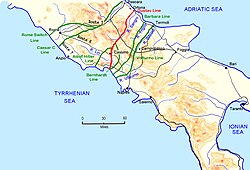
[[File:ItalyDefenseLinesSouthofRome1943 4.jpg|thumb|right|305px|German prepared defensive lines south of Rome]] | [[File:ItalyDefenseLinesSouthofRome1943 4.jpg|thumb|right|305px|German prepared defensive lines south of Rome]] | ||
{{Campaignbox Italy}} | {{Campaignbox Italy}} | ||
The '''Volturno Line''' (also known as the '''Viktor Line'''; {{ | The '''Volturno Line''' (also known as the '''Viktor Line'''; {{Langx|de|Volturno-Linie, Viktor-Linie}}, {{Langx|it|Linea del Volturno}}) was a [[Wehrmacht|German]] defensive position in [[Italy]] during the [[Italian Campaign (World War II)|Italian Campaign]] of [[World War II]]. | ||
The line ran from [[Termoli]] in the east, along the [[Biferno River]] through the [[Apennine Mountains]] to the [[Volturno|Volturno River]] in the west. | The line ran from [[Termoli]] in the east, along the [[Biferno River]] through the [[Apennine Mountains]] to the [[Volturno|Volturno River]] in the west. | ||
Following the [[Allied invasion of Italy]] in September 1943 the German forces set up a series of defensive lines across Italy, intended to delay the [[Allies of World War II|Allied]] advance. The '''Volturno Line''' was the southernmost of these. | Following the [[Allied invasion of Italy]] in September 1943 the [[Wehrmacht|German forces]] set up a series of defensive lines across Italy, intended to delay the [[Allies of World War II|Allied]] advance. The '''Volturno Line''' was the southernmost of these. | ||
==Eighth Army on the River Biferno (Battle of Termoli)== | ==Eighth Army on the River Biferno (Battle of Termoli)== | ||
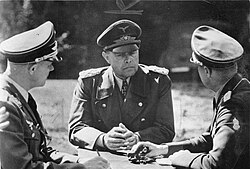
[[File:Bundesarchiv Bild 183-2005-0103-505, Albert Kesselring.jpg|left|thumb|German supreme commander in Italy—[[Generalfeldmarschall|''Generalfeldmarshall'']] [[Albert Kesselring]] (1940).]] | [[File:Bundesarchiv Bild 183-2005-0103-505, Albert Kesselring.jpg|left|thumb|German supreme commander in Italy—[[Generalfeldmarschall|''Generalfeldmarshall'']] [[Albert Kesselring]] (1940).]] | ||
{{main|Operation Devon}} | {{main|Operation Devon}} | ||
As a response to the increasing Allied pressure on the Adriatic front, on October | As a response to the increasing Allied pressure on the Adriatic front, on October 1 the German supreme commander in Italy—[[Generalfeldmarschall|''Generalfeldmarshall'']] [[Albert Kesselring]]—ordered the [[16th Infantry Division (Wehrmacht)|16th Panzer Division]] to switch to the Adriatic front. Elements of the [[78th Infantry Division (United Kingdom)|British 78th Infantry Division]]'s [[11th Infantry Brigade and Headquarters South East|11th Brigade]] infantry crossed the Biferno at dawn on 3 October 1943 following an amphibious landing at Termoli by [[British Commandos]] at 02:15.<ref>Ford, p116</ref> By late morning, the two elements had linked up and that night 78th Division's [[36th Infantry Brigade (United Kingdom)|36th Brigade]] were able to be landed by sea at [[Termoli]]. However, logistical problems had prevented the [[Allies of World War II|Allies]] building a heavy duty bridge across the Biferno and when the bulldozed fords were made unusable after 5 tanks had crossed, there was no way to get more tanks across the river to support the infantry. A lighter weight FBE bridge was built to allow artillery, reconnaissance, and other vehicles to cross. The move east of [[16th Infantry Division (Wehrmacht)|16th Panzer Division]] presented a major and unforeseen threat to the unsupported Allied infantry. As news of the German armour's arrival came in on 4 October, 78th Division's commander— [[Major-general (United Kingdom)|Major-General]] [[Vyvyan Evelegh]]—demanded priority from [[Eighth Army (United Kingdom)|British Eighth Army]], under [[General (United Kingdom)|General]] [[Bernard Montgomery]], for bridging equipment.<ref>Ford, p130</ref> As more German armour arrived, the Allied troops across the Biferno were forced onto the defensive. By the afternoon of 5 October, they had been squeezed back to within {{convert|.5|mi|km|abbr=on}} of Termoli.<ref>Ford, p 136</ref> However, at the same time frantic round the clock efforts by engineers had resulted in a heavyweight [[Bailey bridge]] being completed, allowing Canadian and British armour to cross the Biferno. That evening, 78th Division's [[38th (Irish) Brigade]] arrived by sea at Termoli and the German attack the following morning was narrowly repulsed in desperate fighting. By late morning on 6 October, the Allies were on the attack and by late afternoon the Germans had started to fall back to the next prepared defences on the [[Trigno|River Trigno]], the [[Barbara Line]].<ref>Ford, 9137-141</ref> | ||
==Fifth Army on the River Volturno== | ==Fifth Army on the River Volturno== | ||
{{Expand section|examples and additional citations|date=July | {{Expand section|examples and additional citations|date=July 2011}} | ||
[[File:Volturno2Mignano12Oct15Nov1943.jpg|thumb|320px|right|Summary of [[United States Army North|U.S. Fifth Army]] Operations, Italy 12 October to 15 November 1943.]] | [[File:Volturno2Mignano12Oct15Nov1943.jpg|thumb|320px|right|Summary of [[United States Army North|U.S. Fifth Army]] Operations, Italy 12 October to 15 November 1943.]] | ||
| Line 38: | Line 39: | ||
[[Category:German World War II defensive lines]] | [[Category:German World War II defensive lines]] | ||
[[Category:Italian campaign (World War II)]] | [[Category:Italian campaign (World War II)]] | ||
[[Category: | [[Category:Battles and operations of the Italian campaign (World War II)]] | ||
[[Category:World War II sites in Italy]] | [[Category:World War II sites in Italy]] | ||
Latest revision as of 05:25, 9 January 2026

The Volturno Line (also known as the Viktor Line; German: Volturno-Linie, Viktor-Linie, Italian: Linea del Volturno) was a German defensive position in Italy during the Italian Campaign of World War II.
The line ran from Termoli in the east, along the Biferno River through the Apennine Mountains to the Volturno River in the west.
Following the Allied invasion of Italy in September 1943 the German forces set up a series of defensive lines across Italy, intended to delay the Allied advance. The Volturno Line was the southernmost of these.
Eighth Army on the River Biferno (Battle of Termoli)[edit | edit source]

As a response to the increasing Allied pressure on the Adriatic front, on October 1 the German supreme commander in Italy—Generalfeldmarshall Albert Kesselring—ordered the 16th Panzer Division to switch to the Adriatic front. Elements of the British 78th Infantry Division's 11th Brigade infantry crossed the Biferno at dawn on 3 October 1943 following an amphibious landing at Termoli by British Commandos at 02:15.[1] By late morning, the two elements had linked up and that night 78th Division's 36th Brigade were able to be landed by sea at Termoli. However, logistical problems had prevented the Allies building a heavy duty bridge across the Biferno and when the bulldozed fords were made unusable after 5 tanks had crossed, there was no way to get more tanks across the river to support the infantry. A lighter weight FBE bridge was built to allow artillery, reconnaissance, and other vehicles to cross. The move east of 16th Panzer Division presented a major and unforeseen threat to the unsupported Allied infantry. As news of the German armour's arrival came in on 4 October, 78th Division's commander— Major-General Vyvyan Evelegh—demanded priority from British Eighth Army, under General Bernard Montgomery, for bridging equipment.[2] As more German armour arrived, the Allied troops across the Biferno were forced onto the defensive. By the afternoon of 5 October, they had been squeezed back to within .5 mi (0.80 km) of Termoli.[3] However, at the same time frantic round the clock efforts by engineers had resulted in a heavyweight Bailey bridge being completed, allowing Canadian and British armour to cross the Biferno. That evening, 78th Division's 38th (Irish) Brigade arrived by sea at Termoli and the German attack the following morning was narrowly repulsed in desperate fighting. By late morning on 6 October, the Allies were on the attack and by late afternoon the Germans had started to fall back to the next prepared defences on the River Trigno, the Barbara Line.[4]
Fifth Army on the River Volturno[edit | edit source]
![[icon]](/wiki/File:Wiki_letter_w_cropped.svg) | This section needs expansion with: examples and additional citations. You can help by adding to it. (July 2011) |

On the other coast, the U.S. Fifth Army, commanded by Lieutenant General Mark W. Clark, attacked across the Volturno on the night of 12 October.[5] The Germans, using rearguard tactics, succeeded in slowing the American advance. They skillfully utilized the terrain, which was favourable for defence, to conduct a fighting withdrawal to the next line north (the Barbara Line) which the Allies reached by 2 November.
Bibliography[edit | edit source]
- Clark, LLoyd (2006). Anzio: The Friction of War. Italy and the Battle for Rome 1944. London: Headline Publishing Group. ISBN 978-0-7553-1420-1.
- Fifth Army Historical Section (1990) [1945]. From the Volturno to the Winter Line 6 October-15 November 1943. American Forces in Action series. Washington: United States Army Center of Military History. ISBN 0-16-001999-0. CMH Pub 100-8.
- Ford, Ken (2003) [1999]. Battleaxe Division. Stroud, Gloucestershire: Alan Sutton. ISBN 0-7509-1893-4.
- Smith, Col. Kenneth V. (c. 1990). Naples-Foggia 9 September 1943-21 January 1944. World War II Campaigns. Washington: United States Army Center of Military History. CMH Pub 72-17. Archived from the original on 6 September 2016. Retrieved 1 July 2010.