




Ajay Kumar (talk | contribs) Created a new article |
mNo edit summary |
||
| Line 1: | Line 1: | ||
{{ | {{Short description|High-capacity public transport}} | ||
{{other uses|Rapid transit (disambiguation)}} | {{About|metro rail, a type of rapid, high-capacity public transport system|other uses|Metrorail (disambiguation){{!}}Metrorail}} | ||
{{ | {{Redirect2|Mass rapid transit|Metropolitan train|other uses|Mass rapid transit (disambiguation)|and|Rapid transit (disambiguation)|the German train service|Metropolitan Express Train}} | ||
{{multiple image | |||
| total_width = 320px | |||
[[ | | perrow = 1/2/2 | ||
[[ | | image1 = Seoul-metro-2009-20180916-103548.jpg | ||
| image2 = R211 A train approaching 80th Street August 2025.jpg | |||
| image3 = London Underground 2009 Stock front.jpg | |||
| image4 = Toronto Rocket.JPG | |||
| image5 = Armênia metro station 2017 7.jpg | |||
| footer = From top, left to right: an [[Seoul Metro]] Class 2000 series 10-car EMU set 2x09 leaving [[Hanyang University Station]] on the Seoul Metro Line 2 in Seongdong-gu, Seoul; a [[R211 (New York City Subway car)|R211]] [[A (New York City Subway service)|A]] train at [[80th Street station (IND Fulton Street Line)|80th Street station]] of the [[New York City Subway]]; train at [[Green Park tube station]] on the [[Victoria line]] of the [[London Underground]]; a train at [[Rosedale station (Toronto)|Rosedale station]] on [[Line 1 Yonge–University|Line 1]] of the [[Toronto subway]]; a southbound [[Line 1 (São Paulo Metro)|Line 1]] train on the [[São Paulo Metro]]}} | |||
'''Rapid transit''' | '''Rapid transit''', '''mass rapid transit''' ('''MRT''') or '''rail rapid transit''' ('''RRT'''){{efn|to distinguish it from "bus rapid transit"}}<ref name="BRRT2018">{{cite book |last1=Ingvardson |first1=Jesper Bláfoss |last2=Nielsen |first2=Otto Anker |title=Effects of new bus and rail rapid transit systems – an international review |date=2018 |volume=38 |pages=96–116 |doi=10.1080/01441647.2017.1301594 |url=https://orbit.dtu.dk/en/publications/effects-of-new-bus-and-rail-rapid-transit-systems-an-internationa |access-date=12 August 2025}}</ref><ref name="ATC1976">{{cite book |title=Automatic Train Control in Rail Rapid Transit |date=1976 |publisher=U.S. Congress, Office of Technology Assessment |url=https://books.google.com/books?id=6rMAAAAAMAAJ |language=en}}</ref> and commonly referred to as '''metro''', is a type of high-capacity [[public transport]] that is generally built in [[urban area]]s. A [[grade separation|grade separated]] rapid transit line below ground surface through a [[tunnel]] can be regionally called a '''subway''', '''tube''', '''metro''' or '''underground'''.<ref name="miriamwebster">{{cite web|url=http://www.merriam-webster.com/dictionary/rapid%20transit|title=Rapid transit|publisher=[[Merriam-Webster]]|access-date=2013-07-31|archive-url=https://web.archive.org/web/20130720025558/http://www.merriam-webster.com/dictionary/rapid%20transit|archive-date=2013-07-20|url-status=live}}</ref><ref name="IUTPMetro">{{cite web|url=http://ftp.uitfp.org/ftproot/euroteam/YVA/URP_Fundamental_Requirements_EN.pdf|title=Recommended basic reference for developing a minimum set of standards for voluntary use in the field of urban rail, according to mandate M/486|author=UITP|year=2011|access-date=2014-02-16|archive-url= https://web.archive.org/web/20140222133945/http://ftp.uitp.org/ftproot/euroteam/YVA/URP_Fundamental_Requirements_EN.pdf|archive-date=2014-02-22|url-status=usurped}}</ref><ref name=aptaglossary>{{cite web|url=http://www.apta.com/resources/reportsandpublications/Documents/Transit_Glossary_1994.pdf|title=Glossary of Transit Terminology|publisher=[[American Public Transportation Association]]|access-date=2013-07-31|archive-url=https://web.archive.org/web/20130512230056/http://www.apta.com/resources/reportsandpublications/Documents/Transit_Glossary_1994.pdf|archive-date=2013-05-12|url-status=live}}</ref><ref name="mrt">{{cite journal |title=Mass rapid transit systems for cities in the developing world |year=2003 |url=https://www.tandfonline.com/doi/pdf/10.1080/0144164032000083095 |publisher=Taylor & Francis Online |doi=10.1080/0144164032000083095 |access-date=2 April 2023 |last1=Fouracre |first1=Phil |last2=Dunkerley |first2=Christian |last3=Gardner |first3=Geoff |journal=Transport Reviews |volume=23 |issue=3 |pages=299–310 |s2cid=154931412 |url-access=subscription }}</ref> They are sometimes grade-separated on [[elevated railway]]s, in which case some are referred to as '''elevated''', '''el''' or '''L trains''' – short for "elevated" – or '''skytrains'''. A common alternative term for rapid transit in North America is '''heavy rail'''.{{efn|"Heavy rail" term in North America refers to mass rapid transit (subway/metro) systems while "heavy rail" term refers globally to both main line/branch line freight rail and passenger rail (commuter, regional, intercity and high-speed) other than large-capacity metro and nationally/internationally operated but still a subject of debate.}}<ref name="EnBr">{{cite web |title=Mass transit - Urban Mobility, Efficiency, Environment |url=https://www.britannica.com/topic/mass-transit/The-benefits-of-urban-mass-transit |website=Britannica |access-date=29 September 2024 |language=en |date=4 September 2024}}</ref><ref name="APTA">{{cite web |title=Fact Book Glossary |url=https://www.apta.com/research-technical-resources/transit-statistics/public-transportation-fact-book/fact-book-glossary/ |website=American Public Transportation Association |access-date=29 September 2024}}</ref> Rapid transit systems are usually [[electric railway]]s that, unlike [[bus]]es or [[tram]]s, operate on an exclusive [[right-of-way (transportation)|right-of-way]], which cannot be accessed by pedestrians or other vehicles.<ref name="Britannica">{{cite web|url=http://www.britannica.com/EBchecked/topic/491506/rapid-transit|title=Rapid Transit|publisher=[[Encyclopædia Britannica]]|access-date=2014-11-28|archive-url=https://web.archive.org/web/20141017033402/http://www.britannica.com/EBchecked/topic/491506/rapid-transit|archive-date=2014-10-17|url-status=live}}</ref> | ||
Modern services on rapid transit systems are provided on designated lines between [[ | Modern services on rapid transit systems are provided on designated lines between [[metro station|stations]] typically using [[electric multiple unit]]s on [[railway track]]s. Some systems use [[rubber-tyred metro|guided rubber tires]], magnetic levitation (''[[maglev]]''), or [[monorail]]. The stations typically have high platforms, without steps inside the trains, requiring custom-made trains in order to minimize gaps between train and platform. They are typically integrated with other public transport and often operated by the same [[transit authority|public transport authorities]]. Some rapid transit systems have at-grade intersections between a rapid transit line and a road or between two rapid transit lines.<ref name="UrbanRail.net">{{cite web|url=http://www.urbanrail.net/am/chic/chicago.htm|title=Chicago|access-date=2015-04-24|archive-url=https://web.archive.org/web/20150416074705/http://www.urbanrail.net/am/chic/chicago.htm|archive-date=2015-04-16|url-status=live}}</ref> | ||
The world's first rapid transit system was the partially underground [[Metropolitan Railway]] which opened in 1863 using [[steam locomotive]]s, and now forms part of the [[London Underground]].<ref name=150Anniv>{{Cite book |url=http://www.tfl.gov.uk/corporate/modesoftransport/londonunderground/1604.aspx |title=London Underground: History|author=Transport for London |isbn=978-0-904711-30-1 |access-date=2013-01-02 |archive-url=https://web.archive.org/web/20130116190701/http://www.tfl.gov.uk/corporate/modesoftransport/londonunderground/1604.aspx |archive-date=2013-01-16 |url-status=dead|year=1981}}</ref> In 1868, New York opened the elevated [[IRT Ninth Avenue Line|West Side and Yonkers Patent Railway]], initially a cable-hauled line using | The world's first rapid transit system was the partially underground [[Metropolitan Railway]] which opened in 1863 using [[steam locomotive]]s, and now forms part of the [[London Underground]].<ref name=150Anniv>{{Cite book |url=http://www.tfl.gov.uk/corporate/modesoftransport/londonunderground/1604.aspx |title=London Underground: History|author=Transport for London |isbn=978-0-904711-30-1 |access-date=2013-01-02 |archive-url=https://web.archive.org/web/20130116190701/http://www.tfl.gov.uk/corporate/modesoftransport/londonunderground/1604.aspx |archive-date=2013-01-16 |url-status=dead|year=1981|publisher=Capital Transport }}</ref> In 1868, New York opened the elevated [[IRT Ninth Avenue Line|West Side and Yonkers Patent Railway]], initially a cable-hauled line using [[stationary steam engine]]s. | ||
==Terminology== | ==Terminology== | ||
{{Main|Passenger rail terminology}} | |||
{{Train topics}} | {{Train topics}} | ||
{{ | The term ''Metro'' is the most commonly used term for underground rapid transit systems used by non-native English speakers.<ref>Fjellstrom&Wright, 2002: p. 2</ref> Rapid transit systems may be named after the medium by which passengers travel in busy [[central business district]]s; the use of [[tunnel]]s inspires names such as ''subway'',<ref>{{cite book|title=The American Heritage Dictionary of the English Language|edition=Fourth|publisher=Houghton Mifflin Company|isbn=978-0-618-08230-8|author=Executive ed.: Joseph P. Pickert...|year=2000}}</ref> ''underground'',<ref>{{cite web|title=Definition of "Underground"|publisher=Chambers Reference Online|url=http://www.chambersharrap.co.uk/chambers/features/chref/chref.py/main?query=Underground&title=21st|access-date=2006-11-28|archive-url=https://web.archive.org/web/20070930015654/http://www.chambersharrap.co.uk/chambers/features/chref/chref.py/main?query=Underground&title=21st|archive-date=2007-09-30|url-status=live}}</ref> ''{{Lang|de|Untergrundbahn}} ([[Rapid-transit in Germany#U-Bahn|U-Bahn]])'' in German,<ref name=white63>White, 2002: 63</ref> or ''{{Lang|sv|Tunnelbana}}'' ''(T-bana)'' in Swedish.<ref name=ovenden93>Ovenden, 2007: 93</ref> The use of [[viaduct]]s inspires names such as ''elevated'' (''L'' or ''el''), ''skytrain'',<ref name=ovenden16>[[Mark Ovenden|Ovenden]], 2007: 16</ref> ''overhead'', ''overground'' or ''{{Lang|de|Hochbahn}}'' in German. One of these terms may apply to an entire system, even if a large part of the network, for example, in outer suburbs, runs at ground level. | ||
[[File: | |||
[[ | === Europe === | ||
{{See also|List of metro systems in Europe}} | |||
==== Britain and Ireland ==== | |||
In most of [[England, Wales and Scotland|Britain]], a ''subway'' is a [[pedestrian underpass]]. The terms ''Underground'' and ''Tube'' are used for the [[London Underground]]. The North East England [[Tyne and Wear Metro]], mostly overground, is known as the ''Metro''. In [[Scotland]], the [[Glasgow Subway]] underground rapid transit system is known as the ''Subway''. In [[Ireland]], the [[Dublin Area Rapid Transit]] is despite the name considered a [[commuter rail]] due to usage of mainline railways. | |||
==== Mainland ==== | |||
[[File:MF01 STIF RATP Ligne 9.jpg|thumb|[[Nation station]], on [[Paris Métro Line 9|Line 9]] of the [[Paris Métro]]]] | |||
In France, large cities, such as [[Paris Metro|Paris]], [[Marseille Metro|Marseille]], [[Toulouse Metro|Toulouse]] and [[Lyon Metro|Lyon]], use the term {{lang|fr|métro}}. Also the smaller cities of [[Lille Metro|Lille]] and [[Rennes Metro|Rennes]] have a light metro. Furthermore, [[Brussels Metro|Brussels]] in Belgium, and [[Amsterdam Metro|Amsterdam]] and [[Rotterdam Metro|Rotterdam]] in the Netherlands also use ''métro'' or ''metro'' for their systems. | |||
Several [[Southern Europe]]an countries also use the term ''metro'' ([[Iberian Peninsula]]) or {{lang|it|metropolitana}} (Italy) for rapid transit. In Spain, such systems are present in [[Madrid Metro|Madrid]], [[Barcelona Metro|Barcelona]], [[Bilbao metro|Bilbao]] and [[Metrovalencia|Valencia]]. In Portugal, [[Lisbon Metro|Lisbon]], [[Porto]] and [[Almada]] (which is part of the Lisbon metropolitan area but has a separate light-rail system) have a metro, while [[Coimbra]] has a Bus Rapid Transit system branded as a metro. The Italian cities of [[Catania Metro|Catania]], [[Genoa Metro|Genoa]], [[Milan Metro|Milan]], [[Naples Metro|Naples]], [[Rome Metro|Rome]], [[Brescia Metro|Brescia]] and [[Turin Metro|Turin]] also have rapid transit systems. | |||
In Germany and Austria their rapid transit is known as ''[[U-Bahn]]'', which are often supported by ''[[S-Bahn]]'' systems. In Germany, ''U-Bahn'' systems exist in [[Berlin U-Bahn|Berlin]], [[Hamburg U-Bahn|Hamburg]], [[Munich U-Bahn|Munich]], [[Nuremberg U-Bahn|Nuremberg]] and [[Fürth]], while in Austria such a system exists in [[Vienna U-Bahn|Vienna]]. In addition, the small, car-free town of [[Serfaus]] in the Austrian state of [[Tyrol (state)|Tyrol]] also features a short ''[[U-Bahn Serfaus|U-Bahn]]'' line. There are no ''U-Bahn'' systems in the [[German language|German-speaking]] part of Switzerland, but the city of [[Lausanne]] has its own, small [[Lausanne Métro|métro]] system. In Zurich, Switzerland's largest city, a project for a ''[[Zurich Underground Railway|U-Bahn]]'' network was stopped by a referendum in the 1970s and instead its ''[[Zurich S-Bahn|S-Bahn]]'' system was developed further. Other [[Central Europe]]an countries also have metro lines, for example in the cities of [[Budapest Metro|Budapest]] (Hungary), where it is called {{lang|hu|metró}}, [[Prague Metro|Prague]] (Czech Republic) and [[Warsaw Metro|Warsaw]] (Poland) – the latter two systems also use the term ''metro''. | |||
In [[Eastern Europe]], metro systems are in operation in [[Minsk Metro|Minsk]] (Belarus, called {{lang|be|mietrapaliten}}), [[Kyiv Metro|Kyiv]] (Ukraine, called {{lang|uk|metropoliten}}), [[Moscow Metro|Moscow]] (Russia, called {{lang|ru|metropoliten}}), [[Saint Petersburg Metro|Saint Petersburg]] (Russia), [[Kazan Metro|Kazan]] (Russia), [[Nizhny Novgorod Metro|Nizhny Novgorod]] (Russia), [[Samara Metro|Samara]] (Russia), [[Yekaterinburg Metro|Yekaterinburg]] (Russia), [[Novosibirsk Metro|Novosibirsk]] (Russia). | |||
In [[Southeastern Europe]]an countries, the term ''metro'' is common for rapid transit systems, which exist in [[Athens Metro|Athens]] and [[Thessaloniki Metro|Thessaloniki]] (Greece), [[Belgrade Metro|Belgrade]] (Serbia, currently under construction), [[Sofia Metro|Sofia]] (Bulgaria), [[Istanbul Metro|Istanbul]] (Turkey, called {{lang|tr|metro}}) and [[Baku Metro|Baku]] (Azerbaijan). | |||
In [[Northern Europe]], rapid transit systems are called ''metro'' in [[Copenhagen Metro|Copenhagen]] (Denmark) and [[Helsinki Metro|Helsinki]] (Finland), while they are referred to as {{lang|no|T-bane (tunnelbane)}} in [[Oslo Metro|Oslo]] (Norway) and {{lang|sv|tunnelbana}} in [[Stockholm Metro|Stockholm]] (Sweden). | |||
=== North America === | |||
Various terms are used for rapid transit systems around [[North America]]. The term ''metro'' is primarily used to describe non-English systems, such as the [[Mexico City Metro]] and the [[Montreal Metro]], although the term is often used in English as well, as is the case for [[Los Angeles Metro Rail]] and the [[Washington Metro]], among others. The term "subway" is more commonly used to describe rail rapid transit in English, despite few systems being known by the term. Systems known for their elevated character are often referred to as "the El", "the L", or as a "skytrain," with examples including the [[Chicago "L"]] and [[Vancouver SkyTrain]]. Metro is also used as a shortened reference to a [[metropolitan area]], with some systems referencing this in their names, with the REM (Réseau express métropolitain) and [[Metra]] (Metropolitan Rail) suburban rail in Chicago (despite the latter not being rapid transit at all). [[MBTA subway|Boston's subway system]] is known locally as "The T". In [[Atlanta]], the [[Metropolitan Atlanta Rapid Transit Authority]] goes by the acronym "MARTA." In the [[San Francisco Bay Area]], residents refer to [[Bay Area Rapid Transit]] by its acronym "BART".<ref>{{cite web |date=2013-11-03 |title=DC Metro System Fast Facts |url=https://edition.cnn.com/2013/11/03/us/dc-metro-system-fast-facts/ |url-status=live |archive-url=https://web.archive.org/web/20160124122948/http://edition.cnn.com/2013/11/03/us/dc-metro-system-fast-facts/ |archive-date=2016-01-24 |access-date=2015-07-20 |publisher=[[CNN.com|CNN]]}}</ref><ref>{{Cite web |title=Transportation Basics: How to Use BART |url=https://www.sftravel.com/article/transportation-basics-how-use-bart |access-date=2022-11-03 |website=San Francisco Travel |language=en}}</ref> | |||
The | The [[New York City Subway]] is referred to simply as "the subway", despite 40% of the system running above ground. The term "L" or "El" is not used for elevated lines in general as the lines in the system are already designated with letters and numbers. The "L" train or [[L (New York City Subway service)]] refers specifically to the 14th Street–Canarsie Local line, and not other elevated trains. Similarly, the Toronto Subway is referred to as "the subway", with some of its system also running above ground. These are the only two [[North America]]n systems that are primarily called "subways". | ||
[[File:Victorino de la Plaza Inaugura Subte 1913.JPG|thumb|Inauguration of the [[Buenos Aires Underground]] in 1913.]] | |||
=== Latin America === | |||
In [[Buenos Aires Underground|Buenos Aires]] the first stretch of underground urban railway opened in 1913, as part of Line A. Vice president [[Victorino de la Plaza]] attended the inauguration. | |||
=== Asia === | |||
[[File:Putrajaya Line Train Set 216.jpg|thumb|[[Putrajaya Line]] in Kuala Lumpur, Malaysia]] | |||
In most of [[Southeast Asia]] and in [[Taiwan]], rapid transit systems are primarily known by the [[acronym]] ''MRT''. The meaning varies from one country to another. In [[Indonesia]], the acronym stands for ''[[Jakarta MRT|Moda Raya Terpadu]]'' or ''Integrated Mass [Transit] Mode'' in English.<ref>{{cite news|url=https://m.merdeka.com/jakarta/tarif-belum-diketok-warga-masih-bisa-nikmati-mrt-cuma-cuma-sampai-akhir-maret.html|title=Tarif Belum Diketok, Warga Masih Bisa Nikmati MRT Cuma-cuma Sampai Akhir Maret|newspaper=Merdeka.com|access-date=2017-12-22|language=id}}</ref> In the [[Philippines]], it stands for ''[[Manila Metro Rail Transit System|Metro Rail Transit]]''.<ref>{{cite web |url=http://dotcmrt3.gov.ph/about.php?route=7 |title=About Us – MRT3 Stations |publisher=Metro Rail Transit |access-date=2014-06-08 |url-status=dead |archive-url=https://web.archive.org/web/20130122003116/http://dotcmrt3.gov.ph/about.php?route=7 |archive-date=2013-01-22}}</ref> [[Makati Intra-city Subway|Two]] underground [[Metro Manila Subway|lines]] use the term ''subway''. In [[Thailand]], it stands for ''[[MRT (Bangkok)|Metropolitan Rapid Transit]]'', previously using the ''Mass Rapid Transit'' name.<ref>{{cite web|url=https://bem.listedcompany.com/misc/presentation/20190311-bem-presentation-march-2019-02.pdf|title=BEM Investor presentation}}</ref> Outside of Southeast Asia, [[Taichung]], [[Kaohsiung]] and [[Taoyuan, Taiwan]], have their own ''MRT'' systems which stands for ''Mass Rapid Transit'', as with [[Singapore]] and [[Malaysia]].<ref>{{cite web|url=http://www2.dorts.gov.tw/news/newsletter/ns245/rp245_03.htm|script-title=zh:桃園都會區大眾捷運系統|publisher=Department of Rapid Transit Systems|language=zh|date=2008-07-01|access-date=2010-06-19|archive-date=2011-04-05|archive-url=https://web.archive.org/web/20110405183548/http://www2.dorts.gov.tw/news/newsletter/ns245/rp245_03.htm|url-status=dead}}</ref><ref>[http://www.kcg.gov.tw/~mtbu/html/promote/history.php KMRT History – Kaohsiung City Mass Rapid Transit Bureau official site (Traditional Chinese)] {{webarchive|url=https://web.archive.org/web/20140819082322/http://www.kcg.gov.tw/~mtbu/html/promote/history.php |date=2014-08-19 }}</ref><ref>{{cite book|last1=Seah C. M.|url=http://eservice.nlb.gov.sg/item_holding_s.aspx?bid=4183690|title=Southeast Asian Affairs.|date=1981 |location=Singapore |publisher=Institute of Southeast Asian Studies|page=293}}</ref><ref>{{Cite web |last=Pillay |first=Suzanna |date=2017-07-16 |title=MRT line a game-changer {{!}} New Straits Times |url=https://www.nst.com.my/news/exclusive/2017/07/257695/mrt-line-game-changer |access-date=2024-04-19 |website=NST Online |language=en}}</ref> | |||
In | === Broader definition === | ||
In general rapid transit is a synonym for "metro" type transit, though sometimes rapid transit is defined to include "metro", commuter trains and grade-separated [[light rail]].<ref name="CT77">{{cite book |last1=Weigelt |first1=Horst |last2=Weiss |first2=Helmut H. |last3=Götz |first3=Rainer E. |title=City Traffic: A Systems Digest |date=1977 |publisher=Van Nostrand Reinhold |isbn=978-0-442-29259-1 |page=75 |url=https://books.google.com/books?id=xPskAQAAMAAJ |language=en}}</ref> Also high-capacity bus-based transit systems can have features similar to "metro" systems.<ref>[https://itdp.org/library/standards-and-guides/the-bus-rapid-transit-standard/what-is-brt/ What is BRT?], ''Institute for Transportation & Development Policy''</ref> | |||
==History== | ==History== | ||
[[File:Constructing the Metropolitan Railway.jpg|thumb|Construction of London's [[Metropolitan Railway]] at [[King's Cross St Pancras tube station|King's Cross St Pancras]] in 1861]] | |||
{{Main|History of rapid transit}} | {{Main|History of rapid transit}} | ||
The opening of London's steam-hauled [[Metropolitan Railway]] in 1863 marked the beginning of rapid transit. Initial experiences with steam engines, despite ventilation, were unpleasant. Experiments with [[pneumatic railway]]s failed in their extended adoption by cities. | The opening of London's steam-hauled [[Metropolitan Railway]] in 1863 marked the beginning of rapid transit. Initial experiences with steam engines, despite ventilation, were unpleasant. Experiments with [[pneumatic railway]]s failed in their extended adoption by cities. | ||
| Line 39: | Line 67: | ||
In 1890, the [[City & South London Railway]] was the first electric-traction rapid transit railway, which was also fully underground.<ref name=Ovenden7>Ovenden, 2007: 7</ref> Prior to opening, the line was to be called the "City and South London Subway", thus introducing the term Subway into railway terminology.<ref>Emmerson, Andrew (2010). ''The London Underground''. London: Shire Publications Ltd. p. 13. {{ISBN|978-0-74780-790-2}}.</ref> Both railways, alongside others, were eventually merged into [[London Underground]]. The 1893 [[Liverpool Overhead Railway]] was designed to use electric traction from the outset.<ref>{{cite web |last=Bolger |first=Paul |title=Site Name: Liverpool Overhead Railway & Dingle Station |publisher=Subterranea Britannica |date=2004-11-22 |url=http://www.subbrit.org.uk/sb-sites/sites/l/liverpool_overhead_railway/index.shtml |access-date=2007-09-19 |archive-url=https://web.archive.org/web/20121122042759/http://www.subbrit.org.uk/sb-sites/sites/l/liverpool_overhead_railway/index.shtml |archive-date=2012-11-22 |url-status=live }}</ref> | In 1890, the [[City & South London Railway]] was the first electric-traction rapid transit railway, which was also fully underground.<ref name=Ovenden7>Ovenden, 2007: 7</ref> Prior to opening, the line was to be called the "City and South London Subway", thus introducing the term Subway into railway terminology.<ref>Emmerson, Andrew (2010). ''The London Underground''. London: Shire Publications Ltd. p. 13. {{ISBN|978-0-74780-790-2}}.</ref> Both railways, alongside others, were eventually merged into [[London Underground]]. The 1893 [[Liverpool Overhead Railway]] was designed to use electric traction from the outset.<ref>{{cite web |last=Bolger |first=Paul |title=Site Name: Liverpool Overhead Railway & Dingle Station |publisher=Subterranea Britannica |date=2004-11-22 |url=http://www.subbrit.org.uk/sb-sites/sites/l/liverpool_overhead_railway/index.shtml |access-date=2007-09-19 |archive-url=https://web.archive.org/web/20121122042759/http://www.subbrit.org.uk/sb-sites/sites/l/liverpool_overhead_railway/index.shtml |archive-date=2012-11-22 |url-status=live }}</ref> | ||
The technology quickly spread to other [[List of metro systems in Europe|cities in Europe]], the United States, Argentina, and Canada, with some railways being converted from steam and others being designed to be electric from the outset. [[Budapest]], [[Chicago]], [[Glasgow]] and [[New York City]] all converted or purpose-designed and built electric rail services.<ref>{{cite encyclopedia|url=http://www.britannica.com/eb/article-9070117/subway|title=Subway|encyclopedia=Encyclopædia Britannica online|access-date=2006-12-02|archive-url=https://web.archive.org/web/20061220144312/http://www.britannica.com/eb/article-9070117/subway|archive-date=2006-12-20|url-status=live}}</ref> | The technology quickly spread to other [[List of metro systems in Europe|cities in Europe]], the [[United States]], [[Argentina]], and [[Canada]], with some railways being converted from steam and others being designed to be electric from the outset. [[Budapest]], [[Chicago]], [[Glasgow]], [[Boston]], [[Buenos Aires]] and [[New York City]] all converted or purpose-designed and built electric rail services.<ref>{{cite encyclopedia|url=http://www.britannica.com/eb/article-9070117/subway|title=Subway|encyclopedia=Encyclopædia Britannica online|access-date=2006-12-02|archive-url=https://web.archive.org/web/20061220144312/http://www.britannica.com/eb/article-9070117/subway|archive-date=2006-12-20|url-status=live}}</ref> | ||
Advancements in technology have allowed new automated services. Hybrid solutions have also evolved, such as [[tram-train]] and [[premetro]], which incorporate some of the features of rapid transit systems.<ref name="Ovenden7" / | [[File:The Home Front in Britain during the Second World War HU44272.jpg|thumb|[[Aldwych tube station]] in London being used as a bomb shelter in 1940]] | ||
Advancements in technology have allowed new automated services. Hybrid solutions have also evolved, such as [[tram-train]] and [[premetro]], which incorporate some of the features of rapid transit systems.<ref name="Ovenden7" /> | |||
Since the 1960s, many new systems | [[File:Metro in the World.svg|upright=1.3|thumb|Rapid transit systems in 2024.<ref>{{Cite web |title=urbanrail.net > metro - subway - light rail |url=http://www.urbanrail.net |website=urbanrail.net}}</ref>]] | ||
Since the 1960s, many new systems have been introduced in [[Europe]], [[Asia]] and [[Latin America]].<ref name=white63 /> In the 21st century, most new expansions and systems are located in Asia, with China becoming the world's leader in metro expansion, operating some of the largest and busiest systems while possessing almost 60 cities that are operating, constructing or planning a [[Urban rail transit in China|rapid transit system]].<ref>{{Cite news|url=https://www.itdp.org/2017/02/17/rapid-transit-trends/|title=Rapid Transit Trends Show Record Growth in 2016, with Huge Increases in China, Brazil – Institute for Transportation and Development Policy|date=2017-02-17|work=Institute for Transportation and Development Policy|access-date=2018-09-01|language=en-US|archive-url=https://web.archive.org/web/20180805112927/https://www.itdp.org/2017/02/17/rapid-transit-trends/|archive-date=2018-08-05|url-status=live}}</ref><ref>{{Cite news|url=https://www.thetransportpolitic.com/2018/01/17/in-response-to-growth-chinese-cities-choose-metros/|title=In response to growth, Chinese cities choose metros|date=2018-01-17|work=The Transport Politic|access-date=2018-09-01|language=en-US|archive-url=https://web.archive.org/web/20180907234018/https://www.thetransportpolitic.com/2018/01/17/in-response-to-growth-chinese-cities-choose-metros/|archive-date=2018-09-07|url-status=live}}</ref> | |||
==Operation== | ==Operation== | ||
Rapid transit is used for local transport in [[city|cities]], [[urban agglomeration|agglomerations]], and [[metropolitan area]]s to transport large numbers of people often short distances at high [[frequency]].<ref name="Britannica"/> The extent of the rapid transit system varies greatly between cities, with several transport strategies.<ref name="mrt"/> | Rapid transit is used for local transport in [[city|cities]], [[urban agglomeration|agglomerations]], and [[metropolitan area]]s to transport large numbers of people often short distances at high [[frequency]].<ref name="Britannica"/><ref name="EU2010">{{cite journal |title=Illustrated Glossary for Transport Statistics - 4th edition |journal=Methodologies and Working Papers |date=1 January 2010 |page=10 |url=https://rosap.ntl.bts.gov/view/dot/48820 |access-date=13 January 2025 |publisher=eurostat |issn=1977-0375}}</ref> The extent of the rapid transit system varies greatly between cities, with several transport strategies.<ref name="mrt"/> | ||
Some systems may extend only to the limits of the inner city, or to its inner ring of [[suburb]]s with trains making frequent station stops. The outer suburbs may then be reached by a separate [[commuter rail]] network where more widely spaced stations allow higher speeds. In some cases the differences between urban rapid transit and suburban systems are not clear.<ref name="aptaglossary" /> | Some systems may extend only to the limits of the inner city, or to its inner ring of [[suburb]]s with trains making frequent station stops. The outer suburbs may then be reached by a separate [[commuter rail]] network where more widely spaced stations allow higher speeds. In some cases the differences between urban rapid transit and suburban systems are not clear.<ref name="aptaglossary" /> | ||
Rapid transit systems may be supplemented by other systems such as [[trolleybus]]es, regular [[bus]]es, [[tram]]s, or commuter rail. This combination of transit modes serves to offset certain limitations of rapid transit such as limited stops and long walking distances between outside access points. Bus or tram feeder systems transport people to rapid transit stops.<ref>Cervero, 1998: 13</ref> | Rapid transit systems may be supplemented by other systems such as [[trolleybus]]es, regular [[bus]]es, [[tram]]s, or commuter rail. This combination of transit modes serves to offset certain limitations of rapid transit such as limited stops and long walking distances between outside access points. Bus or tram feeder systems transport people to rapid transit stops.<ref>Cervero, 1998: 13</ref> | ||
===Records=== | |||
{{As of|2021}}, [[China]] (including [[Hong Kong]] and [[Macau]]) has the largest number of [[List of metro systems|rapid transit systems in the world]]{{Mdash}}40 in number,<ref>{{Cite web|date=2021-03-29|title=Luoyang and Ji'nan open metro lines|url=https://www.railjournal.com/regions/asia/luoyang-and-jinan-open-metro-lines/|access-date=2021-06-07|website=International Railway Journal|language=en}}</ref> running on over {{convert|4,500|km|abbr=in}} of track{{Mdash}}and was responsible for most of the world's rapid-transit expansion in the 2010s.<ref>{{Cite news|url=https://www.itdp.org/2018/07/30/china-drives-rapid-transit-growth/|title=China's Metro Boom Continues to Drive Rapid Transit Growth – Institute for Transportation and Development Policy|date=2018-07-30|work=Institute for Transportation and Development Policy|access-date=2018-11-20|language=en-US|archive-url=https://web.archive.org/web/20181120095357/https://www.itdp.org/2018/07/30/china-drives-rapid-transit-growth/|archive-date=2018-11-20|url-status=live}}</ref><ref>{{Cite web|title = Metro Data|url = http://metro-data.info/|website = metro-data.info|access-date = 2018-09-28|archive-url = https://web.archive.org/web/20180929000328/http://metro-data.info/|archive-date = 2018-09-29|url-status = usurped}}</ref><ref>{{Cite news|url=https://www.itdp.org/2017/02/17/rapid-transit-trends/|title=Rapid Transit Trends Show Record Growth in 2016, with Huge Increases in China, Brazil – Institute for Transportation and Development Policy|date=2017-02-17|work=Institute for Transportation and Development Policy|access-date=2018-11-20|language=en-US|archive-url=https://web.archive.org/web/20181023020236/https://www.itdp.org/2017/02/17/rapid-transit-trends/|archive-date=2018-10-23|url-status=live}}</ref> The world's longest single-operator rapid transit system by [[Network length (transport)|route length]] is the [[Shanghai Metro]].<ref>{{cite magazine|url=http://www.railwaygazette.com/news/single-view/view/10/shanghai-now-the-worlds-longest-metro.html|title=Shanghai now the world's longest metro|magazine=[[Railway Gazette International]]|date=4 May 2010|access-date=2010-05-04|archive-url=https://web.archive.org/web/20100515130655/http://www.railwaygazette.com/news/single-view/view/10/shanghai-now-the-worlds-longest-metro.html|archive-date=15 May 2010|url-status=live}}</ref><ref>{{cite news |last=Smith |first=Stephen J. |url=http://nextcity.org/daily/entry/new-starts-shanghai-metro-worlds-longest-panama-canal-drama-japans-maglev |title=New Starts: Shanghai Metro World's Longest, Panama Canal Drama, Japan's Maglev |newspaper=Next City |date=6 January 2014 |access-date=2014-09-21 |archive-url=https://web.archive.org/web/20140925160200/http://nextcity.org/daily/entry/new-starts-shanghai-metro-worlds-longest-panama-canal-drama-japans-maglev |archive-date=25 September 2014 |url-status=live }}</ref> The world's largest single rapid transit service provider by number of stations (472 stations in total)<ref>{{cite web |url=http://web.mta.info/nyct/facts/ridership/ |title=Facts – Subway and Bus Ridership |publisher=[[Metropolitan Transportation Authority|Metropolitan Transportation Authority (MTA)]] |access-date=2014-09-21 |archive-url=https://web.archive.org/web/20140912073839/http://web.mta.info/nyct/facts/ridership/ |archive-date=2014-09-12 |url-status=live }}</ref> is the [[New York City Subway]]. The [[List of metro systems|busiest rapid transit systems in the world]] by annual ridership are the Shanghai Metro, [[Tokyo subway|Tokyo subway system]], [[Seoul Metro]] and the [[Moscow Metro]]. | |||
<gallery widths="210" heights="180"> | |||
File:Riyadh Metro - innoTrans 2016.jpg|[[Riyadh Metro]] spans 176 kilometers across six lines and includes 85 stations, the longest fully automated system globally. | |||
File:Lauttasaaren metroasema 2.jpg|[[Helsinki Metro]] is the northernmost metro system in the world.<ref>{{Cite web |last1=Ennelin |first1=Esa |url=https://discoverhelsinki.fi/gettingaround/helsinki-metro/ |title=Helsinki Metro – Discover Helsinki |work=Discover Helsinki |date=19 March 2019 |access-date=2020-07-04 |archive-date=2020-07-06 |archive-url=https://web.archive.org/web/20200706060219/https://discoverhelsinki.fi/gettingaround/helsinki-metro/ |url-status=live }}</ref><ref>{{Cite web |url=https://transportationhistory.org/2017/08/02/today-in-transportation-history-1982-the-northernmost-public-transportation-system/ |title=Today in Transportation History – 1982: The Northernmost Public Transportation System |date=2 August 2017 |access-date=2020-07-04 |archive-date=2020-07-05 |archive-url=https://web.archive.org/web/20200705215547/https://transportationhistory.org/2017/08/02/today-in-transportation-history-1982-the-northernmost-public-transportation-system/ |url-status=live }}</ref><ref>{{Cite web |url=https://www.myhelsinki.fi/en/see-and-do/neighbourhoods/8-charming-pictures-from-helsinkis-metro |title=8 charming pictures from Helsinki's metro |access-date=2020-07-04 |archive-date=2020-07-04 |archive-url=https://web.archive.org/web/20200704212905/https://www.myhelsinki.fi/en/see-and-do/neighbourhoods/8-charming-pictures-from-helsinkis-metro |url-status=live }}</ref> | |||
File:DelhiMetroBlueLineBombardier.jpg|[[Delhi Metro]] is the longest metro system in India and South Asia, and the 8th longest metro system in the world, with 390+ km of metro track.{{cn|date=October 2025}} | |||
File:M4 San Babila appena inaugurata.jpg|[[Milan Metro]] is the largest rapid transit system in Italy and the 8th longest in [[Europe]].<ref>{{cite web|url=https://www.milanocittastato.it/trasporti/effetto-m4-la-metro-di-milano-entra-nella-top-europea/?fbclid=IwY2xjawF3U1dleHRuA2FlbQIxMQABHXSpIbaPnyiu6v7H7zI_mDyWgUrPadrCjN6GDzfUhPP2dI-Mfj4jLYBecw_aem__7hUFLg35ygwuZipXbL1Vg#goog_rewarded|title=Effetto M4: la metro di Milano entra nella top europea|date=11 October 2024 |access-date=12 October 2024|language=it}}</ref> | |||
</gallery> | |||
===Lines=== | ===Lines=== | ||
[[File:Ana rosa, São Paulo Metro, Line blue, Brazil.jpg|thumb|[[Ana Rosa (São Paulo Metro)|Ana Rosa station]] platform, [[Line 2 (São Paulo Metro)|line 2]] in [[São Paulo Metro]]]] | [[File:Ana rosa, São Paulo Metro, Line blue, Brazil.jpg|thumb|[[Ana Rosa (São Paulo Metro)|Ana Rosa station]] platform, [[Line 2 (São Paulo Metro)|line 2]] in [[São Paulo Metro]]]] | ||
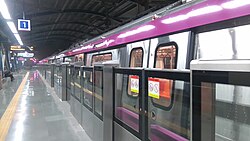
[[File:Delhi Metro - Magenta Line.jpg|thumb|The coaches of the [[Delhi Metro]] are color-coded to indicate different service lines.]] | [[File:Delhi Metro - Magenta Line.jpg|thumb|The coaches of the [[Delhi Metro]] are color-coded to indicate different service lines.]] | ||
Each rapid transit system consists of one or more ''lines'', or circuits. Each line is serviced by at least one specific route with trains stopping at all or some of the line's stations. Most systems operate several routes, and distinguish them by colors, names, numbering, or a combination thereof. Some lines may share track with each other for a portion of their route or operate solely on their own right-of-way. Often a line running through the city center forks into two or more branches in the suburbs, allowing a higher service frequency in the center. This arrangement is used by many systems, such as the [[Copenhagen Metro]],<ref>Ovenden, 2007: 84</ref> the [[Milan Metro]], the [[Oslo Metro]], the [[Istanbul Metro]] and the [[New York City Subway]].<ref>Ovenden, 2007: 32–35</ref> | Each rapid transit system consists of one or more ''lines'', or circuits. Each line is serviced by at least one specific route with trains stopping at all or some of the line's stations. Most systems operate several routes, and distinguish them by colors, names, numbering, or a combination thereof. Some lines may share track with each other for a portion of their route or operate solely on their own right-of-way. Often a line running through the city center forks into two or more branches in the suburbs, allowing a higher service frequency in the center. This arrangement is used by many systems, such as the [[Copenhagen Metro]],<ref>Ovenden, 2007: 84</ref> the [[Milan Metro]], the [[Oslo Metro]], the [[Istanbul Metro]] and the [[New York City Subway]].<ref>Ovenden, 2007: 32–35</ref> | ||
| Line 61: | Line 100: | ||
Alternatively, there may be a single central terminal (often shared with the central railway station), or multiple interchange stations between lines in the city center, for instance in the [[Prague Metro]].<ref>Ovenden, 2007: 95</ref> The [[London Underground]]<ref>Ovenden, 2007: 28–31</ref> and [[Paris Métro]]<ref>Ovenden, 2007: 36–39</ref> are densely built systems with a matrix of crisscrossing lines throughout the cities. The [[Chicago 'L']] has most of its lines converging on [[downtown Chicago|The Loop]], the main business, financial, and cultural area. Some systems have a circular line around the city center connecting to radially arranged outward lines, such as the [[Moscow Metro]]'s [[Koltsevaya Line]] and [[Beijing Subway]]'s [[Line 10, Beijing Subway|Line 10]]. | Alternatively, there may be a single central terminal (often shared with the central railway station), or multiple interchange stations between lines in the city center, for instance in the [[Prague Metro]].<ref>Ovenden, 2007: 95</ref> The [[London Underground]]<ref>Ovenden, 2007: 28–31</ref> and [[Paris Métro]]<ref>Ovenden, 2007: 36–39</ref> are densely built systems with a matrix of crisscrossing lines throughout the cities. The [[Chicago 'L']] has most of its lines converging on [[downtown Chicago|The Loop]], the main business, financial, and cultural area. Some systems have a circular line around the city center connecting to radially arranged outward lines, such as the [[Moscow Metro]]'s [[Koltsevaya Line]] and [[Beijing Subway]]'s [[Line 10, Beijing Subway|Line 10]]. | ||
The capacity of a line is obtained by multiplying the car capacity, the train length, and the [[headway|service frequency]]. Heavy rapid transit trains might have six to twelve cars, while lighter systems may use four or fewer. Cars have a capacity of 100 to 150 passengers, varying with the [[seated to standing ratio]] | The capacity of a line is obtained by multiplying the car capacity, the train length, and the [[headway|service frequency]]. Heavy rapid transit trains might have six to twelve cars, while lighter systems may use four or fewer. Cars have a capacity of 100 to 150 passengers, varying with the [[seated to standing ratio]]{{snd}}more standing gives higher capacity. The minimum time interval between trains is shorter for rapid transit than for mainline railways owing to the use of [[communications-based train control]]: the minimum headway can reach 90 seconds, but many systems typically use 120 seconds to allow for recovery from delays. Typical capacity lines allow 1,200 people per train, giving 36,000 [[passengers per hour per direction]]. However, much higher capacities are attained in [[East Asia]] with ranges of 75,000 to 85,000 people per hour achieved by [[MTR Corporation]]'s urban lines in Hong Kong.<ref>{{Cite web|title=MTR > A Service of World-class Quality|url=https://www.mtr.com.hk/en/corporate/operations/detail_worldclass.html|access-date=2021-06-27|website=www.mtr.com.hk|language=en}}</ref><ref>{{Cite book|last=Runnacles|first=Timothy V.|title=Land-use/Transport Planning in Hong Kong: A Review of Principles and Practices|publisher=Routledge|year=2020|isbn=978-1138361959|editor-last=Dimitriou|editor-first=Harry T.|pages=107|editor-last2=Cook|editor-first2=Alison H.S}}</ref><ref>{{Cite book|last=White|first=Peter|title=Public Transport: Its Planning, Management, and Operation|publisher=Spon Press|year=2002|pages=65–66}}</ref> | ||
====Network topologies==== | ====Network topologies==== | ||
| Line 70: | Line 109: | ||
Ring lines provide good coverage, connect between the radial lines and serve tangential trips that would otherwise need to cross the typically congested core of the network. A rough grid pattern can offer a wide variety of routes while still maintaining reasonable speed and frequency of service.<ref name=Walker>{{cite book|last1=Walker|first1=Jarret|title=Human transit : how clearer thinking about public transit can enrich our communities and our lives|date=2012|publisher=Island Press|location=Washington|isbn=978-1-59726-972-8}}</ref> A study of the 15 world largest subway systems suggested a universal shape composed of a dense core with branches radiating from it.<ref name="Roth">{{cite journal |last1=Roth |first1=C |last2=Kang |first2=SM |last3=Batty |first3=M |last4=Barthelemy |first4=M |title=A long-time limit for world subway networks |journal=Journal of the Royal Society Interface |date=16 May 2012 |volume=9 |issue=75 |pages=2540–2550 |doi=10.1098/rsif.2012.0259 |pmid=22593096 |pmc=3427522 }}</ref> | Ring lines provide good coverage, connect between the radial lines and serve tangential trips that would otherwise need to cross the typically congested core of the network. A rough grid pattern can offer a wide variety of routes while still maintaining reasonable speed and frequency of service.<ref name=Walker>{{cite book|last1=Walker|first1=Jarret|title=Human transit : how clearer thinking about public transit can enrich our communities and our lives|date=2012|publisher=Island Press|location=Washington|isbn=978-1-59726-972-8}}</ref> A study of the 15 world largest subway systems suggested a universal shape composed of a dense core with branches radiating from it.<ref name="Roth">{{cite journal |last1=Roth |first1=C |last2=Kang |first2=SM |last3=Batty |first3=M |last4=Barthelemy |first4=M |title=A long-time limit for world subway networks |journal=Journal of the Royal Society Interface |date=16 May 2012 |volume=9 |issue=75 |pages=2540–2550 |doi=10.1098/rsif.2012.0259 |pmid=22593096 |pmc=3427522 }}</ref> | ||
<gallery heights="200" mode="packed"> | |||
Diameter-line.png|[[Line (geometry)|Line]], e.g. [[Almaty Metro|Almaty]], [[CapMetro Rail|Austin]], [[Baltimore Metro Subway|Baltimore]], [[Red Line (Cleveland)|Cleveland]], [[Dhaka Metro|Dhaka]], [[Gwangju Metro|Gwangju]], [[Hanoi Metro|Hanoi]], [[Astram Line|Hiroshima]], [[Skyline (Honolulu)|Honolulu]], [[Izmir Metro|Izmir]], [[Jakarta MRT|Jakarta]], [[Kazan Metro|Kazan]], [[Lima Metro|Lima]], [[Maracaibo Metro|Maracaibo]], [[Navi Mumbai Metro|Navi Mumbai]], [[Quito Metro|Quito]], [[Sydney Metro|Sydney]], [[Thessaloniki Metro|Thessaloniki]], [[Valencia Metro (Venezuela)|Valencia (Venezuela)]], [[Yekaterinburg Metro|Yekaterinburg]] | |||
Cross-system.png|Cross, e.g. [[Ahmedabad Metro|Ahmedabad]], [[Metropolitan Atlanta Rapid Transit Authority|Atlanta]], [[Namma Metro|Bangalore]], [[Hohhot Metro|Hohhot]], [[Incheon Metro|Incheon]], [[Kaohsiung Mass Rapid Transit|Kaohsiung]], [[Kyoto Municipal Subway|Kyoto]], [[Luoyang Metro|Luoyang]], [[Nagpur Metro|Nagpur]], [[Panama Metro|Panama City]], [[SEPTA Metro|Philadelphia (SEPTA)]], [[Pune Metro|Pune]], [[Pyongyang Metro|Pyongyang]], [[Rotterdam Metro|Rotterdam]], [[Santo Domingo Metro|Santo Domingo]], [[Sendai Subway|Sendai]], [[Warsaw Metro|Warsaw]]. | |||
X-system.png|X-shaped, e.g. [[Algiers Metro|Algiers]], [[Amsterdam Metro|Amsterdam]], [[Bilbao Metro|Bilbao]], [[Brasilia Metro|Brasilia]], [[Brussels Metro|Brussels]], [[Helsinki Metro|Helsinki]], [[Metrorail (Miami-Dade County)|Miami]], [[Nizhny Novgorod Metro|Nizhny Novgorod]], [[Recife Metro|Recife]], [[Rio de Janeiro Metro|Rio de Janeiro]], [[Bay Area Rapid Transit|San Francisco Bay Area]], [[Stockholm Metro|Stockholm]], [[Thessaloniki Metro|Thessaloniki]], [[Yokohama Municipal Subway|Yokohama]] | |||
Air-bladder-system.png|Two crossing paths (air bladder), e.g. [[Chennai Metro|Chennai]], [[Dubai Metro|Dubai]], [[Kobe Municipal Subway|Kobe]], [[Lille Metro|Lille]], [[Marseille Metro|Marseille]], [[Metrorrey|Monterrey]], [[Montreal Metro|Montreal]], [[Nanchang Metro|Nanchang]], [[Nuremberg U-Bahn|Nuremberg]], [[Rotterdam Metro|Rotterdam]], [[Toronto subway|Toronto]] | |||
Secant-system.png|[[Secant line|Secant]], e.g. [[Athens Metro|Athens]], [[Budapest Metro|Budapest]], [[Busan Metro|Busan]], [[Cairo Metro|Cairo]], [[Guadalajara light rail system|Guadalajara]], [[Kharkiv Metro|Kharkiv]], [[Kyiv Metro|Kyiv]], [[Hyderabad Metro|Hyderabad]], [[Lisbon Metro|Lisbon]], [[Milan Metro|Milan]], [[Munich U-Bahn|Munich]], [[SEPTA Metro|Philadelphia]] (including [[PATCO Speedline|PATCO]]), [[Prague Metro|Prague]], [[Rome Metro|Rome]], [[São Paulo Metro|São Paulo]], [[Tashkent Metro|Tashkent]] | |||
Radial-system.png|Radial, e.g. [[MBTA subway|Boston]], [[Budapest Metro|Budapest]], [[Buenos Aires Underground|Buenos Aires]], [[Chicago "L"|Chicago]], [[Daegu Metro|Daegu]], [[Doha Metro|Doha]], [[Los Angeles Metro Rail|Los Angeles]], [[Sapporo Municipal Subway|Sapporo]], [[Sydney Metro|Sydney]], [[Vancouver Sky Train|Vancouver]], [[Washington Metro|Washington, D.C.]] | |||
Circle-system.png|Circle, e.g. [[Detroit People Mover|Detroit]], [[Glasgow Subway|Glasgow]] | |||
Circle-radial-system.png|Circle-radial, e.g. [[Mass Rapid Transit Master Plan in Bangkok Metropolitan Region|Bangkok]], [[Beijing Subway|Beijing]], [[Bucharest Metro|Bucharest]], [[Chengdu Metro|Chengdu]], [[Chongqing Rail Transit|Chongqing]], [[Copenhagen Metro|Copenhagen]], [[Delhi Metro|Delhi]], [[Guangzhou Metro|Guangzhou]], [[Hamburg U-Bahn|Hamburg]], [[London Underground|London]], [[Madrid Metro|Madrid]], [[Moscow Metro|Moscow]], [[Nagoya Municipal Subway|Nagoya]], [[Paris Métro|Paris]], [[Seoul Metropolitan Subway|Seoul]], [[Shanghai Metro|Shanghai]], [[Mass Rapid Transit (Singapore)|Singapore]], [[Tokyo subway|Tokyo]], [[Zhengzhou Metro|Zhengzhou]] | |||
Intermeshed-system.png|Complex grid, e.g. [[Barcelona Metro|Barcelona]], [[Berlin U-Bahn|Berlin]], [[Hangzhou Metro|Hangzhou]], [[MTR|Hong Kong]], [[Mexico City Metro|Mexico City]], [[Milan Metro|Milan]], [[Mumbai Metro|Mumbai]], [[Kolkata Metro|Kolkata]], [[Nanjing Metro|Nanjing]], [[New York City Subway|New York]], [[Osaka Metro|Osaka]], [[Santiago Metro|Santiago]], [[Shenzhen Metro|Shenzhen]], [[Taipei Metro|Taipei]], [[Tehran Metro|Tehran]], [[Tianjin Metro|Tianjin]], [[Vienna U-Bahn|Vienna]], [[Wuhan Metro|Wuhan]] | |||
Loop extended.png|Extended loop, e.g. [[Changchun Rail Transit|Changchun]], [[Naples Metro|Naples]], [[Tyne and Wear Metro|Newcastle]], [[Sofia Metro|Sofia]] | |||
</gallery> | |||
===Passenger information=== | ===Passenger information=== | ||
[[File:Tokyo metro 1000 series lcd display 01.png|thumb|The [[Tokyo Metro]] uses | [[File:Tokyo metro 1000 series lcd display 01.png|thumb|The [[Tokyo Metro]] uses LCD screens to show the current location, upcoming stops, and advertisements in several languages ([[Japanese language|Japanese]], [[English language|English]], [[Simplified Chinese characters|Simplified Chinese]], [[Korean language|Korean]]).]] | ||
[[File:深圳地铁11号线中车长客车第二代报站显示.jpg|thumb|The [[Shenzhen Metro]] uses | Rapid transit operators have often built up strong [[brand]]s, often focused on easy recognition{{snd}}to allow quick identification even in the vast array of signage found in large cities{{snd}}combined with the desire to communicate speed, safety, and authority.<ref>Ovenden, 2007: 107</ref> In many cities, there is a single [[corporate image]] for the entire transit authority, but the rapid transit uses its own logo that fits into the profile. | ||
A [[transit map]] is a [[topological map]] or [[schematic | |||
[[File:深圳地铁11号线中车长客车第二代报站显示.jpg|thumb|The [[Shenzhen Metro]] uses LCD screens to show the current location, upcoming stops and diagrams of the next station.]] | |||
A [[transit map]] is a [[topological map]] or [[schematic|schematic diagram]] used to show the routes and stations in a [[public transport]] system. The main components are [[Color-coding|color-coded]] lines to indicate each line or service, with named icons to indicate stations. Maps may show only rapid transit or also include other modes of public transport.<ref name=ovenden9>Ovenden, 2007: 9</ref> Transit maps can be found in transit vehicles, on [[railway platform|platforms]], elsewhere in stations, and in printed [[public transport timetable|timetables]]. Maps help users understand the interconnections between different parts of the system; for example, they show the [[Interchange station|interchange]] stations where passengers can transfer between lines. Unlike conventional maps, transit maps are usually not geographically accurate, but emphasize the [[topology|topological]] connections among the different stations. The graphic presentation may use straight lines and fixed angles, and often a fixed minimum distance between stations, to simplify the display of the transit network. Often this has the effect of compressing the distance between stations in the outer area of the system, and expanding distances between those close to the center.<ref name=ovenden9 /> | |||
Some systems assign unique [[alphanumeric code]]s to each of their stations to help commuters identify them, which briefly encodes information about the line it is on, and its position on the line.<ref name=strom58>Ström, 1998: 58</ref> For example, on the [[Singapore MRT]], [[Changi Airport MRT station]] has the alphanumeric code CG2, indicating its position as the 2nd station on the Changi Airport branch of the East West Line. Interchange stations have at least two codes, for example, [[Raffles Place MRT station]] has two codes, NS26 and EW14, the 26th station on the North South Line and the 14th station on the East West Line. | Some systems assign unique [[alphanumeric code]]s to each of their stations to help commuters identify them, which briefly encodes information about the line it is on, and its position on the line.<ref name=strom58>Ström, 1998: 58</ref> For example, on the [[Singapore MRT]], [[Changi Airport MRT station]] has the alphanumeric code CG2, indicating its position as the 2nd station on the Changi Airport branch of the East West Line. Interchange stations have at least two codes, for example, [[Raffles Place MRT station]] has two codes, NS26 and EW14, the 26th station on the North South Line and the 14th station on the East West Line. | ||
The Seoul Metro is another example that utilizes a code for its stations. Unlike that of Singapore's MRT, it is mostly numbers. Based on the line number, for example Sinyongsan station, is coded as station 429. Being on Line 4, the first number of the station code is 4. The last | The Seoul Metro is another example that utilizes a code for its stations. Unlike that of Singapore's MRT, it is mostly numbers. Based on the line number, for example Sinyongsan station, is coded as station 429. Being on Line 4, the first number of the station code is 4. The last two numbers are the station number on that line. Interchange stations can have multiple codes. Like City Hall station in Seoul which is served by Line 1 and Line 2. It has a code of 132 and 201 respectively. The Line 2 is a circle line and the first stop is City Hall, therefore, City Hall has the station code of 201. For lines without a number like Bundang line it will have an alphanumeric code. Lines without a number that are operated by KORAIL will start with the letter 'K'. | ||
With widespread use of the [[Internet]] and [[cell phone]]s globally, transit operators now use these technologies to present information to their users. In addition to online maps and timetables, some transit operators now offer real-time information which allows passengers to know when the next vehicle will arrive, and expected travel times. The standardized [[General Transit Feed Specification|GTFS]] data format for transit information allows many third-party software developers to produce web and smartphone app programs which give passengers customized updates regarding specific transit lines and stations of interest. | With widespread use of the [[Internet]] and [[cell phone]]s globally, transit operators now use these technologies to present information to their users. In addition to online maps and timetables, some transit operators now offer real-time information which allows passengers to know when the next vehicle will arrive, and expected travel times. The standardized [[General Transit Feed Specification|GTFS]] data format for transit information allows many third-party software developers to produce web and smartphone app programs which give passengers customized updates regarding specific transit lines and stations of interest. | ||
[[Mexico City Metro]] uses a unique [[pictogram]] for each station. Originally intended to help make the network map "readable" by illiterate people, this system has since become an "icon" of the system. | |||
===Safety and security=== | ===Safety and security=== | ||
{{see also|Classification of railway accidents}} | {{see also|Classification of railway accidents}} | ||
Compared to other modes of transport, rapid transit has a good [[safety]] record, with few accidents. Rail transport is subject to strict [[safety|safety regulations]], with requirements for procedure and maintenance to minimize risk. [[Head-on collision]]s are rare due to use of double track, and low operating speeds reduce the occurrence and severity of [[rear-end collision]]s and [[derailment]]s. [[Fire]] is more of a danger underground, such as the [[King's Cross fire]] in London in November 1987, which killed 31 people. Systems are generally built to allow evacuation of trains at many places throughout the system.<ref>{{cite web| url=http://hazmat.dot.gov/riskmgmt/riskcompare.htm| title=A Comparison of Risk: Accidental Deaths – United States – 1999–2003| author=Office of Hazardous Materials Safety| publisher=US Department of Transportation| access-date=2007-09-10 |archive-url = https://web.archive.org/web/20070907235322/http://hazmat.dot.gov/riskmgmt/riskcompare.htm |archive-date = 7 September 2007}}</ref><ref>{{cite web| url=http://www.rail-reg.gov.uk/| title=Office of Rail Regulation| publisher=UK Health & Safety Executive| access-date=2007-09-10| archive-url=https://web.archive.org/web/20140127201437/http://www.rail-reg.gov.uk/| archive-date=2014-01-27| url-status=live}}</ref> | Compared to other modes of transport, rapid transit has a good [[safety]] record, with few accidents. Rail transport is subject to strict [[safety|safety regulations]], with requirements for procedure and maintenance to minimize risk. [[Head-on collision]]s are rare due to use of double track, and low operating speeds reduce the occurrence and severity of [[rear-end collision]]s and [[derailment]]s. [[Fire]] is more of a danger underground, such as the [[King's Cross fire]] in London in November 1987, which killed 31 people. Systems are generally built to allow evacuation of trains at many places throughout the system.<ref>{{cite web| url=http://hazmat.dot.gov/riskmgmt/riskcompare.htm| title=A Comparison of Risk: Accidental Deaths – United States – 1999–2003| author=Office of Hazardous Materials Safety| publisher=US Department of Transportation| access-date=2007-09-10 |archive-url = https://web.archive.org/web/20070907235322/http://hazmat.dot.gov/riskmgmt/riskcompare.htm |archive-date = 7 September 2007}}</ref><ref>{{cite web| url=http://www.rail-reg.gov.uk/| title=Office of Rail Regulation| publisher=UK Health & Safety Executive| access-date=2007-09-10| archive-url=https://web.archive.org/web/20140127201437/http://www.rail-reg.gov.uk/| archive-date=2014-01-27| url-status=live}}</ref> | ||
[[railway platform height|High platforms]], usually over 1 | [[railway platform height|High platforms]], usually over {{convert|1|m|ft|0|abbr=on}}, are a safety risk, as people falling onto the tracks have trouble climbing back. [[Platform screen doors]] are used on some systems to eliminate this danger. | ||
Rapid transit facilities are public spaces and may suffer from [[security]] problems: [[petty crime]]s, such as [[pickpocketing]] and baggage theft, and more serious [[violent crime]]s, as well as sexual assaults on tightly packed trains and platforms.<ref>{{cite web|url=http://metro.co.uk/2017/04/30/sexual-assault-on-public-transport-is-an-increasing-problem-heres-why-we-need-to-speak-out-6593306/|title=Why we need to talk about sexual assault on public transport|date=30 April 2017|access-date=6 January 2018|archive-url=https://web.archive.org/web/20180106174449/http://metro.co.uk/2017/04/30/sexual-assault-on-public-transport-is-an-increasing-problem-heres-why-we-need-to-speak-out-6593306/|archive-date=6 January 2018|url-status=live}}</ref><ref>{{cite web|url=http://fortune.com/2016/06/22/sex-crimes-subway/|title=Sexual Harassment on the New York Subway Has Increased More Than 50% This Year|access-date=2018-01-06|archive-url=https://web.archive.org/web/20180106174334/http://fortune.com/2016/06/22/sex-crimes-subway/|archive-date=2018-01-06|url-status=live}}</ref> Security measures include [[video surveillance]], [[security guard]]s, and [[conductor (transportation)|conductors]]. In some countries a specialized [[transit police]] may be established. These security measures are normally integrated with measures to protect revenue by checking that passengers are not travelling without paying.<ref>Needle et al., 1997: 10–13</ref> | Rapid transit facilities are public spaces and may suffer from [[security]] problems: [[petty crime]]s, such as [[pickpocketing]] and baggage theft, and more serious [[violent crime]]s, as well as sexual assaults on tightly packed trains and platforms.<ref>{{cite web|url=http://metro.co.uk/2017/04/30/sexual-assault-on-public-transport-is-an-increasing-problem-heres-why-we-need-to-speak-out-6593306/|title=Why we need to talk about sexual assault on public transport|date=30 April 2017|access-date=6 January 2018|archive-url=https://web.archive.org/web/20180106174449/http://metro.co.uk/2017/04/30/sexual-assault-on-public-transport-is-an-increasing-problem-heres-why-we-need-to-speak-out-6593306/|archive-date=6 January 2018|url-status=live}}</ref><ref>{{cite web|url=http://fortune.com/2016/06/22/sex-crimes-subway/|title=Sexual Harassment on the New York Subway Has Increased More Than 50% This Year|access-date=2018-01-06|archive-url=https://web.archive.org/web/20180106174334/http://fortune.com/2016/06/22/sex-crimes-subway/|archive-date=2018-01-06|url-status=live}}</ref> Security measures include [[video surveillance]], [[security guard]]s, and [[conductor (transportation)|conductors]]. In some countries a specialized [[transit police]] may be established. These security measures are normally integrated with measures to protect revenue by checking that passengers are not travelling without paying.<ref>Needle et al., 1997: 10–13</ref> | ||
Some subway systems, such as the [[Beijing Subway]], which is ranked by Worldwide Rapid Transit Data as the "World's Safest Rapid Transit Network" in 2015, incorporates airport-style security checkpoints at every station. Rapid transit systems have been subject to [[terrorism]] with many casualties, such as the 1995 [[Tokyo subway sarin gas attack]]<ref>{{cite news |url=http://www.elmundo.es/documentos/2006/04/11/auto_11m.html |title=El auto de procesamiento por el 11-M |newspaper=El Mundo |language=es |access-date=2008-09-08 |archive-url=https://web.archive.org/web/20081220195300/http://www.elmundo.es/documentos/2006/04/11/auto_11m.html |archive-date=2008-12-20 |url-status=live }}</ref> and the 2005 "[[7/7]]" terrorist bombings on the London Underground. | Some subway systems, such as the [[Beijing Subway]], which is ranked by Worldwide Rapid Transit Data as the "World's Safest Rapid Transit Network" in 2015, incorporates airport-style security checkpoints at every station. Rapid transit systems have been subject to [[terrorism]] with many casualties, such as the 1995 [[Tokyo subway sarin gas attack]]<ref>{{cite news |url=http://www.elmundo.es/documentos/2006/04/11/auto_11m.html |title=El auto de procesamiento por el 11-M |newspaper=El Mundo |language=es |access-date=2008-09-08 |archive-url=https://web.archive.org/web/20081220195300/http://www.elmundo.es/documentos/2006/04/11/auto_11m.html |archive-date=2008-12-20 |url-status=live }}</ref> and the 2005 "[[7/7]]" terrorist bombings on the London Underground. | ||
<gallery widths="200" heights="160"> | |||
File:2000년대 초반 서울소방 소방공무원(소방관) 활동 사진 부활절 안전근무-1.jpg|[[Seoul Metropolitan Fire and Disaster Management Headquarters|Seoul Fire Services]] personnel participating in a firefighting exercise on [[Seoul Subway Line 6]] in March 2001 | |||
File:Xinyi Line Platform 2, Daan Station 20131124a.jpg|[[Platform-edge doors]] are used for safety at [[Daan Station]] on [[Tamsui-Xinyi Line|the Red Line (Tamsui-Xinyi Line)]], [[Taipei Metro]], [[Taiwan]]. | |||
File:Chennai Underground metrostation with India's first Platform Screen Doors.jpg|Full-height enclosed [[platform screen doors]] installed in an underground station of the [[Chennai Metro]] | |||
</gallery> | |||
=== Added features === | === Added features === | ||
[[File:Wi-Fi and mobile phone antenna inside New York City subway.jpg|thumb|[[Distributed antenna system|DAS antennas]], such as this one installed by [[Transit Wireless]] in a [[New York City Subway|NYC Subway]] station, are commonly used to provide cellular reception in metro stations.]] | [[File:Wi-Fi and mobile phone antenna inside New York City subway.jpg|thumb|[[Distributed antenna system|DAS antennas]], such as this one installed by [[Transit Wireless]] in a [[New York City Subway|NYC Subway]] station, are commonly used to provide cellular reception in metro stations.]] | ||
Some rapid | |||
Some rapid transit trains have extra features such as wall sockets, cellular reception, typically using a [[leaky feeder]] in tunnels and [[Distributed antenna system|DAS antennas]] in stations, as well as [[Wi-Fi]] connectivity. The first metro system in the world to enable full mobile phone reception in underground stations and tunnels was Singapore's Mass Rapid Transit (MRT) system, which launched its first underground mobile phone network using [[Advanced Mobile Phone System|AMPS]] in 1989.<ref>{{cite web|url=https://graphics.straitstimes.com/STI/STIMEDIA/Interactives/2015/10/35-years-of-ict/supercharging-singapore/the-1980s.html|title=Supercharging Singapore|website=The Straits Times|date=10 October 2015 }}</ref> Many metro systems, such as the Hong Kong [[Mass Transit Railway]] (MTR) and the Berlin U-Bahn, provide mobile data connections in their tunnels for various network operators. | |||
==Infrastructure== | ==Infrastructure== | ||
| Line 120: | Line 167: | ||
The [[technology]] used for public, mass rapid transit has undergone significant changes in the years since the [[Metropolitan Railway]] opened publicly in London in 1863.<ref name="IUTPMetro"/><ref name=aptaglossary/> | The [[technology]] used for public, mass rapid transit has undergone significant changes in the years since the [[Metropolitan Railway]] opened publicly in London in 1863.<ref name="IUTPMetro"/><ref name=aptaglossary/> | ||
High capacity [[ | High capacity [[monorail]]s with larger and longer trains can be classified as rapid transit systems.<ref>{{Cite web |title= |url=http://ftp.uitp.org/ftproot/euroteam/YVA/URP_Fundamental_Requirements_EN.pdf |archive-url=https://web.archive.org/web/20140222133945/http://ftp.uitp.org/ftproot/euroteam/YVA/URP_Fundamental_Requirements_EN.pdf |archive-date=2014-02-22 |access-date=2025-09-05 |website=ftp.uitp.org}}</ref> Such monorail systems recently started operating in [[Chongqing Rail Transit|Chongqing]] and [[São Paulo Metro|São Paulo]]. [[Light metro]] is a subclass of rapid transit that has the speed and grade separation of a "full metro" but is designed for smaller passenger numbers. It often has smaller loading gauges, has lighter and smaller train cars, and typically consists of two to four cars. Light metros are typically used as [[Feeder line (network)|feeder lines]] into the main rapid transit system.<ref>White, 2002: 64–65</ref> For instance, the [[Wenhu Line]] of the [[Taipei Metro]] serves many relatively sparse neighbourhoods and feeds into and complements the high capacity metro lines. | ||
Some systems have been built from scratch, others are reclaimed from former commuter rail or suburban tramway systems that have been upgraded, and often supplemented with an underground or elevated downtown section.<ref name="ovenden93" /> Ground-level alignments with a dedicated [[Right-of-way (transportation)|right-of-way]] are typically used only outside dense areas, since they create a physical barrier in the urban fabric that hinders the flow of people and vehicles across their path and have a larger physical footprint. This method of construction is the cheapest as long as land values are low. It is often used for new systems in areas that are planned to fill up with buildings after the line is built.<ref name="kjenstad46" /> | Some systems have been built from scratch, others are reclaimed from former commuter rail or suburban tramway systems that have been upgraded, and often supplemented with an underground or elevated downtown section.<ref name="ovenden93" /> Ground-level alignments with a dedicated [[Right-of-way (transportation)|right-of-way]] are typically used only outside dense areas, since they create a physical barrier in the urban fabric that hinders the flow of people and vehicles across their path and have a larger physical footprint. This method of construction is the cheapest as long as land values are low. It is often used for new systems in areas that are planned to fill up with buildings after the line is built.<ref name="kjenstad46" /> | ||
| Line 131: | Line 178: | ||
Some urban rail lines are built to a [[loading gauge]] as large as that of [[heavy rail|main-line railways]]; others are built to a smaller one and have [[tunnel]]s that restrict the size and sometimes the shape of the train compartments. One example is most of the [[London Underground]], which has acquired the informal term "tube train" due to the cylindrical shape of the trains used on the [[London Underground infrastructure#Subsurface versus deep-level tube lines|deep tube lines]]. | Some urban rail lines are built to a [[loading gauge]] as large as that of [[heavy rail|main-line railways]]; others are built to a smaller one and have [[tunnel]]s that restrict the size and sometimes the shape of the train compartments. One example is most of the [[London Underground]], which has acquired the informal term "tube train" due to the cylindrical shape of the trains used on the [[London Underground infrastructure#Subsurface versus deep-level tube lines|deep tube lines]]. | ||
Historically, rapid transit trains used [[ceiling fan]]s and openable windows to provide fresh air and [[Piston effect|piston-effect]] wind cooling to riders. From the 1950s to the 1990s (and in most of Europe until the 2000s), many rapid transit trains from that era were also fitted with forced-air ventilation systems in carriage ceiling units for passenger comfort. Early rapid transit rolling stock fitted with [[air conditioning]], such as the [[PATH (rail system)|Hudson and Manhattan Railroad]] K- | Historically, rapid transit trains used [[ceiling fan]]s and openable windows to provide fresh air and [[Piston effect|piston-effect]] wind cooling to riders. From the 1950s to the 1990s (and in most of Europe until the 2000s), many rapid transit trains from that era were also fitted with forced-air ventilation systems in carriage ceiling units for passenger comfort. Early rapid transit rolling stock fitted with [[air conditioning]], such as the [[PATH (rail system)|Hudson and Manhattan Railroad]] K-series cars<ref>{{cite periodical | url=https://hoboken.pastperfectonline.com/archive/45CDC2F1-59A0-4758-8193-365369441079 | title=Hudson and Manhattan Railroad |periodical = Electric Railroads |issue=27 |date= Aug 1959 |publisher=Electric Railroaders Assn., N.Y., N.Y. |via= Hoboken Historical Museum |url-status=dead |archive-url=https://web.archive.org/web/20230318223037/https://hoboken.pastperfectonline.com/archive/45CDC2F1-59A0-4758-8193-365369441079 |archive-date= 2023-03-18 }}</ref> from 1958, the [[New York City Subway]] [[R38 (New York City Subway car)|R38]] and [[R42 (New York City Subway car)|R42]] cars from the late-1960s, and the [[Nagoya Municipal Subway 3000 series]], [[Osaka Municipal Subway 10 series]]<ref>{{Cite web |last=Tsuchiya |first=Takeyuki |date=7 July 2022 |title=昔の地下鉄は暑かった?車両「冷房化」の意外な歴史 |trans-title=Was it hot in the old subway? Surprising history of vehicle "cooling" |url=https://mainichi.jp/premier/business/articles/20220706/biz/00m/020/014000c |url-access=subscription |archive-url=https://web.archive.org/web/20220706195540/https://mainichi.jp/premier/business/articles/20220706/biz/00m/020/014000c |archive-date=6 July 2022 |access-date=15 August 2022 |website=Mainichi Shimbun |language=ja}}</ref> and [[MTR Metro Cammell EMU (DC)|MTR M-Train EMU]]s from the 1970s, were generally only made possible largely due to the relatively generous loading gauges of these systems and also adequate open-air sections to dissipate hot air from these air conditioning units. Especially in some rapid transit systems such as the [[Montreal Metro]]<ref>{{cite web|url=http://ruefrontenac.com/nouvelles-generales/92-transport/27088-stm-metro-nouvelles|title=Métro et autobus: chaud débat sur la climatisation|date=January 27, 2009|publisher=Ruefrontenac.com|language=fr|access-date=March 10, 2011}}</ref> (opened 1966) and [[Sapporo Municipal Subway]] (opened 1971), their entirely enclosed nature due to their use of rubber-tyred technology to cope with heavy snowfall experienced by both cities in winter precludes any air-conditioning retrofits of rolling stock due to the risk of heating the tunnels to temperatures that would be too hot for passengers and for train operations. | ||
In many cities, metro networks consist of lines operating different sizes and types of vehicles. Although these sub networks | In many cities, metro networks consist of lines operating different sizes and types of vehicles. Although these sub-networks may not often be connected by track, in cases when it is necessary, rolling stock with a smaller [[loading gauge]] from one sub network may be transported along other lines that use larger trains. On some networks such operations are part of normal services. | ||
===Tracks=== | ===Tracks=== | ||
{{See also|Railway gauge}} | {{See also|Railway gauge}} | ||
[[File:Catania - stazione metropolitana Giovanni XXIII - elettrotreno CT1-001.jpg|thumb|[[Catania Metro]] train at Giovanni XXIII Station]] | |||
Most rapid transit systems use conventional [[standard gauge]] [[railway track]]. Since tracks in subway tunnels are not exposed to [[rain]], [[snow]], or other forms of [[precipitation]], they are often fixed directly to the floor rather than resting on [[track ballast|ballast]], such as normal railway tracks. | Most rapid transit systems use conventional [[standard gauge]] [[railway track]]. Since tracks in subway tunnels are not exposed to [[rain]], [[snow]], or other forms of [[precipitation]], they are often fixed directly to the floor rather than resting on [[track ballast|ballast]], such as normal railway tracks. | ||
An alternate technology, using [[rubber-tired metro|rubber tires]] on narrow [[concrete]] or steel [[roll way]]s, was pioneered on certain lines of the [[Paris Métro]] and [[Mexico City Metro]], and the first completely new system to use it was in [[Montreal Metro|Montreal]], Canada. On most of these networks, additional horizontal wheels are required for guidance, and a conventional track is often provided in case of [[flat tire]]s and for [[railroad switch|switching]]. There are also some rubber-tired systems that use a central [[guide rail]], such as the [[Sapporo Municipal Subway]] and the [[NeoVal]] system in [[Rennes Metro|Rennes]], France. Advocates of this system note that it is much quieter than conventional steel-wheeled trains, and allows for greater [[slope|inclines]] given the increased [[Traction (engineering)|traction]] of the rubber tires. However, they have higher maintenance costs and are less energy efficient. They also lose traction when weather conditions are wet or icy, preventing above-ground use of the Montréal Metro and limiting it on the Sapporo Municipal Subway, but not rubber-tired systems in other cities.<ref>{{cite book|url=http://www.stm.info/English/en-bref/a-notrefierte.pdf |title=The Montreal Métro, a source of pride |author=Société de transport de Montréal |isbn=978-2-921969-08-6 |page=6 |url-status=dead |archive-url=https://web.archive.org/web/20070930211539/http://www.stm.info/English/en-bref/a-notrefierte.pdf |archive-date=September 30, 2007 |year=2002 }}</ref> | An alternate technology, using [[rubber-tired metro|rubber tires]] on narrow [[concrete]] or steel [[roll way]]s, was pioneered on certain lines of the [[Paris Métro]] and [[Mexico City Metro]], and the first completely new system to use it was in [[Montreal Metro|Montreal]], Canada. On most of these networks, additional horizontal wheels are required for guidance, and a conventional track is often provided in case of [[flat tire]]s and for [[railroad switch|switching]]. There are also some rubber-tired systems that use a central [[guide rail]], such as the [[Sapporo Municipal Subway]] and the [[NeoVal]] system in [[Rennes Metro|Rennes]], France. Advocates of this system note that it is much quieter than conventional steel-wheeled trains, and allows for greater [[slope|inclines]] given the increased [[Traction (engineering)|traction]] of the rubber tires. However, they have higher maintenance costs and are less energy efficient. They also lose traction when weather conditions are wet or icy, preventing above-ground use of the Montréal Metro and limiting it on the Sapporo Municipal Subway, but not rubber-tired systems in other cities.<ref>{{cite book|url=http://www.stm.info/English/en-bref/a-notrefierte.pdf |title=The Montreal Métro, a source of pride |author=Société de transport de Montréal |isbn=978-2-921969-08-6 |page=6 |url-status=dead |archive-url=https://web.archive.org/web/20070930211539/http://www.stm.info/English/en-bref/a-notrefierte.pdf |archive-date=September 30, 2007 |year=2002 |publisher=Société de transport de Montréal }}</ref> | ||
Some cities with steep hills incorporate [[mountain railway]] technologies in their metros. One of the lines of the [[Lyon Metro Line C|Lyon Metro]] includes a section of [[Rack railway|rack (cog) railway]], while the [[Carmelit]], in Haifa, is an underground [[funicular]]. | Some cities with steep hills incorporate [[mountain railway]] technologies in their metros. One of the lines of the [[Lyon Metro Line C|Lyon Metro]] includes a section of [[Rack railway|rack (cog) railway]], while the [[Carmelit]], in Haifa, is an underground [[funicular]]. | ||
| Line 148: | Line 196: | ||
===Motive power=== | ===Motive power=== | ||
{{See also|Railway electrification system}} | {{See also|Railway electrification system}} | ||
[[File:Inaugurazione metro B1.jpg|thumb|[[Rome Metro]]]] | |||
Although trains on very early rapid transit systems like the [[Metropolitan Railway]] were powered using [[steam engine]]s, either via cable haulage or [[steam locomotive]]s, nowadays virtually all metro trains use [[electric motor|electric power]] and are built to run as [[multiple unit]]s. Power for the trains, referred to as [[Traction power network|traction power]], is usually supplied via one of two forms: an [[overhead line]], suspended from poles or towers along the track or from structure or tunnel ceilings, or a [[third rail]] mounted at track level and contacted by a sliding "[[pickup shoe]]". The practice of sending power through rails on the ground is mainly due to the limited overhead clearance of tunnels, which physically prevents the use of [[overhead lines|overhead wires]]. | Although trains on very early rapid transit systems like the [[Metropolitan Railway]] were powered using [[steam engine]]s, either via cable haulage or [[steam locomotive]]s, nowadays virtually all metro trains use [[electric motor|electric power]] and are built to run as [[multiple unit]]s. Power for the trains, referred to as [[Traction power network|traction power]], is usually supplied via one of two forms: an [[overhead line]], suspended from poles or towers along the track or from structure or tunnel ceilings, or a [[third rail]] mounted at track level and contacted by a sliding "[[pickup shoe]]". The practice of sending power through rails on the ground is mainly due to the limited overhead clearance of tunnels, which physically prevents the use of [[overhead lines|overhead wires]]. | ||
The use of overhead wires allows higher power supply [[voltage]]s to be used. Overhead wires are more likely to be used on metro systems without many tunnels, for example, the [[Shanghai Metro]]. Overhead wires are employed on some systems that are predominantly underground, as in [[Barcelona metro|Barcelona]], [[Fukuoka Subway|Fukuoka]], [[MTR|Hong Kong]], [[Madrid Metro|Madrid]], and [[Shijiazhuang Metro|Shijiazhuang]]. Both overhead wire and third-rail systems usually use the running rails as the return conductor. Some systems use a separate fourth rail for this purpose. There are transit lines that make use of both rail and overhead power, with vehicles able to switch between the two such as [[Blue Line (MBTA)|Blue Line]] in [[Boston]]. | The use of overhead wires allows higher power supply [[voltage]]s to be used. Overhead wires are more likely to be used on metro systems without many tunnels, for example, the [[Shanghai Metro]]. Overhead wires are employed on some systems that are predominantly underground, as in [[Barcelona metro|Barcelona]], [[Fukuoka Subway|Fukuoka]], [[MTR|Hong Kong]], [[Madrid Metro|Madrid]], and [[Shijiazhuang Metro|Shijiazhuang]]. Both overhead wire and third-rail systems usually use the running rails as the return conductor. Some systems use a separate fourth rail for this purpose. There are transit lines that make use of both rail and overhead power, with vehicles able to switch between the two such as [[Blue Line (MBTA)|Blue Line]] in [[Boston]]. | ||
Most rapid transit systems use [[direct current]] but some systems in India, mainly [[Delhi Metro]], use [[25 kV AC railway electrification|25 kV 50 Hz]] supplied by [[overhead wire]]s. | |||
===Tunnels=== | ===Tunnels=== | ||
[[File:Metro Prague Construction Works Prosek.jpg | [[File:Metro Prague Construction Works Prosek.jpg|thumb|Constructing a subway station [[Prosek (Prague Metro)|''Prosek'']] in [[Prague]]]] | ||
At subterranean levels, [[tunnel]]s move traffic away from street level, avoiding delays caused by [[traffic congestion]] and leaving more land available for buildings and other uses. In areas of high land prices and dense land use, tunnels may be the only economic route for mass transportation. [[Cut-and-cover]] tunnels are constructed by digging up city streets, which are then rebuilt over the tunnel. Alternatively, [[tunnel-boring machine]]s can be used to dig deep-bore tunnels that lie further down in [[bedrock]].<ref name="Ovenden7" /> | At subterranean levels, [[tunnel]]s move traffic away from street level, avoiding delays caused by [[traffic congestion]] and leaving more land available for buildings and other uses. In areas of high land prices and dense land use, tunnels may be the only economic route for mass transportation. [[Cut-and-cover]] tunnels are constructed by digging up city streets, which are then rebuilt over the tunnel. Alternatively, [[tunnel-boring machine]]s can be used to dig deep-bore tunnels that lie further down in [[bedrock]].<ref name="Ovenden7" /> | ||
| Line 166: | Line 217: | ||
A disadvantage with this, is that the cost of tunneling is much higher than building cut-and-cover systems, at-grade or elevated. Early tunneling machines could not make tunnels large enough for conventional railway equipment, necessitating special low, round trains, such as are still used by most of the London Underground. It cannot install [[air conditioning]] on most of its lines because the amount of empty space between the trains and tunnel walls is so small. Other lines were built with cut-and-cover and have since been equipped with [[London Underground S7 and S8 Stock|air-conditioned trains]]. | A disadvantage with this, is that the cost of tunneling is much higher than building cut-and-cover systems, at-grade or elevated. Early tunneling machines could not make tunnels large enough for conventional railway equipment, necessitating special low, round trains, such as are still used by most of the London Underground. It cannot install [[air conditioning]] on most of its lines because the amount of empty space between the trains and tunnel walls is so small. Other lines were built with cut-and-cover and have since been equipped with [[London Underground S7 and S8 Stock|air-conditioned trains]]. | ||
The deepest metro system in the world was built in [[Saint Petersburg Metro|St. Petersburg]], Russia where in the [[marshland]], stable soil starts more than {{ | The deepest metro system in the world was built in [[Saint Petersburg Metro|St. Petersburg]], Russia where in the [[marshland]], stable soil starts more than {{cvt|50|m|ft}} deep. Above that level, the soil mostly consists of water-bearing finely dispersed sand. Because of this, only three stations out of nearly 60 are built near ground level and three more above the ground. Some stations and tunnels lie as deep as {{cvt|100|-|120|m|ft}} below the surface. Usually, the vertical distance between the ground level and the rail is used to represent the depth. Among the possible candidates are: | ||
[[File:Metro SPB Line5 Sportivnaya Upper Hall.jpg|right|thumb|The ''[[Sportivnaya (Saint Petersburg Metro)|Sportivnaya]]'' station of the [[Saint Petersburg Metro]] has two levels.]] | [[File:Metro SPB Line5 Sportivnaya Upper Hall.jpg|right|thumb|The ''[[Sportivnaya (Saint Petersburg Metro)|Sportivnaya]]'' station of the [[Saint Petersburg Metro]] has two levels.]] | ||
Deepest stations: | |||
The [[Extension of Island line to Western District|West Island line]], an extension of the [[Island line (MTR)|MTR Island line]] serving western Hong Kong Island, opened in 2015, has two stations ([[Sai Ying Pun station|Sai Ying Pun]] and [[HKU station|HKU]]) situated over {{ | * ''[[Hongyancun station]]'' in [[Chongqing Rail Transit|Chongqing Metro]], China ({{cvt|116|m|ft}}, opened in 2022) | ||
* ''[[Arsenalna]]'' station in [[Kyiv Metro]], Ukraine ({{cvt|105.5|m|ft}}, opened 1960, built under a hill) | |||
* [[Sofia metro station|''Sofia'']] station in [[Stockholm Metro]], Sweden (c. 100 m (c. 328 ft), opening in 2030) | |||
* ''[[Hongtudi station]]'' in [[Chongqing Rail Transit|Chongqing Metro]], China ({{cvt|94|m|ft}}, opened in 2016) | |||
* ''[[Admiralteyskaya (Saint Petersburg Metro)|Admiralteyskaya (The Admiralty)]]'' in [[Saint Petersburg Metro]], Russia ({{cvt|86|m|ft}}, opened 2011) | |||
* ''[[Liyuchi station]]'' in [[Chongqing Rail Transit|Chongqing Metro]], China ({{cvt|76|m|ft}}, opened in 2017) | |||
* ''[[Park Pobedy (Moscow Metro)|Park Pobedy]]'' station in [[Moscow Metro|Moscow]] (c. {{cvt|80|m|ft}}, opened 2005, built under a hill) | |||
* ''[[Puhung station]]'' in [[Pyongyang Metro]], North Korea (which doubles as a [[Nuclear fallout shelter|nuclear shelter]]) | |||
* ''[[Washington Park MAX Station|Washington Park]]'' [[MAX Light Rail]] station in Portland, Oregon, US (built under a hill), {{cvt|80|m|ft}} | |||
An advantage of deep tunnels is that they can dip in a basin-like profile between stations, without incurring the significant extra costs associated with digging near ground level. This technique, also referred to as putting stations "on humps", allows gravity to assist the trains as they accelerate from one station and brake at the next. It was used as early as 1890 on parts of the [[City and South London Railway]] and has been used many times since, for example in Montreal and Nuremberg. | |||
The [[Extension of Island line to Western District|West Island line]], an extension of the [[Island line (MTR)|MTR Island line]] serving western Hong Kong Island, opened in 2015, has two stations ([[Sai Ying Pun station|Sai Ying Pun]] and [[HKU station|HKU]]) situated over {{cvt|100|m|ft}} below ground level, to serve passengers on the [[Mid-Levels]]. They have several entrances/exits equipped with high-speed lifts, instead of [[escalator]]s. These kinds of exits have existed in many London Underground stations and stations in former Soviet Union nations. | |||
===Elevated railways=== | ===Elevated railways=== | ||
[[Elevated railway]]s are a cheaper and easier way to build an exclusive right-of-way without digging expensive tunnels or creating barriers. In addition to street level railways they may also be the only other feasible alternative due to considerations such as a high water table close to the city surface that raises the cost of, or even precludes underground railways (e.g. [[Miami]]). Elevated guideways were popular around the beginning of the 20th century, but fell out of favor. They came back into fashion in the last quarter of the | [[Elevated railway]]s are a cheaper and easier way to build an exclusive right-of-way without digging expensive tunnels or creating barriers. In addition to street level railways they may also be the only other feasible alternative due to considerations such as a high water table close to the city surface that raises the cost of, or even precludes underground railways (e.g. [[Miami]]). Elevated guideways were popular around the beginning of the 20th century, but fell out of favor. They came back into fashion in the last quarter of the century{{snd}}often in combination with driverless systems, for instance Vancouver's [[Vancouver SkyTrain|SkyTrain]], London's [[Docklands Light Railway]],<ref>{{cite web |url=http://www.tfl.gov.uk/dlr/about/facts.shtml |title= Docklands Light Railway – About DLR |access-date=2006-12-04 |archive-url = https://web.archive.org/web/20061027170620/http://www.tfl.gov.uk/dlr/about/facts.shtml |archive-date = 27 October 2006}}</ref> the [[Miami Metrorail]], [[Bangkok Skytrain]],<ref>{{cite web |url=http://www.bts.co.th/en/btstrain.asp |title= Bangkok Mass Transit System Company Limited – BTS SkyTrain|access-date=2006-12-04 |archive-url=https://web.archive.org/web/20061119024422/http://www.bts.co.th/en/btstrain.asp <!--Added by H3llBot--> |archive-date=2006-11-19 }}</ref> and [[Skyline (Honolulu)|Skyline Honolulu]].<ref>{{cite web |url=https://www.honolulu.gov/transportation/divisions/mobility/rail-operations.html |title=Skyline Rail Operations |date=9 January 2024 |publisher=City and County of Honolulu |access-date=17 January 2024 }}{{Dead link|date=August 2025 |bot=InternetArchiveBot |fix-attempted=yes }}</ref> | ||
===Stations=== | ===Stations=== | ||
{{Main|Metro station}} | {{Main|Metro station}} | ||
[[File: | |||
[[File:Toledo (Metropolitana di Napoli L1).jpg|thumb|[[Toledo (Naples Metro)|Toledo station]] on [[Line 1 (Naples Metro)|Line 1]] of the [[Naples Metro]]. On 30 November 2012, the Toledo station was elected by ''[[The Daily Telegraph]]'' as the most beautiful subway station in Europe and the world,<ref>{{Cite news |date=4 February 2016 |title=The most impressive underground railway stations in Europe |url=https://www.telegraph.co.uk/travel/rail-journeys/The-most-impressive-underground-railway-stations-in-Europe/ |access-date=25 August 2016 |work=[[The Daily Telegraph|The Telegraph]] |issn=0307-1235}}</ref><ref>{{Cite web |last=Tortora |first=Francesco |date=30 November 2012 |title=La stazione del metrò più bella d'Europa si trova a Napoli |url=https://www.corriere.it/cronache/12_novembre_30/stazioni-metropolitana-belle-materdei-napoli-metro_7204d56c-3afb-11e2-b4fa-74f27e512bd0.shtml |access-date=16 January 2013 |website=[[Corriere della Sera]] |language=it |quote=Il sito del Daily Telegraph di Londra dedica un reportage fotografico alle stazioni della metro più affascinanti d'Europa. Tra le ventidue segnalate, la palma della più bella è assegnata alla fermata Toledo di Napoli, inaugurata lo scorso 12 aprile. |trans-quote=The website of [[The Daily Telegraph]] in London features a photographic report on the most captivating metro stations in Europe. Among the twenty-two highlighted, the title of the most beautiful is awarded to the Toledo station in Naples, inaugurated on April 12.}}</ref><ref>{{Cite web |date=2024-08-21 |title=Europe's Most Beautiful Metro Art Installation Is 130 Feet Underground; All About Toledo Art Station In Naples |url=https://curlytales.com/europes-most-beautiful-metro-art-installation-is-130-feet-underground-all-about-toledo-art-station-in-naples/ |access-date=2025-01-16 |website=Curly Tales |language=en-US}}</ref><ref>{{Cite web |title=Europe's Most Beautiful Metro Station |url=https://www.atlasobscura.com/places/toledo-art-metro-station-underground |access-date=2025-01-16 |website=Atlas Obscura |language=en}}</ref> a recognition echoed by [[CNN]]’s rankings.<ref>{{Cite web |date=2014-02-17 |title=Le stazioni del metrò più imponenti d'Europa, Napoli in testa |url=https://www.repubblica.it/esteri/2014/02/17/foto/le_stazioni_metropolitane_pi_imponenti_deuropa_per_la_cnn_toledo_sempre_prima-78844123/1/ |access-date=2025-01-16 |website=la Repubblica |language=it}}</ref>]] | |||
Stations function as [[transport hub|hubs]] to allow passengers to board and disembark from trains. They are also payment checkpoints and allow passengers to transfer between modes of transport, for instance to buses or other trains. Access is provided via either [[island platform|island-]] or [[side platform]]s.<ref>Uslan et al., 1990: 71</ref> Underground stations, especially deep-level ones, increase the overall transport time: long [[escalator]] rides to the platforms mean that the stations can become bottlenecks if not adequately built. Some underground and elevated stations are integrated into vast [[Underground city|underground]] or [[skyway]] networks respectively, that connect to nearby commercial buildings.<ref>Cervero, 1998: 8</ref> In suburbs, there may be a "[[park and ride]]" connected to the station.<ref>Cervero, 1998: 226</ref> | Stations function as [[transport hub|hubs]] to allow passengers to board and disembark from trains. They are also payment checkpoints and allow passengers to transfer between modes of transport, for instance to buses or other trains. Access is provided via either [[island platform|island-]] or [[side platform]]s.<ref>Uslan et al., 1990: 71</ref> Underground stations, especially deep-level ones, increase the overall transport time: long [[escalator]] rides to the platforms mean that the stations can become bottlenecks if not adequately built. Some underground and elevated stations are integrated into vast [[Underground city|underground]] or [[skyway]] networks respectively, that connect to nearby commercial buildings.<ref>Cervero, 1998: 8</ref> In suburbs, there may be a "[[park and ride]]" connected to the station.<ref>Cervero, 1998: 226</ref> | ||
| Line 192: | Line 249: | ||
To allow easy access to the trains, the [[railway platform height|platform height]] allows step-free access between platform and train. If the station complies with [[accessibility]] standards, it allows both disabled people and those with wheeled baggage easy access to the trains,<ref>{{cite journal |title=Dual-Mode Traction Power Distribution for Light Rail Transit: A Design Option |author= Boorse, Jack W. |journal=Transportation Research Record |volume=1677 |year=1999 |pages=67–72 |doi=10.3141/1677-09 |s2cid= 110192749 }}</ref> though if the track is curved there can be a [[Platform gap|gap between the train and platform]]. Some stations use [[platform screen doors]] to increase safety by preventing people falling onto the tracks, as well as reducing ventilation costs. | To allow easy access to the trains, the [[railway platform height|platform height]] allows step-free access between platform and train. If the station complies with [[accessibility]] standards, it allows both disabled people and those with wheeled baggage easy access to the trains,<ref>{{cite journal |title=Dual-Mode Traction Power Distribution for Light Rail Transit: A Design Option |author= Boorse, Jack W. |journal=Transportation Research Record |volume=1677 |year=1999 |pages=67–72 |doi=10.3141/1677-09 |s2cid= 110192749 }}</ref> though if the track is curved there can be a [[Platform gap|gap between the train and platform]]. Some stations use [[platform screen doors]] to increase safety by preventing people falling onto the tracks, as well as reducing ventilation costs. | ||
Particularly in the former [[Soviet Union]] and other Eastern European countries, but to an increasing extent elsewhere, the stations were built with splendid decorations such as [[marble]] walls, polished [[granite]] floors and mosaics—thus exposing the public to art in their everyday life, outside galleries and museums. The systems in [[Moscow Metro|Moscow]], [[Saint Petersburg Metro|St. Petersburg]], [[Tashkent Metro|Tashkent]] and [[Kyiv Metro|Kyiv]] are widely regarded as some of the most beautiful in the world.<ref name="mb art">{{cite web |url=http://mic-ro.com/metro/metroart.html |title=Metro Arts and Architecture |publisher=Metro Bits |access-date=2006-12-04 |archive-url=https://web.archive.org/web/20061202064053/http://mic-ro.com/metro/metroart.html |archive-date=2006-12-02 |url-status=live }}</ref> Several other cities such as London,<ref>{{cite web|url=https://art.tfl.gov.uk|title=Art on the Underground}}</ref> [[Stockholm Metro|Stockholm]], [[Montreal Metro|Montreal]], [[Lisbon Metro|Lisbon]], [[Naples Metro|Naples]] and [[Los Angeles County Metropolitan Transportation Authority|Los Angeles]] have also focused on art, which may range from decorative wall claddings, to large, flamboyant artistic schemes integrated with station architecture, to displays of ancient artifacts recovered during station construction.<ref>{{cite web|url=http://www.sl.se/templates/Page.aspx?id=1669 |author=Storstockholms Lokaltrafik |author-link=Storstockholms Lokaltrafik |title=Konståkning i världens längsta konstutställning |access-date=2008-08-20 |language=sv |url-status=dead |archive-url=https://web.archive.org/web/20071013204448/http://sl.se/templates/Page.aspx?id=1669 |archive-date=October 13, 2007 }}</ref> It may be possible to profit by attracting more passengers by spending relatively small amounts on grand [[architecture]], art, [[cleanliness]], [[accessibility]], [[lighting]] and a feeling of [[safety]].<ref>{{cite web |url=http://www.apta.com/research/info/online/documents/10ways.pdf |title=10 Ways to Enhance Your Community: Unleash the Power of Public Transportation |access-date=2006-12-04 |archive-url = https://web.archive.org/web/20061017031905/http://www.apta.com/research/info/online/documents/10ways.pdf |archive-date = 17 October 2006}}</ref> | [[File:Nautilus_dobrininskaya.jpg|thumb|A giant [[Nautilus (genus)|nautilus]] in red [[marble]] on the wall on Moscow Metro]] | ||
Particularly in the former [[Soviet Union]] and other Eastern European countries, but to an increasing extent elsewhere, the stations were built with splendid decorations such as [[marble]] walls, polished [[granite]] floors and mosaics—thus exposing the public to art in their everyday life, outside galleries and museums. Moscow Metro's wall cladding [[:ru:Окаменелости в Московском метрополитене|contains many fossils]], from [[coral]]s to [[Ammonoidea|ammonoids]] and [[nautilus]]es. The systems in [[Moscow Metro|Moscow]], [[Saint Petersburg Metro|St. Petersburg]], [[Tashkent Metro|Tashkent]] and [[Kyiv Metro|Kyiv]] are widely regarded as some of the most beautiful in the world.<ref name="mb art">{{cite web |url=http://mic-ro.com/metro/metroart.html |title=Metro Arts and Architecture |publisher=Metro Bits |access-date=2006-12-04 |archive-url=https://web.archive.org/web/20061202064053/http://mic-ro.com/metro/metroart.html |archive-date=2006-12-02 |url-status=live }}</ref> Several other cities such as London,<ref>{{cite web|url=https://art.tfl.gov.uk|title=Art on the Underground}}</ref> [[Stockholm Metro|Stockholm]], [[Montreal Metro|Montreal]], [[Lisbon Metro|Lisbon]], [[Namma Metro|Bangalore]], [[Naples Metro|Naples]] and [[Los Angeles County Metropolitan Transportation Authority|Los Angeles]] have also focused on art, which may range from decorative wall claddings, to large, flamboyant artistic schemes integrated with station architecture, to displays of ancient artifacts recovered during station construction.<ref>{{cite web|url=http://www.sl.se/templates/Page.aspx?id=1669 |author=Storstockholms Lokaltrafik |author-link=Storstockholms Lokaltrafik |title=Konståkning i världens längsta konstutställning |access-date=2008-08-20 |language=sv |url-status=dead |archive-url=https://web.archive.org/web/20071013204448/http://sl.se/templates/Page.aspx?id=1669 |archive-date=October 13, 2007 }}</ref> It may be possible to profit by attracting more passengers by spending relatively small amounts on grand [[architecture]], art, [[cleanliness]], [[accessibility]], [[lighting]] and a feeling of [[safety]].<ref>{{cite web |url=http://www.apta.com/research/info/online/documents/10ways.pdf |title=10 Ways to Enhance Your Community: Unleash the Power of Public Transportation |access-date=2006-12-04 |archive-url = https://web.archive.org/web/20061017031905/http://www.apta.com/research/info/online/documents/10ways.pdf |archive-date = 17 October 2006}}</ref> | |||
<gallery widths="200" heights="180"> | |||
Montreal Metro MPM-10 trains at Plamondon Station dllu.jpg|Two [[Montreal Metro]] trains stopped at a station. | |||
Sun Yat-sen University Station platform at old Line 2 in Guangzhou Metro.jpg|A station of the [[Guangzhou Metro]] in 2005 | |||
</gallery> | |||
==Crew size and automation== | ==Crew size and automation== | ||
In the early days of underground railways, at least two staff members were needed to operate each train: one or more attendants (also called "[[Conductor (rail)|conductor]]" or "guard") to operate the doors or gates, as well as a driver (also called the "[[railroad engineer|engineer]]" or "motorman"). The introduction of powered doors around 1920 permitted crew sizes to be reduced, and trains in many cities are now operated by [[One Person Train Operation|a single person]]. Where the operator would not be able to see the whole side of the train to tell whether the doors can be safely closed, [[mirror]]s or [[Closed-circuit television|closed-circuit TV]] monitors are often provided for that purpose. | In the early days of underground railways, at least two staff members were needed to operate each train: one or more attendants (also called "[[Conductor (rail)|conductor]]" or "guard") to operate the doors or gates, as well as a driver (also called the "[[railroad engineer|engineer]]" or "motorman"). The introduction of powered doors around 1920 permitted crew sizes to be reduced, and trains in many cities are now operated by [[One Person Train Operation|a single person]]. Where the operator would not be able to see the whole side of the train to tell whether the doors can be safely closed, [[mirror]]s or [[Closed-circuit television|closed-circuit TV]] monitors are often provided for that purpose. | ||
A replacement system for human drivers became available in the 1960s, with the advancement of [[computer]]ized technologies for [[automatic train control]] and, later, [[automatic train operation]] (ATO). ATO could start a train, accelerate to the correct speed, and stop automatically in the correct position at the [[railway platform]] at the next station, while taking into account the information that a human driver would obtain from [[railway signal|lineside]] or [[cab signaling|cab signals]]. The first metro line to use this technology in its entirety was London's [[Victoria line]], opened in 1968. | A replacement system for human drivers became available in the 1960s, with the advancement of [[computer]]ized technologies for [[automatic train control]] and, later, [[automatic train operation]] (ATO). ATO could start a train, accelerate to the correct speed, and stop automatically in the correct position at the [[railway platform]] at the next station, while taking into account the information that a human driver would obtain from [[railway signal|lineside]] or [[cab signaling|cab signals]]. The first metro line to use this technology in its entirety was London's [[Victoria line]], opened in 1968. | ||
| Line 207: | Line 268: | ||
At the same time, countervailing arguments stated that in an [[emergency]] situation, a crew member on board the train would have possibly been able to prevent the emergency in the first place, drive a partially failed train to the next station, assist with an [[emergency evacuation|evacuation]] if needed, or call for the correct [[emergency services]] and help direct them to the location where the emergency occurred. In some cities, the same reasons are used to justify a crew of two rather than one; one person drives from the front of the train, while the other operates the doors from a position farther back, and is more conveniently able to assist passengers in the rear cars. An example of the presence of a driver purely due to union opposition is the [[Scarborough RT]] line in Toronto. | At the same time, countervailing arguments stated that in an [[emergency]] situation, a crew member on board the train would have possibly been able to prevent the emergency in the first place, drive a partially failed train to the next station, assist with an [[emergency evacuation|evacuation]] if needed, or call for the correct [[emergency services]] and help direct them to the location where the emergency occurred. In some cities, the same reasons are used to justify a crew of two rather than one; one person drives from the front of the train, while the other operates the doors from a position farther back, and is more conveniently able to assist passengers in the rear cars. An example of the presence of a driver purely due to union opposition is the [[Scarborough RT]] line in Toronto. | ||
Completely unstaffed trains, or "unattended train operation" (UTO) or technically "GoA 4", are more accepted on newer systems where there are no existing crews to be displaced, and especially on [[light metro]] lines. One of the first such systems was the [[Véhicule Automatique Léger|VAL]] (''véhicule automatique léger'' or "automated light vehicle"), first used in 1983 on the [[Lille Metro]] in France. Additional VAL lines have been built in other cities such as [[Toulouse Metro|Toulouse]], France, and [[Turin Metro|Turin]], Italy. Another system that uses unstaffed trains is [[Bombardier Transportation|Bombardier's]] [[Bombardier Innovia Metro|Innovia Metro]], originally developed by the [[Urban Transportation Development Corporation]] as the [[Bombardier Innovia Metro|Intermediate Capacity Transit System]] (ICTS). It was later used on the [[Vancouver SkyTrain|SkyTrain]] in Vancouver and the [[Kelana Jaya Line]] in Kuala Lumpur, both which | Completely unstaffed trains, or "unattended train operation" (UTO) or technically "GoA 4", are more accepted on newer systems where there are no existing crews to be displaced, and especially on [[light metro]] lines. One of the first such systems was the [[Véhicule Automatique Léger|VAL]] (''véhicule automatique léger'' or "automated light vehicle"), first used in 1983 on the [[Lille Metro]] in France. Additional VAL lines have been built in other cities such as [[Toulouse Metro|Toulouse]], France, and [[Turin Metro|Turin]], Italy. Another system that uses unstaffed trains is [[Bombardier Transportation|Bombardier's]] [[Bombardier Innovia Metro|Innovia Metro]], originally developed by the [[Urban Transportation Development Corporation]] as the [[Bombardier Innovia Metro|Intermediate Capacity Transit System]] (ICTS). It was later used on the [[Vancouver SkyTrain|SkyTrain]] in Vancouver and the [[Kelana Jaya Line]] in Kuala Lumpur, both of which carry no crew members. | ||
[[ | |||
Another obstacle to conversion of existing lines to fully automated operation is that the conversion may necessitate a shutdown of operations. Furthermore, where several lines share the same infrastructure, it may be necessary to share tracks between automated and human-operated trains at least for a transitory period. The Nuremberg U-Bahn converted the existing [[U2 (Nuremberg U-Bahn)|U2]] to fully automated (GoA4) in early 2010 without a single day of service disruption. Before that it had run in mixed operation with the newly opened fully driverless [[U3 (Nuremberg U-Bahn)|U3]] from 2008. Nuremberg U-Bahn was the first system in the world to undertake such a transition with mixed operation and without service disruption. While this demonstrates that those technological hurdles can be overcome, the project was severely delayed, missing the target of being in operation in time for the [[2006 FIFA World Cup]] and the hoped for international orders for the system of automation employed in Nuremberg never materialized. | |||
Systems that use automatic trains also commonly employ full-height [[platform screen doors]] or half-height [[automatic platform gate]]s in order to improve safety and ensure passenger confidence, but this is not universal, as networks like [[Nuremberg U-Bahn|Nuremberg]] do not, using [[infrared sensors]] instead to detect obstacles on the track. Conversely, some lines which retain drivers or manual train operation nevertheless use PSDs, notably London's [[Jubilee Line Extension]]. The first network to install PSDs on an already operational system was [[MTR|Hong Kong's MTR]], followed by the Singapore MRT. | Systems that use automatic trains also commonly employ full-height [[platform screen doors]] or half-height [[automatic platform gate]]s in order to improve safety and ensure passenger confidence, but this is not universal, as networks like [[Nuremberg U-Bahn|Nuremberg]] do not, using [[infrared sensors]] instead to detect obstacles on the track. Conversely, some lines which retain drivers or manual train operation nevertheless use PSDs, notably London's [[Jubilee Line Extension]]. The first network to install PSDs on an already operational system was [[MTR|Hong Kong's MTR]], followed by the Singapore MRT. | ||
As for larger trains, the [[Paris Métro]] has human drivers on most lines but runs automated trains on its newest line, [[Paris Métro Line 14|Line 14]], which opened in 1998. The older [[Paris Métro Line 1|Line 1]] was subsequently converted to unattended operation by 2012, and | As for larger trains, the [[Paris Métro]] has human drivers on most lines but runs automated trains on its newest line, [[Paris Métro Line 14|Line 14]], which opened in 1998. The older [[Paris Métro Line 1|Line 1]] was subsequently converted to unattended operation by 2012, and [[Paris Métro Line 4|Line 4]] in 2023. The [[North East Line|North East MRT line]] in Singapore, which opened in 2003, is the world's first fully automated underground urban heavy-rail line. The MTR [[Disneyland Resort line]] is also automated, along with trains on the [[South Island line]]. | ||
<gallery widths="200" heights="180"> | |||
File:C751A, Unrefurbished.jpg|[[Alstom Metropolis C751A|Trains]] on the [[North East Line|North East MRT line]] in [[Mass Rapid Transit (Singapore)|Singapore]] are fully automated and are not operated by any driver. | |||
Image:Praha metro novy vlak kabina.jpg|[[Prague Metro]], [[Metro M1 (Prague)|M1]] driver panel | |||
File:CastleHillMetroStation.jpg|Platform screen doors at Castle Hill Station on the [[Sydney Metro]] | |||
</gallery> | |||
==Modal tradeoffs and interconnections== | ==Modal tradeoffs and interconnections== | ||
{{Main|Urban rail transit}} | {{Main|Urban rail transit}} | ||
[[File:Stratford x pltfm.jpg|thumb|[[Stratford station|Stratford Station]] in London is shared by [[London Underground]] trains (left) and main line rail services (right), as well as the [[Docklands Light Railway]] (not shown).]] | [[File:Stratford x pltfm.jpg|thumb|[[Stratford station|Stratford Station]] in London is shared by [[London Underground]] trains (left) and main line rail services (right), as well as the [[Docklands Light Railway]] (not shown).]] | ||
Since the 1980s, [[tram]]s have incorporated several features of rapid transit: [[light rail]] systems (trams) run on their own [[Right-of-way (transportation)|rights-of-way]], thus avoiding [[Traffic congestion|congestion]]; they remain on the same level as buses and cars. Some light rail systems have elevated or underground sections. Both new and upgraded tram systems allow faster speed and higher capacity, and are a cheap alternative to construction of rapid transit, especially in smaller cities.<ref name=pulling /> | Since the 1980s, [[tram]]s have incorporated several features of rapid transit: [[light rail]] systems (trams) run on their own [[Right-of-way (transportation)|rights-of-way]], thus avoiding [[Traffic congestion|congestion]]; they remain on the same level as buses and cars. Some light rail systems have elevated or underground sections. Both new and upgraded tram systems allow faster speed and higher capacity, and are a cheap alternative to construction of rapid transit, especially in smaller cities.<ref name="pulling">{{cite web |author=Pulling, Niel |date=2008-05-22 |title=Light Rail – the Solution to Inner-City Chaos? |url=http://www.railway-technology.com/features/feature1953/ |url-status=live |archive-url=https://web.archive.org/web/20120229165634/http://www.railway-technology.com/features/feature1953/ |archive-date=2012-02-29 |access-date=2008-08-18 |publisher=Railway Technology}}</ref> | ||
A [[premetro]] design means that an underground rapid transit system is built in the city center, but only a light rail or tram system in the suburbs. Conversely, other cities have opted to build a full metro in the suburbs, but run trams in city streets to save the cost of expensive tunnels. In North America, [[interurban]]s were constructed as [[street-running]] suburban trams, without the grade-separation of rapid transit. Premetros also allow a gradual upgrade of existing tramways to rapid transit, thus spreading the investment costs over time. They are most common in Germany with the name [[Stadtbahn]].<ref name="White, 2002: 64"/> | A [[premetro]] design means that an underground rapid transit system is built in the city center, but only a light rail or tram system in the suburbs. Conversely, other cities have opted to build a full metro in the suburbs, but run trams in city streets to save the cost of expensive tunnels. In North America, [[interurban]]s were constructed as [[street-running]] suburban trams, without the grade-separation of rapid transit. Premetros also allow a gradual upgrade of existing tramways to rapid transit, thus spreading the investment costs over time. They are most common in Germany with the name [[Stadtbahn]].<ref name="White, 2002: 64"/> | ||
Suburban [[commuter rail]] is a heavy rail system that operates at a lower frequency than urban rapid transit, with higher average speeds, often only serving one station in each village and town. Commuter rail systems of some cities (such as German [[S-Bahn]]s, Jakarta's [[KRL Commuterline]], [[ | Suburban [[commuter rail]] is a heavy rail system that operates at a lower frequency than urban rapid transit, with higher average speeds, often only serving one station in each village and town. Commuter rail systems of some cities (such as German [[S-Bahn]]s, Jakarta's [[KRL Commuterline]], [[Mumbai Suburban Railway]], [[Commuter rail in Australia|Australian suburban networks]], Danish [[S-train|S-tog]] etc.) can be seen as the substitute for the city's rapid transit system providing frequent mass transit within city. In contrast, the mainly urban rapid transit systems in some cities (such as the [[Dubai Metro]], [[Shanghai Metro]], [[MetroSur]] of the [[Madrid Metro]], [[Taipei Metro]], [[Rapid Rail|Kuala Lumpur Rapid Transit]] etc.) have lines that fan out to reach the outer suburbs. With some other urban or "near urban" rapid transit systems ([[Guangfo Metro]], [[Bay Area Rapid Transit]], [[Los Teques Metro]] and [[Seoul Subway Line 7]], etc.) serving bi- and multi-nucleus [[urban agglomeration|agglomerations]]. | ||
Some cities have opted for two tiers of urban railways: an urban rapid transit system (such as the [[Paris Métro]], [[Berlin U-Bahn]], [[London Underground]], [[Sydney Metro]], [[Tokyo subway]], [[Jakarta MRT]] and [[SEPTA#Rapid transit|Philadelphia Subway]]) and a suburban system (such as their counterparts [[Réseau Express Régional|RER]], [[Berlin S-Bahn|S-Bahn]], [[Crossrail]] & [[London Overground]], [[Sydney Trains]], [[East Japan Railway Company|JR Urban Lines]], [[KRL Commuterline]] and [[SEPTA Regional Rail|Regional Rail]] respectively). Such systems are known variously as [[S-train]]s, suburban service, or (sometimes) regional rail. The suburban systems may have their own purpose built trackage, run at similar "rapid transit-like" frequencies, and (in many countries) are operated by the national railway company. In some cities these suburban services run through tunnels in the city center and have direct transfers to the rapid transit system, on the same or adjoining platforms.<ref name="white6364">White, 2002: 63–64</ref><ref>Cervero, 1998: 21</ref> | Some cities have opted for two tiers of urban railways: an urban rapid transit system (such as the [[Paris Métro]], [[Berlin U-Bahn]], [[London Underground]], [[Sydney Metro]], [[Tokyo subway]], [[Jakarta MRT]] and [[SEPTA#Rapid transit|Philadelphia Subway]]) and a suburban system (such as their counterparts [[Réseau Express Régional|RER]], [[Berlin S-Bahn|S-Bahn]], [[Crossrail]] & [[London Overground]], [[Sydney Trains]], [[East Japan Railway Company|JR Urban Lines]], [[KRL Commuterline]] and [[SEPTA Regional Rail|Regional Rail]] respectively). Such systems are known variously as [[S-train]]s, suburban service, or (sometimes) regional rail. The suburban systems may have their own purpose built trackage, run at similar "rapid transit-like" frequencies, and (in many countries) are operated by the national railway company. In some cities these suburban services run through tunnels in the city center and have direct transfers to the rapid transit system, on the same or adjoining platforms.<ref name="white6364">White, 2002: 63–64</ref><ref>Cervero, 1998: 21</ref> | ||
| Line 231: | Line 299: | ||
==Costs, benefits, and impacts== | ==Costs, benefits, and impacts== | ||
{{Main|Transport planning}} | {{Main|Transport planning}} | ||
[[File:Docklands Light Railway 121 (6175977501).jpg|thumb|The [[Docklands Light Railway]] in London allows for dense land use, while retaining a high capacity.]] | [[File:Docklands Light Railway 121 (6175977501).jpg|thumb|The [[Docklands Light Railway]] in London allows for dense land use, while retaining a high capacity.]] | ||
{{As of|2018|March}}, 212 cities have built rapid transit systems.<ref>{{cite web |url=http://mic-ro.com/metro/table.html |title=World Metro Database |publisher=Metro Bits |access-date=2013-11-17 |archive-url=https://web.archive.org/web/20100923072945/http://mic-ro.com/metro/table.html |archive-date=2010-09-23 |url-status=live }}</ref> The [[capital cost]] is high, as is the risk of [[cost overrun]] and benefit shortfall; [[public financing]] is normally required. Rapid transit is sometimes seen as an alternative to an extensive [[road transport]] system with many [[motorway]]s;<ref name=bb258>Banister and Berechman, 2000: 258</ref> the rapid transit system allows higher capacity with less land use, less environmental impact, and a lower cost.<ref>Cervero, 1998: 26</ref><ref name="mrt"/> A 2023 study found that rapid transit systems lead to a massive reduction in {{CO2}} emissions.<ref>{{Cite journal |last1=Dasgupta |first1=Susmita |last2=Lall |first2=Somik |last3=Wheeler |first3=David |date=2023 |title=Subways and {{CO2}} emissions: A global analysis with satellite data |url=https://www.sciencedirect.com/science/article/pii/S0048969723023124 |journal=Science of the Total Environment |language=en |volume=883 | | [[File:Manila Line 2 train towards Araneta Center - Cubao station.jpg|thumb|Elevated lines are generally cheaper to build than underground lines. ([[LRT Line 2 (Metro Manila)|Manila Line 2]])]] | ||
{{As of|2018|March}}, 212 cities have built rapid transit systems.<ref>{{cite web |url=http://mic-ro.com/metro/table.html |title=World Metro Database |publisher=Metro Bits |access-date=2013-11-17 |archive-url=https://web.archive.org/web/20100923072945/http://mic-ro.com/metro/table.html |archive-date=2010-09-23 |url-status=live }}</ref> The [[capital cost]] is high, as is the risk of [[cost overrun]] and benefit shortfall; [[public financing]] is normally required. Rapid transit is sometimes seen as an alternative to an extensive [[road transport]] system with many [[motorway]]s;<ref name=bb258>Banister and Berechman, 2000: 258</ref> the rapid transit system allows higher capacity with less land use, less environmental impact, and a lower cost.<ref>Cervero, 1998: 26</ref><ref name="mrt"/> A 2023 study found that rapid transit systems lead to a massive reduction in {{CO2}} emissions.<ref>{{Cite journal |last1=Dasgupta |first1=Susmita |last2=Lall |first2=Somik |last3=Wheeler |first3=David |date=2023 |title=Subways and {{CO2}} emissions: A global analysis with satellite data |url=https://www.sciencedirect.com/science/article/pii/S0048969723023124 |journal=Science of the Total Environment |language=en |volume=883 |article-number=163691 |doi=10.1016/j.scitotenv.2023.163691 |pmid=37100143 |bibcode= |s2cid=258327571 |issn=0048-9697|url-access=subscription }}</ref> | |||
Elevated or underground systems in city centers allow the transport of people without occupying expensive land, and permit the city to develop compactly without physical barriers. [[Motorway]]s often depress nearby residential [[land value]]s, but proximity to a rapid transit station often triggers commercial and residential growth, with large [[transit oriented development]] office and housing blocks being constructed.<ref name=bb258 /><ref>European Conference of Ministers of Transport, 2003: 187</ref> Also, an efficient transit system can decrease the economic welfare loss caused by the increase of [[population density]] in a metropolis.<ref name="Rémy Prud'homme">{{cite journal |last=Prud'homme|first=Rémy |title=Public transport congestion costs: The case of the Paris subway |journal=Transport Policy |doi=10.1016/j.tranpol.2011.11.002 |volume=21 |pages=101–109|year=2012 }}</ref> | Elevated or underground systems in city centers allow the transport of people without occupying expensive land, and permit the city to develop compactly without physical barriers. [[Motorway]]s often depress nearby residential [[land value]]s, but proximity to a rapid transit station often triggers commercial and residential growth, with large [[transit oriented development]] office and housing blocks being constructed.<ref name=bb258 /><ref>European Conference of Ministers of Transport, 2003: 187</ref> Also, an efficient transit system can decrease the economic welfare loss caused by the increase of [[population density]] in a metropolis.<ref name="Rémy Prud'homme">{{cite journal |last=Prud'homme|first=Rémy |title=Public transport congestion costs: The case of the Paris subway |journal=Transport Policy |doi=10.1016/j.tranpol.2011.11.002 |volume=21 |pages=101–109|year=2012 }}</ref> | ||
| Line 240: | Line 311: | ||
The [[farebox recovery ratio]], a ratio of ticket income to operating costs, is often used to assess operational profitability, with some systems including Hong Kong's [[MTR Corporation]],<ref name=mtrresult>{{cite web |url=http://www.mtr.com.hk/eng/corporate/file_rep/PR-08-075-E.pdf |title=Announcement of Unaudited Results for the Six Months Ended 30 June 2008 |author=MTR Corporation |author-link=MTR Corporation |date=2008-08-05 |access-date=2008-08-21 |archive-url=https://web.archive.org/web/20080909221821/http://www.mtr.com.hk/eng/corporate/file_rep/PR-08-075-E.pdf |archive-date=9 September 2008 |url-status=live }}</ref> and [[Taipei Rapid Transit System|Taipei]]<ref>{{cite web|title=Taipei Rapid Transit Corporation '08 Annual Report|url=http://english.trtc.com.tw/public/Attachment/9112716543575.pdf|publisher=Taipei Rapid Transit Corporation|page=96|access-date=2010-07-06|archive-url=https://web.archive.org/web/20111225183011/http://english.trtc.com.tw/public/Attachment/9112716543575.pdf|archive-date=2011-12-25|url-status=live}}</ref> achieving recovery ratios of well over 100%. This ignores both heavy capital costs incurred in building the system, which are often funded with [[soft loan]]s<ref>{{cite web |url=http://cfusrug.org/articles/financing_strat.php |title=:: Center for Urban Studies and Research |access-date=2010-11-11 |url-status=dead |archive-url=https://web.archive.org/web/20110725153952/http://cfusrug.org/articles/financing_strat.php |archive-date=2011-07-25 }}</ref> and whose [[loan servicing|servicing]] is excluded from calculations of profitability, as well as ancillary revenue such as income from [[real estate]] portfolios.<ref name=mtrresult /> Some systems, particularly Hong Kong's, extensions are partly financed by the sale of land whose value has appreciated by the new access the extension has brought to the area,<ref name=kjenstad46>Kjenstad, 1994: 46</ref> a process known as [[value capture]]. | The [[farebox recovery ratio]], a ratio of ticket income to operating costs, is often used to assess operational profitability, with some systems including Hong Kong's [[MTR Corporation]],<ref name=mtrresult>{{cite web |url=http://www.mtr.com.hk/eng/corporate/file_rep/PR-08-075-E.pdf |title=Announcement of Unaudited Results for the Six Months Ended 30 June 2008 |author=MTR Corporation |author-link=MTR Corporation |date=2008-08-05 |access-date=2008-08-21 |archive-url=https://web.archive.org/web/20080909221821/http://www.mtr.com.hk/eng/corporate/file_rep/PR-08-075-E.pdf |archive-date=9 September 2008 |url-status=live }}</ref> and [[Taipei Rapid Transit System|Taipei]]<ref>{{cite web|title=Taipei Rapid Transit Corporation '08 Annual Report|url=http://english.trtc.com.tw/public/Attachment/9112716543575.pdf|publisher=Taipei Rapid Transit Corporation|page=96|access-date=2010-07-06|archive-url=https://web.archive.org/web/20111225183011/http://english.trtc.com.tw/public/Attachment/9112716543575.pdf|archive-date=2011-12-25|url-status=live}}</ref> achieving recovery ratios of well over 100%. This ignores both heavy capital costs incurred in building the system, which are often funded with [[soft loan]]s<ref>{{cite web |url=http://cfusrug.org/articles/financing_strat.php |title=:: Center for Urban Studies and Research |access-date=2010-11-11 |url-status=dead |archive-url=https://web.archive.org/web/20110725153952/http://cfusrug.org/articles/financing_strat.php |archive-date=2011-07-25 }}</ref> and whose [[loan servicing|servicing]] is excluded from calculations of profitability, as well as ancillary revenue such as income from [[real estate]] portfolios.<ref name=mtrresult /> Some systems, particularly Hong Kong's, extensions are partly financed by the sale of land whose value has appreciated by the new access the extension has brought to the area,<ref name=kjenstad46>Kjenstad, 1994: 46</ref> a process known as [[value capture]]. | ||
Urban land-use planning policies are essential for the success of rapid transit systems, particularly as mass transit is not feasible in low-density communities. Transportation planners estimate that to support rapid rail services, there must be a residential housing density of twelve dwelling units per acre.<ref>{{cite web |last1=Booth |first1=Geoffrey |last2=Leonard |first2=Bruce |last3=Pawlukiewicz |first3=Michael |title=Ten Principles for Reinventing America's Suburban Business Districts |url=https://americas.uli.org/wp-content/uploads/2012/07/TP_BusinessDistricts.ashx_.pdf |website=ULI Americas |publisher=Urban Land Institute |access-date=2021-07-26}}</ref> | Urban [[land-use planning]] policies are essential for the success of rapid transit systems, particularly as mass transit is not feasible in low-density communities. Transportation planners estimate that to support rapid rail services, there must be a residential housing density of twelve dwelling units per acre.<ref>{{cite web |last1=Booth |first1=Geoffrey |last2=Leonard |first2=Bruce |last3=Pawlukiewicz |first3=Michael |title=Ten Principles for Reinventing America's Suburban Business Districts |url=https://americas.uli.org/wp-content/uploads/2012/07/TP_BusinessDistricts.ashx_.pdf |website=ULI Americas |publisher=Urban Land Institute |access-date=2021-07-26}}</ref> | ||
==See also== | ==See also== | ||
{{ | {{Portal|Transport|Rail|Buses}} | ||
* [[Bus rapid transit]] | |||
* [[List of metro systems]] | * [[List of metro systems]] | ||
* [[ | * [[Light rail|Light rail transit]] | ||
* [[Megaproject]] | * [[Megaproject]] | ||
* [[Personal rapid transit]] | * [[Personal rapid transit]] | ||
* [[Regional rail]] | |||
* [[Rapid transit track gauge]] | * [[Rapid transit track gauge]] | ||
==Notes== | |||
{{notelist}} | |||
== References == | == References == | ||
=== Citations === | === Citations === | ||
{{Reflist}} | {{Reflist}} | ||
| Line 257: | Line 331: | ||
=== Sources === | === Sources === | ||
{{refbegin}} | {{refbegin}} | ||
* {{cite book |title=Transport Investment and Economic Development |author1=Banister, David |author2=Berechman, Joseph | * {{cite book |title=Transport Investment and Economic Development |author1=Banister, David |author2=Berechman, Joseph |name-list-style=amp |url=https://books.google.com/books?id=g1UClQCOdE4C |year=2000 |publisher=Routledge |isbn=978-0-419-25590-1 }} | ||
* Bobrick, Benson (1981). ''Labyrinths of Iron'': '' | * Bobrick, Benson (1981). ''Labyrinths of Iron'': ''A''[''n''] ''History of the World's Subways''. New York: Newsweek Books. {{ISBN|0-88225-299-2}}. | ||
* {{cite book |title = The Transit Metropolis |last=Cervero |first = Robert |author-link=Robert Cervero |url = https://books.google.com/books?id=bLs3H_IWr3wC |year=1998 |publisher=Island Press |isbn=978-1-55963-591-2 }} | * {{cite book |title=The Transit Metropolis |last=Cervero |first=Robert |author-link=Robert Cervero |url=https://books.google.com/books?id=bLs3H_IWr3wC |year=1998 |publisher=Island Press |isbn=978-1-55963-591-2 }} | ||
* {{cite book |title = Safe & Sustainable Transport |author=European Conference of Ministers of Transport |url = https://books.google.com/books?id=I-Ny0W7XN6QC |year=2003 |publisher=OECD Publishing |location=Paris |isbn=978-92-821-1303-5 }} | * {{cite book |title=Safe & Sustainable Transport |author=European Conference of Ministers of Transport |url=https://books.google.com/books?id=I-Ny0W7XN6QC |year=2003 |publisher=OECD Publishing |location=Paris |isbn=978-92-821-1303-5 }} | ||
* {{cite web |url = https://3gozaa3xxbpb499ejp30lxc8-wpengine.netdna-ssl.com/wp-content/uploads/2014/07/Sustainable-Transport-Mass-Transit-Options.pdf |title=Mass Transit Options |work=Sustainable Transport: A Sourcebook for Policy-Makers in Developing Cities |author1=Fjellstrom, K. |author2=Wright, L. |publisher=[[Deutsche Gesellschaft für Technische Zusammenarbeit]] |year=2002 |access-date=2009-07-09 }} | * {{cite web |url=https://3gozaa3xxbpb499ejp30lxc8-wpengine.netdna-ssl.com/wp-content/uploads/2014/07/Sustainable-Transport-Mass-Transit-Options.pdf |title=Mass Transit Options |work=Sustainable Transport: A Sourcebook for Policy-Makers in Developing Cities |author1=Fjellstrom, K. |author2=Wright, L. |publisher=[[Deutsche Gesellschaft für Technische Zusammenarbeit]] |year=2002 |access-date=2009-07-09 |archive-date=2018-08-07 |archive-url=https://web.archive.org/web/20180807032833/https://3gozaa3xxbpb499ejp30lxc8-wpengine.netdna-ssl.com/wp-content/uploads/2014/07/Sustainable-Transport-Mass-Transit-Options.pdf |url-status=dead }} | ||
* {{cite book | * {{cite book |author=Kjenstad, Rune |year=1994 |title = På skinner i Bymarka |publisher=Baneforlaget |location=Oslo |language=no |isbn=978-82-91448-01-5 }} | ||
* {{cite book | * {{cite book |author1=Needle, Jerome A. |author2=Transportation Security Board |author3=Cobb, Renée M. |name-list-style=amp |year=1997 |title=Improving Transit Security |url=https://books.google.com/books?id=WfBt0kzz524C |publisher=Transportation Security Board |isbn=978-0-309-06013-4 }} | ||
* {{cite book |author=Ovenden, Mark |year=2007 |title = Transit Maps of the World |publisher=Penguin |location=London |isbn=978-0-14-311265-5 |author-link=Mark Ovenden }} | |||
* {{cite book |title= | * {{cite book|editor=Joseph P. Pickert |display-editors=etal |year=2000|title=The American Heritage Dictionary of the English Language|edition=4th|publisher=Houghton Mifflin Company|isbn=978-0-618-08230-8}} | ||
* {{cite book | * {{cite book |author=Ström, Marianne |year=1998 |title=Metro Art |url=https://books.google.com/books?id=cOkxz36ITdoC |publisher=ACR Edition |isbn=978-2-86770-068-2 }} | ||
* {{cite book | * {{cite book |author=Uslan, Mark |author2=American Foundation for the Blind |author2-link=American Foundation for the Blind |author3=Peck, Alec |author4=Wiener, William |author5=Stern, Arlene |name-list-style=amp |year=1990 |title = Access to Mass Transit for Blind and Visually Impaired Travelers |publisher=American Foundation for the Blind |isbn=978-0-89128-166-5 }} | ||
* {{cite book|title= | * {{cite book |author=White, Peter |year=2002 |title=Public Transport: Its Planning, Management, and Operation |publisher=Taylor & Francis |url=https://books.google.com/books?id=d1oZxyjPDF4C |isbn=978-0-415-25772-5 }} | ||
{{refend}} | {{refend}} | ||
| Line 275: | Line 349: | ||
* [http://urbanrail.net/ UrbanRail] | * [http://urbanrail.net/ UrbanRail] | ||
=== Databases === | |||
* [http://metro-data.info/ | * {{usurped|1=[https://web.archive.org/web/20180929000328/http://metro-data.info/ Metro-Data.info]}} ({{Webarchive|url=https://web.archive.org/web/20180929000328/http://metro-data.info/ |date=2018-09-29 }}) – database of metro systems around the world | ||
{{Public transport |state = collapsed }} | {{Public transport |state = collapsed }} | ||
{{Man-made and man-related Subterranea}} | {{Man-made and man-related Subterranea}} | ||
| Line 291: | Line 364: | ||
[[Category:Rapid transit| ]] | [[Category:Rapid transit| ]] | ||
[[Category:1863 introductions]] | [[Category:1863 introductions]] | ||
[[Category:Articles containing video clips]] | |||
[[Category:Commuting]] | [[Category:Commuting]] | ||
[[Category: | [[Category:Passenger rail transport]] | ||
[[Category:Turkish inventions]] | |||
[[Category:American inventions]] | |||
[[Category:English inventions]] | |||
Latest revision as of 07:38, 27 March 2026


Rapid transit, mass rapid transit (MRT) or rail rapid transit (RRT)[lower-alpha 1][1][2] and commonly referred to as metro, is a type of high-capacity public transport that is generally built in urban areas. A grade separated rapid transit line below ground surface through a tunnel can be regionally called a subway, tube, metro or underground.[3][4][5][6] They are sometimes grade-separated on elevated railways, in which case some are referred to as elevated, el or L trains – short for "elevated" – or skytrains. A common alternative term for rapid transit in North America is heavy rail.[lower-alpha 2][7][8] Rapid transit systems are usually electric railways that, unlike buses or trams, operate on an exclusive right-of-way, which cannot be accessed by pedestrians or other vehicles.[9]
Modern services on rapid transit systems are provided on designated lines between stations typically using electric multiple units on railway tracks. Some systems use guided rubber tires, magnetic levitation (maglev), or monorail. The stations typically have high platforms, without steps inside the trains, requiring custom-made trains in order to minimize gaps between train and platform. They are typically integrated with other public transport and often operated by the same public transport authorities. Some rapid transit systems have at-grade intersections between a rapid transit line and a road or between two rapid transit lines.[10]
The world's first rapid transit system was the partially underground Metropolitan Railway which opened in 1863 using steam locomotives, and now forms part of the London Underground.[11] In 1868, New York opened the elevated West Side and Yonkers Patent Railway, initially a cable-hauled line using stationary steam engines.
Terminology[edit | edit source]
Template:Train topics The term Metro is the most commonly used term for underground rapid transit systems used by non-native English speakers.[12] Rapid transit systems may be named after the medium by which passengers travel in busy central business districts; the use of tunnels inspires names such as subway,[13] underground,[14] Untergrundbahn (U-Bahn) in German,[15] or Tunnelbana (T-bana) in Swedish.[16] The use of viaducts inspires names such as elevated (L or el), skytrain,[17] overhead, overground or Hochbahn in German. One of these terms may apply to an entire system, even if a large part of the network, for example, in outer suburbs, runs at ground level.
Europe[edit | edit source]
Britain and Ireland[edit | edit source]
In most of Britain, a subway is a pedestrian underpass. The terms Underground and Tube are used for the London Underground. The North East England Tyne and Wear Metro, mostly overground, is known as the Metro. In Scotland, the Glasgow Subway underground rapid transit system is known as the Subway. In Ireland, the Dublin Area Rapid Transit is despite the name considered a commuter rail due to usage of mainline railways.
Mainland[edit | edit source]

In France, large cities, such as Paris, Marseille, Toulouse and Lyon, use the term métro. Also the smaller cities of Lille and Rennes have a light metro. Furthermore, Brussels in Belgium, and Amsterdam and Rotterdam in the Netherlands also use métro or metro for their systems.
Several Southern European countries also use the term metro (Iberian Peninsula) or metropolitana (Italy) for rapid transit. In Spain, such systems are present in Madrid, Barcelona, Bilbao and Valencia. In Portugal, Lisbon, Porto and Almada (which is part of the Lisbon metropolitan area but has a separate light-rail system) have a metro, while Coimbra has a Bus Rapid Transit system branded as a metro. The Italian cities of Catania, Genoa, Milan, Naples, Rome, Brescia and Turin also have rapid transit systems.
In Germany and Austria their rapid transit is known as U-Bahn, which are often supported by S-Bahn systems. In Germany, U-Bahn systems exist in Berlin, Hamburg, Munich, Nuremberg and Fürth, while in Austria such a system exists in Vienna. In addition, the small, car-free town of Serfaus in the Austrian state of Tyrol also features a short U-Bahn line. There are no U-Bahn systems in the German-speaking part of Switzerland, but the city of Lausanne has its own, small métro system. In Zurich, Switzerland's largest city, a project for a U-Bahn network was stopped by a referendum in the 1970s and instead its S-Bahn system was developed further. Other Central European countries also have metro lines, for example in the cities of Budapest (Hungary), where it is called metró, Prague (Czech Republic) and Warsaw (Poland) – the latter two systems also use the term metro.
In Eastern Europe, metro systems are in operation in Minsk (Belarus, called mietrapaliten), Kyiv (Ukraine, called metropoliten), Moscow (Russia, called metropoliten), Saint Petersburg (Russia), Kazan (Russia), Nizhny Novgorod (Russia), Samara (Russia), Yekaterinburg (Russia), Novosibirsk (Russia).
In Southeastern European countries, the term metro is common for rapid transit systems, which exist in Athens and Thessaloniki (Greece), Belgrade (Serbia, currently under construction), Sofia (Bulgaria), Istanbul (Turkey, called metro) and Baku (Azerbaijan).
In Northern Europe, rapid transit systems are called metro in Copenhagen (Denmark) and Helsinki (Finland), while they are referred to as T-bane (tunnelbane) in Oslo (Norway) and tunnelbana in Stockholm (Sweden).
North America[edit | edit source]
Various terms are used for rapid transit systems around North America. The term metro is primarily used to describe non-English systems, such as the Mexico City Metro and the Montreal Metro, although the term is often used in English as well, as is the case for Los Angeles Metro Rail and the Washington Metro, among others. The term "subway" is more commonly used to describe rail rapid transit in English, despite few systems being known by the term. Systems known for their elevated character are often referred to as "the El", "the L", or as a "skytrain," with examples including the Chicago "L" and Vancouver SkyTrain. Metro is also used as a shortened reference to a metropolitan area, with some systems referencing this in their names, with the REM (Réseau express métropolitain) and Metra (Metropolitan Rail) suburban rail in Chicago (despite the latter not being rapid transit at all). Boston's subway system is known locally as "The T". In Atlanta, the Metropolitan Atlanta Rapid Transit Authority goes by the acronym "MARTA." In the San Francisco Bay Area, residents refer to Bay Area Rapid Transit by its acronym "BART".[18][19]
The New York City Subway is referred to simply as "the subway", despite 40% of the system running above ground. The term "L" or "El" is not used for elevated lines in general as the lines in the system are already designated with letters and numbers. The "L" train or L (New York City Subway service) refers specifically to the 14th Street–Canarsie Local line, and not other elevated trains. Similarly, the Toronto Subway is referred to as "the subway", with some of its system also running above ground. These are the only two North American systems that are primarily called "subways".

Latin America[edit | edit source]
In Buenos Aires the first stretch of underground urban railway opened in 1913, as part of Line A. Vice president Victorino de la Plaza attended the inauguration.
Asia[edit | edit source]

In most of Southeast Asia and in Taiwan, rapid transit systems are primarily known by the acronym MRT. The meaning varies from one country to another. In Indonesia, the acronym stands for Moda Raya Terpadu or Integrated Mass [Transit] Mode in English.[20] In the Philippines, it stands for Metro Rail Transit.[21] Two underground lines use the term subway. In Thailand, it stands for Metropolitan Rapid Transit, previously using the Mass Rapid Transit name.[22] Outside of Southeast Asia, Taichung, Kaohsiung and Taoyuan, Taiwan, have their own MRT systems which stands for Mass Rapid Transit, as with Singapore and Malaysia.[23][24][25][26]
Broader definition[edit | edit source]
In general rapid transit is a synonym for "metro" type transit, though sometimes rapid transit is defined to include "metro", commuter trains and grade-separated light rail.[27] Also high-capacity bus-based transit systems can have features similar to "metro" systems.[28]
History[edit | edit source]

The opening of London's steam-hauled Metropolitan Railway in 1863 marked the beginning of rapid transit. Initial experiences with steam engines, despite ventilation, were unpleasant. Experiments with pneumatic railways failed in their extended adoption by cities.
In 1890, the City & South London Railway was the first electric-traction rapid transit railway, which was also fully underground.[29] Prior to opening, the line was to be called the "City and South London Subway", thus introducing the term Subway into railway terminology.[30] Both railways, alongside others, were eventually merged into London Underground. The 1893 Liverpool Overhead Railway was designed to use electric traction from the outset.[31]
The technology quickly spread to other cities in Europe, the United States, Argentina, and Canada, with some railways being converted from steam and others being designed to be electric from the outset. Budapest, Chicago, Glasgow, Boston, Buenos Aires and New York City all converted or purpose-designed and built electric rail services.[32]

Advancements in technology have allowed new automated services. Hybrid solutions have also evolved, such as tram-train and premetro, which incorporate some of the features of rapid transit systems.[29]

Since the 1960s, many new systems have been introduced in Europe, Asia and Latin America.[15] In the 21st century, most new expansions and systems are located in Asia, with China becoming the world's leader in metro expansion, operating some of the largest and busiest systems while possessing almost 60 cities that are operating, constructing or planning a rapid transit system.[34][35]
Operation[edit | edit source]
Rapid transit is used for local transport in cities, agglomerations, and metropolitan areas to transport large numbers of people often short distances at high frequency.[9][36] The extent of the rapid transit system varies greatly between cities, with several transport strategies.[6]
Some systems may extend only to the limits of the inner city, or to its inner ring of suburbs with trains making frequent station stops. The outer suburbs may then be reached by a separate commuter rail network where more widely spaced stations allow higher speeds. In some cases the differences between urban rapid transit and suburban systems are not clear.[5]
Rapid transit systems may be supplemented by other systems such as trolleybuses, regular buses, trams, or commuter rail. This combination of transit modes serves to offset certain limitations of rapid transit such as limited stops and long walking distances between outside access points. Bus or tram feeder systems transport people to rapid transit stops.[37]
Records[edit | edit source]
As of 2021[update], China (including Hong Kong and Macau) has the largest number of rapid transit systems in the world—40 in number,[38] running on over 4,500 km (2,800 miles) of track—and was responsible for most of the world's rapid-transit expansion in the 2010s.[39][40][41] The world's longest single-operator rapid transit system by route length is the Shanghai Metro.[42][43] The world's largest single rapid transit service provider by number of stations (472 stations in total)[44] is the New York City Subway. The busiest rapid transit systems in the world by annual ridership are the Shanghai Metro, Tokyo subway system, Seoul Metro and the Moscow Metro.
-
 Riyadh Metro spans 176 kilometers across six lines and includes 85 stations, the longest fully automated system globally.
 -
![Helsinki Metro is the northernmost metro system in the world.[45][46][47]](https://upload.wikimedia.org/wikipedia/commons/8/85/Lauttasaaren_metroasema_2.jpg?utm_source=commons.wikimedia.org&utm_campaign=imageinfo&utm_content=original)
-
![Delhi Metro is the longest metro system in India and South Asia, and the 8th longest metro system in the world, with 390+ km of metro track.[citation needed]](https://upload.wikimedia.org/wikipedia/commons/4/47/DelhiMetroBlueLineBombardier.jpg?utm_source=commons.wikimedia.org&utm_campaign=imageinfo&utm_content=original) Delhi Metro is the longest metro system in India and South Asia, and the 8th longest metro system in the world, with 390+ km of metro track.[citation needed]
Delhi Metro is the longest metro system in India and South Asia, and the 8th longest metro system in the world, with 390+ km of metro track.[citation needed] -
![Milan Metro is the largest rapid transit system in Italy and the 8th longest in Europe.[48]](https://upload.wikimedia.org/wikipedia/commons/e/e6/M4_San_Babila_appena_inaugurata.jpg?utm_source=commons.wikimedia.org&utm_campaign=imageinfo&utm_content=original)

![Helsinki Metro is the northernmost metro system in the world.[45][46][47]](/wiki/File:Lauttasaaren_metroasema_2.jpg)
![Delhi Metro is the longest metro system in India and South Asia, and the 8th longest metro system in the world, with 390+ km of metro track.[citation needed]](/wiki/File:DelhiMetroBlueLineBombardier.jpg)
![Milan Metro is the largest rapid transit system in Italy and the 8th longest in Europe.[48]](/wiki/File:M4_San_Babila_appena_inaugurata.jpg)
Lines[edit | edit source]


Each rapid transit system consists of one or more lines, or circuits. Each line is serviced by at least one specific route with trains stopping at all or some of the line's stations. Most systems operate several routes, and distinguish them by colors, names, numbering, or a combination thereof. Some lines may share track with each other for a portion of their route or operate solely on their own right-of-way. Often a line running through the city center forks into two or more branches in the suburbs, allowing a higher service frequency in the center. This arrangement is used by many systems, such as the Copenhagen Metro,[49] the Milan Metro, the Oslo Metro, the Istanbul Metro and the New York City Subway.[50]
Alternatively, there may be a single central terminal (often shared with the central railway station), or multiple interchange stations between lines in the city center, for instance in the Prague Metro.[51] The London Underground[52] and Paris Métro[53] are densely built systems with a matrix of crisscrossing lines throughout the cities. The Chicago 'L' has most of its lines converging on The Loop, the main business, financial, and cultural area. Some systems have a circular line around the city center connecting to radially arranged outward lines, such as the Moscow Metro's Koltsevaya Line and Beijing Subway's Line 10.
The capacity of a line is obtained by multiplying the car capacity, the train length, and the service frequency. Heavy rapid transit trains might have six to twelve cars, while lighter systems may use four or fewer. Cars have a capacity of 100 to 150 passengers, varying with the seated to standing ratio – more standing gives higher capacity. The minimum time interval between trains is shorter for rapid transit than for mainline railways owing to the use of communications-based train control: the minimum headway can reach 90 seconds, but many systems typically use 120 seconds to allow for recovery from delays. Typical capacity lines allow 1,200 people per train, giving 36,000 passengers per hour per direction. However, much higher capacities are attained in East Asia with ranges of 75,000 to 85,000 people per hour achieved by MTR Corporation's urban lines in Hong Kong.[54][55][56]
Network topologies[edit | edit source]
Rapid transit topologies are determined by a large number of factors, including geographical barriers, existing or expected travel patterns, construction costs, politics, and historical constraints. A transit system is expected to serve an area of land with a set of lines, which consist of shapes summarized as "I", "L", "U", "S", and "O" shapes or loops. Geographical barriers may cause chokepoints where transit lines must converge (for example, to cross a body of water), which are potential congestion sites but also offer an opportunity for transfers between lines.[57]
Ring lines provide good coverage, connect between the radial lines and serve tangential trips that would otherwise need to cross the typically congested core of the network. A rough grid pattern can offer a wide variety of routes while still maintaining reasonable speed and frequency of service.[57] A study of the 15 world largest subway systems suggested a universal shape composed of a dense core with branches radiating from it.[58]
-

-

-
 X-shaped, e.g. Algiers, Amsterdam, Bilbao, Brasilia, Brussels, Helsinki, Miami, Nizhny Novgorod, Recife, Rio de Janeiro, San Francisco Bay Area, Stockholm, Thessaloniki, Yokohama
 -

-

-
 Radial, e.g. Boston, Budapest, Buenos Aires, Chicago, Daegu, Doha, Los Angeles, Sapporo, Sydney, Vancouver, Washington, D.C.
 -

-

-

-


Passenger information[edit | edit source]

Rapid transit operators have often built up strong brands, often focused on easy recognition – to allow quick identification even in the vast array of signage found in large cities – combined with the desire to communicate speed, safety, and authority.[59] In many cities, there is a single corporate image for the entire transit authority, but the rapid transit uses its own logo that fits into the profile.

A transit map is a topological map or schematic diagram used to show the routes and stations in a public transport system. The main components are color-coded lines to indicate each line or service, with named icons to indicate stations. Maps may show only rapid transit or also include other modes of public transport.[60] Transit maps can be found in transit vehicles, on platforms, elsewhere in stations, and in printed timetables. Maps help users understand the interconnections between different parts of the system; for example, they show the interchange stations where passengers can transfer between lines. Unlike conventional maps, transit maps are usually not geographically accurate, but emphasize the topological connections among the different stations. The graphic presentation may use straight lines and fixed angles, and often a fixed minimum distance between stations, to simplify the display of the transit network. Often this has the effect of compressing the distance between stations in the outer area of the system, and expanding distances between those close to the center.[60]
Some systems assign unique alphanumeric codes to each of their stations to help commuters identify them, which briefly encodes information about the line it is on, and its position on the line.[61] For example, on the Singapore MRT, Changi Airport MRT station has the alphanumeric code CG2, indicating its position as the 2nd station on the Changi Airport branch of the East West Line. Interchange stations have at least two codes, for example, Raffles Place MRT station has two codes, NS26 and EW14, the 26th station on the North South Line and the 14th station on the East West Line.
The Seoul Metro is another example that utilizes a code for its stations. Unlike that of Singapore's MRT, it is mostly numbers. Based on the line number, for example Sinyongsan station, is coded as station 429. Being on Line 4, the first number of the station code is 4. The last two numbers are the station number on that line. Interchange stations can have multiple codes. Like City Hall station in Seoul which is served by Line 1 and Line 2. It has a code of 132 and 201 respectively. The Line 2 is a circle line and the first stop is City Hall, therefore, City Hall has the station code of 201. For lines without a number like Bundang line it will have an alphanumeric code. Lines without a number that are operated by KORAIL will start with the letter 'K'.
With widespread use of the Internet and cell phones globally, transit operators now use these technologies to present information to their users. In addition to online maps and timetables, some transit operators now offer real-time information which allows passengers to know when the next vehicle will arrive, and expected travel times. The standardized GTFS data format for transit information allows many third-party software developers to produce web and smartphone app programs which give passengers customized updates regarding specific transit lines and stations of interest.
Mexico City Metro uses a unique pictogram for each station. Originally intended to help make the network map "readable" by illiterate people, this system has since become an "icon" of the system.
Safety and security[edit | edit source]
Compared to other modes of transport, rapid transit has a good safety record, with few accidents. Rail transport is subject to strict safety regulations, with requirements for procedure and maintenance to minimize risk. Head-on collisions are rare due to use of double track, and low operating speeds reduce the occurrence and severity of rear-end collisions and derailments. Fire is more of a danger underground, such as the King's Cross fire in London in November 1987, which killed 31 people. Systems are generally built to allow evacuation of trains at many places throughout the system.[62][63]
High platforms, usually over 1 m (3 ft), are a safety risk, as people falling onto the tracks have trouble climbing back. Platform screen doors are used on some systems to eliminate this danger.
Rapid transit facilities are public spaces and may suffer from security problems: petty crimes, such as pickpocketing and baggage theft, and more serious violent crimes, as well as sexual assaults on tightly packed trains and platforms.[64][65] Security measures include video surveillance, security guards, and conductors. In some countries a specialized transit police may be established. These security measures are normally integrated with measures to protect revenue by checking that passengers are not travelling without paying.[66]
Some subway systems, such as the Beijing Subway, which is ranked by Worldwide Rapid Transit Data as the "World's Safest Rapid Transit Network" in 2015, incorporates airport-style security checkpoints at every station. Rapid transit systems have been subject to terrorism with many casualties, such as the 1995 Tokyo subway sarin gas attack[67] and the 2005 "7/7" terrorist bombings on the London Underground.
-
 Seoul Fire Services personnel participating in a firefighting exercise on Seoul Subway Line 6 in March 2001
 -
 Platform-edge doors are used for safety at Daan Station on the Red Line (Tamsui-Xinyi Line), Taipei Metro, Taiwan.
 -
 Full-height enclosed platform screen doors installed in an underground station of the Chennai Metro
_%ED%99%9C%EB%8F%99_%EC%82%AC%EC%A7%84_%EB%B6%80%ED%99%9C%EC%A0%88_%EC%95%88%EC%A0%84%EA%B7%BC%EB%AC%B4-1.jpg)


Added features[edit | edit source]

Some rapid transit trains have extra features such as wall sockets, cellular reception, typically using a leaky feeder in tunnels and DAS antennas in stations, as well as Wi-Fi connectivity. The first metro system in the world to enable full mobile phone reception in underground stations and tunnels was Singapore's Mass Rapid Transit (MRT) system, which launched its first underground mobile phone network using AMPS in 1989.[68] Many metro systems, such as the Hong Kong Mass Transit Railway (MTR) and the Berlin U-Bahn, provide mobile data connections in their tunnels for various network operators.
Infrastructure[edit | edit source]


The technology used for public, mass rapid transit has undergone significant changes in the years since the Metropolitan Railway opened publicly in London in 1863.[4][5]
High capacity monorails with larger and longer trains can be classified as rapid transit systems.[69] Such monorail systems recently started operating in Chongqing and São Paulo. Light metro is a subclass of rapid transit that has the speed and grade separation of a "full metro" but is designed for smaller passenger numbers. It often has smaller loading gauges, has lighter and smaller train cars, and typically consists of two to four cars. Light metros are typically used as feeder lines into the main rapid transit system.[70] For instance, the Wenhu Line of the Taipei Metro serves many relatively sparse neighbourhoods and feeds into and complements the high capacity metro lines.
Some systems have been built from scratch, others are reclaimed from former commuter rail or suburban tramway systems that have been upgraded, and often supplemented with an underground or elevated downtown section.[16] Ground-level alignments with a dedicated right-of-way are typically used only outside dense areas, since they create a physical barrier in the urban fabric that hinders the flow of people and vehicles across their path and have a larger physical footprint. This method of construction is the cheapest as long as land values are low. It is often used for new systems in areas that are planned to fill up with buildings after the line is built.[71]
Trains[edit | edit source]
Most rapid transit trains are electric multiple units with lengths from three to over ten cars.[72] Crew sizes have decreased throughout history, with some modern systems now running completely unstaffed trains.[73] Other trains continue to have drivers, even if their only role in normal operation is to open and close the doors of the trains at stations. Power is commonly delivered by a third rail or by overhead wires. The whole London Underground network uses fourth rail and others use the linear motor for propulsion.[74]
Some urban rail lines are built to a loading gauge as large as that of main-line railways; others are built to a smaller one and have tunnels that restrict the size and sometimes the shape of the train compartments. One example is most of the London Underground, which has acquired the informal term "tube train" due to the cylindrical shape of the trains used on the deep tube lines.
Historically, rapid transit trains used ceiling fans and openable windows to provide fresh air and piston-effect wind cooling to riders. From the 1950s to the 1990s (and in most of Europe until the 2000s), many rapid transit trains from that era were also fitted with forced-air ventilation systems in carriage ceiling units for passenger comfort. Early rapid transit rolling stock fitted with air conditioning, such as the Hudson and Manhattan Railroad K-series cars[75] from 1958, the New York City Subway R38 and R42 cars from the late-1960s, and the Nagoya Municipal Subway 3000 series, Osaka Municipal Subway 10 series[76] and MTR M-Train EMUs from the 1970s, were generally only made possible largely due to the relatively generous loading gauges of these systems and also adequate open-air sections to dissipate hot air from these air conditioning units. Especially in some rapid transit systems such as the Montreal Metro[77] (opened 1966) and Sapporo Municipal Subway (opened 1971), their entirely enclosed nature due to their use of rubber-tyred technology to cope with heavy snowfall experienced by both cities in winter precludes any air-conditioning retrofits of rolling stock due to the risk of heating the tunnels to temperatures that would be too hot for passengers and for train operations.
In many cities, metro networks consist of lines operating different sizes and types of vehicles. Although these sub-networks may not often be connected by track, in cases when it is necessary, rolling stock with a smaller loading gauge from one sub network may be transported along other lines that use larger trains. On some networks such operations are part of normal services.
Tracks[edit | edit source]

Most rapid transit systems use conventional standard gauge railway track. Since tracks in subway tunnels are not exposed to rain, snow, or other forms of precipitation, they are often fixed directly to the floor rather than resting on ballast, such as normal railway tracks.
An alternate technology, using rubber tires on narrow concrete or steel roll ways, was pioneered on certain lines of the Paris Métro and Mexico City Metro, and the first completely new system to use it was in Montreal, Canada. On most of these networks, additional horizontal wheels are required for guidance, and a conventional track is often provided in case of flat tires and for switching. There are also some rubber-tired systems that use a central guide rail, such as the Sapporo Municipal Subway and the NeoVal system in Rennes, France. Advocates of this system note that it is much quieter than conventional steel-wheeled trains, and allows for greater inclines given the increased traction of the rubber tires. However, they have higher maintenance costs and are less energy efficient. They also lose traction when weather conditions are wet or icy, preventing above-ground use of the Montréal Metro and limiting it on the Sapporo Municipal Subway, but not rubber-tired systems in other cities.[78]
Some cities with steep hills incorporate mountain railway technologies in their metros. One of the lines of the Lyon Metro includes a section of rack (cog) railway, while the Carmelit, in Haifa, is an underground funicular.
For elevated lines, another alternative is the monorail, which can be built either as straddle-beam monorails or as a suspended monorail. While monorails have never gained wide acceptance outside Japan, there are some such as Chongqing Rail Transit's monorail lines which are widely used in a rapid transit setting.
Motive power[edit | edit source]

Although trains on very early rapid transit systems like the Metropolitan Railway were powered using steam engines, either via cable haulage or steam locomotives, nowadays virtually all metro trains use electric power and are built to run as multiple units. Power for the trains, referred to as traction power, is usually supplied via one of two forms: an overhead line, suspended from poles or towers along the track or from structure or tunnel ceilings, or a third rail mounted at track level and contacted by a sliding "pickup shoe". The practice of sending power through rails on the ground is mainly due to the limited overhead clearance of tunnels, which physically prevents the use of overhead wires.
The use of overhead wires allows higher power supply voltages to be used. Overhead wires are more likely to be used on metro systems without many tunnels, for example, the Shanghai Metro. Overhead wires are employed on some systems that are predominantly underground, as in Barcelona, Fukuoka, Hong Kong, Madrid, and Shijiazhuang. Both overhead wire and third-rail systems usually use the running rails as the return conductor. Some systems use a separate fourth rail for this purpose. There are transit lines that make use of both rail and overhead power, with vehicles able to switch between the two such as Blue Line in Boston.
Most rapid transit systems use direct current but some systems in India, mainly Delhi Metro, use 25 kV 50 Hz supplied by overhead wires.
Tunnels[edit | edit source]

At subterranean levels, tunnels move traffic away from street level, avoiding delays caused by traffic congestion and leaving more land available for buildings and other uses. In areas of high land prices and dense land use, tunnels may be the only economic route for mass transportation. Cut-and-cover tunnels are constructed by digging up city streets, which are then rebuilt over the tunnel. Alternatively, tunnel-boring machines can be used to dig deep-bore tunnels that lie further down in bedrock.[29]
The construction of an underground metro is an expensive project and is often carried out over a number of years. There are several different methods of building underground lines.
In one common method, known as cut-and-cover the city streets are excavated and a tunnel structure strong enough to support the road above is built in the trench, which is then filled in and the roadway rebuilt. This method often involves extensive relocation of utilities commonly buried not far below street level – particularly power and telephone wiring, water and gas mains, and sewers. This relocation must be done carefully, as according to documentaries from the National Geographic Society, one of the causes of the April 1992 explosions in Guadalajara was a mislocated water pipeline. The structures are typically made of concrete, perhaps with structural columns of steel. In the oldest systems, brick, and cast iron were used. Cut-and-cover construction can take so long that it is often necessary to build a temporary roadbed while construction is going on underneath, in order to avoid closing main streets for long periods of time.
Another tunneling method is called bored tunneling. Here, construction starts with a vertical shaft from which tunnels are horizontally dug, often with a tunneling shield, thus avoiding almost any disturbance to existing streets, buildings, and utilities. But problems with ground water are more likely, and tunneling through native bedrock may require blasting. The first city to extensively use deep tunneling was London, where a thick sedimentary layer of clay largely avoids both problems. The confined space in the tunnel also limits the machinery that can be used, but specialized tunnel-boring machines are now available to overcome this challenge.
A disadvantage with this, is that the cost of tunneling is much higher than building cut-and-cover systems, at-grade or elevated. Early tunneling machines could not make tunnels large enough for conventional railway equipment, necessitating special low, round trains, such as are still used by most of the London Underground. It cannot install air conditioning on most of its lines because the amount of empty space between the trains and tunnel walls is so small. Other lines were built with cut-and-cover and have since been equipped with air-conditioned trains.
The deepest metro system in the world was built in St. Petersburg, Russia where in the marshland, stable soil starts more than 50 m (160 ft) deep. Above that level, the soil mostly consists of water-bearing finely dispersed sand. Because of this, only three stations out of nearly 60 are built near ground level and three more above the ground. Some stations and tunnels lie as deep as 100–120 m (330–390 ft) below the surface. Usually, the vertical distance between the ground level and the rail is used to represent the depth. Among the possible candidates are:

Deepest stations:
- Hongyancun station in Chongqing Metro, China (116 m (381 ft), opened in 2022)
- Arsenalna station in Kyiv Metro, Ukraine (105.5 m (346 ft), opened 1960, built under a hill)
- Sofia station in Stockholm Metro, Sweden (c. 100 m (c. 328 ft), opening in 2030)
- Hongtudi station in Chongqing Metro, China (94 m (308 ft), opened in 2016)
- Admiralteyskaya (The Admiralty) in Saint Petersburg Metro, Russia (86 m (282 ft), opened 2011)
- Liyuchi station in Chongqing Metro, China (76 m (249 ft), opened in 2017)
- Park Pobedy station in Moscow (c. 80 m (260 ft), opened 2005, built under a hill)
- Puhung station in Pyongyang Metro, North Korea (which doubles as a nuclear shelter)
- Washington Park MAX Light Rail station in Portland, Oregon, US (built under a hill), 80 m (260 ft)
An advantage of deep tunnels is that they can dip in a basin-like profile between stations, without incurring the significant extra costs associated with digging near ground level. This technique, also referred to as putting stations "on humps", allows gravity to assist the trains as they accelerate from one station and brake at the next. It was used as early as 1890 on parts of the City and South London Railway and has been used many times since, for example in Montreal and Nuremberg.
The West Island line, an extension of the MTR Island line serving western Hong Kong Island, opened in 2015, has two stations (Sai Ying Pun and HKU) situated over 100 m (330 ft) below ground level, to serve passengers on the Mid-Levels. They have several entrances/exits equipped with high-speed lifts, instead of escalators. These kinds of exits have existed in many London Underground stations and stations in former Soviet Union nations.
Elevated railways[edit | edit source]
Elevated railways are a cheaper and easier way to build an exclusive right-of-way without digging expensive tunnels or creating barriers. In addition to street level railways they may also be the only other feasible alternative due to considerations such as a high water table close to the city surface that raises the cost of, or even precludes underground railways (e.g. Miami). Elevated guideways were popular around the beginning of the 20th century, but fell out of favor. They came back into fashion in the last quarter of the century – often in combination with driverless systems, for instance Vancouver's SkyTrain, London's Docklands Light Railway,[79] the Miami Metrorail, Bangkok Skytrain,[80] and Skyline Honolulu.[81]
Stations[edit | edit source]
.jpg)
Stations function as hubs to allow passengers to board and disembark from trains. They are also payment checkpoints and allow passengers to transfer between modes of transport, for instance to buses or other trains. Access is provided via either island- or side platforms.[87] Underground stations, especially deep-level ones, increase the overall transport time: long escalator rides to the platforms mean that the stations can become bottlenecks if not adequately built. Some underground and elevated stations are integrated into vast underground or skyway networks respectively, that connect to nearby commercial buildings.[88] In suburbs, there may be a "park and ride" connected to the station.[89]
To allow easy access to the trains, the platform height allows step-free access between platform and train. If the station complies with accessibility standards, it allows both disabled people and those with wheeled baggage easy access to the trains,[90] though if the track is curved there can be a gap between the train and platform. Some stations use platform screen doors to increase safety by preventing people falling onto the tracks, as well as reducing ventilation costs.

Particularly in the former Soviet Union and other Eastern European countries, but to an increasing extent elsewhere, the stations were built with splendid decorations such as marble walls, polished granite floors and mosaics—thus exposing the public to art in their everyday life, outside galleries and museums. Moscow Metro's wall cladding contains many fossils, from corals to ammonoids and nautiluses. The systems in Moscow, St. Petersburg, Tashkent and Kyiv are widely regarded as some of the most beautiful in the world.[91] Several other cities such as London,[92] Stockholm, Montreal, Lisbon, Bangalore, Naples and Los Angeles have also focused on art, which may range from decorative wall claddings, to large, flamboyant artistic schemes integrated with station architecture, to displays of ancient artifacts recovered during station construction.[93] It may be possible to profit by attracting more passengers by spending relatively small amounts on grand architecture, art, cleanliness, accessibility, lighting and a feeling of safety.[94]
-
 Two Montreal Metro trains stopped at a station.
 -
 A station of the Guangzhou Metro in 2005


Crew size and automation[edit | edit source]
In the early days of underground railways, at least two staff members were needed to operate each train: one or more attendants (also called "conductor" or "guard") to operate the doors or gates, as well as a driver (also called the "engineer" or "motorman"). The introduction of powered doors around 1920 permitted crew sizes to be reduced, and trains in many cities are now operated by a single person. Where the operator would not be able to see the whole side of the train to tell whether the doors can be safely closed, mirrors or closed-circuit TV monitors are often provided for that purpose.
A replacement system for human drivers became available in the 1960s, with the advancement of computerized technologies for automatic train control and, later, automatic train operation (ATO). ATO could start a train, accelerate to the correct speed, and stop automatically in the correct position at the railway platform at the next station, while taking into account the information that a human driver would obtain from lineside or cab signals. The first metro line to use this technology in its entirety was London's Victoria line, opened in 1968.
In normal operation, a crew member sits in the driver's position at the front, but is only responsible for closing the doors at each station. By pressing two "start" buttons the train would then move automatically to the next station. This style of "semi-automatic train operation" (STO), known technically as "Grade of Automation (GoA) 2", has become widespread, especially on newly built lines like the San Francisco Bay Area's BART network.
A variant of ATO, "driverless train operation" (DTO) or technically "GoA 3", is seen on some systems, as in London's Docklands Light Railway, which opened in 1987. Here, a "passenger service agent" (formerly called "train captain") would ride with the passengers rather than sit at the front as a driver would, but would have the same responsibilities as a driver in a GoA 2 system. This technology could allow trains to operate completely automatically with no crew, just as most elevators do. When the initially increasing costs for automation began to decrease, this became a financially attractive option for the operators.
At the same time, countervailing arguments stated that in an emergency situation, a crew member on board the train would have possibly been able to prevent the emergency in the first place, drive a partially failed train to the next station, assist with an evacuation if needed, or call for the correct emergency services and help direct them to the location where the emergency occurred. In some cities, the same reasons are used to justify a crew of two rather than one; one person drives from the front of the train, while the other operates the doors from a position farther back, and is more conveniently able to assist passengers in the rear cars. An example of the presence of a driver purely due to union opposition is the Scarborough RT line in Toronto.
Completely unstaffed trains, or "unattended train operation" (UTO) or technically "GoA 4", are more accepted on newer systems where there are no existing crews to be displaced, and especially on light metro lines. One of the first such systems was the VAL (véhicule automatique léger or "automated light vehicle"), first used in 1983 on the Lille Metro in France. Additional VAL lines have been built in other cities such as Toulouse, France, and Turin, Italy. Another system that uses unstaffed trains is Bombardier's Innovia Metro, originally developed by the Urban Transportation Development Corporation as the Intermediate Capacity Transit System (ICTS). It was later used on the SkyTrain in Vancouver and the Kelana Jaya Line in Kuala Lumpur, both of which carry no crew members.
Another obstacle to conversion of existing lines to fully automated operation is that the conversion may necessitate a shutdown of operations. Furthermore, where several lines share the same infrastructure, it may be necessary to share tracks between automated and human-operated trains at least for a transitory period. The Nuremberg U-Bahn converted the existing U2 to fully automated (GoA4) in early 2010 without a single day of service disruption. Before that it had run in mixed operation with the newly opened fully driverless U3 from 2008. Nuremberg U-Bahn was the first system in the world to undertake such a transition with mixed operation and without service disruption. While this demonstrates that those technological hurdles can be overcome, the project was severely delayed, missing the target of being in operation in time for the 2006 FIFA World Cup and the hoped for international orders for the system of automation employed in Nuremberg never materialized.
Systems that use automatic trains also commonly employ full-height platform screen doors or half-height automatic platform gates in order to improve safety and ensure passenger confidence, but this is not universal, as networks like Nuremberg do not, using infrared sensors instead to detect obstacles on the track. Conversely, some lines which retain drivers or manual train operation nevertheless use PSDs, notably London's Jubilee Line Extension. The first network to install PSDs on an already operational system was Hong Kong's MTR, followed by the Singapore MRT.
As for larger trains, the Paris Métro has human drivers on most lines but runs automated trains on its newest line, Line 14, which opened in 1998. The older Line 1 was subsequently converted to unattended operation by 2012, and Line 4 in 2023. The North East MRT line in Singapore, which opened in 2003, is the world's first fully automated underground urban heavy-rail line. The MTR Disneyland Resort line is also automated, along with trains on the South Island line.
-
 Trains on the North East MRT line in Singapore are fully automated and are not operated by any driver.
 -
 Prague Metro, M1 driver panel
 -
 Platform screen doors at Castle Hill Station on the Sydney Metro


Modal tradeoffs and interconnections[edit | edit source]

Since the 1980s, trams have incorporated several features of rapid transit: light rail systems (trams) run on their own rights-of-way, thus avoiding congestion; they remain on the same level as buses and cars. Some light rail systems have elevated or underground sections. Both new and upgraded tram systems allow faster speed and higher capacity, and are a cheap alternative to construction of rapid transit, especially in smaller cities.[95]
A premetro design means that an underground rapid transit system is built in the city center, but only a light rail or tram system in the suburbs. Conversely, other cities have opted to build a full metro in the suburbs, but run trams in city streets to save the cost of expensive tunnels. In North America, interurbans were constructed as street-running suburban trams, without the grade-separation of rapid transit. Premetros also allow a gradual upgrade of existing tramways to rapid transit, thus spreading the investment costs over time. They are most common in Germany with the name Stadtbahn.[72]
Suburban commuter rail is a heavy rail system that operates at a lower frequency than urban rapid transit, with higher average speeds, often only serving one station in each village and town. Commuter rail systems of some cities (such as German S-Bahns, Jakarta's KRL Commuterline, Mumbai Suburban Railway, Australian suburban networks, Danish S-tog etc.) can be seen as the substitute for the city's rapid transit system providing frequent mass transit within city. In contrast, the mainly urban rapid transit systems in some cities (such as the Dubai Metro, Shanghai Metro, MetroSur of the Madrid Metro, Taipei Metro, Kuala Lumpur Rapid Transit etc.) have lines that fan out to reach the outer suburbs. With some other urban or "near urban" rapid transit systems (Guangfo Metro, Bay Area Rapid Transit, Los Teques Metro and Seoul Subway Line 7, etc.) serving bi- and multi-nucleus agglomerations.
Some cities have opted for two tiers of urban railways: an urban rapid transit system (such as the Paris Métro, Berlin U-Bahn, London Underground, Sydney Metro, Tokyo subway, Jakarta MRT and Philadelphia Subway) and a suburban system (such as their counterparts RER, S-Bahn, Crossrail & London Overground, Sydney Trains, JR Urban Lines, KRL Commuterline and Regional Rail respectively). Such systems are known variously as S-trains, suburban service, or (sometimes) regional rail. The suburban systems may have their own purpose built trackage, run at similar "rapid transit-like" frequencies, and (in many countries) are operated by the national railway company. In some cities these suburban services run through tunnels in the city center and have direct transfers to the rapid transit system, on the same or adjoining platforms.[96][97]
In some cases, such as the London Underground and the London Overground, suburban and rapid transit systems even run on the exact same track along some sections. California's BART, Federal District's Metrô-DF and Washington's Metrorail system is an example of a hybrid of the two: in the suburbs the lines function like a commuter rail line, with longer intervals and longer distance between stations; in the downtown areas, the stations become closer together and many lines interline with intervals dropping to typical rapid transit headways.
Costs, benefits, and impacts[edit | edit source]
.jpg)

As of March 2018[update], 212 cities have built rapid transit systems.[98] The capital cost is high, as is the risk of cost overrun and benefit shortfall; public financing is normally required. Rapid transit is sometimes seen as an alternative to an extensive road transport system with many motorways;[99] the rapid transit system allows higher capacity with less land use, less environmental impact, and a lower cost.[100][6] A 2023 study found that rapid transit systems lead to a massive reduction in CO
2 emissions.[101]
Elevated or underground systems in city centers allow the transport of people without occupying expensive land, and permit the city to develop compactly without physical barriers. Motorways often depress nearby residential land values, but proximity to a rapid transit station often triggers commercial and residential growth, with large transit oriented development office and housing blocks being constructed.[99][102] Also, an efficient transit system can decrease the economic welfare loss caused by the increase of population density in a metropolis.[103]
Rapid transit systems have high fixed costs. Most systems are publicly owned, by either local governments, transit authorities or national governments. Capital investments are often partially or completely financed by taxation, rather than by passenger fares, but must often compete with funding for roads. The transit systems may be operated by the owner or by a private company through a public service obligation. The owners of the systems often also own the connecting bus or rail systems, or are members of the local transport association, allowing for free transfers between modes. Almost all transit systems operate at a deficit, requiring fare revenue, advertising and government funding to cover costs.
The farebox recovery ratio, a ratio of ticket income to operating costs, is often used to assess operational profitability, with some systems including Hong Kong's MTR Corporation,[104] and Taipei[105] achieving recovery ratios of well over 100%. This ignores both heavy capital costs incurred in building the system, which are often funded with soft loans[106] and whose servicing is excluded from calculations of profitability, as well as ancillary revenue such as income from real estate portfolios.[104] Some systems, particularly Hong Kong's, extensions are partly financed by the sale of land whose value has appreciated by the new access the extension has brought to the area,[71] a process known as value capture.
Urban land-use planning policies are essential for the success of rapid transit systems, particularly as mass transit is not feasible in low-density communities. Transportation planners estimate that to support rapid rail services, there must be a residential housing density of twelve dwelling units per acre.[107]
See also[edit | edit source]
- Bus rapid transit
- List of metro systems
- Light rail transit
- Megaproject
- Personal rapid transit
- Regional rail
- Rapid transit track gauge
Notes[edit | edit source]
- ↑ to distinguish it from "bus rapid transit"
- ↑ "Heavy rail" term in North America refers to mass rapid transit (subway/metro) systems while "heavy rail" term refers globally to both main line/branch line freight rail and passenger rail (commuter, regional, intercity and high-speed) other than large-capacity metro and nationally/internationally operated but still a subject of debate.
References[edit | edit source]
Citations[edit | edit source]
- ↑ Ingvardson, Jesper Bláfoss; Nielsen, Otto Anker (2018). Effects of new bus and rail rapid transit systems – an international review. Vol. 38. pp. 96–116. doi:10.1080/01441647.2017.1301594. Retrieved 12 August 2025.
- ↑ Automatic Train Control in Rail Rapid Transit. U.S. Congress, Office of Technology Assessment. 1976.
- ↑ "Rapid transit". Merriam-Webster. Archived from the original on 2013-07-20. Retrieved 2013-07-31.
- ↑ 4.0 4.1 UITP (2011). "Recommended basic reference for developing a minimum set of standards for voluntary use in the field of urban rail, according to mandate M/486" (PDF). Archived from the original on 2014-02-22. Retrieved 2014-02-16.
- ↑ 5.0 5.1 5.2 "Glossary of Transit Terminology" (PDF). American Public Transportation Association. Archived (PDF) from the original on 2013-05-12. Retrieved 2013-07-31.
- ↑ 6.0 6.1 6.2 Fouracre, Phil; Dunkerley, Christian; Gardner, Geoff (2003). "Mass rapid transit systems for cities in the developing world". Transport Reviews. 23 (3). Taylor & Francis Online: 299–310. doi:10.1080/0144164032000083095. S2CID 154931412. Retrieved 2 April 2023.
- ↑ "Mass transit - Urban Mobility, Efficiency, Environment". Britannica. 4 September 2024. Retrieved 29 September 2024.
- ↑ "Fact Book Glossary". American Public Transportation Association. Retrieved 29 September 2024.
- ↑ 9.0 9.1 "Rapid Transit". Encyclopædia Britannica. Archived from the original on 2014-10-17. Retrieved 2014-11-28.
- ↑ "Chicago". Archived from the original on 2015-04-16. Retrieved 2015-04-24.
- ↑ Transport for London (1981). London Underground: History. Capital Transport. ISBN 978-0-904711-30-1. Archived from the original on 2013-01-16. Retrieved 2013-01-02.
- ↑ Fjellstrom&Wright, 2002: p. 2
- ↑ Executive ed.: Joseph P. Pickert... (2000). The American Heritage Dictionary of the English Language (Fourth ed.). Houghton Mifflin Company. ISBN 978-0-618-08230-8.
- ↑ "Definition of "Underground"". Chambers Reference Online. Archived from the original on 2007-09-30. Retrieved 2006-11-28.
- ↑ 15.0 15.1 White, 2002: 63
- ↑ 16.0 16.1 Ovenden, 2007: 93
- ↑ Ovenden, 2007: 16
- ↑ "DC Metro System Fast Facts". CNN. 2013-11-03. Archived from the original on 2016-01-24. Retrieved 2015-07-20.
- ↑ "Transportation Basics: How to Use BART". San Francisco Travel. Retrieved 2022-11-03.
- ↑ "Tarif Belum Diketok, Warga Masih Bisa Nikmati MRT Cuma-cuma Sampai Akhir Maret". Merdeka.com (in Bahasa Indonesia). Retrieved 2017-12-22.
- ↑ "About Us – MRT3 Stations". Metro Rail Transit. Archived from the original on 2013-01-22. Retrieved 2014-06-08.
- ↑ "BEM Investor presentation" (PDF).
- ↑ 桃園都會區大眾捷運系統 (in 中文). Department of Rapid Transit Systems. 2008-07-01. Archived from the original on 2011-04-05. Retrieved 2010-06-19.
- ↑ KMRT History – Kaohsiung City Mass Rapid Transit Bureau official site (Traditional Chinese) Archived 2014-08-19 at the Wayback Machine
- ↑ Seah C. M. (1981). Southeast Asian Affairs. Singapore: Institute of Southeast Asian Studies. p. 293.
- ↑ Pillay, Suzanna (2017-07-16). "MRT line a game-changer | New Straits Times". NST Online. Retrieved 2024-04-19.
- ↑ Weigelt, Horst; Weiss, Helmut H.; Götz, Rainer E. (1977). City Traffic: A Systems Digest. Van Nostrand Reinhold. p. 75. ISBN 978-0-442-29259-1.
- ↑ What is BRT?, Institute for Transportation & Development Policy
- ↑ 29.0 29.1 29.2 Ovenden, 2007: 7
- ↑ Emmerson, Andrew (2010). The London Underground. London: Shire Publications Ltd. p. 13. ISBN 978-0-74780-790-2.
- ↑ Bolger, Paul (2004-11-22). "Site Name: Liverpool Overhead Railway & Dingle Station". Subterranea Britannica. Archived from the original on 2012-11-22. Retrieved 2007-09-19.
- ↑ "Subway". Encyclopædia Britannica online. Archived from the original on 2006-12-20. Retrieved 2006-12-02.
- ↑ "urbanrail.net > metro - subway - light rail". urbanrail.net.
- ↑ "Rapid Transit Trends Show Record Growth in 2016, with Huge Increases in China, Brazil – Institute for Transportation and Development Policy". Institute for Transportation and Development Policy. 2017-02-17. Archived from the original on 2018-08-05. Retrieved 2018-09-01.
- ↑ "In response to growth, Chinese cities choose metros". The Transport Politic. 2018-01-17. Archived from the original on 2018-09-07. Retrieved 2018-09-01.
- ↑ "Illustrated Glossary for Transport Statistics - 4th edition". Methodologies and Working Papers. eurostat: 10. 1 January 2010. ISSN 1977-0375. Retrieved 13 January 2025.
- ↑ Cervero, 1998: 13
- ↑ "Luoyang and Ji'nan open metro lines". International Railway Journal. 2021-03-29. Retrieved 2021-06-07.
- ↑ "China's Metro Boom Continues to Drive Rapid Transit Growth – Institute for Transportation and Development Policy". Institute for Transportation and Development Policy. 2018-07-30. Archived from the original on 2018-11-20. Retrieved 2018-11-20.
- ↑ "Metro Data". metro-data.info. Archived from the original on 2018-09-29. Retrieved 2018-09-28.
- ↑ "Rapid Transit Trends Show Record Growth in 2016, with Huge Increases in China, Brazil – Institute for Transportation and Development Policy". Institute for Transportation and Development Policy. 2017-02-17. Archived from the original on 2018-10-23. Retrieved 2018-11-20.
- ↑ "Shanghai now the world's longest metro". Railway Gazette International. 4 May 2010. Archived from the original on 15 May 2010. Retrieved 2010-05-04.
- ↑ Smith, Stephen J. (6 January 2014). "New Starts: Shanghai Metro World's Longest, Panama Canal Drama, Japan's Maglev". Next City. Archived from the original on 25 September 2014. Retrieved 2014-09-21.
- ↑ "Facts – Subway and Bus Ridership". Metropolitan Transportation Authority (MTA). Archived from the original on 2014-09-12. Retrieved 2014-09-21.
- ↑ Ennelin, Esa (19 March 2019). "Helsinki Metro – Discover Helsinki". Discover Helsinki. Archived from the original on 2020-07-06. Retrieved 2020-07-04.
- ↑ "Today in Transportation History – 1982: The Northernmost Public Transportation System". 2 August 2017. Archived from the original on 2020-07-05. Retrieved 2020-07-04.
- ↑ "8 charming pictures from Helsinki's metro". Archived from the original on 2020-07-04. Retrieved 2020-07-04.
- ↑ "Effetto M4: la metro di Milano entra nella top europea" (in italiano). 11 October 2024. Retrieved 12 October 2024.
- ↑ Ovenden, 2007: 84
- ↑ Ovenden, 2007: 32–35
- ↑ Ovenden, 2007: 95
- ↑ Ovenden, 2007: 28–31
- ↑ Ovenden, 2007: 36–39
- ↑ "MTR > A Service of World-class Quality". www.mtr.com.hk. Retrieved 2021-06-27.
- ↑ Runnacles, Timothy V. (2020). Dimitriou, Harry T.; Cook, Alison H.S (eds.). Land-use/Transport Planning in Hong Kong: A Review of Principles and Practices. Routledge. p. 107. ISBN 978-1138361959.
- ↑ White, Peter (2002). Public Transport: Its Planning, Management, and Operation. Spon Press. pp. 65–66.
- ↑ 57.0 57.1 Walker, Jarret (2012). Human transit : how clearer thinking about public transit can enrich our communities and our lives. Washington: Island Press. ISBN 978-1-59726-972-8.
- ↑ Roth, C; Kang, SM; Batty, M; Barthelemy, M (16 May 2012). "A long-time limit for world subway networks". Journal of the Royal Society Interface. 9 (75): 2540–2550. doi:10.1098/rsif.2012.0259. PMC 3427522. PMID 22593096.
- ↑ Ovenden, 2007: 107
- ↑ 60.0 60.1 Ovenden, 2007: 9
- ↑ Ström, 1998: 58
- ↑ Office of Hazardous Materials Safety. "A Comparison of Risk: Accidental Deaths – United States – 1999–2003". US Department of Transportation. Archived from the original on 7 September 2007. Retrieved 2007-09-10.
- ↑ "Office of Rail Regulation". UK Health & Safety Executive. Archived from the original on 2014-01-27. Retrieved 2007-09-10.
- ↑ "Why we need to talk about sexual assault on public transport". 30 April 2017. Archived from the original on 6 January 2018. Retrieved 6 January 2018.
- ↑ "Sexual Harassment on the New York Subway Has Increased More Than 50% This Year". Archived from the original on 2018-01-06. Retrieved 2018-01-06.
- ↑ Needle et al., 1997: 10–13
- ↑ "El auto de procesamiento por el 11-M". El Mundo (in español). Archived from the original on 2008-12-20. Retrieved 2008-09-08.
- ↑ "Supercharging Singapore". The Straits Times. 10 October 2015.
- ↑ ftp.uitp.org https://web.archive.org/web/20140222133945/http://ftp.uitp.org/ftproot/euroteam/YVA/URP_Fundamental_Requirements_EN.pdf. Archived from the original (PDF) on 2014-02-22. Retrieved 2025-09-05.
{{cite web}}: Missing or empty|title=(help) - ↑ White, 2002: 64–65
- ↑ 71.0 71.1 Kjenstad, 1994: 46
- ↑ 72.0 72.1 White, 2002: 64
- ↑ Railway Technology. "Toulouse Metro, France". Archived from the original on 2008-09-26. Retrieved 2008-08-20.
- ↑ Sato, Yoshihiko; Matsumoto, Akira & Knothe, Klaus (2002). "Review on rail corrugation studies". Wear. 253 (1–2): 130–139. doi:10.1016/S0043-1648(02)00092-3.
- ↑ "Hudson and Manhattan Railroad". Electric Railroads. No. 27. Electric Railroaders Assn., N.Y., N.Y. Aug 1959. Archived from the original on 2023-03-18 – via Hoboken Historical Museum.
- ↑ Tsuchiya, Takeyuki (7 July 2022). "昔の地下鉄は暑かった?車両「冷房化」の意外な歴史" [Was it hot in the old subway? Surprising history of vehicle "cooling"]. Mainichi Shimbun (in 日本語). Archived from the original on 6 July 2022. Retrieved 15 August 2022.
- ↑ "Métro et autobus: chaud débat sur la climatisation" (in français). Ruefrontenac.com. January 27, 2009. Retrieved March 10, 2011.
- ↑ Société de transport de Montréal (2002). The Montreal Métro, a source of pride (PDF). Société de transport de Montréal. p. 6. ISBN 978-2-921969-08-6. Archived from the original (PDF) on September 30, 2007.
- ↑ "Docklands Light Railway – About DLR". Archived from the original on 27 October 2006. Retrieved 2006-12-04.
- ↑ "Bangkok Mass Transit System Company Limited – BTS SkyTrain". Archived from the original on 2006-11-19. Retrieved 2006-12-04.
- ↑ "Skyline Rail Operations". City and County of Honolulu. 9 January 2024. Retrieved 17 January 2024.[permanent dead link]
- ↑ "The most impressive underground railway stations in Europe". The Telegraph. 4 February 2016. ISSN 0307-1235. Retrieved 25 August 2016.
- ↑ Tortora, Francesco (30 November 2012). "La stazione del metrò più bella d'Europa si trova a Napoli". Corriere della Sera (in italiano). Retrieved 16 January 2013.
Il sito del Daily Telegraph di Londra dedica un reportage fotografico alle stazioni della metro più affascinanti d'Europa. Tra le ventidue segnalate, la palma della più bella è assegnata alla fermata Toledo di Napoli, inaugurata lo scorso 12 aprile.
[The website of The Daily Telegraph in London features a photographic report on the most captivating metro stations in Europe. Among the twenty-two highlighted, the title of the most beautiful is awarded to the Toledo station in Naples, inaugurated on April 12.] - ↑ "Europe's Most Beautiful Metro Art Installation Is 130 Feet Underground; All About Toledo Art Station In Naples". Curly Tales. 2024-08-21. Retrieved 2025-01-16.
- ↑ "Europe's Most Beautiful Metro Station". Atlas Obscura. Retrieved 2025-01-16.
- ↑ "Le stazioni del metrò più imponenti d'Europa, Napoli in testa". la Repubblica (in italiano). 2014-02-17. Retrieved 2025-01-16.
- ↑ Uslan et al., 1990: 71
- ↑ Cervero, 1998: 8
- ↑ Cervero, 1998: 226
- ↑ Boorse, Jack W. (1999). "Dual-Mode Traction Power Distribution for Light Rail Transit: A Design Option". Transportation Research Record. 1677: 67–72. doi:10.3141/1677-09. S2CID 110192749.
- ↑ "Metro Arts and Architecture". Metro Bits. Archived from the original on 2006-12-02. Retrieved 2006-12-04.
- ↑ "Art on the Underground".
- ↑ Storstockholms Lokaltrafik. "Konståkning i världens längsta konstutställning" (in svenska). Archived from the original on October 13, 2007. Retrieved 2008-08-20.
- ↑ "10 Ways to Enhance Your Community: Unleash the Power of Public Transportation" (PDF). Archived from the original (PDF) on 17 October 2006. Retrieved 2006-12-04.
- ↑ Pulling, Niel (2008-05-22). "Light Rail – the Solution to Inner-City Chaos?". Railway Technology. Archived from the original on 2012-02-29. Retrieved 2008-08-18.
- ↑ White, 2002: 63–64
- ↑ Cervero, 1998: 21
- ↑ "World Metro Database". Metro Bits. Archived from the original on 2010-09-23. Retrieved 2013-11-17.
- ↑ 99.0 99.1 Banister and Berechman, 2000: 258
- ↑ Cervero, 1998: 26
- ↑ Dasgupta, Susmita; Lall, Somik; Wheeler, David (2023). "Subways and CO
2 emissions: A global analysis with satellite data". Science of the Total Environment. 883 163691. doi:10.1016/j.scitotenv.2023.163691. ISSN 0048-9697. PMID 37100143. S2CID 258327571. - ↑ European Conference of Ministers of Transport, 2003: 187
- ↑ Prud'homme, Rémy (2012). "Public transport congestion costs: The case of the Paris subway". Transport Policy. 21: 101–109. doi:10.1016/j.tranpol.2011.11.002.
- ↑ 104.0 104.1 MTR Corporation (2008-08-05). "Announcement of Unaudited Results for the Six Months Ended 30 June 2008" (PDF). Archived (PDF) from the original on 9 September 2008. Retrieved 2008-08-21.
- ↑ "Taipei Rapid Transit Corporation '08 Annual Report" (PDF). Taipei Rapid Transit Corporation. p. 96. Archived (PDF) from the original on 2011-12-25. Retrieved 2010-07-06.
- ↑ ":: Center for Urban Studies and Research". Archived from the original on 2011-07-25. Retrieved 2010-11-11.
- ↑ Booth, Geoffrey; Leonard, Bruce; Pawlukiewicz, Michael. "Ten Principles for Reinventing America's Suburban Business Districts" (PDF). ULI Americas. Urban Land Institute. Retrieved 2021-07-26.
Sources[edit | edit source]
- Banister, David & Berechman, Joseph (2000). Transport Investment and Economic Development. Routledge. ISBN 978-0-419-25590-1.
- Bobrick, Benson (1981). Labyrinths of Iron: A[n] History of the World's Subways. New York: Newsweek Books. ISBN 0-88225-299-2.
- Cervero, Robert (1998). The Transit Metropolis. Island Press. ISBN 978-1-55963-591-2.
- European Conference of Ministers of Transport (2003). Safe & Sustainable Transport. Paris: OECD Publishing. ISBN 978-92-821-1303-5.
- Fjellstrom, K.; Wright, L. (2002). "Mass Transit Options" (PDF). Sustainable Transport: A Sourcebook for Policy-Makers in Developing Cities. Deutsche Gesellschaft für Technische Zusammenarbeit. Archived from the original (PDF) on 2018-08-07. Retrieved 2009-07-09.
- Kjenstad, Rune (1994). På skinner i Bymarka (in norsk). Oslo: Baneforlaget. ISBN 978-82-91448-01-5.
- Needle, Jerome A.; Transportation Security Board & Cobb, Renée M. (1997). Improving Transit Security. Transportation Security Board. ISBN 978-0-309-06013-4.
- Ovenden, Mark (2007). Transit Maps of the World. London: Penguin. ISBN 978-0-14-311265-5.
- Joseph P. Pickert; et al., eds. (2000). The American Heritage Dictionary of the English Language (4th ed.). Houghton Mifflin Company. ISBN 978-0-618-08230-8.
- Ström, Marianne (1998). Metro Art. ACR Edition. ISBN 978-2-86770-068-2.
- Uslan, Mark; American Foundation for the Blind; Peck, Alec; Wiener, William & Stern, Arlene (1990). Access to Mass Transit for Blind and Visually Impaired Travelers. American Foundation for the Blind. ISBN 978-0-89128-166-5.
- White, Peter (2002). Public Transport: Its Planning, Management, and Operation. Taylor & Francis. ISBN 978-0-415-25772-5.
External links[edit | edit source]
Databases[edit | edit source]
- Metro-Data.info[usurped] (Archived 2018-09-29 at the Wayback Machine) – database of metro systems around the world
Template:Public transport Template:Man-made and man-related Subterranea