


imported>ShortDescBot ShortDescBot adding short description "Species of lizard" |
updated page |
||
| Line 2: | Line 2: | ||
{{speciesbox | {{speciesbox | ||
| image = OphisopsLeschenaultii.jpg | | image = OphisopsLeschenaultii.jpg | ||
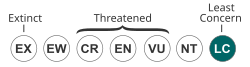
| status = LC | |||
| status_system = IUCN3.1 | |||
| status_ref = <ref name=iucn>[[species:Kanishka D.B. Ukuwela|Ukuwela K]], [[species:A. Suneth Kanishka|Kannishka S]], [[Mendis Wickramasinghe|Wickramasinghe LJM]] (2021). "''Ophisops leschenaultii'' ". The [[IUCN]] Red List of Threatened Species 2021: https://dx.doi.org/10.2305/IUCN.UK.2021-3.RLTS.T172684A1366580.en. Accessed on 10 January 2025.</ref> | |||
| genus = Ophisops | | genus = Ophisops | ||
| species = leschenaultii | | species = leschenaultii | ||
| Line 10: | Line 13: | ||
*''Cabrita leschenaultii'' <br>{{small|— [[William Thomas Blanford|Blanford]], 1870}} | *''Cabrita leschenaultii'' <br>{{small|— [[William Thomas Blanford|Blanford]], 1870}} | ||
*''Ophisops leschenaultii'' <br>{{small|— [[:fr:Indraneil Das|Das]], 1996}} | *''Ophisops leschenaultii'' <br>{{small|— [[:fr:Indraneil Das|Das]], 1996}} | ||
| synonyms_ref = <ref> | | synonyms_ref = <ref name=RDB>{{EMBL species|genus=Ophisops|species=leschenaultii}} www.reptile-database.org.</ref> | ||
}} | }} | ||
'''''Ophisops leschenaultii''''', [[Common name|commonly]] called '''Leschenault's snake-eye''', '''Leschenault’s lacerta''', | '''''Ophisops leschenaultii''''', [[Common name|commonly]] called '''Leschenault's snake-eye''', '''Leschenault’s lacerta''', and '''Leschenault's cabrita''', is a [[species]] of [[lizard]] in the [[Family (biology)|family]] [[Lacertidae]]. The species is native to [[India]] and eastern [[Sri Lanka]]. In Sri Lanka, this lizard is called {{Transliteration|si|pandura katussa}} in [[Sinhala language|Sinhala]]. In some parts of the country, it is also called {{Transliteration|si|heeraluwa}} or {{Transliteration|si|sikanala}}, which is a common name for all skink-like reptiles. | ||
==Description== | ==Description== | ||
| Line 38: | Line 41: | ||
The specimens in the Paris Museum are said to be from the coast of Coromandel. [[Thomas C. Jerdon|Jerdon]] (Journ. As. Soc. Bengal, xxii. p. 476) says that he has recognized the species: ''it is somewhat locally distributed. I have seen it in the Salem and [[Coimbatore|Coimbatoor]] districts only, especially near the banks of the Cauvery. It frequents bushy ground, hedges of ''Euphorbia'' and clumps of Cactus.'' Mr. [[Edward Blyth|Blyth]] adds that the Museum at Calcutta contains examples of what he takes to be this species, from Pind Dadun Khan, in the Punjab Salt Range; and that it formerly possessed the same from Afghanistan." | The specimens in the Paris Museum are said to be from the coast of Coromandel. [[Thomas C. Jerdon|Jerdon]] (Journ. As. Soc. Bengal, xxii. p. 476) says that he has recognized the species: ''it is somewhat locally distributed. I have seen it in the Salem and [[Coimbatore|Coimbatoor]] districts only, especially near the banks of the Cauvery. It frequents bushy ground, hedges of ''Euphorbia'' and clumps of Cactus.'' Mr. [[Edward Blyth|Blyth]] adds that the Museum at Calcutta contains examples of what he takes to be this species, from Pind Dadun Khan, in the Punjab Salt Range; and that it formerly possessed the same from Afghanistan." | ||
==Habitat== | |||
The preferred natural [[habitat]] of ''O. leschenaultii'' is rocky areas of either [[forest]] or [[shrubland]], at altitudes from sea level to {{cvt|1,500|m|ft}}.<ref name=iucn/> | |||
==Behavior== | |||
''O. leschenaulti'' is [[Terrestrial locomotion|terrestrial]] and [[Diurnality|diurnal]].<ref name=iucn/> | |||
==Reproduction== | |||
''O. leschenaultii'' is [[Oviparity|oviparous]].<ref name=iucn/><ref name=RDB/> [[Clutch (eggs)|Clutch]] size is up to six eggs.<ref name=iucn/> | |||
==Etymology== | ==Etymology== | ||
The [[Specific name (zoology)|specific name]], ''leschenaultii'', commemorates French naturalist [[Jean Baptiste Leschenault de la Tour]].<ref>Beolens, Bo; Watkins, Michael; Grayson, Michael (2011). ''The Eponym Dictionary of Reptiles''. Baltimore: Johns Hopkins University Press. xiii + 296 pp. {{ISBN|978-1-4214-0135-5}}. (''Ophisops leschenaultii'', p. 156).</ref> | The [[Specific name (zoology)|specific name]], ''leschenaultii'', commemorates French naturalist [[Jean Baptiste Leschenault de la Tour]].<ref>[[species:Bo Beolens|Beolens, Bo]]; [[species:Michael Watkins|Watkins, Michael]]; [[species:Michael Grayson|Grayson, Michael]] (2011). ''The Eponym Dictionary of Reptiles''. Baltimore: Johns Hopkins University Press. xiii + 296 pp. {{ISBN|978-1-4214-0135-5}}. (''Ophisops leschenaultii'', p. 156).</ref> | ||
==References== | ==References== | ||
| Line 46: | Line 58: | ||
==Further reading== | ==Further reading== | ||
*[[George Albert Boulenger|Boulenger GA]] (1887). ''Catalogue of the Lizards in the British Museum (Natural History). Second Edition. Volume III. Lacertidæ ...'' London: Trustees of the British Museum (Natural History). (Taylor and Francis, printers). xii + 575 pp. + Plates | *[[George Albert Boulenger|Boulenger GA]] (1887). ''Catalogue of the Lizards in the British Museum (Natural History). Second Edition. Volume III. Lacertidæ'' ...'''.''' London: Trustees of the British Museum (Natural History). (Taylor and Francis, printers). xii + 575 pp. + Plates I–XL. (''Cabrita leschenaultii'', pp. 70–71). | ||
*Boulenger GA (1890). ''The Fauna of British India, Including Ceylon and Burma. Reptilia and Batrachia.'' London: Secretary of State for India in Council. (Taylor and Francis, printers). xviii + 541 pp. (''Cabrita leschenaultii'', p. 172). | *Boulenger GA (1890). ''The Fauna of British India, Including Ceylon and Burma. Reptilia and Batrachia.'' London: Secretary of State for India in Council. (Taylor and Francis, printers). xviii + 541 pp. (''Cabrita leschenaultii'', p. 172). | ||
*[[:fr:Indraneil Das|Das I]] (2002). ''A Photographic Guide to Snakes and other Reptiles of India''. Sanibel Island, Florida: Ralph Curtis Books. 144 pp. {{ISBN|0-88359-056-5}}. (''Ophisops leschenaultii'', p. 104). | *[[:fr:Indraneil Das|Das I]] (2002). ''A Photographic Guide to Snakes and other Reptiles of India''. Sanibel Island, Florida: Ralph Curtis Books. 144 pp. {{ISBN|0-88359-056-5}}. (''Ophisops leschenaultii'', p. 104). | ||
*Gayen NC (1999). "A synopsis of the reptiles of Gujarat, western India". ''Hamadryad'' '''24''' (1): | *[[species:Neela Gayen|Gayen NC]] (1999). "A synopsis of the reptiles of Gujarat, western India". ''Hamadryad'' '''24''' (1): 1–22. | ||
*[[John Edward Gray|Gray JE]] (1838). "Catalogue of the Slender-tongued Saurians, with Descriptions of many new Genera and Species. Part 1". '' | *[[John Edward Gray|Gray JE]] (1838). "Catalogue of the Slender-tongued Saurians, with Descriptions of many new Genera and Species. Part 1". ''Annals and Magazine of Natural History, First Series'' '''1''': 274–283. (''Cabrita brunnea'', new species, p. 282). | ||
*Gray JE (1845). ''Catalogue of the Specimens of Lizards in the Collection of the British Museum.'' London: Trustees of the British Museum (Edward Newman, printer). xxviii + 289 pp. (''Cabrita leschenaultii'', p. 43). | *Gray JE (1845). ''Catalogue of the Specimens of Lizards in the Collection of the British Museum.'' London: Trustees of the British Museum (Edward Newman, printer). xxviii + 289 pp. (''Cabrita leschenaultii'', p. 43). | ||
*[[Albert Günther|Günther ACLG]] (1864). ''The Reptiles of British India.'' London: The Ray Society. (Taylor and Francis, printers). xxvii + 452 pp. + Plates | *[[Albert Günther|Günther ACLG]] (1864). ''The Reptiles of British India.'' London: The Ray Society. (Taylor and Francis, printers). xxvii + 452 pp. + Plates I–XXVI. (''Cabrita leschenaultii'', pp. 71–72). | ||
*[[Henri Milne-Edwards|Milne-Edwards H]] (1829). "''Recherches zoologiques pour servir à l'histoire des lézards, extraites d'une monographie de ce genre'' ". '' | *[[Henri Milne-Edwards|Milne-Edwards H]] (1829). "''Recherches zoologiques pour servir à l'histoire des lézards, extraites d'une monographie de ce genre'' ". ''Annales des Sciences Naturelles, Paris'' '''16''': 50–89. (''Lacerta leschenaultii'', new species, p. 80). (in French). | ||
*[[Malcolm Arthur Smith|Smith MA]] (1935). ''The Fauna of British India, Including Ceylon and Burma. Reptilia and Amphibia. Vol. II.—Sauria.'' London: Secretary of State for India in Council. (Taylor and Francis, printers). xiii + 440 pp. + Plate I + 2 maps. ("''Cabrita leschenaulti'' [sic]", pp. 374–375). | *[[Malcolm Arthur Smith|Smith MA]] (1935). ''The Fauna of British India, Including Ceylon and Burma. Reptilia and Amphibia. Vol. II.—Sauria.'' London: Secretary of State for India in Council. (Taylor and Francis, printers). xiii + 440 pp. + Plate I + 2 maps. ("''Cabrita leschenaulti'' [sic]", pp. 374–375). | ||
==External links== | ==External links== | ||
{{Commons category|Ophisops leschenaultii}} | {{Commons category|Ophisops leschenaultii}} | ||
{{Taxonbar|from=Q3011846}} | {{Taxonbar|from=Q3011846}} | ||
[[Category:Ophisops]] | [[Category:Ophisops]] | ||
[[Category: | [[Category:Lizards of India]] | ||
[[Category:Reptiles of Sri Lanka]] | [[Category:Reptiles of Sri Lanka]] | ||
[[Category:Reptiles described in 1829]] | [[Category:Reptiles described in 1829]] | ||
[[Category:Taxa named by Henri Milne-Edwards]] | [[Category:Taxa named by Henri Milne-Edwards]] | ||
Latest revision as of 09:39, 16 December 2025
| Ophisops leschenaultii | |
|---|---|

| |
Scientific classification 
| |
| : | [[Template:Taxonomy/Ophisops]] |
| Species: | Template:Taxonomy/OphisopsO. leschenaultii
|
| Binomial name | |
| Template:Taxonomy/OphisopsOphisops leschenaultii (Milne-Edwards, 1829)
| |
| Synonyms[2] | |
Milne-Edwards, 1829
Gray, 1838
— A.M.C. Duméril & Bibron, 1839
— Blanford, 1870
— Das, 1996 | |
Ophisops leschenaultii, commonly called Leschenault's snake-eye, Leschenault’s lacerta, and Leschenault's cabrita, is a species of lizard in the family Lacertidae. The species is native to India and eastern Sri Lanka. In Sri Lanka, this lizard is called pandura katussa in Sinhala. In some parts of the country, it is also called heeraluwa or sikanala, which is a common name for all skink-like reptiles.
Description[edit | edit source]
The following description is from G.A. Boulenger's The Fauna of British India, Including Ceylon and Burma. Reptilia and Batrachia (1890):

"Upper head shields strongly keeled and striated; anterior labials keeled, forming a projecting margin; canthus rostralis very strong; nostril in the horizontal suture between two large nasals which are extensively in contact with the rostral, and followed by one or two postnasals, the upper of which sometimes enters the nostril; no azygous prefrontal; frontal long and narrow; a small occipital; 4 supraoculars, first and fourth small, the two principal separated from the supraciliaries by a series of granules; subocular bordering the lip, between the fourth and fifth (or fifth and sixth) upper labials; temporal scales small, keeled; two large shields border the parietals exteriorly; a curved large shield on the supero-anterior border of the ear-opening; six large chin-shields on each side, the three anterior in contact with their fellows. Dorsal scales moderately large, scarcely larger on the back than on the sides; ventrals broader than long, in 6 longitudinal and 25 to 29 transverse series, the median longitudinal series narrower than the others; 42 to 48 scales round the middle of the body, ventrals included. A large postero-median preanal plate. The hind limb reaches the ante-humeral fold or a little beyond the ear; the length of the foot equals the distance between the antehumeral fold and the nostril or the tip of the snout. 12 to 16 femoral pores on each side. Tail nearly twice as long as head and body; caudal scales much larger than dorsals.
Brownish or golden above; a pale band, edged above with a black one, along each side of the body and tail, commencing from the supraciliary edge; another pale, black-edged band along the upper lip and side of the body; the space between the two light bands on each side usually black, or spotted with black; lower surfaces yellowish-white, tail and hind limbs often reddish.
From snout to vent 2 inches [5 cm]; tail 4 [10 cm]."

Description from A. Günther's The Reptiles of British India (1864):

"Two loreals; the central occipital very small. The lower eyelid transparent; temples with small, hexagonal, keeled scales of equal size. Dorsal scales keeled, rhombic. Ventral scales in six longitudinal and twenty-five or twenty-six transverse series. Vent covered with a larger central scale, surrounded by other small ones. Fifteen or sixteen femoral pores.
Brown, with two broad whitish bands on each side, the upper arising from the superciliary and running along the side of the back, the lower proceeding from below the eye and ear along; the middle of the side.
Total length 5 1/2 inches [14 cm], of head and trunk 2 inches [5 cm].
The specimens in the Paris Museum are said to be from the coast of Coromandel. Jerdon (Journ. As. Soc. Bengal, xxii. p. 476) says that he has recognized the species: it is somewhat locally distributed. I have seen it in the Salem and Coimbatoor districts only, especially near the banks of the Cauvery. It frequents bushy ground, hedges of Euphorbia and clumps of Cactus. Mr. Blyth adds that the Museum at Calcutta contains examples of what he takes to be this species, from Pind Dadun Khan, in the Punjab Salt Range; and that it formerly possessed the same from Afghanistan."
Habitat[edit | edit source]
The preferred natural habitat of O. leschenaultii is rocky areas of either forest or shrubland, at altitudes from sea level to 1,500 m (4,900 ft).[1]
Behavior[edit | edit source]
O. leschenaulti is terrestrial and diurnal.[1]
Reproduction[edit | edit source]
O. leschenaultii is oviparous.[1][2] Clutch size is up to six eggs.[1]
Etymology[edit | edit source]
The specific name, leschenaultii, commemorates French naturalist Jean Baptiste Leschenault de la Tour.[3]
References[edit | edit source]
- ↑ 1.0 1.1 1.2 1.3 1.4 Ukuwela K, Kannishka S, Wickramasinghe LJM (2021). "Ophisops leschenaultii ". The IUCN Red List of Threatened Species 2021: https://dx.doi.org/10.2305/IUCN.UK.2021-3.RLTS.T172684A1366580.en. Accessed on 10 January 2025.
- ↑ 2.0 2.1 Template:EMBL species www.reptile-database.org.
- ↑ Beolens, Bo; Watkins, Michael; Grayson, Michael (2011). The Eponym Dictionary of Reptiles. Baltimore: Johns Hopkins University Press. xiii + 296 pp. ISBN 978-1-4214-0135-5. (Ophisops leschenaultii, p. 156).
Further reading[edit | edit source]
- Boulenger GA (1887). Catalogue of the Lizards in the British Museum (Natural History). Second Edition. Volume III. Lacertidæ .... London: Trustees of the British Museum (Natural History). (Taylor and Francis, printers). xii + 575 pp. + Plates I–XL. (Cabrita leschenaultii, pp. 70–71).
- Boulenger GA (1890). The Fauna of British India, Including Ceylon and Burma. Reptilia and Batrachia. London: Secretary of State for India in Council. (Taylor and Francis, printers). xviii + 541 pp. (Cabrita leschenaultii, p. 172).
- Das I (2002). A Photographic Guide to Snakes and other Reptiles of India. Sanibel Island, Florida: Ralph Curtis Books. 144 pp. ISBN 0-88359-056-5. (Ophisops leschenaultii, p. 104).
- Gayen NC (1999). "A synopsis of the reptiles of Gujarat, western India". Hamadryad 24 (1): 1–22.
- Gray JE (1838). "Catalogue of the Slender-tongued Saurians, with Descriptions of many new Genera and Species. Part 1". Annals and Magazine of Natural History, First Series 1: 274–283. (Cabrita brunnea, new species, p. 282).
- Gray JE (1845). Catalogue of the Specimens of Lizards in the Collection of the British Museum. London: Trustees of the British Museum (Edward Newman, printer). xxviii + 289 pp. (Cabrita leschenaultii, p. 43).
- Günther ACLG (1864). The Reptiles of British India. London: The Ray Society. (Taylor and Francis, printers). xxvii + 452 pp. + Plates I–XXVI. (Cabrita leschenaultii, pp. 71–72).
- Milne-Edwards H (1829). "Recherches zoologiques pour servir à l'histoire des lézards, extraites d'une monographie de ce genre ". Annales des Sciences Naturelles, Paris 16: 50–89. (Lacerta leschenaultii, new species, p. 80). (in French).
- Smith MA (1935). The Fauna of British India, Including Ceylon and Burma. Reptilia and Amphibia. Vol. II.—Sauria. London: Secretary of State for India in Council. (Taylor and Francis, printers). xiii + 440 pp. + Plate I + 2 maps. ("Cabrita leschenaulti [sic]", pp. 374–375).