



>Iridescent 2 m →Purpose: Cleanup and typo fixing, typo(s) fixed: 1963-1969 → 1963–1969 |
m fixed issues |
||
| Line 1: | Line 1: | ||
{{Short description|Ballistic missile payload containing multiple warheads which are independently targetable}}{{ | {{Short description|Ballistic missile payload containing multiple warheads which are independently targetable}} | ||
{{ | {{Redirect|MIRV|the band|M.I.R.V.}} | ||
{{Use American English|date=May 2023}} | |||
[[Image:W87 MX Missile schematic.jpg|thumb|upright=1.2|The MIRV U.S. [[LGM-118A Peacekeeper|Peacekeeper]] missile, with the re-entry vehicles highlighted in red.]] | [[Image:W87 MX Missile schematic.jpg|thumb|upright=1.2|The MIRV U.S. [[LGM-118A Peacekeeper|Peacekeeper]] missile, with the re-entry vehicles highlighted in red.]] | ||
[[Image:W87 MIRV.jpg|thumb|Technicians secure a number of | [[Image:W87 MIRV.jpg|thumb|Technicians secure a number of Mk12A re-entry vehicles on a [[LGM-118A Peacekeeper|Peacekeeper]] MIRV bus.]] | ||
[[File:LGM-118A Peacekeeper MIRV.jpg|thumb|upright|LGM-118A Peacekeeper MIRV at the [[National Museum of the United States Air Force]].]] | [[File:LGM-118A Peacekeeper MIRV.jpg|thumb|upright|LGM-118A Peacekeeper MIRV at the [[National Museum of the United States Air Force]].]] | ||
[[Image:Trident II missile image.jpg|thumb|upright|A [[UGM-133 Trident II|Trident II missile]], operated exclusively by the [[US Navy]] and [[Royal Navy]]. Each missile can carry up to | [[File:MIRV_cut-away.jpg|thumb|Cut away diagram of a MIRV.]] | ||
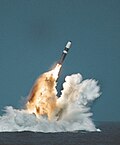
[[Image:Trident II missile image.jpg|thumb|upright|A [[UGM-133 Trident II|Trident II missile]], operated exclusively by the [[US Navy]] and [[Royal Navy]]. Each missile can carry up to 12 warheads.<ref name="Lockheed Martin UGM-133 Trident II">{{cite web |url=http://www.designation-systems.net/dusrm/m-133.html |title=UGM-133 |last=Parsch |first=Andreas |publisher=Directory of U.S. Military Rockets and Missiles |access-date=2014-06-13 |archive-url=https://web.archive.org/web/20110315090113/http://www.designation-systems.net/dusrm/m-133.html |archive-date=2011-03-15 |url-status=live }}</ref>]] | |||
A '''multiple independently targetable reentry vehicle''' ('''MIRV''') is an [[atmospheric entry| | A '''multiple independently targetable reentry vehicle''' ('''MIRV''') is an [[atmospheric entry|exo]]<nowiki>atmospheric</nowiki> [[ballistic missile]] payload containing several [[warhead]]s, each capable of being aimed to hit a different target. The concept is almost invariably associated with [[intercontinental ballistic missile]]s carrying [[thermonuclear warhead]]s, even if not strictly being limited to them. An intermediate case is the [[#MRV|multiple reentry vehicle]] (MRV) missile which carries several warheads which are dispersed but not individually aimed. All [[List of states with nuclear weapons|nuclear-weapon states]] except [[Pakistan and weapons of mass destruction|Pakistan]]{{efn|"Pakistan is confirmed to possess MIRV technology, but there is no confirmation yet that it has deployed MIRV missiles."<ref>{{cite web |url=https://www.dia.mil/News/Speeches-and-Testimonies/Article-View/Article/1457815/statement-for-the-record-worldwide-threat-assessment/utm_content/buffer03bbe/utm_medium/social/utm_campaign/buffer/utm_content/buffer6e4e7/utm_medium/social/utm_campaign/buffer/?utm_source=twitter.com|title=Statement for the Record: Worldwide Threat Assessment |date=March 6, 2018 |archive-url=https://web.archive.org/web/20180313031732/https://www.dia.mil/News/Speeches-and-Testimonies/Article-View/Article/1457815/statement-for-the-record-worldwide-threat-assessment/utm_content/buffer03bbe/utm_medium/social/utm_campaign/buffer/utm_content/buffer6e4e7/utm_medium/social/utm_campaign/buffer/?utm_source=twitter.com |access-date=March 31, 2024|archive-date=2018-03-13 }}</ref><ref name="Ref1">{{ cite news | author= Usman Haider | author2= Abdul Moiz Khan | title =Why Did Pakistan Test Its MIRV-Capable Ababeel Missile? | newspaper = [[The Diplomat (magazine)|The Diplomat]] | date = 18 November 2023 | url =https://thediplomat.com/2023/11/why-did-pakistan-test-its-mirv-capable-ababeel-missile/ | access-date =11 March 2024}}</ref>}} and [[North Korea]]{{efn|"North Korea claims to possess and have successfully tested a MIRV, but there is no confirmation yet that it has operationally deployed MIRVs on any missiles."<ref>{{cite web|url=https://www.nknews.org/2024/06/north-korea-says-it-successfully-conducted-multiple-warhead-missile-test/|website=NKNews|title=North Korea Says it Successfully Conducted Multiple Warhead Missile Test|date=27 June 2024|access-date=26 June 2024}}</ref>}} are currently confirmed to have deployed MIRV missile systems. | ||
The first true MIRV design was the [[Minuteman III]], first successfully tested in 1968 and introduced into actual use in 1970.<ref name=lmtapmilm>{{cite news |url=https://news.google.com/newspapers?id=EcFeAAAAIBAJ&pg=1876%2C3599204 |work=Lewiston Morning Tribune |location= | The first true MIRV design was the [[Minuteman III]], first successfully tested in 1968 and introduced into actual use in 1970.<ref name=lmtapmilm>{{cite news |url=https://news.google.com/newspapers?id=EcFeAAAAIBAJ&pg=1876%2C3599204 |work=Lewiston Morning Tribune |location=Idaho |agency=Associated Press |title=Military says Minuteman missiles ready |date=July 20, 1970 |page=1 |access-date=May 31, 2020 |archive-date=August 28, 2020 |archive-url=https://web.archive.org/web/20200828223736/https://news.google.com/newspapers?id=EcFeAAAAIBAJ&pg=1876%2C3599204 |url-status=live }}</ref><ref name=":0">{{cite book |last1= Polmar |first1= Norman |author-link1= Norman Polmar |last2= Norris |first2= Robert S. |date= 2009-07-01 |title= The U.S. Nuclear Arsenal: A History of Weapons and Delivery Systems since 1945 |language= en |edition= 1st |publisher= [[Naval Institute Press]] |isbn= 978-1557506818 |lccn= 2008054725 |oclc= 602923650 |ol= OL22843826M |ref= 2009_Polmar |df= dmy-all}}</ref><ref>{{Cite web |url=http://nuclearweaponarchive.org/Usa/Weapons/Mmiii.html |title=The Minuteman III ICBM |access-date=2017-09-17 |archive-url=https://web.archive.org/web/20190118234653/http://nuclearweaponarchive.org/Usa/Weapons/Mmiii.html |archive-date=2019-01-18 |url-status=live }}</ref> The Minuteman III held three smaller [[W62]] warheads, with yields of about {{convert|170|ktonTNT}} each in place of the single {{convert|1.2|MtonTNT}} [[W56]] used on the Minuteman II.<ref name=":1">{{Cite web |date=July 2021 |title=Nuclear Chronology |url=https://www.acq.osd.mil/ncbdp/nm/chronology/NuclearChronology_updatedJuly2021.pdf |url-status=live |archive-url=https://web.archive.org/web/20220812151017/https://www.acq.osd.mil/ncbdp/nm/chronology/NuclearChronology_updatedJuly2021.pdf |archive-date=August 12, 2022 |access-date=January 18, 2024 |website=www.acq.osd.mil}}</ref> From 1970 to 1975, the United States would remove approximately 550 earlier versions of the Minuteman ICBM in the [[Strategic Air Command]]'s (SAC) arsenal and replace them with the new Minuteman IIIs outfitted with a MIRV payload, increasing their overall effectiveness.<ref name=":0" /> The smaller power of the warheads used (W62, W78 and W87) was offset by increasing the accuracy of the system, allowing it to attack the same hard targets as the larger, less accurate, W56.<ref name=":1" /><ref>{{Cite web |date=March 1, 2019 |title=W87-1 Modification Program |url=https://www.energy.gov/sites/prod/files/2019/03/f60/2019-03-08-FACTSHEET-W87-1.pdf |url-status=live |archive-url=https://web.archive.org/web/20230326030517/https://www.energy.gov/sites/prod/files/2019/03/f60/2019-03-08-FACTSHEET-W87-1.pdf |archive-date=March 26, 2023 |access-date=January 18, 2024 |website=energy.gov}}</ref> The MMIII was introduced specifically to address the Soviet construction of an [[anti-ballistic missile]] (ABM) [[A-35 anti-ballistic missile system|system]] around Moscow; MIRV allowed the US to overwhelm any conceivable ABM system without increasing the size of their own missile fleet. The Soviets responded by adding MIRV to their [[R-36 (missile)|R-36]] design, first with three warheads in 1975, and eventually up to ten in later versions. While the United States phased out the use of MIRVs in ICBMs in 2014 to comply with [[New START]],<ref>{{Cite news|url=https://www.greatfallstribune.com/story/news/local/2014/06/18/last-malmstrom-icbm-reconfigured-treaty/10773351/|title=Last Malmstrom ICBM reconfigured under treaty|work=Great Falls Tribune|access-date=2018-09-08|language=en|archive-date=2020-08-28|archive-url=https://web.archive.org/web/20200828223736/https://www.greatfallstribune.com/story/news/local/2014/06/18/last-malmstrom-icbm-reconfigured-treaty/10773351/|url-status=live}}</ref> Russia continues to develop new ICBM designs using the technology.<ref>{{Cite news|url=https://www.businessinsider.com/how-satan-2-icbm-nuclear-weapon-works-2018-3|title=Putin has touted an 'invincible' nuclear weapon that really exists — here's how it works and why it deeply worries experts|work=Business Insider|access-date=2018-09-08|archive-url=https://web.archive.org/web/20180908130742/https://www.businessinsider.com/how-satan-2-icbm-nuclear-weapon-works-2018-3|archive-date=2018-09-08|url-status=live}}</ref> | ||
The introduction of MIRV led to a major change in the strategic balance. Previously, with one warhead per missile, it was conceivable that one could build a | The introduction of MIRV led to a major change in the strategic balance. Previously, with one warhead per missile, it was conceivable that one could build a defense that used missiles to attack individual warheads. Any increase in missile fleet by the enemy could be countered by a similar increase in interceptors. With MIRV, a single new enemy missile meant that multiple interceptors would have to be built, meaning that it was much less expensive to increase the attack than the defense. This [[cost-exchange ratio]] was so heavily biased towards the attacker that the concept of [[mutual assured destruction]] became the leading concept in strategic planning and ABM systems were severely limited in the 1972 [[Anti-Ballistic Missile Treaty]] in order to avoid a massive [[arms race]].<ref>{{Cite web |title=The Anti-Ballistic Missile (ABM) Treaty at a Glance {{!}} Arms Control Association |url=https://www.armscontrol.org/factsheets/anti-ballistic-missile-abm-treaty-glance |archive-url=https://web.archive.org/web/20250727045833/https://www.armscontrol.org/factsheets/anti-ballistic-missile-abm-treaty-glance |archive-date=2025-07-27 |access-date=2025-08-07 |website=www.armscontrol.org |language=en |url-status=live }}</ref> | ||
In June 2017 the United States finished converting its Minuteman III missiles back to using a single reentry vehicle system, as part of its obligations under the [[New START]] treaty.<ref>{{Cite web |date=2014-06-27 |title=The End of MIRVs for U.S. ICBMs |url=https://blog.ucsusa.org/emacdonald/the-end-of-mirvs-for-u-s-icbms/ |access-date=2024-01-19 |website=The Equation |language=en-US}}</ref><ref>{{Cite web |title=NMHB 2020 [Revised] |url=https://www.acq.osd.mil/ncbdp/nm/NMHB2020rev/chapters/chapter3.html |access-date=2024-01-19 |website=www.acq.osd.mil}}</ref> | |||
On November 21, 2024, Russia used a conventionally-armed MIRV system on the [[Oreshnik (missile)|Oreshnik intermediate-range ballistic missile]] to attack the Ukrainian city of [[Dnipro]], marking their first usage in combat.<ref name="r017" /> | |||
== Purpose == | == Purpose == | ||
The military purpose of a MIRV is fourfold: | The military purpose of a MIRV is fourfold: | ||
*Enhance [[first-strike]] proficiency for strategic forces.<ref name="gwu.edu">{{cite web |url= https://nsarchive2.gwu.edu//nsa/NC/mirv/mirv.html |title= MIRV: A BRIEF HISTORY OF MINUTEMAN and MULTIPLE REENTRY VEHICLES |last= Buchonnet |first= Daniel |date= 1976-02-01 |website= gwu.edu |publisher= [[Lawrence Livermore National Laboratory|Lawrence Livermore Laboratory]] |agency= [[United States Department of Defense]] |language= en |archive-url= https://web.archive.org/web/20190915054553/https://nsarchive2.gwu.edu//nsa/NC/mirv/mirv.html |archive-date= 2019-09-15 |url-status= live |access-date= 2019-11-24 |quote= The idea of multiple warheads dates back to the mid-1960s, but the key year in the history of the MIRV concept was 1962 when several of technological developments made it possible for scientists and engineers to conceive of multiple, separately targeted warheads that could hit a growing list of Soviet nuclear threat targets. One important innovation was that the weapons laboratories had designed small thermonuclear weapons, a necessary condition for deploying multiple reentry vehicles on the relatively small Minuteman. |ref= gwu.edu |df= dmy-all}}</ref> | *Enhance [[first-strike]] proficiency for strategic forces.<ref name="gwu.edu">{{cite web |url= https://nsarchive2.gwu.edu//nsa/NC/mirv/mirv.html |title= MIRV: A BRIEF HISTORY OF MINUTEMAN and MULTIPLE REENTRY VEHICLES |last= Buchonnet |first= Daniel |date= 1976-02-01 |website= gwu.edu |publisher= [[Lawrence Livermore National Laboratory|Lawrence Livermore Laboratory]] |agency= [[United States Department of Defense]] |language= en |archive-url= https://web.archive.org/web/20190915054553/https://nsarchive2.gwu.edu//nsa/NC/mirv/mirv.html |archive-date= 2019-09-15 |url-status= live |access-date= 2019-11-24 |quote= The idea of multiple warheads dates back to the mid-1960s, but the key year in the history of the MIRV concept was 1962 when several of technological developments made it possible for scientists and engineers to conceive of multiple, separately targeted warheads that could hit a growing list of Soviet nuclear threat targets. One important innovation was that the weapons laboratories had designed small thermonuclear weapons, a necessary condition for deploying multiple reentry vehicles on the relatively small Minuteman. |ref= gwu.edu |df= dmy-all}}</ref> | ||
*Providing greater target damage for a given [[thermonuclear weapon]] payload. Several small and lower yield warheads cause much more target damage area than a single warhead alone. This, in turn, reduces the number of missiles and launch facilities required for a given destruction level | *Providing greater target damage for a given [[thermonuclear weapon]] payload. Several small and lower yield warheads cause much more target damage area than a single warhead alone. This, in turn, reduces the number of missiles and launch facilities required for a given destruction level – much the same as the purpose of a [[cluster munition]].<ref name="Hansen">The best overall printed sources on nuclear weapons design are: [[Chuck Hansen|Hansen, Chuck]]. ''U.S. Nuclear Weapons: The Secret History.'' San Antonio, TX: Aerofax, 1988; and the more-updated Hansen, Chuck, "[http://www.uscoldwar.com/ Swords of Armageddon: U.S. Nuclear Weapons Development since 1945] {{Webarchive|url=https://web.archive.org/web/20161230020259/http://www.uscoldwar.com/ |date=2016-12-30 }}" (CD-ROM & download available). PDF. 2,600 pages, Sunnyvale, California, Chukelea Publications, 1995, 2007. {{ISBN|978-0-9791915-0-3}} (2nd Ed.)</ref> | ||
*With single-warhead missiles, one missile must be launched for each target. By contrast, with a MIRV warhead, the post-boost (or bus) stage can dispense the warheads against multiple targets across a broad area. | *With single-warhead missiles, one missile must be launched for each target. By contrast, with a MIRV warhead, the post-boost (or bus) stage can dispense the warheads against multiple targets across a broad area. | ||
*Reduces the effectiveness of an [[anti-ballistic missile]] system that relies on intercepting individual warheads.<ref name="Aldridge1983">{{cite book|author=Robert C. Aldridge|title=First Strike!: The Pentagon's Strategy for Nuclear War|url=https://books.google.com/books?id=Pb0mnwEACAAJ|access-date=26 February 2013|year=1983|publisher=South End Press|isbn=978-0-89608-154-3|pages=65–|archive-url=https://web.archive.org/web/20140716180535/http://books.google.com/books/about/First_Strike.html?id=Pb0mnwEACAAJ|archive-date=16 July 2014|url-status=live}}</ref> While a MIRV | *Reduces the effectiveness of an [[anti-ballistic missile]] system that relies on intercepting individual warheads.<ref name="Aldridge1983">{{cite book|author=Robert C. Aldridge|title=First Strike!: The Pentagon's Strategy for Nuclear War|url=https://books.google.com/books?id=Pb0mnwEACAAJ|access-date=26 February 2013|year=1983|publisher=South End Press|isbn=978-0-89608-154-3|pages=65–|archive-url=https://web.archive.org/web/20140716180535/http://books.google.com/books/about/First_Strike.html?id=Pb0mnwEACAAJ|archive-date=16 July 2014|url-status=live}}</ref> While a attacking MIRV missile can have multiple warheads (3{{hyphen}}12 on United States and Russian missiles), interceptors may have only one warhead per missile. Thus, in both a military and an economic sense, MIRVs render ABM systems less effective, as the costs of maintaining a workable defense against MIRVs would greatly increase, requiring multiple defensive missiles for each offensive one. Decoy [[Atmospheric entry|re-entry]] vehicles can be used alongside actual warheads to minimize the chances of the actual warheads being intercepted before they reach their targets. A system that destroys the missile earlier in its trajectory (before MIRV separation) is not affected by this but is more difficult, and thus more expensive to implement. | ||
MIRV land-based [[Intercontinental ballistic missile|ICBM]]s were considered destabilizing because they tended to put a premium on [[first-strike|striking first]].<ref>{{Cite web |url=https://www.rand.org/pubs/research_reports/RR1628.html |title= | MIRV land-based [[Intercontinental ballistic missile|ICBM]]s were considered destabilizing because they tended to put a premium on [[first-strike|striking first]].<ref>{{Cite web |url=https://www.rand.org/pubs/research_reports/RR1628.html |title=China's Evolving Nuclear Deterrent: Major Drivers and Issues for the United States |date=15 March 2017 |access-date=2017-12-01 |archive-url=https://web.archive.org/web/20171201182213/https://www.rand.org/pubs/research_reports/RR1628.html |archive-date=2017-12-01 |url-status=live |last1=Heginbotham |first1=Eric }}</ref> The world's first MIRV—US [[Minuteman III]] missile of 1970—threatened to rapidly increase the US's deployable nuclear arsenal and thus the possibility that it would have enough bombs to destroy virtually all of the [[Russia and weapons of mass destruction|Soviet Union's nuclear weapons]] and negate any significant retaliation. Later on the US feared the Soviet's MIRVs because Soviet missiles had a greater [[throw-weight]] and could thus put more warheads on each missile than the US could. For example, the US MIRVs might have increased their warhead per missile count by a factor of 6 while the Soviets increased theirs by a factor of 10. Furthermore, the US had a much smaller proportion of its nuclear arsenal in ICBMs than the Soviets. Bombers could not be outfitted with MIRVs so their capacity would not be multiplied. Thus the US did not seem to have as much potential for MIRV usage as the Soviets. However, the US had a larger number of [[submarine-launched ballistic missile]]s, which could be outfitted with MIRVs, and helped offset the ICBM disadvantage. It is because of their first-strike capability that land-based MIRVs were banned under the [[START II]] agreement. START II was ratified by the [[Russian Duma]] on 14 April 2000, but Russia withdrew from the treaty in 2002 after the US withdrew from the [[Anti-Ballistic Missile Treaty|ABM treaty]]. | ||
== Operation == | |||
In a MIRV, the main rocket motor (or [[booster (rocketry)|booster]]) pushes a "bus" into a free-flight [[suborbital]] ballistic flight path. After the boost phase, the bus maneuvers using small on-board rocket motors and a computerized [[inertial guidance system]]. It takes up a ballistic trajectory that will deliver a re-entry vehicle containing a warhead to a target and then releases a warhead on that trajectory. It then maneuvers to a different trajectory, releasing another warhead, and repeats the process for all warheads. | |||
[[Image:Minuteman III MIRV path.svg|thumb|upright=1.5|[[LGM-30 Minuteman|Minuteman III]] MIRV launch sequence: | |||
1. The missile launches out of its silo by firing its first-stage boost motor (''A''). | 1. The missile launches out of its silo by firing its first-stage boost motor (''A''). | ||
2. About 60 seconds after launch, the first-stage drops off and the second-stage motor (''B'') ignites. The missile shroud (''E'') is ejected. | 2. About 60 seconds after launch, the first-stage drops off and the second-stage motor (''B'') ignites. The missile shroud (''E'') is ejected. | ||
| Line 38: | Line 42: | ||
8. The nuclear warheads detonate, either as air bursts or ground bursts.]] | 8. The nuclear warheads detonate, either as air bursts or ground bursts.]] | ||
The precise technical details are closely guarded [[military secret]]s, to hinder any development of enemy counter-measures. The bus's on-board [[propellant]] limits the distances between targets of individual warheads to perhaps a few hundred | The precise technical details are closely guarded [[military secret]]s, to hinder any development of enemy counter-measures. The bus's on-board [[propellant]] limits the distances between targets of individual warheads to perhaps a few hundred kilometers.<ref name=airliners>{{Cite web |url=http://www.airliners.net/discussions/military/read.main/68181/ |title=Question Re Mirv Warheads — Military Forum {{!}} Airliners.net<!-- Bot generated title --> |access-date=2008-07-02 |archive-url=https://web.archive.org/web/20071016214658/http://www.airliners.net/discussions/military/read.main/68181/ |archive-date=2007-10-16 |url-status=live }}</ref> Some warheads may use small [[hypersonic|hyper]]<nowiki>sonic</nowiki> [[airfoil]]s during the descent to gain additional cross-range distance. Additionally, some buses (e.g. the British [[Chevaline]] system) can release [[decoy]]s to confuse interception devices and [[radar]]s, such as [[aluminium|aluminized]] balloons or electronic noisemakers. | ||
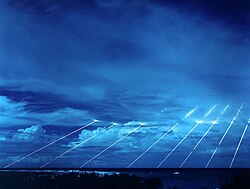
[[Image:Peacekeeper-missile-testing.jpg|thumb|Testing of the [[LGM-118 Peacekeeper|Peacekeeper]] reentry vehicles: all eight (of a possible ten) were fired from only one missile. Each line shows the path of an individual warhead captured on reentry via long-exposure photography.]] | [[Image:Peacekeeper-missile-testing.jpg|thumb|Testing of the [[LGM-118 Peacekeeper|Peacekeeper]] reentry vehicles: all eight (of a possible ten) were fired from only one missile. Each line shows the path of an individual warhead captured on reentry via long-exposure photography.]] | ||
Accuracy is crucial because doubling the accuracy decreases the needed warhead energy by a factor of four for radiation damage and by a factor of eight for blast damage. Navigation system accuracy and the available geophysical information limits the warhead target accuracy. | Accuracy is crucial because doubling the accuracy decreases the needed warhead energy by a factor of four for radiation damage and by a factor of eight for blast damage. Navigation system accuracy and the available geophysical information limits the warhead target accuracy. Accuracy is expressed as [[circular error probable]] (CEP). This is the radius of the circle that the warhead has a 50 percent chance of falling into when aimed at the center. CEP is about 90–100 m for the [[Trident missile|Trident II]] and [[LGM-118A Peacekeeper|Peacekeeper]] missiles.<ref name="Cimbala2010">{{cite book|last=Cimbala|first=Stephen J.|title=Military Persuasion: Deterrence and Provocation in Crisis and War|url=https://books.google.com/books?id=rMe9guZoyIUC&pg=PA86|access-date=3 May 2013|year=2010|publisher=Penn State Press|isbn=978-0-271-04126-1|page=86|archive-url=https://web.archive.org/web/20160426054128/https://books.google.com/books?id=rMe9guZoyIUC&pg=PA86|archive-date=26 April 2016|url-status=live}}</ref> | ||
==MRV== | ==MRV== | ||
A multiple re-entry vehicle (MRV) system for a [[ballistic missile]] deploys multiple warheads above a single aimpoint which then drift apart, producing a cluster bomb-like effect. These warheads are not individually targetable. The advantage of an MRV over a single warhead is the increased effectiveness due to the greater coverage | A multiple re-entry vehicle (MRV) system for a [[ballistic missile]] deploys multiple warheads above a single aimpoint which then drift apart, producing a cluster bomb-like effect. These warheads are not individually targetable. The advantage of an MRV over a single warhead is the increased effectiveness due to the greater coverage; this increases the overall damage produced within the center of the pattern, making it far greater than the damage possible from any single warhead in the MRV cluster; this makes for an efficient area-attack weapon and makes interception by [[anti-ballistic missile]]s more challenging due to the number of warheads being deployed at once.<ref name=":0" /> | ||
Improved warhead designs allow smaller warheads for a given yield, while better electronics and guidance systems allow greater accuracy. As a result, MIRV technology has proven more attractive than MRV for advanced nations. Multiple-warhead missiles require both a | Improved warhead designs allow smaller warheads for a given yield, while better electronics and guidance systems allow greater accuracy. As a result, MIRV technology has proven more attractive than MRV for advanced nations. Multiple-warhead missiles require both a miniaturized [[physics package]] and a lower mass re-entry vehicle, both of which are highly advanced technologies. As a result, single-warhead missiles are more attractive for nations with less advanced or less productive nuclear technology. The United States first deployed MRV warheads on the [[UGM-27 Polaris|Polaris A-3]] SLBM in 1964 on the [[USS Daniel Webster (SSBN-626)|USS Daniel Webster]]. The [[Polaris A3 missile|Polaris A-3]] missile carried three warheads each having an approximate yield of {{convert|200|ktTNT|TJ}}. This system was also used by the Royal Navy who also retained MRV with the [[Chevaline]] upgrade, though the number of warheads in Chevaline was reduced to two due to the ABM counter-measures carried.<ref name=":0" /> The Soviet Union deployed 3 MRVs on the [[R-27 Zyb#R-27U (RSM-25)|R-27U]] SLBM and 3 MRVs on the [[R-36 (missile)#R-36P|R-36P]] ICBM. Refer to [[atmospheric reentry|atmospheric re-entry]] for more details. | ||
==MIRV-capable missiles== | == Combat usage == | ||
On November 21, 2024, as part of the [[Russian invasion of Ukraine]], Russia launched an [[Oreshnik (missile)|Oreshnik intermediate-range ballistic missile]], striking [[Dnipro]].<ref name="c077">{{cite web |date=2024-11-20 |title=Putin says Russia hit Ukraine with new intermediate-range ballistic missile |url=https://www.bbc.co.uk/news/live/c20726y20kvt?post=asset:a94a8e80-95a1-425e-acbe-f4d418555f20#post |access-date=2024-11-21 |website=BBC News}}</ref> Western officials stated the missile used a MIRV system, marking their first use in combat.<ref name="r017">{{cite web |last=Edwards |first=Christian |last2=Nicholls |first2=Catherine |last3=Radford |first3=Antoinette |last4=Sangal |first4=Aditi |date=2024-11-21 |title=Russian ballistic missile carried multiple warheads, US and Western officials say |url=https://www.cnn.com/world/live-news/ukraine-russia-war-11-21-24#cm3rqdcdg00053b6ql9grs2v0 |access-date=2024-11-21 |website=CNN}}</ref><ref name="d173">{{cite web |date=2024-11-21 |title=Russia fired experimental ballistic missile at Ukraine, Putin says |url=https://www.reuters.com/world/europe/russia-launches-intercontinental-ballistic-missile-attack-ukraine-kyiv-says-2024-11-21/ |access-date=2024-11-21 |website=Reuters}}</ref> The night attack was reported to see six sequential vertical flashes, each comprising a cluster of up to six individual projectiles.<ref name="i831">{{cite web |date=2024-11-20 |title=Videos circulating online show impact of Dnipro strike |url=https://www.bbc.co.uk/news/live/c20726y20kvt?post=asset:794c5e44-1c70-412e-9d1e-395b6027be7e#post |access-date=2024-11-21 |website=BBC News}}</ref> Ukraine's air force initially claimed an [[intercontinental ballistic missile]] (range greater than 5,500 km) was used,<ref name=":2">{{Cite news |last=Sauer |first=Pjotr |date=2024-11-21 |title=Putin says Russia fired experimental ballistic missile into Ukraine |url=https://www.theguardian.com/world/2024/nov/21/putin-says-russia-fired-experimental-ballistic-missile-into-ukraine |access-date=2024-11-21 |work=The Guardian |language=en-GB |issn=0261-3077}}</ref> and Ukrainian media initially reported it was an [[RS-26 Rubezh]] IRBM with range 5,800 km. The US and Russia confirmed it was [[Intermediate-range ballistic missile|intermediate-range]] (3,000–5,500 km),<ref name=":2" /> but the Pentagon stated it was based on the RS-26 IRBM.<ref name="r017" /> It was fired from the [[Astrakhan Oblast|Astrakhan]] region 700 km away.<ref name="d173" /> UN spokesperson [[Stéphane Dujarric]] called the use of the intermediate-range weapon "concerning and worrying".<ref name="c0772">{{cite web |date=2024-11-20 |title=UN says Russia's use of intermediate-range missile 'worrying' |url=https://www.bbc.co.uk/news/live/c20726y20kvt?post=asset:a94a8e80-95a1-425e-acbe-f4d418555f20#post |access-date=2024-11-21 |website=BBC News}}</ref> | |||
== MIRV-capable missiles == | |||
{{Incomplete list|date=August 2020}} | {{Incomplete list|date=August 2020}} | ||
;[[China]]: | ;[[China]]: | ||
*[[DF-3#DF-3A|DF-3A]] (retired, 3 warheads) | |||
*[[DF-4#DF-4A|DF-4A]] (retired, 3 warheads) | |||
*[[DF-5#DF-5B|DF-5B]] (active, 3-8 warheads) | *[[DF-5#DF-5B|DF-5B]] (active, 3-8 warheads) | ||
*[[DF-5#DF-5C|DF-5C]] (active, 10 warheads) | *[[DF-5#DF-5C|DF-5C]] (active, 10 warheads) | ||
*[[DF-31#DF-31A|DF-31A]] (active, 3-5 warheads) | *[[DF-31#DF-31A|DF-31A]] (active, 3-5 warheads) | ||
*[[DF-31#DF-31AG/DF-31B|DF-31B]] (active, | *[[DF-31#DF-31AG/DF-31B|DF-31B]] (active, 3-5 warheads) | ||
*[[DF-41]] (active, 10 | *[[DF-41]] (active, up to 10 warheads) | ||
*[[JL-2]] (active, 3 | *[[JL-2]] (active, 1-3 warheads) | ||
*[[JL-3]] (under development) | *[[JL-3]] (under development) | ||
;[[France]]: | ;[[France]]: | ||
*[[M4 (missile)|M4]] (retired, 6 warheads) | *[[M4 (missile)|M4]] (retired, 6 warheads) | ||
*[[M45 (missile)|M45]] ( | *[[M45 (missile)|M45]] (retired, 6 warheads) | ||
*[[M51 (missile)|M51]] (active, 6-10 warheads) | *[[M51 (missile)|M51]] (active, 6-10 warheads) | ||
;[[India]] | ;[[India]] | ||
*[[Agni- | *[[Agni-V]]<ref>{{Cite web|url=https://apnews.com/article/india-missile-test-multiple-warheads-77de306d97fe1a299d811e6edcefc740|title=India conducts first test flight of domestically developed missile that can carry multiple warheads|website=apnews.com|date=11 March 2024}}</ref> (active, 3-6 (tested)<ref>{{Cite web |title=India's MIRV-tipped Agni-5 Missile Test : All your questions answered |url=https://www.business-standard.com/external-affairs-defence-security/news/india-s-mirv-tipped-agni-5-missile-test-all-your-questions-answered-124031201019_1.html |website=Business Standard |language=en}}</ref><ref>{{Cite web |date=2024-03-12 |title=One missile, many weapons: What makes the latest Agni-5 special |url=https://indianexpress.com/article/explained/one-missile-many-weapons-what-makes-the-latest-agni-v-special-9208831/ |access-date=2024-03-14 |website=The Indian Express |language=en}}</ref> 10–12 (Operational)<ref>{{Cite web |date=2024-03-12 |title=Why India Testing Agni-5 is a Milestone Moment |url=https://www.news18.com/opinion/opinion-why-india-testing-agni-5-is-a-milestone-moment-8812790.html |access-date=2024-03-14 |website=News18 |language=en}}</ref> nuclear warheads) | ||
*[[Agni-P|Agni Prime]]<ref>{{Cite web |last=Rout |first=Hemant Kumar |date=2021-09-13 |title=India to conduct first user trial of Agni-V missile |url=https://www.newindianexpress.com/states/odisha/2021/Sep/13/india-to-conduct-first-user-trial-of-agni-v-missile-2357942.html |access-date=2024-03-12 |website=The New Indian Express |language=en}}</ref> (active, 2 warheads) | |||
*[[Agni-VI]]<ref>{{Cite web |title=Mission Divyastra successful: A look at evolution of Agni missiles |url=https://www.indiatoday.in/science/story/evolution-of-agni-missiles-2513492-2024-03-11 |access-date=2024-03-12 |website=India Today |language=en}}</ref>(under development) | |||
*[[ | *[[K-6 (missile)|K-6]]<ref>{{Cite web |last=Gady |first=Franz-Stefan |title=India Launches Second Ballistic Missile Sub |url=https://thediplomat.com/2017/12/india-launches-second-ballistic-missile-sub/ |access-date=2024-03-12 |website=thediplomat.com |language=en-US}}</ref> (under development) | ||
;[[ | ;[[Israel]]: | ||
*[[ | *[[Jericho (missile)#Jericho III|Jericho 3]] (active, suspected capability, not announced, 2-3 technically possible)<ref>{{cite web |title=Jericho 3 |url=https://missilethreat.csis.org/missile/jericho-3/ |website=Missile Threat |publisher=Center for Strategic and International Studies |access-date=4 April 2020 |archive-date=21 January 2013 |archive-url=https://web.archive.org/web/20130121132332/http://missilethreat.com/missiles/jericho-123/ |url-status=live }}</ref> | ||
;[[ | ;[[North Korea]]: | ||
*[[ | *[[Pukguksong-4]] (unconfirmed) | ||
*[[Hwasong-17]] | |||
*[[Hwasong-19]] | |||
*[[Hwasong-20]] (under development)<ref>{{Cite web|author=Đào Cảnh|date=15 September 2025|title=Tên lửa Hwasong-20 tầm bắn 15.000km, công nghệ MIRV, thay đổi cuộc chơi quân sự toàn cầu|trans-title=Hwasong-20 missile with range of 15,000km, MIRV technology, changing the global military game|url=https://vietnamnet.vn/ten-lua-hwasong-20-tam-ban-15-000km-thay-doi-cuoc-choi-quan-su-toan-cau-2442068.html|access-date=2025-09-29|website=[[VietNamNet]]|language=vi}}</ref> | |||
;[[Pakistan]]: | ;[[Pakistan]]: | ||
*[[Ababeel (missile)|Ababeel]] ( | *[[Ababeel (missile)|Ababeel]] (active, 3-8 warheads)<ref>{{Cite web |title=Pakistan missile test confirms its MIRV ambitions |url=https://www.iiss.org/online-analysis/missile-dialogue-initiative/2023/10/pakistan-missile-test-confirms-its-mirv-ambitions/ |access-date=2024-04-04 |website=IISS |language=en}}</ref><ref name="Ref1">{{ cite news | author= Usman Haider | author2= Abdul Moiz Khan | title =Why Did Pakistan Test Its MIRV-Capable Ababeel Missile? | newspaper = [[The Diplomat (magazine)|The Diplomat]] | date = 18 November 2023 | url =https://thediplomat.com/2023/11/why-did-pakistan-test-its-mirv-capable-ababeel-missile/ | access-date =11 March 2024}}</ref> | ||
;[[USSR]]/[[Russian Federation]]: | ;[[USSR]]/[[Russian Federation]]: | ||
[[File:RSD10 MIRV.jpg|thumb|upright|[[RSD-10 Pioneer]] MIRV at the [[National Air and Space Museum]]]] | [[File:RSD10 MIRV.jpg|thumb|upright|[[RSD-10 Pioneer]] MIRV at the [[National Air and Space Museum]]]] | ||
*[[R-36 (missile)|R-36 mod 4]] ( | *[[R-36 (missile)|R-36 mod 4]] (retired, 10-14 warheads) | ||
*[[R-36 (missile)|R-36 mod 5]] (active, 10 warheads) | *[[R-36 (missile)|R-36 mod 5]] (active, 10 warheads) | ||
*[[R-29 Vysota|R-29R]] (active, 3 warheads) | *[[R-29 Vysota|R-29R]] (active, 3 warheads) | ||
*[[R-29 Vysota|R-29RK]] ( | *[[R-29 Vysota|R-29RK]] (retired, 7 warheads) | ||
*[[MR-UR-100 Sotka]] (retired, 4 warheads) | *[[MR-UR-100 Sotka]] (retired, 4 warheads) | ||
*[[UR-100N]] mod 3 ( | *[[UR-100N]] mod 3 (retired, 6 warheads) | ||
*[[RSD-10 Pioneer]] (retired, 3 warheads) | *[[RSD-10 Pioneer]] (retired, 3 warheads) | ||
*[[R-39 Rif]] (retired, 10 warheads) | *[[R-39 Rif]] (retired, 10 warheads) | ||
| Line 95: | Line 105: | ||
*[[RT-23 Molodets]] (retired, 10 warheads) | *[[RT-23 Molodets]] (retired, 10 warheads) | ||
*[[R-29RMU Sineva]] (active, 4 or 10 warheads) | *[[R-29RMU Sineva]] (active, 4 or 10 warheads) | ||
*[[RS-24 Yars]] (active, 3- | *[[RS-24 Yars]] (active, 3-4 warheads) | ||
*[[R-29RMU2 Layner]] (active, 4 or 12 warheads) | *[[R-29RMU2 Layner]] (active, 4 or 12 warheads) | ||
*[[RSM-56 Bulava]] (active 6-10 warheads) | *[[RSM-56 Bulava]] (active 6-10 warheads) | ||
*[[RS-28 Sarmat]] (active, 10-15 warheads) | *[[RS-28 Sarmat]] (active, 10-15 warheads) | ||
*[[RS-26 Rubezh]] ( | *[[RS-26 Rubezh]] (development stopped, 4 warheads) | ||
*[[BZhRK Barguzin]] ( | *[[BZhRK Barguzin]] (development stopped, 4-16 warheads) | ||
; | ;[[United Kingdom]]: | ||
*[[UGM-133 Trident II]] (active, | *[[UGM-133 Trident II]] (active, 8-12 warheads) | ||
;[[United States]]: | ;[[United States]]: | ||
| Line 110: | Line 120: | ||
*[[UGM-96 Trident I]] (retired, 8 warheads) | *[[UGM-96 Trident I]] (retired, 8 warheads) | ||
*[[LGM-118 Peacekeeper]] (retired, 10 warheads) | *[[LGM-118 Peacekeeper]] (retired, 10 warheads) | ||
*[[UGM-133 Trident II]] (active 8- | *[[UGM-133 Trident II]] (active 8-12 warheads) | ||
==See also== | ==See also== | ||
| Line 120: | Line 130: | ||
* [[Multiple Kill Vehicle]] | * [[Multiple Kill Vehicle]] | ||
==Notes== | |||
{{notelist}} | |||
==References== | ==References== | ||
{{Reflist|35em}} | {{Reflist|35em}} | ||
==External links== | ==External links== | ||
{{commons | {{commons}} | ||
*[http://www.gwu.edu/~nsarchiv/nsa/NC/mirv/mirv.html "MIRV: A | *[http://www.gwu.edu/~nsarchiv/nsa/NC/mirv/mirv.html "MIRV: A Brief History of Minuteman and Multiple Reentry Vehicles"] by Daniel Buchonnet, Lawrence Livermore Laboratory, February 1976. | ||
*[https://archive.org/details/Operatio1964 Operation 1964] | *[https://archive.org/details/Operatio1964 Operation 1964] | ||
*[http://video.google.com/videoplay?docid=5487766263025895160 The Defense of the United States, 1981 CBS Five-Part TV Series] from [[Google Video]] | *[http://video.google.com/videoplay?docid=5487766263025895160 The Defense of the United States, 1981 CBS Five-Part TV Series] {{Webarchive|url=https://web.archive.org/web/20110607201202/http://video.google.com/videoplay?docid=5487766263025895160 |date=2011-06-07 }} from [[Google Video]] | ||
{{DEFAULTSORT:Multiple Independently Targetable Reentry Vehicle}} | {{DEFAULTSORT:Multiple Independently Targetable Reentry Vehicle}} | ||
[[Category:Ballistic missiles]] | [[Category:Ballistic missiles]] | ||
[[Category:MIRV capable missiles|*]] | [[Category:MIRV capable missiles|*]] | ||
[[Category:Penetration aids]] | |||
Latest revision as of 08:46, 24 February 2026


A multiple independently targetable reentry vehicle (MIRV) is an exoatmospheric ballistic missile payload containing several warheads, each capable of being aimed to hit a different target. The concept is almost invariably associated with intercontinental ballistic missiles carrying thermonuclear warheads, even if not strictly being limited to them. An intermediate case is the multiple reentry vehicle (MRV) missile which carries several warheads which are dispersed but not individually aimed. All nuclear-weapon states except Pakistan[lower-alpha 1] and North Korea[lower-alpha 2] are currently confirmed to have deployed MIRV missile systems.
The first true MIRV design was the Minuteman III, first successfully tested in 1968 and introduced into actual use in 1970.[5][6][7] The Minuteman III held three smaller W62 warheads, with yields of about 170 kilotons of TNT (710 TJ) each in place of the single 1.2 megatons of TNT (5.0 PJ) W56 used on the Minuteman II.[8] From 1970 to 1975, the United States would remove approximately 550 earlier versions of the Minuteman ICBM in the Strategic Air Command's (SAC) arsenal and replace them with the new Minuteman IIIs outfitted with a MIRV payload, increasing their overall effectiveness.[6] The smaller power of the warheads used (W62, W78 and W87) was offset by increasing the accuracy of the system, allowing it to attack the same hard targets as the larger, less accurate, W56.[8][9] The MMIII was introduced specifically to address the Soviet construction of an anti-ballistic missile (ABM) system around Moscow; MIRV allowed the US to overwhelm any conceivable ABM system without increasing the size of their own missile fleet. The Soviets responded by adding MIRV to their R-36 design, first with three warheads in 1975, and eventually up to ten in later versions. While the United States phased out the use of MIRVs in ICBMs in 2014 to comply with New START,[10] Russia continues to develop new ICBM designs using the technology.[11]
The introduction of MIRV led to a major change in the strategic balance. Previously, with one warhead per missile, it was conceivable that one could build a defense that used missiles to attack individual warheads. Any increase in missile fleet by the enemy could be countered by a similar increase in interceptors. With MIRV, a single new enemy missile meant that multiple interceptors would have to be built, meaning that it was much less expensive to increase the attack than the defense. This cost-exchange ratio was so heavily biased towards the attacker that the concept of mutual assured destruction became the leading concept in strategic planning and ABM systems were severely limited in the 1972 Anti-Ballistic Missile Treaty in order to avoid a massive arms race.[12]
In June 2017 the United States finished converting its Minuteman III missiles back to using a single reentry vehicle system, as part of its obligations under the New START treaty.[13][14]
On November 21, 2024, Russia used a conventionally-armed MIRV system on the Oreshnik intermediate-range ballistic missile to attack the Ukrainian city of Dnipro, marking their first usage in combat.[15]
Purpose[edit | edit source]
The military purpose of a MIRV is fourfold:
- Enhance first-strike proficiency for strategic forces.[16]
- Providing greater target damage for a given thermonuclear weapon payload. Several small and lower yield warheads cause much more target damage area than a single warhead alone. This, in turn, reduces the number of missiles and launch facilities required for a given destruction level – much the same as the purpose of a cluster munition.[17]
- With single-warhead missiles, one missile must be launched for each target. By contrast, with a MIRV warhead, the post-boost (or bus) stage can dispense the warheads against multiple targets across a broad area.
- Reduces the effectiveness of an anti-ballistic missile system that relies on intercepting individual warheads.[18] While a attacking MIRV missile can have multiple warheads (3Template:Hyphen12 on United States and Russian missiles), interceptors may have only one warhead per missile. Thus, in both a military and an economic sense, MIRVs render ABM systems less effective, as the costs of maintaining a workable defense against MIRVs would greatly increase, requiring multiple defensive missiles for each offensive one. Decoy re-entry vehicles can be used alongside actual warheads to minimize the chances of the actual warheads being intercepted before they reach their targets. A system that destroys the missile earlier in its trajectory (before MIRV separation) is not affected by this but is more difficult, and thus more expensive to implement.
MIRV land-based ICBMs were considered destabilizing because they tended to put a premium on striking first.[19] The world's first MIRV—US Minuteman III missile of 1970—threatened to rapidly increase the US's deployable nuclear arsenal and thus the possibility that it would have enough bombs to destroy virtually all of the Soviet Union's nuclear weapons and negate any significant retaliation. Later on the US feared the Soviet's MIRVs because Soviet missiles had a greater throw-weight and could thus put more warheads on each missile than the US could. For example, the US MIRVs might have increased their warhead per missile count by a factor of 6 while the Soviets increased theirs by a factor of 10. Furthermore, the US had a much smaller proportion of its nuclear arsenal in ICBMs than the Soviets. Bombers could not be outfitted with MIRVs so their capacity would not be multiplied. Thus the US did not seem to have as much potential for MIRV usage as the Soviets. However, the US had a larger number of submarine-launched ballistic missiles, which could be outfitted with MIRVs, and helped offset the ICBM disadvantage. It is because of their first-strike capability that land-based MIRVs were banned under the START II agreement. START II was ratified by the Russian Duma on 14 April 2000, but Russia withdrew from the treaty in 2002 after the US withdrew from the ABM treaty.
Operation[edit | edit source]
In a MIRV, the main rocket motor (or booster) pushes a "bus" into a free-flight suborbital ballistic flight path. After the boost phase, the bus maneuvers using small on-board rocket motors and a computerized inertial guidance system. It takes up a ballistic trajectory that will deliver a re-entry vehicle containing a warhead to a target and then releases a warhead on that trajectory. It then maneuvers to a different trajectory, releasing another warhead, and repeats the process for all warheads.

The precise technical details are closely guarded military secrets, to hinder any development of enemy counter-measures. The bus's on-board propellant limits the distances between targets of individual warheads to perhaps a few hundred kilometers.[20] Some warheads may use small hypersonic airfoils during the descent to gain additional cross-range distance. Additionally, some buses (e.g. the British Chevaline system) can release decoys to confuse interception devices and radars, such as aluminized balloons or electronic noisemakers.

Accuracy is crucial because doubling the accuracy decreases the needed warhead energy by a factor of four for radiation damage and by a factor of eight for blast damage. Navigation system accuracy and the available geophysical information limits the warhead target accuracy. Accuracy is expressed as circular error probable (CEP). This is the radius of the circle that the warhead has a 50 percent chance of falling into when aimed at the center. CEP is about 90–100 m for the Trident II and Peacekeeper missiles.[21]
MRV[edit | edit source]
A multiple re-entry vehicle (MRV) system for a ballistic missile deploys multiple warheads above a single aimpoint which then drift apart, producing a cluster bomb-like effect. These warheads are not individually targetable. The advantage of an MRV over a single warhead is the increased effectiveness due to the greater coverage; this increases the overall damage produced within the center of the pattern, making it far greater than the damage possible from any single warhead in the MRV cluster; this makes for an efficient area-attack weapon and makes interception by anti-ballistic missiles more challenging due to the number of warheads being deployed at once.[6]
Improved warhead designs allow smaller warheads for a given yield, while better electronics and guidance systems allow greater accuracy. As a result, MIRV technology has proven more attractive than MRV for advanced nations. Multiple-warhead missiles require both a miniaturized physics package and a lower mass re-entry vehicle, both of which are highly advanced technologies. As a result, single-warhead missiles are more attractive for nations with less advanced or less productive nuclear technology. The United States first deployed MRV warheads on the Polaris A-3 SLBM in 1964 on the USS Daniel Webster. The Polaris A-3 missile carried three warheads each having an approximate yield of 200 kilotonnes of TNT (840 TJ). This system was also used by the Royal Navy who also retained MRV with the Chevaline upgrade, though the number of warheads in Chevaline was reduced to two due to the ABM counter-measures carried.[6] The Soviet Union deployed 3 MRVs on the R-27U SLBM and 3 MRVs on the R-36P ICBM. Refer to atmospheric re-entry for more details.
Combat usage[edit | edit source]
On November 21, 2024, as part of the Russian invasion of Ukraine, Russia launched an Oreshnik intermediate-range ballistic missile, striking Dnipro.[22] Western officials stated the missile used a MIRV system, marking their first use in combat.[15][23] The night attack was reported to see six sequential vertical flashes, each comprising a cluster of up to six individual projectiles.[24] Ukraine's air force initially claimed an intercontinental ballistic missile (range greater than 5,500 km) was used,[25] and Ukrainian media initially reported it was an RS-26 Rubezh IRBM with range 5,800 km. The US and Russia confirmed it was intermediate-range (3,000–5,500 km),[25] but the Pentagon stated it was based on the RS-26 IRBM.[15] It was fired from the Astrakhan region 700 km away.[23] UN spokesperson Stéphane Dujarric called the use of the intermediate-range weapon "concerning and worrying".[26]
MIRV-capable missiles[edit | edit source]
- DF-3A (retired, 3 warheads)
- DF-4A (retired, 3 warheads)
- DF-5B (active, 3-8 warheads)
- DF-5C (active, 10 warheads)
- DF-31A (active, 3-5 warheads)
- DF-31B (active, 3-5 warheads)
- DF-41 (active, up to 10 warheads)
- JL-2 (active, 1-3 warheads)
- JL-3 (under development)
- Agni-V[27] (active, 3-6 (tested)[28][29] 10–12 (Operational)[30] nuclear warheads)
- Agni Prime[31] (active, 2 warheads)
- Agni-VI[32](under development)
- K-6[33] (under development)
- Pukguksong-4 (unconfirmed)
- Hwasong-17
- Hwasong-19
- Hwasong-20 (under development)[35]

- R-36 mod 4 (retired, 10-14 warheads)
- R-36 mod 5 (active, 10 warheads)
- R-29R (active, 3 warheads)
- R-29RK (retired, 7 warheads)
- MR-UR-100 Sotka (retired, 4 warheads)
- UR-100N mod 3 (retired, 6 warheads)
- RSD-10 Pioneer (retired, 3 warheads)
- R-39 Rif (retired, 10 warheads)
- R-29RM Shtil (retired, 4 warheads)
- RT-23 Molodets (retired, 10 warheads)
- R-29RMU Sineva (active, 4 or 10 warheads)
- RS-24 Yars (active, 3-4 warheads)
- R-29RMU2 Layner (active, 4 or 12 warheads)
- RSM-56 Bulava (active 6-10 warheads)
- RS-28 Sarmat (active, 10-15 warheads)
- RS-26 Rubezh (development stopped, 4 warheads)
- BZhRK Barguzin (development stopped, 4-16 warheads)
- UGM-133 Trident II (active, 8-12 warheads)
- LGM-30 Minuteman III (active, 1-3 warheads, currently carries one warhead)
- UGM-73 Poseidon (retired, 10 or 14 warheads)
- UGM-96 Trident I (retired, 8 warheads)
- LGM-118 Peacekeeper (retired, 10 warheads)
- UGM-133 Trident II (active 8-12 warheads)
See also[edit | edit source]
- Comparison of ICBMs
- DARPA Falcon Project
- List of ICBMs
- Maneuverable re-entry vehicle (MARV or MaRV)
- Missile Command—1980s video game in which MIRVs must be intercepted
- Multiple Kill Vehicle
Notes[edit | edit source]
References[edit | edit source]
- ↑ Parsch, Andreas. "UGM-133". Directory of U.S. Military Rockets and Missiles. Archived from the original on 2011-03-15. Retrieved 2014-06-13.
- ↑ "Statement for the Record: Worldwide Threat Assessment". March 6, 2018. Archived from the original on 2018-03-13. Retrieved March 31, 2024.
- ↑ 3.0 3.1 Usman Haider; Abdul Moiz Khan (18 November 2023). "Why Did Pakistan Test Its MIRV-Capable Ababeel Missile?". The Diplomat. Retrieved 11 March 2024.
- ↑ "North Korea Says it Successfully Conducted Multiple Warhead Missile Test". NKNews. 27 June 2024. Retrieved 26 June 2024.
- ↑ "Military says Minuteman missiles ready". Lewiston Morning Tribune. Idaho. Associated Press. July 20, 1970. p. 1. Archived from the original on August 28, 2020. Retrieved May 31, 2020.
- ↑ 6.0 6.1 6.2 6.3 Polmar, Norman; Norris, Robert S. (1 July 2009). The U.S. Nuclear Arsenal: A History of Weapons and Delivery Systems since 1945 (1st ed.). Naval Institute Press. ISBN 978-1557506818. LCCN 2008054725. OCLC 602923650. OL 22843826M.
- ↑ "The Minuteman III ICBM". Archived from the original on 2019-01-18. Retrieved 2017-09-17.
- ↑ 8.0 8.1 "Nuclear Chronology" (PDF). www.acq.osd.mil. July 2021. Archived (PDF) from the original on August 12, 2022. Retrieved January 18, 2024.
- ↑ "W87-1 Modification Program" (PDF). energy.gov. March 1, 2019. Archived (PDF) from the original on March 26, 2023. Retrieved January 18, 2024.
- ↑ "Last Malmstrom ICBM reconfigured under treaty". Great Falls Tribune. Archived from the original on 2020-08-28. Retrieved 2018-09-08.
- ↑ "Putin has touted an 'invincible' nuclear weapon that really exists — here's how it works and why it deeply worries experts". Business Insider. Archived from the original on 2018-09-08. Retrieved 2018-09-08.
- ↑ "The Anti-Ballistic Missile (ABM) Treaty at a Glance | Arms Control Association". www.armscontrol.org. Archived from the original on 2025-07-27. Retrieved 2025-08-07.
- ↑ "The End of MIRVs for U.S. ICBMs". The Equation. 2014-06-27. Retrieved 2024-01-19.
- ↑ "NMHB 2020 [Revised]". www.acq.osd.mil. Retrieved 2024-01-19.
- ↑ 15.0 15.1 15.2 Edwards, Christian; Nicholls, Catherine; Radford, Antoinette; Sangal, Aditi (2024-11-21). "Russian ballistic missile carried multiple warheads, US and Western officials say". CNN. Retrieved 2024-11-21.
- ↑ Buchonnet, Daniel (1 February 1976). "MIRV: A BRIEF HISTORY OF MINUTEMAN and MULTIPLE REENTRY VEHICLES". gwu.edu. Lawrence Livermore Laboratory. United States Department of Defense. Archived from the original on 15 September 2019. Retrieved 24 November 2019.
The idea of multiple warheads dates back to the mid-1960s, but the key year in the history of the MIRV concept was 1962 when several of technological developments made it possible for scientists and engineers to conceive of multiple, separately targeted warheads that could hit a growing list of Soviet nuclear threat targets. One important innovation was that the weapons laboratories had designed small thermonuclear weapons, a necessary condition for deploying multiple reentry vehicles on the relatively small Minuteman.
- ↑ The best overall printed sources on nuclear weapons design are: Hansen, Chuck. U.S. Nuclear Weapons: The Secret History. San Antonio, TX: Aerofax, 1988; and the more-updated Hansen, Chuck, "Swords of Armageddon: U.S. Nuclear Weapons Development since 1945 Archived 2016-12-30 at the Wayback Machine" (CD-ROM & download available). PDF. 2,600 pages, Sunnyvale, California, Chukelea Publications, 1995, 2007. ISBN 978-0-9791915-0-3 (2nd Ed.)
- ↑ Robert C. Aldridge (1983). First Strike!: The Pentagon's Strategy for Nuclear War. South End Press. pp. 65–. ISBN 978-0-89608-154-3. Archived from the original on 16 July 2014. Retrieved 26 February 2013.
- ↑ Heginbotham, Eric (15 March 2017). "China's Evolving Nuclear Deterrent: Major Drivers and Issues for the United States". Archived from the original on 2017-12-01. Retrieved 2017-12-01.
- ↑ "Question Re Mirv Warheads — Military Forum | Airliners.net". Archived from the original on 2007-10-16. Retrieved 2008-07-02.
- ↑ Cimbala, Stephen J. (2010). Military Persuasion: Deterrence and Provocation in Crisis and War. Penn State Press. p. 86. ISBN 978-0-271-04126-1. Archived from the original on 26 April 2016. Retrieved 3 May 2013.
- ↑ "Putin says Russia hit Ukraine with new intermediate-range ballistic missile". BBC News. 2024-11-20. Retrieved 2024-11-21.
- ↑ 23.0 23.1 "Russia fired experimental ballistic missile at Ukraine, Putin says". Reuters. 2024-11-21. Retrieved 2024-11-21.
- ↑ "Videos circulating online show impact of Dnipro strike". BBC News. 2024-11-20. Retrieved 2024-11-21.
- ↑ 25.0 25.1 Sauer, Pjotr (2024-11-21). "Putin says Russia fired experimental ballistic missile into Ukraine". The Guardian. ISSN 0261-3077. Retrieved 2024-11-21.
- ↑ "UN says Russia's use of intermediate-range missile 'worrying'". BBC News. 2024-11-20. Retrieved 2024-11-21.
- ↑ "India conducts first test flight of domestically developed missile that can carry multiple warheads". apnews.com. 11 March 2024.
- ↑ "India's MIRV-tipped Agni-5 Missile Test : All your questions answered". Business Standard.
- ↑ "One missile, many weapons: What makes the latest Agni-5 special". The Indian Express. 2024-03-12. Retrieved 2024-03-14.
- ↑ "Why India Testing Agni-5 is a Milestone Moment". News18. 2024-03-12. Retrieved 2024-03-14.
- ↑ Rout, Hemant Kumar (2021-09-13). "India to conduct first user trial of Agni-V missile". The New Indian Express. Retrieved 2024-03-12.
- ↑ "Mission Divyastra successful: A look at evolution of Agni missiles". India Today. Retrieved 2024-03-12.
- ↑ Gady, Franz-Stefan. "India Launches Second Ballistic Missile Sub". thediplomat.com. Retrieved 2024-03-12.
- ↑ "Jericho 3". Missile Threat. Center for Strategic and International Studies. Archived from the original on 21 January 2013. Retrieved 4 April 2020.
- ↑ Đào Cảnh (15 September 2025). "Tên lửa Hwasong-20 tầm bắn 15.000km, công nghệ MIRV, thay đổi cuộc chơi quân sự toàn cầu" [Hwasong-20 missile with range of 15,000km, MIRV technology, changing the global military game]. VietNamNet (in Tiếng Việt). Retrieved 2025-09-29.
- ↑ "Pakistan missile test confirms its MIRV ambitions". IISS. Retrieved 2024-04-04.
External links[edit | edit source]
- "MIRV: A Brief History of Minuteman and Multiple Reentry Vehicles" by Daniel Buchonnet, Lawrence Livermore Laboratory, February 1976.
- Operation 1964
- The Defense of the United States, 1981 CBS Five-Part TV Series Archived 2011-06-07 at the Wayback Machine from Google Video