



Article formatted. |
Gurushivam (talk | contribs) No edit summary |
||
| Line 1: | Line 1: | ||
{{refimprove|date=January 2025}} | |||
{{Short description|Group of five Vishnu temples in South India}} | {{Short description|Group of five Vishnu temples in South India}} | ||
[[File:Maharishi Bhrighuji.jpg|thumb| | {{Use dmy dates|date=July 2023}} | ||
The '''Pancha | {{Use Indian English|date=December 2019}} | ||
[[File:Maharishi Bhrighuji.jpg|thumb|alt=Painting of a seated holy man, looking at a deity|The maharishi [[Bhrigu]]]] | |||
The '''Pancha Kshetram''', ({{langx|sa|पञ्च क्षेत्रम्|lit=Five abodes/stages of Vishnu|translit=Pañca Kṣetram}}) or '''Pancha Bhargavi Kshethram''', is a group of five [[Hindu temple]]s in [[Hinduism in India|India]] which are dedicated to the deities [[Vishnu]] and [[Lakshmi]] (Bhargavi). Their legend is associated with the [[Venkateswara Temple, Tirumala]]. Four of the temples are [[Divya Desam]]s, and one is an [[Abhimana Kshethram]]. | |||
==Legend== | ==Legend== | ||
During ''[[Kali Yuga]]'', [[Narada]] advised | During ''[[Kali Yuga]]'', [[Narada]] advised sages who were performing a [[yajna|yagna]] (fire ritual) to decide who of the [[Trimurti]] ([[Brahma]], [[Vishnu]] and [[Shiva]]) should receive its fruits. [[Bhrigu]] was sent to test the trinity. The sage, who had an extra eye in the sole of his foot, visited Brahma and Shiva without being noticed. He cursed Brahma to not be worshipped, and Shiva to be worshipped as a [[lingam]]. Bhrigu then visited Vishnu, who ignored him. Angry, Bhrigu kicked Vishnu in the chest; Vishnu apologised to the sage by massaging his feet, crushing the extra eye on the sole of Bhrigu's foot. [[Lakshmi]] considered the kick an insult, since Vishnu's chest was considered Lakshmi's residence. She left [[Vaikuntha]], came to Earth at [[Kolhapur|Kohlapura]], and began meditating.<ref>{{Cite web|url=https://timesofindia.indiatimes.com/religion/religious-places/history-of-tirupati-balaji-temple/articleshow/68206101.cms|title=History of Tirupati Balaji temple|date=21 January 2023|via=The Economic Times - The Times of India}}</ref> | ||
Vishnu | Vishnu took human form as [[Venkateswara|Srinivasa]], left Vaikuntha in search of Lakshmi, reached the [[Seshachalam Hills]] in [[Tirumala]], and began meditating. Lakshmi learned about Srinivasa and called Shiva and Brahma, who became a cow and a calf. Lakshmi gave them to the [[Chola]] king ruling the Tirumala Hills; the cow would provide milk to Srinivasa daily while it was grazing. A cowherd in the king's household saw this, and tried to beat the cow with his staff; Srinivasa bore the injury, and struck down the cowherd. Angered by the cowherd's actions, Srinivasa made the Chola king an [[asura]]; sins committed by servants should be born by their employers. The king prayed for mercy; Srinivasa told him that he would be reborn as Akasharaja and should marry Srinivasa to his foster-daughter, [[Padmavati (Hinduism)|Padmavati]].<ref>{{Cite web|url=https://www.jagranjosh.com/general-knowledge/tirumala-tirupati-devasthanam-all-about-the-tirupati-temple-its-legend-architecture-and-more-1632477971-1|title=Tirumala Tirupati Devasthanam: TTD Online, TTD Darshan, Tirupati Temple Legend, Architecture & More|date=24 December 2021|website=Jagranjosh.com}}</ref> | ||
Srinivasa | Srinivasa stayed with his foster-mother, [[Vakula Devi]], on the Tirumala Hills. The [[Chola dynasty|Chola]] king was reborn as Akasharaja and had a foster-daughter, Padmavati (the human form of Lakshmi, who took this form in the Padmapushkarini, present-day [[Tiruchanur]] in Tirupati, [[Andhra Pradesh]]). Srinivasa married Padmavati in present-day [[Narayanavanam]], and returned to the Tirumala Hills. After a few months, Srinivasa and Padmavati went to the seven Tirumala hills to emancipate humankind from the troubles of ''Kali Yuga''. They became stone deities, expressing their wish to always be there. | ||
Padmavati was still angry with Vishnu. Bhrigu sought an apology and asked Lakshmi to allow him to be born in four more places: Sundararaja Perumal Temple, Salem, as Bhrigu; [[Nachiyar Koil]] as Medhavi Maharishi; [[Oppiliappan Temple]] as Markandeya Maharishi, and [[Sarangapani Temple]] as Hema Maharishi.<ref name="templesinindiainfo">{{cite web|title=Salem Alagirinathar Temple Timings, History|url=https://templesinindiainfo.com/salem-alagirinathar-temple-timings-history/|publisher=templesinindiainfo|accessdate=9 April 2017}}</ref><ref name="Meena">{{cite book|title=Temples in South India|last=V.|first=Meena|publisher=Harikumar Arts|location=Kanniyakumari|year=1974|edition=1st|page=29}}</ref><ref>{{Cite web|url=https://www.newindianexpress.com/opinions/2020/jun/22/sharngapani-perumal-the-temple-designed-like-a-chariot-2159561.html|title=Sharngapani Perumal: The temple designed like a chariot|website=The New Indian Express}}</ref> | |||
==The five Temples== | ==<span class="anchor" id="The five Temples"></span>The five temples== | ||
{{Location map+|Tamil Nadu | {{Location map+|Tamil Nadu | ||
|places= | |places= | ||
{{location map~ |Tamil Nadu|lat=13.6830|long=79.3469|label= Tirumala|position=left}} | {{location map~ |Tamil Nadu|lat=13.6830|long=79.3469|label= Tirumala|position=left}} | ||
| Line 20: | Line 23: | ||
{{location map~ |Tamil Nadu|lat=10.9613|long=79.4313|label= Thirunageswaram|position=right}} | {{location map~ |Tamil Nadu|lat=10.9613|long=79.4313|label= Thirunageswaram|position=right}} | ||
{{location map~ |Tamil Nadu|lat=10.9594|long=79.3747|label= Thirukudandhai|position=left}} | {{location map~ |Tamil Nadu|lat=10.9594|long=79.3747|label= Thirukudandhai|position=left}} | ||
|caption=Pancha Kshethram locations|float=center|width=360}} | |caption=Pancha Kshethram locations|float=center|width=360|alt=Map of Tamil Nadu region, with temple locations}} | ||
[[Venkateswara Temple, Tirumala]] is run by Tirumala Tirupati Devasthanams (TTD), | [[Venkateswara Temple, Tirumala]] is run by Tirumala Tirupati Devasthanams (TTD), controlled by the Andhra Pradesh government. The other four temples, in [[Tamil Nadu]], are maintained and administered by the [[Hindu Religious and Charitable Endowments Department]] of the [[government of Tamil Nadu]]. The deities are revered in the fifth-century Tamil [[Vaishnavism|Vaishnavate]] ''[[Divya Prabandha]]m'', written by the [[Alvars]]. The temples are classified as [[Divya Desam]] except for one, which is one of the 108 [[Abhimana Kshethram|Abhimana Sthalam]]. | ||
{| class="wikitable sortable" | {| class="wikitable sortable" | ||
|- style="background:#FFC569" | |- style="background:#FFC569" | ||
! Temple | |||
! Photo | |||
! Location | |||
! Details | |||
|- | |- | ||
| [[Venkateswara Temple, Tirumala]] | | [[Venkateswara Temple, Tirumala]] | ||
| [[File:Tirumala 090615.jpg|200px]] | | [[File:Tirumala 090615.jpg|200px|alt=The temple, seen from a distance]] | ||
| [[Tirumala]] {{coord|13|40|59.7|N|79|20|49.9|E}} | | [[Tirumala]] {{coord|13|40|59.7|N|79|20|49.9|E|}} | ||
| | | Venkateswara Temple is in the hill town of [[Tirumala]], at [[Tirupati]] in the [[Tirupati district]] of Andhra Pradesh. It is dedicated to Venkateswara, a form of Vishnu believed to have appeared on Earth to save humankind from ''Kali Yuga''. The temple is also known as Kaliyuga Vaikuntha, Tirumala Temple, Tirupati Temple and Tirupati Balaji Temple. Venkateswara is also known as Balaji, Govinda, and Srinivasa.<ref>{{cite web |url=http://www.tirumala.org/maintemple_about.htm |title=Tirumala Temple |access-date=13 September 2007 |archive-url=https://web.archive.org/web/20071011032254/http://tirumala.org/maintemple_about.htm |archive-date=11 October 2007 |url-status=dead}}</ref> | ||
|- | |- | ||
| | | Sundararaja Perumal Temple | ||
| | |||
| | |||
| [[Salem, Tamil Nadu|Salem]], {{coord|11.65|N|78.15|E}} | | [[Salem, Tamil Nadu|Salem]], {{coord|11.65|N|78.15|E}} | ||
| | | Sundararaja Perumal Temple, also known as Kottai Perumal Koil, is located on the [[Thirumanimutharu River (tributary of Kaveri)|Thirumanimutharu River]].<ref name="auto">{{Cite web|url=https://www.maalaimalar.com/news/district/in-fort-perumal-templeonline-booking-for-special-darshan-554269|title=கோட்டை பெருமாள் கோவிலில் சிறப்பு தரிசனத்துக்கு ஆன்லைனில் முன்பதிவு|first=மாலை|last=மலர்|date=28 December 2022|website=www.maalaimalar.com}}</ref> It has contributions from the medieval Cholas, [[Vijayanagara Empire]], [[Chera]], [[Pandyas]] and [[Madurai Nayaks]]. The temple follows the [[Vaikhanasa]] tradition and its priests belong to the [[Vadakalai]] sect of [[Vaishnavism]], a Brahmin sub-caste. | ||
|- | |- | ||
| [[Nachiyar Koil]] | | [[Nachiyar Koil]] | ||
| [[File:Nachiyar Kovil (13).jpg|200px|alt=Front of a newer-looking temple]] | |||
| [[File:Nachiyar Kovil (13).jpg|200px]] | |||
| [[Nachiyar Koil]] {{coord|10|55|N|79|26|E}} | | [[Nachiyar Koil]] {{coord|10|55|N|79|26|E}} | ||
| | | Nachiyar Kovil (or Thirunarayur Nambi Temple) is in Thirunarayur, a village on the outskirts of [[Kumbakonam]]. The [[Dravidian architecture|Dravidian]] temple is mentioned in the [[Divya Prabandha]]m, the early-medieval [[Tamil literature|Tamil]] verse collection from the [[Alvars]]. It is one of the 108 Divya Desam dedicated to Vishnu, who is worshipped as Srinivasa Perumal; his consort, Lakshmi, is worshiped as Nachiyar. The temple is where Vishnu is believed to have begun ''[[Samashrayana|Pancha Samskara]]'' (religious initiation) for [[Thirumangai Alvar]], and follows the [[Thenkalai|Tenkalai]] tradition. | ||
|- | |- | ||
| [[ | | [[Oppiliappan Temple]] | ||
| [[File:Uppliyappan Kovil.jpg|200px|alt=Front of an older-looking temple]] | |||
| Thirunageswaram {{coord|10|57|41.63|N|79|25|53.73|E}} | |||
| [[File:Uppliyappan Kovil.jpg|200px]] | | The Dravidian Oppiliappan Temple is near [[Thirunageswaram]], a village on the outskirts of Kumbakonam. It is the 60th of the 108 Divya Desams dedicated to Vishnu, who is worshiped as Oppiliappan; his consort, Lakshmi, is worshiped as [[Bhumi Devi|Bhudevi]]. The temple is believed to have been begun by the medieval Cholas of the late 8th century CE, with later contributions from the [[Thanjavur Nayak kingdom|Thanjavur Nayaks]]. It has two inscriptions dating to the Chola period, a five-tiered ''[[gopuram]]'' (gateway tower), and a granite wall. | ||
| | |||
| | |||
The temple is believed | |||
|- | |- | ||
| [[ | | [[Sarangapani Temple]] | ||
| [[File:Gopuras in Kumbakonam - India.JPG|200px|alt=Two large, Dravidian buildings]] | |||
| Kumbakonam {{coord|10|57|34|N|79|22|29|E}} | |||
| [[File:Gopuras in Kumbakonam - India.JPG|200px]] | | Sarangapani Temple, in Kumbakonam, is one of the [[Divya Desam]]: the 108 temples of [[Vishnu]] revered in [[Nalayira Divya Prabandham]] by the [[Alwars|12 poet-saints]].<ref>{{cite book|title=108 Vaishnavite Divya Desams: Divya desams in Malai Nadu and Vada Nadu|last= M. S. |first=Ramesh|publisher= Tirumalai-Tirupati Devasthanam}}</ref> On the [[Kaveri]], it is one of the [[Pancharanga Kshetrams]].<ref name="Pancharanga Kshetrams">{{cite web | title=Pancharanga Kshetrams|work=Indiantemples.com |url=http://www.indiantemples.com/Tamilnadu/df012.html |access-date= 2007-06-20}}</ref> The temple, believed to have had contributions from the medieval Cholas, the Vijayanagara Empire, and the [[Madurai Nayaks]], is within a large granite wall. Its ''gopuram'' (main gateway) has eleven tiers and a height of {{convert|173|ft|m|abbr=on}}. | ||
| | |||
| | |||
title=Pancharanga Kshetrams|work=Indiantemples.com | | |||
url=http://www.indiantemples.com/Tamilnadu/df012.html |access-date= 2007-06-20}}</ref> | |||
The temple | |||
|- | |- | ||
|} | |} | ||
| Line 81: | Line 64: | ||
{{Reflist}} | {{Reflist}} | ||
[[Category:Vishnu temples]] | |||
[[Category:Lakshmi temples]] | |||
[[Category:Hindu temples in Andhra Pradesh]] | |||
[[Category:Hindu temples in Tamil Nadu]] | |||
Latest revision as of 02:27, 20 November 2025
 | This article needs more citations. (January 2025) |

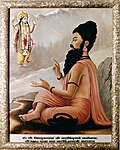
The Pancha Kshetram, (Sanskrit: पञ्च क्षेत्रम्, romanized: Pañca Kṣetram, lit. 'Five abodes/stages of Vishnu') or Pancha Bhargavi Kshethram, is a group of five Hindu temples in India which are dedicated to the deities Vishnu and Lakshmi (Bhargavi). Their legend is associated with the Venkateswara Temple, Tirumala. Four of the temples are Divya Desams, and one is an Abhimana Kshethram.
Legend[edit | edit source]
During Kali Yuga, Narada advised sages who were performing a yagna (fire ritual) to decide who of the Trimurti (Brahma, Vishnu and Shiva) should receive its fruits. Bhrigu was sent to test the trinity. The sage, who had an extra eye in the sole of his foot, visited Brahma and Shiva without being noticed. He cursed Brahma to not be worshipped, and Shiva to be worshipped as a lingam. Bhrigu then visited Vishnu, who ignored him. Angry, Bhrigu kicked Vishnu in the chest; Vishnu apologised to the sage by massaging his feet, crushing the extra eye on the sole of Bhrigu's foot. Lakshmi considered the kick an insult, since Vishnu's chest was considered Lakshmi's residence. She left Vaikuntha, came to Earth at Kohlapura, and began meditating.[1]
Vishnu took human form as Srinivasa, left Vaikuntha in search of Lakshmi, reached the Seshachalam Hills in Tirumala, and began meditating. Lakshmi learned about Srinivasa and called Shiva and Brahma, who became a cow and a calf. Lakshmi gave them to the Chola king ruling the Tirumala Hills; the cow would provide milk to Srinivasa daily while it was grazing. A cowherd in the king's household saw this, and tried to beat the cow with his staff; Srinivasa bore the injury, and struck down the cowherd. Angered by the cowherd's actions, Srinivasa made the Chola king an asura; sins committed by servants should be born by their employers. The king prayed for mercy; Srinivasa told him that he would be reborn as Akasharaja and should marry Srinivasa to his foster-daughter, Padmavati.[2]
Srinivasa stayed with his foster-mother, Vakula Devi, on the Tirumala Hills. The Chola king was reborn as Akasharaja and had a foster-daughter, Padmavati (the human form of Lakshmi, who took this form in the Padmapushkarini, present-day Tiruchanur in Tirupati, Andhra Pradesh). Srinivasa married Padmavati in present-day Narayanavanam, and returned to the Tirumala Hills. After a few months, Srinivasa and Padmavati went to the seven Tirumala hills to emancipate humankind from the troubles of Kali Yuga. They became stone deities, expressing their wish to always be there.
Padmavati was still angry with Vishnu. Bhrigu sought an apology and asked Lakshmi to allow him to be born in four more places: Sundararaja Perumal Temple, Salem, as Bhrigu; Nachiyar Koil as Medhavi Maharishi; Oppiliappan Temple as Markandeya Maharishi, and Sarangapani Temple as Hema Maharishi.[3][4][5]
The five temples[edit | edit source]


Venkateswara Temple, Tirumala is run by Tirumala Tirupati Devasthanams (TTD), controlled by the Andhra Pradesh government. The other four temples, in Tamil Nadu, are maintained and administered by the Hindu Religious and Charitable Endowments Department of the government of Tamil Nadu. The deities are revered in the fifth-century Tamil Vaishnavate Divya Prabandham, written by the Alvars. The temples are classified as Divya Desam except for one, which is one of the 108 Abhimana Sthalam.
| Temple | Photo | Location | Details |
|---|---|---|---|
| Venkateswara Temple, Tirumala | 
|
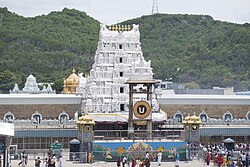
Tirumala 13°40′59.7″N 79°20′49.9″E / 13.683250°N 79.347194°E | Venkateswara Temple is in the hill town of Tirumala, at Tirupati in the Tirupati district of Andhra Pradesh. It is dedicated to Venkateswara, a form of Vishnu believed to have appeared on Earth to save humankind from Kali Yuga. The temple is also known as Kaliyuga Vaikuntha, Tirumala Temple, Tirupati Temple and Tirupati Balaji Temple. Venkateswara is also known as Balaji, Govinda, and Srinivasa.[6] |
| Sundararaja Perumal Temple | Salem, 11°39′N 78°09′E / 11.65°N 78.15°E | Sundararaja Perumal Temple, also known as Kottai Perumal Koil, is located on the Thirumanimutharu River.[7] It has contributions from the medieval Cholas, Vijayanagara Empire, Chera, Pandyas and Madurai Nayaks. The temple follows the Vaikhanasa tradition and its priests belong to the Vadakalai sect of Vaishnavism, a Brahmin sub-caste. | |
| Nachiyar Koil | .jpg)
|
Nachiyar Koil 10°55′N 79°26′E / 10.917°N 79.433°E | Nachiyar Kovil (or Thirunarayur Nambi Temple) is in Thirunarayur, a village on the outskirts of Kumbakonam. The Dravidian temple is mentioned in the Divya Prabandham, the early-medieval Tamil verse collection from the Alvars. It is one of the 108 Divya Desam dedicated to Vishnu, who is worshipped as Srinivasa Perumal; his consort, Lakshmi, is worshiped as Nachiyar. The temple is where Vishnu is believed to have begun Pancha Samskara (religious initiation) for Thirumangai Alvar, and follows the Tenkalai tradition. |
| Oppiliappan Temple | 
|
Thirunageswaram 10°57′41.63″N 79°25′53.73″E / 10.9615639°N 79.4315917°E | The Dravidian Oppiliappan Temple is near Thirunageswaram, a village on the outskirts of Kumbakonam. It is the 60th of the 108 Divya Desams dedicated to Vishnu, who is worshiped as Oppiliappan; his consort, Lakshmi, is worshiped as Bhudevi. The temple is believed to have been begun by the medieval Cholas of the late 8th century CE, with later contributions from the Thanjavur Nayaks. It has two inscriptions dating to the Chola period, a five-tiered gopuram (gateway tower), and a granite wall. |
| Sarangapani Temple | 
|
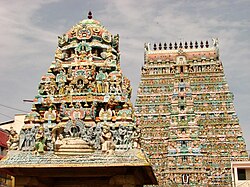
Kumbakonam 10°57′34″N 79°22′29″E / 10.95944°N 79.37472°E | Sarangapani Temple, in Kumbakonam, is one of the Divya Desam: the 108 temples of Vishnu revered in Nalayira Divya Prabandham by the 12 poet-saints.[8] On the Kaveri, it is one of the Pancharanga Kshetrams.[9] The temple, believed to have had contributions from the medieval Cholas, the Vijayanagara Empire, and the Madurai Nayaks, is within a large granite wall. Its gopuram (main gateway) has eleven tiers and a height of 173 ft (53 m). |
References[edit | edit source]
- ↑ "History of Tirupati Balaji temple". 21 January 2023 – via The Economic Times - The Times of India.
- ↑ "Tirumala Tirupati Devasthanam: TTD Online, TTD Darshan, Tirupati Temple Legend, Architecture & More". Jagranjosh.com. 24 December 2021.
- ↑ "Salem Alagirinathar Temple Timings, History". templesinindiainfo. Retrieved 9 April 2017.
- ↑ V., Meena (1974). Temples in South India (1st ed.). Kanniyakumari: Harikumar Arts. p. 29.
- ↑ "Sharngapani Perumal: The temple designed like a chariot". The New Indian Express.
- ↑ "Tirumala Temple". Archived from the original on 11 October 2007. Retrieved 13 September 2007.
- ↑ மலர், மாலை (28 December 2022). "கோட்டை பெருமாள் கோவிலில் சிறப்பு தரிசனத்துக்கு ஆன்லைனில் முன்பதிவு". www.maalaimalar.com.
- ↑ M. S., Ramesh. 108 Vaishnavite Divya Desams: Divya desams in Malai Nadu and Vada Nadu. Tirumalai-Tirupati Devasthanam.
- ↑ "Pancharanga Kshetrams". Indiantemples.com. Retrieved 20 June 2007.