




Ajay Kumar (talk | contribs) Created a new article |
No edit summary |
||
| Line 2: | Line 2: | ||
{{Other uses|Hiking|Camping|Backpacking (disambiguation)}} | {{Other uses|Hiking|Camping|Backpacking (disambiguation)}} | ||
{{Redirect|Trekking}} | {{Redirect|Trekking}} | ||
[[File:Backpacking in polish carpathians cm01.jpg|thumb|Backpacking in the [[Beskids|Beskid Niski]] | [[File:Backpacking in polish carpathians cm01.jpg|thumb|Backpacking in the [[Beskids|Beskid Niski]] Mountains, in the Polish part of the [[Carpathian Mountains]]]] | ||
[[File:Backpacking in Grand Teton NP-NPS.jpg|thumb|right|Backpacking in the [[Grand Teton National Park]], [[Wyoming]]]] | [[File:Backpacking in Grand Teton NP-NPS.jpg|thumb|right|Backpacking in the [[Grand Teton National Park]], [[Wyoming]]]] | ||
'''Backpacking''' is the outdoor recreation of carrying gear on one's back while [[hiking]] for more than a day. It is often an extended journey<ref>"Travel or hike carrying one's belongings in a backpack: [e.g.] a week's backpacking in the [[Pyrenees]], [or] he has backpacked around the world" (''New Oxford American Dictionary'').</ref> and may involve [[camping]] outdoors. In North America, tenting is common, whereas simple shelters and [[mountain hut]]s, widely found in Europe, are rare. In New Zealand, hiking is called [[Tramping in New Zealand|tramping]], and tents are used alongside a nationwide network of huts.<ref>H. W. Orsman, ''The Dictionary of New Zealand English''. Auckland: Oxford University Press, 1999.</ref> [[Hill walking]] is equivalent in Britain (but this can also refer to a day walk), though backpackers make use of a variety of accommodation, in addition to camping. Backpackers use simple huts in South Africa.<ref name="footprint.co.za">{{Cite web |url=http://www.footprint.co.za/Development_introduction.htm |title=Trail Development |access-date=2013-12-13 |archive-url=https://web.archive.org/web/20140401014642/http://www.footprint.co.za/Development_introduction.htm |archive-date=2014-04-01 |url-status=dead }}</ref> '''Trekking''' and [[bushwalking]] are other terms used to describe multi-day backpacking trips, with the term Trekking emphasizing a more self-reliant approach to Backpacking in more remote areas. The terms [[walking tour]] or [[Long distance path|long distance hike]] are also used. | |||
'''Backpacking''' is the outdoor recreation of carrying gear on one's back while [[hiking]] for more than a day. It is often an extended journey<ref>"Travel or hike carrying one's belongings in a backpack: [e.g.] a week's backpacking in the [[Pyrenees]], [or] he has backpacked around the world" (''New Oxford American Dictionary'').</ref> and may involve [[camping]] outdoors. In North America, tenting is common, | |||
Backpacking [[backpacking (travel)|as a method of travel]] is a different activity, which mainly uses [[public transport]] during a journey that can last months. | Backpacking [[backpacking (travel)|as a method of travel]] is a different activity, which mainly uses [[public transport]] during a journey that can last months. It is, however, similar to [[bikepacking]], [[bicycle touring]], [[Canoe camping|canoe]] and [[kayak]] camping, and [[trail riding]], with [[saddlebags]]. | ||
==Definition== | ==Definition== | ||
Backpacking is an [[outdoor recreation]] where gear is carried in a [[backpack]]. This can include food, water, bedding, shelter, clothing, stove, and cooking kit. Given that backpackers must carry their gear, the total weight of their bag and its contents is a primary concern of backpackers. Backpacking trips range from one night to weeks or months, sometimes aided by planned resupply points, drops, or caches. | Backpacking is an [[outdoor recreation]] where gear is carried in a [[backpack]]. This can include food, water, bedding, shelter, clothing, stove, and cooking kit. Given that backpackers must carry their gear, the total weight of their bag and its contents is a primary concern of backpackers. Backpacking trips range from one night to weeks or months, sometimes aided by planned resupply points, drops, or caches. | ||
==Research== | ==Research== | ||
[[File:Mountain Jack and a Wandering Miner .jpg|thumb|A miner carrying a backpack during the [[California Gold Rush]]]] | |||
Carrying loads appears to have differentiated humans from other animals.<ref name=ruckingScience>{{cite web | |||
| url = https://www.runnersworld.com/training/a36131472/rucking-benefits/ | | url = https://www.runnersworld.com/training/a36131472/rucking-benefits/ | ||
| title = How Rucking Can Benefit Your Running Performance | | title = How Rucking Can Benefit Your Running Performance | ||
| Line 28: | Line 25: | ||
===Fitness benefits=== | ===Fitness benefits=== | ||
A weighted carry from backpacking taxes muscles.<ref name=ruckingScience/> A weighted load stresses the shoulders, | A weighted carry from backpacking taxes muscles.<ref name=ruckingScience/> A weighted load stresses the shoulders, deltoids, back, abdominals, obliques, hips, quadriceps, hamstrings and the knees.<ref name=ruckingScience/> Humans can carry weight under {{convert|50|lb}} in a safe manner,<ref name=ruckingScience/> and a weighted carry is as beneficial for the cardiovascular system as a light run,<ref name=ruckingScience/> and for exercise, a weighted carry helps avoid injuries.<ref name=ruckingScience/> | ||
A differential exists between a man running in comparison to a man walking while carrying a backpack.<ref name=ruckingScience/> A {{convert|175|lb|adj=on}} man running, without a backpack, loads his knees with {{convert|1400|lb}} of stress per stride.<ref name=ruckingScience/> The same person, carrying a {{convert|30|lb|adj=on}} pack, loads his knees with {{convert|555|lb}} of stress per step.<ref name=ruckingScience/> | |||
==Accommodations== | ==Accommodations== | ||
[[File:Pocosin cabin.jpg|thumb | [[File:Pocosin cabin.jpg|thumb|The Pocosin cabin along the [[Appalachian Trail]] in [[Shenandoah National Park]] ]] | ||
Backpacking camps are usually more spartan than campsites where gear is transported by car or boat. In areas with heavy backpacker traffic, a hike-in [[campsite]] might have a [[fire ring]] (where permissible), an [[outhouse]], a wooden bulletin board with a [[map]] and information about the trail and area. Many hike-in camps are no more than level patches of ground free of underbrush. In remote [[wilderness]] areas hikers must choose their own site. Established camps are rare and the [[ethos]] is to "[[leave no trace]]" when gone. | Backpacking camps are usually more spartan than campsites where gear is transported by car or boat. In areas with heavy backpacker traffic, a hike-in [[campsite]] might have a [[fire ring]] (where permissible), an [[outhouse]], a wooden bulletin board with a [[map]] and information about the trail and area. Many hike-in camps are no more than level patches of ground free of underbrush. In remote [[wilderness]] areas hikers must choose their own site. Established camps are rare and the [[ethos]] is to "[[leave no trace]]" when gone. | ||
| Line 41: | Line 36: | ||
In some regions, varying forms of accommodation exist, from simple log lean-to's to staffed facilities offering escalating degrees of service. Beds, meals, and even drinks may be had at [[Alps|Alpine]] [[mountain hut|hut]]s scattered among well-traveled European mountains. Backpackers there can walk from hut-to-hut without leaving the mountains, while in places like the [[Lake District]] or [[Yorkshire Dales]] in England hill-walkers descend to stay in [[youth hostel]]s, farmhouses or [[guest house]]s. Reservations can usually be made in advance and are recommended in the high season. | In some regions, varying forms of accommodation exist, from simple log lean-to's to staffed facilities offering escalating degrees of service. Beds, meals, and even drinks may be had at [[Alps|Alpine]] [[mountain hut|hut]]s scattered among well-traveled European mountains. Backpackers there can walk from hut-to-hut without leaving the mountains, while in places like the [[Lake District]] or [[Yorkshire Dales]] in England hill-walkers descend to stay in [[youth hostel]]s, farmhouses or [[guest house]]s. Reservations can usually be made in advance and are recommended in the high season. | ||
In the more remote parts of Great Britain, especially Scotland, [[bothy|bothies]] exist to provide simple (free) accommodation for backpackers. On the French system of [[long distance trail]]s, ''[[Grande Randonnée]]s'', backpackers can stay in ''gîtes d'étapes'', which are simple hostels provided for walkers and cyclists. There are some simple shelters and occasional mountain hut also provided in North America, including on the [[Appalachian Trail]]. Another example is the High Sierra Camps in the [[Yosemite National Park]]. Long-distance backpacking trails with huts also exist in South Africa, including the 100 km plus [[Amatola Trail]], in the [[Eastern Cape]] Province.<ref name="footprint.co.za" /> Backpacking is also popular in the [[Himalayas]] (often called trekking there), where [[Porter (carrier)|porters]] and [[pack animals]] are often used.<ref>{{Cite book |last1=Zurick, Pacheco |url=https://books.google.com/books?id=S20hk99x_-MC |title=Illustrated Atlas of the Himalaya |last2=J.Shrestha |last3=Bajracharya, B. |publisher=India Research Press |year=2006 |isbn=9788183860376}}</ref> | In the more remote parts of Great Britain, especially Scotland, [[bothy|bothies]] exist to provide simple (free) accommodation for backpackers. On the French system of [[long distance trail]]s, ''[[Grande Randonnée]]s'', backpackers can stay in ''gîtes d'étapes'', which are simple hostels provided for walkers and cyclists. There are some simple shelters and occasional mountain hut also provided in North America, including on the [[Appalachian Trail]]. Another example is the [[High Sierra Camps]] in the [[Yosemite National Park]]. Long-distance backpacking trails with huts also exist in South Africa, including the 100 km plus [[Amatola Trail]], in the [[Eastern Cape]] Province.<ref name="footprint.co.za" /> Backpacking is also popular in the [[Himalayas]] (often called trekking there), where [[Porter (carrier)|porters]] and [[pack animals]] are often used.<ref>{{Cite book |last1=Zurick, Pacheco |url=https://books.google.com/books?id=S20hk99x_-MC |title=Illustrated Atlas of the Himalaya |last2=J.Shrestha |last3=Bajracharya, B. |publisher=India Research Press |year=2006 |isbn=9788183860376}}</ref> | ||
{{clear left}} | {{clear left}} | ||
| Line 56: | Line 51: | ||
#[[Survival kit|Survival gear]]. | #[[Survival kit|Survival gear]]. | ||
#A shelter such as a tent, tarp or [[Bivouac shelter|bivouac sack]]. | #A shelter such as a tent, tarp or [[Bivouac shelter|bivouac sack]]. | ||
#Water containers and purifiers. | #Water containers and purifiers. | ||
=== Water === | === Water === | ||
| Line 71: | Line 66: | ||
* Treatment with [[ultraviolet]] light | * Treatment with [[ultraviolet]] light | ||
Water may be stored in bottles or collapsible plastic bladders. [[Hydration bladder | Water may be stored in bottles or collapsible plastic bladders. [[Hydration bladder]]s are increasingly popular. | ||
===Food=== | ===Food=== | ||
{{Main|Camping food}} | {{Main|Camping food}} | ||
{{See also|Nutrition |Outdoor cooking |Survival skills}} | {{See also|Nutrition |Outdoor cooking |Survival skills}} | ||
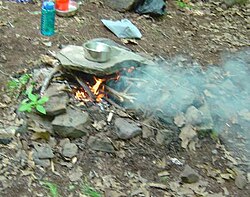
[[File:CampCooking.jpg|thumb | [[File:CampCooking.jpg|thumb|Cooking in the outdoors using a heated stone]] | ||
Backpacking is energy-intensive: long-distance hikers require up to 4,500 [[calorie]]s of food energy per day.<ref>{{cite magazine|title=This Is What Every Long-Distance Hiker Needs to Know About Nutrition|date=27 March 2024|first=Adam|last=Roy|magazine=Backpacker Magazine|url=https://www.backpacker.com/skills/backpacking-fitness/backpacking-nutrition/}}</ref> This is the equivalent of {{convert|1.5|to|2.5|lb|kg|order=flip}} of food.<ref name=REIfood>{{cite web|title=Backpacking Food Ideas & Meal Planning|first=Phuong|last=Le|publisher=REI|url=https://www.rei.com/learn/expert-advice/planning-menu.html|access-date=2025-05-18}}</ref> | |||
There are several choices for backpacking food. Many hikers use [[freeze-drying|freeze-dried]] precooked entrees for hot meals, quickly reconstituted by adding boiling water.<ref name=REIfood/> Popular snacks include [[trail mix]], nuts, [[energy bar]]s, and chocolate.<ref name=REIfood/> Some backpackers consume dried foods, including [[beef jerky]], [[dried fruit]], [[instant oatmeal]], and powdered [[hummus]].<ref>{{cite web|title=15 Smart Backpacking Food Ideas|date=17 July 2024|website=JetBoil|url=https://jetboil.johnsonoutdoors.com/us/trail-life/backpacking-food-ideas|access-date=2025-05-18}}</ref> | |||
There are three common ways to prepare food while backpacking: cold soaking, cooking on a [[portable stove|camp stove]], and cooking over a [[campfire]]. Cold soaking consists of rehydrating dried food with cold water, generally used to avoid carrying the weight of a stove.<ref name=REIultralight>{{cite web|title=Meal Planning for Ultralight Backpacking|website=REI|url=https://www.rei.com/learn/expert-advice/meal-planning-for-ultralight-backpacking.html|access-date=2025-05-18}}</ref> For stove cooking, small liquid or gas-fueled stoves<ref>{{cite web|title=How to Choose a Backpacking Stove|website=REI|url=https://www.rei.com/learn/expert-advice/backpacking-stove.html|access-date=2025-05-18}}</ref> and lightweight cooking pots are common. | |||
When campfires are not prohibited,<ref>{{cite web|title=What you should know about fire restrictions, warnings and watches|publisher=Pacific Crest Trail Association|url=https://www.pcta.org/discover-the-trail/backcountry-basics/fire/fire-restrictions-warnings-watches/|access-date=2025-05-18}}</ref> it is possible to cook food directly over a campfire.<ref name=firecook>{{cite magazine|title=How to Cook Over a Fire, According to a Survival Instructor|date=25 April 2024|first=Jessie|last=Krebs|magazine=Backpacker Magazine|url=https://www.backpacker.com/survival/how-to-cook-over-a-fire/}}</ref> Campfires can be used to boil, bake, roast, or fry food.<ref name=firecook/> | |||
For long-distance backpacking trips, it is sometimes not possible to carry all of the food required from the beginning. In this situation, backpackers need to resupply with food. This resupply can be done by either buying new food in towns along the route, or mailing themselves boxes of food.<ref>{{cite web|title=The Vital Art of Resupplying in Long-Distance Backpacking|date=27 September 2023|publisher=ULA Equipment|url=https://www.ula-equipment.com/2023/09/27/resupplying-long-distance-backpacking/|access-date=2025-05-18}}</ref><ref>{{cite web|title=Resupply strategy|publisher=Pacific Crest Trail Association|url=https://www.pcta.org/discover-the-trail/thru-hiking-long-distance-hiking/resupply/|access-date=2025-05-18}}</ref> | |||
==Ultralight-hiking== | ===Ultralight-hiking=== | ||
[[File:Tent at High Shelf Camp.jpg|thumb | [[File:Tent at High Shelf Camp.jpg|thumb|A backpacker's modern lightweight dome tent near [[Mount Anne]] in a [[Tasmanian Wilderness]] area]] | ||
{{Main|Ultralight backpacking}} | {{Main|Ultralight backpacking}} | ||
Ultralight backpacking is a style of lightweight [[backpacking (wilderness)|backpacking]] that emphasizes carrying the lightest and least amount of gear.<ref name="jordan">{{Cite book|last1=George Cole|title=Lightweight Backpacking and Camping|last2=Ryan Jordan|last3=Alan Dixon|publisher=Beartooth Mountain Press|year=2006|isbn=0-9748188-2-8|location=Bozeman, MT}}</ref> While no technical standards exist, some hikers consider "ultralight" to mean an initial base weight of less than {{cvt|4.5|kg|lb|0}}.<ref>{{Cite book |last=Mike Clelland |year=2011 |title=Ultralight Backpackin' Tips: 153 Amazing & Inexpensive Tips For Extremely Lightweight Camping |location=Helena, Montana |publisher=FalconGuides Press}}</ref> Base weight is the weight of a fully loaded [[backpack]] at the start of a trip, excluding worn weight and consumables such as food, water, and fuel (which vary depending on the duration and style of trip). Base weight can be lowered by reducing the weight of individual items of gear, or by choosing not to carry that gear. Ultralight backpacking is popular among [[Thru-hiking|thru-hikers]].<ref>{{cite magazine|title=The Best Ultralight Backpacks for Thru-Hikers and Fastpackers|url=https://www.backpacker.com/gear/backpacks/best-ultralight-backpacks/|date=30 April 2025|first=Corey|last=Buhay|magazine=Backpacker Magazine}}</ref> | |||
Ultralight backpacking was popularized by American [[rock climbing|rock climber]] [[Ray Jardine]], whose 1992 book ''PCT Hiker's Handbook''<ref>{{Cite book |last=Ray Jardine |year=1992 |title=The PCT Hiker's Handbook |location=LaPine, OR |publisher=AdventureLore Press |isbn=0-9632359-0-7}}</ref> laid the foundations for many techniques that ultralight backpackers use today. Jardine claimed his first [[Pacific Crest Trail]] thru-hike was with a base weight of {{cvt|5.7|kg|lb}}, and by his third PCT thru-hike it was below {{cvt|4.5|kg|lb|0}}<ref name="jardine">{{Cite book |last=Ray Jardine |author-link=Ray Jardine |year=1999 |title=Beyond Backpacking: Ray Jardines Guide to Lightweight Hiking |location=LaPine, OR |publisher=AventureLore Press |isbn=0-9632359-3-1}}</ref> | |||
== Skills and safety == | == Skills and safety == | ||
| Line 103: | Line 96: | ||
{{Main|Hazards of outdoor recreation}} | {{Main|Hazards of outdoor recreation}} | ||
* [[Survival skills]] can provide peace of mind and may make the difference between life and death when the weather, terrain, or environment turns unexpectedly for the worse. | * [[Survival skills]] can provide peace of mind and may make the difference between life and death when the weather, terrain, or environment turns unexpectedly for the worse. | ||
* [[Navigation]] and [[orienteering]] are useful to find the [[trailhead]], then find and follow a route to a desired sequence of destinations, and then an exit. In case of disorientation, orienteering skills are important to determine the current location and formulate a route to somewhere more desirable. At their most basic, navigation skills allow one to choose the correct sequence of trails to follow. In situations where a trail or clear line-of-sight to the desired destination is not present, navigation and orienteering allow the backpacker to understand the terrain and wilderness around them and, using their tools and practices, select the appropriate direction to hike. Weather (rain, fog, snow), terrain (hilly, rock faces, dense forest), and hiker experience can all impact and increase the challenges to navigation in the wilderness. | * [[Navigation]] and [[orienteering]] are useful to find the [[trailhead]], then find and follow a route to a desired sequence of destinations, and then an exit. In case of disorientation, orienteering skills are important to determine the current location and formulate a route to somewhere more desirable. At their most basic, navigation skills allow one to choose the correct sequence of trails to follow. In situations where a trail or clear line-of-sight to the desired destination is not present, navigation and orienteering allow the backpacker to understand the terrain and wilderness around them and, using their tools and practices, select the appropriate direction to hike. Weather (rain, fog, snow), terrain (hilly, rock faces, dense forest), and hiker experience can all impact and increase the challenges to navigation in the wilderness.<ref>{{Cite book |last=Logue |first=Victoria |url=https://books.google.com/books?id=jpUs-DO5QkUC&dq=safety+in+hiking&pg=PP1 |title=Hiking and Backpacking: Essential Skills, Equipment, and Safety |date=2013-03-01 |publisher=Menasha Ridge Press |isbn=978-0-89732-866-1 |language=en}}</ref> | ||
* [[First aid]]: effectively dealing with minor injuries ([[wikt:splinter|splinter]]s, punctures, sprains) is considered by many a fundamental backcountry skill. More subtle, but maybe even more important, is recognizing and promptly treating [[hypothermia]], [[heat stroke]], [[dehydration]] and [[Hypoxia (medical)|hypoxia]], as these are rarely encountered in daily life. | * [[First aid]]: effectively dealing with minor injuries ([[wikt:splinter|splinter]]s, punctures, sprains) is considered by many a fundamental backcountry skill. More subtle, but maybe even more important, is recognizing and promptly treating [[hypothermia]], [[heat stroke]], [[dehydration]] and [[Hypoxia (medical)|hypoxia]], as these are rarely encountered in daily life. | ||
* [[Leave No Trace]] is the backpacker's version of the [[Golden Rule (ethics)|golden rule]]: To have beautiful and pristine places to enjoy, help make them. At a minimum, | * [[Leave No Trace]] is the backpacker's version of the [[Golden Rule (ethics)|golden rule]]: To have beautiful and pristine places to enjoy, help make them. At a minimum, do not make them worse. | ||
* [[Distress signal]]ing is a skill of last resort. | * [[Distress signal]]ing is a skill of last resort. | ||
== Discrimination == | |||
[[File:WOMAN HIKER LOOKING AT MALHEUR RIVER-MALHEUR (24762969629).jpg|alt=woman sitting on a large boulder overlooking a lush, forested, winding river|thumb|upright|A female hiker at Malheur River in the Malheur National Forest]] | |||
Backpacking has been a historically white male-dominated outdoor recreational activity. With official backpacks for the sport being patented since 1878, it is indicative of the demographics that the first backpack designed for and marketed towards women wasn't invented until 1979,<ref name=":0">{{Cite web |last=Parris |first=Aer |title=The History of the Backpack |url=https://www.rei.com/blog/hike/the-history-of-the-backpack?srsltid=AfmBOoqcNGrqMRzBmXXmpEiQAPl6XZ_AnupOzdI8GpnCZvuphCwSK_9j |website=REI}}</ref> over 100 years later. | |||
Backpacking was popularized in the 1960s after the passing of [[Wilderness Act|The Wilderness Act]].<ref>{{Cite web |title=Law and Policy - Wilderness (U.S. National Park Service) |url=https://www.nps.gov/subjects/wilderness/law-and-policy.htm#:~:text=The%20Wilderness%20Act%20of%201964,Service,%20and%20US%20Forest%20Service. |access-date=2024-09-13 |website=www.nps.gov |language=en}}</ref> Since then, the majority of backpackers have been young, white, men.<ref>{{Cite web |last=Joey |date=2020-11-04 |title=59+ Hiking Statistics: How Many People Hike In The US? (2023) |url=https://www.jerseyislandholidays.com/59-hiking-statistics/ |access-date=2024-09-14 |website=Jersey Island Holidays |language=en-GB}}</ref> Studies surrounding the outdoor activity have reflected this. The effects on backpacking (hiking) on women wasn't studied until around 2004,<ref>{{Cite journal |last=Boulware |first=David R |date=2004 |title=Gender Differences among long distance Backpackers: A prospective study of Women Appalachian Trail Backpackers |journal=Wilderness & Environmental Medicine |volume=15 |issue=3 |pages=175–180 |doi=10.1580/1080-6032(2004)15[175:gdalba]2.0.co;2 |issn=1080-6032 |pmc=1946964 |pmid=15473456}}</ref> and research is still lacking. | |||
== Related activities == | == Related activities == | ||
| Line 112: | Line 112: | ||
===Winter backpacking=== | ===Winter backpacking=== | ||
{{Further|Ski touring|Snowshoeing}} | {{Further|Ski touring|Snowshoeing}} | ||
[[Image:Bivouac2.jpg|thumb | [[Image:Bivouac2.jpg|thumb|A winter [[bivouac sack|bivouac]] in Germany.]] | ||
Winter backpacking requires a higher level of skill and generally more specialized gear than in other seasons. [[Skis]] or [[snowshoes]] may be required to traverse deep snow, or [[crampons]] and an [[ice axe]] where needed. Winter sleeping bags and tents are essential, as are waterproof, water-repellent, and moisture dissipating materials. Cotton clothing retains moisture and chills the body, both particularly dangerous in cold weather. Winter backpackers stick to wool or synthetic fabric like nylon or polypropylene, which hold less moisture and often have specialized wicking properties to dissipate sweat generated during aerobic activities. Layering is essential, as wet clothes quickly sap body heat and can lead to [[frostbite]] or [[hypothermia]]. | Winter backpacking requires a higher level of skill and generally more specialized gear than in other seasons. [[Skis]] or [[snowshoes]] may be required to traverse deep snow, or [[crampons]] and an [[ice axe]] where needed. Winter sleeping bags and tents are essential, as are waterproof, water-repellent, and moisture dissipating materials. Cotton clothing retains moisture and chills the body, both particularly dangerous in cold weather. Winter backpackers stick to wool or synthetic fabric like nylon or polypropylene, which hold less moisture and often have specialized wicking properties to dissipate sweat generated during aerobic activities. Layering is essential, as wet clothes quickly sap body heat and can lead to [[frostbite]] or [[hypothermia]]. | ||
| Line 120: | Line 120: | ||
===Fastpacking=== | ===Fastpacking=== | ||
{{Further|Fastpacking}} | {{Further|Fastpacking}} | ||
[[Fastpacking]] is a recreational activity that combines [[ultralight backpacking]] with [[running]], and, on steep slopes, [[hiking]]. It is a multi-day adventure that usually takes places along [[long distance trails]].<ref>{{Cite web|date=2009-08-06|title=Fastpacking: What, and Why? |first=Kate |last=Siber |url=https://www.runnersworld.com/trail-running/a20800756/running-and-backpacking/|access-date=2023-01-02|website=Runner's World|language=en-us}}</ref><ref>Clint Cherepa, [https://www.outdoors.org/articles/fastpacking "Hike Fast, Sleep Hard: Are You Ready to Try Fastpacking?"] ''Outdoors.org'', August 27, 2018.</ref> A sleeping bag is carried and other essential backpacking items, and often a tent or similar shelter, if places to stay are not available.<ref>Ad Crable, "Running wild", ''Lancaster New Era'', June 18, 1993.</ref><ref>{{Cite web|title=Run, don't walk: mastering the art of fastpacking |first=Patrick |last=Kinsella |date=May 5, 2017 |url=https://www.lonelyplanet.com/articles/run-dont-walk-mastering-the-art-of-fastpacking|access-date=2023-01-02|website=Lonely Planet|language=en}}</ref> | [[Fastpacking]] is a recreational activity that combines [[ultralight backpacking]] with [[running]], and, on steep slopes, [[hiking]]. It is a multi-day adventure that usually takes places along [[long distance trails]].<ref>{{Cite web|date=2009-08-06|title=Fastpacking: What, and Why? |first=Kate |last=Siber |url=https://www.runnersworld.com/trail-running/a20800756/running-and-backpacking/|access-date=2023-01-02|website=Runner's World|language=en-us}}</ref><ref>Clint Cherepa, [https://www.outdoors.org/articles/fastpacking "Hike Fast, Sleep Hard: Are You Ready to Try Fastpacking?"] {{Webarchive|url=https://web.archive.org/web/20210123234414/https://www.outdoors.org/articles/fastpacking |date=2021-01-23 }} ''Outdoors.org'', August 27, 2018.</ref> A sleeping bag is carried and other essential backpacking items, and often a tent or similar shelter, if places to stay are not available.<ref>Ad Crable, "Running wild", ''Lancaster New Era'', June 18, 1993.</ref><ref>{{Cite web|title=Run, don't walk: mastering the art of fastpacking |first=Patrick |last=Kinsella |date=May 5, 2017 |url=https://www.lonelyplanet.com/articles/run-dont-walk-mastering-the-art-of-fastpacking|access-date=2023-01-02|website=Lonely Planet|language=en}}</ref> | ||
===Other=== | ===Other=== | ||
[[File:027 Cycling Torres del Paine.jpg|thumb|right|Expedition cycle touring, [[Torres del Paine National Park]]. | [[File:027 Cycling Torres del Paine.jpg|thumb|right|Expedition cycle touring, [[Torres del Paine National Park]], Chile.]] | ||
* [[Backpacking (travel)]], where public transport is used to visit cultural attractions, rather than natural ones, though it may also include wilderness side trips. | * [[Backpacking (travel)]], where public transport is used to visit cultural attractions, rather than natural ones, though it may also include wilderness side trips. | ||
* [[Adventure travel]], tourism in a highly unpredictable or hazardous region or environment. | * [[Adventure travel]], tourism in a highly unpredictable or hazardous region or environment. | ||
| Line 134: | Line 131: | ||
==See also== | ==See also== | ||
{{Columns-list|colwidth= | {{Columns-list|colwidth=20em| | ||
* [[Backpacking with animals]] | * [[Backpacking with animals]] | ||
* [[Bivouac shelter]] | * [[Bivouac shelter]] | ||
| Line 146: | Line 143: | ||
* [[Trekking pole]] | * [[Trekking pole]] | ||
}} | }} | ||
{{clear right}} | |||
==References== | ==References== | ||
Latest revision as of 08:38, 8 March 2026


Backpacking is the outdoor recreation of carrying gear on one's back while hiking for more than a day. It is often an extended journey[1] and may involve camping outdoors. In North America, tenting is common, whereas simple shelters and mountain huts, widely found in Europe, are rare. In New Zealand, hiking is called tramping, and tents are used alongside a nationwide network of huts.[2] Hill walking is equivalent in Britain (but this can also refer to a day walk), though backpackers make use of a variety of accommodation, in addition to camping. Backpackers use simple huts in South Africa.[3] Trekking and bushwalking are other terms used to describe multi-day backpacking trips, with the term Trekking emphasizing a more self-reliant approach to Backpacking in more remote areas. The terms walking tour or long distance hike are also used.
Backpacking as a method of travel is a different activity, which mainly uses public transport during a journey that can last months. It is, however, similar to bikepacking, bicycle touring, canoe and kayak camping, and trail riding, with saddlebags.
Definition[edit | edit source]
Backpacking is an outdoor recreation where gear is carried in a backpack. This can include food, water, bedding, shelter, clothing, stove, and cooking kit. Given that backpackers must carry their gear, the total weight of their bag and its contents is a primary concern of backpackers. Backpacking trips range from one night to weeks or months, sometimes aided by planned resupply points, drops, or caches.
Research[edit | edit source]

Carrying loads appears to have differentiated humans from other animals.[4]
Fitness benefits[edit | edit source]
A weighted carry from backpacking taxes muscles.[4] A weighted load stresses the shoulders, deltoids, back, abdominals, obliques, hips, quadriceps, hamstrings and the knees.[4] Humans can carry weight under 50 pounds (23 kg) in a safe manner,[4] and a weighted carry is as beneficial for the cardiovascular system as a light run,[4] and for exercise, a weighted carry helps avoid injuries.[4]
A differential exists between a man running in comparison to a man walking while carrying a backpack.[4] A 175-pound (79 kg) man running, without a backpack, loads his knees with 1,400 pounds (640 kg) of stress per stride.[4] The same person, carrying a 30-pound (14 kg) pack, loads his knees with 555 pounds (252 kg) of stress per step.[4]
Accommodations[edit | edit source]

Backpacking camps are usually more spartan than campsites where gear is transported by car or boat. In areas with heavy backpacker traffic, a hike-in campsite might have a fire ring (where permissible), an outhouse, a wooden bulletin board with a map and information about the trail and area. Many hike-in camps are no more than level patches of ground free of underbrush. In remote wilderness areas hikers must choose their own site. Established camps are rare and the ethos is to "leave no trace" when gone.
In some regions, varying forms of accommodation exist, from simple log lean-to's to staffed facilities offering escalating degrees of service. Beds, meals, and even drinks may be had at Alpine huts scattered among well-traveled European mountains. Backpackers there can walk from hut-to-hut without leaving the mountains, while in places like the Lake District or Yorkshire Dales in England hill-walkers descend to stay in youth hostels, farmhouses or guest houses. Reservations can usually be made in advance and are recommended in the high season.
In the more remote parts of Great Britain, especially Scotland, bothies exist to provide simple (free) accommodation for backpackers. On the French system of long distance trails, Grande Randonnées, backpackers can stay in gîtes d'étapes, which are simple hostels provided for walkers and cyclists. There are some simple shelters and occasional mountain hut also provided in North America, including on the Appalachian Trail. Another example is the High Sierra Camps in the Yosemite National Park. Long-distance backpacking trails with huts also exist in South Africa, including the 100 km plus Amatola Trail, in the Eastern Cape Province.[3] Backpacking is also popular in the Himalayas (often called trekking there), where porters and pack animals are often used.[5]
Equipment[edit | edit source]
 |
Backpacking gear depends on the terrain and climate, and on a hiker's plans for shelter (refuges, huts, gites, camping, etc.). It may include:
- A backpack of appropriate size. Backpacks can include frameless, external frame, internal frame, and bodypack styles.
- Clothing and footwear appropriate for the conditions.
- Food and a means to prepare it (stove, utensils, pot, etc.).
- Sleep system such as a sleeping bag and a pad.
- Survival gear.
- A shelter such as a tent, tarp or bivouac sack.
- Water containers and purifiers.
Water[edit | edit source]

Proper hydration is critical to successful backpacking. Depending on conditions - which include weather, terrain, load, and the hiker's age and fitness - a backpacker may drink 2 to 8 litres (1/2 to 2 gallons), or more, per day. At 1 kilogram (2.2 lb) per 1 litre (1.1 US qt)[6] water is exceptionally heavy. It is impossible to carry more than a few days' supply. Therefore, hikers often drink natural water supplies, sometimes after filtering or purifying.
Some hikers will treat water before drinking to protect against waterborne diseases carried by bacteria and protozoa. The chief treatment methods include:
- Boiling
- Treatment with chemicals such as chlorine or iodine
- Filtering (often used with chemical treatments)
- Treatment with ultraviolet light
Water may be stored in bottles or collapsible plastic bladders. Hydration bladders are increasingly popular.
Food[edit | edit source]

Backpacking is energy-intensive: long-distance hikers require up to 4,500 calories of food energy per day.[7] This is the equivalent of 0.68 to 1.13 kilograms (1.5 to 2.5 lb) of food.[8]
There are several choices for backpacking food. Many hikers use freeze-dried precooked entrees for hot meals, quickly reconstituted by adding boiling water.[8] Popular snacks include trail mix, nuts, energy bars, and chocolate.[8] Some backpackers consume dried foods, including beef jerky, dried fruit, instant oatmeal, and powdered hummus.[9]
There are three common ways to prepare food while backpacking: cold soaking, cooking on a camp stove, and cooking over a campfire. Cold soaking consists of rehydrating dried food with cold water, generally used to avoid carrying the weight of a stove.[10] For stove cooking, small liquid or gas-fueled stoves[11] and lightweight cooking pots are common.
When campfires are not prohibited,[12] it is possible to cook food directly over a campfire.[13] Campfires can be used to boil, bake, roast, or fry food.[13]
For long-distance backpacking trips, it is sometimes not possible to carry all of the food required from the beginning. In this situation, backpackers need to resupply with food. This resupply can be done by either buying new food in towns along the route, or mailing themselves boxes of food.[14][15]
Ultralight-hiking[edit | edit source]

Ultralight backpacking is a style of lightweight backpacking that emphasizes carrying the lightest and least amount of gear.[16] While no technical standards exist, some hikers consider "ultralight" to mean an initial base weight of less than 4.5 kg (10 lb).[17] Base weight is the weight of a fully loaded backpack at the start of a trip, excluding worn weight and consumables such as food, water, and fuel (which vary depending on the duration and style of trip). Base weight can be lowered by reducing the weight of individual items of gear, or by choosing not to carry that gear. Ultralight backpacking is popular among thru-hikers.[18]
Ultralight backpacking was popularized by American rock climber Ray Jardine, whose 1992 book PCT Hiker's Handbook[19] laid the foundations for many techniques that ultralight backpackers use today. Jardine claimed his first Pacific Crest Trail thru-hike was with a base weight of 5.7 kg (13 lb), and by his third PCT thru-hike it was below 4.5 kg (10 lb)[20]
Skills and safety[edit | edit source]
|

- Survival skills can provide peace of mind and may make the difference between life and death when the weather, terrain, or environment turns unexpectedly for the worse.
- Navigation and orienteering are useful to find the trailhead, then find and follow a route to a desired sequence of destinations, and then an exit. In case of disorientation, orienteering skills are important to determine the current location and formulate a route to somewhere more desirable. At their most basic, navigation skills allow one to choose the correct sequence of trails to follow. In situations where a trail or clear line-of-sight to the desired destination is not present, navigation and orienteering allow the backpacker to understand the terrain and wilderness around them and, using their tools and practices, select the appropriate direction to hike. Weather (rain, fog, snow), terrain (hilly, rock faces, dense forest), and hiker experience can all impact and increase the challenges to navigation in the wilderness.[21]
- First aid: effectively dealing with minor injuries (splinters, punctures, sprains) is considered by many a fundamental backcountry skill. More subtle, but maybe even more important, is recognizing and promptly treating hypothermia, heat stroke, dehydration and hypoxia, as these are rarely encountered in daily life.
- Leave No Trace is the backpacker's version of the golden rule: To have beautiful and pristine places to enjoy, help make them. At a minimum, do not make them worse.
- Distress signaling is a skill of last resort.
Discrimination[edit | edit source]
.jpg)
Backpacking has been a historically white male-dominated outdoor recreational activity. With official backpacks for the sport being patented since 1878, it is indicative of the demographics that the first backpack designed for and marketed towards women wasn't invented until 1979,[22] over 100 years later.
Backpacking was popularized in the 1960s after the passing of The Wilderness Act.[23] Since then, the majority of backpackers have been young, white, men.[24] Studies surrounding the outdoor activity have reflected this. The effects on backpacking (hiking) on women wasn't studied until around 2004,[25] and research is still lacking.
Related activities[edit | edit source]
Winter backpacking[edit | edit source]

Winter backpacking requires a higher level of skill and generally more specialized gear than in other seasons. Skis or snowshoes may be required to traverse deep snow, or crampons and an ice axe where needed. Winter sleeping bags and tents are essential, as are waterproof, water-repellent, and moisture dissipating materials. Cotton clothing retains moisture and chills the body, both particularly dangerous in cold weather. Winter backpackers stick to wool or synthetic fabric like nylon or polypropylene, which hold less moisture and often have specialized wicking properties to dissipate sweat generated during aerobic activities. Layering is essential, as wet clothes quickly sap body heat and can lead to frostbite or hypothermia.
A winter bivouac can also be made in a snow cave. It has thermal properties similar to an igloo and is effective both at providing protection from wind and low temperatures. A properly made snow cave can be 0 °C (32 °F) or warmer inside, even when outside temperatures are −40 °C (−40 °F).[26][27] It is constructed by excavating snow so that its entrance tunnel is below the main space in order to retain warm air. Construction is simplified by building on a steep slope and digging slightly upwards and horizontally into the snow. The roof is domed to prevent dripping on the occupants. Adequate snow depth, free of rocks and ice, is needed — generally 4 to 5 ft (1.2 to 1.5 m) is sufficient. A quinzhee is similar, but constructed by tunneling into mounded snow rather than by digging into a natural snow formation.
Fastpacking[edit | edit source]
Fastpacking is a recreational activity that combines ultralight backpacking with running, and, on steep slopes, hiking. It is a multi-day adventure that usually takes places along long distance trails.[28][29] A sleeping bag is carried and other essential backpacking items, and often a tent or similar shelter, if places to stay are not available.[30][31]
Other[edit | edit source]

- Backpacking (travel), where public transport is used to visit cultural attractions, rather than natural ones, though it may also include wilderness side trips.
- Adventure travel, tourism in a highly unpredictable or hazardous region or environment.
- Thru-hiking, traversing a long-distance trail in a single, continuous journey.
- Ultralight backpacking, which minimizes both weight and amount of gear carried, typically employed in highly aerobic back-country pursuits.
- Wilderness survival
See also[edit | edit source]
References[edit | edit source]
- ↑ "Travel or hike carrying one's belongings in a backpack: [e.g.] a week's backpacking in the Pyrenees, [or] he has backpacked around the world" (New Oxford American Dictionary).
- ↑ H. W. Orsman, The Dictionary of New Zealand English. Auckland: Oxford University Press, 1999.
- ↑ 3.0 3.1 "Trail Development". Archived from the original on 2014-04-01. Retrieved 2013-12-13.
- ↑ 4.0 4.1 4.2 4.3 4.4 4.5 4.6 4.7 4.8 Easter, Michael (11 May 2021). "How Rucking Can Benefit Your Running Performance". runnersworld.com.
- ↑ Zurick, Pacheco; J.Shrestha; Bajracharya, B. (2006). Illustrated Atlas of the Himalaya. India Research Press. ISBN 9788183860376.
- ↑ "Comparisons and Conversions". pp. 2nd paragraph. Retrieved 2009-05-08.
- ↑ Roy, Adam (27 March 2024). "This Is What Every Long-Distance Hiker Needs to Know About Nutrition". Backpacker Magazine.
- ↑ 8.0 8.1 8.2 Le, Phuong. "Backpacking Food Ideas & Meal Planning". REI. Retrieved 2025-05-18.
- ↑ "15 Smart Backpacking Food Ideas". JetBoil. 17 July 2024. Retrieved 2025-05-18.
- ↑ "Meal Planning for Ultralight Backpacking". REI. Retrieved 2025-05-18.
- ↑ "How to Choose a Backpacking Stove". REI. Retrieved 2025-05-18.
- ↑ "What you should know about fire restrictions, warnings and watches". Pacific Crest Trail Association. Retrieved 2025-05-18.
- ↑ 13.0 13.1 Krebs, Jessie (25 April 2024). "How to Cook Over a Fire, According to a Survival Instructor". Backpacker Magazine.
- ↑ "The Vital Art of Resupplying in Long-Distance Backpacking". ULA Equipment. 27 September 2023. Retrieved 2025-05-18.
- ↑ "Resupply strategy". Pacific Crest Trail Association. Retrieved 2025-05-18.
- ↑ George Cole; Ryan Jordan; Alan Dixon (2006). Lightweight Backpacking and Camping. Bozeman, MT: Beartooth Mountain Press. ISBN 0-9748188-2-8.
- ↑ Mike Clelland (2011). Ultralight Backpackin' Tips: 153 Amazing & Inexpensive Tips For Extremely Lightweight Camping. Helena, Montana: FalconGuides Press.
- ↑ Buhay, Corey (30 April 2025). "The Best Ultralight Backpacks for Thru-Hikers and Fastpackers". Backpacker Magazine.
- ↑ Ray Jardine (1992). The PCT Hiker's Handbook. LaPine, OR: AdventureLore Press. ISBN 0-9632359-0-7.
- ↑ Ray Jardine (1999). Beyond Backpacking: Ray Jardines Guide to Lightweight Hiking. LaPine, OR: AventureLore Press. ISBN 0-9632359-3-1.
- ↑ Logue, Victoria (2013-03-01). Hiking and Backpacking: Essential Skills, Equipment, and Safety. Menasha Ridge Press. ISBN 978-0-89732-866-1.
- ↑ Parris, Aer. "The History of the Backpack". REI.
- ↑ "Law and Policy - Wilderness (U.S. National Park Service)". www.nps.gov. Retrieved 2024-09-13.
- ↑ Joey (2020-11-04). "59+ Hiking Statistics: How Many People Hike In The US? (2023)". Jersey Island Holidays. Retrieved 2024-09-14.
- ↑ Boulware, David R (2004). "Gender Differences among long distance Backpackers: A prospective study of Women Appalachian Trail Backpackers". Wilderness & Environmental Medicine. 15 (3): 175–180. doi:10.1580/1080-6032(2004)15[175:gdalba]2.0.co;2. ISSN 1080-6032. PMC 1946964. PMID 15473456.
- ↑ "Quinzee (aka - Snow Cave)". AlphaRubicon.com. Retrieved 2007-01-30.
- ↑ Gerke, Randy. "When Storms Rage (or how to build a snow cave)". Enviro-Tech International. Retrieved 2007-01-30.
- ↑ Siber, Kate (2009-08-06). "Fastpacking: What, and Why?". Runner's World. Retrieved 2023-01-02.
- ↑ Clint Cherepa, "Hike Fast, Sleep Hard: Are You Ready to Try Fastpacking?" Archived 2021-01-23 at the Wayback Machine Outdoors.org, August 27, 2018.
- ↑ Ad Crable, "Running wild", Lancaster New Era, June 18, 1993.
- ↑ Kinsella, Patrick (May 5, 2017). "Run, don't walk: mastering the art of fastpacking". Lonely Planet. Retrieved 2023-01-02.
External links[edit | edit source]
- American Hiking Society Preserves and protects hiking trails and the hiking experience
- Leave No Trace - The Leave No Trace Center for Outdoor Ethics is an educational, nonprofit organization dedicated to the responsible enjoyment and active stewardship of the outdoors by all people, worldwide.