
>Smeagol 17 |
Vernell29N (talk | contribs) enhanced citations for accuracy |
||
| Line 1: | Line 1: | ||
{{ | {{Short description|Armed Ghanjah dhow (trading ship)}} | ||
{{Use dmy dates|date=April 2017}} | {{Use dmy dates|date=April 2017}} | ||
[[ | {{Infobox ship | ||
| display_title = ''Ganj-i-Sawai'' | |||
|section1={{Infobox ship/image | |||
| image = Ganj-i-Sawai, Mughal Hajj Ship.jpg | |||
| image_caption = A later (1933) interpretation of Ganj-i-Sawai. The ship is inaccurately depicted as an [[East Indiaman]]. | |||
}} | |||
|section2={{Infobox ship/career | |||
| flag = | |||
| name = ''Ganj-I-Sawai'' | |||
| owner = <ul> | |||
<li>[[Mariam-uz-Zamani]] | |||
<li>[[Jahangir]]</li> | |||
<li>[[Shah Jahan]]</li> | |||
<li>[[Aurangzeb]]</li> | |||
</ul> | |||
| operator = | |||
| route = | |||
| ordered = In 1614 by Empress Mariam-uz-Zamani<ref name = AiyshaSafdar/> | |||
| builder = | |||
| original_cost = | |||
| yard_number = | |||
| way_number = | |||
| laid_down = | |||
| launched = 1616 | |||
| completed = 1616 | |||
| acquired = | |||
| maiden_voyage = 1617 | |||
| in_service = | |||
| registry = | |||
| out_of_service = 7 September 1695 | |||
| identification = | |||
| fate = [[Capture of the Grand Mughal Fleet|Seized by pirates]] | |||
| notes = | |||
}} | |||
|section3={{Infobox ship/characteristics | |||
| hide_header = | |||
| type = [[Ghanjah]] [[sailing ship]] | |||
| tonnage = | |||
| displacement = 1500{{sfn|Johnson|2020|p=120}} to 1600 tons{{sfn|Baer|2005|p=101}}<ref name="google2">{{cite web|url=https://books.google.com/books?id=Nw4IAQAAIAAJ&dq=rahimi+ship+length&pg=PA469 |title=Gazetteer of the Bombay Presidency: Tha'na (2 pts.) - Google Books |year=1882 |accessdate=2020-01-20}}</ref> | |||
| length = | |||
| beam = | |||
| height = | |||
| draught = | |||
| depth = | |||
| decks = | |||
| power = | |||
| propulsion = | |||
| speed = | |||
| complement = 1100–1300 total, 400–500 of which were soldiers{{sfn|Saletore|1978|p=54—55}} | |||
| armament = 40–80 guns{{sfn|Saletore|1978|p=54—55}}/ 800 guns<ref>{{harvtxt|Kaushik Roy|2015|p=194 }}</ref><ref>{{harvtxt|Roy|1972|p=XII }}</ref> | |||
| notes = | |||
}} | |||
}} | |||
{{Campaignbox Golden Age of Piracy}} | {{Campaignbox Golden Age of Piracy}} | ||
The '''''Ganj-i-Sawai''''' (Persian/[[Hindustani language|Hindustani]]: | The '''''Ganj-i-Sawai''''' ([[Persian language|Persian]]/[[Hindustani language|Hindustani]]: ''Ganj-i-Sawai'', in English "Exceeding Treasure", often anglicized as '''''Gunsway''''') was an armed ship belonging to the [[Mughal Empire|Mughals]]. During [[Aurangzeb]]'s reign, it was [[Capture of the Grand Mughal Fleet|captured]] on 7 September 1695 by the English pirate [[Henry Every]] en route from present-day [[Mocha, Yemen|Mocha]], Yemen to [[Surat]], India. It was built on the order of [[Mariam-uz-Zamani|Empress Mariam-uz-Zamani]], great-grandmother of Aurengzeb, after the capture of her ship named ''[[Rahīmī|Rahimi]]''.<ref name = AiyshaSafdar>{{cite journal | ||
| last1 = Safdar | |||
| first1 = Aiysha | |||
| last2 = Azam Kalan | |||
| first2 = Muhammad | |||
| journal = Journal of Indian Studies | |||
| title = History of Indian Ocean-A South Asian Perspective | |||
| date = January–June 2021 | |||
| volume = 7 | |||
| number = 1 | |||
| pages = 183–200 | |||
| url = https://pu.edu.pk/images/journal/indianStudies/PDF/12_v7_1_21.pdf | |||
}}</ref>{{rp|pp=186–187}} | |||
==Capture by pirates== | ==Capture by pirates== | ||
In August 1695, [[Henry Every]], captaining the 46-gun, 5th rate [[frigate]] ''[[Fancy (ship)|Fancy]]'', reached the [[Bab-el-Mandeb|Mandab Strait]], where he teamed up with five other pirate ships, including [[Thomas Tew]]'s 8-gun, 46-man [[sloop-of-war]] ''Amity'', [[Richard Want]] in ''Dolphin'', [[Joseph Faro]] in ''Portsmouth Adventure'', [[Thomas Wake (pirate)|Thomas Wake]] in ''Susannah'', and [[William May (pirate)|William Maze]] in ''Pearl''. Although a [[Mughal Empire|Mughal]] convoy of 25 ships bound for India had eluded the pirate fleet during the night, the following day they encountered ''Ganj-i-Sawai'' and her escort ''Fateh Muhammed'' | {{Main|Capture of the Grand Mughal Fleet}} | ||
In August 1695, [[Henry Every]], captaining the 46-gun, 5th rate [[frigate]] ''[[Fancy (ship)|Fancy]]'', reached the [[Bab-el-Mandeb|Mandab Strait]], where he teamed up with five other pirate ships, including [[Thomas Tew]]'s 8-gun, 46-man [[sloop-of-war]] ''Amity'', [[Richard Want]] in ''Dolphin'', [[Joseph Faro]] in ''Portsmouth Adventure'', [[Thomas Wake (pirate)|Thomas Wake]] in ''Susannah'', and [[William May (pirate)|William Maze]] in ''Pearl''. Although a [[Mughal Empire|Mughal]] convoy of 25 ships bound for India had eluded the pirate fleet during the night, the following day they encountered ''Ganj-i-Sawai'' and her escort ''Fateh Muhammed'' with both stragglers passing the straits en route to [[Surat]]. | |||
Every and his men attacked ''Fateh Muhammed'', which had earlier repulsed an attack by ''Amity'', killing Captain Tew. Perhaps intimidated by ''Fancy''{{'}}s 46 guns or weakened by their earlier battle with Tew, ''Fateh Muhammed''{{'}}s crew put up little resistance, and Every's pirates sacked the ship and came away with £40,000 worth of treasure. | Every and his men attacked ''Fateh Muhammed'', which had earlier repulsed an attack by ''Amity'', killing Captain Tew. Perhaps intimidated by ''Fancy''{{'}}s 46 guns or weakened by their earlier battle with Tew, ''Fateh Muhammed''{{'}}s crew put up little resistance, and Every's pirates sacked the ship and came away with £40,000 worth of treasure. | ||
Every | Every then sailed in pursuit of ''Ganj-i-Sawai'', overtaking her about eight days out of Surat. ''Ganj-i-Sawai'' was a fearsome opponent, mounting 62 guns and carrying four to five hundred guards armed with small arms,<ref>{{cite book|last1=Harris|first1=Graham|title=Treasure and Intrigue: The Legacy of Captain Kidd|date=2002|publisher=Dundurn|location=Toronto|isbn=9781550024098|page=88|url=https://books.google.com/books?id=ZAbB8ujNogEC|access-date=27 June 2017|language=en}}</ref> as well as six hundred other passengers. But the opening volley evened the odds, as one of the ''Ganj-i-Sawai''{{'}}s cannons exploded, killing some of its gunners and causing great confusion and demoralization among the crew, while Every's [[Broadside (naval)|broadside]] shot his enemy's mainmast by the board. The larger ''Fancy'' drew alongside, and a number of her 113-man crew clambered aboard, overpowering the crew, passengers, and slaves of ''Ganj-i-Sawai''. | ||
The victorious pirates then subjected their captives to several days of horror, [[murder]]ing prisoners at will, and using [[torture]] to force them to reveal the location of the ships' treasure. | The victorious pirates then subjected their captives to several days of horror, [[murder]]ing prisoners at will, and using [[torture]] to force them to reveal the location of the ships' treasure. | ||
The loot from ''Ganj-i-Sawai'' | The loot from ''Ganj-i-Sawai'' totaled between £325,000 and £600,000, including "some 500,000 [[gold]] and [[silver]] pieces, plus numerous jeweled baubles and miscellaneous silver cups, trinkets, and so on."<ref>{{Cite book|last=Burgess| first=Douglas R. Jr. | author-link = Douglas Burgess |title=The Politics of Piracy: Crime and Civil Disobedience in Colonial America|publisher=ForeEdge|year=2014|isbn=9781611685275|location=Lebanon, NH|pages=53}}</ref> Several crews went home empty-handed: Tew was dead, Want and Wake's ships were too slow and never made it to the battle, Faro made it to the ''Ganj-i-Sawai'' but never engaged, and Maze was present but Every took back their share of the loot after ''Pearl''{{'}}s crew tried to trade [[Methods of coin debasement|clipped]] coins to ''Fancy''{{'}}s men.<ref name="Neverland">{{cite book|last1=Rennie|first1=Neil|title=Treasure Neverland: Real and Imaginary Pirates|date=2013|publisher=OUP Oxford|location=Oxford|isbn=9780191668654|url=https://books.google.com/books?id=VXUMAgAAQBAJ|access-date=27 June 2017|language=en}}</ref> Every had been asked by the other pirate captains to carry the treasure to an agreed upon location where it would be split among the various crews, as ''Fancy'', with her 46 guns, carried the most fire power to guard it. Come nightfall, Every and his crew silently slipped away from the pirate armada, taking all ''Ganj-i-Sawai''<nowiki/>'s treasure with them. | ||
In response to the capture of ''Ganj-i-Sawai'', the Mughal Emperor, Aurangzeb, sent his army to five key ports for English trade in | In response to the capture of ''Ganj-i-Sawai'', the Mughal Emperor, Aurangzeb, sent his army to five key ports for English trade in India—Bombay, Surat, Broach, Agra, and Ahmedabad—to close them. Aurangzeb effectively cut off English trade with India as he refused to reopen the ports until Henry Every was caught and executed for his crimes. The [[East India Company]] reconciled with the Mughal Emperor by fully compensating his losses, and filed an insurance claim for £350,000,<ref>{{Cite book|last=Burgess| first=Douglas | author-link = Douglas Burgess |title=The Pirates' Pact: The Secret Alliances Between History's Most Notorious Buccaneers and Colonial America|url=https://archive.org/details/piratespactsecre00jrdo|url-access=limited|publisher=McGraw Hill|year=2009|isbn=9780071474764|location=New York|pages=[https://archive.org/details/piratespactsecre00jrdo/page/n161 143]}}</ref> though Mughal authorities demanded this amount be doubled. The desire to see Every executed led to the first truly global manhunt in history, though he and the majority of his crew would never be caught. Six members of his crew were captured, tried, and executed, though they were not found guilty of seizing ''Ganj-i-Sawai'', but rather a different ship.<ref>{{cite journal|title=The trial of Joseph Dawson, Edward Forseith, William May, Wm. Bishop, James Lewis, and John Sparkes, at the Old-Bailey, for felony and piracy|volume=13|issue=392, column 451|year=1812|journal=A Complete Collection of State Trials and Proceedings for High Treason and Other Crimes and Misdemeanors}}</ref> | ||
== | == Gallery == | ||
<gallery mode="packed" widths="170" heights="170"> | |||
Avery Chasing the Great Mughal's Ship.jpg|''Ganj-i-Sawai'' being chased by Every's fleet. The ship is mistakenly depicted as an East Indiaman. | |||
Every engaging the Great Mogul's Ship.jpg|Illustration of ''Ganj-i-Sawai'' (center) being attacked. | |||
</gallery> | |||
==See also== | ==See also== | ||
* [[Polacca]] | |||
* [[Rahīmī|Rahīmī (Mughal ship)]] | * [[Rahīmī|Rahīmī (Mughal ship)]] | ||
* [[Child's War]] | * [[Child's War]] | ||
* [[ | * [[Chinese treasure ship]] | ||
* [[ | * [[Javanese jong]] | ||
* [[ | * [[Sloop]] | ||
==Citations== | |||
{{Reflist}} | |||
==References== | ==References== | ||
{{ | {{refbegin}} | ||
* {{cite book |last=Baer |first=Joel |year=2005 |title=Pirates of the British Isles |publisher=Tempus |isbn=9780752423043}} | |||
* {{cite book |last=Botting |first=Douglas |year=1978 |title=The Seafarers: The Pirates |publisher=Time-Life Books |pages=82–83}} | |||
* {{cite book |last=Johnson |first=Steven |year=2020 |title=Enemy of All Mankind: A True Story of Piracy, Power, and History's First Global Manhunt |publisher=Riverhead Books |isbn=9780735211605}} | |||
*{{cite book|last=Roy|first=Atul Chandra|title=History of Bengal: Mughal Period, 1526-1765 A.D.|url=https://archive.org/details/in.ernet.dli.2015.532589/mode/2up |year=1968|publisher=Nababharat Publishers|location=Calcutta}} | |||
* {{cite book |last=Roy |first=Atul Chandra |title=A history of Mughal navy and naval warfares |date=1972 |publisher=World Press |pages=XII |url=https://www.amazon.com/history-Mughal-navy-naval-warfares/dp/B0006C8KUY |access-date=6 April 2024 |language=En}} | |||
* {{cite book |url= https://books.google.com/books?id=oh7ICQAAQBAJ |title= Warfare in Pre-British India - 1500BCE to 1740CE |author= Kaushik Roy |date=2015 |publisher= Routledge |isbn= 978-1-317-58691-3 }} | |||
* {{cite book |last=Saletore |first=Rajaram Narayan |year=1978 |title=Indian Pirates |publisher=Concept Publishing Company}} | |||
* {{cite book |last=Woodard |first=Colin |year=2007 |title=The Republic of Pirates: Being the True and Surprising Story of the Caribbean Pirates and the Man Who Brought Them Down |publisher=Houghton Mifflin Harcourt |location=Orlando, FL |isbn=978-0-15-101302-9 |pages=20–23}} | * {{cite book |last=Woodard |first=Colin |year=2007 |title=The Republic of Pirates: Being the True and Surprising Story of the Caribbean Pirates and the Man Who Brought Them Down |publisher=Houghton Mifflin Harcourt |location=Orlando, FL |isbn=978-0-15-101302-9 |pages=20–23}} | ||
{{refend}} | |||
{{World's largest wooden ships}} | |||
{{Pirates}} | {{Pirates}} | ||
{{Hajj incidents|state=collapsed}} | |||
[[Category:1690s ships]] | [[Category:1690s ships]] | ||
[[Category:Mariam-uz-Zamani]] | |||
[[Category:Merchant ships of India]] | [[Category:Merchant ships of India]] | ||
[[Category:Mughal Empire]] | [[Category:Military of the Mughal Empire]] | ||
[[Category:Piracy in the Indian Ocean]] | [[Category:Piracy in the Indian Ocean]] | ||
[[Category:Ships attacked and captured by pirates]] | [[Category:Ships attacked and captured by pirates]] | ||
[[Category:Ships built in India]] | [[Category:Ships built in India]] | ||
[[Category:Incidents during the Hajj]] | |||
Latest revision as of 00:52, 8 March 2026
Template:Infobox ship Template:Campaignbox Golden Age of Piracy The Ganj-i-Sawai (Persian/Hindustani: Ganj-i-Sawai, in English "Exceeding Treasure", often anglicized as Gunsway) was an armed ship belonging to the Mughals. During Aurangzeb's reign, it was captured on 7 September 1695 by the English pirate Henry Every en route from present-day Mocha, Yemen to Surat, India. It was built on the order of Empress Mariam-uz-Zamani, great-grandmother of Aurengzeb, after the capture of her ship named Rahimi.[1]:
Capture by pirates[edit | edit source]
In August 1695, Henry Every, captaining the 46-gun, 5th rate frigate Fancy, reached the Mandab Strait, where he teamed up with five other pirate ships, including Thomas Tew's 8-gun, 46-man sloop-of-war Amity, Richard Want in Dolphin, Joseph Faro in Portsmouth Adventure, Thomas Wake in Susannah, and William Maze in Pearl. Although a Mughal convoy of 25 ships bound for India had eluded the pirate fleet during the night, the following day they encountered Ganj-i-Sawai and her escort Fateh Muhammed with both stragglers passing the straits en route to Surat.
Every and his men attacked Fateh Muhammed, which had earlier repulsed an attack by Amity, killing Captain Tew. Perhaps intimidated by Fancy's 46 guns or weakened by their earlier battle with Tew, Fateh Muhammed's crew put up little resistance, and Every's pirates sacked the ship and came away with £40,000 worth of treasure.
Every then sailed in pursuit of Ganj-i-Sawai, overtaking her about eight days out of Surat. Ganj-i-Sawai was a fearsome opponent, mounting 62 guns and carrying four to five hundred guards armed with small arms,[2] as well as six hundred other passengers. But the opening volley evened the odds, as one of the Ganj-i-Sawai's cannons exploded, killing some of its gunners and causing great confusion and demoralization among the crew, while Every's broadside shot his enemy's mainmast by the board. The larger Fancy drew alongside, and a number of her 113-man crew clambered aboard, overpowering the crew, passengers, and slaves of Ganj-i-Sawai.
The victorious pirates then subjected their captives to several days of horror, murdering prisoners at will, and using torture to force them to reveal the location of the ships' treasure.
The loot from Ganj-i-Sawai totaled between £325,000 and £600,000, including "some 500,000 gold and silver pieces, plus numerous jeweled baubles and miscellaneous silver cups, trinkets, and so on."[3] Several crews went home empty-handed: Tew was dead, Want and Wake's ships were too slow and never made it to the battle, Faro made it to the Ganj-i-Sawai but never engaged, and Maze was present but Every took back their share of the loot after Pearl's crew tried to trade clipped coins to Fancy's men.[4] Every had been asked by the other pirate captains to carry the treasure to an agreed upon location where it would be split among the various crews, as Fancy, with her 46 guns, carried the most fire power to guard it. Come nightfall, Every and his crew silently slipped away from the pirate armada, taking all Ganj-i-Sawai's treasure with them.
In response to the capture of Ganj-i-Sawai, the Mughal Emperor, Aurangzeb, sent his army to five key ports for English trade in India—Bombay, Surat, Broach, Agra, and Ahmedabad—to close them. Aurangzeb effectively cut off English trade with India as he refused to reopen the ports until Henry Every was caught and executed for his crimes. The East India Company reconciled with the Mughal Emperor by fully compensating his losses, and filed an insurance claim for £350,000,[5] though Mughal authorities demanded this amount be doubled. The desire to see Every executed led to the first truly global manhunt in history, though he and the majority of his crew would never be caught. Six members of his crew were captured, tried, and executed, though they were not found guilty of seizing Ganj-i-Sawai, but rather a different ship.[6]
Gallery[edit | edit source]
-
 Ganj-i-Sawai being chased by Every's fleet. The ship is mistakenly depicted as an East Indiaman.
 -
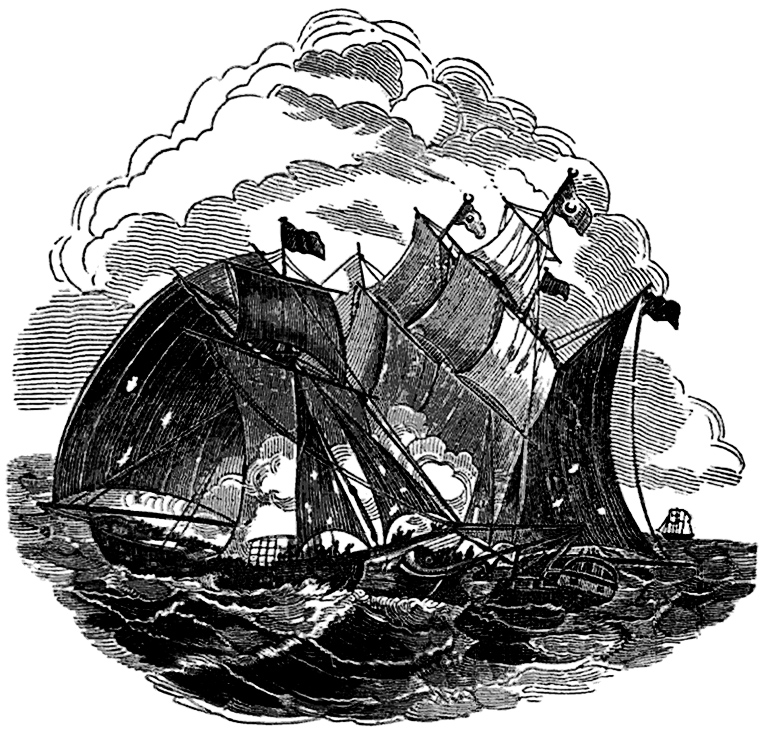 Illustration of Ganj-i-Sawai (center) being attacked.


See also[edit | edit source]
Citations[edit | edit source]
- ↑ Safdar, Aiysha; Azam Kalan, Muhammad (January–June 2021). "History of Indian Ocean-A South Asian Perspective" (PDF). Journal of Indian Studies. 7 (1): 183–200.
- ↑ Harris, Graham (2002). Treasure and Intrigue: The Legacy of Captain Kidd. Toronto: Dundurn. p. 88. ISBN 9781550024098. Retrieved 27 June 2017.
- ↑ Burgess, Douglas R. Jr. (2014). The Politics of Piracy: Crime and Civil Disobedience in Colonial America. Lebanon, NH: ForeEdge. p. 53. ISBN 9781611685275.
- ↑ Rennie, Neil (2013). Treasure Neverland: Real and Imaginary Pirates. Oxford: OUP Oxford. ISBN 9780191668654. Retrieved 27 June 2017.
- ↑ Burgess, Douglas (2009). The Pirates' Pact: The Secret Alliances Between History's Most Notorious Buccaneers and Colonial America. New York: McGraw Hill. pp. 143. ISBN 9780071474764.
- ↑ "The trial of Joseph Dawson, Edward Forseith, William May, Wm. Bishop, James Lewis, and John Sparkes, at the Old-Bailey, for felony and piracy". A Complete Collection of State Trials and Proceedings for High Treason and Other Crimes and Misdemeanors. 13 (392, column 451). 1812.
References[edit | edit source]
- Baer, Joel (2005). Pirates of the British Isles. Tempus. ISBN 9780752423043.
- Botting, Douglas (1978). The Seafarers: The Pirates. Time-Life Books. pp. 82–83.
- Johnson, Steven (2020). Enemy of All Mankind: A True Story of Piracy, Power, and History's First Global Manhunt. Riverhead Books. ISBN 9780735211605.
- Roy, Atul Chandra (1968). History of Bengal: Mughal Period, 1526-1765 A.D. Calcutta: Nababharat Publishers.
- Roy, Atul Chandra (1972). A history of Mughal navy and naval warfares. World Press. pp. XII. Retrieved 6 April 2024.
- Kaushik Roy (2015). Warfare in Pre-British India - 1500BCE to 1740CE. Routledge. ISBN 978-1-317-58691-3.
- Saletore, Rajaram Narayan (1978). Indian Pirates. Concept Publishing Company.
- Woodard, Colin (2007). The Republic of Pirates: Being the True and Surprising Story of the Caribbean Pirates and the Man Who Brought Them Down. Orlando, FL: Houghton Mifflin Harcourt. pp. 20–23. ISBN 978-0-15-101302-9.
Template:World's largest wooden ships Template:Pirates Template:Hajj incidents