


robot: Import articles to fix broken redirects |
ConradQ41114 (talk | contribs) slightly cleanup formatting for clarity and improved wording |
||
| Line 1: | Line 1: | ||
{{Short description|Islamic architecture of the Deccan Plateau, India}} | |||
{{distinguish|The Architecture of a Deccan Sultanate}} | |||
{{more citations needed|date=December 2019}} | {{more citations needed|date=December 2019}} | ||
{{Use dmy dates|date=December 2019}} | {{Use dmy dates|date=December 2019}} | ||
{{Use Indian English|date=December 2019}} | {{Use Indian English|date=December 2019}} | ||
[[File: | [[File:Murud Janjira Fort.JPG|thumb|right|300px|Murud-Janjira Fort built by Ahmadnagar Sultanate]] | ||
The | The Deccan sultanates were five [[Medieval India#Early modern period|early modern]] kingdoms ([[Sultanate of Bijapur|Bijapur]], [[Sultanate of Golconda|Golkonda]], [[Ahmadnagar Sultanate|Ahmadnagar]], [[Bidar Sultanate|Bidar]], and [[Berar Sultanate|Berar]]) which ruled on the [[Deccan Plateau]] beginning in the late 15th century and lasting through the 17th century. The architecture the sultanates produced was a regional variant of [[Indo-Islamic architecture]], influenced by the styles of the [[Delhi Sultanate]] and later [[Mughal architecture]]. [[Persia|Persian]] and [[Central Asia|Central Asian]] design features also feature in some structures. The sultanate styles differ greatly from those employed in [[Hindu temple architecture]] in the same areas. | ||
The rulers of the five Deccan sultanates established numerous contributions in the arts, music, literature and architecture. The [[Bidar fort|Bidar]] and [[Golconda]] forts demonstrate how architecture factored into the military planning of the sultanates. Apart from forts, these regimes also constructed many tombs, [[mosque]]s, and [[madrasa]]s. [[Gol Gumbaz]] (the tomb of [[Mohammed Adil Shah, Sultan of Bijapur|Mohammed Adil Shah]]) was once the second largest dome in the world.{{when|date=April 2024}} | |||
In 2014, [[UNESCO]] designated a group of buildings as tentative [[World Heritage Site|World Heritage Sites]] under the name "Monuments and Forts of the Deccan Sultanate" (despite there being multiple sultanates), which included<ref>[https://whc.unesco.org/en/tentativelists/5887/ UNESCO "tentative list"]</ref> the Bahmani and Barid Shahi Monuments at [[Bidar]] (Karnataka), the Adil Shahi Monuments at [[Bijapur]] (Karnataka), and Qutb Shahi Monuments at [[Hyderabad]] (Telangana). | |||
== | ==Ahmadnagar Sultanate== | ||
[[ | [[File:Faria Bagh Palace of second Nizam.JPG|300px|thumb|Ruins of Faria Bagh, the Palace of Nizam Shahi rulers]] | ||
During the Ahmadnagar rule, multiple palaces were constructed, and their ruins lie in and around Ahmadnagar city in the present day. The Ahmadnagar also built tombs of nobles such as Salabat Khan and Changiz Khan, and saints such as Shah Sharif and Bava Bangali.<ref>{{cite book |last1=Sohoni |first1=Pushkar |title=The Architecture of a Deccan Sultanate: Courtly Practice and Royal Authority in Late Medieval India |title-link=The Architecture of a Deccan Sultanate |date=2018 |publisher=I.B. Tauris |location=London |isbn=9780755606795}}</ref> | |||
Malik Ambar is credited with the construction of the [[Murud-Janjira|Janjira Fort]] in the Murud Area of present-day [[Maharashtra]], India.<ref>{{Cite book|last=Sohoni|first=Pushkar |chapter=The Fort of Janjira |title=African Rulers and Generals in India |publisher=University of North Carolina Ethiopian and East African Studies Project; Ahmedabad Sidi Heritage and Educational Center|year=2020|location=Greensboro, North Carolina; Ahmedabad|pages=167–183}}</ref> After its construction in 1567 CE, the fort was essential to the Sidis' withstanding various invasion attempts by the Marathas, Mughals, and Portuguese to capture Janjira.<ref>{{Cite journal|last=Kainthla|first=Anita|date=Aug 2011|title=The Invincible Fort of Murud Janjira|journal=India Currents|volume=25|issue=5|pages=56–57|id={{ProQuest|<!-- add ProQuest data here -->}}}}</ref> | |||
== | The Farah Bagh palace (also called Faria Bagh) is situated in [[Ahmednagar]], [[Maharashtra]]. It was built by Nizam Shahi rulers in Ahmednagar.<ref>{{Cite web|url=https://www.hindustantimes.com/mumbai-news/how-16th-century-ahmednagar-palace-in-maharashtra-stayed-cool-in-summer/story-qAKzMj36SLpmGDxcIB5lwL.html|title=How 16th-century Ahmednagar palace in Maharashtra stayed cool in summer|date=2019-05-26|website=Hindustan Times|language=en|access-date=2019-10-25}}</ref><ref>{{cite book | url=https://books.google.com/books?id=aHcfv6zkJgQC&dq=Farah+bagh++Ahmednagar&pg=PA11 | title=The New Cambridge History of India: 1. The Portuguese in India | publisher=Cambridge University Press | author=George Michell | year=1987 | isbn=0521563216 |accessdate=20 June 2013}}</ref><ref>{{Cite journal|last1=Singh|first1=M.|last2=Kumar|first2=S Vinodh|date=2019-05-08|title=Architechtural features and characterization of 16th century Indian Monument Farah Bagh, Ahmed Nagar, India|url=https://www.researchgate.net/publication/332935786|journal=International Journal of Architectural Heritage|volume=14 |issue=9 |pages=1398–1411 |doi=10.1080/15583058.2019.1610524|s2cid=164648431 }}</ref> | ||
Farah Bagh was the centrepiece of a palatial complex completed in 1583 CE. It belonged to the royal household and Murtaza [[Nizam]] Shah often retired here to play chess with a Delhi singer he called Fateh Shah. He also built the singer a separate palace called Lakad Mahal in the garden.{{citation needed|date=June 2024}} | |||
<!-- is this a quote? ''This Palace served as the inspiration for the of the Taj Mahal and its architecture.'' --> | |||
==Bijapur Sultanate== | |||
[[File:Gagan Mahal Bijapura.jpg|300px|thumb|Ruins of Gagan Mahal]] | |||
Prominent monuments in [[Bijapur]] include the Gagan Mahal, [[Gol Gumbaz]], [[Bijapur Fort]], and [[Ibrahim Rauza]]. Gol Gumbaz is the tomb of [[Mohammed Adil Shah, Sultan of Bijapur|Mohammed Adil Shah]] and it contains the second-largest dome in the world constructed before the modern age. The external diameter of the hemispherical dome is 44 m. Ibrahim Rouza is the tomb of [[Ibrahim Adil Shah II]] and it is said to be one of the most beautiful monuments in Bijapur. | |||
[[ | |||
The | |||
The Jami Masjid | The [[Jama Masjid, Bijapur|Jami Masjid]] is one of the largest mosques in India having a courtyard of 11,000 square feet. Other architectural works from this period in Bijapur are the [[Chini Mahal]], [[Sat Manzil]], [[Gagan Mahal]], [[Anand Mahal]], and the [[Asar Mahal]] (built in 1646 CE).<ref name="michell_86">{{harvnb|Michell|Zebrowski|1999|pp=41–47, 86–98}}</ref> | ||
[[ | ==Golconda Sultanate== | ||
{{Further|Qutb Shahi architecture}} | |||
[[Golkonda|Golkonda fort]], built by the Qutb Shahi dynasty, has a reputation as one of the most impregnable forts in India, but it is also known for its acoustic features and water management systems. | |||
The Jami Masjid, built by [[Quli Qutb Mulk]] in 1518 CE, is a notable mosque in Golkonda. The [[Golkonda#Qutub Shahi tombs|tombs of Qutb Shahis]] are a mausoleum complex, a royal necropolis composed of 30 tombs of the royal family, erected between the years of 1543 and 1672 CE. | |||
[[ | [[Charminar|Char Minar]], in central [[Hyderabad]], was completed in 1591 CE, having four minarets with heights of 56 m. The construction of the [[Makkah Masjid, Hyderabad|Makkah Masjid]] was started in 1617 CE during the reign of [[Muhammad Qutb Shah]], the building was finally completed in 1693.<ref>{{harvnb|Michell|Zebrowski|1999|pp=47–53, 101–106}}</ref> | ||
==References== | ==References== | ||
{{reflist}} | {{reflist}} | ||
==Sources== | |||
* {{cite book| last1 = Michell | first1 = George | first2 = Mark | last2 = Zebrowski | title = Architecture and Art of the Deccan Sultanates (The New Cambridge History of India Vol. I:7) | publisher = Cambridge University Press | year = 1999 | location = Cambridge | isbn = 0-521-56321-6 }} | |||
* {{cite book |url=https://archive.org/details/in.ernet.dli.2015.279710/page/n1 |title=Bidar, Its History and Monuments |last=Yazdani |first=Ghulam |publisher=[[Oxford University Press]] |year=1947 |location=London |author-link=Ghulam Yazdani}} | |||
==External links== | ==External links== | ||
*[http://www.frontline.in/navigation/?type=static&page=flonnet&rdurl=fl2820/stories/20111007282006200.htm Monuments of Deccan Sultanates and other Islamic Monuments of India] | * [http://www.frontline.in/navigation/?type=static&page=flonnet&rdurl=fl2820/stories/20111007282006200.htm Monuments of Deccan Sultanates and other Islamic Monuments of India] – [[Frontline (magazine)|Frontline]] | ||
[[Category:Monuments and memorials in Telangana]] | [[Category:Monuments and memorials in Telangana]] | ||
| Line 63: | Line 56: | ||
[[Category:Buildings and structures in Bidar district]] | [[Category:Buildings and structures in Bidar district]] | ||
[[Category:Tourist attractions in Bidar district]] | [[Category:Tourist attractions in Bidar district]] | ||
[[Category:Architecture | [[Category:Architecture in India]] | ||
[[Category:Deccan sultanates]] | [[Category:Deccan sultanates]] | ||
Latest revision as of 14:07, 11 January 2026
 | This article needs more citations. (December 2019) |

The Deccan sultanates were five early modern kingdoms (Bijapur, Golkonda, Ahmadnagar, Bidar, and Berar) which ruled on the Deccan Plateau beginning in the late 15th century and lasting through the 17th century. The architecture the sultanates produced was a regional variant of Indo-Islamic architecture, influenced by the styles of the Delhi Sultanate and later Mughal architecture. Persian and Central Asian design features also feature in some structures. The sultanate styles differ greatly from those employed in Hindu temple architecture in the same areas.
The rulers of the five Deccan sultanates established numerous contributions in the arts, music, literature and architecture. The Bidar and Golconda forts demonstrate how architecture factored into the military planning of the sultanates. Apart from forts, these regimes also constructed many tombs, mosques, and madrasas. Gol Gumbaz (the tomb of Mohammed Adil Shah) was once the second largest dome in the world.[when?]
In 2014, UNESCO designated a group of buildings as tentative World Heritage Sites under the name "Monuments and Forts of the Deccan Sultanate" (despite there being multiple sultanates), which included[1] the Bahmani and Barid Shahi Monuments at Bidar (Karnataka), the Adil Shahi Monuments at Bijapur (Karnataka), and Qutb Shahi Monuments at Hyderabad (Telangana).
Ahmadnagar Sultanate[edit | edit source]

During the Ahmadnagar rule, multiple palaces were constructed, and their ruins lie in and around Ahmadnagar city in the present day. The Ahmadnagar also built tombs of nobles such as Salabat Khan and Changiz Khan, and saints such as Shah Sharif and Bava Bangali.[2]
Malik Ambar is credited with the construction of the Janjira Fort in the Murud Area of present-day Maharashtra, India.[3] After its construction in 1567 CE, the fort was essential to the Sidis' withstanding various invasion attempts by the Marathas, Mughals, and Portuguese to capture Janjira.[4]
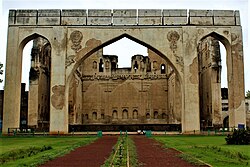
The Farah Bagh palace (also called Faria Bagh) is situated in Ahmednagar, Maharashtra. It was built by Nizam Shahi rulers in Ahmednagar.[5][6][7] Farah Bagh was the centrepiece of a palatial complex completed in 1583 CE. It belonged to the royal household and Murtaza Nizam Shah often retired here to play chess with a Delhi singer he called Fateh Shah. He also built the singer a separate palace called Lakad Mahal in the garden.[citation needed]
Bijapur Sultanate[edit | edit source]

Prominent monuments in Bijapur include the Gagan Mahal, Gol Gumbaz, Bijapur Fort, and Ibrahim Rauza. Gol Gumbaz is the tomb of Mohammed Adil Shah and it contains the second-largest dome in the world constructed before the modern age. The external diameter of the hemispherical dome is 44 m. Ibrahim Rouza is the tomb of Ibrahim Adil Shah II and it is said to be one of the most beautiful monuments in Bijapur.
The Jami Masjid is one of the largest mosques in India having a courtyard of 11,000 square feet. Other architectural works from this period in Bijapur are the Chini Mahal, Sat Manzil, Gagan Mahal, Anand Mahal, and the Asar Mahal (built in 1646 CE).[8]
Golconda Sultanate[edit | edit source]
Golkonda fort, built by the Qutb Shahi dynasty, has a reputation as one of the most impregnable forts in India, but it is also known for its acoustic features and water management systems.
The Jami Masjid, built by Quli Qutb Mulk in 1518 CE, is a notable mosque in Golkonda. The tombs of Qutb Shahis are a mausoleum complex, a royal necropolis composed of 30 tombs of the royal family, erected between the years of 1543 and 1672 CE.
Char Minar, in central Hyderabad, was completed in 1591 CE, having four minarets with heights of 56 m. The construction of the Makkah Masjid was started in 1617 CE during the reign of Muhammad Qutb Shah, the building was finally completed in 1693.[9]
References[edit | edit source]
- ↑ UNESCO "tentative list"
- ↑ Sohoni, Pushkar (2018). The Architecture of a Deccan Sultanate: Courtly Practice and Royal Authority in Late Medieval India. London: I.B. Tauris. ISBN 9780755606795.
- ↑ Sohoni, Pushkar (2020). "The Fort of Janjira". African Rulers and Generals in India. Greensboro, North Carolina; Ahmedabad: University of North Carolina Ethiopian and East African Studies Project; Ahmedabad Sidi Heritage and Educational Center. pp. 167–183.
- ↑ Kainthla, Anita (August 2011). "The Invincible Fort of Murud Janjira". India Currents. 25 (5): 56–57. .
- ↑ "How 16th-century Ahmednagar palace in Maharashtra stayed cool in summer". Hindustan Times. 26 May 2019. Retrieved 25 October 2019.
- ↑ George Michell (1987). The New Cambridge History of India: 1. The Portuguese in India. Cambridge University Press. ISBN 0521563216. Retrieved 20 June 2013.
- ↑ Singh, M.; Kumar, S Vinodh (8 May 2019). "Architechtural features and characterization of 16th century Indian Monument Farah Bagh, Ahmed Nagar, India". International Journal of Architectural Heritage. 14 (9): 1398–1411. doi:10.1080/15583058.2019.1610524. S2CID 164648431.
- ↑ Michell & Zebrowski 1999, pp. 41–47, 86–98
- ↑ Michell & Zebrowski 1999, pp. 47–53, 101–106
Sources[edit | edit source]
- Michell, George; Zebrowski, Mark (1999). Architecture and Art of the Deccan Sultanates (The New Cambridge History of India Vol. I:7). Cambridge: Cambridge University Press. ISBN 0-521-56321-6.
- Yazdani, Ghulam (1947). Bidar, Its History and Monuments. London: Oxford University Press.
External links[edit | edit source]
- Pages using the JsonConfig extension
- Articles needing additional references from December 2019
- Monuments and memorials in Telangana
- Buildings and structures in Bijapur district
- Monuments and memorials in Karnataka
- Buildings and structures in Telangana
- Tourist attractions in Telangana
- Buildings and structures in Bidar district
- Tourist attractions in Bidar district
- Architecture in India
- Deccan sultanates