


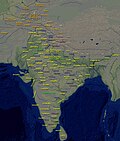

ImportMaster (talk | contribs) robot: import pages using Special:Import |
Bruce06828 (talk | contribs) m minor reworked references after review also and corrected details based on references |
||
| Line 1: | Line 1: | ||
{{Short description|Term used to designate Greek-speakers in ancient India}} | {{Short description|Term used to designate Greek-speakers in ancient India}} | ||
{{About|the Pali word}} | {{About|the Pali word}} | ||
{{redirect|Yavana|the Hellenistic kingdom in India|Indo-Greek | {{redirect|Yavana|the Hellenistic kingdom in India|Indo-Greek kingdom}} | ||
{{ | {{EngvarB|date=June 2025}} | ||
{{Use dmy dates|date=June 2025}} | |||
{{Use dmy dates|date= | |||
[[File:MenanderCoinFront.jpg|thumb|200px|The "Yona" Greek king of India [[Menander I|Menander]] (160–135 BCE). Inscription in [[Greek language|Greek]]: {{lang|grc|Bασιλέως Σωτῆρος Μενάνδρου}}, lit. "of Saviour King Menander".]] | [[File:MenanderCoinFront.jpg|thumb|200px|The "Yona" Greek king of India [[Menander I|Menander]] (160–135 BCE). Inscription in [[Greek language|Greek]]: {{lang|grc|Bασιλέως Σωτῆρος Μενάνδρου}}, lit. "of Saviour King Menander".]] | ||
[[File:EpicIndia.jpg|thumb|right|350px|Yavana kingdom alongside other locations of kingdoms and republics mentioned in the Indian epics or [[Bharata Khanda]].]] | |||
The word '''Yona''' in [[Pali]] and the [[Prakrit]]s, and the analogue '''Yavana''' in [[Sanskrit]], were used in [[Ancient India]] to designate [[Greek language|Greek]] speakers. "Yona" and "Yavana" are transliterations of the Greek word for "[[Ionians]]" ({{langx|grc|Ἴωνες < Ἰάoνες < *Ἰάϝoνες}}), who were probably the first Greeks to be known in India. | |||
The Yona are mentioned in the Ashoka inscriptions, along with the [[Kambojas]], as two societies where there are only nobles and slaves.<ref name="Thomas1933">{{cite book|last=Thomas|first=Edward Joseph|author-link=Edward Joseph Thomas|title=The History of Buddhist Thought|url=https://books.google.com/books?id=1JpnHU1-IgMC&pg=PA85|year=1933|publisher=Asian Educational Services|isbn=978-81-206-1095-8|page=85 with footnote 2}}</ref> | Both terms appear in ancient [[Sanskrit]] literature. ''Yavana'' appears, for instance, in the ''[[Mahabharata]]'', while ''Yona'' appears in texts such as the [[Sri Lanka]]n chronicle ''[[Mahavamsa]]''. | ||
The Yona are mentioned in the [[Ashoka]] inscriptions, along with the [[Kambojas]], as two societies where there are only nobles and slaves.<ref name="Thomas1933">{{cite book|last=Thomas|first=Edward Joseph|author-link=Edward Joseph Thomas|title=The History of Buddhist Thought|url=https://books.google.com/books?id=1JpnHU1-IgMC&pg=PA85|year=1933|publisher=Asian Educational Services|isbn=978-81-206-1095-8|page=85 with footnote 2}}</ref> | |||
Examples of direct association of these terms with the Greeks include: | Examples of direct association of these terms with the Greeks include: | ||
| Line 26: | Line 23: | ||
In general, the words "Yoṇa" or "Yoṇaka" were the current Greek Hellenistic forms, while the term "Yavana" was the Indian word to designate the [[Greeks]] or the [[Indo-Greeks]].<ref>The Greeks in Bactria and India by William Woodthorpe Tarn [https://books.google.com/books?id=-HeJS3nE9cAC&pg=PA257 p.257]</ref> | In general, the words "Yoṇa" or "Yoṇaka" were the current Greek Hellenistic forms, while the term "Yavana" was the Indian word to designate the [[Greeks]] or the [[Indo-Greeks]].<ref>The Greeks in Bactria and India by William Woodthorpe Tarn [https://books.google.com/books?id=-HeJS3nE9cAC&pg=PA257 p.257]</ref> | ||
== Comparable terms in the | == Comparable terms in the ancient world == | ||
[[File:DNa Inscription Yauna.jpg|thumb|The Achaemenid name for [[Ionia]]n Greeks: ''Yauna'' ([[Old Persian cuneiform]]: [[Wikt:𐎹𐎢𐎴|𐎹𐎢𐎴]]) in the [[DNa inscription]] of [[Darius the Great]], | [[File:DNa Inscription Yauna.jpg|thumb|The Achaemenid name for [[Ionia]]n Greeks: ''Yauna'' ([[Old Persian cuneiform]]: [[Wikt:𐎹𐎢𐎴|𐎹𐎢𐎴]]) in the [[DNa inscription]] of [[Darius the Great]], {{Circa|490 BC}}]] | ||
This usage was shared by many of the countries east of Greece, from the [[Mediterranean]] to [[Sindh]]: | This usage was shared by many of the countries east of Greece, from the [[Mediterranean]] to [[Sindh]]: | ||
* [[Ancient Egypt|Egyptians]] used the word ''ywnj-ꜥꜣ''. | * [[Ancient Egypt|Egyptians]] used the word ''ywnj-ꜥꜣ''. | ||
* In [[Arabic]] it is ''Yūnān''. | |||
* [[Assyria]]ns used the word ''Iawanu''. | * [[Assyria]]ns used the word ''Iawanu''. | ||
* [[Babylon]]ians used the word ''Yaman'' and ''Yamanaya''.<ref>{{cite book|last=Kinzl|first=Konrad H.|title=A Companion to the Classical Greek World|url=https://books.google.com/books?id=loeWIRBo3isC&pg=PA202|year=2010|publisher=John Wiley & Sons|isbn=978-1-4443-3412-8|page=202}}</ref> | * [[Babylon]]ians used the word ''Yaman'' and ''Yamanaya''.<ref>{{cite book|last=Kinzl|first=Konrad H.|title=A Companion to the Classical Greek World|url=https://books.google.com/books?id=loeWIRBo3isC&pg=PA202|year=2010|publisher=John Wiley & Sons|isbn=978-1-4443-3412-8|page=202}}</ref> | ||
* In [[Biblical Hebrew]], the word was יוון ''[[Javan|Yāwān]]'' ([[Modern Hebrew]] ''Yavan'') | * In [[Biblical Hebrew]], the word was {{Script/Hebrew|יוון}} ''[[Javan|Yāwān]]'' ([[Modern Hebrew]] ''Yavan'') | ||
* | * [[Persian people|Persians]] used the word ''Yauna'' from the [[Old Persian]] word for designating the Greeks, namely "Yauna" (literally '[[Ionia]]ns', as they were the first Greeks with whom the Persians had extensive contact).<ref>{{cite book|last1=Roisman|first1=Joseph|last2=Worthington|first2=Ian|title=A Companion to Ancient Macedonia|url=https://books.google.com/books?id=QsJ183uUDkMC&pg=PA87|year=2011|publisher=John Wiley & Sons|isbn=978-1-4443-5163-7|page=87}}</ref> | ||
* The ancient [[Chinese language|Chinese]] [[Endonym and exonym|exonym]] for modern-day [[Fergana|Ferghana]] is "[[Dayuan]]", which may come from the term Yona. | |||
==History== | ==History== | ||
The usage of "Yona" and "Yavana, or variants such as "Yauna | The usage of "Yona" and "Yavana, or variants such as "Yauna" and "Javana", appears repeatedly, and particularly in relation to the Greek kingdoms which neighboured or sometimes occupied the [[Punjab]] over a period of several centuries from the 4th century BCE to the first century CE, such as the [[Seleucid Empire]], the [[Greco-Bactrian kingdom]] and the [[Indo-Greek kingdom]].<ref name=":0" /> The Yavanar are mentioned in detail in [[Sangam literature]] epics such as ''[[Paṭṭiṉappālai]]'', describing their brisk trade with the [[Early Cholas]] in the [[Sangam period]]. | ||
After [[Alexander the Great]]'s invasion, the Greek settlements had existed in eastern parts of [[Achaemenid Empire]], northwest of India, as neighbours to the [[Kambojas]].{{citation needed|date=March 2015}} The references to the Yonas in the early [[Buddhist texts]] may be related to the same.{{ | After [[Alexander the Great]]'s invasion, the Greek settlements had existed in eastern parts of [[Achaemenid Empire]], northwest of India, as neighbours to the [[Kambojas]].{{citation needed|date=March 2015}} The references to the Yonas in the early [[Buddhist texts]], and [[Menander I]] ({{langx|pi|Milinda|italic=yes}}), may be related to the same.<ref>{{Cite web |date=20 March 2025 |title=The Ancient Greeks Who Became Buddhists |url=https://www.greecehighdefinition.com/blog/2025/3/20/the-ancient-greeks-who-became-buddhists |access-date=1 June 2025 |website=GHD |language=en-US}}</ref><ref name=":0">{{cite book|last=Halkias|first=Georgios T.| editor-last1 =Wick | editor-first1 =Peter | editor-last2 =Rabens | editor-first2 =Volker |year=2014|chapter=When the Greeks Converted the Buddha: Asymmetrical Transfers of Knowledge in Indo-Greek Cultures|title= Religions and Trade: Religious Formation, Transformation and Cross-Cultural Exchange between East and West|publisher=[[Brill Publishers]]|isbn=978-90-04-25528-9}}</ref> | ||
The | The earliest attested use of the word in India is by grammarian [[Pāṇini]], (c. 5th century bc) in the form Yavanānī, which is taken by commentators to mean Greek script.<ref>{{cite journal |last1=Lal |first1=Shyam Bihari |title=Yavanas in the Ancient Indian Inscriptions |journal=Proceedings of the Indian History Congress |date=2004 |volume=65 |pages=1115–1120 |issn=2249-1937|jstor=44144820 }}</ref> | ||
===Role in Buddhism=== | ===Role in Buddhism=== | ||
| Line 47: | Line 46: | ||
====Edicts of Ashoka (250 BC)==== | ====Edicts of Ashoka (250 BC)==== | ||
[[File:Territories conquered by the Dharma according to Ashoka.jpg|thumb|Territories "conquered by the Dharma" according to [[Major Rock Edicts|Major Rock Edict No.13]] of Ashoka (260–218 BCE).<ref name=PK>{{cite book |last1=Kosmin |first1=Paul J. |title=The Land of the Elephant Kings |date=2014 |publisher=Harvard University Press |isbn=9780674728820 |page=57 |url=https://books.google.com/books?id=9UWdAwAAQBAJ&pg=PA57 |language=en}}</ref>]] | [[File:Territories conquered by the Dharma according to Ashoka.jpg|thumb|Territories "conquered by the Dharma" according to [[Major Rock Edicts|Major Rock Edict No.13]] of Ashoka (260–218 BCE).<ref name=PK>{{cite book |last1=Kosmin |first1=Paul J. |title=The Land of the Elephant Kings |date=2014 |publisher=Harvard University Press |isbn=9780674728820 |page=57 |url=https://books.google.com/books?id=9UWdAwAAQBAJ&pg=PA57 |language=en}}</ref>]] | ||
[[File:Khalsi rock edict of Ashoka with names of the Greek kings.jpg|thumb|The [[Khalsi rock edict]] of Ashoka, which mentions the Greek kings [[Antiochus II Theos|Antiochus]], [[Ptolemy II of Egypt|Ptolemy]], [[Antigonus II Gonatas|Antigonus]], [[Magas of Cyrene|Magas]] and [[Alexander II of Epirus|Alexander]] by name (underlined in | [[File:Khalsi rock edict of Ashoka with names of the Greek kings.jpg|thumb|The [[Khalsi rock edict]] of Ashoka, which mentions the Greek kings [[Antiochus II Theos|Antiochus]], [[Ptolemy II of Egypt|Ptolemy]], [[Antigonus II Gonatas|Antigonus]], [[Magas of Cyrene|Magas]] and [[Alexander II of Epirus|Alexander]] by name (underlined in colour). Here the Greek rulers are described as "Yona" ([[Brahmi]]: 𑀬𑁄𑀦, third and fourth letters after the first occurrence of Antigonus in red).]] | ||
Some of the better-known examples are those of the [[Edicts of Ashoka]] (c. 250 BCE), in which the | Some of the better-known examples are those of the [[Edicts of Ashoka]] (c. 250 BCE), in which the Emperor [[Ashoka]] refers to the Greek populations under his rule. Rock Edicts V and XIII mention the Yonas (or the Greeks) along with the Kambojas and Gandharas as a subject people forming a frontier region of his empire and attest that he sent envoys to the Greek rulers in the West as far as the Mediterranean, faultlessly naming them one by one. | ||
In [[Edicts of Ashoka#Proselytism beyond India|the Gandhari original of Rock XIII]], the Greek kings to the West are associated unambiguously with the term "Yona": Antiochus is referred as ''"Amtiyoko nama Yonaraja"'' (lit. "[[Antiochus II Theos|The Greek king by the name of Antiochus]]"), beyond whom live the four other kings: ''"param ca tena Atiyokena cature 4 rajani Turamaye nama Amtikini nama Maka nama Alikasudaro nama"'' (lit. "And beyond Antiochus, four kings [[Ptolemy II Philadelphus|by the name of Ptolemy]], [[Antigonus II Gonatas|the name of Antigonos]], [[Magas of Cyrene|the name of Magas]], [[Alexander II of Epirus|the name Alexander]]"). | In [[Edicts of Ashoka#Proselytism beyond India|the Gandhari original of Rock XIII]], the Greek kings to the West are associated unambiguously with the term "Yona": Antiochus is referred as ''"Amtiyoko nama Yonaraja"'' (lit. "[[Antiochus II Theos|The Greek king by the name of Antiochus]]"), beyond whom live the four other kings: ''"param ca tena Atiyokena cature 4 rajani Turamaye nama Amtikini nama Maka nama Alikasudaro nama"'' (lit. "And beyond Antiochus, four kings [[Ptolemy II Philadelphus|by the name of Ptolemy]], [[Antigonus II Gonatas|the name of Antigonos]], [[Magas of Cyrene|the name of Magas]], [[Alexander II of Epirus|the name Alexander]]"). | ||
| Line 68: | Line 67: | ||
The ''Vanaparava'' of [[Mahabharata]] contains prophecies that "[[Mleccha]] kings of the Shakas, Yavanas, Kambojas, Bahlikas etc. shall rule the earth un-righteously in Kaliyuga ...".<ref>Mahabharata 3.188.34–36.</ref> This reference apparently alludes to chaotic political scenario following the collapse of the [[Maurya Empire|Maurya]] and [[Shunga Empire]]s in northern India and its subsequent occupation by foreign hordes such as of the Yonas, [[Kambojas]], [[Saka]]s and [[Pahlavas]]. | The ''Vanaparava'' of [[Mahabharata]] contains prophecies that "[[Mleccha]] kings of the Shakas, Yavanas, Kambojas, Bahlikas etc. shall rule the earth un-righteously in Kaliyuga ...".<ref>Mahabharata 3.188.34–36.</ref> This reference apparently alludes to chaotic political scenario following the collapse of the [[Maurya Empire|Maurya]] and [[Shunga Empire]]s in northern India and its subsequent occupation by foreign hordes such as of the Yonas, [[Kambojas]], [[Saka]]s and [[Pahlavas]]. | ||
[[File:Inscription Yonakasa No.18 Cave No.17 Nasik caves.jpg|thumb|upright=1.5|Dedication by a man of Greek descent on a wall of Cave 17 in the [[Nasik Caves]] (photograph and rubbing). Detail of the "Yo-ṇa-ka-sa" word (adjectival form of "Yoṇaka", [[Brahmi]]: | [[File:Inscription Yonakasa No.18 Cave No.17 Nasik caves.jpg|thumb|upright=1.5|Dedication by a man of Greek descent on a wall of Cave 17 in the [[Nasik Caves]] (photograph and rubbing). Detail of the "Yo-ṇa-ka-sa" word (adjectival form of "Yoṇaka", [[Brahmi]]: 𑀬𑁄𑀡𑀓𑀲), with Nasik/[[Karla Caves|Karla]]-period [[Brahmi script]] for reference. Circa 120 CE.]] | ||
There are important references to the warring Mleccha hordes of the Shakas, Yavanas, Kambojas, the Pahlavas and others in the ''Bala Kanda'' of [[Valmiki]]'s ''[[Ramayana]]''.{{citation needed|date=July 2015}} | There are important references to the warring Mleccha hordes of the Shakas, Yavanas, Kambojas, the Pahlavas and others in the ''Bala Kanda'' of [[Valmiki]]'s ''[[Ramayana]]''.{{citation needed|date=July 2015}} | ||
Indologists like Dr H. C. Raychadhury, Dr B. C. Law, Dr Satya Shrava and others see in these verses the clear glimpses of the struggles of the Hindus with the mixed invading hordes of the barbaric Sakas, Yavanas, Kambojas, Pahlavas etc. from north-west.<ref>The Śakas in India, 1981, p 12, Satya Shrava; Journal, 1920, p 175, University of Calcutta. Department of Letters; India & Russia: Linguistic & Cultural Affinity, 1982, p 100, Weer Rajendra Rishi; Indological Studies, 1950, p 32, Dr B. C. Law; Political History of India from the Accession of Parikshit to the Coronation of Bimbisara, 1923, Page iii, Hemchandra Raychaudhuri; Political History of Ancient India, 1996, p 4, Raychaudhury; Indological Studies, 1950, p 4, Dr B. C. Law.</ref> The time frame for these struggles is 2nd century BCE downwards.<ref>Political History of Ancient India, 1996, pp 3–4.</ref> | Indologists like Dr H. C. Raychadhury, Dr B. C. Law, Dr Satya Shrava and others see in these verses the clear glimpses of the struggles of the Hindus with the mixed invading hordes of the barbaric Sakas, Yavanas, Kambojas, Pahlavas etc. from north-west.<ref>The Śakas in India, 1981, p 12, Satya Shrava; Journal, 1920, p 175, University of Calcutta. Department of Letters; India & Russia: Linguistic & Cultural Affinity, 1982, p 100, Weer Rajendra Rishi; Indological Studies, 1950, p 32, Dr B. C. Law; Political History of India from the Accession of Parikshit to the Coronation of Bimbisara, 1923, Page iii, Hemchandra Raychaudhuri; Political History of Ancient India, 1996, p 4, Raychaudhury; Indological Studies, 1950, p 4, Dr B. C. Law.</ref> The time frame for these struggles is 2nd century BCE downwards.<ref>Political History of Ancient India, 1996, pp 3–4.</ref> | ||
The other Indian records prophecies the 180 BCE Yona attacks on [[Saket]], [[Panchala]], [[Mathura]] and [[Pataliputra]], probably against the Shunga Empire, and possibly in defence of Buddhism: "After having conquered Saketa, the country of the Panchala and the Mathuras, the Yavanas, wicked and valiant, will reach Kusumadhvaja ("The town of the flower-standard", Pataliputra). The thick mud-fortifications at Pataliputra being reached, all the provinces will be in disorder, without doubt. Ultimately, a great battle will follow, with tree-like engines (siege engines)."<ref>Gargi-Samhita Paragraph 5, Yuga Purana.</ref> "The Yavanas will command, the Kings will disappear. (But ultimately) the Yavanas, intoxicated with fighting, will not stay in Madhadesa (the Middle Country); there will be undoubtedly a civil war among them, arising in their own country, there will be a terrible and ferocious war."<ref>Gargi-Samhita, Yuga Purana Chapter, No 7.</ref> The "Anushasanaparava" of the ''Mahabharata'' affirms that the country of Majjhimadesa was invaded the Yavanas and the Kambojas who were later utterly defeated. The Yona invasion of Majjhimadesa ("middle country, midlands") was jointly carried out by the Yonas and the Kambojas. Majjhimadesa here means the middle of Greater India which then included Afghanistan, Pakistan and large parts of Central Asia. | The other Indian records prophecies the 180 BCE Yona attacks on [[Saket]], [[Panchala]], [[Mathura]] and [[Pataliputra]], probably against the Shunga Empire, and possibly in defence of Buddhism: "After having conquered Saketa, the country of the Panchala and the Mathuras, the Yavanas, wicked and valiant, will reach Kusumadhvaja ("The town of the flower-standard", Pataliputra). The thick mud-fortifications at Pataliputra being reached, all the provinces will be in disorder, without doubt. Ultimately, a great battle will follow, with tree-like engines (siege engines)."<ref>Gargi-Samhita Paragraph 5, Yuga Purana.</ref> "The Yavanas will command, the Kings will disappear. (But ultimately) the Yavanas, intoxicated with fighting, will not stay in Madhadesa (the Middle Country); there will be undoubtedly a civil war among them, arising in their own country, there will be a terrible and ferocious war."<ref>Gargi-Samhita, Yuga Purana Chapter, No 7.</ref> The "Anushasanaparava" of the ''Mahabharata'' affirms that the country of Majjhimadesa was invaded by the Yavanas and the Kambojas who were later utterly defeated. The Yona invasion of Majjhimadesa ("middle country, midlands") was jointly carried out by the Yonas and the Kambojas. Majjhimadesa here means the middle of Greater India which then included Afghanistan, Pakistan and large parts of Central Asia. | ||
===Other references=== | ===Other references=== | ||
| Line 86: | Line 85: | ||
====Sanchi==== | ====Sanchi==== | ||
[[File:Foreigners at Sanchi Stupa I North Gateway.jpg|thumb|Foreigners on the Northern Gateway of Stupa I.]] | [[File:Foreigners at Sanchi Stupa I North Gateway.jpg|thumb|Foreigners on the Northern Gateway of Stupa I.]] | ||
Some of the friezes of [[Sanchi]] also show devotees in Greek attire. The men are depicted with short curly hair, often held together with a [[headband]] of the type commonly seen on [[ancient Greek coinage]]. The clothing too is Greek, complete with [[tunic]]s, capes and sandals. The musical instruments are also quite characteristic, such as the double flute called [[aulos]]. Also visible are [[carnyx]]-like [[cornu (horn)|horns]]. They are all celebrating at the entrance of the stupa. These men would be foreigners from north-west India visiting the [[stupa]], possibly [[Malla ( | Some of the friezes of [[Sanchi]] also show devotees in Greek attire. The men are depicted with short curly hair, often held together with a [[headband]] of the type commonly seen on [[ancient Greek coinage]]. The clothing too is Greek, complete with [[tunic]]s, capes and sandals. The musical instruments are also quite characteristic, such as the double flute called [[aulos]]. Also visible are [[carnyx]]-like [[cornu (horn)|horns]]. They are all celebrating at the entrance of the stupa. These men would be foreigners from north-west India visiting the [[stupa]], possibly [[Malla (tribe)|Mallas]], [[Indo-Scythians]] or Indo-Greeks.<ref>"A guide to Sanchi" John Marshall. These "Greek-looking foreigners" are also described in Susan Huntington, "The art of ancient India", p. 100</ref> | ||
Three inscriptions are known from Yavana<ref name="IAS">{{cite book|title=Purātattva, Number 8|date=1975|publisher=Indian Archaeological Society|url=https://books.google.com/books?id=MW9DAAAAYAAJ|page=188|quote=A reference to a Yona in the Sanchi inscriptions is also of immense value.(...) One of the inscriptions announces the gift of a Setapathia Yona, "Setapathiyasa Yonasa danam" i.e the gift of a Yona, inhabitant of Setapatha. '''The word Yona can't be here anything, but a Greek donor'''}}</ref> donors at Sanchi, the clearest of which reads "''Setapathiyasa Yonasa danam''" ("Gift of the Yona of Setapatha"), Setapatha being an uncertain city.<ref>{{cite book|author=Upinder Singh|title=The Idea of Ancient India: Essays on Religion, Politics, and Archaeology|url=https://books.google.com/books?id=KIWTCwAAQBAJ&pg=PA18|year=2016|publisher=SAGE Publications|isbn=978-93-5150-647-8|page=18}}</ref> | Three inscriptions are known from Yavana<ref name="IAS">{{cite book|title=Purātattva, Number 8|date=1975|publisher=Indian Archaeological Society|url=https://books.google.com/books?id=MW9DAAAAYAAJ|page=188|quote=A reference to a Yona in the Sanchi inscriptions is also of immense value.(...) One of the inscriptions announces the gift of a Setapathia Yona, "Setapathiyasa Yonasa danam" i.e the gift of a Yona, inhabitant of Setapatha. '''The word Yona can't be here anything, but a Greek donor'''}}</ref> donors at Sanchi, the clearest of which reads "''Setapathiyasa Yonasa danam''" ("Gift of the Yona of Setapatha"), Setapatha being an uncertain city.<ref>{{cite book|author=Upinder Singh|title=The Idea of Ancient India: Essays on Religion, Politics, and Archaeology|url=https://books.google.com/books?id=KIWTCwAAQBAJ&pg=PA18|year=2016|publisher=SAGE Publications|isbn=978-93-5150-647-8|page=18}}</ref> | ||
===Buddhist caves of Western India=== | ===Buddhist caves of Western India=== | ||
[[File:Karla Caves Great Chaitya Left pillar No9.jpg|thumb|251px|Left pillar No.9 of the Great Chatya at [[Karla Caves]]. This pillar was donated by a Yavana | [[File:Karla Caves Great Chaitya Left pillar No9.jpg|thumb|251px|Left pillar No.9 of the Great Chatya at [[Karla Caves]]. This pillar was donated by a Yavana {{Circa|120 CE}}, like five other pillars. The inscription of this pillar reads: ''"Dhenukakata Yavanasa/ Yasavadhanana[m]/ thabo dana[m]"'' i.e. "(This) pillar (is) the gift of the Yavana Yasavadhana from Denukakata".<ref name="p.328 Inscription No10">Epigraphia Indica Vol.18 [https://archive.org/stream/in.ernet.dli.2015.367557 p.328 Inscription No10]</ref> Below: detail of the word ''"Ya-va-na-sa"'' (adjectival form of "Yavana", [[Brahmi script]] 𑀬𑀯𑀦𑀲).]] | ||
In the Great [[Chaitya]] of the [[Karla Caves]] built and dedicated by [[Western Satraps]] [[Nahapana]] in 120 CE,<ref name="WH">World Heritage Monuments and Related Edifices in India, Volume 1 ʻAlī Jāvīd, Tabassum Javeed, Algora Publishing, 2008 [https://books.google.com/books?id=fg-lGID3WpQC&pg=PA42 p.42]</ref> there are six inscriptions made by self-described Yavana donors, who donated six of the pillars, although their names are Buddhist names.<ref name="SC">Some Early Dynasties of South India, by Sudhakar Chattopadhyaya [https://books.google.com/books?id=78I5lDHU2jQC&pg=PA83 p.83]</ref> They account for nearly half of the known dedicatory inscriptions on the pillars of the Chaitya.<ref>Epigraphia Indica Vol.18 [https://archive.org/stream/in.ernet.dli.2015.367557 p.326-328] and Epigraphia Indica Vol.7 [Epigraphia Indica Vol.7 [https://archive.org/details/epigraphiaindica014351mbp p.53-54]</ref> | In the Great [[Chaitya]] of the [[Karla Caves]] built and dedicated by [[Western Satraps]] [[Nahapana]] in 120 CE,<ref name="WH">World Heritage Monuments and Related Edifices in India, Volume 1 ʻAlī Jāvīd, Tabassum Javeed, Algora Publishing, 2008 [https://books.google.com/books?id=fg-lGID3WpQC&pg=PA42 p.42]</ref> there are six inscriptions made by self-described Yavana donors, who donated six of the pillars, although their names are Buddhist names.<ref name="SC">Some Early Dynasties of South India, by Sudhakar Chattopadhyaya [https://books.google.com/books?id=78I5lDHU2jQC&pg=PA83 p.83]</ref> They account for nearly half of the known dedicatory inscriptions on the pillars of the Chaitya.<ref>Epigraphia Indica Vol.18 [https://archive.org/stream/in.ernet.dli.2015.367557 p.326-328] and Epigraphia Indica Vol.7 [Epigraphia Indica Vol.7 [https://archive.org/details/epigraphiaindica014351mbp p.53-54]</ref> | ||
| Line 115: | Line 114: | ||
[[File:Bharhut Yavana.jpg|thumb|Vedika pillar with possible Greek warrior (headband of a king, tunic etc...) from [[Bharhut]].<ref>Faces of Power: Alexander's Image and Hellenistic Politics by Andrew Stewart [https://books.google.com/books?id=1SUw29Q_SeMC&pg=PA180 p.180]</ref> Bharhut, Madhya Pradesh, Shunga Period, c.100-80BC. Reddish brown sandstone.<ref>D.N. Jha,"Early India: A Concise History"p.150, plate 17</ref> [[Indian Museum]], [[Calcutta]].]] | [[File:Bharhut Yavana.jpg|thumb|Vedika pillar with possible Greek warrior (headband of a king, tunic etc...) from [[Bharhut]].<ref>Faces of Power: Alexander's Image and Hellenistic Politics by Andrew Stewart [https://books.google.com/books?id=1SUw29Q_SeMC&pg=PA180 p.180]</ref> Bharhut, Madhya Pradesh, Shunga Period, c.100-80BC. Reddish brown sandstone.<ref>D.N. Jha,"Early India: A Concise History"p.150, plate 17</ref> [[Indian Museum]], [[Calcutta]].]] | ||
The [[Mahabharata]] groups the Yavanas with the Kambojas and the Chinas and calls them "Mlechchas" (Barbarians). In the Shanti Parva section, the Yavanas are grouped with the Kambojas, [[Kirata]]s, [[Saka]]s, and the [[Pahlava]]s etc. and are spoken of as living the life of [[Dasyu]]s (dacoits). In another chapter of the same Parva, the Yaunas, Kambojas, Gandharas etc. are spoken of as equal to the "Svapakas" and the "Grddhras". | The [[Mahabharata]] groups the Yavanas with the Kambojas and the Chinas and calls them "Mlechchas" (Barbarians). In the Shanti Parva section, the Yavanas are grouped with the Kambojas, [[Kirata]]s, [[Saka]]s, and the [[Pahlava]]s etc. and are spoken of as living the life of [[Dasyu]]s (dacoits). In another chapter of the same Parva, the Yaunas, Kambojas, Gandharas etc. are spoken of as equal to the "Svapakas" and the "Grddhras". | ||
In [[Harivaṃśa|Harivamsha]] , [[Brahmanda Purana|Bramhanda purana]] And [[Vishnu Purana|Vishnu purana]] there is also mention of Yavana King Named [[Kalayavana|Kalyavana]] who invaded [[Mathura]] And [[Dvārakā|Dvaraka]] With the alliance of Magadha King [[Jarasandha]]<ref>{{Cite book |last=Dowson |first=John |title=A Classical Dictionary of Hindu Mythology and Religion, Geography, History and Literature |date=2013 |publisher=Taylor and Francis |isbn=978-0-415-24521-0 |location=Hoboken}}</ref>. | |||
Udyogaparva of Mahabharata<ref>Mahabharata 5.19.21–23.</ref> says that the composite army of the Kambojas, Yavanas and Sakas had participated in the Mahabharata war under the supreme command of Kamboja king [[Sudakshina]]. The [[Hindu Epics|epic]] numerously applauds this composite army as being very fierce and wrathful. | Udyogaparva of Mahabharata<ref>Mahabharata 5.19.21–23.</ref> says that the composite army of the Kambojas, Yavanas and Sakas had participated in the Mahabharata war under the supreme command of Kamboja king [[Sudakshina]]. The [[Hindu Epics|epic]] numerously applauds this composite army as being very fierce and wrathful. | ||
| Line 120: | Line 121: | ||
Balakanda of [[Ramayana]] also groups the Yavanas with the Kambojas, Sakas, Pahlavas etc. and refers to them as the military allies of [[Wise Old Man|sage]] Vishistha against [[Vedic civilization|Vedic]] king Vishwamitra<ref>Ramayana 55.2–3.</ref> The Kishkindha Kanda of Ramayana locates the Sakas, Kambojas, Yavanas and Paradas in the extreme north-west beyond the [[Himalaya|Himavat]] (i.e. [[Hindukush]]).<ref>Ramayana 43.12.</ref> | Balakanda of [[Ramayana]] also groups the Yavanas with the Kambojas, Sakas, Pahlavas etc. and refers to them as the military allies of [[Wise Old Man|sage]] Vishistha against [[Vedic civilization|Vedic]] king Vishwamitra<ref>Ramayana 55.2–3.</ref> The Kishkindha Kanda of Ramayana locates the Sakas, Kambojas, Yavanas and Paradas in the extreme north-west beyond the [[Himalaya|Himavat]] (i.e. [[Hindukush]]).<ref>Ramayana 43.12.</ref> | ||
The Buddhist drama [[Mudrarakshasa]] by [[Visakhadutta]] as well as the [[Jain]]a works [[Parishishtaparvan]] refer to [[Chandragupta Maurya|Chandragupta]]'s alliance with [[Himalayas|Himalayan]] king Parvataka. This Himalayan alliance gave Chandragupta a powerful composite army made up of the frontier martial tribes of the Shakas, Kambojas, Yavanas, Parasikas, Bahlikas etc.<ref>See: Mudrarakshas, Act II.</ref> which he may have utilised to aid defeat the [[Classical Greece|Greek]] successors of [[Alexander the Great]] and the [[Nanda dynasty|Nanda]] rulers of [[Magadha]], and thus establishing his [[Mauryan Empire]] in northern India. | The Buddhist drama [[Mudrarakshasa]] by [[Visakhadutta]] as well as the [[Jain]]a works [[Parishishtaparvan]] refer to [[Chandragupta Maurya|Chandragupta]]'s alliance with [[Himalayas|Himalayan]] king Parvataka. This Himalayan alliance gave Chandragupta a powerful composite army made up of the frontier martial tribes of the Shakas, Kambojas, Yavanas, Parasikas, Bahlikas etc.<ref>See: Mudrarakshas, Act II.</ref> which he may have utilised to aid defeat the [[Classical Greece|Greek]] successors of [[Alexander the Great]] and the [[Nanda dynasty|Nanda]] rulers of [[Magadha (Mahajanapada)|Magadha]], and thus establishing his [[Mauryan Empire]] in northern India. | ||
[[Manusmriti]]<ref>Manusmriti X.43–44.</ref> lists the Yavanas with the Kambojas, Sakas, Pahlavas, [[Parada | [[Manusmriti]]<ref>Manusmriti X.43–44.</ref> lists the Yavanas with the Kambojas, Sakas, Pahlavas, [[Parada kingdom|Paradas]] etc. and regards them as degraded [[Kshatriya]]s (Hindu caste). Anushasanaparva of Mahabharata<ref>Mahabharata 13.33.23.</ref> also views the Yavanas, Kambojas, Shakas etc. in the same light. Patanjali's Mahabhashya<ref>Mahabhasya II.4.10.</ref> regards the Yavanas and Sakas as Anirvasita (pure) [[Shudra]]s. Gautama-Dharmasutra<ref>Gautama-Dharmasutra IV.21.</ref> regards the Yavanas or Greeks as having sprung from Shudra females and Kshatriya males. | ||
The Assalayana Sutta of Majjhima Nikaya attests that in Yona and Kamboja nations, there were only two classes of people...[[Arya]]s and [[Dasa]]s...the masters and slaves, and that the Arya could become Dasa and vice versa. The Vishnu Purana also indicates that the "Chaturvarna" or four class social system was absent in the lands of Kiratas in the East, and the Yavanas and Kambojas etc. in the West. | The Assalayana Sutta of Majjhima Nikaya attests that in Yona and Kamboja nations, there were only two classes of people...[[Arya]]s and [[Dasa]]s...the masters and slaves, and that the Arya could become Dasa and vice versa. The Vishnu Purana also indicates that the "Chaturvarna" or four class social system was absent in the lands of Kiratas in the East, and the Yavanas and Kambojas etc. in the West. | ||
Numerous [[Puranic]] literature groups the Yavanas with the [[Saka]]s, Kambojas, [[Pahlava]]s and [[Parada | Numerous [[Puranic]] literature groups the Yavanas with the [[Saka]]s, Kambojas, [[Pahlava]]s and [[Parada kingdom|Paradas]] and refers to the peculiar hair styles of these people which were different from those of the [[Hindu]]s. [[Ganapatha]] on [[Pāṇini]] attests that it was a practice among the Yavanas and the Kambojas to wear short-cropped hair (''Kamboja-mundah Yavana-mundah''). | ||
Vartika of [[Katayayana]] informs us that the kings of the Shakas and the Yavanas, like those of the Kambojas, may also be addressed by their respective [[tribe|tribal]] names. | Vartika of [[Katayayana]] informs us that the kings of the Shakas and the Yavanas, like those of the Kambojas, may also be addressed by their respective [[tribe|tribal]] names. | ||
| Line 137: | Line 138: | ||
==Later meanings== | ==Later meanings== | ||
[[File:Manmodi Chaitya Yavanasa inscription.jpg|thumb|349px|The [[façade]] of the Chaitya Hall at [[Manmodi Caves]] was donated by a Yavana, according to the inscription on the central flat surface of the lotus. Detail of the "Ya-va-na-sa" circular inscription in | [[File:Manmodi Chaitya Yavanasa inscription.jpg|thumb|349px|The [[façade]] of the Chaitya Hall at [[Manmodi Caves]] was donated by a Yavana, according to the inscription on the central flat surface of the lotus. Detail of the "Ya-va-na-sa" circular inscription in [[Brahmi script]]: 𑀬𑀯𑀦𑀲, {{Circa|120 CE}}.<ref name="RT">Religions and Trade: Religious Formation, Transformation and Cross-Cultural Exchange between East and West, BRILL, 2013 [https://books.google.com/books?id=AXdfAgAAQBAJ&pg=PA97 p.97 Note 97]</ref>]] | ||
The terms "Yona", "Yonaka" or "Yavana" literally referred to the [[Greeks]], however "mlechas" was also used probably due to their barbaric behaviour as invaders. Indian languages did not base a distinction on religion early on but after the arrival of [[Islam]] to the subcontinent, the term Yavana was used along with Turuka, Turuska, Tajik, and Arab more than Mussalaman or [[Muslim]] for invaders professing Islam as their religion.<ref name = Aloka>{{cite book |author=Parasher-Sen, Aloka |title=Subordinate and marginal groups in early India |publisher=Oxford University Press |location=Oxford [Oxfordshire] |year=2004 |pages=52 |isbn=0-19-566542-2 }}</ref> | The terms "Yona", "Yonaka" or "Yavana" literally referred to the [[Greeks]], however "mlechas" was also used probably due to their barbaric behaviour as invaders. Indian languages did not base a distinction on religion early on but after the arrival of [[Islam]] to the subcontinent, the term Yavana was used along with Turuka, Turuska, Tajik, and Arab more than Mussalaman or [[Muslim]] for invaders professing Islam as their religion.<ref name = Aloka>{{cite book |author=Parasher-Sen, Aloka |title=Subordinate and marginal groups in early India |publisher=Oxford University Press |location=Oxford [Oxfordshire] |year=2004 |pages=52 |isbn=0-19-566542-2 }}</ref> | ||
The [[Chams]] of [[Champa]] are thought referring [[Đại Việt]] as "Yavana".<ref>{{cite book|title=Udaya|url=https://books.google.com/books?id=vH9uAAAAMAAJ|year=2006|publisher=Department of Culture and Monuments, Authority for the Protection and Management of the Region Angkor / Siem Reap|pages=117, 118, 119}}</ref><ref name="MiksicGoh2011">{{cite book|author1-link=John N. Miksic|last1=Miksic|first1=John N.|last2=Goh|first2=Geok Yian|last3=O'Connor|first3=Sue|title=Rethinking Cultural Resource Management in Southeast Asia: Preservation, Development, and Neglect|url=https://books.google.com/books?id=AJy2GXNxaxQC&pg=PA241|year=2011|publisher=Anthem Press|isbn=978-0-85728-389-4|page=241}}</ref><ref>{{cite book|last=Schafer|first=Edward H.|author-link=Edward H. Schafer|title=The Vermilion Bird|url=https://archive.org/details/vermilionbirdtan00scha|url-access=registration|year=1967|publisher=University of California Press|page=[https://archive.org/details/vermilionbirdtan00scha/page/11 11]|id=GGKEY:J7QZAZWA45P}}</ref><ref name="Higham2009">{{cite book|last=Higham|first=Charles|author-link=Charles Higham (archaeologist)|title=Encyclopedia of Ancient Asian Civilizations|url=https://books.google.com/books?id=H1c1UIEVH9gC&pg=PA64|year=2014|publisher=Infobase Publishing|isbn=978-1-4381-0996-1|page=64}}</ref> However this statement is largely vague. Cham sources refer [[Dai Viet]] as ''nagara Yuen'' ([[Cham language|Cham]]: nagara yvan, lit. "Viet state"), and the Viets as ''Yuen'' (yvan).<ref>{{cite book|last=Golzio|first=Karl-Heinz|year=2004|title=Inscriptions of Campā based on the editions and translations of Abel Bergaigne, Étienne Aymonier, Louis Finot, Édouard Huber and other French scholars and of the work of R. C. Majumdar. Newly presented, with minor corrections of texts and translations, together with calculations of given dates|publisher=Shaker Verlag|pages=199–200}}</ref> Both terminologies in Cham materials were written in Cham script and [[Cham language|Old Cam]], the first dated 1142 during the reign of [[Jaya Harivarman I|Harivarman I]], showing little linguistic evidence to prove that Cham ''Yuen'' and Indian ''Yavana'' are connected.<ref>{{Cite book|title=Cities of Nineteenth Century Colonial Vietnam: Hanoi, Saigon, Hue and the Champa Ruins|last1=Barrelon|first1=Pierre|last2=De Corbigny|first2=Brossard|last3=Lemire|first3=Charles|last4=Cahen|first4=Gaston|date=1999|publisher=White Lotus Press|isbn=978-9-74843-456-8|language=en|page=191}}</ref> Similarly for Kiernan's argument to Khmer ''Yuon'', the Cham reference for the Viet should have been derived from "Yue" or "Viet". | The [[Chams]] of [[Champa]] are thought referring [[Đại Việt]] as "Yavana".<ref>{{cite book|title=Udaya|url=https://books.google.com/books?id=vH9uAAAAMAAJ|year=2006|publisher=Department of Culture and Monuments, Authority for the Protection and Management of the Region Angkor / Siem Reap|pages=117, 118, 119}}</ref><ref name="MiksicGoh2011">{{cite book|author1-link=John N. Miksic|last1=Miksic|first1=John N.|last2=Goh|first2=Geok Yian|last3=O'Connor|first3=Sue|title=Rethinking Cultural Resource Management in Southeast Asia: Preservation, Development, and Neglect|url=https://books.google.com/books?id=AJy2GXNxaxQC&pg=PA241|year=2011|publisher=Anthem Press|isbn=978-0-85728-389-4|page=241}}</ref><ref>{{cite book|last=Schafer|first=Edward H.|author-link=Edward H. Schafer|title=The Vermilion Bird|url=https://archive.org/details/vermilionbirdtan00scha|url-access=registration|year=1967|publisher=University of California Press|page=[https://archive.org/details/vermilionbirdtan00scha/page/11 11]|id=GGKEY:J7QZAZWA45P}}</ref><ref name="Higham2009">{{cite book|last=Higham|first=Charles|author-link=Charles Higham (archaeologist)|title=Encyclopedia of Ancient Asian Civilizations|url=https://books.google.com/books?id=H1c1UIEVH9gC&pg=PA64|year=2014|publisher=Infobase Publishing|isbn=978-1-4381-0996-1|page=64}}</ref> However this statement is largely vague. Cham sources refer [[Dai Viet]] as ''nagara Yuen'' ([[Cham language|Cham]]: nagara yvan, lit. "Viet state"), and the Viets as ''Yuen'' (yvan).<ref>{{cite book|last=Golzio|first=Karl-Heinz|year=2004|title=Inscriptions of Campā based on the editions and translations of Abel Bergaigne, Étienne Aymonier, Louis Finot, Édouard Huber and other French scholars and of the work of R. C. Majumdar. Newly presented, with minor corrections of texts and translations, together with calculations of given dates|publisher=Shaker Verlag|pages=199–200}}</ref> Both terminologies in Cham materials were written in Cham script and [[Cham language|Old Cam]], the first dated 1142 during the reign of [[Jaya Harivarman I|Harivarman I]], showing little linguistic evidence to prove that Cham ''Yuen'' and Indian ''Yavana'' are connected.<ref>{{Cite book|title=Cities of Nineteenth Century Colonial Vietnam: Hanoi, Saigon, Hue and the Champa Ruins|last1=Barrelon|first1=Pierre|last2=De Corbigny|first2=Brossard|last3=Lemire|first3=Charles|last4=Cahen|first4=Gaston|date=1999|publisher=White Lotus Press|isbn=978-9-74843-456-8|language=en|page=191}}</ref> Similarly for Kiernan's argument to Khmer ''Yuon'', the Cham reference for the Viet should have been derived from "Yue" or "Viet". | ||
The [[Khmer language|Khmer]] word "Yuon" (yuôn) យួន /yuən/ was thought to be an [[anti-Vietnamese sentiment|ethnic slur for Vietnamese]], derived from the Indian word for Greek, "Yavana",<ref name="Post Staff">{{cite news |author=Post Staff |date=4 July 2003 |title=From Ionia to Vietnam |url=http://www.phnompenhpost.com/national/ionia-vietnam |newspaper=The Phnom Penh Post }}</ref> however, it is actually the transcription of the word "Viet" or "Yueh" rather than "Yavana",<ref>{{cite news|author=Kenneth Tso and Sophal Ear|date=8 February 2010|title=Yuon: What's in a xenonym?|url=https://www.phnompenhpost.com/national/yuon-what%E2%80%99s-xenonym|newspaper=The Phnom Penh Post}}</ref> because the Khmer word ''Yuon'' spelled with the diphthong uo, not v in "Yavana". According to Kiernan, "the [[Pol Pot regime]], following French orientalists, mythologized [[Cambodian–Vietnamese War|its | The [[Khmer language|Khmer]] word "Yuon" (yuôn) យួន /yuən/ was thought to be an [[anti-Vietnamese sentiment|ethnic slur for Vietnamese]], derived from the Indian word for Greek, "Yavana",<ref name="Post Staff">{{cite news |author=Post Staff |date=4 July 2003 |title=From Ionia to Vietnam |url=http://www.phnompenhpost.com/national/ionia-vietnam |newspaper=The Phnom Penh Post }}</ref> however, it is actually the transcription of the word "Viet" or "Yueh" rather than "Yavana",<ref>{{cite news|author=Kenneth Tso and Sophal Ear|date=8 February 2010|title=Yuon: What's in a xenonym?|url=https://www.phnompenhpost.com/national/yuon-what%E2%80%99s-xenonym|newspaper=The Phnom Penh Post}}</ref> because the Khmer word ''Yuon'' spelled with the diphthong uo, not v in "Yavana". According to Kiernan, "the [[Pol Pot regime]], following French orientalists, mythologized [[Cambodian–Vietnamese War|its conflict with Hanoi]] as part of a millennial ethnic epic"; therefore they altered the meaning of ''yuon'' that being misleading implied as ''savages, foreigners''.<ref>{{cite web|url=https://gsp.yale.edu/sites/default/files/myth_nationalism_and_genocide.pdf|title=Myth, nationalism and genocide|date=2001 |website=Yale University Genocide Studies Program|author=Ben Kiernan}}</ref> | ||
The [[Sinhalese language|Sinhalese]] term Yonaka referring to the [[Sri Lankan Moors]], is thought to have been derived from the term Yona.<ref>{{Cite book|url=https://books.google.com/books?id=6cTXAAAAMAAJ&q=sonakar|title=Encyclopaedia of the World Muslims: Tribes, Castes and Communities|last1=Singh|first1=Nagendra Kr|last2=Khan|first2=Abdul Mabud|date=2001|publisher=Global Vision|isbn=9788187746102|language=en}}</ref> | The [[Sinhalese language|Sinhalese]] term Yonaka referring to the [[Sri Lankan Moors]], is thought to have been derived from the term Yona.<ref>{{Cite book|url=https://books.google.com/books?id=6cTXAAAAMAAJ&q=sonakar|title=Encyclopaedia of the World Muslims: Tribes, Castes and Communities|last1=Singh|first1=Nagendra Kr|last2=Khan|first2=Abdul Mabud|date=2001|publisher=Global Vision|isbn=9788187746102|language=en}}</ref> | ||
| Line 150: | Line 151: | ||
==See also== | ==See also== | ||
*[[Greeks in India]] | |||
*[[Greco-Buddhism]] | *[[Greco-Buddhism]] | ||
*[[Names of the Greeks]] | *[[Names of the Greeks]] | ||
| Line 155: | Line 157: | ||
*[[Kambojas]] | *[[Kambojas]] | ||
*[[Mleccha]] | *[[Mleccha]] | ||
*[[Yavana Rani]] | *''[[Yavana Rani]]'' | ||
==Notes== | ==Notes== | ||
| Line 169: | Line 171: | ||
[[Category:Ancient Greeks in Asia]] | [[Category:Ancient Greeks in Asia]] | ||
[[Category: | [[Category:Ancient Greece–Ancient India relations]] | ||
[[Category:Ancient peoples of Pakistan]] | [[Category:Ancient peoples of Pakistan]] | ||
[[Category:Indo-Greeks]] | |||
[[Category:Ancient peoples of Afghanistan]] | |||
[[Category:Ancient peoples of India]] | |||
[[Category:Pali words and phrases]] | |||
Latest revision as of 01:18, 21 March 2026


The word Yona in Pali and the Prakrits, and the analogue Yavana in Sanskrit, were used in Ancient India to designate Greek speakers. "Yona" and "Yavana" are transliterations of the Greek word for "Ionians" (Ancient Greek: Ἴωνες < Ἰάoνες < *Ἰάϝoνες), who were probably the first Greeks to be known in India.
Both terms appear in ancient Sanskrit literature. Yavana appears, for instance, in the Mahabharata, while Yona appears in texts such as the Sri Lankan chronicle Mahavamsa.
The Yona are mentioned in the Ashoka inscriptions, along with the Kambojas, as two societies where there are only nobles and slaves.[1]
Examples of direct association of these terms with the Greeks include:
- The mention of the "Yauna" in the Persepolis Administrative Archives (550–333 BC).[2]
- The mention of the "Yona king Aṃtiyoka" in the Edicts of Ashoka (280 BCE)
- The mention of the "Yona king Aṃtalikitasa" in the Heliodorus pillar in Vidisha (110 BCE)
- King Milinda and his bodyguard of "500 Yonas" in the Milinda Panha.
- The description of Greek astrology and Greek terminology in the Yavanajātaka "Nativity of the Yavanas" (150 CE).
- The mention of Alexandria on the Caucasus, "the city of the Yonas" in the Mahavamsa, Chapter 29 (4th century CE).
In general, the words "Yoṇa" or "Yoṇaka" were the current Greek Hellenistic forms, while the term "Yavana" was the Indian word to designate the Greeks or the Indo-Greeks.[3]
Comparable terms in the ancient world[edit | edit source]

This usage was shared by many of the countries east of Greece, from the Mediterranean to Sindh:
- Egyptians used the word ywnj-ꜥꜣ.
- In Arabic it is Yūnān.
- Assyrians used the word Iawanu.
- Babylonians used the word Yaman and Yamanaya.[4]
- In Biblical Hebrew, the word was יוון Yāwān (Modern Hebrew Yavan)
- Persians used the word Yauna from the Old Persian word for designating the Greeks, namely "Yauna" (literally 'Ionians', as they were the first Greeks with whom the Persians had extensive contact).[5]
- The ancient Chinese exonym for modern-day Ferghana is "Dayuan", which may come from the term Yona.
History[edit | edit source]
The usage of "Yona" and "Yavana, or variants such as "Yauna" and "Javana", appears repeatedly, and particularly in relation to the Greek kingdoms which neighboured or sometimes occupied the Punjab over a period of several centuries from the 4th century BCE to the first century CE, such as the Seleucid Empire, the Greco-Bactrian kingdom and the Indo-Greek kingdom.[6] The Yavanar are mentioned in detail in Sangam literature epics such as Paṭṭiṉappālai, describing their brisk trade with the Early Cholas in the Sangam period.
After Alexander the Great's invasion, the Greek settlements had existed in eastern parts of Achaemenid Empire, northwest of India, as neighbours to the Kambojas.[citation needed] The references to the Yonas in the early Buddhist texts, and Menander I (Pali: Milinda), may be related to the same.[7][6]
The earliest attested use of the word in India is by grammarian Pāṇini, (c. 5th century bc) in the form Yavanānī, which is taken by commentators to mean Greek script.[8]
Role in Buddhism[edit | edit source]
Edicts of Ashoka (250 BC)[edit | edit source]


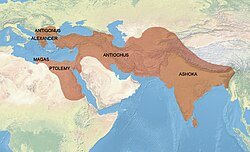
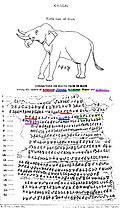
Some of the better-known examples are those of the Edicts of Ashoka (c. 250 BCE), in which the Emperor Ashoka refers to the Greek populations under his rule. Rock Edicts V and XIII mention the Yonas (or the Greeks) along with the Kambojas and Gandharas as a subject people forming a frontier region of his empire and attest that he sent envoys to the Greek rulers in the West as far as the Mediterranean, faultlessly naming them one by one.
In the Gandhari original of Rock XIII, the Greek kings to the West are associated unambiguously with the term "Yona": Antiochus is referred as "Amtiyoko nama Yonaraja" (lit. "The Greek king by the name of Antiochus"), beyond whom live the four other kings: "param ca tena Atiyokena cature 4 rajani Turamaye nama Amtikini nama Maka nama Alikasudaro nama" (lit. "And beyond Antiochus, four kings by the name of Ptolemy, the name of Antigonos, the name of Magas, the name Alexander").
In Buddhist Texts[edit | edit source]
Other Buddhist texts such as the Dipavamsa and the 1861 Sasana Vamsa reveal that after the Third Buddhist council, the elder monk (thero) Maharakkhita was sent to the "Yona country" and he preached Buddhism among the Yonas and the Kambojas, and that at the same time the Yona elder monk (thero) Dharmaraksita was sent to the country of Aparantaka in Western India also. Ashoka's Rock Edict XIII also pairs the Yonas with the Kambojas (Yonakambojesu) and conveys that brahmans and śramaṇas are found everywhere in his empire except in the lands of the Yonas and the Kambojas.
Mahavamsa[edit | edit source]
The Mahavamsa or "Great Chronicle" of Sri Lanka refers to the thera Mahārakkhita being sent to preach to the Yona country, and also to the Yona thera Dhammarakkhita, who was sent to Aparanta ("the Western Ends").[10] It also mentions that Pandukabhaya of Anuradhapura set aside a part of his capital city of Anuradhapura for the Yonas.[11]
Another Yona thera, Mahādhammarakkhita, is mentioned as having come from Alexandria on the Caucasus in the country of the Yonas, to be present at the building of the Ruwanwelisaya.[12]
Milindapanha[edit | edit source]
Another example is that of the Milinda Panha (Chapter I), where "Yonaka" is used to refer to the great Indo-Greek king Menander (160–135 BC), and to the guard of "five hundred Greeks" that constantly accompanies him.
Invasion of India[edit | edit source]
The Vanaparava of Mahabharata contains prophecies that "Mleccha kings of the Shakas, Yavanas, Kambojas, Bahlikas etc. shall rule the earth un-righteously in Kaliyuga ...".[13] This reference apparently alludes to chaotic political scenario following the collapse of the Maurya and Shunga Empires in northern India and its subsequent occupation by foreign hordes such as of the Yonas, Kambojas, Sakas and Pahlavas.

There are important references to the warring Mleccha hordes of the Shakas, Yavanas, Kambojas, the Pahlavas and others in the Bala Kanda of Valmiki's Ramayana.[citation needed]
Indologists like Dr H. C. Raychadhury, Dr B. C. Law, Dr Satya Shrava and others see in these verses the clear glimpses of the struggles of the Hindus with the mixed invading hordes of the barbaric Sakas, Yavanas, Kambojas, Pahlavas etc. from north-west.[14] The time frame for these struggles is 2nd century BCE downwards.[15]
The other Indian records prophecies the 180 BCE Yona attacks on Saket, Panchala, Mathura and Pataliputra, probably against the Shunga Empire, and possibly in defence of Buddhism: "After having conquered Saketa, the country of the Panchala and the Mathuras, the Yavanas, wicked and valiant, will reach Kusumadhvaja ("The town of the flower-standard", Pataliputra). The thick mud-fortifications at Pataliputra being reached, all the provinces will be in disorder, without doubt. Ultimately, a great battle will follow, with tree-like engines (siege engines)."[16] "The Yavanas will command, the Kings will disappear. (But ultimately) the Yavanas, intoxicated with fighting, will not stay in Madhadesa (the Middle Country); there will be undoubtedly a civil war among them, arising in their own country, there will be a terrible and ferocious war."[17] The "Anushasanaparava" of the Mahabharata affirms that the country of Majjhimadesa was invaded by the Yavanas and the Kambojas who were later utterly defeated. The Yona invasion of Majjhimadesa ("middle country, midlands") was jointly carried out by the Yonas and the Kambojas. Majjhimadesa here means the middle of Greater India which then included Afghanistan, Pakistan and large parts of Central Asia.
Other references[edit | edit source]
On the 110 BCE Heliodorus pillar in Vidisha in Central India, the Indo-Greek king Antialcidas, who had sent an ambassador to the court of the Shunga emperor Bhagabhadra, was also qualified as "Yona".
The Mahavamsa also attests Yona settlement in Anuradhapura in ancient Sri Lanka, probably contributing to trade between East and West.
Buddhist texts like Sumangala Vilasini class the language of the Yavanas with the Milakkhabhasa i.e. impure language.
Roman traders in Tamilakkam were also considered Yavanas.
Sanchi[edit | edit source]

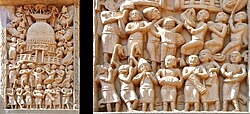
Some of the friezes of Sanchi also show devotees in Greek attire. The men are depicted with short curly hair, often held together with a headband of the type commonly seen on ancient Greek coinage. The clothing too is Greek, complete with tunics, capes and sandals. The musical instruments are also quite characteristic, such as the double flute called aulos. Also visible are carnyx-like horns. They are all celebrating at the entrance of the stupa. These men would be foreigners from north-west India visiting the stupa, possibly Mallas, Indo-Scythians or Indo-Greeks.[18]
Three inscriptions are known from Yavana[19] donors at Sanchi, the clearest of which reads "Setapathiyasa Yonasa danam" ("Gift of the Yona of Setapatha"), Setapatha being an uncertain city.[20]
Buddhist caves of Western India[edit | edit source]

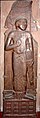
In the Great Chaitya of the Karla Caves built and dedicated by Western Satraps Nahapana in 120 CE,[22] there are six inscriptions made by self-described Yavana donors, who donated six of the pillars, although their names are Buddhist names.[23] They account for nearly half of the known dedicatory inscriptions on the pillars of the Chaitya.[24]
- 3rd pillar of the left row:
- 4th pillar of the left row:
- "Of Dhamma, a Yavana from Dhenukakata"[27]
- 9th pillar of the left row:
- "(This) pillar (is) the gift of the Yavana Yasavadhana from Denukakata"[21]
- 5th pillar of the right row:
- "This pillar is the gift of the Yavana Vitasamghata from Umehanakata"[28]
- 13th pillar of the right row:
- "(This) pillar (is) the gift of the Yavana Dhamadhaya from Denukakata"[29]
- 15th pillar of the right row:
- "(This) pillar (is) the gift of the Yavana Chulayakha from Dhenukakata"[30]
The city of Dhenukakata is thought to be Danahu near the city of Karli.[23] It is described by other donors in other inscriptions as a "vaniya-gama" (A community of merchants).
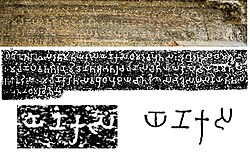
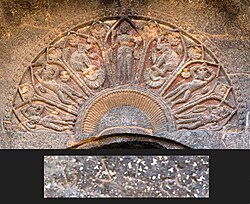
The Yavanas are also known for their donation of a complete cave at the Nasik Caves (cave No.17), and for their donations with inscriptions at the Junnar caves.
The Yonas and other northwestern invaders in Indian literature[edit | edit source]
The Yavanas or Yonas are frequently found listed with the Kambojas, Sakas, Pahlavas and other northwestern tribes in numerous ancient Indian texts.

The Mahabharata groups the Yavanas with the Kambojas and the Chinas and calls them "Mlechchas" (Barbarians). In the Shanti Parva section, the Yavanas are grouped with the Kambojas, Kiratas, Sakas, and the Pahlavas etc. and are spoken of as living the life of Dasyus (dacoits). In another chapter of the same Parva, the Yaunas, Kambojas, Gandharas etc. are spoken of as equal to the "Svapakas" and the "Grddhras".
In Harivamsha , Bramhanda purana And Vishnu purana there is also mention of Yavana King Named Kalyavana who invaded Mathura And Dvaraka With the alliance of Magadha King Jarasandha[33].
Udyogaparva of Mahabharata[34] says that the composite army of the Kambojas, Yavanas and Sakas had participated in the Mahabharata war under the supreme command of Kamboja king Sudakshina. The epic numerously applauds this composite army as being very fierce and wrathful.
Balakanda of Ramayana also groups the Yavanas with the Kambojas, Sakas, Pahlavas etc. and refers to them as the military allies of sage Vishistha against Vedic king Vishwamitra[35] The Kishkindha Kanda of Ramayana locates the Sakas, Kambojas, Yavanas and Paradas in the extreme north-west beyond the Himavat (i.e. Hindukush).[36]
The Buddhist drama Mudrarakshasa by Visakhadutta as well as the Jaina works Parishishtaparvan refer to Chandragupta's alliance with Himalayan king Parvataka. This Himalayan alliance gave Chandragupta a powerful composite army made up of the frontier martial tribes of the Shakas, Kambojas, Yavanas, Parasikas, Bahlikas etc.[37] which he may have utilised to aid defeat the Greek successors of Alexander the Great and the Nanda rulers of Magadha, and thus establishing his Mauryan Empire in northern India.
Manusmriti[38] lists the Yavanas with the Kambojas, Sakas, Pahlavas, Paradas etc. and regards them as degraded Kshatriyas (Hindu caste). Anushasanaparva of Mahabharata[39] also views the Yavanas, Kambojas, Shakas etc. in the same light. Patanjali's Mahabhashya[40] regards the Yavanas and Sakas as Anirvasita (pure) Shudras. Gautama-Dharmasutra[41] regards the Yavanas or Greeks as having sprung from Shudra females and Kshatriya males.
The Assalayana Sutta of Majjhima Nikaya attests that in Yona and Kamboja nations, there were only two classes of people...Aryas and Dasas...the masters and slaves, and that the Arya could become Dasa and vice versa. The Vishnu Purana also indicates that the "Chaturvarna" or four class social system was absent in the lands of Kiratas in the East, and the Yavanas and Kambojas etc. in the West.
Numerous Puranic literature groups the Yavanas with the Sakas, Kambojas, Pahlavas and Paradas and refers to the peculiar hair styles of these people which were different from those of the Hindus. Ganapatha on Pāṇini attests that it was a practice among the Yavanas and the Kambojas to wear short-cropped hair (Kamboja-mundah Yavana-mundah).
Vartika of Katayayana informs us that the kings of the Shakas and the Yavanas, like those of the Kambojas, may also be addressed by their respective tribal names.
Brihatkathamanjari of Kshmendra[42] informs us that king Vikramaditya had unburdened the sacred earth of the Barbarians like the Shakas, Kambojas, Yavanas, Tusharas, Parasikas, Hunas etc. by annihilating these sinners completely.
The Brahmanda Purana[43] refers to the horses born in Yavana country.
The Mahaniddesa[44] speaks of Yona and Parama Yona, probably referring to Arachosia as the Yona and Bactria as the Parama Yona.
Later meanings[edit | edit source]

The terms "Yona", "Yonaka" or "Yavana" literally referred to the Greeks, however "mlechas" was also used probably due to their barbaric behaviour as invaders. Indian languages did not base a distinction on religion early on but after the arrival of Islam to the subcontinent, the term Yavana was used along with Turuka, Turuska, Tajik, and Arab more than Mussalaman or Muslim for invaders professing Islam as their religion.[46]
The Chams of Champa are thought referring Đại Việt as "Yavana".[47][48][49][50] However this statement is largely vague. Cham sources refer Dai Viet as nagara Yuen (Cham: nagara yvan, lit. "Viet state"), and the Viets as Yuen (yvan).[51] Both terminologies in Cham materials were written in Cham script and Old Cam, the first dated 1142 during the reign of Harivarman I, showing little linguistic evidence to prove that Cham Yuen and Indian Yavana are connected.[52] Similarly for Kiernan's argument to Khmer Yuon, the Cham reference for the Viet should have been derived from "Yue" or "Viet".
The Khmer word "Yuon" (yuôn) យួន /yuən/ was thought to be an ethnic slur for Vietnamese, derived from the Indian word for Greek, "Yavana",[53] however, it is actually the transcription of the word "Viet" or "Yueh" rather than "Yavana",[54] because the Khmer word Yuon spelled with the diphthong uo, not v in "Yavana". According to Kiernan, "the Pol Pot regime, following French orientalists, mythologized its conflict with Hanoi as part of a millennial ethnic epic"; therefore they altered the meaning of yuon that being misleading implied as savages, foreigners.[55]
The Sinhalese term Yonaka referring to the Sri Lankan Moors, is thought to have been derived from the term Yona.[56]
Contemporary usage[edit | edit source]
The word Yona, or one of its derivatives, is still used by some languages to designate contemporary Greece, such as in Arabic (يونان), in Hebrew (יוון), in Turkish ("Yunanistan"), in Armenian (Հունաստան Hounistan), modern Aramaic (ܝܘ̈ܢܝܐ Yawnoye), or the Pashto, Hindi, Urdu, Malay and Indonesian languages ("Yunani").
See also[edit | edit source]
Notes[edit | edit source]
- ↑ Thomas, Edward Joseph (1933). The History of Buddhist Thought. Asian Educational Services. p. 85 with footnote 2. ISBN 978-81-206-1095-8.
- ↑ Waters, Matt (2014). Ancient Persia: A Concise History of the Achaemenid Empire, 550–330 BCE. Cambridge: Cambridge University Press. p. 173. ISBN 978-1-10700-9-608.
- ↑ The Greeks in Bactria and India by William Woodthorpe Tarn p.257
- ↑ Kinzl, Konrad H. (2010). A Companion to the Classical Greek World. John Wiley & Sons. p. 202. ISBN 978-1-4443-3412-8.
- ↑ Roisman, Joseph; Worthington, Ian (2011). A Companion to Ancient Macedonia. John Wiley & Sons. p. 87. ISBN 978-1-4443-5163-7.
- ↑ 6.0 6.1 Halkias, Georgios T. (2014). "When the Greeks Converted the Buddha: Asymmetrical Transfers of Knowledge in Indo-Greek Cultures". In Wick, Peter; Rabens, Volker (eds.). Religions and Trade: Religious Formation, Transformation and Cross-Cultural Exchange between East and West. Brill Publishers. ISBN 978-90-04-25528-9.
- ↑ "The Ancient Greeks Who Became Buddhists". GHD. 20 March 2025. Retrieved 1 June 2025.
- ↑ Lal, Shyam Bihari (2004). "Yavanas in the Ancient Indian Inscriptions". Proceedings of the Indian History Congress. 65: 1115–1120. ISSN 2249-1937. JSTOR 44144820.
- ↑ Kosmin, Paul J. (2014). The Land of the Elephant Kings. Harvard University Press. p. 57. ISBN 9780674728820.
- ↑ (Mahavamsa XII) Archived 20 October 2014 at the Wayback Machine
- ↑ (Mahavamsa X)
- ↑ (Mahawamsa XXIX)
- ↑ Mahabharata 3.188.34–36.
- ↑ The Śakas in India, 1981, p 12, Satya Shrava; Journal, 1920, p 175, University of Calcutta. Department of Letters; India & Russia: Linguistic & Cultural Affinity, 1982, p 100, Weer Rajendra Rishi; Indological Studies, 1950, p 32, Dr B. C. Law; Political History of India from the Accession of Parikshit to the Coronation of Bimbisara, 1923, Page iii, Hemchandra Raychaudhuri; Political History of Ancient India, 1996, p 4, Raychaudhury; Indological Studies, 1950, p 4, Dr B. C. Law.
- ↑ Political History of Ancient India, 1996, pp 3–4.
- ↑ Gargi-Samhita Paragraph 5, Yuga Purana.
- ↑ Gargi-Samhita, Yuga Purana Chapter, No 7.
- ↑ "A guide to Sanchi" John Marshall. These "Greek-looking foreigners" are also described in Susan Huntington, "The art of ancient India", p. 100
- ↑ Purātattva, Number 8. Indian Archaeological Society. 1975. p. 188.
A reference to a Yona in the Sanchi inscriptions is also of immense value.(...) One of the inscriptions announces the gift of a Setapathia Yona, "Setapathiyasa Yonasa danam" i.e the gift of a Yona, inhabitant of Setapatha. The word Yona can't be here anything, but a Greek donor
- ↑ Upinder Singh (2016). The Idea of Ancient India: Essays on Religion, Politics, and Archaeology. SAGE Publications. p. 18. ISBN 978-93-5150-647-8.
- ↑ 21.0 21.1 Epigraphia Indica Vol.18 p.328 Inscription No10
- ↑ World Heritage Monuments and Related Edifices in India, Volume 1 ʻAlī Jāvīd, Tabassum Javeed, Algora Publishing, 2008 p.42
- ↑ 23.0 23.1 Some Early Dynasties of South India, by Sudhakar Chattopadhyaya p.83
- ↑ Epigraphia Indica Vol.18 p.326-328 and Epigraphia Indica Vol.7 [Epigraphia Indica Vol.7 p.53-54
- ↑ Epigraphia Indica Vol.7 p.53-54 Inscription No.7
- ↑ Problems of Ancient Indian History: New Perspectives and Perceptions, Shankar Goyal – 2001, p.104
- ↑ Epigraphia Indica Vol.7 p.55-56 Inscription No.10 and Epigraphia Indica Vol.18 p.327 Inscription No.7 differ on the content of this inscription. Here, Epigraphia Indica Vol.7 was chosen, as Epigraphia Indica Vol.18 only mentions an inscription similar to that of pillar No.3, a possible mixup.
- ↑ Epigraphia Indica Vol.18 p.326 Inscription No1
- ↑ Epigraphia Indica Vol.18 p.326 Inscription No 4
- ↑ Epigraphia Indica Vol.18 p.327 Inscription No6
- ↑ Faces of Power: Alexander's Image and Hellenistic Politics by Andrew Stewart p.180
- ↑ D.N. Jha,"Early India: A Concise History"p.150, plate 17
- ↑ Dowson, John (2013). A Classical Dictionary of Hindu Mythology and Religion, Geography, History and Literature. Hoboken: Taylor and Francis. ISBN 978-0-415-24521-0.
- ↑ Mahabharata 5.19.21–23.
- ↑ Ramayana 55.2–3.
- ↑ Ramayana 43.12.
- ↑ See: Mudrarakshas, Act II.
- ↑ Manusmriti X.43–44.
- ↑ Mahabharata 13.33.23.
- ↑ Mahabhasya II.4.10.
- ↑ Gautama-Dharmasutra IV.21.
- ↑ Brihat-Katha-Manjari 10.1.285-86.
- ↑ Brahmanda Purana, Upodghatapada, 16–17.
- ↑ Mahaniddesa, pp 155, 415.
- ↑ Religions and Trade: Religious Formation, Transformation and Cross-Cultural Exchange between East and West, BRILL, 2013 p.97 Note 97
- ↑ Parasher-Sen, Aloka (2004). Subordinate and marginal groups in early India. Oxford [Oxfordshire]: Oxford University Press. p. 52. ISBN 0-19-566542-2.
- ↑ Udaya. Department of Culture and Monuments, Authority for the Protection and Management of the Region Angkor / Siem Reap. 2006. pp. 117, 118, 119.
- ↑ Miksic, John N.; Goh, Geok Yian; O'Connor, Sue (2011). Rethinking Cultural Resource Management in Southeast Asia: Preservation, Development, and Neglect. Anthem Press. p. 241. ISBN 978-0-85728-389-4.
- ↑ Schafer, Edward H. (1967). The Vermilion Bird. University of California Press. p. 11. GGKEY:J7QZAZWA45P.
- ↑ Higham, Charles (2014). Encyclopedia of Ancient Asian Civilizations. Infobase Publishing. p. 64. ISBN 978-1-4381-0996-1.
- ↑ Golzio, Karl-Heinz (2004). Inscriptions of Campā based on the editions and translations of Abel Bergaigne, Étienne Aymonier, Louis Finot, Édouard Huber and other French scholars and of the work of R. C. Majumdar. Newly presented, with minor corrections of texts and translations, together with calculations of given dates. Shaker Verlag. pp. 199–200.
- ↑ Barrelon, Pierre; De Corbigny, Brossard; Lemire, Charles; Cahen, Gaston (1999). Cities of Nineteenth Century Colonial Vietnam: Hanoi, Saigon, Hue and the Champa Ruins. White Lotus Press. p. 191. ISBN 978-9-74843-456-8.
- ↑ Post Staff (4 July 2003). "From Ionia to Vietnam". The Phnom Penh Post.
- ↑ Kenneth Tso and Sophal Ear (8 February 2010). "Yuon: What's in a xenonym?". The Phnom Penh Post.
- ↑ Ben Kiernan (2001). "Myth, nationalism and genocide" (PDF). Yale University Genocide Studies Program.
- ↑ Singh, Nagendra Kr; Khan, Abdul Mabud (2001). Encyclopaedia of the World Muslims: Tribes, Castes and Communities. Global Vision. ISBN 9788187746102.
References[edit | edit source]
- The shape of ancient thought. Comparative Studies in Greek and Indian philosophies, by Thomas Mc Evilly (Allworth Press, New York 2002) ISBN 1-58115-203-5
- Liber Genesis 10:2. "Filii Iapheth: Gomer et Magog et Madai et Iavan et Thubal et Mosoch et Thiras." Nova vulgata.