

No edit summary |
expanded content |
||
| Line 1: | Line 1: | ||
{{Short description|British soldier, banker and artist (1786–1877)}} | {{Short description|British soldier, banker and artist (1786–1877)}} | ||
{{Use dmy dates|date=June 2022}} | {{Use dmy dates|date=June 2022}} | ||
{{Use British English|date=August 2025}} | |||
{{Infobox person | {{Infobox person | ||
| honorific_prefix = [[Captain (British Army and Royal Marines)|Captain]] | | honorific_prefix = [[Captain (British Army and Royal Marines)|Captain]] | ||
| Line 15: | Line 15: | ||
| death_date = {{Death date and age|1877|12|09|1786|10|23|df=y}} | | death_date = {{Death date and age|1877|12|09|1786|10|23|df=y}} | ||
| death_place = [[Nice]], [[Provence-Alpes-Côte d'Azur]], France | | death_place = [[Nice]], [[Provence-Alpes-Côte d'Azur]], France | ||
| education = | | education = | ||
| alma_mater = | | alma_mater = | ||
| Line 40: | Line 39: | ||
}} | }} | ||
[[Captain (British Army and Royal Marines)|Captain]] '''Robert Melville Grindlay''' [[Royal Society of Arts|FRSA]] [[Royal Asiatic Society of Great Britain and Ireland|MRAS]] [[Zoological Society of London|FZS]] [[Royal Horticultural Society|FRHS]] [[Royal Botanic Society|FRBS]]{{ref|RMG1|[a]}} (23 October 1786 – 9 December 1877) was a British soldier, artist, and banker during the 18th and 19th centuries.<ref name="Tyson">{{Cite book|last=Tyson|first=Geoffrey|url= | [[Captain (British Army and Royal Marines)|Captain]] '''Robert Melville Grindlay''' [[Royal Society of Arts|FRSA]] [[Royal Asiatic Society of Great Britain and Ireland|MRAS]] [[Zoological Society of London|FZS]] [[Royal Horticultural Society|FRHS]] [[Royal Botanic Society|FRBS]]{{ref|RMG1|[a]}} (23 October 1786 – 9 December 1877) was a British soldier, artist, and banker during the 18th and 19th centuries.<ref name="Tyson">{{Cite book |last=Tyson |first=Geoffrey |url=https://manfamily.org/wp-content/uploads/2024/03/GrindlaySBank.pdf |title=100 Years of Banking in Asia and Africa, 1863 – 1963 – A History of National and Grindlays Bank Limited: Chapter XV |publisher=National and Grindlays Bank Limited |year=1963 |isbn= |location=London |pages=}}</ref><ref>{{Cite web|title=Capt. Robert Melville Grindlay (The Print Gallery)|url=https://prints.themaphouse.com/capt-robert-m-grindlay/|website=The Map House (www.themaphouse.com)|access-date=29 October 2021|archive-date=29 October 2021|archive-url=https://web.archive.org/web/20211029180821/https://prints.themaphouse.com/capt-robert-m-grindlay/|url-status=dead}}</ref><ref>{{Cite book|last=Grindlay|first=Robert Melville|url=https://books.google.com/books?id=Xmc9zQEACAAJ&q=robert+melville+grindlay|title=Scenery, Costumes and Architecture, Chiefly on the Western Side of India|publisher=Smith, Elder & Company|year=1830}}</ref> Born in London, England he served as an [[East India Company]] agent in the [[Bombay Army]], during which time he made a large collection of sketches and drawings of the [[Indian subcontinent]].<ref name=":7">{{Cite book|last=Berry|first=William|url=https://books.google.com/books?id=okhFAAAAYAAJ&pg=PA10|title=County Genealogies: Pedigrees of the Families in the County of Sussex|publisher=Sherwood, Gilbert and Piper|year=1830|location=London|pages=93}}</ref><ref>{{Cite web|last=Grindlay|first=Robert Melville|title=North-west view of the fort of Bombay|url=http://www.bl.uk/onlinegallery/onlineex/apac/other/019xzz000000400u00017000.html|website=British Library Online}}</ref><ref name=":11">{{Cite web|last=Chatterjee|first=Arup K Chatterjee|title=Robert Melville Grindlay: The artist, Indophile and imperialist who founded Grindlays Bank|url=https://scroll.in/magazine/866960/robert-melville-the-artist-indophile-and-imperialist-who-founded-grindlays-bank|website=Scroll In}}</ref> Upon returning to England he founded the multinational commercial firm [[Grindlays Bank]] and various philanthropic initiatives.<ref name="Jones">Geoffrey Jones, British Multinational Banking 1830–1990, (1993)</ref><ref>{{Cite web|title=London Metropolitan Archives: City of London|url=https://discovery.nationalarchives.gov.uk/details/r/ecffdfd9-33e1-4fc2-b743-91edbce45e9e|website=The National Archives|quote=Robert Melville Grindlay esq, and others of Leamington Priors, Warwickshire, appointed as trustees for Harriet Rokeby of Oxenden near Market Harborough, Northamptonshire}}</ref><ref>{{Cite book|last=Grindlay|first=Robert Melville|url=https://books.google.com/books?id=LadWAAAAcAAJ&dq=robert+melville+grindlay&pg=RA1-PA8|title=A View of the Present State of the Question as to Steam Communication with India: With a Map, and an Appendix, Containing the Petitions to Parliament, and Other Documents|publisher=Smith, Elder and Company|year=1837|location=London}}</ref> | ||
== Early years and family == | == Early years and family == | ||
| Line 48: | Line 47: | ||
*{{Cite web |title=Image Viewer: Baptism Registry |url=https://www.ancestry.co.uk/imageviewer/collections/1624/images/31280_194651-00164?usePUB=true&_phsrc=HSi12&_phstart=successSource&usePUBJs=true&pId=3382400}}</ref> | *{{Cite web |title=Image Viewer: Baptism Registry |url=https://www.ancestry.co.uk/imageviewer/collections/1624/images/31280_194651-00164?usePUB=true&_phsrc=HSi12&_phstart=successSource&usePUBJs=true&pId=3382400}}</ref> | ||
His grandparents James ( | His grandparents James (died 1765) and Christina Grindlay (née Govan),<ref>{{Cite web |others=Hunting For Bears, comp.. South Carolina Marriage Index, 1641–1965. South Carolina marriage information taken from various sources. |title=South Carolina, U.S., Compiled Marriage Index, 1641–1965 |url=https://www.ancestry.co.uk/discoveryui-content/view/335284:7840?tid=&pid=&queryId=acb1f804d48891526d2be1f6ed7dd4d5&_phsrc=IcH132&_phstart=successSource |website= |quote=Name: James Grindlay; Spouse: Christian Govan; Marriage Date: 11 Oct 1755; Source: South Carolina Marriages 1688–1799.}}</ref> [[Attorney at law|attorneys at law]], had emigrated to [[Charleston, South Carolina|Charleston]], [[Province of South Carolina|South Carolina]] from [[Glasgow]], [[Scotland]] during the early 18th century, after previous generations had resettled in [[Lanarkshire]] from the [[North Midlands]].<ref name=":0">{{Cite web |others=DOBSON, DAVID. The Original Scots Colonists of Early America, 1612–1783. Baltimore, MD: Genealogical Publishing Co., Inc., 1989. 370p. |title=U.S. and Canada, Passenger and Immigration Lists Index, 1500s–1900s |url=https://www.ancestry.co.uk/discoveryui-content/view/851939:7486 |website= |quote=Name: John Grindlay; Arrival Year: 1612–1777; Arrival Place: Charleston, South Carolina; Primary Immigrant: Grindlay, Christian; Family Members: Husband James; Son John; Source Publication Code: 1640.7.5; Annotation: Date and port of arrival or date and place of settlement. Names of parents, date of birth or baptism, place of birth, occupation, place of education, place of former residence, port of embarkation, place of intended destination, and notation concerning immigration.}}</ref><ref>{{Cite web |others=Directory of Scottish Settlers in North America, 1625–1825. Vol. VII; Author:: David Dobson |title=U.S., Directory of Scottish Settlers in North America, 1625–1825 |url=https://www.ancestry.co.uk/discoveryui-content/view/10014267:62215 |website= |quote=Govan, Mrs Christina, late widow of James Grindlay, attorney at law in Charleston, South Carolina, late in Glasgow}} | ||
*{{Cite web |title=Image Viewer: Directory |url=https://www.ancestry.co.uk/imageviewer/collections/62215/images/scotsettlersvii-002570-39?usePUB=true&usePUBJs=true&pId=10014267}}</ref><ref>{{Cite web |others=Wills and Miscellaneous Probate Records, 1671–1868; Author: Charleston County (South Carolina). Probate Judge; Probate Place: Charleston, South Carolina |title=South Carolina, U.S., Wills and Probate Records, 1670–1980 |url=https://www.ancestry.co.uk/discoveryui-content/view/8326:9080?tid=&pid=&queryId=c05a80ba351e5104cc9cc5edf9a83ca9&_phsrc=IcH134&_phstart=successSource |website= |quote=Will of James Grindlay (d.1765) bequeathing his estate to his wife Christina, his son John and his brother Alexander who had who remained in 'North Brittain'.}} | *{{Cite web |title=Image Viewer: Directory |url=https://www.ancestry.co.uk/imageviewer/collections/62215/images/scotsettlersvii-002570-39?usePUB=true&usePUBJs=true&pId=10014267}}</ref><ref>{{Cite web |others=Wills and Miscellaneous Probate Records, 1671–1868; Author: Charleston County (South Carolina). Probate Judge; Probate Place: Charleston, South Carolina |title=South Carolina, U.S., Wills and Probate Records, 1670–1980 |url=https://www.ancestry.co.uk/discoveryui-content/view/8326:9080?tid=&pid=&queryId=c05a80ba351e5104cc9cc5edf9a83ca9&_phsrc=IcH134&_phstart=successSource |website= |quote=Will of James Grindlay (d.1765) bequeathing his estate to his wife Christina, his son John and his brother Alexander who had who remained in 'North Brittain'.}} | ||
*{{Cite web |title=Image Viewer: Will and Testament |url=https://www.ancestry.co.uk/imageviewer/collections/9080/images/004753750_00728?usePUB=true&_phsrc=IcH134&_phstart=successSource&usePUBJs=true&pId=8326}}</ref> However, his father returned to the [[United Kingdom of Great Britain and Ireland|United Kingdom]] and attended [[Emmanuel College, Cambridge]], before taking up various [[Clergy|ecclesiastical]] positions at [[St Peter, Vere Street|Oxford Chapel, Marylebone]], [[Bishop's Caundle|Bishop's Caundle Church, Dorest]], and the [[Horne, Surrey|Church of St. Mary the Virgin, Horne, Surrey]], as well various charitable enterprises, including [[Catch22 (charity)|The Philanthropic Society]].<ref>{{Cite web|title=Clergy of the Church of England Database: Grindlay, John (1787–1818)|url=https://theclergydatabase.org.uk/jsp/persons/CreatePersonFrames.jsp?PersonID=52678|website=CCED}}</ref><ref name=":1" /><ref>{{Cite book|url=https://books.google.com/books?id=F3RjAAAAcAAJ&dq=bosanquet+grindlay&pg=PA1|title=An Account of the nature and views of the Philanthropic Society, instituted in ... 1788 for the prevention of crimes, etc. [With the annual report for 1798.]|publisher=Philanthropic Society|year=1799|location=London}}</ref><ref>{{Cite book|url=https://books.google.com/books?id=tucNAAAAQAAJ&dq=bosanquet+grindlay&pg=PA334|title=The Royal Kalendar and Court and City Register for England, Scotland, Ireland, and the Colonies for the Year 1819|publisher=Wm. H. Allen|year=1819|location=London|pages=334}}</ref><ref>{{Cite book|last=Whitten|first=Doreen Muriel|url=http://etheses.lse.ac.uk/137/1/Whitten_Protection,_prevention,_reformation_a_history_of_the_Philanthropic_Society,_1788-1848.pdf|title=Protection, Prevention, Reformation: A history of the Philanthropic Society, 1788–1848.|publisher=London School of Economics and Political Science|year=2001|quote=Reverend John Grindlay LL.D. as Chaplain, Superintendent and Secretary.}}</ref> | *{{Cite web |title=Image Viewer: Will and Testament |url=https://www.ancestry.co.uk/imageviewer/collections/9080/images/004753750_00728?usePUB=true&_phsrc=IcH134&_phstart=successSource&usePUBJs=true&pId=8326}}</ref> However, his father returned to the [[United Kingdom of Great Britain and Ireland|United Kingdom]] and attended [[Emmanuel College, Cambridge]], before taking up various [[Clergy|ecclesiastical]] positions at [[St Peter, Vere Street|Oxford Chapel, Marylebone]], [[Bishop's Caundle|Bishop's Caundle Church, Dorest]], and the [[Horne, Surrey|Church of St. Mary the Virgin, Horne, Surrey]], as well various charitable enterprises, including [[Catch22 (charity)|The Philanthropic Society]].<ref>{{Cite web|title=Clergy of the Church of England Database: Grindlay, John (1787–1818)|url=https://theclergydatabase.org.uk/jsp/persons/CreatePersonFrames.jsp?PersonID=52678|website=CCED}}</ref><ref name=":1" /><ref>{{Cite book|url=https://books.google.com/books?id=F3RjAAAAcAAJ&dq=bosanquet+grindlay&pg=PA1|title=An Account of the nature and views of the Philanthropic Society, instituted in ... 1788 for the prevention of crimes, etc. [With the annual report for 1798.]|publisher=Philanthropic Society|year=1799|location=London}}</ref><ref>{{Cite book|url=https://books.google.com/books?id=tucNAAAAQAAJ&dq=bosanquet+grindlay&pg=PA334|title=The Royal Kalendar and Court and City Register for England, Scotland, Ireland, and the Colonies for the Year 1819|publisher=Wm. H. Allen|year=1819|location=London|pages=334}}</ref><ref>{{Cite book|last=Whitten|first=Doreen Muriel|url=http://etheses.lse.ac.uk/137/1/Whitten_Protection,_prevention,_reformation_a_history_of_the_Philanthropic_Society,_1788-1848.pdf|title=Protection, Prevention, Reformation: A history of the Philanthropic Society, 1788–1848.|publisher=London School of Economics and Political Science|year=2001|quote=Reverend John Grindlay LL.D. as Chaplain, Superintendent and Secretary.}}</ref> | ||
| Line 61: | Line 60: | ||
During his time in the military, Grindlay held several [[Staff (military)|staff]] positions in the [[Bombay Presidency]] of [[British India]] as well as acting Captain of [[114th Mahrattas|2nd Battalion of the 7th Bombay Native Infantry]], including Secretary of the Committee of Embarkation of Bombay and [[Aide-de-camp]] of [[Sir Evan Nepean, 1st Baronet]], the [[List of governors of Bombay Presidency|Governor]] of [[Bombay]].<ref name="Tyson" /><ref name=":11" /><ref name=":25">{{Cite news|date=1877|title=Board Arrow|work=Broad Arrow|url=https://www.britishnewspaperarchive.co.uk/viewer/bl/0000587/18771222/068/0025|quote=Broad Arrow – Saturday 22 December 1877. Captain Robert Melville Grindlay who died at Nice on the morning of Sunday, December 9. He filled the position of aide-de-camp to Sir Evan Nepean, Governor of Bombay, and he also assisted on the survey of Guzerat and the Western Presidency under the late Colonel Monier Williams. He retired, ceasing at the same time to have any interest in the firm [Grindlays Bank]. He left England to spend the residue of this days under the shadow of the Maritime Alps.}}</ref> | During his time in the military, Grindlay held several [[Staff (military)|staff]] positions in the [[Bombay Presidency]] of [[British India]] as well as acting Captain of [[114th Mahrattas|2nd Battalion of the 7th Bombay Native Infantry]], including Secretary of the Committee of Embarkation of Bombay and [[Aide-de-camp]] of [[Sir Evan Nepean, 1st Baronet]], the [[List of governors of Bombay Presidency|Governor]] of [[Bombay]].<ref name="Tyson" /><ref name=":11" /><ref name=":25">{{Cite news|date=1877|title=Board Arrow|work=Broad Arrow|url=https://www.britishnewspaperarchive.co.uk/viewer/bl/0000587/18771222/068/0025|quote=Broad Arrow – Saturday 22 December 1877. Captain Robert Melville Grindlay who died at Nice on the morning of Sunday, December 9. He filled the position of aide-de-camp to Sir Evan Nepean, Governor of Bombay, and he also assisted on the survey of Guzerat and the Western Presidency under the late Colonel Monier Williams. He retired, ceasing at the same time to have any interest in the firm [Grindlays Bank]. He left England to spend the residue of this days under the shadow of the Maritime Alps.}}</ref> | ||
Grindlay undertook numerous military expeditions while in India, including a diplomatic mission to the court of the [[Talpur dynasty|Talpur]] [[Emir|Amirs]] of [[Sindh]] in 1808, which formed part of the prelude to the [[ | Grindlay undertook numerous military expeditions while in India, including a diplomatic mission to the court of the [[Talpur dynasty|Talpur]] [[Emir|Amirs]] of [[Sindh]] in 1808, which formed part of the prelude to the [[British conquest of Sindh|Amir signature of a treaty of "friendship"]] with the British in 1809.<ref name=":12">{{Cite book |last=Burnes |first=Sir Alexander |url=https://www.google.co.uk/books/edition/Travels_Into_Bokhara/y-Ow7Grk1U8C?hl=en&gbpv=1 |title=Travels into Bokhara together with a narrative of a voyage on the Indus |publisher=Oxford University Press |year=1834}}</ref><ref name=":27">{{Cite journal|last=Wallis|first=Frank H|date=2011|title=A History of the British Conquest of Afghanistan and Western India, 1838 to 1849|url=https://www.jstor.org/stable/10.2979/victorianstudies.54.1.117|journal=Victorian Studies|volume=54|issue=1|pages=111|doi=10.2979/victorianstudies.54.1.117|jstor=10.2979/victorianstudies.54.1.117|s2cid=142641569|url-access=subscription}}</ref> Having taken an interest in the history and geography of north-western India, he kept a diary of his travels, including the journey from [[Lakhpat|Lukhpat]] in [[Cutch State|Cutch]], India to [[Hyderabad, Sindh|Hyderabad]] in [[Sindh]], [[Pakistan]] along the [[Kori Creek|Kori]] and [[Nara River (India)|Narra]] rivers by way of [[Sindhri (town)|Sindhri]], to meet with Mir Ghulam Ali Talpur, the ruling Amir.<ref>{{Cite book|last=Keller|first=Sara|url=https://books.google.com/books?id=KDBuDwAAQBAJ&dq=Pauline+Rohatagi+grindlay&pg=PA144|title=Knowledge and the Indian Ocean: Intangible Networks of Western India and Beyond|publisher=Springer|year=2018|pages=144–145|isbn=9783319968391}}</ref> Several extracts of his journal were used to form part of the best selling memoir of [[Alexander Burnes|Captain Sir Alexander Burnes]], ''Travels into Bokhara'', first published in 1835''.<ref name=":12" />''<ref>{{cite web|last1=Hirst|first1=Christopher|title=Travels into Bokhara, by Alexander Burnes|url=https://www.independent.co.uk/arts-entertainment/books/reviews/travels-into-bokhara-by-alexander-burnes-7660988.html|access-date=12 September 2016|website=The Independent|date=19 April 2012}}</ref> | ||
In 1813, Grindlay was given leave to accompany [[Mary Elizabeth Frederica Mackenzie]], then Lady Hood, on a sketching expedition across [[Peninsular India|Peninsula India]].<ref name=":28">{{Cite web |last=Roy |title=New evidence for the style of the "Fraser artist" in Delhi: Portraits of Afghans 1808-10 |url=https://blogs.bl.uk/asian-and-african/2015/11/new-evidence-for-the-style-of-the-fraser-artist-in-delhi-portraits-of-afghans-1808-10.html |website=British Library - Asian and African Studies Blog: Dr Malini Roy, Head of Visual Arts at the British Library (London)}}</ref> They stopped for two months in [[Poona]], where he drew a number of portraits for [[Mountstuart Elphinstone]], British [[Envoy (title)|Envoy]] to the Court of [[Kabul]], for his report on the expedition to [[Shah Shuja Durrani]], Emir of the [[Durrani Empire]], ''An Account of the Kingdom of Caubul, and its Dependencies in Persia, Tartary, and India'', published in 1815.<ref>{{Cite web |title=Royal Society for Asian Affairs (RSAA) - Grindlay, Robert Melville, 1786-1877, Lieutenant, artist |url=https://discovery.nationalarchives.gov.uk/details/r/181438aa-ea21-4891-946f-3748226f61e4 |website=The National Archives}}</ref><ref>{{Cite book |last=Elphinstone |first=Mountstuart |url=https://archive.org/details/bub_gb_FOc-AAAAYAAJ/mode/2up |title=An Account of the Kingdom of Caubul,and its Dependencies in Persia, Tartary, and India: Comprising a view of the Afghaun nation, and a history of the Dooraunee monarchy |publisher=Longman, Hurst, Rees, Orme, and Brown. |year=1815 |edition=1st |language=English}}</ref> Grindlay later presented the original [[aquatint]]s to [[William Elphinstone, 15th Lord Elphinstone]] for his biography of Mountstuart following his death in 1859.<ref name=":28" /><ref>{{Cite web |title=Letter from Captain [R] Melville Grindlay to William Buller Fullerton-Elphinstone, 15th Lord Elphinstone |url=https://archiveshub.jisc.ac.uk/search/archives/8194ea34-8291-3ce1-8996-f9caf03f0f6a?component=3be4e770-dd76-3613-8996-0c64912deae5 |website=Archive Hub |quote=This letter, as well as the ones in Mss Eur F88/306 and Mss Eur F88/308 relate to publishing a fuller account of Mountstuart Elphinstone's life to date. George Dempster's daughter had made the acquaintance of a Captain B Melville Grindlay, an old Indian friend of Mrs Mary Stewart Mackenzie, Lady Hood who has a diary that might be of use.}}</ref> | |||
== Marriage == | == Marriage == | ||
Grindlay returned to England from India in | Grindlay returned to England from India in 1820 and married Maria Susannah Commerell on 20 July 1821 at [[St Marylebone Parish Church]].<ref name="odnb2">{{cite ODNB|title=John Edmund Commerell|year = 2004|url=http://www.oxforddnb.com/view/article/32520?docPos=1|access-date=29 December 2014|doi = 10.1093/ref:odnb/32520}}</ref><ref name=":8">{{Cite book|last=John Burke Esq. &|first=John Bernard Burke Esq.|url=https://books.google.com/books?id=2FE4AQAAMAAJ&dq=robert+melville+grindlay&pg=PA249|title=A Genealogical and Heraldic Dictionary of the Landed Gentry of Great Britain & Ireland|publisher=Henry Colburn|year=1866|location=London|pages=249}}</ref> Maria was the daughter of John William Commerell, of Strood Green near [[Horsham]], a [[High Sheriff of Sussex|Sheriff of Sussex]], whose family originated from [[Heilbronn]] in [[Swabia]], Germany,{{ref|RMG5|[e]}} where they were [[privy council]]lors and confidents of the [[House of Württemberg|Dukes of Württemberg]].<ref name=":7" /><ref name=":8" /> | ||
The couple established themselves at their principle London home at North Bank, [[Regent's Park]], in the parish of St. Marylebone,<ref name=":13">{{Cite web|title=John Barrett. Theft: burglary. 2nd January 1834|url=https://www.oldbaileyonline.org/browse.jsp?div=t18340102-53|website=Old Bailey Proceedings Online|quote=Transcript of a report of burglary at the home of Captain Robert Melville Grindlay, No. 35, North Bank, Regent's Park, on 2nd January 1834.}}</ref><ref name=":21">{{Cite book|url=https://books.google.com/books?id=lqpWAAAAcAAJ&dq=alfred+robert+grindlay+fellow&pg=PA16|title=The Royal Botanic Society of London [List of Fellows, Etc.]|publisher=Richard and John E Taylor|year=1841|location=London}}</ref> and had a son, Robert Melville Grindlay, born on 12 September 1821 and baptised on 24 September 1821 at St Marylebone Parish Church, but who died in infancy later that same year.<ref name=":7" /> | The couple established themselves at their principle London home at North Bank, [[Regent's Park]], in the parish of St. Marylebone,<ref name=":13">{{Cite web|title=John Barrett. Theft: burglary. 2nd January 1834|url=https://www.oldbaileyonline.org/browse.jsp?div=t18340102-53|website=Old Bailey Proceedings Online|quote=Transcript of a report of burglary at the home of Captain Robert Melville Grindlay, No. 35, North Bank, Regent's Park, on 2nd January 1834.}}</ref><ref name=":21">{{Cite book|url=https://books.google.com/books?id=lqpWAAAAcAAJ&dq=alfred+robert+grindlay+fellow&pg=PA16|title=The Royal Botanic Society of London [List of Fellows, Etc.]|publisher=Richard and John E Taylor|year=1841|location=London}}</ref> and had a son, Robert Melville Grindlay, born on 12 September 1821 and baptised on 24 September 1821 at St Marylebone Parish Church, but who died in infancy later that same year.<ref name=":7" /> | ||
| Line 76: | Line 77: | ||
{{main|Grindlays Bank}} | {{main|Grindlays Bank}} | ||
After returning to England, Grindlay maintained his influential [[Anglo-Indian]] connections and his correspondence with friends and former colleagues. Drawing on his extensive knowledge and experience of the region he undertook a growing number of personal commissions of assistance, to the point where in 1828 he founded ''Leslie & Grindlay'', to provide similar services to the wider public on a permanent business basis.<ref name="Tyson" /> Initially the company arranged passage to and from India for customers and their baggage, but in time added private banking activities to their services, eventually becoming the | After returning to England, Grindlay maintained his influential [[Anglo-Indian]] connections and his correspondence with friends and former colleagues. Drawing on his extensive knowledge and experience of the region he undertook a growing number of personal commissions of assistance, to the point where in 1828 he founded ''Leslie & Grindlay'', to provide similar services to the wider public on a permanent business basis.<ref name="Tyson" /> Initially the company arranged passage to and from India for customers and their baggage, but in time added private banking activities to their services, eventually becoming the principle bankers to the [[Presidency armies|Presidency Armies]] of the [[East India Company]], the [[British Indian Army]], and the business community in India.<ref name="Tyson" /><ref name=":11" /> | ||
The company was first based in Birchin Lane, off | The company was first based in Birchin Lane, off [[Lombard Street, London|Lombard Street]] in London and began by acting as agents to help secure the travel arrangements of its clientele, to and from India, procuring sea passages, clearing and shipping baggage, as well as providing advisory services including extensive kit lists, route maps and costings for East India Company employees and British officials.<ref>{{Cite web|last=O'Brien|first=John|date=29 June 2021|title=Untold lives blog – Outfitting an East India Company employee|url=https://blogs.bl.uk/untoldlives/2021/06/outfitting-an-east-india-company-employee-.html|website=British Library – India Office Records}}</ref><ref name=":17">{{Cite book|url=https://www.manfamily.org/PDFs/Grindlay%2520Travel%2520Advice.pdf|title=Grindlay & Co.'s Overland Circular – Hints for Travellers to India, Detailing the Several Routes.|publisher=Smith, Elder & Co|year=1847|location=London}}</ref> Expansion saw the business open other offices in the [[City of London]] ([[Cornhill, London|Cornhill]] and [[Bishopsgate]]) and [[Westminster]] ([[Whitehall]] and [[St James's Square]]). | ||
Under the guidance and direction of Grindlay, these services shifted over time towards financial operations, including banking, insurance, savings and encashment of cheques and drafts, and operational expansion to include the [[Indian subcontinent]], the Middle East and elements of Africa and Southeast Asia. During this same period various partner additions, mergers, and acquisitions resulted in the firm undergoing several name changes, being styled ''Grindlay, Christian & Matthews'' from 1839, ''Grindlay & Co'' from 1843, ''Grindlay & Co Ltd'' from 1924 and ''Grindlays Bank Ltd'' in 1947, until its merger with the National Bank of India in 1958 when it became ''National and Grindlays Bank''.<ref name=":02">{{Cite web|title=Royal Bank of Scotland – Heritage Archives|url=http://heritagearchives.rbs.com/companies/list/grindlays-bank-ltd.html}}</ref> | Under the guidance and direction of Grindlay, these services shifted over time towards financial operations, including banking, insurance, savings and encashment of cheques and drafts, and operational expansion to include the [[Indian subcontinent]], the Middle East and elements of Africa and Southeast Asia. During this same period various partner additions, mergers, and acquisitions resulted in the firm undergoing several name changes, being styled ''Grindlay, Christian & Matthews'' from 1839, ''Grindlay & Co'' from 1843, ''Grindlay & Co Ltd'' from 1924 and ''Grindlays Bank Ltd'' in 1947, until its merger with the National Bank of India in 1958 when it became ''National and Grindlays Bank''.<ref name=":02">{{Cite web|title=Royal Bank of Scotland – Heritage Archives|url=http://heritagearchives.rbs.com/companies/list/grindlays-bank-ltd.html}}</ref> | ||
By | By 1842, when Grindlay retired, the firm had become "the most distinguished bankers and agents to the civil and military officials of the business community and the British army in India".<ref name=":11" /> | ||
==== Timeline ==== | ==== Timeline ==== | ||
| Line 95: | Line 96: | ||
=== East India Company === | === East India Company === | ||
Grindlay was a major "proprietor of East India stock" with a significant stake and considerable influence in the [[East India Company]] during the 19th century.<ref name=":23">{{Cite news|date=1833|title=The British Newspaper Archive (BNA)|work=The Morning Post|url=https://www.britishnewspaperarchive.co.uk/viewer/bl/0000174/18330430/004/0001|quote=The Morning Post – Tuesday 30 April 1833. East India House, April 25, 1833. – The Court of Directors of the United Company of Merchants of England trading to the East Indies do hereby give notice, that a General Court of the said Company will be held at their house, in Leadenhall street, on Friday, the 3rd of May next, from eleven o'clock in the forenoon until six in the evening, for the purpose of taking a ballot, in pursuance of the following requisition, viz.:– "We, the undersigned Proprietors of East India Stock, concurring generally in the terms of the resolution which it has now been agreed shall form the main question, consider it to be of moment that an opportunity should be afforded to the proprietors at large to pass their judgement upon it; and we therefore require that the same may be decided by ballot: Campbell Marjoribanks, William Wigram, William Astell, William Stanley Clarke, Thomas Povner (junior), Thomas Hallifax, Richard Twining, Joseph Kaye, John Shore, Robert Brown, Joseph Sellon, William Hull, Patrick Hadow, James Ritchie, John Hicks, W. Hobson, Thomas Vignew, James Brogden, Charles Mills, Robert Melville Grindlay, David Carruthers, Henry Heath, Francis M. Ommanney, Henry Shank, William Young, George Lyall, James R. Carnac, Richard Jenkins. April 25, 1833. The question upon which the ballot is to be taken being as follows, viz:– [end extract]}}</ref> He was a central actor in the debating and eventual approval of the [[Saint Helena Act 1833 | Grindlay was a major "proprietor of East India stock" with a significant stake and considerable influence in the [[East India Company]] during the 19th century.<ref name=":23">{{Cite news|date=1833|title=The British Newspaper Archive (BNA)|work=The Morning Post|url=https://www.britishnewspaperarchive.co.uk/viewer/bl/0000174/18330430/004/0001|quote=The Morning Post – Tuesday 30 April 1833. East India House, April 25, 1833. – The Court of Directors of the United Company of Merchants of England trading to the East Indies do hereby give notice, that a General Court of the said Company will be held at their house, in Leadenhall street, on Friday, the 3rd of May next, from eleven o'clock in the forenoon until six in the evening, for the purpose of taking a ballot, in pursuance of the following requisition, viz.:– "We, the undersigned Proprietors of East India Stock, concurring generally in the terms of the resolution which it has now been agreed shall form the main question, consider it to be of moment that an opportunity should be afforded to the proprietors at large to pass their judgement upon it; and we therefore require that the same may be decided by ballot: Campbell Marjoribanks, William Wigram, William Astell, William Stanley Clarke, Thomas Povner (junior), Thomas Hallifax, Richard Twining, Joseph Kaye, John Shore, Robert Brown, Joseph Sellon, William Hull, Patrick Hadow, James Ritchie, John Hicks, W. Hobson, Thomas Vignew, James Brogden, Charles Mills, Robert Melville Grindlay, David Carruthers, Henry Heath, Francis M. Ommanney, Henry Shank, William Young, George Lyall, James R. Carnac, Richard Jenkins. April 25, 1833. The question upon which the ballot is to be taken being as follows, viz:– [end extract]}}</ref> He was a central actor in the debating and eventual approval of the [[Saint Helena Act 1833]], being named alongside 27 other stockholders, [[Member of Parliament (United Kingdom)|Members of Parliament]], and [[List of East India Company directors|company directors and chairman]], including [[William Wigram]], [[William Astell]], [[Richard Twining (tea merchant, born 1772)|Richard Twining]], [[Sir Charles Mills, 1st Baronet|Sir Charles Mills]], [[Francis Molyneux Ommanney|Sir Francis Molyneux Ommanney]], [[George Lyall (1779–1853)|George Lyall]], [[Sir James Rivett-Carnac, 1st Baronet|Sir James Rivett-Carnac]] and [[Sir Richard Jenkins]], in formal [[East India House]] communications.<ref name=":23" /><ref name=":24">{{Cite book|last=Lang|first=Eugen Maurice|url=https://books.google.com/books?id=P1y--X4XQ1sC&pg=PA77|title=Codification in the British Empire and America <!--|origpublisher=H J Paris |origlocation=[[Amsterdam]]-->|publisher=Lawbook Exchange Ltd|year=2005|isbn=1-58477-620-X|page=77, footnote 2|orig-date=1924}}</ref> | ||
The Act provided a 20-year extension of the [[royal charter]] granted to the East India Company, allowing it to maintain its political and administrative duties in India, but with a number of additional provisions which continued the successive reduction in the company's commercial rights and trading monopolies,<ref>{{Cite web|title=East India Company and Raj 1785–1858|url=https://www.parliament.uk/about/living-heritage/evolutionofparliament/legislativescrutiny/parliament-and-empire/parliament-and-the-american-colonies-before-1765/east-india-company-and-raj-1785-1858/|website=UK Parliament}}</ref> seen in the charters of [[Charter Act of 1793|1793]], [[Charter Act of 1813|1813]], [[Saint Helena Act 1833|1833]] and 1853.<ref name=":24" /> | The Act provided a 20-year extension of the [[royal charter]] granted to the East India Company, allowing it to maintain its political and administrative duties in India, but with a number of additional provisions which continued the successive reduction in the company's commercial rights and trading monopolies,<ref>{{Cite web|title=East India Company and Raj 1785–1858|url=https://www.parliament.uk/about/living-heritage/evolutionofparliament/legislativescrutiny/parliament-and-empire/parliament-and-the-american-colonies-before-1765/east-india-company-and-raj-1785-1858/|website=UK Parliament}}</ref> seen in the charters of [[Charter Act of 1793|1793]], [[Charter Act of 1813|1813]], [[Saint Helena Act 1833|1833]] and 1853.<ref name=":24" />{{efn|name=st|The citation of this act by this [[short title]] was authorised by section 5 of, and the second schedule to, the [[Statute Law Revision Act 1948]]. Due to the repeal of those provisions, it is now authorised by section 19(2) of the [[Interpretation Act 1978]].}} | ||
=== Freemasonry === | === Freemasonry === | ||
| Line 108: | Line 109: | ||
[[File:The Rajah of Cutch with his vassalls.jpg|thumb|''The Rajah of Cutch with his vassals'', by Robert Melville Grindlay, 1826]] | [[File:The Rajah of Cutch with his vassalls.jpg|thumb|''The Rajah of Cutch with his vassals'', by Robert Melville Grindlay, 1826]] | ||
Grindlay kept a detailed personal journal of his time in India, and made numerous sketches and paintings of his travels across the [[Indian subcontinent]].<ref name="Tyson" /><ref name=":11" /> Widely regarded as a "gifted amateur artist",<ref>{{Cite book|last=Oakley|first=Ann|url=https://books.google.com/books?id=PAvfBAAAQBAJ&dq=People+in+finance+Robert+Melville+Grindlay&pg=PA242|title=A Critical Woman: Barbara Wootton, Social Science and Public Policy in the Twentieth Century.|publisher=Bloomsbury|year=2011|isbn=9781849664691|quote=The bank's founder, Barbara Kyle's grandfather, Captain Robert Melville Grindlay, was also a gifted amateur painter. Painting ran in the family.}}</ref><ref>{{Cite book|last=Rohatgi|first=Pauline|title=Amateur artists in western India: James Forbes and Robert Melville Grindlay|publisher=MARG Publications|year=1989|pages=17–34}}</ref> he sketched hundreds of landscapes in [[Gujarat]], the [[Deccan Plateau|Deccan]], and along the coast with 24 of his works featuring in 75 publications and now held across 439 separate library holdings (as of 2021).<ref>{{Cite web|title=Grindlay, Robert Melville|url=https://www.worldcat.org/identities/lccn-n88096225/|website=www.worldcat.org}}</ref> | Grindlay kept a detailed personal journal of his time in India, and made numerous sketches and paintings of his travels across the [[Indian subcontinent]].<ref name="Tyson" /><ref name=":11" /> Widely regarded as a "gifted amateur artist",<ref>{{Cite book|last=Oakley|first=Ann|url=https://books.google.com/books?id=PAvfBAAAQBAJ&dq=People+in+finance+Robert+Melville+Grindlay&pg=PA242|title=A Critical Woman: Barbara Wootton, Social Science and Public Policy in the Twentieth Century.|publisher=Bloomsbury|year=2011|isbn=9781849664691|quote=The bank's founder, Barbara Kyle's grandfather, Captain Robert Melville Grindlay, was also a gifted amateur painter. Painting ran in the family.}}</ref><ref>{{Cite book|last=Rohatgi|first=Pauline|title=Amateur artists in western India: James Forbes and Robert Melville Grindlay|publisher=MARG Publications|year=1989|pages=17–34}}</ref> he sketched hundreds of landscapes in [[Gujarat]], the [[Deccan Plateau|Deccan]], and along the coast, with 24 of his works featuring in over 75 publications, and now held across 439 separate library holdings (as of 2021).<ref>{{Cite web|title=Grindlay, Robert Melville|url=https://www.worldcat.org/identities/lccn-n88096225/|website=www.worldcat.org}}</ref> These include the works of [[Alexander Burnes|Captain Sir Alexander Burnes]], [[Mountstuart Elphinstone]], and [[Henry Pottinger|Lieutenant-General Sir Henry Pottinger, 1st Baronet]] and his ''Travels in Beloochistan and Sinde'', first published in 1816, along with many others.<ref>{{Cite news |last=Shamsie |first=Muneeza |date=2015 |title=Review: Historical Portfolio - Representing Sindh: Images of the British Encounter by Rosemary Raza |url=https://www.dawn.com/news/amp/1218119 |work=[[Dawn (newspaper)|Dawn]]}}</ref> | ||
The most famous and comprehensive of these collected works is the best selling ''Scenery, Costumes and Architecture chiefly on the Western Side of India''.<ref>{{Cite web|date=4 July 2018|title=Banker, soldier, artist, lover|url=https://sarmaya.in/spotlight/banker-soldier-artist-lover/|website=Sarmaya Trust}}</ref><ref name=":14">{{Cite book|url=https://books.google.com/books?id=6TsgAAAAMAAJ&dq=robert+melville+grindlay&pg=PA2|title=The Byron Gallery: A Series of Historical Embellishments to Illustrate the Poetical Works of Lord Byron – Captain Grindlay's View in India|publisher=Smith, Elder & Co|year=1833}}</ref> This series was first published in 6 parts comprising 6 plates each, 36 in total, hand-coloured [[aquatint]]s with accompanying explanatory descriptions and annotations in 1830 by [[Smith, Elder & Co.|Smith, Elder & Co]], having been started by [[Rudolph Ackermann]] in 1826.<ref>{{Cite web|last=Grindlay|first=Robert Melville|title=Scenery, Costumes and Architecture|url=https://www.baumanrarebooks.com/rare-books/grindlay-robert-melville/scenery-costumes-and-architecture-of-india/82957.aspx|website=Bauman Rare Books}}</ref> On completion of the serial issues, the book was also released as a whole by Smith, Elder & Co and issued in one or two volumes, folio copies of which have sold for upwards of £25,000.00.<ref name="Tyson" /><ref>{{Cite web|last=Grindlay|first=Robert Melville|title=Scenery, Costumes and Architecture chiefly on the Western Side of India.|url=https://www.maggs.com/scenery-costumes-and-architecture-chiefly-on-the-western-side-of-india_208426.htm|website=www.maggs.com|quote=£9500.00. Captain Grindlay's book is one of the most appealing of the many colour plate books that depict the scenery of India. Grindlay's work and life are discussed at some length by Pauline Rohatgi in India and Pageant of Prints (pp177-194) London 1989. Abbey Travel, 442.}}</ref> The majority of his published works are engravings of original sketches then overpainted with oils.<ref>{{Cite web|last=Grindlay|first=Robert Melville|date=1805|title=A Hindoo Female of the Deccan & Concane|url=https://collections.vam.ac.uk/item/O136823/a-hindoo-female-of-the-oil-painting-grindlay-robert-melville/|website=Victoria and Albert Museum Online}}</ref>[[File:Map of India by Wyld James.jpg|left|thumb|''Map of India'' arranged and constructed under the direction of Capt. R.M. Grindlay, by [[James Wyld]], Geographer to Queen Victoria and Prince Albert, 1840]] | The most famous and comprehensive of these collected works is the best selling ''Scenery, Costumes and Architecture chiefly on the Western Side of India''.<ref>{{Cite web|date=4 July 2018|title=Banker, soldier, artist, lover|url=https://sarmaya.in/spotlight/banker-soldier-artist-lover/|website=[[Sarmaya Trust]]}}</ref><ref name=":14">{{Cite book|url=https://books.google.com/books?id=6TsgAAAAMAAJ&dq=robert+melville+grindlay&pg=PA2|title=The Byron Gallery: A Series of Historical Embellishments to Illustrate the Poetical Works of Lord Byron – Captain Grindlay's View in India|publisher=Smith, Elder & Co|year=1833}}</ref> This series was first published in 6 parts comprising 6 plates each, 36 in total, hand-coloured [[aquatint]]s with accompanying explanatory descriptions and annotations in 1830 by [[Smith, Elder & Co.|Smith, Elder & Co]], having been started by [[Rudolph Ackermann]] in 1826.<ref>{{Cite web|last=Grindlay|first=Robert Melville|title=Scenery, Costumes and Architecture|url=https://www.baumanrarebooks.com/rare-books/grindlay-robert-melville/scenery-costumes-and-architecture-of-india/82957.aspx|website=Bauman Rare Books}}</ref> On completion of the serial issues, the book was also released as a whole by Smith, Elder & Co and issued in one or two volumes, folio copies of which have sold for upwards of £25,000.00.<ref name="Tyson" /><ref>{{Cite web|last=Grindlay|first=Robert Melville|title=Scenery, Costumes and Architecture chiefly on the Western Side of India.|url=https://www.maggs.com/scenery-costumes-and-architecture-chiefly-on-the-western-side-of-india_208426.htm|website=www.maggs.com|quote=£9500.00. Captain Grindlay's book is one of the most appealing of the many colour plate books that depict the scenery of India. Grindlay's work and life are discussed at some length by Pauline Rohatgi in India and Pageant of Prints (pp177-194) London 1989. Abbey Travel, 442.}}</ref> The majority of his published works are engravings of original sketches then overpainted with oils.<ref>{{Cite web|last=Grindlay|first=Robert Melville|date=1805|title=A Hindoo Female of the Deccan & Concane|url=https://collections.vam.ac.uk/item/O136823/a-hindoo-female-of-the-oil-painting-grindlay-robert-melville/|website=Victoria and Albert Museum Online}}</ref>[[File:Map of India by Wyld James.jpg|left|thumb|''Map of India'' arranged and constructed under the direction of Capt. R.M. Grindlay, by [[James Wyld]], Geographer to Queen Victoria and Prince Albert, 1840]] | ||
Reviews of ''Scenery, Costumes and Architecture chiefly on the Western Side of India'' in ''The Byron Gallery'' (1833):<blockquote>"If there has been any foundation for the complaint, that the splendid scenery and gorgeous architecture of India have never yet been adequately | Reviews of ''Scenery, Costumes and Architecture chiefly on the Western Side of India'' in ''The Byron Gallery'' (1833):<blockquote>"If there has been any foundation for the complaint, that the splendid scenery and gorgeous architecture of India have never yet been adequately {{sic|pou|rtrayed|hide=y}} [portrayed] by the pencil, it will vanish when this work shall be known, which certainly equals, if it does not transcend, any antecedent production of the graphic art. This work bids fair, not merely to establish the fame of Captain Grindlay, but to do honour to the British arts"<ref name=":14" /><ref name=":22">{{Cite book|url=https://books.google.com/books?id=bjs9AQAAMAAJ&dq=scenery+costumes+and+architecture+chiefly+on+the+western+side+of+india&pg=PA758|title=The Asiatic Journal and Monthly Register for British India and Its Dependencies; Review – Scenery, Costumes, and Architecture of Western India|publisher=Black, Parbury, & Allen|year=1826|volume=21|pages=756}}</ref> – [[The Asiatic Journal and Monthly Register for British India and Its Dependencies|Asiatic Journal]] | ||
"Captain Grindlay gives by this specimen of his labours, ample proof of genius, talent, and industry, exercised to high advantage during his service in the 'farther East;' the work will be appreciated as it deserves and admired for the fidelity as well as the spirit with which the scenes are brought before the eye. It embraces scenes and subjects from the Mahratta country to the banks of the Indus, and is as varied as it is undoubtedly beautiful. This splendid publication will be highly acceptable to all persons interested in Indian subjects and fully deserves the patronage already bestowed upon it"<ref name=":14" /> – Oriental Herald | "Captain Grindlay gives by this specimen of his labours, ample proof of genius, talent, and industry, exercised to high advantage during his service in the 'farther East;' the work will be appreciated as it deserves and admired for the fidelity as well as the spirit with which the scenes are brought before the eye. It embraces scenes and subjects from the Mahratta country to the banks of the Indus, and is as varied as it is undoubtedly beautiful. This splendid publication will be highly acceptable to all persons interested in Indian subjects and fully deserves the patronage already bestowed upon it"<ref name=":14" /> – Oriental Herald | ||
| Line 126: | Line 127: | ||
==== Steam Communication with India ==== | ==== Steam Communication with India ==== | ||
Although likely initially motivated by classical imperial capitalism, Grindlay's experiences in South Asia lead to his becoming an ardent [[Indophile]], committed to the strengthening of the Indian economy and infrastructure.<ref name=":11" /> In his role as London agent to the Stream Committees of the [[Indian Presidencies]] during the [[Company Raj]], Grindlay advocated strongly for the establishment of regular and permanent communications by [[steam vessel]]s between Great Britain and India, for the benefit of both countries.<ref name=":15">{{Cite book|last=Grindlay|first=Robert Melville|url=http://www.manfamily.org/PDFs/Grindlay%20Steam%20Communication.pdf|title=Steam communication with India|edition=1st|location=London}}</ref> | Although likely initially motivated by classical imperial capitalism, Grindlay's experiences in South Asia lead to his becoming an ardent [[Indophile]], committed to the strengthening of the Indian economy and infrastructure.<ref name=":11" /> In his role as London agent to the Stream Committees of the [[Indian Presidencies]] during the [[Company Raj]], Grindlay advocated strongly for the establishment of regular and permanent communications by [[steam vessel]]s between Great Britain and India, for the benefit of both countries.<ref name=":15">{{Cite book|last=Grindlay|first=Robert Melville|url=http://www.manfamily.org/PDFs/Grindlay%20Steam%20Communication.pdf|title=Steam communication with India|edition=1st|location=London}}{{Dead link|date=February 2026 |bot=InternetArchiveBot }}</ref> | ||
Between 1834 and 1836, Grindlay published the first edition of his ''A view of the present state of the question as to steam communication with India'', in which he laments the slow government action following an enquiry by a committee of the [[House of Commons of the United Kingdom|House of Commons]] to investigate the "practicability and expediency of establishing, on a permanent footing, a system of steam communication with India" on 14 July 1834.<ref name=":15" /> The pamphlet details the economic benefits of the proposed route between England and India via the [[Red Sea]], incorporating detailed financial calculations, maps of proposed routes, and widely signed petitions from across the [[Indian Presidencies]] in support of its establishment.<ref name=":11" /><ref name=":15" /> | Between 1834 and 1836, Grindlay published the first edition of his ''A view of the present state of the question as to steam communication with India'', in which he laments the slow government action following an enquiry by a committee of the [[House of Commons of the United Kingdom|House of Commons]] to investigate the "practicability and expediency of establishing, on a permanent footing, a system of steam communication with India" on 14 July 1834.<ref name=":15" /> The pamphlet details the economic benefits of the proposed route between England and India via the [[Red Sea]], incorporating detailed financial calculations, maps of proposed routes, and widely signed petitions from across the [[Indian Presidencies]] in support of its establishment.<ref name=":11" /><ref name=":15" /> | ||
| Line 192: | Line 193: | ||
:# [[East India Company|EICS]] – Member of the East India Company | :# [[East India Company|EICS]] – Member of the East India Company | ||
:# [[Aide-de-camp|ADC]] – Aide-de-camp of the Governor of Bombay | :# [[Aide-de-camp|ADC]] – Aide-de-camp of the Governor of Bombay | ||
:{{Note|RMG2|b}}Although born in Marylebone, then a village near London, his distinctive middle name pays homage to his Scottish Grindlay ancestry and links between his forebears and the small but powerful noble [[Melville family]] of Midlothian and Fife (see [[Robert Melville, 1st Lord Melville]], [[Earl of Melville|Earl Melville]], [[Clan Melville]], etc.).<ref name="Tyson2">{{Cite book|last=Tyson|first=Geoffrey|url=http://www.manfamily.org/PDFs/GrindlaySBank.pdf|title=100 Years of Banking in Asia and Africa, 1863 – 1963 – A History of National and Grindlays Bank Limited: Chapter XV|publisher=National and Grindlays Bank Limited|year=1963|isbn=|location=London|pages=}}</ref> | :{{Note|RMG2|b}}Although born in Marylebone, then a village near London, his distinctive middle name pays homage to his Scottish Grindlay ancestry and links between his forebears and the small but powerful noble [[Melville family]] of Midlothian and Fife (see [[Robert Melville, 1st Lord Melville]], [[Earl of Melville|Earl Melville]], [[Clan Melville]], etc.).<ref name="Tyson2">{{Cite book|last=Tyson|first=Geoffrey|url=http://www.manfamily.org/PDFs/GrindlaySBank.pdf|title=100 Years of Banking in Asia and Africa, 1863 – 1963 – A History of National and Grindlays Bank Limited: Chapter XV|publisher=National and Grindlays Bank Limited|year=1963|isbn=|location=London|pages=}}{{Dead link|date=February 2026 |bot=InternetArchiveBot }}</ref> | ||
:{{Note|RMG3|c}}The relations of Robert Melville Grindlay were:<ref name=":7" /><ref name=":4" /><ref name=":6" /><ref name=":3">{{Cite web|title=My Descendant Chart|url=http://www.burningviolin.org/family/Boileau/BBC_modern.pdf|website=www.burningviolin.org|quote=Chart of the descendants of Charles (ii) Boileau (1673–1733) & Mary Magdalena Collot D'Escury (1679–1731)}}</ref><ref name=":5">{{Cite web |others=Principal Probate Registry. Calendar of the Grants of Probate and Letters of Administration made in the Probate Registries of the High Court of Justice in England. London, England |title=England & Wales, National Probate Calendar (Index of Wills and Administrations), 1858–1995 |url=https://www.ancestry.co.uk/discoveryui-content/view/1212470:1904 |website= |quote=The will of Anna Maria Melville Imbert (née Grindlay), died on 5th June 1889 was proved at the principle registry by Henry Robert Grindlay of 22 Colville Terrace, Notting Hill in the county of Middlesex, a lieutenant-colonel in Her Majesty's Army the sole executor.}} | :{{Note|RMG3|c}}The relations of Robert Melville Grindlay were:<ref name=":7" /><ref name=":4" /><ref name=":6" /><ref name=":3">{{Cite web|title=My Descendant Chart|url=http://www.burningviolin.org/family/Boileau/BBC_modern.pdf|website=www.burningviolin.org|quote=Chart of the descendants of Charles (ii) Boileau (1673–1733) & Mary Magdalena Collot D'Escury (1679–1731)}}</ref><ref name=":5">{{Cite web |others=Principal Probate Registry. Calendar of the Grants of Probate and Letters of Administration made in the Probate Registries of the High Court of Justice in England. London, England |title=England & Wales, National Probate Calendar (Index of Wills and Administrations), 1858–1995 |url=https://www.ancestry.co.uk/discoveryui-content/view/1212470:1904 |website= |quote=The will of Anna Maria Melville Imbert (née Grindlay), died on 5th June 1889 was proved at the principle registry by Henry Robert Grindlay of 22 Colville Terrace, Notting Hill in the county of Middlesex, a lieutenant-colonel in Her Majesty's Army the sole executor.}} | ||
*{{Cite web |title=Image Viewer: Will and Testament |url=https://www.ancestry.co.uk/imageviewer/collections/1904/images/31874_221847-00269?usePUB=true&usePUBJs=true&pId=1212470}}</ref><ref name=":26">{{Cite book|last=Hart|first=Colonel H. G.|url=https://digital.nls.uk/dcn23/1056/9110/105691100.23.pdf|title=The New Annual Army List and Militia List and Indian Civil Service List for 1871|publisher=John Murray|year=1871|location=London|pages=60–61, 620}}</ref> | *{{Cite web |title=Image Viewer: Will and Testament |url=https://www.ancestry.co.uk/imageviewer/collections/1904/images/31874_221847-00269?usePUB=true&usePUBJs=true&pId=1212470}}</ref><ref name=":26">{{Cite book|last=Hart|first=Colonel H. G.|url=https://digital.nls.uk/dcn23/1056/9110/105691100.23.pdf|title=The New Annual Army List and Militia List and Indian Civil Service List for 1871|publisher=John Murray|year=1871|location=London|pages=60–61, 620}}</ref> | ||
{{block indent|1=<nowiki /> | {{block indent|1=<nowiki /> | ||
{{Tree list}} | {{Tree list}} | ||
* James Grindlay ( | * James Grindlay (died 1765) | ||
** [[The Reverend|Reverend]] Dr John Grindlay (1756–1818) | ** [[The Reverend|Reverend]] Dr John Grindlay (1756–1818) | ||
*** Alexander Grindlay (1785–1794) | *** Alexander Grindlay (1785–1794) | ||
| Line 205: | Line 206: | ||
*** William Grindlay (b. 3 March 1791) | *** William Grindlay (b. 3 March 1791) | ||
*** Charles George Grindlay (14 July 1793 – 26 August 1824) | *** Charles George Grindlay (14 July 1793 – 26 August 1824) | ||
**** [[Lieutenant colonel (United Kingdom)|Lieutenant Colonel]] Henry Robert Grindlay ( | **** [[Lieutenant colonel (United Kingdom)|Lieutenant Colonel]] Henry Robert Grindlay (born 1821) | ||
***** Florence Melville Grindlay | ***** Florence Melville Grindlay | ||
***** Walter Grindlay | ***** Walter Grindlay | ||
| Line 223: | Line 224: | ||
:{{Note|RMG4|d}}Grindlay and his siblings were predominately baptised at either [[St Marylebone Parish Church]] or the [[St Mary-at-Lambeth|Church of St. Mary-at-Lambeth]]. | :{{Note|RMG4|d}}Grindlay and his siblings were predominately baptised at either [[St Marylebone Parish Church]] or the [[St Mary-at-Lambeth|Church of St. Mary-at-Lambeth]]. | ||
:{{Note|RMG5|e}}Fredrick William Commerell, grandfather of Maria, moved to England from Germany in 1732, and was naturalised by [[Letters Patent (United Kingdom)|Letters Patent]] in 1752.<ref name=":7" /> | :{{Note|RMG5|e}}Fredrick William Commerell, grandfather of Maria, moved to England from Germany in 1732, and was naturalised by [[Letters Patent (United Kingdom)|Letters Patent]] in 1752.<ref name=":7" /> | ||
== Notes == | |||
{{Notelist}} | |||
== References == | == References == | ||
{{reflist}} | |||
==External links== | |||
* An engraving in Fisher's Drawing Room Scrap Book, 1835 by [[William Miller (engraver)|William Miller]] of the painting, {{ws|[[s:Letitia Elizabeth Landon (L. E. L.) in Fisher's Drawing Room Scrap Book, 1835/The Nizam's Daughter|British Residency in Hyderabad]]}} together with an associated poetical illustration by [[Letitia Elizabeth Landon]] on ''The Nizam's Daughter''. | |||
* An engraving in Fisher's Drawing Room Scrap Book, 1836 by J Redaway of the painting {{ws|[[s:Letitia Elizabeth Landon (L. E. L.) in Fisher's Drawing Room Scrap Book, 1836/Immolation of a Hindoo Widow|A Suttee, Preparing for the Immolation of a Hindoo Widow]]}} with a poetical illustration by [[Letitia Elizabeth Landon]]. | |||
{{ | {{Authority control}} | ||
{{DEFAULTSORT:Grindlay, Robert Melville}} | {{DEFAULTSORT:Grindlay, Robert Melville}} | ||
[[Category:1786 births]] | [[Category:1786 births]] | ||
[[Category:1877 deaths]] | [[Category:1877 deaths]] | ||
[[Category:British artists]] | |||
[[Category:British bankers]] | [[Category:British bankers]] | ||
[[Category:British | [[Category:British East India Company Army officers]] | ||
[[Category:Fellows of the Royal Asiatic Society]] | [[Category:Fellows of the Royal Asiatic Society]] | ||
[[Category:Fellows of the Zoological Society of London]] | [[Category:Fellows of the Zoological Society of London]] | ||
Latest revision as of 02:19, 15 March 2026
Robert Melville Grindlay | |
|---|---|
 Engraving of Capt. R M Grindlay | |
| Born | 23 October 1786 Marylebone, London, England |
| Died | 9 December 1877 (aged 91) Nice, Provence-Alpes-Côte d'Azur, France |
| Occupation |
|
| Known for | Banking to the British Empire Paintings of the Indian subcontinent |
| Title |
|
| Spouse(s) | Maria Susannah Grindlay (née Commerell) (m. 1821) |
| Children | Robert Melville Grindlay (son) |
| Parents |
|
| Relatives | See footnotes |
| Family | Grindlay |
Captain Robert Melville Grindlay FRSA MRAS FZS FRHS FRBS[a] (23 October 1786 – 9 December 1877) was a British soldier, artist, and banker during the 18th and 19th centuries.[1][2][3] Born in London, England he served as an East India Company agent in the Bombay Army, during which time he made a large collection of sketches and drawings of the Indian subcontinent.[4][5][6] Upon returning to England he founded the multinational commercial firm Grindlays Bank and various philanthropic initiatives.[7][8][9]
Early years and family[edit | edit source]
Grindlay was born on 23 October 1786, one of eight children,[b][c] to The Reverend Dr John Grindlay DCL LLD (1756–1818) and his wife Elizabeth (d.1843) in the village of St. Mary-le-Bone (now Marylebone) near London,[10][11] and baptised on 17 November of that same year at St Marylebone Parish Church.[d][12][13][14]
His grandparents James (died 1765) and Christina Grindlay (née Govan),[15] attorneys at law, had emigrated to Charleston, South Carolina from Glasgow, Scotland during the early 18th century, after previous generations had resettled in Lanarkshire from the North Midlands.[16][17][18] However, his father returned to the United Kingdom and attended Emmanuel College, Cambridge, before taking up various ecclesiastical positions at Oxford Chapel, Marylebone, Bishop's Caundle Church, Dorest, and the Church of St. Mary the Virgin, Horne, Surrey, as well various charitable enterprises, including The Philanthropic Society.[19][12][20][21][22]
Grindlay was educated in London and left school at the age of 17, having secured a position as a cadet in the Honourable East India Company (HEIC).[1]
Military service[edit | edit source]
Grindlay served in the 7th Bombay Infantry of the Bombay Army, the military arm of the East India Company, from 1804 to 1820. He was made a cadet in 1802 aged 17, following a nomination by E Parry Esq. secured for him by his father, and sailed to India the following year on the maiden voyage of the East Indiaman, the Prince of Wales, in 1803.[23][24] He became a Lieutenant in 1804, and reached the rank of Captain in 1817, before retiring from the military in 1820 at the age of 34.[1]
During his time in the military, Grindlay held several staff positions in the Bombay Presidency of British India as well as acting Captain of 2nd Battalion of the 7th Bombay Native Infantry, including Secretary of the Committee of Embarkation of Bombay and Aide-de-camp of Sir Evan Nepean, 1st Baronet, the Governor of Bombay.[1][6][25]
Grindlay undertook numerous military expeditions while in India, including a diplomatic mission to the court of the Talpur Amirs of Sindh in 1808, which formed part of the prelude to the Amir signature of a treaty of "friendship" with the British in 1809.[26][27] Having taken an interest in the history and geography of north-western India, he kept a diary of his travels, including the journey from Lukhpat in Cutch, India to Hyderabad in Sindh, Pakistan along the Kori and Narra rivers by way of Sindhri, to meet with Mir Ghulam Ali Talpur, the ruling Amir.[28] Several extracts of his journal were used to form part of the best selling memoir of Captain Sir Alexander Burnes, Travels into Bokhara, first published in 1835.[26][29]
In 1813, Grindlay was given leave to accompany Mary Elizabeth Frederica Mackenzie, then Lady Hood, on a sketching expedition across Peninsula India.[30] They stopped for two months in Poona, where he drew a number of portraits for Mountstuart Elphinstone, British Envoy to the Court of Kabul, for his report on the expedition to Shah Shuja Durrani, Emir of the Durrani Empire, An Account of the Kingdom of Caubul, and its Dependencies in Persia, Tartary, and India, published in 1815.[31][32] Grindlay later presented the original aquatints to William Elphinstone, 15th Lord Elphinstone for his biography of Mountstuart following his death in 1859.[30][33]
Marriage[edit | edit source]
Grindlay returned to England from India in 1820 and married Maria Susannah Commerell on 20 July 1821 at St Marylebone Parish Church.[34][35] Maria was the daughter of John William Commerell, of Strood Green near Horsham, a Sheriff of Sussex, whose family originated from Heilbronn in Swabia, Germany,[e] where they were privy councillors and confidents of the Dukes of Württemberg.[4][35]
The couple established themselves at their principle London home at North Bank, Regent's Park, in the parish of St. Marylebone,[36][37] and had a son, Robert Melville Grindlay, born on 12 September 1821 and baptised on 24 September 1821 at St Marylebone Parish Church, but who died in infancy later that same year.[4]
Grindlay was uncle-in-law to Sir John Edmund Commerell, Admiral of the Fleet and William Augustus Commerell, a first-class cricketer.[35][34]
Banking and commerce[edit | edit source]
Grindlays Bank[edit | edit source]
After returning to England, Grindlay maintained his influential Anglo-Indian connections and his correspondence with friends and former colleagues. Drawing on his extensive knowledge and experience of the region he undertook a growing number of personal commissions of assistance, to the point where in 1828 he founded Leslie & Grindlay, to provide similar services to the wider public on a permanent business basis.[1] Initially the company arranged passage to and from India for customers and their baggage, but in time added private banking activities to their services, eventually becoming the principle bankers to the Presidency Armies of the East India Company, the British Indian Army, and the business community in India.[1][6]
The company was first based in Birchin Lane, off Lombard Street in London and began by acting as agents to help secure the travel arrangements of its clientele, to and from India, procuring sea passages, clearing and shipping baggage, as well as providing advisory services including extensive kit lists, route maps and costings for East India Company employees and British officials.[38][39] Expansion saw the business open other offices in the City of London (Cornhill and Bishopsgate) and Westminster (Whitehall and St James's Square).
Under the guidance and direction of Grindlay, these services shifted over time towards financial operations, including banking, insurance, savings and encashment of cheques and drafts, and operational expansion to include the Indian subcontinent, the Middle East and elements of Africa and Southeast Asia. During this same period various partner additions, mergers, and acquisitions resulted in the firm undergoing several name changes, being styled Grindlay, Christian & Matthews from 1839, Grindlay & Co from 1843, Grindlay & Co Ltd from 1924 and Grindlays Bank Ltd in 1947, until its merger with the National Bank of India in 1958 when it became National and Grindlays Bank.[40]
By 1842, when Grindlay retired, the firm had become "the most distinguished bankers and agents to the civil and military officials of the business community and the British army in India".[6]
Timeline[edit | edit source]
Key events during the tenure of Captain Grindlay:
- 1828 – Grindlay established Leslie & Grindlay in Birchin Lane, London (which included a reading room, where travellers could meet and discuss the latest developments in India)
- 1830 – Leslie left the firm
- 1830 – Firm headquarters moved to 16 Cornhill Street, London (next to The Royal Exchange)
- 1835 – Additional offices and West End reading room opened at 8 St. Martins Place, London (adjacent to St Martin-in-the-Fields and Trafalgar Square)
- 1839 – Restyled as Grindlay, Christian & Matthews after Grindlay took on additional partners
- 1842 – Grindlay retires from the firm aged 56
East India Company[edit | edit source]
Grindlay was a major "proprietor of East India stock" with a significant stake and considerable influence in the East India Company during the 19th century.[41] He was a central actor in the debating and eventual approval of the Saint Helena Act 1833, being named alongside 27 other stockholders, Members of Parliament, and company directors and chairman, including William Wigram, William Astell, Richard Twining, Sir Charles Mills, Sir Francis Molyneux Ommanney, George Lyall, Sir James Rivett-Carnac and Sir Richard Jenkins, in formal East India House communications.[41][42]
The Act provided a 20-year extension of the royal charter granted to the East India Company, allowing it to maintain its political and administrative duties in India, but with a number of additional provisions which continued the successive reduction in the company's commercial rights and trading monopolies,[43] seen in the charters of 1793, 1813, 1833 and 1853.[42][lower-alpha 1]
Freemasonry[edit | edit source]
On 20 May 1836, Grindlay was initiated into the Freemasons and registered as a member of the United Grand Lodge of England, continuing the association of the Grindlay family with the fraternal organisation and their collective charitable contributions and public works.[44]
Artist and author[edit | edit source]
Artist and draftsman[edit | edit source]

Grindlay kept a detailed personal journal of his time in India, and made numerous sketches and paintings of his travels across the Indian subcontinent.[1][6] Widely regarded as a "gifted amateur artist",[45][46] he sketched hundreds of landscapes in Gujarat, the Deccan, and along the coast, with 24 of his works featuring in over 75 publications, and now held across 439 separate library holdings (as of 2021).[47] These include the works of Captain Sir Alexander Burnes, Mountstuart Elphinstone, and Lieutenant-General Sir Henry Pottinger, 1st Baronet and his Travels in Beloochistan and Sinde, first published in 1816, along with many others.[48]
The most famous and comprehensive of these collected works is the best selling Scenery, Costumes and Architecture chiefly on the Western Side of India.[49][50] This series was first published in 6 parts comprising 6 plates each, 36 in total, hand-coloured aquatints with accompanying explanatory descriptions and annotations in 1830 by Smith, Elder & Co, having been started by Rudolph Ackermann in 1826.[51] On completion of the serial issues, the book was also released as a whole by Smith, Elder & Co and issued in one or two volumes, folio copies of which have sold for upwards of £25,000.00.[1][52] The majority of his published works are engravings of original sketches then overpainted with oils.[53]

Reviews of Scenery, Costumes and Architecture chiefly on the Western Side of India in The Byron Gallery (1833):
"If there has been any foundation for the complaint, that the splendid scenery and gorgeous architecture of India have never yet been adequately pourtrayed [portrayed] by the pencil, it will vanish when this work shall be known, which certainly equals, if it does not transcend, any antecedent production of the graphic art. This work bids fair, not merely to establish the fame of Captain Grindlay, but to do honour to the British arts"[50][54] – Asiatic Journal
"Captain Grindlay gives by this specimen of his labours, ample proof of genius, talent, and industry, exercised to high advantage during his service in the 'farther East;' the work will be appreciated as it deserves and admired for the fidelity as well as the spirit with which the scenes are brought before the eye. It embraces scenes and subjects from the Mahratta country to the banks of the Indus, and is as varied as it is undoubtedly beautiful. This splendid publication will be highly acceptable to all persons interested in Indian subjects and fully deserves the patronage already bestowed upon it"[50] – Oriental Herald
"The fidelity of the representations is very striking; and all the plates are most acceptable, as illustrating an extremely interesting and important country, hitherto little known either literary or graphic means. The variety of views and the handsome style in which executed, will, together with the descriptions, recommend this only to persons connected with India, but the British public generally and collectors in the arts Literary Gazette"[50] – Literary Gazette
"We consider it only just to a work of the highest class, to say, that having seen Captain Grindlay's Views on the Scenery, Costume, Architecture of the Western side of India, we cannot hesitate to pronounce its illustrations beautiful – they are admirable specimens of the art, and the manner in which they are coloured and gotten up, reflects infinite credit on spirited publishers"[50] – John Bull
Grindlay presented a copy of his Scenery, Costumes and Architecture chiefly on the Western Side of India to Sir Thomas Lawrence, President of the Royal Academy in 1829 and later to Prince Albert and his groom-in-waiting General Sir Francis Seymour in 1840.[55][56]
His artistic skills were also employed in overseeing the creation of various maps of India during the British occupation, most notable of which was the Map of India; constructed with great care and research from all the latest authorities and intended more particularly to facilitate a reference to the civil and military stations. The map was drawn up by The Rt Hon. James Wyld MP FRGS, the Geographer Royal of England, under the direction of Grindlay and relying heavily on his detailed knowledge and experience of the region.
Grindlay also assisted Colonel Monier Williams, Surveyor-General in the Bombay presidency, on his surveying of Gujarat and the Western Presidency.[25]
Author and pamphleteer[edit | edit source]
Steam Communication with India[edit | edit source]
Although likely initially motivated by classical imperial capitalism, Grindlay's experiences in South Asia lead to his becoming an ardent Indophile, committed to the strengthening of the Indian economy and infrastructure.[6] In his role as London agent to the Stream Committees of the Indian Presidencies during the Company Raj, Grindlay advocated strongly for the establishment of regular and permanent communications by steam vessels between Great Britain and India, for the benefit of both countries.[57]
Between 1834 and 1836, Grindlay published the first edition of his A view of the present state of the question as to steam communication with India, in which he laments the slow government action following an enquiry by a committee of the House of Commons to investigate the "practicability and expediency of establishing, on a permanent footing, a system of steam communication with India" on 14 July 1834.[57] The pamphlet details the economic benefits of the proposed route between England and India via the Red Sea, incorporating detailed financial calculations, maps of proposed routes, and widely signed petitions from across the Indian Presidencies in support of its establishment.[6][57]
Reviews of A view of the present state of the question as to steam communication with India (1837):
"For seven or eight years past the propriety of establishing a regular and permanent Steam Communication between the protecting and dependent country has been discussed. The advocates of such communication have now assumed a very determined attitude...The signal gun has already been discharged by Captain Grindlay. This gentleman having been appointed agent for all the Presidencies has commenced his duties by the issue of a Pamphlet on the state of the question as to Steam Communication with India"[58] – United Service Journal
"This important subject is here handled in so masterly a manner by Captain Grindlay, the statements are so clear, the illustrations so lucid, and the arguments and inference so strong and legitimate, that we think we shall do most justice to the author by freely quoting from the Pamphlet itself...Captain Grindlay's observations on this point and sincerely trust that the ensuing Session of Parliament will not pass without some effective steps being taken by the legislature for the establishment of such a rapid and certain communication with India as our national interests and the cause of humanity and civilization demand...We feel the country to be deeply indebted to Captain Grindlay for his exertions and we trust the day will come when he will not go unrewarded."[58] – Mining Railway and Steam Navigation Gazette
Two further editions of the pamphlet were issued in 1837,[57] and continued the drive for improved communications and reiterated Grindlay's belief that unexplored networks of cotton, jute, spices and tea in India could help Britain's ancillary industries in the east, and also overcome the expenditure of sustaining Britain's enmity with China. The political pressure of Grindlay's pamphleteering and outspoken support for steam communications via the Red Sea, helped to stimulate the creation of the Suez Canal, opening as it did in 1869.[6]
Steamship Press[edit | edit source]
Towards the end of his time at Grindlay, Christian & Matthews, Grindlay had begun to supply a weekly 'budget' or communiqué of home news for the Indian newspapers.[59] The success of this bulletin prompted the partners to transfer printing to London and then dispatch the news sheets to India, thereby improving efficiency, and to expand the remit to include logistical advice for travellers.[24][59] Printing the paper in England for a predominately British expatriate audience across the British Empire, made it part of a nineteenth century publishing phenomenon, known as the "steamship press".[60] This more substantial periodical attributed to Grindlay,[24] became the Grindlay & Co's Overland Circulator, and amassed a wide readership including military, medical, ecclesiastical, political and aristocratic personnel.[39]
On 7 January 1847, Grindlay & Co published the first edition of its The Home News: A Summary of European Intelligence for India and the Colonies, a comprehensive journal, that further built on Grindlay's earlier work.[24][59][60][61] Considered a "first rank among the journals of India",[62] and "resemble[ing] the Spectator in substance",[61] The Home News hit peak circulation in 1862 with 15,000 copies sold, after which technological advance, principally electrical telegraphy,[24] meant it was no long required and publication ceased in 1898 with edition 2970.[24][59][60] Its editors included Charles 'Shirley' Brooks, Thomas Escott, and George Sala.[1]
Later years[edit | edit source]
Grindlay retired from banking and all other business activities in 1842, at the age of 56. He and his wife Maria afterwards moved to Nice, Provence-Alpes-Côte d'Azur, France where he focused on his artistic passions in the "shadow of the Maritime Alps", and resided for the rest of his life, dying in 1877 at the age of 91.[1][25] Maria remained in Nice, later dying there herself.
Cultural depictions[edit | edit source]
Grindlay has featured in a number of books, journals, and articles since his death in 1877, covering his life and achievements including 100 Years of Banking in Asia and Africa by Geoffrey Tyson in 1963, British Multinational Banking 1830–1990 by Geoffrey Jones in 1993, and A History of the British Conquest of Afghanistan and Western India by Frank H Wallis in 2011.[1][7][27]
Both he, and Grindlays Bank, appear in the Sherlock Holmes pastiche novel Sergeant Verity and the Blood Royal by Donald Serrell Thomas, published under his pseudonym Francis Selwyn in 1979,[63] which sees the protagonist policemen, Sergeant William Clarence Verity, protect the Prince of Wales during a trip to America in the 1860s.[64]
Gallery[edit | edit source]
-
 "Great Excavated Temple at Ellora" 1813
 -
 "Great Excavated Temple at Ellora" 1813
 -
 "Preparation for a Suttee" 1816
 -
 "The Great Triad in the Cave Temple of Elephanta near Bombay" 1830
 -
 "A Nautch in the Palace of the Ameer of Sind" 1808
 -
 "The sacred town and temples of Dwarka" 1826
 -
 "The British Residency" 1834
 -
 "A Suttee" 1836
 -
 "The Rajah of Cutch with his vassalls" 1826
 -
 "Scene in Kattiawar, Travellers and Escort" 1830
 -
 "View of Sassoor in the Decan" 1813.
 -
 "Preparation for a Suttee, or the Immolation of a Hindoo Widow" 1858
 -
 "View of Sassoor in the Deccan, South East of Poonah" 1858
 -
 "Maha Kali. Bhadra Kali. Sheoo Kali" 1824-1834
 -
 "Bhadra" 1824-1834
 -
 "Mahadeo and Parvati" 1824-1834
 -
 "Bhairava" 1824-1834
 -
 "Scene in Kathiawar. Travellers & Escort" 1858
 -
 "Hindoo and Mahomedan Buildings" 1858
 -
 "View of Sassoor, in the Deccan" 1813
 -
 "Fortress of Bowrie in Rajpootana" 1858
 -
 "View of Sassoor, in the Deccan" 1838
 -
 "Map of India" 1840
 -
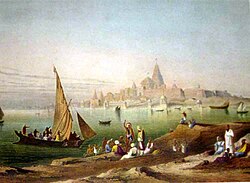 "The sacred town and temples of Dwarka" 1826-1830
 -
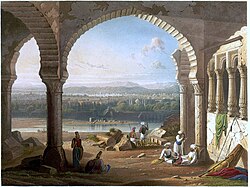 "Aurangzebs Palace" 1830


.jpg)


.jpg)
.jpg)
_(14802834913).jpg)
.jpg)
.jpg)
.jpg)
.jpg)
.jpg)
_(14802847333).jpg)


See also[edit | edit source]
Footnotes[edit | edit source]
- ^a The full list of post-nominal letters for Robert Melville Grindlay used during his lifetime is as follows:[1][35][37][50][54][65]
- FRSA – Fellow of the Royal Society of Arts
- MRAS – Member of the Royal Asiatic Society of Great Britain and Ireland
- FZS – Fellow of the Zoological Society of London
- FRHS – Fellow of the Royal Horticultural Society
- FRBS – Fellow of the Royal Botanical Society
- EICS – Member of the East India Company
- ADC – Aide-de-camp of the Governor of Bombay
- ^b Although born in Marylebone, then a village near London, his distinctive middle name pays homage to his Scottish Grindlay ancestry and links between his forebears and the small but powerful noble Melville family of Midlothian and Fife (see Robert Melville, 1st Lord Melville, Earl Melville, Clan Melville, etc.).[66]
- ^c The relations of Robert Melville Grindlay were:[4][10][11][67][68][69]
- James Grindlay (died 1765)
- Reverend Dr John Grindlay (1756–1818)
- Alexander Grindlay (1785–1794)
- Captain Robert Melville Grindlay (1786–1877)
- Robert Melville Grindlay (12 September 1821 – 1821), died in infancy
- John Whyte Grindlay (1790–1790), died in infancy
- William Grindlay (b. 3 March 1791)
- Charles George Grindlay (14 July 1793 – 26 August 1824)
- Lieutenant Colonel Henry Robert Grindlay (born 1821)
- Florence Melville Grindlay
- Walter Grindlay
- Robert Stoneleigh Grindlay
- Harry Carter Grindlay
- Guy Grindlay
- Lieutenant Colonel Henry Robert Grindlay (born 1821)
- Caroline Grindlay
- Anna Maria Melville Imbert (née Grindlay) (1798 – 5 June 1889)
- Samuel Grindlay (8 May 1803 – 1806)
- Alexander Grindlay
- Reverend Dr John Grindlay (1756–1818)
Notable extended relations include:
- Sir John Edmund Commerell, Admiral of the Fleet (nephew-in-law)
- William Augustus Commerell, first-class cricketer (nephew-in-law)
- ^d Grindlay and his siblings were predominately baptised at either St Marylebone Parish Church or the Church of St. Mary-at-Lambeth.
- ^e Fredrick William Commerell, grandfather of Maria, moved to England from Germany in 1732, and was naturalised by Letters Patent in 1752.[4]
Notes[edit | edit source]
- ↑ The citation of this act by this short title was authorised by section 5 of, and the second schedule to, the Statute Law Revision Act 1948. Due to the repeal of those provisions, it is now authorised by section 19(2) of the Interpretation Act 1978.
References[edit | edit source]
- ↑ 1.00 1.01 1.02 1.03 1.04 1.05 1.06 1.07 1.08 1.09 1.10 1.11 Tyson, Geoffrey (1963). 100 Years of Banking in Asia and Africa, 1863 – 1963 – A History of National and Grindlays Bank Limited: Chapter XV (PDF). London: National and Grindlays Bank Limited.
- ↑ "Capt. Robert Melville Grindlay (The Print Gallery)". The Map House (www.themaphouse.com). Archived from the original on 29 October 2021. Retrieved 29 October 2021.
- ↑ Grindlay, Robert Melville (1830). Scenery, Costumes and Architecture, Chiefly on the Western Side of India. Smith, Elder & Company.
- ↑ 4.0 4.1 4.2 4.3 4.4 Berry, William (1830). County Genealogies: Pedigrees of the Families in the County of Sussex. London: Sherwood, Gilbert and Piper. p. 93.
- ↑ Grindlay, Robert Melville. "North-west view of the fort of Bombay". British Library Online.
- ↑ 6.0 6.1 6.2 6.3 6.4 6.5 6.6 6.7 Chatterjee, Arup K Chatterjee. "Robert Melville Grindlay: The artist, Indophile and imperialist who founded Grindlays Bank". Scroll In.
- ↑ 7.0 7.1 Geoffrey Jones, British Multinational Banking 1830–1990, (1993)
- ↑ "London Metropolitan Archives: City of London". The National Archives.
Robert Melville Grindlay esq, and others of Leamington Priors, Warwickshire, appointed as trustees for Harriet Rokeby of Oxenden near Market Harborough, Northamptonshire
- ↑ Grindlay, Robert Melville (1837). A View of the Present State of the Question as to Steam Communication with India: With a Map, and an Appendix, Containing the Petitions to Parliament, and Other Documents. London: Smith, Elder and Company.
- ↑ 10.0 10.1 "England & Wales, Prerogative Court of Canterbury Wills, 1384–1858". The National Archives; Kew, Surrey, England; Records of the Prerogative Court of Canterbury, Series PROB 11; Class: PROB 11; Piece: 1836.
Will of Elizabeth Grindlay bequeathing her estate to her daughter Anna Maria Melville Grindlay, her son Robert Melville Grindlay and her youngest son William.
{{cite web}}: CS1 maint: others (link) - ↑ 11.0 11.1 "England & Wales, Prerogative Court of Canterbury Wills, 1384–1858". The National Archives; Kew, Surrey, England; Records of the Prerogative Court of Canterbury, Series PROB 11; Class: PROB 11; Piece: 1611.
Will of Reverend Dr John Grindlay bequeathing his estate to his wife Elizabeth Grindlay, his eldest daughter Caroline and another daughter Anna Maria Melville Grindlay.
{{cite web}}: CS1 maint: others (link) - ↑ 12.0 12.1 An Account of the School for the Indigent Blinde in St. Georges' Fields. London: The Philanthropic Society. 1818.
Acted as Chaplain; Committee Member; Auditor Member for the school.
- ↑ "The Cambridge University Alumni, 1261–1900". Venn, J. A., comp.. Alumni Cantabrigienses. London, England: Cambridge University Press, 1922–1954.
Name: The Rev. John. Grindlay; College: Emmanuel; Died: Dec. 12, 1818; More Information: Adm. sizar at Emmanuel, May 9, 1787. A 'Ten-year man.' From America. Ord. priest (Bristol) May 24, 1790, C. of Caundle Bishop, Dorset. Chaplain and Secretary to the Philanthropic Society. R. of Horne, Surrey. Died Dec. 12, 1818. (G. Mag., 1819, I. 90.)
{{cite web}}: CS1 maint: others (link) - ↑ "London Metropolitan Archives: London, England, Church of England Baptisms, Marriages and Burials, 1538–1812". London Metropolitan Archives.
Robert Melville Grindlay; Male; Baptism; Baptism 17 Nov 1786; St Marylebone, Westminster, Middlesex, England; (Father) John Grindlay; (Mother) Elizabeth Grindlay
{{cite web}}: CS1 maint: others (link) - ↑ "South Carolina, U.S., Compiled Marriage Index, 1641–1965". Hunting For Bears, comp.. South Carolina Marriage Index, 1641–1965. South Carolina marriage information taken from various sources.
Name: James Grindlay; Spouse: Christian Govan; Marriage Date: 11 Oct 1755; Source: South Carolina Marriages 1688–1799.
{{cite web}}: CS1 maint: others (link) - ↑ "U.S. and Canada, Passenger and Immigration Lists Index, 1500s–1900s". DOBSON, DAVID. The Original Scots Colonists of Early America, 1612–1783. Baltimore, MD: Genealogical Publishing Co., Inc., 1989. 370p.
Name: John Grindlay; Arrival Year: 1612–1777; Arrival Place: Charleston, South Carolina; Primary Immigrant: Grindlay, Christian; Family Members: Husband James; Son John; Source Publication Code: 1640.7.5; Annotation: Date and port of arrival or date and place of settlement. Names of parents, date of birth or baptism, place of birth, occupation, place of education, place of former residence, port of embarkation, place of intended destination, and notation concerning immigration.
{{cite web}}: CS1 maint: others (link) - ↑ "U.S., Directory of Scottish Settlers in North America, 1625–1825". Directory of Scottish Settlers in North America, 1625–1825. Vol. VII; Author:: David Dobson.
Govan, Mrs Christina, late widow of James Grindlay, attorney at law in Charleston, South Carolina, late in Glasgow
{{cite web}}: CS1 maint: others (link) - ↑ "South Carolina, U.S., Wills and Probate Records, 1670–1980". Wills and Miscellaneous Probate Records, 1671–1868; Author: Charleston County (South Carolina). Probate Judge; Probate Place: Charleston, South Carolina.
Will of James Grindlay (d.1765) bequeathing his estate to his wife Christina, his son John and his brother Alexander who had who remained in 'North Brittain'.
{{cite web}}: CS1 maint: others (link) - ↑ "Clergy of the Church of England Database: Grindlay, John (1787–1818)". CCED.
- ↑ An Account of the nature and views of the Philanthropic Society, instituted in ... 1788 for the prevention of crimes, etc. [With the annual report for 1798.]. London: Philanthropic Society. 1799.
- ↑ The Royal Kalendar and Court and City Register for England, Scotland, Ireland, and the Colonies for the Year 1819. London: Wm. H. Allen. 1819. p. 334.
- ↑ Whitten, Doreen Muriel (2001). Protection, Prevention, Reformation: A history of the Philanthropic Society, 1788–1848 (PDF). London School of Economics and Political Science.
Reverend John Grindlay LL.D. as Chaplain, Superintendent and Secretary.
- ↑ "Registers of Employees of the East India Company and the India Office, 1746–1939". University of London; London, England; The East India Register and Directory for 1804 Mathison, J. & Mason, A.W.; Reference Number: b1701902 1804.
Bombay Cadets – Robert Melville Grindla[y]
{{cite web}}: CS1 maint: others (link) - ↑ 24.0 24.1 24.2 24.3 24.4 24.5 Thomas, Ralph (1906). "Notes and Queries: Capt. Grindlay" (PDF). Pall Mall Gazette: 101–102.
- "Notes and Queries". Pall Mall Gazette. 13 August 1906 – via The British Newspaper Archive.
- ↑ 25.0 25.1 25.2 "Board Arrow". Broad Arrow. 1877.
Broad Arrow – Saturday 22 December 1877. Captain Robert Melville Grindlay who died at Nice on the morning of Sunday, December 9. He filled the position of aide-de-camp to Sir Evan Nepean, Governor of Bombay, and he also assisted on the survey of Guzerat and the Western Presidency under the late Colonel Monier Williams. He retired, ceasing at the same time to have any interest in the firm [Grindlays Bank]. He left England to spend the residue of this days under the shadow of the Maritime Alps.
- ↑ 26.0 26.1 Burnes, Sir Alexander (1834). Travels into Bokhara together with a narrative of a voyage on the Indus. Oxford University Press.
- ↑ 27.0 27.1 Wallis, Frank H (2011). "A History of the British Conquest of Afghanistan and Western India, 1838 to 1849". Victorian Studies. 54 (1): 111. doi:10.2979/victorianstudies.54.1.117. JSTOR 10.2979/victorianstudies.54.1.117. S2CID 142641569.
- ↑ Keller, Sara (2018). Knowledge and the Indian Ocean: Intangible Networks of Western India and Beyond. Springer. pp. 144–145. ISBN 9783319968391.
- ↑ Hirst, Christopher (19 April 2012). "Travels into Bokhara, by Alexander Burnes". The Independent. Retrieved 12 September 2016.
- ↑ 30.0 30.1 Roy. "New evidence for the style of the "Fraser artist" in Delhi: Portraits of Afghans 1808-10". British Library - Asian and African Studies Blog: Dr Malini Roy, Head of Visual Arts at the British Library (London).
- ↑ "Royal Society for Asian Affairs (RSAA) - Grindlay, Robert Melville, 1786-1877, Lieutenant, artist". The National Archives.
- ↑ Elphinstone, Mountstuart (1815). An Account of the Kingdom of Caubul,and its Dependencies in Persia, Tartary, and India: Comprising a view of the Afghaun nation, and a history of the Dooraunee monarchy (1st ed.). Longman, Hurst, Rees, Orme, and Brown.
- ↑ "Letter from Captain [R] Melville Grindlay to William Buller Fullerton-Elphinstone, 15th Lord Elphinstone". Archive Hub.
This letter, as well as the ones in Mss Eur F88/306 and Mss Eur F88/308 relate to publishing a fuller account of Mountstuart Elphinstone's life to date. George Dempster's daughter had made the acquaintance of a Captain B Melville Grindlay, an old Indian friend of Mrs Mary Stewart Mackenzie, Lady Hood who has a diary that might be of use.
- ↑ 34.0 34.1 "John Edmund Commerell". Oxford Dictionary of National Biography (online ed.). Oxford University Press. 2004. doi:10.1093/ref:odnb/32520. Retrieved 29 December 2014. Template:ODNBsub
- ↑ 35.0 35.1 35.2 35.3 John Burke Esq. &, John Bernard Burke Esq. (1866). A Genealogical and Heraldic Dictionary of the Landed Gentry of Great Britain & Ireland. London: Henry Colburn. p. 249.
- ↑ "John Barrett. Theft: burglary. 2nd January 1834". Old Bailey Proceedings Online.
Transcript of a report of burglary at the home of Captain Robert Melville Grindlay, No. 35, North Bank, Regent's Park, on 2nd January 1834.
- ↑ 37.0 37.1 The Royal Botanic Society of London [List of Fellows, Etc.]. London: Richard and John E Taylor. 1841.
- ↑ O'Brien, John (29 June 2021). "Untold lives blog – Outfitting an East India Company employee". British Library – India Office Records.
- ↑ 39.0 39.1 Grindlay & Co.'s Overland Circular – Hints for Travellers to India, Detailing the Several Routes (PDF). London: Smith, Elder & Co. 1847.
- ↑ "Royal Bank of Scotland – Heritage Archives".
- ↑ 41.0 41.1 "The British Newspaper Archive (BNA)". The Morning Post. 1833.
The Morning Post – Tuesday 30 April 1833. East India House, April 25, 1833. – The Court of Directors of the United Company of Merchants of England trading to the East Indies do hereby give notice, that a General Court of the said Company will be held at their house, in Leadenhall street, on Friday, the 3rd of May next, from eleven o'clock in the forenoon until six in the evening, for the purpose of taking a ballot, in pursuance of the following requisition, viz.:– "We, the undersigned Proprietors of East India Stock, concurring generally in the terms of the resolution which it has now been agreed shall form the main question, consider it to be of moment that an opportunity should be afforded to the proprietors at large to pass their judgement upon it; and we therefore require that the same may be decided by ballot: Campbell Marjoribanks, William Wigram, William Astell, William Stanley Clarke, Thomas Povner (junior), Thomas Hallifax, Richard Twining, Joseph Kaye, John Shore, Robert Brown, Joseph Sellon, William Hull, Patrick Hadow, James Ritchie, John Hicks, W. Hobson, Thomas Vignew, James Brogden, Charles Mills, Robert Melville Grindlay, David Carruthers, Henry Heath, Francis M. Ommanney, Henry Shank, William Young, George Lyall, James R. Carnac, Richard Jenkins. April 25, 1833. The question upon which the ballot is to be taken being as follows, viz:– [end extract]
- ↑ 42.0 42.1 Lang, Eugen Maurice (2005) [1924]. Codification in the British Empire and America. Lawbook Exchange Ltd. p. 77, footnote 2. ISBN 1-58477-620-X.
- ↑ "East India Company and Raj 1785–1858". UK Parliament.
- ↑ "United Grand Lodge of England Freemason Membership Registers, 1751–1921". Library and Museum of Freemasonry; London, England; Freemasonry Membership Registers; Description: Register of Admissions: London 'B', #275–648.
Robert Melville Grindlay; E India Agent; Initiated 20 May 1836.
{{cite web}}: CS1 maint: others (link) - ↑ Oakley, Ann (2011). A Critical Woman: Barbara Wootton, Social Science and Public Policy in the Twentieth Century. Bloomsbury. ISBN 9781849664691.
The bank's founder, Barbara Kyle's grandfather, Captain Robert Melville Grindlay, was also a gifted amateur painter. Painting ran in the family.
- ↑ Rohatgi, Pauline (1989). Amateur artists in western India: James Forbes and Robert Melville Grindlay. MARG Publications. pp. 17–34.
- ↑ "Grindlay, Robert Melville". www.worldcat.org.
- ↑ Shamsie, Muneeza (2015). "Review: Historical Portfolio - Representing Sindh: Images of the British Encounter by Rosemary Raza". Dawn.
- ↑ "Banker, soldier, artist, lover". Sarmaya Trust. 4 July 2018.
- ↑ 50.0 50.1 50.2 50.3 50.4 50.5 The Byron Gallery: A Series of Historical Embellishments to Illustrate the Poetical Works of Lord Byron – Captain Grindlay's View in India. Smith, Elder & Co. 1833.
- ↑ Grindlay, Robert Melville. "Scenery, Costumes and Architecture". Bauman Rare Books.
- ↑ Grindlay, Robert Melville. "Scenery, Costumes and Architecture chiefly on the Western Side of India". www.maggs.com.
£9500.00. Captain Grindlay's book is one of the most appealing of the many colour plate books that depict the scenery of India. Grindlay's work and life are discussed at some length by Pauline Rohatgi in India and Pageant of Prints (pp177-194) London 1989. Abbey Travel, 442.
- ↑ Grindlay, Robert Melville (1805). "A Hindoo Female of the Deccan & Concane". Victoria and Albert Museum Online.
- ↑ 54.0 54.1 The Asiatic Journal and Monthly Register for British India and Its Dependencies; Review – Scenery, Costumes, and Architecture of Western India. Vol. 21. Black, Parbury, & Allen. 1826. p. 756.
- ↑ "Autograph Letter from Sir Thomas Lawrence (1769–1830), portrait painter, President of the Royal Academy to Captain Robert Melville Grindlay (1786–1877)". AbeBooks. 1829.
- ↑ "Autograph Letter to Captain Robert Melville Grindlay (1786–1877), thanking him for presenting his book to Prince Albert (consort to Queen Victoria) from General Sir Francis Seymour (1813–1890), army officer, and Prince Albert's Groom-in-Waiting". AbeBooks. 1840.
- ↑ 57.0 57.1 57.2 57.3 Grindlay, Robert Melville. Steam communication with India (PDF) (1st ed.). London.[dead link]
- ↑ 58.0 58.1 Grindlay, Captain Robert Melville (1837). A view of the present state of the question as to steam communication with India. With Map, and an Appendix, contain the Petitions to Parliament, and other documents (3rd ed.). London: Smith, Elder & Co.
Containing reviews of the first edition of the pamphlet
- ↑ 59.0 59.1 59.2 59.3 Grindlays 1828 – 1978 (PDF). London: Grindlays Banking Group. 1978.
- ↑ 60.0 60.1 60.2 Staveley-Wadham, Rose (2020). "Hot Off The Press – New Titles This Week: Home News for India, China and the Colonies". The British Newspaper Archive.
- ↑ 61.0 61.1 The India Office and Burma Office List. Harrison and sons. 1847.
- ↑ Allen's Indian Mail, and Register of Intelligence for British and Foreign India, China, and All Parts of the East. Vol. 4. London: Allen & Co. 1846. p. 808.
- ↑ "Historical & Fictional Characters in Sherlockian Pastiches". www.schoolandholmes.com.
Grindlay, Robert Melville (British Banker); Grindlays: "The Case of the Blood Royal" (Donald Thomas) p189
- ↑ Selwyn, Francis (1979). "Sergeant Verity and the Blood Royal (Sergeant Verity #4)". Goodreads.
- ↑ The Asiatic journal and monthly register for British and foreign India, China and Australasia; Critical Notices: Scenery Costumes and Architecture chiefly on the Western Side of India. Vol. 2. Allen. 1830. p. 95.
- ↑ Tyson, Geoffrey (1963). 100 Years of Banking in Asia and Africa, 1863 – 1963 – A History of National and Grindlays Bank Limited: Chapter XV (PDF). London: National and Grindlays Bank Limited.[dead link]
- ↑ "My Descendant Chart" (PDF). www.burningviolin.org.
Chart of the descendants of Charles (ii) Boileau (1673–1733) & Mary Magdalena Collot D'Escury (1679–1731)
- ↑ "England & Wales, National Probate Calendar (Index of Wills and Administrations), 1858–1995". Principal Probate Registry. Calendar of the Grants of Probate and Letters of Administration made in the Probate Registries of the High Court of Justice in England. London, England.
The will of Anna Maria Melville Imbert (née Grindlay), died on 5th June 1889 was proved at the principle registry by Henry Robert Grindlay of 22 Colville Terrace, Notting Hill in the county of Middlesex, a lieutenant-colonel in Her Majesty's Army the sole executor.
{{cite web}}: CS1 maint: others (link) - ↑ Hart, Colonel H. G. (1871). The New Annual Army List and Militia List and Indian Civil Service List for 1871 (PDF). London: John Murray. pp. 60–61, 620.
External links[edit | edit source]
- An engraving in Fisher's Drawing Room Scrap Book, 1835 by William Miller of the painting, Template:Ws together with an associated poetical illustration by Letitia Elizabeth Landon on The Nizam's Daughter.
- An engraving in Fisher's Drawing Room Scrap Book, 1836 by J Redaway of the painting Template:Ws with a poetical illustration by Letitia Elizabeth Landon.