


>Ronakshah1990 Removing repetition. |
mNo edit summary |
||
| Line 1: | Line 1: | ||
{{short description|Part of the Bengali wedding ceremony, involving turmeric}} | {{short description|Part of the Bengali wedding ceremony, involving turmeric}} | ||
'''Gaye holud''' ({{ | {{italic title}} | ||
[[File:A prparation for Gaye holud.JPG|thumb|Paste of turmeric prepared for ''gaye holud'' ceremony|250px]] | |||
'''''Gaye holud''''' ({{Langx|bn|গায়ে হলুদ}} lit: "yellow/[[turmeric]] on the body") or '''''gatro horidra''''' ({{Langx|bn|গাত্র-হরিদ্রা|label=none}}) is a wedding ceremony observed by [[Bengalis]].<ref name="kk12Dec2018" /> | |||
It is part of an elaborate series of celebrations constituting a Bengali wedding. The ''gaye holud'' takes place prior to the religious and legal wedding ceremonies. The ''gaye holud'' may be a joint event for the bride and groom's families, or it may consist of separate events for the bride's family and the groom's family.{{citation needed|date=December 2020}} | |||
It is part of an elaborate series of celebrations constituting | |||
== Ceremonial process == | == Ceremonial process == | ||
[[File:Gaye Holud, Dhaka, Bangladesh, JBI.jpg|thumb|Gaye holud in [[Dhaka]], [[Bangladesh]]|250px]] | |||
[[File:Gaye-Holud ceremony of Bengali groom.jpg|thumb|Gaye holud ceremony in [[West Bengal]], India|250px]] | |||
[[File: | The bride is seated on a dais and the turmeric paste is applied by the guests to her face and body. Sweets are then fed to the bride by all the guests and attendants, piece by piece.<ref name="kk12Dec2018">{{Cite news |script-title=bn:একালের গায়ে হলুদ |url=https://www.kalerkantho.com/print-edition/shuvo-bibaho/2018/12/12/713802 |work=Kaler Kantho |date=12 December 2018 |language=bn |access-date=3 September 2021}}</ref> In some families, [[henna]] is used to decorate her hands and feet with elaborate abstract designs.{{citation needed|date=May 2024}} During this ceremony, it is customary for the families to exchange gifts. The turmeric used in the ritual typically comes from the groom’s home, along with other elaborately adorned gifts known as ''tattwa'' (তত্ত্ব), presented by the groom’s family to the bride’s family. These gifts—often including fish (especially [[ilish]]), sweets, and clothing—are not to be confused with [[dowry]]; their significance lies in the intricate artistry of their decoration rather than the monetary value.<ref>{{Cite web |date=2012-12-31 |title=Bengali Wedding : Tatta (Gift Giving) Demystified |url=https://thediaryofamadbride.wordpress.com/2012/12/30/bengali-wedding-tatta-gift-giving-demystified/ |access-date=2024-12-19 |website=The Diary of A Mad Bride |language=en}}</ref> | ||
The bride is seated on a dais and the turmeric paste is applied by the guests to her face and body. | |||
== Popularity of the custom == | == Popularity of the custom == | ||
Although similar ceremonies exist in other parts of the Indian subcontinent, the gaye holud is a custom particular to the Bengali people. It is not considered a religious function, as it is celebrated by Muslims, Hindus, and Christians in both Bangladesh | Although similar ceremonies exist in other parts of the Indian subcontinent, the ''gaye holud'' is a custom particular to the Bengali people. It is not considered a religious function, as it is celebrated by Muslims, Hindus, and Christians in both Bangladesh, the Indian state of West Bengal and wherever Bengalis live, irrespective of religion. Although it is considered a part of the Bengali wedding tradition, the couple is not considered married at the end of the ''gaye holud''. There is no legal marriage performed during this ceremony. Unlike the wedding ceremonies, the ''gaye holud'' is not a formal or extravagant event; both guests and bridal party members dress more simply and decorate the venue less intricately than at the wedding ceremonies.<ref>{{cite book |last=Akhter |first=Shahida |year=2012 |chapter=Gaye Halud |chapter-url=https://en.banglapedia.org/index.php/Gaye_Halud |editor1-last=Islam |editor1-first=Sirajul |editor1-link=Sirajul Islam |editor2-last=Jamal |editor2-first=Ahmed A. |title=Banglapedia: National Encyclopedia of Bangladesh |edition=Second |publisher=[[Asiatic Society of Bangladesh]]}}</ref> | ||
==Gallery== | |||
<gallery mode="packed"> | <gallery mode="packed"> | ||
File:Fish Holud.jpg|The groom's family members often bring fish decorated as a wedding couple to the bride's gaye holud | |||
File:Wedding Photography of Bangladesh.jpg|Girls are dancing in Bangladeshi gaye holud ceremony | |||
File:Fish Holud.jpg|The groom's family members often bring fish decorated as a wedding couple to the bride's | |||
File:Wedding Photography of Bangladesh.jpg|Girls are dancing in Bangladeshi | |||
</gallery> | </gallery> | ||
==See also== | ==See also== | ||
* [[ | * [[Mayian]] | ||
== References == | == References == | ||
| Line 37: | Line 27: | ||
==External links== | ==External links== | ||
{{ | {{Commons category|Gaye holud}} | ||
{{Bengali wedding}} | {{Bengali wedding}} | ||
{{Indian wedding}} | {{Indian wedding}} | ||
[[Category: | [[Category:Culture of Bengal]] | ||
[[Category:Culture of Bangladesh]] | |||
[[Category:Indian wedding traditions]] | [[Category:Indian wedding traditions]] | ||
[[Category:Bangladeshi wedding traditions]] | [[Category:Bangladeshi wedding traditions]] | ||
Latest revision as of 23:14, 6 April 2025

Gaye holud (Bengali: গায়ে হলুদ lit: "yellow/turmeric on the body") or gatro horidra (গাত্র-হরিদ্রা) is a wedding ceremony observed by Bengalis.[1]
It is part of an elaborate series of celebrations constituting a Bengali wedding. The gaye holud takes place prior to the religious and legal wedding ceremonies. The gaye holud may be a joint event for the bride and groom's families, or it may consist of separate events for the bride's family and the groom's family.[citation needed]
Ceremonial process[edit | edit source]


The bride is seated on a dais and the turmeric paste is applied by the guests to her face and body. Sweets are then fed to the bride by all the guests and attendants, piece by piece.[1] In some families, henna is used to decorate her hands and feet with elaborate abstract designs.[citation needed] During this ceremony, it is customary for the families to exchange gifts. The turmeric used in the ritual typically comes from the groom’s home, along with other elaborately adorned gifts known as tattwa (তত্ত্ব), presented by the groom’s family to the bride’s family. These gifts—often including fish (especially ilish), sweets, and clothing—are not to be confused with dowry; their significance lies in the intricate artistry of their decoration rather than the monetary value.[2]
Popularity of the custom[edit | edit source]
Although similar ceremonies exist in other parts of the Indian subcontinent, the gaye holud is a custom particular to the Bengali people. It is not considered a religious function, as it is celebrated by Muslims, Hindus, and Christians in both Bangladesh, the Indian state of West Bengal and wherever Bengalis live, irrespective of religion. Although it is considered a part of the Bengali wedding tradition, the couple is not considered married at the end of the gaye holud. There is no legal marriage performed during this ceremony. Unlike the wedding ceremonies, the gaye holud is not a formal or extravagant event; both guests and bridal party members dress more simply and decorate the venue less intricately than at the wedding ceremonies.[3]
Gallery[edit | edit source]
-
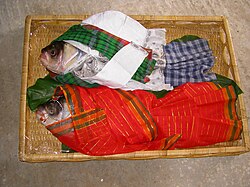 The groom's family members often bring fish decorated as a wedding couple to the bride's gaye holud
 -
 Girls are dancing in Bangladeshi gaye holud ceremony


See also[edit | edit source]
References[edit | edit source]
- ↑ 1.0 1.1 একালের গায়ে হলুদ. Kaler Kantho (in Bengali). 12 December 2018. Retrieved 3 September 2021.
- ↑ "Bengali Wedding : Tatta (Gift Giving) Demystified". The Diary of A Mad Bride. 2012-12-31. Retrieved 2024-12-19.
- ↑ Akhter, Shahida (2012). "Gaye Halud". In Islam, Sirajul; Jamal, Ahmed A. (eds.). Banglapedia: National Encyclopedia of Bangladesh (Second ed.). Asiatic Society of Bangladesh.