



Ajay Kumar (talk | contribs) Created a new article |
m basic fix article based on references and updated info |
||
| Line 1: | Line 1: | ||
{{Short description|Arabic phrase | {{Short description|Arabic phrase}} | ||
{{ | {{Redirect|Allahu Akbar|the former national anthem of Libya|Allahu Akbar (anthem)|other uses|Allahu Akbar (disambiguation)}} | ||
{{Distinguish|Takfir}} | |||
{{italic title}} | |||
{{Infobox Arabic term | |||
| title = Takbir | |||
| arabic = {{wikt-lang|ar|تَكْبِير}} | |||
| arabic_rom = {{Transliteration|ar|takbīr}} | |||
| native pronunciation = {{IPA|ar|tak.biːr}} | |||
| literal meaning = "magnification [of God]" | |||
}} | |||
{{Infobox Arabic term | |||
| title = Allahu Akbar | |||
| arabic = {{wikt-lang|ar|اللّٰهُ أَكْبَر}} | |||
| arabic_rom = {{Transliteration|ar|Allāhu ʾAkbar}} | |||
| native pronunciation = {{IPA|ar|ʔaɫ.ɫaː.hu ʔak.bar||Ar-eg-الله أكبر.oga}} | |||
| literal meaning = "God is greater [than everything]" | |||
}} | |||
The ''' | The {{Lang|ar-Latn|'''takbīr'''}} ({{langx|ar|تَكْبِير}} {{IPA|ar|tak.biːr|}}, {{lit|magnification [of God]}}) is the name for the Arabic phrase ''{{transliteration|ar|DIN|Allāhu ʾAkbar}}'' ({{langx|ar|اللّٰهُ أَكْبَر}} {{IPA|ar|ʔaɫ.ɫaː.hu ʔak.bar||Ar-eg-الله أكبر.oga}}, {{lit|[[God in Islam|God]] is the greatest [of everything]}}).<ref name="10.1163_1573-3912_islam_SIM_7330">Wensinck, A.J., "Takbīr", in: Encyclopaedia of Islam, Second Edition, Edited by: P. Bearman, Th. Bianquis, C.E. Bosworth, E. van Donzel, W.P. Heinrichs. Consulted online on 09 September 2023 {{doi|10.1163/1573-3912_islam_SIM_7330}} | ||
First published online: 2012</ref><ref name="OUA"> | First published online: 2012</ref><ref name="OUA">{{cite book | url=https://www.oxfordreference.com/view/10.1093/acref/9780195305135.001.0001/acref-9780195305135-e-0980 | isbn=978-0-19-530513-5 | title=The Oxford Encyclopedia of the Islamic World | chapter=Takbīr | date=2009 | publisher=Oxford University Press }}</ref><ref name="Encyclopedia.com 2023">{{cite web | title=Takbīr | website=Encyclopedia.com | date=22 August 2023 | url=https://www.encyclopedia.com/religion/dictionaries-thesauruses-pictures-and-press-releases/takbir | access-date=9 September 2023 | archive-date=7 October 2023 | archive-url=https://web.archive.org/web/20231007225523/https://www.encyclopedia.com/religion/dictionaries-thesauruses-pictures-and-press-releases/takbir | url-status=live }}</ref><ref name="raleighmasjid.org">{{cite web|title=The Times of the Five Daily Prayers|url=https://raleighmasjid.org/times/|access-date=23 August 2015|archive-date=23 March 2023|archive-url=https://web.archive.org/web/20230323152924/https://raleighmasjid.org/times/|url-status=live}}</ref> | ||
It is a common Arabic expression, used in various contexts by [[Muslim]]s | It is a common Arabic expression, used in various contexts by [[Muslim]]s around the world: in formal [[salah]] (prayer),<ref name="raleighmasjid.org"/> in the [[adhan]] (Islamic call to prayer),<ref name="Nigosian102">{{cite book |last=Nigosian |first=S. A. |title= Islam: Its History, Teaching, and Practices |url=https://archive.org/details/islamitshistoryt0000nigo |url-access=registration |year=2004 |publisher=[[Indiana University Press]] |location=[[Indiana]] |isbn= 0-253-21627-3 |page=[https://archive.org/details/islamitshistoryt0000nigo/page/102 102]}}</ref> in [[Hajj]], as an informal expression of faith, in times of distress or joy, or to express resolute determination or defiance. The phrase is the official motto of [[Iran]] and [[Iraq]]. It is also used by Orthodox [[Arab Christians]] as an expression of faith.<ref name="Telegraph">Emma Bennett, [http://www.telegraph.co.uk/news/2016/05/11/what-does-allahu-akbar-mean/ What does Allahu Akbar mean?], ''The Telegraph'' (UK), 12 June 2016.</ref> | ||
==Etymology== | ==Etymology== | ||
[[File:Allahoakbar Vectorized.svg|thumb| | [[File:Allahoakbar Vectorized.svg|thumb|{{Lang|ar-Latn|takbīr}} in [[Nastaliq|nastaʿlīq]]]] | ||
The Arabic word {{lang|ar|كَبِير}} ({{transliteration|ar|DIN|kabīr}}) means ''big'' from the [[Semitic root]] ''{{transliteration|ar|DIN|[[kāf|k]]-[[bāʼ|b]]-[[rāʼ|r]]}}''. The Arabic word {{lang|ar|أَكْبَر}} ({{transliteration|ar|DIN | [[File:Takbir in Thuluth.svg|thumb|alt=The Takbir written in Thuluth script|The Takbir written in Thuluth script]] | ||
[[File:Takbir in naskh.svg|thumb|alt=The Takbir written in Naskh script|Takbir in Naskh script]] | |||
The Arabic word {{lang|ar|كَبِير}} ({{transliteration|ar|DIN|kabīr}}) means ''big'' from the [[Semitic root]] ''{{transliteration|ar|DIN|[[kāf|k]]-[[bāʼ|b]]-[[rāʼ|r]]}}''. A [[cognate]] word for this root exists in [[Hebrew]] as {{lang|he|כביר}} ({{Transliteration|he|kabir}}). The Arabic word {{lang|ar|أَكْبَر}} ([[:wikt:أَكْبَر|{{transliteration|ar|DIN|ʾakbar}}]]) is the [[Elative (gradation)|elative]] form ("bigger, biggest") of the [[adjective]] {{Transliteration|ar|kabīr}} ("big"). When used in the {{transliteration|ar|DIN|takbīr}} it is usually translated as "biggest", but some authors translate it as "bigger".<ref>E. W. Lane, ''[[Arabic English Lexicon]]'', 1893, gives for ''kabir'': "bigger, and biggest, in body, or corporeal substance, and in estimation or rank or dignity, and more, or most, advanced in age, older, and oldest" [https://archive.org/stream/ArabicEnglishLexicon.CopiousEasternSources.EnlargedSuppl.Kamoos.Lane.Poole.1863/07.ArabicEnglLex.v1p7.let.21.22.23.24.Qaf.Kaf.Lam.Mim..Lane-Poole.1885.#page/n113/mode/2up (p. 2587)] {{webarchive |url=https://web.archive.org/web/20161007201240/https://archive.org/stream/ArabicEnglishLexicon.CopiousEasternSources.EnlargedSuppl.Kamoos.Lane.Poole.1863/07.ArabicEnglLex.v1p7.let.21.22.23.24.Qaf.Kaf.Lam.Mim..Lane-Poole.1885.#page/n113/mode/2up |date=October 7, 2016 }}.</ref><ref>{{cite book|title=A Practical Arabic Grammar|page=66|url=https://books.google.com/books?id=ex4UAAAAYAAJ&q=comparative&pg=PA69 |year=1887 |author=A.O.Green|publisher=Clarendon Press}}</ref><ref>"The formula, as the briefest expression of the absolute superiority of the One God, is used in Muslim life in different circumstances, in which the idea of God, His greatness and goodness is suggested." Wensinck, A. J. ''The [[Encyclopaedia of Islam]]'', 2nd edition. Brill, 2000. Volume 10, T-U, p. 119, Takbir.</ref> The term ''{{transliteration|ar|DIN|takbīr}}'' itself is the stem II [[Arabic grammar|verbal noun]] of the root {{Transliteration|ar|DIN|k-b-r}}, meaning "big", from which ''akbar'' "bigger" is derived. The form ''{{transliteration|ar|DIN|Allāhu}}'' is a [[nominative]] of ''[[Allah]]'', meaning "[[God in Islam|God]]".<ref name="EoQ">Böwering, Gerhard, ''God and His Attributes'', Encyclopaedia of the Qurʼān, Brill, 2007.</ref><ref>Macdonald, D. B. ''The [[Encyclopaedia of Islam]]'', 2nd edition. Brill, 1971. Volume 3, H-Iram, p. 1093, ''[[Ilah]]''.</ref> | |||
The {{transliteration|ar|DIN| | The {{transliteration|ar|DIN|takbīr}} is sometimes translated into English as "God is greater", which is short for "God is greater than all" ({{Lang|ar|الله أَكْبَرُ من كلِّ شيء}}). It is an example of an Arabic idiom where an incomplete sentence, abbreviated because of its familiarity, is considered grammatically correct.<ref>{{Cite web |last=إسماعيل عتوك |first=محمد |date=December 2019 |title=لماذا لا نقول في الأذان : ( الله الأكبر ) مع أل التعريف، بدلاً من ( الله أكبر ) ؟ |url=https://quran-m.com/لماذا-لا-نقول-في-الأذان-الله-الأكبر-مع/ |url-status=live |archive-url=https://web.archive.org/web/20230611031350/https://quran-m.com/لماذا-لا-نقول-في-الأذان-الله-الأكبر-مع/ |archive-date=2023-06-11}}</ref> | ||
==Usage in Islamic rituals== | ==Usage in Islamic rituals== | ||
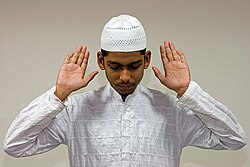
[[File:Takbir of prayer.jpg|thumb|A Muslim raises both of his hands to recite the | [[File:Takbir of prayer.jpg|thumb|A Muslim raises both of his hands to recite the ''takbīr'' in prayer.]] | ||
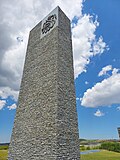
[[File:Sancaklar Camii Minaresi.jpg|thumb|Calligraphic Takbir in minaret of [[Sancaklar Mosque]] | [[File:Sancaklar Camii Minaresi.jpg|thumb|Calligraphic Takbir in minaret of [[Sancaklar Mosque]]]] | ||
This phrase is recited by [[Muslim]]s in many different situations. | This phrase is recited by [[Muslim]]s in many different situations. | ||
===In prayer=== | ===In prayer=== | ||
The phrase is said during each stage of both [[salah]] (obligatory prayers, performed five times a day), and [[Nafl prayer|nafl]] (supererogatory prayers, performed at will). The call to prayer by the ''[[muezzin]]'' to those outside the mosque (''[[adhan]]'') and the call to those inside to line up for the commencement of prayer (''[[iqama]]'') also contain the phrase.<ref name="Nigosian102"/> | The phrase is said during each stage of both [[salah]] (obligatory prayers, performed five times a day), and [[Nafl prayer|nafl]] (supererogatory prayers, performed at will). The call to prayer by the ''[[muezzin]]'' to those outside the mosque (''[[adhan]]'') and the call to those inside to line up for the commencement of prayer (''[[iqama]]'') also contain the phrase.<ref name="Nigosian102"/> | ||
While there are many short prayers like it, the | While there are many short prayers like it, the {{transliteration|ar|DIN|takbīr}} is used more frequently than any other.<ref>{{cite web|title=What I learned from Muslims about God|url=https://www.americamagazine.org/issue/called-prayer|author=Patrick J. Ryan, S.J.|date=29 October 2015|publisher=[[America (magazine)|America]]|access-date=8 January 2025|archive-date=7 December 2023|archive-url=https://web.archive.org/web/20231207125630/https://www.americamagazine.org/issue/called-prayer|url-status=live}}</ref> | ||
=== Following births and deaths === | ===Following births and deaths=== | ||
The phrase is used after the birth of a child as a means of praising God.<ref>{{cite web|url=http://www.jerrahi.org/library/articles/birth_school|title=On Birth & School|access-date=4 September 2013|url-status=dead|archive-url=https://web.archive.org/web/20130827111517/http://www.jerrahi.org/library/articles/birth_school|archive-date=27 August 2013}}</ref> It is also part Islamic funeral and burial customs.<ref>{{cite book|last1=el-Hibri|first1=Tayeb|title=Parable and Politics in Early Islamic History: The Rashidun Caliphs|date=19 October 2010|publisher=[[Columbia University Press]]|isbn=9780231521659|url=https://books.google.com/books?id=ouwL4dGrTN8C&pg=PA362}}</ref> | The phrase is used after the birth of a child as a means of praising God.<ref>{{cite web |url=http://www.jerrahi.org/library/articles/birth_school|title=On Birth & School|access-date=4 September 2013|url-status=dead|archive-url=https://web.archive.org/web/20130827111517/http://www.jerrahi.org/library/articles/birth_school|archive-date=27 August 2013}}</ref> It is also part of [[Islamic funeral]] and burial customs.<ref>{{cite book|last1=el-Hibri|first1=Tayeb|title=Parable and Politics in Early Islamic History: The Rashidun Caliphs|date=19 October 2010|publisher=[[Columbia University Press]]|isbn=9780231521659|url=https://books.google.com/books?id=ouwL4dGrTN8C&pg=PA362}}</ref> | ||
=== During the Eid Festival and the Hajj === | ===During the Eid Festival and the Hajj=== | ||
During the festival of [[Eid al-Adha]] and the days preceding it, Muslims recite the | During the festival of [[Eid al-Fitr]] and [[Eid al-Adha]], and also the days preceding it, Muslims recite the ''{{transliteration|ar|DIN|takbīr}}''. This is particularly the case on the [[Day of Arafah]].<ref name="Faraz Rabbani">{{cite web|last=Rabbani|first=Faraz|title=The Day of 'Arafah: The 9th of Dhu'l Hijjah |url=http://qa.sunnipath.com/issue_view.asp?HD=1&ID=763&CATE=3|publisher=Qibla.com|access-date=4 September 2013|url-status=dead|archive-url=https://web.archive.org/web/20131015192812/http://qa.sunnipath.com/issue_view.asp?HD=1&ID=763&CATE=3|archive-date=15 October 2013}}</ref> | ||
===During the halal slaughter of animals=== | ===During the halal slaughter of animals=== | ||
In the process of pronouncing the name of God while performing [[Dhabihah]] one must say {{Transliteration|ar|Bismillah Allahu Akbar}}.<ref name ="USA">{{cite web|url=https://www.ushalalcertification.com/terminology.html|title=Arabic Definitions|publisher=USA Halal Chamber of Commerce, Inc.|access-date=5 August 2020|archive-date=19 July 2023|archive-url=https://web.archive.org/web/20230719162845/https://www.ushalalcertification.com/terminology.html|url-status=live}}</ref> | |||
==Other social usage== | ==Other social usage== | ||
[[File:God is the Greatest-Arabic-Desouk.jpg | [[File:God is the Greatest-Arabic-Desouk.jpg|thumbnail|''Allāhu akbar'' in a memorial, [[Desouk]], [[Egypt]]]] | ||
[[File:Imam Ali Shrine - 1994.jpg | [[File:Imam Ali Shrine - 1994.jpg|thumbnail|''Allāhu akbar'' in Arabic calligraphy seen on [[Imam Ali Shrine|Imam Ali Mosque]] architecture (center of the Iwan), 1994]] | ||
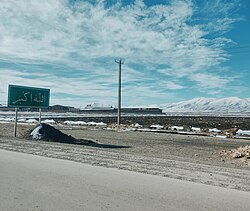
[[File:Roads_in_iran.jpg | [[File:Roads_in_iran.jpg|thumbnail|A sign with ''Allāhu akbar'' written on the side of a road in Iran]] | ||
The expression | The expression ''{{transliteration|ar|DIN|Allāhu ʾakbar}}'' can be used in a variety of situations, from celebrations to times of grief. | ||
In a historical account by someone who was present both at the birth of [[Abd Allah ibn al-Zubayr]] and at his funeral, the author observes that | In a historical account by someone who was present both at the birth of the ruler [[Abd Allah ibn al-Zubayr]] (7th century) and at his funeral, the author observes that ''{{transliteration|ar|DIN|Allāhu ʾakbar}}'' was said on both occasions.<ref name=suleiman/> | ||
=== In times of joy and gratitude === | ===In times of joy and gratitude=== | ||
The | The ''{{transliteration|ar|DIN|takbīr}}'' can be used to express joy or surprise. It is also used as applause in religious contexts, such as after a Quran recital, as other forms of applause are considered less appropriate.<ref name=venice>{{cite web|title=Allahu akbar: What is the Takbir?|date=25 August 2017|url=https://www.theweek.co.uk/88011/allahu-akbar-what-is-the-takbir|publisher=[[The Week]]|access-date=8 January 2025|archive-date=19 July 2023|archive-url=https://web.archive.org/web/20230719163313/https://www.theweek.co.uk/88011/allahu-akbar-what-is-the-takbir|url-status=live}}</ref> | ||
It is used to celebrate an election win.<ref>{{cite web | url=https://www.news18.com/world/mothin-ali-british-councillor-green-party-who-shouted-allahu-akbar-after-being-elected-in-local-polls-8878969.html | title=Who is Mothin Ali? British Councillor Who Shouted 'Allahu Akbar' After Being Elected in Local Polls | date=6 May 2024 | access-date=16 May 2024 | archive-date=16 May 2024 | archive-url=https://web.archive.org/web/20240516093405/https://www.news18.com/world/mothin-ali-british-councillor-green-party-who-shouted-allahu-akbar-after-being-elected-in-local-polls-8878969.html | url-status=live }}</ref><ref>{{cite news | url=https://www.telegraph.co.uk/politics/2024/05/18/copy-of-most-voters-think-allahu-akbar-inappropriate-politicians/ | title=Most voters think shouting 'Allahu Akbar' is inappropriate for politicians | newspaper=The Telegraph | date=18 May 2024 | last1=Hazell | first1=Will }}</ref> As a multi-purpose phrase, it is sometimes used by Arab football commentators as an expression of amazement, or even as a [[football chant]].<ref name=nyt/> | |||
=== Brunei === | |||
On 1 January 1984, Begawan Sultan Omar Ali Saifuddien led the masses of people who chanted the ''takbir'' to celebrate the restoration of independence.<ref>{{Cite web |last=Scoop |first=The |date=2018-02-23 |title=A look back at Brunei's first National Day |url=http://thescoop.co/2018/02/24/look-back-bruneis-first-national-day/ |access-date=2025-08-08 |website=The Scoop |language=en-GB}}</ref> | |||
=== In battle === | ===In battle=== | ||
Historically, the | Historically, the ''{{transliteration|ar|DIN|takbīr}}'' has been used as a cry of victory during battle.<ref>Ludwig W. Adamec, Historical Dictionary of Islam, Scarecrow Press, 2nd ed. 2009, pg. 32</ref> [[Ibn Ishaq]]'s 8th century ''Life of Muhammed'' narrates two occasions when [[Muhammad]] proclaimed the ''{{transliteration|ar|DIN|takbīr}}'' during battle.<ref>Life of Mohammed [سيرة رسول الله] by Ibn Ishaq, translated by Alfred Guillaume, Oxford University Press, 1955, 17th printing, Karachi, 2004 https://archive.org/details/TheLifeOfMohammedGuillaume</ref> | ||
===Iran=== | |||
https://archive.org/ | During the [[Iranian Revolution]] of 1979, it was shouted from rooftops in Iran during the evenings as a form of protest. The ''{{transliteration|ar|DIN|takbīr}}'' was later adopted as the official motto of Iran.<ref>[[Constitution of Iran]], Article 18</ref> This practice returned in the [[2009 Iranian presidential election protests]],<ref>{{Cite web|url=https://news.yahoo.com/s/ap/20090614/ap_on_re_mi_ea/ml_iran_election |archiveurl=https://web.archive.org/web/20090617072238/http://news.yahoo.com/s/ap/20090614/ap_on_re_mi_ea/ml_iran_election|url-status=dead |title=Yahoo News|archivedate=June 17, 2009}}</ref><ref>{{cite web|url=https://www.youtube.com/watch?v=9WU-cxEEJ-E | archive-url=https://ghostarchive.org/varchive/youtube/20211110/9WU-cxEEJ-E| archive-date=2021-11-10 | url-status=live|title=YouTube |publisher=YouTube |date=June 9, 2009 |access-date=May 8, 2011}}{{cbignore}}</ref> which protested the election results.<ref>{{cite news|url=https://news.bbc.co.uk/2/hi/middle_east/8386335.stm|title=How Iran's opposition inverts old slogans|date=December 7, 2009|work=BBC News|access-date=December 21, 2009|archive-date=January 2, 2010|archive-url=https://web.archive.org/web/20100102053922/http://news.bbc.co.uk/2/hi/middle_east/8386335.stm|url-status=live}}</ref> | ||
=== | === Bangladesh === | ||
In December 2025, a mob attacked the office of ''[[The Daily Star (Bangladesh)|The Daily Star]]'' in [[Farmgate]], [[Dhaka]]. Chanting slogans such as “Nara-e-Takbir” and “Allahu Akbar,” they smashed glass panels, dragged out chairs, tables, and papers, and set them on fire.<ref>{{Cite web |date=2025-12-19 |title=Prothom Alo, The Daily Star offices vandalised, set on fire; all trapped staff evacuated |url=https://www.tbsnews.net/bangladesh/fire-daily-star-doused-trapped-staff-rescued-prothom-alo-building-still-fire-1313526 |access-date=2025-12-20 |website=The Business Standard |language=en}}</ref> | |||
=== Usage by extremists and terrorists=== | ===Usage by extremists and terrorists=== | ||
The phrase has | {{See also|Islamic terrorism}} | ||
The phrase has been used as a battle cry by [[Islamic extremism|Islamic extremists]] and [[Islamic terrorism|terrorists]].<ref name="Chap1">{{cite book |chapter='We Have Some Planes' |url=http://govinfo.library.unt.edu/911/report/911Report_Ch1.htm |year=2004 |title=9/11 Commission Report |publisher=National Commission on Terrorist Attacks Upon the United States |access-date=May 30, 2008 |archive-date=May 14, 2008 |archive-url=https://web.archive.org/web/20080514052417/http://govinfo.library.unt.edu/911/report/911Report_Ch1.htm |url-status=live }}</ref> However, this usage has been denounced by other Muslims.<ref name=suleiman>{{cite news|title=What 'Allahu Akbar' really means|url=https://www.cnn.com/2017/11/01/opinions/allahu-akbar-meaning/index.html|author=[[Omar Suleiman (imam)|Omar Suleiman]]|publisher=[[CNN]]|archive-date=2020-07-27|access-date=2020-08-10|archive-url=https://web.archive.org/web/20200727141624/https://www.cnn.com/2017/11/01/opinions/allahu-akbar-meaning/index.html|url-status=live}}</ref><ref name="nyt">{{Cite news |last=Nagourney |first=Eric |date=2017-11-02 |title='Allahu Akbar': An Everyday Phrase, Tarnished by Attacks |language=en-US |work=The New York Times |issn=0362-4331 |url=https://www.nytimes.com/2017/11/02/world/americas/allahu-akbar-terrorism.html |access-date=2023-01-10 |archive-date=2021-11-12 |archive-url=https://web.archive.org/web/20211112122355/https://www.nytimes.com/2017/11/02/world/americas/allahu-akbar-terrorism.html |url-status=live }}</ref> | |||
Professor Khaled A. Beydoun, author of | Professor [[Khaled A. Beydoun]], author of ''The New Crusades: Islamophobia and the Global War on Muslims'' (2023),<ref>{{cite book | isbn=978-0520356306 | title=The New Crusades: Islamophobia and the Global War on Muslims | last1=Beydoun | first1=Khaled A. | date=21 March 2023 | publisher=Univ of California Press }}</ref> writes that the association of the phrase "Allah Akbar" with terrorism has been exacerbated by mass media and television pundits. He adds that films and shows also utilize it as a cinematic [[Trope (cinema)|trope]] further cementing the association.<ref name=beydoun>{{cite news|title=The perils of saying 'Allahu Akbar' in public|author=Khaled Beydoun|url=https://www.washingtonpost.com/news/global-opinions/wp/2018/08/25/the-perils-of-saying-allahu-akbar-in-public/|newspaper=[[Washington Post]]|archive-date=2020-12-04|access-date=2020-08-10|archive-url=https://web.archive.org/web/20201204174705/https://www.washingtonpost.com/news/global-opinions/wp/2018/08/25/the-perils-of-saying-allahu-akbar-in-public/|url-status=live}}</ref> | ||
=== In politics === | ===In politics=== | ||
In India, [[Asaduddin Owaisi]], president of the [[All India Majlis-e-Ittehadul Muslimeen|AIMIM]] and [[Abu Taher Khan]], representing [[Trinamool Congress|TMC]], after being elected as [[Member of Parliament (India)| | In India, [[Asaduddin Owaisi]], president of the [[All India Majlis-e-Ittehadul Muslimeen|AIMIM]] and [[Abu Taher Khan]], representing [[Trinamool Congress|TMC]], after being elected as [[Member of Parliament (India)|members of the Indian Parliament]], ended their oath with the slogan of "Allahu Akbar".<ref>{{Cite web |date=18 June 2019 |title='Jai Shri Ram', 'Allahu Akbar': Religious slogans mark swearing in ceremony of 17th LS |url=https://www.tribuneindia.com/news/archive/nation/-jai-shri-ram-allahu-akbar-religious-slogans-mark-swearing-in-ceremony-of-17th-ls-789685 |website=Tribune India |access-date=18 April 2023 |archive-date=20 July 2023 |archive-url=https://web.archive.org/web/20230720000112/https://www.tribuneindia.com/news/archive/nation/-jai-shri-ram-allahu-akbar-religious-slogans-mark-swearing-in-ceremony-of-17th-ls-789685 |url-status=live }}</ref> | ||
=== Usage by Christians === | ===Usage by Christians === | ||
The phrase is | The phrase (Allah; meaning God in English) is recited by Arabic speaking Orthodox Christians as an expression of their faith.<ref name="Telegraph" /> [[Palestinian Christians]] use Allah in their prayer to refer to the creator of the world, and the takbir as an expression of their faith. The use of takbir has been defended by [[Theodosios Hanna]], the Palestinian Orthodox [[Archbishop]] of [[Sebastia, Nablus|Sebastia]].<ref name="Theodosios">{{cite web | last1=Adib | first1=Reem | last2=Hadji | first2=Sohayle M | last3=Racman | first3=Abdul | last4=Gubat-Manabilang | first4=Monaimah | title=Deciphering the Stereotyping of Arabs, their language and religion by the Bruneians | website=Firdaus Journal | volume=2 | issue=1 | date=15 Jun 2022 | doi=10.37134/firdaus.vol2.1.2.2022 | url=https://ejournal.upsi.edu.my/index.php/firdaus/article/view/6989/3574 | access-date=23 Nov 2025 | page=20}}</ref> | ||
==Use on flags== | ==Use on flags== | ||
===Afghanistan=== | ===Afghanistan=== | ||
The Afghan constitution that came into force on January 4, 2004, required that ''Allāhu akbar'' be inscribed on the | The Afghan constitution that came into force on January 4, 2004, required that ''Allāhu akbar'' be inscribed on the flag of the [[Islamic Republic of Afghanistan]].<ref>McCarthy, Andrew C., "Cold Comfort on Islam and Apostasy; No one who's actually read the Afghan constitution should be surprised by the Abdul Rahman case", ''[[National Review]]'', March 27, 2006, accessed February 11, 2010]</ref> After the [[Taliban takeover|2021 Taliban offensive]], the [[Flag of Afghanistan|flag of the first emirate]] was readopted, and thus the ''takbīr'' removed from the flag.<ref>{{Cite web |date=2022-03-31 |title=Taliban hoist giant flag in Afghan capital, eight months after return |url=https://www.france24.com/en/live-news/20220331-taliban-hoist-giant-flag-in-afghan-capital-eight-months-after-return |access-date=2023-03-21 |website=France 24 |language=en |archive-date=2022-04-02 |archive-url=https://web.archive.org/web/20220402112722/https://www.france24.com/en/live-news/20220331-taliban-hoist-giant-flag-in-afghan-capital-eight-months-after-return |url-status=live }}</ref> | ||
===Iran=== | ===Iran=== | ||
''Allāhu akbar'' is written in stylized form across the bottom of the green stripe and the top of the red stripe of the [[Flag of Iran|flag of the Islamic Republic of Iran]], adopted in 1980.<ref>{{cite web |last=McKeever |first=Amy| url=https://www.nationalgeographic.com/history/article/iran-flag-symbolism-history-meaning-controversy | archive-url=https://web.archive.org/web/20221129160617/https://www.nationalgeographic.com/history/article/iran-flag-symbolism-history-meaning-controversy | url-status=dead | archive-date=November 29, 2022 |title=Why Iran's flag is at the center of controversy at the World Cup |date=November 29, 2022 |work= National Geographic|accessdate=10 October 2023}}</ref> | |||
===Iraq=== | ===Iraq=== | ||
The phrase ''Allāhu akbar'' is written on the center of the [[flag of Iraq]]. | The phrase ''Allāhu akbar'' is written on the center of the [[flag of Iraq]]. | ||
During the [[Gulf War]] in January 1991, [[Saddam Hussein]] held a meeting with top military commanders, where it was decided to add the words ''Allāhu akbar'' (described as the Islamic [[battle cry]])<ref>{{cite web|url=https://news.google.com/newspapers?id=37gTAAAAIBAJ&pg=5117,3700016&dq=flag+iraq+islamist+allahu-akbar&hl=en |title=New Straits Times |date=January 15, 1991 |access-date=May 8, 2011}}</ref> to Iraq's flag to boost his secular regime's religious credentials, casting himself as the leader of an Islamic army.<ref name="usat">{{cite news|url=https://www.usatoday.com/news/world/iraq/2004-04-26-iraq-flag_x.htm|title=U.S.-picked Iraq leaders approve new flag|date=April 26, 2004|work=USA Today|access-date=February 9, 2010}}</ref><ref>{{cite web |author=Deroy Murdock |url=http://article.nationalreview.com/268429/the-911-connection/deroy-murdock |title=Murdock, Deroy, "The 9/11 Connection," April 3, 2003 |work=The National Review |access-date=May 8, 2011 |url-status=dead |archive-url=https://web.archive.org/web/20100617021913/http://article.nationalreview.com/268429/the-911-connection/deroy-murdock |archive-date=June 17, 2010 }}</ref> Hussein described the flag as "the banner of jihad and monotheism".<ref>{{cite book|url=https://books.google.com/books?id=0OkasRnU4K0C&q=flag+%22allahu+akbar%22&pg=PA138 |title= | During the [[Gulf War]] in January 1991, [[Saddam Hussein]] held a meeting with top military commanders, where it was decided to add the words ''Allāhu akbar'' (described as the Islamic [[battle cry]])<ref>{{cite web |url=https://news.google.com/newspapers?id=37gTAAAAIBAJ&pg=5117,3700016&dq=flag+iraq+islamist+allahu-akbar&hl=en |title=New Straits Times |date=January 15, 1991 |access-date=May 8, 2011 }}{{Dead link|date=January 2025 |bot=InternetArchiveBot |fix-attempted=yes }}</ref> to Iraq's flag to boost his secular regime's religious credentials, casting himself as the leader of an Islamic army.<ref name="usat">{{cite news|url=https://www.usatoday.com/news/world/iraq/2004-04-26-iraq-flag_x.htm|title=U.S.-picked Iraq leaders approve new flag|date=April 26, 2004 |work=USA Today|access-date=February 9, 2010}}</ref><ref>{{cite web |author=Deroy Murdock |url=http://article.nationalreview.com/268429/the-911-connection/deroy-murdock |title=Murdock, Deroy, "The 9/11 Connection," April 3, 2003 |work=The National Review |access-date=May 8, 2011 |url-status=dead |archive-url=https://web.archive.org/web/20100617021913/http://article.nationalreview.com/268429/the-911-connection/deroy-murdock |archive-date=June 17, 2010 }}</ref> Hussein described the flag as "the banner of jihad and monotheism".<ref>{{cite book |url=https://books.google.com/books?id=0OkasRnU4K0C&q=flag+%22allahu+akbar%22&pg=PA138 |title=Saddam's war of words: politics, religion, and the Iraqi invasion of Kuwait |access-date=February 19, 2014 |isbn=978-0-292-70264-6 |last1=Long |first1=Jerry M. |date=April 2004 |publisher=University of Texas Press }}</ref> | ||
In 2004, the US-picked [[Iraqi Governing Council]] approved a new flag for Iraq that abandoned symbols of Hussein's regime, such as the words ''Allāhu akbar''.<ref name="usat"/><ref>{{cite web|url=http://www.atimes.com/atimes/Middle_East/FE26Ak05.html |archive-url=https://web.archive.org/web/20040528171025/http://atimes.com/atimes/Middle_East/FE26Ak05.html |url-status= | In 2004, the US-picked [[Iraqi Governing Council]] approved a new flag for Iraq that abandoned symbols of Hussein's regime, such as the words ''Allāhu akbar''.<ref name="usat"/><ref>{{cite web|url=http://www.atimes.com/atimes/Middle_East/FE26Ak05.html |archive-url=https://web.archive.org/web/20040528171025/http://atimes.com/atimes/Middle_East/FE26Ak05.html |url-status=dead |archive-date=May 28, 2004 |last=Rosen |first=Nir |title=Iraq's religious tide cannot be turned back |work=Asia Times |date=May 26, 2004 |access-date=May 8, 2011}}</ref> In January 2008, however, Iraq's [[Council of Representatives of Iraq|parliament]] passed a law to change the flag by leaving in the phrase, but changing the [[calligraphy]] of the words ''Allāhu akbar'', which had been a copy of Hussein's handwriting, to a [[Kufic]] script.<ref>[http://www.foxnews.com/wires/2008Jan22/0,4670,IraqFlagDispute,00.html Abdul-Zahra, Qassim, "Iraqi Lawmakers Vote to Change Flag,"] ''[[USA Today]]'', January 22, 2008, accessed February 9, 2010 {{webarchive|url=https://web.archive.org/web/20160305202752/http://www.foxnews.com/wires/2008Jan22/0%2C4670%2CIraqFlagDispute%2C00.html |date=March 5, 2016 }}</ref><ref>{{cite news|last=Abdul |first=Qassim |url=https://www.usatoday.com/news/topstories/2008-02-05-1386576333_x.htm |title=Abdul-Zahra, Qassim, "Iraq unveils flag without Saddam's stars" |work=USA Today|date=February 5, 2008 |access-date=May 8, 2011}}</ref> The Iraqi flag under Hussein had each of the two words of the phrase written in one of the spaces between the stars on the central band; the flag adopted in 2008 kept the phrase and removed the stars. | ||
===Other uses=== | ===Other uses=== | ||
A resistance movement that fought British rule in [[Waziristan]], [[Pakistan]], used a red flag bearing ''Allāhu akbar'' in white letters.<ref>{{cite news|url=http://www.accessmylibrary.com/premium/0286/0286-9628676.html |title=Analysis: A ride on the wild side |publisher=UPI |date=September 19, 2005 |access-date=May 8, 2011}}</ref> | A resistance movement that fought British rule in [[Waziristan]], [[Pakistan]], used a red flag bearing ''Allāhu akbar'' in white letters.<ref>{{cite news|url=http://www.accessmylibrary.com/premium/0286/0286-9628676.html |title=Analysis: A ride on the wild side |publisher=UPI |date=September 19, 2005 |access-date=May 8, 2011}}</ref> | ||
[[Slogan of the Houthi movement|The flag used by the Houthis]] in Yemen also includes bearing ''Allāhu akbar'' in green letters.<ref>{{Cite web |last=Riedel |first=Bruce |date=2017-12-18 |title=Who are the Houthis, and why are we at war with them? |url=https://www.brookings.edu/blog/markaz/2017/12/18/who-are-the-houthis-and-why-are-we-at-war-with-them/ |access-date=2023-03-29 |website=Brookings |language=en-US}}</ref> | [[Slogan of the Houthi movement|The flag used by the Houthis]] in Yemen also includes bearing ''Allāhu akbar'' in green letters.<ref>{{Cite web |last=Riedel |first=Bruce |date=2017-12-18 |title=Who are the Houthis, and why are we at war with them? |url=https://www.brookings.edu/blog/markaz/2017/12/18/who-are-the-houthis-and-why-are-we-at-war-with-them/ |access-date=2023-03-29 |website=Brookings |language=en-US |archive-date=2018-06-12 |archive-url=https://web.archive.org/web/20180612163411/https://www.brookings.edu/blog/markaz/2017/12/18/who-are-the-houthis-and-why-are-we-at-war-with-them/ |url-status=live }}</ref> | ||
<gallery> | <gallery> | ||
File:Flag of Iraq.svg|[[Flag of Iraq]], with stylized Kufic script, introduced in 2008 | File:Flag of Iraq.svg|[[Flag of Iraq]], with stylized [[Kufic script]], introduced in 2008 | ||
File:Flag of Iran.svg|[[Flag of Iran]], introduced in 1980 | File:Flag of Iran.svg|[[Flag of Iran]], introduced in 1980 | ||
File:Flag of Afghanistan (2013–2021).svg|Former [[flag of Afghanistan]], with the phrase beneath the [[Shahada]], used from 2004 to 2021 | File:Flag of Afghanistan (2013–2021).svg|Former [[flag of Afghanistan]], with the phrase beneath the [[Shahada]], used from 2004 to 2021 | ||
File:Flag of Waziristan resistance (1930s).svg|Flag of 1930s [[Waziristan|Waziristan (Pakistan)]] resistance movement | File:Flag of Waziristan resistance (1930s).svg|Flag of 1930s [[Waziristan|Waziristan (Pakistan)]] resistance movement | ||
</gallery> | </gallery> | ||
| Line 105: | Line 125: | ||
*[[Alláh-u-Abhá]] | *[[Alláh-u-Abhá]] | ||
*[[Deo optimo maximo]] | *[[Deo optimo maximo]] | ||
==References== | ==References== | ||
{{Reflist}} | {{Reflist}} | ||
=== | ===Sources=== | ||
* {{cite book|year=1995|author= Rohi Baalbaki|title=Al-Mawrid|edition=7th |location=Beirut |publisher=Dar El-Ilm Lilmalayin|isbn=9953-9023-1-3}} | * {{cite book|year=1995|author= Rohi Baalbaki|title=Al-Mawrid|edition=7th |location=Beirut |publisher=Dar El-Ilm Lilmalayin|isbn=9953-9023-1-3}} | ||
* {{cite book|year=1870|author=[[F. Steingass]] Ph.D., University of Munich|title=Persian-English Dictionary, Including the Arabic words and phrases to be met with in literature |location=Beirut |publisher=Librairie Du Liban}} | * {{cite book|year=1870|author=[[F. Steingass]] Ph.D., University of Munich|title=Persian-English Dictionary, Including the Arabic words and phrases to be met with in literature |location=Beirut |publisher=Librairie Du Liban}} | ||
| Line 119: | Line 136: | ||
{{commons category}} | {{commons category}} | ||
* [https://web.archive.org/web/20110917001300/http://www.slate.com/id/2149455/ Essay on the ''takbir''] at ''[[Slate (magazine)|Slate]]'' | * [https://web.archive.org/web/20110917001300/http://www.slate.com/id/2149455/ Essay on the ''takbir''] at ''[[Slate (magazine)|Slate]]'' | ||
* {{cite web | last=Team | first=Bridge Initiative | title=Allahu Akbar - Factsheet: Islam, Muslims, Islamophobia | website=Bridge Initiative | date=12 September 2017 | url=https://bridge.georgetown.edu/research/factsheet-allahu-akbar/ | access-date=2 Nov 2021 | archive-date=1 November 2021 | archive-url=https://web.archive.org/web/20211101122740/https://bridge.georgetown.edu/research/factsheet-allahu-akbar/ | url-status=dead }} | |||
{{Islamic prayer}} | {{Islamic prayer}} | ||
{{Characters and names in the Quran}} | {{Characters and names in the Quran}} | ||
{{Authority control}} | {{Authority control}} | ||
[[Category:Islamic terminology]] | [[Category:Islamic terminology]] | ||
[[Category:Superlatives in religion]] | [[Category:Superlatives in religion]] | ||
[[Category:Religious formulas]] | [[Category:Religious formulas]] | ||
[[Category:Dhikr]] | |||
[[Category:National mottos]] | |||
Latest revision as of 11:49, 22 March 2026
Template:Infobox Chinese/HeaderArabicتَكْبِيرRomanizationtakbīrIPAArabic pronunciation: [tak.biːr]Literal meaning"magnification [of God]"Template:Infobox Chinese/Footer
Template:Infobox Chinese/HeaderArabicاللّٰهُ أَكْبَرRomanizationAllāhu ʾAkbarIPA[ʔaɫ.ɫaː.hu ʔak.bar]  [[:Media:Ar-eg-الله أكبر.oga|]] (help·info)Literal meaning"God is greater [than everything]"Template:Infobox Chinese/Footer
The takbīr (Arabic: تَكْبِير [tak.biːr], lit. 'magnification [of God]') is the name for the Arabic phrase Allāhu ʾAkbar (Arabic: اللّٰهُ أَكْبَر [ʔaɫ.ɫaː.hu ʔak.bar] [[:Media:Ar-eg-الله أكبر.oga|]] (help·info), lit. 'God is the greatest [of everything]').[1][2][3][4]
It is a common Arabic expression, used in various contexts by Muslims around the world: in formal salah (prayer),[4] in the adhan (Islamic call to prayer),[5] in Hajj, as an informal expression of faith, in times of distress or joy, or to express resolute determination or defiance. The phrase is the official motto of Iran and Iraq. It is also used by Orthodox Arab Christians as an expression of faith.[6]
Etymology[edit | edit source]


The Arabic word كَبِير (kabīr) means big from the Semitic root k-b-r. A cognate word for this root exists in Hebrew as כביר (kabir). The Arabic word أَكْبَر (ʾakbar) is the elative form ("bigger, biggest") of the adjective kabīr ("big"). When used in the takbīr it is usually translated as "biggest", but some authors translate it as "bigger".[7][8][9] The term takbīr itself is the stem II verbal noun of the root k-b-r, meaning "big", from which akbar "bigger" is derived. The form Allāhu is a nominative of Allah, meaning "God".[10][11]
The takbīr is sometimes translated into English as "God is greater", which is short for "God is greater than all" (الله أَكْبَرُ من كلِّ شيء). It is an example of an Arabic idiom where an incomplete sentence, abbreviated because of its familiarity, is considered grammatically correct.[12]
Usage in Islamic rituals[edit | edit source]


This phrase is recited by Muslims in many different situations.
In prayer[edit | edit source]
The phrase is said during each stage of both salah (obligatory prayers, performed five times a day), and nafl (supererogatory prayers, performed at will). The call to prayer by the muezzin to those outside the mosque (adhan) and the call to those inside to line up for the commencement of prayer (iqama) also contain the phrase.[5]
While there are many short prayers like it, the takbīr is used more frequently than any other.[13]
Following births and deaths[edit | edit source]
The phrase is used after the birth of a child as a means of praising God.[14] It is also part of Islamic funeral and burial customs.[15]
During the Eid Festival and the Hajj[edit | edit source]
During the festival of Eid al-Fitr and Eid al-Adha, and also the days preceding it, Muslims recite the takbīr. This is particularly the case on the Day of Arafah.[16]
During the halal slaughter of animals[edit | edit source]
In the process of pronouncing the name of God while performing Dhabihah one must say Bismillah Allahu Akbar.[17]
Other social usage[edit | edit source]


The expression Allāhu ʾakbar can be used in a variety of situations, from celebrations to times of grief.
In a historical account by someone who was present both at the birth of the ruler Abd Allah ibn al-Zubayr (7th century) and at his funeral, the author observes that Allāhu ʾakbar was said on both occasions.[18]
In times of joy and gratitude[edit | edit source]
The takbīr can be used to express joy or surprise. It is also used as applause in religious contexts, such as after a Quran recital, as other forms of applause are considered less appropriate.[19]
It is used to celebrate an election win.[20][21] As a multi-purpose phrase, it is sometimes used by Arab football commentators as an expression of amazement, or even as a football chant.[22]
Brunei[edit | edit source]
On 1 January 1984, Begawan Sultan Omar Ali Saifuddien led the masses of people who chanted the takbir to celebrate the restoration of independence.[23]
In battle[edit | edit source]
Historically, the takbīr has been used as a cry of victory during battle.[24] Ibn Ishaq's 8th century Life of Muhammed narrates two occasions when Muhammad proclaimed the takbīr during battle.[25]
Iran[edit | edit source]
During the Iranian Revolution of 1979, it was shouted from rooftops in Iran during the evenings as a form of protest. The takbīr was later adopted as the official motto of Iran.[26] This practice returned in the 2009 Iranian presidential election protests,[27][28] which protested the election results.[29]
Bangladesh[edit | edit source]
In December 2025, a mob attacked the office of The Daily Star in Farmgate, Dhaka. Chanting slogans such as “Nara-e-Takbir” and “Allahu Akbar,” they smashed glass panels, dragged out chairs, tables, and papers, and set them on fire.[30]
Usage by extremists and terrorists[edit | edit source]
The phrase has been used as a battle cry by Islamic extremists and terrorists.[31] However, this usage has been denounced by other Muslims.[18][22]
Professor Khaled A. Beydoun, author of The New Crusades: Islamophobia and the Global War on Muslims (2023),[32] writes that the association of the phrase "Allah Akbar" with terrorism has been exacerbated by mass media and television pundits. He adds that films and shows also utilize it as a cinematic trope further cementing the association.[33]
In politics[edit | edit source]
In India, Asaduddin Owaisi, president of the AIMIM and Abu Taher Khan, representing TMC, after being elected as members of the Indian Parliament, ended their oath with the slogan of "Allahu Akbar".[34]
Usage by Christians[edit | edit source]
The phrase (Allah; meaning God in English) is recited by Arabic speaking Orthodox Christians as an expression of their faith.[6] Palestinian Christians use Allah in their prayer to refer to the creator of the world, and the takbir as an expression of their faith. The use of takbir has been defended by Theodosios Hanna, the Palestinian Orthodox Archbishop of Sebastia.[35]
Use on flags[edit | edit source]
Afghanistan[edit | edit source]
The Afghan constitution that came into force on January 4, 2004, required that Allāhu akbar be inscribed on the flag of the Islamic Republic of Afghanistan.[36] After the 2021 Taliban offensive, the flag of the first emirate was readopted, and thus the takbīr removed from the flag.[37]
Iran[edit | edit source]
Allāhu akbar is written in stylized form across the bottom of the green stripe and the top of the red stripe of the flag of the Islamic Republic of Iran, adopted in 1980.[38]
Iraq[edit | edit source]
The phrase Allāhu akbar is written on the center of the flag of Iraq.
During the Gulf War in January 1991, Saddam Hussein held a meeting with top military commanders, where it was decided to add the words Allāhu akbar (described as the Islamic battle cry)[39] to Iraq's flag to boost his secular regime's religious credentials, casting himself as the leader of an Islamic army.[40][41] Hussein described the flag as "the banner of jihad and monotheism".[42]
In 2004, the US-picked Iraqi Governing Council approved a new flag for Iraq that abandoned symbols of Hussein's regime, such as the words Allāhu akbar.[40][43] In January 2008, however, Iraq's parliament passed a law to change the flag by leaving in the phrase, but changing the calligraphy of the words Allāhu akbar, which had been a copy of Hussein's handwriting, to a Kufic script.[44][45] The Iraqi flag under Hussein had each of the two words of the phrase written in one of the spaces between the stars on the central band; the flag adopted in 2008 kept the phrase and removed the stars.
Other uses[edit | edit source]
A resistance movement that fought British rule in Waziristan, Pakistan, used a red flag bearing Allāhu akbar in white letters.[46]
The flag used by the Houthis in Yemen also includes bearing Allāhu akbar in green letters.[47]
-
 Flag of Iraq, with stylized Kufic script, introduced in 2008
 -
 Flag of Iran, introduced in 1980
 -
 Former flag of Afghanistan, with the phrase beneath the Shahada, used from 2004 to 2021
 -
 Flag of 1930s Waziristan (Pakistan) resistance movement


.svg)
.svg)
See also[edit | edit source]
- Dhikr
- Tasbih
- Tahmid
- Tahlil
- Tasmiyah
- Salawat
- Shahada
- Hallelujah
- Hallel
- Alláh-u-Abhá
- Deo optimo maximo
References[edit | edit source]
- ↑ Wensinck, A.J., "Takbīr", in: Encyclopaedia of Islam, Second Edition, Edited by: P. Bearman, Th. Bianquis, C.E. Bosworth, E. van Donzel, W.P. Heinrichs. Consulted online on 09 September 2023 doi:10.1163/1573-3912_islam_SIM_7330 First published online: 2012
- ↑ "Takbīr". The Oxford Encyclopedia of the Islamic World. Oxford University Press. 2009. ISBN 978-0-19-530513-5.
- ↑ "Takbīr". Encyclopedia.com. 22 August 2023. Archived from the original on 7 October 2023. Retrieved 9 September 2023.
- ↑ 4.0 4.1 "The Times of the Five Daily Prayers". Archived from the original on 23 March 2023. Retrieved 23 August 2015.
- ↑ 5.0 5.1 Nigosian, S. A. (2004). Islam: Its History, Teaching, and Practices. Indiana: Indiana University Press. p. 102. ISBN 0-253-21627-3.
- ↑ 6.0 6.1 Emma Bennett, What does Allahu Akbar mean?, The Telegraph (UK), 12 June 2016.
- ↑ E. W. Lane, Arabic English Lexicon, 1893, gives for kabir: "bigger, and biggest, in body, or corporeal substance, and in estimation or rank or dignity, and more, or most, advanced in age, older, and oldest" (p. 2587) Archived October 7, 2016, at the Wayback Machine.
- ↑ A.O.Green (1887). A Practical Arabic Grammar. Clarendon Press. p. 66.
- ↑ "The formula, as the briefest expression of the absolute superiority of the One God, is used in Muslim life in different circumstances, in which the idea of God, His greatness and goodness is suggested." Wensinck, A. J. The Encyclopaedia of Islam, 2nd edition. Brill, 2000. Volume 10, T-U, p. 119, Takbir.
- ↑ Böwering, Gerhard, God and His Attributes, Encyclopaedia of the Qurʼān, Brill, 2007.
- ↑ Macdonald, D. B. The Encyclopaedia of Islam, 2nd edition. Brill, 1971. Volume 3, H-Iram, p. 1093, Ilah.
- ↑ إسماعيل عتوك, محمد (December 2019). "لماذا لا نقول في الأذان : ( الله الأكبر ) مع أل التعريف، بدلاً من ( الله أكبر ) ؟". Archived from the original on 2023-06-11.
- ↑ Patrick J. Ryan, S.J. (29 October 2015). "What I learned from Muslims about God". America. Archived from the original on 7 December 2023. Retrieved 8 January 2025.
- ↑ "On Birth & School". Archived from the original on 27 August 2013. Retrieved 4 September 2013.
- ↑ el-Hibri, Tayeb (19 October 2010). Parable and Politics in Early Islamic History: The Rashidun Caliphs. Columbia University Press. ISBN 9780231521659.
- ↑ Rabbani, Faraz. "The Day of 'Arafah: The 9th of Dhu'l Hijjah". Qibla.com. Archived from the original on 15 October 2013. Retrieved 4 September 2013.
- ↑ "Arabic Definitions". USA Halal Chamber of Commerce, Inc. Archived from the original on 19 July 2023. Retrieved 5 August 2020.
- ↑ 18.0 18.1 Omar Suleiman. "What 'Allahu Akbar' really means". CNN. Archived from the original on 2020-07-27. Retrieved 2020-08-10.
- ↑ "Allahu akbar: What is the Takbir?". The Week. 25 August 2017. Archived from the original on 19 July 2023. Retrieved 8 January 2025.
- ↑ "Who is Mothin Ali? British Councillor Who Shouted 'Allahu Akbar' After Being Elected in Local Polls". 6 May 2024. Archived from the original on 16 May 2024. Retrieved 16 May 2024.
- ↑ Hazell, Will (18 May 2024). "Most voters think shouting 'Allahu Akbar' is inappropriate for politicians". The Telegraph.
- ↑ 22.0 22.1 Nagourney, Eric (2017-11-02). "'Allahu Akbar': An Everyday Phrase, Tarnished by Attacks". The New York Times. ISSN 0362-4331. Archived from the original on 2021-11-12. Retrieved 2023-01-10.
- ↑ Scoop, The (2018-02-23). "A look back at Brunei's first National Day". The Scoop. Retrieved 2025-08-08.
- ↑ Ludwig W. Adamec, Historical Dictionary of Islam, Scarecrow Press, 2nd ed. 2009, pg. 32
- ↑ Life of Mohammed [سيرة رسول الله] by Ibn Ishaq, translated by Alfred Guillaume, Oxford University Press, 1955, 17th printing, Karachi, 2004 https://archive.org/details/TheLifeOfMohammedGuillaume
- ↑ Constitution of Iran, Article 18
- ↑ "Yahoo News". Archived from the original on June 17, 2009.
- ↑ "YouTube". YouTube. June 9, 2009. Archived from the original on 2021-11-10. Retrieved May 8, 2011.
- ↑ "How Iran's opposition inverts old slogans". BBC News. December 7, 2009. Archived from the original on January 2, 2010. Retrieved December 21, 2009.
- ↑ "Prothom Alo, The Daily Star offices vandalised, set on fire; all trapped staff evacuated". The Business Standard. 2025-12-19. Retrieved 2025-12-20.
- ↑ "'We Have Some Planes'". 9/11 Commission Report. National Commission on Terrorist Attacks Upon the United States. 2004. Archived from the original on May 14, 2008. Retrieved May 30, 2008.
- ↑ Beydoun, Khaled A. (21 March 2023). The New Crusades: Islamophobia and the Global War on Muslims. Univ of California Press. ISBN 978-0520356306.
- ↑ Khaled Beydoun. "The perils of saying 'Allahu Akbar' in public". Washington Post. Archived from the original on 2020-12-04. Retrieved 2020-08-10.
- ↑ "'Jai Shri Ram', 'Allahu Akbar': Religious slogans mark swearing in ceremony of 17th LS". Tribune India. 18 June 2019. Archived from the original on 20 July 2023. Retrieved 18 April 2023.
- ↑ Adib, Reem; Hadji, Sohayle M; Racman, Abdul; Gubat-Manabilang, Monaimah (15 Jun 2022). "Deciphering the Stereotyping of Arabs, their language and religion by the Bruneians". Firdaus Journal. p. 20. doi:10.37134/firdaus.vol2.1.2.2022. Retrieved 23 Nov 2025.
- ↑ McCarthy, Andrew C., "Cold Comfort on Islam and Apostasy; No one who's actually read the Afghan constitution should be surprised by the Abdul Rahman case", National Review, March 27, 2006, accessed February 11, 2010]
- ↑ "Taliban hoist giant flag in Afghan capital, eight months after return". France 24. 2022-03-31. Archived from the original on 2022-04-02. Retrieved 2023-03-21.
- ↑ McKeever, Amy (November 29, 2022). "Why Iran's flag is at the center of controversy at the World Cup". National Geographic. Archived from the original on November 29, 2022. Retrieved 10 October 2023.
- ↑ "New Straits Times". January 15, 1991. Retrieved May 8, 2011.[permanent dead link]
- ↑ 40.0 40.1 "U.S.-picked Iraq leaders approve new flag". USA Today. April 26, 2004. Retrieved February 9, 2010.
- ↑ Deroy Murdock. "Murdock, Deroy, "The 9/11 Connection," April 3, 2003". The National Review. Archived from the original on June 17, 2010. Retrieved May 8, 2011.
- ↑ Long, Jerry M. (April 2004). Saddam's war of words: politics, religion, and the Iraqi invasion of Kuwait. University of Texas Press. ISBN 978-0-292-70264-6. Retrieved February 19, 2014.
- ↑ Rosen, Nir (May 26, 2004). "Iraq's religious tide cannot be turned back". Asia Times. Archived from the original on May 28, 2004. Retrieved May 8, 2011.
- ↑ Abdul-Zahra, Qassim, "Iraqi Lawmakers Vote to Change Flag," USA Today, January 22, 2008, accessed February 9, 2010 Archived March 5, 2016, at the Wayback Machine
- ↑ Abdul, Qassim (February 5, 2008). "Abdul-Zahra, Qassim, "Iraq unveils flag without Saddam's stars"". USA Today. Retrieved May 8, 2011.
- ↑ "Analysis: A ride on the wild side". UPI. September 19, 2005. Retrieved May 8, 2011.
- ↑ Riedel, Bruce (2017-12-18). "Who are the Houthis, and why are we at war with them?". Brookings. Archived from the original on 2018-06-12. Retrieved 2023-03-29.
Sources[edit | edit source]
- Rohi Baalbaki (1995). Al-Mawrid (7th ed.). Beirut: Dar El-Ilm Lilmalayin. ISBN 9953-9023-1-3.
- F. Steingass Ph.D., University of Munich (1870). Persian-English Dictionary, Including the Arabic words and phrases to be met with in literature. Beirut: Librairie Du Liban.
External links[edit | edit source]
- Essay on the takbir at Slate
- Team, Bridge Initiative (12 September 2017). "Allahu Akbar - Factsheet: Islam, Muslims, Islamophobia". Bridge Initiative. Archived from the original on 1 November 2021. Retrieved 2 Nov 2021.
Template:Islamic prayer Template:Characters and names in the Quran