





m Removing protection template from an unprotected page |
typo fix |
||
| Line 1: | Line 1: | ||
{{Short description|Combined military forces of the People's Republic of China}} | {{Short description|Combined military forces of the People's Republic of China}} | ||
{{other uses| | {{redirect|PLA}} | ||
{{about|the overall military of the People's Republic of China|for the 'ground force' or army|People's Liberation Army Ground Force|other uses|People's Liberation Army (disambiguation)|and|Chinese Army (disambiguation)|and|People's Liberation Army (disambiguation)}} | |||
{{ | {{Pp-semi-vandalism|small=yes}} | ||
{{ | {{Use dmy dates|date=December 2019}} | ||
{{Use British English |date = November 2015}} | |||
{{Infobox national military | {{Infobox national military | ||
| name = People's Liberation Army | | name = People's Liberation Army | ||
| native_name = | | native_name = 中国人民解放军 | ||
| image = [[File:China Emblem PLA.svg|180px]] | | image = [[File:China Emblem PLA.svg|180px]] | ||
| alt = | | alt = | ||
| caption = Emblem of the People's Liberation Army | | caption = [[Emblem of the People's Liberation Army]] | ||
| image2 = [[File:People's Liberation Army Flag of the People's Republic of China.svg|180px]] | | image2 = [[File:People's Liberation Army Flag of the People's Republic of China.svg|180px]] | ||
| alt2 = | | alt2 = | ||
| caption2 = [[Flag of the People's Liberation Army]]<br />The characters are "八一", referencing [[Nanchang uprising|August 1]]. | | caption2 = [[Flag of the People's Liberation Army]]<br />The characters are "八一", referencing [[Nanchang uprising|August 1]]. | ||
| motto = {{lang|zh-Hans-CN|为人民服务}}<br />("[[Serve the People]]") | | motto = {{lang|zh-Hans-CN|为人民服务}}<br />("[[Serve the People]]") | ||
| founded = {{Start date and age|df=yes|1927|8|1}} | | founded = {{Start date and age|df=yes|1927|8|1}}<br>[[Nanchang uprising]] | ||
| current_form = {{Start date and age|df=yes|1947|10|10}} | | current_form = {{Start date and age|df=yes|1947|10|10}} | ||
| branches = '''Services'''<br>{{Plain list| | |||
# {{Army|China|name=Ground Force|size=23px}} | # {{Army|China|name=Ground Force|size=23px}} | ||
# {{Navy|China|name=Navy|size=23px}} | # {{Navy|China|name=Navy|size=23px}} | ||
# {{Air force|China|name=Air Force|size=23px}} | # {{Air force|China|name=Air Force|size=23px}} | ||
# {{Flagicon image|Rocket Force Flag of the People's Republic of China.svg|size=23px}} [[People's Liberation Army Rocket Force|Rocket Force]] | # {{Flagicon image|Rocket Force Flag of the People's Republic of China.svg|size=23px}} [[People's Liberation Army Rocket Force|Rocket Force]] | ||
}} | }} | ||
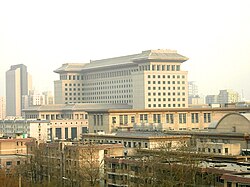
| headquarters = August First Building | '''Arms'''<br>{{Plain list| | ||
| website ={{Official URL}} | # [[File:Aerospace Flag of the People's Republic of China.svg|23x17px|border]] [[People's Liberation Army Aerospace Force|Aerospace Force]] | ||
| commander-in-chief = | # [[File:Cyberspace Flag of the People's Republic of China.svg|23x17px|border]] [[People's Liberation Army Cyberspace Force|Cyberspace Force]] | ||
# [[File:Information Support Flag of the People's Republic of China.svg|23x17px|border]] [[People's Liberation Army Information Support Force|Information Support Force]] | |||
# [[File:Joint Logistics Support Flag of the People's Republic of China.svg|23x17px|border]] [[People's Liberation Army Joint Logistics Support Force|Joint Logistics Support Force]] | |||
}} | |||
| headquarters = [[August First Building]], [[Fuxing Road, Beijing|Fuxing Road]], [[Haidian, Beijing]] | |||
| website = {{Official URL}} | |||
| commander-in-chief = [[Central Military Commission (China)|Central Military Commission]] | |||
{{Infobox |child = yes | {{Infobox |child = yes | ||
|label1 = [[Supreme Military Command of the People's Republic of China|CMC leadership]] | |label1 = [[Supreme Military Command of the People's Republic of China|CMC leadership]] | ||
|data1 = '''[[Chairman of the Central Military Commission (China)|Chairman]]:'''<br />{{Flagicon image|Flag of the Chinese Communist Party.svg}}{{Flagdeco|China}} [[Xi Jinping]] | |data1 = '''[[Chairman of the Central Military Commission (China)|Chairman]]:'''<br />{{Flagicon image|Flag of the Chinese Communist Party.svg}}{{Flagdeco|China}} [[Xi Jinping]]<br />'''[[Vice Chairman of the Central Military Commission|Vice Chairman]]''':<br />{{Flagicon image|Rocket Force Flag of the People's Republic of China.svg}} [[Jiang (rank)|General]] [[Zhang Shengmin]] | ||
{{ | |||
}} | }} | ||
| commander-in-chief_title = Governing body | | commander-in-chief_title = Governing body | ||
| chief minister = {{Flagdeco|China| | | chief minister = {{Flagdeco|China|navy}} [[Jiang (rank)|Admiral]] [[Dong Jun]] | ||
| chief minister_title = | | chief minister_title = [[Minister of National Defense (China)|Minister of National Defense]] | ||
| minister | | minister = ''Vacant'' | ||
| minister_title | | minister_title = Director of the [[Political Work Department of the Central Military Commission|Political Work Department]] | ||
| chief_of_staff | | chief_of_staff = ''Vacant'' | ||
| chief_of_staff_title = Chief of the [[Joint Staff Department | | chief_of_staff_title = Chief of the [[Joint Staff Department (China)|Joint Staff Department]] | ||
| commander | | commander = {{Flagicon image|Rocket Force Flag of the People's Republic of China.svg}} [[Jiang (rank)|General]] [[Zhang Shengmin]] | ||
| commander_title = Secretary of [[ | | commander_title = Secretary of [[Discipline Inspection Commission of the Central Military Commission|Discipline Inspection Commission]] | ||
<!-- Manpower --> | <!-- Manpower -->| age = 18 | ||
| age | | conscription = [[Conscription_in_China|Inactive since 1949]] (Law dictates a hybrid system of conscripts and volunteers)<ref name=":4" /> | ||
| conscription | | manpower_data = | ||
| manpower_data | | manpower_age = | ||
| manpower_age | | available = | ||
| available | | available_f = | ||
| available_f | | fit = | ||
| fit | | fit_f = | ||
| fit_f | | reaching = | ||
| reaching | | reaching_f = | ||
| reaching_f | | active = 2,035,000 (2025){{Sfn|The International Institute for Strategic Studies|2025|p=240}} | ||
| active | | ranked = 1st | ||
| ranked | | reserve = 510,000 (2025){{sfn|The International Institute for Strategic Studies|2025|p=240}} | ||
| reserve | | deployed = <!-- Financial --> | ||
| deployed | | amount = US$314 billion (2024)<ref name="SIPRI-2020">{{Cite web |date=April 2025 |title=Trends in Military Expenditure 2024 |url=https://www.sipri.org/sites/default/files/2025-04/2504_fs_milex_2024.pdf#page=2 |access-date=28 April 2025 |publisher=[[Stockholm International Peace Research Institute]]}}</ref><br />([[List of countries by military expenditures|ranked 2nd]]) | ||
<!-- Financial --> | | percent_GDP = 1.7% (2024)<ref name="SIPRI-2020"/> | ||
| amount | |||
| percent_GDP | |||
| domestic_suppliers = {{blist | | domestic_suppliers = {{blist | ||
| [[China National Aero-Technology Import & Export Corporation]] | | [[China National Aero-Technology Import & Export Corporation]] | ||
| Line 74: | Line 75: | ||
| [[China National Nuclear Corporation]] | | [[China National Nuclear Corporation]] | ||
}} | }} | ||
| foreign_suppliers | | foreign_suppliers = {{Plain list| | ||
*{{ | * {{Flag|Russia}} | ||
*{{Flag|France}} | * {{Flag|France}} | ||
}} | }} | ||
Historical: {{Unbulleted list|{{USSR}}<ref>{{cite web |url=https://www.scmp.com/news/china/military/article/3139603/how-china-grew-buyer-major-arms-trade-player |title=China's arms trade: which countries does it buy from and sell to? |website=South China Morning Post |first=Maryann |last=Xue |date=4 July 2021 |access-date=26 May 2022 |archive-date=26 May 2022 |archive-url=https://web.archive.org/web/20220526161751/https://www.scmp.com/news/china/military/article/3139603/how-china-grew-buyer-major-arms-trade-player |url-status=live }}</ref>}} | |||
| imports | | imports = {{Currency|14.858 billion|US$|passthrough=yes|linked=no}}<br>(2010–2021)<ref name="SIPRI"/> | ||
| exports | | exports = {{Currency|18.121 billion|US$|passthrough=yes|linked=no}}<br>(2010–2021)<ref name="SIPRI">{{cite web|url=https://armstrade.sipri.org/armstrade/page/values.php|title=TIV of arms imports/exports from China, 2010–2021|date=7 February 2022|work=[[Stockholm International Peace Research Institute]]|access-date=26 January 2023|archive-date=21 June 2023|archive-url=https://web.archive.org/web/20230621145309/https://armstrade.sipri.org/armstrade/page/values.php|url-status=live}}</ref> | ||
<!-- Related articles --> | <!-- Related articles -->| history = {{Plain list| | ||
| history | * [[History of the People's Liberation Army|History of the PLA]] | ||
* [[Modernization of the People's Liberation Army|Modernization of the PLA]] | |||
* [[List of Chinese wars and battles|Historical Chinese wars and battles]] | |||
* [[List of wars involving the People's Republic of China|Military engagements]] | |||
}} | }} | ||
{{Chinese | | ranks = {{Plain list| | ||
* [[Ranks of the People's Liberation Army Ground Force|Army ranks]] | |||
* [[Ranks of the People's Liberation Army Navy|Navy ranks]] | |||
* [[Ranks of the People's Liberation Army Air Force|Air force ranks]] | |||
}} | |||
}} | |||
{{Infobox Chinese | |||
| title = Chinese People's Liberation Army | | title = Chinese People's Liberation Army | ||
| t = 中國人民解放軍 | | t = 中國人民解放軍 | ||
| Line 91: | Line 100: | ||
| l = "China People Liberation Army" | | l = "China People Liberation Army" | ||
| p = Zhōngguó Rénmín Jiěfàngjūn | | p = Zhōngguó Rénmín Jiěfàngjūn | ||
| w = | | tp = Jhong-guó Rén-mín Jiě-fàng-jyun | ||
| w = {{tone superscript|Chung1-kuo2 Jen2-min2 Chieh3-fang4-chün1}} | |||
| y = Jūng-gwok Yàhn-màhn Gáai-fong-gwān | | y = Jūng-gwok Yàhn-màhn Gáai-fong-gwān | ||
| j = | | j = zung1 gwok3 jan4 man4 gaai2 fong3 gwan1 | ||
| bpmf = ㄓㄨㄥ ㄍㄨㄛˊ ㄖㄣˊ ㄇㄧㄣˊ ㄐㄧㄝˇ ㄈㄤˋ ㄐㄩㄣ | | bpmf = ㄓㄨㄥ ㄍㄨㄛˊ ㄖㄣˊ ㄇㄧㄣˊ ㄐㄧㄝˇ ㄈㄤˋ ㄐㄩㄣ | ||
| mi = {{IPAc-cmn|zh|ong|1|.|g|uo|2|-|r|en|2|.|m|in|2|-|j|ie|3|.|f|ang|2|.|jun|1}} | | mi = {{IPAc-cmn|zh|ong|1|.|g|uo|2|-|r|en|2|.|m|in|2|-|j|ie|3|.|f|ang|2|.|jun|1}} | ||
| ci = {{IPAc-yue|z|ung|1| | | ci = {{IPAc-yue|z|ung|1|-|gw|ok|3|-|j|an|4|-|m|an|4|-|g|aai|2|-|f|ong|3|-|gw|an|1}} | ||
| order = st | | order = st | ||
}} | }} | ||
{{Politics of China |expanded = Military }} | {{Politics of China |expanded = Military }} | ||
The '''People's Liberation Army''' ('''PLA''') is the | The '''People's Liberation Army''' ('''PLA''') is the military wing of the [[Chinese Communist Party]] (CCP) and the primary armed forces of the [[People's Republic of China]] (PRC). It consists of four [[Military branch|services]]—[[People's Liberation Army Ground Force|Ground Force]], [[People's Liberation Army Navy|Navy]], [[People's Liberation Army Air Force|Air Force]], and [[People's Liberation Army Rocket Force|Rocket Force]]—and four arms—[[People's Liberation Army Aerospace Force|Aerospace Force]], [[People's Liberation Army Cyberspace Force|Cyberspace Force]], [[People's Liberation Army Information Support Force|Information Support Force]], and [[People's Liberation Army Joint Logistics Support Force|Joint Logistics Support Force]]. It operates under the CCP's [[The Party commands the gun|absolute control]] and is led by the [[Central Military Commission (China)|Central Military Commission]] (CMC) with its [[Chairman of the Central Military Commission (China)|chairman]] as [[Supreme Military Command of the People's Republic of China|commander-in-chief]]. | ||
The PLA can trace its origins during the [[Republic of China (1912–1949)|Republican | The PLA can trace its origins during the [[Republic of China (1912–1949)|Republican era]] to the left-wing units of the [[National Revolutionary Army]] (NRA) of the [[Kuomintang]] (KMT), when they broke away in 1927 in an [[Nanchang Uprising|uprising]] against the [[nationalist government]] as the [[Chinese Red Army]] before being reintegrated into the NRA as units of [[New Fourth Army]] and [[Eighth Route Army]] during the [[Second Sino-Japanese War]]. The two NRA communist units were reconstituted as the PLA in 1947. Since 1949, the PLA has used nine different military strategies, which it calls "strategic guidelines". The most important came in 1956, 1980, and 1993. Politically, the PLA and the paramilitary [[People's Armed Police]] (PAP) have the [[People's Liberation Army and People's Armed Police delegation to the National People's Congress|largest delegation]] in the [[National People's Congress]] (NPC); the joint delegation currently has 281 deputies—over 9% of the total—all of whom are CCP members. | ||
The PLA is not a traditional nation-state military. It is the armed wing of the CCP and controlled by the party, not by the state. The PLA's primary mission is the defense of the party and its interests. The PLA is the guarantor of the party's survival and rule, and the party prioritizes maintaining control and the loyalty of the PLA. According to Chinese law, the party has absolute control over the armed forces and the CMC exercises supreme military command; the party and state CMCs are practically a single body by membership. Since 1989, the [[General Secretary of the Chinese Communist Party|CCP general secretary]] has also been the CMC Chairman; this grants significant political power as the only member of the [[Politburo Standing Committee of the Chinese Communist Party|Politburo Standing Committee]] with direct responsibilities for the armed forces. The [[Ministry of National Defense (China)|Ministry of National Defense]] has no command authority; it is the PLA's interface with state and foreign entities and insulates the PLA from external influence. | |||
Today, the majority of military units around the country are assigned to one of five [[Theater commands of the People's Liberation Army| | Today, the majority of military units around the country are assigned to one of five [[Theater commands of the People's Liberation Army|theatre commands]] by geographical location. In addition to wartime arrangements, the PLA is also involved in the peacetime operations of other components of the armed forces. This is particularly visible in [[Territorial disputes of the People's Republic of China|maritime territorial disputes]] where the navy is heavily involved in the planning, coordination and execution of operations by the PAP's [[China Coast Guard]]. The PLA is [[List of countries by number of military and paramilitary personnel|the world's largest military force]] (not including paramilitary or [[People's Liberation Army Reserve Force|reserve forces]]) and has the second largest defence budget in the world. China's military expenditure was US$314 billion in 2024, accounting for [[List of countries with highest military expenditures|12 percent of the world's defence expenditures]]. It is also one of the fastest modernizing militaries in the world, and has been termed as a potential military superpower, with significant regional defence and rising global [[power projection]] capabilities.<ref>{{cite web |title=Global military spending remains high at $1.7 trillion |url=https://www.sipri.org/media/press-release/2018/global-military-spending-remains-high-17-trillion |url-status=live |archive-url=https://web.archive.org/web/20180527073110/https://www.sipri.org/media/press-release/2018/global-military-spending-remains-high-17-trillion |archive-date=27 May 2018 |access-date=2018-10-13 |publisher=[[Stockholm International Peace Research Institute]] |date=2 May 2018 |language=en}}</ref>{{Sfn|The International Institute for Strategic Studies|2025|p=240}} | ||
== Mission == | |||
The PLA's primary mission is the defense of the CCP and its interests.{{sfn|Saunders et al.|2019|pp=13–14}} It is the guarantor of the party's survival and rule,{{sfn|Saunders et al.|2019|pp=13–14}}{{sfn|Saunders et al.|2019|p=521}} and the party prioritizes [[Civilian control of the military in communist states|maintaining control]] and the loyalty of the PLA.{{sfn|Saunders et al.|2019|p=521}} | |||
In 2004, [[paramount leader]] [[Hu Jintao]] stated the mission of the PLA as:<ref>{{cite web |url = https://www.rand.org/pubs/testimonies/2009/RAND_CT332.pdf |title = The PLA Navy's ''New Historic Missions'': Expanding Capabilities for a Re-emergent Maritime Power |access-date = 1 April 2011 |archive-url = https://web.archive.org/web/20110428051927/http://www.rand.org/pubs/testimonies/2009/RAND_CT332.pdf |archive-date = 28 April 2011 |url-status = live }}</ref> | In 2004, [[paramount leader]] [[Hu Jintao]] stated the mission of the PLA as:<ref>{{cite web |url = https://www.rand.org/pubs/testimonies/2009/RAND_CT332.pdf |title = The PLA Navy's ''New Historic Missions'': Expanding Capabilities for a Re-emergent Maritime Power |access-date = 1 April 2011 |archive-url = https://web.archive.org/web/20110428051927/http://www.rand.org/pubs/testimonies/2009/RAND_CT332.pdf |archive-date = 28 April 2011 |url-status = live }}</ref> | ||
* | * Consolidate the rule of the CCP | ||
* | * Ensure sovereignty, territorial integrity, internal security and national development of the People's Republic of China | ||
* | * Safeguard the country's interests | ||
* | * Help maintain world peace | ||
China describes its military posture as [[active defense]], defined in a 2015 state [[white paper]] as "We will not attack unless we are attacked, but we will surely counterattack if attacked."<ref name=":13">{{Cite book |last=Garlick |first=Jeremy |title=Advantage China: Agent of Change in an Era of Global Disruption |date=2024 |publisher=[[Bloomsbury Academic]] |isbn=978-1-350-25231-8 |pages=}}</ref>{{Rp|page=41}} | |||
== History == | == History == | ||
{{Main|History of the People's Liberation Army}} | {{Main|History of the People's Liberation Army}} | ||
=== Early history === | === Early history === | ||
{{Further|Chinese Civil War|Second Sino-Japanese War}} | {{Further|Chinese Civil War|Second Sino-Japanese War}} | ||
In 1925, the CCP's Central Military Department, was renamed the Central Military Commission.<ref name=":02">{{Cite book |last=Guo |first=Xuezhi |title=China's Security State: Philosophy, Evolution, and Politics |date=2012-08-29 |publisher=[[Cambridge University Press]] |isbn=978-1-107-02323-9 |language=en |doi=10.1017/CBO9781139150897}}</ref>{{Reference page|page=304}} It was first led by [[Zhang Guotao]] who was replaced by [[Zhou Enlai]] in 1926 as head of the CMC.<ref name=":02" />{{Reference page|page=304}} At the time of the [[First United Front]], the CMC was not a unified military command structure but was more of an administrative liaison with other armed communist groups.<ref name=":02" />{{Reference page|page=304}} | |||
The CCP founded its military wing on 1 August 1927 during the [[Nanchang uprising]], beginning the [[Chinese Civil War]]. Communist elements of the [[National Revolutionary Army]] rebelled under the leadership of [[Zhu De]], [[He Long]], [[Ye Jianying]], [[Zhou Enlai]], and other leftist elements of the [[Kuomintang]] (KMT) after the [[Shanghai massacre]] in 1927.<ref>{{Cite web |last=Carter |first=James |date=4 August 2021 |title=The Nanchang Uprising and the birth of the PLA |url=https://thechinaproject.com/2021/08/04/the-nanchang-uprising-and-the-birth-of-the-pla/ |website=The China Project |access-date=12 November 2022 |archive-date=7 November 2022 |archive-url=https://web.archive.org/web/20221107180237/https://thechinaproject.com/2021/08/04/the-nanchang-uprising-and-the-birth-of-the-pla/ |url-status=live }}</ref> They were then known as the [[Chinese Workers' and Peasants' Red Army]], or simply the Red Army.<ref>{{Cite web |date=17 June 2004 |title=History of the PLA's Ground Force Organisational Structure and Military Regions |url=https://rusi.org/explore-our-research/publications/commentary/history-plas-ground-force-organisational-structure-and-military-regions |website=[[Royal United Services Institute]] |access-date=12 November 2022 |archive-date=11 November 2022 |archive-url=https://web.archive.org/web/20221111215039/https://rusi.org/explore-our-research/publications/commentary/history-plas-ground-force-organisational-structure-and-military-regions/ |url-status=live }}</ref> In 1934 and 1935, the Red Army survived several campaigns led against it by [[Chiang Kai-Shek]]'s Kuomintang and engaged in the [[Long March]].<ref name="Bianco">{{Cite book |last=Bianco |first=Lucien |title=Origins of the Chinese Revolution, 1915–1949 |title-link=Origins of the Chinese Revolution, 1915–1949 |date=1971 |publisher=[[Stanford University Press]] |isbn=978-0-8047-0827-2 |page=68 |language=en |author-link=Lucien Bianco}}</ref> | |||
During the [[Second Sino-Japanese War]] from 1937 to 1945, the CCP's military forces were nominally integrated into the National Revolutionary Army of the [[Republic of China (1912–1949)|Republic of China]], forming two main units, the [[Eighth Route Army]] and the [[New Fourth Army]].<ref name="Benton-1999">{{Cite book |last=Benton |first=Gregor |url=https://books.google.com/books?id=ayLTpS8iujQC |title=New Fourth Army: Communist Resistance Along the Yangtze and the Huai, 1938–1941 |date=1999 |publisher=University of California Press |isbn=978-0-520-21992-2 |page=396 |language=en |access-date=12 November 2022 |archive-date=15 January 2023 |archive-url=https://web.archive.org/web/20230115051955/https://books.google.com/books?id=ayLTpS8iujQC |url-status=live }}</ref> During this time, these two military groups primarily employed [[guerrilla warfare|guerrilla tactics]], generally avoiding large-scale battles with the Japanese, and at the same time consolidating by recruiting KMT troops and paramilitary forces behind Japanese lines into their forces.<ref>{{Cite book |last=Zedong |first=Mao |title=On Guerilla Warfare: Mao Tse-Tung On Guerilla Warfare |title-link=On Guerrilla Warfare |date=2017 |publisher=Martino Fine Books |isbn=978-1-68422-164-6 |language=en |author-link=Mao Zedong}}</ref> | |||
After the [[Surrender of Japan|Japanese surrender]] in 1945, the CCP continued to use the National Revolutionary Army unit structures, until the decision was made in February 1947 to merge the Eighth Route Army and New Fourth Army.<ref name="Benton-1999" /> On October 10, 1947, the "[[Manifesto of the Chinese People's Liberation Army]]" was published, renaming the new million-strong force the People's Liberation Army (PLA).<ref>{{Cite web |author= |date=2017-07-06 |title=1946年,第一次使用"中国人民解放军"称谓 |url=http://www.guancha.cn/military-affairs/2017_07_06_416780.shtml |archiveurl=https://web.archive.org/web/20170709094507/http://www.guancha.cn/military-affairs/2017_07_06_416780.shtml |archivedate=2017-07-09 |accessdate= |publisher=解放军报 |language= |quote=}}</ref><ref name="NRAPLA2">{{cite web |date=2020-08-01 |title=【延安记忆】"中国人民解放军"称谓由此开始 |url=http://m.cnwest.com/sxxw/a/2020/08/01/18969370.html |url-status=live |archive-url=https://web.archive.org/web/20200822221319/http://m.cnwest.com/sxxw/a/2020/08/01/18969370.html |archive-date=2020-08-22 |access-date=2020-08-22}}</ref><ref>{{cite web |date=2017-10-10 |title=1947年10月10日,《中国人民解放军宣言》发布 |url=http://photo.chinamil.com.cn/tsjs/2017-10/10/content_7780489.htm |url-status=live |archive-url=https://web.archive.org/web/20200822211432/http://photo.chinamil.com.cn/tsjs/2017-10/10/content_7780489.htm |archive-date=2020-08-22 |access-date=2020-08-22 |publisher=中国军网}}</ref><ref>{{cite web |title=中国共产党领导的红军改编为八路军的背景和改编情况 – 太行英雄网 |url=http://taihangsummit.com/%E4%B8%AD%E5%9B%BD%E5%85%B1%E4%BA%A7%E5%85%9A%E9%A2%86%E5%AF%BC%E7%9A%84%E7%BA%A2%E5%86%9B%E6%94%B9%E7%BC%96%E4%B8%BA%E5%85%AB%E8%B7%AF%E5%86%9B%E7%9A%84%E8%83%8C%E6%99%AF%E5%92%8C%E6%94%B9%E7%BC%96/ |url-status=live |archive-url=https://web.archive.org/web/20220107174949/http://taihangsummit.com/%E4%B8%AD%E5%9B%BD%E5%85%B1%E4%BA%A7%E5%85%9A%E9%A2%86%E5%AF%BC%E7%9A%84%E7%BA%A2%E5%86%9B%E6%94%B9%E7%BC%96%E4%B8%BA%E5%85%AB%E8%B7%AF%E5%86%9B%E7%9A%84%E8%83%8C%E6%99%AF%E5%92%8C%E6%94%B9%E7%BC%96/ |archive-date=7 January 2022 |access-date=7 January 2022}}</ref> The reorganization was completed by late 1948. The PLA eventually won the Chinese Civil War, establishing the [[People's Republic of China]] in 1949.<ref>{{Cite web |title=The Chinese Revolution of 1949 |url=https://history.state.gov/milestones/1945-1952/chinese-rev |website=[[United States Department of State]], Office of the Historian |access-date=12 November 2022 |archive-date=19 May 2017 |archive-url=https://web.archive.org/web/20170519004017/https://history.state.gov/milestones/1945-1952/chinese-rev |url-status=live }}</ref> | |||
=== | === Establishment of the People's Republic of China === | ||
{{Further|Korean War|Sino-Indian War|Sino-Soviet border conflict}} | {{Further|Korean War|Sino-Indian War|Sino-Soviet border conflict}} | ||
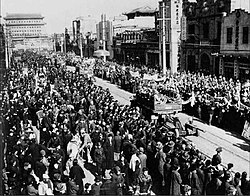
[[File:PLA Enters Peking.jpg|thumb|PLA troops entering Beijing in 1949 during the [[Chinese Civil War]]]] | [[File:PLA Enters Peking.jpg|thumb|PLA troops entering Beijing in 1949 during the [[Chinese Civil War]]]] | ||
[[File:Chinese troops leaving Korea.jpg|thumb|Chinese troops gathered on a T-34/85 or a Type 58 medium tank leaving [[North Korea]] in 1958, 5 years after the Korean War ended with an armistice (a ceasefire) in 1953. The banner in the background of the picture bears a slogan (in Chinese) which declares "The Friendship And Unity of the North Korean And Chinese Peoples Are Always Steadfast And Strong!"]] | [[File:Chinese troops leaving Korea.jpg|thumb|Chinese troops gathered on a T-34/85 or a Type 58 medium tank leaving [[North Korea]] in 1958, 5 years after the Korean War ended with an armistice (a ceasefire) in 1953. The banner in the background of the picture bears a slogan (in Chinese) which declares "The Friendship And Unity of the North Korean And Chinese Peoples Are Always Steadfast And Strong!"]] | ||
[[File:China 10th Anniversary Parade in Beijing 01.jpg|thumb|Marshal [[Lin Biao]] surveying the soldiers during the 10th-anniversary military parade in 1959 | [[File:China 10th Anniversary Parade in Beijing 01.jpg|thumb|Marshal [[Lin Biao]] surveying the soldiers during the 10th-anniversary military parade in 1959]] | ||
After the establishment of the PRC, the PLA underwent a drastic reorganization, with the establishment of the [[People's Liberation Army Air Force|Air Force]] leadership structure in November 1949, followed by the [[People's Liberation Army Navy|Navy]] leadership structure the following April.<ref>Ken Allen, [http://www.rand.org/pubs/conf_proceedings/CF182/CF182.ch9.pdf Chapter 9, "PLA Air Force Organization"] {{webarchive|url=https://web.archive.org/web/20070929102648/http://www.rand.org/pubs/conf_proceedings/CF182/CF182.ch9.pdf|date=2007-09-29}}, The PLA as Organization, ed. James C. Mulvenon and Andrew N.D. Yang (Santa Monica, CA: RAND, 2002), 349.</ref><ref name="中国人民解放军海军成立70周年多国海军活动新闻发布会在青岛举行">{{cite web |title=中国人民解放军海军成立70周年多国海军活动新闻发布会在青岛举行 |url=http://www.mod.gov.cn/power/2019-04/20/content_4839865.htm |url-status=live |archive-url=https://web.archive.org/web/20221001160506/http://www.mod.gov.cn/power/2019-04/20/content_4839865.htm |archive-date=1 October 2022 |access-date=18 May 2020 |website=mod.gov.cn |publisher=[[Ministry of National Defence of the People's Republic of China]] |language=zh}}</ref> | |||
In | In this early period, the People's Liberation Army overwhelmingly consisted of peasants.<ref name="Russo-2020">{{Cite book |last=Russo |first=Alessandro |title=Cultural Revolution and revolutionary culture |date=2020 |publisher=[[Duke University Press]] |isbn=978-1-4780-1218-4 |location=Durham |pages=36–37 |oclc=1156439609}}</ref> Its treatment of soldiers and officers was [[Egalitarianism|egalitarian]]<ref name="Russo-2020" /> and formal ranks were not adopted until 1955.<ref name="upi.com">{{Cite web |title=China's People's Liberation Army, the world's second largest conventional... |url=https://www.upi.com/Archives/1988/06/25/Chinas-Peoples-Liberation-Army-the-worlds-second-largest-conventional/9105583214400/ |url-status=live |archive-url=https://web.archive.org/web/20221204232316/https://www.upi.com/Archives/1988/06/25/Chinas-Peoples-Liberation-Army-the-worlds-second-largest-conventional/9105583214400/ |archive-date=4 December 2022 |access-date=2022-12-04 |website=UPI |language=en}}</ref> As a result of its egalitarian organization, the early PLA overturned strict traditional hierarchies that governed the lives of peasants.<ref name="Russo-2020" /> As sociologist Alessandro Russo summarizes, the peasant composition of the PLA hierarchy was a radical break with Chinese societal norms and "overturned the strict traditional hierarchies in unprecedented forms of egalitarianism[.]"<ref name="Russo-2020" /> During the 1950s, the PLA with Soviet assistance began to transform itself from a peasant army into a modern one.<ref>{{citation |title=Pamphlet number 30-51, Handbook on the Chinese Communist Army |date=7 December 1960 |url=http://libweb.uoregon.edu/ec/e-asia/read/chicom.pdf |access-date=1 April 2011 |archive-url=https://web.archive.org/web/20110429013230/http://libweb.uoregon.edu/ec/e-asia/read/chicom.pdf |archive-date=29 April 2011 |url-status=dead |publisher=Department of the Army}}</ref> | ||
In | In the PRC's early years, the PLA was a dominant [[Foreign policy of China|foreign policy]] institution in the country.<ref name="Loh">{{Cite book |last=Loh |first=Dylan M.H. |title=China's Rising Foreign Ministry: Practices and Representations of Assertive Diplomacy |publisher=[[Stanford University Press]] |year=2024 |isbn=9781503638204}}</ref>{{Rp|page=17}} Since 1949, China has used nine different military strategies, which the PLA calls "strategic guidelines". The most important came in 1956, 1980, and 1993.<ref name="M. Taylor Fravel 2019">{{Cite book |last=Fravel |first=M. Taylor |author-link=Taylor Fravel |title=Active Defense: China's Military Strategy since 1949 |date=2019 |publisher=[[Princeton University Press]] |isbn=978-0-691-18559-0 |volume=2 |doi=10.2307/j.ctv941tzj |jstor=j.ctv941tzj |s2cid=159282413}}</ref> | ||
In November 1950, some units of the PLA under the name of the [[People's Volunteer Army]] intervened in the [[Korean War]] as United Nations forces under General [[Douglas MacArthur]] approached the [[Yalu River]].<ref name="Stewart-2015">{{Cite book |last=Stewart |first=Richard |url=https://history.army.mil/brochures/kw-chinter/chinter.htm |title=The Korean War: The Chinese Intervention |date=2015 |publisher=CreateSpace Independent Publishing Platform |isbn=978-1-5192-3611-1 |language=en |access-date=12 November 2022 |archive-date=12 November 2022 |archive-url=https://web.archive.org/web/20221112194350/https://history.army.mil/brochures/kw-chinter/chinter.htm |url-status=dead }}</ref> Under the weight of this offensive, Chinese forces drove MacArthur's forces out of North Korea and captured [[Seoul]], but were subsequently pushed back south of Pyongyang north of the [[38th parallel north|38th Parallel]].<ref name="Stewart-2015" /> The war also catalyzed the rapid modernization of the PLAAF.<ref>{{Citation |last1=Cliff |first1=Roger |title=The Evolution of Chinese Air Force Doctrine |date=2011 |url= |work=Shaking the Heavens and Splitting the Earth |pages=33–46 |series=Chinese Air Force Employment Concepts in the 21st Century |publisher=[[RAND Corporation]] |isbn=978-0-8330-4932-2 |jstor=10.7249/mg915af.10 |last2=Fei |first2=John |last3=Hagen |first3=Jeff |last4=Hague |first4=Elizabeth |last5=Heginbotham |first5=Eric |last6=Stillion |first6=John}}</ref> | |||
In | In 1962, the PLA Ground Force also fought India in the [[Sino-Indian War]].<ref>{{cite book |last1=Hoffman |first1=Steven A. |url=https://books.google.com/books?id=_bjADwAAQBAJ&q=chinese+army+patrols+ladakh+april+1962&pg=PA103 |title=India and the China Crisis |date=1990 |publisher=University of California Press |isbn=978-0-520-30172-6 |location=Berkeley |pages=101–104 |access-date=1 October 2020 |archive-url=https://web.archive.org/web/20211009120905/https://books.google.com/books?id=_bjADwAAQBAJ&q=chinese%2Barmy%2Bpatrols%2Bladakh%2Bapril%2B1962&pg=PA103 |archive-date=9 October 2021 |url-status=live}}</ref><ref>{{cite book |last1=Van Tronder |first1=Gerry |url=https://books.google.com/books?id=JrTNDwAAQBAJ&q=sino-indian+war+patrols+at+Ladakh+april+30+1962&pg=PT12 |title=Sino-Indian War: Border Clash: October–November 1962 |date=2018 |publisher=Pen and Sword Military |isbn=978-1-5267-2838-8 |access-date=1 October 2020 |archive-url=https://web.archive.org/web/20210625205658/https://books.google.com/books?id=JrTNDwAAQBAJ&q=sino-indian+war+patrols+at+Ladakh+april+30+1962&pg=PT12 |archive-date=25 June 2021 |url-status=live}}</ref> In [[Nathu La and Cho La clashes|a series of border clashes in 1967]] with Indian troops, the PLA suffered heavy numerical and tactical losses.<ref name="Chellaney2" /><ref name="Praagh">{{Cite book |url=https://books.google.com/books?id=TbpU0HngYhoC&pg=PA301 |title=Greater Game: India's Race with Destiny and China |last=Van Praagh |first=David |date=2003 |publisher=McGill-Queen's Press – MQUP |isbn=978-0773525887 |page=301 |language=en |quote=(Indian) ''jawans'' trained and equipped for high-altitude combat used US provided artillery, deployed on higher ground than that of their adversaries, to decisive tactical advantage at Nathu La and Cho La near the Sikkim-Tibet border. |access-date=6 August 2021 |archive-date=25 December 2018 |archive-url=https://web.archive.org/web/20181225173405/https://books.google.com/books?id=TbpU0HngYhoC&pg=PA301 |url-status=live }}</ref><ref name="Hoontrakul">{{citation |first=Ponesak |last=Hoontrakul |chapter=Asia's Evolving Economic Dynamism and Political Pressures |editor1=P. Hoontrakul |editor2=C. Balding |editor3=R. Marwah |title=The Global Rise of Asian Transformation: Trends and Developments in Economic Growth Dynamics |chapter-url=https://books.google.com/books?id=RrKYBgAAQBAJ&pg=PA37 |year=2014 |publisher=Palgrave Macmillan US |isbn=978-1-137-41236-2 |page=37 |quote=Cho La incident (1967) – Victorious: India / Defeated : China |access-date=6 August 2021 |archive-date=25 December 2018 |archive-url=https://web.archive.org/web/20181225173404/https://books.google.com/books?id=RrKYBgAAQBAJ&pg=PA37%20 |url-status=live }}</ref> | ||
The | Before the [[Cultural Revolution]], military region commanders tended to remain in their posts for long periods. The longest-serving military region commanders were [[Xu Shiyou]] in the [[Nanjing Military Region]] (1954–74), [[Yang Dezhi]] in the [[Jinan Military Region]] (1958–74), [[Chen Xilian]] in the [[Shenyang Military Region]] (1959–73), and [[Han Xianchu]] in the Fuzhou Military Region (1960–74).<ref name="autogenerated436">{{Cite book |last=Li |first=Xiaobing |url=https://archive.org/details/historyofmodernc0000lixi |title=A History of the Modern Chinese Army |date=2007 |publisher=[[University Press of Kentucky]] |doi=10.2307/j.ctt2jcq4k |isbn=978-0-8131-2438-4 |jstor=j.ctt2jcq4k}}</ref> In the early days of the Cultural Revolution, the PLA abandoned the use of the military ranks that it had adopted in 1955.<ref name="upi.com" /> The [[Central Military Commission (China)|Central Military Commission]] had deemed that ranks were an expression of [[bourgeois right]] and hierarchy which led to individualist attitudes, inequality, and a sense of disunity.<ref name=":Kindler2">{{Cite book |last=Kindler |first=Benjamin |title=Writing to the Rhythm of Labor: Cultural Politics of the Chinese Revolution, 1942-1976 |date=2025 |publisher=[[Columbia University Press]] |isbn=978-0-231-21932-7 |location=New York City, NY}}</ref>{{Reference page|page=165}} | ||
The establishment of a professional military force equipped with modern weapons and doctrine was the last of the [[Four Modernizations]] announced by Zhou Enlai and supported by [[Deng Xiaoping]].<ref name="Ebrey">{{cite web |author=Ebrey, Patricia Buckley |title=Four Modernizations Era |url=http://depts.washington.edu/chinaciv/graph/9confour.htm |url-status=live |archive-url=https://web.archive.org/web/20101007221511/http://depts.washington.edu/chinaciv/graph/9confour.htm |archive-date=October 7, 2010<!-- 22:15:11 --> |access-date=October 20, 2012 |work=A Visual Sourcebook of Chinese Civilization |publisher=University of Washington}}</ref><ref name="ScienceTechnology">{{cite news |author=人民日报 |date=31 January 1963 |script-title=zh:在上海举行的科学技术工作会议上周恩来阐述科学技术现代化的重大意义 |language=zh |trans-title=Science and Technology in Shanghai at the conference on Zhou Enlai explained the significance of modern science and technology |pages=1 |newspaper=People's Daily |publisher=Central Committee of the Chinese Communist Party |url=http://rmrbw.net/read.php?tid=302475&fpage=14 |url-status=usurped |access-date=October 21, 2011 |archive-url=https://web.archive.org/web/20160214201234/http://rmrbw.net/read.php?tid=302475 |archive-date=February 14, 2016}}</ref> In keeping with Deng's mandate to reform, the PLA has demobilized millions of men and women since 1978 and has introduced modern methods in such areas as [[military recruitment|recruitment]] and manpower, [[military strategy|strategy]], and [[military education and training|education and training]].<ref>{{Cite journal |last=Mason |first=David |date=1984 |title=China's Four Modernizations: Blueprint for Development or Prelude to Turmoil? |url= |journal=[[Asian Affairs]] |volume=11 |issue=3 |pages=47–70 |doi=10.1080/00927678.1984.10553699 |issn=0092-7678 |jstor=30171968}}</ref> In 1979, the PLA fought [[Vietnam]] over a border skirmish in the [[Sino-Vietnamese War]] where both sides claimed victory.<ref>{{Cite news |last=Vincent |first=Travils |date=9 February 2022 |title=Why Won't Vietnam Teach the History of the Sino-Vietnamese War? |work=[[The Diplomat (magazine)|The Diplomat]] |url=https://thediplomat.com/2022/02/why-wont-vietnam-teach-about-the-sino-vietnamese-war/ |access-date=12 November 2022 |archive-date=18 February 2022 |archive-url=https://web.archive.org/web/20220218003020/https://thediplomat.com/2022/02/why-wont-vietnam-teach-about-the-sino-vietnamese-war/ |url-status=live }}</ref> However, western analysts generally agree that Vietnam handily outperformed the PLA.<ref name="autogenerated436"/> | |||
The | During the [[Sino-Soviet split]], strained relations between China and the Soviet Union resulted in bloody border clashes and mutual backing of each other's adversaries.<ref>{{Cite journal |last=Fravel |first=M. Taylor |date=2007 |title=Power Shifts and Escalation: Explaining China's Use of Force in Territorial Disputes |journal=[[International Security]] |volume=32 |issue=3 |pages=44–83 |doi=10.1162/isec.2008.32.3.44 |issn=0162-2889 |jstor=30130518 |s2cid=57559936}}</ref> China and Afghanistan had neutral relations with each other during the King's rule.<ref name="AfCh1981">''China and Afghanistan'', Gerald Segal, Asian Survey, Vol. 21, No. 11 (Nov., 1981), University of California Press</ref> When the pro-Soviet Afghan Communists seized power in Afghanistan in 1978, relations between China and the Afghan communists quickly turned hostile.<ref name="Hilali-2001" /> The Afghan pro-Soviet communists supported China's enemies in Vietnam and blamed China for supporting Afghan anticommunist militants.<ref name="Hilali-2001">{{Cite journal |last=Hilali |first=A.Z |date=September 2001 |title=China's response to the Soviet invasion of Afghanistan |journal=[[Central Asian Survey]] |language=en |volume=20 |issue=3 |pages=323–351 |doi=10.1080/02634930120095349 |s2cid=143657643 |issn=0263-4937}}</ref> China responded to the [[Soviet–Afghan War|Soviet invasion of Afghanistan]] by supporting the [[Afghan mujahidin]] and ramping up their military presence near Afghanistan in Xinjiang.<ref name="Hilali-2001" /> China acquired military equipment from the United States to defend itself from Soviet attacks.<ref name=":7">{{cite book |author=Starri |first=S. Frederick |author-link=S. Frederick Starr |title=Xinjiang: China's Muslim Borderland |title-link=Xinjiang: China's Muslim Borderland |publisher=M.E. Sharpe |year=2004 |isbn=0765613182 |editor= |edition= |pages=157–158}}</ref> | ||
The PLA Ground Force trained and supported the Afghan Mujahideen during the Soviet-Afghan War, moving its training camps for the mujahideen from Pakistan into China itself.<ref>{{Cite journal |last=Szczudlik-Tatar |first=Justyna |date=October 2014 |title=China's Evolving Stance on Afghanistan: Towards More Robust Diplomacy with "Chinese Characteristics" |url=https://www.files.ethz.ch/isn/184324/PISM%20Strategic%20File%20no%2022%20(58).pdf |journal=Strategic File |publisher=Polish Institute of International Affairs |volume=58 |issue=22 |access-date=12 November 2022 |archive-date=29 August 2023 |archive-url=https://web.archive.org/web/20230829133903/https://www.files.ethz.ch/isn/184324/PISM%20Strategic%20File%20no%2022%20(58).pdf |url-status=live }}</ref> Hundreds of millions of dollars' worth of anti-aircraft missiles, rocket launchers, and machine guns were given to the Mujahideen by the Chinese.<ref>{{Cite web |last=Galster |first=Steve |date=9 October 2001 |title=Volume II: Afghanistan: Lessons from the Last War |url=https://nsarchive2.gwu.edu/NSAEBB/NSAEBB57/essay.html |website=National Security Archive, [[George Washington University]] |access-date=12 November 2022 |archive-date=6 September 2021 |archive-url=https://web.archive.org/web/20210906203727/https://nsarchive2.gwu.edu/NSAEBB/NSAEBB57/essay.html |url-status=live }}</ref> Chinese military advisors and army troops were also present with the Mujahideen during training.<ref name=":7" /> | |||
=== Since 1980 === | === Since 1980 === | ||
{{See also|North China Military Exercise}} | {{See also|North China Military Exercise}} | ||
In 1981, the PLA conducted its largest [[North China Military Exercise|military exercise in North China]] since the founding of the People's Republic.<ref name="M. Taylor Fravel 2019" /><ref name=" | In 1981, the PLA conducted its largest [[North China Military Exercise|military exercise in North China]] since the founding of the People's Republic.<ref name="M. Taylor Fravel 2019" /><ref name="Godwin-2019">{{Cite book |last=Godwin |first=Paul H. B. |url=https://books.google.com/books?id=EiCeDwAAQBAJ&q=North+China+Military+Exercise+1981&pg=PT26 |title=The Chinese Defense Establishment: Continuity And Change In The 1980s |date=2019 |publisher=Routledge |isbn=978-1-000-31540-0 |language=en |access-date=12 November 2022 |archive-date=11 February 2024 |archive-url=https://web.archive.org/web/20240211032245/https://books.google.com/books?id=EiCeDwAAQBAJ&q=North+China+Military+Exercise+1981&pg=PT26#v=onepage&q=North%20China%20Military%20Exercise%201981&f=false |url-status=live }}</ref> | ||
Reform and modernization have today resumed their position as the PLA's primary objectives, although the armed forces' political loyalty to the CCP has remained a leading concern.<ref>{{Cite news |date=20 August 2018 |title=Xi Jinping insists on PLA's absolute loyalty to Communist Party |work=[[The Economic Times]] |url=https://economictimes.indiatimes.com/news/defence/xi-jinping-insists-on-plas-absolute-loyalty-to-communist-party/articleshow/65471728.cms?from=mdr}}</ref><ref>{{Cite news |last=Chan |first=Minnie |date=23 September 2022 |title=China's military told to 'resolutely do what the party asks it to do' |work=[[South China Morning Post]] |url=https://www.scmp.com/news/china/military/article/3193454/chinas-military-told-resolutely-do-what-party-asks-it-do | In the late 1980s, the central government had increasing expenditures and limited revenue.<ref name=":03">{{Cite book |last=Lin |first=Shuanglin |title=China's Public Finance: Reforms, Challenges, and Options |publisher=[[Cambridge University Press]] |year=2022 |isbn=978-1-009-09902-8 |edition= |location=New York, NY}}</ref>{{Rp|page=43}} The central government encouraged its agencies and encouraged local governments to expand their services and pursue revenues.<ref name=":03" />{{Rp|page=43}} The PLA [[Business activities of the Chinese military|established businesses]] including hotels and restaurants.<ref name=":03" />{{Rp|page=43}} The PLA gained more autonomy and permission to engage in commercial activities in exchange for a reduced role in political affairs and limited budgets;{{sfn|Saunders et al.|2019|p=523}} the military was downsized to free resources for [[economic development]].<ref>{{Cite web |last=Zissis |first=Carin |date=5 December 2006 |title=Modernizing the People's Liberation Army of China |url=https://www.cfr.org/backgrounder/modernizing-peoples-liberation-army-china |website=[[Council on Foreign Relations]] |access-date=12 November 2022 |archive-date=12 November 2022 |archive-url=https://web.archive.org/web/20221112194350/https://www.cfr.org/backgrounder/modernizing-peoples-liberation-army-china |url-status=live }}</ref> The lack of oversight, ineffective self-regulation, and [[Jiang Zemin]]'s and [[Hu Jintao]]'s lack of close personal ties to the PLA{{sfn|Saunders et al.|2019|p=523}} led to systemic corruption that persisted through the late-2010s.{{sfn|Saunders et al.|2019|p=51}} Jiang's attempt to divest the PLA of its commercial interests was only partially successful, as many were still run by close associates of PLA officers.{{sfn|Saunders et al.|2019|p=523}} Corruption lowered readiness and proficiency,{{sfn|Saunders et al.|2019|p=520}} was a barrier to modernization and professionalization,{{sfn|Saunders et al.|2019|p=526}} and eroded party control.{{sfn|Saunders et al.|2019|p=521}} The 2010s [[Anti-corruption campaign under Xi Jinping|anti-corruption campaigns and military reforms]] under [[Xi Jinping]] from the early-2010s were in part executed to address these problems.{{sfn|Saunders et al.|2019|pp=51-52}}{{sfn|Saunders et al.|2019|p=531}} | ||
Following the [[People's Liberation Army at the 1989 Tiananmen Square protests and massacre|PLA's suppression]] of the [[1989 Tiananmen Square protests and massacre]], ideological correctness was temporarily revived as the dominant theme in Chinese military affairs.<ref>{{Cite news |date=30 April 2009 |title=PLA's "Absolute Loyalty" to the Party in Doubt |url=https://jamestown.org/program/plas-absolute-loyalty-to-the-party-in-doubt/ |website=[[The Jamestown Foundation]] |access-date=12 November 2022 |archive-date=13 November 2022 |archive-url=https://web.archive.org/web/20221113113012/https://jamestown.org/program/plas-absolute-loyalty-to-the-party-in-doubt/ |url-status=live }}</ref> Reform and modernization have today resumed their position as the PLA's primary objectives, although the armed forces' political loyalty to the CCP has remained a leading concern.<ref>{{Cite news |date=20 August 2018 |title=Xi Jinping insists on PLA's absolute loyalty to Communist Party |work=[[The Economic Times]] |url=https://economictimes.indiatimes.com/news/defence/xi-jinping-insists-on-plas-absolute-loyalty-to-communist-party/articleshow/65471728.cms?from=mdr |access-date=12 November 2022 |archive-date=15 March 2023 |archive-url=https://web.archive.org/web/20230315132848/https://economictimes.indiatimes.com/news/defence/xi-jinping-insists-on-plas-absolute-loyalty-to-communist-party/articleshow/65471728.cms?from=mdr |url-status=live }}</ref><ref>{{Cite news |last=Chan |first=Minnie |date=23 September 2022 |title=China's military told to 'resolutely do what the party asks it to do' |work=[[South China Morning Post]] |url=https://www.scmp.com/news/china/military/article/3193454/chinas-military-told-resolutely-do-what-party-asks-it-do |access-date=12 November 2022 |archive-date=19 October 2023 |archive-url=https://web.archive.org/web/20231019060837/https://www.scmp.com/news/china/military/article/3193454/chinas-military-told-resolutely-do-what-party-asks-it-do |url-status=live }}</ref> | |||
Beginning in the 1980s, the PLA tried to transform itself from a land-based power centered on a vast ground force to a smaller, more mobile, high-tech one capable of mounting operations beyond its borders.<ref name="M. Taylor Fravel 2019" /> The motivation for this was that a massive land invasion by Russia was no longer seen as a major threat, and the new threats to China are seen to be a declaration of independence by [[Taiwan]], possibly with assistance from the United States, or a confrontation over the [[Spratly Islands]].<ref name="autogenerated2005">The Political System of the People's Republic of China. Chief Editor Pu Xingzu, Shanghai, 2005, Shanghai People's Publishing House. {{ISBN|7-208-05566-1}}, Chapter 11 The State Military System.</ref> | Beginning in the 1980s, the PLA tried to transform itself from a land-based power centered on a vast ground force to a smaller, more mobile, high-tech one capable of mounting operations beyond its borders.<ref name="M. Taylor Fravel 2019" /> The motivation for this was that a massive land invasion by Russia was no longer seen as a major threat, and the new threats to China are seen to be a declaration of independence by [[Taiwan]], possibly with assistance from the United States, or a confrontation over the [[Spratly Islands]].<ref name="autogenerated2005">The Political System of the People's Republic of China. Chief Editor Pu Xingzu, Shanghai, 2005, Shanghai People's Publishing House. {{ISBN|7-208-05566-1}}, Chapter 11 The State Military System.</ref> | ||
In 1985 | In 1985, the PLA changed from being constantly prepared to "hit early, strike hard, and to fight a nuclear war" to developing the military in an era of peace.<ref name="M. Taylor Fravel 2019" /> The PLA reoriented itself to modernization, improving its fighting ability, and becoming a world-class force. Deng Xiaoping stressed that the PLA needed to focus more on quality rather than on quantity.<ref name="autogenerated2005"/> | ||
The decision of the Chinese government in 1985 to reduce the size of the military by one million was completed by 1987. Staffing in military leadership was cut by about 50 percent. During the Ninth Five Year Plan (1996–2000) the PLA was reduced by a further 500,000. The PLA had also been expected to be reduced by another 200,000 by 2005. The PLA has focused on increasing mechanization and informatization to be able to fight a high-intensity war.<ref name="autogenerated2005"/> | The decision of the Chinese government in 1985 to reduce the size of the military by one million was completed by 1987. Staffing in military leadership was cut by about 50 percent. During the Ninth Five Year Plan (1996–2000) the PLA was reduced by a further 500,000. The PLA had also been expected to be reduced by another 200,000 by 2005. The PLA has focused on increasing mechanization and informatization to be able to fight a high-intensity war.<ref name="autogenerated2005"/> | ||
| Line 174: | Line 185: | ||
[[File:Chinese honor guard in column 070322-F-0193C-014.JPEG|thumb|upright=1.25|The [[Beijing Garrison Honor Guard Battalion|PLA Honor Guard]] in Beijing, 2007]] | [[File:Chinese honor guard in column 070322-F-0193C-014.JPEG|thumb|upright=1.25|The [[Beijing Garrison Honor Guard Battalion|PLA Honor Guard]] in Beijing, 2007]] | ||
Former CMC chairman | Former CMC chairman Jiang in 1990 called on the military to "meet political standards, be militarily competent, have a good working style, adhere strictly to discipline, and provide vigorous logistic support" ({{zh |s = 政治合格、军事过硬、作风优良、纪律严明、保障有力 |p = zhèngzhì hégé, jūnshì guòyìng, zuòfēng yōuliáng, jìlǜ yánmíng, bǎozhàng yǒulì }}).<ref>{{Cite web |date=2006-08-11 |title=部队要做到政治合格、军事过硬、作风优良、纪律严明、保障有力 |trans-title=The troops must be politically qualified, militarily competent, have good conduct, strict discipline and strong support |url=http://cpc.people.com.cn/GB/67481/69242/69244/4690367.html |url-status=dead |archive-url=https://web.archive.org/web/20061013101243/http://cpc.people.com.cn/GB/67481/69242/69244/4690367.html |archive-date=2006-10-13 |access-date=2024-12-30 |website=[[People's Daily]] |language=zh}}</ref> The 1991 [[Gulf War]] provided the Chinese leadership with a stark realization that the PLA was an oversized, almost-obsolete force.<ref>{{Cite news |last=Farley |first=Robert |date=1 September 2021 |title=China Has Not Forgotten the Lessons of the Gulf War |work=[[National Interest]] |url=https://nationalinterest.org/blog/reboot/china-has-not-forgotten-lessons-gulf-war-192949 |access-date=12 November 2022 |archive-date=11 November 2022 |archive-url=https://web.archive.org/web/20221111091521/https://nationalinterest.org/blog/reboot/china-has-not-forgotten-lessons-gulf-war-192949 |url-status=live }}</ref><ref>{{Cite book |last=Scobell |first=Andrew |url=https://apps.dtic.mil/sti/pdfs/ADA553490.pdf |title=Chinese Lessons from Other Peoples' Wars |date=2011 |publisher=Strategic Studies Institute, U.S. Army War College |isbn=978-1-58487-511-6 |language=en |access-date=12 November 2022 |archive-date=12 November 2022 |archive-url=https://web.archive.org/web/20221112194350/https://apps.dtic.mil/sti/pdfs/ADA553490.pdf |url-status=live }}</ref> The USA's sending of two aircraft carrier groups to the vicinity of Taiwan during the [[Third Taiwan Strait Crisis]] prompted Jiang to order a ten-year PLA modernization program.<ref name=":054">{{Cite book |last=Lampton |first=David M. |title=Living U.S.-China Relations: From Cold War to Cold War |date=2024 |publisher=[[Rowman & Littlefield]] |isbn=978-1-5381-8725-8 |location=Lanham, MD |pages=225 |author-link=David M. Lampton}}</ref> | ||
[[File:2025 Moscow Victory Day Parade 53.jpg|thumb|People's Liberation Army on Red Square in [[Moscow]] during the [[2025 Moscow Victory Day Parade|Victory Day parade]] on 9 May 2025]] | |||
The possibility of a militarized Japan has also been a continuous concern to the Chinese leadership since the late 1990s.<ref>{{Cite journal |last=Sasaki |first=Tomonori |date=23 September 2010 |title=China Eyes the Japanese Military: China's Threat Perception of Japan since the 1980s |url=https://www.cambridge.org/core/journals/china-quarterly/article/abs/china-eyes-the-japanese-military-chinas-threat-perception-of-japan-since-the-1980s/4C3D00214448677422255F228609C395 |journal=The China Quarterly |language=en |volume=203 |pages=560–580 |doi=10.1017/S0305741010000597 |s2cid=153828298 |issn=1468-2648 |access-date=12 November 2022 |archive-date=12 November 2022 |archive-url=https://web.archive.org/web/20221112194349/https://www.cambridge.org/core/journals/china-quarterly/article/abs/china-eyes-the-japanese-military-chinas-threat-perception-of-japan-since-the-1980s/4C3D00214448677422255F228609C395 |url-status=live |url-access=subscription }}</ref> In addition, China's military leadership has been reacting to and learning from the successes and failures of the [[United States Armed Forces]] during the [[Kosovo War]],<ref>{{Cite journal |last1=Sakaguchi |first1=Yoshiaki |last2=Mayama |first2=Katsuhiko |date=1999 |title=Significance of the War in Kosovo for China and Russia |url=http://www.nids.mod.go.jp/english/publication/kiyo/pdf/bulletin_e2001_1.pdf |journal=NIDS Security Reports |issue=3 |pages=1–23 |access-date=12 November 2022 |archive-date=14 August 2022 |archive-url=https://web.archive.org/web/20220814012122/http://www.nids.mod.go.jp/english/publication/kiyo/pdf/bulletin_e2001_1.pdf |url-status=live }}</ref> the [[United States invasion of Afghanistan|2001 invasion of Afghanistan]],<ref>{{Cite news |last=Sun |first=Yun |date=8 April 2020 |title=China's Strategic Assessment of Afghanistan |work=War on the Rocks |url=https://warontherocks.com/2020/04/chinas-strategic-assessment-of-afghanistan/ |access-date=12 November 2022 |archive-date=12 November 2022 |archive-url=https://web.archive.org/web/20221112194347/https://warontherocks.com/2020/04/chinas-strategic-assessment-of-afghanistan/ |url-status=live }}</ref> the [[2003 invasion of Iraq]],<ref name="Chase-2007">{{Cite journal |last=Chase |first=Michael S. |date=19 September 2007 |title=China's Assessment of the War in Iraq: America's "Deepest Quagmire" and the Implications for Chinese National Security |url=https://jamestown.org/program/chinas-assessment-of-the-war-in-iraq-americas-deepest-quagmire-and-the-implications-for-chinese-national-security/ |journal=China Brief |publisher=[[The Jamestown Foundation]] |volume=7 |issue=17 |via= |access-date=12 November 2022 |archive-date=12 November 2022 |archive-url=https://web.archive.org/web/20221112194353/https://jamestown.org/program/chinas-assessment-of-the-war-in-iraq-americas-deepest-quagmire-and-the-implications-for-chinese-national-security/ |url-status=live }}</ref> and the [[Iraqi insurgency (2003–2011)|Iraqi insurgency]].<ref name="Chase-2007" /> All these lessons inspired China to transform the PLA from a military based on quantity to one based on quality. Chairman Jiang Zemin officially made a "[[revolution in military affairs]]" (RMA) part of the official national military strategy in 1993 to [[Modernization of the People's Liberation Army|modernize the Chinese armed forces]].<ref name="Ji-1999">{{Cite journal |last=Ji |first=You |date=1999 |title=The Revolution in Military Affairs and the Evolution of China's Strategic Thinking |url=https://www.jstor.org/stable/25798464 |journal=Contemporary Southeast Asia |volume=21 |issue=3 |pages=344–364 |jstor=25798464 |issn=0129-797X |access-date=12 November 2022 |archive-date=12 November 2022 |archive-url=https://web.archive.org/web/20221112194351/https://www.jstor.org/stable/25798464 |url-status=live }}</ref> | |||
A goal of the RMA is to transform the PLA into a force capable of winning what it calls "local wars under high-tech conditions" rather than a massive, numbers-dominated ground-type war.<ref name="Ji-1999" /> Chinese military planners call for short decisive campaigns, limited in both their geographic scope and their political goals. In contrast to the past, more attention is given to [[reconnaissance]], mobility, and deep reach. This new vision has shifted resources towards the navy and air force. The PLA is also actively preparing for [[space warfare]] and [[cyber-warfare]].<ref>{{Cite journal |last=Wortzel |first=Larry M. |date=2007 |title=The Chinese People's Liberation Army and Space Warfare |journal=Space Policy |publisher=[[American Enterprise Institute]] |jstor=resrep03013 |jstor-access=free}}</ref><ref>{{Cite journal |last=Hjortdal |first=Magnus |date=2011 |title=China's Use of Cyber Warfare: Espionage Meets Strategic Deterrence |journal=[[Journal of Strategic Security]] |volume=4 |issue=2 |pages=1–24 |doi=10.5038/1944-0472.4.2.1 |issn=1944-0464 |jstor=26463924 |s2cid=145083379|doi-access=free }}</ref><ref>{{Cite web |last1=Jinghua |first1=Lyu |title=What Are China's Cyber Capabilities and Intentions? |url=https://carnegieendowment.org/posts/2019/04/what-are-chinas-cyber-capabilities-and-intentions?lang=en |access-date=2022-11-12 |website=[[Carnegie Endowment for International Peace]] |language=en |archive-date=12 November 2022 |archive-url=https://web.archive.org/web/20221112194358/https://carnegieendowment.org/2019/04/01/what-are-china-s-cyber-capabilities-and-intentions-pub-78734 |url-status=live }}</ref> | |||
In 2002, the PLA began holding military exercises with militaries from other countries.<ref name="Shinn-2023">{{Cite book |last1=Shinn |first1=David H. |title=China's Relations with Africa: a New Era of Strategic Engagement |last2=Eisenman |first2=Joshua |date=2023 |publisher=[[Columbia University Press]] |isbn=978-0-231-21001-0 |location=New York |author-link=David H. Shinn}}</ref>{{Rp|page=242}} From 2018 to 2023, more than half of these exercises have focused on military training other than war, generally antipiracy, or antiterrorism exercises involving combatting non-state actors.<ref name="Shinn-2023" />{{Rp|page=242}} In 2009, the PLA held its first military exercise in Africa, a humanitarian and medical training practice conducted in Gabon.<ref name="Shinn-2023" />{{Rp|page=242}} | |||
For the past 10 to 20 years, the PLA has acquired some advanced weapons systems from Russia, including [[Sovremenny-class destroyer]]s,<ref>{{Cite web |last=Osborn |first=Kris |date=2022-03-21 |title=China Modernizes Its Russian-Built Destroyers With New Weapons |url=https://nationalinterest.org/blog/buzz/china-modernizes-its-russian-built-destroyers-new-weapons-201352 |access-date=2022-11-12 |website=[[The National Interest]] |language=en |archive-date=4 February 2023 |archive-url=https://web.archive.org/web/20230204091606/https://nationalinterest.org/blog/buzz/china-modernizes-its-russian-built-destroyers-new-weapons-201352 |url-status=live }}</ref> [[Sukhoi Su-27]]<ref>{{Cite web |last=Gao |first=Charlie |date=2021-01-01 |title=How China Got Their Own Russian-Made Su-27 "Flanker" Jets |url=https://nationalinterest.org/blog/reboot/how-china-got-their-own-russian-made-su-27-%E2%80%9Cflanker%E2%80%9D-jets-175617 |access-date=2022-11-12 |website=[[The National Interest]] |language=en |archive-date=5 December 2022 |archive-url=https://web.archive.org/web/20221205160448/https://nationalinterest.org/blog/reboot/how-china-got-their-own-russian-made-su-27-%E2%80%9Cflanker%E2%80%9D-jets-175617 |url-status=live }}</ref> and [[Kilo-class submarine|Kilo-class]] diesel-electric submarines.<ref>{{Cite web |last=Larson |first=Caleb |date=2021-05-11 |title=China's Deadly Kilo-Class Submarines Are From Russia With Love |url=https://nationalinterest.org/blog/reboot/chinas-deadly-kilo-class-submarines-are-russia-love-184940 |access-date=2022-11-12 |website=[[The National Interest]] |language=en |archive-date=4 February 2023 |archive-url=https://web.archive.org/web/20230204232241/https://nationalinterest.org/blog/reboot/chinas-deadly-kilo-class-submarines-are-russia-love-184940 |url-status=live }}</ref> It has also started to produce several new classes of destroyers and frigates including the [[Type 052D destroyer|Type 052D]] class guided-missile destroyer.<ref>{{Cite news |last=Vavasseur |first=Xavier |date=21 August 2022 |title=Five Type 052D Destroyers Under Construction In China |work=Naval News |url=https://www.navalnews.com/naval-news/2022/08/five-type-052d-destroyers-under-construction-in-china/ |access-date=12 November 2022 |archive-date=25 August 2022 |archive-url=https://web.archive.org/web/20220825171507/https://www.navalnews.com/naval-news/2022/08/five-type-052d-destroyers-under-construction-in-china/ |url-status=live }}</ref><ref>{{Cite news |last=Wertheim |first=Eric |date=January 2020 |title=China's Luyang III/Type 052D Destroyer Is a Potent Adversary |work=[[United States Naval Institute]] |url=https://www.usni.org/magazines/proceedings/2020/january/chinas-luyang-iiitype-052d-destroyer-potent-adversary |access-date=12 November 2022 |archive-date=10 June 2023 |archive-url=https://web.archive.org/web/20230610103513/https://www.usni.org/magazines/proceedings/2020/january/chinas-luyang-iiitype-052d-destroyer-potent-adversary |url-status=live }}</ref> In addition, the PLAAF has designed its very own [[Chengdu J-10]] fighter aircraft<ref>{{Cite news |last1=Rogoway |first1=Tyler |last2=Helfrich |first2=Emma |date=18 July 2022 |title=China's J-10 Fighter Spotted In New 'Big Spine' Configuration (Updated) |work=The Warzone |url=https://www.thedrive.com/the-war-zone/chinas-j-10-fighter-spotted-in-new-big-spine-configuration |access-date=12 November 2022 |archive-date=12 November 2022 |archive-url=https://web.archive.org/web/20221112194349/https://www.thedrive.com/the-war-zone/chinas-j-10-fighter-spotted-in-new-big-spine-configuration |url-status=live }}</ref> and a new stealth fighter, the [[Chengdu J-20]].<ref>{{Cite web |last=Osborn |first=Kris |date=2022-10-04 |title=China Boosts J-20 Fighter Production to Counter U.S. Stealth Fighters |url=https://nationalinterest.org/blog/buzz/china-boosts-j-20-fighter-production-counter-us-stealth-fighters-205178 |access-date=2022-11-12 |website=[[The National Interest]] |language=en |archive-date=1 December 2022 |archive-url=https://web.archive.org/web/20221201112242/https://nationalinterest.org/blog/buzz/china-boosts-j-20-fighter-production-counter-us-stealth-fighters-205178 |url-status=live }}</ref> The PLA launched the new [[Type 094 submarine|Jin class]] nuclear submarines on 3 December 2004 capable of launching nuclear warheads that could strike targets across the Pacific Ocean<ref>{{Cite journal |last=Funaiole |first=Matthew P. |date=4 August 2021 |title=A Glimpse of Chinese Ballistic Missile Submarines |url=https://www.csis.org/analysis/glimpse-chinese-ballistic-missile-submarines |access-date= |website=[[Center for Strategic & International Studies]] |language=en |archive-date=7 October 2023 |archive-url=https://web.archive.org/web/20231007114240/https://www.csis.org/analysis/glimpse-chinese-ballistic-missile-submarines |url-status=live }}</ref> and have three aircraft carriers, with the latest, the Fujian, launched in 2022.<ref>{{Cite web |last=Lendon |first=Brad |date=2022-06-25 |title=Never mind China's new aircraft carrier, these are the ships the US should worry about |url=https://www.cnn.com/2022/06/25/asia/china-navy-aircraft-carrier-analysis-intl-hnk-ml-dst/index.html |access-date=2022-11-12 |website=[[CNN]] |language=en |archive-date=12 November 2022 |archive-url=https://web.archive.org/web/20221112194347/https://www.cnn.com/2022/06/25/asia/china-navy-aircraft-carrier-analysis-intl-hnk-ml-dst/index.html |url-status=live }}</ref><ref>{{Cite web |date=2022-07-19 |title=Fujian aircraft carrier doesn't have radar, weapon systems yet, photos show |url=https://www.scmp.com/news/china/military/article/3185845/chinas-fujian-aircraft-carrier-doesnt-have-radar-and-weapon |access-date=2022-11-12 |website=South China Morning Post |language=en |archive-date=12 November 2022 |archive-url=https://web.archive.org/web/20221112194359/https://www.scmp.com/news/china/military/article/3185845/chinas-fujian-aircraft-carrier-doesnt-have-radar-and-weapon |url-status=live }}</ref><ref>{{Cite web |last=Hendrix |first=Jerry |date=2022-07-06 |title=The Ominous Portent of China's New Carrier |url=https://www.nationalreview.com/2022/07/the-ominous-portent-of-chinas-new-carrier/ |access-date=2022-11-12 |website=[[National Review]] |language=en-US |archive-date=12 November 2022 |archive-url=https://web.archive.org/web/20221112194350/https://www.nationalreview.com/2022/07/the-ominous-portent-of-chinas-new-carrier/ |url-status=live }}</ref> | |||
From 2014 to 2015, the PLA deployed 524 medical staff on a rotational basis to combat the [[Western African Ebola virus epidemic|Ebola virus outbreak]] in Liberia, Sierra Leone, Guinea, and Guinea-Bissau.<ref name="Shinn-2023" />{{Rp|page=245}} As of 2023, this was the PLA's largest medical assistance mission in another country.<ref name="Shinn-2023" />{{Rp|page=245}} | |||
China [[Deepening National Defense and Military Reform|re-organized its military from 2015 to 2016]]. In 2015, the PLA formed new units including the PLA Ground Force, the PLA Rocket Force, and the PLA Strategic Support Force.<ref>{{cite web |title=China establishes Rocket Force and Strategic Support Force |url=http://english.chinamil.com.cn/news-channels/photo-reports/2016-01/01/content_6840110.htm |url-status=live |archive-url=https://web.archive.org/web/20160410043139/http://english.chinamil.com.cn/news-channels/photo-reports/2016-01/01/content_6840110.htm |archive-date=10 April 2016 |access-date=2 January 2016 |website=People's Liberation Army}}</ref> In 2016, the CMC replaced the four traditional military departments with a number of new bodies.<ref name=":Duan">{{Cite book |last=Duan |first=Lei |title=China under Xi Jinping: A New Assessment |publisher=[[Leiden University Press]] |year=2024 |isbn=9789087284411 |editor-last=Fang |editor-first=Qiang |pages= |chapter=Towards a More Joint Strategy: Assessing Chinese Military Reforms and Militia Reconstruction |jstor=jj.15136086 |editor-last2=Li |editor-first2=Xiaobing}}</ref>{{Rp|pages=288–289}} China replaced its system of seven military regions with newly established Theater Commands: [[Northern Theater Command|Northern]], [[Southern Theater Command|Southern]], [[Western Theater Command|Western]], [[Eastern Theater Command|Eastern]], and [[Central Theater Command|Central]].<ref name=":Duan" />{{Rp|page=289}} In the prior system, operations were segmented by military branch and region.<ref name=":Duan" />{{Rp|page=289}} In contrast, each Theater Command is intended to function as a unified entity with joint operations across different military branches.<ref name=":Duan" />{{Rp|page=289}} | |||
The PLA on 1 August 2017 marked its 90th anniversary.<ref>{{Cite web |date=2017-03-15 |title=Exclusive: Massive parade tipped for PLA's 90th birthday |url=https://www.scmp.com/news/china/diplomacy-defence/article/2079193/massive-parade-tipped-plas-90th-birthday |access-date=2022-11-12 |website=[[South China Morning Post]] |language=en |archive-date=12 November 2022 |archive-url=https://web.archive.org/web/20221112194347/https://www.scmp.com/news/china/diplomacy-defence/article/2079193/massive-parade-tipped-plas-90th-birthday |url-status=live }}</ref> Before the big anniversary it mounted its biggest parade yet and the first outside of Beijing, held in the [[Zhurihe Training Base]] in the [[Northern Theater Command]] (within the Inner Mongolia Autonomous Region).<ref>{{Cite news |last=Buckley |first=Chris |date=2017-07-30 |title=China Shows Off Military Might as Xi Jinping Tries to Cement Power |language=en-US |work=[[The New York Times]] |url=https://www.nytimes.com/2017/07/30/world/asia/china-military-parade-xi-jinping.html |access-date=2021-10-12 |issn=0362-4331 |archive-date=7 October 2021 |archive-url=https://web.archive.org/web/20211007084938/https://www.nytimes.com/2017/07/30/world/asia/china-military-parade-xi-jinping.html |url-status=live }}</ref> | |||
In | In December 2023, [[Reuters]] reported a military leadership purge after high-ranking generals were ousted from the [[National People's Congress]].<ref>{{Cite news |date=December 31, 2023 |title=Chinese military purge exposes weakness, could widen |url=https://www.reuters.com/world/china/sweeping-chinese-military-purge-exposes-weakness-could-widen-2023-12-30/ |access-date=July 22, 2024 |work=[[Reuters]]}}</ref> Prior to 2017, over sixty generals were investigated and sacked.<ref>{{Cite news |date=2017-10-22 |title=Charting China's 'great purge' under Xi |language=en-GB |work=[[BBC News]] |url=https://www.bbc.com/news/world-asia-china-41670162 |access-date=2024-01-01 |archive-date=6 June 2021 |archive-url=https://web.archive.org/web/20210606041942/https://www.bbc.com/news/world-asia-china-41670162 |url-status=live }}</ref> | ||
The | === Overseas deployments and UN peacekeeping operations === | ||
{{Further|List of countries with overseas military bases#China|People's Liberation Army Support Base in Djibouti}} | |||
In addition to its [[People's Liberation Army Support Base in Djibouti|Support Base in Djibouti]], the PLA operates a base in Tajikistan and a [[listening station]] in Cuba.<ref>{{Cite news |last=Yan |first=Sophia |date=2024-07-10 |title=China constructing secret military base in Tajikistan to crush threat from Taliban |url=https://www.telegraph.co.uk/world-news/2024/07/10/china-secret-military-base-tajikistan-taliban-afghanistan/ |access-date=2024-07-10 |work=[[The Daily Telegraph]] |language=en-GB |issn=0307-1235 |archive-date=22 July 2024 |archive-url=https://web.archive.org/web/20240722173910/https://www.telegraph.co.uk/world-news/2024/07/10/china-secret-military-base-tajikistan-taliban-afghanistan/ |url-status=live }}</ref><ref>{{Cite web |date=July 1, 2024 |title=Secret Signals: Decoding China's Intelligence Activities in Cuba |url=https://features.csis.org/hiddenreach/china-cuba-spy-sigint |url-status=live |archive-url=https://web.archive.org/web/20240702051639/https://features.csis.org/hiddenreach/china-cuba-spy-sigint/ |archive-date=2024-07-02 |access-date=2024-07-02 |website=[[Center for Strategic and International Studies]] |language=en}}</ref> The [[Espacio Lejano Station]] in Argentina is operated by a PLA unit.<ref name=":23">{{Cite news |last=Garrison |first=Cassandra |date=2019-01-31 |title=China's military-run space station in Argentina is a 'black box' |url=https://www.reuters.com/article/us-space-argentina-china-insight-idUSKCN1PP0I2 |url-status=live |archive-url=https://web.archive.org/web/20220125031112/https://www.reuters.com/article/us-space-argentina-china-insight-idUSKCN1PP0I2 |archive-date=2022-01-25 |access-date=2022-01-25 |work=[[Reuters]] |language=en}}</ref><ref>{{Cite web |date=October 4, 2022 |title=Eyes on the Skies: China's Growing Space Footprint in South America |url=https://features.csis.org/hiddenreach/china-ground-stations-space |url-status=live |archive-url=https://web.archive.org/web/20221005034621/https://features.csis.org/hiddenreach/china-ground-stations-space/ |archive-date=2022-10-05 |access-date=2022-10-04 |website=[[Center for Strategic and International Studies]] |language=en}}</ref> The PLAN has also undertaken rotational deployments of its warships at the [[Ream Naval Base]] in Cambodia.<ref>{{Cite web |last1=Cheang |first1=Sopheng |last2=David |first2=Rising |date=2024-05-08 |title=Chinese warships have been docked in Cambodia for 5 months, but government says it's not permanent |url=https://apnews.com/article/cambodia-china-naval-base-warships-ream-d4571e2ca53e682ce17c121312443b52 |access-date=2024-07-10 |website=[[Associated Press]] |language=en |archive-date=9 July 2024 |archive-url=https://web.archive.org/web/20240709235517/https://apnews.com/article/cambodia-china-naval-base-warships-ream-d4571e2ca53e682ce17c121312443b52 |url-status=live }}</ref><ref>{{Cite news |date=July 4, 2024 |title=Chinese warships rotate at Cambodia's Ream naval base |url=https://www.rfa.org/english/news/cambodia/china-warships-ream-07042024025936.html |access-date=July 10, 2024 |work=[[Radio Free Asia]]}}</ref> | |||
The People's Republic of China has sent the PLA to various hotspots as part of China's role as a prominent member of the United Nations.<ref>{{Cite web |last=Gowan |first=Richard |date=2020-09-14 |title=China's pragmatic approach to UN peacekeeping |url=https://www.brookings.edu/articles/chinas-pragmatic-approach-to-un-peacekeeping/ |access-date=2022-11-12 |website=[[Brookings Institution]] |language=en-US |archive-date=12 November 2022 |archive-url=https://web.archive.org/web/20221112194349/https://www.brookings.edu/articles/chinas-pragmatic-approach-to-un-peacekeeping/ |url-status=live }}</ref> Such units usually include engineers and logistical units and members of the paramilitary [[People's Armed Police]] and have been deployed as part of peacekeeping operations in [[Lebanon]],<ref name="Rowland-2022" /><ref>{{Cite report |url=https://isdp.eu/content/uploads/2018/03/PRC-Peacekeeping-Backgrounder.pdf |title=China's Role in UN Peacekeeping |date=March 2018 |publisher=Institute for Security & Development Policy |access-date=10 December 2022 |archive-date=5 October 2022 |archive-url=https://web.archive.org/web/20221005235516/https://isdp.eu/content/uploads/2018/03/PRC-Peacekeeping-Backgrounder.pdf |url-status=live }}</ref> the [[Republic of the Congo]],<ref name="Rowland-2022">{{Cite report |url=https://www.airuniversity.af.edu/Portals/10/AUPress/Papers/WF_088_Rowland_Chinese_Security_Cooperation_Activities.pdf |title=Chinese Security Cooperation Activities: Trends and Implications for US Policy |last=Rowland |first=Daniel T. |date=September 2022 |access-date=10 December 2022 |archive-date=10 December 2022 |archive-url=https://web.archive.org/web/20221210200840/https://www.airuniversity.af.edu/Portals/10/AUPress/Papers/WF_088_Rowland_Chinese_Security_Cooperation_Activities.pdf |url-status=live }}</ref> [[Sudan]],<ref>Daniel M. Hartnett, 2012-03-13, [http://www.uscc.gov/researchpapers/2012/MEMO-PLA-PKO_final.pdf China's First Deployment of Combat Forces to a UN. Peacekeeping Mission—South Sudan] {{webarchive|url=https://web.archive.org/web/20121014025306/http://www.uscc.gov/researchpapers/2012/MEMO-PLA-PKO_final.pdf |date=14 October 2012 }}, United States-China Economic and Security Review Commission</ref> [[Ivory Coast]],<ref>Bernard Yudkin Geoxavier, 2012-09-18, [http://yalejournal.org/2012/09/china-as-peacekeeper-an-updated-perspective-on-humanitarian-intervention/ China as Peacekeeper: An Updated Perspective on Humanitarian Intervention] {{webarchive|url=https://web.archive.org/web/20130131054018/http://yalejournal.org/2012/09/china-as-peacekeeper-an-updated-perspective-on-humanitarian-intervention/ |date=31 January 2013 }}, Yale Journal of International Affairs</ref> [[Haiti]],<ref>{{Cite news |date=1 February 2005 |title=Chinese Peacekeepers to Haiti: Much Attention, More Confusion |work=[[Royal United Services Institute]] |url=https://rusi.org/publication/chinese-peacekeepers-haiti-much-attention-more-confusion |access-date=10 December 2022 |archive-date=11 February 2024 |archive-url=https://web.archive.org/web/20240211032250/https://rusi.org/publication/chinese-peacekeepers-haiti-much-attention-more-confusion |url-status=live }}</ref><ref>{{Cite news |last=Nichols |first=Michelle |date=14 July 2022 |title=China pushes for U.N. arms embargo on Haiti criminal gangs |work=[[Reuters]] |url=https://www.reuters.com/world/americas/china-pushes-un-arms-embargo-haiti-criminal-gangs-2022-07-14/ |access-date=10 December 2022 |archive-date=10 December 2022 |archive-url=https://web.archive.org/web/20221210200844/https://www.reuters.com/world/americas/china-pushes-un-arms-embargo-haiti-criminal-gangs-2022-07-14/ |url-status=live }}</ref> and more recently, [[Mali War|Mali]] and [[United Nations Mission in South Sudan|South Sudan]].<ref name="Rowland-2022" /><ref>{{Cite web |last=Dyrenforth |first=Thomas |date=2021-08-19 |title=Beijing's Blue Helmets: What to Make of China's Role in UN Peacekeeping in Africa |url=https://mwi.usma.edu/beijings-blue-helmets-what-to-make-of-chinas-role-in-un-peacekeeping-in-africa/ |access-date=2022-11-12 |website=[[Modern War Institute]] |language=en-US |archive-date=12 November 2022 |archive-url=https://web.archive.org/web/20221112194350/https://mwi.usma.edu/beijings-blue-helmets-what-to-make-of-chinas-role-in-un-peacekeeping-in-africa/ |url-status=live }}</ref> | |||
The People's Republic of China has sent the PLA to various hotspots as part of China's role as a prominent member of the United Nations.<ref>{{Cite web |last=Gowan |first=Richard |date=2020-09-14 |title=China's pragmatic approach to UN peacekeeping |url=https://www.brookings.edu/articles/chinas-pragmatic-approach-to-un-peacekeeping/ |access-date=2022-11-12 |website=[[Brookings Institution]] |language=en-US}}</ref> Such units usually include engineers and logistical units and members of the paramilitary [[People's Armed Police]] and have been deployed as part of peacekeeping operations in [[Lebanon]],<ref name=" | |||
=== Engagements === | === Engagements === | ||
{{See also|List of wars involving the People's Republic of China}} | {{See also|List of wars involving the People's Republic of China}} | ||
* 1927–1950: [[Chinese Civil War]]<ref>{{cite book |url=https://books.google.com/books?id=8WYSAAAAQBAJ |title=Historical Dictionary of the Chinese Civil War |publisher=The Scarecrow Press, Inc. |year=2013 |isbn=978-0810878730 |editor1-last=Lew |editor1-first=Christopher R. |location=Lanham, Maryland |page=3 |editor2-last=Leung |editor2-first=Pak-Wah}}</ref> | * 1927–1950: [[Chinese Civil War]]<ref>{{cite book |url=https://books.google.com/books?id=8WYSAAAAQBAJ |title=Historical Dictionary of the Chinese Civil War |publisher=The Scarecrow Press, Inc. |year=2013 |isbn=978-0810878730 |editor1-last=Lew |editor1-first=Christopher R. |location=Lanham, Maryland |page=3 |editor2-last=Leung |editor2-first=Pak-Wah |access-date=10 December 2022 |archive-date=11 April 2023 |archive-url=https://web.archive.org/web/20230411192241/https://books.google.com/books?id=8WYSAAAAQBAJ |url-status=live}}</ref> | ||
* 1937–1945: [[Second Sino-Japanese War]]<ref name="Paine2012">{{cite book |last=Paine |first=S. C. M. |url=https://books.google.com/books?id=bAYgAwAAQBAJ&pg=PA123 |title=The Wars for Asia, 1911–1949 |date= | * 1937–1945: [[Second Sino-Japanese War]]<ref name="Paine2012">{{cite book |last=Paine |first=S. C. M. |url=https://books.google.com/books?id=bAYgAwAAQBAJ&pg=PA123 |title=The Wars for Asia, 1911–1949 |date=2012 |publisher=[[Cambridge University Press]] |isbn=978-1-139-56087-0 |page=123 |access-date=28 November 2017 |archive-url=https://web.archive.org/web/20221012012418/https://books.google.com/books?id=bAYgAwAAQBAJ&pg=PA123 |archive-date=12 October 2022 |url-status=live}}</ref> | ||
* 1949: [[Yangtze incident]] against British warships on the Yangtze River<ref>{{cite web |title=Security Check Required |url=http://www.britains-smallwars.com/RRGP/AMETHYST.htm |url-status=dead |archive-url=https://web.archive.org/web/20150414010949/http://www.britains-smallwars.com/RRGP/AMETHYST.htm |archive-date=14 April 2015 |access-date=1 May 2016}}</ref> | * 1949: [[Amethyst incident|Yangtze incident]] against British warships on the Yangtze River<ref>{{cite web |title=Security Check Required |url=http://www.britains-smallwars.com/RRGP/AMETHYST.htm |url-status=dead |archive-url=https://web.archive.org/web/20150414010949/http://www.britains-smallwars.com/RRGP/AMETHYST.htm |archive-date=14 April 2015 |access-date=1 May 2016}}</ref> | ||
* 1949: [[Incorporation of Xinjiang into the People's Republic of China]]<ref>{{cite web |title=Sinkiang and Sino-Soviet Relations |url=http://www.rand.org/pubs/papers/2008/P1953.pdf |access-date=14 March 2017}}</ref> | * 1949: [[Incorporation of Xinjiang into the People's Republic of China]]<ref>{{cite web |title=Sinkiang and Sino-Soviet Relations |url=http://www.rand.org/pubs/papers/2008/P1953.pdf |access-date=14 March 2017 |archive-date=5 June 2011 |archive-url=https://web.archive.org/web/20110605043232/http://www.rand.org/pubs/papers/2008/P1953.pdf |url-status=live}}</ref> | ||
* 1950: [[Annexation of Tibet by the People's Republic of China]]<ref>Shakya 1999 p.32 (6 Oct); | * 1950: [[Annexation of Tibet by the People's Republic of China]]<ref>Shakya 1999 p. 32 (6 Oct); {{harvp|Goldstein|1997|p=45}} (7 Oct).</ref> | ||
* 1950–1953: [[Korean War]] under the banner of the Chinese [[People's Volunteer Army]]<ref>{{Cite book |last1=Ryan |first1=Mark A. |title=Chinese warfighting: The PLA experience since 1949 |last2=Finkelstein |first2=David M. |last3=McDevitt |first3=Michael A. |date=2003 |publisher=M.E. Sharpe |isbn=0-7656-1087-6 |location=Armonk, NY |page=125}}</ref> | * 1950–1953: [[Korean War]] under the banner of the Chinese [[People's Volunteer Army]]<ref>{{Cite book |last1=Ryan |first1=Mark A. |title=Chinese warfighting: The PLA experience since 1949 |last2=Finkelstein |first2=David M. |last3=McDevitt |first3=Michael A. |date=2003 |publisher=[[M.E. Sharpe]] |isbn=0-7656-1087-6 |location=Armonk, NY |page=125}}</ref> | ||
* 1954–1955: [[First Taiwan Strait Crisis]]<ref>{{Cite journal |last=Rushkoff |first=Bennett C. |date=1981 |title=Eisenhower, Dulles and the Quemoy-Matsu Crisis, | * 1954–1955: [[First Taiwan Strait Crisis]]<ref>{{Cite journal |last=Rushkoff |first=Bennett C. |date=1981 |title=Eisenhower, Dulles and the Quemoy-Matsu Crisis, 1954–1955 |journal=[[Political Science Quarterly]] |volume=96 |issue=3 |pages=465–480 |doi=10.2307/2150556 |issn=0032-3195 |jstor=2150556}}</ref> | ||
* 1955–1970: [[Vietnam War]]<ref name="Zhai">{{Cite book |last=Zhai |first=Qiang |title=China and the Vietnam wars, 1950–1975 |publisher=University of North Carolina Press |year=2000 |isbn=978-0807825327 |location=Chapel Hill |oclc=41564973}}</ref> | * 1955–1970: [[Vietnam War]]<ref name="Zhai">{{Cite book |last=Zhai |first=Qiang |title=China and the Vietnam wars, 1950–1975 |publisher=[[University of North Carolina Press]] |year=2000 |isbn=978-0807825327 |location=Chapel Hill |oclc=41564973}}</ref> | ||
* 1958: [[Second Taiwan Strait Crisis]] at [[Quemoy]] and [[Matsu (islands)|Matsu]]<ref name="1958 crisis">{{cite book |url=https://archive.org/details/The1958TaiwanStraitsCrisisADocumentedHistory/page/n183 |title=The 1958 Taiwan Straits Crisis_ A Documented History |date=1975}}</ref> | * 1958: [[Second Taiwan Strait Crisis]] at [[Quemoy]] and [[Matsu (islands)|Matsu]]<ref name="1958 crisis">{{cite book |url=https://archive.org/details/The1958TaiwanStraitsCrisisADocumentedHistory/page/n183 |title=The 1958 Taiwan Straits Crisis_ A Documented History |date=1975}}</ref> | ||
* 1962: [[Sino-Indian War]]<ref>{{Cite book |last=Lintner |first=Bertil |title=China's India War: Collision Course on the Roof of the World |date=2018 | * 1962: [[Sino-Indian War]]<ref>{{Cite book |last=Lintner |first=Bertil |title=China's India War: Collision Course on the Roof of the World |date=2018 |publisher=[[Oxford University Press]] |isbn=978-0-19-909163-8 |language=en |oclc=1034558154 |author-link=Bertil Lintner}}</ref> | ||
* 1967: [[ | * 1967: [[Nathu La and Cho La clashes|Border skirmishes]] with India<ref name="Chellaney2">{{Cite book |author=Brahma Chellaney |author-link=Brahma Chellaney |url=https://archive.org/details/asianjuggernautr0000chel |title=Asian Juggernaut: The Rise of China, India, and Japan |date=2006 |publisher=[[HarperCollins]] |isbn=978-8172236502 |page=195 |language=en |quote=Indeed, Beijing's acknowledgement of Indian control over Sikkim seems limited to the purpose of facilitating trade through the vertiginous Nathu-la Pass, the scene of bloody artillery duels in September 1967 when Indian troops beat back attacking Chinese forces.}}</ref> | ||
* 1969: [[Sino-Soviet border conflict]]<ref>{{cite web |title=Некоторые малоизвестные эпизоды пограничного конфликта на о. Даманском |url=http://warfor.me/nekotoryie-maloizvestnyie-epizodyi-pogranichnogo-konflikta-na-o-damanskom/ |url-status=live |archive-url=https://web.archive.org/web/20180311140855/http://warfor.me/nekotoryie-maloizvestnyie-epizodyi-pogranichnogo-konflikta-na-o-damanskom/ |archive-date=11 March 2018 |access-date=10 March 2018 |work=Военное оружие и армии Мира}}</ref> | * 1969: [[Sino-Soviet border conflict]]<ref>{{cite web |title=Некоторые малоизвестные эпизоды пограничного конфликта на о. Даманском |url=http://warfor.me/nekotoryie-maloizvestnyie-epizodyi-pogranichnogo-konflikta-na-o-damanskom/ |url-status=live |archive-url=https://web.archive.org/web/20180311140855/http://warfor.me/nekotoryie-maloizvestnyie-epizodyi-pogranichnogo-konflikta-na-o-damanskom/ |archive-date=11 March 2018 |access-date=10 March 2018 |work=Военное оружие и армии Мира|date=3 February 2015 }}</ref> | ||
* 1974: [[Battle of the Paracel Islands]] with [[South Vietnam]]<ref>Carl O. Schustser. [http://www.historynet.com/battle-paracel-islands.htm "Battle for Paracel Islands".]</ref> | * 1974: [[Battle of the Paracel Islands]] with [[South Vietnam]]<ref>Carl O. Schustser. [http://www.historynet.com/battle-paracel-islands.htm "Battle for Paracel Islands".] {{Webarchive|url=https://web.archive.org/web/20220120162438/https://www.historynet.com/battle-paracel-islands.htm |date=20 January 2022 }}</ref> | ||
* 1979: [[Sino-Vietnamese War]]<ref name="auto2">{{cite book |last=Elleman |first=Bruce A. |url=https://archive.org/details/modernchinesewar00elle |title=Modern Chinese Warfare, 1795–1989 |publisher=Routledge |year=2001 |isbn=0415214742 |page=[https://archive.org/details/modernchinesewar00elle/page/n309 297] |url-access=limited}}</ref> | * 1979: [[Sino-Vietnamese War]]<ref name="auto2">{{cite book |last=Elleman |first=Bruce A. |url=https://archive.org/details/modernchinesewar00elle |title=Modern Chinese Warfare, 1795–1989 |publisher=Routledge |year=2001 |isbn=0415214742 |page=[https://archive.org/details/modernchinesewar00elle/page/n309 297] |url-access=limited}}</ref> | ||
* 1979–1990: [[Sino-Vietnamese conflicts | * 1979–1990: [[Sino-Vietnamese conflicts (1979–1991)|Sino-Vietnamese conflicts]]<ref name="CarlyleAThayer">Carlyle A. Thayer, "Security Issues in Southeast Asia: The Third Indochina War", Conference on Security and Arms Control in the North Pacific, Australian National University, Canberra, August 1987.</ref> | ||
* 1988: [[Johnson South Reef Skirmish]] with Vietnam<ref name=" | * 1988: [[Johnson South Reef Skirmish]] with Vietnam<ref name="koo9-154">{{Cite book |last=Koo |first=Min Gyo |title=Island Disputes and Maritime Regime Building in East Asia |date=2010 |publisher=Springer New York |isbn=978-0-387-89669-4 |series=The Political Economy of the Asia Pacific |location=New York, NY |pages=154 |doi=10.1007/978-0-387-89670-0}}</ref> | ||
* 1989: [[People's Liberation Army at Tiananmen Square protests | * 1989: [[People's Liberation Army at the 1989 Tiananmen Square protests and massacre|Enforcement of martial law in Beijing]] during the [[1989 Tiananmen Square protests and massacre]]<ref>{{Cite news |last=McFadden |first=Robert D. |date=5 June 1989 |title=The West Condemns the Crackdown |language=en-US |work=[[The New York Times]] |url=https://www.nytimes.com/1989/06/05/world/the-west-condemns-the-crackdown.html |access-date=25 May 2021 |issn=0362-4331 |archive-date=3 May 2019 |archive-url=https://web.archive.org/web/20190503230905/https://www.nytimes.com/1989/06/05/world/the-west-condemns-the-crackdown.html |url-status=live }}</ref> | ||
* 1990: [[ | * 1990: [[Barin uprising]]<ref>{{Cite journal |last=Dreyer |first=June Teufel |date=2005 |title=China's Vulnerability to Minority Separatism |url=https://www.jstor.org/stable/30172869 |journal=Asian Affairs |volume=32 |issue=2 |pages=69–85 |doi=10.3200/AAFS.32.2.69-86 |jstor=30172869 |s2cid=153883722 |issn=0092-7678 |access-date=10 December 2022 |archive-date=10 December 2022 |archive-url=https://web.archive.org/web/20221210200845/https://www.jstor.org/stable/30172869 |url-status=live |url-access=subscription }}</ref> | ||
* 1995–1996: [[Third Taiwan Strait Crisis]]<ref>{{Cite journal |last=Qimao |first=Chen |date=1996 |title=The Taiwan Strait Crisis: Its Crux and Solutions |url=https://www.jstor.org/stable/2645635 |journal=Asian Survey |volume=36 |issue=11 |pages=1055–1066 |doi=10.2307/2645635 |jstor=2645635 |issn=0004-4687}}</ref> | * 1995–1996: [[Third Taiwan Strait Crisis]]<ref>{{Cite journal |last=Qimao |first=Chen |date=1996 |title=The Taiwan Strait Crisis: Its Crux and Solutions |url=https://www.jstor.org/stable/2645635 |journal=Asian Survey |volume=36 |issue=11 |pages=1055–1066 |doi=10.2307/2645635 |jstor=2645635 |issn=0004-4687 |access-date=10 December 2022 |archive-date=10 December 2022 |archive-url=https://web.archive.org/web/20221210200843/https://www.jstor.org/stable/2645635 |url-status=live |url-access=subscription }}</ref> | ||
* 2007–present: [[UNIFIL]] peacekeeping operations in [[Lebanon]]<ref name="Rowland-2022" /> | |||
* 2009–present: [[Piracy in Somalia|Anti-piracy operations]] in the [[Gulf of Aden]]<ref>{{Cite journal |last=Henry |first=Jérôme |date=November 2016 |title=China's Military Deployments in the Gulf of Aden: Anti-Piracy and Beyond |url=https://www.ifri.org/sites/default/files/atoms/files/chinas_military_deployments_in_the_gulf_of_aden_anti-piracy_and_beyond_0.pdf |journal=Notes de l'Ifri |issue=89 |access-date=10 December 2022 |archive-date=13 November 2022 |archive-url=https://web.archive.org/web/20221113165347/https://www.ifri.org/sites/default/files/atoms/files/chinas_military_deployments_in_the_gulf_of_aden_anti-piracy_and_beyond_0.pdf |url-status=live }}</ref> | |||
* 2007–present: [[UNIFIL]] peacekeeping operations in [[Lebanon]]<ref name=" | * 2014: Search and rescue efforts for [[Malaysia Airlines Flight 370]]<ref>{{Cite news |last=Torode |first=Greg |date=13 March 2014 |title=A nervous region eyes robust Chinese response to missing Malaysian plane |work=[[Reuters]] |url=https://www.reuters.com/article/us-malaysia-airlines-china-response-anal/a-nervous-region-eyes-robust-chinese-response-to-missing-malaysian-plane-idUSBREA2C0XE20140313 |access-date=10 December 2022 |archive-date=10 December 2022 |archive-url=https://web.archive.org/web/20221210200842/https://www.reuters.com/article/us-malaysia-airlines-china-response-anal/a-nervous-region-eyes-robust-chinese-response-to-missing-malaysian-plane-idUSBREA2C0XE20140313 |url-status=live }}</ref> | ||
* 2009–present: [[Piracy in Somalia|Anti-piracy operations]] in the [[Gulf of Aden]]<ref>{{Cite journal |last=Henry |first=Jérôme |date=November 2016 |title=China's Military Deployments in the Gulf of Aden: Anti-Piracy and Beyond |url=https://www.ifri.org/sites/default/files/atoms/files/chinas_military_deployments_in_the_gulf_of_aden_anti-piracy_and_beyond_0.pdf |journal=Notes de l'Ifri |issue=89}}</ref> | * 2014: [[UN]] peacekeeping operations in [[Mali War|Mali]]<ref>{{Cite web |title=Troop and police contributors |url=https://peacekeeping.un.org/en/troop-and-police-contributors |access-date=2021-10-29 |website=United Nations Peacekeeping |language=en |archive-date=30 June 2019 |archive-url=https://web.archive.org/web/20190630060533/https://peacekeeping.un.org/en/troop-and-police-contributors |url-status=live }}</ref> | ||
* 2014: Search and rescue efforts for [[Flight | * 2015: [[UNMISS]] peacekeeping operations in [[South Sudan]]<ref name="UNwho">{{cite web |title=UNMISS Fact Sheet |url=https://peacekeeping.un.org/en/mission/unmiss |access-date=22 December 2017 |publisher=UNMISS |archive-date=23 April 2021 |archive-url=https://web.archive.org/web/20210423064759/https://peacekeeping.un.org/en/mission/unmiss |url-status=live }}</ref> | ||
* 2014: [[UN]] peacekeeping operations in [[ | * 2020–2021: [[2020–2021 China–India skirmishes|China–India skirmishes]]<ref name="Tellis-2020">{{Cite report |url=https://carnegieendowment.org/files/Tellis_Himalayan-Border-Standoffs.pdf |title=Hustling in the Himalayas: The Sino-Indian Border Confrontation |last=Tellis |first=Ashley J. |date=June 2020 |quote=These efforts to bring new territorial enclaves under Chinese control are occurring simultaneously at several different locations, such as on the northern bank of the Pangong Tso, at Hot Springs, and in the Galwan Valley, places that all lie astride the LAC in eastern Ladakh |access-date=29 June 2020 |website=Carnegie Endowment for International Peace |archive-date=18 February 2021 |archive-url=https://web.archive.org/web/20210218135503/https://carnegieendowment.org/files/Tellis_Himalayan-Border-Standoffs.pdf |url-status=live }}</ref> | ||
* 2015: [[UNMISS]] peacekeeping operations in [[South Sudan]]<ref name="UNwho">{{cite web |title=UNMISS Fact Sheet |url=https://peacekeeping.un.org/en/mission/unmiss |access-date=22 December 2017 |publisher=UNMISS}}</ref> | As of at least early 2024, China has not fought a war since 1979 and has only fought relatively minor conflicts since.<ref name=":13" />{{Rp|page=72}} | ||
* | |||
== Organization == | == Organization == | ||
[[File:China's military leadership organizational chart - page 46 - Military and Security Developments Involving the People's Republic of China (2023).png|thumb|Organizational chart of the People's Liberation Army]] | |||
[[File:ChinaDOD.jpg|thumb|The CMC is ceremonially housed in the [[Ministry of National Defense of the People's Republic of China|Ministry of National Defense]] compound ("August 1st Building").]] | |||
The PLA is a component of the armed forces of China, which also includes the PAP, the reserves, and the [[Militia (China)|militia]].{{sfn|Pollpeter|Allen|2012|p=50}} The armed forces are controlled by the CCP under the doctrine of "[[the Party commands the gun]]".{{sfn|Saunders et al.|2019|p=521}} The PLA and the PAP have the largest [[People's Liberation Army and People's Armed Police delegation to the National People's Congress|delegation]] in the [[National People's Congress]] (NPC), which are elected by servicemember election committees of top-level military subdivisions, including the PLA's theater commands and service branches.<ref name=":102">{{Cite web |last=Wei |first=Changhao |date=2022-03-29 |title=Explainer: How Seats in China's National People's Congress Are Allocated |url=https://npcobserver.com/2022/03/explainer-how-seats-in-chinas-national-peoples-congress-are-allocated/ |access-date=2024-03-10 |website=NPC Observer |language=en-US |archive-date=10 March 2024 |archive-url=https://web.archive.org/web/20240310192345/https://npcobserver.com/2022/03/explainer-how-seats-in-chinas-national-peoples-congress-are-allocated/ |url-status=live }}</ref> At the [[14th National People's Congress]]; the joint delegation has 281 deputies—over 9% of the total—all of whom are CCP members.<ref>{{Cite news |date=25 February 2024 |title=中华人民共和国第十四届全国人民代表大会代表名单 |trans-title=List of Deputies to the 14th National People's Congress of the People's Republic of China |url=http://politics.people.com.cn/n1/2023/0225/c1001-32630907.html |access-date=23 July 2024 |work=[[People's Daily]] |archive-date=26 April 2023 |archive-url=https://web.archive.org/web/20230426071927/http://politics.people.com.cn/n1/2023/0225/c1001-32630907.html |url-status=live }}</ref> | |||
=== | === Central Military Commission === | ||
{{Main|Central Military Commission (China)}} | |||
The PLA is governed by the Central Military Commission (CMC); under the arrangement of "[[one institution with two names]]", there exists a state CMC and a Party CMC, although both commissions have identical personnel, organization and function, and effectively work as a single body.<ref name="Liu-2022">{{Cite news |last=Liu |first=Zhen |date=18 October 2022 |title=What is China's Central Military Commission and why is it so powerful? |work=[[South China Morning Post]] |url=https://www.scmp.com/news/china/military/article/3196360/what-chinas-central-military-commission-and-why-it-so-powerful |access-date=18 September 2023 |archive-date=20 September 2023 |archive-url=https://web.archive.org/web/20230920032753/https://www.scmp.com/news/china/military/article/3196360/what-chinas-central-military-commission-and-why-it-so-powerful |url-status=live }}</ref> The only difference in membership between the two occurs for a few months every five years, during the period between a [[National Congress of the Chinese Communist Party|Party National Congress]], when Party CMC membership changes, and the next ensuing National People's Congress, when the state CMC changes.<ref>The Political System of the People's Republic of China. Chief Editor Pu Xingzu, Shanghai, 2005, Shanghai People's Publishing House. {{ISBN|7-208-05566-1}} Chapter 11, the State Military System, pp. 369–392.</ref> | |||
The CMC is composed of a [[Chairman of the Central Military Commission (China)|chairman]], [[Vice Chairman of the Central Military Commission|vice chairpersons]] and regular members. The chairman of the CMC is the commander-in-chief of the PLA, with the post generally held by the [[paramount leader]] of China; since 1989, the post has generally been held together with the [[General Secretary of the Chinese Communist Party|CCP general secretary]].{{sfn|Saunders et al.|2019|p=521}}<ref name="Liu-2022" /><ref>{{cite web |title=Xi Jinping Has a New Title: Commander-in-Chief of the People's Liberation Army |url=https://thediplomat.com/2016/04/xi-jinping-has-a-new-title-commander-in-chief-of-the-peoples-liberation-army/ |url-status=live |archive-url=https://web.archive.org/web/20211006042951/https://thediplomat.com/2016/04/xi-jinping-has-a-new-title-commander-in-chief-of-the-peoples-liberation-army/ |archive-date=6 October 2021 |access-date=2021-09-30 |website=[[The Diplomat (magazine)|The Diplomat]]}}</ref> Per the [[chairman responsibility system]], the CMC chairman exercises absolute control over the CMC and the overall military.<ref>{{Cite journal |last=Ji|first=You|date=2026-01-14|title=Chinese Communist Party Endeavors to Institutionalize Armed Power: Civilian Control of China's Central Military Commission|journal=[[The China Journal]]|pages=000|doi=10.1086/738762|issn=1324-9347}}</ref> Unlike in other countries, the [[Ministry of National Defense (China)|Ministry of National Defense]] and its [[Minister of National Defense (China)|Minister]] do not have command authority, largely acting as diplomatic liaisons of the CMC, insulating the PLA from external influence.{{sfn|Pollpeter|Allen|2012|p=101}} However, except for the current incumbent, Admiral [[Dong Jun]], the Minister has always been a member of the CMC.<ref name="Liu-2022" /> | |||
{{center|'''The Membership of the Central Military Commission'''}} | |||
[[ | ; Chairman: | ||
* [[Xi Jinping]] (also [[General Secretary of the Chinese Communist Party|General Secretary]], [[President of China|President]] and [[Commander-in-chief]] of Joint Battle Command) | |||
; Vice Chairmen: | |||
* General [[Zhang Youxia]] | |||
* General [[Zhang Shengmin]] | |||
; Members | |||
* Chief of the [[Joint Staff Department (China)|Joint Staff Department]] (JSD) – General [[Liu Zhenli (general)|Liu Zhenli]] | |||
* Secretary of the [[Commission for Discipline Inspection of the Central Military Commission|Commission for Discipline Inspection]] – General [[Zhang Shengmin]] | |||
Previously, the PLA was governed by four general departments; the General Political, the General Logistics, the General Armament, and the General Staff Departments. These were abolished in 2016 under the [[2015 People's Republic of China military reform|military reforms]] undertaken by Xi Jinping, replaced with 15 new functional departments directly reporting to the CMC:<ref name="Lague-2019">{{Cite news |last1=Lague |first1=David |last2=Lim |first2=Benjamin Kang |date=23 April 2019 |title=How China is replacing America as Asia's military titan |work=[[Reuters]] |url=https://www.reuters.com/investigates/special-report/china-army-xi/ |access-date=10 January 2020 |archive-date=21 January 2021 |archive-url=https://web.archive.org/web/20210121184056/https://www.reuters.com/investigates/special-report/china-army-xi/ |url-status=live }}</ref> | |||
# [[General Office of the Central Military Commission|General Office]] | |||
# [[Joint Staff Department (China)|Joint Staff Department]] | |||
# [[Political Work Department of the Central Military Commission|Political Work Department]] | |||
# [[Logistic Support Department of the Central Military Commission|Logistic Support Department]] | |||
# [[Equipment Development Department of the Central Military Commission|Equipment Development Department]] | |||
# [[Training and Administration Department of the Central Military Commission|Training and Administration Department]] | |||
# [[National Defense Mobilization Department of the Central Military Commission|National Defense Mobilization Department]] | |||
# [[Commission for Discipline Inspection of the Central Military Commission|Discipline Inspection Commission]] | |||
# [[Political and Legal Affairs Commission of the Central Military Commission|Politics and Legal Affairs Commission]] | |||
# [[Science and Technology Commission of the Central Military Commission|Science and Technology Commission]] | |||
# [[Office for Strategic Planning of the Central Military Commission|Office for Strategic Planning]] | |||
# [[Office for Reform and Organizational Structure]] | |||
# [[Office for International Military Cooperation of the Central Military Commission|Office for International Military Cooperation]] | |||
# [[Audit Office of the Central Military Commission|Audit Office]] | |||
# [[Agency for Offices Administration of the Central Military Commission|Agency for Offices Administration]] | |||
Included among the 15 departments are three commissions. The CMC Discipline Inspection Commission is charged with rooting out corruption. | |||
=== Political control === | |||
{{Further|The Party commands the gun}} | |||
[[File:Z-8_with_the_flag_of_CPC_at_PRC70_(20191001104359).jpg|thumb|The People's Liberation Army raising the [[Emblem and flag of the Chinese Communist Party|flag of the Chinese Communist Party]] during a military parade marking the [[70th anniversary of the People's Republic of China]] on 1 October 2019.]] | |||
The CCP maintains absolute control over the PLA.{{sfn|Pollpeter|Allen|2012|pp=84–85}} It requires the PLA to undergo political education, instilling [[Ideology of the Chinese Communist Party|CCP ideology]] in its members.<ref name=":2" /> Additionally, China maintains a [[political commissar]] system.<ref name=":0">{{Cite news |last1=Torode |first1=Greg |last2=Tian |first2=Yew Lun |date=2023-09-20 |title=Li Shangfu: Who is China's missing defence minister and how important is he? |language=en |work=[[Reuters]] |url=https://www.reuters.com/world/china/chinas-military-hierarchy-under-spotlight-after-defence-minister-disappears-2023-09-18/ |access-date=2023-09-24 |archive-date=24 September 2023 |archive-url=https://web.archive.org/web/20230924210237/https://www.reuters.com/world/china/chinas-military-hierarchy-under-spotlight-after-defence-minister-disappears-2023-09-18/ |url-status=live }}</ref> Regiment-level and higher units maintain CCP committees and political commissars ({{zh|c=政治委员 or 政委}}).<ref name=":0" /><ref name=":1">{{Cite web |title=军事制度 |trans-title=Military System |url=http://www1.china.com.cn/ch-zhengzhi/zhengzhi7.htm |archive-url=https://web.archive.org/web/20070613170026/http://www1.china.com.cn/ch-zhengzhi/zhengzhi7.htm |archive-date=13 June 2007 |access-date=7 November 2023 |website=[[China Internet Information Center]]}}</ref> Additionally, battalion-level and company-level units respectively maintain political directors and political instructors.<ref name=":3">{{Cite web |last1=Allen |first1=Kenneth |last2=Chao |first2=Brian |last3=Kinsella |first3=Ryan |date=4 March 2013 |title=China's Military Political Commissar System in Comparative Perspective |url=https://www.jamestown.org/program/chinas-military-political-commissar-system-in-comparative-perspective |archive-url=https://web.archive.org/web/20201021223644/https://www.jamestown.org/program/chinas-military-political-commissar-system-in-comparative-perspective/ |archive-date=21 October 2020 |access-date=7 November 2023 |website=[[Jamestown Foundation]]}}</ref> The political commissars are officially equal to commanders in status.<ref name=":2">{{Cite news |date=6 November 2023 |title=Xi Jinping is obsessed with political loyalty in the PLA |url=https://www.economist.com/special-report/2023/11/06/xi-jinping-is-obsessed-with-political-loyalty-in-the-pla |url-access=subscription |url-status=live |archive-url=https://web.archive.org/web/20231107161451/https://www.economist.com/special-report/2023/11/06/xi-jinping-is-obsessed-with-political-loyalty-in-the-pla |archive-date=7 November 2023 |access-date=2023-11-07 |newspaper=[[The Economist]] |issn=0013-0613}}</ref> The political commissars are officially responsible for the implementation of party committee decisions, instilling and maintaining party discipline, providing political education, and working with other components of the political work system.<ref name=":3" /> | |||
{{ | Key decisions in the PLA are generally made in the CCP committees throughout the military.<ref name=":2" /><ref name=":33">{{Cite web |last1=Allen |first1=Kenneth |last2=Chao |first2=Brian |last3=Kinsella |first3=Ryan |date=4 March 2013 |title=China's Military Political Commissar System in Comparative Perspective |url=https://www.jamestown.org/program/chinas-military-political-commissar-system-in-comparative-perspective |archive-url=https://web.archive.org/web/20201021223644/https://www.jamestown.org/program/chinas-military-political-commissar-system-in-comparative-perspective/ |archive-date=21 October 2020 |access-date=7 November 2023 |website=[[Jamestown Foundation]]}}</ref> As a rule, the political commissar serves as the party committee secretary while the commander serves as the deputy secretary.<ref name=":3" /> Political commissars report to higher-level party committees, rather than military commanders.<ref>{{Cite web |last=Yuwen |first=Deng |date=2025-11-12 |title=Why Are China’s Generals So Quiet as Xi Purges Them? |url=https://foreignpolicy.com/2025/10/30/xi-purges-china-military-pla-ccp-power-control/ |access-date=2025-11-06 |website=Foreign Policy |language=en-US}}</ref> Due to the CCP's system of absolute control, non-CCP [[List of political parties in China|political parties]] and groups and organizations except the [[Communist Youth League of China]] are not allowed to establish organizations or have members in the PLA. Additionally, only the CCP is allowed to appoint the leading cadres at all levels of the PLA.<ref name=":1" /> | ||
=== Grades === | |||
{{main|Grades of the armed forces of China}} | |||
Grades determine the [[command hierarchy]] from the CMC to the platoon level. Entities command lower-graded entities, and coordinate with like-graded entities.{{sfn|Pollpeter|Allen|2012|p=16}} An organization's grade impacts the resources allocated to it.<ref>{{Cite book |last=Cunningham |first=Fiona S. |title=Under the Nuclear Shadow: China's Information-Age Weapons in International Security |date=2025 |publisher=[[Princeton University Press]] |isbn=978-0-691-26103-4 |location= |doi=10.1515/9780691261782 |jstor=jj.16040335}}</ref>{{Rp|page=89}} Since 1988, all organizations, billets, and officers in the PLA have a grade.{{sfn|Pollpeter|Allen|2012|p=18}} | |||
[[Civil–military relations]] within the wider state bureaucracy is also influenced by grades. The grading systems used by the armed forces and the government are parallel, making it easier for military entities to identify the civilian entities they should coordinate with.{{sfn|Pollpeter|Allen|2012|p=16}} An officer's authority, eligibility for billets, pay, and retirement age is determined by grade.{{sfn|Kaufman|Mackenzie|2009|pp=73-74}}{{sfn|Pollpeter|Allen|2012|p=16}} Career progression includes lateral transfers between billets of the same grade, but which are not considered promotions.{{sfn|Pollpeter|Allen|2012|p=17}}{{sfn|Kaufman|Mackenzie|2009|p=73}} An officer retiring to the civil service has their grade translated to the civil grade system;{{sfn|Pollpeter|Allen|2012|p=16}} their grade continues to progress and draw retirement benefits through the civil system rather than the armed forces.{{sfn|Kaufman|Mackenzie|2009|p=74}} | |||
=== | Historically, an officer's grade — or position ({{zh|s=职务等级|p=zhiwu dengji}}<ref name="jt_wuthnow_saunders_2021-03-16">{{Cite web |last1=Wuthnow |first1=Joel |last2=Saunders |first2=Phillip C. |date=16 March 2021 |title=A New Step Forward in PLA Professionalization |url=https://jamestown.org/program/a-new-step-forward-in-pla-professionalization/ |url-status=live |archive-url=https://web.archive.org/web/20240622160617/https://jamestown.org/program/a-new-step-forward-in-pla-professionalization/ |archive-date=22 June 2024 |access-date=22 June 2024 |website=[[Jamestown Foundation]] |language=en}}</ref>) — was more important than their ''[[Ranks of the People's Liberation Army Ground Force|rank]]'' ({{zh|s=军衔|p=junxian}}<ref name="jt_wuthnow_saunders_2021-03-16"/>).{{sfn|Pollpeter|Allen|2012|p=16}} Historically, time-in-grade and time-in-rank requirements<ref name="jamestown_allen_2010-07-22">{{Cite web |last1=Allen |first1=Kenneth |title=Assessing the PLA's Promotion Ladder to CMC Member Based on Grades vs. Ranks – Part 1 |url=https://jamestown.org/program/assessing-the-plas-promotion-ladder-to-cmc-member-based-on-grades-vs-ranks-part-1/ |access-date=2024-05-12 |language=en-US |archive-date=2024-05-11 |archive-url=https://web.archive.org/web/20240511105015/https://jamestown.org/program/assessing-the-plas-promotion-ladder-to-cmc-member-based-on-grades-vs-ranks-part-1/ |website=The Jamestown Foundation |date=22 July 2010 |url-status=live }}</ref> and promotions were not synchronized;{{sfn|Pollpeter|Allen|2012|p=17}} multiple ranks were present in each grade{{sfn|Pollpeter|Allen|2012|p=19}} with all having the same authority.{{sfn|Kaufman|Mackenzie|2009|p=74}} Rank was mainly a visual aid to roughly determine relative position when interacting with Chinese and foreign personnel.{{sfn|Pollpeter|Allen|2012|p=16}} PLA etiquette preferred addressing personnel by position rather than by rank.{{sfn|Kaufman|Mackenzie|2009|p=77}} Reforms to a more rank-centric system began in 2021.<ref name="jt_wuthnow_saunders_2021-03-16"/> In 2023, a revised grade structure associated one rank per grade, with some ranks spanning multiple grades.<ref name="dalate_cs_grades">{{Cite web |script-title=zh:中国公务员的级别和职级 |trans-title=Chinese civil service grades and ranks |url=http://www.dltdjw.gov.cn/ywgz/gwygl/202303/t20230309_3357858.html |date=9 March 2023 |access-date=2024-06-14 |website=Dalate Banner Party Building Network |archive-date=2024-06-14 |archive-url=https://web.archive.org/web/20240614215401/http://www.dltdjw.gov.cn/ywgz/gwygl/202303/t20230309_3357858.html |url-status=live |language=zh}}</ref> | ||
{{ | |||
{{ | |||
=== Operational control === | |||
[[File:Map of Theatres of PLA en.svg|thumb|right|upright=1.6|The five theatre commands of the PLA<ref>{{cite web |title=Considerations for replacing Military Area Commands with Theater Commands |url=https://english.chinamil.com.cn/news-channels/pla-daily-commentary/2016-02/03/content_6888459.htm |url-status=live |archive-url=https://web.archive.org/web/20180223031932/http://english.chinamil.com.cn/news-channels/pla-daily-commentary/2016-02/03/content_6888459.htm |archive-date=23 February 2018 |access-date=13 January 2019 |website=People's Liberation Army}}</ref>]] | |||
{{Main|Theater command}} | |||
Operational control of combat units is divided between the service headquarters and domestic geographically based [[Theater command|theatre commands]]. | |||
Theatre commands are multi-service ("joint") organizations that are broadly responsible for [[Military strategy|strategy]], [[Military operation plan|plans]], [[Military tactics|tactics]], and [[Military policy|policy]] specific to their assigned [[area of responsibility]]. In wartime, they will likely have full control of subordinate units; in peacetime, units also report to their service headquarters.{{sfn|ATP 7-100.3: Chinese Tactics|2021|p=2-4}} Force-building is the responsibility of the services and the CMC.{{sfn|Saunders et al.|2019|p=235}} The five theatre commands, in order of stated significance are:{{sfn|ATP 7-100.3: Chinese Tactics|2021|pp=2-5 - 2-6}} | |||
* [[Eastern Theater Command]] | |||
* [[Southern Theater Command]] | |||
* [[Western Theater Command]] | |||
* [[Northern Theater Command]] | |||
* [[Central Theater Command]] | |||
The service headquarters retain operational control in some areas within China and outside of China. For example, army headquarters controls or is responsible for the [[PLA Beijing Garrison|Beijing Garrison]], the [[Tibet Military District]], the [[Xinjiang Military District]],{{sfn|Saunders et al.|2019|p=355}} and border and coastal defences. The counterpiracy patrols in the Gulf of Aden are controlled by navy headquarters.{{sfn|Saunders et al.|2019|p=715}} The JSD nominally controls operations beyond China's periphery,{{sfn|Saunders et al.|2019|p=714}} but in practice this seems to apply only to army operations.{{sfn|Saunders et al.|2019|p=137}} Services and theater commands have the same grade. The overlap of areas or units of responsibility may create disputes requiring CMC arbitration.{{sfn|Saunders et al.|2019|p=137}} | |||
As part of the 2015 reforms, military regions were replaced by theatre commands in 2016.{{sfn|Saunders et al.|2019|p=61}} Military regions were − uinlike the theatre commands − army-centric{{sfn|Saunders et al.|2019|p=146}} peacetime administrative organizations,{{sfn|Saunders et al.|2019|p=234}} and joint wartime commands were created on-demand by the army-dominated General Staff Department.{{sfn|Saunders et al.|2019|p=234}} | |||
=== Organization table === | |||
{{familytree/start}} | {{familytree/start}} | ||
{{familytree | | | | | | | | | | | | |jw| | | | | | | | |jw = '''Central Military Commission'''}} | {{familytree | | | | | | | | | | | | |jw| | | | | | | | |jw = '''Central Military Commission'''}} | ||
{{familytree | |,|-|-|-|-|-|v|-|-|-|-|-|+|-|-|-|-|-|v|-|-|-|-|-|.| }} | {{familytree | |,|-|-|-|-|-|v|-|-|-|-|-|+|-|-|-|-|-|v|-|-|-|-|-|.| }} | ||
{{familytree |ju| | | |yx| | | |yt| | | |yz| | | |yy|ju = '''Departments''' |yx = '''Commissions''' |yt = '''Offices'''|yz = ''' | {{familytree |ju| | | |yx| | | |yt| | | |yz| | | |yy|ju = '''Departments''' |yx = '''Commissions''' |yt = '''Offices'''|yz = '''Arms'''|yy = '''Research institutes'''}} | ||
{{familytree |ju| | | |yx| | | |yt| | | |yz| | | |yy|ju = [[General Office of the Central Military Commission|General Office]] |yx = [[Commission for Discipline Inspection of the Central Military Commission|Discipline Inspection Commission]] |yt = [[Office for Strategic Planning of the Central Military Commission|Office for Strategic Planning]]|yz = | {{familytree |ju| | | |yx| | | |yt| | | |yz| | | |yy|ju = [[General Office of the Central Military Commission|General Office]] |yx = [[Commission for Discipline Inspection of the Central Military Commission|Discipline Inspection Commission]] |yt = [[Office for Strategic Planning of the Central Military Commission|Office for Strategic Planning]]|yz = [[People's Liberation Army Aerospace Force|Aerospace Force]]|yy = [[PLA Academy of Military Science|Academy of Military Science]]}} | ||
{{familytree |ju| | | |yx| | | |yt| | | | | {{familytree |ju| | | |yx| | | |yt| | | |yz| | | |yy|ju = [[Joint Staff Department of the Central Military Commission|Joint Staff Department]] |yx = [[Political and Legal Affairs Commission of the Central Military Commission|Politics and Legal Affairs Commission]] |yt = [[Office for Reform and Organizational Structure]]|yz = [[People's Liberation Army Cyberspace Force|Cyberspace Force]]|yy = [[PLA National Defence University|National Defence University]]}} | ||
{{familytree |ju| | | |yx| | | |yt| | | | | {{familytree |ju| | | |yx| | | |yt| | | |yz| | | |yy|ju = [[Political Work Department of the Central Military Commission|Political Work Department]] |yx = [[Science and Technology Commission of the Central Military Commission|Science and Technology Commission]] |yt = [[Office for International Military Cooperation of the Central Military Commission|Office for International Military Cooperation]]|yz = [[People's Liberation Army Information Support Force|Information Support Force]]|yy = [[National University of Defense Technology]]}} | ||
{{familytree |ju| | | | |!| | | | |yt| | | | | {{familytree |ju| | | | |!| | | | |yt| | | |yz| | | | |!|ju = [[Logistic Support Department of the Central Military Commission|Logistic Support Department]] |yt = [[Audit Office of the Central Military Commission|Audit Office]]|yz = [[People's Liberation Army Joint Logistics Support Force|Joint Logistics Support Force]]<ref>{{Cite web |url=http://eng.chinamil.com.cn/view/2016-09/13/content_7257668.htm |title=China establishes Joint Logistic Support Force - China Military |access-date=17 January 2021 |archive-date=22 January 2021 |archive-url=https://web.archive.org/web/20210122051958/http://eng.chinamil.com.cn/view/2016-09/13/content_7257668.htm |url-status=dead }}</ref>}} | ||
{{familytree |ju| | | | |!| | | | |yt| | | | |!| | | | | |!| |ju = [[Equipment Development Department of the Central Military Commission|Equipment Development Department]] |yt = [[Agency for Offices Administration of the Central Military Commission|Agency for Offices Administration]]}} | {{familytree |ju| | | | |!| | | | |yt| | | | |!| | | | | |!| |ju = [[Equipment Development Department of the Central Military Commission|Equipment Development Department]] |yt = [[Agency for Offices Administration of the Central Military Commission|Agency for Offices Administration]]}} | ||
{{familytree |ju| | | | |!| | | | | |!| | | | | |!| | | | | |!| |ju = [[Training and Administration Department of the Central Military Commission|Training and Administration Department]]}} | {{familytree |ju| | | | |!| | | | | |!| | | | | |!| | | | | |!| |ju = [[Training and Administration Department of the Central Military Commission|Training and Administration Department]]}} | ||
{{familytree |ju| | | | |!| | | | | |!| | | | | |!| | | | | |!| |ju = [[National Defense Mobilization Department of the Central Military Commission|National Defense Mobilization Department]]}} | {{familytree |ju| | | | |!| | | | | |!| | | | | |!| | | | | |!| |ju = [[National Defense Mobilization Department of the Central Military Commission|National Defense Mobilization Department]]}} | ||
{{familytree | |)|-|-|-|-|-|^|-|-|-|-|-|^|-|-|-|-|-|^|-|-|-|-|-|(| }} | {{familytree | |)|-|-|-|-|-|^|-|-|-|-|-|^|-|-|-|-|-|^|-|-|-|-|-|(| }} | ||
{{familytree |ju| | | | | | | | | | | | | | | | | | | | | |yt| |ju = '''[[Theater commands of the People's Liberation Army| | {{familytree |ju| | | | | | | | | | | | | | | | | | | | | |yt| |ju = '''[[Theater commands of the People's Liberation Army|Theatre commands]]''' |yt = '''Service Branches'''}} | ||
{{familytree |ju| | | | | | | | | | | | | | | | | | | | | |yt| |ju = Eastern Theater Command |yt = PLA Ground Force}} | {{familytree |ju| | | | | | | | | | | | | | | | | | | | | |yt| |ju = [[Eastern Theater Command]] |yt = [[People's Liberation Army Ground Force|PLA Ground Force]]}} | ||
{{familytree |ju| | | | | | | | | | | | | | | | | | | | | |yt| |ju = Western Theater Command |yt = PLA Navy}} | {{familytree |ju| | | | | | | | | | | | | | | | | | | | | |yt| |ju = [[Western Theater Command]] |yt = [[People's Liberation Army Navy|PLA Navy]]}} | ||
{{familytree |ju| | | | | | | | | | | | | | | | | | | | | |yt| |ju = Southern Theater Command |yt = PLA Air Force}} | {{familytree |ju| | | | | | | | | | | | | | | | | | | | | |yt| |ju = [[Southern Theater Command]] |yt = [[People's Liberation Army Air Force|PLA Air Force]]}} | ||
{{familytree |ju| | | | | | | | | | | | | | | | | | | | | |yt| |ju = Northern Theater Command |yt = PLA Rocket Force}} | {{familytree |ju| | | | | | | | | | | | | | | | | | | | | |yt| |ju = [[Northern Theater Command]] |yt = [[People's Liberation Army Rocket Force|PLA Rocket Force]]}} | ||
{{familytree |ju| | | | | | | | | | | | | | | | | | | | | | | {{familytree |ju| | | | | | | | | | | | | | | | | | | | | | |!| |ju = [[Central Theater Command]]}} | ||
{{familytree | |`|-|-|-|-|-|-|-|-|-|-|-|v|-|-|-|-|-|-|-|-|-|-|-|'| }} | {{familytree | |`|-|-|-|-|-|-|-|-|-|-|-|v|-|-|-|-|-|-|-|-|-|-|-|'| }} | ||
{{familytree | | | | | | | | | | | | |yt| | | | | | | | |yt = '''People's Liberation Army'''}} | {{familytree | | | | | | | | | | | | |yt| | | | | | | | |yt = '''People's Liberation Army'''}} | ||
{{familytree/end}} | {{familytree/end}} | ||
=== | === Academic institutions === | ||
{{Main| | {{Main|Academic institutions of the armed forces of China}} | ||
There are two academic institutions directly subordinate to the CMC, the [[People's Liberation Army National Defense University|National Defense University]] and the [[National University of Defense Technology]], and they are considered the two top military education institutions in China. There are also 35 institutions affiliated to the PLA's branches and arms, and 7 institutions affiliated to the People's Armed Police.<ref>{{Cite web |last1=Allen |first1=Kenneth |last2=Chen |first2=Minzhi |date=2019 |title=The People's Liberation Army's 37 Academic Institutions |url=https://www.airuniversity.af.edu/Portals/10/CASI/documents/Research/Other-Topics/2020-06-11%20PLA%20Academic_Institutions.pdf |url-status=live |archive-url=https://web.archive.org/web/20240703122915/https://www.airuniversity.af.edu/Portals/10/CASI/documents/Research/Other-Topics/2020-06-11%20PLA%20Academic_Institutions.pdf |archive-date=3 July 2024 |access-date=2024-05-14 |website=[[Air University (United States)|Air University]]}}</ref> | |||
=== | === People's Armed Forces Department === | ||
{{Excerpt|People's Armed Forces Department|only=paragraph|paragraphs=1}} | |||
{{ | |||
== Service branches == | == Service branches == | ||
The PLA | The PLA consists of four [[Military branch|services]] ([[People's Liberation Army Ground Force|Ground Force]], [[People's Liberation Army Navy|Navy]], [[People's Liberation Army Air Force|Air Force]], and [[People's Liberation Army Rocket Force|Rocket Force]]) and four arms ([[People's Liberation Army Aerospace Force|Aerospace Force]], [[People's Liberation Army Cyberspace Force|Cyberspace Force]], [[People's Liberation Army Information Support Force|Information Support Force]], and [[People's Liberation Army Joint Logistics Support Force|Joint Logistics Support Force]]).<ref name=":6" /> | ||
=== Services === | |||
The PLA maintains four services ({{Zh|s=军种|p=jūnzhǒng}}): the Ground Force, the Navy, the Air Force, and the Rocket Force. Following the 200,000 and 300,000 personnel reduction announced in 2003 and 2005 respectively, the total strength of the PLA has been reduced from 2.5 million to around 2 million.<ref>{{Cite news |last1=Wong |first1=Edward |last2=Perlez |first2=Jane |last3=Buckley |first3=Chris |date=2 September 2015 |title=China Announces Cuts of 300,000 Troops at Military Parade Showing Its Might |language=en-US |work=[[The New York Times]] |url=https://www.nytimes.com/2015/09/03/world/asia/beijing-turns-into-ghost-town-as-it-gears-up-for-military-parade.html |url-status=live |url-access=limited |access-date=10 January 2020 |archive-url=https://web.archive.org/web/20150902221802/http://www.nytimes.com/2015/09/03/world/asia/beijing-turns-into-ghost-town-as-it-gears-up-for-military-parade.html |archive-date=2 September 2015 |issn=0362-4331}}</ref> The reductions came mainly from non-combat ground forces, which would allow more funds to be diverted to naval, air, and strategic missile forces. This shows China's shift from ground force prioritization to emphasizing air and naval power with high-tech equipment for offensive roles over [[Territorial disputes of the People's Republic of China|disputed territories]], particularly in the [[Territorial disputes in the South China Sea|South China Sea]].<ref name="areas">[http://the-japan-news.com/news/article/0000911699 China plans military reform to enhance its readiness] {{Webarchive|url=https://web.archive.org/web/20140102191059/http://the-japan-news.com/news/article/0000911699 |date=2 January 2014 }} – The-Japan-news.com</ref> | |||
==== Ground Force ==== | |||
=== Ground Force | |||
[[File:ZTZ-99A tank 20170902.jpg|thumb|A [[Type 99 tank|Type 99A]] main battle tank in service with the PLAGF]] | [[File:ZTZ-99A tank 20170902.jpg|thumb|A [[Type 99 tank|Type 99A]] main battle tank in service with the PLAGF]] | ||
{{Main|People's Liberation Army Ground Force}} | {{Main|People's Liberation Army Ground Force}} | ||
The PLA Ground Force (PLAGF) is the largest of the PLA's five services with | The PLA Ground Force (PLAGF) is the largest of the PLA's five services with 960,000 active duty personnel, approximately half of the PLA's total manpower of around 2 million personnel.{{Sfn|The International Institute for Strategic Studies|2025|p=240}} The PLAGF is organized into twelve active duty group armies sequentially numbered from the [[71st Group Army]] to the [[83rd Group Army]] which are distributed to each of the PRC's five theatre commands, receiving two to three group armies per command. In wartime, numerous PLAGF [[Military reserve force|reserve]] and [[paramilitary]] units may be mobilized to augment these active group armies. The PLAGF [[People's Liberation Army Reserve Force|reserve]] component comprises approximately 510,000 personnel divided into thirty infantry and twelve anti-aircraft artillery (AAA) divisions. The PLAGF is led by Commander [[Li Qiaoming]] and Political Commissar [[Chen Hui (general)]].<ref>{{Cite web |date=2024-12-24 |title=China names Chen Hui to lead army political work amid PLA personnel shake-up |url=https://www.scmp.com/news/china/military/article/3292178/china-names-chen-hui-lead-pla-ground-force-political-work-amid-personnel-shake |access-date=2025-12-13 |website=South China Morning Post |language=en}}</ref><ref>{{Cite web |date=2023-01-04 |title=China promotes General Li Qiaoming to commander of PLA ground force |url=https://www.scmp.com/news/china/military/article/3205548/china-promotes-general-li-qiaoming-commander-pla-ground-force |access-date=2025-12-13 |website=South China Morning Post |language=en}}</ref> | ||
=== Navy | ==== Navy ==== | ||
[[File:Maritime Interdiction Operations at RIMPAC 2016 160718-N-CA112-003.jpg|thumb|A PLAN [[destroyer]] conducting maritime interdiction operations at [[Exercise RIMPAC#RIMPAC 2016|RIMPAC 2016]]]] | [[File:Maritime Interdiction Operations at RIMPAC 2016 160718-N-CA112-003.jpg|thumb|A PLAN [[destroyer]] conducting maritime interdiction operations at [[Exercise RIMPAC#RIMPAC 2016|RIMPAC 2016]]]] | ||
{{Main|People's Liberation Army Navy}} | {{Main|People's Liberation Army Navy}} | ||
Until the early 1990s, the PLA Navy (PLAN) performed a subordinate role to the [[People's Liberation Army Ground Force|PLA Ground Force]] (PLAGF). Since then it has undergone rapid modernisation. The 300,000 strong PLAN is | Until the early 1990s, the PLA Navy (PLAN) performed a subordinate role to the [[People's Liberation Army Ground Force|PLA Ground Force]] (PLAGF). Since then it has undergone rapid modernisation. The 300,000 strong PLAN is organized into three major fleets: the [[North Sea Fleet]] headquartered at [[Qingdao]], the [[East Sea Fleet]] headquartered at [[Ningbo]], and the [[South Sea Fleet]] headquartered in [[Zhanjiang]].<ref>{{Cite news |last=Chi-yuk |first=Choi |date=27 May 2013 |title=PLA Navy's three fleets meet in South China Sea for rare show of force |work=[[South China Morning Post]] |url=http://eng.chinamil.com.cn/view/2018-05/03/content_8022441.htm |access-date=10 December 2022 |archive-date=10 December 2022 |archive-url=https://web.archive.org/web/20221210200844/http://eng.chinamil.com.cn/view/2018-05/03/content_8022441.htm |url-status=live }}</ref> Each fleet consists of a number of [[surface ship]], [[submarine]], [[naval air force]], [[coastal defence and fortification|coastal defence]], and [[marine (military)|marine]] units.<ref>{{Cite report |url=https://www.oni.navy.mil/Portals/12/Intel%20agencies/China_Media/2015_PLA_NAVY_PUB_Print_Low_Res.pdf?ver=2015-12-02-081233-733 |title=The PLA Navy: New Capabilities and Missions for the 21st Century |date=2 December 2015 |publisher=[[Office of Naval Intelligence]] |location=Washington, D.C. |access-date=10 December 2022 |archive-date=10 December 2022 |archive-url=https://web.archive.org/web/20221210200842/https://www.oni.navy.mil/Portals/12/Intel%20agencies/China_Media/2015_PLA_NAVY_PUB_Print_Low_Res.pdf?ver=2015-12-02-081233-733 |url-status=live }}</ref>{{Sfn|The International Institute for Strategic Studies|2025|p=240}} | ||
The navy includes a 25,000 strong [[People's Liberation Army Marine Corps|Marine Corps]] (organised into seven brigades), a | The navy includes a 25,000 strong [[People's Liberation Army Marine Corps|Marine Corps]] (organised into seven brigades), a 18,000 strong [[People's Liberation Army Naval Air Force|Naval Aviation Force]] operating several hundred attack helicopters and fixed-wing aircraft.{{Sfn|The International Institute for Strategic Studies|2025|p=244}} As part of its overall programme of naval modernisation, the PLAN is in the stage of developing a [[blue water navy]].<ref>{{Cite news |last=Farley |first=Robert |date=10 November 2021 |title=Does China Qualify as Having a True Blue Water Navy? |work=[[The National Interest]] |url=https://nationalinterest.org/blog/reboot/does-china-qualify-having-true-blue-water-navy-195958 |access-date=10 December 2022 |archive-date=11 February 2024 |archive-url=https://web.archive.org/web/20240211032859/https://nationalinterest.org/blog/reboot/does-china-qualify-having-true-blue-water-navy-195958 |url-status=live }}</ref> In November 2012, then Party General Secretary Hu Jintao reported to the CCP's [[18th National Congress of the Chinese Communist Party|18th National Congress]] his desire to "enhance our capacity for exploiting marine resource and build China into a strong maritime power".<ref>{{cite web |date=3 July 2018 |title=China launches two destroyers with tech similar to US Navy's Aegis system |url=https://www.defensenews.com/global/asia-pacific/2018/07/03/china-launches-two-destroyers/ |url-status=live |archive-url=https://web.archive.org/web/20220215065312/https://www.defensenews.com/global/asia-pacific/2018/07/03/china-launches-two-destroyers/ |archive-date=15 February 2022 |access-date=6 July 2018 |website=[[Defense News]]}}</ref> According to the United States [[United States Department of Defense|Department of Defense]], the PLAN has numerically the largest navy in the world.<ref>{{Cite book |url=https://media.defense.gov/2021/Nov/03/2002885874/-1/-1/0/2021-CMPR-FINAL.PDF |title=Military and Security Developments Involving the People's Republic of China 2020 Annual Report to Congress |date=2021-07-09 |publisher=[[U.S. Department of Defense]] |language=en |access-date=13 November 2022 |archive-date=9 July 2022 |archive-url=https://web.archive.org/web/20220709194903/https://media.defense.gov/2021/Nov/03/2002885874/-1/-1/0/2021-CMPR-FINAL.PDF |url-status=live }}</ref> The PLAN is led by Commander [[Hu Zhongming]] and Political Commissar is currently vacant.<ref>{{Cite web |date=2025-09-07 |title=CMSI Note 16: Confirmed: ADM Yuan Huazhi Removed as the PLAN’s Political Commissar |url=https://nosi.org/2025/09/07/cmsi-note-16-confirmed-adm-yuan-huazhi-removed-as-the-plans-political-commissar/ |access-date=2025-12-13 |website=Naval Open Source Intelligence |language=en}}</ref><ref>{{Cite web |last=Dahm |first=Mike |date=2023-12-28 |title=Who’s Hu, the New PLAN Commander |url=https://www.usni.org/magazines/proceedings/2023/december/whos-hu-new-plan-commander |access-date=2025-12-13 |website=[[USNI News]] |language=en}}</ref> | ||
=== Air Force | ==== Air Force ==== | ||
[[File:J-20 at Airshow China 2016.jpg|thumb|A [[Chengdu J-20]] [[Fifth-generation jet fighter|5th generation]] stealth fighter]] | [[File:J-20 at Airshow China 2016.jpg|thumb|A [[Chengdu J-20]] [[Fifth-generation jet fighter|5th generation]] stealth fighter]] | ||
{{Main|People's Liberation Army Air Force}} | {{Main|People's Liberation Army Air Force}} | ||
The | The 403,000 strong People's Liberation Army Air Force (PLAAF) was organized into five Theatre Command Air Forces (TCAF) and 24 air divisions.{{Sfn|The International Institute for Strategic Studies|2025|p=240}} {{As of|2024}}, the system has been changed into 11 [[Grades of the People's Liberation Army|Corps Deputy-grade]] "Bases" controlling air brigades.<ref name=":10" /> Divisions have been mostly converted to brigades,<ref name=":10">{{Cite book |last=Trevethan |first=Lawrence |url=https://apps.dtic.mil/sti/pdfs/AD1082606.pdf |title="Brigadization" of the PLA Air Force |date=2018 |website=Defense Technical Information Center |publisher=China Aerospace Studies Institute (CASI) |isbn=978-1718721159 |pages=1–3 |access-date=2024-05-16 |archive-date=3 September 2023 |archive-url=https://web.archive.org/web/20230903134547/https://apps.dtic.mil/sti/pdfs/AD1082606.pdf |url-status=live}}</ref> although some (specifically the Bomber divisions, and some of the special mission units){{Sfn|The International Institute for Strategic Studies|2025|p=240}} remain operational as divisions. The largest operational units within the Aviation Corps is the air division, which has 2 to 3 aviation regiments, each with 20 to 36 aircraft. An Air Brigade has from 24 to 50 aircraft.<ref>{{Cite web |date=August 2022 |title=The Dragon's Wing: The People's Liberation Army Air Force's Strategy > Air University (AU) > Journal of Indo-Pacific Affairs Article Display |url=https://www.airuniversity.af.edu/JIPA/Display/Article/3111108/the-dragons-wing-the-peoples-liberation-army-air-forces-strategy/ |url-status=live |archive-url=https://web.archive.org/web/20220822012050/https://www.airuniversity.af.edu/JIPA/Display/Article/3111108/the-dragons-wing-the-peoples-liberation-army-air-forces-strategy/ |archive-date=22 August 2022 |access-date=2024-05-16 |website=[[Air University (United States)|Air University]]}}</ref> | ||
The surface-to-air missile (SAM) Corps is organized into SAM [[division (military)|divisions]] and [[brigade]]s. There are also three airborne [[15th Airborne Corps|divisions]] manned by the PLAAF. [[J-XX]] and XXJ are names applied by Western intelligence agencies to describe programs by the People's Republic of China to develop one or more [[Fifth generation jet fighter|fifth-generation]] [[fighter aircraft]].<ref name="JDW">Chang 2002</ref><ref name="miltech">Coniglio 2006, P.44</ref> The PLAAF is led by Commander [[Chang Dingqiu]] and Political Commissar [[Guo Puxiao]].<ref>{{cite news |author1=Marcus, Clay |author2=Rod, Lee |date=24 September 2021 |title=Star General Chang Dingqiu Takes Command of China's Air Force |work=[[The Diplomat (magazine)|The Diplomat]] |url=https://thediplomat.com/2021/09/star-general-chang-dingqiu-takes-command-of-chinas-air-force/ |access-date=9 October 2021 |archive-date=27 September 2021 |archive-url=https://web.archive.org/web/20210927091518/https://thediplomat.com/2021/09/star-general-chang-dingqiu-takes-command-of-chinas-air-force/ |url-status=live }}</ref><ref>{{Cite news |date=22 January 2022 |title=[军事报道]张又侠在出席中央军委纪委扩大会议时强调 坚决贯彻全面从严治党战略方针 深入做好新时代军队纪检监察工作 |trans-title=[Military Report] Zhang Youxia, when attending the enlarged meeting of the Disciplinary Commission of the Central Military Commission, emphasized that we must resolutely implement the strategic policy of strictly governing the party in an all-round way and do a good job in the military discipline inspection and supervision work in the new era. |url=https://tv.cctv.com/2022/01/22/VIDEGvAYf6VkuhyfCN3YHBPZ220122.shtml |archive-url=https://web.archive.org/web/20220122134924/https://tv.cctv.com/2022/01/22/VIDEGvAYf6VkuhyfCN3YHBPZ220122.shtml |archive-date=22 January 2022 |work=[[China Central Television]] |language=zh}}</ref> | |||
=== Rocket Force | ==== Rocket Force ==== | ||
[[File:China Announces Troop Cuts at WWII Parade (screenshot) 20159180736.JPG|thumb|DF-21Ds at the [[2015 China Victory Day Parade|2015 Victory Parade]]]] | [[File:China Announces Troop Cuts at WWII Parade (screenshot) 20159180736.JPG|thumb|DF-21Ds at the [[2015 China Victory Day Parade|2015 Victory Parade]]]] | ||
{{Main|People's Liberation Army Rocket Force}} | {{Main|People's Liberation Army Rocket Force}} | ||
The People's Liberation Army Rocket Force (PLARF) is the main strategic missile force of the PLA and consists of at least | The People's Liberation Army Rocket Force (PLARF) is the main strategic missile force of the PLA and consists of at least 125,000 personnel.{{Sfn|The International Institute for Strategic Studies|2025|p=240}} It controls China's [[Nuclear weapons of China|nuclear]] and conventional [[strategic missile]]s.<ref>{{Cite book |last1=Lee |first1=Roderick |last2=Béraud-Sudreau |first2=Lucie |last3=Brewster |first3=David |last4=Cairns |first4=Christopher |last5=Ellis |first5=R. Evan |last6=Herlevi |first6=April |last7=Nantulya |first7=Paul |last8=Nouwens |first8=Meia |last9=Pincus |first9=Rebecca |last10=Wuthnow |first10=Joel |date=2022 |title=PLA Rocket Force as a Service: New Team Player or Increasingly Irrelevant? |chapter=PLA Rocket Force as a Service |journal=Enabling a More Externally Focused and Operational Pla – 2020 Pla Conference Papers |chapter-url=https://www.jstor.org/stable/resrep42811.12 |pages=133–154 |access-date=10 December 2022 |archive-date=10 December 2022 |archive-url=https://web.archive.org/web/20221210200840/https://www.jstor.org/stable/resrep42811.12 |url-status=live }}</ref> China's total nuclear arsenal size is estimated to be between 100 and 400 thermonuclear warheads. The PLARF is organized into bases sequentially numbered from 61 through 67, wherein the first six are operational and allocated to the nation's theatre commands while Base 67 serves as the PRC's central [[nuclear weapon]]s storage facility.<ref>{{Cite journal |last1=Kristensen |first1=Hans M. |last2=Korda |first2=Matt |date=2021-11-02 |title=Chinese nuclear weapons, 2021 |journal=[[Bulletin of the Atomic Scientists]] |language=en |volume=77 |issue=6 |pages=318–336 |bibcode=2021BuAtS..77f.318K |doi=10.1080/00963402.2021.1989208 |issn=0096-3402 |s2cid=244118657 |doi-access=}}</ref> The PLARF is led by Commander Vacant and Political Commissar [[Xu Xisheng]].<ref>{{Cite journal |last=Erickson |first=Andrew |last2=Sharman |first2=Christopher |date=2025-11-13 |title=CMSI Note 17: Replacement Removed: VADM/General Wang Houbin—Naval Star Turned Rocket Force Commander’s Terminal Trajectory |url=https://digital-commons.usnwc.edu/cmsi-notes/17 |journal=CMSI Notes}}</ref><ref>{{Cite web |date=2023-07-31 |title=China unveils new PLA Rocket Force chief in wake of corruption scandal |url=https://www.scmp.com/news/china/military/article/3229515/china-unveils-new-pla-rocket-force-leadership-after-former-commanders-snared-corruption-scandal |access-date=2025-12-13 |website=[[South China Morning Post]] |language=en}}</ref> | ||
== | === Arms === | ||
The PLA maintains four arms ({{Zh|s=兵种|p=}}): the [[People's Liberation Army Aerospace Force|Aerospace Force]], the [[People's Liberation Army Cyberspace Force|Cyberspace Force]], the [[People's Liberation Army Information Support Force|Information Support Force]], and the [[People's Liberation Army Joint Logistics Support Force|Joint Logistics Support Force]]. The four-arm system was established on 19 April 2024.<ref name=":6">{{Cite web |title=Chinese PLA embraces a new system of services and arms: Defence spokesperson |url=http://eng.chinamil.com.cn/CHINA_209163/TopStories_209189/16302105.html |url-status=live |archive-url=https://web.archive.org/web/20240420125715/http://eng.chinamil.com.cn/CHINA_209163/TopStories_209189/16302105.html#:~:text=There%20are%20four%20services%2C%20namely%20the%20Army%2C%20the%20Navy%2C%20the%20Air%20Force%20and%20the%20Rocket%20Force%2C%20and%20four%20arms%2C%20including%20the%20Aerospace%20Force%2C%20the%20Cyberspace%20Force%2C%20the%20Information%20Support%20Force%20and%20the%20Joint%20Logistics%20Support%20Force. |archive-date=20 April 2024 |access-date=2024-04-20 |website=People's Liberation Army}}</ref> | |||
== Personnel == | |||
=== Recruitment and terms of service === | |||
{{Main|Conscription in China}} | {{Main|Conscription in China}} | ||
The PLA began as an all-volunteer force. In 1955, as part of an effort to modernize the PLA, the first ''Military Service Law'' created a system of compulsory [[military service]].<ref name=":4">{{Cite web |last=Allen |first=Kenneth |date=January 14, 2022 |title=The Evolution of the PLA's Enlisted Force: Conscription and Recruitment (Part One) |url=https://jamestown.org/program/the-evolution-of-the-plas-enlisted-force-conscription-and-recruitment-part-one/ |access-date=2024-02-11 |website=[[Jamestown Foundation]] |language=en-US |quote=Following the setback of the Cultural Revolution, in the late 1970s, the PLA embarked on an ambitious program to modernize many aspects of the military, including education, training, and recruitment. Conscripts and volunteers were combined into a single system that allowed conscripts who fulfilled their service obligation to stay in the military as volunteer soldiers for a total of 16 years. |archive-date=16 April 2023 |archive-url=https://web.archive.org/web/20230416185858/https://jamestown.org/program/the-evolution-of-the-plas-enlisted-force-conscription-and-recruitment-part-one/ |url-status=live }}</ref> Since the late 1970s, the PLA has been a hybrid force that combines conscripts and volunteers.<ref name=":4" /><ref>{{Cite news |date=November 6, 2023 |title=China is struggling to recruit enough highly skilled troops |url=https://www.economist.com/special-report/2023/11/06/china-is-struggling-to-recruit-enough-highly-skilled-troops |url-access=subscription |access-date=2024-02-11 |newspaper=[[The Economist]] |issn=0013-0613 |quote=In the late 1970s it adopted the current hybrid system of volunteers and conscripts. |archive-date=10 February 2024 |archive-url=https://web.archive.org/web/20240210060539/https://www.economist.com/special-report/2023/11/06/china-is-struggling-to-recruit-enough-highly-skilled-troops |url-status=live }}</ref><ref name=":5">{{Cite web |last1=Allen |first1=Kenneth W. |last2=Corbett |first2=Thomas |last3=Taylor A. |first3=Lee |last4=Xiu |first4=Ma |date=November 3, 2022 |title=Personnel of the People's Liberation Army |url=https://www.uscc.gov/sites/default/files/2022-11/Personnel_Peoples_Liberation_Army.pdf |access-date=2024-02-11 |website=[[United States–China Economic and Security Review Commission]] |page=23 |archive-date=16 December 2023 |archive-url=https://web.archive.org/web/20231216095328/https://www.uscc.gov/sites/default/files/2022-11/Personnel_Peoples_Liberation_Army.pdf |url-status=live }}</ref> Conscripts who fulfilled their service obligation can stay in the military as volunteer soldiers for a total of 16 years.<ref name=":4" /><ref name=":5" /> [[De jure|''De jur''e]], military service with the PLA is obligatory for all Chinese citizens. However, mandatory military service has not been enacted in China since 1949.<ref>{{cite web |last=Wang |first=Amber |date=30 April 2022 |title=The new rules China hopes will build more professional soldiers |url=https://www.scmp.com/news/china/military/article/3176096/new-rules-china-hopes-will-build-more-professional-soldiers |website=[[South China Morning Post]] |access-date=15 April 2024 |archive-date=22 July 2024 |archive-url=https://web.archive.org/web/20240722173807/https://www.scmp.com/news/china/military/article/3176096/new-rules-china-hopes-will-build-more-professional-soldiers |url-status=live }}</ref><ref name="times_2301">{{cite magazine |date=6 January 2023 |title=Taiwan Is Extending Conscription. Here's How Its Military Compares to Other Countries |url=https://time.com/6245036/taiwan-conscription-military-comparison/ |url-status=live |archive-url=https://web.archive.org/web/20230108050220/https://time.com/6245036/taiwan-conscription-military-comparison/ |archive-date=8 January 2023 |access-date=8 January 2023 |magazine=[[Time (magazine)|Time]]}}</ref> Due to the effect of the [[one-child policy]], over 70 percent of the PLA and 80 percent of its combat troops come from one-child households, according to [[Liu Mingfu]] of the [[People's Liberation Army National Defense University|National Defense University]].<ref>{{Cite news |last=Chan |first=Minnie |date=5 February 2014 |title=Soldiers of the one-child era: are they too weak to fulfill Beijing's military ambitions? |url=https://www.scmp.com/news/china/article/1421451/soldiers-one-child-era-are-they-too-weak-fulfill-beijings-military |access-date=11 July 2025 |work=[[South China Morning Post]]}}</ref> | |||
===Women and ethnic minorities=== | |||
[[ | {{anchor|Women in the People's Liberation Army}} | ||
{{anchor|Ethnic minorities in the People's Liberation Army}} | |||
[[File:Военная делегация из Китая посетила Военную академию Генерального штаба ВС РФ.png|thumb|Female Colonel of the [[People's Liberation Army Joint Logistics Support Force|Joint Logistics Support Force]]]] | |||
Women participated extensively in [[unconventional warfare]], including in combat positions, in the [[Chinese Red Army]] during the [[Chinese Communist Revolution|revolutionary period]], Chinese Civil War (1927–1949) and the Second Sino-Japanese War (1937–1945).<ref name="lixiaolin_1993">{{cite journal |last=Li |first=Xiaolin |date=1993 |title=Chinese Women in the People's Liberation Army: Professionals or Quasi-Professionals? |url=http://www.jstor.org/stable/45346560 |journal=[[Armed Forces & Society]] |volume=20 |issue=1 |pages=69–83 |doi=10.1177/0095327X9302000105 |jstor=45346560 |url-access=subscription}}</ref><ref name="kania_2016">{{cite journal |last=Kania |first=Elsa |date=4 October 2016 |title=Holding Up Half the Sky? (Part 1)—The Evolution of Women's Roles in the PLA |url=https://jamestown.org/program/holding-half-sky-part-1-evolution-womens-roles-pla/ |url-status=live |journal=China Brief |publisher=[[Jamestown Foundation]] |volume=16 |issue=15 |archive-url=https://web.archive.org/web/20240401171605/https://jamestown.org/program/holding-half-sky-part-1-evolution-womens-roles-pla/ |archive-date=1 April 2024 |access-date=1 April 2024}}</ref> After the establishment of the People's Republic of China, along with the People's Liberation Army (PLA)'s transition toward the conventional military organization, the role of women in the armed forces gradually reduced to support, medical, and logistics roles.<ref name="lixiaolin_1993" /> It was considered a prestigious choice for women to join the military. Serving in the military opens up opportunities for education, training, higher status, and relocation to cities after completing the service. During the Cultural Revolution, military service was regarded as a privilege and a method to avoid the [[Down to the Countryside Movement]].<ref name="lixiaolin_1993" /> | |||
In the 1980s, the PLA underwent large-scale demobilization amid the [[reform and opening up]], and women were discharged back to civilian society for economic development while the exclusion of women in the military expanded.<ref name="lixiaolin_1993" /> In the 1990s, the PLA revived the recruitment of female personnel in regular [[military formation]]s but primarily focused on non-combat roles at specialized positions.<ref name="lixiaolin_1993" /> Most women were trained in areas such as academic/engineering, [[Combat medic|medics]], [[Military communications|communications]], intelligence, cultural work, and administrative work, as these positions conform to the traditional gender roles. Women in the PLA were more likely to be cadets and officers instead of enlisted soldiers because of their specializations.<ref name="lixiaolin_1993" /> The military organization still preserved some female combat units as public exemplars of social equality.<ref name="lixiaolin_1993" /><ref name="kania_2016" /> | |||
== | Both enlisted and cadet women personnel underwent the same [[Military recruit training|basic training]] as their male counterparts in the PLA, but many of them serve in predominantly female [[Military organization|organizations]]. Due to ideological reasons, the regulation governing the segregation of sex in the PLA is prohibited, but a quasi-segregated arrangement for women's organizations is still applied through considerations of convenience.<ref name="lixiaolin_1993" /> Women were likelier to hold commanding positions in female-heavy organizations such as medical, logistic, research, and political work units, but sometimes in combat units during peacetime.<ref name="lixiaolin_1993" /> In PLAAF, women traditionally pilot transport aircraft or serve as crew members.<ref>{{cite web |url=https://www.airuniversity.af.edu/CASI/Display/Article/2841996/females-in-the-pla-air-force/ |title=Females in the PLA Air Force |website=China Aerospace Studies Institute |date=15 November 2021 |first=Kenneth |last=W. Allen |access-date=1 April 2024 |archive-date=1 April 2024 |archive-url=https://web.archive.org/web/20240401164601/https://www.airuniversity.af.edu/CASI/Display/Article/2841996/females-in-the-pla-air-force/#:~:text=Historically%2C%20females%20in%20the%20PLAAF,units%2C%20and%20the%20Airborne%20Corps. |url-status=live }}</ref> There had been a small number of high-ranking female officials in the PLA since 1949, but the advancement of position had remained relatively uncommon.<ref name="lixiaolin_1993" /><ref name="kania_2016" /> In the 2010s, women were increasingly serving in combat roles, in mixed-gender organizations alongside their male counterparts, and to the same physical standard.<ref name="kania_2016" /> | ||
The military actively promotes opportunities for women in the military, such as celebrating [[International Women's Day]] for the members of the armed forces, publicizing the number of firsts for female officers and enlisted personnel, including deployments with peacekeeping forces or serving on PLA Navy's first aircraft carrier, announcing female military achievements in state media, and promoting female special forces through news reports or popular media.<ref name="kania_2016" /> PLA does not publish detailed gender composition of its armed forces, but the [[Jamestown Foundation]] estimated approximately 5% of the active military force in China is female.<ref name="kaniaallen_2016">{{cite journal |last1=Kania |first1=Elsa |last2=Allen |first2=Kenneth |date=26 October 2016 |title=Holding Up Half the Sky? (Part 2)—The Evolution of Women's Roles in the PLA |url=https://jamestown.org/program/holding-half-sky-part-2-evolution-womens-roles-pla/ |url-status=live |journal=China Brief |publisher=[[Jamestown Foundation]] |volume=16 |issue=16 |archive-url=https://web.archive.org/web/20240401171607/https://jamestown.org/program/holding-half-sky-part-2-evolution-womens-roles-pla/ |archive-date=1 April 2024 |access-date=1 April 2024}}</ref> | |||
The | National unity and territorial integrity are central themes of the Chinese Communist Revolution. The Chinese Red Army and the succeeding PLA actively recruited [[Ethnic minorities in China|ethnic minorities]]. During the Chinese Civil War, Mongol cavalry units were formed. During the Korean War, as many as 50,000 ethnic Koreans in China volunteered to join the PLA. PLA's recruitment of minorities generally correlates to state policies. During the early years, minorities were given preferential treatment, with special attention given to recruitment and training. In the 1950s, ethnic Mongols accounted for 52% of all officers in [[Inner Mongolia]] military region. During the [[Great Leap Forward]] and Cultural Revolution, armed forces emphasized "socialist culture", assimilation policies, and the construction of common identities between soldiers of different ethnicities.<ref name="Heaton_1977">{{cite journal |last=William R. |first=Heaton |date=1977 |title=The Minorities and the Military in China |url=http://www.jstor.org/stable/45346013. |journal=[[Armed Forces & Society]] |volume=3 |issue=2 |pages=325–342 |doi=10.1177/0095327X7700300211 |jstor=45346013 |url-access=subscription}}</ref> | ||
For ethnic minority cadets and officials, overall development follows national policies. Typically, minority officers hold officer positions in their home regions. Examples included over 34% of the battalion and regimental cadres in [[Yi people|Yi]] autonomous region militia were of the Yi ethnicity, and 45% of the militia cadres in Tibetan local militia were of Tibetan ethnicity. Ethnical minorities achieved high-ranking positions in the PLA, and the percentage of appointments appears to follow the ratio of the Chinese population composition.<ref name="Heaton_1977" /> Prominent figures included ethnic Mongol general [[Ulanhu]], who served in high-ranking roles in the Inner Mongolian region and as vice president of China, and [[Saifuddin Azizi]], a [[Lieutenant General]] and an ethnic [[Uyghurs|Uyghur]] who served in the [[CCP Central Committee]].<ref name="Heaton_1977" /> There were a few instances of ethnic distrust within the PLA, with one prominent example being the defection of [[Margub Iskhakov]], an ethnic [[Muslim]] [[Tatars|Tatar]] PLA general, to the [[Soviet Union]] in the 1960s. However, his defection largely contributed to his disillusion with the failed Great Leap Forward policies, instead of his ethnic background.<ref name="ziyang_2017">{{cite web |last=Yang |first=Zi |date=9 September 2017 |title=Ethnicity factors strongly in PLA promotions |url=https://asiatimes.com/2017/09/racism-always-determine-pla-promotions/ |url-status=live |archive-url=https://web.archive.org/web/20240401164602/https://asiatimes.com/2017/09/racism-always-determine-pla-promotions/ |archive-date=1 April 2024 |access-date=1 April 2024 |website=[[Asia Times]]}}</ref> In modern times, ethnic representation is most visible among junior-ranking officers. Only a few minorities reach the highest-ranking positions.<ref name="ziyang_2017" /> | |||
===Rank structure === | |||
{{Main|Ranks of the People's Liberation Army Ground Force|Ranks of the People's Liberation Army Navy|Ranks of the People's Liberation Army Air Force|People's Liberation Army rank insignia}} | |||
====Officers==== | |||
{| style="border:1px solid #8888aa; background:#f7f8ff; padding:5px; font-size:95%; margin:0 12px 12px 0;" | |||
{{Ranks and Insignia of Non NATO Armies/OF/Blank}} | |||
{{Ranks and Insignia of Non NATO Armies/OF/People's Republic of China}} | |||
{{Ranks and Insignia of Non NATO Navies/OF/People's Republic of China}} | |||
{{Ranks and Insignia of Non NATO Air Forces/OF/People's Republic of China}} | |||
{{Ranks and Insignia of Non NATO Air Forces/OF/People's Republic of China (PLARF)}} | |||
{{Ranks and Insignia of Non NATO Air Forces/OF/People's Republic of China (PLASSF)}} | |||
|} | |||
====Other ranks==== | |||
{| style="border:1px solid #8888aa; background:#f7f8ff; padding:5px; font-size:95%; margin:0 12px 12px 0;" | |||
{{Ranks and Insignia of Non NATO Armies/OR/Blank}} | |||
{{Ranks and Insignia of Non NATO Armies/OR/People's Republic of China}} | |||
{{Ranks and Insignia of Non NATO Navies/OR/People's Republic of China}} | |||
{{Ranks and Insignia of Non NATO Air Forces/OR/People's Republic of China}} | |||
{{Ranks and Insignia of Non NATO Air Forces/OR/People's Republic of China (PLARF)}} | |||
{{Ranks and Insignia of Non NATO Air Forces/OR/People's Republic of China (PLASSF)}} | |||
|} | |||
==== | |||
{ | |||
{{ | |||
China | |||
{{ | |||
{{ | |||
== Weapons and equipment == | == Weapons and equipment == | ||
According to the [[United States Department of Defense]], China is developing kinetic-energy weapons, high-powered lasers, high-powered [[microwave|microwave weapon]]s, [[Particle beam#Military|particle-beam weapon]]s, and [[electromagnetic pulse]] weapons with its increase of military fundings.<ref>The Standard, 5 March 2008, Volume 1, No. 134, Major jump in military spending, Alarm raised over cyber, space advance, ''the Pentagon said in a report. | According to the [[United States Department of Defense]], China is developing kinetic-energy weapons, high-powered lasers, high-powered [[microwave|microwave weapon]]s, [[Particle beam#Military|particle-beam weapon]]s, and [[electromagnetic pulse]] weapons with its increase of military fundings.<ref>The Standard, 5 March 2008, Volume 1, No. 134, Major jump in military spending, Alarm raised over cyber, space advance, ''the Pentagon said in a report. … "The PLA is also exploring satellite jammers, kinetic-energy weapons, high-powered lasers, high-powered microwave weapons, particle-beam weapons, and electromagnetic pulse weapons for counterspace application", it said, adding it was not clear if the cyber intrusions were backed by the military.''</ref> | ||
Responding to reports that its modernisation is dependent on sales of advanced technology from American allies, PLA senior leadership have stated: "Some have politicized China's normal commercial cooperation with foreign countries, damaging our reputation." These contributions include advanced European diesel engines for Chinese warships, military helicopter designs from Eurocopter, French anti-submarine sonars and helicopters,<ref>{{cite news |url = http://in.reuters.com/article/us-breakout-submarines-special-report-idINBRE9BI0PD20131219 |title = Chinese military's secret to success: European engineering |last1 = Lague |first1 = David |date = 19 December 2013 |work = Reuters |access-date = 20 December 2013 |archive-url = https://web.archive.org/web/20131220211323/http://in.reuters.com/article/2013/12/19/us-breakout-submarines-special-report-idINBRE9BI0PD20131219 |archive-date = 20 December 2013 |url-status = dead }}</ref> Australian technology for the [[Houbei class missile boat]],<ref>Lague, David. [https://www.reuters.com/article/us-china-military-technology-idUSBRE84U1HG20120531 "Insight: From a ferry, a Chinese fast-attack boat."] {{Webarchive|url=https://web.archive.org/web/20211116153056/https://www.reuters.com/article/us-china-military-technology-idUSBRE84U1HG20120531 |date=16 November 2021 }} Reuters, 31 May 2012.</ref> and Israeli supplied American missile, laser and aircraft technology.<ref name="G">{{cite web |title = U.S. up in arms over Sino-Israeli ties |url = http://www.atimes.com/atimes/Middle_East/FL21Ak01.html |date = 21 December 2004 |work = [[Asia Times]] |access-date = 11 June 2008 |archive-url = https://web.archive.org/web/20080516232241/http://www.atimes.com/atimes/Middle_East/FL21Ak01.html |archive-date = 16 May 2008 |url-status = unfit }}</ref> | |||
According to the [[Stockholm International Peace Research Institute]]'s data, China became the world's third largest exporter of major arms in 2010–14, an increase of 143 percent from the period 2005–2009.<ref>{{cite web |title = The United States leads upward trend in arms exports, Asian and Gulf states arms imports up, says SIPRI |url = http://www.sipri.org/media/pressreleases/2015/at-march-2015 |website = sipri.org |date = 16 March 2015 |publisher = [[Stockholm International Peace Research Institute]] (SIPRI) |access-date = 18 March 2015 |archive-url = https://web.archive.org/web/20160409121211/http://www.sipri.org/media/pressreleases/2015/at-march-2015 |archive-date = 9 April 2016 |url-status = live }}</ref> SIPRI also calculated that China surpassed Russia to become the world's second largest arms exporter by 2020.<ref>{{cite web|url=https://www.sipri.org/media/press-release/2020/new-sipri-data-reveals-scale-chinese-arms-industry|title=New SIPRI data reveals scale of Chinese arms industry|date=27 January 2020|website=[[Stockholm International Peace Research Institute]]|access-date=27 January 2020|archive-url=https://web.archive.org/web/20200127055352/https://www.sipri.org/media/press-release/2020/new-sipri-data-reveals-scale-chinese-arms-industry|archive-date=27 January 2020|url-status=live}}</ref> | According to the [[Stockholm International Peace Research Institute]]'s data, China became the world's third largest exporter of major arms in 2010–14, an increase of 143 percent from the period 2005–2009.<ref>{{cite web |title = The United States leads upward trend in arms exports, Asian and Gulf states arms imports up, says SIPRI |url = http://www.sipri.org/media/pressreleases/2015/at-march-2015 |website = sipri.org |date = 16 March 2015 |publisher = [[Stockholm International Peace Research Institute]] (SIPRI) |access-date = 18 March 2015 |archive-url = https://web.archive.org/web/20160409121211/http://www.sipri.org/media/pressreleases/2015/at-march-2015 |archive-date = 9 April 2016 |url-status = live }}</ref> SIPRI also calculated that China surpassed Russia to become the world's second largest arms exporter by 2020.<ref>{{cite web|url=https://www.sipri.org/media/press-release/2020/new-sipri-data-reveals-scale-chinese-arms-industry|title=New SIPRI data reveals scale of Chinese arms industry|date=27 January 2020|website=[[Stockholm International Peace Research Institute]]|access-date=27 January 2020|archive-url=https://web.archive.org/web/20200127055352/https://www.sipri.org/media/press-release/2020/new-sipri-data-reveals-scale-chinese-arms-industry|archive-date=27 January 2020|url-status=live}}</ref> | ||
| Line 526: | Line 441: | ||
China's share of global arms exports hence increased from 3 to 5 percent. China supplied major arms to 35 states in 2010–14. A significant percentage (just over 68 percent) of Chinese exports went to three countries: Pakistan, Bangladesh and Myanmar. China also exported major arms to 18 African states. Examples of China's increasing global presence as an arms supplier in 2010–14 included deals with Venezuela for armoured vehicles and transport and trainer aircraft, with Algeria for three frigates, with Indonesia for the supply of hundreds of anti-ship missiles and with Nigeria for the supply of several unmanned combat aerial vehicles.<ref name="auto"/> | China's share of global arms exports hence increased from 3 to 5 percent. China supplied major arms to 35 states in 2010–14. A significant percentage (just over 68 percent) of Chinese exports went to three countries: Pakistan, Bangladesh and Myanmar. China also exported major arms to 18 African states. Examples of China's increasing global presence as an arms supplier in 2010–14 included deals with Venezuela for armoured vehicles and transport and trainer aircraft, with Algeria for three frigates, with Indonesia for the supply of hundreds of anti-ship missiles and with Nigeria for the supply of several unmanned combat aerial vehicles.<ref name="auto"/> | ||
Following rapid advances in its arms industry, China has become less dependent on arms imports, which decreased by 42 percent between | Following rapid advances in its arms industry, China has become less dependent on arms imports, which decreased by 42 percent between 2005–09 and 2010–14. Russia accounted for 61 percent of Chinese arms imports, followed by France with 16 percent and Ukraine with 13 per cent. Helicopters formed a major part of Russian and French deliveries, with the French designs produced under licence in China.<ref name="auto"/> | ||
Over the years, China has struggled to design and produce effective engines for combat and transport vehicles. It continued to import large numbers of engines from Russia and Ukraine in 2010–14 for indigenously designed combat, advanced trainer and transport aircraft, and naval ships. It also produced British-, French- and German-designed engines for combat aircraft, naval ships and armoured vehicles, mostly as part of agreements that have been in place for decades.<ref name="auto">{{cite web |title=Trends in International Arms Transfer, 2014 |url=http://books.sipri.org/product_info?c_product_id=495 |url-status=dead |archive-url=https://web.archive.org/web/20150319023856/http://books.sipri.org/product_info?c_product_id=495 |archive-date=19 March 2015 |access-date=18 March 2015 |website=[[Stockholm International Peace Research Institute]] |publisher= |ref=SIPRI Fact Sheet, March 2015}}</ref> | Over the years, China has struggled to design and produce effective engines for combat and transport vehicles. It continued to import large numbers of engines from Russia and Ukraine in 2010–14 for indigenously designed combat, advanced trainer and transport aircraft, and naval ships. It also produced British-, French- and German-designed engines for combat aircraft, naval ships and armoured vehicles, mostly as part of agreements that have been in place for decades.<ref name="auto">{{cite web |title=Trends in International Arms Transfer, 2014 |url=http://books.sipri.org/product_info?c_product_id=495 |url-status=dead |archive-url=https://web.archive.org/web/20150319023856/http://books.sipri.org/product_info?c_product_id=495 |archive-date=19 March 2015 |access-date=18 March 2015 |website=[[Stockholm International Peace Research Institute]] |publisher= |ref=SIPRI Fact Sheet, March 2015}}</ref> | ||
In August 2021, China tested a nuclear-capable [[Hypersonic flight|hypersonic missile]] that circled the globe before speeding towards its target.<ref>{{cite news |title=Biden airs hypersonic missile fears as probable ambassador labels China 'untrustworthy' |url=https://www.dw.com/en/biden-airs-hypersonic-missile-fears-as-probable-ambassador-labels-china-untrustworthy/a-59568428 |work=Deutsche Welle |date=20 October 2021 |access-date=24 October 2021 |archive-date=28 October 2021 |archive-url=https://web.archive.org/web/20211028041828/https://www.dw.com/en/biden-airs-hypersonic-missile-fears-as-probable-ambassador-labels-china-untrustworthy/a-59568428 |url-status=live }}</ref> The ''Financial Times'' reported that "the test showed that China had made astounding progress on hypersonic weapons and was far more advanced than U.S. officials realized."<ref>{{cite news |title=China successfully tested hypersonic weapon in August: report |url=https://www.space.com/china-hypersonic-weapon-test-august |work=[[Space.com]] |date=17 October 2021 |access-date=24 October 2021 |archive-date=24 October 2021 |archive-url=https://web.archive.org/web/20211024180017/https://www.space.com/china-hypersonic-weapon-test-august |url-status=live }}</ref> During the [[ | In August 2021, China tested a nuclear-capable [[Hypersonic flight|hypersonic missile]] that circled the globe before speeding towards its target.<ref>{{cite news |title=Biden airs hypersonic missile fears as probable ambassador labels China 'untrustworthy' |url=https://www.dw.com/en/biden-airs-hypersonic-missile-fears-as-probable-ambassador-labels-china-untrustworthy/a-59568428 |work=Deutsche Welle |date=20 October 2021 |access-date=24 October 2021 |archive-date=28 October 2021 |archive-url=https://web.archive.org/web/20211028041828/https://www.dw.com/en/biden-airs-hypersonic-missile-fears-as-probable-ambassador-labels-china-untrustworthy/a-59568428 |url-status=live }}</ref> The ''Financial Times'' reported that "the test showed that China had made astounding progress on hypersonic weapons and was far more advanced than U.S. officials realized."<ref>{{cite news |title=China successfully tested hypersonic weapon in August: report |url=https://www.space.com/china-hypersonic-weapon-test-august |work=[[Space.com]] |date=17 October 2021 |access-date=24 October 2021 |archive-date=24 October 2021 |archive-url=https://web.archive.org/web/20211024180017/https://www.space.com/china-hypersonic-weapon-test-august |url-status=live }}</ref> During the [[Zapad 2021]] joint strategic exercise, most of the gear comprised novel Chinese arms such as the [[Shaanxi KJ-500|KJ-500 airborne early warning and control aircraft]], [[Chengdu J-20|J-20]] and [[Shenyang J-16|J-16 fighters]], [[Xi'an Y-20|Y-20 transport planes]], and surveillance and combat drones.<ref>[[Bonny Lin]], Matthew P. Funaiole, Brian Hart, ''et.al.'' China Power Project. (2023). "How Deep Are China-Russia Military Ties?". [https://chinapower.csis.org/china-russia-military-cooperation-arms-sales-exercises/ Center for Strategic and International Studies website] {{Webarchive|url=https://web.archive.org/web/20230807132132/https://chinapower.csis.org/china-russia-military-cooperation-arms-sales-exercises/ |date=7 August 2023 }} Retrieved 7 August 2023.</ref> Another joint forces exercise took place in August 2023 near Alaska.<ref>Michael R. Gordon and Nancy A. Youssef. (6 Aug 2023). "Russia and China Sent Large Naval Patrol Near Alaska". [https://www.wsj.com/articles/russia-and-china-sent-large-naval-patrol-near-alaska-127de28b Wall Street Journal website] {{Webarchive|url=https://web.archive.org/web/20230807132130/https://www.wsj.com/articles/russia-and-china-sent-large-naval-patrol-near-alaska-127de28b |date=7 August 2023 }} Retrieved 7 August 2023.</ref> | ||
On 24 September 2024, the PLARF performed its first intercontinental ballistic missile (ICBM) test over the Pacific Ocean since the early 1980s.<ref>{{Cite news |last=Davidson |first=Helen |date=2024-09-25 |title=China test launches intercontinental ballistic missile for first time in decades |url=https://www.theguardian.com/world/2024/sep/25/china-missile-test-icbm-pla-rocket-force |access-date=2024-09-25 |work=[[The Guardian]] |language=en-GB |issn=0261-3077}}</ref><ref>{{Cite web |date=2024-09-25 |title=China conducts rare public test launch of intercontinental ballistic missile |url=https://www.independent.co.uk/asia/china/china-icbm-test-ballistic-missile-launch-b2618502.html |access-date=2024-09-25 |website=[[The Independent]] |language=en |archive-date=25 September 2024 |archive-url=https://web.archive.org/web/20240925222921/https://www.independent.co.uk/asia/china/china-icbm-test-ballistic-missile-launch-b2618502.html |url-status=live }}</ref> | |||
=== Cyberwarfare === | === Cyberwarfare === | ||
{{Main|Cyberwarfare | {{Main|Cyberwarfare and China}} | ||
There is a belief in the Western military doctrines that the PLA have already begun engaging countries using cyber-warfare.<ref>{{cite news |last=Gorman |first=Siobhan |date=8 April 2009 |title=Electricity Grid in U.S. Penetrated By Spies |work=[[The Wall Street Journal]] |url=https://www.wsj.com/articles/SB123914805204099085 |url-status=live |access-date=1 April 2011 |archive-url=https://web.archive.org/web/20150108232759/http://www.wsj.com/articles/SB123914805204099085 |archive-date=8 January 2015}}</ref> There has been a significant increase in the number of presumed Chinese military initiated cyber events from 1999 to the present day.<ref>{{citation |first = Bryan |last = Krekel |title = Capability of the People's Republic of China to Conduct Cyber Warfare and Computer Network Exploitation |publisher = [[Northrop Grumman]] |year = 2009 |url = http://www.uscc.gov/researchpapers/2009/NorthropGrumman_PRC_Cyber_Paper_FINAL_Approved%20Report_16Oct2009.pdf |url-status = dead |archive-url = https://web.archive.org/web/20110203052113/http://www.uscc.gov/researchpapers/2009/NorthropGrumman_PRC_Cyber_Paper_FINAL_Approved%20Report_16Oct2009.pdf |archive-date = 3 February 2011 }}</ref> | There is a belief in the Western military doctrines that the PLA have already begun engaging countries using cyber-warfare.<ref>{{cite news |last=Gorman |first=Siobhan |date=8 April 2009 |title=Electricity Grid in U.S. Penetrated By Spies |work=[[The Wall Street Journal]] |url=https://www.wsj.com/articles/SB123914805204099085 |url-status=live |access-date=1 April 2011 |archive-url=https://web.archive.org/web/20150108232759/http://www.wsj.com/articles/SB123914805204099085 |archive-date=8 January 2015}}</ref> There has been a significant increase in the number of presumed Chinese military initiated cyber events from 1999 to the present day.<ref>{{citation |first = Bryan |last = Krekel |title = Capability of the People's Republic of China to Conduct Cyber Warfare and Computer Network Exploitation |publisher = [[Northrop Grumman]] |year = 2009 |url = http://www.uscc.gov/researchpapers/2009/NorthropGrumman_PRC_Cyber_Paper_FINAL_Approved%20Report_16Oct2009.pdf |url-status = dead |archive-url = https://web.archive.org/web/20110203052113/http://www.uscc.gov/researchpapers/2009/NorthropGrumman_PRC_Cyber_Paper_FINAL_Approved%20Report_16Oct2009.pdf |archive-date = 3 February 2011 }}</ref> | ||
| Line 539: | Line 456: | ||
Cyberwarfare has gained recognition as a valuable technique because it is an asymmetric technique that is a part of [[Chinese information operations and information warfare|information operations and information warfare]]. As is written by two PLAGF Colonels, [[Qiao Liang (writer)|Qiao Liang]] and [[Wang Xiangsui]] in the book ''[[Unrestricted Warfare]]'', "Methods that are not characterized by the use of the force of arms, nor by the use of military power, nor even by the presence of casualties and bloodshed, are just as likely to facilitate the successful realization of the war's goals, if not more so.<ref>{{citation |last1=Qiao |first1=Liang |last2=Wang |first2 = Xiangsui |title = Unrestricted Warfare |year=1999 |url = http://www.terrorism.com/documents/unrestricted.pdf |publisher = PLA Literature and Arts Publishing House via [[Foreign Broadcast Information Service]] |url-status=dead |archive-url = https://web.archive.org/web/20000815214700/http://www.terrorism.com/documents/unrestricted.pdf |archive-date = 15 August 2000 }}</ref> | Cyberwarfare has gained recognition as a valuable technique because it is an asymmetric technique that is a part of [[Chinese information operations and information warfare|information operations and information warfare]]. As is written by two PLAGF Colonels, [[Qiao Liang (writer)|Qiao Liang]] and [[Wang Xiangsui]] in the book ''[[Unrestricted Warfare]]'', "Methods that are not characterized by the use of the force of arms, nor by the use of military power, nor even by the presence of casualties and bloodshed, are just as likely to facilitate the successful realization of the war's goals, if not more so.<ref>{{citation |last1=Qiao |first1=Liang |last2=Wang |first2 = Xiangsui |title = Unrestricted Warfare |year=1999 |url = http://www.terrorism.com/documents/unrestricted.pdf |publisher = PLA Literature and Arts Publishing House via [[Foreign Broadcast Information Service]] |url-status=dead |archive-url = https://web.archive.org/web/20000815214700/http://www.terrorism.com/documents/unrestricted.pdf |archive-date = 15 August 2000 }}</ref> | ||
While China has long been suspected of [[cyber spying]], on 24 May 2011 the PLA announced the existence of having 'cyber capabilities'.<ref>Beech, Hannah. [ | While China has long been suspected of [[cyber spying]], on 24 May 2011 the PLA announced the existence of having 'cyber capabilities'.<ref>Beech, Hannah. [https://world.time.com/2011/05/27/meet-chinas-newest-soldiers-an-online-blue-army/ "Meet China's Newest Soldiers: An Online Blue Army."] {{Webarchive|url=https://web.archive.org/web/20240927020105/https://world.time.com/2011/05/27/meet-chinas-newest-soldiers-an-online-blue-army/ |date=27 September 2024 }} ''[[time (magazine)|Time]]'', 27 May 2011.</ref> | ||
In February 2013, the media named "Comment Crew" as a hacker military faction for China's People's Liberation Army.<ref>{{cite news |url = https://www.nytimes.com/2013/02/19/technology/chinas-army-is-seen-as-tied-to-hacking-against-us.html?pagewanted=all&_r=0 |newspaper = The New York Times |first = David E. |last = Sanger |title = China's Army Is Seen as Tied to Hacking Against U.S |date = 18 February 2013 |access-date = 28 February 2017 |archive-url = https://web.archive.org/web/20170310124107/http://www.nytimes.com/2013/02/19/technology/chinas-army-is-seen-as-tied-to-hacking-against-us.html?pagewanted=all&_r=0 |archive-date = 10 March 2017 |url-status = live }}</ref> In May 2014, a Federal [[Grand Jury]] in the United States indicted five [[PLA Unit 61398|Unit 61398]] officers on criminal charges related to cyber attacks on private companies based in the United States after alleged investigations by the [[Federal Bureau of Investigation]] who exposed their identities in collaboration with US intelligence agencies such as the CIA.<ref>[https://www.justice.gov/opa/pr/us-charges-five-chinese-military-hackers-cyber-espionage-against-us-corporations-and-labor "U.S. Charges Five Chinese Military Hackers for Cyber Espionage . . . "] {{Webarchive|url=https://web.archive.org/web/20151203185110/http://www.justice.gov/opa/pr/us-charges-five-chinese-military-hackers-cyber-espionage-against-us-corporations-and-labor |date=3 December 2015 }}, 19 May 2014, justice.gov</ref><ref>[https://www.nytimes.com/2014/05/20/us/us-to-charge-chinese-workers-with-cyberspying.html "5 in China Army Face U.S. Charges of Cyberattacks"] {{Webarchive|url=https://web.archive.org/web/20170519141057/https://www.nytimes.com/2014/05/20/us/us-to-charge-chinese-workers-with-cyberspying.html |date=19 May 2017 }}, 19 May 2014, NY Times</ref> | In February 2013, the media named "Comment Crew" as a hacker military faction for China's People's Liberation Army.<ref>{{cite news |url=https://www.nytimes.com/2013/02/19/technology/chinas-army-is-seen-as-tied-to-hacking-against-us.html?pagewanted=all&_r=0 |newspaper=[[The New York Times]] |first=David E. |last=Sanger |title=China's Army Is Seen as Tied to Hacking Against U.S |date=18 February 2013 |access-date=28 February 2017 |archive-url=https://web.archive.org/web/20170310124107/http://www.nytimes.com/2013/02/19/technology/chinas-army-is-seen-as-tied-to-hacking-against-us.html?pagewanted=all&_r=0 |archive-date=10 March 2017 |url-status=live}}</ref> In May 2014, a Federal [[Grand Jury]] in the United States indicted five [[PLA Unit 61398|Unit 61398]] officers on criminal charges related to cyber attacks on private companies based in the United States after alleged investigations by the [[Federal Bureau of Investigation]] who exposed their identities in collaboration with US intelligence agencies such as the CIA.<ref>[https://www.justice.gov/opa/pr/us-charges-five-chinese-military-hackers-cyber-espionage-against-us-corporations-and-labor "U.S. Charges Five Chinese Military Hackers for Cyber Espionage . . . "] {{Webarchive|url=https://web.archive.org/web/20151203185110/http://www.justice.gov/opa/pr/us-charges-five-chinese-military-hackers-cyber-espionage-against-us-corporations-and-labor |date=3 December 2015 }}, 19 May 2014, justice.gov</ref><ref>[https://www.nytimes.com/2014/05/20/us/us-to-charge-chinese-workers-with-cyberspying.html "5 in China Army Face U.S. Charges of Cyberattacks"] {{Webarchive|url=https://web.archive.org/web/20170519141057/https://www.nytimes.com/2014/05/20/us/us-to-charge-chinese-workers-with-cyberspying.html |date=19 May 2017 }}, 19 May 2014, NY Times</ref> | ||
In February 2020, the United States government indicted members of China's People's Liberation Army for the [[2017 Equifax data breach]], which involved hacking into Equifax and plundering sensitive data as part of a massive heist that also included stealing trade secrets, though the CCP denied these claims.<ref name="cbs china deny">{{cite | In February 2020, the United States government indicted members of China's People's Liberation Army for the [[2017 Equifax data breach]], which involved hacking into Equifax and plundering sensitive data as part of a massive heist that also included stealing trade secrets, though the CCP denied these claims.<ref name="cbs china deny">{{cite news |url=https://www.cbsnews.com/news/china-denies-responsibility-in-equifax-breach-after-doj-charges-four-military-members/ |title=Data from Equifax credit hack could "end up on the black market," expert warns |date=February 11, 2020 |access-date=February 11, 2020 |work=[[CBS News]] |archive-date=2 July 2020 |archive-url=https://web.archive.org/web/20200702012248/https://www.cbsnews.com/news/china-denies-responsibility-in-equifax-breach-after-doj-charges-four-military-members/ |url-status=live}}</ref><ref name="WSJ Indicted">{{cite news |url=https://www.wsj.com/articles/four-members-of-china-s-military-indicted-for-massive-equifax-breach-11581346824 |title=Four Members of China's Military Indicted Over Massive Equifax Breach |date=February 11, 2020 |access-date=April 28, 2020 |work=[[The Wall Street Journal]] |archive-date=29 May 2020 |archive-url=https://web.archive.org/web/20200529205316/https://www.wsj.com/articles/four-members-of-china-s-military-indicted-for-massive-equifax-breach-11581346824 |url-status=live}}</ref> | ||
=== Nuclear capabilities === | === Nuclear capabilities === | ||
{{Main| | {{Main|Nuclear weapons of China}} | ||
[[File:Medium and Intercontinental Range Ballistic Missiles.png|thumb|upright=1.35|The range of [[People's Liberation Army Rocket Force|the PLA Rocket Force's]] medium and intercontinental ballistic missiles (2006)]] | [[File:Medium and Intercontinental Range Ballistic Missiles.png|thumb|upright=1.35|The range of [[People's Liberation Army Rocket Force|the PLA Rocket Force's]] medium and intercontinental ballistic missiles (2006)]] | ||
The first of [[List of nuclear weapons tests of China|China's nuclear weapons tests]] took place in 1964, and its [[Test No. 6|first hydrogen bomb test]] occurred in 1967 at [[Lop Nur]]. Tests continued until 1996, when the country signed the [[Comprehensive Nuclear-Test-Ban Treaty]] (CTBT), but did not ratify it.<ref>{{Cite news |last=Borger |first=Julian |author-link=Julian Borger |date=2020-04-16 |title=China may have conducted low-level nuclear test, US claims |url=https://www.theguardian.com/world/2020/apr/16/china-may-have-conducted-low-level-nuclear-test-us-report-claims |url-status=live |archive-url=https://web.archive.org/web/20230529174223/https://www.theguardian.com/world/2020/apr/16/china-may-have-conducted-low-level-nuclear-test-us-report-claims |archive-date=May 29, 2023 |access-date=2023-05-29 |work=[[The Guardian]] |language=en-GB |issn=0261-3077}}</ref> | |||
China | The number of nuclear warheads in China's arsenal remains a state secret.<ref name=":9">{{Cite journal |last1=Kristensen |first1=Hans M. |author-link=Hans M. Kristensen |last2=Korda |first2=Matt |last3=Johns |first3=Eliana |last4=Knight |first4=Mackenzie |date=2024-01-02 |title=Chinese nuclear weapons, 2024 |journal=[[Bulletin of the Atomic Scientists]] |language=en |volume=80 |issue=1 |pages=49–72 |doi=10.1080/00963402.2023.2295206 |issn=0096-3402 |doi-access=free|bibcode=2024BuAtS..80a..49K }}</ref> There are varying estimates of the size of China's arsenal. The ''[[Bulletin of the Atomic Scientists]]'' and [[Federation of American Scientists]] estimated in 2024 that China has a stockpile of approximately 438 nuclear warheads,<ref name=":9" /><ref name=":32">{{Cite web |date=March 31, 2023 |title=Status of World Nuclear Forces |url=https://fas.org/initiative/status-world-nuclear-forces/ |url-status=live |archive-url=https://web.archive.org/web/20230529182756/https://fas.org/initiative/status-world-nuclear-forces/ |archive-date=May 29, 2023 |access-date=2023-05-29 |website=[[Federation of American Scientists]] |language=en-US}}</ref> while the [[United States Department of Defense]] put the estimate at more than 500 operational nuclear warheads,<ref name=":8">{{Cite news |last=Feng |first=Emily |date=October 19, 2023 |title=New Pentagon report claims China now has over 500 operational nuclear warheads |url=https://www.npr.org/2023/10/19/1207156597/new-pentagon-report-claims-china-now-has-over-500-operational-nuclear-warheads |url-status=live |archive-url=https://web.archive.org/web/20231020031121/https://www.npr.org/2023/10/19/1207156597/new-pentagon-report-claims-china-now-has-over-500-operational-nuclear-warheads |archive-date=October 20, 2023 |access-date=October 19, 2023 |work=[[NPR]]}}</ref> making it the [[List of countries with nuclear weapons#Estimated worldwide nuclear stockpiles|third-largest]] in the world. | ||
China's policy has traditionally been one of [[no first use]] while maintaining a deterrent retaliatory force targeted for [[countervalue]] targets.<ref name=":22">{{Cite journal |last1=Kristensen |first1=Hans M. |author-link=Hans M. Kristensen |last2=Korda |first2=Matt |last3=Reynolds |first3=Eliana |date=2023-03-04 |title=Chinese nuclear weapons, 2023 |journal=[[Bulletin of the Atomic Scientists]] |language=en |volume=79 |issue=2 |pages=108–133 |bibcode=2023BuAtS..79b.108K |doi=10.1080/00963402.2023.2178713 |issn=0096-3402 |doi-access=free}}</ref> According to a 2023 study by the [[National Defense University (Washington, D.C.)|National Defense University]], China's nuclear doctrine has historically leaned toward maintaining a secure [[Second strike|second-strike]] capability.<ref>{{Cite web |last1=Logan |first1=David C |last2=Saunders |first2=Philip C. |date=July 26, 2023 |title=Discerning the Drivers of China's Nuclear Force Development: Models, Indicators, and Data |url=https://ndupress.ndu.edu/Media/News/News-Article-View/Article/3471053/discerning-the-drivers-of-chinas-nuclear-force-development-models-indicators-an/ |url-status=live |archive-url=https://web.archive.org/web/20230930001818/https://ndupress.ndu.edu/Media/News/News-Article-View/Article/3471053/discerning-the-drivers-of-chinas-nuclear-force-development-models-indicators-an/ |archive-date=September 30, 2023 |access-date=2023-09-16 |website=[[National Defense University Press]] |language=en-US}}</ref> | |||
=== Space === | === Space === | ||
{{See also|ASAT program of China}} | {{See also|ASAT program of China}} | ||
Having witnessed the crucial role of space to United States military success in the [[Gulf War]], China continues to view space as a critical domain in both conflict and international [[strategic competition]].<ref name=" | Having witnessed the crucial role of space to United States military success in the [[Gulf War]], China continues to view space as a critical domain in both conflict and international [[strategic competition]].<ref name="Cheng-2012">{{Cite journal |last=Cheng |first=Dean |date=2012 |title=China's military role in space |url=https://www.airuniversity.af.edu/Portals/10/SSQ/documents/Volume-06_Issue-1/Cheng.pdf |journal=[[Strategic Studies Quarterly]] |volume=6 |issue=1 |pages=55–77 |via=[[Air University (United States Air Force)|Air University]] |access-date=19 November 2022 |archive-date=19 November 2022 |archive-url=https://web.archive.org/web/20221119013057/https://www.airuniversity.af.edu/Portals/10/SSQ/documents/Volume-06_Issue-1/Cheng.pdf |url-status=live}}</ref><ref>{{Cite web |date=July 2019 |title=China's National Defense in the New Era |url=https://www.andrewerickson.com/2019/07/full-text-of-defense-white-paper-chinas-national-defense-in-the-new-era-english-chinese-versions/ |website=Andrew S. Erickson: China analysis from original sources |access-date=19 November 2022 |archive-date=19 November 2022 |archive-url=https://web.archive.org/web/20221119013056/https://www.andrewerickson.com/2019/07/full-text-of-defense-white-paper-chinas-national-defense-in-the-new-era-english-chinese-versions/ |url-status=live }}</ref> The PLA operates a various satellite constellations performing [[Reconnaissance satellite|reconnaissance]], [[Satellite navigation|navigation]], [[Communications satellite|communication]], and [[Anti-satellite weapon|counterspace]] functions.<ref name="Clark">{{Cite web |last=Clark |first=Stephen |date=29 January 2021 |title=China launches military spy satellite trio into orbit |url=https://spaceflightnow.com/2021/01/29/china-launches-military-spy-satellite-trio-into-orbit/ |url-status=live |archive-url=https://web.archive.org/web/20221023185527/https://spaceflightnow.com/2021/01/29/china-launches-military-spy-satellite-trio-into-orbit/ |archive-date=23 October 2022 |website=Spaceflight Now}}</ref><ref name="op_china">{{cite news |date=27 December 2011 |title=China GPS rival Beidou starts offering navigation data |publisher=BBC |url=https://www.bbc.co.uk/news/technology-16337648 |url-status=live |access-date=20 June 2018 |archive-url=https://web.archive.org/web/20120203001904/http://www.bbc.co.uk/news/technology-16337648 |archive-date=3 February 2012}}</ref><ref name="Bruce-2021">{{Cite news |last=Bruce |first=Leo |date=26 November 2021 |title=China successfully launches tactical military communications satellite |work=[[NASA]] Spaceflight |url=https://www.nasaspaceflight.com/2021/11/china-launches-military-satellite/ |access-date=19 November 2022 |archive-date=19 November 2022 |archive-url=https://web.archive.org/web/20221119013109/https://www.nasaspaceflight.com/2021/11/china-launches-military-satellite/ |url-status=live }}</ref><ref name="Dickinson-2021a">{{Cite report |url=https://www.armed-services.senate.gov/imo/media/doc/Dickinson04.20.2021.pdf |title=United States Space Command Presentation to the Senate Armed Services Committee U.S. Senate |last=Dickinson |first=General James H. |date=21 April 2021 |access-date=19 November 2022 |archive-date=26 August 2022 |archive-url=https://web.archive.org/web/20220826005031/https://www.armed-services.senate.gov/imo/media/doc/Dickinson04.20.2021.pdf |url-status=live }}</ref> Planners at PLA's National Defense University project China's space actions as retaliatory or preventative, following conditions like an attack on a Chinese satellite, an attack on China, or the interruption of a PLA amphibious landing.<ref name=":Li">{{Cite book |last=Li |first=Xiaobing |title=China under Xi Jinping: A New Assessment |publisher=[[Leiden University Press]] |year=2024 |isbn=9789087284411 |editor-last=Fang |editor-first=Qiang |pages=266 |chapter=Beijing's Military Power and East Asian-Pacific Hot Spots |jstor=jj.15136086 |editor-last2=Li |editor-first2=Xiaobing}}</ref> According to this approach, PLA planners assume that the country must have the capacity for retaliation and second-strike capability against a powerful opponent.<ref name=":Li" /> PLA planners envision a limited space war and therefore seek to identify weak but critical nodes in other space systems.<ref name=":Li" /> | ||
Significant components of the PLA's space-based reconnaissance include Jianbing (vanguard) satellites with cover names [[Yaogan]] ({{Zh|c=遥感|l=remote sensing|labels=no}}) and [[Gaofen]] ({{Zh|s=高分|labels=no|l=high resolution}}).<ref name="Clark"/><ref>{{Cite news |last=Jones |first=Andrew |date=22 November 2021 |title=China launches new Gaofen-11 high resolution spy satellite to match U.S. capabilities |work=[[SpaceNews]] |url=https://spacenews.com/china-launches-new-gaofen-11-high-resolution-spy-satellite-to-match-u-s-capabilities/ |access-date=19 November 2022 |archive-date=11 February 2024 |archive-url=https://web.archive.org/web/20240211032728/https://spacenews.com/china-launches-new-gaofen-11-high-resolution-spy-satellite-to-match-u-s-capabilities/ |url-status=live }}</ref> These satellites collect [[Electro-optical sensor|electro-optical]] (EO) imagery to collect a literal representation of a [[Targeting (warfare)|target]], [[Synthetic-aperture radar|synthetic aperture radar]] (SAR) imagery to penetrate the cloudy climates of [[South China|southern China]],<ref name="Sino Defense-2007">{{Cite web |date=12 November 2007 |title=JianBing 5 (YaoGan WeiXing 1/3) Synthetic Aperture Radar |url=http://www.sinodefence.com/strategic/spacecraft/jianbing5.asp |url-status=dead |archive-url=https://web.archive.org/web/20080421185528/http://www.sinodefence.com/strategic/spacecraft/jianbing5.asp |archive-date=21 April 2008 |access-date=18 May 2022 |website=Sino Defense}}</ref> and [[electronic intelligence]] (ELINT) to provide targeting intelligence on adversarial ships.<ref>{{Cite web |date=20 September 2016 |title=The Chinese Maritime Surveillance System |url=https://satelliteobservation.net/2016/09/20/the-chinese-maritime-surveillance-system/ |url-status=live |archive-url=https://web.archive.org/web/20220317214541/https://satelliteobservation.net/2016/09/20/the-chinese-maritime-surveillance-system/ |archive-date=17 March 2022 |website=SatelliteObservation.net}}</ref><ref name="Blizzard-2016">{{Cite journal |last=Blizzard |first=Timothy J. |year=2016 |title=The PLA, A2/AD and the ADF: Lessons for Future Maritime Strategy |url=https://www.jstor.org/stable/26465599 |journal=Security Challenges |volume=12 |issue=3 |pages=69–70 |jstor=26465599 |access-date=19 November 2022 |archive-date=19 November 2022 |archive-url=https://web.archive.org/web/20221119013105/https://www.jstor.org/stable/26465599 |url-status=live }}</ref> The PLA also leverages a restricted, high-performance service of the country's BeiDou [[Positioning system|positioning, navigation, and timing]] (PNT) satellites for its forces and [[Intelligence, surveillance, target acquisition, and reconnaissance|intelligence, surveillance, and reconnaissance]] (ISR) platforms.<ref>{{cite web |year=2012 |title=Precise orbit determination of Beidou Satellites with precise positioning |url=http://earth.scichina.com:8080/sciDe/EN/abstract/abstract507876.shtml |url-status=dead |archive-url=https://web.archive.org/web/20130617060128/http://earth.scichina.com:8080/sciDe/EN/abstract/abstract507876.shtml |archive-date=17 June 2013 |access-date=26 June 2013 |work=Science China}}</ref><ref>{{Cite news |last=Dotson |first=John |date=15 July 2020 |title=The Beidou Satellite Network and the 'Space Silk Road' in Eurasia |url=https://jamestown.org/program/the-beidou-satellite-network-and-the-space-silk-road-in-eurasia/ |access-date=2020-07-16 |newspaper=Jamestown |language=en-US |archive-date=16 July 2020 |archive-url=https://web.archive.org/web/20200716094445/http://jamestown.org/program/the-beidou-satellite-network-and-the-space-silk-road-in-eurasia/ |url-status=live }}</ref> For secure communications, the PLA uses the Zhongxing and Fenghuo series of satellites which enable secure data and voice transmission over [[C band (IEEE)|C-band]], [[Ku band|Ku-band]], and [[Ultra high frequency|UHF]].<ref name="Bruce-2021" /> PLA deployment of anti-satellite and counterspace satellites including those of the [[Shijian]] and [[Shiyan]] series have also brought significant concern from western nations.<ref>{{Cite news |last=Smith |first=Marcia |date=19 August 2013 |title=Surprise Chinese Satellite Maneuvers Mystify Western Experts |work=SpacePolicyOnline |url=https://spacepolicyonline.com/news/surprise-chinese-satelllite-maneuvers-mystify-western-experts/ |access-date=19 November 2022 |archive-date=28 November 2022 |archive-url=https://web.archive.org/web/20221128213524/https://spacepolicyonline.com/news/surprise-chinese-satelllite-maneuvers-mystify-western-experts/ |url-status=live }}</ref><ref name="Dickinson-2021a"/><ref name="Jones-2022">{{Cite news |last=Jones |first=Andrew |date=27 January 2022 |title=China's Shijian-21 towed dead satellite to a high graveyard orbit |work=[[SpaceNews]] |url=https://spacenews.com/chinas-shijian-21-spacecraft-docked-with-and-towed-a-dead-satellite/ |access-date=19 November 2022 |archive-date=3 February 2023 |archive-url=https://web.archive.org/web/20230203142431/https://spacenews.com/chinas-shijian-21-spacecraft-docked-with-and-towed-a-dead-satellite/ |url-status=live }}</ref> | |||
The PLA | The PLA also plays a significant role in the [[Chinese space program]].<ref name="Cheng-2012" /> To date, all the participants have been selected from members of the PLA Air Force.<ref name="Cheng-2012" /> China became the third country in the world to have sent a man into space by its own means with the flight of [[Yang Liwei]] aboard the [[Shenzhou 5]] spacecraft on 15 October 2003,<ref>{{Cite news |last=Yardley |first=Jim |date=15 October 2003 |title=China Sends a Man Into Orbit, Entering the U.S.–Russian Club |work=[[The New York Times]] |url=https://www.nytimes.com/2003/10/15/world/china-sends-a-man-into-orbit-entering-the-us-russian-club.html |access-date=19 November 2022 |archive-date=19 November 2022 |archive-url=https://web.archive.org/web/20221119013057/https://www.nytimes.com/2003/10/15/world/china-sends-a-man-into-orbit-entering-the-us-russian-club.html |url-status=live }}</ref> the flight of [[Fei Junlong]] and [[Nie Haisheng]] aboard [[Shenzhou 6]] on 12 October 2005,<ref>{{Cite news |last=Mali |first=Tariq |date=18 October 2005 |title=Shenzhou 6 Taikonauts Achieve Firsts for China |work=[[SpaceNews]] |url=https://spacenews.com/shenzhou-6-taikonauts-achieve-firsts-china/ |access-date=19 November 2022 |archive-date=11 February 2024 |archive-url=https://web.archive.org/web/20240211032741/https://spacenews.com/shenzhou-6-taikonauts-achieve-firsts-china/ |url-status=live }}</ref> and [[Zhai Zhigang]], [[Liu Boming (taikonaut)|Liu Boming]], and [[Jing Haipeng]] aboard [[Shenzhou 7]] on 25 September 2008.<ref>{{Cite news |last=Jones |first=Andrew |date=7 November 2021 |title=China's Shenzhou 13 crew takes its first spacewalk, the country's 1st by a female astronaut |work=[[Space.com]] |url=https://www.space.com/china-shenzhou-13-first-female-spacewalk |access-date=19 November 2022 |archive-date=7 November 2021 |archive-url=https://web.archive.org/web/20211107191224/https://www.space.com/china-shenzhou-13-first-female-spacewalk |url-status=live }}</ref> | ||
}}</ref> | |||
The PLA started the development of an anti-ballistic and anti-satellite system in the 1960s, code named Project 640, including ground-based lasers and anti-satellite missiles.<ref>{{Cite book |last=Stokes |first=Mark A. |url=https://press.armywarcollege.edu/cgi/viewcontent.cgi?article=1148&context=monographs |title=China's Strategic Modernization: Implications for the United States |date=1999 |publisher=Diane Publishing |isbn=978-1-4289-1197-0 |language=en |access-date=19 November 2022 |archive-date=12 November 2022 |archive-url=https://web.archive.org/web/20221112034405/https://press.armywarcollege.edu/cgi/viewcontent.cgi?article=1148&context=monographs |url-status=live }}</ref> On 11 January 2007, China conducted a successful [[2007 Chinese anti-satellite missile test|test]] of an [[anti-satellite missile]], with an SC-19 class KKV.<ref name="channelnewsasia.com">[http://www.channelnewsasia.com/stories/afp_asiapacific/view/253580/1/.html China plays down fears after satellite shot down] {{Webarchive|url=https://web.archive.org/web/20110929015038/http://www.channelnewsasia.com/stories/afp_asiapacific/view/253580/1/.html |date=29 September 2011 }}, [[Agence France-Presse|AFP]] via [[MediaCorp Channel NewsAsia|Channelnewsasia]], 20 January 2007</ref> | |||
The PLA has tested two types of hypersonic space vehicles, the Shenglong Spaceplane and a new one built by [[Chengdu Aircraft Corporation]]. Only a few pictures have appeared since it was revealed in late 2007. Earlier, images of the High-enthalpy Shock Waves Laboratory [[wind tunnel]] of the [[Chinese Academy of Sciences|CAS]] Key Laboratory of high-temperature gas dynamics (LHD) were published in the Chinese media. Tests with speeds up to Mach 20 were reached around 2001.<ref>{{cite web |url=http://lhd.imech.cas.cn/kyzb/201307/t20130723_116736.html |title=氢氧爆轰驱动激波高焓风洞 |publisher=中国科学院高温气体动力学重点实验室 |date=17 March 2005 |access-date=16 April 2008 |archive-url=https://web.archive.org/web/20160304002515/http://lhd.imech.cas.cn/kyzb/201307/t20130723_116736.html |archive-date=4 March 2016 |url-status=live }}</ref><ref name="strategycenter.net">{{cite web |last=Fisher, Jr. |first=Richard |date=29 June 2011 |title=PLA and U.S. Arms Racing in the Western Pacific |url=http://www.strategycenter.net/research/pubID.247/pub_detail.asp |url-status=dead |archive-url=https://web.archive.org/web/20140131161229/http://www.strategycenter.net/research/pubID.247/pub_detail.asp |archive-date=31 January 2014 |access-date=20 June 2012 |website=[[International Assessment and Strategy Center]] |publisher= |quote=It is also possible that during this decade the PLA Navy could deploy initial railgun and laser weapons. It is known that the PLA has invested heavily in both technologies. |df=dmy-all}}</ref> | |||
== Budget == | |||
{{Main|Military budget of China}} | |||
China's official military budget for 2025 was at 1.78 trillion yuan (US$246 billion), which is an increase of 7.2% over the last year.<ref name=":25">{{Cite news |last1=Chen |first1=Laurie |last2=Torode |first2=Greg |date=5 March 2025 |title=China maintains defence spending increase at 7.2% amid roiling geopolitical tensions |url=https://www.reuters.com/world/china/china-maintains-defence-spending-increase-72-2025-03-05/ |access-date=5 March 2025 |work=[[Reuters]]}}</ref> The [[Stockholm International Peace Research Institute]] (SIPRI) estimated that China's military expenditure was US$314 billion in 2024, the second-largest in the world after the United States and accounting for [[List of countries by military expenditures|12 percent of the world's defence expenditures]].'''''<ref name="SIPRI-2020"/>''''' | |||
{{Military spending top 25 countries}} | |||
{{clear}} | {{clear}} | ||
== | == Symbols == | ||
=== | === Anthem === | ||
{{Main|Military Anthem of the People's Liberation Army}} | |||
[[File:Оркестр Народно-освободительной армии Китая.jpg|thumb|The [[Central Military Band of the People's Liberation Army of China]] at the [[Great Hall of the People]]. The band is a common performer of the military anthem of the PLA at ceremonial protocol events.]] | [[File:Оркестр Народно-освободительной армии Китая.jpg|thumb|The [[Central Military Band of the People's Liberation Army of China]] at the [[Great Hall of the People]]. The band is a common performer of the military anthem of the PLA at ceremonial protocol events.]] | ||
The March of the Chinese People's Liberation Army was adopted as the military anthem by the Central Military Commission on 25 July 1988.<ref>{{Cite web |date=25 July 2021 |title=1988年7月25日,中央軍事委員會決定將《中國人民解放軍進行曲》,定為中國人民解放軍的軍歌。 |trans-title=July 25, 1988: March of the Chinese People's Liberation Army is designate as the military song of the People's Liberation Army |url=https://www.ourchinastory.com/zh/2070/%E3%80%8A%E4%B8%AD%E5%9C%8B%E4%BA%BA%E6%B0%91%E8%A7%A3%E6%94%BE%E8%BB%8D%E9%80%B2%E8%A1%8C%E6%9B%B2%E3%80%8B%E5%AE%9A%E7%82%BA%E8%A7%A3%E6%94%BE%E8%BB%8D%E8%BB%8D%E6%AD%8C |website=Our China Story |language=zh |access-date=10 December 2022 |archive-date=10 December 2022 |archive-url=https://web.archive.org/web/20221210200842/https://www.ourchinastory.com/zh/2070/%E3%80%8A%E4%B8%AD%E5%9C%8B%E4%BA%BA%E6%B0%91%E8%A7%A3%E6%94%BE%E8%BB%8D%E9%80%B2%E8%A1%8C%E6%9B%B2%E3%80%8B%E5%AE%9A%E7%82%BA%E8%A7%A3%E6%94%BE%E8%BB%8D%E8%BB%8D%E6%AD%8C |url-status=live }}</ref> The lyrics of the anthem were written by composer [[Gong Mu]] (real name: Zhang Yongnian; [[Chinese language|Chinese]]: 张永年) and the music was composed by Korea-born Chinese composer [[Zheng Lücheng]].<ref>{{Cite news |date=16 July 2010 |title=军歌歌词是怎样变迁的?那些"飘扬的旗帜" |language=zh |trans-title=How did the lyrics of military songs change? Those "Flags Waving" |work=[[China News Service]] |url=https://www.chinanews.com.cn/cul/2010/07-16/2406888.shtml |access-date=10 December 2022 |archive-date=10 December 2022 |archive-url=https://web.archive.org/web/20221210200841/https://www.chinanews.com.cn/cul/2010/07-16/2406888.shtml |url-status=live }}</ref><ref>{{Cite book |last1=Lee |first1=Lily Xiao Hong |url=https://archive.org/details/isbn_0765600439 |title=Biographical Dictionary of Chinese Women, Volume II |last2=Wiles |first2=Sue |date=2015-01-28 |publisher=[[Routledge]] |isbn=978-1-317-51562-3 |edition=0 |pages=145 |language=en |doi=10.4324/9781315719313 |quote="... situation of their conflicting nationalities by returning to China, where Zheng Lücheng took out Chinese citizenship. ... PRC, Zheng Lücheng was active in his work as a composer; he wrote the music for the Western-style opera Cloud Gazing."}}</ref> | |||
=== Flag and insignia === | |||
{{Main|Emblem of the People's Liberation Army|Flag of the People's Liberation Army}} | |||
The PLA's insignia consists of a roundel with a red star bearing the two [[Chinese character | The PLA's insignia consists of a roundel with a red star bearing the two [[Chinese character]]s "{{lang|zh|八一}}"(literally "eight-one"), referring to the [[Nanchang uprising]] which began on 1 August 1927 (first day of the eighth month) and symbolic as the CCP's founding of the PLA.<ref>{{cite news |last=Wu |first=Fei |date=2009-10-01 |title=Military Parade Marks Anniversary |publisher=China Daily |agency=Xinhua |url=http://www.chinadaily.com.cn/60th/2009-10/01/content_8759348.htm |accessdate=2009-11-04 |archive-date=9 October 2019 |archive-url=https://web.archive.org/web/20191009092009/http://www.chinadaily.com.cn/60th/2009-10/01/content_8759348.htm |url-status=live }}</ref> The inclusion of the two characters ("{{lang|zh|八一}}") is symbolic of the party's revolutionary history carrying strong emotional connotations of the political power which it shed blood to obtain. The flag of the Chinese People's Liberation Army is the war flag of the People's Liberation Army; the layout of the flag has a golden star at the top left corner and "{{lang|zh|八一}}" to the right of the star, placed on a red field. Each service branch also has its flags: The top {{frac|5|8}} of the flags is the same as the PLA flag; the bottom {{frac|3|8}} are occupied by the colors of the branches.<ref>{{cite web|url=http://www.diyifanwen.com/fanwen/bayijianjunjie/143152262.html|title=81 Flag and Other Signs|language=zh|access-date=2009-11-04|archive-date=1 December 2018|archive-url=https://web.archive.org/web/20181201134106/https://www.diyifanwen.com/fanwen/bayijianjunjie/143152262.html|url-status=live}}</ref> | ||
The flag of the Ground Forces has a forest green bar at the bottom. The naval ensign has stripes of blue and white at the bottom. The Air Force uses a sky blue bar. The Rocket Force uses a yellow bar at the bottom. The forest green represents the earth, the blue and white stripes represent the seas, the sky blue represents the air and the yellow represents the flare of missile launching.<ref>{{cite web| | The flag of the Ground Forces has a forest green bar at the bottom. The naval ensign has stripes of blue and white at the bottom. The Air Force uses a sky blue bar. The Rocket Force uses a yellow bar at the bottom. The forest green represents the earth, the blue and white stripes represent the seas, the sky blue represents the air and the yellow represents the flare of missile launching.<ref>{{cite web |date=2004-06-23 |title=Flag, Emblem and Song of the People's Liberation Army |url=http://news.xinhuanet.com/ziliao/2004-06/23/content_1542456.htm |url-status=live |archive-url=https://web.archive.org/web/20160711142438/http://news.xinhuanet.com/ziliao/2004-06/23/content_1542456.htm |archive-date=11 July 2016 |access-date=2009-11-04 |work=[[Xinhua News Agency]] |publisher= |language=zh}}</ref><ref>{{cite web |date=2016-07-01 |title=Uniform of Rocket Force |url=http://military.people.com.cn/n1/2016/0701/c1011-28516063.html |url-status=live |archive-url=https://web.archive.org/web/20201104131431/http://military.people.com.cn/n1/2016/0701/c1011-28516063.html |archive-date=4 November 2020 |access-date=2016-07-06 |work=[[People's Daily]] |language=zh}}</ref> | ||
<gallery class="center" widths="120"> | <gallery class="center" widths="120"> | ||
| Line 691: | Line 516: | ||
== See also == | == See also == | ||
{{Portal|China|Communism | {{Portal|China|Communism}} | ||
* [[ | * [[Outline of the Chinese Civil War]] | ||
* [[Outline of the military history of the People's Republic of China]] | |||
* [[ | |||
* [[Republic of China Armed Forces]] | * [[Republic of China Armed Forces]] | ||
== References == | == References == | ||
| Line 704: | Line 525: | ||
===Works cited=== | ===Works cited=== | ||
* {{Cite book |url=https://armypubs.army.mil/epubs/DR_pubs/DR_a/ARN33195-ATP_7-100.3-000-WEB-1.pdf |title=Army Techniques Publication 7-100.3: Chinese Tactics |publisher=Headquarters, United States Army |year=2021 |isbn=9798457607118 |location=Washington, D.C. |ref={{sfnref|ATP 7-100.3: Chinese Tactics|2021}}}} | |||
* {{cite book |last1=Goldstein |first1=Melvyn C. |title=The Snow Lion and the Dragon: China, Tibet, and the Dalai Lama |date=1997 |publisher=University of California Press |isbn=978-0-520-21254-1 |url=https://books.google.com/books?id=3gFKI09MWuUC |language=en}} | * {{cite book |last1=Goldstein |first1=Melvyn C. |title=The Snow Lion and the Dragon: China, Tibet, and the Dalai Lama |date=1997 |publisher=University of California Press |isbn=978-0-520-21254-1 |url=https://books.google.com/books?id=3gFKI09MWuUC |language=en}} | ||
* {{cite book | | *{{cite book |title=The Military Balance 2025 |url=https://books.google.com/books?id=olpEEQAAQBAJ |author1=International Institute for Strategic Studies |author-link1=International Institute for Strategic Studies |date=12 February 2025 |publisher=[[Routledge]] |location=London |isbn=978-1-003-63076-0 |doi=10.4324/9781003630760 |ref=IISS2025}} | ||
* {{cite report |last1=Kaufman |first1=Alison A. |last2=Mackenzie |first2=Peter W. |date=2009 |title=The Culture of the Chinese People's Liberation Army |url=https://publicintelligence.net/mcia-pla-culture-study/ |publisher=Marine Corps Intelligence Activity |access-date=2024-06-23 |archive-date=2024-06-23 |archive-url=https://web.archive.org/web/20240623194841/https://publicintelligence.net/mcia-pla-culture-study/ |url-status=live }} | |||
* {{cite report |editor1-last=Pollpeter |editor1-first=Kevin |editor2-last=Allen |editor2-first=Kenneth W. |date=14 June 2012 |title=The PLA as Organization v2.0 |url=https://apps.dtic.mil/sti/citations/AD1082742 |publisher=China Aerospace Studies Institute }} | |||
* {{cite book |editor1-last=Saunders |editor1-first=Phillip C. |editor2-last=Ding |editor2-first=Arthur S. |editor3-last=Scobell |editor3-first=Andrew |editor4-last=Yang |editor4-first=Andrew N.D. |editor5-last=Joel |editor5-first=Wuthnow |title=Chairman Xi Remakes the PLA: Assessing Chinese Military Reforms |url=https://ndupress.ndu.edu/Publications/Books/Chairman-Xi-Remakes-the-PLA/ |date=2019 |publisher=National Defense University Press |location=Washington, D.C. |isbn=978-1070233420 |ref={{harvid|Saunders et al.|2019}}}} | |||
* {{Cite book |author=[[International Institute for Strategic Studies]] |title=The Military Balance 2025 |date=2025 |publisher=Routledge |isbn=978-1-041-04967-8 |location=London |ref = {{SfnRef|The International Institute for Strategic Studies|2025}} }} | |||
== Further reading == | == Further reading == | ||
| Line 716: | Line 542: | ||
* {{Cite book |last=Fravel |first=M. Taylor |title=Active Defense: China's Military Strategy Since 1949 |publisher=[[Princeton University Press]] |year=2019 |isbn=9780691210339 |language=en}} | * {{Cite book |last=Fravel |first=M. Taylor |title=Active Defense: China's Military Strategy Since 1949 |publisher=[[Princeton University Press]] |year=2019 |isbn=9780691210339 |language=en}} | ||
* {{Cite book |last=Li |first=Xiaobing |title=A History of the Modern Chinese Army |publisher=[[University Press of Kentucky]] |year=2007 |isbn=9780813172248 |edition= |language=en}} | * {{Cite book |last=Li |first=Xiaobing |title=A History of the Modern Chinese Army |publisher=[[University Press of Kentucky]] |year=2007 |isbn=9780813172248 |edition= |language=en}} | ||
* {{Cite book |last1=Whitson |first1=William W. |title=The Chinese High Command: A History of Communist Military Politics, | * {{Cite book |last1=Whitson |first1=William W. |title=The Chinese High Command: A History of Communist Military Politics, 1927–71 |last2=Huang |first2=Zhenxia |last3=Chên-hsia |first3=Huang |publisher=[[Greenwood Publishing Group|Praeger]] |year=1973 |isbn=978-0333150535 |language=en}} | ||
=== Present-day === | === Present-day === | ||
* {{Cite book |url=https://media.defense.gov/ | * {{Cite book |url=https://media.defense.gov/2025/Dec/23/2003849070/-1/-1/1/ANNUAL-REPORT-TO-CONGRESS-MILITARY-AND-SECURITY-DEVELOPMENTS-INVOLVING-THE-PEOPLES-REPUBLIC-OF-CHINA-2025.PDF |title=2025 Military and Security Developments Involving the People's Republic of China |publisher=[[United States Department of Defense]] |year=2025 |location=Arlington, Virginia |language=en}} ([[China Military Power Report]], Annual Report to [[United States Congress|Congress]]) | ||
* {{Cite book |last1=Chase |first1=Michael S. |title=China's Incomplete Military Transformation: Assessing the Weaknesses of the People's Liberation Army (PLA) |last2=Jeffery |first2=Engstrom |last3=Cheung |first3=Tai Ming |last4=Gunness |first4=Kristen A. |last5=Harold |first5=Scott |last6=Puska |first6=Susan |last7=Berkowitz |first7=Samuel K. |publisher=[[RAND Corporation]] |year=2015 |isbn=9780833088307 |language=en}} | * {{Cite book |last1=Chase |first1=Michael S. |url=https://www.rand.org/pubs/research_reports/RR893.html |title=China's Incomplete Military Transformation: Assessing the Weaknesses of the People's Liberation Army (PLA) |last2=Jeffery |first2=Engstrom |last3=Cheung |first3=Tai Ming |last4=Gunness |first4=Kristen A. |last5=Harold |first5=Scott |last6=Puska |first6=Susan |last7=Berkowitz |first7=Samuel K. |publisher=[[RAND Corporation]] |year=2015 |isbn=9780833088307 |language=en}} | ||
* {{Cite book |last=Fisher |first=Richard D. |title=China's Military Modernization: Building for Regional and Global Reach |publisher=[[Greenwood Publishing Group|Praeger Security International]] |year=2008 |isbn=9780275994860 |language=en}} | * {{Cite book |last=Fisher |first=Richard D. |url=https://archive.org/details/chinasmilitarymo0000fish |title=China's Military Modernization: Building for Regional and Global Reach |publisher=[[Greenwood Publishing Group|Praeger Security International]] |year=2008 |isbn=9780275994860 |language=en}} | ||
* {{Cite book |last1=Kamphausen |first1=Roy |title=Beyond the Strait: PLA Missions Other Than Taiwan |last2=Lai |first2=David |last3=Scobell |first3=Andrew |year=2009 |isbn=9781304886385 |language=en}} | * {{Cite book |last1=Kamphausen |first1=Roy |url=https://www.nbr.org/publication/beyond-the-strait-pla-missions-other-than-taiwan/ |title=Beyond the Strait: PLA Missions Other Than Taiwan |last2=Lai |first2=David |last3=Scobell |first3=Andrew |year=2009 |publisher=[[Strategic Studies Institute]] |isbn=9781304886385 |language=en}} | ||
* {{ | |||
== External links == | |||
* {{Official website}} {{In language|en}} | |||
* {{Official website|http://www.81.cn}} {{In language|zh}} | |||
{{s-start}} | {{s-start}} | ||
{{s-bef |before = [[Eighth Route Army]] and [[New Fourth Army]] }} | {{s-bef |before = [[Eighth Route Army]] and [[New Fourth Army]] }} | ||
| Line 741: | Line 571: | ||
{{Second Sino-Japanese War}} | {{Second Sino-Japanese War}} | ||
}} | }} | ||
{{ | {{Military of Asia}} | ||
}} | |||
{{authority control}} | {{authority control}} | ||
| Line 754: | Line 580: | ||
[[Category:History of the Chinese Communist Party]] | [[Category:History of the Chinese Communist Party]] | ||
[[Category:Politics of China]] | [[Category:Politics of China]] | ||
[[Category:Military units and formations established in 1947]] | |||
[[Category:Military of China| ]] | |||
Latest revision as of 00:29, 17 March 2026


| Chinese People's Liberation Army |
|---|
The People's Liberation Army (PLA) is the military wing of the Chinese Communist Party (CCP) and the primary armed forces of the People's Republic of China (PRC). It consists of four services—Ground Force, Navy, Air Force, and Rocket Force—and four arms—Aerospace Force, Cyberspace Force, Information Support Force, and Joint Logistics Support Force. It operates under the CCP's absolute control and is led by the Central Military Commission (CMC) with its chairman as commander-in-chief.
The PLA can trace its origins during the Republican era to the left-wing units of the National Revolutionary Army (NRA) of the Kuomintang (KMT), when they broke away in 1927 in an uprising against the nationalist government as the Chinese Red Army before being reintegrated into the NRA as units of New Fourth Army and Eighth Route Army during the Second Sino-Japanese War. The two NRA communist units were reconstituted as the PLA in 1947. Since 1949, the PLA has used nine different military strategies, which it calls "strategic guidelines". The most important came in 1956, 1980, and 1993. Politically, the PLA and the paramilitary People's Armed Police (PAP) have the largest delegation in the National People's Congress (NPC); the joint delegation currently has 281 deputies—over 9% of the total—all of whom are CCP members.
The PLA is not a traditional nation-state military. It is the armed wing of the CCP and controlled by the party, not by the state. The PLA's primary mission is the defense of the party and its interests. The PLA is the guarantor of the party's survival and rule, and the party prioritizes maintaining control and the loyalty of the PLA. According to Chinese law, the party has absolute control over the armed forces and the CMC exercises supreme military command; the party and state CMCs are practically a single body by membership. Since 1989, the CCP general secretary has also been the CMC Chairman; this grants significant political power as the only member of the Politburo Standing Committee with direct responsibilities for the armed forces. The Ministry of National Defense has no command authority; it is the PLA's interface with state and foreign entities and insulates the PLA from external influence.
Today, the majority of military units around the country are assigned to one of five theatre commands by geographical location. In addition to wartime arrangements, the PLA is also involved in the peacetime operations of other components of the armed forces. This is particularly visible in maritime territorial disputes where the navy is heavily involved in the planning, coordination and execution of operations by the PAP's China Coast Guard. The PLA is the world's largest military force (not including paramilitary or reserve forces) and has the second largest defence budget in the world. China's military expenditure was US$314 billion in 2024, accounting for 12 percent of the world's defence expenditures. It is also one of the fastest modernizing militaries in the world, and has been termed as a potential military superpower, with significant regional defence and rising global power projection capabilities.[6][2]
Mission[edit | edit source]
The PLA's primary mission is the defense of the CCP and its interests.[7] It is the guarantor of the party's survival and rule,[7][8] and the party prioritizes maintaining control and the loyalty of the PLA.[8]
In 2004, paramount leader Hu Jintao stated the mission of the PLA as:[9]
- Consolidate the rule of the CCP
- Ensure sovereignty, territorial integrity, internal security and national development of the People's Republic of China
- Safeguard the country's interests
- Help maintain world peace
China describes its military posture as active defense, defined in a 2015 state white paper as "We will not attack unless we are attacked, but we will surely counterattack if attacked."[10](p41)
History[edit | edit source]
Early history[edit | edit source]
In 1925, the CCP's Central Military Department, was renamed the Central Military Commission.[11]Template:Reference page It was first led by Zhang Guotao who was replaced by Zhou Enlai in 1926 as head of the CMC.[11]Template:Reference page At the time of the First United Front, the CMC was not a unified military command structure but was more of an administrative liaison with other armed communist groups.[11]Template:Reference page
The CCP founded its military wing on 1 August 1927 during the Nanchang uprising, beginning the Chinese Civil War. Communist elements of the National Revolutionary Army rebelled under the leadership of Zhu De, He Long, Ye Jianying, Zhou Enlai, and other leftist elements of the Kuomintang (KMT) after the Shanghai massacre in 1927.[12] They were then known as the Chinese Workers' and Peasants' Red Army, or simply the Red Army.[13] In 1934 and 1935, the Red Army survived several campaigns led against it by Chiang Kai-Shek's Kuomintang and engaged in the Long March.[14]
During the Second Sino-Japanese War from 1937 to 1945, the CCP's military forces were nominally integrated into the National Revolutionary Army of the Republic of China, forming two main units, the Eighth Route Army and the New Fourth Army.[15] During this time, these two military groups primarily employed guerrilla tactics, generally avoiding large-scale battles with the Japanese, and at the same time consolidating by recruiting KMT troops and paramilitary forces behind Japanese lines into their forces.[16]
After the Japanese surrender in 1945, the CCP continued to use the National Revolutionary Army unit structures, until the decision was made in February 1947 to merge the Eighth Route Army and New Fourth Army.[15] On October 10, 1947, the "Manifesto of the Chinese People's Liberation Army" was published, renaming the new million-strong force the People's Liberation Army (PLA).[17][18][19][20] The reorganization was completed by late 1948. The PLA eventually won the Chinese Civil War, establishing the People's Republic of China in 1949.[21]
Establishment of the People's Republic of China[edit | edit source]


After the establishment of the PRC, the PLA underwent a drastic reorganization, with the establishment of the Air Force leadership structure in November 1949, followed by the Navy leadership structure the following April.[22][23]
In this early period, the People's Liberation Army overwhelmingly consisted of peasants.[24] Its treatment of soldiers and officers was egalitarian[24] and formal ranks were not adopted until 1955.[25] As a result of its egalitarian organization, the early PLA overturned strict traditional hierarchies that governed the lives of peasants.[24] As sociologist Alessandro Russo summarizes, the peasant composition of the PLA hierarchy was a radical break with Chinese societal norms and "overturned the strict traditional hierarchies in unprecedented forms of egalitarianism[.]"[24] During the 1950s, the PLA with Soviet assistance began to transform itself from a peasant army into a modern one.[26]
In the PRC's early years, the PLA was a dominant foreign policy institution in the country.[27](p17) Since 1949, China has used nine different military strategies, which the PLA calls "strategic guidelines". The most important came in 1956, 1980, and 1993.[28]
In November 1950, some units of the PLA under the name of the People's Volunteer Army intervened in the Korean War as United Nations forces under General Douglas MacArthur approached the Yalu River.[29] Under the weight of this offensive, Chinese forces drove MacArthur's forces out of North Korea and captured Seoul, but were subsequently pushed back south of Pyongyang north of the 38th Parallel.[29] The war also catalyzed the rapid modernization of the PLAAF.[30]
In 1962, the PLA Ground Force also fought India in the Sino-Indian War.[31][32] In a series of border clashes in 1967 with Indian troops, the PLA suffered heavy numerical and tactical losses.[33][34][35]
Before the Cultural Revolution, military region commanders tended to remain in their posts for long periods. The longest-serving military region commanders were Xu Shiyou in the Nanjing Military Region (1954–74), Yang Dezhi in the Jinan Military Region (1958–74), Chen Xilian in the Shenyang Military Region (1959–73), and Han Xianchu in the Fuzhou Military Region (1960–74).[36] In the early days of the Cultural Revolution, the PLA abandoned the use of the military ranks that it had adopted in 1955.[25] The Central Military Commission had deemed that ranks were an expression of bourgeois right and hierarchy which led to individualist attitudes, inequality, and a sense of disunity.[37]Template:Reference page
The establishment of a professional military force equipped with modern weapons and doctrine was the last of the Four Modernizations announced by Zhou Enlai and supported by Deng Xiaoping.[38][39] In keeping with Deng's mandate to reform, the PLA has demobilized millions of men and women since 1978 and has introduced modern methods in such areas as recruitment and manpower, strategy, and education and training.[40] In 1979, the PLA fought Vietnam over a border skirmish in the Sino-Vietnamese War where both sides claimed victory.[41] However, western analysts generally agree that Vietnam handily outperformed the PLA.[36]
During the Sino-Soviet split, strained relations between China and the Soviet Union resulted in bloody border clashes and mutual backing of each other's adversaries.[42] China and Afghanistan had neutral relations with each other during the King's rule.[43] When the pro-Soviet Afghan Communists seized power in Afghanistan in 1978, relations between China and the Afghan communists quickly turned hostile.[44] The Afghan pro-Soviet communists supported China's enemies in Vietnam and blamed China for supporting Afghan anticommunist militants.[44] China responded to the Soviet invasion of Afghanistan by supporting the Afghan mujahidin and ramping up their military presence near Afghanistan in Xinjiang.[44] China acquired military equipment from the United States to defend itself from Soviet attacks.[45]
The PLA Ground Force trained and supported the Afghan Mujahideen during the Soviet-Afghan War, moving its training camps for the mujahideen from Pakistan into China itself.[46] Hundreds of millions of dollars' worth of anti-aircraft missiles, rocket launchers, and machine guns were given to the Mujahideen by the Chinese.[47] Chinese military advisors and army troops were also present with the Mujahideen during training.[45]
Since 1980[edit | edit source]
In 1981, the PLA conducted its largest military exercise in North China since the founding of the People's Republic.[28][48]
In the late 1980s, the central government had increasing expenditures and limited revenue.[49](p43) The central government encouraged its agencies and encouraged local governments to expand their services and pursue revenues.[49](p43) The PLA established businesses including hotels and restaurants.[49](p43) The PLA gained more autonomy and permission to engage in commercial activities in exchange for a reduced role in political affairs and limited budgets;[50] the military was downsized to free resources for economic development.[51] The lack of oversight, ineffective self-regulation, and Jiang Zemin's and Hu Jintao's lack of close personal ties to the PLA[50] led to systemic corruption that persisted through the late-2010s.[52] Jiang's attempt to divest the PLA of its commercial interests was only partially successful, as many were still run by close associates of PLA officers.[50] Corruption lowered readiness and proficiency,[53] was a barrier to modernization and professionalization,[54] and eroded party control.[8] The 2010s anti-corruption campaigns and military reforms under Xi Jinping from the early-2010s were in part executed to address these problems.[55][56]
Following the PLA's suppression of the 1989 Tiananmen Square protests and massacre, ideological correctness was temporarily revived as the dominant theme in Chinese military affairs.[57] Reform and modernization have today resumed their position as the PLA's primary objectives, although the armed forces' political loyalty to the CCP has remained a leading concern.[58][59]
Beginning in the 1980s, the PLA tried to transform itself from a land-based power centered on a vast ground force to a smaller, more mobile, high-tech one capable of mounting operations beyond its borders.[28] The motivation for this was that a massive land invasion by Russia was no longer seen as a major threat, and the new threats to China are seen to be a declaration of independence by Taiwan, possibly with assistance from the United States, or a confrontation over the Spratly Islands.[60]
In 1985, the PLA changed from being constantly prepared to "hit early, strike hard, and to fight a nuclear war" to developing the military in an era of peace.[28] The PLA reoriented itself to modernization, improving its fighting ability, and becoming a world-class force. Deng Xiaoping stressed that the PLA needed to focus more on quality rather than on quantity.[60]
The decision of the Chinese government in 1985 to reduce the size of the military by one million was completed by 1987. Staffing in military leadership was cut by about 50 percent. During the Ninth Five Year Plan (1996–2000) the PLA was reduced by a further 500,000. The PLA had also been expected to be reduced by another 200,000 by 2005. The PLA has focused on increasing mechanization and informatization to be able to fight a high-intensity war.[60]

Former CMC chairman Jiang in 1990 called on the military to "meet political standards, be militarily competent, have a good working style, adhere strictly to discipline, and provide vigorous logistic support" (Chinese: 政治合格、军事过硬、作风优良、纪律严明、保障有力; pinyin: zhèngzhì hégé, jūnshì guòyìng, zuòfēng yōuliáng, jìlǜ yánmíng, bǎozhàng yǒulì).[61] The 1991 Gulf War provided the Chinese leadership with a stark realization that the PLA was an oversized, almost-obsolete force.[62][63] The USA's sending of two aircraft carrier groups to the vicinity of Taiwan during the Third Taiwan Strait Crisis prompted Jiang to order a ten-year PLA modernization program.[64]

The possibility of a militarized Japan has also been a continuous concern to the Chinese leadership since the late 1990s.[65] In addition, China's military leadership has been reacting to and learning from the successes and failures of the United States Armed Forces during the Kosovo War,[66] the 2001 invasion of Afghanistan,[67] the 2003 invasion of Iraq,[68] and the Iraqi insurgency.[68] All these lessons inspired China to transform the PLA from a military based on quantity to one based on quality. Chairman Jiang Zemin officially made a "revolution in military affairs" (RMA) part of the official national military strategy in 1993 to modernize the Chinese armed forces.[69]
A goal of the RMA is to transform the PLA into a force capable of winning what it calls "local wars under high-tech conditions" rather than a massive, numbers-dominated ground-type war.[69] Chinese military planners call for short decisive campaigns, limited in both their geographic scope and their political goals. In contrast to the past, more attention is given to reconnaissance, mobility, and deep reach. This new vision has shifted resources towards the navy and air force. The PLA is also actively preparing for space warfare and cyber-warfare.[70][71][72]
In 2002, the PLA began holding military exercises with militaries from other countries.[73](p242) From 2018 to 2023, more than half of these exercises have focused on military training other than war, generally antipiracy, or antiterrorism exercises involving combatting non-state actors.[73](p242) In 2009, the PLA held its first military exercise in Africa, a humanitarian and medical training practice conducted in Gabon.[73](p242)
For the past 10 to 20 years, the PLA has acquired some advanced weapons systems from Russia, including Sovremenny-class destroyers,[74] Sukhoi Su-27[75] and Kilo-class diesel-electric submarines.[76] It has also started to produce several new classes of destroyers and frigates including the Type 052D class guided-missile destroyer.[77][78] In addition, the PLAAF has designed its very own Chengdu J-10 fighter aircraft[79] and a new stealth fighter, the Chengdu J-20.[80] The PLA launched the new Jin class nuclear submarines on 3 December 2004 capable of launching nuclear warheads that could strike targets across the Pacific Ocean[81] and have three aircraft carriers, with the latest, the Fujian, launched in 2022.[82][83][84]
From 2014 to 2015, the PLA deployed 524 medical staff on a rotational basis to combat the Ebola virus outbreak in Liberia, Sierra Leone, Guinea, and Guinea-Bissau.[73](p245) As of 2023, this was the PLA's largest medical assistance mission in another country.[73](p245)
China re-organized its military from 2015 to 2016. In 2015, the PLA formed new units including the PLA Ground Force, the PLA Rocket Force, and the PLA Strategic Support Force.[85] In 2016, the CMC replaced the four traditional military departments with a number of new bodies.[86](pp288–289) China replaced its system of seven military regions with newly established Theater Commands: Northern, Southern, Western, Eastern, and Central.[86](p289) In the prior system, operations were segmented by military branch and region.[86](p289) In contrast, each Theater Command is intended to function as a unified entity with joint operations across different military branches.[86](p289)
The PLA on 1 August 2017 marked its 90th anniversary.[87] Before the big anniversary it mounted its biggest parade yet and the first outside of Beijing, held in the Zhurihe Training Base in the Northern Theater Command (within the Inner Mongolia Autonomous Region).[88]
In December 2023, Reuters reported a military leadership purge after high-ranking generals were ousted from the National People's Congress.[89] Prior to 2017, over sixty generals were investigated and sacked.[90]
Overseas deployments and UN peacekeeping operations[edit | edit source]
In addition to its Support Base in Djibouti, the PLA operates a base in Tajikistan and a listening station in Cuba.[91][92] The Espacio Lejano Station in Argentina is operated by a PLA unit.[93][94] The PLAN has also undertaken rotational deployments of its warships at the Ream Naval Base in Cambodia.[95][96]
The People's Republic of China has sent the PLA to various hotspots as part of China's role as a prominent member of the United Nations.[97] Such units usually include engineers and logistical units and members of the paramilitary People's Armed Police and have been deployed as part of peacekeeping operations in Lebanon,[98][99] the Republic of the Congo,[98] Sudan,[100] Ivory Coast,[101] Haiti,[102][103] and more recently, Mali and South Sudan.[98][104]
Engagements[edit | edit source]
- 1927–1950: Chinese Civil War[105]
- 1937–1945: Second Sino-Japanese War[106]
- 1949: Yangtze incident against British warships on the Yangtze River[107]
- 1949: Incorporation of Xinjiang into the People's Republic of China[108]
- 1950: Annexation of Tibet by the People's Republic of China[109]
- 1950–1953: Korean War under the banner of the Chinese People's Volunteer Army[110]
- 1954–1955: First Taiwan Strait Crisis[111]
- 1955–1970: Vietnam War[112]
- 1958: Second Taiwan Strait Crisis at Quemoy and Matsu[113]
- 1962: Sino-Indian War[114]
- 1967: Border skirmishes with India[33]
- 1969: Sino-Soviet border conflict[115]
- 1974: Battle of the Paracel Islands with South Vietnam[116]
- 1979: Sino-Vietnamese War[117]
- 1979–1990: Sino-Vietnamese conflicts[118]
- 1988: Johnson South Reef Skirmish with Vietnam[119]
- 1989: Enforcement of martial law in Beijing during the 1989 Tiananmen Square protests and massacre[120]
- 1990: Barin uprising[121]
- 1995–1996: Third Taiwan Strait Crisis[122]
- 2007–present: UNIFIL peacekeeping operations in Lebanon[98]
- 2009–present: Anti-piracy operations in the Gulf of Aden[123]
- 2014: Search and rescue efforts for Malaysia Airlines Flight 370[124]
- 2014: UN peacekeeping operations in Mali[125]
- 2015: UNMISS peacekeeping operations in South Sudan[126]
- 2020–2021: China–India skirmishes[127]
As of at least early 2024, China has not fought a war since 1979 and has only fought relatively minor conflicts since.[10](p72)
Organization[edit | edit source]
.png)

The PLA is a component of the armed forces of China, which also includes the PAP, the reserves, and the militia.[128] The armed forces are controlled by the CCP under the doctrine of "the Party commands the gun".[8] The PLA and the PAP have the largest delegation in the National People's Congress (NPC), which are elected by servicemember election committees of top-level military subdivisions, including the PLA's theater commands and service branches.[129] At the 14th National People's Congress; the joint delegation has 281 deputies—over 9% of the total—all of whom are CCP members.[130]
Central Military Commission[edit | edit source]
The PLA is governed by the Central Military Commission (CMC); under the arrangement of "one institution with two names", there exists a state CMC and a Party CMC, although both commissions have identical personnel, organization and function, and effectively work as a single body.[131] The only difference in membership between the two occurs for a few months every five years, during the period between a Party National Congress, when Party CMC membership changes, and the next ensuing National People's Congress, when the state CMC changes.[132]
The CMC is composed of a chairman, vice chairpersons and regular members. The chairman of the CMC is the commander-in-chief of the PLA, with the post generally held by the paramount leader of China; since 1989, the post has generally been held together with the CCP general secretary.[8][131][133] Per the chairman responsibility system, the CMC chairman exercises absolute control over the CMC and the overall military.[134] Unlike in other countries, the Ministry of National Defense and its Minister do not have command authority, largely acting as diplomatic liaisons of the CMC, insulating the PLA from external influence.[135] However, except for the current incumbent, Admiral Dong Jun, the Minister has always been a member of the CMC.[131]
- Chairman
- Xi Jinping (also General Secretary, President and Commander-in-chief of Joint Battle Command)
- Vice Chairmen
- General Zhang Youxia
- General Zhang Shengmin
- Members
- Chief of the Joint Staff Department (JSD) – General Liu Zhenli
- Secretary of the Commission for Discipline Inspection – General Zhang Shengmin
Previously, the PLA was governed by four general departments; the General Political, the General Logistics, the General Armament, and the General Staff Departments. These were abolished in 2016 under the military reforms undertaken by Xi Jinping, replaced with 15 new functional departments directly reporting to the CMC:[136]
- General Office
- Joint Staff Department
- Political Work Department
- Logistic Support Department
- Equipment Development Department
- Training and Administration Department
- National Defense Mobilization Department
- Discipline Inspection Commission
- Politics and Legal Affairs Commission
- Science and Technology Commission
- Office for Strategic Planning
- Office for Reform and Organizational Structure
- Office for International Military Cooperation
- Audit Office
- Agency for Offices Administration
Included among the 15 departments are three commissions. The CMC Discipline Inspection Commission is charged with rooting out corruption.
Political control[edit | edit source]
.jpg)
The CCP maintains absolute control over the PLA.[137] It requires the PLA to undergo political education, instilling CCP ideology in its members.[138] Additionally, China maintains a political commissar system.[139] Regiment-level and higher units maintain CCP committees and political commissars (Chinese: 政治委员 or 政委).[139][140] Additionally, battalion-level and company-level units respectively maintain political directors and political instructors.[141] The political commissars are officially equal to commanders in status.[138] The political commissars are officially responsible for the implementation of party committee decisions, instilling and maintaining party discipline, providing political education, and working with other components of the political work system.[141]
Key decisions in the PLA are generally made in the CCP committees throughout the military.[138][142] As a rule, the political commissar serves as the party committee secretary while the commander serves as the deputy secretary.[141] Political commissars report to higher-level party committees, rather than military commanders.[143] Due to the CCP's system of absolute control, non-CCP political parties and groups and organizations except the Communist Youth League of China are not allowed to establish organizations or have members in the PLA. Additionally, only the CCP is allowed to appoint the leading cadres at all levels of the PLA.[140]
Grades[edit | edit source]
Grades determine the command hierarchy from the CMC to the platoon level. Entities command lower-graded entities, and coordinate with like-graded entities.[144] An organization's grade impacts the resources allocated to it.[145](p89) Since 1988, all organizations, billets, and officers in the PLA have a grade.[146]
Civil–military relations within the wider state bureaucracy is also influenced by grades. The grading systems used by the armed forces and the government are parallel, making it easier for military entities to identify the civilian entities they should coordinate with.[144] An officer's authority, eligibility for billets, pay, and retirement age is determined by grade.[147][144] Career progression includes lateral transfers between billets of the same grade, but which are not considered promotions.[148][149] An officer retiring to the civil service has their grade translated to the civil grade system;[144] their grade continues to progress and draw retirement benefits through the civil system rather than the armed forces.[150]
Historically, an officer's grade — or position (Chinese: 职务等级; pinyin: zhiwu dengji[151]) — was more important than their rank (Chinese: 军衔; pinyin: junxian[151]).[144] Historically, time-in-grade and time-in-rank requirements[152] and promotions were not synchronized;[148] multiple ranks were present in each grade[153] with all having the same authority.[150] Rank was mainly a visual aid to roughly determine relative position when interacting with Chinese and foreign personnel.[144] PLA etiquette preferred addressing personnel by position rather than by rank.[154] Reforms to a more rank-centric system began in 2021.[151] In 2023, a revised grade structure associated one rank per grade, with some ranks spanning multiple grades.[155]
Operational control[edit | edit source]

Operational control of combat units is divided between the service headquarters and domestic geographically based theatre commands.
Theatre commands are multi-service ("joint") organizations that are broadly responsible for strategy, plans, tactics, and policy specific to their assigned area of responsibility. In wartime, they will likely have full control of subordinate units; in peacetime, units also report to their service headquarters.[157] Force-building is the responsibility of the services and the CMC.[158] The five theatre commands, in order of stated significance are:[159]
- Eastern Theater Command
- Southern Theater Command
- Western Theater Command
- Northern Theater Command
- Central Theater Command
The service headquarters retain operational control in some areas within China and outside of China. For example, army headquarters controls or is responsible for the Beijing Garrison, the Tibet Military District, the Xinjiang Military District,[160] and border and coastal defences. The counterpiracy patrols in the Gulf of Aden are controlled by navy headquarters.[161] The JSD nominally controls operations beyond China's periphery,[162] but in practice this seems to apply only to army operations.[163] Services and theater commands have the same grade. The overlap of areas or units of responsibility may create disputes requiring CMC arbitration.[163]
As part of the 2015 reforms, military regions were replaced by theatre commands in 2016.[164] Military regions were − uinlike the theatre commands − army-centric[165] peacetime administrative organizations,[166] and joint wartime commands were created on-demand by the army-dominated General Staff Department.[166]
Organization table[edit | edit source]
Template:Familytree/start Template:Familytree Template:Familytree Template:Familytree Template:Familytree Template:Familytree Template:Familytree Template:Familytree Template:Familytree Template:Familytree Template:Familytree Template:Familytree Template:Familytree Template:Familytree Template:Familytree Template:Familytree Template:Familytree Template:Familytree Template:Familytree Template:Familytree Template:Familytree/end
Academic institutions[edit | edit source]
There are two academic institutions directly subordinate to the CMC, the National Defense University and the National University of Defense Technology, and they are considered the two top military education institutions in China. There are also 35 institutions affiliated to the PLA's branches and arms, and 7 institutions affiliated to the People's Armed Police.[167]
People's Armed Forces Department[edit | edit source]
Service branches[edit | edit source]
The PLA consists of four services (Ground Force, Navy, Air Force, and Rocket Force) and four arms (Aerospace Force, Cyberspace Force, Information Support Force, and Joint Logistics Support Force).[168]
Services[edit | edit source]
The PLA maintains four services (Chinese: 军种; pinyin: jūnzhǒng): the Ground Force, the Navy, the Air Force, and the Rocket Force. Following the 200,000 and 300,000 personnel reduction announced in 2003 and 2005 respectively, the total strength of the PLA has been reduced from 2.5 million to around 2 million.[169] The reductions came mainly from non-combat ground forces, which would allow more funds to be diverted to naval, air, and strategic missile forces. This shows China's shift from ground force prioritization to emphasizing air and naval power with high-tech equipment for offensive roles over disputed territories, particularly in the South China Sea.[170]
Ground Force[edit | edit source]

The PLA Ground Force (PLAGF) is the largest of the PLA's five services with 960,000 active duty personnel, approximately half of the PLA's total manpower of around 2 million personnel.[2] The PLAGF is organized into twelve active duty group armies sequentially numbered from the 71st Group Army to the 83rd Group Army which are distributed to each of the PRC's five theatre commands, receiving two to three group armies per command. In wartime, numerous PLAGF reserve and paramilitary units may be mobilized to augment these active group armies. The PLAGF reserve component comprises approximately 510,000 personnel divided into thirty infantry and twelve anti-aircraft artillery (AAA) divisions. The PLAGF is led by Commander Li Qiaoming and Political Commissar Chen Hui (general).[171][172]
[edit | edit source]

Until the early 1990s, the PLA Navy (PLAN) performed a subordinate role to the PLA Ground Force (PLAGF). Since then it has undergone rapid modernisation. The 300,000 strong PLAN is organized into three major fleets: the North Sea Fleet headquartered at Qingdao, the East Sea Fleet headquartered at Ningbo, and the South Sea Fleet headquartered in Zhanjiang.[173] Each fleet consists of a number of surface ship, submarine, naval air force, coastal defence, and marine units.[174][2]
The navy includes a 25,000 strong Marine Corps (organised into seven brigades), a 18,000 strong Naval Aviation Force operating several hundred attack helicopters and fixed-wing aircraft.[175] As part of its overall programme of naval modernisation, the PLAN is in the stage of developing a blue water navy.[176] In November 2012, then Party General Secretary Hu Jintao reported to the CCP's 18th National Congress his desire to "enhance our capacity for exploiting marine resource and build China into a strong maritime power".[177] According to the United States Department of Defense, the PLAN has numerically the largest navy in the world.[178] The PLAN is led by Commander Hu Zhongming and Political Commissar is currently vacant.[179][180]
Air Force[edit | edit source]

The 403,000 strong People's Liberation Army Air Force (PLAAF) was organized into five Theatre Command Air Forces (TCAF) and 24 air divisions.[2] As of 2024[update], the system has been changed into 11 Corps Deputy-grade "Bases" controlling air brigades.[181] Divisions have been mostly converted to brigades,[181] although some (specifically the Bomber divisions, and some of the special mission units)[2] remain operational as divisions. The largest operational units within the Aviation Corps is the air division, which has 2 to 3 aviation regiments, each with 20 to 36 aircraft. An Air Brigade has from 24 to 50 aircraft.[182]
The surface-to-air missile (SAM) Corps is organized into SAM divisions and brigades. There are also three airborne divisions manned by the PLAAF. J-XX and XXJ are names applied by Western intelligence agencies to describe programs by the People's Republic of China to develop one or more fifth-generation fighter aircraft.[183][184] The PLAAF is led by Commander Chang Dingqiu and Political Commissar Guo Puxiao.[185][186]
Rocket Force[edit | edit source]
_20159180736.JPG)
The People's Liberation Army Rocket Force (PLARF) is the main strategic missile force of the PLA and consists of at least 125,000 personnel.[2] It controls China's nuclear and conventional strategic missiles.[187] China's total nuclear arsenal size is estimated to be between 100 and 400 thermonuclear warheads. The PLARF is organized into bases sequentially numbered from 61 through 67, wherein the first six are operational and allocated to the nation's theatre commands while Base 67 serves as the PRC's central nuclear weapons storage facility.[188] The PLARF is led by Commander Vacant and Political Commissar Xu Xisheng.[189][190]
Arms[edit | edit source]
The PLA maintains four arms (Chinese: 兵种): the Aerospace Force, the Cyberspace Force, the Information Support Force, and the Joint Logistics Support Force. The four-arm system was established on 19 April 2024.[168]
Personnel[edit | edit source]
Recruitment and terms of service[edit | edit source]
The PLA began as an all-volunteer force. In 1955, as part of an effort to modernize the PLA, the first Military Service Law created a system of compulsory military service.[1] Since the late 1970s, the PLA has been a hybrid force that combines conscripts and volunteers.[1][191][192] Conscripts who fulfilled their service obligation can stay in the military as volunteer soldiers for a total of 16 years.[1][192] De jure, military service with the PLA is obligatory for all Chinese citizens. However, mandatory military service has not been enacted in China since 1949.[193][194] Due to the effect of the one-child policy, over 70 percent of the PLA and 80 percent of its combat troops come from one-child households, according to Liu Mingfu of the National Defense University.[195]
Women and ethnic minorities[edit | edit source]

Women participated extensively in unconventional warfare, including in combat positions, in the Chinese Red Army during the revolutionary period, Chinese Civil War (1927–1949) and the Second Sino-Japanese War (1937–1945).[196][197] After the establishment of the People's Republic of China, along with the People's Liberation Army (PLA)'s transition toward the conventional military organization, the role of women in the armed forces gradually reduced to support, medical, and logistics roles.[196] It was considered a prestigious choice for women to join the military. Serving in the military opens up opportunities for education, training, higher status, and relocation to cities after completing the service. During the Cultural Revolution, military service was regarded as a privilege and a method to avoid the Down to the Countryside Movement.[196]
In the 1980s, the PLA underwent large-scale demobilization amid the reform and opening up, and women were discharged back to civilian society for economic development while the exclusion of women in the military expanded.[196] In the 1990s, the PLA revived the recruitment of female personnel in regular military formations but primarily focused on non-combat roles at specialized positions.[196] Most women were trained in areas such as academic/engineering, medics, communications, intelligence, cultural work, and administrative work, as these positions conform to the traditional gender roles. Women in the PLA were more likely to be cadets and officers instead of enlisted soldiers because of their specializations.[196] The military organization still preserved some female combat units as public exemplars of social equality.[196][197]
Both enlisted and cadet women personnel underwent the same basic training as their male counterparts in the PLA, but many of them serve in predominantly female organizations. Due to ideological reasons, the regulation governing the segregation of sex in the PLA is prohibited, but a quasi-segregated arrangement for women's organizations is still applied through considerations of convenience.[196] Women were likelier to hold commanding positions in female-heavy organizations such as medical, logistic, research, and political work units, but sometimes in combat units during peacetime.[196] In PLAAF, women traditionally pilot transport aircraft or serve as crew members.[198] There had been a small number of high-ranking female officials in the PLA since 1949, but the advancement of position had remained relatively uncommon.[196][197] In the 2010s, women were increasingly serving in combat roles, in mixed-gender organizations alongside their male counterparts, and to the same physical standard.[197]
The military actively promotes opportunities for women in the military, such as celebrating International Women's Day for the members of the armed forces, publicizing the number of firsts for female officers and enlisted personnel, including deployments with peacekeeping forces or serving on PLA Navy's first aircraft carrier, announcing female military achievements in state media, and promoting female special forces through news reports or popular media.[197] PLA does not publish detailed gender composition of its armed forces, but the Jamestown Foundation estimated approximately 5% of the active military force in China is female.[199]
National unity and territorial integrity are central themes of the Chinese Communist Revolution. The Chinese Red Army and the succeeding PLA actively recruited ethnic minorities. During the Chinese Civil War, Mongol cavalry units were formed. During the Korean War, as many as 50,000 ethnic Koreans in China volunteered to join the PLA. PLA's recruitment of minorities generally correlates to state policies. During the early years, minorities were given preferential treatment, with special attention given to recruitment and training. In the 1950s, ethnic Mongols accounted for 52% of all officers in Inner Mongolia military region. During the Great Leap Forward and Cultural Revolution, armed forces emphasized "socialist culture", assimilation policies, and the construction of common identities between soldiers of different ethnicities.[200]
For ethnic minority cadets and officials, overall development follows national policies. Typically, minority officers hold officer positions in their home regions. Examples included over 34% of the battalion and regimental cadres in Yi autonomous region militia were of the Yi ethnicity, and 45% of the militia cadres in Tibetan local militia were of Tibetan ethnicity. Ethnical minorities achieved high-ranking positions in the PLA, and the percentage of appointments appears to follow the ratio of the Chinese population composition.[200] Prominent figures included ethnic Mongol general Ulanhu, who served in high-ranking roles in the Inner Mongolian region and as vice president of China, and Saifuddin Azizi, a Lieutenant General and an ethnic Uyghur who served in the CCP Central Committee.[200] There were a few instances of ethnic distrust within the PLA, with one prominent example being the defection of Margub Iskhakov, an ethnic Muslim Tatar PLA general, to the Soviet Union in the 1960s. However, his defection largely contributed to his disillusion with the failed Great Leap Forward policies, instead of his ethnic background.[201] In modern times, ethnic representation is most visible among junior-ranking officers. Only a few minorities reach the highest-ranking positions.[201]
Rank structure[edit | edit source]
Officers[edit | edit source]
Template:Ranks and Insignia of Non NATO Armies/OF/BlankTemplate:Ranks and Insignia of Non NATO Armies/OF/People's Republic of ChinaTemplate:Ranks and Insignia of Non NATO Navies/OF/People's Republic of ChinaTemplate:Ranks and Insignia of Non NATO Air Forces/OF/People's Republic of ChinaTemplate:Ranks and Insignia of Non NATO Air Forces/OF/People's Republic of China (PLARF)Template:Ranks and Insignia of Non NATO Air Forces/OF/People's Republic of China (PLASSF)Other ranks[edit | edit source]
Template:Ranks and Insignia of Non NATO Armies/OR/People's Republic of ChinaTemplate:Ranks and Insignia of Non NATO Navies/OR/People's Republic of ChinaTemplate:Ranks and Insignia of Non NATO Air Forces/OR/People's Republic of ChinaTemplate:Ranks and Insignia of Non NATO Air Forces/OR/People's Republic of China (PLARF)Template:Ranks and Insignia of Non NATO Air Forces/OR/People's Republic of China (PLASSF)| Equivalent NATO code |
OR-9 | OR-8 | OR-7 | OR-6 | OR-5 | OR-4 | OR-3 | OR-2 | OR-1 | |||||||||||||||||||||||||||
|---|---|---|---|---|---|---|---|---|---|---|---|---|---|---|---|---|---|---|---|---|---|---|---|---|---|---|---|---|---|---|---|---|---|---|---|---|
Weapons and equipment[edit | edit source]
According to the United States Department of Defense, China is developing kinetic-energy weapons, high-powered lasers, high-powered microwave weapons, particle-beam weapons, and electromagnetic pulse weapons with its increase of military fundings.[202]
Responding to reports that its modernisation is dependent on sales of advanced technology from American allies, PLA senior leadership have stated: "Some have politicized China's normal commercial cooperation with foreign countries, damaging our reputation." These contributions include advanced European diesel engines for Chinese warships, military helicopter designs from Eurocopter, French anti-submarine sonars and helicopters,[203] Australian technology for the Houbei class missile boat,[204] and Israeli supplied American missile, laser and aircraft technology.[205]
According to the Stockholm International Peace Research Institute's data, China became the world's third largest exporter of major arms in 2010–14, an increase of 143 percent from the period 2005–2009.[206] SIPRI also calculated that China surpassed Russia to become the world's second largest arms exporter by 2020.[207]
China's share of global arms exports hence increased from 3 to 5 percent. China supplied major arms to 35 states in 2010–14. A significant percentage (just over 68 percent) of Chinese exports went to three countries: Pakistan, Bangladesh and Myanmar. China also exported major arms to 18 African states. Examples of China's increasing global presence as an arms supplier in 2010–14 included deals with Venezuela for armoured vehicles and transport and trainer aircraft, with Algeria for three frigates, with Indonesia for the supply of hundreds of anti-ship missiles and with Nigeria for the supply of several unmanned combat aerial vehicles.[208]
Following rapid advances in its arms industry, China has become less dependent on arms imports, which decreased by 42 percent between 2005–09 and 2010–14. Russia accounted for 61 percent of Chinese arms imports, followed by France with 16 percent and Ukraine with 13 per cent. Helicopters formed a major part of Russian and French deliveries, with the French designs produced under licence in China.[208]
Over the years, China has struggled to design and produce effective engines for combat and transport vehicles. It continued to import large numbers of engines from Russia and Ukraine in 2010–14 for indigenously designed combat, advanced trainer and transport aircraft, and naval ships. It also produced British-, French- and German-designed engines for combat aircraft, naval ships and armoured vehicles, mostly as part of agreements that have been in place for decades.[208]
In August 2021, China tested a nuclear-capable hypersonic missile that circled the globe before speeding towards its target.[209] The Financial Times reported that "the test showed that China had made astounding progress on hypersonic weapons and was far more advanced than U.S. officials realized."[210] During the Zapad 2021 joint strategic exercise, most of the gear comprised novel Chinese arms such as the KJ-500 airborne early warning and control aircraft, J-20 and J-16 fighters, Y-20 transport planes, and surveillance and combat drones.[211] Another joint forces exercise took place in August 2023 near Alaska.[212]
On 24 September 2024, the PLARF performed its first intercontinental ballistic missile (ICBM) test over the Pacific Ocean since the early 1980s.[213][214]
Cyberwarfare[edit | edit source]
There is a belief in the Western military doctrines that the PLA have already begun engaging countries using cyber-warfare.[215] There has been a significant increase in the number of presumed Chinese military initiated cyber events from 1999 to the present day.[216]
Cyberwarfare has gained recognition as a valuable technique because it is an asymmetric technique that is a part of information operations and information warfare. As is written by two PLAGF Colonels, Qiao Liang and Wang Xiangsui in the book Unrestricted Warfare, "Methods that are not characterized by the use of the force of arms, nor by the use of military power, nor even by the presence of casualties and bloodshed, are just as likely to facilitate the successful realization of the war's goals, if not more so.[217]
While China has long been suspected of cyber spying, on 24 May 2011 the PLA announced the existence of having 'cyber capabilities'.[218]
In February 2013, the media named "Comment Crew" as a hacker military faction for China's People's Liberation Army.[219] In May 2014, a Federal Grand Jury in the United States indicted five Unit 61398 officers on criminal charges related to cyber attacks on private companies based in the United States after alleged investigations by the Federal Bureau of Investigation who exposed their identities in collaboration with US intelligence agencies such as the CIA.[220][221]
In February 2020, the United States government indicted members of China's People's Liberation Army for the 2017 Equifax data breach, which involved hacking into Equifax and plundering sensitive data as part of a massive heist that also included stealing trade secrets, though the CCP denied these claims.[222][223]
Nuclear capabilities[edit | edit source]

The first of China's nuclear weapons tests took place in 1964, and its first hydrogen bomb test occurred in 1967 at Lop Nur. Tests continued until 1996, when the country signed the Comprehensive Nuclear-Test-Ban Treaty (CTBT), but did not ratify it.[224]
The number of nuclear warheads in China's arsenal remains a state secret.[225] There are varying estimates of the size of China's arsenal. The Bulletin of the Atomic Scientists and Federation of American Scientists estimated in 2024 that China has a stockpile of approximately 438 nuclear warheads,[225][226] while the United States Department of Defense put the estimate at more than 500 operational nuclear warheads,[227] making it the third-largest in the world.
China's policy has traditionally been one of no first use while maintaining a deterrent retaliatory force targeted for countervalue targets.[228] According to a 2023 study by the National Defense University, China's nuclear doctrine has historically leaned toward maintaining a secure second-strike capability.[229]
Space[edit | edit source]
Having witnessed the crucial role of space to United States military success in the Gulf War, China continues to view space as a critical domain in both conflict and international strategic competition.[230][231] The PLA operates a various satellite constellations performing reconnaissance, navigation, communication, and counterspace functions.[232][233][234][235] Planners at PLA's National Defense University project China's space actions as retaliatory or preventative, following conditions like an attack on a Chinese satellite, an attack on China, or the interruption of a PLA amphibious landing.[236] According to this approach, PLA planners assume that the country must have the capacity for retaliation and second-strike capability against a powerful opponent.[236] PLA planners envision a limited space war and therefore seek to identify weak but critical nodes in other space systems.[236]
Significant components of the PLA's space-based reconnaissance include Jianbing (vanguard) satellites with cover names Yaogan (遥感; 'remote sensing') and Gaofen (高分; 'high resolution').[232][237] These satellites collect electro-optical (EO) imagery to collect a literal representation of a target, synthetic aperture radar (SAR) imagery to penetrate the cloudy climates of southern China,[238] and electronic intelligence (ELINT) to provide targeting intelligence on adversarial ships.[239][240] The PLA also leverages a restricted, high-performance service of the country's BeiDou positioning, navigation, and timing (PNT) satellites for its forces and intelligence, surveillance, and reconnaissance (ISR) platforms.[241][242] For secure communications, the PLA uses the Zhongxing and Fenghuo series of satellites which enable secure data and voice transmission over C-band, Ku-band, and UHF.[234] PLA deployment of anti-satellite and counterspace satellites including those of the Shijian and Shiyan series have also brought significant concern from western nations.[243][235][244]
The PLA also plays a significant role in the Chinese space program.[230] To date, all the participants have been selected from members of the PLA Air Force.[230] China became the third country in the world to have sent a man into space by its own means with the flight of Yang Liwei aboard the Shenzhou 5 spacecraft on 15 October 2003,[245] the flight of Fei Junlong and Nie Haisheng aboard Shenzhou 6 on 12 October 2005,[246] and Zhai Zhigang, Liu Boming, and Jing Haipeng aboard Shenzhou 7 on 25 September 2008.[247]
The PLA started the development of an anti-ballistic and anti-satellite system in the 1960s, code named Project 640, including ground-based lasers and anti-satellite missiles.[248] On 11 January 2007, China conducted a successful test of an anti-satellite missile, with an SC-19 class KKV.[249]
The PLA has tested two types of hypersonic space vehicles, the Shenglong Spaceplane and a new one built by Chengdu Aircraft Corporation. Only a few pictures have appeared since it was revealed in late 2007. Earlier, images of the High-enthalpy Shock Waves Laboratory wind tunnel of the CAS Key Laboratory of high-temperature gas dynamics (LHD) were published in the Chinese media. Tests with speeds up to Mach 20 were reached around 2001.[250][251]
Budget[edit | edit source]
China's official military budget for 2025 was at 1.78 trillion yuan (US$246 billion), which is an increase of 7.2% over the last year.[252] The Stockholm International Peace Research Institute (SIPRI) estimated that China's military expenditure was US$314 billion in 2024, the second-largest in the world after the United States and accounting for 12 percent of the world's defence expenditures.[3] Template:Military spending top 25 countries
Symbols[edit | edit source]
Anthem[edit | edit source]

The March of the Chinese People's Liberation Army was adopted as the military anthem by the Central Military Commission on 25 July 1988.[253] The lyrics of the anthem were written by composer Gong Mu (real name: Zhang Yongnian; Chinese: 张永年) and the music was composed by Korea-born Chinese composer Zheng Lücheng.[254][255]
Flag and insignia[edit | edit source]
The PLA's insignia consists of a roundel with a red star bearing the two Chinese characters "八一"(literally "eight-one"), referring to the Nanchang uprising which began on 1 August 1927 (first day of the eighth month) and symbolic as the CCP's founding of the PLA.[256] The inclusion of the two characters ("八一") is symbolic of the party's revolutionary history carrying strong emotional connotations of the political power which it shed blood to obtain. The flag of the Chinese People's Liberation Army is the war flag of the People's Liberation Army; the layout of the flag has a golden star at the top left corner and "八一" to the right of the star, placed on a red field. Each service branch also has its flags: The top 5⁄8 of the flags is the same as the PLA flag; the bottom 3⁄8 are occupied by the colors of the branches.[257]
The flag of the Ground Forces has a forest green bar at the bottom. The naval ensign has stripes of blue and white at the bottom. The Air Force uses a sky blue bar. The Rocket Force uses a yellow bar at the bottom. The forest green represents the earth, the blue and white stripes represent the seas, the sky blue represents the air and the yellow represents the flare of missile launching.[258][259]
-
 PLA
PLA -

-

-

-


See also[edit | edit source]
- Outline of the Chinese Civil War
- Outline of the military history of the People's Republic of China
- Republic of China Armed Forces
References[edit | edit source]
- ↑ 1.0 1.1 1.2 1.3 Allen, Kenneth (14 January 2022). "The Evolution of the PLA's Enlisted Force: Conscription and Recruitment (Part One)". Jamestown Foundation. Archived from the original on 16 April 2023. Retrieved 11 February 2024.
Following the setback of the Cultural Revolution, in the late 1970s, the PLA embarked on an ambitious program to modernize many aspects of the military, including education, training, and recruitment. Conscripts and volunteers were combined into a single system that allowed conscripts who fulfilled their service obligation to stay in the military as volunteer soldiers for a total of 16 years.
- ↑ 2.0 2.1 2.2 2.3 2.4 2.5 2.6 2.7 The International Institute for Strategic Studies 2025, p. 240.
- ↑ 3.0 3.1 3.2 "Trends in Military Expenditure 2024" (PDF). Stockholm International Peace Research Institute. April 2025. Retrieved 28 April 2025.
- ↑ Xue, Maryann (4 July 2021). "China's arms trade: which countries does it buy from and sell to?". South China Morning Post. Archived from the original on 26 May 2022. Retrieved 26 May 2022.
- ↑ 5.0 5.1 "TIV of arms imports/exports from China, 2010–2021". Stockholm International Peace Research Institute. 7 February 2022. Archived from the original on 21 June 2023. Retrieved 26 January 2023.
- ↑ "Global military spending remains high at $1.7 trillion". Stockholm International Peace Research Institute. 2 May 2018. Archived from the original on 27 May 2018. Retrieved 13 October 2018.
- ↑ 7.0 7.1 Saunders et al. 2019, pp. 13–14.
- ↑ 8.0 8.1 8.2 8.3 8.4 Saunders et al. 2019, p. 521.
- ↑ "The PLA Navy's New Historic Missions: Expanding Capabilities for a Re-emergent Maritime Power" (PDF). Archived (PDF) from the original on 28 April 2011. Retrieved 1 April 2011.
- ↑ 10.0 10.1 Garlick, Jeremy (2024). Advantage China: Agent of Change in an Era of Global Disruption. Bloomsbury Academic. ISBN 978-1-350-25231-8.
- ↑ 11.0 11.1 11.2 Guo, Xuezhi (29 August 2012). China's Security State: Philosophy, Evolution, and Politics. Cambridge University Press. doi:10.1017/CBO9781139150897. ISBN 978-1-107-02323-9.
- ↑ Carter, James (4 August 2021). "The Nanchang Uprising and the birth of the PLA". The China Project. Archived from the original on 7 November 2022. Retrieved 12 November 2022.
- ↑ "History of the PLA's Ground Force Organisational Structure and Military Regions". Royal United Services Institute. 17 June 2004. Archived from the original on 11 November 2022. Retrieved 12 November 2022.
- ↑ Bianco, Lucien (1971). Origins of the Chinese Revolution, 1915–1949. Stanford University Press. p. 68. ISBN 978-0-8047-0827-2.
- ↑ 15.0 15.1 Benton, Gregor (1999). New Fourth Army: Communist Resistance Along the Yangtze and the Huai, 1938–1941. University of California Press. p. 396. ISBN 978-0-520-21992-2. Archived from the original on 15 January 2023. Retrieved 12 November 2022.
- ↑ Zedong, Mao (2017). On Guerilla Warfare: Mao Tse-Tung On Guerilla Warfare. Martino Fine Books. ISBN 978-1-68422-164-6.
- ↑ "1946年,第一次使用"中国人民解放军"称谓". 解放军报. 6 July 2017. Archived from the original on 9 July 2017.
- ↑ "【延安记忆】"中国人民解放军"称谓由此开始". 1 August 2020. Archived from the original on 22 August 2020. Retrieved 22 August 2020.
- ↑ "1947年10月10日,《中国人民解放军宣言》发布". 中国军网. 10 October 2017. Archived from the original on 22 August 2020. Retrieved 22 August 2020.
- ↑ "中国共产党领导的红军改编为八路军的背景和改编情况 – 太行英雄网". Archived from the original on 7 January 2022. Retrieved 7 January 2022.
- ↑ "The Chinese Revolution of 1949". United States Department of State, Office of the Historian. Archived from the original on 19 May 2017. Retrieved 12 November 2022.
- ↑ Ken Allen, Chapter 9, "PLA Air Force Organization" Archived 2007-09-29 at the Wayback Machine, The PLA as Organization, ed. James C. Mulvenon and Andrew N.D. Yang (Santa Monica, CA: RAND, 2002), 349.
- ↑ "中国人民解放军海军成立70周年多国海军活动新闻发布会在青岛举行". mod.gov.cn (in 中文). Ministry of National Defence of the People's Republic of China. Archived from the original on 1 October 2022. Retrieved 18 May 2020.
- ↑ 24.0 24.1 24.2 24.3 Russo, Alessandro (2020). Cultural Revolution and revolutionary culture. Durham: Duke University Press. pp. 36–37. ISBN 978-1-4780-1218-4. OCLC 1156439609.
- ↑ 25.0 25.1 "China's People's Liberation Army, the world's second largest conventional..." UPI. Archived from the original on 4 December 2022. Retrieved 4 December 2022.
- ↑ Pamphlet number 30-51, Handbook on the Chinese Communist Army (PDF), Department of the Army, 7 December 1960, archived from the original (PDF) on 29 April 2011, retrieved 1 April 2011
- ↑ Loh, Dylan M.H. (2024). China's Rising Foreign Ministry: Practices and Representations of Assertive Diplomacy. Stanford University Press. ISBN 9781503638204.
- ↑ 28.0 28.1 28.2 28.3 Fravel, M. Taylor (2019). Active Defense: China's Military Strategy since 1949. Vol. 2. Princeton University Press. doi:10.2307/j.ctv941tzj. ISBN 978-0-691-18559-0. JSTOR j.ctv941tzj. S2CID 159282413.
- ↑ 29.0 29.1 Stewart, Richard (2015). The Korean War: The Chinese Intervention. CreateSpace Independent Publishing Platform. ISBN 978-1-5192-3611-1. Archived from the original on 12 November 2022. Retrieved 12 November 2022.
- ↑ Cliff, Roger; Fei, John; Hagen, Jeff; Hague, Elizabeth; Heginbotham, Eric; Stillion, John (2011), "The Evolution of Chinese Air Force Doctrine", Shaking the Heavens and Splitting the Earth, Chinese Air Force Employment Concepts in the 21st Century, RAND Corporation, pp. 33–46, ISBN 978-0-8330-4932-2, JSTOR 10.7249/mg915af.10
{{citation}}: CS1 maint: work parameter with ISBN (link) - ↑ Hoffman, Steven A. (1990). India and the China Crisis. Berkeley: University of California Press. pp. 101–104. ISBN 978-0-520-30172-6. Archived from the original on 9 October 2021. Retrieved 1 October 2020.
- ↑ Van Tronder, Gerry (2018). Sino-Indian War: Border Clash: October–November 1962. Pen and Sword Military. ISBN 978-1-5267-2838-8. Archived from the original on 25 June 2021. Retrieved 1 October 2020.
- ↑ 33.0 33.1 Brahma Chellaney (2006). Asian Juggernaut: The Rise of China, India, and Japan. HarperCollins. p. 195. ISBN 978-8172236502.
Indeed, Beijing's acknowledgement of Indian control over Sikkim seems limited to the purpose of facilitating trade through the vertiginous Nathu-la Pass, the scene of bloody artillery duels in September 1967 when Indian troops beat back attacking Chinese forces.
- ↑ Van Praagh, David (2003). Greater Game: India's Race with Destiny and China. McGill-Queen's Press – MQUP. p. 301. ISBN 978-0773525887. Archived from the original on 25 December 2018. Retrieved 6 August 2021.
(Indian) jawans trained and equipped for high-altitude combat used US provided artillery, deployed on higher ground than that of their adversaries, to decisive tactical advantage at Nathu La and Cho La near the Sikkim-Tibet border.
- ↑ Hoontrakul, Ponesak (2014), "Asia's Evolving Economic Dynamism and Political Pressures", in P. Hoontrakul; C. Balding; R. Marwah (eds.), The Global Rise of Asian Transformation: Trends and Developments in Economic Growth Dynamics, Palgrave Macmillan US, p. 37, ISBN 978-1-137-41236-2, archived from the original on 25 December 2018, retrieved 6 August 2021,
Cho La incident (1967) – Victorious: India / Defeated : China
- ↑ 36.0 36.1 Li, Xiaobing (2007). A History of the Modern Chinese Army. University Press of Kentucky. doi:10.2307/j.ctt2jcq4k. ISBN 978-0-8131-2438-4. JSTOR j.ctt2jcq4k.
- ↑ Kindler, Benjamin (2025). Writing to the Rhythm of Labor: Cultural Politics of the Chinese Revolution, 1942-1976. New York City, NY: Columbia University Press. ISBN 978-0-231-21932-7.
- ↑ Ebrey, Patricia Buckley. "Four Modernizations Era". A Visual Sourcebook of Chinese Civilization. University of Washington. Archived from the original on 7 October 2010. Retrieved 20 October 2012.
- ↑ 人民日报 (31 January 1963). 在上海举行的科学技术工作会议上周恩来阐述科学技术现代化的重大意义 [Science and Technology in Shanghai at the conference on Zhou Enlai explained the significance of modern science and technology]. People's Daily (in 中文). Central Committee of the Chinese Communist Party. p. 1. Archived from the original on 14 February 2016. Retrieved 21 October 2011.
- ↑ Mason, David (1984). "China's Four Modernizations: Blueprint for Development or Prelude to Turmoil?". Asian Affairs. 11 (3): 47–70. doi:10.1080/00927678.1984.10553699. ISSN 0092-7678. JSTOR 30171968.
- ↑ Vincent, Travils (9 February 2022). "Why Won't Vietnam Teach the History of the Sino-Vietnamese War?". The Diplomat. Archived from the original on 18 February 2022. Retrieved 12 November 2022.
- ↑ Fravel, M. Taylor (2007). "Power Shifts and Escalation: Explaining China's Use of Force in Territorial Disputes". International Security. 32 (3): 44–83. doi:10.1162/isec.2008.32.3.44. ISSN 0162-2889. JSTOR 30130518. S2CID 57559936.
- ↑ China and Afghanistan, Gerald Segal, Asian Survey, Vol. 21, No. 11 (Nov., 1981), University of California Press
- ↑ 44.0 44.1 44.2 Hilali, A.Z (September 2001). "China's response to the Soviet invasion of Afghanistan". Central Asian Survey. 20 (3): 323–351. doi:10.1080/02634930120095349. ISSN 0263-4937. S2CID 143657643.
- ↑ 45.0 45.1 Starri, S. Frederick (2004). Xinjiang: China's Muslim Borderland. M.E. Sharpe. pp. 157–158. ISBN 0765613182.
- ↑ Szczudlik-Tatar, Justyna (October 2014). "China's Evolving Stance on Afghanistan: Towards More Robust Diplomacy with "Chinese Characteristics"" (PDF). Strategic File. 58 (22). Polish Institute of International Affairs. Archived (PDF) from the original on 29 August 2023. Retrieved 12 November 2022.
- ↑ Galster, Steve (9 October 2001). "Volume II: Afghanistan: Lessons from the Last War". National Security Archive, George Washington University. Archived from the original on 6 September 2021. Retrieved 12 November 2022.
- ↑ Godwin, Paul H. B. (2019). The Chinese Defense Establishment: Continuity And Change In The 1980s. Routledge. ISBN 978-1-000-31540-0. Archived from the original on 11 February 2024. Retrieved 12 November 2022.
- ↑ 49.0 49.1 49.2 Lin, Shuanglin (2022). China's Public Finance: Reforms, Challenges, and Options. New York, NY: Cambridge University Press. ISBN 978-1-009-09902-8.
- ↑ 50.0 50.1 50.2 Saunders et al. 2019, p. 523.
- ↑ Zissis, Carin (5 December 2006). "Modernizing the People's Liberation Army of China". Council on Foreign Relations. Archived from the original on 12 November 2022. Retrieved 12 November 2022.
- ↑ Saunders et al. 2019, p. 51.
- ↑ Saunders et al. 2019, p. 520.
- ↑ Saunders et al. 2019, p. 526.
- ↑ Saunders et al. 2019, pp. 51-52.
- ↑ Saunders et al. 2019, p. 531.
- ↑ "PLA's "Absolute Loyalty" to the Party in Doubt". The Jamestown Foundation. 30 April 2009. Archived from the original on 13 November 2022. Retrieved 12 November 2022.
- ↑ "Xi Jinping insists on PLA's absolute loyalty to Communist Party". The Economic Times. 20 August 2018. Archived from the original on 15 March 2023. Retrieved 12 November 2022.
- ↑ Chan, Minnie (23 September 2022). "China's military told to 'resolutely do what the party asks it to do'". South China Morning Post. Archived from the original on 19 October 2023. Retrieved 12 November 2022.
- ↑ 60.0 60.1 60.2 The Political System of the People's Republic of China. Chief Editor Pu Xingzu, Shanghai, 2005, Shanghai People's Publishing House. ISBN 7-208-05566-1, Chapter 11 The State Military System.
- ↑ "部队要做到政治合格、军事过硬、作风优良、纪律严明、保障有力" [The troops must be politically qualified, militarily competent, have good conduct, strict discipline and strong support]. People's Daily (in 中文). 11 August 2006. Archived from the original on 13 October 2006. Retrieved 30 December 2024.
- ↑ Farley, Robert (1 September 2021). "China Has Not Forgotten the Lessons of the Gulf War". National Interest. Archived from the original on 11 November 2022. Retrieved 12 November 2022.
- ↑ Scobell, Andrew (2011). Chinese Lessons from Other Peoples' Wars (PDF). Strategic Studies Institute, U.S. Army War College. ISBN 978-1-58487-511-6. Archived (PDF) from the original on 12 November 2022. Retrieved 12 November 2022.
- ↑ Lampton, David M. (2024). Living U.S.-China Relations: From Cold War to Cold War. Lanham, MD: Rowman & Littlefield. p. 225. ISBN 978-1-5381-8725-8.
- ↑ Sasaki, Tomonori (23 September 2010). "China Eyes the Japanese Military: China's Threat Perception of Japan since the 1980s". The China Quarterly. 203: 560–580. doi:10.1017/S0305741010000597. ISSN 1468-2648. S2CID 153828298. Archived from the original on 12 November 2022. Retrieved 12 November 2022.
- ↑ Sakaguchi, Yoshiaki; Mayama, Katsuhiko (1999). "Significance of the War in Kosovo for China and Russia" (PDF). NIDS Security Reports (3): 1–23. Archived (PDF) from the original on 14 August 2022. Retrieved 12 November 2022.
- ↑ Sun, Yun (8 April 2020). "China's Strategic Assessment of Afghanistan". War on the Rocks. Archived from the original on 12 November 2022. Retrieved 12 November 2022.
- ↑ 68.0 68.1 Chase, Michael S. (19 September 2007). "China's Assessment of the War in Iraq: America's "Deepest Quagmire" and the Implications for Chinese National Security". China Brief. 7 (17). The Jamestown Foundation. Archived from the original on 12 November 2022. Retrieved 12 November 2022.
- ↑ 69.0 69.1 Ji, You (1999). "The Revolution in Military Affairs and the Evolution of China's Strategic Thinking". Contemporary Southeast Asia. 21 (3): 344–364. ISSN 0129-797X. JSTOR 25798464. Archived from the original on 12 November 2022. Retrieved 12 November 2022.
- ↑ Wortzel, Larry M. (2007). "The Chinese People's Liberation Army and Space Warfare". Space Policy. American Enterprise Institute. JSTOR resrep03013.
- ↑ Hjortdal, Magnus (2011). "China's Use of Cyber Warfare: Espionage Meets Strategic Deterrence". Journal of Strategic Security. 4 (2): 1–24. doi:10.5038/1944-0472.4.2.1. ISSN 1944-0464. JSTOR 26463924. S2CID 145083379.
- ↑ Jinghua, Lyu. "What Are China's Cyber Capabilities and Intentions?". Carnegie Endowment for International Peace. Archived from the original on 12 November 2022. Retrieved 12 November 2022.
- ↑ 73.0 73.1 73.2 73.3 73.4 Shinn, David H.; Eisenman, Joshua (2023). China's Relations with Africa: a New Era of Strategic Engagement. New York: Columbia University Press. ISBN 978-0-231-21001-0.
- ↑ Osborn, Kris (21 March 2022). "China Modernizes Its Russian-Built Destroyers With New Weapons". The National Interest. Archived from the original on 4 February 2023. Retrieved 12 November 2022.
- ↑ Gao, Charlie (1 January 2021). "How China Got Their Own Russian-Made Su-27 "Flanker" Jets". The National Interest. Archived from the original on 5 December 2022. Retrieved 12 November 2022.
- ↑ Larson, Caleb (11 May 2021). "China's Deadly Kilo-Class Submarines Are From Russia With Love". The National Interest. Archived from the original on 4 February 2023. Retrieved 12 November 2022.
- ↑ Vavasseur, Xavier (21 August 2022). "Five Type 052D Destroyers Under Construction In China". Naval News. Archived from the original on 25 August 2022. Retrieved 12 November 2022.
- ↑ Wertheim, Eric (January 2020). "China's Luyang III/Type 052D Destroyer Is a Potent Adversary". United States Naval Institute. Archived from the original on 10 June 2023. Retrieved 12 November 2022.
- ↑ Rogoway, Tyler; Helfrich, Emma (18 July 2022). "China's J-10 Fighter Spotted In New 'Big Spine' Configuration (Updated)". The Warzone. Archived from the original on 12 November 2022. Retrieved 12 November 2022.
- ↑ Osborn, Kris (4 October 2022). "China Boosts J-20 Fighter Production to Counter U.S. Stealth Fighters". The National Interest. Archived from the original on 1 December 2022. Retrieved 12 November 2022.
- ↑ Funaiole, Matthew P. (4 August 2021). "A Glimpse of Chinese Ballistic Missile Submarines". Center for Strategic & International Studies. Archived from the original on 7 October 2023.
- ↑ Lendon, Brad (25 June 2022). "Never mind China's new aircraft carrier, these are the ships the US should worry about". CNN. Archived from the original on 12 November 2022. Retrieved 12 November 2022.
- ↑ "Fujian aircraft carrier doesn't have radar, weapon systems yet, photos show". South China Morning Post. 19 July 2022. Archived from the original on 12 November 2022. Retrieved 12 November 2022.
- ↑ Hendrix, Jerry (6 July 2022). "The Ominous Portent of China's New Carrier". National Review. Archived from the original on 12 November 2022. Retrieved 12 November 2022.
- ↑ "China establishes Rocket Force and Strategic Support Force". People's Liberation Army. Archived from the original on 10 April 2016. Retrieved 2 January 2016.
- ↑ 86.0 86.1 86.2 86.3 Duan, Lei (2024). "Towards a More Joint Strategy: Assessing Chinese Military Reforms and Militia Reconstruction". In Fang, Qiang; Li, Xiaobing (eds.). China under Xi Jinping: A New Assessment. Leiden University Press. ISBN 9789087284411. JSTOR jj.15136086.
- ↑ "Exclusive: Massive parade tipped for PLA's 90th birthday". South China Morning Post. 15 March 2017. Archived from the original on 12 November 2022. Retrieved 12 November 2022.
- ↑ Buckley, Chris (30 July 2017). "China Shows Off Military Might as Xi Jinping Tries to Cement Power". The New York Times. ISSN 0362-4331. Archived from the original on 7 October 2021. Retrieved 12 October 2021.
- ↑ "Chinese military purge exposes weakness, could widen". Reuters. 31 December 2023. Retrieved 22 July 2024.
- ↑ "Charting China's 'great purge' under Xi". BBC News. 22 October 2017. Archived from the original on 6 June 2021. Retrieved 1 January 2024.
- ↑ Yan, Sophia (10 July 2024). "China constructing secret military base in Tajikistan to crush threat from Taliban". The Daily Telegraph. ISSN 0307-1235. Archived from the original on 22 July 2024. Retrieved 10 July 2024.
- ↑ "Secret Signals: Decoding China's Intelligence Activities in Cuba". Center for Strategic and International Studies. 1 July 2024. Archived from the original on 2 July 2024. Retrieved 2 July 2024.
- ↑ Garrison, Cassandra (31 January 2019). "China's military-run space station in Argentina is a 'black box'". Reuters. Archived from the original on 25 January 2022. Retrieved 25 January 2022.
- ↑ "Eyes on the Skies: China's Growing Space Footprint in South America". Center for Strategic and International Studies. 4 October 2022. Archived from the original on 5 October 2022. Retrieved 4 October 2022.
- ↑ Cheang, Sopheng; David, Rising (8 May 2024). "Chinese warships have been docked in Cambodia for 5 months, but government says it's not permanent". Associated Press. Archived from the original on 9 July 2024. Retrieved 10 July 2024.
- ↑ "Chinese warships rotate at Cambodia's Ream naval base". Radio Free Asia. 4 July 2024. Retrieved 10 July 2024.
- ↑ Gowan, Richard (14 September 2020). "China's pragmatic approach to UN peacekeeping". Brookings Institution. Archived from the original on 12 November 2022. Retrieved 12 November 2022.
- ↑ 98.0 98.1 98.2 98.3 Rowland, Daniel T. (September 2022). Chinese Security Cooperation Activities: Trends and Implications for US Policy (PDF) (Report). Archived (PDF) from the original on 10 December 2022. Retrieved 10 December 2022.
- ↑ China's Role in UN Peacekeeping (PDF) (Report). Institute for Security & Development Policy. March 2018. Archived (PDF) from the original on 5 October 2022. Retrieved 10 December 2022.
- ↑ Daniel M. Hartnett, 2012-03-13, China's First Deployment of Combat Forces to a UN. Peacekeeping Mission—South Sudan Archived 14 October 2012 at the Wayback Machine, United States-China Economic and Security Review Commission
- ↑ Bernard Yudkin Geoxavier, 2012-09-18, China as Peacekeeper: An Updated Perspective on Humanitarian Intervention Archived 31 January 2013 at the Wayback Machine, Yale Journal of International Affairs
- ↑ "Chinese Peacekeepers to Haiti: Much Attention, More Confusion". Royal United Services Institute. 1 February 2005. Archived from the original on 11 February 2024. Retrieved 10 December 2022.
- ↑ Nichols, Michelle (14 July 2022). "China pushes for U.N. arms embargo on Haiti criminal gangs". Reuters. Archived from the original on 10 December 2022. Retrieved 10 December 2022.
- ↑ Dyrenforth, Thomas (19 August 2021). "Beijing's Blue Helmets: What to Make of China's Role in UN Peacekeeping in Africa". Modern War Institute. Archived from the original on 12 November 2022. Retrieved 12 November 2022.
- ↑ Lew, Christopher R.; Leung, Pak-Wah, eds. (2013). Historical Dictionary of the Chinese Civil War. Lanham, Maryland: The Scarecrow Press, Inc. p. 3. ISBN 978-0810878730. Archived from the original on 11 April 2023. Retrieved 10 December 2022.
- ↑ Paine, S. C. M. (2012). The Wars for Asia, 1911–1949. Cambridge University Press. p. 123. ISBN 978-1-139-56087-0. Archived from the original on 12 October 2022. Retrieved 28 November 2017.
- ↑ "Security Check Required". Archived from the original on 14 April 2015. Retrieved 1 May 2016.
- ↑ "Sinkiang and Sino-Soviet Relations" (PDF). Archived (PDF) from the original on 5 June 2011. Retrieved 14 March 2017.
- ↑ Shakya 1999 p. 32 (6 Oct); Goldstein (1997), p. 45 (7 Oct).
- ↑ Ryan, Mark A.; Finkelstein, David M.; McDevitt, Michael A. (2003). Chinese warfighting: The PLA experience since 1949. Armonk, NY: M.E. Sharpe. p. 125. ISBN 0-7656-1087-6.
- ↑ Rushkoff, Bennett C. (1981). "Eisenhower, Dulles and the Quemoy-Matsu Crisis, 1954–1955". Political Science Quarterly. 96 (3): 465–480. doi:10.2307/2150556. ISSN 0032-3195. JSTOR 2150556.
- ↑ Zhai, Qiang (2000). China and the Vietnam wars, 1950–1975. Chapel Hill: University of North Carolina Press. ISBN 978-0807825327. OCLC 41564973.
- ↑ The 1958 Taiwan Straits Crisis_ A Documented History. 1975.
- ↑ Lintner, Bertil (2018). China's India War: Collision Course on the Roof of the World. Oxford University Press. ISBN 978-0-19-909163-8. OCLC 1034558154.
- ↑ "Некоторые малоизвестные эпизоды пограничного конфликта на о. Даманском". Военное оружие и армии Мира. 3 February 2015. Archived from the original on 11 March 2018. Retrieved 10 March 2018.
- ↑ Carl O. Schustser. "Battle for Paracel Islands". Archived 20 January 2022 at the Wayback Machine
- ↑ Elleman, Bruce A. (2001). Modern Chinese Warfare, 1795–1989. Routledge. p. 297. ISBN 0415214742.
- ↑ Carlyle A. Thayer, "Security Issues in Southeast Asia: The Third Indochina War", Conference on Security and Arms Control in the North Pacific, Australian National University, Canberra, August 1987.
- ↑ Koo, Min Gyo (2010). Island Disputes and Maritime Regime Building in East Asia. The Political Economy of the Asia Pacific. New York, NY: Springer New York. p. 154. doi:10.1007/978-0-387-89670-0. ISBN 978-0-387-89669-4.
- ↑ McFadden, Robert D. (5 June 1989). "The West Condemns the Crackdown". The New York Times. ISSN 0362-4331. Archived from the original on 3 May 2019. Retrieved 25 May 2021.
- ↑ Dreyer, June Teufel (2005). "China's Vulnerability to Minority Separatism". Asian Affairs. 32 (2): 69–85. doi:10.3200/AAFS.32.2.69-86. ISSN 0092-7678. JSTOR 30172869. S2CID 153883722. Archived from the original on 10 December 2022. Retrieved 10 December 2022.
- ↑ Qimao, Chen (1996). "The Taiwan Strait Crisis: Its Crux and Solutions". Asian Survey. 36 (11): 1055–1066. doi:10.2307/2645635. ISSN 0004-4687. JSTOR 2645635. Archived from the original on 10 December 2022. Retrieved 10 December 2022.
- ↑ Henry, Jérôme (November 2016). "China's Military Deployments in the Gulf of Aden: Anti-Piracy and Beyond" (PDF). Notes de l'Ifri (89). Archived (PDF) from the original on 13 November 2022. Retrieved 10 December 2022.
- ↑ Torode, Greg (13 March 2014). "A nervous region eyes robust Chinese response to missing Malaysian plane". Reuters. Archived from the original on 10 December 2022. Retrieved 10 December 2022.
- ↑ "Troop and police contributors". United Nations Peacekeeping. Archived from the original on 30 June 2019. Retrieved 29 October 2021.
- ↑ "UNMISS Fact Sheet". UNMISS. Archived from the original on 23 April 2021. Retrieved 22 December 2017.
- ↑ Tellis, Ashley J. (June 2020). Hustling in the Himalayas: The Sino-Indian Border Confrontation (PDF). Carnegie Endowment for International Peace (Report). Archived (PDF) from the original on 18 February 2021. Retrieved 29 June 2020.
These efforts to bring new territorial enclaves under Chinese control are occurring simultaneously at several different locations, such as on the northern bank of the Pangong Tso, at Hot Springs, and in the Galwan Valley, places that all lie astride the LAC in eastern Ladakh
- ↑ Pollpeter & Allen 2012, p. 50.
- ↑ Wei, Changhao (29 March 2022). "Explainer: How Seats in China's National People's Congress Are Allocated". NPC Observer. Archived from the original on 10 March 2024. Retrieved 10 March 2024.
- ↑ "中华人民共和国第十四届全国人民代表大会代表名单" [List of Deputies to the 14th National People's Congress of the People's Republic of China]. People's Daily. 25 February 2024. Archived from the original on 26 April 2023. Retrieved 23 July 2024.
- ↑ 131.0 131.1 131.2 Liu, Zhen (18 October 2022). "What is China's Central Military Commission and why is it so powerful?". South China Morning Post. Archived from the original on 20 September 2023. Retrieved 18 September 2023.
- ↑ The Political System of the People's Republic of China. Chief Editor Pu Xingzu, Shanghai, 2005, Shanghai People's Publishing House. ISBN 7-208-05566-1 Chapter 11, the State Military System, pp. 369–392.
- ↑ "Xi Jinping Has a New Title: Commander-in-Chief of the People's Liberation Army". The Diplomat. Archived from the original on 6 October 2021. Retrieved 30 September 2021.
- ↑ Ji, You (14 January 2026). "Chinese Communist Party Endeavors to Institutionalize Armed Power: Civilian Control of China's Central Military Commission". The China Journal: 000. doi:10.1086/738762. ISSN 1324-9347.
- ↑ Pollpeter & Allen 2012, p. 101.
- ↑ Lague, David; Lim, Benjamin Kang (23 April 2019). "How China is replacing America as Asia's military titan". Reuters. Archived from the original on 21 January 2021. Retrieved 10 January 2020.
- ↑ Pollpeter & Allen 2012, pp. 84–85.
- ↑ 138.0 138.1 138.2 "Xi Jinping is obsessed with political loyalty in the PLA". The Economist. 6 November 2023. ISSN 0013-0613. Archived from the original on 7 November 2023. Retrieved 7 November 2023.
- ↑ 139.0 139.1 Torode, Greg; Tian, Yew Lun (20 September 2023). "Li Shangfu: Who is China's missing defence minister and how important is he?". Reuters. Archived from the original on 24 September 2023. Retrieved 24 September 2023.
- ↑ 140.0 140.1 "军事制度" [Military System]. China Internet Information Center. Archived from the original on 13 June 2007. Retrieved 7 November 2023.
- ↑ 141.0 141.1 141.2 Allen, Kenneth; Chao, Brian; Kinsella, Ryan (4 March 2013). "China's Military Political Commissar System in Comparative Perspective". Jamestown Foundation. Archived from the original on 21 October 2020. Retrieved 7 November 2023.
- ↑ Allen, Kenneth; Chao, Brian; Kinsella, Ryan (4 March 2013). "China's Military Political Commissar System in Comparative Perspective". Jamestown Foundation. Archived from the original on 21 October 2020. Retrieved 7 November 2023.
- ↑ Yuwen, Deng (12 November 2025). "Why Are China's Generals So Quiet as Xi Purges Them?". Foreign Policy. Retrieved 6 November 2025.
- ↑ 144.0 144.1 144.2 144.3 144.4 144.5 Pollpeter & Allen 2012, p. 16.
- ↑ Cunningham, Fiona S. (2025). Under the Nuclear Shadow: China's Information-Age Weapons in International Security. Princeton University Press. doi:10.1515/9780691261782. ISBN 978-0-691-26103-4. JSTOR jj.16040335.
- ↑ Pollpeter & Allen 2012, p. 18.
- ↑ Kaufman & Mackenzie 2009, pp. 73-74.
- ↑ 148.0 148.1 Pollpeter & Allen 2012, p. 17.
- ↑ Kaufman & Mackenzie 2009, p. 73.
- ↑ 150.0 150.1 Kaufman & Mackenzie 2009, p. 74.
- ↑ 151.0 151.1 151.2 Wuthnow, Joel; Saunders, Phillip C. (16 March 2021). "A New Step Forward in PLA Professionalization". Jamestown Foundation. Archived from the original on 22 June 2024. Retrieved 22 June 2024.
- ↑ Allen, Kenneth (22 July 2010). "Assessing the PLA's Promotion Ladder to CMC Member Based on Grades vs. Ranks – Part 1". The Jamestown Foundation. Archived from the original on 11 May 2024. Retrieved 12 May 2024.
- ↑ Pollpeter & Allen 2012, p. 19.
- ↑ Kaufman & Mackenzie 2009, p. 77.
- ↑ 中国公务员的级别和职级 [Chinese civil service grades and ranks]. Dalate Banner Party Building Network (in 中文). 9 March 2023. Archived from the original on 14 June 2024. Retrieved 14 June 2024.
- ↑ "Considerations for replacing Military Area Commands with Theater Commands". People's Liberation Army. Archived from the original on 23 February 2018. Retrieved 13 January 2019.
- ↑ ATP 7-100.3: Chinese Tactics 2021, p. 2-4.
- ↑ Saunders et al. 2019, p. 235.
- ↑ ATP 7-100.3: Chinese Tactics 2021, pp. 2-5 - 2-6.
- ↑ Saunders et al. 2019, p. 355.
- ↑ Saunders et al. 2019, p. 715.
- ↑ Saunders et al. 2019, p. 714.
- ↑ 163.0 163.1 Saunders et al. 2019, p. 137.
- ↑ Saunders et al. 2019, p. 61.
- ↑ Saunders et al. 2019, p. 146.
- ↑ 166.0 166.1 Saunders et al. 2019, p. 234.
- ↑ Allen, Kenneth; Chen, Minzhi (2019). "The People's Liberation Army's 37 Academic Institutions" (PDF). Air University. Archived (PDF) from the original on 3 July 2024. Retrieved 14 May 2024.
- ↑ 168.0 168.1 "Chinese PLA embraces a new system of services and arms: Defence spokesperson". People's Liberation Army. Archived from the original on 20 April 2024. Retrieved 20 April 2024.
- ↑ Wong, Edward; Perlez, Jane; Buckley, Chris (2 September 2015). "China Announces Cuts of 300,000 Troops at Military Parade Showing Its Might". The New York Times. ISSN 0362-4331. Archived from the original on 2 September 2015. Retrieved 10 January 2020.
- ↑ China plans military reform to enhance its readiness Archived 2 January 2014 at the Wayback Machine – The-Japan-news.com
- ↑ "China names Chen Hui to lead army political work amid PLA personnel shake-up". South China Morning Post. 24 December 2024. Retrieved 13 December 2025.
- ↑ "China promotes General Li Qiaoming to commander of PLA ground force". South China Morning Post. 4 January 2023. Retrieved 13 December 2025.
- ↑ Chi-yuk, Choi (27 May 2013). "PLA Navy's three fleets meet in South China Sea for rare show of force". South China Morning Post. Archived from the original on 10 December 2022. Retrieved 10 December 2022.
- ↑ The PLA Navy: New Capabilities and Missions for the 21st Century (PDF) (Report). Washington, D.C.: Office of Naval Intelligence. 2 December 2015. Archived (PDF) from the original on 10 December 2022. Retrieved 10 December 2022.
- ↑ The International Institute for Strategic Studies 2025, p. 244.
- ↑ Farley, Robert (10 November 2021). "Does China Qualify as Having a True Blue Water Navy?". The National Interest. Archived from the original on 11 February 2024. Retrieved 10 December 2022.
- ↑ "China launches two destroyers with tech similar to US Navy's Aegis system". Defense News. 3 July 2018. Archived from the original on 15 February 2022. Retrieved 6 July 2018.
- ↑ Military and Security Developments Involving the People's Republic of China 2020 Annual Report to Congress (PDF). U.S. Department of Defense. 9 July 2021. Archived (PDF) from the original on 9 July 2022. Retrieved 13 November 2022.
- ↑ "CMSI Note 16: Confirmed: ADM Yuan Huazhi Removed as the PLAN's Political Commissar". Naval Open Source Intelligence. 7 September 2025. Retrieved 13 December 2025.
- ↑ Dahm, Mike (28 December 2023). "Who's Hu, the New PLAN Commander". USNI News. Retrieved 13 December 2025.
- ↑ 181.0 181.1 Trevethan, Lawrence (2018). "Brigadization" of the PLA Air Force (PDF). China Aerospace Studies Institute (CASI). pp. 1–3. ISBN 978-1718721159. Archived (PDF) from the original on 3 September 2023. Retrieved 16 May 2024.
{{cite book}}:|website=ignored (help) - ↑ "The Dragon's Wing: The People's Liberation Army Air Force's Strategy > Air University (AU) > Journal of Indo-Pacific Affairs Article Display". Air University. August 2022. Archived from the original on 22 August 2022. Retrieved 16 May 2024.
- ↑ Chang 2002
- ↑ Coniglio 2006, P.44
- ↑ Marcus, Clay; Rod, Lee (24 September 2021). "Star General Chang Dingqiu Takes Command of China's Air Force". The Diplomat. Archived from the original on 27 September 2021. Retrieved 9 October 2021.
- ↑ "[军事报道]张又侠在出席中央军委纪委扩大会议时强调 坚决贯彻全面从严治党战略方针 深入做好新时代军队纪检监察工作" [[Military Report] Zhang Youxia, when attending the enlarged meeting of the Disciplinary Commission of the Central Military Commission, emphasized that we must resolutely implement the strategic policy of strictly governing the party in an all-round way and do a good job in the military discipline inspection and supervision work in the new era.]. China Central Television (in 中文). 22 January 2022. Archived from the original on 22 January 2022.
- ↑ Lee, Roderick; Béraud-Sudreau, Lucie; Brewster, David; Cairns, Christopher; Ellis, R. Evan; Herlevi, April; Nantulya, Paul; Nouwens, Meia; Pincus, Rebecca; Wuthnow, Joel (2022). "PLA Rocket Force as a Service". PLA Rocket Force as a Service: New Team Player or Increasingly Irrelevant?. pp. 133–154. Archived from the original on 10 December 2022. Retrieved 10 December 2022.
{{cite book}}:|journal=ignored (help) - ↑ Kristensen, Hans M.; Korda, Matt (2 November 2021). "Chinese nuclear weapons, 2021". Bulletin of the Atomic Scientists. 77 (6): 318–336. Bibcode:2021BuAtS..77f.318K. doi:10.1080/00963402.2021.1989208. ISSN 0096-3402. S2CID 244118657.
- ↑ Erickson, Andrew; Sharman, Christopher (13 November 2025). "CMSI Note 17: Replacement Removed: VADM/General Wang Houbin—Naval Star Turned Rocket Force Commander's Terminal Trajectory". CMSI Notes.
- ↑ "China unveils new PLA Rocket Force chief in wake of corruption scandal". South China Morning Post. 31 July 2023. Retrieved 13 December 2025.
- ↑ "China is struggling to recruit enough highly skilled troops". The Economist. 6 November 2023. ISSN 0013-0613. Archived from the original on 10 February 2024. Retrieved 11 February 2024.
In the late 1970s it adopted the current hybrid system of volunteers and conscripts.
- ↑ 192.0 192.1 Allen, Kenneth W.; Corbett, Thomas; Taylor A., Lee; Xiu, Ma (3 November 2022). "Personnel of the People's Liberation Army" (PDF). United States–China Economic and Security Review Commission. p. 23. Archived (PDF) from the original on 16 December 2023. Retrieved 11 February 2024.
- ↑ Wang, Amber (30 April 2022). "The new rules China hopes will build more professional soldiers". South China Morning Post. Archived from the original on 22 July 2024. Retrieved 15 April 2024.
- ↑ "Taiwan Is Extending Conscription. Here's How Its Military Compares to Other Countries". Time. 6 January 2023. Archived from the original on 8 January 2023. Retrieved 8 January 2023.
- ↑ Chan, Minnie (5 February 2014). "Soldiers of the one-child era: are they too weak to fulfill Beijing's military ambitions?". South China Morning Post. Retrieved 11 July 2025.
- ↑ 196.00 196.01 196.02 196.03 196.04 196.05 196.06 196.07 196.08 196.09 Li, Xiaolin (1993). "Chinese Women in the People's Liberation Army: Professionals or Quasi-Professionals?". Armed Forces & Society. 20 (1): 69–83. doi:10.1177/0095327X9302000105. JSTOR 45346560.
- ↑ 197.0 197.1 197.2 197.3 197.4 Kania, Elsa (4 October 2016). "Holding Up Half the Sky? (Part 1)—The Evolution of Women's Roles in the PLA". China Brief. 16 (15). Jamestown Foundation. Archived from the original on 1 April 2024. Retrieved 1 April 2024.
- ↑ W. Allen, Kenneth (15 November 2021). "Females in the PLA Air Force". China Aerospace Studies Institute. Archived from the original on 1 April 2024. Retrieved 1 April 2024.
- ↑ Kania, Elsa; Allen, Kenneth (26 October 2016). "Holding Up Half the Sky? (Part 2)—The Evolution of Women's Roles in the PLA". China Brief. 16 (16). Jamestown Foundation. Archived from the original on 1 April 2024. Retrieved 1 April 2024.
- ↑ 200.0 200.1 200.2 William R., Heaton (1977). "The Minorities and the Military in China". Armed Forces & Society. 3 (2): 325–342. doi:10.1177/0095327X7700300211. JSTOR 45346013.
- ↑ 201.0 201.1 Yang, Zi (9 September 2017). "Ethnicity factors strongly in PLA promotions". Asia Times. Archived from the original on 1 April 2024. Retrieved 1 April 2024.
- ↑ The Standard, 5 March 2008, Volume 1, No. 134, Major jump in military spending, Alarm raised over cyber, space advance, the Pentagon said in a report. … "The PLA is also exploring satellite jammers, kinetic-energy weapons, high-powered lasers, high-powered microwave weapons, particle-beam weapons, and electromagnetic pulse weapons for counterspace application", it said, adding it was not clear if the cyber intrusions were backed by the military.
- ↑ Lague, David (19 December 2013). "Chinese military's secret to success: European engineering". Reuters. Archived from the original on 20 December 2013. Retrieved 20 December 2013.
- ↑ Lague, David. "Insight: From a ferry, a Chinese fast-attack boat." Archived 16 November 2021 at the Wayback Machine Reuters, 31 May 2012.
- ↑ "U.S. up in arms over Sino-Israeli ties". Asia Times. 21 December 2004. Archived from the original on 16 May 2008. Retrieved 11 June 2008.
- ↑ "The United States leads upward trend in arms exports, Asian and Gulf states arms imports up, says SIPRI". sipri.org. Stockholm International Peace Research Institute (SIPRI). 16 March 2015. Archived from the original on 9 April 2016. Retrieved 18 March 2015.
- ↑ "New SIPRI data reveals scale of Chinese arms industry". Stockholm International Peace Research Institute. 27 January 2020. Archived from the original on 27 January 2020. Retrieved 27 January 2020.
- ↑ 208.0 208.1 208.2 "Trends in International Arms Transfer, 2014". Stockholm International Peace Research Institute. Archived from the original on 19 March 2015. Retrieved 18 March 2015.
- ↑ "Biden airs hypersonic missile fears as probable ambassador labels China 'untrustworthy'". Deutsche Welle. 20 October 2021. Archived from the original on 28 October 2021. Retrieved 24 October 2021.
- ↑ "China successfully tested hypersonic weapon in August: report". Space.com. 17 October 2021. Archived from the original on 24 October 2021. Retrieved 24 October 2021.
- ↑ Bonny Lin, Matthew P. Funaiole, Brian Hart, et.al. China Power Project. (2023). "How Deep Are China-Russia Military Ties?". Center for Strategic and International Studies website Archived 7 August 2023 at the Wayback Machine Retrieved 7 August 2023.
- ↑ Michael R. Gordon and Nancy A. Youssef. (6 Aug 2023). "Russia and China Sent Large Naval Patrol Near Alaska". Wall Street Journal website Archived 7 August 2023 at the Wayback Machine Retrieved 7 August 2023.
- ↑ Davidson, Helen (25 September 2024). "China test launches intercontinental ballistic missile for first time in decades". The Guardian. ISSN 0261-3077. Retrieved 25 September 2024.
- ↑ "China conducts rare public test launch of intercontinental ballistic missile". The Independent. 25 September 2024. Archived from the original on 25 September 2024. Retrieved 25 September 2024.
- ↑ Gorman, Siobhan (8 April 2009). "Electricity Grid in U.S. Penetrated By Spies". The Wall Street Journal. Archived from the original on 8 January 2015. Retrieved 1 April 2011.
- ↑ Krekel, Bryan (2009), Capability of the People's Republic of China to Conduct Cyber Warfare and Computer Network Exploitation (PDF), Northrop Grumman, archived from the original (PDF) on 3 February 2011
- ↑ Qiao, Liang; Wang, Xiangsui (1999), Unrestricted Warfare (PDF), PLA Literature and Arts Publishing House via Foreign Broadcast Information Service, archived from the original (PDF) on 15 August 2000
- ↑ Beech, Hannah. "Meet China's Newest Soldiers: An Online Blue Army." Archived 27 September 2024 at the Wayback Machine Time, 27 May 2011.
- ↑ Sanger, David E. (18 February 2013). "China's Army Is Seen as Tied to Hacking Against U.S". The New York Times. Archived from the original on 10 March 2017. Retrieved 28 February 2017.
- ↑ "U.S. Charges Five Chinese Military Hackers for Cyber Espionage . . . " Archived 3 December 2015 at the Wayback Machine, 19 May 2014, justice.gov
- ↑ "5 in China Army Face U.S. Charges of Cyberattacks" Archived 19 May 2017 at the Wayback Machine, 19 May 2014, NY Times
- ↑ "Data from Equifax credit hack could "end up on the black market," expert warns". CBS News. 11 February 2020. Archived from the original on 2 July 2020. Retrieved 11 February 2020.
- ↑ "Four Members of China's Military Indicted Over Massive Equifax Breach". The Wall Street Journal. 11 February 2020. Archived from the original on 29 May 2020. Retrieved 28 April 2020.
- ↑ Borger, Julian (16 April 2020). "China may have conducted low-level nuclear test, US claims". The Guardian. ISSN 0261-3077. Archived from the original on 29 May 2023. Retrieved 29 May 2023.
- ↑ 225.0 225.1 Kristensen, Hans M.; Korda, Matt; Johns, Eliana; Knight, Mackenzie (2 January 2024). "Chinese nuclear weapons, 2024". Bulletin of the Atomic Scientists. 80 (1): 49–72. Bibcode:2024BuAtS..80a..49K. doi:10.1080/00963402.2023.2295206. ISSN 0096-3402.
- ↑ "Status of World Nuclear Forces". Federation of American Scientists. 31 March 2023. Archived from the original on 29 May 2023. Retrieved 29 May 2023.
- ↑ Feng, Emily (19 October 2023). "New Pentagon report claims China now has over 500 operational nuclear warheads". NPR. Archived from the original on 20 October 2023. Retrieved 19 October 2023.
- ↑ Kristensen, Hans M.; Korda, Matt; Reynolds, Eliana (4 March 2023). "Chinese nuclear weapons, 2023". Bulletin of the Atomic Scientists. 79 (2): 108–133. Bibcode:2023BuAtS..79b.108K. doi:10.1080/00963402.2023.2178713. ISSN 0096-3402.
- ↑ Logan, David C; Saunders, Philip C. (26 July 2023). "Discerning the Drivers of China's Nuclear Force Development: Models, Indicators, and Data". National Defense University Press. Archived from the original on 30 September 2023. Retrieved 16 September 2023.
- ↑ 230.0 230.1 230.2 Cheng, Dean (2012). "China's military role in space" (PDF). Strategic Studies Quarterly. 6 (1): 55–77. Archived (PDF) from the original on 19 November 2022. Retrieved 19 November 2022 – via Air University.
- ↑ "China's National Defense in the New Era". Andrew S. Erickson: China analysis from original sources. July 2019. Archived from the original on 19 November 2022. Retrieved 19 November 2022.
- ↑ 232.0 232.1 Clark, Stephen (29 January 2021). "China launches military spy satellite trio into orbit". Spaceflight Now. Archived from the original on 23 October 2022.
- ↑ "China GPS rival Beidou starts offering navigation data". BBC. 27 December 2011. Archived from the original on 3 February 2012. Retrieved 20 June 2018.
- ↑ 234.0 234.1 Bruce, Leo (26 November 2021). "China successfully launches tactical military communications satellite". NASA Spaceflight. Archived from the original on 19 November 2022. Retrieved 19 November 2022.
- ↑ 235.0 235.1 Dickinson, General James H. (21 April 2021). United States Space Command Presentation to the Senate Armed Services Committee U.S. Senate (PDF) (Report). Archived (PDF) from the original on 26 August 2022. Retrieved 19 November 2022.
- ↑ 236.0 236.1 236.2 Li, Xiaobing (2024). "Beijing's Military Power and East Asian-Pacific Hot Spots". In Fang, Qiang; Li, Xiaobing (eds.). China under Xi Jinping: A New Assessment. Leiden University Press. p. 266. ISBN 9789087284411. JSTOR jj.15136086.
- ↑ Jones, Andrew (22 November 2021). "China launches new Gaofen-11 high resolution spy satellite to match U.S. capabilities". SpaceNews. Archived from the original on 11 February 2024. Retrieved 19 November 2022.
- ↑ "JianBing 5 (YaoGan WeiXing 1/3) Synthetic Aperture Radar". Sino Defense. 12 November 2007. Archived from the original on 21 April 2008. Retrieved 18 May 2022.
- ↑ "The Chinese Maritime Surveillance System". SatelliteObservation.net. 20 September 2016. Archived from the original on 17 March 2022.
- ↑ Blizzard, Timothy J. (2016). "The PLA, A2/AD and the ADF: Lessons for Future Maritime Strategy". Security Challenges. 12 (3): 69–70. JSTOR 26465599. Archived from the original on 19 November 2022. Retrieved 19 November 2022.
- ↑ "Precise orbit determination of Beidou Satellites with precise positioning". Science China. 2012. Archived from the original on 17 June 2013. Retrieved 26 June 2013.
- ↑ Dotson, John (15 July 2020). "The Beidou Satellite Network and the 'Space Silk Road' in Eurasia". Jamestown. Archived from the original on 16 July 2020. Retrieved 16 July 2020.
- ↑ Smith, Marcia (19 August 2013). "Surprise Chinese Satellite Maneuvers Mystify Western Experts". SpacePolicyOnline. Archived from the original on 28 November 2022. Retrieved 19 November 2022.
- ↑ Jones, Andrew (27 January 2022). "China's Shijian-21 towed dead satellite to a high graveyard orbit". SpaceNews. Archived from the original on 3 February 2023. Retrieved 19 November 2022.
- ↑ Yardley, Jim (15 October 2003). "China Sends a Man Into Orbit, Entering the U.S.–Russian Club". The New York Times. Archived from the original on 19 November 2022. Retrieved 19 November 2022.
- ↑ Mali, Tariq (18 October 2005). "Shenzhou 6 Taikonauts Achieve Firsts for China". SpaceNews. Archived from the original on 11 February 2024. Retrieved 19 November 2022.
- ↑ Jones, Andrew (7 November 2021). "China's Shenzhou 13 crew takes its first spacewalk, the country's 1st by a female astronaut". Space.com. Archived from the original on 7 November 2021. Retrieved 19 November 2022.
- ↑ Stokes, Mark A. (1999). China's Strategic Modernization: Implications for the United States. Diane Publishing. ISBN 978-1-4289-1197-0. Archived from the original on 12 November 2022. Retrieved 19 November 2022.
- ↑ China plays down fears after satellite shot down Archived 29 September 2011 at the Wayback Machine, AFP via Channelnewsasia, 20 January 2007
- ↑ "氢氧爆轰驱动激波高焓风洞". 中国科学院高温气体动力学重点实验室. 17 March 2005. Archived from the original on 4 March 2016. Retrieved 16 April 2008.
- ↑ Fisher, Jr., Richard (29 June 2011). "PLA and U.S. Arms Racing in the Western Pacific". International Assessment and Strategy Center. Archived from the original on 31 January 2014. Retrieved 20 June 2012.
It is also possible that during this decade the PLA Navy could deploy initial railgun and laser weapons. It is known that the PLA has invested heavily in both technologies.
- ↑ Chen, Laurie; Torode, Greg (5 March 2025). "China maintains defence spending increase at 7.2% amid roiling geopolitical tensions". Reuters. Retrieved 5 March 2025.
- ↑ "1988年7月25日,中央軍事委員會決定將《中國人民解放軍進行曲》,定為中國人民解放軍的軍歌。" [July 25, 1988: March of the Chinese People's Liberation Army is designate as the military song of the People's Liberation Army]. Our China Story (in 中文). 25 July 2021. Archived from the original on 10 December 2022. Retrieved 10 December 2022.
- ↑ "军歌歌词是怎样变迁的?那些"飘扬的旗帜"" [How did the lyrics of military songs change? Those "Flags Waving"]. China News Service (in 中文). 16 July 2010. Archived from the original on 10 December 2022. Retrieved 10 December 2022.
- ↑ Lee, Lily Xiao Hong; Wiles, Sue (28 January 2015). Biographical Dictionary of Chinese Women, Volume II (0 ed.). Routledge. p. 145. doi:10.4324/9781315719313. ISBN 978-1-317-51562-3.
... situation of their conflicting nationalities by returning to China, where Zheng Lücheng took out Chinese citizenship. ... PRC, Zheng Lücheng was active in his work as a composer; he wrote the music for the Western-style opera Cloud Gazing.
- ↑ Wu, Fei (1 October 2009). "Military Parade Marks Anniversary". China Daily. Xinhua. Archived from the original on 9 October 2019. Retrieved 4 November 2009.
- ↑ "81 Flag and Other Signs" (in 中文). Archived from the original on 1 December 2018. Retrieved 4 November 2009.
- ↑ "Flag, Emblem and Song of the People's Liberation Army". Xinhua News Agency (in 中文). 23 June 2004. Archived from the original on 11 July 2016. Retrieved 4 November 2009.
- ↑ "Uniform of Rocket Force". People's Daily (in 中文). 1 July 2016. Archived from the original on 4 November 2020. Retrieved 6 July 2016.
Works cited[edit | edit source]
- Army Techniques Publication 7-100.3: Chinese Tactics (PDF). Washington, D.C.: Headquarters, United States Army. 2021. ISBN 9798457607118.
- Goldstein, Melvyn C. (1997). The Snow Lion and the Dragon: China, Tibet, and the Dalai Lama. University of California Press. ISBN 978-0-520-21254-1.
- International Institute for Strategic Studies (12 February 2025). The Military Balance 2025. London: Routledge. doi:10.4324/9781003630760. ISBN 978-1-003-63076-0.
- Kaufman, Alison A.; Mackenzie, Peter W. (2009). The Culture of the Chinese People's Liberation Army (Report). Marine Corps Intelligence Activity. Archived from the original on 23 June 2024. Retrieved 23 June 2024.
- Pollpeter, Kevin; Allen, Kenneth W., eds. (14 June 2012). The PLA as Organization v2.0 (Report). China Aerospace Studies Institute.
- Saunders, Phillip C.; Ding, Arthur S.; Scobell, Andrew; Yang, Andrew N.D.; Joel, Wuthnow, eds. (2019). Chairman Xi Remakes the PLA: Assessing Chinese Military Reforms. Washington, D.C.: National Defense University Press. ISBN 978-1070233420.
- International Institute for Strategic Studies (2025). The Military Balance 2025. London: Routledge. ISBN 978-1-041-04967-8.
Further reading[edit | edit source]
| Library resources about People's Liberation Army |
History[edit | edit source]
- Dreyer, Edward L. (1995). China at War: 1901–1949. Pearson Longman. ISBN 9780582051232.
- Fravel, M. Taylor (2019). Active Defense: China's Military Strategy Since 1949. Princeton University Press. ISBN 9780691210339.
- Li, Xiaobing (2007). A History of the Modern Chinese Army. University Press of Kentucky. ISBN 9780813172248.
- Whitson, William W.; Huang, Zhenxia; Chên-hsia, Huang (1973). The Chinese High Command: A History of Communist Military Politics, 1927–71. Praeger. ISBN 978-0333150535.
Present-day[edit | edit source]
- 2025 Military and Security Developments Involving the People's Republic of China (PDF). Arlington, Virginia: United States Department of Defense. 2025. (China Military Power Report, Annual Report to Congress)
- Chase, Michael S.; Jeffery, Engstrom; Cheung, Tai Ming; Gunness, Kristen A.; Harold, Scott; Puska, Susan; Berkowitz, Samuel K. (2015). China's Incomplete Military Transformation: Assessing the Weaknesses of the People's Liberation Army (PLA). RAND Corporation. ISBN 9780833088307.
- Fisher, Richard D. (2008). China's Military Modernization: Building for Regional and Global Reach. Praeger Security International. ISBN 9780275994860.
- Kamphausen, Roy; Lai, David; Scobell, Andrew (2009). Beyond the Strait: PLA Missions Other Than Taiwan. Strategic Studies Institute. ISBN 9781304886385.
External links[edit | edit source]
{{URL|example.com|optional display text}}Template:In language- www
.81 Template:In language.cn
| Preceded by Eighth Route Army and New Fourth Army |
Armed wing of the Chinese Communist Party 1 November 1948 – present |
Incumbent |
Template:People's Liberation Army


.svg)
