






robot: Create/upgrade articles. If there is a mistake please report on my talk page. |
AlexPopp6687 (talk | contribs) m expanded content |
||
| Line 1: | Line 1: | ||
{{Short description| | {{Short description|Major military campaign of WWII fought in North Africa}} | ||
{{Distinguish| | {{Distinguish|Military operations in North Africa during World War I}} | ||
{{Use dmy dates|date=June | {{pp-sock|small=yes}} | ||
{{Use dmy dates|date=June 2019}} | |||
{{Infobox military conflict | {{Infobox military conflict | ||
| conflict = North African campaign | | conflict = North African campaign | ||
| partof = [[World War II]] | | partof = the [[Mediterranean and Middle East theatre of World War II|Mediterranean and Middle East theatre]] of [[World War II]] | ||
| image = | | image = 1stAlameinBritDefense.jpg | ||
| caption = British | | image_upright = 1.0 | ||
| date = | | caption = British troops on the defensive posture during the [[First Battle of El Alamein]], July 1942. | ||
| place = [[Italian Libya|Libya]], [[Kingdom of Egypt|Egypt]], [[French | | date = 11 June 1940 – [[Operation Vulcan|13 May 1943]]<br>({{Age in years, months, weeks and days|month1=06|day1=10|year1=1940|month2=05|day2=12|year2=1943}}) | ||
| place = [[Italian Libya|Libya]], [[Kingdom of Egypt|Egypt]], [[French Chad|Chad]], [[Algeria]], [[French Morocco|Morocco]], [[French Tunisia|Tunisia]] | |||
| result = [[Allies of World War II|Allied]] victory | | result = [[Allies of World War II|Allied]] victory | ||
| territory = [[Italian Libya]] placed under [[British Military Administration (Libya)|British]] and [[French military administration in Fezzan|French military administration]] | | territory = [[Italian Libya]] placed under [[British Military Administration (Libya)|British]] and [[French military administration in Fezzan|French military administration]] | ||
| combatant1 = '''[[Allies of World War II|Allies]]'''<br | | combatants_header = [[World War II by country|Belligerents]] | ||
| combatant1 = '''[[Allies of World War II|Allies]]'''<br>{{flagcountry|United Kingdom}} and [[British Empire|Empire]]: | |||
* {{flagcountry|British Raj}} | * {{flagcountry|British Raj}} | ||
* {{ | * {{flag|Emirate of Transjordan}} | ||
* {{ | *{{flagcountry|Mandatory Palestine}} | ||
* {{flagcountry|Dominion of | * {{flagcountry|Dominion of Newfoundland}}<ref>{{Cite web |title=Royal Artillery |url=https://www.heritage.nf.ca/articles/politics/royal-artillery.php|website=Newfoundland Heritage Web Site|last=Higgins|first=Jenny|date=2007}}</ref> | ||
{{nowrap|{{flag|United States|1912}}<ref group="nb" name="1942–43">November 1942 to May 1943.</ref>}}<br> | |||
{{nowrap|{{flag|United States|1912}}<ref group="nb" name="1942–43">November 1942 to May 1943.</ref>}}<br | |||
{{flag|Free France}} | {{flag|Free France}} | ||
* {{flagdeco|France | * {{flagdeco|Free France}} [[French Algeria|Algeria]]<ref group="nb" name="1942–43" /> | ||
* {{ | * {{flagdeco|Tunisia}} [[French Tunisia|Tunisia]]<ref group="nb" name="1942–43" /> | ||
* {{ | * {{flagdeco|Morocco}} [[French protectorate of Morocco|Morocco]]<ref group="nb" name="1942–43" /> | ||
{{flagdeco| | * {{flagdeco|Free France}} [[French Polynesia]]<ref>{{Cite web|title=Battalion De Pacifique | ||
| combatant2 = '''[[Axis powers|Axis]]'''<br | |url=https://www.worldmilitariaforum.com/articles/Marine-Infantry-Pacific-Battalion-Of-WW2.php|website=World Militaria Forum|last=man|first=Custer|date=2021}}</ref> | ||
{{flagcountry| | * {{flagdeco|Free France}} [[Wallis and Futuna]]<ref>{{Cite web|title=Battalion De Pacifique | ||
* {{ | |url=https://www.worldmilitariaforum.com/forums/index.php|website=World Militaria Forum|last=man|first=Custer|date=2021}}</ref> | ||
* {{flagdeco|Free France}} [[New Caledonia]]<ref>{{Cite web |title=Battalion De Pacifique | |||
|url=https://www.worldmilitariaforum.com/forums/index.php|website=World Militaria Forum|last=man|first=Custerman|date=2021}}</ref> | |||
{{flag|Australia}}<ref>[[Statute of Westminster Adoption Act 1942|Self-governance from 1942]]</ref><br>{{flagcountry|Dominion of New Zealand}}<br>{{flagcountry|Union of South Africa|1928}}<br>{{flagcountry|Polish government-in-exile}}<br>{{flagcountry|Greek government-in-exile|state}}<br>{{flagcountry|Czechoslovak government-in-exile}}<br>{{flag icon|Kingdom of Yugoslavia}}[[Yugoslav Army Outside the Homeland|Yugoslavia]]<ref group="nb">The [[Yugoslav Army Outside the Homeland|Royal Yugoslav Army Outside the Homeland]] consisted of over 1,000 officers and soldiers of the Royal Yugoslav Army, Air Force, and Navy who escaped the Axis Invasion of Yugoslavia in April 1941 and subsequently participated in the Western Desert Campaign. This was the only part of the Royal Yugoslav Army that remained under the direct command of the [[Yugoslav government-in-exile]] in Cairo.</ref> | |||
| combatant2 = '''[[Axis powers|Axis]]'''<br> | |||
{{flagcountry|Kingdom of Italy}} | |||
* {{flagcountry|Italian Libya}} | |||
{{flagcountry|Nazi Germany}} | {{flagcountry|Nazi Germany}} | ||
---- | ----{{flag|Vichy France}}<ref group="nb" name="1940–42">8–11 November 1942. Vichy officially pursued a policy of [[armed neutrality]] and conducted military actions against armed incursions from Axis and Allied belligerents. The pledging of allegiance of the Vichy troops in French North Africa to the Allies convinced the Axis that Vichy could not be trusted to continue this policy, so they invaded and occupied the French rump state (''[[Case Anton]]'')</ref> | ||
{{flag|Vichy France}}<ref group="nb" name="1940–42">8–11 November 1942. Vichy officially pursued a policy of [[armed neutrality]] and conducted military actions against armed incursions from Axis and Allied belligerents. The pledging of allegiance of the Vichy troops in French North Africa to the Allies convinced the Axis that Vichy could not be trusted to continue this policy, so they invaded and occupied the French rump state (''[[Case Anton]]'')</ref> | * {{flag|French Algeria|name=Algeria}}<ref group="nb" name="1940–42" /> | ||
* {{ | * {{flagdeco|Tunisia}} [[French protectorate of Tunisia|Tunisia]]<ref group="nb" name="1940–42" /> | ||
* {{ | * {{flagdeco|Morocco}} [[French protectorate of Morocco|Morocco]]<ref group="nb" name="1940–42" /> | ||
* {{ | <!----Commanders of the conquest---->| commander1 = <!---Note:Do NOT add the commanders of the British XIII Corps or the British Troops in Egypt as they were only a small force and considered not a large field army, The British 8th Army was the main field army for the Allies until 1942, for the Commanders with British troops on Egypt and the XIII Corps, see the Western Desert campaign page.---> {{unbulleted list | ||
<!----Commanders of the conquest---->| commander1 = <!---Note: Do | |||
| {{flagicon|UK}} [[Archibald Wavell, 1st Earl Wavell|Archibald Wavell]] | | {{flagicon|UK}} [[Archibald Wavell, 1st Earl Wavell|Archibald Wavell]] | ||
| {{flagicon|UK}} [[Claude Auchinleck]] | |||
| {{flagicon|UK}} [[Harold Alexander, 1st Earl Alexander of Tunis|Harold Alexander]] | |||
| {{flagicon|UK}} [[Alan Cunningham]] | |||
| {{flagicon|UK}} [[Neil Ritchie]] | |||
| {{flagicon|UK}} [[Bernard Montgomery]] | |||
| {{flagicon|UK}} [[Kenneth Anderson (British Army officer)|Kenneth Anderson]] | |||
| {{flagicon|USA|1912}} [[Dwight D. Eisenhower]] | |||
| {{flagicon|Free France}} [[Henri Giraud]]}} | |||
| commander2 = <!---Note: Do not place Rommel first. Despite substantial autonomy, Rommel was ultimately under Italian command, as the Afrika Corps was a detachment sent by Germany to assist Italy. (See Jon Latimer, ''Tobruk 1941: Rommel's opening move'', Osprey Publishing: 2001, p. 13.)---> | | commander2 = <!---Note: Do not place Rommel first. Despite substantial autonomy, Rommel was ultimately under Italian command, as the Afrika Corps was a detachment sent by Germany to assist Italy. (See Jon Latimer, ''Tobruk 1941: Rommel's opening move'', Osprey Publishing: 2001, p. 13.)---> | ||
{{unbulleted list | {{unbulleted list | ||
| {{flagicon|Kingdom of Italy}} [[Ugo Cavallero]] | |||
| {{flagicon|Kingdom of Italy}} [[Vittorio Ambrosio]] | |||
| {{flagicon|Kingdom of Italy}} [[Italo Balbo]]{{KIA}} | |||
| {{flagicon|Kingdom of Italy}} [[Rodolfo Graziani]] | |||
| {{flagicon|Kingdom of Italy}} [[Italo Gariboldi]] | |||
| {{flagicon|Kingdom of Italy}} [[Ettore Bastico]] | |||
| {{flagicon|Kingdom of Italy}} [[Curio Barbasetti di Prun|Curio Barbasetti]] | |||
| {{flagicon|Kingdom of Italy}} [[Giovanni Messe]]{{surrendered}} | |||
| {{flagicon|Nazi Germany}} [[Albert Kesselring]] | |||
| {{flagicon|Nazi Germany}} [[Erwin Rommel]] | |||
| {{flagicon|Nazi Germany}} [[Georg Stumme]]{{KIA}} | |||
| {{flagicon|Nazi Germany}} [[Hans-Jürgen von Arnim]]{{surrendered}} | |||
---- | ---- | ||
| {{flagicon|Vichy France}} [[François Darlan]]{{ | | {{flagicon|Vichy France}} [[François Darlan]]{{surrendered}}<ref group="nb">Darlan joined the Allies after Operation Torch in Nov. 1942 but was later assassinated due to his former allegiance to Vichy France.</ref> | ||
}} | }} | ||
<!----Casualties---->| casualties1 = {{unbulleted list | <!----Casualties---->| casualties1 = {{unbulleted list | ||
| {{flagicon| | | {{flagicon|British Empire}} '''British Empire''':{{longitem|style=line-height:1.3em|35,478 killed{{sfn|Carell|1960|p=597}}<br>220,000 total casualties{{sfn|Zabecki|2007|loc=North Africa}} }} | ||
| {{raise|0.15em|{{flagicon|Free French Forces}} '''Free | | {{raise|0.15em|{{flagicon|Free French Forces}} '''Free France''': {{longitem|style=line-height:1.3em|16,000 killed, wounded or missing{{sfn|Cartier|1975|p=40}} }} | ||
}} | }} | ||
| {{flagicon|USA|1912}} '''United States''':{{longitem|style=line-height:1.3em|2,715 killed<br | | {{flagicon|USA|1912}} '''United States''':{{longitem|style=line-height:1.3em|2,715 killed<br>8,978 wounded<br>6,528 missing{{sfn|Playfair|Molony|Flynn|Gleave|2004c|p=460|ps=. United States losses from 12 November 1942.}}{{sfn|Atkinson|2004|p=536}}}} | ||
| {{longitem|style=line-height:1.3em|'''Material losses''':<br | | {{longitem|style=line-height:1.3em|'''Material losses''':<br>2,000 tanks destroyed<br>1,400 aircraft destroyed}} | ||
}} | }} | ||
| casualties2 = {{unbulleted list |class=nowrap | | casualties2 = {{unbulleted list |class=nowrap | ||
| {{flagicon| | | {{flagicon|Kingdom of Italy}} '''Italy''':<br>22,341 killed{{sfn|Istat|1957|p={{page needed|date=November 2024}}}}<br>250,000–350,000 captured{{refn|500,000 prisoners are listed as being taken in North Africa, East Africa, and Sicily; as 150,000 POWs were taken in the [[Allied invasion of Sicily]] and about 100,000 in [[East African Campaign (World War II)|East Africa]], this would leave ~250,000 to be taken in North Africa; 130,000 during [[Operation Compass]], and 120,000 afterwards.{{sfn|Baxter|1996|p=38}}|group="nb"}}<!-- | ||
-->{{refn|group=nb|Historian Giorgio Rochat wrote: {{blockquote|''Sono circa 400.000 i prigionieri fatti dagli inglesi in Etiopia e in Africa settentrionale, 125.000 presi dagli americani in Tunisia e in Sicilia, 40.000 lasciati ai francesi in Tunisia'' ("There were about 400,000 prisoners taken by the British in North Africa and in Ethiopia, 125,000 taken by the Americans in Tunisia and Sicily, 40,000 by the French in Tunisia") | -->{{refn|group=nb|Historian Giorgio Rochat wrote: {{blockquote|''Sono circa 400.000 i prigionieri fatti dagli inglesi in Etiopia e in Africa settentrionale, 125.000 presi dagli americani in Tunisia e in Sicilia, 40.000 lasciati ai francesi in Tunisia'' ("There were about 400,000 prisoners taken by the British in North Africa and in Ethiopia, 125,000 taken by the Americans in Tunisia and Sicily, 40,000 by the French in Tunisia"){{sfn|Rochat|2005|p=446}}}} Considering that about 100,000 Italian prisoners were taken in East Africa and that prisoners taken by the Americans were mainly in Sicily, the total is around 340,000–350,000.{{citation needed|date=February 2012}}}} | ||
| {{flagicon|Nazi Germany}} '''Germany''': | | {{flagicon|Nazi Germany}} '''Germany''':{{sfn|Carell|1960|p=596}}<br>18,594 killed<br>3,400 missing<br>180,000 captured | ||
| {{flagicon|Vichy France}} '''Vichy France''':{{refn|group=nb|name=Torch|During [[Operation Torch]] only (8–16 November 1942).}}<br | | {{flagicon|Vichy France}} '''Vichy France''':{{refn|group=nb|name=Torch|During [[Operation Torch]] only (8–16 November 1942).}}<br>{{citation needed|date=February 2012}}<br>1,346 killed<br>1,997 wounded | ||
| '''Material losses''':<ref name="Barclay">Barclay, Mediterranean Operations</ref> | | '''Material losses''':<ref name="Barclay">Barclay, Mediterranean Operations</ref>{{sfn|Porch|2004|p=415}}<br>2,550 tanks lost<br>70,000 trucks lost<br>6,200 guns lost<br>8,000 aircraft destroyed<br>2,400,000 gross tons of shipping | ||
}} | }} | ||
| campaignbox = {{WWIITheatre}}{{Campaignbox North Africa}} | | campaignbox = {{WWIITheatre}}{{Campaignbox North Africa}} | ||
| Line 79: | Line 85: | ||
}} | }} | ||
The '''North African campaign''' of | The '''North African campaign''' of [[World War II]] took place in [[North Africa]] from 11 June 1940 to 13 May 1943, fought between the [[Allies of World War II|Allies]] and the [[Axis powers]]. It included campaigns in the [[Italian Libya|Libya]]n and [[History of Egypt under the British|Egypt]]ian deserts ([[Western Desert campaign]], Desert War), in [[French protectorate in Morocco|Morocco]] and [[French Algeria|Algeria]] ([[Operation Torch]]), and in [[French protectorate of Tunisia|Tunisia]] ([[Tunisian campaign|Tunisia campaign]]). The Allied war effort was dominated by the [[Commonwealth of Nations|British Commonwealth]] and exiles from [[German-occupied Europe]]. The United States entered the war in December 1941 and began direct military assistance in North Africa on 11 May 1942. | ||
Fighting in North Africa started with the [[ | Fighting in North Africa started with the British raids on [[Italian Libya]] on 11 June 1940 after Italy's entry into the Second World War on the German side. On 14 June, the British [[11th Hussars]] and part of the [[1st Royal Tank Regiment]], (1st RTR) crossed the border from Egypt into Libya and captured [[Fort Capuzzo]]. This was followed by an Italian [[counter-offensive]] into Egypt and the capture of [[Sidi Barrani]] in September. The British recaptured Sidi Barrani in December during [[Operation Compass]]. The Italian [[Tenth Army (Italy)|10th Army]] was destroyed and the [[Nazi Germany|German]] ''[[Afrika Korps]]'' was dispatched to North Africa in February 1941 in [[Operation Sonnenblume]] to reinforce the Italians and prevent an Axis defeat. | ||
Battles for control of Libya and Egypt followed, with advances and retreats until the [[Second Battle of El Alamein]] in October 1942 when the Eighth Army (Lieutenant-General [[Bernard Montgomery]]) defeated the German–Italian {{lang|de|Panzerarmee Afrika}} and forced its remnants into Tunisia. After [[Operation Torch]], the Anglo-American [[Operation Torch|landings]] in North-West Africa in November 1942 and fighting against [[Vichy France]] forces (which then changed sides), the Allies trapped about 250,000 German and Italian personnel in northern Tunisia, forcing their surrender in May 1943. | |||
Information gleaned via British [[Ultra (cryptography)|Ultra]] code-breaking | Information gleaned via British [[Ultra (cryptography)|Ultra]] code-breaking was important in the Allied victory in North Africa. The [[Italian campaign (World War II)|Italian campaign]] followed, culminating in the downfall of the Fascist government in Italy and the elimination of Germany's main European ally. German and Italian forces committed atrocities against prisoners of war and [[Maghrebi Jews]], [[Berbers]] and [[Arabs]]. | ||
== Western Desert campaign == | == Western Desert campaign == | ||
{{Main|Western Desert | {{Main|Western Desert campaign}} | ||
On 10 May 1940, the [[Wehrmacht]] started the [[Battle of France]] (or ''Westfeldzug''). Six weeks later, France surrendered. The [[Second Armistice at Compiègne|Armistice at Compiègne]] took place on 22 June 1940 leaving the [[Vichy France|Vichy government]] in control of French territory not occupied by Germany. This included all of [[French North Africa]]. On 10 June, [[Kingdom of Italy|Italy]] aligned itself with [[Nazi Germany]] and declared war upon [[French Third Republic|France]] and the [[United Kingdom]].{{sfn|Playfair|Molony|Flynn|Gleave|2004a|p=109}} Italian leader [[Benito Mussolini]] explicitly outlined in his declaration of war that this did not involve the war against [[Kingdom of Egypt]], saying "Italy does not intend to drag into the conflict other peoples bordering her on land or on sea".<ref>{{cite news|title=Mussolini: Speech of the 10 June 1940, Declaration of War on France and England|url=https://historicalresources.wordpress.com/2008/09/19/mussolini-speech-of-the-10-june-1940-declaration-of-war-on-france-and-england/|access-date=21 September 2025|date=19 September 2008}}</ref> British forces (along with Indian and [[Rhodesia (region)|Rhodesian]] troops) based in Egypt were initially ordered to take defensive measures, but to avoid provocation as much as possible.{{sfn|Playfair|Molony|Flynn|Gleave|2004a|p=41}} However, on 11 June the British started launching a series of raids against Italian positions in Libya.<ref>Churchill, p. 371</ref> Following the defeat of France on 25 June, Italian forces in [[Italian Tripolitania|Tripolitania]] – facing French troops based in [[Tunisia]] – redeployed to [[Italian Cyrenaica|Cyrenaica]] to reinforce the [[Tenth Army (Italy)|Italian Tenth Army]].{{sfn|Macksey|1971|p=25}} This, coupled with the steadily degrading equipment of the British forces, led General [[Archibald Wavell]] to order an end to the raids and place the defence of the Egyptian border with a small screening force.{{sfn|Macksey|1971|p=38}} | |||
To counter the Italian advance, Wavell ordered his screening forces to harass the | By 8 August, Mussolini ordered the Tenth Army to [[Italian invasion of Egypt|invade Egypt]]. Two days later, no invasion having been launched, Mussolini ordered Marshal [[Rodolfo Graziani|Graziani]] that, the moment German forces launched [[Operation Sea Lion]] to invade Great Britain, he was to attack.{{sfn|Macksey|1971|p=35}} After German defeat in the Battle of Britain, the invasion never took place. On 8 September, the Italians – despite being hampered by a lack of transport, low levels of training among officers, and the state of its supporting equipment{{sfn|Macksey|1971|p=25}} – were ordered to invade Egypt the following day. The plan was to advance along the coastal road while limited armoured forces operated on the [[desert]] flank.{{sfn|Macksey|1971|p=38}} To counter the Italian advance, Wavell ordered his screening forces to harass the Italians and then fall back towards [[Mersa Matruh]], where the main British infantry force was based. Positioned on the desert flank was the [[7th Armoured Division (United Kingdom)|7th Armoured Division]], which would strike at the flank of the Italian force.{{sfn|Macksey|1971|p=40}}{{sfn|Playfair|Molony|Flynn|Gleave|2004a|pp=209–210}} | ||
[[File:Italian troops charging in North Africa (retouched).jpg|thumb|Italian troops charging in the desert.]] | |||
By 16 September, the Italian force had advanced to [[Maktila]], around {{convert|80|mi|km|order=flip}} west of Mersa Matruh, where they halted due to supply problems.{{sfn|Macksey|1971|p=47}} Despite Mussolini urging them to carry on, Graziani ordered his men to dig in around [[Sidi Barrani]], and fortified camps were established in forward locations; additional troops were also positioned behind the main force.{{sfn|Macksey|1971|p=68}} In response to the dispersed Italian camps, the British planned a limited five-day attack, [[Operation Compass]], to strike at these fortified camps one by one.<ref>Wavell {{London Gazette|issue=37628|date=25 June 1946|page=3261|supp=1}}</ref>{{sfn|Playfair|Molony|Flynn|Gleave|2004a|pp=260–261, 264}} The British Commonwealth force, totalling 36,000 men,{{sfn|Bauer|2000|p=95}} attacked the forward elements of the 10-division-strong Italian army on 9 December.{{sfn|Playfair|Molony|Flynn|Gleave|2004a|p=267}} Following their initial success, the forces of Operation Compass{{sfn|Mead|2007|p=331}} pursued the retreating Italian forces.{{sfn|Playfair|Molony|Flynn|Gleave|2004a|p=271}} In January, the small port at [[Bardia]] was taken,{{sfn|Playfair|Molony|Flynn|Gleave|2004a|pp=286–287}} soon followed by the seizure of the fortified port of [[Tobruk]].<ref>{{cite web| url=http://www.touregypt.net/featurestories/wwii1.htm| title=World War II's Opening Salvoes in North Africa|last=Dunn|first=Jimmy|publisher=Tour Egypt}}</ref> | |||
Some 40,000 Italians were captured in and around the two ports, with the remainder of the Tenth Army retreating along the coast road back to [[El Agheila]]. [[Richard O'Connor]] sent the 7th Armoured Division across the desert with a small reconnaissance group. It reached [[Beda Fomm]] some ninety minutes before the Italians, cutting off their retreat. Although they tried desperately to overcome the British force at the [[Battle of Beda Fomm]], the Italians were unable to break through, and the remnants of the retreating army surrendered. Over ten weeks Allied forces had destroyed the Italian Tenth Army and reached El Agheila, taking 130,000 prisoners of war in the process.{{sfn|Playfair|Molony|Flynn|Gleave|2004a|p=358}}<ref>{{Cite magazine|issue=17 February 1941|title=Fall of Bengasi|magazine=Time |url=http://www.time.com/time/magazine/article/0,9171,851005,00.html|archive-url=https://web.archive.org/web/20100626023859/http://www.time.com/time/magazine/article/0,9171,851005,00.html|url-status=dead|archive-date=26 June 2010|access-date=17 December 2007|date=17 February 1941}}</ref><ref name="Wav3268">Wavell in {{London Gazette|issue=37628|date=25 June 1946|page=3268|supp=1}}</ref> | |||
Mussolini requested help from his German allies, while the Italian ''[[Comando Supremo]]'' speedily sent several large motorized and armoured forces to protect their colonies in [[North Africa]]. | Mussolini requested help from his German allies, while the Italian ''[[Comando Supremo]]'' ("high command") speedily sent several large motorized and armoured forces to protect their colonies in [[North Africa]].{{sfn|Bauer|2000|p=121}} This greatly expanded reinforcement included the soon-to-be-renowned ''Ariete'' Armoured division under General [[Ettore Baldassarre]].{{sfn|Walker|2003|p=67}} Meanwhile, the Germans hastily assembled a motorized force, whose lead elements arrived in [[Tripoli, Libya|Tripoli]] in February. This relatively small expeditionary force, termed the ''[[Afrika Korps]]'' by [[Adolf Hitler]], was placed under the command of [[Erwin Rommel]]. His orders were to reinforce the Italians and block Allied attempts to drive them out of the region.{{sfn|Jentz|1998|p=82}}<ref name="Rommel, p. 109">Rommel, p. 109</ref> However, the initial commitment of only one panzer division and subsequently, no more than two panzer and one motorized divisions, indicated the limited extent of German involvement and commitment to this theatre of operations.{{sfn|Walker|2003|p=67}} The bulk of the reinforcements were Italian and therefore it was up to the Italians to do the bulk of the fighting. The forward Allied force – now named [[XIII Corps (United Kingdom)|XIII Corps]] – adopted a defensive posture and over the coming months was built up, before most of its veteran forces were [[Operation Lustre|redeployed to Greece]] to counter the German invasion there. In addition, the 7th Armoured Division was withdrawn to the Nile delta.{{sfn|Playfair|Molony|Flynn|Gleave|2004a|p=289}}{{sfn|Playfair|Molony|Flynn|Gleave|2004b|p=2}}{{sfn|Jentz|1998|p=85}} The veteran forces were replaced by inexperienced newcomers, ill-equipped to face German armour.{{sfn|Playfair|Molony|Flynn|Gleave|2004b|pp=2–5}} | ||
{{ | |||
}} | |||
Although Rommel had been ordered to simply hold the line, an [[armoured reconnaissance]] soon became a full-fledged offensive from El Agheila in March. | [[File:Bundesarchiv Bild 101I-783-0150-28, Nordafrika, Panzer III.jpg|thumb|German Panzer III during [[Operation Sonnenblume]], April 1941.]] | ||
Although Rommel had been ordered to simply hold the line, an [[armoured reconnaissance]] soon became a full-fledged offensive from El Agheila in March.{{sfn|Jentz|1998|p=82}}<ref name="Rommel, p. 109"/> In March–April, Allied forces were forced back{{sfn|Playfair|Molony|Flynn|Gleave|2004b|p=19–40}} and leading general officers captured. The [[9th Division (Australia)|Australian 9th Infantry Division]] fell back to the fortress port of Tobruk,{{sfn|Latimer|2001|pp=43–45}} and the remaining British and [[Commonwealth of Nations|Commonwealth]] forces withdrew a further {{convert|100|mi|km|order=flip}} east to the Libyan–Egyptian border.{{sfn|Playfair|Molony|Flynn|Gleave|2004b|pp=33–35}} With [[Siege of Tobruk|Tobruk under siege]] by the main Italian-German force, a small battlegroup continued to press eastwards. Capturing Fort Capuzzo and Bardia in passing, it then advanced into Egypt, and by the end of April it had taken Sollum and the tactically important [[Halfaya Pass]]. Rommel garrisoned these positions, reinforcing the battle-group and ordering it onto the defensive.{{sfn|Playfair|Molony|Flynn|Gleave|2004b|p=160}}{{sfn|Jentz|1998|pp=128–129, 131}} | |||
Though isolated on land, Tobruk's garrison continued to receive supplies and replacements, delivered by the [[Royal Navy]] at night. | Though isolated on land, Tobruk's garrison continued to receive supplies and replacements, delivered by the [[Royal Navy]] at night. German and Italian forces did not have the strength or training to take the fortress. This created a supply problem for his forward units. His front-line positions at Sollum were at the end of an extended supply chain that stretched back to Tripoli and had to bypass the coast road at Tobruk. Further, he was constantly threatened with a breakout of the British forces at Tobruk.{{sfn|Latimer|2001|pp=48–64}} Without Tobruk in Axis hands, further advances into Egypt were impractical.{{sfn|Playfair|Molony|Flynn|Gleave|2004b|p=41}}{{sfn|Jentz|1998|p=128}} | ||
The Allies launched a small-scale counter-attack called [[Operation Brevity]] in an attempt to push Axis forces off the key passes at the border, with some initial success. However they could not hold the advance positions and followed ''Brevity'' up with a much larger-scale offensive, [[Operation Battleaxe]] intended to relieve the siege at Tobruk, but this operation also failed. | The Allies launched a small-scale counter-attack called [[Operation Brevity]] in an attempt to push Axis forces off the key passes at the border, with some initial success. However they could not hold the advance positions and followed ''Brevity'' up with a much larger-scale offensive, [[Operation Battleaxe]] intended to relieve the siege at Tobruk, but this operation also failed. Following the failure of Operation Battleaxe, Archibald Wavell was relieved of command and replaced by [[Claude Auchinleck]]. The [[Western Desert Force]] was reinforced with a second corps, [[XXX Corps (United Kingdom)|XXX Corps]], with the two corps forming the [[British Eighth Army|Eighth Army]]. Eighth Army was made up of army forces from the Commonwealth nations, including the [[British Army]], the [[Australian Army]], the [[British Indian Army|Indian Army]], the [[New Zealand Army]], the [[South African Army]], and the [[Sudan Defence Force]]. There was also a brigade of [[Free French]] under [[Marie-Pierre Koenig]]. | ||
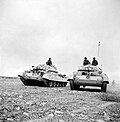
[[File:IWM-E-6724-Crusader-19411126.jpg|thumb|British Crusader tanks during the Operation Crusader, 26 November 1941.]] | |||
The new formation launched a new offensive, [[Operation Crusader]], in November. After a see-saw battle, the [[70th Infantry Division (United Kingdom)|70th Division]] garrisoning Tobruk was relieved and the Axis forces were forced to fall back. By January 1942, the [[front line]] was again at El Agheila. | |||
After receiving supplies and reinforcements from Tripoli, the Axis attacked again, defeating the Allies in the [[Battle of Gazala]] in June and [[Axis capture of Tobruk|capturing Tobruk]]. The Axis forces drove the Eighth Army back over the Egyptian border, but their advance was stopped in July only {{convert|90|mi|km|-1}} from [[Alexandria]] in the [[First Battle of El Alamein]]. | |||
Of great significance, on 29 June reports of British military operations in North Africa sent to Washington by the US military attaché in Cairo, [[Bonner Fellers]], no longer used the compromised [[Black (code)|"Black Code"]] which the Axis forces had been reading, so the Axis could no longer learn of British "strengths, positions, losses, reinforcements, supply, situation, plans, morale etc" as they had since 1940. | |||
General Auchinleck, although he had checked Rommel's advance at the First Battle of El Alamein, was replaced by General [[Harold Alexander]]. Lieutenant-General [[William Gott]] was promoted from XIII Corps commander to command of the entire Eighth Army, but he was killed when his aircraft was intercepted and shot down over Egypt. He was replaced by Lieutenant-General [[Bernard Montgomery]]. | |||
General Auchinleck, although he had checked Rommel's advance at the First Battle of El Alamein, was replaced by General [[Harold Alexander]]. Lieutenant-General [[William Gott]] was promoted from | |||
At the end of June, Axis forces made a second attempt to break through the Allied defences at El Alamein at [[Battle of Alam Halfa|Alam Halfa]], but were unsuccessful. After a lengthy period of build-up and training, the Eighth Army launched a major offensive, decisively defeating the Italian-German army in the [[Second Battle of El Alamein]] in late October, driving Axis forces west and capturing Tripoli in mid-January 1943. By February, the Eighth Army was facing the Italian-German ''Panzer'' Army near the [[Mareth Line]] and came under command of | At the end of June, Axis forces made a second attempt to break through the Allied defences at El Alamein at [[Battle of Alam Halfa|Alam Halfa]], but were unsuccessful. After a lengthy period of build-up and training, the Eighth Army launched a major offensive, decisively defeating the Italian-German army in the [[Second Battle of El Alamein]] in late October, driving Axis forces west and capturing Tripoli in mid-January 1943. By February, the Eighth Army was facing the Italian-German ''Panzer'' Army near the [[Mareth Line]] and came under command of Alexander's [[18th Army Group]] for the concluding phase of the war in North Africa{{Snd}}the [[Tunisian campaign|Tunisia campaign]]. | ||
==Operation Torch== | ==Operation Torch== | ||
{{Main|Operation Torch}} | {{Main|Operation Torch}} | ||
Operation Torch in November 1942 was a compromise operation that met the British objective of securing victory in North Africa while allowing [[United States Armed Forces|American armed forces]] the opportunity to engage in the fight against Nazi Germany on a limited scale. | [[File:American troops on board a landing craft heading for the beaches at Oran in Algeria during Operation 'Torch', November 1942. A12661.jpg|upright|thumb|American troops on board a [[Landing Craft Assault]] heading into [[Oran]], November 1942]] | ||
Operation Torch in November 1942 was a compromise operation that met the British objective of securing victory in North Africa while allowing [[United States Armed Forces|American armed forces]] the opportunity to engage in the fight against Nazi Germany on a limited scale.{{sfn|Willmott|1984|p={{page needed|date=November 2024}}}} In addition, as [[Joseph Stalin]], the leader of the [[Soviet Union]], had long been pleading for a second front to be opened to engage the Wehrmacht and relieve pressure on the [[Red Army]], it provided some degree of relief for the Red Army on the [[Eastern Front (World War II)|Eastern Front]] by diverting Axis forces to the North African theatre. Over half the German [[Junkers Ju 52|Ju 52]] transport planes that were needed to supply the [[Battle of Stalingrad#Sixth Army surrounded|encircled Axis forces at Stalingrad]] were tied up supplying Axis forces in North Africa.{{sfn|Hayward|1998||pp=[https://archive.org/details/stoppedatstaling0000hayw/page/219/mode/2up 219], [https://archive.org/details/stoppedatstaling0000hayw/page/248/mode/2up 248]}} | |||
Senior U.S. commanders were strongly opposed to proposed landings in North-West Africa. After the western Allied [[Combined Chiefs of Staff]] (CCS) met in London on 30 July 1942 General [[George Marshall]] and Admiral [[Ernest King]] declined to approve the plan. Marshall and other U.S. generals advocated the [[Operation Sledgehammer|invasion of northern Europe]] later that year, which the British rejected. | Senior U.S. commanders were strongly opposed to proposed landings in North-West Africa. After the western Allied [[Combined Chiefs of Staff]] (CCS) met in London on 30 July 1942 General [[George Marshall]] and Admiral [[Ernest King]] declined to approve the plan. Marshall and other U.S. generals advocated the [[Operation Sledgehammer|invasion of northern Europe]] later that year, which the British rejected.{{sfn|Zabecki|1999|p=1270}}{{sfn|Mackenzie|1999||pp=54–55}} After Prime Minister [[Winston Churchill]] pressed for a landing in [[French North Africa]] in 1942, Marshall suggested instead to President [[Franklin D. Roosevelt]] that the U.S. abandon the [[Germany first]] strategy and take the offensive in the Pacific. Roosevelt said it would do nothing to help Russia.{{sfn|Ward|Burns|2014|p=402}} With Marshall unable to persuade the British to change their minds,{{sfn|Frentzos|Thompson|2013|p=135}} President Roosevelt gave a direct order that [[Operation Torch]] was to have precedence over other operations and was to take place at the earliest possible date, one of only two direct orders he gave to military commanders during the war. | ||
The landings started on 8 November, and finished on 16 November. In an attempt to pincer German and Italian forces, Allied forces (American and British Commonwealth) landed in | The landings started on 8 November, and finished on 16 November. In an attempt to pincer German and Italian forces, Allied forces (American and British Commonwealth) landed in Vichy-held French North Africa under the assumption that there would be little to no resistance. Nevertheless, Vichy French forces put up a strong and bloody resistance to the Allies in [[Oran]] and [[Morocco]], but not in [[Algiers]], where a ''[[coup d'état]]'' by the French resistance on 8 November succeeded in neutralizing the [[19th Army Corps (France)|French XIX Corps]] before the landing and arresting the Vichy commanders. Consequently, the landings met no practical opposition in Algiers, and the city was captured on the first day along with the entire Vichy African command. After three days of talks and threats, Generals [[Mark W. Clark|Mark Clark]] and [[Dwight D. Eisenhower|Dwight Eisenhower]] compelled Vichy Admiral [[François Darlan]] and General [[Alphonse Juin]] to order the cessation on 10–11 November of armed resistance from Vichy forces in Oran and Morocco, promising to make Darlan the head of a Free French administration. During Operation Torch, Americans fought Vichy French and German navy vessels in the [[Naval Battle of Casablanca]], which ended in an American victory. | ||
The Allied landings prompted the Axis occupation of Vichy France ([[Case Anton]]) | The Allied landings prompted the Axis occupation of Vichy France ([[Case Anton]]) including an attempt to capture the French fleet at Toulon, which did them little good, as the [[Scuttling of the French fleet at Toulon|main portion of the fleet was scuttled]] to prevent their use by the Axis. | ||
The Vichy | The [[Vichy Army]] in North Africa joined the Allies. | ||
== Tunisian campaign == | == Tunisian campaign == | ||
{{Main|Tunisian campaign}} | {{Main|Tunisian campaign}} | ||
[[File:TigerITankTunis.jpg|thumb|left|Captured [[Tiger I]] tank #712 of the [[501st Heavy Panzer Battalion]]<ref>{{cite web |url=http://armorfortheages.com/MilitaryVehicles/TigerI/TigerI.html |title=AFTA Tiger I Page |work=armorfortheages.com |access-date=28 September | Following the Operation Torch landings – from early November 1942 – the Germans and Italians initiated a buildup of troops in Tunisia to fill the vacuum left by Vichy troops which had withdrawn. During this period of weakness, the Allies decided against a rapid advance into Tunisia while they wrestled with the Vichy authorities. Many of the Allied soldiers were tied up in garrison duties because of the uncertain status and intentions of the Vichy forces. | ||
By mid-November, the Allies were able to advance into Tunisia, but only in single division strength. By early December, the Eastern Task | |||
[[File:TigerITankTunis.jpg|thumb|left|Captured [[Tiger I]] tank #712 of the [[501st Heavy Panzer Battalion]]<ref>{{cite web |url=http://armorfortheages.com/MilitaryVehicles/TigerI/TigerI.html |title=AFTA Tiger I Page |work=armorfortheages.com |access-date=28 September 2016}}</ref>]] | |||
By mid-November, the Allies were able to advance into Tunisia, but only in single division strength. By early December, the Eastern Task Force – which had been redesignated as the [[First Army (United Kingdom)|British First Army]] under Lieutenant-General [[Kenneth Anderson (British Army officer)|Kenneth Anderson]] – was composed of the [[78th Infantry Division (United Kingdom)|British 78th Infantry Division]], [[6th Armoured Division (United Kingdom)|British 6th Armoured Division]], [[1st Parachute Brigade (United Kingdom)|1st Parachute Brigade]], [[No. 6 Commando]] and elements of [[1st Armored Division (United States)|US 1st Armored Division]]. But by this time, one German and five Italian divisions had been shipped from Europe and the remoteness of Allied airfields from the front line gave the Axis clear air superiority over the battlefield. The Allies were halted and pushed back having advanced eastwards to within {{convert|30|km|mi}} of Tunis. | |||
During the winter, there followed a period of stalemate during which time both sides continued to build up their forces. By the new year, the British First Army had one British, one US and one French Corps (a second British Corps headquarters was activated in April). In the second half of February, in eastern Tunisia, | In early December, the Allies were met with the reality that they would not be successful in capturing the key cities of Tunis and Bizerta. The air campaigns by the Axis forces proved to be a difficult challenge for the British forces. However, the Allies were left with the advantage of having secured the island of Malta, enabling the Allies to carry out future aerial operations. Additionally, on land, allied British and American forces were able to hold onto their possessions. On 4 December 1942 the Allied Force Headquarters in North Africa reported that military operations were ongoing in the Tebourba area. The Axis powers attempted a second counter-attack in the neighborhood of Tebourba, following their failed attempt on 1 December. The attack was successfully repulsed by the Allied powers, and the enemy sustained significant damage to their weaponry. During the winter, there followed a period of stalemate during which time both sides continued to build up their forces. By the new year, the British First Army had one British, one US and one French Corps (a second British Corps headquarters was activated in April). In the second half of February, in eastern Tunisia, the Axis had some successes against the mainly inexperienced French and US troops, most notably in routing the [[II Corps (United States)|US II Corps]] commanded by Major General [[Lloyd Fredendall]] at the [[Battle of Kasserine Pass]]. | ||
By the beginning of March, the [[Eighth Army (United Kingdom)|British Eighth Army]] | By the beginning of March, the [[Eighth Army (United Kingdom)|British Eighth Army]] – advancing westward along the North African coast – had reached the Tunisian border. Rommel and von Arnim found themselves in an Allied "two army" pincer. They were outflanked, outmanned and outgunned. Rommel went back to Germany for health reasons and was substituted by the Italian general [[Giovanni Messe|Messe]]. | ||
The British Eighth Army bypassed the Axis defence on the | The British Eighth Army bypassed the Axis defence on the Mareth Line in late March after harsh fighting{{citation needed|date=April 2022}} and First Army in central Tunisia launched their main offensive in mid-April to squeeze the Axis forces until their resistance in Africa collapsed. The Axis forces surrendered on 13 May 1943 yielding over 275,000 [[prisoners of war]]. The last Axis force to surrender in North Africa was the 1st Italian Army of General Messe.{{sfn|Walker|2006|p=193}} This huge loss of experienced troops greatly reduced the military capacity of the Axis powers, although some Axis troops escaped Tunisia. This defeat in Africa led to all Italian colonies in Africa being captured.{{Citation needed|date=August 2021}} | ||
== Intelligence == | == Intelligence == | ||
=== Axis === | === Axis === | ||
[[File:Bundesarchiv Bild 101I-443-1575-19A, Nordafrika, Schützenpanzer.jpg|thumb|A German Signals reception unit in the desert]] | [[File:Bundesarchiv Bild 101I-443-1575-19A, Nordafrika, Schützenpanzer.jpg|thumb|A German Signals reception unit in the desert]] | ||
The Axis had considerable success in intelligence gathering through radio communication intercepts and monitoring unit radio traffic. The most important success came through intercepting the reports of | The Axis had considerable success in intelligence gathering through radio communication intercepts and monitoring unit radio traffic. The most important success came through intercepting the reports of Fellers, the US military attaché in Egypt. He had been tasked by Marshall with providing detailed reports on the military situation in Africa.<ref name="Deac">{{cite web |url=http://www.historynet.com/intercepted-communications-for-field-marshal-erwin-rommel.htm/1 |title=Intercepted Communications for Field Marshal Erwin Rommel |author=Wil Deac |work=World War II Magazine |date=12 June 2006 |access-date=26 February 2013 |archive-date=3 March 2016 |archive-url=https://web.archive.org/web/20160303225443/http://www.historynet.com/intercepted-communications-for-field-marshal-erwin-rommel.htm/1 |url-status=dead}}</ref> Fellers talked with British military and civilian headquarters personnel, read documents and visited the battlefront. Known to the Germans as "die gute Quelle" (the good source) or more jokingly as 'the little fellow', he transmitted his reports back to Washington using the "Black Code" of the [[United States Department of State|US State Department]]. However, in September 1941, the Italians had stolen a code book containing the Black Code, photographed it and returned it to the US embassy in Rome.{{sfn|Lewin|1998|p=251}} The Italians shared parts of their intercepts with their German allies. In addition the "[[Cipher Department of the High Command of the Wehrmacht|Chiffrierabteilung]]" (German military cipher branch) were soon able to break the code. Fellers' reports were very detailed and played a significant role in informing the Germans of allied strength and intentions between January and June 1942 | ||
The Afrika Korps had the intelligence services of the 621st Signals Battalion mobile monitoring element which arrived in North Africa in late April 1941,{{sfn|Forty|1998|pp=97 | In addition, the Italian ''[[Servizio Informazioni Segrete]]'' or SIS code-breakers were able to successfully intercept much radio encrypted signals intelligence (SIGINT) from British aircraft traffic as well as first-class ciphers from British vessels and land bases, providing [[Supermarina]] (Regia Marina) with timely warnings of Allied intentions in the Mediterranean.{{sfn|O'Hara|Cernuschi|2013|p=119}} Indeed, so successful was the Italian SIS in handling the bulk of Axis naval intelligence in the Mediterranean, that "Britain's offensive use of SIGINT was largely negated by Italy's defensive SIGINT."{{sfn|O'Hara|Cernuschi|2013|p=135}} | ||
The Afrika Korps had the intelligence services of the 621st Signals Battalion mobile monitoring element which arrived in North Africa in late April 1941,{{sfn|Forty|1998|pp=97, 148}} commanded by Hauptmann Alfred Seeböhm. The 621st Signals Battalion monitored radio communications among British units. Unfortunately for the Allies, the British not only failed to change their codes with any frequency, they were also prone to poor radio discipline in combat. Their officers made frequent open, uncoded transmissions to their commands, allowing the Germans to more easily identify British units and deployments.<ref name="Deac" /> The situation changed after a counterattack during the Battle of Gazala resulted in the 621st Signals Battalion being overrun and destroyed, and a number of their documents captured, alerting British intelligence to the problem.{{sfn|Lewin|1998|p=252}} The British responded by instituting an improved call signal procedure, introducing radiotelephonic codes, imposing rigid wireless silence on reserve formations, padding out real messages with dummy traffic, tightening up on their radio discipline in combat and creating an entire fake signals network in the southern sector.{{sfn|Lewin|1998|p=252}} | |||
=== Allies === | === Allies === | ||
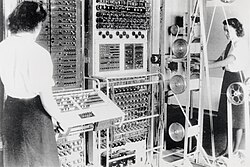
[[File:Colossus.jpg|thumb|Colossus Mark II computer at Bletchley Park]] | [[File:Colossus.jpg|thumb|[[Colossus computer|Colossus Mark II]] computer at [[Bletchley Park]]]] | ||
Allied codebreakers read much enciphered German message traffic, especially that encrypted with the [[Enigma machine]]. The Allies' [[Ultra (cryptography)|Ultra]] programme was initially of limited value, as it took too long to get the information to the commanders in the field, and at times provided information that was less than helpful. | Allied codebreakers read much enciphered German message traffic, especially that encrypted with the [[Enigma machine]]. The Allies' [[Ultra (cryptography)|Ultra]] programme was initially of limited value, as it took too long to get the information to the commanders in the field, and at times provided information that was less than helpful.{{refn|Quote: Protection of the top secret Ultra source meant that the distribution of Ultra was extremely slow and by the time it had reached the relevant commander it was often out of date and therefore at best useless and at worst dangerously mis-leading.[http://www.topedge.com/panels/ww2/na/intelligence.html "Intelligence in North Africa"] {{Webarchive|url=https://web.archive.org/web/20130124083841/http://www.topedge.com/panels/ww2/na/intelligence.html |date=24 January 2013 }}|group="nb"}} In terms of anticipating the next move the Germans would make, reliance on Ultra sometimes backfired. Part of the reason the initial German attacks in March 1941 were so successful was that Ultra intercepts had informed Wavell that OKW had clearly directed Rommel not to take any offensive action, but to wait until he was further reinforced with the 15th Panzer Division in May.{{refn|{{lang|de|Quote: Schuld an dieser Einschätzung sind die Enigma Berichte, aus denen Wavell ersehen kann, dass Rommel lediglich den Auftrag hat, die Syrte-Front zu stabilisieren, und dass sein wichtigster Verband, die 15. Panzerdivision, noch nicht in Afrika eingetroffen ist.}}[http://www.deutsches-afrikakorps.de/html/verlauf_maerz_1941.html ''Verlauf März 1941''] {{Webarchive|url=https://web.archive.org/web/20130205231844/http://www.deutsches-afrikakorps.de/html/verlauf_maerz_1941.html |date=5 February 2013 }}. In: ''Der Feldzug in Afrika 1941–1943'' (deutsches-afrikakorps.de). Retrieved 24 November 2009. Translated: The responsibility for this assessment are the Enigma reports, which can be seen from Wavell that Rommel only has a mandate to stabilize the Sirte front, and that his most important unit, the 15th Panzer Division, has not yet arrived in Africa.|group="nb"}} Rommel received this information, but placed more value on his own assessment of the situation. Trusting that the Germans had no intention of taking major action, the British command did not respond until it was too late.{{refn|Quote: On 30 March Wavell signalled, 'I do not believe he can make any big effort for another month.'{{sfn|Lewin|1998|p=33}}|group="nb"}} Furthermore, Rommel did not generally provide OKW or the Italian ''Comando Supremo'' details of his planned operations, for he thought the Italians too prone to leak the information. Thus on 21 January 1942, when Rommel struck out on his second offensive from El Agheila, ''Comando Supremo'' was just as surprised to learn of it as the British were.{{refn|Quote from Rommel's diary: I had maintained secrecy over the Panzer Group's forthcoming attack eastwards from Mersa el Brega and informed neither the Italian nor the German High Command. We knew from experience that Italian Headquarters cannot keep things to themselves and that everything they wireless to Rome gets round to British ears. However, I had arranged with the Quartermaster for the Panzer Group's order to be posted in every ''Cantoniera'' in Tripolitinia on 21 January ...{{sfn|Lewin|1998|pp=99–101}}|group="nb"}} Ultra intercepts provided the British with such information as the name of the new German commander, his time of arrival, and the numbers and condition of the Axis forces, but they might not correctly reveal Rommel's intentions. | ||
In: ''Der Feldzug in Afrika 1941–1943'' (deutsches-afrikakorps.de). Retrieved 24 November 2009 | |||
The primary benefit of Ultra intercepts to the effort in North Africa was to aid in cutting the Axis supply line to Tunisia. Ultra intercepts provided valuable information about the times and routes of Axis supply shipments across the Mediterranean. This was critical in providing the British with the opportunity to intercept and destroy them. During the time when Malta was under heavy air attack, the ability to act on this information was limited, but as Allied air and naval strength improved, the information became instrumental to Allied success. It is estimated that 40% to 60% of Axis supply shipping was located and destroyed due to decrypted information.<ref name="cl.cam.ac.uk">Kingsly, Sir Harry [http://www.cl.cam.ac.uk/research/security/Historical/hinsley.html "The Influence of ULTRA in the Second World War"] {{webarchive|url=https://web.archive.org/web/20110622015407/http://www.cl.cam.ac.uk/research/security/Historical/hinsley.html |date=22 June | [[File:Special Air Service in North Africa E 21337.jpg|thumb|right|British [[Special Air Service|SAS]] patrol in armed jeeps]] | ||
The primary benefit of Ultra intercepts to the effort in North Africa was to aid in cutting the Axis supply line to Tunisia. Ultra intercepts provided valuable information about the times and routes of Axis supply shipments across the Mediterranean. This was critical in providing the British with the opportunity to intercept and destroy them. During the time when Malta was under heavy air attack, the ability to act on this information was limited, but as Allied air and naval strength improved, the information became instrumental to Allied success. It is estimated that 40% to 60% of Axis supply shipping was located and destroyed due to decrypted information.<ref name="cl.cam.ac.uk">Kingsly, Sir Harry [http://www.cl.cam.ac.uk/research/security/Historical/hinsley.html "The Influence of ULTRA in the Second World War"] {{webarchive|url=https://web.archive.org/web/20110622015407/http://www.cl.cam.ac.uk/research/security/Historical/hinsley.html |date=22 June 2011}}</ref>{{sfn|Hinsley|1993|p={{page needed|date=November 2024}}}} However, this claim is strongly disputed by the authors [[Vincent P. O'Hara]] and Enrico Cernuschi (2013) who claim that historians like [[Harry Hinsley|F.H. Hinsley]] have greatly exaggerated the effects of Ultra. For example, they claim that intelligence provided by Ultra had little impact in stopping Italian convoys reaching North Africa. Of the 2.67 million tons of materiel, fuel, and munitions shipped to Africa – nearly all in Italian vessels and under Italian escort – 2.24 million tons managed to arrive despite the best efforts of Ultra and the British Navy to prevent it.{{sfn|O'Hara|Cernuschi|2013|p=118}} In effect, "Ultra did not deny the Axis armies the supplies they needed to reach the Nile."{{sfn|O'Hara|Cernuschi|2013|p=135}} | |||
Heavy losses of German paratroopers | Heavy losses of German paratroopers during the [[Battle of Crete]], made possible by Ultra warnings of the drop times and locations, meant that Hitler hesitated in attacking Malta,<ref>{{cite web |url=http://www.topedge.com/panels/ww2/na/intelligence.html |title=Intelligence in North Africa |work=topedge.com |access-date=28 September 2016}}</ref> which aided the British in gaining control of the Mediterranean, as did the losses of the Italian Navy at the [[Battle of Cape Matapan]].{{sfn|Hinsley|Stripp|1993|p=3}} To conceal the fact that German coded messages were being read, a fact critical to the overall Allied war effort, British command required a flyover mission be carried out before a convoy could be attacked in order to give the appearance that a reconnaissance flight had discovered the target. | ||
[[ | == Atrocities == | ||
{{See also|Jews outside Europe under Axis occupation}} | |||
The North African campaign was often labeled a "war without hate", a pure military clash in the desert without the partisan murders and [[ethnic cleansing]] that was occurring across Europe. This view has been challenged by recent historians, given that there were indeed many civilians who lived in the region and the campaign was marked by numerous atrocities and abuses by both Italian and German forces towards Allied prisoners of war and local [[The Holocaust|Jewish]], [[Berbers|Berber]], and Arab populations.{{sfnm|1a1=Citino|1y=2007|1p=116|2a1=Bernhard|2y=2012|2pp=425–446}} | |||
== Aftermath == | == Aftermath == | ||
[[File:Wehrmacht fuel barrel in Tunesia.jpg|thumb|upright|Wehrmacht fuel barrel in Tunisia, 2010]] | [[File:Wehrmacht fuel barrel in Tunesia.jpg|thumb|upright|Wehrmacht fuel barrel in Tunisia, 2010]] | ||
After victory by the Allies in the North African campaign, the stage was set for the [[Italian | After victory by the Allies in the North African campaign, the stage was set for the [[Italian campaign (World War II)|Italian campaign]] to begin. The [[Allied invasion of Sicily|invasion of Sicily]] followed two months later. Nearly 400,000 Axis and Allied troops were lost, injured or died of disease by the end of the North African campaign. | ||
== See also == | == See also == | ||
* [[List of British military equipment of World War II]] | * [[List of British military equipment of World War II]] | ||
* [[List of equipment of the United States Army during World War II]] | * [[List of equipment of the United States Army during World War II]] | ||
* [[List of French military equipment of World War II]] | * [[List of French military equipment of World War II]] | ||
* [[List of German military equipment of World War II]] | * [[List of German military equipment of World War II]] | ||
* [[List of Italian Army equipment in World War II]] | * [[List of Italian Army equipment in World War II]] | ||
* [[List of North African campaign battles]] | |||
* [[List of North African | |||
* [[North African campaign timeline]] | * [[North African campaign timeline]] | ||
* [[Timeline of World War II (1940)| | * Timelines of World War II by year: [[Timeline of World War II (1940)|1940]]{{\}}[[Timeline of World War II (1941)|1941]]{{\}}[[Timeline of World War II (1942)|1942]]{{\}}[[Timeline of World War II (1943)|1943]] | ||
* [[Libya in World War II]] | |||
* ''[[The Campaign for North Africa]]'', 1978 board game | |||
== Notes == | == Notes == | ||
| Line 210: | Line 200: | ||
== References == | == References == | ||
* {{Cite book |first=Rick |last=Atkinson |title=[[An Army at Dawn: The War in North Africa, 1942–1943]] |orig-year=2002 |year=2004 |publisher=Abacus |isbn=0-349-11636- | * {{Cite book |first=Rick |last=Atkinson |title=[[An Army at Dawn: The War in North Africa, 1942–1943]] |orig-year=2002 |year=2004 |publisher=Abacus |isbn=978-0-349-11636-5|author-link=Rick Atkinson}} | ||
* | * Custermen (2023). [https://www.worldmilitariaforum.com/forums/index.php?/topic/318521-marine-infantry-battalion-of-pacific-ww2/ Marine Infantry Battalion of Pacific WW2] Custermen (2023, July 20). Marine Infantry Battalion of Pacific WW2. World Militaria Forum. https://www.worldmilitariaforum.com/forums/index.php?%2Ftopic%2F318521-marine-infantry-battalion-of-pacific-ww2%2F | ||
* {{cite book |first=Eddy |last=Bauer |title=The history of World War II |edition=Revised and updated |orig-year=1984 |year=2000 |publisher=Silverdale |location=Great Britain |isbn=978-1-85605-552-9}} | * {{cite book |first=Eddy |last=Bauer |title=The history of World War II |edition=Revised and updated |orig-year=1984 |year=2000 |publisher=Silverdale |location=Great Britain |isbn=978-1-85605-552-9}} | ||
* {{cite book|last1=Baxter|first1=Colin F.|title=The War in North Africa, 1940–1943: A Selected Bibliography|date=1996|publisher=Greenwood Publishing Group|isbn=978-0-313-29120-3}} | |||
* {{cite journal |last=Bernhard |first=Patrick |date=1 December 2012 |title=Behind the Battle Lines: Italian Atrocities and the Persecution of Arabs, Berbers, and Jews in North Africa during World War II |journal=Holocaust and Genocide Studies |volume=26 |issue=3 |pages=425–446 |doi=10.1093/hgs/dcs054 |issn=8756-6583}} | |||
* {{cite book |first=Gregory |last=Blaxland |title=The Plain Cook and the Great Showman: The First and Eighth Armies in North Africa |year=1977 |publisher=William Kimber |location=London |isbn=0-7183-0386-5}} | |||
* {{cite book |first=Paul |last=Carell |author-link=Paul Carell |title=Le volpi del deserto. 1941–1943: le armate italo-tedesche in Africa settentrionale |trans-title=The wolves of the desert. 1941–1943: the Italo-German armies in North Africa |publisher=Bantam |location=New York |year=1960}} | * {{cite book |first=Paul |last=Carell |author-link=Paul Carell |title=Le volpi del deserto. 1941–1943: le armate italo-tedesche in Africa settentrionale |trans-title=The wolves of the desert. 1941–1943: the Italo-German armies in North Africa |publisher=Bantam |location=New York |year=1960}} | ||
* {{cite book |first=Raymond |last=Cartier |year=1975 |title=La Seconde Guerre Mondiale |trans-title=The Second World War |volume=4: January 1943 – June 1944 |publisher=Press Pocket |isbn=978-2-266-00004-8}} | |||
* {{cite book |last=Citino |first=Robert |author-link=Robert Citino| title=Death of the Wehrmacht: The German Campaigns of 1942 |year=2007 |publisher=University Press of Kansas |location=Lawrence, KS |isbn=978-0-70-062821-6}} | |||
* {{cite book |last=Forty |first=George |year=1998 |title=The Armies of Rommel |publisher=Arms and Armour Press |location=London |isbn=978-1-85409-379-0}} | * {{cite book |last=Forty |first=George |year=1998 |title=The Armies of Rommel |publisher=Arms and Armour Press |location=London |isbn=978-1-85409-379-0}} | ||
* {{cite book |first=Thomas L. |last=Jentz |title=Tank Combat in North Africa: The Opening Rounds, Operations Sonnenblume, Brevity, Skorpion and Battleaxe, February 1941 – June 1941 |publisher=Schiffer Publishing |year=1998 |isbn=0-7643-0226- | * {{cite book |first1=Christos |last1=Frentzos |first2=Antonio |last2=Thompson |title=Routledge Handbook of US Military and Diplomatic History |date=2013 |publisher=[[Taylor & Francis]] |isbn=978-1-135-07102-8 |location=[[Hoboken, New Jersey|Hoboken]] |url=https://books.google.com/books?id=VRiYAAAAQBAJ&pg=PA135 |access-date=2020-05-10 |via=[[Google Books]]}} | ||
* {{cite book |first=John |last=Keegan |author-link=John Keegan |title=Oxford Companion to World War II |publisher=Oxford University Press |year=2001 |isbn=0-19-280666- | * {{cite book |first=Joel S.A. |last=Hayward |author-link=Joel Hayward |title=[[Stopped at Stalingrad|Stopped at Stalingrad: The Luftwaffe and Hitler's Defeat in the East, 1942–1943]] |publisher=[[University Press of Kansas]] |location=[[Lawrence, Kansas|Lawrence]] |year=1998 |isbn=978-0-7006-1146-1}} | ||
* {{cite book |last=Hinsley |first=Francis Harry |author-link=Harry Hinsley |year=1993 |title=British intelligence in the Second World War |location=Cambridge |publisher=Cambridge University Press |isbn=978-0-521-44304-3}} | |||
* {{cite book |last1=Hinsley |first1=Francis Harry |author-link1=Harry Hinsley |last2=Stripp |first2=Alan |year=1993 |title=Codebreakers: The inside story of Bletchley Park |location=Oxford |publisher=Oxford University Press |isbn=978-0-19-280132-6}} | |||
* {{cite book |editor=Istat |year=1957 |title=Morti E Dispersi Per Cause Belliche Negli Anni 1940–45 |trans-title=Deaths and Missing from War Causes in the Years 1940–45 |language=it |location=Roma |publisher=Instituto Centrale Statistica |oclc=1146519178 }} | |||
* {{cite book |first=Thomas L. |last=Jentz |title=Tank Combat in North Africa: The Opening Rounds, Operations Sonnenblume, Brevity, Skorpion and Battleaxe, February 1941 – June 1941 |publisher=Schiffer Publishing |year=1998 |isbn=978-0-7643-0226-8}} | |||
* {{cite book |first=John |last=Keegan |author-link=John Keegan |title=Oxford Companion to World War II |publisher=Oxford University Press |year=2001 |isbn=978-0-19-280666-6}} | |||
* {{cite book |title=Tobruk 1941: Rommel's Opening Move |last=Latimer |first=Jon |publisher=Osprey |year=2001 |isbn=0-275-98287-4}} | |||
* {{cite book |last=Lewin |first=Ronald |year=1998 |orig-year=1968 |title=Rommel As Military Commander |publisher=B&N Books |location=New York |isbn=978-0-7607-0861-3 |url=https://archive.org/details/rommelasmilitary0000lewi}} | * {{cite book |last=Lewin |first=Ronald |year=1998 |orig-year=1968 |title=Rommel As Military Commander |publisher=B&N Books |location=New York |isbn=978-0-7607-0861-3 |url=https://archive.org/details/rommelasmilitary0000lewi}} | ||
* {{cite journal |last1=O'Hara |first1=Vincent |last2= | * {{cite book |last=Mackenzie |first=S.P. |author-link=Simon MacKenzie |title=The Second World War in Europe |date=1999 |publisher=[[Longman]] |location=London |isbn=978-1-317-86471-4 |url= https://archive.org/details/secondworldwarin0000mack/page/54/mode/2up |access-date=2020-05-10 |via=[[Internet Archive#Text collection|Internet Archive Book Reader]]}} | ||
* {{ | * {{cite book |title=Beda Fomm: The Classic Victory |last=Macksey |first=Major Kenneth |author-link=Kenneth Macksey |issue=Battle Book Number 22 |publisher=Ballantine |year=1971 |series=Ballantine's Illustrated History of the Violent Century |oclc=637460844}} | ||
* {{Cite book |last=Walker |first=Ian |title=Iron Hulls, Iron Hearts: Mussolini's Elite Armoured Divisions in North Africa |location=Ramsbury |publisher=Crowood |year=2006 |isbn=1-86126-839- | * {{cite book |first=Richard |last=Mead |title=Churchill's Lions: A Biographical Guide to the Key British Generals of World War II |year=2007 |publisher=Spellmount |location=Stroud |isbn=978-1-86227-431-0}} | ||
* {{Cite book |last=Willmott |first=H.P. |title=June, 1944 |year=1984 |publisher=Blandford Press |location=Poole, Dorset |isbn=0-7137-1446- | * {{cite journal |last1=O'Hara |first1=Vincent |last2=Cernuschi |first2=Enrico |title=The Other Ultra: Signal Intelligence and the Battle to Supply Rommel's Attack toward Suez |journal=Naval War College Review |date=Summer 2013 |volume=66 |issue=3 |pages=117–138}} | ||
* {{Cite web |url=https://www.pbs.org/thewar/detail_5211.htm |work=The War |title=North Africa (1940–1943) |first=David T. |last=Zabecki |year=2007 |publisher=PBS |access-date=8 September 2010 |archive-date=12 April 2010 |archive-url=https://web.archive.org/web/20100412233135/http://www.pbs.org/thewar/detail_5211.htm |url-status=dead}} | * {{cite book |first1=Major-General I.S.O. |last1=Playfair |author1-link=Ian Stanley Ord Playfair |first2=Brigadier C.J.C. |last2=Molony |first3=Captain F.C. [[Royal Navy|RN]] |last3=Flynn |first4=Group Captain T.P. |last4=Gleave |editor-last=Butler |editor-first=J.R.M |editor-link=James Ramsay Montagu Butler |title=The Mediterranean and Middle East: The Early Successes Against Italy (to May 1941) |publisher=Naval & Military Press |year=2004a |series=History of the Second World War, United Kingdom Military Series |volume=I |orig-year=1st. pub. [[HMSO]] 1954 |isbn=978-1-84574-065-8 |name-list-style=amp}} | ||
* {{cite book |first1=Major-General I.S.O. |last1=Playfair |author1-link=Ian Stanley Ord Playfair |first2=Brigadier C.J.C. |last2=Molony |first3=Captain F.C. [[Royal Navy|RN]] |last3=Flynn |first4=Group Captain T.P. |last4=Gleave |editor-last=Butler |editor-first=J.R.M |editor-link=James Ramsay Montagu Butler |title=The Mediterranean and Middle East: The Germans Come to the Help of Their Ally (1941) |publisher=Naval & Military Press |year=2004b |series=History of the Second World War, United Kingdom Military Series |volume=II |orig-year=1st. pub. HMSO 1956 |isbn=978-1-84574-066-5 |name-list-style=amp}} | |||
* {{Cite book |first1=Major-General I.S.O. |last1=Playfair |author1-link=Ian Stanley Ord Playfair |first2=Brigadier C.J.C. |last2=Molony |first3=Captain F.C. [[Royal Navy|RN]] |last3=Flynn |first4=Group Captain T.P. |last4=Gleave |editor-last=Butler |editor-first=J.R.M |editor-link=James Ramsay Montagu Butler |title=The Mediterranean and Middle East, Volume IV: The Destruction of the Axis Forces in Africa |series=History of the Second World War United Kingdom Military Series |orig-year=1st. pub. [[HMSO]] 1966 |year=2004c |location=Uckfield, UK |publisher=Naval & Military Press |isbn=978-1-84574-068-9 |name-list-style=amp}} | |||
* {{cite book |last= Porch |first= Douglas |author-link=Douglas Porch |title= The Path to Victory: The Mediterranean Theater in World War II |year= 2004 |publisher= Farrar, Straus and Giroux |location= New York |isbn = 978-0-374-20518-8}} | |||
* {{cite book |last=Rochat |first=Giorgio |series=Einaudi storia |number=5 |title=Le guerre italiane 1935–1943. Dall'impero d'Etiopia alla disfatta |trans-title=The Italian Wars 1935–1943: From the Empire of Ethiopia to Defeat |year=2005 |publisher=Einaudi |location=Torino |isbn=978-88-06-16118-7}} | |||
* {{Cite book|title=Iron Hulls Iron Hearts|last=Walker|first=Ian W.|publisher=The Crowood Press|year=2003|isbn=978-1-86126-646-0 |location=Trowbridge}} | |||
* {{Cite book |last=Walker |first=Ian |title=Iron Hulls, Iron Hearts: Mussolini's Elite Armoured Divisions in North Africa |location=Ramsbury |publisher=Crowood |year=2006 |isbn=978-1-86126-839-6}} | |||
* {{cite book |last1=Ward |first1=Geoffrey C. |title=The Roosevelts: An Intimate History |last2=Burns |first2=Ken |date=2014 |publisher=[[Alfred A. Knopf]] |location=New York |isbn=978-0-385-35306-9 |chapter=The Common Cause: 1939-1944 |chapter-url=https://books.google.com/books?id=V73CAwAAQBAJ&pg=PA402 |access-date=2020-05-10 |via=[[Google Books]]}} | |||
* {{Cite book |last=Willmott |first=H.P. |title=June, 1944 |year=1984 |publisher=Blandford Press |location=Poole, Dorset |isbn=978-0-7137-1446-3 |url=https://archive.org/details/june194400will}} | |||
* {{cite book |editor-first=David T. |editor-last=Zabecki |editor-link=David T. Zabecki |title=World War II in Europe : an encyclopedia |date=1999 |publisher=[[Garland Science|Garland Publishing]] |location=New York |isbn=978-0-8240-7029-8 |url=https://books.google.com/books?id=gYDN-UfehEEC&pg=PA1270 |access-date=2020-05-10 |via=[[Google Books]]}} | |||
* {{Cite web |url=https://www.pbs.org/thewar/detail_5211.htm |work=The War |title=North Africa (1940–1943) |editor-first=David T. |editor-last=Zabecki |editor-link=David T. Zabecki |year=2007 |publisher=PBS |access-date=8 September 2010 |archive-date=12 April 2010 |archive-url=https://web.archive.org/web/20100412233135/http://www.pbs.org/thewar/detail_5211.htm |url-status=dead}} | |||
*{{cite book |last=Shores |first=Christopher |last2=Massimello |first2=Giovanni |last3=Guest |first3=Russell |last4=Olynyk |first4=Frank |last5=Bock |first5=Winfried |date=2014 |title=A History of the Mediterranean Air War, 1940–1945. Volume 2: North African Desert, February 1942–March 1943 |url= |location= |publisher=Grub Street Publishing |page=181 |isbn= 9781910690970 |access-date=}} | |||
*{{cite book |last=Freivogel |first=Zvonimir |date=2022 |title=Warships of the Royal Yugoslav Navy 1918–1945 |url= |location= |publisher=Despot Infinitus |page= |isbn=978-953-8218-72-9 |access-date=}} | |||
*{{cite book |last=Smetana |first=Vit |last2=Geaney |first2=Kathleen |date= |title=Exile in London: The Experience of Czechoslovakia and the Other Occupied Nations, 1939–1945 |url= |location= |publisher=Charles University in Prague, Karolinum Press |page=116 |isbn= 8024637014 |access-date=}} | |||
== External links == | == External links == | ||
{{Commons category|2=North African campaign}} | {{Commons category|2=North African campaign}} | ||
{{Prone to spam|date=July | * [[German Federal Archives]]: [https://www.bundesarchiv.de/im-archiv-recherchieren/archivgut-recherchieren/nach-themen/der-afrika ''Der Afrikafeldzug''] | ||
{{Prone to spam|date=July 2020}} | |||
<!-- {{No more links}} | <!-- {{No more links}} | ||
Please be cautious adding more external links. | Please be cautious adding more external links. | ||
Wikipedia is not a collection of links and should not be used for advertising. | |||
Excessive or inappropriate links will be removed. | Excessive or inappropriate links will be removed. | ||
See [[ | See [[Wikipedia:External links]] and [[Wikipedia:Spam]] for details. | ||
If there are already suitable links, propose additions or replacements on | If there are already suitable links, propose additions or replacements on | ||
| Line 241: | Line 256: | ||
--> | --> | ||
* [http://www1.yadvashem.org/yv/en/education/newsletter/25/index.asp?WT.mc_id=wiki The Jews of North Africa and the Holocaust] {{Webarchive|url=https://web.archive.org/web/20130731230343/http://www.yadvashem.org/yv/en/education/newsletter/25/index.asp?WT.mc_id=wiki |date=31 July | * [http://www1.yadvashem.org/yv/en/education/newsletter/25/index.asp?WT.mc_id=wiki The Jews of North Africa and the Holocaust] {{Webarchive|url=https://web.archive.org/web/20130731230343/http://www.yadvashem.org/yv/en/education/newsletter/25/index.asp?WT.mc_id=wiki |date=31 July 2013}} an e-Newsletter for Holocaust educators by [[Yad Vashem]] | ||
* [https://www.bbc.co.uk/history/worldwars/wwtwo/launch_ani_north_africa_campaign.shtml BBC's flash video of the North African campaign] | * [https://www.bbc.co.uk/history/worldwars/wwtwo/launch_ani_north_africa_campaign.shtml BBC's flash video of the North African campaign] | ||
* [http://www.worldwar-2.net/timelines/war-in-the-desert/war-in-the-desert-index-1940.htm Timeline of the North African campaign] | * [http://www.worldwar-2.net/timelines/war-in-the-desert/war-in-the-desert-index-1940.htm Timeline of the North African campaign] | ||
Latest revision as of 01:03, 28 March 2026


.svg)
The North African campaign of World War II took place in North Africa from 11 June 1940 to 13 May 1943, fought between the Allies and the Axis powers. It included campaigns in the Libyan and Egyptian deserts (Western Desert campaign, Desert War), in Morocco and Algeria (Operation Torch), and in Tunisia (Tunisia campaign). The Allied war effort was dominated by the British Commonwealth and exiles from German-occupied Europe. The United States entered the war in December 1941 and began direct military assistance in North Africa on 11 May 1942.
Fighting in North Africa started with the British raids on Italian Libya on 11 June 1940 after Italy's entry into the Second World War on the German side. On 14 June, the British 11th Hussars and part of the 1st Royal Tank Regiment, (1st RTR) crossed the border from Egypt into Libya and captured Fort Capuzzo. This was followed by an Italian counter-offensive into Egypt and the capture of Sidi Barrani in September. The British recaptured Sidi Barrani in December during Operation Compass. The Italian 10th Army was destroyed and the German Afrika Korps was dispatched to North Africa in February 1941 in Operation Sonnenblume to reinforce the Italians and prevent an Axis defeat.
Battles for control of Libya and Egypt followed, with advances and retreats until the Second Battle of El Alamein in October 1942 when the Eighth Army (Lieutenant-General Bernard Montgomery) defeated the German–Italian Panzerarmee Afrika and forced its remnants into Tunisia. After Operation Torch, the Anglo-American landings in North-West Africa in November 1942 and fighting against Vichy France forces (which then changed sides), the Allies trapped about 250,000 German and Italian personnel in northern Tunisia, forcing their surrender in May 1943.
Information gleaned via British Ultra code-breaking was important in the Allied victory in North Africa. The Italian campaign followed, culminating in the downfall of the Fascist government in Italy and the elimination of Germany's main European ally. German and Italian forces committed atrocities against prisoners of war and Maghrebi Jews, Berbers and Arabs.
Western Desert campaign[edit | edit source]
On 10 May 1940, the Wehrmacht started the Battle of France (or Westfeldzug). Six weeks later, France surrendered. The Armistice at Compiègne took place on 22 June 1940 leaving the Vichy government in control of French territory not occupied by Germany. This included all of French North Africa. On 10 June, Italy aligned itself with Nazi Germany and declared war upon France and the United Kingdom.[17] Italian leader Benito Mussolini explicitly outlined in his declaration of war that this did not involve the war against Kingdom of Egypt, saying "Italy does not intend to drag into the conflict other peoples bordering her on land or on sea".[18] British forces (along with Indian and Rhodesian troops) based in Egypt were initially ordered to take defensive measures, but to avoid provocation as much as possible.[19] However, on 11 June the British started launching a series of raids against Italian positions in Libya.[20] Following the defeat of France on 25 June, Italian forces in Tripolitania – facing French troops based in Tunisia – redeployed to Cyrenaica to reinforce the Italian Tenth Army.[21] This, coupled with the steadily degrading equipment of the British forces, led General Archibald Wavell to order an end to the raids and place the defence of the Egyptian border with a small screening force.[22]
By 8 August, Mussolini ordered the Tenth Army to invade Egypt. Two days later, no invasion having been launched, Mussolini ordered Marshal Graziani that, the moment German forces launched Operation Sea Lion to invade Great Britain, he was to attack.[23] After German defeat in the Battle of Britain, the invasion never took place. On 8 September, the Italians – despite being hampered by a lack of transport, low levels of training among officers, and the state of its supporting equipment[21] – were ordered to invade Egypt the following day. The plan was to advance along the coastal road while limited armoured forces operated on the desert flank.[22] To counter the Italian advance, Wavell ordered his screening forces to harass the Italians and then fall back towards Mersa Matruh, where the main British infantry force was based. Positioned on the desert flank was the 7th Armoured Division, which would strike at the flank of the Italian force.[24][25]
.jpg)
By 16 September, the Italian force had advanced to Maktila, around 130 kilometres (80 mi) west of Mersa Matruh, where they halted due to supply problems.[26] Despite Mussolini urging them to carry on, Graziani ordered his men to dig in around Sidi Barrani, and fortified camps were established in forward locations; additional troops were also positioned behind the main force.[27] In response to the dispersed Italian camps, the British planned a limited five-day attack, Operation Compass, to strike at these fortified camps one by one.[28][29] The British Commonwealth force, totalling 36,000 men,[30] attacked the forward elements of the 10-division-strong Italian army on 9 December.[31] Following their initial success, the forces of Operation Compass[32] pursued the retreating Italian forces.[33] In January, the small port at Bardia was taken,[34] soon followed by the seizure of the fortified port of Tobruk.[35]
Some 40,000 Italians were captured in and around the two ports, with the remainder of the Tenth Army retreating along the coast road back to El Agheila. Richard O'Connor sent the 7th Armoured Division across the desert with a small reconnaissance group. It reached Beda Fomm some ninety minutes before the Italians, cutting off their retreat. Although they tried desperately to overcome the British force at the Battle of Beda Fomm, the Italians were unable to break through, and the remnants of the retreating army surrendered. Over ten weeks Allied forces had destroyed the Italian Tenth Army and reached El Agheila, taking 130,000 prisoners of war in the process.[36][37][38]
Mussolini requested help from his German allies, while the Italian Comando Supremo ("high command") speedily sent several large motorized and armoured forces to protect their colonies in North Africa.[39] This greatly expanded reinforcement included the soon-to-be-renowned Ariete Armoured division under General Ettore Baldassarre.[40] Meanwhile, the Germans hastily assembled a motorized force, whose lead elements arrived in Tripoli in February. This relatively small expeditionary force, termed the Afrika Korps by Adolf Hitler, was placed under the command of Erwin Rommel. His orders were to reinforce the Italians and block Allied attempts to drive them out of the region.[41][42] However, the initial commitment of only one panzer division and subsequently, no more than two panzer and one motorized divisions, indicated the limited extent of German involvement and commitment to this theatre of operations.[40] The bulk of the reinforcements were Italian and therefore it was up to the Italians to do the bulk of the fighting. The forward Allied force – now named XIII Corps – adopted a defensive posture and over the coming months was built up, before most of its veteran forces were redeployed to Greece to counter the German invasion there. In addition, the 7th Armoured Division was withdrawn to the Nile delta.[43][44][45] The veteran forces were replaced by inexperienced newcomers, ill-equipped to face German armour.[46]

Although Rommel had been ordered to simply hold the line, an armoured reconnaissance soon became a full-fledged offensive from El Agheila in March.[41][42] In March–April, Allied forces were forced back[47] and leading general officers captured. The Australian 9th Infantry Division fell back to the fortress port of Tobruk,[48] and the remaining British and Commonwealth forces withdrew a further 160 kilometres (100 mi) east to the Libyan–Egyptian border.[49] With Tobruk under siege by the main Italian-German force, a small battlegroup continued to press eastwards. Capturing Fort Capuzzo and Bardia in passing, it then advanced into Egypt, and by the end of April it had taken Sollum and the tactically important Halfaya Pass. Rommel garrisoned these positions, reinforcing the battle-group and ordering it onto the defensive.[50][51]
Though isolated on land, Tobruk's garrison continued to receive supplies and replacements, delivered by the Royal Navy at night. German and Italian forces did not have the strength or training to take the fortress. This created a supply problem for his forward units. His front-line positions at Sollum were at the end of an extended supply chain that stretched back to Tripoli and had to bypass the coast road at Tobruk. Further, he was constantly threatened with a breakout of the British forces at Tobruk.[52] Without Tobruk in Axis hands, further advances into Egypt were impractical.[53][54]
The Allies launched a small-scale counter-attack called Operation Brevity in an attempt to push Axis forces off the key passes at the border, with some initial success. However they could not hold the advance positions and followed Brevity up with a much larger-scale offensive, Operation Battleaxe intended to relieve the siege at Tobruk, but this operation also failed. Following the failure of Operation Battleaxe, Archibald Wavell was relieved of command and replaced by Claude Auchinleck. The Western Desert Force was reinforced with a second corps, XXX Corps, with the two corps forming the Eighth Army. Eighth Army was made up of army forces from the Commonwealth nations, including the British Army, the Australian Army, the Indian Army, the New Zealand Army, the South African Army, and the Sudan Defence Force. There was also a brigade of Free French under Marie-Pierre Koenig.

The new formation launched a new offensive, Operation Crusader, in November. After a see-saw battle, the 70th Division garrisoning Tobruk was relieved and the Axis forces were forced to fall back. By January 1942, the front line was again at El Agheila.
After receiving supplies and reinforcements from Tripoli, the Axis attacked again, defeating the Allies in the Battle of Gazala in June and capturing Tobruk. The Axis forces drove the Eighth Army back over the Egyptian border, but their advance was stopped in July only 90 miles (140 km) from Alexandria in the First Battle of El Alamein.
Of great significance, on 29 June reports of British military operations in North Africa sent to Washington by the US military attaché in Cairo, Bonner Fellers, no longer used the compromised "Black Code" which the Axis forces had been reading, so the Axis could no longer learn of British "strengths, positions, losses, reinforcements, supply, situation, plans, morale etc" as they had since 1940.
General Auchinleck, although he had checked Rommel's advance at the First Battle of El Alamein, was replaced by General Harold Alexander. Lieutenant-General William Gott was promoted from XIII Corps commander to command of the entire Eighth Army, but he was killed when his aircraft was intercepted and shot down over Egypt. He was replaced by Lieutenant-General Bernard Montgomery.
At the end of June, Axis forces made a second attempt to break through the Allied defences at El Alamein at Alam Halfa, but were unsuccessful. After a lengthy period of build-up and training, the Eighth Army launched a major offensive, decisively defeating the Italian-German army in the Second Battle of El Alamein in late October, driving Axis forces west and capturing Tripoli in mid-January 1943. By February, the Eighth Army was facing the Italian-German Panzer Army near the Mareth Line and came under command of Alexander's 18th Army Group for the concluding phase of the war in North Africa – the Tunisia campaign.
Operation Torch[edit | edit source]

Operation Torch in November 1942 was a compromise operation that met the British objective of securing victory in North Africa while allowing American armed forces the opportunity to engage in the fight against Nazi Germany on a limited scale.[55] In addition, as Joseph Stalin, the leader of the Soviet Union, had long been pleading for a second front to be opened to engage the Wehrmacht and relieve pressure on the Red Army, it provided some degree of relief for the Red Army on the Eastern Front by diverting Axis forces to the North African theatre. Over half the German Ju 52 transport planes that were needed to supply the encircled Axis forces at Stalingrad were tied up supplying Axis forces in North Africa.[56]
Senior U.S. commanders were strongly opposed to proposed landings in North-West Africa. After the western Allied Combined Chiefs of Staff (CCS) met in London on 30 July 1942 General George Marshall and Admiral Ernest King declined to approve the plan. Marshall and other U.S. generals advocated the invasion of northern Europe later that year, which the British rejected.[57][58] After Prime Minister Winston Churchill pressed for a landing in French North Africa in 1942, Marshall suggested instead to President Franklin D. Roosevelt that the U.S. abandon the Germany first strategy and take the offensive in the Pacific. Roosevelt said it would do nothing to help Russia.[59] With Marshall unable to persuade the British to change their minds,[60] President Roosevelt gave a direct order that Operation Torch was to have precedence over other operations and was to take place at the earliest possible date, one of only two direct orders he gave to military commanders during the war.
The landings started on 8 November, and finished on 16 November. In an attempt to pincer German and Italian forces, Allied forces (American and British Commonwealth) landed in Vichy-held French North Africa under the assumption that there would be little to no resistance. Nevertheless, Vichy French forces put up a strong and bloody resistance to the Allies in Oran and Morocco, but not in Algiers, where a coup d'état by the French resistance on 8 November succeeded in neutralizing the French XIX Corps before the landing and arresting the Vichy commanders. Consequently, the landings met no practical opposition in Algiers, and the city was captured on the first day along with the entire Vichy African command. After three days of talks and threats, Generals Mark Clark and Dwight Eisenhower compelled Vichy Admiral François Darlan and General Alphonse Juin to order the cessation on 10–11 November of armed resistance from Vichy forces in Oran and Morocco, promising to make Darlan the head of a Free French administration. During Operation Torch, Americans fought Vichy French and German navy vessels in the Naval Battle of Casablanca, which ended in an American victory.
The Allied landings prompted the Axis occupation of Vichy France (Case Anton) including an attempt to capture the French fleet at Toulon, which did them little good, as the main portion of the fleet was scuttled to prevent their use by the Axis.
The Vichy Army in North Africa joined the Allies.
Tunisian campaign[edit | edit source]
Following the Operation Torch landings – from early November 1942 – the Germans and Italians initiated a buildup of troops in Tunisia to fill the vacuum left by Vichy troops which had withdrawn. During this period of weakness, the Allies decided against a rapid advance into Tunisia while they wrestled with the Vichy authorities. Many of the Allied soldiers were tied up in garrison duties because of the uncertain status and intentions of the Vichy forces.

By mid-November, the Allies were able to advance into Tunisia, but only in single division strength. By early December, the Eastern Task Force – which had been redesignated as the British First Army under Lieutenant-General Kenneth Anderson – was composed of the British 78th Infantry Division, British 6th Armoured Division, 1st Parachute Brigade, No. 6 Commando and elements of US 1st Armored Division. But by this time, one German and five Italian divisions had been shipped from Europe and the remoteness of Allied airfields from the front line gave the Axis clear air superiority over the battlefield. The Allies were halted and pushed back having advanced eastwards to within 30 kilometres (19 mi) of Tunis.
In early December, the Allies were met with the reality that they would not be successful in capturing the key cities of Tunis and Bizerta. The air campaigns by the Axis forces proved to be a difficult challenge for the British forces. However, the Allies were left with the advantage of having secured the island of Malta, enabling the Allies to carry out future aerial operations. Additionally, on land, allied British and American forces were able to hold onto their possessions. On 4 December 1942 the Allied Force Headquarters in North Africa reported that military operations were ongoing in the Tebourba area. The Axis powers attempted a second counter-attack in the neighborhood of Tebourba, following their failed attempt on 1 December. The attack was successfully repulsed by the Allied powers, and the enemy sustained significant damage to their weaponry. During the winter, there followed a period of stalemate during which time both sides continued to build up their forces. By the new year, the British First Army had one British, one US and one French Corps (a second British Corps headquarters was activated in April). In the second half of February, in eastern Tunisia, the Axis had some successes against the mainly inexperienced French and US troops, most notably in routing the US II Corps commanded by Major General Lloyd Fredendall at the Battle of Kasserine Pass.
By the beginning of March, the British Eighth Army – advancing westward along the North African coast – had reached the Tunisian border. Rommel and von Arnim found themselves in an Allied "two army" pincer. They were outflanked, outmanned and outgunned. Rommel went back to Germany for health reasons and was substituted by the Italian general Messe.
The British Eighth Army bypassed the Axis defence on the Mareth Line in late March after harsh fighting[citation needed] and First Army in central Tunisia launched their main offensive in mid-April to squeeze the Axis forces until their resistance in Africa collapsed. The Axis forces surrendered on 13 May 1943 yielding over 275,000 prisoners of war. The last Axis force to surrender in North Africa was the 1st Italian Army of General Messe.[62] This huge loss of experienced troops greatly reduced the military capacity of the Axis powers, although some Axis troops escaped Tunisia. This defeat in Africa led to all Italian colonies in Africa being captured.[citation needed]
Intelligence[edit | edit source]
Axis[edit | edit source]

The Axis had considerable success in intelligence gathering through radio communication intercepts and monitoring unit radio traffic. The most important success came through intercepting the reports of Fellers, the US military attaché in Egypt. He had been tasked by Marshall with providing detailed reports on the military situation in Africa.[63] Fellers talked with British military and civilian headquarters personnel, read documents and visited the battlefront. Known to the Germans as "die gute Quelle" (the good source) or more jokingly as 'the little fellow', he transmitted his reports back to Washington using the "Black Code" of the US State Department. However, in September 1941, the Italians had stolen a code book containing the Black Code, photographed it and returned it to the US embassy in Rome.[64] The Italians shared parts of their intercepts with their German allies. In addition the "Chiffrierabteilung" (German military cipher branch) were soon able to break the code. Fellers' reports were very detailed and played a significant role in informing the Germans of allied strength and intentions between January and June 1942
In addition, the Italian Servizio Informazioni Segrete or SIS code-breakers were able to successfully intercept much radio encrypted signals intelligence (SIGINT) from British aircraft traffic as well as first-class ciphers from British vessels and land bases, providing Supermarina (Regia Marina) with timely warnings of Allied intentions in the Mediterranean.[65] Indeed, so successful was the Italian SIS in handling the bulk of Axis naval intelligence in the Mediterranean, that "Britain's offensive use of SIGINT was largely negated by Italy's defensive SIGINT."[66]
The Afrika Korps had the intelligence services of the 621st Signals Battalion mobile monitoring element which arrived in North Africa in late April 1941,[67] commanded by Hauptmann Alfred Seeböhm. The 621st Signals Battalion monitored radio communications among British units. Unfortunately for the Allies, the British not only failed to change their codes with any frequency, they were also prone to poor radio discipline in combat. Their officers made frequent open, uncoded transmissions to their commands, allowing the Germans to more easily identify British units and deployments.[63] The situation changed after a counterattack during the Battle of Gazala resulted in the 621st Signals Battalion being overrun and destroyed, and a number of their documents captured, alerting British intelligence to the problem.[68] The British responded by instituting an improved call signal procedure, introducing radiotelephonic codes, imposing rigid wireless silence on reserve formations, padding out real messages with dummy traffic, tightening up on their radio discipline in combat and creating an entire fake signals network in the southern sector.[68]
Allies[edit | edit source]

Allied codebreakers read much enciphered German message traffic, especially that encrypted with the Enigma machine. The Allies' Ultra programme was initially of limited value, as it took too long to get the information to the commanders in the field, and at times provided information that was less than helpful.[nb 8] In terms of anticipating the next move the Germans would make, reliance on Ultra sometimes backfired. Part of the reason the initial German attacks in March 1941 were so successful was that Ultra intercepts had informed Wavell that OKW had clearly directed Rommel not to take any offensive action, but to wait until he was further reinforced with the 15th Panzer Division in May.[nb 9] Rommel received this information, but placed more value on his own assessment of the situation. Trusting that the Germans had no intention of taking major action, the British command did not respond until it was too late.[nb 10] Furthermore, Rommel did not generally provide OKW or the Italian Comando Supremo details of his planned operations, for he thought the Italians too prone to leak the information. Thus on 21 January 1942, when Rommel struck out on his second offensive from El Agheila, Comando Supremo was just as surprised to learn of it as the British were.[nb 11] Ultra intercepts provided the British with such information as the name of the new German commander, his time of arrival, and the numbers and condition of the Axis forces, but they might not correctly reveal Rommel's intentions.

The primary benefit of Ultra intercepts to the effort in North Africa was to aid in cutting the Axis supply line to Tunisia. Ultra intercepts provided valuable information about the times and routes of Axis supply shipments across the Mediterranean. This was critical in providing the British with the opportunity to intercept and destroy them. During the time when Malta was under heavy air attack, the ability to act on this information was limited, but as Allied air and naval strength improved, the information became instrumental to Allied success. It is estimated that 40% to 60% of Axis supply shipping was located and destroyed due to decrypted information.[71][72] However, this claim is strongly disputed by the authors Vincent P. O'Hara and Enrico Cernuschi (2013) who claim that historians like F.H. Hinsley have greatly exaggerated the effects of Ultra. For example, they claim that intelligence provided by Ultra had little impact in stopping Italian convoys reaching North Africa. Of the 2.67 million tons of materiel, fuel, and munitions shipped to Africa – nearly all in Italian vessels and under Italian escort – 2.24 million tons managed to arrive despite the best efforts of Ultra and the British Navy to prevent it.[73] In effect, "Ultra did not deny the Axis armies the supplies they needed to reach the Nile."[66]
Heavy losses of German paratroopers during the Battle of Crete, made possible by Ultra warnings of the drop times and locations, meant that Hitler hesitated in attacking Malta,[74] which aided the British in gaining control of the Mediterranean, as did the losses of the Italian Navy at the Battle of Cape Matapan.[75] To conceal the fact that German coded messages were being read, a fact critical to the overall Allied war effort, British command required a flyover mission be carried out before a convoy could be attacked in order to give the appearance that a reconnaissance flight had discovered the target.
Atrocities[edit | edit source]
The North African campaign was often labeled a "war without hate", a pure military clash in the desert without the partisan murders and ethnic cleansing that was occurring across Europe. This view has been challenged by recent historians, given that there were indeed many civilians who lived in the region and the campaign was marked by numerous atrocities and abuses by both Italian and German forces towards Allied prisoners of war and local Jewish, Berber, and Arab populations.[76]
Aftermath[edit | edit source]

After victory by the Allies in the North African campaign, the stage was set for the Italian campaign to begin. The invasion of Sicily followed two months later. Nearly 400,000 Axis and Allied troops were lost, injured or died of disease by the end of the North African campaign.
See also[edit | edit source]
- List of British military equipment of World War II
- List of equipment of the United States Army during World War II
- List of French military equipment of World War II
- List of German military equipment of World War II
- List of Italian Army equipment in World War II
- List of North African campaign battles
- North African campaign timeline
- Timelines of World War II by year: 1940 / 1941 / 1942 / 1943
- Libya in World War II
- The Campaign for North Africa, 1978 board game
Notes[edit | edit source]
Footnotes[edit | edit source]
- ↑ 1.0 1.1 1.2 1.3 November 1942 to May 1943.
- ↑ The Royal Yugoslav Army Outside the Homeland consisted of over 1,000 officers and soldiers of the Royal Yugoslav Army, Air Force, and Navy who escaped the Axis Invasion of Yugoslavia in April 1941 and subsequently participated in the Western Desert Campaign. This was the only part of the Royal Yugoslav Army that remained under the direct command of the Yugoslav government-in-exile in Cairo.
- ↑ 3.0 3.1 3.2 3.3 8–11 November 1942. Vichy officially pursued a policy of armed neutrality and conducted military actions against armed incursions from Axis and Allied belligerents. The pledging of allegiance of the Vichy troops in French North Africa to the Allies convinced the Axis that Vichy could not be trusted to continue this policy, so they invaded and occupied the French rump state (Case Anton)
- ↑ Darlan joined the Allies after Operation Torch in Nov. 1942 but was later assassinated due to his former allegiance to Vichy France.
- ↑ 500,000 prisoners are listed as being taken in North Africa, East Africa, and Sicily; as 150,000 POWs were taken in the Allied invasion of Sicily and about 100,000 in East Africa, this would leave ~250,000 to be taken in North Africa; 130,000 during Operation Compass, and 120,000 afterwards.[12]
- ↑ Historian Giorgio Rochat wrote:
Considering that about 100,000 Italian prisoners were taken in East Africa and that prisoners taken by the Americans were mainly in Sicily, the total is around 340,000–350,000.[citation needed]Sono circa 400.000 i prigionieri fatti dagli inglesi in Etiopia e in Africa settentrionale, 125.000 presi dagli americani in Tunisia e in Sicilia, 40.000 lasciati ai francesi in Tunisia ("There were about 400,000 prisoners taken by the British in North Africa and in Ethiopia, 125,000 taken by the Americans in Tunisia and Sicily, 40,000 by the French in Tunisia")[13]
- ↑ During Operation Torch only (8–16 November 1942).
- ↑ Quote: Protection of the top secret Ultra source meant that the distribution of Ultra was extremely slow and by the time it had reached the relevant commander it was often out of date and therefore at best useless and at worst dangerously mis-leading."Intelligence in North Africa" Archived 24 January 2013 at the Wayback Machine
- ↑ Quote: Schuld an dieser Einschätzung sind die Enigma Berichte, aus denen Wavell ersehen kann, dass Rommel lediglich den Auftrag hat, die Syrte-Front zu stabilisieren, und dass sein wichtigster Verband, die 15. Panzerdivision, noch nicht in Afrika eingetroffen ist.Verlauf März 1941 Archived 5 February 2013 at the Wayback Machine. In: Der Feldzug in Afrika 1941–1943 (deutsches-afrikakorps.de). Retrieved 24 November 2009. Translated: The responsibility for this assessment are the Enigma reports, which can be seen from Wavell that Rommel only has a mandate to stabilize the Sirte front, and that his most important unit, the 15th Panzer Division, has not yet arrived in Africa.
- ↑ Quote: On 30 March Wavell signalled, 'I do not believe he can make any big effort for another month.'[69]
- ↑ Quote from Rommel's diary: I had maintained secrecy over the Panzer Group's forthcoming attack eastwards from Mersa el Brega and informed neither the Italian nor the German High Command. We knew from experience that Italian Headquarters cannot keep things to themselves and that everything they wireless to Rome gets round to British ears. However, I had arranged with the Quartermaster for the Panzer Group's order to be posted in every Cantoniera in Tripolitinia on 21 January ...[70]
Citations[edit | edit source]
- ↑ Higgins, Jenny (2007). "Royal Artillery". Newfoundland Heritage Web Site.
- ↑ man, Custer (2021). "Battalion De Pacifique". World Militaria Forum.
- ↑ man, Custer (2021). "Battalion De Pacifique". World Militaria Forum.
- ↑ man, Custerman (2021). "Battalion De Pacifique". World Militaria Forum.
- ↑ Self-governance from 1942
- ↑ Carell 1960, p. 597.
- ↑ Zabecki 2007, North Africa.
- ↑ Cartier 1975, p. 40.
- ↑ Playfair et al. 2004c, p. 460. United States losses from 12 November 1942.
- ↑ Atkinson 2004, p. 536.
- ↑ Istat 1957, p. [page needed].
- ↑ Baxter 1996, p. 38.
- ↑ Rochat 2005, p. 446.
- ↑ Carell 1960, p. 596.
- ↑ Barclay, Mediterranean Operations
- ↑ Porch 2004, p. 415.
- ↑ Playfair et al. 2004a, p. 109.
- ↑ "Mussolini: Speech of the 10 June 1940, Declaration of War on France and England". 19 September 2008. Retrieved 21 September 2025.
- ↑ Playfair et al. 2004a, p. 41.
- ↑ Churchill, p. 371
- ↑ 21.0 21.1 Macksey 1971, p. 25.
- ↑ 22.0 22.1 Macksey 1971, p. 38.
- ↑ Macksey 1971, p. 35.
- ↑ Macksey 1971, p. 40.
- ↑ Playfair et al. 2004a, pp. 209–210.
- ↑ Macksey 1971, p. 47.
- ↑ Macksey 1971, p. 68.
- ↑ Wavell "No. 37628". The London Gazette (1st supplement). 25 June 1946. p. 3261.
- ↑ Playfair et al. 2004a, pp. 260–261, 264.
- ↑ Bauer 2000, p. 95.
- ↑ Playfair et al. 2004a, p. 267.
- ↑ Mead 2007, p. 331.
- ↑ Playfair et al. 2004a, p. 271.
- ↑ Playfair et al. 2004a, pp. 286–287.
- ↑ Dunn, Jimmy. "World War II's Opening Salvoes in North Africa". Tour Egypt.
- ↑ Playfair et al. 2004a, p. 358.
- ↑ "Fall of Bengasi". Time. No. 17 February 1941. 17 February 1941. Archived from the original on 26 June 2010. Retrieved 17 December 2007.
- ↑ Wavell in "No. 37628". The London Gazette (1st supplement). 25 June 1946. p. 3268.
- ↑ Bauer 2000, p. 121.
- ↑ 40.0 40.1 Walker 2003, p. 67.
- ↑ 41.0 41.1 Jentz 1998, p. 82.
- ↑ 42.0 42.1 Rommel, p. 109
- ↑ Playfair et al. 2004a, p. 289.
- ↑ Playfair et al. 2004b, p. 2.
- ↑ Jentz 1998, p. 85.
- ↑ Playfair et al. 2004b, pp. 2–5.
- ↑ Playfair et al. 2004b, p. 19–40.
- ↑ Latimer 2001, pp. 43–45.
- ↑ Playfair et al. 2004b, pp. 33–35.
- ↑ Playfair et al. 2004b, p. 160.
- ↑ Jentz 1998, pp. 128–129, 131.
- ↑ Latimer 2001, pp. 48–64.
- ↑ Playfair et al. 2004b, p. 41.
- ↑ Jentz 1998, p. 128.
- ↑ Willmott 1984, p. [page needed].
- ↑ Hayward 1998, pp. 219, 248.
- ↑ Zabecki 1999, p. 1270.
- ↑ Mackenzie 1999, pp. 54–55.
- ↑ Ward & Burns 2014, p. 402.
- ↑ Frentzos & Thompson 2013, p. 135.
- ↑ "AFTA Tiger I Page". armorfortheages.com. Retrieved 28 September 2016.
- ↑ Walker 2006, p. 193.
- ↑ 63.0 63.1 Wil Deac (12 June 2006). "Intercepted Communications for Field Marshal Erwin Rommel". World War II Magazine. Archived from the original on 3 March 2016. Retrieved 26 February 2013.
- ↑ Lewin 1998, p. 251.
- ↑ O'Hara & Cernuschi 2013, p. 119.
- ↑ 66.0 66.1 O'Hara & Cernuschi 2013, p. 135.
- ↑ Forty 1998, pp. 97, 148.
- ↑ 68.0 68.1 Lewin 1998, p. 252.
- ↑ Lewin 1998, p. 33.
- ↑ Lewin 1998, pp. 99–101.
- ↑ Kingsly, Sir Harry "The Influence of ULTRA in the Second World War" Archived 22 June 2011 at the Wayback Machine
- ↑ Hinsley 1993, p. [page needed].
- ↑ O'Hara & Cernuschi 2013, p. 118.
- ↑ "Intelligence in North Africa". topedge.com. Retrieved 28 September 2016.
- ↑ Hinsley & Stripp 1993, p. 3.
- ↑ Citino 2007, p. 116; Bernhard 2012, pp. 425–446.
References[edit | edit source]
- Atkinson, Rick (2004) [2002]. An Army at Dawn: The War in North Africa, 1942–1943. Abacus. ISBN 978-0-349-11636-5.
- Custermen (2023). Marine Infantry Battalion of Pacific WW2 Custermen (2023, July 20). Marine Infantry Battalion of Pacific WW2. World Militaria Forum. https://www.worldmilitariaforum.com/forums/index.php?%2Ftopic%2F318521-marine-infantry-battalion-of-pacific-ww2%2F
- Bauer, Eddy (2000) [1984]. The history of World War II (Revised and updated ed.). Great Britain: Silverdale. ISBN 978-1-85605-552-9.
- Baxter, Colin F. (1996). The War in North Africa, 1940–1943: A Selected Bibliography. Greenwood Publishing Group. ISBN 978-0-313-29120-3.
- Bernhard, Patrick (1 December 2012). "Behind the Battle Lines: Italian Atrocities and the Persecution of Arabs, Berbers, and Jews in North Africa during World War II". Holocaust and Genocide Studies. 26 (3): 425–446. doi:10.1093/hgs/dcs054. ISSN 8756-6583.
- Blaxland, Gregory (1977). The Plain Cook and the Great Showman: The First and Eighth Armies in North Africa. London: William Kimber. ISBN 0-7183-0386-5.
- Carell, Paul (1960). Le volpi del deserto. 1941–1943: le armate italo-tedesche in Africa settentrionale [The wolves of the desert. 1941–1943: the Italo-German armies in North Africa]. New York: Bantam.
- Cartier, Raymond (1975). La Seconde Guerre Mondiale [The Second World War]. Vol. 4: January 1943 – June 1944. Press Pocket. ISBN 978-2-266-00004-8.
- Citino, Robert (2007). Death of the Wehrmacht: The German Campaigns of 1942. Lawrence, KS: University Press of Kansas. ISBN 978-0-70-062821-6.
- Forty, George (1998). The Armies of Rommel. London: Arms and Armour Press. ISBN 978-1-85409-379-0.
- Frentzos, Christos; Thompson, Antonio (2013). Routledge Handbook of US Military and Diplomatic History. Hoboken: Taylor & Francis. ISBN 978-1-135-07102-8. Retrieved 10 May 2020 – via Google Books.
- Hayward, Joel S.A. (1998). Stopped at Stalingrad: The Luftwaffe and Hitler's Defeat in the East, 1942–1943. Lawrence: University Press of Kansas. ISBN 978-0-7006-1146-1.
- Hinsley, Francis Harry (1993). British intelligence in the Second World War. Cambridge: Cambridge University Press. ISBN 978-0-521-44304-3.
- Hinsley, Francis Harry; Stripp, Alan (1993). Codebreakers: The inside story of Bletchley Park. Oxford: Oxford University Press. ISBN 978-0-19-280132-6.
- Istat, ed. (1957). Morti E Dispersi Per Cause Belliche Negli Anni 1940–45 [Deaths and Missing from War Causes in the Years 1940–45] (in italiano). Roma: Instituto Centrale Statistica. OCLC 1146519178.
- Jentz, Thomas L. (1998). Tank Combat in North Africa: The Opening Rounds, Operations Sonnenblume, Brevity, Skorpion and Battleaxe, February 1941 – June 1941. Schiffer Publishing. ISBN 978-0-7643-0226-8.
- Keegan, John (2001). Oxford Companion to World War II. Oxford University Press. ISBN 978-0-19-280666-6.
- Latimer, Jon (2001). Tobruk 1941: Rommel's Opening Move. Osprey. ISBN 0-275-98287-4.
- Lewin, Ronald (1998) [1968]. Rommel As Military Commander. New York: B&N Books. ISBN 978-0-7607-0861-3.
- Mackenzie, S.P. (1999). The Second World War in Europe. London: Longman. ISBN 978-1-317-86471-4. Retrieved 10 May 2020 – via Internet Archive Book Reader.
- Macksey, Major Kenneth (1971). Beda Fomm: The Classic Victory. Ballantine's Illustrated History of the Violent Century. Ballantine. OCLC 637460844.
- Mead, Richard (2007). Churchill's Lions: A Biographical Guide to the Key British Generals of World War II. Stroud: Spellmount. ISBN 978-1-86227-431-0.
- O'Hara, Vincent; Cernuschi, Enrico (Summer 2013). "The Other Ultra: Signal Intelligence and the Battle to Supply Rommel's Attack toward Suez". Naval War College Review. 66 (3): 117–138.
- Playfair, Major-General I.S.O.; Molony, Brigadier C.J.C.; Flynn, Captain F.C. RN & Gleave, Group Captain T.P. (2004a) [1st. pub. HMSO 1954]. Butler, J.R.M (ed.). The Mediterranean and Middle East: The Early Successes Against Italy (to May 1941). History of the Second World War, United Kingdom Military Series. Vol. I. Naval & Military Press. ISBN 978-1-84574-065-8.
- Playfair, Major-General I.S.O.; Molony, Brigadier C.J.C.; Flynn, Captain F.C. RN & Gleave, Group Captain T.P. (2004b) [1st. pub. HMSO 1956]. Butler, J.R.M (ed.). The Mediterranean and Middle East: The Germans Come to the Help of Their Ally (1941). History of the Second World War, United Kingdom Military Series. Vol. II. Naval & Military Press. ISBN 978-1-84574-066-5.
- Playfair, Major-General I.S.O.; Molony, Brigadier C.J.C.; Flynn, Captain F.C. RN & Gleave, Group Captain T.P. (2004c) [1st. pub. HMSO 1966]. Butler, J.R.M (ed.). The Mediterranean and Middle East, Volume IV: The Destruction of the Axis Forces in Africa. History of the Second World War United Kingdom Military Series. Uckfield, UK: Naval & Military Press. ISBN 978-1-84574-068-9.
- Porch, Douglas (2004). The Path to Victory: The Mediterranean Theater in World War II. New York: Farrar, Straus and Giroux. ISBN 978-0-374-20518-8.
- Rochat, Giorgio (2005). Le guerre italiane 1935–1943. Dall'impero d'Etiopia alla disfatta [The Italian Wars 1935–1943: From the Empire of Ethiopia to Defeat]. Einaudi storia. Torino: Einaudi. ISBN 978-88-06-16118-7.
- Walker, Ian W. (2003). Iron Hulls Iron Hearts. Trowbridge: The Crowood Press. ISBN 978-1-86126-646-0.
- Walker, Ian (2006). Iron Hulls, Iron Hearts: Mussolini's Elite Armoured Divisions in North Africa. Ramsbury: Crowood. ISBN 978-1-86126-839-6.
- Ward, Geoffrey C.; Burns, Ken (2014). "The Common Cause: 1939-1944". The Roosevelts: An Intimate History. New York: Alfred A. Knopf. ISBN 978-0-385-35306-9. Retrieved 10 May 2020 – via Google Books.
- Willmott, H.P. (1984). June, 1944. Poole, Dorset: Blandford Press. ISBN 978-0-7137-1446-3.
- Zabecki, David T., ed. (1999). World War II in Europe : an encyclopedia. New York: Garland Publishing. ISBN 978-0-8240-7029-8. Retrieved 10 May 2020 – via Google Books.
- Zabecki, David T., ed. (2007). "North Africa (1940–1943)". The War. PBS. Archived from the original on 12 April 2010. Retrieved 8 September 2010.
- Shores, Christopher; Massimello, Giovanni; Guest, Russell; Olynyk, Frank; Bock, Winfried (2014). A History of the Mediterranean Air War, 1940–1945. Volume 2: North African Desert, February 1942–March 1943. Grub Street Publishing. p. 181. ISBN 9781910690970.
- Freivogel, Zvonimir (2022). Warships of the Royal Yugoslav Navy 1918–1945. Despot Infinitus. ISBN 978-953-8218-72-9.
- Smetana, Vit; Geaney, Kathleen. Exile in London: The Experience of Czechoslovakia and the Other Occupied Nations, 1939–1945. Charles University in Prague, Karolinum Press. p. 116. ISBN 8024637014.
External links[edit | edit source]
- German Federal Archives: Der Afrikafeldzug
- The Jews of North Africa and the Holocaust Archived 31 July 2013 at the Wayback Machine an e-Newsletter for Holocaust educators by Yad Vashem
- BBC's flash video of the North African campaign
- Timeline of the North African campaign
- Canadian World War 2 Online Newspaper Archives – The North African Campaigns, 1940–1943
- North African Campaign Desert War.net
- Pages using the JsonConfig extension
- Flag icons missing country data templates
- Articles prone to spam from July 2020
- North African campaign
- 1940s in Africa
- 1940s in Egypt
- 1940s in Libya
- African theatres of World War II
- Battles and operations of World War II involving Australia
- Battles and operations of World War II involving France
- Battles and operations of World War II involving Germany
- Battles and operations of World War II involving India
- Battles and operations of World War II involving Italy
- Battles and operations of World War II involving New Zealand
- Battles and operations of World War II involving Poland
- Battles and operations of World War II involving South Africa
- Battles and operations of World War II involving the United States
- Campaigns of World War II
- Campaigns, operations and battles of World War II involving the United Kingdom
- Conflicts in 1940
- Conflicts in 1941
- Conflicts in 1942
- Conflicts in 1943
- Egypt in World War II
- Libya in World War II
- Military campaigns involving Germany
- Tunisian campaign
- United States Army Rangers
- Western Desert campaign