


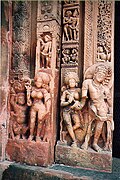
>Rodw m Disambiguating links to Deogarh (link changed to Deogarh, Uttar Pradesh) using DisamAssist. |
Digitalvivek (talk | contribs) updated details |
||
| Line 1: | Line 1: | ||
{{short description|Stone disk on the top of a Hindu temple's main tower}} | {{short description|Stone disk on the top of a Hindu temple's main tower}} | ||
[[File:Khajuraho Devi Jagadambi Temple 2010 (cropped).jpg|thumb|Double amalaka at the top of the [[Devi Jagadambi Temple]] at [[Khajuraho]]]] | [[File:Khajuraho Devi Jagadambi Temple 2010 (cropped).jpg|thumb|Double amalaka at the top of the [[Devi Jagadambi Temple]] at [[Khajuraho]]]] | ||
[[File:Bhubneshwar Siddheshwar Mukteshwar Group Temple.jpg|thumb|Prominent amalakas at the Siddheshwar Mukteshwar Group Temple, [[Bhubaneswar]]]] | [[File:Bhubneshwar Siddheshwar Mukteshwar Group Temple.jpg|thumb|Prominent amalakas at the Siddheshwar Mukteshwar Group Temple, [[Bhubaneswar]]]] | ||
An '''amalaka''' ({{ | An '''amalaka''' ({{langx|sa|आमलक}}), is a segmented or notched stone disk, usually with ridges on the rim, that sits on the top of a [[Hindu temple]]'s [[shikhara]] or main tower. According to one interpretation, the amalaka represents a lotus, and thus the symbolic seat for the deity below. Another interpretation is that it symbolizes the sun, and is thus the gateway to the heavenly world.<ref>{{cite web |url=http://personal.carthage.edu/jlochtefeld/picturepages/Khajuraho/architecture.html#Amalaka |title=Khajuraho Architecture |publisher=Personal.carthage.edu |date=2006-01-12 |accessdate=2012-08-09 |archive-date=2016-03-02 |archive-url=https://web.archive.org/web/20160302071937/http://personal.carthage.edu/jlochtefeld/picturepages/Khajuraho/architecture.html#Amalaka |url-status=dead }}; Kramrisch, 348-356</ref> | ||
The name and, according to some sources the shape, of the amalaka comes from the fruit of [[Phyllanthus emblica]] (or Mirobalanus embilica),<ref>Harle, 54; Kramrisch, 356</ref> the Indian [[gooseberry]], or myrobolan fig tree. | The name and, according to some sources the shape, of the amalaka comes from the fruit of ''[[Phyllanthus emblica]]'' (or ''Mirobalanus embilica''),<ref>Harle, 54; Kramrisch, 356</ref> the Indian [[gooseberry]], or myrobolan fig tree. This is called ''āmalaki'' in [[Sanskrit]], and the fruit has a slightly segmented shape, though this is much less marked than in the architectural shape.<ref>Kramrisch, 354-355</ref> | ||
The amalaka itself is crowned with a [[kalasam]] or finial,<ref>Kramrisch, 350, 355</ref> from which a temple banner is often hung. | The amalaka itself is crowned with a [[kalasam]] or finial,<ref>Kramrisch, 350, 355</ref> from which a temple banner is often hung. | ||
| Line 16: | Line 15: | ||
==Symbolism== | ==Symbolism== | ||
Like other parts of [[Hindu temple architecture]], there is a large body of symbolic and mystical interpretation around the | Like other parts of [[Hindu temple architecture]], there is a large body of symbolic and mystical interpretation around the amalaka. It is seen as a ring gripping and embracing a notional pillar that rises from the main [[cult image]] of the deity below it in the sanctum, and reaches up to heaven through the top of the temple.<ref>Kramrisch, 348-356. Only a small part of this is summarized here.</ref> | ||
<gallery widths="200px" heights="200px"> | <gallery widths="200px" heights="200px"> | ||
| Line 32: | Line 31: | ||
==References== | ==References== | ||
*Harle, J.C., ''The Art and Architecture of the Indian Subcontinent'', 2nd edn. 1994, Yale University Press Pelican History of Art, {{ISBN|0300062176}} | *Harle, J.C., ''The Art and Architecture of the Indian Subcontinent'', 2nd edn. 1994, Yale University Press Pelican History of Art, {{ISBN|0300062176}} | ||
*[[Stella Kramrisch|Kramrisch, Stella]], ''The Hindu Temple'', Volume 2, 1996 (originally 1946), {{ISBN|8120802225}}, 9788120802223, [https://books.google. | *[[Stella Kramrisch|Kramrisch, Stella]], ''The Hindu Temple'', Volume 2, 1996 (originally 1946), {{ISBN|8120802225}}, 9788120802223, [https://books.google.com/books?id=8-aS52MgIkMC google books] | ||
==External links== | ==External links== | ||
{{Commons category | {{Commons category}} | ||
* [http://personal.carthage.edu/jlochtefeld/picturepages/Khajuraho/architecture.html Khajuraho Architecture] | * [http://personal.carthage.edu/jlochtefeld/picturepages/Khajuraho/architecture.html Khajuraho Architecture] {{Webarchive|url=https://web.archive.org/web/20160302071937/http://personal.carthage.edu/jlochtefeld/picturepages/Khajuraho/architecture.html |date=2016-03-02 }} | ||
[[Category:Hindu temple architecture]] | [[Category:Hindu temple architecture]] | ||
Latest revision as of 08:16, 12 July 2025
.jpg)

An amalaka (Sanskrit: आमलक), is a segmented or notched stone disk, usually with ridges on the rim, that sits on the top of a Hindu temple's shikhara or main tower. According to one interpretation, the amalaka represents a lotus, and thus the symbolic seat for the deity below. Another interpretation is that it symbolizes the sun, and is thus the gateway to the heavenly world.[1]
The name and, according to some sources the shape, of the amalaka comes from the fruit of Phyllanthus emblica (or Mirobalanus embilica),[2] the Indian gooseberry, or myrobolan fig tree. This is called āmalaki in Sanskrit, and the fruit has a slightly segmented shape, though this is much less marked than in the architectural shape.[3]
The amalaka itself is crowned with a kalasam or finial,[4] from which a temple banner is often hung.
History[edit | edit source]

The shape first appears (or survives) as an element in the capitals of columns around the time of Ashoka in the 3rd century BCE,[5] recurring in some capitals of the 1st century CE. In some of these, as at the Great Chaitya at the Karla Caves, and the verandahs to Caves 3, 10 and 17 at the Pandavleni Caves, the amalaka is "boxed" with a rectangular framework cage.[6]
The oldest representation of an Amalaka as the base for the kalasha is seen in a door jamb at the Dahshavatara temple at Deogarh, dated to about 500 AD.[7] Amalakas appear to have been common at the top of shikhara by the Gupta period, though no originals remain in place. They were to remain standard in most of India, in the Nagara and Kalinga architecture styles of the west and east respectively, but not in the Dravidian architecture of South India.[8] Some early temples in the Deccan, such as the 7th-century Lakshamana temple in brick at Sirpur, have amalakas at the corners of some level of the shikhara (but not, as it survives, at the top in the usual way).[9]
Symbolism[edit | edit source]
Like other parts of Hindu temple architecture, there is a large body of symbolic and mystical interpretation around the amalaka. It is seen as a ring gripping and embracing a notional pillar that rises from the main cult image of the deity below it in the sanctum, and reaches up to heaven through the top of the temple.[10]
-
 Detached amalaka stone of the Durga Temple, Aihole, 7th century
 -
 "Boxed" amalakas in the capitals outside Cave 17, Pandavleni Caves, 2nd-3rd century CE
 -
 "Boxed" amalakas in the capitals, Bedse Caves
 -
 Corner amalakas at the 7th-century Lakshamana temple in brick at Sirpur
 -
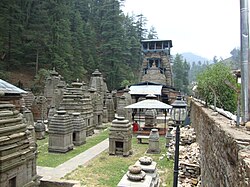 7-12th century temples at Jageshwar, Uttarakhand. In some of them the amalakas are boxed to hold a roof.
 -
 Early, rounded, amalaka, with squared amalakas at the corners below, 8th century. Galaganatha Temple, Pattadakal, Karnataka

.jpg)
.jpg)
.JPG)

.jpg)
Notes[edit | edit source]
- ↑ "Khajuraho Architecture". Personal.carthage.edu. 2006-01-12. Archived from the original on 2016-03-02. Retrieved 2012-08-09.; Kramrisch, 348-356
- ↑ Harle, 54; Kramrisch, 356
- ↑ Kramrisch, 354-355
- ↑ Kramrisch, 350, 355
- ↑ Harle, 54
- ↑ Harle, 54-55; Kramrisch, 352-353
- ↑ Prāsāda as Palace: Kūṭina Origins of the Nāgara Temple, Michael W. Meister, Artibus Asiae, Vol. 49, No. 3/4 (1988 - 1989), pp. 254-280
- ↑ Harle, 111, 140, 166; Kramrisch, 348, 352
- ↑ Harle, 166
- ↑ Kramrisch, 348-356. Only a small part of this is summarized here.
References[edit | edit source]
- Harle, J.C., The Art and Architecture of the Indian Subcontinent, 2nd edn. 1994, Yale University Press Pelican History of Art, ISBN 0300062176
- Kramrisch, Stella, The Hindu Temple, Volume 2, 1996 (originally 1946), ISBN 8120802225, 9788120802223, google books
External links[edit | edit source]
- Khajuraho Architecture Archived 2016-03-02 at the Wayback Machine