

imported>Yobot m Fix REFPUNCT + other minor fixes |
m refine layout per standard format and improved wording |
||
| Line 1: | Line 1: | ||
{{Short description|Three-storied building situated at entrance of the Golden Temple complex}} | |||
{{Use dmy dates|date=November 2019}} | {{Use dmy dates|date=November 2019}} | ||
{{multiple image | {{multiple image | ||
| align = right | | align = right | ||
| direction = vertical | | direction = vertical | ||
| image1 = | | image1 = Twin towers of Ramgarhia Bunga, Golden Temple, Amritsar, Punjab, India (2013).jpg | ||
| width1 = 240 | | width1 = 240 | ||
| image2 = Golden-Temple-Wide-View.jpg | | image2 = Golden-Temple-Wide-View.jpg | ||
| Line 10: | Line 11: | ||
}} | }} | ||
'''Ramgarhia Bunga | '''Ramgarhia Bunga''' is the three-storeyed red stone [[watchtower]]s complex located near southeastern edge of the [[Golden Temple]], [[Amritsar]].<ref name=pht1/> The two minaret-style Ramgarhia Bunga high towers are visible from the ''parikrama'' (circumambulation) walkway around the Harmandir Sahib Sarovar (water tank).<ref>{{cite book|author1=Pashaura Singh|author2=Louis E. Fenech|title=The Oxford Handbook of Sikh Studies|url=https://books.google.com/books?id=8I0NAwAAQBAJ&pg=PA435 |year=2014 |publisher=Oxford University Press|isbn=978-0-19-969930-8|page=435}}</ref> It is a pre-[[Ranjit Singh]] structure built by [[Sikh]] warrior and [[Ramgarhia]] [[misl]] chief [[Jassa Singh Ramgarhia]] in late 18th-century,<ref>{{Cite web|url=https://www.sikhchic.com/article-detail.php?id=2532&cat=14|title=sikhchic.com | The Art and Culture of the Diaspora | Restoration of The Bunga Ramgharia|website=www.sikhchic.com}}</ref><ref>{{Cite web|url=http://www.sikh-heritage.co.uk/heritage/Amritsar/Amritsar.htm|title = Untitled Document}}</ref> after the 1762 destruction and desecration of the Sikh holy temple and site by the Afghan Muslim forces led by Ahmed Shah Abdali.<ref name=pht1/> The Bunga watchtowers-related infrastructure was constructed to station sentinels to watch for any surprise attack, house soldiers to help fortify the area, and to protect the holy complex from desecration.<ref name=pht1>[http://punjabtourism.gov.in/Downloads/Brochures/Golden%20Temple%20Amritsar%20Darbar%20Sahib.pdf The Golden Temple], Punjab Heritage and Tourism Promotion Board, Government of Punjab, India</ref><ref name="FenechMcLeod2014p74"/> | ||
The Ramgarhia Bunga houses the granite slab of ''[[Peacock Throne|Takht-e-Taus]]''<ref>https://www.punjabitribuneonline.com/ | The Ramgarhia Bunga houses the granite slab of ''[[Peacock Throne|Takht-e-Taus]]''<ref>{{Cite web|url=https://www.punjabitribuneonline.com/news/archive/features/ਜੱਸਾ-ਸਿੰਘ-ਰਾਮਗੜ੍ਹੀਆ-ਦੀ-ਅਨਮੋਲ-ਨਿਸ਼ਾਨੀ-ਬੁੰਗਾ-ਰਾਮਗੜ੍ਹੀਆ-956254|title=ਜੱਸਾ ਸਿੰਘ ਰਾਮਗੜ੍ਹੀਆ ਦੀ ਅਨਮੋਲ ਨਿਸ਼ਾਨੀ : ਬੁੰਗਾ ਰਾਮਗੜ੍ਹੀਆ|website=Tribuneindia News Service}}</ref> from the [[Red Fort]] on which, according to the [[oral tradition]], all the [[Mughal Empire|Mughal emperors]] were crowned in [[Delhi]]. This slab was seized by Sikhs from Delhi, during an attack against the Mughal armies, and brought back to [[Amritsar]] as a symbol that the Mughal Empire will end with the removal of their coronation stone.<ref name=pht1/> | ||
==History== | ==History== | ||
[[Image:Darbar Sahib and Ramgarhia bunga.JPG|250px|thumb|right|Ramgarhia Bunga and [[Harmandir Sahib|Golden Temple]] illuminated on [[Guru Nanak Dev]] [[Gurpurab]]]] | [[Image:Darbar Sahib and Ramgarhia bunga.JPG|250px|thumb|right|Ramgarhia Bunga and [[Harmandir Sahib|Golden Temple]] illuminated on [[Guru Nanak Dev]] [[Gurpurab]]]] | ||
During the reign of the Muslim [[Mughal Empire|Mughal]] Emperors, The Golden Temple was damaged many times, but each time it was rebuilt by the [[Sikh]]s. Sardars of the 12 [[Sikh]] [[Misl]]s decided that some of the [[Khalsa]] leaders must be housed inside it for its protection against their enemies. According to Fenech and McLeod, during the 18th century, Sikh misl chiefs and rich communities built over 70 such ''Bungas'' of different shapes and forms around the Golden Temple to watch the area, house soldiers and defend the temple.<ref name="FenechMcLeod2014p74"/> Such ''Bungas'' were also built near major Sikh shrines elsewhere on the [[Indian subcontinent]] in the 18th-century.<ref name="FenechMcLeod2014p74"/> | During the reign of the Muslim [[Mughal Empire|Mughal]] Emperors, The Golden Temple was damaged many times, but each time it was rebuilt by the [[Sikh]]s. Sardars of the 12 [[Sikh]] [[Misl]]s decided that some of the [[Khalsa]] leaders must be housed inside it for its protection against their enemies. According to Fenech and McLeod, during the 18th century, Sikh misl chiefs and rich communities built over 70 such ''Bungas'' of different shapes and forms around the Golden Temple to watch the area, house soldiers and defend the temple.<ref name="FenechMcLeod2014p74"/> Such ''Bungas'' were also built near major Sikh shrines elsewhere on the [[Indian subcontinent]] in the 18th-century.<ref name="FenechMcLeod2014p74"/> The Ramgarhia Bunga was originally constructed in 1755 by Jassa Singh Ramgarhia.<ref name=":0">{{Cite news |last=Teja |first=Charanjit Singh |date=7 June 2025 |title=In photos: Echoes of valour & faith resound at grand Sikh structure Ramgarhia Bunga |url=https://www.tribuneindia.com/news/punjab/echoes-of-valour-faith-resound-at-ramgarhia-bunga/ |access-date=20 August 2025 |work=The Tribune |quote=Over time, the building suffered damage, especially during the 1905 earthquake and the 1984 Operation Blue Star.}}</ref> | ||
[[Ramgarhia]] [[misl]] chief [[Jassa Singh Ramgarhia]] had conquered territory as far afield as [[Delhi]], where he removed the slab from the [[Peacock throne|Takht-e-Taus]] on which the Mughal coronation ceremonies were held. He brought the slab to [[Amritsar]] and placed it in the Ramgarhia Bunga where it still lies. | [[Ramgarhia]] [[misl]] chief [[Jassa Singh Ramgarhia]] had conquered territory as far afield as [[Delhi]], where he removed the slab from the [[Peacock throne|Takht-e-Taus]] on which the Mughal coronation ceremonies were held. He brought the slab to [[Amritsar]] and placed it in the Ramgarhia Bunga where it still lies. | ||
In the 19th century, these served defensive purposes, provided accommodation for Sikh pilgrims and some served as centers of learning.<ref name="FenechMcLeod2014p74">{{cite book|author1=Louis E. Fenech|author2=W. H. McLeod|title=Historical Dictionary of Sikhism|url=https://books.google.com/books?id=xajcAwAAQBAJ&pg=PA74|year=2014|publisher=Rowman & Littlefield Publishers|isbn=978-1-4422-3601-1|pages=74–75}}</ref> Most of the Bungas were demolished during and after the British colonial era, often to improve the facilities for growing number of pilgrims in the 20th-century. The Ramgarhia Bunga is single surviving example of the Bunga-related historic infrastructure in [[Amritsar]],<ref name="pht1" /> along with [[Akal Takht]] which originally was built as the Akal Bunga on the other side of holy tank.<ref name="FenechMcLeod2014p74" /> The [[1905 Kangra earthquake]] caused extensive damage to the complex, particularly by destroying the top domes of its two burj watchtowers, which were left unrepaired until 2010–11.<ref name=":0" /><ref name=":1">{{Cite news |date=6 June 2014 |title=THEN TOP LOST IN 1905, MORE DAMAGE IN '84 |url=https://www.pressreader.com/india/hindustan-times-bathinda/20140606/281921656105755 |access-date=20 August 2025 |work=Hindustan Times (Bathinda) |quote=The old Nanakshahi bricks have been concealed with pink tiles on the outer walls of the two minarets of Ramgarhia Bunga. The top portion of the minarets was demolished after damage in earthquake in 1905. The structure thereafter remained flat on the top; but to give it back its original look the upper portion was rebuilt in 2001-02. It still does not resemble the original structure, particularly the stone used.}}</ref> The complex experienced heavy damage due to [[Operation Blue Star]] in 1984.<ref name=":0" /><ref name=":1" /> In 2025, a twenty-year-old restoration project was completed.<ref name=":0" /> | |||
==Architecture== | ==Architecture== | ||
[[Image:Templo dorado-Amritsar-India087.JPG|200px|thumb| | [[Image:Templo dorado-Amritsar-India087.JPG|200px|thumb|Rebuilt top dome of one of the two burj towers. The top domes were only repaired in 2001–02, almost a century after the original domes were destroyed in a 1905 earthquake.<ref name=":1" /><ref name=":0" />]] | ||
Ramgarhia Bunga consists of three flat-roofed ranges, each of two principal storeys, arranged round three sides of a courtyard and is constructed almost of small burnt bricks ([[Nanakshahi]]) set in lime and mud mortar.<ref name="auto">{{Cite web|url=https://www.tribuneindia.com/2003/20030301/punjab1.htm|title=The Tribune, Chandigarh, India - Punjab|website=www.tribuneindia.com}}</ref> The colonnade and the triple arches are of red sandstone. The undersides of the vaults and all the walls were finished internally and externally with lime plaster and lime wash, much of it decorative with arches. Lower levels are approached by two flights of steps, one from outside and the other from within the courtyard. | Ramgarhia Bunga consists of three flat-roofed ranges, each of two principal storeys, arranged round three sides of a courtyard and is constructed almost of small burnt bricks ([[Nanakshahi bricks|Nanakshahi]]) set in lime and mud mortar.<ref name="auto">{{Cite web|url=https://www.tribuneindia.com/2003/20030301/punjab1.htm|title=The Tribune, Chandigarh, India - Punjab|website=www.tribuneindia.com}}</ref> The colonnade and the triple arches are of red sandstone. The undersides of the vaults and all the walls were finished internally and externally with lime plaster and lime wash, much of it decorative with arches. Lower levels are approached by two flights of steps, one from outside and the other from within the courtyard. | ||
The rebuilt top domes of the two burj watchtowers do not resemble the originals due to the differences in material uses, with the original domes consisting of [[Nanakshahi bricks]].<ref name=":1" /> | |||
==Ramgarhia misl== | ==Ramgarhia misl== | ||
{{main|Ramgarhia Misl}} | {{main|Ramgarhia Misl}} | ||
Ramgarhia misl chief [[Jassa Singh Ramgarhia]] was a brave Sikh leader. He had redesigned<ref>https://www.thesikhencyclopedia.com/architecture/ram-rauni</ref> a mud fortress ''Ram Rauni'' in 1748 about a mile from [[Golden Temple]] which was used to house and keep soldiers.<ref>{{cite book|author=Parm B Singh|title=Golden Temple|url=https://books.google.com/books?id=mX_XAAAAMAAJ|year=1999|publisher=Punjabi University|isbn=978-81-7380-569-1|page=23}}</ref> The place was named so in honour of fourth [[Sikh Guru]] [[Guru Ram Das|Shri Guru Ram Das Ji]], who have founded the [[Amritsar]] city. The place was later known as ''Quila Ramgarh'' due to its fortification by [[Jassa Singh Ramgarhia]]. The [[Ramgarhia Misl]] derives its name from this place which literally means ''Custodians of the Castle of God''.<ref>https://www.tribuneindia.com/2006/20060330/aplus.htm#1</ref> The Quila Ramgarh has already lost its very existence and its location is adjacent to Gurudwara Sri Ramsar Sahib and Guru Ramdas Khalsa Senior Secondary School on Ramsar Road, [[Amritsar]]. | Ramgarhia misl chief [[Jassa Singh Ramgarhia]] was a brave Sikh leader. He had redesigned<ref>{{Cite encyclopedia|url=https://www.thesikhencyclopedia.com/architecture/ram-rauni|title = Ram Rauni| encyclopedia=The Sikh Encyclopedia -ਸਿੱਖ ਧਰਮ ਵਿਸ਼ਵਕੋਸ਼ |date = 19 December 2000 | last1=Gujral | first1=Maninder S. }}</ref> a mud fortress ''Ram Rauni'' in 1748 about a mile from [[Golden Temple]] which was used to house and keep soldiers.<ref>{{cite book|author=Parm B Singh|title=Golden Temple|url=https://books.google.com/books?id=mX_XAAAAMAAJ|year=1999|publisher=Punjabi University|isbn=978-81-7380-569-1|page=23}}</ref> The place was named so in honour of fourth [[Sikh Guru]] [[Guru Ram Das|Shri Guru Ram Das Ji]], who have founded the [[Amritsar]] city. The place was later known as ''Quila Ramgarh'' due to its fortification by [[Jassa Singh Ramgarhia]]. The [[Ramgarhia Misl]] derives its name from this place which literally means ''Custodians of the Castle of God''.<ref>{{Cite web|url=https://www.tribuneindia.com/2006/20060330/aplus.htm#1|title=The Tribune, Chandigarh, India - Amritsar PLUS}}</ref> The Quila Ramgarh has already lost its very existence and its location is adjacent to Gurudwara Sri Ramsar Sahib and Guru Ramdas Khalsa Senior Secondary School on Ramsar Road, [[Amritsar]]. | ||
Ramgarhia bunga remains a symbol of the [[Ramgarhia]] Sikh community's identity, their historic sacrifices and contribution to defending the Golden Temple over the centuries.<ref>{{cite book|author1=Pashaura Singh|author2=Norman Gerald Barrier|title=Sikh Identity: Continuity and Change|url= https://books.google.com/books?id=DIN0AAAAMAAJ| year=1999|publisher=Manohar|isbn=978-81-7304-236-2|page=264}}</ref> | Ramgarhia bunga remains a symbol of the [[Ramgarhia]] Sikh community's identity, their historic sacrifices and contribution to defending the Golden Temple over the centuries.<ref>{{cite book|author1=Pashaura Singh|author2=Norman Gerald Barrier|title=Sikh Identity: Continuity and Change|url= https://books.google.com/books?id=DIN0AAAAMAAJ| year=1999|publisher=Manohar|isbn=978-81-7304-236-2|page=264}}</ref> | ||
==Renovation== | ==Renovation== | ||
The original domes on the [[minarets]] were damaged and then removed in 1903 because of an earthquake. The minarets were again heavily damaged by Indian artillery fire during [[Operation Blue Star]] in 1984,<ref>{{Cite web|url=https://www.tribuneindia.com/1999/99sep16/punjab.htm|title=tribuneindia... Punjab|website=www.tribuneindia.com}}</ref><ref>{{Cite book|url=https://books.google.com/books?id=nn5IDwAAQBAJ | The original domes on the [[minarets]] were damaged and then removed in 1903 because of an earthquake. The minarets were again heavily damaged by Indian artillery fire during [[Operation Blue Star]] in 1984,<ref>{{Cite web|url=https://www.tribuneindia.com/1999/99sep16/punjab.htm|title=tribuneindia... Punjab|website=www.tribuneindia.com}}</ref><ref>{{Cite book|url=https://books.google.com/books?id=nn5IDwAAQBAJ|title=INDIA'S MAJOR MILITARY & RESCUE OPERATIONS|last1=Pandey|first1=Hemant Kumar|last2=Singh|first2=Manish Raj|publisher=Horizon Books ( A Division of Ignited Minds Edutech P Ltd)|year=2017|isbn=978-9386369390|pages=154}}</ref> but later renovated by the [[Shiromani Gurdwara Parbandhak Committee]]<ref>{{Cite web|url=http://www.sgpc.net/bunga.asp|archive-url=https://web.archive.org/web/20081010192312/http://sgpc.net/bunga.asp|url-status=dead|title=Conservsation of Ramgarhia Bunga|archive-date=10 October 2008}}</ref> and the [[Ramgarhia]] Society Sardar Jassa Singh Ramgarhia Federation.<ref name="auto"/><ref>{{Cite web|url=https://www.bhaskar.com/punjab/amritsar/news/ramgarhia-bunga-to-be-rescued-for-6-years-073113-4564397.html|title=6 साल से अटके रामगढ़िया बुंगा की मरम्मत शुरू हाेने की उम्मीद|date=16 May 2019|website=Dainik Bhaskar}}</ref> Later, some Babas of Kar Sewawale had done colossal damage to the heritage site by converting a portion into their abode.<ref>{{Cite web|url=https://www.tribuneindia.com/2008/20081118/punjab1.htm|title=The Tribune, Chandigarh, India - Punjab|website=www.tribuneindia.com}}</ref> There are also plans to convert basement of bunga to Sikh museum.<ref>{{Cite web|url=https://indianexpress.com/article/cities/chandigarh/bunga-ramgarhia-to-be-converted-into-museum/|title=Bunga Ramgarhia to be converted into museum|date=8 May 2010}}</ref> | ||
==See also== | ==See also== | ||
| Line 44: | Line 49: | ||
Image: 1880 photograph of the Golden Temple, Darbar Sahib, sacred pool and nearby buildings, Amritsar.jpg|Golden temple view from Ramgarhia bunga | Image: 1880 photograph of the Golden Temple, Darbar Sahib, sacred pool and nearby buildings, Amritsar.jpg|Golden temple view from Ramgarhia bunga | ||
Image:Harmindir_Sahib,_Amritsar,_Punjab,_India.jpg|Darbar Sahib night view | Image:Harmindir_Sahib,_Amritsar,_Punjab,_India.jpg|Darbar Sahib night view | ||
Image: Historic stone slab of Mughal throne.jpg|Slab of Mughal throne placed in Bunga<ref>https://kunalkhurana.com/amritsar-2018/</ref> | Image: Historic stone slab of Mughal throne.jpg|Slab of Mughal throne placed in Bunga<ref>{{Cite web | title=Amritsar - like you have never seen before! | url=https://kunalkhurana.com/amritsar-2018/ | archive-url=https://web.archive.org/web/20191015171328/https://kunalkhurana.com/amritsar-2018/ | access-date=2025-02-16 | archive-date=2019-10-15}}</ref> | ||
Image: Amritsar golden temple2.jpg|Bunga as seen from main entrance of Golden Temple | Image: Amritsar golden temple2.jpg|Bunga as seen from main entrance of Golden Temple | ||
Image:Amritsar golden temple.jpg | Image:Amritsar golden temple.jpg | ||
Image:I (21).JPG | Image:I (21).JPG | ||
Image:Harmandir Sahib 2.jpg | Image:Harmandir Sahib 2.jpg | ||
Image:Golden Temple 1.jpg | Image:Golden Temple 1.jpg | ||
Image:Goldentemple (82).JPG | Image:Goldentemple (82).JPG | ||
| Line 60: | Line 64: | ||
Image:Golden Temple 1194.jpg | Image:Golden Temple 1194.jpg | ||
Image:Morning at the Golden Temple, Amritsar.jpg | Image:Morning at the Golden Temple, Amritsar.jpg | ||
Image:Golden Temple ,night.view.jpg|Night view of Bunga in Golden Temple complex. | |||
</gallery> | </gallery> | ||
Latest revision as of 13:41, 15 March 2026
.jpg)

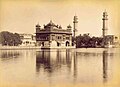
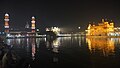
Ramgarhia Bunga is the three-storeyed red stone watchtowers complex located near southeastern edge of the Golden Temple, Amritsar.[1] The two minaret-style Ramgarhia Bunga high towers are visible from the parikrama (circumambulation) walkway around the Harmandir Sahib Sarovar (water tank).[2] It is a pre-Ranjit Singh structure built by Sikh warrior and Ramgarhia misl chief Jassa Singh Ramgarhia in late 18th-century,[3][4] after the 1762 destruction and desecration of the Sikh holy temple and site by the Afghan Muslim forces led by Ahmed Shah Abdali.[1] The Bunga watchtowers-related infrastructure was constructed to station sentinels to watch for any surprise attack, house soldiers to help fortify the area, and to protect the holy complex from desecration.[1][5]
The Ramgarhia Bunga houses the granite slab of Takht-e-Taus[6] from the Red Fort on which, according to the oral tradition, all the Mughal emperors were crowned in Delhi. This slab was seized by Sikhs from Delhi, during an attack against the Mughal armies, and brought back to Amritsar as a symbol that the Mughal Empire will end with the removal of their coronation stone.[1]
History[edit | edit source]

During the reign of the Muslim Mughal Emperors, The Golden Temple was damaged many times, but each time it was rebuilt by the Sikhs. Sardars of the 12 Sikh Misls decided that some of the Khalsa leaders must be housed inside it for its protection against their enemies. According to Fenech and McLeod, during the 18th century, Sikh misl chiefs and rich communities built over 70 such Bungas of different shapes and forms around the Golden Temple to watch the area, house soldiers and defend the temple.[5] Such Bungas were also built near major Sikh shrines elsewhere on the Indian subcontinent in the 18th-century.[5] The Ramgarhia Bunga was originally constructed in 1755 by Jassa Singh Ramgarhia.[7]
Ramgarhia misl chief Jassa Singh Ramgarhia had conquered territory as far afield as Delhi, where he removed the slab from the Takht-e-Taus on which the Mughal coronation ceremonies were held. He brought the slab to Amritsar and placed it in the Ramgarhia Bunga where it still lies.
In the 19th century, these served defensive purposes, provided accommodation for Sikh pilgrims and some served as centers of learning.[5] Most of the Bungas were demolished during and after the British colonial era, often to improve the facilities for growing number of pilgrims in the 20th-century. The Ramgarhia Bunga is single surviving example of the Bunga-related historic infrastructure in Amritsar,[1] along with Akal Takht which originally was built as the Akal Bunga on the other side of holy tank.[5] The 1905 Kangra earthquake caused extensive damage to the complex, particularly by destroying the top domes of its two burj watchtowers, which were left unrepaired until 2010–11.[7][8] The complex experienced heavy damage due to Operation Blue Star in 1984.[7][8] In 2025, a twenty-year-old restoration project was completed.[7]
Architecture[edit | edit source]

Ramgarhia Bunga consists of three flat-roofed ranges, each of two principal storeys, arranged round three sides of a courtyard and is constructed almost of small burnt bricks (Nanakshahi) set in lime and mud mortar.[9] The colonnade and the triple arches are of red sandstone. The undersides of the vaults and all the walls were finished internally and externally with lime plaster and lime wash, much of it decorative with arches. Lower levels are approached by two flights of steps, one from outside and the other from within the courtyard.
The rebuilt top domes of the two burj watchtowers do not resemble the originals due to the differences in material uses, with the original domes consisting of Nanakshahi bricks.[8]
Ramgarhia misl[edit | edit source]
Ramgarhia misl chief Jassa Singh Ramgarhia was a brave Sikh leader. He had redesigned[10] a mud fortress Ram Rauni in 1748 about a mile from Golden Temple which was used to house and keep soldiers.[11] The place was named so in honour of fourth Sikh Guru Shri Guru Ram Das Ji, who have founded the Amritsar city. The place was later known as Quila Ramgarh due to its fortification by Jassa Singh Ramgarhia. The Ramgarhia Misl derives its name from this place which literally means Custodians of the Castle of God.[12] The Quila Ramgarh has already lost its very existence and its location is adjacent to Gurudwara Sri Ramsar Sahib and Guru Ramdas Khalsa Senior Secondary School on Ramsar Road, Amritsar.
Ramgarhia bunga remains a symbol of the Ramgarhia Sikh community's identity, their historic sacrifices and contribution to defending the Golden Temple over the centuries.[13]
Renovation[edit | edit source]
The original domes on the minarets were damaged and then removed in 1903 because of an earthquake. The minarets were again heavily damaged by Indian artillery fire during Operation Blue Star in 1984,[14][15] but later renovated by the Shiromani Gurdwara Parbandhak Committee[16] and the Ramgarhia Society Sardar Jassa Singh Ramgarhia Federation.[9][17] Later, some Babas of Kar Sewawale had done colossal damage to the heritage site by converting a portion into their abode.[18] There are also plans to convert basement of bunga to Sikh museum.[19]
See also[edit | edit source]
Photo gallery[edit | edit source]
-
 Location of bunga in Darbar sahib complex (no. 17)
 -
 Golden Temple in year 1880
 -
 Bunga visible behind Golden Temple in 1870
 -
 Golden temple view from Ramgarhia bunga
 -
 Darbar Sahib night view
 -
![Slab of Mughal throne placed in Bunga[20]](/w/images/smartcommons/thumbs/commons/4/48/Historic_stone_slab_of_Mughal_throne.jpg/120px-Historic_stone_slab_of_Mughal_throne.jpg) Slab of Mughal throne placed in Bunga[20]
Slab of Mughal throne placed in Bunga[20] -
 Bunga as seen from main entrance of Golden Temple
 -

-

-

-

-

-

-

-

-

-

-

-

-

-
 Night view of Bunga in Golden Temple complex.


![Slab of Mughal throne placed in Bunga[20]](/wiki/File:Historic_stone_slab_of_Mughal_throne.jpg)


.JPG)


.JPG)


.jpeg)


References[edit | edit source]
- ↑ 1.0 1.1 1.2 1.3 1.4 The Golden Temple, Punjab Heritage and Tourism Promotion Board, Government of Punjab, India
- ↑ Pashaura Singh; Louis E. Fenech (2014). The Oxford Handbook of Sikh Studies. Oxford University Press. p. 435. ISBN 978-0-19-969930-8.
- ↑ "sikhchic.com | The Art and Culture of the Diaspora | Restoration of The Bunga Ramgharia". www.sikhchic.com.
- ↑ "Untitled Document".
- ↑ 5.0 5.1 5.2 5.3 5.4 Louis E. Fenech; W. H. McLeod (2014). Historical Dictionary of Sikhism. Rowman & Littlefield Publishers. pp. 74–75. ISBN 978-1-4422-3601-1.
- ↑ "ਜੱਸਾ ਸਿੰਘ ਰਾਮਗੜ੍ਹੀਆ ਦੀ ਅਨਮੋਲ ਨਿਸ਼ਾਨੀ : ਬੁੰਗਾ ਰਾਮਗੜ੍ਹੀਆ". Tribuneindia News Service.
- ↑ 7.0 7.1 7.2 7.3 7.4 Teja, Charanjit Singh (7 June 2025). "In photos: Echoes of valour & faith resound at grand Sikh structure Ramgarhia Bunga". The Tribune. Retrieved 20 August 2025.
Over time, the building suffered damage, especially during the 1905 earthquake and the 1984 Operation Blue Star.
- ↑ 8.0 8.1 8.2 8.3 "THEN TOP LOST IN 1905, MORE DAMAGE IN '84". Hindustan Times (Bathinda). 6 June 2014. Retrieved 20 August 2025.
The old Nanakshahi bricks have been concealed with pink tiles on the outer walls of the two minarets of Ramgarhia Bunga. The top portion of the minarets was demolished after damage in earthquake in 1905. The structure thereafter remained flat on the top; but to give it back its original look the upper portion was rebuilt in 2001-02. It still does not resemble the original structure, particularly the stone used.
- ↑ 9.0 9.1 "The Tribune, Chandigarh, India - Punjab". www.tribuneindia.com.
- ↑ Gujral, Maninder S. (19 December 2000). "Ram Rauni". The Sikh Encyclopedia -ਸਿੱਖ ਧਰਮ ਵਿਸ਼ਵਕੋਸ਼.
- ↑ Parm B Singh (1999). Golden Temple. Punjabi University. p. 23. ISBN 978-81-7380-569-1.
- ↑ "The Tribune, Chandigarh, India - Amritsar PLUS".
- ↑ Pashaura Singh; Norman Gerald Barrier (1999). Sikh Identity: Continuity and Change. Manohar. p. 264. ISBN 978-81-7304-236-2.
- ↑ "tribuneindia... Punjab". www.tribuneindia.com.
- ↑ Pandey, Hemant Kumar; Singh, Manish Raj (2017). INDIA'S MAJOR MILITARY & RESCUE OPERATIONS. Horizon Books ( A Division of Ignited Minds Edutech P Ltd). p. 154. ISBN 978-9386369390.
- ↑ "Conservsation of Ramgarhia Bunga". Archived from the original on 10 October 2008.
- ↑ "6 साल से अटके रामगढ़िया बुंगा की मरम्मत शुरू हाेने की उम्मीद". Dainik Bhaskar. 16 May 2019.
- ↑ "The Tribune, Chandigarh, India - Punjab". www.tribuneindia.com.
- ↑ "Bunga Ramgarhia to be converted into museum". 8 May 2010.
- ↑ "Amritsar - like you have never seen before!". Archived from the original on 15 October 2019. Retrieved 16 February 2025.