

robot: Create/upgrade articles. If there is a mistake please report on my talk page. |
minor cleaned up section to improve readability also |
||
| Line 1: | Line 1: | ||
{{short description|Asian type of battle axe}} | {{short description|Asian type of battle axe}} | ||
[[File:Indian (Sind) tabar 2.jpg|thumb|200px|Indian ( | [[File:Indian (Sind) tabar 2.jpg|thumb|200px|Indian ([[Sindh]]) tabar battle axe, late 18th century or earlier, crescent shape 5-inch-long head with a square hammer opposite of the blade, 22-inch-long steel haft, the end of the haft unscrews to reveal a 5-inch slim blade. Heavily patinated head and handle with traces of engraving.]] | ||
The '''tabar''' (also called ''tabarzin'', which means "saddle axe" [in persian], [[ | The '''tabar''' (also called ''tabarzin'', which means "saddle axe" [in persian], [[Persian language|Persian]]: ''تبر'') is a type of [[battle axe]]. The term ''tabar'' is used for axes originating from the Ottoman Empire, Persia, India and surrounding countries and cultures. the word ''tabar'' is also used in most [[Slavic languages]] as the word for axe<ref name="auto1">{{cite book|author=Boris Alexandrovič Rybakov|title=Kievan Russia: History of Kievan Russia's First Feudal|url=https://books.google.com/books?id=9-JBAAAAYAAJ&dq=topor+russian+scythian|year=1989|publisher=Progress|isbn=978-5-01-001154-3|page=30}}</ref> (e.g. {{langx|ru|топор}}). | ||
== Persia == | == Persia == | ||
The '''tabarzin''' (saddle axe) ({{ | The '''tabarzin''' (saddle axe) ({{langx|fa| تبرزین}}; sometimes translated "saddle-hatchet") is the traditional battle axe of [[Persia]] ([[Iran]]). It bears one or two crescent-shaped blades. The long form of the tabar was about seven feet long, while a shorter version was about three feet long. What makes the Persian axe unique is the very thin handle, which is very light and always [[metal]]lic.<ref name="Dary">''Complete Persian culture (Dary dialect)'' by Gholam-reza Ensaf-pur</ref> The ''tabarzin'' was sometimes carried as a symbolic weapon by wandering [[dervish]]es (Muslim ascetic worshippers).{{cn|date=July 2015}} The word ''tabar'' for axe was directly borrowed into [[Armenian language|Armenian]] as ''tapar'' ({{langx|hy|տապար}}) from [[Middle Persian]] ''tabar'',<ref>{{cite encyclopedia|url=http://www.iranicaonline.org/articles/armenia-iv|entry=ARMENIA AND IRAN iv. Iranian influences|encyclopedia=Encyclopaedia Iranica|first=H. W. |last=Bailey|date=December 15, 1986 |volume=II, Fasc. 4-5|pages= 445–465}}</ref><ref name="auto">{{cite book|author=Anatoly Liberman|url=https://books.google.com/books?id=sMiRc-JFIfMC&pg=PA142&dq=armenia+tapar+axe|title=Word Origins...And How We Know Them: Etymology for Everyone|date=16 March 2009|publisher=Oxford University Press, USA|isbn=978-0-19-538707-0|page=142}}</ref> as well as into [[Proto-Slavic]] as "topor" ''(*toporъ)'', the latter word known to be taken through [[Scythian languages|Scythian]],<ref>{{harvtxt|Sussex|Cubberley|2011|pp=111–112}}</ref><ref name="auto1"/> and is still the common [[Slavic languages|Slavic]] word for axe.<ref name="auto1"/> | ||
== India == | == India == | ||
| Line 17: | Line 17: | ||
File:Indian tabar-zaghnal.jpg|Indian tabar-zaghnal, a combination tabar axe and zaghnal war hammer - pick, all-steel construction, 18th to 19th century | File:Indian tabar-zaghnal.jpg|Indian tabar-zaghnal, a combination tabar axe and zaghnal war hammer - pick, all-steel construction, 18th to 19th century | ||
File:Indian tabar-shishpar.jpg|Indian (Deccan) tabar-shishpar, an extremely rare combination tabar axe and shishpar eight-flanged mace, steel with hollow shaft, 21.75 inches, 17th to 18th century | File:Indian tabar-shishpar.jpg|Indian (Deccan) tabar-shishpar, an extremely rare combination tabar axe and shishpar eight-flanged mace, steel with hollow shaft, 21.75 inches, 17th to 18th century | ||
File:Tabar Indo-Persian Axe.jpg|18th century | File:Tabar Indo-Persian Axe.jpg|18th century Persian ceremonial tabar, crafted of steel with gold koftgari inlay, Kufic calligraphy and pierced decorations | ||
File:Sindudesh flag.jpg|Flag of [[Sindhudesh Movement|Sindhudesh]] movement, the axe represents anger against enemies. | |||
File:Badge of Sind Regiment.png|Badge of [[Sindh Regiment]] an infantry regiment in Pakistan army. | |||
</gallery> | </gallery> | ||
| Line 29: | Line 31: | ||
*{{citation| last1=Sussex |first=Roland |author1-link=Roland Sussex |last2=Cubberley |first2=Paul |year=2011 |publisher=Cambridge University Press |title=The Slavic Languages |isbn=978-0-521-29448-5}} | *{{citation| last1=Sussex |first=Roland |author1-link=Roland Sussex |last2=Cubberley |first2=Paul |year=2011 |publisher=Cambridge University Press |title=The Slavic Languages |isbn=978-0-521-29448-5}} | ||
[[Category:Medieval weapons]] | [[Category:Medieval edged and bladed weapons]] | ||
[[Category:Indo-Persian weaponry]] | [[Category:Indo-Persian weaponry]] | ||
[[Category:Iranian martial arts]] | |||
[[Category:Weapons of Iran]] | |||
Latest revision as of 03:26, 2 May 2025
_tabar_2.jpg)
The tabar (also called tabarzin, which means "saddle axe" [in persian], Persian: تبر) is a type of battle axe. The term tabar is used for axes originating from the Ottoman Empire, Persia, India and surrounding countries and cultures. the word tabar is also used in most Slavic languages as the word for axe[1] (e.g. Russian: топор).
Persia[edit | edit source]
The tabarzin (saddle axe) (Persian: تبرزین; sometimes translated "saddle-hatchet") is the traditional battle axe of Persia (Iran). It bears one or two crescent-shaped blades. The long form of the tabar was about seven feet long, while a shorter version was about three feet long. What makes the Persian axe unique is the very thin handle, which is very light and always metallic.[2] The tabarzin was sometimes carried as a symbolic weapon by wandering dervishes (Muslim ascetic worshippers).[citation needed] The word tabar for axe was directly borrowed into Armenian as tapar (Armenian: տապար) from Middle Persian tabar,[3][4] as well as into Proto-Slavic as "topor" (*toporъ), the latter word known to be taken through Scythian,[5][1] and is still the common Slavic word for axe.[1]
India[edit | edit source]
During the 17th and 18th centuries, the tabar battle axe was a standard weapon of the mounted warriors of Punjab, Sikh Khalsa army and what is now modern day India and Pakistan. Made entirely of metal or with a wood haft, it had a strongly curved blade and a hammer-headed poll and was often decorated with scroll work. Sometimes a small knife was inserted in the tabar's hollow haft.
Arabia[edit | edit source]
According to Adam Metz's "Islamic Civilization in the Fourth Century of the Hegira," the tabar was frequently not only a weapon used by police chiefs (Sahib al-Shurta), but also a mark of office for them.
Gallery[edit | edit source]
-
 Indian (Southern) tabar (axe), 18th century, the wooden haft has a steel tang running 3/4 of the way down, pinned by four rivets. The axe head is brass with a forged steel blade, L. 58 cm.
 -
 Indian tabar-zaghnal, a combination tabar axe and zaghnal war hammer - pick, all-steel construction, 18th to 19th century
 -
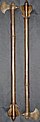 Indian (Deccan) tabar-shishpar, an extremely rare combination tabar axe and shishpar eight-flanged mace, steel with hollow shaft, 21.75 inches, 17th to 18th century
 -
 18th century Persian ceremonial tabar, crafted of steel with gold koftgari inlay, Kufic calligraphy and pierced decorations
 -
 Flag of Sindhudesh movement, the axe represents anger against enemies.
 -
 Badge of Sindh Regiment an infantry regiment in Pakistan army.
.jpg)


See also[edit | edit source]
References[edit | edit source]
- ↑ 1.0 1.1 1.2 Boris Alexandrovič Rybakov (1989). Kievan Russia: History of Kievan Russia's First Feudal. Progress. p. 30. ISBN 978-5-01-001154-3.
- ↑ Complete Persian culture (Dary dialect) by Gholam-reza Ensaf-pur
- ↑ Bailey, H. W. (December 15, 1986). "ARMENIA AND IRAN iv. Iranian influences". Encyclopaedia Iranica. Vol. II, Fasc. 4-5. pp. 445–465.
- ↑ Anatoly Liberman (16 March 2009). Word Origins...And How We Know Them: Etymology for Everyone. Oxford University Press, USA. p. 142. ISBN 978-0-19-538707-0.
- ↑ Sussex & Cubberley (2011, pp. 111–112)
Sources[edit | edit source]
- Sussex, Roland; Cubberley, Paul (2011), The Slavic Languages, Cambridge University Press, ISBN 978-0-521-29448-5