




>StSeanSpicer m →Fifth generation: led, not lead |
adjusted references after review |
||
| Line 1: | Line 1: | ||
{{Short description|Missile fired from the air at airborne targets}} | {{Short description|Missile fired from the air at airborne targets}} | ||
[[File: | [[File:AIM-120 AMRAAM and AIM-9 Sidewinder.JPG|thumb|An F-16 armed with an [[AIM-120 AMRAAM]] beyond-visual-range air to air missile (outer pylon) and an [[AIM-9 Sidewinder]] close combat missile (inner pylon); both missiles in this image are inert training missiles, as indicated by the blue markings]] | ||
[[ | [[File:ILA 2010 Samstag 125.JPG|thumb|[[Meteor (missile)|Meteor]] - example of a Ramjet powered air to air missile.]] | ||
[[File:ILA 2010 Samstag 125.JPG|thumb|[[Meteor | |||
An '''air-to-air missile''' ('''AAM''') is a [[missile]] fired from an [[aircraft]] for the purpose of destroying another aircraft. AAMs are typically powered by one or more [[rocket motor]]s, usually [[solid-fuel rocket|solid fueled]] but sometimes [[liquid-fuel rocket|liquid fueled]]. [[Ramjet]] engines, as used on the [[Meteor (missile)|Meteor]], are emerging as propulsion that will enable future medium-range missiles to maintain higher average speed across their engagement envelope. | An '''air-to-air missile''' ('''AAM''') is a [[missile]] fired from an [[aircraft]] for the purpose of destroying another aircraft in flight. AAMs are typically powered by one or more [[rocket motor]]s, usually [[solid-fuel rocket|solid fueled]] but sometimes [[liquid-fuel rocket|liquid fueled]]. [[Ramjet]] engines, as used on the [[Meteor (missile)|Meteor]], are emerging as propulsion that will enable future medium- to long-range missiles to maintain higher average speed across their engagement envelope. | ||
Air-to-air missiles are broadly put in two groups. Those designed to engage opposing aircraft at ranges of | Air-to-air missiles are broadly put in two groups. Those designed to engage opposing aircraft at ranges of around 30 km<ref name="ASRAAM-MBDS">{{cite web|url= https://www.mbda-systems.com/product/asraam/|title= ASRAAM|publisher= MBDS Systems|access-date= 17 November 2024|archive-date= 10 April 2021|archive-url= https://web.archive.org/web/20210410214314/https://www.mbda-systems.com/product/asraam/|url-status= live}}</ref><ref name="AA-11 ARCHER R-73">{{cite web |url= https://www.globalsecurity.org/military/world/russia/aa-11.htm|title = AA-11 ARCHER R-73 |publisher= Global Security |access-date= 3 February 2020}}</ref> to 40 km<ref name="RVV-MD">{{cite web |url= https://roe.ru/eng/catalog/aerospace-systems/air-to-air-missile/rvv-md/|title = RVV-MD |publisher= Rosoboronexport |access-date= 17 November 2024}}</ref><ref name="AA-11 ARCHER R-73"/> maximum are known as short-range or "within visual range" missiles (SRAAMs or WVRAAMs) and are sometimes called "[[dogfight]]" missiles because they are designed to optimize their agility rather than range.<ref name="ASRAAM-MBDS"/><ref name="RVV-MD"/> Most use [[infrared guidance]] and are called heat-seeking missiles. In contrast, medium- or long-range missiles (MRAAMs or LRAAMs), which both fall under the category of [[beyond-visual-range missile|beyond-visual-range]] missiles (BVRAAMs), tend to rely upon radar guidance, of which there are many forms. Some modern ones use [[inertial guidance]] and/or "mid-course updates" to get the missile close enough to use an active homing sensor. The concepts of air-to-air missiles and [[surface-to-air missile]]s are closely related, and in some cases versions of the same weapon may be used for both roles, such as the [[ASRAAM]] and [[Sea Ceptor]]. | ||
==History== | ==History== | ||
The air-to-air missile grew out of the unguided [[air-to-air rocket]]s used during the [[First World War]]. [[Le Prieur rocket]]s were sometimes attached to the struts of biplanes and fired electrically, usually against [[observation balloons]], by such early pilots as [[Albert Ball]] and A. M. Walters.<ref>{{cite book |title= Albert Ball VC |pages= 90–91}}</ref> Facing the Allied air superiority, [[Germany in World War II]] invested limited effort into missile research, initially adapting the projectile of the unguided [[21 cm Nebelwerfer 42]] infantry barrage rocket system into the air-launched [[Werfer-Granate 21|BR 21]] anti-aircraft rocket in 1943; leading to the deployment of the [[ | [[file:Ruhrstahl X-4.jpg|thumb|[[Ruhrstahl X-4]] in RAF Museum Cosford]] | ||
The air-to-air missile grew out of the unguided [[air-to-air rocket]]s used during the [[First World War]]. [[Le Prieur rocket]]s were sometimes attached to the struts of biplanes and fired electrically, usually against [[observation balloons]], by such early pilots as [[Albert Ball]] and A. M. Walters.<ref>{{cite book |title= Albert Ball VC |pages= 90–91}}</ref> Facing the Allied air superiority, [[Germany in World War II]] invested limited effort into missile research, initially adapting the projectile of the unguided [[21 cm Nebelwerfer 42]] infantry barrage rocket system into the air-launched [[Werfer-Granate 21|BR 21]] anti-aircraft rocket in 1943; leading to the deployment of the [[R4M]] unguided rocket and the development of [[List of German guided weapons of World War II|various guided missile prototypes]] such as the [[Ruhrstahl X-4]]. | |||
The [[US Navy]] and [[US Air Force]] began equipping guided missiles in 1956, deploying the USAF's [[AIM-4 Falcon]] and the USN's [[AIM-7 Sparrow]] and [[AIM-9 Sidewinder]]. Post-war research led the [[Royal Air Force]] to introduce [[Fairey Fireflash]] into service in 1957 but their results were unsuccessful. The [[Soviet Air Force]] introduced its [[K-5 (missile)|K-5]] into service in 1957. The first-ever successful combat deployment and shoot-down of an adversary aircraft happened during the [[Second Taiwan Strait Crisis|1958 Kinmen (Quemoy) Crisis]], when [[Republic of China Air Force|RoCAF]] F-86 Sabres shot down at least one Soviet-made [[People's Liberation Army Air Force|PLAAF]] MiG-17 using U.S.-supplied AIM-9 Sidewinder AAMs; the PLAAF fortuitously recovered a largely-intact AIM-9 Sidewinder that hit and got lodged into one of their MiG-17s, but did not explode, and reportedly turned over to the Soviets for reverse-engineering into the [[K-13 (missile)|K-13 AAM]].<ref>{{Cite web |last=Mizokami |first=Kyle |date=2024-06-05 |title=America's Groundbreaking Sidewinder Was Poised to Rule the Skies. Then, the Soviet Union Stole It. |url=https://www.popularmechanics.com/military/weapons/a60734289/aim-9-sidewinder-missile-history/ |url-status=live |archive-url=https://web.archive.org/web/20241206003824/https://www.popularmechanics.com/military/weapons/a60734289/aim-9-sidewinder-missile-history/ |archive-date=2024-12-06 |access-date=2025-05-31 |website=Popular Mechanics |language=en-US |quote=Nine years after the end of the Chinese Civil War, when the island of Taiwan officially became the sovereign Republic of China, its air force squared off in dogfights against the People’s Republic of China... The MiGs, which [[Chairman of the Chinese Communist Party]] [[Mao Zedong]] sent to test Taiwanese defenses, could fly faster and higher than the aging Sabres, making them difficult to intercept. Nothing, not even the superior training of the Taiwanese pilots, could make up for that. And both sides knew it...}}</ref> | |||
As missile systems have continued to advance, modern air warfare consists almost entirely of missile firing. The use of [[beyond-visual-range missile|beyond-visual-range]] combat became so pervasive in the US that early [[F-4]] variants were armed only with missiles in the 1960s. High casualty rates during the [[Vietnam War]] caused the US to reintroduce [[autocannon]] and traditional dogfighting tactics but the missile remains the primary weapon in air combat. | |||
In the [[Falklands War]] British [[Harrier jump jet|Harriers]], using AIM-9L missiles were able to defeat faster Argentinian opponents.<ref>{{Cite web|url=http://www.thehistorychannel.co.uk/site/microsites/Falklands/index_microsite.php?microsite=Falklands&target=The_Harrier§ion=626|archive-url=https://web.archive.org/web/20090519010009/http://www.thehistorychannel.co.uk/site/microsites/Falklands/index_microsite.php?microsite=Falklands&target=The_Harrier§ion=626|url-status=dead|title=The History Channel|archive-date=May 19, 2009}}</ref> Since the late 20th century [[all-aspect]] heat-seeking designs can [[missile lock-on|lock-on]] to a target from various angles, not just from behind, where the heat signature from the engines is strongest. Other types rely on radar guidance (either on-board or "painted" by the launching aircraft). | |||
===Use of air-to-air missiles as surface-to-air missiles=== | |||
[[File:NASAMS NL Gilze-Rijen AB 2014.jpg|thumb|An AIM-120 dummy missile on a rail extending from the [[NASAMS]] canister]] | |||
In 1999 R-73 missile were adapted by Serb forces for surface to air missiles. The [[Houthi movement]] Missile Research and Development Centre and the Missile Force have tried to fire R-27/R-60/R-73/R-77 against Saudi aircraft using stockpiles of missiles from [[Yemeni Air Force]] stocks. The issue for the R-27 and R-77 is the lack of a radar to support their guidance to the target. However the R-73 and R-60 are infra-red heat seeking missiles. They only require power, liquid nitrogen "to cool the seeker head", and a pylon to launch the missile. These missiles have been paired with a "US made FLIR Systems ULTRA 8500 turrets". Only one near miss has been verified and that was a R-27T fired at [[Royal Saudi Air Force]] F-15SA. However the drawback is that these missiles are intended to be fired from one jet fighter against another. So the motors and fuel load are smaller than a purpose built surface to air missile.<ref>{{Cite web |title=Here's how Houthis were able to deploy R-27/R-60/R-73/R-77 Air-to-Air Missiles as SAMs against Saudi-led Coalition Aircraft |url=https://theaviationgeekclub.com/heres-how-houthis-were-able-to-deploy-r-27-r-60-r-73-r-77-air-to-air-missiles-as-sams-against-saudi-led-coalition-aircraft/ |author= Dario Leone| date=2019-07-17 |access-date=2022-10-14 |website=theaviationgeekclub.com}}</ref> | |||
On the Western side, the Norwegian-American made [[NASAMS]] air defense system has been developed for using [[AIM-9 Sidewinder]], [[IRIS-T]] and [[AMRAAM]] air-to-air missiles to intercept targets. None of these missiles require modifications and hence it is possible for the system to take missiles straight from an aircraft. After a live-fire test occurred in September 2020 off the coasts of Florida, during which it successfully engaged a simulated cruise missile, in 2022 NASAMS was deployed to Ukraine, where for the first time this missile system was used in real combat conditions, and, according to Ukrainian government, was able to shoot down more than 100 aerial targets.<ref>{{Cite web |title=US air defense system delivery hopes to save Kiev |url=https://asiatimes.com/2022/07/us-air-defense-system-delivery-hopes-to-save-kiev/ |author= Stephen Bryen| date=2022-07-09 |access-date=2022-10-14 |website=asiatimes.com}}</ref> | |||
==Warhead== | ==Warhead== | ||
A conventional explosive blast warhead, [[fragmentation (weaponry)|fragmentation]] warhead, or [[continuous rod]] warhead (or a combination of any of those three warhead types) is typically used in the attempt to disable or destroy the target aircraft. Warheads are typically detonated by a [[proximity fuze]] or by an impact fuze if it scores a direct hit. Less commonly, nuclear warheads have been mounted on a small number of air-to-air missile types (such as the [[AIM-26 Falcon]]) although these | [[File:AIM-9L DF-ST-82-10199.jpg|thumb|right|[[AIM-9 Sidewinder|AIM-9]]L Captive Air Training Missile (CATM) with [[rocket motor]] and inert [[warhead]] for training.]] | ||
A conventional explosive blast warhead, [[fragmentation (weaponry)|fragmentation]] warhead, or [[continuous rod]] warhead (or a combination of any of those three warhead types) is typically used in the attempt to disable or destroy the target aircraft. Warheads are typically detonated by a [[proximity fuze]] or by an impact fuze if it scores a direct hit. Less commonly, nuclear warheads have been mounted on a small number of air-to-air missile types (such as the [[AIM-26 Falcon]]) although these have never been used in combat. | |||
==Guidance== | ==Guidance== | ||
{{See also|Missile guidance}} | {{See also|Missile guidance}} | ||
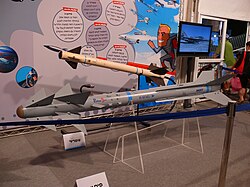
[[File:Göktuğ.jpg|thumb|[[Gökdoğan (air-to-air missile)|Gökdoğan]] (displayed lower-front) [[active radar homing]] [[Beyond-visual-range missile|BVR]] air-to-air missile and [[Bozdoğan (air-to-air missile)|Bozdoğan]] (displayed lower-back) [[infrared homing]] short-range air-to-air missile side by aide at the [[International Defence Industry Fair|IDEF]] 2019 in [[Istanbul]], [[Turkey]].]] | |||
Guided missiles operate by detecting their target (usually by either [[radar]] or [[infrared]] methods, although rarely others such as [[laser guidance]] or [[Optical motion tracking|optical tracking]]), and then "homing" in on the target on a collision course. | Guided missiles operate by detecting their target (usually by either [[radar]] or [[infrared]] methods, although rarely others such as [[laser guidance]] or [[Optical motion tracking|optical tracking]]), and then "homing" in on the target on a collision course. | ||
| Line 36: | Line 42: | ||
====Active radar homing==== | ====Active radar homing==== | ||
{{Main|Active radar homing}} | {{Main|Active radar homing}} | ||
[[File:Seeker Vympel-R-77-maks2009.jpg|thumb|Active radar seeker Head of Vympel [[R-77]] at 2009 [[MAKS Airshow]]]] | |||
Active radar (AR)-guided missiles carry their own radar system to detect and track their target. However, the size of the radar antenna is limited by the small diameter of missiles, limiting its range which typically means such missiles are launched at a predicted future location of the target, often relying on separate guidance systems such as [[Global Positioning System]], [[inertial guidance]], or a mid-course update from either the launching aircraft or other system that can communicate with the missile to get the missile close to the target. At a predetermined point (frequently based on time since launch or arrival near the predicted target location) the missile's radar system is activated (the missile is said to "go active"), and the missile then homes in on the target. | Active radar (AR)-guided missiles carry their own radar system to detect and track their target. However, the size of the radar antenna is limited by the small diameter of missiles, limiting its range which typically means such missiles are launched at a predicted future location of the target, often relying on separate guidance systems such as [[Global Positioning System]], [[inertial guidance]], or a mid-course update from either the launching aircraft or other system that can communicate with the missile to get the missile close to the target. At a predetermined point (frequently based on time since launch or arrival near the predicted target location) the missile's radar system is activated (the missile is said to "go active"), and the missile then homes in on the target. | ||
| Line 43: | Line 50: | ||
====Semi-active radar homing==== | ====Semi-active radar homing==== | ||
[[File:F-15 firing AIM-7Ms.jpg|thumb|right|Two [[F-15E]]s from the 90th Fighter Squadron USAF, from Elmendorf Air Force Base, Alaska, fire a pair of semi-active radar homing [[AIM-7 Sparrow|AIM-7Ms]] during a training mission.]] | |||
{{Main|Semi-active radar homing}} | {{Main|Semi-active radar homing}} | ||
Semi-active radar homing (SARH) guided missiles are simpler and more common. They function by detecting radar energy reflected from the target. The radar energy is emitted from the launching aircraft's own radar system. | Semi-active radar homing (SARH) guided missiles are simpler and more common. They function by detecting radar energy reflected from the target. The radar energy is emitted from the launching aircraft's own radar system. | ||
| Line 54: | Line 62: | ||
====Beam riding==== | ====Beam riding==== | ||
{{Main|Beam riding}} | {{Main|Beam riding}} | ||
[[File:K-5M Air-to-Air Missile.jpg|thumb|right|A beam riding [[K-5 (missile)]] air-to-air missile on [[MiG-19]]. (Displayed in the Military History Museum and Park in Kecel, Hungary)]] | |||
An early form of radar guidance was "[[beam-riding]]" (BR). In this method, the attacking aircraft directs a narrow beam of radar energy at the target. The air-to-air missile was launched into the beam, where sensors on the aft of the missile controlled the missile, keeping it within the beam. So long as the beam was kept on the target aircraft, the missile would ride the beam until making the interception. | An early form of radar guidance was "[[beam-riding]]" (BR). In this method, the attacking aircraft directs a narrow beam of radar energy at the target. The air-to-air missile was launched into the beam, where sensors on the aft of the missile controlled the missile, keeping it within the beam. So long as the beam was kept on the target aircraft, the missile would ride the beam until making the interception. | ||
While conceptually simple, the move is hard because of the challenge of simultaneously keeping the beam solidly on the target (which | While conceptually simple, the move is hard because of the challenge of simultaneously keeping the beam solidly on the target (which could not be relied upon to cooperate by flying straight and level), continuing to fly one's own aircraft, and monitoring enemy countermeasures. | ||
An added complication was that the beam will spread out into a cone shape as the distance from the attacking aircraft increases. This will result in less accuracy for the missile because the beam may actually be larger than the target aircraft when the missile arrives. The missile could be securely within the beam but still not be close enough to destroy the target. | An added complication was that the beam will spread out into a cone shape as the distance from the attacking aircraft increases. This will result in less accuracy for the missile because the beam may actually be larger than the target aircraft when the missile arrives. The missile could be securely within the beam but still not be close enough to destroy the target. | ||
| Line 62: | Line 71: | ||
===Infrared guidance=== | ===Infrared guidance=== | ||
{{Main|Infrared homing}} | {{Main|Infrared homing}} | ||
[[File:MAA-1A seeker head.jpg|thumb|right|Infrared homing seeker head of [[MAA-1 Piranha]]]] | |||
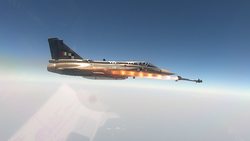
[[File:HAL Tejas (LSP-07) firing Python-5 missile better visibility.png|alt==An infrared homing Python-5 AAM being fired from Indian Air Force HAL Tejas fighter during certification tests|thumb|An infrared homing Python-5 AAM being fired from [[HAL Tejas]] fighter]] | [[File:HAL Tejas (LSP-07) firing Python-5 missile better visibility.png|alt==An infrared homing Python-5 AAM being fired from Indian Air Force HAL Tejas fighter during certification tests|thumb|An infrared homing Python-5 AAM being fired from [[HAL Tejas]] fighter]] | ||
'''Infrared guided''' (IR) missiles home on the heat produced by an aircraft. Early infra-red detectors had poor sensitivity, so could only track the hot exhaust pipes of an aircraft. This meant an attacking aircraft had to maneuver to a position behind its target before it could fire an infra-red guided missile. This also limited the range of the missile as the infra-red signature soon become too small to detect with increasing distance and after launch the missile was playing "catch-up" with its target. Early infrared seekers were unusable in clouds or rain (which is still a limitation to some degree) and could be distracted by the sun, a reflection of the sun off of a cloud or ground object, or any other "hot" object within its view. | '''Infrared guided''' (IR) missiles home on the heat produced by an aircraft. Early infra-red detectors had poor sensitivity, so could only track the hot exhaust pipes of an aircraft. This meant an attacking aircraft had to maneuver to a position behind its target before it could fire an infra-red guided missile. This also limited the range of the missile as the infra-red signature soon become too small to detect with increasing distance and after launch the missile was playing "catch-up" with its target. Early infrared seekers were unusable in clouds or rain (which is still a limitation to some degree) and could be distracted by the sun, a reflection of the sun off of a cloud or ground object, or any other "hot" object within its view. | ||
| Line 74: | Line 84: | ||
===Electro-optical=== | ===Electro-optical=== | ||
A recent advancement in missile guidance is '''electro-optical''' imaging. The Israeli [[ | A recent advancement in missile guidance is '''electro-optical''' imaging. The Israeli [[Python-5]] has an electro-optical seeker that scans designated area for targets via optical imaging. Once a target is acquired, the missile will lock-on to it for the kill. Electro-optical seekers can be programmed to target vital area of an aircraft, such as the cockpit. Since it does not depend on the target aircraft's heat signature, it can be used against low-heat targets such as [[UAVs]] and [[cruise missile]]s. However, clouds can get in the way of electro-optical sensors.<ref>{{cite web|url=http://www.fas.org/spp/military/docops/afwa/metsat-U3.htm|title=Atmospheric Effects on Electro-optics|access-date=4 November 2014}}</ref> | ||
===Passive | ===Passive anti-radiation=== | ||
{{Main|Anti-radiation missile}} | {{Main|Anti-radiation missile}} | ||
Evolving missile guidance designs are converting the anti-radiation missile (ARM) design, pioneered during Vietnam and used to home in against emitting surface-to-air missile (SAM) sites, to an air intercept weapon. Current air-to-air passive anti-radiation missile development is thought to be a countermeasure to [[airborne early warning and control]] (AEW&C | Evolving missile guidance designs are converting the anti-radiation missile (ARM) design, pioneered during Vietnam and used to home in against emitting surface-to-air missile (SAM) sites, to an air intercept weapon. Current air-to-air passive anti-radiation missile development is thought to be a countermeasure to [[airborne early warning and control]] (AEW&C – also known as AEW or AWACS) aircraft which typically mount powerful search radars. | ||
Due to their dependence on target aircraft radar emissions, when used against fighter aircraft passive anti-radiation missiles are primarily limited to forward-aspect intercept geometry.<ref>Carlo Kopp (Aug 2009). [http://www.ausairpower.net/APA-Rus-BVR-AAM.html "The Russian Philosophy of BVR Air Combat"]. ''Airpower Australia'', Retrieved April 2010</ref> For examples, see [[ | Due to their dependence on target aircraft radar emissions, when used against fighter aircraft passive anti-radiation missiles are primarily limited to forward-aspect intercept geometry.<ref>Carlo Kopp (Aug 2009). [http://www.ausairpower.net/APA-Rus-BVR-AAM.html "The Russian Philosophy of BVR Air Combat"]. ''Airpower Australia'', Retrieved April 2010</ref> For examples, see [[Vympel R-27]] and [[Brazo]]. | ||
Another aspect of passive anti-radiation homing is the "home on jam" mode which, when installed, allows a radar-guided missile to home in on the jammer of the target aircraft if the primary seeker is jammed by the [[electronic countermeasures]] of the target aircraft | Another aspect of passive anti-radiation homing is the "home on jam" mode which, when installed, allows a radar-guided missile to home in on the jammer of the target aircraft if the primary seeker is jammed by the [[electronic countermeasures]] of the target aircraft. | ||
==Design== | ==Design== | ||
Air-to-air missiles are typically long, thin cylinders in order to reduce their cross section and thus minimize drag at the high speeds at which they travel. Missiles are divided into five primary systems (moving forward to aft): seeker, guidance, warhead, | [[File:MAKS Airshow 2013 (Ramenskoye Airport, Russia) (524-21).jpg|thumb|right|Scramjet engine powered [[R-37 (missile)|R-37]]M (under the export designation RVV-BD) long range hypersonic BVR missile at 2013 [[MAKS Airshow]].]] | ||
[[File:T129 ATAK armed with 19-Tube 70 mm rocket launcher and 2 air to air Stinger.jpg|thumb|right|[[T129 ATAK]] helicopter with two very short range [[Air-to-Air Stinger]] missiles mounted under-wing. The helicopter launched missile is developed from the [[FIM-92 Stinger ]] [[MANPADS]].]] | |||
Air-to-air missiles are typically long, thin cylinders in order to reduce their cross section and thus minimize drag at the high speeds at which they travel. Missiles are divided into five primary systems (moving forward to aft): seeker, guidance, warhead, motor, and control actuation. | |||
At the front is the seeker, either a radar system, radar homer, or infra-red detector. Behind that lies the avionics which control the missile. Typically after that, in the centre of the missile, is the warhead, usually several kilograms of high explosive surrounded by metal that fragments on detonation (or in some cases, pre-fragmented metal). | At the front is the seeker, either a radar system, radar homer, or infra-red detector. Behind that lies the avionics which control the missile. Typically after that, in the centre of the missile, is the warhead, usually several kilograms of high explosive surrounded by metal that fragments on detonation (or in some cases, pre-fragmented metal). | ||
The rear part of the missile contains the propulsion system, usually a rocket of some type and the control actuation system or CAS. [[Dual-thrust]] solid-fuel rockets are common, but some longer-range missiles use liquid-fuel motors that can "throttle" to extend their range and preserve fuel for energy-intensive final maneuvering. Some solid-fuelled missiles mimic this technique with a second rocket motor which burns during the terminal homing phase. There are missiles | The rear part of the missile contains the propulsion system, usually a rocket of some type and the control actuation system or CAS. [[Dual-thrust]] solid-fuel rockets are common, but some longer-range missiles use liquid-fuel motors that can "throttle" to extend their range and preserve fuel for energy-intensive final maneuvering. Some solid-fuelled missiles mimic this technique with a second rocket motor which burns during the terminal homing phase. There are missiles, such as the MBDA Meteor, that "breathe" air (using a [[ramjet]], similar to a jet engine) in order to extend their range. | ||
Modern missiles use "low-smoke" motors – early missiles produced thick smoke trails, which were easily seen by the crew of the target aircraft alerting them to the attack and helping them determine how to evade it. | Modern missiles use "low-smoke" motors – early missiles produced thick smoke trails, which were easily seen by the crew of the target aircraft alerting them to the attack and helping them determine how to evade it. | ||
| Line 95: | Line 108: | ||
The CAS is typically an electro-mechanical, servo control actuation system, which takes input from the guidance system and manipulates the airfoils or fins at the rear of the missile that guide or steers the weapon to target. | The CAS is typically an electro-mechanical, servo control actuation system, which takes input from the guidance system and manipulates the airfoils or fins at the rear of the missile that guide or steers the weapon to target. | ||
Nowadays, countries start developing hypersonic air-to-air missile using [[Scramjet|scramjet engines]] (such as [[R-37 (missile)|R-37]], or [[AIM-260 JATM]]), which not only increases efficiency for [[BVR]] battles, but it also makes survival chances of target aircraft drop to nearly zero. | |||
[[ | |||
==Performance== | ==Performance== | ||
A number of terms frequently crop up in discussions of air-to-air missile performance. | A number of terms frequently crop up in discussions of air-to-air missile performance. | ||
;Launch success zone | ; Launch success zone: The Launch Success Zone is the range within which there is a high (defined) kill probability against a target that remains unaware of its engagement until the final moment. When alerted visually or by a warning system the target attempts a last-ditch-manoeuvre sequence. | ||
:The Launch Success Zone is the range within which there is a high (defined) kill probability against a target that remains unaware of its engagement until the final moment. When alerted visually or by a warning system the target attempts a last-ditch-manoeuvre sequence. | ; F-pole: A closely related term is the F-Pole. This is the slant range between the launch aircraft and target, at the time of interception. The greater the F-Pole, the greater the confidence that the launch aircraft will achieve air superiority with that missile. | ||
; A-pole: This is the slant range between the launch aircraft and target at the time that the missile begins active guidance or acquires the target with the missile's active seeker. The greater the A-Pole means less time and possibly greater distance that the launch aircraft needs to support the missile guidance until missile seeker acquisition. | |||
; No-escape zone: The no-escape zone is the zone within which there is a high (defined) kill probability against a target even if it has been alerted. This zone is defined as a conical shape with the tip at the missile launch. The cone's length and width are determined by the missile and seeker performance. A missile's speed, range and seeker sensitivity will mostly determine the length of this imaginary cone, while its agility (turn rate) and seeker complexity (speed of detection and ability to detect off axis targets) will determine the width of the cone. | |||
===Missile minimum range=== | |||
:A | [[File:gw-tomphoenix.jpg|thumb|A [[US Navy]] [[VF-103 Jolly Rogers]] [[F-14 Tomcat]] fighter launches an [[AIM-54 Phoenix]] long-range air-to-air missile. Photo courtesy U.S. Navy Atlantic Fleet.]] | ||
A missile is subject to a minimum range, before which it cannot maneuver effectively. In order to maneuver sufficiently from a poor launch angle at short ranges to hit its target, some missiles use [[thrust vectoring]], which allow the missile to start turning "off the rail", before its motor has accelerated it up to high enough speeds for its small aerodynamic surfaces to be useful. | |||
==Short-range air-to-air missile== | |||
{{See also-text|[[Beyond-visual-range missile]]s have their own article}} | |||
Short-range air-to-air missiles (SRAAMs), typically used in "[[dogfight]]ing" or close range air combat compare to the [[beyond-visual-range missile]]s. Most of the short-range air-to-air missiles are [[Infrared homing|infrared guided]]. | |||
=== | === SRAAM missile evolution === | ||
[[File:Misil aire-aire de corto alcance (SRAAM) PiLi-5 (PL-5) - (inertes para entrenamiento).jpg|thumb|right|Chinese [[PL-5]] short-range air-to-air missiles]] | |||
Those missiles usually classified into five "generations" according to the historical technological advances. Most of these advances were in infrared seeker technology (later combined with [[digital signal processing]]). | |||
=== First generation === | |||
Early short-range missiles such as the early [[AIM-9 Sidewinder|Sidewinders]] and [[K-13 (missile)]] (''AA-2 Atoll'') had infrared seekers with a narrow (30-degree) field of view and required the attacker to position himself behind the target ([[Tail-chase engagement|rear aspect engagement]]). This meant that the target aircraft only had to perform a slight turn to move outside the missile seeker's field of view and cause the missile to lose track of the target ("break lock").<ref name=" | Early short-range missiles such as the early [[AIM-9 Sidewinder|Sidewinders]] and [[K-13 (missile)]] (''AA-2 Atoll'') had infrared seekers with a narrow (30-degree) field of view and required the attacker to position himself behind the target ([[Tail-chase engagement|rear aspect engagement]]). This meant that the target aircraft only had to perform a slight turn to move outside the missile seeker's field of view and cause the missile to lose track of the target ("break lock").<ref name="Carlo Kopp-1997">{{cite journal | ||
|author = Carlo Kopp | |author = Carlo Kopp | ||
|date=April 1997 | |date=April 1997 | ||
|title = Fourth Generation AAMs | |title = Fourth Generation AAMs – The Rafael Python 4 | ||
|journal = Australian Aviation | |journal = Australian Aviation | ||
|volume=1997 | |volume=1997 | ||
| Line 130: | Line 143: | ||
}}</ref> | }}</ref> | ||
=== Second generation === | |||
The second-generation of short-range missiles utilized more effective seekers that were better cooled than its predecessors while being typically "uncaged"; resulting in improved sensitivity to heat signatures, an increase in field of view as well as allowing the possibility of leading a missile within its FOV for an increased probability of kill against a maneuvering target. In some cases, the improved sensitivity to heat signatures allows for a very limited side and even all-aspect tracking, as is the case with the [[Red Top missile]]. In conjunction with improved control surfaces and propulsion motors over the first generation of dogfight missiles, the technological advances of the second-generation short-range missiles allowed them to be used not just on non-maneuvering bombers, but also actively maneuvering fighters. Examples include advanced derivatives of the [[K-13 (missile)]] and [[AIM-9]] such as '''K-13M''' ('''R-13M''', Object 380) or '''AIM-9D / G / H'''. | |||
=== Third generation === | |||
This generation introduced | This generation introduced much more sensitive seekers that are capable of locking onto the warm heat irradiated by the skins of aircraft from the front or side aspects, as opposed to just the hotter engine nozzle(s) from rear-aspect, allowing for a true [[all-aspect]] capability. This significantly expanded potential attacking envelopes, allowing the attacker to fire at a target which was side-on or front-on to itself as opposed to just the rear. While the field-of-view was still restricted to a fairly narrow cone, the attack at least did not have to be behind the target.<ref name="Carlo Kopp-1997" /> | ||
Also typical of the third generation of short-range missiles are further improved agility over the previous generation as well as their ability to radar-slave; which is acquiring tracking data from the launching aircraft's radar or [[IRST]] systems, allowing attackers to launch missiles without ever pointing the nose of the aircraft at an enemy prior to leading the missile. Examples of this generation of dogfight missiles include the [[R-60 (missile)|R-60M]] or the [[Python-3]]. | |||
The [[R-73 (missile)]] (''AA-11 Archer'') entered service in 1985 and marked a new generation of dogfight missile. It had a wider field of view and could be cued onto a target using a [[helmet mounted sight]]. This allowed it to be launched at targets that would otherwise not be seen by older generation missiles that generally stared forward while waiting to be launched. This capability, combined with a more powerful motor that allows the missile to maneuver against crossing targets and launch at greater ranges, gives the launching aircraft improved tactical freedom.<ref name=" | |||
=== Fourth generation === | |||
The [[R-73 (missile)]] (''AA-11 Archer'') entered service in 1985 and marked a new generation of dogfight missile. It had a wider field of view and could be cued onto a target using a [[helmet mounted sight]]. This allowed it to be launched at targets that would otherwise not be seen by older generation missiles that generally stared forward while waiting to be launched. This capability, combined with a more powerful motor that allows the missile to maneuver against crossing targets and launch at greater ranges, gives the launching aircraft improved tactical freedom.<ref name="Carlo Kopp-1998">{{cite journal | |||
|author = Carlo Kopp | |author = Carlo Kopp | ||
|date=August 1998 | |date=August 1998 | ||
|title = Helmet Mounted Sights and Displays | |title = Helmet Mounted Sights and Displays | ||
|journal = Air Power International | |journal = Air Power International | ||
| Line 148: | Line 163: | ||
Other members of the 4th generation use [[focal plane array]]s to offer greatly improved scanning and countermeasures resistance (especially against flares). These missiles are also much more agile, some by employing [[thrust vectoring]] (typically [[gimballed thrust]]). | Other members of the 4th generation use [[focal plane array]]s to offer greatly improved scanning and countermeasures resistance (especially against flares). These missiles are also much more agile, some by employing [[thrust vectoring]] (typically [[gimballed thrust]]). | ||
=== Fifth generation === | |||
The latest generation of short-range missiles again defined by advances in seeker technologies, this time electro-optical [[imaging infrared]] (IIR) seekers that allow the missiles to "see" images rather than single "points" of infrared radiation (heat). The sensors combined with more powerful [[digital signal processing]] provide the following benefits: | [[File:IRIS-T air-to-air-missile.jpg|thumb|right|An [[IRIS-T]] air-to-air missile of the [[German Air Force]].]] | ||
*greater infrared counter countermeasures (IRCCM) ability, by being able to distinguish aircraft from [[infrared countermeasures]] (IRCM) such as flares. | The latest generation of short-range missiles again defined by advances in seeker technologies, this time electro-optical [[imaging infrared]] (IIR) seekers that allow the missiles to "see" images rather than single "points" of infrared radiation (heat). The sensors combined with more powerful [[digital signal processing]] provide the following benefits: | ||
*greater sensitivity means greater range and ability to identify smaller low flying targets such as [[ | * greater infrared counter countermeasures (IRCCM) ability, by being able to distinguish aircraft from [[infrared countermeasures]] (IRCM) such as flares. | ||
*more detailed target image allows targeting of more vulnerable parts of aircraft instead of just homing in on the brightest infrared source (exhaust). | * greater sensitivity means greater range and ability to identify smaller low flying targets such as [[UAV]]s. | ||
* more detailed target image allows targeting of more vulnerable parts of aircraft instead of just homing in on the brightest infrared source (exhaust). | |||
Examples of fifth- | Examples of fifth generation short-range missiles include: | ||
* [[R-73 (missile)|R-73M]] ("AA-11 Archer") – Russia (1994–)<ref name="R-73">{{Cite web|url=https://missilery.info/missile/r73|title=Управляемая ракета малой дальности Р-73 | Ракетная техника|website=missilery.info}}</ref> | |||
*[[R-73 (missile)]] | * [[ASRAAM]] – UK (1998–) | ||
*[[ | * [[AIM-9 Sidewinder#AIM-9X|AIM-9X Sidewinder]] – US (2003–) | ||
*[[ | * [[Python 5]] – Israel (2003–) | ||
*[[ | * [[AAM-5 (Japanese missile)|AAM-5 ]] – Japan (2004–) | ||
*[[ | * [[IRIS-T]] – Germany (2005–) | ||
*[[ | * [[PL-10]] – China (2015–) | ||
*[[ | * [[R-73 (missile)|R-74M2]] ("AA-11 Archer") – Russia (2019–)ref name="R-73"/> | ||
* [[A-Darter]] – South Africa and Brazil (2019–)<ref>{{Cite web|last=Lake|first=Jon|title=A-Darter Missile Certified by Brazil and South Africa|url=https://www.ainonline.com/aviation-news/defense/2019-10-09/darter-missile-certified-brazil-and-south-africa|access-date=2021-11-29|website=Aviation International News|language=en|archive-date=2021-11-29|archive-url=https://web.archive.org/web/20211129194611/https://www.ainonline.com/aviation-news/defense/2019-10-09/darter-missile-certified-brazil-and-south-africa|url-status=dead}}</ref> | |||
*[[A-Darter]] | * [[Bozdoğan (air-to-air missile)|Bozdoğan]] – Turkey (2024–) | ||
== List of missiles by country == | == List of missiles by country == | ||
''For each missile, short notes are given, including an indication of its range and guidance mechanism.'' | ''For each missile, short notes are given, including an indication of its range and guidance mechanism.'' | ||
| Line 180: | Line 188: | ||
* [[Mectron MAA-1 Piranha|MAA-1A Piranha]] – Short-range IR | * [[Mectron MAA-1 Piranha|MAA-1A Piranha]] – Short-range IR | ||
* [[MAA-1B|MAA-1B Piranha]] – IR-guided missile. | * [[MAA-1B|MAA-1B Piranha]] – IR-guided missile. | ||
* [[ | * [[A-Darter]] – Short-range IR (With South Africa) | ||
===Canada=== | |||
* [[Velvet Glove]] - short range, semi-active radar-guided | |||
===France=== | ===France=== | ||
*[[ | * [[Nord AA.20]], [[AA.25]] – radio-guided, beam-riding | ||
*[[R.511|Matra R.510]] – IR-guided | * [[R.511|Matra R.510]] – IR-guided | ||
*[[R.511|Matra R.511]] – radar-guided | * [[R.511|Matra R.511]] – radar-guided | ||
*[[ | * [[Matra R.550 Magic]] – short-range, IR-guided | ||
*[[Matra Magic II]] – IR-guided | * [[Matra Magic II]] – IR-guided | ||
*[[ | * [[Matra R.530]] – medium-range, IR- or radar-guided | ||
*[[Super 530|Matra Super 530F/Super 530D]] – medium-range, radar-guided | * [[Super 530|Matra Super 530F/Super 530D]] – medium-range, radar-guided | ||
*[[Mistral (missile)|Matra Mistral]] – IR-guided | * [[Mistral (missile)|Matra Mistral]] – IR-guided | ||
*[[MBDA MICA]] – medium-range, IR- or active radar-guided | * [[MBDA MICA]] – medium-range, IR- or active radar-guided | ||
*[[MBDA Meteor]] – long-range active radar-guided missile, integrated on Rafale.<ref>{{cite web|url=https://www.defense.gouv.fr/salle-de-presse/communiques/communiques-de-florence-parly/communique_premiers-tirs-meteor-effectues-par-les-rafale-de-l-armee-de-l-air-et-de-la-marine-nationale|title=Communiqué Premiers tirs METEOR effectués par les Rafale de l'armée de l'Air et de la Marine nationale|access-date=14 August 2019}}</ref> | * [[MBDA Meteor]] – long-range active radar-guided missile, integrated on Rafale.<ref>{{cite web|url=https://www.defense.gouv.fr/salle-de-presse/communiques/communiques-de-florence-parly/communique_premiers-tirs-meteor-effectues-par-les-rafale-de-l-armee-de-l-air-et-de-la-marine-nationale|title=Communiqué Premiers tirs METEOR effectués par les Rafale de l'armée de l'Air et de la Marine nationale|access-date=14 August 2019}}</ref> | ||
*[[PARS 3 LR|TRIGAT LR]] | * [[PARS 3 LR|TRIGAT LR]] | ||
===Germany=== | ===Germany=== | ||
[[File:Luftwaffe Eurofighter Typhoon.JPG|thumb|Luftwaffe IRIS-T and Meteor missiles on a Eurofighter Typhoon]] | [[File:Luftwaffe Eurofighter Typhoon.JPG|thumb|Luftwaffe IRIS-T and Meteor missiles on a Eurofighter Typhoon]] | ||
* [[Henschel Hs 298]] – [[World War II]] design, [[MCLOS]], never saw service | * [[Henschel Hs 298]] – [[World War II]] design, [[MCLOS]], never saw service | ||
*[[IRIS-T]] | * [[IRIS-T]] | ||
* MBDA Meteor long-range, active radar-guided, pending contract for integration on Eurofighter.<ref name=" | * MBDA Meteor long-range, active radar-guided, pending contract for integration on Eurofighter.<ref name="First Tranche 3 Typhoon Readied For Flight">{{cite web|url=http://aviationweek.com/awin/first-tranche-3-typhoon-readied-flight|title=First Tranche 3 Typhoon Readied For Flight|access-date=4 November 2014}}</ref> | ||
* [[Ruhrstahl X-4]] – [[World War II]] design, first practical anti-aircraft missile, [[MCLOS]], never saw service | * [[Ruhrstahl X-4]] – [[World War II]] design, first practical anti-aircraft missile, [[MCLOS]], never saw service | ||
*[[RZ 65]] missile project developed by [[Rheinmetall-Borsig]] in 1941. After about 3000 tests it revealed itself unsatisfactory owing to an accuracy of only 15%. The project was terminated by the end of the war.<ref name="Allgemeine Luftkampfraketen">{{cite web|url=http://www.luftwaffen-projekte.de/lwp/raketen/lkrak/lkrak.htm|title=Allgemeine Luftkampfraketen|access-date=4 November 2014|archive-url=https://web.archive.org/web/20150122021704/http://www.luftwaffen-projekte.de/lwp/raketen/lkrak/lkrak.htm|archive-date=22 January 2015|url-status=dead}}</ref> | * [[RZ 65]] missile project developed by [[Rheinmetall-Borsig]] in 1941. After about 3000 tests it revealed itself unsatisfactory owing to an accuracy of only 15%. The project was terminated by the end of the war.<ref name="Allgemeine Luftkampfraketen">{{cite web|url=http://www.luftwaffen-projekte.de/lwp/raketen/lkrak/lkrak.htm|title=Allgemeine Luftkampfraketen|access-date=4 November 2014|archive-url=https://web.archive.org/web/20150122021704/http://www.luftwaffen-projekte.de/lwp/raketen/lkrak/lkrak.htm|archive-date=22 January 2015|url-status=dead}}</ref> | ||
* [[Dornier Viper]] | * [[Dornier Viper]] | ||
=== | ===India=== | ||
[[File:Astra BVRAAM successfully test fired from Su-30MKI off the Odisha coast on September 17, 2019.jpg|thumb|[[Astra (missile)|Astra]] [[BVRAAM]] fired from [[Indian Air Force|IAF]] [[Su-30MKI]]]] | |||
* [[Astra (missile)|Astra Mk 1]] – Long-range radar-guided<ref name="Allgemeine Luftkampfraketen"/><ref>{{cite web | url=https://www.thehindubusinessline.com/news/after-successful-development-trials-astra-missile-ready-for-production/article9864087.ece | title=After successful development trials, Astra missile ready for production | date=18 September 2017 }}</ref> | |||
* [[Astra (missile)|Astra Mk | * [[Astra (missile)|Astra Mk 2]] – Long-range radar-guided | ||
* [[Astra (missile)|Astra Mk 3]] – Long-range radar-guided | |||
* [[Astra (missile)|Astra IR]] – Short-range infrared homing | |||
* [[K-100 (missile)]] – [[Inertial navigation]] and [[active radar homing]] (with Russia) | * [[K-100 (missile)]] – [[Inertial navigation]] and [[active radar homing]] (with Russia) | ||
===Iran=== | ===Iran=== | ||
* [[Fatter]] – copy of U.S. [[AIM-9 Sidewinder]]<ref>{{cite web|url=http://www.janes.com/articles/Janes-Air-Launched-Weapons/Fatter-Iran.html|title=Fatter | * [[Fatter]] – copy of U.S. [[AIM-9 Sidewinder]]<ref>{{cite web|url=http://www.janes.com/articles/Janes-Air-Launched-Weapons/Fatter-Iran.html|title=Fatter – Jane's Air-Launched Weapons|access-date=4 November 2014}}</ref> | ||
* [[Sedjil (air-to-air missile)|Sedjil]] – copy of U.S. [[MIM-23 Hawk]] converted to be carried by aircraft<ref>{{cite web|url=http://www.janes.com/articles/Janes-Air-Launched-Weapons/Sedjil-Project-Sky-Hawk-Iran.html|title=Sedjil | * [[Sedjil (air-to-air missile)|Sedjil]] – copy of U.S. [[MIM-23 Hawk]] converted to be carried by aircraft<ref>{{cite web|url=http://www.janes.com/articles/Janes-Air-Launched-Weapons/Sedjil-Project-Sky-Hawk-Iran.html|title=Sedjil – Jane's Air-Launched Weapons|access-date=4 November 2014}}</ref> | ||
* [[Fakour-90]] – | * [[Fakour-90]] – copy of U.S. [[AIM-54 Phoenix]]<ref>{{cite web|url=http://theaviationist.com/2013/09/26/farouk-missile/|title=Iranian F-14 Tomcat's new indigenous air-to-air missile is actually an (improved?) AIM-54 Phoenix replica|date=26 September 2013|access-date=11 February 2015}}</ref> | ||
===Iraq=== | ===Iraq=== | ||
| Line 222: | Line 233: | ||
===Israel=== | ===Israel=== | ||
[[file:Python5-missile001.jpg|thumb|The newest and the oldest member of [[Rafael Advanced Defense Systems|Rafael]]'s [[Python (missile)|Python family of AAM]] for comparisons, Python-5 (displayed lower-front) and Shafrir-1 (upper-back)]] | |||
* [[Python (missile)|Python]]: | * [[Python (missile)|Python]]: | ||
* [[Shafrir-1|Rafael Shafrir]] | ** [[Shafrir-1|Rafael Shafrir]] – first Israeli domestic AAM | ||
* [[Shafrir-2|Rafael Shafrir 2]] | ** [[Shafrir-2|Rafael Shafrir 2]] – improved Shafrir missile | ||
* [[Python-3|Rafael Python 3]] | ** [[Python-3|Rafael Python 3]] – medium-range IR-homing missile with all aspect capability [http://www.fas.org/man/dod-101/sys/missile/row/python3.htm] | ||
* [[Python-4|Rafael Python 4]] | ** [[Python-4|Rafael Python 4]] – medium-range IR-homing missile with HMS-guidance capability [http://www.fas.org/man/dod-101/sys/missile/row/python4.htm] | ||
* [[Python-5]] | ** [[Python-5]] – improved Python 4 with electro-optical imaging seeker, and 360 degrees lock on. (and launch) [https://web.archive.org/web/20060715230748/http://www.israeli-weapons.com/weapons/missile_systems/air_missiles/python/Python5.html] | ||
* [[ | ** [[Rafael Derby]] – Also known as the Alto, this is a medium-range, BVR active radar-homing missile [https://web.archive.org/web/20060718065607/http://www.israeli-weapons.com/weapons/missile_systems/air_missiles/derby/Derby.html] | ||
** [[Python (missile)#I-Derby ER|I-Derby ER]] – long range BVR active radar-homing missile | |||
* [[Sky Sting]] – 6th generation long-range, air-to-air missile | |||
===Italy=== | ===Italy=== | ||
* [[ | * [[Alenia Aspide]] – Copy of the U.S.[[AIM-7 Sparrow]], based on the AIM-7E. | ||
===Japan=== | ===Japan=== | ||
*[[ | * [[AAM-1]] – (Type 69 air-to-air missile) short-range, IR-seeking air-to-air missile. | ||
*[[AAM-2]] – short-range | * [[AAM-2]] – short-range, IR-seeking air-to-air missile; similar to AIM-4D, prototype-only. | ||
*[[ | * [[AAM-3]] – (Type 90 air-to-air missile) short-range, all-aspect IR-seeking air-to-air missile. | ||
*[[ | * [[AAM-4]] – (Type 99 air-to-air missile) medium-range, active radar-guided air-to-air missile. | ||
*[[ | * [[AAM-5]] – (Type 04 air-to-air missile) short-range, all-aspect IR-seeking air-to-air missile. | ||
===People's Republic of China=== | ===People's Republic of China=== | ||
*[[K-5 (missile)|PL-1]] – PRC version of the [[ | * [[K-5 (missile)|PL-1]] – PRC version of the [[Soviet]] [[K-5 (missile)]] (AA-1 Alkali), retired. | ||
*[[PL-2]] – PRC version of the Soviet [[Vympel K-13]] (AA-2 Atoll), which was based on AIM-9B Sidewinder. [https://web.archive.org/web/20060527234727/http://www.sinodefence.com/airforce/weapon/pl2.asp] Retired & replaced by PL-5 in PLAAF service. | * [[PL-2]] – PRC version of the Soviet [[Vympel K-13]] (AA-2 Atoll), which was based on AIM-9B Sidewinder. [https://web.archive.org/web/20060527234727/http://www.sinodefence.com/airforce/weapon/pl2.asp] Retired & replaced by PL-5 in PLAAF service. | ||
*[[PL-3 (missile)|PL-3]] – updated version of the PL-2, did not enter service. | * [[PL-3 (missile)|PL-3]] – updated version of the PL-2, did not enter service. | ||
*[[PL-4 (missile)|PL-4]] – experimental BVR missile based on AIM-7D, did not enter service. | * [[PL-4 (missile)|PL-4]] – experimental BVR missile based on AIM-7D, did not enter service. | ||
*[[PL-6 (missile)|PL-6]] – updated version of PL-3, also did not enter service. | * [[PL-6 (missile)|PL-6]] – updated version of PL-3, also did not enter service. | ||
*[[PL-5]] – updated version of the PL-2, known versions include: [https://web.archive.org/web/20121111174758/http://www.sinodefence.com/airforce/weapon/pl5.asp] | * [[PL-5]] – updated version of the PL-2, known versions include: [https://web.archive.org/web/20121111174758/http://www.sinodefence.com/airforce/weapon/pl5.asp] | ||
** PL-5A – semi-active radar-homing AAM intended to replace the PL-2, did not enter service. Resembles AIM-9G in appearance. | ** PL-5A – semi-active radar-homing AAM intended to replace the PL-2, did not enter service. Resembles AIM-9G in appearance. | ||
** PL-5B – IR version, entered service in the 1990s to replace the PL-2 SRAAM. Limited off-boresight | ** PL-5B – IR version, entered service in the 1990s to replace the PL-2 SRAAM. Limited off-boresight | ||
** PL-5C – Improved version comparable to AIM-9H or AIM-9L in performance | ** PL-5C – Improved version comparable to AIM-9H or AIM-9L in performance | ||
** PL-5E – All-aspect attack version, resembles AIM-9P in appearance. | ** PL-5E – All-aspect attack version, resembles AIM-9P in appearance. | ||
*[[PL-7]] – PRC version of the IR-homing French [[R550 Magic]] AAM, did not enter service. [https://web.archive.org/web/20060510171721/http://www.sinodefence.com/airforce/weapon/pl7.asp] | * [[PL-7]] – PRC version of the IR-homing French [[R550 Magic]] AAM, did not enter service. [https://web.archive.org/web/20060510171721/http://www.sinodefence.com/airforce/weapon/pl7.asp] | ||
*[[PL-8 (missile)|PL-8]] – PRC version of the Israeli [[Python (missile)|Rafael Python 3]] [https://web.archive.org/web/20120123130704/http://www.sinodefence.com/airforce/weapon/pl8.asp] | * [[PL-8 (missile)|PL-8]] – PRC version of the Israeli [[Python (missile)|Rafael Python 3]] [https://web.archive.org/web/20120123130704/http://www.sinodefence.com/airforce/weapon/pl8.asp] | ||
*[[PL-9]] – short-range IR-guided missile, marketed for export. One known improved version (PL-9C). [https://web.archive.org/web/20100113005329/http://www.sinodefence.com/airforce/weapon/pl9.asp] | * [[PL-9]] – short-range IR-guided missile, marketed for export. One known improved version (PL-9C). [https://web.archive.org/web/20100113005329/http://www.sinodefence.com/airforce/weapon/pl9.asp] | ||
* | * PL-10(old);– semi-active radar-homing medium-range missile based on the HQ-61 SAM, [https://web.archive.org/web/20060527235105/http://www.sinodefence.com/airforce/weapon/pl10.asp] often confused with PL-11. Did not enter service. | ||
*PL-10/PL-ASR – short-range IR-guided missile | * [[PL-10]](new)/PL-ASR – short-range off-boresight all-aspect IR-guided missile. | ||
*PL-11 – medium-range air-to-air missile (MRAAM), based on the HQ-61C & Italian Aspide (AIM-7) technology. Limited service with J-8-B/D/H fighters. Known versions include: [https://web.archive.org/web/20060527235118/http://www.sinodefence.com/airforce/weapon/pl11.asp] | * PL-11 – medium-range air-to-air missile (MRAAM), based on the HQ-61C & Italian Aspide (AIM-7) technology. Limited service with J-8-B/D/H fighters. Known versions include: [https://web.archive.org/web/20060527235118/http://www.sinodefence.com/airforce/weapon/pl11.asp] | ||
** PL-11 – MRAAM with semi-active radar homing, based on the HQ-61C SAM and Aspide seeker technology, exported as FD-60 [https://web.archive.org/web/20060629041355/http://mil.jschina.com.cn/huitong/missile.htm] | ** PL-11 – MRAAM with semi-active radar homing, based on the HQ-61C SAM and Aspide seeker technology, exported as FD-60 [https://web.archive.org/web/20060629041355/http://mil.jschina.com.cn/huitong/missile.htm] | ||
** PL-11A – Improved PL-11 with increased range, warhead, and more effective seeker. The new seeker only requires fire-control radar guidance during the terminal stage, providing a basic LOAL (lock-on after launch) capability. | ** PL-11A – Improved PL-11 with increased range, warhead, and more effective seeker. The new seeker only requires fire-control radar guidance during the terminal stage, providing a basic LOAL (lock-on after launch) capability. | ||
** PL-11B – Also known as PL-11 AMR, improved PL-11 with AMR-1 active radar-homing seeker. | ** PL-11B – Also known as PL-11 AMR, improved PL-11 with AMR-1 active radar-homing seeker. | ||
** LY-60 – PL-11 adopted for navy ships for air-defense, sold to Pakistan but does not appear to be in service with the Chinese Navy. [https://web.archive.org/web/20060510173549/http://www.sinodefence.com/navy/navalmissile/ly60.asp] | ** LY-60 – PL-11 adopted for navy ships for air-defense, sold to Pakistan but does not appear to be in service with the Chinese Navy. [https://web.archive.org/web/20060510173549/http://www.sinodefence.com/navy/navalmissile/ly60.asp] | ||
*[[PL-12]] (SD-10) – medium-range active radar missile [https://web.archive.org/web/20060510164424/http://www.sinodefence.com/airforce/weapon/pl12.asp] | * [[PL-12]] (SD-10) – medium-range active radar missile [https://web.archive.org/web/20060510164424/http://www.sinodefence.com/airforce/weapon/pl12.asp] | ||
**[[PL-12#PL-12A|PL-12A]] – with upgraded motor | ** [[PL-12#PL-12A|PL-12A]] – with upgraded motor | ||
**[[PL-12#PL-12B|PL-12B]] – with upgraded guidance | ** [[PL-12#PL-12B|PL-12B]] – with upgraded guidance | ||
**[[PL-12#PL-12C|PL-12C]] – with foldable tailfins | ** [[PL-12#PL-12C|PL-12C]] – with foldable tailfins | ||
**[[PL-12#PL-12D|PL-12D]] – with belly inlet and ramjet motors | ** [[PL-12#PL-12D|PL-12D]] – with belly inlet and ramjet motors | ||
*F80 – medium-range active radar missile | * F80 – medium-range active radar missile | ||
*[[PL-15]] – long-range active radar missile | * [[PL-15]] – long-range active radar missile | ||
*[[TY-90]] – light IR-homing air-to-air missile designed for helicopters [https://web.archive.org/web/20060527234657/http://www.sinodefence.com/airforce/weapon/ty90.asp] | * [[PL-17]] – extreme long-range active radar missile | ||
* [[PL-21]] - long-range active radar missile (In Development) | |||
* [[TY-90]] – light IR-homing air-to-air missile designed for helicopters [https://web.archive.org/web/20060527234657/http://www.sinodefence.com/airforce/weapon/ty90.asp] | |||
'''<big>North Korea</big>''' | |||
A non-designated medium-range air to air missile was unveiled by North Korean TV which resembles both the American [[AIM-120 AMRAAM]] and the Chinese [[PL-12]]. | |||
===Soviet Union/Russian Federation=== | ===Soviet Union/Russian Federation=== | ||
| Line 277: | Line 296: | ||
* [[Bisnovat R-4]] (NATO reporting name '''AA-5 'Ash'''') – IR or SARH | * [[Bisnovat R-4]] (NATO reporting name '''AA-5 'Ash'''') – IR or SARH | ||
* [[Bisnovat R-40]] (NATO reporting name '''AA-6 'Acrid'''') – long-range IR or SARH | * [[Bisnovat R-40]] (NATO reporting name '''AA-6 'Acrid'''') – long-range IR or SARH | ||
* [[Vympel R-23|Vympel R-23/R-24]] (NATO reporting name '''AA-7 'Apex'''') – medium-range | * [[Vympel R-23|Vympel R-23/R-24]] (NATO reporting name '''AA-7 'Apex'''') – medium-range SARH or IR | ||
* [[Molniya R-60]] (NATO reporting name '''AA-8 'Aphid'''') – short-range IR | * [[Molniya R-60]] (NATO reporting name '''AA-8 'Aphid'''') – short-range IR | ||
* [[Vympel R-33]] (NATO reporting name '''AA-9 'Amos'''') – long-range active radar | * [[Vympel R-33]] (NATO reporting name '''AA-9 'Amos'''') – long-range active radar | ||
* [[Vympel R-27]] (NATO reporting name '''AA-10 'Alamo'''') – medium-range SARH or IR | * [[Vympel R-27]] (NATO reporting name '''AA-10 'Alamo'''') – medium-range SARH or IR | ||
* [[Vympel R-73]] (NATO reporting name '''AA-11 'Archer'''') – short-range IR | * [[R-73 (missile)|Vympel R-73 and R-74]] (NATO reporting name '''AA-11 'Archer'''') – short-range IR | ||
* [[Vympel R-77]] (NATO reporting name '''AA-12 'Adder'''') – medium-range active radar | * [[Vympel R-77]] (NATO reporting name '''AA-12 'Adder'''') – medium-range active radar | ||
* [[Vympel R-37]] (NATO reporting name '''AA-13 'Axehead'''') – long-range [[SARH]] or [[active radar homing]] | |||
* [[Vympel R-37]] (NATO reporting name '''AA | |||
* [[Novator KS-172 AAM-L]] – extreme long-range, [[inertial navigation]] with terminal [[active radar homing]] | * [[Novator KS-172 AAM-L]] – extreme long-range, [[inertial navigation]] with terminal [[active radar homing]] | ||
===South Africa=== | ===South Africa=== | ||
*[[ | * [[A-Darter]] – Short-range IR (With Brazil) | ||
*[[V3 Kukri (missile)|V3 Kukri]] – Short-range IR | * [[V3 Kukri (missile)|V3 Kukri]] – Short-range IR | ||
*[[ | * [[R-Darter]] – Beyond-visual-range (BVR) radar-guided missile | ||
===Taiwan=== | ===Taiwan=== | ||
*[[Sky Sword I]] (TC-1) – air-to-air | * [[Sky Sword I]] (TC-1) – air-to-air | ||
*[[Sky Sword II]] (TC-2) – air-to-air | * [[Sky Sword II]] (TC-2) – air-to-air | ||
===Turkey=== | ===Turkey=== | ||
* [[Merlin (missile)|Bozdoğan (Merlin)]] – WVRAAM (within-visual-range air-to-air missile) | |||
* [[ | * [[Peregrine (missile)|Gökdoğan (Peregrine)]] – [[BVRAAM|BVRAAM (beyond-visual-range air-to-air missile)]] | ||
* [[ | * [[GÖKTUĞ|Akdoğan (Gyrfalcon)]] – Akdoğan is a 'mini' air-to-air missile intended to be cost-effective and to be used in UAVs such as [[Bayraktar Akıncı]] and [[TAI Aksungur]]. | ||
* [[GÖKTUĞ|Akdoğan (Gyrfalcon)]] | * [[GÖKTUĞ|Gökhan]] – it was officially confirmed that this variant would have a [[Ramjet]].<ref>{{cite web |url=https://en.defenceturk.net/the-air-to-air-missile-with-ramjet-engine-from-tubitak-sage-gokhan/|title=The air-to-air missile with Ramjet engine from TÜBITAK Sage: GÖKHAN|date=25 June 2021}}</ref> | ||
* [[GÖKTUĞ|Gökhan]] | * [[Sungur MANPAD|Sungur]] - [[MANPADS]] Air-to-air version also available for use on UAVs | ||
===United Kingdom=== | ===United Kingdom=== | ||
*[[ | * [[Fireflash]] – short-range beam-riding | ||
*[[ | * [[Firestreak]] – short-range IR | ||
*[[Hawker Siddeley Red Top|Red Top]] – short-range IR | * [[Hawker Siddeley Red Top|Red Top]] – short-range IR | ||
*[[Hawker Siddeley SRAAM|Taildog/SRAAM]] – short-range IR | * [[Hawker Siddeley SRAAM|Taildog/SRAAM]] – short-range IR | ||
* [[Skyflash]] – medium-range radar-guided missile based on the AIM-7E2, said to have quick warm-up times of 1 to 2 seconds. | * [[Skyflash]] – medium-range radar-guided missile based on the AIM-7E2, said to have quick warm-up times of 1 to 2 seconds. | ||
* [[AIM-132 ASRAAM]] – short-range IR | * [[AIM-132 ASRAAM]] – short-range IR | ||
* [[MBDA Meteor]] – long-range active radar-guided missile | * [[MBDA Meteor]] – long-range active radar-guided missile with a solid fuel ducted ramjet<ref name="First Tranche 3 Typhoon Readied For Flight"/> | ||
===United States=== | ===United States=== | ||
* [[AIM-4 Falcon]] – radar (later IR) | |||
==== Retired ==== | |||
* [[AIM-4 Falcon]] – radar-guided (later IR-seeking) | |||
* [[AIM-26 Falcon]] | * [[AIM-26 Falcon]] | ||
* [[AIM-47 Falcon]] | * [[AIM-47 Falcon]] | ||
* [[AIM-54 Phoenix]] – long-range, semi-active and active radar; retired in 2004 | * [[AIM-54 Phoenix]] – long-range, semi-active-guided and active radar-guided; retired in 2004 | ||
===Typical air-to-air missiles | ==== Operational ==== | ||
* [[AIM-7 Sparrow]] – medium-range, semi-active radar-guided | |||
* [[AIM-9 Sidewinder]] – short-range, IR-seeking | |||
* [[AIM-92 Stinger|AIM-92 Stinger ]]– short-range, IR-seeking; launched from helicopters | |||
* [[AIM-120 AMRAAM]] – medium-range, active radar-guided; replaces [[AIM-7 Sparrow]] | |||
* [[AIM-174]] - extreme long-range, active radar-guided<ref>{{Cite web |last=Johnston |first=Carter |date=2024-07-05 |title=U.S. Navy Confirms SM-6 Air Launched Configuration is 'Operationally Deployed' |url=https://www.navalnews.com/naval-news/2024/07/u-s-navy-confirms-sm-6-air-launched-configuration-is-operationally-deployed/ |access-date=2024-07-07 |website=Naval News |language=en-US}}</ref> | |||
==== In development ==== | |||
* [[AIM-260 JATM]] – Under development by [[Lockheed Martin]] | |||
* [[AIM-160 CUDA/SACM]]<ref>{{Cite web|url=https://www.flightglobal.com/usaf-reveals-slimmed-down-sacm-air-to-air-missile-concept/119781.article|title=USAF reveals slimmed-down SACM air-to-air missile concept|first=James|last=Drew|date=2016-02-25|website=Flight Global}}</ref><ref>{{Cite web|url=http://www.janes.com/article/57493/raytheon-selected-to-deliver-next-generation-tactical-air-to-air-missile-solutions|title=Raytheon selected to deliver next-generation tactical air-to-air missile solutions|website=IHS Jane's 360|date=September 1, 2016|archive-url=https://web.archive.org/web/20160901102806/http://www.janes.com/article/57493/raytheon-selected-to-deliver-next-generation-tactical-air-to-air-missile-solutions|archive-date=2016-09-01}}</ref><ref>{{Cite web|url=https://www.upi.com/Defense-News/2016/01/21/Raytheon-to-research-tactical-missile-capabilities/7671453398070/|title=Raytheon to research tactical missile capabilities|date=2016-01-21|website=UPI}}</ref><ref>{{Cite web|url=https://sofrep.com/fightersweep/sacm-affordable-highly-lethal-missile/|title=SACM: Affordable, Highly-Lethal Missile|website=SOFREP |date=7 March 2016 }}</ref><ref>{{Cite web|url=https://www.militaryaerospace.com/articles/2016/01/missiles-technology-research.html|title=StackPath|website=www.militaryaerospace.com|date=21 January 2016 }}</ref> – Under development | |||
* Boeing LRAAM <ref>{{Cite web |last=Bisht |first=Inder Singh |date=2021-09-23 |title=Boeing Unveils Long-Range Air-to-Air Missile Concept |url=https://www.thedefensepost.com/2021/09/23/boeing-long-missile-concept/ |access-date=2024-03-21 |website=The Defense Post |language=en-us}}</ref> | |||
* [[Long-Range Engagement Weapon|LREW]] (Long-Range Engagement Weapon programme) | |||
* MAM (Modular Advanced Missile)<ref>{{Cite web |title=The Weekly Debrief: More Details Emerge About New USAF Mystery Missile |url=https://aviationweek.com/defense-space/missile-defense-weapons/weekly-debrief-more-details-emerge-about-new-usaf-mystery |access-date=2024-03-21 |website=Aviation Week Network}}</ref> | |||
* Raytheon Peregrine <ref>{{Cite web |last=Bisht |first=Inder Singh |date=2022-12-20 |title=Raytheon Clinches Next-Gen Air-to-Air Missile Concept Funding |url=https://www.thedefensepost.com/2022/12/20/raytheon-next-gen-missile/ |access-date=2024-03-21 |website=The Defense Post |language=en-us}}</ref> – Compact medium-range active radar missile | |||
==Typical air-to-air missiles <!-- organised by nation -->== | |||
{| class="wikitable sortable" | {| class="wikitable sortable" | ||
|- | |- | ||
! width= | ! width="26%" | Rocket Name | ||
! width="13%" | Country of origin | |||
! width=13% | Country of origin | ! width="11%" | Period of manufacture and use | ||
! width=11% | Period of manufacture and use | ! width="11%" | Weight | ||
! width=9% | Warhead weight | ! width="9%" | Warhead weight | ||
! width=13% | Warhead types | ! width="13%" | Warhead types | ||
! width=11% | Range | ! width="11%" | Range | ||
! width=7% | Speed | ! width="7%" | Speed | ||
|- | |- | ||
| | | [[PL-12]] | ||
| [[ | | {{CHN}} | ||
| {{ | | 2007– | ||
| | | 180 kg | ||
| | | ? | ||
| | | ? | ||
| | | 70–100 km | ||
| Mach 4 | |||
|- | |||
| [[R.550 Magic|R550 Magic / Magic 2]] | |||
<small>[[MBDA]]</small> | |||
| {{FRA}} | |||
| 1976–1986 (Magic)<br />1986– (Magic 2) | |||
| 89 kg | |||
| 12.5 kg | |||
| Blast/fragmentation | |||
| 20 km | |||
| Mach 2.7 | | Mach 2.7 | ||
|- | |- | ||
| [[MICA (missile)|MICA-EM/-IR]] | |||
| [[ | <small>[[MBDA]]</small> | ||
| {{FRA}} | |||
| 1996– (EM)<br />2000– (IR) | |||
| 112 kg | |||
| 12 kg | |||
| | | Blast/fragmentation<br />(focused splinters HE) | ||
| | | >60 km | ||
| | | Mach 4 | ||
| | |||
| | |||
| | |||
| Mach | |||
|- | |- | ||
| [[IRIS-T]] | |||
[[Diehl Defence|<small>Diehl Defence</small>]] | |||
| {{flag|Germany}} (lead contractor) | |||
{{flag|Italy}} | |||
{{flag|Greece}} | |||
{{flag|Norway}}{{flag|Spain}} | |||
| 2005– | |||
| 87.4 kg | | 87.4 kg | ||
| 11.4 kg | | 11.4 kg | ||
| HE/fragmentation | | HE/fragmentation | ||
| Line 373: | Line 407: | ||
| Mach 3 | | Mach 3 | ||
|- | |- | ||
| | | [[Astra Missile|Astra]] | ||
| [[ | | {{IND}} | ||
| {{ | | 2010– | ||
| | | 154 kg | ||
| | | 15 kg | ||
| HE fragmentation directional warhead | |||
| 110–160 km<ref>{{cite web|url=https://theprint.in/defence/deal-for-desi-astra-mk-1-sealed-india-set-to-test-next-gen-air-to-air-missile-this-month/979234/.|title = Deal for desi Astra Mk 1 sealed, India set to test next-gen air-to-air missile 'this month'| website=[[ThePrint]] |date = 1 June 2022}}</ref> | |||
| Mach 4.5+ | |||
|- | |||
| [[Derby (missile)|Derby]] | |||
<small>[[Rafael Advanced Defense Systems|Rafael]]</small> | |||
| {{ISR}} | |||
| 1990– | |||
| 118 kg | |||
| 23 kg | |||
| Blast/fragmentation | | Blast/fragmentation | ||
| 50 km | | 50 km | ||
| Mach | | Mach 4 | ||
|- | |||
| [[AAM-4]] | |||
| {{JPN}} | |||
| 1999– | |||
| 220 kg | |||
| ? | |||
| Directional explosive warhead | |||
| 100–120 km | |||
| Mach 4–5 | |||
|- | |- | ||
| [[K-100 (missile)|K-100]] | |||
| [[ | | {{RUS}}/{{IND}} | ||
| {{ | | 2010– | ||
| | | 748 kg | ||
| | | 50 kg | ||
| | | HE fragmentation directional warhead | ||
| | | 200–400 km | ||
| Mach | | Mach 3.3 | ||
|- | |- | ||
| [[R-73 (missile)|R-73 Vympel]] | |||
| {{RUS}} | |||
| 1982– | |||
|| 105 kg | || 105 kg | ||
| 7.4 kg | | 7.4 kg | ||
| Fragmentation | | Fragmentation | ||
| Line 400: | Line 453: | ||
| Mach 2.5 | | Mach 2.5 | ||
|- | |- | ||
| | | [[R-77 (missile)|R-77 Vympel]] | ||
| [[ | | {{RUS}} | ||
| {{ | | 1994– | ||
| | | 175 kg | ||
| | | 22 kg | ||
| Blast | | Blast/fragmentation | ||
| | | 80–160 km | ||
| Mach 4.5 | |||
|- | |||
| [[K-5 (missile)|K-5]] | |||
| {{USSR}} <br />{{RUS}} | |||
| 1957–1977 | |||
| 82.7 kg | |||
| 13 kg | |||
| [[High explosive]] [[warhead]] | |||
| 2–6 km | |||
| Mach 2.33 | |||
|- | |||
| [[R-27 (air-to-air missile)|R-27]] | |||
| {{USSR}} <br />{{RUS}} | |||
| 1983– | |||
| 253 kg | |||
| 39 kg | |||
| Blast/fragmentation, or continuous rod | |||
| 40–170 km | |||
| Mach 4.5 | |||
|- | |||
| [[R-33 (missile)|R-33]] | |||
| {{USSR}} <br />{{RUS}} | |||
| 1981– | |||
| 490 kg | |||
| 47.5 kg | |||
| HE/fragmentation warhead | |||
| 120–220 km | |||
| Mach 4.5–6 | |||
|- | |||
| [[R-37 (missile)|R-37]] | |||
| {{USSR}} <br />{{RUS}} | |||
| 1989– | |||
| 600 kg | |||
| 60 kg | |||
| HE fragmentation directional warhead | |||
| 150–398 km | |||
| Mach 6 | |||
|- | |||
| [[R-40 (missile)|R-40]] | |||
| {{USSR}} <br />{{RUS}} | |||
| 1970– | |||
| 475 kg | |||
| 38–100 kg | |||
| Blast fragmentation | |||
| 50–80 km | |||
| Mach 2.2–4.5 | |||
|- | |||
| [[Molniya R-60|R-60 Molniya]] | |||
| {{USSR}} <br />{{RUS}} | |||
| 1974– | |||
| 43.5 kg | |||
| 3 kg | |||
| [[expanding-rod warhead|expanding-rod]] [[warhead]] | |||
| 8 km | |||
| Mach 2.7 | |||
|- | |||
| [[Sky Sword II]](TC-2) | |||
| {{flag|Taiwan}} | |||
| 1999 | |||
| 184 kg | |||
| 22 kg | |||
| Blast/fragmentation | |||
| 60 km | |||
| Mach 4 | | Mach 4 | ||
|- | |- | ||
| | | [[Sky Sword II]]C(TC-2C) | ||
| [[ | | {{flag|Taiwan}} | ||
| {{ | | 2017 | ||
| | | 184 kg | ||
| | | 22 kg | ||
| Blast/fragmentation | |||
| 100 km | |||
| Mach 6 | |||
|- | |||
| [[MBDA Meteor|Meteor]] | |||
<small>[[MBDA]]</small> | |||
| {{UK}} (lead contractor) | |||
{{flag|France}} | |||
{{flag|Germany}} | |||
{{flag|Italy}} | |||
{{flag|Sweden}} | |||
{{flag|Spain}} | |||
| 2016– | |||
| 190 kg | |||
| ? | |||
| Blast/fragmentation | |||
| 200 km<ref>{{cite web|url=https://www.defensenews.com/global/europe/2021/08/02/german-air-force-declares-meteor-missile-ready-for-eurofighter-fleet/#:~:text=The%20Meteor%20has%20a%20combat,target's%20maneuvers%2C%20the%20pilot%20said.|title = German air force declares Meteor missile ready for Eurofighter fleet|date = 2 August 2021}}</ref> | |||
| Mach 4+ | |||
|- | |||
| [[AIM-132 ASRAAM]] | |||
<small>[[MBDA UK]]</small> | |||
| {{GBR}} | |||
| 2002– | |||
| 88 kg | |||
| 10 kg | |||
| Blast/fragmentation | | Blast/fragmentation | ||
| | | 25 km | ||
| Mach | | Mach 3+ | ||
|- | |- | ||
| [[Firestreak]] | |||
<small>[[de Havilland]]</small> | |||
| {{UK}} | |||
| 1957–1988 | |||
| 136 kg | | 136 kg | ||
| 22.7 kg | | 22.7 kg | ||
| Annular Blast Fragmentation | | Annular Blast Fragmentation | ||
| Line 427: | Line 569: | ||
| Mach 3 | | Mach 3 | ||
|- | |- | ||
| | | [[Red Top (missile)|Red Top]] | ||
<small>[[Hawker Siddeley]]</small> | |||
| {{UK}} | |||
| 1964–1988 | |||
| 154 kg | |||
| 31 kg | |||
| Annular Blast Fragmentation | |||
| 12 km | |||
| Mach 3.2 | |||
|- | |||
| [[AIM-9 Sidewinder]] | |||
| {{USA}} | |||
| 1956– | |||
| 86 kg | |||
| 9.4 kg | |||
| [[Annular blast fragmentation]] | |||
| 18 km | |||
| Mach 2.5 | |||
|- | |||
| [[AIM-120 AMRAAM|Raytheon AIM-120D AMRAAM]] | | [[AIM-120 AMRAAM|Raytheon AIM-120D AMRAAM]] | ||
| {{USA}} | | {{USA}} | ||
| 2008 | | 2008 | ||
| 152 kg | |||
| 18 kg | | 18 kg | ||
| Blast/fragmentation | | Blast/fragmentation | ||
| 160 km | | >160 km | ||
| Mach 4 | | Mach 4 | ||
|- | |- | ||
| [[AIM-120 AMRAAM|Raytheon AIM-120C AMRAAM]] | | [[AIM-120 AMRAAM|Raytheon AIM-120C AMRAAM]] | ||
| {{USA}} | | {{USA}} | ||
| 1996 | | 1996 | ||
| 152 kg | |||
| 18 kg | | 18 kg | ||
| Blast/fragmentation | | Blast/fragmentation | ||
| 105 km | | >105 km | ||
| Mach 4 | | Mach 4 | ||
|- | |- | ||
| [[AIM-120 AMRAAM|Raytheon AIM-120B AMRAAM]] | | [[AIM-120 AMRAAM|Raytheon AIM-120B AMRAAM]] | ||
| {{USA}} | | {{USA}} | ||
| | | 1994– | ||
| 152 kg | |||
| 23 kg | | 23 kg | ||
| Blast/fragmentation | | Blast/fragmentation | ||
| | | 55–75 km | ||
| Mach 4 | | Mach 4 | ||
|- | |- | ||
| [[AIM-7 Sparrow]] | |||
| [[ | | {{USA}} | ||
| 1959–1982 | |||
| 230 kg | |||
| 40 kg | |||
| High explosive blast-fragmentation | |||
| 22–85 km | |||
| Mach 2.5–4 | |||
| {{ | |||
| | |||
| | |||
| | |||
| | |||
| | |||
| Mach | |||
|- | |- | ||
| [[AIM-54 Phoenix]] | | [[AIM-54 Phoenix]] | ||
| {{USA}} | | {{USA}} | ||
| 1974–2004 | | 1974–2004 | ||
| 61 kg | | 450–470 kg | ||
| 61 kg | |||
| High explosive | | High explosive | ||
| 190 km | | 190 km | ||
| Mach 5 | | Mach 5 | ||
|} | |} | ||
| Line 587: | Line 657: | ||
}} | }} | ||
[[Category:Air-to-air missiles | [[Category:Air-to-air missiles]] | ||
[[Category: | [[Category:Types of missile]] | ||
Latest revision as of 08:32, 22 March 2026


An air-to-air missile (AAM) is a missile fired from an aircraft for the purpose of destroying another aircraft in flight. AAMs are typically powered by one or more rocket motors, usually solid fueled but sometimes liquid fueled. Ramjet engines, as used on the Meteor, are emerging as propulsion that will enable future medium- to long-range missiles to maintain higher average speed across their engagement envelope.
Air-to-air missiles are broadly put in two groups. Those designed to engage opposing aircraft at ranges of around 30 km[1][2] to 40 km[3][2] maximum are known as short-range or "within visual range" missiles (SRAAMs or WVRAAMs) and are sometimes called "dogfight" missiles because they are designed to optimize their agility rather than range.[1][3] Most use infrared guidance and are called heat-seeking missiles. In contrast, medium- or long-range missiles (MRAAMs or LRAAMs), which both fall under the category of beyond-visual-range missiles (BVRAAMs), tend to rely upon radar guidance, of which there are many forms. Some modern ones use inertial guidance and/or "mid-course updates" to get the missile close enough to use an active homing sensor. The concepts of air-to-air missiles and surface-to-air missiles are closely related, and in some cases versions of the same weapon may be used for both roles, such as the ASRAAM and Sea Ceptor.
History[edit | edit source]

The air-to-air missile grew out of the unguided air-to-air rockets used during the First World War. Le Prieur rockets were sometimes attached to the struts of biplanes and fired electrically, usually against observation balloons, by such early pilots as Albert Ball and A. M. Walters.[4] Facing the Allied air superiority, Germany in World War II invested limited effort into missile research, initially adapting the projectile of the unguided 21 cm Nebelwerfer 42 infantry barrage rocket system into the air-launched BR 21 anti-aircraft rocket in 1943; leading to the deployment of the R4M unguided rocket and the development of various guided missile prototypes such as the Ruhrstahl X-4.
The US Navy and US Air Force began equipping guided missiles in 1956, deploying the USAF's AIM-4 Falcon and the USN's AIM-7 Sparrow and AIM-9 Sidewinder. Post-war research led the Royal Air Force to introduce Fairey Fireflash into service in 1957 but their results were unsuccessful. The Soviet Air Force introduced its K-5 into service in 1957. The first-ever successful combat deployment and shoot-down of an adversary aircraft happened during the 1958 Kinmen (Quemoy) Crisis, when RoCAF F-86 Sabres shot down at least one Soviet-made PLAAF MiG-17 using U.S.-supplied AIM-9 Sidewinder AAMs; the PLAAF fortuitously recovered a largely-intact AIM-9 Sidewinder that hit and got lodged into one of their MiG-17s, but did not explode, and reportedly turned over to the Soviets for reverse-engineering into the K-13 AAM.[5]
As missile systems have continued to advance, modern air warfare consists almost entirely of missile firing. The use of beyond-visual-range combat became so pervasive in the US that early F-4 variants were armed only with missiles in the 1960s. High casualty rates during the Vietnam War caused the US to reintroduce autocannon and traditional dogfighting tactics but the missile remains the primary weapon in air combat.
In the Falklands War British Harriers, using AIM-9L missiles were able to defeat faster Argentinian opponents.[6] Since the late 20th century all-aspect heat-seeking designs can lock-on to a target from various angles, not just from behind, where the heat signature from the engines is strongest. Other types rely on radar guidance (either on-board or "painted" by the launching aircraft).
Use of air-to-air missiles as surface-to-air missiles[edit | edit source]

In 1999 R-73 missile were adapted by Serb forces for surface to air missiles. The Houthi movement Missile Research and Development Centre and the Missile Force have tried to fire R-27/R-60/R-73/R-77 against Saudi aircraft using stockpiles of missiles from Yemeni Air Force stocks. The issue for the R-27 and R-77 is the lack of a radar to support their guidance to the target. However the R-73 and R-60 are infra-red heat seeking missiles. They only require power, liquid nitrogen "to cool the seeker head", and a pylon to launch the missile. These missiles have been paired with a "US made FLIR Systems ULTRA 8500 turrets". Only one near miss has been verified and that was a R-27T fired at Royal Saudi Air Force F-15SA. However the drawback is that these missiles are intended to be fired from one jet fighter against another. So the motors and fuel load are smaller than a purpose built surface to air missile.[7]
On the Western side, the Norwegian-American made NASAMS air defense system has been developed for using AIM-9 Sidewinder, IRIS-T and AMRAAM air-to-air missiles to intercept targets. None of these missiles require modifications and hence it is possible for the system to take missiles straight from an aircraft. After a live-fire test occurred in September 2020 off the coasts of Florida, during which it successfully engaged a simulated cruise missile, in 2022 NASAMS was deployed to Ukraine, where for the first time this missile system was used in real combat conditions, and, according to Ukrainian government, was able to shoot down more than 100 aerial targets.[8]
Warhead[edit | edit source]

A conventional explosive blast warhead, fragmentation warhead, or continuous rod warhead (or a combination of any of those three warhead types) is typically used in the attempt to disable or destroy the target aircraft. Warheads are typically detonated by a proximity fuze or by an impact fuze if it scores a direct hit. Less commonly, nuclear warheads have been mounted on a small number of air-to-air missile types (such as the AIM-26 Falcon) although these have never been used in combat.
Guidance[edit | edit source]

Guided missiles operate by detecting their target (usually by either radar or infrared methods, although rarely others such as laser guidance or optical tracking), and then "homing" in on the target on a collision course.
Although the missile may use radar or infra-red guidance to home on the target, the launching aircraft may detect and track the target before launch by other means. Infra-red guided missiles can be "slaved" to an attack radar in order to find the target and radar-guided missiles can be launched at targets detected visually or via an infra-red search and track (IRST) system, although they may require the attack radar to illuminate the target during part or all of the missile interception itself.
Radar guidance[edit | edit source]
Radar guidance is normally used for medium- or long-range missiles, where the infra-red signature of the target would be too faint for an infra-red detector to track. There are three major types of radar-guided missile – active, semi-active, and passive.
Radar-guided missiles can be countered by rapid maneuvering (which may result in them "breaking lock", or may cause them to overshoot), deploying chaff or using electronic counter-measures.
Active radar homing[edit | edit source]

Active radar (AR)-guided missiles carry their own radar system to detect and track their target. However, the size of the radar antenna is limited by the small diameter of missiles, limiting its range which typically means such missiles are launched at a predicted future location of the target, often relying on separate guidance systems such as Global Positioning System, inertial guidance, or a mid-course update from either the launching aircraft or other system that can communicate with the missile to get the missile close to the target. At a predetermined point (frequently based on time since launch or arrival near the predicted target location) the missile's radar system is activated (the missile is said to "go active"), and the missile then homes in on the target.
If the range from the attacking aircraft to the target is within the range of the missile's radar system, the missile can "go active" immediately upon launch.
The great advantage of an active radar homing system is that it enables a "fire-and-forget" mode of attack, where the attacking aircraft is free to pursue other targets or escape the area after launching the missile.
Semi-active radar homing[edit | edit source]

Semi-active radar homing (SARH) guided missiles are simpler and more common. They function by detecting radar energy reflected from the target. The radar energy is emitted from the launching aircraft's own radar system.
However, this means that the launch aircraft has to maintain a "lock" on the target (keep illuminating the target aircraft with its own radar) until the missile makes the interception. This limits the attacking aircraft's ability to maneuver, which may be necessary should threats to the attacking aircraft appear.
An advantage of SARH-guided missiles is that they are homing on the reflected radar signal, so accuracy actually increases as the missile gets closer because the reflection comes from a "point source": the target. Against this, if there are multiple targets, each will be reflecting the same radar signal and the missile may become confused as to which target is its intended victim. The missile may well be unable to pick a specific target and fly through a formation without passing within lethal range of any specific aircraft. Newer missiles have logic circuits in their guidance systems to help prevent this problem.
At the same time, jamming the missile lock-on is easier because the launching aircraft is further from the target than the missile, so the radar signal has to travel further and is greatly attenuated over the distance. This means that the missile may be jammed or "spoofed" by countermeasures whose signals grow stronger as the missile gets closer. One counter to this is a "home on jam" capability in the missile that allows it to home in on the jamming signal.
Beam riding[edit | edit source]

An early form of radar guidance was "beam-riding" (BR). In this method, the attacking aircraft directs a narrow beam of radar energy at the target. The air-to-air missile was launched into the beam, where sensors on the aft of the missile controlled the missile, keeping it within the beam. So long as the beam was kept on the target aircraft, the missile would ride the beam until making the interception.
While conceptually simple, the move is hard because of the challenge of simultaneously keeping the beam solidly on the target (which could not be relied upon to cooperate by flying straight and level), continuing to fly one's own aircraft, and monitoring enemy countermeasures.
An added complication was that the beam will spread out into a cone shape as the distance from the attacking aircraft increases. This will result in less accuracy for the missile because the beam may actually be larger than the target aircraft when the missile arrives. The missile could be securely within the beam but still not be close enough to destroy the target.
Infrared guidance[edit | edit source]

_firing_Python-5_missile_better_visibility.png)
Infrared guided (IR) missiles home on the heat produced by an aircraft. Early infra-red detectors had poor sensitivity, so could only track the hot exhaust pipes of an aircraft. This meant an attacking aircraft had to maneuver to a position behind its target before it could fire an infra-red guided missile. This also limited the range of the missile as the infra-red signature soon become too small to detect with increasing distance and after launch the missile was playing "catch-up" with its target. Early infrared seekers were unusable in clouds or rain (which is still a limitation to some degree) and could be distracted by the sun, a reflection of the sun off of a cloud or ground object, or any other "hot" object within its view.
More modern infra-red guided missiles can detect the heat of an aircraft's skin, warmed by the friction of airflow, in addition to the fainter heat signature of the engine when the aircraft is seen from the side or head-on. This, combined with greater maneuverability, gives them an "all-aspect" capability, and an attacking aircraft no longer had to be behind its target to fire. Although launching from behind the target increases the probability of a hit, the launching aircraft usually has to be closer to the target in such a tail-chase engagement.
An aircraft can defend against infra-red missiles by dropping flares that are hotter than the aircraft, so the missile homes in on the brighter, hotter target. In turn, IR missiles may employ filters to enable it to ignore targets whose temperature is not within a specified range.
Towed decoys which closely mimic engine heat and infra-red jammers can also be used. Some large aircraft and many combat helicopters make use of so-called "hot brick" infra-red jammers, typically mounted near the engines. Current research is developing laser devices which can spoof or destroy the guidance systems of infra-red guided missiles. See Infrared countermeasure.
Start of the 21st century missiles such as the ASRAAM use an "imaging infrared" seeker which "sees" the target (much like a digital video camera), and can distinguish between an aircraft and a point heat source such as a flare. They also feature a very wide detection angle, so the attacking aircraft does not have to be pointing straight at the target for the missile to lock on. The pilot can use a helmet mounted sight (HMS) and target another aircraft by looking at it, and then firing. This is called "off-boresight" launch. For example, the Russian Su-27 is equipped with an infra-red search and track (IRST) system with laser rangefinder for its HMS-aimed missiles.
Electro-optical[edit | edit source]
A recent advancement in missile guidance is electro-optical imaging. The Israeli Python-5 has an electro-optical seeker that scans designated area for targets via optical imaging. Once a target is acquired, the missile will lock-on to it for the kill. Electro-optical seekers can be programmed to target vital area of an aircraft, such as the cockpit. Since it does not depend on the target aircraft's heat signature, it can be used against low-heat targets such as UAVs and cruise missiles. However, clouds can get in the way of electro-optical sensors.[9]
Passive anti-radiation[edit | edit source]
Evolving missile guidance designs are converting the anti-radiation missile (ARM) design, pioneered during Vietnam and used to home in against emitting surface-to-air missile (SAM) sites, to an air intercept weapon. Current air-to-air passive anti-radiation missile development is thought to be a countermeasure to airborne early warning and control (AEW&C – also known as AEW or AWACS) aircraft which typically mount powerful search radars.
Due to their dependence on target aircraft radar emissions, when used against fighter aircraft passive anti-radiation missiles are primarily limited to forward-aspect intercept geometry.[10] For examples, see Vympel R-27 and Brazo.
Another aspect of passive anti-radiation homing is the "home on jam" mode which, when installed, allows a radar-guided missile to home in on the jammer of the target aircraft if the primary seeker is jammed by the electronic countermeasures of the target aircraft.
Design[edit | edit source]
_(524-21).jpg)

Air-to-air missiles are typically long, thin cylinders in order to reduce their cross section and thus minimize drag at the high speeds at which they travel. Missiles are divided into five primary systems (moving forward to aft): seeker, guidance, warhead, motor, and control actuation.
At the front is the seeker, either a radar system, radar homer, or infra-red detector. Behind that lies the avionics which control the missile. Typically after that, in the centre of the missile, is the warhead, usually several kilograms of high explosive surrounded by metal that fragments on detonation (or in some cases, pre-fragmented metal).
The rear part of the missile contains the propulsion system, usually a rocket of some type and the control actuation system or CAS. Dual-thrust solid-fuel rockets are common, but some longer-range missiles use liquid-fuel motors that can "throttle" to extend their range and preserve fuel for energy-intensive final maneuvering. Some solid-fuelled missiles mimic this technique with a second rocket motor which burns during the terminal homing phase. There are missiles, such as the MBDA Meteor, that "breathe" air (using a ramjet, similar to a jet engine) in order to extend their range.
Modern missiles use "low-smoke" motors – early missiles produced thick smoke trails, which were easily seen by the crew of the target aircraft alerting them to the attack and helping them determine how to evade it.
The CAS is typically an electro-mechanical, servo control actuation system, which takes input from the guidance system and manipulates the airfoils or fins at the rear of the missile that guide or steers the weapon to target.
Nowadays, countries start developing hypersonic air-to-air missile using scramjet engines (such as R-37, or AIM-260 JATM), which not only increases efficiency for BVR battles, but it also makes survival chances of target aircraft drop to nearly zero.
Performance[edit | edit source]
A number of terms frequently crop up in discussions of air-to-air missile performance.
- Launch success zone
- The Launch Success Zone is the range within which there is a high (defined) kill probability against a target that remains unaware of its engagement until the final moment. When alerted visually or by a warning system the target attempts a last-ditch-manoeuvre sequence.
- F-pole
- A closely related term is the F-Pole. This is the slant range between the launch aircraft and target, at the time of interception. The greater the F-Pole, the greater the confidence that the launch aircraft will achieve air superiority with that missile.
- A-pole
- This is the slant range between the launch aircraft and target at the time that the missile begins active guidance or acquires the target with the missile's active seeker. The greater the A-Pole means less time and possibly greater distance that the launch aircraft needs to support the missile guidance until missile seeker acquisition.
- No-escape zone
- The no-escape zone is the zone within which there is a high (defined) kill probability against a target even if it has been alerted. This zone is defined as a conical shape with the tip at the missile launch. The cone's length and width are determined by the missile and seeker performance. A missile's speed, range and seeker sensitivity will mostly determine the length of this imaginary cone, while its agility (turn rate) and seeker complexity (speed of detection and ability to detect off axis targets) will determine the width of the cone.
Missile minimum range[edit | edit source]

A missile is subject to a minimum range, before which it cannot maneuver effectively. In order to maneuver sufficiently from a poor launch angle at short ranges to hit its target, some missiles use thrust vectoring, which allow the missile to start turning "off the rail", before its motor has accelerated it up to high enough speeds for its small aerodynamic surfaces to be useful.
Short-range air-to-air missile[edit | edit source]
Short-range air-to-air missiles (SRAAMs), typically used in "dogfighting" or close range air combat compare to the beyond-visual-range missiles. Most of the short-range air-to-air missiles are infrared guided.
SRAAM missile evolution[edit | edit source]
_PiLi-5_(PL-5)_-_(inertes_para_entrenamiento).jpg)
Those missiles usually classified into five "generations" according to the historical technological advances. Most of these advances were in infrared seeker technology (later combined with digital signal processing).
First generation[edit | edit source]
Early short-range missiles such as the early Sidewinders and K-13 (missile) (AA-2 Atoll) had infrared seekers with a narrow (30-degree) field of view and required the attacker to position himself behind the target (rear aspect engagement). This meant that the target aircraft only had to perform a slight turn to move outside the missile seeker's field of view and cause the missile to lose track of the target ("break lock").[11]
Second generation[edit | edit source]
The second-generation of short-range missiles utilized more effective seekers that were better cooled than its predecessors while being typically "uncaged"; resulting in improved sensitivity to heat signatures, an increase in field of view as well as allowing the possibility of leading a missile within its FOV for an increased probability of kill against a maneuvering target. In some cases, the improved sensitivity to heat signatures allows for a very limited side and even all-aspect tracking, as is the case with the Red Top missile. In conjunction with improved control surfaces and propulsion motors over the first generation of dogfight missiles, the technological advances of the second-generation short-range missiles allowed them to be used not just on non-maneuvering bombers, but also actively maneuvering fighters. Examples include advanced derivatives of the K-13 (missile) and AIM-9 such as K-13M (R-13M, Object 380) or AIM-9D / G / H.
Third generation[edit | edit source]
This generation introduced much more sensitive seekers that are capable of locking onto the warm heat irradiated by the skins of aircraft from the front or side aspects, as opposed to just the hotter engine nozzle(s) from rear-aspect, allowing for a true all-aspect capability. This significantly expanded potential attacking envelopes, allowing the attacker to fire at a target which was side-on or front-on to itself as opposed to just the rear. While the field-of-view was still restricted to a fairly narrow cone, the attack at least did not have to be behind the target.[11]
Also typical of the third generation of short-range missiles are further improved agility over the previous generation as well as their ability to radar-slave; which is acquiring tracking data from the launching aircraft's radar or IRST systems, allowing attackers to launch missiles without ever pointing the nose of the aircraft at an enemy prior to leading the missile. Examples of this generation of dogfight missiles include the R-60M or the Python-3.
Fourth generation[edit | edit source]
The R-73 (missile) (AA-11 Archer) entered service in 1985 and marked a new generation of dogfight missile. It had a wider field of view and could be cued onto a target using a helmet mounted sight. This allowed it to be launched at targets that would otherwise not be seen by older generation missiles that generally stared forward while waiting to be launched. This capability, combined with a more powerful motor that allows the missile to maneuver against crossing targets and launch at greater ranges, gives the launching aircraft improved tactical freedom.[12]
Other members of the 4th generation use focal plane arrays to offer greatly improved scanning and countermeasures resistance (especially against flares). These missiles are also much more agile, some by employing thrust vectoring (typically gimballed thrust).
Fifth generation[edit | edit source]

The latest generation of short-range missiles again defined by advances in seeker technologies, this time electro-optical imaging infrared (IIR) seekers that allow the missiles to "see" images rather than single "points" of infrared radiation (heat). The sensors combined with more powerful digital signal processing provide the following benefits:
- greater infrared counter countermeasures (IRCCM) ability, by being able to distinguish aircraft from infrared countermeasures (IRCM) such as flares.
- greater sensitivity means greater range and ability to identify smaller low flying targets such as UAVs.
- more detailed target image allows targeting of more vulnerable parts of aircraft instead of just homing in on the brightest infrared source (exhaust).
Examples of fifth generation short-range missiles include:
- R-73M ("AA-11 Archer") – Russia (1994–)[13]
- ASRAAM – UK (1998–)
- AIM-9X Sidewinder – US (2003–)
- Python 5 – Israel (2003–)
- AAM-5 – Japan (2004–)
- IRIS-T – Germany (2005–)
- PL-10 – China (2015–)
- R-74M2 ("AA-11 Archer") – Russia (2019–)ref name="R-73"/>
- A-Darter – South Africa and Brazil (2019–)[14]
- Bozdoğan – Turkey (2024–)
List of missiles by country[edit | edit source]
For each missile, short notes are given, including an indication of its range and guidance mechanism.
Brazil[edit | edit source]
- MAA-1A Piranha – Short-range IR
- MAA-1B Piranha – IR-guided missile.
- A-Darter – Short-range IR (With South Africa)
Canada[edit | edit source]
- Velvet Glove - short range, semi-active radar-guided
France[edit | edit source]
- Nord AA.20, AA.25 – radio-guided, beam-riding
- Matra R.510 – IR-guided
- Matra R.511 – radar-guided
- Matra R.550 Magic – short-range, IR-guided
- Matra Magic II – IR-guided
- Matra R.530 – medium-range, IR- or radar-guided
- Matra Super 530F/Super 530D – medium-range, radar-guided
- Matra Mistral – IR-guided
- MBDA MICA – medium-range, IR- or active radar-guided
- MBDA Meteor – long-range active radar-guided missile, integrated on Rafale.[15]
- TRIGAT LR
Germany[edit | edit source]

- Henschel Hs 298 – World War II design, MCLOS, never saw service
- IRIS-T
- MBDA Meteor long-range, active radar-guided, pending contract for integration on Eurofighter.[16]
- Ruhrstahl X-4 – World War II design, first practical anti-aircraft missile, MCLOS, never saw service
- RZ 65 missile project developed by Rheinmetall-Borsig in 1941. After about 3000 tests it revealed itself unsatisfactory owing to an accuracy of only 15%. The project was terminated by the end of the war.[17]
- Dornier Viper
India[edit | edit source]

- Astra Mk 1 – Long-range radar-guided[17][18]
- Astra Mk 2 – Long-range radar-guided
- Astra Mk 3 – Long-range radar-guided
- Astra IR – Short-range infrared homing
- K-100 (missile) – Inertial navigation and active radar homing (with Russia)
Iran[edit | edit source]
- Fatter – copy of U.S. AIM-9 Sidewinder[19]
- Sedjil – copy of U.S. MIM-23 Hawk converted to be carried by aircraft[20]
- Fakour-90 – copy of U.S. AIM-54 Phoenix[21]
Iraq[edit | edit source]
- Al Humurrabi – Long-range, semi active radar
Israel[edit | edit source]

- Python:
- Rafael Shafrir – first Israeli domestic AAM
- Rafael Shafrir 2 – improved Shafrir missile
- Rafael Python 3 – medium-range IR-homing missile with all aspect capability [1]
- Rafael Python 4 – medium-range IR-homing missile with HMS-guidance capability [2]
- Python-5 – improved Python 4 with electro-optical imaging seeker, and 360 degrees lock on. (and launch) [3]
- Rafael Derby – Also known as the Alto, this is a medium-range, BVR active radar-homing missile [4]
- I-Derby ER – long range BVR active radar-homing missile
- Sky Sting – 6th generation long-range, air-to-air missile
Italy[edit | edit source]
- Alenia Aspide – Copy of the U.S.AIM-7 Sparrow, based on the AIM-7E.
Japan[edit | edit source]
- AAM-1 – (Type 69 air-to-air missile) short-range, IR-seeking air-to-air missile.
- AAM-2 – short-range, IR-seeking air-to-air missile; similar to AIM-4D, prototype-only.
- AAM-3 – (Type 90 air-to-air missile) short-range, all-aspect IR-seeking air-to-air missile.
- AAM-4 – (Type 99 air-to-air missile) medium-range, active radar-guided air-to-air missile.
- AAM-5 – (Type 04 air-to-air missile) short-range, all-aspect IR-seeking air-to-air missile.
People's Republic of China[edit | edit source]
- PL-1 – PRC version of the Soviet K-5 (missile) (AA-1 Alkali), retired.
- PL-2 – PRC version of the Soviet Vympel K-13 (AA-2 Atoll), which was based on AIM-9B Sidewinder. [5] Retired & replaced by PL-5 in PLAAF service.
- PL-3 – updated version of the PL-2, did not enter service.
- PL-4 – experimental BVR missile based on AIM-7D, did not enter service.
- PL-6 – updated version of PL-3, also did not enter service.
- PL-5 – updated version of the PL-2, known versions include: [6]
- PL-5A – semi-active radar-homing AAM intended to replace the PL-2, did not enter service. Resembles AIM-9G in appearance.
- PL-5B – IR version, entered service in the 1990s to replace the PL-2 SRAAM. Limited off-boresight
- PL-5C – Improved version comparable to AIM-9H or AIM-9L in performance
- PL-5E – All-aspect attack version, resembles AIM-9P in appearance.
- PL-7 – PRC version of the IR-homing French R550 Magic AAM, did not enter service. [7]
- PL-8 – PRC version of the Israeli Rafael Python 3 [8]
- PL-9 – short-range IR-guided missile, marketed for export. One known improved version (PL-9C). [9]
- PL-10(old);– semi-active radar-homing medium-range missile based on the HQ-61 SAM, [10] often confused with PL-11. Did not enter service.
- PL-10(new)/PL-ASR – short-range off-boresight all-aspect IR-guided missile.
- PL-11 – medium-range air-to-air missile (MRAAM), based on the HQ-61C & Italian Aspide (AIM-7) technology. Limited service with J-8-B/D/H fighters. Known versions include: [11]
- PL-11 – MRAAM with semi-active radar homing, based on the HQ-61C SAM and Aspide seeker technology, exported as FD-60 [12]
- PL-11A – Improved PL-11 with increased range, warhead, and more effective seeker. The new seeker only requires fire-control radar guidance during the terminal stage, providing a basic LOAL (lock-on after launch) capability.
- PL-11B – Also known as PL-11 AMR, improved PL-11 with AMR-1 active radar-homing seeker.
- LY-60 – PL-11 adopted for navy ships for air-defense, sold to Pakistan but does not appear to be in service with the Chinese Navy. [13]
- PL-12 (SD-10) – medium-range active radar missile [14]
- F80 – medium-range active radar missile
- PL-15 – long-range active radar missile
- PL-17 – extreme long-range active radar missile
- PL-21 - long-range active radar missile (In Development)
- TY-90 – light IR-homing air-to-air missile designed for helicopters [15]
North Korea
A non-designated medium-range air to air missile was unveiled by North Korean TV which resembles both the American AIM-120 AMRAAM and the Chinese PL-12.
Soviet Union/Russian Federation[edit | edit source]
- K-5 (missile) (NATO reporting name AA-1 'Alkali') – beam-riding
- Vympel K-13 (NATO reporting name AA-2 'Atoll') – short-range IR or SARH
- Kaliningrad K-8 (NATO reporting name AA-3 'Anab') – IR or SARH
- Raduga K-9 (NATO reporting name AA-4 'Awl') – IR or SARH
- Bisnovat R-4 (NATO reporting name AA-5 'Ash') – IR or SARH
- Bisnovat R-40 (NATO reporting name AA-6 'Acrid') – long-range IR or SARH
- Vympel R-23/R-24 (NATO reporting name AA-7 'Apex') – medium-range SARH or IR
- Molniya R-60 (NATO reporting name AA-8 'Aphid') – short-range IR
- Vympel R-33 (NATO reporting name AA-9 'Amos') – long-range active radar
- Vympel R-27 (NATO reporting name AA-10 'Alamo') – medium-range SARH or IR
- Vympel R-73 and R-74 (NATO reporting name AA-11 'Archer') – short-range IR
- Vympel R-77 (NATO reporting name AA-12 'Adder') – medium-range active radar
- Vympel R-37 (NATO reporting name AA-13 'Axehead') – long-range SARH or active radar homing
- Novator KS-172 AAM-L – extreme long-range, inertial navigation with terminal active radar homing
South Africa[edit | edit source]
- A-Darter – Short-range IR (With Brazil)
- V3 Kukri – Short-range IR
- R-Darter – Beyond-visual-range (BVR) radar-guided missile
Taiwan[edit | edit source]
- Sky Sword I (TC-1) – air-to-air
- Sky Sword II (TC-2) – air-to-air
Turkey[edit | edit source]
- Bozdoğan (Merlin) – WVRAAM (within-visual-range air-to-air missile)
- Gökdoğan (Peregrine) – BVRAAM (beyond-visual-range air-to-air missile)
- Akdoğan (Gyrfalcon) – Akdoğan is a 'mini' air-to-air missile intended to be cost-effective and to be used in UAVs such as Bayraktar Akıncı and TAI Aksungur.
- Gökhan – it was officially confirmed that this variant would have a Ramjet.[22]
- Sungur - MANPADS Air-to-air version also available for use on UAVs
United Kingdom[edit | edit source]
- Fireflash – short-range beam-riding
- Firestreak – short-range IR
- Red Top – short-range IR
- Taildog/SRAAM – short-range IR
- Skyflash – medium-range radar-guided missile based on the AIM-7E2, said to have quick warm-up times of 1 to 2 seconds.
- AIM-132 ASRAAM – short-range IR
- MBDA Meteor – long-range active radar-guided missile with a solid fuel ducted ramjet[16]
United States[edit | edit source]
Retired[edit | edit source]
- AIM-4 Falcon – radar-guided (later IR-seeking)
- AIM-26 Falcon
- AIM-47 Falcon
- AIM-54 Phoenix – long-range, semi-active-guided and active radar-guided; retired in 2004
Operational[edit | edit source]
- AIM-7 Sparrow – medium-range, semi-active radar-guided
- AIM-9 Sidewinder – short-range, IR-seeking
- AIM-92 Stinger – short-range, IR-seeking; launched from helicopters
- AIM-120 AMRAAM – medium-range, active radar-guided; replaces AIM-7 Sparrow
- AIM-174 - extreme long-range, active radar-guided[23]
In development[edit | edit source]
- AIM-260 JATM – Under development by Lockheed Martin
- AIM-160 CUDA/SACM[24][25][26][27][28] – Under development
- Boeing LRAAM [29]
- LREW (Long-Range Engagement Weapon programme)
- MAM (Modular Advanced Missile)[30]
- Raytheon Peregrine [31] – Compact medium-range active radar missile
Typical air-to-air missiles[edit | edit source]
| Rocket Name | Country of origin | Period of manufacture and use | Weight | Warhead weight | Warhead types | Range | Speed |
|---|---|---|---|---|---|---|---|
| PL-12 |  China China
|
2007– | 180 kg | ? | ? | 70–100 km | Mach 4 |
| R550 Magic / Magic 2 |  France France
|
1976–1986 (Magic) 1986– (Magic 2) |
89 kg | 12.5 kg | Blast/fragmentation | 20 km | Mach 2.7 |
| MICA-EM/-IR | France
|
1996– (EM) 2000– (IR) |
112 kg | 12 kg | Blast/fragmentation (focused splinters HE) |
>60 km | Mach 4 |
| IRIS-T |  Germany (lead contractor) Germany (lead contractor)
|
2005– | 87.4 kg | 11.4 kg | HE/fragmentation | 25 km | Mach 3 |
| Astra |  India India
|
2010– | 154 kg | 15 kg | HE fragmentation directional warhead | 110–160 km[32] | Mach 4.5+ |
| Derby |  Israel Israel
|
1990– | 118 kg | 23 kg | Blast/fragmentation | 50 km | Mach 4 |
| AAM-4 |  Japan Japan
|
1999– | 220 kg | ? | Directional explosive warhead | 100–120 km | Mach 4–5 |
| K-100 |  Russia/ India Russia/ India
|
2010– | 748 kg | 50 kg | HE fragmentation directional warhead | 200–400 km | Mach 3.3 |
| R-73 Vympel | Russia
|
1982– | 105 kg | 7.4 kg | Fragmentation | 20–40 km | Mach 2.5 |
| R-77 Vympel | Russia
|
1994– | 175 kg | 22 kg | Blast/fragmentation | 80–160 km | Mach 4.5 |
| K-5 | Template:USSR Russia
|
1957–1977 | 82.7 kg | 13 kg | High explosive warhead | 2–6 km | Mach 2.33 |
| R-27 | Template:USSR Russia
|
1983– | 253 kg | 39 kg | Blast/fragmentation, or continuous rod | 40–170 km | Mach 4.5 |
| R-33 | Template:USSR Russia
|
1981– | 490 kg | 47.5 kg | HE/fragmentation warhead | 120–220 km | Mach 4.5–6 |
| R-37 | Template:USSR Russia
|
1989– | 600 kg | 60 kg | HE fragmentation directional warhead | 150–398 km | Mach 6 |
| R-40 | Template:USSR Russia
|
1970– | 475 kg | 38–100 kg | Blast fragmentation | 50–80 km | Mach 2.2–4.5 |
| R-60 Molniya | Template:USSR Russia
|
1974– | 43.5 kg | 3 kg | expanding-rod warhead | 8 km | Mach 2.7 |
| Sky Sword II(TC-2) |  Taiwan Taiwan
|
1999 | 184 kg | 22 kg | Blast/fragmentation | 60 km | Mach 4 |
| Sky Sword IIC(TC-2C) | Taiwan
|
2017 | 184 kg | 22 kg | Blast/fragmentation | 100 km | Mach 6 |
| Meteor |  United Kingdom (lead contractor) United Kingdom (lead contractor)
|
2016– | 190 kg | ? | Blast/fragmentation | 200 km[33] | Mach 4+ |
| AIM-132 ASRAAM | United Kingdom
|
2002– | 88 kg | 10 kg | Blast/fragmentation | 25 km | Mach 3+ |
| Firestreak | United Kingdom
|
1957–1988 | 136 kg | 22.7 kg | Annular Blast Fragmentation | 6.4 km | Mach 3 |
| Red Top | United Kingdom
|
1964–1988 | 154 kg | 31 kg | Annular Blast Fragmentation | 12 km | Mach 3.2 |
| AIM-9 Sidewinder |  United States United States
|
1956– | 86 kg | 9.4 kg | Annular blast fragmentation | 18 km | Mach 2.5 |
| Raytheon AIM-120D AMRAAM | United States
|
2008 | 152 kg | 18 kg | Blast/fragmentation | >160 km | Mach 4 |
| Raytheon AIM-120C AMRAAM | United States
|
1996 | 152 kg | 18 kg | Blast/fragmentation | >105 km | Mach 4 |
| Raytheon AIM-120B AMRAAM | United States
|
1994– | 152 kg | 23 kg | Blast/fragmentation | 55–75 km | Mach 4 |
| AIM-7 Sparrow | United States
|
1959–1982 | 230 kg | 40 kg | High explosive blast-fragmentation | 22–85 km | Mach 2.5–4 |
| AIM-54 Phoenix | United States
|
1974–2004 | 450–470 kg | 61 kg | High explosive | 190 km | Mach 5 |


See also[edit | edit source]
References[edit | edit source]
- ↑ 1.0 1.1 "ASRAAM". MBDS Systems. Archived from the original on 10 April 2021. Retrieved 17 November 2024.
- ↑ 2.0 2.1 "AA-11 ARCHER R-73". Global Security. Retrieved 3 February 2020.
- ↑ 3.0 3.1 "RVV-MD". Rosoboronexport. Retrieved 17 November 2024.
- ↑ Albert Ball VC. pp. 90–91.
- ↑ Mizokami, Kyle (2024-06-05). "America's Groundbreaking Sidewinder Was Poised to Rule the Skies. Then, the Soviet Union Stole It". Popular Mechanics. Archived from the original on 2024-12-06. Retrieved 2025-05-31.
Nine years after the end of the Chinese Civil War, when the island of Taiwan officially became the sovereign Republic of China, its air force squared off in dogfights against the People's Republic of China... The MiGs, which Chairman of the Chinese Communist Party Mao Zedong sent to test Taiwanese defenses, could fly faster and higher than the aging Sabres, making them difficult to intercept. Nothing, not even the superior training of the Taiwanese pilots, could make up for that. And both sides knew it...
- ↑ "The History Channel". Archived from the original on May 19, 2009.
- ↑ Dario Leone (2019-07-17). "Here's how Houthis were able to deploy R-27/R-60/R-73/R-77 Air-to-Air Missiles as SAMs against Saudi-led Coalition Aircraft". theaviationgeekclub.com. Retrieved 2022-10-14.
- ↑ Stephen Bryen (2022-07-09). "US air defense system delivery hopes to save Kiev". asiatimes.com. Retrieved 2022-10-14.
- ↑ "Atmospheric Effects on Electro-optics". Retrieved 4 November 2014.
- ↑ Carlo Kopp (Aug 2009). "The Russian Philosophy of BVR Air Combat". Airpower Australia, Retrieved April 2010
- ↑ 11.0 11.1 Carlo Kopp (April 1997). "Fourth Generation AAMs – The Rafael Python 4". Australian Aviation. 1997 (April). Retrieved 2007-03-08.
- ↑ Carlo Kopp (August 1998). "Helmet Mounted Sights and Displays". Air Power International. Retrieved 2007-03-08.
- ↑ "Управляемая ракета малой дальности Р-73 | Ракетная техника". missilery.info.
- ↑ Lake, Jon. "A-Darter Missile Certified by Brazil and South Africa". Aviation International News. Archived from the original on 2021-11-29. Retrieved 2021-11-29.
- ↑ "Communiqué Premiers tirs METEOR effectués par les Rafale de l'armée de l'Air et de la Marine nationale". Retrieved 14 August 2019.
- ↑ 16.0 16.1 "First Tranche 3 Typhoon Readied For Flight". Retrieved 4 November 2014.
- ↑ 17.0 17.1 "Allgemeine Luftkampfraketen". Archived from the original on 22 January 2015. Retrieved 4 November 2014.
- ↑ "After successful development trials, Astra missile ready for production". 18 September 2017.
- ↑ "Fatter – Jane's Air-Launched Weapons". Retrieved 4 November 2014.
- ↑ "Sedjil – Jane's Air-Launched Weapons". Retrieved 4 November 2014.
- ↑ "Iranian F-14 Tomcat's new indigenous air-to-air missile is actually an (improved?) AIM-54 Phoenix replica". 26 September 2013. Retrieved 11 February 2015.
- ↑ "The air-to-air missile with Ramjet engine from TÜBITAK Sage: GÖKHAN". 25 June 2021.
- ↑ Johnston, Carter (2024-07-05). "U.S. Navy Confirms SM-6 Air Launched Configuration is 'Operationally Deployed'". Naval News. Retrieved 2024-07-07.
- ↑ Drew, James (2016-02-25). "USAF reveals slimmed-down SACM air-to-air missile concept". Flight Global.
- ↑ "Raytheon selected to deliver next-generation tactical air-to-air missile solutions". IHS Jane's 360. September 1, 2016. Archived from the original on 2016-09-01.
- ↑ "Raytheon to research tactical missile capabilities". UPI. 2016-01-21.
- ↑ "SACM: Affordable, Highly-Lethal Missile". SOFREP. 7 March 2016.
- ↑ "StackPath". www.militaryaerospace.com. 21 January 2016.
- ↑ Bisht, Inder Singh (2021-09-23). "Boeing Unveils Long-Range Air-to-Air Missile Concept". The Defense Post. Retrieved 2024-03-21.
- ↑ "The Weekly Debrief: More Details Emerge About New USAF Mystery Missile". Aviation Week Network. Retrieved 2024-03-21.
- ↑ Bisht, Inder Singh (2022-12-20). "Raytheon Clinches Next-Gen Air-to-Air Missile Concept Funding". The Defense Post. Retrieved 2024-03-21.
- ↑ "Deal for desi Astra Mk 1 sealed, India set to test next-gen air-to-air missile 'this month'". ThePrint. 1 June 2022.
- ↑ "German air force declares Meteor missile ready for Eurofighter fleet". 2 August 2021.
Bibliography[edit | edit source]
- Albert Ball, V. C. Chaz Bowyer. Crecy Publishing, 2002. ISBN 0-947554-89-0, ISBN 978-0-947554-89-7.