



m Added a new release to the platform. |
minor adjusted content for accuracy and updated info for consistency |
||
| Line 1: | Line 1: | ||
{{Short description| | {{Short description|None}} | ||
{{ | {{Use dmy dates|date=April 2024}} | ||
{{Use Oxford spelling|date=April 2024}} | |||
During the [[Korean War]], six countries—[[Sweden]], [[India]], [[Denmark]], [[Norway]], [[Italy]], and [[West Germany]]<!-- Countries are listed in the order in which they entered the conflict. -->—provided medical support to [[First Republic of Korea|South Korea]] and the [[United Nations Forces in the Korean War|United Nations Forces]]. They provided a range of medical services, including the provision of mobile field hospitals; medical professionals, including doctors and nurses; hospital beds; equipment; and ambulances.<ref>The source of statistics in this article is the official book about Korean War statistics published by [[Ministry of National Defense (South Korea)|South Korean Ministry of National Defense Institute for Military History]] in June 2014.</ref> Some of these personnel were killed during the conflict, though they were not combatants against [[North Korea]] and the [[China|People's Republic of China]]. | |||
== Countries == | |||
== Sweden == | === Sweden === | ||
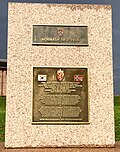
[[File:Korean war monument of Sweden in Busan.jpg|180px|thumbnail|right| | [[File:Korean war monument of Sweden in Busan.jpg|180px|thumbnail|right|Monument to the Swedish medical aid effort in [[Busan]], 2009]] | ||
[[File:Swedish Red Cross Field Hospital Korea 1950 AMA.0010239.jpg|left|thumb|The Swedish Red Cross Field Hospital in [[Busan]], 1950]] | |||
The Swedish Red Cross Field Hospital was established by the Swedish mission sent to Korea to deal with the humanitarian crisis. Following the North Korean invasion, the UN Security Council adopted a resolution asking all UN member states to support South Korea. The Swedish government responded on 14 July 1950, by authorizing the dispatch of a 200-bed mobile field hospital. {{cn|date=September 2023}} Shortly before his death, [[Gustaf V of Sweden|King Gustaf V]] announced that the Swedish state would cover the hospital's expenses.<ref>{{cite web|url=http://www.zum.de/whkmla/region/scandinavia/pusan.html |title=WHKMLA : Sweden's Contribution during the Korean War |publisher=Zum.de |access-date=2012-07-15}}</ref> The Swedish Red Cross Field Hospital personnel arrived in Korea on 23 September 1950, and began medical support on 25 September 1950.{{cn|date=September 2023}} Deciding that a stationary 400-bed Evacuation Hospital would be more valuable than the smaller but more mobile [[field hospital]], which opened at the beginning of October, the Swedish hospital was converted and moved to the compound of the ''Commercial Middle School'' in [[Pusan]], where it remained until 1958.{{cn|date=September 2023}}The hospital was expanded to 600 beds by the end of the war, staffed by 174 Swedish doctors and nurses at any one time, all belonging to the [[Swedish Red Cross]].{{cn|date=September 2023}} Among its patients was the [[ROK Army]] Major {{ill|Park Chung-in|ko|박정인 (군인)}}.<ref>[http://www.economytalk.kr/news/articleView.html?idxno=130654 朴定仁(박정인,88세 백골사단장 별세] 골수반공 야전형 일생]</ref> | |||
{{ | After the [[Korean Armistice Agreement|ceasefire]] in July 1953, the institute changed its name to 'Swedish Hospital in Pusan'. The hospital stayed comparatively unchanged as a civilian hospital until it was closed in March 1957. The closing ceremony was held on 20 March 1957, and personnel left soon afterwards.<ref name="고마운瑞典病院서전병원의功績공적">{{Cite web|url=https://newslibrary.naver.com/viewer/index.naver?articleId=1957032200239101024&editNo=1&printCount=1&publishDate=1957-03-22&officeId=00023&pageNo=1&printNo=10728&publishType=00010|title=네이버 뉴스 라이브러리|website=NAVER Newslibrary}}</ref><ref name="瑞典赤十字病院서전적십자병원을 感謝감사로써보낸다">{{Cite web|url=https://newslibrary.naver.com/viewer/index.naver?articleId=1957032200329201005&editNo=1&printCount=1&publishDate=1957-03-22&officeId=00032&pageNo=1&printNo=3556&publishType=00020|title=네이버 뉴스 라이브러리|website=NAVER Newslibrary}}</ref><ref>{{Cite web|url=https://newslibrary.naver.com/viewer/index.naver?articleId=1957031900239203013&editNo=1&printCount=1&publishDate=1957-03-19&officeId=00023&pageNo=3&printNo=10725&publishType=00020|title=네이버 뉴스 라이브러리|website=NAVER Newslibrary}}</ref> A small advisory group from Sweden stayed in Korea to advise on medical practices until autumn 1958. Over the duration of the conflict, 1,124 Swedish men and women served in the Swedish hospital, and 19,100 United Nations and 2,400 Korean personnel were treated by Swedish doctors. {{cn|date=September 2023}} At the closing ceremony, the hospital received the [[Presidential Unit Citation (South Korea)|Republic of Korea Presidential Citation]]. Some personnel received the Korean [[Order of Military Merit (South Korea)|Order of Military Merit]].<ref>{{Cite web|url=https://www.sanghun.go.kr/nation/participation/sangopen/sangInfoOpen.do|title=대한민국 상훈 > 정보공개 · 민원 > 상훈기록 공개|website=www.sanghun.go.kr}}</ref> | ||
Because of Sweden's reputation for neutrality during the major 20th century conflicts ([[World War I|First World]], [[World War II|Second World]] and [[Korean War]]s), Sweden was included as one of the four founding members of the [[Neutral Nations Supervisory Commission]]. Several Swedish military personnel served in Korea enforcing the [[Panmunjom]] armistice. Sweden was the first Western European country to establish diplomatic relations and an embassy in North Korea.<ref>{{Cite news|url=https://www.reuters.com/article/us-northkorea-missiles-sweden/it-never-got-paid-for-the-volvos-but-could-sweden-mediate-with-north-korea-idUSKBN1AR1ST|title=It never got paid for the Volvos, but could Sweden mediate with...|last=Johnson|first=Simon|work=U.S.|access-date=2018-05-06|language=en-US}}</ref> | |||
== Denmark == | === India === | ||
[[File:MS Jutlandia stone.JPG| | [[File:IndiansoldiersKorea1953.jpg|thumb|Indian troops on the [[USS Point Cruz|USS ''Point Cruz'']] preparing to be flown by helicopter to the [[Korean Demilitarized Zone]], 7 September 1953]] | ||
[[File:1951koreaindiaunemblem500won.jpg|thumb|South Korean stamp commemorating the role of India's 60th PFA, 1951]] | |||
After the outbreak of the [[Korean War]] on 25 June 1950, India decided to provide a [[Field ambulance|medical unit]]. The 60th Parachute Field Ambulance (60th PFA), commanded by Lieutenant Colonel [[A. G. Rangaraj]], arrived on 20 November 1950 and began to operate on 6 December 1950 at the [[Pyongyang]] front. The main unit was attached to the [[27th Infantry Brigade (United Kingdom)|British 27th Infantry Brigade]] and the [[1st Commonwealth Division]] and provided medical support at the front, while the detachment served in the hospital at [[Daegu]], providing services to the [[United Nations Forces in the Korean War|UN Forces]], [[ROK Army|South Korean Army]], and Korean civilians.<ref>{{Cite web|url=https://n.news.naver.com/mnews/article/023/0003771141?sid=103|title=[윤희영의 News English] 6·25 부상병 20만 명 치료한 인도軍 군의관|website=n.news.naver.com}}</ref> Around 20,000 soldiers and civilians were treated from November 1950 to February 1954.<ref>[https://new.mnd.go.kr/user/imhc/upload/pblictn2/625_15/index.html The Statistics of the Korean War, 391 Page - ROK Ministry of National Defense Institute for Military History, 2014 (E-BOOK)] {{Webarchive|url=https://web.archive.org/web/20230709114538/https://new.mnd.go.kr/user/imhc/upload/pblictn2/625_15/index.html |date=2023-07-09 }} {{in lang|ko}}</ref><ref>[https://www.imhc.mil.kr/user/imhc/upload/pblictn/PBLICTNEBOOK_201408070704130850.pdf The Statistics of the Korean War, 391 Page - ROK Ministry of National Defense Institute for Military History, 2014 (PDF)] {{Webarchive|url=https://web.archive.org/web/20210111004201/https://www.imhc.mil.kr/user/imhc/upload/pblictn/PBLICTNEBOOK_201408070704130850.pdf |date=2021-01-11 }} {{in lang|ko}}</ref><ref>{{cite news |last1=Kumar |first1=Sanjay |title=Exhibition showcases Indian chapter in Korean War |url=http://www.koreaherald.com/view.php?ud=20220307000928 |access-date=2 April 2022 |publisher=The Korea Herald |date=7 March 2022}}</ref> | |||
After [[Operation Tomahawk]] on 21 March 1951, for which the 60th PFA was attached to the [[187th Infantry Regiment (United States)|187th Airborne Regimental Combat Team]], two members of the unit were awarded with the [[Maha Vir Chakra]]s, while the 60th PFA was awarded the President's Trophy on 10 March 1955. | |||
Indian Army officer—Colonel M. K..Unni Nayar, part of the [[United Nations|United Nations Korea Committee]], died on 12 August 1950 when he was killed in a mine accident.<ref>{{Cite web|url=https://n.news.naver.com/mnews/article/001/0004536992?sid=102|title=잊혀진 한 인도군 장교의 죽음|website=n.news.naver.com}}</ref><ref>{{Cite web|url=https://www.kukinews.com/article/view/kuk201806270293|title=68년 만에 6·25전쟁 전사자 명비에 오르는 인도인 장교|date=27 June 2018|website=쿠키뉴스}}</ref><ref>{{Cite web|url=https://www.busan.com/print/index.php?code=20160826000084|title=부산일보|website=www.busan.com}}</ref> He was buried in [[Daegu]], and his wife was interred in the same grave in 2012.<ref>{{Cite web|url=https://ncms.nculture.org/korean-war/story/4125|title=유엔한국위원단 인도 대표 나야 대령 기념비|website=ncms.nculture.org}}</ref> A memorial to him in [[Suseong District]], Daegu was unveiled on 7 December 1950.<ref>{{Cite web|url=https://blog.naver.com/suseongblog/223126801603|title=수성구청 블로그 : 네이버 블로그|website=blog.naver.com}}</ref><ref>{{Cite web|url=http://suseong.kr/index.do|title=나야대령 기념비|website=suseong.kr}}</ref> | |||
=== Denmark === | |||
[[File:MS Jutlandia stone.JPG|thumb|Memorial of ''[[MS Jutlandia]]'' in [[Copenhagen]], 2009]] | |||
{{Main article|MS Jutlandia#Korean War}} | {{Main article|MS Jutlandia#Korean War}} | ||
Denmark supplied the ''[[MS Jutlandia]]'' under the [[Danish Red Cross]] for the duration of the war.{{cn|date=August 2023}} | |||
== Norway == | === Norway === | ||
[[File:2016 NORMASH.jpg| | [[File:2016 NORMASH.jpg|thumb|Memorial of NORMASH in [[Oslo]], 2016]] | ||
[[File:NORMASH nurse Korea.jpg|thumb|A Norwegian nurse tending to a Canadian soldier in [[First Republic of Korea|South Korea]], {{Circa|1951}}]] | |||
Norwegian Mobile Army Surgical Hospital (NORMASH) was the Norwegian [[field hospital]] participating in the [[Korean War]] from 1951 to 1954 under [[United Nations Command]]. On 29 December 1950, the [[Norwegian Red Cross]] received a request to establish a hospital in Korea. During the first days of 1951 a plan was drafted for a field hospital based on the American [[Mobile Army Surgical Hospital]] (MASH) with 60 beds and a staff of 83. On 2 March the [[Parliament of Norway|Norwegian Parliament]] approved the plan. The first group of personnel left Norway on 16 May, and was followed by the second group on 23 May. The route from [[Stavanger]] to [[Tokyo]] ran via [[Munich]], [[Nice]], [[Naples]], [[Beirut]], [[Cairo]], [[Karachi]], [[Calcutta]], [[Bangkok]] and [[Hong Kong]]. From Tokyo the personnel were transported to Seoul by military transport aircraft. They arrived in South Korea on 22 June and NORMASH was first established at [[Uijongbu]], approximately 12 miles north of Seoul, on 19 July. | |||
The hospital consisted of both [[Nissen hut]]s and tents and had a surgery with four operating tables. The hospital was later moved to [[Tongduchon]] about 40 miles north of Seoul, and was moved a third time to its final location a few miles further north. In total, NORMASH treated 90,000 patients, of which the largest groups were the U.S. (36%), South Korea (33%) and the various British and Commonwealth troops (27%). The unit also treated 172 North Korean and Chinese POWs. NORMASH performed on average eight surgeries per day. In the fall of 1951 it was decided to increase the personnel from 83 to 105, and on 26 October the decision was made to maintain the hospital as an [[army hospital]] for the duration of the UN operation in Korea. | |||
With the signing of the [[s:Korean Armistice Agreement|Armistice Agreement]] on 27 July 1953, the hospital stopped receiving wounded soldiers, but continued to treat substantial number of Korean civilians. Though an [[armistice]] was in effect, the stability in the region was questionable, and the hospital was kept at the ready in case of a breaking of the [[ceasefire]]. In the fall of 1953 NORMASH was the only hospital for four divisions in the 1st Army Corps. The hospital was kept while awaiting the establishment of a Scandinavian training hospital in Seoul,<ref name="NMC">{{cite web |url=http://www.norway.or.kr/News_and_events/koreanorway/medical/medicalcenter/ |title=National Medical Center, Seoul |work=norway.or.kr |year=2012 |access-date=24 February 2012 |archive-date=7 February 2012 |archive-url=https://web.archive.org/web/20120207023815/http://www.norway.or.kr/News_and_events/koreanorway/medical/medicalcenter/ |url-status=dead }}</ref> and it was not until 17 October 1954 that the hospital received orders to return to Norway. Four days later the last patient was released, and on 10 November all equipment was returned to the US Army. | |||
In total 623 men and women served in NORMASH over seven contingents, two of which were after the Armistice. The hospital lost two personnel; driver Arne Christiansen was shot and killed in 1952, and laboratory technician Brit Reisæther was killed in a car accident in 1954. NORMASH twice received the [[Meritorious Unit Commendation|United States Meritorious Unit Commendation]] and the [[Presidential Unit Citation (South Korea)|Republic of Korea Presidential Unit Citation]] (6 October 1952, 23 November 1953). All personnel also received the [[Norwegian Korea Medal]], and were visited by [[Marilyn Monroe]].{{Citation needed|date=April 2018}} | |||
=== Italy === | |||
The 68th Italian Red Cross Hospital (L’OSPEDALE Croce Rossa Italiana N°68) was an Italian field hospital in the Korean War.<ref>{{Cite web|url=https://cri.it/2016/06/16/gli-italiani-nella-guerra-di-corea-lospedale-cri-n68/|title=Gli Italiani nella Guerra di Corea – L’Ospedale CRI n°68 – Croce Rossa Italiana|date=16 June 2016}}</ref> After the outbreak of war on 25 June 1950, Italy dispatched the medical unit to Korea to aid the humanitarian disaster, even though Italy was not a member of the [[United Nations]] until 1955.<ref>{{cite web |url=http://www.korean-war.com/italianRChospital.html |title=Italian Red Cross Hospital |access-date=2012-06-02 |url-status=dead |archive-url=https://web.archive.org/web/20120822103003/http://www.korean-war.com/italianRChospital.html |archive-date=2012-08-22 }}</ref> | |||
The [[Italian Red Cross]] supported this hospital with personnel from the Military Corps (''Corpo Militare della Croce Rossa Italiana'') and the Volunteer Nurses Corps (''Corpo delle Infermiere Volontarie della Croce Rossa Italiana''). The hospital staff left [[Napoli]] on 16 October, and arrived in [[Busan]] on 16 November; the hospital opened on 6 December at the [[:ko:서울우신초등학교|Usin Elementary School facility]] in [[Yeongdeungpo District]], [[Seoul]]. On 30 December 1952, a suspected [[communist]] arsonist lit a fire in the hospital, destroying it. A new hospital was built by 23 February 1953. On 30 December 1954, the hospital was transferred to the South Korean Government,<ref>{{Cite web|url=https://newslibrary.naver.com/viewer/index.naver?articleId=1954123100209202013&editNo=1&printCount=1&publishDate=1954-12-31&officeId=00020&pageNo=2&printNo=9801&publishType=00020|title=네이버 뉴스 라이브러리|website=NAVER Newslibrary}}</ref> and three days later the hospital staff left for Italy. | |||
The hospital twice received the [[Presidential Unit Citation (South Korea)|Republic of Korea Presidential Unit Citation]]<ref>{{Cite web|url=https://newslibrary.naver.com/viewer/index.naver?articleId=1954123000239102020&editNo=1&printCount=1&publishDate=1954-12-30&officeId=00023&pageNo=2&printNo=9917&publishType=00010|title=네이버 뉴스 라이브러리|website=NAVER Newslibrary}}</ref> On 2 June 1989, Graziella Simbolotti, ambassador of Italy to South Korea, installed a memorial at Usin School.<ref>{{Cite web|url=https://www.konas.net/article/article.asp?idx=57592|title=「참전기념 시설물 소개」 ⑳ 이탈리아 의무부대 6.25전쟁 참전기념비|website=www.konas.net}}</ref> | |||
=== West Germany === | |||
On 7 April 1953, [[Chancellor of Germany]] [[Konrad Adenauer|Adenauer]] visited the United States and met President [[Dwight D. Eisenhower|Eisenhower]], where he proposed that West Germany offer medical support. Two parties of medical personnel left Germany for Korea in January and February 1954.<ref>{{Cite web|url=https://newslibrary.naver.com/viewer/index.naver?articleId=1954013000209202013&editNo=1&printCount=1&publishDate=1954-01-30&officeId=00020&pageNo=2&printNo=9472&publishType=00020|title=네이버 뉴스 라이브러리|website=NAVER Newslibrary}}</ref><ref name="auto">{{Cite web|url=https://newslibrary.naver.com/viewer/index.naver?articleId=1954021000239101006&editNo=1&printCount=1&publishDate=1954-02-10&officeId=00023&pageNo=1&printNo=9594&publishType=00010|title=네이버 뉴스 라이브러리|website=NAVER Newslibrary}}</ref> The hospital opened on 17 May in [[Busan]] with 80 personnel<ref>{{Cite web|url=https://newslibrary.naver.com/viewer/index.naver?articleId=1954051900239102020&editNo=1&printCount=1&publishDate=1954-05-19&officeId=00023&pageNo=2&printNo=9692&publishType=00010|title=네이버 뉴스 라이브러리|website=NAVER Newslibrary}}</ref><ref>{{Cite web|url=https://koreajoongangdaily.joins.com/2010/10/05/socialAffairs/The-Germans-who-healed-Koreans/2926815.html|title=The Germans who healed Koreans|date=5 October 2010|website=koreajoongangdaily.joins.com}}</ref> and closed nearly five years later on 14 March 1959, with a total of 200 Germans having treated about 2,400,000 civilians.<ref>{{Cite web|url=https://newslibrary.naver.com/viewer/index.naver?articleId=1959031500329203006&editNo=2&printCount=1&publishDate=1959-03-15&officeId=00032&pageNo=3&printNo=4278&publishType=00020|title=네이버 뉴스 라이브러리|website=NAVER Newslibrary}}</ref><ref name="auto"/> | |||
President [[Moon Jae-in]] visited Germany in July 2017 where he met the surviving staff member, Karl Hauser, and the others' descendants, acknowledging their contributions; Hauser was awarded the [[Orders, decorations, and medals of South Korea#Commendations|Republic of Korea Presidential Citation]].<ref>{{Cite web|url=https://www.korea.net/NewsFocus/policies/view?articleId=147689|title=President Moon meets with German medical personnel : Korea.net : The official website of the Republic of Korea|first=Korean Culture and Information|last=Service (KOCIS)|website=www.korea.net}}</ref><ref>{{Cite web|url=https://n.news.naver.com/mnews/article/056/0010477328?sid=100|title=文대통령, 한국 파견 獨 의료지원단에 “영원히 감사”|website=n.news.naver.com}}</ref> The former staff of the hospital and their descendants visited South Korea in November 2017;<ref>{{Cite web|url=https://n.news.naver.com/mnews/article/021/0002332615?sid=100|title=6·25 獨 의료지원단 중 ‘유일 생존자’ 칼 하우저 來韓|website=n.news.naver.com}}</ref> the South Korean Government acknowledged Germany's support in June 2018.<ref>{{Cite web|url=https://blog.naver.com/mnd9090/221308437146|title=국방부 블로그 : 네이버 블로그|website=blog.naver.com}}</ref> A memorial dedicated to their service, located in [[Seo District, Busan|Seo District]], [[Busan]], was erected in 1997.<ref>{{Cite web|url=http://www.unpm.or.kr/un2022/sub.php?&MenuID=126&bCode=X8&cate=&st=&ss=&gotoPage=5&mode=view&bo_no=56|title=UN평화기념관 방문을 환영합니다. 국내 페이지 입니다.|website=www.unpm.or.kr}}</ref> | |||
== Memorials == | == Memorials == | ||
On 20 September 1976, | On 20 September 1976, the Medical Support Corps Participation Monument was unveiled in [[Yeongdo District]], [[Busan]], commemorating the medical support provided by Sweden, India, Denmark, Norway, and Italy.<ref>{{Cite web|url=http://www.unpm.or.kr/un2022/sub.php?&MenuID=126&bCode=X8&cate=&st=sisul&ss=%EF%BF%BD%EB%B8%A3%EF%BF%BD%EF%BF%BD%EF%BF%BD%EF%BF%BD&gotoPage=1&mode=view&bo_no=61|title=UN평화기념관 방문을 환영합니다. 국내 페이지 입니다.|website=www.unpm.or.kr}}</ref> | ||
== See also == | == See also == | ||
* [[United Nations Command]] | * [[United Nations Command]] | ||
* [[United Nations | ** [[United Nations Forces in the Korean War]] | ||
* [[United Nations Memorial Cemetery]], the burial site of 2,300 United Nations Command personnel who died during the Korean War | |||
* [ | |||
== References == | == References == | ||
| Line 134: | Line 72: | ||
[[Category:Medical support in the Korean War|*]] | [[Category:Medical support in the Korean War|*]] | ||
Latest revision as of 22:08, 14 October 2025
During the Korean War, six countries—Sweden, India, Denmark, Norway, Italy, and West Germany—provided medical support to South Korea and the United Nations Forces. They provided a range of medical services, including the provision of mobile field hospitals; medical professionals, including doctors and nurses; hospital beds; equipment; and ambulances.[1] Some of these personnel were killed during the conflict, though they were not combatants against North Korea and the People's Republic of China.
Countries[edit | edit source]
Sweden[edit | edit source]


The Swedish Red Cross Field Hospital was established by the Swedish mission sent to Korea to deal with the humanitarian crisis. Following the North Korean invasion, the UN Security Council adopted a resolution asking all UN member states to support South Korea. The Swedish government responded on 14 July 1950, by authorizing the dispatch of a 200-bed mobile field hospital. [citation needed] Shortly before his death, King Gustaf V announced that the Swedish state would cover the hospital's expenses.[2] The Swedish Red Cross Field Hospital personnel arrived in Korea on 23 September 1950, and began medical support on 25 September 1950.[citation needed] Deciding that a stationary 400-bed Evacuation Hospital would be more valuable than the smaller but more mobile field hospital, which opened at the beginning of October, the Swedish hospital was converted and moved to the compound of the Commercial Middle School in Pusan, where it remained until 1958.[citation needed]The hospital was expanded to 600 beds by the end of the war, staffed by 174 Swedish doctors and nurses at any one time, all belonging to the Swedish Red Cross.[citation needed] Among its patients was the ROK Army Major Park Chung-in.[3]
After the ceasefire in July 1953, the institute changed its name to 'Swedish Hospital in Pusan'. The hospital stayed comparatively unchanged as a civilian hospital until it was closed in March 1957. The closing ceremony was held on 20 March 1957, and personnel left soon afterwards.[4][5][6] A small advisory group from Sweden stayed in Korea to advise on medical practices until autumn 1958. Over the duration of the conflict, 1,124 Swedish men and women served in the Swedish hospital, and 19,100 United Nations and 2,400 Korean personnel were treated by Swedish doctors. [citation needed] At the closing ceremony, the hospital received the Republic of Korea Presidential Citation. Some personnel received the Korean Order of Military Merit.[7]
Because of Sweden's reputation for neutrality during the major 20th century conflicts (First World, Second World and Korean Wars), Sweden was included as one of the four founding members of the Neutral Nations Supervisory Commission. Several Swedish military personnel served in Korea enforcing the Panmunjom armistice. Sweden was the first Western European country to establish diplomatic relations and an embassy in North Korea.[8]
India[edit | edit source]


After the outbreak of the Korean War on 25 June 1950, India decided to provide a medical unit. The 60th Parachute Field Ambulance (60th PFA), commanded by Lieutenant Colonel A. G. Rangaraj, arrived on 20 November 1950 and began to operate on 6 December 1950 at the Pyongyang front. The main unit was attached to the British 27th Infantry Brigade and the 1st Commonwealth Division and provided medical support at the front, while the detachment served in the hospital at Daegu, providing services to the UN Forces, South Korean Army, and Korean civilians.[9] Around 20,000 soldiers and civilians were treated from November 1950 to February 1954.[10][11][12]
After Operation Tomahawk on 21 March 1951, for which the 60th PFA was attached to the 187th Airborne Regimental Combat Team, two members of the unit were awarded with the Maha Vir Chakras, while the 60th PFA was awarded the President's Trophy on 10 March 1955.
Indian Army officer—Colonel M. K..Unni Nayar, part of the United Nations Korea Committee, died on 12 August 1950 when he was killed in a mine accident.[13][14][15] He was buried in Daegu, and his wife was interred in the same grave in 2012.[16] A memorial to him in Suseong District, Daegu was unveiled on 7 December 1950.[17][18]
Denmark[edit | edit source]

Denmark supplied the MS Jutlandia under the Danish Red Cross for the duration of the war.[citation needed]
Norway[edit | edit source]


Norwegian Mobile Army Surgical Hospital (NORMASH) was the Norwegian field hospital participating in the Korean War from 1951 to 1954 under United Nations Command. On 29 December 1950, the Norwegian Red Cross received a request to establish a hospital in Korea. During the first days of 1951 a plan was drafted for a field hospital based on the American Mobile Army Surgical Hospital (MASH) with 60 beds and a staff of 83. On 2 March the Norwegian Parliament approved the plan. The first group of personnel left Norway on 16 May, and was followed by the second group on 23 May. The route from Stavanger to Tokyo ran via Munich, Nice, Naples, Beirut, Cairo, Karachi, Calcutta, Bangkok and Hong Kong. From Tokyo the personnel were transported to Seoul by military transport aircraft. They arrived in South Korea on 22 June and NORMASH was first established at Uijongbu, approximately 12 miles north of Seoul, on 19 July.
The hospital consisted of both Nissen huts and tents and had a surgery with four operating tables. The hospital was later moved to Tongduchon about 40 miles north of Seoul, and was moved a third time to its final location a few miles further north. In total, NORMASH treated 90,000 patients, of which the largest groups were the U.S. (36%), South Korea (33%) and the various British and Commonwealth troops (27%). The unit also treated 172 North Korean and Chinese POWs. NORMASH performed on average eight surgeries per day. In the fall of 1951 it was decided to increase the personnel from 83 to 105, and on 26 October the decision was made to maintain the hospital as an army hospital for the duration of the UN operation in Korea.
With the signing of the Armistice Agreement on 27 July 1953, the hospital stopped receiving wounded soldiers, but continued to treat substantial number of Korean civilians. Though an armistice was in effect, the stability in the region was questionable, and the hospital was kept at the ready in case of a breaking of the ceasefire. In the fall of 1953 NORMASH was the only hospital for four divisions in the 1st Army Corps. The hospital was kept while awaiting the establishment of a Scandinavian training hospital in Seoul,[19] and it was not until 17 October 1954 that the hospital received orders to return to Norway. Four days later the last patient was released, and on 10 November all equipment was returned to the US Army.
In total 623 men and women served in NORMASH over seven contingents, two of which were after the Armistice. The hospital lost two personnel; driver Arne Christiansen was shot and killed in 1952, and laboratory technician Brit Reisæther was killed in a car accident in 1954. NORMASH twice received the United States Meritorious Unit Commendation and the Republic of Korea Presidential Unit Citation (6 October 1952, 23 November 1953). All personnel also received the Norwegian Korea Medal, and were visited by Marilyn Monroe.[citation needed]
Italy[edit | edit source]
The 68th Italian Red Cross Hospital (L’OSPEDALE Croce Rossa Italiana N°68) was an Italian field hospital in the Korean War.[20] After the outbreak of war on 25 June 1950, Italy dispatched the medical unit to Korea to aid the humanitarian disaster, even though Italy was not a member of the United Nations until 1955.[21]
The Italian Red Cross supported this hospital with personnel from the Military Corps (Corpo Militare della Croce Rossa Italiana) and the Volunteer Nurses Corps (Corpo delle Infermiere Volontarie della Croce Rossa Italiana). The hospital staff left Napoli on 16 October, and arrived in Busan on 16 November; the hospital opened on 6 December at the Usin Elementary School facility in Yeongdeungpo District, Seoul. On 30 December 1952, a suspected communist arsonist lit a fire in the hospital, destroying it. A new hospital was built by 23 February 1953. On 30 December 1954, the hospital was transferred to the South Korean Government,[22] and three days later the hospital staff left for Italy.
The hospital twice received the Republic of Korea Presidential Unit Citation[23] On 2 June 1989, Graziella Simbolotti, ambassador of Italy to South Korea, installed a memorial at Usin School.[24]
West Germany[edit | edit source]
On 7 April 1953, Chancellor of Germany Adenauer visited the United States and met President Eisenhower, where he proposed that West Germany offer medical support. Two parties of medical personnel left Germany for Korea in January and February 1954.[25][26] The hospital opened on 17 May in Busan with 80 personnel[27][28] and closed nearly five years later on 14 March 1959, with a total of 200 Germans having treated about 2,400,000 civilians.[29][26]
President Moon Jae-in visited Germany in July 2017 where he met the surviving staff member, Karl Hauser, and the others' descendants, acknowledging their contributions; Hauser was awarded the Republic of Korea Presidential Citation.[30][31] The former staff of the hospital and their descendants visited South Korea in November 2017;[32] the South Korean Government acknowledged Germany's support in June 2018.[33] A memorial dedicated to their service, located in Seo District, Busan, was erected in 1997.[34]
Memorials[edit | edit source]
On 20 September 1976, the Medical Support Corps Participation Monument was unveiled in Yeongdo District, Busan, commemorating the medical support provided by Sweden, India, Denmark, Norway, and Italy.[35]
See also[edit | edit source]
- United Nations Command
- United Nations Memorial Cemetery, the burial site of 2,300 United Nations Command personnel who died during the Korean War
References[edit | edit source]
- ↑ The source of statistics in this article is the official book about Korean War statistics published by South Korean Ministry of National Defense Institute for Military History in June 2014.
- ↑ "WHKMLA : Sweden's Contribution during the Korean War". Zum.de. Retrieved 15 July 2012.
- ↑ 朴定仁(박정인,88세 백골사단장 별세 골수반공 야전형 일생]
- ↑ "네이버 뉴스 라이브러리". NAVER Newslibrary.
- ↑ "네이버 뉴스 라이브러리". NAVER Newslibrary.
- ↑ "네이버 뉴스 라이브러리". NAVER Newslibrary.
- ↑ "대한민국 상훈 > 정보공개 · 민원 > 상훈기록 공개". www.sanghun.go.kr.
- ↑ Johnson, Simon. "It never got paid for the Volvos, but could Sweden mediate with..." U.S. Retrieved 6 May 2018.
- ↑ "[윤희영의 News English] 6·25 부상병 20만 명 치료한 인도軍 군의관". n.news.naver.com.
- ↑ The Statistics of the Korean War, 391 Page - ROK Ministry of National Defense Institute for Military History, 2014 (E-BOOK) Archived 2023-07-09 at the Wayback Machine (in Korean)
- ↑ The Statistics of the Korean War, 391 Page - ROK Ministry of National Defense Institute for Military History, 2014 (PDF) Archived 2021-01-11 at the Wayback Machine (in Korean)
- ↑ Kumar, Sanjay (7 March 2022). "Exhibition showcases Indian chapter in Korean War". The Korea Herald. Retrieved 2 April 2022.
- ↑ "잊혀진 한 인도군 장교의 죽음". n.news.naver.com.
- ↑ "68년 만에 6·25전쟁 전사자 명비에 오르는 인도인 장교". 쿠키뉴스. 27 June 2018.
- ↑ "부산일보". www.busan.com.
- ↑ "유엔한국위원단 인도 대표 나야 대령 기념비". ncms.nculture.org.
- ↑ "수성구청 블로그 : 네이버 블로그". blog.naver.com.
- ↑ "나야대령 기념비". suseong.kr.
- ↑ "National Medical Center, Seoul". norway.or.kr. 2012. Archived from the original on 7 February 2012. Retrieved 24 February 2012.
- ↑ "Gli Italiani nella Guerra di Corea – L'Ospedale CRI n°68 – Croce Rossa Italiana". 16 June 2016.
- ↑ "Italian Red Cross Hospital". Archived from the original on 22 August 2012. Retrieved 2 June 2012.
- ↑ "네이버 뉴스 라이브러리". NAVER Newslibrary.
- ↑ "네이버 뉴스 라이브러리". NAVER Newslibrary.
- ↑ "「참전기념 시설물 소개」 ⑳ 이탈리아 의무부대 6.25전쟁 참전기념비". www.konas.net.
- ↑ "네이버 뉴스 라이브러리". NAVER Newslibrary.
- ↑ 26.0 26.1 "네이버 뉴스 라이브러리". NAVER Newslibrary.
- ↑ "네이버 뉴스 라이브러리". NAVER Newslibrary.
- ↑ "The Germans who healed Koreans". koreajoongangdaily.joins.com. 5 October 2010.
- ↑ "네이버 뉴스 라이브러리". NAVER Newslibrary.
- ↑ Service (KOCIS), Korean Culture and Information. "President Moon meets with German medical personnel : Korea.net : The official website of the Republic of Korea". www.korea.net.
- ↑ "文대통령, 한국 파견 獨 의료지원단에 "영원히 감사"". n.news.naver.com.
- ↑ "6·25 獨 의료지원단 중 '유일 생존자' 칼 하우저 來韓". n.news.naver.com.
- ↑ "국방부 블로그 : 네이버 블로그". blog.naver.com.
- ↑ "UN평화기념관 방문을 환영합니다. 국내 페이지 입니다". www.unpm.or.kr.
- ↑ "UN평화기념관 방문을 환영합니다. 국내 페이지 입니다". www.unpm.or.kr.