



Ajay Kumar (talk | contribs) Created a new article |
m adjusted intro per sources and cleaned formatting for clarity |
||
| Line 3: | Line 3: | ||
{{Redirect|Festivity|the ship|MV Festivity}} | {{Redirect|Festivity|the ship|MV Festivity}} | ||
{{Use mdy dates|date=June 2013}} | {{Use mdy dates|date=June 2013}} | ||
[[File: | [[File:Holi Festival of Colors Utah, United States 2013.jpg|thumb|The [[Hindu]] festival of [[Holi]] at [[Sri Sri Radha Krishna Temple]] in [[Utah]], U.S.]] | ||
[[File: | [[File:Weezer Bethlehem 2019 5.jpg|thumb|[[Musikfest]], an eleven-day outdoor music festival held annually each August in [[Bethlehem, Pennsylvania]], is the largest free music festival in the [[United States]], drawing over 1.3 million attendees.<ref>{{Cite web|url=https://www.wfmz.com/entertainment/festival/musikfest/by-the-numbers-musikfest-2023/article_6684b92c-3b8b-11ee-88c9-a3849fd493cb.html|title=By the numbers: Musikfest 2023|date=August 15, 2023|website=WFMZ.com}}</ref>]] | ||
A '''festival''' is an | [[File:Red and Gold for Niño.jpg|alt=Sinulog Festival Contingent 2024-03|thumb|[[Sinulog|Sinulog Festival]] is the one entitled of the “Grandest Festival of the [[Philippines]]” and which estimated over 4 million attendees. ]] | ||
[[File:Peace Revolution first program ever.jpg|thumb|right| | |||
[[Buddhism|Buddhist]] festival of [[Magha Puja]] celebration held in Thailand.]] | |||
A '''festival''' is an event celebrated by a community and centering on some characteristic aspect or aspects of that community and its [[religion]] or [[culture]]s. It is often marked as a local or national [[holiday]], [[Melā|mela]], or [[Muslim holidays|Eid]]. A festival constitutes typical cases of [[glocalization]], as well as the high culture-low culture interrelationship.<ref>{{Cite book |last=Caves |first=R. W. |title=Encyclopedia of the City |publisher=Routledge |year=2004 |isbn=978-0-415-25225-6 |pages=264}}</ref> Next to religion and [[folklore]], a significant origin is [[agriculture|agricultural]]. Food is such a vital resource that many festivals are associated with [[harvest]] time. Religious commemoration and thanksgiving for good harvests are blended in events that take place in [[autumn]], such as [[Halloween]] in the northern hemisphere and [[Easter]] in the southern. | |||
Festivals often serve to fulfill specific communal purposes, especially in regard to commemoration or thanking to the gods, goddesses or saints: they are called [[patronal festivals]]. They may also provide [[entertainment]], which was particularly important to local communities before the advent of mass-produced entertainment. Festivals that focus on cultural or ethnic topics also seek to inform community members of their | Festivals often serve to fulfill specific communal purposes, especially in regard to commemoration or thanking to the gods, goddesses or saints: they are called [[patronal festivals]]. They may also provide [[entertainment]], which was particularly important to local communities before the advent of mass-produced entertainment. Festivals that focus on cultural or ethnic topics also seek to inform community members of their [[tradition]]s; the involvement of [[old age|elders]] sharing stories and experience provides a means for unity among [[family|families]].<ref>{{cite web |title=Why festivals are important |url=https://www.thenews.com.pk/print/188562-why-festivals-are-important |website=www.thenews.com.pk |access-date=10 February 2023 |language=en}}</ref> Attendants of festivals are often motivated by a desire for escapism, socialization and camaraderie; the practice has been seen as a means of creating geographical connection, belonging and adaptability.<ref name=":0">{{Cite journal |last=Davies |first=Karen |date=2021 |title=Festivals Post Covid-19 |url=https://doi.org/10.1080/01490400.2020.1774000 |journal=Leisure Sciences |volume=43 |issue=1–2 |pages=184–189 |doi=10.1080/01490400.2020.1774000 |s2cid=225693273 |issn=0149-0400|url-access=subscription }}</ref><ref name=":1">{{Cite journal |last=Quinn |first=Bernadette |date=2003 |title=Symbols, practices and myth-making: Cultural perspectives on the Wexford Festival Opera |url=https://doi.org/10.1080/14616680309710 |journal=Tourism Geographies |volume=5 |issue=3 |pages=329–349 |doi=10.1080/14616680309710 |s2cid=143509970 |issn=1461-6688 |access-date=August 21, 2022 |archive-date=August 28, 2022 |archive-url=https://web.archive.org/web/20220828130715/https://www.tandfonline.com/doi/abs/10.1080/14616680309710 |url-status=live |url-access=subscription }}</ref> | ||
==Etymology | ==Etymology== | ||
[[File: | [[File:The MET.jpg|thumb|The annual [[Met Gala]] at the [[Metropolitan Museum of Art]] in [[Manhattan]] is an [[haute couture]] festival celebrating the global [[fashion industry]].]] | ||
[[File:Ländliches Fest in Schwaben.jpg|thumb| | [[File:Ländliches Fest in Schwaben.jpg|thumb|A country festival in [[Swabia]]]] | ||
[[File:NavigiumIsidis.jpg|thumb|''Procession in Honor of Isis'', a 1903 depiction of the Egyptian [[Navigium Isidis]] festival by [[Frederick Arthur Bridgman]]]] | |||
The word "festival" was originally used as an adjective from the late fourteenth century, deriving from [[Latin]] via [[Old French]].<ref name=oed1>{{cite web|url=http://www.oed.com/view/Entry/69567 |title=festival, adj. and n. |archive-url=https://web.archive.org/web/20220828130717/https://www.oed.com/start;jsessionid=516303139ACABFDA6DF9FB295946FC00?authRejection=true&url=%2Fview%2FEntry%2F69567 |archive-date=August 28, 2022 |website=[[OED Online]] |date=March 2014 |publisher=Oxford University Press |access-date=April 16, 2014}}</ref> In [[Middle English]], a "festival dai" was a religious holiday.<ref>{{cite web|url=http://quod.lib.umich.edu/cgi/m/mec/med-idx?type=id&id=MED15806&egs=all |title=festival (adj.) |archive-url=https://web.archive.org/web/20140702174739/http://quod.lib.umich.edu/cgi/m/mec/med-idx?type=id&id=MED15806&egs=all |archive-date=July 2, 2014 |website=[[Middle English Dictionary]] |access-date=April 16, 2014}}</ref> | |||
The | The first recorded used of the word "festival" as a noun was in 1589 (as "Festifall").<ref name=oed1/> Feast first came into usage as a noun {{Circa|1200}},<ref>{{cite web|url=http://www.oed.com/view/Entry/68799 |title=feast, n. |archive-url=https://web.archive.org/web/20220828130719/https://www.oed.com/start;jsessionid=7B4E1C8966F3F709B74E5277161BE93D?authRejection=true&url=%2Fview%2FEntry%2F68799 |archive-date=August 28, 2022 |website=[[OED Online]] |date=March 2014 |publisher=Oxford University Press |access-date=April 16, 2014}}</ref> and its first recorded use as a verb was circa 1300.<ref>{{cite web|url=http://www.oed.com/view/Entry/68800 |title=feast, v. |archive-url=https://web.archive.org/web/20220828130718/https://www.oed.com/start;jsessionid=3BAE000C92C9A9622F67045AA8600539?authRejection=true&url=%2Fview%2FEntry%2F68800 |archive-date=August 28, 2022 |website=[[OED Online]] |date=March 2014 |publisher=Oxford University Press |access-date=April 16, 2014}}</ref> | ||
The word '''gala''' comes from [[Arabic]] word ''khil'a'', meaning robe of honor.<ref>{{cite book |author=James E Glevin |title=The Modern Middle East: A History |year=2020 |publisher=[[Oxford University Press]] |isbn=978- | The word '''gala''' comes from [[Arabic]] word ''khil'a'', meaning robe of honor.<ref>{{cite book |author=James E Glevin |title=The Modern Middle East: A History |year=2020 |publisher=[[Oxford University Press]] |isbn=978-0-19-007406-7 |page=21}}</ref> The word gala was initially used to describe "festive dress", but came to be a synonym of "festival" starting in the 18th century.<ref>{{cite web|url=https://www.etymonline.com/word/gala#etymonline_v_1224|title=gala (n.)|website=[[Online Etymology Dictionary]] |access-date=June 27, 2020|archive-date=June 27, 2020|archive-url=https://web.archive.org/web/20200627154557/https://www.etymonline.com/word/gala#etymonline_v_1224|url-status=live}}</ref> | ||
==History== | ==History== | ||
Festivals have long been significant in human culture and are found in virtually all cultures.{{sfn|Cudny|2016|p=13}}<ref>{{Cite book | | [[File:Alexander van Bredael - A Festival in Antwerp.jpg|thumb|A festival at [[Antwerp]], Belgium, in the 17th century]] | ||
Festivals have long been significant in [[human culture]] and history and are found in virtually all cultures.{{sfn|Cudny|2016|p=13}}<ref>{{Cite book |title=Time Out of Time: Essays on the Festival |publisher=[[University of New Mexico Press]] |year=1987 |isbn=0-8263-0932-1 |editor-last=Falassi |editor-first=Alessandro |edition= |location= |pages=1 |oclc=15017471 }}</ref> The importance of festivals, to the present, is found in private and public; secular and religious life.<ref name=":3" /> [[Ancient Greece|Ancient Greek]] and [[Ancient Rome|Roman]] societies relied heavily upon festivals, both communal and administrative.<ref name="Brandt">{{cite book |title=Greek and Roman Festivals: Content, Meaning, and Practice |author2= |publisher=Oxford University Press |year=2012 |isbn=978-0-19-969609-3 |editor-last=Brandt |editor-first=J. Rasmus |edition=1st |location= |pages=1 |editor-last2=Iddeng |editor-first2=Jon W.}}</ref> [[Saturnalia]] was likely influential to Christmas and [[Carnival]].<ref name=":2" /> Celebration of social occasions, religion and nature were common.<ref name=":2" /> Specific festivals have century-long histories and festivals in general have developed over the last few centuries – some traditional festivals in [[Ghana]], for example, predate European [[Colonization|colonisation]] of the 15th century.<ref name=":1" /><ref name=":2">{{Cite journal |last=Cudny |first=Waldemar |date=2014 |title=The Phenomenon of Festivals: Their Origins, Evolution, and Classifications |url=https://www.jstor.org/stable/43861801 |journal=Anthropos |volume=109 |issue=2 |pages=640–656 |doi=10.5771/0257-9774-2014-2-640 |jstor=43861801 |issn=0257-9774 |access-date=August 23, 2022 |archive-date=August 23, 2022 |archive-url=https://web.archive.org/web/20220823120027/https://www.jstor.org/stable/43861801 |url-status=live |url-access=subscription }}</ref><ref>{{Cite journal |last=Odotei |first=Irene |date=2002 |title=Festivals in Ghana: Continuity, Transformation and Politicisation of Tradition |url=https://www.jstor.org/stable/41406666 |journal=Transactions of the Historical Society of Ghana |issue=6 |pages=17–34 |jstor=41406666 |issn=0855-3246 |access-date=August 24, 2022 |archive-date=August 24, 2022 |archive-url=https://web.archive.org/web/20220824192222/https://www.jstor.org/stable/41406666 |url-status=live }}</ref> Festivals prospered following the Second World War.<ref name=":2" /> Both established in 1947, [[Festival d'Avignon|Avignon Festival]] and the [[Edinburgh Festival Fringe]] have been notable in shaping the modern model of festivals.<ref>{{Cite book |last=Bartie |first=Angela |url=http://dx.doi.org/10.3366/edinburgh/9780748670307.001.0001 |title=The Edinburgh Festivals: Culture and Society in Post-war Britain |date=2013 |publisher=Edinburgh University Press |isbn=978-0-7486-7030-7 |pages=6 |doi=10.3366/edinburgh/9780748670307.001.0001 |access-date=August 24, 2022 |archive-date=August 28, 2022 |archive-url=https://web.archive.org/web/20220828130716/https://apps.crossref.org/coaccess/coaccess.html?doi=10.3366%2Fedinburgh%2F9780748670307.001.0001 |url-status=live }}</ref> Art festivals became more prominent by the turn of the 21st century.<ref name=":3">{{Cite journal |last=Quinn |first=Bernadette |date=2005 |title=Arts Festivals and the City |url=http://dx.doi.org/10.1080/00420980500107250 |journal=Urban Studies |volume=42 |issue=5–6 |pages=927–943 |doi=10.1080/00420980500107250 |bibcode=2005UrbSt..42..927Q |s2cid=154354884 |issn=0042-0980|url-access=subscription }}</ref> In modern times, festivals are offered to public as a global tourist prospect although they are commonly [[State ownership|public]] or [[Not-for-Profit|not-for-profit]].<ref>{{Cite journal |last1=Prentice |first1=Richard |last2=Andersen |first2=Vivien |date=2003 |title=Festival as creative destination |url=https://linkinghub.elsevier.com/retrieve/pii/S0160738302000348 |journal=Annals of Tourism Research |language=en |volume=30 |issue=1 |pages=7–30 |doi=10.1016/S0160-7383(02)00034-8 |access-date=August 21, 2022 |archive-date=June 23, 2022 |archive-url=https://web.archive.org/web/20220623143343/https://linkinghub.elsevier.com/retrieve/pii/S0160738302000348 |url-status=live |url-access=subscription }}</ref><ref>{{Cite journal |last1=Andersson |first1=Tommy D. |last2=Getz |first2=Donald |date=2008 |title=Stakeholder Management Strategies of Festivals |url=https://www.tandfonline.com/action/showCitFormats?doi=10.1080%2F15470140802323801 |journal=Journal of Convention & Event Tourism |language=en |volume=9 |issue=3 |pages=199–220 |doi=10.1080/15470140802323801 |s2cid=154831702 |issn=1547-0148 |access-date=August 28, 2022 |archive-date=August 27, 2022 |archive-url=https://web.archive.org/web/20220827194803/https://www.tandfonline.com/action/showCitFormats?doi=10.1080%2F15470140802323801 |url-status=live |url-access=subscription }}</ref> | |||
==Traditions== | ==Traditions== | ||
Many festivals have religious origins and entwine cultural and religious significance in traditional activities. The most important religious festivals such as [[Christmas]], [[Rosh Hashanah]], [[Diwali]], [[Eid al-Fitr|Eid-al-Fitr]] and [[Eid al-Adha|Eid-al-Adha]] serve to mark out the year. Others, such as [[harvest festival]]s, celebrate seasonal change. Events of historical significance, such as important [[military]] victories or other nation-building events also provide the impetus for a festival. An early example is the festival established by [[Ancient Egypt]]ian Pharaoh [[Ramesses III]] celebrating his victory over the Libyans.<ref name=Berrett>{{cite book|last=Berrett|first=LaMar C.|title=Discovering the world of the Bible|year=1996|publisher=Grandin Book Co.|location=Provo, Utah|isbn=0-910523-52-5|page=289|edition=3rd ed., rev.|author2=Ogden D. Kelly}}</ref> In many countries, royal holidays commemorate dynastic events just as agricultural holidays are about harvests. Festivals are often commemorated annually. | Many festivals have religious origins and entwine cultural and religious significance in traditional activities. The most important religious festivals such as [[Christmas]], [[Rosh Hashanah]], [[Diwali]], [[Holi]], [[Eid al-Fitr|Eid-al-Fitr]] and [[Eid al-Adha|Eid-al-Adha]] serve to mark out the year. Others, such as [[harvest festival]]s, celebrate seasonal change. Events of historical significance, such as important [[military]] victories or other nation-building events also provide the impetus for a festival. An early example is the festival established by [[Ancient Egypt]]ian Pharaoh [[Ramesses III]] celebrating his victory over the Libyans.<ref name=Berrett>{{cite book|last=Berrett|first=LaMar C.|title=Discovering the world of the Bible|year=1996|publisher=Grandin Book Co.|location=Provo, Utah|isbn=0-910523-52-5|page=289|edition=3rd ed., rev.|author2=Ogden D. Kelly}}</ref> In many countries, royal holidays commemorate dynastic events just as agricultural holidays are about harvests. Festivals are often commemorated annually. | ||
There are numerous [[Outline of festivals#Types of festivals|types of festivals]] in the world and most countries celebrate important events or traditions with traditional cultural events and activities. Most culminate in the consumption of specially prepared food (showing the connection to "feasting") and they bring people together. Festivals are also strongly associated with national holidays. Lists of national festivals are published to make participation easier.<ref>See for example: [[List of festivals in Australia]]; [[List of festivals in Bangladesh|Bangladesh]]; [[List of festivals in Canada|Canada]]; [[Traditional Chinese holidays|China]]; [[List of festivals in Colombia|Colombia]]; [[List of festivals in Costa Rica|Costa Rica]]; [[List of festivals in Fiji|Fiji]]; [[Public holidays in India|India]]; [[List of festivals in Indonesia|Indonesia]]; [[List of festivals in Iran|Iran]]; [[List of festivals in Japan|Japan]]; [[List of festivals in Laos|Laos]]; [[List of festivals in Morocco|Morocco]]; [[List of festivals in Nepal|Nepal]]; [[List of festivals in Pakistan|Pakistan]]; [[List of festivals in the Philippines|Philippines]]; [[List of festivals in Romania|Romania]]; [[List of festivals in Tunisia|Tunisia]]; [[List of festivals in Turkey|Turkey]]; [[List of festivals in the United Kingdom|United Kingdom]]; [[List of festivals in the United States|United States]]; [[List of festivals in Vietnam|Vietnam]]. | There are numerous [[Outline of festivals#Types of festivals|types of festivals]] in the world and most countries celebrate important events or traditions with traditional cultural events and activities. Most culminate in the consumption of specially prepared food (showing the connection to "feasting") and they bring people together. Festivals are also strongly associated with national holidays. Lists of national festivals are published to make participation easier.<ref>See for example: [[List of festivals in Australia]]; [[List of festivals in Bangladesh|Bangladesh]]; [[List of festivals in Canada|Canada]]; [[Traditional Chinese holidays|China]]; [[List of festivals in Colombia|Colombia]]; [[List of festivals in Costa Rica|Costa Rica]]; [[List of festivals in Fiji|Fiji]]; [[Public holidays in India|India]]; [[List of festivals in Indonesia|Indonesia]]; [[List of festivals in Iran|Iran]]; [[List of festivals in Japan|Japan]]; [[List of festivals in Laos|Laos]]; [[List of festivals in Morocco|Morocco]]; [[List of festivals in Nepal|Nepal]]; [[List of festivals in Pakistan|Pakistan]]; [[List of festivals in the Philippines|Philippines]]; [[List of festivals in Romania|Romania]]; [[List of festivals in Tunisia|Tunisia]]; [[List of festivals in Turkey|Turkey]]; [[List of festivals in the United Kingdom|United Kingdom]]; [[List of festivals in the United States|United States]]; [[List of festivals in Vietnam|Vietnam]]. | ||
| Line 27: | Line 34: | ||
==Types of festivals== | ==Types of festivals== | ||
The scale of festivals varies; in location and attendance, they may range from a local to national level.{{sfn|Cudny|2016|p=15}}<ref name=":2" /> Music festivals, for example, often bring together disparate groups of people, such that they are both localised and global.<ref>{{Cite book | The scale of festivals varies; in location and attendance, they may range from a local to national level.{{sfn|Cudny|2016|p=15}}<ref name=":2" /> Music festivals, for example, often bring together disparate groups of people, such that they are both localised and global.<ref>{{Cite book |title=Music Practices Across Borders : (E)Valuating Space, Diversity and Exchange |date=2019 |publisher=Transcript |isbn=978-3-8394-4667-6 |editor-last=Hondros |editor-first=Konstantin |location= |pages=86 |oclc=1105916920 |editor-last2=Silva |editor-first2=Glaucia Peres da }}</ref> The "vast majority" of festivals are, however, local, modest and populist.<ref name=":4" /> The abundance of festivals significantly hinders quantifying the total there of.<ref name=":3" /> There exists significant variation among festivals, beyond binary dichotomies of sacred and secular, rural and urban, people and establishment.<ref name=":4">{{Cite journal |last=Waterman |first=Stanley |date=1998 |title=Carnivals for elites? The cultural politics of arts festivals |url=http://dx.doi.org/10.1191/030913298672233886 |journal=Progress in Human Geography |volume=22 |issue=1 |pages=54–74 |doi=10.1191/030913298672233886 |s2cid=144867877 |issn=0309-1325|url-access=subscription }}</ref> | ||
===Religious festivals=== | ===Religious festivals=== | ||
{{main|Religious festival}} | {{main|Religious festival}} | ||
Among many [[religion]]s, a feast is a set of celebrations in honour of [[God]] or [[ | Among many [[religion]]s, a feast is a set of celebrations in honour of [[God]] or various [[deity|deities]].<ref name="Bleeker">{{Cite book |last=Bleeker |first=Claas Jouco |url=https://books.google.com/books?id=35M3AAAAIAAJ&pg=PA29 |title=Egyptian Festivals: Enactments of Religious Renewal |date=1967 |publisher=Brill Archive |language=en |access-date=August 27, 2022 |archive-date=August 28, 2022 |archive-url=https://web.archive.org/web/20220828130716/https://books.google.com/books?id=35M3AAAAIAAJ&pg=PA29 |url-status=live }}</ref> A feast and a festival are historically interchangeable. Most religions have festivals that recur annually and some, such as [[Passover]], Easter, and Eid al-Adha are [[moveable feast]]s – that is, those that are determined either by lunar or agricultural cycles or the calendar in use at the time. The [[Sed festival]], for example, celebrated the thirtieth year of an Egyptian [[pharaoh]]'s rule and then every three (or four in one case) years after that.<ref>{{cite encyclopedia|title=Heb-Sed (Egyptian feast)|url=https://www.britannica.com/EBchecked/topic/258986/Heb-Sed|encyclopedia=[[Encyclopædia Britannica]]|access-date=16 April 2014|archive-date=May 4, 2015|archive-url=https://web.archive.org/web/20150504215701/http://www.britannica.com/EBchecked/topic/258986/Heb-Sed|url-status=live}}</ref> Among the [[Ashanti people|Ashantis]], most of their traditional festivals are linked to gazette sites which are believed to be sacred with several rich biological resources in their pristine forms. Thus, the annual commemoration of the festivals helps in maintaining the buoyancy of the conserved natural site, assisting in biodiversity conservation.<ref>{{Cite journal|last=Robson|first=James P.|date=2007|title=Local approaches to biodiversity conservation: lessons from Oaxaca, southern Mexico|journal=International Journal of Sustainable Development|volume=10|issue=3|pages=267|doi=10.1504/ijsd.2007.017647|issn=0960-1406}}</ref> Vodoun days is also one of the religious festivals of Benin which invites surrounding countries like Togo and Ghana because of the almost identical culture and tradition. Vodoun days is a festival of Vodoun.<ref>{{Cite web |title=Benin : the nationale vodun festival is now: "vodun days" |url=https://globalvoices.org |website=www.globalvoices.org}}</ref> Even in Togo Godogbe za of Gblinkomegan is a traditional celebration based on ancestor worship. | ||
In the [[Christianity|Christian]] [[liturgical calendar]], there are two principal feasts, properly known as the Feast of the Nativity of our Lord (Christmas) and the Feast of the Resurrection (Easter), but minor [[patronal festivals|festivals in honour of local patron saints]] are celebrated in almost all countries influenced by Christianity. In the [[Catholic Church|Catholic]], [[Eastern Orthodox]], and [[Anglican]] liturgical calendars there are a great number of lesser feasts throughout the year commemorating saints, sacred events or doctrines. In the [[Philippines]], each day of the year has at least one specific religious festival, either from Catholic, Islamic, or indigenous origins.<ref>{{cite web |title=Calendar of Philippine Festivals and Monthly Observances / Theme {{!}} Tourism Promotions Board |url=https://www.tpb.gov.ph/tpb-calendar-of-promotions-and-marketing-activities/calendar-of-philippine-festivals-and-monthly-observances-theme/ |website=www.tpb.gov.ph |access-date=10 February 2023}}</ref> | In the [[Christianity|Christian]] [[liturgical calendar]], there are two principal feasts, properly known as the Feast of the Nativity of our Lord (Christmas) and the Feast of the Resurrection (Easter), but minor [[patronal festivals|festivals in honour of local patron saints]] are celebrated in almost all countries influenced by Christianity. In the [[Catholic Church|Catholic]], [[Eastern Orthodox]], [[Lutheranism|Evangelical Lutheran]] and [[Anglican]] liturgical calendars there are a great number of lesser feasts throughout the year commemorating saints, sacred events or doctrines. Within Evangelical Lutheranism, "festival" is part of the [[Calendar of saints#Ranking of feast days|ranking of feast days]].<ref>{{cite web |title=Feasts and Festivals |url=https://www.lcms.org/worship/church-year/feasts-and-festivals |publisher=[[Lutheran Church – Missouri Synod]] |access-date=3 November 2025 |date=2025}}</ref><ref>{{cite web |title=Feasts, Festivals, and Commemorations, Oh My! |url=https://allthehousehold.com/feasts-festivals-and-commemorations-oh-my/ |publisher=ATH |access-date=3 November 2025 |date=2025}}</ref> In the [[Philippines]], each day of the year has at least one specific religious festival, either from Catholic, Islamic, or indigenous origins.<ref>{{cite web |title=Calendar of Philippine Festivals and Monthly Observances / Theme {{!}} Tourism Promotions Board |url=https://www.tpb.gov.ph/tpb-calendar-of-promotions-and-marketing-activities/calendar-of-philippine-festivals-and-monthly-observances-theme/ |website=www.tpb.gov.ph |access-date=10 February 2023 |archive-date=September 27, 2023 |archive-url=https://web.archive.org/web/20230927171735/https://www.tpb.gov.ph/tpb-calendar-of-promotions-and-marketing-activities/calendar-of-philippine-festivals-and-monthly-observances-theme/ |url-status=dead }}</ref> | ||
[[Buddhism|Buddhist]] religious festivals, such as [[Esala Perahera]] are held in Sri Lanka and Thailand.<ref name=Gerson>{{cite book|last=Gerson|first=Ruth|title=Traditional festivals in Thailand|year=1996|publisher=Oxford University Press|location=Kuala Lumpur; New York|isbn= | Hindus celebrate many festivals, such as [[Navaratri]], [[Holi]], [[Rama Navami]], [[Karva Chauth]], [[Diwali]], [[Pongal (festival)|Pongal]], [[Kartika Purnima]]; among others. Most Hindu festivals are not celebrated by all Hindus.<ref name=Encyclopedia />{{rp|pages=226–227}} One example of a Hindu festival is [[Ganesh Chaturthi]], which is dedicated to the god [[Ganesha]] and is celebrated throughout India, but especially in [[Maharashtra]].<ref name=Encyclopedia>{{Cite book |last=Lochtefeld |first=James G. |url=https://books.google.com/books?id=AbWazgEACAAJ |title=The Illustrated Encyclopedia of Hinduism: A-M |date=2002 |publisher=Rosen |isbn=978-0-8239-3179-8 |language=en}}</ref>{{rp|p=237}} During the festival, [[Murti|idols]] of the god Ganesha, traditionally made of clay, are worshipped, and on the same day or after 1, 3, 5, 7, 10 or 11 days, are immersed in water.<ref name=Business_Standard>{{cite web |author=Sonika Nitin Nimje |date=9 September 2024 |title=Ganesh Visarjan 2024: Why is Visarjan done on different days? |url=https://www.business-standard.com/india-news/ganesh-visarjan-2024-why-is-visarjan-done-on-different-days-view-details-124090900534_1.html |website=Business Standard |location=New Delhi |access-date=5 March 2025}}</ref> The public celebration of the festival, which includes a public procession, was promoted by [[Bal Gangadhar Tilak]] as a means of asserting and celebrating a Hindu nationalist identity and to provide a sense of Hindu solidarity during the [[British Raj]] in India.<ref name=Encyclopedia />{{rp|pages=237–238,698}}<ref name=Barnouw>{{Cite journal |last=Barnouw |first=Victor |date=1954 |title=The Changing Character of a Hindu Festival |url=http://www.jstor.org/stable/664633 |journal=American Anthropologist |volume=56 |issue=1 |pages=74–86 |doi=10.1525/aa.1954.56.1.02a00070 |jstor=664633 |issn=0002-7294|url-access=subscription}}</ref> | ||
[[Buddhism|Buddhist]] religious festivals, such as [[Esala Perahera]] are held in Sri Lanka and Thailand.<ref name=Gerson>{{cite book|last=Gerson|first=Ruth|title=Traditional festivals in Thailand|year=1996|publisher=Oxford University Press|location=Kuala Lumpur; New York|isbn=967-65-3111-1|url-access=registration|url=https://archive.org/details/traditionalfesti00gers}}</ref> The [[Sikh]] community celebrates the [[Vaisakhi]] festival marking the new year and birth of the [[Khalsa]].<ref name="Roy2005">{{cite book|last=Roy|first=Christian|title=Traditional Festivals, Vol. 2 [M – Z]: A Multicultural Encyclopedia|year=2005|publisher=ABC-CLIO|isbn=978-1-57607-089-5|page=[https://archive.org/details/traditionalfesti0000royc/page/480 480]|chapter=Sikh Vaisakhi: Anniversary of the Pure|chapter-url=https://archive.org/details/traditionalfesti0000royc/page/480}}</ref> | |||
{{Gallery | {{Gallery | ||
| Line 41: | Line 50: | ||
|width=180 | |width=180 | ||
|height=150 | |height=150 | ||
|align=center | |align=center | ||
|File:Golden Haggadah cleaning.jpg|Cleaning in preparation for [[Passover]] ({{Circa|1320}}) | |File:Golden Haggadah cleaning.jpg|Cleaning in preparation for [[Passover]] ({{Circa|1320}}) | ||
|File:Radha celebrating Holi, c1788.jpg|Radha celebrating [[Holi]], Kangra, India (c1788) | |File:Radha celebrating Holi, c1788.jpg|Radha celebrating [[Holi]], Kangra, India (c1788) | ||
|File:Flickr - Government Press Office (GPO) - A Christmas mass at the church of the holy Sepulchre, in Bethlehem (1).jpg|A [[Christmas]] mass at the [[Church of the Nativity]], in [[Bethlehem]], Palestine (1979) | |File:Flickr - Government Press Office (GPO) - A Christmas mass at the church of the holy Sepulchre, in Bethlehem (1).jpg|A [[Christmas]] mass at the [[Church of the Nativity]], in [[Bethlehem]], Palestine (1979) | ||
|File:Mahoma en el castillo de Villena.JPG|Moors and Christian festival in [[Villena]], Spain | |File:Mahoma en el castillo de Villena.JPG|Moors and Christian festival in [[Villena]], Spain | ||
| Line 52: | Line 60: | ||
===Arts festivals=== | ===Arts festivals=== | ||
{{main|Arts festival}} | {{main|Arts festival}} | ||
Among the many offspring of general arts festivals are also more specific types of festivals, including ones that showcase intellectual or creative achievement such as [[science festival]]s, [[literary festival]]s and [[music festival]]s.<ref>See [[List of music festivals]].</ref> Sub-categories include [[comedy festival]]s, [[rock festival]]s, [[List of jazz festivals|jazz festivals]] and [[buskers festival]]s; [[poetry]] festivals,<ref>Some such as such as [[Cúirt International Festival of Literature]] started as a poetry festival and then broadened in scope.</ref> [[theatre festival]]s, and [[storytelling festival]]s; and re-enactment festivals such as [[Renaissance fair]]s. In the [[Philippines]], aside from numerous art festivals scattered throughout the year, February is known as national arts month, the culmination of all art festivals in the entire archipelago.<ref>{{Cite journal|last=Kasilag|first=Giselle P.|date=February 1999|title=Performances, exhibits around the country mark National Arts Month|journal=BusinessWorld (SanJuan, Philippines)|pages=1|issn=0116-3930|via=Nexis Uni}}</ref> The modern model of music festivals began in the 1960s-70s and have become a lucrative global industry.<ref name=":0" /> Predecessors extend back to the 11th century and some, such as the Three Choirs Festival, remain to this day.<ref>{{Cite journal |last=Frey |first=Bruno S. |date=1994 |title=The Economics of Music Festivals |url=http://dx.doi.org/10.1007/bf01207151 |journal=Journal of Cultural Economics |volume=18 |issue=1 |pages=29–39 |doi=10.1007/bf01207151 |s2cid=153806851 |issn=0885-2545 |access-date=August 25, 2022 |archive-date=August 28, 2022 |archive-url=https://web.archive.org/web/20220828130718/https://link.springer.com/article/10.1007/BF01207151 |url-status=live |url-access=subscription }}</ref> | |||
Among the many offspring of general arts festivals are also more specific types of festivals, including ones that showcase intellectual or creative achievement such as [[science festival]]s, [[literary festival]]s and [[music festival]]s.<ref>See [[List of music festivals]].</ref> | |||
[[Film festival]]s involve the screenings of several different films, and are usually held annually. Some of the most significant film festivals include the [[Berlin International Film Festival]], the [[Venice Film Festival]] and the [[Cannes Film Festival]]. | [[Film festival]]s involve the screenings of several different films, and are usually held annually. Some of the most significant film festivals include the [[Berlin International Film Festival]], the [[Venice Film Festival]] and the [[Cannes Film Festival]]. | ||
| Line 61: | Line 68: | ||
|width=180 | |width=180 | ||
|height=150 | |height=150 | ||
|align=center | |align=center | ||
|File:RIAN archive 100588 All-Union Pushkin Poetry Festival.jpg|[[Alexander Pushkin|Pushkin]] Poetry Festival, Russia | |File:RIAN archive 100588 All-Union Pushkin Poetry Festival.jpg|[[Alexander Pushkin|Pushkin]] Poetry Festival, Russia | ||
| Line 68: | Line 74: | ||
}} | }} | ||
A food festival is an event celebrating food or drink. These often highlight the output of producers from a certain region. Some food festivals are focused on a particular item of food, such as the [[National Peanut Festival]] in the United States, or the [[Galway International Oyster Festival]] in Ireland. There are also specific beverage festivals, such as the famous [[Oktoberfest]] in Germany for [[Beer festival|beer]]. Many countries hold festivals to celebrate [[wine festival|wine]]. One example is the global celebration of the arrival of [[Beaujolais nouveau]], which involves shipping the new wine around the world for its release date on the third Thursday of November each year.<ref>{{cite news|last=Hyslop|first=Leah|title=Beaujolais Nouveau day: 10 facts about the wine|url=https://www.telegraph.co.uk/foodanddrink/wine/10465236/Beaujolais-Nouveau-day-10-facts-about-the-wine.html |archive-url=https://ghostarchive.org/archive/20220111/https://www.telegraph.co.uk/foodanddrink/wine/10465236/Beaujolais-Nouveau-day-10-facts-about-the-wine.html |archive-date=January 11, 2022 |url-access=subscription |url-status=live|newspaper=[[The Daily Telegraph|The Telegraph]]|date=21 November 2013}}{{cbignore}}</ref><ref name="Haine2006">{{cite book|last=Haine|first=W. Scott|title=Culture and Customs of France|url=https://books.google.com/books?id=qCf6aOTZsuYC&pg=PA103|year=2006|publisher=Greenwood Publishing Group|isbn=978-0-313-32892-3|page=103|access-date=December 15, 2015|archive-date=May 1, 2016|archive-url=https://web.archive.org/web/20160501083008/https://books.google.com/books?id=qCf6aOTZsuYC&pg=PA103|url-status=live}}</ref> Both Beaujolais nouveau and the Japanese rice wine [[sake]] are associated with harvest time. In the Philippines, there are at least two hundred festivals dedicated to food and drinks.{{Citation needed|date=February 2018}} | A food festival is an event celebrating food or drink. These often highlight the output of producers from a certain region. Some food festivals are focused on a particular item of food, such as the [[National Peanut Festival]] in the United States, or the [[Galway International Oyster Festival]] in Ireland. There are also specific beverage festivals, such as the famous [[Oktoberfest]] in Germany for [[Beer festival|beer]]. Many countries hold festivals to celebrate [[wine festival|wine]]. One example is the global celebration of the arrival of [[Beaujolais nouveau]], which involves shipping the new wine around the world for its release date on the third Thursday of November each year.<ref>{{cite news|last=Hyslop|first=Leah|title=Beaujolais Nouveau day: 10 facts about the wine|url=https://www.telegraph.co.uk/foodanddrink/wine/10465236/Beaujolais-Nouveau-day-10-facts-about-the-wine.html |archive-url=https://ghostarchive.org/archive/20220111/https://www.telegraph.co.uk/foodanddrink/wine/10465236/Beaujolais-Nouveau-day-10-facts-about-the-wine.html |archive-date=January 11, 2022 |url-access=subscription |url-status=live|newspaper=[[The Daily Telegraph|The Telegraph]]|date=21 November 2013}}{{cbignore}}</ref><ref name="Haine2006">{{cite book|last=Haine|first=W. Scott|title=Culture and Customs of France|url=https://books.google.com/books?id=qCf6aOTZsuYC&pg=PA103|year=2006|publisher=Greenwood Publishing Group|isbn=978-0-313-32892-3|page=103|access-date=December 15, 2015|archive-date=May 1, 2016|archive-url=https://web.archive.org/web/20160501083008/https://books.google.com/books?id=qCf6aOTZsuYC&pg=PA103|url-status=live}}</ref> Both Beaujolais nouveau and the Japanese rice wine [[sake]] are associated with harvest time. In the Philippines, there are at least two hundred festivals dedicated to food and drinks.{{Citation needed|date=February 2018}} | ||
| Line 75: | Line 80: | ||
|width=180 | |width=180 | ||
|height=150 | |height=150 | ||
|align=center | |align=center | ||
|File:SowetoWineFestival.JPG|[[Soweto]] Wine Festival, South Africa (2009) | |File:SowetoWineFestival.JPG|[[Soweto]] Wine Festival, South Africa (2009) | ||
|File:La Tomatina (25.08.2010) - Spain, Buñol 30.jpg|[[La Tomatina]], Spain (2010) | |File:La Tomatina (25.08.2010) - Spain, Buñol 30.jpg|[[La Tomatina]], Spain (2010) | ||
|File:031 Trachtenumzug Bierwagen Hofbraeu.JPG|Beer horse cart from the Hofbräuhaus brewery at [[Oktoberfest]] Germany (2013) | |File:031 Trachtenumzug Bierwagen Hofbraeu.JPG|Beer horse cart from the Hofbräuhaus brewery at [[Oktoberfest]] Germany (2013) | ||
| Line 85: | Line 88: | ||
===Seasonal and harvest festivals=== | ===Seasonal and harvest festivals=== | ||
{{main|Food festival}} | |||
Seasonal festivals, such as [[Beltane]], are determined by the [[solar calendar|solar]] and the [[lunar calendar]]s and by the cycle of the [[season]]s, especially because of its effect on food supply, as a result of which there is a [[list of harvest festivals|wide range]] of ancient and modern [[harvest festival]]s. Ancient Egyptians relied upon the seasonal [[inundation]] caused by the [[Nile River]], a form of [[irrigation]], which provided fertile land for crops.<ref name="Bunson">{{cite book|last=Bunson|first=Margaret|title=Encyclopedia of Ancient Egypt|chapter-url=https://books.google.com/books?id=-6EJ0G-4jyoC&pg=PA277|year=2009|publisher=Infobase Publishing|isbn=978-1-4381-0997-8|page=278|chapter=Nile festivals|access-date=December 15, 2015|archive-date=May 7, 2016|archive-url=https://web.archive.org/web/20160507054755/https://books.google.com/books?id=-6EJ0G-4jyoC&pg=PA277|url-status=live}}</ref> In the [[Alps]], in autumn the return of the cattle from the mountain [[pasture]]s to the stables in the valley is celebrated as ''[[Almabtrieb]]''. A recognized winter festival, the [[Chinese New Year]], is set by the lunar calendar, and celebrated from the day of the second new moon after the [[Dongzhi (solar term)|winter solstice]]. [[Dree Festival]] of the Apatanis living in Lower Subansiri District of Arunachal Pradesh is celebrated every year from July 4 to 7 by praying for a bumper crop harvest.<ref name="GoAP PR">{{cite web|url=http://arunachalpradesh.nic.in/press/04-05/050704a.htm|title=Press release – Dree festival|date=5 July 2004|publisher=Directorate of Information, Govt of Arunachal Pradesh|access-date=2009-07-13|archive-url=https://web.archive.org/web/20110718153132/http://arunachalpradesh.nic.in/press/04-05/050704a.htm|archive-date=July 18, 2011|url-status=dead|df=mdy-all}}</ref> | Seasonal festivals, such as [[Beltane]], are determined by the [[solar calendar|solar]] and the [[lunar calendar]]s and by the cycle of the [[season]]s, especially because of its effect on food supply, as a result of which there is a [[list of harvest festivals|wide range]] of ancient and modern [[harvest festival]]s. Ancient Egyptians relied upon the seasonal [[inundation]] caused by the [[Nile River]], a form of [[irrigation]], which provided fertile land for crops.<ref name="Bunson">{{cite book|last=Bunson|first=Margaret|title=Encyclopedia of Ancient Egypt|chapter-url=https://books.google.com/books?id=-6EJ0G-4jyoC&pg=PA277|year=2009|publisher=Infobase Publishing|isbn=978-1-4381-0997-8|page=278|chapter=Nile festivals|access-date=December 15, 2015|archive-date=May 7, 2016|archive-url=https://web.archive.org/web/20160507054755/https://books.google.com/books?id=-6EJ0G-4jyoC&pg=PA277|url-status=live}}</ref> In the [[Alps]], in autumn the return of the cattle from the mountain [[pasture]]s to the stables in the valley is celebrated as ''[[Almabtrieb]]''. A recognized winter festival, the [[Chinese New Year]], is set by the lunar calendar, and celebrated from the day of the second new moon after the [[Dongzhi (solar term)|winter solstice]]. [[Dree Festival]] of the Apatanis living in Lower Subansiri District of Arunachal Pradesh is celebrated every year from July 4 to 7 by praying for a bumper crop harvest.<ref name="GoAP PR">{{cite web|url=http://arunachalpradesh.nic.in/press/04-05/050704a.htm|title=Press release – Dree festival|date=5 July 2004|publisher=Directorate of Information, Govt of Arunachal Pradesh|access-date=2009-07-13|archive-url=https://web.archive.org/web/20110718153132/http://arunachalpradesh.nic.in/press/04-05/050704a.htm|archive-date=July 18, 2011|url-status=dead|df=mdy-all}}</ref> | ||
| Line 93: | Line 97: | ||
|width=180 | |width=180 | ||
|height=150 | |height=150 | ||
|align=center | |align=center | ||
|File:Nileshwar 22.jpg|Temple Festival in India | |File:Nileshwar 22.jpg|Temple Festival in India | ||
|File:Chateau de Montsoreau Museum of contemporary art sky lantern.jpg|[[Château de Montsoreau-Museum of Contemporary Art]] [[Sky lantern]] Festival, in [[Loire Valley]] | |File:Chateau de Montsoreau Museum of contemporary art sky lantern.jpg|[[Château de Montsoreau-Museum of Contemporary Art]] [[Sky lantern]] Festival, in [[Loire Valley]] | ||
|File:Midsommardans av Anders Zorn 1897.jpg|Midsummer dance by [[Anders Zorn]], Sweden (1897) | |File:Midsommardans av Anders Zorn 1897.jpg|Midsummer dance by [[Anders Zorn]], Sweden (1897) | ||
|File:Sendai-tanabata-aug2008.jpg|[[Tanabata]] summer festival in [[Sendai Prefecture|Sendai]], [[Japan]] | |File:Sendai-tanabata-aug2008.jpg|[[Tanabata]] summer festival in [[Sendai Prefecture|Sendai]], [[Japan]] | ||
|File:Grand Parade 3.jpg|Grand Parade at the [[Sydney Royal Easter Show]], Australia (2009) | |File:Grand Parade 3.jpg|Grand Parade at the [[Sydney Royal Easter Show]], Australia (2009) | ||
|File:Calabaza de Halloween.jpg|[[Halloween]] pumpkins show the close relationship between a harvest and religious festivals | |File:Calabaza de Halloween.jpg|[[Halloween]] pumpkins show the close relationship between a harvest and religious festivals | ||
| Line 105: | Line 108: | ||
== Politics == | == Politics == | ||
Scholarly literature notes that festivals functionally disseminate political values and meaning, such as ownership of place, which undergoes transformation in accordance with the festival.<ref name=":1" /><ref name=":4" /> Furthermore, a festival may act as an artefact which allows citizens to achieve "certain ideals", including those of identity and ideology.<ref>{{Cite journal |last1=Jeong |first1=Sunny |last2=Santos |first2=Carla Almeida. |date=2004 |title=Cultural Politics and Contested Place Identity |url=https://linkinghub.elsevier.com/retrieve/pii/S0160738304000210 |journal=Annals of Tourism Research |language=en |volume=31 |issue=3 |pages=640–656 |doi=10.1016/j.annals.2004.01.004}}</ref> Festivals may be used to rehabilitate or elevate the image of a city; the [[ephemerality]] of festivals means that their impact is often incorporeal, of name, memory and perception.<ref name=":3" /><ref name=":4" /> In deviating from routine, festivals may reinforce the convention, be it social, cultural or economic.<ref name=":2" /><ref name=":4" /> | Scholarly literature notes that festivals functionally disseminate political values and meaning, such as ownership of place, which undergoes transformation in accordance with the festival.<ref name=":1" /><ref name=":4" /> Furthermore, a festival may act as an artefact which allows citizens to achieve "certain ideals", including those of identity and ideology.<ref>{{Cite journal |last1=Jeong |first1=Sunny |last2=Santos |first2=Carla Almeida. |date=2004 |title=Cultural Politics and Contested Place Identity |url=https://linkinghub.elsevier.com/retrieve/pii/S0160738304000210 |journal=Annals of Tourism Research |language=en |volume=31 |issue=3 |pages=640–656 |doi=10.1016/j.annals.2004.01.004|url-access=subscription }}</ref> Festivals may be used to rehabilitate or elevate the image of a city; the [[ephemerality]] of festivals means that their impact is often incorporeal, of name, memory and perception.<ref name=":3" /><ref name=":4" /> In deviating from routine, festivals may reinforce the convention, be it social, cultural or economic.<ref name=":2" /><ref name=":4" /> | ||
==Study of festivals== | ==Study of festivals== | ||
* [[Festive ecology]] – explores the relationships between the [[symbol]]ism and the [[ecology]] of the [[plant]]s, [[fungi]] and [[animal]]s associated with cultural events such as festivals, processions and special occasions. | * [[Festive ecology]] – explores the relationships between the [[symbol]]ism and the [[ecology]] of the [[plant]]s, [[fungi]] and [[animal]]s associated with cultural events such as festivals, processions and special occasions. | ||
* [[Heortology]] – the study of [[religious festival]]s. It was originally only used in respect of [[Christianity|Christian]] festivals,<ref>{{CathEncy|wstitle=Heortology}}</ref> but it now covers all [[religion]]s, in particular those of Ancient [[Greece]].<ref>{{Cite book |last=Parker |first=Robert | * [[Heortology]] – the study of [[religious festival]]s. It was originally only used in respect of [[Christianity|Christian]] festivals,<ref>{{CathEncy|wstitle=Heortology}}</ref> but it now covers all [[religion]]s, in particular those of Ancient [[Greece]].<ref>{{Cite book |last=Parker |first=Robert |title=Athenian religion : a history |date=1996 |publisher=Clarendon Press |isbn=0-19-814979-4 |location=Oxford |oclc=32590127 }}</ref> See [[list of foods with religious symbolism]] for some topical overlap. [chirag] | ||
==See also== | ==See also== | ||
| Line 129: | Line 132: | ||
==References== | ==References== | ||
{{Reflist|30em}} | {{Reflist|30em}} | ||
*{{Cite book |last=Cudny |first=Waldemar |url=https://link.springer.com/book/10.1007/978-3-319-31997-1 |title=Festivalisation of Urban Spaces |series=Springer Geography |publisher=[[Springer Science+Business Media|Springer]] |year=2016 |isbn=978-3-319-31997-1 |language=en |doi=10.1007/978-3-319-31997-1|s2cid=168194339 }} | * {{Cite book |last=Cudny |first=Waldemar |url=https://link.springer.com/book/10.1007/978-3-319-31997-1 |title=Festivalisation of Urban Spaces |series=Springer Geography |publisher=[[Springer Science+Business Media|Springer]] |year=2016 |isbn=978-3-319-31997-1 |language=en |doi=10.1007/978-3-319-31997-1|s2cid=168194339 }} | ||
==Further reading== | ==Further reading== | ||
* {{cite book|title=Festival and events management: an international arts and culture perspective|year=2004|publisher=Elsevier Butterworth-Heinemann|location=Amsterdam|isbn= | * {{cite book|title=Festival and events management: an international arts and culture perspective|year=2004|publisher=Elsevier Butterworth-Heinemann|location=Amsterdam|isbn=978-0-7506-5872-0|edition=1st ed., repr.|editor=Ian Yeoman}} | ||
==External links== | ==External links== | ||
| Line 139: | Line 142: | ||
* {{Wiktionary-inline|fest|Festival}} | * {{Wiktionary-inline|fest|Festival}} | ||
{{Authority control}} | {{Authority control}} | ||
[[Category:Festivals| ]] | [[Category:Festivals| ]] | ||
[[Category:Social events]] | [[Category:Social events]] | ||
[[Category: | [[Category:Parties]] | ||
Latest revision as of 16:15, 1 February 2026


A festival is an event celebrated by a community and centering on some characteristic aspect or aspects of that community and its religion or cultures. It is often marked as a local or national holiday, mela, or Eid. A festival constitutes typical cases of glocalization, as well as the high culture-low culture interrelationship.[2] Next to religion and folklore, a significant origin is agricultural. Food is such a vital resource that many festivals are associated with harvest time. Religious commemoration and thanksgiving for good harvests are blended in events that take place in autumn, such as Halloween in the northern hemisphere and Easter in the southern.
Festivals often serve to fulfill specific communal purposes, especially in regard to commemoration or thanking to the gods, goddesses or saints: they are called patronal festivals. They may also provide entertainment, which was particularly important to local communities before the advent of mass-produced entertainment. Festivals that focus on cultural or ethnic topics also seek to inform community members of their traditions; the involvement of elders sharing stories and experience provides a means for unity among families.[3] Attendants of festivals are often motivated by a desire for escapism, socialization and camaraderie; the practice has been seen as a means of creating geographical connection, belonging and adaptability.[4][5]
Etymology[edit | edit source]


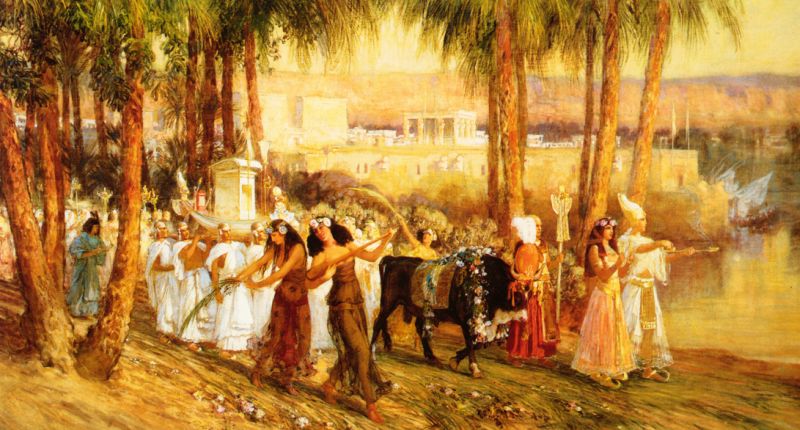
The word "festival" was originally used as an adjective from the late fourteenth century, deriving from Latin via Old French.[6] In Middle English, a "festival dai" was a religious holiday.[7]
The first recorded used of the word "festival" as a noun was in 1589 (as "Festifall").[6] Feast first came into usage as a noun c. 1200,[8] and its first recorded use as a verb was circa 1300.[9]
The word gala comes from Arabic word khil'a, meaning robe of honor.[10] The word gala was initially used to describe "festive dress", but came to be a synonym of "festival" starting in the 18th century.[11]
History[edit | edit source]

Festivals have long been significant in human culture and history and are found in virtually all cultures.[12][13] The importance of festivals, to the present, is found in private and public; secular and religious life.[14] Ancient Greek and Roman societies relied heavily upon festivals, both communal and administrative.[15] Saturnalia was likely influential to Christmas and Carnival.[16] Celebration of social occasions, religion and nature were common.[16] Specific festivals have century-long histories and festivals in general have developed over the last few centuries – some traditional festivals in Ghana, for example, predate European colonisation of the 15th century.[5][16][17] Festivals prospered following the Second World War.[16] Both established in 1947, Avignon Festival and the Edinburgh Festival Fringe have been notable in shaping the modern model of festivals.[18] Art festivals became more prominent by the turn of the 21st century.[14] In modern times, festivals are offered to public as a global tourist prospect although they are commonly public or not-for-profit.[19][20]
Traditions[edit | edit source]
Many festivals have religious origins and entwine cultural and religious significance in traditional activities. The most important religious festivals such as Christmas, Rosh Hashanah, Diwali, Holi, Eid-al-Fitr and Eid-al-Adha serve to mark out the year. Others, such as harvest festivals, celebrate seasonal change. Events of historical significance, such as important military victories or other nation-building events also provide the impetus for a festival. An early example is the festival established by Ancient Egyptian Pharaoh Ramesses III celebrating his victory over the Libyans.[21] In many countries, royal holidays commemorate dynastic events just as agricultural holidays are about harvests. Festivals are often commemorated annually.
There are numerous types of festivals in the world and most countries celebrate important events or traditions with traditional cultural events and activities. Most culminate in the consumption of specially prepared food (showing the connection to "feasting") and they bring people together. Festivals are also strongly associated with national holidays. Lists of national festivals are published to make participation easier.[22]
Types of festivals[edit | edit source]
The scale of festivals varies; in location and attendance, they may range from a local to national level.[23][16] Music festivals, for example, often bring together disparate groups of people, such that they are both localised and global.[24] The "vast majority" of festivals are, however, local, modest and populist.[25] The abundance of festivals significantly hinders quantifying the total there of.[14] There exists significant variation among festivals, beyond binary dichotomies of sacred and secular, rural and urban, people and establishment.[25]
Religious festivals[edit | edit source]
Among many religions, a feast is a set of celebrations in honour of God or various deities.[26] A feast and a festival are historically interchangeable. Most religions have festivals that recur annually and some, such as Passover, Easter, and Eid al-Adha are moveable feasts – that is, those that are determined either by lunar or agricultural cycles or the calendar in use at the time. The Sed festival, for example, celebrated the thirtieth year of an Egyptian pharaoh's rule and then every three (or four in one case) years after that.[27] Among the Ashantis, most of their traditional festivals are linked to gazette sites which are believed to be sacred with several rich biological resources in their pristine forms. Thus, the annual commemoration of the festivals helps in maintaining the buoyancy of the conserved natural site, assisting in biodiversity conservation.[28] Vodoun days is also one of the religious festivals of Benin which invites surrounding countries like Togo and Ghana because of the almost identical culture and tradition. Vodoun days is a festival of Vodoun.[29] Even in Togo Godogbe za of Gblinkomegan is a traditional celebration based on ancestor worship.
In the Christian liturgical calendar, there are two principal feasts, properly known as the Feast of the Nativity of our Lord (Christmas) and the Feast of the Resurrection (Easter), but minor festivals in honour of local patron saints are celebrated in almost all countries influenced by Christianity. In the Catholic, Eastern Orthodox, Evangelical Lutheran and Anglican liturgical calendars there are a great number of lesser feasts throughout the year commemorating saints, sacred events or doctrines. Within Evangelical Lutheranism, "festival" is part of the ranking of feast days.[30][31] In the Philippines, each day of the year has at least one specific religious festival, either from Catholic, Islamic, or indigenous origins.[32]
Hindus celebrate many festivals, such as Navaratri, Holi, Rama Navami, Karva Chauth, Diwali, Pongal, Kartika Purnima; among others. Most Hindu festivals are not celebrated by all Hindus.[33](pp226–227) One example of a Hindu festival is Ganesh Chaturthi, which is dedicated to the god Ganesha and is celebrated throughout India, but especially in Maharashtra.[33]: During the festival, idols of the god Ganesha, traditionally made of clay, are worshipped, and on the same day or after 1, 3, 5, 7, 10 or 11 days, are immersed in water.[34] The public celebration of the festival, which includes a public procession, was promoted by Bal Gangadhar Tilak as a means of asserting and celebrating a Hindu nationalist identity and to provide a sense of Hindu solidarity during the British Raj in India.[33](pp237–238,698)[35]
Buddhist religious festivals, such as Esala Perahera are held in Sri Lanka and Thailand.[36] The Sikh community celebrates the Vaisakhi festival marking the new year and birth of the Khalsa.[37]
-
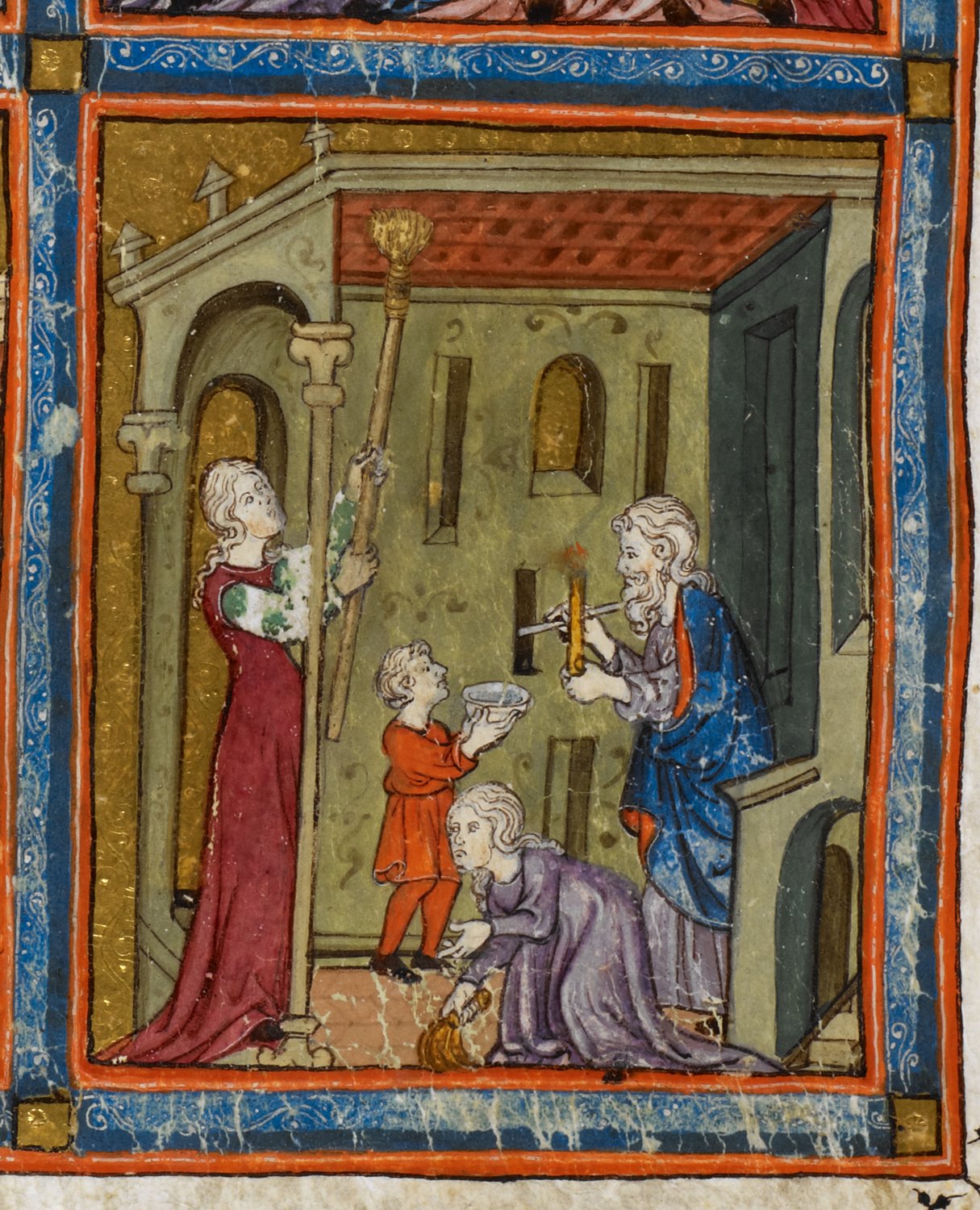 Cleaning in preparation for Passover (c. 1320)
 -
 Radha celebrating Holi, Kangra, India (c1788)
 -

-
 Moors and Christian festival in Villena, Spain
 -
 Decoration of god Krishna on Krishnastami in India.


_-_A_Christmas_mass_at_the_church_of_the_holy_Sepulchre,_in_Bethlehem_(1).jpg)


Arts festivals[edit | edit source]
Among the many offspring of general arts festivals are also more specific types of festivals, including ones that showcase intellectual or creative achievement such as science festivals, literary festivals and music festivals.[38] Sub-categories include comedy festivals, rock festivals, jazz festivals and buskers festivals; poetry festivals,[39] theatre festivals, and storytelling festivals; and re-enactment festivals such as Renaissance fairs. In the Philippines, aside from numerous art festivals scattered throughout the year, February is known as national arts month, the culmination of all art festivals in the entire archipelago.[40] The modern model of music festivals began in the 1960s-70s and have become a lucrative global industry.[4] Predecessors extend back to the 11th century and some, such as the Three Choirs Festival, remain to this day.[41]
Film festivals involve the screenings of several different films, and are usually held annually. Some of the most significant film festivals include the Berlin International Film Festival, the Venice Film Festival and the Cannes Film Festival.
-
 Pushkin Poetry Festival, Russia
 -
 Television studio at the Hôtel Martinez during the Cannes Film Festival, France (2006)
 -
 The opening ceremony at the Woodstock rock festival, United States (1969)


A food festival is an event celebrating food or drink. These often highlight the output of producers from a certain region. Some food festivals are focused on a particular item of food, such as the National Peanut Festival in the United States, or the Galway International Oyster Festival in Ireland. There are also specific beverage festivals, such as the famous Oktoberfest in Germany for beer. Many countries hold festivals to celebrate wine. One example is the global celebration of the arrival of Beaujolais nouveau, which involves shipping the new wine around the world for its release date on the third Thursday of November each year.[42][43] Both Beaujolais nouveau and the Japanese rice wine sake are associated with harvest time. In the Philippines, there are at least two hundred festivals dedicated to food and drinks.[citation needed]
-
 Soweto Wine Festival, South Africa (2009)
 -
 La Tomatina, Spain (2010)
 -
 Beer horse cart from the Hofbräuhaus brewery at Oktoberfest Germany (2013)

_-_Spain,_Bu%C3%B1ol_30.jpg)

Seasonal and harvest festivals[edit | edit source]
Seasonal festivals, such as Beltane, are determined by the solar and the lunar calendars and by the cycle of the seasons, especially because of its effect on food supply, as a result of which there is a wide range of ancient and modern harvest festivals. Ancient Egyptians relied upon the seasonal inundation caused by the Nile River, a form of irrigation, which provided fertile land for crops.[44] In the Alps, in autumn the return of the cattle from the mountain pastures to the stables in the valley is celebrated as Almabtrieb. A recognized winter festival, the Chinese New Year, is set by the lunar calendar, and celebrated from the day of the second new moon after the winter solstice. Dree Festival of the Apatanis living in Lower Subansiri District of Arunachal Pradesh is celebrated every year from July 4 to 7 by praying for a bumper crop harvest.[45]
Midsummer or St John's Day, is an example of a seasonal festival, related to the feast day of a Christian saint as well as a celebration of the time of the summer solstice in the northern hemisphere, where it is particularly important in Sweden. Winter carnivals also provide the opportunity to utilise to celebrate creative or sporting activities requiring snow and ice. In the Philippines, each day of the year has at least one festival dedicated to harvesting of crops, fishes, crustaceans, milk, and other local goods.[citation needed]
-
 Temple Festival in India
 -

-
 Midsummer dance by Anders Zorn, Sweden (1897)
 -

-
 Grand Parade at the Sydney Royal Easter Show, Australia (2009)
 -
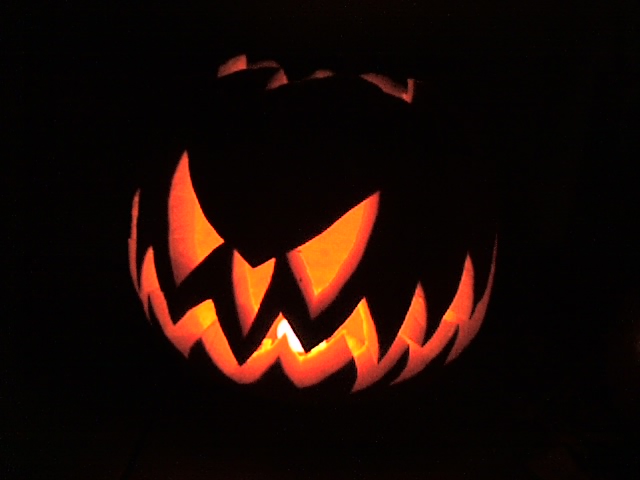 Halloween pumpkins show the close relationship between a harvest and religious festivals


Politics[edit | edit source]
Scholarly literature notes that festivals functionally disseminate political values and meaning, such as ownership of place, which undergoes transformation in accordance with the festival.[5][25] Furthermore, a festival may act as an artefact which allows citizens to achieve "certain ideals", including those of identity and ideology.[46] Festivals may be used to rehabilitate or elevate the image of a city; the ephemerality of festivals means that their impact is often incorporeal, of name, memory and perception.[14][25] In deviating from routine, festivals may reinforce the convention, be it social, cultural or economic.[16][25]
Study of festivals[edit | edit source]
- Festive ecology – explores the relationships between the symbolism and the ecology of the plants, fungi and animals associated with cultural events such as festivals, processions and special occasions.
- Heortology – the study of religious festivals. It was originally only used in respect of Christian festivals,[47] but it now covers all religions, in particular those of Ancient Greece.[48] See list of foods with religious symbolism for some topical overlap. [chirag]
See also[edit | edit source]
References[edit | edit source]
- ↑ "By the numbers: Musikfest 2023". WFMZ.com. August 15, 2023.
- ↑ Caves, R. W. (2004). Encyclopedia of the City. Routledge. p. 264. ISBN 978-0-415-25225-6.
- ↑ "Why festivals are important". www.thenews.com.pk. Retrieved February 10, 2023.
- ↑ 4.0 4.1 Davies, Karen (2021). "Festivals Post Covid-19". Leisure Sciences. 43 (1–2): 184–189. doi:10.1080/01490400.2020.1774000. ISSN 0149-0400. S2CID 225693273.
- ↑ 5.0 5.1 5.2 Quinn, Bernadette (2003). "Symbols, practices and myth-making: Cultural perspectives on the Wexford Festival Opera". Tourism Geographies. 5 (3): 329–349. doi:10.1080/14616680309710. ISSN 1461-6688. S2CID 143509970. Archived from the original on August 28, 2022. Retrieved August 21, 2022.
- ↑ 6.0 6.1 "festival, adj. and n." OED Online. Oxford University Press. March 2014. Archived from the original on August 28, 2022. Retrieved April 16, 2014.
- ↑ "festival (adj.)". Middle English Dictionary. Archived from the original on July 2, 2014. Retrieved April 16, 2014.
- ↑ "feast, n." OED Online. Oxford University Press. March 2014. Archived from the original on August 28, 2022. Retrieved April 16, 2014.
- ↑ "feast, v." OED Online. Oxford University Press. March 2014. Archived from the original on August 28, 2022. Retrieved April 16, 2014.
- ↑ James E Glevin (2020). The Modern Middle East: A History. Oxford University Press. p. 21. ISBN 978-0-19-007406-7.
- ↑ "gala (n.)". Online Etymology Dictionary. Archived from the original on June 27, 2020. Retrieved June 27, 2020.
- ↑ Cudny 2016, p. 13.
- ↑ Falassi, Alessandro, ed. (1987). Time Out of Time: Essays on the Festival. University of New Mexico Press. p. 1. ISBN 0-8263-0932-1. OCLC 15017471.
- ↑ 14.0 14.1 14.2 14.3 Quinn, Bernadette (2005). "Arts Festivals and the City". Urban Studies. 42 (5–6): 927–943. Bibcode:2005UrbSt..42..927Q. doi:10.1080/00420980500107250. ISSN 0042-0980. S2CID 154354884.
- ↑ Brandt, J. Rasmus; Iddeng, Jon W., eds. (2012). Greek and Roman Festivals: Content, Meaning, and Practice (1st ed.). Oxford University Press. p. 1. ISBN 978-0-19-969609-3.
- ↑ 16.0 16.1 16.2 16.3 16.4 16.5 Cudny, Waldemar (2014). "The Phenomenon of Festivals: Their Origins, Evolution, and Classifications". Anthropos. 109 (2): 640–656. doi:10.5771/0257-9774-2014-2-640. ISSN 0257-9774. JSTOR 43861801. Archived from the original on August 23, 2022. Retrieved August 23, 2022.
- ↑ Odotei, Irene (2002). "Festivals in Ghana: Continuity, Transformation and Politicisation of Tradition". Transactions of the Historical Society of Ghana (6): 17–34. ISSN 0855-3246. JSTOR 41406666. Archived from the original on August 24, 2022. Retrieved August 24, 2022.
- ↑ Bartie, Angela (2013). The Edinburgh Festivals: Culture and Society in Post-war Britain. Edinburgh University Press. p. 6. doi:10.3366/edinburgh/9780748670307.001.0001. ISBN 978-0-7486-7030-7. Archived from the original on August 28, 2022. Retrieved August 24, 2022.
- ↑ Prentice, Richard; Andersen, Vivien (2003). "Festival as creative destination". Annals of Tourism Research. 30 (1): 7–30. doi:10.1016/S0160-7383(02)00034-8. Archived from the original on June 23, 2022. Retrieved August 21, 2022.
- ↑ Andersson, Tommy D.; Getz, Donald (2008). "Stakeholder Management Strategies of Festivals". Journal of Convention & Event Tourism. 9 (3): 199–220. doi:10.1080/15470140802323801. ISSN 1547-0148. S2CID 154831702. Archived from the original on August 27, 2022. Retrieved August 28, 2022.
- ↑ Berrett, LaMar C.; Ogden D. Kelly (1996). Discovering the world of the Bible (3rd ed., rev. ed.). Provo, Utah: Grandin Book Co. p. 289. ISBN 0-910523-52-5.
- ↑ See for example: List of festivals in Australia; Bangladesh; Canada; China; Colombia; Costa Rica; Fiji; India; Indonesia; Iran; Japan; Laos; Morocco; Nepal; Pakistan; Philippines; Romania; Tunisia; Turkey; United Kingdom; United States; Vietnam.
- ↑ Cudny 2016, p. 15.
- ↑ Hondros, Konstantin; Silva, Glaucia Peres da, eds. (2019). Music Practices Across Borders : (E)Valuating Space, Diversity and Exchange. Transcript. p. 86. ISBN 978-3-8394-4667-6. OCLC 1105916920.
- ↑ 25.0 25.1 25.2 25.3 25.4 Waterman, Stanley (1998). "Carnivals for elites? The cultural politics of arts festivals". Progress in Human Geography. 22 (1): 54–74. doi:10.1191/030913298672233886. ISSN 0309-1325. S2CID 144867877.
- ↑ Bleeker, Claas Jouco (1967). Egyptian Festivals: Enactments of Religious Renewal. Brill Archive. Archived from the original on August 28, 2022. Retrieved August 27, 2022.
- ↑ "Heb-Sed (Egyptian feast)". Encyclopædia Britannica. Archived from the original on May 4, 2015. Retrieved April 16, 2014.
- ↑ Robson, James P. (2007). "Local approaches to biodiversity conservation: lessons from Oaxaca, southern Mexico". International Journal of Sustainable Development. 10 (3): 267. doi:10.1504/ijsd.2007.017647. ISSN 0960-1406.
- ↑ "Benin : the nationale vodun festival is now: "vodun days"". www.globalvoices.org.
- ↑ "Feasts and Festivals". Lutheran Church – Missouri Synod. 2025. Retrieved November 3, 2025.
- ↑ "Feasts, Festivals, and Commemorations, Oh My!". ATH. 2025. Retrieved November 3, 2025.
- ↑ "Calendar of Philippine Festivals and Monthly Observances / Theme | Tourism Promotions Board". www.tpb.gov.ph. Archived from the original on September 27, 2023. Retrieved February 10, 2023.
- ↑ 33.0 33.1 33.2 Lochtefeld, James G. (2002). The Illustrated Encyclopedia of Hinduism: A-M. Rosen. ISBN 978-0-8239-3179-8.
- ↑ Sonika Nitin Nimje (September 9, 2024). "Ganesh Visarjan 2024: Why is Visarjan done on different days?". Business Standard. New Delhi. Retrieved March 5, 2025.
- ↑ Barnouw, Victor (1954). "The Changing Character of a Hindu Festival". American Anthropologist. 56 (1): 74–86. doi:10.1525/aa.1954.56.1.02a00070. ISSN 0002-7294. JSTOR 664633.
- ↑ Gerson, Ruth (1996). Traditional festivals in Thailand. Kuala Lumpur; New York: Oxford University Press. ISBN 967-65-3111-1.
- ↑ Roy, Christian (2005). "Sikh Vaisakhi: Anniversary of the Pure". Traditional Festivals, Vol. 2 [M – Z]: A Multicultural Encyclopedia. ABC-CLIO. p. 480. ISBN 978-1-57607-089-5.
- ↑ See List of music festivals.
- ↑ Some such as such as Cúirt International Festival of Literature started as a poetry festival and then broadened in scope.
- ↑ Kasilag, Giselle P. (February 1999). "Performances, exhibits around the country mark National Arts Month". BusinessWorld (SanJuan, Philippines): 1. ISSN 0116-3930 – via Nexis Uni.
- ↑ Frey, Bruno S. (1994). "The Economics of Music Festivals". Journal of Cultural Economics. 18 (1): 29–39. doi:10.1007/bf01207151. ISSN 0885-2545. S2CID 153806851. Archived from the original on August 28, 2022. Retrieved August 25, 2022.
- ↑ Hyslop, Leah (November 21, 2013). "Beaujolais Nouveau day: 10 facts about the wine". The Telegraph. Archived from the original on January 11, 2022.
- ↑ Haine, W. Scott (2006). Culture and Customs of France. Greenwood Publishing Group. p. 103. ISBN 978-0-313-32892-3. Archived from the original on May 1, 2016. Retrieved December 15, 2015.
- ↑ Bunson, Margaret (2009). "Nile festivals". Encyclopedia of Ancient Egypt. Infobase Publishing. p. 278. ISBN 978-1-4381-0997-8. Archived from the original on May 7, 2016. Retrieved December 15, 2015.
- ↑ "Press release – Dree festival". Directorate of Information, Govt of Arunachal Pradesh. July 5, 2004. Archived from the original on July 18, 2011. Retrieved July 13, 2009.
- ↑ Jeong, Sunny; Santos, Carla Almeida. (2004). "Cultural Politics and Contested Place Identity". Annals of Tourism Research. 31 (3): 640–656. doi:10.1016/j.annals.2004.01.004.
- ↑ Herbermann, Charles, ed. (1913). . Catholic Encyclopedia. New York: Robert Appleton Company.
- ↑ Parker, Robert (1996). Athenian religion : a history. Oxford: Clarendon Press. ISBN 0-19-814979-4. OCLC 32590127.
- Cudny, Waldemar (2016). Festivalisation of Urban Spaces. Springer Geography. Springer. doi:10.1007/978-3-319-31997-1. ISBN 978-3-319-31997-1. S2CID 168194339.
Further reading[edit | edit source]
- Ian Yeoman, ed. (2004). Festival and events management: an international arts and culture perspective (1st ed., repr. ed.). Amsterdam: Elsevier Butterworth-Heinemann. ISBN 978-0-7506-5872-0.