



robot: Update article (please report if you notice any mistake or error in this edit) |
refined citations further and fixed typos per standard format |
||
| Line 1: | Line 1: | ||
{{other uses}} | {{other uses}} | ||
{{Use Indian English|date=March 2016}} | {{Use Indian English|date=March 2016}} | ||
{{Use dmy dates|date= | {{Use dmy dates|date=July 2025}}{{Short description|Ethnic group of Andaman Islands}} | ||
{{Infobox ethnic group | {{Infobox ethnic group | ||
| group = Onge | | group = Onge | ||
| native_name = | | native_name = {{lang|oon|ॳङे (Öñge)}} | ||
| native_name_lang = oon | | native_name_lang = oon | ||
| image = | | image = | ||
| image_caption = | | image_caption = A young Onge mother with her baby | ||
| population = 101<ref>http://www.censusindia.gov.in/2011census/PCA/SC_ST/PCA-A11_Appendix/ST-35-PCA-A11-APPENDIX.xlsx {{ | | population = 101<ref>[http://www.censusindia.gov.in/2011census/PCA/SC_ST/PCA-A11_Appendix/ST-35-PCA-A11-APPENDIX.xlsx 2011 census data]censusindia.gov.in {{Webarchive|url=https://web.archive.org/web/20210112010546/http://www.censusindia.gov.in/2011census/PCA/SC_ST/PCA-A11_Appendix/ST-35-PCA-A11-APPENDIX.xlsx |date=12 January 2021 }}</ref> | ||
| total_year = 2011 census | | total_year = 2011 census | ||
| regions = {{flag|India}}<br /> specifically [[Little Andaman Island]] | | regions = {{flag|India}}<br /> specifically [[Little Andaman Island]] | ||
| Line 17: | Line 16: | ||
}} | }} | ||
The '''Onge''' (also '''Önge''', '''Ongee''', and '''Öñge''') are an [[Andamanese peoples|Andamanese ethnic group]], indigenous to the [[Andaman Islands]] in [[Southeast Asia]] at the [[Bay of Bengal]], [[India]]. They are traditionally [[hunter-gatherers|hunter-gatherers and fishers]], but also practice [[plant cultivation]]. They are designated as a [[Scheduled Castes and Scheduled Tribes|Scheduled Tribe]] of India.<ref>{{cite web |url=http://censusindia.gov.in/Tables_Published/SCST/ST%20Lists.pdf |page=27 |title=List of notified Scheduled Tribes |publisher=Census India |access-date=15 December 2013 |archive-url=https://web.archive.org/web/20131107225208/http://censusindia.gov.in/Tables_Published/SCST/ST%20Lists.pdf |archive-date=7 November 2013 }}</ref> | |||
The '''Onge''' (also '''Önge''', '''Ongee''', and '''Öñge''') are an [[Andamanese peoples|Andamanese ethnic group]], indigenous to the [[Andaman Islands]] in [[Southeast Asia]] at the [[Bay of Bengal]], | |||
== History == | == History == | ||
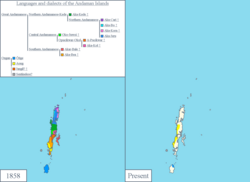
[[File:Andamanese | [[File:Distribution of different Andamanese peoples, languages, and dialects at the time of British contact compared to the present day.png|left|thumb|200x200px|The distributions of different Andamanese peoples, languages, and dialects at the time of British contact compared to the present-day.]] | ||
In the 18th century the Onge | In the 18th century the Onge were distributed across [[Little Andaman Island]] and the nearby islands, with some territory and camps established on [[Rutland Island]] and the southern tip of [[South Andaman Island]]. After they encountered British colonial officers, friendly relations were established with the [[British Empire]] in the 1800s through Lieutenant [[Archibald Blair]]. Originally restive, they were pacified by [[Maurice Vidal Portman|M. V. Portman]] in the 1890s.{{clarify|reason=In what way were they 'restive'? What does it mean that they were 'pacified'? These terms seem like obscure euphemisms for some kind of violent conflict.|date=August 2013}}<ref name="weber1">George Weber, ''[http://www.andaman.org/BOOK/chapter8/text8.htm the Tribes]''. Chapter 8 in ''[http://www.andaman.org/BOOK/text-group-BodyChapters.htm The andamanese]''. Accessed on 2012-07-03.</ref><ref name="portman" /> British naval officer [[Maurice Vidal Portman|M. V. Portman]] described them as the "mildest, most timid, and inoffensive" group of Andamanese people he had encountered.<ref name="weber">{{cite web|first=George|last=Weber|url=http://www.andaman.org/BOOK/app-a/a-portman.htm|title=Maurice Vidal Portman (1861–1935)|work=The Andamanese (Appendix A – Pioneer Biographies of the British Period to 1947)|access-date=3 July 2012|archive-url=https://web.archive.org/web/20120805204050/http://www.andaman.org/BOOK/app-a/a-portman.htm|archive-date=5 August 2012}}</ref><ref name="portman"/> By the end of the 19th century they sometimes visited the [[South Brother Island, India|South]] and [[North Brother Island, India|North Brother Islands]] to catch [[sea turtle]]s; at the time, those islands seemed to be the boundary between their territory and the range of the [[Great Andamanese people]] further north.<ref name="portman">M. V. Portman (1899), ''[http://booksnow2.scholarsportal.info/ebooks/oca2/22/historyofourrela02portuoft/historyofourrela02portuoft_bw.pdf A history of our Relations with the Andamanese]'', Volume II. Office of the Government Printing, Calcutta, India.</ref> Today, the surviving members are confined to two reserve camps on Little Andaman: Dugong Creek in the northeast, and South Bay. | ||
The Onge were semi-nomadic and fully dependent on [[Hunter-gatherer|hunting and gathering]] for food. | |||
The Onge are one of the aboriginal peoples ([[adivasi]]) of India. Together with the other Andamanese tribes and a few other isolated groups elsewhere in [[Oceania]], they comprise the [[Negrito]] peoples. | |||
[[image:Onge people depicted in Kolkata Museum.jpg|thumb|A depiction of Onge people in Kolkata Museum]] | |||
=== Population === | === Population === | ||
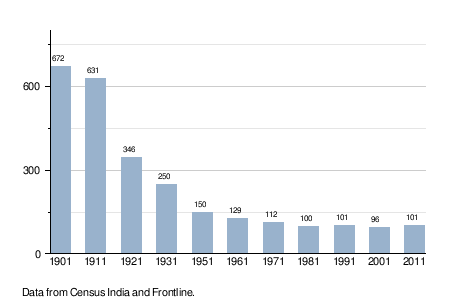
Onge population numbers were substantially reduced in the aftermath of colonisation and settlement, from 672 in 1901 to barely 100.<ref name="Pandya1993">{{cite book |last=Pandya |first=Vishvajit |title=Above the Forest: A Study of Andamanese Ethnoanemology, Cosmology, and the Power of Ritual |date=1993 |publisher=Oxford University Press |isbn=978-0-19-562971-2}}</ref>{{rp|51}}<ref name="bbc2004a">{{cite news |title=अंडमान में जनजातियों को ख़तरा |trans-title=Tribes endangered in the Andamans |work=BBC News |date=30 December 2004 |language=hi |access-date=25 November 2008 |url=https://www.bbc. | Onge population numbers were substantially reduced in the aftermath of colonisation and settlement, from 672 in 1901 to barely 100.<ref name="Pandya1993">{{cite book |last=Pandya |first=Vishvajit |title=Above the Forest: A Study of Andamanese Ethnoanemology, Cosmology, and the Power of Ritual |date=1993 |publisher=Oxford University Press |isbn=978-0-19-562971-2}}</ref>{{rp|51}}<ref name="bbc2004a">{{cite news |title=अंडमान में जनजातियों को ख़तरा |trans-title=Tribes endangered in the Andamans |work=BBC News |date=30 December 2004 |language=hi |access-date=25 November 2008 |url=https://www.bbc.com/hindi/regionalnews/story/2004/12/041230_tsunami_aborigins |quote=जारवा के 100, ओन्गी के 105, ग्रेट एंडमानिस के 40–45 और सेन्टेलीज़ के क़रीब 250 लोग नेगरीटो कबीले से हैं, जो दक्षिण एशिया की प्राचीनतम जनजाति है {{bracket|100 of the Jarawa, 105 of the Onge, 40–45 of the Great Andamanese, and about 250 of the Sentinelese belong to the Negrito group which is South Asia's oldest tribal affiliation}}.}}</ref> The population is still maintaining their cultural and biological identity, and it appears that total numbers have increased from 100 to 117 in 2017.<ref>{{Cite journal |last1=Raviprasad |first1=B.V. |last2=Ghosh |first2=Amit Kumar |last3=Sasikumar |first3=M. |year=2020 |title=Survival, Continuity and Identity Among the Onge of Andaman and Nicobar Islands |series=Volume 69, Issue 1 |journal=Journal of the Anthropological Survey of India |volume=69 |pages=71–81|doi=10.1177/2277436X20927255 |s2cid=220324793 |doi-access=free }}</ref> | ||
A major cause of the decline in Onge population is the changes in their food habits brought about by their contact with the outside world.<ref>Devi, L. Dilly (1987). "Sociological Aspects of Food and Nutrition among the Onges of the Little Andaman Island". Ph.D. dissertation, University of Delhi, Delhi</ref> Infant and child mortality is in the range of 40%.<ref>{{cite web |url=http://www.culturalsurvival.org/ourpublications/csq/article/ecocide-or-genocide-the-onge-andaman-islands |title=Ecocide or Genocide? The Onge in the Andaman Islands |work=Cultural Survival |access-date=4 March 2016}}</ref> The Onge's [[net reproductive index]] is 0.91.<ref name="gob">A. N. Sharma (2003), ''[https://books.google.com/books?id=WEztW7c0CqQC&pg=PA64 Tribal Development in the Andaman Islands]'', page 64. Sarup & Sons, New Delhi.</ref> The net reproductive index among the Great Andamanese is 1.40.<ref>A. N. Sharma (2003), ''[https://books.google.com/books?id=WEztW7c0CqQC&pg=PA72 Tribal Development in the Andaman Islands]'', page 72. Sarup & Sons, New Delhi.</ref> | A major cause of the decline in Onge population is the changes in their food habits brought about by their contact with the outside world.<ref>Devi, L. Dilly (1987). "Sociological Aspects of Food and Nutrition among the Onges of the Little Andaman Island". Ph.D. dissertation, University of Delhi, Delhi</ref> The Onge are also one of the least fertile people in the world. About 40% of the married couples are sterile. Onge women rarely become pregnant before the age of 28.<ref>{{Cite book | url=https://books.google.com/books?id=FPX6wiuZ3ikC&pg=PA44 | title=Andaman and Nicobar Tribes Restudied: Encounters and Concerns| isbn=978-81-8324-010-9| last1=Mann| first1=Rann Singh| date=January 2005| publisher=Mittal Publications}}</ref> Infant and child mortality is in the range of 40%.<ref>{{cite web |url=http://www.culturalsurvival.org/ourpublications/csq/article/ecocide-or-genocide-the-onge-andaman-islands |title=Ecocide or Genocide? The Onge in the Andaman Islands |work=Cultural Survival |date=2 March 2010 |access-date=4 March 2016}}</ref> The Onge's [[net reproductive index]] is 0.91.<ref name="gob">A. N. Sharma (2003), ''[https://books.google.com/books?id=WEztW7c0CqQC&pg=PA64 Tribal Development in the Andaman Islands]'', page 64. Sarup & Sons, New Delhi.</ref> The net reproductive index among the Great Andamanese is 1.40.<ref>A. N. Sharma (2003), ''[https://books.google.com/books?id=WEztW7c0CqQC&pg=PA72 Tribal Development in the Andaman Islands]'', page 72. Sarup & Sons, New Delhi.</ref> | ||
In 1901, there were 672 Onge; 631 in 1911, 346 in 1921, 250 in 1931, and 150 in 1951.<ref name="jsr1976">{{cite journal |journal=Journal of Social Research |title=Journal of Social Research |publisher=Council of Social and Cultural Research, Ranchi University Department of Anthropology, Bihar |date=1976 |volume=19 |access-date=25 November 2008 |url=https://books.google.com/books?id=MIQrAAAAIAAJ}}</ref><ref name="Frontline1999">{{cite journal |url=http://www.frontline.in/static/html/fl1609/16090710.htm |title=Little Andaman: a chronology |journal=Frontline |date=1999 |location=Chennai, India |volume=16 |issue=9 |issn=0970-1710}}</ref> | |||
<timeline> | <timeline> | ||
Colors= | Colors= | ||
| Line 95: | Line 100: | ||
=== Tsunami surviving tactics === | === Tsunami surviving tactics === | ||
The semi-nomadic Onge have traditional stories that | The semi-nomadic Onge have traditional stories that tell of the ground shaking and a great wall of water destroying the land. Taking heed of this story, the Onge survived the [[tsunami|tsunami catastrophe]] caused by the [[2004 Indian Ocean earthquake]] by taking shelter in the highlands.<ref>{{cite web |url=http://www.culturalsurvival.org/publications/cultural-survival-quarterly/mariana-budjeryn/and-then-came-tsunami-disaster-brings-atte |title=And Then Came the Tsunami: Disaster Brings Attention and New Challenges to Asia's Indigenous Peoples |access-date=22 February 2010 |last=Budjeryn |first=Mariana |publisher=[[Cultural Survival Quarterly]]}}</ref> | ||
=== Poisoning incident === | === Poisoning incident === | ||
In December 2008, eight male tribal members died after drinking a toxic liquid{{spnd}}identified as [[methanol]] by some sources{{spnd}}that they had apparently mistaken for [[ethanol|drinking alcohol]].<ref name="alcerr">{{cite news|last=Bhaumik|first=Subir|date=9 December 2008|title=Alcohol error hits Andamans tribe|work=[[BBC News]]|url= | In December 2008, eight male tribal members died after drinking a toxic liquid{{spnd}}identified as [[methanol]] by some sources{{spnd}}that they had apparently mistaken for [[ethanol|drinking alcohol]].<ref name="alcerr">{{cite news|last=Bhaumik|first=Subir|date=9 December 2008|title=Alcohol error hits Andamans tribe|work=[[BBC News]]|url=https://news.bbc.co.uk/1/hi/world/south_asia/7772952.stm|access-date=10 December 2008}}</ref> The liquid apparently came from a container that had washed ashore at Dugong Creek near their settlement on the island, but Port Blair authorities ordered an investigation into whether it had originated elsewhere. A further 15 Onge were taken to hospital with at least one critically ill.<ref name="bottle">{{cite web|author=Buncombe, Andrew|date=12 December 2008|title=Washed-up poison bottle kills eight members of island tribe|url=https://www.independent.co.uk/news/world/asia/washedup-poison-bottle-kills-eight-members-of-island-tribe-1062908.html|archive-url=https://web.archive.org/web/20081212223232/http://www.independent.co.uk/news/world/asia/washedup-poison-bottle-kills-eight-members-of-island-tribe-1062908.html|archive-date=12 December 2008|access-date=12 December 2008|location=London|format=online edition|newspaper=[[The Independent]]}}</ref> | ||
With their population estimated at only around 100 before the incident, the director of [[Survival International]] described the mass poisoning as a "calamity for the Onge", and warned that any more deaths could "put the survival of the entire tribe in serious danger".<ref name="bottle" /> [[Bhopinder Singh]], the [[List of lieutenant governors of the Andaman and Nicobar Islands|Lieutenant Governor of the Andaman Islands]], ordered an inquiry into the incident.<ref>{{cite web|date=11 December 2008|title=Inquiry ordered into death of Onge tribesmen|url=http://www.hindu.com/thehindu/holnus/001200812111313.htm | With their population estimated at only around 100 before the incident, the director of [[Survival International]] described the mass poisoning as a "calamity for the Onge", and warned that any more deaths could "put the survival of the entire tribe in serious danger".<ref name="bottle" /> [[Bhupinder Singh Thakur|Bhopinder Singh]], the [[List of lieutenant governors of the Andaman and Nicobar Islands|Lieutenant Governor of the Andaman Islands]], ordered an inquiry into the incident.<ref>{{cite web|date=11 December 2008|title=Inquiry ordered into death of Onge tribesmen|url=http://www.hindu.com/thehindu/holnus/001200812111313.htm|archive-url=https://web.archive.org/web/20121103151921/http://www.hindu.com/thehindu/holnus/001200812111313.htm|archive-date=3 November 2012|access-date=13 December 2008|work=[[The Hindu]]}}</ref> The Onge have been rather vulnerable toward any option for radical change, they deserve close, careful attention to ward off any untoward impact of change-initiatives.<ref>{{Cite book |last1=Danda |first1=Dipali |last2=Mukherjee |first2=Sumit |title=Dilemma of Development among the Onge of Andaman |date=2021 |publisher=Taylor & Francis |isbn=978-1-032-15127-4}}</ref> | ||
== Culture and religion == | == Culture and religion == | ||
The native Andamanese religion and belief system is a form of [[ | The native Andamanese religion and belief system is a form of [[animism]]. [[Ancestor worship]] is an important element in the religious traditions of the Andaman islands.<ref>{{cite journal|vauthors=Bxown AK|date=30 September 1909|title=The Religion of the Andaman Islanders|journal=Folklore|volume=20|issue=3|pages=257–371|doi=10.1080/0015587X.1909.9719883}}</ref> The Andamanese probably had no government or clan leader, but made decisions by group [[Consensus decision-making|consensus]].<ref>{{Cite book|title=The Andaman Islanders|vauthors=Brown AR|publisher=Cambridge University Press|year=1933|location=Cambridge|page=44}}</ref> | ||
== Language == | == Language == | ||
The Onge speak the [[Önge language]]. It is one of two known [[Ongan languages]] (southern [[Andamanese languages]]). Önge used to be spoken throughout Little Andaman as well as in smaller islands to the north, and possibly in the southern tip of [[South Andaman]] island. Since the middle of the 19th century, with the arrival of the British in the [[Andaman Islands|Andamans]], and, after [[Partition of India|Indian independence]], the massive inflow of Indian settlers from the mainland, the number of Onge speakers has steadily declined. However, a moderate increase has been observed in recent years.<ref>{{cite web |url=http://www.combatlaw.org/information.php?article_id=23&issue_id=9 |title=The Colonisation of Little Andaman Island |access-date=23 June 2008 }}{{dead link|date=January 2018 |bot=InternetArchiveBot |fix-attempted=yes }}</ref> {{As of|2006}}, there were 94 native Onge speakers<ref name="Ethnologue">{{cite book |editor1-first=M. Paul |editor1-last=Lewis |editor2-first=Gary F. |editor2-last=Simons |editor3-first=Charles D. |editor3-last=Fennig |year=2013 |title=Ethnologue: Languages of the World |chapter=Öñge |edition=17th |location=Dallas, Texas |publisher=SIL International |chapter-url=http://www.ethnologue.com/17/language/oon |archive-url=https://web.archive.org/web/20160309160836/http://www.ethnologue.com/17/language/oon/ |archive-date=9 March 2016 |url-status=live | The Onge speak the [[Önge language]]. It is one of two known [[Ongan languages]] (southern [[Andamanese languages]]). Önge used to be spoken throughout Little Andaman as well as in smaller islands to the north, and possibly in the southern tip of [[South Andaman]] island. Since the middle of the 19th century, with the arrival of the British in the [[Andaman Islands|Andamans]], and, after [[Partition of India|Indian independence]], the massive inflow of Indian settlers from the mainland, the number of Onge speakers has steadily declined. However, a moderate increase has been observed in recent years.<ref>{{cite web |url=http://www.combatlaw.org/information.php?article_id=23&issue_id=9 |title=The Colonisation of Little Andaman Island |access-date=23 June 2008 }}{{dead link|date=January 2018 |bot=InternetArchiveBot |fix-attempted=yes }}</ref> {{As of|2006}}, there were 94 native Onge speakers<ref name="Ethnologue">{{cite book |editor1-first=M. Paul |editor1-last=Lewis |editor2-first=Gary F. |editor2-last=Simons |editor3-first=Charles D. |editor3-last=Fennig |year=2013 |title=Ethnologue: Languages of the World |chapter=Öñge |edition=17th |location=Dallas, Texas |publisher=SIL International |chapter-url=http://www.ethnologue.com/17/language/oon |archive-url=https://web.archive.org/web/20160309160836/http://www.ethnologue.com/17/language/oon/ |archive-date=9 March 2016 |url-status=live }}</ref> confined to a single settlement in the northeast of Little Andaman Island (see map above), making it an [[endangered language]]. | ||
The [[Ongan languages]], to which Onge belongs, have been proposed by Juliette Blevins to be related to [[East Asian languages|Mainland Asian languages]], such as [[Austronesian languages|Austronesian]].<ref>Blevins, Juliette (2007), "A Long Lost Sister of Proto-Austronesian? Proto-Ongan, Mother of Jarawa and Onge of the Andaman Islands" (PDF), ''Oceanic Linguistics'', '''46''' (1): 154–198, [[Doi (identifier)|doi]]:10.1353/ol.2007.0015, [[S2CID (identifier)|S2CID]] 143141296</ref> However, this proposal has not been well received by other linguists, such as [[Robert Blust]], who concludes that the hypothesis is not supported by the | The [[Ongan languages]], to which Onge belongs, have been proposed by [[Juliette Blevins]] to be related to [[East Asian languages|Mainland Asian languages]], such as [[Austronesian languages|Austronesian]].<ref>Blevins, Juliette (2007), "A Long Lost Sister of Proto-Austronesian? Proto-Ongan, Mother of Jarawa and Onge of the Andaman Islands" (PDF), ''Oceanic Linguistics'', '''46''' (1): 154–198, [[Doi (identifier)|doi]]:10.1353/ol.2007.0015, [[S2CID (identifier)|S2CID]] 143141296</ref> However, this proposal has not been well received by other linguists, such as [[Robert Blust]], who concludes that the hypothesis is not supported by the [[comparative method]] (used in linguistics), and also cites non-linguistic (such as cultural, archaeological, and biological) evidence against Blevins' hypothesis.<ref>Blust, Robert (2014). "Some Recent Proposals Concerning the Classification of the Austronesian Languages", ''Oceanic Linguistics'' 53:2:300–391. "To put it bluntly, the AON hypothesis is a castle built on sand, an elaborate illusion fostered by the misplaced hope that a major discovery has been made that somehow eluded the investigations of all other scholars."|url=https://www.researchgate.net/publication/279031484_Some_Recent_Proposals_Concerning_the_Classification_of_the_Austronesian_Languages</ref> [[George van Driem]] (2011) considers Blevins' evidence as "not compelling", although he leaves the possibility open that some resemblances could be the result of contact/borrowing, a position also held by Hoogervorst (2012).<ref>{{cite book |last=van Driem |first=George |year=2011 |chapter=Rice and the Austroasiatic and Hmong-Mien homelands |chapter-url=https://www.researchgate.net/publication/256442016 |access-date= 13 November 2021 |editor=N.J Enfield |title=Dynamics of human diversity: the case of mainland Southeast Asia |location=Canberra |publisher=Pacific Linguistics}}</ref><ref>{{cite thesis |last=Hoogervorst |first=Tom |year=2012 |title=Southeast Asia in the ancient Indian Ocean world: combining historical linguistic and archaeological approaches |type=PhD thesis |publisher=University of Oxford |url=https://ora.ox.ac.uk/objects/uuid:b8b47816-7184-42ab-958e-026bc3431ea3 |access-date=13 November 2021 |quote=Nevertheless, it is conceivable that some of the given forms are genuinely related, though better explained as loans than common inheritance (p. 91).}}</ref> | ||
== Genetics == | == Genetics == | ||
[[File:PCA calculated on present-day individuals from eastern Eurasia and Near Oceania.png|thumb|PCA calculated on present-day and ancient individuals from eastern Eurasia and Oceania. PC1 (23,8%) distinguish East-Eurasians and Australo-Melanesians, while PC2 (6,3%) differentiates East-Eurasians along a North to South cline.]] | [[File:PCA calculated on present-day individuals from eastern Eurasia and Near Oceania.png|thumb|PCA calculated on present-day and ancient individuals from eastern Eurasia and Oceania. PC1 (23,8%) distinguish East-Eurasians and Australo-Melanesians, while PC2 (6,3%) differentiates East-Eurasians along a North to South cline.]] | ||
[[File:Eastern non-Africans.png|thumb|Genetic population tree of "eastern non-African" populations.]] | [[File:Eastern non-Africans.png|thumb|Genetic population tree of "eastern non-African" populations.]] | ||
Genetically, the Onge, as well as other Andamanese people, are distantly related to [[East Asian people]]. The Andamanese Onge show the highest affinity towards some Southeast Asian [[Negrito]] ethnic groups, such as the [[Aeta people]], but also ancient remains of [[Hoabinhian]]s, which are all characterized by Basal-East Asian ancestry. It was found that Andamanese (Onge) split from the common ancestor of modern day East Asians between 50, | Genetically, the Onge, as well as other Andamanese people, are distantly related to [[East Asian people]]. The Andamanese Onge show the highest affinity towards some Southeast Asian [[Negrito]] ethnic groups, such as the [[Aeta people]], but also ancient remains of [[Hoabinhian]]s, which are all characterized by Basal-East Asian ancestry. It was found that Andamanese (Onge) split from the common ancestor of modern day East Asians between 50,000 BC and 25,000 BC, before becoming isolated on the [[Andaman Islands]]. The Andamanese (Onge) as well as East Asians, are also distantly related to Ancient Ancestral South Indians, a proposed ancient indigenous lineage of [[South Asia]]. Recent genetic evidence suggest that a Basal-East Asian population (close or ancestral to Andamanese and East Asians) was widespread in [[Asia]].<ref>{{Cite journal|last1=Carlhoff|first1=Selina|last2=Duli|first2=Akin|last3=Nägele|first3=Kathrin|last4=Nur|first4=Muhammad|last5=Skov|first5=Laurits|last6=Sumantri|first6=Iwan|last7=Oktaviana|first7=Adhi Agus|last8=Hakim|first8=Budianto|last9=Burhan|first9=Basran|last10=Syahdar|first10=Fardi Ali|last11=McGahan|first11=David P.|date=2021|title=Genome of a middle Holocene hunter-gatherer from Wallacea|journal=Nature|volume=596|issue=7873|pages=543–547|doi=10.1038/s41586-021-03823-6|issn=0028-0836|pmc=8387238|pmid=34433944|bibcode=2021Natur.596..543C}}</ref><ref>{{Cite journal|last1=Larena|first1=Maximilian|last2=Sanchez-Quinto|first2=Federico|last3=Sjödin|first3=Per|last4=McKenna|first4=James|last5=Ebeo|first5=Carlo|last6=Reyes|first6=Rebecca|last7=Casel|first7=Ophelia|last8=Huang|first8=Jin-Yuan|last9=Hagada|first9=Kim Pullupul|last10=Guilay|first10=Dennis|last11=Reyes|first11=Jennelyn|date=30 March 2021|title=Multiple migrations to the Philippines during the last 50,000 years|journal=Proceedings of the National Academy of Sciences of the United States of America|volume=118|issue=13|article-number=e2026132118|doi=10.1073/pnas.2026132118|issn=0027-8424|pmc=8020671|pmid=33753512|bibcode=2021PNAS..11826132L |doi-access=free }}</ref><ref name="LipsonReich2017">{{cite journal |last1=Lipson |first1=Mark |last2=Reich |first2=David |year=2017 |title=A Working Model of the Deep Relationships of Diverse Modern Human Genetic Lineages Outside of Africa |url= |journal=Molecular Biology and Evolution |volume=34 |issue=4 |pages=889–902 |doi=10.1093/molbev/msw293 |issn=0737-4038 |pmc=5400393 |pmid=28074030}}</ref><ref>{{Cite journal |last1=Liu |first1=Yan |last2=Wang |first2=Mengge |last3=Chen |first3=Pengyu |last4=Wang |first4=Zheng |display-authors=3 |date=2021 |title=Combined Low-/High-Density Modern and Ancient Genome-Wide Data Document Genomic Admixture History of High-Altitude East Asians |journal=Frontiers in Genetics |volume=12 |issue=582357 |article-number=582357 |doi=10.3389/fgene.2021.582357 |doi-access=free |pmid=33643377 |pmc=7905318 }}</ref><ref>{{Cite journal |last1=Aghakhanian |first1=Farhang |last2=Hoh |first2=Boon-Peng |last3=Yew |first3=Chee-Wei |last4=Subbiah |first4=Vijay Kumar |display-authors=3 |date=2022 |title=Sequence analyses of Malaysian Indigenous communities reveal historical admixture between Hoabinhian hunter-gatherers and Neolithic farmers |journal=Scientific Reports |volume=12 |issue=13743 |page=13743 |doi=10.1038/s41598-022-17884-8 |pmid=35962005 |pmc=9374673 |bibcode=2022NatSR..1213743A }}</ref><ref>{{Cite journal |last1=Wang |first1=Tianyi |last2=Yang |first2=Melinda A. |last3=Zhu |first3=Zhonghua |last4=Ma |first4=Minmin |last5=Shi |first5=Han |last6=Speidel |first6=Leo |last7=Min |first7=Rui |last8=Yuan |first8=Haibing |last9=Jiang |first9=Zhilong |last10=Hu |first10=Changcheng |last11=Li |first11=Xiaorui |last12=Zhao |first12=Dongyue |last13=Bai |first13=Fan |last14=Cao |first14=Peng |last15=Liu |first15=Feng |date=29 May 2025 |title=Prehistoric genomes from Yunnan reveal ancestry related to Tibetans and Austroasiatic speakers |url=https://www.science.org/doi/10.1126/science.adq9792 |journal=Science |volume=388 |issue=6750 |doi=10.1126/science.adq9792 |quote=The present-day Onge and ancient Hòabìnhian individual (La368) share a close genetic relationship to each other, carrying a deeply diverged Basal Asian ancestry as genetically distant from populations carrying Tianyuan ancestry as those carrying East Asian ancestry. |article-number=eadq9792 |pmid=40440384 |bibcode=2025Sci...388q9792W }}</ref> Onge are also closely related to [[Papuans (Indonesia)|Papuans]] and [[Aboriginal Australians]] although they lack the additional Denisovan ancestry found in the latter two,<ref name=":1">{{Cite journal |last=Yang |first=Melinda A. |date=2022 |title=A genetic history of migration, diversification, and admixture in Asia |url=https://www.pivotscipub.com/hpgg/2/1/0001/html |journal=Human Population Genetics and Genomics |volume=2 |issue=1 |via=Pivot Science Publications}}</ref> however, other studies detected Denisovan and Neanderthal affinities.<ref name="Mondal, Bertranpetit & Lao.">{{cite journal | vauthors = Mondal M, Bertranpetit J, Lao O | title = Approximate Bayesian computation with deep learning supports a third archaic introgression in Asia and Oceania | journal = Nature Communications | volume = 10 | issue = 1 | article-number = 246 | date = January 2019 | pmid = 30651539 | pmc = 6335398 | doi = 10.1038/s41467-018-08089-7 | bibcode = 2019NatCo..10..246M }}</ref><ref name="Teixeira & Cooper">{{cite journal | vauthors = Teixeira JC, Cooper A | title = Using hominin introgression to trace modern human dispersals | journal = Proceedings of the National Academy of Sciences of the United States of America | volume = 116 | issue = 31 | pages = 15327–15332 | date = July 2019 | pmid = 31300536 | pmc = 6681743 | doi = 10.1073/pnas.1904824116 | bibcode = 2019PNAS..11615327T | doi-access = free }}</ref> Overall, despite their affinities, there was a simultaneous split between the Onge, Asian (including Han, Indigenous Taiwanese and Thai) and Near Oceanian (including Aboriginal Australians and Melanesians) lineages after the initial eastward migration of an [[Ancient East Eurasians|ancient eastern lineage]] from the [[Iranian Plateau]].<ref>{{Cite journal |last1=Purnomo |first1=Gludhug A. |last2=Kealy |first2=Shimona |last3=Connor |first3=Sue O' |last4=Tobler |first4=Raymond |display-authors=3 |date=2024 |title=The genetic origins and impacts of historical Papuan migrations into Wallacea |journal=PNAS |volume=121 |issue=52 |article-number=e2412355121 |doi=10.1073/pnas.2412355121 |doi-access=free |pmid=39689173 |pmc=11670103 |bibcode=2024PNAS..12112355P }}</ref><ref>{{Cite journal |last1=Vallini |first1=Leonardo |last2=Zampieri |first2=Carlo |last3=Shoaee |first3=Mohamed Javad |last4=Bortolini |first4=Eugenio |display-authors=3 |date=2024 |title=The Persian plateau served as hub for Homo sapiens after the main out of Africa dispersal |journal=Nature Communications |volume=15 |issue=1882 |page=1882 |doi=10.1038/s41467-024-46161-7 |pmid=38528002 |pmc=10963722 |bibcode=2024NatCo..15.1882V }}</ref> | ||
[[File:Population genome tree (SAsia or AASI).png|thumb|Genetic population tree of Eurasian populations.]] | [[File:Population genome tree (SAsia or AASI).png|thumb|Genetic population tree of Eurasian populations.]] | ||
A study by Reich et al. (2009) found that while the Onge are distantly related to modern | A study by Reich et al. (2009) found that while the Onge are distantly related to modern South Asians, they have none of the admixture from [[Neolithic]] Iranian farmers or [[Yamnaya culture|steppe pastoralists]] which is widespread on the mainland. From this, they conclude that the Onge are solely descended from one of the ancient populations which contributed to the genetics of modern Indians.<ref name="Reich">{{cite journal|last=Reich|first=David|author2=Kumarasamy Thangaraj |author3=Nick Patterson |author4=Alkes L. Price |author5=Lalji Singh |title=Reconstructing Indian Population History|journal=Nature|date=24 September 2009|volume=461|issue=7263|pages=489–494|doi=10.1038/nature08365|pmid=19779445|pmc=2842210|bibcode=2009Natur.461..489R}}</ref> According to Chaubey and Endicott (2013), overall, the Andamanese are more closely related to Southeast Asians and East Asians than they are to present-day South Asians.<ref>{{Cite journal|last1=Endicott|first1=Phillip|last2=Chaubey|first2=Gyaneshwer|date=June 2013|title=The Andaman Islanders in a Regional Genetic Context: Reexamining the Evidence for an Early Peopling of the Archipelago from South Asia|journal=Human Biology|volume=85|issue=1/3|pages=153–173|doi=10.3378/027.085.0307|pmid=24297224|s2cid=7774927|issn=0018-7143|url=https://digitalcommons.wayne.edu/humbiol/vol85/iss1/7|url-access=subscription}}</ref> According to Yelmen et al. 2019, the non-West Eurasian part extracted from South Asian samples, especially from certain South Indian tribal groups, are a better proxy for Ancient Ancestral South Asian (AASI) ancestry than the Andamanese Onge are.<ref>{{Cite journal|last1=Yelmen|first1=Burak|last2=Mondal|first2=Mayukh|last3=Marnetto|first3=Davide|last4=Pathak|first4=Ajai K|last5=Montinaro|first5=Francesco|last6=Gallego Romero|first6=Irene|last7=Kivisild|first7=Toomas|last8=Metspalu|first8=Mait|last9=Pagani|first9=Luca|date=August 2019|title=Ancestry-Specific Analyses Reveal Differential Demographic Histories and Opposite Selective Pressures in Modern South Asian Populations|journal=Molecular Biology and Evolution|volume=36|issue=8|pages=1628–1642|doi=10.1093/molbev/msz037|issn=0737-4038|pmc=6657728|pmid=30952160}}</ref> There is also evidence of deep divergence between the AASI lineage and the ancestry found in present Onge.<ref name=":1" /><ref name=":2">{{Cite bioRxiv |last1=Kerdoncuff |first1=Elise |last2=Skov |first2=Laurits |last3=Patterson |first3=Nick |last4=Zhao |first4=Wei |display-authors=3 |date=2024 |title=50,000 years of Evolutionary History of India: Insights from ∼2,700 Whole Genome Sequences |biorxiv=10.1101/2024.02.15.580575 }}</ref> According to a 2023 study, [[Great Andamanese]] are found to be ancestral to the Onge and [[Jarawas (Andaman Islands)|Jarawa]] groups.<ref name=":3">{{Cite journal |last1=Thirunavukkarasu |first1=Sitalaximi |last2=Varghese |first2=N. |last3=Kashyap |first3=V.K. |date=2023 |title=Genetic differentiation of Andaman Islanders and their relatedness to Nicobar Islanders |url=https://www.researchgate.net/publication/367466955 |journal=Human Gene |volume=35 |via=ResearchGate}}</ref> | ||
The Onge's physical similarities with indigenous [[Africans|African]] groups are also reflective of adaptation to tropical rainforests and [[convergent evolution]] rather than shared ancestry.<ref name=":3" /> | |||
The Onge population is consistently declining and infant mortality rate is very high. Several physiological parameters such as ABO, Rh blood group, blood pressure, SGOT, SGPT and total protein level, Hepatitis B surface antigen, VDRL and some genetic markers have been conducted.<ref name=":0">{{Cite journal |last=Kumar |first=Shrawan |date=1988 |title=Blood groups, sickle cell trait and total haemoglobin among Onge of Little Andaman |url=https://www.academia.edu/99184442 |journal=Human Science |volume=37 |issue=4 |pages=378–381}}</ref> The results of blood pressure, cholesterol level and liver enzyme test do not show any abnormality. However, the incidence of HbsAg is found to be very high that might have affected their fertility.<ref name=":0" /><ref>{{Cite journal |last=Kumar |first=Shrawan |date=1992 |title=Immunogenetic study on the Onge population |url=https://www.academia.edu/97472297 |journal=J. Anthrop. Surv. India |volume=41 |pages=55–84}}</ref> | |||
Analysis of paternal lineages indicates that all Onge carry the Y-DNA [[Haplogroup D-M174|Haplogroup D]], widespread in [[East Asia]] and less in [[Central Asia]].<ref>Kumarasamy Thangaraj, Lalji Singh, Alla G. Reddy, V.Raghavendra Rao, Subhash C. Sehgal, Peter A. Underhill, Melanie Pierson, Ian G. Frame, [[Erika Hagelberg]](2003);[https://www.sciencedirect.com/science/article/pii/S0960982202013362 Genetic Affinities of the Andaman Islanders, a Vanishing Human Population] ;Current Biology Volume 13, Issue 2, 21 January 2003, Pages 86–93 doi:10.1016/S0960-9822(02)01336-2</ref> Maternally, the Onge also exclusively belong to the [[haplogroup M (mtDNA)|M]] clade, bearing the M2 and M4 subclades, commonly found in Asia.<ref name="endicott2003">{{cite journal |title=The Genetic Origins of the Andaman Islanders |author1=M. Phillip Endicott |author2=Thomas P. Gilbert |author3=Chris Stringer |author4=Carles Lalueza-Fox |author5=Eske Willerslev |author6=Anders J. Hansen |author7=Alan Cooper |year=2003 |access-date=8 July 2021 |url=https://core.ac.uk/download/pdf/82677986.pdf|url-status=live|archive-url=https://web.archive.org/web/20190307014229/https://core.ac.uk/download/pdf/82677986.pdf|archive-date=7 March 2019|journal=American Journal of Human Genetics |volume=72 |issue=1 |pages=178–184 |quote=The HVR‑1 data separate them into two lineages, identified on the Indian mainland ... as M4 and M2 ... The Andamanese M2 contains two haplotypes ... developed in situ, after an early colonization ... Alternatively, it is possible that the haplotypes have become extinct in India or are present at a low frequency and have not yet been sampled, but, in each case, an early settlement of the Andaman Islands by an M2‑bearing population is implied ... The Andaman M4 haplotype ... is still present among populations in India, suggesting it was subject to the late Pleistocene population expansions.... |pmid=12478481 |doi=10.1086/345487 |pmc=378623 |bibcode=2003AmJHG..72..178E }}</ref><ref name="Reich" /><ref name="Moorjani">{{cite journal |last=Moorjani |first=Priya |author2=Kumarasamy Thangaraj |author3=Nick Patterson |author4=Alkes L. Price |author5=Lalji Singh |author6=David Reich |title=Genetic Evidence for Recent Population Mixture in India |journal=American Journal of Human Genetics |volume=93 |issue=3 |pages=422–438 |date=5 September 2013 |pmid=23932107 |pmc=3769933 |doi=10.1016/j.ajhg.2013.07.006}}</ref> | |||
The immunoglobulin levels (G,M and A) have been studied and found to be quite high compare to other Indian and world populations. The increase level of immunoglobulins in the Onge might have resulted to frequent exposure to different kind of infections and diseases.<ref>{{Cite journal |last=Kumar |first=Shrawan |date=1987 |title=Study of immunoglobulin levels in the Onge of Little Andaman |url=https://www.academia.edu/99046127 |journal=Human Science |volume=36 |issue=3 |pages=260–265}}</ref> | |||
== References == | == References == | ||
| Line 129: | Line 140: | ||
[[Category:Ethnic groups in the Andaman and Nicobar Islands]] | [[Category:Ethnic groups in the Andaman and Nicobar Islands]] | ||
[[Category:Scheduled Tribes of the Andaman and Nicobar Islands]] | [[Category:Scheduled Tribes of the Andaman and Nicobar Islands]] | ||
[[Category:Negritos]] | |||
Latest revision as of 12:39, 15 February 2026
ॳङे (Öñge) | |
|---|---|
| Total population | |
| 101[1] (2011 census) | |
| Regions with significant populations | |
 India Indiaspecifically Little Andaman Island | |
| Languages | |
| Önge, one of the Ongan languages | |
| Religion | |
| traditional folk religion (animism) | |
| Related ethnic groups | |
| other Andamanese peoples, especially Jarawa |
The Onge (also Önge, Ongee, and Öñge) are an Andamanese ethnic group, indigenous to the Andaman Islands in Southeast Asia at the Bay of Bengal, India. They are traditionally hunter-gatherers and fishers, but also practice plant cultivation. They are designated as a Scheduled Tribe of India.[2]
History[edit | edit source]

In the 18th century the Onge were distributed across Little Andaman Island and the nearby islands, with some territory and camps established on Rutland Island and the southern tip of South Andaman Island. After they encountered British colonial officers, friendly relations were established with the British Empire in the 1800s through Lieutenant Archibald Blair. Originally restive, they were pacified by M. V. Portman in the 1890s.[clarification needed][3][4] British naval officer M. V. Portman described them as the "mildest, most timid, and inoffensive" group of Andamanese people he had encountered.[5][4] By the end of the 19th century they sometimes visited the South and North Brother Islands to catch sea turtles; at the time, those islands seemed to be the boundary between their territory and the range of the Great Andamanese people further north.[4] Today, the surviving members are confined to two reserve camps on Little Andaman: Dugong Creek in the northeast, and South Bay.
The Onge were semi-nomadic and fully dependent on hunting and gathering for food.
The Onge are one of the aboriginal peoples (adivasi) of India. Together with the other Andamanese tribes and a few other isolated groups elsewhere in Oceania, they comprise the Negrito peoples.

Population[edit | edit source]
Onge population numbers were substantially reduced in the aftermath of colonisation and settlement, from 672 in 1901 to barely 100.[6]:51[7] The population is still maintaining their cultural and biological identity, and it appears that total numbers have increased from 100 to 117 in 2017.[8]
A major cause of the decline in Onge population is the changes in their food habits brought about by their contact with the outside world.[9] The Onge are also one of the least fertile people in the world. About 40% of the married couples are sterile. Onge women rarely become pregnant before the age of 28.[10] Infant and child mortality is in the range of 40%.[11] The Onge's net reproductive index is 0.91.[12] The net reproductive index among the Great Andamanese is 1.40.[13]
In 1901, there were 672 Onge; 631 in 1911, 346 in 1921, 250 in 1931, and 150 in 1951.[14][15]
Tsunami surviving tactics[edit | edit source]
The semi-nomadic Onge have traditional stories that tell of the ground shaking and a great wall of water destroying the land. Taking heed of this story, the Onge survived the tsunami catastrophe caused by the 2004 Indian Ocean earthquake by taking shelter in the highlands.[16]
Poisoning incident[edit | edit source]
In December 2008, eight male tribal members died after drinking a toxic liquid – identified as methanol by some sources – that they had apparently mistaken for drinking alcohol.[17] The liquid apparently came from a container that had washed ashore at Dugong Creek near their settlement on the island, but Port Blair authorities ordered an investigation into whether it had originated elsewhere. A further 15 Onge were taken to hospital with at least one critically ill.[18]
With their population estimated at only around 100 before the incident, the director of Survival International described the mass poisoning as a "calamity for the Onge", and warned that any more deaths could "put the survival of the entire tribe in serious danger".[18] Bhopinder Singh, the Lieutenant Governor of the Andaman Islands, ordered an inquiry into the incident.[19] The Onge have been rather vulnerable toward any option for radical change, they deserve close, careful attention to ward off any untoward impact of change-initiatives.[20]
Culture and religion[edit | edit source]
The native Andamanese religion and belief system is a form of animism. Ancestor worship is an important element in the religious traditions of the Andaman islands.[21] The Andamanese probably had no government or clan leader, but made decisions by group consensus.[22]
Language[edit | edit source]
The Onge speak the Önge language. It is one of two known Ongan languages (southern Andamanese languages). Önge used to be spoken throughout Little Andaman as well as in smaller islands to the north, and possibly in the southern tip of South Andaman island. Since the middle of the 19th century, with the arrival of the British in the Andamans, and, after Indian independence, the massive inflow of Indian settlers from the mainland, the number of Onge speakers has steadily declined. However, a moderate increase has been observed in recent years.[23] As of 2006[update], there were 94 native Onge speakers[24] confined to a single settlement in the northeast of Little Andaman Island (see map above), making it an endangered language.
The Ongan languages, to which Onge belongs, have been proposed by Juliette Blevins to be related to Mainland Asian languages, such as Austronesian.[25] However, this proposal has not been well received by other linguists, such as Robert Blust, who concludes that the hypothesis is not supported by the comparative method (used in linguistics), and also cites non-linguistic (such as cultural, archaeological, and biological) evidence against Blevins' hypothesis.[26] George van Driem (2011) considers Blevins' evidence as "not compelling", although he leaves the possibility open that some resemblances could be the result of contact/borrowing, a position also held by Hoogervorst (2012).[27][28]
Genetics[edit | edit source]


Genetically, the Onge, as well as other Andamanese people, are distantly related to East Asian people. The Andamanese Onge show the highest affinity towards some Southeast Asian Negrito ethnic groups, such as the Aeta people, but also ancient remains of Hoabinhians, which are all characterized by Basal-East Asian ancestry. It was found that Andamanese (Onge) split from the common ancestor of modern day East Asians between 50,000 BC and 25,000 BC, before becoming isolated on the Andaman Islands. The Andamanese (Onge) as well as East Asians, are also distantly related to Ancient Ancestral South Indians, a proposed ancient indigenous lineage of South Asia. Recent genetic evidence suggest that a Basal-East Asian population (close or ancestral to Andamanese and East Asians) was widespread in Asia.[29][30][31][32][33][34] Onge are also closely related to Papuans and Aboriginal Australians although they lack the additional Denisovan ancestry found in the latter two,[35] however, other studies detected Denisovan and Neanderthal affinities.[36][37] Overall, despite their affinities, there was a simultaneous split between the Onge, Asian (including Han, Indigenous Taiwanese and Thai) and Near Oceanian (including Aboriginal Australians and Melanesians) lineages after the initial eastward migration of an ancient eastern lineage from the Iranian Plateau.[38][39]
.png)
A study by Reich et al. (2009) found that while the Onge are distantly related to modern South Asians, they have none of the admixture from Neolithic Iranian farmers or steppe pastoralists which is widespread on the mainland. From this, they conclude that the Onge are solely descended from one of the ancient populations which contributed to the genetics of modern Indians.[40] According to Chaubey and Endicott (2013), overall, the Andamanese are more closely related to Southeast Asians and East Asians than they are to present-day South Asians.[41] According to Yelmen et al. 2019, the non-West Eurasian part extracted from South Asian samples, especially from certain South Indian tribal groups, are a better proxy for Ancient Ancestral South Asian (AASI) ancestry than the Andamanese Onge are.[42] There is also evidence of deep divergence between the AASI lineage and the ancestry found in present Onge.[35][43] According to a 2023 study, Great Andamanese are found to be ancestral to the Onge and Jarawa groups.[44]
The Onge's physical similarities with indigenous African groups are also reflective of adaptation to tropical rainforests and convergent evolution rather than shared ancestry.[44]
The Onge population is consistently declining and infant mortality rate is very high. Several physiological parameters such as ABO, Rh blood group, blood pressure, SGOT, SGPT and total protein level, Hepatitis B surface antigen, VDRL and some genetic markers have been conducted.[45] The results of blood pressure, cholesterol level and liver enzyme test do not show any abnormality. However, the incidence of HbsAg is found to be very high that might have affected their fertility.[45][46]
Analysis of paternal lineages indicates that all Onge carry the Y-DNA Haplogroup D, widespread in East Asia and less in Central Asia.[47] Maternally, the Onge also exclusively belong to the M clade, bearing the M2 and M4 subclades, commonly found in Asia.[48][40][49]
The immunoglobulin levels (G,M and A) have been studied and found to be quite high compare to other Indian and world populations. The increase level of immunoglobulins in the Onge might have resulted to frequent exposure to different kind of infections and diseases.[50]
References[edit | edit source]
- ↑ 2011 census datacensusindia.gov.in Archived 12 January 2021 at the Wayback Machine
- ↑ "List of notified Scheduled Tribes" (PDF). Census India. p. 27. Archived from the original (PDF) on 7 November 2013. Retrieved 15 December 2013.
- ↑ George Weber, the Tribes. Chapter 8 in The andamanese. Accessed on 2012-07-03.
- ↑ 4.0 4.1 4.2 M. V. Portman (1899), A history of our Relations with the Andamanese, Volume II. Office of the Government Printing, Calcutta, India.
- ↑ Weber, George. "Maurice Vidal Portman (1861–1935)". The Andamanese (Appendix A – Pioneer Biographies of the British Period to 1947). Archived from the original on 5 August 2012. Retrieved 3 July 2012.
- ↑ Pandya, Vishvajit (1993). Above the Forest: A Study of Andamanese Ethnoanemology, Cosmology, and the Power of Ritual. Oxford University Press. ISBN 978-0-19-562971-2.
- ↑ "अंडमान में जनजातियों को ख़तरा" [Tribes endangered in the Andamans]. BBC News (in हिन्दी). 30 December 2004. Retrieved 25 November 2008.
जारवा के 100, ओन्गी के 105, ग्रेट एंडमानिस के 40–45 और सेन्टेलीज़ के क़रीब 250 लोग नेगरीटो कबीले से हैं, जो दक्षिण एशिया की प्राचीनतम जनजाति है [100 of the Jarawa, 105 of the Onge, 40–45 of the Great Andamanese, and about 250 of the Sentinelese belong to the Negrito group which is South Asia's oldest tribal affiliation].
- ↑ Raviprasad, B.V.; Ghosh, Amit Kumar; Sasikumar, M. (2020). "Survival, Continuity and Identity Among the Onge of Andaman and Nicobar Islands". Journal of the Anthropological Survey of India. Volume 69, Issue 1. 69: 71–81. doi:10.1177/2277436X20927255. S2CID 220324793.
- ↑ Devi, L. Dilly (1987). "Sociological Aspects of Food and Nutrition among the Onges of the Little Andaman Island". Ph.D. dissertation, University of Delhi, Delhi
- ↑ Mann, Rann Singh (January 2005). Andaman and Nicobar Tribes Restudied: Encounters and Concerns. Mittal Publications. ISBN 978-81-8324-010-9.
- ↑ "Ecocide or Genocide? The Onge in the Andaman Islands". Cultural Survival. 2 March 2010. Retrieved 4 March 2016.
- ↑ A. N. Sharma (2003), Tribal Development in the Andaman Islands, page 64. Sarup & Sons, New Delhi.
- ↑ A. N. Sharma (2003), Tribal Development in the Andaman Islands, page 72. Sarup & Sons, New Delhi.
- ↑ "Journal of Social Research". Journal of Social Research. 19. Council of Social and Cultural Research, Ranchi University Department of Anthropology, Bihar. 1976. Retrieved 25 November 2008.
- ↑ "Little Andaman: a chronology". Frontline. 16 (9). Chennai, India. 1999. ISSN 0970-1710.
- ↑ Budjeryn, Mariana. "And Then Came the Tsunami: Disaster Brings Attention and New Challenges to Asia's Indigenous Peoples". Cultural Survival Quarterly. Retrieved 22 February 2010.
- ↑ Bhaumik, Subir (9 December 2008). "Alcohol error hits Andamans tribe". BBC News. Retrieved 10 December 2008.
- ↑ 18.0 18.1 Buncombe, Andrew (12 December 2008). "Washed-up poison bottle kills eight members of island tribe". The Independent. London. Archived from the original (online edition) on 12 December 2008. Retrieved 12 December 2008.
- ↑ "Inquiry ordered into death of Onge tribesmen". The Hindu. 11 December 2008. Archived from the original on 3 November 2012. Retrieved 13 December 2008.
- ↑ Danda, Dipali; Mukherjee, Sumit (2021). Dilemma of Development among the Onge of Andaman. Taylor & Francis. ISBN 978-1-032-15127-4.
- ↑ Bxown AK (30 September 1909). "The Religion of the Andaman Islanders". Folklore. 20 (3): 257–371. doi:10.1080/0015587X.1909.9719883.
- ↑ Brown AR (1933). The Andaman Islanders. Cambridge: Cambridge University Press. p. 44.
- ↑ "The Colonisation of Little Andaman Island". Retrieved 23 June 2008.[permanent dead link]
- ↑ Lewis, M. Paul; Simons, Gary F.; Fennig, Charles D., eds. (2013). "Öñge". Ethnologue: Languages of the World (17th ed.). Dallas, Texas: SIL International. Archived from the original on 9 March 2016.
- ↑ Blevins, Juliette (2007), "A Long Lost Sister of Proto-Austronesian? Proto-Ongan, Mother of Jarawa and Onge of the Andaman Islands" (PDF), Oceanic Linguistics, 46 (1): 154–198, doi:10.1353/ol.2007.0015, S2CID 143141296
- ↑ Blust, Robert (2014). "Some Recent Proposals Concerning the Classification of the Austronesian Languages", Oceanic Linguistics 53:2:300–391. "To put it bluntly, the AON hypothesis is a castle built on sand, an elaborate illusion fostered by the misplaced hope that a major discovery has been made that somehow eluded the investigations of all other scholars."|url=https://www.researchgate.net/publication/279031484_Some_Recent_Proposals_Concerning_the_Classification_of_the_Austronesian_Languages
- ↑ van Driem, George (2011). "Rice and the Austroasiatic and Hmong-Mien homelands". In N.J Enfield (ed.). Dynamics of human diversity: the case of mainland Southeast Asia. Canberra: Pacific Linguistics. Retrieved 13 November 2021.
- ↑ Hoogervorst, Tom (2012). Southeast Asia in the ancient Indian Ocean world: combining historical linguistic and archaeological approaches (PhD thesis). University of Oxford. Retrieved 13 November 2021.
Nevertheless, it is conceivable that some of the given forms are genuinely related, though better explained as loans than common inheritance (p. 91).
- ↑ Carlhoff, Selina; Duli, Akin; Nägele, Kathrin; Nur, Muhammad; Skov, Laurits; Sumantri, Iwan; Oktaviana, Adhi Agus; Hakim, Budianto; Burhan, Basran; Syahdar, Fardi Ali; McGahan, David P. (2021). "Genome of a middle Holocene hunter-gatherer from Wallacea". Nature. 596 (7873): 543–547. Bibcode:2021Natur.596..543C. doi:10.1038/s41586-021-03823-6. ISSN 0028-0836. PMC 8387238. PMID 34433944.
- ↑ Larena, Maximilian; Sanchez-Quinto, Federico; Sjödin, Per; McKenna, James; Ebeo, Carlo; Reyes, Rebecca; Casel, Ophelia; Huang, Jin-Yuan; Hagada, Kim Pullupul; Guilay, Dennis; Reyes, Jennelyn (30 March 2021). "Multiple migrations to the Philippines during the last 50,000 years". Proceedings of the National Academy of Sciences of the United States of America. 118 (13) e2026132118. Bibcode:2021PNAS..11826132L. doi:10.1073/pnas.2026132118. ISSN 0027-8424. PMC 8020671. PMID 33753512.
- ↑ Lipson, Mark; Reich, David (2017). "A Working Model of the Deep Relationships of Diverse Modern Human Genetic Lineages Outside of Africa". Molecular Biology and Evolution. 34 (4): 889–902. doi:10.1093/molbev/msw293. ISSN 0737-4038. PMC 5400393. PMID 28074030.
- ↑ Liu, Yan; Wang, Mengge; Chen, Pengyu; et al. (2021). "Combined Low-/High-Density Modern and Ancient Genome-Wide Data Document Genomic Admixture History of High-Altitude East Asians". Frontiers in Genetics. 12 (582357) 582357. doi:10.3389/fgene.2021.582357. PMC 7905318. PMID 33643377.
- ↑ Aghakhanian, Farhang; Hoh, Boon-Peng; Yew, Chee-Wei; et al. (2022). "Sequence analyses of Malaysian Indigenous communities reveal historical admixture between Hoabinhian hunter-gatherers and Neolithic farmers". Scientific Reports. 12 (13743): 13743. Bibcode:2022NatSR..1213743A. doi:10.1038/s41598-022-17884-8. PMC 9374673. PMID 35962005.
- ↑ Wang, Tianyi; Yang, Melinda A.; Zhu, Zhonghua; Ma, Minmin; Shi, Han; Speidel, Leo; Min, Rui; Yuan, Haibing; Jiang, Zhilong; Hu, Changcheng; Li, Xiaorui; Zhao, Dongyue; Bai, Fan; Cao, Peng; Liu, Feng (29 May 2025). "Prehistoric genomes from Yunnan reveal ancestry related to Tibetans and Austroasiatic speakers". Science. 388 (6750) eadq9792. Bibcode:2025Sci...388q9792W. doi:10.1126/science.adq9792. PMID 40440384.
The present-day Onge and ancient Hòabìnhian individual (La368) share a close genetic relationship to each other, carrying a deeply diverged Basal Asian ancestry as genetically distant from populations carrying Tianyuan ancestry as those carrying East Asian ancestry.
- ↑ 35.0 35.1 Yang, Melinda A. (2022). "A genetic history of migration, diversification, and admixture in Asia". Human Population Genetics and Genomics. 2 (1) – via Pivot Science Publications.
- ↑ Mondal M, Bertranpetit J, Lao O (January 2019). "Approximate Bayesian computation with deep learning supports a third archaic introgression in Asia and Oceania". Nature Communications. 10 (1) 246. Bibcode:2019NatCo..10..246M. doi:10.1038/s41467-018-08089-7. PMC 6335398. PMID 30651539.
- ↑ Teixeira JC, Cooper A (July 2019). "Using hominin introgression to trace modern human dispersals". Proceedings of the National Academy of Sciences of the United States of America. 116 (31): 15327–15332. Bibcode:2019PNAS..11615327T. doi:10.1073/pnas.1904824116. PMC 6681743. PMID 31300536.
- ↑ Purnomo, Gludhug A.; Kealy, Shimona; Connor, Sue O'; et al. (2024). "The genetic origins and impacts of historical Papuan migrations into Wallacea". PNAS. 121 (52) e2412355121. Bibcode:2024PNAS..12112355P. doi:10.1073/pnas.2412355121. PMC 11670103. PMID 39689173.
- ↑ Vallini, Leonardo; Zampieri, Carlo; Shoaee, Mohamed Javad; et al. (2024). "The Persian plateau served as hub for Homo sapiens after the main out of Africa dispersal". Nature Communications. 15 (1882): 1882. Bibcode:2024NatCo..15.1882V. doi:10.1038/s41467-024-46161-7. PMC 10963722. PMID 38528002.
- ↑ 40.0 40.1 Reich, David; Kumarasamy Thangaraj; Nick Patterson; Alkes L. Price; Lalji Singh (24 September 2009). "Reconstructing Indian Population History". Nature. 461 (7263): 489–494. Bibcode:2009Natur.461..489R. doi:10.1038/nature08365. PMC 2842210. PMID 19779445.
- ↑ Endicott, Phillip; Chaubey, Gyaneshwer (June 2013). "The Andaman Islanders in a Regional Genetic Context: Reexamining the Evidence for an Early Peopling of the Archipelago from South Asia". Human Biology. 85 (1/3): 153–173. doi:10.3378/027.085.0307. ISSN 0018-7143. PMID 24297224. S2CID 7774927.
- ↑ Yelmen, Burak; Mondal, Mayukh; Marnetto, Davide; Pathak, Ajai K; Montinaro, Francesco; Gallego Romero, Irene; Kivisild, Toomas; Metspalu, Mait; Pagani, Luca (August 2019). "Ancestry-Specific Analyses Reveal Differential Demographic Histories and Opposite Selective Pressures in Modern South Asian Populations". Molecular Biology and Evolution. 36 (8): 1628–1642. doi:10.1093/molbev/msz037. ISSN 0737-4038. PMC 6657728. PMID 30952160.
- ↑ Kerdoncuff, Elise; Skov, Laurits; Patterson, Nick; et al. (2024). "50,000 years of Evolutionary History of India: Insights from ∼2,700 Whole Genome Sequences". bioRxiv 10.1101/2024.02.15.580575.
- ↑ 44.0 44.1 Thirunavukkarasu, Sitalaximi; Varghese, N.; Kashyap, V.K. (2023). "Genetic differentiation of Andaman Islanders and their relatedness to Nicobar Islanders". Human Gene. 35 – via ResearchGate.
- ↑ 45.0 45.1 Kumar, Shrawan (1988). "Blood groups, sickle cell trait and total haemoglobin among Onge of Little Andaman". Human Science. 37 (4): 378–381.
- ↑ Kumar, Shrawan (1992). "Immunogenetic study on the Onge population". J. Anthrop. Surv. India. 41: 55–84.
- ↑ Kumarasamy Thangaraj, Lalji Singh, Alla G. Reddy, V.Raghavendra Rao, Subhash C. Sehgal, Peter A. Underhill, Melanie Pierson, Ian G. Frame, Erika Hagelberg(2003);Genetic Affinities of the Andaman Islanders, a Vanishing Human Population ;Current Biology Volume 13, Issue 2, 21 January 2003, Pages 86–93 doi:10.1016/S0960-9822(02)01336-2
- ↑ M. Phillip Endicott; Thomas P. Gilbert; Chris Stringer; Carles Lalueza-Fox; Eske Willerslev; Anders J. Hansen; Alan Cooper (2003). "The Genetic Origins of the Andaman Islanders" (PDF). American Journal of Human Genetics. 72 (1): 178–184. Bibcode:2003AmJHG..72..178E. doi:10.1086/345487. PMC 378623. PMID 12478481. Archived (PDF) from the original on 7 March 2019. Retrieved 8 July 2021.
The HVR‑1 data separate them into two lineages, identified on the Indian mainland ... as M4 and M2 ... The Andamanese M2 contains two haplotypes ... developed in situ, after an early colonization ... Alternatively, it is possible that the haplotypes have become extinct in India or are present at a low frequency and have not yet been sampled, but, in each case, an early settlement of the Andaman Islands by an M2‑bearing population is implied ... The Andaman M4 haplotype ... is still present among populations in India, suggesting it was subject to the late Pleistocene population expansions....
- ↑ Moorjani, Priya; Kumarasamy Thangaraj; Nick Patterson; Alkes L. Price; Lalji Singh; David Reich (5 September 2013). "Genetic Evidence for Recent Population Mixture in India". American Journal of Human Genetics. 93 (3): 422–438. doi:10.1016/j.ajhg.2013.07.006. PMC 3769933. PMID 23932107.
- ↑ Kumar, Shrawan (1987). "Study of immunoglobulin levels in the Onge of Little Andaman". Human Science. 36 (3): 260–265.