


>Constant314 Restored revision 1065657417 by Mchandra 24795 (talk): Cleanup formatting |
small correct lead to improve readability |
||
| Line 1: | Line 1: | ||
{{Short description| | {{Short description|Physical model of propagating energy}} | ||
{{Use dmy dates|date= | {{Use dmy dates|date=March 2022}} | ||
[[File:Onde electromagnetique.svg|thumb|upright=1.8|A [[linear polarization|linearly polarized]] electromagnetic wave going in the z-axis, with E denoting the [[electric field]] and perpendicular B denoting [[magnetic field]]|400x200px]] | |||
[[File:Onde electromagnetique.svg|thumb|upright=1.8|A [[linear polarization|linearly polarized | |||
{{Electromagnetism|cTopic=Electrodynamics}} | {{Electromagnetism|cTopic=Electrodynamics}} | ||
In [[physics]], '''electromagnetic radiation''' ('''EMR''') or '''electromagnetic wave''' ('''EMW''') is a self-propagating [[wave]] of the [[electromagnetic field]] that carries [[momentum]] and [[radiant energy]] through space.<ref>* {{cite book |author=Purcell and Morin, Harvard University. |title=Electricity and Magnetism, 820p |publisher=Cambridge University Press, New York |year=2013 |isbn=978-1-107-01402-2 |edition=3rd}} p 430: "These waves... require no medium to support their propagation. Traveling electromagnetic waves carry energy, and... the ''Poynting'' vector describes the energy flow...;" p 440: ... the electromagnetic wave must have the following properties: 1) The field pattern travels with speed c (speed of light); 2) At every point within the wave... the electric field strength E equals "c" times the magnetic field strength B; 3) The electric field and the magnetic field are perpendicular to one another and to the direction of travel, or propagation."</ref><ref name="ThoughtCo">{{Cite web |title=What Is Electromagnetic Radiation? |url=https://www.thoughtco.com/definition-of-electromagnetic-radiation-605069 |url-status=live |archive-url=https://web.archive.org/web/20240925165728/https://www.thoughtco.com/definition-of-electromagnetic-radiation-605069 |archive-date=25 September 2024 |access-date=2024-09-25 |website=ThoughtCo |language=en}}</ref> It encompasses a broad spectrum, classified by [[frequency]] (inversely proportional to [[wavelength]]), ranging from [[radio waves]], [[microwaves]], [[infrared]], [[visible light]], [[ultraviolet]], [[X-ray]]s, to [[gamma rays]].<ref>{{cite journal |last1=Maxwell |first1=J. Clerk |date=1 January 1865 |title=A Dynamical Theory of the Electromagnetic Field |journal=Philosophical Transactions of the Royal Society of London |volume=155 |pages=459–512 |bibcode=1865RSPT..155..459M |doi=10.1098/rstl.1865.0008 |s2cid=186207827}}</ref><ref>* {{cite book |author-last1=Browne|author-first1= Michael |title=Physics for Engineering and Science, p427 |publisher=McGraw Hill/Schaum, New York. |year=2013 |isbn=978-0-07-161399-6 |edition=2nd}}; p319: "For historical reasons, different portions of the EM spectrum are given different names, although they are all the same kind of thing. Visible light constitutes a narrow range of the spectrum, from wavelengths of about 400-800 nm.... ;p 320 "An electromagnetic wave carries forward momentum... If the radiation is absorbed by a surface, the momentum drops to zero and a force is exerted on the surface... Thus the radiation pressure of an electromagnetic wave is (formula)."</ref> All forms of EMR travel at the speed of light in a vacuum and exhibit [[wave–particle duality]], behaving both as waves and as discrete particles called photons. | |||
Electromagnetic radiation is produced by accelerating charged particles such as from the Sun and other celestial bodies or artificially generated for various applications. Its interaction with matter depends on wavelength, influencing its uses in communication, medicine, industry, and scientific research. Radio waves enable [[broadcasting]] and [[Wireless|wireless communication]], infrared is used in [[Thermography|thermal imaging]], visible light is essential for vision, and higher-energy radiation, such as X-rays and gamma rays, is applied in medical imaging, cancer treatment, and industrial inspection. Exposure to high-energy radiation can pose health risks, making shielding and regulation necessary in certain applications. | |||
[[ | |||
In [[quantum mechanics]], an alternate way of viewing EMR is that it consists of [[photon]]s, uncharged [[elementary particle]]s with zero [[rest mass]] which are the [[quantum|quanta]] of the [[electromagnetic field]], responsible for all electromagnetic interactions.<ref>{{Cite web|url=https://www.nobelprize.org/nobel_prizes/themes/physics/ekspong/|title=The Dual Nature of Light as Reflected in the Nobel Archives|website=nobelprize.org|access-date=4 September 2017|url-status=live|archive-url=https://web.archive.org/web/20170715170621/http://www.nobelprize.org/nobel_prizes/themes/physics/ekspong/|archive-date=15 July 2017}}</ref> [[Quantum electrodynamics]] is the theory of how EMR interacts with matter on an atomic level.<ref>{{Cite web|url=http://www.encyclopedia.com/science-and-technology/astronomy-and-space-exploration/astronomy-general/electromagnetic-spectrum|title=Electromagnetic Spectrum facts, information, pictures {{!}} Encyclopedia.com articles about Electromagnetic Spectrum|website=encyclopedia.com|language=en|access-date=4 September 2017|url-status=live|archive-url=https://web.archive.org/web/20170613005456/http://www.encyclopedia.com/science-and-technology/astronomy-and-space-exploration/astronomy-general/electromagnetic-spectrum|archive-date=13 June 2017}}</ref> Quantum effects provide additional sources of EMR, such as the [[Atomic electron transition|transition of electrons]] to lower [[energy level]]s in an atom and [[black-body radiation]].<ref name="Tipler">{{cite book| last1 = Tipler| first1 = Paul A. | title = Physics for Scientists and Engineers: Vol. 1: Mechanics, Oscillations and Waves, Thermodynamics| publisher = MacMillan| date = 1999| pages = 454| url = https://books.google.com/books?id=U9lkAkTdAosC&q=%22electromagnetic+waves%22+charges+accelerate&pg=PA454| isbn = 978-1-57259-491-3}}</ref> | |||
[[ | |||
== Physics == | |||
[[File:VisibleEmrWavelengths.svg|thumb|The relative wavelengths of the electromagnetic waves of three different colours of [[Visible light|light]] (blue, green, and red) with a distance scale in micrometers along the x-axis]] | |||
==== | === Properties === | ||
Electromagnetic radiation is produced by accelerating charged particles and can be naturally emitted,<ref name="Cloude">{{cite book |last1=Cloude |first1=Shane |url=https://books.google.com/books?id=8-NLj54dU2YC&q=%22electromagnetic+radiation%22+charges+accelerates&pg=PA28 |title=An Introduction to Electromagnetic Wave Propagation and Antennas |date=1995 |publisher=Springer Science and Business Media |isbn=978-0-387-91501-2 |pages=28–33}}</ref><ref name="Bettini">{{cite book |last1=Bettini |first1=Alessandro |url=https://books.google.com/books?id=Ip9xDQAAQBAJ&q=%22electromagnetic+waves%22+charges+accelerating&pg=PA95 |title=A Course in Classical Physics, Vol. 4 – Waves and Light |date=2016 |publisher=Springer |isbn=978-3-319-48329-0 |pages=95, 103}}</ref> as from the Sun and other celestial bodies, or artificially generated for various applications. The energy in electromagnetic waves is sometimes called [[radiant energy]].<ref>{{Cite news |title=What Is Electromagnetic Radiation? |url=https://www.livescience.com/38169-electromagnetism.html |url-status=live |archive-url=https://web.archive.org/web/20170904152301/https://www.livescience.com/38169-electromagnetism.html |archive-date=4 September 2017 |access-date=4 September 2017 |work=Live Science}}</ref><ref>{{Cite book |url={{google books |plainurl=y |id=AUriAAAAMAAJ|page=22}} |title=The Michigan Technic |date=1960 |publisher=UM Libraries |language=en}}</ref> The electromagnetic waves' energy does not need a propagating medium to travel through space; they move through a vacuum at the speed of light.<ref>{{Cite web |date=2016-08-10 |title=Anatomy of an Electromagnetic Wave |url=https://science.nasa.gov/ems/02_anatomy/ |access-date=2025-03-25 |website=NASA Science |language=en-US}}</ref> | |||
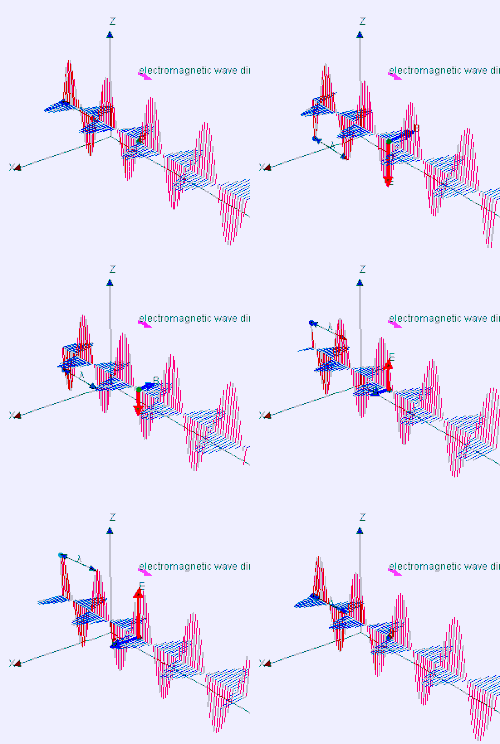
[[File:Electromagneticwave3D.gif|thumb|Electromagnetic waves can be imagined as a self-propagating transverse oscillating wave of electric and magnetic fields. This 3D animation shows a plane linearly polarized wave propagating from left to right. The electric and magnetic fields in such a wave are in phase with each other, reaching minima and maxima together.]] | |||
Electric and magnetic fields obey the properties of [[superposition principle|superposition]]. Thus, a field due to any particular particle or time-varying electric or magnetic field contributes to the fields present in the same space due to other causes. Further, as they are [[Vector (geometric)|vector]] fields, all magnetic and electric field vectors add together according to [[vector addition]].<ref>Purcell, p442: "Any number of electromagnetic waves can propagate through the same region without affecting one another. The field '''E''' at a space time point is the vector sum of the electric fields of the individual waves, and the same goes for '''B'''".</ref> For example, in optics two or more coherent light waves may interact and by constructive or destructive [[Interference (wave propagation)|interference]] yield a resultant irradiance deviating from the sum of the component irradiances of the individual light waves.<ref>{{Cite web|title=PV Performance Modeling Collaborative {{!}} Plane of Array (POA) Irradiance|url=https://pvpmc.sandia.gov/modeling-steps/1-weather-design-inputs/plane-of-array-poa-irradiance/|access-date=14 January 2022|language=en-US|archive-date=14 January 2022|archive-url=https://web.archive.org/web/20220114171617/https://pvpmc.sandia.gov/modeling-steps/1-weather-design-inputs/plane-of-array-poa-irradiance/|url-status=live}}</ref> The electromagnetic fields of light are not affected by traveling through static electric or magnetic fields in a linear medium such as a vacuum. However, in nonlinear media, such as some [[crystal]]s, interactions can occur between light and static electric and magnetic fields—these interactions include the [[Faraday effect]] and the [[Kerr effect]].<ref>{{cite journal|title=Experimental observation of relativistic nonlinear Thomson scattering|first1=Szu-yuan|last1=Chen|first2=Anatoly|last2=Maksimchuk|first3=Donald|last3=Umstadter|date=17 December 1998|journal=Nature|volume=396|issue=6712|pages=653–655|doi=10.1038/25303|arxiv=physics/9810036|bibcode=1998Natur.396..653C|s2cid=16080209}}</ref><ref name="crowther-1920">{{Cite book |last=Crowther |first=James Arnold |author-link=James Arnold Crowther |url={{google books|plainurl=y|id=iWe4AAAAIAAJ|page=5}} |title=The life and discoveries of Michael Faraday |date=1920 |publisher=Society for promoting Christian knowledge |pages=54–57 |access-date=15 June 2014}}</ref> | |||
In [[refraction]], a wave crossing from one medium to another of different [[density]] alters its [[Velocity|speed and direction]] upon entering the new medium. The ratio of the refractive indices of the media determines the degree of refraction, and is summarized by [[Snell's law]]. Light of composite wavelengths (natural sunlight) disperses into a visible [[electromagnetic spectrum|spectrum]] passing through a prism, because of the wavelength-dependent [[refractive index]] of the [[Prism (optics)|prism]] material ([[Dispersion (optics)|dispersion]]); that is, each component wave within the composite light is bent a different amount.<ref>{{Cite journal|title=Prisms|url=https://www.spectroscopyonline.com/view/prisms|access-date=17 January 2021|journal=Spectroscopy|series=Spectroscopy-09-01-2008|date=September 2008|volume=23|issue=9|archive-date=22 January 2021|archive-url=https://web.archive.org/web/20210122044456/https://www.spectroscopyonline.com/view/prisms|url-status=live}}</ref> | |||
EM radiation exhibits both wave properties and [[Subatomic particle|particle]] properties at the same time (known as [[wave–particle duality]]). Both wave and particle characteristics have been confirmed in many experiments. Wave characteristics are more apparent when EM radiation is measured over relatively large timescales and over large distances while particle characteristics are more evident when measuring small timescales and distances. For example, when electromagnetic radiation is absorbed by matter, particle-like properties will be more obvious when the average number of photons in the cube of the relevant wavelength is much smaller than 1. It is not so difficult to experimentally observe non-uniform deposition of energy when light is absorbed, however this alone is not evidence of "particulate" behavior. Rather, it reflects the quantum nature of ''matter''.<ref>{{cite web |url=http://www.qo.phy.auckland.ac.nz/talks/photoelectric.pdf|archive-url=https://web.archive.org/web/20070627171942/http://www.qo.phy.auckland.ac.nz/talks/photoelectric.pdf|url-status=dead|archive-date=27 June 2007|title=Einstein and the Photoelectric Effect |first=H. J. |last=Carmichael |publisher=Quantum Optics Theory Group, University of Auckland |access-date=22 December 2009}}</ref> A [[Quantum mechanics|quantum theory]] of the interaction between electromagnetic radiation and matter such as electrons is described by the theory of [[quantum electrodynamics]]. | |||
=== | Electromagnetic waves can be [[Polarization (waves)|polarized]], reflected, refracted, or [[diffracted]], and can interfere with each other.<ref>{{Cite web |title=DATE |url=http://galileo.phys.virginia.edu/classes/usem/SciImg/home_files/introduction.htm |url-status=live |archive-url=https://web.archive.org/web/20150512060344/http://galileo.phys.virginia.edu/classes/usem/SciImg/home_files/introduction.htm |archive-date=12 May 2015 |access-date=4 September 2017 |website=galileo.phys.virginia.edu}}</ref><ref>{{Cite web |title=Physics – Waves |url=http://www-jcsu.jesus.cam.ac.uk/~rpc25/notes/physics/waves/waves.html |url-status=live |archive-url=https://web.archive.org/web/20170904153721/http://www-jcsu.jesus.cam.ac.uk/~rpc25/notes/physics/waves/waves.html |archive-date=4 September 2017 |access-date=4 September 2017 |website=www-jcsu.jesus.cam.ac.uk}}</ref><ref>{{Cite web |title=Wave Behaviors {{!}} Science Mission Directorate |url=https://science.nasa.gov/ems/03_behaviors |url-status=live |archive-url=https://web.archive.org/web/20170514053337/https://science.nasa.gov/ems/03_behaviors |archive-date=14 May 2017 |access-date=4 September 2017 |website=science.nasa.gov |date=10 August 2016 |language=en}}</ref> Some experiments display both the wave and particle natures of electromagnetic waves, such as the self-interference of a single [[photon]].<ref>{{cite journal|doi=10.1119/1.1737397|url=http://people.whitman.edu/~beckmk/QM/grangier/Thorn_ajp.pdf|title=Observing the quantum behavior of light in an undergraduate laboratory|year=2004|last1=Thorn|first1=J. J.|last2=Neel|first2=M. S.|last3=Donato|first3=V. W.|last4=Bergreen|first4=G. S.|last5=Davies|first5=R. E.|last6=Beck|first6=M.|journal=American Journal of Physics|volume=72|issue=9|pages=1210|bibcode=2004AmJPh..72.1210T|url-status=live|archive-url=https://web.archive.org/web/20160201214040/http://people.whitman.edu/~beckmk/QM/grangier/Thorn_ajp.pdf|archive-date=1 February 2016}}</ref> When a low intensity light is sent through an [[interferometer]] it will be detected by a [[photomultiplier]] or other sensitive detector only along one arm of the device, consistent with particle properties, and yet the accumulated effect of many such detections will be interference consistent with wave properties. | ||
=== Wave model === | |||
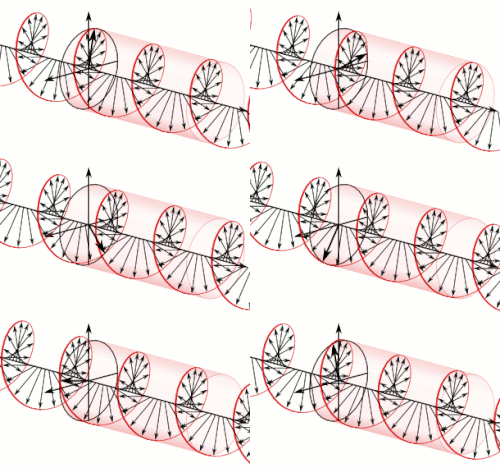
[[File:Circular.Polarization.Circularly.Polarized.Light Right.Handed.Animation.305x190.255Colors.gif|thumb|right|Representation of the electric field vector of a wave of circularly polarized electromagnetic radiation]] In homogeneous, isotropic media, electromagnetic radiation is a [[transverse wave]],<ref>{{cite book |title=Electromagnetic Theory |first=Julius Adams|last=Stratton|publisher=McGraw-Hill Book Company, New York, NY |orig-year=1941 |year=2007|chapter-url=https://books.google.com/books?id=zFeWdS2luE4C&q=%22electromagnetic+theory%22+stratton |chapter=Chapter V Plane waves in unbounded, isotropic media|isbn=978-0-470-13153-4}}</ref> meaning that its oscillations are perpendicular to the direction of energy transfer and travel. It comes from the [[Electromagnetic wave equation|following equations]]:<math display="block">\begin{align} | |||
\nabla \cdot \mathbf{E} &= 0\\ | |||
\nabla \cdot \mathbf{B} &= 0 | |||
\end{align}</math>These equations predicate that any electromagnetic wave must be a transverse wave, where the electric field {{math|'''E'''}} and the magnetic field {{math|'''B'''}} are both perpendicular to the direction of wave propagation. The electric and magnetic parts of the field in an electromagnetic wave stand in a fixed ratio of strengths to satisfy the two [[Maxwell's equations]] that specify how one is produced from the other. In dissipation-less (lossless) media, these {{math|E}} and {{math|B}} fields are also in phase, with both reaching maxima and minima at the same points in space. | |||
In [[ | In the [[Near and far field|far-field]] EM radiation which is described by the two source-free Maxwell [[curl operator]] equations, a time-change in one type of field is proportional to the curl of the other. These derivatives require that the {{math|E}} and {{math|B}} fields in EMR are in phase.{{anchor|frequency}} An important aspect of light's nature is its [[frequency]]. The frequency of a wave is its rate of oscillation and is measured in [[hertz]], the [[SI]] unit of frequency, where one hertz is equal to one oscillation per second. Light usually has multiple frequencies that sum to form the resultant wave. Different frequencies undergo different angles of refraction, a phenomenon known as [[Dispersion relation|dispersion]]. | ||
A monochromatic wave (a wave of a single frequency) consists of successive troughs and crests, and the distance between two adjacent crests or troughs is called the [[wavelength]]. Waves of the electromagnetic spectrum vary in size, from very long radio waves longer than a continent to very short gamma rays smaller than atom nuclei. Frequency is inversely proportional to wavelength, according to the equation:<ref>{{Cite web|url=https://astronomy.swin.edu.au/cosmos/E/Electromagnetic+Radiation|title=Electromagnetic Radiation {{!}} COSMOS|website=astronomy.swin.edu.au|access-date=29 March 2020|archive-date=19 March 2020|archive-url=https://web.archive.org/web/20200319090846/https://www.astronomy.swin.edu.au/cosmos/E/Electromagnetic+Radiation|url-status=live}}</ref> | |||
: <math>\displaystyle v=f\lambda</math> | |||
where ''v'' is the speed of the wave ([[speed of light|''c'']] in a vacuum or less in other media), ''f'' is the frequency, and ''λ'' is the wavelength. As waves cross boundaries between different media, their speeds change but their frequencies remain constant. | |||
Electromagnetic waves in free space must be solutions of Maxwell's [[electromagnetic wave equation]]. Two main classes of solutions are known, namely plane waves and spherical waves. The plane waves may be viewed as the limiting case of spherical waves at a very large (ideally infinite) distance from the source. Both types of waves can have a waveform which is an arbitrary time function (so long as it is sufficiently differentiable to conform to the wave equation). As with any time function, this can be decomposed by means of [[Fourier analysis]] into its [[frequency spectrum]], or individual sinusoidal components, each of which contains a single frequency, amplitude, and phase. Such a component wave is said to be ''monochromatic''. | |||
Interference is the superposition of two or more waves resulting in a new wave pattern. If the fields have components in the same direction, they constructively interfere, while opposite directions cause destructive interference. Additionally, multiple polarization signals can be combined (i.e. interfered) to form new states of polarization, which is known as parallel polarization state generation.<ref>{{cite journal |last1=She |first1=Alan |last2=Capasso |first2=Federico |date=17 May 2016 |title=Parallel Polarization State Generation |journal=Scientific Reports |volume=6 |article-number=26019 |arxiv=1602.04463 |bibcode=2016NatSR...626019S |doi=10.1038/srep26019 |pmc=4869035 |pmid=27184813}}</ref> | |||
Electromagnetic | === Maxwell's equations === | ||
{{Main|Maxwell's equations}} | |||
[[James Clerk Maxwell]] derived a [[Electromagnetic wave equation|wave form of the electric and magnetic equations]], thus uncovering the wave-like nature of [[Electric Field|electric]] and [[magnetic fields]] and their [[Symmetry (physics)|symmetry]]. Because the speed of EM waves predicted by the wave equation coincided with the measured [[speed of light]], Maxwell concluded that light itself is an EM wave.<ref>{{Cite web|url=https://physics.info/em-waves/|title=Electromagnetic Waves|website=The Physics Hypertextbook|last=Elert|first=Glenn|access-date=4 June 2018|archive-date=2 April 2019|archive-url=https://web.archive.org/web/20190402081830/https://physics.info/em-waves/|url-status=live}}</ref><ref>{{Cite web|url=http://www.clerkmaxwellfoundation.org/html/maxwell-s_impact_.html|title=The Impact of James Clerk Maxwell's Work|website=clerkmaxwellfoundation.org|access-date=4 September 2017|url-status=live|archive-url=https://web.archive.org/web/20170917213509/http://www.clerkmaxwellfoundation.org/html/maxwell-s_impact_.html|archive-date=17 September 2017}}</ref> Maxwell's equations were confirmed by [[Heinrich Hertz]] through experiments with radio waves.<ref>{{Cite web|date=18 December 2015|title=Maxwell's equations and the secrets of nature|url=https://plus.maths.org/content/maxwells-equation-and-power-unification|access-date=2 May 2021|website=plus.maths.org|language=en|archive-date=2 May 2021|archive-url=https://web.archive.org/web/20210502084738/https://plus.maths.org/content/maxwells-equation-and-power-unification|url-status=live}}</ref> Out of the four equations, two of the equations that Maxwell refined were [[Electromagnetic induction|Faraday's Law of Induction]] and [[Ampère's circuital law]], which he extended by adding the [[displacement current]] term to the equations himself. Maxwell thought that the displacement current, which he viewed as the motion of bound charges, gave rise to the magnetic field.<ref>{{Cite journal |last1=Suárez |first1=Álvaro |last2=Martí |first2=Arturo C. |last3=Zuza |first3=Kristina |last4=Guisasola |first4=Jenaro |date=2023-08-17 |title=Electromagnetic field presented in introductory physics textbooks and consequences for its teaching |url=https://link.aps.org/doi/10.1103/PhysRevPhysEducRes.19.020113 |journal=Physical Review Physics Education Research |language=en |volume=19 |issue=2 |article-number=020113 |doi=10.1103/PhysRevPhysEducRes.19.020113 |arxiv=2305.05431 |bibcode=2023PRPER..19b0113S |issn=2469-9896|hdl=10810/63511 |hdl-access=free }}</ref> The other two equations are [[Gauss's law]] and [[Gauss's law for magnetism]]. | |||
=== | === Near and far fields === | ||
{{Main|Near and far field|Liénard–Wiechert potential}} | |||
[[File:FarNearFields-USP-4998112-1.svg|thumb|upright=1.35|In electromagnetic radiation (such as microwaves from an antenna, shown here) the term ''radiation'' applies only to the parts of the [[electromagnetic field]] that radiate into infinite space and decrease in intensity by an [[inverse-square law]] of power, such that the total energy that crosses through an imaginary sphere surrounding the source is the same regardless of the size of the sphere. Electromagnetic radiation thus reaches the ''[[near and far field|far]]'' part of the electromagnetic field around a transmitter. A part of the ''near'' field (close to the transmitter) includes the changing ''[[electromagnetic field]]'', but that is not electromagnetic ''radiation''.]] | |||
Maxwell's equations established that some charges and currents (''sources'') produce local [[electromagnetic field]]s near them that do not radiate. Currents directly produce magnetic fields, but such fields of a [[magnetic dipole|magnetic-dipole]]–type that dies out with distance from the current. In a similar manner, moving charges pushed apart in a conductor by a changing electrical potential (such as in an antenna) produce an [[electric dipole|electric-dipole]]–type electrical field, but this also declines with distance. These fields make up the ''[[near and far field|near]]'' field. Neither of these behaviours is responsible for EM radiation. Instead, they only efficiently transfer energy to a receiver very close to the source, such as inside a [[transformer]]. The near field has strong effects on its source, with any energy withdrawn by a receiver causing increased ''load'' (decreased [[electrical reactance]]) on the source. The near field does not propagate freely into space, carrying energy away without a distance limit, but rather oscillates, returning its energy to the transmitter if it is not absorbed by a receiver.<ref>{{Cite web |date=2023-09-15 |title=Electromagnetic radiation {{!}} Spectrum, Examples, & Types {{!}} Britannica |url=https://www.britannica.com/science/electromagnetic-radiation |access-date=2023-10-16 |website=www.britannica.com |language=en |archive-date=2 May 2015 |archive-url=https://web.archive.org/web/20150502222537/http://www.britannica.com/EBchecked/topic/183228/electromagnetic-radiation/59182/Microwaves |url-status=live }}</ref> | |||
[[ | By contrast, the ''[[Near and far field|far]]'' field is composed of ''radiation'' that is free of the transmitter, in the sense that the transmitter requires the same power to send changes in the field out regardless of whether anything absorbs the signal, e.g. a radio station does not need to increase its power when more receivers use the signal. This far part of the electromagnetic field ''is'' electromagnetic radiation. The far fields propagate (radiate) without allowing the transmitter to affect them. This causes them to be independent in the sense that their existence and their energy, after they have left the transmitter, is completely independent of both transmitter and receiver. Due to [[conservation of energy]], the amount of power passing through any closed surface drawn around the source is the same. The [[power density]] of EM radiation from an [[isotropic]] source decreases with the inverse square of the distance from the source; this is called the [[inverse-square law]]. Field intensity due to dipole parts of the near field varies according to an inverse-cube law,<ref>{{Cite journal |last=Capps |first=Charles |date=August 16, 2001 |title=Near field or far field? |url=https://people.eecs.ku.edu/~callen58/501/Capps2001EDNpp95.pdf |journal=Designfeature |pages=96}}</ref> and thus fades with distance. | ||
In the [[Liénard–Wiechert potential]] formulation of the electric and magnetic fields due to motion of a single particle (according to Maxwell's equations), the terms associated with acceleration of the particle are those that are responsible for the part of the field that is regarded as electromagnetic radiation. By contrast, the term associated with the changing static electric field of the particle and the magnetic term that results from the particle's uniform velocity are both associated with the near field, and do not comprise electromagnetic radiation.<ref>{{Cite web |date=2021-12-09 |title=10.1: Liénard-Wiechert Potentials |url=https://phys.libretexts.org/Bookshelves/Electricity_and_Magnetism/Essential_Graduate_Physics_-_Classical_Electrodynamics_(Likharev)/10%3A_Radiation_by_Relativistic_Charges/10.01%3A_Lienard-Wiechert_Potentials |access-date=2024-07-26 |website=Physics LibreTexts |language=en |archive-date=26 July 2024 |archive-url=https://web.archive.org/web/20240726225813/https://phys.libretexts.org/Bookshelves/Electricity_and_Magnetism/Essential_Graduate_Physics_-_Classical_Electrodynamics_(Likharev)/10%3A_Radiation_by_Relativistic_Charges/10.01%3A_Lienard-Wiechert_Potentials |url-status=live }}</ref> | |||
=== Particle model and quantum theory === | |||
{{See also|Quantization (physics)|Quantum optics}} | |||
An anomaly arose in the late 19th century involving a contradiction between the wave theory of light and measurements of the electromagnetic spectra that were being emitted by thermal radiators known as [[black bodies]]. Physicists struggled with this problem unsuccessfully for many years, and it later became known as the [[ultraviolet catastrophe]]. In 1900, [[Max Planck]] developed a new theory of [[Planck's law of black-body radiation|black-body radiation]] that explained the observed spectrum. Planck's theory was based on the idea that black bodies emit light (and other electromagnetic radiation) only as discrete bundles or packets of energy. These packets were called [[quantum|quanta]]. In 1905, [[Albert Einstein]] proposed that light quanta be regarded as real particles. Later the particle of light was given the name [[photon]], to correspond with other particles being described around this time, such as the [[electron]] and [[proton]]. A photon has an energy, ''E'', proportional to its frequency, ''f'', by | |||
: <math>E = hf = \frac{hc}{\lambda} \,\!</math> | |||
where ''h'' is the [[Planck constant]], <math>\lambda</math> is the wavelength and ''c'' is the [[speed of light]]. This is sometimes known as the [[Planck–Einstein equation]].<ref>{{cite book | |||
An anomaly arose in the late 19th century involving a contradiction between the wave theory of light and measurements of the electromagnetic spectra that were being emitted by thermal radiators known as [[ | |||
: <math>E = hf = \frac{hc}{\lambda} \,\! </math> | |||
where ''h'' is [[Planck | |||
{{cite book | |||
| title = Physical Chemistry | | title = Physical Chemistry | ||
| author = Paul M. S. Monk | | author = Paul M. S. Monk | ||
| Line 102: | Line 80: | ||
|pages=[https://archive.org/details/quantumtheoryoff00stev/page/15 15–17] | |pages=[https://archive.org/details/quantumtheoryoff00stev/page/15 15–17] | ||
|url=https://archive.org/details/quantumtheoryoff00stev/page/15 | |url=https://archive.org/details/quantumtheoryoff00stev/page/15 | ||
}}</ref> | }}</ref> Likewise, the momentum ''p'' of a photon is also proportional to its frequency and inversely proportional to its wavelength: | ||
Likewise, the momentum ''p'' of a photon is also proportional to its frequency and inversely proportional to its wavelength: | |||
: <math>p = { E \over c } = { hf \over c } = { h \over \lambda }. </math> | : <math>p = { E \over c } = { hf \over c } = { h \over \lambda }. </math> | ||
The source of Einstein's proposal that light was composed of particles (or could act as particles in some circumstances) was an experimental anomaly not explained by the wave theory: the [[photoelectric effect]], in which light striking a metal surface ejected electrons from the surface, causing an [[electric current]] to flow across an applied [[voltage]]. Experimental measurements demonstrated that the energy of individual ejected electrons was proportional to the ''[[frequency]]'', rather than the ''[[intensity (physics)|intensity]]'', of the light. Furthermore, below a certain minimum frequency, which depended on the particular metal, no current would flow regardless of the intensity. These observations appeared to contradict the wave theory, and for years physicists tried | The source of Einstein's proposal that light was composed of particles (or could act as particles in some circumstances) was an experimental anomaly not explained by the wave theory: the [[photoelectric effect]], in which light striking a metal surface ejected electrons from the surface, causing an [[electric current]] to flow across an applied [[voltage]]. Experimental measurements demonstrated that the energy of individual ejected electrons was proportional to the ''[[frequency]]'', rather than the ''[[intensity (physics)|intensity]]'', of the light. Furthermore, below a certain minimum frequency, which depended on the particular metal, no current would flow regardless of the intensity. These observations appeared to contradict the wave theory, and for years physicists tried to find an explanation. In 1905, Einstein explained this phenomenon by resurrecting the particle theory of light. Because of the preponderance of evidence in favor of the wave theory, however, Einstein's ideas were met initially with great skepticism among established physicists. Eventually Einstein's explanation was accepted as new particle-like behavior of light was observed, such as the [[Compton effect]].<ref name="Commins QM">{{cite book |last1=Commins |first1=Eugene |title=Quantum Mechanics; An Experimentalist's Approach |date=2014 |publisher=Cambridge University Press |isbn=978-1-107-06399-0}}</ref><ref>{{Cite book|last1=Ling|first1=Samuel J.|title=University physics. Volume 3|last2=Sanny|first2=Jeff|last3=Moebs|first3=William|publisher=OpenStax|year=2016|isbn=978-1-947172-22-7|chapter=The Compton Effect}}</ref> | ||
As a photon is absorbed by an [[atom]], it [[ | As a photon is absorbed by an [[atom]], it [[excites]] the atom, elevating an electron to a higher [[energy level]] (one that is on average farther from the nucleus). When an electron in an excited molecule or atom descends to a lower energy level, it emits a photon of light at a frequency corresponding to the energy difference. Since the energy levels of electrons in atoms are discrete, each element and each molecule emits and absorbs its own characteristic frequencies. Immediate photon emission is called [[fluorescence]], a type of [[photoluminescence]]. An example is visible light emitted from fluorescent paints, in response to ultraviolet ([[blacklight]]). Many other fluorescent emissions are known in spectral bands other than visible light. Delayed emission is called [[phosphorescence]].<ref>{{Cite web|url=http://www.majordifferences.com/2016/11/7-differences-between-fluorescence-and-Phosphorescence.html|title=7 Differences between Fluorescence and Phosphorescence|last=Haneef|first=Deena T. Kochunni, Jazir|access-date=4 September 2017|url-status=live|archive-url=https://web.archive.org/web/20170904152324/http://www.majordifferences.com/2016/11/7-differences-between-fluorescence-and-Phosphorescence.html|archive-date=4 September 2017}}</ref><ref>{{Cite book|url={{google books |plainurl=y |id=kAn4AgAAQBAJ|page=93}}|title=Fundamental Physics of Radiology|last1=Meredith|first1=W. J.|last2=Massey|first2=J. B.|date=22 October 2013|publisher=Butterworth-Heinemann|isbn=978-1-4832-8435-4|language=en}}</ref> | ||
=== | Quantum mechanics also governs [[Emission (electromagnetic radiation)|emission]], which is seen when an emitting gas glows due to excitation of the atoms from any mechanism, including heat. As electrons descend to lower energy levels, a spectrum is emitted that represents the jumps between the energy levels of the electrons, but lines are seen because again emission happens only at particular energies after excitation.<ref>Browne, p 376: "Radiation is emitted or absorbed only when the electron jumps from one orbit to the other, and the frequency of radiation depends only upon on the energies of the electron in the initial and final orbits.</ref> An example is the emission spectrum of [[nebula]]e.<ref>{{cite book |last1=Hunter |first1=Tim B. |title=The Barnard Objects: Then and Now |last2=Dobek |first2=Gerald O. |date=19 July 2023 |publisher=Springer Cham |isbn=978-3-031-31485-8 |chapter=Nebulae: An Overview |bibcode=2023botn.book.....H |doi=10.1007/978-3-031-31485-8}}</ref> Rapidly moving electrons are most sharply accelerated when they encounter a region of force, so they are responsible for producing much of the highest frequency electromagnetic radiation observed in nature. These phenomena can be used to detect the composition of gases lit from behind ([[Absorption spectroscopy|absorption spectra]]) and for glowing gases ([[Emission spectrum|emission spectra]]). [[Spectroscopy]] (for example) determines what [[chemical element]]s comprise a particular star. Shifts in the frequency of the spectral lines for an element, called a [[redshift]], can be used to determine the star's [[Comoving and proper distances|cosmological distance]].<ref>{{Cite book |last=Longair |first=Malcolm S. |url=https://link.springer.com/10.1007/978-3-662-65891-8 |title=Galaxy Formation |date=2023 |publisher=Springer Berlin Heidelberg |isbn=978-3-662-65890-1 |series=Astronomy and Astrophysics Library |location=Berlin, Heidelberg |language=en |bibcode=2023gafo.book.....L |doi=10.1007/978-3-662-65891-8}}</ref>{{rp|181}} | ||
{{ | |||
=== Wave–particle duality === | |||
{{Main|Wave–particle duality}} | |||
The modern theory that explains the nature of light includes the notion of wave–particle duality. The theory is based on the concept that every quantum entity can show wave-like or particle-like behaviors, depending on observation. The observation led to the collapse of the entity's [[wave function]]. If it is based on the [[Copenhagen interpretation]], the observation does really collapse the wave function; for the [[many-worlds interpretation]], all possible outcomes of the collapse happened in [[Multiverse|parallel universes]]; for the [[pilot wave theory]], the particle behaviour is simply determined by waves. The duality nature of a real photon has been observed in the [[double-slit experiment]]. | |||
Together, wave and particle effects fully explain the emission and absorption spectra of EM radiation. The matter-composition of the medium through which the light travels determines the nature of the absorption and emission spectrum. These bands correspond to the allowed energy levels in the atoms. Dark bands in the [[absorption spectroscopy|absorption spectrum]] are due to the atoms in an intervening medium between source and observer. The atoms absorb certain frequencies of the light between emitter and detector/eye, then emit them in all directions. A dark band appears to the detector, due to the radiation scattered out of the [[light beam]]. For instance, dark bands in the light emitted by a distant [[star]] are due to the atoms in the star's atmosphere. | |||
===Propagation speed=== | === Propagation speed === | ||
{{ | {{Main|Speed of light}} | ||
In empty space (vacuum), electromagnetic radiation travels at the [[speed of light]], <math>c</math>, 299,792,458 meters per second (approximately 186,000 miles per second). In a medium other than vacuum it travels at a lower velocity <math>v</math>, given by a dimensionless parameter between 0 and 1 characteristic of the medium called the [[velocity factor]] <math>\mathit{VF}</math> or its reciprocal, the [[refractive index]] <math>n</math>: | |||
:<math>v = \mathit{VF} \cdot c = {c \over n}</math>. | |||
The reason for this is that in matter the electric and magnetic fields of the wave are slowed because they polarize the charged particles in the medium they pass through.<ref name="Griffiths">{{cite book| last = Griffiths| first = David J. | title = Introduction to Electrodynamics, Vol. 2| publisher = Cambridge Univ. Press| date = 2017| url = https://books.google.com/books?id=ndAoDwAAQBAJ| isbn = 9781108420419| mr = | zbl = | jfm =}}</ref>{{rp|401}} The oscillating electric field causes nearby positive and negative charges in atoms to move slightly apart and together, inducing an oscillating [[polarization density|polarization]], creating an electric polarization field. The oscillating magnetic field moves nearby [[magnetic dipoles]], inducing an oscillating [[magnetization]], creating an induced oscillating magnetic field. These induced fields, [[superposition|superposed]] on the original wave fields, slow the wave ([[Ewald–Oseen extinction theorem]]). The amount of slowing depends on the electromagnetic properties of the medium, the [[permittivity|electric permittivity]] and [[magnetic permeability]]. In the [[Systeme International|SI]] system of units, empty space has a [[Permittivity of Free Space|vacuum permittivity]] of <math>\epsilon_\text{0} =</math> 8.854×10<sup>−12</sup> F/m ([[farad]]s per meter) and a [[vacuum permeability]] of <math>\mu_\text{0} =</math> 1.257×10<sup>−6</sup> H/m ([[Henry (unit)|henries]] per meter). These universal constants determine the speed of light in a vacuum: | |||
:<math>c = {1 \over \sqrt{\epsilon_\text{0}\mu_\text{0}}}</math> | |||
In a medium that is isotropic and linear, which means the electric polarization is proportional to the electric field <math>\mathbf{D} = \epsilon\mathbf{E}</math> and the magnetization is proportional to the magnetic field <math>\mathbf{H} = {1 \over \mu}\mathbf{B}</math>. The speed of the waves, the <math>\mathit{VF}</math>, and the refractive index are determined by only two parameters: the [[permittivity|electric permittivity]] <math>\epsilon</math> of the medium in farads per meter, and the [[magnetic permeability]] of the medium <math>\mu</math> in henrys per meter<ref name="Griffiths" />{{rp|401}} | |||
:<math>v = {1 \over \sqrt{\epsilon\mu}}</math> | |||
:<math>n = {1 \over \mathit{VF}} = c\sqrt{\epsilon\mu} = \sqrt{{\epsilon\mu \over \epsilon_\text{0}\mu_\text{0}}}</math> | |||
If the permittivity and permeability of the medium is constant for different frequency EM waves, this is called a ''[[dispersion (optics)|non-dispersive]]'' medium.<ref name="Griffiths" />{{rp|417-418}} In this case all EM wave frequencies would travel at the same velocity, and the waveshape stays constant as it travels. However in real matter <math>\epsilon</math> and <math>\mu</math> typically vary with frequency, this is called a ''[[dispersion (optics)|dispersive]]'' medium. In dispersive media different spectral bands have different propagation characteristics, and an arbitrary wave changes shape as it travels through the medium. | |||
== History of discovery == | |||
{{See also|History of electromagnetic theory|Timeline of electromagnetism and classical optics|Radiation#Discovery}} | |||
Electromagnetic radiation of wavelengths other than those of visible light were discovered in the early 19th century. The discovery of [[infrared]] radiation is ascribed to astronomer [[William Herschel]], who published his results in 1800 before the [[Royal Society of London]].<ref name=HerschelRSIR>{{cite journal|jstor=107057|title=Experiments on the Refrangibility of the Invisible Rays of the Sun. By William Herschel, LL. D. F. R. S|first=William|last=Herschel|date=1 January 1800|journal=Philosophical Transactions of the Royal Society of London|volume=90|pages=284–292|doi=10.1098/rstl.1800.0015|bibcode=1800RSPT...90..284H|doi-access=free}}</ref> Herschel used a glass [[Triangular prism (optics)|prism]] to [[refract]] light from the [[Sun]] and detected invisible rays that caused heating beyond the red part of the spectrum, through an increase in the temperature recorded with a [[thermometer]]. These "calorific rays" were later termed infrared.<ref>{{Cite journal|last1=Holzer|first1=Aton M.|last2=Elmets|first2=Craig A.|date=2010|title=The Other End of the Rainbow: Infrared and Skin|journal=The Journal of Investigative Dermatology|volume=130|issue=6|pages=1496–1499|doi=10.1038/jid.2010.79|issn=0022-202X|pmc=2926798|pmid=20463675}}</ref> | |||
== | |||
In 1801 German physicist [[Johann Wilhelm Ritter]] discovered [[ultraviolet]] in an experiment similar to Herschel's, using sunlight and a glass prism. Ritter noted that invisible rays near the violet edge of a solar spectrum dispersed by a triangular prism darkened [[silver chloride]] preparations more quickly than did the nearby violet light. Ritter's experiments were an early precursor to what would become photography. Ritter noted that the ultraviolet rays (which at first were called "chemical rays") were capable of causing chemical reactions.<ref>{{Cite web|title=Ultraviolet {{!}} COSMOS|url=https://astronomy.swin.edu.au/cosmos/U/Ultraviolet|url-status=live|archive-url=https://web.archive.org/web/20210301192020/https://astronomy.swin.edu.au/cosmos/u/ultraviolet|archive-date=1 March 2021|access-date=29 September 2021|website=astronomy.swin.edu.au}}</ref><ref>{{Cite journal|last=Davidson|first=Michael W.|date=March 2014|title=Pioneers in Optics: Johann Wilhelm Ritter and Ernest Rutherford|journal=Microscopy Today|language=en|volume=22|issue=2|pages=48–51|doi=10.1017/S1551929514000029|s2cid=135584871|issn=1551-9295|doi-access=free}}</ref> | |||
[[File:James Clerk Maxwell sitting.jpg|thumb|upright|[[James Clerk Maxwell]] (1831–1879)]] | |||
In 1862–64 [[James Clerk Maxwell]] developed equations for the electromagnetic field which suggested that waves in the field would travel with a speed that was very close to the known speed of light. Maxwell therefore suggested that visible light (as well as invisible infrared and ultraviolet rays by inference) all consisted of propagating disturbances (or radiation) in the electromagnetic field. Radio waves were first produced deliberately by [[Heinrich Hertz]] in 1887, using electrical circuits calculated to produce oscillations at a much lower frequency than that of visible light, following recipes for producing oscillating charges and currents suggested by Maxwell's equations. Hertz also developed ways to detect these waves, and produced and characterized what were later termed [[radio wave]]s and [[microwave]]s.<ref name=Jeans>[[Jeans, James]] (1947) [https://archive.org/stream/growthofphysical029068mbp#page/n11/mode/2up The Growth of Physical Science]. Cambridge University Press</ref>{{rp|286,7}} | |||
[[ | [[Wilhelm Röntgen]] discovered and named [[X-rays]]. After experimenting with high voltages applied to an evacuated tube on 8 November 1895, he noticed a fluorescence on a nearby plate of coated glass. In one month, he discovered X-rays' main properties.<ref name=Jeans />{{rp|307}} | ||
[[ | The last portion of the EM spectrum to be discovered was associated with [[radioactivity]]. [[Henri Becquerel]] found that [[uranium]] salts caused fogging of an unexposed photographic plate through a covering paper in a manner similar to X-rays, and [[Marie Curie]] discovered that only certain elements gave off these rays of energy, soon discovering the intense radiation of [[radium]]. The radiation from [[pitchblende]] was differentiated into alpha rays ([[alpha particle]]s) and beta rays ([[beta particle]]s) by [[Ernest Rutherford]] through simple experimentation in 1899, but these proved to be charged particulate types of radiation. However, in 1900 the French scientist [[Paul Villard]] discovered a third neutrally charged and especially penetrating type of radiation from radium, and after he described it, Rutherford realized it must be yet a third type of radiation, which in 1903 Rutherford named [[gamma ray]]s. | ||
In 1910 British physicist [[William Henry Bragg]] demonstrated that gamma rays are electromagnetic radiation, not particles, and in 1914 Rutherford and [[Edward Andrade]] measured their wavelengths, finding that they were similar to X-rays but with shorter wavelengths and higher frequency, although a 'cross-over' between X and gamma rays makes it possible to have X-rays with a higher energy (and hence shorter wavelength) than gamma rays and vice versa. The origin of the ray differentiates them, gamma rays tend to be natural phenomena originating from the unstable nucleus of an atom and X-rays are electrically generated (and hence man-made) unless they are as a result of [[bremsstrahlung]] X-radiation caused by the interaction of fast moving particles (such as beta particles) colliding with certain materials, usually of higher atomic numbers.<ref name="Jeans" />{{rp|308,9}} | |||
==Electromagnetic spectrum== | == Electromagnetic spectrum == | ||
{{ | {{Main|Electromagnetic spectrum}} | ||
[[File: | [[File:EM_spectrum_updated.svg|thumb|upright=2.25|right|[[Electromagnetic spectrum]] with visible light highlighted. The bottom graph (visible spectrum) shows wavelength in units of nanometers (nm).]] | ||
[[File:Light spectrum.svg|right|frame|'''Legend:'''<br /> | [[File:Light spectrum.svg|right|frame|'''Legend:'''<br /> | ||
γ = [[Gamma ray]]s<br /> | γ = [[Gamma ray]]s<br /> | ||
<br /> | <br /> | ||
HX = Hard [[X-ray]]s<br /> | HX = Hard [[X-ray]]s<br /> | ||
SX = Soft X- | SX = Soft X-rays<br /> | ||
<br /> | <br /> | ||
EUV = Extreme-[[ultraviolet]]<br /> | EUV = Extreme-[[ultraviolet]]<br /> | ||
| Line 185: | Line 156: | ||
ELF = [[Extremely low frequency]] (radio)]] | ELF = [[Extremely low frequency]] (radio)]] | ||
EM radiation (the designation 'radiation' excludes static electric and magnetic and [[near and far field|near fields]]) is classified by wavelength into [[radio wave|radio]], [[microwave]], [[infrared]], [[visible spectrum|visible]], [[ultraviolet]], [[X-ray]]s and [[gamma rays]]. Arbitrary electromagnetic waves can be expressed by [[Fourier analysis]] in terms of [[sinusoidal]] [[monochromatic]] | EM radiation (the designation 'radiation' excludes static electric and magnetic and [[near and far field|near fields]]) is classified by wavelength into [[radio wave|radio]], [[microwave]], [[infrared]], [[visible spectrum|visible]], [[ultraviolet]], [[X-ray]]s, and [[gamma rays]]. Arbitrary electromagnetic waves can be expressed by [[Fourier analysis]] in terms of [[sinusoidal]] waves ([[monochromatic radiation]]), which in turn can each be classified into these regions of the EMR spectrum. | ||
For certain classes of EM waves, the waveform is most usefully treated as ''random'', and then spectral analysis must be done by slightly different mathematical techniques appropriate to random or [[stochastic process]]es. In such cases, the individual frequency components are represented in terms of their ''power'' content, and the phase information is not preserved. Such a representation is called the [[power spectral density]] of the random process. Random electromagnetic radiation requiring this kind of analysis is, for example, encountered in the interior of stars, and in certain other very wideband forms of radiation such as the [[Zero point field| | For certain classes of EM waves, the waveform is most usefully treated as ''random'', and then spectral analysis must be done by slightly different mathematical techniques appropriate to random or [[stochastic process]]es. In such cases, the individual frequency components are represented in terms of their ''power'' content, and the phase information is not preserved. Such a representation is called the [[power spectral density]] of the random process. Random electromagnetic radiation requiring this kind of analysis is, for example, encountered in the interior of stars, and in certain other very wideband forms of radiation such as the [[Zero point field|zero-point wave field]] of the electromagnetic vacuum. | ||
The behavior of EM radiation and its interaction with matter depends on its frequency, and changes qualitatively as the frequency changes. Lower frequencies have longer wavelengths, and higher frequencies have shorter wavelengths, and are associated with photons of higher energy. There is no fundamental limit known to these wavelengths or energies, at either end of the spectrum, although photons with energies near the [[Planck energy]] or exceeding it (far too high to have ever been observed) will require new physical theories to describe. | The behavior of EM radiation and its interaction with matter depends on its frequency, and changes qualitatively as the frequency changes. Lower frequencies have longer wavelengths, and higher frequencies have shorter wavelengths, and are associated with photons of higher energy. There is no fundamental limit known to these wavelengths or energies, at either end of the spectrum, although photons with energies near the [[Planck energy]] or exceeding it (far too high to have ever been observed) will require new physical theories to describe. | ||
=== Radio and microwave === | === Radio and microwave === | ||
{{ | {{Main|Radio wave|Microwave}} | ||
When radio waves impinge upon a [[Electrical conductor|conductor]], they couple to the conductor, travel along it and [[radio frequency induction|induce]] an electric current on the conductor surface by moving the electrons of the conducting material in correlated bunches of charge. | Electromagnetic radiation phenomena with wavelengths ranging from one meter to one millimeter are called microwaves; with frequencies between 300 MHz (0.3 GHz) and 300 GHz. When radio waves impinge upon a [[Electrical conductor|conductor]], they couple to the conductor, travel along it, and [[radio frequency induction|induce]] an electric current on the conductor surface by moving the electrons of the conducting material in correlated bunches of charge. At radio and microwave frequencies, EMR interacts with matter largely as a bulk collection of charges which are spread out over large numbers of affected atoms. In [[electrical conductor]]s, such induced bulk movement of charges ([[electric current]]s) results in absorption of the EMR, or else separations of charges that cause generation of new EMR (effective reflection of the EMR). An example is absorption or emission of radio waves by antennas, or absorption of microwaves by water or other molecules with an [[electric dipole moment]], as for example inside a [[microwave oven]]. These interactions produce either electric currents or heat, or both. | ||
=== Infrared === | |||
{{Main|Infrared}} | |||
Like radio and microwave, infrared (IR) is reflected by metals (and also most EMR, well into the ultraviolet range). However, unlike lower-frequency radio and microwave radiation, infrared EMR commonly interacts with dipoles present in single molecules, which change as atoms vibrate at the ends of a single chemical bond. It is consequently absorbed by a wide range of substances, causing them to increase in temperature as the vibrations dissipate as heat. The same process, run in reverse, causes bulk substances to radiate in the infrared spontaneously (see [[thermal radiation]] section below). | |||
=== | Infrared radiation is divided into spectral subregions. While different subdivision schemes exist,<ref>{{cite web|last=Henderson |first=Roy |url=http://info.tuwien.ac.at/iflt/safety/section1/1_1_1.htm |title=Wavelength considerations |publisher=Instituts für Umform- und Hochleistungs |access-date=18 October 2007 |archive-url = https://web.archive.org/web/20071028072110/http://info.tuwien.ac.at/iflt/safety/section1/1_1_1.htm |archive-date = 28 October 2007}}</ref><ref>{{cite web |url=http://www.ipac.caltech.edu/Outreach/Edu/Regions/irregions.html |title=Near, Mid and Far-Infrared |publisher=NASA IPAC |access-date=4 April 2007 |url-status=dead |archive-url=https://archive.today/20120529/http://www.ipac.caltech.edu/Outreach/Edu/Regions/irregions.html |archive-date=29 May 2012 }}</ref> the spectrum is commonly divided as near-infrared (0.75–1.4 μm), short-wavelength infrared (1.4–3 μm), mid-wavelength infrared (3–8 μm), long-wavelength infrared (8–15 μm) and [[far infrared]] (15–1000 μm).<ref name="Byrnes">{{Cite book|last=Byrnes |first=James |title=Unexploded Ordnance Detection and Mitigation |url=https://archive.org/details/unexplodedordnan00abry |url-access=limited |publisher=Springer |year=2009 |pages=[https://archive.org/details/unexplodedordnan00abry/page/n29 21]–22 |isbn=978-1-4020-9252-7|bibcode=2009uodm.book.....B }}</ref> | ||
{{ | |||
Infrared radiation | Some animals, such as [[Infrared sensing in snakes|snakes]], have thermo-sensitive membranes (pit organs) that can detect temperature differences, allowing them to sense infrared radiation.<ref>{{Cite journal |last1=Gracheva |first1=Elena O. |last2=Ingolia |first2=Nicholas T. |last3=Kelly |first3=Yvonne M. |last4=Cordero-Morales |first4=Julio F. |last5=Hollopeter |first5=Gunther |last6=Chesler |first6=Alexander T. |last7=Sánchez |first7=Elda E. |last8=Perez |first8=John C. |last9=Weissman |first9=Jonathan S. |last10=Julius |first10=David |date=2010 |title=Molecular basis of infrared detection by snakes |journal=Nature |language=en |volume=464 |issue=7291 |pages=1006–1011 |doi=10.1038/nature08943 |issn=0028-0836 |pmc=2855400 |pmid=20228791 |bibcode=2010Natur.464.1006G }}</ref> | ||
=== Visible light === | === Visible light === | ||
{{ | {{Main|Light}} | ||
Natural sources produce EM radiation across the spectrum. EM radiation with a [[wavelength]] between approximately 400 [[nanometre|nm]] and 700 nm is directly detected by the [[human eye]] and perceived as visible light. Other wavelengths, especially nearby infrared (longer than 700 nm) and ultraviolet (shorter than 400 nm) are also sometimes referred to as light. | Natural sources produce EM radiation across the spectrum. EM radiation with a [[wavelength]] between approximately 400 [[nanometre|nm]] and 700 nm is directly detected by the [[human eye]] and perceived as visible light. Other wavelengths, especially nearby infrared (longer than 700 nm) and ultraviolet (shorter than 400 nm) are also sometimes referred to as light. | ||
As frequency increases into the visible range, photons have enough energy to change the bond structure of some individual molecules. It is not a coincidence that this happens in the visible range, as the [[Visual system|mechanism of vision]] involves the change in bonding of a single molecule, [[retinal]], which absorbs a single photon. The change in retinal causes a change in the shape of the [[rhodopsin]] protein it is contained in, which starts the biochemical process that causes the [[retina]] of the human eye to sense the light. | As frequency increases into the visible range, photons have enough energy to change the bond structure of some individual molecules. It is not a coincidence that this happens in the visible range, as the [[Visual system|mechanism of vision]] involves the change in bonding of a single molecule, [[retinal]], which absorbs a single photon. The change in retinal causes a change in the shape of the [[rhodopsin]] protein it is contained in, which starts the biochemical process that causes the [[retina]] of the human eye to sense the light. | ||
Visible light is able to affect only a tiny percentage of all molecules. Usually not in a permanent or damaging way, rather the photon excites an electron which then emits another photon when returning to its original position. This is the source of color produced by most dyes. Retinal is an exception. When a photon is absorbed, the [[Retinal#Visual cycle|retinal permanently changes structure from cis to trans]], and requires a protein to convert it back, i.e. reset it to be able to function as a light detector again. | |||
[[Photosynthesis]] becomes possible in this range as well, for the same reason. A single molecule of [[chlorophyll]] is excited by a single photon. In plant tissues that conduct photosynthesis, [[carotenoids]] act to quench electronically excited chlorophyll produced by visible light in a process called [[non-photochemical quenching]], to prevent reactions that would otherwise interfere with photosynthesis at high light levels. | [[Photosynthesis]] becomes possible in this range as well, for the same reason. A single molecule of [[chlorophyll]] is excited by a single photon. In plant tissues that conduct photosynthesis, [[carotenoids]] act to quench electronically excited chlorophyll produced by visible light in a process called [[non-photochemical quenching]], to prevent reactions that would otherwise interfere with photosynthesis at high light levels. | ||
[[ | Limited evidence indicate that some [[reactive oxygen species]] are created by visible light in skin, and that these may have some role in [[photoaging]], in the same manner as [[ultraviolet A]].<ref name="Liebel-2012">{{Cite journal |last1=Liebel |first1=F. |last2=Kaur |first2=S. |last3=Ruvolo |first3=E. |last4=Kollias |first4=N. |last5=Southall |first5=M. D. |year=2012 |title=Irradiation of Skin with Visible Light Induces Reactive Oxygen Species and Matrix-Degrading Enzymes |journal=Journal of Investigative Dermatology |volume=132 |issue=7 |pages=1901–1907 |doi=10.1038/jid.2011.476 |pmid=22318388 |doi-access=free}}</ref> | ||
Infrared, microwaves and radio waves are known to damage molecules and biological tissue only by bulk heating, not excitation from single photons of the radiation. | Infrared, microwaves, and radio waves are known to damage molecules and biological tissue only by bulk heating, not excitation from single photons of the radiation. | ||
=== Ultraviolet === | === Ultraviolet === | ||
{{ | {{Main|Ultraviolet}} | ||
As frequency increases into the ultraviolet, photons now carry enough energy (about three [[electron volt]]s or more) to excite certain doubly bonded molecules into permanent chemical rearrangement. In [[DNA]], this causes lasting damage. DNA is also indirectly damaged by reactive oxygen species produced by ultraviolet A (UVA), which has energy too low to damage DNA directly. This is why ultraviolet at all wavelengths can damage DNA, and is capable of causing cancer, and (for [[UVB]]) skin burns (sunburn) that are far worse than would be produced by simple heating (temperature increase) effects. | As frequency increases into the ultraviolet, photons now carry enough energy (about three [[electron volt]]s or more) to excite certain doubly bonded molecules into permanent chemical rearrangement. In [[DNA]], this causes lasting damage. DNA is also indirectly damaged by reactive oxygen species produced by ultraviolet A (UVA), which has energy too low to damage DNA directly. This is why ultraviolet at all wavelengths can damage DNA, and is capable of causing cancer, and (for [[UVB]]) skin burns (sunburn) that are far worse than would be produced by simple heating (temperature increase) effects. | ||
At the higher end of the ultraviolet range, the energy of photons becomes large enough to impart enough energy to electrons to cause them to be liberated from the atom, in a process called [[photoionisation]]. The energy required for this is always larger than about 10 [[electron volt]] (eV) corresponding with wavelengths smaller than 124 nm (some sources suggest a more realistic cutoff of 33 eV, which is the energy required to ionize water). This high end of the ultraviolet spectrum with energies in the approximate ionization range, is sometimes called "extreme UV. | At the higher end of the ultraviolet range, the energy of photons becomes large enough to impart enough energy to electrons to cause them to be liberated from the atom, in a process called [[photoionisation]]. The energy required for this is always larger than about 10 [[electron volt]] (eV) corresponding with wavelengths smaller than 124 nm (some sources suggest a more realistic cutoff of 33 eV, which is the energy required to ionize water). This high end of the ultraviolet spectrum with energies in the approximate ionization range, is sometimes called "extreme UV". Ionizing UV is strongly filtered by the Earth's atmosphere.<ref>{{Citation |last= |first= |title=Solar and Ultraviolet Radiation |date=2012 |work=Radiation |url=https://www.ncbi.nlm.nih.gov/books/NBK304366/ |access-date=2025-03-24 |publisher=International Agency for Research on Cancer |language=en}}</ref> | ||
=== X-rays and gamma rays === | === X-rays and gamma rays === | ||
{{ | {{Main|X-rays|Gamma rays}} | ||
Electromagnetic radiation composed of photons that carry minimum-ionization energy, or more | Electromagnetic radiation composed of photons that carry minimum-ionization energy, or more (which includes the entire spectrum with shorter wavelengths), is therefore termed [[ionizing radiation]]. (Many other kinds of ionizing radiation are made of non-EM particles.) Electromagnetic-type ionizing radiation extends from the extreme ultraviolet to all higher frequencies and shorter wavelengths, which means that all X-rays and gamma rays qualify. These are capable of the most severe types of molecular damage, which can happen in biology to any type of biomolecule, including mutation and cancer,<ref name="Baeyens-2023">{{Citation |last1=Baeyens |first1=Ans |title=Basic Concepts of Radiation Biology |date=2023 |work=Radiobiology Textbook |pages=25–81 |editor-last=Baatout |editor-first=Sarah |url=https://link.springer.com/chapter/10.1007/978-3-031-18810-7_2 |access-date=2025-03-24 |place=Cham |publisher=Springer International Publishing |language=en |doi=10.1007/978-3-031-18810-7_2 |isbn=978-3-031-18810-7 |last2=Abrantes |first2=Ana Margarida |last3=Ahire |first3=Vidhula |last4=Ainsbury |first4=Elizabeth A. |last5=Baatout |first5=Sarah |last6=Baselet |first6=Bjorn |last7=Botelho |first7=Maria Filomena |last8=Boterberg |first8=Tom |last9=Chevalier |first9=Francois|url-access=subscription |hdl=1854/LU-01HB6GSWBNSND2YG9VWSGB95TY |hdl-access=free }}</ref> and often at great depths below the skin, since the higher end of the X-ray spectrum, and all of the gamma ray spectrum, penetrate matter. | ||
==Atmosphere and magnetosphere== | == Atmosphere and magnetosphere == | ||
{{ | {{Main|ozone layer|shortwave radio|skywave|ionosphere|atmospheric window|optical window}} | ||
[[File:Atmospheric electromagnetic opacity.svg|thumb|upright=2.25|Rough plot of Earth's atmospheric absorption and scattering (or [[opacity (optics)|opacity]]) of various [[wavelength]]s of electromagnetic radiation]] | [[File:Atmospheric electromagnetic opacity.svg|thumb|upright=2.25|Rough plot of Earth's atmospheric absorption and scattering (or [[opacity (optics)|opacity]]) of various [[wavelength]]s of electromagnetic radiation]] | ||
Most UV and X-rays are blocked by absorption first from molecular [[nitrogen]], and then (for wavelengths in the upper UV) from the electronic excitation of [[dioxygen]] and finally [[ozone]] at the mid-range of UV. Only 30% of the Sun's ultraviolet light reaches the ground, and almost all of this is well transmitted. | Most UV and X-rays are blocked by absorption first from molecular [[nitrogen]], and then (for wavelengths in the upper UV) from the electronic excitation of [[dioxygen]] and finally [[ozone]] at the mid-range of UV. Only 30% of the Sun's ultraviolet light reaches the ground, and almost all of this is well transmitted. | ||
Visible light is well transmitted in air, as it is not energetic enough to excite nitrogen, oxygen, or ozone, but too energetic to excite molecular vibrational frequencies of water vapor.{{ | Visible light is well transmitted in air, a property known as an [[optical window|atmospheric window]], as it is not energetic enough to excite nitrogen, oxygen, or ozone, but too energetic to excite molecular vibrational frequencies of water vapor and carbon dioxide.<ref>{{cite book |last1=Tao |first1=Jiasheng |title=Space Optical Remote Sensing |publisher=Springer, Singapore |isbn=978-981-99-3318-1 |chapter=Radiation Source and Optical Atmospheric Transmission |series=Advances in Optics and Optoelectronics |date=2023 |pages=111–188 |doi=10.1007/978-981-99-3318-1_4}}</ref> Absorption bands in the infrared are due to modes of vibrational excitation in water vapor. However, at energies too low to excite water vapor, the atmosphere becomes transparent again, allowing free transmission of most microwave and radio waves.<ref>{{cite web |last1=Chaplin |first1=Martin |title=Infared Spectroscopy |date=May 15, 2013 |page=water.lsbu.ac.uk |url=https://www.ifsc.usp.br/~lavfis2/BancoApostilasImagens/ApLuminescencia/Infrared%20Spectroscop1.pdf |access-date=April 19, 2022 |archive-date=24 March 2022 |archive-url=https://web.archive.org/web/20220324185050/https://www.ifsc.usp.br/~lavfis2/BancoApostilasImagens/ApLuminescencia/Infrared%20Spectroscop1.pdf |url-status=dead }}</ref> | ||
Absorption bands in the infrared are due to modes of vibrational excitation in water vapor. However, at energies too low to excite water vapor, the atmosphere becomes transparent again, allowing free transmission of most microwave and radio waves | |||
Finally, at radio wavelengths longer than 10 m or so (about 30 MHz), the air in the lower atmosphere remains transparent to radio, but plasma in certain layers of the [[ionosphere]] begins to interact with radio waves (see [[skywave]]). This property allows some longer wavelengths (100 m or 3 MHz) to be reflected and results in [[shortwave radio]] beyond line-of-sight. However, certain [[Ionosphere#D layer|ionospheric effects]] begin to block incoming radiowaves from space, when their frequency is less than about 10 MHz (wavelength longer than about 30 m).<ref>{{Cite journal|last=Dabas|first=R S|title=Ionosphere and its influence on radio communications|journal=Resonance|language=en|volume=5|issue=7|pages=28–43|doi=10.1007/bf02867245|issn=0971-8044|date=July 2000|s2cid=121347063}}</ref> | |||
== Thermal and electromagnetic radiation as a form of heat == | |||
{{Main|Thermal radiation|Planck's law}} | |||
The basic structure of [[matter]] involves charged particles bound together. When electromagnetic radiation impinges on matter, it causes the charged particles to oscillate and gain energy. The ultimate fate of this energy depends on the context. It could be immediately re-radiated and appear as scattered, reflected, or transmitted radiation. It may get dissipated into other microscopic motions within the matter, coming to [[thermal equilibrium]] and manifesting itself as [[thermal energy]], or even [[Temperature#Kinetic theory approach|kinetic energy]], in the material. With a few exceptions related to high-energy photons (such as [[fluorescence]], [[harmonic generation]], [[photochemical reaction]]s, the [[photovoltaic effect]] for ionizing radiations at far ultraviolet, X-ray, and gamma radiation), absorbed electromagnetic radiation simply deposits its energy by heating the material. This happens for infrared, microwave, and radio wave radiation. | |||
Intense radio waves can thermally burn living tissue and can cook food. In addition to infrared [[laser]]s, sufficiently intense visible and ultraviolet lasers can easily set paper afire.<ref name="nuceng.ca">{{Cite web |title=CANDU textbook |url=http://www.nuceng.ca/candu/ |url-status=dead |archive-url=https://web.archive.org/web/20170420121747/http://www.nuceng.ca/candu/ |archive-date=20 April 2017 |access-date=24 March 2017 |website=nuceng.ca}}</ref> Ionizing radiation creates high-speed electrons in a material and breaks chemical bonds, but after these electrons collide many times with other atoms eventually most of the energy becomes thermal energy all in a tiny fraction of a second. This caveat also applies to UV, even though almost all of it is not ionizing, because UV can damage molecules due to electronic excitation, which is far greater per unit energy than heating effects.<ref name="nuceng.ca" /><ref name="Baeyens-2023" /> | |||
The inverse or time-reversed process of absorption is thermal radiation. Much of the thermal energy in matter consists of random motion of charged particles, and this energy can be radiated away from the matter. The resulting radiation may subsequently be absorbed by another piece of matter, with the deposited energy heating the material.<ref>{{Cite web|url=https://www2.southeastern.edu/Academics/Faculty/wparkinson/help/thermochemistry/|title=Thermodynamics Part 1: Work, Heat, Internal Energy and Enthalpy|website=www2.southeastern.edu|access-date=24 March 2017|url-status=live|archive-url=https://web.archive.org/web/20170324012259/http://www2.southeastern.edu/Academics/Faculty/wparkinson/help/thermochemistry/|archive-date=24 March 2017}}</ref> | Infrared radiation in the spectral distribution of a [[black body]] is usually considered a form of heat, since it has an equivalent temperature and is associated with an entropy change per unit of thermal energy. However, "heat" is a technical term in physics and thermodynamics and is often confused with thermal energy. Any type of electromagnetic energy can be transformed into thermal energy in interaction with matter. Thus, ''any'' electromagnetic radiation can "heat" (in the sense of increase the [[thermal energy]] temperature of) a material, when it is absorbed.<ref>{{Cite web|url=https://docs.kde.org/stable5/en/kdeedu/kstars/ai-blackbody.html|title=Blackbody Radiation|website=docs.kde.org|access-date=24 March 2017|url-status=dead|archive-url=https://web.archive.org/web/20170808154617/https://docs.kde.org/stable5/en/kdeedu/kstars/ai-blackbody.html|archive-date=8 August 2017}}</ref> The inverse or time-reversed process of absorption is thermal radiation. Much of the thermal energy in matter consists of random motion of charged particles, and this energy can be radiated away from the matter. The resulting radiation may subsequently be absorbed by another piece of matter, with the deposited energy heating the material.<ref>{{Cite web|url=https://www2.southeastern.edu/Academics/Faculty/wparkinson/help/thermochemistry/|title=Thermodynamics Part 1: Work, Heat, Internal Energy and Enthalpy|website=www2.southeastern.edu|access-date=24 March 2017|url-status=live|archive-url=https://web.archive.org/web/20170324012259/http://www2.southeastern.edu/Academics/Faculty/wparkinson/help/thermochemistry/|archive-date=24 March 2017}}</ref> | ||
The electromagnetic radiation in an opaque cavity at thermal equilibrium is effectively a form of thermal energy, having maximum [[entropy|radiation entropy]].<ref>{{Cite web|url=http://www.astro.lu.se/Education/utb/ASTA21/pdf/Planck | The electromagnetic radiation in an opaque cavity at thermal equilibrium is effectively a form of thermal energy, having maximum [[entropy|radiation entropy]].<ref>{{Cite web|url=http://www.astro.lu.se/Education/utb/ASTA21/pdf/Planck%27s%20law.pdf|title=Planck's law|website=astro.lu.se|url-status=dead|access-date=24 March 2017|archive-url=https://web.archive.org/web/20161130131244/http://www.astro.lu.se/Education/utb/ASTA21/pdf/Planck%27s%20law.pdf|archive-date=30 November 2016}}</ref> | ||
== Biological effects == | == Biological effects == | ||
{{ | {{Main|Electromagnetic radiation and health|Wireless device radiation and health}} | ||
[[Bioelectromagnetics]] is the study of the interactions and effects of EM radiation on living organisms. The effects of electromagnetic radiation upon living cells, including those in humans, depends upon the radiation's power and frequency. For low-frequency radiation (radio waves to | [[Bioelectromagnetics]] is the study of the interactions and effects of EM radiation on living organisms. The effects of electromagnetic radiation upon living cells, including those in humans, depends upon the radiation's power and frequency. For low-frequency radiation (radio waves to near ultraviolet) the best-understood effects are those due to radiation power alone, acting through heating when radiation is absorbed. For these thermal effects, frequency is important as it affects the intensity of the radiation and penetration into the organism (for example, microwaves penetrate better than infrared). It is widely accepted that low frequency fields that are too weak to cause significant heating could not possibly have any biological effect.<ref name="Binhi-2002">{{cite book |last= Binhi|first= Vladimir N|others= Repiev, A & Edelev, M (translators from Russian)|title= Magnetobiology: Underlying Physical Problems |url= https://archive.org/details/magnetobiologyun00binh_968|url-access= limited|publisher= Academic Press|location= San Diego|year= 2002|pages= [https://archive.org/details/magnetobiologyun00binh_968/page/n11 1]–16|isbn= 978-0-12-100071-4|oclc= 49700531}}</ref> Some research suggests that weaker ''non-thermal'' electromagnetic fields (including weak ELF magnetic fields, although the latter does not strictly qualify as EM radiation<ref name="Binhi-2002" /><ref>{{Cite journal | last1 = Delgado | first1 = J. M. | last2 = Leal | first2 = J. | last3 = Monteagudo | first3 = J. L. | last4 = Gracia | first4 = M. G. | title = Embryological changes induced by weak, extremely low frequency electromagnetic fields | journal = Journal of Anatomy | volume = 134 | issue = Pt 3 | pages = 533–551 | year = 1982 | pmid = 7107514 | pmc = 1167891 }}</ref><ref>{{Cite journal | last1 = Harland | first1 = J. D. | last2 = Liburdy | first2 = R. P. | doi = 10.1002/(SICI)1521-186X(1997)18:8<555::AID-BEM4>3.0.CO;2-1 | title = Environmental magnetic fields inhibit the antiproliferative action of tamoxifen and melatonin in a human breast cancer cell line | journal = Bioelectromagnetics | volume = 18 | issue = 8 | pages = 555–562 | year = 1997 | pmid = 9383244 | url = https://zenodo.org/record/1235522 | access-date = 30 June 2019 | archive-date = 16 December 2019 | archive-url = https://web.archive.org/web/20191216194119/https://zenodo.org/record/1235522 | url-status = live }}</ref>) and modulated RF and microwave fields can have biological effects, though the significance of this is unclear.<ref name="Aalto S, Haarala C, Brück A, Sipilä H, Hämäläinen H, Rinne JO 2006 885–90">{{Cite journal | last1 = Aalto | first1 = S. | last2 = Haarala | first2 = C. | last3 = Brück | first3 = A. | last4 = Sipilä | first4 = H. | last5 = Hämäläinen | first5 = H. | last6 = Rinne | first6 = J. O. | doi = 10.1038/sj.jcbfm.9600279 | title = Mobile phone affects cerebral blood flow in humans | journal = Journal of Cerebral Blood Flow & Metabolism | volume = 26 | issue = 7 | pages = 885–890 | year = 2006 | pmid = 16495939 | doi-access = free }}</ref><ref>{{Cite journal | doi = 10.1002/bem.2250110107 | last1 = Cleary | first1 = S. F. | last2 = Liu | first2 = L. M. | last3 = Merchant | first3 = R. E. | title = In vitro lymphocyte proliferation induced by radio-frequency electromagnetic radiation under isothermal conditions | journal = Bioelectromagnetics | volume = 11 | issue = 1 | pages = 47–56 | year = 1990 | pmid = 2346507 }}</ref> | ||
Electromagnetic | The [[World Health Organization]] has classified radio frequency electromagnetic radiation as [[List of IARC Group 2B carcinogens|Group 2B]]—possibly carcinogenic.<ref>[http://www.iarc.fr/en/media-centre/pr/2011/pdfs/pr208_E.pdf IARC classifies Radiofrequency Electromagnetic Fields as possibly carcinogenic to humans] {{webarchive|url=https://web.archive.org/web/20110601063650/http://www.iarc.fr/en/media-centre/pr/2011/pdfs/pr208_E.pdf |date=1 June 2011 }}. World Health Organization. 31 May 2011</ref><ref>{{cite news | url=https://www.cbsnews.com/news/trouble-with-cell-phone-radiation-standard/ | publisher=CBS News| title=Trouble with cell phone radiation standard | url-status=live | archive-url=https://web.archive.org/web/20130509153533/http://www.cbsnews.com/2100-503063_162-20068246.html | archive-date=9 May 2013 }}</ref> This group contains possible carcinogens such as lead, DDT, and styrene. At higher frequencies (some of visible and beyond), the effects of individual photons begin to become important, as these now have enough energy individually to directly or indirectly damage biological molecules.<ref>See {{cite journal | pmid =22318388 | doi=10.1038/jid.2011.476 | volume=132 | issue=7 | title=Irradiation of skin with visible light induces reactive oxygen species and matrix-degrading enzymes | date=July 2012 | journal=J. Invest. Dermatol. | pages=1901–7| last1=Liebel | first1=F | last2=Kaur | first2=S | last3=Ruvolo | first3=E | last4=Kollias | first4=N | last5=Southall | first5=M. D. | doi-access=free }} for evidence of quantum damage from visible light via [[reactive oxygen species]] generated in skin. This happens also with UVA. With UVB, the damage to DNA becomes direct, with [[photochemical]] formation of [[pyrimidine dimers]].</ref> All UV frequencies have been classed as Group 1 carcinogens by the World Health Organization. Ultraviolet radiation from sun exposure is the primary cause of skin cancer.<ref>{{cite journal|last=Narayanan|first=DL |author2=Saladi, RN |author3=Fox, JL|title=Ultraviolet radiation and skin cancer|journal=International Journal of Dermatology|date=September 2010|volume=49|issue=9|pages=978–86|pmid=20883261|doi=10.1111/j.1365-4632.2010.04474.x|s2cid=22224492 |doi-access=free}}</ref><ref name="Review05">{{cite journal|last=Saladi|first=RN|author2=Persaud, AN|title=The causes of skin cancer: a comprehensive review|journal=Drugs of Today|date=January 2005|volume=41|issue=1|pages=37–53|pmid=15753968|doi=10.1358/dot.2005.41.1.875777}}</ref> | ||
Thus, at UV frequencies and higher, electromagnetic radiation does more damage to biological systems than simple heating predicts. This is most obvious in the "far" (or "extreme") ultraviolet. UV, with X-ray and gamma radiation, are referred to as [[ionizing radiation]] due to the ability of photons of this radiation to produce [[ion]]s and [[free radical]]s in materials (including living tissue). Since such radiation can severely damage life at energy levels that produce little heating, it is considered far more dangerous (in terms of damage-produced per unit of energy, or power) than the rest of the electromagnetic spectrum. | |||
=== Use as a weapon === | |||
{{See also|Directed energy weapons#Microwave weapons}} | |||
The heat ray is an application of EMR that makes use of microwave frequencies to create an unpleasant heating effect in the upper layer of the skin. A publicly known heat ray weapon called the [[Active Denial System]] was developed by the US military as an experimental weapon to deny the enemy access to an area.<ref>{{cite web|url=http://www.dvidshub.net/news/85028/new-marine-corps-non-lethal-weapon-heats-things-up|title=DVIDS – News – New Marine Corps non-lethal weapon heats things up|work=DVIDS|access-date=1 November 2014|archive-date=2 November 2014|archive-url=https://web.archive.org/web/20141102001103/http://www.dvidshub.net/news/85028/new-marine-corps-non-lethal-weapon-heats-things-up|url-status=live}}</ref> A [[death ray]] is a theoretical weapon that delivers heat ray based on electromagnetic energy at levels that are capable of injuring human tissue. An inventor of a death ray, [[Harry Grindell Matthews]], claimed to have lost sight in his left eye while working on his death ray weapon based on a microwave [[magnetron]] from the 1920s (a normal [[microwave oven]] creates a tissue damaging cooking effect inside the oven at around 2 kV/m).<ref>{{Cite web|title=Effects on the human body: Extremely low frequency RF {{!}} Radio Frequency {{!}} Radio Spectrum|url=https://www.scribd.com/document/365723483/Radio-Frequency|access-date=8 March 2021|website=Scribd|language=en|archive-date=11 October 2021|archive-url=https://web.archive.org/web/20211011005518/https://www.scribd.com/document/365723483/Radio-Frequency|url-status=live}}</ref> | |||
== Derivation from electromagnetic theory == | |||
{{Main|Electromagnetic wave equation}} | |||
Electromagnetic waves are predicted by the classical laws of electricity and magnetism, known as [[Maxwell's equations]]. There are nontrivial solutions of the homogeneous Maxwell's equations (without charges or currents), describing ''waves'' of changing electric and magnetic fields. Beginning with Maxwell's equations in [[free space]]: | |||
{{NumBlk||<math display="block">\nabla \cdot \mathbf{E} = 0</math>|{{EquationRef|1}}}} | |||
{{NumBlk||<math display="block">\nabla \times \mathbf{E} = -\frac{\partial \mathbf{B}}{\partial t}</math>|{{EquationRef|2}}}} | |||
{{NumBlk||<math display="block">\nabla \cdot \mathbf{B} = 0</math>|{{EquationRef|3}}}} | |||
{{NumBlk||<math display="block">\nabla \times \mathbf{B} = \mu_0 \varepsilon_0 \frac{\partial \mathbf{E}}{\partial t}</math>|{{EquationRef|4}}}} | |||
where | |||
* <math>\mathbf{E}</math> and <math>\mathbf{B}</math> are the [[electric field]] (measured in [[volt|V]]/m or [[Newtons|N]]/[[Coulomb|C]]) and the [[magnetic field]] (measured in [[tesla (unit)|T]] or [[Weber (unit)|Wb]]/m<sup>2</sup>), respectively; | |||
* <math>\nabla \cdot \mathbf X </math> yields the [[divergence]] and <math>\nabla \times \mathbf X </math> the [[curl (mathematics)|curl]] of a vector field <math>\mathbf X</math>; | |||
* <math>\frac{\partial \mathbf{B}}{\partial t}</math> and <math>\frac{\partial \mathbf{E}}{\partial t}</math> are [[partial derivatives]] (rate of change in time, with location fixed) of the magnetic and electric field; | |||
* <math>\mu_0</math> is the [[permeability (electromagnetism)|permeability]] of a vacuum (4{{pi}} × 10<sup>−7</sup> [[henry (unit)|H]]/m), and <math>\varepsilon_0</math> is the [[permittivity]] of a vacuum (8.85 × 10<sup>−12</sup> [[farad|F]]/m); | |||
{{NumBlk| | Besides the trivial solution <math>\mathbf{E} = \mathbf{B} = \mathbf{0}</math>, useful solutions can be derived with the following [[vector identity]], valid for all vectors <math>\mathbf{A}</math> in some vector field:<math display="block">\nabla \times \left( \nabla \times \mathbf{A} \right) = \nabla \left( \nabla \cdot \mathbf{A} \right) - \nabla^2 \mathbf{A}.</math>Taking the curl of the second Maxwell's equation ({{EquationNote|2}}) yields:{{NumBlk||<math display="block">\nabla \times \left(\nabla \times \mathbf{E} \right) = \nabla \times \left(-\frac{\partial \mathbf{B}}{\partial t} \right)</math>|{{EquationRef|5}}}} | ||
Evaluating the left hand side of ({{EquationNote|5}}) with the above identity and simplifying using ({{EquationNote|1}}), yields: | Evaluating the left hand side of ({{EquationNote|5}}) with the above identity and simplifying using ({{EquationNote|1}}), yields: | ||
{{NumBlk||<math display="block"> \nabla \times \left(\nabla \times \mathbf{E} \right) = \nabla\left(\nabla \cdot \mathbf{E} \right) - \nabla^2 \mathbf{E} = - \nabla^2 \mathbf{E}.</math>|{{EquationRef|6}}}} | |||
Evaluating the right hand side of ({{EquationNote|5}}) by exchanging the sequence of derivatives and inserting the fourth {{nowrap|Maxwell's equation ({{EquationNote|4}}),}} yields: | |||
{{NumBlk||<math display="block">\nabla \times \left(-\frac{\partial \mathbf{B}}{\partial t} \right) = -\frac{\partial}{\partial t} \left( \nabla \times \mathbf{B} \right) = -\mu_0 \varepsilon_0 \frac{\partial^2 \mathbf{E}}{\partial t^2}</math>|{{EquationRef|7}}}} | |||
Evaluating the right hand side of ({{EquationNote|5}}) by exchanging the sequence of | |||
{{NumBlk| | |||
Combining ({{EquationNote|6}}) and ({{EquationNote|7}}) again, gives a vector-valued [[differential equation]] for the electric field, solving the homogeneous Maxwell equations: | Combining ({{EquationNote|6}}) and ({{EquationNote|7}}) again, gives a vector-valued [[differential equation]] for the electric field, solving the homogeneous Maxwell's equations: | ||
{{Equation box 1|border=2|border colour=#ccccff | {{Equation box 1|border=2|border colour=#ccccff | ||
| Line 310: | Line 257: | ||
}} | }} | ||
Taking the curl of the fourth Maxwell equation ({{EquationNote|4}}) results in a similar differential equation for a magnetic field solving the homogeneous Maxwell equations: | Taking the curl of the fourth Maxwell's equation ({{EquationNote|4}}) results in a similar differential equation for a magnetic field solving the homogeneous Maxwell's equations: | ||
{{Equation box 1|border=2|border colour=#ccccff | {{Equation box 1|border=2|border colour=#ccccff | ||
| Line 316: | Line 263: | ||
}} | }} | ||
Both differential equations have the form of the general [[wave equation]] for waves propagating with speed <math>c_0,</math> where <math>f</math> is a function of time and location, which gives the amplitude of the wave at some time at a certain location | Both differential equations have the form of the general [[wave equation]] for waves propagating with speed <math>c_0,</math> where <math>f</math> is a function of time and location, which gives the amplitude of the wave at some time at a certain location:<math display="block">\nabla^2 f = \frac{1}{{c_0}^2} \frac{\partial^2 f}{\partial t^2}</math>This is also written as: <math display="block">\Box f = 0</math> | ||
where <math>\Box</math> denotes the so-called [[d'Alembert operator]], which in Cartesian coordinates is given as:<math display="block">\Box = \nabla^2 - \frac{1}{{c_0}^2} \frac{\partial^2}{\partial t^2} = \frac{\partial^2}{\partial x^2} + \frac{\partial^2}{\partial y^2} + \frac{\partial^2}{\partial z^2} - \frac{1}{{c_0}^2} \frac{\partial^2}{\partial t^2} \ </math> | |||
:<math>\nabla^2 f = \frac{1}{{c_0}^2} \frac{\partial^2 f}{\partial t^2}</math> | |||
This is also written as | |||
where <math>\Box</math> denotes the so-called [[d'Alembert operator]], which in Cartesian coordinates is given as | |||
Comparing the terms for the speed of propagation, yields in the case of the electric and magnetic fields: | Comparing the terms for the speed of propagation, yields in the case of the electric and magnetic fields: | ||
<math display="block">c_0 = \frac{1}{\sqrt{\mu_0 \varepsilon_0}}.</math> | |||
This is the [[speed of light]] in vacuum. Thus Maxwell's equations connect the [[vacuum permittivity]] <math>\varepsilon_0</math>, the [[vacuum permeability]] <math>\mu_0</math>, and the speed of light, ''c''<sub>0</sub>, via the above equation. This relationship had been discovered by [[Wilhelm Eduard Weber]] and [[Rudolf Kohlrausch]] prior to the development of Maxwell's electrodynamics, however Maxwell was the first to produce a field theory consistent with waves traveling at the speed of light. | This is the [[speed of light]] in vacuum. Thus Maxwell's equations connect the [[vacuum permittivity]] <math>\varepsilon_0</math>, the [[vacuum permeability]] <math>\mu_0</math>, and the speed of light, ''c''<sub>0</sub>, via the above equation. This relationship had been discovered by [[Wilhelm Eduard Weber]] and [[Rudolf Kohlrausch]] prior to the development of Maxwell's electrodynamics, however Maxwell was the first to produce a field theory consistent with waves traveling at the speed of light. | ||
These are only two equations versus the original four, so more information pertains to these waves hidden within Maxwell's equations. A generic vector wave for the electric field has the form | These are only two equations versus the original four, so more information pertains to these waves hidden within Maxwell's equations. A generic vector wave for the electric field has the form | ||
<math display="block">\mathbf{E} = \mathbf{E}_0 f{\left( \hat{\mathbf{k}} \cdot \mathbf{x} - c_0 t \right)}</math> | |||
Here, <math>\mathbf{E}_0</math> is a constant vector, <math>f</math> is any second differentiable function, <math> \hat{\mathbf{k}}</math> is a unit vector in the direction of propagation, and <math> {\mathbf{x}} </math> is a position vector. <math>f{\left( \hat{\mathbf{k}} \cdot \mathbf{x} - c_0 t \right)}</math> is a generic solution to the wave equation. In other words, | |||
<math display="block">\nabla^2 f{\left( \hat{\mathbf{k}} \cdot \mathbf{x} - c_0 t \right)} = \frac{1}{{c_0}^2} \frac{\partial^2}{\partial t^2} f{\left( \hat{\mathbf{k}} \cdot \mathbf{x} - c_0 t \right)}, | |||
Here, <math>\mathbf{E}_0</math> is | </math>for a generic wave traveling in the <math>\hat{\mathbf{k}}</math> direction. | ||
for a generic wave traveling in the <math>\hat{\mathbf{k}}</math> direction. | |||
From the first of Maxwell's equations, we get | From the first of Maxwell's equations, we get | ||
<math display="block">\nabla \cdot \mathbf{E} = \hat{\mathbf{k}} \cdot \mathbf{E}_0 f'{\left( \hat{\mathbf{k}} \cdot \mathbf{x} - c_0 t \right)} = 0</math> | |||
Thus, | Thus, | ||
<math display="block">\mathbf{E} \cdot \hat{\mathbf{k}} = 0</math> | |||
which implies that the electric field is orthogonal to the direction the wave propagates. The second of Maxwell's equations yields the magnetic field, namely, | which implies that the electric field is orthogonal to the direction the wave propagates. The second of Maxwell's equations yields the magnetic field, namely, | ||
<math display="block">\nabla \times \mathbf{E} = \hat{\mathbf{k}} \times \mathbf{E}_0 f'{\left( \hat{\mathbf{k}} \cdot \mathbf{x} - c_0 t \right)} = -\frac{\partial \mathbf{B}}{\partial t}</math> | |||
Thus, | Thus, | ||
<math display="block">\mathbf{B} = \frac{1}{c_0} \hat{\mathbf{k}} \times \mathbf{E}</math> | |||
The remaining equations will be satisfied by this choice of <math>\mathbf{E},\mathbf{B}</math>. | The remaining equations will be satisfied by this choice of <math>\mathbf{E},\mathbf{B}</math>. | ||
The electric and magnetic field waves in the far-field travel at the speed of light. They have a special restricted orientation and proportional magnitudes, <math>E_0 = c_0 B_0</math>, which can be seen immediately from the [[Poynting vector]]. The electric field, magnetic field, and direction of wave propagation are all orthogonal, and the wave propagates in the same direction as <math>\mathbf{E} \times \mathbf{B}</math>. Also | The electric and magnetic field waves in the far-field travel at the speed of light. They have a special restricted orientation and proportional magnitudes, <math>E_0 = c_0 B_0</math>, which can be seen immediately from the [[Poynting vector]]. The electric field, magnetic field, and direction of wave propagation are all orthogonal, and the wave propagates in the same direction as <math>\mathbf{E} \times \mathbf{B}</math>. Also '''E''' and '''B''' far-fields in free space, which as wave solutions depend primarily on these two Maxwell's equations to remain in phase with each other. This is guaranteed since the generic wave solution is first order in both space and time, and the [[curl operator]] on one side of these equations results in first-order spatial derivatives of the wave solution, while the time-derivative on the other side of the equations, which gives the other field, is first-order in time, resulting in the same [[phase shift]] for both fields in each mathematical operation. | ||
From the viewpoint of an electromagnetic wave traveling forward, the electric field might be oscillating up and down, while the magnetic field oscillates right and left. This picture can be rotated with the electric field oscillating right and left and the magnetic field oscillating down and up. This is a different solution that is traveling in the same direction. This arbitrariness in the orientation with respect to propagation direction is known as [[polarization (waves)|polarization]]. On a quantum level, it is described as [[photon polarization]]. The direction of the polarization is defined as the direction of the electric field. | From the viewpoint of an electromagnetic wave traveling forward, the electric field might be oscillating up and down, while the magnetic field oscillates right and left. This picture can be rotated with the electric field oscillating right and left and the magnetic field oscillating down and up. This is a different solution that is traveling in the same direction. This arbitrariness in the orientation with respect to propagation direction is known as [[polarization (waves)|polarization]]. On a quantum level, it is described as [[photon polarization]]. The direction of the polarization is defined as the direction of the electric field. | ||
| Line 362: | Line 293: | ||
More general forms of the second-order wave equations given above are available, allowing for both non-vacuum propagation media and sources. Many competing derivations exist, all with varying levels of approximation and intended applications. One very general example is a form of the electric field equation,<ref name=kinsler2010> | More general forms of the second-order wave equations given above are available, allowing for both non-vacuum propagation media and sources. Many competing derivations exist, all with varying levels of approximation and intended applications. One very general example is a form of the electric field equation,<ref name=kinsler2010> | ||
{{cite journal | {{cite journal | ||
| author=Kinsler | | author-last1=Kinsler | ||
| author-first1=Paul | |||
| year=2010 | | year=2010 | ||
| title=Optical pulse propagation with minimal approximations | | title=Optical pulse propagation with minimal approximations | ||
| Line 368: | Line 300: | ||
| volume=81 | | volume=81 | ||
| issue=1 | | issue=1 | ||
| | | article-number=013819 | ||
| doi=10.1103/PhysRevA.81.013819 | | doi=10.1103/PhysRevA.81.013819 | ||
| arxiv=0810.5689 | | arxiv=0810.5689 | ||
| Line 374: | Line 306: | ||
</ref> which was factorized into a pair of explicitly directional wave equations, and then efficiently reduced into a single uni-directional wave equation by means of a simple slow-evolution approximation. | </ref> which was factorized into a pair of explicitly directional wave equations, and then efficiently reduced into a single uni-directional wave equation by means of a simple slow-evolution approximation. | ||
==See also== | == See also == | ||
{{Div col|colwidth=25em}} | {{Div col|colwidth=25em}} | ||
* [[Antenna measurement]] | * [[Antenna measurement]] | ||
* [[ | * [[Bioelectromagnetics]] | ||
* [[Bolometer]] | * [[Bolometer]] | ||
* [[ | * [[CONELRAD]] | ||
* [[Electromagnetic pulse]] | * [[Electromagnetic pulse]] | ||
* [[Electromagnetic radiation and health]] | * [[Electromagnetic radiation and health]] | ||
| Line 388: | Line 320: | ||
* [[Impedance of free space]] | * [[Impedance of free space]] | ||
* [[Radiation reaction]] | * [[Radiation reaction]] | ||
* [[ | * [[Health effects of sunlight exposure]] | ||
* [[Sinusoidal plane-wave solutions of the electromagnetic wave equation]] | * [[Sinusoidal plane-wave solutions of the electromagnetic wave equation]] | ||
{{Div col end}} | {{Div col end}} | ||
==References== | == References == | ||
{{Reflist}} | {{Reflist}} | ||
* {{Cite web|title=Light: Electromagnetic waves, the electromagnetic spectrum and photons (article)|url=https://www.khanacademy.org/science/ap-chemistry/electronic-structure-of-atoms-ap/bohr-model-hydrogen-ap/a/light-and-the-electromagnetic-spectrum|access-date=2 May 2021|website=Khan Academy|language=en}} | * {{Cite web|title=Light: Electromagnetic waves, the electromagnetic spectrum and photons (article)|url=https://www.khanacademy.org/science/ap-chemistry/electronic-structure-of-atoms-ap/bohr-model-hydrogen-ap/a/light-and-the-electromagnetic-spectrum|access-date=2 May 2021|website=Khan Academy|language=en}} | ||
==Further reading== | == Further reading == | ||
* {{cite book | last = Hecht | first = Eugene | title = Optics | edition = 4th | publisher = Pearson Education | year = 2001 | isbn = 978-0-8053-8566-3}} | * {{cite book | last = Hecht | first = Eugene | title = Optics | edition = 4th | publisher = Pearson Education | year = 2001 | isbn = 978-0-8053-8566-3}} | ||
* {{cite book | last = Serway | first = Raymond A. | author2 = Jewett, John W. | title = Physics for Scientists and Engineers | edition = 6th | publisher = Brooks Cole | year = 2004 | isbn = 978-0-534-40842-8 | url = https://archive.org/details/physicssciengv2p00serw}} | * {{cite book | last = Serway | first = Raymond A. | author2 = Jewett, John W. | title = Physics for Scientists and Engineers | edition = 6th | publisher = Brooks Cole | year = 2004 | isbn = 978-0-534-40842-8 | url = https://archive.org/details/physicssciengv2p00serw}} | ||
| Line 402: | Line 334: | ||
* {{cite book| last = Reitz | first = John |author2=Milford, Frederick |author3=Christy, Robert | title = Foundations of Electromagnetic Theory | edition = 4th | publisher = Addison Wesley | year = 1992 | isbn = 978-0-201-52624-0}} | * {{cite book| last = Reitz | first = John |author2=Milford, Frederick |author3=Christy, Robert | title = Foundations of Electromagnetic Theory | edition = 4th | publisher = Addison Wesley | year = 1992 | isbn = 978-0-201-52624-0}} | ||
* {{cite book | last = Jackson | first = John David | author-link = John David Jackson (physicist) | title = Classical Electrodynamics | edition = 3rd | publisher = John Wiley & Sons | year = 1999 | isbn = 978-0-471-30932-1}} | * {{cite book | last = Jackson | first = John David | author-link = John David Jackson (physicist) | title = Classical Electrodynamics | edition = 3rd | publisher = John Wiley & Sons | year = 1999 | isbn = 978-0-471-30932-1}} | ||
* {{cite book | author= | * {{cite book | author-link1=Allen Taflove|author-first1=Allen|author-last1=Taflove|author-first2=Susan C. |author-last2=Hagness| title=Computational Electrodynamics: The Finite-Difference Time-Domain Method, 3rd ed | publisher=Artech House Publishers | year=2005 | isbn=978-1-58053-832-9 }} | ||
==External links== | == External links == | ||
{{Wikisource|QST/December 1915/Pictured Electromagnetic Waves|Pictured Electro-Magnetic Waves}} | {{Wikisource|QST/December 1915/Pictured Electromagnetic Waves|Pictured Electro-Magnetic Waves}} | ||
{{Library resources box| by=no| onlinebooks=no| others=no| about=yes| label=Electromagnetic radiation}} | {{Library resources box| by=no| onlinebooks=no| others=no| about=yes| label=Electromagnetic radiation}} | ||
* [ | * [https://feynmanlectures.caltech.edu/I_28.html The Feynman Lectures on Physics Vol. I Ch. 28: Electromagnetic Radiation] | ||
* [http://www.physnet.org/modules/pdf_modules/m210.pdf ''Electromagnetic Waves from Maxwell's Equations''] on [http://www.physnet.org Project PHYSNET]. | * {{Commons category-inline}} | ||
* [http://www.physnet.org/modules/pdf_modules/m210.pdf ''Electromagnetic Waves from Maxwell's Equations''] on [http://www.physnet.org/ Project PHYSNET]. | |||
{{Fundamental interactions}} | {{Fundamental interactions}} | ||
{{Radiation}} | {{Radiation}} | ||
{{In space}} | {{In space}} | ||
{{Authority control}} | {{Authority control}} | ||
{{Portal bar|Physics}} | |||
[[Category:Electromagnetic radiation| ]] | [[Category:Electromagnetic radiation| ]] | ||
[[Category:Heinrich Hertz]] | [[Category:Heinrich Hertz]] | ||
[[Category:Radiation]] | [[Category:Radiation]] | ||
Latest revision as of 10:09, 20 March 2026

Template:Electromagnetism In physics, electromagnetic radiation (EMR) or electromagnetic wave (EMW) is a self-propagating wave of the electromagnetic field that carries momentum and radiant energy through space.[1][2] It encompasses a broad spectrum, classified by frequency (inversely proportional to wavelength), ranging from radio waves, microwaves, infrared, visible light, ultraviolet, X-rays, to gamma rays.[3][4] All forms of EMR travel at the speed of light in a vacuum and exhibit wave–particle duality, behaving both as waves and as discrete particles called photons.
Electromagnetic radiation is produced by accelerating charged particles such as from the Sun and other celestial bodies or artificially generated for various applications. Its interaction with matter depends on wavelength, influencing its uses in communication, medicine, industry, and scientific research. Radio waves enable broadcasting and wireless communication, infrared is used in thermal imaging, visible light is essential for vision, and higher-energy radiation, such as X-rays and gamma rays, is applied in medical imaging, cancer treatment, and industrial inspection. Exposure to high-energy radiation can pose health risks, making shielding and regulation necessary in certain applications.
In quantum mechanics, an alternate way of viewing EMR is that it consists of photons, uncharged elementary particles with zero rest mass which are the quanta of the electromagnetic field, responsible for all electromagnetic interactions.[5] Quantum electrodynamics is the theory of how EMR interacts with matter on an atomic level.[6] Quantum effects provide additional sources of EMR, such as the transition of electrons to lower energy levels in an atom and black-body radiation.[7]
Physics[edit | edit source]

Properties[edit | edit source]
Electromagnetic radiation is produced by accelerating charged particles and can be naturally emitted,[8][9] as from the Sun and other celestial bodies, or artificially generated for various applications. The energy in electromagnetic waves is sometimes called radiant energy.[10][11] The electromagnetic waves' energy does not need a propagating medium to travel through space; they move through a vacuum at the speed of light.[12]

Electric and magnetic fields obey the properties of superposition. Thus, a field due to any particular particle or time-varying electric or magnetic field contributes to the fields present in the same space due to other causes. Further, as they are vector fields, all magnetic and electric field vectors add together according to vector addition.[13] For example, in optics two or more coherent light waves may interact and by constructive or destructive interference yield a resultant irradiance deviating from the sum of the component irradiances of the individual light waves.[14] The electromagnetic fields of light are not affected by traveling through static electric or magnetic fields in a linear medium such as a vacuum. However, in nonlinear media, such as some crystals, interactions can occur between light and static electric and magnetic fields—these interactions include the Faraday effect and the Kerr effect.[15][16]
In refraction, a wave crossing from one medium to another of different density alters its speed and direction upon entering the new medium. The ratio of the refractive indices of the media determines the degree of refraction, and is summarized by Snell's law. Light of composite wavelengths (natural sunlight) disperses into a visible spectrum passing through a prism, because of the wavelength-dependent refractive index of the prism material (dispersion); that is, each component wave within the composite light is bent a different amount.[17]
EM radiation exhibits both wave properties and particle properties at the same time (known as wave–particle duality). Both wave and particle characteristics have been confirmed in many experiments. Wave characteristics are more apparent when EM radiation is measured over relatively large timescales and over large distances while particle characteristics are more evident when measuring small timescales and distances. For example, when electromagnetic radiation is absorbed by matter, particle-like properties will be more obvious when the average number of photons in the cube of the relevant wavelength is much smaller than 1. It is not so difficult to experimentally observe non-uniform deposition of energy when light is absorbed, however this alone is not evidence of "particulate" behavior. Rather, it reflects the quantum nature of matter.[18] A quantum theory of the interaction between electromagnetic radiation and matter such as electrons is described by the theory of quantum electrodynamics.
Electromagnetic waves can be polarized, reflected, refracted, or diffracted, and can interfere with each other.[19][20][21] Some experiments display both the wave and particle natures of electromagnetic waves, such as the self-interference of a single photon.[22] When a low intensity light is sent through an interferometer it will be detected by a photomultiplier or other sensitive detector only along one arm of the device, consistent with particle properties, and yet the accumulated effect of many such detections will be interference consistent with wave properties.
Wave model[edit | edit source]

In homogeneous, isotropic media, electromagnetic radiation is a transverse wave,[23] meaning that its oscillations are perpendicular to the direction of energy transfer and travel. It comes from the following equations:
These equations predicate that any electromagnetic wave must be a transverse wave, where the electric field E and the magnetic field B are both perpendicular to the direction of wave propagation. The electric and magnetic parts of the field in an electromagnetic wave stand in a fixed ratio of strengths to satisfy the two Maxwell's equations that specify how one is produced from the other. In dissipation-less (lossless) media, these E and B fields are also in phase, with both reaching maxima and minima at the same points in space.
In the far-field EM radiation which is described by the two source-free Maxwell curl operator equations, a time-change in one type of field is proportional to the curl of the other. These derivatives require that the E and B fields in EMR are in phase. An important aspect of light's nature is its frequency. The frequency of a wave is its rate of oscillation and is measured in hertz, the SI unit of frequency, where one hertz is equal to one oscillation per second. Light usually has multiple frequencies that sum to form the resultant wave. Different frequencies undergo different angles of refraction, a phenomenon known as dispersion.
A monochromatic wave (a wave of a single frequency) consists of successive troughs and crests, and the distance between two adjacent crests or troughs is called the wavelength. Waves of the electromagnetic spectrum vary in size, from very long radio waves longer than a continent to very short gamma rays smaller than atom nuclei. Frequency is inversely proportional to wavelength, according to the equation:[24]
where v is the speed of the wave (c in a vacuum or less in other media), f is the frequency, and λ is the wavelength. As waves cross boundaries between different media, their speeds change but their frequencies remain constant.
Electromagnetic waves in free space must be solutions of Maxwell's electromagnetic wave equation. Two main classes of solutions are known, namely plane waves and spherical waves. The plane waves may be viewed as the limiting case of spherical waves at a very large (ideally infinite) distance from the source. Both types of waves can have a waveform which is an arbitrary time function (so long as it is sufficiently differentiable to conform to the wave equation). As with any time function, this can be decomposed by means of Fourier analysis into its frequency spectrum, or individual sinusoidal components, each of which contains a single frequency, amplitude, and phase. Such a component wave is said to be monochromatic.
Interference is the superposition of two or more waves resulting in a new wave pattern. If the fields have components in the same direction, they constructively interfere, while opposite directions cause destructive interference. Additionally, multiple polarization signals can be combined (i.e. interfered) to form new states of polarization, which is known as parallel polarization state generation.[25]
Maxwell's equations[edit | edit source]
James Clerk Maxwell derived a wave form of the electric and magnetic equations, thus uncovering the wave-like nature of electric and magnetic fields and their symmetry. Because the speed of EM waves predicted by the wave equation coincided with the measured speed of light, Maxwell concluded that light itself is an EM wave.[26][27] Maxwell's equations were confirmed by Heinrich Hertz through experiments with radio waves.[28] Out of the four equations, two of the equations that Maxwell refined were Faraday's Law of Induction and Ampère's circuital law, which he extended by adding the displacement current term to the equations himself. Maxwell thought that the displacement current, which he viewed as the motion of bound charges, gave rise to the magnetic field.[29] The other two equations are Gauss's law and Gauss's law for magnetism.
Near and far fields[edit | edit source]

Maxwell's equations established that some charges and currents (sources) produce local electromagnetic fields near them that do not radiate. Currents directly produce magnetic fields, but such fields of a magnetic-dipole–type that dies out with distance from the current. In a similar manner, moving charges pushed apart in a conductor by a changing electrical potential (such as in an antenna) produce an electric-dipole–type electrical field, but this also declines with distance. These fields make up the near field. Neither of these behaviours is responsible for EM radiation. Instead, they only efficiently transfer energy to a receiver very close to the source, such as inside a transformer. The near field has strong effects on its source, with any energy withdrawn by a receiver causing increased load (decreased electrical reactance) on the source. The near field does not propagate freely into space, carrying energy away without a distance limit, but rather oscillates, returning its energy to the transmitter if it is not absorbed by a receiver.[30]
By contrast, the far field is composed of radiation that is free of the transmitter, in the sense that the transmitter requires the same power to send changes in the field out regardless of whether anything absorbs the signal, e.g. a radio station does not need to increase its power when more receivers use the signal. This far part of the electromagnetic field is electromagnetic radiation. The far fields propagate (radiate) without allowing the transmitter to affect them. This causes them to be independent in the sense that their existence and their energy, after they have left the transmitter, is completely independent of both transmitter and receiver. Due to conservation of energy, the amount of power passing through any closed surface drawn around the source is the same. The power density of EM radiation from an isotropic source decreases with the inverse square of the distance from the source; this is called the inverse-square law. Field intensity due to dipole parts of the near field varies according to an inverse-cube law,[31] and thus fades with distance.
In the Liénard–Wiechert potential formulation of the electric and magnetic fields due to motion of a single particle (according to Maxwell's equations), the terms associated with acceleration of the particle are those that are responsible for the part of the field that is regarded as electromagnetic radiation. By contrast, the term associated with the changing static electric field of the particle and the magnetic term that results from the particle's uniform velocity are both associated with the near field, and do not comprise electromagnetic radiation.[32]
Particle model and quantum theory[edit | edit source]
An anomaly arose in the late 19th century involving a contradiction between the wave theory of light and measurements of the electromagnetic spectra that were being emitted by thermal radiators known as black bodies. Physicists struggled with this problem unsuccessfully for many years, and it later became known as the ultraviolet catastrophe. In 1900, Max Planck developed a new theory of black-body radiation that explained the observed spectrum. Planck's theory was based on the idea that black bodies emit light (and other electromagnetic radiation) only as discrete bundles or packets of energy. These packets were called quanta. In 1905, Albert Einstein proposed that light quanta be regarded as real particles. Later the particle of light was given the name photon, to correspond with other particles being described around this time, such as the electron and proton. A photon has an energy, E, proportional to its frequency, f, by
where h is the Planck constant, is the wavelength and c is the speed of light. This is sometimes known as the Planck–Einstein equation.[33] In quantum theory (see first quantization) the energy of the photons is thus directly proportional to the frequency of the EMR wave.[34] Likewise, the momentum p of a photon is also proportional to its frequency and inversely proportional to its wavelength:
The source of Einstein's proposal that light was composed of particles (or could act as particles in some circumstances) was an experimental anomaly not explained by the wave theory: the photoelectric effect, in which light striking a metal surface ejected electrons from the surface, causing an electric current to flow across an applied voltage. Experimental measurements demonstrated that the energy of individual ejected electrons was proportional to the frequency, rather than the intensity, of the light. Furthermore, below a certain minimum frequency, which depended on the particular metal, no current would flow regardless of the intensity. These observations appeared to contradict the wave theory, and for years physicists tried to find an explanation. In 1905, Einstein explained this phenomenon by resurrecting the particle theory of light. Because of the preponderance of evidence in favor of the wave theory, however, Einstein's ideas were met initially with great skepticism among established physicists. Eventually Einstein's explanation was accepted as new particle-like behavior of light was observed, such as the Compton effect.[35][36]
As a photon is absorbed by an atom, it excites the atom, elevating an electron to a higher energy level (one that is on average farther from the nucleus). When an electron in an excited molecule or atom descends to a lower energy level, it emits a photon of light at a frequency corresponding to the energy difference. Since the energy levels of electrons in atoms are discrete, each element and each molecule emits and absorbs its own characteristic frequencies. Immediate photon emission is called fluorescence, a type of photoluminescence. An example is visible light emitted from fluorescent paints, in response to ultraviolet (blacklight). Many other fluorescent emissions are known in spectral bands other than visible light. Delayed emission is called phosphorescence.[37][38]
Quantum mechanics also governs emission, which is seen when an emitting gas glows due to excitation of the atoms from any mechanism, including heat. As electrons descend to lower energy levels, a spectrum is emitted that represents the jumps between the energy levels of the electrons, but lines are seen because again emission happens only at particular energies after excitation.[39] An example is the emission spectrum of nebulae.[40] Rapidly moving electrons are most sharply accelerated when they encounter a region of force, so they are responsible for producing much of the highest frequency electromagnetic radiation observed in nature. These phenomena can be used to detect the composition of gases lit from behind (absorption spectra) and for glowing gases (emission spectra). Spectroscopy (for example) determines what chemical elements comprise a particular star. Shifts in the frequency of the spectral lines for an element, called a redshift, can be used to determine the star's cosmological distance.[41]:181
Wave–particle duality[edit | edit source]
The modern theory that explains the nature of light includes the notion of wave–particle duality. The theory is based on the concept that every quantum entity can show wave-like or particle-like behaviors, depending on observation. The observation led to the collapse of the entity's wave function. If it is based on the Copenhagen interpretation, the observation does really collapse the wave function; for the many-worlds interpretation, all possible outcomes of the collapse happened in parallel universes; for the pilot wave theory, the particle behaviour is simply determined by waves. The duality nature of a real photon has been observed in the double-slit experiment.
Together, wave and particle effects fully explain the emission and absorption spectra of EM radiation. The matter-composition of the medium through which the light travels determines the nature of the absorption and emission spectrum. These bands correspond to the allowed energy levels in the atoms. Dark bands in the absorption spectrum are due to the atoms in an intervening medium between source and observer. The atoms absorb certain frequencies of the light between emitter and detector/eye, then emit them in all directions. A dark band appears to the detector, due to the radiation scattered out of the light beam. For instance, dark bands in the light emitted by a distant star are due to the atoms in the star's atmosphere.
Propagation speed[edit | edit source]
In empty space (vacuum), electromagnetic radiation travels at the speed of light, , 299,792,458 meters per second (approximately 186,000 miles per second). In a medium other than vacuum it travels at a lower velocity , given by a dimensionless parameter between 0 and 1 characteristic of the medium called the velocity factor or its reciprocal, the refractive index :
- .
The reason for this is that in matter the electric and magnetic fields of the wave are slowed because they polarize the charged particles in the medium they pass through.[42]:401 The oscillating electric field causes nearby positive and negative charges in atoms to move slightly apart and together, inducing an oscillating polarization, creating an electric polarization field. The oscillating magnetic field moves nearby magnetic dipoles, inducing an oscillating magnetization, creating an induced oscillating magnetic field. These induced fields, superposed on the original wave fields, slow the wave (Ewald–Oseen extinction theorem). The amount of slowing depends on the electromagnetic properties of the medium, the electric permittivity and magnetic permeability. In the SI system of units, empty space has a vacuum permittivity of 8.854×10⁻¹² F/m (farads per meter) and a vacuum permeability of 1.257×10⁻⁶ H/m (henries per meter). These universal constants determine the speed of light in a vacuum:
In a medium that is isotropic and linear, which means the electric polarization is proportional to the electric field and the magnetization is proportional to the magnetic field . The speed of the waves, the , and the refractive index are determined by only two parameters: the electric permittivity of the medium in farads per meter, and the magnetic permeability of the medium in henrys per meter[42]:401
If the permittivity and permeability of the medium is constant for different frequency EM waves, this is called a non-dispersive medium.[42]:417–418 In this case all EM wave frequencies would travel at the same velocity, and the waveshape stays constant as it travels. However in real matter and typically vary with frequency, this is called a dispersive medium. In dispersive media different spectral bands have different propagation characteristics, and an arbitrary wave changes shape as it travels through the medium.
History of discovery[edit | edit source]
Electromagnetic radiation of wavelengths other than those of visible light were discovered in the early 19th century. The discovery of infrared radiation is ascribed to astronomer William Herschel, who published his results in 1800 before the Royal Society of London.[43] Herschel used a glass prism to refract light from the Sun and detected invisible rays that caused heating beyond the red part of the spectrum, through an increase in the temperature recorded with a thermometer. These "calorific rays" were later termed infrared.[44]
In 1801 German physicist Johann Wilhelm Ritter discovered ultraviolet in an experiment similar to Herschel's, using sunlight and a glass prism. Ritter noted that invisible rays near the violet edge of a solar spectrum dispersed by a triangular prism darkened silver chloride preparations more quickly than did the nearby violet light. Ritter's experiments were an early precursor to what would become photography. Ritter noted that the ultraviolet rays (which at first were called "chemical rays") were capable of causing chemical reactions.[45][46]

In 1862–64 James Clerk Maxwell developed equations for the electromagnetic field which suggested that waves in the field would travel with a speed that was very close to the known speed of light. Maxwell therefore suggested that visible light (as well as invisible infrared and ultraviolet rays by inference) all consisted of propagating disturbances (or radiation) in the electromagnetic field. Radio waves were first produced deliberately by Heinrich Hertz in 1887, using electrical circuits calculated to produce oscillations at a much lower frequency than that of visible light, following recipes for producing oscillating charges and currents suggested by Maxwell's equations. Hertz also developed ways to detect these waves, and produced and characterized what were later termed radio waves and microwaves.[47]:286,7
Wilhelm Röntgen discovered and named X-rays. After experimenting with high voltages applied to an evacuated tube on 8 November 1895, he noticed a fluorescence on a nearby plate of coated glass. In one month, he discovered X-rays' main properties.[47]:307
The last portion of the EM spectrum to be discovered was associated with radioactivity. Henri Becquerel found that uranium salts caused fogging of an unexposed photographic plate through a covering paper in a manner similar to X-rays, and Marie Curie discovered that only certain elements gave off these rays of energy, soon discovering the intense radiation of radium. The radiation from pitchblende was differentiated into alpha rays (alpha particles) and beta rays (beta particles) by Ernest Rutherford through simple experimentation in 1899, but these proved to be charged particulate types of radiation. However, in 1900 the French scientist Paul Villard discovered a third neutrally charged and especially penetrating type of radiation from radium, and after he described it, Rutherford realized it must be yet a third type of radiation, which in 1903 Rutherford named gamma rays.
In 1910 British physicist William Henry Bragg demonstrated that gamma rays are electromagnetic radiation, not particles, and in 1914 Rutherford and Edward Andrade measured their wavelengths, finding that they were similar to X-rays but with shorter wavelengths and higher frequency, although a 'cross-over' between X and gamma rays makes it possible to have X-rays with a higher energy (and hence shorter wavelength) than gamma rays and vice versa. The origin of the ray differentiates them, gamma rays tend to be natural phenomena originating from the unstable nucleus of an atom and X-rays are electrically generated (and hence man-made) unless they are as a result of bremsstrahlung X-radiation caused by the interaction of fast moving particles (such as beta particles) colliding with certain materials, usually of higher atomic numbers.[47]:308,9
Electromagnetic spectrum[edit | edit source]


γ = Gamma rays
HX = Hard X-rays
SX = Soft X-rays
EUV = Extreme-ultraviolet
NUV = Near-ultraviolet
Visible light (colored bands)
NIR = Near-infrared
MIR = Mid-infrared
FIR = Far-infrared
EHF = Extremely high frequency (microwaves)
SHF = Super-high frequency (microwaves)
UHF = Ultrahigh frequency (radio waves)
VHF = Very high frequency (radio)
HF = High frequency (radio)
MF = Medium frequency (radio)
LF = Low frequency (radio)
VLF = Very low frequency (radio)
VF = Voice frequency
ULF = Ultra-low frequency (radio)
SLF = Super-low frequency (radio)
ELF = Extremely low frequency (radio)
EM radiation (the designation 'radiation' excludes static electric and magnetic and near fields) is classified by wavelength into radio, microwave, infrared, visible, ultraviolet, X-rays, and gamma rays. Arbitrary electromagnetic waves can be expressed by Fourier analysis in terms of sinusoidal waves (monochromatic radiation), which in turn can each be classified into these regions of the EMR spectrum.
For certain classes of EM waves, the waveform is most usefully treated as random, and then spectral analysis must be done by slightly different mathematical techniques appropriate to random or stochastic processes. In such cases, the individual frequency components are represented in terms of their power content, and the phase information is not preserved. Such a representation is called the power spectral density of the random process. Random electromagnetic radiation requiring this kind of analysis is, for example, encountered in the interior of stars, and in certain other very wideband forms of radiation such as the zero-point wave field of the electromagnetic vacuum.
The behavior of EM radiation and its interaction with matter depends on its frequency, and changes qualitatively as the frequency changes. Lower frequencies have longer wavelengths, and higher frequencies have shorter wavelengths, and are associated with photons of higher energy. There is no fundamental limit known to these wavelengths or energies, at either end of the spectrum, although photons with energies near the Planck energy or exceeding it (far too high to have ever been observed) will require new physical theories to describe.
Radio and microwave[edit | edit source]
Electromagnetic radiation phenomena with wavelengths ranging from one meter to one millimeter are called microwaves; with frequencies between 300 MHz (0.3 GHz) and 300 GHz. When radio waves impinge upon a conductor, they couple to the conductor, travel along it, and induce an electric current on the conductor surface by moving the electrons of the conducting material in correlated bunches of charge. At radio and microwave frequencies, EMR interacts with matter largely as a bulk collection of charges which are spread out over large numbers of affected atoms. In electrical conductors, such induced bulk movement of charges (electric currents) results in absorption of the EMR, or else separations of charges that cause generation of new EMR (effective reflection of the EMR). An example is absorption or emission of radio waves by antennas, or absorption of microwaves by water or other molecules with an electric dipole moment, as for example inside a microwave oven. These interactions produce either electric currents or heat, or both.
Infrared[edit | edit source]
Like radio and microwave, infrared (IR) is reflected by metals (and also most EMR, well into the ultraviolet range). However, unlike lower-frequency radio and microwave radiation, infrared EMR commonly interacts with dipoles present in single molecules, which change as atoms vibrate at the ends of a single chemical bond. It is consequently absorbed by a wide range of substances, causing them to increase in temperature as the vibrations dissipate as heat. The same process, run in reverse, causes bulk substances to radiate in the infrared spontaneously (see thermal radiation section below).
Infrared radiation is divided into spectral subregions. While different subdivision schemes exist,[48][49] the spectrum is commonly divided as near-infrared (0.75–1.4 μm), short-wavelength infrared (1.4–3 μm), mid-wavelength infrared (3–8 μm), long-wavelength infrared (8–15 μm) and far infrared (15–1000 μm).[50]
Some animals, such as snakes, have thermo-sensitive membranes (pit organs) that can detect temperature differences, allowing them to sense infrared radiation.[51]
Visible light[edit | edit source]
Natural sources produce EM radiation across the spectrum. EM radiation with a wavelength between approximately 400 nm and 700 nm is directly detected by the human eye and perceived as visible light. Other wavelengths, especially nearby infrared (longer than 700 nm) and ultraviolet (shorter than 400 nm) are also sometimes referred to as light.
As frequency increases into the visible range, photons have enough energy to change the bond structure of some individual molecules. It is not a coincidence that this happens in the visible range, as the mechanism of vision involves the change in bonding of a single molecule, retinal, which absorbs a single photon. The change in retinal causes a change in the shape of the rhodopsin protein it is contained in, which starts the biochemical process that causes the retina of the human eye to sense the light.
Visible light is able to affect only a tiny percentage of all molecules. Usually not in a permanent or damaging way, rather the photon excites an electron which then emits another photon when returning to its original position. This is the source of color produced by most dyes. Retinal is an exception. When a photon is absorbed, the retinal permanently changes structure from cis to trans, and requires a protein to convert it back, i.e. reset it to be able to function as a light detector again.
Photosynthesis becomes possible in this range as well, for the same reason. A single molecule of chlorophyll is excited by a single photon. In plant tissues that conduct photosynthesis, carotenoids act to quench electronically excited chlorophyll produced by visible light in a process called non-photochemical quenching, to prevent reactions that would otherwise interfere with photosynthesis at high light levels.
Limited evidence indicate that some reactive oxygen species are created by visible light in skin, and that these may have some role in photoaging, in the same manner as ultraviolet A.[52]
Infrared, microwaves, and radio waves are known to damage molecules and biological tissue only by bulk heating, not excitation from single photons of the radiation.
Ultraviolet[edit | edit source]
As frequency increases into the ultraviolet, photons now carry enough energy (about three electron volts or more) to excite certain doubly bonded molecules into permanent chemical rearrangement. In DNA, this causes lasting damage. DNA is also indirectly damaged by reactive oxygen species produced by ultraviolet A (UVA), which has energy too low to damage DNA directly. This is why ultraviolet at all wavelengths can damage DNA, and is capable of causing cancer, and (for UVB) skin burns (sunburn) that are far worse than would be produced by simple heating (temperature increase) effects.
At the higher end of the ultraviolet range, the energy of photons becomes large enough to impart enough energy to electrons to cause them to be liberated from the atom, in a process called photoionisation. The energy required for this is always larger than about 10 electron volt (eV) corresponding with wavelengths smaller than 124 nm (some sources suggest a more realistic cutoff of 33 eV, which is the energy required to ionize water). This high end of the ultraviolet spectrum with energies in the approximate ionization range, is sometimes called "extreme UV". Ionizing UV is strongly filtered by the Earth's atmosphere.[53]
X-rays and gamma rays[edit | edit source]
Electromagnetic radiation composed of photons that carry minimum-ionization energy, or more (which includes the entire spectrum with shorter wavelengths), is therefore termed ionizing radiation. (Many other kinds of ionizing radiation are made of non-EM particles.) Electromagnetic-type ionizing radiation extends from the extreme ultraviolet to all higher frequencies and shorter wavelengths, which means that all X-rays and gamma rays qualify. These are capable of the most severe types of molecular damage, which can happen in biology to any type of biomolecule, including mutation and cancer,[54] and often at great depths below the skin, since the higher end of the X-ray spectrum, and all of the gamma ray spectrum, penetrate matter.
Atmosphere and magnetosphere[edit | edit source]

Most UV and X-rays are blocked by absorption first from molecular nitrogen, and then (for wavelengths in the upper UV) from the electronic excitation of dioxygen and finally ozone at the mid-range of UV. Only 30% of the Sun's ultraviolet light reaches the ground, and almost all of this is well transmitted.
Visible light is well transmitted in air, a property known as an atmospheric window, as it is not energetic enough to excite nitrogen, oxygen, or ozone, but too energetic to excite molecular vibrational frequencies of water vapor and carbon dioxide.[55] Absorption bands in the infrared are due to modes of vibrational excitation in water vapor. However, at energies too low to excite water vapor, the atmosphere becomes transparent again, allowing free transmission of most microwave and radio waves.[56]
Finally, at radio wavelengths longer than 10 m or so (about 30 MHz), the air in the lower atmosphere remains transparent to radio, but plasma in certain layers of the ionosphere begins to interact with radio waves (see skywave). This property allows some longer wavelengths (100 m or 3 MHz) to be reflected and results in shortwave radio beyond line-of-sight. However, certain ionospheric effects begin to block incoming radiowaves from space, when their frequency is less than about 10 MHz (wavelength longer than about 30 m).[57]
Thermal and electromagnetic radiation as a form of heat[edit | edit source]
The basic structure of matter involves charged particles bound together. When electromagnetic radiation impinges on matter, it causes the charged particles to oscillate and gain energy. The ultimate fate of this energy depends on the context. It could be immediately re-radiated and appear as scattered, reflected, or transmitted radiation. It may get dissipated into other microscopic motions within the matter, coming to thermal equilibrium and manifesting itself as thermal energy, or even kinetic energy, in the material. With a few exceptions related to high-energy photons (such as fluorescence, harmonic generation, photochemical reactions, the photovoltaic effect for ionizing radiations at far ultraviolet, X-ray, and gamma radiation), absorbed electromagnetic radiation simply deposits its energy by heating the material. This happens for infrared, microwave, and radio wave radiation.
Intense radio waves can thermally burn living tissue and can cook food. In addition to infrared lasers, sufficiently intense visible and ultraviolet lasers can easily set paper afire.[58] Ionizing radiation creates high-speed electrons in a material and breaks chemical bonds, but after these electrons collide many times with other atoms eventually most of the energy becomes thermal energy all in a tiny fraction of a second. This caveat also applies to UV, even though almost all of it is not ionizing, because UV can damage molecules due to electronic excitation, which is far greater per unit energy than heating effects.[58][54]
Infrared radiation in the spectral distribution of a black body is usually considered a form of heat, since it has an equivalent temperature and is associated with an entropy change per unit of thermal energy. However, "heat" is a technical term in physics and thermodynamics and is often confused with thermal energy. Any type of electromagnetic energy can be transformed into thermal energy in interaction with matter. Thus, any electromagnetic radiation can "heat" (in the sense of increase the thermal energy temperature of) a material, when it is absorbed.[59] The inverse or time-reversed process of absorption is thermal radiation. Much of the thermal energy in matter consists of random motion of charged particles, and this energy can be radiated away from the matter. The resulting radiation may subsequently be absorbed by another piece of matter, with the deposited energy heating the material.[60]
The electromagnetic radiation in an opaque cavity at thermal equilibrium is effectively a form of thermal energy, having maximum radiation entropy.[61]
Biological effects[edit | edit source]
Bioelectromagnetics is the study of the interactions and effects of EM radiation on living organisms. The effects of electromagnetic radiation upon living cells, including those in humans, depends upon the radiation's power and frequency. For low-frequency radiation (radio waves to near ultraviolet) the best-understood effects are those due to radiation power alone, acting through heating when radiation is absorbed. For these thermal effects, frequency is important as it affects the intensity of the radiation and penetration into the organism (for example, microwaves penetrate better than infrared). It is widely accepted that low frequency fields that are too weak to cause significant heating could not possibly have any biological effect.[62] Some research suggests that weaker non-thermal electromagnetic fields (including weak ELF magnetic fields, although the latter does not strictly qualify as EM radiation[62][63][64]) and modulated RF and microwave fields can have biological effects, though the significance of this is unclear.[65][66]
The World Health Organization has classified radio frequency electromagnetic radiation as Group 2B—possibly carcinogenic.[67][68] This group contains possible carcinogens such as lead, DDT, and styrene. At higher frequencies (some of visible and beyond), the effects of individual photons begin to become important, as these now have enough energy individually to directly or indirectly damage biological molecules.[69] All UV frequencies have been classed as Group 1 carcinogens by the World Health Organization. Ultraviolet radiation from sun exposure is the primary cause of skin cancer.[70][71]
Thus, at UV frequencies and higher, electromagnetic radiation does more damage to biological systems than simple heating predicts. This is most obvious in the "far" (or "extreme") ultraviolet. UV, with X-ray and gamma radiation, are referred to as ionizing radiation due to the ability of photons of this radiation to produce ions and free radicals in materials (including living tissue). Since such radiation can severely damage life at energy levels that produce little heating, it is considered far more dangerous (in terms of damage-produced per unit of energy, or power) than the rest of the electromagnetic spectrum.
Use as a weapon[edit | edit source]
The heat ray is an application of EMR that makes use of microwave frequencies to create an unpleasant heating effect in the upper layer of the skin. A publicly known heat ray weapon called the Active Denial System was developed by the US military as an experimental weapon to deny the enemy access to an area.[72] A death ray is a theoretical weapon that delivers heat ray based on electromagnetic energy at levels that are capable of injuring human tissue. An inventor of a death ray, Harry Grindell Matthews, claimed to have lost sight in his left eye while working on his death ray weapon based on a microwave magnetron from the 1920s (a normal microwave oven creates a tissue damaging cooking effect inside the oven at around 2 kV/m).[73]
Derivation from electromagnetic theory[edit | edit source]
Electromagnetic waves are predicted by the classical laws of electricity and magnetism, known as Maxwell's equations. There are nontrivial solutions of the homogeneous Maxwell's equations (without charges or currents), describing waves of changing electric and magnetic fields. Beginning with Maxwell's equations in free space: Template:NumBlk Template:NumBlk Template:NumBlk Template:NumBlk where
- and are the electric field (measured in V/m or N/C) and the magnetic field (measured in T or Wb/m2), respectively;
- yields the divergence and the curl of a vector field ;
- and are partial derivatives (rate of change in time, with location fixed) of the magnetic and electric field;
- is the permeability of a vacuum (4Template:Pi × 10−7 H/m), and is the permittivity of a vacuum (8.85 × 10⁻¹² F/m);
Besides the trivial solution , useful solutions can be derived with the following vector identity, valid for all vectors in some vector field:Taking the curl of the second Maxwell's equation (Template:EquationNote) yields:Template:NumBlk
Evaluating the left hand side of (Template:EquationNote) with the above identity and simplifying using (Template:EquationNote), yields: Template:NumBlk
Evaluating the right hand side of (Template:EquationNote) by exchanging the sequence of derivatives and inserting the fourth Maxwell's equation (Template:EquationNote), yields: Template:NumBlk
Combining (Template:EquationNote) and (Template:EquationNote) again, gives a vector-valued differential equation for the electric field, solving the homogeneous Maxwell's equations:
Taking the curl of the fourth Maxwell's equation (Template:EquationNote) results in a similar differential equation for a magnetic field solving the homogeneous Maxwell's equations:
Both differential equations have the form of the general wave equation for waves propagating with speed where is a function of time and location, which gives the amplitude of the wave at some time at a certain location:This is also written as: where denotes the so-called d'Alembert operator, which in Cartesian coordinates is given as:
Comparing the terms for the speed of propagation, yields in the case of the electric and magnetic fields:
This is the speed of light in vacuum. Thus Maxwell's equations connect the vacuum permittivity , the vacuum permeability , and the speed of light, c0, via the above equation. This relationship had been discovered by Wilhelm Eduard Weber and Rudolf Kohlrausch prior to the development of Maxwell's electrodynamics, however Maxwell was the first to produce a field theory consistent with waves traveling at the speed of light.
These are only two equations versus the original four, so more information pertains to these waves hidden within Maxwell's equations. A generic vector wave for the electric field has the form Here, is a constant vector, is any second differentiable function, is a unit vector in the direction of propagation, and is a position vector. is a generic solution to the wave equation. In other words, for a generic wave traveling in the direction.
From the first of Maxwell's equations, we get Thus, which implies that the electric field is orthogonal to the direction the wave propagates. The second of Maxwell's equations yields the magnetic field, namely, Thus, The remaining equations will be satisfied by this choice of .
The electric and magnetic field waves in the far-field travel at the speed of light. They have a special restricted orientation and proportional magnitudes, , which can be seen immediately from the Poynting vector. The electric field, magnetic field, and direction of wave propagation are all orthogonal, and the wave propagates in the same direction as . Also E and B far-fields in free space, which as wave solutions depend primarily on these two Maxwell's equations to remain in phase with each other. This is guaranteed since the generic wave solution is first order in both space and time, and the curl operator on one side of these equations results in first-order spatial derivatives of the wave solution, while the time-derivative on the other side of the equations, which gives the other field, is first-order in time, resulting in the same phase shift for both fields in each mathematical operation.
From the viewpoint of an electromagnetic wave traveling forward, the electric field might be oscillating up and down, while the magnetic field oscillates right and left. This picture can be rotated with the electric field oscillating right and left and the magnetic field oscillating down and up. This is a different solution that is traveling in the same direction. This arbitrariness in the orientation with respect to propagation direction is known as polarization. On a quantum level, it is described as photon polarization. The direction of the polarization is defined as the direction of the electric field.
More general forms of the second-order wave equations given above are available, allowing for both non-vacuum propagation media and sources. Many competing derivations exist, all with varying levels of approximation and intended applications. One very general example is a form of the electric field equation,[74] which was factorized into a pair of explicitly directional wave equations, and then efficiently reduced into a single uni-directional wave equation by means of a simple slow-evolution approximation.
See also[edit | edit source]
- Antenna measurement
- Bioelectromagnetics
- Bolometer
- CONELRAD
- Electromagnetic pulse
- Electromagnetic radiation and health
- Evanescent wave coupling
- Finite-difference time-domain method
- Gravitational wave
- Helicon
- Impedance of free space
- Radiation reaction
- Health effects of sunlight exposure
- Sinusoidal plane-wave solutions of the electromagnetic wave equation
References[edit | edit source]
- ↑ * Purcell and Morin, Harvard University. (2013). Electricity and Magnetism, 820p (3rd ed.). Cambridge University Press, New York. ISBN 978-1-107-01402-2. p 430: "These waves... require no medium to support their propagation. Traveling electromagnetic waves carry energy, and... the Poynting vector describes the energy flow...;" p 440: ... the electromagnetic wave must have the following properties: 1) The field pattern travels with speed c (speed of light); 2) At every point within the wave... the electric field strength E equals "c" times the magnetic field strength B; 3) The electric field and the magnetic field are perpendicular to one another and to the direction of travel, or propagation."
- ↑ "What Is Electromagnetic Radiation?". ThoughtCo. Archived from the original on 25 September 2024. Retrieved 25 September 2024.
- ↑ Maxwell, J. Clerk (1 January 1865). "A Dynamical Theory of the Electromagnetic Field". Philosophical Transactions of the Royal Society of London. 155: 459–512. Bibcode:1865RSPT..155..459M. doi:10.1098/rstl.1865.0008. S2CID 186207827.
- ↑ * Browne, Michael (2013). Physics for Engineering and Science, p427 (2nd ed.). McGraw Hill/Schaum, New York. ISBN 978-0-07-161399-6.; p319: "For historical reasons, different portions of the EM spectrum are given different names, although they are all the same kind of thing. Visible light constitutes a narrow range of the spectrum, from wavelengths of about 400-800 nm.... ;p 320 "An electromagnetic wave carries forward momentum... If the radiation is absorbed by a surface, the momentum drops to zero and a force is exerted on the surface... Thus the radiation pressure of an electromagnetic wave is (formula)."
- ↑ "The Dual Nature of Light as Reflected in the Nobel Archives". nobelprize.org. Archived from the original on 15 July 2017. Retrieved 4 September 2017.
- ↑ "Electromagnetic Spectrum facts, information, pictures | Encyclopedia.com articles about Electromagnetic Spectrum". encyclopedia.com. Archived from the original on 13 June 2017. Retrieved 4 September 2017.
- ↑ Tipler, Paul A. (1999). Physics for Scientists and Engineers: Vol. 1: Mechanics, Oscillations and Waves, Thermodynamics. MacMillan. p. 454. ISBN 978-1-57259-491-3.
- ↑ Cloude, Shane (1995). An Introduction to Electromagnetic Wave Propagation and Antennas. Springer Science and Business Media. pp. 28–33. ISBN 978-0-387-91501-2.
- ↑ Bettini, Alessandro (2016). A Course in Classical Physics, Vol. 4 – Waves and Light. Springer. pp. 95, 103. ISBN 978-3-319-48329-0.
- ↑ "What Is Electromagnetic Radiation?". Live Science. Archived from the original on 4 September 2017. Retrieved 4 September 2017.
- ↑ The Michigan Technic. UM Libraries. 1960.
- ↑ "Anatomy of an Electromagnetic Wave". NASA Science. 10 August 2016. Retrieved 25 March 2025.
- ↑ Purcell, p442: "Any number of electromagnetic waves can propagate through the same region without affecting one another. The field E at a space time point is the vector sum of the electric fields of the individual waves, and the same goes for B".
- ↑ "PV Performance Modeling Collaborative | Plane of Array (POA) Irradiance". Archived from the original on 14 January 2022. Retrieved 14 January 2022.
- ↑ Chen, Szu-yuan; Maksimchuk, Anatoly; Umstadter, Donald (17 December 1998). "Experimental observation of relativistic nonlinear Thomson scattering". Nature. 396 (6712): 653–655. arXiv:physics/9810036. Bibcode:1998Natur.396..653C. doi:10.1038/25303. S2CID 16080209.
- ↑ Crowther, James Arnold (1920). The life and discoveries of Michael Faraday. Society for promoting Christian knowledge. pp. 54–57. Retrieved 15 June 2014.
- ↑ "Prisms". Spectroscopy. Spectroscopy-09-01-2008. 23 (9). September 2008. Archived from the original on 22 January 2021. Retrieved 17 January 2021.
- ↑ Carmichael, H. J. "Einstein and the Photoelectric Effect" (PDF). Quantum Optics Theory Group, University of Auckland. Archived from the original (PDF) on 27 June 2007. Retrieved 22 December 2009.
- ↑ "DATE". galileo.phys.virginia.edu. Archived from the original on 12 May 2015. Retrieved 4 September 2017.
- ↑ "Physics – Waves". www-jcsu.jesus.cam.ac.uk. Archived from the original on 4 September 2017. Retrieved 4 September 2017.
- ↑ "Wave Behaviors | Science Mission Directorate". science.nasa.gov. 10 August 2016. Archived from the original on 14 May 2017. Retrieved 4 September 2017.
- ↑ Thorn, J. J.; Neel, M. S.; Donato, V. W.; Bergreen, G. S.; Davies, R. E.; Beck, M. (2004). "Observing the quantum behavior of light in an undergraduate laboratory" (PDF). American Journal of Physics. 72 (9): 1210. Bibcode:2004AmJPh..72.1210T. doi:10.1119/1.1737397. Archived (PDF) from the original on 1 February 2016.
- ↑ Stratton, Julius Adams (2007) [1941]. "Chapter V Plane waves in unbounded, isotropic media". Electromagnetic Theory. McGraw-Hill Book Company, New York, NY. ISBN 978-0-470-13153-4.
- ↑ "Electromagnetic Radiation | COSMOS". astronomy.swin.edu.au. Archived from the original on 19 March 2020. Retrieved 29 March 2020.
- ↑ She, Alan; Capasso, Federico (17 May 2016). "Parallel Polarization State Generation". Scientific Reports. 6 26019. arXiv:1602.04463. Bibcode:2016NatSR...626019S. doi:10.1038/srep26019. PMC 4869035. PMID 27184813.
- ↑ Elert, Glenn. "Electromagnetic Waves". The Physics Hypertextbook. Archived from the original on 2 April 2019. Retrieved 4 June 2018.
- ↑ "The Impact of James Clerk Maxwell's Work". clerkmaxwellfoundation.org. Archived from the original on 17 September 2017. Retrieved 4 September 2017.
- ↑ "Maxwell's equations and the secrets of nature". plus.maths.org. 18 December 2015. Archived from the original on 2 May 2021. Retrieved 2 May 2021.
- ↑ Suárez, Álvaro; Martí, Arturo C.; Zuza, Kristina; Guisasola, Jenaro (17 August 2023). "Electromagnetic field presented in introductory physics textbooks and consequences for its teaching". Physical Review Physics Education Research. 19 (2) 020113. arXiv:2305.05431. Bibcode:2023PRPER..19b0113S. doi:10.1103/PhysRevPhysEducRes.19.020113. hdl:10810/63511. ISSN 2469-9896.
- ↑ "Electromagnetic radiation | Spectrum, Examples, & Types | Britannica". www.britannica.com. 15 September 2023. Archived from the original on 2 May 2015. Retrieved 16 October 2023.
- ↑ Capps, Charles (16 August 2001). "Near field or far field?" (PDF). Designfeature: 96.
- ↑ "10.1: Liénard-Wiechert Potentials". Physics LibreTexts. 9 December 2021. Archived from the original on 26 July 2024. Retrieved 26 July 2024.
- ↑ Paul M. S. Monk (2004). Physical Chemistry. John Wiley and Sons. p. 435. ISBN 978-0-471-49180-4.
- ↑ Weinberg, S. (1995). The Quantum Theory of Fields. Vol. 1. Cambridge University Press. pp. 15–17. ISBN 978-0-521-55001-7.
- ↑ Commins, Eugene (2014). Quantum Mechanics; An Experimentalist's Approach. Cambridge University Press. ISBN 978-1-107-06399-0.
- ↑ Ling, Samuel J.; Sanny, Jeff; Moebs, William (2016). "The Compton Effect". University physics. Volume 3. OpenStax. ISBN 978-1-947172-22-7.
- ↑ Haneef, Deena T. Kochunni, Jazir. "7 Differences between Fluorescence and Phosphorescence". Archived from the original on 4 September 2017. Retrieved 4 September 2017.
{{cite web}}: CS1 maint: multiple names: authors list (link) - ↑ Meredith, W. J.; Massey, J. B. (22 October 2013). Fundamental Physics of Radiology. Butterworth-Heinemann. ISBN 978-1-4832-8435-4.
- ↑ Browne, p 376: "Radiation is emitted or absorbed only when the electron jumps from one orbit to the other, and the frequency of radiation depends only upon on the energies of the electron in the initial and final orbits.
- ↑ Hunter, Tim B.; Dobek, Gerald O. (19 July 2023). "Nebulae: An Overview". The Barnard Objects: Then and Now. Springer Cham. Bibcode:2023botn.book.....H. doi:10.1007/978-3-031-31485-8. ISBN 978-3-031-31485-8.
- ↑ Longair, Malcolm S. (2023). Galaxy Formation. Astronomy and Astrophysics Library. Berlin, Heidelberg: Springer Berlin Heidelberg. Bibcode:2023gafo.book.....L. doi:10.1007/978-3-662-65891-8. ISBN 978-3-662-65890-1.
- ↑ 42.0 42.1 42.2 Griffiths, David J. (2017). Introduction to Electrodynamics, Vol. 2. Cambridge Univ. Press. ISBN 9781108420419.
- ↑ Herschel, William (1 January 1800). "Experiments on the Refrangibility of the Invisible Rays of the Sun. By William Herschel, LL. D. F. R. S". Philosophical Transactions of the Royal Society of London. 90: 284–292. Bibcode:1800RSPT...90..284H. doi:10.1098/rstl.1800.0015. JSTOR 107057.
- ↑ Holzer, Aton M.; Elmets, Craig A. (2010). "The Other End of the Rainbow: Infrared and Skin". The Journal of Investigative Dermatology. 130 (6): 1496–1499. doi:10.1038/jid.2010.79. ISSN 0022-202X. PMC 2926798. PMID 20463675.
- ↑ "Ultraviolet | COSMOS". astronomy.swin.edu.au. Archived from the original on 1 March 2021. Retrieved 29 September 2021.
- ↑ Davidson, Michael W. (March 2014). "Pioneers in Optics: Johann Wilhelm Ritter and Ernest Rutherford". Microscopy Today. 22 (2): 48–51. doi:10.1017/S1551929514000029. ISSN 1551-9295. S2CID 135584871.
- ↑ 47.0 47.1 47.2 Jeans, James (1947) The Growth of Physical Science. Cambridge University Press
- ↑ Henderson, Roy. "Wavelength considerations". Instituts für Umform- und Hochleistungs. Archived from the original on 28 October 2007. Retrieved 18 October 2007.
- ↑ "Near, Mid and Far-Infrared". NASA IPAC. Retrieved 4 April 2007.
{{cite web}}: CS1 maint: deprecated archival service (link) - ↑ Byrnes, James (2009). Unexploded Ordnance Detection and Mitigation. Springer. pp. 21–22. Bibcode:2009uodm.book.....B. ISBN 978-1-4020-9252-7.
- ↑ Gracheva, Elena O.; Ingolia, Nicholas T.; Kelly, Yvonne M.; Cordero-Morales, Julio F.; Hollopeter, Gunther; Chesler, Alexander T.; Sánchez, Elda E.; Perez, John C.; Weissman, Jonathan S.; Julius, David (2010). "Molecular basis of infrared detection by snakes". Nature. 464 (7291): 1006–1011. Bibcode:2010Natur.464.1006G. doi:10.1038/nature08943. ISSN 0028-0836. PMC 2855400. PMID 20228791.
- ↑ Liebel, F.; Kaur, S.; Ruvolo, E.; Kollias, N.; Southall, M. D. (2012). "Irradiation of Skin with Visible Light Induces Reactive Oxygen Species and Matrix-Degrading Enzymes". Journal of Investigative Dermatology. 132 (7): 1901–1907. doi:10.1038/jid.2011.476. PMID 22318388.
- ↑ "Solar and Ultraviolet Radiation", Radiation, International Agency for Research on Cancer, 2012, retrieved 24 March 2025
- ↑ 54.0 54.1 Baeyens, Ans; Abrantes, Ana Margarida; Ahire, Vidhula; Ainsbury, Elizabeth A.; Baatout, Sarah; Baselet, Bjorn; Botelho, Maria Filomena; Boterberg, Tom; Chevalier, Francois (2023), Baatout, Sarah (ed.), "Basic Concepts of Radiation Biology", Radiobiology Textbook, Cham: Springer International Publishing, pp. 25–81, doi:10.1007/978-3-031-18810-7_2, hdl:1854/LU-01HB6GSWBNSND2YG9VWSGB95TY, ISBN 978-3-031-18810-7, retrieved 24 March 2025
{{citation}}: CS1 maint: work parameter with ISBN (link) - ↑ Tao, Jiasheng (2023). "Radiation Source and Optical Atmospheric Transmission". Space Optical Remote Sensing. Advances in Optics and Optoelectronics. Springer, Singapore. pp. 111–188. doi:10.1007/978-981-99-3318-1_4. ISBN 978-981-99-3318-1.
- ↑ Chaplin, Martin (15 May 2013). "Infared Spectroscopy" (PDF). p. water.lsbu.ac.uk. Archived from the original (PDF) on 24 March 2022. Retrieved 19 April 2022.
- ↑ Dabas, R S (July 2000). "Ionosphere and its influence on radio communications". Resonance. 5 (7): 28–43. doi:10.1007/bf02867245. ISSN 0971-8044. S2CID 121347063.
- ↑ 58.0 58.1 "CANDU textbook". nuceng.ca. Archived from the original on 20 April 2017. Retrieved 24 March 2017.
- ↑ "Blackbody Radiation". docs.kde.org. Archived from the original on 8 August 2017. Retrieved 24 March 2017.
- ↑ "Thermodynamics Part 1: Work, Heat, Internal Energy and Enthalpy". www2.southeastern.edu. Archived from the original on 24 March 2017. Retrieved 24 March 2017.
- ↑ "Planck's law" (PDF). astro.lu.se. Archived from the original (PDF) on 30 November 2016. Retrieved 24 March 2017.
- ↑ 62.0 62.1 Binhi, Vladimir N (2002). Magnetobiology: Underlying Physical Problems. Repiev, A & Edelev, M (translators from Russian). San Diego: Academic Press. pp. 1–16. ISBN 978-0-12-100071-4. OCLC 49700531.
- ↑ Delgado, J. M.; Leal, J.; Monteagudo, J. L.; Gracia, M. G. (1982). "Embryological changes induced by weak, extremely low frequency electromagnetic fields". Journal of Anatomy. 134 (Pt 3): 533–551. PMC 1167891. PMID 7107514.
- ↑ Harland, J. D.; Liburdy, R. P. (1997). "Environmental magnetic fields inhibit the antiproliferative action of tamoxifen and melatonin in a human breast cancer cell line". Bioelectromagnetics. 18 (8): 555–562. doi:10.1002/(SICI)1521-186X(1997)18:8<555::AID-BEM4>3.0.CO;2-1. PMID 9383244. Archived from the original on 16 December 2019. Retrieved 30 June 2019.
- ↑ Aalto, S.; Haarala, C.; Brück, A.; Sipilä, H.; Hämäläinen, H.; Rinne, J. O. (2006). "Mobile phone affects cerebral blood flow in humans". Journal of Cerebral Blood Flow & Metabolism. 26 (7): 885–890. doi:10.1038/sj.jcbfm.9600279. PMID 16495939.
- ↑ Cleary, S. F.; Liu, L. M.; Merchant, R. E. (1990). "In vitro lymphocyte proliferation induced by radio-frequency electromagnetic radiation under isothermal conditions". Bioelectromagnetics. 11 (1): 47–56. doi:10.1002/bem.2250110107. PMID 2346507.
- ↑ IARC classifies Radiofrequency Electromagnetic Fields as possibly carcinogenic to humans Archived 1 June 2011 at the Wayback Machine. World Health Organization. 31 May 2011
- ↑ "Trouble with cell phone radiation standard". CBS News. Archived from the original on 9 May 2013.
- ↑ See Liebel, F; Kaur, S; Ruvolo, E; Kollias, N; Southall, M. D. (July 2012). "Irradiation of skin with visible light induces reactive oxygen species and matrix-degrading enzymes". J. Invest. Dermatol. 132 (7): 1901–7. doi:10.1038/jid.2011.476. PMID 22318388. for evidence of quantum damage from visible light via reactive oxygen species generated in skin. This happens also with UVA. With UVB, the damage to DNA becomes direct, with photochemical formation of pyrimidine dimers.
- ↑ Narayanan, DL; Saladi, RN; Fox, JL (September 2010). "Ultraviolet radiation and skin cancer". International Journal of Dermatology. 49 (9): 978–86. doi:10.1111/j.1365-4632.2010.04474.x. PMID 20883261. S2CID 22224492.
- ↑ Saladi, RN; Persaud, AN (January 2005). "The causes of skin cancer: a comprehensive review". Drugs of Today. 41 (1): 37–53. doi:10.1358/dot.2005.41.1.875777. PMID 15753968.
- ↑ "DVIDS – News – New Marine Corps non-lethal weapon heats things up". DVIDS. Archived from the original on 2 November 2014. Retrieved 1 November 2014.
- ↑ "Effects on the human body: Extremely low frequency RF | Radio Frequency | Radio Spectrum". Scribd. Archived from the original on 11 October 2021. Retrieved 8 March 2021.
- ↑ Kinsler, Paul (2010). "Optical pulse propagation with minimal approximations". Phys. Rev. A. 81 (1) 013819. arXiv:0810.5689. Bibcode:2010PhRvA..81a3819K. doi:10.1103/PhysRevA.81.013819.
- "Light: Electromagnetic waves, the electromagnetic spectrum and photons (article)". Khan Academy. Retrieved 2 May 2021.
Further reading[edit | edit source]
- Hecht, Eugene (2001). Optics (4th ed.). Pearson Education. ISBN 978-0-8053-8566-3.
- Serway, Raymond A.; Jewett, John W. (2004). Physics for Scientists and Engineers (6th ed.). Brooks Cole. ISBN 978-0-534-40842-8.
- Tipler, Paul (2004). Physics for Scientists and Engineers: Electricity, Magnetism, Light, and Elementary Modern Physics (5th ed.). W. H. Freeman. ISBN 978-0-7167-0810-0.
- Reitz, John; Milford, Frederick; Christy, Robert (1992). Foundations of Electromagnetic Theory (4th ed.). Addison Wesley. ISBN 978-0-201-52624-0.
- Jackson, John David (1999). Classical Electrodynamics (3rd ed.). John Wiley & Sons. ISBN 978-0-471-30932-1.
- Taflove, Allen; Hagness, Susan C. (2005). Computational Electrodynamics: The Finite-Difference Time-Domain Method, 3rd ed. Artech House Publishers. ISBN 978-1-58053-832-9.
External links[edit | edit source]
| Library resources about Electromagnetic radiation |
- The Feynman Lectures on Physics Vol. I Ch. 28: Electromagnetic Radiation
- Electromagnetic Waves from Maxwell's Equations on Project PHYSNET.
Template:Fundamental interactions Template:Radiation Template:In space