


->SdkbBot m Removed overlinked country wikilink and general fixes (task 2) |
m brief expand citations per sources and updated info as per guidelines |
||
| Line 1: | Line 1: | ||
{{Short description|Egyptian | {{Short description|Egyptian Islamist leader and politician (1906–1949)}} | ||
{{More citations needed|date=December 2006}} | {{More citations needed|date=December 2006}} | ||
{{Infobox religious biography | {{Infobox religious biography | ||
| religion = [[ | | religion = [[Islam]] | ||
| honorific-prefix = [[Sheikh]] | | honorific-prefix = [[Sheikh]] | ||
| name = Hassan Ahmed | | name = Hassan Ahmed Abd al-Rahman Muhammed al-Banna | ||
| native_name = {{lang|ar|{{Script/Arabic|حسن أحمد عبد الرحمن محمد البنا}}}} | |||
| image = Hassan al-Banna.jpg | | image = Hassan al-Banna.jpg | ||
| module = {{Infobox officeholder|embed=yes | | module = {{Infobox officeholder|embed=yes | ||
|office = Founder and 1st General Guide of the Egyptian [[Muslim Brotherhood]] | |office = Founder and 1st General Guide of the Egyptian [[Muslim Brotherhood]] | ||
|president = | |president = | ||
|term_start = 1928 | |term_start = 22 March 1928 | ||
|term_end = 1949 | |term_end = 12 February 1949 | ||
|predecessor = | |predecessor = | ||
|successor = [[Hassan al-Hudaybi]]}} | |successor = [[Hassan al-Hudaybi]]}} | ||
| birth_date = {{Birth date|1906|10|14|df=y}} | | birth_date = {{Birth date|1906|10|14|df=y}} | ||
| birth_place = [[Mahmoudiyah, Egypt|Mahmoudiyah]], [[Beheira Governorate|Beheira]], [[Khedivate of | | birth_place = [[Mahmoudiyah, Egypt|Mahmoudiyah]], [[Beheira Governorate|Beheira]], [[Khedivate of Egypt]] | ||
| death_date = {{Death date and age|1949|02|12|1906|10|14|df=y}} | | death_date = {{Death date and age|1949|02|12|1906|10|14|df=y}} | ||
| death_place = [[Cairo]], [[Kingdom of Egypt| | | death_place = [[Cairo]], [[Kingdom of Egypt]] | ||
| death_cause = [[Gunshot wound]]s | |||
| nationality = [[Egyptians|Egyptian]] | | nationality = [[Egyptians|Egyptian]] | ||
| jurisprudence = [[ | | jurisprudence = [[Salafism|Independent]] ([[Salafi]])<ref>{{Cite web |date=2020-07-17 |title=Who is Shaikh Hassan Al-Banna? – Religion of Islam |url=https://religion-of-islam.com/index.php/2020/07/17/who-is-shaikh-hassan-al-banna-is-he-sufi/ |access-date=2024-07-12 |language=en-US}}</ref><ref>{{Citation |title=Hasan al-Banna and the Muslim Brotherhood |date=2017-08-09 |work=The Islamists |pages=31–50 |url=http://dx.doi.org/10.2307/j.ctvgc6143.7 |access-date=2024-07-12 |publisher=Afro-Middle East Centre|doi=10.2307/j.ctvgc6143.7 |url-access=subscription }}</ref><ref name="Ikhwani">{{Cite book |last=Bari |first=Johurul |url=https://catalogtest.lib.uchicago.edu/vufind/Record/2369280 |title=Re-emergence of the Muslim Brothers in Egypt |date=1995 |publisher=Lancers Books |isbn=978-81-7095-052-3 |location=New Delhi |page=15}}</ref><ref>{{Cite web |title=A history of the modern Islamic movement that is Salafism {{!}} Aeon Essays |url=https://aeon.co/essays/a-history-of-the-modern-islamic-movement-that-is-salafism |access-date=2024-07-12 |website=Aeon |language=en}}</ref> | ||
| | | movement = [[Muslim Brotherhood|Ikhwani]]<ref name="Ikhwani" /> | ||
| party = [[Muslim Brotherhood]] | | party = [[Muslim Brotherhood]] | ||
| alma_mater = [[ | | alma_mater = | ||
| | | influences = [[Ahmad Bin Hanbal]], [[al-Ghazali]], [[Ibn Taymiyyah]], [[Ibn Qayyim al-Jawziyah]], [[:ar:أحمد عبد الرحمن البنا الساعاتي|Ahmed al-Banna]], Abdul-Wahhab al-Hasafi, [[Muhammad Abduh]], [[Rashid Rida]],<ref name="Islamist Thought pg. 26">Introduction to ''Princeton Readings in Islamist Thought: Texts and Contexts from Al-Banna to Bin Laden'', pg. 26. Part of the Princeton Studies in Muslim Politics series. Eds. [[Roxanne Leslie Euben]] and Muhammad Qasim Zaman. [[Princeton, New Jersey|Princeton]]: [[Princeton University Press]], 2006. {{ISBN|9780691135885}}</ref> [[Izz al-Din al-Qassam|Shaykh Izz al-Din al-Qassam]] | ||
| | | influenced = [[Muslim Brotherhood]], [[Jamaat-e-Islami]], [[Hassan al-Hudaybi]], [[Mohammed Mahdi Akef]], [[Mohammed Badie]], [[Mahmoud Ezzat]], [[Mohamed Naguib]], [[Gamal Abdel Nasser]], [[Anwar Sadat]], [[Sayyid Qutb]], [[:ar:محمد محمود الصواف|Muhammad Mahmoud al-Sawaf]], [[:ar:عبد المنعم صالح العلي العزي|Abdel Moneim Saleh al-Ali al-Ezzi]], [[:ar:يوسف العظم|Yusuf Azm]], [[Mohammed al-Ghazali]], [[Taqi al-Din al-Nabhani]], [[:ar:عبد الحميد البلالي|Abdul Hamid al-Bilali]], [[Wagdy Abd el-Hamied Mohamed Ghoneim]], [[Abu Muhammad al-Maqdisi]], [[Amin al-Husseini]], [[Abdel Aziz al-Rantisi]], [[Yahya Ayyash]], [[Yusuf al-Qaradawi]], [[Rached Ghannouchi]], [[:ar:عبد الله المطوع|Abdullah al-Mutawa]], [[:ar:جاسم مهلهل الياسين|Jassim Muhalhal al-Yasin]], [[Muhammad Surur]], [[Mustafa al-Siba'i]], [[:ar:محمد العوضي|Mohamed al-Awadi]], [[Abdullah Yusuf Azzam]], [[Mahfoud Nahnah]], [[Zainab al Ghazali|Zainab al-Ghazali]], [[:ar:لبيبة أحمد|Labiba Ahmed]], [[Yvonne Ridley]] | ||
| creed = [[Athari]]<ref>{{Cite book|last=R. Halverson|first=Jeffrey|title=Theology and Creed in Sunni Islam|publisher=Palgrave Macmillan |year=2010|isbn=978-0-230-10279-8| location=New York|pages=49, 62 }}</ref><ref>{{Cite book|last=C. Martin, R. Woodward |first=Richard, Mark |title=Defenders of Reason in Islam: Mu'tazilism from Medieval School to Modern Symbol |publisher=One World Publications |year=2010|isbn=978-1-85168-147-1| location=185 Banbury Road, Oxford OX2 7AR, England|page=218}}</ref> | |||
| creed = [[Athari]]<ref>{{Cite book|last=R. Halverson|first=Jeffrey|title=Theology and Creed in Sunni Islam|publisher=Palgrave Macmillan |year=2010|isbn=978-0-230-10279-8| location= | |||
}} | }} | ||
'''Hassan Ahmed Abd al-Rahman Muhammed al-Banna''' ({{langx|ar|حسن أحمد عبد الرحمن محمد البنا}}; 14 October 1906 – 12 February 1949), known as '''Hassan al-Banna''' ({{langx|ar|حسن البنا}}), was an Egyptian schoolteacher and [[Imam]], best known for founding the [[Muslim Brotherhood]],<ref name="HB" /> one of the largest and most influential global [[Islamism|Islamist]] movements,<ref name="HB">{{Cite news|url=http://www.oxfordbibliographies.com/view/document/obo-9780195390155/obo-9780195390155-0006.xml|title=Hasan al-Banna – Islamic Studies – Oxford Bibliographies – obo|access-date=2017-01-08|archive-url=https://web.archive.org/web/20170101074107/http://www.oxfordbibliographies.com/view/document/obo-9780195390155/obo-9780195390155-0006.xml|archive-date=2017-01-01|url-status=live}}</ref><ref name="Ikhwani" /> and for his death<ref name=Kepel | |||
>{{cite book | |||
|last=Kepel | |||
|first=Gilles | |||
|title=Jihad: The Trail of Political Islam | |||
|date=2006 | |||
|publisher=I.B. Tauris | |||
|pages=122 | |||
|isbn=978-1-84511-257-8 | |||
|url=https://books.google.com/books?id=OLvTNk75hUoC&pg=PA61 | |||
|quote= | |||
}} | |||
</ref> at the hands of the Egyptian government.<ref name="roots"/> | |||
Al-Banna's writings marked a turning-point in Islamic intellectual history by presenting a modern ideology based on [[Islam]].<ref name=OEIW>{{cite encyclopedia |author=Olivier Carré |translator=Elizabeth Keller |author2=Liv Tønnessen |title=Bannā, Ḥasan al- |encyclopedia=The Oxford Encyclopedia of the Islamic World |editor=John L. Esposito |publisher=Oxford University Press |location=Oxford |year=2009 |url=http://www.oxfordreference.com/view/10.1093/acref/9780195305135.001.0001/acref-9780195305135-e-0101 |url-access=subscription |isbn=9780195305135 |access-date=2017-01-31 |archive-url=https://web.archive.org/web/20170913230819/http://www.oxfordreference.com/view/10.1093/acref/9780195305135.001.0001/acref-9780195305135-e-0101 |archive-date=2017-09-13 |url-status=live }}</ref> Al-Banna considered | Al-Banna's writings marked a turning-point in Islamic intellectual history by presenting a distinct and all-encompassing modern ideology based on [[Islam]].<ref name="OEIW">{{cite encyclopedia |author=Olivier Carré |translator=Elizabeth Keller |author2=Liv Tønnessen |title=Bannā, Ḥasan al- |encyclopedia=The Oxford Encyclopedia of the Islamic World |editor=John L. Esposito |publisher=Oxford University Press |location=Oxford |year=2009 |url=http://www.oxfordreference.com/view/10.1093/acref/9780195305135.001.0001/acref-9780195305135-e-0101 |url-access=subscription |isbn=9780195305135 |access-date=2017-01-31 |archive-url=https://web.archive.org/web/20170913230819/http://www.oxfordreference.com/view/10.1093/acref/9780195305135.001.0001/acref-9780195305135-e-0101 |archive-date=2017-09-13 |url-status=live}}</ref> Al-Banna considered Islam to be a comprehensive system of life, with the [[Quran]] and [[Sunnah]] as the only acceptable constitution.<ref name="ODI">{{cite encyclopedia |title=Banna, Hasan al- |editor=John L. Esposito |encyclopedia=The Oxford Dictionary of Islam |publisher=Oxford University Press |location=Oxford |year=2014 |url=https://archive.org/details/oxforddictionary00bada |url-access=subscription |isbn=9780195125580}}</ref> He called for [[Islamization]] of the state, the economy, and society.<ref name="OEIW" /> He declared that establishing a just society required development of institutions and progressive taxation, and developed an [[Islamic economics|Islamic fiscal theory]] where ''[[zakat]]'' would be reserved for social expenditure in order to reduce inequality.<ref name="ODI" /><ref name="OEIW" /> Al-Banna's ideology featured criticism of Western [[materialism]], [[British imperialism]], and the traditionalism of the Egyptian ''[[Ulama|ulema]]''.<ref name="BEIP">{{cite encyclopedia |author=Patrick S. O'Donnell |title=al-Banna', Hasan (1906–49) |encyclopedia=The Biographical Encyclopaedia of Islamic Philosophy |publisher=[[Continuum International Publishing Group|Continuum]] |editor=Oliver Leaman |year=2010 |url=http://www.oxfordreference.com/view/10.1093/acref/9780199754731.001.0001/acref-9780199754731-e-80 |url-access=subscription |isbn=9780199754731 |access-date=2017-01-31 |archive-url=https://web.archive.org/web/20170913184038/http://www.oxfordreference.com/view/10.1093/acref/9780199754731.001.0001/acref-9780199754731-e-80 |archive-date=2017-09-13 |url-status=live}}</ref> He appealed to Egyptian and [[Pan-Arabism|pan-Arab]] patriotism but rejected [[Arab nationalism]] and regarded all [[Muslims]] as members of a single [[Ummah|nation-community]].<ref name="ODI" /><ref name="OEIW" /><ref name="BEIP" /> | ||
Following the [[abolition of the Caliphate]] in 1924, al-Banna called on Muslims to prepare for armed struggle against [[colonial rule]]; he warned Muslims against the "widespread belief" that "''jihad'' of the heart" was more important than "''jihad'' of the sword".{{sfn|Kadri|2012|p=160}} He allowed the formation of a secret military wing within the Muslim Brotherhood, which took part in the [[Arab–Israeli conflict]].<ref name="BEIP" /> Al-Banna generally encouraged Egyptians to abandon [[Western culture|Western customs]]; and argued that the state should enforce Islamic public morality through censorship and application of ''[[hudud]]'' corporal punishment.<ref name="OEIW" /> Nonetheless, his thought was open to Western ideas and some of his writings quote European authors instead of Islamic sources.<ref name="OEIW" /> | |||
Al-Banna was assassinated by the [[State Security Investigations Service|Egyptian secret police]] in 1949.<ref name=ODI/> His son-in-law [[Said Ramadan]] emerged as a major leader of the Muslim Brotherhood in the 1950s. | Al-Banna was assassinated by the [[State Security Investigations Service|Egyptian secret police]] in 1949.<ref name="ODI" /> His son-in-law [[Said Ramadan]] emerged as a major leader of the Muslim Brotherhood in the 1950s. | ||
==Early life== | ==Early life== | ||
Hassan al-Banna was born on 14 October 1906 in [[Mahmoudiyah, Egypt|Mahmudiyya]], a rural [[Nile Delta]] town in the [[Beheira Governorate]] | Hassan al-Banna was born on 14 October 1906 in [[Mahmoudiyah, Egypt|Mahmudiyya]], a rural [[Nile Delta]] town in the [[Beheira Governorate]] northwest of [[Cairo]]. | ||
{{Islamism sidebar|Key ideologues}} | {{Islamism sidebar|Key ideologues}} | ||
His father, Sheikh | His father, Sheikh Ahmed Abd al-Rahman al-Banna al-Sa'ati, was a [[Hanbali]] imam,<ref name="مجلة المجتمع">[http://www.almujtamaa-mag.com/Detail.asp?InSectionID=2332&InNewsItemID=297055 "من أعلام الدعوة والحركة الإسلامية المعاصرة":الشيخ المحدّث أحمد عبد الرحمن البنا الساعاتي بقية السلف وزينة الخلف]{{dead link|date=October 2017 |bot=InternetArchiveBot |fix-attempted=yes }}، مجلة المجتمع الكويتية، 20 ديسمبر 2008م</ref> [[muezzin]] and mosque teacher. His father was an important spiritual influence during al-Banna's early life. Sheikh Ahmed was known for his work as a Hanbali scholar, particularly his classifications of the traditions of Imam [[Ahmad ibn Hanbal]]. These classifications became known as ''musnad al-fath al-rabbani''. Through this work, Sheikh Ahmed forged connections with [[Islam]]ic scholars that proved useful when his son moved to Cairo in 1932. | ||
In addition to his early exposure to | In addition to his early exposure to [[Islamic fundamentalism|puritanism]], Hassan al-Banna was inspired by [[Rashid Rida]]'s magazine, [[al-Manar (magazine)|''Al-Manar'']] and he was heavily influenced by [[Islamic fundamentalism]] as a youth in Mahmudiyya.<ref name="Islamist Thought pg. 26" /> | ||
Al-Banna was first exposed to [[Egyptian nationalism|Egyptian nationalist]] politics during the [[Egyptian Revolution of 1919]]; he was thirteen years old at the time. In his personal accounts, Al-Banna identified himself with the widespread activism of the time. Despite his young age, al-Banna participated in demonstrations in [[Damanhur]], published political pamphlets and founded youth reform societies. Although Al-Banna's family were not members of the Egyptian elite, they were relatively well-respected in [[El Mahmoudiyah|Mahmudiyya]]. Sheikh | Al-Banna was first exposed to [[Egyptian nationalism|Egyptian nationalist]] politics during the [[Egyptian Revolution of 1919]]; he was thirteen years old at the time. In his personal accounts, Al-Banna identified himself with the widespread activism of the time. Despite his young age, al-Banna participated in demonstrations in [[Damanhur]], published political pamphlets and founded youth reform societies.<ref>{{Cite book |last=al-Banna |first=Hassan |title=Mudhakkirât al-da'wa wa al-dâ'iya |publisher=International Islamic Publishers |year=1982 |edition=1st |location=Karachi |translator-last=Shaikh |translator-first=M.N. |trans-title=Memoirs of Hasan al Banna Shaheed}}</ref> Although Al-Banna's family were not members of the Egyptian elite, they were relatively well-respected in [[El Mahmoudiyah|Mahmudiyya]]. Sheikh Ahmed's was a distinguished [[Imam]] and the family owned some property. However, during the 1920s economic crisis, the family had trouble sustaining the upkeep of their property and moved to [[Cairo]] in 1924. | ||
==Education== | ==Education== | ||
| Line 50: | Line 62: | ||
In Mahmudiyya, al-Banna studied in the village mosque with Sheikh Zahran. The two developed a close relationship that influenced al-Banna's early intellectual and religious development. In addition to the mosque school, al-Banna received private instruction from his father. He also studied in Cairo for four years; he attended Dar al-‘Ulum, an Egyptian institution that educated prospective teachers in modern subjects. The school was not very traditional and al-Banna enrolled against his father's wishes, as a break from typical Islamic conservatism. Building upon his father's scholarly connections, al-Banna became associated with the Islamic Society for Nobility of Islamic Morals and the [[Young Men's Muslim Association]] (YMMA). He published more than fifteen articles in ''Majallat al-Fath'', an influential Islamic journal associated with the YMMA. | In Mahmudiyya, al-Banna studied in the village mosque with Sheikh Zahran. The two developed a close relationship that influenced al-Banna's early intellectual and religious development. In addition to the mosque school, al-Banna received private instruction from his father. He also studied in Cairo for four years; he attended Dar al-‘Ulum, an Egyptian institution that educated prospective teachers in modern subjects. The school was not very traditional and al-Banna enrolled against his father's wishes, as a break from typical Islamic conservatism. Building upon his father's scholarly connections, al-Banna became associated with the Islamic Society for Nobility of Islamic Morals and the [[Young Men's Muslim Association]] (YMMA). He published more than fifteen articles in ''Majallat al-Fath'', an influential Islamic journal associated with the YMMA. | ||
Hasan | Hasan al-Banna headed to Cairo in 1923 to enroll as a student in [[Faculty of Dar Al-Uloom, Cairo University|Dar al-Ulum College]]. His student life would be a significant experience for his ideological formation. In the face of an urban social life vastly different from his rural upbringing, Al-Banna "noticed a defection of the educated youth from what he considered to be the Islamic way of life." Al-Banna also had disdain for Egypt's liberal political class. It was during this time that he became exposed to the works of the Salafi scholar [[Rashid Rida]]. He was a regular visitor of the ''Salafiyya'' book store, at that time directed by [[Muhibb-ud-Deen Al-Khatib|Muhibb al-Din al-Khatib]]; and often attended the lectures of Rashid Rida. For Al-Banna, Rida's works provided him theological guidance to rectify the faults he was witnessing in Egypt.<ref name="encyclopediageopolitica.com">{{Cite web|date=2 March 2021 |title= The Family Tree of Islamist Extremism | url=https://encyclopediageopolitica.com/2021/03/02/the-family-tree-of-islamist-extremism |url-status=live| archive-url=https://web.archive.org/web/20210302231204/https://encyclopediageopolitica.com/2021/03/02/the-family-tree-of-islamist-extremism/ |archive-date=2 March 2021 |website=Encyclopedia Geopolitica}}</ref><ref>{{Cite book|last=P. Mitchell|first=Richard|title=The Society of the Muslim Brothers|publisher=Oxford University Press|year=1968|isbn=0-19-508437-3|location=New York-4314|page=5|chapter=Chapter 1: HASAN AL-BANNA AND THE FOUNDING OF THE SOCIETY OF THE MUSLIM BROTHERS}}</ref> | ||
==Muslim Brotherhood== | ==Muslim Brotherhood== | ||
Al-Banna learned of the abolition of the [[Ottoman Caliphate]] in 1924, while he was still a student. This event influenced him greatly; although the caliphate had no power, he viewed its end as a "calamity". He later called the events a "declaration of war against all shapes of Islam".<ref name="farmer-2007-83">{{cite book|last1=Farmer|first1=Brian R.|title=Understanding Radical Islam: Medieval Ideology in the Twenty-first Century|date=2007|publisher=Peter Lang|page=83|url=https://books.google.com/books?id=bIQ0hhu8l7IC&q=al-banna+on+caliphate&pg=PA83|access-date=29 December 2016|isbn=9780820488431}}</ref> | Al-Banna learned of the abolition of the [[Ottoman Caliphate]] in 1924, while he was still a student. This event influenced him greatly; although the caliphate had no power, he viewed its end as a "calamity". He later called the events a "declaration of war against all shapes of Islam".<ref name="farmer-2007-83">{{cite book|last1=Farmer|first1=Brian R.|title=Understanding Radical Islam: Medieval Ideology in the Twenty-first Century|date=2007|publisher=Peter Lang|page=83|url=https://books.google.com/books?id=bIQ0hhu8l7IC&q=al-banna+on+caliphate&pg=PA83|access-date=29 December 2016|isbn=9780820488431}}</ref> | ||
After completing his studies at a Dar al-‘Ulum in 1927, al-Banna became a primary school teacher in [[Ismailia]]. At that time, Ismailia was the location of the Egyptian headquarters of the [[Suez Canal]]. Foreign influence was stronger in Ismailia than in other parts of Egypt. While living there, al-Banna grew increasingly disillusioned with British [[cultural colonization|cultural colonialism]]. He was especially concerned that hasty attempts to modernize Egypt often had the negative effect of compromising Islamic principles. Many Egyptian nationalists were also dissatisfied with [[Wafd]] leadership, mainly because of its moderate stances and insistence on [[secularism]]. | After completing his studies at a Dar al-‘Ulum in 1927, al-Banna became a primary school teacher in [[Ismailia]]. At that time, Ismailia was the location of the Egyptian headquarters of the [[Suez Canal]]. Foreign influence was stronger in Ismailia than in other parts of Egypt. While living there, al-Banna grew increasingly disillusioned with British [[cultural colonization|cultural colonialism]]. He was especially concerned that hasty attempts to modernize Egypt often had the negative effect of compromising Islamic principles. Many Egyptian nationalists were also dissatisfied with [[Wafd Party|Wafd]] leadership, mainly because of its moderate stances and insistence on [[secularism]]. | ||
Hassan al-Banna became acquainted with many important thinkers in Cairo, and had also established personal correspondence with Rashid Rida. Here, Al-Banna developed an ideological framework which synthesised the worldview of past Islamic revivalists in Rashid Rida's interpretation. One of the most important revivalist ideas advocated by Rida was the formation of | Hassan al-Banna became acquainted with many important thinkers in Cairo, and had also established personal correspondence with Rashid Rida. Here, Al-Banna developed an ideological framework which synthesised the worldview of past Islamic revivalists in Rashid Rida's interpretation. One of the most important revivalist ideas advocated by Rida was the formation of an [[Islamic state]] that would govern by the [[Sharia]] and return to a society modelled during the time of [[ Prophet Muhammad]] and his [[Companions of the Prophet|companions]]. This idea of a revolutionary struggle based on Islamic principles would guide Hassan al-Banna's later life and manifest in the formation of the [[Muslim Brotherhood]].<ref name="encyclopediageopolitica.com" /> | ||
[[File:Hassan el banna ikhwan.jpg|thumb|219x219px|Hassan al-Banna with his followers and supporters.]] | |||
Following the ideas of [[Rashid Rida]], Al-Banna believed that moral decay was the primary cause of societal and political decline and felt that talks held within the arena of mosques were not sufficient to hold the influx of societal liberalisation encouraged by political secularisation. In his time at [[Ismailia]], Al-Banna took to the cafes to preach to the general public in short lectures. His charismatic speeches attracted a large number of youth to his call. In March 1928 six workers affiliated with the [[Suez Canal Company | Following the ideas of [[Rashid Rida]], Al-Banna believed that moral decay was the primary cause of societal and political decline and felt that talks held within the arena of mosques were not sufficient to hold the influx of societal liberalisation encouraged by political secularisation. In his time at [[Ismailia]], Al-Banna took to the cafes to preach to the general public in short lectures. His charismatic speeches attracted a large number of youth to his call. In March 1928 six workers affiliated with the [[Suez Canal Company]] approached Banna, complaining about injustices suffered by Muslims at the hands of foreign colonialist control. They appointed Banna as their leader and to work for [[Islam]] through ''[[Jihad]]'' and revive Islamic Brotherhood. Thus, the [[Muslim Brotherhood|Muslim Brothers]] were born; under the pledge that its members would<blockquote>"be soldiers in the call to Islam, and in that is the life for the country and the honour for the ''[[Ummah]]''. ... We are brothers in the service of Islam. Hence we are the 'Muslim Brothers'."<ref>{{Cite book|last=Pankhurst|first=Reza|title=The Inevitable Caliphate? - A History of the Struggle for Global Islamic Union, 1924 to the Present|publisher=Oxford University Press|year=2013|isbn=978-0-19-932799-7|location=New York|pages=68–69}}</ref><ref>{{Cite book|last=DE BELLAIGUE|first=CHRISTOPHER|title=The Islamic Enlightenment: The Struggle Between Faith and Reason- 1798 to Modern Times|publisher=LIVERIGHT PUBLISHING CORPORATION|year=2017|isbn=978-0-87140-373-5|location=New York|page=376|chapter=Chapter 6: Counter-Enlightenment}}</ref></blockquote> | ||
At first, the Muslim Brotherhood was only one of many small Islamic associations that existed at the time. Similar to the organizations that al-Banna had himself joined at a young age, these organizations aimed to promote personal piety and engaged in pure charitable activities. By the late 1930s, the Muslim Brotherhood had established branches in every Egyptian province. | At first, the Muslim Brotherhood was only one of many small Islamic associations that existed at the time. Similar to the organizations that al-Banna had himself joined at a young age, these organizations aimed to promote personal piety and engaged in pure charitable activities. By the late 1930s, the Muslim Brotherhood had established branches in every Egyptian province. | ||
| Line 68: | Line 80: | ||
In Ismailia, al-Banna preached not only in the mosque, but also in the coffee houses; in those times, coffee houses were generally viewed as a morally suspect novelty. When some of his views on relatively minor points of Islamic practice led to strong disagreements with the local religious elite, he adopted the policy of avoiding religious controversies.<ref name="Mitchell 7">Mitchell, 7.</ref><ref>Lia, 32–35.</ref> | In Ismailia, al-Banna preached not only in the mosque, but also in the coffee houses; in those times, coffee houses were generally viewed as a morally suspect novelty. When some of his views on relatively minor points of Islamic practice led to strong disagreements with the local religious elite, he adopted the policy of avoiding religious controversies.<ref name="Mitchell 7">Mitchell, 7.</ref><ref>Lia, 32–35.</ref> | ||
Al-Banna was appalled by the many conspicuous signs of foreign military and economic domination in Ismailia: the British military camps, the public utilities, farms, food supply | Al-Banna was appalled by the many conspicuous signs of foreign military and economic domination in Ismailia: the British military camps, the public utilities, farms, food supply were owned by foreign interests, and the comfortable villas of the foreign management of the [[Suez Canal Company]], next to the simple shacks of the Egyptian workers.<ref name="Mitchell 7"/> | ||
==Political activity== | ==Political activity and thought== | ||
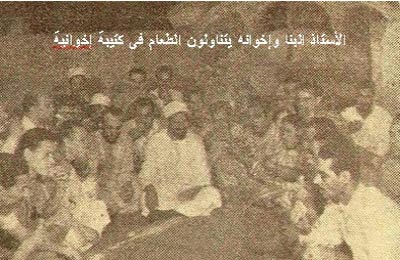
[[File:Ikhwan-Kateba.jpg|thumb|Hassan al-Banna eating with supporters.]] | |||
Al-Banna endeavored to bring about reforms through institution-building, relentless activism at the grassroots level and a reliance on mass communication. He built a complex mass movement that featured sophisticated governance structures; sections in charge of furthering the society's values among peasants, workers and professionals; units entrusted with key functions, including propagation of the message, liaison with the Islamic world and press and translation; and specialized committees for finances and legal affairs. | Al-Banna endeavored to bring about reforms through institution-building, relentless activism at the grassroots level and a reliance on mass communication. He built a complex mass movement that featured sophisticated governance structures; sections in charge of furthering the society's values among peasants, workers and professionals; units entrusted with key functions, including propagation of the message, liaison with the Islamic world and press and translation; and specialized committees for finances and legal affairs. Declaring [[Islam]] as the only comprehensive religious system that could solve the challenges of modernity and calling upon [[Muslims]] to reject [[European values|Western ideologies]], Al-Banna wrote: <blockquote>"If the French Revolution decreed the rights of man and declared for freedom, equality and brotherhood, and if the Russian Revolution brought closer the classes and social justice for the people, the great Islamic Revolution [had] decreed all that 1300 years before. It did not confine itself to philosophical theories but rather spread these principles through daily life, and added to them [the notions of] divinity of mankind, and the perfectibility of his virtues and [the fulfilment of] his spiritual tendencies".<ref>{{Cite book|last=P. Mitchell |first=Richard |title=The Society of the Muslim Brothers |publisher=Oxford University Press |year=1993 | isbn=0-19-508437-3 |location=New York-4314 |chapter= IX: The Solution | pages=232–233}}</ref><ref>{{Cite book |last=Ahmad |first=Talmiz |title=West Asia at War: Repression, Resistance and Great Power Games |publisher=HarperCollins |year=2022 |isbn=978-93-5489-525-8 |location=4th Floor, Tower A, Building No. 10, Phase II, DLF Cyber City, Gurugram, Haryana – 122002 |chapter=5: Islam at the Heart of West Asian Politics (1979-2001)}}</ref></blockquote> | ||
Al-Banna relied on pre-existing social networks―in particular those built around mosques, Islamic welfare associations and neighborhood groups―to anchor the Muslim Brotherhood into Egyptian society. This weaving of traditional ties into a distinctively modern structure was at the root of his success. Directly attached to the brotherhood, and feeding its expansion, were numerous businesses, clinics, and schools. In addition, members were affiliated with the movement through a series of cells, revealingly called ''usar'' ("families").{{citation needed|date=June 2017}} | Al-Banna relied on pre-existing social networks―in particular those built around mosques, Islamic welfare associations and neighborhood groups―to anchor the Muslim Brotherhood into Egyptian society. This weaving of traditional ties into a distinctively modern structure was at the root of his success. Directly attached to the brotherhood, and feeding its expansion, were numerous businesses, clinics, and schools. In addition, members were affiliated with the movement through a series of cells, revealingly called ''usar'' ("families").{{citation needed|date=June 2017}} | ||
| Line 80: | Line 93: | ||
Rooted in Islam, Al-Banna's message tackled issues including [[colonialism]], [[public health]], [[educational]] policy, [[natural resources]] management, [[social inequalities]], [[pan-Islamism]], [[nationalism]], [[Arab nationalism]], the weakness of the Islamic world on the international scene, and the growing conflict in [[Mandate Palestine|Palestine]].<ref>Mura, 61–85.</ref> By emphasizing concerns that appealed to a variety of constituencies, al-Banna was able to recruit from among a cross-section of Egyptian society—though modern-educated civil servants, office employees, and professionals remained dominant among the organization's activists and decision-makers. Al-Banna was also active in resisting British colonial rule in Egypt. | Rooted in Islam, Al-Banna's message tackled issues including [[colonialism]], [[public health]], [[educational]] policy, [[natural resources]] management, [[social inequalities]], [[pan-Islamism]], [[nationalism]], [[Arab nationalism]], the weakness of the Islamic world on the international scene, and the growing conflict in [[Mandate Palestine|Palestine]].<ref>Mura, 61–85.</ref> By emphasizing concerns that appealed to a variety of constituencies, al-Banna was able to recruit from among a cross-section of Egyptian society—though modern-educated civil servants, office employees, and professionals remained dominant among the organization's activists and decision-makers. Al-Banna was also active in resisting British colonial rule in Egypt. | ||
Al-Banna warned his readers against the "widespread belief among many Muslims" that jihad of the heart was more important and demanding than jihad of the sword. | Al-Banna warned his readers against the "widespread belief among many Muslims" that jihad of the heart was more important and demanding than jihad of the sword.{{sfn|Kadri|2012|p=158}} He called on Muslims to prepare for [[jihad]] against colonial powers:<blockquote>Muslims ... are compelled to humble themselves before non-Muslims, and are ruled by unbelievers. Their lands have been trampled over, and their honor besmirched. Their adversaries are in charge of their affairs, and the rites of their religion have fallen into abeyance with their own domains ... Hence it has become an individual obligation, which there is no evading, on every Muslim to prepare his equipment, to make up his mind to engage in jihad, and to get ready for it until the opportunity is ripe and God decrees.<ref>Al-Banna, Hasan, ''Five Tracts of Hasan Al-Banna, (1906–49): A Selection from the "Majmu'at Rasa'il al-Imam al-Shahid Hasan al-Banna"'', Translated by Charles Wendell. Berkeley, CA, 1978, pp.150, 155;</ref></blockquote> | ||
With his work ''On Jihad'' written toward the end of the 1930s, he became "the first influential scholar since the 1857 India uprising" to call for jihad against unbelievers.{{sfn|Kadri|2012|p=158}} | |||
===Views=== | |||
Al-Banna was well known for his emphasis on importance of propagating Islam and on jihad of the sword in the face of Western power. | |||
{{blockquote|The Quran has appointed the Muslims guardians over immature humanity and gave them dominion and sovereignty over the world to serve this noble purpose. Our mission is to guide all humanity towards the pure Islamic principles without which man cannot attain happiness. God has also commanded us to spread Islam by reason and persuasion, but if we are opposed, then by the sword and the spear.<ref name="al-Banna-35-37-(Chamieh p.146">Al-Banna, Hasan, ''Al-Rasa'el'' (The Epistles, a collection of his sermons), al-Mo'assasa al-Islamiya, Beirut 1984, p.35–37; cited in {{cite book |title=Traditionalists, Militants and Liberal in Present Islam |first1=Jebran |last1=Chamieh |publisher=Research and Publishing House |date=1977 |page=146}}</ref>}} | |||
He also believed that the doctrine of early Muslims towards disbelievers in the creation of their empire had not been outdated. "Islam presents hostile [Christians and Jews] with three choices: Acceptance of Islam, war, or paying the poll tax" ([[jizya]]).<ref>Al-Banna, Hasan, ''Al-Rasa'el'' (The Epistles, a collection of his sermons), al-Mo'assasa al-Islamiya, Beirut 1984, p.43; cited in {{cite book |title=Traditionalists, Militants and Liberal in Present Islam |first1=Jebran |last1=Chamieh |publisher=Research and Publishing House |date=1977 |page=68}}</ref> Although neither a ruler nor a scholar, in the history of the Islamic world Al-Banna notable for inspiring individual Muslims to wage "free-lance" jihad warfare "for the first time"—as prior to his influence jihad had been led a caliph or Muslim ruler.{{sfn|Kadri|2012|p=160}} | |||
==Muslim Brothers and the Palestine conflict== | ==Muslim Brothers and the Palestine conflict== | ||
[[File:Al-Banna and al-Masri.jpg|thumb|right|Al-Banna (third from left) with [[Aziz Ali al-Misri]] (fourth from right), [[Mohamed Ali Eltaher]] (second from the right) and Egyptian, Palestinian and Algerian political and religious figures at a reception in Cairo, 1947]] | [[File:Al-Banna and al-Masri.jpg|thumb|right|Al-Banna (third from left) with [[Aziz Ali al-Misri]] (fourth from right), [[Mohamed Ali Eltaher]] (second from the right) and Egyptian, Palestinian and Algerian political and religious figures at a reception in Cairo, 1947]] | ||
Among the Muslim Brothers' most notable accomplishments during these early years was its involvement in the [[1936–1939 Arab revolt in Palestine]]. The Muslim Brothers launched a pro-Palestine campaign which contributed to making the Palestine issue a widespread Muslim concern. The Muslim Brothers carried out a fundraising campaign said to have relied upon donations from the rural and urban working classes, rather than wealthy Egyptians. In addition to their fundraising efforts, the Muslim Brothers also organized special prayers for Palestinian nationalists, held political rallies, and distributed propaganda. Although the | Among the Muslim Brothers' most notable accomplishments during these early years was its involvement in the [[1936–1939 Arab revolt in Palestine]]. The Muslim Brothers launched a pro-Palestine campaign which contributed to making the Palestine issue a widespread Muslim concern. The Muslim Brothers carried out a fundraising campaign said to have relied upon donations from the rural and urban working classes, rather than wealthy Egyptians. In addition to their fundraising efforts, the Muslim Brothers also organized special prayers for Palestinian Arab nationalists, held political rallies, and distributed propaganda. Although the Arab revolt in Palestine was ultimately suppressed through repression and military action, the Muslim Brothers' impressive mobilization efforts helped make the Palestinian question a pan-Arab concern in the Middle East. | ||
When Rashid Rida died | When Rashid Rida died in August 1935, his ''Al-Manar'' magazine also perished with him. Sometime in 1939, Hassan al-Banna resurrected ''Al-Manar'' to further promote the revolutionary ideology pioneered by the Muslim Brotherhood and claim Rashid Rida's legacy.<ref name="encyclopediageopolitica.com"/> | ||
Hassan al-Banna in two of his writings, ''Peace In Islam'' and ''Our Message'', criticizes the ultra-nationalism of Nazi Germany and Fascist Italy as being a "reprehensible idea" within which was "not the slightest good"<ref>"Six Tracts of Hasan Al-Bana", page 70, Africaw for Publishing and Distribution, 2006</ref> and which gave power to "chosen tyrants".<ref>{{Cite web|url=https://www.scribd.com/document/97406376/Peace-in-Islam-Hassan-Al-Banna|title = Peace in Islam - Hassan Al-Banna | PDF | God in Islam | Muhammad}}</ref> According to historian Malise Ruthven, he expressed `considerable admiration for the Nazi Brownshirts` during the 1930s.<ref name="Ruthven-Fury-2002">{{cite book |last1=Ruthven |first1=Malise |title=A fury for God : the Islamist attack on America |date=2002 |publisher=Granta |location=London, NY |page=73 |isbn=978-1-86207-540-5 |url=https://archive.org/details/furyforgodislami0000ruth/mode/2up?q=brownshirts |access-date=12 February 2025}}</ref><ref name="Berman Terror 2003-59"/> He used the name ''kata'ib'' (phalanges) for the units of his organization, in the style of [[Francisco Franco]], the Fascist dictator of Spain (according to Paul Berman).<ref name="Berman Terror 2003-59">{{cite book |last1=Berman |first1=Paul |title=Terror and Liberalism |date=2003 |publisher=W.W. Norton and Company |page=59}}</ref> | |||
===Final days and assassination=== | ===Final days and assassination=== | ||
Between 1948 and 1949, shortly after the society sent volunteers to fight against Israel in the [[1948 Arab–Israeli War]], the conflict between the [[Kingdom of Egypt|monarchy]] and the organization reached its climax. Concerned with the Brotherhood's increasing assertiveness and popularity among the masses, as well as being alarmed by rumours that the Brotherhood was plotting a [[coup]] against the monarchy and cabinet, [[Prime Minister of Egypt|Prime Minister]] [[Nokrashy Pasha]] (whose predecessor had been slain by a Brotherhood adherent near the end of World War II) outlawed the organization in December 1948. The Brotherhood's assets were impounded and scores of its members were sent to jail. Following the murder of Nokrashy Pasha by a student member of the Brotherhood,<ref>''Biographical Dictionary Of Modern Egypt'' (American University in Cairo Press {{ISBN|1-55587-229-8}})</ref> Al-Banna released a statement condemning the assassination and stating that terror is not acceptable in Islam.<ref>Mitchell, Richard Paul, ''The Society of the Muslim Brothers'', Oxford University Press, 1993, pp. 68–69</ref><ref> | Between 1948 and 1949, shortly after the society sent volunteers to fight against Israel in the [[1948 Arab–Israeli War]], the conflict between the [[Kingdom of Egypt|monarchy]] and the organization reached its climax. Concerned with the Brotherhood's increasing assertiveness and popularity among the masses, as well as being alarmed by rumours that the Brotherhood was plotting a [[coup]] against the monarchy and cabinet, [[Prime Minister of Egypt|Prime Minister]] [[Nokrashy Pasha]] (whose predecessor had been slain by a Brotherhood adherent near the end of World War II) outlawed the organization in December 1948. The Brotherhood's assets were impounded and scores of its members were sent to jail. Following the murder of Nokrashy Pasha by a student member of the Brotherhood,<ref>''Biographical Dictionary Of Modern Egypt'' (American University in Cairo Press {{ISBN|1-55587-229-8}})</ref> Al-Banna released a statement condemning the assassination and stating that terror is not acceptable in Islam.<ref>Mitchell, Richard Paul, ''The Society of the Muslim Brothers'', Oxford University Press, 1993, pp. 68–69</ref><ref>http://www.mideastweb.org/Middle-East-Encyclopedia/hassan_al-banna.htm {{Webarchive|url=https://web.archive.org/web/20120208111805/http://www.mideastweb.org/Middle-East-Encyclopedia/hassan_al-banna.htm |date=2012-02-08 }} suggests that al-Banna favoured assassination and therefore was assassinated by the government.</ref><ref name="roots">{{cite web|url=http://allthingspoliticaltoday.com/articles/the-roots-of-al-qaeda|title=The Roots of al-Qaeda|publisher=All Things Political Today|access-date=26 June 2012|archive-url=https://web.archive.org/web/20111122155918/http://allthingspoliticaltoday.com/articles/the-roots-of-al-qaeda|archive-date=22 November 2011|url-status=live}}</ref> | ||
On 12 February 1949, al-Banna and his brother-in-law Abdul Karim Mansur were scheduled to negotiate with the government's representative, Minister Zaki Ali Pasha, at the Jama'iyyat al-Shubban al-Muslimeen headquarters in Cairo—but the minister never arrived. By 5 p.m., al-Banna and his brother-in-law had decided to leave. As they stood waiting for a taxi, they were shot by two men. Al-Banna eventually died from his wounds. [[Farouk of Egypt|King Farouk]] and his [[Iron Guard of Egypt]] were accused of being behind the assassination.<ref>{{cite web|url=http://egyptianchronicles.blogspot.com/2008/02/egyptian-x-files-who-killed-hassan-al.html|title=Egyptian Chronicles: Egyptian X-files: Who Killed Hassan Al Bana ??|last=Zeinobia|date=27 February 2008|access-date=17 April 2015|archive-url=https://web.archive.org/web/20150420072042/http://egyptianchronicles.blogspot.com/2008/02/egyptian-x-files-who-killed-hassan-al.html|archive-date=20 April 2015|url-status=live}}</ref> | On 12 February 1949, al-Banna and his brother-in-law Abdul Karim Mansur were scheduled to negotiate with the government's representative, Minister Zaki Ali Pasha, at the Jama'iyyat al-Shubban al-Muslimeen headquarters in Cairo—but the minister never arrived. By 5 p.m., al-Banna and his brother-in-law had decided to leave. As they stood waiting for a taxi, they were shot by two men. Al-Banna eventually died from his wounds. [[Farouk of Egypt|King Farouk]] and his [[Iron Guard of Egypt]] were accused of being behind the assassination.<ref>{{cite web|url=http://egyptianchronicles.blogspot.com/2008/02/egyptian-x-files-who-killed-hassan-al.html|title=Egyptian Chronicles: Egyptian X-files: Who Killed Hassan Al Bana ??|last=Zeinobia|date=27 February 2008|access-date=17 April 2015|archive-url=https://web.archive.org/web/20150420072042/http://egyptianchronicles.blogspot.com/2008/02/egyptian-x-files-who-killed-hassan-al.html|archive-date=20 April 2015|url-status=live}}</ref> His father Ahmed retrieved his corpse from [[Qasr El Eyni Hospital]] to his house, then his coffin was carried by women with the police escort who prevented men from attending his funeral except for [[Makram Ebeid]] who was a government figure.<ref>{{cite web |url=https://english.ahram.org.eg/NewsContent/4/0/69312/Opinion/Makram-Ebeid-Pacha--Hassan-ElBanna-Egypts-golden-a.aspx |title=Makram Ebeid Pacha & Hassan El-Banna: Egypt's golden age of national unity |website=ahram.org |date=17 April 2013 }}</ref> | ||
==Family== | ==Family== | ||
Al-Banna's daughter Wafa al-Banna was married to [[Said Ramadan]], who became a major leader of the Muslim Brotherhood. Their two sons, [[Tariq Ramadan]] and [[Hani Ramadan]], are | Al-Banna's daughter Wafa al-Banna was married to [[Said Ramadan]], who became a major leader of the Muslim Brotherhood. Their two sons, [[Tariq Ramadan]] and [[Hani Ramadan]], are Islamic scholars and educationists. Hassan al-Banna's younger brother, [[Gamal al-Banna]], was a more liberal scholar and proponent of [[Liberalism and progressivism within Islam|Islamic reform]].<ref>[[Caroline Fourest]], ''Brother Tariq: The Doublespeak of Tariq Ramadan'', Encounter Books (2008), p. 7</ref> | ||
==Writings== | ==Writings== | ||
Hassan al-Banna | Hassan al-Banna wrote more than 2000 articles and many books, which include an [[autobiographical novel]] entitled ''Mudhakkirât al-da'wa wa al-dâ'iya'' (''Remembrances of Preaching and of a Preacher'').<ref>Brigitte Maréchal, ''The Muslim Brothers in Europe: Roots and Discourse'', BRILL (2008), p. 89</ref> | ||
==See also== | ==See also== | ||
| Line 113: | Line 131: | ||
{{Wikiquote}} | {{Wikiquote}} | ||
*{{cite book |last=Gensicke |first=Klaus |year=2007 |title=Der Mufti von Jerusalem und die Nationalsozialisten: Eine politische Biographie Amin el-Husseinis |location=Darmstadt |publisher=Wissenschaftliche Buchgesellschaft |isbn=978-3-534-20808-1 |language=de}} | *{{cite book |last=Gensicke |first=Klaus |year=2007 |title=Der Mufti von Jerusalem und die Nationalsozialisten: Eine politische Biographie Amin el-Husseinis |location=Darmstadt |publisher=Wissenschaftliche Buchgesellschaft |isbn=978-3-534-20808-1 |language=de}} | ||
* {{cite book |last1=Kadri |first1=Sadakat |url=https://books.google.com/books?id=ztCRZOhJ10wC&q=Heaven+on+Earth%3A+A+Journey+Through+Shari%27a+Law |title=Heaven on Earth: A Journey Through Shari'a Law from the Deserts of Ancient Arabia ... |date=2012 |publisher=Macmillan |isbn=9780099523277 }} | |||
* {{Cite book |last=Krämer |first=Gudrun |author-link=Gudrun Krämer |url=https://books.google.com/books?id=Yhu9DwAAQBAJ |title=Hasan Al-Banna |publisher=Oneworld Publications |year=2014 |isbn=9781780742120}} | |||
*{{cite book |last=Lia |first=Brynjar |year=1998 |title=The Society of the Muslim Brothers in Egypt: The Rise of an Islamic Mass Movement |location=Reading, UK |publisher=Garnet |isbn=978-0-86372-220-2 }} | *{{cite book |last=Lia |first=Brynjar |year=1998 |title=The Society of the Muslim Brothers in Egypt: The Rise of an Islamic Mass Movement |location=Reading, UK |publisher=Garnet |isbn=978-0-86372-220-2 }} | ||
*{{cite book |last1=Mallmann |first1=Klaus-Michael |name-list-style=amp |first2=Martin |last2=Cüppers |year=2006 |title=Halbmond und Hakenkreuz: Das Dritte Reich, die Araber und Palästina |location=Darmstadt |publisher=Wissenschaftliche Buchgesellschaft |isbn=978-3-534-19729-3 }} | *{{cite book |last1=Mallmann |first1=Klaus-Michael |name-list-style=amp |first2=Martin |last2=Cüppers |year=2006 |title=Halbmond und Hakenkreuz: Das Dritte Reich, die Araber und Palästina |location=Darmstadt |publisher=Wissenschaftliche Buchgesellschaft |isbn=978-3-534-19729-3 }} | ||
| Line 130: | Line 150: | ||
| title-link = The Looming Tower | | title-link = The Looming Tower | ||
}} | }} | ||
* [https://web.archive.org/web/20060725223759/http://www.youngmuslims.ca/biographies/display.asp?ID=8 Hasan Al-Banna<!-- bot-generated title -->] at www.youngmuslims.ca | * [https://web.archive.org/web/20060725223759/http://www.youngmuslims.ca/biographies/display.asp?ID=8 Hasan Al-Banna<!-- bot-generated title -->] at www.youngmuslims.ca | ||
==External links== | ==External links== | ||
{{Wikiquote}} | |||
* [https://web.archive.org/web/20080129131208/http://www.hassanalbanna.org/ www.hassanalbanna.org] | * [https://web.archive.org/web/20080129131208/http://www.hassanalbanna.org/ www.hassanalbanna.org] | ||
* [http://www.islamtimes.org/vdcd.j0s2yt0jfme6y.html biography] | * [http://www.islamtimes.org/vdcd.j0s2yt0jfme6y.html biography] | ||
| Line 154: | Line 174: | ||
[[Category:1906 births]] | [[Category:1906 births]] | ||
[[Category:1949 deaths]] | [[Category:1949 deaths]] | ||
[[Category: | [[Category:People murdered in 1949]] | ||
[[Category:Cairo University alumni]] | |||
[[Category: | |||
[[Category:Assassinated Egyptian politicians]] | [[Category:Assassinated Egyptian politicians]] | ||
[[Category:Atharis]] | [[Category:Atharis]] | ||
[[Category:Muslim anti-fascists]] | |||
[[Category:Muslim reformers]] | [[Category:Muslim reformers]] | ||
[[Category:Muslim Brotherhood founders]] | [[Category:Muslim Brotherhood founders]] | ||
[[Category:Deaths by firearm in Egypt]] | [[Category:Deaths by firearm in Egypt]] | ||
| Line 170: | Line 187: | ||
[[Category:People from Beheira Governorate]] | [[Category:People from Beheira Governorate]] | ||
[[Category:Caliphalism]] | [[Category:Caliphalism]] | ||
[[Category:Egyptian | [[Category:Egyptian Islamists]] | ||
[[Category: | [[Category:Politicians assassinated in the 1940s]] | ||
[[Category:Political prisoners in Egypt]] | |||
Latest revision as of 11:47, 30 January 2026
 | This article needs additional citations for verification. (December 2006) |

Hassan Ahmed Abd al-Rahman Muhammed al-Banna (Script error: The function "langx" does not exist.; 14 October 1906 – 12 February 1949), known as Hassan al-Banna (Script error: The function "langx" does not exist.), was an Egyptian schoolteacher and Imam, best known for founding the Muslim Brotherhood,[8] one of the largest and most influential global Islamist movements,[8][3] and for his death[9] at the hands of the Egyptian government.[10]
Al-Banna's writings marked a turning-point in Islamic intellectual history by presenting a distinct and all-encompassing modern ideology based on Islam.[11] Al-Banna considered Islam to be a comprehensive system of life, with the Quran and Sunnah as the only acceptable constitution.[12] He called for Islamization of the state, the economy, and society.[11] He declared that establishing a just society required development of institutions and progressive taxation, and developed an Islamic fiscal theory where zakat would be reserved for social expenditure in order to reduce inequality.[12][11] Al-Banna's ideology featured criticism of Western materialism, British imperialism, and the traditionalism of the Egyptian ulema.[13] He appealed to Egyptian and pan-Arab patriotism but rejected Arab nationalism and regarded all Muslims as members of a single nation-community.[12][11][13]
Following the abolition of the Caliphate in 1924, al-Banna called on Muslims to prepare for armed struggle against colonial rule; he warned Muslims against the "widespread belief" that "jihad of the heart" was more important than "jihad of the sword".[14] He allowed the formation of a secret military wing within the Muslim Brotherhood, which took part in the Arab–Israeli conflict.[13] Al-Banna generally encouraged Egyptians to abandon Western customs; and argued that the state should enforce Islamic public morality through censorship and application of hudud corporal punishment.[11] Nonetheless, his thought was open to Western ideas and some of his writings quote European authors instead of Islamic sources.[11]
Al-Banna was assassinated by the Egyptian secret police in 1949.[12] His son-in-law Said Ramadan emerged as a major leader of the Muslim Brotherhood in the 1950s.
Early life[edit | edit source]
Hassan al-Banna was born on 14 October 1906 in Mahmudiyya, a rural Nile Delta town in the Beheira Governorate northwest of Cairo. Template:Islamism sidebar His father, Sheikh Ahmed Abd al-Rahman al-Banna al-Sa'ati, was a Hanbali imam,[15] muezzin and mosque teacher. His father was an important spiritual influence during al-Banna's early life. Sheikh Ahmed was known for his work as a Hanbali scholar, particularly his classifications of the traditions of Imam Ahmad ibn Hanbal. These classifications became known as musnad al-fath al-rabbani. Through this work, Sheikh Ahmed forged connections with Islamic scholars that proved useful when his son moved to Cairo in 1932.
In addition to his early exposure to puritanism, Hassan al-Banna was inspired by Rashid Rida's magazine, Al-Manar and he was heavily influenced by Islamic fundamentalism as a youth in Mahmudiyya.[7]
Al-Banna was first exposed to Egyptian nationalist politics during the Egyptian Revolution of 1919; he was thirteen years old at the time. In his personal accounts, Al-Banna identified himself with the widespread activism of the time. Despite his young age, al-Banna participated in demonstrations in Damanhur, published political pamphlets and founded youth reform societies.[16] Although Al-Banna's family were not members of the Egyptian elite, they were relatively well-respected in Mahmudiyya. Sheikh Ahmed's was a distinguished Imam and the family owned some property. However, during the 1920s economic crisis, the family had trouble sustaining the upkeep of their property and moved to Cairo in 1924.
Education[edit | edit source]
In Mahmudiyya, al-Banna studied in the village mosque with Sheikh Zahran. The two developed a close relationship that influenced al-Banna's early intellectual and religious development. In addition to the mosque school, al-Banna received private instruction from his father. He also studied in Cairo for four years; he attended Dar al-‘Ulum, an Egyptian institution that educated prospective teachers in modern subjects. The school was not very traditional and al-Banna enrolled against his father's wishes, as a break from typical Islamic conservatism. Building upon his father's scholarly connections, al-Banna became associated with the Islamic Society for Nobility of Islamic Morals and the Young Men's Muslim Association (YMMA). He published more than fifteen articles in Majallat al-Fath, an influential Islamic journal associated with the YMMA.
Hasan al-Banna headed to Cairo in 1923 to enroll as a student in Dar al-Ulum College. His student life would be a significant experience for his ideological formation. In the face of an urban social life vastly different from his rural upbringing, Al-Banna "noticed a defection of the educated youth from what he considered to be the Islamic way of life." Al-Banna also had disdain for Egypt's liberal political class. It was during this time that he became exposed to the works of the Salafi scholar Rashid Rida. He was a regular visitor of the Salafiyya book store, at that time directed by Muhibb al-Din al-Khatib; and often attended the lectures of Rashid Rida. For Al-Banna, Rida's works provided him theological guidance to rectify the faults he was witnessing in Egypt.[17][18]
Muslim Brotherhood[edit | edit source]
Al-Banna learned of the abolition of the Ottoman Caliphate in 1924, while he was still a student. This event influenced him greatly; although the caliphate had no power, he viewed its end as a "calamity". He later called the events a "declaration of war against all shapes of Islam".[19]
After completing his studies at a Dar al-‘Ulum in 1927, al-Banna became a primary school teacher in Ismailia. At that time, Ismailia was the location of the Egyptian headquarters of the Suez Canal. Foreign influence was stronger in Ismailia than in other parts of Egypt. While living there, al-Banna grew increasingly disillusioned with British cultural colonialism. He was especially concerned that hasty attempts to modernize Egypt often had the negative effect of compromising Islamic principles. Many Egyptian nationalists were also dissatisfied with Wafd leadership, mainly because of its moderate stances and insistence on secularism.
Hassan al-Banna became acquainted with many important thinkers in Cairo, and had also established personal correspondence with Rashid Rida. Here, Al-Banna developed an ideological framework which synthesised the worldview of past Islamic revivalists in Rashid Rida's interpretation. One of the most important revivalist ideas advocated by Rida was the formation of an Islamic state that would govern by the Sharia and return to a society modelled during the time of Prophet Muhammad and his companions. This idea of a revolutionary struggle based on Islamic principles would guide Hassan al-Banna's later life and manifest in the formation of the Muslim Brotherhood.[17]

Following the ideas of Rashid Rida, Al-Banna believed that moral decay was the primary cause of societal and political decline and felt that talks held within the arena of mosques were not sufficient to hold the influx of societal liberalisation encouraged by political secularisation. In his time at Ismailia, Al-Banna took to the cafes to preach to the general public in short lectures. His charismatic speeches attracted a large number of youth to his call. In March 1928 six workers affiliated with the Suez Canal Company approached Banna, complaining about injustices suffered by Muslims at the hands of foreign colonialist control. They appointed Banna as their leader and to work for Islam through Jihad and revive Islamic Brotherhood. Thus, the Muslim Brothers were born; under the pledge that its members would
"be soldiers in the call to Islam, and in that is the life for the country and the honour for the Ummah. ... We are brothers in the service of Islam. Hence we are the 'Muslim Brothers'."[20][21]
At first, the Muslim Brotherhood was only one of many small Islamic associations that existed at the time. Similar to the organizations that al-Banna had himself joined at a young age, these organizations aimed to promote personal piety and engaged in pure charitable activities. By the late 1930s, the Muslim Brotherhood had established branches in every Egyptian province.
A decade later, the organization had 500,000 active members and as many sympathizers in Egypt alone.[citation needed] Its appeal was not limited only to Egypt; its popularity had grown in several other countries. The organization's growth was particularly pronounced after al-Banna relocated their headquarters to Cairo in 1932. The most important factor contributing to this dramatic expansion was the organizational and ideological leadership provided by al-Banna.[citation needed]
In Ismailia, al-Banna preached not only in the mosque, but also in the coffee houses; in those times, coffee houses were generally viewed as a morally suspect novelty. When some of his views on relatively minor points of Islamic practice led to strong disagreements with the local religious elite, he adopted the policy of avoiding religious controversies.[22][23]
Al-Banna was appalled by the many conspicuous signs of foreign military and economic domination in Ismailia: the British military camps, the public utilities, farms, food supply were owned by foreign interests, and the comfortable villas of the foreign management of the Suez Canal Company, next to the simple shacks of the Egyptian workers.[22]
Political activity and thought[edit | edit source]

Al-Banna endeavored to bring about reforms through institution-building, relentless activism at the grassroots level and a reliance on mass communication. He built a complex mass movement that featured sophisticated governance structures; sections in charge of furthering the society's values among peasants, workers and professionals; units entrusted with key functions, including propagation of the message, liaison with the Islamic world and press and translation; and specialized committees for finances and legal affairs. Declaring Islam as the only comprehensive religious system that could solve the challenges of modernity and calling upon Muslims to reject Western ideologies, Al-Banna wrote:
"If the French Revolution decreed the rights of man and declared for freedom, equality and brotherhood, and if the Russian Revolution brought closer the classes and social justice for the people, the great Islamic Revolution [had] decreed all that 1300 years before. It did not confine itself to philosophical theories but rather spread these principles through daily life, and added to them [the notions of] divinity of mankind, and the perfectibility of his virtues and [the fulfilment of] his spiritual tendencies".[24][25]
Al-Banna relied on pre-existing social networks―in particular those built around mosques, Islamic welfare associations and neighborhood groups―to anchor the Muslim Brotherhood into Egyptian society. This weaving of traditional ties into a distinctively modern structure was at the root of his success. Directly attached to the brotherhood, and feeding its expansion, were numerous businesses, clinics, and schools. In addition, members were affiliated with the movement through a series of cells, revealingly called usar ("families").[citation needed]
The material, social and psychological support provided by the Muslim Brotherhood were instrumental to the movement's ability to generate enormous loyalty among its members and to attract new recruits. The movement was built around services and an organizational structure intended to enable individuals to integrate into a distinctly Islamic setting that was shaped by the society's own principles.
Rooted in Islam, Al-Banna's message tackled issues including colonialism, public health, educational policy, natural resources management, social inequalities, pan-Islamism, nationalism, Arab nationalism, the weakness of the Islamic world on the international scene, and the growing conflict in Palestine.[26] By emphasizing concerns that appealed to a variety of constituencies, al-Banna was able to recruit from among a cross-section of Egyptian society—though modern-educated civil servants, office employees, and professionals remained dominant among the organization's activists and decision-makers. Al-Banna was also active in resisting British colonial rule in Egypt.
Al-Banna warned his readers against the "widespread belief among many Muslims" that jihad of the heart was more important and demanding than jihad of the sword.[27] He called on Muslims to prepare for jihad against colonial powers:
Muslims ... are compelled to humble themselves before non-Muslims, and are ruled by unbelievers. Their lands have been trampled over, and their honor besmirched. Their adversaries are in charge of their affairs, and the rites of their religion have fallen into abeyance with their own domains ... Hence it has become an individual obligation, which there is no evading, on every Muslim to prepare his equipment, to make up his mind to engage in jihad, and to get ready for it until the opportunity is ripe and God decrees.[28]
With his work On Jihad written toward the end of the 1930s, he became "the first influential scholar since the 1857 India uprising" to call for jihad against unbelievers.[27]
Views[edit | edit source]
Al-Banna was well known for his emphasis on importance of propagating Islam and on jihad of the sword in the face of Western power.
The Quran has appointed the Muslims guardians over immature humanity and gave them dominion and sovereignty over the world to serve this noble purpose. Our mission is to guide all humanity towards the pure Islamic principles without which man cannot attain happiness. God has also commanded us to spread Islam by reason and persuasion, but if we are opposed, then by the sword and the spear.[29]
He also believed that the doctrine of early Muslims towards disbelievers in the creation of their empire had not been outdated. "Islam presents hostile [Christians and Jews] with three choices: Acceptance of Islam, war, or paying the poll tax" (jizya).[30] Although neither a ruler nor a scholar, in the history of the Islamic world Al-Banna notable for inspiring individual Muslims to wage "free-lance" jihad warfare "for the first time"—as prior to his influence jihad had been led a caliph or Muslim ruler.[14]
Muslim Brothers and the Palestine conflict[edit | edit source]

Among the Muslim Brothers' most notable accomplishments during these early years was its involvement in the 1936–1939 Arab revolt in Palestine. The Muslim Brothers launched a pro-Palestine campaign which contributed to making the Palestine issue a widespread Muslim concern. The Muslim Brothers carried out a fundraising campaign said to have relied upon donations from the rural and urban working classes, rather than wealthy Egyptians. In addition to their fundraising efforts, the Muslim Brothers also organized special prayers for Palestinian Arab nationalists, held political rallies, and distributed propaganda. Although the Arab revolt in Palestine was ultimately suppressed through repression and military action, the Muslim Brothers' impressive mobilization efforts helped make the Palestinian question a pan-Arab concern in the Middle East.
When Rashid Rida died in August 1935, his Al-Manar magazine also perished with him. Sometime in 1939, Hassan al-Banna resurrected Al-Manar to further promote the revolutionary ideology pioneered by the Muslim Brotherhood and claim Rashid Rida's legacy.[17]
Hassan al-Banna in two of his writings, Peace In Islam and Our Message, criticizes the ultra-nationalism of Nazi Germany and Fascist Italy as being a "reprehensible idea" within which was "not the slightest good"[31] and which gave power to "chosen tyrants".[32] According to historian Malise Ruthven, he expressed `considerable admiration for the Nazi Brownshirts` during the 1930s.[33][34] He used the name kata'ib (phalanges) for the units of his organization, in the style of Francisco Franco, the Fascist dictator of Spain (according to Paul Berman).[34]
Final days and assassination[edit | edit source]
Between 1948 and 1949, shortly after the society sent volunteers to fight against Israel in the 1948 Arab–Israeli War, the conflict between the monarchy and the organization reached its climax. Concerned with the Brotherhood's increasing assertiveness and popularity among the masses, as well as being alarmed by rumours that the Brotherhood was plotting a coup against the monarchy and cabinet, Prime Minister Nokrashy Pasha (whose predecessor had been slain by a Brotherhood adherent near the end of World War II) outlawed the organization in December 1948. The Brotherhood's assets were impounded and scores of its members were sent to jail. Following the murder of Nokrashy Pasha by a student member of the Brotherhood,[35] Al-Banna released a statement condemning the assassination and stating that terror is not acceptable in Islam.[36][37][10]
On 12 February 1949, al-Banna and his brother-in-law Abdul Karim Mansur were scheduled to negotiate with the government's representative, Minister Zaki Ali Pasha, at the Jama'iyyat al-Shubban al-Muslimeen headquarters in Cairo—but the minister never arrived. By 5 p.m., al-Banna and his brother-in-law had decided to leave. As they stood waiting for a taxi, they were shot by two men. Al-Banna eventually died from his wounds. King Farouk and his Iron Guard of Egypt were accused of being behind the assassination.[38] His father Ahmed retrieved his corpse from Qasr El Eyni Hospital to his house, then his coffin was carried by women with the police escort who prevented men from attending his funeral except for Makram Ebeid who was a government figure.[39]
Family[edit | edit source]
Al-Banna's daughter Wafa al-Banna was married to Said Ramadan, who became a major leader of the Muslim Brotherhood. Their two sons, Tariq Ramadan and Hani Ramadan, are Islamic scholars and educationists. Hassan al-Banna's younger brother, Gamal al-Banna, was a more liberal scholar and proponent of Islamic reform.[40]
Writings[edit | edit source]
Hassan al-Banna wrote more than 2000 articles and many books, which include an autobiographical novel entitled Mudhakkirât al-da'wa wa al-dâ'iya (Remembrances of Preaching and of a Preacher).[41]
See also[edit | edit source]
Notes[edit | edit source]
- ↑ "Who is Shaikh Hassan Al-Banna? – Religion of Islam". 2020-07-17. Retrieved 2024-07-12.
- ↑ "Hasan al-Banna and the Muslim Brotherhood", The Islamists, Afro-Middle East Centre, pp. 31–50, 2017-08-09, doi:10.2307/j.ctvgc6143.7, retrieved 2024-07-12
- ↑ 3.0 3.1 3.2 Bari, Johurul (1995). Re-emergence of the Muslim Brothers in Egypt. New Delhi: Lancers Books. p. 15. ISBN 978-81-7095-052-3.
- ↑ "A history of the modern Islamic movement that is Salafism | Aeon Essays". Aeon. Retrieved 2024-07-12.
- ↑ R. Halverson, Jeffrey (2010). Theology and Creed in Sunni Islam. New York: Palgrave Macmillan. pp. 49, 62. ISBN 978-0-230-10279-8.
- ↑ C. Martin, R. Woodward, Richard, Mark (2010). Defenders of Reason in Islam: Mu'tazilism from Medieval School to Modern Symbol. 185 Banbury Road, Oxford OX2 7AR, England: One World Publications. p. 218. ISBN 978-1-85168-147-1.
{{cite book}}: CS1 maint: location (link) CS1 maint: multiple names: authors list (link) - ↑ 7.0 7.1 Introduction to Princeton Readings in Islamist Thought: Texts and Contexts from Al-Banna to Bin Laden, pg. 26. Part of the Princeton Studies in Muslim Politics series. Eds. Roxanne Leslie Euben and Muhammad Qasim Zaman. Princeton: Princeton University Press, 2006. ISBN 9780691135885
- ↑ 8.0 8.1 "Hasan al-Banna – Islamic Studies – Oxford Bibliographies – obo". Archived from the original on 2017-01-01. Retrieved 2017-01-08.
- ↑ Kepel, Gilles (2006). Jihad: The Trail of Political Islam. I.B. Tauris. p. 122. ISBN 978-1-84511-257-8.
- ↑ 10.0 10.1 "The Roots of al-Qaeda". All Things Political Today. Archived from the original on 22 November 2011. Retrieved 26 June 2012.
- ↑ 11.0 11.1 11.2 11.3 11.4 11.5 Olivier Carré; Liv Tønnessen (2009). "Bannā, Ḥasan al-". In John L. Esposito (ed.). The Oxford Encyclopedia of the Islamic World. Translated by Elizabeth Keller. Oxford: Oxford University Press. ISBN 9780195305135. Archived from the original on 2017-09-13. Retrieved 2017-01-31.
- ↑ 12.0 12.1 12.2 12.3 John L. Esposito, ed. (2014). "Banna, Hasan al-". The Oxford Dictionary of Islam. Oxford: Oxford University Press. ISBN 9780195125580.
- ↑ 13.0 13.1 13.2 Patrick S. O'Donnell (2010). "al-Banna', Hasan (1906–49)". In Oliver Leaman (ed.). The Biographical Encyclopaedia of Islamic Philosophy. Continuum. ISBN 9780199754731. Archived from the original on 2017-09-13. Retrieved 2017-01-31.
- ↑ 14.0 14.1 Kadri 2012, p. 160.
- ↑ "من أعلام الدعوة والحركة الإسلامية المعاصرة":الشيخ المحدّث أحمد عبد الرحمن البنا الساعاتي بقية السلف وزينة الخلف[permanent dead link]، مجلة المجتمع الكويتية، 20 ديسمبر 2008م
- ↑ al-Banna, Hassan (1982). Mudhakkirât al-da'wa wa al-dâ'iya [Memoirs of Hasan al Banna Shaheed]. Translated by Shaikh, M.N. (1st ed.). Karachi: International Islamic Publishers.
- ↑ 17.0 17.1 17.2 "The Family Tree of Islamist Extremism". Encyclopedia Geopolitica. 2 March 2021. Archived from the original on 2 March 2021.
- ↑ P. Mitchell, Richard (1968). "Chapter 1: HASAN AL-BANNA AND THE FOUNDING OF THE SOCIETY OF THE MUSLIM BROTHERS". The Society of the Muslim Brothers. New York-4314: Oxford University Press. p. 5. ISBN 0-19-508437-3.
{{cite book}}: CS1 maint: location (link) - ↑ Farmer, Brian R. (2007). Understanding Radical Islam: Medieval Ideology in the Twenty-first Century. Peter Lang. p. 83. ISBN 9780820488431. Retrieved 29 December 2016.
- ↑ Pankhurst, Reza (2013). The Inevitable Caliphate? - A History of the Struggle for Global Islamic Union, 1924 to the Present. New York: Oxford University Press. pp. 68–69. ISBN 978-0-19-932799-7.
- ↑ DE BELLAIGUE, CHRISTOPHER (2017). "Chapter 6: Counter-Enlightenment". The Islamic Enlightenment: The Struggle Between Faith and Reason- 1798 to Modern Times. New York: LIVERIGHT PUBLISHING CORPORATION. p. 376. ISBN 978-0-87140-373-5.
- ↑ 22.0 22.1 Mitchell, 7.
- ↑ Lia, 32–35.
- ↑ P. Mitchell, Richard (1993). "IX: The Solution". The Society of the Muslim Brothers. New York-4314: Oxford University Press. pp. 232–233. ISBN 0-19-508437-3.
{{cite book}}: CS1 maint: location (link) - ↑ Ahmad, Talmiz (2022). "5: Islam at the Heart of West Asian Politics (1979-2001)". West Asia at War: Repression, Resistance and Great Power Games. 4th Floor, Tower A, Building No. 10, Phase II, DLF Cyber City, Gurugram, Haryana – 122002: HarperCollins. ISBN 978-93-5489-525-8.
{{cite book}}: CS1 maint: location (link) - ↑ Mura, 61–85.
- ↑ 27.0 27.1 Kadri 2012, p. 158.
- ↑ Al-Banna, Hasan, Five Tracts of Hasan Al-Banna, (1906–49): A Selection from the "Majmu'at Rasa'il al-Imam al-Shahid Hasan al-Banna", Translated by Charles Wendell. Berkeley, CA, 1978, pp.150, 155;
- ↑ Al-Banna, Hasan, Al-Rasa'el (The Epistles, a collection of his sermons), al-Mo'assasa al-Islamiya, Beirut 1984, p.35–37; cited in Chamieh, Jebran (1977). Traditionalists, Militants and Liberal in Present Islam. Research and Publishing House. p. 146.
- ↑ Al-Banna, Hasan, Al-Rasa'el (The Epistles, a collection of his sermons), al-Mo'assasa al-Islamiya, Beirut 1984, p.43; cited in Chamieh, Jebran (1977). Traditionalists, Militants and Liberal in Present Islam. Research and Publishing House. p. 68.
- ↑ "Six Tracts of Hasan Al-Bana", page 70, Africaw for Publishing and Distribution, 2006
- ↑ "Peace in Islam - Hassan Al-Banna | PDF | God in Islam | Muhammad".
- ↑ Ruthven, Malise (2002). A fury for God : the Islamist attack on America. London, NY: Granta. p. 73. ISBN 978-1-86207-540-5. Retrieved 12 February 2025.
- ↑ 34.0 34.1 Berman, Paul (2003). Terror and Liberalism. W.W. Norton and Company. p. 59.
- ↑ Biographical Dictionary Of Modern Egypt (American University in Cairo Press ISBN 1-55587-229-8)
- ↑ Mitchell, Richard Paul, The Society of the Muslim Brothers, Oxford University Press, 1993, pp. 68–69
- ↑ http://www.mideastweb.org/Middle-East-Encyclopedia/hassan_al-banna.htm Archived 2012-02-08 at the Wayback Machine suggests that al-Banna favoured assassination and therefore was assassinated by the government.
- ↑ Zeinobia (27 February 2008). "Egyptian Chronicles: Egyptian X-files: Who Killed Hassan Al Bana ??". Archived from the original on 20 April 2015. Retrieved 17 April 2015.
- ↑ "Makram Ebeid Pacha & Hassan El-Banna: Egypt's golden age of national unity". ahram.org. 17 April 2013.
- ↑ Caroline Fourest, Brother Tariq: The Doublespeak of Tariq Ramadan, Encounter Books (2008), p. 7
- ↑ Brigitte Maréchal, The Muslim Brothers in Europe: Roots and Discourse, BRILL (2008), p. 89
References[edit | edit source]
- Gensicke, Klaus (2007). Der Mufti von Jerusalem und die Nationalsozialisten: Eine politische Biographie Amin el-Husseinis (in Deutsch). Darmstadt: Wissenschaftliche Buchgesellschaft. ISBN 978-3-534-20808-1.
- Kadri, Sadakat (2012). Heaven on Earth: A Journey Through Shari'a Law from the Deserts of Ancient Arabia ... Macmillan. ISBN 9780099523277.
- Krämer, Gudrun (2014). Hasan Al-Banna. Oneworld Publications. ISBN 9781780742120.
- Lia, Brynjar (1998). The Society of the Muslim Brothers in Egypt: The Rise of an Islamic Mass Movement. Reading, UK: Garnet. ISBN 978-0-86372-220-2.
- Mallmann, Klaus-Michael & Cüppers, Martin (2006). Halbmond und Hakenkreuz: Das Dritte Reich, die Araber und Palästina. Darmstadt: Wissenschaftliche Buchgesellschaft. ISBN 978-3-534-19729-3.
- Mitchell, Richard P. (1993), The Society of the Muslim Brothers, London: Oxford University Press, ISBN 978-0-19-508437-5
- Mura, Andrea (2012). "A genealogical inquiry into early Islamism: the discourse of Hasan al-Banna". Journal of Political Ideologies. 17 (1): 61–85. doi:10.1080/13569317.2012.644986. S2CID 144873457.
- Mura, Andrea (2015). The Symbolic Scenarios of Islamism: A Study in Islamic Political Thought. London: Routledge.
- Soage, Ana B. (2008). "Hasan al-Banna or the politicisation of Islam". Totalitarian Movements and Political Religions. 9 (1): 21–42. doi:10.1080/14690760701856374. S2CID 144898080.
- Wright, Lawrence (2006-08-08). The Looming Tower: Al-Qaeda and the Road to 9/11. Knopf. p. 480. ISBN 978-0-375-41486-2.
- Hasan Al-Banna at www.youngmuslims.ca
External links[edit | edit source]
- www.hassanalbanna.org
- biography
- Founder of the Muslim Brotherhood, Al-Banna was one of the century's most original thinkers
- The Ten Principles of Hasan al-Banna
- Letter to a Muslim Student
- Hasan al-Banna
- "On Jihad" from Five Tracts of Hasan al-Banna
| Religious titles | ||
|---|---|---|
| Preceded by New position |
General Guide of the Muslim Brotherhood 1928–1949 |
Succeeded by Hassan al-Hudaybi |