


Ajay Kumar (talk | contribs) Created a new article |
m updated page |
||
| Line 1: | Line 1: | ||
{{Short description|Storage organ in plants}} | {{Short description|Storage organ in plants}} | ||
{{About||fungal genus|Tuber (fungus)|other uses}} | {{About||fungal genus|Tuber (fungus)|other uses}} | ||
[[File:Ullucus tuberosus (South Peru).jpg|thumb|upright=1.2|Ulluku (''[[Ullucus tuberosus]]'') tubers]] | |||
[[File:Ullucus tuberosus (South Peru).jpg| | |||
'''Tubers''' are a type of enlarged structure | '''Tubers''' are a type of enlarged structure that [[plant]]s use as [[storage organ]]s for [[nutrient]]s, derived from stems or roots. Tubers help plants [[perennate]] (survive winter or dry months), provide energy and nutrients, and are a means of [[asexual reproduction]].<ref name="rooting_cuttings_of_tropical_trees">{{Citation |title=Rooting Cuttings of Tropical Trees |pages=11 |year=1994 |location=London |publisher=Commonwealth Science Council |isbn=978-0-85092-394-0}}</ref> | ||
'''Stem tubers''' manifest as thickened [[rhizome]]s (underground stems) or [[stolon]]s (horizontal connections between organisms); examples include the [[potato]] and [[Yam (vegetable)|yam]]. The term '''''root tuber''''' describes modified lateral [[root]]s, as in [[sweet potato]], [[cassava]], and [[dahlia]]. | |||
==Terminology== | ==Terminology== | ||
The term originates from the [[Latin]] {{lang|la|tuber}}, meaning | The term originates from the [[Latin]] {{lang|la|tuber}}, meaning 'lump, bump, or swelling'.<ref>{{cite encyclopedia |url=http://www.etymonline.com/index.php?term=tuber |title=Tuber |dictionary=Online Etymology Dictionary |url-status=live |archive-url=https://web.archive.org/web/20160215121743/http://www.etymonline.com/index.php?term=tuber |archive-date=2016-02-15 }}</ref> | ||
Some writers | Some writers limit the definition of ''tuber'' to structures derived from [[Plant stem|stems]],<ref>{{Citation |last=Mauseth |first=James D. |title=Botany: An Introduction to Plant Biology | edition=5th | year=2012 |isbn=978-1-4496-6580-7 |publisher=Jones and Bartlett Learning |location=Sudbury, MA}}, p. 672</ref> while others also apply the term to structures derived from [[root]]s.<ref name=Been10>{{Citation |last=Beentje |first=Henk |year=2010 |title=The Kew Plant Glossary |location=Richmond, Surrey |publisher=[[Royal Botanic Gardens, Kew]] |isbn=978-1-84246-422-9 }}, p. 124</ref> | ||
<!-- "Stem tuber" redirects here; do not change section title without fixing this --> | |||
== Stem tubers == | |||
[[File:Starr 010725-9001 Anredera cordifolia.jpg|thumb|upright=1.2|Flowers and tuber of ''[[Anredera cordifolia]]'']] | |||
[[ | A stem tuber forms from thickened [[rhizome]]s or [[stolon]]s. The top sides of the tuber produce shoots that grow into typical [[Plant stem|stems]] and leaves and the undersides produce roots. They tend to form at the sides of the parent plant and are most often located near the soil surface. The underground tuber is normally a short-lived storage and regenerative organ developing from a shoot that branches off a mature plant. The offspring or new tubers are attached to a parent tuber or form at the end of a hypogeogenous (initiated below ground) [[rhizome]]. In the autumn the plant dies, except for the new offspring tubers, which have one dominant bud that in spring regrows a new shoot producing stems and leaves; in summer the tubers decay and new tubers begin to grow. Some plants also form smaller tubers or [[tubercule]]s that act like seeds, producing small plants that resemble (in morphology and size) seedlings. Some stem tubers are long-lived, such as those of tuberous [[begonia]]s, but many plants have tubers that survive only until the plants have fully leafed out, at which point the tuber is reduced to a shriveled-up husk.{{cn|date=October 2023}} | ||
Stem tubers generally start off as enlargements of the [[hypocotyl]] section of a seedling, but sometimes also include the first node or two of the [[epicotyl]] and the upper section of the root. The tuber has a vertical orientation, with one or a few vegetative buds on the top and fibrous roots produced on the bottom from a basal section. Typically the tuber has an oblong rounded shape. | Stem tubers generally start off as enlargements of the [[hypocotyl]] section of a seedling, but sometimes also include the first node or two of the [[epicotyl]] and the upper section of the root. The tuber has a vertical orientation, with one or a few vegetative buds on the top and fibrous roots produced on the bottom from a basal section. Typically the tuber has an oblong rounded shape.{{cn|date=October 2023}} | ||
Tuberous begonias, [[Yam (vegetable)|yams]],<ref name=FNA>{{eFloras|1|10280|Dioscoreaceae |last1=Raz |first1=Lauren |publisher=Flora of North America North of Mexico |volume=26 |url-status=live |archive-url=https://web.archive.org/web/20060419014306/http://www.efloras.org/florataxon.aspx?flora_id=1&taxon_id=10280 |archive-date=2006-04-19 }}</ref><ref name=Martin>{{cite journal|last1=Martin|first1=FW|last2=Ortiz|first2=Sonia|title=Origin and Anatomy of Tubers of Dioscorea Floribunda and D. Spiculiflora|journal=Botanical Gazette|date=1963|volume=124|issue=6|pages=416–421|doi=10.1086/336228|jstor=2473209|s2cid=84746878}}</ref> and | Tuberous begonias, [[Yam (vegetable)|yams]],<ref name=FNA>{{eFloras|1|10280|Dioscoreaceae |last1=Raz |first1=Lauren |publisher=Flora of North America North of Mexico |volume=26 |url-status=live |archive-url=https://web.archive.org/web/20060419014306/http://www.efloras.org/florataxon.aspx?flora_id=1&taxon_id=10280 |archive-date=2006-04-19 }}</ref><ref name=Martin>{{cite journal|last1=Martin|first1=FW|last2=Ortiz|first2=Sonia|title=Origin and Anatomy of Tubers of Dioscorea Floribunda and D. Spiculiflora|journal=Botanical Gazette|date=1963|volume=124|issue=6|pages=416–421|doi=10.1086/336228|jstor=2473209|s2cid=84746878}}</ref> and [[cyclamen]]s are commonly grown stem tubers. Mignonette vine (''[[Anredera cordifolia]]'') produces aerial stem tubers on {{convert|12|to|25|ft|m|adj=mid|-tall|order=flip|round=0.5}} vines; the tubers fall to the ground and grow. ''[[Plectranthus esculentus]]'', of the mint family [[Lamiaceae]], produces tuberous underground organs from the base of the stem, weighing up to {{convert|1.8|kg|lboz|abbr=on}} per tuber, forming from axillary buds producing short stolons that grow into tubers.<ref>{{cite journal|author1=J. Allemann |author2=P.J. Robbertse |author3=P.S. Hammes |date=20 June 2003 |title=Organographic and anatomical evidence that the edible storage organs of ''Plectranthus esculentus'' N.E.Br. (Lamiaceae) are stem tubers |journal=Field Crops Research |volume=83 |issue=1 |pages=35–39 |doi=10.1016/S0378-4290(03)00054-6 |bibcode=2003FCrRe..83...35A }}</ref> Even though [[legume]]s are not commonly associated with forming stem tubers, ''[[Lathyrus tuberosus]]'' is an example native to Asia and Europe, where it was once grown as a crop.<ref name="Mansfeld2001" /> | ||
===Potatoes=== | ===Potatoes=== | ||
{{Main|Potato}} | {{Main|Potato}} | ||
[[File: | [[File:SolanumTuberosumYoungTuber.jpg|thumb|A young [[potato]] tuber]] | ||
Potatoes are stem tubers{{snd}}enlarged stolons thicken to develop into [[storage organ]]s.<ref>{{cite web |url=http://potatogenome.berkeley.edu/nsf5/potato_biology/tuber_formation.php |title=Potato Genome Project |author=University of California, Berkeley |author-link=University of California, Berkeley |access-date=17 July 2018}}</ref><ref>"Interrelationships of the number of initial sprouts, stems, stolons and tubers per potato plant" ''Journal Potato Research''. Springer Netherlands {{ISSN|0014-3065}} (Print) {{ISSN|1871-4528}} (Online) Volume 33, Number 2 / June 1990</ref><ref>{{cite web |url=http://www.personal.psu.edu/faculty/w/x/wxm15/Online/Botany/Stems/stem_lecture_01.htm |title=Introduction to Stems |access-date=2005-05-10 |url-status=dead |archive-url=https://web.archive.org/web/20050413012738/http://www.personal.psu.edu/faculty/w/x/wxm15/Online/Botany/Stems/stem_lecture_01.htm |archive-date=2005-04-13 | website = Pennsylvania State University - Environmental Science | publisher = Monaco Educational Service | date = 2000}}</ref> The tuber has all the parts of a normal stem, including nodes and internodes. The nodes are the eyes and each has a leaf scar. The nodes or eyes are arranged around the tuber in a spiral fashion beginning on the end opposite the attachment point to the stolon. The terminal bud is produced at the farthest point away from the stolon attachment and tubers, and thus show the same [[apical dominance]] as a normal stem. Internally, a tuber is filled with starch stored in enlarged [[parenchyma]]-like cells. The inside of a tuber has the typical cell structures of any stem, including a pith, vascular zones, and a cortex. | Potatoes are stem tubers{{snd}}enlarged stolons thicken to develop into [[storage organ]]s.<ref>{{cite web |url=http://potatogenome.berkeley.edu/nsf5/potato_biology/tuber_formation.php |title=Potato Genome Project |author=University of California, Berkeley |author-link=University of California, Berkeley |access-date=17 July 2018 |archive-date=15 July 2010 |archive-url=https://web.archive.org/web/20100715200630/http://potatogenome.berkeley.edu/nsf5/potato_biology/tuber_formation.php |url-status=dead }}</ref><ref>"Interrelationships of the number of initial sprouts, stems, stolons and tubers per potato plant" ''Journal Potato Research''. Springer Netherlands {{ISSN|0014-3065}} (Print) {{ISSN|1871-4528}} (Online) Volume 33, Number 2 / June 1990</ref><ref>{{cite web |url=http://www.personal.psu.edu/faculty/w/x/wxm15/Online/Botany/Stems/stem_lecture_01.htm |title=Introduction to Stems |access-date=2005-05-10 |url-status=dead |archive-url=https://web.archive.org/web/20050413012738/http://www.personal.psu.edu/faculty/w/x/wxm15/Online/Botany/Stems/stem_lecture_01.htm |archive-date=2005-04-13 | website = Pennsylvania State University - Environmental Science | publisher = Monaco Educational Service | date = 2000}}</ref> The tuber has all the parts of a normal stem, including nodes and internodes. The nodes are the eyes and each has a [[leaf scar]]. The nodes or eyes are arranged around the tuber in a spiral fashion beginning on the end opposite the attachment point to the stolon. The terminal bud is produced at the farthest point away from the stolon attachment and tubers, and thus show the same [[apical dominance]] as a normal stem. Internally, a tuber is filled with starch stored in enlarged [[parenchyma]]-like cells. The inside of a tuber has the typical cell structures of any stem, including a pith, vascular zones, and a [[Cortex (botany)|cortex]].{{cn|date=October 2023}} | ||
The tuber is produced in one growing season and used to perennate the plant and as a means of [[Plant propagation|propagation]]. When fall comes, the above-ground structure of the plant dies, but the tubers survive underground over winter until spring, when they regenerate new shoots that use the stored food in the tuber to grow. As the main shoot develops from the tuber, the base of the shoot close to the tuber produces adventitious roots and lateral buds on the shoot. The shoot also produces stolons that are long [[etiolation|etiolated]] stems. The stolon elongates during long days with the presence of high [[auxins]] levels that prevent root growth off of the stolon. Before new tuber formation begins, the stolon must be a certain age. The enzyme lipoxygenase makes a hormone, [[jasmonic acid]], which is involved in the control of potato tuber development. | The tuber is produced in one growing season and used to [[perennate]] the plant and as a means of [[Plant propagation|propagation]]. When fall comes, the above-ground structure of the plant dies, but the tubers survive underground over winter until spring, when they regenerate new shoots that use the stored food in the tuber to grow. As the main shoot develops from the tuber, the base of the shoot close to the tuber produces adventitious roots and lateral buds on the shoot. The shoot also produces stolons that are long [[etiolation|etiolated]] stems. The stolon elongates during long days with the presence of high [[auxins]] levels that prevent root growth off of the stolon. Before new tuber formation begins, the stolon must be a certain age. The enzyme [[lipoxygenase]] makes a hormone, [[jasmonic acid]], which is involved in the control of potato tuber development.{{cn|date=October 2023}} | ||
The stolons are easily recognized when potato plants are grown from seeds. As the plants grow, stolons are produced around the soil surface from the nodes. The tubers form close to the soil surface and sometimes even on top of the ground. When potatoes are cultivated, the tubers are cut into pieces and planted much deeper into the soil. Planting the pieces deeper creates more area for the plants to generate the tubers and their size increases. The pieces sprout shoots that grow to the surface. These shoots are rhizome-like and generate short stolons from the nodes while in the ground. | The stolons are easily recognized when potato plants are grown from seeds. As the plants grow, stolons are produced around the soil surface from the nodes. The tubers form close to the soil surface and sometimes even on top of the ground. When potatoes are cultivated, the tubers are cut into pieces and planted much deeper into the soil. Planting the pieces deeper creates more area for the plants to generate the tubers and their size increases. The pieces sprout shoots that grow to the surface. These shoots are rhizome-like and generate short stolons from the nodes while in the ground. When the shoots reach the soil surface, they produce roots and shoots that grow into the green plant.{{cn|date=October 2023}} | ||
<!-- "Root tuber" redirects here! Do not change section title without fixing this. --> | |||
[[File:Ipomoea batatasL ja01.jpg|thumb| | == Root tubers == | ||
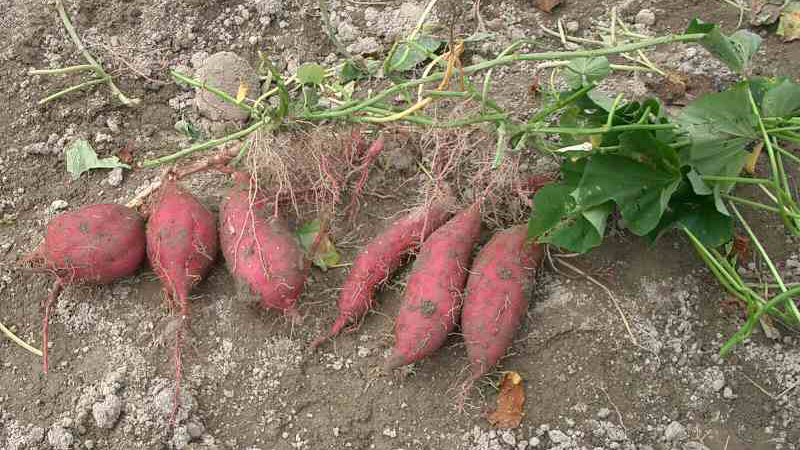
[[File:Ipomoea batatasL ja01.jpg|thumb|upright=1.7|Freshly dug [[sweet potato]] plants with tubers]] | |||
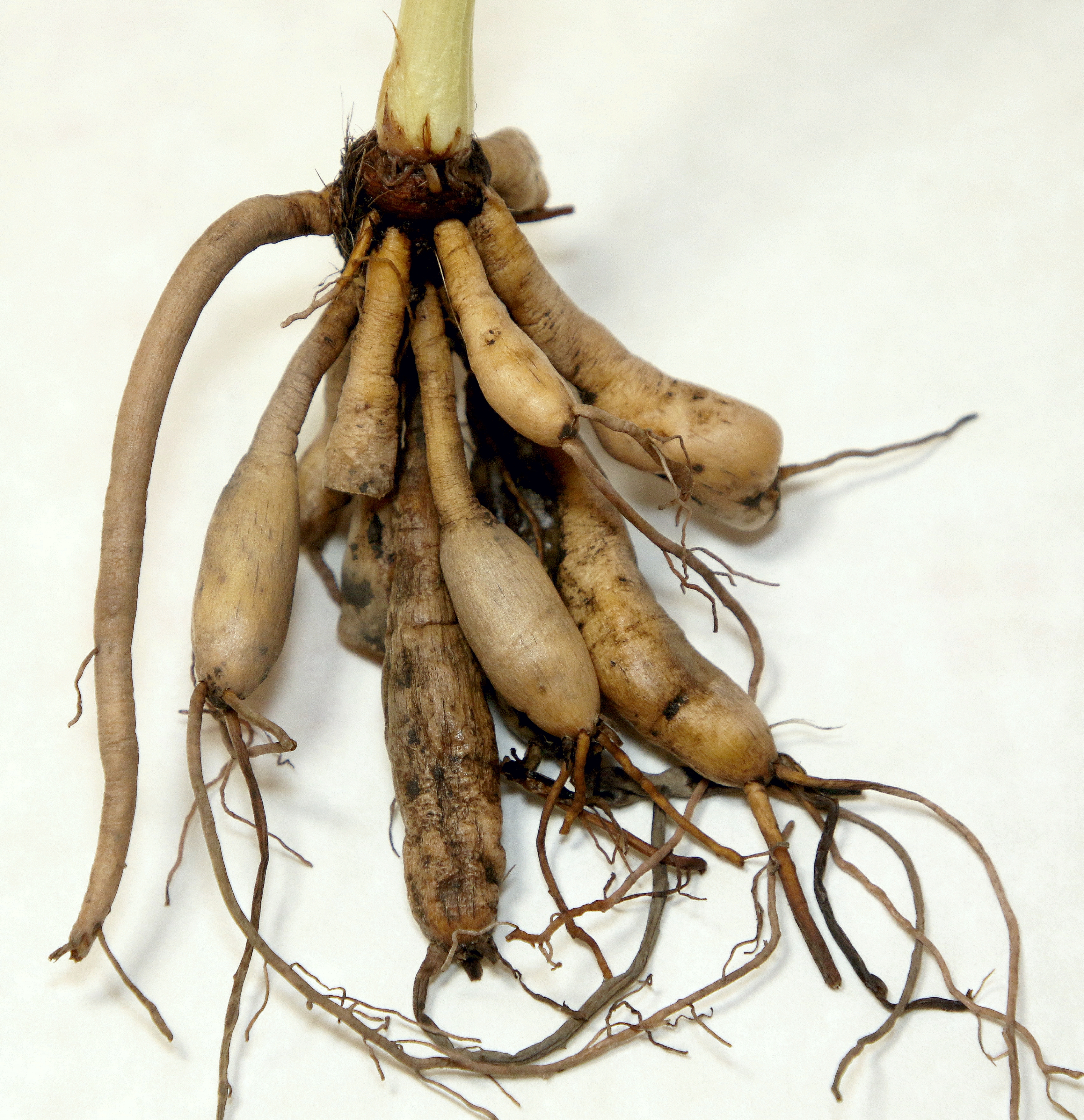
[[File:Hem Root.jpg|thumb|''[[Hemerocallis]]'' tuber roots]] | |||
A root tuber, tuberous root or storage root is a modified lateral [[root]], enlarged to function as a [[storage organ]]. The enlarged area of the tuber can be produced at the end or middle of a root or involve the entire root. It is thus different in origin, but similar in function and appearance, to a stem tuber. Plants with tuberous roots include the [[sweet potato]] (''Ipomoea batatas''), [[cassava]], [[dahlia]], and ''[[Sagittaria]]'' (arrowhead) species.{{cn|date=October 2023}} | |||
Root tubers are perennating organs, thickened roots that store nutrients over periods when the plant cannot actively grow, thus permitting survival from one year to the next. The massive enlargement of secondary roots typically represented by sweet potato have the internal and external cell and tissue structures of a normal root; they produce [[adventitious roots]] and stems, which again produce adventitious roots.<ref name=Davis1994>{{Citation| editor1-last = Davis | editor1-first = Tim D.| editor2-last = Haissig | editor2-first = Bruce E.| year = 1994| title = Biology of Adventitious Root Formation| pages = 17 | isbn = 978-0-306-44627-6| publisher = Plenum Press| location = New York}}</ref> | |||
In root tubers, there are no nodes and internodes or reduced leaves. The proximal end of the tuber, which was attached to the old plant, has crown tissue that produces buds which grow into new stems and foliage.<ref name=Kyte1996>{{Citation | last1 = Kyte | first1 = Lydiane | last2 = Kleyn | first2 = John | year = 1996 | title = Plants from Test Tubes: An Introduction to Micropropagation | pages = 23–24 | isbn = 978-0-88192-361-2 | publisher = Timber Press | location = Portland, Or. }}</ref> The distal end of the tuber normally produces unmodified roots. In stem tubers the order is reversed, with the distal end producing stems. Tuberous roots are biennial in duration: the plant produces tubers the first year, and at the end of the growing season, the shoots often die, leaving the newly generated tubers; the next growing season, the tubers produce new shoots. As the shoots of the new plant grow, the stored reserves of the tuber are consumed in the production of new roots, stems, and reproductive organs; any remaining root tissue dies concurrently to the plant's regeneration of the next generation of tubers.{{cn|date=October 2023}} | |||
The | |||
''[[Hemerocallis fulva]]'' (orange daylily) and a number of [[daylily]] hybrids have large root tubers; ''H. fulva'' spreads by underground stolons<ref>{{eFloras|2|200027676|Hemerocallis fulva |last1=Chen |first1=Xinqi |first2=Junko |last2=Noguchi |volume=24 |access-date=27 April 2018 |url-status=live |archive-url=https://web.archive.org/web/20161114001709/http://www.efloras.org/florataxon.aspx?flora_id=2&taxon_id=200027676 |archive-date=14 November 2016 }}</ref> that end with a new fan that grows roots that produce thick tubers and then send out more stolons.<ref name=Mansfeld2001>{{Citation |last = Mansfeld | first = Rudolf |year = 2001 |title = Mansfeld's Encyclopedia of Agricultural and Horticultural Crops |pages = 2231 |isbn = 978-3-540-41017-1 |publisher = Springer | location = Berlin }}</ref><ref>http://sain.utk.edu/invasives/species32.shtml{{Dead link|date=January 2019 |bot=InternetArchiveBot |fix-attempted=yes }}</ref> | |||
Plants with root tubers | Plants with root tubers can be propagated from late summer to late winter by digging up the tubers and separating them, making sure that each piece has some crown tissue for replanting.{{cn|date=October 2023}} | ||
[[File:World Primary Crops Harvested Area By Commodity Group.svg|thumb|Roots and tubers are some of the most widely harvested crops in the world.]] | |||
Root tubers are a rich source of nutrients for humans and wild animals, e.g. those of ''[[Sagittaria]]'' plants which are eaten by [[Duck|ducks]].<ref name="Hammerson2004">{{Citation | last = Hammerson | first = Geoffrey A. | year = 2004 | title = Connecticut Wildlife: Biodiversity, Natural History, and Conservation | pages = 89 | isbn = 978-1-58465-369-1 | publisher = University Press of New England | location = Hanover }}</ref> | |||
== See also == | == See also == | ||
*[[Bulb]], modified stems with a short fleshy vertical stem, covered by thick fleshy modified leaves that enclose a bud for the next season's growth<ref name=Davis1979>{{Citation | last1 = Davis | first1 = P.H. | last2 = Cullen | first2 = J. | year = 1979 | title = The Identification of Flowering Plant Families, including a Key to those Native and Cultivated in North Temperate Regions | pages = 102 | isbn = 978-0-521-29359-4 | publisher = Cambridge University Press | location = Cambridge}}</ref> | * [[Bulb]], modified stems with a short fleshy vertical stem, covered by thick fleshy modified leaves that enclose a bud for the next season's growth<ref name=Davis1979>{{Citation | last1 = Davis | first1 = P.H. | last2 = Cullen | first2 = J. | year = 1979 | title = The Identification of Flowering Plant Families, including a Key to those Native and Cultivated in North Temperate Regions | pages = 102 | isbn = 978-0-521-29359-4 | publisher = Cambridge University Press | location = Cambridge}}</ref> | ||
*[[Caudex]], a form of [[aerial stem modification|stem modification]] similar in appearance to a tuber | * [[Caudex]], a form of [[aerial stem modification|stem modification]] similar in appearance to a tuber | ||
*[[Corm]], modified stems covered by dry scale-like leaves called a tunic, differing from true bulbs by having distinct nodes and internodes | * [[Corm]], modified stems covered by dry scale-like leaves called a tunic, differing from true bulbs by having distinct nodes and internodes | ||
*[[Taproot]], the largest, most central, and most dominant root of some plants | * [[Taproot]], the largest, most central, and most dominant root of some plants | ||
== References == | == References == | ||
| Line 57: | Line 62: | ||
* [http://www.foodsubs.com/Tubers.html Cook's Thesaurus] has a good inventory of tuber varieties. | * [http://www.foodsubs.com/Tubers.html Cook's Thesaurus] has a good inventory of tuber varieties. | ||
* [https://www.rtb.cgiar.org/ CGIAR Research Program on Roots, Tubers and Bananas] | * [https://www.rtb.cgiar.org/ CGIAR Research Program on Roots, Tubers and Bananas] | ||
{{Authority control}} | |||
[[Category:Plant morphology]] | [[Category:Plant morphology]] | ||
Latest revision as of 00:18, 21 March 2026
.jpg)
Tubers are a type of enlarged structure that plants use as storage organs for nutrients, derived from stems or roots. Tubers help plants perennate (survive winter or dry months), provide energy and nutrients, and are a means of asexual reproduction.[1]
Stem tubers manifest as thickened rhizomes (underground stems) or stolons (horizontal connections between organisms); examples include the potato and yam. The term root tuber describes modified lateral roots, as in sweet potato, cassava, and dahlia.
Terminology[edit | edit source]
The term originates from the Latin tuber, meaning 'lump, bump, or swelling'.[2]
Some writers limit the definition of tuber to structures derived from stems,[3] while others also apply the term to structures derived from roots.[4]
Stem tubers[edit | edit source]

A stem tuber forms from thickened rhizomes or stolons. The top sides of the tuber produce shoots that grow into typical stems and leaves and the undersides produce roots. They tend to form at the sides of the parent plant and are most often located near the soil surface. The underground tuber is normally a short-lived storage and regenerative organ developing from a shoot that branches off a mature plant. The offspring or new tubers are attached to a parent tuber or form at the end of a hypogeogenous (initiated below ground) rhizome. In the autumn the plant dies, except for the new offspring tubers, which have one dominant bud that in spring regrows a new shoot producing stems and leaves; in summer the tubers decay and new tubers begin to grow. Some plants also form smaller tubers or tubercules that act like seeds, producing small plants that resemble (in morphology and size) seedlings. Some stem tubers are long-lived, such as those of tuberous begonias, but many plants have tubers that survive only until the plants have fully leafed out, at which point the tuber is reduced to a shriveled-up husk.[citation needed]
Stem tubers generally start off as enlargements of the hypocotyl section of a seedling, but sometimes also include the first node or two of the epicotyl and the upper section of the root. The tuber has a vertical orientation, with one or a few vegetative buds on the top and fibrous roots produced on the bottom from a basal section. Typically the tuber has an oblong rounded shape.[citation needed]
Tuberous begonias, yams,[5][6] and cyclamens are commonly grown stem tubers. Mignonette vine (Anredera cordifolia) produces aerial stem tubers on 3.5-to-7.5-metre-tall (12 to 25 ft) vines; the tubers fall to the ground and grow. Plectranthus esculentus, of the mint family Lamiaceae, produces tuberous underground organs from the base of the stem, weighing up to 1.8 kg (3 lb 15 oz) per tuber, forming from axillary buds producing short stolons that grow into tubers.[7] Even though legumes are not commonly associated with forming stem tubers, Lathyrus tuberosus is an example native to Asia and Europe, where it was once grown as a crop.[8]
Potatoes[edit | edit source]

Potatoes are stem tubers – enlarged stolons thicken to develop into storage organs.[9][10][11] The tuber has all the parts of a normal stem, including nodes and internodes. The nodes are the eyes and each has a leaf scar. The nodes or eyes are arranged around the tuber in a spiral fashion beginning on the end opposite the attachment point to the stolon. The terminal bud is produced at the farthest point away from the stolon attachment and tubers, and thus show the same apical dominance as a normal stem. Internally, a tuber is filled with starch stored in enlarged parenchyma-like cells. The inside of a tuber has the typical cell structures of any stem, including a pith, vascular zones, and a cortex.[citation needed]
The tuber is produced in one growing season and used to perennate the plant and as a means of propagation. When fall comes, the above-ground structure of the plant dies, but the tubers survive underground over winter until spring, when they regenerate new shoots that use the stored food in the tuber to grow. As the main shoot develops from the tuber, the base of the shoot close to the tuber produces adventitious roots and lateral buds on the shoot. The shoot also produces stolons that are long etiolated stems. The stolon elongates during long days with the presence of high auxins levels that prevent root growth off of the stolon. Before new tuber formation begins, the stolon must be a certain age. The enzyme lipoxygenase makes a hormone, jasmonic acid, which is involved in the control of potato tuber development.[citation needed]
The stolons are easily recognized when potato plants are grown from seeds. As the plants grow, stolons are produced around the soil surface from the nodes. The tubers form close to the soil surface and sometimes even on top of the ground. When potatoes are cultivated, the tubers are cut into pieces and planted much deeper into the soil. Planting the pieces deeper creates more area for the plants to generate the tubers and their size increases. The pieces sprout shoots that grow to the surface. These shoots are rhizome-like and generate short stolons from the nodes while in the ground. When the shoots reach the soil surface, they produce roots and shoots that grow into the green plant.[citation needed]
Root tubers[edit | edit source]


A root tuber, tuberous root or storage root is a modified lateral root, enlarged to function as a storage organ. The enlarged area of the tuber can be produced at the end or middle of a root or involve the entire root. It is thus different in origin, but similar in function and appearance, to a stem tuber. Plants with tuberous roots include the sweet potato (Ipomoea batatas), cassava, dahlia, and Sagittaria (arrowhead) species.[citation needed]
Root tubers are perennating organs, thickened roots that store nutrients over periods when the plant cannot actively grow, thus permitting survival from one year to the next. The massive enlargement of secondary roots typically represented by sweet potato have the internal and external cell and tissue structures of a normal root; they produce adventitious roots and stems, which again produce adventitious roots.[12]
In root tubers, there are no nodes and internodes or reduced leaves. The proximal end of the tuber, which was attached to the old plant, has crown tissue that produces buds which grow into new stems and foliage.[13] The distal end of the tuber normally produces unmodified roots. In stem tubers the order is reversed, with the distal end producing stems. Tuberous roots are biennial in duration: the plant produces tubers the first year, and at the end of the growing season, the shoots often die, leaving the newly generated tubers; the next growing season, the tubers produce new shoots. As the shoots of the new plant grow, the stored reserves of the tuber are consumed in the production of new roots, stems, and reproductive organs; any remaining root tissue dies concurrently to the plant's regeneration of the next generation of tubers.[citation needed]
Hemerocallis fulva (orange daylily) and a number of daylily hybrids have large root tubers; H. fulva spreads by underground stolons[14] that end with a new fan that grows roots that produce thick tubers and then send out more stolons.[8][15]
Plants with root tubers can be propagated from late summer to late winter by digging up the tubers and separating them, making sure that each piece has some crown tissue for replanting.[citation needed]

Root tubers are a rich source of nutrients for humans and wild animals, e.g. those of Sagittaria plants which are eaten by ducks.[16]
See also[edit | edit source]
- Bulb, modified stems with a short fleshy vertical stem, covered by thick fleshy modified leaves that enclose a bud for the next season's growth[17]
- Caudex, a form of stem modification similar in appearance to a tuber
- Corm, modified stems covered by dry scale-like leaves called a tunic, differing from true bulbs by having distinct nodes and internodes
- Taproot, the largest, most central, and most dominant root of some plants
References[edit | edit source]
- ↑ Rooting Cuttings of Tropical Trees, London: Commonwealth Science Council, 1994, p. 11, ISBN 978-0-85092-394-0
- ↑ "Tuber". Online Etymology Dictionary. Archived from the original on 2016-02-15.
- ↑ Mauseth, James D. (2012), Botany: An Introduction to Plant Biology (5th ed.), Sudbury, MA: Jones and Bartlett Learning, ISBN 978-1-4496-6580-7, p. 672
- ↑ Beentje, Henk (2010), The Kew Plant Glossary, Richmond, Surrey: Royal Botanic Gardens, Kew, ISBN 978-1-84246-422-9, p. 124
- ↑ Template:EFloras
- ↑ Martin, FW; Ortiz, Sonia (1963). "Origin and Anatomy of Tubers of Dioscorea Floribunda and D. Spiculiflora". Botanical Gazette. 124 (6): 416–421. doi:10.1086/336228. JSTOR 2473209. S2CID 84746878.
- ↑ J. Allemann; P.J. Robbertse; P.S. Hammes (20 June 2003). "Organographic and anatomical evidence that the edible storage organs of Plectranthus esculentus N.E.Br. (Lamiaceae) are stem tubers". Field Crops Research. 83 (1): 35–39. Bibcode:2003FCrRe..83...35A. doi:10.1016/S0378-4290(03)00054-6.
- ↑ 8.0 8.1 Mansfeld, Rudolf (2001), Mansfeld's Encyclopedia of Agricultural and Horticultural Crops, Berlin: Springer, p. 2231, ISBN 978-3-540-41017-1
- ↑ University of California, Berkeley. "Potato Genome Project". Archived from the original on 15 July 2010. Retrieved 17 July 2018.
- ↑ "Interrelationships of the number of initial sprouts, stems, stolons and tubers per potato plant" Journal Potato Research. Springer Netherlands ISSN 0014-3065 (Print) ISSN 1871-4528 (Online) Volume 33, Number 2 / June 1990
- ↑ "Introduction to Stems". Pennsylvania State University - Environmental Science. Monaco Educational Service. 2000. Archived from the original on 2005-04-13. Retrieved 2005-05-10.
- ↑ Davis, Tim D.; Haissig, Bruce E., eds. (1994), Biology of Adventitious Root Formation, New York: Plenum Press, p. 17, ISBN 978-0-306-44627-6
- ↑ Kyte, Lydiane; Kleyn, John (1996), Plants from Test Tubes: An Introduction to Micropropagation, Portland, Or.: Timber Press, pp. 23–24, ISBN 978-0-88192-361-2
- ↑ Template:EFloras
- ↑ http://sain.utk.edu/invasives/species32.shtml[permanent dead link]
- ↑ Hammerson, Geoffrey A. (2004), Connecticut Wildlife: Biodiversity, Natural History, and Conservation, Hanover: University Press of New England, p. 89, ISBN 978-1-58465-369-1
- ↑ Davis, P.H.; Cullen, J. (1979), The Identification of Flowering Plant Families, including a Key to those Native and Cultivated in North Temperate Regions, Cambridge: Cambridge University Press, p. 102, ISBN 978-0-521-29359-4
External links[edit | edit source]
- Cook's Thesaurus has a good inventory of tuber varieties.
- CGIAR Research Program on Roots, Tubers and Bananas