

>Amshpatten →References: temp add |
corrected content as per guidelines and fixed typos to improve readability |
||
| Line 4: | Line 4: | ||
It is thought that the three-arched hill symbol was initiated during the [[Maurya Empire]] (3rd–2nd century BCE).<ref>"The crescented three- arched hill symbol, seems to have originally been adopted by Chandragupta Maurya." Malwa Through the Ages, from the Earliest Times to 1305 A.D, Kailash Chand Jain Motilal Banarsidass Publ., 1972 [https://books.google.com/books?id=_3O7q7cU7k0C&pg=PA145]</ref> Later, in coins from [[Taxila]] dated from 220 BCE, the three-arched symbol appears regularly, and from 185 BCE is regularly associated with the animal figures of the elephant and the lion.<ref>[https://www.cngcoins.com/Coin.aspx?CoinID=150982 CNG Coins]</ref> In contrast, the [[Nandipada]] is generally associated with the [[zebu]] bull.<ref>[https://www.cngcoins.com/Coin.aspx?CoinID=127009 CNG Coins]</ref> On coins of the [[Shunga Empire|Shunga period]], the three-arched hill can appear among a multitude of other symbols, such as the [[Nandipada]], the tree-in-railing, the elephant, or the empty cross.{{cn|date=June 2017}} | It is thought that the three-arched hill symbol was initiated during the [[Maurya Empire]] (3rd–2nd century BCE).<ref>"The crescented three- arched hill symbol, seems to have originally been adopted by Chandragupta Maurya." Malwa Through the Ages, from the Earliest Times to 1305 A.D, Kailash Chand Jain Motilal Banarsidass Publ., 1972 [https://books.google.com/books?id=_3O7q7cU7k0C&pg=PA145]</ref> Later, in coins from [[Taxila]] dated from 220 BCE, the three-arched symbol appears regularly, and from 185 BCE is regularly associated with the animal figures of the elephant and the lion.<ref>[https://www.cngcoins.com/Coin.aspx?CoinID=150982 CNG Coins]</ref> In contrast, the [[Nandipada]] is generally associated with the [[zebu]] bull.<ref>[https://www.cngcoins.com/Coin.aspx?CoinID=127009 CNG Coins]</ref> On coins of the [[Shunga Empire|Shunga period]], the three-arched hill can appear among a multitude of other symbols, such as the [[Nandipada]], the tree-in-railing, the elephant, or the empty cross.{{cn|date=June 2017}} | ||
The symbol is generally considered a representation of a [[Buddhist]] [[Chaitya | The symbol is generally considered a representation of a [[Buddhist]] [[Chaitya]]. It has also been argued that it was the imperial symbol of the Mauryas.<ref>Coin Splendour: A Journey Into the Past, Prasanna Rao Bandela, Abhinav Publications, 2003, p.28 [https://books.google.com/books?id=_mUg2BBJr7kC&pg=PA28]</ref> The symbol however, appears in many post-Mauryan contexts as seen with the coins of Taxila and the Shungas. | ||
==Gallery== | ==Gallery== | ||
Latest revision as of 03:09, 30 March 2023

The Arched-hill symbol is a symbol on ancient Coinage of India. There are some variations to the number of the hills depicted, or the symbol surmounting the hill, such as a crescent or a star.
It is thought that the three-arched hill symbol was initiated during the Maurya Empire (3rd–2nd century BCE).[1] Later, in coins from Taxila dated from 220 BCE, the three-arched symbol appears regularly, and from 185 BCE is regularly associated with the animal figures of the elephant and the lion.[2] In contrast, the Nandipada is generally associated with the zebu bull.[3] On coins of the Shunga period, the three-arched hill can appear among a multitude of other symbols, such as the Nandipada, the tree-in-railing, the elephant, or the empty cross.[citation needed]
The symbol is generally considered a representation of a Buddhist Chaitya. It has also been argued that it was the imperial symbol of the Mauryas.[4] The symbol however, appears in many post-Mauryan contexts as seen with the coins of Taxila and the Shungas.
Gallery[edit | edit source]
-
 A Sunga coin (150 BCE-100 CE) with three-arched hill (reverse, top left) among other symbols.
 -
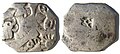 An Arched-hill symbol on the reverse of this Maurya Empire coin.
 -
 Single-die local coinage of Taxila. Column and arched-hill symbol (220-185 BCE).
 -
 Taxila coin (Post-Maurya, 185-160 BCE).
 -
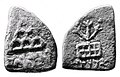 A six-arched hill symbol with star on top, with tree-in-railing on a coin of Indo-Greek king Agathocles.
 -
 A six-arched hill symbol on Pope John Paul I coat of arms. Fairly common in other coats of arms in Italy.


._Circa_220-185_BC_Column_and_Hill.jpg)


See also[edit | edit source]
References[edit | edit source]
- ↑ "The crescented three- arched hill symbol, seems to have originally been adopted by Chandragupta Maurya." Malwa Through the Ages, from the Earliest Times to 1305 A.D, Kailash Chand Jain Motilal Banarsidass Publ., 1972 [1]
- ↑ CNG Coins
- ↑ CNG Coins
- ↑ Coin Splendour: A Journey Into the Past, Prasanna Rao Bandela, Abhinav Publications, 2003, p.28 [2]