




>Renata3 |
m expanded content |
||
| Line 1: | Line 1: | ||
{{Short description|King of the Mallabhum}} | |||
{{Use dmy dates|date=June 2024}} | |||
{{Use Indian English|date=June 2024}} | |||
{{Infobox royalty | {{Infobox royalty | ||
|name =Raghunath Singha Dev | |name =Raghunath Singha Dev | ||
| Line 5: | Line 8: | ||
|succession =51st king of the [[Mallabhum]] | |succession =51st king of the [[Mallabhum]] | ||
|coronation = | |coronation = | ||
|reign = | |reign =1626–1656 CE. | ||
|predecessor =[[Dhari Hambir Malla Dev]] | |predecessor =[[Dhari Hambir Malla Dev]] | ||
|successor =[[Bir Singha Dev]] | |successor =[[Bir Singha Dev]] | ||
| Line 13: | Line 16: | ||
|religion = [[Hinduism]] | |religion = [[Hinduism]] | ||
|position = | |position = | ||
|father =[[ | |father =[[Hambir Malla Dev]] | ||
|mother = | |mother = | ||
}} | }} | ||
'''Raghunath Malla Dev''' also known as '''Raghunath Singha Dev''', was the fifty-first king of the [[Mallabhum]] (now in the Indian state of [[West Bengal]]). He ruled from 1626 to 1656 CE.{{Sfn|Dasgupta|Biswas|Mallik|2009|pp=25 & 37}}<ref name=Malabhum>Malabhum, Bishnupur-Chandra, Manoranjan; 2004; Kolkata. Deys Publishing {{ISBN|8129500442}}</ref><ref>{{cite book|last1=Mallik|first1=Abhaya Pada|title=History of Bishnupur-Raj: An Ancient Kingdom of West Bengal|date=1921|publisher=Calcutta|pages=130|edition=the University of Michigan|url=https://books.google.com/books?id=QF4dAAAAMAAJ| | '''Raghunath Malla Dev''', also known as '''Raghunath Singha Dev''', was the fifty-first king of the [[Mallabhum]] (now in the Indian state of [[West Bengal]]). He ruled from 1626 to 1656 CE.{{Sfn|Dasgupta|Biswas|Mallik|2009|pp=25 & 37}}<ref name=Malabhum>Malabhum, Bishnupur-Chandra, Manoranjan; 2004; Kolkata. Deys Publishing {{ISBN|8129500442}}</ref><ref>{{cite book|last1=Mallik|first1=Abhaya Pada|title=History of Bishnupur-Raj: An Ancient Kingdom of West Bengal|date=1921|publisher=Calcutta|pages=130|edition=the University of Michigan|url=https://books.google.com/books?id=QF4dAAAAMAAJ|access-date=11 March 2016}}</ref> | ||
==Personal life== | ==Personal life== | ||
Because Kalaram, son of [[Dhari Hambir Malla Dev]], was unfit to become a king due to his physical inability, his mother, who was Dhari Hambir's wife, enthroned her husband's young brother Raghunath Malla Dev, who later got the title of Singha.{{Sfn|Dasgupta|Biswas|Mallik|2009|pp=25 & 37}} | Because Kalaram, son of [[Dhari Hambir Malla Dev]], was unfit to become a king due to his physical inability, his mother, who was Dhari Hambir's wife, enthroned her husband's young brother Raghunath Malla Dev, who later got the title of Singha.{{Sfn|Dasgupta|Biswas|Mallik|2009|pp=25 & 37}} | ||
During his regime a very friendly relationship with the [[Mughals]] meant that Bishnupur operated as a free and separate state. Public works that were completed during his reign include five sayars (large size ponds) and [[temples]] such as [[Jor Bangla]], Shyam Rai, Kalachand and stone Chariot were built.{{Sfn|Dasgupta|Biswas|Mallik|2009|pp=25 & 37}} | During his regime a very friendly relationship with the [[Mughals]] meant that Bishnupur operated as a free and separate state. Public works that were completed during his reign include five sayars (large size ponds) and [[temples]] such as [[Jor Bangla Temple|Jor Bangla]], Shyam Rai, Kalachand and stone Chariot were built.{{Sfn|Dasgupta|Biswas|Mallik|2009|pp=25 & 37}} | ||
===Singha title=== | ===Singha title=== | ||
The king's family got the title of Singha as an honour due to the strength of Raghunath.{{Sfn|Dasgupta|Biswas|Mallik|2009|pp=25 & 37}} | The king's family got the title of Singha (pronunciation: sing-ho)<ref>{{cite web |title=BHID: Bishnupur Heritage Image Database |url=https://www.isical.ac.in/~bsnpr/kalachand.php |website=Indian Statistical Institute (ISI)}}</ref> as an honour due to the strength of Raghunath.{{Sfn|Dasgupta|Biswas|Mallik|2009|pp=25 & 37}} | ||
==Mallabhum temples== | ==Mallabhum temples== | ||
===Jor-Bangla temple=== | ===Jor-Bangla temple=== | ||
Bishnupur | {{Main|Jor Bangla Temple}} | ||
Bishnupur Jor-Bangla temple, built 1655 by King Raghunath Singha Dev. It is richly ornamented with [[terracotta]] carvings. The roof has the classic chala style of Bengal architecture.{{Sfn|Dasgupta|Biswas|Mallik|2009|p=37}}<ref name="Bishnupur Sub-division">{{cite web|title= Bishnupur Sub-division |url=http://bankura.gov.in/Tourism/Bishnupur.htm#Pancha_Ratna_Temple|website=bankura.gov.in|accessdate=}}</ref> | |||
{|class="wikitable" align="center" width="30%" style="font-size:90%; border:2px solid orange;" | {|class="wikitable" align="center" width="30%" style="font-size:90%; border:2px solid orange;" | ||
| Line 45: | Line 49: | ||
===Pancha ratna temple=== | ===Pancha ratna temple=== | ||
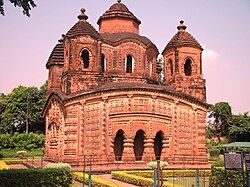
The Pancha Ratna temple (five towers) was built by King Raghunath Singha in 1643. It stands on a low square plinth and consists of an ambulatory pathway with a porch opened by three arches on the four sides of the temple. The central [[sikhara]] is octagonal, while the other four are square. The walls are richly decorated with terracotta carvings featuring aspects of Lord | The Pancha Ratna temple (five towers) was built by King Raghunath Singha in 1643. It stands on a low square plinth and consists of an ambulatory pathway with a porch opened by three arches on the four sides of the temple. The central [[sikhara]] is octagonal, while the other four are square. The walls are richly decorated with terracotta carvings featuring aspects of Lord Krishna's life.<ref name="Bishnupur Sub-division"/> | ||
{|class="wikitable" align="center" width="30%" style="font-size:90%; border:2px solid orange;" | {|class="wikitable" align="center" width="30%" style="font-size:90%; border:2px solid orange;" | ||
|+ Pancha Ratna Temple | |+ Pancha Ratna Temple | ||
| Line 81: | Line 85: | ||
Image:Inscription on Shyamrai Temple Bishnupur.JPG| | Image:Inscription on Shyamrai Temple Bishnupur.JPG| | ||
</gallery> | </gallery> | ||
==In popular culture== | |||
[[File:The Vishnupur Gharana - Fading Footfalls in Gharana Fort - Documentary.webm|thumb|thumbtime=36:53|right|The dhrupad gharana of Bishnupur kingdom]] | |||
===Film=== | |||
* [[Eastern Zonal Cultural Centre]], Kolkata, brings you the Fourth Documentary from 𝗢𝗻𝗹𝗶𝗻𝗲 𝗔𝗿𝗰𝗵𝗶𝘃𝗲 [[𝗗𝗼𝗰𝘂𝗺𝗲𝗻𝘁𝗮𝗿𝘆 𝗙𝗶𝗹𝗺 𝗙𝗲𝘀𝘁𝗶𝘃𝗮𝗹]]. The video is a presentation on the dhrupad gharana of [[Bishnupur kingdom]]. | |||
==See also== | ==See also== | ||
| Line 93: | Line 102: | ||
{{Mallabhum}} | {{Mallabhum}} | ||
[[Category:Kings of Mallabhum]] | [[Category:Kings of Mallabhum]] | ||
[[Category:17th-century Indian monarchs]] | [[Category:17th-century Indian monarchs]] | ||
[[Category:Mallabhum temples]] | [[Category:Mallabhum temples]] | ||
Latest revision as of 18:34, 30 January 2025
| Raghunath Singha Dev | |
|---|---|
 Terracotta work on the Pancha Ratna temple dedicated to Shyamrai (Krishna) built by Raghunath Singha Dev in Bishnupur in 1643 | |
| 51st king of the Mallabhum | |
| Reign | 1626–1656 CE. |
| Predecessor | Dhari Hambir Malla Dev |
| Successor | Bir Singha Dev |
| Father | Hambir Malla Dev |
| Religion | Hinduism |
Raghunath Malla Dev, also known as Raghunath Singha Dev, was the fifty-first king of the Mallabhum (now in the Indian state of West Bengal). He ruled from 1626 to 1656 CE.[1][2][3]
Personal life[edit | edit source]
Because Kalaram, son of Dhari Hambir Malla Dev, was unfit to become a king due to his physical inability, his mother, who was Dhari Hambir's wife, enthroned her husband's young brother Raghunath Malla Dev, who later got the title of Singha.[1]
During his regime a very friendly relationship with the Mughals meant that Bishnupur operated as a free and separate state. Public works that were completed during his reign include five sayars (large size ponds) and temples such as Jor Bangla, Shyam Rai, Kalachand and stone Chariot were built.[1]
Singha title[edit | edit source]
The king's family got the title of Singha (pronunciation: sing-ho)[4] as an honour due to the strength of Raghunath.[1]
Mallabhum temples[edit | edit source]
Jor-Bangla temple[edit | edit source]
Bishnupur Jor-Bangla temple, built 1655 by King Raghunath Singha Dev. It is richly ornamented with terracotta carvings. The roof has the classic chala style of Bengal architecture.[5][6]

|

|

|
Pancha ratna temple[edit | edit source]
The Pancha Ratna temple (five towers) was built by King Raghunath Singha in 1643. It stands on a low square plinth and consists of an ambulatory pathway with a porch opened by three arches on the four sides of the temple. The central sikhara is octagonal, while the other four are square. The walls are richly decorated with terracotta carvings featuring aspects of Lord Krishna's life.[6]

|
_Arnab_Dutta_2011.JPG)
|

|
| Pancha Ratna Temple (Deity Shyam Ray (Krishna)) | One of the five Shikhars of Pancha Ratna Temple | Terracotta work on Pancha Ratna Temple |
Malleshwar temple[edit | edit source]
This is another temple of laterite stone, built by Raghunath Singha Dev in 1622. It is a deul type of temple and the earliest temple of Lord Siva at Bishnupur. It is square in plan, its height is 10.7 m, and each side is 6.9 m. Its original sikhara was ekratna and have rekh deul style. An octagonal tower later replaced it. This monument is declared to be of national importance under the ancient monuments and archaeological sites and remains act 1958.[7]
Shyam Rai temple[edit | edit source]


Built in 1643 by king Raghunath, Shyam Rai temple has the most intricate sculptural details amongst all the Bishnupuur temples. Shyam Rai Temple is an example of the Pancha Ratna (meaning five gems) architecture. The gems in this temple are the four small towers and one main tower that build the Temple. The architecture of this Temple is unique in its own way and is one of the highest prioritized monuments of the Archaeological Survey of India (ASI).[8]
Kalachand temple[edit | edit source]
_Arnab_Dutta_2011.JPG)
The Kalachand temple built in 1656 by King Raghunath Singha in ekratna style (one tower) with laterite stone.[9]
Terracotta art in Bishnupur[edit | edit source]


In popular culture[edit | edit source]
Film[edit | edit source]
- Eastern Zonal Cultural Centre, Kolkata, brings you the Fourth Documentary from 𝗢𝗻𝗹𝗶𝗻𝗲 𝗔𝗿𝗰𝗵𝗶𝘃𝗲 𝗗𝗼𝗰𝘂𝗺𝗲𝗻𝘁𝗮𝗿𝘆 𝗙𝗶𝗹𝗺 𝗙𝗲𝘀𝘁𝗶𝘃𝗮𝗹. The video is a presentation on the dhrupad gharana of Bishnupur kingdom.
See also[edit | edit source]
References[edit | edit source]
- ↑ 1.0 1.1 1.2 1.3 Dasgupta, Biswas & Mallik 2009, pp. 25 & 37.
- ↑ Malabhum, Bishnupur-Chandra, Manoranjan; 2004; Kolkata. Deys Publishing ISBN 8129500442
- ↑ Mallik, Abhaya Pada (1921). History of Bishnupur-Raj: An Ancient Kingdom of West Bengal (the University of Michigan ed.). Calcutta. p. 130. Retrieved 11 March 2016.
- ↑ "BHID: Bishnupur Heritage Image Database". Indian Statistical Institute (ISI).
- ↑ Dasgupta, Biswas & Mallik 2009, p. 37.
- ↑ 6.0 6.1 "Bishnupur Sub-division". bankura.gov.in.
- ↑ Dasgupta, Biswas & Mallik 2009, p. 50.
- ↑ "Take a drive back to the 7th century into Malla Dynasty along with serenade nature" (PDF). bankura.gov.in. Government of West Bengal. p. 5. Retrieved 2 February 2016.
- ↑ "Bishnupur Sub-division". bankura.gov.in.
Sources[edit | edit source]
- Dasgupta, Gautam Kumar; Biswas, Samira; Mallik, Rabiranjan (2009), Heritage Tourism: An Anthropological Journey to Bishnupur, A Mittal Publication, p. 20, ISBN 978-8183242943