



No edit summary Tags: Mobile edit Mobile web edit Advanced mobile edit |
Lorrine11I (talk | contribs) basic improve layout for consistency |
||
| Line 1: | Line 1: | ||
{{Use dmy dates|date=September 2020}} | {{Use dmy dates|date=September 2020}} | ||
{{Short description|Gupta | {{Short description|Maharajadhiraja of the Gupta Empire from 455 to 467}} | ||
{{EngvarB|date=October 2019}} | {{EngvarB|date=October 2019}} | ||
{{Infobox royalty | {{Infobox royalty | ||
| succession = | | succession = [[List of Gupta emperors|Gupta emperor]] | ||
| image= [[File:Skandagupta Circa 455-480 CE.jpg|300px]] | | title = [[Chakravartin]]<ref>{{cite book | last1=Kumar | first1=Sanjeev | title=Treasures of the Gupta Empire: A Numismatic History of the Golden Age of India | date=18 July 2024 | publisher=Archaeopress Publishing | isbn=978-1-80327-796-7 | url=https://books.google.com/books?id=mN0UEQAAQBAJ&dq=gupta+empire&pg=PA6 }}</ref> <br> [[Vikramaditya]]<br> Kramaditya | ||
| caption =Gold coin of Skandagupta, depicting himself on the obverse, [[Lakshmi]] on the reverse. The name [[File:Gupta ashoka sk.jpg|12px]][[File:Gupta allahabad nd.jpg|12px]] ''Skan-da'' appears vertically under the left arm of the | | image = [[File:Skandagupta Circa 455-480 CE.jpg|300px]] | ||
| reign = {{circa|455|467 | | caption = Gold coin of Skandagupta, depicting himself on the obverse, [[Lakshmi]] on the reverse. The name [[File:Gupta ashoka sk.jpg|12px]][[File:Gupta allahabad nd.jpg|12px]] ''Skan-da'' appears vertically under the left arm of the emperor. | ||
| religion = [[Hinduism]]<ref>"For the temporary reprieve from the Huns won by Skandagupta was the final phase of Indian classicism . The king himself worshipped Hindu gods and goddesses, then returning to the fore, but he did not neglect other beliefs such as Jainism and Buddhism." in {{cite book |last1=Cotterell |first1=Arthur |title=The Pimlico Dictionary Of Classical Civilizations |date=30 June 2011 |publisher=Random House |isbn=978-1-4464-6672-8 |page=367 |url=https://books.google.com/books?id=3zy_zJdaSSIC&pg=PT367 |language=en}} and {{cite book |last1=Cotterell |first1=Arthur |title=From Aristotle to Zoroaster: An A to Z Companion to the Classical World |year=1998 |publisher=Free Press |isbn=978-0-684-85596-7 |page=173 |url=https://books.google.com/books?id=eRxmAAAAMAAJ |language=en}}</ref> | | reign = {{circa|455|467}} | ||
| religion = [[Hinduism]]<ref>"For the temporary reprieve from the Huns won by Skandagupta was the final phase of Indian classicism . The king himself worshipped Hindu gods and goddesses, then returning to the fore, but he did not neglect other beliefs such as Jainism and Buddhism." in {{cite book |last1=Cotterell |first1=Arthur |title=The Pimlico Dictionary Of Classical Civilizations |date=30 June 2011 |publisher=Random House |isbn=978-1-4464-6672-8 |page=367 |url=https://books.google.com/books?id=3zy_zJdaSSIC&pg=PT367 |language=en}} and {{cite book |last1=Cotterell |first1=Arthur |title=From Aristotle to Zoroaster: An A to Z Companion to the Classical World |year=1998 |publisher=Free Press |isbn=978-0-684-85596-7 |page=173 |url=https://books.google.com/books?id=eRxmAAAAMAAJ |language=en}}</ref> | |||
| predecessor = [[Kumaragupta I]] | |||
| predecessor = [[Kumaragupta I]] | | successor = [[Purugupta]] | ||
| successor =[[Purugupta]] | | dynasty = [[Gupta Empire|Gupta]] | ||
| father = [[Kumaragupta I]] | |||
| mother = Unknown | |||
| dynasty = [[Gupta Empire|Gupta]] | | death_date = 467 CE | ||
| father =[[Kumaragupta I]] | |||
| mother = | |||
| death_date = | |||
}} | }} | ||
{{Location map+ | {{Location map+ | ||
| Line 40: | Line 32: | ||
{{location map~ |South Asia |lat=26|N |long=76|E |label=[[Gupta Empire|'''{{center|GUPTA<br/>EMPIRE}}''']] |position=right |label_size=70 |mark=1000x1.png|marksize=0}} | {{location map~ |South Asia |lat=26|N |long=76|E |label=[[Gupta Empire|'''{{center|GUPTA<br/>EMPIRE}}''']] |position=right |label_size=70 |mark=1000x1.png|marksize=0}} | ||
}} | }} | ||
'''Skandagupta''' ( | '''Skandagupta''' (''Ska-nda-gu-pta'',<ref>{{cite book |last1=Allen |first1=John |title=Catalogue of the coins of the Gupta dynasties |date=1914 |page=[https://archive.org/details/in.gov.ignca.47214/page/n251 114] |url=https://archive.org/details/in.gov.ignca.47214}}</ref> r. {{Circa|455}}–467) was a [[Gupta Empire|Gupta Emperor]]. His [[Bhitari pillar inscription of Skandagupta|Bhitari pillar inscription]] suggests that he restored the Gupta power by defeating his enemies, who may have been rebels or foreign invaders. He repulsed an invasion by the [[Indo-Hephthalite]]s (known as [[Huna people|Hunas]] in India), probably the [[Kidarites]]. He seems to have maintained control of his inherited territory, and is generally considered the last of the great Gupta Emperors. The Gupta genealogy after him is unclear, but he was most probably succeeded by [[Purugupta]], who appears to have been his younger half-brother. | ||
== Early life == | == Early life == | ||
Skandagupta was a son of the Gupta emperor [[Kumaragupta I]].{{sfn|R. C. Majumdar|1981|p=69}} His mother may have been a junior queen or a concubine of Kumaragupta. This theory is based on the fact that Skandagputa's inscriptions mention the name of his father, but not of his mother.{{sfn|Hermann Kulke|Dietmar Rothermund|2004|p=96}} For example, Skandagupta's [[Bhitari pillar inscription of Skandagupta|Bhitari pillar inscription]] lists the chief queens (''mahadevis'') of his ancestors [[Chandragupta I]], [[Samudragupta]], and [[Chandragupta II]], but does not mention the chief queen of his father Kumaragupta.{{sfn|R. C. Majumdar|1981|p=71}}{{sfn|R. C. Majumdar|1962|pp= | Skandagupta was a son of the Gupta emperor [[Kumaragupta I]].{{sfn|R. C. Majumdar|1981|p=69}} His mother may have been a junior queen or a concubine of Kumaragupta. This theory is based on the fact that Skandagputa's inscriptions mention the name of his father, but not of his mother.{{sfn|Hermann Kulke|Dietmar Rothermund|2004|p=96}} For example, Skandagupta's [[Bhitari pillar inscription of Skandagupta|Bhitari pillar inscription]] lists the chief queens (''mahadevis'') of his ancestors [[Chandragupta I]], [[Samudragupta]], and [[Chandragupta II]], but does not mention the chief queen of his father Kumaragupta.{{sfn|R. C. Majumdar|1981|p=71}}{{sfn|R. C. Majumdar|1962|pp=17–28}} [[John Faithfull Fleet|J. F. Fleet]] read a line of the Bhitari inscription to state that Skandagupta was "raised to Aryan status by the panegyrics of bards". Based on this, [[Arthur Llewellyn Basham|A. L. Basham]] theorized that his mother was from a low-caste [[Shudra]] background.{{sfn|Jagannath Agrawal|1968|p=325}} | ||
Others, such as [[Dasharatha Sharma]] have criticized this theory, pointing out that the Bhitari inscription clearly suggests that Skandagupta's mother held a very exalted status in the eyes of her son.{{sfn|Jagannath Agrawal|1968|p=325}} The inscription states that after restoring the fallen fortunes of his family by defeating his enemies, he visited his mother just like the legendary hero [[Krishna]] had visited his mother [[Devaki]].{{sfn|R. C. Majumdar|1981|p=69}} Jagannath Agrawal theorizes that the composer of the inscription deliberately departed from convention and devoted a line to the king's mother: this was not because of the inferior status of the mother.{{sfn|Jagannath Agrawal|1968|p=326}} Agrawal disputes Fleet's reading of the "Aryan status" line, providing an alternative reading: "whom nobility causes to blush by reason of the narrations of his exploits by means of songs and eulogies". This line seems to be inspired from a verse in [[Kalidasa]]'s ''[[Raghuvaṃśa]]''. Agrawal further argues that the Bhitari inscription is a ''[[prashasti]]'' aimed at glorifying the king, and its composer would not have made a derogatory insinuation about the low status of the king's mother.{{sfn|Jagannath Agrawal|1968|p=326}} | Others, such as [[Dasharatha Sharma]] have criticized this theory, pointing out that the Bhitari inscription clearly suggests that Skandagupta's mother held a very exalted status in the eyes of her son.{{sfn|Jagannath Agrawal|1968|p=325}} The inscription states that after restoring the fallen fortunes of his family by defeating his enemies, he visited his mother just like the legendary hero [[Krishna]] had visited his mother [[Devaki]].{{sfn|R. C. Majumdar|1981|p=69}} Jagannath Agrawal theorizes that the composer of the inscription deliberately departed from convention and devoted a line to the king's mother: this was not because of the inferior status of the mother.{{sfn|Jagannath Agrawal|1968|p=326}} Agrawal disputes Fleet's reading of the "Aryan status" line, providing an alternative reading: "whom nobility causes to blush by reason of the narrations of his exploits by means of songs and eulogies". This line seems to be inspired from a verse in [[Kalidasa]]'s ''[[Raghuvaṃśa]]''. Agrawal further argues that the Bhitari inscription is a ''[[prashasti]]'' aimed at glorifying the king, and its composer would not have made a derogatory insinuation about the low status of the king's mother.{{sfn|Jagannath Agrawal|1968|p=326}} According to historian Jappen Oberoi, Skandagupta's mother was definitely a queen, if not the chief queen, and that makes Skandagupta a legitimate son of Kumaragupta I.<ref>{{cite book |author=Jappen Oberoi |title=Cometh the Hour, Cometh the Man: The Saga of Skandagupta |publisher=Manak |location=New Delhi/Michigan |year=2024 |isbn=978-93-91897-69-7}}{{pn|date=February 2025}}</ref> | ||
Based on the inscription, some scholars have theorised that Devaki was the name of his mother. However, according to historian [[R. C. Majumdar]], it is more likely that the description aims to highlight the degraded position of his mother just like that of the legendary Devaki, before Skandagupta restored her to a position of prestige and power, just like Krishna did for Devaki.{{sfn|R. C. Majumdar|1981|p=69}} | Based on the inscription, some scholars have theorised that Devaki was the name of his mother. However, according to historian [[R. C. Majumdar]], it is more likely that the description aims to highlight the degraded position of his mother just like that of the legendary Devaki, before Skandagupta restored her to a position of prestige and power, just like Krishna did for Devaki.{{sfn|R. C. Majumdar|1981|p=69}} | ||
== Ascension to the throne == | == Ascension to the throne == | ||
{{Main|Gupta War of Succession}} | |||
{{multiple image|border=infobox|perrow=2/2/2|total_width=400 | {{multiple image|border=infobox|perrow=2/2/2|total_width=400 | ||
| align = right | | align = right | ||
| Line 64: | Line 57: | ||
According to one theory, these enemies invaded the Gupta empire during the last years of Kumaragupta's reign, or shortly after his death, and Skandagupta defeated them. According to another theory, the conflict referred to in the Bhitari inscription resulted from a disputed succession to the throne. This theory is based on the following points:{{sfn|R. C. Majumdar|1981|p=70}} | According to one theory, these enemies invaded the Gupta empire during the last years of Kumaragupta's reign, or shortly after his death, and Skandagupta defeated them. According to another theory, the conflict referred to in the Bhitari inscription resulted from a disputed succession to the throne. This theory is based on the following points:{{sfn|R. C. Majumdar|1981|p=70}} | ||
{{multiple image|border=infobox|perrow=1|total_width=250 | {{multiple image | ||
| align | | border = infobox | ||
| direction =vertical | | perrow = 1 | ||
| header=Junagadh rock inscription of Skandagupta | | total_width = 250 | ||
| image1 | | align = left | ||
| image2 | | direction = vertical | ||
| footer=The [[Junagadh]] rock in [[Girnar|Girnar mountain]] contains an inscription of Skandagupta, besides those of the earlier kings [[Ashoka]] and [[Rudradaman I]].<ref>[http://projectsouthasia.sdstate.edu/Docs/HISTORY/PRIMARYDOCS/EPIGRAPHY/JunagadhRockInscription.htm "Junagadh Rock Inscription of Rudradaman", ''Project South Asia''.] {{webarchive|url=https://web.archive.org/web/20090223182107/http://projectsouthasia.sdstate.edu/Docs/HISTORY/PRIMARYDOCS/EPIGRAPHY/JunagadhRockInscription.htm|date=23 February 2009 }}</ref> | | header = Junagadh rock inscription of Skandagupta | ||
| image1 = Ashoka Rock Edict at Junagadh.jpg | |||
| image2 = Junagadh rock inscription of Skandagupta.png | |||
| footer = The [[Junagadh]] rock in [[Girnar|Girnar mountain]] contains an inscription of Skandagupta, besides those of the earlier kings [[Ashoka]] and [[Rudradaman I]].<ref>[http://projectsouthasia.sdstate.edu/Docs/HISTORY/PRIMARYDOCS/EPIGRAPHY/JunagadhRockInscription.htm "Junagadh Rock Inscription of Rudradaman", ''Project South Asia''.] {{webarchive|url=https://web.archive.org/web/20090223182107/http://projectsouthasia.sdstate.edu/Docs/HISTORY/PRIMARYDOCS/EPIGRAPHY/JunagadhRockInscription.htm|date=23 February 2009 }}</ref> | |||
}} | }} | ||
* The Junagadh inscription states that after his father's death, Skandagupta became "the ruler of the earth" by his own prowess.{{sfn|R. C. Majumdar|1981|p=70}} This suggests that Skandagupta acquired the throne using force.{{sfn|R. C. Majumdar|1981|p=71}} | * The Junagadh inscription states that after his father's death, Skandagupta became "the ruler of the earth" by his own prowess.{{sfn|R. C. Majumdar|1981|p=70}} This suggests that Skandagupta acquired the throne using force.{{sfn|R. C. Majumdar|1981|p=71}} | ||
* His mother | * His mother was probably a junior wife of Kumaragupta rather than the chief queen (see [[#Early life|Early life]] section above), and therefore, his claim to the throne was not legitimate.{{sfn|R. C. Majumdar|1981|p=71}}{{sfn|R. C. Majumdar|1962|pp=17–28}} | ||
* The Junagadh inscription states that [[Lakshmi]], the goddess of fortune, chose Skandagupta as her husband after rejecting all other "sons of kings".{{sfn|D. K. Ganguly|1987|p=79}}{{sfn|R. C. Majumdar|1981|p=70}} Some coins issued by Skandagupta depict a woman offering him an uncertain object, probably a [[varmala|garland]] or a ring. Assuming this woman is Lakshmi, the depiction seems to be a visual representation of the statement made in the inscription.{{sfn|R. C. Majumdar|1981|pp= | * The Junagadh inscription states that [[Lakshmi]], the goddess of fortune, chose Skandagupta as her husband after rejecting all other "sons of kings".{{sfn|D. K. Ganguly|1987|p=79}}{{sfn|R. C. Majumdar|1981|p=70}} Some coins issued by Skandagupta depict a woman offering him an uncertain object, probably a [[varmala|garland]] or a ring. Assuming this woman is Lakshmi, the depiction seems to be a visual representation of the statement made in the inscription.{{sfn|R. C. Majumdar|1981|pp=70–71}} (Some scholars identify the woman as a queen rather than Lakshmi).{{sfn|D. K. Ganguly|1987|p=79}} | ||
* The Bhitari inscription makes three mentions of the fallen fortunes of the Gupta family (''kula'' or ''vamsha''). The mention of ''family'', rather than the ''empire'', may be a reference to the disputed succession to the throne. The reading "Yudhyamitras", rather than "Pushyamitras", may be correct, and the enemies referred to in the inscription may be rival claimants to the throne.{{sfn|R. C. Majumdar|1981|pp= | * The Bhitari inscription makes three mentions of the fallen fortunes of the Gupta family (''kula'' or ''vamsha''). The mention of ''family'', rather than the ''empire'', may be a reference to the disputed succession to the throne. The reading "Yudhyamitras", rather than "Pushyamitras", may be correct, and the enemies referred to in the inscription may be rival claimants to the throne.{{sfn|R. C. Majumdar|1981|pp=70–71}} | ||
* Various historical records suggest that multiple people in the Gupta empire assumed sovereign status after Kumaragupta's death. These people include Kumaragupta's brother [[Govindagupta]], his relative Ghatotkacha-gupta, and Prakashaditya (who is known from some gold coins). These people may have been rivals of Skandagupta.{{sfn|R. C. Majumdar|1981|p=71}} | * Various historical records suggest that multiple people in the Gupta empire assumed sovereign status after Kumaragupta's death. These people include Kumaragupta's brother [[Govindagupta]], his relative Ghatotkacha-gupta, and Prakashaditya (who is known from some gold coins). These people may have been rivals of Skandagupta.{{sfn|R. C. Majumdar|1981|p=71}} | ||
| Line 81: | Line 78: | ||
== Conflict with the Hunas == | == Conflict with the Hunas == | ||
{{See also|Gupta–Hunnic Wars}} | |||
{{See also| Gupta-Kidarite Conflict}} | |||
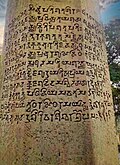
[[File:Kakandi Script.jpg|thumb| | [[File:Kakandi Script.jpg|thumb|Madra inscription on the [[Kahaum pillar]]]] | ||
During Skandagupta's period, the [[Indo-Hephthalites]] (known as the White Huns or [[Huna people|Hunas]]) invaded India from the northwest, advancing as far as the [[Indus River]].{{sfn|R. C. Majumdar|1981|p=73}} | During Skandagupta's period, the [[Indo-Hephthalites]] (known as the White Huns or [[Huna people|Hunas]]) invaded India from the northwest, advancing as far as the [[Indus River]].{{sfn|R. C. Majumdar|1981|p=73}} | ||
| Line 90: | Line 87: | ||
{{quote|(Skandagupta), "by whose two arms the earth was shaken, when he, the creator (of a disturbance like that) of a terrible whirlpool, joined in close conflict with the [[Huna people|Hûnas]]; . . . . . . among enemies . . . . . . arrows . . . . . . . . . . . . proclaimed . . . . . . . . . . . . just as if it were the roaring of (the river) [[Ganges|Ganga]], making itself noticed in (their) ears." | [[Bhitari pillar inscription of Skandagupta]] Line 15}} | {{quote|(Skandagupta), "by whose two arms the earth was shaken, when he, the creator (of a disturbance like that) of a terrible whirlpool, joined in close conflict with the [[Huna people|Hûnas]]; . . . . . . among enemies . . . . . . arrows . . . . . . . . . . . . proclaimed . . . . . . . . . . . . just as if it were the roaring of (the river) [[Ganges|Ganga]], making itself noticed in (their) ears." | [[Bhitari pillar inscription of Skandagupta]] Line 15}} | ||
The date of the Huna invasion is not certain. The Bhitari inscription mentions it after describing the conflict with the Pushyamitras (or the ''Yudhyamitras''), which suggests that it happened later during Skandagupta's reign. However, a possible reference to this conflict in the Junagadh inscription suggests that it may have happened at the beginning of the Skandagupta's reign or during the reign of his father Kumaragupta. The Junagadh inscription, dated to the year 138 of the Gupta era (c. | The date of the Huna invasion is not certain. The Bhitari inscription mentions it after describing the conflict with the Pushyamitras (or the ''Yudhyamitras''), which suggests that it happened later during Skandagupta's reign. However, a possible reference to this conflict in the Junagadh inscription suggests that it may have happened at the beginning of the Skandagupta's reign or during the reign of his father Kumaragupta. The Junagadh inscription, dated to the year 138 of the Gupta era (c. 457–458 CE) mentions Skandagupta's success against the [[mlechchha]]s (foreigners):{{sfn|R. C. Majumdar|1981|pp=73–74}} | ||
{{quote|...whose [Skandagupta's] fame, moreover, even [his] enemies, in the countries of the mlechchhas... having their pride broken down to the very root, announce with the words "verily the victory has been achieved by him." | Junagadh inscription{{sfn|R. C. Majumdar|1981|p=73}} }} | {{quote|...whose [Skandagupta's] fame, moreover, even [his] enemies, in the countries of the mlechchhas... having their pride broken down to the very root, announce with the words "verily the victory has been achieved by him." | Junagadh inscription{{sfn|R. C. Majumdar|1981|p=73}} }} | ||
The victory against the mlechchhas happened in or before the year 136 of the Gupta era ({{Circa|455}}-456 CE), when Skandagupta ascended the throne and when he appointed Parnadatta as the governor of the [[Saurashtra (region)|Saurashtra]] region, in which Junagadh is located. Since Skandagupta is not known to have fought against any other foreigners, these mlechchhas were probably the Hunas. If this identification is correct, it is possible that as a prince, Skandagupta was sent to check the Huna invasion at the frontier, and Kumaragupta died in the capital while this conflict was happening; Skandagupta returned to the capital and overcame rebels or rival claimants to ascend the throne.{{sfn|R. C. Majumdar|1981|pp= | The victory against the mlechchhas happened in or before the year 136 of the Gupta era ({{Circa|455}}-456 CE), when Skandagupta ascended the throne and when he appointed Parnadatta as the governor of the [[Saurashtra (region)|Saurashtra]] region, in which Junagadh is located. Since Skandagupta is not known to have fought against any other foreigners, these mlechchhas were probably the Hunas. If this identification is correct, it is possible that as a prince, Skandagupta was sent to check the Huna invasion at the frontier, and Kumaragupta died in the capital while this conflict was happening; Skandagupta returned to the capital and overcame rebels or rival claimants to ascend the throne.{{sfn|R. C. Majumdar|1981|pp=73–74}} | ||
A sentence in the [[Sanskrit]] text ''Chandra-Vyakarana'' ({{Circa|7th century}}) states ''Ajayad-Gupto Hunan'', literally, "The Gupta conquered the Hunas". This may be a reference to Skandagupta's victory over the Hunas, although an alternative reading by scholar [[K. P. Jayaswal]] has "Jato" instead of "Gupto".{{sfn|R. C. Majumdar|1981|p=74}} A story in the ''[[Kathasaritsagara]]'' (11th century) states that the legendary king [[Vikramaditya]] ascended the throne after his father Mahendraditya abdicated it, and inflicted a crushing defeat on the mlechchhas. Since Mahendraditya was a title of Kumaragupta, and Vikramaditya that of Skandagupta, this may be a reference to Skandagupta's victory over the Hunas.{{sfn|R. C. Majumdar|1981|p=75}} | A sentence in the [[Sanskrit]] text ''Chandra-Vyakarana'' ({{Circa|7th century}}) states ''Ajayad-Gupto Hunan'', literally, "The Gupta conquered the Hunas". This may be a reference to Skandagupta's victory over the Hunas, although an alternative reading by scholar [[K. P. Jayaswal]] has "Jato" instead of "Gupto".{{sfn|R. C. Majumdar|1981|p=74}} A story in the ''[[Kathasaritsagara]]'' (11th century) states that the legendary king [[Vikramaditya]] ascended the throne after his father Mahendraditya abdicated it, and inflicted a crushing defeat on the mlechchhas. Since Mahendraditya was a title of Kumaragupta, and Vikramaditya that of Skandagupta, this may be a reference to Skandagupta's victory over the Hunas.{{sfn|R. C. Majumdar|1981|p=75}} | ||
| Line 102: | Line 99: | ||
The [[Junagadh]] rock, which contains inscription of the earlier emperors, [[Major Rock Edicts|Ashoka]] and [[Junagadh rock inscription of Rudradaman|Rudradaman]], has an inscription engraved on the orders of Skandagupta's governor Parnadatta. The inscription states that Skandagupta appointed governors of all provinces, including Parnadatta as the governor of [[Saurashtra (region)|Surashtra]].{{sfn|R. C. Majumdar|1981|p=75}} It is not clear if the verse refers to routine appointments made by the king, or his actions after a political turmoil resulting from a war of succession or invasion.{{sfn|R. C. Majumdar|1981|p=76}} The inscription outlines several qualifications required to be the governor of Surashtra, stating that only Parnadatta met these requirements. Again, it is not clear if these were actual qualifications required to be a governor under Skandagupta's rule, or if the verse simply aims to eulogise Parnadatta.{{sfn|R. C. Majumdar|1981|p=75}} | The [[Junagadh]] rock, which contains inscription of the earlier emperors, [[Major Rock Edicts|Ashoka]] and [[Junagadh rock inscription of Rudradaman|Rudradaman]], has an inscription engraved on the orders of Skandagupta's governor Parnadatta. The inscription states that Skandagupta appointed governors of all provinces, including Parnadatta as the governor of [[Saurashtra (region)|Surashtra]].{{sfn|R. C. Majumdar|1981|p=75}} It is not clear if the verse refers to routine appointments made by the king, or his actions after a political turmoil resulting from a war of succession or invasion.{{sfn|R. C. Majumdar|1981|p=76}} The inscription outlines several qualifications required to be the governor of Surashtra, stating that only Parnadatta met these requirements. Again, it is not clear if these were actual qualifications required to be a governor under Skandagupta's rule, or if the verse simply aims to eulogise Parnadatta.{{sfn|R. C. Majumdar|1981|p=75}} | ||
Parnadatta appointed his son Chakrapalita as the magistrate of the Girinagara city (near modern Junagadh-[[Girnar]] area), which was presumably the capital of Surashtra. The Junagadh inscription records Chakdrapalita's repairs to the Sudarshana lake, an ancient reservoir originally constructed by [[Chandragupta Maurya]], and later improved by his grandson Ashoka. The dam was subsequently re-built by Rudradaman in c. 150, but burst in c. | Parnadatta appointed his son Chakrapalita as the magistrate of the Girinagara city (near modern Junagadh-[[Girnar]] area), which was presumably the capital of Surashtra. The Junagadh inscription records Chakdrapalita's repairs to the Sudarshana lake, an ancient reservoir originally constructed by [[Chandragupta Maurya]], and later improved by his grandson Ashoka. The dam was subsequently re-built by Rudradaman in c. 150, but burst in c. 456–457 (year 137 of the [[Gupta era]]). Chakrapalita is said to have spent an "immeasurable" amount of wealth to build an embankment, and is also credited with the construction of a [[Vishnu]] temple.{{sfn|R. C. Majumdar|1981|p=76}} | ||
An inscription of the [[Vakataka]] king Narendrasena claims that his commands were obeyed by the rulers of [[Dakshina Kosala|Kosala]], [[Maikal Hills|Mekala]] and [[Malwa|Malava]]. The regnal dates of Narendrasena are not certain, but he is generally thought to be a contemporary of Skandagupta. Since Malava was a part of the Gupta Empire at one time, it is possible that Narendrasena raided Gupta territories during Skandagupta's reign. Skandagupta would have restored Gupta control over the region soon after. A c. | An inscription of the [[Vakataka]] king Narendrasena claims that his commands were obeyed by the rulers of [[Dakshina Kosala|Kosala]], [[Maikal Hills|Mekala]] and [[Malwa|Malava]]. The regnal dates of Narendrasena are not certain, but he is generally thought to be a contemporary of Skandagupta. Since Malava was a part of the Gupta Empire at one time, it is possible that Narendrasena raided Gupta territories during Skandagupta's reign. Skandagupta would have restored Gupta control over the region soon after. A c. 460–461 inscription refers to the "tranquil reign of Skandagupta, the lord of hundred kings."{{sfn|R. C. Majumdar|1981|p=77}} | ||
== Succession == | == Succession == | ||
The last known date of Skandagupta is c. | The last known date of Skandagupta is c. 467–468 CE (year 148 of the [[Gupta era]]),{{sfn|R. C. Majumdar|1981|p=77}} and he probably ruled for a few more years.{{sfn|R. C. Majumdar|1981|p=80}} | ||
Skandagupta was most probably succeeded by [[Purugupta]], who appears to have been his half-brother. Purugupta was a son of Kumaragupta I from his chief queen, and therefore, must have been his legitimate successor. It is possible that he was a minor at the time of Kumaragupta I's death, because of which Skandagupta ascended the throne. Skandagupta appears to have died heirless, or his son may have been dethroned by Purugupta's family.{{sfn|R. C. Majumdar|1981|p=81}} | Skandagupta was most probably succeeded by [[Purugupta]], who appears to have been his half-brother. Purugupta was a son of Kumaragupta I from his chief queen, and therefore, must have been his legitimate successor. It is possible that he was a minor at the time of Kumaragupta I's death, because of which Skandagupta ascended the throne. Skandagupta appears to have died heirless, or his son may have been dethroned by Purugupta's family.{{sfn|R. C. Majumdar|1981|p=81}} | ||
| Line 115: | Line 112: | ||
Compared to his predecessors, Skandagupta issued fewer gold coins, and some of these coins feature relatively [[debasement|less quantity of gold]]. It is possible that the various wars fought by him strained the state treasury, although this cannot be said with certainty.{{sfn|R. C. Majumdar|1981|p=71}} | Compared to his predecessors, Skandagupta issued fewer gold coins, and some of these coins feature relatively [[debasement|less quantity of gold]]. It is possible that the various wars fought by him strained the state treasury, although this cannot be said with certainty.{{sfn|R. C. Majumdar|1981|p=71}} | ||
Skandagupta issued five types of gold coins: Archer type, King and queen type, Chhatra type, Lion-slayer type and Horseman type.<ref>Sanjeev Kumar (2017). "Treasures of the Gupta Empire", Shivlee Trust, pp. | Skandagupta issued five types of gold coins: Archer type, King and queen type, Chhatra type, Lion-slayer type and Horseman type.<ref>Sanjeev Kumar (2017). "Treasures of the Gupta Empire", Shivlee Trust, pp. 344–353.</ref> His silver coins are of four types: Garuda type, Bull type, Altar type and Madhyadesha type.{{sfn|Ashvini Agrawal|1989|pp=28–9, 31–2}} The initial gold coinage was on the old weight standard used by his father [[Kumaragupta]] of approximately 8.4 gm. This initial coinage is quite scarce. At some point in his reign, Skandagupta revalued his currency, switching from the old dinar standard to a new ''suvarna'' standard that weighed approximately 9.2 gm.<ref>A.S. Altekar (1957). "The Coinage of the Gupta Empire", Varanasi: Banaras Hindu University.</ref> These later coins were all only of the Archer type, and this standard and type was followed by all subsequent Gupta rulers. | ||
<gallery mode="packed"> | <gallery mode="packed"> | ||
| Line 122: | Line 119: | ||
File:Gold dinar of Skandagupta.jpg|Gold dinar of Skandagupta. | File:Gold dinar of Skandagupta.jpg|Gold dinar of Skandagupta. | ||
</gallery> | </gallery> | ||
== Religion == | |||
Skandagupta's [[Bhitari pillar inscription of Skandagupta|Bhitari pillar inscription]] records his installation of a [[Vishnu]] image in the memory of his father.{{sfn|R. C. Majumdar|1981|p=69}} | |||
==In popular culture== | ==In popular culture== | ||
[[Jaishankar Prasad]], a renowned poet of modern [[Hindi literature]], wrote a play named ''Skandagupta'' in 1928, based on the life of | [[Jaishankar Prasad]], a renowned poet of modern [[Hindi literature]], wrote a play named ''Skandagupta'' in 1928, based on the life of Skandagupta.<ref>{{cite book |author=Nagendra |title=Jayashankar Prasad: His Mind and Art |year=1989 |publisher=Prabhat |oclc=24770883 |page=45 |url=https://books.google.com/books?id=m4xjAAAAMAAJ }}</ref> In the 1960s, [[Shanta Gandhi]], Professor of Ancient Indian Drama while at [[National School of Drama]], staged the play with little changes to the original script.<ref>{{cite news|url=http://www.thehindu.com/features/friday-review/theatre/article40398.ece|title=Re-discovering Dhruvaswamini|date=29 October 2009|work=The Hindu}}</ref><ref>{{cite book|last=Lal |first=Mohan |title=The Encyclopaedia of Indian Literature – Volume 5 |publisher=Sahitya Akademi|year= 2006|pages=4119|isbn=81-260-1221-8}}</ref> | ||
According to Rakesh Upadhyay, a professor at the [[Banaras Hindu University]], the movie ''[[Baahubali 2: The Conclusion]]'' was based on Skandagupta's life.<ref>{{cite web |title=स्कंदगुप्त की कहानी पर बनी है बाहुबली फिल्म |url=https://www.jagran.com/uttar-pradesh/ghazipur-bahubali-film-is-based-on-the-story-of-skandagupta-19688956.html |website=Dainik Jagran |language=hi}}</ref> | |||
== References == | == References == | ||
| Line 137: | Line 137: | ||
* {{cite book |author=Ashvini Agrawal |title=Rise and Fall of the Imperial Guptas |url=https://books.google.com/books?id=hRjC5IaJ2zcC&pg=PA315 |year=1989 |publisher=Motilal Banarsidass |isbn=978-81-208-0592-7 }} | * {{cite book |author=Ashvini Agrawal |title=Rise and Fall of the Imperial Guptas |url=https://books.google.com/books?id=hRjC5IaJ2zcC&pg=PA315 |year=1989 |publisher=Motilal Banarsidass |isbn=978-81-208-0592-7 }} | ||
* {{cite book |author=D. K. Ganguly |title=The Imperial Guptas and Their Times |url=https://books.google.com/books?id=Hud2_Ie3T94C&pg=PP1 |year=1987 |publisher=Abhinav |isbn=978-81-7017-222-2 }} | * {{cite book |author=D. K. Ganguly |title=The Imperial Guptas and Their Times |url=https://books.google.com/books?id=Hud2_Ie3T94C&pg=PP1 |year=1987 |publisher=Abhinav |isbn=978-81-7017-222-2 }} | ||
* {{cite book |author1=Hermann Kulke |author2=Dietmar Rothermund |title=A History of India |url=https://books.google.com/books?id=TPVq3ykHyH4C&pg=PA96 |year=2004 |publisher=Psychology Press |isbn=978-0-415-32919-4 }} | * {{cite book |author1=[[Hermann Kulke]] |author2=Dietmar Rothermund |title=A History of India |url=https://books.google.com/books?id=TPVq3ykHyH4C&pg=PA96 |year=2004 |publisher=Psychology Press |isbn=978-0-415-32919-4 }} | ||
* {{cite journal |author=Jagannath Agrawal |title=The status of Skandagupta's mother |journal=Annals of the Bhandarkar Oriental Research Institute |volume=48-49 |year=1968 |pages=325–327 |jstor=41694254 }} | * {{cite journal |author=Jagannath Agrawal |title=The status of Skandagupta's mother |journal=Annals of the Bhandarkar Oriental Research Institute |volume=48-49 |year=1968 |pages=325–327 |jstor=41694254 }} | ||
* {{cite book |author=R. C. Majumdar |title=The History and Culture of the Indian People: The classical age |url=https://books.google.com/books?id=2J0fAAAAIAAJ |year=1962 |publisher=Bharatiya Vidya Bhavan }} | * {{cite book |author=R. C. Majumdar |title=The History and Culture of the Indian People: The classical age |url=https://books.google.com/books?id=2J0fAAAAIAAJ |year=1962 |publisher=Bharatiya Vidya Bhavan }} | ||
* {{cite book |author=R. C. Majumdar |author-link=R. C. Majumdar |title=A Comprehensive History of India |volume=3, Part I: A.D. | * {{cite book |author=R. C. Majumdar |author-link=R. C. Majumdar |title=A Comprehensive History of India |volume=3, Part I: A.D. 300–985 |url=https://books.google.com/books?id=mRBuAAAAMAAJ |year=1981 |publisher=Indian History Congress / People's Publishing House |oclc=34008529 }} | ||
{{ref end}} | {{ref end}} | ||
| Line 165: | Line 165: | ||
[[Category:467 deaths]] | [[Category:467 deaths]] | ||
[[Category:5th-century Hindus]] | [[Category:5th-century Hindus]] | ||
[[Category:5th-century maharajadhirajas]] | |||
Latest revision as of 12:26, 17 March 2026
| Skandagupta | |
|---|---|
| Chakravartin[1] Vikramaditya Kramaditya | |
 Gold coin of Skandagupta, depicting himself on the obverse, Lakshmi on the reverse. The name   Skan-da appears vertically under the left arm of the emperor. Skan-da appears vertically under the left arm of the emperor. | |
| Gupta emperor | |
| Reign | c. 455 – c. 467 |
| Predecessor | Kumaragupta I |
| Successor | Purugupta |
| Died | 467 CE |
| Dynasty | Gupta |
| Father | Kumaragupta I |
| Mother | Unknown |
| Religion | Hinduism[2] |


Skandagupta (Ska-nda-gu-pta,[3] r. c. 455–467) was a Gupta Emperor. His Bhitari pillar inscription suggests that he restored the Gupta power by defeating his enemies, who may have been rebels or foreign invaders. He repulsed an invasion by the Indo-Hephthalites (known as Hunas in India), probably the Kidarites. He seems to have maintained control of his inherited territory, and is generally considered the last of the great Gupta Emperors. The Gupta genealogy after him is unclear, but he was most probably succeeded by Purugupta, who appears to have been his younger half-brother.
Early life[edit | edit source]
Skandagupta was a son of the Gupta emperor Kumaragupta I.[4] His mother may have been a junior queen or a concubine of Kumaragupta. This theory is based on the fact that Skandagputa's inscriptions mention the name of his father, but not of his mother.[5] For example, Skandagupta's Bhitari pillar inscription lists the chief queens (mahadevis) of his ancestors Chandragupta I, Samudragupta, and Chandragupta II, but does not mention the chief queen of his father Kumaragupta.[6][7] J. F. Fleet read a line of the Bhitari inscription to state that Skandagupta was "raised to Aryan status by the panegyrics of bards". Based on this, A. L. Basham theorized that his mother was from a low-caste Shudra background.[8]
Others, such as Dasharatha Sharma have criticized this theory, pointing out that the Bhitari inscription clearly suggests that Skandagupta's mother held a very exalted status in the eyes of her son.[8] The inscription states that after restoring the fallen fortunes of his family by defeating his enemies, he visited his mother just like the legendary hero Krishna had visited his mother Devaki.[4] Jagannath Agrawal theorizes that the composer of the inscription deliberately departed from convention and devoted a line to the king's mother: this was not because of the inferior status of the mother.[9] Agrawal disputes Fleet's reading of the "Aryan status" line, providing an alternative reading: "whom nobility causes to blush by reason of the narrations of his exploits by means of songs and eulogies". This line seems to be inspired from a verse in Kalidasa's Raghuvaṃśa. Agrawal further argues that the Bhitari inscription is a prashasti aimed at glorifying the king, and its composer would not have made a derogatory insinuation about the low status of the king's mother.[9] According to historian Jappen Oberoi, Skandagupta's mother was definitely a queen, if not the chief queen, and that makes Skandagupta a legitimate son of Kumaragupta I.[10]
Based on the inscription, some scholars have theorised that Devaki was the name of his mother. However, according to historian R. C. Majumdar, it is more likely that the description aims to highlight the degraded position of his mother just like that of the legendary Devaki, before Skandagupta restored her to a position of prestige and power, just like Krishna did for Devaki.[4]
Ascension to the throne[edit | edit source]


Skandagupta ascended the throne in year 136 of the Gupta era (c. 455-456 CE).[4] According to the Bhitari pillar inscription, he restored "the fallen fortunes of his family". The inscription states that when he prepared to do so, he spent a night on the bare earth, and then defeated his enemies, who had grown wealthy and powerful. After defeating his enemies, he visited his widowed mother, whose eyes were "full of tears from joy".[4]
Many scholars read the name of the enemies mentioned in the Bhitari inscription as "Pushyamitras", who according to the Puranas, were a tribe, and probably ruled an area located on the banks of the Narmada River. However, an alternative interpretation of the inscription reads "Yudhyamitras" (a generic term for enemies) instead of "Pushyamitras".[11]
According to one theory, these enemies invaded the Gupta empire during the last years of Kumaragupta's reign, or shortly after his death, and Skandagupta defeated them. According to another theory, the conflict referred to in the Bhitari inscription resulted from a disputed succession to the throne. This theory is based on the following points:[11]


- The Junagadh inscription states that after his father's death, Skandagupta became "the ruler of the earth" by his own prowess.[11] This suggests that Skandagupta acquired the throne using force.[6]
- His mother was probably a junior wife of Kumaragupta rather than the chief queen (see Early life section above), and therefore, his claim to the throne was not legitimate.[6][7]
- The Junagadh inscription states that Lakshmi, the goddess of fortune, chose Skandagupta as her husband after rejecting all other "sons of kings".[13][11] Some coins issued by Skandagupta depict a woman offering him an uncertain object, probably a garland or a ring. Assuming this woman is Lakshmi, the depiction seems to be a visual representation of the statement made in the inscription.[14] (Some scholars identify the woman as a queen rather than Lakshmi).[13]
- The Bhitari inscription makes three mentions of the fallen fortunes of the Gupta family (kula or vamsha). The mention of family, rather than the empire, may be a reference to the disputed succession to the throne. The reading "Yudhyamitras", rather than "Pushyamitras", may be correct, and the enemies referred to in the inscription may be rival claimants to the throne.[14]
- Various historical records suggest that multiple people in the Gupta empire assumed sovereign status after Kumaragupta's death. These people include Kumaragupta's brother Govindagupta, his relative Ghatotkacha-gupta, and Prakashaditya (who is known from some gold coins). These people may have been rivals of Skandagupta.[6]
Another argument cited in favour of the disputed succession theory is that the records of the subsequent Gupta kings omit Skandagupta's name from the royal genealogy, listing Purugupta's name after that of Kumaragupta. An example is the Bhitari seal of the 6th century king Kumaragupta III. However, this omission may be explained by the fact that these subsequent kings were descendants of Skandagupta's half-brother Purugupta, and the genealogical lists in their records intend to list only their direct ancestors, rather than provide a comprehensive list of the earlier Gupta kings.[6]
Conflict with the Hunas[edit | edit source]

During Skandagupta's period, the Indo-Hephthalites (known as the White Huns or Hunas) invaded India from the northwest, advancing as far as the Indus River.[15]
The Bhitari pillar inscription states that Skandagupta defeated the Hunas:[15]
(Skandagupta), "by whose two arms the earth was shaken, when he, the creator (of a disturbance like that) of a terrible whirlpool, joined in close conflict with the Hûnas; . . . . . . among enemies . . . . . . arrows . . . . . . . . . . . . proclaimed . . . . . . . . . . . . just as if it were the roaring of (the river) Ganga, making itself noticed in (their) ears."
The date of the Huna invasion is not certain. The Bhitari inscription mentions it after describing the conflict with the Pushyamitras (or the Yudhyamitras), which suggests that it happened later during Skandagupta's reign. However, a possible reference to this conflict in the Junagadh inscription suggests that it may have happened at the beginning of the Skandagupta's reign or during the reign of his father Kumaragupta. The Junagadh inscription, dated to the year 138 of the Gupta era (c. 457–458 CE) mentions Skandagupta's success against the mlechchhas (foreigners):[16]
...whose [Skandagupta's] fame, moreover, even [his] enemies, in the countries of the mlechchhas... having their pride broken down to the very root, announce with the words "verily the victory has been achieved by him."
— Junagadh inscription[15]
The victory against the mlechchhas happened in or before the year 136 of the Gupta era (c. 455-456 CE), when Skandagupta ascended the throne and when he appointed Parnadatta as the governor of the Saurashtra region, in which Junagadh is located. Since Skandagupta is not known to have fought against any other foreigners, these mlechchhas were probably the Hunas. If this identification is correct, it is possible that as a prince, Skandagupta was sent to check the Huna invasion at the frontier, and Kumaragupta died in the capital while this conflict was happening; Skandagupta returned to the capital and overcame rebels or rival claimants to ascend the throne.[16]
A sentence in the Sanskrit text Chandra-Vyakarana (c. 7th century) states Ajayad-Gupto Hunan, literally, "The Gupta conquered the Hunas". This may be a reference to Skandagupta's victory over the Hunas, although an alternative reading by scholar K. P. Jayaswal has "Jato" instead of "Gupto".[17] A story in the Kathasaritsagara (11th century) states that the legendary king Vikramaditya ascended the throne after his father Mahendraditya abdicated it, and inflicted a crushing defeat on the mlechchhas. Since Mahendraditya was a title of Kumaragupta, and Vikramaditya that of Skandagupta, this may be a reference to Skandagupta's victory over the Hunas.[18]
Western India[edit | edit source]
The Junagadh rock, which contains inscription of the earlier emperors, Ashoka and Rudradaman, has an inscription engraved on the orders of Skandagupta's governor Parnadatta. The inscription states that Skandagupta appointed governors of all provinces, including Parnadatta as the governor of Surashtra.[18] It is not clear if the verse refers to routine appointments made by the king, or his actions after a political turmoil resulting from a war of succession or invasion.[19] The inscription outlines several qualifications required to be the governor of Surashtra, stating that only Parnadatta met these requirements. Again, it is not clear if these were actual qualifications required to be a governor under Skandagupta's rule, or if the verse simply aims to eulogise Parnadatta.[18]
Parnadatta appointed his son Chakrapalita as the magistrate of the Girinagara city (near modern Junagadh-Girnar area), which was presumably the capital of Surashtra. The Junagadh inscription records Chakdrapalita's repairs to the Sudarshana lake, an ancient reservoir originally constructed by Chandragupta Maurya, and later improved by his grandson Ashoka. The dam was subsequently re-built by Rudradaman in c. 150, but burst in c. 456–457 (year 137 of the Gupta era). Chakrapalita is said to have spent an "immeasurable" amount of wealth to build an embankment, and is also credited with the construction of a Vishnu temple.[19]
An inscription of the Vakataka king Narendrasena claims that his commands were obeyed by the rulers of Kosala, Mekala and Malava. The regnal dates of Narendrasena are not certain, but he is generally thought to be a contemporary of Skandagupta. Since Malava was a part of the Gupta Empire at one time, it is possible that Narendrasena raided Gupta territories during Skandagupta's reign. Skandagupta would have restored Gupta control over the region soon after. A c. 460–461 inscription refers to the "tranquil reign of Skandagupta, the lord of hundred kings."[20]
Succession[edit | edit source]
The last known date of Skandagupta is c. 467–468 CE (year 148 of the Gupta era),[20] and he probably ruled for a few more years.[21]
Skandagupta was most probably succeeded by Purugupta, who appears to have been his half-brother. Purugupta was a son of Kumaragupta I from his chief queen, and therefore, must have been his legitimate successor. It is possible that he was a minor at the time of Kumaragupta I's death, because of which Skandagupta ascended the throne. Skandagupta appears to have died heirless, or his son may have been dethroned by Purugupta's family.[22]
Coinage[edit | edit source]
Compared to his predecessors, Skandagupta issued fewer gold coins, and some of these coins feature relatively less quantity of gold. It is possible that the various wars fought by him strained the state treasury, although this cannot be said with certainty.[6]
Skandagupta issued five types of gold coins: Archer type, King and queen type, Chhatra type, Lion-slayer type and Horseman type.[23] His silver coins are of four types: Garuda type, Bull type, Altar type and Madhyadesha type.[24] The initial gold coinage was on the old weight standard used by his father Kumaragupta of approximately 8.4 gm. This initial coinage is quite scarce. At some point in his reign, Skandagupta revalued his currency, switching from the old dinar standard to a new suvarna standard that weighed approximately 9.2 gm.[25] These later coins were all only of the Archer type, and this standard and type was followed by all subsequent Gupta rulers.
-
![Coin of Skandagupta (455-467), in the style of the Western Satraps.[26]](/w/images/smartcommons/thumbs/commons/e/e9/Gupta_Kings._Skandagupta._AD_455-467.jpg/363px-Gupta_Kings._Skandagupta._AD_455-467.jpg) Coin of Skandagupta (455-467), in the style of the Western Satraps.[26]
Coin of Skandagupta (455-467), in the style of the Western Satraps.[26] -
 Coin of Skandagupta Kramaditya with facing Garuda.
 -
 Gold dinar of Skandagupta.
![Coin of Skandagupta (455-467), in the style of the Western Satraps.[26]](/wiki/File:Gupta_Kings._Skandagupta._AD_455-467.jpg)


Religion[edit | edit source]
Skandagupta's Bhitari pillar inscription records his installation of a Vishnu image in the memory of his father.[4]
In popular culture[edit | edit source]
Jaishankar Prasad, a renowned poet of modern Hindi literature, wrote a play named Skandagupta in 1928, based on the life of Skandagupta.[27] In the 1960s, Shanta Gandhi, Professor of Ancient Indian Drama while at National School of Drama, staged the play with little changes to the original script.[28][29]
According to Rakesh Upadhyay, a professor at the Banaras Hindu University, the movie Baahubali 2: The Conclusion was based on Skandagupta's life.[30]
References[edit | edit source]
| Gupta Empire 320 CE–550 CE | ||||||||||||||||||||||||||||||||||||
|---|---|---|---|---|---|---|---|---|---|---|---|---|---|---|---|---|---|---|---|---|---|---|---|---|---|---|---|---|---|---|---|---|---|---|---|---|
|
||||||||||||||||||||||||||||||||||||


- ↑ Kumar, Sanjeev (18 July 2024). Treasures of the Gupta Empire: A Numismatic History of the Golden Age of India. Archaeopress Publishing. ISBN 978-1-80327-796-7.
- ↑ "For the temporary reprieve from the Huns won by Skandagupta was the final phase of Indian classicism . The king himself worshipped Hindu gods and goddesses, then returning to the fore, but he did not neglect other beliefs such as Jainism and Buddhism." in Cotterell, Arthur (30 June 2011). The Pimlico Dictionary Of Classical Civilizations. Random House. p. 367. ISBN 978-1-4464-6672-8. and Cotterell, Arthur (1998). From Aristotle to Zoroaster: An A to Z Companion to the Classical World. Free Press. p. 173. ISBN 978-0-684-85596-7.
- ↑ Allen, John (1914). Catalogue of the coins of the Gupta dynasties. p. 114.
- ↑ 4.0 4.1 4.2 4.3 4.4 4.5 R. C. Majumdar 1981, p. 69.
- ↑ Hermann Kulke & Dietmar Rothermund 2004, p. 96.
- ↑ 6.0 6.1 6.2 6.3 6.4 6.5 R. C. Majumdar 1981, p. 71.
- ↑ 7.0 7.1 R. C. Majumdar 1962, pp. 17–28.
- ↑ 8.0 8.1 Jagannath Agrawal 1968, p. 325.
- ↑ 9.0 9.1 Jagannath Agrawal 1968, p. 326.
- ↑ Jappen Oberoi (2024). Cometh the Hour, Cometh the Man: The Saga of Skandagupta. New Delhi/Michigan: Manak. ISBN 978-93-91897-69-7.[page needed]
- ↑ 11.0 11.1 11.2 11.3 R. C. Majumdar 1981, p. 70.
- ↑ "Junagadh Rock Inscription of Rudradaman", Project South Asia. Archived 23 February 2009 at the Wayback Machine
- ↑ 13.0 13.1 D. K. Ganguly 1987, p. 79.
- ↑ 14.0 14.1 R. C. Majumdar 1981, pp. 70–71.
- ↑ 15.0 15.1 15.2 R. C. Majumdar 1981, p. 73.
- ↑ 16.0 16.1 R. C. Majumdar 1981, pp. 73–74.
- ↑ R. C. Majumdar 1981, p. 74.
- ↑ 18.0 18.1 18.2 R. C. Majumdar 1981, p. 75.
- ↑ 19.0 19.1 R. C. Majumdar 1981, p. 76.
- ↑ 20.0 20.1 R. C. Majumdar 1981, p. 77.
- ↑ R. C. Majumdar 1981, p. 80.
- ↑ R. C. Majumdar 1981, p. 81.
- ↑ Sanjeev Kumar (2017). "Treasures of the Gupta Empire", Shivlee Trust, pp. 344–353.
- ↑ Ashvini Agrawal 1989, pp. 28–9, 31–2.
- ↑ A.S. Altekar (1957). "The Coinage of the Gupta Empire", Varanasi: Banaras Hindu University.
- ↑ "Evidence of the conquest of Saurastra during the reign of Chandragupta II is to be seen in his rare silver coins which are more directly imitated from those of the Western Satraps... they retain some traces of the old inscriptions in Greek characters, while on the reverse, they substitute the Gupta type ... for the chaitya with crescent and star." in Rapson "A catalogue of Indian coins in the British Museum. The Andhras etc.", p.cli
- ↑ Nagendra (1989). Jayashankar Prasad: His Mind and Art. Prabhat. p. 45. OCLC 24770883.
- ↑ "Re-discovering Dhruvaswamini". The Hindu. 29 October 2009.
- ↑ Lal, Mohan (2006). The Encyclopaedia of Indian Literature – Volume 5. Sahitya Akademi. p. 4119. ISBN 81-260-1221-8.
- ↑ "स्कंदगुप्त की कहानी पर बनी है बाहुबली फिल्म". Dainik Jagran (in हिन्दी).
Bibliography[edit | edit source]
- Ashvini Agrawal (1989). Rise and Fall of the Imperial Guptas. Motilal Banarsidass. ISBN 978-81-208-0592-7.
- D. K. Ganguly (1987). The Imperial Guptas and Their Times. Abhinav. ISBN 978-81-7017-222-2.
- Hermann Kulke; Dietmar Rothermund (2004). A History of India. Psychology Press. ISBN 978-0-415-32919-4.
- Jagannath Agrawal (1968). "The status of Skandagupta's mother". Annals of the Bhandarkar Oriental Research Institute. 48–49: 325–327. JSTOR 41694254.
- R. C. Majumdar (1962). The History and Culture of the Indian People: The classical age. Bharatiya Vidya Bhavan.
- R. C. Majumdar (1981). A Comprehensive History of India. Vol. 3, Part I: A.D. 300–985. Indian History Congress / People's Publishing House. OCLC 34008529.
Further reading[edit | edit source]
- Singh, Jai Prakash (1976) History and Coinage of Skandagupta Kramāditya, Varanasi:Department of Ancient Indian History, Culture & Archaeology, Banaras Hindu University.
External links[edit | edit source]
- The Bhitari Pillar Inscription of Skandagupta
- The Bihar Stone Pillar Inscription of Skandagupta
- The Junagadh Rock Inscription of Skandagupta
- Coinage of Skandagupta
| Regnal titles | ||
|---|---|---|
| Preceded by Kumaragupta I |
Gupta Emperor 455–467 CE |
Succeeded by Purugupta |