



m Removed empty portal template using script |
Kartikeyar (talk | contribs) m fixed details to improve readability |
||
| Line 1: | Line 1: | ||
[[File:Burka ban world map.svg|thumb|400px| | {{short description|Legal situation of wearing a burqa in different countries}} | ||
{{AI-generated|certain=y|date=December 2025}} | |||
[[File:Burka ban world map.svg|thumb|400px|Countries with burqa bans {{as of|2026|lc=y}}. {{Legend|#800000|Ban in public places}}{{Legend|#ffd29f|Full or partial ban in some localities}}{{Legend|#ff8a9d|Ban on sale and manufacturing}}{{Legend|#b774ff|Ban in some public buildings or in the public workplace}}]] | |||
{{Islamic female dress}} | {{Islamic female dress}} | ||
[[ | The [[burqa]], an all-enveloping outer garment which completely covers the body and the face, and the [[niqab]], a similar garment that leaves the eyes uncovered, are worn by some Muslim women in various countries. Some countries have banned wearing these garments in government offices, schools, or in public places and streets. | ||
There are currently | There are currently 24 states that have banned the burqa and niqab, both Muslim-majority countries and non-Muslim countries, including: | ||
* Africa: [[Cameroon]], [[Chad]], [[the Republic of the Congo]], [[Gabon]], [[Senegal]], [[Tunisia]], [[Zambia]] | |||
* Asia: [[China]], [[Kazakhstan]], [[Kyrgyzstan]], [[Sri Lanka]], [[Tajikistan]], [[Turkmenistan]], [[Uzbekistan]] | |||
* Europe: [[Austria]], [[Belgium]], [[Bulgaria]], [[Denmark]], [[France]], [[Italy]], [[Luxembourg]], [[the Netherlands]], [[Switzerland]], [[Portugal]] | |||
==Europe== | ==Europe== | ||
[[File:Full-face veils ban in Europe.svg|thumb|right|400px|Europe | [[File:Full-face veils ban in Europe.svg|thumb|right|400px|Europe burqa bans before Portugal {{as of|2025|lc=y}}<br /> | ||
{{Legend|#b34452|National ban | {{Legend|#b34452|National ban{{snd}}country bans people from wearing full-[[face veil]]s in public}} | ||
{{Legend|#db8e97|Local ban | {{Legend|#db8e97|Local ban{{snd}}cities or regions ban full-face veils}} | ||
{{Legend|#e29882|Partial ban | {{Legend|#e29882|Partial ban{{snd}}government bans full-face veils in some locations}} | ||
]] | ]] | ||
=== Austria === | === Austria === | ||
{{Main|Islam in Austria}} | {{Main|Islam in Austria}} | ||
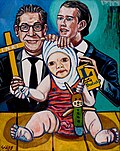
[[File:Matthias Laurenz Gräff - "Liebende Eltern".jpg|thumb|180px| | [[File:Matthias Laurenz Gräff - "Liebende Eltern".jpg|thumb|180px|{{lang|de|Liebende Eltern}} ('Loving Parents') by [[Matthias Laurenz Gräff]] (2018), a painting about the discussion of face-covering clothing, showing [[Austrian Chancellor]] [[Sebastian Kurz]], Vice Chancellor [[Heinz-Christian Strache]], and a Muslim child]] | ||
In 2017, a legal ban on face-covering clothing was adopted by the [[ | In 2017, a legal ban on face-covering clothing was adopted by the [[Austrian parliament]].<ref>{{cite news|url=https://www.welt.de/politik/ausland/article164642964/Oesterreich-stellt-Tragen-von-Burka-und-Nikab-unter-Strafe.html|title=Integration: Österreich stellt Tragen von Burka und Nikab unter Strafe|date=16 May 2017 |access-date=26 October 2017|newspaper=Die Welt}}</ref><ref>{{cite news |url=http://www.sbs.com.au/news/article/2017/10/02/burqa-ban-takes-effect-austria|title=Burqa ban takes effect in Austria|website=SBS News|access-date=26 October 2017}}</ref> | ||
=== Belgium === | === Belgium === | ||
{{Main|Islam in Belgium}} | {{Main|Islam in Belgium}} | ||
As of 2015, Belgium has specific bans on face-covering dress, such as the | As of 2015, Belgium has specific bans on face-covering dress, such as the [[niqab]] or burqa. On 11 July 2017, the [[European Court of Human Rights]] upheld Belgium's ban on burqas and full-face veils.<ref name="auto">{{cite news |author=Lizzie Dearden |date=11 July 2017 |title=European Court of Human Rights upholds Belgium's ban on burqas and full-face Islamic veils |newspaper=The Independent |url=https://www.independent.co.uk/news/world/europe/belgium-burqa-ban-upheld-european-court-of-human-rights-dakir-v-full-face-islamic-veils-headscarf-hijab-a7835156.html}}</ref> | ||
=== Bulgaria === | === Bulgaria === | ||
{{Main|Islam in Bulgaria}} | {{Main|Islam in Bulgaria}} | ||
In 2016, a ban on the wearing of face-covering clothing in public was adopted by the | In 2016, a ban on the wearing of face-covering clothing in public was adopted by the Bulgarian parliament.<ref name="smh">{{Cite web |last=Krasimirov |first=Angel |date=2016-09-30 |title=Bulgaria the latest European country to ban the burqa and niqab in public places |url=https://www.smh.com.au/world/bulgaria-the-latest-european-country-to-ban-the-burqa-and-niqab-in-public-places-20160930-grss9q.html |access-date=5 December 2016 |website=The Sydney Morning Herald |language=en}}</ref> The Bulgarian parliament enacted the ban on the basis of security concerns, however the ban stimulated conflict as 10 percent of the country's population identifies as Muslim. Women who violate the burqa ban face fines up to €770 (~US$848) and have their social security benefits suspended.<ref>{{Cite news |url=http://www.independent.co.uk/news/world/europe/bulgaria-burka-ban-benefits-cut-burkini-niqab-a7340601.html|title=Another European country just banned the burqa|date=1 October 2016|website=The Independent|language=en|access-date=10 November 2019}}</ref> | ||
=== Denmark === | === Denmark === | ||
{{Main|Islam in Denmark}} | {{Main|Islam in Denmark}} | ||
In autumn 2017, the [[Danish government]] considered adopting a law prohibiting people to wear "attire and clothing masking the face in such a way that it impairs recognizability".<ref>{{cite news |url=https://www.independent.co.uk/news/world/europe/denmark-ban-full-face-covering-burqa-jakob-ellemann-jensen-a7986561.html|title=Denmark is about to ban the burqa|website=[[The Independent]]|date=6 October 2017}}</ref> The proposal was met with support from the three largest political parties<ref>[https://www.ft.dk/samling/20171/lovforslag/L219/105/afstemninger.htm L 219 Forslag til lov om ændring af straffeloven], ''[[Folketinget]]''</ref> and was passed into law on 31 May 2018, becoming § 134 c of the [[Danish Penal Code]], stating that "[a]ny person who in a public place wears a item of clothing that covers said person's face shall be liable to a fine" with an exception for coverings that serve "a creditable purpose" (e.g. sports equipment, protection against the cold, masks for carnivals, masquerades, etc.).<ref>{{cite news|url=https://www.theguardian.com/world/2018/may/31/denmark-passes-law-banning-burqa-and-niqab|title=Denmark passes law banning burqa and niqab|date=31 May 2018|website=The Guardian}}</ref><ref>{{cite news|url=https://www.ft.dk/ripdf/samling/20171/lovforslag/l219/20171_l219_som_vedtaget.pdf|title=L 219 Forslag til lov om ændring af straffeloven. (Law as passed.)|publisher=Danish Parliament|language=da|trans-title=L 219 Motion to amend the penal code. (Law as passed.)}}</ref> The law came into force on 1 August 2018. On the first day of the implementation of the burqa ban, hundreds of protesters rallied wearing face veils in public. According to the ban, wearing a burqa or a niqab in public can lead to a fine of 1000 [[Danish krone|kroner]] (~US$156) in the case of first time offences, rising to 10,000 kr. (~US$1560) for a fourth offence.<ref>{{cite news|url=https://www.irishtimes.com/news/world/europe/denmark-s-burqa-ban-is-greeted-by-protest-and-confusion-1.3583365|title=Denmark's burqa ban is greeted by protest and confusion|newspaper=The Irish Times|language=en|access-date=10 November 2019}}</ref><ref>{{Cite news|url=https://www.telegraph.co.uk/news/2018/05/31/denmark-becomes-latest-european-country-ban-full-islamic-face/|title=Denmark becomes latest European country to ban full Islamic face veil in public spaces|date=31 May 2018|work=The Telegraph|access-date=2 June 2018|issn=0307-1235}}</ref> Under the ban, police are instructed to order women to remove their veils or to leave the public space. Police officers who fail to obey the orders of the ban are subject to fines. | |||
In autumn 2017, the [[ | |||
=== France === | === France === | ||
{{Main| | {{Main|French ban on face covering}} | ||
France is a [[secular country]]. One of the key principles of the [[1905 French law on the Separation of the Churches and the State]] is the freedom of religious exercise. At the same time, this law prohibited public servants from wearing any religious symbols during work. | |||
In 1994, the [[French Ministry of Education]] sent out recommendations to teachers and headteachers to ban the Islamic veil (specified as hijab, niqab, and burka) in educational institutions. According to a 2019 study by the [[IZA Institute of Labor Economics]], a higher proportion of girls of Muslim background born after 1980 graduated from high school, bringing their graduation rates closer to the non-Muslim female cohort.<ref>{{Cite journal |last1=Maurin |first1=Éric |last2=Navarrete H. |first2=Nicolás |date=September 2019 |title=Behind the Veil: The Effect of Banning the Islamic Veil in Schools |url=https://docs.iza.org/dp12645.pdf |journal=[[IZA Institute of Labor Economics]] |issue=12645}}</ref> Having a "Muslim background" was defined as having an immigrant father from a predominantly Muslim country (hence, indigenized Muslims with a longer history in France were not considered), as the study was highlighting the "difficulties faced by adolescents with a foreign cultural background in forming their own identity". Males in the Muslim group also had a lower graduation rate than males in the non-Muslim group. While secularism is often criticized for restricting [[freedom of religion]], the study concluded that for the French context, the "implementation of more restrictive policies in French public schools ended up promoting the educational empowerment of some of the most disadvantaged groups of female students".<ref>{{cite news|url=https://newsroom.iza.org/en/archive/research/effects-of-banning-the-islamic-veil-in-public-schools/|title=Effects of banning the Islamic veil in public schools|website=IZA Newsroom|access-date=2019-12-27}}</ref> | |||
In 2004, the [[French law on secularity and conspicuous religious symbols in schools]] banned most religious signs, including the hijab, from public primary and secondary schools in France. The proposed ban was extremely controversial, with both sides of the political spectrum being split on the issue, some people arguing that the law goes against religious freedom and is racist because it affects mostly Muslim women and Jewish men. | In 2004, the [[French law on secularity and conspicuous religious symbols in schools]] banned most religious signs, including the hijab, from public primary and secondary schools in France. The proposed ban was extremely controversial, with both sides of the political spectrum being split on the issue, some people arguing that the law goes against religious freedom and is racist because it affects mostly Muslim women and Jewish men. | ||
In 2010, a [[French ban on face covering|ban on face covering]],<ref>{{Citation|title=LOI n° 2010-1192 du 11 octobre 2010 interdisant la dissimulation du visage dans l'espace public|date=11 October 2010|url=https://www.legifrance.gouv.fr/affichTexte.do?cidTexte=JORFTEXT000022911670|access-date=12 January 2018}}</ref> targeting especially women wearing [[chador]] and burqa, was adopted by the French Parliament. According to ''The Guardian'', the | In 2010, a [[French ban on face covering|ban on face covering]],<ref>{{Citation|title=LOI n° 2010-1192 du 11 octobre 2010 interdisant la dissimulation du visage dans l'espace public|date=11 October 2010|url=https://www.legifrance.gouv.fr/affichTexte.do?cidTexte=JORFTEXT000022911670|access-date=12 January 2018}}</ref> targeting especially women wearing [[chador]] and burqa, was adopted by the French Parliament. According to ''The Guardian'', the ban was challenged and taken to the European Court of Human Rights which upheld the law on 1 July 2014, accepting the argument of the French government that the law was based on "a certain idea of living together".<ref>{{cite news|url=https://www.theguardian.com/world/2014/jul/01/france-burqa-ban-upheld-human-rights-court|title=France's burqa ban upheld by human rights court|last1=Willsher|first1=Kim|date=1 July 2014|access-date=1 July 2014|newspaper=The Guardian}}</ref> In 2013 the applicant stood outside the [[Élysée Palace]] in niqab and subsequently received a criminal conviction. The French criminal courts noted in 2014 that the lower court was wrong to dismiss her rights covered under Article 18, but dismissed her appeal.{{rp|16}} The French delegation argued that wearing face coverings violated the principle of "living together". Judges [[Angelika Nussberger]] and [[Helena Jäderblom]] dissented, calling the concept "far-fetched and vague."{{rp|61}} Going on to note that the very decision of declaring what a woman is allowed to wear was hypocritical and antithetical to the aim of protecting human rights.<ref>{{cite web |date=1 July 2014 |title=Grand Chamber Case of S.A.S. v. France (Application no. 43835/11) Judgment |url=https://hudoc.echr.coe.int/app/conversion/pdf/?library=ECHR&id=001-145466&filename= |publisher=[[European Court of Human Rights]] |publication-place=Strasbourg}}</ref> The committee came to the determination in 2018 that the case had been incorrectly dismissed after review by a single judge on the grounds that, "the conditions of admissibility laid down in articles 34 and 35 of the Convention [had] not been met." Upon review the committee concluded that the applicants' human rights had been violated under article 18 and 26 of the [[International Covenant on Civil and Political Rights]].{{rp|13}} The committee dismissed the notion of "living together" as a vague notion not protected under international law.<ref>{{cite web|url=https://tbinternet.ohchr.org/_layouts/treatybodyexternal/Download.aspx?symbolno=CCPR/C/123/D/2747/2016&Lang=en|title=CCPR/C/123/D/2747/2016; Human Rights Committee Views adopted by the Committee under article 5 (4) of the Optional Protocol, concerning communication No. 2747/2016*,**,***|date=7 December 2018}}</ref> | ||
=== | === Italy === | ||
{{Main|Islam in | {{Main|Islam in Italy}} | ||
In | In October 2025, the Italian government voted to ban the burqa and niqab in all public places.<ref>[https://www.reuters.com/world/new-italian-bill-targets-islamic-face-coverings-religious-funding-2025-10-08/ Reuters.com: New Italian bill targets Islamic face coverings and religious funding], October 2025</ref> | ||
=== Latvia === | === Latvia === | ||
In 2016 ''[[The Independent]]'' reported that a legal ban of face-covering Islamic clothing was adopted by the [[ | {{Main|Islam in Latvia}} | ||
In 2016 ''[[The Independent]]'' reported that a legal ban of face-covering [[Islamic clothing]] was adopted by the [[Latvian parliament]].<ref name="independent.co.uk">{{cite news|url=https://www.independent.co.uk/news/islamic-muslim-face-veil-niqab-burqa-banned-latvia-despite-being-worn-by-just-three-women-entire-a6993991.html|title=A European government has banned Islamic face veils despite them being worn by just three women|website=[[The Independent]]|date=21 April 2016|access-date=1 February 2017}}</ref> After long public discussions draft legislation was approved by the Latvian government on 22 August 2017, however it was never adopted by the parliament as a law.<ref>{{cite web|url=https://www.mk.gov.lv/lv/aktualitates/ministru-kabinets-atbalsta-sejas-aizsegsanas-ierobezojuma-likumprojektu|title=A Ministru kabinets atbalsta Sejas aizsegšanas ierobežojuma likumprojektu|date=22 August 2017}}</ref> | |||
=== Netherlands === | === Netherlands === | ||
{{Main|Islam in the Netherlands}} | {{Main|Islam in the Netherlands}} | ||
The [[States General of the Netherlands]] enacted a ban on face-covering clothing, popularly described as the "burqa ban", in January 2012.<ref>[http://www.rnw.nl/english/bulletin/ministers-vote-dutch-‘burqa-ban’ "Ministers vote Dutch 'burqa ban'"] {{Webarchive|url=https://web.archive.org/web/20120210030405/http://www.rnw.nl/english/bulletin/ministers-vote-dutch-%E2%80%98burqa-ban%E2%80%99 |date=2012-02-10 }}, rnw.nl</ref><ref>Bruno Waterfield (15 September 2011). [https://www.telegraph.co.uk/news/worldnews/europe/netherlands/8765673/Netherlands-to-ban-the-burka.html "Netherlands to ban the burka"]. ''The Daily Telegraph''.</ref> In 2018, the Netherlands implemented a partial burqa ban that prohibits wearing face-covering clothing, including burqas and niqabs, in specific public places such as government buildings, schools, and public transportation.<ref>{{cite news |last1=Halasz |first1=Stephanie |last2=McKenzie |first2=Sheena |title=The Netherlands introduces burqa ban in some public spaces |url=https://edition.cnn.com/2018/06/27/europe/netherlands-partial-burqa-ban-intl/index.html |access-date=9 August 2018 |publisher=CNN |date=27 June 2018}}</ref> | |||
The burqa ban came into force on 1 August 2019 in schools, public transport, hospitals, and government buildings, but there are doubts over whether it will be applied in practice.<ref>[https://edition.cnn.com/2019/08/01/europe/netherlands-burqa-ban-scli-intl/index.html The Netherlands has introduced a 'burqa ban' – but its enforcement is in doubt], CNN, 1 August 2019</ref> [[Amsterdam]] Mayor [[Femke Halsema]] spoke out in her opposition to the law. She stated that removing someone wearing a burqa from public transport in the capital would not be fitting with current Dutch society. Chairman of the Dutch Public Transport Association, Pedro Peters, also voiced his opinion on the ban. Peters said: "You are not going to stop the bus for half an hour for someone wearing a burqa", waiting for the police to arrive; "we are also not allowed to refuse anyone because we have a transport obligation".<ref name="French">{{Cite news|url=https://www.washingtonpost.com/world/as-the-netherlands-burqa-ban-takes-effect-police-and-transport-officials-refuse-to-enforce-it/2019/08/01/a91fb648-b461-11e9-acc8-1d847bacca73_story.html|title=As the Netherlands' burqa ban takes effect, police and transport officials refuse to enforce it |first=James |last=McAuley |newspaper=The Washington Post|language=en|access-date=6 November 2019}}</ref> Known officially as the Partial Ban on Face-Covering Clothing Act, the act also details that those who refuse to uncover their faces may pay a fine of at least €150 and can be arrested.<ref name="French"/> Dutch police have also stated that enforcing the ban is not a priority, and that they likely would not respond to a complaint within a thirty-minute timeframe.<ref>{{Cite news|url=https://www.theguardian.com/world/2019/aug/01/dutch-police-signal-unwillingness-enforce-new-burqa-ban|title=Dutch 'burqa ban' rendered largely unworkable on first day|last=Boffey|first=Daniel|date=1 August 2019|work=The Guardian|access-date=6 November 2019|language=en-GB|issn=0261-3077}}</ref> | |||
=== Norway === | === Norway === | ||
{{Main|Islam in Norway}} | {{Main|Islam in Norway}} | ||
In 2018 the [[Norwegian parliament]] voted to ban the burqa in schools and universities.<ref>{{cite news|url=https://www.independent.co.uk/news/world/europe/norway-burqa-ban-schools-universities-parliament-vote-niqab-latest-a8387826.html|title=Norway votes in favour of banning burqa in schools and universities|website=[[The Independent]]|date=7 June 2018}}</ref><ref>{{cite news|url=https://au.news.yahoo.com/norway-bans-burqas-niqabs-schools-211009300.html|title=Norway bans burqas and niqabs at schools}}</ref> | |||
=== Portugal === | |||
{{Main|Islam in Portugal}} | |||
On October 17th, 2025, the Portuguese parliament voted to ban the burqa and niqab in all public places.<ref>{{Cite news |last=Press |first=Associated |date=2025-10-17 |title=Burqa ban bill approved by Portugal’s parliament seen as targeting Muslim women |url=https://www.theguardian.com/world/2025/oct/17/burqa-ban-bill-approved-by-portugals-parliament-seen-as-targeting-muslim-women |access-date=2025-10-25 |work=The Guardian |language=en-GB |issn=0261-3077}}</ref> | |||
=== Russia === | |||
{{Main|Islam in Russia}} | |||
In July 2024, the niqab and other full-face veils were temporarily banned in the Muslim-majority republic of [[Dagestan]] by the Muftiate, an Islamic authority. The ban followed the [[2024 Dagestan attacks]], where reports said one attacker planned to use the niqab as a disguise to escape.<ref>{{Cite web |date=2024-07-03 |title=Dagestan bans niqab in response to deadly terror attacks |url=https://www.politico.eu/article/dagestan-ban-niqab-in-response-to-deadly-terror-attack-russia-chechnya-ramzan-kadyrov/ |access-date=2024-07-17 |website=POLITICO |language=en-GB}}</ref> | |||
===Spain=== | |||
{{main|Islam in Spain}} | |||
In February 2026, the conservative Vox party, with the support of the People's Party, pushed through parliament a bill to criminalize full-face veils. The left-wing coalition opposed it, considering it to have racist undertones. They [[PSOE]] subsequently planned to push through their own banning measures.<ref>https://www.thelocal.es/20260216/spains-right-wing-parties-work-together-on-burqa-ban</ref> | |||
[[Seville]] and [[Cantabria]] joined the prohibition since march 2026. | |||
=== Sweden === | === Sweden === | ||
In December 2019, the municipality of | {{Main|Islam in Sweden}} | ||
In December 2019, the [[Skurup Municipality|municipality of Skurup]] banned Islamic veils in educational institutions. Earlier, in May 2019, the [[Staffanstorp Municipality|municipality of Staffanstorp]] approved a similar ban.<ref>{{Cite news |last=Malmöhus |first=P4 |title=Skurup förbjuder slöja i skolan |url=https://sverigesradio.se/sida/artikel.aspx?programid=96&artikel=7369615 |access-date=2019-12-19 |work=Sveriges Radio |language=sv}}</ref> On 17 November 2020, the Administrative Courts in [[Malmö]] and [[Lund]] determined that both municipalities' decisions to prohibit headscarves, niqabs, and burqas in preschools and primary schools violated the [[Basic Laws of Sweden|constitutional right]] to [[freedom of religion]] and the [[European Convention on Human Rights]].<ref>{{Cite web |last=Malmö |first=Förvaltningsrätten i |date=2020-11-17 |title=Beslut om förbud mot huvudduk upphävs |url=https://www.domstol.se/en/nyheter/2020/11/beslut-om-forbud-mot-huvudduk-upphavs/?utm_source=chatgpt.com |access-date=2025-10-18 |website=Sveriges Domstolar |language=sv}}</ref> Both municipalities appealed, but on 23 June 2021, the Administrative Court of Appeal in [[Gothenburg]] upheld the initial rulings on the same grounds.<ref>{{Cite web |last=Nyheter |first=S. V. T. |date=2021-06-23 |title=Beslut står fast: Olagligt att förbjuda slöja i skolan |url=https://www.svt.se/nyheter/inrikes/beslut-star-fast-olagligt-att-forbjuda-sloja-i-skolan |access-date=2025-10-18 |website=SVT Nyheter |language=sv}}</ref> On 8 December 2022, the [[Supreme Administrative Court of Sweden|Supreme Administrative Court]] overturned both bans, with Justice Ulrik von Essen stating that "in order for the restriction to be permissible, it must be supported by law" and that "legal support is lacking in national law and therefore the municipalities' decisions should be overturned".<ref>{{Cite web |date=8 December 2022 |title=HÖGSTA FÖRVALTNINGSDOMSTOLENS DOM (Skurup) |url=https://www.domstol.se/globalassets/filer/domstol/hogstaforvaltningsdomstolen/2022/domar-och-beslut/4266-21.pdf |access-date=2025-10-18 |website=domstol.se}}</ref><ref>{{Cite web |date=8 December 2022 |title=HÖGSTA FÖRVALTNINGSDOMSTOLENS DOM (Staffanstorp) |url=https://www.domstol.se/globalassets/filer/domstol/hogstaforvaltningsdomstolen/2022/domar-och-beslut/4120-21.pdf |access-date=2025-10-18 |website=domstol.se}}</ref><ref>{{Cite web |last=Nyheter |first=S. V. T. |date=2022-12-08 |title=Slöjförbud i skolan är olagligt – Staffanstorp och Skurup förlorade |url=https://www.svt.se/nyheter/lokalt/skane/hogsta-instans-sager-nej-till-slojforbud |access-date=2025-10-18 |website=SVT Nyheter |language=sv}}</ref> | |||
On 12 October 2025, [[Christian Democrats (Sweden)|Christian Democrats]] (KD) leader and [[Deputy Prime Minister of Sweden|Deputy Prime Minister]] [[Ebba Busch]] proposed a nationwide ban on burqas and niqabs in public places such as streets, squares, shopping centres, and healthcare facilities.<ref>{{Cite web |last=Nyheter |first=S. V. T. |date=2025-10-12 |title=Busch: Förbjud burka och niqab på allmän plats |url=https://www.svt.se/nyheter/inrikes/busch-forbjud-burka-och-niqab-pa-allman-plats |access-date=2025-10-18 |website=SVT Nyheter |language=sv}}</ref> [[Minister for Education (Sweden)|Education]] and [[Minister for Integration (Sweden)|Integration Minister]] and [[Liberals (Sweden)|Leader of the Liberals]] [[Simona Mohamsson]] expressed support for stronger measures against religious oppression, including forced veiling, but did not explicitly endorse Busch’s proposal,<ref>{{Cite web |date=2025-10-15 |title='Islam Must Adapt To Sweden' — Swedish Deputy PM Urges Public Burqa, Niqab Ban - Gulf Insider {{!}} Gulf Insider |url=https://www.gulf-insider.com/islam-must-adapt-to-sweden/ |access-date=2025-10-18 |language=en-US}}</ref> and neither did any other party in the [[Tidö Agreement|Tidö Government]].<ref>{{Cite web |last=Gasslander |first=Tor |date=2025-10-12 |title=Ebba Busch vill förbjuda burka och niqab |url=https://omni.se/ebba-busch-vill-forbjuda-burka-och-niqab/a/xmGdmV |access-date=2025-10-18 |website=Omni |language=sv}}</ref> | |||
=== Switzerland === | === Switzerland === | ||
In a referendum on 7 March 2021, Swiss voters approved a nationwide ban on the burqa, with over 51% of the electorate supporting it.<ref>{{cite news|url=https://www.theguardian.com/world/2021/mar/07/switzerland-on-course-to-ban-wearing-of-burqa-and-niqab-in-public-places |title=Switzerland to ban wearing of burqa and niqab in public places |website=[[The Guardian]] |date=7 March 2021}}</ref> | {{Main|Islam in Switzerland}} | ||
In [[2021 Swiss referendums#Ban on full facial coverings|a referendum on 7 March 2021]], Swiss voters approved a nationwide ban on the burqa, with over 51% of the electorate supporting it.<ref>{{cite news|url=https://www.theguardian.com/world/2021/mar/07/switzerland-on-course-to-ban-wearing-of-burqa-and-niqab-in-public-places |title=Switzerland to ban wearing of burqa and niqab in public places |website=[[The Guardian]] |date=7 March 2021}}</ref> | |||
Earlier, in September 2013, a constitutional referendum in the [[Canton of Ticino]] on a [[Popular initiative (Switzerland)|popular initiative]] banning full-face veils was approved with 66.2% of the vote.<ref>{{Cite news|url=https://www.srf.ch/news/schweiz/abstimmungen/abstimmungen/abstimmungen-ti/ja-zum-burka-verbot-im-tessin|title=Ja zum Burka-Verbot im Tessin |work=SRF Schweizer Radio und Fernsehen|access-date=2020-05-17|language=de}}</ref> In May 2017, the [[Landsgemeinde]] in the [[Canton of Glarus]] rejected adopting a similar measure with about two-thirds of the vote.<ref>{{Cite news|url=https://www.srf.ch/news/regional/ostschweiz/kein-burka-verbot-im-kanton-glarus|title=Kein Burka-Verbot im Kanton Glarus |work=SRF Schweizer Radio und Fernsehen|access-date=2020-05-17|language=de}}</ref> | Earlier, in September 2013, a constitutional referendum in the [[Canton of Ticino]] on a [[Popular initiative (Switzerland)|popular initiative]] banning full-face veils was approved with 66.2% of the vote.<ref>{{Cite news|url=https://www.srf.ch/news/schweiz/abstimmungen/abstimmungen/abstimmungen-ti/ja-zum-burka-verbot-im-tessin|title=Ja zum Burka-Verbot im Tessin |work=SRF Schweizer Radio und Fernsehen|access-date=2020-05-17|language=de}}</ref> In May 2017, the [[Landsgemeinde]] in the [[Canton of Glarus]] rejected adopting a similar measure with about two-thirds of the vote.<ref>{{Cite news|url=https://www.srf.ch/news/regional/ostschweiz/kein-burka-verbot-im-kanton-glarus|title=Kein Burka-Verbot im Kanton Glarus |work=SRF Schweizer Radio und Fernsehen|access-date=2020-05-17|language=de}}</ref> In September 2018, the [[Canton of St Gallen]] became the second canton in Switzerland to vote in favour of a ban on facial coverings in public, with two-thirds casting a ballot in favor.<ref>{{cite news |url=https://www.dw.com/en/swiss-canton-st-gallen-votes-for-ban-on-burqas-in-public/a-45607726 |title=Swiss canton St Gallen votes for ban on burqas in public | DW | 23.09.2018| publisher=[[Deutsche Welle]]}} | ||
In September 2018, the [[Canton of St Gallen]] | |||
</ref> | </ref> | ||
==Muslim world== | ==Muslim world== | ||
===Algeria=== | ===Algeria=== | ||
In 2018, the government passed a law banning the wearing of full face-veils, called burqas or niqabs, for female public | {{Main|Islam in Algeria}} | ||
In 2018, the [[government of Algeria|government]] passed a law banning the wearing of full face-veils, called burqas or niqabs, for female [[public servant]]s while at work.<ref>{{cite news |url=https://www.moroccoworldnews.com/2018/10/255703/algeria-burqas-niqabs-women/ |title=Algeria Outlaws Burqas, Niqabs for Women at Work |date=19 October 2018}}</ref><ref>{{Cite web |url=https://ewn.co.za/2018/10/19/algerian-bans-female-public-servants-from-wearing-full-face-veils |title=Algerian bans female public servants from wearing full-face veils}}</ref> The Prime Minister at the time, [[Ahmed Ouyahia]], pushed the ban because of his belief that women should be identifiable in the workspace.<ref>{{Cite report |title=Prime Minister Trudeau should not Rely on the Courts to Uphold his Promises to Indigenous Peoples |publisher=Amnesty International |via=Brill |doi=10.1163/2210-7975_hrd-9211-2016179 |doi-broken-date=30 July 2025 }}</ref> | |||
===Egypt=== | ===Egypt=== | ||
{{Main|Islam in Egypt}} | |||
[[File:Gamal Abdel Nasser on the Muslim Brotherhood (subtitled).webm|thumb|left|alt=Gamal Abdel Nasser laughing at the Muslim Brotherhood for suggesting in 1953 that women should be required to wear the hijab.|Gamal Abdel Nasser laughing at the Muslim Brotherhood for suggesting in 1953 that women should be required to wear the hijab]] | [[File:Gamal Abdel Nasser on the Muslim Brotherhood (subtitled).webm|thumb|left|alt=Gamal Abdel Nasser laughing at the Muslim Brotherhood for suggesting in 1953 that women should be required to wear the hijab.|Gamal Abdel Nasser laughing at the Muslim Brotherhood for suggesting in 1953 that women should be required to wear the hijab]] | ||
[[File:P2090099 veiled arab woman.JPG|thumb|233x233px|[[ | [[File:P2090099 veiled arab woman.JPG|thumb|233x233px|Woman wearing a [[niqab]] in Egypt]] | ||
In 1953, Egyptian leader President [[Gamal Abdel Nasser]] was told by the leader of the [[Muslim Brotherhood]] that they wanted to enforce the wearing of the hijab, to which Nasser responded: "Sir, I know you have a daughter in college – and she doesn't wear a headscarf or anything! Why don't you make her wear the headscarf? So you can't make one girl, your own daughter, wear it, and yet you want me to go and make ten million women wear it?". | In 1953, Egyptian leader President [[Gamal Abdel Nasser]] was told by the leader of the [[Muslim Brotherhood]] that they wanted to enforce the wearing of the hijab, to which Nasser responded: "Sir, I know you have a daughter in college – and she doesn't wear a headscarf or anything! Why don't you make her wear the headscarf? So you can't make one girl, your own daughter, wear it, and yet you want me to go and make ten million women wear it?". | ||
The veil gradually disappeared in the following decades, so much so that by 1958 an article by the [[United Press International|United Press]] (UP) stated that "the veil is unknown here."<ref>{{Cite journal|author=United Press Service (UP) |date=26 January 1958|title=Egypt's Women Foil Attempt to Restrict |journal=[[Sarasota Herald-Tribune]] |issue=114 |page=28 |url=https://news.google.com/newspapers?nid=1755&dat=19580126&id=8AodAAAAIBAJ&pg=3454,4406325 |access-date=10 February 2010|author-link=United Press International}}</ref> However, the veil has | The veil gradually disappeared in the following decades, so much so that by 1958, an article by the [[United Press International|United Press]] (UP) stated that "the veil is unknown here."<ref>{{Cite journal|author=United Press Service (UP) |date=26 January 1958|title=Egypt's Women Foil Attempt to Restrict |journal=[[Sarasota Herald-Tribune]] |issue=114 |page=28 |url=https://news.google.com/newspapers?nid=1755&dat=19580126&id=8AodAAAAIBAJ&pg=3454,4406325 |access-date=10 February 2010|author-link=United Press International}}</ref> However, the veil has had a resurgence since the [[Iranian Revolution]], concomitant with the global revival of Muslim piety. According to ''[[The New York Times]]'', as of 2007, about 90 percent of Egyptian women currently wear a headscarf.<ref>{{Cite news|last=Slackman |first=Michael |date=28 January 2007|title=In Egypt, a New Battle Begins Over the Veil |newspaper=[[The New York Times]] |url=https://www.nytimes.com/2007/01/28/weekinreview/28slackman.html |access-date=10 February 2010}}</ref> | ||
A small number of women wear the niqab. The secular government does not encourage women to wear it, fearing it will present an Islamic extremist political opposition. In the country, it is negatively associated with [[Salafist]] political activism.<ref name="kuwait-times"/><ref name="hijabworld">{{cite news|url=http://www.iht.com/articles/ap/2006/10/31/africa/ME_GEN_Mideast_Veil_Glance.php |title=A look at the wearing of veils, and disputes on the issue, across the Muslim world |newspaper=International Herald Tribune |access-date=31 October 2006}}</ref> There have been some restrictions on wearing the hijab by the government, which views it as a political symbol. In 2002, two presenters were excluded from a state-run TV station for deciding to wear hijab on national television.<ref name="egypttv">Ranyah Sabry (17 April 2007) [https://news.bbc.co.uk/2/hi/middle_east/6565145.stm Egypt anchorwomen battle for hijab] BBC News. Retrieved on 13 February 2009.</ref> The [[American University in Cairo]], Cairo University, and [[Helwan University]] attempted to forbid entry to niqab wearers in 2004 and 2007.<ref>{{cite news |url=http://gulfnews.com/news/region/egypt/veil-war-breaks-out-on-egypt-university-campus-1.37235 |title=Veil war breaks out on Egypt university campus |author=Ramadan Al Sherbini |date=22 October 2006 |website=Gulf News}}</ref><ref>{{cite web|url=http://www.islamwomen.org/EngIw/NwsDetails.aspx?id=1205|title=The Islamic Network for Woman and Families|access-date=2021-08-29|archive-date=2020-10-31|archive-url=https://web.archive.org/web/20201031194635/http://www.islamwomen.org/EngIw/NwsDetails.aspx?id=1205|url-status=dead}}</ref><ref>{{cite web|url=https://globalvoices.org/2009/10/09/egypt-niqab-ban-stirs-controversy/|title=Egypt: Niqab Ban Stirs Controversy |website=Global Voices |date=9 October 2009}}</ref> | |||
[[Muhammad Sayyid Tantawy]], [[Grand Imam of al-Azhar]], issued a [[fatwa]] in October 2009 arguing that veiling of the face is not required under Islam. He had reportedly asked a student to take off her niqab when he spotted her in a classroom, and he told her that the niqab is a cultural tradition without Islamic importance.<ref name="kuwait-times">{{Cite news|title=Fatwa stirs heated debate over face-veiling in Kuwait |date=9 October 2009 |access-date=9 October 2009 |url=http://www.kuwaittimes.net/read_news.php?newsid=MTQwMTY5MzI5Mg== |work=[[Kuwait Times]] |archive-url=https://web.archive.org/web/20100619060055/http://kuwaittimes.net/read_news.php?newsid=MTQwMTY5MzI5Mg%3D%3D |archive-date=19 June 2010 |url-status=dead }}</ref> Government bans on wearing the niqab on college campuses at the [[University of Cairo]] and during university exams in 2009 were overturned later.<ref>{{cite web|url=http://worldfocus.org/blog/2009/10/08/how-you-see-it-egyptian-campus-bans-niqab/7680/|title=How You See It: Egyptian campus bans niqab – Worldfocus|date=8 October 2009}}</ref><ref>{{cite web|url=http://www.universityworldnews.com/article.php?story=2009101517002713|title=Egypt: Controversial ban on niqab in dorms – University World News}}</ref><ref>{{cite web|url=http://jurist.law.pitt.edu/paperchase/2010/01/egypt-court-upholds-niqab-ban-for.php|title=Egypt court upholds niqab ban for university examinations |website=Pitt.edu|access-date=26 October 2017}}</ref><ref>{{cite news |url=https://gulfnews.com/world/mena/egypt-court-revokes-ban-on-niqab-at-exam-halls-1.571211 |title=Egypt court revokes ban on niqab at exam halls|author=Ramadan Al Sherbini|date=20 January 2010 |website=Gulf News }}</ref> Minister [[Hany Mahfouz Helal]] met protests by some human rights and Islamic groups. | |||
===Kazakhstan=== | |||
{{Main|Islam in Kazakhstan}} | |||
On 1 July 2025, [[Kazakhstan]] officially banned the Burqa and Niqab. <ref>{{Cite news |date=2025-06-30 |title=Kazakhstan bans face coverings in public places |url=https://www.reuters.com/world/asia-pacific/kazakhstan-bans-face-coverings-public-places-2025-06-30/ |access-date=2025-10-05 |work=Reuters |language=en}}</ref> | |||
===Kyrgyzstan=== | |||
{{Main|Islam in Kyrgyzstan}} | |||
On 27 December 2024, [[Supreme Council (Kyrgyzstan)|Kyrgyzstan's parliament]] specifically approved a ban on wearing the niqab, a full-face Islamic veil, in public places. The government justified the measure by arguing that the niqab was not part of traditional Kyrgyz culture and claimed it was necessary to protect national identity and security.<ref>{{cite web |url=https://www.asiaplustj.info/en/news/centralasia/20241227/kyrgyzstans-parliament-approves-a-ban-on-wearing-niqab-in-public-places |title=Kyrgyzstan's Parliament Approves a Ban on Wearing Niqab in Public Places |publisher=Asia-Plus |date=27 December 2024 }}</ref> | |||
On 22 January 2025, President [[Sadyr Zhaparov]] signed the law "On Amendments to a Number of Legislative Religious Acts of the Kyrgyz Republic," officially enforcing the ban. The law, which was also posted on his official website, prohibited clothing that obscures a person's face, except in cases related to work requirements or medical reasons. Additional provisions included bans on coercing individuals to change their religious beliefs, conducting religious rituals in state institutions like nursing homes, prisons, and military units, and distributing religious literature in public places, schools, or door-to-door.<ref>{{cite web |url=https://bearr.org/regional-news/ban-on-wearing-the-niqab-in-public-places-in-kyrgyzstan/ |title=Ban on Wearing the Niqab in Public Places in Kyrgyzstan |publisher=BEARR Trust |date=22 January 2025 }}</ref> A week later, on 1 February, the niqab ban formally came into effect, imposing a fine of 20,000 [[Kyrgyz som|soms]] (approximately $230) for violations. The government also emphasized that the measure was intended to improve public safety by ensuring better identification of individuals in public spaces and government institutions.<ref>{{cite web |last=Najibullah |first=Farangis |url=https://www.rferl.org/a/niqab-ban-kyrgyzstan-islam-hijab-central-asia/33297197.html |title=Kyrgyzstan Bans Islamic Niqab As Critics Warn It Could Alienate Some Women |publisher=RFE/RL |date=1 February 2025 }}</ref> | |||
===Morocco=== | ===Morocco=== | ||
{{Main|Islam in Morocco}} | |||
[[File:In Morocco have lot of women head scarves and veils.jpg|thumb|A group of Moroccan women wearing headscarves and veils]] | [[File:In Morocco have lot of women head scarves and veils.jpg|thumb|A group of Moroccan women wearing headscarves and veils]] | ||
In Morocco, the headscarf is not forbidden by law, and women are free to choose to wear one. The headscarf is more frequent in the northern regions, small to medium cities and rural regions. As it is not totally widespread, wearing a hijab is considered rather a religious decision. In 2005, a schoolbook for basic religious education was heavily criticized for picturing female children with headscarves, and later the picture of the little girl with the Islamic headscarf was removed from the school books.<ref>{{cite news|url= | In Morocco, the headscarf is not forbidden by law, and women are free to choose to wear one. The headscarf is more frequent in the northern regions, small to medium cities, and rural regions. As it is not totally widespread, wearing a hijab is considered rather a religious decision. In 2005, a schoolbook for basic religious education was heavily criticized for picturing female children with headscarves, and later the picture of the little girl with the Islamic headscarf was removed from the school books.<ref>{{cite news|url=https://news.bbc.co.uk/2/hi/5413808.stm|title=Morocco moves to drop headscarf|date=6 October 2006 |publisher=BBC News}}</ref> The headscarf is strongly and implicitly forbidden in Morocco's military and the police. | ||
In January 2017 Morocco banned the manufacturing, marketing and sale of the burqa | In January 2017 Morocco banned the manufacturing, marketing and sale of the Afghan burqa,<ref>{{cite web|url=https://theconversation.com/why-moroccos-burqa-ban-is-more-than-just-a-security-measure-72120|title=Why Morocco's burqa ban is more than just a security measure|first=Moha|last=Ennaji|website=TheConversation.com|date=31 January 2017 |access-date=26 October 2017}}</ref> however, this does not apply to other types of niqab.<ref>{{cite web |author1-link=FRANCE 24 Arabic |title=المغرب يمنع بيع وتسويق "البرقع" الأفغاني |url=https://www.youtube.com/watch?v=gKEkFp1kOtM |website=youtube.com |language=ar |format=video |date=February 7, 2017}}</ref> | ||
===Syria=== | ===Syria=== | ||
[[File:Woman in niqab, Aleppo (2010).jpg|thumb|Woman in | {{Main|Islam in Syria}} | ||
[[File:Woman in niqab, Aleppo (2010).jpg|thumb|Woman in niqab in [[Aleppo, Syria]]]] | |||
In 2010, Ghiyath Barakat, Syria's minister of higher education, announced a ban on women wearing full-face veils at [[university|universities]]. The official stated that the face veils ran counter to secular and academic principles of Syria.<ref>{{cite news|title=Syria bans face veils at universities |url=https://www.bbc.co.uk/news/world-middle-east-10684359 |date=19 July 2010 |access-date=19 July 2010 |publisher=[[BBC News]]}}</ref> However, the ban strictly addresses veils that cover the head and mouth, and does not include hijabs, or headscarfs, which most Syrian women wear.<ref>{{Cite news|url=https://www.theguardian.com/world/2010/jul/20/syria-bans-niqab-from-universities|title=Syria bans niqab from universities|agency=Associated Press|date=20 July 2010|work=The Guardian|access-date=10 November 2019|language=en-GB|issn=0261-3077}}</ref> | In 2010, Ghiyath Barakat, Syria's minister of higher education, announced a ban on women wearing full-face veils at [[university|universities]]. The official stated that the face veils ran counter to secular and academic principles of Syria.<ref>{{cite news|title=Syria bans face veils at universities |url=https://www.bbc.co.uk/news/world-middle-east-10684359 |date=19 July 2010 |access-date=19 July 2010 |publisher=[[BBC News]]}}</ref> However, the ban strictly addresses veils that cover the head and mouth, and does not include hijabs, or headscarfs, which most Syrian women wear.<ref>{{Cite news|url=https://www.theguardian.com/world/2010/jul/20/syria-bans-niqab-from-universities|title=Syria bans niqab from universities|agency=Associated Press|date=20 July 2010|work=The Guardian|access-date=10 November 2019|language=en-GB|issn=0261-3077}}</ref> | ||
=== Tajikistan === | === Tajikistan === | ||
In 2017, the government of [[Tajikistan]] passed a law requiring people to "stick to traditional national clothes and culture", which has been widely seen as an attempt to prevent women from wearing Islamic clothing, in particular the style of headscarf wrapped under the chin, in contrast to the traditional Tajik headscarf tied behind the head.<ref>{{cite news|title=Tajikstan passes law 'to stop Muslim women wearing hijabs'|author=Harriet Agerholm|date=1 September 2017|newspaper=The Independent|url=https://www.independent.co.uk/news/world/asia/tajikstan-muslim-hijabs-stop-women-law-headscarfs-central-asia-islam-a7923886.html }}</ref> | {{Main|Islam in Tajikistan}} | ||
In 2017, the government of [[Tajikistan]] passed a law requiring people to "stick to traditional national clothes and culture", which has been widely seen as an attempt to prevent women from wearing Islamic clothing, in particular the style of headscarf wrapped under the chin, in contrast to the traditional [[Tajiks|Tajik]] headscarf tied behind the head.<ref>{{cite news|title=Tajikstan passes law 'to stop Muslim women wearing hijabs'|author=Harriet Agerholm|date=1 September 2017|newspaper=The Independent|url=https://www.independent.co.uk/news/world/asia/tajikstan-muslim-hijabs-stop-women-law-headscarfs-central-asia-islam-a7923886.html }}</ref> | |||
===Tunisia=== | ===Tunisia=== | ||
On 6 July 2019 the government banned the wearing of the | {{Main|Islam in Tunisia}} | ||
On 6 July 2019, the [[government of Tunisia|government]] banned the wearing of the niqab in public institutions, citing security reasons.<ref>{{cite news |url=https://www.aljazeera.com/news/2019/07/tunisia-bans-face-veils-public-institutions-bombing-190705132559010.html |title=Tunisia bans face veils in public institutions after bombing|publisher=Al Jazeera|date=5 July 2019}}</ref><ref name="reuters.com">{{cite news|url=https://www.reuters.com/article/uk-tunisia-niqab-security-idUKKCN1U01CH |title=Tunisian PM bans wearing of niqab in public institutions |date=5 July 2019|access-date=5 July 2019|publisher=Reuters }}</ref> | |||
===Uzbekistan=== | |||
{{Main|Islam in Uzbekistan}} | |||
[[Uzbekistan]] lifted its ban on wearing hijabs in public places in 2021, allowing greater religious expression. However, in September 2023, the government imposed a ban on wearing face-covering garments like the burqa in specific public spaces for security reasons.<ref>{{cite web |url=https://asiaplustj.info/en/news/centralasia/20230918/uzbekistan-authorities-tighten-measures-against-beard-and-hijab-wearing |title=Uzbekistan Authorities Tighten Measures Against Beard and Hijab Wearing |publisher=Asia Plus |date=18 September 2023 }}</ref> Additionally, authorities enforced restrictions on wearing beards and hijabs in schools, requiring female students to remove headscarves before entering educational institutions. These actions reflect the government's evolving stance on religious attire.<ref>{{cite web |url=https://kz.kursiv.media/en/2023-11-02/uzbekistan-bans-wearing-burqas-in-public/ |title=Uzbekistan Bans Wearing Burqas in Public |publisher=Kursiv Media |date=2 November 2023 }}</ref> | |||
==Africa== | ==Africa== | ||
[[File: | [[File:Nº 3 HAÏK alt version.jpg|thumbnail|Women in [[Algeria]] wearing a ''[[Haik (garment)|haïk]]'', a type of veil]] | ||
===Cameroon=== | ===Cameroon=== | ||
On 12 July 2015, two | {{Main|Islam in Cameroon}} | ||
On 12 July 2015, two [[female suicide bomber]]s dressed in burqas [[Suicide bombing|blew themselves up]] in [[Fotokol]], [[Far North Region (Cameroon)|Far North Region]], killing 13 people. Following the attacks, since 16 July, [[Cameroon]] banned the wearing of full-face veils, including the burqa, in the Far North. Governor Midjiyawa Bakari of the mainly Muslim region said the measure was to prevent further attacks.<ref name="cameroonban" >[https://www.bbc.com/news/world-africa-33553041 Cameroon bans Islamic face veil after suicide bombings], 16 July 2015. Retrieved 18 July 2015.</ref> | |||
=== Chad === | === Chad === | ||
Following a | {{Main|Islam in Chad}} | ||
Following a [[2015 N'Djamena bombings|two suicide bombing]]s on 15 June 2015, which killed 33 people in [[N'Djamena]], the [[government of Chad|government]] announced on 16 June 2015 the banning of the wearing of the burqa in its territory for security reasons.<ref>{{cite news|url=https://www.reuters.com/article/us-chad-blast-idUSKBN0OX2L720150617|title=Chad arrests five and bans burqa after suicide bombings|date=17 June 2015|publisher=Reuters}}</ref> The 2015 prime minister, [[Kalzeubet Pahimi Deubet]], called the burqa "[[camouflage]]".<ref>{{Cite news|url=https://www.bbc.com/news/world-africa-33166220|title=Chad bans face veil after bombings|date=17 June 2015|access-date=10 November 2019|language=en-GB}}</ref> Women who violate this ban are subject to jail time.<ref>{{Cite news|url=https://www.telegraph.co.uk/women/life/burka-bans-the-countries-where-muslim-women-cant-wear-veils/|title=Burka bans: The countries where Muslim women can't wear veils|last=Sanghani|first=Radhika|date=8 July 2016|work=The Telegraph|access-date=10 November 2019|language=en-GB|issn=0307-1235}}</ref> | |||
=== | ===Gabon=== | ||
{{Main|Islam in Gabon}} | |||
On 15 July 2015, [[Government of Gabon|Gabon]] announced a ban on the wearing of full-face veils in public and places of work in response to the Fotokol bombings.<ref name="cameroonban" /> | |||
=== | ===Republic of the Congo=== | ||
{{Main|Islam in the Republic of the Congo}} | |||
The full-face veil was banned in May 2015 in public places in the [[Republic of the Congo]] to "[[counter terrorism]]", although there has not been an [[Islamist]] attack in the country.<ref name="cameroonban" /> | |||
==Asia-Pacific== | ==Asia-Pacific== | ||
===Australia=== | ===Australia=== | ||
{{Main|Burka ban in Australia}} | {{Main|Burka ban in Australia}} | ||
[[File:Say no to Burqas mural in Newtown, New South Wales.jpg|thumb|Say no to | [[File:Say no to Burqas mural in Newtown, New South Wales.jpg|thumb|Say no to burqas mural in [[Newtown, New South Wales]]]] | ||
In September 2011, [[Australia]]'s most populous state, New South Wales, passed the Identification Legislation Amendment Act 2011 to require a person to remove a face covering if asked by a state official. The law is viewed as a response to a court case of 2011 where a woman in Sydney was convicted of falsely claiming that a traffic | In September 2011, [[Australia]]'s most populous state, [[New South Wales]], passed the [[Identification Legislation Amendment Act 2011]] to require a person to remove a face covering if asked by a state official. The law is viewed as a response to a court case of 2011 where a woman in [[Sydney]] was convicted of falsely claiming that a [[traffic police]]man had tried to remove her niqab.<ref>{{cite news|url=https://www.huffingtonpost.com/2012/03/05/australia-veil-law-burqa-ban_n_1320811.html|title=Australia Muslim Veil Law Requires Women To Remove Face-Covering Niqab In New South Wales, 3 May 2012|website=The Huffington Post|access-date=26 October 2017}}</ref> | ||
The debate in Australia is more about when and where face coverings may legitimately be restricted.<ref name=Barker>[http://www.austlii.edu.au/au/journals/UWALawRw/2012/6.pdf The Full Face Covering Debate: An Australian Perspective] by Renae | The debate in Australia is more about when and where face coverings may legitimately be restricted.<ref name="Barker">[http://www.austlii.edu.au/au/journals/UWALawRw/2012/6.pdf The Full Face Covering Debate: An Australian Perspective] by Renae Barker</ref> In a Western Australian case in July 2010, a woman sought to give evidence in court wearing a niqab. The request was refused on the basis that the jury needs to see the face of the person giving evidence.<ref name="Barker" /> | ||
===China=== | ===China=== | ||
In 2017, China banned the burqa in the | {{Main|Islam in China}} | ||
In 2017, China banned the burqa in the region of [[Xinjiang]].<ref>{{cite news|url=https://www.independent.co.uk/news/world/asia/china-burqa-abnormal-beards-ban-muslim-province-xinjiang-veils-province-extremism-crackdown-freedom-a7657826.html|title=China bans burqas and 'abnormal' beards in Muslim province|website=[[The Independent]]|date=30 March 2017}}</ref><ref>{{cite news |last1=Phillips |first1=Tom |title=China bans burqa in capital of Muslim region of Xinjiang |url=https://www.telegraph.co.uk/news/worldnews/asia/china/11342070/China-bans-burqa-in-capital-of-Muslim-region-of-Xinjiang.html |access-date=9 August 2018 |newspaper=The Telegraph |date=13 January 2015}}</ref> | |||
===India=== | |||
[[File:India (2533145450).jpg|thumb|A Muslim woman wearing a niqab in India]] | |||
{{Main|Islam in India}} | |||
In India, Muslim women are allowed to wear the [[hijab]] and [[burqa]] anytime, anywhere.<ref name="thestar1">{{Cite news |last=Sheikh Saaliq |date=8 February 2022 |title=In India, wearing hijab bars some Muslim students from class |work=Toronto Star |url=https://www.thestar.com/news/world/asia/2022/02/08/in-india-wearing-hijab-bars-some-muslim-students-from-class.html}}</ref><ref name="BBC larger bench">{{Cite news |date=10 February 2022 |title=Karnataka hijab row: Judge refers issue to larger bench |work=BBC News |url=https://www.bbc.com/news/world-asia-india-60312864}}</ref><ref name="csm">{{Cite news |date=8 February 2022 |title=Religious identity, rights in focus as Indian schools ban hijab |work=Christian Science Monitor |url=https://www.csmonitor.com/World/Asia-South-Central/2022/0208/Religious-identity-rights-in-focus-as-Indian-schools-ban-hijab}}</ref> However, in April 2019, [[Shiv Sena]] party member [[Sanjay Raut]] called for the burqa to be banned.<ref>{{Cite news |date=2019-05-01 |title=Hardline Indian group allied with Modi calls for ban on the veil |language=en |publisher=Reuters |url=https://www.reuters.com/article/us-sri-lanka-blasts-burqa-india-idUSKCN1S739A |access-date=2020-10-15}}</ref><ref>{{cite news |date=May 2, 2019 |title=Shiv Sena calls for ban on burqa in public places |language=en |website=The Times of India |url=https://timesofindia.indiatimes.com/india/shiv-sena-calls-for-ban-on-burqa-in-public-places/articleshow/69123648.cms |access-date=2020-10-15}}</ref> | |||
In February 2020, [[Uttar Pradesh]]'s labor minister [[Raghuraj Pratap Singh|Raghuraj Singh]] called for an outright ban on women wearing burqas, suggesting that [[terrorism in India|terrorists]] have been using them to elude authorities.<ref>{{cite news |title=UP BJP leader Raghuraj Singh seeks ban on burqa |website=The New Indian Express |url=https://www.newindianexpress.com/nation/2020/feb/10/up-bjp-leader-raghuraj-singh-seeks-ban-on-burqa-2101580.html |access-date=2020-10-15}}</ref> | |||
In January 2022, some students in [[Karnataka]] [[2022 Karnataka hijab row|asked for special rights]] to wear the burqa even when educational institutes have a pre-decided rule of wearing [[school uniform|uniforms]].<ref>{{cite news |date=2022-02-06 |title=Karnataka Govt invokes state law to back hijab ban: 'Don't wear clothes that disturb law & order' |language=en |website=The Indian Express |url=https://indianexpress.com/article/cities/bangalore/karnataka-hijab-controversy-clothes-ban-harmony-public-order-7758633/ |access-date=2022-02-06}}</ref> On 15 March 2022, through a verdict, the [[Karnataka High Court]] upheld the hijab ban in educational institutions as a non-essential part of Islam<ref>{{Cite news |title=Karnataka High Court hijab verdict lacks reason, makes up baseless new rules for fundamental rights |website=The Quint |url=https://www.thequint.com/voices/opinion/karnataka-hc-hijab-verdict-no-reasons-makes-up-rules-fundamental-rights-constitutional-law}}</ref><ref>{{Cite news |title=Hijab verdict: a grave constitutional wrong |website=Deccan Herald |url=https://www.deccanherald.com/opinion/comment/hijab-row-verdict-a-grave-constitutional-wrong-1092595.html}}</ref> and suggested that wearing hijabs can be restricted in government colleges where uniforms are prescribed and ruled that "prescription of a school uniform" is a "reasonable restriction". | |||
===Myanmar=== | ===Myanmar=== | ||
At a conference in [[Yangon]] held by the Organization for the Protection of Race and Religion on 21 June 2015, a group of monks | {{Main|Islam in Myanmar}} | ||
At a conference in [[Yangon]] held by the [[Organization for the Protection of Race and Religion]] on 21 June 2015, a group of monks declared that the headscarves "were not in line with school discipline", and recommended that the Burmese government ban the wearing of hijabs by Muslim schoolgirls and ban the butchering of animals on the [[Eid al-Fitr|Eid]] holiday.<ref>{{Cite web |last=Blake |first=Eben |date=2015-06-22 |title=Hijab Ban 2015: Buddhist Monks Propose Anti-Muslim Measure On Myanmar Schoolgirls |url=https://www.ibtimes.com/hijab-ban-2015-buddhist-monks-propose-anti-muslim-measure-myanmar-schoolgirls-1977704 |access-date= |website=International Business Times |language=en-US}}</ref> | |||
===Sri Lanka=== | ===Sri Lanka=== | ||
A Sri Lankan MP called for both burqa and | {{Main|Islam in Sri Lanka}} | ||
A Sri Lankan MP called for both the burqa and niqab to be banned from the country in wake of the [[2019 Sri Lanka Easter bombings|Easter terror attack]] which happened on 21 April 2019 during a local [[parliament of Sri Lanka|parliamentary]] session.<ref>{{cite news|url=https://www.independent.co.uk/news/world/asia/sri-lanka-bombing-burqa-ban-isis-islam-ashu-marasinghe-a8883801.html|title=Sri Lankan MP wants to ban the burqa in the wake of the Easter massacre|date=24 April 2019|website=The Independent|access-date=25 April 2019}}</ref><ref>{{cite news|url=https://www.independent.co.uk/news/world/asia/sri-lanka-attacks-burqa-ban-muslims-terrorism-bombings-a8885056.html|title=Fear of retaliation against Sri Lankan Muslims grows as MP calls for burqa ban|date=24 April 2019|website=The Independent|access-date=25 April 2019}}</ref><ref>{{cite news|url=http://www.dailynews.lk/2019/04/24/local/183684/ban-%E2%80%98niqab-burqa%E2%80%99-prof-ashu|title=Ban 'niqab, burqa' – Prof. Ashu|last=Range|first=Irangika|website=Daily News|access-date=25 April 2019}}</ref> | |||
The [[Sri Lankan government]] temporarily banned all types of clothing covering the face, including the burqa and niqab, on 29 April 2019.<ref>{{cite news |title=Covering the face banned from tomorrow |url=http://www.dailymirror.lk/breaking_news/Covering-the-face-banned-from-tomorrow/108-166091 |newspaper=Daily Mirror}}</ref> | |||
[[ | |||
The Ban has been removed at present. | |||
== North America == | |||
===Canada=== | ===Canada=== | ||
{{See also|Islam in Canada}} | {{See also|Islam in Canada}} | ||
On 12 December 2011, the Canadian [[Minister of Citizenship and Immigration]] issued a decree banning the niqab or any other face-covering garments for women swearing their oath of citizenship; the hijab was not affected.<ref>[https://www.cbc.ca/news/politics/face-veils-banned-for-citizenship-oaths-1.1048750 Face veils banned for citizenship oaths]. CBC. Published 12 December 2011. Retrieved 21 December 2011.</ref> This edict was later overturned by a Court of Appeal on the grounds of being unlawful.{{Citation needed|date=November 2025}} | |||
In October 2017, Bill 62, a [[Quebec ban on face covering]], made headlines. {{As of|2018|July}}, the ban has been suspended by at least two judges for violating the ''[[Canadian Charter of Rights and Freedoms]]''. It was first suspended in December 2017.<ref>{{Cite news|url=https://www.reuters.com/article/us-canada-religion-quebec-lawsuit/canadian-judge-suspends-quebec-niqab-ban-idUSKBN1DW01B|title=Canadian judge suspends Quebec niqab ban|last=Paperny|first=Anna Mehler|work=U.S.|access-date=22 July 2018}}</ref><ref>{{Cite news|url=https://ca.reuters.com/article/domesticNews/idCAKBN1JO3CI-OCADN|archive-url=https://web.archive.org/web/20180710215438/https://ca.reuters.com/article/domesticNews/idCAKBN1JO3CI-OCADN|url-status=dead|archive-date=July 10, 2018|title=Second Canadian judge suspends Quebec niqab ban|last=Paperny|first=Anna Mehler|work=CA|access-date=22 July 2018}}</ref><ref>{{Cite news|url=https://www.cbc.ca/news/canada/montreal/quebec-bill-62-face-covering-july1-1.4724863|title=Judge suspends Quebec face-covering ban, says it appears to violate charter |publisher=CBC News |access-date=22 July 2018}}</ref> | |||
In October 2017, Bill 62, a [[Quebec ban on face covering]], made headlines. {{As of|2018|July}}, the ban has been suspended by at least two judges for violating the ''[[Canadian Charter of Rights and Freedoms]]''. It was first suspended in December 2017.<ref>{{Cite news|url=https://www.reuters.com/article/us-canada-religion-quebec-lawsuit/canadian-judge-suspends-quebec-niqab-ban-idUSKBN1DW01B|title=Canadian judge suspends Quebec niqab ban|last=Paperny|first=Anna Mehler|work=U.S.|access-date=22 July 2018}}</ref><ref>{{Cite news|url=https://ca.reuters.com/article/domesticNews/idCAKBN1JO3CI-OCADN|title=Second Canadian judge suspends Quebec niqab ban|last=Paperny|first=Anna Mehler|work=CA|access-date=22 July 2018}}</ref><ref>{{Cite news|url=https://www.cbc.ca/news/canada/montreal/quebec-bill-62-face-covering-july1-1.4724863|title=Judge suspends Quebec face-covering ban, says it appears to violate charter |publisher=CBC News |access-date=22 July 2018}}</ref> | |||
With regards to public opinion, a 27 October 2017 [[Ipsos]] poll found that 76% of Quebecers backed Bill 62, with 24% opposing it. The same survey found the 68% of Canadians in general supported a law similar to Bill 62 in their part of Canada.<ref>{{cite news|last1=Abedi|first1=Maham|title=68% of Canadians want Quebec's face-coverings ban in their province|url=https://globalnews.ca/video/3828903/new-ipsos-poll-reveals-cross-canada-sentiment-about-quebecs-bill-62-face-veil-ban|website=[[Global News]]|access-date=28 October 2017|date=27 October 2017}}</ref> A 27 October [[Angus Reid (market research)|Angus Reid Institute]] poll found that 70% Canadians outside of Quebec supported "legislation similar to Bill 62" where they lived in the country, with 30% opposing it.<ref>{{cite web|title=Four-in-ten outside Quebec would prohibit women wearing niqabs from receiving government services|url=http://angusreid.org/bill-62-face-covering/|website=[[Angus Reid (market research)|Angus Reid]]|access-date=28 October 2017|date=27 October 2017}}</ref> | With regards to public opinion, a 27 October 2017 [[Ipsos]] poll found that 76% of Quebecers backed Bill 62, with 24% opposing it. The same survey found the 68% of Canadians in general supported a law similar to Bill 62 in their part of Canada.<ref>{{cite news|last1=Abedi|first1=Maham|title=68% of Canadians want Quebec's face-coverings ban in their province|url=https://globalnews.ca/video/3828903/new-ipsos-poll-reveals-cross-canada-sentiment-about-quebecs-bill-62-face-veil-ban|website=[[Global News]]|access-date=28 October 2017|date=27 October 2017}}</ref> A 27 October [[Angus Reid (market research)|Angus Reid Institute]] poll found that 70% Canadians outside of Quebec supported "legislation similar to Bill 62" where they lived in the country, with 30% opposing it.<ref>{{cite web|title=Four-in-ten outside Quebec would prohibit women wearing niqabs from receiving government services|url=http://angusreid.org/bill-62-face-covering/|website=[[Angus Reid (market research)|Angus Reid]]|access-date=28 October 2017|date=27 October 2017}}</ref> | ||
As of June 2019, wearing religious symbols is prohibited for certain public servants in positions of authority in Québec: police, judges and teachers. | As of June 2019, wearing religious symbols is prohibited for certain public servants in positions of authority in Québec: police, judges and teachers.{{Citation needed|date=November 2025}} | ||
People such as [[Tarek Fatah]]<ref>{{cite news|url=http://torontosun.com/opinion/columnists/fatah-the-cross-vs-the-crescent-in-europe|title=FATAH: The Cross vs. the Crescent in Europe|date=12 June 2018}}</ref><ref>{{cite news|url=https://edmontonjournal.com/news/national/memo-to-ford-tarek-fatah-wants-the-burqa-banned-forever/wcm/b05b2646-3baa-42fb-b925-4e8af17f7b75?video_autoplay=true|title=MEMO TO FORD: Tarek Fatah wants the burqa banned forever!|date=15 June 2018}}</ref><ref>{{cite news|url=http://torontosun.com/news/national/memo-to-ford-tarek-fatah-wants-the-burqa-banned-forever|title=MEMO TO FORD: Tarek Fatah wants the burqa banned forever!|date=15 June 2018}}</ref> and [[Ensaf Haidar]]<ref>{{cite news|url=https://globalnews.ca/news/4307779/raif-badawi-wife-ensaf-haidar-burqa-ban/|title=Wife of jailed Saudi blogger Raif Badawi calls for burqa ban in Ontario|date=July 2018}}</ref> have called on the | People such as [[Tarek Fatah]]<ref>{{cite news|url=http://torontosun.com/opinion/columnists/fatah-the-cross-vs-the-crescent-in-europe|title=FATAH: The Cross vs. the Crescent in Europe|date=12 June 2018}}</ref><ref>{{cite news|url=https://edmontonjournal.com/news/national/memo-to-ford-tarek-fatah-wants-the-burqa-banned-forever/wcm/b05b2646-3baa-42fb-b925-4e8af17f7b75?video_autoplay=true|title=MEMO TO FORD: Tarek Fatah wants the burqa banned forever!|date=15 June 2018}}</ref><ref>{{cite news|url=http://torontosun.com/news/national/memo-to-ford-tarek-fatah-wants-the-burqa-banned-forever|title=MEMO TO FORD: Tarek Fatah wants the burqa banned forever!|date=15 June 2018}}</ref> and [[Ensaf Haidar]]<ref>{{cite news|url=https://globalnews.ca/news/4307779/raif-badawi-wife-ensaf-haidar-burqa-ban/|title=Wife of jailed Saudi blogger Raif Badawi calls for burqa ban in Ontario|date=July 2018}}</ref> have called on the burqa to be banned. | ||
In 2017 | In 2017 the [[mayor of Quebec City]], [[Régis Labeaume]], said he supports legislation banning the wearing of the niqab or burqa in public spaces.<ref>{{cite news |title=Labeaume wants Quebec City to ban face-covers in public spaces |newspaper=[[Montreal Gazette]] |url=https://montrealgazette.com/news/quebec/labeaume-wants-quebec-city-to-banish-face-covers-in-public-spaces |date=August 22, 2017 |quote="Personally, for me, one should not be allowed to hide one's face in a public space," he said in a news conference at city hall. "The face-covering of a protester (...) and the burqa and the niqab are all the same thing." [...] He said he agreed with the French law that prohibits wearing the burqa in a public space.}}</ref><ref>{{cite news |url=https://www.thestar.com/news/canada/2017/08/25/religious-rights-may-dominate-remaining-weeks-of-ndp-leadership-campaign-hbert.html |title=Religious rights may dominate remaining weeks of NDP leadership campaign: Hébert |newspaper=[[The Toronto Star]] |first=Chantal |last=Hébert |date=August 25, 2017 |quote=Quebec City Mayor Régis Labeaume, among others, is arguing for a blanket ban on the wearing of burkas and niqabs in the public space.}}</ref> A 2017 Canadian poll found that 54% supported banning the burqa.<ref>{{cite web | url=https://www.campaignresearch.com/single-post/2017/10/31/banning-burka-supported-by-majority-of-canadians | title=Majority of Canadians Support Banning the Burka | date=2 November 2017 }}</ref> | ||
== | ==Ban chronology== | ||
The table below lists in chronological order states | The table below lists, in chronological order, states that are either [[United Nations]] (UN) members or have UN observer status that have completely banned the burqa. | ||
{| class="wikitable sortable" style="text-align:center" | {| class="wikitable sortable" style="text-align:center" | ||
! Year banned !! Countries !! Countries per year !! Cumulative countries | |||
! | |||
! | |||
! | |||
! | |||
|- | |- | ||
| 2010 || style=text-align:left | {{flag|France}} || 1 || 1 | | 2010 || style=text-align:left | {{flag|France}} || 1 || 1 | ||
| Line 177: | Line 223: | ||
| 2011 || style=text-align:left | {{flag|Belgium}} || 1 || 2 | | 2011 || style=text-align:left | {{flag|Belgium}} || 1 || 2 | ||
|- | |- | ||
| 2015 || style=text-align:left | {{flag|Bulgaria}} {{flag|Chad}} {{flag|Congo}} {{flag|Gabon}} || | | 2015 || style=text-align:left | {{ubl|{{flag|Bulgaria}}|{{flag|Cameroon}}|{{flag|Chad}}|{{flag|Congo}}|{{flag|Gabon}}}} || 5 || 7 | ||
|- | |||
| 2017 || style=text-align:left | {{ubl|{{flag|Austria}}|{{flag|China}}|{{flag|Tajikistan}}}} || 3 || 10 | |||
|- | |||
| 2018 || style=text-align:left | {{ubl|{{flag|Denmark}}|{{flag|Luxembourg}}}} || 2 || 12 | |||
|- | |||
| 2019 || style=text-align:left | {{ubl|{{flag|Netherlands}}|{{flag|Sri Lanka}}|{{flag|Tunisia}}}} || 3 || 15 | |||
|- | |- | ||
| | | 2021 || style=text-align:left | {{flag|Switzerland}} || 1 || 16 | ||
|- | |- | ||
| | | 2023 || style=text-align:left | {{flag|Uzbekistan}} || 1 || 17 | ||
|- | |- | ||
| | | 2025 || style=text-align:left | {{ubl|{{flag|Kazakhstan}}|{{flag|Kyrgyzstan}}| | ||
{{flag|Senegal}}|{{flag|Turkmenistan}}|{{flag|Portugal}}}}|| 5 || 22 | |||
|} | |} | ||
==See also== | ==See also== | ||
{{Portal|Islam|Fashion}} | |||
* [[Women in Islam]] | * [[Women in Islam]] | ||
* [[Islam in Europe]] | * [[Islam in Europe]] | ||
* [[Islamic dress in Europe]] | * [[Islamic dress in Europe]] | ||
* [[Clothing laws by country]] | * [[Clothing laws by country]] | ||
* [[Headscarf | * [[Headscarf controversy in Turkey]] | ||
* [[Hijab controversy in Quebec]] | * [[Hijab controversy in Quebec]] | ||
* [[Multiculturalism]] | * [[Multiculturalism]] | ||
* [[Hijab by country]] | |||
==References== | ==References== | ||
{{reflist}} | {{reflist}} | ||
==External links== | ==External links== | ||
{{Commons category-inline|Hijabs by country}} | {{Commons category-inline|Hijabs by country}} | ||
* [http://twocircles.net/2010aug17/burqa_ban_what_it_means_west.html Burqa ban: What it means for the West] – TCN News | * [http://twocircles.net/2010aug17/burqa_ban_what_it_means_west.html Burqa ban: What it means for the West] – TCN News | ||
* [https://web.archive.org/web/20070707130810/http://www.univie.ac.at/veil/Home3/index.htm Veil Project] – Values, Equality and Differences in Liberal Democracies. Debates about Muslim Headscarves in Europe ([[University of Vienna]]) | * [https://web.archive.org/web/20070707130810/http://www.univie.ac.at/veil/Home3/index.htm Veil Project] – Values, Equality and Differences in Liberal Democracies. Debates about Muslim Headscarves in Europe ([[University of Vienna]]) | ||
[[Category:History of Asian clothing]] | [[Category:History of Asian clothing]] | ||
[[Category:Islam by country| ]] | |||
[[Category:Islamic female clothing]] | |||
[[Category:Articles containing video clips]] | |||
Latest revision as of 22:17, 29 March 2026

 |
| Part of a series on |
| Islamic female dress |
|---|
| Types |
| Practice and law by country |
| Concepts |
| Other |
The burqa, an all-enveloping outer garment which completely covers the body and the face, and the niqab, a similar garment that leaves the eyes uncovered, are worn by some Muslim women in various countries. Some countries have banned wearing these garments in government offices, schools, or in public places and streets.
There are currently 24 states that have banned the burqa and niqab, both Muslim-majority countries and non-Muslim countries, including:
- Africa: Cameroon, Chad, the Republic of the Congo, Gabon, Senegal, Tunisia, Zambia
- Asia: China, Kazakhstan, Kyrgyzstan, Sri Lanka, Tajikistan, Turkmenistan, Uzbekistan
- Europe: Austria, Belgium, Bulgaria, Denmark, France, Italy, Luxembourg, the Netherlands, Switzerland, Portugal
Europe[edit | edit source]

Austria[edit | edit source]

In 2017, a legal ban on face-covering clothing was adopted by the Austrian parliament.[1][2]
Belgium[edit | edit source]
As of 2015, Belgium has specific bans on face-covering dress, such as the niqab or burqa. On 11 July 2017, the European Court of Human Rights upheld Belgium's ban on burqas and full-face veils.[3]
Bulgaria[edit | edit source]
In 2016, a ban on the wearing of face-covering clothing in public was adopted by the Bulgarian parliament.[4] The Bulgarian parliament enacted the ban on the basis of security concerns, however the ban stimulated conflict as 10 percent of the country's population identifies as Muslim. Women who violate the burqa ban face fines up to €770 (~US$848) and have their social security benefits suspended.[5]
Denmark[edit | edit source]
In autumn 2017, the Danish government considered adopting a law prohibiting people to wear "attire and clothing masking the face in such a way that it impairs recognizability".[6] The proposal was met with support from the three largest political parties[7] and was passed into law on 31 May 2018, becoming § 134 c of the Danish Penal Code, stating that "[a]ny person who in a public place wears a item of clothing that covers said person's face shall be liable to a fine" with an exception for coverings that serve "a creditable purpose" (e.g. sports equipment, protection against the cold, masks for carnivals, masquerades, etc.).[8][9] The law came into force on 1 August 2018. On the first day of the implementation of the burqa ban, hundreds of protesters rallied wearing face veils in public. According to the ban, wearing a burqa or a niqab in public can lead to a fine of 1000 kroner (~US$156) in the case of first time offences, rising to 10,000 kr. (~US$1560) for a fourth offence.[10][11] Under the ban, police are instructed to order women to remove their veils or to leave the public space. Police officers who fail to obey the orders of the ban are subject to fines.
France[edit | edit source]
France is a secular country. One of the key principles of the 1905 French law on the Separation of the Churches and the State is the freedom of religious exercise. At the same time, this law prohibited public servants from wearing any religious symbols during work.
In 1994, the French Ministry of Education sent out recommendations to teachers and headteachers to ban the Islamic veil (specified as hijab, niqab, and burka) in educational institutions. According to a 2019 study by the IZA Institute of Labor Economics, a higher proportion of girls of Muslim background born after 1980 graduated from high school, bringing their graduation rates closer to the non-Muslim female cohort.[12] Having a "Muslim background" was defined as having an immigrant father from a predominantly Muslim country (hence, indigenized Muslims with a longer history in France were not considered), as the study was highlighting the "difficulties faced by adolescents with a foreign cultural background in forming their own identity". Males in the Muslim group also had a lower graduation rate than males in the non-Muslim group. While secularism is often criticized for restricting freedom of religion, the study concluded that for the French context, the "implementation of more restrictive policies in French public schools ended up promoting the educational empowerment of some of the most disadvantaged groups of female students".[13]
In 2004, the French law on secularity and conspicuous religious symbols in schools banned most religious signs, including the hijab, from public primary and secondary schools in France. The proposed ban was extremely controversial, with both sides of the political spectrum being split on the issue, some people arguing that the law goes against religious freedom and is racist because it affects mostly Muslim women and Jewish men.
In 2010, a ban on face covering,[14] targeting especially women wearing chador and burqa, was adopted by the French Parliament. According to The Guardian, the ban was challenged and taken to the European Court of Human Rights which upheld the law on 1 July 2014, accepting the argument of the French government that the law was based on "a certain idea of living together".[15] In 2013 the applicant stood outside the Élysée Palace in niqab and subsequently received a criminal conviction. The French criminal courts noted in 2014 that the lower court was wrong to dismiss her rights covered under Article 18, but dismissed her appeal.:16 The French delegation argued that wearing face coverings violated the principle of "living together". Judges Angelika Nussberger and Helena Jäderblom dissented, calling the concept "far-fetched and vague.":61 Going on to note that the very decision of declaring what a woman is allowed to wear was hypocritical and antithetical to the aim of protecting human rights.[16] The committee came to the determination in 2018 that the case had been incorrectly dismissed after review by a single judge on the grounds that, "the conditions of admissibility laid down in articles 34 and 35 of the Convention [had] not been met." Upon review the committee concluded that the applicants' human rights had been violated under article 18 and 26 of the International Covenant on Civil and Political Rights.:13 The committee dismissed the notion of "living together" as a vague notion not protected under international law.[17]
Italy[edit | edit source]
In October 2025, the Italian government voted to ban the burqa and niqab in all public places.[18]
Latvia[edit | edit source]
In 2016 The Independent reported that a legal ban of face-covering Islamic clothing was adopted by the Latvian parliament.[19] After long public discussions draft legislation was approved by the Latvian government on 22 August 2017, however it was never adopted by the parliament as a law.[20]
Netherlands[edit | edit source]
The States General of the Netherlands enacted a ban on face-covering clothing, popularly described as the "burqa ban", in January 2012.[21][22] In 2018, the Netherlands implemented a partial burqa ban that prohibits wearing face-covering clothing, including burqas and niqabs, in specific public places such as government buildings, schools, and public transportation.[23]
The burqa ban came into force on 1 August 2019 in schools, public transport, hospitals, and government buildings, but there are doubts over whether it will be applied in practice.[24] Amsterdam Mayor Femke Halsema spoke out in her opposition to the law. She stated that removing someone wearing a burqa from public transport in the capital would not be fitting with current Dutch society. Chairman of the Dutch Public Transport Association, Pedro Peters, also voiced his opinion on the ban. Peters said: "You are not going to stop the bus for half an hour for someone wearing a burqa", waiting for the police to arrive; "we are also not allowed to refuse anyone because we have a transport obligation".[25] Known officially as the Partial Ban on Face-Covering Clothing Act, the act also details that those who refuse to uncover their faces may pay a fine of at least €150 and can be arrested.[25] Dutch police have also stated that enforcing the ban is not a priority, and that they likely would not respond to a complaint within a thirty-minute timeframe.[26]
Norway[edit | edit source]
In 2018 the Norwegian parliament voted to ban the burqa in schools and universities.[27][28]
Portugal[edit | edit source]
On October 17th, 2025, the Portuguese parliament voted to ban the burqa and niqab in all public places.[29]
Russia[edit | edit source]
In July 2024, the niqab and other full-face veils were temporarily banned in the Muslim-majority republic of Dagestan by the Muftiate, an Islamic authority. The ban followed the 2024 Dagestan attacks, where reports said one attacker planned to use the niqab as a disguise to escape.[30]
Spain[edit | edit source]
In February 2026, the conservative Vox party, with the support of the People's Party, pushed through parliament a bill to criminalize full-face veils. The left-wing coalition opposed it, considering it to have racist undertones. They PSOE subsequently planned to push through their own banning measures.[31]
Seville and Cantabria joined the prohibition since march 2026.
Sweden[edit | edit source]
In December 2019, the municipality of Skurup banned Islamic veils in educational institutions. Earlier, in May 2019, the municipality of Staffanstorp approved a similar ban.[32] On 17 November 2020, the Administrative Courts in Malmö and Lund determined that both municipalities' decisions to prohibit headscarves, niqabs, and burqas in preschools and primary schools violated the constitutional right to freedom of religion and the European Convention on Human Rights.[33] Both municipalities appealed, but on 23 June 2021, the Administrative Court of Appeal in Gothenburg upheld the initial rulings on the same grounds.[34] On 8 December 2022, the Supreme Administrative Court overturned both bans, with Justice Ulrik von Essen stating that "in order for the restriction to be permissible, it must be supported by law" and that "legal support is lacking in national law and therefore the municipalities' decisions should be overturned".[35][36][37]
On 12 October 2025, Christian Democrats (KD) leader and Deputy Prime Minister Ebba Busch proposed a nationwide ban on burqas and niqabs in public places such as streets, squares, shopping centres, and healthcare facilities.[38] Education and Integration Minister and Leader of the Liberals Simona Mohamsson expressed support for stronger measures against religious oppression, including forced veiling, but did not explicitly endorse Busch’s proposal,[39] and neither did any other party in the Tidö Government.[40]
Switzerland[edit | edit source]
In a referendum on 7 March 2021, Swiss voters approved a nationwide ban on the burqa, with over 51% of the electorate supporting it.[41]
Earlier, in September 2013, a constitutional referendum in the Canton of Ticino on a popular initiative banning full-face veils was approved with 66.2% of the vote.[42] In May 2017, the Landsgemeinde in the Canton of Glarus rejected adopting a similar measure with about two-thirds of the vote.[43] In September 2018, the Canton of St Gallen became the second canton in Switzerland to vote in favour of a ban on facial coverings in public, with two-thirds casting a ballot in favor.[44]
Muslim world[edit | edit source]
Algeria[edit | edit source]
In 2018, the government passed a law banning the wearing of full face-veils, called burqas or niqabs, for female public servants while at work.[45][46] The Prime Minister at the time, Ahmed Ouyahia, pushed the ban because of his belief that women should be identifiable in the workspace.[47]
Egypt[edit | edit source]

In 1953, Egyptian leader President Gamal Abdel Nasser was told by the leader of the Muslim Brotherhood that they wanted to enforce the wearing of the hijab, to which Nasser responded: "Sir, I know you have a daughter in college – and she doesn't wear a headscarf or anything! Why don't you make her wear the headscarf? So you can't make one girl, your own daughter, wear it, and yet you want me to go and make ten million women wear it?".
The veil gradually disappeared in the following decades, so much so that by 1958, an article by the United Press (UP) stated that "the veil is unknown here."[48] However, the veil has had a resurgence since the Iranian Revolution, concomitant with the global revival of Muslim piety. According to The New York Times, as of 2007, about 90 percent of Egyptian women currently wear a headscarf.[49]
A small number of women wear the niqab. The secular government does not encourage women to wear it, fearing it will present an Islamic extremist political opposition. In the country, it is negatively associated with Salafist political activism.[50][51] There have been some restrictions on wearing the hijab by the government, which views it as a political symbol. In 2002, two presenters were excluded from a state-run TV station for deciding to wear hijab on national television.[52] The American University in Cairo, Cairo University, and Helwan University attempted to forbid entry to niqab wearers in 2004 and 2007.[53][54][55]
Muhammad Sayyid Tantawy, Grand Imam of al-Azhar, issued a fatwa in October 2009 arguing that veiling of the face is not required under Islam. He had reportedly asked a student to take off her niqab when he spotted her in a classroom, and he told her that the niqab is a cultural tradition without Islamic importance.[50] Government bans on wearing the niqab on college campuses at the University of Cairo and during university exams in 2009 were overturned later.[56][57][58][59] Minister Hany Mahfouz Helal met protests by some human rights and Islamic groups.
Kazakhstan[edit | edit source]
On 1 July 2025, Kazakhstan officially banned the Burqa and Niqab. [60]
Kyrgyzstan[edit | edit source]
On 27 December 2024, Kyrgyzstan's parliament specifically approved a ban on wearing the niqab, a full-face Islamic veil, in public places. The government justified the measure by arguing that the niqab was not part of traditional Kyrgyz culture and claimed it was necessary to protect national identity and security.[61]
On 22 January 2025, President Sadyr Zhaparov signed the law "On Amendments to a Number of Legislative Religious Acts of the Kyrgyz Republic," officially enforcing the ban. The law, which was also posted on his official website, prohibited clothing that obscures a person's face, except in cases related to work requirements or medical reasons. Additional provisions included bans on coercing individuals to change their religious beliefs, conducting religious rituals in state institutions like nursing homes, prisons, and military units, and distributing religious literature in public places, schools, or door-to-door.[62] A week later, on 1 February, the niqab ban formally came into effect, imposing a fine of 20,000 soms (approximately $230) for violations. The government also emphasized that the measure was intended to improve public safety by ensuring better identification of individuals in public spaces and government institutions.[63]
Morocco[edit | edit source]

In Morocco, the headscarf is not forbidden by law, and women are free to choose to wear one. The headscarf is more frequent in the northern regions, small to medium cities, and rural regions. As it is not totally widespread, wearing a hijab is considered rather a religious decision. In 2005, a schoolbook for basic religious education was heavily criticized for picturing female children with headscarves, and later the picture of the little girl with the Islamic headscarf was removed from the school books.[64] The headscarf is strongly and implicitly forbidden in Morocco's military and the police.
In January 2017 Morocco banned the manufacturing, marketing and sale of the Afghan burqa,[65] however, this does not apply to other types of niqab.[66]
Syria[edit | edit source]
.jpg)
In 2010, Ghiyath Barakat, Syria's minister of higher education, announced a ban on women wearing full-face veils at universities. The official stated that the face veils ran counter to secular and academic principles of Syria.[67] However, the ban strictly addresses veils that cover the head and mouth, and does not include hijabs, or headscarfs, which most Syrian women wear.[68]
Tajikistan[edit | edit source]
In 2017, the government of Tajikistan passed a law requiring people to "stick to traditional national clothes and culture", which has been widely seen as an attempt to prevent women from wearing Islamic clothing, in particular the style of headscarf wrapped under the chin, in contrast to the traditional Tajik headscarf tied behind the head.[69]
Tunisia[edit | edit source]
On 6 July 2019, the government banned the wearing of the niqab in public institutions, citing security reasons.[70][71]
Uzbekistan[edit | edit source]
Uzbekistan lifted its ban on wearing hijabs in public places in 2021, allowing greater religious expression. However, in September 2023, the government imposed a ban on wearing face-covering garments like the burqa in specific public spaces for security reasons.[72] Additionally, authorities enforced restrictions on wearing beards and hijabs in schools, requiring female students to remove headscarves before entering educational institutions. These actions reflect the government's evolving stance on religious attire.[73]
Africa[edit | edit source]

Cameroon[edit | edit source]
On 12 July 2015, two female suicide bombers dressed in burqas blew themselves up in Fotokol, Far North Region, killing 13 people. Following the attacks, since 16 July, Cameroon banned the wearing of full-face veils, including the burqa, in the Far North. Governor Midjiyawa Bakari of the mainly Muslim region said the measure was to prevent further attacks.[74]
Chad[edit | edit source]
Following a two suicide bombings on 15 June 2015, which killed 33 people in N'Djamena, the government announced on 16 June 2015 the banning of the wearing of the burqa in its territory for security reasons.[75] The 2015 prime minister, Kalzeubet Pahimi Deubet, called the burqa "camouflage".[76] Women who violate this ban are subject to jail time.[77]
Gabon[edit | edit source]
On 15 July 2015, Gabon announced a ban on the wearing of full-face veils in public and places of work in response to the Fotokol bombings.[74]
Republic of the Congo[edit | edit source]
The full-face veil was banned in May 2015 in public places in the Republic of the Congo to "counter terrorism", although there has not been an Islamist attack in the country.[74]
Asia-Pacific[edit | edit source]
Australia[edit | edit source]

In September 2011, Australia's most populous state, New South Wales, passed the Identification Legislation Amendment Act 2011 to require a person to remove a face covering if asked by a state official. The law is viewed as a response to a court case of 2011 where a woman in Sydney was convicted of falsely claiming that a traffic policeman had tried to remove her niqab.[78]
The debate in Australia is more about when and where face coverings may legitimately be restricted.[79] In a Western Australian case in July 2010, a woman sought to give evidence in court wearing a niqab. The request was refused on the basis that the jury needs to see the face of the person giving evidence.[79]
China[edit | edit source]
In 2017, China banned the burqa in the region of Xinjiang.[80][81]
India[edit | edit source]
.jpg)
In India, Muslim women are allowed to wear the hijab and burqa anytime, anywhere.[82][83][84] However, in April 2019, Shiv Sena party member Sanjay Raut called for the burqa to be banned.[85][86]
In February 2020, Uttar Pradesh's labor minister Raghuraj Singh called for an outright ban on women wearing burqas, suggesting that terrorists have been using them to elude authorities.[87]
In January 2022, some students in Karnataka asked for special rights to wear the burqa even when educational institutes have a pre-decided rule of wearing uniforms.[88] On 15 March 2022, through a verdict, the Karnataka High Court upheld the hijab ban in educational institutions as a non-essential part of Islam[89][90] and suggested that wearing hijabs can be restricted in government colleges where uniforms are prescribed and ruled that "prescription of a school uniform" is a "reasonable restriction".
Myanmar[edit | edit source]
At a conference in Yangon held by the Organization for the Protection of Race and Religion on 21 June 2015, a group of monks declared that the headscarves "were not in line with school discipline", and recommended that the Burmese government ban the wearing of hijabs by Muslim schoolgirls and ban the butchering of animals on the Eid holiday.[91]
Sri Lanka[edit | edit source]
A Sri Lankan MP called for both the burqa and niqab to be banned from the country in wake of the Easter terror attack which happened on 21 April 2019 during a local parliamentary session.[92][93][94]
The Sri Lankan government temporarily banned all types of clothing covering the face, including the burqa and niqab, on 29 April 2019.[95]
The Ban has been removed at present.
North America[edit | edit source]
Canada[edit | edit source]
On 12 December 2011, the Canadian Minister of Citizenship and Immigration issued a decree banning the niqab or any other face-covering garments for women swearing their oath of citizenship; the hijab was not affected.[96] This edict was later overturned by a Court of Appeal on the grounds of being unlawful.[citation needed]
In October 2017, Bill 62, a Quebec ban on face covering, made headlines. As of July 2018[update], the ban has been suspended by at least two judges for violating the Canadian Charter of Rights and Freedoms. It was first suspended in December 2017.[97][98][99]
With regards to public opinion, a 27 October 2017 Ipsos poll found that 76% of Quebecers backed Bill 62, with 24% opposing it. The same survey found the 68% of Canadians in general supported a law similar to Bill 62 in their part of Canada.[100] A 27 October Angus Reid Institute poll found that 70% Canadians outside of Quebec supported "legislation similar to Bill 62" where they lived in the country, with 30% opposing it.[101]
As of June 2019, wearing religious symbols is prohibited for certain public servants in positions of authority in Québec: police, judges and teachers.[citation needed]
People such as Tarek Fatah[102][103][104] and Ensaf Haidar[105] have called on the burqa to be banned.
In 2017 the mayor of Quebec City, Régis Labeaume, said he supports legislation banning the wearing of the niqab or burqa in public spaces.[106][107] A 2017 Canadian poll found that 54% supported banning the burqa.[108]
Ban chronology[edit | edit source]
The table below lists, in chronological order, states that are either United Nations (UN) members or have UN observer status that have completely banned the burqa.
| Year banned | Countries | Countries per year | Cumulative countries |
|---|---|---|---|
| 2010 |  France France |
1 | 1 |
| 2011 |  Belgium Belgium |
1 | 2 |
| 2015 | 5 | 7 | |
| 2017 | 3 | 10 | |
| 2018 | 2 | 12 | |
| 2019 | 3 | 15 | |
| 2021 |  Switzerland Switzerland |
1 | 16 |
| 2023 |  Uzbekistan Uzbekistan |
1 | 17 |
| 2025 | 5 | 22 |


See also[edit | edit source]
- Women in Islam
- Islam in Europe
- Islamic dress in Europe
- Clothing laws by country
- Headscarf controversy in Turkey
- Hijab controversy in Quebec
- Multiculturalism
- Hijab by country
References[edit | edit source]
- ↑ "Integration: Österreich stellt Tragen von Burka und Nikab unter Strafe". Die Welt. 16 May 2017. Retrieved 26 October 2017.
- ↑ "Burqa ban takes effect in Austria". SBS News. Retrieved 26 October 2017.
- ↑ Lizzie Dearden (11 July 2017). "European Court of Human Rights upholds Belgium's ban on burqas and full-face Islamic veils". The Independent.
- ↑ Krasimirov, Angel (2016-09-30). "Bulgaria the latest European country to ban the burqa and niqab in public places". The Sydney Morning Herald. Retrieved 5 December 2016.
- ↑ "Another European country just banned the burqa". The Independent. 1 October 2016. Retrieved 10 November 2019.
- ↑ "Denmark is about to ban the burqa". The Independent. 6 October 2017.
- ↑ L 219 Forslag til lov om ændring af straffeloven, Folketinget
- ↑ "Denmark passes law banning burqa and niqab". The Guardian. 31 May 2018.
- ↑ "L 219 Forslag til lov om ændring af straffeloven. (Law as passed.)" [L 219 Motion to amend the penal code. (Law as passed.)] (PDF) (in dansk). Danish Parliament.
- ↑ "Denmark's burqa ban is greeted by protest and confusion". The Irish Times. Retrieved 10 November 2019.
- ↑ "Denmark becomes latest European country to ban full Islamic face veil in public spaces". The Telegraph. 31 May 2018. ISSN 0307-1235. Retrieved 2 June 2018.
- ↑ Maurin, Éric; Navarrete H., Nicolás (September 2019). "Behind the Veil: The Effect of Banning the Islamic Veil in Schools" (PDF). IZA Institute of Labor Economics (12645).
- ↑ "Effects of banning the Islamic veil in public schools". IZA Newsroom. Retrieved 2019-12-27.
- ↑ LOI n° 2010-1192 du 11 octobre 2010 interdisant la dissimulation du visage dans l'espace public, 11 October 2010, retrieved 12 January 2018
- ↑ Willsher, Kim (1 July 2014). "France's burqa ban upheld by human rights court". The Guardian. Retrieved 1 July 2014.
- ↑ "Grand Chamber Case of S.A.S. v. France (Application no. 43835/11) Judgment". Strasbourg: European Court of Human Rights. 1 July 2014.
- ↑ "CCPR/C/123/D/2747/2016; Human Rights Committee Views adopted by the Committee under article 5 (4) of the Optional Protocol, concerning communication No. 2747/2016*,**,***". 7 December 2018.
- ↑ Reuters.com: New Italian bill targets Islamic face coverings and religious funding, October 2025
- ↑ "A European government has banned Islamic face veils despite them being worn by just three women". The Independent. 21 April 2016. Retrieved 1 February 2017.
- ↑ "A Ministru kabinets atbalsta Sejas aizsegšanas ierobežojuma likumprojektu". 22 August 2017.
- ↑ "Ministers vote Dutch 'burqa ban'" Archived 2012-02-10 at the Wayback Machine, rnw.nl
- ↑ Bruno Waterfield (15 September 2011). "Netherlands to ban the burka". The Daily Telegraph.
- ↑ Halasz, Stephanie; McKenzie, Sheena (27 June 2018). "The Netherlands introduces burqa ban in some public spaces". CNN. Retrieved 9 August 2018.
- ↑ The Netherlands has introduced a 'burqa ban' – but its enforcement is in doubt, CNN, 1 August 2019
- ↑ 25.0 25.1 McAuley, James. "As the Netherlands' burqa ban takes effect, police and transport officials refuse to enforce it". The Washington Post. Retrieved 6 November 2019.
- ↑ Boffey, Daniel (1 August 2019). "Dutch 'burqa ban' rendered largely unworkable on first day". The Guardian. ISSN 0261-3077. Retrieved 6 November 2019.
- ↑ "Norway votes in favour of banning burqa in schools and universities". The Independent. 7 June 2018.
- ↑ "Norway bans burqas and niqabs at schools".
- ↑ Press, Associated (2025-10-17). "Burqa ban bill approved by Portugal's parliament seen as targeting Muslim women". The Guardian. ISSN 0261-3077. Retrieved 2025-10-25.
- ↑ "Dagestan bans niqab in response to deadly terror attacks". POLITICO. 2024-07-03. Retrieved 2024-07-17.
- ↑ https://www.thelocal.es/20260216/spains-right-wing-parties-work-together-on-burqa-ban
- ↑ Malmöhus, P4. "Skurup förbjuder slöja i skolan". Sveriges Radio (in svenska). Retrieved 2019-12-19.
{{cite news}}: CS1 maint: numeric names: authors list (link) - ↑ Malmö, Förvaltningsrätten i (2020-11-17). "Beslut om förbud mot huvudduk upphävs". Sveriges Domstolar (in svenska). Retrieved 2025-10-18.
- ↑ Nyheter, S. V. T. (2021-06-23). "Beslut står fast: Olagligt att förbjuda slöja i skolan". SVT Nyheter (in svenska). Retrieved 2025-10-18.
- ↑ "HÖGSTA FÖRVALTNINGSDOMSTOLENS DOM (Skurup)" (PDF). domstol.se. 8 December 2022. Retrieved 2025-10-18.
- ↑ "HÖGSTA FÖRVALTNINGSDOMSTOLENS DOM (Staffanstorp)" (PDF). domstol.se. 8 December 2022. Retrieved 2025-10-18.
- ↑ Nyheter, S. V. T. (2022-12-08). "Slöjförbud i skolan är olagligt – Staffanstorp och Skurup förlorade". SVT Nyheter (in svenska). Retrieved 2025-10-18.
- ↑ Nyheter, S. V. T. (2025-10-12). "Busch: Förbjud burka och niqab på allmän plats". SVT Nyheter (in svenska). Retrieved 2025-10-18.
- ↑ "'Islam Must Adapt To Sweden' — Swedish Deputy PM Urges Public Burqa, Niqab Ban - Gulf Insider | Gulf Insider". 2025-10-15. Retrieved 2025-10-18.
- ↑ Gasslander, Tor (2025-10-12). "Ebba Busch vill förbjuda burka och niqab". Omni (in svenska). Retrieved 2025-10-18.
- ↑ "Switzerland to ban wearing of burqa and niqab in public places". The Guardian. 7 March 2021.
- ↑ "Ja zum Burka-Verbot im Tessin". SRF Schweizer Radio und Fernsehen (in Deutsch). Retrieved 2020-05-17.
- ↑ "Kein Burka-Verbot im Kanton Glarus". SRF Schweizer Radio und Fernsehen (in Deutsch). Retrieved 2020-05-17.
- ↑ "Swiss canton St Gallen votes for ban on burqas in public | DW | 23.09.2018". Deutsche Welle.
- ↑ "Algeria Outlaws Burqas, Niqabs for Women at Work". 19 October 2018.
- ↑ "Algerian bans female public servants from wearing full-face veils".
- ↑ Prime Minister Trudeau should not Rely on the Courts to Uphold his Promises to Indigenous Peoples (Report). Amnesty International. doi:10.1163/2210-7975_hrd-9211-2016179 ( (inactive $1) 30 July 2025) – via Brill.
{{cite report}}: CS1 maint: DOI inactive as of July 2025 (link) - ↑ United Press Service (UP) (26 January 1958). "Egypt's Women Foil Attempt to Restrict". Sarasota Herald-Tribune (114): 28. Retrieved 10 February 2010.
- ↑ Slackman, Michael (28 January 2007). "In Egypt, a New Battle Begins Over the Veil". The New York Times. Retrieved 10 February 2010.
- ↑ 50.0 50.1 "Fatwa stirs heated debate over face-veiling in Kuwait". Kuwait Times. 9 October 2009. Archived from the original on 19 June 2010. Retrieved 9 October 2009.
- ↑ "A look at the wearing of veils, and disputes on the issue, across the Muslim world". International Herald Tribune. Retrieved 31 October 2006.
- ↑ Ranyah Sabry (17 April 2007) Egypt anchorwomen battle for hijab BBC News. Retrieved on 13 February 2009.
- ↑ Ramadan Al Sherbini (22 October 2006). "Veil war breaks out on Egypt university campus". Gulf News.
- ↑ "The Islamic Network for Woman and Families". Archived from the original on 2020-10-31. Retrieved 2021-08-29.
- ↑ "Egypt: Niqab Ban Stirs Controversy". Global Voices. 9 October 2009.
- ↑ "How You See It: Egyptian campus bans niqab – Worldfocus". 8 October 2009.
- ↑ "Egypt: Controversial ban on niqab in dorms – University World News".
- ↑ "Egypt court upholds niqab ban for university examinations". Pitt.edu. Retrieved 26 October 2017.
- ↑ Ramadan Al Sherbini (20 January 2010). "Egypt court revokes ban on niqab at exam halls". Gulf News.
- ↑ "Kazakhstan bans face coverings in public places". Reuters. 2025-06-30. Retrieved 2025-10-05.
- ↑ "Kyrgyzstan's Parliament Approves a Ban on Wearing Niqab in Public Places". Asia-Plus. 27 December 2024.
- ↑ "Ban on Wearing the Niqab in Public Places in Kyrgyzstan". BEARR Trust. 22 January 2025.
- ↑ Najibullah, Farangis (1 February 2025). "Kyrgyzstan Bans Islamic Niqab As Critics Warn It Could Alienate Some Women". RFE/RL.
- ↑ "Morocco moves to drop headscarf". BBC News. 6 October 2006.
- ↑ Ennaji, Moha (31 January 2017). "Why Morocco's burqa ban is more than just a security measure". TheConversation.com. Retrieved 26 October 2017.
- ↑ "المغرب يمنع بيع وتسويق "البرقع" الأفغاني" (video). youtube.com (in العربية). February 7, 2017.
- ↑ "Syria bans face veils at universities". BBC News. 19 July 2010. Retrieved 19 July 2010.
- ↑ "Syria bans niqab from universities". The Guardian. Associated Press. 20 July 2010. ISSN 0261-3077. Retrieved 10 November 2019.
- ↑ Harriet Agerholm (1 September 2017). "Tajikstan passes law 'to stop Muslim women wearing hijabs'". The Independent.
- ↑ "Tunisia bans face veils in public institutions after bombing". Al Jazeera. 5 July 2019.
- ↑ "Tunisian PM bans wearing of niqab in public institutions". Reuters. 5 July 2019. Retrieved 5 July 2019.
- ↑ "Uzbekistan Authorities Tighten Measures Against Beard and Hijab Wearing". Asia Plus. 18 September 2023.
- ↑ "Uzbekistan Bans Wearing Burqas in Public". Kursiv Media. 2 November 2023.
- ↑ 74.0 74.1 74.2 Cameroon bans Islamic face veil after suicide bombings, 16 July 2015. Retrieved 18 July 2015.
- ↑ "Chad arrests five and bans burqa after suicide bombings". Reuters. 17 June 2015.
- ↑ "Chad bans face veil after bombings". 17 June 2015. Retrieved 10 November 2019.
- ↑ Sanghani, Radhika (8 July 2016). "Burka bans: The countries where Muslim women can't wear veils". The Telegraph. ISSN 0307-1235. Retrieved 10 November 2019.
- ↑ "Australia Muslim Veil Law Requires Women To Remove Face-Covering Niqab In New South Wales, 3 May 2012". The Huffington Post. Retrieved 26 October 2017.
- ↑ 79.0 79.1 The Full Face Covering Debate: An Australian Perspective by Renae Barker
- ↑ "China bans burqas and 'abnormal' beards in Muslim province". The Independent. 30 March 2017.
- ↑ Phillips, Tom (13 January 2015). "China bans burqa in capital of Muslim region of Xinjiang". The Telegraph. Retrieved 9 August 2018.
- ↑ Sheikh Saaliq (8 February 2022). "In India, wearing hijab bars some Muslim students from class". Toronto Star.
- ↑ "Karnataka hijab row: Judge refers issue to larger bench". BBC News. 10 February 2022.
- ↑ "Religious identity, rights in focus as Indian schools ban hijab". Christian Science Monitor. 8 February 2022.
- ↑ "Hardline Indian group allied with Modi calls for ban on the veil". Reuters. 2019-05-01. Retrieved 2020-10-15.
- ↑ "Shiv Sena calls for ban on burqa in public places". The Times of India. May 2, 2019. Retrieved 2020-10-15.
- ↑ "UP BJP leader Raghuraj Singh seeks ban on burqa". The New Indian Express. Retrieved 2020-10-15.
- ↑ "Karnataka Govt invokes state law to back hijab ban: 'Don't wear clothes that disturb law & order'". The Indian Express. 2022-02-06. Retrieved 2022-02-06.
- ↑ "Karnataka High Court hijab verdict lacks reason, makes up baseless new rules for fundamental rights". The Quint.
- ↑ "Hijab verdict: a grave constitutional wrong". Deccan Herald.
- ↑ Blake, Eben (2015-06-22). "Hijab Ban 2015: Buddhist Monks Propose Anti-Muslim Measure On Myanmar Schoolgirls". International Business Times.
- ↑ "Sri Lankan MP wants to ban the burqa in the wake of the Easter massacre". The Independent. 24 April 2019. Retrieved 25 April 2019.
- ↑ "Fear of retaliation against Sri Lankan Muslims grows as MP calls for burqa ban". The Independent. 24 April 2019. Retrieved 25 April 2019.
- ↑ Range, Irangika. "Ban 'niqab, burqa' – Prof. Ashu". Daily News. Retrieved 25 April 2019.
- ↑ "Covering the face banned from tomorrow". Daily Mirror.
- ↑ Face veils banned for citizenship oaths. CBC. Published 12 December 2011. Retrieved 21 December 2011.
- ↑ Paperny, Anna Mehler. "Canadian judge suspends Quebec niqab ban". U.S. Retrieved 22 July 2018.
- ↑ Paperny, Anna Mehler. "Second Canadian judge suspends Quebec niqab ban". CA. Archived from the original on July 10, 2018. Retrieved 22 July 2018.
- ↑ "Judge suspends Quebec face-covering ban, says it appears to violate charter". CBC News. Retrieved 22 July 2018.
- ↑ Abedi, Maham (27 October 2017). "68% of Canadians want Quebec's face-coverings ban in their province". Global News. Retrieved 28 October 2017.
- ↑ "Four-in-ten outside Quebec would prohibit women wearing niqabs from receiving government services". Angus Reid. 27 October 2017. Retrieved 28 October 2017.
- ↑ "FATAH: The Cross vs. the Crescent in Europe". 12 June 2018.
- ↑ "MEMO TO FORD: Tarek Fatah wants the burqa banned forever!". 15 June 2018.
- ↑ "MEMO TO FORD: Tarek Fatah wants the burqa banned forever!". 15 June 2018.
- ↑ "Wife of jailed Saudi blogger Raif Badawi calls for burqa ban in Ontario". July 2018.
- ↑ "Labeaume wants Quebec City to ban face-covers in public spaces". Montreal Gazette. August 22, 2017.
"Personally, for me, one should not be allowed to hide one's face in a public space," he said in a news conference at city hall. "The face-covering of a protester (...) and the burqa and the niqab are all the same thing." [...] He said he agreed with the French law that prohibits wearing the burqa in a public space.
- ↑ Hébert, Chantal (August 25, 2017). "Religious rights may dominate remaining weeks of NDP leadership campaign: Hébert". The Toronto Star.
Quebec City Mayor Régis Labeaume, among others, is arguing for a blanket ban on the wearing of burkas and niqabs in the public space.
- ↑ "Majority of Canadians Support Banning the Burka". 2 November 2017.
External links[edit | edit source]
- Burqa ban: What it means for the West – TCN News
- Veil Project – Values, Equality and Differences in Liberal Democracies. Debates about Muslim Headscarves in Europe (University of Vienna)