











Ajay Kumar (talk | contribs) Created a new article |
m added information per standard format and fixed typos per sources |
||
| Line 1: | Line 1: | ||
{{Short description|Military term for a captive of the enemy}} | {{Short description|Military term for a captive of the enemy}} | ||
{{Redirect|POW|other uses|POW (disambiguation)|and|Prisoner of war (disambiguation)}} | {{Redirect|POW|other uses|POW (disambiguation)|and|Prisoner of war (disambiguation)}} | ||
{{Use | {{Use British English|date=June 2024}} | ||
{{Use | {{Use dmy dates|date=June 2024}} | ||
[[File: | [[File:Abu-Simbel temple3.jpg|thumb|Engraving of [[Kingdom of Kush|Kushite]] prisoners, [[Abu Simbel]], Egypt, 13th century BC]] | ||
{{War}} | {{War}} | ||
A '''prisoner of war''' ('''POW''') is a person held captive by a [[belligerent]] power during or immediately after an armed conflict. The earliest recorded usage of the phrase "prisoner of war" dates back to 1610.{{efn|Compare {{OEtymD|prisoner|access-date=10 October 2021}} – "Captives taken in war have been called prisoners since mid-14c.; phrase prisoner of war dates from 1630s".}} | |||
Belligerents hold prisoners of war for a range of reasons. These may include isolating them from enemy combatants still in the field (releasing and [[Repatriation|repatriating]] them in an orderly manner after hostilities), demonstrating military victory, punishment, prosecution of [[war crime]]s, labour exploitation, recruiting or even conscripting them as combatants, extracting or collecting military and political intelligence, and political or religious indoctrination.<ref>{{cite journal |url=http://www.ajol.info/index.php/smsajms/article/viewFile/42654/9522 |author=John Hickman |title=What is a Prisoner of War For |journal=Scientia Militaria |volume=36 |issue=2 |date=2002 |access-date=14 September 2015 |archive-url=https://web.archive.org/web/20230326032030/http://www.ajol.info/index.php/smsajms/article/viewFile/42654/9522 |archive-date=26 March 2023}}</ref> | |||
Belligerents hold prisoners of war | |||
==Ancient times== | ==Ancient times== | ||
[[File: | [[File:Antiker Triumphzug 19Jh ubs G 0866 III 001.jpg|thumb|Engraving of prisoners in a [[Roman triumph|Roman Triumph]], 19th century]] | ||
For much of history, prisoners of war would often be slaughtered or enslaved.<ref>Wickham, Jason (2014) The Enslavement of War Captives by the Romans up to 146 BC, University of Liverpool PhD Dissertation. {{cite web |url= http://repository.liv.ac.uk/17893/1/WickhamJ_May2014_17893.pdf |title=The Enslavement of War Captives by the Romans to 146 BC|access-date =24 May 2015 |url-status= dead |archive-url= https://web.archive.org/web/20150524213405/http://repository.liv.ac.uk/17893/1/WickhamJ_May2014_17893.pdf |archive-date= 24 May 2015 |df= dmy-all }} Wickham 2014 notes that for Roman warfare the outcome of capture could lead to release, ransom, execution or enslavement.</ref> Early Roman [[gladiator]]s could be prisoners of war, categorised according to their ethnic roots as [[Samnites]], [[Thracians]], and [[Gauls]] (''Galli'').<ref>[http://penelope.uchicago.edu/%7Egrout/encyclopaedia_romana/gladiators/gladiators.html "The Roman Gladiator"] {{Webarchive|url=https://web.archive.org/web/20200126174158/http://penelope.uchicago.edu/~grout/encyclopaedia_romana/gladiators/gladiators.html |date=26 January 2020 }}, The University of Chicago – "Originally, captured soldiers had been made to fight with their own weapons and in their particular style of combat. It was from these conscripted prisoners of war that the gladiators acquired their exotic appearance, a distinction being made between the weapons imagined to be used by defeated enemies and those of their Roman conquerors. The Samnites (a tribe from Campania which the Romans had fought in the fourth and third centuries BC) were the prototype for Rome's professional gladiators, and it was their equipment that first was used and later adopted for the arena. [...] Two other gladiatorial categories also took their name from defeated tribes, the Galli (Gauls) and Thraeces (Thracians)."</ref> Homer's ''[[Iliad]]'' describes Trojan and Greek soldiers offering rewards of wealth to opposing forces who have defeated them on the battlefield in exchange for mercy, but such offers were not always accepted. | |||
Typically, victors made little distinction between enemy combatants and enemy civilians, although they were more likely to spare women and children. Sometimes the purpose of a battle, if not of a war, was to capture women, a practice known as ''[[raptio]]''; the [[Rape of the Sabines]] involved, according to tradition, a large mass-abduction by the founders of Rome. Typically women had no [[women's rights|rights]], and were held legally as [[Personal property|chattel]]s.<ref>{{Cite web|url= http://www.nwhp.org/resources/womens-rights-movement/history-of-the-womens-rights-movement/|title= History of the Women's Rights Movement|last1= Eisenberg|first1= Bonnie|last2= Ruthsdotter|first2= Mary|date= 1998|website= www.nwhp.org|language= en-US|archive-url= https://web.archive.org/web/20180712154817/http://www.nwhp.org/resources/womens-rights-movement/history-of-the-womens-rights-movement/|archive-date= 12 July 2018|url-status= dead}}</ref> | |||
In the fourth century AD, [[Acacius of Amida|St Acacius of Amida]], touched by the plight of Persian prisoners captured in a recent war with the [[Roman Empire]], who were held in his town under appalling conditions and destined for a life of slavery, took the initiative in ransoming them by selling his church's precious gold and silver vessels and letting them return to their country. For this he was later [[canonised]].<ref> | |||
In the fourth century AD, | |||
{{Cite web | {{Cite web | ||
|title = Church Fathers: Church History, Book VII (Socrates Scholasticus) | |title = Church Fathers: Church History, Book VII (Socrates Scholasticus) | ||
|url = http://www.newadvent.org/fathers/26017.htm | |url = http://www.newadvent.org/fathers/26017.htm | ||
|website = www.newadvent.org |access-date = 19 October 2015 | |website = www.newadvent.org |access-date = 19 October 2015 | ||
|archive-url=https://web.archive.org/web/20230511051435/https://www.newadvent.org/fathers/26017.htm | |||
|archive-date= May | |archive-date= 11 May 2023 | ||
}} | }} | ||
</ref> | </ref> | ||
| Line 31: | Line 27: | ||
==Middle Ages and Renaissance== | ==Middle Ages and Renaissance== | ||
[[File:DiezAlbumsPrisoners.jpg|thumb| [[Mongol Empire|Mongol]] riders with prisoners, 14th century]] | [[File:DiezAlbumsPrisoners.jpg|thumb| [[Mongol Empire|Mongol]] riders with prisoners, 14th century]] | ||
According to legend, during [[Childeric I|Childeric]]'s siege and blockade of | According to legend, during [[Childeric I|Childeric]]'s siege and blockade of Paris in 464 the nun [[Geneviève]] (later canonised as the city's patron saint) pleaded with the Frankish king for the welfare of prisoners of war and met with a favourable response. Later, [[Clovis I]] ({{reign | 481 | 511}}) liberated captives after Genevieve urged him to do so.<ref name="Attwater">Attwater, Donald and Catherine Rachel John. ''The Penguin Dictionary of Saints''. 3rd ed., New York: Penguin Books, 1993. {{ISBN|0-14-051312-4}}.</ref> | ||
King [[Henry V of England|Henry V]]'s English army killed many French prisoners of war | King [[Henry V of England|Henry V]]'s English army killed many French prisoners of war at the [[Battle of Agincourt]] in 1415.<ref>"But when the outcries of the lackies and boies, which ran awaie for feare of the Frenchmen thus spoiling the campe came to the kings eares, he doubting least his enimies should gather togither againe, and begin a new field; and mistrusting further that the prisoners would be an aid to his enimies, or the verie enimies to their takers in deed if they were suffered to live, contrarie to his accustomed gentleness, commended by sound of trumpet, that everie man (upon pain and death) should uncontinentlie slaie his prisoner. When this dolorous decree, and pitifull proclamation was pronounced, pitie it was to see how some Frenchmen were suddenlie sticked with daggers, some were brained with pollaxes, some slaine with malls, others had their throats cut, and some their bellies panched, so that in effect, having respect to the great number, few prisoners were saved." [[Raphael Holinshed]], ''Chronicles of England, Scotland and Ireland'', quoted by Andrew Gurr in his introduction to {{cite book | last1 = Shakespeare | first1 = William | last2 = Gurr | first2 = Andrew | title = King Henry V | publisher = Cambridge University Press | year = 2005 | page = 24 | isbn = 0-521-84792-3}}</ref> This was done after a French raiding party returned to the main army after looting the English camp, Henry misinterpreted this as the French receiving reinforcements, and was afraid that the prisoners would rejoin the fight against the English. | ||
In the later [[Middle Ages]] a number of [[religious war]]s aimed to not only defeat but also to eliminate enemies. Authorities in [[Christian Europe]] often considered the extermination of [[Heresy|heretics]] and [[paganism|heathens]] desirable. Examples of such wars include the 13th-century [[Albigensian Crusade]] in | In the later [[Middle Ages]] a number of [[religious war]]s aimed to not only defeat but also to eliminate enemies. Authorities in [[Christian Europe]] often considered the extermination of [[Heresy|heretics]] and [[paganism|heathens]] desirable. Examples of such wars include the 13th-century [[Albigensian Crusade]] in Languedoc and the [[Northern Crusades]] in the [[Baltic region]].<ref>{{cite book |title = Europe: A History |page = [https://archive.org/details/europehistory00davi_0/page/362 362] |author-link = Norman Davies |first = Norman |last = Davies |isbn = 0-19-520912-5 |publisher = Oxford University Press |date = 1996 |url = https://archive.org/details/europehistory00davi_0/page/362}}</ref> When asked by a crusader how to distinguish between the Catholics and [[Cathars]] following the projected capture (1209) of the city of [[Béziers]], the papal legate [[Arnaud Amalric]] allegedly replied, "[[Caedite eos. Novit enim Dominus qui sunt eius.|Kill them all, God will know His own]]."{{efn|According to the ''Dialogus Miraculorum'' by [[Caesarius of Heisterbach]], Arnaud Amalric was only ''reported'' to have said that.}} | ||
Likewise, the inhabitants of conquered cities were frequently massacred during | Likewise, the inhabitants of conquered cities were frequently massacred during [[crusades]] in the 11th and 12th centuries. Noblemen could hope to be ransomed; their families would have to send to their captors large sums of wealth commensurate with the social status of the captive. | ||
[[Feudal Japan]] had no custom of ransoming prisoners of war, who could expect for the most part summary execution.<ref>[http://muse.jhu.edu/login?uri=/journals/journal_of_japanese_studies/v031/31.2lamers.html "Samurai, Warfare and the State in Early Medieval Japan"] {{Webarchive|url=https://web.archive.org/web/20160304124715/http://muse.jhu.edu/login?uri=%2Fjournals%2Fjournal_of_japanese_studies%2Fv031%2F31.2lamers.html |date=4 March 2016 }}, ''The Journal of Japanese Studies''.</ref> | [[Feudal Japan]] had no custom of ransoming prisoners of war, who could expect for the most part summary execution.<ref>[http://muse.jhu.edu/login?uri=/journals/journal_of_japanese_studies/v031/31.2lamers.html "Samurai, Warfare and the State in Early Medieval Japan"] {{Webarchive|url=https://web.archive.org/web/20160304124715/http://muse.jhu.edu/login?uri=%2Fjournals%2Fjournal_of_japanese_studies%2Fv031%2F31.2lamers.html |date=4 March 2016 }}, ''The Journal of Japanese Studies''.</ref> | ||
| Line 43: | Line 39: | ||
[[File:Codex Magliabechiano (141 cropped).jpg|thumb| Aztec sacrifices, as depicted in the [[Codex Mendoza]] ({{circa | 1541}})]] | [[File:Codex Magliabechiano (141 cropped).jpg|thumb| Aztec sacrifices, as depicted in the [[Codex Mendoza]] ({{circa | 1541}})]] | ||
In the 13th century the expanding [[Mongol Empire]] famously distinguished between cities or towns that surrendered (where the population was spared but required to support the conquering Mongol army) and those that resisted (in which case the city was [[Destruction under the Mongol Empire|ransacked and destroyed]], and all the population killed). In [[Termez]], on the [[Oxus]]: "all the people, both men and women, were driven out onto the plain, and divided in accordance with their usual custom, then they were all slain" | In the 13th century the expanding [[Mongol Empire]] famously distinguished between cities or towns that surrendered (where the population was spared but required to support the conquering Mongol army) and those that resisted (in which case the city was [[Destruction under the Mongol Empire|ransacked and destroyed]], and all the population killed). In [[Termez]], on the [[Oxus]]: "all the people, both men and women, were driven out onto the plain, and divided in accordance with their usual custom, then they were all slain."<ref>{{cite web|url= https://faculty.washington.edu/modelski/CAWC.htm |title= Central Asian world cities |publisher= Faculty.washington.edu |date= 29 September 2007 |access-date= 14 April 2012 |url-status= dead |archive-url= https://web.archive.org/web/20120118121401/https://faculty.washington.edu/modelski/CAWC.htm |archive-date= 18 January 2012 }}</ref> | ||
The [[Aztec]]s [[Aztec warfare|warred]] constantly with neighbouring tribes and groups, aiming to collect live prisoners for [[Human sacrifice in Aztec culture|sacrifice]].<ref>Meyer, Michael C. and William L. Sherman. ''The Course of Mexican History''. Oxford University Press, 5th ed. 1995.</ref> For the re-consecration of [[Great Pyramid of Tenochtitlan]] in 1487, "between 10,000 and 80,400 persons" were sacrificed.<ref>Hassig, Ross (2003). "El sacrificio y las guerras floridas" | The [[Aztec]]s [[Aztec warfare|warred]] constantly with neighbouring tribes and groups, aiming to collect live prisoners for [[Human sacrifice in Aztec culture|sacrifice]].<ref>Meyer, Michael C. and William L. Sherman. ''The Course of Mexican History''. Oxford University Press, 5th ed. 1995.</ref> For the re-consecration of [[Great Pyramid of Tenochtitlan]] in 1487, "between 10,000 and 80,400 persons" were sacrificed.<ref>Hassig, Ross (2003). "El sacrificio y las guerras floridas." [[Arqueología Mexicana]], pp. 46–51.</ref><ref>{{cite web |url = http://www.latinamericanstudies.org/aztecs/sacrifice.htm |title = The Enigma of Aztec Sacrifice |publisher = Latinamericanstudies.org |last = Harner |first = Michael |work = Natural History |date = April 1977 |volume = 86 |number = 4 |pages = 46–51 |archive-url = https://ghostarchive.org/archive/20230519060523/https://www.latinamericanstudies.org/aztecs/sacrifice.htm |archive-date = 19 May 2023 |access-date = 6 April 2010 |url-status = live }}</ref> | ||
During the [[early Muslim conquests]] of 622–750, Muslims routinely captured large numbers of prisoners. Aside from those who converted, most were ransomed or [[Muslim slavery|enslaved]].<ref>{{cite book|last = Crone |first = Patricia|date= 2004 |pages = 371–372|title = God's Rule: Government and Islam |url = https://books.google.com/books?id=w7VlOIivYnEC&pg=PA371 |publisher = Columbia University Press |isbn = 978-0231132909}}</ref><ref>Roger DuPasquier. ''Unveiling Islam''. Islamic Texts Society, 1992, p. 104</ref> Christians captured during the Crusades were usually either killed or sold into slavery if they could not pay a ransom.<ref>{{cite book |last= Nigosian |first= S. A. |title= Islam. Its History, Teaching, and Practices |url= https://archive.org/details/islamitshistoryt0000nigo |url-access= registration |publisher= Indiana University Press |year= 2004 |location= Bloomington |page= [https://archive.org/details/islamitshistoryt0000nigo/page/115 115]}}</ref> During his lifetime ({{circa | 570}} – 632), [[Muhammad]] made it the responsibility of the Islamic government to provide food and clothing, on a reasonable basis, to captives, regardless of their religion; however, if the prisoners were in the custody of a person, then the responsibility was on the individual.<ref>Maududi (1967), ''Introduction of Ad-Dahr'', "Period of revelation", p. 159.</ref> | During the [[early Muslim conquests]] of 622–750, Muslims routinely captured large numbers of prisoners. Aside from those who converted, most were ransomed or [[Muslim slavery|enslaved]].<ref>{{cite book|last = Crone |first = Patricia|date= 2004 |pages = 371–372|title = God's Rule: Government and Islam |url = https://books.google.com/books?id=w7VlOIivYnEC&pg=PA371 |publisher = Columbia University Press |isbn = 978-0231132909}}</ref><ref>Roger DuPasquier. ''Unveiling Islam''. Islamic Texts Society, 1992, p. 104</ref> Christians captured during the Crusades were usually either killed or sold into slavery if they could not pay a ransom.<ref>{{cite book |last= Nigosian |first= S. A. |title= Islam. Its History, Teaching, and Practices |url= https://archive.org/details/islamitshistoryt0000nigo |url-access= registration |publisher= Indiana University Press |year= 2004 |location= Bloomington |page= [https://archive.org/details/islamitshistoryt0000nigo/page/115 115]}}</ref> During his lifetime ({{circa | 570}} – 632), [[Muhammad]] made it the responsibility of the Islamic government to provide food and clothing, on a reasonable basis, to captives, regardless of their religion; however, if the prisoners were in the custody of a person, then the responsibility was on the individual.<ref>Maududi (1967), ''Introduction of Ad-Dahr'', "Period of revelation", p. 159.</ref> On certain occasions where Muhammad felt the enemy had broken a treaty with the Muslims he endorsed the mass execution of male prisoners who participated in battles, as in the case of the [[Banu Qurayza]] in 627. The Muslims divided up the females and children of those executed as ''ghanima'' (spoils of war).<ref>{{Cite book|last=Lings|first=Martin|title=Muhammad: his life based on the earliest sources|date=1983|publisher=Inner Traditions International|isbn=0-89281-046-7|location=New York|pages=229–233|oclc=9195533}}</ref> | ||
Naval forces from both Christian and Muslim countries often turned prisoners of war into [[galley slave]]s. Thus, at the [[Battle of Lepanto]] in 1571, 12,000 Christian galley [[Slavery in the Ottoman Empire|slaves]] were freed from the [[Ottoman Empire|Ottoman Turks]].<ref>{{Citation | |||
| last = Patrick | |||
| first = James | |||
| year = 2007 | |||
| title = Renaissance and Reformation | |||
| periodical = Vol. | |||
| volume = 7 | |||
| page = 718 | |||
}}</ref> | |||
On certain occasions where Muhammad felt the enemy had broken a treaty with the Muslims he endorsed the mass execution of male prisoners who participated in battles, as in the case of the [[Banu Qurayza]] in 627. The Muslims divided up the females and children of those executed as ''ghanima'' (spoils of war).<ref>{{Cite book|last=Lings|first=Martin | |||
==Modern times== | ==Modern times== | ||
[[File:Het dobbelspel om het leven Rijksmuseum SK-A-2675.jpeg|thumb|Casting the dice for life or death, by [[Jan van Huchtenburg]]]] | [[File:Het dobbelspel om het leven Rijksmuseum SK-A-2675.jpeg|thumb|Casting the dice for life or death, by [[Jan van Huchtenburg]]]] | ||
In Europe | In Europe the treatment of prisoners of war became increasingly centralised, in the time period between the 16th and late 18th century. Whereas prisoners of war had previously been regarded as the private property of the captor, captured enemy soldiers were increasingly regarded as state property. The European states strove to exert increasing control over all stages of captivity, from the question of who would be attributed the status of prisoner of war to their eventual release. The act of surrender was regulated so that it, ideally, should be legitimised by officers, who negotiated the surrender of their whole unit.<ref>{{Cite book|last=Wilson|first=Peter H.|title='Prisoners in early modern warfare' in Prisoners in War|year=2010|publisher=OUP Oxford |isbn=978-0199577576}}</ref> Soldiers whose style of fighting did not conform to the battle line tactics of regular European armies, such as [[Cossacks]] and [[Croats (military unit)|Croats]], were often denied the status of prisoners of war.<ref>{{Cite book|last=Batelka|first=Philipp|title=Zwischen Tätern und Opfern: Gewaltbeziehungen und Gewaltgemeinschaften|publisher=Vandenhoeck & Ruprecht|year=2017|isbn=978-3-525-30099-2|pages=107–129}}</ref> | ||
In line with this development the treatment of prisoners of war | In line with this development the treatment of prisoners of war was increasingly regulated by international treaties, particularly the so-called cartel system, which regulated how warring states would exchange prisoners.<ref>{{Cite book|last=Hohrath|first=Daniel|title='In Cartellen wird der Werth eines Gefangenen bestimmet', in In der Hand des Feindes: Kriegsgefangenschaft von der Antike bis zum zweiten Weltkrieg|year=1999}}</ref> The 1648 [[Peace of Westphalia]], which ended the [[Thirty Years' War]], established the rule that prisoners of war should be released and allowed to return to their homelands without ransom after hostilities ended.<ref>"Prisoner of war", ''Encyclopædia Britannica''</ref> | ||
There also evolved the [[Prisoners of war parole|right of ''parole'']], French for "discourse", in which a captured officer surrendered his sword and gave his word as a gentleman in exchange for privileges. If he swore not to escape, he could gain better accommodations and the freedom of the prison. If he swore to cease hostilities against the nation | There also evolved the [[Prisoners of war parole|right of ''parole'']], French for "discourse", in which a captured officer surrendered his sword and gave his word as a gentleman in exchange for privileges. If he swore not to escape, he could gain better accommodations and the freedom of the prison. If he swore to cease hostilities against the nation that held him captive, he could be repatriated or exchanged but could not serve against his former captors in a military capacity. | ||
===European settlers captured in North America=== | ===European settlers captured in North America=== | ||
{{further|Prisoners of war in the American Revolutionary War}} | {{further|Prisoners of war in the American Revolutionary War}} | ||
Early historical narratives of captured European settlers | Early historical narratives of captured European settlers and the perspectives of literate women captured by the [[Indigenous peoples of the Americas|indigenous peoples of North America]], exist. The [[A Narrative of the Captivity and Restoration of Mrs. Mary Rowlandson|writings]] of [[Mary Rowlandson]], captured in 1676 in the chaotic fighting of [[King Philip's War]], provide an early example. Such narratives enjoyed some popularity, spawning a genre of the [[captivity narrative]], and had lasting influence on the body of early [[American literature]], most notably through the legacy of [[James Fenimore Cooper]]'s ''[[The Last of the Mohicans]]'' (1826). Some Native Americans continued to capture Europeans and use them both as labourers and as bargaining chips into the 19th century; see for example the case of [[John R. Jewitt]], a sailor who wrote a memoir about his years as a captive of the [[Nuu-chah-nulth people|Nootka]] people on the [[Pacific Northwest]] coast from 1802 to 1805. | ||
=== Great Northern War === | |||
During the [[Great Northern War]] of 1700 to 1721, Russian authorities sent many Swedish prisoners-of-war, especially those who surrendered after the [[Battle of Poltava]] in 1709, to Siberia.<ref> | |||
{{cite book | |||
|last1 = Haywood | |||
|first1 = Anthony | |||
|date = 2 May 2012 | |||
|orig-date = 1981 | |||
|title = Siberia: A Cultural History | |||
|url = https://books.google.com/books?id=2r6_BAAAQBAJ | |||
|series = Landscapes of the imagination | |||
|publisher = Andrews UK Limited | |||
|edition = revised | |||
|isbn = 9781908493378 | |||
|access-date = 26 January 2025 | |||
|quote = The Treasury [in Tobolsk] [...] built in 1714-17 [...] is also known as the Swedish Chamber, because it was largely the work of Swedish prisoners of war who had been captured during the Battle of Poltava in 1709, a victory in Russia's war against Sweden (1700–21) that gave Russia dominance of the Baltic Sea. Their arrival had added a new layer to Tobolsk's colourful ethic make-up. | |||
}} | |||
</ref> | |||
===French Revolutionary wars and Napoleonic wars=== | ===French Revolutionary wars and Napoleonic wars=== | ||
The earliest known purpose-built [[prisoner-of-war camp]] was established at [[Norman Cross]] in Huntingdonshire, England in 1797 to house the increasing number of prisoners from the [[French Revolutionary Wars]] and | The earliest known purpose-built [[prisoner-of-war camp]] was established at [[Norman Cross Prison|Norman Cross]] in Huntingdonshire, England in 1797 to house the increasing number of prisoners from the [[French Revolutionary Wars]] and [[Napoleonic Wars]].<ref>{{National Heritage List for England|num=1006782|desc=Site of the Norman Cross Depot for Prisoners of War|url=https://historicengland.org.uk/listing/the-list/list-entry/1006782|archive-url=https://web.archive.org/web/20230405180656/https://historicengland.org.uk/listing/the-list/list-entry/1006782|url-status=dead|archive-date= 5 April 2023}}</ref> The average prison population was about 5,500 men. The lowest number recorded was 3,300 in October 1804 and 6,272 on 10 April 1810 was the highest number of prisoners recorded in any official document. [[Norman Cross Prison]] was intended to be a model depot providing the most humane treatment of prisoners of war. The British government went to great lengths to provide food of a quality at least equal to that available to locals. The senior officer from each quadrangle was permitted to inspect the food as it was delivered to the prison to ensure it was of sufficient quality. Despite the generous supply and quality of food, some prisoners died of starvation after gambling away their rations. Most of the men held in the prison were low-ranking soldiers and sailors, including midshipmen and junior officers, with a small number of [[privateers]]. About 100 senior officers and some civilians "of good social standing", mainly passengers on captured ships and the wives of some officers, were given ''parole'' outside the prison, mainly in [[Peterborough]] although some further afield. They were afforded the courtesy of their rank within English society. | ||
During the [[Battle of Leipzig]] both sides used the [[Alter Johannisfriedhof|city's cemetery]] as a [[Lazaretto|lazaret]] and prisoner camp for around 6,000 POWs who lived in | During the [[Battle of Leipzig]], both sides used the [[Alter Johannisfriedhof|city's cemetery]] as a [[Lazaretto|lazaret]] and prisoner camp for around 6,000 POWs who lived in [[Burial vault (tomb)|burial vaults]] and used coffins for firewood. Food was scarce and prisoners resorted to eating horses, cats, dogs or even [[Cannibalism|human flesh]]. The bad conditions inside the graveyard contributed to a city-wide epidemic after the battle.<ref>{{cite web |url=https://reader.digitale-sammlungen.de/de/fs1/object/goToPage/bsb10604517.html?pageNo=305 |archive-url=https://web.archive.org/web/20190227060150/https://reader.digitale-sammlungen.de/de/fs1/object/goToPage/bsb10604517.html?pageNo=305 |url-status=dead |archive-date=27 February 2019 |language=de |author-link=Johann Friedrich Rochlitz |author=Rochlitz |title=Collected Works vol 6 |date=1822 |page=305ff |via=Munich Digitization Center}}</ref><ref>{{cite web |url=https://www.leipzig-lese.de/index.php?article_id=393 |language=de |title=Die Aufzeichnungen des Totengräbers Ahlemann 1813 |website=leipzig-lese.de |access-date=21 April 2022|archive-url=https://web.archive.org/web/20230407051349/https://www.leipzig-lese.de/streifzuege/geschichte/die-aufzeichnungen-des-totengraebers-ahlemann-1813/|archive-date=7 April 2023}}</ref> | ||
===Prisoner exchanges=== | ===Prisoner exchanges=== | ||
The extensive period of conflict during the [[American Revolutionary War]] and [[Napoleonic Wars]] (1793–1815), followed by the [[United Kingdom – United States relations|Anglo-American]] [[War of 1812]], led to the emergence of a [[Cartel (ship)|cartel]] system for the [[exchange of prisoners]], even while the belligerents were at war. A cartel was usually arranged by the respective armed service for the exchange of like-ranked personnel. The aim was to achieve a reduction in the number of prisoners held, while at the same time alleviating shortages of skilled personnel in the home country.{{ | The extensive period of conflict during the [[American Revolutionary War]] and [[Napoleonic Wars]] (1793–1815), followed by the [[United Kingdom – United States relations|Anglo-American]] [[War of 1812]], led to the emergence of a [[Cartel (ship)|cartel]] system for the [[exchange of prisoners]], even while the belligerents were at war. A cartel was usually arranged by the respective armed service for the exchange of like-ranked personnel. The aim was to achieve a reduction in the number of prisoners held, while at the same time alleviating shortages of skilled personnel in the home country.<ref>{{Cite web |title=Cartel for the Exchange of Prisoners of War |url=https://www.battlefields.org/learn/primary-sources/cartel-exchange-prisoners-war |access-date=2025-07-07 |website=American Battlefield Trust |language=en}}</ref> | ||
===American Civil War=== | ===American Civil War=== | ||
{{main|American Civil War prison camps}} | {{main|American Civil War prison camps}} | ||
[[File:Price Raid (cropped).jpg|thumb|[[Union (American Civil War)|Union]] prisoners of war on the way to [[Camp Ford]] prison in October 1864]] | [[File:Price Raid (cropped).jpg|thumb|[[Union (American Civil War)|Union]] prisoners of war on the way to [[Camp Ford]] prison in October 1864]] | ||
[[File:Prisoner of war, from Belle Isle, Richmond, at the U.S. General Hospital, Div. 1, Annapolis.jpg|thumb|upright|[[Union Army]] soldier on his release from a [[Military forces of the Confederate States|Confederate]] POW camp, c. 1865]] | [[File:Prisoner of war, from Belle Isle, Richmond, at the U.S. General Hospital, Div. 1, Annapolis.jpg|thumb|upright|[[Union Army]] soldier on his release from a [[Military forces of the Confederate States|Confederate]] POW camp, c. 1865]] | ||
At the start of the American Civil War a system of paroles operated. Captives agreed not to fight until they were officially exchanged. Meanwhile, they were held in camps run by their own army where they were paid but not allowed to perform any military duties.<ref>{{cite book|author=Roger Pickenpaugh|title=Captives in Blue: The Civil War Prisons of the Confederacy|url=https://books.google.com/books?id=pWOfsOceCNUC&pg=PA57|year=2013|publisher=University of Alabama Press|pages=57–73|isbn=978-0817317836}}</ref> The system of exchanges collapsed in 1863 when the Confederacy refused to exchange black prisoners. In the late summer of 1864, a year after the [[Dix–Hill Cartel]] was suspended, Confederate officials approached Union General Benjamin Butler, Union Commissioner of Exchange, about resuming the cartel and including the black prisoners. Butler contacted Grant for guidance on the issue, and Grant responded to Butler on 18 August 1864 with his now famous statement. He rejected the offer, stating in essence, that the Union could afford to leave their men in captivity, the Confederacy could not.<ref>{{cite web|url= | At the start of the American Civil War a system of paroles operated. Captives agreed not to fight until they were officially exchanged. Meanwhile, they were held in camps run by their own army where they were paid but not allowed to perform any military duties.<ref>{{cite book|author=Roger Pickenpaugh|title=Captives in Blue: The Civil War Prisons of the Confederacy|url=https://books.google.com/books?id=pWOfsOceCNUC&pg=PA57|year=2013|publisher=University of Alabama Press|pages=57–73|isbn=978-0817317836}}</ref> The system of exchanges collapsed in 1863 when the Confederacy refused to exchange black prisoners. | ||
In the late summer of 1864, a year after the [[Dix–Hill Cartel]] was suspended, Confederate officials approached Union General Benjamin Butler, Union Commissioner of Exchange, about resuming the cartel and including the black prisoners. Butler contacted Grant for guidance on the issue, and Grant responded to Butler on 18 August 1864 with his now famous statement. He rejected the offer, stating in essence, that the Union could afford to leave their men in captivity, the Confederacy could not.<ref>{{cite web|url=https://home.nps.gov/ande/learn/historyculture/grant-and-the-prisoner-exchange.htm |title=Myth: General Ulysses S. Grant stopped the prisoner exchange, and is thus responsible for all of the suffering in Civil War prisons on both sides – Andersonville National Historic Site |publisher=U.S. National Park Service |date=18 July 2014 |access-date=28 July 2014|url-status=live |archive-url=https://web.archive.org/web/20230307202416/https://www.nps.gov/ande/learn/historyculture/grant-and-the-prisoner-exchange.htm|archive-date= 7 March 2023}}</ref> After that about 56,000 of the 409,000 POWs died in prisons during the [[American Civil War]], accounting for nearly 10% of the conflict's fatalities.<ref>{{cite magazine |url=http://www.slate.com/articles/arts/books/2008/01/national_life_after_death.html |title=National Life After Death |author=Richard Wightman Fox |date=7 January 2008 |magazine=Slate |access-date=10 December 2012 |archive-date=15 June 2013 |archive-url=https://web.archive.org/web/20130615092827/http://www.slate.com/articles/arts/books/2008/01/national_life_after_death.html |url-status=live}}</ref> Of the 45,000 Union prisoners of war confined in [[Camp Sumter]], located near [[Andersonville, Georgia]], 13,000 (28%) died.<ref>{{cite web |url=http://www.nps.gov/nr/twhp/wwwlps/lessons/11andersonville/11facts1.htm |title=Andersonville: Prisoner of War Camp-Reading 1 |publisher=U.S. National Park Service |access-date=28 November 2008|archive-url=https://web.archive.org/web/20130821213258/http://www.nps.gov/nr/twhp/wwwlps/lessons/11andersonville/11facts1.htm|archive-date= 21 August 2013}}</ref> At [[Camp Douglas (Chicago)|Camp Douglas]] in Chicago, Illinois, 10% of its Confederate prisoners died during one cold winter month; and [[Elmira Prison]] in New York state, with a death rate of 25% (2,963), nearly equalled that of Andersonville.<ref>Hall, Yancey (1 July 2003). [https://web.archive.org/web/20030707041320/http://news.nationalgeographic.com/news/2003/07/0701_030701_civilwarprisons.html "US Civil War Prison Camps Claimed Thousands"]. ''National Geographic News''.</ref> | |||
===Amelioration=== | ===Amelioration=== | ||
During the 19th century | During the 19th century there were increased efforts to improve the treatment and processing of prisoners. As a result of these emerging conventions, a number of international conferences were held, starting with the Brussels Conference of 1874, with nations agreeing that it was necessary to prevent inhumane treatment of prisoners and the use of weapons causing unnecessary harm. Although no agreements were immediately ratified by the participating nations, work was continued that resulted in new conventions being adopted and becoming recognised as [[international law]] that specified that prisoners of war be treated humanely and diplomatically. | ||
===Hague and Geneva Conventions=== | ===Hague and Geneva Conventions=== | ||
Chapter II of the Annex to the [[Hague Convention of 1907|1907 Hague Convention]] ''IV – The Laws and Customs of War on Land'' covered the treatment of prisoners of war in detail. These provisions were further expanded in the [[Geneva Convention on Prisoners of War (1929)|1929 Geneva Convention on the Prisoners of War]] and were largely revised in the [[Third Geneva Convention]] in 1949. | Chapter II of the Annex to the [[Hague Convention of 1907|1907 Hague Convention]] ''IV – The Laws and Customs of War on Land'' covered the treatment of prisoners of war in detail. These provisions were further expanded in the [[Geneva Convention on Prisoners of War (1929)|1929 Geneva Convention on the Prisoners of War]] and were largely revised in the [[Third Geneva Convention]] in 1949. | ||
Article 4 of the Third Geneva Convention protects captured | Article 4 of the Third Geneva Convention protects captured military personnel, some [[guerrilla warfare|guerrilla]] fighters, and certain civilians. It applies from the moment of capture until release or repatriation. Under the 1949 [[Geneva Conventions]], POWs are [[protected persons]], meaning their deprivation of rights afforded by the Third Convention could amount to a war crime.<ref name="JWEFS">{{cite web|url=https://guide-humanitarian-law.org/content/article/3/protected-persons/|title=The Practical Guide to Humanitarian Law: Protected Persons|publisher=[[Doctors Without Borders]]}}</ref> Article 17 of the Third Geneva Convention states that POWs can only be required to give their name, date of birth, [[Military rank|rank]] and [[service number]]. | ||
The [[ICRC]] has a special role to play, with regards to [[international humanitarian law]], in [[Restoring Family Links|restoring and maintaining family contact in times of war]], in particular concerning the right of prisoners of war and internees to send and receive letters and cards (Geneva Convention (GC) III, art. 71 and GC IV, art. 107). | The [[ICRC]] has a special role to play, with regards to [[international humanitarian law]], in [[Restoring Family Links|restoring and maintaining family contact in times of war]], in particular concerning the right of prisoners of war and internees to send and receive letters and cards (Geneva Convention (GC) III, art. 71 and GC IV, art. 107). | ||
However, nations vary in their dedication to following these laws, and historically the treatment of POWs has varied greatly. During World War II, [[Imperial Japan]] and [[Nazi Germany]] | However, nations vary in their dedication to following these laws, and historically the treatment of POWs has varied greatly. During World War II, [[Imperial Japan]] and [[Nazi Germany]] were notorious for atrocities against prisoners of war. The German military used the Soviet Union's refusal to sign the Geneva Convention as a reason for not providing the necessities of life to Soviet POWs; the Soviets also used Axis prisoners as forced labour. The Germans routinely executed Allied commandos captured behind German lines per the [[Commando Order]]. | ||
====Qualifications==== | ====Qualifications==== | ||
[[File:Illustration of the Decapitation of Violent Chinese Soldiers by Utagawa Kokunimasa 1894.png|thumb|Japanese illustration depicting the beheading of Chinese captives during the [[First Sino-Japanese War]] of 1894–95]] | [[File:Illustration of the Decapitation of Violent Chinese Soldiers by Utagawa Kokunimasa 1894.png|thumb|Japanese illustration depicting the beheading of Chinese captives during the [[First Sino-Japanese War]] of 1894–95]] | ||
To be entitled to | To be entitled to POW status, captured persons must be [[lawful combatant]]s entitled to combatant's privilege—which provides immunity from punishment for lawful acts of war, such as killing [[enemy combatant]]s. To qualify under the [[Third Geneva Convention]], a combatant must be part of a chain of command, wear a "fixed distinctive marking, visible from a distance", bear arms openly, and have conducted military operations according to the [[laws and customs of war]]. The Convention recognises a few other groups as well, such as "Inhabitants of a non-occupied territory, who on the approach of the enemy spontaneously take up arms to resist the invading forces, without having had time to form themselves into regular armed units". | ||
Under [[Additional Protocol I]], the requirement of a distinctive marking is waived. ''[[Francs-tireurs]]'', [[militia]]s, [[insurgent]]s, [[terrorists]], saboteurs, [[Mercenary|mercenaries]], and spies generally do not qualify because they do not fulfill the criteria of Additional Protocol I and are therefore [[unlawful combatant]]s. Captured soldiers who do not get POW status are still protected like civilians under the [[Fourth Geneva Convention]]. | |||
The criteria are applied primarily to ''international'' armed conflicts. The application of prisoner of war status in non-international armed conflicts like [[civil wars]] is guided by [[Additional Protocol II]], but [[insurgents]] are often treated as | [[File:Ernest Grandier, a prisoner of the Zulus, stands naked and t Wellcome V0041878 (cropped).jpg|thumb|[[Ernest Grandier]] captured during the [[Anglo-Zulu War]]]] | ||
The criteria are applied primarily to ''international'' armed conflicts. The application of prisoner of war status in non-international armed conflicts like [[civil wars]] is guided by [[Additional Protocol II]], but [[insurgents]] are often treated as traitors, terrorists, or criminals by government forces and are sometimes executed on spot or tortured. Guerrillas and other irregular combatants generally cannot expect to receive benefits from both civilian and military status simultaneously. | |||
===Rights=== | ===Rights=== | ||
Under the [[Third Geneva Convention]], prisoners of war (POW) must be: | Under the [[Third Geneva Convention]], prisoners of war (POW) must be: | ||
* Treated humanely with respect for their persons and their | * Treated humanely with respect for their persons and their honour | ||
* Able to inform their next of kin and the [[International Committee of the Red Cross]] of their capture | * Able to inform their next of kin and the [[International Committee of the Red Cross]] of their capture | ||
* Allowed to communicate regularly with relatives and receive packages | * Allowed to communicate regularly with relatives and receive packages | ||
| Line 119: | Line 134: | ||
* Paid for work done and not forced to do work that is dangerous, unhealthy, or degrading | * Paid for work done and not forced to do work that is dangerous, unhealthy, or degrading | ||
* Released quickly after conflicts end | * Released quickly after conflicts end | ||
* Not compelled to give any information except for name, age, rank, and service number<ref>{{cite web|title=Geneva Convention|url=http://www.ppu.org.uk/learn/texts/doc_geneva_con.html|publisher=Peace Pledge Union|access-date=6 April 2014| | * Not compelled to give any information except for name, age, rank, and service number<ref>{{cite web|title=Geneva Convention|url=http://www.ppu.org.uk/learn/texts/doc_geneva_con.html|publisher=Peace Pledge Union|access-date=6 April 2014|archive-url=https://web.archive.org/web/20070821130538/http://www.ppu.org.uk/learn/texts/doc_geneva_con.html|archive-date= 21 August 2007}}</ref> | ||
In addition, if wounded or sick on the battlefield, the prisoner will receive help from the International Committee of the Red Cross.<ref>{{cite web|title=Story of an idea- the Film|url=https://www.youtube.com/watch?v=oIwB-Y6FUjY| archive-url=https://ghostarchive.org/varchive/youtube/20211029/oIwB-Y6FUjY| archive-date=29 October 2021|publisher=International Committee of the Red Cross|access-date=6 April 2014}}{{cbignore}}</ref> | In addition, if wounded or sick on the battlefield, the prisoner will receive help from the International Committee of the Red Cross.<ref>{{cite web|title=Story of an idea- the Film| date=5 May 2008 |url=https://www.youtube.com/watch?v=oIwB-Y6FUjY| archive-url=https://ghostarchive.org/varchive/youtube/20211029/oIwB-Y6FUjY| archive-date=29 October 2021|publisher=International Committee of the Red Cross|access-date=6 April 2014}}{{cbignore}}</ref> | ||
When a country is responsible for breaches of prisoner of war rights, those accountable will be punished accordingly. An example of this is the [[Nuremberg Trials|Nuremberg]] and [[Tokyo Trials]]. German and Japanese military commanders were prosecuted for preparing and initiating a [[war of aggression]], | When a country is responsible for breaches of prisoner of war rights, those accountable will be punished accordingly. An example of this is the [[Nuremberg Trials|Nuremberg]] and [[Tokyo Trials]]. German and Japanese military commanders were prosecuted for preparing and initiating a [[war of aggression]], murder, ill treatment, and deportation of individuals, and [[genocide]] during World War II.<ref>{{cite encyclopedia|last=Penrose|first=Mary Margaret|title=War Crime|url=http://www.britannica.com/EBchecked/topic/635621/war-crime/224687/The-Nurnberg-and-Tokyo-trials|encyclopedia=Encyclopædia Britannica|access-date=6 April 2014}}</ref> Most were executed or sentenced to life in prison for their crimes. | ||
===U.S. Code of Conduct and terminology=== | ===U.S. Code of Conduct and terminology=== | ||
[[The United States Military Code of Conduct]] was promulgated in 1955 via [[s:Executive Order 10631|Executive Order 10631]] under [[U.S. President|President]] [[Dwight D. Eisenhower]] to serve as a moral code for United States service members who have been taken prisoner. It was created primarily in response to the breakdown of leadership and organisation, specifically when U.S. forces were POWs during the [[Korean War]]. | |||
[[The United States Military Code of Conduct]] was promulgated in 1955 via [[s:Executive Order 10631|Executive Order 10631]] under [[U.S. President|President]] [[Dwight D. Eisenhower]] to serve as a moral code for United States service members who have been taken prisoner. It was created primarily in response to the breakdown of leadership and | |||
When a military member is taken prisoner, the Code of Conduct reminds them that the chain of command is still in effect (the highest ranking service member eligible for command, regardless of service branch, is in command), and requires them to support their leadership. The Code of Conduct also requires service members to resist giving information to the enemy (beyond identifying themselves, that is, "name, rank, serial number"), receiving special favours or parole, or otherwise providing their enemy captors aid and comfort. | When a military member is taken prisoner, the Code of Conduct reminds them that the chain of command is still in effect (the highest ranking service member eligible for command, regardless of service branch, is in command), and requires them to support their leadership. The Code of Conduct also requires service members to resist giving information to the enemy (beyond identifying themselves, that is, "name, rank, serial number"), receiving special favours or parole, or otherwise providing their enemy captors aid and comfort. | ||
Since the [[Vietnam War]], the official U.S. military term for enemy POWs is EPW (Enemy Prisoner of War). This name change was introduced | [[File:POW-MIA flag.jpg | thumb | right]] | ||
Since the [[Vietnam War]], the official U.S. military term for enemy POWs is EPW (Enemy Prisoner of War). This name change was introduced to distinguish between enemy and U.S. captives.<ref>{{cite news| url=https://query.nytimes.com/gst/fullpage.html?res=9D0CE7DE1239F93AA25751C0A967958260&sec=&spon=&pagewanted=all | work=The New York Times | title=War in the Gulf: P.O.W.'s; U.S. Says Prisoners Seem War-Weary | first=Eric | last=Schmitt | date=19 February 1991|archive-url=https://web.archive.org/web/20230407051341/https://www.nytimes.com/1991/02/19/world/war-in-the-gulf-pow-s-us-says-prisoners-seem-war-weary.html?sec=&spon=&pagewanted=all|archive-date=7 April 2023}}</ref> | |||
In 2000 | In 2000 the U.S. military replaced the designation "Prisoner of War" for captured American personnel with "Missing-Captured". A January 2008 directive states that the reasoning behind this is since "Prisoner of War" is the international legal recognised status for such people there is no need for any individual country to follow suit. This change remains relatively unknown even among experts in the field and "Prisoner of War" remains widely used in the Pentagon which has a "POW/Missing Personnel Office" and awards the [[Prisoner of War Medal]].<ref name="Missing-Captured">{{cite magazine|last=Thompson |first=Mark |url=https://nation.time.com/2012/05/17/pentagon-we-dont-call-them-pows-anymore/ |title=Pentagon: We Don't Call Them POWs Anymore |magazine=Time |date=17 May 2012 |access-date=28 July 2014|url-status=live |archive-url=https://web.archive.org/web/20230408085511/https://nation.time.com/2012/05/17/pentagon-we-dont-call-them-pows-anymore/|archive-date=8 April 2023}}</ref><ref>{{cite web |url=http://www.dtic.mil/whs/directives/corres/pdf/130018p.pdf |title=Department of Defense Instruction January 8, 2008 Incorporating Change 1, August 14, 2009 |access-date=28 July 2014 |archive-date=4 January 2014 |archive-url=https://web.archive.org/web/20140104014239/http://www.dtic.mil/whs/directives/corres/pdf/130018p.pdf |url-status=dead }}</ref> | ||
==World War I== | ==World War I== | ||
{{ | {{Main|Prisoners of war in World War I}} | ||
[[File:US pow.jpg|thumb|American soldiers of the 11th Engineer Regiment taken as prisoners of war by Germany in 1917 | |||
[[File:Americans in German prison camp. A group of American prisoners in a German prison camp listening at . . . - NARA - 533544.tif|thumb|US POWs at German prison camp Rastatt, Germany 1918 | [[File:German POWs captured in Flanders by Brits2.jpg|thumb|upright=1.2|German soldiers captured by the British in [[Flanders]]]] | ||
[[File:US pow.jpg|thumb|American soldiers of the 11th Engineer Regiment taken as prisoners of war by Germany in 1917]] | |||
[[File:Americans in German prison camp. A group of American prisoners in a German prison camp listening at . . . - NARA - 533544.tif|thumb|US POWs at German prison camp Rastatt, Germany 1918<ref>Years later Several ex POWS identified themselves (Ref: AMerican Legion Monthly Magazine September 1927)</ref>]] | |||
[[File:Type of German prisoners captured in the new push (4688031177).jpg|thumb|German soldier of Infantry Regiment 120, POW 1 January 1918]] | [[File:Type of German prisoners captured in the new push (4688031177).jpg|thumb|German soldier of Infantry Regiment 120, POW 1 January 1918]] | ||
During World War I, about eight million men surrendered and were held in POW camps until the war ended. All nations pledged to follow the Hague rules on fair treatment of prisoners of war, and in general the POWs had a much higher survival rate than their peers who were not captured.<ref>Geo G. Phillimore and Hugh H. L. Bellot, "Treatment of Prisoners of War", ''Transactions of the Grotius Society'', Vol. 5, (1919), pp. 47–64.</ref> Individual surrenders were uncommon; usually a large unit surrendered all its men. At [[Battle of Tannenberg (1914)|Tannenberg]] 92,000 Russians surrendered during the battle. When the besieged garrison of [[Kaunas]] surrendered in 1915, 20,000 Russians became prisoners. Over half the Russian losses were prisoners as a proportion of those captured, wounded or killed. About 3.3 million men became prisoners.<ref>Niall Ferguson, ''The Pity of War | During World War I, about eight million men surrendered and were held in POW camps until the war ended. All nations pledged to follow the Hague rules on fair treatment of prisoners of war, and in general the POWs had a much higher survival rate than their peers who were not captured.<ref>Geo G. Phillimore and Hugh H. L. Bellot, "Treatment of Prisoners of War", ''Transactions of the Grotius Society'', Vol. 5, (1919), pp. 47–64.</ref> Individual surrenders were uncommon; usually a large unit surrendered all its men. At [[Battle of Tannenberg (1914)|Tannenberg]] 92,000 Russians surrendered during the battle. When the besieged garrison of [[Kaunas]] surrendered in 1915, 20,000 Russians became prisoners. Over half the Russian losses were prisoners as a proportion of those captured, wounded or killed. About 3.3 million men became prisoners.<ref>Niall Ferguson, ''The Pity of War''. (1999) pp. 368–69 for data.</ref> | ||
The [[German Empire]] held 2.5 million prisoners; [[Russian Empire|Russia]] held 2.9 million, and [[United Kingdom of Great Britain and Ireland|Britain]] and [[French Third Republic|France]] held about 720,000, mostly gained in the period just before the [[Armistice]] in 1918. The US held 48,000. The most dangerous moment for POWs was the act of surrender, when helpless soldiers were sometimes killed or mistakenly shot down. Once prisoners reached a POW camp conditions were better (and often much better than in World War II), thanks in part to the efforts of the [[International Red Cross]] and inspections by neutral nations. | The [[German Empire]] held 2.5 million prisoners; [[Russian Empire|Russia]] held 2.9 million, and [[United Kingdom of Great Britain and Ireland|Britain]] and [[French Third Republic|France]] held about 720,000, mostly gained in the period just before the [[Armistice]] in 1918. The US held 48,000. The most dangerous moment for POWs was the act of surrender, when helpless soldiers were sometimes killed or mistakenly shot down. Once prisoners reached a POW camp conditions were better (and often much better than in World War II), thanks in part to the efforts of the [[International Red Cross]] and inspections by neutral nations. | ||
There was much harsh treatment of POWs in Germany, as recorded by the American ambassador (prior to America's entry into the war), James W. Gerard, who published his findings in | There was much harsh treatment of POWs in Germany, as recorded by the American ambassador (prior to America's entry into the war), James W. Gerard, who published his findings in ''My Four Years in Germany''. Even worse conditions are reported in the book ''Escape of a Princess Pat'' by the Canadian George Pearson. It was particularly bad in Russia, where starvation was common for prisoners and civilians alike; a quarter of the over 2 million POWs held there died.<ref>"''[https://books.google.com/books?id=PP7uMQdgv5AC&pg=PA240 Disobedience and Conspiracy in the German Army, 1918–1945] {{Webarchive|url=https://web.archive.org/web/20221225172617/https://books.google.com/books?id=PP7uMQdgv5AC&pg=PA240&dq&hl=en |date=25 December 2022 }}''". Robert B. Kane, Peter Loewenberg (2008). [[McFarland & Company|McFarland]]. p. 240. {{ISBN|0-7864-3744-8}}</ref> Nearly 375,000 of the 500,000 [[Austro-Hungarian]] prisoners of war taken by Russians perished in [[Siberia]] from [[smallpox]] and [[typhus]].<ref>{{cite news|url=https://www.nytimes.com/1920/01/28/archives/375000-austrians-have-died-in-siberia-remaining-125000-war.html |title=375,000 Austrians Have Died in Siberia; Remaining 125,000 War Prisoner... — Article preview |newspaper=The New York Times |date=8 April 2012 |access-date=14 April 2012|archive-url=https://web.archive.org/web/20230326032437/https://www.nytimes.com/1920/01/28/archives/375000-austrians-have-died-in-siberia-remaining-125000-war.html|archive-date= 26 March 2023}}</ref> In Germany, food was short, but only 5 per cent died.<ref>Richard B. Speed, III. ''Prisoners, Diplomats and the Great War: A Study in the Diplomacy of Captivity''. (1990)</ref><ref>Ferguson, ''The Pity of War''. (1999) Ch 13</ref><ref>Desmond Morton, ''Silent Battle: Canadian Prisoners of War in Germany, 1914–1919''. 1992.</ref> | ||
The [[Ottoman Empire]] often treated prisoners of war poorly. Some 11,800 British soldiers, most from the [[British Indian Army]], became prisoners after the five-month [[Siege of Kut]], in [[Mesopotamia]], in April 1916. Many were weak and starved when they surrendered and 4,250 died in captivity.<ref>British National Archives, "The Mesopotamia campaign", at [http://www.nationalarchives.gov.uk/pathways/firstworldwar/battles/mesopotamia.htm] {{Webarchive|url=https://web.archive.org/web/20171010072018/http://www.nationalarchives.gov.uk/pathways/firstworldwar/battles/mesopotamia.htm|date=10 October 2017}};</ref> | The [[Ottoman Empire]] often treated prisoners of war poorly{{Citation needed|reason=The deaths of British soldiers before they were captured and their deaths due to their conditions during the siege are not related to the Ottoman attitude towards the prisoners. British officers did not accept surrender.|date=October 2023}}. Some 11,800 British soldiers, most from the [[British Indian Army]], became prisoners after the five-month [[Siege of Kut]], in [[Mesopotamia]], in April 1916. Many were weak and starved when they surrendered and 4,250 died in captivity.<ref>British National Archives, "The Mesopotamia campaign", at [http://www.nationalarchives.gov.uk/pathways/firstworldwar/battles/mesopotamia.htm] {{Webarchive|url=https://web.archive.org/web/20171010072018/http://www.nationalarchives.gov.uk/pathways/firstworldwar/battles/mesopotamia.htm|date=10 October 2017}};</ref> | ||
During the [[Sinai and Palestine campaign]] 217 Australian and unknown numbers of British, New Zealand and Indian soldiers were captured by Ottoman forces. About 50 per cent of the Australian prisoners were light horsemen including 48 missing believed captured on 1 May 1918 in the Jordan Valley. [[Australian Flying Corps]] pilots and observers were captured in the Sinai Peninsula, Palestine and the Levant. One third of all Australian prisoners were captured on Gallipoli including the crew of the submarine AE2 which made a passage through the Dardanelles in 1915. Forced marches and crowded railway journeys preceded years in camps where disease, poor diet and inadequate medical facilities prevailed. About 25 per cent of other ranks died, many from malnutrition, while only one officer died.<ref>Peter Dennis, [[Jeffrey Grey]], Ewan Morris, Robin Prior with Jean Bou, ''The Oxford Companion to Australian Military History'' (2008) p. 429</ref><ref>H.S. Gullett, ''Official History of Australia in the War of 1914–18, Vol. VII The Australian Imperial Force in Sinai and Palestine'' (1941) pp. 620–622</ref> The most curious case came in Russia where the [[Czechoslovak Legion]] of [[Czechoslovakia|Czechoslovak]] prisoners (from the [[Austro-Hungarian]] army) who were released and armed to fight on the side of the Entente, who briefly served as a military and diplomatic force during the [[Russian Civil War]]. | During the [[Sinai and Palestine campaign]] 217 Australian and unknown numbers of British, New Zealand and Indian soldiers were captured by Ottoman forces. About 50 per cent of the Australian prisoners were light horsemen including 48 missing believed captured on 1 May 1918 in the Jordan Valley. [[Australian Flying Corps]] pilots and observers were captured in the Sinai Peninsula, Palestine and the Levant. One third of all Australian prisoners were captured on Gallipoli including the crew of the submarine AE2 which made a passage through the Dardanelles in 1915. Forced marches and crowded railway journeys preceded years in camps where disease, poor diet and inadequate medical facilities prevailed. About 25 per cent of other ranks died, many from malnutrition, while only one officer died.<ref>Peter Dennis, [[Jeffrey Grey]], Ewan Morris, Robin Prior with Jean Bou, ''The Oxford Companion to Australian Military History'' (2008) p. 429</ref><ref>H.S. Gullett, ''Official History of Australia in the War of 1914–18, Vol. VII The Australian Imperial Force in Sinai and Palestine'' (1941) pp. 620–622</ref> The most curious case came in Russia where the [[Czechoslovak Legion]] of [[Czechoslovakia|Czechoslovak]] prisoners (from the [[Austro-Hungarian]] army) who were released and armed to fight on the side of the Entente, who briefly served as a military and diplomatic force during the [[Russian Civil War]]. | ||
| Line 167: | Line 183: | ||
We are thankful that this longed for day has arrived, & that back in the old Country you will be able once more to enjoy the happiness of a home & to see good days among those who anxiously look for your return.|George R.I.<ref>{{cite web|url=http://www.royal.gov.uk/ImagesandBroadcasts/TheQueenandtechnology.aspx |title=The Queen and technology |publisher=Royal.gov.uk |access-date=14 April 2012 |url-status=dead |archive-url=https://web.archive.org/web/20120509195352/http://www.royal.gov.uk/ImagesandBroadcasts/TheQueenandtechnology.aspx |archive-date=9 May 2012 }}</ref>}} | We are thankful that this longed for day has arrived, & that back in the old Country you will be able once more to enjoy the happiness of a home & to see good days among those who anxiously look for your return.|George R.I.<ref>{{cite web|url=http://www.royal.gov.uk/ImagesandBroadcasts/TheQueenandtechnology.aspx |title=The Queen and technology |publisher=Royal.gov.uk |access-date=14 April 2012 |url-status=dead |archive-url=https://web.archive.org/web/20120509195352/http://www.royal.gov.uk/ImagesandBroadcasts/TheQueenandtechnology.aspx |archive-date=9 May 2012 }}</ref>}} | ||
While the Allied prisoners were sent home at the end of the war, the same treatment was not granted to [[Central Powers]] prisoners of the Allies and Russia, many of whom had to serve as [[forced labour]], e.g. in France, until 1920. They were released after many approaches by the [[ICRC]] to the [[Allied Supreme Council]].<ref>{{cite web|url=http://www.icrc.org/Web/Eng/siteeng0.nsf/html/57JQGQ|title=Search results – Resource centre|work=International Committee of the Red Cross|date=3 October 2013}}</ref> | While the Allied prisoners were sent home at the end of the war, the same treatment was not granted to [[Central Powers]] prisoners of the Allies and Russia, many of whom had to serve as [[forced labour]], e.g. in France, until 1920. They were released after many approaches by the [[ICRC]] to the [[Allied Supreme Council]].<ref>{{cite web|url=http://www.icrc.org/Web/Eng/siteeng0.nsf/html/57JQGQ|title=Search results – Resource centre|work=International Committee of the Red Cross|date=3 October 2013|access-date=9 April 2010|archive-date=19 July 2010|archive-url=https://web.archive.org/web/20100719030032/http://www.icrc.org/web/eng/siteeng0.nsf/html/57JQGQ|url-status=dead}}</ref> | ||
==World War II== | ==World War II== | ||
[[File:Bundesarchiv Bild 101I-267-0111-36, Russland, russische Kriegsgefangene (Juden).jpg|thumb|upright|Jewish USSR POW captured by German Army, August 1941. At least 50,000 Jewish soldiers were executed after selection.]] | [[File:Bundesarchiv Bild 101I-267-0111-36, Russland, russische Kriegsgefangene (Juden).jpg|thumb|upright|Jewish USSR POW captured by German Army, August 1941. At least 50,000 Jewish soldiers were executed after selection.]] | ||
[[File:Thulin 23 May 1940 - German soldier from IR 469 helps a French wounded soldier from 158e RI.jpg|thumb|A German soldier assisting a wounded French soldier in Thulin, [[Belgium]], May 1940.]] | |||
Historian [[Niall Ferguson]], in addition to figures from [[Keith Lowe (author)|Keith Lowe]], tabulated the total death rate for POWs in World War II as follows:<ref>{{Citation|last=Ferguson|first=Niall|title=Prisoner Taking and Prisoner Killing in the Age of Total War: Towards a Political Economy of Military Defeat|journal=War in History|volume=11|issue=2|pages=148–192|year=2004|doi=10.1191/0968344504wh291oa|s2cid=159610355}}, p. 186</ref><ref>{{Citation|last=Lowe|first=Keith|title=Savage Continent: Europe in the aftermath of World War II|year=2012}}, p. 122</ref> | Historian [[Niall Ferguson]], in addition to figures from [[Keith Lowe (author)|Keith Lowe]], tabulated the total death rate for POWs in World War II as follows:<ref>{{Citation|last=Ferguson|first=Niall|title=Prisoner Taking and Prisoner Killing in the Age of Total War: Towards a Political Economy of Military Defeat|journal=War in History|volume=11|issue=2|pages=148–192|year=2004|doi=10.1191/0968344504wh291oa|s2cid=159610355}}, p. 186</ref><ref>{{Citation|last=Lowe|first=Keith|title=Savage Continent: Europe in the aftermath of World War II|year=2012}}, p. 122</ref> | ||
{| class="wikitable sortable" | {| class="wikitable sortable" | ||
!colspan=2|Category!!rowspan=2|Percentage of<br />POWs that died | |||
|- | |||
!Captives!!Captors | |||
|- | |||
| Chinese||Japanese||60.0+%<ref>{{Cite book|last=Tianyi |first=He |date=2013 |title=日军侵华战俘营总论 |trans-title=General Overview of Japanese Prisoner-of-War Camps in China |publisher=Beijing: Social Sciences Academic Press |page=426 |script-quote=zh:抗战被俘士兵能活着逃回根据地或日本投降返回故乡的不足40% |trans-quote=No more than 40% of the soldiers captured during the War of Resistance were able to escape alive back to their bases or return to their hometowns after Japan's surrender}}</ref>{{efn|Including captured soldiers massacred in the battlefield like in the [[Nanjing Massacre]]}} | |||
|- | |||
| USSR||Germans||57.5% | |||
|- | |||
| Germans||Yugoslavs||41.2% | |||
|- | |||
|Germans||USSR||35.8% | |||
|- | |||
|Americans||Japanese||33.0% | |||
|- | |||
|Germans||Eastern Europeans||32.9% | |||
|- | |||
| British||Japanese||24.8% | |||
|- | |||
| French||Germans||4.1% | |||
|- | |||
| British||Germans||3.5% | |||
|- | |||
| Germans||French||2.6% | |||
|- | |||
| Americans||Germans||1.2% | |||
|- | |- | ||
| Germans||Americans||0.2% | |||
|- | |||
| | | Germans||British||<0.1% | ||
|- | |||
| | |||
|} | |} | ||
| Line 210: | Line 226: | ||
====Empire of Japan==== | ====Empire of Japan==== | ||
{{See also|Far East prisoners of war|Japanese war crimes}} | {{See also|Allied prisoners of war of Japan|Far East prisoners of war|Japanese war crimes}} | ||
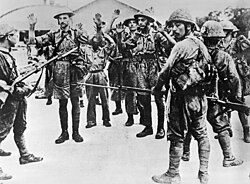
The [[Empire of Japan]], which had signed but never ratified the [[Geneva Convention on Prisoners of War (1929)|1929 Geneva Convention on Prisoners of War]],<ref>{{cite web|url=http://www.icrc.org/ihl.nsf/WebSign?ReadForm&id=305&ps=S |title=International Humanitarian Law – State Parties / Signatories |publisher=Icrc.org |date=27 July 1929 |access-date=14 April 2012}}</ref> did not treat prisoners of war in accordance with international agreements, including provisions of the [[Hague Conventions (1899 and 1907)|Hague Conventions]], either during the [[Second Sino-Japanese War]] or during the [[Pacific War]], because the Japanese viewed surrender as dishonorable. Moreover, according to a directive ratified on 5 August 1937 by [[Hirohito]], the constraints of the Hague Conventions were explicitly removed on Chinese prisoners.<ref>Akira Fujiwara, ''Nitchû Sensô ni Okeru Horyo Gyakusatsu'', Kikan Sensô Sekinin Kenkyû 9, 1995, p. 22</ref> | [[File:Bosbritsurrendergroup.jpg|thumb|Troops of the [[Suffolk Regiment]] surrendering to the Japanese after the [[Fall of Singapore|Battle of Singapore]], 1942]] | ||
The [[Empire of Japan]], which had signed but never ratified the [[Geneva Convention on Prisoners of War (1929)|1929 Geneva Convention on Prisoners of War]],<ref>{{cite web|url=http://www.icrc.org/ihl.nsf/WebSign?ReadForm&id=305&ps=S |title=International Humanitarian Law – State Parties / Signatories |publisher=Icrc.org |date=27 July 1929 |access-date=14 April 2012}}</ref> did not treat prisoners of war in accordance with international agreements, including provisions of the [[Hague Conventions (1899 and 1907)|Hague Conventions]], either during the [[Second Sino-Japanese War]] or during the [[Pacific War]], because the Japanese viewed surrender as dishonorable. Moreover, according to a directive ratified on 5 August 1937 by [[Emperor Hirohito]], the constraints of the Hague Conventions were explicitly removed on Chinese prisoners of war.<ref>Akira Fujiwara, ''Nitchû Sensô ni Okeru Horyo Gyakusatsu'', Kikan Sensô Sekinin Kenkyû 9, 1995, p. 22</ref> | |||
Prisoners of war from China, the United States, Australia, Britain, Canada, India, the Netherlands, New Zealand, | Prisoners of war from China, the United States, Australia, Britain, Canada, India, the Netherlands, New Zealand, the Philippines, and Japanese-occupied Asia, held by Japanese imperial armed forces were subject to murder, torture (both physical and psychological), beatings, extrajudicial punishment, [[Slavery in Japan|slavery]], [[Unit 731|medical experiments]], starvation rations, poor medical treatment and [[Chichijima incident|cannibalism]].<ref>{{cite news|url=https://www.independent.co.uk/news/world/japanese-troops-ate-flesh-of-enemies-and-civilians-1539816.html|author=McCarthy, Terry|title=Japanese troops ate flesh of enemies and civilians|newspaper=The Independent|date=12 August 1992|location=London|archive-url=https://web.archive.org/web/20230512013235/https://www.independent.co.uk/news/world/japanese-troops-ate-flesh-of-enemies-and-civilians-1539816.html|archive-date= 12 May 2023}}</ref><ref>{{Cite web|url=http://www.cooksontributeb29.com/uploads/5/8/6/5/5865941/b29_fukubayashi.pdf|archive-url=https://web.archive.org/web/20230405180657/http://www.cooksontributeb29.com/uploads/5/8/6/5/5865941/b29_fukubayashi.pdf|archive-date= 5 April 2023|title=An excellent reference for Japan and the treatment of US Airmen Pows is Toru Fukubayashi, "Allied Aircraft and Airmen Lost over Japanese Mainland" 20 May 2007. (PDF File 20 pages)}}</ref> The most notorious use of forced labour was in the construction of the Burma–Thailand [[Death Railway]]. After 20 March 1943, the Imperial Navy was ordered to kill prisoners of war taken at sea.<ref>{{cite book |last1=Felton |first1=Mark |title=Slaughter at Sea: The Story of Japan's Naval War Crimes |date=2007 |isbn=978-1-84415-647-4 |pages=252|publisher=Pen & Sword Maritime }}</ref> After the [[Armistice of Cassibile]], Italian soldiers and civilians in East Asia were taken as prisoners of war by Japanese armed forces and subject to the same conditions as other POWs.<ref>{{cite web |last1=Tsuyoshi |first1=Masuda |title=Forgotten tragedy of Italian war detainees |url=https://www3.nhk.or.jp/nhkworld/en/news/backstories/816/ |website=nhk.or.jp |publisher=NHK World |access-date=30 June 2020|archive-url=https://web.archive.org/web/20230406111747/https://www3.nhk.or.jp/nhkworld/en/news/backstories/816/|archive-date= 6 April 2023}}</ref> | ||
[[File:March of Death from Bataan to the prison camp - Dead soldiers.jpg|thumb|Thousands of US and Filipino POWs died on the [[Bataan Death March]], April 1942]] | |||
According to the findings of the [[International Military Tribunal for the Far East|Tokyo Tribunal]], the Japanese captured 350,000 POWs, of which 131,134 came from Britain, the Netherlands, Australia, the United States, Canada, and New Zealand. Of these 131,134 POWs, 35,756 died while detained, the death rate of Western prisoners was thus 27.1 per cent, seven times that of Western POWs under the Germans and Italians.<ref name="hidden">{{cite book |author=Yuki Tanaka |author-link=Yuki Tanaka (historian) |title=Hidden Horrors |date=1996 |publisher=Avalon Publishing |isbn=978-0813327181 |pages=2, 3}}</ref> The death rate of Chinese was much higher. Thus, while 37,583 prisoners from the United Kingdom, 28,500 from the Netherlands, and 14,473 from the United States were released after the [[surrender of Japan]], the number for the Chinese was only 56.<ref name =hidden/><ref>[[Herbert Bix]], ''[[Hirohito and the Making of Modern Japan]]'', 2001, p. 360</ref> The 27,465 US Army POWs captured in the Pacific Theater, including Filipinos, had a 40.4 per cent death rate.<ref>Statistical and Accounting Branch, Office of the Adjutant General, U.S. Department of the Army, ''Army Battle Casualties and Nonbattle Deaths in World War II. Final Report, 7 December 1941–31 December 1946,'' page 5</ref> The War Ministry in Tokyo issued an order at the end of the war allowing local commanders to kill remaining POWs without formal orders from Tokyo.<ref>[https://www.pbs.org/wgbh/amex/bataan/peopleevents/e_atrocities.html Japanese Atrocities in the Philippines] {{Webarchive|url=https://web.archive.org/web/20030727223501/http://www.pbs.org/wgbh/amex/bataan/peopleevents/e_atrocities.html|date=27 July 2003}}". Public Broadcasting Service (PBS)</ref> | |||
{| class="wikitable sortable" | |||
! colspan="4" |Number of Western Allied POWs and Death Rate Under the Japanese<ref>Based on data in "Horyo Saishū Ronkoku Fuzoku-sho 'B'", Kykutō Kokusai Gunji Saiben No. 337, February 19, 1948.</ref><ref name="hidden" /> | |||
|- | |||
!Country | |||
!Number of POWs | |||
!Number of Deaths | |||
!Death Rate | |||
|- | |||
|Australia | |||
|21,726 | |||
|7,412 | |||
|34.1 | |||
|- | |||
| Canada||1,691 | |||
|273 | |||
|16.1 | |||
|- | |||
| New Zealand||121 | |||
|31 | |||
|25.6 | |||
|- | |||
|The Netherlands||37,000 | |||
|8,500 | |||
|22.9 | |||
|- | |||
|United Kingdom||50,016 | |||
|12,433 | |||
|24.8 | |||
|- | |||
|United States | |||
|21,580 | |||
|7,107 | |||
|32.9 | |||
|- | |||
|Total | |||
|132,134 | |||
|35,756 | |||
|27.1 | |||
|} | |||
No direct access to the POWs was provided to the [[International Red Cross]]. Escapes among | No direct access to the POWs was provided to the [[International Red Cross]]. Escapes among the [[European descent|prisoners of European descent]] were almost impossible because of the difficulty of hiding in Asiatic populations.<ref>''Prisoners of the Japanese : POWs of World War II in the Pacific'', by Gavan Daws, {{ISBN|0-688-14370-9}}</ref> | ||
Allied POW camps and ship-transports | Allied POW camps and ship-transports became accidental targets of Allied attacks. The number of deaths which occurred when Japanese "[[hell ship]]s"—unmarked transport ships in which POWs were transported in harsh conditions—were attacked by [[United States Navy|U.S. Navy]] [[submarine]]s was particularly high. Gavan Daws has calculated that "of all POWs who died in the Pacific War, one in three was killed on the water by friendly fire".<ref>{{cite book|last=Daws|first=Gavan|title=Prisoners of the Japanese: POWs of World War II in the Pacific|year=1994|publisher=Scribe Publications|isbn=1-920769-12-9|pages=295–297|location=Melbourne}}</ref> Daws states that 10,800 of the 50,000 POWs shipped by the Japanese were killed at sea<ref>Daws (1994), p. 297</ref> while Donald L. Miller states that "approximately 21,000 Allied POWs died at sea, about 19,000 of them killed by friendly fire."<ref>{{cite book |last=Miller |first=Donald L. |url=https://books.google.com/books?id=zRd-z7amBj0C&pg=PA317 |title=D-Days in the Pacific |date=2008 |publisher=Simon and Schuster |isbn=978-1439128817 |page=317}}</ref> | ||
Life in the POW camps was recorded at great risk to themselves by artists such as [[Jack Bridger Chalker]], [[Philip Meninsky]], [[Ashley George Old]], and [[Ronald Searle]]. Human hair was often used for brushes, plant juices and blood for paint, toilet paper as the "canvas". Some of their works were used as evidence in the trials of Japanese war criminals. | Life in the POW camps was recorded at great risk to themselves by artists such as [[Jack Bridger Chalker]], [[Philip Meninsky]], [[Ashley George Old]], and [[Ronald Searle]]. Human hair was often used for brushes, plant juices and blood for paint, toilet paper as the "canvas". Some of their works were used as evidence in the trials of Japanese war criminals. | ||
Female prisoners (detainees) at [[Changi Prison]] in | Female prisoners (detainees) at [[Changi Prison]] in Singapore, recorded their ordeal in seemingly harmless prison quilt embroidery.<ref>{{Cite book|title=Threads of life : a history of the world through the eye of a needle|last=Hunter|first=Clare|publisher=Spectre (Hodder & Stoughton)|year=2019|isbn=978-1473687912|location=London|pages=50–58}}</ref> | ||
<gallery widths="140" heights="140"> | |||
<gallery | |||
File:Portrait of "Dusty" Rhodes by Ashley George Old.jpg|Water colour sketch of "Dusty" Rhodes by [[Ashley George Old]] | File:Portrait of "Dusty" Rhodes by Ashley George Old.jpg|Water colour sketch of "Dusty" Rhodes by [[Ashley George Old]] | ||
File:POWs Burma Thai RR.jpg|Australian and Dutch POWs at Tarsau, Thailand in 1943 | File:POWs Burma Thai RR.jpg|Australian and Dutch POWs at Tarsau, Thailand in 1943 | ||
File:Army nurses rescued from Santo Tomas 1945h.jpg|[[Angels of Bataan|U.S. Army Nurses]] in [[Santo Tomas Internment Camp]], 1943 | File:Army nurses rescued from Santo Tomas 1945h.jpg|[[Angels of Bataan|U.S. Army Nurses]] in [[Santo Tomas Internment Camp]], 1943 | ||
File:Navy Nurses Rescued from Los Banos.jpg|[[United States Navy Nurse Corps|U.S. Navy nurses]] rescued from Los Baños Internment Camp, March 1945 | File:Navy Nurses Rescued from Los Banos.jpg|[[United States Navy Nurse Corps|U.S. Navy nurses]] rescued from Los Baños Internment Camp, March 1945 | ||
File:Gaunt allied prisoners of war at Aomori camp near Yokohama cheer rescuers from U.S. Navy. Waving flags of the United... - NARA - 520992.tif|Allied prisoners of war at | File:Gaunt allied prisoners of war at Aomori camp near Yokohama cheer rescuers from U.S. Navy. Waving flags of the United... - NARA - 520992.tif|Allied prisoners of war at Aomori camp near [[Yokohama]], Japan, waving flags of the United States, Great Britain, and the Netherlands in August 1945 | ||
File:Canadian POWs | File:Canadian POWs in Manilla Philippines 1945.gif|Liberated Canadian POWs arriving in Manila, Philippines, 1945 | ||
File:Aso Mining POWs.jpg|Malnourished Australian POWs forced to work at the Aso mining company, August 1945 | File:Aso Mining POWs.jpg|Malnourished Australian POWs forced to work at the Aso mining company, August 1945 | ||
File:Giving a sick man a drink as US POWs of Japanese, Philippine Islands, Cabanatuan prison camp.jpg|POW art depicting [[Raid at Cabanatuan#POW camp|Cabanatuan prison camp]], produced in 1946 | File:Giving a sick man a drink as US POWs of Japanese, Philippine Islands, Cabanatuan prison camp.jpg|POW art depicting [[Raid at Cabanatuan#POW camp|Cabanatuan prison camp]], produced in 1946 | ||
File:LeonardGSiffleet.jpg|Australian POW [[Leonard Siffleet]] captured at New Guinea moments before his execution with a Japanese [[shin gunto]] sword in 1943 | File:LeonardGSiffleet.jpg|Australian POW [[Leonard Siffleet]] captured at New Guinea moments before his execution with a Japanese [[shin gunto]] sword in 1943 | ||
File:Japanese atrocities imperial war museum K9923.jpg|Captured soldiers of the British Indian Army executed by the Japanese | File:Japanese atrocities imperial war museum K9923.jpg|Captured soldiers of the British Indian Army executed by the Japanese | ||
</gallery> | |||
====Germany==== | ====Germany==== | ||
=====French soldiers===== | =====French soldiers===== | ||
{{main|French prisoners of war in World War II}} | {{main|French prisoners of war in World War II}} | ||
[[File:Black prisoners in Eastern Europe; with Luftwaffe soldiers.jpg|thumb|French [[Senegalese Tirailleurs]] held as POW by the germans into [[Stalag I-B]], East Prussia (now Poland), 1944.]] | |||
After the French armies surrendered in summer 1940, Germany seized two million French prisoners of war and sent them to camps in Germany. About one third were released on various terms. Of the remainder, the officers and non-commissioned officers were kept in camps and did not work. The privates were sent out to work. About half of them worked for German agriculture, where food supplies were adequate and controls were lenient. The others worked in factories or mines, where conditions were much harsher.<ref>Richard Vinen, ''The Unfree French: Life under the Occupation'' (2006) pp. 183–214</ref> | After the French armies surrendered in summer 1940, Germany seized two million French prisoners of war and sent them to camps in Germany. About one third were released on various terms. Of the remainder, the officers and non-commissioned officers were kept in camps and did not work. The privates were sent out to work. About half of them worked for German agriculture, where food supplies were adequate and controls were lenient. The others worked in factories or mines, where conditions were much harsher.<ref>Richard Vinen, ''The Unfree French: Life under the Occupation'' (2006) pp. 183–214</ref> | ||
| Line 249: | Line 306: | ||
Germany and Italy generally treated prisoners from the [[British Empire]] and [[Commonwealth of Nations|Commonwealth]], France, the U.S., and other western Allies in accordance with the [[Geneva Convention on Prisoners of War (1929)|Geneva Convention]], which had been signed by these countries.<ref>{{cite web |url=http://www.cicr.org/ihl.nsf/WebSign?ReadForm&id=305&ps=P |title=International Humanitarian Law – State Parties / Signatories |publisher=Cicr.org |access-date=14 April 2012 |archive-url=https://web.archive.org/web/20120205211218/http://www.cicr.org/ihl.nsf/WebSign?ReadForm&id=305&ps=P |archive-date=5 February 2012 |url-status=dead }}</ref> Consequently, western Allied officers were not usually made to work and some personnel of lower rank were usually compensated, or not required to work either. The main complaints of western Allied prisoners of war in [[Wehrmacht|German]] POW camps—especially during the last two years of the war—concerned shortages of food. | Germany and Italy generally treated prisoners from the [[British Empire]] and [[Commonwealth of Nations|Commonwealth]], France, the U.S., and other western Allies in accordance with the [[Geneva Convention on Prisoners of War (1929)|Geneva Convention]], which had been signed by these countries.<ref>{{cite web |url=http://www.cicr.org/ihl.nsf/WebSign?ReadForm&id=305&ps=P |title=International Humanitarian Law – State Parties / Signatories |publisher=Cicr.org |access-date=14 April 2012 |archive-url=https://web.archive.org/web/20120205211218/http://www.cicr.org/ihl.nsf/WebSign?ReadForm&id=305&ps=P |archive-date=5 February 2012 |url-status=dead }}</ref> Consequently, western Allied officers were not usually made to work and some personnel of lower rank were usually compensated, or not required to work either. The main complaints of western Allied prisoners of war in [[Wehrmacht|German]] POW camps—especially during the last two years of the war—concerned shortages of food. | ||
[[File:American POWs AF Museum.jpg|left|thumb|Representation of a "Forty-and-eight" boxcar used to transport American POWs in Germany during World War II]] | [[File:American POWs AF Museum.jpg|left|thumb|Representation of a "Forty-and-eight" boxcar used to transport American POWs in Germany during World War II]] | ||
Only a small proportion of western Allied POWs who were | Only a small proportion of western Allied POWs who were Jews—or whom the Nazis believed to be Jewish—were killed as part of [[the Holocaust]] or were subjected to other [[antisemitism|antisemitic]] policies.<ref>{{Cite web|url=https://www.nationalww2museum.org/war/articles/jewish-american-pows-europe#:~:text=An%20estimated%209%2C000%20American%20Jews,of%20both%20pride%20and%20peril.&text=Around%20500%2C000%20American%20Jews%20served,risk%20should%20they%20be%20captured.|title=Pride and Peril: Jewish American POWs in Europe|website=The National WWII Museum |date=26 May 2021 |access-date=21 April 2022|archive-url=https://web.archive.org/web/20230405180657/https://www.nationalww2museum.org/war/articles/jewish-american-pows-europe|archive-date= 5 April 2023}}</ref> For example, Major [[Yitzhak Ben-Aharon]], a [[Palestinian Jew]] who had enlisted in the British Army, and who was captured by the Germans in [[Greek Campaign|Greece in 1941]], experienced four years of captivity under entirely normal conditions for POWs.<ref>{{cite web |url=http://www.jafi.org.il/JewishAgency/English/Jewish+Education/Compelling+Content/Eye+on+Israel/Gallery+of+People+(Biographies)/Ben+Aharon+Yitzhak.htm |title=Ben Aharon Yitzhak |publisher=Jafi.org.il |access-date=14 April 2012 |url-status=dead |archive-url=https://web.archive.org/web/20120318070158/http://www.jafi.org.il/JewishAgency/English/Jewish+Education/Compelling+Content/Eye+on+Israel/Gallery+of+People+(Biographies)/Ben+Aharon+Yitzhak.htm |archive-date=18 March 2012 }}</ref> | ||
A small number of Allied personnel were sent to concentration camps, for a variety of reasons including being Jewish.<ref>See, for example, [https://www.h-net.org/reviews/showrev.cgi?path=295291169228827 Joseph Robert White, 2006, "Flint Whitlock. Given Up for Dead: American GIs in the Nazi Concentration Camp at Berga"] {{Webarchive|url=https://web.archive.org/web/20070611020900/http://www.h-net.org/reviews/showrev.cgi?path=295291169228827 |date=11 June 2007 }} (book review)</ref> As the US historian Joseph Robert White put it: "An important exception ... is the sub-camp for U.S. POWs at [[Berga, Thuringia|Berga an der Elster]], officially called ''[[Arbeitslager|Arbeitskommando]] 625'' [also known as ''[[Stalag IX-B]]'']. Berga was the deadliest work detachment for American captives in Germany. 73 men who participated, or 21 percent of the detachment, perished in two months. 80 of the 350 POWs were Jews."<ref>{{Cite news |last=Inskeep |first=Steve |date=2005 | A small number of Allied personnel were sent to concentration camps, for a variety of reasons including being Jewish.<ref>See, for example, [https://www.h-net.org/reviews/showrev.cgi?path=295291169228827 Joseph Robert White, 2006, "Flint Whitlock. Given Up for Dead: American GIs in the Nazi Concentration Camp at Berga"] {{Webarchive|url=https://web.archive.org/web/20070611020900/http://www.h-net.org/reviews/showrev.cgi?path=295291169228827 |date=11 June 2007 }} (book review)</ref> As the US historian Joseph Robert White put it: "An important exception ... is the sub-camp for U.S. POWs at [[Berga, Thuringia|Berga an der Elster]], officially called ''[[Arbeitslager|Arbeitskommando]] 625'' [also known as ''[[Stalag IX-B]]'']. Berga was the deadliest work detachment for American captives in Germany. 73 men who participated, or 21 percent of the detachment, perished in two months. 80 of the 350 POWs were Jews."<ref>{{Cite news |last=Inskeep |first=Steve |date=30 May 2005 |title='Soldiers and Slaves' Details Saga of Jewish POWs |language=en |pages=1 |work=[[NPR]] |url=https://www.npr.org/2005/05/30/4672288/soldiers-and-slaves-details-saga-of-jewish-pows |access-date=10 January 2023}}</ref> Another well-known example was a group of 168 Australian, British, Canadian, New Zealand and US aviators who were held for two months at [[Buchenwald concentration camp]];<ref>See: [https://web.archive.org/web/20230207180457/https://www.rcafassociation.ca/heritage/history/buchenwald/allied-officers-deported-to-buchenwald-klb-club-archives/ Royal Canadian Air Force Association, "Allied Officers Deported to Buchenwald"] and [https://web.archive.org/web/20071114105127/http://www.nationalmuseum.af.mil/factsheets/factsheet.asp?id=1575 National Museum of the USAF, "Allied Victims of the Holocaust"].</ref> two of the POWs died at Buchenwald. Two possible reasons have been suggested for this incident: German authorities wanted to make an example of ''[[terror bombing|Terrorflieger]]'' ("terrorist aviators") or these aircrews were classified as spies, because they had been disguised as civilians or enemy soldiers when they were apprehended. | ||
[[File:Pow telegram.jpg|thumb|Telegram notifying parents of an American POW of his capture by Germany]] | [[File:Pow telegram.jpg|thumb|Telegram notifying parents of an American POW of his capture by Germany]] | ||
Information on conditions in the stalags is contradictory depending on the source. Some American POWs claimed the Germans were victims of circumstance and did the best they could, while others accused their captors of brutalities and forced labour. In any case, the prison camps were miserable places where food rations were meager and conditions squalid. One American admitted "The only difference between the stalags and concentration camps was that we weren't gassed or shot in the former. I do not recall a single act of compassion or mercy on the part of the Germans." Typical meals consisted of a bread slice and watery potato soup which was still more substantial than what Soviet POWs or concentration camp inmates received. Another prisoner stated that "The German plan was to keep us alive, yet weakened enough that we wouldn't attempt escape."<ref>Ambrose, pp 360{{full citation needed|date=September 2021}}</ref> | Information on conditions in the stalags is contradictory depending on the source. Some American POWs claimed the Germans were victims of circumstance and did the best they could, while others accused their captors of brutalities and forced labour. In any case, the prison camps were miserable places where food rations were meager and conditions squalid. One American admitted "The only difference between the stalags and concentration camps was that we weren't gassed or shot in the former. I do not recall a single act of compassion or mercy on the part of the Germans." Typical meals consisted of a bread slice and watery potato soup which was still more substantial than what Soviet POWs or concentration camp inmates received. Another prisoner stated that "The German plan was to keep us alive, yet weakened enough that we wouldn't attempt escape."<ref>Ambrose, pp 360{{full citation needed|date=September 2021}}</ref> | ||
As the Red Army approached some POW camps in early 1945, German guards forced western Allied POWs | As the Red Army approached some POW camps in early 1945, German guards forced western Allied POWs [[The March (1945)|to walk]] long distances towards central Germany, often in extreme winter weather conditions.<ref>{{Cite web|url=https://www.b24.net/powMarch.htm|title=Death March from Stalag Luft 4 during WWII|website=www.b24.net|access-date=26 October 2019|archive-url=https://web.archive.org/web/20170705073356/https://www.b24.net/powMarch.htm|archive-date= 5 July 2017}}</ref> It is estimated that, out of 257,000 POWs, about 80,000 were subject to such marches and up to 3,500 of them died as a result.<ref>{{Cite web|title=Guests of the Third Reich|url=https://guestsofthethirdreich.org/liberation/|access-date=26 October 2020|website=guestsofthethirdreich.org|archive-url=https://web.archive.org/web/20230407045309/https://guestsofthethirdreich.org/liberation/|archive-date= 7 April 2023}}</ref> | ||
=====Italian POWs===== | =====Italian POWs===== | ||
{{main|Operation Achse|Italian military internees|Massacre of the Acqui Division}} | {{main|Operation Achse|Italian military internees|Massacre of the Acqui Division}} | ||
In September 1943 after the Armistice, Italian officers and soldiers in many places waiting for orders were arrested by Germans and Italian fascists and taken to internment camps in Germany or Eastern Europe, where they were held for the duration of the war. The International Red Cross could do nothing for them, as they were not regarded as POWs, but the prisoners held the status of "[[Italian military internees|military internees]]". Treatment of the prisoners was generally poor. The author [[Giovannino Guareschi]] was among those interned and wrote about this time in his life. The book was translated and published as ''My Secret Diary''. He wrote about semi-starvation, the casual murder of individual prisoners by guards and how, when they were released (now from a German camp), they found a deserted German town filled with foodstuffs that they (with other released prisoners) ate.{{citation needed|date=February 2012}}. It is estimated that of the 700,000 Italians taken prisoner by the Germans, around 40,000 died in detention and more than 13,000 lost their lives during the transportation from the Greek islands to the mainland.<ref>{{cite web|url = http://www.anrp.it/le-porte-della-memoria/|title = Le porte della Memoria|access-date = 12 November 2006| | In September 1943 after the Armistice, Italian officers and soldiers in many places waiting for orders were arrested by Germans and Italian fascists and taken to internment camps in Germany or Eastern Europe, where they were held for the duration of the war. The International Red Cross could do nothing for them, as they were not regarded as POWs, but the prisoners held the status of "[[Italian military internees|military internees]]". Treatment of the prisoners was generally poor. The author [[Giovannino Guareschi]] was among those interned and wrote about this time in his life. The book was translated and published as ''My Secret Diary''. He wrote about semi-starvation, the casual murder of individual prisoners by guards and how, when they were released (now from a German camp), they found a deserted German town filled with foodstuffs that they (with other released prisoners) ate.{{citation needed|date=February 2012}}. It is estimated that of the 700,000 Italians taken prisoner by the Germans, around 40,000 died in detention and more than 13,000 lost their lives during the transportation from the Greek islands to the mainland.<ref>{{cite web|url = http://www.anrp.it/le-porte-della-memoria/|title = Le porte della Memoria|access-date = 12 November 2006|archive-url=https://web.archive.org/web/20230406111751/http://www.anrp.it/le-porte-della-memoria/|archive-date= 6 April 2023}}</ref> | ||
=====Eastern European POWs===== | =====Eastern European POWs===== | ||
{{Main|German mistreatment of Soviet prisoners of war}} | {{Main|German mistreatment of Soviet prisoners of war|German atrocities committed against Polish prisoners of war}} | ||
[[File:Bundesarchiv Bild 183-B21845, Sowjetische Kriegsgefangene im Lager.jpg|left|thumb|An improvised camp for Soviet POWs. Between June 1941 and January 1942, the Nazis killed an estimated 2.8 million Soviet prisoners of war, whom they viewed as "[[Untermensch|subhuman]]".<ref>Daniel Goldhagen, ''Hitler's Willing Executioners'' (p. 290)—"2.8 million young, healthy Soviet POWs" killed by the Germans, "mainly by starvation ... in less than eight months" of 1941–42, before "the decimation of Soviet POWs ... was stopped" and the Germans "began to use them as laborers".</ref>]] | [[File:Bundesarchiv Bild 183-B21845, Sowjetische Kriegsgefangene im Lager.jpg|left|thumb|An improvised camp for Soviet POWs. Between June 1941 and January 1942, the Nazis killed an estimated 2.8 million Soviet prisoners of war, whom they viewed as "[[Untermensch|subhuman]]".<ref>Daniel Goldhagen, ''Hitler's Willing Executioners'' (p. 290)—"2.8 million young, healthy Soviet POWs" killed by the Germans, "mainly by starvation ... in less than eight months" of 1941–42, before "the decimation of Soviet POWs ... was stopped" and the Germans "began to use them as laborers".</ref>]] | ||
| Line 271: | Line 329: | ||
[[File:Bundesarchiv Bild 192-208, KZ Mauthausen, Sowjetische Kriegsgefangene.jpg|thumb|Naked Soviet prisoners of war in [[Mauthausen concentration camp]]]] | [[File:Bundesarchiv Bild 192-208, KZ Mauthausen, Sowjetische Kriegsgefangene.jpg|thumb|Naked Soviet prisoners of war in [[Mauthausen concentration camp]]]] | ||
The Germans officially justified their policy on the grounds that the Soviet Union had not signed the Geneva Convention. Legally, however, under article 82 of the [[Geneva Convention on Prisoners of War (1929)|Geneva Convention]], signatory countries had to give POWs of all signatory and non-signatory countries the rights assigned by the convention.<ref name="art%2E%2082">{{cite web |url= http://www.icrc.org/ihl.nsf/WebART/305-430083?OpenDocument|title= Part VIII: Execution of the convention #Section I: General provisions |access-date= 29 November 2007}}</ref> Shortly after the German invasion in 1941, the USSR made Berlin an offer of a reciprocal adherence to the [[Hague Conventions (1899 and 1907)|Hague Conventions]]. Third Reich officials left the Soviet "note" unanswered.<ref>Beevor, ''Stalingrad''. Penguin 2001 {{ISBN|0-14-100131-3}} p. 60</ref><ref>James D. Morrow, ''Order within Anarchy: The Laws of War as an International Institution'', 2014, p. 218</ref> | The Germans officially justified their policy on the grounds that the Soviet Union had not signed the Geneva Convention. Legally, however, under article 82 of the [[Geneva Convention on Prisoners of War (1929)|Geneva Convention]], signatory countries had to give POWs of all signatory and non-signatory countries the rights assigned by the convention.<ref name="art%2E%2082">{{cite web |url= http://www.icrc.org/ihl.nsf/WebART/305-430083?OpenDocument|title= Part VIII: Execution of the convention #Section I: General provisions |access-date= 29 November 2007}}</ref> Shortly after the German invasion in 1941, the USSR made Berlin an offer of a reciprocal adherence to the [[Hague Conventions (1899 and 1907)|Hague Conventions]]. Third Reich officials left the Soviet "note" unanswered.<ref>Beevor, ''Stalingrad''. Penguin 2001 {{ISBN|0-14-100131-3}} p. 60</ref><ref>James D. Morrow, ''Order within Anarchy: The Laws of War as an International Institution'', 2014, p. 218</ref> | ||
====Romania==== | |||
=====Soviet POWs===== | |||
Between 1941 and 1944, 91,060 Soviet prisoners of war were captured by the [[Romanian Army]]. Until August 1944, 5,221 Soviet prisoners died in Romanian camps mainly to disease during winter. The POWs were treated according to the 1929 Geneva Convention, which was ratified by Romania on 15 September 1931. Initially, the prisoners were held in five POW camps in [[Vulcan, Brașov|Vulcan]], [[Găești]], [[Drăgășani]], [[Alexandria, Romania|Alexandria]] and [[Slobozia]]. By 1942, the number reached 12 camps of which 10 were in Romania, and two in [[Transnistria Governorate|Transnistria]] at [[Tiraspol]] and [[Odesa]]. As the frontline moved further away, the captured prisoners were given to German POW camps, and then they were transferred to Romanian ones after requests from the Romanian authorities.<ref name="Dutu1">{{cite web|url=https://alesandrudutu.wordpress.com/2015/11/25/prizonieri-de-razboi-sovietici-in-romania-1941-1944/|title=Prizonieri de război sovietici în România (1941–1944)|language=ro|first=Alesandru|last=Duțu|date=25 November 2015}}</ref> | |||
[[File:Bess7.JPG|thumb|left|Soviet POWs escorted by a Romanian cavalryman in 1941]] | |||
In the winter of 1941/1942, the conditions of the POW camps were unsatisfactory, leading to the deaths of prisoners due to various diseases. The conditions were improved in 1942 when, by order of Marshal [[Ion Antonescu]], the organisations leading the camps were to permanently control how the prisoners were accommodated, cared for, fed, and used. Due to some problems that arose with the food allowance in 1942, it was decided that the prisoners were to be fed like the Romanian troops, with an allocated 30 [[Romanian leu|lei]] per soldier per day.<ref name="Dutu1"/> | |||
In accordance with Article 27 of the Geneva Convention, the POWs were used in various productive activities. In return for providing work, the prisoners were granted payment and accommodation, as well as free time for cleaning, rest, and religious or other activities by their employers, according to the contracts signed with the commanders of the prison camps. The main workplaces for prisoners were in agriculture and industrial enterprises, but also in forestry, civil works, and in service of the POW camps.<ref name="Dutu1"/> | |||
For correspondence with their families, the prisoners were provided with postcards. However, most of these were not used as the POWs feared reprisals from the Soviet authorities upon learning that they were prisoners in Romania. The punishment of POWs in the Romanian camps was applied following the regulations of the Romanian Army. Executions by firing squad were few. The escapees who were caught and did not commit any acts of sabotage or espionage were tried by [[court-martial]] and sentenced to prison terms from 3–6 months to several years. After 23 August 1944, the Soviet POWs were handed over to the Soviet headquarters.<ref name="Dutu1"/> | |||
=====Western Allies' POWs===== | |||
[[File:Bucharest Day 2 - Institutul Teologic (9337908278).jpg|thumb|The {{ill|Bucharest Faculty of Orthodox Theology|ro|Facultatea de Teologie Ortodoxă a Universității din București}}, the former Normal School used as Camp No. 13 during the war]] | |||
The first Americans were captured in Romania following [[Operation Tidal Wave]]. The airmen were interned at first in the court of the Central Seminary in [[Bucharest]], with the wounded airmen taken to the no. 415 Hospital in [[Sinaia]]. After Marshal Antonescu's visits, a new camp was to be set up, and the prisoners were to be treated according to the Geneva Convention. In September, all 110 POWs were transferred to the villas belonging to the Brașov and Giurgiu City Halls at [[Timișul de Jos]], in the newly established Camp No. 14 (''Lagărul de prizonieri nr. 14'').<ref name="Dutu2">{{cite web|url=https://alesandrudutu.wordpress.com/2015/08/02/1943-1944-prizonieri-de-razboi-americani-si-englezi-in-romania/|title=1943 – 1944. Prizonieri de război americani și englezi în România|language=ro|first=Alesandru|last=Duțu|date=2 August 2015}}</ref> The excellent living conditions at the camp earned it the nickname "gilded cage", with the prisoners describing it as "probably the best prison camp in the world".<ref>{{cite web|url=https://historia.ro/sectiune/general/prizonierii-americani-in-colivia-de-aur-de-la-2317030.html|title=Prizonierii americani în "colivia de aur" de la Timișu de Jos|language=ro|first=Alexandru|last=Armă|access-date=29 March 2024}}</ref> The treatment of the Allied POWs was overseen by Princess [[Catherine Caradja]], who was nicknamed "The Angel of Ploiești" by the airmen.<ref name="reunion">{{cite web|url=https://www.iar80flyagain.org/operatiunea-reunion-i/|title=Operatiunea Reunion (I)|language=ro|website=iar80flyagain.org|date=28 October 2022}}</ref> | |||
In the spring of 1944, with the increasing number of American and British prisoners due to the [[Western Allied campaign in Romania|restarted air campaign]], a new camp was set up in Bucharest.<ref name="Dutu2"/> Camp No. 13 from Bucharest was initially located within the barracks of the [[Michael the Brave 30th Guards Brigade|6th Guard Regiment "Mihai Viteazul"]], in a frequently bombed area.<ref>{{cite web|url=https://aircrewremembered.com/tichborne-lawrence-franklin.html|title=No. 40 Squadron Wellington X ME990 -R F/O. Lawrence Franklin Tichborne|website=aircrewremembered.com|date=October 2018}}</ref> It was later moved to the [[Normal School]] on St. Ecaterina Street. In June 1944, the non-commissioned officers were transferred to a wing of the {{ill|"Regina Elisabeta" Military Hospital|ro|Spitalul Universitar de Urgență Militar Central „Dr. Carol Davila”}}. After 23 August, at the request of the prisoners to be organised into a military unit, General [[Ioan Mihail Racoviță|Mihail Racoviță]] approved the transfer of 896 POWs to the barracks of the 4th [[Vânători (military unit)|Vânători]] Regiment. All Western Allied POWs were evacuated to Italy during [[Operation Reunion]] from 31 August to 3 September.<ref name="Dutu2"/><ref name="reunion"/> | |||
===Treatment of POWs by the Soviet Union=== | ===Treatment of POWs by the Soviet Union=== | ||
| Line 279: | Line 354: | ||
[[File:RIAN archive 129359 German prisoners-of-war in Moscow.jpg|thumb|German prisoners of war being paraded through Moscow]] | [[File:RIAN archive 129359 German prisoners-of-war in Moscow.jpg|thumb|German prisoners of war being paraded through Moscow]] | ||
According to some sources, the Soviets captured 3.5 million [[Axis powers of World War II|Axis]] servicemen (excluding Japanese), of whom more than a million died.<ref>{{cite web |last=Rees |first=Simon |url=http://www.historynet.com/historical_conflicts/8556717.html?featured=y&c=y |title=German POWs and the Art of Survival |publisher=Historynet.com |access-date=14 April 2012 |url-status=dead |archive-url=https://web.archive.org/web/20071219031006/http://www.historynet.com/historical_conflicts/8556717.html?featured=y&c=y |archive-date=19 December 2007 | According to some sources, the Soviets captured 3.5 million [[Axis powers of World War II|Axis]] servicemen (excluding Japanese), of whom more than a million died.<ref>{{cite web |last=Rees |first=Simon |url=http://www.historynet.com/historical_conflicts/8556717.html?featured=y&c=y |title=German POWs and the Art of Survival |publisher=Historynet.com |access-date=14 April 2012 |url-status=dead |archive-url=https://web.archive.org/web/20071219031006/http://www.historynet.com/historical_conflicts/8556717.html?featured=y&c=y |archive-date=19 December 2007 }}</ref> One specific example is that of the German POWs after the [[Battle of Stalingrad]], where the Soviets captured 91,000 German troops in total (completely exhausted, starving and sick), of whom only 5,000 survived the captivity. | ||
German soldiers were kept as forced labour for many years after the war. The last German POWs like [[Erich Hartmann]], the highest-scoring [[flying ace|fighter ace]] in the history of [[aerial warfare]], who had been declared guilty of [[war crime]]s but without [[due process]], were not released by the Soviets until 1955, two years after Stalin died.<ref>{{cite web|url=http://www.worldwar2database.com/html/germanpow.htm |title=German POWs in Allied Hands – World War II |publisher=Worldwar2database.com |date=27 July 2011 |access-date=14 April 2012 |url-status=dead |archive-url=https://web.archive.org/web/20120412040201/http://worldwar2database.com/html/germanpow.htm |archive-date=12 April 2012 }}</ref> | German soldiers were kept as forced labour for many years after the war. The last German POWs like [[Erich Hartmann]], the highest-scoring [[flying ace|fighter ace]] in the history of [[aerial warfare]], who had been declared guilty of [[war crime]]s but without [[due process]], were not released by the Soviets until 1955, two years after Stalin died.<ref>{{cite web|url=http://www.worldwar2database.com/html/germanpow.htm |title=German POWs in Allied Hands – World War II |publisher=Worldwar2database.com |date=27 July 2011 |access-date=14 April 2012 |url-status=dead |archive-url=https://web.archive.org/web/20120412040201/http://worldwar2database.com/html/germanpow.htm |archive-date=12 April 2012 }}</ref> | ||
| Line 285: | Line 360: | ||
====Polish==== | ====Polish==== | ||
[[File:Katyń, ekshumacja ofiar.jpg|thumb|Katyn 1943 exhumation; photo by [[International Red Cross]] delegation]] | [[File:Katyń, ekshumacja ofiar.jpg|thumb|Katyn 1943 exhumation; photo by [[International Red Cross]] delegation]] | ||
As a result of the [[Soviet invasion of Poland]] in 1939, hundreds of thousands of Polish soldiers became [[Polish prisoners of war in the Soviet Union (after 1939)|prisoners of war in the Soviet Union]]. Thousands were executed; over 20,000 Polish military personnel and civilians perished in the [[Katyn massacre]].<ref name="Fischer">[[Benjamin | As a result of the [[Soviet invasion of Poland]] in 1939, hundreds of thousands of Polish soldiers became [[Polish prisoners of war in the Soviet Union (after 1939)|prisoners of war in the Soviet Union]]. Thousands were executed; over 20,000 Polish military personnel and civilians perished in the [[Katyn massacre]].<ref name="Fischer">[[Benjamin Fischer (historian)]], "[https://web.archive.org/web/20000816221054/http://www.cia.gov/csi/studies/winter99-00/art6.html The Katyn Controversy: Stalin's Killing Field]", ''[[Studies in Intelligence]]'', Winter 1999–2000.</ref> Out of [[Władysław Anders|Anders]]' 80,000 evacuees from the Soviet Union to the United Kingdom, only 310 volunteered to return to Poland in 1947.<ref>{{cite web |url=http://www.wajszczuk.v.pl/english/drzewo/czytelnia/michael_hope.htm |author=Michael Hope|title=Polish deportees in the Soviet Union |publisher=Wajszczuk.v.pl |access-date=14 April 2012 |url-status=dead |archive-url=https://web.archive.org/web/20120216171614/http://www.wajszczuk.v.pl/english/drzewo/czytelnia/michael_hope.htm |archive-date=16 February 2012 }}</ref> | ||
Of the 230,000 Polish prisoners of war taken by the Soviet army, only 82,000 survived.<ref>"''[https://books.google.com/books?id=H1jsgYCoRioC&pg=PA209 Livre noir du Communisme: crimes, terreur, répression] {{Webarchive|url=https://web.archive.org/web/20221225172617/https://books.google.com/books?id=H1jsgYCoRioC&pg=PA209&dq&hl=en |date=25 December 2022 }}''". Stéphane Courtois, Mark Kramer (1999). [[Harvard University Press]]. p. 209. {{ISBN|0-674-07608-7}}</ref> | Of the 230,000 Polish prisoners of war taken by the Soviet army, only 82,000 survived.<ref>"''[https://books.google.com/books?id=H1jsgYCoRioC&pg=PA209 Livre noir du Communisme: crimes, terreur, répression] {{Webarchive|url=https://web.archive.org/web/20221225172617/https://books.google.com/books?id=H1jsgYCoRioC&pg=PA209&dq&hl=en |date=25 December 2022 }}''". Stéphane Courtois, Mark Kramer (1999). [[Harvard University Press]]. p. 209. {{ISBN|0-674-07608-7}}</ref> | ||
====Japanese==== | ====Japanese==== | ||
After the [[Soviet–Japanese War]], 560,000 to 760,000 [[Japanese prisoners of war in the Soviet Union|Japanese prisoners of war]] were captured by the Soviet Union. The prisoners were captured in [[Manchuria]], Korea, South [[Sakhalin]] and the [[Kuril Islands]], then sent to work as forced labour in the Soviet Union and [[Mongolia]].<ref name="sankeishinbun">{{cite web|url=http://sankei.jp.msn.com/world/europe/090724/erp0907240115000-n1.htm |title=シベリア抑留、露に76万人分の資料 軍事公文書館でカード発見 |access-date=21 September 2009 |date=24 July 2009 |work=Sankeishinbun |url-status=dead |archive-url=https://web.archive.org/web/20090726100909/http://sankei.jp.msn.com/world/europe/090724/erp0907240115000-n1.htm |archive-date=26 July 2009 }}</ref> An estimated 60,000 to 347,000 of these Japanese prisoners of war died in captivity.<ref name="news.bbc.co.uk">[ | After the [[Soviet–Japanese War]], 560,000 to 760,000 [[Japanese prisoners of war in the Soviet Union|Japanese prisoners of war]] were captured by the Soviet Union. The prisoners were captured in [[Manchuria]], Korea, South [[Sakhalin]] and the [[Kuril Islands]], then sent to work as forced labour in the Soviet Union and [[Mongolia]].<ref name="sankeishinbun">{{cite web|url=http://sankei.jp.msn.com/world/europe/090724/erp0907240115000-n1.htm |title=シベリア抑留、露に76万人分の資料 軍事公文書館でカード発見 |access-date=21 September 2009 |date=24 July 2009 |work=Sankeishinbun |url-status=dead |archive-url=https://web.archive.org/web/20090726100909/http://sankei.jp.msn.com/world/europe/090724/erp0907240115000-n1.htm |archive-date=26 July 2009 }}</ref> An estimated 60,000 to 347,000 of these Japanese prisoners of war died in captivity.<ref name="news.bbc.co.uk">[https://news.bbc.co.uk/2/hi/world/monitoring/63012.stm Japanese POW group says files on over 500,000 held in Moscow] , ''[[BBC News]]'', 7 March 1998</ref><ref name="UN Press Release">[http://www.unhchr.ch/huricane/huricane.nsf/view01/8D22741F69F38DD3802568C40036B229?opendocument UN Press Release] {{Webarchive|url=https://web.archive.org/web/20070929084218/http://www.unhchr.ch/huricane/huricane.nsf/view01/8D22741F69F38DD3802568C40036B229?opendocument |date=29 September 2007 }}, [[Commission on Human Rights]], 56th session, 13 April 2000.</ref><ref name="zagor">[http://www.auditorium.ru/books/407/ POW in the USSR 1939–1956: Documents and Materials] {{webarchive|url=https://web.archive.org/web/20071102082712/http://www.auditorium.ru/books/407/|date=2 November 2007}} Moscow ''[[Logos Publishers]] (2000)'' (Военнопленные в СССР. 1939–1956: Документы и материалы Науч.-исслед. ин-т проблем экон. истории ХХ века и др.; Под ред. М.М. Загорулько. – М.: Логос, 2000. – 1118 с.: ил.) {{ISBN|5-88439-093-9}}</ref><ref name="Ann">[[Anne Applebaum]] ''Gulag: A History'', Doubleday, April 2003, {{ISBN|0-7679-0056-1}}; p. 431.[http://www.anneapplebaum.com/gulag/intro.html Introduction online] {{webarchive|url=https://web.archive.org/web/20071013124127/http://anneapplebaum.com/gulag/intro.html |date=13 October 2007 }})</ref> | ||
====Americans==== | ====Americans==== | ||
| Line 308: | Line 383: | ||
During the war, the armies of Western Allied nations such as Australia, Canada, the UK and the US<ref>Tremblay, Robert, Bibliothèque et Archives Canada, et al. "Histoires oubliées – Interprogrammes : Des prisonniers spéciaux" Interlude. Aired: 20 July 2008, 14h47 to 15h00. '''Note''': See also [[Saint Helen's Island]].</ref> were given orders to treat [[Axis powers of World War II|Axis]] prisoners strictly in accordance with the [[Geneva Convention on Prisoners of War (1929)|Geneva Convention]].<ref>{{cite book|editor-last1=Dear |editor-first1=I.C.B |editor-last2=Foot |editor-first2=M.R.D.|title=The Oxford Companion to World War II |publisher=Oxford University Press|location=Oxford|year=2005|pages=983–984|chapter=War Crimes|isbn=978-0-19-280670-3}}</ref> Some breaches of the Convention took place, however. According to [[Stephen E. Ambrose]], of the roughly 1,000 US combat veterans he had interviewed, only one admitted to shooting a prisoner, saying he "felt remorse, but would do it again". However, one-third of interviewees told him they had seen fellow US troops kill German prisoners.<ref>[[James J. Weingartner]], [http://www.historycooperative.org/journals/jah/94.4/weingartner.html ''"Americans, Germans, and War Crimes: Converging Narratives from "the Good War"''] the [[Journal of American History]], Vol. 94, No. 4. March 2008 {{webarchive |url=https://web.archive.org/web/20101114112740/http://www.historycooperative.org/journals/jah/94.4/weingartner.html |date=14 November 2010 }}</ref> | During the war, the armies of Western Allied nations such as Australia, Canada, the UK and the US<ref>Tremblay, Robert, Bibliothèque et Archives Canada, et al. "Histoires oubliées – Interprogrammes : Des prisonniers spéciaux" Interlude. Aired: 20 July 2008, 14h47 to 15h00. '''Note''': See also [[Saint Helen's Island]].</ref> were given orders to treat [[Axis powers of World War II|Axis]] prisoners strictly in accordance with the [[Geneva Convention on Prisoners of War (1929)|Geneva Convention]].<ref>{{cite book|editor-last1=Dear |editor-first1=I.C.B |editor-last2=Foot |editor-first2=M.R.D.|title=The Oxford Companion to World War II |publisher=Oxford University Press|location=Oxford|year=2005|pages=983–984|chapter=War Crimes|isbn=978-0-19-280670-3}}</ref> Some breaches of the Convention took place, however. According to [[Stephen E. Ambrose]], of the roughly 1,000 US combat veterans he had interviewed, only one admitted to shooting a prisoner, saying he "felt remorse, but would do it again". However, one-third of interviewees told him they had seen fellow US troops kill German prisoners.<ref>[[James J. Weingartner]], [http://www.historycooperative.org/journals/jah/94.4/weingartner.html ''"Americans, Germans, and War Crimes: Converging Narratives from "the Good War"''] the [[Journal of American History]], Vol. 94, No. 4. March 2008 {{webarchive |url=https://web.archive.org/web/20101114112740/http://www.historycooperative.org/journals/jah/94.4/weingartner.html |date=14 November 2010 }}</ref> | ||
In Britain, German prisoners, particularly higher-ranked officers, were housed in luxurious buildings where [[Covert listening device|listening devices]] were installed. A considerable amount of military intelligence was gained from [[eavesdropping]] on what the officers believed were private casual conversations. Much of the listening was carried out by German refugees, in many cases Jews. The work of these refugees in contributing to the Allied victory was declassified over half a century later.<ref>{{Cite web|url=https://www.timesofisrael.com/how-britains-german-born-jewish-secret-listeners-helped-win-world-war-ii/|title=How Britain's German-born Jewish 'secret listeners' helped win World War II|first=Robert|last=Philpot|website= | In Britain, German prisoners, particularly higher-ranked officers, were housed in luxurious buildings where [[Covert listening device|listening devices]] were installed. A considerable amount of military intelligence was gained from [[eavesdropping]] on what the officers believed were private casual conversations. Much of the listening was carried out by German refugees, in many cases Jews. The work of these refugees in contributing to the Allied victory was declassified over half a century later.<ref>{{Cite web|url=https://www.timesofisrael.com/how-britains-german-born-jewish-secret-listeners-helped-win-world-war-ii/|title=How Britain's German-born Jewish 'secret listeners' helped win World War II|first=Robert|last=Philpot|website=The Times of Israel|date=November 2019 |archive-url=https://web.archive.org/web/20230407045310/https://www.timesofisrael.com/how-britains-german-born-jewish-secret-listeners-helped-win-world-war-ii/|archive-date=7 April 2023}}</ref> | ||
In February 1944, 59.7% of POWs in America were employed. This relatively low percentage was due to problems setting wages that would not compete against those of non-prisoners, to union opposition, as well as concerns about security, sabotage, and escape. Given national manpower shortages, citizens and employers resented the idle prisoners, and efforts were made to | In February 1944, 59.7% of POWs in America were employed. This relatively low percentage was due to problems setting wages that would not compete against those of non-prisoners, to union opposition, as well as concerns about security, sabotage, and escape. Given national manpower shortages, citizens and employers resented the idle prisoners, and efforts were made to decentralise the camps and reduce security enough that more prisoners could work. By the end of May 1944, POW employment was at 72.8%, and by late April 1945 it had risen to 91.3%. The sector that made the most use of POW workers was agriculture. There was more demand than supply of prisoners throughout the war, and 14,000 POW repatriations were delayed in 1946 so prisoners could be used in the spring farming seasons, mostly to thin and block [[sugar beets]] in the west. While some in Congress wanted to extend POW labour beyond June 1946, President Truman rejected this, leading to the end of the program.<ref name="histpow">{{Cite web |title=History of Prisoner of War Utilization by the United States Army 1776–1945 |author=George G. Lewis |author2=John Mehwa |work=Center of Military History, United States Army |date=1982 |access-date=16 August 2020 |url= https://history.army.mil/html/books/104/104-11-1/cmhPub_104-11-1.pdf|archive-url=https://web.archive.org/web/20230405180657/https://history.army.mil/html/books/104/104-11-1/cmhPub_104-11-1.pdf|archive-date=5 April 2023}}</ref> | ||
Towards the end of the war in Europe, as large numbers of Axis soldiers surrendered, the US created the designation of [[Disarmed Enemy Forces]] (DEF) so as not to treat prisoners as POWs. A lot of these soldiers were kept in open fields in makeshift camps in the Rhine valley (''[[Rheinwiesenlager]]''). Controversy has arisen about how Eisenhower managed these prisoners.<ref>{{cite magazine| url=http://www.time.com/time/magazine/article/0,9171,958673,00.html | archive-url=https://web.archive.org/web/20070310191329/http://www.time.com/time/magazine/article/0,9171,958673,00.html | url-status=dead | archive-date=10 March 2007 | magazine=Time | title=Ike's Revenge? | date=2 October 1989 | access-date=22 May 2010}}</ref> (see ''[[Other Losses]]''). | Towards the end of the war in Europe, as large numbers of Axis soldiers surrendered, the US created the designation of [[Disarmed Enemy Forces]] (DEF) so as not to treat prisoners as POWs. A lot of these soldiers were kept in open fields in makeshift camps in the Rhine valley (''[[Rheinwiesenlager]]''). Controversy has arisen about how Eisenhower managed these prisoners.<ref>{{cite magazine| url=http://www.time.com/time/magazine/article/0,9171,958673,00.html | archive-url=https://web.archive.org/web/20070310191329/http://www.time.com/time/magazine/article/0,9171,958673,00.html | url-status=dead | archive-date=10 March 2007 | magazine=Time | title=Ike's Revenge? | date=2 October 1989 | access-date=22 May 2010}}</ref> (see ''[[Other Losses]]''). | ||
| Line 316: | Line 391: | ||
After the surrender of Germany in May 1945, the POW status of the German prisoners was in many cases maintained, and they were for several years used as public labourers in countries such as the UK and France. Many died when forced to clear minefields in countries such as Norway and France. "By September 1945 it was estimated by the French authorities that two thousand prisoners were being maimed and killed each month in accidents".<ref>S. P. MacKenzie "The Treatment of Prisoners of War in World War II" The Journal of Modern History, Vol. 66, No. 3. (September 1994), pp. 487–520.</ref><ref>Footnote to: K. W. Bohme, Zur Geschichte der deutschen Kriegsgefangenen des Zweiten Weltkrieges, 15 vols. (Munich, 1962–74), 1, pt. 1:x. (n. 1 above), 13:173; ICRC (n. 12 above), p. 334.</ref> | After the surrender of Germany in May 1945, the POW status of the German prisoners was in many cases maintained, and they were for several years used as public labourers in countries such as the UK and France. Many died when forced to clear minefields in countries such as Norway and France. "By September 1945 it was estimated by the French authorities that two thousand prisoners were being maimed and killed each month in accidents".<ref>S. P. MacKenzie "The Treatment of Prisoners of War in World War II" The Journal of Modern History, Vol. 66, No. 3. (September 1994), pp. 487–520.</ref><ref>Footnote to: K. W. Bohme, Zur Geschichte der deutschen Kriegsgefangenen des Zweiten Weltkrieges, 15 vols. (Munich, 1962–74), 1, pt. 1:x. (n. 1 above), 13:173; ICRC (n. 12 above), p. 334.</ref> | ||
In 1946, the UK held over 400,000 German POWs, many having been transferred from POW camps in the US and Canada. They were employed as labourers to compensate for the lack of manpower in Britain, as a form of [[war reparations|war reparation]].<ref name="Renate Held 2008">Renate Held, "Die deutschen Kriegsgefangenen in britischer Hand – ein Überblick [The German Prisoners of War in British Hands – An Overview] (in German)" (2008)</ref><ref>Eugene Davidsson, "The Trial of the Germans: An Account of the Twenty-Two Defendants Before the International Military Tribunal at Nuremberg", (1997) pp. 518–519 "the Allies stated in 1943 their intention of using forced workers outside Germany after the war, and not only did they express the intention but they carried it out. Not only Russia made use of such labour. France was given hundreds of thousands of German prisoners of war captured by the Americans, and their physical condition became so bad that the American Army authorities themselves protested. In England and the United States, too, some German prisoners of war were being put to work long after the surrender, and in Russia thousands of them worked until the mid-50s."</ref> A public debate ensued in the | In 1946, the UK held over 400,000 German POWs, many having been transferred from POW camps in the US and Canada. They were employed as labourers to compensate for the lack of manpower in Britain, as a form of [[war reparations|war reparation]].<ref name="Renate Held 2008">Renate Held, "Die deutschen Kriegsgefangenen in britischer Hand – ein Überblick [The German Prisoners of War in British Hands – An Overview] (in German)" (2008)</ref><ref>Eugene Davidsson, "The Trial of the Germans: An Account of the Twenty-Two Defendants Before the International Military Tribunal at Nuremberg", (1997) pp. 518–519 "the Allies stated in 1943 their intention of using forced workers outside Germany after the war, and not only did they express the intention but they carried it out. Not only Russia made use of such labour. France was given hundreds of thousands of German prisoners of war captured by the Americans, and their physical condition became so bad that the American Army authorities themselves protested. In England and the United States, too, some German prisoners of war were being put to work long after the surrender, and in Russia thousands of them worked until the mid-50s."</ref> A public debate ensued in the UK over the treatment of German prisoners of war, with many in Britain comparing the treatment to the POWs to [[Slavery|slave labour]].<ref name="German migrants">{{cite book | author = Inge Weber-Newth |author2=Johannes-Dieter Steinert | title = German migrants in post-war Britain: an enemy embrace | url = https://books.google.com/books?id=hSxK1Hus-BIC | access-date = 15 December 2009 | year = 2006 | publisher = Routledge | isbn =978-0-7146-5657-1| pages = 24–30 | chapter = Chapter 2: Immigration policy—immigrant policy | quote = Views in the Media were mirrored in the House of commons, where the arguments were characterized by a series of questions, the substance of which were always the same. Here too the talk was often of slave labour, and this debate was not laid to rest until the government announced its strategy.}}</ref> In 1947, the Ministry of Agriculture argued against repatriation of working German prisoners, since by then they made up 25 per cent of the land workforce, and it wanted to continue having them work in the UK until 1948.<ref name="German migrants"/> | ||
The "[[London Cage]]", an [[MI19]] prisoner of war facility in | The "[[London Cage]]", an [[MI19]] prisoner of war facility in London used during and immediately after the war to interrogate prisoners before sending them to prison camps, was subject to allegations of torture.<ref name='Secrets'>{{cite news | first=Ian | last=Cobain | title=The secrets of the London Cage | date=12 November 2005 | url =https://www.theguardian.com/uk/2005/nov/12/secondworldwar.world | work =The Guardian | access-date = 17 January 2009|archive-url=https://web.archive.org/web/20230404012234/https://www.theguardian.com/uk/2005/nov/12/secondworldwar.world|archive-date= 4 April 2023 }}</ref> | ||
After the German surrender, the International Red Cross was prohibited from providing aid, such as food or prisoner visits, to POW camps in Germany. However, after making appeals to the Allies in the autumn of 1945, the Red Cross was allowed to investigate the camps in the British and French occupation zones of Germany, as well as providing relief to the prisoners held there.<ref name="autogenerated2005">Staff. [http://www.icrc.org/web/eng/siteeng0.nsf/htmlall/57jnwx?opendocument ICRC in WW II: German prisoners of war in Allied hands] {{Webarchive|url=https://web.archive.org/web/20090426202233/http://www.icrc.org/web/eng/siteeng0.nsf/htmlall/57jnwx?opendocument |date=26 April 2009 }}, 2 February 2005<!--Retrieved 12 August 2008--></ref> On 4 February 1946, the Red Cross was also permitted to visit and assist prisoners in the US occupation zone of Germany, although only with very small quantities of food. "During their visits, the delegates observed that German prisoners of war were often detained in appalling conditions. They drew the attention of the authorities to this fact, and gradually succeeded in getting some improvements made".<ref name="autogenerated2005"/> | After the German surrender, the International Red Cross was prohibited from providing aid, such as food or prisoner visits, to POW camps in Germany. However, after making appeals to the Allies in the autumn of 1945, the Red Cross was allowed to investigate the camps in the British and French occupation zones of Germany, as well as providing relief to the prisoners held there.<ref name="autogenerated2005">Staff. [http://www.icrc.org/web/eng/siteeng0.nsf/htmlall/57jnwx?opendocument ICRC in WW II: German prisoners of war in Allied hands] {{Webarchive|url=https://web.archive.org/web/20090426202233/http://www.icrc.org/web/eng/siteeng0.nsf/htmlall/57jnwx?opendocument |date=26 April 2009 }}, 2 February 2005<!--Retrieved 12 August 2008--></ref> On 4 February 1946, the Red Cross was also permitted to visit and assist prisoners in the US occupation zone of Germany, although only with very small quantities of food. "During their visits, the delegates observed that German prisoners of war were often detained in appalling conditions. They drew the attention of the authorities to this fact, and gradually succeeded in getting some improvements made".<ref name="autogenerated2005"/> | ||
POWs were also transferred among the Allies, with for example 6,000 German officers transferred from Western Allied camps to the Soviets and subsequently imprisoned in the [[Sachsenhausen concentration camp]], at the time one of the [[NKVD special camps in Germany 1945–50|NKVD special camps]].<ref>"Ex-Death Camp Tells Story of Nazi and Soviet Horrors" ''New York Times'', 17 December 2001</ref><ref>{{cite news|last=Butler|first=Desmond|date=17 December 2001|title=Ex-Death Camp Tells Story of Nazi and Soviet Horrors|newspaper=The New York Times|url=https://www.nytimes.com/2001/12/17/world/ex-death-camp-tells-story-of-nazi-and-soviet-horrors.html|access-date=30 December 2013| | POWs were also transferred among the Allies, with for example 6,000 German officers transferred from Western Allied camps to the Soviets and subsequently imprisoned in the [[Sachsenhausen concentration camp]], at the time one of the [[NKVD special camps in Germany 1945–50|NKVD special camps]].<ref>"Ex-Death Camp Tells Story of Nazi and Soviet Horrors" ''New York Times'', 17 December 2001</ref><ref>{{cite news|last=Butler|first=Desmond|date=17 December 2001|title=Ex-Death Camp Tells Story of Nazi and Soviet Horrors|newspaper=The New York Times|url=https://www.nytimes.com/2001/12/17/world/ex-death-camp-tells-story-of-nazi-and-soviet-horrors.html|access-date=30 December 2013|archive-url=https://web.archive.org/web/20230328012225/https://www.nytimes.com/2001/12/17/world/ex-death-camp-tells-story-of-nazi-and-soviet-horrors.html|archive-date=28 March 2023}}</ref><ref>{{cite news| url=https://query.nytimes.com/gst/fullpage.html?res=9A0CEFDA163EF934A25751C1A9679C8B63 | work=The New York Times | title=Ex-Death Camp Tells Story of Nazi and Soviet Horrors | first=Desmond | last=Butler | date=17 December 2001|archive-url=https://web.archive.org/web/20230328012225/https://www.nytimes.com/2001/12/17/world/ex-death-camp-tells-story-of-nazi-and-soviet-horrors.html|archive-date= 28 March 2023}}</ref> Although the Soviet Union had not signed the Geneva Convention, the U.S. chose to hand over several hundred thousand German prisoners to the Soviet Union in May 1945 as a "gesture of friendship".<ref>Edward N. Peterson, The American Occupation of Germany, pp. 42, 116, "Some hundreds of thousands who had fled to the Americans to avoid being taken prisoner by the Soviets were turned over in May to the Red Army in a gesture of friendship."</ref> U.S. forces also refused to accept the surrender of German troops attempting to surrender to them in [[Saxony]] and [[Bohemia]], and handed them over to the Soviet Union instead.<ref>Niall Ferguson, "Prisoner Taking and Prisoner Killing in the Age of Total War: Towards a Political Economy of Military Defeat" War in History 2004 11 (2) 148–192 p. 189, (footnote, referenced to: [[Heinz Nawratil]], Die deutschen Nachkriegsverluste unter Vertriebenen, Gefangenen und Verschleppter: mit einer übersicht über die europäischen Nachkriegsverluste (Munich and Berlin, 1988), pp. 36f.)</ref> | ||
The United States handed over 740,000 German prisoners to France, which was a Geneva Convention signatory but which used them as forced labourers. Newspapers reported that the POWs were being mistreated; Judge [[Robert H. Jackson]], chief US prosecutor in the [[Nuremberg trials]], told US President [[Harry S Truman]] in October 1945 that the Allies themselves, | The United States handed over 740,000 German prisoners to France, which was a Geneva Convention signatory but which used them as forced labourers. Newspapers reported that the POWs were being mistreated; Judge [[Robert H. Jackson]], chief US prosecutor in the [[Nuremberg trials]], told US President [[Harry S Truman]] in October 1945 that the Allies themselves, | ||
<blockquote>have done or are doing some of the very things we are prosecuting the Germans for. The French are so violating the Geneva Convention in the treatment of prisoners of war that our command is taking back prisoners sent to them. We are prosecuting plunder and our Allies are practising it.<ref>David Lubań, "Legal Modernism", Univ of Michigan Press, 1994. {{ISBN|978-0-472-10380-5}} pp. 360, 361</ref><ref>[https://www.pbs.org/wgbh/ | <blockquote>have done or are doing some of the very things we are prosecuting the Germans for. The French are so violating the Geneva Convention in the treatment of prisoners of war that our command is taking back prisoners sent to them. We are prosecuting plunder and our Allies are practising it.<ref>David Lubań, "Legal Modernism", Univ of Michigan Press, 1994. {{ISBN|978-0-472-10380-5}} pp. 360, 361</ref><ref>"[https://www.pbs.org/wgbh/americanexperience/features/nuremberg-legacy/ The Legacy of Nuremberg]", PBS. [https://www.pbs.org/wgbh/americanexperience/features/nuremberg-legacy/].</ref></blockquote> | ||
====Hungarians==== | ====Hungarians==== | ||
[[Hungarians]] became POWs of the Western Allies. Some of these were, like the Germans, used as forced labour in France after the cessation of hostilities.<ref>{{Cite web |url=http://www.hungarianhistory.com/lib/francia/francia.pdf |title=Hungarian Prisoners-of-War In French Captivity 1945–1947 |first=Bela |last=Tarczai |website=www.hungarianhistory.com |url-status=dead|archive-url=https://web.archive.org/web/20050301160204/http://www.hungarianhistory.com/lib/francia/francia.pdf |archive-date=1 March 2005}}</ref> After the war, Hungarian POWs were handed over to the Soviets and transported to the [[Soviet Union]] for [[Forced labor of Hungarians in the Soviet Union|forced labour]]. Such forced Hungarian labour by the USSR is often referred to as [[malenkij robot]]—little work. [[András Toma]], a Hungarian soldier taken prisoner by the Red Army in 1944, was discovered in a Russian psychiatric hospital in 2000. It is likely that he was the last prisoner of war from World War II to be repatriated.<ref>Thorpe, Nick. [ | [[Hungarians]] became POWs of the Western Allies. Some of these were, like the Germans, used as forced labour in France after the cessation of hostilities.<ref>{{Cite web |url=http://www.hungarianhistory.com/lib/francia/francia.pdf |title=Hungarian Prisoners-of-War In French Captivity 1945–1947 |first=Bela |last=Tarczai |website=www.hungarianhistory.com |url-status=dead|archive-url=https://web.archive.org/web/20050301160204/http://www.hungarianhistory.com/lib/francia/francia.pdf |archive-date=1 March 2005}}</ref> After the war, Hungarian POWs were handed over to the Soviets and transported to the [[Soviet Union]] for [[Forced labor of Hungarians in the Soviet Union|forced labour]]. Such forced Hungarian labour by the USSR is often referred to as [[malenkij robot]]—little work. [[András Toma]], a Hungarian soldier taken prisoner by the Red Army in 1944, was discovered in a Russian psychiatric hospital in 2000. It is likely that he was the last prisoner of war from World War II to be repatriated.<ref>Thorpe, Nick. [https://news.bbc.co.uk/2/hi/europe/929702.stm Hungarian POW identified] . [[BBC News]], 17 September 2000. Accessed 11 December 2016</ref> | ||
====Japanese==== | ====Japanese==== | ||
| Line 335: | Line 410: | ||
[[File:OkinawaJapanesePOW.jpg|thumb|A group of Japanese soldiers captured during the [[Battle of Okinawa]]]] | [[File:OkinawaJapanesePOW.jpg|thumb|A group of Japanese soldiers captured during the [[Battle of Okinawa]]]] | ||
Although thousands of Japanese servicemembers were taken prisoner, most fought until they were killed or committed suicide. Of the 22,000 Japanese soldiers present at the beginning of the [[Battle of Iwo Jima]], over 20,000 were killed and only 216 were taken prisoner.<ref>{{cite book | last = Morison | first = Samuel Eliot | author-link = Samuel Eliot Morison | orig-year = 1960 | year = 2002 | title = Victory in the Pacific, 1945 |series=Volume 14 of ''[[History of United States Naval Operations in World War II]]'' | publisher = University of Illinois Press | location = Urbana | isbn = 0-252-07065-8 | oclc = 49784806}}</ref> Of the 30,000 Japanese troops that defended [[Saipan]], fewer than 1,000 remained alive at battle's end.<ref>[http://www.historynet.com/battle-of-saipan.htm Battle of Saipan] {{Webarchive|url=https://web.archive.org/web/20121103221858/http://www.historynet.com/battle-of-saipan.htm |date=3 November 2012 }}, historynet.com</ref> Japanese prisoners sent to camps fared well; however, some were killed when attempting to surrender or were massacred<ref>[https://www.telegraph.co.uk/news/worldnews/asia/japan/1495651/American-troops-murdered-Japanese-PoWs.html American troops 'murdered Japanese PoWs'] {{Webarchive|url=https://web.archive.org/web/20181019164056/https://www.telegraph.co.uk/news/worldnews/asia/japan/1495651/American-troops-murdered-Japanese-PoWs.html|date=19 October 2018}}, "American and Australian soldiers massacred Japanese prisoners of war" according to The Faraway War by Prof Richard Aldrich of Nottingham University. From the diaries of Charles Lindberg: as told by a US officer, "Oh, we could take more if we wanted to", one of the officers replied. "But our boys don't like to take prisoners." "It doesn't encourage the rest to surrender when they hear of their buddies being marched out on the flying field and machine-guns turned loose on them." On Australian soldiers attitudes [[Eddie Stanton]] is quoted: "Japanese are still being shot all over the place", "The necessity for capturing them has ceased to worry anyone. Nippo soldiers are just so much machine-gun practice. Too many of our soldiers are tied up guarding them."</ref> just after doing so (see [[Allied war crimes during World War II#The Pacific|Allied war crimes during World War II in the Pacific]]). In some instances, Japanese prisoners were tortured through a variety of methods.<ref name=cnn19969623>{{cite news | url=http://edition.cnn.com/WORLD/9609/23/rare.photos/index.html| title=Photos document brutality in Shanghai| publisher=CNN| date=23 September 1996| access-date=8 June 2010| | Although thousands of Japanese servicemembers were taken prisoner of war, most fought until they were killed or committed suicide. Of the 22,000 Japanese soldiers present at the beginning of the [[Battle of Iwo Jima]], over 20,000 were killed and only 216 were taken prisoner of war.<ref>{{cite book | last = Morison | first = Samuel Eliot | author-link = Samuel Eliot Morison | orig-year = 1960 | year = 2002 | title = Victory in the Pacific, 1945 |series=Volume 14 of ''[[History of United States Naval Operations in World War II]]'' | publisher = University of Illinois Press | location = Urbana | isbn = 0-252-07065-8 | oclc = 49784806}}</ref> Of the 30,000 Japanese troops that defended [[Saipan]], fewer than 1,000 remained alive at battle's end.<ref>[http://www.historynet.com/battle-of-saipan.htm Battle of Saipan] {{Webarchive|url=https://web.archive.org/web/20121103221858/http://www.historynet.com/battle-of-saipan.htm |date=3 November 2012 }}, historynet.com</ref> Japanese prisoners of war sent to camps fared well; however, some were killed when attempting to surrender or were massacred<ref>[https://www.telegraph.co.uk/news/worldnews/asia/japan/1495651/American-troops-murdered-Japanese-PoWs.html American troops 'murdered Japanese PoWs'] {{Webarchive|url=https://web.archive.org/web/20181019164056/https://www.telegraph.co.uk/news/worldnews/asia/japan/1495651/American-troops-murdered-Japanese-PoWs.html|date=19 October 2018}}, "American and Australian soldiers massacred Japanese prisoners of war" according to The Faraway War by Prof Richard Aldrich of Nottingham University. From the diaries of Charles Lindberg: as told by a US officer, "Oh, we could take more if we wanted to", one of the officers replied. "But our boys don't like to take prisoners." "It doesn't encourage the rest to surrender when they hear of their buddies being marched out on the flying field and machine-guns turned loose on them." On Australian soldiers attitudes [[Eddie Stanton]] is quoted: "Japanese are still being shot all over the place", "The necessity for capturing them has ceased to worry anyone. Nippo soldiers are just so much machine-gun practice. Too many of our soldiers are tied up guarding them."</ref> just after doing so (see [[Allied war crimes during World War II#The Pacific|Allied war crimes during World War II in the Pacific]]). In some instances, Japanese prisoners of war were tortured through a variety of methods.<ref name=cnn19969623>{{cite news | url=http://edition.cnn.com/WORLD/9609/23/rare.photos/index.html| title=Photos document brutality in Shanghai| publisher=CNN| date=23 September 1996| access-date=8 June 2010|archive-url=https://web.archive.org/web/20230406225846/http://edition.cnn.com/WORLD/9609/23/rare.photos/index.html|archive-date= 6 April 2023}}</ref> A method of torture used by the Chinese [[National Revolutionary Army]] (NRA) included suspending prisoners by the neck in wooden cages until they died.<ref>[http://edition.cnn.com/WORLD/9609/23/rare.photos/image2.lg.jpg CNN] {{Webarchive|url=https://web.archive.org/web/20110514134201/http://edition.cnn.com/WORLD/9609/23/rare.photos/image2.lg.jpg |date=14 May 2011 }} 23 September 1996 image 2</ref> In very rare cases, some were beheaded by sword, and a severed head was once used as a football by Chinese National Revolutionary Army (NRA) soldiers.<ref>[http://edition.cnn.com/WORLD/9609/23/rare.photos/image3.lg.jpg CNN] {{Webarchive|url=https://web.archive.org/web/20110514134150/http://edition.cnn.com/WORLD/9609/23/rare.photos/image3.lg.jpg |date=14 May 2011 }} 23 September 1996 image 3</ref> | ||
After the war, many Japanese POWs were kept on as [[Japanese Surrendered Personnel]] until mid-1947 by the Allies. The JSP were used until 1947 for labour purposes, such as road maintenance, recovering corpses for reburial, cleaning, and preparing farmland. Early tasks also included repairing airfields damaged by Allied bombing during the war and maintaining law and order until the arrival of Allied forces in the region. | After the war, many Japanese POWs were kept on as [[Japanese Surrendered Personnel]] until mid-1947 by the Allies. The JSP were used until 1947 for labour purposes, such as road maintenance, recovering corpses for reburial, cleaning, and preparing farmland. Early tasks also included repairing airfields damaged by Allied bombing during the war and maintaining law and order until the arrival of Allied forces in the region. | ||
| Line 349: | Line 424: | ||
On 11 February 1945, at the conclusion of the [[Yalta Conference]], the United States and United Kingdom signed a Repatriation Agreement with the USSR.<ref>{{cite web|url=http://www.fff.org/freedom/0895a.asp |title=Repatriation – The Dark Side of World War II |publisher=Fff.org |access-date=14 April 2012 |url-status=dead |archive-url=https://web.archive.org/web/20120117182523/http://www.fff.org/freedom/0895a.asp |archive-date=17 January 2012 }}</ref> The interpretation of this agreement resulted in the forcible repatriation of all Soviets ([[Operation Keelhaul]]) regardless of their wishes. The forced repatriation operations took place in 1945–1947.<ref>{{cite web|url=http://www.hillsdale.edu/news/imprimis/archive/issue.asp?year=1988&month=12 |title=Forced Repatriation to the Soviet Union: The Secret Betrayal |publisher=Hillsdale.edu |access-date=14 April 2012 |url-status=dead |archive-url=https://web.archive.org/web/20120207142426/http://www.hillsdale.edu/news/imprimis/archive/issue.asp?year=1988&month=12 |archive-date=7 February 2012 }}</ref> | On 11 February 1945, at the conclusion of the [[Yalta Conference]], the United States and United Kingdom signed a Repatriation Agreement with the USSR.<ref>{{cite web|url=http://www.fff.org/freedom/0895a.asp |title=Repatriation – The Dark Side of World War II |publisher=Fff.org |access-date=14 April 2012 |url-status=dead |archive-url=https://web.archive.org/web/20120117182523/http://www.fff.org/freedom/0895a.asp |archive-date=17 January 2012 }}</ref> The interpretation of this agreement resulted in the forcible repatriation of all Soviets ([[Operation Keelhaul]]) regardless of their wishes. The forced repatriation operations took place in 1945–1947.<ref>{{cite web|url=http://www.hillsdale.edu/news/imprimis/archive/issue.asp?year=1988&month=12 |title=Forced Repatriation to the Soviet Union: The Secret Betrayal |publisher=Hillsdale.edu |access-date=14 April 2012 |url-status=dead |archive-url=https://web.archive.org/web/20120207142426/http://www.hillsdale.edu/news/imprimis/archive/issue.asp?year=1988&month=12 |archive-date=7 February 2012 }}</ref> | ||
==Post-World War II | ==Post-World War II== | ||
[[File:Americanexecuted1950korea.jpg|thumb|A U.S. Army POW of the [[21st Infantry Regiment (United States)|21st Infantry Regiment]] bound and killed by North Koreans during the Korean War]] | [[File:Americanexecuted1950korea.jpg|thumb|left|A U.S. Army POW of the [[21st Infantry Regiment (United States)|21st Infantry Regiment.]] bound and killed by North Koreans during the Korean War.]] | ||
During the [[Korean War]], the North Koreans developed a reputation for torturing and severely mistreating prisoners of war (see [[Korean War POWs detained in North Korea#Treatment of POWs by North Korean and Chinese forces|Treatment of POWs by North Korean and Chinese forces]]). Their POWs were housed in three camps, according to their potential usefulness to the North Korean army. Peace camps and reform camps were for POWs that were either sympathetic to the cause or who had valued skills that could be useful to the North Korean military; these enemy soldiers were indoctrinated and sometimes conscripted into the North Korean army. While POWs in peace camps were reportedly treated with more consideration,<ref name="Three">{{cite web|date=April 1997|title=Chinese operated three types of POW camps for Americans during the Korean War|url=http://www.kpows.com/thechineseconnection.html|access-date=30 March 2013|archive-url=https://web.archive.org/web/20230419114222/http://www.kpows.com/thechineseconnection.html|archive-date= 19 April 2023}}</ref> regular prisoners of war were usually tortured or treated very poorly. | |||
During the [[Korean War]], the North Koreans developed a reputation for severely mistreating prisoners of war (see [[Korean War POWs detained in North Korea#Treatment of POWs by North Korean and Chinese forces|Treatment of POWs by North Korean and Chinese forces]]). Their POWs were housed in three camps, according to their potential usefulness to the North Korean army. Peace camps and reform camps were for POWs that were either sympathetic to the cause or who had valued skills that could be useful to the North Korean military; these enemy soldiers were indoctrinated and sometimes conscripted into the North Korean army. While POWs in peace camps were reportedly treated with more consideration,<ref name="Three">{{cite web|date=April 1997|title=Chinese operated three types of POW camps for Americans during the Korean War|url=http://www.kpows.com/thechineseconnection.html|access-date=30 March 2013| | |||
[[File:USVietPeace.JPG|thumb|right|An American POW being released by North Vietnamese and Viet Cong captors in February 1973.]] | |||
The 1952 Inter-Camp POW Olympics were held from 15 to 27 November 1952 in Pyuktong, [[North Korea]]. The Chinese hoped to gain worldwide publicity, and while some prisoners refused to participate, some 500 POWs of eleven nationalities took part.<ref name="Adams, 2007, p. 62">Adams, (2007), p. 62.</ref> They came from all the North Korean prison camps and competed in football, baseball, softball, basketball, volleyball, track and field, soccer, gymnastics, and [[boxing]].<ref name="Adams, 2007, p. 62" /> For the POWs, this was also an opportunity to meet with friends from other camps. The prisoners had their own photographers, announcers, and even reporters, who after each day's competition published a newspaper, the "Olympic Roundup".<ref>Adams, Clarence. (2007). ''An American Dream: The Life of an African American Soldier and POW who Spent Twelve Years in Communist China''. Amherst & Boston. [[University of Massachusetts Press]]. {{ISBN|978-1-5584-9595-1}}, p.62</ref> | The 1952 Inter-Camp POW Olympics were held from 15 to 27 November 1952 in Pyuktong, [[North Korea]]. The Chinese hoped to gain worldwide publicity, and while some prisoners refused to participate, some 500 POWs of eleven nationalities took part.<ref name="Adams, 2007, p. 62">Adams, (2007), p. 62.</ref> They came from all the North Korean prison camps and competed in football, baseball, softball, basketball, volleyball, track and field, soccer, gymnastics, and [[boxing]].<ref name="Adams, 2007, p. 62" /> For the POWs, this was also an opportunity to meet with friends from other camps. The prisoners had their own photographers, announcers, and even reporters, who after each day's competition published a newspaper, the "Olympic Roundup".<ref>Adams, Clarence. (2007). ''An American Dream: The Life of an African American Soldier and POW who Spent Twelve Years in Communist China''. Amherst & Boston. [[University of Massachusetts Press]]. {{ISBN|978-1-5584-9595-1}}, p.62</ref> | ||
At the end of the [[First Indochina War]], of the 11,721 French soldiers taken prisoner after the [[Battle of Dien Bien Phu]] and led by the [[Viet Minh]] on [[death march]]es to distant POW camps, only 3,290 were repatriated four months later.<ref>''[https://books.google.com/books?id=zCVrzwEErzgC&pg=PA388 Trap Door to the Dark Side] {{Webarchive|url=https://web.archive.org/web/20221225172618/https://books.google.com/books?id=zCVrzwEErzgC&pg=PA388&dq&hl=en |date=25 December 2022 }}''. William C. Jeffries (2006). p. 388. {{ISBN|1-4259-5120-1}}</ref> | At the end of the [[First Indochina War]], of the 11,721 French soldiers taken prisoner after the [[Battle of Dien Bien Phu]] and led by the [[Viet Minh]] on [[death march]]es to distant POW camps, only 3,290 were repatriated four months later.<ref>''[https://books.google.com/books?id=zCVrzwEErzgC&pg=PA388 Trap Door to the Dark Side] {{Webarchive|url=https://web.archive.org/web/20221225172618/https://books.google.com/books?id=zCVrzwEErzgC&pg=PA388&dq&hl=en |date=25 December 2022 }}''. William C. Jeffries (2006). p. 388. {{ISBN|1-4259-5120-1}}</ref> | ||
During the [[Vietnam War]], the [[Viet Cong]] and [[North Vietnamese Army]] took many [[U.S. prisoners of war during the Vietnam War|United States servicemembers as prisoners of war]] and subjected them to mistreatment and torture. Some American prisoners were held in the prison known to US POWs as the [[Hanoi Hilton]]. | [[File:Hanoi-taxi-march1973.jpg|thumb|left|Recently released American POWs from North Vietnamese prison camps in 1973.]] | ||
During the [[Vietnam War]], the [[Viet Cong]] and [[North Vietnamese Army]] took many [[South Vietnamese Army|South Vietnamese]] and [[U.S. prisoners of war during the Vietnam War|United States servicemembers as prisoners of war]] and subjected them to mistreatment and torture. Some American and South Vietnamese prisoners of war were held in the prison known to US POWs as the [[Hanoi Hilton]]. North Vietnamese and Viet Cong held in custody by South Vietnamese and American forces [[Côn Đảo Prison#Vietnam War|were also tortured]] and badly treated.<ref name="south-viet">{{cite magazine|title=In South Vietnamese Jails|magazine=NY Books|url=http://www.nybooks.com/articles/10775|access-date=30 November 2009|last1=Thanh|first1=Ngo Ba|last2=Luce|first2=Don|archive-url=https://web.archive.org/web/20230409075649/https://www.nybooks.com/articles/1970/11/05/in-south-vietnamese-jails/|archive-date= 9 April 2023}}</ref> After the war, millions of South Vietnamese servicemen and government workers were sent to [[Re-education camp (Vietnam)|"re-education" camps]], where many perished. | |||
As in previous conflicts, speculation existed, without evidence, that a handful of American pilots captured during the Korean and Vietnam wars were transferred to the Soviet Union and never repatriated.<ref>{{cite news|url= | As in previous conflicts, speculation existed, without evidence, that a handful of American pilots captured during the Korean and Vietnam wars were transferred to the Soviet Union and never repatriated.<ref>{{cite news|url=https://www.latimes.com/archives/la-xpm-1993-08-29-mn-29122-story.html |work=Los Angeles Times |first=Robert |last=Burns |title=Were Korean War POWs Sent to U.S.S.R? New Evidence Surfaces: Probe: Former Marine corporal spent 33 months as a prisoner and was interrogated by Soviet agents who thought he was a pilot |date=29 August 1993|url-status=live |archive-url=https://web.archive.org/web/20230409184340/https://www.latimes.com/archives/la-xpm-1993-08-29-mn-29122-story.html|archive-date=9 April 2023}}</ref><ref>[http://www.nationalalliance.org/korea/korea04.htm pp 26–33 Transfer of U.S. Korean War POWs To the Soviet Union]. Nationalalliance.org. Retrieved on 24 May 2014. {{webarchive |url=https://web.archive.org/web/20140714145328/http://www.nationalalliance.org/korea/korea04.htm |date=14 July 2014 }}</ref><ref>[http://www.taskforceomegainc.org/USSR.html USSR] {{Webarchive|url=https://web.archive.org/web/20130507133934/http://www.taskforceomegainc.org/USSR.html |date=7 May 2013 }}. Taskforceomegainc.org (17 September 1996). Retrieved on 24 May 2014.</ref> | ||
Regardless of regulations determining treatment of prisoners, violations of their rights continue to be reported. Many cases of POW massacres have been reported in recent times, including the murder of Israeli prisoners of war in the 1973 [[Yom Kippur War]] by their Egyptian | Regardless of regulations determining treatment of prisoners, violations of their rights continue to be reported. Many cases of POW massacres have been reported in recent times, including the murder of Israeli prisoners of war in the 1973 [[Yom Kippur War]] by their Egyptian captors, the [[13 October massacre]] in Lebanon by Syrian forces and [[Massacre of police officers in Eastern Sri Lanka in June 1990|June 1990 massacre]] in Sri Lanka. | ||
Indian intervention in the [[Bangladesh Liberation War]] in 1971 led to the [[Indo-Pakistani War of 1971|third Indo-Pakistan war]], which ended in Indian victory and | Indian intervention in the [[Bangladesh Liberation War]] in 1971 led to the [[Indo-Pakistani War of 1971|third Indo-Pakistan war]], which ended in Indian victory and the capture of 93,000 Pakistani POWs, they were later slowly repatriated in a deal with Pakistani President [[Zulfikar Ali Bhutto]].<ref>{{Cite web |title=The True Story of India's Decision to Release 93,000 Pakistani POWs After 1971 War |url=https://thewire.in/history/the-untold-story-behind-indira-gandhis-decision-to-release-93000-pakistani-pows-after-the-bangladesh-war |access-date=14 May 2024 |website=thewire.in |language=en}}</ref> | ||
In 1982, during the [[Falklands War]], prisoners were well-treated in general by both sides, with military commanders dispatching enemy prisoners back to their homelands in record time.<ref>{{Cite web|url=https://www.upi.com/Archives/1982/04/27/Falkland-Islands-a-gentlemans-war/9723388728000/|title=Falkland Islands: a gentleman's war|website=UPI| | In 1982, during the [[Falklands War]], prisoners were well-treated in general by both sides, with military commanders dispatching enemy prisoners back to their homelands in record time following the end of the war.<ref>{{Cite web|url=https://www.upi.com/Archives/1982/04/27/Falkland-Islands-a-gentlemans-war/9723388728000/|title=Falkland Islands: a gentleman's war|website=UPI|archive-url=https://web.archive.org/web/20220517111554/https://www.upi.com/Archives/1982/04/27/Falkland-Islands-a-gentlemans-war/9723388728000/|archive-date= 17 May 2022}}</ref> | ||
In 1991, during the [[Gulf War]], American, British, Italian, and Kuwaiti POWs (mostly crew members of downed aircraft and special forces) were tortured by the Iraqi secret police. An American military doctor, [[Rhonda Cornum|Major Rhonda Cornum]], a 37-year-old flight surgeon captured when her Blackhawk UH-60 was shot down, was also subjected to sexual abuse.<ref>{{cite web |title=war story: Rhonda Cornum |url=https://www.pbs.org/wgbh/pages/frontline/gulf/war/5.html |work=[[Frontline (U.S. TV series)|Frontline]] |publisher=[[Public Broadcasting Service|PBS]] |access-date=24 June 2009| | In 1991, during the [[Gulf War]], American, British, Italian, and Kuwaiti POWs (mostly crew members of downed aircraft and special forces) were tortured by the Iraqi secret police. An American military doctor, [[Rhonda Cornum|Major Rhonda Cornum]], a 37-year-old flight surgeon captured when her Blackhawk UH-60 was shot down, was also subjected to sexual abuse.<ref>{{cite web |title=war story: Rhonda Cornum |url=https://www.pbs.org/wgbh/pages/frontline/gulf/war/5.html |work=[[Frontline (U.S. TV series)|Frontline]] |publisher=[[Public Broadcasting Service|PBS]] |access-date=24 June 2009|archive-url=https://web.archive.org/web/20230406094130/https://www.pbs.org/wgbh/pages/frontline/gulf/war/5.html|archive-date= 6 April 2023}}</ref> | ||
During the [[Yugoslav Wars]] in the 1990s, [[Serb]] paramilitary forces supported by [[Yugoslav People's Army|JNA]] forces killed POWs at [[Vukovar massacre|Vukovar]] and [[Škabrnja massacre|Škarbrnja]], while [[Bosnian Serb]] forces killed POWs at [[Srebrenica massacre|Srebrenica]]. A large number of surviving Croatian or Bosnian POWs described the conditions in Serbian concentration camps as similar to those in Germany in World War II, including regular beatings, torture and random executions. | [[File:Yugoslav EPWs detained in Kosovo by the USMC's 26th MEU (July 1999).jpg|thumb|left|[[Ground Forces of Serbia and Montenegro|Yugoslav]] POWs during the [[Kosovo War]] in 1999.]] | ||
During the [[Yugoslav Wars]] in the 1990s, [[Serb]] paramilitary forces supported by [[Yugoslav People's Army|JNA]] forces killed POWs at [[Vukovar massacre|Vukovar]] and [[Škabrnja massacre|Škarbrnja]], while [[Bosnian Serb]] forces killed POWs at [[Srebrenica massacre|Srebrenica]]. A large number of surviving Croatian or Bosnian POWs described the conditions in Serbian concentration camps as similar to those in Germany in World War II, including regular beatings, torture and random executions.{{Citation needed|date=April 2024}} | |||
In 2001, reports emerged concerning two POWs that India had taken during the [[Sino-Indian War]], Yang Chen and Shih Liang. The two were imprisoned as spies for three years before being interned in a [[mental asylum]] in [[Ranchi]], where they spent the following 38 years under a special prisoner status.<ref>Shaikh Azizur Rahman, "[http://www.washtimes.com/world/20030727-104257-8893r.htm Two Chinese prisoners from '62 war repatriated] {{Webarchive|url=https://web.archive.org/web/20200728100329/https://www.washingtontimes.com/news/2003/jul/27/20030727-104257-8893r/ |date=28 July 2020 }}", ''The Washington Times''.</ref> | In 2001, reports emerged concerning two POWs that India had taken during the [[Sino-Indian War]], Yang Chen and Shih Liang. The two were imprisoned as spies for three years before being interned in a [[mental asylum]] in [[Ranchi]], where they spent the following 38 years under a special prisoner status.<ref>Shaikh Azizur Rahman, "[http://www.washtimes.com/world/20030727-104257-8893r.htm Two Chinese prisoners from '62 war repatriated] {{Webarchive|url=https://web.archive.org/web/20200728100329/https://www.washingtontimes.com/news/2003/jul/27/20030727-104257-8893r/ |date=28 July 2020 }}", ''The Washington Times''.</ref> | ||
The last prisoners of the 1980–1988 [[Iran–Iraq War]] were exchanged in 2003.<ref>{{cite news|url=https://query.nytimes.com/gst/fullpage.html?res=9F0DEFDC113EF937A25750C0A9659C8B63 |title=Threats and Responses: Briefly Noted; Iran-Iraq Prisoner Deal |author=Nazila Fathi|work=[[The New York Times]] |date=14 March 2003 |access-date=14 April 2012| | The last prisoners of the 1980–1988 [[Iran–Iraq War]] were exchanged in 2003.<ref>{{cite news|url=https://query.nytimes.com/gst/fullpage.html?res=9F0DEFDC113EF937A25750C0A9659C8B63 |title=Threats and Responses: Briefly Noted; Iran-Iraq Prisoner Deal |author=Nazila Fathi|work=[[The New York Times]] |date=14 March 2003 |access-date=14 April 2012|archive-url=https://web.archive.org/web/20221226173810/https://www.nytimes.com/2003/03/14/world/threats-and-responses-briefly-noted-iran-iraq-prisoner-deal.html|archive-date= 26 December 2022}}</ref> | ||
During the [[ | During the [[Russo-Ukrainian war (2022–present)|Russo-Ukrainian war]], Ukrainian POWs have described being tortured by [[Russian Armed Forces|Russian forces]] using electrocution, beatings, and sexual abuse. Both sides of the conflict forced prisoners to be naked at times as a humiliating punishment.<ref>{{Cite web |title=Ukraine / Russia: Prisoners of war |url=https://www.ohchr.org/en/press-briefing-notes/2022/11/ukraine-russia-prisoners-war |access-date=9 April 2023 |website=OHCHR |language=en|archive-url=https://web.archive.org/web/20221231121747/https://www.ohchr.org/en/press-briefing-notes/2022/11/ukraine-russia-prisoners-war|archive-date=31 December 2022}}</ref> According to the Israeli human rights group [[B'tselem]], since the outbreak of the [[Gaza war]] in October 2023, the abuse of [[Mass detentions in the Gaza war|Palestinian detainees]] has become so institutionalized that the prisons should be called 'torture camps'.<ref>{{cite news |first1=Bethan |last1=McKernan |first2=Emma |last2=Graham-Harrison |first3=Quique | last3=Kierszenbaum |first4=Sufian |last4=Taha |url=https://www.theguardian.com/world/article/2024/aug/05/palestinian-prisoners-describe-widespread-abuse-in-israels-jails |title=Palestinian prisoners describe systemic abuse in Israel's jails |newspaper=[[The Guardian]] |date=5 August 2024}}</ref> | ||
==Numbers of POWs== | ==Numbers of POWs== | ||
This section lists nations with the highest number of POWs since the start of World War II and ranked by descending order. These are also the highest numbers in any war since the [[Geneva Convention on Prisoners of War (1929)|Convention Relative to the Treatment of Prisoners of War]] entered into force on 19 June 1931. The [[USSR]] had not signed the Geneva Convention.<ref>Clark, Alan ''[[Operation Barbarossa|Barbarossa]]: The Russian-Geran Conflict 1941–1945'' p. 206, {{ISBN|0-304-35864-9}}</ref> | This section lists nations with the highest number of POWs since the start of World War II and ranked by descending order. These are also the highest numbers in any war since the [[Geneva Convention on Prisoners of War (1929)|Convention Relative to the Treatment of Prisoners of War]] entered into force on 19 June 1931. The [[USSR]] had not signed the Geneva Convention.<ref>Clark, Alan ''[[Operation Barbarossa|Barbarossa]]: The Russian-Geran Conflict 1941–1945'' p. 206, {{ISBN|0-304-35864-9}}</ref> | ||
{|class="wikitable" | {|class="wikitable" | ||
| | ! width=150|Army | ||
! Number of POWs held in captivity | ! Number of POWs held in captivity | ||
! | ! width=150|War | ||
|- | |- | ||
| style="color:#000;"| {{flag|Nazi Germany}} | | style="color:#000;"| {{flag|Nazi Germany}} | ||
| | | | ||
* | * About 3 million taken by USSR (474,967 died in captivity (>15%))<ref name=autogenerated1 /><br>Historian [[Rüdiger Overmans]] maintains that it seems entirely plausible, while not provable, that one million died in Soviet custody.<br>He also believes that there were men who actually died as POWs among those listed as missing-in-action.<ref>Rüdiger Overmans: "Die Rheinwiesenlager 1945" in: Hans-Erich Volkmann (ed.): ''Ende des Dritten Reiches – Ende des Zweiten Weltkrieges. Eine perspektivische Rückschau''. Herausgegeben im Auftrag des Militärgeschichtlichen Forschungsamtes. Munich 1995. {{ISBN|3-492-12056-3}}, p. 277</ref> | ||
* | * Unknown number in [[Yugoslavia]], [[Poland]], [[Netherlands]], [[Belgium]], [[Denmark]] (the death rate for German prisoners of war was highest in Yugoslavia with over 50%)<ref>Kurt W. Böhme: "Die deutschen Kriegsgefangenen in Jugoslawien", Band I/1 der Reihe: Kurt W. Böhme, [[Erich Maschke]] (eds.): ''Zur Geschichte der deutschen Kriegsgefangenen des Zweiten Weltkrieges'', Bielefeld 1976, {{ISBN|3-7694-0003-8}}, pp. 42–136, 254</ref> | ||
* | * Over 4.5 million taken by the Western Allies before the formal surrender of Germany, another three million after the surrender{{efn|see references on the pages [[Western Front (World War II)]] and [[North African Campaign (World War II)]]}} | ||
* 1.3 million unknown<ref>{{cite web|url=https://www.stern.de/politik/geschichte/kriegsgefangene-viele-kamen-nicht-zurueck-3548272.html |title=Kriegsgefangene: Viele kamen nicht zurück|publisher=Stern.de – Politik |date=6 February 2012 |access-date=14 April 2012| | * 1.3 million unknown<ref>{{cite web|url=https://www.stern.de/politik/geschichte/kriegsgefangene-viele-kamen-nicht-zurueck-3548272.html |title=Kriegsgefangene: Viele kamen nicht zurück|publisher=Stern.de – Politik |date=6 February 2012 |access-date=14 April 2012|archive-url=https://web.archive.org/web/20230326033207/https://www.stern.de/politik/geschichte/kriegsgefangene-viele-kamen-nicht-zurueck-3548272.html|archive-date= 26 March 2023}}</ref> | ||
| [[World War II]] | | [[World War II]] | ||
|- | |- | ||
| style="color:#000;"| {{USSR}} | | style="color:#000;"| {{USSR}} | ||
| 5.7 million taken by | | 5.7 million taken by Germany (about 3 [[German mistreatment of Soviet prisoners of war|million died in captivity]] (56–68%))<ref name=autogenerated1>''Soviet Casualties and Combat Losses in the Twentieth Century'', Greenhill Books, London, 1997, G. F. Krivosheev, editor (ref. Streit)</ref> | ||
| World War II (total) | | World War II (total) | ||
|- | |- | ||
| style="color:#000;"| {{FRA}} | | style="color:#000;"| {{FRA}} | ||
| 1,800,000 taken by | | 1,800,000 taken by Germany | ||
| World War II | |||
|- | |||
| style="color:#000;"| {{ROC}} | |||
| 1,000,000+ taken by Japan<ref>{{Cite book|last=Tianyi |first=He |date=2007 |title=亚洲的奥斯威辛: 日军侵华集中营揭秘 |trans-title=Asia's Auschwitz: Unveiling the Japanese Army's Concentration Camps in China |page=3 |publisher=Chengdu: Sichuan People's Publishing House |script-quote=zh:日军在中国设立的战俘集中营有四十余个,关押战俘约五十万人。如果算上日军在各地临时设立的战俘收容所、留置场,足有上百个,关押战俘约在百万人以上。|trans-quote=The Japanese army set up more than forty prisoner-of-war camps in China, holding around 500,000 POWs. If temporary prisoner-of-war holding facilities and detention centers set up by the Japanese army in various locations are also counted, the total number of camps exceeded one hundred, with more than one million POWs held.}}</ref>{{efn|Including civilian forced laborers held in the prisoner-of-war camps}} | |||
| World War II | | World War II | ||
|- | |- | ||
| style="color:#000;"| {{POL}} | | style="color:#000;"| {{POL}} | ||
| 675,000 (420,000 taken by | | 675,000 (420,000 taken by Germany; 240,000 taken by the Soviets in 1939; 15,000 taken by Germany in Warsaw in 1944) | ||
| World War II | | World War II | ||
|- | |- | ||
| Line 435: | Line 514: | ||
==In popular culture== | ==In popular culture== | ||
{{further|War film}} | {{further|War film}} | ||
===Films and television=== | ===Films and television=== | ||
{{columns-list|colwidth=17em| | |||
* ''[[1971 (2007 film)|1971]]'' | * ''[[1971 (2007 film)|1971]]'' | ||
* ''[[Andersonville (film)|Andersonville]]'' | * ''[[Andersonville (film)|Andersonville]]'' | ||
| Line 443: | Line 523: | ||
* ''[[Blood Oath (film)|Blood Oath]]'' | * ''[[Blood Oath (film)|Blood Oath]]'' | ||
* ''[[The Bridge on the River Kwai]]'' | * ''[[The Bridge on the River Kwai]]'' | ||
* ''[[Brothers]]'' | |||
* ''[[The Brylcreem Boys]]'' | * ''[[The Brylcreem Boys]]'' | ||
* ''[[The Colditz Story]]'' | * ''[[The Colditz Story]]'' | ||
| Line 450: | Line 531: | ||
* ''[[Escape from Sobibor]]'' | * ''[[Escape from Sobibor]]'' | ||
* ''[[Escape to Athena]]'' | * ''[[Escape to Athena]]'' | ||
* '' [[Escape to Victory]]'' | |||
* ''[[Faith of My Fathers (film)|Faith of My Fathers]]'' | * ''[[Faith of My Fathers (film)|Faith of My Fathers]]'' | ||
* ''[[The Grand Illusion (film)|Grand Illusion]]'' | * ''[[The Grand Illusion (film)|Grand Illusion]]'' | ||
| Line 466: | Line 548: | ||
* ''[[The One That Got Away (1957 film)|The One That Got Away]]'' | * ''[[The One That Got Away (1957 film)|The One That Got Away]]'' | ||
* ''[[P.O.W.- Bandi Yuddh Ke]]'' | * ''[[P.O.W.- Bandi Yuddh Ke]]'' | ||
* [[The Password is Courage | * ''[[The Password is Courage]]'' | ||
* ''[[Paradise Road (1997 film)|Paradise Road]]'' | * ''[[Paradise Road (1997 film)|Paradise Road]]'' | ||
* ''[[The Pianist (2002 film)|The Pianist]]'' | * ''[[The Pianist (2002 film)|The Pianist]]'' | ||
* ''[[Prisoner of the Mountains]]'' | |||
* ''[[The Purple Heart]]'' | * ''[[The Purple Heart]]'' | ||
* ''[[The Railway Man (film)|The Railway Man]]'' | * ''[[The Railway Man (film)|The Railway Man]]'' | ||
| Line 489: | Line 572: | ||
* ''[[Who Goes Next?]]'' | * ''[[Who Goes Next?]]'' | ||
* ''[[The Wooden Horse]]'' | * ''[[The Wooden Horse]]'' | ||
}} | |||
==See also== | ==See also== | ||
{{colbegin}} | {{colbegin}} | ||
* [[Prisoner-of-war camp]] | * [[Prisoner-of-war camp]] | ||
* [[13th Psychological Operations Battalion]] | * [[13th Psychological Operations Battalion]] | ||
* [[1952 POW olympics]] | * [[1952 POW olympics]] | ||
* [[Armenian | * [[Armenian prisoners of the Second Nagorno-Karabakh War]] | ||
* [[Camps for Russian prisoners and internees in Poland (1919–1924)]] | * [[Camps for Russian prisoners and internees in Poland (1919–1924)]] | ||
* [[Civilian Internee]] | * [[Civilian Internee]] | ||
* [[Coming home to liberated France (World War II)]] | |||
* [[Duty to escape]] | * [[Duty to escape]] | ||
* [[Elsa Brändström]] | * [[Elsa Brändström]] | ||
* [[ | * [[German atrocities committed against Soviet prisoners of war]] | ||
* [[German | * [[German prisoners of war in the United States]] | ||
* [[ | *[[Guantanamo Bay detention camp]] | ||
* [[Islamic views on prisoners of war]] | |||
* [[Korean War POWs detained in North Korea]] | * [[Korean War POWs detained in North Korea]] | ||
* [[Laws of war]] | * [[Laws of war]] | ||
* [[List of notable prisoners of war]] | * [[List of notable prisoners of war]] | ||
* [[List of prisoner-of-war escapes]] | * [[List of prisoner-of-war escapes]] | ||
* [[Medal for civilian prisoners, deportees and hostages of the 1914-1918 Great War]] | * [[Medal for civilian prisoners, deportees and hostages of the 1914-1918 Great War|Medal for civilian prisoners, deportees and hostages of the 1914–1918 Great War]] | ||
* [[Military Chaplain#Noncombatant status]] | * [[Military Chaplain#Noncombatant status]] | ||
* [[Postage stamps and postal history of the Confederate States#Prisoner of war mail|Prisoner of war mail]] | * [[Postage stamps and postal history of the Confederate States#Prisoner of war mail|Prisoner of war mail]] | ||
* [[Rule of Law in Armed Conflicts Project (RULAC)]] | * [[Rule of Law in Armed Conflicts Project (RULAC)]] | ||
* [[Unlawful combatant]] | |||
* [[Vietnam War POW/MIA issue]] | * [[Vietnam War POW/MIA issue]] | ||
* [[World War II Radio Heroes: Letters of Compassion]] | * [[World War II Radio Heroes: Letters of Compassion]] | ||
| Line 547: | Line 613: | ||
* [[Johnny Hickman|John Hickman]], "What is a Prisoner of War For?" ''[https://web.archive.org/web/20070205204548/http://academic.sun.ac.za/mil/mil_history/scientia%20militaria.htm Scientia Militaria: South African Journal of Military Studies]''. Vol. 36, No. 2. 2008. pp. 19–35. | * [[Johnny Hickman|John Hickman]], "What is a Prisoner of War For?" ''[https://web.archive.org/web/20070205204548/http://academic.sun.ac.za/mil/mil_history/scientia%20militaria.htm Scientia Militaria: South African Journal of Military Studies]''. Vol. 36, No. 2. 2008. pp. 19–35. | ||
* [[s:Third Geneva Convention|Full text of Third Geneva Convention, 1949 revision]] | * [[s:Third Geneva Convention|Full text of Third Geneva Convention, 1949 revision]] | ||
* {{cite encyclopedia | | * {{cite encyclopedia | encyclopaedia=Encyclopædia Britannica | edition=CD | year=2002 | article=Prisoner of War}} | ||
* [https://web.archive.org/web/20171213205052/http://www.gendercide.org/case_soviet.html Gendercide site] | * [https://web.archive.org/web/20171213205052/http://www.gendercide.org/case_soviet.html Gendercide site] | ||
* "Soviet Casualties and Combat Losses in the Twentieth Century", Greenhill Books, London, 1997, G. F. Krivosheev, editor. | * "Soviet Casualties and Combat Losses in the Twentieth Century", Greenhill Books, London, 1997, G. F. Krivosheev, editor. | ||
| Line 556: | Line 622: | ||
===Primary sources=== | ===Primary sources=== | ||
* The stories of several American fighter pilots, shot down over North Vietnam are the focus of [[American Film Foundation]]'s 1999 documentary ''[[Return with Honor]]'', presented by [[Tom Hanks]]. | * The stories of several American fighter pilots, shot down over North Vietnam are the focus of [[American Film Foundation]]'s 1999 documentary ''[[Return with Honor]]'', presented by [[Tom Hanks]]. | ||
* Lewis H. Carlson, ''We | * Lewis H. Carlson, ''We Were Each Other's Prisoners: An Oral History of World War II American and German Prisoners of War'', 1st ed.; 1997, BasicBooks (HarperCollins, Inc). {{ISBN|0-465-09120-2}}. | ||
* Peter Dennis, Jeffrey Grey, Ewan Morris, Robin Prior with Jean Bou : ''The Oxford Companion to Australian Military History'' 2nd ed. (Melbourne: Oxford University Press Australia & New Zealand, 2008) {{OCLC|489040963}}. | * Peter Dennis, Jeffrey Grey, Ewan Morris, Robin Prior with Jean Bou : ''The Oxford Companion to Australian Military History'' 2nd ed. (Melbourne: Oxford University Press Australia & New Zealand, 2008) {{OCLC|489040963}}. | ||
* H.S. Gullett, ''Official History of Australia in the War of 1914–18, Vol. VII The Australian Imperial Force in Sinai and Palestine'' 10th ed. (Sydney: Angus & Robinson, 1941) {{OCLC|220900153}}. | * H.S. Gullett, ''Official History of Australia in the War of 1914–18, Vol. VII The Australian Imperial Force in Sinai and Palestine'' 10th ed. (Sydney: Angus & Robinson, 1941) {{OCLC|220900153}}. | ||
* Alfred James Passfield, ''The Escape Artist: An WW2 Australian prisoner's chronicle of life in German POW camps and his eight escape attempts'', 1984 Artlook Books Western Australia. {{ISBN|0-86445-047-8}}. | * Alfred James Passfield, ''The Escape Artist: An WW2 Australian prisoner's chronicle of life in German POW camps and his eight escape attempts'', 1984 Artlook Books Western Australia. {{ISBN|0-86445-047-8}}. | ||
* Rivett, Rohan D. (1946). ''Behind Bamboo''. Sydney: Angus & Robertson. Republished by Penguin, 1992; {{ISBN|0-14-014925-2}}. | * Rivett, Rohan D. (1946). ''Behind Bamboo''. Sydney: Angus & Robertson. Republished by Penguin, 1992; {{ISBN|0-14-014925-2}}. | ||
* George G. Lewis and John Mewha, ''History of prisoner of war | * George G. Lewis and John Mewha, ''History of prisoner of war use by the United States Army, 1776–1945''; Dept. of the Army, 1955. | ||
* Vetter, Hal, ''Mutine at Koje Island''; Charles Tuttle Company, Vermont, 1965. | * Vetter, Hal, ''Mutine at Koje Island''; Charles Tuttle Company, Vermont, 1965. | ||
* Jin, Ha, ''War Trash: A novel''; Pantheon, 2004. {{ISBN|978-0-375-42276-8}}. | * Jin, Ha, ''War Trash: A novel''; Pantheon, 2004. {{ISBN|978-0-375-42276-8}}. | ||
| Line 567: | Line 633: | ||
* Desflandres, Jean, {{Lang|fr|Rennbahn: Trente-deux mois de captivité en Allemagne 1914–1917 Souvenirs d'un soldat belge, étudiant à l'université libre de Bruxelles}} 3rd edition (Paris, 1920) | * Desflandres, Jean, {{Lang|fr|Rennbahn: Trente-deux mois de captivité en Allemagne 1914–1917 Souvenirs d'un soldat belge, étudiant à l'université libre de Bruxelles}} 3rd edition (Paris, 1920) | ||
==Further reading== | ===Further reading=== | ||
* Devaux, Roger. ''[http://www.genea.free.fr/guefangue/index-en.php Treize Qu'ils Etaient]{{Dead link|date=October 2014}}: Life of the French prisoners of war at the peasants of low Bavaria (1939–1945)'' – Mémoires et Cultures{{snd}}2007. {{ISBN|2-916062-51-3}} | * Devaux, Roger. ''[http://www.genea.free.fr/guefangue/index-en.php Treize Qu'ils Etaient]{{Dead link|date=October 2014}}: Life of the French prisoners of war at the peasants of low Bavaria (1939–1945)'' – Mémoires et Cultures{{snd}}2007. {{ISBN|2-916062-51-3}} | ||
* Doylem Robert C. ''The Enemy in Our Hands: America's Treatment of Prisoners of War From the Revolution to the War on Terror'' (University Press of Kentucky, 2010); 468 pages; Sources include American soldiers' own narratives of their experiences guarding POWs plus [https://web.archive.org/web/20130510234107/http://www.pritzkermilitarylibrary.org/Home/Robert-C-Doyle.aspx Webcast Author Interview] at the [[Pritzker Military Library]] on 26 June 2010 | * Doylem Robert C. ''The Enemy in Our Hands: America's Treatment of Prisoners of War From the Revolution to the War on Terror'' (University Press of Kentucky, 2010); 468 pages; Sources include American soldiers' own narratives of their experiences guarding POWs plus [https://web.archive.org/web/20130510234107/http://www.pritzkermilitarylibrary.org/Home/Robert-C-Doyle.aspx Webcast Author Interview] at the [[Pritzker Military Library]] on 26 June 2010 | ||
* Gascare, Pierre. ''Histoire de la captivité des Français en Allemagne (1939–1945)'', Éditions Gallimard, France, 1967. {{ISBN|2-07-022686-7}}. | * Gascare, Pierre. ''Histoire de la captivité des Français en Allemagne (1939–1945)'', Éditions Gallimard, France, 1967. {{ISBN|2-07-022686-7}}. | ||
* McGowran, Tom, ''Beyond the Bamboo Screen: Scottish Prisoners of War under the Japanese.'' 1999. Cualann Press Ltd{{ISBN?}} | * McGowran, Tom, ''Beyond the Bamboo Screen: Scottish Prisoners of War under the Japanese.'' 1999. Cualann Press Ltd{{ISBN?}} | ||
* [[Arnold Krammer|Krammer, Arnold]], | * [[Arnold Krammer|Krammer, Arnold]], ''Nazi Prisoners of War in America'' 1979 Stein & Day; 1991, 1996 Scarborough House. {{ISBN|0-8128-8561-9}}. | ||
* Krebs, Daniel, and Lorien Foote, eds. ''Useful Captives: The Role of POWs in American Military Conflicts'' (University Press of Kansas, 2021). {{ISBN?}} | * Krebs, Daniel, and Lorien Foote, eds. ''Useful Captives: The Role of POWs in American Military Conflicts'' (University Press of Kansas, 2021). {{ISBN?}} | ||
* Moore, Bob, & Kent Fedorowich eds., ''Prisoners of War and Their Captors in World War II'', Berg Press, Oxford, UK, 1997. {{ISBN?}} | * Moore, Bob, & Kent Fedorowich eds., ''Prisoners of War and Their Captors in World War II'', Berg Press, Oxford, UK, 1997. {{ISBN?}} | ||
| Line 590: | Line 656: | ||
==External links== | ==External links== | ||
{{Commons category|Prisoners of war}} | |||
{{EB1922 Poster|Prisoners of War}} | {{EB1922 Poster|Prisoners of War}} | ||
{{Wiktionary}} | |||
*[https://web.archive.org/web/20090212222647/http://www.icrc.org/web/eng/siteeng0.nsf/htmlall/section_ihl_prisoners_of_war Prisoners of war and humanitarian law], ICRC. | *[https://web.archive.org/web/20090212222647/http://www.icrc.org/web/eng/siteeng0.nsf/htmlall/section_ihl_prisoners_of_war Prisoners of war and humanitarian law], ICRC. | ||
| Line 617: | Line 683: | ||
*[https://web.archive.org/web/20230407141153/https://donmooreswartales.com/2010/05/12/harry-glixon/ Jewish POW swapped by Germans in World War II] | *[https://web.archive.org/web/20230407141153/https://donmooreswartales.com/2010/05/12/harry-glixon/ Jewish POW swapped by Germans in World War II] | ||
{{ | {{Clear}} | ||
{{Incarceration}} | {{Incarceration}} | ||
{{Particular human rights}} | {{Particular human rights}} | ||
| Line 623: | Line 689: | ||
{{Authority control}} | {{Authority control}} | ||
{{DEFAULTSORT:Prisoner | {{DEFAULTSORT:Prisoner of War}} | ||
[[Category:Prisoners of war| ]] | [[Category:Prisoners of war| ]] | ||
[[Category:17th-century neologisms]] | [[Category:17th-century neologisms]] | ||
[[Category:Aftermath of war]] | [[Category:Aftermath of war]] | ||
[[Category:Imprisonment and detention]] | [[Category:Imprisonment and detention]] | ||
[[Category: | [[Category:War]] | ||
Latest revision as of 09:18, 24 March 2026

| Part of a series on |
| War |
|---|
A prisoner of war (POW) is a person held captive by a belligerent power during or immediately after an armed conflict. The earliest recorded usage of the phrase "prisoner of war" dates back to 1610.[lower-alpha 1]
Belligerents hold prisoners of war for a range of reasons. These may include isolating them from enemy combatants still in the field (releasing and repatriating them in an orderly manner after hostilities), demonstrating military victory, punishment, prosecution of war crimes, labour exploitation, recruiting or even conscripting them as combatants, extracting or collecting military and political intelligence, and political or religious indoctrination.[1]
Ancient times[edit | edit source]

For much of history, prisoners of war would often be slaughtered or enslaved.[2] Early Roman gladiators could be prisoners of war, categorised according to their ethnic roots as Samnites, Thracians, and Gauls (Galli).[3] Homer's Iliad describes Trojan and Greek soldiers offering rewards of wealth to opposing forces who have defeated them on the battlefield in exchange for mercy, but such offers were not always accepted.
Typically, victors made little distinction between enemy combatants and enemy civilians, although they were more likely to spare women and children. Sometimes the purpose of a battle, if not of a war, was to capture women, a practice known as raptio; the Rape of the Sabines involved, according to tradition, a large mass-abduction by the founders of Rome. Typically women had no rights, and were held legally as chattels.[4]
In the fourth century AD, St Acacius of Amida, touched by the plight of Persian prisoners captured in a recent war with the Roman Empire, who were held in his town under appalling conditions and destined for a life of slavery, took the initiative in ransoming them by selling his church's precious gold and silver vessels and letting them return to their country. For this he was later canonised.[5]
Middle Ages and Renaissance[edit | edit source]

According to legend, during Childeric's siege and blockade of Paris in 464 the nun Geneviève (later canonised as the city's patron saint) pleaded with the Frankish king for the welfare of prisoners of war and met with a favourable response. Later, Clovis I (r. 481–511) liberated captives after Genevieve urged him to do so.[6]
King Henry V's English army killed many French prisoners of war at the Battle of Agincourt in 1415.[7] This was done after a French raiding party returned to the main army after looting the English camp, Henry misinterpreted this as the French receiving reinforcements, and was afraid that the prisoners would rejoin the fight against the English.
In the later Middle Ages a number of religious wars aimed to not only defeat but also to eliminate enemies. Authorities in Christian Europe often considered the extermination of heretics and heathens desirable. Examples of such wars include the 13th-century Albigensian Crusade in Languedoc and the Northern Crusades in the Baltic region.[8] When asked by a crusader how to distinguish between the Catholics and Cathars following the projected capture (1209) of the city of Béziers, the papal legate Arnaud Amalric allegedly replied, "Kill them all, God will know His own."[lower-alpha 2]
Likewise, the inhabitants of conquered cities were frequently massacred during crusades in the 11th and 12th centuries. Noblemen could hope to be ransomed; their families would have to send to their captors large sums of wealth commensurate with the social status of the captive.
Feudal Japan had no custom of ransoming prisoners of war, who could expect for the most part summary execution.[9]
.jpg)
In the 13th century the expanding Mongol Empire famously distinguished between cities or towns that surrendered (where the population was spared but required to support the conquering Mongol army) and those that resisted (in which case the city was ransacked and destroyed, and all the population killed). In Termez, on the Oxus: "all the people, both men and women, were driven out onto the plain, and divided in accordance with their usual custom, then they were all slain."[10]
The Aztecs warred constantly with neighbouring tribes and groups, aiming to collect live prisoners for sacrifice.[11] For the re-consecration of Great Pyramid of Tenochtitlan in 1487, "between 10,000 and 80,400 persons" were sacrificed.[12][13]
During the early Muslim conquests of 622–750, Muslims routinely captured large numbers of prisoners. Aside from those who converted, most were ransomed or enslaved.[14][15] Christians captured during the Crusades were usually either killed or sold into slavery if they could not pay a ransom.[16] During his lifetime (c. 570 – 632), Muhammad made it the responsibility of the Islamic government to provide food and clothing, on a reasonable basis, to captives, regardless of their religion; however, if the prisoners were in the custody of a person, then the responsibility was on the individual.[17] On certain occasions where Muhammad felt the enemy had broken a treaty with the Muslims he endorsed the mass execution of male prisoners who participated in battles, as in the case of the Banu Qurayza in 627. The Muslims divided up the females and children of those executed as ghanima (spoils of war).[18]
Naval forces from both Christian and Muslim countries often turned prisoners of war into galley slaves. Thus, at the Battle of Lepanto in 1571, 12,000 Christian galley slaves were freed from the Ottoman Turks.[19]
Modern times[edit | edit source]

In Europe the treatment of prisoners of war became increasingly centralised, in the time period between the 16th and late 18th century. Whereas prisoners of war had previously been regarded as the private property of the captor, captured enemy soldiers were increasingly regarded as state property. The European states strove to exert increasing control over all stages of captivity, from the question of who would be attributed the status of prisoner of war to their eventual release. The act of surrender was regulated so that it, ideally, should be legitimised by officers, who negotiated the surrender of their whole unit.[20] Soldiers whose style of fighting did not conform to the battle line tactics of regular European armies, such as Cossacks and Croats, were often denied the status of prisoners of war.[21]
In line with this development the treatment of prisoners of war was increasingly regulated by international treaties, particularly the so-called cartel system, which regulated how warring states would exchange prisoners.[22] The 1648 Peace of Westphalia, which ended the Thirty Years' War, established the rule that prisoners of war should be released and allowed to return to their homelands without ransom after hostilities ended.[23]
There also evolved the right of parole, French for "discourse", in which a captured officer surrendered his sword and gave his word as a gentleman in exchange for privileges. If he swore not to escape, he could gain better accommodations and the freedom of the prison. If he swore to cease hostilities against the nation that held him captive, he could be repatriated or exchanged but could not serve against his former captors in a military capacity.
European settlers captured in North America[edit | edit source]
Early historical narratives of captured European settlers and the perspectives of literate women captured by the indigenous peoples of North America, exist. The writings of Mary Rowlandson, captured in 1676 in the chaotic fighting of King Philip's War, provide an early example. Such narratives enjoyed some popularity, spawning a genre of the captivity narrative, and had lasting influence on the body of early American literature, most notably through the legacy of James Fenimore Cooper's The Last of the Mohicans (1826). Some Native Americans continued to capture Europeans and use them both as labourers and as bargaining chips into the 19th century; see for example the case of John R. Jewitt, a sailor who wrote a memoir about his years as a captive of the Nootka people on the Pacific Northwest coast from 1802 to 1805.
Great Northern War[edit | edit source]
During the Great Northern War of 1700 to 1721, Russian authorities sent many Swedish prisoners-of-war, especially those who surrendered after the Battle of Poltava in 1709, to Siberia.[24]
French Revolutionary wars and Napoleonic wars[edit | edit source]
The earliest known purpose-built prisoner-of-war camp was established at Norman Cross in Huntingdonshire, England in 1797 to house the increasing number of prisoners from the French Revolutionary Wars and Napoleonic Wars.[25] The average prison population was about 5,500 men. The lowest number recorded was 3,300 in October 1804 and 6,272 on 10 April 1810 was the highest number of prisoners recorded in any official document. Norman Cross Prison was intended to be a model depot providing the most humane treatment of prisoners of war. The British government went to great lengths to provide food of a quality at least equal to that available to locals. The senior officer from each quadrangle was permitted to inspect the food as it was delivered to the prison to ensure it was of sufficient quality. Despite the generous supply and quality of food, some prisoners died of starvation after gambling away their rations. Most of the men held in the prison were low-ranking soldiers and sailors, including midshipmen and junior officers, with a small number of privateers. About 100 senior officers and some civilians "of good social standing", mainly passengers on captured ships and the wives of some officers, were given parole outside the prison, mainly in Peterborough although some further afield. They were afforded the courtesy of their rank within English society.
During the Battle of Leipzig, both sides used the city's cemetery as a lazaret and prisoner camp for around 6,000 POWs who lived in burial vaults and used coffins for firewood. Food was scarce and prisoners resorted to eating horses, cats, dogs or even human flesh. The bad conditions inside the graveyard contributed to a city-wide epidemic after the battle.[26][27]
Prisoner exchanges[edit | edit source]
The extensive period of conflict during the American Revolutionary War and Napoleonic Wars (1793–1815), followed by the Anglo-American War of 1812, led to the emergence of a cartel system for the exchange of prisoners, even while the belligerents were at war. A cartel was usually arranged by the respective armed service for the exchange of like-ranked personnel. The aim was to achieve a reduction in the number of prisoners held, while at the same time alleviating shortages of skilled personnel in the home country.[28]
American Civil War[edit | edit source]
.jpg)

At the start of the American Civil War a system of paroles operated. Captives agreed not to fight until they were officially exchanged. Meanwhile, they were held in camps run by their own army where they were paid but not allowed to perform any military duties.[29] The system of exchanges collapsed in 1863 when the Confederacy refused to exchange black prisoners.
In the late summer of 1864, a year after the Dix–Hill Cartel was suspended, Confederate officials approached Union General Benjamin Butler, Union Commissioner of Exchange, about resuming the cartel and including the black prisoners. Butler contacted Grant for guidance on the issue, and Grant responded to Butler on 18 August 1864 with his now famous statement. He rejected the offer, stating in essence, that the Union could afford to leave their men in captivity, the Confederacy could not.[30] After that about 56,000 of the 409,000 POWs died in prisons during the American Civil War, accounting for nearly 10% of the conflict's fatalities.[31] Of the 45,000 Union prisoners of war confined in Camp Sumter, located near Andersonville, Georgia, 13,000 (28%) died.[32] At Camp Douglas in Chicago, Illinois, 10% of its Confederate prisoners died during one cold winter month; and Elmira Prison in New York state, with a death rate of 25% (2,963), nearly equalled that of Andersonville.[33]
Amelioration[edit | edit source]
During the 19th century there were increased efforts to improve the treatment and processing of prisoners. As a result of these emerging conventions, a number of international conferences were held, starting with the Brussels Conference of 1874, with nations agreeing that it was necessary to prevent inhumane treatment of prisoners and the use of weapons causing unnecessary harm. Although no agreements were immediately ratified by the participating nations, work was continued that resulted in new conventions being adopted and becoming recognised as international law that specified that prisoners of war be treated humanely and diplomatically.
Hague and Geneva Conventions[edit | edit source]
Chapter II of the Annex to the 1907 Hague Convention IV – The Laws and Customs of War on Land covered the treatment of prisoners of war in detail. These provisions were further expanded in the 1929 Geneva Convention on the Prisoners of War and were largely revised in the Third Geneva Convention in 1949.
Article 4 of the Third Geneva Convention protects captured military personnel, some guerrilla fighters, and certain civilians. It applies from the moment of capture until release or repatriation. Under the 1949 Geneva Conventions, POWs are protected persons, meaning their deprivation of rights afforded by the Third Convention could amount to a war crime.[34] Article 17 of the Third Geneva Convention states that POWs can only be required to give their name, date of birth, rank and service number.
The ICRC has a special role to play, with regards to international humanitarian law, in restoring and maintaining family contact in times of war, in particular concerning the right of prisoners of war and internees to send and receive letters and cards (Geneva Convention (GC) III, art. 71 and GC IV, art. 107).
However, nations vary in their dedication to following these laws, and historically the treatment of POWs has varied greatly. During World War II, Imperial Japan and Nazi Germany were notorious for atrocities against prisoners of war. The German military used the Soviet Union's refusal to sign the Geneva Convention as a reason for not providing the necessities of life to Soviet POWs; the Soviets also used Axis prisoners as forced labour. The Germans routinely executed Allied commandos captured behind German lines per the Commando Order.
Qualifications[edit | edit source]
To be entitled to POW status, captured persons must be lawful combatants entitled to combatant's privilege—which provides immunity from punishment for lawful acts of war, such as killing enemy combatants. To qualify under the Third Geneva Convention, a combatant must be part of a chain of command, wear a "fixed distinctive marking, visible from a distance", bear arms openly, and have conducted military operations according to the laws and customs of war. The Convention recognises a few other groups as well, such as "Inhabitants of a non-occupied territory, who on the approach of the enemy spontaneously take up arms to resist the invading forces, without having had time to form themselves into regular armed units".
Under Additional Protocol I, the requirement of a distinctive marking is waived. Francs-tireurs, militias, insurgents, terrorists, saboteurs, mercenaries, and spies generally do not qualify because they do not fulfill the criteria of Additional Protocol I and are therefore unlawful combatants. Captured soldiers who do not get POW status are still protected like civilians under the Fourth Geneva Convention.
.jpg)
The criteria are applied primarily to international armed conflicts. The application of prisoner of war status in non-international armed conflicts like civil wars is guided by Additional Protocol II, but insurgents are often treated as traitors, terrorists, or criminals by government forces and are sometimes executed on spot or tortured. Guerrillas and other irregular combatants generally cannot expect to receive benefits from both civilian and military status simultaneously.
Rights[edit | edit source]
Under the Third Geneva Convention, prisoners of war (POW) must be:
- Treated humanely with respect for their persons and their honour
- Able to inform their next of kin and the International Committee of the Red Cross of their capture
- Allowed to communicate regularly with relatives and receive packages
- Given adequate food, clothing, housing, and medical attention
- Paid for work done and not forced to do work that is dangerous, unhealthy, or degrading
- Released quickly after conflicts end
- Not compelled to give any information except for name, age, rank, and service number[35]
In addition, if wounded or sick on the battlefield, the prisoner will receive help from the International Committee of the Red Cross.[36]
When a country is responsible for breaches of prisoner of war rights, those accountable will be punished accordingly. An example of this is the Nuremberg and Tokyo Trials. German and Japanese military commanders were prosecuted for preparing and initiating a war of aggression, murder, ill treatment, and deportation of individuals, and genocide during World War II.[37] Most were executed or sentenced to life in prison for their crimes.
U.S. Code of Conduct and terminology[edit | edit source]
The United States Military Code of Conduct was promulgated in 1955 via Executive Order 10631 under President Dwight D. Eisenhower to serve as a moral code for United States service members who have been taken prisoner. It was created primarily in response to the breakdown of leadership and organisation, specifically when U.S. forces were POWs during the Korean War.
When a military member is taken prisoner, the Code of Conduct reminds them that the chain of command is still in effect (the highest ranking service member eligible for command, regardless of service branch, is in command), and requires them to support their leadership. The Code of Conduct also requires service members to resist giving information to the enemy (beyond identifying themselves, that is, "name, rank, serial number"), receiving special favours or parole, or otherwise providing their enemy captors aid and comfort.

Since the Vietnam War, the official U.S. military term for enemy POWs is EPW (Enemy Prisoner of War). This name change was introduced to distinguish between enemy and U.S. captives.[38]
In 2000 the U.S. military replaced the designation "Prisoner of War" for captured American personnel with "Missing-Captured". A January 2008 directive states that the reasoning behind this is since "Prisoner of War" is the international legal recognised status for such people there is no need for any individual country to follow suit. This change remains relatively unknown even among experts in the field and "Prisoner of War" remains widely used in the Pentagon which has a "POW/Missing Personnel Office" and awards the Prisoner of War Medal.[39][40]
World War I[edit | edit source]


.jpg)
During World War I, about eight million men surrendered and were held in POW camps until the war ended. All nations pledged to follow the Hague rules on fair treatment of prisoners of war, and in general the POWs had a much higher survival rate than their peers who were not captured.[42] Individual surrenders were uncommon; usually a large unit surrendered all its men. At Tannenberg 92,000 Russians surrendered during the battle. When the besieged garrison of Kaunas surrendered in 1915, 20,000 Russians became prisoners. Over half the Russian losses were prisoners as a proportion of those captured, wounded or killed. About 3.3 million men became prisoners.[43]
The German Empire held 2.5 million prisoners; Russia held 2.9 million, and Britain and France held about 720,000, mostly gained in the period just before the Armistice in 1918. The US held 48,000. The most dangerous moment for POWs was the act of surrender, when helpless soldiers were sometimes killed or mistakenly shot down. Once prisoners reached a POW camp conditions were better (and often much better than in World War II), thanks in part to the efforts of the International Red Cross and inspections by neutral nations.
There was much harsh treatment of POWs in Germany, as recorded by the American ambassador (prior to America's entry into the war), James W. Gerard, who published his findings in My Four Years in Germany. Even worse conditions are reported in the book Escape of a Princess Pat by the Canadian George Pearson. It was particularly bad in Russia, where starvation was common for prisoners and civilians alike; a quarter of the over 2 million POWs held there died.[44] Nearly 375,000 of the 500,000 Austro-Hungarian prisoners of war taken by Russians perished in Siberia from smallpox and typhus.[45] In Germany, food was short, but only 5 per cent died.[46][47][48]
The Ottoman Empire often treated prisoners of war poorly[citation needed]. Some 11,800 British soldiers, most from the British Indian Army, became prisoners after the five-month Siege of Kut, in Mesopotamia, in April 1916. Many were weak and starved when they surrendered and 4,250 died in captivity.[49]
During the Sinai and Palestine campaign 217 Australian and unknown numbers of British, New Zealand and Indian soldiers were captured by Ottoman forces. About 50 per cent of the Australian prisoners were light horsemen including 48 missing believed captured on 1 May 1918 in the Jordan Valley. Australian Flying Corps pilots and observers were captured in the Sinai Peninsula, Palestine and the Levant. One third of all Australian prisoners were captured on Gallipoli including the crew of the submarine AE2 which made a passage through the Dardanelles in 1915. Forced marches and crowded railway journeys preceded years in camps where disease, poor diet and inadequate medical facilities prevailed. About 25 per cent of other ranks died, many from malnutrition, while only one officer died.[50][51] The most curious case came in Russia where the Czechoslovak Legion of Czechoslovak prisoners (from the Austro-Hungarian army) who were released and armed to fight on the side of the Entente, who briefly served as a military and diplomatic force during the Russian Civil War.
Release of prisoners[edit | edit source]

At the end of the war in 1918 there were believed to be 140,000 British prisoners of war in Germany, including thousands of internees held in neutral Switzerland.[52] The first British prisoners were released and reached Calais on 15 November. Plans were made for them to be sent via Dunkirk to Dover and a large reception camp was established at Dover capable of housing 40,000 men, which could later be used for demobilisation.
On 13 December 1918, the armistice was extended and the Allies reported that by 9 December 264,000 prisoners had been repatriated. A very large number of these had been released en masse and sent across Allied lines without any food or shelter. This created difficulties for the receiving Allies and many ex-prisoners died from exhaustion. The released POWs were met by cavalry troops and sent back through the lines in lorries to reception centres where they were refitted with boots and clothing and dispatched to the ports in trains.
Upon arrival at the receiving camp the POWs were registered and "boarded" before being dispatched to their own homes. All commissioned officers had to write a report on the circumstances of their capture and to ensure that they had done all they could to avoid capture. Each returning officer and man was given a message from King George V, written in his own hand and reproduced on a lithograph.
The Queen joins me in welcoming you on your release from the miseries & hardships, which you have endured with so much patience and courage.
During these many months of trial, the early rescue of our gallant Officers & Men from the cruelties of their captivity has been uppermost in our thoughts.
We are thankful that this longed for day has arrived, & that back in the old Country you will be able once more to enjoy the happiness of a home & to see good days among those who anxiously look for your return.
— George R.I.[53]
While the Allied prisoners were sent home at the end of the war, the same treatment was not granted to Central Powers prisoners of the Allies and Russia, many of whom had to serve as forced labour, e.g. in France, until 1920. They were released after many approaches by the ICRC to the Allied Supreme Council.[54]
World War II[edit | edit source]
.jpg)

Historian Niall Ferguson, in addition to figures from Keith Lowe, tabulated the total death rate for POWs in World War II as follows:[55][56]
| Category | Percentage of POWs that died | |
|---|---|---|
| Captives | Captors | |
| Chinese | Japanese | 60.0+%[57][lower-alpha 3] |
| USSR | Germans | 57.5% |
| Germans | Yugoslavs | 41.2% |
| Germans | USSR | 35.8% |
| Americans | Japanese | 33.0% |
| Germans | Eastern Europeans | 32.9% |
| British | Japanese | 24.8% |
| French | Germans | 4.1% |
| British | Germans | 3.5% |
| Germans | French | 2.6% |
| Americans | Germans | 1.2% |
| Germans | Americans | 0.2% |
| Germans | British | <0.1% |
Treatment of POWs by the Axis[edit | edit source]
Empire of Japan[edit | edit source]

The Empire of Japan, which had signed but never ratified the 1929 Geneva Convention on Prisoners of War,[58] did not treat prisoners of war in accordance with international agreements, including provisions of the Hague Conventions, either during the Second Sino-Japanese War or during the Pacific War, because the Japanese viewed surrender as dishonorable. Moreover, according to a directive ratified on 5 August 1937 by Emperor Hirohito, the constraints of the Hague Conventions were explicitly removed on Chinese prisoners of war.[59]
Prisoners of war from China, the United States, Australia, Britain, Canada, India, the Netherlands, New Zealand, the Philippines, and Japanese-occupied Asia, held by Japanese imperial armed forces were subject to murder, torture (both physical and psychological), beatings, extrajudicial punishment, slavery, medical experiments, starvation rations, poor medical treatment and cannibalism.[60][61] The most notorious use of forced labour was in the construction of the Burma–Thailand Death Railway. After 20 March 1943, the Imperial Navy was ordered to kill prisoners of war taken at sea.[62] After the Armistice of Cassibile, Italian soldiers and civilians in East Asia were taken as prisoners of war by Japanese armed forces and subject to the same conditions as other POWs.[63]

According to the findings of the Tokyo Tribunal, the Japanese captured 350,000 POWs, of which 131,134 came from Britain, the Netherlands, Australia, the United States, Canada, and New Zealand. Of these 131,134 POWs, 35,756 died while detained, the death rate of Western prisoners was thus 27.1 per cent, seven times that of Western POWs under the Germans and Italians.[64] The death rate of Chinese was much higher. Thus, while 37,583 prisoners from the United Kingdom, 28,500 from the Netherlands, and 14,473 from the United States were released after the surrender of Japan, the number for the Chinese was only 56.[64][65] The 27,465 US Army POWs captured in the Pacific Theater, including Filipinos, had a 40.4 per cent death rate.[66] The War Ministry in Tokyo issued an order at the end of the war allowing local commanders to kill remaining POWs without formal orders from Tokyo.[67]
| Number of Western Allied POWs and Death Rate Under the Japanese[68][64] | |||
|---|---|---|---|
| Country | Number of POWs | Number of Deaths | Death Rate |
| Australia | 21,726 | 7,412 | 34.1 |
| Canada | 1,691 | 273 | 16.1 |
| New Zealand | 121 | 31 | 25.6 |
| The Netherlands | 37,000 | 8,500 | 22.9 |
| United Kingdom | 50,016 | 12,433 | 24.8 |
| United States | 21,580 | 7,107 | 32.9 |
| Total | 132,134 | 35,756 | 27.1 |
No direct access to the POWs was provided to the International Red Cross. Escapes among the prisoners of European descent were almost impossible because of the difficulty of hiding in Asiatic populations.[69]
Allied POW camps and ship-transports became accidental targets of Allied attacks. The number of deaths which occurred when Japanese "hell ships"—unmarked transport ships in which POWs were transported in harsh conditions—were attacked by U.S. Navy submarines was particularly high. Gavan Daws has calculated that "of all POWs who died in the Pacific War, one in three was killed on the water by friendly fire".[70] Daws states that 10,800 of the 50,000 POWs shipped by the Japanese were killed at sea[71] while Donald L. Miller states that "approximately 21,000 Allied POWs died at sea, about 19,000 of them killed by friendly fire."[72]
Life in the POW camps was recorded at great risk to themselves by artists such as Jack Bridger Chalker, Philip Meninsky, Ashley George Old, and Ronald Searle. Human hair was often used for brushes, plant juices and blood for paint, toilet paper as the "canvas". Some of their works were used as evidence in the trials of Japanese war criminals.
Female prisoners (detainees) at Changi Prison in Singapore, recorded their ordeal in seemingly harmless prison quilt embroidery.[73]
-
 Water colour sketch of "Dusty" Rhodes by Ashley George Old
 -
 Australian and Dutch POWs at Tarsau, Thailand in 1943
 -

-
 U.S. Navy nurses rescued from Los Baños Internment Camp, March 1945
 -
Allied prisoners of war at Aomori camp near Yokohama, Japan, waving flags of the United States, Great Britain, and the Netherlands in August 1945
-
 Liberated Canadian POWs arriving in Manila, Philippines, 1945
 -
 Malnourished Australian POWs forced to work at the Aso mining company, August 1945
 -
 POW art depicting Cabanatuan prison camp, produced in 1946
 -
 Australian POW Leonard Siffleet captured at New Guinea moments before his execution with a Japanese shin gunto sword in 1943
 -
 Captured soldiers of the British Indian Army executed by the Japanese


Germany[edit | edit source]
French soldiers[edit | edit source]

After the French armies surrendered in summer 1940, Germany seized two million French prisoners of war and sent them to camps in Germany. About one third were released on various terms. Of the remainder, the officers and non-commissioned officers were kept in camps and did not work. The privates were sent out to work. About half of them worked for German agriculture, where food supplies were adequate and controls were lenient. The others worked in factories or mines, where conditions were much harsher.[74]
Western Allies' POWs[edit | edit source]
Germany and Italy generally treated prisoners from the British Empire and Commonwealth, France, the U.S., and other western Allies in accordance with the Geneva Convention, which had been signed by these countries.[75] Consequently, western Allied officers were not usually made to work and some personnel of lower rank were usually compensated, or not required to work either. The main complaints of western Allied prisoners of war in German POW camps—especially during the last two years of the war—concerned shortages of food.

Only a small proportion of western Allied POWs who were Jews—or whom the Nazis believed to be Jewish—were killed as part of the Holocaust or were subjected to other antisemitic policies.[76] For example, Major Yitzhak Ben-Aharon, a Palestinian Jew who had enlisted in the British Army, and who was captured by the Germans in Greece in 1941, experienced four years of captivity under entirely normal conditions for POWs.[77]
A small number of Allied personnel were sent to concentration camps, for a variety of reasons including being Jewish.[78] As the US historian Joseph Robert White put it: "An important exception ... is the sub-camp for U.S. POWs at Berga an der Elster, officially called Arbeitskommando 625 [also known as Stalag IX-B]. Berga was the deadliest work detachment for American captives in Germany. 73 men who participated, or 21 percent of the detachment, perished in two months. 80 of the 350 POWs were Jews."[79] Another well-known example was a group of 168 Australian, British, Canadian, New Zealand and US aviators who were held for two months at Buchenwald concentration camp;[80] two of the POWs died at Buchenwald. Two possible reasons have been suggested for this incident: German authorities wanted to make an example of Terrorflieger ("terrorist aviators") or these aircrews were classified as spies, because they had been disguised as civilians or enemy soldiers when they were apprehended.

Information on conditions in the stalags is contradictory depending on the source. Some American POWs claimed the Germans were victims of circumstance and did the best they could, while others accused their captors of brutalities and forced labour. In any case, the prison camps were miserable places where food rations were meager and conditions squalid. One American admitted "The only difference between the stalags and concentration camps was that we weren't gassed or shot in the former. I do not recall a single act of compassion or mercy on the part of the Germans." Typical meals consisted of a bread slice and watery potato soup which was still more substantial than what Soviet POWs or concentration camp inmates received. Another prisoner stated that "The German plan was to keep us alive, yet weakened enough that we wouldn't attempt escape."[81]
As the Red Army approached some POW camps in early 1945, German guards forced western Allied POWs to walk long distances towards central Germany, often in extreme winter weather conditions.[82] It is estimated that, out of 257,000 POWs, about 80,000 were subject to such marches and up to 3,500 of them died as a result.[83]
Italian POWs[edit | edit source]
In September 1943 after the Armistice, Italian officers and soldiers in many places waiting for orders were arrested by Germans and Italian fascists and taken to internment camps in Germany or Eastern Europe, where they were held for the duration of the war. The International Red Cross could do nothing for them, as they were not regarded as POWs, but the prisoners held the status of "military internees". Treatment of the prisoners was generally poor. The author Giovannino Guareschi was among those interned and wrote about this time in his life. The book was translated and published as My Secret Diary. He wrote about semi-starvation, the casual murder of individual prisoners by guards and how, when they were released (now from a German camp), they found a deserted German town filled with foodstuffs that they (with other released prisoners) ate.[citation needed]. It is estimated that of the 700,000 Italians taken prisoner by the Germans, around 40,000 died in detention and more than 13,000 lost their lives during the transportation from the Greek islands to the mainland.[84]
Eastern European POWs[edit | edit source]

Between 1941 and 1945 the Axis powers took about 5.7 million Soviet prisoners. About one million of them were released during the war, in that their status changed but they remained under German authority. A little over 500,000 either escaped or were liberated by the Red Army. Some 930,000 more were found alive in camps after the war. The remaining 3.3 million prisoners (57.5% of the total captured) died during their captivity.[86] Between the launching of Operation Barbarossa in the summer of 1941 and the following spring, 2.8 million of the 3.2 million Soviet prisoners taken died while in German hands.[87] According to Russian military historian General Grigoriy Krivosheyev, the Axis powers took 4.6 million Soviet prisoners, of whom 1.8 million were found alive in camps after the war and 318,770 were released by the Axis during the war and were then drafted into the Soviet armed forces again.[88] By comparison, 8,348 Western Allied prisoners died in German camps during 1939–45 (3.5% of the 232,000 total).[89]

The Germans officially justified their policy on the grounds that the Soviet Union had not signed the Geneva Convention. Legally, however, under article 82 of the Geneva Convention, signatory countries had to give POWs of all signatory and non-signatory countries the rights assigned by the convention.[90] Shortly after the German invasion in 1941, the USSR made Berlin an offer of a reciprocal adherence to the Hague Conventions. Third Reich officials left the Soviet "note" unanswered.[91][92]
Romania[edit | edit source]
Soviet POWs[edit | edit source]
Between 1941 and 1944, 91,060 Soviet prisoners of war were captured by the Romanian Army. Until August 1944, 5,221 Soviet prisoners died in Romanian camps mainly to disease during winter. The POWs were treated according to the 1929 Geneva Convention, which was ratified by Romania on 15 September 1931. Initially, the prisoners were held in five POW camps in Vulcan, Găești, Drăgășani, Alexandria and Slobozia. By 1942, the number reached 12 camps of which 10 were in Romania, and two in Transnistria at Tiraspol and Odesa. As the frontline moved further away, the captured prisoners were given to German POW camps, and then they were transferred to Romanian ones after requests from the Romanian authorities.[93]

In the winter of 1941/1942, the conditions of the POW camps were unsatisfactory, leading to the deaths of prisoners due to various diseases. The conditions were improved in 1942 when, by order of Marshal Ion Antonescu, the organisations leading the camps were to permanently control how the prisoners were accommodated, cared for, fed, and used. Due to some problems that arose with the food allowance in 1942, it was decided that the prisoners were to be fed like the Romanian troops, with an allocated 30 lei per soldier per day.[93]
In accordance with Article 27 of the Geneva Convention, the POWs were used in various productive activities. In return for providing work, the prisoners were granted payment and accommodation, as well as free time for cleaning, rest, and religious or other activities by their employers, according to the contracts signed with the commanders of the prison camps. The main workplaces for prisoners were in agriculture and industrial enterprises, but also in forestry, civil works, and in service of the POW camps.[93]
For correspondence with their families, the prisoners were provided with postcards. However, most of these were not used as the POWs feared reprisals from the Soviet authorities upon learning that they were prisoners in Romania. The punishment of POWs in the Romanian camps was applied following the regulations of the Romanian Army. Executions by firing squad were few. The escapees who were caught and did not commit any acts of sabotage or espionage were tried by court-martial and sentenced to prison terms from 3–6 months to several years. After 23 August 1944, the Soviet POWs were handed over to the Soviet headquarters.[93]
Western Allies' POWs[edit | edit source]
.jpg)
The first Americans were captured in Romania following Operation Tidal Wave. The airmen were interned at first in the court of the Central Seminary in Bucharest, with the wounded airmen taken to the no. 415 Hospital in Sinaia. After Marshal Antonescu's visits, a new camp was to be set up, and the prisoners were to be treated according to the Geneva Convention. In September, all 110 POWs were transferred to the villas belonging to the Brașov and Giurgiu City Halls at Timișul de Jos, in the newly established Camp No. 14 (Lagărul de prizonieri nr. 14).[94] The excellent living conditions at the camp earned it the nickname "gilded cage", with the prisoners describing it as "probably the best prison camp in the world".[95] The treatment of the Allied POWs was overseen by Princess Catherine Caradja, who was nicknamed "The Angel of Ploiești" by the airmen.[96]
In the spring of 1944, with the increasing number of American and British prisoners due to the restarted air campaign, a new camp was set up in Bucharest.[94] Camp No. 13 from Bucharest was initially located within the barracks of the 6th Guard Regiment "Mihai Viteazul", in a frequently bombed area.[97] It was later moved to the Normal School on St. Ecaterina Street. In June 1944, the non-commissioned officers were transferred to a wing of the "Regina Elisabeta" Military Hospital. After 23 August, at the request of the prisoners to be organised into a military unit, General Mihail Racoviță approved the transfer of 896 POWs to the barracks of the 4th Vânători Regiment. All Western Allied POWs were evacuated to Italy during Operation Reunion from 31 August to 3 September.[94][96]
Treatment of POWs by the Soviet Union[edit | edit source]
Germans, Romanians, Italians, Hungarians, Finns[edit | edit source]


According to some sources, the Soviets captured 3.5 million Axis servicemen (excluding Japanese), of whom more than a million died.[98] One specific example is that of the German POWs after the Battle of Stalingrad, where the Soviets captured 91,000 German troops in total (completely exhausted, starving and sick), of whom only 5,000 survived the captivity.
German soldiers were kept as forced labour for many years after the war. The last German POWs like Erich Hartmann, the highest-scoring fighter ace in the history of aerial warfare, who had been declared guilty of war crimes but without due process, were not released by the Soviets until 1955, two years after Stalin died.[99]
Polish[edit | edit source]

As a result of the Soviet invasion of Poland in 1939, hundreds of thousands of Polish soldiers became prisoners of war in the Soviet Union. Thousands were executed; over 20,000 Polish military personnel and civilians perished in the Katyn massacre.[100] Out of Anders' 80,000 evacuees from the Soviet Union to the United Kingdom, only 310 volunteered to return to Poland in 1947.[101]
Of the 230,000 Polish prisoners of war taken by the Soviet army, only 82,000 survived.[102]
Japanese[edit | edit source]
After the Soviet–Japanese War, 560,000 to 760,000 Japanese prisoners of war were captured by the Soviet Union. The prisoners were captured in Manchuria, Korea, South Sakhalin and the Kuril Islands, then sent to work as forced labour in the Soviet Union and Mongolia.[103] An estimated 60,000 to 347,000 of these Japanese prisoners of war died in captivity.[104][105][106][107]
Americans[edit | edit source]
Stories that circulated during the Cold War claimed 23,000 Americans held in German POW camps had been seized by the Soviets and never been repatriated. The claims had been perpetuated after the release of people like John H. Noble. Careful scholarly studies demonstrated that this was a myth based on the misinterpretation of a telegram about Soviet prisoners held in Italy.[108]
Treatment of POWs by the Western Allies[edit | edit source]
Germans[edit | edit source]


of a German General
(Front- and Backside)
During the war, the armies of Western Allied nations such as Australia, Canada, the UK and the US[109] were given orders to treat Axis prisoners strictly in accordance with the Geneva Convention.[110] Some breaches of the Convention took place, however. According to Stephen E. Ambrose, of the roughly 1,000 US combat veterans he had interviewed, only one admitted to shooting a prisoner, saying he "felt remorse, but would do it again". However, one-third of interviewees told him they had seen fellow US troops kill German prisoners.[111]
In Britain, German prisoners, particularly higher-ranked officers, were housed in luxurious buildings where listening devices were installed. A considerable amount of military intelligence was gained from eavesdropping on what the officers believed were private casual conversations. Much of the listening was carried out by German refugees, in many cases Jews. The work of these refugees in contributing to the Allied victory was declassified over half a century later.[112]
In February 1944, 59.7% of POWs in America were employed. This relatively low percentage was due to problems setting wages that would not compete against those of non-prisoners, to union opposition, as well as concerns about security, sabotage, and escape. Given national manpower shortages, citizens and employers resented the idle prisoners, and efforts were made to decentralise the camps and reduce security enough that more prisoners could work. By the end of May 1944, POW employment was at 72.8%, and by late April 1945 it had risen to 91.3%. The sector that made the most use of POW workers was agriculture. There was more demand than supply of prisoners throughout the war, and 14,000 POW repatriations were delayed in 1946 so prisoners could be used in the spring farming seasons, mostly to thin and block sugar beets in the west. While some in Congress wanted to extend POW labour beyond June 1946, President Truman rejected this, leading to the end of the program.[113]
Towards the end of the war in Europe, as large numbers of Axis soldiers surrendered, the US created the designation of Disarmed Enemy Forces (DEF) so as not to treat prisoners as POWs. A lot of these soldiers were kept in open fields in makeshift camps in the Rhine valley (Rheinwiesenlager). Controversy has arisen about how Eisenhower managed these prisoners.[114] (see Other Losses).
After the surrender of Germany in May 1945, the POW status of the German prisoners was in many cases maintained, and they were for several years used as public labourers in countries such as the UK and France. Many died when forced to clear minefields in countries such as Norway and France. "By September 1945 it was estimated by the French authorities that two thousand prisoners were being maimed and killed each month in accidents".[115][116]
In 1946, the UK held over 400,000 German POWs, many having been transferred from POW camps in the US and Canada. They were employed as labourers to compensate for the lack of manpower in Britain, as a form of war reparation.[117][118] A public debate ensued in the UK over the treatment of German prisoners of war, with many in Britain comparing the treatment to the POWs to slave labour.[119] In 1947, the Ministry of Agriculture argued against repatriation of working German prisoners, since by then they made up 25 per cent of the land workforce, and it wanted to continue having them work in the UK until 1948.[119]
The "London Cage", an MI19 prisoner of war facility in London used during and immediately after the war to interrogate prisoners before sending them to prison camps, was subject to allegations of torture.[120]
After the German surrender, the International Red Cross was prohibited from providing aid, such as food or prisoner visits, to POW camps in Germany. However, after making appeals to the Allies in the autumn of 1945, the Red Cross was allowed to investigate the camps in the British and French occupation zones of Germany, as well as providing relief to the prisoners held there.[121] On 4 February 1946, the Red Cross was also permitted to visit and assist prisoners in the US occupation zone of Germany, although only with very small quantities of food. "During their visits, the delegates observed that German prisoners of war were often detained in appalling conditions. They drew the attention of the authorities to this fact, and gradually succeeded in getting some improvements made".[121]
POWs were also transferred among the Allies, with for example 6,000 German officers transferred from Western Allied camps to the Soviets and subsequently imprisoned in the Sachsenhausen concentration camp, at the time one of the NKVD special camps.[122][123][124] Although the Soviet Union had not signed the Geneva Convention, the U.S. chose to hand over several hundred thousand German prisoners to the Soviet Union in May 1945 as a "gesture of friendship".[125] U.S. forces also refused to accept the surrender of German troops attempting to surrender to them in Saxony and Bohemia, and handed them over to the Soviet Union instead.[126]
The United States handed over 740,000 German prisoners to France, which was a Geneva Convention signatory but which used them as forced labourers. Newspapers reported that the POWs were being mistreated; Judge Robert H. Jackson, chief US prosecutor in the Nuremberg trials, told US President Harry S Truman in October 1945 that the Allies themselves,
have done or are doing some of the very things we are prosecuting the Germans for. The French are so violating the Geneva Convention in the treatment of prisoners of war that our command is taking back prisoners sent to them. We are prosecuting plunder and our Allies are practising it.[127][128]
Hungarians[edit | edit source]
Hungarians became POWs of the Western Allies. Some of these were, like the Germans, used as forced labour in France after the cessation of hostilities.[129] After the war, Hungarian POWs were handed over to the Soviets and transported to the Soviet Union for forced labour. Such forced Hungarian labour by the USSR is often referred to as malenkij robot—little work. András Toma, a Hungarian soldier taken prisoner by the Red Army in 1944, was discovered in a Russian psychiatric hospital in 2000. It is likely that he was the last prisoner of war from World War II to be repatriated.[130]
Japanese[edit | edit source]

Although thousands of Japanese servicemembers were taken prisoner of war, most fought until they were killed or committed suicide. Of the 22,000 Japanese soldiers present at the beginning of the Battle of Iwo Jima, over 20,000 were killed and only 216 were taken prisoner of war.[131] Of the 30,000 Japanese troops that defended Saipan, fewer than 1,000 remained alive at battle's end.[132] Japanese prisoners of war sent to camps fared well; however, some were killed when attempting to surrender or were massacred[133] just after doing so (see Allied war crimes during World War II in the Pacific). In some instances, Japanese prisoners of war were tortured through a variety of methods.[134] A method of torture used by the Chinese National Revolutionary Army (NRA) included suspending prisoners by the neck in wooden cages until they died.[135] In very rare cases, some were beheaded by sword, and a severed head was once used as a football by Chinese National Revolutionary Army (NRA) soldiers.[136]
After the war, many Japanese POWs were kept on as Japanese Surrendered Personnel until mid-1947 by the Allies. The JSP were used until 1947 for labour purposes, such as road maintenance, recovering corpses for reburial, cleaning, and preparing farmland. Early tasks also included repairing airfields damaged by Allied bombing during the war and maintaining law and order until the arrival of Allied forces in the region.
Italians[edit | edit source]
In 1943, Italy overthrew Mussolini and became an Allied co-belligerent. This did not change the status of many Italian POWs, retained in Australia, the UK and US due to labour shortages.[137]
After Italy surrendered to the Allies and declared war on Germany, the United States initially made plans to send Italian POWs back to fight Germany. Ultimately though, the government decided instead to loosen POW work requirements prohibiting Italian prisoners from carrying out war-related work. About 34,000 Italian POWs were active in 1944 and 1945 on 66 US military installations, performing support roles such as quartermaster, repair, and engineering work as Italian Service Units.[113]
Cossacks[edit | edit source]
On 11 February 1945, at the conclusion of the Yalta Conference, the United States and United Kingdom signed a Repatriation Agreement with the USSR.[138] The interpretation of this agreement resulted in the forcible repatriation of all Soviets (Operation Keelhaul) regardless of their wishes. The forced repatriation operations took place in 1945–1947.[139]
Post-World War II[edit | edit source]

During the Korean War, the North Koreans developed a reputation for torturing and severely mistreating prisoners of war (see Treatment of POWs by North Korean and Chinese forces). Their POWs were housed in three camps, according to their potential usefulness to the North Korean army. Peace camps and reform camps were for POWs that were either sympathetic to the cause or who had valued skills that could be useful to the North Korean military; these enemy soldiers were indoctrinated and sometimes conscripted into the North Korean army. While POWs in peace camps were reportedly treated with more consideration,[140] regular prisoners of war were usually tortured or treated very poorly.

The 1952 Inter-Camp POW Olympics were held from 15 to 27 November 1952 in Pyuktong, North Korea. The Chinese hoped to gain worldwide publicity, and while some prisoners refused to participate, some 500 POWs of eleven nationalities took part.[141] They came from all the North Korean prison camps and competed in football, baseball, softball, basketball, volleyball, track and field, soccer, gymnastics, and boxing.[141] For the POWs, this was also an opportunity to meet with friends from other camps. The prisoners had their own photographers, announcers, and even reporters, who after each day's competition published a newspaper, the "Olympic Roundup".[142]
At the end of the First Indochina War, of the 11,721 French soldiers taken prisoner after the Battle of Dien Bien Phu and led by the Viet Minh on death marches to distant POW camps, only 3,290 were repatriated four months later.[143]

During the Vietnam War, the Viet Cong and North Vietnamese Army took many South Vietnamese and United States servicemembers as prisoners of war and subjected them to mistreatment and torture. Some American and South Vietnamese prisoners of war were held in the prison known to US POWs as the Hanoi Hilton. North Vietnamese and Viet Cong held in custody by South Vietnamese and American forces were also tortured and badly treated.[144] After the war, millions of South Vietnamese servicemen and government workers were sent to "re-education" camps, where many perished.
As in previous conflicts, speculation existed, without evidence, that a handful of American pilots captured during the Korean and Vietnam wars were transferred to the Soviet Union and never repatriated.[145][146][147]
Regardless of regulations determining treatment of prisoners, violations of their rights continue to be reported. Many cases of POW massacres have been reported in recent times, including the murder of Israeli prisoners of war in the 1973 Yom Kippur War by their Egyptian captors, the 13 October massacre in Lebanon by Syrian forces and June 1990 massacre in Sri Lanka.
Indian intervention in the Bangladesh Liberation War in 1971 led to the third Indo-Pakistan war, which ended in Indian victory and the capture of 93,000 Pakistani POWs, they were later slowly repatriated in a deal with Pakistani President Zulfikar Ali Bhutto.[148]
In 1982, during the Falklands War, prisoners were well-treated in general by both sides, with military commanders dispatching enemy prisoners back to their homelands in record time following the end of the war.[149]
In 1991, during the Gulf War, American, British, Italian, and Kuwaiti POWs (mostly crew members of downed aircraft and special forces) were tortured by the Iraqi secret police. An American military doctor, Major Rhonda Cornum, a 37-year-old flight surgeon captured when her Blackhawk UH-60 was shot down, was also subjected to sexual abuse.[150]
.jpg)
During the Yugoslav Wars in the 1990s, Serb paramilitary forces supported by JNA forces killed POWs at Vukovar and Škarbrnja, while Bosnian Serb forces killed POWs at Srebrenica. A large number of surviving Croatian or Bosnian POWs described the conditions in Serbian concentration camps as similar to those in Germany in World War II, including regular beatings, torture and random executions.[citation needed]
In 2001, reports emerged concerning two POWs that India had taken during the Sino-Indian War, Yang Chen and Shih Liang. The two were imprisoned as spies for three years before being interned in a mental asylum in Ranchi, where they spent the following 38 years under a special prisoner status.[151]
The last prisoners of the 1980–1988 Iran–Iraq War were exchanged in 2003.[152]
During the Russo-Ukrainian war, Ukrainian POWs have described being tortured by Russian forces using electrocution, beatings, and sexual abuse. Both sides of the conflict forced prisoners to be naked at times as a humiliating punishment.[153] According to the Israeli human rights group B'tselem, since the outbreak of the Gaza war in October 2023, the abuse of Palestinian detainees has become so institutionalized that the prisons should be called 'torture camps'.[154]
Numbers of POWs[edit | edit source]
This section lists nations with the highest number of POWs since the start of World War II and ranked by descending order. These are also the highest numbers in any war since the Convention Relative to the Treatment of Prisoners of War entered into force on 19 June 1931. The USSR had not signed the Geneva Convention.[155]
| Army | Number of POWs held in captivity | War |
|---|---|---|
 Nazi Germany Nazi Germany
|
|
World War II |
| Template:USSR | 5.7 million taken by Germany (about 3 million died in captivity (56–68%))[156] | World War II (total) |
 France France
|
1,800,000 taken by Germany | World War II |
 Republic of China Republic of China
|
1,000,000+ taken by Japan[160][lower-alpha 5] | World War II |
 Poland Poland
|
675,000 (420,000 taken by Germany; 240,000 taken by the Soviets in 1939; 15,000 taken by Germany in Warsaw in 1944) | World War II |
 United Kingdom United Kingdom
|
≈200,000 (135,000 taken in Europe, does not include Pacific or Commonwealth figures) | World War II |
 Iraq Iraq
|
≈175,000 taken by Coalition of the Gulf War | Persian Gulf War |
 Kingdom of Italy Kingdom of Italy
|
|
World War II |
| Template:US | ≈130,000 (95,532 taken by Germany) | World War II |
| File:Merchant flag of Japan (1870).svg Empire of Japan |
|
World War II |
.svg)
In popular culture[edit | edit source]
Films and television[edit | edit source]
- 1971
- Andersonville
- Another Time, Another Place
- As Far as My Feet Will Carry Me
- Blood Oath
- The Bridge on the River Kwai
- Brothers
- The Brylcreem Boys
- The Colditz Story
- Danger Within
- The Deer Hunter
- Empire of the Sun
- Escape from Sobibor
- Escape to Athena
- Escape to Victory
- Faith of My Fathers
- Grand Illusion
- The Great Escape
- The Great Raid
- Hanoi Hilton
- Hart's War
- Hogan's Heroes
- Homeland
- Land of Mine
- Katyń
- King Rat
- The McKenzie Break
- Merry Christmas, Mr. Lawrence
- Missing in Action
- The One That Got Away
- P.O.W.- Bandi Yuddh Ke
- The Password is Courage
- Paradise Road
- The Pianist
- Prisoner of the Mountains
- The Purple Heart
- The Railway Man
- Rambo: First Blood Part II
- Rescue Dawn
- The Report
- Slaughterhouse Five
- Some Kind of Hero
- Stalag 17
- Summer of My German Soldier
- T-34
- Tea with Mussolini
- Tenko
- Three Came Home
- To End All Wars
- Unbroken
- Uncommon Valor
- Von Ryan's Express
- The Walking Dead
- Who Goes Next?
- The Wooden Horse
See also[edit | edit source]
- Prisoner-of-war camp
- 13th Psychological Operations Battalion
- 1952 POW olympics
- Armenian prisoners of the Second Nagorno-Karabakh War
- Camps for Russian prisoners and internees in Poland (1919–1924)
- Civilian Internee
- Coming home to liberated France (World War II)
- Duty to escape
- Elsa Brändström
- German atrocities committed against Soviet prisoners of war
- German prisoners of war in the United States
- Guantanamo Bay detention camp
- Islamic views on prisoners of war
- Korean War POWs detained in North Korea
- Laws of war
- List of notable prisoners of war
- List of prisoner-of-war escapes
- Medal for civilian prisoners, deportees and hostages of the 1914–1918 Great War
- Military Chaplain#Noncombatant status
- Prisoner of war mail
- Rule of Law in Armed Conflicts Project (RULAC)
- Unlawful combatant
- Vietnam War POW/MIA issue
- World War II Radio Heroes: Letters of Compassion
References[edit | edit source]
Notes[edit | edit source]
- ↑ Compare Harper, Douglas. "prisoner". Online Etymology Dictionary. Retrieved 10 October 2021. – "Captives taken in war have been called prisoners since mid-14c.; phrase prisoner of war dates from 1630s".
- ↑ According to the Dialogus Miraculorum by Caesarius of Heisterbach, Arnaud Amalric was only reported to have said that.
- ↑ Including captured soldiers massacred in the battlefield like in the Nanjing Massacre
- ↑ see references on the pages Western Front (World War II) and North African Campaign (World War II)
- ↑ Including civilian forced laborers held in the prisoner-of-war camps
Citations[edit | edit source]
- ↑ John Hickman (2002). "What is a Prisoner of War For". Scientia Militaria. 36 (2). Archived from the original on 26 March 2023. Retrieved 14 September 2015.
- ↑ Wickham, Jason (2014) The Enslavement of War Captives by the Romans up to 146 BC, University of Liverpool PhD Dissertation. "The Enslavement of War Captives by the Romans to 146 BC" (PDF). Archived from the original (PDF) on 24 May 2015. Retrieved 24 May 2015. Wickham 2014 notes that for Roman warfare the outcome of capture could lead to release, ransom, execution or enslavement.
- ↑ "The Roman Gladiator" Archived 26 January 2020 at the Wayback Machine, The University of Chicago – "Originally, captured soldiers had been made to fight with their own weapons and in their particular style of combat. It was from these conscripted prisoners of war that the gladiators acquired their exotic appearance, a distinction being made between the weapons imagined to be used by defeated enemies and those of their Roman conquerors. The Samnites (a tribe from Campania which the Romans had fought in the fourth and third centuries BC) were the prototype for Rome's professional gladiators, and it was their equipment that first was used and later adopted for the arena. [...] Two other gladiatorial categories also took their name from defeated tribes, the Galli (Gauls) and Thraeces (Thracians)."
- ↑ Eisenberg, Bonnie; Ruthsdotter, Mary (1998). "History of the Women's Rights Movement". www.nwhp.org. Archived from the original on 12 July 2018.
- ↑ "Church Fathers: Church History, Book VII (Socrates Scholasticus)". www.newadvent.org. Archived from the original on 11 May 2023. Retrieved 19 October 2015.
- ↑ Attwater, Donald and Catherine Rachel John. The Penguin Dictionary of Saints. 3rd ed., New York: Penguin Books, 1993. ISBN 0-14-051312-4.
- ↑ "But when the outcries of the lackies and boies, which ran awaie for feare of the Frenchmen thus spoiling the campe came to the kings eares, he doubting least his enimies should gather togither againe, and begin a new field; and mistrusting further that the prisoners would be an aid to his enimies, or the verie enimies to their takers in deed if they were suffered to live, contrarie to his accustomed gentleness, commended by sound of trumpet, that everie man (upon pain and death) should uncontinentlie slaie his prisoner. When this dolorous decree, and pitifull proclamation was pronounced, pitie it was to see how some Frenchmen were suddenlie sticked with daggers, some were brained with pollaxes, some slaine with malls, others had their throats cut, and some their bellies panched, so that in effect, having respect to the great number, few prisoners were saved." Raphael Holinshed, Chronicles of England, Scotland and Ireland, quoted by Andrew Gurr in his introduction to Shakespeare, William; Gurr, Andrew (2005). King Henry V. Cambridge University Press. p. 24. ISBN 0-521-84792-3.
- ↑ Davies, Norman (1996). Europe: A History. Oxford University Press. p. 362. ISBN 0-19-520912-5.
- ↑ "Samurai, Warfare and the State in Early Medieval Japan" Archived 4 March 2016 at the Wayback Machine, The Journal of Japanese Studies.
- ↑ "Central Asian world cities". Faculty.washington.edu. 29 September 2007. Archived from the original on 18 January 2012. Retrieved 14 April 2012.
- ↑ Meyer, Michael C. and William L. Sherman. The Course of Mexican History. Oxford University Press, 5th ed. 1995.
- ↑ Hassig, Ross (2003). "El sacrificio y las guerras floridas." Arqueología Mexicana, pp. 46–51.
- ↑ Harner, Michael (April 1977). "The Enigma of Aztec Sacrifice". Natural History. Latinamericanstudies.org. pp. 46–51. Archived from the original on 19 May 2023. Retrieved 6 April 2010.
- ↑ Crone, Patricia (2004). God's Rule: Government and Islam. Columbia University Press. pp. 371–372. ISBN 978-0231132909.
- ↑ Roger DuPasquier. Unveiling Islam. Islamic Texts Society, 1992, p. 104
- ↑ Nigosian, S. A. (2004). Islam. Its History, Teaching, and Practices. Bloomington: Indiana University Press. p. 115.
- ↑ Maududi (1967), Introduction of Ad-Dahr, "Period of revelation", p. 159.
- ↑ Lings, Martin (1983). Muhammad: his life based on the earliest sources. New York: Inner Traditions International. pp. 229–233. ISBN 0-89281-046-7. OCLC 9195533.
- ↑ Patrick, James (2007), "Renaissance and Reformation", Vol., vol. 7, p. 718
- ↑ Wilson, Peter H. (2010). 'Prisoners in early modern warfare' in Prisoners in War. OUP Oxford. ISBN 978-0199577576.
- ↑ Batelka, Philipp (2017). Zwischen Tätern und Opfern: Gewaltbeziehungen und Gewaltgemeinschaften. Vandenhoeck & Ruprecht. pp. 107–129. ISBN 978-3-525-30099-2.
- ↑ Hohrath, Daniel (1999). 'In Cartellen wird der Werth eines Gefangenen bestimmet', in In der Hand des Feindes: Kriegsgefangenschaft von der Antike bis zum zweiten Weltkrieg.
- ↑ "Prisoner of war", Encyclopædia Britannica
- ↑
Haywood, Anthony (2 May 2012) [1981]. Siberia: A Cultural History. Landscapes of the imagination (revised ed.). Andrews UK Limited. ISBN 9781908493378. Retrieved 26 January 2025.
The Treasury [in Tobolsk] [...] built in 1714-17 [...] is also known as the Swedish Chamber, because it was largely the work of Swedish prisoners of war who had been captured during the Battle of Poltava in 1709, a victory in Russia's war against Sweden (1700–21) that gave Russia dominance of the Baltic Sea. Their arrival had added a new layer to Tobolsk's colourful ethic make-up.
- ↑ Historic England. "Site of the Norman Cross Depot for Prisoners of War (1006782)". National Heritage List for England. Archived from the original on 5 April 2023.
- ↑ Rochlitz (1822). "Collected Works vol 6" (in Deutsch). p. 305ff. Archived from the original on 27 February 2019 – via Munich Digitization Center.
- ↑ "Die Aufzeichnungen des Totengräbers Ahlemann 1813". leipzig-lese.de (in Deutsch). Archived from the original on 7 April 2023. Retrieved 21 April 2022.
- ↑ "Cartel for the Exchange of Prisoners of War". American Battlefield Trust. Retrieved 7 July 2025.
- ↑ Roger Pickenpaugh (2013). Captives in Blue: The Civil War Prisons of the Confederacy. University of Alabama Press. pp. 57–73. ISBN 978-0817317836.
- ↑ "Myth: General Ulysses S. Grant stopped the prisoner exchange, and is thus responsible for all of the suffering in Civil War prisons on both sides – Andersonville National Historic Site". U.S. National Park Service. 18 July 2014. Archived from the original on 7 March 2023. Retrieved 28 July 2014.
- ↑ Richard Wightman Fox (7 January 2008). "National Life After Death". Slate. Archived from the original on 15 June 2013. Retrieved 10 December 2012.
- ↑ "Andersonville: Prisoner of War Camp-Reading 1". U.S. National Park Service. Archived from the original on 21 August 2013. Retrieved 28 November 2008.
- ↑ Hall, Yancey (1 July 2003). "US Civil War Prison Camps Claimed Thousands". National Geographic News.
- ↑ "The Practical Guide to Humanitarian Law: Protected Persons". Doctors Without Borders.
- ↑ "Geneva Convention". Peace Pledge Union. Archived from the original on 21 August 2007. Retrieved 6 April 2014.
- ↑ "Story of an idea- the Film". International Committee of the Red Cross. 5 May 2008. Archived from the original on 29 October 2021. Retrieved 6 April 2014.
- ↑ Penrose, Mary Margaret. "War Crime". Encyclopædia Britannica. Retrieved 6 April 2014.
- ↑ Schmitt, Eric (19 February 1991). "War in the Gulf: P.O.W.'s; U.S. Says Prisoners Seem War-Weary". The New York Times. Archived from the original on 7 April 2023.
- ↑ Thompson, Mark (17 May 2012). "Pentagon: We Don't Call Them POWs Anymore". Time. Archived from the original on 8 April 2023. Retrieved 28 July 2014.
- ↑ "Department of Defense Instruction January 8, 2008 Incorporating Change 1, August 14, 2009" (PDF). Archived from the original (PDF) on 4 January 2014. Retrieved 28 July 2014.
- ↑ Years later Several ex POWS identified themselves (Ref: AMerican Legion Monthly Magazine September 1927)
- ↑ Geo G. Phillimore and Hugh H. L. Bellot, "Treatment of Prisoners of War", Transactions of the Grotius Society, Vol. 5, (1919), pp. 47–64.
- ↑ Niall Ferguson, The Pity of War. (1999) pp. 368–69 for data.
- ↑ "Disobedience and Conspiracy in the German Army, 1918–1945 Archived 25 December 2022 at the Wayback Machine". Robert B. Kane, Peter Loewenberg (2008). McFarland. p. 240. ISBN 0-7864-3744-8
- ↑ "375,000 Austrians Have Died in Siberia; Remaining 125,000 War Prisoner... — Article preview". The New York Times. 8 April 2012. Archived from the original on 26 March 2023. Retrieved 14 April 2012.
- ↑ Richard B. Speed, III. Prisoners, Diplomats and the Great War: A Study in the Diplomacy of Captivity. (1990)
- ↑ Ferguson, The Pity of War. (1999) Ch 13
- ↑ Desmond Morton, Silent Battle: Canadian Prisoners of War in Germany, 1914–1919. 1992.
- ↑ British National Archives, "The Mesopotamia campaign", at [1] Archived 10 October 2017 at the Wayback Machine;
- ↑ Peter Dennis, Jeffrey Grey, Ewan Morris, Robin Prior with Jean Bou, The Oxford Companion to Australian Military History (2008) p. 429
- ↑ H.S. Gullett, Official History of Australia in the War of 1914–18, Vol. VII The Australian Imperial Force in Sinai and Palestine (1941) pp. 620–622
- ↑ The Postal History Society 1936–2011 – 75th anniversary display to the Royal Philatelic Society, London Archived 21 December 2016 at the Wayback Machine, p. 11
- ↑ "The Queen and technology". Royal.gov.uk. Archived from the original on 9 May 2012. Retrieved 14 April 2012.
- ↑ "Search results – Resource centre". International Committee of the Red Cross. 3 October 2013. Archived from the original on 19 July 2010. Retrieved 9 April 2010.
- ↑ Ferguson, Niall (2004), "Prisoner Taking and Prisoner Killing in the Age of Total War: Towards a Political Economy of Military Defeat", War in History, 11 (2): 148–192, doi:10.1191/0968344504wh291oa, S2CID 159610355, p. 186
- ↑ Lowe, Keith (2012), Savage Continent: Europe in the aftermath of World War II, p. 122
- ↑ Tianyi, He (2013). 日军侵华战俘营总论 [General Overview of Japanese Prisoner-of-War Camps in China]. Beijing: Social Sciences Academic Press. p. 426. 抗战被俘士兵能活着逃回根据地或日本投降返回故乡的不足40% [No more than 40% of the soldiers captured during the War of Resistance were able to escape alive back to their bases or return to their hometowns after Japan's surrender]
{{cite book}}: CS1 maint: publisher location (link) - ↑ "International Humanitarian Law – State Parties / Signatories". Icrc.org. 27 July 1929. Retrieved 14 April 2012.
- ↑ Akira Fujiwara, Nitchû Sensô ni Okeru Horyo Gyakusatsu, Kikan Sensô Sekinin Kenkyû 9, 1995, p. 22
- ↑ McCarthy, Terry (12 August 1992). "Japanese troops ate flesh of enemies and civilians". The Independent. London. Archived from the original on 12 May 2023.
- ↑ "An excellent reference for Japan and the treatment of US Airmen Pows is Toru Fukubayashi, "Allied Aircraft and Airmen Lost over Japanese Mainland" 20 May 2007. (PDF File 20 pages)" (PDF). Archived from the original (PDF) on 5 April 2023.
- ↑ Felton, Mark (2007). Slaughter at Sea: The Story of Japan's Naval War Crimes. Pen & Sword Maritime. p. 252. ISBN 978-1-84415-647-4.
- ↑ Tsuyoshi, Masuda. "Forgotten tragedy of Italian war detainees". nhk.or.jp. NHK World. Archived from the original on 6 April 2023. Retrieved 30 June 2020.
- ↑ Herbert Bix, Hirohito and the Making of Modern Japan, 2001, p. 360
- ↑ Statistical and Accounting Branch, Office of the Adjutant General, U.S. Department of the Army, Army Battle Casualties and Nonbattle Deaths in World War II. Final Report, 7 December 1941–31 December 1946, page 5
- ↑ Japanese Atrocities in the Philippines Archived 27 July 2003 at the Wayback Machine". Public Broadcasting Service (PBS)
- ↑ Based on data in "Horyo Saishū Ronkoku Fuzoku-sho 'B'", Kykutō Kokusai Gunji Saiben No. 337, February 19, 1948.
- ↑ Prisoners of the Japanese : POWs of World War II in the Pacific, by Gavan Daws, ISBN 0-688-14370-9
- ↑ Daws, Gavan (1994). Prisoners of the Japanese: POWs of World War II in the Pacific. Melbourne: Scribe Publications. pp. 295–297. ISBN 1-920769-12-9.
- ↑ Daws (1994), p. 297
- ↑ Miller, Donald L. (2008). D-Days in the Pacific. Simon and Schuster. p. 317. ISBN 978-1439128817.
- ↑ Hunter, Clare (2019). Threads of life : a history of the world through the eye of a needle. London: Spectre (Hodder & Stoughton). pp. 50–58. ISBN 978-1473687912.
- ↑ Richard Vinen, The Unfree French: Life under the Occupation (2006) pp. 183–214
- ↑ "International Humanitarian Law – State Parties / Signatories". Cicr.org. Archived from the original on 5 February 2012. Retrieved 14 April 2012.
- ↑ "Pride and Peril: Jewish American POWs in Europe". The National WWII Museum. 26 May 2021. Archived from the original on 5 April 2023. Retrieved 21 April 2022.
- ↑ "Ben Aharon Yitzhak". Jafi.org.il. Archived from the original on 18 March 2012. Retrieved 14 April 2012.
- ↑ See, for example, Joseph Robert White, 2006, "Flint Whitlock. Given Up for Dead: American GIs in the Nazi Concentration Camp at Berga" Archived 11 June 2007 at the Wayback Machine (book review)
- ↑ Inskeep, Steve (30 May 2005). "'Soldiers and Slaves' Details Saga of Jewish POWs". NPR. p. 1. Retrieved 10 January 2023.
- ↑ See: Royal Canadian Air Force Association, "Allied Officers Deported to Buchenwald" and National Museum of the USAF, "Allied Victims of the Holocaust".
- ↑ Ambrose, pp 360[full citation needed]
- ↑ "Death March from Stalag Luft 4 during WWII". www.b24.net. Archived from the original on 5 July 2017. Retrieved 26 October 2019.
- ↑ "Guests of the Third Reich". guestsofthethirdreich.org. Archived from the original on 7 April 2023. Retrieved 26 October 2020.
- ↑ "Le porte della Memoria". Archived from the original on 6 April 2023. Retrieved 12 November 2006.
- ↑ Daniel Goldhagen, Hitler's Willing Executioners (p. 290)—"2.8 million young, healthy Soviet POWs" killed by the Germans, "mainly by starvation ... in less than eight months" of 1941–42, before "the decimation of Soviet POWs ... was stopped" and the Germans "began to use them as laborers".
- ↑ "Soviet Prisoners of War: Forgotten Nazi Victims of World War II". Historynet.com. Archived from the original on 30 March 2008. Retrieved 14 April 2012.
- ↑ Davies, Norman (2006). Europe at War 1939–1945: No Simple Victory. London: Pan Books. p. 271. ISBN 978-0-330-35212-3.
- ↑ "Report at the session of the Russian association of WWII historians in 1998". Gpw.tellur.ru. Archived from the original on 20 March 2012. Retrieved 14 April 2012.
- ↑ Michael Burleigh (2000). The Third Reich – A New History. New York: Hill and Wang. pp. 512–513. ISBN 978-0-8090-9325-0.
- ↑ "Part VIII: Execution of the convention #Section I: General provisions". Retrieved 29 November 2007.
- ↑ Beevor, Stalingrad. Penguin 2001 ISBN 0-14-100131-3 p. 60
- ↑ James D. Morrow, Order within Anarchy: The Laws of War as an International Institution, 2014, p. 218
- ↑ 93.0 93.1 93.2 93.3 Duțu, Alesandru (25 November 2015). "Prizonieri de război sovietici în România (1941–1944)" (in română).
- ↑ 94.0 94.1 94.2 Duțu, Alesandru (2 August 2015). "1943 – 1944. Prizonieri de război americani și englezi în România" (in română).
- ↑ Armă, Alexandru. "Prizonierii americani în "colivia de aur" de la Timișu de Jos" (in română). Retrieved 29 March 2024.
- ↑ 96.0 96.1 "Operatiunea Reunion (I)". iar80flyagain.org (in română). 28 October 2022.
- ↑ "No. 40 Squadron Wellington X ME990 -R F/O. Lawrence Franklin Tichborne". aircrewremembered.com. October 2018.
- ↑ Rees, Simon. "German POWs and the Art of Survival". Historynet.com. Archived from the original on 19 December 2007. Retrieved 14 April 2012.
- ↑ "German POWs in Allied Hands – World War II". Worldwar2database.com. 27 July 2011. Archived from the original on 12 April 2012. Retrieved 14 April 2012.
- ↑ Benjamin Fischer (historian), "The Katyn Controversy: Stalin's Killing Field", Studies in Intelligence, Winter 1999–2000.
- ↑ Michael Hope. "Polish deportees in the Soviet Union". Wajszczuk.v.pl. Archived from the original on 16 February 2012. Retrieved 14 April 2012.
- ↑ "Livre noir du Communisme: crimes, terreur, répression Archived 25 December 2022 at the Wayback Machine". Stéphane Courtois, Mark Kramer (1999). Harvard University Press. p. 209. ISBN 0-674-07608-7
- ↑ "シベリア抑留、露に76万人分の資料 軍事公文書館でカード発見". Sankeishinbun. 24 July 2009. Archived from the original on 26 July 2009. Retrieved 21 September 2009.
- ↑ 104.0 104.1 Japanese POW group says files on over 500,000 held in Moscow , BBC News, 7 March 1998
- ↑ 105.0 105.1 UN Press Release Archived 29 September 2007 at the Wayback Machine, Commission on Human Rights, 56th session, 13 April 2000.
- ↑ POW in the USSR 1939–1956: Documents and Materials Archived 2 November 2007 at the Wayback Machine Moscow Logos Publishers (2000) (Военнопленные в СССР. 1939–1956: Документы и материалы Науч.-исслед. ин-т проблем экон. истории ХХ века и др.; Под ред. М.М. Загорулько. – М.: Логос, 2000. – 1118 с.: ил.) ISBN 5-88439-093-9
- ↑ Anne Applebaum Gulag: A History, Doubleday, April 2003, ISBN 0-7679-0056-1; p. 431.Introduction online Archived 13 October 2007 at the Wayback Machine)
- ↑ Paul M. Cole (1994) POW/MIA Issues: Volume 2, World War II and the Early Cold War Archived 4 March 2016 at the Wayback Machine National Defense Research Institute. RAND Corporation, p. 28 Retrieved 18 July 2012
- ↑ Tremblay, Robert, Bibliothèque et Archives Canada, et al. "Histoires oubliées – Interprogrammes : Des prisonniers spéciaux" Interlude. Aired: 20 July 2008, 14h47 to 15h00. Note: See also Saint Helen's Island.
- ↑ Dear, I.C.B; Foot, M.R.D., eds. (2005). "War Crimes". The Oxford Companion to World War II. Oxford: Oxford University Press. pp. 983–984. ISBN 978-0-19-280670-3.
- ↑ James J. Weingartner, "Americans, Germans, and War Crimes: Converging Narratives from "the Good War" the Journal of American History, Vol. 94, No. 4. March 2008 Archived 14 November 2010 at the Wayback Machine
- ↑ Philpot, Robert (November 2019). "How Britain's German-born Jewish 'secret listeners' helped win World War II". The Times of Israel. Archived from the original on 7 April 2023.
- ↑ 113.0 113.1 George G. Lewis; John Mehwa (1982). "History of Prisoner of War Utilization by the United States Army 1776–1945" (PDF). Center of Military History, United States Army. Archived from the original (PDF) on 5 April 2023. Retrieved 16 August 2020.
- ↑ "Ike's Revenge?". Time. 2 October 1989. Archived from the original on 10 March 2007. Retrieved 22 May 2010.
- ↑ S. P. MacKenzie "The Treatment of Prisoners of War in World War II" The Journal of Modern History, Vol. 66, No. 3. (September 1994), pp. 487–520.
- ↑ Footnote to: K. W. Bohme, Zur Geschichte der deutschen Kriegsgefangenen des Zweiten Weltkrieges, 15 vols. (Munich, 1962–74), 1, pt. 1:x. (n. 1 above), 13:173; ICRC (n. 12 above), p. 334.
- ↑ Renate Held, "Die deutschen Kriegsgefangenen in britischer Hand – ein Überblick [The German Prisoners of War in British Hands – An Overview] (in German)" (2008)
- ↑ Eugene Davidsson, "The Trial of the Germans: An Account of the Twenty-Two Defendants Before the International Military Tribunal at Nuremberg", (1997) pp. 518–519 "the Allies stated in 1943 their intention of using forced workers outside Germany after the war, and not only did they express the intention but they carried it out. Not only Russia made use of such labour. France was given hundreds of thousands of German prisoners of war captured by the Americans, and their physical condition became so bad that the American Army authorities themselves protested. In England and the United States, too, some German prisoners of war were being put to work long after the surrender, and in Russia thousands of them worked until the mid-50s."
- ↑ 119.0 119.1 Inge Weber-Newth; Johannes-Dieter Steinert (2006). "Chapter 2: Immigration policy—immigrant policy". German migrants in post-war Britain: an enemy embrace. Routledge. pp. 24–30. ISBN 978-0-7146-5657-1. Retrieved 15 December 2009.
Views in the Media were mirrored in the House of commons, where the arguments were characterized by a series of questions, the substance of which were always the same. Here too the talk was often of slave labour, and this debate was not laid to rest until the government announced its strategy.
- ↑ Cobain, Ian (12 November 2005). "The secrets of the London Cage". The Guardian. Archived from the original on 4 April 2023. Retrieved 17 January 2009.
- ↑ 121.0 121.1 Staff. ICRC in WW II: German prisoners of war in Allied hands Archived 26 April 2009 at the Wayback Machine, 2 February 2005
- ↑ "Ex-Death Camp Tells Story of Nazi and Soviet Horrors" New York Times, 17 December 2001
- ↑ Butler, Desmond (17 December 2001). "Ex-Death Camp Tells Story of Nazi and Soviet Horrors". The New York Times. Archived from the original on 28 March 2023. Retrieved 30 December 2013.
- ↑ Butler, Desmond (17 December 2001). "Ex-Death Camp Tells Story of Nazi and Soviet Horrors". The New York Times. Archived from the original on 28 March 2023.
- ↑ Edward N. Peterson, The American Occupation of Germany, pp. 42, 116, "Some hundreds of thousands who had fled to the Americans to avoid being taken prisoner by the Soviets were turned over in May to the Red Army in a gesture of friendship."
- ↑ Niall Ferguson, "Prisoner Taking and Prisoner Killing in the Age of Total War: Towards a Political Economy of Military Defeat" War in History 2004 11 (2) 148–192 p. 189, (footnote, referenced to: Heinz Nawratil, Die deutschen Nachkriegsverluste unter Vertriebenen, Gefangenen und Verschleppter: mit einer übersicht über die europäischen Nachkriegsverluste (Munich and Berlin, 1988), pp. 36f.)
- ↑ David Lubań, "Legal Modernism", Univ of Michigan Press, 1994. ISBN 978-0-472-10380-5 pp. 360, 361
- ↑ "The Legacy of Nuremberg", PBS. [2].
- ↑ Tarczai, Bela. "Hungarian Prisoners-of-War In French Captivity 1945–1947" (PDF). www.hungarianhistory.com. Archived from the original (PDF) on 1 March 2005.
- ↑ Thorpe, Nick. Hungarian POW identified . BBC News, 17 September 2000. Accessed 11 December 2016
- ↑ Morison, Samuel Eliot (2002) [1960]. Victory in the Pacific, 1945. Volume 14 of History of United States Naval Operations in World War II. Urbana: University of Illinois Press. ISBN 0-252-07065-8. OCLC 49784806.
- ↑ Battle of Saipan Archived 3 November 2012 at the Wayback Machine, historynet.com
- ↑ American troops 'murdered Japanese PoWs' Archived 19 October 2018 at the Wayback Machine, "American and Australian soldiers massacred Japanese prisoners of war" according to The Faraway War by Prof Richard Aldrich of Nottingham University. From the diaries of Charles Lindberg: as told by a US officer, "Oh, we could take more if we wanted to", one of the officers replied. "But our boys don't like to take prisoners." "It doesn't encourage the rest to surrender when they hear of their buddies being marched out on the flying field and machine-guns turned loose on them." On Australian soldiers attitudes Eddie Stanton is quoted: "Japanese are still being shot all over the place", "The necessity for capturing them has ceased to worry anyone. Nippo soldiers are just so much machine-gun practice. Too many of our soldiers are tied up guarding them."
- ↑ "Photos document brutality in Shanghai". CNN. 23 September 1996. Archived from the original on 6 April 2023. Retrieved 8 June 2010.
- ↑ CNN Archived 14 May 2011 at the Wayback Machine 23 September 1996 image 2
- ↑ CNN Archived 14 May 2011 at the Wayback Machine 23 September 1996 image 3
- ↑ Insolvibile Isabella, Wops. I prigionieri italiani in Gran Bretagna, Naples, Italy, Edizioni Scientifiche Italiane, 2012, ISBN 978-8849523560
- ↑ "Repatriation – The Dark Side of World War II". Fff.org. Archived from the original on 17 January 2012. Retrieved 14 April 2012.
- ↑ "Forced Repatriation to the Soviet Union: The Secret Betrayal". Hillsdale.edu. Archived from the original on 7 February 2012. Retrieved 14 April 2012.
- ↑ "Chinese operated three types of POW camps for Americans during the Korean War". April 1997. Archived from the original on 19 April 2023. Retrieved 30 March 2013.
- ↑ 141.0 141.1 Adams, (2007), p. 62.
- ↑ Adams, Clarence. (2007). An American Dream: The Life of an African American Soldier and POW who Spent Twelve Years in Communist China. Amherst & Boston. University of Massachusetts Press. ISBN 978-1-5584-9595-1, p.62
- ↑ Trap Door to the Dark Side Archived 25 December 2022 at the Wayback Machine. William C. Jeffries (2006). p. 388. ISBN 1-4259-5120-1
- ↑ Thanh, Ngo Ba; Luce, Don. "In South Vietnamese Jails". NY Books. Archived from the original on 9 April 2023. Retrieved 30 November 2009.
- ↑ Burns, Robert (29 August 1993). "Were Korean War POWs Sent to U.S.S.R? New Evidence Surfaces: Probe: Former Marine corporal spent 33 months as a prisoner and was interrogated by Soviet agents who thought he was a pilot". Los Angeles Times. Archived from the original on 9 April 2023.
- ↑ pp 26–33 Transfer of U.S. Korean War POWs To the Soviet Union. Nationalalliance.org. Retrieved on 24 May 2014. Archived 14 July 2014 at the Wayback Machine
- ↑ USSR Archived 7 May 2013 at the Wayback Machine. Taskforceomegainc.org (17 September 1996). Retrieved on 24 May 2014.
- ↑ "The True Story of India's Decision to Release 93,000 Pakistani POWs After 1971 War". thewire.in. Retrieved 14 May 2024.
- ↑ "Falkland Islands: a gentleman's war". UPI. Archived from the original on 17 May 2022.
- ↑ "war story: Rhonda Cornum". Frontline. PBS. Archived from the original on 6 April 2023. Retrieved 24 June 2009.
- ↑ Shaikh Azizur Rahman, "Two Chinese prisoners from '62 war repatriated Archived 28 July 2020 at the Wayback Machine", The Washington Times.
- ↑ Nazila Fathi (14 March 2003). "Threats and Responses: Briefly Noted; Iran-Iraq Prisoner Deal". The New York Times. Archived from the original on 26 December 2022. Retrieved 14 April 2012.
- ↑ "Ukraine / Russia: Prisoners of war". OHCHR. Archived from the original on 31 December 2022. Retrieved 9 April 2023.
- ↑ McKernan, Bethan; Graham-Harrison, Emma; Kierszenbaum, Quique; Taha, Sufian (5 August 2024). "Palestinian prisoners describe systemic abuse in Israel's jails". The Guardian.
- ↑ Clark, Alan Barbarossa: The Russian-Geran Conflict 1941–1945 p. 206, ISBN 0-304-35864-9
- ↑ 156.0 156.1 Soviet Casualties and Combat Losses in the Twentieth Century, Greenhill Books, London, 1997, G. F. Krivosheev, editor (ref. Streit)
- ↑ Rüdiger Overmans: "Die Rheinwiesenlager 1945" in: Hans-Erich Volkmann (ed.): Ende des Dritten Reiches – Ende des Zweiten Weltkrieges. Eine perspektivische Rückschau. Herausgegeben im Auftrag des Militärgeschichtlichen Forschungsamtes. Munich 1995. ISBN 3-492-12056-3, p. 277
- ↑ Kurt W. Böhme: "Die deutschen Kriegsgefangenen in Jugoslawien", Band I/1 der Reihe: Kurt W. Böhme, Erich Maschke (eds.): Zur Geschichte der deutschen Kriegsgefangenen des Zweiten Weltkrieges, Bielefeld 1976, ISBN 3-7694-0003-8, pp. 42–136, 254
- ↑ "Kriegsgefangene: Viele kamen nicht zurück". Stern.de – Politik. 6 February 2012. Archived from the original on 26 March 2023. Retrieved 14 April 2012.
- ↑ Tianyi, He (2007). 亚洲的奥斯威辛: 日军侵华集中营揭秘 [Asia's Auschwitz: Unveiling the Japanese Army's Concentration Camps in China]. Chengdu: Sichuan People's Publishing House. p. 3. 日军在中国设立的战俘集中营有四十余个,关押战俘约五十万人。如果算上日军在各地临时设立的战俘收容所、留置场,足有上百个,关押战俘约在百万人以上。 [The Japanese army set up more than forty prisoner-of-war camps in China, holding around 500,000 POWs. If temporary prisoner-of-war holding facilities and detention centers set up by the Japanese army in various locations are also counted, the total number of camps exceeded one hundred, with more than one million POWs held.]


Bibliography[edit | edit source]
- John Hickman, "What is a Prisoner of War For?" Scientia Militaria: South African Journal of Military Studies. Vol. 36, No. 2. 2008. pp. 19–35.
- Full text of Third Geneva Convention, 1949 revision
- "Prisoner of War". Encyclopædia Britannica (CD ed.). 2002.
- Gendercide site
- "Soviet Casualties and Combat Losses in the Twentieth Century", Greenhill Books, London, 1997, G. F. Krivosheev, editor.
- "Keine Kameraden. Die Wehrmacht und die sowjetischen Kriegsgefangenen 1941–1945", Dietz, Bonn 1997, ISBN 3-8012-5023-7
- Bligh, Alexander. 2015. "The 1973 War and the Formation of Israeli POW Policy – A Watershed Line? ". In Udi Lebel and Eyal Lewin (eds.), The 1973 Yom Kippur War and the Reshaping of Israeli Civil–Military Relations. Washington, DC: Lexington Books (2015), 121–146.
- Bligh, Alexander. 2014. "The development of Israel's POW policy: The 1967 War as a test case", Paper presented at the Seventh Annual ASMEA Conference: Searching for Balance in the Middle East and Africa (Washington, D.C., 31 October 2014).
Primary sources[edit | edit source]
- The stories of several American fighter pilots, shot down over North Vietnam are the focus of American Film Foundation's 1999 documentary Return with Honor, presented by Tom Hanks.
- Lewis H. Carlson, We Were Each Other's Prisoners: An Oral History of World War II American and German Prisoners of War, 1st ed.; 1997, BasicBooks (HarperCollins, Inc). ISBN 0-465-09120-2.
- Peter Dennis, Jeffrey Grey, Ewan Morris, Robin Prior with Jean Bou : The Oxford Companion to Australian Military History 2nd ed. (Melbourne: Oxford University Press Australia & New Zealand, 2008) OCLC 489040963.
- H.S. Gullett, Official History of Australia in the War of 1914–18, Vol. VII The Australian Imperial Force in Sinai and Palestine 10th ed. (Sydney: Angus & Robinson, 1941) OCLC 220900153.
- Alfred James Passfield, The Escape Artist: An WW2 Australian prisoner's chronicle of life in German POW camps and his eight escape attempts, 1984 Artlook Books Western Australia. ISBN 0-86445-047-8.
- Rivett, Rohan D. (1946). Behind Bamboo. Sydney: Angus & Robertson. Republished by Penguin, 1992; ISBN 0-14-014925-2.
- George G. Lewis and John Mewha, History of prisoner of war use by the United States Army, 1776–1945; Dept. of the Army, 1955.
- Vetter, Hal, Mutine at Koje Island; Charles Tuttle Company, Vermont, 1965.
- Jin, Ha, War Trash: A novel; Pantheon, 2004. ISBN 978-0-375-42276-8.
- Sean Longden, Hitler's British Slaves. First Published Arris Books, 2006. 2nd ed., Constable Robinson, 2007.
- Desflandres, Jean, Rennbahn: Trente-deux mois de captivité en Allemagne 1914–1917 Souvenirs d'un soldat belge, étudiant à l'université libre de Bruxelles 3rd edition (Paris, 1920)
Further reading[edit | edit source]
- Devaux, Roger. Treize Qu'ils Etaient[dead link]: Life of the French prisoners of war at the peasants of low Bavaria (1939–1945) – Mémoires et Cultures – 2007. ISBN 2-916062-51-3
- Doylem Robert C. The Enemy in Our Hands: America's Treatment of Prisoners of War From the Revolution to the War on Terror (University Press of Kentucky, 2010); 468 pages; Sources include American soldiers' own narratives of their experiences guarding POWs plus Webcast Author Interview at the Pritzker Military Library on 26 June 2010
- Gascare, Pierre. Histoire de la captivité des Français en Allemagne (1939–1945), Éditions Gallimard, France, 1967. ISBN 2-07-022686-7.
- McGowran, Tom, Beyond the Bamboo Screen: Scottish Prisoners of War under the Japanese. 1999. Cualann Press Ltd[ISBN missing]
- Krammer, Arnold, Nazi Prisoners of War in America 1979 Stein & Day; 1991, 1996 Scarborough House. ISBN 0-8128-8561-9.
- Krebs, Daniel, and Lorien Foote, eds. Useful Captives: The Role of POWs in American Military Conflicts (University Press of Kansas, 2021). [ISBN missing]
- Moore, Bob, & Kent Fedorowich eds., Prisoners of War and Their Captors in World War II, Berg Press, Oxford, UK, 1997. [ISBN missing]
- Bob Moore, and Kent Fedorowich. The British Empire and Its Italian Prisoners of War, 1940–1947 (2002) excerpt and text search
- David Rolf, Prisoners of the Reich, Germany's Captives, 1939–1945, 1998; on British POWs [ISBN missing]
- Scheipers, Sibylle Prisoners and Detainees in War , European History Online, Mainz: Institute of European History, 2011, retrieved: 16 November 2011.
- Paul J. Springer. America's Captives: Treatment of POWs From the Revolutionary War to the War on Terror (University Press of Kansas; 2010); 278 pages; Argues that the US military has failed to incorporate lessons on POW policy from each successive conflict. [ISBN missing]
- Vance, Jonathan F. (2006). The Encyclopedia of Prisoners of War & Internment (2nd ed.). Millerton, NY: Grey House Pub, 2006. p. 800. ISBN 978-1-59237-120-4., EBook ISBN 978-1-59237-170-9
- Richard D. Wiggers, "The United States and the Denial of Prisoner of War (POW) Status at the End of the Second World War", Militargeschichtliche Mitteilungen 52 (1993) pp. 91–94.
- Winton, Andrew, Open Road to Faraway: Escapes from Nazi POW Camps 1941–1945. 2001. Cualann Press Ltd. [ISBN missing]
- Harris, Justin Michael. "American Soldiers and POW Killing in the European Theater of World War II"
- United States. Government Accountability Office. DOD's POW/MIA Mission: Capability and Capacity to Account for Missing Persons Undermined by Leadership Weaknesses and Fragmented Organizational Structure: Testimony before the Subcommittee on Military Personnel, Committee on Armed Services, U.S. House of Representatives. Washington, D.C.: U.S. Government Printing Office, 2013.
- On 12 February 2013, three American POWs gathered at the Pritzker Military Library for a webcast conversation regarding their individual experiences as POWs and the memoirs they each published:
- Rhonda Cornum – with Peter Copeland She Went to War: The Rhonda Cornum Story 1992 ISBN 978-0891414636
- John Borling – a collection of his poetry Taps on the Walls: Poems from the Hanoi Hilton 2013 ISBN 978-0615659053
- Donald E. Casey – To Fight for My Country, Sir!: Memoirs of a 19-year-old B-17 Navigator Shot Down in Nazi Germany 2009 ISBN 978-1448669875
External links[edit | edit source]
- Prisoners of war and humanitarian law, ICRC.
- Prisoners of War UK National Archives.
- Prisoners of War 1755–1831 UK National Archives ADM 103
- Archive of World War II memories BBC.
- Soviet Prisoners of War: Forgotten Nazi Victims of World War II HistoryNet.
- Reports made by World War I prisoners of war UK National Archives
- First hand account of being a Japanese POW. Part 1 in a series of 4 video interviews Storyvault
- German POWs and the art of survival Historical Eye
- Current status of Vietnam War POW/MIA
- Clifford Reddish. War Memoirs of a British Army Signalman as a prisoner of the Japanese
- Canada's Forgotten PoW Camps CBC Digital Archives
- German army list of Stalags
- German army list of Oflags
- Colditz Oflag IVC POW Camp
- Lamsdorf Reunited
- New Zealand PoWs of Germany, Italy & Japan New Zealand Official History
- Notes of Japanese soldier in a USSR prison camp after World War II
- German prisoners of war in Allied hands (World War II) ICRC
- World War II U.S. POW Archives
- Korean War POW Archives
- Historic films about POWs in World War I European Film Gateway
- Jewish POW swapped by Germans in World War II