



Ajay Kumar (talk | contribs) Created a new article |
cleaned up citations for accuracy |
||
| Line 1: | Line 1: | ||
{{ | {{Short description|none}} | ||
This page is a '''glossary of [[archaeology]]''', the study of the human past from material remains. | This page is a '''glossary of [[archaeology]]''', the study of the human past from material remains. | ||
{{Compact ToC|seealso=yes|notesfirst=yes|refs=yes|extlinks=yes}} | {{Compact ToC|seealso=yes|notesfirst=yes|refs=yes|extlinks=yes}} | ||
| Line 14: | Line 15: | ||
{{term|aerial archaeology|[[aerial archaeology]]}} | {{term|aerial archaeology|[[aerial archaeology]]}} | ||
{{defn|Archaeological investigations conducted from the air, e.g. using [[aerial photography]] or [[satellite imagery]].}} | {{defn|Archaeological investigations conducted from the air, e.g. using [[aerial photography]] or [[satellite imagery]].}} | ||
{{term|alignment}} | |||
{{defn|Co-linear arrangement of features or structures with external landmarks or, in [[archaeoastronomy]], an astronomically significant point or axis.{{sfn|Shaw|Jameson|1999|loc="alignment"}}}} | |||
{{term|antiquarian|[[antiquarian]]}} | {{term|antiquarian|[[antiquarian]]}} | ||
| Line 46: | Line 50: | ||
{{term|assemblage}} | {{term|assemblage}} | ||
{{defn|A set of artefacts or | {{defn|A set of artefacts or [[Biofact (archaeology)|ecofact]]s found together, from the same place and time.{{sfn|Renfrew|Bahn|2008|p=578}}<ref>{{cite web |url=https://archaeologywordsmith.com/search.php?q=assemblage |title=Assemblage |website=Archaeology Wordsmith |last=Kipfer |first=Barbara Ann |access-date=2 February 2019}}</ref> Can refer to the total assemblage from a site, or a specific type of artefact, e.g. lithic assemblage, zooarchaeological assemblage.{{sfn|Feder|2008|p=93}}}} | ||
{{term|association}} | {{term|association}} | ||
{{defn|Two or more excavated objects that are thought to be related are said to be in association, e.g. artefacts discovered in close proximity within the same [[context (archaeology)|context]], or architectural features thought to have been standing at the same time.}} | {{defn|Two or more excavated objects that are thought to be related are said to be in association, e.g. artefacts discovered in close proximity within the same [[context (archaeology)|context]], or architectural features thought to have been standing at the same time.}} | ||
{{term|avenue}} | |||
{{defn|Type of prehistoric monument found in the British Isles, consisting of two parallel lines of [[standing stone]]s and/or banks and ditches.{{sfn|Robb|1998|loc=note 6}} Examples include the [[Stonehenge Avenue]], [[Beckhampton Avenue]] and [[West Kennet Avenue]].}} | |||
{{glossary end}} | {{glossary end}} | ||
== B == | == B == | ||
[[File:Moza-449.jpg|thumb|right|The {{gli|Wheeler–Kenyon method}} is characterised by intact {{gli|baulks}} (pictured here topped with white sandbags) between each excavation unit.]] | |||
{{glossary start}} | {{glossary start}} | ||
{{term|backfill}} | {{term|backfill}} | ||
{{defn|no=1|To re-fill a trench once an excavation has been completed.}} | {{defn|no=1|To re-fill a trench once an excavation has been completed.}} | ||
{{defn|no=2|Material used for backfilling, usually spoil from the original excavation.}} | {{defn|no=2|Material used for backfilling, usually spoil from the original excavation.}} | ||
| Line 69: | Line 74: | ||
{{term|bladelet}} | {{term|bladelet}} | ||
{{defn|Type of stone tool; a small [[blade (archaeology)|blade]] characteristic of [[Upper Palaeolithic Europe]].{{sfn|Darvill|2009|loc="bladelet"}}}} | {{defn|Type of stone tool; a small [[blade (archaeology)|blade]] characteristic of [[Upper Palaeolithic Europe]].{{sfn|Darvill|2009|loc="bladelet"}}}} | ||
{{term|box–grid method}} | |||
{{defn|''See {{gli|Wheeler–Kenyon method}}''.}} | |||
{{glossary end}} | {{glossary end}} | ||
| Line 78: | Line 86: | ||
{{defn|''See {{gli|radiocarbon dating}}''.}} | {{defn|''See {{gli|radiocarbon dating}}''.}} | ||
{{term|context | {{term|context}} | ||
{{defn|no=1| | {{defn|no=1|Information relating to where an artefact or feature was found and what it was found in association with.}} | ||
{{defn|no=2|In [[single context recording|single context excavation]], a well-defined stratigraphic unit relating to a single depositional event, used as the primary unit for recording and analysis.}} | {{defn|no=2|In [[single context recording|single context excavation]], a well-defined stratigraphic unit relating to a single depositional event, used as the primary unit for recording and analysis.}} | ||
| Line 138: | Line 146: | ||
{{term|flotation}} | {{term|flotation}} | ||
{{defn|Method of separating very small objects from excavated sediments using water. It is particularly important for the recovery of botanical remains and animal bones.}} | {{defn|Method of separating very small objects from excavated sediments using water. It is particularly important for the recovery of botanical remains and animal bones.<ref>{{Cite news|url=http://archaeology.about.com/od/fterms/g/flotation.htm|title=Flotation Method in Archaeology|newspaper=About.com Education|access-date=2017-01-08|archive-date=2017-01-09|archive-url=https://web.archive.org/web/20170109021158/http://archaeology.about.com/od/fterms/g/flotation.htm|url-status=dead}}</ref>}} | ||
{{term|forensic archaeology|[[Forensic anthropology#Forensic archaeology|forensic archaeology]]}} | {{term|forensic archaeology|[[Forensic anthropology#Forensic archaeology|forensic archaeology]]}} | ||
{{defn|Forensic archaeologists employ their knowledge of archaeological techniques and theory in a legal context. This broad description is necessary as forensic archaeology is practiced in a variety of ways around the world.<ref>{{cite book |last1= Groen|first1= W.J. Mike|last2= | {{defn|Forensic archaeologists employ their knowledge of archaeological techniques and theory in a legal context. This broad description is necessary as forensic archaeology is practiced in a variety of ways around the world.<ref>{{cite book |last1= Groen|first1= W.J. Mike|last2= Márquez-Grant|first2= Nicholas|last3= Janaway|first3= Robert C.|date= 2015|title= Forensic archaeology: A global perspective|isbn=9781118745977}}</ref>}} | ||
{{term|funerary archaeology|[[funerary archaeology]]}} | {{term|funerary archaeology|[[funerary archaeology]]}} | ||
| Line 159: | Line 167: | ||
{{defn|A form of [[rock art]] produced on the ground, either by arranging material on the surface (a '''positive geoglyph''') or removing part of it (a '''negative geoglyph''').{{sfn|Kipfer|2000|p=205|loc="geoglyph"}}}} | {{defn|A form of [[rock art]] produced on the ground, either by arranging material on the surface (a '''positive geoglyph''') or removing part of it (a '''negative geoglyph''').{{sfn|Kipfer|2000|p=205|loc="geoglyph"}}}} | ||
{{glossary end}} | {{Term|governance archaeology}}{{Defn|Governance archaeology seeks to understand the myriad combinations of ways in which people have governed themselves throughout time. A goal in this endeavor is to better understand the full range of options available to modern humans and, to the extent possible, some of the opportunities and pitfalls of different governance characteristics.<ref name=":02">{{Cite journal |last1=Carugati |first1=Federica |last2=Schneider |first2=Nathan |author-link2=Nathan Schneider |date=February 28, 2023 |title=Governance Archaeology: Research as Ancestry |url=https://direct.mit.edu/daed/article/152/1/245/115000/Governance-Archaeology-Research-as-Ancestry |journal=[[Daedalus (journal)|Daedalus]] |volume=152 |issue=1 |pages=245–257 |doi=10.1162/daed_a_01985 |via=[[MIT Press]] Direct|doi-access=free }}</ref>}}{{glossary end}} | ||
== H == | == H == | ||
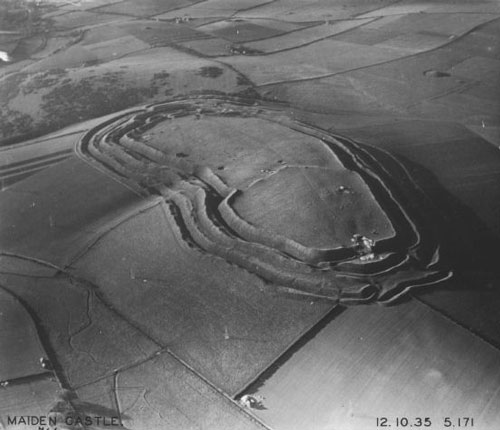
[[File:Aerial photograph of Maiden Castle, 1935.jpg|thumb|[[Maiden Castle, Dorset|Maiden Castle]] in Dorset is one of the largest {{gli|hillfort|hillforts}} in Europe]] | |||
{{glossary start}} | {{glossary start}} | ||
| Line 169: | Line 178: | ||
{{term|hillfort|[[hillfort]]}} | {{term|hillfort|[[hillfort]]}} | ||
{{defn|A type of earthwork used as a fortified refuge or defended settlement.}} | {{defn|A type of earthwork used as a fortified refuge or defended settlement.}} | ||
{{term|homology}} | |||
{{term|homolog|multi=yes}} | |||
{{defn|Similarity in style or form owing to a common origin, as opposed to an {{gli|analog}}; see also [[homology (biology)]].<ref>{{cite book |last1=Lyman |first1=R. Lee |author1-link=R. Lee Lyman |editor1-last=Hurt |editor1-first=Teresa D. |editor2-last=Rakita |editor2-first=Gordon F. M. |title=Style and function: Conceptual issues in evolutionary archaeology |date=2001 |isbn=978-0897897327 |pages=69–89 |chapter=Culture historical and biological approaches to identifying homologous traits|publisher=Bloomsbury Academic }}</ref><ref>{{Cite journal|url=http://www.jstor.org/stable/20177446|title=The Direct Historical Approach, Analogical Reasoning, and Theory in Americanist Archaeology|author1=Lyman, R. Lee|author1-link=R. Lee Lyman|author2=O'Brien, Michael J.|year=2001|journal=Journal of Archaeological Method and Theory|volume=8|issue=4|pages=303–342|doi=10.1023/A:1013736416067 |jstor=20177446 |url-access=subscription}}</ref>}} | |||
{{glossary end}} | {{glossary end}} | ||
| Line 183: | Line 196: | ||
{{term|in situ|[[In situ#Archaeology|in situ]]}} | {{term|in situ|[[In situ#Archaeology|in situ]]}} | ||
{{defn|Features, artefacts and other remains in their original depositional context, cf. {{gli|unstratified}}.}} | {{defn|Features, artefacts and other remains in their original depositional context, cf. {{gli|unstratified}}.}} | ||
{{glossary end}} | |||
== J == | |||
{{glossary start}} | |||
{{term|jar burial|[[jar burial]]}} | |||
{{defn|{{gli|Inhumation}} of whole human remains in a ceramic vessel, as opposed to the more common {{gli|urn burial}}, where only ashes from [[cremation]] are interred.{{sfn|Bray|Trump|1970|p=117|loc="jar burial"}}}} | |||
{{glossary end}} | {{glossary end}} | ||
| Line 245: | Line 267: | ||
== P == | == P == | ||
[[File:Siedlung Rosdorf Mühlengrund Firstpfosten Grundriss XXVI.jpg|thumb|right|{{gli|Profile}} photograph of a {{gli|posthole}} that has been {{gli|half-section|half-sectioned}}]] | |||
{{glossary start}} | {{glossary start}} | ||
| Line 250: | Line 274: | ||
{{term|paleoethnobotany|multi=y}} | {{term|paleoethnobotany|multi=y}} | ||
{{defn|''See {{gli|archaeobotany}}''.}} | {{defn|''See {{gli|archaeobotany}}''.}} | ||
{{term|plan}} | |||
{{defn|Horizontal exposure of an excavated area, {{gli|feature}} or {{gli|artefact}} (as seen from above); a drawing or photograph of the same.}} | |||
{{term|ploughsoil}} | |||
{{defn|The soil down to the level at which it will have been disturbed by ploughing.}} | |||
{{term|pollen diagram}} | {{term|pollen diagram}} | ||
{{term|pollen profile|multi=y}} | {{term|pollen profile|multi=y}} | ||
{{term|pollen spectrum|multi=y}} | {{term|pollen spectrum|multi=y}} | ||
{{defn|A series of side-by-side graphs, produced by [[archaeobotany|archaeobotanists]] and [[palynology|palynologists]], showing the frequency of different types (species) of [[pollen]] in a soil sample by depth. Usually presented vertically, with the shallowest samples at the top and the deepest at the bottom, to represent a [[pollen core]] or other stratified deposit. The depth of the sample corresponds roughly to how old it is, and therefore the vertical axis may also contain an estimate of its absolute age. Used to visualise the [[environmental history]] of the place where the sample was taken.<ref>{{Cite dictionary|url=http://www.archaeologywordsmith.com/lookup.php?category=&where=headword&terms=pollen+diagram|title=pollen diagram|dictionary=Archaeology Wordsmith|last1=Kipfer|first1=Barbara Ann|year=2010|access-date=2017-01-31}}</ref><ref>{{Cite web|url=http://www.jefpat.org/archeobotany/PollenDiagram.aspx|title=How To Read A Pollen Diagram|website=Maryland Archeobotany|publisher=Jefferson Patterson Park and Museum|access-date=2017-01-31}}</ref>}} | {{defn|A series of side-by-side graphs, produced by [[archaeobotany|archaeobotanists]] and [[palynology|palynologists]], showing the frequency of different types (species) of [[pollen]] in a soil sample by depth. Usually presented vertically, with the shallowest samples at the top and the deepest at the bottom, to represent a [[pollen core]] or other stratified deposit. The depth of the sample corresponds roughly to how old it is, and therefore the vertical axis may also contain an estimate of its absolute age. Used to visualise the [[environmental history]] of the place where the sample was taken.<ref>{{Cite dictionary|url=http://www.archaeologywordsmith.com/lookup.php?category=&where=headword&terms=pollen+diagram|title=pollen diagram|dictionary=Archaeology Wordsmith|last1=Kipfer|first1=Barbara Ann|year=2010|access-date=2017-01-31}}</ref><ref>{{Cite web|url=http://www.jefpat.org/archeobotany/PollenDiagram.aspx|title=How To Read A Pollen Diagram|website=Maryland Archeobotany|publisher=Jefferson Patterson Park and Museum|access-date=2017-01-31|archive-date=2016-12-21|archive-url=https://web.archive.org/web/20161221175327/http://www.jefpat.org/archeobotany/PollenDiagram.aspx|url-status=dead}}</ref>}} | ||
{{term|positive geoglyph}} | {{term|positive geoglyph}} | ||
{{defn|''See {{gli|geoglyph}}''.}} | {{defn|''See {{gli|geoglyph}}''.}} | ||
{{term|posthole}} | |||
{{defn|Cut feature that once held an upright timber or stone structural member, which can be recognised even after the (wooden) post has decayed because its fill differs from the sediment around it.{{sfn|Bray|Trump|1970|p=185|loc="post hole"}}}} | |||
{{term|postpipe}} | |||
{{defn|Remains of an upright timber placed in a {{gli|posthole}}.{{cn|date=January 2024}}}} | |||
{{term|potassium–argon dating}} | {{term|potassium–argon dating}} | ||
{{defn|''See {{gli|K–Ar dating}}''.}} | {{defn|''See {{gli|K–Ar dating}}''.}} | ||
{{term|potsherd | {{term|potsherd}} | ||
{{defn|A fragment of pottery.<ref name="kip">{{cite | {{defn|A fragment of pottery.<ref name="kip">{{cite dictionary|last=Kipfer|first=Barbara A.|dictionary=Archaeology Wordsmith|title=sherd|date=2002|access-date=April 6, 2014|url=http://www.archaeologywordsmith.com/lookup.php?terms=Sherd|url-status=dead|archive-url=https://web.archive.org/web/20140408230345/http://www.archaeologywordsmith.com/lookup.php?terms=Sherd|archive-date=April 8, 2014}}</ref> In specialised usage ''sherd'' is preferred over the more common spelling ''shard'', where ''sherd'' refers to ceramics and ''shard'' to glass.<ref>{{Cite Merriam-Webster|shard|access-date=2019-10-10}}</ref>}} | ||
{{term|profile}} | |||
{{defn|Vertical exposure of an excavated area, {{gli|feature}} or {{gli|artefact}} (as seen from the side), possibly also in {{gli|section}}; a drawing or photograph of the same.}} | |||
{{glossary end}} | {{glossary end}} | ||
| Line 292: | Line 331: | ||
{{defn|A period of time spent working on a particular site or field project.}} | {{defn|A period of time spent working on a particular site or field project.}} | ||
{{term|section|[[Section (archaeology)| | {{term|section|[[Section (archaeology)|section]]}} | ||
{{defn|A section is a view of the archaeological sequence showing it in the vertical plane, as a cross section, showing the stratigraphy.}} | {{defn|A section is a view of the archaeological sequence showing it in the vertical plane, as a cross section, showing the stratigraphy.}} | ||
{{term|sherd|[[sherd]]}} | {{term|sherd|[[sherd]]}} | ||
{{defn|'' | {{defn|''See {{gli|potsherd}}''}} | ||
{{term|shovel test pit|[[shovel test pit]]}} | {{term|shovel test pit|[[shovel test pit]]}} | ||
| Line 327: | Line 366: | ||
== U == | == U == | ||
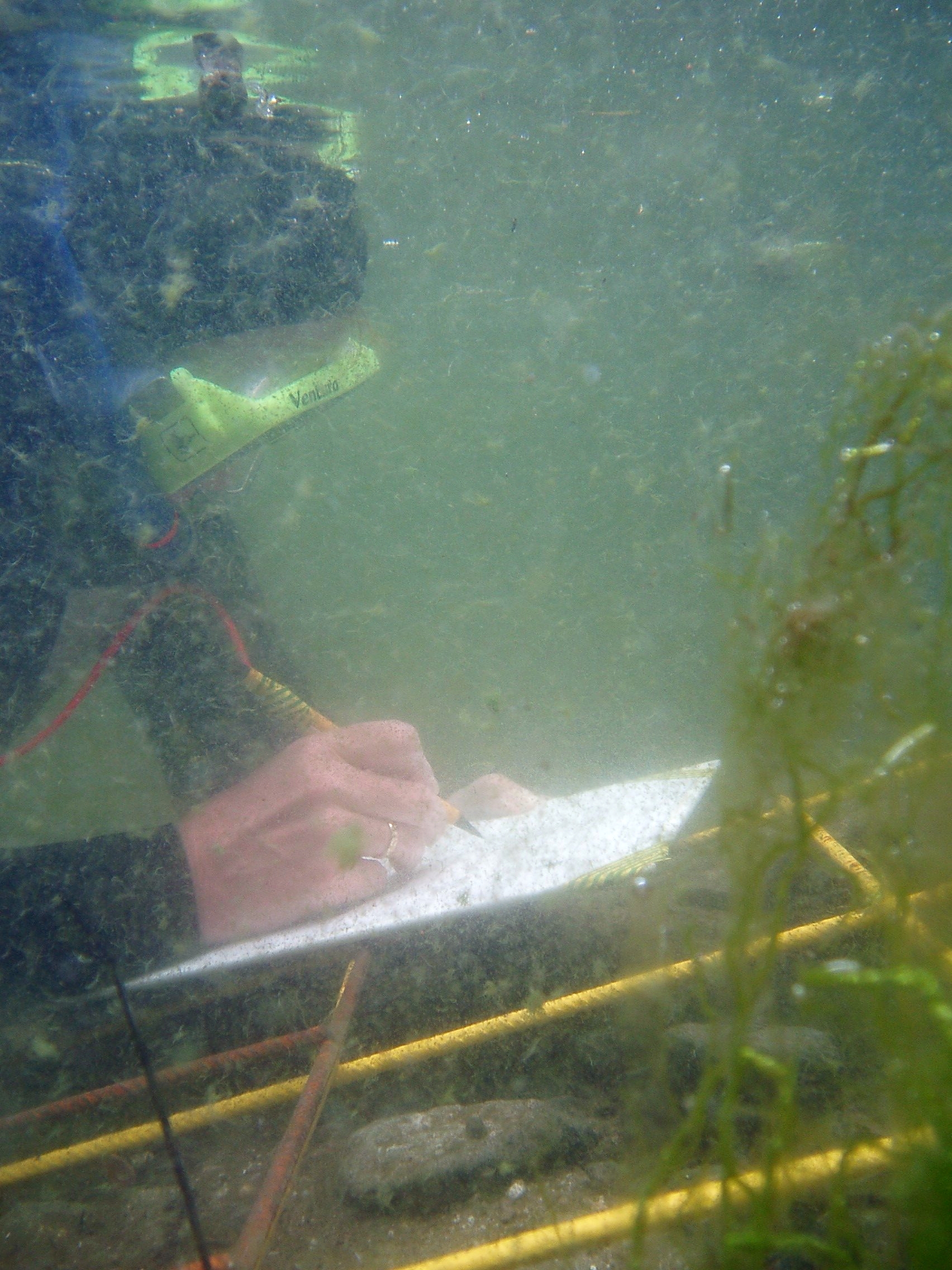
[[File:Scale drawing underwater.jpg|thumb|right|An {{gli|underwater archaeology|underwater archaeologist}} recording a {{gli|feature}} in {{gli|plan}}]] | |||
{{glossary start}} | {{glossary start}} | ||
| Line 368: | Line 408: | ||
== V == | == V == | ||
{{ | {{term|Virtual archaeology|[[virtual archaeology]]}} | ||
{{defn|A subfield of [[digital archeology]] that creates and use virtual models and [[simulations]] of archaeological sites, artifacts, and processes.<ref>{{cite web |title=Educational & Virtual Tours Resources List |url=https://www.archaeological.org/virtual-education-resources/ |website=archaeological.org |publisher=Archaeological Institute of America |access-date=2 December 2024}}</ref>}} | |||
== W == | == W == | ||
[[File:Washing-sieving, samples from Calvero de la Higuera, Pinilla del Valle, Madrid, Spain 02.JPG|thumb|right|Wet sieving | [[File:Washing-sieving, samples from Calvero de la Higuera, Pinilla del Valle, Madrid, Spain 02.JPG|thumb|right|{{gli|Wet sieving}}]] | ||
{{glossary start}} | {{glossary start}} | ||
| Line 379: | Line 420: | ||
{{term|wet sieving}} | {{term|wet sieving}} | ||
{{defn|The use of flowing water to force excavated sediment through a screen or mesh and recover small artefacts. It is more effective than {{gli|dry sieving}} in heavier soils and, as part of the process of [[flotation (archaeology)|flotation]], can be used to recover very small organic remains.{{sfn|Kipfer|2000|p=514|loc="sieving"}}}} | {{defn|The use of flowing water to force excavated sediment through a screen or mesh and recover small artefacts. It is more effective than {{gli|dry sieving}} in heavier soils and, as part of the process of [[flotation (archaeology)|flotation]], can be used to recover very small organic remains.{{sfn|Kipfer|2000|p=514|loc="sieving"}}}} | ||
{{term|Wheeler–Kenyon method|[[Wheeler–Kenyon method]]}} | |||
{{term|box–grid method|multi=yes}} | |||
{{defn|{{gli|Excavation}} strategy where an area is divided into a grid of square {{gli|trench|trenches}} and {{gli|baulk|baulks}} are left between each square, exposing the site in both {{gli|plan}} and {{gli|profile}}. Developed by [[Mortimer Wheeler]] and [[Tessa Wheeler]] at [[Verulamium]] (1930–35) and refined by [[Kathleen Kenyon]] at [[Jericho]] (1952–58).<ref>{{cite book |last1=Dever |first1=William G. |first2=H. Darrell |last2=Lance |title=Manual of Field Excavation: Handbook for Field Archaeologists |location=New York |publisher=Jewish Institute of Religion |date=1982 |pages=50–51 |isbn=9780878203031}}</ref>}} | |||
{{glossary end}} | {{glossary end}} | ||
== X == | == X == | ||
{{glossary start}} | |||
{{term|X-ray fluorescence|[[X-ray fluorescence]] (XRF)}} | |||
{{defn|Method of analysing the chemical composition of an object by exposing it to [[X-ray]]s and examining the resulting secondary (fluorescent) X-rays emitted.{{sfn|Bray|Trump|1970|p=258|loc="X-ray fluorescence"}}}} | |||
{{ | {{glossary end}} | ||
== Y == | == Y == | ||
{{ | {{glossary start}} | ||
{{term|yield}} | |||
{{defn|Information important in prehistory or history.<ref>{{cite web |title=Determining which archaeological sites are significant: Evaluation |url=https://www.achp.gov/Section_106_Archaeology_Guidance/Questions%20and%20Answers/Determining_which_archaeological_sites_are_significant_Evaluation |website=achp.gov |publisher=Advisory Council on Historic Preservation |access-date=3 December 2024}}</ref>}} | |||
{{glossary end}} | |||
== Z == | == Z == | ||
| Line 408: | Line 462: | ||
== Bibliography == | == Bibliography == | ||
{{Refbegin|indent=yes}} | {{Refbegin|indent=yes}} | ||
*{{Cite book|url=http://www.oxfordreference.com/view/10.1093/acref/9780199534043.001.0001/acref-9780199534043|title=The Concise Oxford Dictionary of Archaeology|last=Darvill|first=Timothy|publisher=Oxford University Press|year=2009|isbn=9780191727139|location=Oxford|doi=10.1093/acref/9780199534043.001.0001|url-access=subscription}} | * {{Cite book|last1=Bray|first1=Warwick|last2=Trump|first2=David|year=1970|title=A Dictionary of Archaeology|publisher=[[Allen Lane]]|isbn=0713901373}} | ||
*{{cite book |last=Feder |first=Kenneth |year=2008 |title=Linking to the Past: A Brief Introduction to Archaeology |edition=2nd updated |location=Oxford |publisher=Oxford University Press |isbn=978-0-19-533117-2}} | * {{Cite book|url=http://www.oxfordreference.com/view/10.1093/acref/9780199534043.001.0001/acref-9780199534043|title=The Concise Oxford Dictionary of Archaeology|last=Darvill|first=Timothy|publisher=Oxford University Press|year=2009|isbn=9780191727139|location=Oxford|doi=10.1093/acref/9780199534043.001.0001|url-access=subscription}} | ||
*{{Cite book|title=Encyclopedic Dictionary of Archaeology|last=Kipfer|first=Barbara Ann|publisher=Kluwer Academic/Plenum Publishers|year=2000|location=New York | * {{cite book |last=Feder |first=Kenneth |year=2008 |title=Linking to the Past: A Brief Introduction to Archaeology |edition=2nd updated |location=Oxford |publisher=Oxford University Press |isbn=978-0-19-533117-2}} | ||
*{{Cite book|url=http://www.sciencedirect.com/science/referenceworks/9780123739629|title=Encyclopedia of Archaeology|publisher=Elsevier|year=2008|isbn=9780123739629|editor-last=Pearsall|editor-first=Deborah M.|location=Amsterdam|url-access=subscription}} | * {{Cite book|title=Encyclopedic Dictionary of Archaeology|last=Kipfer|first=Barbara Ann|publisher=Kluwer Academic/Plenum Publishers|year=2000|location=New York|isbn=978-0-306-46158-3}} | ||
*{{cite book |last1=Renfrew |first1=Colin |last2=Bahn |first2=Paul |author-link1=Colin Renfrew |author-link2=Paul Bahn |year=2008 |title=Archaeology: Theories, Methods, and Practice |edition=5th updated |location=London |publisher=Thames & Hudson |isbn=978-0-500-28719-4 |oclc=441377624}} | * {{Cite book|url=http://www.sciencedirect.com/science/referenceworks/9780123739629|title=Encyclopedia of Archaeology|publisher=Elsevier|year=2008|isbn=9780123739629|editor-last=Pearsall|editor-first=Deborah M.|location=Amsterdam|url-access=subscription}} | ||
*{{Cite book|title=A Dictionary of Archaeology|publisher=Blackwell|year=1999|isbn=9780470753446|editor-last=Shaw|editor-first=Ian|location=Oxford|doi=10.1002/9780470753446|editor-last2=Jameson|editor-first2=Robert}} | * {{cite book |last1=Renfrew |first1=Colin |last2=Bahn |first2=Paul |author-link1=Colin Renfrew |author-link2=Paul Bahn |year=2008 |title=Archaeology: Theories, Methods, and Practice |edition=5th updated |location=London |publisher=Thames & Hudson |isbn=978-0-500-28719-4 |oclc=441377624}} | ||
*{{Cite book|title=Encyclopedia of Global Archaeology|publisher=Springer|year=2014|isbn=978-1-4419-0465-2|editor-last=Smith|editor-first=Clare|location=New York | * {{cite journal |last1=Robb |first1=John G. |title=The 'ritual landscape' concept in archaeology: a heritage construction |journal=Landscape Research |date=1998 |volume=23 |issue=2 |pages=159–174 |doi=10.1080/01426399808706533 |bibcode=1998LandR..23..159R |url=https://www.tandfonline.com/doi/abs/10.1080/01426399808706533 |language=en |issn=0142-6397|url-access=subscription }} | ||
* {{Cite book|title=A Dictionary of Archaeology|publisher=Blackwell|year=1999|isbn=9780470753446|editor-last=Shaw|editor-first=Ian|location=Oxford|doi=10.1002/9780470753446|editor-last2=Jameson|editor-first2=Robert}} | |||
* {{Cite book|title=Encyclopedia of Global Archaeology|publisher=Springer|year=2014|isbn=978-1-4419-0465-2|editor-last=Smith|editor-first=Clare|location=New York|doi=10.1007/978-1-4419-0465-2|hdl=2268/163881 |s2cid=220616743 }} | |||
{{Refend}} | {{Refend}} | ||
== External links == | |||
* [http://archaeology.about.com/od/glossary/ About.com Archaeology Glossary] {{Webarchive|url=https://web.archive.org/web/20161203143108/http://archaeology.about.com/od/glossary/ |date=2016-12-03 }} | |||
{{Glossaries of science and engineering}} | |||
[[Category:Glossaries of science|Archaeology]] | [[Category:Glossaries of science|Archaeology]] | ||
| Line 421: | Line 482: | ||
[[Category:Archaeology| ]] | [[Category:Archaeology| ]] | ||
[[Category:Archaeology-related lists| ]] | [[Category:Archaeology-related lists| ]] | ||
[[Category: | [[Category:Bharatpedia glossaries using description lists]] | ||
Latest revision as of 15:49, 23 January 2026
This page is a glossary of archaeology, the study of the human past from material remains.
A[edit | edit source]
- absolute age
- The age of an object with reference to a fixed and specific time scale, as determined by some method of absolute dating, e.g. 10,000 BP or 1.9 mya.[1]
- absolute dating
- Ascertaining the age of an object with reference to a fixed and specific time scale (e.g. calendar years or radiocarbon years), as opposed to relative dating.[2]
- aerial archaeology
- Archaeological investigations conducted from the air, e.g. using aerial photography or satellite imagery.
- alignment
- Co-linear arrangement of features or structures with external landmarks or, in archaeoastronomy, an astronomically significant point or axis.[3]
- antiquarian
- antiquary
- A person interested in the collection, curation and/or study of antiquities, particularly in reference to the intellectual tradition that developed in Europe in the 16th–17th centuries and is considered a precursor to modern archaeology.[4]
- antiquarianism
- An intellectual tradition of inquiry that developed in Europe in the 16th and early 17th centuries AD as a result of new interests in nature, antiquity, the Renaissance of learning, and the addition of time‐depth to people's view of the world.[5]
- antiquities
- Ancient artefacts, particularly in the context of their trade and collection.
- antiquity
- The ancient past, in particular the period of the earliest historic civilizations (see classical antiquity).
- archaeobotany
- Subdiscipline devoted to the analysis of plant remains in the archaeological record.
- archaeozoology
- See zooarchaeology.
- archaeologist
- A person engaged in the study or profession of archaeology.
- archaeology
- archeology
- The academic discipline concerned with the study of the human past through material remains.
- artefact
- artifact
- A physical object made by humans.
- assemblage
- A set of artefacts or ecofacts found together, from the same place and time.[6][7] Can refer to the total assemblage from a site, or a specific type of artefact, e.g. lithic assemblage, zooarchaeological assemblage.[8]
- association
- Two or more excavated objects that are thought to be related are said to be in association, e.g. artefacts discovered in close proximity within the same context, or architectural features thought to have been standing at the same time.
- avenue
- Type of prehistoric monument found in the British Isles, consisting of two parallel lines of standing stones and/or banks and ditches.[9] Examples include the Stonehenge Avenue, Beckhampton Avenue and West Kennet Avenue.
B[edit | edit source]

- backfill
- 1. To re-fill a trench once an excavation has been completed.
- 2. Material used for backfilling, usually spoil from the original excavation.
- baulk
- balk
- A wall of earth left in place between excavated areas in order to maintain the structural integrity of the trench and/or expose a section to aid in interpretation.
- bladelet
- Type of stone tool; a small blade characteristic of Upper Palaeolithic Europe.[10]
- box–grid method
- See Wheeler–Kenyon method.
C[edit | edit source]
- C14 dating
- See radiocarbon dating.
- context
- 1. Information relating to where an artefact or feature was found and what it was found in association with.
- 2. In single context excavation, a well-defined stratigraphic unit relating to a single depositional event, used as the primary unit for recording and analysis.
- culture
- An archaeological culture is a recurring assemblage of artifacts from a specific time and place that may constitute the material culture remains of a particular past human society.
D[edit | edit source]
- diagnostic
- A term used for objects, particularly sherds of pottery, which can be dated to a particular chronological period, and so used to ascertain the date of a particular context.
- dig
- An informal term for an archaeological excavation.
- disturbance
- Any change to an archaeological site due to events which occurred after the site was laid down.
- dry sieving
- A method of sifting artefacts from excavated sediments by shaking it through sieves or meshes of varying sizes. As opposed to wet sieving, which uses water.[11]
E[edit | edit source]
- earthworks
- Earthworks are artificial changes in land level, typically made from piles of artificially placed or sculpted rocks and soil
- environmental archaeology
- Environmental archaeology is the science of reconstructing the relationships between past societies and the environments they lived in.
- evaluation
- See trial trenching.
- excavation
- Excavation is the exposure, processing and recording of archaeological remains.
F[edit | edit source]
- fieldwork
- Archaeological investigations taking place in the field, e.g. excavations or surveys.
- finds
- An informal term for artifacts, features and other things discovered by archaeologists.
- fill
- Material that has accumulated, or been deposited, within a negative feature such as a cut, ditch, or a hollow in a building.
- finds processing
- The preparation of finds from an excavation for storage or further specialist analysis, typically including washing, labelling, sorting and listing in an inventory.
- finds specialist
- An archaeologist who specialises in the analysis of a particular type of find, e.g. medieval pottery or prehistoric worked flint.
- flotation
- Method of separating very small objects from excavated sediments using water. It is particularly important for the recovery of botanical remains and animal bones.[12]
- forensic archaeology
- Forensic archaeologists employ their knowledge of archaeological techniques and theory in a legal context. This broad description is necessary as forensic archaeology is practiced in a variety of ways around the world.[13]
- funerary archaeology
- Funerary archaeology is the study of the treatment and commemoration of the dead. It includes the study of human remains, associated artefacts and monuments.
G[edit | edit source]
- geoarchaeology
- The application of geology and other earth science techniques to archaeology.[14]
- geofact
- Rocks or other naturally occurring minerals found in an archaeological context and presumed to have been transported there by humans, but not sufficiently modified to qualify as an artefact.[15]
- geoglyph
- A form of rock art produced on the ground, either by arranging material on the surface (a positive geoglyph) or removing part of it (a negative geoglyph).[16]
- governance archaeology
- Governance archaeology seeks to understand the myriad combinations of ways in which people have governed themselves throughout time. A goal in this endeavor is to better understand the full range of options available to modern humans and, to the extent possible, some of the opportunities and pitfalls of different governance characteristics.[17]
H[edit | edit source]

- henge
- A type of Neolithic earthwork that has a ring-shaped bank and ditch, with the ditch inside the bank.
- hillfort
- A type of earthwork used as a fortified refuge or defended settlement.
- homology
- homolog
- Similarity in style or form owing to a common origin, as opposed to an analog; see also homology (biology).[18][19]
I[edit | edit source]
- industrial archaeology
- Subdiscipline devoted to the study of past industry and industrial heritage.
- industry
- A typological classification of stone tools, e.g. the Mousterian industry, the Acheulean industry.
- in situ
- Features, artefacts and other remains in their original depositional context, cf. unstratified.
J[edit | edit source]
- jar burial
- Inhumation of whole human remains in a ceramic vessel, as opposed to the more common urn burial, where only ashes from cremation are interred.[20]
K[edit | edit source]
- K–Ar dating
- Potassium–argon dating; a radiometric dating method useful for samples older than 100,000 years.[21]
- kerb
- kerbstone circle
- A circular retaining wall built around certain types of burial mound.[22]
- kill site
- A site where people slaughtered and/or butchered animals, especially in a Palaeolithic context, e.g. Naco Mammoth Kill Site, Cooper Bison Kill Site.[23]
- killed object
- An object which has been deliberately broken or damaged in such a way as to make it unusable.[24]
- kiln site
- In Southeast Asian archaeology, a site that was the centre for manufacture of particular ceramic ware, e.g. Phnom Kulen, Buriram, Go Sanh, Kalong, Sukhothai.[25]
L[edit | edit source]
- locus
- See context.
M[edit | edit source]
- matrix
- 1. The physical material in which finds and other cultural remains are found, e.g. soil or rock.[26]
- 2. Harris matrix; a diagram showing the stratigraphic relations between contexts.
- megasite
- mega-site
- A site that is anomalously large in comparison to others from the same period and region, e.g. PPNB megasites, Trypillia megasites.[27]
N[edit | edit source]
- negative geoglyph
- See geoglyph.
O[edit | edit source]
- occupation earth
- set of deposits believed to represent in-situ settlement at an archaeological site, containing pottery sherds, ashes, animal remains, etc.[28]
P[edit | edit source]

- palaeoethnobotany
- paleoethnobotany
- See archaeobotany.
- plan
- Horizontal exposure of an excavated area, feature or artefact (as seen from above); a drawing or photograph of the same.
- ploughsoil
- The soil down to the level at which it will have been disturbed by ploughing.
- pollen diagram
- pollen profile
- pollen spectrum
- A series of side-by-side graphs, produced by archaeobotanists and palynologists, showing the frequency of different types (species) of pollen in a soil sample by depth. Usually presented vertically, with the shallowest samples at the top and the deepest at the bottom, to represent a pollen core or other stratified deposit. The depth of the sample corresponds roughly to how old it is, and therefore the vertical axis may also contain an estimate of its absolute age. Used to visualise the environmental history of the place where the sample was taken.[29][30]
- positive geoglyph
- See geoglyph.
- posthole
- Cut feature that once held an upright timber or stone structural member, which can be recognised even after the (wooden) post has decayed because its fill differs from the sediment around it.[31]
- postpipe
- Remains of an upright timber placed in a posthole.[citation needed]
- potassium–argon dating
- See K–Ar dating.
- potsherd
- A fragment of pottery.[32] In specialised usage sherd is preferred over the more common spelling shard, where sherd refers to ceramics and shard to glass.[33]
- profile
- Vertical exposure of an excavated area, feature or artefact (as seen from the side), possibly also in section; a drawing or photograph of the same.
Q[edit | edit source]
- quarter sectioning
- Sometimes called digging by quadrant, it is a procedure for excavating discrete features (especially those circular or ovoid in shape) where two diagonally opposite quadrants are removed, resulting in two complete cross-sections of a feature.
R[edit | edit source]
- radiocarbon dating
- absolute dating technique used to determine the age of organic materials less than 50,000 years old. Age is determined by examining the loss of the unstable carbon-14 isotope, which is absorbed by all living organisms during their lifespan. The rate of decay of this unstable isotope after the organism has died is assumed to be constant, and is measured in half-lives of 5730 + 40 years, meaning that the amount of carbon-14 is reduced to half the amount after about 5730 years. Dates generated by radiocarbon dating have to be calibrated using dates derived from other absolute dating methods, such as dendrochronology and ice cores.[citation needed]
S[edit | edit source]
- screening
- See sieving
- season
- A period of time spent working on a particular site or field project.
- section
- A section is a view of the archaeological sequence showing it in the vertical plane, as a cross section, showing the stratigraphy.
- sherd
- See potsherd
- shovel test pit
- test holes, usually dug out by a shovel, in order to determine whether the soil contains any cultural remains that are not visible on the surface.
- shovelbum
- A colloquial term for professional excavators working in cultural resources management in the United States.
- sieving
- The use of sieves, screens, and meshes to improve the recovery rate of artefacts from excavated sediments (spoil). Can be divided into dry sieving and wet sieving.[11]
- spoil
- Loose sediment excavated from a trench.
- spoil heap
- A pile of sediment from an excavation, usually located next to a trench.
T[edit | edit source]
- trial trenching
- A method of archaeological evaluation used to estimate the archaeological potential of a site.[34]
- typology
- The classification of objects according to their physical characteristics.
U[edit | edit source]

- underwater archaeology
- Subdiscipline devoted to the study of archaeological remains submerged under seas, lakes, or rivers.[35]
- unenclosed
- See enclosure.
- uniface
- Stone tool or other artefact that has only been worked on one side, cf. biface.[36][37]
- unit
- 1. In stratigraphic excavation, a context.[38]
- 2. In British commercial archaeology, a company providing archaeological services, e.g. the Birmingham University Field Archaeology Unit.[38]
- univallate
- Hillfort or other enclosed settlement surrounded by a single line of walls or ramparts, cf. multivallate.[39]
- unurned
- Cremation burial where the remains were not placed in a container (urn), typical of the Early to Middle Bronze Age in Northern Europe.[40]
- updraught kiln
- updraft kiln
- Type of ceramic kiln which works by drawing hot air from a fire placed adjacent to or below the material to be fired.[41]
- urban archaeology
- Subdiscipline devoted to the study of archaeology in major cities and towns.[42]
- urn
- Pottery vessel in which cremated remains were placed for interment; sometimes specially made, but often a repurposed domestic container.[43]
- urnfield
- Cemetery containing cremation burials in urns. Typical of Late Bronze Age Europe and the eponymous Urnfield culture.[44]
- use-wear
- Microscopic traces of wear, damage or residue left on the surface of an artefact from use. Use-wear analysis involves studying these traces to discern the function of a tool.[45]
V[edit | edit source]
W[edit | edit source]

- watching brief
- A formal programme of observation and investigation conducted during any operation carried out for non-archaeological reasons.
- wet sieving
- The use of flowing water to force excavated sediment through a screen or mesh and recover small artefacts. It is more effective than dry sieving in heavier soils and, as part of the process of flotation, can be used to recover very small organic remains.[11]
- Wheeler–Kenyon method
- box–grid method
- Excavation strategy where an area is divided into a grid of square trenches and baulks are left between each square, exposing the site in both plan and profile. Developed by Mortimer Wheeler and Tessa Wheeler at Verulamium (1930–35) and refined by Kathleen Kenyon at Jericho (1952–58).[47]
X[edit | edit source]
- X-ray fluorescence (XRF)
- Method of analysing the chemical composition of an object by exposing it to X-rays and examining the resulting secondary (fluorescent) X-rays emitted.[48]
Y[edit | edit source]
- yield
- Information important in prehistory or history.[49]
Z[edit | edit source]
- zooarchaeology
- Subdiscipline devoted to the analysis of animal remains in the archaeological record.
See also[edit | edit source]
References[edit | edit source]
- ↑ Kipfer 2000, p. 2, "absolute age".
- ↑ Kipfer 2000, p. 2, "absolute dating".
- ↑ Shaw & Jameson 1999, "alignment".
- ↑ Darvill 2009, "antiquarian".
- ↑ Darvill 2009, "antiquarianism".
- ↑ Renfrew & Bahn 2008, p. 578.
- ↑ Kipfer, Barbara Ann. "Assemblage". Archaeology Wordsmith. Retrieved 2 February 2019.
- ↑ Feder 2008, p. 93.
- ↑ Robb 1998, note 6.
- ↑ Darvill 2009, "bladelet".
- ↑ 11.0 11.1 11.2 Kipfer 2000, p. 514, "sieving".
- ↑ "Flotation Method in Archaeology". About.com Education. Archived from the original on 2017-01-09. Retrieved 2017-01-08.
- ↑ Groen, W.J. Mike; Márquez-Grant, Nicholas; Janaway, Robert C. (2015). Forensic archaeology: A global perspective. ISBN 9781118745977.
- ↑ Kipfer 2000, p. 205, "geoarchaeology".
- ↑ Kipfer 2000, p. 205, "geofact".
- ↑ Kipfer 2000, p. 205, "geoglyph".
- ↑ Carugati, Federica; Schneider, Nathan (February 28, 2023). "Governance Archaeology: Research as Ancestry". Daedalus. 152 (1): 245–257. doi:10.1162/daed_a_01985 – via MIT Press Direct.
- ↑ Lyman, R. Lee (2001). "Culture historical and biological approaches to identifying homologous traits". In Hurt, Teresa D.; Rakita, Gordon F. M. (eds.). Style and function: Conceptual issues in evolutionary archaeology. Bloomsbury Academic. pp. 69–89. ISBN 978-0897897327.
- ↑ Lyman, R. Lee; O'Brien, Michael J. (2001). "The Direct Historical Approach, Analogical Reasoning, and Theory in Americanist Archaeology". Journal of Archaeological Method and Theory. 8 (4): 303–342. doi:10.1023/A:1013736416067. JSTOR 20177446.
- ↑ Bray & Trump 1970, p. 117, "jar burial".
- ↑ Kipfer 2000, p. 271, "K–Ar dating".
- ↑ Kipfer 2000, p. 275, "kerb".
- ↑ Kipfer 2000, p. 279, "kill site".
- ↑ Adams, Jenny L. (2008). "Beyond the Broken". In Rowan, Yorke M.; Ebling, Jennie R. (eds.). New Approaches to Old Stones. Sheffield: Equinox. p. 217.
- ↑ Kipfer 2000, p. 279, "kiln site".
- ↑ Kipfer 2000, p. 339, "matrix".
- ↑ "What to Do with "Megasites" in Prehistory? Further Exploring the "Megasite" Conundrum". The Digital Archaeological Record. Digital Antiquity.
- ↑ Barker, Philip (1993). Techniques of archaeological excavation (3rd ed.). B. T. Batsford. p. 138. ISBN 978-0-7134-7169-4.
- ↑ Kipfer, Barbara Ann (2010). "pollen diagram". Archaeology Wordsmith. Retrieved 2017-01-31.
- ↑ "How To Read A Pollen Diagram". Maryland Archeobotany. Jefferson Patterson Park and Museum. Archived from the original on 2016-12-21. Retrieved 2017-01-31.
- ↑ Bray & Trump 1970, p. 185, "post hole".
- ↑ Kipfer, Barbara A. (2002). "sherd". Archaeology Wordsmith. Archived from the original on April 8, 2014. Retrieved April 6, 2014.
- ↑ Template:Cite Merriam-Webster
- ↑ Chartered Institute for Archaeologists (CIfA) (2020). Standard and guidance for archaeological field evaluation (PDF).
- ↑ Darvill 2009, "underwater archaeology".
- ↑ Darvill 2009, "unifacial flaking".
- ↑ Darvill 2009, "unifacial tool".
- ↑ 38.0 38.1 Darvill 2009, "unit".
- ↑ Darvill 2009, "univallate hillfort".
- ↑ Darvill 2009, "unurned cremation".
- ↑ Darvill 2009, "updraught kiln".
- ↑ Darvill 2009, "urban archaeology".
- ↑ Darvill 2009, "urn".
- ↑ Darvill 2009, "urnfield".
- ↑ Darvill 2009, "use-wear (microwear) analysis".
- ↑ "Educational & Virtual Tours Resources List". archaeological.org. Archaeological Institute of America. Retrieved 2 December 2024.
- ↑ Dever, William G.; Lance, H. Darrell (1982). Manual of Field Excavation: Handbook for Field Archaeologists. New York: Jewish Institute of Religion. pp. 50–51. ISBN 9780878203031.
- ↑ Bray & Trump 1970, p. 258, "X-ray fluorescence".
- ↑ "Determining which archaeological sites are significant: Evaluation". achp.gov. Advisory Council on Historic Preservation. Retrieved 3 December 2024.
Bibliography[edit | edit source]
- Bray, Warwick; Trump, David (1970). A Dictionary of Archaeology. Allen Lane. ISBN 0713901373.
- Darvill, Timothy (2009). The Concise Oxford Dictionary of Archaeology. Oxford: Oxford University Press. doi:10.1093/acref/9780199534043.001.0001. ISBN 9780191727139.
- Feder, Kenneth (2008). Linking to the Past: A Brief Introduction to Archaeology (2nd updated ed.). Oxford: Oxford University Press. ISBN 978-0-19-533117-2.
- Kipfer, Barbara Ann (2000). Encyclopedic Dictionary of Archaeology. New York: Kluwer Academic/Plenum Publishers. ISBN 978-0-306-46158-3.
- Pearsall, Deborah M., ed. (2008). Encyclopedia of Archaeology. Amsterdam: Elsevier. ISBN 9780123739629.
- Renfrew, Colin; Bahn, Paul (2008). Archaeology: Theories, Methods, and Practice (5th updated ed.). London: Thames & Hudson. ISBN 978-0-500-28719-4. OCLC 441377624.
- Robb, John G. (1998). "The 'ritual landscape' concept in archaeology: a heritage construction". Landscape Research. 23 (2): 159–174. Bibcode:1998LandR..23..159R. doi:10.1080/01426399808706533. ISSN 0142-6397.
- Shaw, Ian; Jameson, Robert, eds. (1999). A Dictionary of Archaeology. Oxford: Blackwell. doi:10.1002/9780470753446. ISBN 9780470753446.
- Smith, Clare, ed. (2014). Encyclopedia of Global Archaeology. New York: Springer. doi:10.1007/978-1-4419-0465-2. hdl:2268/163881. ISBN 978-1-4419-0465-2. S2CID 220616743.
External links[edit | edit source]
- About.com Archaeology Glossary Archived 2016-12-03 at the Wayback Machine