

No edit summary |
Nobranding1 (talk | contribs) m small rework layout per sources and cleaned formatting as per guidelines |
||
| Line 1: | Line 1: | ||
{{Short description|Species of oak tree}} | |||
{{Use dmy dates|date=February 2025}} | |||
{{speciesbox | |||
| image = Quercus semecarpifolia kz04.jpg | |||
| genus = Quercus | |||
| display_parents = 2 | |||
| parent = Quercus sect. Ilex | |||
| species = semecarpifolia | |||
| authority = [[Sm.]] | |||
| synonyms_ref = <ref>{{ThePlantList |id=kew-175022 |taxon=Quercus semecarpifolia |authority=Sm.}}</ref> | |||
| synonyms = * ''Quercus cassura'' <small>Buch.-Ham. ex D.Don</small> | |||
* ''Quercus obtusifolia'' <small>D.Don</small> | |||
| status = LC | |||
| status_system = IUCN3.1 | |||
| status_ref = <ref name="iucn status">{{cite iucn |author=Qin, H. |date=2020 |title=''Quercus semecarpifolia'' |volume=2020 |url=https://www.iucnredlist.org/species/194230/147633899 |access-date=10 March 2023}}</ref> | |||
}} | |||
'''''Quercus semecarpifolia''''' is an Asian species of [[oak]]. It is native to the Himalayas and nearby mountains in [[Tibet]], Afghanistan, India, Nepal, and Pakistan,<ref name=kelly>{{eFloras|2|210001864|Quercus semecarpifolia |first1=Chengjiu |last1=Huang |first2=Yongtian |last2=Zhang |first3=Bruce |last3=Bartholomew |volume=4}}</ref> where it is referred to as '''kharsu'''.<ref name=":0">{{Cite journal |last1=Rawat |first1=Balwant |last2=Rawat |first2=Janhvi M. |last3=Purohit |first3=Sumit |last4=Singh |first4=Gajendra |last5=Sharma |first5=Pradeep Kumar |last6=Chandra |first6=Anup |last7=Shabaaz Begum |first7=J. P. |last8=Venugopal |first8=Divya |last9=Jaremko |first9=Mariusz |last10=Qureshi |first10=Kamal A. |date=2022 |title=A comprehensive review of Quercus semecarpifolia Sm.: An ecologically and commercially important Himalayan tree |journal=Frontiers in Ecology and Evolution |volume=10 |doi=10.3389/fevo.2022.961345 |issn=2296-701X |doi-access=free |bibcode=2022FrEEv..1061345R |hdl=10754/681751 |hdl-access=free}}</ref> It is classified in subgenus ''Cerris'', [[Quercus sect. Ilex|section ''Ilex'']].<ref>{{Cite journal |last1=Denk |first1=Thomas |last2=Grimm |first2=Guido W. |last3=Manos |first3=Paul S. |last4=Deng |first4=Min |last5=Hipp |first5=Andrew L. |date=2017 |title=Appendix 2.1: An updated infrageneric classification of the oaks |website=figshare |doi=10.6084/m9.figshare.5547622.v1 |url=https://figshare.com/articles/dataset/Appendix_2_1_________An_updated_infrageneric_classification_of_the_oaks/5547622/1 |access-date=18 February 2023 |format=xls |name-list-style=amp}}</ref><ref>{{Citation |last1=Denk |first1=Thomas |last2=Grimm |first2=Guido W. |last3=Manos |first3=Paul S. |last4=Deng |first4=Min |last5=Hipp |first5=Andrew L. |title=Oaks Physiological Ecology. Exploring the Functional Diversity of Genus Quercus L |series=Tree Physiology |date=2017 |volume=7 |editor1-last=Gil-Pelegrín |editor1-first=Eustaquio |editor2-last=Peguero-Pina |editor2-first=José Javier |editor3-last=Sancho-Knapik |editor3-first=Domingo |contribution=An Updated Infrageneric Classification of the Oaks: Review of Previous Taxonomic Schemes and Synthesis of Evolutionary Patterns |pages=13–38 |publication-place=Cham. |publisher=Springer International Publishing |doi=10.1007/978-3-319-69099-5_2 |isbn=978-3-319-69099-5 |contribution-url=https://doi.org/10.1007/978-3-319-69099-5_2 |name-list-style=amp}}</ref> | |||
''Quercus semecarpifolia'' is an [[evergreen]] tree up to {{Convert|30|m|abbr=off}} tall. The leaves are up to {{Convert|12|cm|abbr=off|frac=4}} long, with a few teeth along the sides but rounded at the tip.<ref name=kelly/><ref name=heleen>[https://www.biodiversitylibrary.org/item/119403#page/259/mode/1up Smith, James Edward in Rees. 1814 The cyclopædia; or, Universal dictionary of arts, sciences, and literature. volume 29, pages not numbered, ''Quercus'' number 20]</ref> | ''Quercus semecarpifolia'' is an [[evergreen]] tree up to {{Convert|30|m|abbr=off}} tall. The leaves are up to {{Convert|12|cm|abbr=off|frac=4}} long, with a few teeth along the sides but rounded at the tip.<ref name=kelly/><ref name=heleen>[https://www.biodiversitylibrary.org/item/119403#page/259/mode/1up Smith, James Edward in Rees. 1814 The cyclopædia; or, Universal dictionary of arts, sciences, and literature. volume 29, pages not numbered, ''Quercus'' number 20]</ref> | ||
It has been grown in middle Europe, Western Germany, winter-hardiness zone 7, withstanding -14 °C, without any damages. It gives a good, showy bush to small tree with lush green leaves. | It has been grown in middle Europe, Western Germany, winter-hardiness zone 7, withstanding -14 °C, without any damages. It gives a good, showy bush to small tree with lush green leaves. | ||
The epithet ''semecarpifolia'' refers to a resemblance between the leaves of this species and those of ''[[Semecarpus anacardium]].''<ref name=heleen/> | The epithet ''semecarpifolia'' refers to a resemblance between the leaves of this species and those of ''[[Semecarpus anacardium]].''<ref name=heleen/> | ||
In its native range, it serves as a [[keystone species]], exhibiting up to 80% [[Dominance (ecology)|dominance]] at elevations between 2700 and 3300 meters.<ref name=":0" /> In areas where less [[Environmental degradation|degradation]] has occurred, ''Q. semecarpifolia'' reduces light at the forest floor, encouraging the growth of [[Shade tolerance|shade tolerant]] [[Herbaceous plant|herbaceous]] species.<ref name=":0" /> Local people make use of kharsu more frequently than other native oaks for food, animal fodder, fuel, and timber.<ref>{{Cite journal |last1=Singh |first1=Amit |last2=Samant |first2=S. S. |last3=Naithani |first3=Suneet |date=1 September 2021 |title=Population ecology and habitat suitability modelling of Quercus semecarpifolia Sm. in the sub-alpine ecosystem of Great Himalayan National Park, north-western Himalaya, India |journal=South African Journal of Botany |language=en |volume=141 |pages=158–170 |doi=10.1016/j.sajb.2021.04.022 |issn=0254-6299 |doi-access=free|bibcode=2021SAJB..141..158S }}</ref> Its leaves are also known to support ''[[Antheraea roylei|Antheraea proylei]]'' silk worms, goats,<ref>{{Cite journal |last1=Raju |first1=J. |last2=Sahoo |first2=B. |last3=Chandrakar |first3=A. |last4=Sankar |first4=M. |last5=Garg |first5=A. K. |last6=Sharma |first6=A. K. |last7=Pandey |first7=A. B. |date=1 April 2015 |title=Effect of feeding oak leaves (Quercus semecarpifolia vs Quercus leucotricophora) on nutrient utilization, growth performance and gastrointestinal nematodes of goats in temperate sub Himalayas |journal=Small Ruminant Research |language=en |volume=125 |pages=1–9 |doi=10.1016/j.smallrumres.2014.12.013 |issn=0921-4488 |doi-access=free}}</ref> and prevent slug infestations.<ref name=":0" /> | |||
==Fossil record== | ==Fossil record== | ||
| Line 16: | Line 34: | ||
{{Taxonbar|from=Q7599286}} | {{Taxonbar|from=Q7599286}} | ||
[[Category:Quercus|semecarpifolia]] | [[Category:Quercus|semecarpifolia]] | ||
[[Category:Trees of | [[Category:Trees of Afghanistan]] | ||
[[Category:Trees of | [[Category:Trees of the Indian subcontinent]] | ||
[[Category:Trees of Tibet]] | [[Category:Trees of Tibet]] | ||
[[Category:Plants described in 1814]] | [[Category:Plants described in 1814]] | ||
[[Category:Taxa named by James Edward Smith]] | [[Category:Taxa named by James Edward Smith (botanist)]] | ||
{{Quercus-stub}} | |||
Latest revision as of 03:23, 12 November 2025
| Quercus semecarpifolia | |
|---|---|

| |
Scientific classification 
| |
| : | [[Template:Taxonomy/Quercus sect. Ilex]] |
| Species: | Template:Taxonomy/QuercusQ. semecarpifolia
|
| Binomial name | |
| Template:Taxonomy/QuercusQuercus semecarpifolia | |
| Synonyms[2] | |
| |
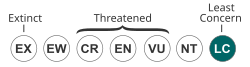
Quercus semecarpifolia is an Asian species of oak. It is native to the Himalayas and nearby mountains in Tibet, Afghanistan, India, Nepal, and Pakistan,[3] where it is referred to as kharsu.[4] It is classified in subgenus Cerris, section Ilex.[5][6]
Quercus semecarpifolia is an evergreen tree up to 30 metres (98 feet) tall. The leaves are up to 12 centimetres (4+3⁄4 inches) long, with a few teeth along the sides but rounded at the tip.[3][7] It has been grown in middle Europe, Western Germany, winter-hardiness zone 7, withstanding -14 °C, without any damages. It gives a good, showy bush to small tree with lush green leaves. The epithet semecarpifolia refers to a resemblance between the leaves of this species and those of Semecarpus anacardium.[7]
In its native range, it serves as a keystone species, exhibiting up to 80% dominance at elevations between 2700 and 3300 meters.[4] In areas where less degradation has occurred, Q. semecarpifolia reduces light at the forest floor, encouraging the growth of shade tolerant herbaceous species.[4] Local people make use of kharsu more frequently than other native oaks for food, animal fodder, fuel, and timber.[8] Its leaves are also known to support Antheraea proylei silk worms, goats,[9] and prevent slug infestations.[4]
Fossil record[edit | edit source]
Fossils of Quercus semecarpifolia have been described from the fossil flora of Kızılcahamam district in Turkey, which is of early Pliocene age.[10]
References[edit | edit source]
- ↑ Qin, H. (2020). "Quercus semecarpifolia". IUCN Red List of Threatened Species. 2020. Retrieved 10 March 2023.
- ↑ Template:ThePlantList
- ↑ 3.0 3.1 Template:EFloras
- ↑ 4.0 4.1 4.2 4.3 Rawat, Balwant; Rawat, Janhvi M.; Purohit, Sumit; Singh, Gajendra; Sharma, Pradeep Kumar; Chandra, Anup; Shabaaz Begum, J. P.; Venugopal, Divya; Jaremko, Mariusz; Qureshi, Kamal A. (2022). "A comprehensive review of Quercus semecarpifolia Sm.: An ecologically and commercially important Himalayan tree". Frontiers in Ecology and Evolution. 10. Bibcode:2022FrEEv..1061345R. doi:10.3389/fevo.2022.961345. hdl:10754/681751. ISSN 2296-701X.
- ↑ Denk, Thomas; Grimm, Guido W.; Manos, Paul S.; Deng, Min & Hipp, Andrew L. (2017). "Appendix 2.1: An updated infrageneric classification of the oaks" (xls). figshare. doi:10.6084/m9.figshare.5547622.v1. Retrieved 18 February 2023.
- ↑ Denk, Thomas; Grimm, Guido W.; Manos, Paul S.; Deng, Min & Hipp, Andrew L. (2017), "An Updated Infrageneric Classification of the Oaks: Review of Previous Taxonomic Schemes and Synthesis of Evolutionary Patterns", in Gil-Pelegrín, Eustaquio; Peguero-Pina, José Javier & Sancho-Knapik, Domingo (eds.), Oaks Physiological Ecology. Exploring the Functional Diversity of Genus Quercus L, Tree Physiology, vol. 7, Cham.: Springer International Publishing, pp. 13–38, doi:10.1007/978-3-319-69099-5_2, ISBN 978-3-319-69099-5
- ↑ 7.0 7.1 Smith, James Edward in Rees. 1814 The cyclopædia; or, Universal dictionary of arts, sciences, and literature. volume 29, pages not numbered, Quercus number 20
- ↑ Singh, Amit; Samant, S. S.; Naithani, Suneet (1 September 2021). "Population ecology and habitat suitability modelling of Quercus semecarpifolia Sm. in the sub-alpine ecosystem of Great Himalayan National Park, north-western Himalaya, India". South African Journal of Botany. 141: 158–170. Bibcode:2021SAJB..141..158S. doi:10.1016/j.sajb.2021.04.022. ISSN 0254-6299.
- ↑ Raju, J.; Sahoo, B.; Chandrakar, A.; Sankar, M.; Garg, A. K.; Sharma, A. K.; Pandey, A. B. (1 April 2015). "Effect of feeding oak leaves (Quercus semecarpifolia vs Quercus leucotricophora) on nutrient utilization, growth performance and gastrointestinal nematodes of goats in temperate sub Himalayas". Small Ruminant Research. 125: 1–9. doi:10.1016/j.smallrumres.2014.12.013. ISSN 0921-4488.
- ↑ Kasaplıgil, Baki (1977). "Ankara, Kızılcahamam yakınındaki Güvem köyü civarında bulunan son tersiyer kozalaklı-yeşil yapraklı ormanı" [A Late-Tertiary Conifer-Hardwood Forest From the Vicinity of Güvem Village, Near Kızılcahamam, Ankara] (PDF). Bulletin of the Mineral Research and Exploration (in Türkçe and English). 88. Ankara: General Directorate of Mineral Research and Exploration: 94-102.
External links[edit | edit source]
 | This article about plants in the genus Quercus is a stub. You can help Bharatpedia by expanding it. |