





m Removing protection template from an unprotected page |
improve page for accuracy and updated info after review |
||
| Line 1: | Line 1: | ||
{{Short description| | {{Short description|Hebrew patriarch of the Abrahamic religions}} | ||
{{ | {{About|the biblical figure|the name|Abraham (name)}} | ||
{{Redirect-several|Avraham|Avram|Abraham|Abram}} | |||
{{Pp-move}} | |||
{{Protection padlock|small=yes}} | |||
{{Use dmy dates|date=September 2020}} | {{Use dmy dates|date=September 2020}} | ||
{{Infobox religious biography | {{Infobox religious biography | ||
| image = Guercino Abramo ripudia Agar (cropped 2).jpg | |||
| image = | |||
| caption = {{nowrap|''[[Abraham Casting out Hagar and Ishmael]]'' (1657)}}<br />{{nowrap|by [[Guercino|Giovanni Francesco Barbieri]]}} | | caption = {{nowrap|''[[Abraham Casting out Hagar and Ishmael]]'' (1657)}}<br />{{nowrap|by [[Guercino|Giovanni Francesco Barbieri]]}} | ||
| known_for = Namesake of the [[Abrahamic religions]]: traditional founder of the [[Jewish nation]],{{sfn|Levenson|2012|p=3}}{{sfn|Mendes-Flohr|2005}} spiritual ancestor of [[Christians]],{{sfn|Levenson|2012|p=6}} major [[Prophets and messengers in Islam|Islamic prophet]],{{sfn|Levenson|2012|p=8}} [[Manifestation of God (Baháʼí Faith)|Manifestation of God]] and originator of [[monotheistic]] faith in [[Baháʼí Faith]],{{Sfn|Smith|2000a|pp=22, 231}} third spokesman ({{tlit|ar|natiq}}) prophet of [[Druze]]s{{sfn|Swayd|2009|p=3}} | |||
| spouse = {{plainlist| | |||
| known_for = Namesake of the [[Abrahamic religions]]: traditional founder of the [[Jewish nation]],{{sfn|Levenson|2012|p=3}}{{sfn|Mendes-Flohr|2005}} spiritual ancestor of [[Christians]],{{sfn|Levenson|2012|p=6}} major [[Prophets and messengers in Islam|Islamic prophet]]{{sfn|Levenson|2012|p=8}} | * [[Sarah]] | ||
| spouse = [[Sarah]] | * [[Hagar]] (concubine) | ||
* [[Keturah]] | |||
}} | |||
| name = Abraham | | name = Abraham | ||
| native_name = אַבְרָהָם | | native_name = {{nobold|אַבְרָהָם {{tlit|hbo|Avrahám}}}} | ||
| native_name_lang = | | native_name_lang = hbo | ||
| birth_place = [[Ur of the Chaldees]] | | birth_name = {{lang|hbo|אַבְרָם}} {{tlit|hbo|Avrám}}<ref>[[s:Bible (King James)/Genesis#17:5|Genesis 17:5]]</ref> | ||
| birth_date = 1948 [[Anno Mundi|{{abbr|AM|Anno Mundi}}]] | |||
| birth_place = [[Ur of the Chaldees]], [[Mesopotamia]] | |||
| father = [[Terah]] | | father = [[Terah]] | ||
| mother = [[Amathlai]] | | mother = [[Amathlai]]<ref>[[s:he:בבא בתרא צא א|בבא בתרא צא א]]</ref> | ||
| children = {{Collapsible list | | children = {{Collapsible list | ||
| title = | | title = {{nobold|Oldest to youngest:}} | ||
| [[Ishmael]] (son, with Hagar) | | [[Ishmael]] (son, with Hagar) | ||
| [[Isaac]] (son, with Sarah) | | [[Isaac]] (son, with Sarah) | ||
| [[Zimran]] (son, with Keturah) | | [[Zimran]] (son, with Keturah) | ||
| [[Jokshan]] (son, with Keturah) | | [[Jokshan]] (son, with Keturah) | ||
| [[Medan (son of Abraham)|Medan]] (son, with Keturah) | | [[Medan (son of Abraham)|Medan]] (son, with Keturah) | ||
| [[Midian (son of Abraham)|Midian]] (son, with Keturah) | | [[Midian (son of Abraham)|Midian]] (son, with Keturah) | ||
| [[Ishbak]] (son, with Keturah) | | [[Ishbak]] (son, with Keturah) | ||
| [[Shuah]] (son, with Keturah) | | [[Shuah]] (son, with Keturah) | ||
}} | }} | ||
| relatives = {{Collapsible list | | relatives = {{Collapsible list | ||
| title = | | title = {{nobold|Closest to furthest:}} | ||
| [[Haran]] (brother) | | [[Haran]] (brother) | ||
| [[Nahor, son of Terah|Nahor]] (brother) | | [[Nahor, son of Terah|Nahor]] (brother) | ||
| [[Jacob]] (grandson) | |||
| [[Jacob]] (grandson) | | [[Esau]] (grandson) | ||
| [[Esau]] (grandson) | | [[Lot (biblical person)|Lot]] (nephew) | ||
| [[Lot (biblical person)|Lot]] (nephew) | | [[Twelve Tribes of Israel]] (great-grandsons) | ||
| [[Twelve Tribes of Israel]] (great-grandsons) | | [[Dinah]] (great-granddaughter) | ||
| [[Dinah]] (great-granddaughter) | | see: ''[[Abraham's family tree]]'' | ||
| | }} | ||
| death_place = [[Cave of Machpelah]], [[Hebron]], [[Canaan]]<ref>[[s:Bible (King James)/Genesis#25:8|Genesis 25:8]]</ref> | |||
| death_place = [[Hebron]], [[Canaan]]< | | death_date = 2123 [[Anno Mundi|{{abbr|AM|Anno Mundi}}]] | ||
| | |||
}} | }} | ||
'''Abraham'''{{efn|{{IPAc-en|ˈ|eɪ|b|r|ə|h|æ|m|,_|-|h|ə|m}}; {{Hebrew name|{{Script/Hebrew|אַבְרָהָם}}|ʾAvraham|ʾAḇrāhām}}; {{ | '''Abraham'''{{efn|{{IPAc-en|ˈ|eɪ|b|r|ə|h|æ|m|,_|-|h|ə|m}}; {{Hebrew name|{{Script/Hebrew|אַבְרָהָם}}|ʾAvraham|ʾAḇrāhām}}; {{langx|ar|إِبْرَاهِيْمُ|ʾIbrāhīm}}; {{langx|grc-x-biblical|Ἀβραάμ|Abraám}}; {{Langx|la|Abrahamus}}}} (originally '''Abram'''){{efn|{{Hebrew name|{{Script/Hebrew|אַבְרָם}}|ʾAvram|ʾAḇrām}}}} is the common [[Hebrews|Hebrew]] [[Patriarchs (Bible)|patriarch]] of the [[Abrahamic religions]], including [[Judaism]], [[Christianity]], and [[Islam]].{{sfn|McCarter|2000|p=8}} In Judaism, he is the founding father who began the [[Covenant (biblical)|covenantal relationship]] between the [[Jewish people]] and [[God in Judaism|God]]; in Christianity, he is the spiritual progenitor of all believers, whether Jewish or [[gentile|non-Jewish]];{{efn|{{harvnb|Jeffrey|1992|p=10}} writes "In the NT Abraham is recognized as the father of Israel and of the Levitical priesthood (Heb. 7), as the "legal" forebear of Jesus (i.e. ancestor of Joseph according to Matt. 1), and spiritual progenitor of all Christians (Rom. 4; Gal. 3:16, 29; cf. also the ''Visio Pauli'')"}}{{sfn|Wright|2010|p=72}} and [[Abraham in Islam|in Islam]], he is a link in the [[Prophets and messengers in Islam|chain of Islamic prophets]] that begins with [[Adam in Islam|Adam]] and culminates in [[Muhammad]].{{sfn|Levenson|2012|p=8}} Abraham is also revered in other Abrahamic religions such as the [[Baháʼí Faith]] and the [[Druze|Druze faith]].{{sfn|Swayd|2009|p=3}}{{Sfn|Smith|2000a|pp=22, 231}} | ||
The story of the life of Abraham as told in the narrative of the [[Book of Genesis]] revolves around the themes of posterity and land. He is said to have been called by God to leave the house of his father [[Terah]] and settle in the land of [[Canaan]], which God now promises to Abraham and his progeny. This promise is subsequently inherited by [[Isaac]], Abraham's son | The story of the life of Abraham, as told in the narrative of the [[Book of Genesis]] in the [[Hebrew Bible]], revolves around the themes of posterity and land.<ref>{{Cite book |last1=Meyer |first1=Frederick Brotherton |url=https://books.google.com/books?id=PQ1A4xnC-AAC |title=The Life of Abraham: The Obedience of Faith |last2=Meyer |first2=F. B. |date=1996 |publisher=YWAM Publishing |isbn=978-1-883002-34-3 |language=en}}</ref> He is said to have been called by [[God in Abrahamic religions|God]] to leave the house of his father [[Terah]] and settle in the land of [[Canaan]], which God now promises to Abraham and his progeny. This promise is subsequently inherited by [[Isaac]], Abraham's son by his wife [[Sarah]], while Isaac's half-brother [[Ishmael]] is also promised that he will be the founder of a great nation. Abraham purchases a tomb (the [[Cave of the Patriarchs]]) at [[Hebron]]<ref>{{Cite web |title=Tomb of the Patriarchs and Matriarchs (Ma'arat HaMachpelah) |url=https://www.jewishvirtuallibrary.org/tomb-of-the-patriarchs-ma-arat-hamachpelah |access-date=2025-04-02 |website=www.jewishvirtuallibrary.org}}</ref> to be Sarah's grave, thus establishing his right to the land; and, in the second generation, his heir Isaac is married to a woman from his own kin to earn his parents' approval. Abraham later marries [[Keturah]] and has six more sons; but, on his death, when he is buried beside Sarah, it is Isaac who receives "all Abraham's goods" while the other sons receive only "gifts".{{sfn|Ska|2009|pp=26–31}} | ||
Most scholars view the [[patriarchal age]], along with [[the Exodus]] and the period of the [[biblical judges]], as a late literary construct that does not relate to any particular historical era | Most scholars view the [[patriarchal age]], along with [[the Exodus]] and the period of the [[biblical judges]], as a late literary construct that does not relate to any particular historical era.{{sfn|McNutt|1999|pp=41–42}} It is largely concluded that the [[Torah]], the series of books that includes Genesis, was composed during the [[Achaemenid Empire|Persian period]], as a result of tensions between Jewish landowners who had stayed in [[Yehud (Persian province)|Judah]] during the [[Babylonian captivity]] and traced their right to the land through their "father Abraham", and the returning exiles who based their counterclaim on [[Moses]] and the Exodus tradition of the [[Israelites]].{{sfn|Ska|2006|pp=227–228, 260}} | ||
==The Abraham cycle== | ==The Abraham cycle== | ||
===Structure and narrative programs=== | ===Structure and narrative programs=== | ||
The Abraham cycle is not structured by a unified plot | The Abraham cycle ({{Bibleverse|Genesis|11:27|KJV}}–{{Bibleverse|Genesis|25:11|KJV}}) unfolds as a narrative of mounting tension, centered on the conflict between God's promise that Abram would father a lineage and become the ancestor of numerous nations, and a succession of crises that jeopardize this divine commitment. The storytelling method used here is the “obstacle story,” a [[List of narrative techniques|literary device]] renowned for its enduring and universal popularity across cultures and eras.<ref>{{Cite web |last=Helyer |first=Larry R. |date=1995 |title=Abraham's Eight Crises |url=https://library.biblicalarchaeology.org/article/abrahams-eight-crises/ |website=The BAS Library |language=en-US}}</ref> | ||
The Abraham cycle is not structured by a unified plot centered on a conflict and its resolution or a problem and its solution.{{sfn|Ska|2009|p=28}} The episodes are often only loosely linked, and the sequence is not always logical, but it is unified by the presence of Abraham himself, as either actor or witness, and by the themes of posterity and land.{{sfn|Ska|2009|pp=28–29}} These themes form "narrative programs" set out in {{Bibleverse|Genesis|11:27-31|KJV}} concerning the sterility of Sarah and {{Bibleverse|Genesis|12:1-3|KJV}} in which Abraham is ordered to leave the land of his birth for the land God will show him.{{sfn|Ska|2009|pp=28–29}} | |||
===Origins and calling=== | ===Origins and calling=== | ||
[[Terah]], the ninth in descent from [[Noah]], was the father of Abram, [[Nahor, son of Terah|Nahor]], | [[File:Abraham's Journey (en).svg|thumb|Abraham's journey to Canaan according to the Book of Genesis.]] | ||
[[Terah]], the ninth in descent from [[Noah]], was the father of Abram, [[Nahor, son of Terah|Nahor]], [[Haran]] ({{langx|he|הָרָן}} ''Hārān'') and [[Sarah]].<ref>Freedman, Meyers & Beck, ''Eerdmans Dictionary of the Bible'' {{ISBN|978-0-8028-2400-4}}, 2000, p. 551 and {{bibleverse|Genesis|20:12|kjv}}</ref> Haran was the father of [[Lot (Bible)|Lot]], who was Abram's nephew; the [[Abraham's family tree|family]] lived in [[Ur of the Chaldees]]. Haran died there while Terah was still alive.<ref>{{bibleverse|Genesis|11:28}}</ref> Abram married [[Sarah|Sarah (Sarai)]] but they were childless.<ref>{{bibleverse|Genesis|11:30}}</ref> | |||
Genesis 11 records that Terah, Abram, Sarai, and Lot departed for [[Canaan]], but settled in a place named [[Haran (biblical place)|Haran]] ({{langx|he|חָרָן}} ''Ḥārān''), where Terah died at the age of 205.<ref>{{Cite journal|title=The Chronology of the Pentateuch: A Comparison of the MT and LXX|author=Larsson, Gerhard|year=1983|journal=Journal of Biblical Literature|volume=102|issue=3|pages=401–409|doi=10.2307/3261014|jstor=3261014 | issn = 0021-9231 }}</ref><ref>{{bibleverse|Genesis|11:32}}</ref> | |||
Then the narrative in Genesis 12 shows that God told Abram to leave his country and his kindred, and go to a land that God would show him, and promised to make of him a great nation, bless him, make his name great, bless them that bless him, and curse them who may curse him. Abram was 75 years old when he and Sarai left Haran with his nephew Lot, and their possessions and people that they had acquired, and they traveled to [[Shechem]] in Canaan.<ref>{{bibleverse|Genesis|12:4–6}}</ref> Abram built an [[altar]] to God in Shechem, and later he built another altar between [[Bethel]] and [[Ai (Canaan)|Ai]]. From there the party travelled to the [[Negev]], or to the south.<ref>{{bibleverse|Genesis|12:7–9}}</ref> | |||
===Sarai=== | According to some exegetes, like [[Nahmanides]], Abram was actually born in Haran and he later relocated to Ur, while some of his family remained in Haran.<ref>{{Cite journal|url=https://tobias-lib.ub.uni-tuebingen.de/xmlui/bitstream/handle/10900/148219/jbq_444_KleinMeso.pdf|title=Nahmanides' Understanding of Abraham's Mesopotamian Origins | ||
There was a severe famine in the land of Canaan, so that Abram | |author=Klein, Reuven Chaim|year=2016|journal=Jewish Bible Quarterly|volume=44|issue=4|pages=233–240|archive-url=https://web.archive.org/web/20240708183416/https://tobias-lib.ub.uni-tuebingen.de/xmlui/bitstream/handle/10900/148219/jbq_444_KleinMeso.pdf|archive-date=2024-07-08}}</ref> | ||
===Sarai and Pharoah=== | |||
{{Main|Sarah}} | |||
[[File:Tissot Abram's Counsel to Sarai.jpg|thumb|''Abraham's Counsel to Sarai'', watercolor by [[James Tissot]], {{circa|1900}} ([[Jewish Museum (Manhattan)|Jewish Museum]], New York)]] | |||
There was a severe [[famine]] in the land of Canaan, so that Abram, Lot, and their households traveled to [[Ancient Egypt|Egypt]]. On the way Abram told Sarai to say tell the Egyptians she was his sister, so that the Egyptians would not kill him. When they entered Egypt, the Pharaoh's officials praised Sarai's beauty to [[Pharaohs in the Bible|Pharaoh]], and they took her into the palace and gave Abram goods in exchange. God afflicted Pharaoh and his household with plagues, which led Pharaoh to try to find out what was wrong.<ref>{{bibleverse|Genesis|12:14–17|kjv}}</ref> Upon discovering that Sarai was a married woman, Pharaoh demanded that Abram and Sarai leave,<ref>{{bibleverse|Genesis|12:18–20|kjv}}</ref> escorting them to the frontier.<ref>Genesis 12:20: [[Jerusalem Bible]] (1966)</ref> | |||
===Abram and Lot separate=== | ===Abram and Lot separate=== | ||
{{main|Abraham and Lot's conflict}} | {{main|Abraham and Lot's conflict}} | ||
When they lived for a while in the [[Negev]] after being banished from Egypt and came back to the [[Bethel]] and [[Ai (Canaan)|Ai]] area, Abram's and Lot's sizable herds occupied the same pastures. This became a problem for the herdsmen, who were assigned to each family's cattle. The conflicts between herdsmen had become so troublesome that Abram suggested that Lot choose a separate area, either on the left hand or on the right hand, that there be no conflict between them.<ref>{{bibleverse|Genesis|13:9|kjv}}</ref> Lot decided to go eastward to the plain of [[Jordan River|Jordan]], where the land was well watered everywhere as far as [[Zoara]], and he dwelled in the cities of the plain toward [[Sodom and Gomorrah|Sodom]].<ref>{{cite book|author=George W. Coats|title=Genesis, with an Introduction to Narrative Literature|url=https://books.google.com/books?id=OrrdUOovklIC&pg=PA113|year=1983|publisher=Wm. B. Eerdmans Publishing|isbn=978-0-8028-1954-3|pages=113–114}}</ref> Abram went south to [[Hebron]] and settled in the plain of [[Mamre]], where he built another altar to worship [[God in Abrahamic religions|God]].<ref>{{Cite book|url=https://books.google.com/books?id=vRolnGU5KvAC&pg=PA59|title=The Religion of the Patriarchs|first=Augustine|last=Pagolu|pages= 59–60|date=1 November 1998|publisher=A&C Black|isbn=978-1-85075-935-5 |via=Google Books}}</ref> | |||
When they | |||
===Chedorlaomer=== | ===Chedorlaomer=== | ||
{{Main|Battle of Siddim}} | {{Main|Battle of Siddim}} | ||
[[File: | [[File:Abraham y Melquisedec, por Juan Antonio de Frías.jpg|thumb|''Abraham and Melchizedek'' by [[Juan Antonio de Frías y Escalante]], 1668]] | ||
During the rebellion of the Jordan River cities, [[Sodom and Gomorrah]], against [[Elam]], Abram's nephew, Lot, was taken prisoner along with his entire household by the invading Elamite forces. The Elamite army came to collect the spoils of war, after having just defeated the king of Sodom's armies.<ref>{{bibleverse|Genesis|14:8–12|kjv}}</ref> Lot and his family, at the time, were settled on the outskirts of the Kingdom of Sodom which made them a visible target.<ref>{{bibleverse|Genesis|13:12|kjv}}</ref> | |||
One person who escaped capture came and told Abram what happened. Once Abram received this news, he immediately assembled 318 trained servants. Abram's force headed north in pursuit of the Elamite army, who were already worn down from the [[Battle of the Vale of Siddim|Battle of Siddim]]. When they caught up with them at [[Dan (Bible)|Dan]], Abram devised a battle plan by splitting his group into more than one unit, and launched a night raid. Not only were they able to free the captives, Abram's unit chased and slaughtered the Elamite King [[Chedorlaomer]] at Hobah, just north of [[Damascus]]. They freed Lot, as well as his household and possessions, and recovered all of the goods from Sodom that had been taken.<ref>{{bibleverse|Genesis|14:13–16|kjv}}</ref> | |||
[[ | Upon Abram's return, Sodom's king came out to meet with him in the [[King's dale|Valley of Shaveh]], the "king's dale". Also, [[Melchizedek]] king of Salem ([[Jerusalem]]), a priest of [[Elyon|El Elyon]], brought out bread and wine and blessed Abram and God.<ref>Noth, Martin. ''A History of Pentateuchal Traditions'' (Englewood Cliffs 1972) p. 28</ref> Abram then gave Melchizedek a [[tithe|tenth]] of everything. The king of Sodom then offered to let Abram keep all the possessions if he would merely return his people. Abram declined to accept anything other than the share to which his allies were entitled.<ref>{{bibleverse|Genesis|14:22-24|kjv}}</ref> | ||
===Covenant of the pieces=== | ===Covenant of the pieces=== | ||
{{see also|Covenant of the pieces}} | {{see also|Covenant of the pieces}} | ||
The voice of the Lord came to Abram in a vision and repeated the promise of the land and descendants as numerous as the stars. Abram and God made a covenant ceremony, and God told of the future bondage of Israel in Egypt. God described to Abram the land that his offspring would claim: the land of the [[Kenites]], [[Kenizzite]]s, [[Kadmonites]], [[Biblical Hittites|Hittites]], [[Perizzites]], Rephaims, [[Amorites]], [[Canaanites]], [[Girgashites]], and [[Jebusite]]s.<ref>{{ | The voice of the Lord came to Abram in a vision and repeated the promise of the land and descendants as numerous as the stars. Abram and God made a covenant ceremony, and God told of the future bondage of Israel in Egypt. God described to Abram the land that his offspring would claim: the land of the [[Kenites]], [[Kenizzite]]s, [[Kadmonites]], [[Biblical Hittites|Hittites]], [[Perizzites]], Rephaims, [[Amorites]], [[Canaan#Canaanites|Canaanites]], [[Girgashites]], and [[Jebusite]]s.<ref>{{Cite journal |last=Zeligs |first=Dorothy F. |date=1961 |title=Abraham and the Covenant of the Pieces: A Study in Ambivalence |url=https://archive.org/details/sim_american-imago_summer-1961_18_2/page/172 |journal=American Imago |volume=18 |issue=2 |pages=173–186 |jstor=26301751 |issn=0065-860X}}</ref> | ||
===Hagar=== | ===Hagar=== | ||
{{see also|Hagar | {{see also|Hagar}} | ||
[[File:Foster Bible Pictures 0032-1.jpg|thumb| | [[File:Foster Bible Pictures 0032-1.jpg|thumb|upright=.8|''Abraham, [[Sarah]] and [[Hagar]]'', Bible illustration from 1897]] | ||
Abram and Sarai tried to make sense of how he would become a progenitor of nations, because after 10 years of living in Canaan, no child had been born. Sarai then offered her Egyptian slave, [[Hagar]], to Abram with the intention that she would bear him a son.<ref>{{ | Abram and Sarai tried to make sense of how he would become a progenitor of nations, because after 10 years of living in Canaan, no child had been born. Sarai then offered her Egyptian slave, [[Hagar]], to Abram with the intention that she would bear him a son.<ref>{{cite web |url=http://www.jewishencyclopedia.com/view.jsp?artid=53&letter=H |title=Jewish Encyclopedia, ''Hagar'' |publisher=Jewishencyclopedia.com |access-date=16 December 2023 |archive-date=20 October 2011 |archive-url=https://web.archive.org/web/20111020081331/http://jewishencyclopedia.com/view.jsp?artid=53&letter=H |url-status=live }}</ref> | ||
After Hagar found she was pregnant, she began to despise her mistress, Sarai. Sarai responded by mistreating Hagar, and Hagar fled into the wilderness. An angel spoke with Hagar at the fountain on the way to [[Shur (Bible)|Shur]]. He instructed her to return to Abram's camp and that her son would be "a wild ass of a man; his hand shall be against every man, and every man's hand against him; and he shall dwell in the face of all his brethren." She was told to call her son [[Ishmael]]. Hagar then called God who spoke to her "[[El Roi|El-roi]]", ("Thou God seest me:" KJV). From that day onward, the well was called Beer-lahai-roi, ("The well of him that liveth and seeth me." KJV margin), located between [[Kadesh (biblical)|Kadesh]] and Bered. She then did as she was instructed by returning to her mistress in order to have her child. Abram was 86 years of age when Ishmael was born.<ref>{{bibleverse|Genesis|16:4–16| | After Hagar found she was pregnant, she began to despise her mistress, Sarai. Sarai responded by mistreating Hagar, and Hagar fled into the wilderness. An angel spoke with Hagar at the fountain on the way to [[Shur (Bible)|Shur]]. He instructed her to return to Abram's camp and that her son would be "a wild ass of a man; his hand shall be against every man, and every man's hand against him; and he shall dwell in the face of all his brethren." She was told to call her son [[Ishmael]]. Hagar then called God who spoke to her "[[El Roi|El-roi]]", ("Thou God seest me:" KJV). From that day onward, the well was called Beer-lahai-roi, ("The well of him that liveth and seeth me." KJV margin), located between [[Kadesh (biblical)|Kadesh]] and Bered. She then did as she was instructed by returning to her mistress in order to have her child. Abram was 86 years of age when Ishmael was born.<ref>{{bibleverse|Genesis|16:4–16|kjv}}</ref> | ||
===Sarah=== | ===Sarah=== | ||
Thirteen years later, when Abram was 99 years of age, God declared Abram's new name: "Abraham" – "a father of many nations".<ref>{{bibleverse|Genesis|17:5| | Thirteen years later, when Abram was 99 years of age, God declared Abram's new name: "Abraham" – "a father of many nations".<ref>{{bibleverse|Genesis|17:5|kjv}}</ref> Abraham then received the instructions for the [[covenant of the pieces]], of which [[Religious male circumcision|circumcision]] was to be the sign.<ref>{{bibleverse|Genesis|17:10–14|kjv}}</ref> | ||
God declared Sarai's new name: "[[Sarah]]", blessed her, and told Abraham, "I will give thee a son also of her".<ref>{{bibleverse|Genesis|17:15–16| | God declared Sarai's new name: "[[Sarah]]", blessed her, and told Abraham, "I will give thee a son also of her".<ref>{{bibleverse|Genesis|17:15–16|kjv}}</ref> Abraham laughed, and "said in his heart, 'Shall a ''child'' be born unto him that is a hundred years old? and shall Sarah, that is ninety years old, bear [a child]?'"<ref>{{bibleverse|Genesis|17:17|kjv}}</ref> Immediately after Abraham's encounter with God, he had his entire household of men, including himself (age 99) and Ishmael (age 13), circumcised.<ref>{{bibleverse|Genesis|17:22–27|kjv}}</ref> | ||
===Three visitors=== | ==={{anchor|Three visitors}}Three visitors=== | ||
[[File:Tissot Abraham and the Three Angels.jpg|thumb|upright=1 | [[File:Tissot Abraham and the Three Angels.jpg|thumb|upright=1|''Abraham and the Three Angels'', watercolor by [[James Tissot]], {{circa|1896–1902|lk=no}}]] | ||
Not long afterward, during the heat of the day, Abraham had been sitting at the entrance of his tent by the [[terebinth]]s of [[Mamre]]. He looked up and saw three men in the presence of God. Then he ran and bowed to the ground to welcome them. Abraham then offered to wash their feet and fetch them a morsel of bread, to which they assented. Abraham rushed to Sarah's tent to order [[ash cake]]s made from choice flour, then he ordered a servant-boy to prepare a choice calf. When all was prepared, he set curds, milk and the calf before them, waiting on them, under a tree, as they ate.<ref>{{bibleverse|Genesis|18:1–8| | Not long afterward, during the heat of the day, Abraham had been sitting at the entrance of his tent by the [[terebinth]]s of [[Mamre]]. He looked up and saw three men in the presence of God. Then he ran and bowed to the ground to welcome them. Abraham then offered to wash their feet and fetch them a morsel of bread, to which they assented. Abraham rushed to Sarah's tent to order [[ash cake]]s made from choice flour, then he ordered a servant-boy to prepare a choice calf. When all was prepared, he set curds, milk and the calf before them, waiting on them, under a tree, as they ate.<ref>{{bibleverse|Genesis|18:1–8|kjv}}</ref> | ||
One of the visitors told Abraham that upon his return next year, Sarah would have a son. While at the tent entrance, Sarah overheard what was said and she laughed to herself about the prospect of having a child at their ages. The visitor inquired of Abraham why Sarah laughed at bearing a child at her age, as nothing is too hard for God. Frightened, Sarah denied laughing.<ref>{{bibleverse|Genesis|18:15| | One of the visitors told Abraham that upon his return next year, Sarah would have a son. While at the tent entrance, Sarah overheard what was said and she laughed to herself about the prospect of having a child at their ages. The visitor inquired of Abraham why Sarah laughed at bearing a child at her age, as nothing is too hard for God. Frightened, Sarah denied laughing.<ref>{{bibleverse|Genesis|18:15|kjv}}</ref> | ||
===Abraham's plea=== | ===Abraham's plea=== | ||
{{main|Sodom and Gomorrah|Lot (biblical person)}} | {{main|Sodom and Gomorrah|Lot (biblical person)}} | ||
[[File:Tissot Abraham Sees Sodom in Flames.jpg|thumb|upright=1 | [[File:Tissot Abraham Sees Sodom in Flames.jpg|thumb|upright=1|''Abraham Sees Sodom in Flames'', watercolor by [[James Tissot]], {{circa|1896–1902|lk=no}}]] | ||
After eating, Abraham and the three visitors got up. They walked over to the peak that overlooked the 'cities of the plain' to discuss the fate of [[Sodom and Gomorrah]] for their detestable sins that were so great, it moved God to action. Because Abraham's nephew was living in Sodom, God revealed plans to confirm and judge these cities. At this point, the two other visitors left for Sodom. Then Abraham turned to God and pleaded decrementally with Him (from fifty persons to less) that "if there were at least ten righteous men found in the city, would not God spare the city?" For the sake of ten righteous people, God declared that he would not destroy the city.<ref>{{bibleverse|Genesis|18:17–33| | After eating, Abraham and the three visitors got up. They walked over to the peak that overlooked the 'cities of the plain' to discuss the fate of [[Sodom and Gomorrah]] for their detestable sins that were so great, it moved God to action. Because Abraham's nephew was living in Sodom, God revealed plans to confirm and judge these cities. At this point, the two other visitors left for Sodom. Then Abraham turned to God and pleaded decrementally with Him (from fifty persons to less) that "if there were at least ten righteous men found in the city, would not God spare the city?" For the sake of ten righteous people, God declared that he would not destroy the city.<ref>{{bibleverse|Genesis|18:17–33|kjv}}</ref> | ||
When the two visitors arrived in Sodom to conduct their report, they planned on staying in the city square. However, Abraham's nephew, Lot, met with them and strongly insisted that these two "men" stay at his house for the night. A rally of men stood outside of Lot's home and demanded that Lot bring out his guests so that they may "know" ({{Abbr|v.|verse}} 5) them. However, Lot objected and offered his virgin daughters who had not "known" (v. 8) man to the rally of men instead. They rejected that notion and sought to break down Lot's door to get to his male guests,<ref>{{bibleverse|Genesis|19:1–9| | When the two visitors arrived in Sodom to conduct their report, they planned on staying in the city square. However, Abraham's nephew, Lot, met with them and strongly insisted that these two "men" stay at his house for the night. A rally of men stood outside of Lot's home and demanded that Lot bring out his guests so that they may "know" ({{Abbr|v.|verse}} 5) them. However, Lot objected and offered his virgin daughters who had not "known" (v. 8) man to the rally of men instead. They rejected that notion and sought to break down Lot's door to get to his male guests,<ref>{{bibleverse|Genesis|19:1–9|kjv}}</ref> thus confirming the wickedness of the city and portending their imminent destruction.<ref>{{bibleverse|Genesis|19:12–13|kjv}}</ref> | ||
Early the next morning, Abraham went to the place where he stood before God. He "looked out toward Sodom and Gomorrah" and saw what became of the cities of the plain, where not even "ten righteous" (v. 18:32) had been found, as "the smoke of the land went up as the smoke of a furnace."<ref>{{bibleverse|Genesis|19:27–29| | Early the next morning, Abraham went to the place where he stood before God. He "looked out toward Sodom and Gomorrah" and saw what became of the cities of the plain, where not even "ten righteous" (v. 18:32) had been found, as "the smoke of the land went up as the smoke of a furnace."<ref>{{bibleverse|Genesis|19:27–29|kjv}}</ref> | ||
===Abimelech=== | ===Abimelech=== | ||
[[File:Tissot The Caravan of Abraham.jpg|thumb|''The Caravan of Abraham'', watercolor by [[James Tissot]], before 1903 ([[Jewish Museum (Manhattan)|Jewish Museum]], New York)]] | [[File:Tissot The Caravan of Abraham.jpg|thumb|upright=.7|''The Caravan of Abraham'', watercolor by [[James Tissot]], before 1903 ([[Jewish Museum (Manhattan)|Jewish Museum]], New York)]] | ||
{{see also|Endogamy|Wife–sister narratives in the Book of Genesis}} | {{see also|Endogamy|Wife–sister narratives in the Book of Genesis}} | ||
Abraham settled between [[Kadesh (South of Israel)|Kadesh]] and [[Shur (Bible)|Shur]] in what the Bible anachronistically calls "the land of the [[Philistine]]s". While he was living in [[Gerar]], Abraham openly claimed that Sarah was his sister. Upon discovering this news, King [[Abimelech]] had her brought to him. God then came to Abimelech in a dream and declared that taking her would result in death because she was a man's wife. Abimelech had not laid hands on her, so he inquired if he would also slay a righteous nation, especially since Abraham had claimed that he and Sarah were siblings. In response, God told Abimelech that he did indeed have a blameless heart and that is why he continued to exist. However, should he not return the wife of Abraham back to him, God would surely destroy Abimelech and his entire household. Abimelech was informed that Abraham was a prophet who would pray for him.<ref>{{bibleverse|Genesis|20:1–7| | Abraham settled between [[Kadesh (South of Israel)|Kadesh]] and [[Shur (Bible)|Shur]] in what the Bible anachronistically calls "the land of the [[Philistine]]s". While he was living in [[Gerar]], Abraham openly claimed that Sarah was his sister. Upon discovering this news, King [[Abimelech]] had her brought to him. God then came to Abimelech in a dream and declared that taking her would result in death because she was a man's wife. Abimelech had not laid hands on her, so he inquired if he would also slay a righteous nation, especially since Abraham had claimed that he and Sarah were siblings. In response, God told Abimelech that he did indeed have a blameless heart and that is why he continued to exist. However, should he not return the wife of Abraham back to him, God would surely destroy Abimelech and his entire household. Abimelech was informed that Abraham was a prophet who would pray for him.<ref>{{bibleverse|Genesis|20:1–7|kjv}}</ref> | ||
Early next morning, Abimelech informed his servants of his dream and approached Abraham inquiring as to why he had brought such great guilt upon his kingdom. Abraham stated that he thought there was no fear of God in that place, and that they might kill him for his wife. Then Abraham defended what he had said as not being a lie at all: "And yet indeed ''she is'' my sister; she ''is'' the daughter of my father, but not the daughter of my mother; and she became my wife."<ref>{{bibleverse|Genesis|20:12| | Early next morning, Abimelech informed his servants of his dream and approached Abraham inquiring as to why he had brought such great guilt upon his kingdom. Abraham stated that he thought there was no fear of God in that place, and that they might kill him for his wife. Then Abraham defended what he had said as not being a lie at all: "And yet indeed ''she is'' my sister; she ''is'' the daughter of my father, but not the daughter of my mother; and she became my wife."<ref>{{bibleverse|Genesis|20:12|kjv}}</ref> Abimelech returned Sarah to Abraham, and gave him gifts of sheep, oxen, and servants; and invited him to settle wherever he pleased in Abimelech's lands. Further, Abimelech gave Abraham a thousand pieces of silver to serve as Sarah's vindication before all. Abraham then prayed for Abimelech and his household, since God had stricken the women with infertility because of the taking of Sarah.<ref>{{bibleverse|Genesis|20:8–18|kjv}}</ref> | ||
After living for some time in the land of the Philistines, Abimelech and [[Phicol]], the chief of his troops, approached Abraham because of a dispute that resulted in a violent confrontation at a well. Abraham then reproached Abimelech due to his Philistine servant's aggressive attacks and the seizing of [[Abraham's | After living for some time in the land of the Philistines, Abimelech and [[Phicol]], the chief of his troops, approached Abraham because of a dispute that resulted in a violent confrontation at a well. Abraham then reproached Abimelech due to his Philistine servant's aggressive attacks and the seizing of [[Abraham's Well]]. Abimelech claimed ignorance of the incident. Then Abraham offered a pact by providing sheep and oxen to Abimelech. Further, to attest that Abraham was the one who dug the well, he also gave Abimelech seven ewes for proof. Because of this sworn oath, they called the place of this well: [[Beersheba]]. After Abimelech and Phicol headed back to [[Philistia]], Abraham planted a [[List of plants in the Bible|tamarisk]] grove in Beersheba and called upon "the name of the {{LORD}}, the everlasting God."<ref>{{bibleverse|Genesis|21:22–34|kjv}}</ref> | ||
===Isaac=== | ===Isaac=== | ||
As had been prophesied in Mamre the previous year,<ref>{{bibleverse|Genesis|17:21| | As had been prophesied in Mamre the previous year,<ref>{{bibleverse|Genesis|17:21|kjv}}</ref> Sarah became pregnant and bore a son to Abraham, on the first anniversary of the covenant of circumcision. Abraham was "an hundred years old", when his son whom he named [[Isaac]] was born; and he circumcised him when he was eight days old.<ref>{{bibleverse|Genesis|21:1–5|kjv}}</ref> For Sarah, the thought of giving birth and nursing a child, at such an old age, also brought her much laughter, as she declared, "God hath made me to laugh, so that all who hear will laugh with me."<ref>{{bibleverse|Genesis|21:6–7|kjv}}</ref> Isaac continued to grow and on the day he was weaned, Abraham held a great feast to honor the occasion. During the celebration, however, Sarah found Ishmael mocking; an observation that would begin to clarify the birthright of Isaac.<ref>{{bibleverse|Genesis|21:8–13|kjv}}</ref> | ||
[[File:Adriaen van der Werff - The Expulsion of Hagar and Ishmael - 59.063 - Rhode Island School of Design Museum.jpg|thumb|''The Expulsion of Hagar and Ishmael'', by [[Adriaen van der Werff]], {{circa|1699|lk=no}} ([[Rhode Island School of Design Museum]], Rhode Island)]] | ===Ishmael=== | ||
[[File:Adriaen van der Werff - The Expulsion of Hagar and Ishmael - 59.063 - Rhode Island School of Design Museum.jpg|thumb|upright=.8|''The Expulsion of Hagar and Ishmael'', by [[Adriaen van der Werff]], {{circa|1699|lk=no}} ([[Rhode Island School of Design Museum]], Rhode Island)]] | |||
Ishmael was fourteen years old when Abraham's son Isaac was born to Sarah. When she found Ishmael teasing Isaac, Sarah told Abraham to send both Ishmael and Hagar away. She declared that Ishmael would not share in Isaac's inheritance. Abraham was greatly distressed by his wife's words and sought the advice of his God. God told Abraham not to be distressed but to do as his wife commanded. God reassured Abraham that "in Isaac shall seed be called to thee."<ref>{{bibleverse|Genesis|21:12|kjv}}</ref> He also said Ishmael would make a nation, "because he is thy seed".<ref>{{bibleverse|Genesis|21:9–13|kjv}}</ref> | |||
Ishmael was fourteen years old when Abraham's son Isaac was born to Sarah. When she found Ishmael teasing Isaac, Sarah told Abraham to send both Ishmael and Hagar away. She declared that Ishmael would not share in Isaac's inheritance. Abraham was greatly distressed by his wife's words and sought the advice of his God. God told Abraham not to be distressed but to do as his wife commanded. God reassured Abraham that "in Isaac shall seed be called to thee."<ref>{{bibleverse|Genesis|21:12| | |||
Early the next morning, Abraham brought Hagar and Ishmael out together. He gave her bread and water and sent them away. The two wandered in the wilderness of Beersheba until her bottle of water was completely consumed. In a moment of despair, she burst into tears. After God heard the boy's voice, an [[angel of the Lord]] confirmed to Hagar that he would become a great nation, and will be "living on his sword". A well of water then appeared so that it saved their lives. As the boy grew, he became a skilled [[Archery|archer]] living in the wilderness of [[Desert of Paran|Paran]]. Eventually his mother found a wife for Ishmael from her home country, the land of Egypt.<ref>{{bibleverse|Genesis|21:14–21| | Early the next morning, Abraham brought Hagar and Ishmael out together. He gave her bread and water and sent them away. The two wandered in the wilderness of Beersheba until her bottle of water was completely consumed. In a moment of despair, she burst into tears. After God heard the boy's voice, an [[angel of the Lord]] confirmed to Hagar that he would become a great nation, and will be "living on his sword". A well of water then appeared so that it saved their lives. As the boy grew, he became a skilled [[Archery|archer]] living in the wilderness of [[Desert of Paran|Paran]]. Eventually his mother found a wife for Ishmael from her home country, the land of Egypt.<ref>{{bibleverse|Genesis|21:14–21|kjv}}</ref> | ||
===Binding of Isaac=== | ===Binding of Isaac=== | ||
{{main|Binding of Isaac}} | {{main|Binding of Isaac}} | ||
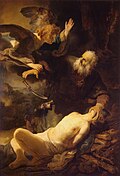
[[File:Rembrandt Abraham's Sacrifice (Hermitage).jpg|thumb|upright=.8|''The Angel Hinders the Offering of Isaac'', by [[Rembrandt]], 1635 ([[Hermitage Museum]], Saint Petersburg)]] | |||
At some point in Isaac's youth, Abraham was commanded by God to offer his son up as a sacrifice in the land of [[Moriah]]. The patriarch traveled three days until he came to the mount that God told him of. He then commanded the servants to remain while he and Isaac proceeded alone into the mount. Isaac carried the wood upon which he would be sacrificed. Along the way, Isaac asked his father where the animal for the burnt offering was, to which Abraham replied "God will provide himself a lamb for a burnt offering". Just as Abraham was about to sacrifice his son, he was interrupted by the angel of the Lord, and he saw behind him a "ram caught in a thicket by his horns", which he sacrificed instead of his son. The place was later named as [[Jehovah-jireh]]. | At some point in Isaac's youth, Abraham was commanded by God to offer his son up as a sacrifice in the land of [[Moriah]]. The patriarch traveled three days until he came to the mount that God told him of. He then commanded the servants to remain while he and Isaac proceeded alone into the mount. Isaac carried the wood upon which he would be sacrificed. Along the way, Isaac asked his father where the animal for the burnt offering was, to which Abraham replied "God will provide himself a lamb for a burnt offering". Just as Abraham was about to sacrifice his son, he was interrupted by the angel of the Lord, and he saw behind him a "ram caught in a thicket by his horns", which he sacrificed instead of his son. The place was later named as [[Jehovah-jireh]]. For his obedience he received another promise of numerous descendants and abundant prosperity. After this event, Abraham went to Beersheba.<ref>{{bibleverse|Genesis|22:1–19|kjv}}</ref> | ||
===Later years=== | ===Later years=== | ||
{{see also|Abraham's family tree}} | {{see also|Abraham's family tree}} | ||
Sarah died, and Abraham buried her in the [[Cave of the Patriarchs]] (the "cave of Machpelah"), near Hebron which he had purchased along with the adjoining field from Ephron the [[Biblical Hittites|Hittite]].<ref>{{bibleverse|Genesis|23:1–20| | Sarah died, and Abraham buried her in the [[Cave of the Patriarchs]] (the "cave of Machpelah"), near Hebron which he had purchased along with the adjoining field from Ephron the [[Biblical Hittites|Hittite]].<ref>{{bibleverse|Genesis|23:1–20|kjv}}</ref> After the death of Sarah, Abraham took another wife, a [[concubine]] named [[Keturah]], by whom he had six sons: [[Zimran]], [[Jokshan]], [[Medan (son of Abraham)|Medan]], [[Midian (son of Abraham)|Midian]], [[Ishbak]], and [[Shuah]].<ref>{{bibleverse|Genesis|25:1–6|kjv}}</ref> According to the Bible, reflecting the change of his name to "Abraham" meaning "a father of many nations", Abraham is considered to be the progenitor of many nations mentioned in the Bible, among others the [[Israelites]], [[Ishmaelites]],<ref>{{bibleverse|Genesis|25:12–18|kjv}}</ref> [[Edom]]ites,<ref>{{bibleverse|Genesis|36:1–43|kjv}}</ref> [[Amalek#Amalekites in the Hebrew Bible|Amalekites]],<ref>{{bibleverse|Genesis|36:12–16|kjv}}</ref> [[Kenizzite]]s,<ref>{{bibleverse|Genesis|36:9–16|kjv}}</ref> [[Midian]]ites and [[Assyrian people|Assyrians]],<ref>{{bibleverse|Genesis|25:1–5|kjv}}</ref> and through his nephew Lot he was also related to the [[Moab]]ites and [[Ammon]]ites.<ref>{{bibleverse|Genesis|19:35–38|kjv}}</ref> Abraham lived to see Isaac marry [[Rebecca (biblical figure)|Rebekah]], and to see the birth of his twin grandsons [[Jacob and Esau]]. He died at age 175, and was buried in the cave of Machpelah by his sons Isaac and Ishmael.<ref>{{bibleverse|Genesis|25:7–10|kjv}}, {{bibleverse|1 Chronicles|1:32|kjv}}</ref> | ||
== | ==Historical context== | ||
===Historicity=== | ===Historicity=== | ||
[[File:PikiWiki Israel 11347 Abrams well.jpg|thumb|upright=1 | [[File:PikiWiki Israel 11347 Abrams well.jpg|thumb|upright=1|[[Abraham's Well]] at [[Beersheba]], Israel]] | ||
In the early and middle 20th century, leading archaeologists such as [[William F. Albright]] and [[G. Ernest Wright]] and biblical scholars such as [[Albrecht Alt]] and [[John Bright (biblical scholar)|John Bright]] believed that the patriarchs and matriarchs were either real individuals or believable composites of people who lived in the "[[patriarchal age]]", the 2nd millennium BCE.<ref>{{Cite book|last=Bright|first=John|url=https://books.google.com/books?id=0VG67yLs-LAC&q=Abraham|title=A History of Israel|date=1959|publisher=Westminster John Knox Press|isbn=978-0-664-22068-6|page=93|language=en}}</ref> | In the early and middle 20th century, leading archaeologists such as [[William F. Albright]] and [[G. Ernest Wright]] and biblical scholars such as [[Albrecht Alt]] and [[John Bright (biblical scholar)|John Bright]] believed that the patriarchs and matriarchs were either real individuals or believable composites of people who lived in the "[[patriarchal age]]", the 2nd millennium BCE.<ref>{{Cite book|last=Bright|first=John|url=https://books.google.com/books?id=0VG67yLs-LAC&q=Abraham|title=A History of Israel|date=1959|publisher=Westminster John Knox Press|isbn=978-0-664-22068-6|page=93|language=en}}</ref> However, in the 1970s, new arguments concerning Israel's past and the biblical texts challenged these views; these arguments can be found in [[Thomas L. Thompson]]'s ''[[The Historicity of the Patriarchal Narratives]]'' (1974),<ref>{{Cite book|last=Thompson|first=Thomas L.|url=https://books.google.com/books?id=o91vmgEACAAJ&q=The+Historicity+of+the+Patriarchal+Narratives:+The+Quest+for+the+Historical+Abraham|title=The Historicity of the Patriarchal Narratives: The Quest for the Historical Abraham|date=1974|publisher=Gruyter, Walter de, & Company |isbn=9783110040968 |language=en}}</ref> and [[John Van Seters]]' ''[[Abraham in History and Tradition]]'' (1975).<ref>{{Cite book|last=Seters|first=John Van|url=https://books.google.com/books?id=MySUQgAACAAJ&q=Abraham+in+history+and+tradition|title=Abraham in History and Tradition|date=1975|publisher=Yale University Press|isbn=978-0-300-01792-2|archive-date=7 December 2024|access-date=13 October 2024|archive-url=https://web.archive.org/web/20241207061533/https://books.google.com/books?id=MySUQgAACAAJ&q=Abraham+in+history+and+tradition|url-status=live}}</ref> Thompson, a literary scholar, based his argument on archaeology and ancient texts. His thesis centered on the lack of compelling evidence that the patriarchs lived in the 2nd millennium BCE, and noted how certain biblical texts reflected first millennium conditions and concerns. Van Seters examined the patriarchal stories and argued that their names, social milieu, and messages strongly suggested that they were [[Iron Age]] creations.{{sfn|Moore|Kelle|2011|pp=18–19}} Van Seters' and Thompson's works were a [[paradigm shift]] in biblical scholarship and archaeology, which gradually led scholars to no longer consider the patriarchal narratives as historical.<ref>{{Cite book|last=Moorey|first=Peter Roger Stuart|url=https://books.google.com/books?id=e1x9Rs_zdG8C&q=A+Century+of+Biblical+Archaeology|title=A Century of Biblical Archaeology|date=1991|publisher=Westminster John Knox Press|isbn=978-0-664-25392-9|pages=153–154}}</ref> Some conservative scholars attempted to defend the Patriarchal narratives in the following years, but this has not found acceptance among scholars.<ref>{{harvnb|Dever|2001|p=98}}: "There are a few sporadic attempts by conservative scholars to "save" the patriarchal narratives as history, such as [[Kenneth Kitchen]] [...] By and large, however, the minimalist view of Thompson's pioneering work, ''The Historicity of the Patriarchal Narratives'', prevails."</ref><ref>{{Cite book|last=Grabbe|first=Lester L.|editor1-first=H. G. M|editor1-last=Williamson|title=Understanding the History of Ancient Israel|url=https://britishacademy.universitypressscholarship.com/view/10.5871/bacad/9780197264010.001.0001/upso-9780197264010-chapter-5|chapter=Some Recent Issues in the Study of the History of Israel|publisher=British Academy|year=2007|isbn=978-0-19-173494-6|language=en-US|doi=10.5871/bacad/9780197264010.001.0001|quote=The fact is that we are all minimalists – at least, when it comes to the patriarchal period and the settlement. When I began my PhD studies more than three decades ago in the USA, the 'substantial historicity' of the patriarchs was widely accepted as was the unified conquest of the land. These days it is quite difficult to find anyone who takes this view.|archive-date=28 March 2022|access-date=12 July 2021|archive-url=https://web.archive.org/web/20220328134917/https://britishacademy.universitypressscholarship.com/view/10.5871/bacad/9780197264010.001.0001/upso-9780197264010-chapter-5|url-status=live}}</ref> By the beginning of the 21st century, archaeologists had stopped trying to recover any context that would make Abraham, Isaac or Jacob credible historical figures.{{sfn|Dever|2001|p=98 and fn.2}} | ||
==={{anchor|Renaming}} Origins of the narrative=== | ==={{anchor|Renaming}} Origins of the narrative=== | ||
[[File:Abraham's Gate.jpg|thumb|[[Abraham's Gate|Abraham's Gate, Tel Dan, Israel]]]] | [[File:Abraham's Gate.jpg|thumb|[[Abraham's Gate|Abraham's Gate, Tel Dan, Israel]]]] | ||
Abraham's story, like those of the other patriarchs, most likely had a substantial oral prehistory{{sfn|Pitard|2001|p=27}} (he is mentioned in the [[Book of Ezekiel]]<ref>{{Bibleverse|Ezekiel|33:24}}</ref> and the [[Book of Isaiah]]<ref>{{Bibleverse|Isaiah|63:16}}</ref>). As with [[Moses]], Abraham's name is apparently very ancient, as the tradition found in the [[Book of Genesis]] no longer understands its original meaning | Abraham's story, like those of the other patriarchs, most likely had a substantial oral prehistory{{sfn|Pitard|2001|p=27}} (he is mentioned in the [[Book of Ezekiel]]<ref>{{Bibleverse|Ezekiel|33:24|kjv}}</ref> and the [[Book of Isaiah]]<ref>{{Bibleverse|Isaiah|63:16|kjv}}</ref>). As with [[Moses]], Abraham's name is apparently very ancient, as the tradition found in the [[Book of Genesis]] no longer understands its original meaning, which is likely "father is exalted" – the meaning offered in {{Bibleverse|Genesis|17:5|KJV}}, "Father of a multitude", is a [[folk etymology]].{{sfn|Thompson|2016|pp=23–24}} At some stage the [[oral tradition]]s became part of the written tradition of the [[Pentateuch]]; a majority of scholars believe this stage belongs to the Persian period, roughly 520–320 BCE.{{sfn|Ska|2009|p=260}} The mechanisms by which this came about remain unknown,{{sfn|Enns|2012|p=26}} but there are currently at least two hypotheses.{{sfn|Ska|2006|pp=217, 227–28}} The first, called Persian Imperial authorisation, is that the post-Exilic community devised the Torah as a legal basis on which to function within the Persian Imperial system; the second is that the Pentateuch was written to provide the criteria for determining who would belong to the post-Exilic Jewish community and to establish the power structures and relative positions of its various groups, notably the priesthood and the lay "elders".{{sfn|Ska|2006|pp=217, 227–28}} | ||
The completion of the Torah and its elevation to the centre of post-Exilic Judaism was as much or more about combining older texts as writing new ones – the final Pentateuch was based on existing traditions.{{sfn|Carr|Conway|2010|p=193}} In the | The completion of the Torah and its elevation to the centre of post-Exilic Judaism was as much or more about combining older texts as writing new ones – the final Pentateuch was based on existing traditions.{{sfn|Carr|Conway|2010|p=193}} In the Book of Ezekiel,<ref>{{bibleverse-nb|Ezekiel|33:24|kjv}}</ref> written during the Exile (i.e., in the first half of the 6th century BCE), [[Ezekiel]], an exile in Babylon, tells how those who remained in Judah are claiming ownership of the land based on inheritance from Abraham; but the prophet tells them they have no claim because they do not observe Torah.{{sfn|Ska|2009|p=43}} The Book of Isaiah<ref>{{bibleverse-nb||Isaiah|63:16|kjv}}</ref> similarly testifies of tension between the people of Judah and the returning post-Exilic Jews (the "[[Golah|gôlâ]]"), stating that God is the father of Israel and that Israel's history begins with the Exodus and not with Abraham.{{sfn|Ska|2009|p=44}} The conclusion to be inferred from this and similar evidence (e.g., [[Ezra–Nehemiah]]), is that the figure of Abraham must have been preeminent among the great landowners of Judah at the time of the Exile and after, serving to support their claims to the land in opposition to those of the returning exiles.{{sfn|Ska|2009|p=44}} | ||
=== Amorite origin hypothesis === | |||
According to [[Nissim Amzallag]], the Book of Genesis portrays Abraham as having an [[Amorites|Amorite]] origin, arguing that the patriarch's provenance from the region of [[Harran]] as described in {{Bibleverse|Genesis|11:31|KJV}} associates him with the territory of the Amorite homeland. He also notes parallels between the biblical narrative and the Amorite migration into the [[Southern Levant]] in the [[2nd millennium BCE]].<ref>{{cite book |title=Yahweh and the Origins of Ancient Israel: Insights from the Archaeological Record |last=Amzallag |first=Nissim |publisher=Cambridge University Press |year=2023 |isbn=978-1-009-31478-7 |page=76 |url=https://books.google.com/books?id=Qee-EAAAQBAJ&pg=PA76}}</ref> Likewise, some scholars like [[Daniel E. Fleming]] and Alice Mandell have argued that the biblical portrayal of the Patriarchs' lifestyle appears to reflect the Amorite culture of the 2nd millennium BCE as attested in texts from the ancient city-state of [[Mari, Syria|Mari]], suggesting that the Genesis stories retain historical memories of the ancestral origins of some of the Israelites.<ref>{{cite book |title=The Future of Biblical Archaeology: Reassessing Methodologies and Assumptions |last=Fleming |first=Daniel E. |publisher=Eerdmans |year=2004 |isbn=978-0-8028-2173-7 |pages=193–232 |editor-last=Hoffmeier |editor-first=James K. |chapter=Genesis in History and Tradition: The Syrian Background of Israel's Ancestors, Reprise |editor-last2=Millard |editor-first2=Alan R. |chapter-url=https://books.google.com/books?id=PUcs-FQv4uIC&pg=PA193 |archive-date=5 December 2024 |access-date=22 June 2024 |archive-url=https://web.archive.org/web/20241205133533/https://books.google.com/books?id=PUcs-FQv4uIC&pg=PA193 |url-status=live }}</ref><ref>{{cite book |title=The Cambridge Companion to Genesis |last=Mandell |first=Alice |publisher=Cambridge University Press |year=2022 |isbn=978-1-108-42375-5 |pages=143–46 |editor-last=Arnold |editor-first=Bill T. |chapter=Genesis and its Ancient Literary Analogues |chapter-url=https://books.google.com/books?id=-EpgEAAAQBAJ&pg=PA143 |archive-date=8 June 2024 |access-date=22 June 2024 |archive-url=https://web.archive.org/web/20240608142040/https://books.google.com/books?id=-EpgEAAAQBAJ&pg=PA143 |url-status=live }}</ref> [[Alan Millard]] argues that the name Abram is of [[Amorite language|Amorite]] origin and that it is attested in Mari as ''ʾabī-rām''. He also suggests that the Patriarch's name corresponds to a form typical of the Middle Bronze Age and not of later periods.<ref>{{cite journal |title=Patriarchal Names in Context |journal=Tyndale Bulletin |last=Millard |first=Alan |volume=75 |issue=December |pages=155–174 |year=2024 |doi=10.53751/001c.117657 |issn=2752-7042 |doi-access=free}}</ref> Some papers identify Abraham with the Amorite chieftain [[Sumu-abum|Abum]], and his son Ishmael with [[Sumu-la-El|Sumulael]].<ref>{{Cite book |last=Knauf |first=Ernst Axel |url=https://www.academia.edu/832723/Ismael |title=Ismael}}</ref><ref>{{Cite journal |last=Boer |first=Rients de |date=2018 |title=Beginnings of Old Babylonian Babylon: Sumu-abum and Sumu-la-El |url=https://www.jstor.org/stable/10.5615/jcunestud.70.2018.0053 |journal=Journal of Cuneiform Studies |volume=70 |pages=53–86 |doi=10.5615/jcunestud.70.2018.0053 |issn=0022-0256}}</ref> | |||
===Canaanite origin hypothesis=== | |||
The earliest possible reference to Abraham may be the name of a town in the [[Negev]] listed in the [[Bubastite Portal]] inscription of Pharaoh [[Sheshonq I]] (biblical [[Shishak]]), which is referred as "the Fortress of Abraham" (i-bi-ra-ma), suggesting the possible existence of an Abraham tradition in the 10th century BCE.{{sfn|McCarter|2000|p=9}}{{sfn|Hendel|2005|pp=48–49}} The orientalist [[Mario Liverani]] has proposed to see in the name Abraham the eponymous ancestor of a 13th-century BCE [[tribe]], the Raham, mentioned in a stele of [[Seti I]] found at [[Beth-Shean]] and dating back to around 1289 BCE. The tribe probably lived in the area surrounding or close to Beth-Shean, in [[Galilee]] (the stele in fact refers to battles that took place in the area). Liverani hypothesized that the members of the tribe of Raham called themselves "sons of Raham" (''*Banu-Raham''), so that the name of their eponymous ancestor would have been "father of Raham" (''*Abu-Raham''), that being the name of the patriarch Abraham.<ref>{{cite book |title=Israel's History and the History of Israel |last=Liverani |first=Mario |publisher=Routledge |year=2014 |isbn=978-1-317-48893-4 |page=25 |url=https://books.google.com/books?id=_1zfBQAAQBAJ&pg=PA25}}</ref> [[Israel Finkelstein]] and [[Thomas Römer]] suggested that the oldest Abraham traditions originated in the Iron Age (monarchic period) and that they contained an [[wikt:autochthonous|autochthonous]] hero story, as the oldest biblical references to Abraham outside the book of Genesis ({{Bibleverse|Ezekiel|33|KJV}} and {{Bibleverse|Isaiah|51|KJV}}) do not have an indication of a Mesopotamian origin of Abraham and present only two main themes of the Abraham narrative in Genesis—land and offspring.<ref name=":82">{{cite journal |title=Comments on the Historical Background of the Abraham Narrative: Between "Realia" and "Exegetica" |journal=Hebrew Bible and Ancient Israel |url=https://www.academia.edu/29972948 |last1=Finkelstein |first1=Israel |issue=1 |volume=3 |pages=3–23 |last2=Römer |first2=Thomas |year=2014 |doi=10.1628/219222714x13994465496820 |archive-date=29 February 2024 |access-date=23 November 2023 |archive-url=https://web.archive.org/web/20240229190528/https://www.academia.edu/29972948 |url-status=live }}</ref> Finkelstein and Römer considered Abraham as ancestor who was worshiped in Hebron, with the oldest tradition of him possibly being about the altar he built in Hebron.<ref name=":82" /> | |||
== Religious traditions == | == Religious traditions == | ||
Abraham is given a high position of respect in three major world faiths, [[Judaism]], [[Christianity]], and [[Islam]]. In Judaism, he is the founding father of the covenant, the special relationship between the Jewish people and God—leading to the belief that the [[Jews as the chosen people|Jews are the chosen people of God]]. In Christianity, [[Paul the Apostle]] taught that Abraham's faith in God—preceding the [[Mosaic law]]—made him the prototype of all believers, Jewish or [[gentile]]; and in Islam, he is seen as a link in the [[Prophets and messengers in Islam|chain of prophets]] that begins with [[Adam]] and culminates in [[Muhammad]].{{sfn|Levenson|2012|p=8}} | |||
Abraham is given a high position of respect in three major world faiths, [[Judaism]], [[Christianity]] and [[Islam]]. In Judaism, he is the founding father of the covenant, the special relationship between the Jewish people and | |||
===Judaism=== | ===Judaism=== | ||
In Jewish tradition, Abraham is called ''Avraham Avinu'' (אברהם אבינו), "our father Abraham, | In Jewish tradition, Abraham is called ''Avraham Avinu'' (אברהם אבינו), "our father Abraham", signifying that he is both the biological progenitor of the Jews and the father of Judaism, the first Jew.{{sfn|Levenson|2012|p=3}} His story is read in the weekly [[Torah]] reading portions, predominantly in the [[parashot]]: [[Lech-Lecha (parsha)|Lech-Lecha]] (לֶךְ-לְךָ), [[Vayeira (parsha)|Vayeira]] (וַיֵּרָא), [[Chayei Sarah (parsha)|Chayei Sarah]] (חַיֵּי שָׂרָה), and [[Toledot (parsha)|Toledot]] (תּוֹלְדֹת).<ref>{{Cite book |last=Held |first=Shai |url=https://books.google.com/books?id=XzIxDwAAQBAJ |title=The Heart of Torah: Essays on the Weekly Torah Portion |date=2017 |publisher=U of Nebraska Press |isbn=978-0-8276-1333-1 |language=en}}</ref> | ||
[[Hanan bar Rava]] taught in [[Abba Arikha]]'s name that Abraham's mother was named ʾĂmatlaʾy bat Karnebo.<ref>{{Cite web|title=Bava Batra 91a|url=https://www.sefaria.org/Bava_Batra.91a|access-date=2021-03-08|website=www.sefaria.org}}</ref>{{Efn|MSS variants: ''bat Barnebo, bat bar-Nebo, bar-bar-Nebo, bat Karnebi, bat Kar Nebo''. Karnebo (''outpost of [[Nabu]]'') is attested as a [[Sumer]]ian theophoric place-name in [[Akkadian language|Akkadian]] inscriptions, including the [[Andre Michaux|Michaux stone]]. It referred to at least two separate cities in antiquity.<ref>Yamada, Shigeo. [https://www.jstage.jst.go.jp/article/orient/40/0/40_56/_pdf "Karus on the Frontiers of the Neo-Assyrian Empire, Orient 40 (2005)]"</ref> Rabbinic tradition connects Karnebo to the [[Biblical Hebrew]] Kar (כר ''lamb''), translating it ''[[Tumah and taharah|pure]] lambs''.<ref>[https://www.sefaria.org/Rashbam_on_Bava_Batra.91a.14.2?lang=bi "Rashbam on Bava Batra 91a:14:2"]. http://www.sefaria.org. Retrieved 2021-03-08.</ref>}} [[Hiyya bar Abba]] taught that [[Abraham and the Idol Shop|Abraham worked in Teraḥ's idol shop]] in his youth.<ref>{{Cite web|title=Bereishit Rabbah 38|url=https://www.sefaria.org/Bereishit_Rabbah.38|access-date=2021-03-11|website=www.sefaria.org}}</ref> | [[Hanan bar Rava]] taught in [[Abba Arikha]]'s name that Abraham's mother was named ʾĂmatlaʾy bat Karnebo.<ref>{{Cite web|title=Bava Batra 91a|url=https://www.sefaria.org/Bava_Batra.91a|access-date=2021-03-08|website=www.sefaria.org|archive-date=30 May 2015|archive-url=https://web.archive.org/web/20150530091641/https://www.sefaria.org/Bava_Batra.91a|url-status=live}}</ref>{{Efn|MSS variants: ''bat Barnebo, bat bar-Nebo, bar-bar-Nebo, bat Karnebi, bat Kar Nebo''. Karnebo (''outpost of [[Nabu]]'') is attested as a [[Sumer]]ian theophoric place-name in [[Akkadian language|Akkadian]] inscriptions, including the [[Andre Michaux|Michaux stone]]. It referred to at least two separate cities in antiquity.<ref>Yamada, Shigeo. [https://www.jstage.jst.go.jp/article/orient/40/0/40_56/_pdf "Karus on the Frontiers of the Neo-Assyrian Empire, Orient 40 (2005)] {{Webarchive|url=https://web.archive.org/web/20220521130027/https://www.jstage.jst.go.jp/article/orient/40/0/40_56/_pdf |date=21 May 2022 }}"</ref> Rabbinic tradition connects Karnebo to the [[Biblical Hebrew]] Kar (כר ''lamb''), translating it ''[[Tumah and taharah|pure]] lambs''.<ref>[https://www.sefaria.org/Rashbam_on_Bava_Batra.91a.14.2?lang=bi "Rashbam on Bava Batra 91a:14:2"] {{Webarchive|url=https://web.archive.org/web/20220521122919/https://www.sefaria.org/Rashbam_on_Bava_Batra.91a.14.2?lang=bi |date=21 May 2022 }}. http://www.sefaria.org {{Webarchive|url=https://web.archive.org/web/20130202120144/http://www.sefaria.org/ |date=2 February 2013 }}. Retrieved 2021-03-08.</ref>}} [[Hiyya bar Abba]] taught that [[Abraham and the Idol Shop|Abraham worked in Teraḥ's idol shop]] in his youth.<ref>{{Cite web|title=Bereishit Rabbah 38|url=https://www.sefaria.org/Bereishit_Rabbah.38|access-date=2021-03-11|website=www.sefaria.org|archive-date=11 July 2023|archive-url=https://web.archive.org/web/20230711002906/https://www.sefaria.org/Bereishit_Rabbah.38|url-status=live}}</ref> | ||
In ''[[Legends of the Jews]]'', God created heaven and earth for the sake of the merits of Abraham.{{sfn|Ginzberg|1909|loc=Vol I: The Wicked Generations}} After the [[Genesis flood narrative|biblical flood]], Abraham was the only one among the pious who solemnly swore never to forsake God,{{sfn|Ginzberg|1909|loc=Vol. I: In the Fiery Furnace}} studied in the house of [[Noah]] and [[Shem]] to learn about the "Ways of God, | In ''[[Legends of the Jews]]'', God created heaven and earth for the sake of the merits of Abraham.{{sfn|Ginzberg|1909|loc=Vol I: The Wicked Generations}} After the [[Genesis flood narrative|biblical flood]], Abraham was the only one among the pious who solemnly swore never to forsake God,{{sfn|Ginzberg|1909|loc=Vol. I: In the Fiery Furnace}} studied in the house of [[Noah]] and [[Shem]] to learn about the "Ways of God",{{sfn|Jasher|1840|p=22|loc =Ch9, vv 5–6}} and continued the line of [[Kohanim|High Priest]] from Noah and Shem, assigning the office to [[Levi]] and [[Tribe of Levi|his seed]] forever. Before leaving his father's land, Abraham was miraculously saved from the fiery furnace of [[Nimrod]] following his brave action of breaking the idols of the [[Chaldea]]ns into pieces.{{sfn|Ginzberg|1909}} During his sojourning in Canaan, Abraham was accustomed to extend hospitality to travelers and strangers and taught how to praise God also knowledge of God to those who had received his kindness.{{sfn|Ginzberg|1909|loc=Vol. I: The Covenant with Abimelech}} | ||
Along with [[Isaac]] and [[Jacob]], he is the one whose name would appear united with God, as [[God in Judaism]] | Along with [[Isaac]] and [[Jacob]], he is the one whose name would appear united with God, as [[God in Judaism]] is called ''Elohei Avraham, Elohei Yitzchak, vEilohei Ya'akov'' ("God of Abraham, God of Isaac, and God of Jacob").{{sfn|Ginzberg|1909|loc=Vol. I: Joy and Sorrow in the House of Jacob}} He was also mentioned as the father of thirty nations.{{sfn|Ginzberg|1909|loc=Vol. I: The Birth of Esau and Jacob}} | ||
Abraham is | ===Mandaeism=== | ||
In [[Mandaeism]], Abraham ({{langx|myz|ࡀࡁࡓࡀࡄࡉࡌ|translit=Abrahim}}) is mentioned in [[s:Translation:Ginza Rabba/Right Ginza/Book 18|Book 18]] of the ''[[Right Ginza]]'' as the patriarch of the Jewish people. [[Mandaeans]] consider Abraham to have been originally a Mandaean priest, however they differ with Abraham and Jews regarding circumcision which they consider to be bodily mutilation and therefore forbidden.<ref name="GR Gelbert">{{cite book |last1=Gelbert |first1=Carlos |url=https://livingwaterbooks.com.au/product/ginza-rba/ |title=Ginza Rba |publisher=Living Water Books |year=2011 |isbn=978-0958034630 |location=Sydney |access-date=17 February 2022 |archive-url=https://web.archive.org/web/20220316031021/https://livingwaterbooks.com.au/product/ginza-rba/ |archive-date=16 March 2022 |url-status=live}}</ref><ref name="GR Lidzbarski">{{cite book |last=Lidzbarski |first=Mark |url=https://archive.org/details/MN41563ucmf_2 |title=Ginza: Der Schatz oder Das große Buch der Mandäer |date=1925 |publisher=Vandenhoek & Ruprecht |location=Göttingen}}</ref><ref name="DrowerHaranGawaita">{{cite book |last=Drower |first=Ethel Stefana |title=The Haran Gawaita and the Baptism of Hibil-Ziwa |publisher=Biblioteca Apostolica Vaticana |year=1953}}</ref><ref name="auto2">{{cite book |last=Drower |first=Ethel Stefana |title=The Mandaeans of Iraq and Iran |publisher=Oxford At The Clarendon Press |year=1937}}</ref><ref>{{cite book |last=Smith |first=Andrew Phillip |title=John the Baptist and the Last Gnostics: the Secret History of the Mandaeans |publisher=Watkins |year=2016}}</ref>{{rp|18,185}} | |||
===Christianity=== | ===Christianity=== | ||
[[File:Aert de Gelder 009.jpg|thumb|''Abraham and the Angels'', by [[Aert de Gelder]], {{circa|1680–85}} ([[Museum Boijmans Van Beuningen]], [[Rotterdam]])]] | |||
In [[Christianity]], Abraham is revered as the [[Prophets of Christianity|prophet]] to whom God chose to reveal himself and with whom God initiated a [[Covenant (biblical)|covenant]] (cf. ''[[Covenant Theology]]'').{{sfn|Wright|2010|p=72}}<ref name="WaReMu">{{harvnb|Waters|Reid|Muether|2020|ps=: "Paul also shows us how the Abrahamic covenant relates to the covenantal administrations that precede and follow it. ... There is, then, covenantal continuity between the inaugural administration of God's one gracious covenant in the garden of Eden (Gen. 3:15) and the subsequent administration of that covenant to Abraham and his family (Gen. 12; 15; 17). The Abrahamic administration serves to reveal more of the person and work of Christ and, in this way, continue to administer Christ to human beings through faith."}}</ref> [[Paul the Apostle]] declared that all who believe in Jesus ([[Christians]]) are "included in the seed of Abraham and are inheritors of the promise made to Abraham."{{sfn|Wright|2010|p=72}} In {{Bibleverse|Romans|4|KJV}}, Abraham is praised for his "unwavering faith" in God, which is tied into the concept of partakers of the covenant of grace being those "who demonstrate faith in the saving power of Christ".<ref>Firestone, Reuven. [http://cmje.usc.edu/articles/abraham.php "Abraham."] {{Webarchive|url=https://web.archive.org/web/20170909233637/http://cmje.usc.edu/articles/abraham.php |date=9 September 2017 }} ''Encyclopedia of World History''.</ref><ref name="WaReMu" /> | |||
| | |||
| | |||
In [[Christianity]], Abraham is revered as the [[Prophets of Christianity|prophet]] to whom God chose to reveal himself and with whom God initiated a [[Covenant (biblical)|covenant]] (cf. ''[[Covenant Theology]]'').{{sfn|Wright|2010|p=72}}{{ | |||
Throughout history, church leaders, following Paul, have emphasized Abraham as the spiritual father of all Christians.{{sfn|Jeffrey|1992|p=10}} [[Augustine of Hippo]] declared that Christians are "children (or "seed") of Abraham by faith", [[Ambrose]] stated that "by means of their faith Christians possess the promises made to Abraham", and [[Martin Luther]] recalled Abraham as "a paradigm of the man of faith."{{efn|{{harvnb|Jeffrey|1992|p=10}} states "St. Augustine, following Paul, regards all Christians as children (or "seed") of Abraham by faith, although "born of strangers" (e.g. In Joan. Ev. 108). St. Ambrose likewise says that by means of their faith Christians possess the promises made to Abraham. Abraham's initial departure from his homeland is understood by St. Caesarius of Arles as a type of Christian leaving the world of carnal habits to follow Christ. Later commentators as diverse as Luther and Kierkegaard recall Abraham as a paradigm of the man of faith. }} | Throughout history, church leaders, following Paul, have emphasized Abraham as the spiritual father of all Christians.{{sfn|Jeffrey|1992|p=10}} [[Augustine of Hippo]] declared that Christians are "children (or "seed") of Abraham by faith", [[Ambrose]] stated that "by means of their faith Christians possess the promises made to Abraham", and [[Martin Luther]] recalled Abraham as "a paradigm of the man of faith."{{efn|{{harvnb|Jeffrey|1992|p=10}} states "St. Augustine, following Paul, regards all Christians as children (or "seed") of Abraham by faith, although "born of strangers" (e.g. In Joan. Ev. 108). St. Ambrose likewise says that by means of their faith Christians possess the promises made to Abraham. Abraham's initial departure from his homeland is understood by St. Caesarius of Arles as a type of Christian leaving the world of carnal habits to follow Christ. Later commentators as diverse as Luther and Kierkegaard recall Abraham as a paradigm of the man of faith. }} | ||
The [[Roman Catholic Church]], the largest Christian denomination, calls Abraham "our father in Faith" in the [[Eucharistic prayer]] of the [[Roman Canon]], recited during the [[Mass in the Catholic Church|Mass]]. He is also commemorated in the [[calendar of saints|calendars of saints]] of several denominations: on 20 August by the [[Maronite Church]], 28 August in the [[Coptic Orthodox Church|Coptic Church]] and the [[Assyrian Church of the East]] (with the full [[daily office|office]] for the latter), and on 9 October by the Roman Catholic Church and the [[Lutheran Church–Missouri Synod]].<ref name="LCMS"/> In the introduction to his 15th-century translation of the [[Golden Legend]]'s account of Abraham, [[William Caxton]] noted that this patriarch's life was read in church on [[Sunday before Lent|Quinquagesima Sunday]].<ref name="Caxton">{{cite web|last=Caxton|first=William|title=Abraham|url=http://www.fordham.edu/halsall/basis/goldenlegend/GoldenLegend-Volume1.asp#Abraham|website=The Golden Legend|publisher=Internet Medieval Source Book|access-date=3 April 2014}}</ref> | The [[Roman Catholic Church]], the largest Christian denomination, calls Abraham "our father in Faith" in the [[Eucharistic prayer]] of the [[Roman Canon]], recited during the [[Mass in the Catholic Church|Mass]]. He is also commemorated in the [[calendar of saints|calendars of saints]] of several denominations: on 20 August by the [[Maronite Church]], 28 August in the [[Coptic Orthodox Church|Coptic Church]] and the [[Assyrian Church of the East]] (with the full [[daily office|office]] for the latter), and on 9 October by the Roman Catholic Church and the [[Lutheran Church–Missouri Synod]].<ref name="LCMS">{{cite web |title=Commemorations |url=https://www.lcms.org/worship/church-year/commemorations |publisher=[[Lutheran Church—Missouri Synod]] |access-date=31 October 2020 |language=en |archive-date=4 July 2019 |archive-url=https://web.archive.org/web/20190704153818/https://www.lcms.org/worship/church-year/commemorations |url-status=live }}</ref> In the introduction to his 15th-century translation of the [[Golden Legend]]'s account of Abraham, [[William Caxton]] noted that this patriarch's life was read in church on [[Sunday before Lent|Quinquagesima Sunday]].<ref name="Caxton">{{cite web|last=Caxton|first=William|title=Abraham|url=http://www.fordham.edu/halsall/basis/goldenlegend/GoldenLegend-Volume1.asp#Abraham|website=The Golden Legend|publisher=Internet Medieval Source Book|access-date=3 April 2014|archive-date=13 August 2011|archive-url=https://web.archive.org/web/20110813234236/http://www.fordham.edu/halsall/basis/goldenlegend/GoldenLegend-Volume1.asp#Abraham|url-status=live}}</ref> | ||
He is the [[patron saint]] of those in the hospitality industry.{{sfn|Holweck|1924|p= | He is the [[patron saint]] of those in the hospitality industry.{{sfn|Holweck|1924|p=7}} The [[Eastern Orthodox Church]] commemorates him as the "Righteous Forefather Abraham", with two [[feast day]]s in its [[Eastern Orthodox Church liturgical calendar|liturgical calendar]]. The first time is on 9 October (for those churches which follow the traditional [[Julian Calendar]], 9 October falls on 22 October of the modern [[Gregorian Calendar]]), where he is commemorated together with his nephew "Righteous Lot". The other is on the "Sunday of the Forefathers" (two Sundays before Christmas), when he is commemorated together with other [[Genealogy of Jesus|ancestors of Jesus]]. Abraham is also mentioned in the [[Divine Liturgy]] of [[Basil the Great]], just before the Anaphora, and Abraham and Sarah are invoked in the prayers said by the priest over a newly married couple. A popular [[hymn]] sung in many English-speaking [[Sunday School]]s by children is known as "Father Abraham" and emphasizes the patriarch as the spiritual progenitor of Christians.<ref name="Smith2000">{{cite book |last1=Smith |first1=Carol |title=The Ultimate Guide to the Bible |date=2000b |publisher=Barbour |isbn=978-1-57748-824-8 |page=91 |language=en}}</ref> | ||
===Islam=== | ===Islam=== | ||
{{main|Abraham in Islam}} | {{main|Abraham in Islam}} | ||
[[File: | [[File:Abraham_Family_Tree.svg|thumb|Simple diagram showing the descent from '''Abraham''' to '''Ishmael''' and '''Isaac''', with '''twelve tribal descendants''' ]] | ||
Islam regards Abraham as a link in the chain of prophets that begins with Adam and culminates in [[Muhammad]].{{sfn|Levenson|2012|p= | [[File:Ibrahim's sacrifice of Emsaeil is stopped by Jibril delivering a sheep instead uncropped.jpg|thumb|Islamic [[Persian miniature|miniature]] of Ibrahim's sacrifice of his son is stopped by the angel Jibril delivering a sheep instead from a Persian 1577 [[Qisas al-Anbiya|''Stories of the Prophets'']] manuscript.]] | ||
Islam regards {{tlit|ar|ʾIbrāhīm}} (Abraham) as a link in the chain of prophets that begins with Adam and culminates in [[Muhammad]] via {{tlit|ar|ʾIsmāʿīl}} (Ishmael).{{sfn|Levenson|2012|p=8}} Abraham is mentioned in 35 [[chapters of the Quran]], more often than any other biblical personage apart from [[Moses in Islam|Moses]].{{sfn|Peters|2003|p=9}} He is called both a {{tlit|ar|hanif}} ([[monotheist]]) and {{tlit|ar|muslim}} (one who submits),{{sfn|Levenson|2012|p=200}} and Muslims regard him as a [[prophet]] and [[patriarch]], the archetype of the perfect [[Muslim]], and the revered reformer of the [[Kaaba]] in [[Mecca]].{{sfn|Lings|2004|p=}} Islamic tradition considers Abraham the first "pioneer of Islam" (which is also called {{tlit|ar|millat ʾIbrāhīm}}, the 'religion of Abraham'), and that his purpose and mission throughout his life was to proclaim the [[Tawhid|oneness of God]]. In Islam, Abraham holds an exalted position among the major prophets and he is referred to as {{tlit|ar|Khalīlullāh}}, meaning 'Friend of [[God in Islam|God]]'.<ref>{{Cite web |title=Khalilullah: The Friend of God |url=https://www.answering-islam.org/Gilchrist/Vol2/4a.html |access-date=2025-04-05 |website=www.answering-islam.org}}</ref> Besides {{tlit|ar|[[Islamic view of Isaac|Ishaq]]}} and {{tlit|ar|[[Yaqub]]}} (Isaac and Jacob), Abraham is among the most excellent and honorable men in the view of God.<ref>{{qref|38|45-47|b=yl}}</ref>{{sfn|Maulana|2006|p=104}} He is also mentioned in Quran as the "Father of Muslims", and is put forward as a role model for the community.<ref>{{qref|60|4-6|b=yl}}</ref> | |||
===Druze faith=== | |||
The [[Druze]] regard Abraham as the third spokesman (''natiq'') after [[Adam]] and [[Noah]], who helped transmit the foundational teachings of monotheism (''tawhid'') intended for the larger audience.{{sfn|Swayd|2009|p=3}} He is also among the seven prophets who appeared in different periods of history according to the Druze faith.<ref name="Hitti 1928 37">{{cite book|title=The Origins of the Druze People and Religion: With Extracts from Their Sacred Writings| first= Philip K.|last= Hitti|year= 1928| isbn= 978-1465546623| page =37 |publisher=Library of Alexandria}}</ref><ref name="Dana 2008 17">{{cite book|title=The Druze in the Middle East: Their Faith, Leadership, Identity and Status| first= Nissim |last= Dana|year= 2008| isbn= 9781903900369| page =17 |publisher=Michigan University press}}</ref> | |||
=== | === Baháʼí Faith === | ||
[[Baháʼí Faith|Baháʼís]] considered Abraham as a [[Manifestation of God (Baháʼí Faith)|Manifestation of God]], and as the originator of [[monotheistic]] religion.{{Sfn|Smith|2000a|pp=22, 231}} [[ʻAbdu'l-Bahá]] states that Abraham was born in [[Mesopotamia]],{{Sfn|ʻAbdu'l-Bahá|2014|p=10}} and [[Baháʼu'lláh|Bahá'u'lláh]] states that the language which Abraham spoke, when "he crossed the [[Jordan]]", is [[Hebrew language|Hebrew]] ('''Ibrání''), so "the language of the crossing."{{Sfn|Baháʼu'lláh|1976|p=54}} To ʻAbdu'l-Bahá, the Abraham was born to a family that was ignorant of the oneness of God.{{Sfn|ʻAbdu'l-Bahá|2014|p=4}} Abraham opposed his own people and government, and even his own kin, he rejected all their gods, and, alone and single-handed, he withstood a powerful nation.{{Sfn|ʻAbdu'l-Bahá|2014|p=4}} These people believed not in one God [[Polytheism|but in many gods]], to whom they ascribed miracles, and hence they all rose up against Abraham. No one supported him except his nephew [[Lot (biblical person)|Lot]] and "one or two other individuals of no consequence".{{Sfn|ʻAbdu'l-Bahá|2014|p=4}} At last the intensity of his enemies' opposition obliged him, utterly wronged, to forsake his native land. Abraham then came to "these regions", that is, to the [[Holy Land]].{{Sfn|ʻAbdu'l-Bahá|2014|p=4}} To Bahá'u'lláh, the "Voice of [[God in the Baháʼí Faith|God]]" commanded Abraham to offer up [[Ishmael]] as a sacrifice, so that his steadfastness in the faith of God and his detachment from all else but him may be demonstrated unto men. The purpose of God, moreover, was to sacrifice him as a ransom for the sins and iniquities of all the peoples of the earth.{{Sfn|Baháʼu'lláh|1976|p=23}} | |||
In the Baháʼí texts, like the Islamic texts, Abraham is often referred to as "the Friend of God".{{Sfn|Smith|2000a|p=22}} 'Abdu'l-Bahá described Abraham as the founder of monotheism.{{sfn|ʻAbdu'l-Bahá|1978|p=22}} | |||
ʻAbdu'l-Bahá also suggested the "holy manifestations who have been the sources or founders of the various religious systems" were united and agreed in purpose and teaching, and the Abraham, [[Moses]], [[Zoroaster]], [[the Buddha]], [[Jesus]], [[Muhammad]], the [[Báb]] and Bahá'u'lláh are one in "spirit and reality".{{Sfn|ʻAbdu'l-Bahá|1912|p=118}} | |||
== | == Artistic depictions == | ||
===Painting and sculpture=== | ===Painting and sculpture=== | ||
[[File:Isaac sarcifice Pio Christiano Inv31648.jpg|thumb|16th-century plaster cast of a late | [[File:Isaac sarcifice Pio Christiano Inv31648.jpg|thumb|16th-century plaster cast of a late Roman-era [[Sacrifice of Isaac]]. The hand of God originally came down to restrain Abraham's knife (both are now missing).]] | ||
Paintings on the life of Abraham tend to focus on only a few incidents: the sacrifice of Isaac; meeting Melchizedek; entertaining the three angels; Hagar in the desert; and a few others.{{efn|name=Abeart}} Additionally, Martin O'Kane, a professor of Biblical Studies, writes that the parable of [[Rich man and Lazarus|Lazarus]] resting in the "[[Bosom of Abraham]]", as described in the [[Gospel of Luke]], became an iconic image in Christian works.{{sfn|Exum|2007|p=135}} According to O'Kane, artists often chose to divert from the common literary portrayal of Lazarus sitting next to Abraham at a banquet in Heaven and instead focus on the "somewhat incongruous notion of Abraham, the most venerated of patriarchs, holding a naked and vulnerable child in his bosom".{{sfn|Exum|2007|p=135}} Several artists have been inspired by the life of Abraham, including [[Albrecht Dürer]] (1471–1528), [[Caravaggio]] (1573–1610), [[Donatello]], [[Raphael]], [[Anthony van Dyck|Philip van Dyck]] (Dutch painter, 1680–1753), and [[Claude Lorrain]] (French painter, 1600–1682). [[Rembrandt]] (Dutch, 1606–1669) created at least seven works on Abraham, [[Peter Paul Rubens]] (1577–1640) did several, [[Marc Chagall]] did at least five on Abraham, Gustave Doré (French illustrator, 1832–1883) did six, and [[James Tissot]] (French painter and illustrator, 1836–1902) did over twenty works on the subject.{{efn|name=Abeart}} | Paintings on the life of Abraham tend to focus on only a few incidents: the sacrifice of Isaac; meeting Melchizedek; entertaining the three angels; Hagar in the desert; and a few others.{{efn|name=Abeart}} Additionally, Martin O'Kane, a professor of Biblical Studies, writes that the parable of [[Rich man and Lazarus|Lazarus]] resting in the "[[Bosom of Abraham]]", as described in the [[Gospel of Luke]], became an iconic image in Christian works.{{sfn|Exum|2007|p=135}} According to O'Kane, artists often chose to divert from the common literary portrayal of Lazarus sitting next to Abraham at a banquet in Heaven and instead focus on the "somewhat incongruous notion of Abraham, the most venerated of patriarchs, holding a naked and vulnerable child in his bosom".{{sfn|Exum|2007|p=135}} Several artists have been inspired by the life of Abraham, including [[Albrecht Dürer]] (1471–1528), [[Caravaggio]] (1573–1610), [[Donatello]], [[Raphael]], [[Anthony van Dyck|Philip van Dyck]] (Dutch painter, 1680–1753), and [[Claude Lorrain]] (French painter, 1600–1682). [[Rembrandt]] (Dutch, 1606–1669) created at least seven works on Abraham, [[Peter Paul Rubens]] (1577–1640) did several, [[Marc Chagall]] did at least five on Abraham, Gustave Doré (French illustrator, 1832–1883) did six, and [[James Tissot]] (French painter and illustrator, 1836–1902) did over twenty works on the subject.{{efn|name=Abeart}} | ||
The [[Sarcophagus of Junius Bassus]] depicts a set of biblical stories, including Abraham about to sacrifice Isaac. These sculpted scenes are on the outside of a marble [[Early Christian art|Early Christian]] [[sarcophagus]] used for the burial of [[Junius Bassus Theotecnius|Junius Bassus]]. He died in 359. This sarcophagus has been described as "probably the single most famous piece of early Christian relief sculpture."{{sfn|Rutgers|1993|p=}} The sarcophagus was originally placed in or under [[Old St. Peter's Basilica]], was rediscovered in 1597, and is now below the modern basilica in the Museo Storico del Tesoro della Basilica di San Pietro (Museum of [[St. Peter's Basilica]]) in the [[Vatican City|Vatican]]. The base is approximately {{convert|4|x|8|x|4|ft|m|abbr=on}}. | The [[Sarcophagus of Junius Bassus]] depicts a set of biblical stories, including Abraham about to sacrifice Isaac. These sculpted scenes are on the outside of a marble [[Early Christian art|Early Christian]] [[sarcophagus]] used for the burial of [[Junius Bassus Theotecnius|Junius Bassus]]. He died in 359. This sarcophagus has been described as "probably the single most famous piece of early Christian relief sculpture."{{sfn|Rutgers|1993|p=}} The sarcophagus was originally placed in or under [[Old St. Peter's Basilica]], was rediscovered in 1597, and is now below the modern basilica in the Museo Storico del Tesoro della Basilica di San Pietro (Museum of [[St. Peter's Basilica]]) in the [[Vatican City|Vatican]]. The base is approximately {{convert|4|x|8|x|4|ft|m|abbr=on}}.<ref>{{Cite web |last=Laurie |first=Annie |date=2012 |title=Plaster Cast of the Sarcophagus of Junius Bassus in the Vatican Museum |url=https://m.ipernity.com/#/doc/laurieannie/24820593}}</ref> | ||
[[George Segal (artist)|George Segal]] created figural sculptures by molding plastered gauze strips over live models in his 1987 work ''Abraham's Farewell to Ishmael''. The human condition was central to his concerns, and Segal used the Old Testament as a source for his imagery. This sculpture depicts the dilemma faced by Abraham when Sarah demanded that he expel Hagar and Ishmael. In the sculpture, the father's tenderness, Sarah's rage, and Hagar's resigned acceptance portray a range of human emotions. The sculpture was donated to the Miami Art Museum after the artist's death in 2000.<ref>[https://web.archive.org/web/20110429085513/http://www.miamiartmuseum.org/collection-selected-segalgeorge.asp Abraham's Farewell to Ishmael. ''George Segal.'' Miami Art Museum. Collections: Recent Acquisitions.]. Retrieved 10 September 2014.</ref> | [[George Segal (artist)|George Segal]] created figural sculptures by molding plastered gauze strips over live models in his 1987 work ''Abraham's Farewell to Ishmael''. The human condition was central to his concerns, and Segal used the Old Testament as a source for his imagery. This sculpture depicts the dilemma faced by Abraham when Sarah demanded that he expel Hagar and Ishmael. In the sculpture, the father's tenderness, Sarah's rage, and Hagar's resigned acceptance portray a range of human emotions. The sculpture was donated to the Miami Art Museum after the artist's death in 2000.<ref>[https://web.archive.org/web/20110429085513/http://www.miamiartmuseum.org/collection-selected-segalgeorge.asp Abraham's Farewell to Ishmael. ''George Segal.'' Miami Art Museum. Collections: Recent Acquisitions.]. Retrieved 10 September 2014.</ref> | ||
| Line 225: | Line 227: | ||
===Christian iconography=== | ===Christian iconography=== | ||
[[File:Праведни Авраам и прaведни (покајани) разбојник у рају, живопис у светој обитељи Грачаница, Србија.jpg|thumb|Abraham in paradise, [[Gračanica Monastery]], [[Serbia]]]] | [[File:Праведни Авраам и прaведни (покајани) разбојник у рају, живопис у светој обитељи Грачаница, Србија.jpg|thumb|Abraham in paradise, [[Gračanica Monastery]], [[Serbia]]]] | ||
Abraham can sometimes be identified by the context of the image{{snd}} the meeting with [[Melchizedek]], [[:commons:Category:Abraham and three angels|the three visitors]], or [[:commons:Category:Sacrifice of Isaac|the sacrifice of Isaac]]. In solo portraits a sword or knife may be used as his accessory, as in [[:commons:File:AbrahamMorlaiterJRS.JPG|this statue]] by [[Giovanni Maria Morlaiter]] or [[:commons:File:AbrahamMonacoJRS.jpg|this painting]] by [[Lorenzo Monaco]]. | |||
As early as the beginning of the 3rd century, Christian art followed Christian [[Typology (theology)# | As early as the beginning of the 3rd century, Christian art followed Christian [[Typology (theology)#Offering of Isaac|typology]] in making the sacrifice of Isaac a foreshadowing of Christ's sacrifice on the cross, and its memorial in the sacrifice of the Mass. See for example [[:commons:File:AltarFuldaClunyJRS.jpg|this 11th-century Christian altar]] engraved with Abraham's and other sacrifices taken to prefigure that of Christ in the Eucharist.<ref>{{cite web |url=http://www.christianiconography.info/abraham.html |title=Abraham the Patriarch in Art – Iconography and Literature |publisher=Christian Iconography – a project of [[Georgia Regents University]]. |access-date=2014-04-18 |archive-date=19 April 2014 |archive-url=https://web.archive.org/web/20140419020651/http://www.christianiconography.info/abraham.html |url-status=live }}</ref> | ||
Some early Christian writers interpreted the three visitors as the [[triune God]]. Thus in Santa Maria Maggiore, Rome, [[:commons:File:HospitalityAbrahamSMMaggioreJRS.jpg|a 5th-century mosaic]] portrays only the visitors against a [[gold ground]] and puts semitransparent copies of them in the "heavenly" space above the scene. In Eastern Orthodox art, the visit is the chief means by which the Trinity is pictured ([[:commons:File:Russian - Hospitality of Abraham - Walters 371185.jpg|example]]). Some images do not include Abraham and Sarah, like Andrei Rublev's ''Trinity'', which shows only the three visitors as beardless youths at a table.<ref name=Boguslawski>{{cite web|last=Boguslawski|first=Alexander|title=The Holy Trinity|url=http://myweb.rollins.edu/aboguslawski/Ruspaint/trinity.html|publisher=Rollins.edu|access-date=3 April 2014}}</ref> | [[File:Icoană a Raiului din Ploieşti.jpg|thumb|[[Mural]] of Abraham in [[Heaven in Christianity|Heaven]] from the Holy Mother Church, [[Ploiești]], Romania]] | ||
Some early Christian writers interpreted the three visitors as the [[triune God]]. Thus in [[Santa Maria Maggiore]], Rome, [[:commons:File:HospitalityAbrahamSMMaggioreJRS.jpg|a 5th-century mosaic]] portrays only the visitors against a [[gold ground]] and puts semitransparent copies of them in the "heavenly" space above the scene. In Eastern Orthodox art, the visit is the chief means by which the Trinity is pictured ([[:commons:File:Russian - Hospitality of Abraham - Walters 371185.jpg|example]]). Some images do not include Abraham and Sarah, like Andrei Rublev's ''Trinity'', which shows only the three visitors as beardless youths at a table.<ref name=Boguslawski>{{cite web|last=Boguslawski|first=Alexander|title=The Holy Trinity|url=http://myweb.rollins.edu/aboguslawski/Ruspaint/trinity.html|publisher=Rollins.edu|access-date=3 April 2014}}</ref> | |||
===Literature=== | ===Literature=== | ||
''[[Fear and Trembling]]'' (original [[Danish language|Danish]] title: | ''[[Fear and Trembling]]'' (original [[Danish language|Danish]] title: {{lang|da|Frygt og Bæven}}) is an influential philosophical work by [[Søren Kierkegaard]], published in 1843 under the pseudonym {{lang|la|Johannes de silentio}} (''John the Silent''). Kierkegaard wanted to understand the anxiety that must have been present in Abraham when God asked him to sacrifice his son.{{sfn|Kierkegaard|1980|pp=155–156}} [[W. G. Hardy]]'s novel ''Father Abraham'' (1935) tells the fictionalized life story of Abraham.<ref>{{cite news|title=Abraham's Quest For God|last=Allison|first=W. T.|date=26 January 1935|newspaper=Winnipeg Tribune|location=Winnipeg, Manitoba|page=39|url=https://newspaperarchive.com/sports-clipping-jan-26-1935-1458299/|archive-date=7 December 2019|access-date=23 January 2020|archive-url=https://web.archive.org/web/20191207042023/https://newspaperarchive.com/sports-clipping-jan-26-1935-1458299/|url-status=live}}{{free access}}</ref> In her short story collection ''[[Sarah and After]]'', [[Lynne Reid Banks]] tells the story of Abraham and Sarah, with an emphasis on Sarah's view of events.<ref>{{Cite book |last=Sutherland |first=Zena |url=https://books.google.com/books?id=UxgsBHor_LgC&dq=%22Sarah+and+After%22+Lynne+Reid+Banks&pg=PA28 |title=The Best in Children's Books: The University of Chicago Guide to Children's Literature, 1973–78 |date=1980 |publisher=University of Chicago Press |isbn=978-0-226-78059-7 |page=28 |language=en}}</ref> | ||
=== Music === | === Music === | ||
In 1681, [[Marc-Antoine Charpentier]] released a Dramatic motet (Oratorio), ''Sacrificim Abrahae'' H.402 – 402 a – 402 b, for soloists, chorus, doubling instruments and continuo. [[Sébastien de Brossard]] | In 1681, [[Marc-Antoine Charpentier]] released a Dramatic motet (Oratorio), ''{{lang|la|Sacrificim Abrahae}}'' H.402 – 402 a – 402 b, for soloists, chorus, doubling instruments and continuo.<ref>{{Cite book |last=Charpentier |first=Marc-Antoine |url=https://books.google.com/books?id=WUAJAQAAMAAJ |title=Sacrificium Abrahae: H. 402 |date=1995 |publisher=Editions du Centre de musique baroque de Versailles |language=fr}}</ref> [[Sébastien de Brossard]] composed a [[cantata]] ''{{lang|fr|Abraham ou le sacrifice d'Isaac}}'' between 1703 and 1708.<ref>{{Cite AV media notes|url=https://en.opera-scores.com/O/S%C3%A9bastien+de+Brossard/Abraham+ou+le+sacrifice+d'Isaac.html#:~:text=Composer:+Brossard+S%C3%A9bastien+de+Full,full+scores+in+pdf|title=Cantata: Abraham ou le sacrifice d'Isaac |first=Sébastien |last=de Brossard |type=Sheet music|via=en.opera-scores.com |date=c. 1708 |id=SdB.69}}</ref> | ||
In 1994, [[Steve Reich]] released an opera named ''[[The Cave (opera)|The Cave]]''. The title refers to the [[Cave of the Patriarchs]]. The narrative of the opera is based on the story of Abraham and his immediate family as it is recounted in | In 1994, [[Steve Reich]] released an opera named ''[[The Cave (opera)|The Cave]]''. The title refers to the [[Cave of the Patriarchs]]. The narrative of the opera is based on the story of Abraham, and his immediate family, as it is recounted in religious texts, and understood by individuals from different cultures and religious traditions.<ref>{{Cite web |last=Reich |first=Steve |date=1990 |title=The Cave |url=https://stevereich.com/composition/the-cave/ |website=stevereich.com |access-date=26 August 2023 |archive-date=26 August 2023 |archive-url=https://web.archive.org/web/20230826204939/https://stevereich.com/composition/the-cave/ |url-status=live }}</ref> | ||
[[Bob Dylan]]'s | The [[Highway 61 Revisited (song)|eponymous track]] on [[Bob Dylan]]'s 1965 album ''[[Highway 61 Revisited]]''<ref>{{Cite web|url=http://www.bobdylan.com/songs/highway-61-revisited/|title=Highway 61 Revisited |website=bobdylan.com |access-date=30 December 2023|archive-date=22 January 2021|archive-url=https://web.archive.org/web/20210122041934/http://www.bobdylan.com/songs/highway-61-revisited/|url-status=live}}</ref> contains five stanzas, with someone in each describing an unusual problem that is ultimately resolved on Highway 61. In the first stanza, [[God in Abrahamic religions|God]] tells Abraham to "[[Binding of Isaac|kill me a son]]". God wants the killing done on Highway 61. ''Abram'', the birth name of Abraham, is also the name of Dylan's father.<ref>{{Cite news|url=https://www.duluthnewstribune.com/lifestyle/arts-and-entertainment/from-odessa-to-duluth-the-journey-of-bob-dylans-grandparents|title=From Odessa to Duluth: The journey of Bob Dylan's grandparents|date=28 March 2022|work=Duluth News Tribune|access-date=30 December 2023|archive-date=30 December 2023|archive-url=https://web.archive.org/web/20231230214919/https://www.duluthnewstribune.com/lifestyle/arts-and-entertainment/from-odessa-to-duluth-the-journey-of-bob-dylans-grandparents|url-status=live}}</ref> In 2004, ''[[Rolling Stone]]'' magazine ranked "Highway 61 Revisited" at number 364 in their [[Rolling Stone's 500 Greatest Songs of All Time|500 Greatest Songs of All Time]].<ref>{{cite magazine|title=Rolling Stone's 500 Greatest Songs of All Time |date=9 December 2004 |url=https://www.rollingstone.com/news/coverstory/500songs/page/4|access-date=8 August 2008 |url-status=dead |archive-url=https://web.archive.org/web/20080913125603/http://www.rollingstone.com/news/coverstory/500songs/page/4| archive-date=13 September 2008|magazine=Rolling Stone}}</ref> | ||
== See also == | == See also == | ||
| Line 245: | Line 248: | ||
{{columns-list|colwidth=20em| | {{columns-list|colwidth=20em| | ||
* [[Abraham I (disambiguation)|Abraham I]], [[Abraham II (disambiguation)|II]], [[Abraham III (disambiguation)|III]] (disambiguations) | * [[Abraham I (disambiguation)|Abraham I]], [[Abraham II (disambiguation)|II]], [[Abraham III (disambiguation)|III]] (disambiguations) | ||
* [[Abraham Path]] | * [[Abraham Path]] | ||
* [[Abraham's Gate]] at [[Tel Dan]] | * [[Abraham's Gate]] at [[Tel Dan]] | ||
| Line 256: | Line 258: | ||
* [[Ibrium]] | * [[Ibrium]] | ||
* [[List of oldest fathers]] | * [[List of oldest fathers]] | ||
* [[Pearl of Great Price (Mormonism) | * [[Pearl of Great Price (Mormonism)]] | ||
* [[Table of prophets of Abrahamic religions]] | * [[Table of prophets of Abrahamic religions]] | ||
}} | }} | ||
== | == Footnotes == | ||
{{notelist|refs= | {{notelist|30em|refs= | ||
{{efn|name=Abeart|For a | {{efn|name=Abeart|For a thorough collection of links to artwork about Abraham see: {{cite web|url=https://www.jesuswalk.com/abraham/abraham-artwork.htm |title=Artwork Depicting Scenes from Abraham's Life|archive-url=https://web.archive.org/web/20250115015846/https://www.jesuswalk.com/abraham/abraham-artwork.htm |archive-date=15 January 2025 }} }} | ||
}} | }} | ||
== References == | == References == | ||
{{reflist}} | {{reflist|20em}} | ||
== Bibliography == | == Bibliography == | ||
<!--ALPHABETICAL Last Name Order - --> | <!--ALPHABETICAL Last Name Order - --> | ||
{{refbegin| | {{refbegin|30em|indent=yes}}<!-- this template needs {{refend}} at end of this section --> | ||
* {{cite book | | * {{cite book |author=ʻAbdu'l-Bahá |author-link=ʻAbdu'l-Bahá |url=http://www.bahai.org/library/authoritative-texts/abdul-baha/some-answered-questions |title=Selections from the Writings of 'Abdu'l‑Bahá|publisher=Baháʼí World Centre|year=1978|editor-last=Barney |editor-first=Research Department of the Universal House of Justice|translator=Bahá'í World Centre and by Gail, Marzieh}} | ||
* {{cite book | | * {{cite book |author=ʻAbdu'l-Bahá |author-link=ʻAbdu'l-Bahá |url=http://www.bahai.org/library/authoritative-texts/abdul-baha/some-answered-questions |title=Some Answered Questions |publisher=Baháʼí World Centre |year=2014 |isbn=978-0-87743-374-3 |editor-last=Barney |editor-first=Laura Clifford |edition=Newly revised |location=Haifa, Israel |orig-year=1908}}{{source-attribution}} | ||
* {{cite book | | * {{cite book |author=ʻAbdu'l-Bahá |author-link=ʻAbdu'l-Bahá |url=https://www.bahai.org/library/authoritative-texts/abdul-baha/promulgation-universal-peace/ |title=The Promulgation of Universal Peace |date=1912 |publisher= |isbn= |editor-last=MacNutt |editor-first=Howard |location= |translator= |translator-link=}} | ||
* {{cite book |author=Baháʼu'lláh |author-link=Baháʼu'lláh |url=https://www.bahai.org/library/authoritative-texts/bahaullah/gleanings-writings-bahaullah |title=Gleanings from the Writings of Baháʼu'lláh |date=1976 |publisher=Baháʼí Publishing Trust |isbn=0-87743-187-6 |editor-last=[[Shogi Effendi]] |location=Wilmette, Illinois, USA |translator=Shoghi Effendi |translator-link=}} | |||
* {{cite book |last1= Carr |first1= David M. |author-link1= David M. Carr |last2= Conway |first2= Colleen M. |title= An Introduction to the Bible: Sacred Texts and Imperial Contexts |chapter= Introduction to the Pentateuch |publisher= John Wiley & Sons |url= https://books.google.com/books?id=dJerjvlxCHsC |year= 2010 |isbn= 978-1405167383 }} | * {{cite book |last1= Carr |first1= David M. |author-link1= David M. Carr |last2= Conway |first2= Colleen M. |title= An Introduction to the Bible: Sacred Texts and Imperial Contexts |chapter= Introduction to the Pentateuch |publisher= John Wiley & Sons |url= https://books.google.com/books?id=dJerjvlxCHsC |year= 2010 |isbn= 978-1405167383 }} | ||
* {{cite book |last=Dever |first=William G. |author-link=William G. Dever |title=What Did the Biblical Writers Know, and when Did They Know It?: What Archaeology Can Tell Us about the Reality of Ancient Israel |url= https://books.google.com/books?id=6-VxwC5rQtwC&q=%22respectable+archaeologists%22&pg=PA98 |year=2001 |publisher=Wm. B. Eerdmans Publishing |isbn=978-0-8028-2126-3 }} | * {{cite book |last=Dever |first=William G. |author-link=William G. Dever |title=What Did the Biblical Writers Know, and when Did They Know It?: What Archaeology Can Tell Us about the Reality of Ancient Israel |url= https://books.google.com/books?id=6-VxwC5rQtwC&q=%22respectable+archaeologists%22&pg=PA98 |year=2001 |publisher=Wm. B. Eerdmans Publishing |isbn=978-0-8028-2126-3 }} | ||
* {{cite book |last= Enns |first= Peter | author-link= Peter Enns |title= The Evolution of Adam |year= 2012 |publisher= Baker Books |isbn=978-1-58743-315-3 |url= https://books.google.com/books?id=BNxeoqoTg-YC }} | * {{cite book |last= Enns |first= Peter | author-link= Peter Enns |title= The Evolution of Adam |year= 2012 |publisher= Baker Books |isbn=978-1-58743-315-3 |url= https://books.google.com/books?id=BNxeoqoTg-YC }} | ||
* {{cite book |last=Exum |first=Jo Cheryl |author-link= J. Cheryl Exum|title=Retellings: The Bible in Literature, Music, Art and Film |url= https://books.google.com/books?id=4bTVrpXSXe8C&q=Biblical+Art+Abraham&pg=PA135 |year=2007 |publisher=Brill Publishers |isbn=978-90-04-16572-4 }} | * {{cite book |last=Exum |first=Jo Cheryl |author-link= J. Cheryl Exum|title=Retellings: The Bible in Literature, Music, Art and Film |url= https://books.google.com/books?id=4bTVrpXSXe8C&q=Biblical+Art+Abraham&pg=PA135 |year=2007 |publisher=Brill Publishers |isbn=978-90-04-16572-4 }} | ||
* {{cite book |last=Ginzberg |first=Louis| author-link=Louis Ginzberg |translator=Henrietta Szold|title=The Legends of the Jews|year=1909|url=http://www.swartzentrover.com/cotor/e-books/misc/Legends/Legends%20of%20the%20Jews.pdf |archive-url=https://ghostarchive.org/archive/20221009/http://www.swartzentrover.com/cotor/e-books/misc/Legends/Legends%20of%20the%20Jews.pdf |archive-date=2022-10-09 |url-status=live|location=Philadelphia|publisher=[[Jewish Publication Society]] }} | * {{cite book |last=Ginzberg |first=Louis| author-link=Louis Ginzberg |translator=Henrietta Szold|title=The Legends of the Jews|year=1909|url=http://www.swartzentrover.com/cotor/e-books/misc/Legends/Legends%20of%20the%20Jews.pdf |archive-url=https://ghostarchive.org/archive/20221009/http://www.swartzentrover.com/cotor/e-books/misc/Legends/Legends%20of%20the%20Jews.pdf |archive-date=2022-10-09 |url-status=live|location=Philadelphia|publisher=[[Jewish Publication Society]] }} | ||
* {{cite book | * {{cite book |title=Remembering Abraham: Culture, Memory, and History in the Hebrew Bible |last=Hendel |first=Ronald |publisher=Oxford University Press |year=2005 |isbn=978-0-19-803959-4 |url=https://books.google.com/books?id=IMsweVhMbaoC&pg=PA47}} | ||
* {{cite book |last1=Holweck |first1=Frederick George | author-link=Frederick George Holweck |title=A Biographical Dictionary of the Saints |year=1924 |publisher=B. Herder Book Co }} | * {{cite book |last1=Holweck |first1=Frederick George | author-link=Frederick George Holweck |title=A Biographical Dictionary of the Saints |year=1924 |publisher=B. Herder Book Co }} | ||
* {{cite book|author=Jasher|date= 1840|title= The Book of Jasher|publisher=Noah and Gould|location=New York|editor=|url=https://archive.org/details/thebookofjasher1840/page/n55/mode/2up|display-authors=0}} | * {{cite book|author=Jasher|date= 1840|title= The Book of Jasher|publisher=Noah and Gould|location=New York|editor=|url=https://archive.org/details/thebookofjasher1840/page/n55/mode/2up|display-authors=0}} | ||
* {{cite book|last=Jeffrey|first=David Lyle |author-link=David Lyle Jeffrey|title=A Dictionary of Biblical Tradition in English Literature|url=https://books.google.com/books?id=zD6xVr1CizIC&pg=PA10|year=1992|publisher=Wm. B. Eerdmans |isbn=978-0-8028-3634-2}} | * {{cite book|last=Jeffrey|first=David Lyle |author-link=David Lyle Jeffrey|title=A Dictionary of Biblical Tradition in English Literature|url=https://books.google.com/books?id=zD6xVr1CizIC&pg=PA10|year=1992|publisher=Wm. B. Eerdmans |isbn=978-0-8028-3634-2}} | ||
| Line 295: | Line 291: | ||
* {{cite book |last=Levenson |first=Jon Douglas | author-link= Jon D. Levenson |title=Inheriting Abraham: The Legacy of the Patriarch in Judaism, Christianity, and Islam |year=2012 |publisher=Princeton University Press |url= https://books.google.com/books?id=EUO2Mhd-drcC&q=Inheriting+Abraham |isbn=978-0691155692 }} | * {{cite book |last=Levenson |first=Jon Douglas | author-link= Jon D. Levenson |title=Inheriting Abraham: The Legacy of the Patriarch in Judaism, Christianity, and Islam |year=2012 |publisher=Princeton University Press |url= https://books.google.com/books?id=EUO2Mhd-drcC&q=Inheriting+Abraham |isbn=978-0691155692 }} | ||
* {{cite book|last=Lings|first=Martin |title=Mecca: From Before Genesis Until Now|url=https://books.google.com/books?id=1JAwAAAAYAAJ|year=2004|publisher=Archetype|isbn=978-1-901383-07-2}} | * {{cite book|last=Lings|first=Martin |title=Mecca: From Before Genesis Until Now|url=https://books.google.com/books?id=1JAwAAAAYAAJ|year=2004|publisher=Archetype|isbn=978-1-901383-07-2}} | ||
* {{cite book|last=Maulana|first=Mohammad |title=Encyclopaedia of Quranic Studies (Set of 26 Vols.)|url=https://books.google.com/books?id=vFskAQAAIAAJ|year=2006|publisher=Anmol Publications|isbn=978-81-261-2771-9}} | * {{cite book|last=Maulana|first=Mohammad |title=Encyclopaedia of Quranic Studies (Set of 26 Vols.)|url=https://books.google.com/books?id=vFskAQAAIAAJ|year=2006|publisher=Anmol Publications|isbn=978-81-261-2771-9}} | ||
* {{cite book |last1=McCarter |first1=P. Kyle |author-link= | * {{cite book |last1=McCarter |first1=P. Kyle |author-link=P. Kyle McCarter Jr. |chapter=Abraham |editor1-last=Freedman |editor1-first=Noel David |editor-link1=David Noel Freedman |editor2-last=Myers |editor2-first=Allen C. |title=Eerdmans Dictionary of the Bible |year=2000 |publisher=Amsterdam University Press |chapter-url= https://books.google.com/books?id=qRtUqxkB7wkC&q=Abraham+Isaac+Ishmael&pg=PA8 |isbn=978-90-5356-503-2 |pages=8–10 }} | ||
* {{cite book |last=McNutt |first=Paula M. |title=Reconstructing the Society of Ancient Israel |url= https://books.google.com/books?id=hd28MdGNyTYC&q=Abraham+patriarchal+%22known+history%22&pg=PA41 |year=1999 |publisher=Westminster John Knox Press |isbn=978-0-664-22265-9 }} | * {{cite book |last=McNutt |first=Paula M. |title=Reconstructing the Society of Ancient Israel |url= https://books.google.com/books?id=hd28MdGNyTYC&q=Abraham+patriarchal+%22known+history%22&pg=PA41 |year=1999 |publisher=Westminster John Knox Press |isbn=978-0-664-22265-9 }} | ||
* {{cite encyclopedia |surname=Mendes-Flohr |given=Paul |author-link=Paul R. Mendes-Flohr | * {{cite encyclopedia |surname=Mendes-Flohr |given=Paul |author-link=Paul R. Mendes-Flohr |editor=Thomas Riggs |title=Judaism |year=2005 |url=https://www.encyclopedia.com/philosophy-and-religion/judaism/judaism/judaism |via=[[Encyclopedia.com]] |encyclopedia=Worldmark Encyclopedia of Religious Practices |place=Farmington Hills, Mi |publisher=Thomson Gale |volume=1 |isbn=978-0787666118}} | ||
* {{ | * {{Cite book |last1=Moore |first1=Megan Bishop |last2=Kelle |first2=Brad E. |year=2011 |title=Biblical History and Israel's Past |url=https://books.google.com/books?id=Qjkz_8EMoaUC&q=Thompson+%22Van+Seters%22&pg=PA19 |location=Grand Rapids, Mich. |publisher=William B. Eerdmans Pub. Company |isbn=978-0-8028-6260-0 |oclc=693560718}} | ||
* {{cite book |last=Peters |first=Francis Edward|author-link=Francis Edward Peters |title=Islam, a Guide for Jews and Christians |url=https://books.google.com/books?id=HYJ2c9E9IM8C&pg=PA9|year=2003|publisher=[[Princeton University Press]] |isbn=978-1400825486 }} | |||
* {{cite book |last=Peters |first=Francis Edward|author-link=Francis Edward Peters |title=Islam, a Guide for Jews and Christians |url= https://books.google.com/books?id=HYJ2c9E9IM8C& | * {{cite book |last1=Pitard |first1=Wayne T. |chapter=Before Israel |editor1-last=Coogan |editor1-first=Michael D. |title=The Oxford History of the Biblical World |year=2001 |publisher=Oxford University Press |chapter-url= https://books.google.com/books?id=zFhvECwNQD0C&q=oral+tradition&pg=PA27 |isbn=978-0-19-513937-2 }} | ||
* {{cite book |last1=Pitard |first1=Wayne T. |chapter=Before Israel |editor1-last=Coogan |editor1-first=Michael D. |title=The Oxford History of the Biblical World |year=2001 |publisher=Oxford University Press |chapter-url= https://books.google.com/books?id=zFhvECwNQD0C&q=oral+tradition&pg=PA27 |isbn=978-0-19-513937-2 | |||
* {{cite journal|last1=Rutgers|first1=Leonard Victor|title=''The Iconography of the Sarcophagus of Junius Bassus'' (review)|journal=Journal of Early Christian Studies|volume=1|issue=1|year=1993|pages=94–96|issn=1086-3184|doi=10.1353/earl.0.0155|s2cid=170301601}} | * {{cite journal|last1=Rutgers|first1=Leonard Victor|title=''The Iconography of the Sarcophagus of Junius Bassus'' (review)|journal=Journal of Early Christian Studies|volume=1|issue=1|year=1993|pages=94–96|issn=1086-3184|doi=10.1353/earl.0.0155|s2cid=170301601}} | ||
* {{cite book|last=Ska |first=Jean Louis |title=Introduction to Reading the Pentateuch |year=2006 |publisher=Eisenbrauns |isbn=978-1-57506-122-1 |url= https://books.google.com/books?id=7cdy67ZvzdkC}} | |||
* {{cite book|last=Ska |first=Jean Louis |title=Introduction to Reading the Pentateuch |year=2006 |publisher=Eisenbrauns |isbn=978-1-57506-122-1 |url= https://books.google.com/books?id=7cdy67ZvzdkC | |||
* {{cite book |last1=Ska |first1=Jean Louis |title=The Exegesis of the Pentateuch: Exegetical Studies and Basic Questions |year=2009 |publisher=Mohr Siebeck |url= https://books.google.com/books?id=7g4yqsv0S0cC&pg=PA30 |isbn=978-3-16-149905-0 }} | * {{cite book |last1=Ska |first1=Jean Louis |title=The Exegesis of the Pentateuch: Exegetical Studies and Basic Questions |year=2009 |publisher=Mohr Siebeck |url= https://books.google.com/books?id=7g4yqsv0S0cC&pg=PA30 |isbn=978-3-16-149905-0 }} | ||
* {{Cite book|url=https://books.google.com/books?id=1Nq9lD5wnBMC&q=abraham+druze&pg=PA3|title=The a to Z of the Druzes|isbn=978-0810868366|last1=Swayd|first1=Samy S.|year=2009|publisher=Rowman & Littlefield }} | * {{Cite book|url=https://books.google.com/books?id=1Nq9lD5wnBMC&q=abraham+druze&pg=PA3|title=The a to Z of the Druzes|isbn=978-0810868366|last1=Swayd|first1=Samy S.|year=2009|publisher=Rowman & Littlefield }} | ||
* {{ | * {{cite book |last=Smith | first=Peter |author-link=Peter Smith (historian) |date=2000a |title=A Concise Encyclopedia of the Bahá'í Faith |publisher=[[Oneworld Publications]] |isbn=978-1780744803|access-date=December 26, 2020|url=https://books.google.com/books?id=pYfrAQAAQBAJ&pg=PT71}} | ||
* {{cite book |last=Thompson |first=Thomas L. |title=The Historicity of the Patriarchal Narratives: The Quest for the Historical Abraham |publisher=[[ | * {{cite book |last=Thompson |first=Thomas L. |title=The Historicity of the Patriarchal Narratives: The Quest for the Historical Abraham |publisher=[[Walter de Gruyter GmbH & Co KG]] |author-link=Thomas L. Thompson |location=Berlin/Boston |year=2016 |url=https://books.google.com/books?id=Y0iHDwAAQBAJ&pg=PA23 |isbn=978-3-11-084144-2 |orig-date=1974 }} | ||
* {{cite book|last1=Waters|first1=Guy P.|last2=Reid|first2=J. Nicholas |last3=Muether|first3=John R. |title=Covenant Theology: Biblical, Theological, and Historical Perspectives|url=https://books.google.com/books?id=l0gAEAAAQBAJ|year=2020|publisher=Crossway|isbn=978-1-4335-6006-4 | * {{cite book|last1=Waters|first1=Guy P.|last2=Reid|first2=J. Nicholas |last3=Muether|first3=John R. |title=Covenant Theology: Biblical, Theological, and Historical Perspectives|url=https://books.google.com/books?id=l0gAEAAAQBAJ|year=2020|publisher=Crossway|isbn=978-1-4335-6006-4}} | ||
* {{cite book|last=Wright|first=Christopher J. H. |author-link=Christopher J. H. Wright|title=The Mission of God's People: A Biblical Theology of the Church's Mission|url=https://books.google.com/books?id=G_2QnrMdwNQC&pg=PA72|year=2010|publisher=Zondervan |isbn=978-0-310-32303-7}} | * {{cite book|last=Wright|first=Christopher J. H. |author-link=Christopher J. H. Wright|title=The Mission of God's People: A Biblical Theology of the Church's Mission|url=https://books.google.com/books?id=G_2QnrMdwNQC&pg=PA72|year=2010|publisher=Zondervan |isbn=978-0-310-32303-7}} | ||
{{refend}}<!-- PLEASE DO NOT REMOVE THIS TEMPLATE --> | {{refend}}<!-- PLEASE DO NOT REMOVE THIS TEMPLATE --> | ||
== External links == | == External links == | ||
{{EBD poster|wstitle=Abraham}} | {{EBD poster|wstitle=Abraham}} | ||
{{EB1911 poster|Abraham}} | {{EB1911 poster|Abraham}} | ||
* [http://www.azamra.org/Earth/mount-03.html Abraham smashes the idols] | {{Wikiquote}} | ||
* [ | {{Commons category}} | ||
* [http://www.azamra.org/Earth/mount-03.html Abraham smashes the idols] | |||
* [https://www.loc.gov/item/2021668400 "Journey and Life of the Patriarch Abraham"], a map dating back to 1590 | |||
{{Legendary progenitors}} | {{Legendary progenitors}} | ||
| Line 334: | Line 321: | ||
{{Book of Genesis}} | {{Book of Genesis}} | ||
{{Catholic saints}} | {{Catholic saints}} | ||
{{Prophets in the Quran}} | |||
{{Authority control}} | {{Authority control}} | ||
[[Category:Abraham| ]] | |||
[[Category:21st-century BC people]] | [[Category:21st-century BC people]] | ||
[[Category:Angelic visionaries]] | [[Category:Angelic visionaries]] | ||
[[Category:Ancestors of the Ishmaelites]] | |||
[[Category:Biblical patriarchs]] | [[Category:Biblical patriarchs]] | ||
[[Category:Biblical people]] | |||
[[Category:Book of Genesis people]] | [[Category:Book of Genesis people]] | ||
[[Category:Characters in the Divine Comedy]] | |||
[[Category:Christian saints from the Old Testament]] | [[Category:Christian saints from the Old Testament]] | ||
[[Category:Founders of religions]] | [[Category:Founders of religions]] | ||
[[Category:Heroes in mythology and legend]] | |||
[[Category:Lech-Lecha]] | [[Category:Lech-Lecha]] | ||
[[Category:People from Harran]] | |||
[[Category:People | |||
[[Category:Prophets in the Druze faith]] | [[Category:Prophets in the Druze faith]] | ||
[[Category:Sumerian people]] | |||
[[Category:Ur of the Chaldees]] | [[Category:Ur of the Chaldees]] | ||
[[Category:Vayeira]] | [[Category:Vayeira]] | ||
Latest revision as of 16:31, 11 March 2026
Abraham | |
|---|---|
אַבְרָהָם Template:Tlit | |
.jpg) | |
| Personal | |
| Born | 1948 AM |
| Died | 2123 AM |
| Spouse | |
| Children | |
| Parents | |
| Known for | Namesake of the Abrahamic religions: traditional founder of the Jewish nation,[1][2] spiritual ancestor of Christians,[3] major Islamic prophet,[4] Manifestation of God and originator of monotheistic faith in Baháʼí Faith,[5] third spokesman (Template:Tlit) prophet of Druzes[6] |
| Relatives | Closest to furthest:
|
Abraham[lower-alpha 1] (originally Abram)[lower-alpha 2] is the common Hebrew patriarch of the Abrahamic religions, including Judaism, Christianity, and Islam.[10] In Judaism, he is the founding father who began the covenantal relationship between the Jewish people and God; in Christianity, he is the spiritual progenitor of all believers, whether Jewish or non-Jewish;[lower-alpha 3][11] and in Islam, he is a link in the chain of Islamic prophets that begins with Adam and culminates in Muhammad.[4] Abraham is also revered in other Abrahamic religions such as the Baháʼí Faith and the Druze faith.[6][5]
The story of the life of Abraham, as told in the narrative of the Book of Genesis in the Hebrew Bible, revolves around the themes of posterity and land.[12] He is said to have been called by God to leave the house of his father Terah and settle in the land of Canaan, which God now promises to Abraham and his progeny. This promise is subsequently inherited by Isaac, Abraham's son by his wife Sarah, while Isaac's half-brother Ishmael is also promised that he will be the founder of a great nation. Abraham purchases a tomb (the Cave of the Patriarchs) at Hebron[13] to be Sarah's grave, thus establishing his right to the land; and, in the second generation, his heir Isaac is married to a woman from his own kin to earn his parents' approval. Abraham later marries Keturah and has six more sons; but, on his death, when he is buried beside Sarah, it is Isaac who receives "all Abraham's goods" while the other sons receive only "gifts".[14]
Most scholars view the patriarchal age, along with the Exodus and the period of the biblical judges, as a late literary construct that does not relate to any particular historical era.[15] It is largely concluded that the Torah, the series of books that includes Genesis, was composed during the Persian period, as a result of tensions between Jewish landowners who had stayed in Judah during the Babylonian captivity and traced their right to the land through their "father Abraham", and the returning exiles who based their counterclaim on Moses and the Exodus tradition of the Israelites.[16]
The Abraham cycle[edit | edit source]
Structure and narrative programs[edit | edit source]
The Abraham cycle (Genesis 11:27–Genesis 25:11) unfolds as a narrative of mounting tension, centered on the conflict between God's promise that Abram would father a lineage and become the ancestor of numerous nations, and a succession of crises that jeopardize this divine commitment. The storytelling method used here is the “obstacle story,” a literary device renowned for its enduring and universal popularity across cultures and eras.[17]
The Abraham cycle is not structured by a unified plot centered on a conflict and its resolution or a problem and its solution.[18] The episodes are often only loosely linked, and the sequence is not always logical, but it is unified by the presence of Abraham himself, as either actor or witness, and by the themes of posterity and land.[19] These themes form "narrative programs" set out in Genesis 11:27–31 concerning the sterility of Sarah and Genesis 12:1–3 in which Abraham is ordered to leave the land of his birth for the land God will show him.[19]
Origins and calling[edit | edit source]
.svg)
Terah, the ninth in descent from Noah, was the father of Abram, Nahor, Haran (Hebrew: הָרָן Hārān) and Sarah.[20] Haran was the father of Lot, who was Abram's nephew; the family lived in Ur of the Chaldees. Haran died there while Terah was still alive.[21] Abram married Sarah (Sarai) but they were childless.[22]
Genesis 11 records that Terah, Abram, Sarai, and Lot departed for Canaan, but settled in a place named Haran (Hebrew: חָרָן Ḥārān), where Terah died at the age of 205.[23][24]
Then the narrative in Genesis 12 shows that God told Abram to leave his country and his kindred, and go to a land that God would show him, and promised to make of him a great nation, bless him, make his name great, bless them that bless him, and curse them who may curse him. Abram was 75 years old when he and Sarai left Haran with his nephew Lot, and their possessions and people that they had acquired, and they traveled to Shechem in Canaan.[25] Abram built an altar to God in Shechem, and later he built another altar between Bethel and Ai. From there the party travelled to the Negev, or to the south.[26]
According to some exegetes, like Nahmanides, Abram was actually born in Haran and he later relocated to Ur, while some of his family remained in Haran.[27]
Sarai and Pharoah[edit | edit source]

There was a severe famine in the land of Canaan, so that Abram, Lot, and their households traveled to Egypt. On the way Abram told Sarai to say tell the Egyptians she was his sister, so that the Egyptians would not kill him. When they entered Egypt, the Pharaoh's officials praised Sarai's beauty to Pharaoh, and they took her into the palace and gave Abram goods in exchange. God afflicted Pharaoh and his household with plagues, which led Pharaoh to try to find out what was wrong.[28] Upon discovering that Sarai was a married woman, Pharaoh demanded that Abram and Sarai leave,[29] escorting them to the frontier.[30]
Abram and Lot separate[edit | edit source]
When they lived for a while in the Negev after being banished from Egypt and came back to the Bethel and Ai area, Abram's and Lot's sizable herds occupied the same pastures. This became a problem for the herdsmen, who were assigned to each family's cattle. The conflicts between herdsmen had become so troublesome that Abram suggested that Lot choose a separate area, either on the left hand or on the right hand, that there be no conflict between them.[31] Lot decided to go eastward to the plain of Jordan, where the land was well watered everywhere as far as Zoara, and he dwelled in the cities of the plain toward Sodom.[32] Abram went south to Hebron and settled in the plain of Mamre, where he built another altar to worship God.[33]
Chedorlaomer[edit | edit source]

During the rebellion of the Jordan River cities, Sodom and Gomorrah, against Elam, Abram's nephew, Lot, was taken prisoner along with his entire household by the invading Elamite forces. The Elamite army came to collect the spoils of war, after having just defeated the king of Sodom's armies.[34] Lot and his family, at the time, were settled on the outskirts of the Kingdom of Sodom which made them a visible target.[35]
One person who escaped capture came and told Abram what happened. Once Abram received this news, he immediately assembled 318 trained servants. Abram's force headed north in pursuit of the Elamite army, who were already worn down from the Battle of Siddim. When they caught up with them at Dan, Abram devised a battle plan by splitting his group into more than one unit, and launched a night raid. Not only were they able to free the captives, Abram's unit chased and slaughtered the Elamite King Chedorlaomer at Hobah, just north of Damascus. They freed Lot, as well as his household and possessions, and recovered all of the goods from Sodom that had been taken.[36]
Upon Abram's return, Sodom's king came out to meet with him in the Valley of Shaveh, the "king's dale". Also, Melchizedek king of Salem (Jerusalem), a priest of El Elyon, brought out bread and wine and blessed Abram and God.[37] Abram then gave Melchizedek a tenth of everything. The king of Sodom then offered to let Abram keep all the possessions if he would merely return his people. Abram declined to accept anything other than the share to which his allies were entitled.[38]
Covenant of the pieces[edit | edit source]
The voice of the Lord came to Abram in a vision and repeated the promise of the land and descendants as numerous as the stars. Abram and God made a covenant ceremony, and God told of the future bondage of Israel in Egypt. God described to Abram the land that his offspring would claim: the land of the Kenites, Kenizzites, Kadmonites, Hittites, Perizzites, Rephaims, Amorites, Canaanites, Girgashites, and Jebusites.[39]
Hagar[edit | edit source]

Abram and Sarai tried to make sense of how he would become a progenitor of nations, because after 10 years of living in Canaan, no child had been born. Sarai then offered her Egyptian slave, Hagar, to Abram with the intention that she would bear him a son.[40]
After Hagar found she was pregnant, she began to despise her mistress, Sarai. Sarai responded by mistreating Hagar, and Hagar fled into the wilderness. An angel spoke with Hagar at the fountain on the way to Shur. He instructed her to return to Abram's camp and that her son would be "a wild ass of a man; his hand shall be against every man, and every man's hand against him; and he shall dwell in the face of all his brethren." She was told to call her son Ishmael. Hagar then called God who spoke to her "El-roi", ("Thou God seest me:" KJV). From that day onward, the well was called Beer-lahai-roi, ("The well of him that liveth and seeth me." KJV margin), located between Kadesh and Bered. She then did as she was instructed by returning to her mistress in order to have her child. Abram was 86 years of age when Ishmael was born.[41]
Sarah[edit | edit source]
Thirteen years later, when Abram was 99 years of age, God declared Abram's new name: "Abraham" – "a father of many nations".[42] Abraham then received the instructions for the covenant of the pieces, of which circumcision was to be the sign.[43]
God declared Sarai's new name: "Sarah", blessed her, and told Abraham, "I will give thee a son also of her".[44] Abraham laughed, and "said in his heart, 'Shall a child be born unto him that is a hundred years old? and shall Sarah, that is ninety years old, bear [a child]?'"[45] Immediately after Abraham's encounter with God, he had his entire household of men, including himself (age 99) and Ishmael (age 13), circumcised.[46]
Three visitors[edit | edit source]

Not long afterward, during the heat of the day, Abraham had been sitting at the entrance of his tent by the terebinths of Mamre. He looked up and saw three men in the presence of God. Then he ran and bowed to the ground to welcome them. Abraham then offered to wash their feet and fetch them a morsel of bread, to which they assented. Abraham rushed to Sarah's tent to order ash cakes made from choice flour, then he ordered a servant-boy to prepare a choice calf. When all was prepared, he set curds, milk and the calf before them, waiting on them, under a tree, as they ate.[47]
One of the visitors told Abraham that upon his return next year, Sarah would have a son. While at the tent entrance, Sarah overheard what was said and she laughed to herself about the prospect of having a child at their ages. The visitor inquired of Abraham why Sarah laughed at bearing a child at her age, as nothing is too hard for God. Frightened, Sarah denied laughing.[48]
Abraham's plea[edit | edit source]

After eating, Abraham and the three visitors got up. They walked over to the peak that overlooked the 'cities of the plain' to discuss the fate of Sodom and Gomorrah for their detestable sins that were so great, it moved God to action. Because Abraham's nephew was living in Sodom, God revealed plans to confirm and judge these cities. At this point, the two other visitors left for Sodom. Then Abraham turned to God and pleaded decrementally with Him (from fifty persons to less) that "if there were at least ten righteous men found in the city, would not God spare the city?" For the sake of ten righteous people, God declared that he would not destroy the city.[49]
When the two visitors arrived in Sodom to conduct their report, they planned on staying in the city square. However, Abraham's nephew, Lot, met with them and strongly insisted that these two "men" stay at his house for the night. A rally of men stood outside of Lot's home and demanded that Lot bring out his guests so that they may "know" (v. 5) them. However, Lot objected and offered his virgin daughters who had not "known" (v. 8) man to the rally of men instead. They rejected that notion and sought to break down Lot's door to get to his male guests,[50] thus confirming the wickedness of the city and portending their imminent destruction.[51]
Early the next morning, Abraham went to the place where he stood before God. He "looked out toward Sodom and Gomorrah" and saw what became of the cities of the plain, where not even "ten righteous" (v. 18:32) had been found, as "the smoke of the land went up as the smoke of a furnace."[52]
Abimelech[edit | edit source]

Abraham settled between Kadesh and Shur in what the Bible anachronistically calls "the land of the Philistines". While he was living in Gerar, Abraham openly claimed that Sarah was his sister. Upon discovering this news, King Abimelech had her brought to him. God then came to Abimelech in a dream and declared that taking her would result in death because she was a man's wife. Abimelech had not laid hands on her, so he inquired if he would also slay a righteous nation, especially since Abraham had claimed that he and Sarah were siblings. In response, God told Abimelech that he did indeed have a blameless heart and that is why he continued to exist. However, should he not return the wife of Abraham back to him, God would surely destroy Abimelech and his entire household. Abimelech was informed that Abraham was a prophet who would pray for him.[53]
Early next morning, Abimelech informed his servants of his dream and approached Abraham inquiring as to why he had brought such great guilt upon his kingdom. Abraham stated that he thought there was no fear of God in that place, and that they might kill him for his wife. Then Abraham defended what he had said as not being a lie at all: "And yet indeed she is my sister; she is the daughter of my father, but not the daughter of my mother; and she became my wife."[54] Abimelech returned Sarah to Abraham, and gave him gifts of sheep, oxen, and servants; and invited him to settle wherever he pleased in Abimelech's lands. Further, Abimelech gave Abraham a thousand pieces of silver to serve as Sarah's vindication before all. Abraham then prayed for Abimelech and his household, since God had stricken the women with infertility because of the taking of Sarah.[55]
After living for some time in the land of the Philistines, Abimelech and Phicol, the chief of his troops, approached Abraham because of a dispute that resulted in a violent confrontation at a well. Abraham then reproached Abimelech due to his Philistine servant's aggressive attacks and the seizing of Abraham's Well. Abimelech claimed ignorance of the incident. Then Abraham offered a pact by providing sheep and oxen to Abimelech. Further, to attest that Abraham was the one who dug the well, he also gave Abimelech seven ewes for proof. Because of this sworn oath, they called the place of this well: Beersheba. After Abimelech and Phicol headed back to Philistia, Abraham planted a tamarisk grove in Beersheba and called upon "the name of the LORD, the everlasting God."[56]
Isaac[edit | edit source]
As had been prophesied in Mamre the previous year,[57] Sarah became pregnant and bore a son to Abraham, on the first anniversary of the covenant of circumcision. Abraham was "an hundred years old", when his son whom he named Isaac was born; and he circumcised him when he was eight days old.[58] For Sarah, the thought of giving birth and nursing a child, at such an old age, also brought her much laughter, as she declared, "God hath made me to laugh, so that all who hear will laugh with me."[59] Isaac continued to grow and on the day he was weaned, Abraham held a great feast to honor the occasion. During the celebration, however, Sarah found Ishmael mocking; an observation that would begin to clarify the birthright of Isaac.[60]
Ishmael[edit | edit source]

Ishmael was fourteen years old when Abraham's son Isaac was born to Sarah. When she found Ishmael teasing Isaac, Sarah told Abraham to send both Ishmael and Hagar away. She declared that Ishmael would not share in Isaac's inheritance. Abraham was greatly distressed by his wife's words and sought the advice of his God. God told Abraham not to be distressed but to do as his wife commanded. God reassured Abraham that "in Isaac shall seed be called to thee."[61] He also said Ishmael would make a nation, "because he is thy seed".[62]
Early the next morning, Abraham brought Hagar and Ishmael out together. He gave her bread and water and sent them away. The two wandered in the wilderness of Beersheba until her bottle of water was completely consumed. In a moment of despair, she burst into tears. After God heard the boy's voice, an angel of the Lord confirmed to Hagar that he would become a great nation, and will be "living on his sword". A well of water then appeared so that it saved their lives. As the boy grew, he became a skilled archer living in the wilderness of Paran. Eventually his mother found a wife for Ishmael from her home country, the land of Egypt.[63]
Binding of Isaac[edit | edit source]
.jpg)
At some point in Isaac's youth, Abraham was commanded by God to offer his son up as a sacrifice in the land of Moriah. The patriarch traveled three days until he came to the mount that God told him of. He then commanded the servants to remain while he and Isaac proceeded alone into the mount. Isaac carried the wood upon which he would be sacrificed. Along the way, Isaac asked his father where the animal for the burnt offering was, to which Abraham replied "God will provide himself a lamb for a burnt offering". Just as Abraham was about to sacrifice his son, he was interrupted by the angel of the Lord, and he saw behind him a "ram caught in a thicket by his horns", which he sacrificed instead of his son. The place was later named as Jehovah-jireh. For his obedience he received another promise of numerous descendants and abundant prosperity. After this event, Abraham went to Beersheba.[64]
Later years[edit | edit source]
Sarah died, and Abraham buried her in the Cave of the Patriarchs (the "cave of Machpelah"), near Hebron which he had purchased along with the adjoining field from Ephron the Hittite.[65] After the death of Sarah, Abraham took another wife, a concubine named Keturah, by whom he had six sons: Zimran, Jokshan, Medan, Midian, Ishbak, and Shuah.[66] According to the Bible, reflecting the change of his name to "Abraham" meaning "a father of many nations", Abraham is considered to be the progenitor of many nations mentioned in the Bible, among others the Israelites, Ishmaelites,[67] Edomites,[68] Amalekites,[69] Kenizzites,[70] Midianites and Assyrians,[71] and through his nephew Lot he was also related to the Moabites and Ammonites.[72] Abraham lived to see Isaac marry Rebekah, and to see the birth of his twin grandsons Jacob and Esau. He died at age 175, and was buried in the cave of Machpelah by his sons Isaac and Ishmael.[73]
Historical context[edit | edit source]
Historicity[edit | edit source]

In the early and middle 20th century, leading archaeologists such as William F. Albright and G. Ernest Wright and biblical scholars such as Albrecht Alt and John Bright believed that the patriarchs and matriarchs were either real individuals or believable composites of people who lived in the "patriarchal age", the 2nd millennium BCE.[74] However, in the 1970s, new arguments concerning Israel's past and the biblical texts challenged these views; these arguments can be found in Thomas L. Thompson's The Historicity of the Patriarchal Narratives (1974),[75] and John Van Seters' Abraham in History and Tradition (1975).[76] Thompson, a literary scholar, based his argument on archaeology and ancient texts. His thesis centered on the lack of compelling evidence that the patriarchs lived in the 2nd millennium BCE, and noted how certain biblical texts reflected first millennium conditions and concerns. Van Seters examined the patriarchal stories and argued that their names, social milieu, and messages strongly suggested that they were Iron Age creations.[77] Van Seters' and Thompson's works were a paradigm shift in biblical scholarship and archaeology, which gradually led scholars to no longer consider the patriarchal narratives as historical.[78] Some conservative scholars attempted to defend the Patriarchal narratives in the following years, but this has not found acceptance among scholars.[79][80] By the beginning of the 21st century, archaeologists had stopped trying to recover any context that would make Abraham, Isaac or Jacob credible historical figures.[81]
Origins of the narrative[edit | edit source]

Abraham's story, like those of the other patriarchs, most likely had a substantial oral prehistory[82] (he is mentioned in the Book of Ezekiel[83] and the Book of Isaiah[84]). As with Moses, Abraham's name is apparently very ancient, as the tradition found in the Book of Genesis no longer understands its original meaning, which is likely "father is exalted" – the meaning offered in Genesis 17:5, "Father of a multitude", is a folk etymology.[85] At some stage the oral traditions became part of the written tradition of the Pentateuch; a majority of scholars believe this stage belongs to the Persian period, roughly 520–320 BCE.[86] The mechanisms by which this came about remain unknown,[87] but there are currently at least two hypotheses.[88] The first, called Persian Imperial authorisation, is that the post-Exilic community devised the Torah as a legal basis on which to function within the Persian Imperial system; the second is that the Pentateuch was written to provide the criteria for determining who would belong to the post-Exilic Jewish community and to establish the power structures and relative positions of its various groups, notably the priesthood and the lay "elders".[88]
The completion of the Torah and its elevation to the centre of post-Exilic Judaism was as much or more about combining older texts as writing new ones – the final Pentateuch was based on existing traditions.[89] In the Book of Ezekiel,[90] written during the Exile (i.e., in the first half of the 6th century BCE), Ezekiel, an exile in Babylon, tells how those who remained in Judah are claiming ownership of the land based on inheritance from Abraham; but the prophet tells them they have no claim because they do not observe Torah.[91] The Book of Isaiah[92] similarly testifies of tension between the people of Judah and the returning post-Exilic Jews (the "gôlâ"), stating that God is the father of Israel and that Israel's history begins with the Exodus and not with Abraham.[93] The conclusion to be inferred from this and similar evidence (e.g., Ezra–Nehemiah), is that the figure of Abraham must have been preeminent among the great landowners of Judah at the time of the Exile and after, serving to support their claims to the land in opposition to those of the returning exiles.[93]
Amorite origin hypothesis[edit | edit source]
According to Nissim Amzallag, the Book of Genesis portrays Abraham as having an Amorite origin, arguing that the patriarch's provenance from the region of Harran as described in Genesis 11:31 associates him with the territory of the Amorite homeland. He also notes parallels between the biblical narrative and the Amorite migration into the Southern Levant in the 2nd millennium BCE.[94] Likewise, some scholars like Daniel E. Fleming and Alice Mandell have argued that the biblical portrayal of the Patriarchs' lifestyle appears to reflect the Amorite culture of the 2nd millennium BCE as attested in texts from the ancient city-state of Mari, suggesting that the Genesis stories retain historical memories of the ancestral origins of some of the Israelites.[95][96] Alan Millard argues that the name Abram is of Amorite origin and that it is attested in Mari as ʾabī-rām. He also suggests that the Patriarch's name corresponds to a form typical of the Middle Bronze Age and not of later periods.[97] Some papers identify Abraham with the Amorite chieftain Abum, and his son Ishmael with Sumulael.[98][99]
Canaanite origin hypothesis[edit | edit source]
The earliest possible reference to Abraham may be the name of a town in the Negev listed in the Bubastite Portal inscription of Pharaoh Sheshonq I (biblical Shishak), which is referred as "the Fortress of Abraham" (i-bi-ra-ma), suggesting the possible existence of an Abraham tradition in the 10th century BCE.[100][101] The orientalist Mario Liverani has proposed to see in the name Abraham the eponymous ancestor of a 13th-century BCE tribe, the Raham, mentioned in a stele of Seti I found at Beth-Shean and dating back to around 1289 BCE. The tribe probably lived in the area surrounding or close to Beth-Shean, in Galilee (the stele in fact refers to battles that took place in the area). Liverani hypothesized that the members of the tribe of Raham called themselves "sons of Raham" (*Banu-Raham), so that the name of their eponymous ancestor would have been "father of Raham" (*Abu-Raham), that being the name of the patriarch Abraham.[102] Israel Finkelstein and Thomas Römer suggested that the oldest Abraham traditions originated in the Iron Age (monarchic period) and that they contained an autochthonous hero story, as the oldest biblical references to Abraham outside the book of Genesis (Ezekiel 33 and Isaiah 51) do not have an indication of a Mesopotamian origin of Abraham and present only two main themes of the Abraham narrative in Genesis—land and offspring.[103] Finkelstein and Römer considered Abraham as ancestor who was worshiped in Hebron, with the oldest tradition of him possibly being about the altar he built in Hebron.[103]
Religious traditions[edit | edit source]
Abraham is given a high position of respect in three major world faiths, Judaism, Christianity, and Islam. In Judaism, he is the founding father of the covenant, the special relationship between the Jewish people and God—leading to the belief that the Jews are the chosen people of God. In Christianity, Paul the Apostle taught that Abraham's faith in God—preceding the Mosaic law—made him the prototype of all believers, Jewish or gentile; and in Islam, he is seen as a link in the chain of prophets that begins with Adam and culminates in Muhammad.[4]
Judaism[edit | edit source]
In Jewish tradition, Abraham is called Avraham Avinu (אברהם אבינו), "our father Abraham", signifying that he is both the biological progenitor of the Jews and the father of Judaism, the first Jew.[1] His story is read in the weekly Torah reading portions, predominantly in the parashot: Lech-Lecha (לֶךְ-לְךָ), Vayeira (וַיֵּרָא), Chayei Sarah (חַיֵּי שָׂרָה), and Toledot (תּוֹלְדֹת).[104]
Hanan bar Rava taught in Abba Arikha's name that Abraham's mother was named ʾĂmatlaʾy bat Karnebo.[105][lower-alpha 4] Hiyya bar Abba taught that Abraham worked in Teraḥ's idol shop in his youth.[108]
In Legends of the Jews, God created heaven and earth for the sake of the merits of Abraham.[109] After the biblical flood, Abraham was the only one among the pious who solemnly swore never to forsake God,[110] studied in the house of Noah and Shem to learn about the "Ways of God",[111] and continued the line of High Priest from Noah and Shem, assigning the office to Levi and his seed forever. Before leaving his father's land, Abraham was miraculously saved from the fiery furnace of Nimrod following his brave action of breaking the idols of the Chaldeans into pieces.[112] During his sojourning in Canaan, Abraham was accustomed to extend hospitality to travelers and strangers and taught how to praise God also knowledge of God to those who had received his kindness.[113]
Along with Isaac and Jacob, he is the one whose name would appear united with God, as God in Judaism is called Elohei Avraham, Elohei Yitzchak, vEilohei Ya'akov ("God of Abraham, God of Isaac, and God of Jacob").[114] He was also mentioned as the father of thirty nations.[115]
Mandaeism[edit | edit source]
In Mandaeism, Abraham (Classical Mandaic: ࡀࡁࡓࡀࡄࡉࡌ, romanized: Abrahim) is mentioned in Book 18 of the Right Ginza as the patriarch of the Jewish people. Mandaeans consider Abraham to have been originally a Mandaean priest, however they differ with Abraham and Jews regarding circumcision which they consider to be bodily mutilation and therefore forbidden.[116][117][118][119][120]:18,185
Christianity[edit | edit source]

In Christianity, Abraham is revered as the prophet to whom God chose to reveal himself and with whom God initiated a covenant (cf. Covenant Theology).[11][121] Paul the Apostle declared that all who believe in Jesus (Christians) are "included in the seed of Abraham and are inheritors of the promise made to Abraham."[11] In Romans 4, Abraham is praised for his "unwavering faith" in God, which is tied into the concept of partakers of the covenant of grace being those "who demonstrate faith in the saving power of Christ".[122][121]
Throughout history, church leaders, following Paul, have emphasized Abraham as the spiritual father of all Christians.[123] Augustine of Hippo declared that Christians are "children (or "seed") of Abraham by faith", Ambrose stated that "by means of their faith Christians possess the promises made to Abraham", and Martin Luther recalled Abraham as "a paradigm of the man of faith."[lower-alpha 5]
The Roman Catholic Church, the largest Christian denomination, calls Abraham "our father in Faith" in the Eucharistic prayer of the Roman Canon, recited during the Mass. He is also commemorated in the calendars of saints of several denominations: on 20 August by the Maronite Church, 28 August in the Coptic Church and the Assyrian Church of the East (with the full office for the latter), and on 9 October by the Roman Catholic Church and the Lutheran Church–Missouri Synod.[124] In the introduction to his 15th-century translation of the Golden Legend's account of Abraham, William Caxton noted that this patriarch's life was read in church on Quinquagesima Sunday.[125] He is the patron saint of those in the hospitality industry.[126] The Eastern Orthodox Church commemorates him as the "Righteous Forefather Abraham", with two feast days in its liturgical calendar. The first time is on 9 October (for those churches which follow the traditional Julian Calendar, 9 October falls on 22 October of the modern Gregorian Calendar), where he is commemorated together with his nephew "Righteous Lot". The other is on the "Sunday of the Forefathers" (two Sundays before Christmas), when he is commemorated together with other ancestors of Jesus. Abraham is also mentioned in the Divine Liturgy of Basil the Great, just before the Anaphora, and Abraham and Sarah are invoked in the prayers said by the priest over a newly married couple. A popular hymn sung in many English-speaking Sunday Schools by children is known as "Father Abraham" and emphasizes the patriarch as the spiritual progenitor of Christians.[127]
Islam[edit | edit source]


Islam regards Template:Tlit (Abraham) as a link in the chain of prophets that begins with Adam and culminates in Muhammad via Template:Tlit (Ishmael).[4] Abraham is mentioned in 35 chapters of the Quran, more often than any other biblical personage apart from Moses.[128] He is called both a Template:Tlit (monotheist) and Template:Tlit (one who submits),[129] and Muslims regard him as a prophet and patriarch, the archetype of the perfect Muslim, and the revered reformer of the Kaaba in Mecca.[130] Islamic tradition considers Abraham the first "pioneer of Islam" (which is also called Template:Tlit, the 'religion of Abraham'), and that his purpose and mission throughout his life was to proclaim the oneness of God. In Islam, Abraham holds an exalted position among the major prophets and he is referred to as Template:Tlit, meaning 'Friend of God'.[131] Besides Template:Tlit and Template:Tlit (Isaac and Jacob), Abraham is among the most excellent and honorable men in the view of God.[132][133] He is also mentioned in Quran as the "Father of Muslims", and is put forward as a role model for the community.[134]
Druze faith[edit | edit source]
The Druze regard Abraham as the third spokesman (natiq) after Adam and Noah, who helped transmit the foundational teachings of monotheism (tawhid) intended for the larger audience.[6] He is also among the seven prophets who appeared in different periods of history according to the Druze faith.[135][136]
Baháʼí Faith[edit | edit source]
Baháʼís considered Abraham as a Manifestation of God, and as the originator of monotheistic religion.[5] ʻAbdu'l-Bahá states that Abraham was born in Mesopotamia,[137] and Bahá'u'lláh states that the language which Abraham spoke, when "he crossed the Jordan", is Hebrew ('Ibrání), so "the language of the crossing."[138] To ʻAbdu'l-Bahá, the Abraham was born to a family that was ignorant of the oneness of God.[139] Abraham opposed his own people and government, and even his own kin, he rejected all their gods, and, alone and single-handed, he withstood a powerful nation.[139] These people believed not in one God but in many gods, to whom they ascribed miracles, and hence they all rose up against Abraham. No one supported him except his nephew Lot and "one or two other individuals of no consequence".[139] At last the intensity of his enemies' opposition obliged him, utterly wronged, to forsake his native land. Abraham then came to "these regions", that is, to the Holy Land.[139] To Bahá'u'lláh, the "Voice of God" commanded Abraham to offer up Ishmael as a sacrifice, so that his steadfastness in the faith of God and his detachment from all else but him may be demonstrated unto men. The purpose of God, moreover, was to sacrifice him as a ransom for the sins and iniquities of all the peoples of the earth.[140]
In the Baháʼí texts, like the Islamic texts, Abraham is often referred to as "the Friend of God".[141] 'Abdu'l-Bahá described Abraham as the founder of monotheism.[142]
ʻAbdu'l-Bahá also suggested the "holy manifestations who have been the sources or founders of the various religious systems" were united and agreed in purpose and teaching, and the Abraham, Moses, Zoroaster, the Buddha, Jesus, Muhammad, the Báb and Bahá'u'lláh are one in "spirit and reality".[143]
Artistic depictions[edit | edit source]
Painting and sculpture[edit | edit source]

Paintings on the life of Abraham tend to focus on only a few incidents: the sacrifice of Isaac; meeting Melchizedek; entertaining the three angels; Hagar in the desert; and a few others.[lower-alpha 6] Additionally, Martin O'Kane, a professor of Biblical Studies, writes that the parable of Lazarus resting in the "Bosom of Abraham", as described in the Gospel of Luke, became an iconic image in Christian works.[144] According to O'Kane, artists often chose to divert from the common literary portrayal of Lazarus sitting next to Abraham at a banquet in Heaven and instead focus on the "somewhat incongruous notion of Abraham, the most venerated of patriarchs, holding a naked and vulnerable child in his bosom".[144] Several artists have been inspired by the life of Abraham, including Albrecht Dürer (1471–1528), Caravaggio (1573–1610), Donatello, Raphael, Philip van Dyck (Dutch painter, 1680–1753), and Claude Lorrain (French painter, 1600–1682). Rembrandt (Dutch, 1606–1669) created at least seven works on Abraham, Peter Paul Rubens (1577–1640) did several, Marc Chagall did at least five on Abraham, Gustave Doré (French illustrator, 1832–1883) did six, and James Tissot (French painter and illustrator, 1836–1902) did over twenty works on the subject.[lower-alpha 6]
The Sarcophagus of Junius Bassus depicts a set of biblical stories, including Abraham about to sacrifice Isaac. These sculpted scenes are on the outside of a marble Early Christian sarcophagus used for the burial of Junius Bassus. He died in 359. This sarcophagus has been described as "probably the single most famous piece of early Christian relief sculpture."[145] The sarcophagus was originally placed in or under Old St. Peter's Basilica, was rediscovered in 1597, and is now below the modern basilica in the Museo Storico del Tesoro della Basilica di San Pietro (Museum of St. Peter's Basilica) in the Vatican. The base is approximately 4 ft × 8 ft × 4 ft (1.2 m × 2.4 m × 1.2 m).[146]
George Segal created figural sculptures by molding plastered gauze strips over live models in his 1987 work Abraham's Farewell to Ishmael. The human condition was central to his concerns, and Segal used the Old Testament as a source for his imagery. This sculpture depicts the dilemma faced by Abraham when Sarah demanded that he expel Hagar and Ishmael. In the sculpture, the father's tenderness, Sarah's rage, and Hagar's resigned acceptance portray a range of human emotions. The sculpture was donated to the Miami Art Museum after the artist's death in 2000.[147]
Christian iconography[edit | edit source]
_%D1%80%D0%B0%D0%B7%D0%B1%D0%BE%D1%98%D0%BD%D0%B8%D0%BA_%D1%83_%D1%80%D0%B0%D1%98%D1%83,_%D0%B6%D0%B8%D0%B2%D0%BE%D0%BF%D0%B8%D1%81_%D1%83_%D1%81%D0%B2%D0%B5%D1%82%D0%BE%D1%98_%D0%BE%D0%B1%D0%B8%D1%82%D0%B5%D1%99%D0%B8_%D0%93%D1%80%D0%B0%D1%87%D0%B0%D0%BD%D0%B8%D1%86%D0%B0,_%D0%A1%D1%80%D0%B1%D0%B8%D1%98%D0%B0.jpg)
Abraham can sometimes be identified by the context of the image – the meeting with Melchizedek, the three visitors, or the sacrifice of Isaac. In solo portraits a sword or knife may be used as his accessory, as in this statue by Giovanni Maria Morlaiter or this painting by Lorenzo Monaco.
As early as the beginning of the 3rd century, Christian art followed Christian typology in making the sacrifice of Isaac a foreshadowing of Christ's sacrifice on the cross, and its memorial in the sacrifice of the Mass. See for example this 11th-century Christian altar engraved with Abraham's and other sacrifices taken to prefigure that of Christ in the Eucharist.[148]

Some early Christian writers interpreted the three visitors as the triune God. Thus in Santa Maria Maggiore, Rome, a 5th-century mosaic portrays only the visitors against a gold ground and puts semitransparent copies of them in the "heavenly" space above the scene. In Eastern Orthodox art, the visit is the chief means by which the Trinity is pictured (example). Some images do not include Abraham and Sarah, like Andrei Rublev's Trinity, which shows only the three visitors as beardless youths at a table.[149]
Literature[edit | edit source]
Fear and Trembling (original Danish title: Frygt og Bæven) is an influential philosophical work by Søren Kierkegaard, published in 1843 under the pseudonym Johannes de silentio (John the Silent). Kierkegaard wanted to understand the anxiety that must have been present in Abraham when God asked him to sacrifice his son.[150] W. G. Hardy's novel Father Abraham (1935) tells the fictionalized life story of Abraham.[151] In her short story collection Sarah and After, Lynne Reid Banks tells the story of Abraham and Sarah, with an emphasis on Sarah's view of events.[152]
Music[edit | edit source]
In 1681, Marc-Antoine Charpentier released a Dramatic motet (Oratorio), Sacrificim Abrahae H.402 – 402 a – 402 b, for soloists, chorus, doubling instruments and continuo.[153] Sébastien de Brossard composed a cantata Abraham ou le sacrifice d'Isaac between 1703 and 1708.[154]
In 1994, Steve Reich released an opera named The Cave. The title refers to the Cave of the Patriarchs. The narrative of the opera is based on the story of Abraham, and his immediate family, as it is recounted in religious texts, and understood by individuals from different cultures and religious traditions.[155]
The eponymous track on Bob Dylan's 1965 album Highway 61 Revisited[156] contains five stanzas, with someone in each describing an unusual problem that is ultimately resolved on Highway 61. In the first stanza, God tells Abraham to "kill me a son". God wants the killing done on Highway 61. Abram, the birth name of Abraham, is also the name of Dylan's father.[157] In 2004, Rolling Stone magazine ranked "Highway 61 Revisited" at number 364 in their 500 Greatest Songs of All Time.[158]
See also[edit | edit source]
Footnotes[edit | edit source]
- ↑ /ˈeɪbrəhæm, -həm/; Template:Hebrew name; Arabic: إِبْرَاهِيْمُ, romanized: ʾIbrāhīm; Biblical Greek: Ἀβραάμ, romanized: Abraám; Latin: Abrahamus
- ↑ Template:Hebrew name
- ↑ Jeffrey 1992, p. 10 writes "In the NT Abraham is recognized as the father of Israel and of the Levitical priesthood (Heb. 7), as the "legal" forebear of Jesus (i.e. ancestor of Joseph according to Matt. 1), and spiritual progenitor of all Christians (Rom. 4; Gal. 3:16, 29; cf. also the Visio Pauli)"
- ↑ MSS variants: bat Barnebo, bat bar-Nebo, bar-bar-Nebo, bat Karnebi, bat Kar Nebo. Karnebo (outpost of Nabu) is attested as a Sumerian theophoric place-name in Akkadian inscriptions, including the Michaux stone. It referred to at least two separate cities in antiquity.[106] Rabbinic tradition connects Karnebo to the Biblical Hebrew Kar (כר lamb), translating it pure lambs.[107]
- ↑ Jeffrey 1992, p. 10 states "St. Augustine, following Paul, regards all Christians as children (or "seed") of Abraham by faith, although "born of strangers" (e.g. In Joan. Ev. 108). St. Ambrose likewise says that by means of their faith Christians possess the promises made to Abraham. Abraham's initial departure from his homeland is understood by St. Caesarius of Arles as a type of Christian leaving the world of carnal habits to follow Christ. Later commentators as diverse as Luther and Kierkegaard recall Abraham as a paradigm of the man of faith.
- ↑ 6.0 6.1 For a thorough collection of links to artwork about Abraham see: "Artwork Depicting Scenes from Abraham's Life". Archived from the original on 15 January 2025.
References[edit | edit source]
- ↑ 1.0 1.1 Levenson 2012, p. 3.
- ↑ Mendes-Flohr 2005.
- ↑ Levenson 2012, p. 6.
- ↑ 4.0 4.1 4.2 4.3 Levenson 2012, p. 8.
- ↑ 5.0 5.1 5.2 Smith 2000a, pp. 22, 231.
- ↑ 6.0 6.1 6.2 Swayd 2009, p. 3.
- ↑ Genesis 17:5
- ↑ Genesis 25:8
- ↑ בבא בתרא צא א
- ↑ McCarter 2000, p. 8.
- ↑ 11.0 11.1 11.2 Wright 2010, p. 72.
- ↑ Meyer, Frederick Brotherton; Meyer, F. B. (1996). The Life of Abraham: The Obedience of Faith. YWAM Publishing. ISBN 978-1-883002-34-3.
- ↑ "Tomb of the Patriarchs and Matriarchs (Ma'arat HaMachpelah)". www.jewishvirtuallibrary.org. Retrieved 2 April 2025.
- ↑ Ska 2009, pp. 26–31.
- ↑ McNutt 1999, pp. 41–42.
- ↑ Ska 2006, pp. 227–228, 260.
- ↑ Helyer, Larry R. (1995). "Abraham's Eight Crises". The BAS Library.
- ↑ Ska 2009, p. 28.
- ↑ 19.0 19.1 Ska 2009, pp. 28–29.
- ↑ Freedman, Meyers & Beck, Eerdmans Dictionary of the Bible ISBN 978-0-8028-2400-4, 2000, p. 551 and Genesis 20:12
- ↑ Genesis 11:28
- ↑ Genesis 11:30
- ↑ Larsson, Gerhard (1983). "The Chronology of the Pentateuch: A Comparison of the MT and LXX". Journal of Biblical Literature. 102 (3): 401–409. doi:10.2307/3261014. ISSN 0021-9231. JSTOR 3261014.
- ↑ Genesis 11:32
- ↑ Genesis 12:4–6
- ↑ Genesis 12:7–9
- ↑ Klein, Reuven Chaim (2016). "Nahmanides' Understanding of Abraham's Mesopotamian Origins" (PDF). Jewish Bible Quarterly. 44 (4): 233–240. Archived from the original (PDF) on 8 July 2024.
- ↑ Genesis 12:14–17
- ↑ Genesis 12:18–20
- ↑ Genesis 12:20: Jerusalem Bible (1966)
- ↑ Genesis 13:9
- ↑ George W. Coats (1983). Genesis, with an Introduction to Narrative Literature. Wm. B. Eerdmans Publishing. pp. 113–114. ISBN 978-0-8028-1954-3.
- ↑ Pagolu, Augustine (1 November 1998). The Religion of the Patriarchs. A&C Black. pp. 59–60. ISBN 978-1-85075-935-5 – via Google Books.
- ↑ Genesis 14:8–12
- ↑ Genesis 13:12
- ↑ Genesis 14:13–16
- ↑ Noth, Martin. A History of Pentateuchal Traditions (Englewood Cliffs 1972) p. 28
- ↑ Genesis 14:22–24
- ↑ Zeligs, Dorothy F. (1961). "Abraham and the Covenant of the Pieces: A Study in Ambivalence". American Imago. 18 (2): 173–186. ISSN 0065-860X. JSTOR 26301751.
- ↑ "Jewish Encyclopedia, Hagar". Jewishencyclopedia.com. Archived from the original on 20 October 2011. Retrieved 16 December 2023.
- ↑ Genesis 16:4–16
- ↑ Genesis 17:5
- ↑ Genesis 17:10–14
- ↑ Genesis 17:15–16
- ↑ Genesis 17:17
- ↑ Genesis 17:22–27
- ↑ Genesis 18:1–8
- ↑ Genesis 18:15
- ↑ Genesis 18:17–33
- ↑ Genesis 19:1–9
- ↑ Genesis 19:12–13
- ↑ Genesis 19:27–29
- ↑ Genesis 20:1–7
- ↑ Genesis 20:12
- ↑ Genesis 20:8–18
- ↑ Genesis 21:22–34
- ↑ Genesis 17:21
- ↑ Genesis 21:1–5
- ↑ Genesis 21:6–7
- ↑ Genesis 21:8–13
- ↑ Genesis 21:12
- ↑ Genesis 21:9–13
- ↑ Genesis 21:14–21
- ↑ Genesis 22:1–19
- ↑ Genesis 23:1–20
- ↑ Genesis 25:1–6
- ↑ Genesis 25:12–18
- ↑ Genesis 36:1–43
- ↑ Genesis 36:12–16
- ↑ Genesis 36:9–16
- ↑ Genesis 25:1–5
- ↑ Genesis 19:35–38
- ↑ Genesis 25:7–10, 1 Chronicles 1:32
- ↑ Bright, John (1959). A History of Israel. Westminster John Knox Press. p. 93. ISBN 978-0-664-22068-6.
- ↑ Thompson, Thomas L. (1974). The Historicity of the Patriarchal Narratives: The Quest for the Historical Abraham. Gruyter, Walter de, & Company. ISBN 9783110040968.
- ↑ Seters, John Van (1975). Abraham in History and Tradition. Yale University Press. ISBN 978-0-300-01792-2. Archived from the original on 7 December 2024. Retrieved 13 October 2024.
- ↑ Moore & Kelle 2011, pp. 18–19.
- ↑ Moorey, Peter Roger Stuart (1991). A Century of Biblical Archaeology. Westminster John Knox Press. pp. 153–154. ISBN 978-0-664-25392-9.
- ↑ Dever 2001, p. 98: "There are a few sporadic attempts by conservative scholars to "save" the patriarchal narratives as history, such as Kenneth Kitchen [...] By and large, however, the minimalist view of Thompson's pioneering work, The Historicity of the Patriarchal Narratives, prevails."
- ↑ Grabbe, Lester L. (2007). "Some Recent Issues in the Study of the History of Israel". In Williamson, H. G. M (ed.). Understanding the History of Ancient Israel. British Academy. doi:10.5871/bacad/9780197264010.001.0001. ISBN 978-0-19-173494-6. Archived from the original on 28 March 2022. Retrieved 12 July 2021.
The fact is that we are all minimalists – at least, when it comes to the patriarchal period and the settlement. When I began my PhD studies more than three decades ago in the USA, the 'substantial historicity' of the patriarchs was widely accepted as was the unified conquest of the land. These days it is quite difficult to find anyone who takes this view.
- ↑ Dever 2001, p. 98 and fn.2.
- ↑ Pitard 2001, p. 27.
- ↑ Ezekiel 33:24
- ↑ Isaiah 63:16
- ↑ Thompson 2016, pp. 23–24.
- ↑ Ska 2009, p. 260.
- ↑ Enns 2012, p. 26.
- ↑ 88.0 88.1 Ska 2006, pp. 217, 227–28.
- ↑ Carr & Conway 2010, p. 193.
- ↑ 33:24
- ↑ Ska 2009, p. 43.
- ↑ 63:16
- ↑ 93.0 93.1 Ska 2009, p. 44.
- ↑ Amzallag, Nissim (2023). Yahweh and the Origins of Ancient Israel: Insights from the Archaeological Record. Cambridge University Press. p. 76. ISBN 978-1-009-31478-7.
- ↑ Fleming, Daniel E. (2004). "Genesis in History and Tradition: The Syrian Background of Israel's Ancestors, Reprise". In Hoffmeier, James K.; Millard, Alan R. (eds.). The Future of Biblical Archaeology: Reassessing Methodologies and Assumptions. Eerdmans. pp. 193–232. ISBN 978-0-8028-2173-7. Archived from the original on 5 December 2024. Retrieved 22 June 2024.
- ↑ Mandell, Alice (2022). "Genesis and its Ancient Literary Analogues". In Arnold, Bill T. (ed.). The Cambridge Companion to Genesis. Cambridge University Press. pp. 143–46. ISBN 978-1-108-42375-5. Archived from the original on 8 June 2024. Retrieved 22 June 2024.
- ↑ Millard, Alan (2024). "Patriarchal Names in Context". Tyndale Bulletin. 75 (December): 155–174. doi:10.53751/001c.117657. ISSN 2752-7042.
- ↑ Knauf, Ernst Axel. Ismael.
- ↑ Boer, Rients de (2018). "Beginnings of Old Babylonian Babylon: Sumu-abum and Sumu-la-El". Journal of Cuneiform Studies. 70: 53–86. doi:10.5615/jcunestud.70.2018.0053. ISSN 0022-0256.
- ↑ McCarter 2000, p. 9.
- ↑ Hendel 2005, pp. 48–49.
- ↑ Liverani, Mario (2014). Israel's History and the History of Israel. Routledge. p. 25. ISBN 978-1-317-48893-4.
- ↑ 103.0 103.1 Finkelstein, Israel; Römer, Thomas (2014). "Comments on the Historical Background of the Abraham Narrative: Between "Realia" and "Exegetica"". Hebrew Bible and Ancient Israel. 3 (1): 3–23. doi:10.1628/219222714x13994465496820. Archived from the original on 29 February 2024. Retrieved 23 November 2023.
- ↑ Held, Shai (2017). The Heart of Torah: Essays on the Weekly Torah Portion. U of Nebraska Press. ISBN 978-0-8276-1333-1.
- ↑ "Bava Batra 91a". www.sefaria.org. Archived from the original on 30 May 2015. Retrieved 8 March 2021.
- ↑ Yamada, Shigeo. "Karus on the Frontiers of the Neo-Assyrian Empire, Orient 40 (2005) Archived 21 May 2022 at the Wayback Machine"
- ↑ "Rashbam on Bava Batra 91a:14:2" Archived 21 May 2022 at the Wayback Machine. http://www.sefaria.org Archived 2 February 2013 at the Wayback Machine. Retrieved 2021-03-08.
- ↑ "Bereishit Rabbah 38". www.sefaria.org. Archived from the original on 11 July 2023. Retrieved 11 March 2021.
- ↑ Ginzberg 1909, Vol I: The Wicked Generations.
- ↑ Ginzberg 1909, Vol. I: In the Fiery Furnace.
- ↑ Jasher 1840, p. 22, Ch9, vv 5–6.
- ↑ Ginzberg 1909.
- ↑ Ginzberg 1909, Vol. I: The Covenant with Abimelech.
- ↑ Ginzberg 1909, Vol. I: Joy and Sorrow in the House of Jacob.
- ↑ Ginzberg 1909, Vol. I: The Birth of Esau and Jacob.
- ↑ Gelbert, Carlos (2011). Ginza Rba. Sydney: Living Water Books. ISBN 978-0958034630. Archived from the original on 16 March 2022. Retrieved 17 February 2022.
- ↑ Lidzbarski, Mark (1925). Ginza: Der Schatz oder Das große Buch der Mandäer. Göttingen: Vandenhoek & Ruprecht.
- ↑ Drower, Ethel Stefana (1953). The Haran Gawaita and the Baptism of Hibil-Ziwa. Biblioteca Apostolica Vaticana.
- ↑ Drower, Ethel Stefana (1937). The Mandaeans of Iraq and Iran. Oxford At The Clarendon Press.
- ↑ Smith, Andrew Phillip (2016). John the Baptist and the Last Gnostics: the Secret History of the Mandaeans. Watkins.
- ↑ 121.0 121.1 Waters, Reid & Muether 2020: "Paul also shows us how the Abrahamic covenant relates to the covenantal administrations that precede and follow it. ... There is, then, covenantal continuity between the inaugural administration of God's one gracious covenant in the garden of Eden (Gen. 3:15) and the subsequent administration of that covenant to Abraham and his family (Gen. 12; 15; 17). The Abrahamic administration serves to reveal more of the person and work of Christ and, in this way, continue to administer Christ to human beings through faith."
- ↑ Firestone, Reuven. "Abraham." Archived 9 September 2017 at the Wayback Machine Encyclopedia of World History.
- ↑ Jeffrey 1992, p. 10.
- ↑ "Commemorations". Lutheran Church—Missouri Synod. Archived from the original on 4 July 2019. Retrieved 31 October 2020.
- ↑ Caxton, William. "Abraham". The Golden Legend. Internet Medieval Source Book. Archived from the original on 13 August 2011. Retrieved 3 April 2014.
- ↑ Holweck 1924, p. 7.
- ↑ Smith, Carol (2000b). The Ultimate Guide to the Bible. Barbour. p. 91. ISBN 978-1-57748-824-8.
- ↑ Peters 2003, p. 9.
- ↑ Levenson 2012, p. 200.
- ↑ Lings 2004.
- ↑ "Khalilullah: The Friend of God". www.answering-islam.org. Retrieved 5 April 2025.
- ↑ Template:Qref
- ↑ Maulana 2006, p. 104.
- ↑ Template:Qref
- ↑ Hitti, Philip K. (1928). The Origins of the Druze People and Religion: With Extracts from Their Sacred Writings. Library of Alexandria. p. 37. ISBN 978-1465546623.
- ↑ Dana, Nissim (2008). The Druze in the Middle East: Their Faith, Leadership, Identity and Status. Michigan University press. p. 17. ISBN 9781903900369.
- ↑ ʻAbdu'l-Bahá 2014, p. 10.
- ↑ Baháʼu'lláh 1976, p. 54.
- ↑ 139.0 139.1 139.2 139.3 ʻAbdu'l-Bahá 2014, p. 4.
- ↑ Baháʼu'lláh 1976, p. 23.
- ↑ Smith 2000a, p. 22.
- ↑ ʻAbdu'l-Bahá 1978, p. 22.
- ↑ ʻAbdu'l-Bahá 1912, p. 118.
- ↑ 144.0 144.1 Exum 2007, p. 135.
- ↑ Rutgers 1993.
- ↑ Laurie, Annie (2012). "Plaster Cast of the Sarcophagus of Junius Bassus in the Vatican Museum".
- ↑ Abraham's Farewell to Ishmael. George Segal. Miami Art Museum. Collections: Recent Acquisitions.. Retrieved 10 September 2014.
- ↑ "Abraham the Patriarch in Art – Iconography and Literature". Christian Iconography – a project of Georgia Regents University. Archived from the original on 19 April 2014. Retrieved 18 April 2014.
- ↑ Boguslawski, Alexander. "The Holy Trinity". Rollins.edu. Retrieved 3 April 2014.
- ↑ Kierkegaard 1980, pp. 155–156.
- ↑ Allison, W. T. (26 January 1935). "Abraham's Quest For God". Winnipeg Tribune. Winnipeg, Manitoba. p. 39. Archived from the original on 7 December 2019. Retrieved 23 January 2020.Template:Free access
- ↑ Sutherland, Zena (1980). The Best in Children's Books: The University of Chicago Guide to Children's Literature, 1973–78. University of Chicago Press. p. 28. ISBN 978-0-226-78059-7.
- ↑ Charpentier, Marc-Antoine (1995). Sacrificium Abrahae: H. 402 (in français). Editions du Centre de musique baroque de Versailles.
- ↑ de Brossard, Sébastien (c. 1708). Cantata: Abraham ou le sacrifice d'Isaac (Sheet music). SdB.69 – via en.opera-scores.com.
- ↑ Reich, Steve (1990). "The Cave". stevereich.com. Archived from the original on 26 August 2023. Retrieved 26 August 2023.
- ↑ "Highway 61 Revisited". bobdylan.com. Archived from the original on 22 January 2021. Retrieved 30 December 2023.
- ↑ "From Odessa to Duluth: The journey of Bob Dylan's grandparents". Duluth News Tribune. 28 March 2022. Archived from the original on 30 December 2023. Retrieved 30 December 2023.
- ↑ "Rolling Stone's 500 Greatest Songs of All Time". Rolling Stone. 9 December 2004. Archived from the original on 13 September 2008. Retrieved 8 August 2008.
Bibliography[edit | edit source]
- ʻAbdu'l-Bahá (1978). Barney, Research Department of the Universal House of Justice (ed.). Selections from the Writings of 'Abdu'l‑Bahá. Translated by Bahá'í World Centre and by Gail, Marzieh. Baháʼí World Centre.
- ʻAbdu'l-Bahá (2014) [1908]. Barney, Laura Clifford (ed.). Some Answered Questions (Newly revised ed.). Haifa, Israel: Baháʼí World Centre. ISBN 978-0-87743-374-3.
 This article incorporates text from a publication now in the public domain:
 - ʻAbdu'l-Bahá (1912). MacNutt, Howard (ed.). The Promulgation of Universal Peace.
- Baháʼu'lláh (1976). Shogi Effendi (ed.). Gleanings from the Writings of Baháʼu'lláh. Translated by Shoghi Effendi. Wilmette, Illinois, USA: Baháʼí Publishing Trust. ISBN 0-87743-187-6.
- Carr, David M.; Conway, Colleen M. (2010). "Introduction to the Pentateuch". An Introduction to the Bible: Sacred Texts and Imperial Contexts. John Wiley & Sons. ISBN 978-1405167383.
- Dever, William G. (2001). What Did the Biblical Writers Know, and when Did They Know It?: What Archaeology Can Tell Us about the Reality of Ancient Israel. Wm. B. Eerdmans Publishing. ISBN 978-0-8028-2126-3.
- Enns, Peter (2012). The Evolution of Adam. Baker Books. ISBN 978-1-58743-315-3.
- Exum, Jo Cheryl (2007). Retellings: The Bible in Literature, Music, Art and Film. Brill Publishers. ISBN 978-90-04-16572-4.
- Ginzberg, Louis (1909). The Legends of the Jews (PDF). Translated by Henrietta Szold. Philadelphia: Jewish Publication Society. Archived (PDF) from the original on 9 October 2022.
- Hendel, Ronald (2005). Remembering Abraham: Culture, Memory, and History in the Hebrew Bible. Oxford University Press. ISBN 978-0-19-803959-4.
- Holweck, Frederick George (1924). A Biographical Dictionary of the Saints. B. Herder Book Co.
- The Book of Jasher. New York: Noah and Gould. 1840.
- Jeffrey, David Lyle (1992). A Dictionary of Biblical Tradition in English Literature. Wm. B. Eerdmans. ISBN 978-0-8028-3634-2.
- Kierkegaard, Søren (1980). The Concept of Anxiety: A Simple Psychologically Orienting Deliberation on the Dogmatic Issue of Hereditary Sin. Princeton University Press. ISBN 978-0-691-02011-2.
- Levenson, Jon Douglas (2012). Inheriting Abraham: The Legacy of the Patriarch in Judaism, Christianity, and Islam. Princeton University Press. ISBN 978-0691155692.
- Lings, Martin (2004). Mecca: From Before Genesis Until Now. Archetype. ISBN 978-1-901383-07-2.
- Maulana, Mohammad (2006). Encyclopaedia of Quranic Studies (Set of 26 Vols.). Anmol Publications. ISBN 978-81-261-2771-9.
- McCarter, P. Kyle (2000). "Abraham". In Freedman, Noel David; Myers, Allen C. (eds.). Eerdmans Dictionary of the Bible. Amsterdam University Press. pp. 8–10. ISBN 978-90-5356-503-2.
- McNutt, Paula M. (1999). Reconstructing the Society of Ancient Israel. Westminster John Knox Press. ISBN 978-0-664-22265-9.
- Mendes-Flohr, Paul (2005). "Judaism". In Thomas Riggs (ed.). Worldmark Encyclopedia of Religious Practices. Vol. 1. Farmington Hills, Mi: Thomson Gale. ISBN 978-0787666118 – via Encyclopedia.com.
- Moore, Megan Bishop; Kelle, Brad E. (2011). Biblical History and Israel's Past. Grand Rapids, Mich.: William B. Eerdmans Pub. Company. ISBN 978-0-8028-6260-0. OCLC 693560718.
- Peters, Francis Edward (2003). Islam, a Guide for Jews and Christians. Princeton University Press. ISBN 978-1400825486.
- Pitard, Wayne T. (2001). "Before Israel". In Coogan, Michael D. (ed.). The Oxford History of the Biblical World. Oxford University Press. ISBN 978-0-19-513937-2.
- Rutgers, Leonard Victor (1993). "The Iconography of the Sarcophagus of Junius Bassus (review)". Journal of Early Christian Studies. 1 (1): 94–96. doi:10.1353/earl.0.0155. ISSN 1086-3184. S2CID 170301601.
- Ska, Jean Louis (2006). Introduction to Reading the Pentateuch. Eisenbrauns. ISBN 978-1-57506-122-1.
- Ska, Jean Louis (2009). The Exegesis of the Pentateuch: Exegetical Studies and Basic Questions. Mohr Siebeck. ISBN 978-3-16-149905-0.
- Swayd, Samy S. (2009). The a to Z of the Druzes. Rowman & Littlefield. ISBN 978-0810868366.
- Smith, Peter (2000a). A Concise Encyclopedia of the Bahá'í Faith. Oneworld Publications. ISBN 978-1780744803. Retrieved 26 December 2020.
- Thompson, Thomas L. (2016) [1974]. The Historicity of the Patriarchal Narratives: The Quest for the Historical Abraham. Berlin/Boston: Walter de Gruyter GmbH & Co KG. ISBN 978-3-11-084144-2.
- Waters, Guy P.; Reid, J. Nicholas; Muether, John R. (2020). Covenant Theology: Biblical, Theological, and Historical Perspectives. Crossway. ISBN 978-1-4335-6006-4.
- Wright, Christopher J. H. (2010). The Mission of God's People: A Biblical Theology of the Church's Mission. Zondervan. ISBN 978-0-310-32303-7.


External links[edit | edit source]
- Abraham smashes the idols
- "Journey and Life of the Patriarch Abraham", a map dating back to 1590
Template:Legendary progenitors Template:Adam to Jesus Template:Prophets of the Tanakh Template:Book of Genesis
- Pages using the JsonConfig extension
- Articles containing French-language text
- Abraham
- 21st-century BC people
- Angelic visionaries
- Ancestors of the Ishmaelites
- Biblical patriarchs
- Biblical people
- Book of Genesis people
- Characters in the Divine Comedy
- Christian saints from the Old Testament
- Founders of religions
- Heroes in mythology and legend
- Lech-Lecha
- People from Harran
- Prophets in the Druze faith
- Sumerian people
- Ur of the Chaldees
- Vayeira