






No edit summary |
Ankitasharma (talk | contribs) basic adjust information to improve readability also and updated info |
||
| Line 1: | Line 1: | ||
{{Short description|none}} | {{Short description|none}} <!-- This short description is INTENTIONALLY "none" - please see WP:SDNONE before you consider changing it! --> | ||
{{Infobox country | |||
|conventional_long_name = Sri Lanka | |||
The ''' | |image_map = Sri Lanka (orthographic projection).svg | ||
}} | |||
The '''national symbols of Sri Lanka''' are the national anthem, flag, emblem, flower, tree, bird, butterfly, gemstone and sport. They represent the country and its people within [[Sri Lanka]] and abroad as well as traditions, culture, history and geography. Several other symbols do not have official acknowledgment as national symbols but are considered national symbols at the local level.<ref name="sunday">{{cite news | url=https://archives.sundayobserver.lk/2012/01/29/jun05.asp | title=The identity of Mother Lanka | newspaper=[[Sunday Observer (Sri Lanka)|Sunday Observer]] | date=29 January 2012 | access-date=1 December 2014 | url-status=live | archive-url=https://web.archive.org/web/20150216175104/http://www.sundayobserver.lk/2012/01/29/jun05.asp | archive-date=16 February 2015 }}</ref><ref name="govlk">{{cite book | title=National Symbols Of Sri Lanka | publisher=Sarasavi Publishers | author=Wimalaratne, K D G | year=2013 | location=Sri Lanka | isbn=978-9553101198}}</ref> | |||
== | <!-- == Development of symbols == --> | ||
{|class="wikitable" | The [[Constitution of the Democratic Socialist Republic of Sri Lanka]] sets out the [[Flag of Sri Lanka|national flag]], the [[National anthem of Sri Lanka|national anthem]], the national day and the national language.<ref>{{cite web|url=http://www.priu.gov.lk/Cons/1978Constitution/CONTENTS.html|title=Constitution of the Democratic Socialist Republic of Sri Lanka|publisher=Data and Information Unit of the Presidential Secretariat|work=PressInform|access-date=3 December 2014|url-status=dead|archive-url=https://web.archive.org/web/20141118180853/http://www.priu.gov.lk/Cons/1978Constitution/CONTENTS.html|archive-date=18 November 2014}}</ref> The constitution was promulgated by the [[National State Assembly]] on 7 September 1978. On 14 November 1987 the [[Sri Lankan Parliament]] passed the [[Thirteenth Amendment to the Constitution of Sri Lanka]], which made both [[Sinhala language|Sinhala]] and [[Tamil language|Tamil]] the national languages.<ref>{{cite news | url=http://asiafoundation.org/in-asia/2013/01/16/in-post-conflict-sri-lanka-language-is-essential-for-reconciliation/ | title=In Post-Conflict Sri Lanka, Language is Essential for Reconciliation | newspaper=Asia foundation | date=16 January 2013 | access-date=3 December 2014| author=Martyn, Sabina }}</ref> | ||
== National symbols == | |||
{|class="wikitable" | |||
|- | |||
! Title | |||
! Symbol | |||
! width=100 | Media | |||
! Notes | |||
|- | |||
| [[List of national anthems|National anthem]] | |||
| "[[Sri Lanka Matha]]" | |||
| align="center"|[[File:Sri Lankan national anthem, performed by the United States Navy Band.wav|thumb|'''Anthem:''' "[[Sri Lanka Matha]]"]] | |||
| The national anthem of Sri Lanka "Sri Lanka Matha" is believed to have been written by [[Rabindranath Tagore]]<ref>{{cite news | url=http://www.thehindu.com/opinion/lead/celebrating-rabindranath-tagores-legacy/article2026880.ece | title=Celebrating Rabindranath Tagore's legacy | newspaper=[[The Hindu]] | date=May 18, 2011 | access-date=December 1, 2014| last1=Habib | first1=Haroon }}</ref> and later composed by [[Ananda Samarakoon]] in 1940 before the island nation's independence from the [[British Ceylon|British]]. In 1951, it became the national anthem of Sri Lanka.<ref>{{cite book | last = Bandaranayake | first = Senake | title = Ivan Peries paintings, 1938–88 | publisher = Tamarind Publications | location = Colombo | year = 1996 | isbn = 9559458000 }} page 155</ref><ref>{{cite news | url=http://timesofindia.indiatimes.com/sports/cricket/off-the-field/Man-of-the-series-Nobel-laureate-Tagore/articleshow/7854172.cms | title=Man of the series: Nobel laureate Tagore | work=[[The Times Of India]] | date=Apr 3, 2011 | access-date=December 1, 2014}}</ref> Firstly, it was written in [[Sinhalese language|Sinhalese]] and translated to [[Tamil language|Tamil]]. The first performance of the anthem was held in the fourth anniversary of independence day on 4 February 1952.<ref name="sunday"/> | |||
|- | |||
| [[National flag]] | |||
| [[Flag of Sri Lanka]] | |||
| align="center"| [[File:Flag of Sri Lanka.svg|239x239px|alt=Flag of Sri Lanka]] | |||
| The national flag of Sri Lanka consists of a lion holding a sword in its right fore paw by representing the [[Sinhalese people]] and [[Prince Vijaya|first king]]. Dark red/maroon background represents [[Buddhist]] symbol. Four golden-yellow [[Ficus religiosa|bo leaves]], one in each corner represent [[Four Sublime States]]. Around the background is a yellow border that represents [[Bhikkhu|Buddhist monk's community]]. On the left side, two vertical stripes in green and saffron represent [[Sri Lankan Moors|Moors]] and [[Sri Lankan Tamil people|Tamil]] communities.<ref>{{cite web | url=http://www.srilankaembassy.org/en/sri-lanka/national-symbols/ | title=National Symbols | publisher=Embassy of Sri Lanka in Russia | access-date=1 December 2014 | archive-url=https://web.archive.org/web/20150620043350/http://www.srilankaembassy.org/en/sri-lanka/national-symbols/ | archive-date=20 June 2015 | url-status=dead }}</ref> The current flag was adopted in 1950.<ref name="govlk" /> | |||
|- | |||
| [[National emblem]] | |||
| [[Emblem of Sri Lanka|National emblem of Sri Lanka]] | |||
| align="center"| [[File:Emblem of Sri Lanka.svg|70px|alt=Emblem of Sri Lanka]] | |||
| The national emblem of Sri Lanka used by Sri Lankan government is in connection with the administrative purpose and government of the country. The current republican emblem was adopted in 1972 after the country was declared as a republic state.<ref name="sunday" /> The emblem has a lion, holding a sword in its right fore paw on a maroon background encircled with petals of a [[Nymphaea stellata|blue lotus]]. Also it features a bunch of [[rice|paddy]], grain vase (''punkalasa''), [[dhammachakka]], sun and moon.<ref>{{cite web | url=http://www.srilankaconsulatela.com/SriLankaCountryInformation.aspx | title=Sri Lanka Country Information | publisher=Sri Lankan Consulate in Los Angeles | access-date=2 December 2014 | url-status=dead | archive-url=https://web.archive.org/web/20101107004430/http://www.srilankaconsulatela.com/SriLankaCountryInformation.aspx | archive-date=7 November 2010 }}</ref> | |||
|- | |||
| [[National language]] | |||
| [[Sinhala language|Sinhala]] / [[Tamil language|Tamil]] | |||
| align="center"| [[File:Word Sinhala in Yasarath font.svg|70px|alt=Sinhalese language]] [[File:Word Tamil.svg|70px|alt=Tamil language]] | |||
| The national languages of Sri Lanka are [[Sinhalese language|Sinhalese]] and [[Tamil language|Tamil]].<ref>{{cite web | url=http://www.languagesdept.gov.lk/index.php | title=Official Languages | publisher=Department of Official Languages | access-date=27 December 2014 | url-status=dead | archive-url=https://web.archive.org/web/20141219022051/http://www.languagesdept.gov.lk/index.php | archive-date=19 December 2014 }}</ref> As per Chapter IV (Language), Article 19 of [[Constitution of Sri Lanka]] Sinhalese and Tamil have been recognised as national languages.<ref>{{cite web | url=http://www.priu.gov.lk/Cons/1978Constitution/Chapter_04_Amd.html | title=Constitution of the Democratic Socialist Republic of Sri Lanka, Ch-V,19 | publisher=[[Government of Sri Lanka]] | date=1978 | access-date=27 December 2014 | archive-url=https://web.archive.org/web/20030203101808/http://www.priu.gov.lk/Cons/1978Constitution/Chapter_04_Amd.html | archive-date=3 February 2003 | url-status=dead }}</ref> | |||
|- | |||
| [[National flower]] | |||
| [[Nymphaea nouchali|Blue water lily flower]]<br />(''Nymphahea Stellata '') | |||
| align="center"| [[File:Nymphaea nouchali (2).jpg|thumb]] | |||
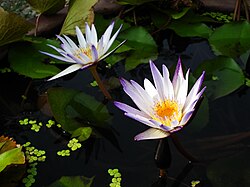
| The blue water lily was declared the national flower of Sri Lanka on 26 February 1986.<ref>{{Cite web |title=National Flower |url=https://www.srilanka.org.tr/national-flower_2-2958#:~:text=The%20%E2%80%9CNil%20Mahanel%E2%80%9D%20flower,,Lanka%20on%2026th%20February%201986. |access-date=2023-04-26 |website=www.srilanka.org.tr}}</ref> It is found in all parts of the island and grows mainly in shallow water. The flower is considered a symbol of truth, purity and discipline. It has connections with [[Gautama Buddha|Buddha]] and was used as ceremonial flower in Sri Lanka throughout history.<ref>{{cite web | url=http://www.park.org/Japan/TokyoNet/aip/search/all/stats.html | title=National flower | access-date=2 December 2014}}</ref><ref>{{cite news | url=http://www.sundaytimes.lk/101107/Plus/plus_01.html | title=The 'great pretender' | newspaper=[[The Sunday Times (Sri Lanka)]] | date=7 November 2010 | access-date=2 December 2014 | author=Hettiarachchi, Kumudini}}</ref> | |||
|- | |||
| [[National tree]] | |||
| [[Mesua ferrea|Ceylon ironwood]] <br />(''Mesua ferrea'') | |||
| align="center"| [[File:Mesua ferrea L. Dewadaru Airport Karimun Jawa.JPG|226x226px|alt=Ceylon ironwood]] | |||
| Ceylon ironwood (''naa'') was declared the national tree of Sri Lanka on 26 February 1986. It was chosen as the national tree due to its endemism in Sri Lanka, utility, historic & cultural importance, exterior posture, wide distribution, colour and nature and ability to draw and sketch easily.<ref name=govlk /> [[Theravada Buddhism]] considers this tree for achieved enlightenment.<ref>{{cite news | url=http://www.dailynews.lk/?q=features/initial-buddhist-missionary-activities | title=Initial Buddhist missionary activities | newspaper=[[Daily News (Sri Lanka)]] | date=21 November 2013 | access-date=2 December 2014 | author=Epasinghe, Premasara | url-status=dead | archive-url=https://web.archive.org/web/20150619204025/http://www.dailynews.lk/?q=features%2Finitial-buddhist-missionary-activities | archive-date=19 June 2015 }}</ref> The tree has been utilised for various purposes since ancient times.<ref>{{cite web | url=http://www.greatmirror.com/index.cfm?navid=978 | title=Notes on the Geography of Sri Lanka: Embekke | publisher=The Great Mirror | access-date=2 December 2014}}</ref> | |||
|- | |||
| [[National bird]] | |||
| [[Sri Lankan junglefowl]]<br />(''Gallus lafayetii'') | |||
| align="center"| [[File:Flickr - Rainbirder - Ceylon Junglefowl (Gallus lafayetii) Male.jpg|155x155px|alt=Sri Lankan junglefowl]] | |||
| The Sri Lankan junglefowl is the official national bird. The colourful bird is [[List of endemic birds of Sri Lanka|endemic to Sri Lanka]] and commonly found in national parks, jungle and dense scrub. It is an endemic bird of Sri Lanka.<ref>{{cite web | url=http://www.gov.lk/web/index.php?option=com_content&view=article&id=197&Itemid=373&lang=en | title=Country Overview | publisher=[[Government of Sri Lanka]] | access-date=2 December 2014}}</ref><ref>{{cite news | url=http://www.sundaytimes.lk/031026/funday/3.htm | title=Ceylon junglefowl – National Bird of the country | newspaper=[[The Sunday Times (Sri Lanka)]] | access-date=2 December 2014}}</ref> | |||
|- | |||
| National butterfly | |||
| [[Troides darsius|Sri Lankan birdwing]]<br />(''Troides darsius'') | |||
| align="center"| [[File:Darsius male.jpg|197x197px|alt=Sri Lankan birdwing]] | |||
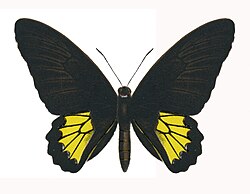
| Sri Lankan birdwing is endemic to Sri Lanka and was declared as the national [[butterfly]] with a connection to the butterfly conservation action plan. The largest Sri Lankan butterfly was categorised as flagship species due to its wide distribution. It has glossy black and bright yellow colours and an attractive pattern.<ref>{{cite news | url=http://sundaytimes.lk/100328/News/nws_16.html | title=Sri Lanka names its national butterfly | newspaper=[[The Sunday Times (Sri Lanka)]] | date=March 28, 2010 | access-date=2 December 2014 | author=Rodrigo, Malaka}}</ref><ref>{{cite news | url=http://www.highbeam.com/doc/1P3-1992907821.html | archive-url=https://web.archive.org/web/20150329105715/http://www.highbeam.com/doc/1P3-1992907821.html | url-status=dead | archive-date=March 29, 2015 | title=National Butterfly | date=March 25, 2010 | access-date=December 2, 2014 | newspaper=[[Daily News (Sri Lanka)]] |url-access=}}</ref> | |||
|- | |- | ||
| National gemstone | |||
| [[ | | [[Blue sapphire]] | ||
| [[ | | align="center"| [[File:Geschliffener blauer Saphir.jpg|124x124px|alt=Blue sapphire]] | ||
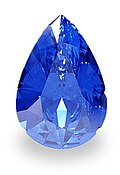
| The blue sapphire was declared the national [[Gems of Sri Lanka|gemstone of Sri Lanka]] in October 2003. A postage stamp worth LKR 4.50 was issued on 2 October 2003 to mark the announcement. Sri Lanka is famous for blue sapphires, especially known for their size.<ref>{{cite news | url=http://www.sundaytimes.lk/040314/funday/4.html | title=Blue Sapphire – the national gemstone | newspaper=[[The Sunday Times (Sri Lanka)]] | access-date=2 December 2014}}</ref> | |||
|- | |||
| [[National sport]] | |||
| [[Volleyball]] | |||
| align="center"| [[File:Volley ball angelo gelmi 01.svg|70px|alt=Volleyball]] | |||
| Volleyball was officially recognised as the national [[Sport in Sri Lanka|sport of Sri Lanka]] in 1991.<ref>{{cite web | url=http://volleyballsrilanka.org/ | title=Volleyball – The national game of Sri Lanka | publisher=Sri Lanka Volleyball Federation | access-date=2 December 2014 | archive-url=https://web.archive.org/web/20180330115738/http://volleyballsrilanka.org/ | archive-date=30 March 2018 | url-status=dead }}</ref> The sport was introduced in 1916 to Sri Lanka. However, there is an opinion that Sri Lankans played a similar sport before its introduction.<ref>{{cite news | url=http://dailynews.lk/?q=sports/how-volleyball-came-being | title=How volleyball came into being | newspaper=[[Daily News (Sri Lanka)]] | date=12 June 2014 | access-date=2 December 2014 | author=Marikar, Hafiz | url-status=dead | archive-url=https://web.archive.org/web/20150619192502/http://dailynews.lk/?q=sports%2Fhow-volleyball-came-being | archive-date=19 June 2015 }}</ref> [[Elle (sport)|Elle]] had recognition as a national sport before volleyball.<ref>{{cite news | url=http://www.island.lk/index.php?page_cat=article-details&page=article-details&code_title=34318 | title=Volleyball, Sri Lanka's National Sport | newspaper=[[The Island (Sri Lanka)]] | date=September 10, 2011 | access-date=2 December 2014}}</ref> | |||
|} | |||
== Unofficial == | |||
Here are list of national symbols that have no official status. | |||
{|class="wikitable" | |||
|- | |- | ||
! | ! Title | ||
| | ! Symbol | ||
! width=100 | Media | |||
! Notes | |||
|- | |- | ||
| rowspan="3"| [[National animal]] | |||
| | |||
| [[ | |||
|- | |- | ||
| [[Sri Lankan elephant]]<br />(''Elephas maximus maximus'') | |||
| [[ | | align="center"| [[File:Sri Lanka Elephants.JPG|70px|alt=Sri Lankan elephant]] | ||
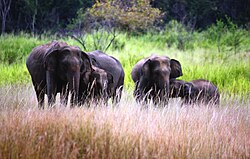
| [[ | | rowspan="2"| There is no official national animal in Sri Lanka even though the [[Sri Lankan elephant|elephant]], lion, and [[Grizzled giant squirrel]] are locally considered as such. Lions are the most celebrated animal for [[Sinhalese people]], symbolising heraldry. The [[Sri Lanka lion|Sri Lankan lion]] is a prehistoric subspecies of lion.<ref>{{cite web | url=http://www.iucnredlist.org/details/15951/0 | title=Panthera leo | publisher=International Union for Conservation of Nature and Natural Resources | access-date=30 January 2015}}</ref> | ||
|- | |- | ||
| [[Lion]]<br />(''Panthera leo'') | |||
| [[ | | align="center"| [[File:020 The lion king Snyggve in the Serengeti National Park Photo by Giles Laurent.jpg|70px|alt=Lion]] | ||
| [[ | |||
|- | |- | ||
| [[National monument]] | |||
| [[ | | [[Independence Memorial Hall]] | ||
| align="center"| [[File:Independence Commemoration Hall.jpg|70px|alt=Independence Memorial Hall]] | |||
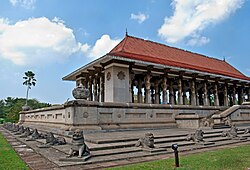
| Independence Memorial Hall is an iconic structure commemorating the independence of Sri Lanka from the [[British Ceylon|British rule]]. Named "''Magul Maduwa''" (Celebration Hall), its structure is based on the Royal Audience Hall of the [[Kingdom of Kandy]], the last kingdom that fell to colonial occupation in the island. It also known as ''Independence Commemoration Hall'' and ''Independence Commemoration Hall''.<ref>{{cite web | url=http://www.nation.lk/edition/jeans/item/2197-independence-memorial-hall.html | title=Independence Memorial Hall | publisher=[[The Nation (Sri Lanka)]] | date=2 February 2012 | access-date=2 December 2014 | url-status=dead | archive-url=https://archive.today/20130820022850/http://www.nation.lk/edition/jeans/item/2197-independence-memorial-hall.html | archive-date=20 August 2013 }}</ref><ref>{{cite web | url=http://www.colomboguide.net/Historic-Places-in-Colombo/independent-square.html | title=Independence Square | publisher=Colombo Guide | access-date=30 January 2015 | archive-date=5 February 2015 | archive-url=https://web.archive.org/web/20150205040022/http://colomboguide.net/Historic-Places-in-Colombo/independent-square.html | url-status=dead }}</ref> | |||
|- | |- | ||
| [[National dress]] | |||
| [[ | | [[Sarong]] and shirt (men)<br /> [[Osari|Osariya]] (women) | ||
| [[ | | align="center"| [[File:Sinhalese Girl Wearing A Traditional Kandyan Saree (Osaria)-1.jpg|70px|alt=Girl wearing a saree]] | ||
| Sri Lanka does not acknowledge any national dress since there are three [[Sri Lankan people|major communities]] and a few minor communities. Commonly, men's traditional dress is the sarong/dhoti and shirt and women's traditional dress is a sari. The three major communities (Sinhalese, Tamils, Muslims) have significant differences in their regional dress although the majority of them wear [[Western culture|Western]] dress today.<ref>{{cite web | url=http://www.mysrilanka.com/travel/lanka/nati_symbol/dress.htm | title=National Dress | work=My Sri Lanka | access-date=1 December 2014 | archive-date=11 April 2015 | archive-url=https://web.archive.org/web/20150411042250/http://www.mysrilanka.com/travel/lanka/nati_symbol/dress.htm | url-status=dead }}</ref><ref>{{cite web | url=https://www.academia.edu/4790920 | title=Sri Lanka Traditional Dress | access-date=30 January 2015| last1=Dikkumbura | first1=Sampath }}</ref> | |||
|- | |- | ||
| [[National dish]] | |||
| [[Rice and curry]] | |||
| align="center"| [[File:Rice and curry at Liberty Mall food court.jpg|alt=Rice and curry|70x70px]] | |||
| Rice and curry is a popular dish in Sri Lanka. The dish has cooked rice with various curry dishes of vegetable and/or meat.<ref>{{cite web | url=http://www.go-lanka.com/sri-lanka/food.html | archive-url=https://web.archive.org/web/20070824102144/http://www.go-lanka.com/sri-lanka/food.html | url-status=usurped | archive-date=August 24, 2007 | title=Sri Lanka Rice & Curry | publisher=Go Lanka | access-date=30 January 2015}}</ref><ref>{{cite web | url=http://www.lonelyplanet.com/sri-lanka/travel-tips-and-articles/discover-the-many-flavours-of-sri-lanka | title=Discover the many flavours of Sri Lanka | publisher=Lonely Planet | access-date=30 January 2015}}</ref> | |||
|} | |} | ||
== | == See also == | ||
* [[ | {{Portal|Sri Lanka}} | ||
* [[ | * [[Outline of Sri Lanka]] | ||
* [[Timeline of Sri Lankan history]] | |||
* [[Lists of national symbols]] | |||
== | == Further reading == | ||
{{ | * {{cite book |last=Wimalaratne |first=K. D. G. |date=2006 |title=National Symbols of Sri Lanka |publisher=Kishers & Distributors |page=40 |isbn=9789551277093 }} | ||
{{ | == References == | ||
{{Reflist|2}} | |||
{{Asia topic|National symbols of}} | {{Asia topic|National symbols of}} | ||
{{Sri Lanka topics}} | |||
[[Category:National symbols of Sri Lanka| ]] | [[Category:National symbols of Sri Lanka| ]] | ||
[[Category: | [[Category:Lists of national symbols]] | ||
Latest revision as of 08:55, 10 December 2025
Sri Lanka | |
|---|---|
.svg) |
The national symbols of Sri Lanka are the national anthem, flag, emblem, flower, tree, bird, butterfly, gemstone and sport. They represent the country and its people within Sri Lanka and abroad as well as traditions, culture, history and geography. Several other symbols do not have official acknowledgment as national symbols but are considered national symbols at the local level.[1][2]
The Constitution of the Democratic Socialist Republic of Sri Lanka sets out the national flag, the national anthem, the national day and the national language.[3] The constitution was promulgated by the National State Assembly on 7 September 1978. On 14 November 1987 the Sri Lankan Parliament passed the Thirteenth Amendment to the Constitution of Sri Lanka, which made both Sinhala and Tamil the national languages.[4]
National symbols[edit | edit source]
| Title | Symbol | Media | Notes |
|---|---|---|---|
| National anthem | "Sri Lanka Matha" | The national anthem of Sri Lanka "Sri Lanka Matha" is believed to have been written by Rabindranath Tagore[5] and later composed by Ananda Samarakoon in 1940 before the island nation's independence from the British. In 1951, it became the national anthem of Sri Lanka.[6][7] Firstly, it was written in Sinhalese and translated to Tamil. The first performance of the anthem was held in the fourth anniversary of independence day on 4 February 1952.[1] | |
| National flag | Flag of Sri Lanka | 
|
The national flag of Sri Lanka consists of a lion holding a sword in its right fore paw by representing the Sinhalese people and first king. Dark red/maroon background represents Buddhist symbol. Four golden-yellow bo leaves, one in each corner represent Four Sublime States. Around the background is a yellow border that represents Buddhist monk's community. On the left side, two vertical stripes in green and saffron represent Moors and Tamil communities.[8] The current flag was adopted in 1950.[2] |
| National emblem | National emblem of Sri Lanka | 
|
The national emblem of Sri Lanka used by Sri Lankan government is in connection with the administrative purpose and government of the country. The current republican emblem was adopted in 1972 after the country was declared as a republic state.[1] The emblem has a lion, holding a sword in its right fore paw on a maroon background encircled with petals of a blue lotus. Also it features a bunch of paddy, grain vase (punkalasa), dhammachakka, sun and moon.[9] |
| National language | Sinhala / Tamil |  
|
The national languages of Sri Lanka are Sinhalese and Tamil.[10] As per Chapter IV (Language), Article 19 of Constitution of Sri Lanka Sinhalese and Tamil have been recognised as national languages.[11] |
| National flower | Blue water lily flower (Nymphahea Stellata ) |
.jpg) |
The blue water lily was declared the national flower of Sri Lanka on 26 February 1986.[12] It is found in all parts of the island and grows mainly in shallow water. The flower is considered a symbol of truth, purity and discipline. It has connections with Buddha and was used as ceremonial flower in Sri Lanka throughout history.[13][14] |
| National tree | Ceylon ironwood (Mesua ferrea) |

|
Ceylon ironwood (naa) was declared the national tree of Sri Lanka on 26 February 1986. It was chosen as the national tree due to its endemism in Sri Lanka, utility, historic & cultural importance, exterior posture, wide distribution, colour and nature and ability to draw and sketch easily.[2] Theravada Buddhism considers this tree for achieved enlightenment.[15] The tree has been utilised for various purposes since ancient times.[16] |
| National bird | Sri Lankan junglefowl (Gallus lafayetii) |
_Male.jpg)
|
The Sri Lankan junglefowl is the official national bird. The colourful bird is endemic to Sri Lanka and commonly found in national parks, jungle and dense scrub. It is an endemic bird of Sri Lanka.[17][18] |
| National butterfly | Sri Lankan birdwing (Troides darsius) |

|
Sri Lankan birdwing is endemic to Sri Lanka and was declared as the national butterfly with a connection to the butterfly conservation action plan. The largest Sri Lankan butterfly was categorised as flagship species due to its wide distribution. It has glossy black and bright yellow colours and an attractive pattern.[19][20] |
| National gemstone | Blue sapphire | 
|
The blue sapphire was declared the national gemstone of Sri Lanka in October 2003. A postage stamp worth LKR 4.50 was issued on 2 October 2003 to mark the announcement. Sri Lanka is famous for blue sapphires, especially known for their size.[21] |
| National sport | Volleyball | 
|
Volleyball was officially recognised as the national sport of Sri Lanka in 1991.[22] The sport was introduced in 1916 to Sri Lanka. However, there is an opinion that Sri Lankans played a similar sport before its introduction.[23] Elle had recognition as a national sport before volleyball.[24] |
Unofficial[edit | edit source]
Here are list of national symbols that have no official status.
| Title | Symbol | Media | Notes |
|---|---|---|---|
| National animal | |||
| Sri Lankan elephant (Elephas maximus maximus) |

|
There is no official national animal in Sri Lanka even though the elephant, lion, and Grizzled giant squirrel are locally considered as such. Lions are the most celebrated animal for Sinhalese people, symbolising heraldry. The Sri Lankan lion is a prehistoric subspecies of lion.[25] | |
| Lion (Panthera leo) |

| ||
| National monument | Independence Memorial Hall | 
|
Independence Memorial Hall is an iconic structure commemorating the independence of Sri Lanka from the British rule. Named "Magul Maduwa" (Celebration Hall), its structure is based on the Royal Audience Hall of the Kingdom of Kandy, the last kingdom that fell to colonial occupation in the island. It also known as Independence Commemoration Hall and Independence Commemoration Hall.[26][27] |
| National dress | Sarong and shirt (men) Osariya (women) |
-1.jpg)
|
Sri Lanka does not acknowledge any national dress since there are three major communities and a few minor communities. Commonly, men's traditional dress is the sarong/dhoti and shirt and women's traditional dress is a sari. The three major communities (Sinhalese, Tamils, Muslims) have significant differences in their regional dress although the majority of them wear Western dress today.[28][29] |
| National dish | Rice and curry | 
|
Rice and curry is a popular dish in Sri Lanka. The dish has cooked rice with various curry dishes of vegetable and/or meat.[30][31] |
See also[edit | edit source]
Further reading[edit | edit source]
- Wimalaratne, K. D. G. (2006). National Symbols of Sri Lanka. Kishers & Distributors. p. 40. ISBN 9789551277093.
References[edit | edit source]
- ↑ 1.0 1.1 1.2 "The identity of Mother Lanka". Sunday Observer. 29 January 2012. Archived from the original on 16 February 2015. Retrieved 1 December 2014.
- ↑ 2.0 2.1 2.2 Wimalaratne, K D G (2013). National Symbols Of Sri Lanka. Sri Lanka: Sarasavi Publishers. ISBN 978-9553101198.
- ↑ "Constitution of the Democratic Socialist Republic of Sri Lanka". PressInform. Data and Information Unit of the Presidential Secretariat. Archived from the original on 18 November 2014. Retrieved 3 December 2014.
- ↑ Martyn, Sabina (16 January 2013). "In Post-Conflict Sri Lanka, Language is Essential for Reconciliation". Asia foundation. Retrieved 3 December 2014.
- ↑ Habib, Haroon (May 18, 2011). "Celebrating Rabindranath Tagore's legacy". The Hindu. Retrieved December 1, 2014.
- ↑ Bandaranayake, Senake (1996). Ivan Peries paintings, 1938–88. Colombo: Tamarind Publications. ISBN 9559458000. page 155
- ↑ "Man of the series: Nobel laureate Tagore". The Times Of India. Apr 3, 2011. Retrieved December 1, 2014.
- ↑ "National Symbols". Embassy of Sri Lanka in Russia. Archived from the original on 20 June 2015. Retrieved 1 December 2014.
- ↑ "Sri Lanka Country Information". Sri Lankan Consulate in Los Angeles. Archived from the original on 7 November 2010. Retrieved 2 December 2014.
- ↑ "Official Languages". Department of Official Languages. Archived from the original on 19 December 2014. Retrieved 27 December 2014.
- ↑ "Constitution of the Democratic Socialist Republic of Sri Lanka, Ch-V,19". Government of Sri Lanka. 1978. Archived from the original on 3 February 2003. Retrieved 27 December 2014.
- ↑ "National Flower". www.srilanka.org.tr. Retrieved 2023-04-26.
- ↑ "National flower". Retrieved 2 December 2014.
- ↑ Hettiarachchi, Kumudini (7 November 2010). "The 'great pretender'". The Sunday Times (Sri Lanka). Retrieved 2 December 2014.
- ↑ Epasinghe, Premasara (21 November 2013). "Initial Buddhist missionary activities". Daily News (Sri Lanka). Archived from the original on 19 June 2015. Retrieved 2 December 2014.
- ↑ "Notes on the Geography of Sri Lanka: Embekke". The Great Mirror. Retrieved 2 December 2014.
- ↑ "Country Overview". Government of Sri Lanka. Retrieved 2 December 2014.
- ↑ "Ceylon junglefowl – National Bird of the country". The Sunday Times (Sri Lanka). Retrieved 2 December 2014.
- ↑ Rodrigo, Malaka (March 28, 2010). "Sri Lanka names its national butterfly". The Sunday Times (Sri Lanka). Retrieved 2 December 2014.
- ↑ "National Butterfly". Daily News (Sri Lanka). March 25, 2010. Archived from the original on March 29, 2015. Retrieved December 2, 2014.
- ↑ "Blue Sapphire – the national gemstone". The Sunday Times (Sri Lanka). Retrieved 2 December 2014.
- ↑ "Volleyball – The national game of Sri Lanka". Sri Lanka Volleyball Federation. Archived from the original on 30 March 2018. Retrieved 2 December 2014.
- ↑ Marikar, Hafiz (12 June 2014). "How volleyball came into being". Daily News (Sri Lanka). Archived from the original on 19 June 2015. Retrieved 2 December 2014.
- ↑ "Volleyball, Sri Lanka's National Sport". The Island (Sri Lanka). September 10, 2011. Retrieved 2 December 2014.
- ↑ "Panthera leo". International Union for Conservation of Nature and Natural Resources. Retrieved 30 January 2015.
- ↑ "Independence Memorial Hall". The Nation (Sri Lanka). 2 February 2012. Retrieved 2 December 2014.
{{cite web}}: CS1 maint: deprecated archival service (link) - ↑ "Independence Square". Colombo Guide. Archived from the original on 5 February 2015. Retrieved 30 January 2015.
- ↑ "National Dress". My Sri Lanka. Archived from the original on 11 April 2015. Retrieved 1 December 2014.
- ↑ Dikkumbura, Sampath. "Sri Lanka Traditional Dress". Retrieved 30 January 2015.
- ↑ "Sri Lanka Rice & Curry". Go Lanka. Archived from the original on August 24, 2007. Retrieved 30 January 2015.
- ↑ "Discover the many flavours of Sri Lanka". Lonely Planet. Retrieved 30 January 2015.


