


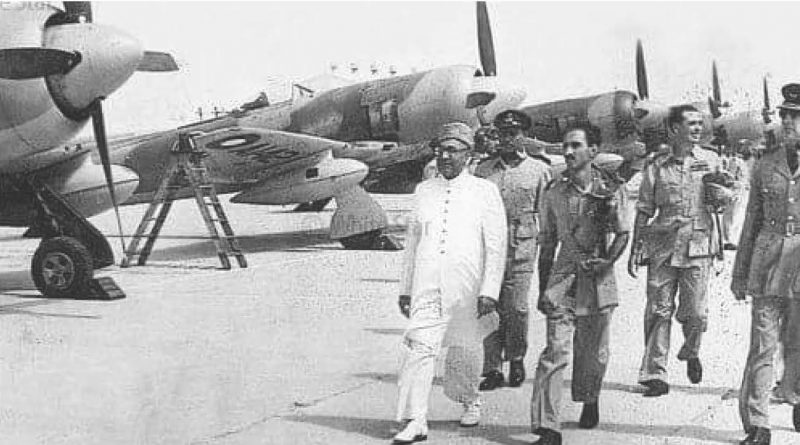


m robot: Create/update articles. If there is a mistake please report on my talk page. |
m enhance layout additionally and fixed typos |
||
| Line 1: | Line 1: | ||
{{Short description| | {{Short description|3rd Pakistani Air Chief (1923–2011)}} | ||
{{ | {{Use Pakistani English|date=November 2025}} | ||
{{Use dmy dates|date=November 2015}} | {{Use dmy dates|date=November 2015}} | ||
{{Infobox officeholder | {{Infobox officeholder | ||
| honorific-prefix = [[Air Marshal]] | | honorific-prefix = [[Air Marshal]]<br>[[Malik (surname)|Malik]] | ||
| name = | | name = Nur Khan | ||
| native_name | | native_name = {{nq|نور خان}} | ||
| honorific_suffix = [[Hilal-e-Jurat|HJ]] [[Hilal-e-Quaid-e-Azam|HQA]] [[Sitara-e-Quaid-e-Azam|SQA]] [[Sitara-e-Pakistan|SPk]] | |||
| | | image = Air Marshal Nur Khan.jpg | ||
| image = | | image_size = 220px | ||
| image_size = | | caption = Portrait, {{circa|1965}} | ||
| office = Member of the 7th<br>[[National Assembly of Pakistan]] | |||
| constituency = [[NA-43 (Attock-III)]] | |||
| caption = | | term_start = 20 March 1985 | ||
| | | term_end = 29 May 1988 | ||
| office = | | office1 = 6th [[Governor of West Pakistan]] | ||
| term_start = | | term_start1 = 1 September 1969 | ||
| term_end = | | term_end1 = 31 January 1970 | ||
| | | predecessor1 = [[Tikka Khan]] | ||
| successor1 = [[Attiqur Rahman]] | |||
| office2 = 3rd [[C-in-C of the PAF|Commander-in-Chief]]<br>[[Pakistan Air Force]] | |||
| | |||
| | |||
| | |||
| | |||
| office2 = [[ | |||
| term_start2 = 23 July 1965 | | term_start2 = 23 July 1965 | ||
| term_end2 = 31 August 1969 | | term_end2 = 31 August 1969 | ||
| | | deputy2 = {{Collapsible list | ||
| | |framestyle=border:none; padding:0; <!--Hides borders and improves row spacing--> | ||
| | |title=''See list'' | ||
|2=Mohammad Akhtar (1966)|3=S.A. Yusaf (1966-67)<ref>{{cite book|url=https://www.google.com/books/edition/Who_s_who_in_British_Aviation/Es0pAQAAIAAJ?hl=en&gbpv=1&bsq=S.%20A.%20Yusaf|title=Who's who in British Aviation|page=19|year=1967}}</ref>|4=Abdul Qadir (1967-69)|5=[[Khyber Khan]] (1969)| | |||
| | }} | ||
| predecessor2 = [[Asghar Khan]] | |||
| | | successor2 = [[Abdur Rahim Khan]] | ||
| | {{collapsed infobox section begin | ||
| | | cont = yes | ||
| | | Other offices | ||
| | | titlestyle = border:3px dashed lightblack; | ||
| | }} | ||
{{Infobox officeholder | |||
| predecessor2 = | | embed = yes | ||
| successor2 = | | office3 = [[Pakistan Cricket Board#Governance of Pakistan cricket|Chairman<br>Board of Control for Cricket in Pakistan]] | ||
| | | term_start3 = 10 February 1980 | ||
| | | term_end3 = 2 February 1984 | ||
| | | predecessor3 = [[Khwaja Mohammad Azhar Khan]] | ||
| successor3 = [[Safdar Butt]] | |||
| term_start3 = | | appointed3 = [[General Zia-ul-Haq]] | ||
| term_end3 = | | office4 = 7th, 10th [[President of the Pakistan Hockey Federation]] | ||
| predecessor3 = | |||
| successor3 = | |||
| term_start4 = 1976 | | term_start4 = 1976 | ||
| term_end4 = 1984 | | term_end4 = 2 February 1984 | ||
| predecessor4 = | | predecessor4 = [[Sadiq Hussain Qureshi]] | ||
| | | term_start5 = 1967 | ||
| term_end5 = 1969 | |||
| | | office6 = Chief Administrator Civil Aviation Authority and Tourism (Pakistan) | ||
| | | term_start6 = February 1964 | ||
| | | term_end6 = 22 July 1965 | ||
| | | office7 = President [[Peshawar Club]] Limited | ||
| term_start7 = March 1968 | |||
| | | term_end7 = March 1969 | ||
| | | term_start8 = April 1959 | ||
| | | term_end8 = June 1961 | ||
| | | office9 = [[Managing Director]]<br>[[Pakistan International Airlines]] | ||
| | | term_start9 = 6 March 1959 | ||
| | | term_end9 = 22 July 1965 | ||
| | | predecessor9 = Zafar-ul-Ahsan | ||
| | | successor9 = [[Asghar Khan]] | ||
| | | office10 = Commander [[PAF Station Mauripur]] | ||
| | | term_start10 = August 1956 | ||
| | | term_end10 = October 1957 | ||
| | | office11 = Commander [[PAF Station Peshawar]] | ||
| term_start11 = December 1955 | |||
| | | term_end11 = August 1956 | ||
| | | office12 = 2nd [[Commandant]] [[RPAF College]] | ||
| | | term_start12 = 15 September 1948 | ||
| | | term_end12 = October 1949 | ||
| | | predecessor12 = [[Asghar Khan]] | ||
| | | successor12 = [[M. A. Rahman]] | ||
| | | office13 = [[Air attaché]] to [[High Commission of Pakistan, London]] | ||
| | | term_start13 = January 1948 | ||
| | | term_end13 = September 1948 | ||
| | | predecessor13 = '''Office established''' | ||
| | | office14 = Commander [[PAF Station Lahore]] | ||
| | | term_start14 = August 1947 | ||
| | | term_end14 = December 1947 | ||
| | | office15 = Flight Commander Squadron Leader Operations 3<br>(Headquarters [[BCOF#Occupation|BCAIR]]) | ||
| | | term_start15 = 14 June 1945 | ||
| | | term_end15 = 30 September 1946 | ||
| | }} | ||
| | {{Collapsed infobox section end}} | ||
| | | birth_name = Malik Nur Khan Awan | ||
| | | birth_date = {{birth date|df=y|1923|2|22}} | ||
| | | birth_place = [[Tamman]], [[Chakwal District]], [[British India]] | ||
| | | death_date = {{Death date and age|df=y|2011|12|15|1923|2|22}} | ||
| | | death_place = [[CMH Rawalpindi]], [[Pakistan]] | ||
| | | resting_place = Tamman, Talagang, Pakistan | ||
| | | burial_place_coordinates = <!-- {{coord|32°59'33.80"N|72°6'13.50"E|type:landmark|display=inline}} --> | ||
| | | party = [[Pakistan Peoples Party]] (1988–89) | ||
| | | otherparty = [[Council Muslim League]] (1970-71)<br>[[Independent (politician)|Independent]] (1985-88) | ||
| | | spouse = {{marriage|Begum Farhat|1952}} | ||
| | | children = 4 | ||
| education = [[Colonel Brown Cambridge School]]<br>[[Chief's College, Lahore]]<br>[[Prince of Wales Royal Indian Military College]] ([[B.A.]])<br>[[No. 1 (I) SFTS]]<br>[[Joint Services Staff College (UK)]]<br>[[RAF Staff College, Andover]]<br>[[PAF Staff College]] | |||
| | | relatives = [[Amir Mohammad Khan]]<br>[[Sardar Mumtaz Khan]]<br>[[Malik Sher Bahadur]] (nephew) | ||
| | | nickname = ''Nuroo'' | ||
| branch = {{air force|British Raj}} {{small|(1941)}}<br>{{air force|PAK}} {{small|(1947)}} | |||
| serviceyears = 1941–1970 | |||
[[ | | rank = [[File:UK-Air-OF8.svg|40px]] [[File:US-O9 insignia.svg|30px]] [[Air Marshal]] | ||
| commands = {{Collapsible list | |||
|framestyle=border:none; padding:0; <!--Hides borders and improves row spacing--> | |||
| | |title=''See list'' | ||
| | |2=[[PAF Station Chaklala]]|3=[[RPAF College]]|4=[[PAF Station Peshawar]]|5=[[PAF Station Mauripur]]| | ||
| | |||
| | |||
| | |||
| | |||
| | |||
| | |||
| | |||
}} | }} | ||
| battles = {{Tree list}} | |||
*[[World War II]] | |||
**[[Burma campaign (1944)]] | |||
**[[Burma Campaign 1944–1945]] | |||
*[[Indo-Pakistani War of 1947]] | |||
*[[Waziristan rebellion (1948-1954)]] | |||
*[[Indo-Pakistani War of 1965]] | |||
**[[Indo-Pakistani Air War of 1965]] | |||
*[[Six-Day War]] | |||
{{Tree list/end}} | |||
| awards = [[Hilal-e-Shujaat]] (1978)<br>[[Midalja għall-Qadi tar-Repubblika]] (1979) | |||
| mawards = '''[[#Awards and decorations|See list]]''' | |||
}} | |||
'''Malik Nur Khan Awan'''{{efn|[[Urdu]]: {{nq|ملک نور خان اعوان}}; Sometimes spelled as Malik Noor Khan<ref>{{cite book|url=https://www.google.com/books/edition/Brezhnev_Plan_for_Asian_Security/OCUhAAAAMAAJ?hl=en&gbpv=1&bsq=%22Malik+Noor+Khan%22|title=Brezhnev Plan for Asian Security: Russia in Asia|year=1975|author=[[A. G. Noorani]]|page=65}}</ref> and erroneously as Mohammad Nur Khan.<ref>{{cite book|url=https://www.google.com/books/edition/Reports_Service/O_MuAQAAIAAJ?hl=en&gbpv=1&bsq=%22Mohammad+Nur+Khan%22|title=Reports Service: South Asia series|volume=12-13|year=1968|author=American Universities Field Staff|pages=2, 10}}</ref>}} (22 February 1923 — 15 December 2011) known as the Man of Steel, The Man With The [[Midas Touch]],{{efn|A reference to the Greek myth in which King [[Midas]] turned anything he touched into gold.}} and informally, Nuroo, was a [[three-star rank]] officer who led the [[Pakistan Air Force]] in the [[Indo-Pakistani War of 1965]], a politician, sports administrator, airline executive and [[statesman]] who served as the third [[C-in-C of the PAF|Commander-in-Chief]] of the PAF from 1965 to 1969 and sixth [[Governor of West Pakistan]] from 1969 to 1970. | |||
Born in the [[Punjab Province (British India)|Punjab Province]], Khan graduated from [[Chief's College, Lahore]] and [[Prince of Wales Royal Indian Military College]]. At the college, he gained fame for his boxing skills and joined the [[Indian Air Force Volunteer Reserve]] in 1940. At the age of 17, he was commissioned into the [[Royal Indian Air Force]] as a fighter pilot in 1941 and trained with the [[Royal Air Force]] as a gunner and bomber pilot. He was later deployed to Burma and flew sorties against Imperial Japan in [[World War II]]. In May 1944, he conducted a dive-bombing mission on a bridge at the Arakan front. | |||
In 1945, Khan served as Flight Commander. After the [[Partition of British India]] in 1947, Khan opted for the [[Royal Pakistan Air Force]] and commanded [[PAF Station Chaklala]]. Subsequently, he became the first air attache of Pakistan to London and later the second commandant of the [[RPAF College]]. In 1958, ''[[Flight (magazine)|Flight]]'' highlighted Air Commodore Nur Khan's leadership of No. 1 Group PAF and described him as "probably the youngest air officer anywhere in the world" at the age of 35. | |||
Widely regarded as Pakistan's greatest administrator, Khan was known for his intellect and management abilities, which largely benefited the country in both sports and aviation. As managing director of [[Pakistan International Airlines]] (PIA) from 1959 to 1965, he transformed the airline into one of the world's frontline carriers. During this period, he acquired several properties for the airline, including the [[Roosevelt Hotel (Manhattan)|Roosevelt Hotel]] in [[New York City]], the Scribe Hotel in [[Paris]], the Central Hotel in [[Abu Dhabi]], and the Minal Hotel in [[Riyadh]]. He also set up the intercontinental chain of hotels in Pakistan and the Malam Jabba ski resort. His tenure, along with that of his successor [[Asghar Khan]], is often referred to as the "golden years of PIA" in the aviation community. [[PAF Base Nur Khan]] is named after him. | |||
Shortly before the outbreak of the [[Indo-Pakistani War of 1965]], Nur Khan succeeded [[Air Marshal Asghar Khan]] as [[C-in-C of the PAF|Commander-in-Chief]] of the [[Pakistan Air Force]]. | |||
== Early life == | |||
Malik Nur Khan was born on 22 February 1923 in [[Tamman]] into a [[Punjabis|Punjabi]] [[Awan (tribe)|Awan]] family with a distinguished military heritage. His father, [[Risaldar-major|Risaldar-Major]] Malik Mihr Khan {{small|{{postnominals|country=GBR|size=100%|OBI|IOM|IDSM}}}} (d. 1963)<ref>{{cite web|url=https://commons.wikimedia.org/wiki/File:Death_of_Nur_Khan%27s_father.jpg|title=Death of Nur Khan's father condoled|date=4 July 1963|publisher=Civil and Military Gazette of Lahore}}</ref> served as a [[Viceroy's Commissioned Officer]] in the [[British Indian Army]] from 1911 to 1936, was deployed to [[France]] and [[Belgium]] in [[World War I]] from 1914 to 1916,<ref>{{cite web|title=Awarded the Second Class of the Indian Order of Merit|url=https://www.thegazette.co.uk/London/issue/29438/supplement/592|publisher=[[The London Gazette]]|date=14 January 1916}}</ref> and was the [[aide-de-camp]] to General [[John Shea (Indian Army officer)|Sir John S.M. Shea]], the Commander-in-Chief of [[Eastern Command (India)]]<ref>{{cite web|title=Indian Army List For January I|url=https://archive.org/details/in.ernet.dli.2015.284987/page/n377/mode/2up?q=Mihr|year=1915}}</ref> and his successor General [[Norman MacMullen]].<ref>{{cite book|url=https://archive.org/details/in.ernet.dli.2015.285021/page/n47/mode/2up?q=%22Malik+Mihr%22|title=Indian Army List|date=October 1934|pages=47, 436|publisher=[[Army Council (1904)|Army Council]]}}</ref><ref>{{cite web|url=https://archive.org/details/in.ernet.dli.2015.285022/page/n49/mode/2up?q=%22Malik+Mihr%22|title=Indian Army List|date=October 1935|pages=49, 466|publisher=[[Army Council (1904)|Army Council]]}}</ref> | |||
The family bore the title "[[Malik#Punjabi usage|Malik]]", meaning "Ruler", a designation commonly associated with Awan lineages. Among Nur Khan's relatives were the [[Nawab of Kalabagh]]<ref name="TNS">{{cite news|url=https://www.thenews.com.pk/tns/detail/1180467|title=Air Marshal Nur Khan: Administrator Par Excellence who took Pakistan sports to new heights|author=Dr. Salman Faridi|date=21 April 2024|newspaper=[[The News International]]}}</ref> and [[Sardar Mumtaz Khan]], a politician.<ref>{{cite news|title=Divided house of the Tammans may give PML-Q's Chaudhry Elahi an edge|url=https://www.dawn.com/news/1422040|date=24 July 2018|publisher=[[Dawn (newspaper)|Dawn]]}}</ref> | |||
Nur Khan began his education at the Government Middle School in [[Tamman]] and attended the [[Colonel Brown Cambridge School]], where he became friends with Bikram Singh, who later became a board member of the [[Civil and Military Gazette]].<ref name="WG">{{cite book|url=https://www.google.com/books/edition/Where_Gallantry_is_Tradition/9w-4VTtJ2xkC?hl=en&gbpv=1&dq=Colonel+Brown+Khan&pg=PA153|title=Where Gallantry is Tradition: Saga of Rashtriya Indian Military College: Plantinum Jubilee Volume|year=1997|publisher=Allied Publishers|chapter=Biki's Tales|author=Bikram Singh|page=153}}</ref> He subsequently enrolled at the [[Chief's College, Lahore]], where he earned a diploma in science.<ref>{{cite book|url=https://www.psic.gop.pk/Download(psic)/Crafts-of-Chakwal-1.pdf#page=185|title=Crafts of Chakwal|chapter=Prominent Personalities of Chakwal: Air Marshal Malik Nur Khan|year=2016}}</ref><ref name="IWW">{{cite book|url=https://www.google.com/books/edition/The_International_Who_s_Who/ptZwCVvIJxkC?hl=en&gbpv=1&bsq=Tamman|title=The International Who's who|year=1973|page=1178}}</ref> In 1934, he joined the [[Prince of Wales Royal Indian Military College]], where cadets were divided into sections known as houses. Nur Khan and [[Asghar Khan]] were members of the Rawlinson House,<ref>{{cite book|url=https://www.google.com/books/edition/Where_Gallantry_is_Tradition/9w-4VTtJ2xkC?hl=en&gbpv=1&bsq=%22Nur%20Khan%22%20Rawlinson|title=Where Gallantry is Tradition: Saga of Rashtriya Indian Military College: Plantinum Jubilee Volume|year=1997|publisher=Allied Publishers|author=Sidharth Mishra}}</ref> while [[Sahabzada Yaqub Khan]] belonged to Kitchener House.<ref>{{cite web|url=https://www.roba.co.in/about-us|title=ROBA History|publisher=Rimcollian Old Boys Association|access-date=25 October 2024}}</ref><ref name="Air Force ISPR">{{cite web|title=Script of Documentary Air Marshal Malik Nur Khan Commander-in-Chief Pakistan Air Force, Islamabad|url=http://www.paf.gov.pk/AM_Nur_Khan_Documentary.html|website=[[Pakistan Air Force]]|access-date=21 October 2016|archive-url=https://web.archive.org/web/20140725213135/http://www.paf.gov.pk/AM_Nur_Khan_Documentary.html|archive-date=2014-07-25}}</ref> | |||
= | On his entry form, [[Chancellor (education)|Principal]] [[Malcolm Hailey, 1st Baron Hailey]], remarked: "An excellent military family from a very military center. The boy has been well educated and is more advanced than many Awans of his age. He is physically fit and should make an officer anyhow, he is the right type."<ref name="Air Force ISPR"/> | ||
At the college, Khan gained a reputation as a "killer" boxer and a devout Muslim. He went on to earn a [[Bachelor of Arts]] in [[military administration]].<ref>{{cite book|url=https://www.google.com/books/edition/Panther_Red_One_Memoirs_of_a_Fighter_Pil/0k-6DQAAQBAJ?hl=en&gbpv=1&dq=Nur+Khan&pg=PT142|title=Panther Red One: Memoirs of a Fighter Pilot|year=2013|author=Air Marshal Subramaniam Raghavendran|publisher=KW Publishers|page=142}}</ref> After completing his initial training at the Initial Training Wing in Lahore by May 1941, he proceeded to [[No. 1 (I) SFTS]], finishing his flying syllabus by late November that year.<ref name="LIVEFIST">{{cite news|title=COLUMN On Air Marshal Nur Khan (1923-2011)|url=https://www.livefistdefence.com/column-on-air-marshal-nur-khan-1923/|date=21 December 2011}}</ref> | |||
Khan later advanced his military education at several institutions, including the [[Joint Services Staff College (UK)]], the [[RAF Staff College, Andover]], and the [[PAF Staff College]].<ref>{{cite web|url=http://paf.gov.pk/AM_Nur_Khan.html|title=Air Marshal Malik Nur Khan: The Legend is No More, Islamabad|website=[[Pakistan Air Force]]|date=15 December 2011|archive-url=https://web.archive.org/web/20130116193536/http://paf.gov.pk/AM_Nur_Khan.html|archive-date=2013-01-16}}</ref><ref name="UNC">{{cite news|title=Air Chief Marshal condoles Air Marshal (Retd) Nur Khan's death|url=https://www.brecorder.com/news/39043|work=[[Brecorder]]|date=16 December 2011}}</ref> | |||
==Service years== | |||
===Royal Indian Air Force=== | |||
[[File:No. 1 SFTS (November 1941), cropped.png|thumb|right|100px|Nur Khan and [[Asghar Khan]] among 77 [[Pilot Officer]] Cadets at [[No. 1 (I) SFTS]], 1941]] | |||
[[File:PWRIMC REUNION 1941.png|thumb|left|250px|[[Asghar Khan]], Cadet Captain Dharanidhar Jayal, and Nur Khan, at a PWRIMC reunion, 1941]] | |||
Nur Khan joined the [[Indian Air Force Volunteer Reserve]] during [[World War II]] and went for air crew training with the [[Royal Air Force]] in December 1940.<ref name="Air Force ISPR"/><ref name="tribune">{{cite web|title=Obituary|url=http://tribune.com.pk/story/307432|date=16 December 2011|publisher=[[The Express Tribune]]}}</ref> | |||
After graduating from the [[Prince of Wales Royal Indian Military College]] as part of the 6th Pilots Course, Nur Khan was commissioned into the [[Royal Indian Air Force]] (RIAF) as a fighter pilot on 6 January 1941, at the age of 17. His family paid for his flying lessons from the [[Northern India Flying Club]] in [[Lahore]], where he learned how to fly the [[de Havilland Tiger Moth]] and received his pilot's A-license.<ref name="Roedad">{{cite book|author=[[Roedad Khan]]|year=1999|title=The American Papers: Secret and Confidential India-Pakistan-Bangladesh Documents, 1965–1973|publisher=[[Oxford University Press]]|page=265}}</ref> | |||
====World War II==== | |||
[[File:RIAF Pilots circa 1941.jpg|thumb|Nur Khan, [[Asghar Khan]], [[Abdur Rahim Khan]], [[Om Prakash Mehra]], and two others (1944)]] | |||
In the [[United Kingdom]], Khan trained with the [[Royal Air Force]] as air crew and received additional training as a gunnery and bomber pilot. Upon returning to [[British India]] in 1942–43, he was deployed to the [[Burma Campaign 1942–1943|Burma campaign]] with the [[Royal Indian Air Force]] as part of the [[occupation forces]] fighting against [[Imperial Japan]]. On 20 May 1944, he dive bombed a bridge on the [[Burma campaign (1944)|Arakan front]].<ref>{{cite book|url=https://www.google.com/books/edition/PAF_Over_the_Years/NnMSAQAAMAAJ?hl=en&gbpv=1&bsq=%22Nur%20Khan%20dive%20bombs%22|title=PAF Over the Years|page=4|year=2002|author=Syed Masood Akhtar Hussaini}}</ref><ref name="Air Force ISPR"/> | |||
In | In the mid-1940s, Nur Khan was an active supporter of the [[Pakistan Movement]], a stance that often made him the subject of teasing by his commanding officer, Flight Lieutenant [[Erlic Pinto]]. Fellow officer, Raja Gohel, fought over Khan's pro-Pakistani views, leading to a physical altercation in which Nur struck Gohel. According to Air Commodore (retd) A.C. Chacko, "Raja went literally mad with fury and we had all the trouble to prevent him bashing Nooru's head with a brick."<ref>{{cite book|url=https://www.google.com/books/edition/Combat_Lore_Indian_Air_Force_1930_1945/SEa6DQAAQBAJ?hl=en&gbpv=1&dq=Nur+Khan&pg=RA1-PT383|quote=We had our quota of Muslim officers who later made their mark in the Pakistan Air Force. Nur Khan was one of them. Though he joined us late, he soon became a trusted lieutenant of Pinto. “Nooru” gave the impression of a fanatic, sometimes Pinto used to tease him about “Pakistan”. This was a new word in those days, but Nur Khan was openly pro-Pakistani. I remember a fight between Nur Khan and Raja Gohel on this issue. Noor hit Gohel— Raja went literally mad with fury and we had all the trouble to prevent him bashing Nooru's head with a brick".|year=2014|title=Combat Lore: Indian Air Force 1930-1945|author=[[Somnath Sapru]]}}</ref><ref>{{cite web|url=https://www.bharat-rakshak.com/indianairforce/images/pdfs/flights-of-valour-hsr-gohel-1705.pdf|title=Flights of Valour: The Life of Group Captain Himmat Singh Ravubha Gohel|author1=Surangana Makin|author2=Samrata Diwan|year=2021|page=41}}</ref> | ||
===Commander | ===Pakistan Air Force=== | ||
====Initial years==== | |||
[[File:Liaquat Ali Khan RPAF 1950.jpg|thumb|left|Prime Minister [[Liaquat Ali Khan]] (left) inspects the fighter arm of the RPAF accompanied by Wing Commander Nur Khan (middle), and Air Vice Marshal Atcherley (far right) at [[PAF Station Mauripur|Mauripur Station]] on [[Independence Day (Pakistan)|Independence Day]], 1950]] | |||
[[File:PAFWorldRecordLoop1958.webm|thumb|right|300px|[[King Zahir Shah]] arrives at [[PAF Station Mauripur]] with [[President Iskandar Mirza]] and [[Nahid Mirza]], welcomed by Air Vice Marshal [[Asghar Khan]] and Air Commodore Nur Khan. Others seen in the video are [[General Ayub Khan]] and chiefs of the Iraqi, Turkish, and Iranian Air Forces. The loop is showcased towards the end. (1958)]] | |||
After the [[Partition of British India]] on 14 August 1947, Nur Khan opted for the [[Royal Pakistan Air Force]] (RPAF) and was appointed the Commander of [[PAF Station Chaklala]].<ref name="Air Force ISPR"/> | |||
In 1948, | In January 1948, Khan became the first Pakistani air attaché to the [[High Commission of Pakistan, London]]. In late 1948, he was asked to return to Pakistan and succeeded [[Asghar Khan]] as [[Commandant]] of the [[RPAF College]] on 15 September.<ref name="Air Force ISPR"/><ref name="tribune"/><ref>{{cite book|url=https://www.google.com/books/edition/Regional_Trade_Directory/HmUaAAAAMAAJ?hl=en&gbpv=1&bsq=commanding|page=370|title=Regional Trade Directory Iran-Pakistan-Turkey|year=1968}}</ref> | ||
Khan was posted to the [[AHQ (PAF)|Air Headquarters]] in [[Rawalpindi]] as the Director of Organisation where he remained involved in the induction of aircraft under [[U.S. military aid]] from January 1950 until March 1951.<ref name="Air Force ISPR"/> That month, Khan was selected for a course at the [[RAF Staff College, Andover]]. [[Ezer Weizman]] in his autobiography, recalled an interaction with Khan while they were both studying at the college: "The following day I was approached by Wing Commander Nur Khan of the Pakistani air force. He was a formidable fellow and I was glad that he was Pakistani and not an Egyptian."<ref>{{cite book|page=112|title=On eagles' wings|year=1977}}</ref> | |||
In the mid-1950s, Nur Khan was appointed the [[F-86 Sabre]] program director. He strongly advocated for the induction of F-86's instead of [[Republic F-84 Thunderjet]]'s into the Air Force, despite opposition by many, which often caused commotion during meetings, with Nur Khan going as far as threatening to resign. Nonetheless, he maintained his stance and the RPAF received the Sabres.<ref name="Air Force ISPR"/> | |||
Promoted to [[Group Captain]] in 1954, Nur Khan was appointed Assistant Chief of Staff (Air) under Chief of Staff Air Commodore L. E. Jarman.<ref>{{cite book|url=https://www.google.com/books/edition/The_Aeroplane_Directory_of_British_Aviat/CRIEAAAAMAAJ?hl=en&gbpv=1&bsq=Nur%20Khan|title=The Aeroplane Directory of British Aviation|page=24|year=1955}}</ref><ref>{{cite book|url=https://www.google.com/books/edition/_/TAInAAAAMAAJ?hl=en&gbpv=1&bsq=nur%20khan|title=The Aeroplane|volume=86|page=211}}</ref> | |||
In response to the threat posed by the [[Soviet Union]], Group Captains [[Asghar Khan]], Nur Khan, and Wing Commander Abdul Qadir developed an expansion plan for the PAF in March 1954. This plan outlined a ten-year goal from 1954 to 1964, aiming to establish the Air Force with 768 aircraft across 44 squadrons. It included ten day-fighter squadrons, five night-fighter squadrons, six bomber squadrons, one reconnaissance squadron, twelve fighter-bomber squadrons, six tactical light bomber squadrons, two twin-engine and one four-engine transport squadrons, and two maritime squadrons. In May 1954, Pakistan entered a Mutual Defence Assistance Agreement with the [[United States]] (USA), securing substantial economic and military aid in exchange for access to PAF bases for launching reconnaissance flights into the Soviet Union.<ref>{{cite web|url=https://capsindia.org/wp-content/uploads/2022/05/DD-Journal-Oct-Dec-2022.pdf#page=26|publisher=[[Centre for Air Power Studies (India)]]|volume=11|year=2021|title=1971 War: The View From The Top|first=Anil|last=Chopra}}</ref> | |||
From December 1955 to August 1956, Khan commanded [[PAF Station Peshawar]].<ref name="Air Force ISPR"/> Afterwards, he commanded [[PAF Station Mauripur]] from August 1956 to October 1957, where he converted the aircraft of PAF fighter squadrons from [[reciprocating engine|reciprocating (or piston)]] to [[jet engine]]s.<ref name="tribune"/> He served at the [[AHQ (PAF)|Air Headquarters]] before he was appointed as Air Officer Commanding of the No. 1 Group PAF.<ref name="Air Force ISPR"/><ref>{{cite book|url=https://www.google.com/books/edition/Aviation_Directory_of_Asia/Zf4WAQAAIAAJ?hl=en&gbpv=1&bsq=%22M.%20Nur%22|title=Aviation Directory of Asia|volume=8|year=1963}}</ref> At the time, the RPAF was organised into two groups: No. 1 Group Headquarters for Operations, based in [[Peshawar]], and No. 2 Group Headquarters for Maintenance, located at [[Drigh Road]].<ref>{{cite book|url=https://books.google.com/books?id=G3_fAAAAMAAJ&q=%22No.1%20Group%20HQ%20for%22|title=The Gold Bird: Pakistan and Its Air Force, Observations of a Pilot|page=165|publisher=[[Oxford University Press]]|year=2002|author=Mansoor Shah|isbn=978-0-19-579772-5}}</ref> In 1958, ''[[Flight (magazine)|Flight]]'' highlighted Air Commodore Nur Khan's leadership of No. 1 Group PAF, describing him as "probably the youngest air officer anywhere in the world" at the age of 35.<ref>{{cite book|url=https://www.google.com/books/edition/Flight/OPc9AQAAIAAJ?hl=en&gbpv=1&bsq=%22m.+nur+khan%22&dq=%22m.+nur+khan%22|title=Straight and Level|publisher=[[Flight (magazine)|Flight]]|date=21 February 1958}}</ref> | |||
== | In 1957, Khan was appointed Chairman of the Committee responsible for the reorganisation of the Pakistan Air Force.<ref>{{cite book|url=https://www.google.com/books/edition/Aviation_Directory_of_Asia/cGYVAAAAMAAJ?hl=en&gbpv=1&bsq=chairman%20committee%20nur|title=Aviation Directory of Asia|year=1965|volume=10}}</ref> | ||
=== Pakistan International Airlines === | ====Pakistan International Airlines==== | ||
Air Commodore Nur Khan was appointed the head of the [[Pakistan International Airlines]] (PIA) as [[Managing Director]] in the afternoon of 6 March 1959.<ref>{{cite book|url=https://www.google.com/books/edition/Pakistan_Trade/HGYjAQAAIAAJ?hl=en&gbpv=1&bsq=%22m.%20nur%20khan%22%20%22April%202,%201959%22|title=Pakistan Trade|volume=10|year=1959|page=22|quote=Nur Khan has been appointed as Managing Director of the Pakistan Interna-tional Airlines Corporation for a pe-riod of three years with effect from April 2, 1959.}}</ref> by [[President Ayub Khan]]. Nur Khan is credited with turning the airline into a profitable, internationally recognised entity.<ref name="PIA">{{cite web|url=http://www.dawn.com/news/691974|title=Lifting PIA: the Nur Khan way|date=31 January 2012|publisher=[[Dawn (newspaper)|Dawn]]}}</ref><ref>{{cite web|url=http://www.dawn.com/news/1095492|title=Herald Exclusive: Plane truths|date=26 March 2014|publisher=[[Dawn (newspaper)|Dawn]]|author=Abid Hussain}}</ref><ref>{{cite news|title=I want to see PIA dominate the skies again|url=https://www.dawn.com/news/1238606|date=12 February 2016|quote=This triumphant era began with the exemplary leadership of Air Commodore Nur Khan in the 1960s.|publisher=[[Dawn (newspaper)|Dawn]]|author=Hamza Siddiq}}</ref> In late 1962, Nur Khan received a two-year extension in his position of managing director by the [[Government of Pakistan]].<ref>{{cite book|url=https://www.google.com/books/edition/The_Aeroplane_and_Commercial_Aviation_Ne/TrbBwFqhvkoC?hl=en&gbpv=1&bsq=Nur%20Khan|page=29|year=1962|title=The Aeroplane and Commercial Aviation News|volume=104}}</ref> | |||
====Commander-in-Chief (1965–1969)==== | |||
{{main|Indo-Pakistani war of 1965}} | |||
{{main|Indo-Pakistani air war of 1965}} | |||
[[File:Nur Khan's Interview.webm|thumb|left|250px|Air Marshal Nur Khan praises his predecessor [[Air Marshal Asghar Khan]] for the PAF's success in the war, Squadron Leader [[Sajad Haider]] is seen briefing pilots]] | |||
Nur Khan | [[File:IND-PAK AIR CHIEFS MEET (1966).jpg|thumb|right|230px|[[Chief of the Air Staff (India)|Chief of the IAF]] [[Arjan Singh]] arrives at [[PAF Station Peshawar]] to meet Nur Khan after the war, 1966]] | ||
On 23 July 1965, the outgoing [[C-in-C of the PAF|Commander-in-Chief]] [[Air Marshal Asghar Khan]] handed over command of the [[Pakistan Air Force]] to Air Marshal Nur Khan. Asghar Khan did not brief him about [[Operation Gibraltar]] in [[Indian administered Kashmir]] as Asghar was not informed by the [[Pakistan Army]] either. | |||
After a hiatus of six years without flying fighter jets, Nur Khan quickly regained familiarity with the cockpit by doing quick checkouts on the [[Lockheed T-33]] before switching to an [[F-104 Starfighter]] and [[F-86 Sabre]].<ref>{{cite book|title=Battle for Pakistan: The Air War of 1965|first=John|last=Fricker|url=https://www.google.com/books/edition/Battle_for_Pakistan/RPttAAAAMAAJ?hl=en&gbpv=1&bsq=%22absence%20of%20some%22|year=1979}}</ref> | |||
The [[AHQ (PAF)|Air Headquarters]] was suspicious regarding the secret operations undertaken by the army, due to previous subsequent skirmishes on the [[Indo-Pakistani border|eastern border]]. Nur Khan met with [[C-in-C of the Pakistan Army|Commander-in-Chief]] [[General Musa Khan]] who admitted that "something was afoot", with Nur Khan immediately responding "this could mean war". However, Musa tried to assure Nur Khan that India would not retaliate. Very few details of the plan were conveyed to both Nur Khan and [[Commander in Chief (Pakistan Navy)|Naval Chief]] [[Afzal Rahman Khan]] by the [[Pakistan Army]] leadership.<ref name="Dawn2005">{{cite web|title=Nur Khan reminisces war|url=http://www.dawn.com/news/155474|date=6 September 2005|publisher=[[Dawn (newspaper)|Dawn]]}}</ref> Still skeptical, Nur Khan was told by General Musa to meet with the General Officer Commanding of Kashmir, [[Major General Akhtar Hussain Malik]] for further details, as he was in charge of [[Operation Gibraltar]]. Reportedly, Akhtar told Nur Khan, "don't worry, because the plan is to send in some 800,000 infiltrators inside the [[Indian administered Kashmir|occupied territory]] to throw out the Indian troops with the help of the local population", with Akhtar claiming the plan was so perfectly designed that the Indians would not be able to retaliate and therefore Nur Khan and the PAF would not need to get into war-time mode.<ref name="Dawn2005"/> | |||
=====Post-war===== | |||
[[File:Air Marshal Nur Khan and General Theodore J. Conway (1968).jpg|thumb|right|Air Marshal Nur Khan and General [[Theodore J. Conway]], Commander-in-Chief of [[U.S. Strike Command]], salute the colors during an arrival ceremony on the [[MacDill AFB]] flightline (October 1968)]] | |||
Air Marshal Nur Khan made two visits to China for the procurement of F-6 jets, the first visit was in November 1965 and the second in December 1967. According to Air Marshal [[Inamul Haque Khan]], "Normally [[Premier Zhou Enlai]] did not meet military chiefs, but he had a liking for Nur Khan and thus graciously had dinner with him. F-6s were provided promptly at a crucial juncture almost free of cost, when we were passing through bad times."<ref name="PCMR">{{cite web|last1=Khan|first1=Inam H.|title=The Origins of Pakistan-China Military Relations|url=https://pakistaniat.com/2010/03/18/china-pakistan-military-relations/|website=pakistaniat.com|date=18 March 2010}}</ref> | |||
On [[Pakistan Day]] 1966, the PAF exhibited Chinese weapons for the first time, including five Chinese-made [[Type 59 tank]]s and four Chinese-made [[Shenyang F-6]] fighter jets, one of which was piloted by Nur Khan.<ref>{{cite news|title=Pakistan Getting Arms In Communist China|date=24 March 1966|publisher=[[Montreal Gazette]]|url=https://books.google.com/books?id=MO4tAAAAIBAJ&pg=PA45#v=onepage&q=Nur%20Khan&f=false|quote=The Pakistan Army included five Chinese-made T-59 medium tanks in the military hardware it rolled out for a Pakistan Day parade in Rawalpindi, the nation's capital 1,000 miles north of Karachi. A flyover of modern jet planes included four Chinese-made MiG-19 fighters, one of them piloted by Air Marshal Nur Khan, the Pakistani Air Force commander. It was the first time Pakistan had exhibited any Communist weapons.}}</ref> | |||
=== | =====1967 Arab–Israeli War===== | ||
Air Marshal Nur Khan allowed the [[Pakistan Air Force]] to serve the [[Military of the Arab League]] against Israel during the [[Six-Day War]].<ref>{{cite news|url=https://www.aljazeera.com/news/2020/6/15/palestinians-mourn-death-of-a-bangladeshi-war-hero|title=Palestinians mourn death of a Bangladeshi war hero|date=15 June 2020|website=[[Al Jazeera]]}}</ref><ref>{{cite news|url=https://www.aa.com.tr/en/asia-pacific/arabs-recall-pakistani-pilots-gallantry-in-1967-war/2262516|title=Arabs recall Pakistani pilots' gallantry in 1967 war|date=6 March 2021|website=[[Anadolu Agency]]}}</ref> | |||
=====Ministership===== | |||
Nur Khan served as Minister of Communications, Health, Labour and Social Welfare, Education, Rehabilitation and Works Division, and Family Planning Division from 5 April 1969 except for the Scientific and Technological Research Division to which he was appointed on 7 May 1969 until 3 August 1969.<ref>{{cite web|url=https://www.cabinet.gov.pk/SiteImage/Misc/files/Federal%20Cabinet%201947/09a%20PRESIDENT'S%20ADVISERS%2026%203%2069%20to%203%208%2069.pdf|title=Federal Cabinet President's Advisers|year=1969}}</ref><ref>{{cite web|url=https://communication.gov.pk/Detail/M2M4NDVkODUtZjZiOS00YWY5LTg2N2EtMzM5ZGU5ODExNzA4|title=Federal Ministers Communication Division Tenure Board}}</ref> | |||
== | =====Final years===== | ||
On 3 April 1969, [[President Yahya Khan]] appointed a four-man military council of administration to run Pakistan. He appointed Air Marshal Nur Khan, Vice Admiral Syed Ahsan, and General Abdul Hamid Khan as Deputy Martial Law Administrators.<ref>{{cite web|url=https://archive.org/details/san-rafael-daily-independent-journal-1969-04-03/page/n37/mode/2up?q=%22Air+Marshal+Nur%22|title=Names Council|date=3 April 1969|publisher=[[San Rafael Daily Independent Journal]]}}</ref><ref name="WJH">{{cite book|title=Council Appointed|date=7 April 1969|publisher=Waycross Journal-Herald|url=https://books.google.com/books?id=p-VZAAAAIBAJ&pg=PA15#v=onepage&q&f=false}}</ref> On 12 July, Nur Khan led a Pakistani delegation in [[Peking]], where he was welcomed by Tseng Kuo Hua. The following day, Tseng hosted a banquet in Khan's honor, and on 16 July, Khan held a banquet for Tseng.<ref>{{cite book|url=https://www.google.com/books/edition/Appearances_and_Activities_of_Leading_Pe/um8VAAAAMAAJ?hl=en&gbpv=1&pg=RA6-PP1&dq=nur%20khan|title=Appearances and Activities of Leading Personalities of the People's Republic of China|page=191|year=1970}}</ref> | |||
=====Ministership===== | |||
Nur Khan served as Minister of Communications, Health, Labour and Social Welfare, Education, Rehabilitation and Works Division, and Family Planning Division from 5 April 1969 except for the Scientific and Technological Research Division to which he was appointed on 7 May 1969 until 3 August 1969.<ref>{{cite web|url=https://www.cabinet.gov.pk/SiteImage/Misc/files/Federal%20Cabinet%201947/09a%20PRESIDENT'S%20ADVISERS%2026%203%2069%20to%203%208%2069.pdf|title=Federal Cabinet President's Advisers|year=1969}}</ref><ref>{{cite web|url=https://communication.gov.pk/Detail/M2M4NDVkODUtZjZiOS00YWY5LTg2N2EtMzM5ZGU5ODExNzA4|title=Federal Ministers Communication Division Tenure Board}}</ref> | |||
==Political career== | |||
===Governor of West Pakistan (1969–1970)=== | |||
Nur Khan's tenure was renewed and his retirement was overturned by [[President Yahya Khan]] who appointed him as the Governor of [[West Pakistan]] on 1 September 1969. He would go on to make major reforms in the country's political and educational structure.<ref>{{cite news|url=https://www.dawn.com/news/596414|title=Faiz`s centenary opens with book|date=5 January 2011|publisher=[[Dawn (newspaper)|Dawn]]}}</ref><ref name="Roedad"/>{{rp|106}}<ref name="Harvard University Press, Shah">{{cite book|last1=Shah|first1=Aqil|title=The Army and Democracy|date=21 April 2014|publisher=Harvard University Press, Shah|isbn=9780674419773|url=https://books.google.com/books?id=ShihAwAAQBAJ&q=nur+khan+governor&pg=PA107}}</ref> | |||
Nur Khan | A committee to overhaul the education system was set up with Nur Khan at the helm. The committee recommended that English should not remain the medium of instruction in Pakistan, rather Urdu and Bengali should be used.<ref>{{cite book|title= Language, education, and culture|page=93|first=Tariq|last=Rahman|year=1999}}</ref><ref>{{cite book|url=https://www.google.com/books/edition/Fighting_Words/fcoDezu1ABoC?hl=en&gbpv=1&dq=%22Nur+Khan%22&pg=PA76|page=76|title=Fighting Words: Language Policy and Ethnic Relations in Asia|year=2003|author1=Michael E. Brown|author2=Sumit Ganguly}}</ref> | ||
He supported the devolution of controversial [[One Unit]] program and oversaw its termination in 1970. | In late 1969, Khan set up 19 industrial advisory panels for devising ways and means of stepping up production in all major industries in [[West Pakistan]].<ref>{{cite book|url=https://www.google.com/books/edition/Area_Handbook_for_Pakistan/5xENAAAAIAAJ?hl=en&gbpv=1&dq=Nur+Khan&pg=PA384|title=Area Handbook for Pakistan|year=1971|page=384}}</ref> He also supported the devolution of the controversial [[One Unit]] program and oversaw its termination in 1970.<ref name="Springer, Burki">{{cite book|last1=Burki|first1=Shahid Javed|title=Pakistan Under Bhutto, 1971–1977|date=November 1988 |publisher=Springer, Burki|isbn=9781349195299|url=https://books.google.com/books?id=LX6xCwAAQBAJ&q=nur+khan+governor&pg=PA49|access-date=1 November 2016|language=en}}</ref> He announced new labour and educational policies to limit the role of politics in universities.<ref name="Springer, Rizvi">{{cite book|last1=Rizvi|first1=H.|title=Military, State and Society in Pakistan|date=15 May 2000|publisher=Springer, Rizvi|isbn=9780230599048|url=https://books.google.com/books?id=ZwGIDAAAQBAJ&q=nur+khan+westpakistan&pg=PA123}}</ref><ref>{{cite book|title=From The Past Pages Of Dawn: 1969: Fifty Years Ago: 'Clean' administration|date=24 October 2019|url=https://www.dawn.com/news/1512632|publisher=[[Dawn (newspaper)|Dawn]]}}</ref> | ||
===1970s=== | |||
Initially, after retiring as the Governor, Nur Khan joined the [[Council Muslim League]] in 1970. Throughout this period, [[Zulfikar Ali Bhutto]] criticised [[Asghar Khan]] and leaders of the Council Muslim League including Nur Khan for supporting [[Sheikh Mujibur Rahman]].<ref>{{cite book|url=https://www.google.com/books/edition/Link/WGxDAAAAYAAJ?hl=en&gbpv=1&bsq=nur|title=Link|year=1971|pages=24, 30}}</ref><ref name="CML">{{cite book|title=Bhutto, Former Foreign Minister, Stirring Storm In Pakistan|last1=Zeitlin|first1=Arnold|url=https://books.google.com/books?id=XttIAAAAIBAJ&pg=PA3&dq=Nur+Khan+Moslem+Council|date=15 October 1970|publisher=[[Meriden Journal]]}}</ref> | |||
=== | On 5 October 1970 in [[Lahore]], Nur Khan accused [[Zulfikar Ali Bhutto]] of conspiring with certain bureaucratic elements within [[General Yahya Khan]]'s government who sought to maintain dictatorial rule. He suggested that Bhutto was trying to seize power through backdoor dealings with the [[Pakistan Army]]'s support.<ref>{{cite book|url=https://www.google.com/books/edition/The_Bangla_Desh_Papers/OQ0NAAAAIAAJ?hl=en&gbpv=1&bsq=perpetuate|title=The Bangla Desh Papers: The Recorded Statements and Speeches of Z. A. Bhutto, Mujeeb-ur-Rahman, Gen. Yahya Khan, and Other Politicians of United Pakistan, 1969-1971|year=1978|page=95}}</ref> | ||
In | |||
Following the [[1970 Pakistani general election]], [[Asghar Khan]] and Nur Khan called for the transfer of power to [[Sheikh Mujibur Rahman]] and his [[Awami League]], who had secured the majority.<ref>{{cite book|url=https://www.google.com/books/edition/What_s_Wrong_with_Pakistan/rRxnDwAAQBAJ?hl=en&gbpv=1&dq=%22What%27s+Wrong+with+Pakistan%3F+%22%22Nur+Khan%22&pg=PT58|title=What's Wrong with Pakistan?|year=2013|author=Babar Ayaz|page=58}}</ref> | |||
===1980s=== | |||
Nur Khan ran as an independent candidate in the [[1985 Pakistani general election]] and was elected as a member of the [[National Assembly (Pakistan)|7th National Assembly]] from [[NA-59 (Attock-III)|NA-43 (Attock-III)]] after receiving 69,828 votes.<ref name="tribune"/><ref>{{cite web|url=https://na.gov.pk/uploads/former-members/7th%20National%20Assembly.pdf#page=3|title=7th National Assembly|website=[[National Assembly of Pakistan]]|year=1988}}</ref> | |||
In 1987, he joined the [[Pakistan Peoples Party]] (PPP) and contested from [[Constituency NA-44]] in the [[1988 Pakistani general election]].<ref name="tribune"/> Khan received 60,962 votes and lost to [[Islami Jamhoori Ittehad]] (IJI) candidate Sardar Mansoor Hayyat Khan Tamman who received 75,928 votes. He conceded his defeat and retired from politics soon after.<ref name="tribune"/> | |||
==Civilian career== | |||
===Second term as Chairman PIA=== | |||
[[File:Gulgee's portrait of Nur Khan.png|thumb|right|200px|Portrait of Nur Khan by [[Gulgee]], {{circa|1960}}]] | |||
In November 1973, Nur Khan was specially requested by [[Prime Minister Zulfikar Ali Bhutto]] to return to the [[Pakistan International Airlines]] (PIA) as chairman. During this term, the airline began operating wide-body [[DC-10]]s and [[Boeing 747]]s.<ref name="PIA"/> The iconic popular green and gold aircraft livery was introduced and Khan kept the PIA out of Pakistan's turbulent political arena, turning it into a sound commercial airline.<ref name="PIA"/> | |||
Nur Khan was a part of the delegations that accompanied [[Prime Minister Zulfikar Ali Bhutto]] and his wife [[Nusrat Bhutto]] on their official state visit to [[Washington, D.C.]] on the invitation of [[President Gerald Ford]] from 4 February to 7 February 1975.<ref>{{cite web|url=https://www.fordlibrarymuseum.gov/library/document/0126/46740355.pdf#page=6|title=State Dinners|publisher=[[Gerald R. Ford Presidential Library]]|date=5 February 1975}}</ref> | |||
In March 1976, Nur Khan reported that the airline had achieved its highest growth in its history the previous year.<ref>{{cite book|url=https://www.google.com/books/edition/Pakistan_Affairs/e1MdAQAAMAAJ?hl=en&gbpv=1&bsq=%22Nur%20Khan%22|title=Pakistan Affairs|year=1975}}</ref> Nur Khan resigned on 9 November 1979.<ref>{{cite web|url=https://find-and-update.company-information.service.gov.uk/officers/Hr0P0Z6UIsNzsEnxQe-6DZ5hZMY/appointments|title=Malik Nur KHAN personal appointments}}</ref> | |||
====Squash Federation==== | |||
From 1951 to 1963, Pakistan achieved remarkable success in Squash by winning the most coveted title, the [[British Open Squash Championships|British Open]]. Thereafter, it was a barren period for squash in the country as Pakistani players failed to get the title, with the closest being [[Aftab Jawaid]], who managed to reach the finals and was a runner-up in 1966, 1967, and 1971. However, he did become the first Pakistani to win the British Amateur title in 1964 which was later discontinued.<ref>{{cite book|url=https://www.dawn.com/news/1552242|title=Squash: The Unheralded Hero|author=Ijaz Chaudhry|date=26 April 2020|publisher=[[Dawn (newspaper)|Dawn]]}}</ref> | |||
When Nur Khan took over as the [[managing director]] of [[Pakistan International Airlines]] (PIA) for the second time in 1973, he immediately took revolutionary steps and initiated what was known as the PIA Colts scheme. Young promising boys were scouted and given a monthly stipend, subsequently being coached and sent to participate in international tournaments with the PIA bearing the travel expenses. Whoever performed well on the international circuit was given permanent employment in the airline. The incentives did not end there, if any of the players achieved some major success in prime events, they were rewarded with a departmental promotion.<ref>{{cite web|url=https://www.piac.com.pk/corporate/about-us/pia-sports|title=Torchbearers of Sports Promotion in Pakistan|access-date=1 February 2024|website=[[Pakistan International Airlines]]}}</ref> | |||
This led to a surfeit of world class Pakistani players in the 70s, namely [[Qamar Zaman]], [[Gogi Alauddin]], [[Hiddy Jahan]], [[Mohibullah Khan]] and others. With there being at least six to seven Pakistanis among the top 10 in the world rankings.<ref>{{Cite web|url=http://jang.com.pk/thenews/dec2011-weekly/nos-25-12-2011/spo.htm#1|title=Tribute: A giant among men|date=25 December 2011|publisher=[[The News International]]}}</ref><ref>{{Cite web|url=https://www.thenews.com.pk/tns/detail/900924|title=Mohibullah Khan... the man who almost created history|date=17 October 2021|publisher=[[The News International]]}}</ref> | |||
On Nur Khan's request in 1975, legendary four-time winner of the [[British Open Squash Championships]] [[Azam Khan (squash player)|Azam Khan]], who was running a squash club in England, trained [[Qamar Zaman]], [[Mohibullah Khan]], and [[Torsam Khan]] for the [[British Open Squash Championship|British Open]]. Subsequently, [[Qamar Zaman]] won and bought back the title to Pakistan after a 12-year drought. | |||
Additionally, Nur Khan gave the squash world [[Jahangir Khan]],<ref>{{cite book|url=https://www.google.com/books/edition/Khans_Unlimited/s1pLAAAAYAAJ?hl=en&gbpv=1&bsq=Air%20Marshal%20Nur%20Khan|title=Khans, Unlimited: A History of Squash in Pakistan|year=1997|page=128}}</ref> a pure PIA colts product who would later become the greatest squash player of all time. The Pakistan Open initiated in 1980 and became a prestigious tournament. [[Pakistan]] also hosted the [[British Open Squash Championships]].<ref>{{Cite web|url=http://www.squashplayer.co.uk/features/azam_khan_part_one.htm|title=Azam Khan, the Greatest?|year=2008|website=Squash Player}}</ref><ref name="the-south-asian.com">{{cite web|url=http://www.the-south-asian.com/Nov2001/Pakistan%20squash%204.htm|title=Pakistan Squash - The Khan Supremacy|date=November 2001}}</ref> | |||
In 1976, Nur Khan built the PIA Squash Complex in [[Karachi]].<ref>{{cite web|url=https://thefridaytimes.com/05-May-2017/the-rise-and-fall-of-pia-iv|title=The rise and fall of PIA - IV|date=5 May 2017|first=Akhtar|last=Mummunka|newspaper=[[The Friday Times]]}}</ref> | |||
====1978 Hijacking incident==== | |||
On 20 January 1978, PIA flight PK-453 heading from [[Sukkur Airport]] to [[Karachi]] was hijacked shortly after breakfast service when a man named Nazir Mohammad, armed with a revolver and dynamite stick entered the cockpit and ordered the pilots, Khaldoon Ghani and First Officer Kadir Gabol, to divert the flight to [[India]] for his cancer treatment. The captain, Khaldoon Ghani, told Nazir that the aircraft did not have enough fuel to go to India and that the plane could land in Karachi only. [[Karachi Airport]] was informed of the hijacking at 10:30am where the plane landed at 10:55am. | |||
During the negotiations, Nazir demanded {{PKRConvert|10|m|year=1978}} and {{USD|1000000|year=1978}} for the release of passengers and crew, stating that he needed the money to enjoy his final days cut short by cancer. Nur Khan told Nazir that the PIA can make arrangements for treatment and offered to be kept as a hostage aboard the aircraft in exchange for the release of passengers and crew. Nazir rejected the offers but allowed the supply of food and water for the hostages in the aircraft. By night time, Nazir had released a total of 14 passengers and an air hostess. | |||
Nazir sent a message to authorities that he wanted to talk to an "important person", Nur Khan accompanied by a [[Pakistan Army]] officer, entered the aircraft at around 11:50 PM. Following an hour of negotiations, Nur Khan pretended to walk away but abruptly turned around, attempting to seize the revolver from Nazir. The gun went off and Nur Khan was shot at point-blank range in his side. The aircraft crew then overpowered Nazir and he was arrested. Nur Khan was taken to [[PNS Shifa Hospital]]. The bullet was lodged about a centimeter from Nur Khan's spine. Nazir was later identified as a resident of [[Mianwali]] in his 30s, who worked in a hotel in [[Sukkur]] under the alias of Aslam Khan. He told police he was a [[Pakistan Army]] deserter of the [[Pakistan Army Corps of Engineers|Corps of Engineers]].<ref>{{cite book|url=https://books.google.com/books?id=B2IzAAAAIBAJ&pg=2#v=onepage&sq=nur&f=false|title=Hijack try fails|first=Hassan|last=Burney|date=21 January 1978|publisher=The Bryan Times|page=2}}</ref><ref>{{cite web|url=https://historyofpia.com/hijackings3.htm|title=History of PIA - Pakistan International Airlines}}</ref><ref>{{cite news|date=7 September 1986|title=Hijacking in Karachi; Hijacking wasn't first try|newspaper=[[The New York Times]]|url=https://www.nytimes.com/1986/09/07/world/hijacking-in-karachi-hijacking-wasn-t-first-try.html|access-date=7 December 2011}}</ref><ref name="PIABeaten">{{cite book|title=Pakistani Hijacker Beaten|date=21 January 1978|publisher=OBSERVER-REPORTER, WASHINGTON. PA.|url=https://books.google.com/books?id=LX6xCwAAQBAJ&q=nur+khan+governor&pg=PA49}}</ref><ref name="PIANUR">{{cite book|title=Head of airline nabs Pakistani hijacker|date=21 January 1978|url=https://books.google.com/books?id=SghKAAAAIBAJ&pg=PA1}}</ref> | |||
The same year, Nur Khan was awarded the [[Hilal-e-Shujaat]] (Crescent of Courage) for his actions.<ref>{{cite book|url=https://www.google.com/books/edition/Gallantry_Medals_Decorations_of_the_Worl/Zq3gAwAAQBAJ?hl=en&gbpv=1&dq=Shujaat+Nur+Khan&pg=PA165|title=Gallantry Medals & Decorations of the World|year=2001|page=165}}</ref> | |||
==Personal life== | |||
<blockquote>''"The more power you have, it demands much more from you; and if service to mankind on your part lacks, you have failed to discharge your responsibility, and you will be held accountable. Justice to the masses and sincerity of purpose in your actions must speak for themselves."''- Nur Khan<ref name="Air Force ISPR"/></blockquote> | |||
Nur Khan married Shahzadi Farhat Sultan Begum in 1952. She was the eldest daughter of Captain Aziz ul-Mulk Shahzada Sultan Aziz, belonging to the [[Durrani dynasty]]. Farhat was also a cousin of [[Abida Sultan]].<ref>{{cite book|url=https://www.google.com/books/edition/Memoirs_of_a_Rebel_Princess/KyFuAAAAMAAJ?hl=en&gbpv=1&bsq=%22my%20cousin%20Farhat%22|title=Memoirs of a Rebel Princess|quote=I would drop in on my cousin Farhat who was married to Air Marshal Nur Khan where I would meet other family members Lall, Rahat and Mano.|page=201|author=[[Abida Sultana]]}}</ref> They had four children. A son, Mansoor Khan, and three daughters, Sima Bibi, Nighat Bibi, and Faiqa Bibi. Begum Farhat died on 19 July 2016 after a prolonged illness and her funeral was held the following day at [[PAF Base Nur Khan]].<ref>{{cite news|title=Nur Khan's wife passes away|url=https://www.dawn.com/news/1271964|date=20 July 2016|publisher=[[Dawn (newspaper)|Dawn]]}}</ref> | |||
==Later life== | |||
On 29 August 2006, he made headlines for his criticism of the actions of the leaders of the [[PML-Q]], particularly President [[Shujaat Hussain]] and Secretary General [[Mushahid Hussain]]. Khan questioned their decision and hypocrisy to continue supporting the regime of [[Musharraf]], especially after the controversial death of [[Akbar Bugti]], caused by the [[Pakistan Army]]. Khan also said that Bugti's death was a blow to national unity.<ref name="Bugti">{{cite news|title=Killing of Bugti a blow to national unity:Nur Khan|url=https://www.dawn.com/news/208139|date=30 August 2006|publisher=[[Dawn (newspaper)|Dawn]]}}</ref> | |||
Nur Khan pointed out that Shujaat and Mushahid portrayed themselves as close friends of the late Bugti, with Shujaat even acknowledging his indebtedness to [[Akbar Bugti]] for saving his father's life when [[Prime Minister Zulfikar Ali Bhutto]] had ordered Bugti, who was the [[Governor of Balochistan#List_of_governors_of_Balochistan|Governor of Balochistan]], to have Shujaat's father [[Chaudhry Zahoor Elahi]] killed while he was in prison. Khan further criticised Mushahid's role, mentioning that Bugti had included Mushahid as one of the three individuals entrusted to hear his case, with a promise to accept their verdict. Khan questioned whether this was the appropriate way to repay trusted friends.<ref name="Bugti"/> | |||
==Illness and death== | |||
Nur Khan had been admitted into the [[CMH Rawalpindi]] on 12 December 2011, as he was suffering from anemia and a chest infection. He died on 15 December 2011.<ref name="ESPN">{{cite news|title=Former Pakistan board president Nur Khan dies aged 88|url=https://www.espncricinfo.com/story/former-pakistan-board-president-air-marshal-nur-khan-dies-aged-88-545567|work=[[ESPNcricinfo]]|date=15 December 2011}}</ref> | |||
===Reactions=== | |||
Former [[C-in-C of the PAF|Commander-in-Chief]] [[Asghar Khan]] said: "Nur Khan was a patriotic, devoted and a decorated son of Pakistan. Nur Khan served the country brilliantly and led the PAF from the front in 1965 war, the country and PAF would never forget him."<ref name="NationPK">{{cite news|url=https://www.nation.com.pk/23-Feb-2012/air-marshal-r-nur-khan-remembered|title=Air Marshal (r) Nur Khan remembered|date=23 February 2012|publisher=[[The Nation (Pakistan)]]}}</ref> | |||
Retired [[Air Commodore Sajad Haider]] wrote: "He was my mentor, our Commander-in-Chief, a man who considered nothing impossible and proved it with his professional excellence, integrity and intrepidness. A legacy few air forces in the world could boast to have inherited. Farewell, my chief — I know you hated when I wrote in my book that you were a maverick, but you know that I meant you were incomparable and lightening fast at the draw. Pakistan’s history will place you at the highest pedestal of military leadership where few have preceded you. May your heroic and noble soul rest in heavenly peace."<ref>{{cite news|url=https://tribune.com.pk/letter/308046/farewell-to-a-man-of-steel|title=Farewell to a man of steel|date=17 December 2011|publisher=[[The Express Tribune]]}}</ref> | |||
Pakistani Squash legend [[Jahangir Khan]] commented, "Under him we had a golden period in cricket, squash and hockey and from [[Imran Khan]] to [[Zaheer Abbas]] and from me to [[Jansher Khan]] he helped develop a lot of players."<ref name="DAWNnews">{{cite news|title=Glowing tributes paid to legendary Nur Khan|url=https://www.dawn.com/news/681178|date=17 December 2011|website=[[Dawn (newspaper)|Dawn]]}}</ref> | |||
Pakistani cricketer [[Wasim Akram]] described Nur Khan as a legend off the field and stated, "We can't find an administrator like him now, what he did for sports in Pakistan will always be remembered."<ref name="DAWNnews"/> | |||
Pakistani Olympian [[Hanif Khan]] remarked, "Field hockey is what it is because of him and because of his contribution, Pakistan held Olympic, World Cup and Champions Trophy titles simultaneously."<ref name="DAWNnews"/> | |||
[[CAS of the PAF|Chief of Air Staff]] [[Rao Qamar Suleman]] expressed grief over the demise of the PAF legend, recalling how Khan led the [[Pakistan Air Force]] and achieved parity over the three time bigger Indian Air Force in the 1965 war and was "the beacon of inspiration for all rank and file" of the air force. | |||
===Legacy and commemorations=== | |||
In 1976, Herbert Feldman in his book, ''The End & The Beginning: Pakistan 1969-1971'' noted, "Air-Marshal Nur Khan was a man cast in very different mold. An Awan from Campbellpur District in the Punjab, he was an efficient, aggressive officer with a touch of showmanship. He had the reputation of being tough and competent, with no patience for sluggards or backsliders. He was, for some time, managing director of Pakistan International Airlines and was credited with having done the job well. In the new set-up of March 1969 he was also regarded as the loner, the masterless man."<ref>{{cite book|title=The End & The Beginning: Pakistan 1969-1971|first=Herbert|last=Feldman|year=1976|page=30}}</ref> | |||
On 22 February 2012, the [[Pakistan Air Force]] (PAF) Auditorium was renamed to Nur Khan Auditorium on what would have been his 89th birthday. Here, several colleagues and friends paid tribute to him, including retired civil servant [[Roedad Khan]], who said, "He was a man of unbounded vitality". In addition, the [[Pakistan Post]] launched a commemorative postage stamp in his honour.<ref>{{cite news|url=https://www.dawn.com/news/697432|title=Tributes paid to Nur Khan|date=22 February 2012|publisher=[[Dawn (newspaper)|Dawn]]}}</ref> Similarly, Air Chief Marshal [[Rao Qamar Suleman]] presented a crest to Khan's widow, Begum Farhat.<ref name="NationPK"/> | |||
In commemoration of his service, PAF Base Chaklala was renamed [[PAF Base Nur Khan]] on 10 October 2012.<ref>{{cite web |url=https://tribune.com.pk/story/449964|title=Paying tribute: Chaklala renamed Nur Khan Airbase|date=11 October 2012|website=[[The Express Tribune]]}}</ref> | |||
The first Nur Khan Memorial Open Golf Championship was inaugurated on 25 May 2015 at the PAF Golf Club in [[Peshawar]].<ref>{{cite web|url=https://www.paf.gov.pk/press_release/uploaded/1432556931.pdf|title=Nur Khan Memorial Open Golf Championship Starts At Peshawar|website=[[Pakistan Air Force]]|date=25 May 2015|access-date=3 November 2025|archive-date=3 March 2019|archive-url=https://web.archive.org/web/20190303123229/https://www.paf.gov.pk/press_release/uploaded/1432556931.pdf|url-status=bot: unknown}}</ref> | |||
==Awards and decorations== | |||
*[[Sitara-e-Quaid-e-Azam]], 1958<ref>{{cite book|url=https://www.google.com/books/edition/Aeroplane_and_Commercial_Aviation_News/AzsPAAAAIAAJ?hl=en&gbpv=1&bsq=nur%20khan|title=Aeroplane and Commercial Aviation News|year=1961|volume=106|page=46}}</ref> | |||
*[[Sitara-e-Pakistan]], 12 January 1963<ref>{{cite book|url=https://www.google.com/books/edition/Progress_of_the_Month/INEo51BrL4YC?hl=en&gbpv=1&bsq=nur%20khan|title=Progress of the Month|page=14|year=1964}}</ref><ref>{{cite book|url=https://www.google.com/books/edition/The_West_Pakistan_Civil_List/g9eMt_WlMSMC?hl=en&gbpv=1&bsq=Air%20Commodore|title=The West Pakistan Civil List|year=1968|page=1128}}</ref> | |||
*[[Midalja għall-Qadi tar-Repubblika]], 1979<ref>{{cite book|url=https://www.google.com/books/edition/The_Malta_Year_Book/0wojAQAAIAAJ?hl=en&gbpv=1&bsq=%22Nur+Khan%22|title=Ġieħ ir-Repubblika|year=1984|publisher=The Malta Year Book|page=83}}</ref> | |||
{| style="margin:1em auto; text-align:center;" | {| style="margin:1em auto; text-align:center;" | ||
|- | |- | ||
| colspan="4" |{{Ribbon devices|number=0|type=award-star|ribbon= | |colspan ="4"|{{Ribbon devices|number=0|type=award-star|ribbon=PAF GDP Red.png|width=250}} | ||
|- | |- | ||
| | |colspan ="4"|{{Ribbon devices|number=0|ribbon=SSG Paratroop Wings.png|width=220}} | ||
|{{Ribbon devices|number=0 | |||
|- | |- | ||
|{{Ribbon devices|number=0|type=award-star|ribbon= | |colspan ="4"| {{Ribbon devices|number=0|type=award-star|ribbon=Hilal-e-Quaid-e-Azam (1957-76).png|width=130}} {{Ribbon devices|number=0|type=award-star|ribbon=Hilal-e-Jurat.png|width=130}} {{Ribbon devices|number=0|type=award-star|ribbon=Hilal-e-Shujaat.png|width=130}} {{Ribbon devices|number=0|type=award-star|ribbon=MLT Medal for Service to the Republic BAR.svg|width=130}} | ||
|- | |- | ||
|{{Ribbon devices|number=0|type=award-star|ribbon=1939–1945 Star.png|width=130}} | |{{Ribbon devices|number=0|type=award-star|ribbon=1939–1945 Star.png|width=130}} | ||
| Line 240: | Line 316: | ||
|{{Ribbon devices|number=0|type=award-star|ribbon=Ribbon - War Medal.png|width=130}} | |{{Ribbon devices|number=0|type=award-star|ribbon=Ribbon - War Medal.png|width=130}} | ||
|- | |- | ||
|{{Ribbon devices|number=0|type= | |{{Ribbon devices|number=0|type=award‐star|ribbon=Pakistan Independence Medal 1947.png|width=130}} | ||
|{{Ribbon devices|number=0|type=award-star|ribbon=Order of Independence - Grand Officer (Jordan).png|width=130}} | |{{Ribbon devices|number=0|type=award-star|ribbon=Order of Independence - Grand Officer (Jordan).png|width=130}} | ||
|{{Ribbon devices|number=0|type=award-star|ribbon=Order of Orange-Nassau - Grand Officer.png|width=130}} | |{{Ribbon devices|number=0|type=award-star|ribbon=Order of Orange-Nassau - Grand Officer.png|width=130}} | ||
|{{Ribbon devices|number=0|type=award-star|ribbon=National Order of the Cedar - Commander (Lebanon).png|width=130}} | |{{Ribbon devices|number=0|type=award-star|ribbon=National Order of the Cedar - Commander (Lebanon).png|width=130}} | ||
|- | |- | ||
|{{Ribbon devices|number=0|type=award-star|ribbon=QE II Coronation Medal 1953.png|width=130}} | |||
|{{Ribbon devices|number=0|type=award-star|ribbon=Republic Medal 1956 (Pakistan).png|width=130}} | |||
|{{Ribbon devices|number=0|type=award-star|ribbon=Sitara-e-Quaid-e-Azam (1957-76).png|width=130}} | |||
|{{Ribbon devices|number=0|type=award-star|ribbon=Sitara-e-Pakistan (SPk) (1957-86).png|width=130}} | |||
|- | |||
|{{Ribbon devices|number=0|type=award-star|ribbon=Sitara-e-Khidmat (SK) (1957-86).png|width=130}} | |||
|{{Ribbon devices|number=0|type=award-star|ribbon=Sitara-e-Harb 1965 War Ribbon.png|width=130}} | |||
|{{Ribbon devices|number=0|type=award-star|ribbon=War Medal 1965(Tamgha-e-Jang, A.H.1385).png|width=130}} | |||
|{{Ribbon devices|number=0|type=award-star|ribbon=Tamgha-e-Diffa.png|width=130}} | |||
|} | |} | ||
{| class="wikitable" style="margin:1em auto; text-align:center;" | {| class="wikitable" style="margin:1em auto; text-align:center;" | ||
| | | colspan="6" |'''PAF''' GD(P) Badge '''RED''' (More than '''3000''' Flying Hours) | ||
| colspan=" | |- | ||
| colspan="6" |'''[[Pakistan Army]]'''<br>'''[[Paratrooper]] Wings'''<br>'''1965''' | |||
|- | |||
|'''[[Hilal-e-Quaid-e-Azam]]''' | |||
''(Crescent of the Great Leader)'' | |||
|'''[[Hilal-e-Jurat]]''' | |||
''(Crescent of Courage)'' | ''(Crescent of Courage)'' | ||
[[ | '''[[1965 War]]''' | ||
|'''[[Hilal-e-Shujaat]]''' | |||
''(Crescent of Bravery)''<br>'''1978''' | |||
|'''[[Midalja għall-Qadi tar-Repubblika]]''' | |||
''(Medal for Service to the [[Republic of Malta]])''<br>'''1979''' | |||
|- | |- | ||
|[[ | |'''[[1939-1945 Star]]''' | ||
'' | |'''[[Burma Star]]'''<br>'''1945''' | ||
|[[ | |'''[[Defence Medal (United Kingdom)|Defence Medal]]'''<br>'''1945''' | ||
'' | |'''[[War Medal 1939-1945]]''' | ||
|[[ | |- | ||
|'''[[Pakistan Medal]]''' | |||
|[[ | ''(Pakistan Tamgha)'' | ||
''( | |||
[[ | '''1947''' | ||
|'''[[Order of Independence (Jordan)]]'''<br>''(Grand Officer)''<br>''(Wisam al-Istiqial)'' | |||
|'''[[Order of Orange-Nassau (Netherlands)]]'''<br>''(Grand Officer)''<br>''([[Orde van Oranje-Nassau]])'' | |||
|'''[[National Order of the Cedar]]'''<br>''(Lebanon)''<br>''(Grand Officer)''<br>''(Wisām al-Arz al-Waṭaniy)'' | |||
|- | |- | ||
|[[ | |'''[[Queen Elizabeth II Coronation Medal]]''' | ||
''( | '''1953''' | ||
|[[ | |'''[[Tamgha-e-Qayam-e-Jamhuria]]''' | ||
''( | ''(Republic Commemoration Medal)''<br>'''1956''' | ||
|[[Pakistan | |'''[[Sitara-e-Quaid-e-Azam]]''' | ||
''( | ''(Star of the Great Leader)'' | ||
'''1958''' | |||
|'''[[Sitara-e-Pakistan]]''' | |||
''(Star of Pakistan)'' | |||
''(Commander of the Order of Pakistan)'' | |||
'''1963''' | |||
|- | |- | ||
|[[ | |'''[[Sitara-e-Khidmat]]''' | ||
|[[ | ''(Star of Service)'' | ||
|'''[[Sitara-e-Harb 1965 War]]''' | |||
|[[War | ''(War Star 1965)'' | ||
|'''[[Tamgha-e-Jang 1965 War]]''' | |||
|[[ | ''(War Medal 1965)'' | ||
|'''[[Tamgha-e-Diffa]]''' | |||
''(Defence Medal)'' | |||
'''[[1965 War]] Clasp''' | |||
|} | |} | ||
=== Foreign decorations === | ===Foreign decorations=== | ||
{| class="wikitable" | {| class="wikitable" | ||
! colspan="3" style="background:#006400; color:#FFFFFF; text-align:center" |Foreign Awards | ! colspan="3" style="background:#006400; color:#FFFFFF; text-align:center" |Foreign Awards | ||
|- | |- | ||
! rowspan="5" |{{flag|UK}} | ! rowspan="5" |{{flag|UK}} | ||
|[[1939-1945 Star]] | |'''[[1939-1945 Star]]''' | ||
|{{Ribbon devices|number=0|type=award-star|ribbon=1939–1945 Star.png|width=130}} | |{{Ribbon devices|number=0|type=award-star|ribbon=1939–1945 Star.png|width=130}} | ||
|- | |- | ||
|[[Burma Star]] | |'''[[Burma Star]]''' | ||
|{{Ribbon devices|number=0|type=award-star|ribbon=Burma Star BAR.svg|width=130}} | |{{Ribbon devices|number=0|type=award-star|ribbon=Burma Star BAR.svg|width=130}} | ||
|- | |- | ||
|[[Defence Medal (United Kingdom)|Defence Medal]] | |'''[[Defence Medal (United Kingdom)|Defence Medal]]''' | ||
|{{Ribbon devices|number=0|type=award-star|ribbon=Defence Medal 1945.png|width=130}} | |{{Ribbon devices|number=0|type=award-star|ribbon=Defence Medal 1945.png|width=130}} | ||
|- | |- | ||
|[[War Medal 1939-1945]] | |'''[[War Medal 1939-1945]]''' | ||
|{{Ribbon devices|number=0|type=award-star|ribbon=Ribbon - War Medal.png|width=130}} | |{{Ribbon devices|number=0|type=award-star|ribbon=Ribbon - War Medal.png|width=130}} | ||
|- | |- | ||
|[[Queen Elizabeth II Coronation Medal]] | |'''[[Queen Elizabeth II Coronation Medal]]''' | ||
|{{Ribbon devices|number=0|type=award-star|ribbon=QE II Coronation Medal 1953.png|width=130}} | |{{Ribbon devices|number=0|type=award-star|ribbon=QE II Coronation Medal 1953.png|width=130}} | ||
|- | |- | ||
!{{flag|Jordan}} | !{{flag|Jordan}} | ||
|[[Order of Independence (Jordan)|Order of Independence]] | |'''[[Order of Independence (Jordan)|Order of Independence]]''' | ||
|{{Ribbon devices|number=0|type=award-star|ribbon=Order of Independence - Grand Officer (Jordan).png|width=130}} | |{{Ribbon devices|number=0|type=award-star|ribbon=Order of Independence - Grand Officer (Jordan).png|width=130}} | ||
|- | |- | ||
!{{flag|Netherlands}} | !{{flag|Netherlands}} | ||
|[[Order of Orange-Nassau]] | |'''[[Order of Orange-Nassau]]''' | ||
|{{Ribbon devices|number=0|type=award-star|ribbon=Order of Orange-Nassau - Grand Officer.png|width=130}} | |{{Ribbon devices|number=0|type=award-star|ribbon=Order of Orange-Nassau - Grand Officer.png|width=130}} | ||
|- | |- | ||
!{{flag|Lebanon}} | !{{flag|Lebanon}} | ||
|[[National Order of the Cedar]] | |'''[[National Order of the Cedar]]''' | ||
|{{Ribbon devices|number=0|type=award-star|ribbon=National Order of the Cedar - Commander (Lebanon).png|width=130}} | |{{Ribbon devices|number=0|type=award-star|ribbon=National Order of the Cedar - Commander (Lebanon).png|width=130}} | ||
|- | |||
!{{flag|Malta}} | |||
|'''[[Midalja għall-Qadi tar-Repubblika]]''' | |||
|{{Ribbon devices|number=0|type=award-star|ribbon=MLT Medal for Service to the Republic BAR.svg|width=130}} | |||
|} | |||
==Effective dates of promotion== | |||
{| class="wikitable" | |||
|- | |||
!style="background:#FFFFE0"| Insignia !! style="background:#FFFFE0"|Rank !!style="background:#FFFFE0"| Date | |||
|- | |||
|style="background:#88EEEE;"|[[File:UK-Air-OF8.svg|30px]] [[File:US-O9 insignia.svg|50px]]||style="background:#88EEEE;"|[[Air Marshal]]|| style="background:#88EEEE;"|5 July 1965<ref>{{cite book|url=https://www.google.com/books/edition/Ilmi_Encyclopaedia_of_General_Knowledge/TqAEAAAAYAAJ?hl=en&gbpv=1&bsq=%225th%20July%201965,%20he%20was%20promoted%20to%20the%20rank%20of%20Air-Marshal%22|title=Ilmi Encyclopaedia of General Knowledge|year=1979|page=318}}</ref> | |||
|- | |||
|style="background:#88EEEE;"|[[File:UK-Air-OF7.svg|30px]] [[File:US-O8 insignia.svg|40px]]||style="background:#88EEEE;"|[[Air Vice Marshal]]|| style="background:#88EEEE;"|19 May 1964<ref>{{cite book|url=https://www.google.com/books/edition/Aero_News/E1BOAAAAYAAJ?hl=en&gbpv=1&bsq=rank|title=Aero News|page=19|year=1964|volume=16}}</ref><ref>{{cite book|url=https://www.google.com/books/edition/Daily_Report_Foreign_Radio_Broadcasts/G-gzD6IE3-YC?hl=en&gbpv=1&dq=%22air+commodore+noor+khan%22&pg=PA21|title=Daily Report, Foreign Radio Broadcasts|publisher=[[Central Intelligence Agency]]|year=1964}}</ref><ref>{{cite book|url=https://www.google.com/books/edition/Ilmi_Encyclopaedia_of_General_Knowledge/TqAEAAAAYAAJ?hl=en&gbpv=1&bsq=%22May%2019,%201964%22|title=Ilmi Encyclopaedia of General Knowledge|page=318|year=1979}}</ref> | |||
|- | |||
|style="background:#b2cefe;"|[[File:UK-Air-OF6.svg|30px]] [[File:US-O7 insignia.svg|20px]]||style="background:#b2cefe;"|[[Air Commodore]]||style="background:#b2cefe;"|1957 | |||
|- | |||
|style="background:#b2cefe;"|[[File:UK-Air-OF5.svg|30px]]||style="background:#b2cefe;"|[[Group Captain]]||style="background:#b2cefe;"|1954 | |||
|- | |||
|style="background:#b2cefe;"|[[File:UK-Air-OF4.svg|30px]]||style="background:#b2cefe;"|[[Wing Commander]]|| style="background:#b2cefe;"|15 September 1948 | |||
|- | |||
|style="background:#b2cefe;"|[[File:UK-Air-OF3.svg|30px]]||style="background:#b2cefe;"|[[Squadron Leader]]||style="background:#b2cefe;"|November 1946 | |||
|- | |||
|style="background:#b2cefe;"|[[File:UK-Air-OF2.svg|30px]]||style="background:#b2cefe;"|[[Flight Lieutenant]]||style="background:#b2cefe;"|14 June 1945 | |||
|- | |||
|style="background:#b2cefe;"|[[File:UK-Air-OF1A.svg|30px]]|| style="background:#b2cefe;"|[[Flying Officer]]||style="background:#b2cefe;"|October 1942 | |||
|- | |||
|style="background:#b2cefe;"|[[File:UK-Air-OF1B.svg|30px]]||style="background:#b2cefe;"|[[Pilot Officer]]||style="background:#b2cefe;"|6 January 1941 | |||
|} | |} | ||
== | ==Further reading== | ||
{{ | {{cite web|title=State Department cable 130100 to U.S. Embassy, Taipei, "Nur Khan's Meeting with Chou En-lai,"|date=5 August 1969|website=[[George Washington University]]|url=https://nsarchive2.gwu.edu/NSAEBB/NSAEBB49/sino.sov.8.pdf}} | ||
==Notes== | |||
{{Notelist}} | |||
== | ==References== | ||
{{reflist}} | |||
{{Chairman of PCB}} | |||
{{Pakistan International Airlines}} | |||
{{s-start}} | {{s-start}} | ||
{{s-mil}} | {{s-mil}} | ||
{{s-bef|before=[[Asghar Khan]]}} | {{s-bef|before=[[Asghar Khan]]}} | ||
{{s-ttl|title=[[ | {{s-ttl|title=[[C-in-C of the PAF]]|years=1965–1969}} | ||
{{s-aft|after=[[ | {{s-aft|after=[[Abdur Rahim Khan]]}} | ||
{{s-break}} | {{s-break}} | ||
{{s-off}} | {{s-off}} | ||
{{s-bef|before=[[Tikka Khan]]}} | {{s-bef|before=[[Tikka Khan]]}} | ||
{{s-ttl|title=Governor of | {{s-ttl|title=[[Governor of West Pakistan]]|years=1969–1970}} | ||
{{s-aft|after=[[Attiqur Rahman]]}} | {{s-aft|after=[[Attiqur Rahman]]}} | ||
{{s-end}} | {{s-end}} | ||
{{DEFAULTSORT:Awan, Malik Nur Khan}} | |||
{{DEFAULTSORT: | |||
[[Category:1923 births]] | [[Category:1923 births]] | ||
[[Category:2011 deaths]] | [[Category:2011 deaths]] | ||
[[Category:Punjabi people]] | [[Category:Punjabi people]] | ||
[[Category:People from | [[Category:People from Talagang District]] | ||
[[Category:Rashtriya Indian Military College alumni]] | [[Category:Rashtriya Indian Military College alumni]] | ||
[[Category:Pakistani test pilots]] | [[Category:Pakistani test pilots]] | ||
[[Category:Pakistan Air Force officers]] | |||
[[Category:Pakistani flying aces]] | [[Category:Pakistani flying aces]] | ||
[[Category:Pakistan Air Force air marshals]] | [[Category:Pakistan Air Force air marshals]] | ||
[[Category:Chiefs of Air Staff | [[Category:Palestinian nationalists]] | ||
[[Category:Military personnel of the | [[Category:Chiefs of the Air Staff (Pakistan)]] | ||
[[Category: | [[Category:Air force personnel of World War II]] | ||
[[Category:Military personnel of the India–Pakistan war of 1965]] | |||
[[Category:Pakistan Air Force personnel]] | |||
[[Category:People from Punjab Province (British India)]] | |||
[[Category:Flying aces]] | |||
[[Category:People from British India]] | |||
[[Category:Air attachés for Pakistan]] | |||
[[Category:Pakistani diplomats]] | |||
[[Category:Military personnel from Punjab, Pakistan]] | |||
[[Category:Pakistan cricket team selectors]] | |||
[[Category:20th-century Pakistani military personnel]] | |||
[[Category:Non-British Royal Air Force personnel of World War II]] | |||
[[Category:Governors of West Pakistan]] | [[Category:Governors of West Pakistan]] | ||
[[Category:Pakistani | [[Category:Pakistani cricket administrators]] | ||
[[Category: | [[Category:People of the Israeli–Palestinian conflict]] | ||
[[Category:Pakistani sports executives and administrators]] | [[Category:Pakistani sports executives and administrators]] | ||
[[Category:Pakistan Hockey Federation presidents]] | [[Category:Pakistan Hockey Federation presidents]] | ||
[[Category:Pakistan Cricket Board | [[Category:Aviators from British India]] | ||
[[Category:Pakistani expatriates in China]] | |||
[[Category:Pakistan Cricket Board presidents and chairmen]] | |||
[[Category:Pakistani MNAs 1985–1988]] | |||
[[Category:Grand Officers of the Order of Orange-Nassau]] | |||
[[Category:Pakistani expatriates in the United States]] | |||
[[Category:Recipients of the Order of Independence (Jordan)]] | |||
[[Category:20th-century Pakistani politicians]] | |||
[[Category:Pakistan People's Party politicians]] | [[Category:Pakistan People's Party politicians]] | ||
[[Category:Recipients of Hilal-e-Shujaat]] | |||
[[Category:Pakistan Cricket Board people]] | |||
[[Category:Pakistan International Airlines people]] | [[Category:Pakistan International Airlines people]] | ||
[[Category:Recipients of Hilal-i-Jur'at]] | [[Category:Recipients of Hilal-i-Jur'at]] | ||
[[Category:Air marshals of the | [[Category:Military leaders of the India–Pakistan war of 1965]] | ||
[[Category: | [[Category:Grand Officers of the National Order of the Cedar]] | ||
[[Category: | [[Category:Pakistani expatriates in Egypt]] | ||
[[Category: | [[Category:Recipients of the Sitara-e-Pakistan]] | ||
[[Category: | [[Category:Air marshals of the India–Pakistan war of 1965]] | ||
[[Category: | [[Category:Cricket administrators]] | ||
[[Category:Recipients of Hilal-i-Quaid-i-Azam]] | |||
[[Category:Recipients of Midalja għall-Qadi tar-Repubblika]] | |||
[[Category:Pakistan Movement activists]] | |||
[[Category:Asian expatriate or displaced military officers]] | |||
[[Category:Science ministers of Pakistan]] | |||
Latest revision as of 12:33, 19 March 2026
Nur Khan | |||||||||||||||||||||||||||||||||||||||||||||||||||||||||||||||||||||||
|---|---|---|---|---|---|---|---|---|---|---|---|---|---|---|---|---|---|---|---|---|---|---|---|---|---|---|---|---|---|---|---|---|---|---|---|---|---|---|---|---|---|---|---|---|---|---|---|---|---|---|---|---|---|---|---|---|---|---|---|---|---|---|---|---|---|---|---|---|---|---|---|
| نور خان | |||||||||||||||||||||||||||||||||||||||||||||||||||||||||||||||||||||||
 Portrait, c. 1965 | |||||||||||||||||||||||||||||||||||||||||||||||||||||||||||||||||||||||
| Member of the 7th National Assembly of Pakistan | |||||||||||||||||||||||||||||||||||||||||||||||||||||||||||||||||||||||
| In office 20 March 1985 – 29 May 1988 | |||||||||||||||||||||||||||||||||||||||||||||||||||||||||||||||||||||||
| Constituency | NA-43 (Attock-III) | ||||||||||||||||||||||||||||||||||||||||||||||||||||||||||||||||||||||
| 6th Governor of West Pakistan | |||||||||||||||||||||||||||||||||||||||||||||||||||||||||||||||||||||||
| In office 1 September 1969 – 31 January 1970 | |||||||||||||||||||||||||||||||||||||||||||||||||||||||||||||||||||||||
| Preceded by | Tikka Khan | ||||||||||||||||||||||||||||||||||||||||||||||||||||||||||||||||||||||
| Succeeded by | Attiqur Rahman | ||||||||||||||||||||||||||||||||||||||||||||||||||||||||||||||||||||||
| 3rd Commander-in-Chief Pakistan Air Force | |||||||||||||||||||||||||||||||||||||||||||||||||||||||||||||||||||||||
| In office 23 July 1965 – 31 August 1969 | |||||||||||||||||||||||||||||||||||||||||||||||||||||||||||||||||||||||
| Deputy | See list
| ||||||||||||||||||||||||||||||||||||||||||||||||||||||||||||||||||||||
| Preceded by | Asghar Khan | ||||||||||||||||||||||||||||||||||||||||||||||||||||||||||||||||||||||
| Succeeded by | Abdur Rahim Khan | ||||||||||||||||||||||||||||||||||||||||||||||||||||||||||||||||||||||
| |||||||||||||||||||||||||||||||||||||||||||||||||||||||||||||||||||||||
| Personal details | |||||||||||||||||||||||||||||||||||||||||||||||||||||||||||||||||||||||
| Born | Malik Nur Khan Awan 22 February 1923 Tamman, Chakwal District, British India | ||||||||||||||||||||||||||||||||||||||||||||||||||||||||||||||||||||||
| Died | 15 December 2011 (aged 88) CMH Rawalpindi, Pakistan | ||||||||||||||||||||||||||||||||||||||||||||||||||||||||||||||||||||||
| Resting place | Tamman, Talagang, Pakistan | ||||||||||||||||||||||||||||||||||||||||||||||||||||||||||||||||||||||
| Political party | Pakistan Peoples Party (1988–89) | ||||||||||||||||||||||||||||||||||||||||||||||||||||||||||||||||||||||
| Other political affiliations | Council Muslim League (1970-71) Independent (1985-88) | ||||||||||||||||||||||||||||||||||||||||||||||||||||||||||||||||||||||
| Spouse(s) | Begum Farhat ( m. 1952) | ||||||||||||||||||||||||||||||||||||||||||||||||||||||||||||||||||||||
| Children | 4 | ||||||||||||||||||||||||||||||||||||||||||||||||||||||||||||||||||||||
| Relatives | Amir Mohammad Khan Sardar Mumtaz Khan Malik Sher Bahadur (nephew) | ||||||||||||||||||||||||||||||||||||||||||||||||||||||||||||||||||||||
| Education | Colonel Brown Cambridge School Chief's College, Lahore Prince of Wales Royal Indian Military College (B.A.) No. 1 (I) SFTS Joint Services Staff College (UK) RAF Staff College, Andover PAF Staff College | ||||||||||||||||||||||||||||||||||||||||||||||||||||||||||||||||||||||
| Civilian awards | Hilal-e-Shujaat (1978) Midalja għall-Qadi tar-Repubblika (1979) | ||||||||||||||||||||||||||||||||||||||||||||||||||||||||||||||||||||||
| Nickname(s) | Nuroo | ||||||||||||||||||||||||||||||||||||||||||||||||||||||||||||||||||||||
| Military service | |||||||||||||||||||||||||||||||||||||||||||||||||||||||||||||||||||||||
| Branch/service |  Indian Air Force (1941) Indian Air Force (1941) Pakistan Air Force (1947) Pakistan Air Force (1947) | ||||||||||||||||||||||||||||||||||||||||||||||||||||||||||||||||||||||
| Years of service | 1941–1970 | ||||||||||||||||||||||||||||||||||||||||||||||||||||||||||||||||||||||
| Rank |   Air Marshal Air Marshal | ||||||||||||||||||||||||||||||||||||||||||||||||||||||||||||||||||||||
| Commands | |||||||||||||||||||||||||||||||||||||||||||||||||||||||||||||||||||||||
| Battles/wars | |||||||||||||||||||||||||||||||||||||||||||||||||||||||||||||||||||||||
| Military awards | See list | ||||||||||||||||||||||||||||||||||||||||||||||||||||||||||||||||||||||
Malik Nur Khan Awan[lower-alpha 1] (22 February 1923 — 15 December 2011) known as the Man of Steel, The Man With The Midas Touch,[lower-alpha 2] and informally, Nuroo, was a three-star rank officer who led the Pakistan Air Force in the Indo-Pakistani War of 1965, a politician, sports administrator, airline executive and statesman who served as the third Commander-in-Chief of the PAF from 1965 to 1969 and sixth Governor of West Pakistan from 1969 to 1970.
Born in the Punjab Province, Khan graduated from Chief's College, Lahore and Prince of Wales Royal Indian Military College. At the college, he gained fame for his boxing skills and joined the Indian Air Force Volunteer Reserve in 1940. At the age of 17, he was commissioned into the Royal Indian Air Force as a fighter pilot in 1941 and trained with the Royal Air Force as a gunner and bomber pilot. He was later deployed to Burma and flew sorties against Imperial Japan in World War II. In May 1944, he conducted a dive-bombing mission on a bridge at the Arakan front.
In 1945, Khan served as Flight Commander. After the Partition of British India in 1947, Khan opted for the Royal Pakistan Air Force and commanded PAF Station Chaklala. Subsequently, he became the first air attache of Pakistan to London and later the second commandant of the RPAF College. In 1958, Flight highlighted Air Commodore Nur Khan's leadership of No. 1 Group PAF and described him as "probably the youngest air officer anywhere in the world" at the age of 35.
Widely regarded as Pakistan's greatest administrator, Khan was known for his intellect and management abilities, which largely benefited the country in both sports and aviation. As managing director of Pakistan International Airlines (PIA) from 1959 to 1965, he transformed the airline into one of the world's frontline carriers. During this period, he acquired several properties for the airline, including the Roosevelt Hotel in New York City, the Scribe Hotel in Paris, the Central Hotel in Abu Dhabi, and the Minal Hotel in Riyadh. He also set up the intercontinental chain of hotels in Pakistan and the Malam Jabba ski resort. His tenure, along with that of his successor Asghar Khan, is often referred to as the "golden years of PIA" in the aviation community. PAF Base Nur Khan is named after him.
Shortly before the outbreak of the Indo-Pakistani War of 1965, Nur Khan succeeded Air Marshal Asghar Khan as Commander-in-Chief of the Pakistan Air Force.
Early life[edit | edit source]
Malik Nur Khan was born on 22 February 1923 in Tamman into a Punjabi Awan family with a distinguished military heritage. His father, Risaldar-Major Malik Mihr Khan OBI IOM IDSM (d. 1963)[4] served as a Viceroy's Commissioned Officer in the British Indian Army from 1911 to 1936, was deployed to France and Belgium in World War I from 1914 to 1916,[5] and was the aide-de-camp to General Sir John S.M. Shea, the Commander-in-Chief of Eastern Command (India)[6] and his successor General Norman MacMullen.[7][8]
The family bore the title "Malik", meaning "Ruler", a designation commonly associated with Awan lineages. Among Nur Khan's relatives were the Nawab of Kalabagh[9] and Sardar Mumtaz Khan, a politician.[10]
Nur Khan began his education at the Government Middle School in Tamman and attended the Colonel Brown Cambridge School, where he became friends with Bikram Singh, who later became a board member of the Civil and Military Gazette.[11] He subsequently enrolled at the Chief's College, Lahore, where he earned a diploma in science.[12][13] In 1934, he joined the Prince of Wales Royal Indian Military College, where cadets were divided into sections known as houses. Nur Khan and Asghar Khan were members of the Rawlinson House,[14] while Sahabzada Yaqub Khan belonged to Kitchener House.[15][16]
On his entry form, Principal Malcolm Hailey, 1st Baron Hailey, remarked: "An excellent military family from a very military center. The boy has been well educated and is more advanced than many Awans of his age. He is physically fit and should make an officer anyhow, he is the right type."[16]
At the college, Khan gained a reputation as a "killer" boxer and a devout Muslim. He went on to earn a Bachelor of Arts in military administration.[17] After completing his initial training at the Initial Training Wing in Lahore by May 1941, he proceeded to No. 1 (I) SFTS, finishing his flying syllabus by late November that year.[18]
Khan later advanced his military education at several institutions, including the Joint Services Staff College (UK), the RAF Staff College, Andover, and the PAF Staff College.[19][20]
Service years[edit | edit source]
Royal Indian Air Force[edit | edit source]
,_cropped.png)

Nur Khan joined the Indian Air Force Volunteer Reserve during World War II and went for air crew training with the Royal Air Force in December 1940.[16][21]
After graduating from the Prince of Wales Royal Indian Military College as part of the 6th Pilots Course, Nur Khan was commissioned into the Royal Indian Air Force (RIAF) as a fighter pilot on 6 January 1941, at the age of 17. His family paid for his flying lessons from the Northern India Flying Club in Lahore, where he learned how to fly the de Havilland Tiger Moth and received his pilot's A-license.[22]
World War II[edit | edit source]

In the United Kingdom, Khan trained with the Royal Air Force as air crew and received additional training as a gunnery and bomber pilot. Upon returning to British India in 1942–43, he was deployed to the Burma campaign with the Royal Indian Air Force as part of the occupation forces fighting against Imperial Japan. On 20 May 1944, he dive bombed a bridge on the Arakan front.[23][16]
In the mid-1940s, Nur Khan was an active supporter of the Pakistan Movement, a stance that often made him the subject of teasing by his commanding officer, Flight Lieutenant Erlic Pinto. Fellow officer, Raja Gohel, fought over Khan's pro-Pakistani views, leading to a physical altercation in which Nur struck Gohel. According to Air Commodore (retd) A.C. Chacko, "Raja went literally mad with fury and we had all the trouble to prevent him bashing Nooru's head with a brick."[24][25]
Pakistan Air Force[edit | edit source]
Initial years[edit | edit source]

After the Partition of British India on 14 August 1947, Nur Khan opted for the Royal Pakistan Air Force (RPAF) and was appointed the Commander of PAF Station Chaklala.[16]
In January 1948, Khan became the first Pakistani air attaché to the High Commission of Pakistan, London. In late 1948, he was asked to return to Pakistan and succeeded Asghar Khan as Commandant of the RPAF College on 15 September.[16][21][26]
Khan was posted to the Air Headquarters in Rawalpindi as the Director of Organisation where he remained involved in the induction of aircraft under U.S. military aid from January 1950 until March 1951.[16] That month, Khan was selected for a course at the RAF Staff College, Andover. Ezer Weizman in his autobiography, recalled an interaction with Khan while they were both studying at the college: "The following day I was approached by Wing Commander Nur Khan of the Pakistani air force. He was a formidable fellow and I was glad that he was Pakistani and not an Egyptian."[27]
In the mid-1950s, Nur Khan was appointed the F-86 Sabre program director. He strongly advocated for the induction of F-86's instead of Republic F-84 Thunderjet's into the Air Force, despite opposition by many, which often caused commotion during meetings, with Nur Khan going as far as threatening to resign. Nonetheless, he maintained his stance and the RPAF received the Sabres.[16]
Promoted to Group Captain in 1954, Nur Khan was appointed Assistant Chief of Staff (Air) under Chief of Staff Air Commodore L. E. Jarman.[28][29]
In response to the threat posed by the Soviet Union, Group Captains Asghar Khan, Nur Khan, and Wing Commander Abdul Qadir developed an expansion plan for the PAF in March 1954. This plan outlined a ten-year goal from 1954 to 1964, aiming to establish the Air Force with 768 aircraft across 44 squadrons. It included ten day-fighter squadrons, five night-fighter squadrons, six bomber squadrons, one reconnaissance squadron, twelve fighter-bomber squadrons, six tactical light bomber squadrons, two twin-engine and one four-engine transport squadrons, and two maritime squadrons. In May 1954, Pakistan entered a Mutual Defence Assistance Agreement with the United States (USA), securing substantial economic and military aid in exchange for access to PAF bases for launching reconnaissance flights into the Soviet Union.[30]
From December 1955 to August 1956, Khan commanded PAF Station Peshawar.[16] Afterwards, he commanded PAF Station Mauripur from August 1956 to October 1957, where he converted the aircraft of PAF fighter squadrons from reciprocating (or piston) to jet engines.[21] He served at the Air Headquarters before he was appointed as Air Officer Commanding of the No. 1 Group PAF.[16][31] At the time, the RPAF was organised into two groups: No. 1 Group Headquarters for Operations, based in Peshawar, and No. 2 Group Headquarters for Maintenance, located at Drigh Road.[32] In 1958, Flight highlighted Air Commodore Nur Khan's leadership of No. 1 Group PAF, describing him as "probably the youngest air officer anywhere in the world" at the age of 35.[33]
In 1957, Khan was appointed Chairman of the Committee responsible for the reorganisation of the Pakistan Air Force.[34]
Pakistan International Airlines[edit | edit source]
Air Commodore Nur Khan was appointed the head of the Pakistan International Airlines (PIA) as Managing Director in the afternoon of 6 March 1959.[35] by President Ayub Khan. Nur Khan is credited with turning the airline into a profitable, internationally recognised entity.[36][37][38] In late 1962, Nur Khan received a two-year extension in his position of managing director by the Government of Pakistan.[39]
Commander-in-Chief (1965–1969)[edit | edit source]
.jpg)
On 23 July 1965, the outgoing Commander-in-Chief Air Marshal Asghar Khan handed over command of the Pakistan Air Force to Air Marshal Nur Khan. Asghar Khan did not brief him about Operation Gibraltar in Indian administered Kashmir as Asghar was not informed by the Pakistan Army either.
After a hiatus of six years without flying fighter jets, Nur Khan quickly regained familiarity with the cockpit by doing quick checkouts on the Lockheed T-33 before switching to an F-104 Starfighter and F-86 Sabre.[40]
The Air Headquarters was suspicious regarding the secret operations undertaken by the army, due to previous subsequent skirmishes on the eastern border. Nur Khan met with Commander-in-Chief General Musa Khan who admitted that "something was afoot", with Nur Khan immediately responding "this could mean war". However, Musa tried to assure Nur Khan that India would not retaliate. Very few details of the plan were conveyed to both Nur Khan and Naval Chief Afzal Rahman Khan by the Pakistan Army leadership.[41] Still skeptical, Nur Khan was told by General Musa to meet with the General Officer Commanding of Kashmir, Major General Akhtar Hussain Malik for further details, as he was in charge of Operation Gibraltar. Reportedly, Akhtar told Nur Khan, "don't worry, because the plan is to send in some 800,000 infiltrators inside the occupied territory to throw out the Indian troops with the help of the local population", with Akhtar claiming the plan was so perfectly designed that the Indians would not be able to retaliate and therefore Nur Khan and the PAF would not need to get into war-time mode.[41]
Post-war[edit | edit source]
.jpg)
Air Marshal Nur Khan made two visits to China for the procurement of F-6 jets, the first visit was in November 1965 and the second in December 1967. According to Air Marshal Inamul Haque Khan, "Normally Premier Zhou Enlai did not meet military chiefs, but he had a liking for Nur Khan and thus graciously had dinner with him. F-6s were provided promptly at a crucial juncture almost free of cost, when we were passing through bad times."[42]
On Pakistan Day 1966, the PAF exhibited Chinese weapons for the first time, including five Chinese-made Type 59 tanks and four Chinese-made Shenyang F-6 fighter jets, one of which was piloted by Nur Khan.[43]
1967 Arab–Israeli War[edit | edit source]
Air Marshal Nur Khan allowed the Pakistan Air Force to serve the Military of the Arab League against Israel during the Six-Day War.[44][45]
Ministership[edit | edit source]
Nur Khan served as Minister of Communications, Health, Labour and Social Welfare, Education, Rehabilitation and Works Division, and Family Planning Division from 5 April 1969 except for the Scientific and Technological Research Division to which he was appointed on 7 May 1969 until 3 August 1969.[46][47]
Final years[edit | edit source]
On 3 April 1969, President Yahya Khan appointed a four-man military council of administration to run Pakistan. He appointed Air Marshal Nur Khan, Vice Admiral Syed Ahsan, and General Abdul Hamid Khan as Deputy Martial Law Administrators.[48][49] On 12 July, Nur Khan led a Pakistani delegation in Peking, where he was welcomed by Tseng Kuo Hua. The following day, Tseng hosted a banquet in Khan's honor, and on 16 July, Khan held a banquet for Tseng.[50]
Ministership[edit | edit source]
Nur Khan served as Minister of Communications, Health, Labour and Social Welfare, Education, Rehabilitation and Works Division, and Family Planning Division from 5 April 1969 except for the Scientific and Technological Research Division to which he was appointed on 7 May 1969 until 3 August 1969.[51][52]
Political career[edit | edit source]
Governor of West Pakistan (1969–1970)[edit | edit source]
Nur Khan's tenure was renewed and his retirement was overturned by President Yahya Khan who appointed him as the Governor of West Pakistan on 1 September 1969. He would go on to make major reforms in the country's political and educational structure.[53][22]:106[54]
A committee to overhaul the education system was set up with Nur Khan at the helm. The committee recommended that English should not remain the medium of instruction in Pakistan, rather Urdu and Bengali should be used.[55][56]
In late 1969, Khan set up 19 industrial advisory panels for devising ways and means of stepping up production in all major industries in West Pakistan.[57] He also supported the devolution of the controversial One Unit program and oversaw its termination in 1970.[58] He announced new labour and educational policies to limit the role of politics in universities.[59][60]
1970s[edit | edit source]
Initially, after retiring as the Governor, Nur Khan joined the Council Muslim League in 1970. Throughout this period, Zulfikar Ali Bhutto criticised Asghar Khan and leaders of the Council Muslim League including Nur Khan for supporting Sheikh Mujibur Rahman.[61][62]
On 5 October 1970 in Lahore, Nur Khan accused Zulfikar Ali Bhutto of conspiring with certain bureaucratic elements within General Yahya Khan's government who sought to maintain dictatorial rule. He suggested that Bhutto was trying to seize power through backdoor dealings with the Pakistan Army's support.[63]
Following the 1970 Pakistani general election, Asghar Khan and Nur Khan called for the transfer of power to Sheikh Mujibur Rahman and his Awami League, who had secured the majority.[64]
1980s[edit | edit source]
Nur Khan ran as an independent candidate in the 1985 Pakistani general election and was elected as a member of the 7th National Assembly from NA-43 (Attock-III) after receiving 69,828 votes.[21][65]
In 1987, he joined the Pakistan Peoples Party (PPP) and contested from Constituency NA-44 in the 1988 Pakistani general election.[21] Khan received 60,962 votes and lost to Islami Jamhoori Ittehad (IJI) candidate Sardar Mansoor Hayyat Khan Tamman who received 75,928 votes. He conceded his defeat and retired from politics soon after.[21]
Civilian career[edit | edit source]
Second term as Chairman PIA[edit | edit source]

In November 1973, Nur Khan was specially requested by Prime Minister Zulfikar Ali Bhutto to return to the Pakistan International Airlines (PIA) as chairman. During this term, the airline began operating wide-body DC-10s and Boeing 747s.[36] The iconic popular green and gold aircraft livery was introduced and Khan kept the PIA out of Pakistan's turbulent political arena, turning it into a sound commercial airline.[36]
Nur Khan was a part of the delegations that accompanied Prime Minister Zulfikar Ali Bhutto and his wife Nusrat Bhutto on their official state visit to Washington, D.C. on the invitation of President Gerald Ford from 4 February to 7 February 1975.[66]
In March 1976, Nur Khan reported that the airline had achieved its highest growth in its history the previous year.[67] Nur Khan resigned on 9 November 1979.[68]
Squash Federation[edit | edit source]
From 1951 to 1963, Pakistan achieved remarkable success in Squash by winning the most coveted title, the British Open. Thereafter, it was a barren period for squash in the country as Pakistani players failed to get the title, with the closest being Aftab Jawaid, who managed to reach the finals and was a runner-up in 1966, 1967, and 1971. However, he did become the first Pakistani to win the British Amateur title in 1964 which was later discontinued.[69]
When Nur Khan took over as the managing director of Pakistan International Airlines (PIA) for the second time in 1973, he immediately took revolutionary steps and initiated what was known as the PIA Colts scheme. Young promising boys were scouted and given a monthly stipend, subsequently being coached and sent to participate in international tournaments with the PIA bearing the travel expenses. Whoever performed well on the international circuit was given permanent employment in the airline. The incentives did not end there, if any of the players achieved some major success in prime events, they were rewarded with a departmental promotion.[70]
This led to a surfeit of world class Pakistani players in the 70s, namely Qamar Zaman, Gogi Alauddin, Hiddy Jahan, Mohibullah Khan and others. With there being at least six to seven Pakistanis among the top 10 in the world rankings.[71][72]
On Nur Khan's request in 1975, legendary four-time winner of the British Open Squash Championships Azam Khan, who was running a squash club in England, trained Qamar Zaman, Mohibullah Khan, and Torsam Khan for the British Open. Subsequently, Qamar Zaman won and bought back the title to Pakistan after a 12-year drought.
Additionally, Nur Khan gave the squash world Jahangir Khan,[73] a pure PIA colts product who would later become the greatest squash player of all time. The Pakistan Open initiated in 1980 and became a prestigious tournament. Pakistan also hosted the British Open Squash Championships.[74][75]
In 1976, Nur Khan built the PIA Squash Complex in Karachi.[76]
1978 Hijacking incident[edit | edit source]
On 20 January 1978, PIA flight PK-453 heading from Sukkur Airport to Karachi was hijacked shortly after breakfast service when a man named Nazir Mohammad, armed with a revolver and dynamite stick entered the cockpit and ordered the pilots, Khaldoon Ghani and First Officer Kadir Gabol, to divert the flight to India for his cancer treatment. The captain, Khaldoon Ghani, told Nazir that the aircraft did not have enough fuel to go to India and that the plane could land in Karachi only. Karachi Airport was informed of the hijacking at 10:30am where the plane landed at 10:55am.
During the negotiations, Nazir demanded Rs. 10 million (Template:PKRConvert/inflation) and US$1,000,000 (equivalent to $Error when using {{Inflation}}: NaN, check parameters for non-numeric data: |r=Expression error: Unexpected < operator.. in 2019) for the release of passengers and crew, stating that he needed the money to enjoy his final days cut short by cancer. Nur Khan told Nazir that the PIA can make arrangements for treatment and offered to be kept as a hostage aboard the aircraft in exchange for the release of passengers and crew. Nazir rejected the offers but allowed the supply of food and water for the hostages in the aircraft. By night time, Nazir had released a total of 14 passengers and an air hostess.
Nazir sent a message to authorities that he wanted to talk to an "important person", Nur Khan accompanied by a Pakistan Army officer, entered the aircraft at around 11:50 PM. Following an hour of negotiations, Nur Khan pretended to walk away but abruptly turned around, attempting to seize the revolver from Nazir. The gun went off and Nur Khan was shot at point-blank range in his side. The aircraft crew then overpowered Nazir and he was arrested. Nur Khan was taken to PNS Shifa Hospital. The bullet was lodged about a centimeter from Nur Khan's spine. Nazir was later identified as a resident of Mianwali in his 30s, who worked in a hotel in Sukkur under the alias of Aslam Khan. He told police he was a Pakistan Army deserter of the Corps of Engineers.[77][78][79][80][81]
The same year, Nur Khan was awarded the Hilal-e-Shujaat (Crescent of Courage) for his actions.[82]
Personal life[edit | edit source]
"The more power you have, it demands much more from you; and if service to mankind on your part lacks, you have failed to discharge your responsibility, and you will be held accountable. Justice to the masses and sincerity of purpose in your actions must speak for themselves."- Nur Khan[16]
Nur Khan married Shahzadi Farhat Sultan Begum in 1952. She was the eldest daughter of Captain Aziz ul-Mulk Shahzada Sultan Aziz, belonging to the Durrani dynasty. Farhat was also a cousin of Abida Sultan.[83] They had four children. A son, Mansoor Khan, and three daughters, Sima Bibi, Nighat Bibi, and Faiqa Bibi. Begum Farhat died on 19 July 2016 after a prolonged illness and her funeral was held the following day at PAF Base Nur Khan.[84]
Later life[edit | edit source]
On 29 August 2006, he made headlines for his criticism of the actions of the leaders of the PML-Q, particularly President Shujaat Hussain and Secretary General Mushahid Hussain. Khan questioned their decision and hypocrisy to continue supporting the regime of Musharraf, especially after the controversial death of Akbar Bugti, caused by the Pakistan Army. Khan also said that Bugti's death was a blow to national unity.[85]
Nur Khan pointed out that Shujaat and Mushahid portrayed themselves as close friends of the late Bugti, with Shujaat even acknowledging his indebtedness to Akbar Bugti for saving his father's life when Prime Minister Zulfikar Ali Bhutto had ordered Bugti, who was the Governor of Balochistan, to have Shujaat's father Chaudhry Zahoor Elahi killed while he was in prison. Khan further criticised Mushahid's role, mentioning that Bugti had included Mushahid as one of the three individuals entrusted to hear his case, with a promise to accept their verdict. Khan questioned whether this was the appropriate way to repay trusted friends.[85]
Illness and death[edit | edit source]
Nur Khan had been admitted into the CMH Rawalpindi on 12 December 2011, as he was suffering from anemia and a chest infection. He died on 15 December 2011.[86]
Reactions[edit | edit source]
Former Commander-in-Chief Asghar Khan said: "Nur Khan was a patriotic, devoted and a decorated son of Pakistan. Nur Khan served the country brilliantly and led the PAF from the front in 1965 war, the country and PAF would never forget him."[87]
Retired Air Commodore Sajad Haider wrote: "He was my mentor, our Commander-in-Chief, a man who considered nothing impossible and proved it with his professional excellence, integrity and intrepidness. A legacy few air forces in the world could boast to have inherited. Farewell, my chief — I know you hated when I wrote in my book that you were a maverick, but you know that I meant you were incomparable and lightening fast at the draw. Pakistan’s history will place you at the highest pedestal of military leadership where few have preceded you. May your heroic and noble soul rest in heavenly peace."[88]
Pakistani Squash legend Jahangir Khan commented, "Under him we had a golden period in cricket, squash and hockey and from Imran Khan to Zaheer Abbas and from me to Jansher Khan he helped develop a lot of players."[89]
Pakistani cricketer Wasim Akram described Nur Khan as a legend off the field and stated, "We can't find an administrator like him now, what he did for sports in Pakistan will always be remembered."[89]
Pakistani Olympian Hanif Khan remarked, "Field hockey is what it is because of him and because of his contribution, Pakistan held Olympic, World Cup and Champions Trophy titles simultaneously."[89]
Chief of Air Staff Rao Qamar Suleman expressed grief over the demise of the PAF legend, recalling how Khan led the Pakistan Air Force and achieved parity over the three time bigger Indian Air Force in the 1965 war and was "the beacon of inspiration for all rank and file" of the air force.
Legacy and commemorations[edit | edit source]
In 1976, Herbert Feldman in his book, The End & The Beginning: Pakistan 1969-1971 noted, "Air-Marshal Nur Khan was a man cast in very different mold. An Awan from Campbellpur District in the Punjab, he was an efficient, aggressive officer with a touch of showmanship. He had the reputation of being tough and competent, with no patience for sluggards or backsliders. He was, for some time, managing director of Pakistan International Airlines and was credited with having done the job well. In the new set-up of March 1969 he was also regarded as the loner, the masterless man."[90]
On 22 February 2012, the Pakistan Air Force (PAF) Auditorium was renamed to Nur Khan Auditorium on what would have been his 89th birthday. Here, several colleagues and friends paid tribute to him, including retired civil servant Roedad Khan, who said, "He was a man of unbounded vitality". In addition, the Pakistan Post launched a commemorative postage stamp in his honour.[91] Similarly, Air Chief Marshal Rao Qamar Suleman presented a crest to Khan's widow, Begum Farhat.[87]
In commemoration of his service, PAF Base Chaklala was renamed PAF Base Nur Khan on 10 October 2012.[92]
The first Nur Khan Memorial Open Golf Championship was inaugurated on 25 May 2015 at the PAF Golf Club in Peshawar.[93]
Awards and decorations[edit | edit source]
- Sitara-e-Quaid-e-Azam, 1958[94]
- Sitara-e-Pakistan, 12 January 1963[95][96]
- Midalja għall-Qadi tar-Repubblika, 1979[97]

| |||

| |||
.png)   
| |||

|

|

|

|

|
.png)
|

|
.png)
|

|
.png)
|
.png)
|
_(1957-86).png)
|
_(1957-86).png)
|

|
.png)
|

|
| PAF GD(P) Badge RED (More than 3000 Flying Hours) | |||||
| Pakistan Army Paratrooper Wings 1965 | |||||
| Hilal-e-Quaid-e-Azam
(Crescent of the Great Leader) |
Hilal-e-Jurat
(Crescent of Courage) |
Hilal-e-Shujaat
(Crescent of Bravery) |
Midalja għall-Qadi tar-Repubblika
(Medal for Service to the Republic of Malta) | ||
| 1939-1945 Star | Burma Star 1945 |
Defence Medal 1945 |
War Medal 1939-1945 | ||
| Pakistan Medal
(Pakistan Tamgha) 1947 |
Order of Independence (Jordan) (Grand Officer) (Wisam al-Istiqial) |
Order of Orange-Nassau (Netherlands) (Grand Officer) (Orde van Oranje-Nassau) |
National Order of the Cedar (Lebanon) (Grand Officer) (Wisām al-Arz al-Waṭaniy) | ||
| Queen Elizabeth II Coronation Medal
1953 |
Tamgha-e-Qayam-e-Jamhuria
(Republic Commemoration Medal) |
Sitara-e-Quaid-e-Azam
(Star of the Great Leader) 1958 |
Sitara-e-Pakistan
(Star of Pakistan) (Commander of the Order of Pakistan) 1963 | ||
| Sitara-e-Khidmat
(Star of Service) |
Sitara-e-Harb 1965 War
(War Star 1965) |
Tamgha-e-Jang 1965 War
(War Medal 1965) |
Tamgha-e-Diffa
(Defence Medal) 1965 War Clasp | ||
Foreign decorations[edit | edit source]




Effective dates of promotion[edit | edit source]
| Insignia | Rank | Date |
|---|---|---|
| |
Air Marshal | 5 July 1965[98] |
  |
Air Vice Marshal | 19 May 1964[99][100][101] |
  |
Air Commodore | 1957 |
 |
Group Captain | 1954 |
 |
Wing Commander | 15 September 1948 |
 |
Squadron Leader | November 1946 |
 |
Flight Lieutenant | 14 June 1945 |
 |
Flying Officer | October 1942 |
 |
Pilot Officer | 6 January 1941 |
Further reading[edit | edit source]
"State Department cable 130100 to U.S. Embassy, Taipei, "Nur Khan's Meeting with Chou En-lai,"" (PDF). George Washington University. 5 August 1969.
Notes[edit | edit source]
References[edit | edit source]
- ↑ Who's who in British Aviation. 1967. p. 19.
- ↑ A. G. Noorani (1975). Brezhnev Plan for Asian Security: Russia in Asia. p. 65.
- ↑ American Universities Field Staff (1968). Reports Service: South Asia series. Vol. 12–13. pp. 2, 10.
- ↑ "Death of Nur Khan's father condoled". Civil and Military Gazette of Lahore. 4 July 1963.
- ↑ "Awarded the Second Class of the Indian Order of Merit". The London Gazette. 14 January 1916.
- ↑ "Indian Army List For January I". 1915.
- ↑ Indian Army List. Army Council. October 1934. pp. 47, 436.
- ↑ "Indian Army List". Army Council. October 1935. pp. 49, 466.
- ↑ Dr. Salman Faridi (21 April 2024). "Air Marshal Nur Khan: Administrator Par Excellence who took Pakistan sports to new heights". The News International.
- ↑ "Divided house of the Tammans may give PML-Q's Chaudhry Elahi an edge". Dawn. 24 July 2018.
- ↑ Bikram Singh (1997). "Biki's Tales". Where Gallantry is Tradition: Saga of Rashtriya Indian Military College: Plantinum Jubilee Volume. Allied Publishers. p. 153.
- ↑ "Prominent Personalities of Chakwal: Air Marshal Malik Nur Khan". Crafts of Chakwal (PDF). 2016.
- ↑ The International Who's who. 1973. p. 1178.
- ↑ Sidharth Mishra (1997). Where Gallantry is Tradition: Saga of Rashtriya Indian Military College: Plantinum Jubilee Volume. Allied Publishers.
- ↑ "ROBA History". Rimcollian Old Boys Association. Retrieved 25 October 2024.
- ↑ 16.00 16.01 16.02 16.03 16.04 16.05 16.06 16.07 16.08 16.09 16.10 "Script of Documentary Air Marshal Malik Nur Khan Commander-in-Chief Pakistan Air Force, Islamabad". Pakistan Air Force. Archived from the original on 25 July 2014. Retrieved 21 October 2016.
- ↑ Air Marshal Subramaniam Raghavendran (2013). Panther Red One: Memoirs of a Fighter Pilot. KW Publishers. p. 142.
- ↑ "COLUMN On Air Marshal Nur Khan (1923-2011)". 21 December 2011.
- ↑ "Air Marshal Malik Nur Khan: The Legend is No More, Islamabad". Pakistan Air Force. 15 December 2011. Archived from the original on 16 January 2013.
- ↑ "Air Chief Marshal condoles Air Marshal (Retd) Nur Khan's death". Brecorder. 16 December 2011.
- ↑ 21.0 21.1 21.2 21.3 21.4 21.5 "Obituary". The Express Tribune. 16 December 2011.
- ↑ 22.0 22.1 Roedad Khan (1999). The American Papers: Secret and Confidential India-Pakistan-Bangladesh Documents, 1965–1973. Oxford University Press. p. 265.
- ↑ Syed Masood Akhtar Hussaini (2002). PAF Over the Years. p. 4.
- ↑ Somnath Sapru (2014). Combat Lore: Indian Air Force 1930-1945.
We had our quota of Muslim officers who later made their mark in the Pakistan Air Force. Nur Khan was one of them. Though he joined us late, he soon became a trusted lieutenant of Pinto. "Nooru" gave the impression of a fanatic, sometimes Pinto used to tease him about "Pakistan". This was a new word in those days, but Nur Khan was openly pro-Pakistani. I remember a fight between Nur Khan and Raja Gohel on this issue. Noor hit Gohel— Raja went literally mad with fury and we had all the trouble to prevent him bashing Nooru's head with a brick".
- ↑ Surangana Makin; Samrata Diwan (2021). "Flights of Valour: The Life of Group Captain Himmat Singh Ravubha Gohel" (PDF). p. 41.
- ↑ Regional Trade Directory Iran-Pakistan-Turkey. 1968. p. 370.
- ↑ On eagles' wings. 1977. p. 112.
- ↑ The Aeroplane Directory of British Aviation. 1955. p. 24.
- ↑ The Aeroplane. Vol. 86. p. 211.
- ↑ Chopra, Anil (2021). "1971 War: The View From The Top" (PDF). Centre for Air Power Studies (India).
- ↑ Aviation Directory of Asia. Vol. 8. 1963.
- ↑ Mansoor Shah (2002). The Gold Bird: Pakistan and Its Air Force, Observations of a Pilot. Oxford University Press. p. 165. ISBN 978-0-19-579772-5.
- ↑ Straight and Level. Flight. 21 February 1958.
- ↑ Aviation Directory of Asia. Vol. 10. 1965.
- ↑ Pakistan Trade. Vol. 10. 1959. p. 22.
Nur Khan has been appointed as Managing Director of the Pakistan Interna-tional Airlines Corporation for a pe-riod of three years with effect from April 2, 1959.
- ↑ 36.0 36.1 36.2 "Lifting PIA: the Nur Khan way". Dawn. 31 January 2012.
- ↑ Abid Hussain (26 March 2014). "Herald Exclusive: Plane truths". Dawn.
- ↑ Hamza Siddiq (12 February 2016). "I want to see PIA dominate the skies again". Dawn.
This triumphant era began with the exemplary leadership of Air Commodore Nur Khan in the 1960s.
- ↑ The Aeroplane and Commercial Aviation News. Vol. 104. 1962. p. 29.
- ↑ Fricker, John (1979). Battle for Pakistan: The Air War of 1965.
- ↑ 41.0 41.1 "Nur Khan reminisces war". Dawn. 6 September 2005.
- ↑ Khan, Inam H. (18 March 2010). "The Origins of Pakistan-China Military Relations". pakistaniat.com.
- ↑ "Pakistan Getting Arms In Communist China". Montreal Gazette. 24 March 1966.
The Pakistan Army included five Chinese-made T-59 medium tanks in the military hardware it rolled out for a Pakistan Day parade in Rawalpindi, the nation's capital 1,000 miles north of Karachi. A flyover of modern jet planes included four Chinese-made MiG-19 fighters, one of them piloted by Air Marshal Nur Khan, the Pakistani Air Force commander. It was the first time Pakistan had exhibited any Communist weapons.
- ↑ "Palestinians mourn death of a Bangladeshi war hero". Al Jazeera. 15 June 2020.
- ↑ "Arabs recall Pakistani pilots' gallantry in 1967 war". Anadolu Agency. 6 March 2021.
- ↑ "Federal Cabinet President's Advisers" (PDF). 1969.
- ↑ "Federal Ministers Communication Division Tenure Board".
- ↑ "Names Council". San Rafael Daily Independent Journal. 3 April 1969.
- ↑ Council Appointed. Waycross Journal-Herald. 7 April 1969.
- ↑ Appearances and Activities of Leading Personalities of the People's Republic of China. 1970. p. 191.
- ↑ "Federal Cabinet President's Advisers" (PDF). 1969.
- ↑ "Federal Ministers Communication Division Tenure Board".
- ↑ "Faiz`s centenary opens with book". Dawn. 5 January 2011.
- ↑ Shah, Aqil (21 April 2014). The Army and Democracy. Harvard University Press, Shah. ISBN 9780674419773.
- ↑ Rahman, Tariq (1999). Language, education, and culture. p. 93.
- ↑ Michael E. Brown; Sumit Ganguly (2003). Fighting Words: Language Policy and Ethnic Relations in Asia. p. 76.
- ↑ Area Handbook for Pakistan. 1971. p. 384.
- ↑ Burki, Shahid Javed (November 1988). Pakistan Under Bhutto, 1971–1977. Springer, Burki. ISBN 9781349195299. Retrieved 1 November 2016.
- ↑ Rizvi, H. (15 May 2000). Military, State and Society in Pakistan. Springer, Rizvi. ISBN 9780230599048.
- ↑ From The Past Pages Of Dawn: 1969: Fifty Years Ago: 'Clean' administration. Dawn. 24 October 2019.
- ↑ Link. 1971. pp. 24, 30.
- ↑ Zeitlin, Arnold (15 October 1970). Bhutto, Former Foreign Minister, Stirring Storm In Pakistan. Meriden Journal.
- ↑ The Bangla Desh Papers: The Recorded Statements and Speeches of Z. A. Bhutto, Mujeeb-ur-Rahman, Gen. Yahya Khan, and Other Politicians of United Pakistan, 1969-1971. 1978. p. 95.
- ↑ Babar Ayaz (2013). What's Wrong with Pakistan?. p. 58.
- ↑ "7th National Assembly" (PDF). National Assembly of Pakistan. 1988.
- ↑ "State Dinners" (PDF). Gerald R. Ford Presidential Library. 5 February 1975.
- ↑ Pakistan Affairs. 1975.
- ↑ "Malik Nur KHAN personal appointments".
- ↑ Ijaz Chaudhry (26 April 2020). Squash: The Unheralded Hero. Dawn.
- ↑ "Torchbearers of Sports Promotion in Pakistan". Pakistan International Airlines. Retrieved 1 February 2024.
- ↑ "Tribute: A giant among men". The News International. 25 December 2011.
- ↑ "Mohibullah Khan... the man who almost created history". The News International. 17 October 2021.
- ↑ Khans, Unlimited: A History of Squash in Pakistan. 1997. p. 128.
- ↑ "Azam Khan, the Greatest?". Squash Player. 2008.
- ↑ "Pakistan Squash - The Khan Supremacy". November 2001.
- ↑ Mummunka, Akhtar (5 May 2017). "The rise and fall of PIA - IV". The Friday Times.
- ↑ Burney, Hassan (21 January 1978). Hijack try fails. The Bryan Times. p. 2.
- ↑ "History of PIA - Pakistan International Airlines".
- ↑ "Hijacking in Karachi; Hijacking wasn't first try". The New York Times. 7 September 1986. Retrieved 7 December 2011.
- ↑ Pakistani Hijacker Beaten. OBSERVER-REPORTER, WASHINGTON. PA. 21 January 1978.
- ↑ Head of airline nabs Pakistani hijacker. 21 January 1978.
- ↑ Gallantry Medals & Decorations of the World. 2001. p. 165.
- ↑ Abida Sultana. Memoirs of a Rebel Princess. p. 201.
I would drop in on my cousin Farhat who was married to Air Marshal Nur Khan where I would meet other family members Lall, Rahat and Mano.
- ↑ "Nur Khan's wife passes away". Dawn. 20 July 2016.
- ↑ 85.0 85.1 "Killing of Bugti a blow to national unity:Nur Khan". Dawn. 30 August 2006.
- ↑ "Former Pakistan board president Nur Khan dies aged 88". ESPNcricinfo. 15 December 2011.
- ↑ 87.0 87.1 "Air Marshal (r) Nur Khan remembered". The Nation (Pakistan). 23 February 2012.
- ↑ "Farewell to a man of steel". The Express Tribune. 17 December 2011.
- ↑ 89.0 89.1 89.2 "Glowing tributes paid to legendary Nur Khan". Dawn. 17 December 2011.
- ↑ Feldman, Herbert (1976). The End & The Beginning: Pakistan 1969-1971. p. 30.
- ↑ "Tributes paid to Nur Khan". Dawn. 22 February 2012.
- ↑ "Paying tribute: Chaklala renamed Nur Khan Airbase". The Express Tribune. 11 October 2012.
- ↑ "Nur Khan Memorial Open Golf Championship Starts At Peshawar" (PDF). Pakistan Air Force. 25 May 2015. Archived from the original on 3 March 2019. Retrieved 3 November 2025.
{{cite web}}: CS1 maint: bot: original URL status unknown (link) - ↑ Aeroplane and Commercial Aviation News. Vol. 106. 1961. p. 46.
- ↑ Progress of the Month. 1964. p. 14.
- ↑ The West Pakistan Civil List. 1968. p. 1128.
- ↑ Ġieħ ir-Repubblika. The Malta Year Book. 1984. p. 83.
- ↑ Ilmi Encyclopaedia of General Knowledge. 1979. p. 318.
- ↑ Aero News. Vol. 16. 1964. p. 19.
- ↑ Daily Report, Foreign Radio Broadcasts. Central Intelligence Agency. 1964.
- ↑ Ilmi Encyclopaedia of General Knowledge. 1979. p. 318.

Template:Chairman of PCB Template:Pakistan International Airlines
| Military offices | ||
|---|---|---|
| Preceded by Asghar Khan |
C-in-C of the PAF 1965–1969 |
Succeeded by Abdur Rahim Khan |
| Political offices | ||
| Preceded by Tikka Khan |
Governor of West Pakistan 1969–1970 |
Succeeded by Attiqur Rahman |