

Ajay Kumar (talk | contribs) Created a new article |
m general reworked citations for accuracy further and improved wording after review |
||
| Line 1: | Line 1: | ||
{{Short description|History of Earth 4600–539 million years ago}} | {{Short description|History of Earth 4600–539 million years ago}} | ||
{{For|the album by German band The Ocean|Precambrian (album)}} | {{For|the album by German band The Ocean|Precambrian (album){{!}}''Precambrian'' (album)}} | ||
{{Redirect|Cryptozoic|the games publisher|Cryptozoic Entertainment}} | {{Redirect|Cryptozoic|the games publisher|Cryptozoic Entertainment}} | ||
{{Infobox geologic timespan | {{Infobox geologic timespan | ||
| Line 6: | Line 6: | ||
| color = Precambrian | | color = Precambrian | ||
| top_bar = all time | | top_bar = all time | ||
| time_start = {{period start| | | time_start = {{period start|precambrian}} | ||
| time_start_uncertainty = | | time_start_uncertainty = {{period start error|precambrian|sign=no}} | ||
| time_end = | | time_end = {{period end|precambrian}} | ||
| time_end_uncertainty = | | time_end_uncertainty = {{period end error|precambrian|sign=no}} | ||
<!--Chronology--> | <!--Chronology--> | ||
| timeline = Eons | | timeline = Eons | ||
| Line 15: | Line 15: | ||
<!--Etymology--> | <!--Etymology--> | ||
| synonym1 = Cryptozoic | | synonym1 = Cryptozoic | ||
| synonym1_coined = | | synonym1_coined = | ||
<!--Usage Information--> | <!--Usage Information--> | ||
| celestial_body = earth | | celestial_body = earth | ||
| usage = Global ([[International Commission on Stratigraphy|ICS]]) | | usage = Global ([[International Commission on Stratigraphy|ICS]]) | ||
| timescales_used | | timescales_used = ICS Time Scale | ||
<!--Definition--> | <!--Definition--> | ||
| chrono_unit = supereon | | chrono_unit = supereon | ||
| strat_unit = supereonothem | | strat_unit = supereonothem | ||
| proposed_by = | | proposed_by = | ||
| timespan_formality = Informal | | timespan_formality = Informal | ||
| lower_boundary_def = Formation of the [[Earth]] | | lower_boundary_def = Formation of the [[Earth]] | ||
| lower_gssa_accept_date = | | lower_gssa_accept_date = {{period start ratification|precambrian}} | ||
| upper_boundary_def = Appearance of the [[Trace fossil|Ichnofossil]] ''[[Treptichnus pedum]]'' | | upper_boundary_def = Appearance of the [[Trace fossil|Ichnofossil]] ''[[Treptichnus pedum]]'' | ||
| upper_gssp_location = [[Fortune Head|Fortune Head section]], | | upper_gssp_location = [[Fortune Head|Fortune Head section]], Newfoundland, Canada | ||
| upper_gssp_coords = {{Coord|47.0762|N|55.8310|W|display=inline}} | | upper_gssp_coords = {{Coord|47.0762|N|55.8310|W|display=inline}} | ||
| upper_gssp_accept_date = | | upper_gssp_accept_date = {{period end ratification|precambrian}} | ||
}} | }} | ||
The '''Precambrian''' ( | The '''Precambrian''' ({{IPAc-en|pron|p|r|i|ˈ|k|æ|m|b|r|i|.|ə|n|,_|-|ˈ|k|eɪ|m|-}} {{respell|pree|KAM|bree|ən|,_|-KAYM|-}};{{refn|{{Cite Collins Dictionary|Precambrian|access-date=2023-08-30}}}} '''pre-Cambrian''', or '''Cryptozoic''', sometimes abbreviated '''pꞒ''' or '''PreꞒ''') is the earliest part of [[History of the Earth|Earth's history]], set before the current [[Phanerozoic]] Eon. The Precambrian is so named because it preceded the [[Cambrian]], the first [[geologic period|period]] of the [[Phanerozoic|Phanerozoic Eon]], which is named after [[Cambria]], the Latinized name for [[Wales]], where rocks from this age were first studied. The Precambrian accounts for 88% of the Earth's geologic time. | ||
The Precambrian is an informal unit of geologic time,<ref name="Gradstein_et-al_2012">{{cite book | title=The Geologic Timescale 2012 | volume=1 | publisher=Elsevier | editor=Gradstein, F.M. | editor2=Ogg, J.G. | editor3=Schmitz, M.D. | editor4=Ogg, G.M. | year=2012 | page=301 | isbn=978-0-44-459390-0}}</ref> subdivided into three [[eon (geology)|eons]] ([[Hadean]], [[Archean]], [[Proterozoic]]) of the [[geologic time scale]]. It spans from the formation of Earth about 4.6 billion years ago ([[Ga (unit)|Ga]]) to the beginning of the Cambrian Period, about {{Period end|Precambrian}} million years ago ([[Ma (unit)|Ma]]), when hard-shelled creatures first appeared in abundance. | The Precambrian is an informal unit of geologic time,<ref name="Gradstein_et-al_2012">{{cite book | title=The Geologic Timescale 2012 | volume=1 | publisher=Elsevier | editor=Gradstein, F.M. | editor2=Ogg, J.G. | editor3=Schmitz, M.D. | editor4=Ogg, G.M. | year=2012 | page=301 | isbn=978-0-44-459390-0}}</ref> subdivided into three [[eon (geology)|eons]] ([[Hadean]], [[Archean]], [[Proterozoic]]) of the [[geologic time scale]]. It spans from the formation of Earth about 4.6 billion years ago ([[Ga (unit)|Ga]]) to the beginning of the Cambrian Period, about {{Period end|Precambrian}} million years ago ([[Ma (unit)|Ma]]), when hard-shelled creatures first appeared in abundance. | ||
==Overview== | ==Overview== | ||
Relatively little is known about the Precambrian, despite it making up roughly | Relatively little is known about the Precambrian, despite it making up roughly eight-ninths of the [[History of the Earth|Earth's history]], and what is known has largely been discovered from the 1960s onwards. The Precambrian fossil record is poorer than that of the succeeding [[Phanerozoic]], and fossils from the Precambrian (e.g. [[stromatolites]]) are of limited [[biostratigraphy|biostratigraphic]] use.<ref name=Monroe>{{cite book |first1=James S. |last1=Monroe |first2=Reed |last2=Wicander |title=The Changing Earth: Exploring Geology and Evolution |edition=2nd |location=Belmont |publisher=[[Wadsworth Publishing Company]] |year=1997 |page=492 |url=https://books.google.com/books?id=48aiAgAAQBAJ&pg=PA492|isbn=978-1-285-98138-3 }}</ref> This is because many Precambrian rocks have been heavily [[metamorphic rock|metamorphosed]], obscuring their origins, while others have been destroyed by erosion, or remain deeply buried beneath Phanerozoic strata.<ref name=Monroe/><ref>{{cite book |last1=Levin |first1=Harold L. |title=The earth through time |date=2010 |publisher=J. Wiley |location=Hoboken, N.J. |isbn=978-0-470-38774-0 |pages=230–233 |edition=9th}} Outlined in {{cite web |first1=Pamela J.W. |last1=Gore |title=The Earliest Earth: 2,100,000,000 years of the Archean Eon |url=http://higheredbcs.wiley.com/legacy/college/levin/0471697435/chap_tut/chaps/chapter08-01.html |date=25 October 2005}}</ref><ref>{{cite book |chapter=The Precambrian Era |chapter-url=http://geo.msu.edu/extra/geogmich/precambrian.html |publisher=[[Michigan State University]] |last=Davis |first=C.M. |year=1964 |title=Readings in the Geography of Michigan}}</ref> | ||
It is thought that [[formation of the Earth|the Earth coalesced]] from material in orbit around the Sun at roughly 4,543 Ma, and may have been struck by another planet called [[Theia (hypothetical planet)|Theia]] shortly after it formed, splitting off material that formed the [[Moon]] (see [[Giant-impact hypothesis]]). A stable crust was apparently in place by 4,433 Ma, since [[zircon]] crystals from [[Western Australia]] have been [[Radiometric dating|dated]] at 4,404 ± 8 Ma.<ref>{{cite web |url=http://geoscience.wisc.edu/geoscience/people/faculty/john-valley/zircons-are-forever/ |title=Zircons are Forever |access-date=28 April 2007 |year=2005 |work=Department of Geoscience |archive-date=18 May 2019 |archive-url=https://web.archive.org/web/20190518054145/http://geoscience.wisc.edu/geoscience/people/faculty/john-valley/zircons-are-forever/ | It is thought that [[formation of the Earth|the Earth coalesced]] from material in orbit around the Sun at roughly 4,543 Ma, and may have been struck by another planet called [[Theia (hypothetical planet)|Theia]] shortly after it formed, splitting off material that formed the [[Moon]] (see [[Giant-impact hypothesis]]). A stable crust was apparently in place by 4,433 Ma, since [[zircon]] crystals from [[Western Australia]] have been [[Radiometric dating|dated]] at 4,404 ± 8 Ma.<ref>{{cite web |url=http://geoscience.wisc.edu/geoscience/people/faculty/john-valley/zircons-are-forever/ |title=Zircons are Forever |access-date=28 April 2007 |year=2005 |work=Department of Geoscience |archive-date=18 May 2019 |archive-url=https://web.archive.org/web/20190518054145/http://geoscience.wisc.edu/geoscience/people/faculty/john-valley/zircons-are-forever/ }}</ref><ref>{{cite journal |last1=Cavosie |first1=Aaron J. |last2=Valley |first2=John W. |last3=Wilde |first3=Simon A. |title=Chapter 2.5 The Oldest Terrestrial Mineral Record: A Review of 4400 to 4000 Ma Detrital Zircons from Jack Hills, Western Australia |journal=Developments in Precambrian Geology |date=2007 |volume=15 |pages=91–111 |doi=10.1016/S0166-2635(07)15025-8|bibcode=2007DevPG..15...91C |isbn=978-0-444-52810-0 }}</ref> | ||
{{anchor|supereon}}The term "Precambrian" is used by [[geologist]]s and [[paleontologists]] for general discussions not requiring a more specific eon name. However, both the [[United States Geological Survey]]<ref>{{citation |author=U.S. Geological Survey Geologic Names Committee |title=Divisions of geologic time – major chronostratigraphic and geochronologic units |publisher=[[United States Geological Survey]] |work=U.S. Geological Survey Fact Sheet 2010–3059 | | {{anchor|supereon}}The term "Precambrian" is used by [[geologist]]s and [[paleontologists]] for general discussions not requiring a more specific eon name. However, both the [[United States Geological Survey]]<ref>{{citation |author=U.S. Geological Survey Geologic Names Committee |title=Divisions of geologic time – major chronostratigraphic and geochronologic units |publisher=[[United States Geological Survey]] |work=U.S. Geological Survey Fact Sheet 2010–3059 |page=2 |year=2010 |url=https://pubs.usgs.gov/fs/2010/3059/ |access-date=20 June 2018}}</ref> and the [[International Commission on Stratigraphy]] regard the term as informal.{{ref icc}} Because the span of time falling under the Precambrian consists of three eons (the [[Hadean]], the [[Archean]], and the [[Proterozoic]]), it is sometimes described as a ''supereon'',<ref>{{cite journal |last1=Senter |first1=Phil |title=The Age of the Earth & Its Importance to Biology |journal=The American Biology Teacher |date=1 April 2013 |volume=75 |issue=4 |pages=251–256 |doi=10.1525/abt.2013.75.4.5|s2cid=85652369 }}</ref><ref>{{cite book |last1=Kamp |first1=Ulrich |title=International Encyclopedia of Geography |chapter=Glaciations |date=6 March 2017 |pages=1–8 |doi=10.1002/9781118786352.wbieg0612|isbn=978-0-470-65963-2 }}</ref> but this is also an informal term, not defined by the ICS in its chronostratigraphic guide.<ref>{{cite web |title=Stratigraphic Guide |url=https://stratigraphy.org/guide/chron |website=International Commission on Stratigraphy |at=Table 3 |access-date=9 December 2020}}</ref> | ||
'''''{{vanchor|Eozoic}}''''' (from {{wikt-lang|en|eo-}} "earliest") was a synonym for ''pre-Cambrian'',<ref>{{cite book|last=Hitchcock|first=C. H.|title=The Geology of New Hampshire|url=https://books.google.com/books?id=zCWO-P0txYYC&pg=PA511|year=1874|page=511|quote= The name ''Eozoic'' seems to have been proposed by Dr. [[J.W. Dawson]], of Montreal, in 1865. He did not fully define the limits of its application at that time; but it seems to have been generally understood by geologists to embrace all the obscurely fossiliferous rocks older than the Cambrian.}}</ref><ref>{{cite book|title=Bulletin|url=https://books.google.com/books?id=YngeAQAAIAAJ&pg=RA3-PA28|volume=767|year=1925|publisher=U.S. Government Printing Office|page=3|quote= [1888] Sir [[J. W. Dawson]] prefers the term "Eozoic" [to Archean], and would have it include all the Pre-Cambrian strata.}}</ref> or more specifically ''[[Archean]]''.<ref>{{cite book|last=Salop|first=L.J.|title=Geological Evolution of the Earth During the Precambrian|url=https://books.google.com/books?id=SmX7CAAAQBAJ&pg=PA9|year=2012|publisher=Springer|isbn=978-3-642-68684-9|page=9|quote= a possibility of dividing the Precambrian history into two eons: the Eozoic, embracing the Archean Era only, and the Protozoic, comprising all the remaining Precambrian Eras.}}</ref> | The oldest fossils found in what was previously called [[Azoic Age|Azoic]] rock, established the geological boundary between the [[Precambrian]] and [[Cambrian]].<ref name=":0">{{Cite book |last=Toghill|first=Peter|title=The Geology of Britain: An Introduction|publisher=Swan Hill Press|year=2000|isbn=9781853108907|pages=33}}</ref><ref>{{Cite web |title=GEOL 102 Introduction to the Strange Aeons of the Precambrian: The Hadean Eon|url=https://www.geol.umd.edu/~tholtz/G102/lectures/102hadean.html|access-date=2026-03-20|website=www.geol.umd.edu}}</ref> | ||
'''''{{vanchor|Eozoic}}''''' (from {{wikt-lang|en|eo-}} "earliest") was a synonym for ''pre-Cambrian'' or ''Precambrian'',<ref>{{cite book|last=Hitchcock|first=C. H.|title=The Geology of New Hampshire|url=https://books.google.com/books?id=zCWO-P0txYYC&pg=PA511|year=1874|page=511|quote= The name ''Eozoic'' seems to have been proposed by Dr. [[J.W. Dawson]], of Montreal, in 1865. He did not fully define the limits of its application at that time; but it seems to have been generally understood by geologists to embrace all the obscurely fossiliferous rocks older than the Cambrian.}}</ref><ref>{{cite book|title=Bulletin|url=https://books.google.com/books?id=YngeAQAAIAAJ&pg=RA3-PA28|volume=767|year=1925|publisher=U.S. Government Printing Office|page=3|quote= [1888] Sir [[J. W. Dawson]] prefers the term "Eozoic" [to Archean], and would have it include all the Pre-Cambrian strata.}}</ref> or more specifically ''[[Archean]]''.<ref>{{cite book|last=Salop|first=L.J.|title=Geological Evolution of the Earth During the Precambrian|url=https://books.google.com/books?id=SmX7CAAAQBAJ&pg=PA9|year=2012|publisher=Springer|isbn=978-3-642-68684-9|page=9|quote= a possibility of dividing the Precambrian history into two eons: the Eozoic, embracing the Archean Era only, and the Protozoic, comprising all the remaining Precambrian Eras.}}</ref> | |||
==Life forms== | ==Life forms== | ||
{{Further|Origin of life|Earliest known life forms}} | {{Further|Origin of life|Avalon explosion|Earliest known life forms}} | ||
A specific date for the origin of life has not been determined. [[Carbon]] found in 3.8 billion-year-old rocks (Archean Eon) from islands off western [[Greenland]] may be of organic origin. Well-preserved microscopic fossils of [[bacteria]] older than 3.46 billion years have been found in [[Western Australia]].<ref>{{cite book |last1=Brun |first1=Yves |author-link=Yves Brun |first2=Lawrence J. |last2=Shimkets |title=Prokaryotic development |publisher=[[ASM Press]] |date=January 2000 |page=114 |isbn=978-1-55581-158-7 |url=https://books.google.com/books?id=wRxrAAAAMAAJ}}</ref> Probable fossils 100 million years older have been found in the same area. However, there is evidence that life could have evolved over 4.280 billion years ago.<ref name="NAT-20170301">{{cite journal |author=Dodd, Matthew S. |author2=Papineau, Dominic |author3=Grenne, Tor |author4=slack, John F. |author5=Rittner, Martin |author6=Pirajno, Franco |author7=O'Neil, Jonathan |author8=Little, Crispin T. S. |title=Evidence for early life in Earth's oldest hydrothermal vent precipitates|journal=Nature |volume=543 |issue=7643 |pages=60–64 |date=2 March 2017 | doi=10.1038/nature21377|pmid=28252057 |bibcode=2017Natur.543...60D |doi-access=free }}</ref><ref name="NYT-20170301">{{cite news |last=Zimmer |first=Carl |author-link=Carl Zimmer |title=Scientists Say Canadian Bacteria Fossils May Be Earth's Oldest |url=https://www.nytimes.com/2017/03/01/science/earths-oldest-bacteria-fossils.html |date=1 March 2017 |work=[[The New York Times]] |access-date=2 March 2017 }}</ref><ref name="BBC-20170301">{{cite web |last=Ghosh |first=Pallab |title=Earliest evidence of life on Earth 'found' |url=https://www.bbc.co.uk/news/science-environment-39117523 |work=[[BBC News]] |date=1 March 2017 |access-date=2 March 2017}}</ref><ref name="4.3b oldest">{{cite news |last1=Dunham |first1=Will |title=Canadian bacteria-like fossils called oldest evidence of life |url=http://ca.reuters.com/article/topNews/idCAKBN16858B?sp=true |date=1 March 2017 |work=[[Reuters]] |access-date=1 March 2017 }}</ref> There is a fairly solid record of bacterial life throughout the remainder (Proterozoic Eon) of the Precambrian. | A specific date for the origin of life has not been determined. [[Carbon]] found in 3.8 billion-year-old rocks (Archean Eon) from islands off western [[Greenland]] may be of organic origin. Well-preserved microscopic fossils of [[bacteria]] older than 3.46 billion years have been found in [[Western Australia]].<ref>{{cite book |last1=Brun |first1=Yves |author-link=Yves Brun |first2=Lawrence J. |last2=Shimkets |title=Prokaryotic development |publisher=[[ASM Press]] |date=January 2000 |page=114 |isbn=978-1-55581-158-7 |url=https://books.google.com/books?id=wRxrAAAAMAAJ}}</ref> Probable fossils 100 million years older have been found in the same area. However, there is evidence that life could have evolved over 4.280 billion years ago.<ref name="NAT-20170301">{{cite journal |author=Dodd, Matthew S. |author2=Papineau, Dominic |author3=Grenne, Tor |author4=slack, John F. |author5=Rittner, Martin |author6=Pirajno, Franco |author7=O'Neil, Jonathan |author8=Little, Crispin T. S. |title=Evidence for early life in Earth's oldest hydrothermal vent precipitates|journal=Nature |volume=543 |issue=7643 |pages=60–64 |date=2 March 2017 | doi=10.1038/nature21377|pmid=28252057 |bibcode=2017Natur.543...60D |doi-access=free }}</ref><ref name="NYT-20170301">{{cite news |last=Zimmer |first=Carl |author-link=Carl Zimmer |title=Scientists Say Canadian Bacteria Fossils May Be Earth's Oldest |url=https://www.nytimes.com/2017/03/01/science/earths-oldest-bacteria-fossils.html |date=1 March 2017 |work=[[The New York Times]] |access-date=2 March 2017 }}</ref><ref name="BBC-20170301">{{cite web |last=Ghosh |first=Pallab |title=Earliest evidence of life on Earth 'found' |url=https://www.bbc.co.uk/news/science-environment-39117523 |work=[[BBC News]] |date=1 March 2017 |access-date=2 March 2017}}</ref><ref name="4.3b oldest">{{cite news |last1=Dunham |first1=Will |title=Canadian bacteria-like fossils called oldest evidence of life |url=http://ca.reuters.com/article/topNews/idCAKBN16858B?sp=true |archive-url=https://web.archive.org/web/20170302114728/http://ca.reuters.com/article/topNews/idCAKBN16858B?sp=true |archive-date=March 2, 2017 |date=1 March 2017 |work=[[Reuters]] |access-date=1 March 2017 }}</ref> There is a fairly solid record of bacterial life throughout the remainder (Proterozoic Eon) of the Precambrian. | ||
Complex multicellular organisms may have appeared as early as 2100 Ma.<ref>{{cite journal |last1=Albani |first1=Abderrazak El |last2=Bengtson |first2=Stefan |last3=Canfield |first3=Donald E. |last4=Bekker |first4=Andrey |last5=Macchiarelli |first5=Roberto |last6=Mazurier |first6=Arnaud |last7=Hammarlund |first7=Emma U. |last8=Boulvais |first8=Philippe |last9=Dupuy |first9=Jean-Jacques |last10=Fontaine |first10=Claude |last11=Fürsich |first11=Franz T. |last12=Gauthier-Lafaye |first12=François |last13=Janvier |first13=Philippe |last14=Javaux |first14=Emmanuelle |last15=Ossa |first15=Frantz Ossa |last16=Pierson-Wickmann |first16=Anne-Catherine |last17=Riboulleau |first17=Armelle |last18=Sardini |first18=Paul |last19=Vachard |first19=Daniel |last20=Whitehouse |first20=Martin |last21=Meunier |first21=Alain |title=Large colonial organisms with coordinated growth in oxygenated environments 2.1 Gyr ago |journal=Nature |date=July 2010 |volume=466 |issue=7302 |pages=100–104 |doi=10.1038/nature09166|pmid=20596019 |bibcode=2010Natur.466..100A |s2cid=4331375 }}</ref> However, the interpretation of ancient fossils is problematic, and "... some definitions of multicellularity encompass everything from simple bacterial colonies to badgers."<ref>{{cite journal |last1=Donoghue |first1=Philip C. J. |last2=Antcliffe |first2=Jonathan B. |title=Origins of multicellularity |journal=Nature |date=July 2010 |volume=466 |issue=7302 |pages=41–42 |doi=10.1038/466041a|pmid=20596008 |s2cid=4396466 }}</ref> Other possible early complex multicellular organisms include a possible 2450 Ma red alga from the [[Kola Peninsula]],<ref>{{cite journal |last1=Rozanov |first1=A. Yu. |last2=Astafieva |first2=M. M. |title=A unique find of the earliest multicellular algae in the Lower Proterozoic (2.45 Ga) of the Kola Peninsula |journal=Doklady Biological Sciences |date=1 March 2013 |volume=449 |issue=1 |pages=96–98 |doi=10.1134/S0012496613020051|pmid=23652437 |s2cid=15774804 }}</ref> 1650 Ma carbonaceous biosignatures in north China,<ref>{{cite journal |last1=Qu |first1=Yuangao |last2=Zhu |first2=Shixing |last3=Whitehouse |first3=Martin |last4=Engdahl |first4=Anders |last5=McLoughlin |first5=Nicola |title=Carbonaceous biosignatures of the earliest putative macroscopic multicellular eukaryotes from 1630 Ma Tuanshanzi Formation, north China |journal=Precambrian Research |date=1 January 2018 |volume=304 |pages=99–109 |doi=10.1016/j.precamres.2017.11.004|bibcode=2018PreR..304...99Q }}</ref> the 1600 Ma ''[[Rafatazmia]]'',<ref>{{cite journal |last1=Bengtson |first1=Stefan |last2=Sallstedt |first2=Therese |last3=Belivanova |first3=Veneta |last4=Whitehouse |first4=Martin |title=Three-dimensional preservation of cellular and subcellular structures suggests 1.6 billion-year-old crown-group red algae |journal=PLOS Biology |date=14 March 2017 |volume=15 |issue=3 |article-number=e2000735 |doi=10.1371/journal.pbio.2000735|pmid=28291791 |pmc=5349422 |doi-access=free }}</ref> and a possible 1047 Ma ''[[Bangiomorpha]]'' red alga from the Canadian Arctic.<ref>{{cite journal|doi=10.1130/G39829.1|title=Precise age of Bangiomorpha pubescens dates the origin of eukaryotic photosynthesis|journal=Geology|volume=46|issue=2|pages=135–138|year=2017|last1=Gibson|first1=Timothy M|last2=Shih|first2=Patrick M|last3=Cumming|first3=Vivien M|last4=Fischer|first4=Woodward W|last5=Crockford|first5=Peter W|last6=Hodgskiss|first6=Malcolm S.W|last7=Wörndle|first7=Sarah|last8=Creaser|first8=Robert A|last9=Rainbird|first9=Robert H|last10=Skulski|first10=Thomas M|last11=Halverson|first11=Galen P|url=https://authors.library.caltech.edu/83811/3/2018030.pdf}}</ref> The earliest fossils widely accepted as complex multicellular organisms date from the Ediacaran Period.<ref>{{cite journal |last1=Laflamme |first1=M. |title=Modeling morphological diversity in the oldest large multicellular organisms |journal=Proceedings of the National Academy of Sciences |date=9 September 2014 |volume=111 |issue=36 |pages=12962–12963 |doi=10.1073/pnas.1412523111|pmid=25114212 |pmc=4246935 |bibcode=2014PNAS..11112962L |doi-access=free }}</ref><ref>{{cite journal |last1=Kolesnikov |first1=Anton V. |last2=Rogov |first2=Vladimir I. |last3=Bykova |first3=Natalia V. |last4=Danelian |first4=Taniel |last5=Clausen |first5=Sébastien |last6=Maslov |first6=Andrey V. |last7=Grazhdankin |first7=Dmitriy V. |title=The oldest skeletal macroscopic organism Palaeopascichnus linearis |journal=Precambrian Research |date=October 2018 |volume=316 |pages=24–37 |doi=10.1016/j.precamres.2018.07.017|bibcode=2018PreR..316...24K |s2cid=134885946 }}</ref> A very diverse collection of soft-bodied forms is found in a variety of locations worldwide and date to between 635 and 542 Ma. These are referred to as [[Ediacaran biota|Ediacaran or Vendian biota]]. Hard-shelled creatures appeared toward the end of that time span, marking the beginning of the Phanerozoic Eon. By the middle of the following Cambrian Period, a very diverse fauna is recorded in the [[Burgess Shale]], including some which may represent stem groups of modern taxa. The increase in diversity of lifeforms during the early Cambrian is called the [[Cambrian explosion]] of life.<ref>{{cite book|last1=Fedonkin|first1=Mikhail A.|author-link=Mikhail A. Fedonkin|last2=Gehling|first2=James G.|last3=Grey|first3=Kathleen|last4=Narbonne|first4=Guy M.|last5=Vickers-Rich|first5=Patricia|author5-link=Patricia Vickers-Rich|others=Foreword by [[Arthur C. Clarke]]|date=2007|title=The Rise of Animals: Evolution and Diversification of the Kingdom Animalia|location=Baltimore, Maryland|publisher=[[Johns Hopkins University Press]]|isbn=978-0-8018-8679-9|lccn=2007061351|oclc=85162342|ol=17256629M}}</ref><ref>{{cite book |last1=Dawkins |first1=Richard |author-link=Richard Dawkins |title=The Ancestor's Tale: A Pilgrimage to the Dawn of Evolution |year=2005 |publisher=[[Houghton Mifflin Harcourt]] |isbn=978-0-618-61916-0 |first2=Yan |last2=Wong |url=https://archive.org/details/ancestorstale00rich_0 |url-access=registration |pages=[https://archive.org/details/ancestorstale00rich_0/page/n696 673]}}</ref> | |||
While land seems to have been devoid of plants and animals, cyanobacteria and other microbes formed prokaryotic [[Algal mat|mats]] that covered terrestrial areas.<ref>{{Cite encyclopedia |url=http://www.paulselden.net/uploads/7/5/3/2/7532217/elsterrestrialization.pdf |title=Terrestrialization (Precambrian–Devonian) |last=Selden |first=Paul A. |year=2005 |encyclopedia=[[Encyclopedia of Life Sciences]] |publisher=[[John Wiley & Sons, Ltd.]] |doi=10.1038/npg.els.0004145 |isbn=978-0-470-01617-6 }}</ref> | |||
Tracks from an animal with leg-like appendages have been found in what was mud 551 million years ago.<ref>{{cite web| url = https://www.independent.co.uk/news/science/archaeology/oldest-fossil-footprints-china-found-discovered-yangtze-virginia-tech-a8386911.html| title = Scientists discover 'oldest footprints on Earth' in southern China dating back 550 million years| website = [[Independent.co.uk]]| date = 7 June 2018}} ''[[The Independent]]''</ref><ref>{{cite journal |last1=Chen |first1=Zhe |last2=Chen |first2=Xiang |last3=Zhou |first3=Chuanming |last4=Yuan |first4=Xunlai |last5=Xiao |first5=Shuhai |title=Late Ediacaran trackways produced by bilaterian animals with paired appendages |journal=Science Advances |date=June 2018 |volume=4 |issue=6 |article-number=eaao6691 |doi=10.1126/sciadv.aao6691|pmid=29881773 |pmc=5990303 |bibcode=2018SciA....4.6691C }}</ref> | |||
===Emergence of life=== | |||
The [[RNA world]] hypothesis asserts that RNA evolved before coded proteins and DNA genomes.<ref>{{cite journal |vauthors=Fine JL, Pearlman RE |title=On the origin of life: an RNA-focused synthesis and narrative |journal=RNA |volume=29 |issue=8 |pages=1085–98 |date=August 2023 |pmid=37142437 |pmc=10351881 |doi=10.1261/rna.079598.123 }}</ref> During the Hadean Eon (4,567–4,031 Ma) abundant [[Geothermal activity|geothermal]] [[Microenvironment (ecology)|microenvironment]]s were present that may have had the potential to support the synthesis and replication of [[RNA]] and thus possibly the evolution of a primitive life form. It was shown that porous rock systems comprising heated air-water interfaces could allow [[ribozyme]]-[[Catalysis|catalyzed]] RNA replication of sense and antisense strands that could be followed by strand-dissociation, thus enabling combined synthesis, release and folding of active ribozymes.<ref name="Salditt2023">{{cite journal |vauthors=Salditt A, Karr L, Salibi E, Le Vay K, Braun D, Mutschler H |date=March 2023 |title=Ribozyme-mediated RNA synthesis and replication in a model Hadean microenvironment |journal=Nat Commun |volume=14 |issue=1 |bibcode=2023NatCo..14.1495S |doi=10.1038/s41467-023-37206-4 |pmc=10023712 |pmid=36932102 |article-number=1495}}</ref> This primitive RNA replicative system also may have been able to undergo template strand switching during replication ([[genetic recombination]]) as is known to occur during the RNA replication of extant [[coronavirus]]es.<ref>{{cite journal |vauthors=Su S, Wong G, Shi W, Liu J, Lai AC, Zhou J, Liu W, Bi Y, Gao GF |title=Epidemiology, Genetic Recombination, and Pathogenesis of Coronaviruses |journal=Trends Microbiol |volume=24 |issue=6 |pages=490–502 |date=June 2016 |pmid=27012512 |pmc=7125511 |doi=10.1016/j.tim.2016.03.003 }}</ref> | |||
==Planetary environment and the oxygen catastrophe== | ==Planetary environment and the oxygen catastrophe== | ||
[[File:Temagami greenstone belt pillow lava.jpg|thumb|Weathered Precambrian [[pillow lava]] in the [[Temagami Greenstone Belt]] of the [[Canadian Shield]]]] | [[File:Temagami greenstone belt pillow lava.jpg|thumb|Weathered Precambrian [[pillow lava]] in the [[Temagami Greenstone Belt]] of the [[Canadian Shield]]]] | ||
Evidence of the details of [[plate tectonics|plate motions]] and other [[tectonic]] activity in the Precambrian | Evidence of the details of [[plate tectonics|plate motions]] and other [[tectonic]] activity in the Precambrian is difficult to interpret. It is generally believed that small proto-continents existed before 4280 Ma, and that most of the Earth's landmasses collected into a single [[supercontinent]] around 1130 Ma. The supercontinent, known as [[Rodinia]], broke up around 750 Ma. A number of [[glaciation|glacial periods]] have been identified going as far back as the [[Huronian]] epoch, roughly 2400–2100 Ma. One of the best studied is the [[Sturtian-Varangian]] glaciation, around 850–635 Ma, which may have brought glacial conditions all the way to the equator, resulting in a "[[Snowball Earth]]".<ref>{{Cite journal |last1=Hoffman |first1=Paul F. |last2=Abbot |first2=Dorian S. |last3=Ashkenazy |first3=Yosef |last4=Benn |first4=Douglas I. |last5=Brocks |first5=Jochen J. |last6=Cohen |first6=Phoebe A. |last7=Cox |first7=Grant M. |last8=Creveling |first8=Jessica R. |last9=Donnadieu |first9=Yannick |last10=Erwin |first10=Douglas H. |last11=Fairchild |first11=Ian J. |last12=Ferreira |first12=David |last13=Goodman |first13=Jason C. |last14=Halverson |first14=Galen P. |last15=Jansen |first15=Malte F. |display-authors=8 |date=2017-11-08 |title=Snowball Earth climate dynamics and Cryogenian geology-geobiology |journal=Science Advances |volume=3 |issue=11 |article-number=e1600983 |doi=10.1126/sciadv.1600983 |pmc=5677351 |pmid=29134193|bibcode=2017SciA....3E0983H }}</ref><ref>{{Cite journal |last=Parnell |first=John |date=2022-06-01 |title=Snowball Earth to Global Warming: Coupled vanadium-carbonaceous deposits in the Cryogenian-Cambrian |url=https://www.sciencedirect.com/science/article/pii/S0169136822001846 |journal=Ore Geology Reviews |volume=145 |article-number=104876 |doi=10.1016/j.oregeorev.2022.104876 |bibcode=2022OGRv..14504876P |issn=0169-1368|hdl=2164/18433 |hdl-access=free }}</ref> | ||
It is believed that [[molecular]] oxygen was not a significant fraction of Earth's atmosphere until after [[photosynthesis|photosynthetic]] life forms evolved and began to produce it in large quantities as a byproduct of their [[metabolism]]. This radical shift from a chemically inert to an oxidizing atmosphere caused an [[ecological crisis]], sometimes called the [[Great Oxygenation Event|oxygen catastrophe]]. At first, [[oxygen]] would have quickly combined with other elements in Earth's crust, primarily iron, removing it from the atmosphere. After the supply of oxidizable surfaces ran out, oxygen would have begun to accumulate in the atmosphere, and the modern high-oxygen atmosphere would have developed. Evidence for this lies in older rocks that contain massive [[banded iron formation]]s that were laid down as iron oxides.<ref>{{Citation |last1=Kump |first1=Lee R. |title=8.1 The Great Oxidation Event |date=2013 |work=Reading the Archive of Earth's Oxygenation: Volume 3: Global Events and the Fennoscandian Arctic Russia - Drilling Early Earth Project |pages=1517–1533 |editor-last=Melezhik |editor-first=Victor A. |url=https://link.springer.com/chapter/10.1007/978-3-642-29670-3_11 |access-date=2025-01-27 |place=Berlin, Heidelberg |publisher=Springer |language=en |doi=10.1007/978-3-642-29670-3_11 |isbn=978-3-642-29670-3 |last2=Fallick |first2=Anthony E. |last3=Melezhik |first3=Victor A. |last4=Strauss |first4=Harald |last5=Lepland |first5=Aivo |editor2-last=Prave |editor2-first=Anthony R. |editor3-last=Hanski |editor3-first=Eero J. |editor4-last=Fallick |editor4-first=Anthony E.|url-access=subscription }}</ref><ref>{{Cite journal |last1=Konhauser |first1=Kurt O. |last2=Pecoits |first2=Ernesto |last3=Lalonde |first3=Stefan V. |last4=Papineau |first4=Dominic |last5=Nisbet |first5=Euan G. |last6=Barley |first6=Mark E. |last7=Arndt |first7=Nicholas T. |last8=Zahnle |first8=Kevin |last9=Kamber |first9=Balz S. |date=2009 |title=Oceanic nickel depletion and a methanogen famine before the Great Oxidation Event |url=https://www.nature.com/articles/nature07858 |journal=Nature |language=en |volume=458 |issue=7239 |pages=750–753 |doi=10.1038/nature07858 |pmid=19360085 |bibcode=2009Natur.458..750K |issn=1476-4687|url-access=subscription }}</ref> | |||
==Subdivisions== | ==Subdivisions== | ||
{{main|Timetable of the Precambrian}} | {{main|Timetable of the Precambrian}} | ||
{{Life timeline}} | {{Life timeline}} | ||
A terminology has evolved covering the early years of the Earth's existence, as [[radiometric dating]] has allowed absolute dates to be assigned to specific formations and features.<ref>{{cite web| url = https://www.geosociety.org/science/timescale/| title = Geological Society of America's "2009 GSA Geologic Time Scale."}}</ref> The Precambrian is divided into three eons: the [[Hadean]] ({{Period start|Hadean}}–{{Period start|Archean}} Ma), [[Archean]] ({{Period start|Archean}}-{{Period start|Proterozoic}} Ma) and [[Proterozoic]] ({{Period start|Proterozoic}}-{{Period start|Cambrian}} Ma). See [[Timetable of the Precambrian]]. | A terminology has evolved covering the early years of the Earth's existence, as [[radiometric dating]] has allowed absolute dates to be assigned to specific formations and features.<ref>{{cite web| url = https://www.geosociety.org/science/timescale/| title = Geological Society of America's "2009 GSA Geologic Time Scale."| access-date = 2019-08-29| archive-date = 2020-11-05| archive-url = https://web.archive.org/web/20201105231837/https://www.geosociety.org/science/timescale/}}</ref> The Precambrian is divided into three eons: the [[Hadean]] ({{Period start|Hadean}}–{{Period start|Archean}} Ma), [[Archean]] ({{Period start|Archean}}-{{Period start|Proterozoic}} Ma) and [[Proterozoic]] ({{Period start|Proterozoic}}-{{Period start|Cambrian}} Ma). See [[Timetable of the Precambrian]]. | ||
* [[Proterozoic]]: this eon refers to the time from the lower [[Cambrian]] boundary, {{Period start|Cambrian}} Ma, back through {{Period start|Proterozoic}} Ma. As originally used, it was a synonym for "Precambrian" and hence included everything prior to the Cambrian boundary. The Proterozoic Eon is divided into three eras: the [[Neoproterozoic]], [[Mesoproterozoic]] and [[Paleoproterozoic]]. | * [[Proterozoic]]: this eon refers to the time from the lower [[Cambrian]] boundary, {{Period start|Cambrian}} Ma, back through {{Period start|Proterozoic}} Ma. As originally used, it was a synonym for "Precambrian" and hence included everything prior to the Cambrian boundary.<ref>{{Cite journal |last1=Plumb |first1=Kenneth A. |last2=James |first2=Harold L. |date=1986-07-15 |title=Subdivision of precambrian time: recommendations and suggestions by the subcommission on precambrian stratigraphy |url=https://www.sciencedirect.com/science/article/abs/pii/0301926886900318 |journal=Precambrian Research |volume=32 |issue=1 |pages=65–92 |doi=10.1016/0301-9268(86)90031-8 |bibcode=1986PreR...32...65P |issn=0301-9268|url-access=subscription }}</ref> The Proterozoic Eon is divided into three eras: the [[Neoproterozoic]], [[Mesoproterozoic]] and [[Paleoproterozoic]]. | ||
** [[Neoproterozoic]]: The youngest [[geologic era]] of the Proterozoic Eon, from the [[Cambrian]] Period lower boundary ({{Period start|Cambrian}} Ma) back to {{Period start|Neoproterozoic}} Ma. The Neoproterozoic corresponds to Precambrian Z rocks of older North American stratigraphy. | ** [[Neoproterozoic]]: The youngest [[geologic era]] of the Proterozoic Eon, from the [[Cambrian]] Period lower boundary ({{Period start|Cambrian}} Ma) back to {{Period start|Neoproterozoic}} Ma. The Neoproterozoic corresponds to Precambrian Z rocks of older North American stratigraphy. | ||
*** [[Ediacaran]]: The youngest [[geologic period]] within the Neoproterozoic Era. The "2012 Geologic Time Scale" dates it from {{Period start|Cambrian}} to {{Period start|Ediacaran}} Ma. In this period the [[Ediacaran biota]] appeared. | *** [[Ediacaran]]: The youngest [[geologic period]] within the Neoproterozoic Era. The "2012 Geologic Time Scale" dates it from {{Period start|Cambrian}} to {{Period start|Ediacaran}} Ma. In this period the [[Ediacaran biota]] appeared. | ||
| Line 77: | Line 82: | ||
* [[Archean]] Eon: {{Period start|Proterozoic}}-{{Period start|Archean}} Ma. | * [[Archean]] Eon: {{Period start|Proterozoic}}-{{Period start|Archean}} Ma. | ||
* [[Hadean]] Eon: {{Period start|Archean}}–{{Period start|Hadean}} Ma. This term was intended originally to cover the time before any preserved rocks were deposited, although some [[zircon]] crystals from about 4400 Ma demonstrate the existence of crust in the Hadean Eon. Other records from Hadean time come from the [[Geology of the Moon|Moon]] and [[meteorite]]s.<ref>{{cite journal |last1=Harrison |first1=T. Mark |title=The Hadean Crust: Evidence from >4 Ga Zircons |journal=Annual Review of Earth and Planetary Sciences |date=27 April 2009 |volume=37 |issue=1 |pages=479–505 |doi=10.1146/annurev.earth.031208.100151|bibcode=2009AREPS..37..479H }}</ref><ref>{{cite journal |last1=Abramov |first1=Oleg |last2=Kring |first2=David A. |last3=Mojzsis |first3=Stephen J. |title=The impact environment of the Hadean Earth |journal=Geochemistry |date=October 2013 |volume=73 |issue=3 |pages=227–248 |doi=10.1016/j.chemer.2013.08.004|bibcode=2013ChEG...73..227A }}</ref> | * [[Hadean]] Eon: {{Period start|Archean}}–{{Period start|Hadean}} Ma. This term was intended originally to cover the time before any preserved rocks were deposited, although some [[zircon]] crystals from about 4400 Ma demonstrate the existence of crust in the Hadean Eon. Other records from Hadean time come from the [[Geology of the Moon|Moon]] and [[meteorite]]s.<ref>{{cite journal |last1=Harrison |first1=T. Mark |title=The Hadean Crust: Evidence from >4 Ga Zircons |journal=Annual Review of Earth and Planetary Sciences |date=27 April 2009 |volume=37 |issue=1 |pages=479–505 |doi=10.1146/annurev.earth.031208.100151|bibcode=2009AREPS..37..479H }}</ref><ref>{{cite journal |last1=Abramov |first1=Oleg |last2=Kring |first2=David A. |last3=Mojzsis |first3=Stephen J. |title=The impact environment of the Hadean Earth |journal=Geochemistry |date=October 2013 |volume=73 |issue=3 |pages=227–248 |doi=10.1016/j.chemer.2013.08.004|bibcode=2013ChEG...73..227A }}</ref> | ||
It has been proposed that the Precambrian should be divided into eons and eras that reflect stages of planetary evolution, rather than the current scheme based upon numerical ages. Such a system could rely on events in the stratigraphic record and be demarcated by [[Global Boundary Stratotype Section and Point|GSSPs]]. The Precambrian could be divided into five "natural" eons, characterized as follows:<ref>{{cite book | last = Bleeker | first = W. | editor = Felix M. Gradstein | editor2 = James G. Ogg | editor3 = Alan G. Smith | title = A Geologic Time Scale 2004 | orig- | It has been proposed that the Precambrian should be divided into eons and eras that reflect stages of planetary evolution, rather than the current scheme based upon numerical ages. Such a system could rely on events in the stratigraphic record and be demarcated by [[Global Boundary Stratotype Section and Point|GSSPs]]. The Precambrian could be divided into five "natural" eons, characterized as follows:<ref>{{cite book | last = Bleeker | first = W. | editor = [[Felix M. Gradstein]] | editor2 = James G. Ogg | editor3 = [[Alan Gilbert Smith|Alan G. Smith]] | title = A Geologic Time Scale 2004 | orig-date = 2004 | publisher = Cambridge University Press | isbn = 978-0-521-78673-7 | chapter = Toward a "natural" Precambrian time scale | date = 2004}} also available at [http://www.stratigraphy.org/bak/precambrian/Bleeker_2004.pdf Stratigraphy.org: Precambrian subcommission]</ref> | ||
# Accretion and differentiation: a period of planetary formation until [[Giant impact hypothesis|giant Moon-forming impact event]]. | # Accretion and differentiation: a period of planetary formation until [[Giant impact hypothesis|giant Moon-forming impact event]]. | ||
# Hadean: dominated by heavy bombardment from about 4.51 Ga (possibly including a [[cool early Earth]] period) to the end of the [[Late Heavy Bombardment]] period. | # Hadean: dominated by heavy bombardment from about 4.51 Ga (possibly including a [[cool early Earth]] period) to the end of the [[Late Heavy Bombardment]] period. | ||
# Archean: a period defined by the first crustal formations (the [[Isua greenstone belt]]) until the deposition of [[banded iron formation]]s due to increasing atmospheric oxygen content. | # Archean: a period defined by the first crustal formations (the [[Isua greenstone belt]]) until the deposition of [[banded iron formation]]s due to increasing atmospheric oxygen content. | ||
# Transition: a period of continued iron | # Transition: a period of continued banded iron formation until the first continental [[red beds]]. | ||
# Proterozoic: a period of modern [[plate tectonics]] until the first [[animal]]s. | # Proterozoic: a period of modern [[plate tectonics]] until the first [[animal]]s. | ||
==Precambrian supercontinents== | ==Precambrian supercontinents== | ||
[[ | The movement of Earth's [[Plate tectonics|plates]] has caused the formation and break-up of continents over time, including occasional formation of a [[supercontinent]] containing most or all of the landmass. The earliest known supercontinent was [[Vaalbara]]. It formed from proto-continents and was a supercontinent 3.636 billion years ago. [[Vaalbara]] broke up c. 2.845–2.803 [[Giga-annum|Ga]] ago. The supercontinent [[Kenorland]] was formed c. 2.72 [[Giga-annum|Ga]] ago and then broke sometime after 2.45–2.1 [[Giga-annum|Ga]] into the proto-continent [[craton]]s called [[Laurentia]], [[Baltica]], [[Yilgarn craton]] and [[Kalahari craton|Kalahari]]. The supercontinent [[Columbia (supercontinent)|Columbia]], or Nuna, formed 2.1–1.8 billion years ago and broke up about 1.3–1.2 billion years ago.<ref name="Zhao1">{{Cite journal |first=Guochun |last=Zhao |author2 = Cawood, Peter A. |author3 = Wilde, Simon A. |author4 = Sun, M. |date=2002|title=Review of global 2.1–1.8 Ga orogens: implications for a pre-Rodinia super-continent |journal=Earth-Science Reviews |volume=59 |issue=1 |pages=125–162 |doi=10.1016/S0012-8252(02)00073-9 |bibcode=2002ESRv...59..125Z}}</ref><ref name="Zhao2">{{Cite journal |first=Guochun |last=Zhao |author2=Sun, M. |author3=Wilde, Simon A. |author4= Li, S.Z. |date=2004|title=A Paleo-Mesoproterozoic super-continent: assembly, growth and breakup |journal=Earth-Science Reviews |volume=67 |issue=1 |pages=91–123 |doi=10.1016/j.earscirev.2004.02.003 |bibcode=2004ESRv...67...91Z|url=http://www.gt-crust.ru/jour/article/view/518 |type=Submitted manuscript |url-access=subscription }}</ref> The supercontinent [[Rodinia]] is thought to have formed about 1300-900 Ma, to have included most or all of Earth's continents and to have broken up into eight continents around 750–600 million years ago.<ref>{{Cite journal | last1 = Li | first1 = Z. X. | last2 = Bogdanova | first2 = S. V. | last3 = Collins | first3 = A. S. | last4 = Davidson | first4 = A. | last5 = De Waele | first5 = B. | last6 = Ernst | first6 = R. E. | last7 = Fitzsimons | first7 = I. C. W. | last8 = Fuck | first8 = R. A. | last9 = Gladkochub | first9 = D. P. | last10 = Jacobs | first10 = J. | last11 = Karlstrom | first11 = K. E. | last12 = Lul | first12 = S. | last13 = Natapov | first13 = L. M. | last14 = Pease | first14 = V. | last15 = Pisarevsky | first15 = S. A. | last16 = Thrane | first16 = K. | last17 = Vernikovsky | first17 = V. | title = Assembly, configuration, and break-up history of Rodinia: A synthesis | year = 2008 | journal = Precambrian Research | volume = 160 | issue = 1–2 | pages = 179–210 | url = http://www.bdewaele.be/pdfs/Lietal_IGCP440_map_2008.pdf | access-date = 6 February 2016 | doi = 10.1016/j.precamres.2007.04.021 | bibcode = 2008PreR..160..179L | archive-date = 4 March 2016 | archive-url = https://web.archive.org/web/20160304231035/http://www.bdewaele.be/pdfs/Lietal_IGCP440_map_2008.pdf }}</ref> | ||
[[ | |||
[[ | |||
<gallery> | |||
File:Kenorland.jpg|Map of [[Kenorland]] supercontinent 2.5 billion years ago{{citation needed|date=April 2024}} | |||
File:Kenorland breaking up.jpg|Map of Kenorland breaking up 2.3 billion years ago{{citation needed|date=April 2024}} | |||
File:Paleoglobe NO 1590 mya-vector-colors.svg|The supercontinent [[Columbia (supercontinent)|Columbia]] about 1.6 billion years ago | |||
File:Positions of ancient continents, 550 million years ago.jpg|Landmass positions near the end of the Precambrian{{citation needed|date=April 2024}} | |||
</gallery> | |||
==See also== | ==See also== | ||
| Line 98: | Line 104: | ||
** {{annotated link|Mesozoic}} | ** {{annotated link|Mesozoic}} | ||
** {{annotated link|Cenozoic}} | ** {{annotated link|Cenozoic}} | ||
* {{annotated link|Precambrian Research}} | |||
==References== | ==References== | ||
| Line 108: | Line 115: | ||
==External links== | ==External links== | ||
{{Commons category|Precambrian}} | |||
* [http://www.scotese.com/precambr.htm Late Precambrian Supercontinent and Ice House World] from the Paleomap Project | * [http://www.scotese.com/precambr.htm Late Precambrian Supercontinent and Ice House World] from the Paleomap Project | ||
Latest revision as of 04:52, 24 March 2026
| Precambrian | |
|---|---|
| Chronology | |
| Proposed subdivisions | See Proposed Precambrian timeline |
| Etymology | |
| Synonym(s) | Cryptozoic |
| Usage information | |
| Celestial body | Earth |
| Regional usage | Global (ICS) |
| Time scale(s) used | ICS Time Scale |
| Definition | |
| Chronological unit | Supereon |
| Stratigraphic unit | Supereonthem |
| Time span formality | Informal |
| Lower boundary definition | Formation of the Earth |
| Lower GSSA ratified | Template:Period start ratification |
| Upper boundary definition | Appearance of the Ichnofossil Treptichnus pedum |
| Upper boundary GSSP | Fortune Head section, Newfoundland, Canada 47°04′34″N 55°49′52″W / 47.0762°N 55.8310°W |
| Upper GSSP ratified | Template:Period end ratification |
The Precambrian ( /priˈkæmbri.ən, -ˈkeɪm-/ pree-KAM-bree-ən, -KAYM-;[1] pre-Cambrian, or Cryptozoic, sometimes abbreviated pꞒ or PreꞒ) is the earliest part of Earth's history, set before the current Phanerozoic Eon. The Precambrian is so named because it preceded the Cambrian, the first period of the Phanerozoic Eon, which is named after Cambria, the Latinized name for Wales, where rocks from this age were first studied. The Precambrian accounts for 88% of the Earth's geologic time.
The Precambrian is an informal unit of geologic time,[2] subdivided into three eons (Hadean, Archean, Proterozoic) of the geologic time scale. It spans from the formation of Earth about 4.6 billion years ago (Ga) to the beginning of the Cambrian Period, about Template:Period end million years ago (Ma), when hard-shelled creatures first appeared in abundance.
Overview[edit | edit source]
Relatively little is known about the Precambrian, despite it making up roughly eight-ninths of the Earth's history, and what is known has largely been discovered from the 1960s onwards. The Precambrian fossil record is poorer than that of the succeeding Phanerozoic, and fossils from the Precambrian (e.g. stromatolites) are of limited biostratigraphic use.[3] This is because many Precambrian rocks have been heavily metamorphosed, obscuring their origins, while others have been destroyed by erosion, or remain deeply buried beneath Phanerozoic strata.[3][4][5]
It is thought that the Earth coalesced from material in orbit around the Sun at roughly 4,543 Ma, and may have been struck by another planet called Theia shortly after it formed, splitting off material that formed the Moon (see Giant-impact hypothesis). A stable crust was apparently in place by 4,433 Ma, since zircon crystals from Western Australia have been dated at 4,404 ± 8 Ma.[6][7]
The term "Precambrian" is used by geologists and paleontologists for general discussions not requiring a more specific eon name. However, both the United States Geological Survey[8] and the International Commission on Stratigraphy regard the term as informal.Template:Ref icc Because the span of time falling under the Precambrian consists of three eons (the Hadean, the Archean, and the Proterozoic), it is sometimes described as a supereon,[9][10] but this is also an informal term, not defined by the ICS in its chronostratigraphic guide.[11]
The oldest fossils found in what was previously called Azoic rock, established the geological boundary between the Precambrian and Cambrian.[12][13]
Eozoic (from eo- "earliest") was a synonym for pre-Cambrian or Precambrian,[14][15] or more specifically Archean.[16]
Life forms[edit | edit source]
A specific date for the origin of life has not been determined. Carbon found in 3.8 billion-year-old rocks (Archean Eon) from islands off western Greenland may be of organic origin. Well-preserved microscopic fossils of bacteria older than 3.46 billion years have been found in Western Australia.[17] Probable fossils 100 million years older have been found in the same area. However, there is evidence that life could have evolved over 4.280 billion years ago.[18][19][20][21] There is a fairly solid record of bacterial life throughout the remainder (Proterozoic Eon) of the Precambrian.
Complex multicellular organisms may have appeared as early as 2100 Ma.[22] However, the interpretation of ancient fossils is problematic, and "... some definitions of multicellularity encompass everything from simple bacterial colonies to badgers."[23] Other possible early complex multicellular organisms include a possible 2450 Ma red alga from the Kola Peninsula,[24] 1650 Ma carbonaceous biosignatures in north China,[25] the 1600 Ma Rafatazmia,[26] and a possible 1047 Ma Bangiomorpha red alga from the Canadian Arctic.[27] The earliest fossils widely accepted as complex multicellular organisms date from the Ediacaran Period.[28][29] A very diverse collection of soft-bodied forms is found in a variety of locations worldwide and date to between 635 and 542 Ma. These are referred to as Ediacaran or Vendian biota. Hard-shelled creatures appeared toward the end of that time span, marking the beginning of the Phanerozoic Eon. By the middle of the following Cambrian Period, a very diverse fauna is recorded in the Burgess Shale, including some which may represent stem groups of modern taxa. The increase in diversity of lifeforms during the early Cambrian is called the Cambrian explosion of life.[30][31]
While land seems to have been devoid of plants and animals, cyanobacteria and other microbes formed prokaryotic mats that covered terrestrial areas.[32]
Tracks from an animal with leg-like appendages have been found in what was mud 551 million years ago.[33][34]
Emergence of life[edit | edit source]
The RNA world hypothesis asserts that RNA evolved before coded proteins and DNA genomes.[35] During the Hadean Eon (4,567–4,031 Ma) abundant geothermal microenvironments were present that may have had the potential to support the synthesis and replication of RNA and thus possibly the evolution of a primitive life form. It was shown that porous rock systems comprising heated air-water interfaces could allow ribozyme-catalyzed RNA replication of sense and antisense strands that could be followed by strand-dissociation, thus enabling combined synthesis, release and folding of active ribozymes.[36] This primitive RNA replicative system also may have been able to undergo template strand switching during replication (genetic recombination) as is known to occur during the RNA replication of extant coronaviruses.[37]
Planetary environment and the oxygen catastrophe[edit | edit source]

Evidence of the details of plate motions and other tectonic activity in the Precambrian is difficult to interpret. It is generally believed that small proto-continents existed before 4280 Ma, and that most of the Earth's landmasses collected into a single supercontinent around 1130 Ma. The supercontinent, known as Rodinia, broke up around 750 Ma. A number of glacial periods have been identified going as far back as the Huronian epoch, roughly 2400–2100 Ma. One of the best studied is the Sturtian-Varangian glaciation, around 850–635 Ma, which may have brought glacial conditions all the way to the equator, resulting in a "Snowball Earth".[38][39]
It is believed that molecular oxygen was not a significant fraction of Earth's atmosphere until after photosynthetic life forms evolved and began to produce it in large quantities as a byproduct of their metabolism. This radical shift from a chemically inert to an oxidizing atmosphere caused an ecological crisis, sometimes called the oxygen catastrophe. At first, oxygen would have quickly combined with other elements in Earth's crust, primarily iron, removing it from the atmosphere. After the supply of oxidizable surfaces ran out, oxygen would have begun to accumulate in the atmosphere, and the modern high-oxygen atmosphere would have developed. Evidence for this lies in older rocks that contain massive banded iron formations that were laid down as iron oxides.[40][41]
Subdivisions[edit | edit source]
Template:Life timeline A terminology has evolved covering the early years of the Earth's existence, as radiometric dating has allowed absolute dates to be assigned to specific formations and features.[42] The Precambrian is divided into three eons: the Hadean (Expression error: Unexpected round operator.–Expression error: Unexpected round operator. Ma), Archean (Expression error: Unexpected round operator.-Expression error: Unexpected round operator. Ma) and Proterozoic (Expression error: Unexpected round operator.-Expression error: Unexpected round operator. Ma). See Timetable of the Precambrian.
- Proterozoic: this eon refers to the time from the lower Cambrian boundary, Expression error: Unexpected round operator. Ma, back through Expression error: Unexpected round operator. Ma. As originally used, it was a synonym for "Precambrian" and hence included everything prior to the Cambrian boundary.[43] The Proterozoic Eon is divided into three eras: the Neoproterozoic, Mesoproterozoic and Paleoproterozoic.
- Neoproterozoic: The youngest geologic era of the Proterozoic Eon, from the Cambrian Period lower boundary (Expression error: Unexpected round operator. Ma) back to Expression error: Unexpected round operator. Ma. The Neoproterozoic corresponds to Precambrian Z rocks of older North American stratigraphy.
- Ediacaran: The youngest geologic period within the Neoproterozoic Era. The "2012 Geologic Time Scale" dates it from Expression error: Unexpected round operator. to Expression error: Unexpected round operator. Ma. In this period the Ediacaran biota appeared.
- Cryogenian: The middle period in the Neoproterozoic Era: Expression error: Unexpected round operator.-Expression error: Unexpected round operator. Ma.
- Tonian: the earliest period of the Neoproterozoic Era: Expression error: Unexpected round operator.-Expression error: Unexpected round operator. Ma.
- Mesoproterozoic: the middle era of the Proterozoic Eon, Expression error: Unexpected round operator.-Expression error: Unexpected round operator. Ma. Corresponds to "Precambrian Y" rocks of older North American stratigraphy.
- Paleoproterozoic: oldest era of the Proterozoic Eon, Expression error: Unexpected round operator.-Expression error: Unexpected round operator. Ma. Corresponds to "Precambrian X" rocks of older North American stratigraphy.
- Neoproterozoic: The youngest geologic era of the Proterozoic Eon, from the Cambrian Period lower boundary (Expression error: Unexpected round operator. Ma) back to Expression error: Unexpected round operator. Ma. The Neoproterozoic corresponds to Precambrian Z rocks of older North American stratigraphy.
- Archean Eon: Expression error: Unexpected round operator.-Expression error: Unexpected round operator. Ma.
- Hadean Eon: Expression error: Unexpected round operator.–Expression error: Unexpected round operator. Ma. This term was intended originally to cover the time before any preserved rocks were deposited, although some zircon crystals from about 4400 Ma demonstrate the existence of crust in the Hadean Eon. Other records from Hadean time come from the Moon and meteorites.[44][45]
It has been proposed that the Precambrian should be divided into eons and eras that reflect stages of planetary evolution, rather than the current scheme based upon numerical ages. Such a system could rely on events in the stratigraphic record and be demarcated by GSSPs. The Precambrian could be divided into five "natural" eons, characterized as follows:[46]
- Accretion and differentiation: a period of planetary formation until giant Moon-forming impact event.
- Hadean: dominated by heavy bombardment from about 4.51 Ga (possibly including a cool early Earth period) to the end of the Late Heavy Bombardment period.
- Archean: a period defined by the first crustal formations (the Isua greenstone belt) until the deposition of banded iron formations due to increasing atmospheric oxygen content.
- Transition: a period of continued banded iron formation until the first continental red beds.
- Proterozoic: a period of modern plate tectonics until the first animals.
Precambrian supercontinents[edit | edit source]
The movement of Earth's plates has caused the formation and break-up of continents over time, including occasional formation of a supercontinent containing most or all of the landmass. The earliest known supercontinent was Vaalbara. It formed from proto-continents and was a supercontinent 3.636 billion years ago. Vaalbara broke up c. 2.845–2.803 Ga ago. The supercontinent Kenorland was formed c. 2.72 Ga ago and then broke sometime after 2.45–2.1 Ga into the proto-continent cratons called Laurentia, Baltica, Yilgarn craton and Kalahari. The supercontinent Columbia, or Nuna, formed 2.1–1.8 billion years ago and broke up about 1.3–1.2 billion years ago.[47][48] The supercontinent Rodinia is thought to have formed about 1300-900 Ma, to have included most or all of Earth's continents and to have broken up into eight continents around 750–600 million years ago.[49]
-
![Map of Kenorland supercontinent 2.5 billion years ago[citation needed]](/w/images/smartcommons/thumbs/commons/7/73/Kenorland.jpg/90px-Kenorland.jpg) Map of Kenorland supercontinent 2.5 billion years ago[citation needed]
Map of Kenorland supercontinent 2.5 billion years ago[citation needed] -
![Map of Kenorland breaking up 2.3 billion years ago[citation needed]](/w/images/smartcommons/thumbs/commons/e/e7/Kenorland_breaking_up.jpg/90px-Kenorland_breaking_up.jpg) Map of Kenorland breaking up 2.3 billion years ago[citation needed]
Map of Kenorland breaking up 2.3 billion years ago[citation needed] -
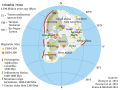 The supercontinent Columbia about 1.6 billion years ago
 -
![Landmass positions near the end of the Precambrian[citation needed]](/w/images/smartcommons/thumbs/commons/2/22/Positions_of_ancient_continents%2C_550_million_years_ago.jpg/120px-Positions_of_ancient_continents%2C_550_million_years_ago.jpg) Landmass positions near the end of the Precambrian[citation needed]
Landmass positions near the end of the Precambrian[citation needed]
![Map of Kenorland supercontinent 2.5 billion years ago[citation needed]](/wiki/File:Kenorland.jpg)
![Map of Kenorland breaking up 2.3 billion years ago[citation needed]](/wiki/File:Kenorland_breaking_up.jpg)

![Landmass positions near the end of the Precambrian[citation needed]](/wiki/File:Positions_of_ancient_continents,_550_million_years_ago.jpg)
See also[edit | edit source]
References[edit | edit source]
- ↑ "Precambrian". Collins English Dictionary. HarperCollins. OCLC 1120411289. Retrieved 2023-08-30.
- ↑ Gradstein, F.M.; Ogg, J.G.; Schmitz, M.D.; Ogg, G.M., eds. (2012). The Geologic Timescale 2012. Vol. 1. Elsevier. p. 301. ISBN 978-0-44-459390-0.
- ↑ 3.0 3.1 Monroe, James S.; Wicander, Reed (1997). The Changing Earth: Exploring Geology and Evolution (2nd ed.). Belmont: Wadsworth Publishing Company. p. 492. ISBN 978-1-285-98138-3.
- ↑ Levin, Harold L. (2010). The earth through time (9th ed.). Hoboken, N.J.: J. Wiley. pp. 230–233. ISBN 978-0-470-38774-0. Outlined in Gore, Pamela J.W. (25 October 2005). "The Earliest Earth: 2,100,000,000 years of the Archean Eon".
- ↑ Davis, C.M. (1964). "The Precambrian Era". Readings in the Geography of Michigan. Michigan State University.
- ↑ "Zircons are Forever". Department of Geoscience. 2005. Archived from the original on 18 May 2019. Retrieved 28 April 2007.
- ↑ Cavosie, Aaron J.; Valley, John W.; Wilde, Simon A. (2007). "Chapter 2.5 The Oldest Terrestrial Mineral Record: A Review of 4400 to 4000 Ma Detrital Zircons from Jack Hills, Western Australia". Developments in Precambrian Geology. 15: 91–111. Bibcode:2007DevPG..15...91C. doi:10.1016/S0166-2635(07)15025-8. ISBN 978-0-444-52810-0.
- ↑ U.S. Geological Survey Geologic Names Committee (2010), "Divisions of geologic time – major chronostratigraphic and geochronologic units", U.S. Geological Survey Fact Sheet 2010–3059, United States Geological Survey, p. 2, retrieved 20 June 2018
- ↑ Senter, Phil (1 April 2013). "The Age of the Earth & Its Importance to Biology". The American Biology Teacher. 75 (4): 251–256. doi:10.1525/abt.2013.75.4.5. S2CID 85652369.
- ↑ Kamp, Ulrich (6 March 2017). "Glaciations". International Encyclopedia of Geography. pp. 1–8. doi:10.1002/9781118786352.wbieg0612. ISBN 978-0-470-65963-2.
- ↑ "Stratigraphic Guide". International Commission on Stratigraphy. Table 3. Retrieved 9 December 2020.
- ↑ Toghill, Peter (2000). The Geology of Britain: An Introduction. Swan Hill Press. p. 33. ISBN 9781853108907.
- ↑ "GEOL 102 Introduction to the Strange Aeons of the Precambrian: The Hadean Eon". www.geol.umd.edu. Retrieved 2026-03-20.
- ↑ Hitchcock, C. H. (1874). The Geology of New Hampshire. p. 511.
The name Eozoic seems to have been proposed by Dr. J.W. Dawson, of Montreal, in 1865. He did not fully define the limits of its application at that time; but it seems to have been generally understood by geologists to embrace all the obscurely fossiliferous rocks older than the Cambrian.
- ↑ Bulletin. Vol. 767. U.S. Government Printing Office. 1925. p. 3.
[1888] Sir J. W. Dawson prefers the term "Eozoic" [to Archean], and would have it include all the Pre-Cambrian strata.
- ↑ Salop, L.J. (2012). Geological Evolution of the Earth During the Precambrian. Springer. p. 9. ISBN 978-3-642-68684-9.
a possibility of dividing the Precambrian history into two eons: the Eozoic, embracing the Archean Era only, and the Protozoic, comprising all the remaining Precambrian Eras.
- ↑ Brun, Yves; Shimkets, Lawrence J. (January 2000). Prokaryotic development. ASM Press. p. 114. ISBN 978-1-55581-158-7.
- ↑ Dodd, Matthew S.; Papineau, Dominic; Grenne, Tor; slack, John F.; Rittner, Martin; Pirajno, Franco; O'Neil, Jonathan; Little, Crispin T. S. (2 March 2017). "Evidence for early life in Earth's oldest hydrothermal vent precipitates". Nature. 543 (7643): 60–64. Bibcode:2017Natur.543...60D. doi:10.1038/nature21377. PMID 28252057.
- ↑ Zimmer, Carl (1 March 2017). "Scientists Say Canadian Bacteria Fossils May Be Earth's Oldest". The New York Times. Retrieved 2 March 2017.
- ↑ Ghosh, Pallab (1 March 2017). "Earliest evidence of life on Earth 'found'". BBC News. Retrieved 2 March 2017.
- ↑ Dunham, Will (1 March 2017). "Canadian bacteria-like fossils called oldest evidence of life". Reuters. Archived from the original on March 2, 2017. Retrieved 1 March 2017.
- ↑ Albani, Abderrazak El; Bengtson, Stefan; Canfield, Donald E.; Bekker, Andrey; Macchiarelli, Roberto; Mazurier, Arnaud; Hammarlund, Emma U.; Boulvais, Philippe; Dupuy, Jean-Jacques; Fontaine, Claude; Fürsich, Franz T.; Gauthier-Lafaye, François; Janvier, Philippe; Javaux, Emmanuelle; Ossa, Frantz Ossa; Pierson-Wickmann, Anne-Catherine; Riboulleau, Armelle; Sardini, Paul; Vachard, Daniel; Whitehouse, Martin; Meunier, Alain (July 2010). "Large colonial organisms with coordinated growth in oxygenated environments 2.1 Gyr ago". Nature. 466 (7302): 100–104. Bibcode:2010Natur.466..100A. doi:10.1038/nature09166. PMID 20596019. S2CID 4331375.
- ↑ Donoghue, Philip C. J.; Antcliffe, Jonathan B. (July 2010). "Origins of multicellularity". Nature. 466 (7302): 41–42. doi:10.1038/466041a. PMID 20596008. S2CID 4396466.
- ↑ Rozanov, A. Yu.; Astafieva, M. M. (1 March 2013). "A unique find of the earliest multicellular algae in the Lower Proterozoic (2.45 Ga) of the Kola Peninsula". Doklady Biological Sciences. 449 (1): 96–98. doi:10.1134/S0012496613020051. PMID 23652437. S2CID 15774804.
- ↑ Qu, Yuangao; Zhu, Shixing; Whitehouse, Martin; Engdahl, Anders; McLoughlin, Nicola (1 January 2018). "Carbonaceous biosignatures of the earliest putative macroscopic multicellular eukaryotes from 1630 Ma Tuanshanzi Formation, north China". Precambrian Research. 304: 99–109. Bibcode:2018PreR..304...99Q. doi:10.1016/j.precamres.2017.11.004.
- ↑ Bengtson, Stefan; Sallstedt, Therese; Belivanova, Veneta; Whitehouse, Martin (14 March 2017). "Three-dimensional preservation of cellular and subcellular structures suggests 1.6 billion-year-old crown-group red algae". PLOS Biology. 15 (3) e2000735. doi:10.1371/journal.pbio.2000735. PMC 5349422. PMID 28291791.
- ↑ Gibson, Timothy M; Shih, Patrick M; Cumming, Vivien M; Fischer, Woodward W; Crockford, Peter W; Hodgskiss, Malcolm S.W; Wörndle, Sarah; Creaser, Robert A; Rainbird, Robert H; Skulski, Thomas M; Halverson, Galen P (2017). "Precise age of Bangiomorpha pubescens dates the origin of eukaryotic photosynthesis" (PDF). Geology. 46 (2): 135–138. doi:10.1130/G39829.1.
- ↑ Laflamme, M. (9 September 2014). "Modeling morphological diversity in the oldest large multicellular organisms". Proceedings of the National Academy of Sciences. 111 (36): 12962–12963. Bibcode:2014PNAS..11112962L. doi:10.1073/pnas.1412523111. PMC 4246935. PMID 25114212.
- ↑ Kolesnikov, Anton V.; Rogov, Vladimir I.; Bykova, Natalia V.; Danelian, Taniel; Clausen, Sébastien; Maslov, Andrey V.; Grazhdankin, Dmitriy V. (October 2018). "The oldest skeletal macroscopic organism Palaeopascichnus linearis". Precambrian Research. 316: 24–37. Bibcode:2018PreR..316...24K. doi:10.1016/j.precamres.2018.07.017. S2CID 134885946.
- ↑ Fedonkin, Mikhail A.; Gehling, James G.; Grey, Kathleen; Narbonne, Guy M.; Vickers-Rich, Patricia (2007). The Rise of Animals: Evolution and Diversification of the Kingdom Animalia. Foreword by Arthur C. Clarke. Baltimore, Maryland: Johns Hopkins University Press. ISBN 978-0-8018-8679-9. LCCN 2007061351. OCLC 85162342. OL 17256629M.
- ↑ Dawkins, Richard; Wong, Yan (2005). The Ancestor's Tale: A Pilgrimage to the Dawn of Evolution. Houghton Mifflin Harcourt. pp. 673. ISBN 978-0-618-61916-0.
- ↑ Selden, Paul A. (2005). "Terrestrialization (Precambrian–Devonian)" (PDF). Encyclopedia of Life Sciences. John Wiley & Sons, Ltd. doi:10.1038/npg.els.0004145. ISBN 978-0-470-01617-6.
- ↑ "Scientists discover 'oldest footprints on Earth' in southern China dating back 550 million years". Independent.co.uk. 7 June 2018. The Independent
- ↑ Chen, Zhe; Chen, Xiang; Zhou, Chuanming; Yuan, Xunlai; Xiao, Shuhai (June 2018). "Late Ediacaran trackways produced by bilaterian animals with paired appendages". Science Advances. 4 (6) eaao6691. Bibcode:2018SciA....4.6691C. doi:10.1126/sciadv.aao6691. PMC 5990303. PMID 29881773.
- ↑ Fine JL, Pearlman RE (August 2023). "On the origin of life: an RNA-focused synthesis and narrative". RNA. 29 (8): 1085–98. doi:10.1261/rna.079598.123. PMC 10351881. PMID 37142437.
- ↑ Salditt A, Karr L, Salibi E, Le Vay K, Braun D, Mutschler H (March 2023). "Ribozyme-mediated RNA synthesis and replication in a model Hadean microenvironment". Nat Commun. 14 (1) 1495. Bibcode:2023NatCo..14.1495S. doi:10.1038/s41467-023-37206-4. PMC 10023712. PMID 36932102.
- ↑ Su S, Wong G, Shi W, Liu J, Lai AC, Zhou J, Liu W, Bi Y, Gao GF (June 2016). "Epidemiology, Genetic Recombination, and Pathogenesis of Coronaviruses". Trends Microbiol. 24 (6): 490–502. doi:10.1016/j.tim.2016.03.003. PMC 7125511. PMID 27012512.
- ↑ Hoffman, Paul F.; Abbot, Dorian S.; Ashkenazy, Yosef; Benn, Douglas I.; Brocks, Jochen J.; Cohen, Phoebe A.; Cox, Grant M.; Creveling, Jessica R.; et al. (2017-11-08). "Snowball Earth climate dynamics and Cryogenian geology-geobiology". Science Advances. 3 (11) e1600983. Bibcode:2017SciA....3E0983H. doi:10.1126/sciadv.1600983. PMC 5677351. PMID 29134193.
- ↑ Parnell, John (2022-06-01). "Snowball Earth to Global Warming: Coupled vanadium-carbonaceous deposits in the Cryogenian-Cambrian". Ore Geology Reviews. 145 104876. Bibcode:2022OGRv..14504876P. doi:10.1016/j.oregeorev.2022.104876. hdl:2164/18433. ISSN 0169-1368.
- ↑ Kump, Lee R.; Fallick, Anthony E.; Melezhik, Victor A.; Strauss, Harald; Lepland, Aivo (2013), Melezhik, Victor A.; Prave, Anthony R.; Hanski, Eero J.; Fallick, Anthony E. (eds.), "8.1 The Great Oxidation Event", Reading the Archive of Earth's Oxygenation: Volume 3: Global Events and the Fennoscandian Arctic Russia - Drilling Early Earth Project, Berlin, Heidelberg: Springer, pp. 1517–1533, doi:10.1007/978-3-642-29670-3_11, ISBN 978-3-642-29670-3, retrieved 2025-01-27
{{citation}}: CS1 maint: work parameter with ISBN (link) - ↑ Konhauser, Kurt O.; Pecoits, Ernesto; Lalonde, Stefan V.; Papineau, Dominic; Nisbet, Euan G.; Barley, Mark E.; Arndt, Nicholas T.; Zahnle, Kevin; Kamber, Balz S. (2009). "Oceanic nickel depletion and a methanogen famine before the Great Oxidation Event". Nature. 458 (7239): 750–753. Bibcode:2009Natur.458..750K. doi:10.1038/nature07858. ISSN 1476-4687. PMID 19360085.
- ↑ "Geological Society of America's "2009 GSA Geologic Time Scale."". Archived from the original on 2020-11-05. Retrieved 2019-08-29.
- ↑ Plumb, Kenneth A.; James, Harold L. (1986-07-15). "Subdivision of precambrian time: recommendations and suggestions by the subcommission on precambrian stratigraphy". Precambrian Research. 32 (1): 65–92. Bibcode:1986PreR...32...65P. doi:10.1016/0301-9268(86)90031-8. ISSN 0301-9268.
- ↑ Harrison, T. Mark (27 April 2009). "The Hadean Crust: Evidence from >4 Ga Zircons". Annual Review of Earth and Planetary Sciences. 37 (1): 479–505. Bibcode:2009AREPS..37..479H. doi:10.1146/annurev.earth.031208.100151.
- ↑ Abramov, Oleg; Kring, David A.; Mojzsis, Stephen J. (October 2013). "The impact environment of the Hadean Earth". Geochemistry. 73 (3): 227–248. Bibcode:2013ChEG...73..227A. doi:10.1016/j.chemer.2013.08.004.
- ↑ Bleeker, W. (2004) [2004]. "Toward a "natural" Precambrian time scale". In Felix M. Gradstein; James G. Ogg; Alan G. Smith (eds.). A Geologic Time Scale 2004. Cambridge University Press. ISBN 978-0-521-78673-7. also available at Stratigraphy.org: Precambrian subcommission
- ↑ Zhao, Guochun; Cawood, Peter A.; Wilde, Simon A.; Sun, M. (2002). "Review of global 2.1–1.8 Ga orogens: implications for a pre-Rodinia super-continent". Earth-Science Reviews. 59 (1): 125–162. Bibcode:2002ESRv...59..125Z. doi:10.1016/S0012-8252(02)00073-9.
- ↑ Zhao, Guochun; Sun, M.; Wilde, Simon A.; Li, S.Z. (2004). "A Paleo-Mesoproterozoic super-continent: assembly, growth and breakup". Earth-Science Reviews (Submitted manuscript). 67 (1): 91–123. Bibcode:2004ESRv...67...91Z. doi:10.1016/j.earscirev.2004.02.003.
- ↑ Li, Z. X.; Bogdanova, S. V.; Collins, A. S.; Davidson, A.; De Waele, B.; Ernst, R. E.; Fitzsimons, I. C. W.; Fuck, R. A.; Gladkochub, D. P.; Jacobs, J.; Karlstrom, K. E.; Lul, S.; Natapov, L. M.; Pease, V.; Pisarevsky, S. A.; Thrane, K.; Vernikovsky, V. (2008). "Assembly, configuration, and break-up history of Rodinia: A synthesis" (PDF). Precambrian Research. 160 (1–2): 179–210. Bibcode:2008PreR..160..179L. doi:10.1016/j.precamres.2007.04.021. Archived from the original (PDF) on 4 March 2016. Retrieved 6 February 2016.
Further reading[edit | edit source]
- Valley, John W., William H. Peck, Elizabeth M. King (1999) Zircons Are Forever, The Outcrop for 1999, University of Wisconsin-Madison Wgeology.wisc.edu Archived 2012-03-16 at the Wayback Machine – Evidence from detrital zircons for the existence of continental crust and oceans on the Earth 4.4 Gyr ago Accessed Jan. 10, 2006
- Wilde, S. A.; Valley, J. W.; Peck, W. H.; Graham, C. M. (2001). "Evidence from detrital zircons for the existence of continental crust and oceans on the Earth 4.4 Gyr ago". Nature. 409 (6817): 175–178. Bibcode:2001Natur.409..175W. doi:10.1038/35051550. PMID 11196637. S2CID 4319774.
- Wyche, S.; Nelson, D. R.; Riganti, A. (2004). "4350–3130 Ma detrital zircons in the Southern Cross Granite–Greenstone Terrane, Western Australia: implications for the early evolution of the Yilgarn Craton". Australian Journal of Earth Sciences. 51 (1): 31–45. Bibcode:2004AuJES..51...31W. doi:10.1046/j.1400-0952.2003.01042.x.
External links[edit | edit source]
- Late Precambrian Supercontinent and Ice House World from the Paleomap Project