


Ajay Kumar (talk | contribs) Created a new article |
Sachin Soni (talk | contribs) refined layout per sources |
||
| Line 6: | Line 6: | ||
| status = EN | | status = EN | ||
| status_system = IUCN3.1 | | status_system = IUCN3.1 | ||
| status_ref =<ref name= | | status_ref =<ref name=iucn>{{cite iucn |author=Gamage, S.N. |author2=Nekaris, K.A.I. |author3=Rudran, R. |year=2022 |amends=2020 |title=''Loris tardigradus'' |article-number=e.T12375A217756381 |doi=10.2305/IUCN.UK.2022-1.RLTS.T12375A217756381.en}}</ref> | ||
| genus = Loris | | genus = Loris | ||
| species = tardigradus | | species = tardigradus | ||
| authority = ([[Carl Linnaeus|Linnaeus]], 1758)<ref>{{cite book|last=Linnæus|first=Carl|title=Systema naturæ per regna tria naturæ, secundum classes, ordines, genera, species, cum characteribus, differentiis, synonymis, locis | | authority = ([[Carl Linnaeus|Linnaeus]], 1758)<ref>{{cite book|last=Linnæus|first=Carl| author-link= Carl Linnæus |title=Systema naturæ per regna tria naturæ, secundum classes, ordines, genera, species, cum characteribus, differentiis, synonymis, locis| volume= I |year= 1758 |publisher= Laurentius Salvius |location= Stockholm | page= 29 |url= https://www.biodiversitylibrary.org/item/80764#page/39/mode/1up|edition=10th |language=la |access-date=21 November 2012}}</ref> | ||
| subdivision_ranks = Subspecies | | subdivision_ranks = Subspecies | ||
| subdivision = | | subdivision = | ||
* ''L. tardigradus nycticeboides'' <small>([[William Charles Osman Hill|Hill]], 1942)</small> | * ''L. tardigradus nycticeboides'' <small>([[William Charles Osman Hill|Hill]], 1942)</small> | ||
* ''L. tardigradus tardigradus'' <small>([[Carl Linnaeus|L.]], 1758)</small> | * ''L. tardigradus tardigradus'' <small>([[Carl Linnaeus|L.]], 1758)</small> | ||
| range_map = | * ''L. tardigradus parvus'' <small>(Hill, 1942)</small> | ||
| range_map_caption = Red | | range_map = Loris tardigradus Range Map (Subspecies).png | ||
| | | range_map_caption = {{leftlegend|#5A5FEE|Southwestern Red Slender Loris |outline=gray}} | ||
{{leftlegend|#b32e6e|Northwestern Red Slender Loris (overlaps with Southwestern Red Slender Loris)|outline=gray}} | |||
{{leftlegend|#81ff60|Highland Slender Loris|outline=gray}} | |||
| synonyms = {{collapsible list |{{species list | |||
|Arachnocebus lori |Lesson, 1840 | |||
|Lemur ceylonicus |Fischer, 1804 | |||
|Lemur tardigradus |Linnaeus, 1758 | |||
|Loris ceylonicus |Fischer, 1804 | |||
|Loris gracilis subsp. zeylanicus |Lydekker, 1905 | |||
|Loris gracilis |É.Geoffroy Saint-Hilaire, 1796 | |||
|Loris lydekkerianus subsp. nycticeboides |Hill, 1942 | |||
|Loris tardigradus subsp. nyctoceboides |Hill, 1942 | |||
|Loris zeylanicus |Lydekker, 1905 | |||
|Nycticebus tardigradus |(Linnaeus, 1758) | |||
|Stenops gracilis |(Geoffroy, 1796) | |||
|Stenops tardigradus |(Linnaeus, 1758) | |||
|Tardigradus loris |Boddaert, 1785 | |||
|Tardigradus tardigradus |(Linnaeus, 1758) | |||
}} }} | |||
| synonyms_ref = <ref name=GBIF>{{GBIF |title=''Loris tardigradus'' (Linnaeus, 1758) |id=2436626 |access-date=1 December 2025}}</ref> | |||
}} | }} | ||
The '''red slender loris''' ('''''Loris tardigradus''''') is a small, nocturnal [[ | The '''red slender loris''' ('''''Loris tardigradus''''') is a small, nocturnal [[Stephsirrhini|stephsirrhine]] [[primate]] native to the [[rainforest]]s of [[Sri Lanka]]. This is {{abbr|No.|number}} 6 of the 10 focal species and No. 22 of the 100 [[EDGE Species|EDGE mammal species]] worldwide considered the most evolutionarily distinct and globally endangered.<ref>{{cite web | work = edgeofexistence.org | access-date = 13 August 2007 | url = http://www.edgeofexistence.org/species/species_info.asp?id=22 | title = Slender loris |archive-url = https://web.archive.org/web/20070701144145/http://www.edgeofexistence.org/species/species_info.asp?id=22 <!-- Bot retrieved archive --> |archive-date = 1 July 2007}}</ref><ref name=msw3/> | ||
== Taxonomy == | |||
The taxonomy of [[slender loris]]es in [[Sri Lanka]] has undergone significant revision. Early classifications recognized multiple subspecies. A pivotal review split them into two species:<ref name = survey>{{cite journal |last=Jayewardene |first=J. |date=April 2004 |title=Survey of the slender loris (Primates, Lorisidae Gray, 1821: ''Loris tardigradus'' Linnaeus, 1758 and ''Loris lydekkerianus'' Cabrera, 1908) in Sri Lanka |journal=Journal of Zoology |volume=262 |issue=4 |pages=327–338 |publisher=Wiley |doi=10.1017/S0952836903004710 |url=https://www.researchgate.net/publication/231792856}}</ref> the small, red wet-zone endemic ''Loris tardigradus'' and the larger, greyish ''[[Gray slender loris|Loris lydekkerianus]]'' found in [[India]] and parts of [[Sri Lanka]]. Genetic and morphological studies later supported this split.<ref name=iucn /> | |||
Recent work refined the classification of the red slender loris, identifying three subspecies based on morphology and geography: ''L. t. tardigradus'', ''L. t. nycticeboides'', and ''L. t. parvus''.<ref name=iucn /><ref name = phylogenetic>{{cite journal |last1=Gamage |first1=Saman |last2=Marikar |first2=Faiz |last3=Groves |first3=Colin |last4=Turner |first4=Craig |last5=Padmalal |first5=Kalinga |last6=Kotagama |first6=Sarath W. |date=November 2019 |title=Phylogenetic relationship among slender loris species (Primates, Lorisidae: ''Loris'') in Sri Lanka based on mtDNA CO1 barcoding |journal=Turkish Journal of Zoology |volume=43 |issue=6 |pages=609–616 |doi=10.3906/zoo-1901-20 |doi-access=free|url=https://www.researchgate.net/publication/337547502|hdl=1885/305655 |hdl-access=free }}</ref> | |||
=== Subspecies === | |||
Three subspecies of this species are recognized: | |||
*Northwestern red slender loris (''Loris tardigradus'' ssp. ''parvus'') - [[Critically endangered|CR]] - Restricted to the northwestern wet and intermediate zones north of the [[Kelani River]] in the [[Western Province, Sri Lanka|Western Province]]. Localities include Henarathgoda, Meerigama Kanda, Pilikuttuwa, and [[Horagolla National Park|Horagolla]].<ref>{{cite iucn |author=Gamage, S.N. |year=2022 |title=''Loris tardigradus'' ssp. ''parvus'' |volume=2022 |article-number=e.T163021284A163021344 |doi=10.2305/IUCN.UK.2022-1.RLTS.T163021284A163021344.en |access-date=1 December 2025}}</ref> | |||
*Southwestern red slender loris (''Loris tardigradus'' ssp. ''tardigradus'') - [[Endangered species|EN]] - Found in the southwestern wet zone across the [[Matara, Sri Lanka|Matara]], [[Ratnapura]], [[Kalutara]], and [[Kegalle]] districts. It occurs in fragmented forests including [[Sinharaja Forest Reserve|Sinharaja]], [[Kanneliya–Dediyagala–Nakiyadeniya|Kanneliya]], [[Peak Wilderness Sanctuary]], and Yagirala.<ref>{{cite iucn |author=Gamage, S.N. |author2=Nekaris, K.A.I. |author3=Rudran, R. |year=2022 |title=''Loris tardigradus'' ssp. ''tardigradus'' |volume=2022 |article-number=e.T39757A17991537 |doi=10.2305/IUCN.UK.2022-1.RLTS.T39757A17991537.en |access-date=1 December 2025}}</ref> | |||
*Highland slender loris (''Loris tardigradus'' ssp. ''nycticeboides'') - [[Critically endangered|CR]] - Confined to high-altitude areas (above approximately 1,500 m) in the [[Central Highlands of Sri Lanka|central highlands]]. Known sites are [[Horton Plains National Park|Horton Plains]], [[Hakgala Strict Nature Reserve|Hakgala]], and forests near [[Nuwara Eliya]] such as Conical Hill and [[Kandapola]].<ref>{{cite iucn |author=Gamage, S.N. |author2=Nekaris, K.A.I. |author3=Rudran, R. |year=2022 |title=''Loris tardigradus'' ssp. ''nycticeboides'' |volume=2022 |article-number=e.T39756A17991511 |doi=10.2305/IUCN.UK.2022-1.RLTS.T39756A17991511.en |access-date=1 December 2025}}</ref> | |||
==Description== | ==Description== | ||
| Line 34: | Line 57: | ||
''L. tardigradus tardigradus'' is reddish brown in the back and creamy yellow below, while ''L. tardigradus nycticeboides'' is dark brown dorsally and very light brown in upperparts. | ''L. tardigradus tardigradus'' is reddish brown in the back and creamy yellow below, while ''L. tardigradus nycticeboides'' is dark brown dorsally and very light brown in upperparts. | ||
== Distribution == | |||
This species is endemic to the rainforests of [[Sri Lanka]]. It is typically found in the southwestern wet zone and the adjacent [[Central Highlands of Sri Lanka|central highlands]]. Its range spans the wet southwestern region, extending from [[Colombo]] through [[Kalutara]], [[Ratnapura]], [[Kegalle]], [[Galle]], and [[Matara, Sri Lanka|Matara]], and possibly into the wetter parts of [[Hambantota District]].<ref name=iucn /> | |||
The species has been documented in numerous protected and proposed forest reserves across several provinces. [[Western Province, Sri Lanka|''Western Province'']] (Maimbulakanda, Pilikuttuwa, Kalukele, Horagolla, Dikkele, Meerigama Kanda, Labugama Kalatuwawa, Indikada Mukalana, Koskanda, Bodinagala, Yagirala, and Madakada), [[Southern Province, Sri Lanka|''Southern Province'']] (Oliyagankele, Welihena, Masmullah, Kekanadura, Beraliya Mukalana, Dandeniya-Aparekka, Kanneliya, Polgahakanda, and Kottawa), ''[[Sabaragamuwa Province]]'' (Sinharaja World Heritage Site, Delwala, Peak Wilderness Sanctuary, Gilimale, Madampe, and Salgala), [[Central Province, Sri Lanka|''Central Province'']] (Horton Plains National Park, Kikiliyamana, Hakgala Strict Nature Reserve, and Conical Hill).<ref name=iucn /><ref name=survey /> | |||
==Behavior== | ==Behavior== | ||
[[File:Loris tardigradus tardigradus 002.jpg|thumb|left|The red slender loris is arboreal.]] | [[File:Loris tardigradus tardigradus 002.jpg|thumb|left|The red slender loris is arboreal.]] | ||
[[Image:Red slender loris skeleton.jpg|thumb|Skeleton of red slender loris.]] | [[Image:Red slender loris skeleton.jpg|thumb|Skeleton of red slender loris.]] | ||
The red slender loris favors lowland [[rainforest]]s (up to {{convert|700|m|ft|abbr=in|disp=or}} in altitude), tropical rainforests and inter-[[monsoon]] forests of the south western wet-zone of Sri Lanka. Masmullah Proposed Forest Reserve harbors one of few remaining red slender loris populations, and is considered a [[biodiversity hotspot]]. The most common plant species eaten was ''[[Humboldtia laurifolia]]'', occurring at 676 trees/ha, with overall density at 1077 trees/ha. ''Humboldtia laurifolia'' is [[Vulnerable species|vulnerable]] and has a mutualistic relationship with [[ant]]s, providing abundant food for lorises.<ref>{{cite journal | | The red slender loris favors lowland [[rainforest]]s (up to {{convert|700|m|ft|abbr=in|disp=or}} in altitude), tropical rainforests and inter-[[monsoon]] forests of the south western wet-zone of Sri Lanka. Masmullah Proposed Forest Reserve harbors one of few remaining red slender loris populations, and is considered a [[biodiversity hotspot]]. The most common plant species eaten was ''[[Humboldtia laurifolia]]'', occurring at 676 trees/ha, with overall density at 1077 trees/ha. ''Humboldtia laurifolia'' is [[Vulnerable species|vulnerable]] and has a mutualistic relationship with [[ant]]s, providing abundant food for lorises.<ref>{{cite journal | first1= K.| last1= Anne-Isola Nekaris | first2 = Wasantha K. D. D.| last2= Liyanage | first3 = Saman N.| last3= Gamage |date=July 2005 | journal = Mammalia | volume = 69 | issue = 2 | pages = 201–210 | doi = 10.1515/mamm.2005.017 | title = Influence of forest structure and composition on population density of the red slender loris ''Loris tardigradus tardigradus'' in Masmullah proposed forest reserve, Sri Lanka| s2cid = 21708919 }}</ref> Reports from the 1960s suggest that it once also occurred in the [[coastal]] zone, however it is now thought to be extinct there. | ||
The red slender loris differs from its close relative the gray slender loris in its frequent use of rapid [[arboreal locomotion]]. It forms small social groups, containing adults of both sexes as well as young animals. This species is among the most social of the [[nocturnal]] primates. During daylight hours the animals sleep in groups in branch tangles, or curled up on a branch with their heads between their legs. The groups also undertake mutual grooming and play at wrestling. The adults typically hunt separately during the night. They are primarily [[insectivorous]] but also eat bird [[egg (biology)|eggs]], [[berry|berries]], leaves, [[bud]]s and occasionally [[invertebrate]]s as well as [[gecko]]s and lizards. They forage, and while doing so, ants may stick to the back of their hands.<ref>{{cite journal|last1=Kumara|first1=H.N.|last2=Kumar|first2=Shanthala|last3=Singh|first3=Mewa|title=A Novel Foraging Technique Observed in Slender Loris (Loris lydekkerianus malabaricus) Feeding on Red Ants in the Western Ghats, India|url=https://www.karger.com/Article/Abstract/83618|access-date=13 October 2020|journal=Folia Primatologica; International Journal of Primatology|year=2005 |volume=76 |issue=2 |pages=116–118 |doi=10.1159/000083618 |pmid=15775683 |s2cid=46584698 }}</ref> As this occurs, the red slender loris is able to consume these ants. To maximize protein and nutrient uptake they consume every part of their prey, including the scales and bones. They make nests out of leaves or find hollows of trees or a similar secure place to live in. | The red slender loris differs from its close relative the gray slender loris in its frequent use of rapid [[arboreal locomotion]]. It forms small social groups, containing adults of both sexes as well as young animals. This species is among the most social of the [[nocturnal]] primates. During daylight hours the animals sleep in groups in branch tangles, or curled up on a branch with their heads between their legs. The groups also undertake mutual grooming and play at wrestling. The adults typically hunt separately during the night. They are primarily [[insectivorous]] but also eat bird [[egg (biology)|eggs]], [[berry|berries]], leaves, [[bud]]s and occasionally [[invertebrate]]s as well as [[gecko]]s and lizards. They forage, and while doing so, ants may stick to the back of their hands.<ref>{{cite journal|last1=Kumara|first1=H.N.|last2=Kumar|first2=Shanthala|last3=Singh|first3=Mewa|title=A Novel Foraging Technique Observed in Slender Loris (Loris lydekkerianus malabaricus) Feeding on Red Ants in the Western Ghats, India| url= https://www.karger.com/Article/Abstract/83618|access-date=13 October 2020|journal=Folia Primatologica; International Journal of Primatology|year=2005 |volume=76 |issue=2 |pages=116–118 |doi=10.1159/000083618 |pmid=15775683 |s2cid=46584698 |url-access=subscription}}</ref> As this occurs, the red slender loris is able to consume these ants. To maximize protein and nutrient uptake they consume every part of their prey, including the scales and bones. They make nests out of leaves or find hollows of trees or a similar secure place to live in. | ||
==Reproduction== | ==Reproduction== | ||
[[File:Loris tardigradus skull.jpg|thumb|left|Skull]] | [[File:Loris tardigradus skull.jpg|thumb|left|Skull]] | ||
Females are dominant. The female reaches her sexual maturity at 10 months and is receptive to the male twice a year. This species mates while hanging upside down from branches; individuals in captivity will not breed if no suitable branch is available. The [[gestation]] period is 166–169 days after which the female will bear 1–2 young which feed from her for 6–7 months. The lifespan of this species is believed to be around 15–18 years in the wild. | Females are dominant. The female reaches her sexual maturity at 10 months and is receptive to the male twice a year. This species mates while hanging upside down from branches; individuals in captivity will not breed if no suitable branch is available. The [[gestation]] period is 166–169 days, after which the female will bear 1–2 young which feed from her for 6–7 months. The lifespan of this species is believed to be around 15–18 years in the wild. | ||
==Threats== | ==Threats== | ||
This slender loris is an endangered species. [[Habitat destruction]] is a major threat. It is widely trapped and killed for use in supposed remedies for eye diseases and is preyed upon by snakes, dogs, and some fish.<ref>{{cite web | | This slender loris is an endangered species. [[Habitat destruction]] is a major threat. It is widely trapped and killed for use in supposed remedies for eye diseases and is preyed upon by snakes, dogs, and some fish.<ref>{{cite web | last= Benders-Hyde| first= Elisabeth | year = 2002 | url = http://www.blueplanetbiomes.org/slender_loris.htm | title = Slender Loris| website= blueplanetbiomes.org| publisher= | access-date = 24 July 2007}}</ref> Other threats include electrocution on live wires, road accidents and capture for the pet trade.<ref name= Nekaris&Jayewardene2004>{{Cite journal | last1 = Nekaris | first1 = K. A. I. | last2 = Jayewardene | first2 = J. | doi = 10.1017/S0952836903004710 | title = Survey of the slender loris (Primates, Lorisidae Gray, 1821: ''Loris tardigradus'' Linnaeus, 1758 and ''Loris lydekkerianus'' Cabrera, 1908) in Sri Lanka | journal = Journal of Zoology | volume = 262 | issue = 4 | pages = 327–338 | year = 2004 }}</ref> | ||
== Conservation == | == Conservation == | ||
The red slender loris was identified as one of the top-10 "focal species" in 2007 by the [[EDGE Species|Evolutionarily Distinct and Globally Endangered]] (EDGE) project.<ref>{{Cite news | title = Protection for 'weirdest' species | url = http://news.bbc.co.uk/2/hi/science/nature/6263331.stm | date = 16 January 2007 | | The red slender loris was identified as one of the top-10 "focal species" in 2007 by the [[EDGE Species|Evolutionarily Distinct and Globally Endangered]] (EDGE) project.<ref>{{Cite news | title = Protection for 'weirdest' species | url = http://news.bbc.co.uk/2/hi/science/nature/6263331.stm | date = 16 January 2007 | work = bbc.co.uk| publisher= [[BBC]] | access-date = 22 May 2007}}</ref> | ||
One early success has been the rediscovery of the virtually unknown [[Horton Plains]] slender loris (''Loris tardigradus nycticeboides''). Originally documented in 1937, there have been only four known encounters in the past 72 years,<ref>http://www.spiegel.de/wissenschaft/natur/0,1518,707502,00.html Der Spiegel | One early success has been the rediscovery of the virtually unknown [[Horton Plains]]<ref name= "Der Spiegel 2010" /> slender loris (''Loris tardigradus nycticeboides''). Originally documented in 1937, there have been only four known encounters in the past 72 years,<ref name= "Der Spiegel 2010">{{cite web| url= http://www.spiegel.de/wissenschaft/natur/0,1518,707502,00.html |title= Faulaffen-Art ist doch nicht ausgestorben| date= 2010-07-20| work= [[Der Spiegel]]| language= de | quote= [Translated from German:] ...it's still around. A small sloth monkey in Sri Lanka was thought to be extinct for more than 60 years. Now researchers have rediscovered it. | access-date= 2025-07-20}}</ref> and for more than 60 years until 2002 the sub-species had been believed to be extinct.<ref name="ap-19Jul10">{{cite news|last=Krishan|first=Francis|title=Rare Sri Lankan primate gets 1st wide-eyed closeup|date=19 July 2010|work=[[The Oregonian]], oregonlive.com|agency=[[Associated Press]]|url=http://www.oregonlive.com/newsflash/index.ssf?/base/international-34/127957441022880.xml&storylist=international|access-date=23 July 2010|archive-date=11 October 2012|archive-url=https://web.archive.org/web/20121011001605/http://www.oregonlive.com/newsflash/index.ssf?/base/international-34/127957441022880.xml&storylist=international}}</ref><ref name="guardian-Jul10">{{cite news|last=Smith|first=Lewis|title=Found: Sri Lankan primate thought to be extinct for 60 years|date=19 July 2010|newspaper=[[The Guardian]]| url= https://www.theguardian.com/world/2010/jul/19/horton-plains-slender-loris-found |access-date=23 July 2010}}</ref> The sub-species was rediscovered in 2002 by a team led by [[Anna Nekaris]] in [[Horton Plains National Park]].<ref name=Nekaris&Jayewardene2004/> The late 2009 capture by a team working under the [[Zoological Society of London]]'s EDGE programme has resulted in the first detailed physical examination of the Horton Plains sub-species and the first-ever photographs of it.<ref name="ap-19Jul10"/> The limited available evidence suggests there may be only about 100 animals still existing, which would make it among the top five most-threatened primates worldwide.<ref name="guardian-Jul10"/> | ||
{{clear}} | |||
==References== | ==References== | ||
| Line 61: | Line 90: | ||
==External links== | ==External links== | ||
{{Commons|Loris tardigradus}} | |||
{{Wikispecies|Loris tardigradus|Red Slender Loris}} | |||
* | * [https://web.archive.org/web/20051125120542/http://www.arkive.org/species/GES/mammals/Loris_tardigradus_and_Loris_lydekkerianus/more_info.html Images and movies of the slender loris ''(Loris tardigradus and Loris lydekkerianus)''] (archived) at arkive.org | ||
* | * [http://www.edgeofexistence.org/mammals/species_info.php?id=22 Slender loris] at edgeofexistence.org, Evolutionarily Distinct and Globally Endangered (EDGE) species | ||
{{Lorisidae nav}} | {{Lorisidae nav}} | ||
| Line 77: | Line 106: | ||
[[Category:Endangered biota of Asia]] | [[Category:Endangered biota of Asia]] | ||
[[Category:Mammals described in 1758|red slender loris]] | [[Category:Mammals described in 1758|red slender loris]] | ||
[[Category:Species | [[Category:Species that are or were threatened by habitat loss]] | ||
[[Category: | [[Category:Animal taxa named by Carl Linnaeus|red slender loris]] | ||
Latest revision as of 16:47, 25 March 2026
| Red slender loris[1] | |
|---|---|

| |
Scientific classification 
| |
| : | [[Template:Taxonomy/Loris]] |
| Species: | Template:Taxonomy/LorisL. tardigradus
|
| Binomial name | |
| Template:Taxonomy/LorisLoris tardigradus | |
| Subspecies | |
.png)
| |
Southwestern Red Slender Loris
Northwestern Red Slender Loris (overlaps with Southwestern Red Slender Loris)
Highland Slender Loris
| |
| Synonyms[4] | |
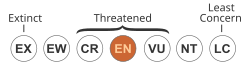
The red slender loris (Loris tardigradus) is a small, nocturnal stephsirrhine primate native to the rainforests of Sri Lanka. This is No. 6 of the 10 focal species and No. 22 of the 100 EDGE mammal species worldwide considered the most evolutionarily distinct and globally endangered.[5][1]
Taxonomy[edit | edit source]
The taxonomy of slender lorises in Sri Lanka has undergone significant revision. Early classifications recognized multiple subspecies. A pivotal review split them into two species:[6] the small, red wet-zone endemic Loris tardigradus and the larger, greyish Loris lydekkerianus found in India and parts of Sri Lanka. Genetic and morphological studies later supported this split.[2]
Recent work refined the classification of the red slender loris, identifying three subspecies based on morphology and geography: L. t. tardigradus, L. t. nycticeboides, and L. t. parvus.[2][7]
Subspecies[edit | edit source]
Three subspecies of this species are recognized:
- Northwestern red slender loris (Loris tardigradus ssp. parvus) - CR - Restricted to the northwestern wet and intermediate zones north of the Kelani River in the Western Province. Localities include Henarathgoda, Meerigama Kanda, Pilikuttuwa, and Horagolla.[8]
- Southwestern red slender loris (Loris tardigradus ssp. tardigradus) - EN - Found in the southwestern wet zone across the Matara, Ratnapura, Kalutara, and Kegalle districts. It occurs in fragmented forests including Sinharaja, Kanneliya, Peak Wilderness Sanctuary, and Yagirala.[9]
- Highland slender loris (Loris tardigradus ssp. nycticeboides) - CR - Confined to high-altitude areas (above approximately 1,500 m) in the central highlands. Known sites are Horton Plains, Hakgala, and forests near Nuwara Eliya such as Conical Hill and Kandapola.[10]
Description[edit | edit source]
This small, slender primate is distinguished by large forward-facing eyes used for precise depth perception, long slender limbs, a well-developed index finger, the absence of tail, and large prominent ears, which are thin, rounded and hairless at the edges. The soft dense fur is reddish-brown color on the back, and the underside is whitish-grey with a sprinkling of silver hair. Its body length on average is 18–25 cm (7–10 in), with an average weight of a mere 85–370 g (3–13 oz). This loris has a four-way grip on each foot. The big toe opposes the other 4 toes for a pincer-like grip on branches and food. It has a dark face mask with central pale stripe, much like the slow lorises.
L. tardigradus tardigradus is reddish brown in the back and creamy yellow below, while L. tardigradus nycticeboides is dark brown dorsally and very light brown in upperparts.
Distribution[edit | edit source]
This species is endemic to the rainforests of Sri Lanka. It is typically found in the southwestern wet zone and the adjacent central highlands. Its range spans the wet southwestern region, extending from Colombo through Kalutara, Ratnapura, Kegalle, Galle, and Matara, and possibly into the wetter parts of Hambantota District.[2]
The species has been documented in numerous protected and proposed forest reserves across several provinces. Western Province (Maimbulakanda, Pilikuttuwa, Kalukele, Horagolla, Dikkele, Meerigama Kanda, Labugama Kalatuwawa, Indikada Mukalana, Koskanda, Bodinagala, Yagirala, and Madakada), Southern Province (Oliyagankele, Welihena, Masmullah, Kekanadura, Beraliya Mukalana, Dandeniya-Aparekka, Kanneliya, Polgahakanda, and Kottawa), Sabaragamuwa Province (Sinharaja World Heritage Site, Delwala, Peak Wilderness Sanctuary, Gilimale, Madampe, and Salgala), Central Province (Horton Plains National Park, Kikiliyamana, Hakgala Strict Nature Reserve, and Conical Hill).[2][6]
Behavior[edit | edit source]


The red slender loris favors lowland rainforests (up to 700 m or 2,300 feet in altitude), tropical rainforests and inter-monsoon forests of the south western wet-zone of Sri Lanka. Masmullah Proposed Forest Reserve harbors one of few remaining red slender loris populations, and is considered a biodiversity hotspot. The most common plant species eaten was Humboldtia laurifolia, occurring at 676 trees/ha, with overall density at 1077 trees/ha. Humboldtia laurifolia is vulnerable and has a mutualistic relationship with ants, providing abundant food for lorises.[11] Reports from the 1960s suggest that it once also occurred in the coastal zone, however it is now thought to be extinct there.
The red slender loris differs from its close relative the gray slender loris in its frequent use of rapid arboreal locomotion. It forms small social groups, containing adults of both sexes as well as young animals. This species is among the most social of the nocturnal primates. During daylight hours the animals sleep in groups in branch tangles, or curled up on a branch with their heads between their legs. The groups also undertake mutual grooming and play at wrestling. The adults typically hunt separately during the night. They are primarily insectivorous but also eat bird eggs, berries, leaves, buds and occasionally invertebrates as well as geckos and lizards. They forage, and while doing so, ants may stick to the back of their hands.[12] As this occurs, the red slender loris is able to consume these ants. To maximize protein and nutrient uptake they consume every part of their prey, including the scales and bones. They make nests out of leaves or find hollows of trees or a similar secure place to live in.
Reproduction[edit | edit source]

Females are dominant. The female reaches her sexual maturity at 10 months and is receptive to the male twice a year. This species mates while hanging upside down from branches; individuals in captivity will not breed if no suitable branch is available. The gestation period is 166–169 days, after which the female will bear 1–2 young which feed from her for 6–7 months. The lifespan of this species is believed to be around 15–18 years in the wild.
Threats[edit | edit source]
This slender loris is an endangered species. Habitat destruction is a major threat. It is widely trapped and killed for use in supposed remedies for eye diseases and is preyed upon by snakes, dogs, and some fish.[13] Other threats include electrocution on live wires, road accidents and capture for the pet trade.[14]
Conservation[edit | edit source]
The red slender loris was identified as one of the top-10 "focal species" in 2007 by the Evolutionarily Distinct and Globally Endangered (EDGE) project.[15]
One early success has been the rediscovery of the virtually unknown Horton Plains[16] slender loris (Loris tardigradus nycticeboides). Originally documented in 1937, there have been only four known encounters in the past 72 years,[16] and for more than 60 years until 2002 the sub-species had been believed to be extinct.[17][18] The sub-species was rediscovered in 2002 by a team led by Anna Nekaris in Horton Plains National Park.[14] The late 2009 capture by a team working under the Zoological Society of London's EDGE programme has resulted in the first detailed physical examination of the Horton Plains sub-species and the first-ever photographs of it.[17] The limited available evidence suggests there may be only about 100 animals still existing, which would make it among the top five most-threatened primates worldwide.[18]
References[edit | edit source]
- ↑ 1.0 1.1 Groves, C. P. (2005). Wilson, D. E.; Reeder, D. M. (eds.). Mammal Species of the World: A Taxonomic and Geographic Reference (3rd ed.). Baltimore: Johns Hopkins University Press. p. 122. ISBN 0-801-88221-4. OCLC 62265494.
- ↑ 2.0 2.1 2.2 2.3 2.4 Gamage, S.N.; Nekaris, K.A.I.; Rudran, R. (2022). "Loris tardigradus". IUCN Red List of Threatened Species. 2022 e.T12375A217756381. doi:10.2305/IUCN.UK.2022-1.RLTS.T12375A217756381.en.
{{cite journal}}: Unknown parameter|amends=ignored (help) - ↑ Linnæus, Carl (1758). Systema naturæ per regna tria naturæ, secundum classes, ordines, genera, species, cum characteribus, differentiis, synonymis, locis (in Latina). Vol. I (10th ed.). Stockholm: Laurentius Salvius. p. 29. Retrieved 21 November 2012.
- ↑ Template:GBIF
- ↑ "Slender loris". edgeofexistence.org. Archived from the original on 1 July 2007. Retrieved 13 August 2007.
- ↑ 6.0 6.1 Jayewardene, J. (April 2004). "Survey of the slender loris (Primates, Lorisidae Gray, 1821: Loris tardigradus Linnaeus, 1758 and Loris lydekkerianus Cabrera, 1908) in Sri Lanka". Journal of Zoology. 262 (4). Wiley: 327–338. doi:10.1017/S0952836903004710.
- ↑ Gamage, Saman; Marikar, Faiz; Groves, Colin; Turner, Craig; Padmalal, Kalinga; Kotagama, Sarath W. (November 2019). "Phylogenetic relationship among slender loris species (Primates, Lorisidae: Loris) in Sri Lanka based on mtDNA CO1 barcoding". Turkish Journal of Zoology. 43 (6): 609–616. doi:10.3906/zoo-1901-20. hdl:1885/305655.
- ↑ Gamage, S.N. (2022). "Loris tardigradus ssp. parvus". IUCN Red List of Threatened Species. 2022 e.T163021284A163021344. doi:10.2305/IUCN.UK.2022-1.RLTS.T163021284A163021344.en. Retrieved 1 December 2025.
- ↑ Gamage, S.N.; Nekaris, K.A.I.; Rudran, R. (2022). "Loris tardigradus ssp. tardigradus". IUCN Red List of Threatened Species. 2022 e.T39757A17991537. doi:10.2305/IUCN.UK.2022-1.RLTS.T39757A17991537.en. Retrieved 1 December 2025.
- ↑ Gamage, S.N.; Nekaris, K.A.I.; Rudran, R. (2022). "Loris tardigradus ssp. nycticeboides". IUCN Red List of Threatened Species. 2022 e.T39756A17991511. doi:10.2305/IUCN.UK.2022-1.RLTS.T39756A17991511.en. Retrieved 1 December 2025.
- ↑ Anne-Isola Nekaris, K.; Liyanage, Wasantha K. D. D.; Gamage, Saman N. (July 2005). "Influence of forest structure and composition on population density of the red slender loris Loris tardigradus tardigradus in Masmullah proposed forest reserve, Sri Lanka". Mammalia. 69 (2): 201–210. doi:10.1515/mamm.2005.017. S2CID 21708919.
- ↑ Kumara, H.N.; Kumar, Shanthala; Singh, Mewa (2005). "A Novel Foraging Technique Observed in Slender Loris (Loris lydekkerianus malabaricus) Feeding on Red Ants in the Western Ghats, India". Folia Primatologica; International Journal of Primatology. 76 (2): 116–118. doi:10.1159/000083618. PMID 15775683. S2CID 46584698. Retrieved 13 October 2020.
- ↑ Benders-Hyde, Elisabeth (2002). "Slender Loris". blueplanetbiomes.org. Retrieved 24 July 2007.
- ↑ 14.0 14.1 Nekaris, K. A. I.; Jayewardene, J. (2004). "Survey of the slender loris (Primates, Lorisidae Gray, 1821: Loris tardigradus Linnaeus, 1758 and Loris lydekkerianus Cabrera, 1908) in Sri Lanka". Journal of Zoology. 262 (4): 327–338. doi:10.1017/S0952836903004710.
- ↑ "Protection for 'weirdest' species". bbc.co.uk. BBC. 16 January 2007. Retrieved 22 May 2007.
- ↑ 16.0 16.1 "Faulaffen-Art ist doch nicht ausgestorben". Der Spiegel (in Deutsch). 20 July 2010. Retrieved 20 July 2025.
[Translated from German:] ...it's still around. A small sloth monkey in Sri Lanka was thought to be extinct for more than 60 years. Now researchers have rediscovered it.
- ↑ 17.0 17.1 Krishan, Francis (19 July 2010). "Rare Sri Lankan primate gets 1st wide-eyed closeup". The Oregonian, oregonlive.com. Associated Press. Archived from the original on 11 October 2012. Retrieved 23 July 2010.
- ↑ 18.0 18.1 Smith, Lewis (19 July 2010). "Found: Sri Lankan primate thought to be extinct for 60 years". The Guardian. Retrieved 23 July 2010.
External links[edit | edit source]
- Images and movies of the slender loris (Loris tardigradus and Loris lydekkerianus) (archived) at arkive.org
- Slender loris at edgeofexistence.org, Evolutionarily Distinct and Globally Endangered (EDGE) species
- Pages using the JsonConfig extension
- IUCN Red List endangered species
- Lorises
- Mammals of Sri Lanka
- Endemic fauna of Sri Lanka
- Primates of South Asia
- EDGE species
- Endangered animals
- Endangered biota of Asia
- Mammals described in 1758
- Species that are or were threatened by habitat loss
- Animal taxa named by Carl Linnaeus