


mNo edit summary |
MochenKitche (talk | contribs) m fix content per standard format |
||
| Line 3: | Line 3: | ||
{{EngvarB|date=June 2020}} | {{EngvarB|date=June 2020}} | ||
{{Use dmy dates|date=June 2020}} | {{Use dmy dates|date=June 2020}} | ||
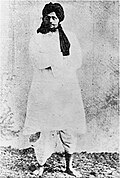
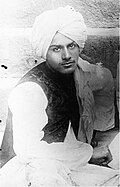
[[File:Revolutionary,_Damodar_Hari_Chapekar.jpg|thumb| | [[File:Revolutionary,_Damodar_Hari_Chapekar.jpg|thumb|Damodar Hari Chapekar]] [[File:Revolutionary, Balkrishna Chapekar.jpg|thumb|Balkrishna Chapekar]] [[File:Revolutionary, Vasudeo Chapekar.jpg|thumb|Vasudeo Chapekar]] | ||
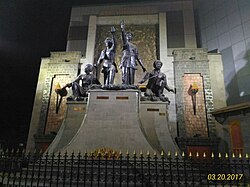
[[File:Chaphekar Brother's.jpg|thumb|Statue of the Chapekar brothers at | [[File:Chaphekar Brother's.jpg|thumb|Statue of the Chapekar brothers at, Pune]]The '''Chapekar Brothers''', '''Damodar Hari Chapekar''' (25 June 1869 – 18 April 1898), '''Balkrishna Hari Chapekar''' (1873 – 12 May 1899, also called Bapurao) and '''Vasudeo Hari Chapekar''' (1880 – 8 May 1899), also spelt Wasudeva or Wasudev, were Indian revolutionaries involved in assassinating W. C. Rand, the British Plague Commissioner of [[Pune|Poona]], after the public of Poona were frustrated with the actions of officers and soldiers appointed by him. Mahadev Vinayak Ranade was also an accomplice in the assassination. | ||
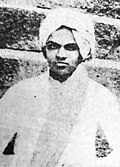
[[File:Revolutionary Mahadev Ranade.jpg|thumb| | [[File:Revolutionary Mahadev Ranade.jpg|thumb|Mahadev Ranade]] 1897 | ||
The brothers | The Chapekar brothers came from [[Chinchwad| Chapa]], a small [[hamlet (place)|hamlet]] in the city of Poona, [[British India]]. When the [[Third plague pandemic|bubonic plague]] hit India in 1896–97, the government had set up a Special Plague Committee for managing the pandemic, with [[Walter Charles Rand]], an [[Indian Civil Services]] officer, as its Commissioner. Over 800 soldiers were brought in to deal with the emergency. Despite orders from the government to pay heed to religious sentiments, the measures employed included entry into private houses, stripping and examination of occupants (including women) by British officers in public, evacuation to hospitals and segregation camps and preventing movement from the city. Some of these officers also vandalised properties and religious symbols. These measures were considered oppressive by the populace of Poona but their complaints were ignored by Rand. Thus, the Chapekar brothers shot Rand and his military escort, Lieutenant Ayerst, on 22 June 1897, the [[Diamond Jubilee of Queen Victoria]], as the British officials were returning from the celebrations at [[Government House]]. Ayerst died on the spot and Rand of his wounds on 3 July.<ref name="Plaqueport"/> | ||
The Chapekar brothers and two accomplices ('''Mahadev Vinayak Ranade''' and '''Khando Vishnu Sathe''' [First-name not known]) were charged with the murders in various roles, as well as the shooting of two informants and an attempt to shoot a police officer. All three brothers were found guilty and hanged, an accomplice was dealt with similarly, and another, then a schoolboy, was sentenced to ten years' rigorous imprisonment.<ref name = "Plagueport">{{cite book | |||
| last =Echenberg | | last =Echenberg | ||
| first =Myron J. | | first =Myron J. | ||
| Line 16: | Line 16: | ||
| location =New York | | location =New York | ||
| pages =66–68 | | pages =66–68 | ||
| isbn =0-8147-2232- | | isbn =978-0-8147-2232-9}}</ref> | ||
==The 1897 Bubonic plague in Pune== | ==The 1897 Bubonic plague in Pune== | ||
{{further | Third plague pandemic#Political impact in Colonial India}} | {{further | Third plague pandemic#Political impact in Colonial India}} | ||
Pune, was a very important military base with a large [[cantonment]] during the British colonial rule. The cantonment had a significant European population of soldiers, officers, and their families. A number of public health initiatives were undertaken during this period ostensibly to protect the Indian population, but mainly to keep Europeans safe from the periodic epidemics of diseases like [[Cholera]], [[bubonic plague]], [[small pox]], etc. The action took form in vaccinating the population and better sanitary arrangements.<ref name="Pune">{{cite book|last1=Arnold|first1=David|title=Science, technology and medicine in Colonial India|date=2002|publisher=Cambridge Univ. Press|location=Cambridge [u.a.]|isbn=9780521563192|pages=142–146|edition=Repr.|url=https://books.google.com/books?id=7bAxnPwOMd8C&q=Science,+Technology+and+Medicine+in+Colonial+India+By+David+Arnold&pg=PR6}}</ref> Given the vast cultural differences, and at times the arrogance of colonial officers, these health measures often led to public anger. However, the heavy handedness particularly bad in 1897, during the bubonic plague epidemic in the city. By the end of February 1897, the epidemic was raging with a mortality rate twice the norm (657 deaths or 0.6% of the city population), and half the city's population had fled. A Special Plague Committee was formed under the chairmanship of W.C. Rand, an [[Indian Civil Services]] officer. He brought European troops to deal with the emergency. The heavy handed measures he employed included forcibly entering peoples' homes, at times in the middle of the night and removing infected people and digging up floors, where it was believed in those days, the plague [[Yersinia pestis|bacillus bacteria]] resided. It was also required of the principal occupant of a house or a building to report all deaths and all illnesses suspected to be plague. Funerals were declared unlawful until the deaths were registered. The | Pune, was a very important military base with a large [[cantonment]] during the British colonial rule. The cantonment had a significant European population of soldiers, officers, and their families. A number of public health initiatives were undertaken during this period ostensibly to protect the Indian population, but mainly to keep Europeans safe from the periodic epidemics of diseases like [[Cholera]], [[bubonic plague]], [[small pox]], etc. The action took form in vaccinating the population and better sanitary arrangements.<ref name="Pune">{{cite book|last1=Arnold|first1=David|title=Science, technology and medicine in Colonial India|date=2002|publisher=Cambridge Univ. Press|location=Cambridge [u.a.]|isbn=9780521563192|pages=142–146|edition=Repr.|url=https://books.google.com/books?id=7bAxnPwOMd8C&q=Science,+Technology+and+Medicine+in+Colonial+India+By+David+Arnold&pg=PR6}}</ref> Given the vast cultural differences, and at times the arrogance of colonial officers, these health measures often led to public anger. However, the heavy handedness particularly bad in 1897, during the bubonic plague epidemic in the city. By the end of February 1897, the epidemic was raging with a mortality rate twice the norm (657 deaths or 0.6% of the city population), and half the city's population had fled. A Special Plague Committee was formed under the chairmanship of W.C. Rand, an [[Indian Civil Services]] officer. He brought European troops to deal with the emergency. The heavy handed measures he employed included forcibly entering peoples' homes, at times in the middle of the night and removing infected people and digging up floors, where it was believed in those days, the plague [[Yersinia pestis|bacillus bacteria]] resided. It was also required of the principal occupant of a house or a building to report all deaths and all illnesses suspected to be plague. Funerals were declared unlawful until the deaths were registered. The committee had the right to mark special grounds for giving funeral to corpses suspected to have succumbed from plague, and prohibit use of any other place for the purpose. Disobedience of the orders would subject the offender to criminal prosecution. The work of the committee began on 13 March and ended on 19 May. The total estimated plague mortality was 2091.<ref>{{cite book|editor-last1=Arnold|editor-first1=David|title=Imperial medicine and indigenous societies|date=1988|publisher=Manchester University Press|location=Manchester|isbn=978-0719024955|page=153|url=https://books.google.com/books?id=0Xi7AAAAIAAJ&q=poona+%22indigenous+civil+society+colonial+&pg=PR6}}</ref> These measures were deeply unpopular. Nationalist leader [[Bal Gangadhar Tilak]] fulminated against the measures in his newspapers, [[Kesari (Marathi newspaper)|Kesari]] and Maratha.<ref>{{cite book|last1=Ramanna|first1=Mridula|title=Health care in Bombay Presidency, 1896–1930|date=2012|publisher=Primus Books|location=Delhi|isbn=9789380607245|pages=19–21|url=https://books.google.com/books?id=Mm14U_6JVwoC&q=mridula+ramanna&pg=PR7}}</ref> The resentment culminated in Rand and his military escort being shot dead by the Chapekar brothers on 22 June 1897.The assassination led to a re-evaluation of public health policies.<ref>{{cite book|last1=Harrison|first1=Mark|title=Public health in British India: Anglo-Indian preventive medicine 1859–1914|date=1994|publisher=Cambridge Univ. Press|location=Cambridge [u.a.]|isbn=978-0521441278|page=148|url=https://books.google.com/books?id=PShpbwti_3EC&q=poona+sanitation+colonial+british&pg=PR8}}</ref> This led even Tilak to support the vaccination efforts later in 1906. | ||
===Diverging opinions of the British measures=== | ===Diverging opinions of the British measures=== | ||
| Line 73: | Line 31: | ||
| year =1897 | | year =1897 | ||
| location =Part II., Chapter I.: The five Plague Committees | | location =Part II., Chapter I.: The five Plague Committees | ||
| pages =89 – | | pages =89 – p.100 | ||
| url =http://www.nls.uk/indiapapers/find/vol/index.cfm?vbid=3726845&seq_no=101 | | url =http://www.nls.uk/indiapapers/find/vol/index.cfm?vbid=3726845&seq_no=101 | ||
| access-date =5 July 2009 | | access-date =5 July 2009 | ||
| Line 92: | Line 50: | ||
| archive-date =13 September 2007 | | archive-date =13 September 2007 | ||
| url-status =dead | | url-status =dead | ||
}}</ref> | }}</ref> A missionary, Rev. Robert P. Wilder, quoted in a contemporary ''[[The New York Times|New York Times]]'' article,<ref>The New York Times, 22 June 1897</ref> asserted that the cause of plague was native practices such as going bare-foot, the distrust of the natives about the government segregation camps; further, that houses have been shut up with corpses inside, and search parties have been going around to unearth them. The same article included reported rumours that the plague has been caused by grain hoarded for twenty years by the [[Vanika|bania]]s or grocers being sold in the market, while others felt it was [[Queen Victoria]]'s curse for the daubing of her statue with tar.<ref>{{cite news | ||
A missionary, Rev. Robert P. Wilder, quoted in a contemporary ''[[The New York Times|New York Times]]'' article,<ref>The New York Times, 22 June 1897</ref> asserted that the cause of plague was native practices such as going bare-foot, the distrust of the natives about the government segregation camps; further, that houses have been shut up with corpses inside, and search parties have been going around to unearth them. The same article included reported rumours that the plague has been caused by grain hoarded for twenty years by the [[Vanika|bania]]s or grocers being sold in the market, while others felt it was [[Queen Victoria]]'s curse for the daubing of her statue with tar.<ref>{{cite news | |||
| title =INDIA'S PLAGUE AND FAMINE; Their Horrors Described by the Rev. Robert P. Wilder, Missionary at Poona. GOVERNMENT AID CAME LATE Two Kinds of the Disease, and Both Deadly – Natives Dying by Hundreds of Hunger – Overseers Stealing the Supplies. | | title =INDIA'S PLAGUE AND FAMINE; Their Horrors Described by the Rev. Robert P. Wilder, Missionary at Poona. GOVERNMENT AID CAME LATE Two Kinds of the Disease, and Both Deadly – Natives Dying by Hundreds of Hunger – Overseers Stealing the Supplies. | ||
| newspaper = [[The New York Times]] | | newspaper = [[The New York Times]] | ||
| Line 102: | Line 58: | ||
| access-date =7 May 2009}}</ref> | | access-date =7 May 2009}}</ref> | ||
In contrast to the above | In contrast to the above accounts, accounts based on local sources quote, among others, [[Narasimha Chintaman Kelkar]] as stating that the appointment of military officers introduced an element of severity and coercion in the house searches, the highhandedness of the government provoked the people of Puna, and some soldiers were beaten in the Rasta Peth locality.<ref>{{cite web | ||
<ref>{{cite web | |||
| last =Savarkar.org team | | last =Savarkar.org team | ||
| title =Associates in Hindutva Movement: Narsimha Chintaman or Tatyasaheb Kelkar | | title =Associates in Hindutva Movement: Narsimha Chintaman or Tatyasaheb Kelkar | ||
| url =http://www.savarkar.org/en/lifesketch/veer-savarkars-associates/associates-hindutva-movement | | url =http://www.savarkar.org/en/lifesketch/veer-savarkars-associates/associates-hindutva-movement | ||
| access-date =11 July 2009 }}</ref> " | | access-date =11 July 2009 }}</ref> Kelkar alleged that the soldiers involved in the house searches "either, through ignorance or impudence, would mock, indulge in monkey tricks, talk foolishly, intimidate, touch innocent people, shove them, enter any place without justification, pocket valuable items, etc".<ref>{{cite book | ||
| last =Joglekar | | last =Joglekar | ||
| first =Jayawant D. | | first =Jayawant D. | ||
| Line 114: | Line 69: | ||
| year =2006 | | year =2006 | ||
| pages =27 | | pages =27 | ||
| url =https://books.google.com/books?id=1J3uk3x_k6sC | | url =https://books.google.com/books?id=1J3uk3x_k6sC&dq=chapekar+dravid&pg=PA27 | ||
| isbn =1-84728-380-2}}</ref> | | isbn =1-84728-380-2}}</ref> His close associate, [[Bal Gangadhar Tilak]], wrote: "Her Majesty the Queen, the Secretary of State and his Council, should not have issued the orders for practising tyranny upon the people of India without any special advantage to be gained... the government should not have entrusted the execution of this order to a suspicious, sullen and tyrannical officer like Rand."<ref name="Plagueport"/> | ||
[[Gopal Krishna Gokhale]] alleged in an interview with the ''[[Manchester Guardian]]'', while on a visit to Britain, that soldiers "ignorant of the language and contemptuous of the customs, the sentiments and the religious susceptibilities of the [Indian] people" had been "let loose" upon the city of [[Pune|Poona]], and had "wantonly destroyed property, appropriated jewellery, burnt furniture, entered kitchens and places of worship, contaminated food, spat upon idols or broke them by throwing them on the ground, and dragged women into the streets for inspection before removal to hospitals" during house searches. Gokhale further alleged during the interview that his associated reported to him that two women were sexually assaulted by soldiers, one of whom subsequently committed suicide. Gokhale subsequently came under a storm of criticism for his claims, and eventually offered an "unqualified apology" for them, for which he came under further criticism from Indian nationalists.<ref> {{Cite book |last=Nanda |first=Bal Ram |url=https://books.google.com/books?id=pI19BgAAQBAJ&dq=gokhale+whose+word+I+can+trust+absolutely&pg=PA110 |title=Gokhale: The Indian Moderates and the British Raj |date=2015-03-08 |publisher=Princeton University Press |isbn=978-1-4008-7049-3 |language=en}} </ref> | |||
==The shooting of Rand== | |||
On 22 June 1897, the Diamond Jubilee of Queen Victoria was celebrated in Poona. In his autobiography, Damodar Hari writes that he believed the jubilee celebrations would cause Europeans of all ranks to go to the Government House, and give them the opportunity to kill Rand. The brothers Damodar Hari and Balkrishna Hari selected a spot of Ganeshkhind road, by side of a yellow bungalow to shoot at Rand. Each armed with a sword and a pistol. Balkrishna in addition carried a hatchet. They reached Ganeshkhind, they saw what looked like Rand's carriage pass by, but they let it go, not being sure, deciding to attack him on his way back. They reached Government House at 7.00 – 7.30 in the evening, the sun had set and darkness began to set in. A large number of people had gathered to witness the spectacle at the Government House. There were bonfires on the hills. The swords and the hatchets they carried made movement without raising suspicion difficult, so they cached them at a stone [[culvert]] near the bungalow. As planned, Damodar Hari waited at the gate of the Government House, and as Rand's carriage emerged, ran 10 – 15 paces behind it. As the carriage reached the yellow bungalow, Damodar made up the distance, and called out "Gondya ala re"(“Gondya has come,” or “here is Gondya”), a predetermined signal for Balkrishna to take action. Damodar Hari undid the flap of the carriage, raised it and fired from a distance of about a span. It was originally planned that both would shoot at Rand, so as to ensure that Rand would not live, however Balkrishna Hari lagged behind and Rand's carriage rolled on, Balkrishna Hari meanwhile on the suspicion that the occupants of the following carriage were whispering to each other, fired at the head of one of them from behind.<ref name = "Autobiography">{{cite book | |||
| last =Chapekar | |||
| first =Damodar | |||
| title =Autobiography of Damodar Hari Chapekar | |||
| publisher =From Bombay Police Abstracts of 1910 | |||
| pages=50–107 | |||
| url =https://cultural.maharashtra.gov.in/english/gazetteer/VOL-II/autobiography.pdf}}</ref> Lieutenant Ayerst, Rand's military escort<ref name = "Plagueport"/> who was riding in the following carriage died on the spot, Rand was taken to [[Sassoon Hospital]] where he succumbed to his injuries on 3 July 1897. | |||
Damodar Hari was arrested in connection with the above, on the basis of information given by the Dravid brothers. In his statement, recorded on 8 October 1897, Damodar Hari, said that atrocities like the pollution of sacred places and the breaking of idols were committed by European soldiers at the time of house searches in Poona, during the plague. Chapekar tells that they wanted to "take revenge" of this. His statement was treated as a confession and he was charged under section 302 of the [[Indian Penal Code]], tried and hanged, on 18 April 1898. Balkrishna Hari absconded, and was found in January 1899, betrayed by a friend. The Dravid brothers were eliminated by Vasudeo Hari, Mahadev Vinayak Ranade and Khando Vishnu Sathe, who were arrested in their attempt to shoot police chief constable Rama Pandu later the same evening, of 9 February 1899.{{cn|date=May 2025}} | |||
==The | All were subsequently apprehended and tried; Balkrishna Hari pleaded not guilty and his defense lawyers included [[S. S. Setlur]].<ref>{{cite news |title=The Jubilee Murders: Yesterday's Proceedings |url=https://www.granthsanjeevani.com/jspui/handle/123456789/19341 |access-date=19 June 2024 |work=The Bombay Gazette |issue=51559 |date=March 8, 1899 |page=5}}</ref> The Chapekar brothers Balkrishna Hari and Vasudeo Hari, along with Ranade, were convicted on March 8, 1899 and sentenced to death by hanging.<ref>{{cite news |title=The Jubilee Murders. The Verdict. The Three Accused Found Guilty |url=https://www.granthsanjeevani.com/jspui/handle/123456789/19342 |access-date=20 June 2024 |work=The Bombay Gazette |issue=51560 |date=March 9, 1899 |page=5}}</ref><ref>{{cite news |title=The Poona Murders. Close of the Trial. Verdict. |url=https://www.granthsanjeevani.com/jspui/handle/123456789/104662 |access-date=19 June 2024 |work=Times of India |issue=58 |date=March 9, 1899 |page=5}}</ref> Vasudev Hari was hanged on 8 May 1899, Mahadeva Vinayak Ranade on 10 May, and Balkrishna Hari on 12 May. Sathe, though a juvenile, was sentenced to 10 years' Rigorous Imprisonment.<ref>{{Cite web | ||
| publisher = [Maharashtra Government Publication] | | publisher = [Maharashtra Government Publication] | ||
| title =THE REVOLUTIONARIES: CHAPEKAR BROTHERS | | title =THE REVOLUTIONARIES: CHAPEKAR BROTHERS | ||
| Line 155: | Line 105: | ||
| url =https://timesmachine.nytimes.com/timesmachine/1897/11/04/102099167.pdf | | url =https://timesmachine.nytimes.com/timesmachine/1897/11/04/102099167.pdf | ||
| access-date =25 June 2009 | | access-date =25 June 2009 | ||
}}</ref> The former article says that Damodar became embittered with Europeans as he was refused enlistment in the army, by the authorities in Shimla. Both articles also mention Damodar's admission of an earlier incident of tarring of Queen Victoria's statue. On 2 February 1898, ''The New York Times'' reported the death sentence passed on Damodar.<ref>{{cite news | |||
| title =Chapekar sentenced to die: Brahmin lawyer who killed Lieut. Ayerst and commissioner Rand. | | title =Chapekar sentenced to die: Brahmin lawyer who killed Lieut. Ayerst and commissioner Rand. | ||
| work = [[The New York Times]] | | work = [[The New York Times]] | ||
| date =3 February 1898 | | date =3 February 1898 | ||
| publication-date =4 February 1898 | url =https://www.nytimes.com/1898/02/04/archives/chapekar-sentenced-to-die-brahmin-lawyer-who-killed-lieut-ayerst.html | | publication-date =4 February 1898 | url =https://www.nytimes.com/1898/02/04/archives/chapekar-sentenced-to-die-brahmin-lawyer-who-killed-lieut-ayerst.html | ||
| access-date =25 June 2009 }}</ref> ''[[The Sydney Morning Herald]]'', dated 13 February 1899, reports that a brother of Damodar Hari, who was sentenced to death for the | | access-date =25 June 2009 }}</ref> ''[[The Sydney Morning Herald]]'', dated 13 February 1899, reports that a brother of Damodar Hari, who was sentenced to death for the killing of Rand and Ayerst, fired upon a [[Australian native police|native police]] officer. A connection between the shooting of the Dravid brothers on the streets of Poona is also mentioned with the shooting. It further states that Chapekar{{clarify|reason=which one|date=May 2025}} boasted of murder the Dravids and also named an accomplice, Ranade. It also reports the arrest of Chapekar and Ranade.<ref>{{cite news | ||
| title =India: Shooting of witnesses – Native officer fired upon. | | title =India: Shooting of witnesses – Native officer fired upon. | ||
| work = The Sydney Morning Herald | | work = The Sydney Morning Herald | ||
| Line 168: | Line 118: | ||
==In popular culture== | ==In popular culture== | ||
The 1979 Indian [[Marathi language|Marathi]]-language film, ''[[22 June 1897]]'', covers events prior to the assassination, the act and its aftermath. | The 1979 Indian [[Marathi language|Marathi]]-language film, ''[[22 June 1897]]'', covers events prior to the assassination, the act and its aftermath.<ref>{{Cite web| last1 =Kailashnath| first1 =Dr. Koppikar| last2 =Chheda| first2 =Subhash| title =22 June 1897, Celebrating 25 years.| url =http://www.rudraa.com/main/Marathi_22_June_1897.htm| access-date =22 June 2009}}</ref> The [[Hindi]] film ''[[Chapekar Brothers (film)|Chapekar Brothers]]'' was released in 2016 and covered the same events. | ||
An Indian [[web television series]] about the brothers in Marathi, ''Gondya Ala Re'', was released in 2019 on [[Zee5]].<ref>{{cite web |title='Gondya Ala Re'- a war cry that inspired Inquilab Zindabad! |url=https://zeenews.india.com/television/gondya-ala-re-a-war-cry-that-inspired-inquilab-zindabad-2228510.html |website=[[Zee News]] |language=en |date=20 August 2019}}</ref> | |||
In 2023, the story of the Chapekar brothers was shown in episode 43 of [[DD National]]'s TV series [[Swaraj (TV series)|''Swaraj'']]. | |||
== Notes == | == Notes == | ||
{{Commons category|Chapekar brothers}} | |||
{{Notelist}} | |||
== References == | == References == | ||
{{reflist}} | {{reflist}} | ||
{{DEFAULTSORT:brothers, Chapekar}} | {{DEFAULTSORT:brothers, Chapekar}} | ||
[[Category:Indian independence activists from Maharashtra]] | [[Category:Indian independence activists from Maharashtra]] | ||
[[Category: | [[Category:Indian independence activists]] | ||
[[Category:People from Maharashtra]] | [[Category:People from Maharashtra]] | ||
[[Category:Marathi people]] | [[Category:Marathi people]] | ||
[[Category:People from Pimpri-Chinchwad]] | [[Category:People from Pimpri-Chinchwad]] | ||
[[Category:Revolutionary movement for Indian independence]] | |||
Latest revision as of 21:23, 20 November 2025


The Chapekar Brothers, Damodar Hari Chapekar (25 June 1869 – 18 April 1898), Balkrishna Hari Chapekar (1873 – 12 May 1899, also called Bapurao) and Vasudeo Hari Chapekar (1880 – 8 May 1899), also spelt Wasudeva or Wasudev, were Indian revolutionaries involved in assassinating W. C. Rand, the British Plague Commissioner of Poona, after the public of Poona were frustrated with the actions of officers and soldiers appointed by him. Mahadev Vinayak Ranade was also an accomplice in the assassination.

1897
The Chapekar brothers came from Chapa, a small hamlet in the city of Poona, British India. When the bubonic plague hit India in 1896–97, the government had set up a Special Plague Committee for managing the pandemic, with Walter Charles Rand, an Indian Civil Services officer, as its Commissioner. Over 800 soldiers were brought in to deal with the emergency. Despite orders from the government to pay heed to religious sentiments, the measures employed included entry into private houses, stripping and examination of occupants (including women) by British officers in public, evacuation to hospitals and segregation camps and preventing movement from the city. Some of these officers also vandalised properties and religious symbols. These measures were considered oppressive by the populace of Poona but their complaints were ignored by Rand. Thus, the Chapekar brothers shot Rand and his military escort, Lieutenant Ayerst, on 22 June 1897, the Diamond Jubilee of Queen Victoria, as the British officials were returning from the celebrations at Government House. Ayerst died on the spot and Rand of his wounds on 3 July.[1]
The Chapekar brothers and two accomplices (Mahadev Vinayak Ranade and Khando Vishnu Sathe [First-name not known]) were charged with the murders in various roles, as well as the shooting of two informants and an attempt to shoot a police officer. All three brothers were found guilty and hanged, an accomplice was dealt with similarly, and another, then a schoolboy, was sentenced to ten years' rigorous imprisonment.[2]
The 1897 Bubonic plague in Pune[edit | edit source]
Pune, was a very important military base with a large cantonment during the British colonial rule. The cantonment had a significant European population of soldiers, officers, and their families. A number of public health initiatives were undertaken during this period ostensibly to protect the Indian population, but mainly to keep Europeans safe from the periodic epidemics of diseases like Cholera, bubonic plague, small pox, etc. The action took form in vaccinating the population and better sanitary arrangements.[3] Given the vast cultural differences, and at times the arrogance of colonial officers, these health measures often led to public anger. However, the heavy handedness particularly bad in 1897, during the bubonic plague epidemic in the city. By the end of February 1897, the epidemic was raging with a mortality rate twice the norm (657 deaths or 0.6% of the city population), and half the city's population had fled. A Special Plague Committee was formed under the chairmanship of W.C. Rand, an Indian Civil Services officer. He brought European troops to deal with the emergency. The heavy handed measures he employed included forcibly entering peoples' homes, at times in the middle of the night and removing infected people and digging up floors, where it was believed in those days, the plague bacillus bacteria resided. It was also required of the principal occupant of a house or a building to report all deaths and all illnesses suspected to be plague. Funerals were declared unlawful until the deaths were registered. The committee had the right to mark special grounds for giving funeral to corpses suspected to have succumbed from plague, and prohibit use of any other place for the purpose. Disobedience of the orders would subject the offender to criminal prosecution. The work of the committee began on 13 March and ended on 19 May. The total estimated plague mortality was 2091.[4] These measures were deeply unpopular. Nationalist leader Bal Gangadhar Tilak fulminated against the measures in his newspapers, Kesari and Maratha.[5] The resentment culminated in Rand and his military escort being shot dead by the Chapekar brothers on 22 June 1897.The assassination led to a re-evaluation of public health policies.[6] This led even Tilak to support the vaccination efforts later in 1906.
Diverging opinions of the British measures[edit | edit source]
In his report on the administration of the Puna plague, Rand wrote, "It is a matter of great satisfaction to the members of the Plague Committee that no credible complaint that the modesty of a woman had been intentionally insulted was made either to themselves or to the officers under whom the troops worked". He also writes that closest watch was kept on the troops employed on plague duty and utmost consideration was shown for the customs and traditions of the people.[7][8] A missionary, Rev. Robert P. Wilder, quoted in a contemporary New York Times article,[9] asserted that the cause of plague was native practices such as going bare-foot, the distrust of the natives about the government segregation camps; further, that houses have been shut up with corpses inside, and search parties have been going around to unearth them. The same article included reported rumours that the plague has been caused by grain hoarded for twenty years by the banias or grocers being sold in the market, while others felt it was Queen Victoria's curse for the daubing of her statue with tar.[10]
In contrast to the above accounts, accounts based on local sources quote, among others, Narasimha Chintaman Kelkar as stating that the appointment of military officers introduced an element of severity and coercion in the house searches, the highhandedness of the government provoked the people of Puna, and some soldiers were beaten in the Rasta Peth locality.[11] Kelkar alleged that the soldiers involved in the house searches "either, through ignorance or impudence, would mock, indulge in monkey tricks, talk foolishly, intimidate, touch innocent people, shove them, enter any place without justification, pocket valuable items, etc".[12] His close associate, Bal Gangadhar Tilak, wrote: "Her Majesty the Queen, the Secretary of State and his Council, should not have issued the orders for practising tyranny upon the people of India without any special advantage to be gained... the government should not have entrusted the execution of this order to a suspicious, sullen and tyrannical officer like Rand."[2]
Gopal Krishna Gokhale alleged in an interview with the Manchester Guardian, while on a visit to Britain, that soldiers "ignorant of the language and contemptuous of the customs, the sentiments and the religious susceptibilities of the [Indian] people" had been "let loose" upon the city of Poona, and had "wantonly destroyed property, appropriated jewellery, burnt furniture, entered kitchens and places of worship, contaminated food, spat upon idols or broke them by throwing them on the ground, and dragged women into the streets for inspection before removal to hospitals" during house searches. Gokhale further alleged during the interview that his associated reported to him that two women were sexually assaulted by soldiers, one of whom subsequently committed suicide. Gokhale subsequently came under a storm of criticism for his claims, and eventually offered an "unqualified apology" for them, for which he came under further criticism from Indian nationalists.[13]
The shooting of Rand[edit | edit source]
On 22 June 1897, the Diamond Jubilee of Queen Victoria was celebrated in Poona. In his autobiography, Damodar Hari writes that he believed the jubilee celebrations would cause Europeans of all ranks to go to the Government House, and give them the opportunity to kill Rand. The brothers Damodar Hari and Balkrishna Hari selected a spot of Ganeshkhind road, by side of a yellow bungalow to shoot at Rand. Each armed with a sword and a pistol. Balkrishna in addition carried a hatchet. They reached Ganeshkhind, they saw what looked like Rand's carriage pass by, but they let it go, not being sure, deciding to attack him on his way back. They reached Government House at 7.00 – 7.30 in the evening, the sun had set and darkness began to set in. A large number of people had gathered to witness the spectacle at the Government House. There were bonfires on the hills. The swords and the hatchets they carried made movement without raising suspicion difficult, so they cached them at a stone culvert near the bungalow. As planned, Damodar Hari waited at the gate of the Government House, and as Rand's carriage emerged, ran 10 – 15 paces behind it. As the carriage reached the yellow bungalow, Damodar made up the distance, and called out "Gondya ala re"(“Gondya has come,” or “here is Gondya”), a predetermined signal for Balkrishna to take action. Damodar Hari undid the flap of the carriage, raised it and fired from a distance of about a span. It was originally planned that both would shoot at Rand, so as to ensure that Rand would not live, however Balkrishna Hari lagged behind and Rand's carriage rolled on, Balkrishna Hari meanwhile on the suspicion that the occupants of the following carriage were whispering to each other, fired at the head of one of them from behind.[14] Lieutenant Ayerst, Rand's military escort[2] who was riding in the following carriage died on the spot, Rand was taken to Sassoon Hospital where he succumbed to his injuries on 3 July 1897.
Damodar Hari was arrested in connection with the above, on the basis of information given by the Dravid brothers. In his statement, recorded on 8 October 1897, Damodar Hari, said that atrocities like the pollution of sacred places and the breaking of idols were committed by European soldiers at the time of house searches in Poona, during the plague. Chapekar tells that they wanted to "take revenge" of this. His statement was treated as a confession and he was charged under section 302 of the Indian Penal Code, tried and hanged, on 18 April 1898. Balkrishna Hari absconded, and was found in January 1899, betrayed by a friend. The Dravid brothers were eliminated by Vasudeo Hari, Mahadev Vinayak Ranade and Khando Vishnu Sathe, who were arrested in their attempt to shoot police chief constable Rama Pandu later the same evening, of 9 February 1899.[citation needed]
All were subsequently apprehended and tried; Balkrishna Hari pleaded not guilty and his defense lawyers included S. S. Setlur.[15] The Chapekar brothers Balkrishna Hari and Vasudeo Hari, along with Ranade, were convicted on March 8, 1899 and sentenced to death by hanging.[16][17] Vasudev Hari was hanged on 8 May 1899, Mahadeva Vinayak Ranade on 10 May, and Balkrishna Hari on 12 May. Sathe, though a juvenile, was sentenced to 10 years' Rigorous Imprisonment.[18]
Coverage of the incident by international press[edit | edit source]
An article, published in The New York Times, dated 4 October 1897, reports the arrest of Damodar Chapekar Deccani, and 28 others, Ayerst's and Rand's slayers. This article states that Deccani is Damodar's last name and refers to him as such. It also terms him an advocate.[19] Another dated 4 November 1897, reports the incident and the subsequent trial, it calls Damodar Chapekar a Brahmin lawyer.[20] The former article says that Damodar became embittered with Europeans as he was refused enlistment in the army, by the authorities in Shimla. Both articles also mention Damodar's admission of an earlier incident of tarring of Queen Victoria's statue. On 2 February 1898, The New York Times reported the death sentence passed on Damodar.[21] The Sydney Morning Herald, dated 13 February 1899, reports that a brother of Damodar Hari, who was sentenced to death for the killing of Rand and Ayerst, fired upon a native police officer. A connection between the shooting of the Dravid brothers on the streets of Poona is also mentioned with the shooting. It further states that Chapekar[clarification needed] boasted of murder the Dravids and also named an accomplice, Ranade. It also reports the arrest of Chapekar and Ranade.[22]
In popular culture[edit | edit source]
The 1979 Indian Marathi-language film, 22 June 1897, covers events prior to the assassination, the act and its aftermath.[23] The Hindi film Chapekar Brothers was released in 2016 and covered the same events.
An Indian web television series about the brothers in Marathi, Gondya Ala Re, was released in 2019 on Zee5.[24]
In 2023, the story of the Chapekar brothers was shown in episode 43 of DD National's TV series Swaraj.
Notes[edit | edit source]
References[edit | edit source]
- ↑ Cite error: Invalid
<ref>tag; no text was provided for refs namedPlaqueport - ↑ 2.0 2.1 2.2 Echenberg, Myron J. (2007). Plague Ports: The Global Urban Impact of Bubonic Plague, 1894–1901. New York: New York University Press. pp. 66–68. ISBN 978-0-8147-2232-9.
- ↑ Arnold, David (2002). Science, technology and medicine in Colonial India (Repr. ed.). Cambridge [u.a.]: Cambridge Univ. Press. pp. 142–146. ISBN 9780521563192.
- ↑ Arnold, David, ed. (1988). Imperial medicine and indigenous societies. Manchester: Manchester University Press. p. 153. ISBN 978-0719024955.
- ↑ Ramanna, Mridula (2012). Health care in Bombay Presidency, 1896–1930. Delhi: Primus Books. pp. 19–21. ISBN 9789380607245.
- ↑ Harrison, Mark (1994). Public health in British India: Anglo-Indian preventive medicine 1859–1914. Cambridge [u.a.]: Cambridge Univ. Press. p. 148. ISBN 978-0521441278.
- ↑ Couchman, M. E. (1897). Account of plague administration in the Bombay Presidency from September 1896 till May 1897. Part II., Chapter I.: The five Plague Committees: Government Central Press, Mumbai (then Bombay). pp. 89–p.100. Archived from the original on 13 September 2007. Retrieved 5 July 2009.
- ↑ Rand, W. C.; Lamb R. A. (1897). Supplement to the account of plague administration in the Bombay Presidency from September 1896 till May 1897. Government Central Press, Mumbai (then Bombay). pp. 1–p.153. Archived from the original on 13 September 2007. Retrieved 3 September 2009.
- ↑ The New York Times, 22 June 1897
- ↑ "INDIA'S PLAGUE AND FAMINE; Their Horrors Described by the Rev. Robert P. Wilder, Missionary at Poona. GOVERNMENT AID CAME LATE Two Kinds of the Disease, and Both Deadly – Natives Dying by Hundreds of Hunger – Overseers Stealing the Supplies". The New York Times. 22 June 1897. Retrieved 7 May 2009.
- ↑ Savarkar.org team. "Associates in Hindutva Movement: Narsimha Chintaman or Tatyasaheb Kelkar". Retrieved 11 July 2009.
- ↑ Joglekar, Jayawant D. (2006). Veer Savarkar Father of Hindu Nationalism. Lulu.com. p. 27. ISBN 1-84728-380-2.
- ↑ Nanda, Bal Ram (8 March 2015). Gokhale: The Indian Moderates and the British Raj. Princeton University Press. ISBN 978-1-4008-7049-3.
- ↑ Chapekar, Damodar. Autobiography of Damodar Hari Chapekar (PDF). From Bombay Police Abstracts of 1910. pp. 50–107.
- ↑ "The Jubilee Murders: Yesterday's Proceedings". The Bombay Gazette. No. 51559. 8 March 1899. p. 5. Retrieved 19 June 2024.
- ↑ "The Jubilee Murders. The Verdict. The Three Accused Found Guilty". The Bombay Gazette. No. 51560. 9 March 1899. p. 5. Retrieved 20 June 2024.
- ↑ "The Poona Murders. Close of the Trial. Verdict". Times of India. No. 58. 9 March 1899. p. 5. Retrieved 19 June 2024.
- ↑ "THE REVOLUTIONARIES: CHAPEKAR BROTHERS" (PDF). [Maharashtra Government Publication]. Retrieved 29 June 2009.
- ↑ "Ayerst's and Rand's slayers: Damodar Chapekar Deccani, a Brahmin Advocate and 28 Others Arrested in India". The New York Times (published 5 October 1897). 4 October 1897. Retrieved 25 June 2009.
- ↑ "Damodar Chapekar on trial" (PDF). The New York Times (published 4 November 1987). 3 November 1897. Retrieved 25 June 2009.
- ↑ "Chapekar sentenced to die: Brahmin lawyer who killed Lieut. Ayerst and commissioner Rand". The New York Times (published 4 February 1898). 3 February 1898. Retrieved 25 June 2009.
- ↑ "India: Shooting of witnesses – Native officer fired upon". The Sydney Morning Herald. 13 February 1899. Retrieved 29 June 2009.
- ↑ Kailashnath, Dr. Koppikar; Chheda, Subhash. "22 June 1897, Celebrating 25 years". Retrieved 22 June 2009.
- ↑ "'Gondya Ala Re'- a war cry that inspired Inquilab Zindabad!". Zee News. 20 August 2019.