



->CodeTalker Reverted 1 edit by 122.161.247.160 (talk): Unexplained removal |
updated article as per guidelines |
||
| Line 1: | Line 1: | ||
{{ | {{Short description|Indian ruling clan}} | ||
}} | |||
{{Use dmy dates|date=May 2019}} | {{Use dmy dates|date=May 2019}} | ||
{{Use Indian English|date=May 2019}} | {{Use Indian English|date=May 2019}} | ||
'''Poosapati / Pusapati''' was the ruling clan of the | '''Poosapati / Pusapati''' was the ruling clan of the [[Vizianagaram estate]]. | ||
==History== | ==History== | ||
[[File:West Entrance of the Vizianagaram fort in Andhra Pradesh.jpg|thumb|West Entrance of the Vizianagaram fort in [[Andhra Pradesh]]]] | [[File:West Entrance of the Vizianagaram fort in Andhra Pradesh.jpg|thumb|West Entrance of the Vizianagaram fort in [[Andhra Pradesh]]]] | ||
[[File:Viznm kota.jpg|thumb|Main Entrance of Vizianagaram Fort]] | [[File:Viznm kota.jpg|thumb|Main Entrance of Vizianagaram Fort]] | ||
The | The Pusapati clan claims descent from Madhavavarma, who led a [[Rajput]] colony into the Krishna Valley in the late 6th century.{{Sfn|Frowde|1908|p=339}} The members of the colony subsequently held important positions at the court of [[Golconda|Golcanda]].{{Sfn|Frowde|1908|p=339}} | ||
The Pusapati chieftain Sitaram Chandra Raju received the villages of [[Kumili]] and Gundredu from Raghunath Krishna Dev of the [[Jeypore Estate]].{{Sfn|Senapati|Sahu|1966|p=63}} Viziaram Raju was appointed as an administrative minister of the Jeypore Estate by Ram Chandra Dev I{{Sfn|Senapati|Sahu|1966|p=66}} and succeeded his father as the head of the clan in 1710.{{Sfn|Frowde|1908|p=339}} Viziaram Raju occupied a portion of the coastal territories of the Jeypore Estate under Vishwambhar Dev II{{sfn|Senapati|Sahu|1966|p=67}} and moved the capital of the estate from [[Ponnur|Potnuru]] to Vizianagaram in 1712; he named the capital town after himself.{{Sfn|Frowde|1908|p=339}} Viziaram Raju prompted the neighboring landowners (''zamindars'') to secede and gain independence from the Jeypore Estate.{{Sfn|Senapati|Sahu|1966|p=66}} In 1757, Viziaram Raju formed an alliance with [[Marquis de Bussy-Castelnau]], which allowed him to seize the capital of the rival landowner of [[Bobbili]].{{Sfn|Frowde|1908|p=339}} | |||
Following Viziaram Raju, the Pusapati clan was led first by Ananda Raju and next by Viziaram Raju II, who was largely controlled by his half-brother Sitarama Raju.{{Sfn|Frowde|1908|p=340}} In 1761, Sitarama Raju attacked [[Paralakhemundi|Parlakhemundi]] defeating its force and their Maratha allies further adding territory to the Vizianagaram Estate.{{Sfn|Frowde|1908|p=340}} In 1768, Viziaram Raju II claimed the right to hold and cultivate (''patta'') Kasipuram, Nandapur, Madgol, etc. with the support of and marking the increasing involvement of the British [[East India Company]]; this resulted in the dissatisfied landowners rising against Vizianagaram.{{Sfn|Senapati|Sahu|1966|p=69}} As Viziaram Raju II was unable to make the requisite revenue collection payments, he was ordered to leave the district.{{Sfn|Senapati|Sahu|1966|p=70}} He defied the orders, which resulted in the [[Battle of Padmanabham]] against the East India Company [[Madras Presidency]] forces led by Colonel Prendergast wherein Viziaram Raju II was defeated and slain.{{Sfn|Frowde|1908|p=341}} | |||
== | Following the Battle of Padmanabham, Narayana Babu Raju was unable to quell the increasing revolts from the hill landowners, which ultimately led to further reductions of the Vizianagaram Estate.{{Sfn|Frowde|1908|p=341}} The successive chieftains Viziaram Gajapati Raju and Ananda Raju proved to be capable leaders and brought in a period of flourishing for the Vizianagaram Estate.{{Sfn|Frowde|1908|p=341}} | ||
The Pusapatis obtained the title of Gajapati after the battle of Nandapur.{{Sfn|Satyanarayana|1997|p=48}} | |||
Pusapadu is a village in erstwhile Guntur district. | |||
==Pusapati rulers== | |||
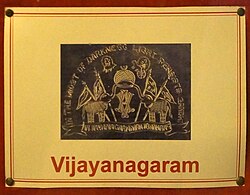
[[File:Vijayanagaram.JPG|thumb|Coat of Arms of Vijayanagaram]] | [[File:Vijayanagaram.JPG|thumb|Coat of Arms of Vijayanagaram]] | ||
[[File:Sisodia branches.jpg|thumb|Branches of the Sisodia Clan]] | [[File:Sisodia branches.jpg|thumb|Branches of the Sisodia Clan]] | ||
* | *Sitarama Raju{{Sfn|Richards|1978|p=55}} | ||
* | *Pusapati Amala Gajapati Raju (Founder) | ||
* | *Pusapati Rachi Gajapati Raju | ||
* | *Pusapati Tama Gajapati Raju | ||
* | *Viziaram Raju I (reigned 1710–1757){{Sfn|Frowde|1908|p=339}} | ||
*[[Pusapati Vijayarama Gajapati Raju | *Ananda Raju{{Sfn|Frowde|1908|p=340}} | ||
*Viziaram Raju II{{Sfn|Frowde|1908|p=340}} | |||
* | *Narayana Babu Raju{{Sfn|Frowde|1908|p=341}} | ||
*[[Pusapati | *Viziaram Raju III (Viziaram Gajapati Raju, reigned 1848–1878){{Sfn|Frowde|1908|p=341}}{{Sfn|Frenz|Berkemer|2006|p=1264}} | ||
*[[Pusapati Ananda Gajapati Raju|Ananda Gajapati Raju]] (reigned 1879–1897){{Sfn|Frowde|1908|p=341}}{{Sfn|Frenz|Berkemer|2006|p=1264}} | |||
*Raja Pusapati Viziaram Gajapati Raju{{Sfn|Frowde|1908|p=341}} | |||
*Alak Narayana Gajapati Raju<ref name=":0">{{Cite web |date=2002-08-05 |title=A socialist among princes |url=http://www.hindu.com/thehindu/thscrip/print.pl?file=2002080501120200.htm&date=2002%2F08%2F05%2F&prd=mp& |url-status=dead |archive-url=https://web.archive.org/web/20120925185348/http://www.hindu.com/thehindu/thscrip/print.pl?file=2002080501120200.htm&date=2002%2F08%2F05%2F&prd=mp& |archive-date=2012-09-25 |access-date=2023-07-15 |website=The Hindu}}</ref> | |||
*[[Pusapati Vijaya Rama Gajapati Raju|Pusapati Vijayarama Gajapati Raju]] (eldest son of Alak Narayana Gajapati Raju, reigned 1945–1995)<ref name=":0" /><ref name=":1">{{Cite web |date=2016-03-27 |title=Ananda Gajapathi Raju passes away |url=http://www.thehansindia.com/posts/index/Andhra-Pradesh/2016-03-27/Ananda-Gajapathi-Raju-passes-away/216633 |url-status=dead |archive-url=https://web.archive.org/web/20181029154005/http://www.thehansindia.com/posts/index/Andhra-Pradesh/2016-03-27/Ananda-Gajapathi-Raju-passes-away/216633 |archive-date=2018-10-29 |access-date=2023-07-15 |website=The Hans India}}</ref> | |||
*Pusapati Ananda Gajapati Raju (eldest son of Vijayarama Gajapati Raju, reigned 1995–2016)<ref name=":1" /><ref>{{Cite web |date=2016-03-26 |title=Anand Gajapathi Raju passes away |url=https://www.thehindu.com/news/cities/Visakhapatnam/Anand-Gajapathi-Raju-passes-away/article14176262.ece |url-status=dead |archive-url=https://web.archive.org/web/20211029033558/https://www.thehindu.com/news/cities/Visakhapatnam/Anand-Gajapathi-Raju-passes-away/article14176262.ece |archive-date=2021-10-29 |access-date=2023-07-15 |website=The Hindu}}</ref> | |||
*[[Pusapati Ashok Gajapati Raju]] (second son of Vijayarama Gajapati Raju, ascended in 2016)<ref>{{Cite web |date=2014-05-27 |title=Ashok Gajapathi Raju |url=https://www.business-standard.com/article/politics/ashok-gajapathi-raju-114052600980_1.html |access-date=2023-07-15 |website=Business Standard}}</ref><ref>{{Cite web |title=Ashok Gajapathi Raju Pusapati |url=https://www.oneindia.com/politicians/ashok-gajapathi-raju-pusapati-32436.html |access-date=2023-07-15 |website=OneIndia}}</ref> | |||
==Notable members== | ==Notable members== | ||
* [[P. S. Kumaraswamy Raja| | * [[P. S. Kumaraswamy Raja|P.S. Kumaraswamy Raja]] – Former chief minister of [[Madras State]] (1949–1952)<ref>{{Cite web |title=List of Chief Ministers of Tamil Nadu |url=https://www.oneindia.com/list-of-chief-ministers-of-tamil-nadu/ |access-date=2023-07-15 |website=OneIndia}}</ref> and governor of [[Odisha]] (1954–1956).<ref>{{Cite web |title=Odisha Governor List |url=https://www.oneindia.com/odisha-governors-list/ |access-date=2023-07-15 |website=OneIndia}}</ref> | ||
*[[ | *[[Maharajkumar of Vizianagram|Pusapati Vijaya Ananda Gajapathi Raju]] (also known as Maharajah of Vizianagram or Vizzy) – Former Indian cricketer,<ref>{{Cite web |title=Maharajah of Vizianagram Profile – Cricket Player India |url=https://www.espncricinfo.com/cricketers/maharajah-of-vizianagram-35930 |access-date=2023-07-15 |website=ESPN CricInfo}}</ref> politician,<ref>{{Cite web |title=1962 India General (3rd Lok Sabha) Election Results |url=https://www.elections.in/parliamentary-constituencies/1962-election-results.html |access-date=2023-07-15 |website=Elections.in, 5 Dots Partners}}</ref> and winner of the Padma Bhushan Award in Sports in 1958.<ref>{{Cite web |title=Padma Bhushan Award Winners |url=https://www.oneindia.com/padma-bhushan-award-winners-list/ |access-date=2023-07-15 |website=OneIndia}}</ref> | ||
*Pusapati Lakshmi Narasimha Raju, Politician and Founder of Cooperative Central Bank and many Cooperative Sugar Factories in North Andhra Pradesh. A freedom fighter, A member of the combined Madras Presidency Legislative Assembly, and a [[Constituent Assembly of India|Signatory to the Indian Constitution.]] | |||
*Pusapati Lakshmi Narasimha Raju (S/o Pusapati Lakshmi Narasimha Raju) Politician – two term member of legislative council in Andhra Pradesh, President of District Cooperative Bank, President of many Cooperative Sugar Factories, Secretary of MANSAS Educational Trust. | |||
*[[Pusapati Aditi Vijayalakshmi|Pusapati Aditi Vijayalakshmi Gajapathi Raju]] (born 1983) is an Indian politician from [[Andhra Pradesh]]. She is the daughter of former central minister [[Ashok Gajapathi Raju]], a Maharaja of Vizianagaram. She won the [[2024 Andhra Pradesh Legislative Assembly election]].<ref>{{Cite web |title=Vizianagaram Assembly Election Results 2024: Vizianagaram Election Candidates List, Election Date, Vote Share |url=https://www.indiatoday.in/elections/assembly/andhra-pradesh/vizianagaram-constituency-result-1018 |access-date=2024-12-11 |website=India Today |language=en}}</ref> | |||
== | ==Notes== | ||
{{reflist}} | {{reflist}} | ||
* {{citation | | == References == | ||
* {{citation |first= | * {{citation |first1=Sri Nilmani |last1=Senapati |first2=Dr. Nabin Kumar |last2=Sahu |title=Orissa District Gazetteers: Koraput |url=https://archive.org/details/dli.ministry.08556 |year=1966 |publisher=Orissa Government Press Cuttack}} | ||
* {{citation |first=Henry |last=Frowde |title=The Imperial Gazetteer of India, Volume XXIV, Travancore to Zira |url=https://dsal.uchicago.edu/reference/gazetteer/toc.html?volume=24 |year=1908 |publisher=Oxford at the Clarendon Press}} | |||
* {{Cite journal |last=Richards |first=J.F. |date=1978 |title=Mughal Retreat from Coastal Andhra |url=https://www.jstor.org/stable/25210918 |journal=The Journal of the Royal Asiatic Society of Great Britain and Ireland |volume=110 |issue=1 |pages=50–68 |doi=10.1017/S0035869X00134227 |jstor=25210918 |s2cid=154680334 |url-access=subscription }} | |||
* {{Cite journal |last1=Frenz |first1=Margret |last2=Berkemer |first2=Georg |date=April 1, 2006 |title=Colleges and Kings: Higher Education under Direct and Indirect Rule |url=https://www.rrcee.net/wp-content/uploads/2016/03/145_Colleges_and_Kings.pdf |journal=Economic and Political Weekly}} | |||
* {{Cite thesis |last=Satyanarayana |first=Kasimsetty |title=Gurazada: A Biographical Study |date=1997 |degree=PhD |publisher=University of North Bengal |url=https://ir.nbu.ac.in/handle/123456789/1212}} | |||
[[Category: | [[Category:Early modern history of India]] | ||
[[Category:Hindu dynasties]] | [[Category:Hindu dynasties]] | ||
[[Category:Telugu monarchs]] | [[Category:Telugu monarchs]] | ||
[[Category:Dynasties of India]] | [[Category:Dynasties of India]] | ||
[[Category: | [[Category:Former monarchies of India]] | ||
[[Category:Raju]] | [[Category:Raju]] | ||
[[Category:Surnames]] | [[Category:Surnames]] | ||
[[Category:Telugu-language surnames]] | [[Category:Telugu-language surnames]] | ||
[[Category:Social groups of Andhra Pradesh]] | [[Category:Social groups of Andhra Pradesh]] | ||
[[Category:Culture of Andhra Pradesh]] | [[Category:Culture of Andhra Pradesh]] | ||
[[Category:Kshatriya communities]] | [[Category:Kshatriya communities]] | ||
Latest revision as of 23:03, 1 March 2026
Poosapati / Pusapati was the ruling clan of the Vizianagaram estate.
History[edit | edit source]


The Pusapati clan claims descent from Madhavavarma, who led a Rajput colony into the Krishna Valley in the late 6th century.[1] The members of the colony subsequently held important positions at the court of Golcanda.[1]
The Pusapati chieftain Sitaram Chandra Raju received the villages of Kumili and Gundredu from Raghunath Krishna Dev of the Jeypore Estate.[2] Viziaram Raju was appointed as an administrative minister of the Jeypore Estate by Ram Chandra Dev I[3] and succeeded his father as the head of the clan in 1710.[1] Viziaram Raju occupied a portion of the coastal territories of the Jeypore Estate under Vishwambhar Dev II[4] and moved the capital of the estate from Potnuru to Vizianagaram in 1712; he named the capital town after himself.[1] Viziaram Raju prompted the neighboring landowners (zamindars) to secede and gain independence from the Jeypore Estate.[3] In 1757, Viziaram Raju formed an alliance with Marquis de Bussy-Castelnau, which allowed him to seize the capital of the rival landowner of Bobbili.[1]
Following Viziaram Raju, the Pusapati clan was led first by Ananda Raju and next by Viziaram Raju II, who was largely controlled by his half-brother Sitarama Raju.[5] In 1761, Sitarama Raju attacked Parlakhemundi defeating its force and their Maratha allies further adding territory to the Vizianagaram Estate.[5] In 1768, Viziaram Raju II claimed the right to hold and cultivate (patta) Kasipuram, Nandapur, Madgol, etc. with the support of and marking the increasing involvement of the British East India Company; this resulted in the dissatisfied landowners rising against Vizianagaram.[6] As Viziaram Raju II was unable to make the requisite revenue collection payments, he was ordered to leave the district.[7] He defied the orders, which resulted in the Battle of Padmanabham against the East India Company Madras Presidency forces led by Colonel Prendergast wherein Viziaram Raju II was defeated and slain.[8]
Following the Battle of Padmanabham, Narayana Babu Raju was unable to quell the increasing revolts from the hill landowners, which ultimately led to further reductions of the Vizianagaram Estate.[8] The successive chieftains Viziaram Gajapati Raju and Ananda Raju proved to be capable leaders and brought in a period of flourishing for the Vizianagaram Estate.[8]
The Pusapatis obtained the title of Gajapati after the battle of Nandapur.[9]
Pusapadu is a village in erstwhile Guntur district.
Pusapati rulers[edit | edit source]


- Sitarama Raju[10]
- Pusapati Amala Gajapati Raju (Founder)
- Pusapati Rachi Gajapati Raju
- Pusapati Tama Gajapati Raju
- Viziaram Raju I (reigned 1710–1757)[1]
- Ananda Raju[5]
- Viziaram Raju II[5]
- Narayana Babu Raju[8]
- Viziaram Raju III (Viziaram Gajapati Raju, reigned 1848–1878)[8][11]
- Ananda Gajapati Raju (reigned 1879–1897)[8][11]
- Raja Pusapati Viziaram Gajapati Raju[8]
- Alak Narayana Gajapati Raju[12]
- Pusapati Vijayarama Gajapati Raju (eldest son of Alak Narayana Gajapati Raju, reigned 1945–1995)[12][13]
- Pusapati Ananda Gajapati Raju (eldest son of Vijayarama Gajapati Raju, reigned 1995–2016)[13][14]
- Pusapati Ashok Gajapati Raju (second son of Vijayarama Gajapati Raju, ascended in 2016)[15][16]
Notable members[edit | edit source]
- P.S. Kumaraswamy Raja – Former chief minister of Madras State (1949–1952)[17] and governor of Odisha (1954–1956).[18]
- Pusapati Vijaya Ananda Gajapathi Raju (also known as Maharajah of Vizianagram or Vizzy) – Former Indian cricketer,[19] politician,[20] and winner of the Padma Bhushan Award in Sports in 1958.[21]
- Pusapati Lakshmi Narasimha Raju, Politician and Founder of Cooperative Central Bank and many Cooperative Sugar Factories in North Andhra Pradesh. A freedom fighter, A member of the combined Madras Presidency Legislative Assembly, and a Signatory to the Indian Constitution.
- Pusapati Lakshmi Narasimha Raju (S/o Pusapati Lakshmi Narasimha Raju) Politician – two term member of legislative council in Andhra Pradesh, President of District Cooperative Bank, President of many Cooperative Sugar Factories, Secretary of MANSAS Educational Trust.
- Pusapati Aditi Vijayalakshmi Gajapathi Raju (born 1983) is an Indian politician from Andhra Pradesh. She is the daughter of former central minister Ashok Gajapathi Raju, a Maharaja of Vizianagaram. She won the 2024 Andhra Pradesh Legislative Assembly election.[22]
Notes[edit | edit source]
- ↑ 1.0 1.1 1.2 1.3 1.4 1.5 Frowde 1908, p. 339.
- ↑ Senapati & Sahu 1966, p. 63.
- ↑ 3.0 3.1 Senapati & Sahu 1966, p. 66.
- ↑ Senapati & Sahu 1966, p. 67.
- ↑ 5.0 5.1 5.2 5.3 Frowde 1908, p. 340.
- ↑ Senapati & Sahu 1966, p. 69.
- ↑ Senapati & Sahu 1966, p. 70.
- ↑ 8.0 8.1 8.2 8.3 8.4 8.5 8.6 Frowde 1908, p. 341.
- ↑ Satyanarayana 1997, p. 48.
- ↑ Richards 1978, p. 55.
- ↑ 11.0 11.1 Frenz & Berkemer 2006, p. 1264.
- ↑ 12.0 12.1 "A socialist among princes". The Hindu. 5 August 2002. Archived from the original on 25 September 2012. Retrieved 15 July 2023.
- ↑ 13.0 13.1 "Ananda Gajapathi Raju passes away". The Hans India. 27 March 2016. Archived from the original on 29 October 2018. Retrieved 15 July 2023.
- ↑ "Anand Gajapathi Raju passes away". The Hindu. 26 March 2016. Archived from the original on 29 October 2021. Retrieved 15 July 2023.
- ↑ "Ashok Gajapathi Raju". Business Standard. 27 May 2014. Retrieved 15 July 2023.
- ↑ "Ashok Gajapathi Raju Pusapati". OneIndia. Retrieved 15 July 2023.
- ↑ "List of Chief Ministers of Tamil Nadu". OneIndia. Retrieved 15 July 2023.
- ↑ "Odisha Governor List". OneIndia. Retrieved 15 July 2023.
- ↑ "Maharajah of Vizianagram Profile – Cricket Player India". ESPN CricInfo. Retrieved 15 July 2023.
- ↑ "1962 India General (3rd Lok Sabha) Election Results". Elections.in, 5 Dots Partners. Retrieved 15 July 2023.
- ↑ "Padma Bhushan Award Winners". OneIndia. Retrieved 15 July 2023.
- ↑ "Vizianagaram Assembly Election Results 2024: Vizianagaram Election Candidates List, Election Date, Vote Share". India Today. Retrieved 11 December 2024.
References[edit | edit source]
- Senapati, Sri Nilmani; Sahu, Dr. Nabin Kumar (1966), Orissa District Gazetteers: Koraput, Orissa Government Press Cuttack
- Frowde, Henry (1908), The Imperial Gazetteer of India, Volume XXIV, Travancore to Zira, Oxford at the Clarendon Press
- Richards, J.F. (1978). "Mughal Retreat from Coastal Andhra". The Journal of the Royal Asiatic Society of Great Britain and Ireland. 110 (1): 50–68. doi:10.1017/S0035869X00134227. JSTOR 25210918. S2CID 154680334.
- Frenz, Margret; Berkemer, Georg (1 April 2006). "Colleges and Kings: Higher Education under Direct and Indirect Rule" (PDF). Economic and Political Weekly.
- Satyanarayana, Kasimsetty (1997). Gurazada: A Biographical Study (PhD thesis). University of North Bengal.