



Ajay Kumar (talk | contribs) Created a new article |
m small changes |
||
| Line 1: | Line 1: | ||
{{Short description|Genus of | {{Short description|Genus of coniferous trees}} | ||
{{ | {{good article}} | ||
{{redirect-several|Pine|Pines|Pine tree}} | |||
<!--Editors: [[pine]], [[pines]], and [[pine tree]] each redirect here. [[pinetree]] does _not_ redirect here--> | |||
{{Automatic_taxobox | {{Automatic_taxobox | ||
| name = | | name = | ||
| | | fossil_range = {{fossilrange|Barremian|Present|earliest=Jurassic}} Possible records from Jurassic<ref>{{cite journal |last=Anderson |first=J. M., H. M. |title=Palaeoflora of Southern Africa. Prodromus of South African Megafloras Devonian to Lower Cretaceous |journal=Botanical Research Institute |date=1985 |page= }}</ref> | ||
| image = Pinus | | image = Pinus jeffreyi at Lassen Volcanic National Park.jpg | ||
| image_caption = ''[[Pinus | | image_alt = Image of a pine tree | ||
| image_caption = ''[[Pinus jeffreyi]]'' | |||
| taxon = Pinus | | taxon = Pinus | ||
| authority = [[Carl Linnaeus|L.]] | | authority = [[Carl Linnaeus|L.]] | ||
| Line 11: | Line 14: | ||
| type_species_authority = [[L.]] | | type_species_authority = [[L.]] | ||
| subdivision_ranks = Subgenera | | subdivision_ranks = Subgenera | ||
| subdivision = | | subdivision = * Subgenus ''[[Strobus]]'' | ||
* Subgenus ''[[Strobus]]'' | |||
* Subgenus ''[[Pinus subg. Pinus|Pinus]]'' | * Subgenus ''[[Pinus subg. Pinus|Pinus]]'' | ||
See '''[[List of Pinus species|List of ''Pinus'' species]]''' for complete taxonomy to species level. See '''[[list of pines by region]]''' for list of species by geographic distribution. | See '''[[List of Pinus species|List of ''Pinus'' species]]''' for complete taxonomy to species level. See '''[[list of pines by region]]''' for list of species by geographic [[species distribution|distribution]]. | ||
| range_map = Pinus range.png | | range_map = Pinus range.png | ||
| range_map_caption = | | range_map_caption = ''Pinus'' distribution: circumpolar, with extensive [[taiga]] forest, almost entirely Northern hemisphere | ||
| synonyms = | | synonyms = * ''Apinus'' <small>de Necker ex Rydberg</small> | ||
* ''Apinus'' <small>de Necker ex Rydberg</small> | |||
* ''Caryopitys'' <small>Small</small> | * ''Caryopitys'' <small>Small</small> | ||
* ''Cembra'' <small>Opiz</small> | * ''Cembra'' <small>Opiz</small> | ||
| Line 28: | Line 29: | ||
}} | }} | ||
A '''pine''' is any [[conifer | A '''pine''' is any [[conifer]] in the [[genus]] '''''Pinus''''' ({{IPAc-en |ˈ|p|aɪ|.|n|ə|s}}<ref>{{cite encyclopedia |url=https://merriam-webster.com/medical/Pinus |entry=Pinus |encyclopedia=Merriam-Webster Medical Dictionary |title=Medical Definition of PINUS }}</ref>) of the family [[Pinaceae]]. ''Pinus'' is the sole genus in the [[subfamily]] '''Pinoideae'''. The species are [[evergreen]] [[tree]]s or shrubs with their leaves in [[Fascicle (botany)|bunches]], usually of 2 to 5 needles. The seeds are carried on woody cones, with two seeds to each cone scale. | ||
Pines are widely [[species distribution|distributed]] in the [[Northern Hemisphere]]; they occupy large areas of [[taiga]] (boreal forest), but are found in many habitats, including the [[Mediterranean Basin]], and [[Dry tropical forest|dry tropical forests]] in [[southeast Asia]] and [[Central America]]. Some are fire-resistant or fire-dependent.<!--lead is just a summary of article body, please do not introduce anything 'new' (or new citations) up here. Thanks--> | |||
Pine trees | Pine trees provide one of the most extensively used types of [[timber]]. The pine nuts are used to make dishes such as [[pesto]], while [[retsina]] wine is flavoured with pine resin.<!--lead is just a summary of article body, please do not introduce anything 'new' (or new citations) up here. Thanks--> | ||
== Description == | |||
=== Tree === | |||
{{ | Pine trees are evergreen, coniferous [[resin]]ous [[tree]]s (or, rarely, [[shrub]]s) growing {{convert|3|–|80|m|ft|abbr=off|-1}} tall, with the majority of species reaching {{convert|15|–|45|m|ft|abbr=on|-1}} tall.<ref name="Fattig-2011">{{cite news |url=http://www.mailtribune.com/apps/pbcs.dll/article?AID=/20110123/NEWS/101230353/ |title=Tallest of the tall |last=Fattig |first=Paul |date=23 January 2011 |newspaper=[[Mail Tribune]] |access-date=27 January 2011 |archive-url=https://web.archive.org/web/20120923095326/http://www.mailtribune.com/apps/pbcs.dll/article?AID=%2F20110123%2FNEWS%2F101230353%2F |archive-date=23 September 2012 }}</ref> The smallest are [[Siberian dwarf pine]] and [[Potosi pinyon]], and the tallest is an {{convert |83.45 |m |abbr=on}} tall [[sugar pine]] (''Pinus lambertiana'') located in [[Yosemite National Park]].<ref name="Associated Press-2021">{{cite news |title=3 Sierra sugar pines added to list of 6 biggest in world |newspaper=Associated Press |date=31 Jan 2021|url=https://apnews.com/article/nevada-forests-south-lake-tahoe-17501dc8cb094fc7ffb1543426631bc6 |access-date=13 Feb 2023}}</ref> | ||
| | |||
| | Pines are long lived and typically reach ages of 100–1,000 years, some even more. The longest-lived is the [[Great Basin bristlecone pine]] (''Pinus longaeva''). One individual in the [[White Mountains (California)|White Mountains]] of California, dubbed "[[Methuselah (pine tree)|Methuselah]]", is among the [[List of longest-living organisms|world's oldest living organisms]] at around 4,800 years old.<ref name="Ryan-1999">{{cite journal |last1=Ryan |first1=Michael |last2=Richardson |first2=David M. |title=The Complete Pine |journal=BioScience |date=December 1999 |volume=49 |issue=12 |pages=1023–1024 |doi=10.2307/1313736 |jstor=1313736}}</ref> [[Prometheus (tree)|An older tree]] near [[Wheeler Peak (Nevada)|Wheeler Peak]], now cut down, was dated at 4,900 years old.<ref>{{cite news |last=Miranda |first=Carolina A. |date=28 February 2015 |title=Follow-up: More tales of the Prometheus tree and how it died |url=https://www.latimes.com/entertainment/arts/miranda/la-et-cam-video-prometheus-bristlecone-pine-20150227-column.html |newspaper=[[Los Angeles Times]] |access-date=16 October 2020}}</ref><ref name="Eveleth-2012">{{cite magazine |last=Eveleth |first=Rose |author-link=Rose Eveleth |date=15 November 2012 |title=How One Man Accidentally Killed the Oldest Tree Ever |url=https://www.smithsonianmag.com/smart-news/how-one-man-accidentally-killed-the-oldest-tree-ever-125764872/ |magazine=[[Smithsonian (magazine)|Smithsonian]] |publisher=[[Smithsonian Institution]] |access-date=16 October 2020}}</ref> | ||
| | |||
| | The spirals of branches, needles, and [[Conifer cone|cone]] scales [[Phyllotaxis|are arranged]] in [[Fibonacci number]] ratios.<ref>{{cite journal |last1=Zeng |first1=Lanling |last2=Wang |first2=Guozhao |title=Modeling golden section in plants |journal=Progress in Natural Science |year=2009 |volume=19 |issue=2 |pages=255–260 |doi=10.1016/j.pnsc.2008.07.004 |quote=The ratio between two pine needles is 0.618 [...] the angle between the two neighbors is about 135° and the angle between the main stem and each branch is close to 34.4° which is the golden section of 90° |doi-access=free|bibcode=2009PNSMI..19..255Z }}</ref><ref>{{cite web |url=https://trees.stanford.edu/ENCYC/PINUSnotes.htm |title=Pinus (Pine) Notes |last1=Bracewell |first1=Ronald |last2=Rawlings |first2=John |website=Trees of Stanford |access-date=2 February 2020}}</ref> | ||
| | <gallery class=center mode=nolines widths=180 heights=180> | ||
| | File:Pinus lambertiana ProspectOR.jpg|''[[Pinus lambertiana]]'' is the tallest pine species.<!--<ref name="Associated Press-2021"/>--> | ||
File:Pinus culminicola.jpg|''[[Pinus culminicola]]'' is a low-growing shrub, among the shortest pines.<!--<ref name="Associated Press-2021"/>--> | |||
| | File:Big bristlecone pine Pinus longaeva.jpg|Ancient ''[[Pinus longaeva]]'', among the oldest of all trees<!--<ref name="Ryan-1999"/>--> | ||
| | </gallery> | ||
| | |||
=== Bark === | === Bark === | ||
The [[Bark (botany)|bark]] of most pines is thick and scaly, but some species have thin, flaky bark. | The [[Bark (botany)|bark]] of most pines is thick and scaly, but some species have thin, flaky bark. The branches are produced in "pseudo-whorls", actually a very tight spiral but appearing like a ring of branches arising from the same point. Many pines are uninodal, producing just one such whorl of branches each year, from [[bud]]s at the tip of the year's new [[plant stem|shoot]], but others are multinodal, producing two or more whorls of branches per year.<ref name="RHS-Dict-1992">{{cite book |title=Royal Horticultural Society Dictionary of Gardening |publisher=[[Macmillan Press]]; Stockton Press |date=1992 |isbn=1-56159-001-0 |volume=3 |pages=582–594}}</ref> | ||
<gallery class=center mode=nolines widths=180 heights=180> | |||
File:Tree Types and Barks 004.jpg|Many pines, like ''[[Pinus taeda]]'', have thick bark that flakes into scales. | |||
File:Pinus bungeana— bark at Morris Arboretum 01 (cropped).jpg|Some species, like ''[[Pinus bungeana]]'', have thin bark. | |||
</gallery> | |||
=== Foliage === | === Foliage === | ||
Pines have four types of [[leaf]]: | |||
Pines have four types of [[leaf]]:<ref name="RHS-Dict-1992"/> | |||
* Seed leaves ([[cotyledon]]s) on seedlings are borne in a whorl of 4–24. | * Seed leaves ([[cotyledon]]s) on seedlings are borne in a whorl of 4–24. | ||
* Juvenile leaves, which follow immediately on seedlings and young plants, are {{Convert|2–6|cm|abbr=off|frac=4}} long, single, green or often blue-green, and arranged spirally on the shoot. These are produced for six months to five years, rarely longer. | * Juvenile leaves, which follow immediately on seedlings and young plants, are {{Convert |2–6 |cm |abbr=off |frac=4}} long, single, green or often blue-green, and arranged spirally on the shoot. These are produced for six months to five years, rarely longer. | ||
* Scale leaves, similar to bud scales, are small, brown and not photosynthetic, and arranged spirally like the juvenile leaves. | * Scale leaves, similar to bud scales, are small, brown and not photosynthetic, and arranged spirally like the juvenile leaves. | ||
* Needles, the adult leaves, are green ([[photosynthetic]]) and bundled in clusters called fascicles. The needles can number from one to seven per fascicle, but generally number from two to five. Each fascicle is produced from a small bud on a dwarf shoot in the axil of a scale leaf. These bud scales often remain on the fascicle as a basal sheath. The needles persist for 1.5–40 years, depending on species. If a shoot's [[apical meristem|growing tip]] is damaged (e.g. eaten by an animal), the needle fascicles just below the damage | * Needles, the adult leaves, are green ([[photosynthetic]]) and bundled in clusters called [[Fascicle (botany)|fascicles]]. The needles can number from one to seven per fascicle, but generally number from two to five. Each fascicle is produced from a small bud on a dwarf shoot in the axil of a scale leaf. These bud scales often remain on the fascicle as a basal sheath. The needles persist for 1.5–40 years, depending on species. If a shoot's [[apical meristem|growing tip]] is damaged (e.g. eaten by an animal), the needle fascicles just below the damage generate a stem-producing bud, which can then replace the lost growth tip. | ||
<gallery class=center mode=nolines widths=180 heights=180> | |||
File:Seekiefer (Pinus halepensis) 14d 1.jpg|''[[Pinus halepensis]]'' seed leaf | |||
File:Spontaneous Pinus seedling D171003.jpg|Juvenile leaves of seedling<br/>''[[Pinus pinaster]]'', single and arranged spirally | |||
File:Scale leaves of Austrian pine.jpg|''[[Pinus nigra]]'' growth candles covered with thin brownish scale leaves | |||
File:Pine needles in bunches of five.jpg|''[[Pinus parviflora]]'' needles, in bunches of five in this species | |||
</gallery> | |||
=== Cones === | |||
Pines are [[monoecious]], having the male and female cones on the same tree.<ref name="Judd-2002">{{cite book |first1=W.S. |last1=Judd |first2=C.S. |last2=Campbell |first3=E.A. |last3=Kellogg |first4=P.F. |last4=Stevens |first5=M.J. |last5=Donoghue |date=2002 |title=Plant systematics, a phylogenetic approach |edition=2 |publisher=[[Sinauer Associates]] |isbn=0-87893-403-0 |page=205}}</ref> The male cones are small, typically 1–5 cm long, and only present for a short period (usually in spring, though autumn in a few pines), falling as soon as they have shed their [[pollen]]. The female cones take 1.5–3 years (depending on species) to mature after [[pollination]], with actual fertilisation delayed one year. At maturity, the female cones are 3–60 cm long. Each cone has numerous spirally-arranged scales, with two seeds on each fertile scale; the scales at the base and tip of the cone are small and sterile without seeds.<ref name="RHS-Dict-1992"/> | |||
The seeds ([[pine nut]]s) are mostly small and winged, and are [[Anemochory|anemochorous]] (wind-dispersed). Some are larger, have only a vestigial wing, and are [[bird]]-dispersed. Female cones are woody and sometimes armed to protect developing seeds from foragers. At maturity, the cones usually open to release the seeds. In some of the bird-dispersed species, for example [[whitebark pine]],<ref>{{cite journal |last=Tomback |first=Diana F. |author-link=Diana Tomback |date=June 1982 |title=Dispersal of Whitebark Pine seeds by Clark's Nutcracker: a mutualism hypothesis |journal=The Journal of Animal Ecology |volume=51 |issue=2 |pages=451–467 |doi=10.2307/3976 |jstor=3976 |bibcode=1982JAnEc..51..451T }}</ref> the seeds are only released by the bird breaking the cones open. In others, the seeds are stored in closed cones for many years until an environmental cue triggers the cones to open, releasing the seeds. This is called [[serotiny]]. The most common form of serotiny is [[pyriscence]], in which resin binds the cones shut until the resin is melted by a forest fire, for example in ''[[Pinus radiata|P. radiata]]'' and ''[[Pinus muricata|P. muricata]]''. The seeds are then released after the fire, enabling them to colonise the burnt ground with minimal competition from other plants.<ref name="RHS-Dict-1992"/><ref name="Rushforth-1987">{{cite book |last=Rushforth |first=Keith |year=1987 |title=Conifers |publisher=[[Christopher Helm Publishers]] |publication-place=London, England, UK |isbn=0-7470-2801-X |pages=158–192}}</ref> | |||
=== | <gallery class=center mode=nolines widths=180 heights=180> | ||
File:Pinus radiata cone.jpg|''[[Pinus radiata]]'' female (seed) cone | |||
File:2021-04-18 11 01 55 Pollen cones on a Loblolly Pine along a walking path in the Franklin Farm section of Oak Hill, Fairfax County, Virginia.jpg|''[[Pinus taeda]]'' male (pollen) cones | |||
File:KoreanPineSeeds.jpg|''[[Pinus koraiensis]]'' seeds | |||
File:Pitch pine cones exposed to fire.jpg|''[[Pinus rigida]]'' cones open when exposed to fire. (left to right: before; after; 24 hours later) | |||
</gallery> | |||
== Naming == | |||
}} | |||
The modern English name "pine" derives from Latin ''pinus'', traced to the Indo-European base ''*pīt-'' 'resin'.<ref>{{cite web |title=Where Are You From? - Credo Reference |url=http://www.credoreference.com/entry/acbwordorig/pine |work=credoreference.com}}</ref> Before the 19th century, pines were often called firs, a name now applied to another genus, ''[[Fir|Abies]]''. In some European languages, Germanic cognates of the Old Norse name are still in use for pines, as in [[Danish language|Danish]] ''fyr''<!--Swedish does have ''furu'' but usually it's ''tall'' nowadays--> and [[German language|German]] ''Föhre''.<ref>{{cite book |last1=Vedel |first1=Helge |last2=Lange |first2=Johan |title=Trees and Bushes in Wood and Hedgerow |date=1960 |publisher=[[Methuen Publishing|Methuen]] |pages=123–124}}</ref> | |||
The genus ''Pinus'' was named by [[Carl Linnaeus]] in 1753. ''[[Pinus sylvestris]]'', the Scots pine, was later chosen as the [[type species]].<ref>{{cite book |last=Linnaeus |first=Carolus |year=1753 |title=Species plantarum: exhibentes plantas rite cognitas, ad genera relatas, cum differentiis specificis, nominibus trivialibus, synonymis selectis, locis natalibus, secundum systema sexuale digestas. Tomus I & II. |publisher=Impensis Laurentii Salvii |page=1000}}</ref><ref>{{cite book |last1=Price |first1=R. A. |last2=Liston |first2=A. |last3=Strauss |first3=S. H. |year=1998 |chapter=Phylogeny and systematics of Pinus |pages=49–68 |editor-last=Richardson |editor-first=D. M. |title=Ecology and Biogeography of Pinus |publisher=[[Cambridge University Press]] |isbn=978-0-521-55176-2}}</ref> | |||
Several other conifers are commonly known as pines, such as the [[Araucaria heterophylla|Norfolk Island pine]] (''Araucaria heterophylla''); however, they belong to other genera.<ref>{{Cite web |title=Norfolk Island Pine – Gardening Solutions |url=https://gardeningsolutions.ifas.ufl.edu/plants/trees-and-shrubs/trees/norfolk-island-pine/ |access-date=28 January 2026}}</ref> | |||
== Evolution == | |||
=== Fossil history === | |||
The | The [[Pinaceae]], the pine family, first appeared in the [[Jurassic]] period.<ref>{{cite journal |last1=Ran |first1=Jin-Hua |last2=Shen |first2=Ting-Ting |last3=Wu |first3=Hui |last4=Gong |first4=Xun |last5=Wang |first5=Xiao-Quan |date=December 2018 |title=Phylogeny and evolutionary history of Pinaceae updated by transcriptomic analysis |journal=Molecular Phylogenetics and Evolution |volume=129 |pages=106–116 |doi=10.1016/j.ympev.2018.08.011 |pmid=30153503 |bibcode=2018MolPE.129..106R |s2cid=52110440}}</ref> The genus ''Pinus'' first appeared during the [[Early Cretaceous]]; the oldest verified fossil is ''[[Pinus yorkshirensis]]'' from the [[Hauterivian]]-[[Barremian]] boundary (~130-125 million years ago) from the [[Speeton Clay Formation|Speeton Clay]], England.<ref>{{cite journal |last1=Ryberg |first1=Patricia E. |last2=Rothwell |first2=Gar W. |last3=Stockey |first3=Ruth A. |last4=Hilton |first4=Jason |last5=Mapes |first5=Gene |last6=Riding |first6=James B. |year=2012 |title=Reconsidering Relationships among Stem and Crown Group Pinaceae: Oldest Record of the Genus ''Pinus'' from the Early Cretaceous of Yorkshire, United Kingdom |journal=International Journal of Plant Sciences |volume=173 |issue=8 |pages=917–932 |doi=10.1086/667228 |bibcode=2012IJPlS.173..917R |s2cid=85402168}}</ref> However, there are possible records of the genus from the [[Jurassic]].<ref>{{cite web |title=Ralikhomo tracksite (zone C/3) (Jurassic of Lesotho) |url=https://paleobiodb.org/classic/basicCollectionSearch?collection_no=149715&is_real_user=1 |website=PBDB.org}}</ref> | ||
== | <gallery class=center mode=nolines widths=220 heights=180> | ||
File:Pinus yorkshirensis holotype (straight).jpg|Oldest pine fossil: ''[[Pinus yorkshirensis]]'' cone. [[Early Cretaceous]], 131–129 [[Million years ago|mya]] | |||
File:Pinus johndayensis Fossil High School Cove Creek.jpg|Fossil cone and needles of ''Pinus johndayensis'', [[Oligocene]], 33 [[Million years ago|mya]] | |||
</gallery> | |||
=== External phylogeny === | |||
Based on [[transcriptome]] analysis, ''Pinus'' is most closely related to the genus ''[[Cathaya]]'', which in turn is closely related to the genus ''[[Picea]]'', the spruces. These genera, with [[fir]]s and [[larch]]es, form the pinoid [[clade]] of the Pinaceae.<ref name="Stull-2021"/> | |||
{{clade | |||
|label1=[[Pinaceae]] | |||
|1={{clade | |||
|label1=[[Abietoideae]] |sublabel1=(firs, cedars, hemlocks) | |||
|1=[[File:Abies alba - Köhler–s Medizinal-Pflanzen-001.jpg|60px]] | |||
|label2=[[Pinoideae]] | |||
|2={{clade | |||
|label1=Lariceae | |||
|1={{clade | |||
|label1=''[[Pseudotsuga]]'' |sublabel1=(Douglas firs) | |||
|1=[[File:Pinetum woburnense (Douglas firs, page 185).jpg|50px]] | |||
|label2=''[[Larix]]'' |sublabel2=(larches) | |||
|2=[[File:395 Larix europaea DC.jpg|60px]] | |||
}} | |||
|label2=Pineae | |||
|2={{clade | |||
|1={{clade | |||
|label1=''[[Cathaya]]'' |sublabel1=(1 sp.<!--no common name-->) | |||
|1=[[File:Cathaya argyrophylla leaves and cones.jpg|50px]] | |||
|label2=''[[Picea]]'' |sublabel2=(spruces) | |||
|2=[[File:Pinetum woburnense (Spruce, page 146) (cropped).jpg|50px]] | |||
}} | |||
|2='''''Pinus''''' [[File:496 Pinus silvestris.jpg|50px]] | |||
}} | |||
}} | |||
}} | |||
}} | |||
=== | === Internal phylogeny === | ||
The evolutionary history of the genus ''Pinus'' has been complicated by [[Hybrid (biology)| | The evolutionary history of the genus ''Pinus'' has been complicated by [[Hybrid (biology)|hybridisation]]. Pines are prone to inter-specific breeding. Wind pollination, long life spans, overlapping generations, large population size, and weak [[reproductive isolation]] make breeding across species more likely. As the pines have diversified, gene transfer between different species has created a complex history of genetic relatedness.<ref>{{cite journal |last1=Hernández-León |first1=Sergio |last2=Gernandt |first2=David S. |last3=Pérez de la Rosa |first3=Jorge A. |last4=Jardón-Barbolla |first4=Lev |date=30 July 2013 |title=Phylogenetic relationships and species delimitation in ''Pinus'' section ''Trifoliae'' inferred from plastid DNA |journal=PLOS ONE |volume=8 |issue=7 |article-number=e70501 |bibcode=2013PLoSO...870501H |doi=10.1371/journal.pone.0070501 |pmc=3728320 |pmid=23936218 |doi-access=free}}</ref><ref>{{cite journal |last1=Flores-Rentería |first1=Lluvia |last2=Wegier |first2=Ana |last3=Ortega Del Vecchyo |first3=Diego |last4=Ortíz-Medrano |first4=Alejandra |last5=Piñero |first5=Daniel |last6=Whipple |first6=Amy V. |last7=Molina-Freaner |first7=Francisco |last8=Domínguez |first8=César A. |display-authors=5 |title=Genetic, morphological, geographical and ecological approaches reveal phylogenetic relationships in complex groups, an example of recently diverged pinyon pine species (Subsection Cembroides) |journal=Molecular Phylogenetics and Evolution |volume=69 |issue=3 |pages=940–9 |date=December 2013 |pmid=23831459 |doi=10.1016/j.ympev.2013.06.010 |bibcode=2013MolPE..69..940F }}</ref> Research using large genetic datasets has clarified these relationships.<ref name="Gernandt-2005"/> Two 21st century phylogenies are given below; the differences between them demonstrate these complications: | ||
{| class="wikitable" | {|class="wikitable e mw-collapsible mw-collapsed" | ||
|- | |- | ||
! colspan=1 |Jin et al. 2021<ref>{{cite journal|title=Phylogenomic and ecological analyses reveal the spatiotemporal evolution of global pines| | ! colspan=1 |Jin et al. 2021<ref>{{cite journal |title=Phylogenomic and ecological analyses reveal the spatiotemporal evolution of global pines |last1=Jin |first1=Wei-Tao |last2=Gernandt |first2=David S. |last3=Wehenkel |first3=Christian |last4=Xia |first4=Xiao-Mei |last5=Wei |first5=Xiao-Xin |last6=Wang |first6=Xiao-Quan |journal=PNAS |date=May 2021 |doi=10.1073/pnas.2022302118 |volume=118 |issue=20 |article-number=e2022302118 |pmid=33941644 |pmc=8157994 |bibcode=2021PNAS..11822302J |doi-access=free}}</ref> | ||
! colspan=1 |Stull et al. 2021<ref name="Stull-2021"/> | |||
|- | |- | ||
| style="vertical-align:top| | |style="vertical-align:top | | ||
{{clade|style=font-size: | {{clade |style=font-size:85%;line-height:75% | ||
|label1=''Pinus'' | |label1=''Pinus'' | ||
|1={{clade | |1={{clade | ||
|label1= | |label1=('''''Strobus''''') | ||
|1={{clade | |1={{clade | ||
|label1=section | |||
|sublabel1=''Parrya'' | |||
|1={{clade | |||
|1={{clade | |1={{clade | ||
|label1=subsection | |||
|sublabel1=''Nelsonii'' | |||
|1=''[[Pinus nelsonii|P. nelsonii]]'' | |||
|label2=subsection | |||
|sublabel2=''Balfouriana'' | |||
|2={{clade | |||
|1=''[[Pinus aristata|P. aristata]]'' | |||
|2={{clade | |||
|1=''[[Pinus balfouriana|P. balfouriana]]'' | |||
|2=''[[Pinus longaeva|P. longaeva]]'' | |||
}} | |||
}} | |||
}} | |||
|2={{clade | |||
|label1=subsection | |||
|sublabel1=''Cembroides'' | |||
|1={{clade | |||
|1={{clade | |1={{clade | ||
| | |2=''[[Pinus rzedowskii|P. rzedowskii]]'' | ||
|1=''[[Pinus | |1={{clade | ||
| | |2=''[[Pinus maximartinezii|P. maximartinezii]]'' | ||
|1=''[[Pinus pinceana|P. pinceana]]'' | |||
}} | |||
}} | |||
|2={{clade | |||
|1={{clade | |||
|1=''[[Pinus quadrifolia|P. quadrifolia]]'' | |||
|2=''[[Pinus monophylla|P. monophylla]]'' | |||
}} | |||
|2={{clade | |||
|2={{clade | |2={{clade | ||
|1=''[[Pinus edulis|P. edulis]]'' | |||
|2=''[[Pinus cembroides|P. cembroides]]'' | |||
}} | |||
|1={{clade | |||
|2=''[[Pinus remota|P. remota]]'' | |||
|1={{clade | |||
|1=''[[Pinus culminicola|P. culminicola]]'' | |||
|2=''[[Pinus discolor|P. discolor]]'' | |||
}} | |||
}} | }} | ||
}} | |||
}} | |||
}} | |||
}} | |||
}} | |||
|label2=section | |||
|sublabel2=''Quinquefoliae'' | |||
|2={{clade | |||
|1={{clade | |||
|label1=subsection | |||
|sublabel1=''Gerardiana'' | |||
|1={{clade | |||
|1=''[[Pinus bungeana|P. bungeana]]'' | |||
|2={{clade | |2={{clade | ||
|1=''[[Pinus squamata|P. squamata]]'' | |||
|2=''[[Pinus gerardiana|P. gerardiana]]'' | |||
}} | |||
}} | |||
}} | |||
|2={{clade | |||
|label1=subsection | |||
|sublabel1=''Krempfii'' | |||
|1=''[[Pinus krempfii|P. krempfii]]'' | |||
|label2=subsection | |||
|sublabel2=''Strobus'' | |||
|2={{clade | |||
|1=''[[Pinus peuce|P. peuce]]'' | |||
|2={{clade | |||
|1={{clade | |||
|1=''[[Pinus lambertiana|P. lambertiana]]'' | |||
|2={{clade | |||
|1={{clade | |||
|1=''[[Pinus strobus|P. strobus]]'' | |||
|2=''[[Pinus chiapensis|P. chiapensis]]'' | |||
}} | |||
|2={{clade | |||
|1=''[[Pinus monticola|P. monticola]]'' | |||
|2={{clade | |2={{clade | ||
|1=''[[Pinus flexilis|P. flexilis]]'' | |||
|2={{clade | |||
|1=''[[Pinus strobiformis|P. strobiformis]]'' | |||
|2=''[[Pinus ayacahuite|P. ayacahuite]]'' | |||
}} | |||
}} | }} | ||
}} | |||
}} | }} | ||
}} | |||
|2={{clade | |||
|1={{clade | |1={{clade | ||
|1=''[[Pinus | |1=''[[Pinus albicaulis|P. albicaulis]]'' | ||
|2={{clade | |||
|1=''[[Pinus koraiensis|P. koraiensis]]'' | |||
|2={{clade | |2={{clade | ||
|1=''[[Pinus sibirica|P. sibirica]]'' | |||
|2=''[[Pinus cembra|P. cembra]]'' | |||
}} | }} | ||
}} | |||
}} | }} | ||
|2={{clade | |2={{clade | ||
|1=''[[Pinus | |1=''[[Pinus parviflora|P. parviflora]]'' | ||
|2={{clade | |||
|1=''[[Pinus wallichiana|P. wallichiana]]'' | |||
|2={{clade | |2={{clade | ||
|1={{clade | |||
|1={{clade | |1={{clade | ||
|2=''[[Pinus dabeshanensis|P. dabeshanensis]]'' | |||
|1=''[[Pinus armandii|P. armandii]]'' | |||
}} | |||
|2={{clade | |||
|1=''[[Pinus fenzeliana|P. fenzeliana]]'' | |||
|2=''[[Pinus mastersiana|P. mastersiana]]'' | |||
}} | |||
}} | |||
|2={{clade | |||
|1=''[[Pinus bhutanica|P. bhutanica]]'' | |||
|2={{clade | |2={{clade | ||
|1=''[[Pinus morrisonicola|P. morrisonicola]]'' | |||
|2={{clade | |||
|1=''[[Pinus wangii|P. wangii]]'' | |||
|2={{clade | |2={{clade | ||
|1=''[[Pinus kwangtungensis|P. kwangtungensis]]'' | |||
|2=''[[Pinus dalatensis|P. dalatensis]]'' | |||
}} | }} | ||
}} | |||
}} | }} | ||
}} | |||
}} | }} | ||
}} | |||
}} | }} | ||
}} | |||
}} | }} | ||
}} | |||
}} | }} | ||
|label2= | }} | ||
}} | |||
|label2=('''''Pinus''''') | |||
|2={{clade | |2={{clade | ||
|label1=section | |||
|sublabel1=''Pinus'' | |||
|1={{clade | |||
|label1=subsection | |||
|sublabel1=''Pinaster'' | |||
|1={{clade | |1={{clade | ||
| | |1=''[[Pinus heldreichii|P. heldreichii]]'' | ||
|1={{clade | |2={{clade | ||
|1=''[[Pinus | |1=''[[Pinus pinaster|P. pinaster]]'' | ||
|2={{clade | |||
|1={{clade | |||
|1=''[[Pinus halepensis|P. halepensis]]'' | |||
|2=''[[Pinus brutia|P. brutia]]'' | |||
}} | |||
|2={{clade | |||
|1=''[[Pinus pinea|P. pinea]]'' | |||
|2={{clade | |2={{clade | ||
|1=''[[Pinus canariensis|P. canariensis]]'' | |||
|2=''[[Pinus roxburghii|P. roxburghii]]'' | |||
}} | }} | ||
|label2=subsection ''Pinus'' | }} | ||
}} | |||
}} | |||
}} | |||
|label2=subsection | |||
|sublabel2=''Pinus'' | |||
|2={{clade | |||
|1={{clade | |||
|1=''[[Pinus latteri|P. latteri]]'' | |||
|2=''[[Pinus merkusii|P. merkusii]]'' | |||
}} | |||
|2={{clade | |||
|1=''[[Pinus resinosa|P. resinosa]]'' | |||
|2={{clade | |2={{clade | ||
|1=''[[Pinus nigra|P. nigra]]'' | |||
|2={{clade | |||
|1={{clade | |1={{clade | ||
|1=''[[Pinus | |1=''[[Pinus densiflora|P. densiflora]]'' | ||
|2=''[[Pinus | |2={{clade | ||
|1=''[[Pinus sylvestris|P. sylvestris]]'' | |||
|2={{clade | |||
|1=''[[Pinus mugo|P. mugo]]'' | |||
|2=''[[Pinus uncinata|P. uncinata]]'' | |||
}} | }} | ||
}} | |||
}} | |||
|2={{clade | |2={{clade | ||
|1=''[[Pinus | |1={{clade | ||
|1=''[[Pinus massoniana|P. massoniana]]'' | |||
|2={{clade | |2={{clade | ||
|1=''[[Pinus thunbergii|P. thunbergii]]'' | |||
|2=''[[Pinus luchuensis|P. luchuensis]]'' | |||
}} | |||
}} | |||
|2={{clade | |||
|1={{clade | |||
|1=''[[Pinus kesiya|P. kesiya]]'' | |||
|2={{clade | |||
|1=''[[Pinus yunnanensis|P. yunnanensis]]'' | |||
|2=''[[Pinus densata|P. densata]]'' | |||
}} | |||
}} | |||
|2={{clade | |||
|1={{clade | |||
|1=''[[Pinus henryi|P. henryi]]'' | |||
|2=''[[Pinus tabuliformis|P. tabuliformis]]'' | |||
}} | |||
|2={{clade | |||
|1=''[[Pinus hwangshanensis|P. hwangshanensis]]'' | |||
|2=''[[Pinus taiwanensis|P. taiwanensis]]'' | |||
}} | |||
}} | }} | ||
}} | |||
}} | }} | ||
}} | |||
}} | }} | ||
|label2=section ''Trifoliae'' | }} | ||
}} | |||
}} | |||
|label2=section | |||
|sublabel2=''Trifoliae'' | |||
|2={{clade | |||
|1={{clade | |||
|label1=subsection | |||
|sublabel1=''Sabiniana'' | |||
|1={{clade | |||
|1=''[[Pinus jeffreyi|P. jeffreyi]]'' | |||
|2={{clade | |||
|1=''[[Pinus coulteri|P. coulteri]]'' | |||
|2={{clade | |||
|1=''[[Pinus torreyana|P. torreyana]]'' | |||
|2=''[[Pinus sabiniana|P. sabiniana]]'' | |||
}} | |||
}} | |||
}} | |||
}} | |||
|2={{clade | |2={{clade | ||
|1={{clade | |||
|label1=subsection | |||
|sublabel1=''Ponderosae'' | |||
|1={{clade | |1={{clade | ||
| | |1={{clade | ||
|1={{clade | |1=''[[Pinus washoensis|P. washoensis]]'' | ||
|1=''[[Pinus | |2=''[[Pinus ponderosa|P. ponderosa]]'' | ||
}} | |||
|2={{clade | |||
|1=''[[Pinus hartwegii|P. hartwegii]]'' | |||
|2={{clade | |||
|1={{clade | |||
|1=''[[Pinus engelmannii|P. engelmannii]]'' | |||
|2={{clade | |||
|1=''[[Pinus durangensis|P. durangensis]]'' | |||
|2=''[[Pinus arizonica|P. arizonica]]'' | |||
}} | |||
}} | |||
|2={{clade | |||
|1={{clade | |||
|1=''[[Pinus devoniana|P. devoniana]]'' | |||
|2=''[[Pinus montezumae|P. montezumae]]'' | |||
}} | |||
|2={{clade | |2={{clade | ||
|1=''[[Pinus pseudostrobus|P. pseudostrobus]]'' | |||
|2={{clade | |||
|1=''[[Pinus gordoniana|P. gordoniana]]'' | |||
|2=''[[Pinus maximinoi|P. maximinoi]]'' | |||
}} | |||
}} | }} | ||
}} | |||
}} | |||
}} | |||
}} | |||
}} | |||
|2={{clade | |||
|1={{clade | |||
|label1=subsection | |||
|sublabel1=''Attenuata'' | |||
|1={{clade | |||
|2=''[[Pinus muricata|P. muricata]]'' | |||
|1={{clade | |||
|1=''[[Pinus radiata|P. radiata]]'' | |||
|2=''[[Pinus attenuata|P. attenuata]]'' | |||
}} | }} | ||
}} | |||
}} | |||
|2={{clade | |2={{clade | ||
|label1=subsection | |||
|sublabel1=''Contorta'' | |||
|1={{clade | |||
|1={{clade | |||
|1=''[[Pinus contorta|P. contorta]]'' | |||
|2=''[[Pinus banksiana|P. banksiana]]'' | |||
}} | |||
|2={{clade | |||
|1=''[[Pinus virginiana|P. virginiana]]'' | |||
|2=''[[Pinus clausa|P. clausa]]'' | |||
}} | |||
}} | |||
|label2=subsection | |||
|sublabel2=''Australes'' | |||
|2={{clade | |||
|1={{clade | |1={{clade | ||
| | |1=''[[Pinus pungens|P. pungens]]'' | ||
|2={{clade | |||
|1=''[[Pinus serotina|P. serotina]]'' | |||
|2=''[[Pinus rigida|P. rigida]]'' | |||
}} | |||
}} | |||
|2={{clade | |||
|1=''[[Pinus glabra|P. glabra]]'' | |||
|2={{clade | |||
|1={{clade | |1={{clade | ||
|1=''[[Pinus taeda|P. taeda]]'' | |||
|2=''[[Pinus echinata|P. echinata]]'' | |||
}} | |||
|2={{clade | |||
|1={{clade | |||
|1=''[[Pinus elliottii|P. elliottii]]'' | |||
|2=''[[Pinus palustris|P. palustris]]'' | |||
}} | |||
|2={{clade | |||
|1=''[[Pinus caribaea|P. caribaea]]'' | |||
|2={{clade | |2={{clade | ||
|1={{clade | |||
|1=''[[Pinus oocarpa|P. oocarpa]]'' | |||
|2=''[[Pinus tecunumanii|P. tecunumanii]]'' | |||
}} | |||
|2={{clade | |||
|1={{clade | |1={{clade | ||
|1=''[[Pinus | |1=''[[Pinus greggii|P. greggii]]'' | ||
|2=''[[Pinus | |2={{clade | ||
|1=''[[Pinus patula|P. patula]]'' | |||
|2=''[[Pinus teocote|P. teocote]]'' | |||
}} | |||
}} | }} | ||
|2={{clade | |2={{clade | ||
|1=''[[Pinus | |1={{clade | ||
|2=''[[Pinus | |1=''[[Pinus lawsonii|P. lawsonii]]'' | ||
|2={{clade | |||
|1=''[[Pinus herrerae|P. herrerae]]'' | |||
|2=''[[Pinus pringlei|P. pringlei]]'' | |||
}} | }} | ||
}} | |||
|2={{clade | |||
|1={{clade | |||
|1=''[[Pinus leiophylla|P. leiophylla]]'' | |||
|1 | |2=''[[Pinus lumholtzii|P. lumholtzii]]'' | ||
}} | }} | ||
|2={{clade | |2={{clade | ||
|1={{clade | |||
|1=''[[Pinus praetermissa|P. praetermissa]]'' | |||
|2=''[[Pinus jaliscana|P. jaliscana]]'' | |||
}} | |||
|2={{clade | |||
|1=''[[Pinus luzmariae|P. luzmariae]]'' | |||
|2=''[[Pinus georginae|P. georginae]]'' | |||
}} | |||
}} | }} | ||
}} | |||
}} | }} | ||
}} | |||
}} | }} | ||
}} | |||
}} | }} | ||
}} | |||
}} | }} | ||
}} | |||
}} | }} | ||
}} | |||
}} | }} | ||
}} | |||
}} | }} | ||
}} | |||
}} | }} | ||
| | | | ||
{{clade|style=font-size: | {{clade |style=font-size:85%;line-height:75% | ||
|label1='''''Pinus''''' | |label1='''''Pinus''''' | ||
|1={{clade | |1={{clade | ||
|label1=('''''Strobus''''') | |label1=('''''Strobus''''') | ||
|1={{clade | |1={{clade | ||
|label1=section | |||
|sublabel1='''''Parrya''''' | |||
|1={{clade | |||
|1={{clade | |1={{clade | ||
|label1=subsection | |||
|sublabel1=''Nelsonii'' | |||
|1=''[[Pinus nelsonii|P. nelsonii]]'' | |||
|label2=subsection | |||
|sublabel2=''Balfouriana'' | |||
|2={{clade | |||
|1=''[[Pinus aristata|P. aristata]]'' | |||
|2={{clade | |||
|1=''[[Pinus balfouriana|P. balfouriana]]'' | |||
|2=''[[Pinus longaeva|P. longaeva]]'' | |||
}} | |||
}} | |||
}} | |||
|2={{clade | |||
|label1=subsection | |||
|sublabel1=''Cembroides'' | |||
|1={{clade | |||
|1={{clade | |1={{clade | ||
| | |1=''[[Pinus monophylla|P. monophylla]]'' | ||
| | |2={{clade | ||
|1=''[[Pinus | |1=''[[Pinus juarezensis|P. juarezensis]]'' | ||
| | |2=''[[Pinus quadrifolia|P. quadrifolia]]'' | ||
| | }} | ||
}} | |||
|2={{clade | |||
|1={{clade | |||
|2=''[[Pinus maximartinezii|P. maximartinezii]]'' | |||
|1=''[[Pinus pinceana|P. pinceana]]'' | |||
}} | |||
|2={{clade | |||
|1=''[[Pinus rzedowskii|P. rzedowskii]]'' | |||
|2={{clade | |2={{clade | ||
|1=''[[Pinus | |1=''[[Pinus edulis|P. edulis]]'' | ||
|2={{clade | |||
|1={{clade | |||
|1=''[[Pinus discolor|P. discolor]]'' | |||
|2=''[[Pinus johannis|P. johannis]]'' | |||
}} | |||
|2={{clade | |2={{clade | ||
|1=''[[Pinus | |1=''[[Pinus culminicola|P. culminicola]]'' | ||
|2=''[[Pinus | |2={{clade | ||
|1=''[[Pinus cembroides|P. cembroides]]'' | |||
|2=''[[Pinus remota|P. remota]]'' | |||
}} | |||
}} | }} | ||
}} | |||
}} | }} | ||
}} | |||
}} | |||
}} | |||
}} | |||
}} | |||
|label2=section | |||
|sublabel2='''''Quinquefoliae''''' | |||
|2={{clade | |||
|1={{clade | |||
|label1=subsection | |||
|sublabel1=''Gerardiana'' | |||
|1={{clade | |||
|1=''[[Pinus bungeana|P. bungeana]]'' | |||
|2=''[[Pinus gerardiana|P. gerardiana]]'' | |||
}} | |||
}} | |||
|2={{clade | |||
|label1=subsection | |||
|sublabel1=''Krempfii'' | |||
|1=''[[Pinus krempfii|P. krempfii]]'' | |||
|label2=subsection | |||
|sublabel2=''Strobus'' | |||
|2={{clade | |||
|1={{clade | |||
|label1=series | |||
|sublabel1=''Macedonia'' | |||
|1=''[[Pinus peuce|P. peuce]]'' | |||
}} | |||
|2={{clade | |2={{clade | ||
|label1= | |1={{clade | ||
|sublabel1='' | |label1=series | ||
|sublabel1=''Strobi'' | |||
|1={{clade | |1={{clade | ||
|1={{clade | |1=''[[Pinus strobus|P. strobus]]'' | ||
|1=''[[Pinus | |2={{clade | ||
|1=''[[Pinus flexilis|P. flexilis]]'' | |||
|2={{clade | |||
|1=''[[Pinus ayacahuite|P. ayacahuite]]'' | |||
|2=''[[Pinus strobiformis|P. strobiformis]]'' | |||
}} | |||
}} | |||
}} | |||
}} | |||
|2={{clade | |||
|label1=series | |||
|sublabel1=''Cembrae'' | |||
|1={{clade | |||
|1=''[[Pinus parviflora|P. parviflora]]'' | |||
|2={{clade | |||
|1=''[[Pinus monticola|P. monticola]]'' | |||
|2={{clade | |||
|1=''[[Pinus cembra|P. cembra]]'' | |||
|2={{clade | |||
|1=''[[Pinus lambertiana|P. lambertiana]]'' | |||
|2={{clade | |2={{clade | ||
|1=''[[Pinus albicaulis|P. albicaulis]]'' | |||
|2=''[[Pinus dalatensis|P. dalatensis]]'' | |||
}} | }} | ||
}} | |||
}} | |||
}} | |||
}} | |||
|label2=series | |||
|sublabel2=''Pumilae'' | |||
|2={{clade | |||
|1=''[[Pinus pumila|P. pumila]]'' | |||
|2={{clade | |||
|1=''[[Pinus wallichiana|P. wallichiana]]'' | |||
|2={{clade | |2={{clade | ||
|1={{clade | |||
|1=''[[Pinus koraiensis|P. koraiensis]]'' | |||
|2=''[[Pinus sibirica|P. sibirica]]'' | |||
}} | |||
|2={{clade | |||
|1=''[[Pinus squamata|P. squamata]]'' | |||
|2={{clade | |2={{clade | ||
|1=''[[Pinus | |1=''[[Pinus morrisonicola|P. morrisonicola]]'' | ||
|2={{clade | |||
|1=''[[Pinus armandii|P. armandii]]'' | |||
|2={{clade | |2={{clade | ||
|1=''[[Pinus | |1=''[[Pinus fenzeliana|P. fenzeliana]]'' | ||
|2={{clade | |||
|1=''[[Pinus kwangtungensis|P. kwangtungensis]]'' | |||
|2={{clade | |2={{clade | ||
|1=''[[Pinus bhutanica|P. bhutanica]]'' | |||
|2=''[[Pinus wangii|P. wangii]]'' | |||
}} | }} | ||
}} | |||
}} | }} | ||
}} | |||
}} | }} | ||
}} | |||
}} | }} | ||
}} | |||
}} | }} | ||
}} | |||
}} | }} | ||
|label2=section | }} | ||
| | }} | ||
}} | |||
}} | |||
|label2=('''''Pinus''''') | |||
|2={{clade | |||
|label1=section | |||
|sublabel1=''Pinus'' | |||
|1={{clade | |||
|label1=subsection | |||
|sublabel1=''Pinaster'' | |||
|1={{clade | |||
|1=''[[Pinus heldreichii|P. heldreichii]]'' | |||
|2={{clade | |||
|1={{clade | |||
|1=''[[Pinus halepensis|P. halepensis]]'' | |||
|2=''[[Pinus brutia|P. brutia]]'' | |||
}} | |||
|2={{clade | |||
|1={{clade | |||
|1=''[[Pinus pinaster|P. pinaster]]'' | |||
|2=''[[Pinus pinea|P. pinea]]'' | |||
}} | |||
|2={{clade | |||
|1=''[[Pinus canariensis|P. canariensis]]'' | |||
|2=''[[Pinus roxburghii|P. roxburghii]]'' | |||
}} | |||
}} | |||
}} | |||
}} | |||
|label2=subsection | |||
|sublabel2=''Pinus'' | |||
|2={{clade | |2={{clade | ||
|1={{clade | |||
|label1=series | |||
|sublabel1=''Pinus'' | |||
|1={{clade | |1={{clade | ||
| | |1={{clade | ||
| | |1=''[[Pinus densata|P. densata]]'' | ||
|2={{clade | |||
|1=''[[Pinus latteri|P. latteri]]'' | |||
|2=''[[Pinus kesiya|P. kesiya]]'' | |||
}} | |||
}} | |||
|2={{clade | |||
|1={{clade | |1={{clade | ||
|1=''[[Pinus | |1=''[[Pinus nigra|P. nigra]]'' | ||
|2=''[[Pinus | |2=''[[Pinus resinosa|P. resinosa]]'' | ||
}} | |||
|2={{clade | |||
|1=''[[Pinus sylvestris|P. sylvestris]]'' | |||
|2={{clade | |||
|1=''[[Pinus mugo|P. mugo]]'' | |||
|2=''[[Pinus uncinata|P. uncinata]]'' | |||
}} | |||
}} | |||
}} | |||
}} | |||
}} | |||
|2={{clade | |||
|label1=series | |||
|sublabel1=''Tropicales'' | |||
|1={{clade | |||
|1=''[[Pinus tropicalis|P. tropicalis]]'' | |||
|2={{clade | |||
|1=''[[Pinus hwangshanensis|P. hwangshanensis]]'' | |||
|2={{clade | |||
|1=''[[Pinus massoniana|P. massoniana]]'' | |||
|2=''[[Pinus merkusii|P. merkusii]]'' | |||
}} | }} | ||
}} | |||
}} | |||
|label2=series | |||
|sublabel2=''Tabuliformes'' | |||
|2={{clade | |2={{clade | ||
|1=''[[Pinus densiflora|P. densiflora]]'' | |||
|2={{clade | |||
|1=''[[Pinus | |1={{clade | ||
|1=''[[Pinus thunbergii|P. thunbergii]]'' | |||
|2=''[[Pinus taiwanensis|P. taiwanensis]]'' | |||
}} | |||
|2={{clade | |2={{clade | ||
|1=''[[Pinus yunnanensis|P. yunnanensis]]'' | |||
|2={{clade | |||
|1=''[[Pinus luchuensis|P. luchuensis]]'' | |||
|2=''[[Pinus tabuliformis|P. tabuliformis]]'' | |||
}} | |||
}} | }} | ||
}} | |||
}} | }} | ||
}} | |||
}} | }} | ||
}} | |||
|label2=section | |||
|sublabel2=''Trifoliae'' | |||
|2={{clade | |||
|1={{clade | |1={{clade | ||
|label1=subsection | |||
|sublabel1=''Contorta'' | |||
|1={{clade | |||
|1=''[[Pinus virginiana|P. virginiana]]'' | |||
|2={{clade | |||
|1=''[[Pinus contorta|P. contorta]]'' | |||
|2=''[[Pinus clausa|P. clausa]]'' | |||
}} | |||
}} | |||
}} | |||
|2={{clade | |||
|1={{clade | |||
|label1=subsection | |label1=subsection | ||
|sublabel1='' | |sublabel1=''Ponderosae'' | ||
|1={{clade | |1={{clade | ||
|1=''[[Pinus | |1=''[[Pinus maximinoi|P. maximinoi]]'' | ||
|2={{clade | |||
|1=''[[Pinus montezumae|P. montezumae]]'' | |||
|2={{clade | |2={{clade | ||
|1={{clade | |||
|1=''[[Pinus sabiniana|P. sabiniana]]'' | |||
|2=''[[Pinus torreyana|P. torreyana]]'' | |||
}} | |||
|2={{clade | |||
|1=''[[Pinus ponderosa|P. ponderosa]]'' | |||
|2={{clade | |2={{clade | ||
|1={{clade | |||
|1=''[[Pinus gordoniana|P. gordoniana]]'' | |||
|2=''[[Pinus yecorensis|P. yecorensis]]'' | |||
}} | |||
|2={{clade | |||
|1=''[[Pinus cooperi|P. cooperi]]'' | |||
|2={{clade | |2={{clade | ||
|1=''[[Pinus durangensis|P. durangensis]]'' | |||
|2={{clade | |||
|1=''[[Pinus nubicola|P. nubicola]]'' | |||
|1=''[[Pinus | |||
|2={{clade | |2={{clade | ||
|1=''[[Pinus coulteri|P. coulteri]]'' | |||
|2={{clade | |||
|1={{clade | |||
|1=''[[Pinus jeffreyi|P. jeffreyi]]'' | |||
|2=''[[Pinus washoensis|P. washoensis]]'' | |||
}} | }} | ||
|2={{clade | |2={{clade | ||
|1=''[[Pinus | |1=''[[Pinus arizonica|P. arizonica]]'' | ||
|2=''[[Pinus | |2={{clade | ||
|1=''[[Pinus engelmannii|P. engelmannii]]'' | |||
|2={{clade | |||
|1=''[[Pinus devoniana|P. devoniana]]'' | |||
|2={{clade | |||
|1=''[[Pinus hartwegii|P. hartwegii]]'' | |||
|2=''[[Pinus pseudostrobus|P. pseudostrobus]]'' | |||
}} | |||
}} | }} | ||
}} | |||
}} | }} | ||
}} | |||
}} | }} | ||
}} | |||
}} | }} | ||
}} | |||
}} | }} | ||
}} | |||
}} | |||
}} | |||
}} | |||
}} | |||
|2={{clade | |||
|label1=subsection | |||
|sublabel1=''Attenuata'' | |||
|1={{clade | |||
|label1=series | |||
|sublabel1=''Leiophyllae'' | |||
|1={{clade | |||
|1=''[[Pinus patula|P. patula]]'' | |||
|2=''[[Pinus leiophylla|P. leiophylla]]'' | |||
}} | |||
|label2=series | |||
|sublabel2=''Attenuatae'' | |||
|2={{clade | |||
|1=''[[Pinus tecunumanii|P. tecunumanii]]'' | |||
|2={{clade | |2={{clade | ||
|1=''[[Pinus muricata|P. muricata]]'' | |||
|2={{clade | |||
|1=''[[Pinus radiata|P. radiata]]'' | |||
|2={{clade | |2={{clade | ||
|1=''[[Pinus attenuata|P. attenuata]]'' | |||
|2=''[[Pinus glabra|P. glabra]]'' | |||
}} | }} | ||
}} | |||
}} | }} | ||
}} | |||
}} | }} | ||
|label2=subsection | |||
|sublabel2=''Australes'' | |||
|2={{clade | |||
|1={{clade | |||
|label1= | |label1=series | ||
|sublabel1='' | |sublabel1=''Palustres'' | ||
|1={{clade | |1={{clade | ||
|1=''[[Pinus | |1=''[[Pinus herrerae|P. herrerae]]'' | ||
|2={{clade | |||
|1=''[[Pinus caribaea|P. caribaea]]'' | |||
|2={{clade | |2={{clade | ||
|1=''[[Pinus | |1=''[[Pinus palustris|P. palustris]]'' | ||
|2=''[[Pinus | |2={{clade | ||
|1=''[[Pinus echinata|P. echinata]]'' | |||
|2=''[[Pinus occidentalis|P. occidentalis]]'' | |||
}} | |||
}} | }} | ||
}} | |||
}} | }} | ||
}} | |||
|2={{clade | |||
|1=''[[Pinus praetermissa|P. praetermissa]]'' | |||
|2={{clade | |||
|label1=series | |||
|sublabel1=''Taeda'' | |||
|1={{clade | |||
|1=''[[Pinus serotina|P. serotina]]'' | |||
|2={{clade | |||
|1=''[[Pinus rigida|P. rigida]]'' | |||
|2={{clade | |||
|1=''[[Pinus pungens|P. pungens]]'' | |||
|2=''[[Pinus taeda|P. taeda]]'' | |||
}} | |||
}} | }} | ||
}} | |||
|label2=series | |||
|sublabel2=''Oocarpae'' | |||
|2={{clade | |||
|1=''[[Pinus elliottii|P. elliottii]]'' | |||
|2={{clade | |||
|1={{clade | |||
|1=''[[Pinus teocote|P. teocote]]'' | |||
|2={{clade | |2={{clade | ||
|1=''[[Pinus greggii|P. greggii]]'' | |||
|2=''[[Pinus lumholtzii|P. lumholtzii]]'' | |||
}} | }} | ||
}} | |||
|2={{clade | |||
|1=''[[Pinus jaliscana|P. jaliscana]]'' | |||
|1 | |||
|2={{clade | |2={{clade | ||
|1=''[[Pinus | |1=''[[Pinus luzmariae|P. luzmariae]]'' | ||
|2={{clade | |||
|1=''[[Pinus georginae|P. georginae]]'' | |||
|2={{clade | |2={{clade | ||
|1=''[[Pinus maestrensis|P. maestrensis]]'' | |||
|2={{clade | |||
|1=''[[Pinus pringlei|P. pringlei]]'' | |||
|2={{clade | |2={{clade | ||
|1=''[[Pinus lawsonii|P. lawsonii]]'' | |||
|2={{clade | |||
|1=''[[Pinus cubensis|P. cubensis]]'' | |||
|2=''[[Pinus oocarpa|P. oocarpa]]'' | |||
}} | |||
}} | }} | ||
}} | |||
}} | }} | ||
}} | |||
}} | }} | ||
}} | |||
}} | }} | ||
}} | |||
}} | }} | ||
}} | |||
}} | }} | ||
}} | |||
}} | }} | ||
}} | |||
}} | }} | ||
}} | |||
}} | }} | ||
|} | |} | ||
== | === Taxonomy === | ||
{{ | {{Main list|List of Pinus species | ||
Pines are native to the [[Northern Hemisphere]], and | | l1 = List of ''Pinus'' species | ||
}} | |||
Pines are [[gymnosperm]]s. The genus is divided into two subgenera based on the number of [[Vascular bundle|fibrovascular bundles]] in the needle, and the presence or absence of a resin seal on the scales of the mature cones before opening. The subgenera can be distinguished by cone, seed, and leaf characters:<ref name="RHS-Dict-1992"/> | |||
* [[Pinus subg. Pinus|''Pinus'' subg. ''Pinus'']], the yellow, or hard pine group, with cones with a resin seal on the scales, and generally with harder wood; the needle fascicles mostly have a persistent sheath (two exceptions, ''[[Pinus leiophylla]]'' and ''[[Pinus lumholtzii]]'', have deciduous sheaths).<ref name="RHS-Dict-1992"/> | |||
* [[Strobus|''Pinus'' subg. ''Strobus'']], [[synonym (biology)|syn.]] ''Pinus'' subg. ''Ducampopinus'', the white or soft pine, and pinyon pine groups, with cones without a resin seal on the scales, and usually have softer wood; the needle fascicles mostly have a deciduous sheath (one exception, ''[[Pinus nelsonii]]'', has a persistent sheath).<ref name="RHS-Dict-1992"/> | |||
Phylogenetic evidence indicates that the subgenera diverged anciently from one another.<ref name="Stull-2021">{{cite journal |last1=Stull |first1=Gregory W. |last2=Qu |first2=Xiao-Jian |last3=Parins-Fukuchi |first3=Caroline |last4=Yang |first4=Ying-Ying |last5=Yang |first5=Jun-Bo |last6=Yang |first6=Zhi-Yun |last7=Hu |first7=Yi |last8=Ma |first8=Hong |last9=Soltis |first9=Pamela S. |last10=Soltis |first10=Douglas E. |last11=Li |first11=De-Zhu |display-authors=5 |date=19 July 2021 |title=Gene duplications and phylogenomic conflict underlie major pulses of phenotypic evolution in gymnosperms |url=https://www.nature.com/articles/s41477-021-00964-4 |journal=Nature Plants |volume=7 |issue=8 |pages=1015–1025 |doi=10.1038/s41477-021-00964-4 |pmid=34282286 |bibcode=2021NatPl...7.1015S |s2cid=236141481 |issn=2055-0278 |access-date=10 January 2022 |archive-date=10 January 2022 |archive-url=https://web.archive.org/web/20220110174725/https://www.nature.com/articles/s41477-021-00964-4/ |url-status=live|url-access=subscription }}</ref> Each subgenus is further divided into sections and subsections.<ref name="Gernandt-2005">{{cite journal |last1=Gernandt |first1=David S. |last2=López |first2=Gretel Geada |last3=García |first3=Sol Ortiz |last4=Liston |first4=Aaron |title=Phylogeny and classification of Pinus |journal=Taxon |volume=54 |issue=1 |date=2005 |doi=10.2307/25065300 |doi-access=free |pages=29–42 |jstor=25065300 |bibcode=2005Taxon..54...29G |url=https://rc.upr.edu.cu/jspui/bitstream/DICT/2586/1/Geada-LopezTAXON2005.pdf}}</ref> | |||
''[[World Flora Online]]'' accepts 134 species-rank taxa (119 species and 15 [[nothospecies]]) of pines as current, with additional synonyms,<ref name="World Flora Online-2022">{{cite web |title=''Pinus'' (L.) |url=https://worldfloraonline.org/taxon/wfo-4000029794 |date=2022 |website=[[World Flora Online]] |access-date=14 August 2022}}</ref> and ''[[Plants of the World Online]]'' 126 species-rank taxa (113 species and 13 nothospecies),<ref name="Plants of the World Online-2013">{{cite web | title=Plants of the World Online | website=Plants of the World Online |date=14 October 2013 |url=https://powo.science.kew.org/taxon/urn%3Alsid%3Aipni.org%3Anames%3A328247-2 | access-date=20 January 2025}}</ref> making it the largest genus among the conifers. The highest species diversity of pines is found in Mexico.<ref>{{cite web |last1=Wehenkel |first1=C. |last2=Mariscal-Lucero |first2=S. |last3=Jaramillo-Correa |first3=J.P. |last4=López-Sánchez |first4=C.A. |title=Genetic diversity and conservation of Mexican forest trees |url=https://research.fs.usda.gov/treesearch/55167#:~:text=The%20highest%20diversity%20of%20pine,exists%20in%20Mexican%20tree%20species. |website=Forest Service |publisher=[[US Department of Agriculture]] |access-date=1 November 2024}}</ref><ref>{{cite journal |title=Biodiversity of Pinus (Pinaceae) in Mexico: speciation and palaeo-endemism |journal=[[Botanical Journal of the Linnean Society]] |date=1996 |volume=121 |issue=4 |pages=365–384 |doi=10.1111/j.1095-8339.1996.tb00762.x |url=https://academic.oup.com/botlinnean/article-abstract/121/4/365/2607921?redirectedFrom=fulltext |access-date=1 November 2024 |last1=Farjon |first1=Aljos |bibcode=1996BJLS..121..365F }}</ref><ref>{{cite journal |last1=Romero-Sanchez |first1=Martin Enrique |last2=Perez-Miranda |first2=Ramiro |last3=Gonzalez-Hernandez |first3=Antonio |last4=Valerio Velasco-Garcia |first4=Mario |last5=Velasco-Bautista |first5=Efraín |last6=Andrés |first6=Flores |title=Current and Potential Spatial Distribution of Six Endangered Pine Species of Mexico: Towards a Conservation Strategy |journal=Forests |date=2018 |volume=9 |issue=12 |page=767 |doi=10.3390/f9120767 |bibcode=2018Fore....9..767R |doi-access=free }}</ref> | |||
== Distribution == | |||
{{see also|List of pines by region}} | |||
Pines are native to the [[Northern Hemisphere]], with the most species in North America, some in Asia, and a few in Europe. Only two species, ''Pinus sylvestris'' and ''[[Pinus sibirica]]'', occur in more than one of those regions (Asia and Europe).<ref name="Nobis-2012">{{cite journal |last1=Nobis |first1=Michael P. |last2=Traiser |first2=Christopher |last3=Roth-Nebelsick |first3=Anita |title=Latitudinal variation in morphological traits of the genus Pinus and its relation to environmental and phylogenetic signals |journal=Plant Ecology & Diversity |volume=5 |issue=1 |date=1 March 2012 |doi=10.1080/17550874.2012.687501 |url=https://www.researchgate.net/publication/239793366_Latitudinal_variation_in_morphological_traits_of_the_genus_Pinus_and_its_relation_to_environmental_and_phylogenetic_signals/download?_tp=eyJjb250ZXh0Ijp7ImZpcnN0UGFnZSI6Il9kaXJlY3QiLCJwYWdlIjoiX2RpcmVjdCJ9fQ <!--NOT redundant to DOI--> |pages=1–11 |bibcode=2012PlEcD...5....1N }}</ref> They occupy large areas of [[boreal forest]] (taiga) in latitudes between 50° and 60° N; about a third of this [[biome]] is in North America and [[Scandinavia]], the rest in [[Siberia]].<ref name="UCMP">{{cite web |url=http://www.ucmp.berkeley.edu/exhibits/biomes/forests.php#boreal |title=The forest biome |publisher=[[University of California Museum of Paleontology]] |access-date=12 May 2019 |archive-url=https://web.archive.org/web/20190620145416/https://ucmp.berkeley.edu/exhibits/biomes/forests.php#boreal |archive-date=20 June 2019 }}</ref> The northernmost species is [[Pinus sylvestris|Scots pine]], reaching just north of 70° N in [[Stabbursdalen National Park]] in Norway.<ref name="Stabbursdalen Nasjonalpark">{{cite web |title=Stabbursdalen Nasjonalpark |url=https://www.miljodirektoratet.no/globalassets/dokumenter/publikasjoner/brosjyrer/stabbursdalen_np_e_nett-110811.pdf |access-date=20 January 2025}}</ref> One species, ''[[Pinus merkusii]]'', crosses the equator in [[Sumatra]] to 2°S.<ref name="Critchfield-1966">{{cite book |last1=Critchfield |first1=William B. |last2=Little |first2=Elbert L. |title=Geographic Distribution of the Pines of the World |date=1966 |publisher=[[USDA Forest Service]]}}</ref> In North America, various species occur in regions at latitudes from as far north as 66° N<ref name="Critchfield-1966"/> to as far south as 12°N.<ref>{{cite journal |last1=Singh |first1=Surendra P. |last2=Inderjit |last3=Singh |first3=Jamuna S. |last4=Majumdar |first4=Sudipto |last5=Moyano |first5=Jaime |last6=Nuñez |first6=Martin A. |last7=Richardson |first7=David M. |date=21 September 2018 |title=Insights on the persistence of pines (''Pinus'' species) in the Late Cretaceous and their increasing dominance in the Anthropocene |journal=Ecology and Evolution |volume=8 |issue=20 |pages=10345–10359 |doi=10.1002/ece3.4499 |doi-access=free |pmc=6206191 |pmid=30398478 |bibcode=2018EcoEv...810345S |bibcode-access=free }}</ref> | |||
Various species have been introduced to temperate and [[subtropics|subtropical]] regions of both hemispheres, where they are grown as [[timber]] or cultivated as ornamental plants in parks and gardens. A number of such introduced species have become [[naturalisation (biology)|naturalised]], and species such as ''[[Pinus radiata]]'' are considered [[invasive species|invasive]] in some regions.<ref name="Global Invasive Species Database-2006">{{cite web |url=http://www.issg.org/database/species/impact_info.asp?si=890&fr=1&sts=sss&lang=EN |title=''Pinus ssp''. (tree), General Impact |publisher=Invasive Species Specialist Group |date=13 March 2006 |work=Global Invasive Species Database |access-date=2 March 2011 |archive-url=https://web.archive.org/web/20110726195335/http://www.issg.org/database/species/impact_info.asp?si=890&fr=1&sts=sss&lang=EN |archive-date=26 July 2011 }}</ref> | |||
<gallery class=center mode=nolines widths=220 heights=180> | |||
File:Pinus sylvestris - Furu Stabbursdalen.jpg|Most northerly: ''[[Pinus sylvestris]]'' in [[Stabbursdalen National Park]], Norway, at 70° North | |||
File:Lake Baikal, Siberian mixed forest, Taiga, Siberia, Russia.jpg|Pines and [[birch]]es in the Siberian [[taiga]] by [[Lake Baikal]] | |||
File:Pines plant.jpg|''[[Pinus merkusii]]'' in [[Sumatra]]: the only pine whose range extends south of the equator | |||
File:Prospectsydneypineforest.jpg|''[[Pinus radiata]]'' in Australia, where it was [[Introduced species|introduced]] in the late 19th century. | |||
</gallery> | |||
== Ecology == | == Ecology == | ||
Pines grow | === Environmental factors === | ||
Pines grow in a very large variety of environments, ranging from semi-arid desert to rainforests, from sea level up to {{convert |5200 |m |ft |abbr=on}}, from the coldest to the hottest environments on Earth. They often occur in mountainous areas with favourable soils.<ref>{{cite web |url=https://basicbiology.net/plants/gymnosperms/pine-trees |date=30 August 2020 |title=Pine Trees |website=Basic Biology |access-date=31 October 2019}}</ref> | |||
''[[Pinus contorta]]'' is a [[Fire ecology|fire-dependent species]], requiring [[wildfire]]s to maintain healthy populations of diverse ages.<ref name="Schoennagel-2004">{{cite journal |last1=Schoennagel |first1=Tania |author1-link=Tania Schoennagel |last2=Veblen |first2=Thomas |title=The Interaction of Fire, Fuels and Climate across Rocky Mountain Forests |journal=BioScience |volume=54 |issue=7 |year=2004 |pages=661–676 |doi=10.1641/0006-3568(2004)054[0661:TIOFFA]2.0.CO;2 |doi-access=free}}</ref> | |||
''[[Pinus canariensis]]'' is highly fire-resistant,<ref>{{cite web |date=9 January 2017 |title=The most fire-resistant pine in the world |url=https://www.forest-monitor.com/en/most-fire-resistant-pine-pinus-canariensis/ |access-date=23 September 2022 |website=Forest Monitor}}</ref> with adaptations such as growing epicormic sprouts after losing its needles in a fire.<ref>{{cite journal |last1=Clarke |first1=P. J. |last2=Lawes |first2=M. J. |last3=Midgley |first3=J. J. |last4=Lamont |first4=B. B. |last5=Ojeda |first5=F. |last6=Burrows |first6=G. E. |last7=Enright |first7=N. J. |last8=Knox |first8=K. J. E. |display-authors=5 |date=January 2013 |title=Resprouting as a key functional trait: how buds, protection and resources drive persistence after fire |journal=[[New Phytologist]] |volume=197 |issue=1 |pages=19–35 |doi=10.1111/nph.12001 |pmid=23110592 |bibcode=2013NewPh.197...19C |doi-access=free}}</ref> Some species such as ''[[Pinus muricata]]'' need fire to open their cones, allowing them to disperse their seeds.<ref name="Block, Andrew-2008">{{cite book |last1=Moore |first2=Gerry |last2=Kershner, Bruce |author3=Craig Tufts |author4=Daniel Mathews |author5=Gil Nelson |author6=Spellenberg, Richard |author7=Thieret, John W. |author8=Terry Purinton |author9=Block, Andrew |display-authors=5 |title=National Wildlife Federation Field Guide to Trees of North America |publisher=Sterling |year=2008 |page=90 |isbn=978-1-4027-3875-3}}</ref> Other pines such as ''[[Pinus mugo]]''<ref name="Solár-2013">{{cite journal |last1=Solár |first1=Jaroslav |last2=Janiga |first2=Marián |title=Long-term Changes in Dwarf Pine ( Pinus mugo ) Cover in the High Tatra Mountains, Slovakia |journal=Mountain Research and Development |volume=33 |issue=1 |date=2013 |doi=10.1659/MRD-JOURNAL-D-12-00079.1 |doi-access=free |pages=51–62 |bibcode=2013MRDev..33...51S |url=https://bioone.org/journals/mountain-research-and-development/volume-33/issue-1/MRD-JOURNAL-D-12-00079.1/Long-term-Changes-in-Dwarf-Pine-Pinus-mugo-Cover-in/10.1659/MRD-JOURNAL-D-12-00079.1.pdf}}</ref> and ''[[Pinus yunnanensis]]'' can grow at high elevation.<ref name="Sun-2020">{{cite journal |last1=Sun |first1=Yan-Qiang |last2=Zhao |first2=Wei |last3=Xu |first3=Chao-Qun |last4=Xu |first4=Yulan |last5=El-Kassaby |first5=Yousry A. |last6=De La Torre |first6=Amanda R. |last7=Mao |first7=Jian-Feng |title=Genetic Variation Related to High Elevation Adaptation Revealed by Common Garden Experiments in Pinus yunnanensis |journal=Frontiers in Genetics |volume=10 |date=11 February 2020 |article-number=1405 |pmid=32117429 |pmc=7027398 |doi=10.3389/fgene.2019.01405 |doi-access=free}}</ref> Some pines, such as ''[[Pinus sabiniana]]'', are adapted to growth in hot, dry [[desert|semidesert]] climates.<ref>{{cite web |title=Pinus sabiniana Dougl |url=https://www.srs.fs.usda.gov/pubs/misc/ag_654/volume_1/pinus/sabiniana.htm |access-date=4 May 2022 |website=www.srs.fs.usda.gov}}</ref> | |||
<gallery class=center mode=nolines widths=180 heights=180> | |||
File:Бор кривул 01.JPG|''[[Pinus mugo]]'', a dwarf mountain species at altitude in Macedonia | |||
File:Prescribed burn in a Pinus nigra stand in Portugal.JPG|A controlled burn in a ''[[Pinus nigra]]'' stand, Portugal | |||
File:Lodgepole pine Yellowstone 1998 near firehole.jpg|A stand of ''[[Pinus contorta]]'' regenerating 10 years after a major fire at [[Yellowstone National Park]] | |||
</gallery> | |||
=== Species interactions === | |||
Pine | Pine needles serve as food for the [[caterpillar]] larvae of several [[moth]] species including the [[pine beauty]], a pest of mature stands of pine trees,<ref>{{cite journal |last1=Hicks |first1=B. J. |last2=Barbour |first2=D. A. |last3=Evans |first3=H. F. |last4=Heritage |first4=S. |last5=Leather |first5=S. R. |last6=Milne |first6=R. |last7=Watt |first7=A. D. |title=The history and control of the pine beauty moth, Panolis flammea (D. & S.) (Lepidoptera: Noctuidae), in Scotland from 1976 to 2000 |journal=Agricultural and Forest Entomology |volume=3 |issue=3 |date=2001 |doi=10.1046/j.1461-9555.2001.00106.x |doi-access=free |pages=161–168}}</ref> and the [[pine hawk-moth]], a large species which causes only occasional damage.<ref>{{cite web |title=Sphinx pinastri: Pine hawk-moth |url=https://www.forestpests.eu/pest/sphinx-pinastri |website=Forest Pests Europe |access-date=2 September 2025}}</ref> | ||
</ref> | Some moths, notably the [[pine processionary]], whose caterpillars can completely defoliate pine trees,<ref>{{cite web |title=Thaumetopoea pityocampa Pine processionary moth |url=https://www.forestpests.eu/pest/thaumetopoea-pityocampa |website=Forest Pests Europe |access-date=2 September 2025}}</ref><ref name="Bonnet-2008">{{cite journal |url=http://www.prodinra.inra.fr/prodinra/pinra/data/2008/07/PROD20086c1fb7e_20080709010355455.pdf |title=La Processionnaire du Pin |language=fr |trans-title=The Pine Processionary |publisher=INRA |journal=Stantari |issue=14 (August–October 2008) |date=2008 |access-date=2 October 2021 |last1=Bonnet |first1=Catherine |last2=Martin |first2=Jean-Claude |last3=Mazet |first3=René |pages=29–33 |archive-url=https://web.archive.org/web/20111004145101/http://www.prodinra.inra.fr/prodinra/pinra/data/2008/07/PROD20086c1fb7e_20080709010355455.pdf |archive-date=4 October 2011 }}</ref><ref name="Kerdelhué-2009">{{cite journal |last1=Kerdelhué |first1=Carole |last2=Zane |first2=Lorenzo |last3=Simonato |first3=Mauro |last4=Salvato |first4=Paola |last5=Rousselet |first5=Jérôme |last6=Roques |first6=Alain |last7=Battisti |first7=Andrea |title=Quaternary history and contemporary patterns in a currently expanding species |journal=BMC Evolutionary Biology |volume=9 |issue=1 |year=2009 |page=220 |doi=10.1186/1471-2148-9-220 |pmid=19732434 |pmc=2753568 |bibcode=2009BMCEE...9..220K |doi-access=free }} {{open access}}</ref> and the [[Dendrolimus pini|pine-tree lappet]], are serious pests of commercial forestry.<ref>{{cite web |title=Pine tree lappet moth in Scotland |url=https://www.forestry.gov.scot/sustainable-forestry/tree-health/tree-pests-and-diseases/pine-tree-lappet-moth |publisher=Scottish Forestry |access-date=1 September 2025}}</ref> | ||
<gallery class=center mode=nolines widths=180 heights=180><!--Moths--> | |||
File:Panolis.flammea.7102.jpg|[[Pine beauty]] moth (''Panolis flammea'') | |||
File:Sphinx pinastri 03.JPG|[[Pine hawk-moth]] (''Sphinx pinastri'') caterpillar feeding on pine needles | |||
File:Treviño - Cerro de Treviño - Nido de procesionaria 01 (cropped).jpg|Tent of [[pine processionary moth]] (''Thaumetopoea pityocampa'') caterpillars | |||
File:Dendrolimus pini larva.jpg|[[Dendrolimus pini|Pine-tree lappet]] (''Dendrolimus pini'') caterpillars on Scots pine with damage to needles | |||
</gallery> | |||
Pine [[ | Several species of pine are attacked by [[nematodes]], causing [[Bursaphelenchus xylophilus|pine wilt disease]], which can quickly kill trees.<ref>[http://nematode.unl.edu/bursaphelenchusxylo.htm ''Bursaphelenchus xylophilus'', Pine Wilt Nematode.] Nematology. University of Nebraska, Lincoln.</ref><ref name="Bursaphelenchus">[http://plpnemweb.ucdavis.edu/nemaplex/Taxadata/G145S1.HTM ''Bursaphelenchus xylophilus''.] {{webarchive |url=https://web.archive.org/web/20120104105627/http://plpnemweb.ucdavis.edu/nemaplex/Taxadata/G145S1.HTM |date=January 4, 2012 }} Nemaplex. UC Davis.</ref> | ||
The sawfly ''[[Common pine sawfly|Diprion pini]]'' is likewise a serious commercial pest of pine forestry, especially of ''Pinus sylvestris''.<ref name="CAPS-2015">{{cite web |title=Diprion pini |url=https://caps.ceris.purdue.edu/wp-content/uploads/2025/07/Diprion-pini_CPHST-Datasheet_2015-version.pdf |website=Cooperative Agricultural Pest Survey |access-date=19 August 2025 |date=July 2015}}</ref> Some birds such as [[Nutcracker (bird)|nutcrackers]] are specialist feeders on pine seeds, and are important in distributing the seeds widely.<ref>{{cite book |last=Lanner |first=Ronald M. |title=Made for each other: A symbiosis of birds and pines |date=1996 |publisher=[[Oxford University Press]] |isbn=0-19-508-903-0 |pages=61–75}}</ref><ref>{{cite book |last1=Tomback |first1=Diana F. |author-link=Diana Tomback |editor1-last=Sekercioglu |editor1-first=Cagan |editor2-last=Wenny |editor2-first=Daniel G. |editor3-last=Whelan |editor3-first=Christopher J. |title=Why birds matter: avian ecological function and ecosystem services |date=2016 |publisher=[[University of Chicago Press]] |isbn=978-0-226-38263-0 |page=201 |chapter=7}}</ref> [[Crossbill]]s rely on ''Pinus sylvestris'' seeds in Scotland, and similarly help significantly to disperse the seeds, whereas [[red squirrel]]s feed on the seeds but do little for seed dispersal.<ref name="Summers-2011">{{cite journal |last=Summers |first=Ron W. |title=Patterns of exploitation of annually varying Pinus sylvestris cone crops by seed-eaters of differing dispersal ability |journal=Ecography |volume=34 |issue=5 |date=2011 |doi=10.1111/j.1600-0587.2010.06498.x |pages=723–728 |bibcode=2011Ecogr..34..723S }}</ref> Pine [[pollen]] may contribute to [[food web]]s involving [[detritivore]]s. Nutrients from pollen aid detritivores in development, growth, and maturation, and may enable fungi to decompose plant litter which is low in nutrients.<ref name="Filipiak-2016">{{cite journal |last=Filipiak |first=Michał |date=1 January 2016 |title=Pollen Stoichiometry May Influence Detrital Terrestrial and Aquatic Food Webs |journal=Frontiers in Ecology and Evolution |volume=4 |page=138 |doi=10.3389/fevo.2016.00138 |bibcode=2016FrEEv...4..138F |url=http://ruj.uj.edu.pl/xmlui/handle/item/34844 |doi-access=free }}</ref> The edible<ref name="Sitta-2008">{{cite journal |last1=Sitta | first1=Nicola | last2=Floriani | first2=Marco |year=2008 |title=Nationalization and globalization trends in the wild mushroom commerce of Italy with emphasis on porcini (''Boletus edulis'' and allied species) |journal=[[Economic Botany]] |volume=62 |issue=3 |pages=307–22 |doi=10.1007/s12231-008-9037-4| bibcode=2008EcBot..62..307S |s2cid=44274570 }}</ref> [[basidiomycete]] fungus ''[[Boletus pinophilus]]'' (pine bolete) forms an [[ectomycorrhizal]] association with pines such as ''[[Pinus cembra|P. cembra]]'', ''P. nigra'', and ''P. sylvestris''.<ref name="Gallardi-2020">{{cite book |last=Gallardi |first=Matteo |chapter=Diversity, Biogeographic Distribution, Ecology, and Ectomycorrhizal Relationships of the Edible Porcini Mushrooms (''Boletus'' s. str., Boletaceae) Worldwide: State of the Art and an Annotated Checklist |title=Mushrooms, Humans and Nature in a Changing World: Perspectives from Ecological, Agricultural and Social Sciences |editor=Pérez-Moreno, Jesús |editor2=Guerin-Laguette, Alexis |editor3=Arzú, Roberto Flores |editor4=Yu, Fu-Qiang |date=2020 |publisher=Springer |isbn=978-3-030-37378-8 |pages=236–237 |chapter-url=https://books.google.com/books?id=M3DgDwAAQBAJ&pg=PA237}}</ref> | |||
=== | <gallery class=center mode=nolines widths=180 heights=180><!--other organisms--> | ||
File:Diprion pini 2 beentree.jpg|Mass of ''[[Common pine sawfly|Diprion pini]]'' sawfly caterpillars on pine tree | |||
File:Spotted nutcracker with pine nut (cropped).jpg|[[Northern nutcracker]] with nut of ''[[Pinus sibirica]]'' | |||
File:Pinus pumila cone eaten by Nucifraga caryocatactes.JPG|''[[Pinus pumila]]'' cone opened by [[Nutcracker (bird)|nutcrackers]] | |||
File:Boletus pinophilus3.JPG|The pine bolete ''[[Boletus pinophilus]]'' forms an [[ectomycorrhizal]] association with several pines. | |||
</gallery> | |||
== Uses == | |||
=== Timber === | |||
== | Pines are among the most commercially important tree species, valued for their timber and [[Pulp (paper)|wood pulp]] throughout the world.<ref>{{cite news |url=http://timberframehq.com/timber-framing-101/timber-species/ |title=Choosing a Timber Species - Timber Frame HQ |work=Timber Frame HQ |access-date=4 January 2018}}</ref><ref>{{cite web |url=http://www.paper.org.uk/information/factsheets/trees.pdf |title=Trees for pulp |website=Paper.org |access-date=4 January 2018 |archive-date=18 November 2017 |archive-url=https://web.archive.org/web/20171118044645/http://www.paper.org.uk/information/factsheets/trees.pdf }}</ref> | ||
{{ | In temperate and tropical regions, they are fast-growing [[softwood]]s that grow in relatively dense stands. Commercial pines are grown in [[plantation]]s for timber that is denser and therefore more durable than spruce (''Picea''). Pine wood is widely used in high-value carpentry items such as furniture, window frames, panelling, floors, and roofing due to its abundance and low cost.<ref>Wiemann, M. C. (2010). Characteristics and Availability of Commercially Important Woods. In ''Wood handbook: Wood as an engineering material'' (pp. 2-2-2–45). Chapter, Forest Products Laboratory; For sale by the Supt. of Docs., U.S. Govt. https://research.fs.usda.gov/treesearch/37440</ref> | ||
| | |||
As pine wood has little resistance to insects or decay after logging, in its untreated state it is generally recommended for indoor construction purposes only, such as indoor [[drywall]] framing. It is commonly used in [[Canadian Lumber Standard]] graded wood.<ref name="Jenkins-2023">{{cite web |last=Jenkins |first=Steve |title=What is CLS timber and what DIY projects is it good for? |website=Homebuilding & Renovating |date=3 September 2023 |url=https://www.homebuilding.co.uk/advice/what-is-cls-timber |access-date=22 August 2024}}</ref> For outside use, pine needs to be treated with copper azole, [[chromated copper arsenate]] or other suitable [[Wood preservation#Chemical preservatives|chemical preservative]]s.<ref>{{cite web |title=Timber treatment |url=https://www.weathertight.org.nz/new-buildings/timber-treatment/#h3-3 |publisher=weathertight.org.nz |access-date=18 May 2019 |date=18 October 2010 }}</ref> | |||
| | |||
| | |||
}} | |||
<gallery class=center mode=nolines widths=180 heights=180> | |||
File:John Deere 2054 DHSP forestry swing machine, Kaibab National Forest 1.jpg|Logging ''[[Pinus ponderosa]]'', [[Arizona]] | |||
File:100 mm furu.jpg|100 mm (4 inch) thick pine timber sawn in sawmill, Sweden | |||
File:Arquitectura en madera.jpg|Pine as an architectural material, Spain | |||
File:Interior of the IKEA Băneasa 14.jpg|Pine furniture, 2019 | |||
</gallery> | |||
===Ornamental uses=== | |||
Many pine trees make attractive ornamental plantings for [[park]]s and larger [[garden]]s, while dwarf [[cultivar]]s are suitable for smaller spaces. There are at least 818 named [[cultivar]]s (or [[trinomial nomenclature|trinomials]]) recognised by the [[American Conifer Society]] ACS.<ref name="American Conifer Society"/> | |||
=== | <gallery class=center mode=nolines widths=180 heights=180> | ||
[[File: | File:Pinus parviflora Miyajima 2zz.jpg|''[[Pinus parviflora]]'' 'Miyajima' ornamental cultivar | ||
File:JBP_Kotobuki.jpg|''[[Pinus thunbergii]]'' 'Kotobuki'<br/>as a 65-year-old [[bonsai]] | |||
</gallery> | |||
=== Food === | |||
=== | The seeds ([[pine nuts]]) are generally edible; the young male cones can be cooked and eaten, as can the bark of young twigs.<ref>{{cite book |title=The Complete Guide to Edible Wild Plants |publisher=[[Skyhorse Publishing]] |others=[[United States Department of the Army]] |year=2009 |isbn=978-1-60239-692-0 |page=78 |oclc=277203364 }}</ref> Some species have large pine nuts, which are harvested and sold for cooking and baking. They are an ingredient of ''[[pesto]] alla genovese''.<ref name="CMPM">{{cite web |publisher=Campionato Mondiale Pesto al Mortaio |title=Pesto's official recipe|url=https://www.pestochampionship.it/championships-recipe/?lang=en |access-date=16 May 2021 |archive-date=16 May 2021 |archive-url=https://web.archive.org/web/20210516204546/https://www.pestochampionship.it/championships-recipe/?lang=en |url-status=live}}</ref> | ||
}}</ref> | |||
The soft, moist, white inner bark ([[vascular cambium|cambium]]) beneath the woody outer bark is edible and very high in vitamins [[vitamin A|A]] and [[vitamin C|C]].<ref name="American Conifer Society">{{cite web |title=Pinus / pine: Conifer Genus |url=https://conifersociety.org/conifers/pinus/ |website=American Conifer Society |access-date=1 March 2022}}</ref> It can be eaten raw in slices as a snack or dried and ground up into a powder for use as an [[ersatz]] flour or thickener in stews, soups, and other foods, such as [[bark bread]].<ref name="Angier-1974">{{cite book |last=Angier |first=Bradford |url=https://archive.org/details/fieldguidetoedib00angi/page/166/mode/2up |title=Field Guide to Edible Wild Plants |publisher=[[Stackpole Books]] |year=1974 |isbn=0-8117-0616-8 |pages=166–167 |oclc=799792 |author-link=Bradford Angier}}</ref> The use of pine cambium gave the Adirondack Indians their name, from the [[Mohawk people|Mohawk Indian]] word ''atirú:taks'', meaning "tree eaters".<ref name="Angier-1974"/> | |||
}}</ref><ref>{{ | |||
= | A [[herbal tea]] is made by steeping young, green pine needles in boiling water (known as ''tallstrunt'' in Sweden).<ref name="Angier-1974" /> In eastern Asia, pine and other conifers are accepted among consumers as a beverage product, and used in teas, as well as wine.<ref name="Zeng-2011">{{cite journal |last1=Zeng |first1=Wei-Cai |last2=Jia |first2=Li-Rong |last3=Zhang |first3=Yan |last4=Cen |first4=Jia-Qi |last5=Chen |first5=Xi |last6=Gao |first6=Hong |last7=Feng |first7=Su |last8=Huang |first8=Yi-Na |display-authors=5 |title=Antibrowning and antimicrobial activities of the water-soluble extract from pine needles of Cedrus deodara |journal=Journal of Food Science |volume=76 |issue=2 |pages=C318–23 |date=March 2011 |pmid=21535752 |doi=10.1111/j.1750-3841.2010.02023.x }}</ref> | ||
In Greece, the wine [[retsina]] is flavoured with resin from ''[[Pinus halepensis]]'' (Aleppo pine).<ref name="Robinson-2006">{{cite book |editor-first=J. |editor-last=Robinson |year=2006 |title=The Oxford Companion to Wine |edition=Third |publisher=[[Oxford University Press]] |pages=568–569 |isbn=0-19-860990-6}}</ref> | |||
<gallery class=center mode=nolines widths=180 heights=180> | |||
File:Christmas pinioli cookies.jpg|[[Pinolate (cookie)|Pinolate biscuits]] with [[pine nut]]s | |||
File:BasilPesto.JPG|[[Pesto]] with [[basil]] and pine nuts | |||
File:Retsina.JPG|A bottle of [[retsina]],<br/>a Greek wine flavoured with ''[[Pinus halepensis]]'' resin | |||
</gallery> | |||
=== Other uses === | |||
In [[traditional Chinese medicine]], [[pine resin]] is used for burns, wounds and | [[Turpentine]] oil, traditionally used as a [[solvent]] in [[paint]]s, [[resin]]s and [[varnish]]es, is extracted from pine resin<ref name="Chalier-2024">{{cite journal |last1=Chalier |first1=Pascale |last2=Martinez-Lopez |first2=Brais |last3=Lacour |first3=Marie Agnès |last4=Rigou |first4=Peggy |title=Extraction of turpentine essential oil from Pinus pinaster ait: Comparison of yield and composition between conventional- or microwave assisted-hydro-distillation and vacuum distillation |journal=Sustainable Chemistry and Pharmacy |volume=41 |date=2024 |doi=10.1016/j.scp.2024.101702 |article-number=101702 |bibcode=2024SusCP..4101702C }}</ref> or pine wood.<ref>{{cite web |title=Turpentine Production and Processing |url=https://www.nzic.org.nz/unsecure_files/book/4F.pdf |publisher=[[New Zealand Institute of Chemistry]] |access-date=1 September 2025}}</ref> Pine needles are woven into baskets in Latin America.<ref>{{cite web |title=Culture Trunks |url=https://liberalarts.utexas.edu/llilas/public-engagement/k-12-programming/culture-trunks.html |publisher=College of Liberal Arts, University of Texas |access-date=1 September 2025}}</ref> In [[traditional Chinese medicine]], [[pine resin]] is used for burns, wounds and skin complaints.<ref>{{cite journal |last1=Ulukanli |first1=Zeynep |last2=KaraböRklü |first2=Salih |last3=Bozok |first3=Fuat |last4=Ates |first4=Burhan |last5=Erdogan |first5=Selim |last6=Cenet |first6=Menderes |last7=Karaaslan |first7=Merve Göksin |display-authors=5 |title=Chemical composition, antimicrobial, insecticidal, phytotoxic and antioxidant activities of Mediterranean Pinus brutia and Pinus pinea resin essential oils |journal=Chinese Journal of Natural Medicines |volume=12 |issue=12 |pages=901–910 |date=December 2014 |pmid=25556061 |doi=10.1016/s1875-5364(14)60133-3 }}</ref> Chinese ink sticks for [[calligraphy]] are often made of pine [[soot]], producing a matt black ink when mixed with water.<ref>{{cite web |title=What Ink Stick Should You Choose For Japanese Calligraphy? |url=https://www.theartofcalligraphy.com/ink-stick |website=The Art of Calligraphy |access-date=1 September 2025}}</ref> Pine needles have been used by Latvian designer Tamara Orjola to create [[Biodegradation|biodegradable]] products including paper, furniture, textiles and dyestuffs.<ref>{{cite web |last=Solanki |first=Seetal |url=https://www.cnn.com/style/article/why-materials-matter-design-innovation/index.html |title=5 radical material innovations that will shape tomorrow |date=2018-12-17 |website=CNN Style |access-date=17 December 2018}}</ref> | ||
== | <gallery class="center" mode="nolines" widths="180" heights="180"> | ||
[[File: | File:Chipping a turpentine tree.jpg|Extracting [[resin]] to make [[turpentine]] and [[rosin]] (before 1920) | ||
File:TianguisArtesanalPatzcuaro2016 113.jpg|Pine needle baskets, [[Pátzcuaro]], Mexico, 2016 | |||
File:胡开文龙翔凤舞柱形墨.jpg|[[Chinese ink]] sticks can be made of pine [[soot]] | |||
File:PineEssentialOil.png|[[Essential oil]] from ''Pinus sylvestris'' | |||
</gallery> | |||
==Culture== | |||
[[File:Villa Borghese Gardens 1 (5895905875).jpg|thumb|left|A movement of [[Ottorino Respighi|Respighi's]] tone poem ''[[Pines of Rome]]'' depicts the [[stone pine]]s of the [[Villa Borghese gardens]].<ref name="Dotsey 2020"/>]] | |||
In ancient Egypt, the god [[Osiris]] was honoured with an image placed in a cavity inside a pine tree. In ancient Greece, the goddess Pitthea was linked with pines, while in ancient Rome, the tree was worshipped in the festival of the god [[Attis]] and the goddess [[Cybele]].<ref name="Trees for Life"/> The Greek god of wine, [[Dionysus]] (also called Bacchus), was associated with pine as a symbol of fertility, and his devotees carried a stick topped with a pine cone (a ''[[thyrsus]]''), a [[phallic symbol]].<ref name="Trees for Life"/> The [[Buryats|Buryat]] people of Siberia revered groves of ''Pinus sylvestris'', while ancient Celtic [[Druid]]s marked the midwinter solstice with fires of the same species.<ref name="Trees for Life">{{cite web |title=Scots pine mythology and folklore |url=https://treesforlife.org.uk/into-the-forest/trees-plants-animals/trees/scots-pine/scots-pine-mythology-and-folklore/ |publisher=Trees for Life |access-date=2 September 2025}}</ref> | |||
| | |||
}} | |||
{{listen |filename=The Pines of Rome - I. The Pines of the Villa Borghese - United States Army Band.mp3|title=The Pines of Rome |description=Respighi's tone poem played by the United States Army Band}} | |||
In 1924, the Italian composer [[Ottorino Respighi]] completed his tone poem ''[[Pines of Rome]]''. Each of its four movements depicts a pine-clad setting in the city of [[Rome]], namely the [[Villa Borghese gardens]], near a [[catacomb]], on the [[Janiculum|Janiculum Hill]], and along the [[Appian Way]].<ref name="Dotsey 2020">{{cite web |last=Dotsey |first=Calvin |title=The March of Time: Respighi's Pines of Rome |date=7 January 2020 |publisher=[[Houston Symphony]] |url=https://houstonsymphony.org/respighi-pines-rome/ |access-date=19 April 2022}}</ref> | |||
Pines are often featured in paintings. A 2021 study lists over a hundred works: many are by artists from the Mediterranean region, such as [[Paul Cézanne]] and [[Jean-Baptiste-Camille Corot]]; Northern Europe, such as [[Akseli Gallen-Kallela]] and [[James Giles (painter)|James William Giles]]; and North America, with works by [[Tom Thomson]] and others. The paintings often depict ''[[Pinus pinea]]'' by the [[Mediterranean Sea|Mediterranean sea]]; other species include ''P. sylvestris'' and ''P. pinaster''.<ref name="Pinon-2021">{{cite journal |last1=Pinon <!--INRAE--> |first1=Jean |title=Les Pins vus par les peintres |trans-title=Pines seen by Painters |journal=Revue forestière française |date=2021 |volume=73 |issue=5 |pages=583–596 |doi=10.20870/revforfr.2021.7109 |url=https://revueforestierefrancaise.agroparistech.fr/article/view/7109/23322 |language=fr|doi-access=free }}</ref> The pine is a particular motif in Chinese art and literature, which sometimes combines painting and poetry in the same work. The pine symbolises longevity and steadfastness, as it retains its green needles throughout the year. Sometimes the pine and cypress are paired. At other times the pine, plum, and bamboo are considered as the "[[Three Friends of Winter]]".<ref>[[Wolfram Eberhard|Eberhard, Wolfram]] (2003 [1986 (German version 1983)]), ''A Dictionary of Chinese Symbols: Hidden Symbols in Chinese Life and Thought''. London, New York: [[Routledge]]. {{ISBN |0-415-00228-1}}, ''sub'' "Pine".</ref> | |||
<ref>{{cite | |||
=== | <gallery class=center mode=nolines widths=220 heights=170> | ||
File:Ménade relieve romano (Museo del Prado) 04b.jpg|A [[maenad]] (follower of [[Dionysus]]) holding a ''[[thyrsus]]'' topped with a pine cone. Roman, 120–140 AD | |||
File:Ikeno Taiga 池大雅 - Pines on Mount Tai (after Gao Qian (after Tang Yin)) - 1985.203 - Arthur M. Sackler Museum.jpg|''Pines on Mount Tai'', [[Ike no Taiga]], Japan, 18th century | |||
File:Pissarro - the-pine-trees-of-louveciennes-1870.jpg|''The Pine Trees of Louveciennes'', [[Camille Pissarro]], 1870 | |||
File:Le pin à l'Estaque (P. Cézanne, Musée de l'Orangerie) (4619406661).jpg|''Le pin à l'Estaque'',<br/>[[Paul Cézanne]], 1875 | |||
File:Under the Pines PMA(15) (16982300531).jpg|''Under the Pines, Evening'', [[Claude Monet]], 1888 | |||
File:'Pine Clouds', 1903 painting by Wu Ku-hsiang.jpg|"Pine Clouds", fan painting by Wu Ku-hsiang, China, 1903 | |||
File:Tom Thomson - The West Wind - Google Art Project.jpg|''[[The West Wind (painting)|The West Wind]]'',<br/>[[Tom Thomson]], 1917,<br/>depicting ''[[Pinus resinosa]]'' | |||
</gallery> | |||
== See also == | == See also == | ||
* [[El Pino (The Pine Tree)]] | * [[El Pino (The Pine Tree)]] | ||
* [[Pine barrens]] | * [[Pine barrens]] | ||
| Line 1,017: | Line 1,102: | ||
== References == | == References == | ||
== | {{Reflist |30em}} | ||
{{refbegin| | |||
* {{cite book | | == Further reading == | ||
* {{cite report | | |||
* {{cite book | | {{refbegin|30em}} | ||
* {{cite book | last = Sulavik | first = Stephen B. | * {{cite book |last=Farjon |first=A. |date=2005 |edition=2nd |title=Pines |publisher=E. J. Brill |isbn=90-04-13916-8 |ref=none}} | ||
* {{cite book | | * {{cite report |last=Little |first1=Elbert L., Jr. |last2=Critchfield |first2=W.B. |date=1969 |title=Subdivisions of the Genus Pinus (Pines) |publisher=US Department of Agriculture |work=Misc. Publ. 1144 (Superintendent of Documents Number: A 1.38:1144) |ref=none}} | ||
* {{cite web |title=Classification of pines |url=http://www.pinetum.org/Lovett/classification.htm |publisher=The Lovett Pinetum Charitable Foundation |access-date=2004 | * {{cite book |editor-last=Richardson |editor-first=D. M. |date=1998 |title=Ecology and Biogeography of Pinus |publisher=Cambridge University Press |page=530 |isbn=0-521-55176-5 |ref=none}} | ||
* {{ | * {{cite book |last=Sulavik |first=Stephen B. |date=2007 |title=Adirondack; Of Indians and Mountains, 1535-1838 |publisher=Purple Mountain Press |pages=244 pages |isbn=978-1-930098-79-4 |ref=none}} | ||
* {{cite book | last = Philips | first = Roger | * {{cite book |last=Mirov |first=N. T. |date=1967 |title=The Genus Pinus |publisher=Ronald Press |ref=none }} | ||
* {{Gymnosperm Database |family=Pinaceae |genus=Pinus }} | * {{cite web |title=Classification of pines |url=http://www.pinetum.org/Lovett/classification.htm |publisher=The Lovett Pinetum Charitable Foundation |access-date=17 January 2004 |archive-date=3 June 2004 |archive-url=https://web.archive.org/web/20040603181329/http://www.pinetum.org/Lovett/classification.htm |url-status=live |ref=none }} | ||
* {{cite journal |last1=Mirov |first1=N. T. |last2=Stanley |first2=R.G. |doi=10.1146/annurev.pp.10.060159.001255 |title=The Pine Tree |journal=Annual Review of Plant Physiology |volume=10 |pages=223–238 |year=1959 |ref=none}} | |||
* {{cite book |last=Philips |first=Roger |title=Trees of North America and Europe |publisher=[[Random House]] |isbn=0-394-50259-0 |date=1979 |url-access=registration |url=https://archive.org/details/treesofnorthamer00phil |ref=none }} | |||
* {{Gymnosperm Database |family=Pinaceae |genus=Pinus |ref=none }} | |||
{{refend}} | {{refend}} | ||
| Line 1,036: | Line 1,123: | ||
{{Commons|Pinus}} | {{Commons|Pinus}} | ||
*[https://www.thespruce.com/pine-trees-from-around-the-world-3269718 40 Species of Pine Trees You Can Grow] by The Spruce | * [https://www.thespruce.com/pine-trees-from-around-the-world-3269718 40 Species of Pine Trees You Can Grow] by The Spruce | ||
*{{Jepson eFlora|10029|Pinus|link=1|type=key}}, covers Californian species | * {{Jepson eFlora |10029 |Pinus |link=1 |type=key}}, covers Californian species | ||
*[http://www.efloras.org/florataxon.aspx?flora_id=1&taxon_id=125519 Pinus in Flora of North America] | * [http://www.efloras.org/florataxon.aspx?flora_id=1&taxon_id=125519 Pinus in Flora of North America] | ||
*[https://plants.usda.gov/ | * [https://plants.usda.gov/plant-profile?symbol=PINUS Pinus in the USDA Plants Database] | ||
*[https://conifersgarden.us/conifer-genera/pinus Conifer Database] | * [https://conifersgarden.us/conifer-genera/pinus Conifer Database] | ||
{{Acrogymnospermae classification}} | {{Acrogymnospermae classification}} | ||
{{Tannin source}} | {{Tannin source}} | ||
{{Woodworking}} | {{Woodworking}} | ||
{{Taxonbar|from=Q12024}} | {{Taxonbar |from=Q12024}} | ||
{{Authority control}} | {{Authority control}} | ||
[[Category:Pinaceae]] | [[Category:Pinaceae]] | ||
[[Category:Pinus| ]] | [[Category:Pinus|Pinus]] | ||
[[Category:Forestry]] | |||
<!--Please don't add [[Category:Conifers]] here, it's the grandparent of Category:Pinaceae! --> | |||
Latest revision as of 14:41, 27 March 2026
| Pine Temporal range: Template:Fossilrange Possible records from Jurassic[1]
| |
|---|---|

| |
| Pinus jeffreyi | |
Scientific classification 
| |
| : | [[Template:Taxonomy/Pinus]] L. |
| Type species | |
| Pinus sylvestris | |
| Subgenera | |
|
See List of Pinus species for complete taxonomy to species level. See list of pines by region for list of species by geographic distribution. | |

| |
| Pinus distribution: circumpolar, with extensive taiga forest, almost entirely Northern hemisphere | |
| Synonyms | |
| |
A pine is any conifer in the genus Pinus (/ˈpaɪ.nəs/[2]) of the family Pinaceae. Pinus is the sole genus in the subfamily Pinoideae. The species are evergreen trees or shrubs with their leaves in bunches, usually of 2 to 5 needles. The seeds are carried on woody cones, with two seeds to each cone scale.
Pines are widely distributed in the Northern Hemisphere; they occupy large areas of taiga (boreal forest), but are found in many habitats, including the Mediterranean Basin, and dry tropical forests in southeast Asia and Central America. Some are fire-resistant or fire-dependent.
Pine trees provide one of the most extensively used types of timber. The pine nuts are used to make dishes such as pesto, while retsina wine is flavoured with pine resin.
Description[edit | edit source]
Tree[edit | edit source]
Pine trees are evergreen, coniferous resinous trees (or, rarely, shrubs) growing 3–80 metres (10–260 feet) tall, with the majority of species reaching 15–45 m (50–150 ft) tall.[3] The smallest are Siberian dwarf pine and Potosi pinyon, and the tallest is an 83.45 m (273.8 ft) tall sugar pine (Pinus lambertiana) located in Yosemite National Park.[4]
Pines are long lived and typically reach ages of 100–1,000 years, some even more. The longest-lived is the Great Basin bristlecone pine (Pinus longaeva). One individual in the White Mountains of California, dubbed "Methuselah", is among the world's oldest living organisms at around 4,800 years old.[5] An older tree near Wheeler Peak, now cut down, was dated at 4,900 years old.[6][7]
The spirals of branches, needles, and cone scales are arranged in Fibonacci number ratios.[8][9]
-
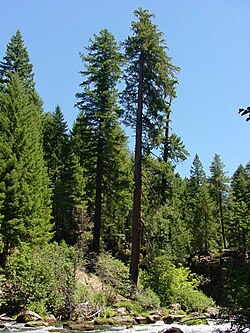 Pinus lambertiana is the tallest pine species.
 -
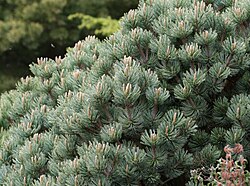 Pinus culminicola is a low-growing shrub, among the shortest pines.
 -
 Ancient Pinus longaeva, among the oldest of all trees


Bark[edit | edit source]
The bark of most pines is thick and scaly, but some species have thin, flaky bark. The branches are produced in "pseudo-whorls", actually a very tight spiral but appearing like a ring of branches arising from the same point. Many pines are uninodal, producing just one such whorl of branches each year, from buds at the tip of the year's new shoot, but others are multinodal, producing two or more whorls of branches per year.[10]
-
 Many pines, like Pinus taeda, have thick bark that flakes into scales.
 -
 Some species, like Pinus bungeana, have thin bark.

.jpg)
Foliage[edit | edit source]
Pines have four types of leaf:[10]
- Seed leaves (cotyledons) on seedlings are borne in a whorl of 4–24.
- Juvenile leaves, which follow immediately on seedlings and young plants, are 2–6 centimetres (3⁄4–2+1⁄4 inches) long, single, green or often blue-green, and arranged spirally on the shoot. These are produced for six months to five years, rarely longer.
- Scale leaves, similar to bud scales, are small, brown and not photosynthetic, and arranged spirally like the juvenile leaves.
- Needles, the adult leaves, are green (photosynthetic) and bundled in clusters called fascicles. The needles can number from one to seven per fascicle, but generally number from two to five. Each fascicle is produced from a small bud on a dwarf shoot in the axil of a scale leaf. These bud scales often remain on the fascicle as a basal sheath. The needles persist for 1.5–40 years, depending on species. If a shoot's growing tip is damaged (e.g. eaten by an animal), the needle fascicles just below the damage generate a stem-producing bud, which can then replace the lost growth tip.
-
 Pinus halepensis seed leaf
 -
 Juvenile leaves of seedling
Pinus pinaster, single and arranged spirally -
 Pinus nigra growth candles covered with thin brownish scale leaves
 -
 Pinus parviflora needles, in bunches of five in this species
_14d_1.jpg)


Cones[edit | edit source]
Pines are monoecious, having the male and female cones on the same tree.[11] The male cones are small, typically 1–5 cm long, and only present for a short period (usually in spring, though autumn in a few pines), falling as soon as they have shed their pollen. The female cones take 1.5–3 years (depending on species) to mature after pollination, with actual fertilisation delayed one year. At maturity, the female cones are 3–60 cm long. Each cone has numerous spirally-arranged scales, with two seeds on each fertile scale; the scales at the base and tip of the cone are small and sterile without seeds.[10]
The seeds (pine nuts) are mostly small and winged, and are anemochorous (wind-dispersed). Some are larger, have only a vestigial wing, and are bird-dispersed. Female cones are woody and sometimes armed to protect developing seeds from foragers. At maturity, the cones usually open to release the seeds. In some of the bird-dispersed species, for example whitebark pine,[12] the seeds are only released by the bird breaking the cones open. In others, the seeds are stored in closed cones for many years until an environmental cue triggers the cones to open, releasing the seeds. This is called serotiny. The most common form of serotiny is pyriscence, in which resin binds the cones shut until the resin is melted by a forest fire, for example in P. radiata and P. muricata. The seeds are then released after the fire, enabling them to colonise the burnt ground with minimal competition from other plants.[10][13]
-
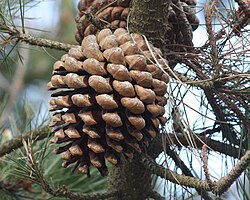 Pinus radiata female (seed) cone
 -
 Pinus taeda male (pollen) cones
 -
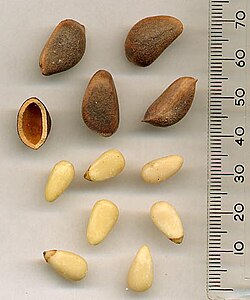 Pinus koraiensis seeds
 -
 Pinus rigida cones open when exposed to fire. (left to right: before; after; 24 hours later)


Naming[edit | edit source]
The modern English name "pine" derives from Latin pinus, traced to the Indo-European base *pīt- 'resin'.[14] Before the 19th century, pines were often called firs, a name now applied to another genus, Abies. In some European languages, Germanic cognates of the Old Norse name are still in use for pines, as in Danish fyr and German Föhre.[15] The genus Pinus was named by Carl Linnaeus in 1753. Pinus sylvestris, the Scots pine, was later chosen as the type species.[16][17]
Several other conifers are commonly known as pines, such as the Norfolk Island pine (Araucaria heterophylla); however, they belong to other genera.[18]
Evolution[edit | edit source]
Fossil history[edit | edit source]
The Pinaceae, the pine family, first appeared in the Jurassic period.[19] The genus Pinus first appeared during the Early Cretaceous; the oldest verified fossil is Pinus yorkshirensis from the Hauterivian-Barremian boundary (~130-125 million years ago) from the Speeton Clay, England.[20] However, there are possible records of the genus from the Jurassic.[21]
.jpg)

External phylogeny[edit | edit source]
Based on transcriptome analysis, Pinus is most closely related to the genus Cathaya, which in turn is closely related to the genus Picea, the spruces. These genera, with firs and larches, form the pinoid clade of the Pinaceae.[22]
Internal phylogeny[edit | edit source]
The evolutionary history of the genus Pinus has been complicated by hybridisation. Pines are prone to inter-specific breeding. Wind pollination, long life spans, overlapping generations, large population size, and weak reproductive isolation make breeding across species more likely. As the pines have diversified, gene transfer between different species has created a complex history of genetic relatedness.[23][24] Research using large genetic datasets has clarified these relationships.[25] Two 21st century phylogenies are given below; the differences between them demonstrate these complications:
| Jin et al. 2021[26] | Stull et al. 2021[22] |
|---|---|
Taxonomy[edit | edit source]
Pines are gymnosperms. The genus is divided into two subgenera based on the number of fibrovascular bundles in the needle, and the presence or absence of a resin seal on the scales of the mature cones before opening. The subgenera can be distinguished by cone, seed, and leaf characters:[10]
- Pinus subg. Pinus, the yellow, or hard pine group, with cones with a resin seal on the scales, and generally with harder wood; the needle fascicles mostly have a persistent sheath (two exceptions, Pinus leiophylla and Pinus lumholtzii, have deciduous sheaths).[10]
- Pinus subg. Strobus, syn. Pinus subg. Ducampopinus, the white or soft pine, and pinyon pine groups, with cones without a resin seal on the scales, and usually have softer wood; the needle fascicles mostly have a deciduous sheath (one exception, Pinus nelsonii, has a persistent sheath).[10]
Phylogenetic evidence indicates that the subgenera diverged anciently from one another.[22] Each subgenus is further divided into sections and subsections.[25]
World Flora Online accepts 134 species-rank taxa (119 species and 15 nothospecies) of pines as current, with additional synonyms,[27] and Plants of the World Online 126 species-rank taxa (113 species and 13 nothospecies),[28] making it the largest genus among the conifers. The highest species diversity of pines is found in Mexico.[29][30][31]
Distribution[edit | edit source]
Pines are native to the Northern Hemisphere, with the most species in North America, some in Asia, and a few in Europe. Only two species, Pinus sylvestris and Pinus sibirica, occur in more than one of those regions (Asia and Europe).[32] They occupy large areas of boreal forest (taiga) in latitudes between 50° and 60° N; about a third of this biome is in North America and Scandinavia, the rest in Siberia.[33] The northernmost species is Scots pine, reaching just north of 70° N in Stabbursdalen National Park in Norway.[34] One species, Pinus merkusii, crosses the equator in Sumatra to 2°S.[35] In North America, various species occur in regions at latitudes from as far north as 66° N[35] to as far south as 12°N.[36]
Various species have been introduced to temperate and subtropical regions of both hemispheres, where they are grown as timber or cultivated as ornamental plants in parks and gardens. A number of such introduced species have become naturalised, and species such as Pinus radiata are considered invasive in some regions.[37]
-
 Most northerly: Pinus sylvestris in Stabbursdalen National Park, Norway, at 70° North
 -

-
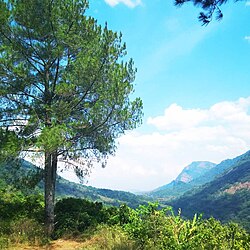 Pinus merkusii in Sumatra: the only pine whose range extends south of the equator
 -
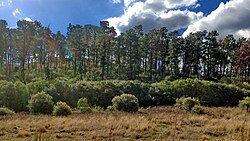 Pinus radiata in Australia, where it was introduced in the late 19th century.


Ecology[edit | edit source]
Environmental factors[edit | edit source]
Pines grow in a very large variety of environments, ranging from semi-arid desert to rainforests, from sea level up to 5,200 m (17,100 ft), from the coldest to the hottest environments on Earth. They often occur in mountainous areas with favourable soils.[38]
Pinus contorta is a fire-dependent species, requiring wildfires to maintain healthy populations of diverse ages.[39] Pinus canariensis is highly fire-resistant,[40] with adaptations such as growing epicormic sprouts after losing its needles in a fire.[41] Some species such as Pinus muricata need fire to open their cones, allowing them to disperse their seeds.[42] Other pines such as Pinus mugo[43] and Pinus yunnanensis can grow at high elevation.[44] Some pines, such as Pinus sabiniana, are adapted to growth in hot, dry semidesert climates.[45]
-
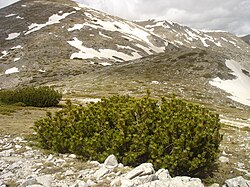 Pinus mugo, a dwarf mountain species at altitude in Macedonia
 -
 A controlled burn in a Pinus nigra stand, Portugal
 -
 A stand of Pinus contorta regenerating 10 years after a major fire at Yellowstone National Park


Species interactions[edit | edit source]
Pine needles serve as food for the caterpillar larvae of several moth species including the pine beauty, a pest of mature stands of pine trees,[46] and the pine hawk-moth, a large species which causes only occasional damage.[47] Some moths, notably the pine processionary, whose caterpillars can completely defoliate pine trees,[48][49][50] and the pine-tree lappet, are serious pests of commercial forestry.[51]
-
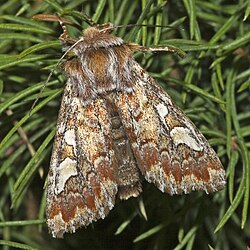 Pine beauty moth (Panolis flammea)
 -
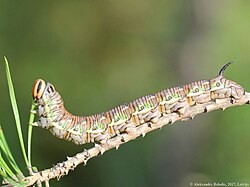 Pine hawk-moth (Sphinx pinastri) caterpillar feeding on pine needles
 -
 Tent of pine processionary moth (Thaumetopoea pityocampa) caterpillars
 -
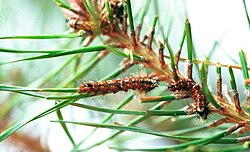 Pine-tree lappet (Dendrolimus pini) caterpillars on Scots pine with damage to needles


.jpg)

Several species of pine are attacked by nematodes, causing pine wilt disease, which can quickly kill trees.[52][53] The sawfly Diprion pini is likewise a serious commercial pest of pine forestry, especially of Pinus sylvestris.[54] Some birds such as nutcrackers are specialist feeders on pine seeds, and are important in distributing the seeds widely.[55][56] Crossbills rely on Pinus sylvestris seeds in Scotland, and similarly help significantly to disperse the seeds, whereas red squirrels feed on the seeds but do little for seed dispersal.[57] Pine pollen may contribute to food webs involving detritivores. Nutrients from pollen aid detritivores in development, growth, and maturation, and may enable fungi to decompose plant litter which is low in nutrients.[58] The edible[59] basidiomycete fungus Boletus pinophilus (pine bolete) forms an ectomycorrhizal association with pines such as P. cembra, P. nigra, and P. sylvestris.[60]
-
 Mass of Diprion pini sawfly caterpillars on pine tree
 -
 Northern nutcracker with nut of Pinus sibirica
 -
 Pinus pumila cone opened by nutcrackers
 -
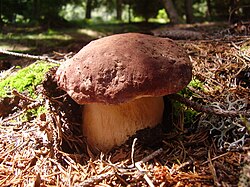 The pine bolete Boletus pinophilus forms an ectomycorrhizal association with several pines.

.jpg)


Uses[edit | edit source]
Timber[edit | edit source]
Pines are among the most commercially important tree species, valued for their timber and wood pulp throughout the world.[61][62] In temperate and tropical regions, they are fast-growing softwoods that grow in relatively dense stands. Commercial pines are grown in plantations for timber that is denser and therefore more durable than spruce (Picea). Pine wood is widely used in high-value carpentry items such as furniture, window frames, panelling, floors, and roofing due to its abundance and low cost.[63]
As pine wood has little resistance to insects or decay after logging, in its untreated state it is generally recommended for indoor construction purposes only, such as indoor drywall framing. It is commonly used in Canadian Lumber Standard graded wood.[64] For outside use, pine needs to be treated with copper azole, chromated copper arsenate or other suitable chemical preservatives.[65]
-
 Logging Pinus ponderosa, Arizona
 -
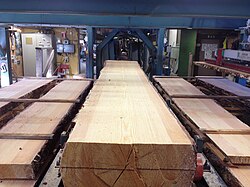 100 mm (4 inch) thick pine timber sawn in sawmill, Sweden
 -
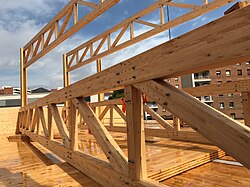 Pine as an architectural material, Spain
 -
 Pine furniture, 2019


Ornamental uses[edit | edit source]
Many pine trees make attractive ornamental plantings for parks and larger gardens, while dwarf cultivars are suitable for smaller spaces. There are at least 818 named cultivars (or trinomials) recognised by the American Conifer Society ACS.[66]
-
 Pinus parviflora 'Miyajima' ornamental cultivar
 -
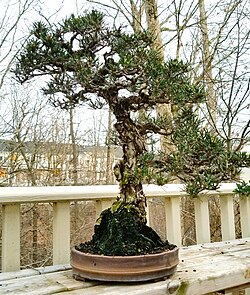


Food[edit | edit source]
The seeds (pine nuts) are generally edible; the young male cones can be cooked and eaten, as can the bark of young twigs.[67] Some species have large pine nuts, which are harvested and sold for cooking and baking. They are an ingredient of pesto alla genovese.[68]
The soft, moist, white inner bark (cambium) beneath the woody outer bark is edible and very high in vitamins A and C.[66] It can be eaten raw in slices as a snack or dried and ground up into a powder for use as an ersatz flour or thickener in stews, soups, and other foods, such as bark bread.[69] The use of pine cambium gave the Adirondack Indians their name, from the Mohawk Indian word atirú:taks, meaning "tree eaters".[69]
A herbal tea is made by steeping young, green pine needles in boiling water (known as tallstrunt in Sweden).[69] In eastern Asia, pine and other conifers are accepted among consumers as a beverage product, and used in teas, as well as wine.[70] In Greece, the wine retsina is flavoured with resin from Pinus halepensis (Aleppo pine).[71]


Other uses[edit | edit source]
Turpentine oil, traditionally used as a solvent in paints, resins and varnishes, is extracted from pine resin[72] or pine wood.[73] Pine needles are woven into baskets in Latin America.[74] In traditional Chinese medicine, pine resin is used for burns, wounds and skin complaints.[75] Chinese ink sticks for calligraphy are often made of pine soot, producing a matt black ink when mixed with water.[76] Pine needles have been used by Latvian designer Tamara Orjola to create biodegradable products including paper, furniture, textiles and dyestuffs.[77]
-

-
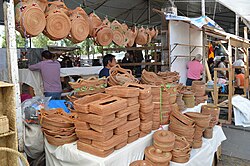 Pine needle baskets, Pátzcuaro, Mexico, 2016
 -
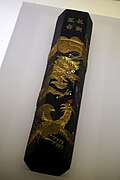 Chinese ink sticks can be made of pine soot
 -
 Essential oil from Pinus sylvestris


Culture[edit | edit source]
.jpg)
In ancient Egypt, the god Osiris was honoured with an image placed in a cavity inside a pine tree. In ancient Greece, the goddess Pitthea was linked with pines, while in ancient Rome, the tree was worshipped in the festival of the god Attis and the goddess Cybele.[79] The Greek god of wine, Dionysus (also called Bacchus), was associated with pine as a symbol of fertility, and his devotees carried a stick topped with a pine cone (a thyrsus), a phallic symbol.[79] The Buryat people of Siberia revered groves of Pinus sylvestris, while ancient Celtic Druids marked the midwinter solstice with fires of the same species.[79]

In 1924, the Italian composer Ottorino Respighi completed his tone poem Pines of Rome. Each of its four movements depicts a pine-clad setting in the city of Rome, namely the Villa Borghese gardens, near a catacomb, on the Janiculum Hill, and along the Appian Way.[78]
Pines are often featured in paintings. A 2021 study lists over a hundred works: many are by artists from the Mediterranean region, such as Paul Cézanne and Jean-Baptiste-Camille Corot; Northern Europe, such as Akseli Gallen-Kallela and James William Giles; and North America, with works by Tom Thomson and others. The paintings often depict Pinus pinea by the Mediterranean sea; other species include P. sylvestris and P. pinaster.[80] The pine is a particular motif in Chinese art and literature, which sometimes combines painting and poetry in the same work. The pine symbolises longevity and steadfastness, as it retains its green needles throughout the year. Sometimes the pine and cypress are paired. At other times the pine, plum, and bamboo are considered as the "Three Friends of Winter".[81]
-

-
 Pines on Mount Tai, Ike no Taiga, Japan, 18th century
 -
 The Pine Trees of Louveciennes, Camille Pissarro, 1870
 -
 Le pin à l'Estaque,
Paul Cézanne, 1875 -
 Under the Pines, Evening, Claude Monet, 1888
 -
 "Pine Clouds", fan painting by Wu Ku-hsiang, China, 1903
 -

_04b.jpg)
)_-_1985.203_-_Arthur_M._Sackler_Museum.jpg)

_(4619406661).jpg)
_(16982300531).jpg)


See also[edit | edit source]
References[edit | edit source]
- ↑ Anderson, J. M., H. M. (1985). "Palaeoflora of Southern Africa. Prodromus of South African Megafloras Devonian to Lower Cretaceous". Botanical Research Institute.
{{cite journal}}: CS1 maint: multiple names: authors list (link) - ↑ "Pinus". Medical Definition of PINUS. Merriam-Webster Medical Dictionary.
- ↑ Fattig, Paul (23 January 2011). "Tallest of the tall". Mail Tribune. Archived from the original on 23 September 2012. Retrieved 27 January 2011.
- ↑ "3 Sierra sugar pines added to list of 6 biggest in world". Associated Press. 31 Jan 2021. Retrieved 13 Feb 2023.
- ↑ Ryan, Michael; Richardson, David M. (December 1999). "The Complete Pine". BioScience. 49 (12): 1023–1024. doi:10.2307/1313736. JSTOR 1313736.
- ↑ Miranda, Carolina A. (28 February 2015). "Follow-up: More tales of the Prometheus tree and how it died". Los Angeles Times. Retrieved 16 October 2020.
- ↑ Eveleth, Rose (15 November 2012). "How One Man Accidentally Killed the Oldest Tree Ever". Smithsonian. Smithsonian Institution. Retrieved 16 October 2020.
- ↑ Zeng, Lanling; Wang, Guozhao (2009). "Modeling golden section in plants". Progress in Natural Science. 19 (2): 255–260. Bibcode:2009PNSMI..19..255Z. doi:10.1016/j.pnsc.2008.07.004.
The ratio between two pine needles is 0.618 [...] the angle between the two neighbors is about 135° and the angle between the main stem and each branch is close to 34.4° which is the golden section of 90°
- ↑ Bracewell, Ronald; Rawlings, John. "Pinus (Pine) Notes". Trees of Stanford. Retrieved 2 February 2020.
- ↑ 10.0 10.1 10.2 10.3 10.4 10.5 10.6 Royal Horticultural Society Dictionary of Gardening. Vol. 3. Macmillan Press; Stockton Press. 1992. pp. 582–594. ISBN 1-56159-001-0.
- ↑ Judd, W.S.; Campbell, C.S.; Kellogg, E.A.; Stevens, P.F.; Donoghue, M.J. (2002). Plant systematics, a phylogenetic approach (2 ed.). Sinauer Associates. p. 205. ISBN 0-87893-403-0.
- ↑ Tomback, Diana F. (June 1982). "Dispersal of Whitebark Pine seeds by Clark's Nutcracker: a mutualism hypothesis". The Journal of Animal Ecology. 51 (2): 451–467. Bibcode:1982JAnEc..51..451T. doi:10.2307/3976. JSTOR 3976.
- ↑ Rushforth, Keith (1987). Conifers. London, England, UK: Christopher Helm Publishers. pp. 158–192. ISBN 0-7470-2801-X.
- ↑ "Where Are You From? - Credo Reference". credoreference.com.
- ↑ Vedel, Helge; Lange, Johan (1960). Trees and Bushes in Wood and Hedgerow. Methuen. pp. 123–124.
- ↑ Linnaeus, Carolus (1753). Species plantarum: exhibentes plantas rite cognitas, ad genera relatas, cum differentiis specificis, nominibus trivialibus, synonymis selectis, locis natalibus, secundum systema sexuale digestas. Tomus I & II. Impensis Laurentii Salvii. p. 1000.
- ↑ Price, R. A.; Liston, A.; Strauss, S. H. (1998). "Phylogeny and systematics of Pinus". In Richardson, D. M. (ed.). Ecology and Biogeography of Pinus. Cambridge University Press. pp. 49–68. ISBN 978-0-521-55176-2.
- ↑ "Norfolk Island Pine – Gardening Solutions". Retrieved 28 January 2026.
- ↑ Ran, Jin-Hua; Shen, Ting-Ting; Wu, Hui; Gong, Xun; Wang, Xiao-Quan (December 2018). "Phylogeny and evolutionary history of Pinaceae updated by transcriptomic analysis". Molecular Phylogenetics and Evolution. 129: 106–116. Bibcode:2018MolPE.129..106R. doi:10.1016/j.ympev.2018.08.011. PMID 30153503. S2CID 52110440.
- ↑ Ryberg, Patricia E.; Rothwell, Gar W.; Stockey, Ruth A.; Hilton, Jason; Mapes, Gene; Riding, James B. (2012). "Reconsidering Relationships among Stem and Crown Group Pinaceae: Oldest Record of the Genus Pinus from the Early Cretaceous of Yorkshire, United Kingdom". International Journal of Plant Sciences. 173 (8): 917–932. Bibcode:2012IJPlS.173..917R. doi:10.1086/667228. S2CID 85402168.
- ↑ "Ralikhomo tracksite (zone C/3) (Jurassic of Lesotho)". PBDB.org.
- ↑ 22.0 22.1 22.2 Stull, Gregory W.; Qu, Xiao-Jian; Parins-Fukuchi, Caroline; Yang, Ying-Ying; Yang, Jun-Bo; et al. (19 July 2021). "Gene duplications and phylogenomic conflict underlie major pulses of phenotypic evolution in gymnosperms". Nature Plants. 7 (8): 1015–1025. Bibcode:2021NatPl...7.1015S. doi:10.1038/s41477-021-00964-4. ISSN 2055-0278. PMID 34282286. S2CID 236141481. Archived from the original on 10 January 2022. Retrieved 10 January 2022.
- ↑ Hernández-León, Sergio; Gernandt, David S.; Pérez de la Rosa, Jorge A.; Jardón-Barbolla, Lev (30 July 2013). "Phylogenetic relationships and species delimitation in Pinus section Trifoliae inferred from plastid DNA". PLOS ONE. 8 (7) e70501. Bibcode:2013PLoSO...870501H. doi:10.1371/journal.pone.0070501. PMC 3728320. PMID 23936218.
- ↑ Flores-Rentería, Lluvia; Wegier, Ana; Ortega Del Vecchyo, Diego; Ortíz-Medrano, Alejandra; Piñero, Daniel; et al. (December 2013). "Genetic, morphological, geographical and ecological approaches reveal phylogenetic relationships in complex groups, an example of recently diverged pinyon pine species (Subsection Cembroides)". Molecular Phylogenetics and Evolution. 69 (3): 940–9. Bibcode:2013MolPE..69..940F. doi:10.1016/j.ympev.2013.06.010. PMID 23831459.
- ↑ 25.0 25.1 Gernandt, David S.; López, Gretel Geada; García, Sol Ortiz; Liston, Aaron (2005). "Phylogeny and classification of Pinus" (PDF). Taxon. 54 (1): 29–42. Bibcode:2005Taxon..54...29G. doi:10.2307/25065300. JSTOR 25065300.
- ↑ Jin, Wei-Tao; Gernandt, David S.; Wehenkel, Christian; Xia, Xiao-Mei; Wei, Xiao-Xin; Wang, Xiao-Quan (May 2021). "Phylogenomic and ecological analyses reveal the spatiotemporal evolution of global pines". PNAS. 118 (20) e2022302118. Bibcode:2021PNAS..11822302J. doi:10.1073/pnas.2022302118. PMC 8157994. PMID 33941644.
- ↑ "Pinus (L.)". World Flora Online. 2022. Retrieved 14 August 2022.
- ↑ "Plants of the World Online". Plants of the World Online. 14 October 2013. Retrieved 20 January 2025.
- ↑ Wehenkel, C.; Mariscal-Lucero, S.; Jaramillo-Correa, J.P.; López-Sánchez, C.A. "Genetic diversity and conservation of Mexican forest trees". Forest Service. US Department of Agriculture. Retrieved 1 November 2024.
- ↑ Farjon, Aljos (1996). "Biodiversity of Pinus (Pinaceae) in Mexico: speciation and palaeo-endemism". Botanical Journal of the Linnean Society. 121 (4): 365–384. Bibcode:1996BJLS..121..365F. doi:10.1111/j.1095-8339.1996.tb00762.x. Retrieved 1 November 2024.
- ↑ Romero-Sanchez, Martin Enrique; Perez-Miranda, Ramiro; Gonzalez-Hernandez, Antonio; Valerio Velasco-Garcia, Mario; Velasco-Bautista, Efraín; Andrés, Flores (2018). "Current and Potential Spatial Distribution of Six Endangered Pine Species of Mexico: Towards a Conservation Strategy". Forests. 9 (12): 767. Bibcode:2018Fore....9..767R. doi:10.3390/f9120767.
- ↑ Nobis, Michael P.; Traiser, Christopher; Roth-Nebelsick, Anita (1 March 2012). "Latitudinal variation in morphological traits of the genus Pinus and its relation to environmental and phylogenetic signals". Plant Ecology & Diversity. 5 (1): 1–11. Bibcode:2012PlEcD...5....1N. doi:10.1080/17550874.2012.687501.
- ↑ "The forest biome". University of California Museum of Paleontology. Archived from the original on 20 June 2019. Retrieved 12 May 2019.
- ↑ "Stabbursdalen Nasjonalpark" (PDF). Retrieved 20 January 2025.
- ↑ 35.0 35.1 Critchfield, William B.; Little, Elbert L. (1966). Geographic Distribution of the Pines of the World. USDA Forest Service.
- ↑ Singh, Surendra P.; Inderjit; Singh, Jamuna S.; Majumdar, Sudipto; Moyano, Jaime; Nuñez, Martin A.; Richardson, David M. (21 September 2018). "Insights on the persistence of pines (Pinus species) in the Late Cretaceous and their increasing dominance in the Anthropocene". Ecology and Evolution. 8 (20): 10345–10359. Bibcode:2018EcoEv...810345S. doi:10.1002/ece3.4499. PMC 6206191. PMID 30398478.
- ↑ "Pinus ssp. (tree), General Impact". Global Invasive Species Database. Invasive Species Specialist Group. 13 March 2006. Archived from the original on 26 July 2011. Retrieved 2 March 2011.
- ↑ "Pine Trees". Basic Biology. 30 August 2020. Retrieved 31 October 2019.
- ↑ Schoennagel, Tania; Veblen, Thomas (2004). "The Interaction of Fire, Fuels and Climate across Rocky Mountain Forests". BioScience. 54 (7): 661–676. doi:10.1641/0006-3568(2004)054[0661:TIOFFA]2.0.CO;2.
- ↑ "The most fire-resistant pine in the world". Forest Monitor. 9 January 2017. Retrieved 23 September 2022.
- ↑ Clarke, P. J.; Lawes, M. J.; Midgley, J. J.; Lamont, B. B.; Ojeda, F.; et al. (January 2013). "Resprouting as a key functional trait: how buds, protection and resources drive persistence after fire". New Phytologist. 197 (1): 19–35. Bibcode:2013NewPh.197...19C. doi:10.1111/nph.12001. PMID 23110592.
- ↑ Moore; Kershner, Bruce, Gerry; Craig Tufts; Daniel Mathews; Gil Nelson; et al. (2008). National Wildlife Federation Field Guide to Trees of North America. Sterling. p. 90. ISBN 978-1-4027-3875-3.
- ↑ Solár, Jaroslav; Janiga, Marián (2013). "Long-term Changes in Dwarf Pine ( Pinus mugo ) Cover in the High Tatra Mountains, Slovakia" (PDF). Mountain Research and Development. 33 (1): 51–62. Bibcode:2013MRDev..33...51S. doi:10.1659/MRD-JOURNAL-D-12-00079.1.
- ↑ Sun, Yan-Qiang; Zhao, Wei; Xu, Chao-Qun; Xu, Yulan; El-Kassaby, Yousry A.; De La Torre, Amanda R.; Mao, Jian-Feng (11 February 2020). "Genetic Variation Related to High Elevation Adaptation Revealed by Common Garden Experiments in Pinus yunnanensis". Frontiers in Genetics. 10 1405. doi:10.3389/fgene.2019.01405. PMC 7027398. PMID 32117429.
- ↑ "Pinus sabiniana Dougl". www.srs.fs.usda.gov. Retrieved 4 May 2022.
- ↑ Hicks, B. J.; Barbour, D. A.; Evans, H. F.; Heritage, S.; Leather, S. R.; Milne, R.; Watt, A. D. (2001). "The history and control of the pine beauty moth, Panolis flammea (D. & S.) (Lepidoptera: Noctuidae), in Scotland from 1976 to 2000". Agricultural and Forest Entomology. 3 (3): 161–168. doi:10.1046/j.1461-9555.2001.00106.x.
- ↑ "Sphinx pinastri: Pine hawk-moth". Forest Pests Europe. Retrieved 2 September 2025.
- ↑ "Thaumetopoea pityocampa Pine processionary moth". Forest Pests Europe. Retrieved 2 September 2025.
- ↑ Bonnet, Catherine; Martin, Jean-Claude; Mazet, René (2008). "La Processionnaire du Pin" [The Pine Processionary] (PDF). Stantari (in français) (14 (August–October 2008)). INRA: 29–33. Archived from the original (PDF) on 4 October 2011. Retrieved 2 October 2021.
- ↑ Kerdelhué, Carole; Zane, Lorenzo; Simonato, Mauro; Salvato, Paola; Rousselet, Jérôme; Roques, Alain; Battisti, Andrea (2009). "Quaternary history and contemporary patterns in a currently expanding species". BMC Evolutionary Biology. 9 (1): 220. Bibcode:2009BMCEE...9..220K. doi:10.1186/1471-2148-9-220. PMC 2753568. PMID 19732434.

- ↑ "Pine tree lappet moth in Scotland". Scottish Forestry. Retrieved 1 September 2025.
- ↑ Bursaphelenchus xylophilus, Pine Wilt Nematode. Nematology. University of Nebraska, Lincoln.
- ↑ Bursaphelenchus xylophilus. Archived January 4, 2012, at the Wayback Machine Nemaplex. UC Davis.
- ↑ "Diprion pini" (PDF). Cooperative Agricultural Pest Survey. July 2015. Retrieved 19 August 2025.
- ↑ Lanner, Ronald M. (1996). Made for each other: A symbiosis of birds and pines. Oxford University Press. pp. 61–75. ISBN 0-19-508-903-0.
- ↑ Tomback, Diana F. (2016). "7". In Sekercioglu, Cagan; Wenny, Daniel G.; Whelan, Christopher J. (eds.). Why birds matter: avian ecological function and ecosystem services. University of Chicago Press. p. 201. ISBN 978-0-226-38263-0.
- ↑ Summers, Ron W. (2011). "Patterns of exploitation of annually varying Pinus sylvestris cone crops by seed-eaters of differing dispersal ability". Ecography. 34 (5): 723–728. Bibcode:2011Ecogr..34..723S. doi:10.1111/j.1600-0587.2010.06498.x.
- ↑ Filipiak, Michał (1 January 2016). "Pollen Stoichiometry May Influence Detrital Terrestrial and Aquatic Food Webs". Frontiers in Ecology and Evolution. 4: 138. Bibcode:2016FrEEv...4..138F. doi:10.3389/fevo.2016.00138.
- ↑ Sitta, Nicola; Floriani, Marco (2008). "Nationalization and globalization trends in the wild mushroom commerce of Italy with emphasis on porcini (Boletus edulis and allied species)". Economic Botany. 62 (3): 307–22. Bibcode:2008EcBot..62..307S. doi:10.1007/s12231-008-9037-4. S2CID 44274570.
- ↑ Gallardi, Matteo (2020). "Diversity, Biogeographic Distribution, Ecology, and Ectomycorrhizal Relationships of the Edible Porcini Mushrooms (Boletus s. str., Boletaceae) Worldwide: State of the Art and an Annotated Checklist". In Pérez-Moreno, Jesús; Guerin-Laguette, Alexis; Arzú, Roberto Flores; Yu, Fu-Qiang (eds.). Mushrooms, Humans and Nature in a Changing World: Perspectives from Ecological, Agricultural and Social Sciences. Springer. pp. 236–237. ISBN 978-3-030-37378-8.
- ↑ "Choosing a Timber Species - Timber Frame HQ". Timber Frame HQ. Retrieved 4 January 2018.
- ↑ "Trees for pulp" (PDF). Paper.org. Archived from the original (PDF) on 18 November 2017. Retrieved 4 January 2018.
- ↑ Wiemann, M. C. (2010). Characteristics and Availability of Commercially Important Woods. In Wood handbook: Wood as an engineering material (pp. 2-2-2–45). Chapter, Forest Products Laboratory; For sale by the Supt. of Docs., U.S. Govt. https://research.fs.usda.gov/treesearch/37440
- ↑ Jenkins, Steve (3 September 2023). "What is CLS timber and what DIY projects is it good for?". Homebuilding & Renovating. Retrieved 22 August 2024.
- ↑ "Timber treatment". weathertight.org.nz. 18 October 2010. Retrieved 18 May 2019.
- ↑ 66.0 66.1 "Pinus / pine: Conifer Genus". American Conifer Society. Retrieved 1 March 2022.
- ↑ The Complete Guide to Edible Wild Plants. United States Department of the Army. Skyhorse Publishing. 2009. p. 78. ISBN 978-1-60239-692-0. OCLC 277203364.
{{cite book}}: CS1 maint: others (link) - ↑ "Pesto's official recipe". Campionato Mondiale Pesto al Mortaio. Archived from the original on 16 May 2021. Retrieved 16 May 2021.
- ↑ 69.0 69.1 69.2 Angier, Bradford (1974). Field Guide to Edible Wild Plants. Stackpole Books. pp. 166–167. ISBN 0-8117-0616-8. OCLC 799792.
- ↑ Zeng, Wei-Cai; Jia, Li-Rong; Zhang, Yan; Cen, Jia-Qi; Chen, Xi; et al. (March 2011). "Antibrowning and antimicrobial activities of the water-soluble extract from pine needles of Cedrus deodara". Journal of Food Science. 76 (2): C318–23. doi:10.1111/j.1750-3841.2010.02023.x. PMID 21535752.
- ↑ Robinson, J., ed. (2006). The Oxford Companion to Wine (Third ed.). Oxford University Press. pp. 568–569. ISBN 0-19-860990-6.
- ↑ Chalier, Pascale; Martinez-Lopez, Brais; Lacour, Marie Agnès; Rigou, Peggy (2024). "Extraction of turpentine essential oil from Pinus pinaster ait: Comparison of yield and composition between conventional- or microwave assisted-hydro-distillation and vacuum distillation". Sustainable Chemistry and Pharmacy. 41 101702. Bibcode:2024SusCP..4101702C. doi:10.1016/j.scp.2024.101702.
- ↑ "Turpentine Production and Processing" (PDF). New Zealand Institute of Chemistry. Retrieved 1 September 2025.
- ↑ "Culture Trunks". College of Liberal Arts, University of Texas. Retrieved 1 September 2025.
- ↑ Ulukanli, Zeynep; KaraböRklü, Salih; Bozok, Fuat; Ates, Burhan; Erdogan, Selim; et al. (December 2014). "Chemical composition, antimicrobial, insecticidal, phytotoxic and antioxidant activities of Mediterranean Pinus brutia and Pinus pinea resin essential oils". Chinese Journal of Natural Medicines. 12 (12): 901–910. doi:10.1016/s1875-5364(14)60133-3. PMID 25556061.
- ↑ "What Ink Stick Should You Choose For Japanese Calligraphy?". The Art of Calligraphy. Retrieved 1 September 2025.
- ↑ Solanki, Seetal (2018-12-17). "5 radical material innovations that will shape tomorrow". CNN Style. Retrieved 17 December 2018.
- ↑ 78.0 78.1 Dotsey, Calvin (7 January 2020). "The March of Time: Respighi's Pines of Rome". Houston Symphony. Retrieved 19 April 2022.
- ↑ 79.0 79.1 79.2 "Scots pine mythology and folklore". Trees for Life. Retrieved 2 September 2025.
- ↑ Pinon, Jean (2021). "Les Pins vus par les peintres" [Pines seen by Painters]. Revue forestière française (in français). 73 (5): 583–596. doi:10.20870/revforfr.2021.7109.
- ↑ Eberhard, Wolfram (2003 [1986 (German version 1983)]), A Dictionary of Chinese Symbols: Hidden Symbols in Chinese Life and Thought. London, New York: Routledge. ISBN 0-415-00228-1, sub "Pine".
Further reading[edit | edit source]
- Farjon, A. (2005). Pines (2nd ed.). E. J. Brill. ISBN 90-04-13916-8.
- Little, Elbert L., Jr.; Critchfield, W.B. (1969). Subdivisions of the Genus Pinus (Pines). Misc. Publ. 1144 (Superintendent of Documents Number: A 1.38:1144) (Report). US Department of Agriculture.
{{cite report}}: CS1 maint: multiple names: authors list (link) - Richardson, D. M., ed. (1998). Ecology and Biogeography of Pinus. Cambridge University Press. p. 530. ISBN 0-521-55176-5.
- Sulavik, Stephen B. (2007). Adirondack; Of Indians and Mountains, 1535-1838. Purple Mountain Press. pp. 244 pages. ISBN 978-1-930098-79-4.
- Mirov, N. T. (1967). The Genus Pinus. Ronald Press.
- "Classification of pines". The Lovett Pinetum Charitable Foundation. Archived from the original on 3 June 2004. Retrieved 17 January 2004.
- Mirov, N. T.; Stanley, R.G. (1959). "The Pine Tree". Annual Review of Plant Physiology. 10: 223–238. doi:10.1146/annurev.pp.10.060159.001255.
- Philips, Roger (1979). Trees of North America and Europe. Random House. ISBN 0-394-50259-0.
- Template:Gymnosperm Database
External links[edit | edit source]
- 40 Species of Pine Trees You Can Grow by The Spruce
- Template:Jepson eFlora, covers Californian species
- Pinus in Flora of North America
- Pinus in the USDA Plants Database
- Conifer Database
Template:Acrogymnospermae classification Template:Tannin source


