
m Removing protection template from an unprotected page |
refine information additionally and corrected details for clarity |
||
| Line 1: | Line 1: | ||
{{Short description|Internationally accepted civil calendar}} | {{Short description|Internationally accepted civil calendar}} | ||
{{About||the calendar of religious holidays and periods|Liturgical year|this year's Gregorian calendar|{{Current calendar}}}} | {{About||the calendar of religious holidays and periods|Liturgical year|this year's Gregorian calendar|{{Current calendar}}}} | ||
{{distinguish|Georgian calendar}} | |||
{{pp-sock|small=yes}} | |||
{{Use British English|date=March 2026}} | |||
{{Use dmy dates|date=April 2024}} | |||
{{Infobox calendar date today}} | |||
The '''Gregorian calendar''' is the [[calendar]] used in most parts of the world.{{sfnp|Dershowitz|Reingold|2008|loc=p. 45. "The calendar in use today in most of the world is the Gregorian or ''new-style'' calendar designed by a commission assembled by Pope Gregory XIII in the sixteenth century."}}{{efn|Many countries that use other calendars for religious purposes use the Gregorian calendar as their [[civil calendar]]. [[Iran]] is a notable exception, in that it uses the [[solar Hijri calendar]].}} It went into effect in October 1582 following the [[papal bull]] {{Lang|la|[[Inter gravissimas]]}} issued by [[Pope Gregory XIII]], which introduced it as a modification of, and replacement for, the [[Julian calendar]]. The principal change was to space [[leap year]]s slightly differently to make the average calendar year 365.2425 days long rather than the Julian calendar's 365.25 days, thus more closely approximating the 365.2422-day [[tropical year|"tropical" or "solar" year]] that is determined by the Earth's revolution around the Sun. | |||
{{ | The rule for leap years is that every year divisible by four is a leap year, except for years that are divisible by 100, except in turn for years also divisible by 400. For example, 1800 and 1900 were not leap years, but 1600 and 2000 were leap years.<ref>{{cite web |date=n.d. |title=Introduction to Calendars |url=https://aa.usno.navy.mil/faq/calendars |accessdate=9 May 2022 |publisher=[[United States Naval Observatory]]}}</ref> | ||
The | There were two reasons to establish the Gregorian calendar. First, the Julian calendar was based on the estimate that the average solar year is exactly 365.25 days long, an overestimate of a little under one day per century, and thus has a leap year every four years without exception. The Gregorian reform shortened the average (calendar) year by 0.0075 days to stop the drift of the calendar with respect to the [[equinox]]es.{{sfnp|Gregory XIII|1582}} Second, in the years since the [[First Council of Nicaea]] in AD 325,{{efn|Rather than 45 BC when the Roman Empire adopted the Julian calendar.}} the excess leap days introduced by the Julian algorithm had caused the calendar to drift such that the [[March equinox]] was occurring well before its nominal 21 March date. This date was important to the Christian churches, because it is fundamental to the [[date of Easter|calculation of the date of Easter]]. To reinstate the association, the reform advanced the date by 10 days:{{efn|By the time Great Britain and its possessions adopted the reform [[Calendar (New Style) Act 1750|with effect from 1752]], the gap had increased to 11 days; when Russia and Greece did so (for their civil calendars) in the 20th century, the jump was 13 days. For other countries and territories, see [[List of adoption dates of the Gregorian calendar by country]].}} Thursday 4 October 1582 was followed by Friday 15 October 1582.{{sfnp|Gregory XIII|1582}} In addition, the reform also altered the lunar cycle used by the Church to calculate the date for Easter, because astronomical new moons were occurring four days before the calculated dates. | ||
The reform was adopted initially by the [[Roman Catholicism|Catholic]] countries of Europe and their overseas possessions. Over the next three centuries, the [[Protestant Reformation|Protestant]] and [[Eastern Orthodoxy|Eastern Orthodox]] countries also gradually moved to what they called the "'''Improved calendar'''",{{efn|called such to avoid any suggestion of recognising the authority of Rome. The British [[Calendar (New Style) Act 1750]] restates the algorithm from first principles without any reference to Gregory.}} with Greece being the last European country to adopt the calendar (for civil use only) in 1923.{{sfnp|Blegen|2013}} However, many Orthodox churches continue to use the Julian calendar for religious rites and the dating of major feasts. To unambiguously specify a date during the transition period (in contemporary documents or in history texts), [[dual dating|both notations were given]], tagged as [[Old Style and New Style|"Old Style" or "New Style"]] as appropriate. During the 20th century, most non-[[Western world|Western]] countries also adopted the calendar, at least for [[Civil calendar|civil purposes]]. | |||
The reform was adopted initially by the [[Roman Catholicism|Catholic]] countries of Europe and their overseas possessions. Over the next three centuries, the [[Protestant Reformation|Protestant]] and [[Eastern Orthodoxy|Eastern Orthodox]] countries also gradually moved to what they called the "'''Improved calendar'''", with Greece being the last European country to adopt the calendar (for civil use only) in 1923.{{sfnp|Blegen|2013}} However, many Orthodox churches continue to use the Julian calendar for religious rites and the dating of major feasts. To unambiguously specify a date during the transition period (in contemporary documents or in history texts), [[dual dating|both notations were given]], tagged as [[Old Style and New Style| | |||
==Description== | ==Description== | ||
The Gregorian calendar, like the [[Julian calendar]], is a [[solar calendar]] with 12 months of 28–31 days each. The year in both calendars consists of 365 days, with a [[leap day]] being added to February in the [[leap year]]s. The months and length of months in the Gregorian calendar are the same as for the Julian calendar. The only difference is that the Gregorian | The Gregorian calendar, like the [[Julian calendar]], is a [[solar calendar]] with 12 months of 28–31 days each. The year in both calendars consists of 365 days, with a [[leap day]] being added to February in the [[leap year]]s. The months and length of months in the Gregorian calendar are the same as for the Julian calendar. The only difference is that the Gregorian calendar omits a leap day in ''three'' centurial years every 400 years and leaves the leap day unchanged in the fourth. | ||
A leap year normally occurs every four years: the leap day, historically, was inserted by doubling 24 February{{snd}} there were indeed [[bissextus|two days dated 24 February]]. However, for many years it has been customary to put the extra day at the end of the month of February, adding a [[29 February]] for the leap day. Before the [[Mysterii Paschalis|1969 revision]] of its [[General Roman Calendar]], the Catholic Church delayed February feasts after the 23rd by one day in leap years; | A leap year normally occurs every four years: the leap day, historically, was inserted by doubling 24 February{{snd}}there were indeed [[bissextus|two days dated 24 February]]. However, for many years it has been customary to put the extra day at the end of the month of February, adding a [[29 February]] for the leap day. Before the [[Mysterii Paschalis|1969 revision]] of its [[General Roman Calendar]], the Catholic Church delayed February feasts after the 23rd by one day in leap years; masses celebrated according to the previous calendar still reflect this delay.{{sfnp|Richards|1998|page=101}} | ||
{| class="wikitable" | {| class="wikitable" | ||
| Line 25: | Line 23: | ||
! {{abbr|No.|Number}} !! Name !! Length in days | ! {{abbr|No.|Number}} !! Name !! Length in days | ||
|- | |- | ||
| 1 || | | 1 || January || 31 | ||
|- | |- | ||
| 2 || | | 2 || February || 28 (29 in [[leap year]]s) | ||
|- | |- | ||
| 3 || | | 3 || March || 31 | ||
|- | |- | ||
| 4 || | | 4 || April || 30 | ||
|- | |- | ||
| 5 || | | 5 || May || 31 | ||
|- | |- | ||
| 6 || | | 6 || June || 30 | ||
|- | |- | ||
| 7 || | | 7 || July || 31 | ||
|- | |- | ||
| 8 || | | 8 || August || 31 | ||
|- | |- | ||
| 9 || | | 9 || September || 30 | ||
|- | |- | ||
| 10 || | | 10 || October || 31 | ||
|- | |- | ||
| 11 || | | 11 || November || 30 | ||
|- | |- | ||
| 12 || | | 12 || December || 31 | ||
|} | |} | ||
Gregorian years are identified by consecutive year numbers.<ref>Clause 3.2.1 [[ISO 8601]]</ref> A calendar date is fully specified by the year (numbered according to a [[calendar era]], in this case ''[[Anno Domini]]'' or [[Common Era]]), the month (identified by name or number), and the day of the month (numbered sequentially starting from 1). Although the calendar year currently runs from 1 January to 31 December, at previous times year numbers were based on a different starting point within the calendar (see | Gregorian years are identified by consecutive year numbers.<ref>Clause 3.2.1 [[ISO 8601]]</ref> A calendar date is fully specified by the year (numbered according to a [[calendar era]], in this case ''[[Anno Domini]]'' or [[Common Era]]), the month (identified by name or number), and the day of the month (numbered sequentially starting from 1). Although the calendar year currently runs from 1 January to 31 December, at previous times year numbers were based on a different starting point within the calendar {{xref|(see: {{slink||Beginning of the year}}, below)}}. | ||
{{clear}} | {{clear}} | ||
Calendar cycles repeat completely every 400 years, which equals 146,097 days.{{efn|The cycle described applies to the solar, or civil, calendar. If one also considers the ecclesiastical lunar rules, the lunisolar Easter ''computus'' cycle repeats only after 5,700,000 years of 2,081,882,250 days in 70,499,183 lunar months, based on an assumed mean lunar month of 29 days 12 hours 44 minutes {{sfrac|2|49928114|70499183}} seconds. (Seidelmann (1992), p. 582) [To properly function as an Easter ''[[computus]]'', this lunisolar cycle must have the same mean year as the Gregorian solar cycle, and indeed that is exactly the case.]}}{{efn|The extreme length of the Gregorian Easter ''computus'' is due to its being the product of the 19-year [[Metonic cycle]], the thirty different possible values of the [[epact]], and the least common multiple (10,000) of the 400-year and 2,500-year solar and lunar correction cycles.{{sfnp|Walker|1945|page=218}}}} Of these 400 years, 303 are regular years of 365 days and 97 are leap years of 366 days. A mean calendar year is {{sfrac|365|97|400}} days = 365.2425 days, or 365 days, 5 hours, 49 minutes and 12 seconds.{{efn|The same result is obtained by summing the fractional parts implied by the rule: {{nowrap|1= 365 + {{sfrac|1|4}} − {{sfrac|1|100}} + {{sfrac|1|400}} = 365 + 0.25 − 0.01 + 0.0025 = 365.2425}}}} | Calendar cycles (ignoring lunar and Easter calculations) repeat completely every 400 years, which equals 146,097 days.{{efn|The cycle described applies to the solar, or civil, calendar. If one also considers the ecclesiastical lunar rules, the lunisolar Easter ''computus'' cycle repeats only after 5,700,000 years of 2,081,882,250 days in 70,499,183 lunar months, based on an assumed mean lunar month of 29 days 12 hours 44 minutes {{sfrac|2|49928114|70499183}} seconds. (Seidelmann (1992), p. 582) [To properly function as an Easter ''[[computus]]'', this lunisolar cycle must have the same mean year as the Gregorian solar cycle, and indeed that is exactly the case.]}}{{efn|The extreme length of the Gregorian Easter ''computus'' is due to its being the product of the 19-year [[Metonic cycle]], the thirty different possible values of the [[epact]], and the least common multiple (10,000) of the 400-year and 2,500-year solar and lunar correction cycles.{{sfnp|Walker|1945|page=218}}}} Of these 400 years, 303 are regular years of 365 days and 97 are leap years of 366 days. A mean calendar year is {{sfrac|365|97|400}} days = 365.2425 days, or 365 days, 5 hours, 49 minutes and 12 seconds.{{efn|The same result is obtained by summing the fractional parts implied by the rule: {{nowrap|1= 365 + {{sfrac|1|4}} − {{sfrac|1|100}} + {{sfrac|1|400}} = 365 + 0.25 − 0.01 + 0.0025 = 365.2425}}}} The cycle contains exactly 20,871 weeks (146,097 = 7 × 20,871). | ||
==Gregorian reform== | ==Gregorian reform== | ||
{{gallery | height=140 | width=200 | {{gallery | height=140 | width=200 | ||
|File:Christopher Clavius.jpg| alt1= a portrait of [[Christopher Clavius]] (1538–1612), one of the main authors of the reform | |File:Christopher Clavius.jpg| alt1= a portrait of [[Christopher Clavius]] (1538–1612), one of the main authors of the reform |[[Christopher Clavius]] (1538–1612), one of the main authors of the reform | ||
|File:Gregory XIII.jpg|alt2 = a portrait of Pope Gregory XIII by [[Lavinia Fontana]], sixteenth century |Pope Gregory XIII, portrait by [[Lavinia Fontana]], | |File:Gregory XIII.jpg|alt2 = a portrait of Pope Gregory XIII by [[Lavinia Fontana]], sixteenth century |Pope Gregory XIII, portrait by [[Lavinia Fontana]], 16th century | ||
|File:Inter-grav.jpg|alt3= an image of the first page of the papal bull {{lang|la|[[Inter gravissimas]]}} | First page of the papal bull {{lang|la|[[Inter gravissimas]]}} | |File:Inter-grav.jpg|alt3= an image of the first page of the papal bull {{lang|la|[[Inter gravissimas]]}} | First page of the papal bull {{lang|la|[[Inter gravissimas]]}} | ||
|File:Gregorianscher Kalender Petersdom.jpg| alt4 = a picture of Gregory's tomb showing Antonio Lilio presenting his printed calendar |Detail of the pope's tomb by [[Camillo Rusconi]] (completed 1723); Antonio Lilio is genuflecting before the pope, presenting his printed calendar. | |File:Gregorianscher Kalender Petersdom.jpg| alt4 = a picture of Gregory's tomb showing Antonio Lilio presenting his printed calendar |Detail of the pope's tomb by [[Camillo Rusconi]] (completed 1723); Antonio Lilio is genuflecting before the pope, presenting his printed calendar. | ||
}} | }} | ||
The Gregorian calendar was a reform of the Julian calendar. It was instituted by papal bull ''[[Inter gravissimas]]'' dated 24 February 1582 by Pope Gregory XIII,{{sfnp|Gregory XIII|1582}} after whom the calendar is named. The motivation for the adjustment was to bring the date for the celebration of Easter to the time of year in which it was celebrated when it was introduced by the early Church. The error in the Julian calendar (its assumption that there are exactly 365.25 days in a year) had led to the date of the equinox according to the calendar drifting from the observed reality, and thus an error had been introduced into the [[Computus|calculation of the date of Easter]]. Although a recommendation of the [[First Council of Nicaea]] in 325 specified that all Christians should celebrate Easter on the same day, it took almost five centuries before virtually all Christians achieved that objective by adopting the rules of the Church of Alexandria (see [[Easter#Controversies over the date|Easter]] for the issues which arose).{{efn|The last major Christian region to accept the Alexandrian rules was the [[Carolingian Empire]] (most of Western Europe) during 780–800. The last monastery in England to accept the Alexandrian rules did so in 931, and a few churches in southwest Asia beyond the eastern border of the [[Byzantine Empire]] continued to use rules that differed slightly, causing four dates for Easter to differ every 532 years.}} | The Gregorian calendar was a reform of the Julian calendar. It was instituted by the papal bull ''[[Inter gravissimas]]'' dated 24 February 1582 by Pope Gregory XIII,{{sfnp|Gregory XIII|1582}} after whom the calendar is named. The motivation for the adjustment was to bring the date for the celebration of Easter to the time of year in which it was celebrated when it was introduced by the early Church. The error in the Julian calendar (its assumption that there are exactly 365.25 days in a year) had led to the date of the equinox according to the calendar drifting from the observed reality, and thus an error had been introduced into the [[Computus|calculation of the date of Easter]]. Although a recommendation of the [[First Council of Nicaea]] in 325 specified that all Christians should celebrate Easter on the same day, it took almost five centuries before virtually all Christians achieved that objective by adopting the rules of the Church of Alexandria (see [[Easter#Controversies over the date|Easter]] for the issues which arose).{{efn|The last major Christian region to accept the Alexandrian rules was the [[Carolingian Empire]] (most of Western Europe) during 780–800. The last monastery in England to accept the Alexandrian rules did so in 931, and a few churches in southwest Asia beyond the eastern border of the [[Byzantine Empire]] continued to use rules that differed slightly, causing four dates for Easter to differ every 532 years.}} | ||
===Background=== | ===Background=== | ||
Because the [[date of Easter]] is a function{{snd}}the ''[[computus]]''{{snd}}of the date of the [[march equinox|spring equinox]] in the northern hemisphere, the [[Catholic Church]] considered | Because the [[date of Easter]] is a function{{snd}}the ''[[computus]]''{{snd}}of the date of the [[march equinox|spring equinox]] in the northern hemisphere, the [[Catholic Church]] considered the increasing divergence between the [[Canon law of the Catholic Church|canonical date]] of the equinox and observed reality to be unacceptable. Easter is celebrated on the Sunday after the [[ecclesiastical full moon]] on or after 21 March, which was adopted as an approximation to the March equinox.{{sfnp|Richards|2013|page=599}} European scholars had been well aware of the calendar drift since the early medieval period. | ||
[[Bede]], writing in the 8th century, showed that the accumulated error in his time was more than three days. [[Roger Bacon]] | [[Bede]], writing in the 8th century, showed that the accumulated error in his time was more than three days. [[Roger Bacon]], {{Circa|1200}}, estimated the error at seven or eight days. [[Dante]], writing {{Circa|1300}}, was aware of the need for calendar reform. An attempt to go forward with such a reform was undertaken by [[Pope Sixtus IV]], who in 1475 invited [[Regiomontanus]] to the Vatican for this purpose. However, the project was interrupted by the death of Regiomontanus shortly after his arrival in Rome.<ref>{{cite book | first1=Ari |last1=Ben-Menahem |title= Historical Encyclopedia of Natural and Mathematical Sciences | volume=1 |year=2009| url= https://books.google.com/books?id=9tUrarQYhKMC&pg=PA863 | page= 863|publisher=Springer |isbn=9783540688310 }}</ref> The increase of astronomical knowledge and the precision of observations towards the end of the 15th century made the question more pressing. Numerous publications over the following decades called for a calendar reform, among them two papers sent to the Vatican by the [[University of Salamanca]] in 1515 and 1578,{{sfnp|Carabias Torres|2012|page=241}} but the project was not taken up again until the 1540s, and implemented only under Pope Gregory XIII (r. 1572–1585). | ||
===Preparation=== | ===Preparation=== | ||
| Line 77: | Line 75: | ||
Lilius's proposal included reducing the number of leap years in four centuries from 100 to 97, by making three out of four centurial years common instead of leap years. He also produced an original and practical scheme for adjusting the [[Epact|epacts of the Moon]] when calculating the annual date of Easter, solving a long-standing obstacle to calendar reform. | Lilius's proposal included reducing the number of leap years in four centuries from 100 to 97, by making three out of four centurial years common instead of leap years. He also produced an original and practical scheme for adjusting the [[Epact|epacts of the Moon]] when calculating the annual date of Easter, solving a long-standing obstacle to calendar reform. | ||
Ancient tables provided the Sun's mean longitude.{{efn|See, for example, {{lang|la|Tabule illustrissimi principis regis alfonsii}} (Prague 1401−4). A full set of Alphonsine Tables (including tables for mean motions, conjunctions of Sun and Moon, equation of time, spherical astronomy, longitudes and latitudes of cities, star tables, eclipse tables).<ref>{{cite book |title=Tabule illustrissimi principis regis alfonsii |trans-title=The tablet of the most illustrious prince King Alphonsus |last=John of Saxony |url=https://archive.org/details/ljs174/page/n3/mode/2up |date=1401 | Ancient tables provided the Sun's mean longitude.{{efn|See, for example, {{lang|la|Tabule illustrissimi principis regis alfonsii}} (Prague 1401−4). A full set of Alphonsine Tables (including tables for mean motions, conjunctions of Sun and Moon, equation of time, spherical astronomy, longitudes and latitudes of cities, star tables, eclipse tables).<ref>{{cite book |title=Tabule illustrissimi principis regis alfonsii |trans-title=The tablet of the most illustrious prince King Alphonsus |last=John of Saxony |url=https://archive.org/details/ljs174/page/n3/mode/2up |date=1401 |language=la}}</ref> For an example of the information provided see Jacques Cassini, {{lang|fr|Tables astronomiques du soleil, de la lune, des planètes, des étoiles fixes, et des satellites de Jupiter et de Saturne}}, Table III.<ref>{{cite book |title=Tables astronomiques du soleil, de la lune, des planètes, des étoiles fixes, et des satellites de Jupiter et de Saturne |language=fr |trans-title=Astronomical tables of the sun, the moon, the planets, the fixed stars, and the satellites of Jupiter and Saturn |first=Jacques |last=Cassini |date=1740 |location=Paris |publisher=Imprimerie Royale |page=T10 |url=https://archive.org/details/s2id11854200/page/10/mode/1up}}</ref>}} The German mathematician [[Christopher Clavius]], the architect of the Gregorian calendar, noted that the tables agreed neither on the time when the Sun passed through the vernal equinox nor on the length of the mean tropical year. [[Tycho Brahe]] also noticed discrepancies.<ref>{{cite book |last=Dreyer |first=J L E |url=https://books.google.com/books?id=CdzSAgAAQBAJ&pg=PA52 |title=Tycho Brahe |date=2014 |publisher=Cambridge University Press |isbn=978-1-108-06871-0 |location=Cambridge |page=52 |quote=He remarks that both the Alphonsine and the Prutenic Tables are several hours wrong with regard to the time of the equinoxes and solstices.}}</ref><ref>{{cite book |url=https://books.google.com/books?id=q2xxatst4OQC&pg=PA29 |last=North |first=J |title=The Universal frame: historical essays in astronomy, natural philosophy and scientific method |publisher=Hambledon |location=London |date=1989 |page=29 |isbn=978-0-907628-95-8 |quote=He noted on one occasion that the ''Alphonsine tables'' differed from the ''Prutenic'' by nineteen hours as to the time of the vernal equinox of 1588.}}</ref> The Gregorian leap year rule (97 leap years in 400 years) was put forward by [[Petrus Pitatus]] of Verona in 1560. He noted that it is consistent with the tropical year of the [[Alfonsine tables]] and with the mean tropical year of Copernicus (''[[De revolutionibus]]'') and [[Erasmus Reinhold]] (''[[Prutenic tables]]''). The three mean tropical years in Babylonian [[sexagesimal]]s as the excess over 365 days (the way they would have been extracted from the tables of mean longitude) were 0;14,33,9,57 (Alfonsine), 0;14,33,11,12 (Copernicus) and 0;14,33,9,24 (Reinhold).{{efn|For an explanation of this notation, see [[Sexagesimal#Notations]].}} In decimal notation, these are equal to 0.24254606, 0.24255185, and 0.24254352, respectively. All values are the same to two sexagesimal places (0;14,33, equal to decimal 0.2425) and this is also the mean length of the Gregorian year. Thus Pitatus's solution would have commended itself to the astronomers.{{sfnp|Swerdlow|1986}} | ||
Lilius's proposals had two components. First, he proposed a correction to the length of the year. The mean [[tropical year]] is 365.24219 days long.{{sfnp|Meeus|Savoie|1992}} A commonly used value in Lilius's time, from the Alfonsine tables, is 365.2425463 days.{{sfnp|Moyer|1983}} As the average length of a Julian year is 365.25 days, the Julian year is almost 11 minutes longer than the mean tropical year. The discrepancy results in a drift of about three days every 400 years. Lilius's proposal resulted in an average year of 365.2425 days (see | Lilius's proposals had two components. First, he proposed a correction to the length of the year. The mean [[tropical year]] is 365.24219 days long.{{sfnp|Meeus|Savoie|1992}} A commonly used value in Lilius's time, from the Alfonsine tables, is 365.2425463 days.{{sfnp|Moyer|1983}} As the average length of a Julian year is 365.25 days, the Julian year is almost 11 minutes longer than the mean tropical year. The discrepancy results in a drift of about three days every 400 years. Lilius's proposal resulted in an average year of 365.2425 days {{xref|(see: {{slink||Accuracy}})}}. At the time of Gregory's reform, there had already been a drift of 10 days since the Council of Nicaea, resulting in the vernal equinox falling on 10 or 11 March instead of the ecclesiastically fixed date of 21 March, and if unreformed it would have drifted further. Lilius proposed that the 10-day drift should be corrected by deleting the Julian leap day on each of its ten occurrences over a period of forty years, thereby providing for a gradual return of the equinox to 21 March. | ||
Lilius's work was expanded upon by Christopher Clavius in a closely argued, 800-page volume. He would later defend his and Lilius's work against detractors. Clavius's opinion was that the correction should take place in one move, and it was this advice that prevailed with Gregory. | Lilius's work was expanded upon by Christopher Clavius in a closely argued, 800-page volume. He would later defend his and Lilius's work against detractors. Clavius's opinion was that the correction should take place in one move, and it was this advice that prevailed with Gregory. | ||
| Line 85: | Line 83: | ||
The second component consisted of an approximation that would provide an accurate yet simple, rule-based calendar. Lilius's formula was a 10-day correction to revert the drift since the Council of Nicaea, and the imposition of a leap day in only 97 years in 400 rather than in 1 year in 4. The proposed rule was that "years divisible by 100 would be leap years only if they were divisible by 400 as well". | The second component consisted of an approximation that would provide an accurate yet simple, rule-based calendar. Lilius's formula was a 10-day correction to revert the drift since the Council of Nicaea, and the imposition of a leap day in only 97 years in 400 rather than in 1 year in 4. The proposed rule was that "years divisible by 100 would be leap years only if they were divisible by 400 as well". | ||
The 19-year cycle used for the lunar calendar required revision because the astronomical new moon was, at the time of the reform, four days before the calculated new moon.{{sfnp|Richards|2013|page=599}} It was to be corrected by one day every 300 or 400 years (8 times in | The 19-year cycle used for the lunar calendar required revision because the astronomical new moon was, at the time of the reform, four days before the calculated new moon.{{sfnp|Richards|2013|page=599}} It was to be corrected by one day every 300 or 400 years (8 times in 2,500 years) along with corrections for the years that were no longer leap years (i.e. 1700, 1800, 1900, 2100, etc.) In fact, a new method for computing the date of Easter was introduced. The method proposed by Lilius was revised somewhat in the final reform.{{sfnp|Ziggelaar|1983|page = 220}} | ||
When the new calendar was put in use, the error accumulated in the 13 centuries since the Council of Nicaea was corrected by a deletion of 10 days. The Julian calendar day Thursday, 4 October 1582 was followed by the first day of the Gregorian calendar, Friday, 15 October 1582 (the cycle of weekdays was not affected). | When the new calendar was put in use, the error accumulated in the 13 centuries since the Council of Nicaea was corrected by a deletion of 10 days. The Julian calendar day Thursday, 4 October 1582 was followed by the first day of the Gregorian calendar, Friday, 15 October 1582 (the cycle of weekdays was not affected). | ||
| Line 92: | Line 90: | ||
====First printed Gregorian calendar==== | ====First printed Gregorian calendar==== | ||
[[File:Reforma Gregoriana del Calendario Juliano.jpg|thumb| | [[File:Reforma Gregoriana del Calendario Juliano.jpg|thumb| | ||
''Lunario Novo, Secondo la Nuova Riforma della Correttione del l'Anno Riformato da N.S. Gregorio XIII'',{{efn|name=Lunario|"New Almanac according to the new reform for the correction of the year, [as] reformed by His Holiness Gregory XIII"}} printed in [[Rome]] by Vincenzo Accolti in 1582, one of the first printed editions of the new calendar | ''Lunario Novo, Secondo la Nuova Riforma della Correttione del l'Anno Riformato da N.S. Gregorio XIII'',{{efn|name=Lunario|"New Almanac according to the new reform for the correction of the year, [as] reformed by His Holiness Gregory XIII".}} printed in [[Rome]] by Vincenzo Accolti in 1582, one of the first printed editions of the new calendar]] | ||
A month after | A month after decreeing the reform, the pope (with a brief of 3 April 1582) granted to one Antoni Lilio the exclusive right to publish the calendar for a period of ten years. The {{lang|it|Lunario Novo secondo la nuova riforma}}{{efn|name=Lunario}} was printed by Vincenzo Accolti, one of the first calendars printed in Rome after the reform, notes at the bottom that it was signed with papal authorization and by Lilio (''Con licentia delli Superiori... et permissu Ant(onii) Lilij''). The papal brief was revoked on 20 September 1582, because Antonio Lilio proved unable to keep up with the demand for copies.<ref>{{cite book| last1=Mezzi |first1=E. |last2= Vizza | first2=F. | title= Luigi Lilio Medico Astronomo e Matematico di Cirò | publisher= Laruffa Editore |location = Reggio Calabria | year=2010 |pages=14, 52 |isbn=9788872214817 }} citing as primary references: {{lang|it|Biblioteca Nazionale Centrale di Firenze}}, Magl. 5.10.5/a, [[Vatican Apostolic Archive]] A.A., Arm. I‑XVIII, 5506, f. 362r.</ref> | ||
===Adoption <span class="anchor" id="Timeline"></span>=== | ===Adoption <span class="anchor" id="Timeline"></span>=== | ||
{{main|Adoption of the Gregorian calendar}} | {{main|Adoption of the Gregorian calendar}} | ||
The bull {{lang|la|Inter gravissimas}} became the law of the Catholic Church in 1582, but it was not recognised by [[Protestantism|Protestant | Although Gregory's reform was enacted in the most solemn of forms available to the Church, the bull had no authority beyond the Catholic Church (of which he was the supreme religious authority) and the [[Papal States]] (which he personally ruled). The changes that he was proposing were changes to the civil calendar, which required adoption by the civil authorities in each country to have legal effect. | ||
The bull {{lang|la|Inter gravissimas}} became the law of the Catholic Church in 1582, but it was not recognised by [[Protestantism|Protestant churches]], [[Eastern Orthodox churches]], [[Oriental Orthodox churches]], and a few others. Consequently, the days on which Easter and related holidays were celebrated by different Christian churches again diverged. | |||
On 29 September 1582, [[Philip II of Spain]] decreed the change from the Julian to the Gregorian calendar.<ref>{{cite book |last=Kamen |first=Henry |date=1998 |title=Philip of Spain |url= https://books.google.com/books?id=wyWourPR5S8C&q=gregorian%20calendar|publisher=Yale University Press |page=248 |isbn=978-0300078008}}</ref> This affected much of Roman Catholic Europe, as Philip was at the time ruler over [[Iberian Union|Spain and Portugal]] as well as [[History of Italy | On 29 September 1582, [[Philip II of Spain]] decreed the change from the Julian to the Gregorian calendar.<ref>{{cite book |last=Kamen |first=Henry |date=1998 |title=Philip of Spain |url= https://books.google.com/books?id=wyWourPR5S8C&q=gregorian%20calendar|publisher=Yale University Press |page=248 |isbn=978-0300078008}}</ref> This affected much of Roman Catholic Europe, as Philip was at the time ruler over [[Iberian Union|Spain and Portugal]] as well as [[History of early modern Italy|much of Italy]].<ref>{{Cite web|last=Cohen|first=Jennie|title=6 Things You May Not Know About the Gregorian Calendar|url=https://www.history.com/news/6-things-you-may-not-know-about-the-gregorian-calendar|access-date=23 July 2021|website=HISTORY|date=23 August 2018 |language=en}}</ref> In these territories, as well as in the [[Polish–Lithuanian Commonwealth]]<ref>{{cite journal |url=http://cejsh.icm.edu.pl/cejsh/element/bwmeta1.element.mhp-a1bcb8a2-65d9-4031-be3c-fb9bfb5ff460/c/SzDPiPP_2011_03_Szulc.pdf |title=Wprowadzenie kalendarza gregoriańskiego w Rzeczpospolitej szlacheckiej |author=Tadeusz Szulc |journal=Studia z Dziejów Państwa i Prawa Polskiego |volume=tom 14 |pages=32–33 |date=2011 |language=pl }}</ref> and in the Papal States, the new calendar was implemented on the date specified by the bull, with Julian Thursday, 4 October 1582, being followed by Gregorian Friday, 15 October. The [[Spanish Empire|Spanish]] and [[Portuguese Empire|Portuguese colonies]] followed somewhat later {{lang|la|de facto}} because of delay in communication.<ref>{{cite web| url=https://archive.org/details/pragmaticasobrel00spai/page/n15/mode/2up |title ="Pragmatica" on the Ten Days of the Year |year =1584 | publisher= [[John Carter Brown Library]]}}: the first known South American imprint, produced in 1584 by Antonio Ricardo, of a four-page edict issued by King Philip II of Spain in 1582, decreeing the change from the Julian to the Gregorian calendar.</ref> The other major Catholic power of Western Europe, France, adopted the change a few months later: 9 December was followed by 20 December.<ref>{{cite web|url=https://www.tondering.dk/claus/cal/gregorian.php|publisher=Tondering.dk|title=The Calendar FAQ: The Gregorian Calendar|accessdate=3 May 2022}}</ref> | ||
Many [[Protestant]] countries initially objected to adopting a Catholic innovation; some Protestants feared the new calendar was part of a plot to return them to the Catholic fold. For example, the British could not bring themselves to adopt the Catholic system explicitly: the Annexe to their [[Calendar (New Style) Act 1750]] established a computation for the date of Easter that achieved the same result as Gregory's rules, without actually referring to him.<ref>{{cite web |url=https://www.legislation.gov.uk/apgb/Geo2/24/23/section/3 |title=Calendar (New Style) Act 1750, Section 3|publisher = Parliament of Great Britain | via=National Archives}}</ref> | Many [[Protestant]] countries initially objected to adopting a Catholic innovation; some Protestants feared the new calendar was part of a plot to return them to the Catholic fold. For example, the British could not bring themselves to adopt the Catholic system explicitly: the Annexe to their [[Calendar (New Style) Act 1750]] established a computation for the date of Easter that achieved the same result as Gregory's rules, without actually referring to him.<ref>{{cite web |url=https://www.legislation.gov.uk/apgb/Geo2/24/23/section/3 |title=Calendar (New Style) Act 1750, Section 3|publisher = Parliament of Great Britain | via=National Archives}}</ref> | ||
| Line 107: | Line 106: | ||
[[Kingdom of Great Britain|Britain]] and the [[British Empire]] (including the eastern part of what is now the United States) adopted the Gregorian calendar in 1752. [[Swedish calendar|Sweden]] followed in 1753. | [[Kingdom of Great Britain|Britain]] and the [[British Empire]] (including the eastern part of what is now the United States) adopted the Gregorian calendar in 1752. [[Swedish calendar|Sweden]] followed in 1753. | ||
Prior to 1917, Turkey used the lunar [[Islamic calendar]] with the [[Hijri year|Hijri era]] for general purposes and the Julian calendar for fiscal purposes. The start of the fiscal year was eventually fixed at 1 March and the year number was roughly equivalent to the [[Hijri year]] (see [[Rumi calendar]]). As the solar year is longer than the lunar year this originally entailed the use of "escape years" every so often when the number of the fiscal year would jump. From 1 March 1917 the fiscal year became Gregorian, rather than Julian. On 1 January 1926, the use of the Gregorian calendar was extended to include use for general purposes and the number of the year became the same as in most other countries. | Prior to 1917, Turkey used the lunar [[Islamic calendar]] with the [[Hijri year|Hijri era]] for general purposes and the Julian calendar for fiscal purposes. The start of the fiscal year was eventually fixed at 1 March and the year number was roughly equivalent to the [[Hijri year]] (see [[Rumi calendar]]). As the solar year is longer than the lunar year, this originally entailed the use of "escape years" every so often when the number of the fiscal year would jump. From 1 March 1917, the fiscal year became Gregorian, rather than Julian. On 1 January 1926, the use of the Gregorian calendar was extended to include use for general purposes and the number of the year became the same as in most other countries. | ||
====Adoption by country==== | ====Adoption by country==== | ||
{{hatnote|This is a brief summary. For a comprehensive table, see [[List of adoption dates of the Gregorian calendar | {{hatnote|This is a brief summary. For a comprehensive table, see [[List of adoption dates of the Gregorian calendar by country]]}} | ||
[[File:Calendars world map.svg|thumb|372x372px|{{legend|#008000;|Countries which have adopted the Gregorian calendar}} | |||
{{Nbsp separated entries}} | |||
{{legend|#008080;|Countries which use a modified version of the Gregorian calendar}} | |||
{{Nbsp separated entries}} | |||
{{legend|#ff8000;|Countries which use the Gregorian calendar alongside other calendars}} | |||
{{Nbsp separated entries}} | |||
{{legend|#ff0000;|Countries which have not adopted the Gregorian calendar}} | |||
{{Nbsp separated entries}}]] | |||
{| class="wikitable" | {| class="wikitable" | ||
! Year | ! Year | ||
! | ! Countries / Areas | ||
|- | |- | ||
| | | 1582 | ||
| [[Spain]], [[Portugal]], [[France]], [[ | | [[Habsburg Spain|Spain]], [[Kingdom of Portugal|Portugal]], [[France in the early modern period|France]], [[Polish–Lithuanian Commonwealth]], [[Italy (geographical region)|Italy]], Catholic [[Low Countries]], [[Duchy of Luxembourg|Luxembourg]], and colonies thereof | ||
|- | |- | ||
| | | 1584 | ||
| [[Kingdom of Bohemia]], some Catholic [[Swiss cantons]]{{efn|name="CH"|In the [[Old Swiss Confederacy]], [[Helvetic Republic]], or [[Switzerland]], adoptions were made between 1584 and 1811. Some Catholic cantons switched in 1584, some Protestant in 1700/1701. For a complete list see [[List of adoption dates of the Gregorian calendar per country]].}} | | [[Kingdom of Bohemia|Bohemia]], some Catholic [[Swiss cantons]]{{efn|name="CH"|In the [[Old Swiss Confederacy]], [[Helvetic Republic]], or [[Switzerland]], adoptions were made between 1584 and 1811. Some Catholic cantons switched in 1584, some Protestant in 1700/1701. For a complete list see [[List of adoption dates of the Gregorian calendar per country]].}} | ||
|- | |- | ||
| | | 1610 | ||
| [[Prussia]] | | [[Duchy of Prussia|Prussia]] | ||
|- | |- | ||
| | | 1648 | ||
| [[Alsace]] | | [[Alsace]] | ||
|- | |- | ||
| | | 1682 | ||
| [[Strasbourg]] | | [[Strasbourg]] | ||
|- | |- | ||
| | | 1700 | ||
| Protestant [[Low Countries]], [[ | | Protestant [[Low Countries]], [[Denmark–Norway]], some Protestant [[Swiss cantons]]{{efn| name="CH"}} | ||
|- | |- | ||
| | | 1752 | ||
| [[Kingdom of Great Britain|Great Britain]], [[Kingdom of Ireland|Ireland]], and the [[British Empire# | | [[Kingdom of Great Britain|Great Britain]], [[Kingdom of Ireland|Ireland]], and the [[British Empire#British Empire (1707–1783)|"First" British Empire (1707–1783)]] | ||
|- | |- | ||
| | | 1753 | ||
| [[Sweden]] | | [[Age of Liberty|Sweden]], including [[Finland under Swedish rule|Finland]] | ||
|- | |- | ||
| | | 1873 | ||
| [[Japan]] | | [[Empire of Japan|Japan]] | ||
|- | |- | ||
| | | 1875 | ||
| [[Egypt]] | | [[Khedivate of Egypt|Egypt]] | ||
|- | |- | ||
| | | 1896 | ||
| [[Korea]] | | [[Joseon|Korea]] | ||
|- | |- | ||
| | | 1912 | ||
| [[China]], [[Albania]] | | [[Qing dynasty|China]], [[Independent Albania|Albania]] | ||
|- | |- | ||
| | | 1915 | ||
| [[Latvia]], [[Lithuania]] | | [[Latvia]], [[Lithuania]] | ||
|- | |- | ||
| | | 1916 | ||
| [[Bulgaria]] | | [[Kingdom of Bulgaria|Bulgaria]] | ||
|- | |- | ||
| | | 1917 | ||
| [[Ottoman Empire]] | | [[Ottoman Empire]] | ||
|- | |- | ||
| | | 1918 | ||
| [[Ukraine]], [[Russia]], [[Estonia]] | | [[Ukrainian People's Republic|Ukraine]], [[Russian Soviet Federative Socialist Republic|Russia]], [[Governorate of Estonia|Estonia]] | ||
|- | |- | ||
| | | 1919 | ||
| [[Romania]], [[Yugoslavia]]{{efn| | | [[Kingdom of Romania|Romania]], [[Kingdom of Yugoslavia|Yugoslavia]]{{efn|The regions comprising the former Kingdoms of Serbia and Montenegro (present-day Kosovo, Montenegro, Serbia and North Macedonia) adopted the Gregorian calendar in 1919. The western and northern regions of what became Yugoslavia were already using the Gregorian calendar. For example, most of [[Slovenia]] adopted the Gregorian calendar at the same time as [[Austria]] in 1583. Coastal [[Croatia]], which was at the time ruled by [[Venice]], adopted the Gregorian calendar in 1582. Inland [[Croatia]], ruled by the [[House of Habsburg|Habsburgs]], adopted it in 1587 along with Hungary. The Gregorian calendar was used in [[Bosnia and Herzegovina]] since the 16th century by the [[Catholic Church|Catholic]] population and was formally adopted for government use in 1878 following occupation by [[Austria-Hungary]].}} | ||
|- | |- | ||
| | | 1923 | ||
| [[Greece]] | | [[Kingdom of Greece|Greece]] | ||
|- | |- | ||
| | | 1926 | ||
| [[Turkey]] ([[common era]] years; Gregorian dates in use since 1917 Ottoman adoption) | | [[Turkey]] ([[common era]] years; Gregorian dates in use since 1917 Ottoman adoption) | ||
|- | |- | ||
| | | 2016 | ||
| [[Saudi Arabia]] | | [[Saudi Arabia]] | ||
|} | |} | ||
==Difference between Gregorian and Julian calendar dates== | ==Difference between Gregorian and Julian calendar dates== | ||
{| class="wikitable floatright" | {| class="wikitable floatright" style="white-space:nowrap" | ||
|+Conversion from Julian to Gregorian dates.<ref>A more extensive list is available at [[Conversion between Julian and Gregorian calendars]]</ref> | |+Conversion from Julian to Gregorian dates.<ref>A more extensive list is available at [[Conversion between Julian and Gregorian calendars]]</ref> | ||
! Gregorian range || Julian range || Difference | ! Gregorian range || Julian range || Difference | ||
| Line 205: | Line 212: | ||
This section always places the intercalary day on {{nowrap|29 February}} even though it was always obtained by doubling {{nowrap|24 February}} (the {{lang|la|bissextum}} (twice sixth) or bissextile day) until the late [[Middle Ages]]. The Gregorian calendar is [[Proleptic Gregorian calendar|proleptic]] before 1582 (calculated backwards on the same basis, for years before 1582), and the difference between Gregorian and Julian calendar dates increases by three days every four centuries (all date ranges are inclusive). | This section always places the intercalary day on {{nowrap|29 February}} even though it was always obtained by doubling {{nowrap|24 February}} (the {{lang|la|bissextum}} (twice sixth) or bissextile day) until the late [[Middle Ages]]. The Gregorian calendar is [[Proleptic Gregorian calendar|proleptic]] before 1582 (calculated backwards on the same basis, for years before 1582), and the difference between Gregorian and Julian calendar dates increases by three days every four centuries (all date ranges are inclusive). | ||
The following equation gives the number of days | The following equation gives the number of days that the Gregorian calendar is ahead of the Julian calendar, called the "secular difference" between the two calendars. A negative difference means the Julian calendar is ahead of the Gregorian calendar.{{sfnp|Blackburn|Holford-Strevens|1999|page=788}} | ||
<math display=block>D = \left\lfloor{Y/100}\right\rfloor - \left\lfloor{Y/400}\right\rfloor - 2,</math> | |||
where <math>D</math> is the secular difference and <math>Y</math> is the year using [[astronomical year numbering]], that is, use {{nowrap|(year BC) | where <math>D</math> is the secular difference and <math>Y</math> is the year using [[astronomical year numbering]], that is, use {{nowrap|1 − (year BC)}} for BC years. <math>\left\lfloor{x}\right\rfloor</math> means that if the result of the division is not an integer it is rounded down to the nearest integer. | ||
The general rule, in years which are leap years in the Julian calendar but not the Gregorian, is: | The general rule, in years which are leap years in the Julian calendar but not the Gregorian, is: | ||
| Line 219: | Line 226: | ||
! Country || Start numbered year<br />on 1 January || Adoption of<br />Gregorian calendar | ! Country || Start numbered year<br />on 1 January || Adoption of<br />Gregorian calendar | ||
|- | |- | ||
| [[Roman Empire]] | | [[Roman Republic]],<br />[[Roman Empire]] || 153 BC || | ||
|- | |- | ||
| Denmark || Gradual change from<br />13th to 16th centuries<ref>Herluf Nielsen: ''Kronologi'' (2nd ed., Dansk Historisk Fællesforening, Copenhagen 1967), pp. 48–50.</ref> || 1700 | | Denmark || Gradual change from<br />13th to 16th centuries<ref>Herluf Nielsen: ''Kronologi'' (2nd ed., Dansk Historisk Fællesforening, Copenhagen 1967), pp. 48–50.</ref> || 1700 | ||
|- | |- | ||
| [[Papal States]] | | [[Republic of Venice]] || 1522 <!-- 1797 is not correct. This is the date when Venice fell to the French Empire and changed to the French system. --> || 1582 | ||
|- | |||
| [[Papal States]] || 1583 || 1582 | |||
|- | |- | ||
| [[Holy Roman Empire]] (Catholic states) || 1544 || 1583 | | [[Holy Roman Empire]]<br />(Catholic states) || 1544 || 1583 | ||
|- | |- | ||
| Spain, Poland, Portugal || 1556{{sfnp|Bond|1875|p=99{{ndash}}100}} || 1582 | | Spain, Poland, Portugal || 1556{{sfnp|Bond|1875|p=99{{ndash}}100}} || 1582 | ||
|- | |- | ||
| [[Holy Roman Empire]] (Protestant states) || 1559 || 1700{{efn|Protestant states in Germany used an astronomical Easter from 1700 to 1774, based on [[Kepler]]'s [[Rudolphine Tables]], differing from the Gregorian Easter twice, one week early in 1724 and 1744.<ref>{{citation |last=Lamont |first=Roscoe |year=1920 |title=The reform of the Julian calendar |url=http://adsbit.harvard.edu//full/1920PA.....28...18L/0000018.000.html |journal=Popular Astronomy |volume=28 |pages=18–32|bibcode=1920PA.....28...18L }}</ref>}} | | [[Holy Roman Empire]]<br />(Protestant states) || 1559 || 1700{{efn|Protestant states in Germany used an astronomical Easter from 1700 to 1774, based on [[Kepler]]'s [[Rudolphine Tables]], differing from the Gregorian Easter twice, one week early in 1724 and 1744.<ref>{{citation |last=Lamont |first=Roscoe |year=1920 |title=The reform of the Julian calendar |url=http://adsbit.harvard.edu//full/1920PA.....28...18L/0000018.000.html |journal=Popular Astronomy |volume=28 |pages=18–32|bibcode=1920PA.....28...18L }}</ref>}} | ||
|- | |- | ||
| Sweden || 1559{{sfnp|Bond|1875|p=98}} || 1753 | | Sweden || 1559{{sfnp|Bond|1875|p=98}} || 1753 | ||
| Line 237: | Line 246: | ||
| [[Southern Netherlands]] || 1576<ref>Per decree of 16 June 1575. Hermann Grotefend, "[http://www.manuscripta-mediaevalia.de/gaeste/grotefend/g_o.htm#Osteranfang Osteranfang] {{Webarchive|url=https://web.archive.org/web/20160713092953/http://www.manuscripta-mediaevalia.de/gaeste/Grotefend/g_o.htm#Osteranfang |date=13 July 2016 }}" (Easter beginning), ''[http://www.manuscripta-mediaevalia.de/gaeste/grotefend/grotefend.htm Zeitrechnung de Deutschen Mittelalters und der Neuzeit] {{Webarchive|url=https://web.archive.org/web/20160628120344/http://www.manuscripta-mediaevalia.de/gaeste/grotefend/grotefend.htm |date=28 June 2016 }}'' (Chronology of the German Middle Ages and modern times) (1891–1898)</ref> || 1582 | | [[Southern Netherlands]] || 1576<ref>Per decree of 16 June 1575. Hermann Grotefend, "[http://www.manuscripta-mediaevalia.de/gaeste/grotefend/g_o.htm#Osteranfang Osteranfang] {{Webarchive|url=https://web.archive.org/web/20160713092953/http://www.manuscripta-mediaevalia.de/gaeste/Grotefend/g_o.htm#Osteranfang |date=13 July 2016 }}" (Easter beginning), ''[http://www.manuscripta-mediaevalia.de/gaeste/grotefend/grotefend.htm Zeitrechnung de Deutschen Mittelalters und der Neuzeit] {{Webarchive|url=https://web.archive.org/web/20160628120344/http://www.manuscripta-mediaevalia.de/gaeste/grotefend/grotefend.htm |date=28 June 2016 }}'' (Chronology of the German Middle Ages and modern times) (1891–1898)</ref> || 1582 | ||
|- | |- | ||
| [[Lorraine (province)|Lorraine]] || 1579{{sfnp|Bond|1875|p=97}} || 1582{{efn|Lorraine reverted to Julian in 1735 and adopted Gregorian again in 1760}} | | [[Lorraine (province)|Lorraine]] || 1579{{sfnp|Bond|1875|p=97}} || 1582{{efn|Lorraine reverted to Julian in 1735 and adopted Gregorian again in 1760.}} | ||
|- | |- | ||
| [[Dutch Republic]] || 1583{{sfnp|Bond|1875|p=94{{ndash}}95}} || 1582 | | [[Dutch Republic|Netherlands]] || 1583{{sfnp|Bond|1875|p=94{{ndash}}95}} || 1582 | ||
|- | |- | ||
| Scotland || 1600<ref name=Blackburn>Blackburn & Holford-Strevens (1999), p. 784.</ref>{{sfnp|Bond|1875|p=92}} || 1752 | | [[Scotland]] || 1600<ref name=Blackburn>Blackburn & Holford-Strevens (1999), p. 784.</ref>{{sfnp|Bond|1875|p=92}} || 1752 | ||
|- | |- | ||
| Russia || 1700<ref>Roscoe Lamont, [http://articles.adsabs.harvard.edu/full/1920PA.....28...18L The reform of the Julian calendar] {{Webarchive|url=https://web.archive.org/web/20151230150923/http://articles.adsabs.harvard.edu/full/1920PA.....28...18L |date=30 December 2015 }}, ''Popular Astronomy'' '''28''' (1920) 18–32. Decree of Peter the Great is on pp. 23–24.</ref>||1918 | | Russia || 1700<ref>Roscoe Lamont, [http://articles.adsabs.harvard.edu/full/1920PA.....28...18L The reform of the Julian calendar] {{Webarchive|url=https://web.archive.org/web/20151230150923/http://articles.adsabs.harvard.edu/full/1920PA.....28...18L |date=30 December 2015 }}, ''Popular Astronomy'' '''28''' (1920) 18–32. Decree of Peter the Great is on pp. 23–24.</ref>||1918 | ||
|- | |- | ||
| [[Tuscany]] || 1750<ref>*Alexandre Dumas, [https://archive.org/details/storiadelgoverno00duma/page/201 <!-- quote=toscana 1750 calendario gregoriano. --> Storia del governo della Toscana: sotto La casa de'Medici]. | | [[Grand Duchy of Tuscany|Tuscany]] || 1750<ref>*Alexandre Dumas, [https://archive.org/details/storiadelgoverno00duma/page/201 <!-- quote=toscana 1750 calendario gregoriano. --> Storia del governo della Toscana: sotto La casa de'Medici]. | ||
*[https://www.florencewithguide.com/it/blog-it/il-calendario-fiorentino/ Il calendario fiorentino] {{Webarchive|url=https://web.archive.org/web/20170310154203/http://www.florencewithguide.com/it/blog-it/il-calendario-fiorentino/ |date=10 March 2017 }}.</ref> || 1582<ref>Lorenzo Cattini, [https://books.google.com/books?id=v--l2PRjuJQC Legislazione toscana raccolta e illustrata], vol. 10, p. 208.</ref> | *[https://www.florencewithguide.com/it/blog-it/il-calendario-fiorentino/ Il calendario fiorentino] {{Webarchive|url=https://web.archive.org/web/20170310154203/http://www.florencewithguide.com/it/blog-it/il-calendario-fiorentino/ |date=10 March 2017 }}.</ref> || 1582<ref>Lorenzo Cattini, [https://books.google.com/books?id=v--l2PRjuJQC Legislazione toscana raccolta e illustrata], vol. 10, p. 208.</ref> | ||
|- | |- | ||
| [[Kingdom of Great Britain|Great Britain]] and the [[British Empire]]<br />except Scotland || 1752<ref name=Blackburn/> || 1752 | | [[Kingdom of Great Britain|Great Britain]] and<br />the [[British Empire]]<br />except Scotland || 1752<ref name=Blackburn/> || 1752 | ||
|- | |- | ||
|} | |} | ||
The year used in dates during the [[Roman Republic]] and the [[Roman Empire]] was the consular year, which began on the day when consuls first entered office—probably 1 May before 222 BC, 15 March from 222 BC and 1 January from 153 BC.<ref>{{cite web|url=http://www.tyndalehouse.com/Egypt/ptolemies/chron/roman/chron_rom_cal.htm#eponymous |title=Roman Dates: Eponymous Years |publisher=Tyndalehouse.com |access-date=14 September 2010}}</ref> The Julian calendar, which began in 45 BC, continued to use 1 January as the first day of the [[new year]]. Even though the year used for dates changed, the civil year always displayed its months in the order January to December from the Roman Republican period until the present. | The year used in dates during the [[Roman Republic]] and the [[Roman Empire]] was the consular year, which began on the day when consuls first entered office—probably 1 May before 222 BC, 15 March from 222 BC and 1 January from 153 BC.<ref>{{cite web|url=http://www.tyndalehouse.com/Egypt/ptolemies/chron/roman/chron_rom_cal.htm#eponymous |title=Roman Dates: Eponymous Years |publisher=Tyndalehouse.com |access-date=14 September 2010}}</ref> The Julian calendar, which began in 45 BC, continued to use 1 January as the first day of the [[new year]]. Even though the year used for dates changed, the civil year always displayed its months in the order January to December from the Roman Republican period until the present. | ||
During the Middle Ages, under the influence of the Catholic Church, many Western European countries moved the start of the year to one of several important Christian festivals—25 December ([[Christmas]]), 25 March ([[Annunciation]]), or Easter,<ref name=MS>{{cite web| first1=Mike |last1= Spathaky |url=http://www.cree.name/genuki/dates.htm | title= Old Style and New Style Dates and the change to the Gregorian Calendar: A summary for genealogists}}</ref> while the Byzantine Empire began its year on 1 September and Russia did so on 1 March until 1492 when the new year was moved to 1 September.<ref>S. I. Seleschnikow: ''Wieviel Monde hat ein Jahr?'' (Aulis-Verlag, Leipzig/Jena/Berlin 1981, p. 149), which is a German translation of С. И. Селешников: ''История календаря и хронология'' (Издательство "Наука", Moscow 1977). The relevant chapter is available online here: [http://grigam.narod.ru/kalend/kalen19.htm История календаря в России и в СССР (Calendar history in Russia and the USSR)] {{Webarchive|url=https://web.archive.org/web/20091017163723/http://grigam.narod.ru/kalend/kalen19.htm |date=17 October 2009 }}. Anno Mundi 7000 lasted from {{nowrap|1 March 1492}} to {{nowrap|31 August 1492}}. {{in lang|ru}}</ref> | During the Middle Ages, under the influence of the Catholic Church, many Western European countries moved the start of the year to one of several important Christian festivals—25 December ([[Christmas]]), 25 March ([[Annunciation]]), or Easter,<ref name=MS>{{cite web| first1=Mike |last1= Spathaky |url=http://www.cree.name/genuki/dates.htm | title= Old Style and New Style Dates and the change to the Gregorian Calendar: A summary for genealogists}}</ref> while the Byzantine Empire began its year on 1 September and Russia did so on 1 March until 1492, when the new year was moved to 1 September.<ref>S. I. Seleschnikow: ''Wieviel Monde hat ein Jahr?'' (Aulis-Verlag, Leipzig/Jena/Berlin 1981, p. 149), which is a German translation of С. И. Селешников: ''История календаря и хронология'' (Издательство "Наука", Moscow 1977). The relevant chapter is available online here: [http://grigam.narod.ru/kalend/kalen19.htm История календаря в России и в СССР (Calendar history in Russia and the USSR)] {{Webarchive|url=https://web.archive.org/web/20091017163723/http://grigam.narod.ru/kalend/kalen19.htm |date=17 October 2009 }}. Anno Mundi 7000 lasted from {{nowrap|1 March 1492}} to {{nowrap|31 August 1492}}. {{in lang|ru}}</ref> | ||
In common usage, 1 January was regarded as New Year's Day and celebrated as such,<ref>[http://www.pepysdiary.com/archive/1661/12/31/index.php Tuesday 31 December 1661] {{Webarchive|url=https://web.archive.org/web/20070929090731/http://www.pepysdiary.com/archive/1661/12/31/index.php |date=29 September 2007 }}, [http://www.pepysdiary.com The Diary of Samuel Pepys] {{Webarchive|url=https://web.archive.org/web/20210301084423/http://www.pepysdiary.com/ |date=1 March 2021 }} "I sat down to end my journell for this year, ..."</ref> but from the 12th century until 1751 the legal year in England began on 25 March ([[Lady Day]]).<ref>Nørby, Toke. [http://www.norbyhus.dk/calendar.html#England The Perpetual Calendar: What about England] {{Webarchive|url=https://web.archive.org/web/20070830124531/http://www.norbyhus.dk/calendar.html#England |date=30 August 2007 }} Version 29 February 2000</ref> So, for example, the Parliamentary record lists the execution of [[Charles I of England|Charles I]] on 30 January as occurring in 1648 (as the year did not end until 24 March),<ref>{{cite web|url= http://www.british-history.ac.uk/report.asp?compid=26211#s5|title= House of Commons Journal Volume 8, 9 June 1660 (Regicides)|publisher=British History Online|access-date=18 March 2007}}</ref> although later histories adjust the start of the year to 1 January and record the execution as occurring in 1649.<ref>{{cite web |url=http://www.nationalarchives.gov.uk/pathways/citizenship/rise_parliament/docs/charles_warrant.htm |title=Death warrant of Charles I |publisher=National Archives}}</ref> | In common usage, 1 January was regarded as New Year's Day and celebrated as such,<ref>[http://www.pepysdiary.com/archive/1661/12/31/index.php Tuesday 31 December 1661] {{Webarchive|url=https://web.archive.org/web/20070929090731/http://www.pepysdiary.com/archive/1661/12/31/index.php |date=29 September 2007 }}, [http://www.pepysdiary.com The Diary of Samuel Pepys] {{Webarchive|url=https://web.archive.org/web/20210301084423/http://www.pepysdiary.com/ |date=1 March 2021 }} "I sat down to end my journell for this year, ..."</ref> but from the 12th century until 1751 the legal year in England began on 25 March ([[Lady Day]]).<ref>Nørby, Toke. [http://www.norbyhus.dk/calendar.html#England The Perpetual Calendar: What about England] {{Webarchive|url=https://web.archive.org/web/20070830124531/http://www.norbyhus.dk/calendar.html#England |date=30 August 2007 }} Version 29 February 2000</ref> So, for example, the Parliamentary record lists the execution of [[Charles I of England|Charles I]] on 30 January as occurring in 1648 (as the year did not end until 24 March),<ref>{{cite web|url= http://www.british-history.ac.uk/report.asp?compid=26211#s5|title= House of Commons Journal Volume 8, 9 June 1660 (Regicides)|publisher=British History Online|access-date=18 March 2007}}</ref> although later histories adjust the start of the year to 1 January and record the execution as occurring in 1649.<ref>{{cite web |url=http://www.nationalarchives.gov.uk/pathways/citizenship/rise_parliament/docs/charles_warrant.htm |title=Death warrant of Charles I |publisher=National Archives}}</ref> | ||
Most Western European countries changed the start of the year to 1 January before they adopted the Gregorian calendar. For example, Scotland changed the start of the Scottish New Year to 1 January in 1600 (this | Most Western European countries changed the start of the year to 1 January before they adopted the Gregorian calendar. For example, Scotland changed the start of the Scottish New Year to 1 January in 1600 (this meant that 1599 was a short year). England, Ireland and the British colonies changed the start of the year to 1 January in 1752 (so 1751 was a short year with only 282 days). Later in 1752 in September the Gregorian calendar was introduced throughout Britain and the British colonies (see the section [[#Adoption|Adoption]]). These two reforms were implemented by the [[Calendar (New Style) Act 1750]].<ref name="NT-Perpetual-Calendar">Nørby, Toke. [http://www.norbyhus.dk/calendar.php The Perpetual Calendar] {{Webarchive|url=https://web.archive.org/web/20191112032636/http://norbyhus.dk/calendar.php |date=12 November 2019 }}</ref> | ||
In some countries, an official decree or law | In some countries, an official decree or law specifies that the start of the year should be 1 January. For such countries, a specific date when a "1 January year" became the norm, can be identified.{{sfnp|Bond|1875|p=91{{ndash}}101}} In other countries, customs varied, and the start of the year moved back and forth as fashion and influence from other countries dictated various customs. Neither the papal bull nor its attached canons explicitly fix such a date, though the latter states that the "[[Golden number (time)|Golden number]]" of 1752 ends in December and a new year (and new Golden number) begins in January 1753.<ref>{{cite book |title=Kalendarium Gregorianum perpetuum |trans-title=Perpetual Gregorian calendar |date=1752 |last=Chiesa Cattolica |language=la |pages=17, 18 |chapter=Canon I: De cyclo decennovenalli • aurei numeri |publisher=apud Ioannes Bapt. Sessam, & fratres |trans-chapter=Canon I: On the nineteenth yearly cycle • golden numbers |chapter-url=https://archive.org/details/bub_gb_xzHmKtG1_rgC/page/n17/mode/2up?q=1583 |quote=''Annus Cycli decennouennalis, qui dr Aureus numerus est 6. terminaturque simulcu ipso anno Domini 1582 in mése Decembri. In mense autem Ianuario initium sumit alius annus Domini , nempe 1583. & in eodem mense Ianuario aslumitur etiam alius annuis Aurei numeri, nimirum 7.'' |trans-quote=The year of the ten-year cycle, which is the golden number 6, ends at the same time in the year of the Lord 1582 in the month of December. And in the month of January begins another year of the Lord, that is, 1583. And in the same month of January also another year of the golden number is ushered in, namely 7. }}</ref> | ||
{{clear}} | {{clear}} | ||
| Line 267: | Line 275: | ||
[[File:Memorial to John Etty (18373251064).jpg|thumb|Memorial plaque to John Etty in [[All Saints' Church, North Street, York]], recording his date of death as 28 January {{sfrac|170|8|9}}]] | [[File:Memorial to John Etty (18373251064).jpg|thumb|Memorial plaque to John Etty in [[All Saints' Church, North Street, York]], recording his date of death as 28 January {{sfrac|170|8|9}}]] | ||
{{Main|Dual dating}} | {{Main|Dual dating}} | ||
During the period between 1582, when the first countries adopted the Gregorian calendar, and 1923, when the last European country adopted it, it was often necessary to indicate the date of some event in both the Julian calendar and in the Gregorian calendar, for example, "10/21 February 1750/51", where the dual year accounts for some countries already beginning their numbered year on 1 January while others were still using some other date. Even before 1582, the year sometimes had to be double-dated because of the different beginnings of the year in various countries. Woolley, writing in his biography of [[John Dee (mathematician)|John Dee]] (1527–1608/9), notes that immediately after 1582 English letter writers "customarily" used "two dates" on their letters, one OS and one NS.<ref>{{cite book| first1= Benjamin |last1= Woolley | title=The Queen's Conjurer: The science and magic of Dr. John Dee, adviser to Queen Elizabeth I |location= New York | publisher=Henry Holt | year= 2001 |page=173}}</ref> | During the period between 1582, when the first countries adopted the Gregorian calendar, and 1923, when the last European country adopted it, it was often necessary to indicate the date of some event in both the Julian calendar and in the Gregorian calendar, for example, "10/21 February 1750/51", where the dual year accounts for some countries already beginning their numbered year on 1 January while others were still using some other date. Even before 1582, the year sometimes had to be double-dated because of the different beginnings of the year in various countries. Woolley, writing in his biography of [[John Dee (mathematician)|John Dee]] (1527–1608/9), notes that immediately after 1582 English letter writers "customarily" used "two dates" on their letters, one OS and one NS.<ref>{{cite book| first1= Benjamin |last1= Woolley | title=The Queen's Conjurer: The science and magic of Dr. John Dee, adviser to Queen Elizabeth I |location= New York | publisher=Henry Holt | year= 2001 |page=173}}</ref> | ||
===Old Style and New Style dates=== | ===Old Style and New Style dates=== | ||
{{Main|Old Style and New Style dates|Calendar (New Style) Act 1750}} <!-- Per [[ | {{Main|Old Style and New Style dates|Calendar (New Style) Act 1750}} | ||
"Old Style" (O.S.) and "New Style" (N.S.) indicate dating systems before and after a calendar change, respectively. Usually, this is the change from the [[Julian calendar]] to the Gregorian calendar as enacted in various European countries between 1582 and the early 20th century. | <!-- Per [[BP:FORK]], this section is a copy of the lead of that article. If change is needed, change the main article first then replicate it here. --> | ||
"Old Style" (O.S.) and "New Style" (N.S.) indicate dating systems before and after a calendar change, respectively. Usually, this is the change from the [[Julian calendar]] to the Gregorian calendar as enacted in various European countries between 1582 and the early 20th century. | |||
In [[England]], [[Wales]], [[Ireland]], and Britain's [[Thirteen Colonies|American colonies]], there were two calendar changes, both in 1752. The first adjusted the start of a new year from [[Lady Day]] (25 March) to 1 January (which [[Scotland]] had done from 1600), while the second discarded the Julian calendar in favour of the Gregorian calendar, removing 11 days from the September 1752 calendar to do so.{{sfn|Poole|1995 |pages=95–139}}<ref name="MS2">Spathaky | In [[England]], [[Wales]], [[Ireland]], and Britain's [[Thirteen Colonies|American colonies]], there were two calendar changes, both in 1752. The first adjusted the start of a new year from [[Lady Day]] (25 March) to 1 January (which [[Scotland]] had done from 1600), while the second discarded the Julian calendar in favour of the Gregorian calendar, removing 11 days from the September 1752 calendar to do so.{{sfn|Poole|1995 |pages=95–139}}<ref name="MS2">{{cite web |last=Spathaky |first=Mike |url=http://www.cree.name/genuki/dates.htm |title=Old Style and New Style Dates and the change to the Gregorian Calendar |url-status=live |date=13 December 2011 |archive-url=https://web.archive.org/web/20141011060050/http://www.cree.name/genuki/dates.htm |archive-date=11 October 2014 |quote=Before 1752, parish registers, in addition to a new year heading after 24th March showing, for example '1733', had another heading at the end of the following December indicating '1733/4'. This showed where the Historical Year 1734 started even though the Civil Year 1733 continued until 24th March. ... We as historians have no excuse for creating ambiguity and must keep to the notation described above in one of its forms. It is no good writing simply 20th January 1745, for a reader is left wondering whether we have used the Civil or the Historical Year. The date should either be written 20th January 1745 OS (if indeed it was Old Style) or as 20th January 1745/6. The hyphen {{notatypo|(1745-6)}} is best avoided as it can be interpreted as indicating a period of time.}}</ref> To accommodate the two calendar changes, writers used [[dual dating]] to identify a given day by giving its date according to both styles of dating. | ||
For countries such as Russia where no start of year adjustment took place, O.S. and N.S. simply indicate the Julian and Gregorian dating systems. Many [[Eastern Orthodox Church|Eastern Orthodox]] countries continue to use the older Julian calendar for religious purposes. | For countries such as Russia where no start of year adjustment took place, O.S. and N.S. simply indicate the Julian and Gregorian dating systems. Many [[Eastern Orthodox Church|Eastern Orthodox]] countries continue to use the older Julian calendar for religious purposes. | ||
| Line 279: | Line 289: | ||
==Proleptic Gregorian calendar== | ==Proleptic Gregorian calendar== | ||
{{Main|Proleptic Gregorian calendar}} | {{Main|Proleptic Gregorian calendar}} | ||
{{unreferenced section|date=October 2020}} | {{unreferenced section|date=October 2020}} | ||
Extending the Gregorian calendar backwards to dates preceding its official introduction produces [[proleptic Gregorian calendar|a proleptic calendar]], which should be used with some caution. For ordinary purposes, the dates of events occurring prior to 15 October 1582 are generally shown as they appeared in the Julian calendar, with the year starting on 1 January, and no conversion to | Extending the Gregorian calendar backwards to dates preceding its official introduction in a particular jurisdiction produces [[proleptic Gregorian calendar|a proleptic calendar]], which should be used with some caution.<!-- Proleptic Gregorian dates before AD 1582 (let alone AD 1) are never used in academic sources, so please don't have a pointless mathematical argument here about what it might be. --> For ordinary purposes, the dates of events occurring prior to 15 October 1582 are generally shown as they appeared in the Julian calendar, with the year starting on 1 January, and no conversion to a putative Gregorian equivalents. For example, the [[Battle of Agincourt]] is universally considered to have been fought on 25 October 1415 which is [[Crispin|Saint Crispin]]'s Day. | ||
But for the period between 15 October 1582 and 14 September 1752 (the date of [[Calendar Act 1750|its legal introduction]] in the British Empire), a significant risk of misunderstanding arises in English language texts. (The equivalent issue arises in Russian (until 1917) and Greek (until 1923) language texts.) This can happen when the same event has two different dates (which may even have a different year number): one as recorded using the Gregorian date in (some) [[continental Europe]]an histories and the other using the Julian date in English history sources. Even then, events that happened on the Continent are usually reported in English language histories according to the local convention where the event occurred, so usually the Gregorian calendar. For example, the [[Battle of Blenheim]] is always given as 13 August 1704. Confusion may occur when an event affects both. For example, [[William III of England]] set sail from the Netherlands on 11 November 1688 (Gregorian calendar) and arrived at [[Brixham]] in England on 5 November 1688 (Julian calendar). | |||
==Months== | ==<span class="anchor" id="Month"></span><span class="anchor" id="Months of the year"></span> Months== | ||
The Gregorian calendar continued to employ the [[Julian calendar|Julian]] months, which have Latinate names and irregular numbers of [[day]]s: | The Gregorian calendar continued to employ the [[Julian calendar|Julian]] months, which have Latinate names and irregular numbers of [[day]]s: | ||
* [[January]] (31 days), from | * [[January]] (31 days), from {{langx|la|mēnsis Iānuārius}}, "Month of [[Janus (mythology)|Janus]]",<ref name=janoed>{{citation |contribution=January, ''n.'' |contribution-url=http://www.oed.com/view/Entry/100755 |title=Oxford English Dictionary |url=http://www.oed.com/ |location=Oxford |publisher=Oxford University Press }}.</ref> the [[Roman mythology|Roman god]] of gates, doorways, beginnings and endings | ||
* [[February]] (28 days in [[common year|common]] and 29 in [[leap year]]s), from | * [[February]] (28 days in [[common year|common]] and 29 in [[leap year]]s), from {{lang|la|mēnsis Februārius}}, "Month of the [[Lupercalia|Februa]]", the [[Roman festivals|Roman festival]] of purgation and purification,<ref name=foed>{{citation |contribution=February, ''n.'' |contribution-url=http://www.oed.com/view/Entry/68878 |title=Oxford English Dictionary }}.</ref><ref name=oe>{{citation |last=Liberman |first=Anatoly |date=7 March 2007 |contribution=On a Self-Congratulatory Note |contribution-url=http://blog.oup.com/2007/03/on_a_self_congr |title=Oxford Etymologist Archives |url=https://blog.oup.com/category/series-columns/oxford_etymologist/ |publisher=Oxford University Press |location=Oxford }}.</ref> [[cognate word|cognate]] with [[fever]],<ref name=foed/> the [[Etruscan mythology|Etruscan]] [[death god]] [[Februus]] ("Purifier"),{{citation needed|date=February 2017}} and the [[Proto-Indo-European language|Proto-Indo-European]] word for [[sulfur]]<ref name=foed/> | ||
* [[ | * [[March]] (31 days), from {{lang|la|mēnsis Mārtius}}, "Month of [[Mars (mythology)|Mars]]",<ref name=maroed>{{citation |contribution=March, ''n.'' |contribution-url=http://www.oed.com/view/Entry/113951 |title=Oxford English Dictionary }}.</ref> the Roman [[war god]]<ref name=oe/> | ||
* [[ | * [[April]] (30 days), from {{lang|la|mēnsis Aprīlis}}, of uncertain meaning<ref name=aproed>{{citation |contribution=April, ''n.'' |contribution-url=http://www.oed.com/view/Entry/9939 |title=Oxford English Dictionary }}.</ref> but usually derived from some form of the verb ''{{lang|la|aperire}}'' ("to open"){{efn|It is not unusual for month names to be based on natural descriptions but this etymology is sometimes doubted since no other ''Roman'' months have such names.<ref name=oe/>}} or the name of the goddess [[Aphrodite]]<ref name=oe/>{{efn|This derivation was apparently a popular one in ancient Rome, given by [[Plutarch]]<ref>{{citation |author=[[Plutarch]] |url=https://penelope.uchicago.edu/Thayer/E/Roman/Texts/Plutarch/Lives/Numa*.html#Romulan_year |title=Life of Numa |at=Ch. xix }}.</ref> but rejected by [[Varro]] and [[Cincius]].{{where|date=February 2017}}<ref>{{cite book |last=Scullard |first=H H |title=Festivals and Ceremonies of the Roman Republic |series=Aspects of Greek and Roman Life |publisher=Cornell University Press |location= Ithaca |date= 1990 |page=96 |isbn=9780801414022}}</ref> | ||
<ref>{{cite book |last=Forsythe |title=Time in Roman religion : one thousand years of religious history |page=10 |publisher=Routledge |location=London |date= 2014 |isbn=9781138802322}}.</ref>}} | <ref>{{cite book |last=Forsythe |title=Time in Roman religion : one thousand years of religious history |page=10 |publisher=Routledge |location=London |date= 2014 |isbn=9781138802322}}.</ref>}} | ||
* [[ | * [[May]] (31 days), from {{lang|la|mēnsis Māius}}, "Month of [[Maia (Roman goddess)|Maia]]",<ref name=mayoed>{{citation |contribution=May, ''n.'' |contribution-url=http://www.oed.com/view/Entry/115285 |title=Oxford English Dictionary }}.</ref> a Roman [[vegetation goddess]]<ref name=oe/> whose name is cognate with Latin ''{{lang|la|magnus}}'' ("great")<ref name=mayoed/> and English ''major'' | ||
* [[ | * [[June]] (30 days), from {{lang|la|mēnsis Iūnius}}, "Month of [[Juno (mythology)|Juno]]",<ref name=junoed>{{citation |contribution=June, ''n.'' |contribution-url=http://www.oed.com/view/Entry/102068 |title=Oxford English Dictionary }}.</ref> the Roman goddess of [[marriage in ancient Rome|marriage]], [[childbirth goddess|childbirth]], and rule<ref name=oe/> | ||
* [[July]] (31 days), from | * [[July]] (31 days), from {{lang|la|mēnsis Iūlius}}', "Month of [[Julius Caesar]]", the month of Caesar's birth, instituted in 44{{nbsp}}BC<ref name=juloed>{{citation |contribution=July, ''n.'' |contribution-url=http://www.oed.com/view/Entry/102005 |title=Oxford English Dictionary }}.</ref> as part of [[Julian calendar|his calendrical reforms]]<ref name=oe/> | ||
* [[ | * [[August]] (31 days), from {{lang|la|mēnsis Augustus}}, "Month of [[Augustus]]", instituted by Augustus in 8{{nbsp}}BC in agreement with July and from the occurrence during the month of several important events during his rise to power<ref name=augoed>{{citation |contribution=August, ''n.'' |contribution-url=http://www.oed.com/view/Entry/13110 |title=Oxford English Dictionary }}.</ref> | ||
* [[September]] (30 days), from | * [[September]] (30 days), from {{lang|la|mēnsis september}}, "seventh month", of the ten-month Roman year of [[Romulus]] {{circa|750}}{{nbsp}}BC<ref name=septoed>{{citation |contribution=September, ''n.'' |contribution-url=http://www.oed.com/view/Entry/176171 |title=Oxford English Dictionary }}.</ref> | ||
* [[October]] (31 days), from | * [[October]] (31 days), from {{lang|la|mēnsis octōber}}, "eighth month", of the ten-month Roman year of Romulus {{circa|750}}{{nbsp}}BC<ref name=ooed>{{citation |contribution=October, ''n.'' |contribution-url=http://www.oed.com/view/Entry/130330 |title=Oxford English Dictionary }}.</ref> | ||
* [[November]] (30 days), from | * [[November]] (30 days), from {{lang|la|mēnsis november}}, "ninth month", of the ten-month Roman year of Romulus {{circa|750}}{{nbsp}}BC<ref name=noed>{{citation |contribution=November, ''n.'' |contribution-url=http://www.oed.com/view/Entry/130330 |title=Oxford English Dictionary }}.</ref> | ||
* [[December]] (31 days), from | * [[December]] (31 days), from {{lang|la|mēnsis december}}, "tenth month", of the ten-month Roman year of Romulus {{circa|750}}{{nbsp}}BC<ref name=doed>{{citation |contribution=December, ''n.'' |contribution-url=http://www.oed.com/view/Entry/48106 |title=Oxford English Dictionary }}.</ref> | ||
Europeans sometimes attempt to remember the number of days in each month by memorizing some form of the traditional verse "[[Thirty Days Hath September]]". It appears in Latin,<ref>{{cite book |last=de Dacia |title=Anianus: Computus Metricus Manualis |location=Odense |first=Petrus |editor-first=Fritz S. |editor-last=Pedersen| | Europeans sometimes attempt to remember the number of days in each month by memorizing some form of the traditional verse "[[Thirty Days Hath September]]". It appears in Latin,<ref>{{cite book |last=de Dacia |title=Anianus: Computus Metricus Manualis |location=Odense |first=Petrus |editor-first=Fritz S. |editor-last=Pedersen| language=la |oclc=163382057}}</ref> Italian,<ref name=i4d>{{citation |url=https://books.google.com/books?id=Ek2LCwAAQBAJ |pages=[https://books.google.com/books?id=Ek2LCwAAQBAJ&pg=PT101 101–2] |title=Italian for Dummies |last=Onofri |first=Francesca Romana |author2=Karen Antje Moller |author3=Teresa L. Picarazzi |display-authors=1 |publisher=Berlitz |date=2012 |isbn=9781118258767 }}.</ref> French<ref>{{citation |page=[https://books.google.com/books?id=jWtIAAAAYAAJ&pg=PA11 11] |last=Bond |first=Otto Ferdinand |author2=Hilda Laura Norman |display-authors=1 |title=Military Manual of Elementary French |date=1918 |publisher=E.L. Steck |location=[[Austin, Texas|Austin]] }}.</ref> and Portuguese,<ref>{{citation |url=https://books.google.com/books?id=TqUvp_kWAAsC |pages=[https://books.google.com/books?id=TqUvp_kWAAsC&dq=%22trinta+dias+tem+setembro%22&pg=PA121 121] |title=Cartapacio de syllaba, e figuras, conforme a ordem dos mais cartapacios de Grammatica... |last=Portella |first=Mathias Rodrigues |date=1738 |publisher=Officina de Antonio Pedrozo Galram |location=Western Lisbon}}.</ref> and belongs to a broad [[oral tradition]] but the earliest currently attested form of the poem is the English [[marginalia]] inserted into a [[calendar of saints]] {{c.|1425}}:<ref name=tto>{{cite news |last=Bryan |first=Roger |date=30 October 2011 |title=The Oldest Rhyme in the Book |url=https://www.thetimes.com/travel/destinations/uk-travel/the-oldest-rhyme-in-the-book-5smhvj32kxx |publisher=Times Newspapers |location=London |ref={{harvid|Bryan|2011b}} }}.</ref><ref>{{cite news |last=Misstear |first=Rachael |title=Welsh Author Digs Deep to Find Medieval Origins of Thirty Days Hath Verse |url=http://www.walesonline.co.uk/news/need-to-read/2012/01/16/welsh-author-digs-deep-to-find-medieval-origins-of-thirty-days-hath-verse-91466-30128447 |date=16 January 2012 |publisher=Media Wales |archive-url=https://web.archive.org/web/20120206080222/http://www.walesonline.co.uk/news/need-to-read/2012/01/16/welsh-author-digs-deep-to-find-medieval-origins-of-thirty-days-hath-verse-91466-30128447 |archive-date=6 February 2012 }}</ref><ref>{{cite web |title=Memorable mnemonics |publisher=BBC Radio 4 |location=London |url=https://news.bbc.co.uk/today/hi/today/newsid_9651000/9651594.stm |date=30 November 2011 }}.</ref> | ||
{{verse translation|Thirti dayes hath novembir | {{verse translation | lang1 = enm |Thirti dayes hath novembir | ||
April june and Septembir. | April june and Septembir. | ||
Of xxviij is but oon | Of xxviij is but oon | ||
And alle the remenaunt xxx and j.<ref name=tto/> | And alle the remenaunt xxx and j.<ref name=tto/> | ||
|Thirty days | |Thirty days has November, | ||
April, June, and September. | April, June, and September. | ||
Of 28 is but one | Of 28 is but one | ||
| Line 323: | Line 324: | ||
[[File:Month - Knuckles (en).svg|thumb|The [[knuckle mnemonic]] for the days of the months of the year]] | [[File:Month - Knuckles (en).svg|thumb|The [[knuckle mnemonic]] for the days of the months of the year]] | ||
Variations appeared in ''[[Mother Goose]]'' and continue to be taught at schools. The unhelpfulness of such involved [[mnemonic]]s has been parodied as "Thirty days hath September{{nbsp}}/ But all the rest I can't remember"<ref>{{ | Variations appeared in ''[[Mother Goose]]'' and continue to be taught at schools. The unhelpfulness of such involved [[mnemonic]]s has been parodied as "Thirty days hath September{{nbsp}}/ But all the rest I can't remember"<ref>{{cite news |work=The Cincinnati Enquirer |date=20 September 1924 |location=Cincinnati |page=6 |title=Thirty days hath September. But all the rest I can't remember}}.</ref> but it has also been called "probably the only sixteenth-century poem most ordinary citizens know by heart".<ref name=holly>{{citation |last=Holland |first=Norman N. |location=New York |publisher=Columbia University Press |title=The Critical I |url=https://books.google.com/books?id=7uOdAwAAQBAJ |date=1992 |page=[https://books.google.com/books?id=7uOdAwAAQBAJ&pg=PA64 64–5] |isbn=9780231076517 }}.</ref> A common nonverbal alternative is the [[knuckle mnemonic]], considering the [[knuckle]]s of one's [[hand]]s as months with 31 days and the lower spaces between them as months with fewer days. Using two hands, one may start from either [[pinkie finger|pinkie]] knuckle as January and count across, omitting the space between the [[index finger|index]] knuckles (July and August). The same procedure can be done using the knuckles of a single hand, returning from the last (July) to the first (August) and continuing through. A similar mnemonic is to move up a [[musical keyboard|piano keyboard]] in [[semitone]]s from an F key, taking the white keys as the longer months and the black keys as the shorter ones. | ||
{{ | ==<span class="anchor" id="Week"></span> Weeks== | ||
{{Main|Seven-day week}} | |||
In conjunction with the system of months, there is a system of [[week]]s. A physical or electronic calendar provides conversion from a given date to the [[weekday]] and shows multiple dates for a given weekday and month. [[Calculating the day of the week]] is not very simple, because of the irregularities in the Gregorian system. When the Gregorian calendar was adopted by each country, the weekly cycle continued uninterrupted. For example, in the case of the few countries that adopted the reformed calendar on the date proposed by Gregory XIII for the calendar's adoption, Friday, 15 October 1582, the preceding date was Thursday, 4 October 1582 (Julian calendar). | In conjunction with the system of months, there is a system of [[week]]s. A physical or electronic calendar provides conversion from a given date to the [[weekday]] and shows multiple dates for a given weekday and month. [[Calculating the day of the week]] is not very simple, because of the irregularities in the Gregorian system. When the Gregorian calendar was adopted by each country, the weekly cycle continued uninterrupted. For example, in the case of the few countries that adopted the reformed calendar on the date proposed by Gregory XIII for the calendar's adoption, Friday, 15 October 1582, the preceding date was Thursday, 4 October 1582 (Julian calendar). | ||
| Line 334: | Line 334: | ||
==Accuracy== | ==Accuracy== | ||
The Gregorian calendar improves the approximation made by the Julian calendar by skipping three Julian leap days in every 400 years, giving an average year of 365.2425 [[solar time#Mean solar time|mean solar days]] long.{{sfnp|Seidelmann|1992|pages=580–581}} This approximation has an error of about one day per 3,030 years{{efn|Using value from Richards (2013, p. 587) for tropical year in mean solar days, the calculation is {{nowrap|1/(365.2425 | The Gregorian calendar improves the approximation made by the Julian calendar by skipping three Julian leap days in every 400 years, giving an average year of 365.2425 [[solar time#Mean solar time|mean solar days]] long.{{sfnp|Seidelmann|1992|pages=580–581}} This approximation has an error of about one day per 3,030 years{{efn|Using value from Richards (2013, p. 587) for tropical year in mean solar days, the calculation is {{nowrap|1/(365.2425 − 365.24217).}}}} ([[NASA]]: 1 day every 3,333.3 years) with respect to the current value of the [[mean tropical year]]. However, because of the [[Axial precession (astronomy)|precession of the equinoxes]], which is not constant, and the movement of the [[perihelion]] (which affects the Earth's orbital speed) the error with respect to the ''astronomical'' vernal equinox is variable; using the average interval between vernal equinoxes near 2000 of 365.24237 days{{sfnp|Meeus|Savoie|1992|page=42}} implies an error closer to 1 day every 7,700 years. By any criterion, the Gregorian calendar is substantially more accurate than the 1 day in 128 years error of the Julian calendar (average year 365.25 days). | ||
In the 19th century, Sir [[John Herschel]] proposed a modification to the Gregorian calendar with 969 leap days every 4,000 years, instead of 970 leap days that the Gregorian calendar would insert over the same period.<ref>{{cite book| | In the 19th century, Sir [[John Herschel]] proposed a modification to the Gregorian calendar with 969 leap days every 4,000 years, instead of 970 leap days that the Gregorian calendar would insert over the same period.<ref>{{cite book|first=John |last=Herschel |chapter=Part IV. Chapter XVIII. Gregorian Calendar. |chapter-url=https://archive.org/details/outlinesofastron00hersuoft/page/672/mode/2up?q=4000&view=theater |title=Outlines of Astronomy |year=1878 |publisher=[[Longman]] |orig-year=1849 | page=673 }}</ref> This would reduce the average year to 365.24225 days. Herschel's proposal would make the year 4000, and multiples thereof, common instead of leap. While this modification has often been proposed since, it has never been officially adopted.<ref>{{cite book |last=Steel |first=Duncan |title=Marking Time: The Epic Quest to Invent the Perfect Calendar|year=2000|publisher=John Wiley & Sons|isbn=978-0-471-29827-4| page=185 |url=https://books.google.com/books?id=rxvVdXyr_hMC&pg=PA185 }}</ref> | ||
On time scales of thousands of years, the Gregorian calendar falls behind the astronomical seasons. This is because [[Earth's rotation#Changes|the Earth's speed of rotation is gradually slowing down]], which makes each day slightly longer over time (see [[tidal acceleration]] and [[leap second]]) while the year maintains a more uniform duration. | On time scales of thousands of years, the Gregorian calendar falls behind the astronomical seasons. This is because [[Earth's rotation#Changes|the Earth's speed of rotation is gradually slowing down]], which makes each day slightly longer over time (see [[tidal acceleration]] and [[leap second]]) while the year maintains a more uniform duration. | ||
| Line 345: | Line 345: | ||
This image shows the difference between the Gregorian calendar and the astronomical seasons. | This image shows the difference between the Gregorian calendar and the astronomical seasons. | ||
The ''y''-axis is the date in June and the ''x''-axis is Gregorian calendar years. | The ''y''-axis is the date of the solstice in June and the ''x''-axis is Gregorian calendar years. | ||
Each point is the date and time of the [[Solstice|June solstice]] in that particular year. The error shifts by about a quarter of a day per year. Centurial years are ordinary years, unless they are divisible by 400, in which case they are leap years. This causes a correction in the years 1700, 1800, 1900, 2100, 2200, and 2300. | Each point is the date and time of the [[Solstice|June solstice]] in that particular year. The error shifts by about a quarter of a day per year. Centurial years are ordinary years, unless they are divisible by 400, in which case they are leap years. This causes a correction in the years 1700, 1800, 1900, 2100, 2200, and 2300. | ||
| Line 364: | Line 364: | ||
==See also== | ==See also== | ||
{{Portal|Christianity}} | {{Portal|Christianity}} | ||
* | * {{Annotated link |Anno Domini}} | ||
* | * {{Annotated link |Calendar (New Style) Act 1750}} | ||
* | * {{Annotated link |Calendar reform}} | ||
* | * {{Annotated link |Common Era}} | ||
* | * {{Annotated link |Conversion between Julian and Gregorian calendars}} | ||
* {{Annotated link |Doomsday rule}} | |||
* | * {{Annotated link |French revolutionary calendar}} | ||
* {{Annotated link |Dionysius Exiguus}} | |||
*[[s:Translation:Inter gravissimas|Inter gravissimas in English]] – Wikisource | *[[s:Translation:Inter gravissimas|Inter gravissimas in English]] – Wikisource | ||
* | * {{Annotated link |Julian day}} | ||
* | * {{Annotated link |History of calendars}} | ||
* | * {{Annotated link |ISO 8601}} | ||
* | * {{Annotated link |List of adoption dates of the Gregorian calendar by country}} | ||
* | * {{Annotated link |List of calendars}} | ||
* | * {{Annotated link |Old Calendarists}} | ||
** | ** {{Annotated link |Greek Old Calendarists}} | ||
* | * {{Annotated link |Revised Julian calendar}} | ||
'''Precursors of the Gregorian reform''' | '''Precursors of the Gregorian reform''' | ||
* [[Johannes de Sacrobosco]], ''De Anni Ratione'' ("On reckoning the years"), {{Circa|1235}} | * [[Johannes de Sacrobosco]], ''De Anni Ratione'' ("On reckoning the years"), {{Circa|1235}} | ||
| Line 393: | Line 394: | ||
{{refbegin |indent=yes}} | {{refbegin |indent=yes}} | ||
*{{cite book |last1=Blackburn |first1= Bonnie |last2= Holford-Strevens |first2= | *{{cite book |last1=Blackburn |first1= Bonnie |last2= Holford-Strevens |first2= Leofranc |year =1999 | title= The Oxford Companion to the Year | publisher=Oxford University Press |isbn=9780192142313|url=https://archive.org/details/oxfordcompaniont00blac}}. | ||
*{{cite web|last1=Blegen |first1= Carl W. |url=https://nataliavogeikoff.com/2013/12/25/an-odd-christmas-or-the-christmasless-year-of-1923-in-greece/ | title= An Odd Christmas |editor-first1= Natalia |editor-last1=Vogeikoff-Brogan |date= 25 December 2013 | series=From the Archivist's Notebook |access-date= 1 April 2018}} | *{{cite web|last1=Blegen |first1= Carl W. |url=https://nataliavogeikoff.com/2013/12/25/an-odd-christmas-or-the-christmasless-year-of-1923-in-greece/ | title= An Odd Christmas |editor-first1= Natalia |editor-last1=Vogeikoff-Brogan |date= 25 December 2013 | series=From the Archivist's Notebook |access-date= 1 April 2018}} | ||
* {{Cite book |last=Bond |first=John James | * {{Cite book |last=Bond |first=John James |title=Handy Book of Rules and Tables for Verifying Dates With the Christian Era Giving an Account of the Chief Eras and Systems Used by Various Nations... |publisher=George Bell & Sons |year=1875 |location=London |author-link=John James Bond |chapter=Commencement of the Year, on the 1st of January or otherwise, and adoption of the Gregorian Calendar |chapter-url=https://archive.org/details/handybookofrules00inbond/page/91/mode/2up}} | ||
*{{cite book|last1=Carabias Torres |first1= A. M |date=2012| title=Salamanca y la medida del tiempo | language=es| location= Salamanca |publisher= Ediciones Universidad de Salamanca}} | *{{cite book|last1=Carabias Torres |first1= A. M |date=2012| title=Salamanca y la medida del tiempo | language=es| location= Salamanca |publisher= Ediciones Universidad de Salamanca}} | ||
*{{cite book|author-link1=Nachum Dershowitz |last1= Dershowitz | first1= D. |author-link2=Edward Reingold | last2=Reingold |first2= E. M |year= 2008 | title= [[Calendrical Calculations]] | edition = 3rd |publisher= Cambridge University Press | location = Cambridge}} | *{{cite book|author-link1=Nachum Dershowitz |last1= Dershowitz | first1= D. |author-link2=Edward Reingold | last2=Reingold |first2= E. M |year= 2008 | title= [[Calendrical Calculations]] | edition = 3rd |publisher= Cambridge University Press | location = Cambridge}} | ||
*{{cite book|author=Gregory XIII | author-link = Gregory XIII |year=1582 | url= https://en.wikisource.org/wiki/Translation:Inter_gravissimas | title= Inter Gravissimas | translator= Wikisource | trans-title=Amongst the most serious tasks of our pastoral office}} | *{{cite book|author=Gregory XIII | author-link = Gregory XIII |year=1582 | url= https://en.wikisource.org/wiki/Translation:Inter_gravissimas | title= Inter Gravissimas | translator= Wikisource | trans-title=Amongst the most serious tasks of our pastoral office}} | ||
* {{cite journal|author-link1=Jean Meeus |last1=Meeus |first1= J. | * {{cite journal|author-link1=Jean Meeus |last1=Meeus |first1= J. |last2= Savoie |first2= D. | year= 1992 | url= http://adsabs.harvard.edu/abs/1992JBAA..102...40M |title= The history of the tropical year | journal= Journal of the British Astronomical Association |volume=102 |number=1 | pages= 40–42|bibcode=1992JBAA..102...40M }} | ||
*{{cite conference|last1=Moyer |first1= Gordon | url=http://articles.adsabs.harvard.edu/cgi-bin/nph-iarticle_query?journal=grc..&year=1983&volume=book&page_ind=181 |title=Aloisius Lilius and the ''Compendium Novae Rationis Restituendi Kalendarium'' |editor1-last=Coyne |editor1-first= G. V. |editor2-last= | *{{cite conference|last1=Moyer |first1= Gordon | url=http://articles.adsabs.harvard.edu/cgi-bin/nph-iarticle_query?journal=grc..&year=1983&volume=book&page_ind=181 |title=Aloisius Lilius and the ''Compendium Novae Rationis Restituendi Kalendarium'' |editor1-last=Coyne |editor1-first= G. V. |editor2-last= Hoskin |editor2-first= M. A. |editor3-last= Pedersen |editor3-first= O. | year=1983 | conference= Gregorian Reform of the Calendar: Proceedings of the Vatican Conference to Commemorate its 400th Anniversary |location= Vatican City |publisher= Pontifical Academy of Sciences, Specolo Vaticano |pages=171–188}} | ||
* {{Cite journal |date=1995 |title='Give us our eleven days!': calendar reform in eighteenth-century England |url=https:// | * {{Cite journal |date=1995 |title='Give us our eleven days!': calendar reform in eighteenth-century England |url=https://insight.cumbria.ac.uk/id/eprint/684/1/Poole_GiveUsOurEleven.pdf |journal=Past & Present |publisher=[[Oxford Academic]] |pages=95–139 |doi=10.1093/past/149.1.95 |jstor=651100 |access-date=4 December 2020 |author-last1=Poole |author-first1=Robert |author1-link=Robert Poole (historian) |issue=149}} | ||
*{{cite book|last1=Richards |first1= E. G. | year= 1998 | title= Mapping Time: The Calendar and its History | publisher =Oxford University Press}} | *{{cite book|last1=Richards |first1= E. G. | year= 1998 | title= Mapping Time: The Calendar and its History | publisher =Oxford University Press|bibcode= 1998mtch.book.....R }} | ||
*{{cite book|last1=Richards |first1= E. G. | year=2013 | chapter= Calendars | editor-first1= S. E. | editor-last1= Urban | editor-first2= | *{{cite book|last1=Richards |first1= E. G. | year=2013 | chapter= Calendars | editor-first1= S. E. | editor-last1= Urban | editor-first2= P. K. | editor-last2 = Seidelmann | title= Explanatory Supplement to the Astronomical Almanac | edition = 3rd | pages= 585–624 | location= Mill Valley CA | publisher=University Science Books|isbn=978-1-891389-85-6}} | ||
*{{cite book|editor-last1=Seidelmann | *{{cite book|editor-last1=Seidelmann | editor-first1= P. K. |year=1992| title= Explanatory Supplement to the Astronomical Almanac | edition= 2nd |location= Sausalito, CA |publisher= University Science Books| bibcode= 1992esaa.book.....S }} | ||
*{{cite journal |last1=Swerdlow |first1= N. M. |year=1986 |url=http://adsabs.harvard.edu/abs/1986JHA....17..109S |title= The Length of the Year in the Original Proposal for the Gregorian Calendar | journal=Journal for the History of Astronomy| volume= 17 | number= 49 | pages= 109–118|doi= 10.1177/002182868601700204 |bibcode= 1986JHA....17..109S |s2cid= 118491152 }} | *{{cite journal |last1=Swerdlow |first1= N. M. |year=1986 |url=http://adsabs.harvard.edu/abs/1986JHA....17..109S |title= The Length of the Year in the Original Proposal for the Gregorian Calendar | journal=Journal for the History of Astronomy| volume= 17 | number= 49 | pages= 109–118|doi= 10.1177/002182868601700204 |bibcode= 1986JHA....17..109S |s2cid= 118491152 }} | ||
*{{cite magazine|last1=Walker | first1= G. W. | url= http://adsabs.harvard.edu/full/1945PA.....53..218W | title= Easter Intervals | magazine= Popular Astronomy | issue= 6 | date = June 1945 | volume=53 | pages=162–178, 218–232| bibcode= 1945PA.....53..218W }} | *{{cite magazine|last1=Walker | first1= G. W. | url= http://adsabs.harvard.edu/full/1945PA.....53..218W | title= Easter Intervals | magazine= Popular Astronomy | issue= 6 | date = June 1945 | volume=53 | pages=162–178, 218–232| bibcode= 1945PA.....53..218W }} | ||
*{{cite conference |last1=Ziggelaar |first1= A. | year=1983 | url=http://articles.adsabs.harvard.edu/cgi-bin/nph-iarticle_query?journal=grc..&year=1983&volume=book&page_ind=209 | title=The Papal Bull of 1582 Promulgating a Reform of the Calendar |editor1-last=Coyne |editor1-first= G. V. |editor2-last= | *{{cite conference |last1=Ziggelaar |first1= A. | year=1983 | url=http://articles.adsabs.harvard.edu/cgi-bin/nph-iarticle_query?journal=grc..&year=1983&volume=book&page_ind=209 | title=The Papal Bull of 1582 Promulgating a Reform of the Calendar |editor1-last=Coyne |editor1-first= G. V. |editor2-last= Hoskin |editor2-first= M. A. |editor3-last= Pedersen |editor3-first= O. | conference= Gregorian Reform of the Calendar: Proceedings of the Vatican Conference to Commemorate its 400th Anniversary | location= Vatican City | publisher=Pontifical Academy of Sciences, Specolo Vaticano | pages= 201–239}} | ||
{{refend}} | {{refend}} | ||
==Further reading== | ==Further reading== | ||
{{refbegin |indent=yes}} | {{refbegin|indent=yes}} | ||
*{{cite book |last1=Barsoum |first1=Ignatius A.|year= 2003| title=The Scattered Pearls: A History Of Syriac Literature And Sciences|location= Piscataway |publisher= Georgias Press |url=https://archive.org/details/EphremBarsoumMattiMoosaTheScatteredPearlsAHistoryOfSyriacLiteratureAndSciences/page/n13/mode/2up?q=Gregorian | *{{cite book |last1=Barsoum |first1=Ignatius A. |year=2003 |title=The Scattered Pearls: A History Of Syriac Literature And Sciences |location=Piscataway |publisher=Georgias Press |url=https://archive.org/details/EphremBarsoumMattiMoosaTheScatteredPearlsAHistoryOfSyriacLiteratureAndSciences/page/n13/mode/2up?q=Gregorian}} | ||
*{{cite journal |last1=Borkowski |first1=K. M. |year=1991 |url=http://articles.adsabs.harvard.edu//full/1991JRASC..85..121B/0000125.000.html |title=The tropical calendar and solar year |journal=Journal of the Royal Astronomical Society of Canada |volume=85 |number=3 |pages=21–130 |bibcode=1991JRASC..85..121B}} | |||
*{{cite journal|last1=Borkowski |first1= K. M. |year=1991 | url= http://articles.adsabs.harvard.edu//full/1991JRASC..85..121B/0000125.000.html | title=The tropical calendar and solar year | journal= Journal of the Royal Astronomical Society of Canada| volume= 85 | number= 3 | pages = 21–130 |bibcode=1991JRASC..85..121B}} | *{{cite conference |editor1-last=Coyne |editor1-first=G. V. |editor2-last=Hoskin |editor2-first=M. A. |editor3-last=Pedersen |editor3-first=O. |year=1983 |url=https://archive.org/details/GregorianReformOfTheCalendar |title=Gregorian Reform of the Calendar |conference=Vatican Conference to Commemorate its 400th Anniversary, 1582–1982 |location=Vatican City |publisher=Pontifical Academy of Sciences, Vatican Observatory ({{lang|it|Pontificia Academia Scientarum, Specola Vaticana}})}} | ||
*{{cite conference|editor1-last=Coyne |editor1-first= G. V. |editor2-last= | *{{cite book |last1=Duncan |first1=D. E |year=1999 |title=Calendar: Humanity's Epic Struggle To Determine A True And Accurate Year |publisher=HarperCollins |isbn=9780380793242}} | ||
*{{cite book |last1=Duncan |first1= D. E |year=1999 | *{{cite journal |last1=Morrison |first1=L. V. |last2=Stephenson |first2=F. R. |year=2004 |url=http://adsabs.harvard.edu/abs/2004JHA....35..327M |title=Historical values of the Earth's clock error ΔT and the calculation of eclipses |journal=Journal for the History of Astronomy |volume=35, part 3 |number=120 |pages=327–336 |doi=10.1177/002182860403500305 |bibcode=2004JHA....35..327M |s2cid=119021116}} | ||
*{{cite journal|last1=Morrison |first1= L. V. | *{{cite magazine |last1=Moyer |first1=Gordon |issue=5 |volume=246 |date=May 1982 |title=The Gregorian Calendar |magazine=Scientific American |pages=144–152}} | ||
*{{cite magazine|last1=Moyer |first1= Gordon | issue= 5 | volume = 246|date = May 1982 | title= The Gregorian Calendar | magazine=Scientific American | pages=144–152}} | *{{cite conference |last1=Pedersen |first1=O |year=1983 |url=http://articles.adsabs.harvard.edu/cgi-bin/nph-iarticle_query?journal=grc..&year=1983&volume=book&page_ind=34 |title=The Ecclesiastical Calendar and the Life of the Church |editor1-last=Coyne |editor1-first=G. V. |editor2-last=Hoskin |editor2-first=M. A. |editor3-last=Pedersen |editor3-first=O. |conference=Gregorian Reform of the Calendar: Proceedings of the Vatican Conference to Commemorate its 400th Anniversary |location=Vatican City |publisher=Pontifical Academy of Sciences, Specolo Vaticano |pages=17–74}} | ||
*{{cite conference|last1=Pedersen |first1= O | year= 1983 | url= http://articles.adsabs.harvard.edu/cgi-bin/nph-iarticle_query?journal=grc..&year=1983&volume=book&page_ind=34 | title= The Ecclesiastical Calendar and the Life of the Church |editor1-last=Coyne |editor1-first= G. V. |editor2-last= | |||
{{refend}} | {{refend}} | ||
| Line 427: | Line 427: | ||
* {{In Our Time|Gregorian calendar|p00548m9|Gregorian_calendar}} | * {{In Our Time|Gregorian calendar|p00548m9|Gregorian_calendar}} | ||
* [http://www.fourmilab.ch/documents/calendar/ Calendar Converter] | * [http://www.fourmilab.ch/documents/calendar/ Calendar Converter] | ||
* [http://www.bluewaterarts.com/calendar/NewInterGravissimas.htm Inter Gravissimas | * [http://www.bluewaterarts.com/calendar/NewInterGravissimas.htm Inter Gravissimas] {{in lang|la|fr|en}} | ||
* [http://webexhibits.org/calendars/year-history.html History of Gregorian Calendar] {{Webarchive|url=https://web.archive.org/web/20140106001448/http://www.webexhibits.org/calendars/year-history.html |date=6 January 2014 }} | * [http://webexhibits.org/calendars/year-history.html History of Gregorian Calendar] {{Webarchive|url=https://web.archive.org/web/20140106001448/http://www.webexhibits.org/calendars/year-history.html |date=6 January 2014 }} | ||
* [http://www.norbyhus.dk/calendar.php The Perpetual Calendar Gregorian Calendar adoption dates for many countries. ] | * [http://www.norbyhus.dk/calendar.php The Perpetual Calendar Gregorian Calendar adoption dates for many countries. ] | ||
* [http://www.recordholders.org/en/records/dates.html World records for mentally calculating the day of the week in the Gregorian Calendar ] | * [http://www.recordholders.org/en/records/dates.html World records for mentally calculating the day of the week in the Gregorian Calendar ] | ||
* [https://web.archive.org/web/20051228123115/http://www.tondering.dk/claus/calendar.html The Calendar FAQ] – Frequently Asked Questions about Calendars | * [https://web.archive.org/web/20051228123115/http://www.tondering.dk/claus/calendar.html The Calendar FAQ] – Frequently Asked Questions about Calendars | ||
* [http://curiousnotions.com/todays-date Today's date (Gregorian) in over 800 more-or-less obscure foreign languages] | * [http://curiousnotions.com/todays-date Today's date (Gregorian) in over 800 more-or-less obscure foreign languages] {{Webarchive|url=https://web.archive.org/web/20230308031826/https://curiousnotions.com/todays-date/ |date=8 March 2023 }} | ||
{{calendars}} | {{calendars}} | ||
Latest revision as of 22:51, 8 March 2026
Template:Infobox calendar date today The Gregorian calendar is the calendar used in most parts of the world.[1][lower-alpha 1] It went into effect in October 1582 following the papal bull Inter gravissimas issued by Pope Gregory XIII, which introduced it as a modification of, and replacement for, the Julian calendar. The principal change was to space leap years slightly differently to make the average calendar year 365.2425 days long rather than the Julian calendar's 365.25 days, thus more closely approximating the 365.2422-day "tropical" or "solar" year that is determined by the Earth's revolution around the Sun.
The rule for leap years is that every year divisible by four is a leap year, except for years that are divisible by 100, except in turn for years also divisible by 400. For example, 1800 and 1900 were not leap years, but 1600 and 2000 were leap years.[2]
There were two reasons to establish the Gregorian calendar. First, the Julian calendar was based on the estimate that the average solar year is exactly 365.25 days long, an overestimate of a little under one day per century, and thus has a leap year every four years without exception. The Gregorian reform shortened the average (calendar) year by 0.0075 days to stop the drift of the calendar with respect to the equinoxes.[3] Second, in the years since the First Council of Nicaea in AD 325,[lower-alpha 2] the excess leap days introduced by the Julian algorithm had caused the calendar to drift such that the March equinox was occurring well before its nominal 21 March date. This date was important to the Christian churches, because it is fundamental to the calculation of the date of Easter. To reinstate the association, the reform advanced the date by 10 days:[lower-alpha 3] Thursday 4 October 1582 was followed by Friday 15 October 1582.[3] In addition, the reform also altered the lunar cycle used by the Church to calculate the date for Easter, because astronomical new moons were occurring four days before the calculated dates.
The reform was adopted initially by the Catholic countries of Europe and their overseas possessions. Over the next three centuries, the Protestant and Eastern Orthodox countries also gradually moved to what they called the "Improved calendar",[lower-alpha 4] with Greece being the last European country to adopt the calendar (for civil use only) in 1923.[4] However, many Orthodox churches continue to use the Julian calendar for religious rites and the dating of major feasts. To unambiguously specify a date during the transition period (in contemporary documents or in history texts), both notations were given, tagged as "Old Style" or "New Style" as appropriate. During the 20th century, most non-Western countries also adopted the calendar, at least for civil purposes.
Description[edit | edit source]
The Gregorian calendar, like the Julian calendar, is a solar calendar with 12 months of 28–31 days each. The year in both calendars consists of 365 days, with a leap day being added to February in the leap years. The months and length of months in the Gregorian calendar are the same as for the Julian calendar. The only difference is that the Gregorian calendar omits a leap day in three centurial years every 400 years and leaves the leap day unchanged in the fourth.
A leap year normally occurs every four years: the leap day, historically, was inserted by doubling 24 February – there were indeed two days dated 24 February. However, for many years it has been customary to put the extra day at the end of the month of February, adding a 29 February for the leap day. Before the 1969 revision of its General Roman Calendar, the Catholic Church delayed February feasts after the 23rd by one day in leap years; masses celebrated according to the previous calendar still reflect this delay.[5]
| No. | Name | Length in days |
|---|---|---|
| 1 | January | 31 |
| 2 | February | 28 (29 in leap years) |
| 3 | March | 31 |
| 4 | April | 30 |
| 5 | May | 31 |
| 6 | June | 30 |
| 7 | July | 31 |
| 8 | August | 31 |
| 9 | September | 30 |
| 10 | October | 31 |
| 11 | November | 30 |
| 12 | December | 31 |
Gregorian years are identified by consecutive year numbers.[6] A calendar date is fully specified by the year (numbered according to a calendar era, in this case Anno Domini or Common Era), the month (identified by name or number), and the day of the month (numbered sequentially starting from 1). Although the calendar year currently runs from 1 January to 31 December, at previous times year numbers were based on a different starting point within the calendar Template:Xref.
Calendar cycles (ignoring lunar and Easter calculations) repeat completely every 400 years, which equals 146,097 days.[lower-alpha 5][lower-alpha 6] Of these 400 years, 303 are regular years of 365 days and 97 are leap years of 366 days. A mean calendar year is 365+97/400 days = 365.2425 days, or 365 days, 5 hours, 49 minutes and 12 seconds.[lower-alpha 7] The cycle contains exactly 20,871 weeks (146,097 = 7 × 20,871).
Gregorian reform[edit | edit source]
-
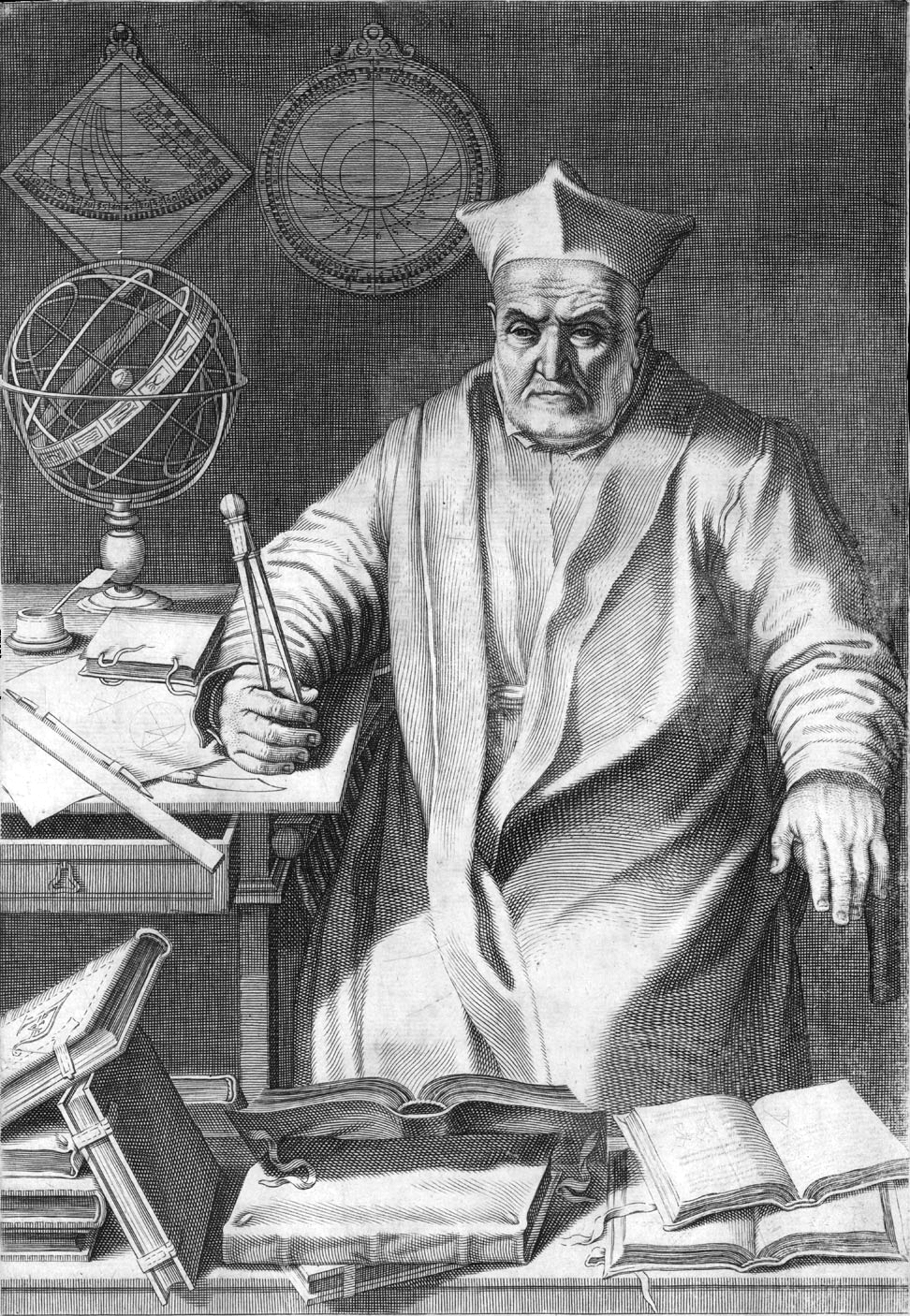 Christopher Clavius (1538–1612), one of the main authors of the reform
 -
 Pope Gregory XIII, portrait by Lavinia Fontana, 16th century
 -
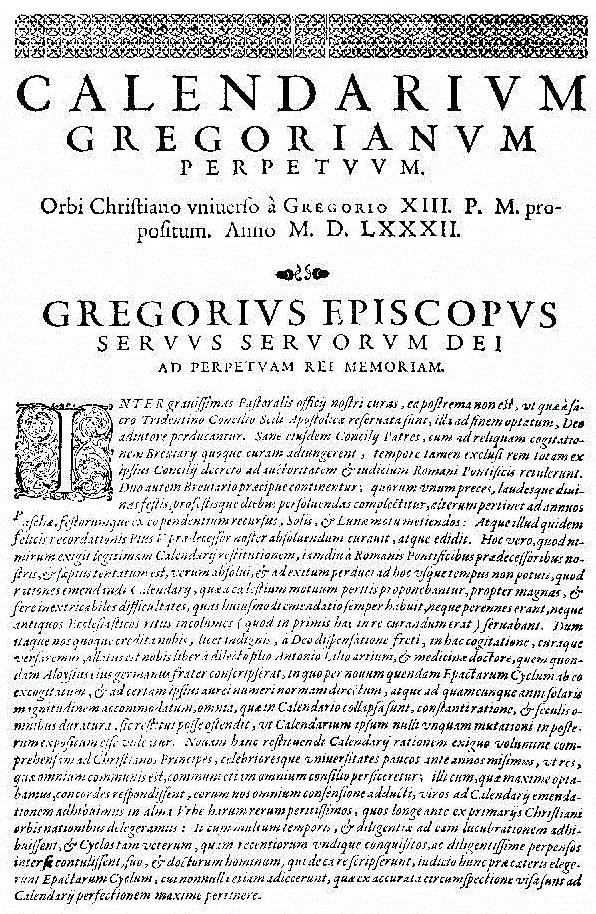 First page of the papal bull Inter gravissimas
 -
 Detail of the pope's tomb by Camillo Rusconi (completed 1723); Antonio Lilio is genuflecting before the pope, presenting his printed calendar.


The Gregorian calendar was a reform of the Julian calendar. It was instituted by the papal bull Inter gravissimas dated 24 February 1582 by Pope Gregory XIII,[3] after whom the calendar is named. The motivation for the adjustment was to bring the date for the celebration of Easter to the time of year in which it was celebrated when it was introduced by the early Church. The error in the Julian calendar (its assumption that there are exactly 365.25 days in a year) had led to the date of the equinox according to the calendar drifting from the observed reality, and thus an error had been introduced into the calculation of the date of Easter. Although a recommendation of the First Council of Nicaea in 325 specified that all Christians should celebrate Easter on the same day, it took almost five centuries before virtually all Christians achieved that objective by adopting the rules of the Church of Alexandria (see Easter for the issues which arose).[lower-alpha 8]
Background[edit | edit source]
Because the date of Easter is a function – the computus – of the date of the spring equinox in the northern hemisphere, the Catholic Church considered the increasing divergence between the canonical date of the equinox and observed reality to be unacceptable. Easter is celebrated on the Sunday after the ecclesiastical full moon on or after 21 March, which was adopted as an approximation to the March equinox.[8] European scholars had been well aware of the calendar drift since the early medieval period.
Bede, writing in the 8th century, showed that the accumulated error in his time was more than three days. Roger Bacon, c. 1200, estimated the error at seven or eight days. Dante, writing c. 1300, was aware of the need for calendar reform. An attempt to go forward with such a reform was undertaken by Pope Sixtus IV, who in 1475 invited Regiomontanus to the Vatican for this purpose. However, the project was interrupted by the death of Regiomontanus shortly after his arrival in Rome.[9] The increase of astronomical knowledge and the precision of observations towards the end of the 15th century made the question more pressing. Numerous publications over the following decades called for a calendar reform, among them two papers sent to the Vatican by the University of Salamanca in 1515 and 1578,[10] but the project was not taken up again until the 1540s, and implemented only under Pope Gregory XIII (r. 1572–1585).
Preparation[edit | edit source]
In 1545, the Council of Trent authorised Pope Paul III to reform the calendar, requiring that the date of the vernal equinox be restored to that which it held at the time of the First Council of Nicaea in 325 and that an alteration to the calendar be designed to prevent future drift. This would allow for more consistent and accurate scheduling of the feast of Easter.
In 1577, a Compendium was sent to expert mathematicians outside the reform commission for comments. Some of these experts, including Giambattista Benedetti and Giuseppe Moleto, believed Easter should be computed from the true motions of the Sun and Moon, rather than using a tabular method, but these recommendations were not adopted.[11] The reform adopted was a modification of a proposal made by the Calabrian doctor Aloysius Lilius (or Lilio).[12]
Lilius's proposal included reducing the number of leap years in four centuries from 100 to 97, by making three out of four centurial years common instead of leap years. He also produced an original and practical scheme for adjusting the epacts of the Moon when calculating the annual date of Easter, solving a long-standing obstacle to calendar reform.
Ancient tables provided the Sun's mean longitude.[lower-alpha 9] The German mathematician Christopher Clavius, the architect of the Gregorian calendar, noted that the tables agreed neither on the time when the Sun passed through the vernal equinox nor on the length of the mean tropical year. Tycho Brahe also noticed discrepancies.[15][16] The Gregorian leap year rule (97 leap years in 400 years) was put forward by Petrus Pitatus of Verona in 1560. He noted that it is consistent with the tropical year of the Alfonsine tables and with the mean tropical year of Copernicus (De revolutionibus) and Erasmus Reinhold (Prutenic tables). The three mean tropical years in Babylonian sexagesimals as the excess over 365 days (the way they would have been extracted from the tables of mean longitude) were 0;14,33,9,57 (Alfonsine), 0;14,33,11,12 (Copernicus) and 0;14,33,9,24 (Reinhold).[lower-alpha 10] In decimal notation, these are equal to 0.24254606, 0.24255185, and 0.24254352, respectively. All values are the same to two sexagesimal places (0;14,33, equal to decimal 0.2425) and this is also the mean length of the Gregorian year. Thus Pitatus's solution would have commended itself to the astronomers.[17]
Lilius's proposals had two components. First, he proposed a correction to the length of the year. The mean tropical year is 365.24219 days long.[18] A commonly used value in Lilius's time, from the Alfonsine tables, is 365.2425463 days.[12] As the average length of a Julian year is 365.25 days, the Julian year is almost 11 minutes longer than the mean tropical year. The discrepancy results in a drift of about three days every 400 years. Lilius's proposal resulted in an average year of 365.2425 days Template:Xref. At the time of Gregory's reform, there had already been a drift of 10 days since the Council of Nicaea, resulting in the vernal equinox falling on 10 or 11 March instead of the ecclesiastically fixed date of 21 March, and if unreformed it would have drifted further. Lilius proposed that the 10-day drift should be corrected by deleting the Julian leap day on each of its ten occurrences over a period of forty years, thereby providing for a gradual return of the equinox to 21 March.
Lilius's work was expanded upon by Christopher Clavius in a closely argued, 800-page volume. He would later defend his and Lilius's work against detractors. Clavius's opinion was that the correction should take place in one move, and it was this advice that prevailed with Gregory.
The second component consisted of an approximation that would provide an accurate yet simple, rule-based calendar. Lilius's formula was a 10-day correction to revert the drift since the Council of Nicaea, and the imposition of a leap day in only 97 years in 400 rather than in 1 year in 4. The proposed rule was that "years divisible by 100 would be leap years only if they were divisible by 400 as well".
The 19-year cycle used for the lunar calendar required revision because the astronomical new moon was, at the time of the reform, four days before the calculated new moon.[8] It was to be corrected by one day every 300 or 400 years (8 times in 2,500 years) along with corrections for the years that were no longer leap years (i.e. 1700, 1800, 1900, 2100, etc.) In fact, a new method for computing the date of Easter was introduced. The method proposed by Lilius was revised somewhat in the final reform.[19]
When the new calendar was put in use, the error accumulated in the 13 centuries since the Council of Nicaea was corrected by a deletion of 10 days. The Julian calendar day Thursday, 4 October 1582 was followed by the first day of the Gregorian calendar, Friday, 15 October 1582 (the cycle of weekdays was not affected).
First printed Gregorian calendar[edit | edit source]

A month after decreeing the reform, the pope (with a brief of 3 April 1582) granted to one Antoni Lilio the exclusive right to publish the calendar for a period of ten years. The Lunario Novo secondo la nuova riforma[lower-alpha 11] was printed by Vincenzo Accolti, one of the first calendars printed in Rome after the reform, notes at the bottom that it was signed with papal authorization and by Lilio (Con licentia delli Superiori... et permissu Ant(onii) Lilij). The papal brief was revoked on 20 September 1582, because Antonio Lilio proved unable to keep up with the demand for copies.[20]
Adoption [edit | edit source]
Although Gregory's reform was enacted in the most solemn of forms available to the Church, the bull had no authority beyond the Catholic Church (of which he was the supreme religious authority) and the Papal States (which he personally ruled). The changes that he was proposing were changes to the civil calendar, which required adoption by the civil authorities in each country to have legal effect.
The bull Inter gravissimas became the law of the Catholic Church in 1582, but it was not recognised by Protestant churches, Eastern Orthodox churches, Oriental Orthodox churches, and a few others. Consequently, the days on which Easter and related holidays were celebrated by different Christian churches again diverged.
On 29 September 1582, Philip II of Spain decreed the change from the Julian to the Gregorian calendar.[21] This affected much of Roman Catholic Europe, as Philip was at the time ruler over Spain and Portugal as well as much of Italy.[22] In these territories, as well as in the Polish–Lithuanian Commonwealth[23] and in the Papal States, the new calendar was implemented on the date specified by the bull, with Julian Thursday, 4 October 1582, being followed by Gregorian Friday, 15 October. The Spanish and Portuguese colonies followed somewhat later de facto because of delay in communication.[24] The other major Catholic power of Western Europe, France, adopted the change a few months later: 9 December was followed by 20 December.[25]
Many Protestant countries initially objected to adopting a Catholic innovation; some Protestants feared the new calendar was part of a plot to return them to the Catholic fold. For example, the British could not bring themselves to adopt the Catholic system explicitly: the Annexe to their Calendar (New Style) Act 1750 established a computation for the date of Easter that achieved the same result as Gregory's rules, without actually referring to him.[26]
Britain and the British Empire (including the eastern part of what is now the United States) adopted the Gregorian calendar in 1752. Sweden followed in 1753.
Prior to 1917, Turkey used the lunar Islamic calendar with the Hijri era for general purposes and the Julian calendar for fiscal purposes. The start of the fiscal year was eventually fixed at 1 March and the year number was roughly equivalent to the Hijri year (see Rumi calendar). As the solar year is longer than the lunar year, this originally entailed the use of "escape years" every so often when the number of the fiscal year would jump. From 1 March 1917, the fiscal year became Gregorian, rather than Julian. On 1 January 1926, the use of the Gregorian calendar was extended to include use for general purposes and the number of the year became the same as in most other countries.
Adoption by country[edit | edit source]

| Year | Countries / Areas |
|---|---|
| 1582 | Spain, Portugal, France, Polish–Lithuanian Commonwealth, Italy, Catholic Low Countries, Luxembourg, and colonies thereof |
| 1584 | Bohemia, some Catholic Swiss cantons[lower-alpha 12] |
| 1610 | Prussia |
| 1648 | Alsace |
| 1682 | Strasbourg |
| 1700 | Protestant Low Countries, Denmark–Norway, some Protestant Swiss cantons[lower-alpha 12] |
| 1752 | Great Britain, Ireland, and the "First" British Empire (1707–1783) |
| 1753 | Sweden, including Finland |
| 1873 | Japan |
| 1875 | Egypt |
| 1896 | Korea |
| 1912 | China, Albania |
| 1915 | Latvia, Lithuania |
| 1916 | Bulgaria |
| 1917 | Ottoman Empire |
| 1918 | Ukraine, Russia, Estonia |
| 1919 | Romania, Yugoslavia[lower-alpha 13] |
| 1923 | Greece |
| 1926 | Turkey (common era years; Gregorian dates in use since 1917 Ottoman adoption) |
| 2016 | Saudi Arabia |
Difference between Gregorian and Julian calendar dates[edit | edit source]
| Gregorian range | Julian range | Difference |
|---|---|---|
| From 15 October 1582 to 28 February 1700 |
From 5 October 1582 to 18 February 1700 |
10 days |
| From 1 March 1700 to 28 February 1800 |
From 19 February 1700 to 17 February 1800 |
11 days |
| From 1 March 1800 to 28 February 1900 |
From 18 February 1800 to 16 February 1900 |
12 days |
| From 1 March 1900 to 28 February 2100 |
From 17 February 1900 to 15 February 2100 |
13 days |
| From 1 March 2100 to 28 February 2200 |
From 16 February 2100 to 14 February 2200 |
14 days |
This section always places the intercalary day on 29 February even though it was always obtained by doubling 24 February (the bissextum (twice sixth) or bissextile day) until the late Middle Ages. The Gregorian calendar is proleptic before 1582 (calculated backwards on the same basis, for years before 1582), and the difference between Gregorian and Julian calendar dates increases by three days every four centuries (all date ranges are inclusive).
The following equation gives the number of days that the Gregorian calendar is ahead of the Julian calendar, called the "secular difference" between the two calendars. A negative difference means the Julian calendar is ahead of the Gregorian calendar.[28] where is the secular difference and is the year using astronomical year numbering, that is, use 1 − (year BC) for BC years. means that if the result of the division is not an integer it is rounded down to the nearest integer.
The general rule, in years which are leap years in the Julian calendar but not the Gregorian, is:
Up to 28 February in the calendar being converted from, add one day less or subtract one day more than the calculated value. Give February the appropriate number of days for the calendar being converted into. When subtracting days to calculate the Gregorian equivalent of 29 February (Julian), 29 February is discounted. Thus if the calculated value is −4 the Gregorian equivalent of this date is 24 February.[29][30]
Beginning of the year[edit | edit source]
| Country | Start numbered year on 1 January |
Adoption of Gregorian calendar |
|---|---|---|
| Roman Republic, Roman Empire |
153 BC | |
| Denmark | Gradual change from 13th to 16th centuries[31] |
1700 |
| Republic of Venice | 1522 | 1582 |
| Papal States | 1583 | 1582 |
| Holy Roman Empire (Catholic states) |
1544 | 1583 |
| Spain, Poland, Portugal | 1556[32] | 1582 |
| Holy Roman Empire (Protestant states) |
1559 | 1700[lower-alpha 14] |
| Sweden | 1559[34] | 1753 |
| France | 1564[35] | 1582[lower-alpha 15] |
| Southern Netherlands | 1576[36] | 1582 |
| Lorraine | 1579[37] | 1582[lower-alpha 16] |
| Netherlands | 1583[38] | 1582 |
| Scotland | 1600[39][40] | 1752 |
| Russia | 1700[41] | 1918 |
| Tuscany | 1750[42] | 1582[43] |
| Great Britain and the British Empire except Scotland |
1752[39] | 1752 |
The year used in dates during the Roman Republic and the Roman Empire was the consular year, which began on the day when consuls first entered office—probably 1 May before 222 BC, 15 March from 222 BC and 1 January from 153 BC.[44] The Julian calendar, which began in 45 BC, continued to use 1 January as the first day of the new year. Even though the year used for dates changed, the civil year always displayed its months in the order January to December from the Roman Republican period until the present.
During the Middle Ages, under the influence of the Catholic Church, many Western European countries moved the start of the year to one of several important Christian festivals—25 December (Christmas), 25 March (Annunciation), or Easter,[45] while the Byzantine Empire began its year on 1 September and Russia did so on 1 March until 1492, when the new year was moved to 1 September.[46]
In common usage, 1 January was regarded as New Year's Day and celebrated as such,[47] but from the 12th century until 1751 the legal year in England began on 25 March (Lady Day).[48] So, for example, the Parliamentary record lists the execution of Charles I on 30 January as occurring in 1648 (as the year did not end until 24 March),[49] although later histories adjust the start of the year to 1 January and record the execution as occurring in 1649.[50]
Most Western European countries changed the start of the year to 1 January before they adopted the Gregorian calendar. For example, Scotland changed the start of the Scottish New Year to 1 January in 1600 (this meant that 1599 was a short year). England, Ireland and the British colonies changed the start of the year to 1 January in 1752 (so 1751 was a short year with only 282 days). Later in 1752 in September the Gregorian calendar was introduced throughout Britain and the British colonies (see the section Adoption). These two reforms were implemented by the Calendar (New Style) Act 1750.[51]
In some countries, an official decree or law specifies that the start of the year should be 1 January. For such countries, a specific date when a "1 January year" became the norm, can be identified.[52] In other countries, customs varied, and the start of the year moved back and forth as fashion and influence from other countries dictated various customs. Neither the papal bull nor its attached canons explicitly fix such a date, though the latter states that the "Golden number" of 1752 ends in December and a new year (and new Golden number) begins in January 1753.[53]
Dual dating[edit | edit source]
.jpg)
During the period between 1582, when the first countries adopted the Gregorian calendar, and 1923, when the last European country adopted it, it was often necessary to indicate the date of some event in both the Julian calendar and in the Gregorian calendar, for example, "10/21 February 1750/51", where the dual year accounts for some countries already beginning their numbered year on 1 January while others were still using some other date. Even before 1582, the year sometimes had to be double-dated because of the different beginnings of the year in various countries. Woolley, writing in his biography of John Dee (1527–1608/9), notes that immediately after 1582 English letter writers "customarily" used "two dates" on their letters, one OS and one NS.[54]
Old Style and New Style dates[edit | edit source]
"Old Style" (O.S.) and "New Style" (N.S.) indicate dating systems before and after a calendar change, respectively. Usually, this is the change from the Julian calendar to the Gregorian calendar as enacted in various European countries between 1582 and the early 20th century.
In England, Wales, Ireland, and Britain's American colonies, there were two calendar changes, both in 1752. The first adjusted the start of a new year from Lady Day (25 March) to 1 January (which Scotland had done from 1600), while the second discarded the Julian calendar in favour of the Gregorian calendar, removing 11 days from the September 1752 calendar to do so.[55][56] To accommodate the two calendar changes, writers used dual dating to identify a given day by giving its date according to both styles of dating.
For countries such as Russia where no start of year adjustment took place, O.S. and N.S. simply indicate the Julian and Gregorian dating systems. Many Eastern Orthodox countries continue to use the older Julian calendar for religious purposes.
Proleptic Gregorian calendar[edit | edit source]
 | This section does not cite any sources. (October 2020) |
Extending the Gregorian calendar backwards to dates preceding its official introduction in a particular jurisdiction produces a proleptic calendar, which should be used with some caution. For ordinary purposes, the dates of events occurring prior to 15 October 1582 are generally shown as they appeared in the Julian calendar, with the year starting on 1 January, and no conversion to a putative Gregorian equivalents. For example, the Battle of Agincourt is universally considered to have been fought on 25 October 1415 which is Saint Crispin's Day.
But for the period between 15 October 1582 and 14 September 1752 (the date of its legal introduction in the British Empire), a significant risk of misunderstanding arises in English language texts. (The equivalent issue arises in Russian (until 1917) and Greek (until 1923) language texts.) This can happen when the same event has two different dates (which may even have a different year number): one as recorded using the Gregorian date in (some) continental European histories and the other using the Julian date in English history sources. Even then, events that happened on the Continent are usually reported in English language histories according to the local convention where the event occurred, so usually the Gregorian calendar. For example, the Battle of Blenheim is always given as 13 August 1704. Confusion may occur when an event affects both. For example, William III of England set sail from the Netherlands on 11 November 1688 (Gregorian calendar) and arrived at Brixham in England on 5 November 1688 (Julian calendar).
Months[edit | edit source]
The Gregorian calendar continued to employ the Julian months, which have Latinate names and irregular numbers of days:
- January (31 days), from Script error: The function "langx" does not exist., "Month of Janus",[57] the Roman god of gates, doorways, beginnings and endings
- February (28 days in common and 29 in leap years), from mēnsis Februārius, "Month of the Februa", the Roman festival of purgation and purification,[58][59] cognate with fever,[58] the Etruscan death god Februus ("Purifier"),[citation needed] and the Proto-Indo-European word for sulfur[58]
- March (31 days), from mēnsis Mārtius, "Month of Mars",[60] the Roman war god[59]
- April (30 days), from mēnsis Aprīlis, of uncertain meaning[61] but usually derived from some form of the verb aperire ("to open")[lower-alpha 17] or the name of the goddess Aphrodite[59][lower-alpha 18]
- May (31 days), from mēnsis Māius, "Month of Maia",[65] a Roman vegetation goddess[59] whose name is cognate with Latin magnus ("great")[65] and English major
- June (30 days), from mēnsis Iūnius, "Month of Juno",[66] the Roman goddess of marriage, childbirth, and rule[59]
- July (31 days), from mēnsis Iūlius', "Month of Julius Caesar", the month of Caesar's birth, instituted in 44 BC[67] as part of his calendrical reforms[59]
- August (31 days), from mēnsis Augustus, "Month of Augustus", instituted by Augustus in 8 BC in agreement with July and from the occurrence during the month of several important events during his rise to power[68]
- September (30 days), from mēnsis september, "seventh month", of the ten-month Roman year of Romulus c. 750 BC[69]
- October (31 days), from mēnsis octōber, "eighth month", of the ten-month Roman year of Romulus c. 750 BC[70]
- November (30 days), from mēnsis november, "ninth month", of the ten-month Roman year of Romulus c. 750 BC[71]
- December (31 days), from mēnsis december, "tenth month", of the ten-month Roman year of Romulus c. 750 BC[72]
Europeans sometimes attempt to remember the number of days in each month by memorizing some form of the traditional verse "Thirty Days Hath September". It appears in Latin,[73] Italian,[74] French[75] and Portuguese,[76] and belongs to a broad oral tradition but the earliest currently attested form of the poem is the English marginalia inserted into a calendar of saints c. 1425:[77][78][79]
Thirti dayes hath novembir |
Thirty days has November, |
.svg)
Variations appeared in Mother Goose and continue to be taught at schools. The unhelpfulness of such involved mnemonics has been parodied as "Thirty days hath September / But all the rest I can't remember"[80] but it has also been called "probably the only sixteenth-century poem most ordinary citizens know by heart".[81] A common nonverbal alternative is the knuckle mnemonic, considering the knuckles of one's hands as months with 31 days and the lower spaces between them as months with fewer days. Using two hands, one may start from either pinkie knuckle as January and count across, omitting the space between the index knuckles (July and August). The same procedure can be done using the knuckles of a single hand, returning from the last (July) to the first (August) and continuing through. A similar mnemonic is to move up a piano keyboard in semitones from an F key, taking the white keys as the longer months and the black keys as the shorter ones.
Weeks[edit | edit source]
In conjunction with the system of months, there is a system of weeks. A physical or electronic calendar provides conversion from a given date to the weekday and shows multiple dates for a given weekday and month. Calculating the day of the week is not very simple, because of the irregularities in the Gregorian system. When the Gregorian calendar was adopted by each country, the weekly cycle continued uninterrupted. For example, in the case of the few countries that adopted the reformed calendar on the date proposed by Gregory XIII for the calendar's adoption, Friday, 15 October 1582, the preceding date was Thursday, 4 October 1582 (Julian calendar).
Opinions vary about the numbering of the days of the week. ISO 8601, in common use worldwide, starts with Monday=1; printed monthly calendar grids often list Mondays in the first (left) column of dates and Sundays in the last. In North America, the week typically begins on Sunday and ends on Saturday.
Accuracy[edit | edit source]
The Gregorian calendar improves the approximation made by the Julian calendar by skipping three Julian leap days in every 400 years, giving an average year of 365.2425 mean solar days long.[82] This approximation has an error of about one day per 3,030 years[lower-alpha 19] (NASA: 1 day every 3,333.3 years) with respect to the current value of the mean tropical year. However, because of the precession of the equinoxes, which is not constant, and the movement of the perihelion (which affects the Earth's orbital speed) the error with respect to the astronomical vernal equinox is variable; using the average interval between vernal equinoxes near 2000 of 365.24237 days[83] implies an error closer to 1 day every 7,700 years. By any criterion, the Gregorian calendar is substantially more accurate than the 1 day in 128 years error of the Julian calendar (average year 365.25 days).
In the 19th century, Sir John Herschel proposed a modification to the Gregorian calendar with 969 leap days every 4,000 years, instead of 970 leap days that the Gregorian calendar would insert over the same period.[84] This would reduce the average year to 365.24225 days. Herschel's proposal would make the year 4000, and multiples thereof, common instead of leap. While this modification has often been proposed since, it has never been officially adopted.[85]
On time scales of thousands of years, the Gregorian calendar falls behind the astronomical seasons. This is because the Earth's speed of rotation is gradually slowing down, which makes each day slightly longer over time (see tidal acceleration and leap second) while the year maintains a more uniform duration.
Calendar seasonal error[edit | edit source]

This image shows the difference between the Gregorian calendar and the astronomical seasons.
The y-axis is the date of the solstice in June and the x-axis is Gregorian calendar years.
Each point is the date and time of the June solstice in that particular year. The error shifts by about a quarter of a day per year. Centurial years are ordinary years, unless they are divisible by 400, in which case they are leap years. This causes a correction in the years 1700, 1800, 1900, 2100, 2200, and 2300.
For instance, these corrections cause 23 December 1903 to be the latest December solstice, and 20 December 2096 to be the earliest solstice—about 2.35 days of variation compared with the astronomical event.
Proposed reforms[edit | edit source]
The following are proposed reforms of the Gregorian calendar:
- Holocene calendar
- International Fixed Calendar (also called the International Perpetual calendar)
- World Calendar
- World Season Calendar
- Leap week calendars
See also[edit | edit source]
- Anno Domini
- Calendar (New Style) Act 1750
- Calendar reform
- Common Era – Modern calendar era
- Conversion between Julian and Gregorian calendars
- Doomsday rule
- French revolutionary calendar
- Dionysius Exiguus
- Inter gravissimas in English – Wikisource
- Julian day
- History of calendars
- ISO 8601
- List of adoption dates of the Gregorian calendar by country
- List of calendars
- Old Calendarists
- Revised Julian calendar
Precursors of the Gregorian reform
- Johannes de Sacrobosco, De Anni Ratione ("On reckoning the years"), c. 1235
- Roger Bacon, Opus Majus ("Greater Work"), c. 1267
Notes[edit | edit source]
- ↑ Many countries that use other calendars for religious purposes use the Gregorian calendar as their civil calendar. Iran is a notable exception, in that it uses the solar Hijri calendar.
- ↑ Rather than 45 BC when the Roman Empire adopted the Julian calendar.
- ↑ By the time Great Britain and its possessions adopted the reform with effect from 1752, the gap had increased to 11 days; when Russia and Greece did so (for their civil calendars) in the 20th century, the jump was 13 days. For other countries and territories, see List of adoption dates of the Gregorian calendar by country.
- ↑ called such to avoid any suggestion of recognising the authority of Rome. The British Calendar (New Style) Act 1750 restates the algorithm from first principles without any reference to Gregory.
- ↑ The cycle described applies to the solar, or civil, calendar. If one also considers the ecclesiastical lunar rules, the lunisolar Easter computus cycle repeats only after 5,700,000 years of 2,081,882,250 days in 70,499,183 lunar months, based on an assumed mean lunar month of 29 days 12 hours 44 minutes 2+49928114/70499183 seconds. (Seidelmann (1992), p. 582) [To properly function as an Easter computus, this lunisolar cycle must have the same mean year as the Gregorian solar cycle, and indeed that is exactly the case.]
- ↑ The extreme length of the Gregorian Easter computus is due to its being the product of the 19-year Metonic cycle, the thirty different possible values of the epact, and the least common multiple (10,000) of the 400-year and 2,500-year solar and lunar correction cycles.[7]
- ↑ The same result is obtained by summing the fractional parts implied by the rule: 365 + 1/4 − 1/100 + 1/400 = 365 + 0.25 − 0.01 + 0.0025 = 365.2425
- ↑ The last major Christian region to accept the Alexandrian rules was the Carolingian Empire (most of Western Europe) during 780–800. The last monastery in England to accept the Alexandrian rules did so in 931, and a few churches in southwest Asia beyond the eastern border of the Byzantine Empire continued to use rules that differed slightly, causing four dates for Easter to differ every 532 years.
- ↑ See, for example, Tabule illustrissimi principis regis alfonsii (Prague 1401−4). A full set of Alphonsine Tables (including tables for mean motions, conjunctions of Sun and Moon, equation of time, spherical astronomy, longitudes and latitudes of cities, star tables, eclipse tables).[13] For an example of the information provided see Jacques Cassini, Tables astronomiques du soleil, de la lune, des planètes, des étoiles fixes, et des satellites de Jupiter et de Saturne, Table III.[14]
- ↑ For an explanation of this notation, see Sexagesimal#Notations.
- ↑ 11.0 11.1 "New Almanac according to the new reform for the correction of the year, [as] reformed by His Holiness Gregory XIII".
- ↑ 12.0 12.1 In the Old Swiss Confederacy, Helvetic Republic, or Switzerland, adoptions were made between 1584 and 1811. Some Catholic cantons switched in 1584, some Protestant in 1700/1701. For a complete list see List of adoption dates of the Gregorian calendar per country.
- ↑ The regions comprising the former Kingdoms of Serbia and Montenegro (present-day Kosovo, Montenegro, Serbia and North Macedonia) adopted the Gregorian calendar in 1919. The western and northern regions of what became Yugoslavia were already using the Gregorian calendar. For example, most of Slovenia adopted the Gregorian calendar at the same time as Austria in 1583. Coastal Croatia, which was at the time ruled by Venice, adopted the Gregorian calendar in 1582. Inland Croatia, ruled by the Habsburgs, adopted it in 1587 along with Hungary. The Gregorian calendar was used in Bosnia and Herzegovina since the 16th century by the Catholic population and was formally adopted for government use in 1878 following occupation by Austria-Hungary.
- ↑ Protestant states in Germany used an astronomical Easter from 1700 to 1774, based on Kepler's Rudolphine Tables, differing from the Gregorian Easter twice, one week early in 1724 and 1744.[33]
- ↑ In 1793 France abandoned the Gregorian calendar in favour of the French Republican Calendar. This change was reverted in 1805.
- ↑ Lorraine reverted to Julian in 1735 and adopted Gregorian again in 1760.
- ↑ It is not unusual for month names to be based on natural descriptions but this etymology is sometimes doubted since no other Roman months have such names.[59]
- ↑ This derivation was apparently a popular one in ancient Rome, given by Plutarch[62] but rejected by Varro and Cincius.[where?][63] [64]
- ↑ Using value from Richards (2013, p. 587) for tropical year in mean solar days, the calculation is 1/(365.2425 − 365.24217).
Citations[edit | edit source]
- ↑ Dershowitz & Reingold (2008), p. 45. "The calendar in use today in most of the world is the Gregorian or new-style calendar designed by a commission assembled by Pope Gregory XIII in the sixteenth century.".
- ↑ "Introduction to Calendars". United States Naval Observatory. n.d. Retrieved 9 May 2022.
- ↑ 3.0 3.1 3.2 Gregory XIII (1582).
- ↑ Blegen (2013).
- ↑ Richards (1998), p. 101.
- ↑ Clause 3.2.1 ISO 8601
- ↑ Walker (1945), p. 218.
- ↑ 8.0 8.1 Richards (2013), p. 599.
- ↑ Ben-Menahem, Ari (2009). Historical Encyclopedia of Natural and Mathematical Sciences. Vol. 1. Springer. p. 863. ISBN 9783540688310.
- ↑ Carabias Torres (2012), p. 241.
- ↑ Ziggelaar (1983), pp. 211, 214.
- ↑ 12.0 12.1 Moyer (1983).
- ↑ John of Saxony (1401). Tabule illustrissimi principis regis alfonsii [The tablet of the most illustrious prince King Alphonsus] (in Latina).
- ↑ Cassini, Jacques (1740). Tables astronomiques du soleil, de la lune, des planètes, des étoiles fixes, et des satellites de Jupiter et de Saturne [Astronomical tables of the sun, the moon, the planets, the fixed stars, and the satellites of Jupiter and Saturn] (in français). Paris: Imprimerie Royale. p. T10.
- ↑ Dreyer, J L E (2014). Tycho Brahe. Cambridge: Cambridge University Press. p. 52. ISBN 978-1-108-06871-0.
He remarks that both the Alphonsine and the Prutenic Tables are several hours wrong with regard to the time of the equinoxes and solstices.
- ↑ North, J (1989). The Universal frame: historical essays in astronomy, natural philosophy and scientific method. London: Hambledon. p. 29. ISBN 978-0-907628-95-8.
He noted on one occasion that the Alphonsine tables differed from the Prutenic by nineteen hours as to the time of the vernal equinox of 1588.
- ↑ Swerdlow (1986).
- ↑ Meeus & Savoie (1992).
- ↑ Ziggelaar (1983), p. 220.
- ↑ Mezzi, E.; Vizza, F. (2010). Luigi Lilio Medico Astronomo e Matematico di Cirò. Reggio Calabria: Laruffa Editore. pp. 14, 52. ISBN 9788872214817. citing as primary references: Biblioteca Nazionale Centrale di Firenze, Magl. 5.10.5/a, Vatican Apostolic Archive A.A., Arm. I‑XVIII, 5506, f. 362r.
- ↑ Kamen, Henry (1998). Philip of Spain. Yale University Press. p. 248. ISBN 978-0300078008.
- ↑ Cohen, Jennie (23 August 2018). "6 Things You May Not Know About the Gregorian Calendar". HISTORY. Retrieved 23 July 2021.
- ↑ Tadeusz Szulc (2011). "Wprowadzenie kalendarza gregoriańskiego w Rzeczpospolitej szlacheckiej" (PDF). Studia z Dziejów Państwa i Prawa Polskiego (in polski). tom 14: 32–33.
- ↑ ""Pragmatica" on the Ten Days of the Year". John Carter Brown Library. 1584.: the first known South American imprint, produced in 1584 by Antonio Ricardo, of a four-page edict issued by King Philip II of Spain in 1582, decreeing the change from the Julian to the Gregorian calendar.
- ↑ "The Calendar FAQ: The Gregorian Calendar". Tondering.dk. Retrieved 3 May 2022.
- ↑ "Calendar (New Style) Act 1750, Section 3". Parliament of Great Britain – via National Archives.
- ↑ A more extensive list is available at Conversion between Julian and Gregorian calendars
- ↑ Blackburn & Holford-Strevens (1999), p. 788.
- ↑ Evans, James (1998). The history and practice of ancient astronomy. Oxford: Oxford University Press. p. 169. ISBN 0-19-509539-1.
- ↑ Explanatory Supplement to The Astronomical Ephemeris and The American Ephemeris and Nautical Almanac. London: Her Majesty's Stationery Office. 1961. p. 417.
- ↑ Herluf Nielsen: Kronologi (2nd ed., Dansk Historisk Fællesforening, Copenhagen 1967), pp. 48–50.
- ↑ Bond (1875), p. 99–100.
- ↑ Lamont, Roscoe (1920), "The reform of the Julian calendar", Popular Astronomy, 28: 18–32, Bibcode:1920PA.....28...18L
- ↑ Bond (1875), p. 98.
- ↑ "Calendrier grégorien en France". www.henk-reints.nl.
- ↑ Per decree of 16 June 1575. Hermann Grotefend, "Osteranfang Archived 13 July 2016 at the Wayback Machine" (Easter beginning), Zeitrechnung de Deutschen Mittelalters und der Neuzeit Archived 28 June 2016 at the Wayback Machine (Chronology of the German Middle Ages and modern times) (1891–1898)
- ↑ Bond (1875), p. 97.
- ↑ Bond (1875), p. 94–95.
- ↑ 39.0 39.1 Blackburn & Holford-Strevens (1999), p. 784.
- ↑ Bond (1875), p. 92.
- ↑ Roscoe Lamont, The reform of the Julian calendar Archived 30 December 2015 at the Wayback Machine, Popular Astronomy 28 (1920) 18–32. Decree of Peter the Great is on pp. 23–24.
- ↑ *Alexandre Dumas, Storia del governo della Toscana: sotto La casa de'Medici.
- Il calendario fiorentino Archived 10 March 2017 at the Wayback Machine.
- ↑ Lorenzo Cattini, Legislazione toscana raccolta e illustrata, vol. 10, p. 208.
- ↑ "Roman Dates: Eponymous Years". Tyndalehouse.com. Retrieved 14 September 2010.
- ↑ Spathaky, Mike. "Old Style and New Style Dates and the change to the Gregorian Calendar: A summary for genealogists".
- ↑ S. I. Seleschnikow: Wieviel Monde hat ein Jahr? (Aulis-Verlag, Leipzig/Jena/Berlin 1981, p. 149), which is a German translation of С. И. Селешников: История календаря и хронология (Издательство "Наука", Moscow 1977). The relevant chapter is available online here: История календаря в России и в СССР (Calendar history in Russia and the USSR) Archived 17 October 2009 at the Wayback Machine. Anno Mundi 7000 lasted from 1 March 1492 to 31 August 1492. (in Russian)
- ↑ Tuesday 31 December 1661 Archived 29 September 2007 at the Wayback Machine, The Diary of Samuel Pepys Archived 1 March 2021 at the Wayback Machine "I sat down to end my journell for this year, ..."
- ↑ Nørby, Toke. The Perpetual Calendar: What about England Archived 30 August 2007 at the Wayback Machine Version 29 February 2000
- ↑ "House of Commons Journal Volume 8, 9 June 1660 (Regicides)". British History Online. Retrieved 18 March 2007.
- ↑ "Death warrant of Charles I". National Archives.
- ↑ Nørby, Toke. The Perpetual Calendar Archived 12 November 2019 at the Wayback Machine
- ↑ Bond (1875), p. 91–101.
- ↑ Chiesa Cattolica (1752). "Canon I: De cyclo decennovenalli • aurei numeri" [Canon I: On the nineteenth yearly cycle • golden numbers]. Kalendarium Gregorianum perpetuum [Perpetual Gregorian calendar] (in Latina). apud Ioannes Bapt. Sessam, & fratres. pp. 17, 18.
Annus Cycli decennouennalis, qui dr Aureus numerus est 6. terminaturque simulcu ipso anno Domini 1582 in mése Decembri. In mense autem Ianuario initium sumit alius annus Domini , nempe 1583. & in eodem mense Ianuario aslumitur etiam alius annuis Aurei numeri, nimirum 7.
[The year of the ten-year cycle, which is the golden number 6, ends at the same time in the year of the Lord 1582 in the month of December. And in the month of January begins another year of the Lord, that is, 1583. And in the same month of January also another year of the golden number is ushered in, namely 7.] - ↑ Woolley, Benjamin (2001). The Queen's Conjurer: The science and magic of Dr. John Dee, adviser to Queen Elizabeth I. New York: Henry Holt. p. 173.
- ↑ Poole 1995, pp. 95–139.
- ↑ Spathaky, Mike (13 December 2011). "Old Style and New Style Dates and the change to the Gregorian Calendar". Archived from the original on 11 October 2014.
Before 1752, parish registers, in addition to a new year heading after 24th March showing, for example '1733', had another heading at the end of the following December indicating '1733/4'. This showed where the Historical Year 1734 started even though the Civil Year 1733 continued until 24th March. ... We as historians have no excuse for creating ambiguity and must keep to the notation described above in one of its forms. It is no good writing simply 20th January 1745, for a reader is left wondering whether we have used the Civil or the Historical Year. The date should either be written 20th January 1745 OS (if indeed it was Old Style) or as 20th January 1745/6. The hyphen (1745-6) is best avoided as it can be interpreted as indicating a period of time.
- ↑ "January, n.", Oxford English Dictionary, Oxford: Oxford University Press.
- ↑ 58.0 58.1 58.2 "February, n.", Oxford English Dictionary.
- ↑ 59.0 59.1 59.2 59.3 59.4 59.5 59.6 Liberman, Anatoly (7 March 2007), "On a Self-Congratulatory Note", Oxford Etymologist Archives, Oxford: Oxford University Press.
- ↑ "March, n.", Oxford English Dictionary.
- ↑ "April, n.", Oxford English Dictionary.
- ↑ Plutarch, Life of Numa, Ch. xix.
- ↑ Scullard, H H (1990). Festivals and Ceremonies of the Roman Republic. Aspects of Greek and Roman Life. Ithaca: Cornell University Press. p. 96. ISBN 9780801414022.
- ↑ Forsythe (2014). Time in Roman religion : one thousand years of religious history. London: Routledge. p. 10. ISBN 9781138802322..
- ↑ 65.0 65.1 "May, n.", Oxford English Dictionary.
- ↑ "June, n.", Oxford English Dictionary.
- ↑ "July, n.", Oxford English Dictionary.
- ↑ "August, n.", Oxford English Dictionary.
- ↑ "September, n.", Oxford English Dictionary.
- ↑ "October, n.", Oxford English Dictionary.
- ↑ "November, n.", Oxford English Dictionary.
- ↑ "December, n.", Oxford English Dictionary.
- ↑ de Dacia, Petrus. Pedersen, Fritz S. (ed.). Anianus: Computus Metricus Manualis (in Latina). Odense. OCLC 163382057.
- ↑ Onofri, Francesca Romana; et al. (2012), Italian for Dummies, Berlitz, pp. 101–2, ISBN 9781118258767.
- ↑ Bond, Otto Ferdinand; et al. (1918), Military Manual of Elementary French, Austin: E.L. Steck, p. 11.
- ↑ Portella, Mathias Rodrigues (1738), Cartapacio de syllaba, e figuras, conforme a ordem dos mais cartapacios de Grammatica..., Western Lisbon: Officina de Antonio Pedrozo Galram, pp. 121.
- ↑ 77.0 77.1 Bryan, Roger (30 October 2011). "The Oldest Rhyme in the Book". London: Times Newspapers..
- ↑ Misstear, Rachael (16 January 2012). "Welsh Author Digs Deep to Find Medieval Origins of Thirty Days Hath Verse". Media Wales. Archived from the original on 6 February 2012.
- ↑ "Memorable mnemonics". London: BBC Radio 4. 30 November 2011..
- ↑ "Thirty days hath September. But all the rest I can't remember". The Cincinnati Enquirer. Cincinnati. 20 September 1924. p. 6..
- ↑ Holland, Norman N. (1992), The Critical I, New York: Columbia University Press, p. 64–5, ISBN 9780231076517.
- ↑ Seidelmann (1992), pp. 580–581.
- ↑ Meeus & Savoie (1992), p. 42.
- ↑ Herschel, John (1878) [1849]. "Part IV. Chapter XVIII. Gregorian Calendar.". Outlines of Astronomy. Longman. p. 673.
- ↑ Steel, Duncan (2000). Marking Time: The Epic Quest to Invent the Perfect Calendar. John Wiley & Sons. p. 185. ISBN 978-0-471-29827-4.
References[edit | edit source]
- Blackburn, Bonnie; Holford-Strevens, Leofranc (1999). The Oxford Companion to the Year. Oxford University Press. ISBN 9780192142313..
- Blegen, Carl W. (25 December 2013). Vogeikoff-Brogan, Natalia (ed.). "An Odd Christmas". From the Archivist's Notebook. Retrieved 1 April 2018.
- Bond, John James (1875). "Commencement of the Year, on the 1st of January or otherwise, and adoption of the Gregorian Calendar". Handy Book of Rules and Tables for Verifying Dates With the Christian Era Giving an Account of the Chief Eras and Systems Used by Various Nations... London: George Bell & Sons.
- Carabias Torres, A. M (2012). Salamanca y la medida del tiempo (in español). Salamanca: Ediciones Universidad de Salamanca.
- Dershowitz, D.; Reingold, E. M (2008). Calendrical Calculations (3rd ed.). Cambridge: Cambridge University Press.
- Gregory XIII (1582). Inter Gravissimas [Amongst the most serious tasks of our pastoral office]. Translated by Wikisource.
- Meeus, J.; Savoie, D. (1992). "The history of the tropical year". Journal of the British Astronomical Association. 102 (1): 40–42. Bibcode:1992JBAA..102...40M.
- Moyer, Gordon (1983). Coyne, G. V.; Hoskin, M. A.; Pedersen, O. (eds.). Aloisius Lilius and the Compendium Novae Rationis Restituendi Kalendarium. Gregorian Reform of the Calendar: Proceedings of the Vatican Conference to Commemorate its 400th Anniversary. Vatican City: Pontifical Academy of Sciences, Specolo Vaticano. pp. 171–188.
- Poole, Robert (1995). "'Give us our eleven days!': calendar reform in eighteenth-century England" (PDF). Past & Present (149). Oxford Academic: 95–139. doi:10.1093/past/149.1.95. JSTOR 651100. Retrieved 4 December 2020.
- Richards, E. G. (1998). Mapping Time: The Calendar and its History. Oxford University Press. Bibcode:1998mtch.book.....R.
- Richards, E. G. (2013). "Calendars". In Urban, S. E.; Seidelmann, P. K. (eds.). Explanatory Supplement to the Astronomical Almanac (3rd ed.). Mill Valley CA: University Science Books. pp. 585–624. ISBN 978-1-891389-85-6.
- Seidelmann, P. K., ed. (1992). Explanatory Supplement to the Astronomical Almanac (2nd ed.). Sausalito, CA: University Science Books. Bibcode:1992esaa.book.....S.
- Swerdlow, N. M. (1986). "The Length of the Year in the Original Proposal for the Gregorian Calendar". Journal for the History of Astronomy. 17 (49): 109–118. Bibcode:1986JHA....17..109S. doi:10.1177/002182868601700204. S2CID 118491152.
- Walker, G. W. (June 1945). "Easter Intervals". Popular Astronomy. Vol. 53, no. 6. pp. 162–178, 218–232. Bibcode:1945PA.....53..218W.
- Ziggelaar, A. (1983). Coyne, G. V.; Hoskin, M. A.; Pedersen, O. (eds.). The Papal Bull of 1582 Promulgating a Reform of the Calendar. Gregorian Reform of the Calendar: Proceedings of the Vatican Conference to Commemorate its 400th Anniversary. Vatican City: Pontifical Academy of Sciences, Specolo Vaticano. pp. 201–239.
Further reading[edit | edit source]
- Barsoum, Ignatius A. (2003). The Scattered Pearls: A History Of Syriac Literature And Sciences. Piscataway: Georgias Press.
- Borkowski, K. M. (1991). "The tropical calendar and solar year". Journal of the Royal Astronomical Society of Canada. 85 (3): 21–130. Bibcode:1991JRASC..85..121B.
- Coyne, G. V.; Hoskin, M. A.; Pedersen, O., eds. (1983). Gregorian Reform of the Calendar. Vatican Conference to Commemorate its 400th Anniversary, 1582–1982. Vatican City: Pontifical Academy of Sciences, Vatican Observatory (Pontificia Academia Scientarum, Specola Vaticana).
- Duncan, D. E (1999). Calendar: Humanity's Epic Struggle To Determine A True And Accurate Year. HarperCollins. ISBN 9780380793242.
- Morrison, L. V.; Stephenson, F. R. (2004). "Historical values of the Earth's clock error ΔT and the calculation of eclipses". Journal for the History of Astronomy. 35, part 3 (120): 327–336. Bibcode:2004JHA....35..327M. doi:10.1177/002182860403500305. S2CID 119021116.
- Moyer, Gordon (May 1982). "The Gregorian Calendar". Scientific American. Vol. 246, no. 5. pp. 144–152.
- Pedersen, O (1983). Coyne, G. V.; Hoskin, M. A.; Pedersen, O. (eds.). The Ecclesiastical Calendar and the Life of the Church. Gregorian Reform of the Calendar: Proceedings of the Vatican Conference to Commemorate its 400th Anniversary. Vatican City: Pontifical Academy of Sciences, Specolo Vaticano. pp. 17–74.
External links[edit | edit source]
- Template:In Our Time
- Calendar Converter
- Inter Gravissimas (in Latin, French, and English)
- History of Gregorian Calendar Archived 6 January 2014 at the Wayback Machine
- The Perpetual Calendar Gregorian Calendar adoption dates for many countries.
- World records for mentally calculating the day of the week in the Gregorian Calendar
- The Calendar FAQ – Frequently Asked Questions about Calendars
- Today's date (Gregorian) in over 800 more-or-less obscure foreign languages Archived 8 March 2023 at the Wayback Machine
Template:Calendars Template:Time Topics Template:Time measurement and standards Template:Chronology Template:Time in religion and mythology