

No edit summary |
add page additionally and improved wording for clarity |
||
| Line 1: | Line 1: | ||
{{Short description|Species of | {{Short description|Species of carnivoran}} | ||
{{Use dmy dates|date=January 2020}} | {{Use dmy dates|date=January 2020}} | ||
{{Use Indian English|date=January 2020}} | {{Use Indian English|date=January 2020}} | ||
| Line 8: | Line 8: | ||
| status = VU | | status = VU | ||
| status_system = IUCN3.1 | | status_system = IUCN3.1 | ||
| status_ref = <ref name=iucn>{{cite iucn |title=''Martes gwatkinsii'' |last1=Mudappa |first1=D. |last2=Jathana |first2=D. |last3=Raman |first3=T. R. S. |name-list-style=amp |date=2015 | | | status_ref = <ref name=iucn>{{cite iucn |title=''Martes gwatkinsii'' |last1=Mudappa |first1=D. |last2=Jathana |first2=D. |last3=Raman |first3=T. R. S. |name-list-style=amp |date=2015 |errata=2016 |article-number=e.T12847A86161239 |doi=10.2305/IUCN.UK.2015-4.RLTS.T12847A45199025.en |access-date=9 March 2022}}</ref> | ||
| status2 = CITES_A3 | |||
| status2_system = CITES | |||
| status2_ref = <ref>{{cite Species+ |id=7173 |title=''Martes gwatkinsii'' Horsfield, 1851 |access-date=25 November 2025}}</ref> | |||
| genus = Martes | | genus = Martes | ||
| species = gwatkinsii | | species = gwatkinsii | ||
| Line 17: | Line 20: | ||
}} | }} | ||
The '''Nilgiri marten''' (''Martes gwatkinsii'') is the only [[marten]] species native to southern [[India]]. It lives in the hills of the [[Nilgiris (mountains)|Nilgiris]] and parts of the [[Western Ghats]]. With only around a thousand members left it is listed as [[Vulnerable species| | The '''Nilgiri marten''' ('''''Martes gwatkinsii''''') is the only [[marten]] species native to southern [[India]]. It lives in the hills of the [[Nilgiris (mountains)|Nilgiris]] and parts of the [[Western Ghats]]. With only around a thousand members left it is listed as [[Vulnerable species|vulnerable]] on the [[IUCN Red List]].<ref name=iucn/> | ||
== | == Taxonomy == | ||
[[ | The Nilgiri marten was described by [[Thomas Horsfield]] based on a skin in the museum of the East India Company; it is named after the collector Reynolds Gwatkins.<ref>{{cite book |last1=Horsfield |first1=Thomas |title=Catalogue of the Mammalia in the Museum of the Hon. East-India Company |year=1851 |location=London |publisher=Printed by J. & H. Cox |pages=99–101 |doi=10.5962/bhl.title.32671 |doi-access=free |oclc=1109424 |ol=243736W |ol-access=free}}</ref> | ||
The Nilgiri marten is deep brown from head to rump, with the forequarters being almost reddish, with a bright throat ranging in colour from yellow to orange. It has a prominent frontal [[wikt:concave|concavity]] and is larger than the [[yellow-throated marten]].<ref name=Prater>{{cite book |last=Prater |first=S. H. |author-link=Stanley Henry Prater |title=The Book of Indian Animals |publisher=Bombay Natural History Society, Oxford University Press |location=Mumbai |year=2005 |orig- | |||
== Characteristics == | |||
The Nilgiri marten is deep brown from head to rump, with the forequarters being almost reddish, with a bright throat ranging in colour from yellow to orange. It has a prominent frontal [[wikt:concave|concavity]] and is larger than the [[yellow-throated marten]].<ref name=Prater>{{cite book |last=Prater |first=S. H. |author-link=Stanley Henry Prater |title=The Book of Indian Animals |publisher=Bombay Natural History Society, Oxford University Press |location=Mumbai |year=2005 |orig-date=1971 |edition=3rd}}</ref> | |||
It is about {{cvt|55-65|cm}} long from head to vent and has a tail of {{cvt|40-45|cm}}. It weighs about {{cvt|2.1|kg}}.<ref name="Hussain1999">{{cite journal |last=Hussain |first=S. A. |author-link=S. A. Hussain |year=1999 |title=Mustelids, Viverrids and Herpestids of India: Species Profile and Conservation Status |url=https://archive.org/details/MustelidsViverridsIndia/page/n6 |journal=ENVIS Bulletin: Wildlife and Protected Areas |volume=2 |issue=2 |pages=1–38}}</ref>{{rp|6}} | |||
==Distribution and habitat== | ==Distribution and habitat== | ||
The Nilgiri marten mainly inhabits the [[shola | [[File:Nilgiri Marten (Martes gwatkinsii).jpg|thumb|Two Nilgiri martens in [[Pampadum Shola National Park]]]] | ||
The Nilgiri marten mainly inhabits the [[shola]] grasslands and [[South Western Ghats montane rain forests]], and occasionally the adjacent [[South Western Ghats moist deciduous forests]] and commercial plantations, that span the [[Western Ghats]] in the [[South India]]n states of [[Karnataka]], [[Kerala]] and [[Tamil Nadu]]. The [[Nilgiri Hills]] form the center of its range, but sightings have also been reported in [[Charmadi]] Ghat and in the [[Neyyar Wildlife Sanctuary|Neyyar]] and [[Peppara Wildlife Sanctuary|Peppara Wildlife Sanctuaries]].<ref>{{cite journal |last1=Christopher |first1=G. |last2=Jayson |first2=E. A. |name-list-style=amp |year=1996 |title=Sightings of Nilgiri marten (''Martes gwatkinsii'' Horsfield) at Peppara Wildlife Sanctuary and Silent Valley National Park, Kerala, India |url=http://nebula.wsimg.com/64d3896788bb835fc33faca74f75641f?AccessKeyId=35E369A09ED705622D78&disposition=0&alloworigin=1 |journal=Small Carnivore Conservation |volume=15 |pages=3–4 |archive-url=https://web.archive.org/web/20200419232855/http://nebula.wsimg.com/64d3896788bb835fc33faca74f75641f?AccessKeyId=35E369A09ED705622D78&disposition=0&alloworigin=1 |archive-date=19 April 2020 |url-status=live}}</ref><ref>{{cite journal |last=Madhusudan |first=M. D. |author-link=Mysore Doreswamy Madhusudan |year=1995 |title=Sighting of the Nilgiri marten (''Martes gwatkinsii'') at Eravikulam National Park, Kerala, India |url=http://nebula.wsimg.com/4a5cc4f2fa3c0b46304f59b6fe74ad45?AccessKeyId=35E369A09ED705622D78&disposition=0&alloworigin=1 |journal=Small Carnivore Conservation |volume=13 |pages=6–7 |archive-url=https://web.archive.org/web/20200419231854/http://nebula.wsimg.com/4a5cc4f2fa3c0b46304f59b6fe74ad45?AccessKeyId=35E369A09ED705622D78&disposition=0&alloworigin=1 |archive-date=19 April 2020 |url-status=live}}</ref><ref>{{cite journal |last1=Gokula |first1=V. |last2=Ramachandran |first2=N. K. |name-list-style=amp |year=1996 |title=A record of the Nilgiri marten (''Martes gwatkinsii'' Horsfield) in Upper Bhavani |url=https://archive.org/details/journalofbombay931996bomb/page/82/mode/1up |journal=Journal of the Bombay Natural History Society |volume=93 |issue=1 |page=82}}</ref><ref name=Mudappa1999>{{cite journal |last=Mudappa |first=D. |year=1999 |title=Lesser Known Carnivores of the Western Ghats |url=https://archive.org/details/MustelidsViverridsIndia/page/n85 |journal=ENVIS Bulletin: Wildlife and Protected Areas |publisher=[[Wildlife Institute of India]] |place=Dehradun |volume=2 |issue=2 |pages=65–70}}</ref><ref>{{cite journal |last=Balakrishnan |first=P. |year=2005 |title=Recent sightings and habitat characteristics of the endemic Nilgiri Marten ''Martes gwatkinsii'' in Western Ghats, India |url=http://nebula.wsimg.com/8e6155184fe900bd8dd47aada16e4b88?AccessKeyId=35E369A09ED705622D78&disposition=0&alloworigin=1 |journal=Small Carnivore Conservation |volume=33 |pages=14–16 |archive-url=https://web.archive.org/web/20200419232550/http://nebula.wsimg.com/8e6155184fe900bd8dd47aada16e4b88?AccessKeyId=35E369A09ED705622D78&disposition=0&alloworigin=1 |archive-date=19 April 2020 |url-status=live}}</ref><ref>{{cite journal |last1=Krishna |first1=K. |last2=Karnad |first2=D. |name-list-style=amp |year=2010 |title=New records of the Nilgiri marten ''Martes gwatkinsii'' in the Western Ghats, India |url=http://nebula.wsimg.com/29fcac2ce03b2ae724f045e27b3d66bf?AccessKeyId=35E369A09ED705622D78&disposition=0&alloworigin=1 |journal=Small Carnivore Conservation |volume=43 |pages=23–27 |archive-url=https://web.archive.org/web/20200419233345/http://nebula.wsimg.com/29fcac2ce03b2ae724f045e27b3d66bf?AccessKeyId=35E369A09ED705622D78&disposition=0&alloworigin=1 |archive-date=19 April 2020 |url-status=live}}</ref> | |||
== | == Behaviour and ecology == | ||
The Nilgiri marten is [[Diurnal animal|diurnal]]. It is mainly [[arboreal]], but descends to the ground occasionally. It is [[omnivorous]] and [[prey]]s on [[bird]]s, small mammals (including the Malabar giant squirrel) and insects such as [[cicada]]s.<ref>{{cite journal |last=Hutton |first=A. F. |year=1948 |title=Feeding habits of the Nilgiri marten [''Charronia gwatkinsii'' (Horsfield) |journal=Journal of the Bombay Natural History Society |volume=48 |issue=2 |pages=355–356 |url=https://archive.org/details/journalofbo4819481949bomb/page/354}}</ref><ref name=Prater/> It has also been observed feeding on a variety of fruits and seeds.<ref>{{cite journal |author1=Anil, G. |author2=Kishor, N. |author3=Gafoor, N. |author4=Ommer, N. |author5=Nameer, P. O. |name-list-style=amp |date=2018 |title=Observations on the Nilgiri Marten ''Martes gwatkinsii'' (Mammalia: Carnivora: Mustelidae) from Pampadum Shola National Park, the southern Western Ghats, India |journal=Journal of Threatened Taxa |volume=10 |issue=1 |pages=11226–11230 |doi=10.11609/jott.3446.10.1.11226-11230 |doi-access=free}}</ref> | |||
The Nilgiri marten is [[Diurnal animal|diurnal]]. It is mainly [[arboreal]], but descends to the ground occasionally. It is [[omnivorous]] and [[prey]]s on [[bird]]s, small mammals and insects such as [[cicada]]s.<ref>{{cite journal |last=Hutton |first=A. F. |year=1948 |title=Feeding habits of the Nilgiri marten [''Charronia gwatkinsii'' (Horsfield) | |||
==References== | ==References== | ||
| Line 37: | Line 40: | ||
==External links== | ==External links== | ||
* [https://web.archive.org/web/20110126034423/http://frontlineonnet.com/fl2605/stories/20090313260506400.htm Photographs: Close encounters in the wild] | |||
* [http:// | * [https://web.archive.org/web/20091226201223/http://www.nilgirimarten.com/ NilgiriMarten.com] (archived 26 December 2009) | ||
* [https://web.archive.org/web/20091226201223/http://www.nilgirimarten.com/ NilgiriMarten.com] | |||
{{Carnivora|M.}} | {{Carnivora|M.}} | ||
{{Taxonbar|from=Q602823}} | {{Taxonbar|from=Q602823}} | ||
[[Category:Martens]] | |||
[[Category:Martens | |||
[[Category:Mammals of India]] | [[Category:Mammals of India]] | ||
[[Category: | [[Category:Mammals of Tamil Nadu]] | ||
[[Category:Fauna of the Western Ghats]] | [[Category:Fauna of the Western Ghats]] | ||
[[Category:Endemic fauna of the Western Ghats]] | [[Category:Endemic fauna of the Western Ghats]] | ||
[[Category:Mammals described in 1851 | [[Category:Mammals described in 1851]] | ||
Latest revision as of 10:00, 25 November 2025
| Nilgiri marten | |
|---|---|

| |
Scientific classification 
| |
| : | [[Template:Taxonomy/Martes]] |
| Species: | Template:Taxonomy/MartesM. gwatkinsii
|
| Binomial name | |
| Template:Taxonomy/MartesMartes gwatkinsii (Horsfield, 1851)
| |

| |
| Nilgiri marten range | |
| Synonyms | |
|
Charronia gwatkinsii | |
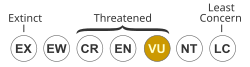
The Nilgiri marten (Martes gwatkinsii) is the only marten species native to southern India. It lives in the hills of the Nilgiris and parts of the Western Ghats. With only around a thousand members left it is listed as vulnerable on the IUCN Red List.[1]
Taxonomy[edit | edit source]
The Nilgiri marten was described by Thomas Horsfield based on a skin in the museum of the East India Company; it is named after the collector Reynolds Gwatkins.[3]
Characteristics[edit | edit source]
The Nilgiri marten is deep brown from head to rump, with the forequarters being almost reddish, with a bright throat ranging in colour from yellow to orange. It has a prominent frontal concavity and is larger than the yellow-throated marten.[4] It is about 55–65 cm (22–26 in) long from head to vent and has a tail of 40–45 cm (16–18 in). It weighs about 2.1 kg (4.6 lb).[5]:6
Distribution and habitat[edit | edit source]
.jpg)
The Nilgiri marten mainly inhabits the shola grasslands and South Western Ghats montane rain forests, and occasionally the adjacent South Western Ghats moist deciduous forests and commercial plantations, that span the Western Ghats in the South Indian states of Karnataka, Kerala and Tamil Nadu. The Nilgiri Hills form the center of its range, but sightings have also been reported in Charmadi Ghat and in the Neyyar and Peppara Wildlife Sanctuaries.[6][7][8][9][10][11]
Behaviour and ecology[edit | edit source]
The Nilgiri marten is diurnal. It is mainly arboreal, but descends to the ground occasionally. It is omnivorous and preys on birds, small mammals (including the Malabar giant squirrel) and insects such as cicadas.[12][4] It has also been observed feeding on a variety of fruits and seeds.[13]
References[edit | edit source]
- ↑ 1.0 1.1 Mudappa, D.; Jathana, D. & Raman, T. R. S. (2015). "Martes gwatkinsii". IUCN Red List of Threatened Species. 2015 e.T12847A86161239. doi:10.2305/IUCN.UK.2015-4.RLTS.T12847A45199025.en. Retrieved 9 March 2022.
{{cite journal}}: Unknown parameter|errata=ignored (help) - ↑ "Martes gwatkinsii Horsfield, 1851". Species+. UN Environment Programme World Conservation Monitoring Centre. Retrieved 25 November 2025.
- ↑ Horsfield, Thomas (1851). Catalogue of the Mammalia in the Museum of the Hon. East-India Company. London: Printed by J. & H. Cox. pp. 99–101. doi:10.5962/bhl.title.32671. OCLC 1109424. OL 243736W.
- ↑ 4.0 4.1 Prater, S. H. (2005) [1971]. The Book of Indian Animals (3rd ed.). Mumbai: Bombay Natural History Society, Oxford University Press.
- ↑ Hussain, S. A. (1999). "Mustelids, Viverrids and Herpestids of India: Species Profile and Conservation Status". ENVIS Bulletin: Wildlife and Protected Areas. 2 (2): 1–38.
- ↑ Christopher, G. & Jayson, E. A. (1996). "Sightings of Nilgiri marten (Martes gwatkinsii Horsfield) at Peppara Wildlife Sanctuary and Silent Valley National Park, Kerala, India". Small Carnivore Conservation. 15: 3–4. Archived from the original on 19 April 2020.
- ↑ Madhusudan, M. D. (1995). "Sighting of the Nilgiri marten (Martes gwatkinsii) at Eravikulam National Park, Kerala, India". Small Carnivore Conservation. 13: 6–7. Archived from the original on 19 April 2020.
- ↑ Gokula, V. & Ramachandran, N. K. (1996). "A record of the Nilgiri marten (Martes gwatkinsii Horsfield) in Upper Bhavani". Journal of the Bombay Natural History Society. 93 (1): 82.
- ↑ Mudappa, D. (1999). "Lesser Known Carnivores of the Western Ghats". ENVIS Bulletin: Wildlife and Protected Areas. 2 (2). Dehradun: Wildlife Institute of India: 65–70.
- ↑ Balakrishnan, P. (2005). "Recent sightings and habitat characteristics of the endemic Nilgiri Marten Martes gwatkinsii in Western Ghats, India". Small Carnivore Conservation. 33: 14–16. Archived from the original on 19 April 2020.
- ↑ Krishna, K. & Karnad, D. (2010). "New records of the Nilgiri marten Martes gwatkinsii in the Western Ghats, India". Small Carnivore Conservation. 43: 23–27. Archived from the original on 19 April 2020.
- ↑ Hutton, A. F. (1948). "Feeding habits of the Nilgiri marten [Charronia gwatkinsii (Horsfield)". Journal of the Bombay Natural History Society. 48 (2): 355–356.
- ↑ Anil, G.; Kishor, N.; Gafoor, N.; Ommer, N. & Nameer, P. O. (2018). "Observations on the Nilgiri Marten Martes gwatkinsii (Mammalia: Carnivora: Mustelidae) from Pampadum Shola National Park, the southern Western Ghats, India". Journal of Threatened Taxa. 10 (1): 11226–11230. doi:10.11609/jott.3446.10.1.11226-11230.
External links[edit | edit source]
- Photographs: Close encounters in the wild
- NilgiriMarten.com (archived 26 December 2009)