







m Removing protection template from an unprotected page |
Freeman14H (talk | contribs) m reworked section also and corrected details per sources |
||
| Line 1: | Line 1: | ||
{{ | {{About|the chemical element}} | ||
{{good article}} | |||
{{pp-semi-indef}} | |||
{{pp-move}} | |||
{{Use dmy dates|date=January 2022}} | {{Use dmy dates|date=January 2022}} | ||
{{Infobox titanium}} | {{Infobox titanium}} | ||
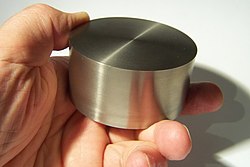
'''Titanium''' is a [[chemical element]] | '''Titanium''' is a [[chemical element]]; it has [[Symbol (chemistry)|symbol]] '''Ti''' and [[atomic number]] 22. Found in nature only as an [[oxide]], it can be reduced to produce a lustrous [[transition metal]] with a silver [[color]], low [[density]], and high strength that is resistant to [[corrosion]] in [[sea water]], [[aqua regia]], and [[chlorine]]. | ||
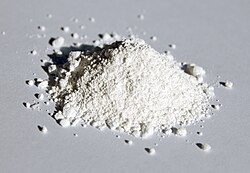
Titanium was discovered in [[Cornwall]], [[Kingdom of Great Britain|Great Britain]], by [[William Gregor]] in 1791 and was named by [[Martin Heinrich Klaproth]] after the [[Titan (mythology)|Titans]] of [[Greek mythology]]. The element occurs within a number of [[mineral]]s, principally [[rutile]] and [[ilmenite]], which are widely distributed in the [[Earth's crust]] and [[lithosphere]]; it is found in almost all living things, as well as bodies of water, rocks, and soils.<ref name="EBC" /> The metal is extracted from its principal mineral ores by the [[Kroll process|Kroll]] and [[Hunter process|Hunter]] processes.<ref name="LANL" /> The most common compound, [[titanium dioxide]], is a popular [[photocatalysis|photocatalyst]] and is used in the manufacture of white pigments.<ref name="HistoryAndUse">{{cite book|last=Krebs|first=Robert E.|title=The History and Use of Our Earth's Chemical Elements: A Reference Guide|edition=2nd|publisher=Greenwood Press|location=[[Westport, CT]]|isbn=978-0-313-33438-2|year=2006|url=https://books.google.com/books?id=yb9xTj72vNAC}}</ref> Other compounds include [[titanium tetrachloride]] (TiCl<sub>4</sub>), a component of [[smoke screen]]s and [[catalyst]]s; and [[Titanium(III) chloride|titanium trichloride]] (TiCl<sub>3</sub>), which is used as a catalyst in the production of [[polypropylene]].<ref name="EBC" /> | Titanium was discovered in [[Cornwall]], [[Kingdom of Great Britain|Great Britain]], by [[William Gregor]] in 1791 and was named by [[Martin Heinrich Klaproth]] after the [[Titan (mythology)|Titans]] of [[Greek mythology]]. The element occurs within a number of [[mineral]]s, principally [[rutile]] and [[ilmenite]], which are widely distributed in the [[Earth's crust]] and [[lithosphere]]; it is found in almost all living things, as well as bodies of water, rocks, and soils.<ref name="EBC" /> The metal is extracted from its principal mineral ores by the [[Kroll process|Kroll]] and [[Hunter process|Hunter]] processes.<ref name="LANL" /> The most common compound, [[titanium dioxide]] (TiO<sub>2</sub>), is a popular [[photocatalysis|photocatalyst]] and is used in the manufacture of white pigments.<ref name="HistoryAndUse">{{cite book|last=Krebs|first=Robert E.|title=The History and Use of Our Earth's Chemical Elements: A Reference Guide|edition=2nd|publisher=Greenwood Press|location=[[Westport, CT]]|isbn=978-0-313-33438-2|year=2006|url=https://books.google.com/books?id=yb9xTj72vNAC}}</ref> Other compounds include [[titanium tetrachloride]] (TiCl<sub>4</sub>), a component of [[smoke screen]]s and [[catalyst]]s; and [[Titanium(III) chloride|titanium trichloride]] (TiCl<sub>3</sub>), which is used as a catalyst in the production of [[polypropylene]].<ref name="EBC" /> | ||
Titanium can be [[alloy]]ed with [[iron]], [[aluminium]], [[vanadium]], and [[molybdenum]], among other elements | Titanium can be [[alloy]]ed with [[iron]], [[aluminium]], [[vanadium]], and [[molybdenum]], among other elements. The resulting [[titanium alloys]] are strong, lightweight, and versatile, with applications including aerospace ([[jet engine]]s, [[missile]]s, and [[spacecraft]]), military, industrial processes (chemicals and petrochemicals, [[desalination plant]]s, pulp, and paper), automotive, [[agriculture]] (farming), sporting goods, jewelry, and [[consumer electronics]].<ref name="EBC" /> Titanium is also considered one of the most [[Biocompatibility|biocompatible]] metals, leading to a range of medical applications including [[prostheses]], [[orthopedic implant]]s, [[dental implant]]s, and [[surgical instrument]]s.<ref name="Medical University 2022 v636">{{cite web | last1=Medical | first1=Tokyo | last2=University | first2=Dental | title=Exploring what gives titanium implants their remarkable biocompatibility | website=Phys.org | date=2022-05-24 | url=https://phys.org/news/2022-05-exploring-titanium-implants-remarkable-biocompatibility.html | access-date=2024-05-02}}</ref> | ||
The two most useful properties of the metal are corrosion resistance and [[Specific strength|strength-to-density ratio]], the highest of any metallic element | The two most useful properties of the metal are its corrosion resistance and [[Specific strength|tensile-strength-to-density ratio]], the highest of any metallic element,<ref>{{harvnb|Donachie|1988|p=11}}</ref> although resistance to [[tensile stress]] does not mean it has the highest ratio for other stresses: [[bulk modulus|bulk compression]], [[shear stress|shear]], and [[P-wave modulus|pressure wave]]. In its unalloyed condition, titanium is as tensile-strong as some [[steel]]s, but less dense.<ref name="Barksdale1968p738">{{harvnb|Barksdale|1968|p=738}}</ref> There are two [[allotropy|allotropic]] forms<ref name="TICE6th" /> and five naturally occurring [[isotope]]s of this element, [[isotopes of titanium|{{sup|46}}Ti]] through {{sup|50}}Ti, with {{sup|48}}Ti being the most [[natural abundance|abundant]] (73.8%).<ref name="EnvChem">{{cite web |url=http://environmentalchemistry.com/yogi/periodic/Ti-pg2.html#Nuclides |title=Periodic Table of Elements: Ti – Titanium |access-date=26 December 2006 |author=Barbalace, Kenneth L. |year=2006}}</ref> | ||
==Characteristics== | == Characteristics == | ||
===Physical properties=== | === Physical properties === | ||
<section begin=properties/> | <section begin=properties/> | ||
As a | As a metal, titanium is recognized for its high [[strength-to-weight ratio]].<ref name=TICE6th>{{cite encyclopedia |title=Titanium |encyclopedia=[[Columbia Encyclopedia]] |edition=6th |date=2000–2006 |publisher=[[Columbia University Press]] |url=https://archive.org/details/columbiaencyclop00laga |location=New York |isbn=978-0-7876-5015-5 |url-access=registration }}</ref> It is a strong metal with low [[density]] that is quite [[ductility|ductile]] (especially in an [[oxygen]]-free environment),<ref name="EBC">{{cite encyclopedia|encyclopedia=Encyclopædia Britannica|title=Titanium|year=2006|url=http://www.britannica.com/eb/article-9072643/titanium|access-date=19 January 2022}}</ref> lustrous, and metallic-white in color.<ref name="Stwertka1998">{{cite book|title=Guide to the Elements|edition=Revised|first=Albert|last=Stwertka|publisher=[[Oxford University Press]]|year=1998|chapter=Titanium|pages= 81–82|isbn=978-0-19-508083-4|chapter-url=https://books.google.com/books?id=K3RWAAAAYAAJ}}</ref> Due to its relatively high melting point (1,668 °C or 3,034 °F) it has sometimes been described as a [[refractory metals|refractory metal]], but this is not the case.<ref>{{cite web|website=Special Metal Fabrication|url=https://special-metals.co.uk/is-titanium-a-refractory-metal|title=Is Titanium A Refractory Metal|date=3 August 2021 }}</ref> It is [[paramagnetism|paramagnetic]] and has fairly low [[electrical conductivity|electrical]] and [[thermal conductivity]] compared to other metals.<ref name="EBC" /> Titanium is [[superconductivity|superconducting]] when cooled below its critical temperature of 0.49 K.<ref>{{Cite journal | doi = 10.1103/PhysRev.92.243| journal = Phys. Rev.| volume = 92| issue = 2| pages = 243–247| year = 1953| title = Superconductivity of Titanium| url = https://archive.org/details/sim_physical-review_1953-10-15_92_2/page/242| last1 = Steele | first1 = M. C. | last2 = Hein | first2 = R. A.| bibcode = 1953PhRv...92..243S}}</ref><ref>{{Cite journal | doi = 10.1103/PhysRevB.97.214516| journal = Phys. Rev. B| volume = 97| issue = 21| article-number = 214516| year = 2018| title = Complete electrodynamics of a BCS superconductor with μeV energy scales: Microwave spectroscopy on titanium at mK temperatures| last1 = Thiemann | first1 = M. |display-authors=etal| arxiv = 1803.02736| bibcode = 2018PhRvB..97u4516T| s2cid = 54891002}}</ref><section end="properties" /> | ||
{{anchor|Commercially pure titanium}} | {{anchor|Commercially pure titanium}} | ||
| Line 24: | Line 25: | ||
Titanium is not as hard as some grades of heat-treated steel; it is non-magnetic and a poor conductor of heat and electricity. Machining requires precautions, because the material can [[galling|gall]] unless sharp tools and proper cooling methods are used. Like steel structures, those made from titanium have a [[fatigue limit]] that guarantees longevity in some applications.<ref name="Stwertka1998" /> | Titanium is not as hard as some grades of heat-treated steel; it is non-magnetic and a poor conductor of heat and electricity. Machining requires precautions, because the material can [[galling|gall]] unless sharp tools and proper cooling methods are used. Like steel structures, those made from titanium have a [[fatigue limit]] that guarantees longevity in some applications.<ref name="Stwertka1998" /> | ||
The metal is a dimorphic [[ | The metal is a dimorphic [[allotrope]] of a [[hexagonal close packed]] α form that changes into a [[body-centered cubic]] (lattice) β form at {{convert|882|°C|°F}}.<ref name="Barksdale1968p734" /><ref name="schmidt65">{{cite book |last1=Schmidt |first1=F. F. |last2=Wood |first2=R. A. |title=HEAT TREATMENT OF TITANIUM AND TITANIUM ALLOYS BY |date=1965 |publisher=NASA |location=GEORGE C. MARSHALL SPACE FLIGHT CENTER |edition=TECHNICAL MEMORANDUM X-53445 |url=https://ntrs.nasa.gov/api/citations/19660015720/downloads/19660015720.pdf}}</ref> The [[specific heat capacity|specific heat]] of the α form increases dramatically as it is heated to this transition temperature but then falls and remains fairly constant for the β form regardless of temperature.<ref name="Barksdale1968p734" /> | ||
===Chemical properties=== | === Chemical properties === | ||
[[File:Titanium in water Pourbaix diagram.png|thumb|[[Pourbaix diagram]] for titanium in pure water, perchloric acid, or sodium hydroxide<ref name="medusa">Puigdomenech, Ignasi (2004) [https://web.archive.org/web/20130605034847/http://www.kth.se/che/medusa ''Hydra/Medusa Chemical Equilibrium Database and Plotting Software''], KTH Royal Institute of Technology.</ref>]] | [[File:Titanium in water Pourbaix diagram.png|thumb|alt=Graph showing the Pourbaix diagram of titanium|[[Pourbaix diagram]] for titanium in pure water, perchloric acid, or sodium hydroxide<ref name="medusa">Puigdomenech, Ignasi (2004) [https://web.archive.org/web/20130605034847/http://www.kth.se/che/medusa ''Hydra/Medusa Chemical Equilibrium Database and Plotting Software''], KTH Royal Institute of Technology.</ref>]] | ||
Like [[aluminium]] and [[magnesium]], the surface of titanium metal and its alloys [[ | Like [[aluminium]] and [[magnesium]], the surface of titanium metal and its alloys [[oxidizes]] immediately upon exposure to air to form a thin non-porous [[Passivation (chemistry)|passivation]] layer that protects the bulk metal from further oxidation or corrosion.<ref name="EBC" /> When it first forms, this protective layer is only 1–2 [[nanometre|nm]] thick, but it continues to grow slowly, reaching a thickness of 25 nm in four years.<ref name="Emsley2001p453" /> This layer gives titanium excellent resistance to corrosion against oxidizing acids, but it will dissolve in dilute [[hydrofluoric acid]], hot hydrochloric acid, and hot sulfuric acid.<ref name=":0">{{Citation |last=Sicius |first=Hermann |title=Titanium Group: Elements of the Fourth Subgroup |date=2024 |work=Handbook of the Chemical Elements |pages=487–535 |url=https://link.springer.com/10.1007/978-3-662-68921-9_9 |access-date=2025-10-08 |place=Berlin, Heidelberg |publisher=Springer Berlin Heidelberg |language=en |doi=10.1007/978-3-662-68921-9_9 |isbn=978-3-662-68920-2|url-access=subscription }}</ref> | ||
Titanium is capable of withstanding attack by dilute [[sulfuric acid|sulfuric]] and [[hydrochloric acid]]s, chloride solutions, and most organic acids.<ref name=LANL/> However, titanium is corroded by concentrated acids.<ref>{{cite journal |author1=Casillas, N. |author2=Charlebois, S. |author3=Smyrl, W.H. |author4=White, H.S. |year=1994 |title=Pitting corrosion of titanium |journal=J. Electrochem. Soc. |volume=141 |issue=3 |pages=636–642 |doi=10.1149/1.2054783 |bibcode=1994JElS..141..636C |url=https://apps.dtic.mil/dtic/tr/fulltext/u2/a274980.pdf |url-status=live |archive-url=https://web.archive.org/web/20200827231129/https://apps.dtic.mil/dtic/tr/fulltext/u2/a274980.pdf |archive-date=27 August 2020}}</ref> Titanium | Titanium is capable of withstanding attack by dilute [[sulfuric acid|sulfuric]] and [[hydrochloric acid]]s at room temperature, chloride solutions, and most organic acids.<ref name=LANL/> However, titanium is corroded by concentrated acids.<ref>{{cite journal |author1=Casillas, N. |author2=Charlebois, S. |author3=Smyrl, W.H. |author4=White, H.S. |year=1994 |title=Pitting corrosion of titanium |journal=J. Electrochem. Soc. |volume=141 |issue=3 |pages=636–642 |doi=10.1149/1.2054783 |bibcode=1994JElS..141..636C |url=https://apps.dtic.mil/dtic/tr/fulltext/u2/a274980.pdf |url-status=live |archive-url=https://web.archive.org/web/20200827231129/https://apps.dtic.mil/dtic/tr/fulltext/u2/a274980.pdf |archive-date=27 August 2020}}</ref> Titanium burns in normal air at temperatures lower than its melting point, so melting the metal is possible only in an inert atmosphere or vacuum.<ref name="LANL" /> At room temperature, titanium is fairly inert to [[halogen]]s, but will violently combine with [[chlorine]] and [[bromine]] at {{convert|550|°C|°F}} to form [[titanium tetrachloride]] and [[titanium tetrabromide]], respectively.<ref name=":0" /> | ||
Titanium readily reacts with oxygen at {{convert|1200|°C|°F}} in air, and at {{convert|610|°C|°F}} in pure oxygen, forming [[titanium dioxide]].<ref name="TICE6th" /> Titanium is one of the few elements that burns in pure nitrogen gas, reacting at {{convert|800|°C|°F}} to form [[titanium nitride]], which causes embrittlement.<ref name=titaniumindustry>{{cite book |title=Industrial Applications of Titanium and Zirconium|chapter-url= https://books.google.com/books?id=0Adr4zleybgC&pg=PA112 |page= 112|first= A.L. |last= Forrest |chapter= Effects of Metal Chemistry on Behavior of Titanium in Industrial Applications |year=1981}}</ref> | Titanium readily reacts with oxygen at {{convert|1200|°C|°F}} in air, and at {{convert|610|°C|°F}} in pure oxygen, forming [[titanium dioxide]].<ref name="TICE6th" /> This oxide is also formed by reaction between titanium and pure oxygen at room temperature and pressure of {{Convert|25|bar}}.<ref name=":0" /> Titanium is one of the few elements that burns in pure nitrogen gas, reacting at {{convert|800|°C|°F}} to form [[titanium nitride]], which causes embrittlement.<ref name=titaniumindustry>{{cite book |title=Industrial Applications of Titanium and Zirconium|chapter-url= https://books.google.com/books?id=0Adr4zleybgC&pg=PA112 |page= 112|first= A.L. |last= Forrest |chapter= Effects of Metal Chemistry on Behavior of Titanium in Industrial Applications |year=1981}}</ref> | ||
===Occurrence=== | === Occurrence === | ||
Titanium is the ninth-most [[abundance of elements in Earth's crust|abundant]] element in [[Earth]]'s crust (0.63% by [[mass]])<ref name="Barksdale1968p732" /> and the seventh-most abundant metal. It is present as oxides in most [[igneous rock]]s, in [[sedimentary rock|sediments]] derived from them, in living things, and natural bodies of water.<ref name="EBC" /><ref name="LANL">{{RubberBible86th}}</ref> Of the 801 types of igneous rocks analyzed by the [[United States Geological Survey]], 784 contained titanium. Its proportion in soils is approximately 0.5–1.5%.<ref name="Barksdale1968p732" /> | Titanium is the ninth-most [[abundance of elements in Earth's crust|abundant]] element in [[Earth]]'s crust (0.63% by [[mass]])<ref name="Barksdale1968p732" /> and the seventh-most abundant metal. It is present as oxides in most [[igneous rock]]s, in [[sedimentary rock|sediments]] derived from them, in living things, and natural bodies of water.<ref name="EBC" /><ref name="LANL">{{RubberBible86th}}</ref> Of the 801 types of igneous rocks analyzed by the [[United States Geological Survey]], 784 contained titanium. Its proportion in soils is approximately 0.5–1.5%.<ref name="Barksdale1968p732" /> | ||
Common titanium-containing [[mineral]]s are [[anatase]], [[brookite]], [[ilmenite]], [[perovskite]], [[rutile]], and [[titanite]] (sphene).<ref name="Emsley2001p453">{{harvnb|Emsley|2001|p=453}}</ref> [[Akaogiite]] is an extremely rare mineral consisting of titanium dioxide. Of these minerals, only rutile and ilmenite have economic importance, yet even they are difficult to find in high concentrations. About 6.0 and 0.7 million tonnes of those minerals were mined in 2011, respectively.<ref name="USGS" /> Significant titanium-bearing ilmenite deposits exist in [[Australia]], [[Canada]], [[China]], [[India]], [[Mozambique]], [[New Zealand]], [[Norway]], [[Sierra Leone]], [[South Africa]], and [[Ukraine]].<ref name="Emsley2001p453" /> | Common titanium-containing [[mineral]]s are [[anatase]], [[brookite]], [[ilmenite]], [[perovskite]], [[rutile]], and [[titanite]] (sphene).<ref name="Emsley2001p453">{{harvnb|Emsley|2001|p=453}}</ref> [[Akaogiite]] is an extremely rare mineral consisting of titanium dioxide. Of these minerals, only rutile and ilmenite have economic importance, yet even they are difficult to find in high concentrations. About 6.0 and 0.7 million tonnes of those minerals were mined in 2011, respectively.<ref name="USGS" /> Significant titanium-bearing ilmenite deposits exist in [[Australia]], [[Canada]], [[China]], [[India]], [[Mozambique]], [[New Zealand]], [[Norway]], [[Sierra Leone]], [[South Africa]], and [[Ukraine]].<ref name="Emsley2001p453" /> Total reserves of anatase, ilmenite, and rutile are estimated to exceed 2 billion tonnes.<ref name="USGS" /> | ||
The concentration of titanium is about 4 [[Molar concentration|picomolar]] in the ocean. At 100 °C, the concentration of titanium in water is estimated to be less than 10{{sup|−7}} M at pH 7. The identity of titanium species in aqueous solution remains unknown because of its low solubility and the lack of sensitive spectroscopic methods, although only the 4+ oxidation state is stable in air. No evidence exists for a biological role, although rare organisms are known to accumulate high concentrations of titanium.<ref>{{cite journal |doi= 10.1021/cr1002886 |pmid= 22074443 |title= Bioinorganic Chemistry of Titanium |journal= Chemical Reviews |volume= 112 |issue= 3 |pages= 1863–81 |year= 2012 |last1= Buettner |first1= K. M. |last2= Valentine |first2= A. M. |bibcode= 2012ChRv..112.1863B }}</ref> | |||
| | |||
| | |||
| | |||
| | |||
| | |||
| | |||
| | |||
Titanium is contained in [[meteorite]]s, and it has been detected in the [[Sun]] and in [[stellar classification|M-type]] [[star]]s<ref name="LANL" /> (the coolest type) with a surface temperature of {{convert|3200|°C|°F}}.<ref name="Emsley2001p451">{{harvnb|Emsley|2001|p=451}}</ref> [[Rock (geology)|Rocks]] brought back from the [[Moon]] during the [[Apollo 17]] mission are composed of 12.1% TiO<sub>2</sub>.<ref name="LANL" /> [[Native element mineral|Native]] titanium is only found in rocks that have been exposed to pressures between roughly 2.8 to 4.0{{Spaces}}[[gigapascal]] on Earth,<ref>{{Cite journal |last1=Chen |first1=Jing |last2=Li |first2=Jiliang |last3=Wu |first3=Jun |date=2000-04-30 |title=Native titanium inclusions in the coesite eclogites from Dabieshan, China |url=https://linkinghub.elsevier.com/retrieve/pii/S0012821X00000571 |journal=Earth and Planetary Science Letters |language=en |volume=177 |issue=3–4 |pages=237–240 |doi=10.1016/S0012-821X(00)00057-1 |bibcode=2000E&PSL.177..237C |url-access=subscription }}</ref> but it has been identified in [[Nanocrystalline material|nanocrystals]] on the Moon.<ref>{{Cite journal |last1=Mokhov |first1=A. V. |last2=Gornostaeva |first2=T. A. |last3=Kartashov |first3=P. M. |last4=Asadulin |first4=En. E. |last5=Bogatikov |first5=O. A. |date=2015 |title=Nanocrystals of native iron and titanium in impact glasses of the lunar regolith |url=http://link.springer.com/10.1134/S1028334X15020038 |journal=Doklady Earth Sciences |language=en |volume=460 |issue=2 |pages=118–122 |doi=10.1134/S1028334X15020038 |bibcode=2015DokES.460..118M |issn=1028-334X|url-access=subscription }}</ref> | |||
=== Isotopes === | |||
===Isotopes=== | |||
{{Main|Isotopes of titanium}} | {{Main|Isotopes of titanium}} | ||
Naturally occurring titanium is composed of five stable [[isotope]]s: | Naturally occurring titanium is composed of five stable [[isotope]]s: {{sup|46}}Ti, {{sup|47}}Ti, {{sup|48}}Ti, {{sup|49}}Ti, and {{sup|50}}Ti, with {{sup|48}}Ti being the most abundant (73.8% [[natural abundance]]). Twenty-three [[radioisotope]]s have been characterized,{{Efn|Twenty-one radioisotopes were known as of 2021 with the publication of the NUBASE2020 nuclear data library,<ref name=nubase2020 /> with two more radioisotopes, {{sup|65}}Ti and {{sup|66}}Ti being discovered in 2025.<ref name=Tarasov2025 />}} the most stable of which are [[titanium-44|{{sup|44}}Ti]] with a [[half-life]] of 63 years; {{sup|45}}Ti, 184.8 minutes; {{sup|51}}Ti, 5.76 minutes; and {{sup|52}}Ti, 1.7 minutes. All other [[radioactive]] isotopes have half-lives less than 33 seconds, with the majority less than half a second.<ref name="EnvChem" /><ref name=nubase2020>{{NUBASE2020|access-date=10 October 2025}}</ref> | ||
The isotopes of titanium range | The isotopes of titanium range from {{sup|39}}Ti to {{sup|66}}Ti.{{AME2016 II|ref}}<ref name=Tarasov2025 /> The primary [[decay mode]] for isotopes lighter than {{sup|46}}Ti is [[positron emission]] (with the exception of {{sup|44}}Ti, which undergoes [[electron capture]]), leading to [[isotopes of scandium]], and the primary mode for isotopes heavier than {{sup|50}}Ti is [[beta emission]], leading to [[isotopes of vanadium]].<ref name="EnvChem" /> Titanium becomes radioactive upon bombardment with [[deuterons]], emitting mainly [[positrons]] and hard [[gamma rays]].<ref name="LANL" /> | ||
== Compounds == | |||
==Compounds== | |||
{{Category see also|Titanium compounds|Titanium minerals}} | {{Category see also|Titanium compounds|Titanium minerals}} | ||
{{see also|Titanium alloy}} | {{see also|Titanium alloy}} | ||
[[File:Titanium nitride coating.jpg|thumb|upright=0.25|alt=A steel colored twist drill bit with the spiral groove colored in a golden shade | [[File:Titanium nitride coating.jpg|thumb|upright=0.25|alt=A steel colored twist drill bit with the spiral groove colored in a golden shade|A titanium nitride-coated [[drill bit]]]] | ||
The +4 [[oxidation state]] dominates titanium chemistry,<ref name="Greenwood1997p958">{{harvnb|Greenwood|Earnshaw|1997|p=958}}</ref> but compounds in the +3 oxidation state are also numerous.<ref name="Greenwood1997p970">{{harvnb|Greenwood|Earnshaw|1997|p=970}}</ref> Commonly, titanium adopts an [[octahedral coordination geometry]] in its complexes,<ref name="Greenwood1997p960">{{harvnb|Greenwood|Earnshaw|1997|p=960}}</ref><ref name="Greenwood1997p967">{{harvnb|Greenwood|Earnshaw|1997|p=967}}</ref> but tetrahedral TiCl<sub>4</sub> is a notable exception. Because of its high oxidation state, titanium(IV) compounds exhibit a high degree of [[covalent bond]]ing.<ref name="Greenwood1997p958" /> | The +4 [[oxidation state]] dominates titanium chemistry,<ref name="Greenwood1997p958">{{harvnb|Greenwood|Earnshaw|1997|p=958}}</ref> but compounds in the +3 oxidation state are also numerous.<ref name="Greenwood1997p970">{{harvnb|Greenwood|Earnshaw|1997|p=970}}</ref> Commonly, titanium adopts an [[octahedral coordination geometry]] in its complexes,<ref name="Greenwood1997p960">{{harvnb|Greenwood|Earnshaw|1997|p=960}}</ref><ref name="Greenwood1997p967">{{harvnb|Greenwood|Earnshaw|1997|p=967}}</ref> but tetrahedral TiCl<sub>4</sub> is a notable exception. Because of its high oxidation state, titanium(IV) compounds exhibit a high degree of [[covalent bond]]ing.<ref name="Greenwood1997p958" /> | ||
===Oxides, sulfides, and alkoxides=== | === Oxides, sulfides, and alkoxides === | ||
The most important oxide is TiO<sub>2</sub>, which exists in three important [[polymorphism (materials science)|polymorphs]]; anatase, brookite, and rutile. All three are white diamagnetic solids, although mineral samples can appear dark | The most important oxide is TiO<sub>2</sub>, which exists in three important [[polymorphism (materials science)|polymorphs]]; anatase, brookite, and rutile. All three are white diamagnetic solids, although mineral samples can appear dark, as in [[rutile]]. They adopt polymeric structures in which Ti is surrounded by six [[oxide]] ligands that link to other Ti centers.<ref name="Greenwood1997p961">{{harvnb|Greenwood|Earnshaw|1997|p=961}}</ref> | ||
The term ''[[titanate]]s'' usually refers to titanium(IV) compounds, as represented by [[barium titanate]] (BaTiO<sub>3</sub>). With a perovskite structure, this material exhibits [[piezoelectric]] properties and is used as a transducer in the interconversion of [[sound]] and [[electricity]].<ref name="TICE6th" /> Many minerals are titanates, such as ilmenite (FeTiO<sub>3</sub>). [[Star sapphire (jewel)|Star sapphires]] and [[ruby|rubies]] get their [[asterism (gemmology)|asterism]] (star-forming shine) from the presence of titanium dioxide impurities.<ref name="Emsley2001p453" /> | The term ''[[titanate]]s'' usually refers to titanium(IV) compounds, as represented by [[barium titanate]] (BaTiO<sub>3</sub>). With a perovskite structure, this material exhibits [[piezoelectric]] properties and is used as a transducer in the interconversion of [[sound]] and [[electricity]].<ref name="TICE6th" /> Many minerals are titanates, such as ilmenite (FeTiO<sub>3</sub>). [[Star sapphire (jewel)|Star sapphires]] and [[ruby|rubies]] get their [[asterism (gemmology)|asterism]] (star-forming shine) from the presence of titanium dioxide impurities.<ref name="Emsley2001p453" /> | ||
A variety of reduced oxides ([[suboxide]]s) of titanium are known, mainly reduced [[stoichiometry|stoichiometries]] of titanium dioxide obtained by [[atmospheric plasma spraying]]. Ti<sub>3</sub>O<sub>5</sub>, described as a Ti(IV)-Ti(III) species, is a purple semiconductor produced by [[reduction (chemistry)|reduction]] of TiO<sub>2</sub> with hydrogen at high temperatures,<ref>{{cite journal |last1=Liu |first1=Gang |last2=Huang |first2=Wan-Xia |last3=Yi |first3=Yong |title=Preparation and Optical Storage Properties of λTi<sub>3</sub>O<sub>5</sub> Powder |journal=Journal of Inorganic Materials |date=26 June 2013 |volume=28 |issue=4 |pages=425–430|doi=10.3724/SP.J.1077.2013.12309}}</ref> and is used industrially when surfaces need to be vapor-coated with titanium dioxide: it evaporates as pure TiO, whereas TiO<sub>2</sub> evaporates as a mixture of oxides and deposits coatings with variable refractive index.<ref>{{cite journal |last1=Bonardi |first1=Antonio |last2=Pühlhofer |first2=Gerd |last3=Hermanutz |first3=Stephan |last4=Santangelo |first4=Andrea |year=2014 |title=A new solution for mirror coating in {{mvar|γ}}-ray Cherenkov Astronomy |journal=Experimental Astronomy |volume=38 |issue=1–2 |pages=1–9 |doi=10.1007/s10686-014-9398-x |bibcode=2014ExA....38....1B |s2cid=119213226 |arxiv=1406.0622}}</ref> Also known is [[titanium(III) oxide|Ti<sub>2</sub>O<sub>3</sub>]], with the [[corundum]] structure, and [[titanium(II) oxide|TiO]], with the rock salt structure, although often nonstoichiometric.{{sfn|Greenwood|Earnshaw|1997|p=962}} | A variety of reduced oxides ([[suboxide]]s) of titanium are known, mainly reduced [[stoichiometry|stoichiometries]] of titanium dioxide obtained by [[atmospheric plasma spraying]]. Ti<sub>3</sub>O<sub>5</sub>, described as a Ti(IV)-Ti(III) species, is a purple semiconductor produced by [[reduction (chemistry)|reduction]] of TiO<sub>2</sub> with hydrogen at high temperatures,<ref>{{cite journal |last1=Liu |first1=Gang |last2=Huang |first2=Wan-Xia |last3=Yi |first3=Yong |title=Preparation and Optical Storage Properties of λTi<sub>3</sub>O<sub>5</sub> Powder |journal=Journal of Inorganic Materials |date=26 June 2013 |volume=28 |issue=4 |pages=425–430|doi=10.3724/SP.J.1077.2013.12309|doi-broken-date=1 July 2025 }}</ref> and is used industrially when surfaces need to be vapor-coated with titanium dioxide: it evaporates as pure TiO, whereas TiO<sub>2</sub> evaporates as a mixture of oxides and deposits coatings with variable refractive index.<ref>{{cite journal |last1=Bonardi |first1=Antonio |last2=Pühlhofer |first2=Gerd |last3=Hermanutz |first3=Stephan |last4=Santangelo |first4=Andrea |year=2014 |title=A new solution for mirror coating in {{mvar|γ}}-ray Cherenkov Astronomy |journal=Experimental Astronomy |volume=38 |issue=1–2 |pages=1–9 |doi=10.1007/s10686-014-9398-x |bibcode=2014ExA....38....1B |s2cid=119213226 |arxiv=1406.0622}}</ref> Also known is [[titanium(III) oxide|Ti<sub>2</sub>O<sub>3</sub>]], with the [[corundum]] structure, and [[titanium(II) oxide|TiO]], with the [[rock salt structure]], although often [[nonstoichiometric]].{{sfn|Greenwood|Earnshaw|1997|p=962}} | ||
The [[alkoxide]]s of titanium(IV), prepared by treating TiCl<sub>4</sub> with | The [[alkoxide]]s of titanium(IV), prepared by treating TiCl<sub>4</sub> with [[Alcohol (chemistry)|alcohol]]s, are colorless compounds that convert to the dioxide on reaction with water. They are industrially useful for depositing solid TiO<sub>2</sub> via the [[sol-gel process]]. [[Titanium isopropoxide]] is used in the synthesis of chiral organic compounds via the [[Sharpless epoxidation]].<ref>{{cite journal |author1=Ramón, Diego J. |author2=Yus, Miguel |year=2006 |title=In the arena of enantioselective synthesis, titanium complexes wear the laurel wreath |journal=Chem. Rev. |volume=106 |issue=6 |pages=2126–2308 |doi=10.1021/cr040698p |pmid=16771446}}</ref> | ||
Titanium forms a variety of sulfides, but only [[titanium disulfide|TiS<sub>2</sub>]] has attracted significant interest. It adopts a layered structure and was used as a cathode in the development of [[lithium batteries]]. Because Ti(IV) is a [[HSAB theory|"hard cation"]], the sulfides of titanium are unstable and tend to hydrolyze to the oxide with release of hydrogen sulfide.<ref>{{cite book | last1 = McKelvy | first1 = M.J. | last2 = Glaunsinger | first2 = W.S. | year = 1995 | title = Inorganic Syntheses | chapter = Titanium Disulfide | volume = 30 | pages = 28–32 | doi = 10.1002/9780470132616.ch7 | isbn = | Titanium forms a variety of sulfides, but only [[titanium disulfide|TiS<sub>2</sub>]] has attracted significant interest. It adopts a layered structure and was used as a cathode in the development of [[lithium batteries]]. Because Ti(IV) is a [[HSAB theory|"hard cation"]], the sulfides of titanium are unstable and tend to hydrolyze to the oxide with release of [[hydrogen sulfide]].<ref>{{cite book | last1 = McKelvy | first1 = M.J. | last2 = Glaunsinger | first2 = W.S. | year = 1995 | title = Inorganic Syntheses | chapter = Titanium Disulfide | volume = 30 | pages = 28–32 | doi = 10.1002/9780470132616.ch7 | isbn = 978-0-470-13261-6 }}</ref> | ||
===Nitrides and carbides=== | === Nitrides and carbides === | ||
[[Titanium nitride]] (TiN) is a refractory solid exhibiting extreme hardness, thermal/electrical conductivity, and a high melting point.<ref>{{Cite journal |last=Saha |first=Naresh |year=1992 |title=Titanium nitride oxidation chemistry: An x-ray photoelectron spectroscopy study |journal=Journal of Applied Physics |volume=72 |issue=7 |pages=3072–3079 |doi=10.1063/1.351465 |bibcode=1992JAP....72.3072S}}</ref> TiN has a hardness equivalent to [[sapphire]] and [[carborundum]] (9.0 on the [[Mohs scale]]),<ref>{{cite web |author=Schubert, E.F. |title=The hardness scale introduced by Friederich Mohs |series=Educational resources |publisher=[[Rensselaer Polytechnic Institute]] |place=Troy, NY |url=https://www.ecse.rpi.edu/~schubert/Educational-resources/Materials-Hardness.pdf |url-status=live |archive-url=https://web.archive.org/web/20100603075632/http://www.rpi.edu/~schubert/Educational-resources/Materials-Hardness.pdf |archive-date=3 June 2010}}</ref> and is often used to coat cutting tools, such as [[drill bit]]s.<ref>{{cite magazine |last=Truini |first=Joseph |date=May 1988 |title=Drill bits |magazine=[[Popular Mechanics]] |volume=165 |issue=5 |page=91 |issn=0032-4558 |url=https://books.google.com/books?id=Z-QDAAAAMBAJ}}</ref> It is also used as a gold-colored decorative finish and as a [[Copper interconnects#Barrier metal|barrier layer]] in [[semiconductor fabrication]].<ref>{{cite book|last=Baliga |first=B. Jayant |year=2005 |title=Silicon carbide power devices |publisher=World Scientific |page=91 |isbn=978-981-256-605-8 |url=https://books.google.com/books?id=LNLVwAzhN7EC}}</ref> [[Titanium carbide]] (TiC), which is also very hard, is found in cutting tools and coatings.<ref>{{cite web |title=Titanium carbide product information |publisher=H.C. Starck |url=http://www.hcstarck.com/titanium_carbide_tic | [[Titanium nitride]] (TiN) is a refractory solid exhibiting extreme hardness, thermal/electrical conductivity, and a high melting point.<ref>{{Cite journal |last=Saha |first=Naresh |year=1992 |title=Titanium nitride oxidation chemistry: An x-ray photoelectron spectroscopy study |journal=Journal of Applied Physics |volume=72 |issue=7 |pages=3072–3079 |doi=10.1063/1.351465 |bibcode=1992JAP....72.3072S}}</ref> TiN has a hardness equivalent to [[sapphire]] and [[carborundum]] (9.0 on the [[Mohs scale]]),<ref>{{cite web |author=Schubert, E.F. |title=The hardness scale introduced by Friederich Mohs |series=Educational resources |publisher=[[Rensselaer Polytechnic Institute]] |place=Troy, NY |url=https://www.ecse.rpi.edu/~schubert/Educational-resources/Materials-Hardness.pdf |url-status=live |archive-url=https://web.archive.org/web/20100603075632/http://www.rpi.edu/~schubert/Educational-resources/Materials-Hardness.pdf |archive-date=3 June 2010}}</ref> and is often used to coat cutting tools, such as [[drill bit]]s.<ref>{{cite magazine |last=Truini |first=Joseph |date=May 1988 |title=Drill bits |magazine=[[Popular Mechanics]] |volume=165 |issue=5 |page=91 |issn=0032-4558 |url=https://books.google.com/books?id=Z-QDAAAAMBAJ}}</ref> It is also used as a gold-colored decorative finish and as a [[Copper interconnects#Barrier metal|barrier layer]] in [[semiconductor fabrication]].<ref>{{cite book|last=Baliga |first=B. Jayant |year=2005 |title=Silicon carbide power devices |publisher=World Scientific |page=91 |isbn=978-981-256-605-8 |url=https://books.google.com/books?id=LNLVwAzhN7EC}}</ref> [[Titanium carbide]] (TiC), which is also very hard, is found in cutting tools and coatings.<ref>{{cite web |title=Titanium carbide product information |publisher=H.C. Starck |url=http://www.hcstarck.com/titanium_carbide_tic |access-date=16 November 2015 |archive-url=https://web.archive.org/web/20170922194330/https://www.hcstarck.com/titanium_carbide_tic |archive-date=22 September 2017}}</ref> | ||
===Halides=== | === Halides === | ||
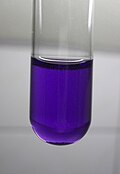
[[File:TiCl3.jpg|thumb| | [[File:TiCl3.jpg|thumb|right|upright=0.75|alt=Violet liquid in a test tube|Titanium(III) compounds are characteristically violet, illustrated by this aqueous solution of [[titanium trichloride]].]] | ||
[[Titanium tetrachloride]] (titanium(IV) chloride, TiCl<sub>4</sub><ref>{{cite report |author1=Seong, S. |author2=Younossi, O. |author3=Goldsmith, B.W. |year=2009 |title=Titanium: Industrial base, price trends, and technology initiatives |publisher=Rand Corporation |isbn=978-0-8330-4575-1 |page=10 |url=https://books.google.com/books?id=tIPFfYW304IC&pg=PA10}}</ref>) is a colorless volatile liquid (commercial samples are yellowish) that, in air, hydrolyzes with spectacular emission of white clouds. Via the [[Kroll process]], TiCl<sub>4</sub> is used in the conversion of titanium ores to titanium metal. Titanium tetrachloride is also used to make titanium dioxide, e.g., for use in white paint.<ref>{{cite book |last=Johnson |first=Richard W. |year=1998 |title=The Handbook of Fluid Dynamics |publisher=Springer |pages=38–21 |isbn=978-3-540-64612-9 |url=https://books.google.com/books?id=JBTlucgGdegC}}</ref> It is widely used in [[organic chemistry]] as a [[Lewis acids and bases|Lewis acid]], for example in the [[Mukaiyama aldol condensation]].<ref>{{cite book |last=Coates |first=Robert M. |author2=Paquette, Leo A. |year=2000 |title=Handbook of Reagents for Organic Synthesis |publisher=John Wiley and Sons |page=93|isbn=978-0-470-85625-3|url=https://books.google.com/books?id=xxYjJgupBSMC}}</ref> In the [[van Arkel–de Boer process]], [[titanium tetraiodide]] (TiI<sub>4</sub>) is generated in the production of high purity titanium metal.<ref name="Greenwood1997p965">{{harvnb|Greenwood|Earnshaw|1997|p=965}}</ref> | [[Titanium tetrachloride]] (titanium(IV) chloride, TiCl<sub>4</sub><ref>{{cite report |author1=Seong, S. |author2=Younossi, O. |author3=Goldsmith, B.W. |year=2009 |title=Titanium: Industrial base, price trends, and technology initiatives |publisher=Rand Corporation |isbn=978-0-8330-4575-1 |page=10 |url=https://books.google.com/books?id=tIPFfYW304IC&pg=PA10}}</ref>) is a colorless volatile liquid (commercial samples are yellowish) that, in air, hydrolyzes with spectacular emission of white clouds. Via the [[Kroll process]], TiCl<sub>4</sub> is used in the conversion of titanium ores to titanium metal. Titanium tetrachloride is also used to make titanium dioxide, e.g., for use in white paint.<ref>{{cite book |last=Johnson |first=Richard W. |year=1998 |title=The Handbook of Fluid Dynamics |publisher=Springer |pages=38–21 |isbn=978-3-540-64612-9 |url=https://books.google.com/books?id=JBTlucgGdegC}}</ref> It is widely used in [[organic chemistry]] as a [[Lewis acids and bases|Lewis acid]], for example in the [[Mukaiyama aldol condensation]].<ref>{{cite book |last=Coates |first=Robert M. |author2=Paquette, Leo A. |year=2000 |title=Handbook of Reagents for Organic Synthesis |publisher=John Wiley and Sons |page=93|isbn=978-0-470-85625-3|url=https://books.google.com/books?id=xxYjJgupBSMC}}</ref> In the [[van Arkel–de Boer process]], [[titanium tetraiodide]] (TiI<sub>4</sub>) is generated in the production of high purity titanium metal.<ref name="Greenwood1997p965">{{harvnb|Greenwood|Earnshaw|1997|p=965}}</ref> | ||
Titanium(III) and titanium(II) also form stable chlorides. A notable example is [[titanium(III) chloride]] (TiCl<sub>3</sub>), which is used as a [[catalyst]] for production of [[polyolefin]]s (see [[Ziegler–Natta catalyst]]) and a reducing [[reagent|agent]] in organic chemistry.<ref>{{cite encyclopedia |first1=Lise-Lotte |last1=Gundersen |first2=Frode |last2=Rise |first3=Kjell |last3=Undheim |first4=José |last4=Méndez Andino |year=2007 |title=Titanium(III) Chloride |encyclopedia=[[Encyclopedia of Reagents for Organic Synthesis]] |doi=10.1002/047084289X.rt120.pub2 |isbn=978- | Titanium(III) and titanium(II) also form stable chlorides. A notable example is [[titanium(III) chloride]] (TiCl<sub>3</sub>), which is used as a [[catalyst]] for production of [[polyolefin]]s (see [[Ziegler–Natta catalyst]]) and a reducing [[reagent|agent]] in organic chemistry.<ref>{{cite encyclopedia |first1=Lise-Lotte |last1=Gundersen |first2=Frode |last2=Rise |first3=Kjell |last3=Undheim |first4=José |last4=Méndez Andino |year=2007 |title=Titanium(III) Chloride |encyclopedia=[[Encyclopedia of Reagents for Organic Synthesis]] |doi=10.1002/047084289X.rt120.pub2 |isbn=978-0-471-93623-7 }}</ref> | ||
===Organometallic complexes=== | === Organometallic complexes === | ||
{{Main|Organotitanium chemistry}} | {{Main|Organotitanium chemistry}} | ||
Owing to the important role of titanium compounds as [[polymerization]] catalyst, compounds with Ti-C bonds have been intensively studied. The most common organotitanium complex is [[titanocene dichloride]] ((C<sub>5</sub>H<sub>5</sub>)<sub>2</sub>TiCl<sub>2</sub>). Related compounds include [[Tebbe's reagent]] and [[Petasis reagent]]. Titanium forms [[metal carbonyl|carbonyl complexes]], e.g. [[titanocene dicarbonyl|(C<sub>5</sub>H<sub>5</sub>)<sub>2</sub>Ti(CO)<sub>2</sub>]].<ref>{{cite book |author-link=John F. Hartwig |author=Hartwig, J.F. |year=2010 |title=Organotransition Metal Chemistry, from Bonding to Catalysis |publisher=University Science Books |place=New York, NY |isbn=978- | Owing to the important role of titanium compounds as [[polymerization]] catalyst, compounds with Ti-C bonds have been intensively studied. The most common organotitanium complex is [[titanocene dichloride]] ((C<sub>5</sub>H<sub>5</sub>)<sub>2</sub>TiCl<sub>2</sub>). Related compounds include [[Tebbe's reagent]] and [[Petasis reagent]]. Titanium forms [[metal carbonyl|carbonyl complexes]], e.g. [[titanocene dicarbonyl|(C<sub>5</sub>H<sub>5</sub>)<sub>2</sub>Ti(CO)<sub>2</sub>]].<ref>{{cite book |author-link=John F. Hartwig |author=Hartwig, J.F. |year=2010 |title=Organotransition Metal Chemistry, from Bonding to Catalysis |publisher=University Science Books |place=New York, NY |isbn=978-1-891389-53-5}}</ref> | ||
==History== | == History == | ||
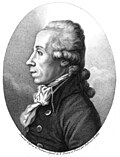
[[File:Martin Heinrich Klaproth.jpg|thumb|upright|alt=Engraved profile image of a mid-age male with high forehead. The person is wearing a coat and a neckerchief.|[[Martin Heinrich Klaproth]] named titanium for the [[titan (mythology)|Titans]] of [[Greek mythology]].]] | [[File:Martin Heinrich Klaproth.jpg|thumb|upright|alt=Engraved profile image of a mid-age male with high forehead. The person is wearing a coat and a neckerchief.|[[Martin Heinrich Klaproth]] named titanium for the [[titan (mythology)|Titans]] of [[Greek mythology]].]] | ||
Titanium was [[discovery of the chemical elements|discovered]] in 1791 by the [[clergy]]man and [[geologist]] [[William Gregor]] as an [[inclusion (mineral)|inclusion]] of a mineral in [[Cornwall]], Great Britain.<ref name=Emsley2001p452/> Gregor recognized the presence of a new element in ilmenite<ref name=HistoryAndUse/> when he found black sand by a stream and noticed the sand was attracted by a [[magnet]].<ref name=Emsley2001p452/> Analyzing the sand, he determined the presence of two metal oxides: [[iron oxide]] (explaining the attraction to the magnet) and 45.25% of a white metallic oxide he could not identify.<ref name="Barksdale1968p732">{{harvnb|Barksdale|1968|p=732}}</ref> Realizing that the unidentified oxide contained a metal that did not match any known element, in 1791 Gregor reported his findings in both German and French science journals: ''[[Crell's Annalen]]'' and ''Observations et Mémoires sur la Physique''.<ref name=Emsley2001p452/><ref>{{cite journal |author=Gregor, William |year=1791 |title=Beobachtungen und Versuche über den Menakanit, einen in Cornwall gefundenen magnetischen Sand | | Titanium was [[discovery of the chemical elements|discovered]] in 1791 by the [[clergy]]man and [[geologist]] [[William Gregor]] as an [[inclusion (mineral)|inclusion]] of a mineral in [[Cornwall]], Great Britain.<ref name=Emsley2001p452/> Gregor recognized the presence of a new element in ilmenite<ref name=HistoryAndUse/> when he found black sand by a stream and noticed the sand was attracted by a [[magnet]].<ref name=Emsley2001p452/> Analyzing the sand, he determined the presence of two metal oxides: [[iron oxide]] (explaining the attraction to the magnet) and 45.25% of a white metallic oxide he could not identify.<ref name="Barksdale1968p732">{{harvnb|Barksdale|1968|p=732}}</ref> Realizing that the unidentified oxide contained a metal that did not match any known element, in 1791 Gregor reported his findings in both German and French science journals: ''[[Crell's Annalen]]'' and ''Observations et Mémoires sur la Physique''.<ref name=Emsley2001p452/><ref>{{cite journal |author=Gregor, William |year=1791 |title=Beobachtungen und Versuche über den Menakanit, einen in Cornwall gefundenen magnetischen Sand |language=de |trans-title=Observations and experiments regarding menaccanite [i.e., ilmenite], a magnetic sand found in Cornwall |journal=Chemische Annalen |volume=1 |pages=[https://books.google.com/books?id=ZFAyAQAAMAAJ&pg=PA40 pp. 40–54], [https://books.google.com/books?id=ZFAyAQAAMAAJ&pg=PA103 103–119]}}</ref><ref>{{cite journal |author=Gregor, William |year=1791 |title=Sur le menakanite, espèce de sable attirable par l'aimant, trouvé dans la province de Cornouilles |trans-title=On menaccanite, a species of magnetic sand, found in the county of Cornwall |language=fr |journal=Observations et Mémoires sur la Physique |volume=39 |pages=[https://archive.org/stream/journaldephysiq23unkngoog#page/n77/mode/1up 72–78], [https://archive.org/stream/journaldephysiq23unkngoog#page/n159/mode/1up 152–160]}}</ref><!-- <ref>{{cite book |url= https://books.google.com/books?id=pqc5AAAAcAAJ&pg=PA40 }}</ref>--> He named this oxide [[manaccanite]].<ref>{{cite journal |last1=Habashi |first1=Fathi |title=Historical Introduction to Refractory Metals |journal=Mineral Processing and Extractive Metallurgy Review |date=January 2001 |volume=22 |issue=1 |pages=25–53 |doi=10.1080/08827509808962488|bibcode=2001MPEMR..22...25H |s2cid=100370649 }}</ref> | ||
Around the same time, [[Franz-Joseph Müller von Reichenstein]] produced a similar substance, but could not identify it.<ref name="HistoryAndUse" /> The oxide was independently rediscovered in 1795 by [[Prussia]]n chemist [[Martin Heinrich Klaproth]] in rutile from Boinik (the German name of Bajmócska), a village in Hungary (now Bojničky in Slovakia).<ref name="Emsley2001p452" />{{efn| | Around the same time, [[Franz-Joseph Müller von Reichenstein]] produced a similar substance, but could not identify it.<ref name="HistoryAndUse" /> The oxide was independently rediscovered in 1795 by [[Prussia]]n chemist [[Martin Heinrich Klaproth]] in rutile from Boinik (the German name of Bajmócska), a village in Hungary (now [[Bojničky]] in Slovakia).<ref name="Emsley2001p452" />{{efn| | ||
''"Diesem zufolge will ich den Namen für die gegenwärtige metallische Substanz, gleichergestalt wie bei dem Uranium geschehen, aus der Mythologie, und zwar von den Ursöhnen der Erde, den Titanen, entlehnen, und benenne also diese neue Metallgeschlecht: Titanium; ... "''<ref name=Klaproth-1795>{{cite journal |author=Klaproth, Martin Heinrich |year=1795 |url=https://books.google.com/books?id=5zFGAAAAYAAJ&pg=PA233 |title=Chemische Untersuchung des sogenannten hungarischen rothen Schörls |trans-title=Chemical investigation of the so-called Hungarian red tourmaline [rutile] |journal=Beiträge zur chemischen Kenntniss der Mineralkörper [Contributions to the chemical knowledge of mineral substances] |volume=1 |pages=233–244 |place=Berlin, DE |publisher=Heinrich August Rottmann}}</ref>{{rp|style=ama|p= 244}} | ''"Diesem zufolge will ich den Namen für die gegenwärtige metallische Substanz, gleichergestalt wie bei dem Uranium geschehen, aus der Mythologie, und zwar von den Ursöhnen der Erde, den Titanen, entlehnen, und benenne also diese neue Metallgeschlecht: Titanium; ... "''<ref name=Klaproth-1795>{{cite journal |author=Klaproth, Martin Heinrich |year=1795 |url=https://books.google.com/books?id=5zFGAAAAYAAJ&pg=PA233 |title=Chemische Untersuchung des sogenannten hungarischen rothen Schörls |trans-title=Chemical investigation of the so-called Hungarian red tourmaline [rutile] |journal=Beiträge zur chemischen Kenntniss der Mineralkörper [Contributions to the chemical knowledge of mineral substances] |volume=1 |pages=233–244 |place=Berlin, DE |publisher=Heinrich August Rottmann}}</ref>{{rp|style=ama|p= 244}} | ||
{{br}} | |||
[By virtue of this I will derive the name for the present metallic substance — as happened similarly in the case of uranium — from mythology, namely from the first sons of the Earth, the Titans, and thus [I] name this new species of metal: "titanium"; ... ] | [By virtue of this I will derive the name for the present metallic substance — as happened similarly in the case of uranium — from mythology, namely from the first sons of the Earth, the Titans, and thus [I] name this new species of metal: "titanium"; ... ] | ||
}} | }} | ||
Klaproth found that it contained a new element and named it for the [[titan (mythology)|Titans]] of [[Greek mythology]].<ref name=Emsley2001p451/> After hearing about Gregor's earlier discovery, he obtained a sample of manaccanite and confirmed that it contained titanium.<ref>{{cite report |title=Twenty-five years of Titanium news: A concise and timely report on titanium and titanium recycling |year=1995 |publisher=Suisman Titanium Corporation |via=[[Pennsylvania State University]] / Google Books |page=37 |url=https://books.google.com/books?id=amIQAQAAMAAJ}}</ref> | Klaproth found that it contained a new element and named it for the [[titan (mythology)|Titans]] of [[Greek mythology]].<ref name=Emsley2001p451/> After hearing about Gregor's earlier discovery, he obtained a sample of manaccanite and confirmed that it contained titanium.<ref>{{cite report |title=Twenty-five years of Titanium news: A concise and timely report on titanium and titanium recycling |year=1995 |publisher=Suisman Titanium Corporation |via=[[Pennsylvania State University]] / Google Books |page=37 |url=https://books.google.com/books?id=amIQAQAAMAAJ}}</ref> | ||
The currently known processes for extracting titanium from its various ores are laborious and costly; it is not possible to reduce the ore by heating with [[carbon]] (as in iron smelting) because titanium combines with the carbon to produce titanium carbide.<ref name=Emsley2001p452/> Pure metallic titanium (99.9%) was first prepared in 1910 by [[Matthew A. Hunter]] at [[Rensselaer Polytechnic Institute]] by heating TiCl<sub>4</sub> with [[sodium]] at {{convert|700-800|°C|°F}} under great pressure<ref name=Roza2008p9>{{harvnb|Roza|2008|p=9}}</ref> in a [[batch production|batch process]] known as the [[Hunter process]].<ref name=LANL/> Titanium metal was not used outside the laboratory until 1932 when [[William Justin Kroll]] produced it by reducing titanium tetrachloride (TiCl<sub>4</sub>) with [[calcium]].<ref name=Greenwood1997p955>{{harvnb|Greenwood|Earnshaw|1997|p=955}}</ref> Eight years later he refined this process with magnesium and with sodium in what became known as the Kroll process.<ref name=Greenwood1997p955/> Although research continues to seek cheaper and more efficient routes, such as the [[FFC Cambridge process]], the Kroll process is still predominantly used for commercial production.<ref name=LANL/><ref name=HistoryAndUse/> | The currently known processes for extracting titanium from its various ores are laborious and costly; it is not possible to reduce the ore by heating with [[carbon]] (as in iron smelting) because titanium combines with the carbon to produce titanium carbide.<ref name=Emsley2001p452/> An extraction of 95% pure titanium was achieved by [[Lars Fredrik Nilson]] and [[:it:Otto Pettersson|Otto Petterson]]. To achieve this they chlorinated titanium oxide in a carbon monoxide atmosphere with chlorine gas before reducing it to titanium metal by the use of sodium.<ref>{{Citation |last1=Takeda |first1=Osamu |title=Chapter 2.7 - Rare Earth, Titanium Group Metals, and Reactive Metals Production |date=2024-01-01 |work=Treatise on Process Metallurgy |edition=Second |pages=697–750 |editor-last=Seetharaman |editor-first=Seshadri |url=https://www.sciencedirect.com/science/article/abs/pii/B9780323853736000107 |access-date=2024-11-22 |publisher=Elsevier |isbn=978-0-323-85373-6 |last2=Uda |first2=Tetsuya |last3=Okabe |first3=Toru H. |editor2-last=Guthrie |editor2-first=Roderick |editor3-last=McLean |editor3-first=Alexander |editor4-last=Seetharaman |editor4-first=Sridhar |doi=10.1016/B978-0-323-85373-6.00010-7|url-access=subscription }}</ref> Pure metallic titanium (99.9%) was first prepared in 1910 by [[Matthew A. Hunter]] at [[Rensselaer Polytechnic Institute]] by heating TiCl<sub>4</sub> with [[sodium]] at {{convert|700-800|°C|°F}} under great pressure<ref name=Roza2008p9>{{harvnb|Roza|2008|p=9}}</ref> in a [[batch production|batch process]] known as the [[Hunter process]].<ref name=LANL/> Titanium metal was not used outside the laboratory until 1932 when [[William Justin Kroll]] produced it by reducing titanium tetrachloride (TiCl<sub>4</sub>) with [[calcium]].<ref name=Greenwood1997p955>{{harvnb|Greenwood|Earnshaw|1997|p=955}}</ref> Eight years later he refined this process with magnesium and with sodium in what became known as the [[Kroll process]].<ref name=Greenwood1997p955/> Although research continues to seek cheaper and more efficient routes, such as the [[FFC Cambridge process]], the Kroll process is still predominantly used for commercial production.<ref name=LANL/><ref name=HistoryAndUse/> | ||
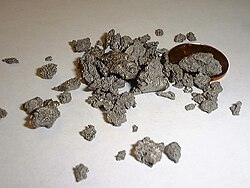
[[File:Titanium metal.jpg|thumb|right|alt=Rough pieces of shiny metal|Titanium "sponge", made by the [[Kroll process]]]] | |||
[[File:Titanium metal.jpg|thumb| | |||
Titanium of very high purity was made in small quantities when [[Anton Eduard van Arkel]] and [[Jan Hendrik de Boer]] discovered the iodide process in 1925, by reacting with iodine and decomposing the formed vapors over a hot filament to pure metal.<ref>{{cite journal |author1=van Arkel, A.E. |author1-link=Anton Eduard van Arkel |author2=de Boer, J.H. |year=1925 |title=Preparation of pure titanium, zirconium, hafnium, and thorium metal |journal=[[Zeitschrift für anorganische und allgemeine Chemie]] |volume=148 |pages=345–50 |doi=10.1002/zaac.19251480133}}</ref> | Titanium of very high purity was made in small quantities when [[Anton Eduard van Arkel]] and [[Jan Hendrik de Boer]] discovered the iodide process in 1925, by reacting with iodine and decomposing the formed vapors over a hot filament to pure metal.<ref>{{cite journal |author1=van Arkel, A.E. |author1-link=Anton Eduard van Arkel |author2=de Boer, J.H. |year=1925 |title=Preparation of pure titanium, zirconium, hafnium, and thorium metal |journal=[[Zeitschrift für anorganische und allgemeine Chemie]] |volume=148 |pages=345–50 |doi=10.1002/zaac.19251480133}}</ref> | ||
In the 1950s and 1960s, the Soviet Union pioneered the use of titanium in military and submarine applications<ref name=Roza2008p9/> ([[Alfa-class submarine|Alfa class]] | In the 1950s and 1960s, the Soviet Union pioneered the use of titanium in military and submarine applications<ref name=Roza2008p9/> ([[Alfa-class submarine|Alfa class]], [[Soviet submarine K-278 Komsomolets|Mike class]] and [[Sierra-class submarine|Sierra II class]])<ref>{{cite web |last=Yanko |first=Eugene |year=2006 |title=Submarines: General information |publisher=Omsk VTTV Arms Exhibition and Military Parade JSC |url=http://warfare.be/db/catid/243/linkid/1756/ |access-date=2 February 2015 |archive-url=https://web.archive.org/web/20160406114504/http://warfare.be/db/catid/243/linkid/1756/ |archive-date=6 April 2016 }}</ref> as part of programs related to the Cold War.<ref>{{cite news |title=VSMPO stronger than ever |date=July–August 2001 |website=Stainless Steel World |pages=16–19 |publisher=KCI Publishing B.V. |url=http://www.stainless-steel-world.net/pdf/ssw0107.pdf?issueID=30 |access-date=2 January 2007 |archive-date=5 October 2006 |archive-url=https://web.archive.org/web/20061005041506/http://www.stainless-steel-world.net/pdf/ssw0107.pdf?issueID=30 }}</ref> Starting in the early 1950s, titanium came into use extensively in military aviation, particularly in high-performance jets, starting with aircraft such as the [[F-100 Super Sabre]] and [[Lockheed A-12]] and [[SR-71]].<ref>{{cite book |editor=Jasper, Adam |year=2020 |title=Architecture and Anthropology |isbn=978-1-351-10627-6 |publisher=Taylor & Francis |page=42}}</ref> | ||
Throughout the Cold War period, titanium was considered a [[strategic material]] by the U.S. government, and a large stockpile of titanium [[Metal foam|sponge]] (a porous form of the pure metal) was maintained by the [[Defense National Stockpile Center]], until the stockpile was dispersed in the 2000s.<ref>{{cite report |title=Strategic and Critical Materials Report to the Congress. Operations under the Strategic and Critical Materials Stock Piling Act during the Period October 2007 through September 2008 |year=2008 |publisher=[[United States Department of Defense]] |page=3304 |author=Defense National Stockpile Center |url=https://www.dnsc.dla.mil/Uploads/Materials/esolomon_5-21-2009_13-29-4_2008OpsReport.pdf |author-link=Defense National Stockpile Center |archive-url=https://web.archive.org/web/20100211093359/https://www.dnsc.dla.mil/Uploads/Materials/esolomon_5-21-2009_13-29-4_2008OpsReport.pdf |archive-date=11 February 2010 | Throughout the Cold War period, titanium was considered a [[strategic material]] by the U.S. government, and a large stockpile of titanium [[Metal foam|sponge]] (a porous form of the pure metal) was maintained by the [[Defense National Stockpile Center]], until the stockpile was dispersed in the 2000s.<ref>{{cite report |title=Strategic and Critical Materials Report to the Congress. Operations under the Strategic and Critical Materials Stock Piling Act during the Period October 2007 through September 2008 |year=2008 |publisher=[[United States Department of Defense]] |page=3304 |author=Defense National Stockpile Center |url=https://www.dnsc.dla.mil/Uploads/Materials/esolomon_5-21-2009_13-29-4_2008OpsReport.pdf |author-link=Defense National Stockpile Center |archive-url=https://web.archive.org/web/20100211093359/https://www.dnsc.dla.mil/Uploads/Materials/esolomon_5-21-2009_13-29-4_2008OpsReport.pdf |archive-date=11 February 2010 }}</ref> Even so, the U.S. government annually allocates 15,000{{Spaces}}metric tons of titanium sponge as potential acquisitions for the stockpile.<ref name=":3" /> | ||
==Production== | ==Production== | ||
{{Main| | {{Main|Titanium production by country}} | ||
{{ | {|class="wikitable floatleft" | ||
[[File:TitaniumUSGOV.jpg|thumb|alt=A small heap of uniform black grains smaller than 1mm diameter | |+ 2024 production of ilmenite and rutile<ref name=":3" /> | ||
[[ | ! Country !! thousand <br />tonnes !! % of total | ||
|- | |||
|[[China]]{{efn|name=ilmen|Country reports only produced ilmenite}}||3,300||35.3 | |||
|- | |||
|[[Mozambique]]||1,908||20.4 | |||
|- | |||
|[[South Africa]]||1,400||15.0 | |||
|- | |||
|[[Australia]]||600||6.4 | |||
|- | |||
|[[Norway]]{{efn|name=ilmen}}||360||3.8 | |||
|- | |||
|[[Canada]]{{efn|name=ilmen}}||350||3.7 | |||
|- | |||
|[[Senegal]]{{efn|name=ilmen}}||300||3.2 | |||
|- | |||
|[[Madagascar]]{{efn|name=ilmen}}||240||2.6 | |||
|- | |||
|[[India]]||222||2.4 | |||
|- | |||
|[[Ukraine]]||130||1.4 | |||
|- | |||
|[[United States]]||100||1.1 | |||
|- | |||
|[[Sierra Leone]]{{efn|name=rutil|Country reports only produced rutile}}||60||0.6 | |||
|- | |||
|[[Kenya]]{{efn|name=rutil}}||40||0.4 | |||
|- | |||
|Other countries||350||3.7 | |||
|- | |||
|'''World'''||'''9,360'''||'''100''' | |||
|} | |||
Titanium production is largely divided into three measured categories: manufacture of porous titanium metal "sponge", titanium oxide pigment, and titanium mineral concentrates used for the production of sponge, pigment, metal ingots, and other titanium products such as coatings. These concentrates are largely made up of the mineral [[ilmenite]], but also include [[anatase]], natural and synthetic [[rutile]], [[tailings]], [[slag]], and [[leucoxene]]. As of 2024, the largest producers of titanium mineral concentrates were [[China]], [[Mozambique]], and [[South Africa]].<ref name=":3">{{cite web |last=United States Geological Survey |date=March 2025 |title=Titanium and titanium dioxide |url=https://pubs.usgs.gov/periodicals/mcs2025/mcs2025.pdf#page=190 |access-date=15 October 2025 |series=Mineral Commodities Summaries}}</ref> | |||
Most of the world's titanium is produced in China. The [[United States Geological Survey]]'s 2025 report on mineral commodities estimated that out of the {{Convert|320,000|metric ton}} of titanium sponge produced globally in 2024, 220,000 (69%) were produced in China, with the second-largest producer being [[Japan]] (which produced 55,000{{Spaces}}metric tons in the same year, 17% of the total). Japan was the largest exporter of titanium sponge in 2024, but did not produce any titanium minerals on its own.<ref name=":3" /> A prior report in 2021 noted that the four leading producers of titanium sponge were China (52%), Japan (24%), Russia (16%) and Kazakhstan (7%).<ref name="USGS" /> Russia remains the third-largest producer of titanium sponge<ref name=":3" /> through the efforts of the metallurgy company [[VSMPO-AVISMA]], despite [[international sanctions during the Russian invasion of Ukraine]].<ref>{{Cite news |last=Taylor |first=Adam |date=March 21, 2024 |title=Two years after start of Ukraine war, Russian titanium keeps flowing to West |url=https://www.washingtonpost.com/world/2024/03/21/russia-titanium-exports-sanctions/ |access-date=October 15, 2025 |newspaper=[[The Washington Post]]}}</ref> Production statistics on titanium dioxide pigment are not as clear-cut, but estimates placed the maximum capacity on global pigment production at {{Convert|9,800,000|metric ton}} in 2024.<ref name=":3" /> | |||
Various methods have been developed to extract and refine titanium from ore since the metal was first purified in 1910.<ref name=":0" /><ref name=":4" /> | |||
===Mineral beneficiation processes=== | |||
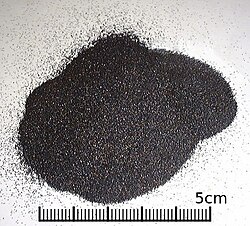
[[File:TitaniumUSGOV.jpg|thumb|alt=A small heap of uniform black grains smaller than 1mm in diameter|Mineral concentrate of fine-grained titanium]] | |||
Several processes have been developed to extract titanium and usable titanium-containing minerals from ore. The [[Becher process]] is an industrial process used to produce synthetic rutile, a form of titanium dioxide, from the ore ilmenite by removing iron.<ref>{{cite web|url=http://www.chemlink.com.au/titan_rutile.htm|title=Rutile and ilmenite - Australian production and potential profile|access-date=2008-03-01|archive-date=2021-02-23|archive-url=https://web.archive.org/web/20210223124602/http://chemlink.com.au/titan_rutile.htm}}</ref> It is not used at scale.<ref name=":4">{{cite book |doi=10.1002/14356007.a27_095 |chapter=Titanium, Titanium Alloys, and Titanium Compounds |title=Ullmann's Encyclopedia of Industrial Chemistry |date=2000 |last1=Sibum |first1=Heinz |last2=Güther |first2=Volker |last3=Roidl |first3=Oskar |last4=Habashi |first4=Fathi |last5=Wolf |first5=Hans Uwe |isbn=978-3-527-30385-4 }}</ref> The [[chloride process]] produces titanium tetrachloride through treatment of rutile ore with chlorine and carbon at high heat,<ref name="Greenwood1997p960" /> then oxidizes the product with an oxygen flame or plasma to produce titanium dioxide.<ref name=UllmannPigments>{{cite encyclopedia |last1=Auer|first1=Gerhard |last2=Woditsch|first2=Peter |last3=Westerhaus|first3=Axel |last4=Kischkewitz|first4=Jürgen |last5=Griebler|first5=Wolf-Dieter |last6=Rohe|first6=Markus |last7=Liedekerke|first7=Marcel |title=Pigments, Inorganic, 2. White Pigments |encyclopedia=Ullmann's Encyclopedia of Industrial Chemistry |publisher=Wiley-VCH |location=Weinheim |date=2017 |page=13 |doi=10.1002/14356007.n20_n01.pub2 |isbn=978-3-527-30673-2}}</ref> The [[Titanium dioxide#Sulfate process|sulfate process]] uses [[sulfuric acid]] (H<sub>2</sub>SO<sub>4</sub>) to leach titanium from ilmenite ore (FeTiO<sub>3</sub>), producing [[titanyl sulfate]] ({{chem2|TiOSO4}}). This sulfate is broken into two hydrates, {{chem2|TiO2}} and {{chem2|H2SO4}}, through addition of water, and this water is removed by adding heat, which produces titanium dioxide as the end product.<ref name="bar1">{{cite news |url=https://www.barbenanalytical.com/-/media/ametekbarbenanalytical/downloads/application_notes/tio2_an_reva.pdf?la=en&revision=eee43ea5-f5e3-4167-af19-4c177cc3dcdd |title=Application Note Titanium Dioxide - Sulfate Process |publisher=Ametek |agency=Barben Analytical |date=2015}}</ref> | |||
===Purification processes=== | |||
{{see also|Category:Titanium processes|Category:Titanium companies}} | |||
====Hunter process==== | |||
The Hunter process was the first industrial process to produce pure metallic titanium. It was invented in 1910 by [[Matthew A. Hunter]], a [[chemist]] born in New Zealand who worked in the United States.<ref>{{cite journal | last1 = Hunter | first1 = M. A. | year = 1910| title = Metallic Titanium | url = | journal = J. Am. Chem. Soc. | volume = 32| issue = 3| pages = 330–336| doi = 10.1021/ja01921a006 | bibcode = 1910JAChS..32..330H }}</ref> The process involves reducing [[titanium tetrachloride]] (TiCl<sub>4</sub>) with [[sodium]] (Na) in a batch reactor with an inert atmosphere at a temperature of 1,000 °C. Dilute [[hydrochloric acid]] is then used to leach the salt from the product.<ref>{{Cite encyclopedia |entry=Hunter process |dictionary=A Dictionary of Chemical Engineering |date=2014 |url=http://www.oxfordreference.com/view/10.1093/acref/9780199651450.001.0001/acref-9780199651450-e-1447 |url-access=subscription |language=en|doi=10.1093/acref/9780199651450.001.0001|last1=Schaschke |first1=Carl |publisher=Oxford University Press |isbn=978-0-19-965145-0 }}</ref> | |||
:TiCl<sub>4</sub>(g) + 4 Na(l) → 4 NaCl(l) + Ti(s) | |||
====Kroll process==== | |||
[[File:Sample of Titanium tetrachloride 01.jpg|thumb|right|alt=Slightly yellow liquid in a vial with a white cap on a black table|Sample of titanium tetrachloride, a volatile liquid]] | |||
The processing of titanium metal occurs in four major steps: reduction of titanium ore into "sponge", a porous form; melting of sponge, or sponge plus a master alloy to form an ingot; primary fabrication, where an ingot is converted into general mill products such as [[bar stock|billet]], bar, [[plate (metal)|plate]], [[sheet metal|sheet]], strip, and [[tube (fluid conveyance)|tube]]; and secondary fabrication of finished shapes from mill products.<ref>{{harvnb|Donachie|1988|loc=Ch. 4}}</ref> | The processing of titanium metal occurs in four major steps: reduction of titanium ore into "sponge", a porous form; melting of sponge, or sponge plus a master alloy to form an ingot; primary fabrication, where an ingot is converted into general mill products such as [[bar stock|billet]], bar, [[plate (metal)|plate]], [[sheet metal|sheet]], strip, and [[tube (fluid conveyance)|tube]]; and secondary fabrication of finished shapes from mill products.<ref>{{harvnb|Donachie|1988|loc=Ch. 4}}</ref> | ||
Because it cannot be readily produced by reduction of titanium dioxide,<ref name=Stwertka1998/> titanium metal is obtained by reduction of TiCl<sub>4</sub> with magnesium metal in the Kroll process. The complexity of this batch production in the Kroll process explains the relatively high market value of titanium,<ref name=Barksdale1968p733>{{harvnb|Barksdale|1968|p=733}}</ref> despite the Kroll process being less expensive than the Hunter process.<ref name=Roza2008p9/> To produce the TiCl<sub>4</sub> required by the Kroll process, the dioxide is subjected to [[carbothermic reduction]] in the presence of [[chlorine]]. In this process, the chlorine gas is passed over a red-hot mixture of rutile or ilmenite in the presence of carbon. | Because it cannot be readily produced by reduction of titanium dioxide,<ref name=Stwertka1998/> titanium metal is obtained by reduction of [[titanium tetrachloride]] (TiCl<sub>4</sub>) with magnesium metal in the Kroll process. The complexity of this batch production in the Kroll process explains the relatively high market value of titanium,<ref name=Barksdale1968p733>{{harvnb|Barksdale|1968|p=733}}</ref> despite the Kroll process being less expensive than the Hunter process.<ref name=Roza2008p9/> To produce the TiCl<sub>4</sub> required by the Kroll process, the dioxide is subjected to [[carbothermic reduction]] in the presence of [[chlorine]]. In this process, the chlorine gas is passed over a red-hot mixture of rutile or ilmenite in the presence of carbon. After extensive purification by [[fractional distillation]], the TiCl<sub>4</sub> is reduced with {{convert|800|C}} molten magnesium in an [[argon]] atmosphere.<ref name=TICE6th/> | ||
After extensive purification by [[fractional distillation]], the TiCl<sub>4</sub> is reduced with {{convert|800|C}} molten magnesium in an [[argon]] atmosphere.<ref name=TICE6th/> | |||
:<chem>2FeTiO3 + 7Cl2 + 6C ->[900^oC] 2FeCl3 + 2TiCl4 + 6CO</chem> | :<chem>2FeTiO3 + 7Cl2 + 6C ->[900^oC] 2FeCl3 + 2TiCl4 + 6CO</chem> | ||
:<chem>TiCl4 + 2Mg ->[1100^oC] Ti + 2MgCl2</chem> | :<chem>TiCl4 + 2Mg ->[1100^oC] Ti + 2MgCl2</chem> | ||
====Arkel-Boer process==== | |||
The [[van Arkel–de Boer process]] was the first semi-industrial process developed to produce pure titanium, invented by [[Anton Eduard van Arkel]] and [[Jan Hendrik de Boer]] in 1925 for the electronics company [[Philips Nv|Philips]].<ref name=":1">{{Cite journal |last1=Binnewies |first1=Michael |last2=Schmidt |first2=Marcus |date=2012 |title=The Iodide Process – a Key to many Divisions of Modern Technology |url=https://onlinelibrary.wiley.com/doi/10.1002/zaac.201210009 |journal=Zeitschrift für anorganische und allgemeine Chemie |language=en |volume=638 |issue=6 |pages=891–893 |doi=10.1002/zaac.201210009 |bibcode=2012ZAACh.638..891B |issn=0044-2313|url-access=subscription }}</ref> It is a closed-loop process<ref name=":2">{{Cite book |last1=Commission |first1=U. S. Atomic Energy |url=https://books.google.com/books?id=dqKgCIbq7hEC |title=The Metallurgy of Hafnium |last2=Development |first2=U. S. Atomic Energy Commission Division of Reactor |date=1960 |publisher=Naval Reactors, Division of Reactor Development, U.S. Atomic Energy Commission |page=109 |language=en}}</ref> that involves thermal decomposition of [[titanium tetraiodide]].<ref>{{Cite book |last=Rosenqvist |first=Terkel |url=https://books.google.com/books?id=I2mg2ine4AEC |title=Principles of Extractive Metallurgy |date=2004 |publisher=Tapir Academic Press |isbn=978-82-519-1922-7 |pages=393–395 |language=en}}</ref> This same process is used to purify other metals, such as thorium, hafnium, and zirconium,<ref name=":1" /> and a similar process using further refined iodide was used to refine chromium. A desire to develop processes that could be run continuously led to the development of commercial processes to refine titanium.<ref name=":2" /> | |||
====Armstrong process==== | |||
[[Titanium powder]] is manufactured using a [[flow production]] process known as the [[Armstrong process]]<ref name=Roza2008p25>{{harvnb|Roza|2008|p=25}}</ref> that is similar to the batch production [[Hunter process]]. A stream of titanium tetrachloride gas is added to a stream of molten sodium; the products (sodium chloride salt and titanium particles) are filtered from the extra sodium. Titanium is then separated from the salt by water washing. Both the sodium and chlorine are recycled to produce and process more titanium tetrachloride.<ref name="ECI online">{{cite web |title=Titanium |date=15 January 2015 |website=The Essential Chemical Industry online |series=CIEC Promoting Science |publisher=[[University of York]] |location=York, UK |url=http://www.essentialchemicalindustry.org/metals/titanium.html}}</ref> | |||
==== Other processes ==== | |||
The titanium tetrachloride used as an intermediate in both the Hunter and Kroll process is a volatile and corrosive liquid, and is thus hazardous to work with. The processes involving the tetrachloride, both its formation and the vacuum distillation processes used to purify the final material, are slow, and have prompted development of other techniques.<ref name=flower>{{cite journal |last=Flower |first=Harvey M.|title=Materials Science: A moving oxygen story |journal=[[Nature (journal)|Nature]] |volume=407 |year=2000 |issue=6802 |pmid=11014169 |pages=305–306 |doi=10.1038/35030266 |s2cid=4425634 }}</ref> | |||
Methods for [[electrolytic]] production of Ti metal from {{chem2|TiO2}} using molten salt electrolytes have been proposed starting in the 1990s,<ref name=flower /> and have been researched and tested at laboratory and small pilot plant scales.<ref name="fray17">{{cite journal |last1=Fray |first1=Derek |last2=Schwandt |first2=Carsten |title=Aspects of the Application of Electrochemistry to the Extraction of Titanium and Its Applications |journal=Materials Transactions |volume=58 |date=2017 |issue=3 |issn=1345-9678 |doi=10.2320/matertrans.MK201619 |pages=306–312|doi-access=free }}</ref> While some metals such as [[nickel]] and [[copper]] can be refined by [[electrowinning]] at room temperature, titanium must be in the molten state, which is likely to damage the [[refractory]] lining of a reaction vessel.<ref name="sohn23">{{cite journal |doi=10.1080/25726641.2023.2255368 |title=Role of electrochemical processes in the extraction of metals and alloys – a review |date=2023 |last1=Shamsuddin |first1=Mohammad |last2=Sohn |first2=Hong Yong |journal=Mineral Processing and Extractive Metallurgy: Transactions of the Institutions of Mining and Metallurgy |volume=132 |issue=3–4 |pages=193–209 |bibcode=2023MPEM..132..193S }}</ref> Zhang and colleagues concluded in 2017 that despite industry interests in finding new ways to manufacture titanium metal, no method had yet been developed to commercially replace the Kroll process.<ref name="zhang17">{{cite journal |title=A Perspective on Thermochemical and Electrochemical Processes for Titanium Metal Production |date=2017 |doi=10.1007/s11837-017-2481-9 |last1=Zhang |first1=Ying |last2=Fang |first2=Zhigang Zak |last3=Sun |first3=Pei |last4=Zheng |first4=Shili |last5=Xia |first5=Yang |last6=Free |first6=Michael |journal=JOM |volume=69 |issue=10 |pages=1861–1868 |bibcode=2017JOM....69j1861Z }}</ref> One manufacturer in Virginia has developed a method to recycle scrap titanium metal back into powder, though their scale remains small, having the goal of producing only 125 tons of titanium per year as of 2025.<ref name=":3" /> | |||
[[ | One method that has been developed to potentially supplant the Kroll process is known as [[Hydrogen assisted magnesiothermic reduction|hydrogen-assisted magnesiothermic reduction]] and makes use of [[magnesium]], hydrochloric acid, and a hydrogen atmosphere to directly reduce titanium dioxide to pure titanium. The reduction of titanium dioxide powder by magnesium in an atomphere of hydrogen can be followed by a leaching step with hydrochloric acid, which removes magnesium and residual non-titanium oxides. This is followed by additional reduction and leaching steps, and eventually results in pure titanium powder or [[titanium hydride]].<ref>{{Cite journal |last1=Lefler |first1=Hyrum |last2=Fang |first2=Z. Zak |last3=Zhang |first3=Ying |last4=Sun |first4=Pei |last5=Xia |first5=Yang |date=2018 |title=Mechanisms of Hydrogen-Assisted Magnesiothermic Reduction of TiO2 |url=https://link.springer.com/10.1007/s11663-018-1399-0 |journal=Metallurgical and Materials Transactions B |language=en |volume=49 |issue=6 |pages=2998–3006 |doi=10.1007/s11663-018-1399-0 |issn=1073-5615|url-access=subscription }}</ref> | ||
===Fabrication=== | === Fabrication === | ||
All [[welding]] of titanium must be done in an inert atmosphere of argon or [[helium]] to shield it from contamination with atmospheric gases (oxygen, nitrogen, and hydrogen).<ref name=Barksdale1968p734/> Contamination causes a variety of conditions, such as [[embrittlement]], which reduce the integrity of the assembly welds and lead to joint failure.<ref>{{Cite book |year=1955 |title=Arc-welding Titanium |author1= Engel, Abraham L. |author2=Huber, R.W. |author3=Lane, I.R. |publisher=U.S. Department of the Interior, Bureau of Mines }}</ref> | All [[welding]] of titanium must be done in an inert atmosphere of argon or [[helium]] to shield it from contamination with atmospheric gases (oxygen, nitrogen, and hydrogen).<ref name=Barksdale1968p734/> Contamination causes a variety of conditions, such as [[embrittlement]], which reduce the integrity of the assembly welds and lead to joint failure.<ref>{{Cite book |year=1955 |title=Arc-welding Titanium |author1= Engel, Abraham L. |author2=Huber, R.W. |author3=Lane, I.R. |publisher=U.S. Department of the Interior, Bureau of Mines }}</ref> | ||
Titanium is very difficult to [[solder]] directly, and hence a [[solderability|solderable]] metal or alloy such as steel is coated on titanium prior to soldering.<ref>{{cite book | title=Report on Brazing and Soldering of Titanium |year=1956 |publisher=Titanium Metallurgical Laboratory, Battelle Memorial Institute |author1=Lewis, W.J. |author2=Faulkner, G.E. |author3=Rieppel, P.J. | url=https://books.google.com/books?id=316b7CW_HOMC&dq=Titanium+soldering&pg=PA2}}</ref> Titanium metal can be machined with the same equipment and the same processes as [[stainless steel]].<ref name="Barksdale1968p734" /> | Titanium is very difficult to [[solder]] directly, and hence a [[solderability|solderable]] metal or alloy such as steel is coated on titanium prior to soldering.<ref>{{cite book | title=Report on Brazing and Soldering of Titanium |year=1956 |publisher=Titanium Metallurgical Laboratory, Battelle Memorial Institute |author1=Lewis, W.J. |author2=Faulkner, G.E. |author3=Rieppel, P.J. | url=https://books.google.com/books?id=316b7CW_HOMC&dq=Titanium+soldering&pg=PA2}}</ref> Titanium metal can be machined with the same equipment and the same processes as [[stainless steel]].<ref name="Barksdale1968p734" /> | ||
====Forming and forging==== | ==== Titanium alloys ==== | ||
Commercially pure flat product (sheet, plate) can be formed readily, but processing must take into account of the tendency of the metal to [[springback]]. This is especially true of certain high-strength alloys.<ref>{{cite book|title=AWS G2.4/G2.4M:2007 Guide for the Fusion Welding of Titanium and Titanium Alloys |year=2006 |publisher=American Welding Society |place=Miami |url=http://pdfcast.org/pdf/titanium-design-and-fabrication-handbook-for-industrial-applications |archive-url=https://web.archive.org/web/20101210022045/http://pdfcast.org/pdf/titanium-design-and-fabrication-handbook-for-industrial-applications | {{main|Titanium alloys}} | ||
[[File:Titanium products.jpg|thumb|alt=Silvery metal items, including rods, a tube, and powder in plastic containers, all resting on a reflective metal plate|Basic titanium products: plate, tube, rods, and powder]] | |||
Common [[titanium alloy]]s are made by reduction. For example, cuprotitanium (rutile with [[copper]] added), ferrocarbon titanium (ilmenite reduced with [[coke (fuel)|coke]] in an electric furnace), and manganotitanium (rutile with manganese or manganese oxides) are reduced.<ref name=TI_Encarta2005>{{cite encyclopedia |title=Titanium |year=2005 |encyclopedia=Microsoft Encarta |url=http://encarta.msn.com/encyclopedia_761569280/Titanium.html |access-date=29 December 2006 |archive-url= https://web.archive.org/web/20061027112633/http://encarta.msn.com/encyclopedia_761569280/Titanium.html |archive-date=27 October 2006}}</ref> | |||
About fifty grades of [[titanium alloy]]s are designed and currently used, although only a couple of dozen are readily available commercially.<ref>{{harvnb|Donachie|1988|p=16, Appendix J}}</ref> The [[ASTM International]] recognizes 31 grades of titanium metal and alloys, of which grades one through four are commercially pure (unalloyed). Those four vary in tensile strength as a function of oxygen content, with grade 1 being the most ductile (lowest tensile strength with an oxygen content of 0.18%), and grade 4 the least ductile (highest tensile strength with an oxygen content of 0.40%).<ref name=Emsley2001p453/> The remaining grades are alloys, each designed for specific properties of ductility, strength, hardness, electrical resistivity, [[creep (deformation)|creep]] resistance, specific corrosion resistance, and combinations thereof.<ref>{{cite book |title=Annual Book of ASTM Standards |section=Volume 02.04: Non-ferrous Metals |year=2006 |publisher=[[ASTM International]] |location=[[West Conshohocken, PA]] |at=section 2 |isbn=978-0-8031-4086-8 |url=https://books.google.com/books?id=yCGIPQAACAAJ}} {{cite book |title=Annual Book of ASTM Standards |year=1998 |section=Volume 13.01: Medical Devices; Emergency Medical Services |publisher=[[ASTM International]] |location=[[West Conshohocken, PA]] |at=sections 2 & 13 |isbn=978-0-8031-2452-3}}</ref> | |||
In addition to the ASTM specifications, titanium alloys are also produced to meet aerospace and military specifications (SAE-AMS, MIL-T), ISO standards, and country-specific specifications, as well as proprietary end-user specifications for aerospace, military, medical, and industrial applications.<ref>{{harvnb|Donachie|1988|pp=13–16, Appendices H and J}}</ref> | |||
==== Forming and forging ==== | |||
Commercially pure flat product (sheet, plate) can be formed readily, but processing must take into account of the tendency of the metal to [[springback]]. This is especially true of certain high-strength alloys.<ref>{{cite book|title=AWS G2.4/G2.4M:2007 Guide for the Fusion Welding of Titanium and Titanium Alloys |year=2006 |publisher=American Welding Society |place=Miami |url=http://pdfcast.org/pdf/titanium-design-and-fabrication-handbook-for-industrial-applications |archive-url=https://web.archive.org/web/20101210022045/http://pdfcast.org/pdf/titanium-design-and-fabrication-handbook-for-industrial-applications |archive-date=10 December 2010 }}</ref><ref>{{cite book|title=Titanium design and fabrication handbook for industrial applications |year=1997 |publisher=Titanium Metals Corporation |location=Dallas |url=http://www.timet.com/design%26fabframe.html |author-link=Titanium Metals Corporation |archive-url=https://web.archive.org/web/20090209014255/http://www.timet.com/design%26fabframe.html |archive-date=9 February 2009 }}</ref> Exposure to the oxygen in air at the elevated temperatures used in forging results in formation of a brittle oxygen-rich metallic surface layer called "[[alpha case]]" that worsens the fatigue properties, so it must be removed by milling, etching, or electrochemical treatment.<ref name=""Chen 2001"">{{cite journal |last1=Chen |first1=George Z. |last2=Fray |first2=Derek J. |last3=Farthing |first3=Tom W. |year=2001 |title=Cathodic deoxygenation of the alpha case on titanium and alloys in molten calcium chloride |journal=Metall. Mater. Trans. B |volume=32 |issue=6 |pages=1041–1052 |doi=10.1007/s11663-001-0093-8 |bibcode=2001MMTB...32.1041C |s2cid=95616531 |url=https://link.springer.com/article/10.1007/s11663-001-0093-8|url-access=subscription }}</ref> The working of titanium may include [[friction welding]],<ref name="mti1">{{Cite web|url=https://www.mtiwelding.com/blog/linear-friction-welding-a-solution-for-titanium-forgings/|title=Linear Friction Welding: A Solution for Titanium Forgings|website=Mtiwelding.com|date=28 August 2023|access-date=13 July 2025}}</ref> [[cryo-forging]],<ref name="mdes1">{{cite news |url=https://www.machinedesign.com/materials/article/21179098/ultra-cold-forging-makes-titanium-strong-and-ductile |title=Ultra-Cold Forging Makes Titanium Strong and Ductile |date=21 October 2021 }}</ref> and [[vacuum arc remelting]].<ref>{{Cite journal |last1=Karimi-Sibaki |first1=E. |last2=Kharicha |first2=A. |last3=Wu |first3=M. |last4=Ludwig |first4=A. |last5=Bohacek |first5=J. |date=2020 |title=A Parametric Study of the Vacuum Arc Remelting (VAR) Process: Effects of Arc Radius, Side-Arcing, and Gas Cooling |url=https://link.springer.com/10.1007/s11663-019-01719-5 |journal=Metallurgical and Materials Transactions B |language=en |volume=51 |issue=1 |pages=222–235 |doi=10.1007/s11663-019-01719-5 |issn=1073-5615|hdl=11012/194825 |hdl-access=free }}</ref> | |||
==Applications== | ==Applications== | ||
[[File:Titanzylinder.jpg|thumb|right|A titanium cylinder | [[File:Titanzylinder.jpg|thumb|right|alt=A hand holding a cylinder of reflective silvery metal|A titanium cylinder]] | ||
Titanium is used in steel as an alloying element ([[ferro-titanium]]) to reduce [[crystallite|grain size]] and as a deoxidizer, and in stainless steel to reduce carbon content.<ref name="EBC" /> Titanium is often alloyed with aluminium (to refine grain size), [[vanadium]], copper (to harden), [[iron]], [[manganese]], [[molybdenum]], and other metals.<ref name=ECE738>{{cite book |last=Hampel |first=Clifford A. |year=1968 |title=The Encyclopedia of the Chemical Elements |page=738 |publisher=Van Nostrand Reinhold |isbn=978-0-442-15598-8}}</ref> Titanium mill products (sheet, plate, bar, wire, forgings, castings) find application in industrial, aerospace, recreational, and emerging markets. Powdered titanium is used in [[pyrotechnics]] as a source of bright-burning particles.<ref>{{cite book |author1=Mocella, Chris |author2=Conkling, John A. |year=2019 |title=Chemistry of Pyrotechnics|publisher=CRC Press |page=86 |isbn= | Titanium is used in steel as an alloying element ([[ferro-titanium]]) to reduce [[crystallite|grain size]] and as a [[deoxidizer]], and in stainless steel to reduce carbon content.<ref name="EBC" /> Titanium is often alloyed with aluminium (to refine grain size), [[vanadium]], copper (to harden), [[iron]], [[manganese]], [[molybdenum]], and other metals.<ref name=ECE738>{{cite book |last=Hampel |first=Clifford A. |year=1968 |title=The Encyclopedia of the Chemical Elements |page=738 |publisher=Van Nostrand Reinhold |isbn=978-0-442-15598-8}}</ref> Titanium mill products (sheet, plate, bar, wire, forgings, castings) find application in industrial, aerospace, recreational, and emerging markets. Powdered titanium is used in [[pyrotechnics]] as a source of bright-burning particles.<ref>{{cite book |author1=Mocella, Chris |author2=Conkling, John A. |year=2019 |title=Chemistry of Pyrotechnics|publisher=CRC Press |page=86 |isbn=978-1-351-62656-9}}</ref> | ||
===Pigments, additives, and coatings=== | ===Pigments, additives, and coatings=== | ||
[[File:Titanium | [[File:Titanium-dioxide-sample.jpg|thumb|alt=White powder in a small pile|[[Titanium dioxide]] is the most commonly used compound of titanium.<ref name="USGS" />]] | ||
[[Titanium dioxide]] ({{chem|TiO|2}}) is the most common compound of the element, being the end point of 95% of the world's refined titanium. It is a widely used white [[pigment]].<ref name="USGS">{{cite web |title=Titanium |publisher=[[United States Geological Survey]] (USGS) |website=USGS Minerals Information |url=https://minerals.usgs.gov/minerals/pubs/commodity/titanium/ |access-date=28 November 2003 |archive-date=27 February 2019 |archive-url=https://web.archive.org/web/20190227092236/https://minerals.usgs.gov/minerals/pubs/commodity/titanium/ |url-status=dead }}</ref> It is also used in cement, in gemstones, and as an optical opacifier in paper.<ref>{{cite book |last=Smook |first=Gary A. |year=2002 |title=Handbook for Pulp & Paper Technologists |edition=3rd |publisher=Angus Wilde Publications |isbn=978-0-9694628-5-9 |page=223 |url=https://books.google.com/books?id=TgtFPgAACAAJ}}</ref> | |||
{{chem|TiO|2}} pigment is chemically inert, resists fading in sunlight, and is very opaque: it imparts a pure and brilliant white color to the brown or grey chemicals that form the majority of household plastics.<ref name=HistoryAndUse/> In nature, this compound is found in the minerals anatase, brookite, and rutile.<ref name=EBC/> Paint made with titanium dioxide does well in severe temperatures and marine environments.<ref name=HistoryAndUse/> Pure titanium dioxide has a very high [[refractive index|index of refraction]] and an [[optical dispersion]] higher than [[diamond]].<ref name=LANL/> | {{chem|TiO|2}} pigment is chemically inert, resists fading in sunlight, and is very opaque: it imparts a pure and brilliant white color to the brown or grey chemicals that form the majority of household plastics.<ref name=HistoryAndUse/> In nature, this compound is found in the minerals anatase, brookite, and rutile.<ref name=EBC/> Paint made with titanium dioxide does well in severe temperatures and marine environments.<ref name=HistoryAndUse/> Pure titanium dioxide has a very high [[refractive index|index of refraction]] and an [[optical dispersion]] higher than [[diamond]].<ref name=LANL/> Titanium dioxide is used in [[sunscreen]]s because it reflects and absorbs [[UV light]].<ref name=Stwertka1998/> | ||
===Aerospace and marine=== | ===Aerospace and marine=== | ||
Because titanium alloys have high [[tensile strength]] to density ratio,<ref name="TICE6th" /> high [[corrosion resistance]],<ref name=LANL/> fatigue resistance, high crack resistance,<ref name=Moiseyev>{{cite book |last=Moiseyev |first=Valentin N. |year=2006 |title=Titanium Alloys: Russian Aircraft and Aerospace Applications |publisher=Taylor and Francis, LLC |page=196 |isbn=978-0-8493-3273-9 |url=https://books.google.com/books?id=legtmQEACAAJ}}</ref> and ability to withstand moderately high temperatures without creeping, they are used in aircraft, armor plating, naval ships, spacecraft, and missiles.<ref name=LANL/><ref name=HistoryAndUse/> For these applications, titanium is alloyed with aluminium, zirconium, nickel,<ref name=Kramer-2013-07-05/> vanadium, and other elements to manufacture a variety of components including critical structural parts | [[File:A12-flying.jpg|thumb|alt=A black aircraft in midair|The [[Lockheed A-12]], one of the first planes with a frame mostly made of titanium]] | ||
Because titanium alloys have high [[tensile strength]] to density ratio,<ref name="TICE6th" /> high [[corrosion resistance]],<ref name=LANL/> fatigue resistance, high crack resistance,<ref name=Moiseyev>{{cite book |last=Moiseyev |first=Valentin N. |year=2006 |title=Titanium Alloys: Russian Aircraft and Aerospace Applications |publisher=Taylor and Francis, LLC |page=196 |isbn=978-0-8493-3273-9 |url=https://books.google.com/books?id=legtmQEACAAJ}}</ref> and ability to withstand moderately high temperatures without creeping, they are used in aircraft, armor plating, naval ships, spacecraft, and missiles.<ref name=LANL/><ref name=HistoryAndUse/> For these applications, titanium is alloyed with aluminium, zirconium, nickel,<ref name=Kramer-2013-07-05/> vanadium, and other elements to manufacture a variety of components including critical structural parts, [[landing gear]], [[firewall (engine)|firewalls]], exhaust ducts (helicopters), and hydraulic systems. About two thirds of all titanium metal produced is used in aircraft frames and engines.<ref name=Emsley2001p454/> The [[titanium 6AL-4V]] alloy accounts for almost 50% of all alloys used in aircraft applications.<ref>{{harvnb|Donachie|1988|p=13}}</ref> | |||
The Lockheed A-12 and | The [[Lockheed A-12]] and the [[SR-71 Blackbird|SR-71 "Blackbird"]] were two of the first aircraft frames where titanium was used, paving the way for much wider use in modern military and commercial aircraft. A large amount of titanium mill products are used in the production of many aircraft, such as (following values are amount of raw mill products used, only a fraction of this ends up in the finished aircraft): 116 metric tons are used in the [[Boeing 787]], 77 in the [[Airbus A380]], 59 in the [[Boeing 777]], 45 in the [[Boeing 747]], 32 in the [[Airbus A340]], 18 in the [[Boeing 737]], 18 in the [[Airbus A330]], and 12 in the [[Airbus A320]].<ref>{{cite book |editor=Froes, F.H. |year=2015 |title=Titanium Physical Metallurgy, Processing, and Applications |page=7 |isbn=978-1-62708-080-4 |publisher=[[ASM International (society)|ASM International]] }}</ref> In aero engine applications, titanium is used for rotors, compressor blades, hydraulic system components, and [[nacelle]]s.<ref>{{Cite web |date=2024-04-10 |title=Titanium in Aerospace – Titanium |url=https://titaniumthemetal.org/blog/titanium-in-aerospace/ |access-date=2024-05-08 |language=en}}</ref><ref>{{Cite web |title=Titanium Metal (Ti) / Sponge / Titanium Powder |url=https://www.lb7.uscourts.gov/documents/13cr5152.pdf |access-date=May 8, 2024 |website=Lb7.uscourts.gov}}</ref> An early use in jet engines was for the [[Orenda Iroquois]] in the 1950s.<ref>{{Cite book |url=https://books.google.com/books?id=nYRXELgG2MoC |title=Flight |date=1958 |publisher=IPC Transport Press Limited |volume=73 |page=864 |language=en}}</ref><ref>{{cite web |title=Iroquois |year=1957 |website=Flight Global (archive) |page=412 |url=https://www.flightglobal.com/pdfarchive/view/1957/1957%20-%201324.html |archive-url=https://web.archive.org/web/20091213041629/https://www.flightglobal.com/pdfarchive/view/1957/1957%20-%201324.html |archive-date=13 December 2009 }}</ref><ref>{{Cite book |last=Gunston |first=Bill |url=https://books.google.com/books?id=DrM7AwAAQBAJ |title=Night Fighters: A Development and Combat History: A Development and Combat History |date=2004-01-15 |publisher=The History Press |isbn=978-0-7524-9512-5 |language=en}}</ref> | ||
Because titanium is resistant to corrosion by sea water, it is used to make propeller shafts, rigging, | Because titanium is resistant to corrosion by sea water, it is used to make propeller shafts, rigging, [[heat exchanger]]s in [[desalination plant]]s,<ref name="LANL" /> heater-chillers for salt water aquariums, fishing line and leader, and divers' knives. Titanium is used in the housings and components of ocean-deployed surveillance and monitoring devices for science and military. The former [[Soviet Union]] developed techniques for making submarines with hulls of titanium alloys,<ref>{{Cite web |date=2007 |title=Unravelling a Cold War Mystery |url=https://www.cia.gov/resources/csi/static/the-ALFA-SSN.pdf |access-date=May 8, 2024 |website=[[CIA]]}}</ref> forging titanium in huge vacuum tubes.<ref name=Kramer-2013-07-05>{{cite news |author=Kramer, Andrew E. |date=5 July 2013 |title=Titanium Fills Vital Role for Boeing and Russia |newspaper=[[The New York Times]] |url=https://www.nytimes.com/2013/07/06/business/global/titanium-fills-vital-role-for-boeing-and-russia.html |access-date=6 July 2013}}</ref> | ||
===Industrial=== | ===Industrial=== | ||
[[ | Welded titanium pipe and process equipment (heat exchangers, tanks, process vessels, valves) are used in the chemical and petrochemical industries primarily for corrosion resistance. Specific alloys are used in oil and gas downhole applications and [[nickel]] [[hydrometallurgy]] for their high strength (e. g.: titanium beta C alloy), corrosion resistance, or both. The [[pulp and paper industry]] uses titanium in process equipment exposed to corrosive media, such as [[sodium hypochlorite]] or wet chlorine gas (in the bleachery).<ref>{{harvnb|Donachie|1988|pp=11–16}}</ref> Titanium is also used in [[sputtering]] targets.<ref>{{cite book |title=Handbook of Hard Coatings |publisher=William Andrew Inc. |year=2001 |isbn=978-0-8155-1438-1 |editor=Bunshah, Rointan F. |location=Norwich, NY |pages=411–419 |chapter=Wear and corrosion resistant hard coatings for non-cutting tool applications |chapter-url=https://books.google.com/books?id=daamnz8el2sC&pg=PA413}}</ref> | ||
Powdered titanium acts as a non-evaporative [[getter]], and is one of several gas-reactive materials used to remove gases from [[ultra-high vacuum]] systems.<ref>{{Cite journal |last1=Krasnov |first1=A. A. |last2=Semenov |first2=A. M. |date=2023 |title=Lumped Ultra-High Vacuum Pumps Based on Non-Evaporable Getters |url=https://link.springer.com/10.3103/S1062873822701726 |journal=Bulletin of the Russian Academy of Sciences: Physics |language=en |volume=87 |issue=5 |pages=568–572 |doi=10.3103/S1062873822701726 |bibcode=2023BRASP..87..568K |issn=1062-8738|url-access=subscription }}</ref> This application manifested in [[titanium sublimation pump]]s<ref>{{Cite journal |last1=Gupta |first1=Ak |last2=Leck |first2=Jh |date=1975 |title=An evaluation of the titanium sublimation pump |url=https://linkinghub.elsevier.com/retrieve/pii/0042207X75916541 |journal=Vacuum |language=en |volume=25 |issue=8 |pages=362–372 |doi=10.1016/0042-207X(75)91654-1 |bibcode=1975Vacuu..25..362G |url-access=subscription }}</ref> first employed in 1961,<ref>{{Cite report |url=https://www.agsrhichome.bnl.gov/RHIC/RAP/rhic_notes/AD-RHIC-1-142/AD-RHIC-126.pdf |title=Some Important Developments in Capture Pumping Technology in the Last Forty Years |last=Welch |first=Kimo M. |date=December 1993 |publisher=[[Brookhaven National Laboratory]]}}</ref> though the metal was first used in vacuum systems to prevent chambers from oxidizing in a design created by [[Raymond Herb]] in 1953.<ref>{{Cite web |last=Buie |first=John |title=Evolution Of The Laboratory Vacuum Pump |url=https://www.labmanager.com/evolution-of-the-laboratory-vacuum-pump-19365 |access-date=2025-10-08 |website=Lab Manager |language=en}}</ref> | |||
Titanium tetrachloride (TiCl<sub>4</sub>), a colorless liquid, is important as an intermediate in the process of making TiO<sub>2</sub> and is also used to produce the Ziegler–Natta catalyst. Titanium tetrachloride is also used to iridize glass and, because it fumes strongly in moist air, it is used to make smoke screens.<ref name="Stwertka1998" /> | Titanium tetrachloride (TiCl<sub>4</sub>), a colorless liquid, is important as an intermediate in the process of making TiO<sub>2</sub> and is also used to produce the Ziegler–Natta catalyst. Titanium tetrachloride is also used to iridize glass and, because it fumes strongly in moist air, it is used to make smoke screens.<ref name="Stwertka1998" /> In many industrial applications, titanium and its alloys can serve as a potential substitute for other metals, such as nickel, niobium, scandium, silver, tantalum, and tungsten.<ref>{{cite web |last=United States Geological Survey |date=March 2025 |title=Mineral Commodities Summaries 2025 |url=https://pubs.usgs.gov/periodicals/mcs2025/mcs2025.pdf |access-date=15 October 2025 }}</ref> | ||
===Consumer and architectural=== | ===Consumer and architectural=== | ||
[[File:Tweeter with Titanium membrane of loudspeaker box JBL TI 5000, 1990s.jpg|thumb|[[Tweeter]] loudspeaker driver with a membrane with 25 mm diameter made from titanium; from a [[JBL]] TI 5000 [[loudspeaker box]], | [[File:Tweeter with Titanium membrane of loudspeaker box JBL TI 5000, 1990s.jpg|thumb|alt=Loudspeaker box|[[Tweeter]] loudspeaker driver with a membrane with 25 mm diameter made from titanium; from a [[JBL]] TI 5000 [[loudspeaker box]], {{circa|1997}}]] | ||
Titanium metal is used in automotive applications, particularly in automobile and motorcycle racing where low weight and high strength and rigidity are critical.<ref>{{cite conference |author=Funatani, K. |date=9–12 October 2000 |title=Recent trends in surface modification of light metals § Metal matrix composite technologies |publication-date=2001 |conference=20th ASM Heat Treating Society Conference |book-title=Heat Treating, an International ... Symposium on Residual Stresses in the Heat Treatment Industry |editor1=Funatani, Kiyoshi |editor2=Totten, George E. |place=St. Louis, MO |publisher=[[ASM International (society)|ASM International]] |volume=1 & 2 |pages=138–144, esp. 141 |isbn=978-0-87170-727-7 |url=https://books.google.com/books?id=4F1zYT4FHyMC}}</ref> | Titanium metal is used in automotive applications, particularly in automobile and motorcycle racing where low weight and high strength and rigidity are critical.<ref>{{cite conference |author=Funatani, K. |date=9–12 October 2000 |title=Recent trends in surface modification of light metals § Metal matrix composite technologies |publication-date=2001 |conference=20th ASM Heat Treating Society Conference |book-title=Heat Treating, an International ... Symposium on Residual Stresses in the Heat Treatment Industry |editor1=Funatani, Kiyoshi |editor2=Totten, George E. |place=St. Louis, MO |publisher=[[ASM International (society)|ASM International]] |volume=1 & 2 |pages=138–144, esp. 141 |isbn=978-0-87170-727-7 |url=https://books.google.com/books?id=4F1zYT4FHyMC}}</ref> The metal is generally too expensive for the general consumer market, though some late model [[Chevrolet Corvette|Corvettes]] have been manufactured with titanium exhausts.<ref>{{cite web |title=Titanium exhausts |publisher=National Corvette Museum |year=2006 |url=http://www.iglou.com/corvette/specs/2001/exhaust.htm |access-date=26 December 2006 |archive-url=http://web.archive.org/web/20130729110304/http://www.iglou.com/corvette/specs/2001/exhaust.htm|archive-date=2013-07-29}}</ref> | ||
[[ | Titanium is used in many sporting goods: tennis rackets, golf clubs, lacrosse stick shafts; cricket, hockey, lacrosse, and football helmet grills, and bicycle frames and components. Although not a mainstream material for bicycle production, titanium bikes have been used by racing teams and [[Adventure Cycling|adventure cyclists]].<ref>{{cite book |last=Davis |first=Joseph R. |year=1998 |title=Metals Handbook |publisher=[[ASM International (society)|ASM International]] |isbn=978-0-87170-654-6 |page=[https://archive.org/details/metalshandbook00davi/page/584 584] |url=https://archive.org/details/metalshandbook00davi |url-access=registration |via=[[Internet Archive]] (archive.org)}}</ref> Titanium is used in spectable frames, as it is durable and protect the lenses, though it may be less flexible than alternatives.<ref>{{Cite book |last1=Kaneko |first1= H. |last2=Kakunai |first2=S. |last3=Morita |first3=M. |last4=Nishimura |first4=J. |chapter=Mechanical characteristics of spectacles |editor-last1=Gdoutos |editor-first1=E.E. |title=Experimental Analysis of Nano and Engineering Materials and Structures |date= 2007 |pages= 521–522 |doi=10.1007/978-1-4020-6239-1_258 |isbn= 978-1-4020-6238-4 }}</ref> Its [[titanium biocompatibility|biocompatibility]] is a potential benefit over other glasses frame materials.<ref>{{Cite journal |last1=Hansraj |first1=Rekha |last2=Govender |first2=Bavahnee |last3=Joosab |first3=Muhammed |last4=Magubane |first4=Sinenhlanhla |last5=Rawat |first5=Zahira |last6=Bissessur |first6=Ajay |date=2021-05-14 |title=Spectacle frames: Disposal practices, biodegradability and biocompatibility – A pilot study |url=https://avehjournal.org/index.php/aveh/article/view/621 |journal=African Vision and Eye Health |language=en |volume=80 |issue=1 |page=7 |doi=10.4102/aveh.v80i1.621 |issn=2410-1516|doi-access=free }}</ref> Titanium is a common material for backpacking cookware and eating utensils. Titanium horseshoes are preferred to steel by [[farrier]]s because they are lighter and more durable.<ref name=Donachie2000>{{harvnb|Donachie|1988|pp=11, 255}}</ref> Some upmarket lightweight and corrosion-resistant tools, such as shovels, knife handles and flashlights, are made of titanium or titanium alloys.<ref name=use>{{cite book |pages=7–8 |year=2019 |isbn=978-0-12-815820-3 |publisher=Elsevier Science |title=Real-World Use of Titanium |author1=Qian, Ma |author2=Niinomi, Mitsuo}}</ref> | ||
[[File:El Guggenheim vizcaíno. (1454058701).jpg|thumb|alt=Building made of abstract shapes covered in silvery metal|Titanium cladding of [[Frank Gehry]]'s [[Guggenheim Museum Bilbao|Guggenheim Museum]], [[Bilbao]]]] | |||
Titanium has occasionally been used in architecture. The {{convert|42.5|m|ft|adj=on|abbr=on}} [[Monument to Yuri Gagarin]], the first man to travel in space, as well as the upper part of the {{convert|110|m|ft|adj=on|abbr=on}} [[Monument to the Conquerors of Space]] on top of the [[Memorial Museum of Cosmonautics|Cosmonaut Museum]] in Moscow are made of titanium.<ref>{{cite book|author=Mike Gruntman|title=Blazing the Trail: The Early History of Spacecraft and Rocketry|page=457|isbn=978-1-56347-705-8|url=https://books.google.com/books?id=2XY9KXxF8OEC|publisher=American Institute of Aeronautics and Astronautics|location=Reston, VA|year=2004|author-link=Mike Gruntman}}</ref><ref>{{cite book|chapter-url=https://books.google.com/books?id=41EqJFxjA4wC&pg=PA408|title=Titanium |chapter= Appearance Related Applications|isbn=978-3-540-71397-5|author1=Lütjering, Gerd|author2=Williams, James Case|date=12 June 2007|publisher=Springer }}</ref> The [[Guggenheim Museum Bilbao]] and the [[Cerritos Millennium Library]] were the first buildings in Europe and North America, respectively, to be sheathed in titanium panels.<ref name="Emsley2001p454">{{harvnb|Emsley|2001|p=454}}</ref> Titanium sheathing was used in the Frederic C. Hamilton Building in Denver, Colorado.<ref>{{cite web |url=http://www.designbuild-network.com/projects/dam/ |title=Denver Art Museum, Frederic C. Hamilton Building |work=Design Build Network |access-date=26 December 2006 |publisher=SPG Media |year=2006}}</ref> | |||
Because of titanium's superior strength and light weight relative to other metals (steel, stainless steel, and aluminium), and because of advances in metalworking techniques, its use has become widespread in the manufacture of firearms. Primary uses include pistol frames and revolver cylinders. For the same reasons, it is used in the body of some laptop computers (for example, in [[Apple Inc.|Apple]]'s [[PowerBook G4]])<ref>{{cite web|access-date=8 August 2009|url=http://www.everymac.com/systems/apple/powerbook_g4/stats/powerbook_g4_400.html|title=Apple PowerBook G4 400 (Original – Ti) Specs|work=everymac.com}}</ref><ref name="use" /> and phones (such as the [[iPhone 15 Pro]]).<ref>{{Cite web |title=Apple Announces iPhone 15 Pro Models With Titanium Enclosure |url=https://www.cnet.com/tech/mobile/apple-announces-iphone-15-pro-models-with-titanium-enclosure/ |access-date=2023-09-19 |website=CNET |language=en}}</ref> | |||
=== Jewelry === | === Jewelry === | ||
[[File:Anodized titanium table.jpg|thumb| | [[File:Anodized titanium table.jpg|thumb|right|alt=Diagram showing different titanium colors in relation to the voltage that produced|Relation between voltage and color for anodized titanium]] | ||
Because of its durability, titanium | Because of its durability, titanium is used in some designer jewelry, such as [[titanium ring]]s.<ref name=Donachie2000/> Its inertness makes it hypoallergenic and wearable in environments such as swimming pools. Titanium is also [[Titanium gold|alloyed with gold]] to produce an alloy that can be marketed as [[Fineness|24-karat]] gold, because the 1% of alloyed Ti is insufficient to require a lesser mark. The resulting alloy is roughly the hardness of 14-karat gold and is more durable than pure 24-karat gold.<ref>{{cite journal |url=http://goldbulletin.org/assets/file/goldbulletin/downloads/Gafner_4_22.pdf |title=The development of 990 Gold-Titanium: its Production, use and Properties |author=Gafner, G. |journal=Gold Bulletin |year=1989 |volume=22 |issue=4 |pages=112–122 |doi=10.1007/BF03214709 |doi-access=free |s2cid=114336550 |archive-url=https://web.archive.org/web/20101129195740/http://goldbulletin.org/assets/file/goldbulletin/downloads/Gafner_4_22.pdf |archive-date=29 November 2010 }}</ref> | ||
Titanium may be [[anodising|anodized]] to vary the thickness of the surface oxide layer, causing optical [[interference fringe]]s and a variety of bright colors.<ref>{{cite web|url=http://electrochem.cwru.edu/ed/encycl/art-a02-anodizing.htm |title=Electrochemistry Encyclopedia |publisher=Chemical Engineering Department, Case Western Reserve University, U.S.|author=Alwitt, Robert S. |year=2002 |access-date=30 December 2006 |archive-url=https://web.archive.org/web/20080702001336/http://electrochem.cwru.edu/ed/encycl/art-a02-anodizing.htm |archive-date=2 July 2008}}</ref> With | Titanium's durability, light weight, and dent and corrosion resistance make it useful for [[watch]] cases.<ref name="Donachie2000" /> Some artists work with titanium to produce sculptures, decorative objects and furniture.<ref>{{cite web|access-date=8 August 2009 |url=http://www.titanium-arts.com/home.html |title=Fine Art and Functional Works in Titanium and Other Earth Elements |archive-url=https://web.archive.org/web/20080513171451/http://www.titanium-arts.com/home.html |archive-date=13 May 2008 }}</ref> Titanium may be [[anodising|anodized]] to vary the thickness of the surface oxide layer, causing optical [[interference fringe]]s and a variety of bright colors.<ref>{{cite web|url=http://electrochem.cwru.edu/ed/encycl/art-a02-anodizing.htm |title=Electrochemistry Encyclopedia |publisher=Chemical Engineering Department, Case Western Reserve University, U.S.|author=Alwitt, Robert S. |year=2002 |access-date=30 December 2006 |archive-url=https://web.archive.org/web/20080702001336/http://electrochem.cwru.edu/ed/encycl/art-a02-anodizing.htm |archive-date=2 July 2008}}</ref> With its variable coloration and chemical inertness, titanium is a popular metal for [[body piercing]].<ref>{{cite web |url=http://www.doctorgoodskin.com/tp/bodypiercing/|work=doctorgoodskin.com |title=Body Piercing Safety |date=1 August 2006}}</ref> | ||
Titanium has a minor use in dedicated non-circulating coins and medals. In 1999, | Titanium has a minor use in dedicated non-circulating coins and medals. In 1999, the world's first titanium coin was minted for [[Gibraltar]]'s millennium celebration.<ref>{{Cite web|url=https://www.pobjoy.com/us/world-firsts|title=World Firsts|publisher=British Pobjoy Mint|access-date=11 November 2017|archive-date=26 February 2015|archive-url=https://web.archive.org/web/20150226055719/https://www.pobjoy.com/us/world-firsts}}</ref> Pobjoy Mint, the British mint that produced the coin, continued to manufacture anodized titanium coins<ref>{{Cite web |last= |first= |date=2018-06-06 |title=Pobjoy issues colored titanium coins |url=https://www.numismaticnews.net/world-coins/pobjoy-issues-colored-titanium-coins |access-date=2025-10-15 |website=Numismatic News |language=en}}</ref> until its closure in 2023.<ref>{{Cite web |last=Starck |first=Jeff |date=12 October 2023 |title=After 58 years of operation, UK's Pobjoy Mint closing |url=https://www.coinworld.com/news/us-coins/after-58-years-of-operation-uk-s-pobjoy-mint-closing |access-date=2025-10-15 |website=CoinWorld |language=en}}</ref> The [[Gold Coast Titans]], an Australian rugby league team, award a medal of pure titanium to their player of the year.<ref>{{cite news|last=Turgeon |first=Luke |title=Titanium Titan: Broughton immortalised |url=http://www.goldcoast.com.au/article/2007/09/20/2947_gold-coast-titans.html |newspaper=The Gold Coast Bulletin |date=20 September 2007 |archive-url=https://web.archive.org/web/20130928082012/http://www.goldcoast.com.au/article/2007/09/20/2947_gold-coast-titans.html |archive-date=28 September 2013}}</ref> | ||
|publisher= British Pobjoy Mint|access-date=11 November 2017}}</ref> The [[Gold Coast Titans]], an Australian rugby league team, award a medal of pure titanium to their player of the year.<ref>{{cite news|last=Turgeon |first=Luke |title=Titanium Titan: Broughton immortalised |url=http://www.goldcoast.com.au/article/2007/09/20/2947_gold-coast-titans.html |newspaper=The Gold Coast Bulletin |date=20 September 2007 |archive-url=https://web.archive.org/web/20130928082012/http://www.goldcoast.com.au/article/2007/09/20/2947_gold-coast-titans.html |archive-date=28 September 2013}}</ref> | |||
===Medical=== | ===Medical=== | ||
{{Main|Titanium biocompatibility}} | {{Main|Titanium biocompatibility}} | ||
Because titanium is [[biocompatibility|biocompatible]] (non-toxic and not rejected by the body), it has many medical uses, including surgical implements and implants, such as hip balls and sockets ([[joint replacement]]) and [[dental implant]]s | Because titanium is [[biocompatibility|biocompatible]] (non-toxic and not rejected by the body), it has many medical uses, including surgical implements and implants, such as hip balls and sockets ([[joint replacement]]) and [[dental implant]]s.<ref name="Emsley2001p452">{{harvnb|Emsley|2001|p=452}}</ref> Titanium and titanium alloy implants have been used in surgery since the 1950s, and are favored due to their low rate of corrosion, long life, and low [[Young's modulus]]. A titanium alloy that contains 6% aluminium and 4% vanadium commonly used in the aerospace industry is also a common material for artificial joints.<ref name="e429">{{cite journal |last1=Sarraf |first1=Masoud |last2=Rezvani Ghomi |first2=Erfan |last3=Alipour |first3=Saeid |last4=Ramakrishna |first4=Seeram |last5=Liana Sukiman |first5=Nazatul |date=2022 |title=A state-of-the-art review of the fabrication and characteristics of titanium and its alloys for biomedical applications |url=https://link.springer.com/content/pdf/10.1007/s42242-021-00170-3.pdf |journal=Bio-Design and Manufacturing |volume=5 |issue=2 |pages=371–395 |doi=10.1007/s42242-021-00170-3 |issn=2096-5524 |pmc=8546395 |pmid=34721937 |access-date=2025-05-28 |doi-access=free}}</ref> | ||
[[File:Titanium plaatje voor pols.jpg|thumb|Medical screws and plate used to repair wrist fractures. Scale is in centimeters.]] | [[File:Titanium plaatje voor pols.jpg|thumb|Medical screws and plate used to repair wrist fractures. Scale is in centimeters. |alt=Screws and plate with ruler]] | ||
Titanium has the inherent ability to [[osseointegration|osseointegrate]], enabling use in [[dental implants]] that can last for over 30 years. This property is also useful for [[internal fixator|orthopedic implant]] applications.<ref name="Emsley2001p452" /> These benefit from titanium's lower modulus of elasticity | Titanium has the inherent ability to [[osseointegration|osseointegrate]], enabling use in [[dental implants]] that can last for over 30 years. This property is also useful for [[internal fixator|orthopedic implant]] applications.<ref name="Emsley2001p452" /> These benefit from titanium's lower modulus of elasticity to more closely match that of the bone that such devices are intended to repair. As a result, skeletal loads are more evenly shared between bone and implant, leading to a lower incidence of bone degradation due to stress shielding and [[periprosthetic]] bone fractures, which occur at the boundaries of orthopedic implants. However, titanium alloys' stiffness is still more than twice that of bone, so adjacent bone bears a greatly reduced load and may deteriorate.<ref>{{cite journal |url=http://www.fraunhofer.de/en/press/research-news/2010/09/titanium-foams-replace-injured-bones.jsp|title=Titanium foams replace injured bones|journal=Research News |date=1 September 2010|archive-url=https://web.archive.org/web/20100904045008/http://www.fraunhofer.de/en/press/research-news/2010/09/titanium-foams-replace-injured-bones.jsp|access-date=27 September 2010|archive-date=4 September 2010}}</ref><ref>{{cite journal | last=Lavine | first=Marc S. | editor-last=Vignieri | editor-first=Sacha | editor-last2=Smith | editor-first2=Jesse | title=Make no bones about titanium | journal=Science | volume=359 | issue=6372 | date=11 January 2018 | doi=10.1126/science.359.6372.173-f | pages=173.6–174| bibcode=2018Sci...359..173L | doi-access=free }}</ref> Biomedical implants coated with a combination of silver and titanium have been researched as a potential option for load-bearing implants that need antimicrobial surfaces.<ref name="e429" /> | ||
Modern advancements in additive manufacturing techniques have increased potential for titanium use in orthopedic implant applications.<ref>{{cite journal | last1=Harun | first1=W.S.W. | last2=Manam | first2=N.S. | last3=Kamariah | first3=M.S.I.N. | last4=Sharif | first4=S. | last5=Zulkifly | first5=A.H. | last6=Ahmad | first6=I. | last7=Miura | first7=H. | title=A review of powdered additive manufacturing techniques for Ti-6al-4v biomedical applications | journal=Powder Technology | volume=331 | year=2018 | doi=10.1016/j.powtec.2018.03.010 | pages=74–97| url=http://irep.iium.edu.my/64319/1/A%20review%20of%20powdered%20additive%20manufacturing%20techniques%20for%20Ti-6al-4v%20biomedical%20applications.pdf }}</ref> Complex implant scaffold designs can be 3D-printed using titanium alloys, which allows for more patient-specific applications and increased implant osseointegration.<ref>{{cite journal | last1=Trevisan | first1=Francesco | last2=Calignano | first2=Flaviana | last3=Aversa | first3=Alberta | last4=Marchese | first4=Giulio | last5=Lombardi | first5=Mariangela | last6=Biamino | first6=Sara | last7=Ugues | first7=Daniele | last8=Manfredi | first8=Diego | year=2017 | title=Additive manufacturing of titanium alloys in the biomedical field: processes, properties and applications | journal=Journal of Applied Biomaterials & Functional Materials | volume=16 | issue=2 |pmid=28967051 | doi=10.5301/jabfm.5000371 | pages=57–67| s2cid=27827821 | doi-access=free }}</ref> | Modern advancements in additive manufacturing techniques have increased potential for titanium use in orthopedic implant applications.<ref>{{cite journal | last1=Harun | first1=W.S.W. | last2=Manam | first2=N.S. | last3=Kamariah | first3=M.S.I.N. | last4=Sharif | first4=S. | last5=Zulkifly | first5=A.H. | last6=Ahmad | first6=I. | last7=Miura | first7=H. | title=A review of powdered additive manufacturing techniques for Ti-6al-4v biomedical applications | journal=Powder Technology | volume=331 | year=2018 | doi=10.1016/j.powtec.2018.03.010 | pages=74–97| url=http://irep.iium.edu.my/64319/1/A%20review%20of%20powdered%20additive%20manufacturing%20techniques%20for%20Ti-6al-4v%20biomedical%20applications.pdf }}</ref> Complex implant scaffold designs can be 3D-printed using titanium alloys, which allows for more patient-specific applications and increased implant osseointegration.<ref>{{cite journal | last1=Trevisan | first1=Francesco | last2=Calignano | first2=Flaviana | last3=Aversa | first3=Alberta | last4=Marchese | first4=Giulio | last5=Lombardi | first5=Mariangela | last6=Biamino | first6=Sara | last7=Ugues | first7=Daniele | last8=Manfredi | first8=Diego | year=2017 | title=Additive manufacturing of titanium alloys in the biomedical field: processes, properties and applications | journal=Journal of Applied Biomaterials & Functional Materials | volume=16 | issue=2 |pmid=28967051 | doi=10.5301/jabfm.5000371 | pages=57–67| s2cid=27827821 | doi-access=free }}</ref> Because titanium is non-[[ferromagnetic]], patients with titanium implants can be safely examined with [[magnetic resonance imaging]] (convenient for long-term implants). Preparing titanium for implantation in the body involves subjecting it to a high-temperature [[plasma (physics)|plasma]] arc which removes the surface atoms, exposing fresh titanium that is instantly oxidized.<ref name="Emsley2001p452" /> Titanium is used for the [[surgical instrument]]s used in [[image-guided surgery]], as well as wheelchairs, crutches, and any other products where high strength and low weight are desirable.<ref>{{Cite book |year=2019 |isbn=978-0-12-815820-3 |publisher=Elsevier Science |title=Real-World Use of Titanium |author1=Qian, Ma |author2=Niinomi, Mitsuo |pages=51, 128 }}</ref> | ||
Titanium | Titanium dioxide [[nanoparticle]]s are widely used in electronics and the delivery of [[pharmaceutical drug|pharmaceuticals]] and cosmetics.<ref>{{cite journal |last1=Pinsino |first1=Annalisa |last2=Russo |first2=Roberta |last3=Bonaventura |first3=Rosa |last4=Brunelli |first4=Andrea |last5=Marcomini |first5=Antonio |last6=Matranga |first6=Valeria |date=28 September 2015 |title=Titanium dioxide nanoparticles stimulate sea urchin immune cell phagocytic activity involving TLR/p38 MAPK-mediated signalling pathway |journal=Scientific Reports |volume=5 |doi=10.1038/srep14492 |pmc=4585977 |pmid=26412401 |article-number=14492 |bibcode=2015NatSR...514492P}}</ref> | ||
==== Anticancer therapy studies ==== | |||
Following the success of [[cisplatin|platinum-based]] chemotherapy, titanium(IV) complexes were among the first non-platinum compounds to be tested and accepted for clinical trials in cancer treatment.<ref>{{Cite journal |last1=Miller |first1=Maya |last2=Mellul |first2=Anna |last3=Braun |first3=Maya |last4=Sherill-Rofe |first4=Dana |last5=Cohen |first5=Emiliano |last6=Shpilt |first6=Zohar |last7=Unterman |first7=Irene |last8=Braitbard |first8=Ori |last9=Hochman |first9=Jacob |last10=Tshuva |first10=Edit Y. |last11=Tabach |first11=Yuval |date=2020-07-24 |title=Titanium Tackles the Endoplasmic Reticulum: A First Genomic Study on a Titanium Anticancer Metallodrug |journal=iScience |volume=23 |issue=7 |article-number=101262 |doi=10.1016/j.isci.2020.101262 |issn=2589-0042 |pmc=7322074 |pmid=32585595 |bibcode=2020iSci...23j1262M }}</ref> The advantage of titanium compounds lies in their high efficacy and low toxicity ''[[in vivo]]''. In biological environments, hydrolysis leads to the safe and inert titanium dioxide. Despite these advantages, the first candidate compounds failed clinical trials due to insufficient efficacy to toxicity ratios and formulation complications. Further development resulted in the creation of potentially effective, selective, and stable titanium-based drugs.<ref name=Tshuva-Miller>{{cite book |last1=Tshuva |first1=Edit Y. |last2=Miller |first2=Maya |editor1-last=Sigel |editor1-first=Astrid |editor2-last=Sigel |editor2-first=Helmut|editor3-last=Freisinger |editor3-first=Eva |editor4-last=Sigel |editor4-first=Roland K.O. |year=2018 |title=Metallo-drugs: Development and action of anticancer agents |series=Metal Ions in Life Sciences |volume=18 |doi=10.1515/9783110470734-014 |pmid=29394027 |publisher=de Gruyter GmbH |location=Berlin, DE |chapter=Chapter 8. Coordination complexes of titanium(IV) for anticancer therapy |pages=219–250 |isbn=978-3-11-047073-4 |chapter-url=https://books.google.com/books?id=4nBLDwAAQBAJ}}</ref> | |||
===Nuclear waste storage=== | ===Nuclear waste storage=== | ||
Because of its corrosion resistance, containers made of titanium have been studied for the long-term storage of nuclear waste. Containers lasting more than 100,000 years are thought possible with manufacturing conditions that minimize material defects.<ref>{{cite journal |doi= 10.1515/CORRREV.2000.18.4-5.331 |title= Hydrogen Absorption and the Lifetime Performance of Titanium Nuclear Waste Containers |journal= Corrosion Reviews |volume= 18 |issue= 4–5 |year= 2000 |last1= Shoesmith |first1= D. W. |last2= Noel |first2= J. J. |last3= Hardie |first3= D. |last4= Ikeda |first4= B. M.|pages= 331–360 |s2cid= 137825823 }}</ref> A titanium "drip shield" | Because of its corrosion resistance, containers made of titanium have been studied for the long-term storage of nuclear waste. Containers lasting more than 100,000 years are thought possible with manufacturing conditions that minimize material defects.<ref>{{cite journal |doi= 10.1515/CORRREV.2000.18.4-5.331 |title= Hydrogen Absorption and the Lifetime Performance of Titanium Nuclear Waste Containers |journal= Corrosion Reviews |volume= 18 |issue= 4–5 |year= 2000 |last1= Shoesmith |first1= D. W. |last2= Noel |first2= J. J. |last3= Hardie |first3= D. |last4= Ikeda |first4= B. M.|pages= 331–360 |s2cid= 137825823 |doi-access= free }}</ref> A titanium "drip shield" has been considered for installation over containers of other types to enhance their longevity.<ref>{{cite journal |title=Proof of Safety at Yucca Mountain |journal=Science |year=2005|volume= 310 |issue=5747 |pages=447–448 |author1=Carter, L.J. |author2=Pigford, T.J. |doi=10.1126/science.1112786 |pmid=16239463 |s2cid=128447596}}</ref> | ||
== | ==Hazards and safety== | ||
Titanium | {{Chembox | ||
| Name = Titanium (powder) | |||
| container_only = yes | |||
| Section7 = {{Chembox Hazards | |||
| ExternalSDS = | |||
| GHSPictograms = {{GHS02}} | |||
| GHSSignalWord = Danger | |||
| HPhrases = {{H-phrases|228}} | |||
| PPhrases = {{P-phrases|210|240|241|280|P370+378}}<ref>{{Cite web|url=https://www.sigmaaldrich.com/US/en/sds/aldrich/268496|title=Titanium|website=Sigma-Aldrich |access-date=15 October 2025 |date=27 June 2025}}</ref> | |||
| NFPA-H = 0 | |||
| NFPA-F = 4 | |||
| NFPA-R = 1 | |||
| NFPA-S = | |||
| NFPA_ref = <ref>{{Cite web|url=https://www.fishersci.com/store/msds?partNumber=AA3667822&productDescription=TITNM+PWR+HYDRIDD+-+99.99+100G&vendorId=VN00024248&countryCode=US&language=en |title=Titanium powder, hydrided|website=Fisher Scientific |access-date=15 October 2025 |date=26 March 2024}}</ref> | |||
}} | |||
}} | |||
Titanium is non-toxic, even in large doses, and does not play any natural role inside the [[human body]].<ref name="Emsley2001p451" /> An estimated 0.8{{Spaces}}milligrams of titanium is ingested by humans each day, but most passes through the [[digestive system]] without being absorbed in the tissues.<ref name="Emsley2001p451" /> However, it can sometimes [[bioaccumulation|bioaccumulate]] in tissues that contain [[silica]]. [[Yellow nail syndrome]] has been reported in individuals that have been exposed to titanium, though the disorder's rarity have made it difficult to determine a direct association between exposure and disorder development.<ref>{{Cite journal |last1=Hsu |first1=Ting-Yuan |last2=Lin |first2=Chun-Chen |last3=Lee |first3=Ming-Dar |last4=Chang |first4=Brian Pin-Hsuan |last5=Tsai |first5=Jeng-Daw |date=2017-01-01 |title=Titanium Dioxide in Toothpaste Causing Yellow Nail Syndrome |url=https://publications.aap.org/pediatrics/article/139/1/e20160546/51867/Titanium-Dioxide-in-Toothpaste-Causing-Yellow-Nail |journal=Pediatrics |language=en |volume=139 |issue=1 |article-number=e20160546 |doi=10.1542/peds.2016-0546 |pmid=27940507 |issn=0031-4005}}</ref><ref>{{Cite journal |last1=Ataya |first1=Ali |last2=Kline |first2=Kristopher P. |last3=Cope |first3=Jessica |last4=Alnuaimat |first4=Hassan |date=2015 |title=Titanium exposure and yellow nail syndrome |journal=Respiratory Medicine Case Reports |volume=16 |pages=146–147 |doi=10.1016/j.rmcr.2015.10.002 |issn=2213-0071 |pmc=4682002 |pmid=26744684}}</ref> | |||
When used in the production or handling of chlorine, titanium | As a powder or in the form of metal shavings, titanium metal poses a significant fire hazard and, when heated in [[air]], an explosion hazard.<ref>{{cite book |last=Cotell |first=Catherine Mary |author2=Sprague, J.A. |author3=Smidt, F.A. |title=ASM Handbook: Surface Engineering |publisher=[[ASM International (society)|ASM International]] |year=1994 |edition=10th |page=836 |isbn=978-0-87170-384-2 |url=https://books.google.com/books?id=RGtsPjqUwy0C}}</ref> Water and [[carbon dioxide]] are ineffective for extinguishing a titanium fire; [[fire classes|Class D]] dry powder agents must be used instead.<ref name="HistoryAndUse" /> When used in the production or handling of chlorine, titanium exposed to dry chlorine gas may result in a titanium–chlorine fire.<ref>{{cite book |author=Compressed Gas Association |title=Handbook of compressed gases |publisher=Springer |year=1999 |edition=4th |page=323 |isbn=978-0-412-78230-5 |url=https://books.google.com/books?id=WSLULtCG9JgC}}</ref> Titanium can also catch fire when a fresh, non-oxidized surface comes in contact with [[liquid oxygen]].<ref>{{cite book |last=Solomon |first=Robert E. |others=National Fire Prevention Association |title=Fire and Life Safety Inspection Manual |publisher=Jones & Bartlett Publishers |year=2002 |edition=8th |page=45 |isbn=978-0-87765-472-8 |url=https://books.google.com/books?id=2fHsoobsCNwC}}</ref> | ||
Titanium can catch fire when a fresh, non-oxidized surface comes in contact with [[liquid oxygen]].<ref>{{cite book |last=Solomon |first=Robert E. |others=National Fire Prevention Association |title=Fire and Life Safety Inspection Manual |publisher=Jones & Bartlett Publishers |year=2002 |edition=8th |page=45 |isbn=978-0-87765-472-8 |url=https://books.google.com/books?id=2fHsoobsCNwC}}</ref> | |||
==Function in plants== | ==Function in plants== | ||
| Line 244: | Line 280: | ||
==See also== | ==See also== | ||
{{Portal|Chemistry}} | |||
{{Colbegin|colwidth=20em}} | {{Colbegin|colwidth=20em}} | ||
* [[ | * [[Titanium alloys]] | ||
* [[Suboxide]] | * [[Suboxide]] | ||
* [[Titanium in zircon geothermometry]] | * [[Titanium in zircon geothermometry]] | ||
* [[Titanium Man]] | * [[Titanium Man]] | ||
{{Colend}} | {{Colend}} | ||
| Line 257: | Line 292: | ||
==References== | ==References== | ||
{{reflist|25em}} | {{reflist|25em|refs= | ||
<ref name=Tarasov2025>{{Cite journal |last1=Tarasov |first1=O. B. |last2=Sherrill |first2=B. M. |last3=Dombos |first3=A. C. |last4=Fukushima |first4=K. |last5=Gade |first5=A. |last6=Haak |first6=K. |last7=Hausmann |first7=M. |last8=Kahl |first8=D. |last9=Kaloyanov |first9=D. |last10=Kwan |first10=E. |last11=Matthews |first11=H. K. |last12=Ostroumov |first12=P. N. |last13=Portillo |first13=M. |last14=Richardson |first14=I. |last15=Smith |first15=M. K. |date=2025-09-04 |title=Discovery of new isotopes in the fragmentation of <sup>82</sup>Se and insights into their production |url=https://link.aps.org/doi/10.1103/573p-7fjp |journal=Physical Review C |volume=112 |issue=3 |page=034604 |doi=10.1103/573p-7fjp |url-access=subscription }}</ref> | |||
}} | |||
== Bibliography == | == Bibliography == | ||
| Line 263: | Line 300: | ||
* {{cite book |title=The Encyclopedia of the Chemical Elements|publisher=Reinhold Book Corporation |location=New York, NY |year=1968 |editor=Clifford A. Hampel |last=Barksdale |first=Jelks |chapter=Titanium |pages=[https://archive.org/details/encyclopediaofch00hamp/page/732 732–738] |lccn=68029938 |chapter-url=https://archive.org/details/encyclopediaofch00hamp |chapter-url-access=registration}} | * {{cite book |title=The Encyclopedia of the Chemical Elements|publisher=Reinhold Book Corporation |location=New York, NY |year=1968 |editor=Clifford A. Hampel |last=Barksdale |first=Jelks |chapter=Titanium |pages=[https://archive.org/details/encyclopediaofch00hamp/page/732 732–738] |lccn=68029938 |chapter-url=https://archive.org/details/encyclopediaofch00hamp |chapter-url-access=registration}} | ||
* {{cite book |title=Titanium: A technical guide |year=1988 |last1=Donachie| first1=Matthew J. | * {{cite book |title=Titanium: A technical guide |year=1988 |last1=Donachie| first1=Matthew J. Jr. |publisher=[[ASM International (society)|ASM International]] |location=Metals Park, OH |page=11 |isbn=978-0-87170-309-5 |url=https://books.google.com/books?id=Ct9RAAAAMAAJ}} | ||
* {{cite book |title=Nature's Building Blocks: An A-Z guide to the elements |last=Emsley |first=John |publisher=Oxford University Press |year=2001 |location=Oxford, England, UK |isbn=978-0-19-850340-8 |chapter=Titanium |chapter-url=https://books.google.com/books?id=j-Xu07p3cKwC|url-access=registration|url=https://archive.org/details/naturesbuildingb0000emsl}} | * {{cite book |title=Nature's Building Blocks: An A-Z guide to the elements |last=Emsley |first=John |publisher=Oxford University Press |year=2001 |location=Oxford, England, UK |isbn=978-0-19-850340-8 |chapter=Titanium |chapter-url=https://books.google.com/books?id=j-Xu07p3cKwC|url-access=registration|url=https://archive.org/details/naturesbuildingb0000emsl}} | ||
* {{cite book|last1=Greenwood|first1=N. N.|last2=Earnshaw|first2=A. |title=Chemistry of the Elements|edition=2nd|publisher=Butterworth-Heinemann|location=Oxford|year=1997|isbn=978-0-7506-3365-9}} | * {{cite book|last1=Greenwood|first1=N. N.|last2=Earnshaw|first2=A. |title=Chemistry of the Elements|edition=2nd|publisher=Butterworth-Heinemann|location=Oxford|year=1997|isbn=978-0-7506-3365-9}} | ||
* {{cite book |last1=Roza |first1=Greg |title=Titanium |year=2008 |publisher=The Rosen Publishing Group |location=New York, NY |isbn=978-1-4042-1412-5 |edition=1st |url=https://books.google.com/books?id=rsAGRf7j7fQC}} | * {{cite book |last1=Roza |first1=Greg |title=Titanium |year=2008 |publisher=The Rosen Publishing Group |location=New York, NY |isbn=978-1-4042-1412-5 |edition=1st |url=https://books.google.com/books?id=rsAGRf7j7fQC}} | ||
| Line 272: | Line 308: | ||
== External links == | == External links == | ||
{{Sister project links|titanium|b=no |n=no |q=no |s=no |v= |species=no}} | {{Sister project links|titanium|b=no |n=no |q=no |s=no |v= |species=no}} | ||
* [https://books.google.com/books?id=7iwDAAAAMBAJ&pg=RA2-PA46 "Titanium: Our Next Major Metal"] | * [https://books.google.com/books?id=7iwDAAAAMBAJ&pg=RA2-PA46 "Titanium: Our Next Major Metal"] in ''[[Popular Science]]'' (October 1950), one of first general public detailed articles on Titanium | ||
* [http://www.periodicvideos.com/videos/022.htm Titanium] at ''[[ | * [http://www.periodicvideos.com/videos/022.htm Titanium] at ''[[Periodic Videos]]'' (University of Nottingham) | ||
* [https:// | * [https://titanium.org/ Titanium.org]: official website of the International Titanium Association, an [[industry association]] | ||
* [https://www.phase-trans.msm.cam.ac.uk/2003/titanium.movies/titanium.html Metallurgy of Titanium and its Alloys] - slide presentations, movies, and other material from [[Harshad Bhadeshia]] and other [[Cambridge University]] metallurgists | |||
* [https://www.phase-trans.msm.cam.ac.uk/2003/titanium.movies/titanium.html Metallurgy of Titanium and its Alloys, Cambridge University] | |||
{{Periodic table (navbox)}} | {{Periodic table (navbox)}} | ||
Latest revision as of 01:02, 15 March 2026
Page Template:Infobox element/styles.css has no content.


Titanium is a chemical element; it has symbol Ti and atomic number 22. Found in nature only as an oxide, it can be reduced to produce a lustrous transition metal with a silver color, low density, and high strength that is resistant to corrosion in sea water, aqua regia, and chlorine.
Titanium was discovered in Cornwall, Great Britain, by William Gregor in 1791 and was named by Martin Heinrich Klaproth after the Titans of Greek mythology. The element occurs within a number of minerals, principally rutile and ilmenite, which are widely distributed in the Earth's crust and lithosphere; it is found in almost all living things, as well as bodies of water, rocks, and soils.[4] The metal is extracted from its principal mineral ores by the Kroll and Hunter processes.[5] The most common compound, titanium dioxide (TiO2), is a popular photocatalyst and is used in the manufacture of white pigments.[6] Other compounds include titanium tetrachloride (TiCl4), a component of smoke screens and catalysts; and titanium trichloride (TiCl3), which is used as a catalyst in the production of polypropylene.[4]
Titanium can be alloyed with iron, aluminium, vanadium, and molybdenum, among other elements. The resulting titanium alloys are strong, lightweight, and versatile, with applications including aerospace (jet engines, missiles, and spacecraft), military, industrial processes (chemicals and petrochemicals, desalination plants, pulp, and paper), automotive, agriculture (farming), sporting goods, jewelry, and consumer electronics.[4] Titanium is also considered one of the most biocompatible metals, leading to a range of medical applications including prostheses, orthopedic implants, dental implants, and surgical instruments.[7]
The two most useful properties of the metal are its corrosion resistance and tensile-strength-to-density ratio, the highest of any metallic element,[8] although resistance to tensile stress does not mean it has the highest ratio for other stresses: bulk compression, shear, and pressure wave. In its unalloyed condition, titanium is as tensile-strong as some steels, but less dense.[9] There are two allotropic forms[10] and five naturally occurring isotopes of this element, 46Ti through 50Ti, with 48Ti being the most abundant (73.8%).[11]
Characteristics[edit | edit source]
Physical properties[edit | edit source]
As a metal, titanium is recognized for its high strength-to-weight ratio.[10] It is a strong metal with low density that is quite ductile (especially in an oxygen-free environment),[4] lustrous, and metallic-white in color.[12] Due to its relatively high melting point (1,668 °C or 3,034 °F) it has sometimes been described as a refractory metal, but this is not the case.[13] It is paramagnetic and has fairly low electrical and thermal conductivity compared to other metals.[4] Titanium is superconducting when cooled below its critical temperature of 0.49 K.[14][15]
Commercially pure (99.2% pure) grades of titanium have ultimate tensile strength of about 434 MPa (63,000 psi), equal to that of common, low-grade steel alloys, but are less dense. Titanium is 60% denser than aluminium, but more than twice as strong[9] as the most commonly used 6061-T6 aluminium alloy. Certain titanium alloys (e.g., Beta C) achieve tensile strengths of over 1,400 MPa (200,000 psi).[16] However, titanium loses strength when heated above 430 °C (806 °F).[17]
Titanium is not as hard as some grades of heat-treated steel; it is non-magnetic and a poor conductor of heat and electricity. Machining requires precautions, because the material can gall unless sharp tools and proper cooling methods are used. Like steel structures, those made from titanium have a fatigue limit that guarantees longevity in some applications.[12]
The metal is a dimorphic allotrope of a hexagonal close packed α form that changes into a body-centered cubic (lattice) β form at 882 °C (1,620 °F).[17][18] The specific heat of the α form increases dramatically as it is heated to this transition temperature but then falls and remains fairly constant for the β form regardless of temperature.[17]
Chemical properties[edit | edit source]

Like aluminium and magnesium, the surface of titanium metal and its alloys oxidizes immediately upon exposure to air to form a thin non-porous passivation layer that protects the bulk metal from further oxidation or corrosion.[4] When it first forms, this protective layer is only 1–2 nm thick, but it continues to grow slowly, reaching a thickness of 25 nm in four years.[20] This layer gives titanium excellent resistance to corrosion against oxidizing acids, but it will dissolve in dilute hydrofluoric acid, hot hydrochloric acid, and hot sulfuric acid.[21]
Titanium is capable of withstanding attack by dilute sulfuric and hydrochloric acids at room temperature, chloride solutions, and most organic acids.[5] However, titanium is corroded by concentrated acids.[22] Titanium burns in normal air at temperatures lower than its melting point, so melting the metal is possible only in an inert atmosphere or vacuum.[5] At room temperature, titanium is fairly inert to halogens, but will violently combine with chlorine and bromine at 550 °C (1,022 °F) to form titanium tetrachloride and titanium tetrabromide, respectively.[21]
Titanium readily reacts with oxygen at 1,200 °C (2,190 °F) in air, and at 610 °C (1,130 °F) in pure oxygen, forming titanium dioxide.[10] This oxide is also formed by reaction between titanium and pure oxygen at room temperature and pressure of 25 bars (2,500 kPa).[21] Titanium is one of the few elements that burns in pure nitrogen gas, reacting at 800 °C (1,470 °F) to form titanium nitride, which causes embrittlement.[23]
Occurrence[edit | edit source]
Titanium is the ninth-most abundant element in Earth's crust (0.63% by mass)[24] and the seventh-most abundant metal. It is present as oxides in most igneous rocks, in sediments derived from them, in living things, and natural bodies of water.[4][5] Of the 801 types of igneous rocks analyzed by the United States Geological Survey, 784 contained titanium. Its proportion in soils is approximately 0.5–1.5%.[24]
Common titanium-containing minerals are anatase, brookite, ilmenite, perovskite, rutile, and titanite (sphene).[20] Akaogiite is an extremely rare mineral consisting of titanium dioxide. Of these minerals, only rutile and ilmenite have economic importance, yet even they are difficult to find in high concentrations. About 6.0 and 0.7 million tonnes of those minerals were mined in 2011, respectively.[25] Significant titanium-bearing ilmenite deposits exist in Australia, Canada, China, India, Mozambique, New Zealand, Norway, Sierra Leone, South Africa, and Ukraine.[20] Total reserves of anatase, ilmenite, and rutile are estimated to exceed 2 billion tonnes.[25]
The concentration of titanium is about 4 picomolar in the ocean. At 100 °C, the concentration of titanium in water is estimated to be less than 10−7 M at pH 7. The identity of titanium species in aqueous solution remains unknown because of its low solubility and the lack of sensitive spectroscopic methods, although only the 4+ oxidation state is stable in air. No evidence exists for a biological role, although rare organisms are known to accumulate high concentrations of titanium.[26]
Titanium is contained in meteorites, and it has been detected in the Sun and in M-type stars[5] (the coolest type) with a surface temperature of 3,200 °C (5,790 °F).[27] Rocks brought back from the Moon during the Apollo 17 mission are composed of 12.1% TiO2.[5] Native titanium is only found in rocks that have been exposed to pressures between roughly 2.8 to 4.0 gigapascal on Earth,[28] but it has been identified in nanocrystals on the Moon.[29]
Isotopes[edit | edit source]
Naturally occurring titanium is composed of five stable isotopes: 46Ti, 47Ti, 48Ti, 49Ti, and 50Ti, with 48Ti being the most abundant (73.8% natural abundance). Twenty-three radioisotopes have been characterized,[lower-alpha 2] the most stable of which are 44Ti with a half-life of 63 years; 45Ti, 184.8 minutes; 51Ti, 5.76 minutes; and 52Ti, 1.7 minutes. All other radioactive isotopes have half-lives less than 33 seconds, with the majority less than half a second.[11][30]
The isotopes of titanium range from 39Ti to 66Ti.Template:AME2016 II[31] The primary decay mode for isotopes lighter than 46Ti is positron emission (with the exception of 44Ti, which undergoes electron capture), leading to isotopes of scandium, and the primary mode for isotopes heavier than 50Ti is beta emission, leading to isotopes of vanadium.[11] Titanium becomes radioactive upon bombardment with deuterons, emitting mainly positrons and hard gamma rays.[5]
Compounds[edit | edit source]

The +4 oxidation state dominates titanium chemistry,[32] but compounds in the +3 oxidation state are also numerous.[33] Commonly, titanium adopts an octahedral coordination geometry in its complexes,[34][35] but tetrahedral TiCl4 is a notable exception. Because of its high oxidation state, titanium(IV) compounds exhibit a high degree of covalent bonding.[32]
Oxides, sulfides, and alkoxides[edit | edit source]
The most important oxide is TiO2, which exists in three important polymorphs; anatase, brookite, and rutile. All three are white diamagnetic solids, although mineral samples can appear dark, as in rutile. They adopt polymeric structures in which Ti is surrounded by six oxide ligands that link to other Ti centers.[36]
The term titanates usually refers to titanium(IV) compounds, as represented by barium titanate (BaTiO3). With a perovskite structure, this material exhibits piezoelectric properties and is used as a transducer in the interconversion of sound and electricity.[10] Many minerals are titanates, such as ilmenite (FeTiO3). Star sapphires and rubies get their asterism (star-forming shine) from the presence of titanium dioxide impurities.[20]
A variety of reduced oxides (suboxides) of titanium are known, mainly reduced stoichiometries of titanium dioxide obtained by atmospheric plasma spraying. Ti3O5, described as a Ti(IV)-Ti(III) species, is a purple semiconductor produced by reduction of TiO2 with hydrogen at high temperatures,[37] and is used industrially when surfaces need to be vapor-coated with titanium dioxide: it evaporates as pure TiO, whereas TiO2 evaporates as a mixture of oxides and deposits coatings with variable refractive index.[38] Also known is Ti2O3, with the corundum structure, and TiO, with the rock salt structure, although often nonstoichiometric.[39]
The alkoxides of titanium(IV), prepared by treating TiCl4 with alcohols, are colorless compounds that convert to the dioxide on reaction with water. They are industrially useful for depositing solid TiO2 via the sol-gel process. Titanium isopropoxide is used in the synthesis of chiral organic compounds via the Sharpless epoxidation.[40]
Titanium forms a variety of sulfides, but only TiS2 has attracted significant interest. It adopts a layered structure and was used as a cathode in the development of lithium batteries. Because Ti(IV) is a "hard cation", the sulfides of titanium are unstable and tend to hydrolyze to the oxide with release of hydrogen sulfide.[41]
Nitrides and carbides[edit | edit source]
Titanium nitride (TiN) is a refractory solid exhibiting extreme hardness, thermal/electrical conductivity, and a high melting point.[42] TiN has a hardness equivalent to sapphire and carborundum (9.0 on the Mohs scale),[43] and is often used to coat cutting tools, such as drill bits.[44] It is also used as a gold-colored decorative finish and as a barrier layer in semiconductor fabrication.[45] Titanium carbide (TiC), which is also very hard, is found in cutting tools and coatings.[46]
Halides[edit | edit source]

Titanium tetrachloride (titanium(IV) chloride, TiCl4[47]) is a colorless volatile liquid (commercial samples are yellowish) that, in air, hydrolyzes with spectacular emission of white clouds. Via the Kroll process, TiCl4 is used in the conversion of titanium ores to titanium metal. Titanium tetrachloride is also used to make titanium dioxide, e.g., for use in white paint.[48] It is widely used in organic chemistry as a Lewis acid, for example in the Mukaiyama aldol condensation.[49] In the van Arkel–de Boer process, titanium tetraiodide (TiI4) is generated in the production of high purity titanium metal.[50]
Titanium(III) and titanium(II) also form stable chlorides. A notable example is titanium(III) chloride (TiCl3), which is used as a catalyst for production of polyolefins (see Ziegler–Natta catalyst) and a reducing agent in organic chemistry.[51]
Organometallic complexes[edit | edit source]
Owing to the important role of titanium compounds as polymerization catalyst, compounds with Ti-C bonds have been intensively studied. The most common organotitanium complex is titanocene dichloride ((C5H5)2TiCl2). Related compounds include Tebbe's reagent and Petasis reagent. Titanium forms carbonyl complexes, e.g. (C5H5)2Ti(CO)2.[52]
History[edit | edit source]

Titanium was discovered in 1791 by the clergyman and geologist William Gregor as an inclusion of a mineral in Cornwall, Great Britain.[53] Gregor recognized the presence of a new element in ilmenite[6] when he found black sand by a stream and noticed the sand was attracted by a magnet.[53] Analyzing the sand, he determined the presence of two metal oxides: iron oxide (explaining the attraction to the magnet) and 45.25% of a white metallic oxide he could not identify.[24] Realizing that the unidentified oxide contained a metal that did not match any known element, in 1791 Gregor reported his findings in both German and French science journals: Crell's Annalen and Observations et Mémoires sur la Physique.[53][54][55] He named this oxide manaccanite.[56]
Around the same time, Franz-Joseph Müller von Reichenstein produced a similar substance, but could not identify it.[6] The oxide was independently rediscovered in 1795 by Prussian chemist Martin Heinrich Klaproth in rutile from Boinik (the German name of Bajmócska), a village in Hungary (now Bojničky in Slovakia).[53][lower-alpha 3] Klaproth found that it contained a new element and named it for the Titans of Greek mythology.[27] After hearing about Gregor's earlier discovery, he obtained a sample of manaccanite and confirmed that it contained titanium.[58]
The currently known processes for extracting titanium from its various ores are laborious and costly; it is not possible to reduce the ore by heating with carbon (as in iron smelting) because titanium combines with the carbon to produce titanium carbide.[53] An extraction of 95% pure titanium was achieved by Lars Fredrik Nilson and Otto Petterson. To achieve this they chlorinated titanium oxide in a carbon monoxide atmosphere with chlorine gas before reducing it to titanium metal by the use of sodium.[59] Pure metallic titanium (99.9%) was first prepared in 1910 by Matthew A. Hunter at Rensselaer Polytechnic Institute by heating TiCl4 with sodium at 700–800 °C (1,292–1,472 °F) under great pressure[60] in a batch process known as the Hunter process.[5] Titanium metal was not used outside the laboratory until 1932 when William Justin Kroll produced it by reducing titanium tetrachloride (TiCl4) with calcium.[61] Eight years later he refined this process with magnesium and with sodium in what became known as the Kroll process.[61] Although research continues to seek cheaper and more efficient routes, such as the FFC Cambridge process, the Kroll process is still predominantly used for commercial production.[5][6]

Titanium of very high purity was made in small quantities when Anton Eduard van Arkel and Jan Hendrik de Boer discovered the iodide process in 1925, by reacting with iodine and decomposing the formed vapors over a hot filament to pure metal.[62]
In the 1950s and 1960s, the Soviet Union pioneered the use of titanium in military and submarine applications[60] (Alfa class, Mike class and Sierra II class)[63] as part of programs related to the Cold War.[64] Starting in the early 1950s, titanium came into use extensively in military aviation, particularly in high-performance jets, starting with aircraft such as the F-100 Super Sabre and Lockheed A-12 and SR-71.[65]
Throughout the Cold War period, titanium was considered a strategic material by the U.S. government, and a large stockpile of titanium sponge (a porous form of the pure metal) was maintained by the Defense National Stockpile Center, until the stockpile was dispersed in the 2000s.[66] Even so, the U.S. government annually allocates 15,000 metric tons of titanium sponge as potential acquisitions for the stockpile.[67]
Production[edit | edit source]
| Country | thousand tonnes |
% of total |
|---|---|---|
| China[lower-alpha 4] | 3,300 | 35.3 |
| Mozambique | 1,908 | 20.4 |
| South Africa | 1,400 | 15.0 |
| Australia | 600 | 6.4 |
| Norway[lower-alpha 4] | 360 | 3.8 |
| Canada[lower-alpha 4] | 350 | 3.7 |
| Senegal[lower-alpha 4] | 300 | 3.2 |
| Madagascar[lower-alpha 4] | 240 | 2.6 |
| India | 222 | 2.4 |
| Ukraine | 130 | 1.4 |
| United States | 100 | 1.1 |
| Sierra Leone[lower-alpha 5] | 60 | 0.6 |
| Kenya[lower-alpha 5] | 40 | 0.4 |
| Other countries | 350 | 3.7 |
| World | 9,360 | 100 |
Titanium production is largely divided into three measured categories: manufacture of porous titanium metal "sponge", titanium oxide pigment, and titanium mineral concentrates used for the production of sponge, pigment, metal ingots, and other titanium products such as coatings. These concentrates are largely made up of the mineral ilmenite, but also include anatase, natural and synthetic rutile, tailings, slag, and leucoxene. As of 2024, the largest producers of titanium mineral concentrates were China, Mozambique, and South Africa.[67]
Most of the world's titanium is produced in China. The United States Geological Survey's 2025 report on mineral commodities estimated that out of the 320,000 metric tons (310,000 long tons) of titanium sponge produced globally in 2024, 220,000 (69%) were produced in China, with the second-largest producer being Japan (which produced 55,000 metric tons in the same year, 17% of the total). Japan was the largest exporter of titanium sponge in 2024, but did not produce any titanium minerals on its own.[67] A prior report in 2021 noted that the four leading producers of titanium sponge were China (52%), Japan (24%), Russia (16%) and Kazakhstan (7%).[25] Russia remains the third-largest producer of titanium sponge[67] through the efforts of the metallurgy company VSMPO-AVISMA, despite international sanctions during the Russian invasion of Ukraine.[68] Production statistics on titanium dioxide pigment are not as clear-cut, but estimates placed the maximum capacity on global pigment production at 9,800,000 metric tons (9,600,000 long tons) in 2024.[67]
Various methods have been developed to extract and refine titanium from ore since the metal was first purified in 1910.[21][69]
Mineral beneficiation processes[edit | edit source]

Several processes have been developed to extract titanium and usable titanium-containing minerals from ore. The Becher process is an industrial process used to produce synthetic rutile, a form of titanium dioxide, from the ore ilmenite by removing iron.[70] It is not used at scale.[69] The chloride process produces titanium tetrachloride through treatment of rutile ore with chlorine and carbon at high heat,[34] then oxidizes the product with an oxygen flame or plasma to produce titanium dioxide.[71] The sulfate process uses sulfuric acid (H2SO4) to leach titanium from ilmenite ore (FeTiO3), producing titanyl sulfate (TiOSO
4). This sulfate is broken into two hydrates, TiO
2 and H
2SO
4, through addition of water, and this water is removed by adding heat, which produces titanium dioxide as the end product.[72]
Purification processes[edit | edit source]
Hunter process[edit | edit source]
The Hunter process was the first industrial process to produce pure metallic titanium. It was invented in 1910 by Matthew A. Hunter, a chemist born in New Zealand who worked in the United States.[73] The process involves reducing titanium tetrachloride (TiCl4) with sodium (Na) in a batch reactor with an inert atmosphere at a temperature of 1,000 °C. Dilute hydrochloric acid is then used to leach the salt from the product.[74]
- TiCl4(g) + 4 Na(l) → 4 NaCl(l) + Ti(s)
Kroll process[edit | edit source]

The processing of titanium metal occurs in four major steps: reduction of titanium ore into "sponge", a porous form; melting of sponge, or sponge plus a master alloy to form an ingot; primary fabrication, where an ingot is converted into general mill products such as billet, bar, plate, sheet, strip, and tube; and secondary fabrication of finished shapes from mill products.[75]
Because it cannot be readily produced by reduction of titanium dioxide,[12] titanium metal is obtained by reduction of titanium tetrachloride (TiCl4) with magnesium metal in the Kroll process. The complexity of this batch production in the Kroll process explains the relatively high market value of titanium,[76] despite the Kroll process being less expensive than the Hunter process.[60] To produce the TiCl4 required by the Kroll process, the dioxide is subjected to carbothermic reduction in the presence of chlorine. In this process, the chlorine gas is passed over a red-hot mixture of rutile or ilmenite in the presence of carbon. After extensive purification by fractional distillation, the TiCl4 is reduced with 800 °C (1,470 °F) molten magnesium in an argon atmosphere.[10]
Arkel-Boer process[edit | edit source]
The van Arkel–de Boer process was the first semi-industrial process developed to produce pure titanium, invented by Anton Eduard van Arkel and Jan Hendrik de Boer in 1925 for the electronics company Philips.[77] It is a closed-loop process[78] that involves thermal decomposition of titanium tetraiodide.[79] This same process is used to purify other metals, such as thorium, hafnium, and zirconium,[77] and a similar process using further refined iodide was used to refine chromium. A desire to develop processes that could be run continuously led to the development of commercial processes to refine titanium.[78]
Armstrong process[edit | edit source]
Titanium powder is manufactured using a flow production process known as the Armstrong process[80] that is similar to the batch production Hunter process. A stream of titanium tetrachloride gas is added to a stream of molten sodium; the products (sodium chloride salt and titanium particles) are filtered from the extra sodium. Titanium is then separated from the salt by water washing. Both the sodium and chlorine are recycled to produce and process more titanium tetrachloride.[81]
Other processes[edit | edit source]
The titanium tetrachloride used as an intermediate in both the Hunter and Kroll process is a volatile and corrosive liquid, and is thus hazardous to work with. The processes involving the tetrachloride, both its formation and the vacuum distillation processes used to purify the final material, are slow, and have prompted development of other techniques.[82]
Methods for electrolytic production of Ti metal from TiO
2 using molten salt electrolytes have been proposed starting in the 1990s,[82] and have been researched and tested at laboratory and small pilot plant scales.[83] While some metals such as nickel and copper can be refined by electrowinning at room temperature, titanium must be in the molten state, which is likely to damage the refractory lining of a reaction vessel.[84] Zhang and colleagues concluded in 2017 that despite industry interests in finding new ways to manufacture titanium metal, no method had yet been developed to commercially replace the Kroll process.[85] One manufacturer in Virginia has developed a method to recycle scrap titanium metal back into powder, though their scale remains small, having the goal of producing only 125 tons of titanium per year as of 2025.[67]
One method that has been developed to potentially supplant the Kroll process is known as hydrogen-assisted magnesiothermic reduction and makes use of magnesium, hydrochloric acid, and a hydrogen atmosphere to directly reduce titanium dioxide to pure titanium. The reduction of titanium dioxide powder by magnesium in an atomphere of hydrogen can be followed by a leaching step with hydrochloric acid, which removes magnesium and residual non-titanium oxides. This is followed by additional reduction and leaching steps, and eventually results in pure titanium powder or titanium hydride.[86]
Fabrication[edit | edit source]
All welding of titanium must be done in an inert atmosphere of argon or helium to shield it from contamination with atmospheric gases (oxygen, nitrogen, and hydrogen).[17] Contamination causes a variety of conditions, such as embrittlement, which reduce the integrity of the assembly welds and lead to joint failure.[87]
Titanium is very difficult to solder directly, and hence a solderable metal or alloy such as steel is coated on titanium prior to soldering.[88] Titanium metal can be machined with the same equipment and the same processes as stainless steel.[17]
Titanium alloys[edit | edit source]

Common titanium alloys are made by reduction. For example, cuprotitanium (rutile with copper added), ferrocarbon titanium (ilmenite reduced with coke in an electric furnace), and manganotitanium (rutile with manganese or manganese oxides) are reduced.[89]
About fifty grades of titanium alloys are designed and currently used, although only a couple of dozen are readily available commercially.[90] The ASTM International recognizes 31 grades of titanium metal and alloys, of which grades one through four are commercially pure (unalloyed). Those four vary in tensile strength as a function of oxygen content, with grade 1 being the most ductile (lowest tensile strength with an oxygen content of 0.18%), and grade 4 the least ductile (highest tensile strength with an oxygen content of 0.40%).[20] The remaining grades are alloys, each designed for specific properties of ductility, strength, hardness, electrical resistivity, creep resistance, specific corrosion resistance, and combinations thereof.[91]
In addition to the ASTM specifications, titanium alloys are also produced to meet aerospace and military specifications (SAE-AMS, MIL-T), ISO standards, and country-specific specifications, as well as proprietary end-user specifications for aerospace, military, medical, and industrial applications.[92]
Forming and forging[edit | edit source]
Commercially pure flat product (sheet, plate) can be formed readily, but processing must take into account of the tendency of the metal to springback. This is especially true of certain high-strength alloys.[93][94] Exposure to the oxygen in air at the elevated temperatures used in forging results in formation of a brittle oxygen-rich metallic surface layer called "alpha case" that worsens the fatigue properties, so it must be removed by milling, etching, or electrochemical treatment.[95] The working of titanium may include friction welding,[96] cryo-forging,[97] and vacuum arc remelting.[98]
Applications[edit | edit source]

Titanium is used in steel as an alloying element (ferro-titanium) to reduce grain size and as a deoxidizer, and in stainless steel to reduce carbon content.[4] Titanium is often alloyed with aluminium (to refine grain size), vanadium, copper (to harden), iron, manganese, molybdenum, and other metals.[99] Titanium mill products (sheet, plate, bar, wire, forgings, castings) find application in industrial, aerospace, recreational, and emerging markets. Powdered titanium is used in pyrotechnics as a source of bright-burning particles.[100]
Pigments, additives, and coatings[edit | edit source]

Titanium dioxide (Template:Chem) is the most common compound of the element, being the end point of 95% of the world's refined titanium. It is a widely used white pigment.[25] It is also used in cement, in gemstones, and as an optical opacifier in paper.[101]
Template:Chem pigment is chemically inert, resists fading in sunlight, and is very opaque: it imparts a pure and brilliant white color to the brown or grey chemicals that form the majority of household plastics.[6] In nature, this compound is found in the minerals anatase, brookite, and rutile.[4] Paint made with titanium dioxide does well in severe temperatures and marine environments.[6] Pure titanium dioxide has a very high index of refraction and an optical dispersion higher than diamond.[5] Titanium dioxide is used in sunscreens because it reflects and absorbs UV light.[12]
Aerospace and marine[edit | edit source]

Because titanium alloys have high tensile strength to density ratio,[10] high corrosion resistance,[5] fatigue resistance, high crack resistance,[102] and ability to withstand moderately high temperatures without creeping, they are used in aircraft, armor plating, naval ships, spacecraft, and missiles.[5][6] For these applications, titanium is alloyed with aluminium, zirconium, nickel,[103] vanadium, and other elements to manufacture a variety of components including critical structural parts, landing gear, firewalls, exhaust ducts (helicopters), and hydraulic systems. About two thirds of all titanium metal produced is used in aircraft frames and engines.[104] The titanium 6AL-4V alloy accounts for almost 50% of all alloys used in aircraft applications.[105]
The Lockheed A-12 and the SR-71 "Blackbird" were two of the first aircraft frames where titanium was used, paving the way for much wider use in modern military and commercial aircraft. A large amount of titanium mill products are used in the production of many aircraft, such as (following values are amount of raw mill products used, only a fraction of this ends up in the finished aircraft): 116 metric tons are used in the Boeing 787, 77 in the Airbus A380, 59 in the Boeing 777, 45 in the Boeing 747, 32 in the Airbus A340, 18 in the Boeing 737, 18 in the Airbus A330, and 12 in the Airbus A320.[106] In aero engine applications, titanium is used for rotors, compressor blades, hydraulic system components, and nacelles.[107][108] An early use in jet engines was for the Orenda Iroquois in the 1950s.[109][110][111]
Because titanium is resistant to corrosion by sea water, it is used to make propeller shafts, rigging, heat exchangers in desalination plants,[5] heater-chillers for salt water aquariums, fishing line and leader, and divers' knives. Titanium is used in the housings and components of ocean-deployed surveillance and monitoring devices for science and military. The former Soviet Union developed techniques for making submarines with hulls of titanium alloys,[112] forging titanium in huge vacuum tubes.[103]
Industrial[edit | edit source]
Welded titanium pipe and process equipment (heat exchangers, tanks, process vessels, valves) are used in the chemical and petrochemical industries primarily for corrosion resistance. Specific alloys are used in oil and gas downhole applications and nickel hydrometallurgy for their high strength (e. g.: titanium beta C alloy), corrosion resistance, or both. The pulp and paper industry uses titanium in process equipment exposed to corrosive media, such as sodium hypochlorite or wet chlorine gas (in the bleachery).[113] Titanium is also used in sputtering targets.[114]
Powdered titanium acts as a non-evaporative getter, and is one of several gas-reactive materials used to remove gases from ultra-high vacuum systems.[115] This application manifested in titanium sublimation pumps[116] first employed in 1961,[117] though the metal was first used in vacuum systems to prevent chambers from oxidizing in a design created by Raymond Herb in 1953.[118]
Titanium tetrachloride (TiCl4), a colorless liquid, is important as an intermediate in the process of making TiO2 and is also used to produce the Ziegler–Natta catalyst. Titanium tetrachloride is also used to iridize glass and, because it fumes strongly in moist air, it is used to make smoke screens.[12] In many industrial applications, titanium and its alloys can serve as a potential substitute for other metals, such as nickel, niobium, scandium, silver, tantalum, and tungsten.[119]
Consumer and architectural[edit | edit source]

Titanium metal is used in automotive applications, particularly in automobile and motorcycle racing where low weight and high strength and rigidity are critical.[120] The metal is generally too expensive for the general consumer market, though some late model Corvettes have been manufactured with titanium exhausts.[121]
Titanium is used in many sporting goods: tennis rackets, golf clubs, lacrosse stick shafts; cricket, hockey, lacrosse, and football helmet grills, and bicycle frames and components. Although not a mainstream material for bicycle production, titanium bikes have been used by racing teams and adventure cyclists.[122] Titanium is used in spectable frames, as it is durable and protect the lenses, though it may be less flexible than alternatives.[123] Its biocompatibility is a potential benefit over other glasses frame materials.[124] Titanium is a common material for backpacking cookware and eating utensils. Titanium horseshoes are preferred to steel by farriers because they are lighter and more durable.[125] Some upmarket lightweight and corrosion-resistant tools, such as shovels, knife handles and flashlights, are made of titanium or titanium alloys.[126]
.jpg)
Titanium has occasionally been used in architecture. The 42.5 m (139 ft) Monument to Yuri Gagarin, the first man to travel in space, as well as the upper part of the 110 m (360 ft) Monument to the Conquerors of Space on top of the Cosmonaut Museum in Moscow are made of titanium.[127][128] The Guggenheim Museum Bilbao and the Cerritos Millennium Library were the first buildings in Europe and North America, respectively, to be sheathed in titanium panels.[104] Titanium sheathing was used in the Frederic C. Hamilton Building in Denver, Colorado.[129]
Because of titanium's superior strength and light weight relative to other metals (steel, stainless steel, and aluminium), and because of advances in metalworking techniques, its use has become widespread in the manufacture of firearms. Primary uses include pistol frames and revolver cylinders. For the same reasons, it is used in the body of some laptop computers (for example, in Apple's PowerBook G4)[130][126] and phones (such as the iPhone 15 Pro).[131]
Jewelry[edit | edit source]

Because of its durability, titanium is used in some designer jewelry, such as titanium rings.[125] Its inertness makes it hypoallergenic and wearable in environments such as swimming pools. Titanium is also alloyed with gold to produce an alloy that can be marketed as 24-karat gold, because the 1% of alloyed Ti is insufficient to require a lesser mark. The resulting alloy is roughly the hardness of 14-karat gold and is more durable than pure 24-karat gold.[132]
Titanium's durability, light weight, and dent and corrosion resistance make it useful for watch cases.[125] Some artists work with titanium to produce sculptures, decorative objects and furniture.[133] Titanium may be anodized to vary the thickness of the surface oxide layer, causing optical interference fringes and a variety of bright colors.[134] With its variable coloration and chemical inertness, titanium is a popular metal for body piercing.[135]
Titanium has a minor use in dedicated non-circulating coins and medals. In 1999, the world's first titanium coin was minted for Gibraltar's millennium celebration.[136] Pobjoy Mint, the British mint that produced the coin, continued to manufacture anodized titanium coins[137] until its closure in 2023.[138] The Gold Coast Titans, an Australian rugby league team, award a medal of pure titanium to their player of the year.[139]
Medical[edit | edit source]
Because titanium is biocompatible (non-toxic and not rejected by the body), it has many medical uses, including surgical implements and implants, such as hip balls and sockets (joint replacement) and dental implants.[53] Titanium and titanium alloy implants have been used in surgery since the 1950s, and are favored due to their low rate of corrosion, long life, and low Young's modulus. A titanium alloy that contains 6% aluminium and 4% vanadium commonly used in the aerospace industry is also a common material for artificial joints.[140]

Titanium has the inherent ability to osseointegrate, enabling use in dental implants that can last for over 30 years. This property is also useful for orthopedic implant applications.[53] These benefit from titanium's lower modulus of elasticity to more closely match that of the bone that such devices are intended to repair. As a result, skeletal loads are more evenly shared between bone and implant, leading to a lower incidence of bone degradation due to stress shielding and periprosthetic bone fractures, which occur at the boundaries of orthopedic implants. However, titanium alloys' stiffness is still more than twice that of bone, so adjacent bone bears a greatly reduced load and may deteriorate.[141][142] Biomedical implants coated with a combination of silver and titanium have been researched as a potential option for load-bearing implants that need antimicrobial surfaces.[140]
Modern advancements in additive manufacturing techniques have increased potential for titanium use in orthopedic implant applications.[143] Complex implant scaffold designs can be 3D-printed using titanium alloys, which allows for more patient-specific applications and increased implant osseointegration.[144] Because titanium is non-ferromagnetic, patients with titanium implants can be safely examined with magnetic resonance imaging (convenient for long-term implants). Preparing titanium for implantation in the body involves subjecting it to a high-temperature plasma arc which removes the surface atoms, exposing fresh titanium that is instantly oxidized.[53] Titanium is used for the surgical instruments used in image-guided surgery, as well as wheelchairs, crutches, and any other products where high strength and low weight are desirable.[145]
Titanium dioxide nanoparticles are widely used in electronics and the delivery of pharmaceuticals and cosmetics.[146]
Anticancer therapy studies[edit | edit source]
Following the success of platinum-based chemotherapy, titanium(IV) complexes were among the first non-platinum compounds to be tested and accepted for clinical trials in cancer treatment.[147] The advantage of titanium compounds lies in their high efficacy and low toxicity in vivo. In biological environments, hydrolysis leads to the safe and inert titanium dioxide. Despite these advantages, the first candidate compounds failed clinical trials due to insufficient efficacy to toxicity ratios and formulation complications. Further development resulted in the creation of potentially effective, selective, and stable titanium-based drugs.[148]
Nuclear waste storage[edit | edit source]
Because of its corrosion resistance, containers made of titanium have been studied for the long-term storage of nuclear waste. Containers lasting more than 100,000 years are thought possible with manufacturing conditions that minimize material defects.[149] A titanium "drip shield" has been considered for installation over containers of other types to enhance their longevity.[150]
Hazards and safety[edit | edit source]
Template:Chembox HazardsExcept where otherwise noted, data are given for materials in their standard state (at 25 °C [77 °F], 100 kPa).
|
Template:Chembox Footer/tracking container only
Titanium is non-toxic, even in large doses, and does not play any natural role inside the human body.[27] An estimated 0.8 milligrams of titanium is ingested by humans each day, but most passes through the digestive system without being absorbed in the tissues.[27] However, it can sometimes bioaccumulate in tissues that contain silica. Yellow nail syndrome has been reported in individuals that have been exposed to titanium, though the disorder's rarity have made it difficult to determine a direct association between exposure and disorder development.[151][152]
As a powder or in the form of metal shavings, titanium metal poses a significant fire hazard and, when heated in air, an explosion hazard.[153] Water and carbon dioxide are ineffective for extinguishing a titanium fire; Class D dry powder agents must be used instead.[6] When used in the production or handling of chlorine, titanium exposed to dry chlorine gas may result in a titanium–chlorine fire.[154] Titanium can also catch fire when a fresh, non-oxidized surface comes in contact with liquid oxygen.[155]
Function in plants[edit | edit source]

An unknown mechanism in plants may use titanium to stimulate the production of carbohydrates and encourage growth. This may explain why most plants contain about 1 part per million (ppm) of titanium, food plants have about 2 ppm, and horsetail and nettle contain up to 80 ppm.[27]
See also[edit | edit source]
Footnotes[edit | edit source]
- ↑ The thermal expansion is anisotropic: the coefficients for each crystal axis are (at 20 °C): αa = 9.48×10⁻⁶/K, αc = 10.06×10⁻⁶/K, and αaverage = αV/3 = 9.68×10⁻⁶/K.
- ↑ Twenty-one radioisotopes were known as of 2021 with the publication of the NUBASE2020 nuclear data library,[30] with two more radioisotopes, 65Ti and 66Ti being discovered in 2025.[31]
- ↑
"Diesem zufolge will ich den Namen für die gegenwärtige metallische Substanz, gleichergestalt wie bei dem Uranium geschehen, aus der Mythologie, und zwar von den Ursöhnen der Erde, den Titanen, entlehnen, und benenne also diese neue Metallgeschlecht: Titanium; ... "[57]:
[By virtue of this I will derive the name for the present metallic substance — as happened similarly in the case of uranium — from mythology, namely from the first sons of the Earth, the Titans, and thus [I] name this new species of metal: "titanium"; ... ]
- ↑ 4.0 4.1 4.2 4.3 4.4 Country reports only produced ilmenite
- ↑ 5.0 5.1 Country reports only produced rutile
References[edit | edit source]
- ↑ 1.0 1.1 Arblaster, John W. (2018). Selected Values of the Crystallographic Properties of Elements. Materials Park, Ohio: ASM International. ISBN 978-1-62708-155-9.
- ↑ Weast, Robert (1984). CRC, Handbook of Chemistry and Physics. Boca Raton, Florida: Chemical Rubber Company Publishing. pp. E110. ISBN 0-8493-0464-4.
- ↑ 3.0 3.1 "Titanium Properties".
- ↑ 4.0 4.1 4.2 4.3 4.4 4.5 4.6 4.7 4.8 "Titanium". Encyclopædia Britannica. 2006. Retrieved 19 January 2022.
- ↑ 5.00 5.01 5.02 5.03 5.04 5.05 5.06 5.07 5.08 5.09 5.10 5.11 5.12 Template:RubberBible86th
- ↑ 6.0 6.1 6.2 6.3 6.4 6.5 6.6 6.7 Krebs, Robert E. (2006). The History and Use of Our Earth's Chemical Elements: A Reference Guide (2nd ed.). Westport, CT: Greenwood Press. ISBN 978-0-313-33438-2.
- ↑ Medical, Tokyo; University, Dental (24 May 2022). "Exploring what gives titanium implants their remarkable biocompatibility". Phys.org. Retrieved 2 May 2024.
- ↑ Donachie 1988, p. 11
- ↑ 9.0 9.1 Barksdale 1968, p. 738
- ↑ 10.0 10.1 10.2 10.3 10.4 10.5 "Titanium". Columbia Encyclopedia (6th ed.). New York: Columbia University Press. 2000–2006. ISBN 978-0-7876-5015-5.
- ↑ 11.0 11.1 11.2 Barbalace, Kenneth L. (2006). "Periodic Table of Elements: Ti – Titanium". Retrieved 26 December 2006.
- ↑ 12.0 12.1 12.2 12.3 12.4 Stwertka, Albert (1998). "Titanium". Guide to the Elements (Revised ed.). Oxford University Press. pp. 81–82. ISBN 978-0-19-508083-4.
- ↑ "Is Titanium A Refractory Metal". Special Metal Fabrication. 3 August 2021.
- ↑ Steele, M. C.; Hein, R. A. (1953). "Superconductivity of Titanium". Phys. Rev. 92 (2): 243–247. Bibcode:1953PhRv...92..243S. doi:10.1103/PhysRev.92.243.
- ↑ Thiemann, M.; et al. (2018). "Complete electrodynamics of a BCS superconductor with μeV energy scales: Microwave spectroscopy on titanium at mK temperatures". Phys. Rev. B. 97 (21) 214516. arXiv:1803.02736. Bibcode:2018PhRvB..97u4516T. doi:10.1103/PhysRevB.97.214516. S2CID 54891002.
- ↑ Donachie 1988, Appendix J, Table J.2
- ↑ 17.0 17.1 17.2 17.3 17.4 Barksdale 1968, p. 734
- ↑ Schmidt, F. F.; Wood, R. A. (1965). HEAT TREATMENT OF TITANIUM AND TITANIUM ALLOYS BY (PDF) (TECHNICAL MEMORANDUM X-53445 ed.). GEORGE C. MARSHALL SPACE FLIGHT CENTER: NASA.
- ↑ Puigdomenech, Ignasi (2004) Hydra/Medusa Chemical Equilibrium Database and Plotting Software, KTH Royal Institute of Technology.
- ↑ 20.0 20.1 20.2 20.3 20.4 Emsley 2001, p. 453
- ↑ 21.0 21.1 21.2 21.3 Sicius, Hermann (2024), "Titanium Group: Elements of the Fourth Subgroup", Handbook of the Chemical Elements, Berlin, Heidelberg: Springer Berlin Heidelberg, pp. 487–535, doi:10.1007/978-3-662-68921-9_9, ISBN 978-3-662-68920-2, retrieved 8 October 2025
{{citation}}: CS1 maint: work parameter with ISBN (link) - ↑ Casillas, N.; Charlebois, S.; Smyrl, W.H.; White, H.S. (1994). "Pitting corrosion of titanium" (PDF). J. Electrochem. Soc. 141 (3): 636–642. Bibcode:1994JElS..141..636C. doi:10.1149/1.2054783. Archived (PDF) from the original on 27 August 2020.
- ↑ Forrest, A.L. (1981). "Effects of Metal Chemistry on Behavior of Titanium in Industrial Applications". Industrial Applications of Titanium and Zirconium. p. 112.
- ↑ 24.0 24.1 24.2 Barksdale 1968, p. 732
- ↑ 25.0 25.1 25.2 25.3 25.4 "Titanium". USGS Minerals Information. United States Geological Survey (USGS). Archived from the original on 27 February 2019. Retrieved 28 November 2003.
- ↑ Buettner, K. M.; Valentine, A. M. (2012). "Bioinorganic Chemistry of Titanium". Chemical Reviews. 112 (3): 1863–81. Bibcode:2012ChRv..112.1863B. doi:10.1021/cr1002886. PMID 22074443.
- ↑ 27.0 27.1 27.2 27.3 27.4 27.5 Emsley 2001, p. 451
- ↑ Chen, Jing; Li, Jiliang; Wu, Jun (30 April 2000). "Native titanium inclusions in the coesite eclogites from Dabieshan, China". Earth and Planetary Science Letters. 177 (3–4): 237–240. Bibcode:2000E&PSL.177..237C. doi:10.1016/S0012-821X(00)00057-1.
- ↑ Mokhov, A. V.; Gornostaeva, T. A.; Kartashov, P. M.; Asadulin, En. E.; Bogatikov, O. A. (2015). "Nanocrystals of native iron and titanium in impact glasses of the lunar regolith". Doklady Earth Sciences. 460 (2): 118–122. Bibcode:2015DokES.460..118M. doi:10.1134/S1028334X15020038. ISSN 1028-334X.
- ↑ 30.0 30.1 Template:NUBASE2020
- ↑ 31.0 31.1 Tarasov, O. B.; Sherrill, B. M.; Dombos, A. C.; Fukushima, K.; Gade, A.; Haak, K.; Hausmann, M.; Kahl, D.; Kaloyanov, D.; Kwan, E.; Matthews, H. K.; Ostroumov, P. N.; Portillo, M.; Richardson, I.; Smith, M. K. (4 September 2025). "Discovery of new isotopes in the fragmentation of 82Se and insights into their production". Physical Review C. 112 (3): 034604. doi:10.1103/573p-7fjp.
- ↑ 32.0 32.1 Greenwood & Earnshaw 1997, p. 958
- ↑ Greenwood & Earnshaw 1997, p. 970
- ↑ 34.0 34.1 Greenwood & Earnshaw 1997, p. 960
- ↑ Greenwood & Earnshaw 1997, p. 967
- ↑ Greenwood & Earnshaw 1997, p. 961
- ↑ Liu, Gang; Huang, Wan-Xia; Yi, Yong (26 June 2013). "Preparation and Optical Storage Properties of λTi3O5 Powder". Journal of Inorganic Materials. 28 (4): 425–430. doi:10.3724/SP.J.1077.2013.12309 ( (inactive $1) 1 July 2025).
{{cite journal}}: CS1 maint: DOI inactive as of July 2025 (link) - ↑ Bonardi, Antonio; Pühlhofer, Gerd; Hermanutz, Stephan; Santangelo, Andrea (2014). "A new solution for mirror coating in Template:Mvar-ray Cherenkov Astronomy". Experimental Astronomy. 38 (1–2): 1–9. arXiv:1406.0622. Bibcode:2014ExA....38....1B. doi:10.1007/s10686-014-9398-x. S2CID 119213226.
- ↑ Greenwood & Earnshaw 1997, p. 962.
- ↑ Ramón, Diego J.; Yus, Miguel (2006). "In the arena of enantioselective synthesis, titanium complexes wear the laurel wreath". Chem. Rev. 106 (6): 2126–2308. doi:10.1021/cr040698p. PMID 16771446.
- ↑ McKelvy, M.J.; Glaunsinger, W.S. (1995). "Titanium Disulfide". Inorganic Syntheses. Vol. 30. pp. 28–32. doi:10.1002/9780470132616.ch7. ISBN 978-0-470-13261-6.
- ↑ Saha, Naresh (1992). "Titanium nitride oxidation chemistry: An x-ray photoelectron spectroscopy study". Journal of Applied Physics. 72 (7): 3072–3079. Bibcode:1992JAP....72.3072S. doi:10.1063/1.351465.
- ↑ Schubert, E.F. "The hardness scale introduced by Friederich Mohs" (PDF). Educational resources. Troy, NY: Rensselaer Polytechnic Institute. Archived (PDF) from the original on 3 June 2010.
- ↑ Truini, Joseph (May 1988). "Drill bits". Popular Mechanics. Vol. 165, no. 5. p. 91. ISSN 0032-4558.
- ↑ Baliga, B. Jayant (2005). Silicon carbide power devices. World Scientific. p. 91. ISBN 978-981-256-605-8.
- ↑ "Titanium carbide product information". H.C. Starck. Archived from the original on 22 September 2017. Retrieved 16 November 2015.
- ↑ Seong, S.; Younossi, O.; Goldsmith, B.W. (2009). Titanium: Industrial base, price trends, and technology initiatives (Report). Rand Corporation. p. 10. ISBN 978-0-8330-4575-1.
- ↑ Johnson, Richard W. (1998). The Handbook of Fluid Dynamics. Springer. pp. 38–21. ISBN 978-3-540-64612-9.
- ↑ Coates, Robert M.; Paquette, Leo A. (2000). Handbook of Reagents for Organic Synthesis. John Wiley and Sons. p. 93. ISBN 978-0-470-85625-3.
- ↑ Greenwood & Earnshaw 1997, p. 965
- ↑ Gundersen, Lise-Lotte; Rise, Frode; Undheim, Kjell; Méndez Andino, José (2007). "Titanium(III) Chloride". Encyclopedia of Reagents for Organic Synthesis. doi:10.1002/047084289X.rt120.pub2. ISBN 978-0-471-93623-7.
- ↑ Hartwig, J.F. (2010). Organotransition Metal Chemistry, from Bonding to Catalysis. New York, NY: University Science Books. ISBN 978-1-891389-53-5.
- ↑ 53.0 53.1 53.2 53.3 53.4 53.5 53.6 53.7 Emsley 2001, p. 452
- ↑ Gregor, William (1791). "Beobachtungen und Versuche über den Menakanit, einen in Cornwall gefundenen magnetischen Sand" [Observations and experiments regarding menaccanite [i.e., ilmenite], a magnetic sand found in Cornwall]. Chemische Annalen (in Deutsch). 1: pp. 40–54, 103–119.
- ↑ Gregor, William (1791). "Sur le menakanite, espèce de sable attirable par l'aimant, trouvé dans la province de Cornouilles" [On menaccanite, a species of magnetic sand, found in the county of Cornwall]. Observations et Mémoires sur la Physique (in français). 39: 72–78, 152–160.
- ↑ Habashi, Fathi (January 2001). "Historical Introduction to Refractory Metals". Mineral Processing and Extractive Metallurgy Review. 22 (1): 25–53. Bibcode:2001MPEMR..22...25H. doi:10.1080/08827509808962488. S2CID 100370649.
- ↑ Klaproth, Martin Heinrich (1795). "Chemische Untersuchung des sogenannten hungarischen rothen Schörls" [Chemical investigation of the so-called Hungarian red tourmaline [rutile]]. Beiträge zur chemischen Kenntniss der Mineralkörper [Contributions to the chemical knowledge of mineral substances]. 1. Berlin, DE: Heinrich August Rottmann: 233–244.
- ↑ Twenty-five years of Titanium news: A concise and timely report on titanium and titanium recycling (Report). Suisman Titanium Corporation. 1995. p. 37 – via Pennsylvania State University / Google Books.
- ↑ Takeda, Osamu; Uda, Tetsuya; Okabe, Toru H. (1 January 2024), Seetharaman, Seshadri; Guthrie, Roderick; McLean, Alexander; Seetharaman, Sridhar (eds.), "Chapter 2.7 - Rare Earth, Titanium Group Metals, and Reactive Metals Production", Treatise on Process Metallurgy (Second ed.), Elsevier, pp. 697–750, doi:10.1016/B978-0-323-85373-6.00010-7, ISBN 978-0-323-85373-6, retrieved 22 November 2024
{{citation}}: CS1 maint: work parameter with ISBN (link) - ↑ 60.0 60.1 60.2 Roza 2008, p. 9
- ↑ 61.0 61.1 Greenwood & Earnshaw 1997, p. 955
- ↑ van Arkel, A.E.; de Boer, J.H. (1925). "Preparation of pure titanium, zirconium, hafnium, and thorium metal". Zeitschrift für anorganische und allgemeine Chemie. 148: 345–50. doi:10.1002/zaac.19251480133.
- ↑ Yanko, Eugene (2006). "Submarines: General information". Omsk VTTV Arms Exhibition and Military Parade JSC. Archived from the original on 6 April 2016. Retrieved 2 February 2015.
- ↑ "VSMPO stronger than ever" (PDF). Stainless Steel World. KCI Publishing B.V. July–August 2001. pp. 16–19. Archived from the original (PDF) on 5 October 2006. Retrieved 2 January 2007.
- ↑ Jasper, Adam, ed. (2020). Architecture and Anthropology. Taylor & Francis. p. 42. ISBN 978-1-351-10627-6.
- ↑ Defense National Stockpile Center (2008). Strategic and Critical Materials Report to the Congress. Operations under the Strategic and Critical Materials Stock Piling Act during the Period October 2007 through September 2008 (PDF) (Report). United States Department of Defense. p. 3304. Archived from the original (PDF) on 11 February 2010.
- ↑ 67.0 67.1 67.2 67.3 67.4 67.5 67.6 United States Geological Survey (March 2025). "Titanium and titanium dioxide" (PDF). Mineral Commodities Summaries. Retrieved 15 October 2025.
- ↑ Taylor, Adam (21 March 2024). "Two years after start of Ukraine war, Russian titanium keeps flowing to West". The Washington Post. Retrieved 15 October 2025.
- ↑ 69.0 69.1 Sibum, Heinz; Güther, Volker; Roidl, Oskar; Habashi, Fathi; Wolf, Hans Uwe (2000). "Titanium, Titanium Alloys, and Titanium Compounds". Ullmann's Encyclopedia of Industrial Chemistry. doi:10.1002/14356007.a27_095. ISBN 978-3-527-30385-4.
- ↑ "Rutile and ilmenite - Australian production and potential profile". Archived from the original on 23 February 2021. Retrieved 1 March 2008.
- ↑ Auer, Gerhard; Woditsch, Peter; Westerhaus, Axel; Kischkewitz, Jürgen; Griebler, Wolf-Dieter; Rohe, Markus; Liedekerke, Marcel (2017). "Pigments, Inorganic, 2. White Pigments". Ullmann's Encyclopedia of Industrial Chemistry. Weinheim: Wiley-VCH. p. 13. doi:10.1002/14356007.n20_n01.pub2. ISBN 978-3-527-30673-2.
- ↑ "Application Note Titanium Dioxide - Sulfate Process" (PDF). Ametek. Barben Analytical. 2015.
- ↑ Hunter, M. A. (1910). "Metallic Titanium". J. Am. Chem. Soc. 32 (3): 330–336. Bibcode:1910JAChS..32..330H. doi:10.1021/ja01921a006.
- ↑ Schaschke, Carl (2014). "Hunter process". A Dictionary of Chemical Engineering. Oxford University Press. doi:10.1093/acref/9780199651450.001.0001. ISBN 978-0-19-965145-0.
- ↑ Donachie 1988, Ch. 4
- ↑ Barksdale 1968, p. 733
- ↑ 77.0 77.1 Binnewies, Michael; Schmidt, Marcus (2012). "The Iodide Process – a Key to many Divisions of Modern Technology". Zeitschrift für anorganische und allgemeine Chemie. 638 (6): 891–893. Bibcode:2012ZAACh.638..891B. doi:10.1002/zaac.201210009. ISSN 0044-2313.
- ↑ 78.0 78.1 Commission, U. S. Atomic Energy; Development, U. S. Atomic Energy Commission Division of Reactor (1960). The Metallurgy of Hafnium. Naval Reactors, Division of Reactor Development, U.S. Atomic Energy Commission. p. 109.
- ↑ Rosenqvist, Terkel (2004). Principles of Extractive Metallurgy. Tapir Academic Press. pp. 393–395. ISBN 978-82-519-1922-7.
- ↑ Roza 2008, p. 25
- ↑ "Titanium". The Essential Chemical Industry online. CIEC Promoting Science. York, UK: University of York. 15 January 2015.
- ↑ 82.0 82.1 Flower, Harvey M. (2000). "Materials Science: A moving oxygen story". Nature. 407 (6802): 305–306. doi:10.1038/35030266. PMID 11014169. S2CID 4425634.
- ↑ Fray, Derek; Schwandt, Carsten (2017). "Aspects of the Application of Electrochemistry to the Extraction of Titanium and Its Applications". Materials Transactions. 58 (3): 306–312. doi:10.2320/matertrans.MK201619. ISSN 1345-9678.
- ↑ Shamsuddin, Mohammad; Sohn, Hong Yong (2023). "Role of electrochemical processes in the extraction of metals and alloys – a review". Mineral Processing and Extractive Metallurgy: Transactions of the Institutions of Mining and Metallurgy. 132 (3–4): 193–209. Bibcode:2023MPEM..132..193S. doi:10.1080/25726641.2023.2255368.
- ↑ Zhang, Ying; Fang, Zhigang Zak; Sun, Pei; Zheng, Shili; Xia, Yang; Free, Michael (2017). "A Perspective on Thermochemical and Electrochemical Processes for Titanium Metal Production". JOM. 69 (10): 1861–1868. Bibcode:2017JOM....69j1861Z. doi:10.1007/s11837-017-2481-9.
- ↑ Lefler, Hyrum; Fang, Z. Zak; Zhang, Ying; Sun, Pei; Xia, Yang (2018). "Mechanisms of Hydrogen-Assisted Magnesiothermic Reduction of TiO2". Metallurgical and Materials Transactions B. 49 (6): 2998–3006. doi:10.1007/s11663-018-1399-0. ISSN 1073-5615.
- ↑ Engel, Abraham L.; Huber, R.W.; Lane, I.R. (1955). Arc-welding Titanium. U.S. Department of the Interior, Bureau of Mines.
- ↑ Lewis, W.J.; Faulkner, G.E.; Rieppel, P.J. (1956). Report on Brazing and Soldering of Titanium. Titanium Metallurgical Laboratory, Battelle Memorial Institute.
- ↑ "Titanium". Microsoft Encarta. 2005. Archived from the original on 27 October 2006. Retrieved 29 December 2006.
- ↑ Donachie 1988, p. 16, Appendix J
- ↑ "Volume 02.04: Non-ferrous Metals". Annual Book of ASTM Standards. West Conshohocken, PA: ASTM International. 2006. section 2. ISBN 978-0-8031-4086-8. "Volume 13.01: Medical Devices; Emergency Medical Services". Annual Book of ASTM Standards. West Conshohocken, PA: ASTM International. 1998. sections 2 & 13. ISBN 978-0-8031-2452-3.
- ↑ Donachie 1988, pp. 13–16, Appendices H and J
- ↑ AWS G2.4/G2.4M:2007 Guide for the Fusion Welding of Titanium and Titanium Alloys. Miami: American Welding Society. 2006. Archived from the original on 10 December 2010.
- ↑ Titanium design and fabrication handbook for industrial applications. Dallas: Titanium Metals Corporation. 1997. Archived from the original on 9 February 2009.
- ↑ Chen, George Z.; Fray, Derek J.; Farthing, Tom W. (2001). "Cathodic deoxygenation of the alpha case on titanium and alloys in molten calcium chloride". Metall. Mater. Trans. B. 32 (6): 1041–1052. Bibcode:2001MMTB...32.1041C. doi:10.1007/s11663-001-0093-8. S2CID 95616531.
- ↑ "Linear Friction Welding: A Solution for Titanium Forgings". Mtiwelding.com. 28 August 2023. Retrieved 13 July 2025.
- ↑ "Ultra-Cold Forging Makes Titanium Strong and Ductile". 21 October 2021.
- ↑ Karimi-Sibaki, E.; Kharicha, A.; Wu, M.; Ludwig, A.; Bohacek, J. (2020). "A Parametric Study of the Vacuum Arc Remelting (VAR) Process: Effects of Arc Radius, Side-Arcing, and Gas Cooling". Metallurgical and Materials Transactions B. 51 (1): 222–235. doi:10.1007/s11663-019-01719-5. hdl:11012/194825. ISSN 1073-5615.
- ↑ Hampel, Clifford A. (1968). The Encyclopedia of the Chemical Elements. Van Nostrand Reinhold. p. 738. ISBN 978-0-442-15598-8.
- ↑ Mocella, Chris; Conkling, John A. (2019). Chemistry of Pyrotechnics. CRC Press. p. 86. ISBN 978-1-351-62656-9.
- ↑ Smook, Gary A. (2002). Handbook for Pulp & Paper Technologists (3rd ed.). Angus Wilde Publications. p. 223. ISBN 978-0-9694628-5-9.
- ↑ Moiseyev, Valentin N. (2006). Titanium Alloys: Russian Aircraft and Aerospace Applications. Taylor and Francis, LLC. p. 196. ISBN 978-0-8493-3273-9.
- ↑ 103.0 103.1 Kramer, Andrew E. (5 July 2013). "Titanium Fills Vital Role for Boeing and Russia". The New York Times. Retrieved 6 July 2013.
- ↑ 104.0 104.1 Emsley 2001, p. 454
- ↑ Donachie 1988, p. 13
- ↑ Froes, F.H., ed. (2015). Titanium Physical Metallurgy, Processing, and Applications. ASM International. p. 7. ISBN 978-1-62708-080-4.
- ↑ "Titanium in Aerospace – Titanium". 10 April 2024. Retrieved 8 May 2024.
- ↑ "Titanium Metal (Ti) / Sponge / Titanium Powder" (PDF). Lb7.uscourts.gov. Retrieved 8 May 2024.
- ↑ Flight. Vol. 73. IPC Transport Press Limited. 1958. p. 864.
- ↑ "Iroquois". Flight Global (archive). 1957. p. 412. Archived from the original on 13 December 2009.
- ↑ Gunston, Bill (15 January 2004). Night Fighters: A Development and Combat History: A Development and Combat History. The History Press. ISBN 978-0-7524-9512-5.
- ↑ "Unravelling a Cold War Mystery" (PDF). CIA. 2007. Retrieved 8 May 2024.
- ↑ Donachie 1988, pp. 11–16
- ↑ Bunshah, Rointan F., ed. (2001). "Wear and corrosion resistant hard coatings for non-cutting tool applications". Handbook of Hard Coatings. Norwich, NY: William Andrew Inc. pp. 411–419. ISBN 978-0-8155-1438-1.
- ↑ Krasnov, A. A.; Semenov, A. M. (2023). "Lumped Ultra-High Vacuum Pumps Based on Non-Evaporable Getters". Bulletin of the Russian Academy of Sciences: Physics. 87 (5): 568–572. Bibcode:2023BRASP..87..568K. doi:10.3103/S1062873822701726. ISSN 1062-8738.
- ↑ Gupta, Ak; Leck, Jh (1975). "An evaluation of the titanium sublimation pump". Vacuum. 25 (8): 362–372. Bibcode:1975Vacuu..25..362G. doi:10.1016/0042-207X(75)91654-1.
- ↑ Welch, Kimo M. (December 1993). Some Important Developments in Capture Pumping Technology in the Last Forty Years (PDF) (Report). Brookhaven National Laboratory.
- ↑ Buie, John. "Evolution Of The Laboratory Vacuum Pump". Lab Manager. Retrieved 8 October 2025.
- ↑ United States Geological Survey (March 2025). "Mineral Commodities Summaries 2025" (PDF). Retrieved 15 October 2025.
- ↑ Funatani, K. (9–12 October 2000). "Recent trends in surface modification of light metals § Metal matrix composite technologies". In Funatani, Kiyoshi; Totten, George E. (eds.). Heat Treating, an International ... Symposium on Residual Stresses in the Heat Treatment Industry. 20th ASM Heat Treating Society Conference. Vol. 1 & 2. St. Louis, MO: ASM International (published 2001). pp. 138–144, esp. 141. ISBN 978-0-87170-727-7.
- ↑ "Titanium exhausts". National Corvette Museum. 2006. Archived from the original on 29 July 2013. Retrieved 26 December 2006.
- ↑ Davis, Joseph R. (1998). Metals Handbook. ASM International. p. 584. ISBN 978-0-87170-654-6 – via Internet Archive (archive.org).
- ↑ Kaneko, H.; Kakunai, S.; Morita, M.; Nishimura, J. (2007). "Mechanical characteristics of spectacles". In Gdoutos, E.E. (ed.). Experimental Analysis of Nano and Engineering Materials and Structures. pp. 521–522. doi:10.1007/978-1-4020-6239-1_258. ISBN 978-1-4020-6238-4.
- ↑ Hansraj, Rekha; Govender, Bavahnee; Joosab, Muhammed; Magubane, Sinenhlanhla; Rawat, Zahira; Bissessur, Ajay (14 May 2021). "Spectacle frames: Disposal practices, biodegradability and biocompatibility – A pilot study". African Vision and Eye Health. 80 (1): 7. doi:10.4102/aveh.v80i1.621. ISSN 2410-1516.
- ↑ 125.0 125.1 125.2 Donachie 1988, pp. 11, 255
- ↑ 126.0 126.1 Qian, Ma; Niinomi, Mitsuo (2019). Real-World Use of Titanium. Elsevier Science. pp. 7–8. ISBN 978-0-12-815820-3.
- ↑ Mike Gruntman (2004). Blazing the Trail: The Early History of Spacecraft and Rocketry. Reston, VA: American Institute of Aeronautics and Astronautics. p. 457. ISBN 978-1-56347-705-8.
- ↑ Lütjering, Gerd; Williams, James Case (12 June 2007). "Appearance Related Applications". Titanium. Springer. ISBN 978-3-540-71397-5.
- ↑ "Denver Art Museum, Frederic C. Hamilton Building". Design Build Network. SPG Media. 2006. Retrieved 26 December 2006.
- ↑ "Apple PowerBook G4 400 (Original – Ti) Specs". everymac.com. Retrieved 8 August 2009.
- ↑ "Apple Announces iPhone 15 Pro Models With Titanium Enclosure". CNET. Retrieved 19 September 2023.
- ↑ Gafner, G. (1989). "The development of 990 Gold-Titanium: its Production, use and Properties" (PDF). Gold Bulletin. 22 (4): 112–122. doi:10.1007/BF03214709. S2CID 114336550. Archived from the original (PDF) on 29 November 2010.
- ↑ "Fine Art and Functional Works in Titanium and Other Earth Elements". Archived from the original on 13 May 2008. Retrieved 8 August 2009.
- ↑ Alwitt, Robert S. (2002). "Electrochemistry Encyclopedia". Chemical Engineering Department, Case Western Reserve University, U.S. Archived from the original on 2 July 2008. Retrieved 30 December 2006.
- ↑ "Body Piercing Safety". doctorgoodskin.com. 1 August 2006.
- ↑ "World Firsts". British Pobjoy Mint. Archived from the original on 26 February 2015. Retrieved 11 November 2017.
- ↑ "Pobjoy issues colored titanium coins". Numismatic News. 6 June 2018. Retrieved 15 October 2025.
- ↑ Starck, Jeff (12 October 2023). "After 58 years of operation, UK's Pobjoy Mint closing". CoinWorld. Retrieved 15 October 2025.
- ↑ Turgeon, Luke (20 September 2007). "Titanium Titan: Broughton immortalised". The Gold Coast Bulletin. Archived from the original on 28 September 2013.
- ↑ 140.0 140.1 Sarraf, Masoud; Rezvani Ghomi, Erfan; Alipour, Saeid; Ramakrishna, Seeram; Liana Sukiman, Nazatul (2022). "A state-of-the-art review of the fabrication and characteristics of titanium and its alloys for biomedical applications" (PDF). Bio-Design and Manufacturing. 5 (2): 371–395. doi:10.1007/s42242-021-00170-3. ISSN 2096-5524. PMC 8546395. PMID 34721937. Retrieved 28 May 2025.
- ↑ "Titanium foams replace injured bones". Research News. 1 September 2010. Archived from the original on 4 September 2010. Retrieved 27 September 2010.
- ↑ Lavine, Marc S. (11 January 2018). Vignieri, Sacha; Smith, Jesse (eds.). "Make no bones about titanium". Science. 359 (6372): 173.6–174. Bibcode:2018Sci...359..173L. doi:10.1126/science.359.6372.173-f.
- ↑ Harun, W.S.W.; Manam, N.S.; Kamariah, M.S.I.N.; Sharif, S.; Zulkifly, A.H.; Ahmad, I.; Miura, H. (2018). "A review of powdered additive manufacturing techniques for Ti-6al-4v biomedical applications" (PDF). Powder Technology. 331: 74–97. doi:10.1016/j.powtec.2018.03.010.
- ↑ Trevisan, Francesco; Calignano, Flaviana; Aversa, Alberta; Marchese, Giulio; Lombardi, Mariangela; Biamino, Sara; Ugues, Daniele; Manfredi, Diego (2017). "Additive manufacturing of titanium alloys in the biomedical field: processes, properties and applications". Journal of Applied Biomaterials & Functional Materials. 16 (2): 57–67. doi:10.5301/jabfm.5000371. PMID 28967051. S2CID 27827821.
- ↑ Qian, Ma; Niinomi, Mitsuo (2019). Real-World Use of Titanium. Elsevier Science. pp. 51, 128. ISBN 978-0-12-815820-3.
- ↑ Pinsino, Annalisa; Russo, Roberta; Bonaventura, Rosa; Brunelli, Andrea; Marcomini, Antonio; Matranga, Valeria (28 September 2015). "Titanium dioxide nanoparticles stimulate sea urchin immune cell phagocytic activity involving TLR/p38 MAPK-mediated signalling pathway". Scientific Reports. 5 14492. Bibcode:2015NatSR...514492P. doi:10.1038/srep14492. PMC 4585977. PMID 26412401.
- ↑ Miller, Maya; Mellul, Anna; Braun, Maya; Sherill-Rofe, Dana; Cohen, Emiliano; Shpilt, Zohar; Unterman, Irene; Braitbard, Ori; Hochman, Jacob; Tshuva, Edit Y.; Tabach, Yuval (24 July 2020). "Titanium Tackles the Endoplasmic Reticulum: A First Genomic Study on a Titanium Anticancer Metallodrug". iScience. 23 (7) 101262. Bibcode:2020iSci...23j1262M. doi:10.1016/j.isci.2020.101262. ISSN 2589-0042. PMC 7322074. PMID 32585595.
- ↑ Tshuva, Edit Y.; Miller, Maya (2018). "Chapter 8. Coordination complexes of titanium(IV) for anticancer therapy". In Sigel, Astrid; Sigel, Helmut; Freisinger, Eva; Sigel, Roland K.O. (eds.). Metallo-drugs: Development and action of anticancer agents. Metal Ions in Life Sciences. Vol. 18. Berlin, DE: de Gruyter GmbH. pp. 219–250. doi:10.1515/9783110470734-014. ISBN 978-3-11-047073-4. PMID 29394027.
- ↑ Shoesmith, D. W.; Noel, J. J.; Hardie, D.; Ikeda, B. M. (2000). "Hydrogen Absorption and the Lifetime Performance of Titanium Nuclear Waste Containers". Corrosion Reviews. 18 (4–5): 331–360. doi:10.1515/CORRREV.2000.18.4-5.331. S2CID 137825823.
- ↑ Carter, L.J.; Pigford, T.J. (2005). "Proof of Safety at Yucca Mountain". Science. 310 (5747): 447–448. doi:10.1126/science.1112786. PMID 16239463. S2CID 128447596.
- ↑ Hsu, Ting-Yuan; Lin, Chun-Chen; Lee, Ming-Dar; Chang, Brian Pin-Hsuan; Tsai, Jeng-Daw (1 January 2017). "Titanium Dioxide in Toothpaste Causing Yellow Nail Syndrome". Pediatrics. 139 (1) e20160546. doi:10.1542/peds.2016-0546. ISSN 0031-4005. PMID 27940507.
- ↑ Ataya, Ali; Kline, Kristopher P.; Cope, Jessica; Alnuaimat, Hassan (2015). "Titanium exposure and yellow nail syndrome". Respiratory Medicine Case Reports. 16: 146–147. doi:10.1016/j.rmcr.2015.10.002. ISSN 2213-0071. PMC 4682002. PMID 26744684.
- ↑ Cotell, Catherine Mary; Sprague, J.A.; Smidt, F.A. (1994). ASM Handbook: Surface Engineering (10th ed.). ASM International. p. 836. ISBN 978-0-87170-384-2.
- ↑ Compressed Gas Association (1999). Handbook of compressed gases (4th ed.). Springer. p. 323. ISBN 978-0-412-78230-5.
- ↑ Solomon, Robert E. (2002). Fire and Life Safety Inspection Manual. National Fire Prevention Association (8th ed.). Jones & Bartlett Publishers. p. 45. ISBN 978-0-87765-472-8.
Bibliography[edit | edit source]
- Barksdale, Jelks (1968). "Titanium". In Clifford A. Hampel (ed.). The Encyclopedia of the Chemical Elements. New York, NY: Reinhold Book Corporation. pp. 732–738. LCCN 68029938.
- Donachie, Matthew J. Jr. (1988). Titanium: A technical guide. Metals Park, OH: ASM International. p. 11. ISBN 978-0-87170-309-5.
- Emsley, John (2001). "Titanium". Nature's Building Blocks: An A-Z guide to the elements. Oxford, England, UK: Oxford University Press. ISBN 978-0-19-850340-8.
- Greenwood, N. N.; Earnshaw, A. (1997). Chemistry of the Elements (2nd ed.). Oxford: Butterworth-Heinemann. ISBN 978-0-7506-3365-9.
- Roza, Greg (2008). Titanium (1st ed.). New York, NY: The Rosen Publishing Group. ISBN 978-1-4042-1412-5.
External links[edit | edit source]
- "Titanium: Our Next Major Metal" in Popular Science (October 1950), one of first general public detailed articles on Titanium
- Titanium at Periodic Videos (University of Nottingham)
- Titanium.org: official website of the International Titanium Association, an industry association
- Metallurgy of Titanium and its Alloys - slide presentations, movies, and other material from Harshad Bhadeshia and other Cambridge University metallurgists
Template:Periodic table (navbox) Template:Titanium compounds Template:Titanium minerals Template:Jewellery