







m Removed empty portal template using script |
minor improved lead for consistency and improved wording for clarity |
||
| Line 1: | Line 1: | ||
{{Short description| | {{Short description|Ninth month of the Islamic calendar and month-long fasting event in Islam}} | ||
{{ | {{Other uses}} | ||
{{Use dmy dates|date= | {{Pp-semi-indef}} | ||
{{Infobox | {{Use dmy dates|date=September 2025}} | ||
| | {{Infobox month | ||
| | | image = {{multiple image | ||
| total_width = 263 | |||
| border = infobox | |||
| perrow = 1/2/2 | |||
| caption_align = center | |||
| image1 = Breaking the Fast (2) (27351979537).jpg | |||
| caption1 = Men breaking their fast during [[iftar]] in [[Grand Mosque of Dubai|Dubai's Grand Mosque]] | |||
| image2 = Crescent moon - Hilal.jpg | |||
| caption2 = A crescent moon over [[Sarıçam]], Turkey | |||
| image3 = Ramadan Quran Reading, Bandar Torkaman (13950320163308600).jpg | |||
| caption3 = Women reading the [[Quran]] in [[Bandar Torkaman]], Iran | |||
| image4 = Tarawih Ramadan di Masjid Raya Sumbar 2019 (2).jpg | |||
| caption4 = [[Tarawih]] prayers at a mosque in [[Padang]], Indonesia | |||
| image5 = Iftar 2.jpg | |||
| caption5 = ''[[Iftar]]'' meal | |||
| image6 = فوازير رمضان في شوارع واسواق عدن.jpg | |||
| caption6 = Ramadan decorations in the streets of [[Aden]], Yemen | |||
| image7 = Zakat Donation Box in Taipei Mosque 20190519.jpg | |||
| caption7 = ''[[Zakat]]'' donation boxes in [[Taipei]], Taiwan | |||
}} | }} | ||
| holidays = | |||
* [[Al-'Ashr al-Awakher]] | |||
* [[Laylat al-Qadr]] | |||
* [[Jumu'atul-Wida]] | |||
* [[Laylat al-Jaiza]] | |||
| prev_month = [[Sha'ban]] | |||
| next_month = [[Shawwal]] | |||
| | |num=9 | ||
| | |calendar=[[Islamic calendar]] | ||
| | |days=29–30 (depends on actual observation of the moon's crescent) | ||
| | |||
| | |||
}} | }} | ||
{{Islam}} | |||
'''Ramadan'''{{efn|{{IPAc-en|lang|ˌ|r|æ|m|ə|ˈ|d|ɑː|n}}, <small>also</small> {{IPAc-en|US|ˌ|r|ɑː|m|-|,_|ˈ|r|æ|m|ə|d|ɑː|n|,_|ˈ|r|ɑː|m|-}},<ref>{{Cite American Heritage Dictionary|Ramadan|access-date=15 May 2019}}</ref><ref>{{cite web|url=https://www.collinsdictionary.com/dictionary/english/ramadan|title=Ramadan|work=[[Collins English Dictionary]]|publisher=[[HarperCollins]]|access-date=15 May 2019}}</ref><ref>{{Cite Merriam-Webster|Ramadan|access-date=15 May 2019}}</ref> {{IPAc-en|UK|ˈ|r|æ|m|ə|d|æ|n}}<ref>{{Cite dictionary |url=http://www.lexico.com/definition/Ramadan |archive-url=https://web.archive.org/web/20200303035204/https://www.lexico.com/definition/ramadan |url-status=dead |archive-date=2020-03-03 |title=Ramadan |dictionary=[[Lexico]] UK English Dictionary |publisher=[[Oxford University Press]]}}</ref>}}{{efn-num|{{langx|ar|رَمَضَان|Ramaḍān}} {{IPA|ar|ra.ma.dˤaːn|}};{{efn|According to Arabic phonology, it can be realized as {{IPA|ar|rɑmɑˈdˤɑːn, ramaˈdˤɑːn, ræmæˈdˤɑːn|}}, depending on the region.}} also spelled '''Ramazan''', '''Ramzan''', '''Ramadhan''', or '''Ramathan'''}} is the ninth month of the [[Islamic calendar]]. It is observed by [[Muslim]]s worldwide as a month of [[fasting]] (''[[Fasting in Islam|sawm]]''), communal [[prayer]] (''[[salah]]''), reflection, study of the Quran, charity, and strengthening community ties.<ref name="auto">{{Cite news |title=Ramadan {{!}} Islam, Fasting, Timing, Traditions, Rules, Meanings, Iftar, & Eid al-Fitr {{!}} Britannica |url=https://www.britannica.com/topic/Ramadan |archive-url=http://web.archive.org/web/20260212110725/https://www.britannica.com/topic/Ramadan |archive-date=2026-02-12 |access-date=2026-02-22 |work=Encyclopedia Britannica |language=en}}</ref> It is also the month in which the [[Quran]] is believed to have been revealed to the [[Prophets of Islam|Islamic prophet]] [[Muhammad]], known as [[Night of Power|Laylat al-Qadr]]. The annual observance of Ramadan is regarded as one of the [[five pillars of Islam]]<ref name="BBC 2012">{{cite web|url=https://www.bbc.co.uk/schools/religion/islam/ramadan.shtml|title=Schools – Religions|work=BBC|access-date=25 July 2012|archive-url=https://web.archive.org/web/20120827092420/http://www.bbc.co.uk/schools/religion/islam/ramadan.shtml|archive-date=27 August 2012|url-status=dead}}</ref> and lasts 29 to 30 days, from one sighting of the [[Hilal (crescent moon)|crescent moon]] to the next.<ref name="Bukhari">{{cite web |url= http://hadithcollection.com/sahihbukhari/64-Sahih%20Bukhari%20Book%2031.%20Fasting/2466-sahih-bukhari-volume-003-book-031-hadith-number-124.html |title= Sahih Bukhari – Book 031 (The Book of Fasting), Hadith 124. |first= AbdAllah-Muhammad |last= Bukhari-Ibn-Ismail |work= hadithcollection.com |date= 28 January 2009 |access-date= 25 July 2012 |archive-url= https://web.archive.org/web/20120613040509/http://hadithcollection.com/sahihbukhari/64-Sahih%20Bukhari%20Book%2031.%20Fasting/2466-sahih-bukhari-volume-003-book-031-hadith-number-124.html |archive-date= 13 June 2012 }}</ref><ref name="Muslim">{{cite web |url= http://hadithcollection.com/sahihmuslim/134-Sahih%20Muslim%20Book%2006.%20Fasting/10970-sahih-muslim-book-006-hadith-number-2378.html |title= Sahih Muslim – Book 006 (The Book of Fasting), Hadith 2378. |first= Abul-Hussain |last= Muslim-Ibn-Habaj |work= hadithcollection.com |date= 28 June 2009 |access-date= 25 July 2012 |archive-url= https://web.archive.org/web/20130115170910/http://hadithcollection.com/sahihmuslim/134-Sahih%20Muslim%20Book%2006.%20Fasting/10970-sahih-muslim-book-006-hadith-number-2378.html |archive-date= 15 January 2013 }}</ref> | |||
The spiritual rewards (''[[thawab]]'') of fasting are believed to be multiplied during Ramadan.<ref>{{cite web|url=http://hadithcollection.com/sahihbukhari/64-Sahih%20Bukhari%20Book%2031.%20Fasting/2465-sahih-bukhari-volume-003-book-031-hadith-number-125.html|title=Sahih Bukhari – Book 031 (The Book of Fasting), Hadith 125.|last=Bukhari-Ibn-Ismail|first=AbdAllah-Muhammad|work=hadithcollection.com|archive-url=https://web.archive.org/web/20130115170845/http://hadithcollection.com/sahihbukhari/64-Sahih%20Bukhari%20Book%2031.%20Fasting/2465-sahih-bukhari-volume-003-book-031-hadith-number-125.html|archive-date=15 January 2013 | Fasting from dawn to sunset is obligatory (''[[fard]]'') for all Muslims who have reached puberty,<ref>{{Cite web |date=2018-05-14 |title=Ramadan fast: Should children give up food and water? |url=https://www.bbc.com/news/world-europe-44107950 |access-date=2026-03-06 |website=Bbc.com |language=en-GB}}</ref> and who are not [[acute illness|acutely]] or [[chronic illness|chronically ill]], [[travel]]ing, [[old age|elderly]], [[breastfeeding]], [[Pregnancy|pregnant]], or [[Menstruation in Islam|menstruating]].<ref>Fasting (Al Siyam) – {{lang|ar|الصيام}} – p. 18, el Bahay el Kholi, 1998</ref> The predawn meal is ''[[suhur]]'', and the nightly feast that breaks the fast is ''[[iftar]]''.<ref>Islam, Andrew Egan – 2002 – p. 24</ref><ref>Dubai – p. 189, Andrea Schulte-Peevers – 2010</ref> Although rulings (''[[fatawa]]'') have been issued that Muslims who live in regions with a [[midnight sun]] or [[polar night]] should follow the timetable of [[Mecca]],<ref>{{cite web|url=https://www.saudiaramcoworld.com/issue/201201/ramadan.in.the.farthest.north.htm|website=Saudi Aramco World|title=Ramadan in the Farthest North|access-date=16 June 2015|archive-url=https://web.archive.org/web/20150204183609/https://www.saudiaramcoworld.com/issue/201201/ramadan.in.the.farthest.north.htm|archive-date=4 February 2015}}</ref> it is common practice to follow the timetable of the closest country in which night can be distinguished from day.<ref name="Ramadan2014"/><ref name="ottawacitizen"/><ref name="ArcticRamadan"/> | ||
Accordingly, during the hours of fasting Muslims refrain not only from food and drink, but also | |||
The spiritual rewards (''[[thawab]]'') of fasting are believed to be multiplied during Ramadan.<ref>{{cite web|url=http://hadithcollection.com/sahihbukhari/64-Sahih%20Bukhari%20Book%2031.%20Fasting/2465-sahih-bukhari-volume-003-book-031-hadith-number-125.html|title=Sahih Bukhari – Book 031 (The Book of Fasting), Hadith 125.|last=Bukhari-Ibn-Ismail|first=AbdAllah-Muhammad|work=hadithcollection.com|archive-url=https://web.archive.org/web/20130115170845/http://hadithcollection.com/sahihbukhari/64-Sahih%20Bukhari%20Book%2031.%20Fasting/2465-sahih-bukhari-volume-003-book-031-hadith-number-125.html|archive-date=15 January 2013|access-date=25 July 2012}}</ref> Accordingly, during the hours of fasting, Muslims refrain not only from food and drink, but also from all behavior deemed to be [[Islamic views on sin|sinful in Islam]].<ref>{{cite book |last1=Smith |first1=Jane I. |title=Islam in America |date=2010 |publisher=[[Columbia University Press]] |isbn=978-0-231-14710-1 |page=15 |url=https://books.google.com/books?id=Tom-AwAAQBAJ&pg=PA15 |access-date=30 May 2017}}</ref><ref>{{cite book |last1=Hotaling |first1=Edward |title=Islam Without Illusions: Its Past, Its Present, and Its Challenge for the Future |date=2003 |publisher=Syracuse University Press |isbn=978-0-8156-0766-3 |page=[https://archive.org/details/islamwithoutillu0000hota/page/57 57] |url=https://archive.org/details/islamwithoutillu0000hota |url-access=registration |access-date=30 May 2017}}</ref> | |||
==Etymology== | ==Etymology== | ||
The word ''Ramadan'' derives from the Arabic root ''R-M-Ḍ'' ({{lang|ar|ر-م-ض|link= | The word ''Ramadan'' derives from the Arabic root ''R-M-Ḍ'' ({{lang|ar|ر-م-ض|link=}}) {{gloss|scorching heat}},<ref>{{cite web |url= http://hadithcollection.com/sahihmuslim/134-Sahih%20Muslim%20Book%2006.%20Fasting/10952-sahih-muslim-book-006-hadith-number-2391.html |title= Sahih Muslim – Book 006 (The Book of Fasting), Hadith 2391. |first= Abul-Hussain |last= Muslim-Ibn-Habaj |work= hadithcollection.com |date= 28 June 2009 |access-date= 25 July 2012 |archive-url= https://web.archive.org/web/20180612143146/http://hadithcollection.com/sahihmuslim/134-Sahih%20Muslim%20Book%2006.%20Fasting/10952-sahih-muslim-book-006-hadith-number-2391.html |archive-date= 12 June 2018 }}</ref> which is the [[Classical Arabic]] verb ''ramiḍa'' ({{lang|ar|رَمِضَ|link=}}) meaning {{gloss|become intensely hot – become burning; become scorching; be blazing; be glowing}}.<ref>{{Cite web |title=رمضان.. لماذا سمي الشهر التاسع في التقويم الهجري بهذا الاسم؟ |url=https://www.aljazeera.net/culture/2021/4/15/لماذا-سمي-شهر-رمضان-بهذا-الاسم؟ |access-date=2025-03-01 |website=الجزيرة نت |language=ar}}</ref><ref>{{Cite web |title=لماذا سمي شهر رمضان بهذا الاسم؟ {{!}} تعلم العربية |url=https://learning.aljazeera.net/en/Blogs/لماذا-سمي-شهر-رمضان-بهذا-الاسم |access-date=2025-03-01 |website=learning.aljazeera.net |language=en}}</ref> | ||
Ramadan is thought as one of the [[names of God in Islam]] by some | Ramadan is thought of as one of the [[names of God in Islam]] by some. Many [[hadiths]] say it is prohibited to say only "Ramadan" in reference to the calendar month and that it is necessary to say "month of Ramadan", as reported in [[Sunni]],<ref name="Al-Bayhaqi">{{cite book |last=[[Al-Bayhaqi]] |first=Abu Bakr |title=[[Sunan al-Kubra lil Behaqi|Sunnan al-Kubra]] |volume=4 |page=Book 11, Ch. 6, No. 7904 |language=ar |quote=قال رسولُ اللَّهِ صَلَّىٰ اللَّٰهُ عَلَيْهِ وَسَلَّمَ: 'لا تَقولوا «رَمَضَانُ»، فإِنَّ رَمَضانَ اسمٌ مِن أسماءِ اللَّهِ، ولَكِن قولوا «شَهرُ رَمَضانَ».' وهَكَذا رَواه الحارِثُ بنُ عبدِ اللَّهِ الخازِنُ عن أبي مَعشَرٍ. وأبو مَعشَرٍ هو نَجيحٌ السِّندِىُّ، ضَعَّفَه يَحيَى بنُ مَعين}}</ref><ref name="Al-Tabari">{{cite book |last=[[Al-Tabari]] |first=Muhammad ibn Jarir |title=[[Tafsir al-Tabari]] |language=ar |volume =3|page=187 |quote=أَنَّهُ كَرِهَ أَنْ يُقَالُ «رَمَضَانَ»، وَيَقُولُ: لَعَلَّهُ اسْمٌ مِنْ أَسْمَاءِ اللَّٰهِ، لَٰكِنَّ نَقُولُ كَمَا قَالَ اللَّٰهُ: «شَهْرُ رَمَضَانَ» }}</ref><ref name="Al-Razi">{{cite book |last=[[Fakhr al-Din al-Razi|Al-Razi]] |first=Fakhr al-Din |title=[[Tafsir al-Kabir (al-Razi)|Tafsir al-Kabir]] |language=ar |volume=5|page= 251 |quote=عَنِ النَّبِيِّ صَلَّىٰ اللَّٰهُ عَلَيْهِ وَسَلَّمَ أَنَّهُ قَالَ: لَا تَقُولُوا۟ «جَاءَ رَمَضَانُ» وَ«ذَهَبَ رَمَضَانُ» وَلَٰكِنْ قُولُوا۟ «جَاءَ شَهْرُ رَمَضَانَ» وَ«ذَهَبَ شَهْرُ رَمَضَانَ» فَإِنَّ رَمَضَانَ اسْمٌ مِنْ أَسْمَاءِ اللَّٰهِ تَعَالَىٰ. }}</ref><ref name="Ibn Abu Hatim">{{cite book |last=Ibn Abu Hatim |first=Abdul Rahman |title=Tafsir Ibn Abu Hatim |language=ar|volume =1 |page= 310, Nu. 1648 |quote=لَا تَقُولُوا۟ «رَمَضَانُ»، فَإِنَّ رَمَضَانَ اسْمٌ مِنْ أَسْمَاءِ اللَّٰهِ، وَلَٰكِنْ قُولُوا۟ «شَهْرُ رَمَضَانَ» }}</ref><ref name="Al-Dimashqi">{{cite book |last=Al-Dimashqi |first=Tamam |title=Fawa'id al-Tamam |language=ar |volume=1|page= 104, Nu. 241 |quote=قَالَ رَسُولُ اللَّٰهِ صَلَّىٰ اللَّٰهُ عَلَيْهِ وَسَلَّمَ: لَا يَقُولَنَّ أَحَدُكُمْ «صُمْتُ رَمَضَانَ»، وَ«قُمْتُ رَمَضَانَ»، وَلَا «صَنَعْتُ فِي رَمَضَانَ كَذَا وَكَذَا»، فَإِنَّ رَمَضَانَ اسْمٌ مِنْ أَسْمَاءِ اللَّٰهِ عَزَّ وَجَلَّ الْعِظَامِ، وَلَٰكِنْ قُولُوا۟ «شَهْرُ رَمَضَانَ» كَمَا قَالَ رَبُّكُمْ عَزَّ وَجَلَّ فِي كِتَابِهِ }}</ref><ref name="Ibn al-Saqri">{{cite book |last=Ibn al-Saqri |first=Abu Tahir |title=Mashyakhah |language=ar |volume =1|page= 126, Nu. 52 |quote=عَائِشَةَ رَضِيَ اللَّٰهُ عَنْهَا قَالَتْ قُلْتُ يَا رَسُولَ اللَّٰهِ مَا مَعْنَىٰ رَمَضَانَ فَقَالَ رَسُولُ اللَّٰهِ صَلَّىٰ اللَّٰهُ عَلَيْهِ وَسَلَّمَ: يَا حُمَيْرَاءُ لَا تَقُولِي «رَمَضَانُ» فَإِنَّهُ اسْمٌ مِنْ أَسْمَاءِ اللَّٰهِ وَلَٰكِنْ قُولِي «شَهْرُ رَمَضَانَ» يَعْنِي رَمَضَانَ أَرْمَضَ فِيهِ ذُنُوبَ عِبَادِهِ فَغَفَرَهَا }}</ref> [[Shia]]<ref name="Al-Kafi">{{cite book |last=[[Muhammad ibn Ya'qub al-Kulayni|Al-Kulayni]] |first=Muhammad ibn Ya'qub |title=[[Kitab al-Kafi|Al-Kafi]] |language=ar |page=Book 14 (the Book of Fasting), Ch. 4 |quote=قَالَ أَبُو جَعْفَرٍ (عَلَيْهِ السَّلَامُ): لَا تَقُولُوا۟ «هَٰذَا رَمَضَانُ» وَلَا «ذَهَبَ رَمَضَانُ» وَلَا «جَاءَ رَمَضَانُ» فَإِنَّ رَمَضَانَ اسْمٌ مِنْ أَسْمَاءِ اللَّٰهِ عَزَّ وَجَلَّ لَا يَجِيءُ وَلَا يَذْهَبُ وَإِنَّمَا يَجِيءُ وَيَذْهَبُ الزَّائِلُ وَلَٰكِنْ قُولُوا۟ «شَهْرُ رَمَضَانَ» فَإِنَّ الشَّهْرَ مُضَافٌ إِلَىٰ الْاسْمِ وَالاسْمُ اسْمُ اللَّٰهِ عَزَّ وَجَلَّ }}</ref><ref name="Al-Faqih">{{cite book |last=[[Ibn Babawayh]] |first=al-Saduq |title=[[Man La Yahduruhu al-Faqih]] |language=ar |volume=2|page= 182 |quote=قَالَ أَمِيرُ الْمُؤْمِنِينَ (عَلَيْهِ السَّلَامُ): لَا تَقُولُوا۟ «رَمَضَانُ» وَلَٰكِنْ قُولُوا۟ «شَهْرُ رَمَضَانَ» فَإِنَّكُمْ لَا تَدْرُونَ مَا رَمَضَانُ }}</ref><ref name="Wasa'il al-Shia">{{cite book |last=[[Al-Hurr al-Amili|Al-Hurr Al-Amili]] |first=Muhammad |title=[[Wasa'il al-Shia]] |language=ar |volume =10|page= Ch. 19 |quote=عَلِيٍّ (عَلَيْهِ السَّلَامُ) قَالَ: لَا تَقُولُوا۟ «رَمَضَانُ» فَإِنَّكُمْ لَا تَدْرُونَ مَا رَمَضَانُ فَمَنْ قَالَهُ فَلْيَتَصَدَّقْ وَلْيَصُمْ كَفَّارَهً لِقَوْلِهِ وَلَٰكِنْ قُولُوا۟ كَمَا قَالَ اللَّٰهُ عَزَّ وَجَلَّ «شَهْرُ رَمَضَانَ» }}</ref><ref name="Bihar Al-Anwar 1">{{cite book |last=[[Mohammad-Baqer Majlesi|Al-Majlisi]] |first=Muhammad-Baqir |title=[[Bihar al-Anwar]] |language=ar |volume =93|page= Ch. 48 }}</ref><ref name="Al-Iqbal">{{cite book |last=[[Sayyed Ibn Tawus|Ibn Tawus]] |first=Sayyid |title=Al-Iqbal Bil-Amal |language=ar |volume=2|page= 29 }}</ref><ref name="Mustadrak al-Wasa'il">{{cite book |last=Al-Nouri Al-Tabarsi |first=Husayn |title=Mustadrak al-Wasa'il |language=ar |volume =7|page=Ch. 12, Hadith 1, Nu. 8609 }}</ref> and [[Zaidiyyah|Zaydi]]<ref name="Al-Amali Al-Khamisiyah">{{cite book |last=Al-Shajari |first=Yahya bin Hussein |title=Al-Amali Al-Khamisiyah |language=ar |volume =1|page= 380, Nu. 1355 |quote=أَنَّ عَلِيًّا عَلَيْهِ السَّلَامُ كَانَ يَقُولُ: لَا تَقُولُوا۟ «رَمَضَانُ» فَإِنَّكُمْ لَا تَدْرُونَ مَا رَمَضَانُ فَمَنْ قَالَهُ فَلْيَتَصَدَّقْ وَلْيَصُمْ كَفَّارَةً لِقَوْلِهِ، وَلَٰكِنْ قُولُوا۟ كَمَا قَالَ اللَّٰهُ عَزَّ وَجَلَّ: «شَهْرُ رَمَضَانَ» }}</ref> sources. Others consider this [[Mawḍūʻ]] (fabricated)<ref name="Ibn al-Jawzi">{{cite book |last=[[Ibn al-Jawzi]] |first=Abdul Rahman |title=[[A Great Collection of Fabricated Traditions|Al-Mawdu'at]] |volume=2 |page=187 |language=ar |quote=قَالَ رَسُولُ اللَّٰهِ صَلَّىٰ اللَّٰهُ عَلَيْهِ وَسَلَّمَ: لَا تَقُولُوا۟ «رَمَضَانُ» فَإِنَّ رَمَضَانَ اسْمُ اللَّٰهِ، وَلَٰكِنْ قُولُوا۟ «شَهْرُ رَمَضَانَ»}}</ref> and [[Da'if|inauthentic]].<ref name="Al-Bayhaqi" /> | ||
In the [[Persian language]], the Arabic letter {{lang|ar|[[ض]]|link= | In the [[Persian language]], the Arabic letter {{lang|ar|[[ض]]|link=}} (''[[Ḍād]]'') is pronounced /z/. Muslim communities in some countries with historical Persian influence, such as [[Afghanistan]], [[Azerbaijan]], [[Bosnia and Herzegovina]], [[Iran]], [[India]], [[Pakistan]], and [[Turkey]], use the word ''Ramazan'' or ''Ramzan''. The word ''Romzan'' is used in [[Bangladesh]].<ref>{{Cite web |date=2020-04-26 |title=Was ist Ramadan? - Diegebetszeiten.de |url=https://diegebetszeiten.de/was-ist-ramadan/ |access-date=2025-03-01 |archive-url=https://web.archive.org/web/20200426133550/https://diegebetszeiten.de/was-ist-ramadan/ |archive-date=26 April 2020 }}</ref> | ||
== History == | == History == | ||
[[File:002185 Al-Baqarah UsmaniScript.png|thumb|[[Al-Baqara|Chapter 2]], Verse 185 in Arabic | [[File:002185 Al-Baqarah UsmaniScript.png|thumb|[[Al-Baqara|Chapter 2]], Verse 185 in Arabic]] | ||
{{Blockquote|Ramadan is the month on which the Quran was revealed as a guide for humanity with clear proofs of guidance and the standard ˹to distinguish between right and wrong˺. So whoever is present this month, let them fast. But whoever is ill or on a journey, then ˹let them fast˺ an equal number of days ˹after Ramaḍân˺. Allah intends ease for you, not hardship, so that you may complete the prescribed period and proclaim the greatness of Allah for guiding you, and perhaps you will be grateful.|{{qref|2|185|c=y}}}} | |||
Muslims hold that all [[scripture]]s were [[Revelation|revealed]] during Ramadan, the [[scrolls of Abraham]], [[Torah in Islam|Torah]], [[Zabur|Psalms]], [[Gospel in Islam|Gospel]], and [[Quran]] having been handed down during that month.<ref name="Rafig">{{Cite book |last=Aliyev |first=Rafig Y. |url=https://books.google.com/books?id=t6CvZJJt1PIC |title=Loud Thoughts on Religion: A Version of the System Study of Religion. Useful Lessons for Everybody |publisher=Trafford Publishing |year=2013 |isbn=978-1-4907-0521-7 |page=129}}</ref> Muhammad is said to have received his first quranic revelation on ''[[Laylat al-Qadr]]'', one of five odd-numbered nights during the last ten days of Ramadan.<ref>{{Cite book|title = The Magnificence of Quran|url = https://books.google.com/books?id=AKmmBQAAQBAJ&pg=PT29 |publisher = Darussalam Publishers|date = 2006|first = Mahmood Bin Ahmad Bin Saaleh|last = Ad-Dausaree}}</ref> | |||
=== | Although Muslims were first commanded to fast in the second year of ''[[Hijri year|Hijra]]'' (624 CE),<ref name="Rafig"/> they believe that the practice of fasting is not in fact an innovation of [[tawhid|monotheism]]<ref>Quran Chapter 2, Revelation 183</ref> but rather has always been necessary for believers to attain [[fear of God]] (''[[taqwa]]'').<ref>{{Cite book|title = Explanation of the Three Fundamental Principles of Islam (Salafi): Sharh Usool ath-Thalatha of Muhammad Ibn Abdul Wahaab|url = https://books.google.com/books?id=EbamAQAAQBAJ&pg=PT63|archive-url = https://web.archive.org/web/20200105005313/https://books.google.com/books?id=EbamAQAAQBAJ&pg=PT63|archive-date = 5 January 2020|publisher = Salafi Books|first = Shaikh Saalih|last = al-Uthaymeen}}</ref>{{qref|2|183|s=y|b=y}} They point to the fact that [[Religion in pre-Islamic Arabia|pre-Islamic pagans]] in Mecca fasted on the tenth day of [[Muharram]] to [[propitiation|expiate sin]] and avoid [[drought]].<ref>{{Cite book|title = Loud Thoughts on Religion: A Version of the System Study of Religion. Useful Lessons for Everybody|url = https://books.google.com/books?id=t6CvZJJt1PIC|publisher = Trafford Publishing|year=2013|isbn = 978-1-4907-0521-7|first = Rafig Y.|last = Aliyev|page = 128}}{{self-published source|date=January 2018}}</ref> [[Philip Jenkins]] argues that the observance of Ramadan fasting grew out of "the strict [[Lenten]] discipline of the [[Syriac Christianity|Syrian Churches]]", a postulation corroborated by other scholars, including theologian [[Paul-Gordon Chandler]],<ref>Jenkins, Philip (2006). ''The New Faces of Christianity: Believing the Bible in the Global South''. p. 182. Oxford University Press. Kindle Edition.</ref><ref name="Chandler2008">{{cite book|last=Chandler|first=Paul-Gordon|title=Pilgrims of Christ on the Muslim Road: Exploring a New Path Between Two Faiths|date=2008|publisher=Cowley Publications|language=en |isbn=978-0-7425-6603-3|page=88}}</ref> but disputed by some Muslim academics.<ref>Muhammad Mustafa al-Azami, "The History of The Quranic Text: From Revelation to Compilation: A Comparative Study with the Old and New Testaments", 2nd Edition (2008), Azami Publishing House</ref> The Quran itself emphasizes that the fast it prescribes had already been prescribed to earlier biblical communities (2:183), though there is no explicit intertext for this pre-Islamic practice.<ref>{{Cite journal |last=Lowry |first=Joseph |date=2024 |title=Quranic Law and Its 'Biblical' Intertexts |url=https://www.degruyter.com/document/doi/10.1515/asia-2023-0017/html |journal=Asiatische Studien - Études Asiatiques |language=en |volume=78 |issue=3 |pages=448 |doi=10.1515/asia-2023-0017 |issn=2235-5871|url-access=subscription }}</ref> | ||
== Important dates == | == Important dates == | ||
The first and last dates of Ramadan are | The [[Islamic calendar]] is [[lunar calendar|lunar]]; each month begins when the first [[crescent]] of a [[new moon]] is sighted.<ref name="auto"/> The Islamic year consists of 12 lunar cycles and is 10 to 11 days shorter than the [[Tropical year|solar year]]. As the Islamic calendar does not use [[Intercalation (timekeeping)|intercalation]],{{efn|A tropical year is almost the same length as a year in the Western [[Gregorian Calendar]]. The difference is imperceptible in a human lifespan.}} Ramadan migrates throughout the seasons. The Islamic day starts after sunset. The estimated start and end dates for Ramadan, based on the [[Umm al-Qura calendar]] of Saudi Arabia, are:<ref>{{Cite web |title=The Umm al-Qura Calendar of Saudi Arabia |url=https://webspace.science.uu.nl/~gent0113/islam/ummalqura.htm |access-date=2024-03-10 |website=Webspace.science.uu.nl}}</ref> | ||
{|class=wikitable style="text-align: right" | |||
|+Ramadan dates between 2024 and 2028<!-- This table is deliberately limited to five years: last two, this, next two. Any more would be unhelpful. There are many external sources that give comprehensive lists. --> | |||
|- | |||
!scope="col"|[[Anno Hegirae|AH]] | |||
!scope="col"|First day ([[Common Era|CE]]/[[Anno Domini|AD]]) | |||
!scope="col"|Last day ([[Common Era|CE]]/[[Anno Domini|AD]]) | |||
|- | |||
!scope="row"|1445 | |||
|11 March 2024 | |||
|{{0}}9 April 2024 | |||
|- | |||
!scope="row"|1446 | |||
|{{0}}1 March 2025 | |||
|29 March 2025 | |||
|- | |||
!scope="row"|1447 | |||
|18 February 2026 | |||
|19 March 2026 | |||
|- | |||
!scope="row"|1448 | |||
|8 February 2027 | |||
|8 March 2027 | |||
|- | |||
!scope="row"|1449 | |||
|28 January 2028 | |||
|25 February 2028 | |||
|} | |||
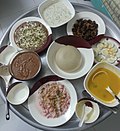
[[File:An Iranian iftar meal (2).jpg|thumb|An iftar meal]] | |||
Many Muslims insist on the local physical sighting of the moon to mark the beginning of Ramadan, but others use the calculated time of the new moon or the [[Saudi Arabia]]n declaration to determine the start of the month. Since the new moon is not in the same state at the same time globally, Ramadan's beginning and ending depend on what lunar sightings are received in each location. As a result, Ramadan dates vary in different countries, but usually by only a day. This is due to the [[Lunar month|cycles of the moon]]; the moon may not qualify as a waxing crescent, which delineates the change in months, at sundown in one location but later meet it in another location.<ref>{{cite web | |||
| url = http://www.ramadan.com.au/faq | |||
| title = What is the Islamic calendar? | |||
| work = FAQ - For Muslims | |||
| publisher = Ramadan Awareness Campaign | |||
| access-date = 2008-09-01 | |||
| archive-date = 2012-09-09 | |||
| archive-url = https://web.archive.org/web/20120909110833/http://www.ramadan.com.au/faq | |||
| url-status = dead | |||
}}</ref> Astronomical projections that approximate the start of Ramadan are available.<ref>{{cite web | |||
| url = http://moonsighting.com/ramadan.html | |||
| title = Ramadan and Eidian | |||
| access-date = 7 August 2012 | |||
| publisher = Committee For Crescent Observation | |||
| archive-date = 4 August 2012 | |||
| archive-url = https://web.archive.org/web/20120804124006/http://moonsighting.com/ramadan.html | |||
| url-status = dead | |||
}}</ref> | |||
In [[Shia Islam]], one of the special dates of this month is the day of the [[assassination of Ali]], the fourth [[Rashidun caliph]] and the first [[Imamate in Shia doctrine|Shia Imam]]. [[Ali]] was struck during morning prayer on the 19th day of Ramadan, 40 [[Islamic calendar|AH]], and died on the 21st day of the month. Shi'ites engage in mourning and prayer on these nights, especially in [[Iran]].<ref>{{cite web |url = https://www.irna.ir/news/82566641/قم-در-سالروز-شهادت-امام-علی-ع-به-سوگ-نشست |title = قم در سالروز شهادت امام علی(ع) به سوگ نشست |trans-title = Qom mourns on anniversary of Imam Ali's (AS) martyrdom|language= fa|access-date = 27 February 2025}} | |||
</ref> | |||
=== Beginning === | === Beginning === | ||
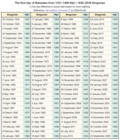
[[File:Ramadan100years1938-2037.png|thumb|Ramadan beginning dates between Gregorian years 1938 and 2038 | [[File:Ramadan100years1938-2037.png|thumb|Ramadan beginning dates between Gregorian years 1938 and 2038.]] | ||
Because the ''[[ | |||
Because the ''[[hilal (crescent moon)|hilāl]]'', or [[Lunar phase|crescent moon]], typically appears one day after the [[new moon]], Muslims can usually estimate the beginning of Ramadan,<ref>[http://www.hilalsighting.org/papers/salman.pdf Hilal Sighting & Islamic Dates: Issues and Solution Insha'Allaah] {{webarchive|url=https://web.archive.org/web/20090206015307/http://www.hilalsighting.org/papers/salman.pdf |date=6 February 2009 }}. Hilal Sighting Committee of North America ([http://www.hilalsighting.org/ website] {{Webarchive|url=https://web.archive.org/web/20090831043652/http://www.hilalsighting.org/ |date=31 August 2009 }}). Retrieved 19 August 2009.</ref> but many prefer to confirm it by direct visual observation.<ref>{{cite web |url= http://hadithcollection.com/sahihbukhari/64-Sahih%20Bukhari%20Book%2031.%20Fasting/2466-sahih-bukhari-volume-003-book-031-hadith-number-124.html |title= Sahih Bukhari – Book 031 (The Book of Fasting), Hadith 124 |first= AbdAllah-Muhammad |last= Bukhari-Ibn-Ismail |work= hadithcollection.com |date= 28 January 2009 |access-date= 25 July 2012 |archive-url= https://web.archive.org/web/20120613040509/http://hadithcollection.com/sahihbukhari/64-Sahih%20Bukhari%20Book%2031.%20Fasting/2466-sahih-bukhari-volume-003-book-031-hadith-number-124.html |archive-date= 13 June 2012 }}</ref> | |||
=== ''Laylat al-Qadr'' === | |||
{{Main|Night of Power}} | |||
The ''Laylat al-Qadr'' ({{langx|ar|لیلة القدر}}) or "Night of Power" is the night that Muslims believe the Quran was first sent down to the world and Muhammad received his first quranic revelation. It is considered the holiest night of the year.<ref>{{Cite book | last = Robinson | first = Neal | title = Islam: A Concise Introduction | publisher = Georgetown University Press | year = 1999 | location = Washington | isbn = 978-0-87840-224-3 | url-access = registration | url = https://archive.org/details/islam00neal }}</ref><ref>{{cite web |url= http://hadithcollection.com/sahihbukhari/64-Sahih%20Bukhari%20Book%2031.%20Fasting/2465-sahih-bukhari-volume-003-book-031-hadith-number-125.html |title= Sahih Bukhari – Book 031 (The Book of Fasting), Hadith 125 |first= AbdAllah-Muhammad |last= Ibn-Ismail-Bukhari |work= hadithcollection.com |access-date= 28 July 2012 |archive-url= https://web.archive.org/web/20130115170845/http://hadithcollection.com/sahihbukhari/64-Sahih%20Bukhari%20Book%2031.%20Fasting/2465-sahih-bukhari-volume-003-book-031-hadith-number-125.html |archive-date= 15 January 2013 }}</ref> It is generally believed to have occurred on an odd-numbered night during the last ten days of Ramadan; the [[Dawoodi Bohra]] believe that ''Laylat al-Qadr'' was the 23rd night of Ramadan.<ref>{{cite web |url= http://hadithcollection.com/sahihbukhari/65-Sahih%20Bukhari%20Book%2032.%20Praying%20at%20Night%20In%20Ramadhan%20(Taraweeh)/2479-sahih-bukhari-volume-003-book-032-hadith-number-238.html |title= Sahih Bukhari – Book 032 (Praying at Night during Ramadhan), Hadith 238 |first= AbdAllah-Muhammad |last= Ibn-Ismail-Bukhari |work= hadithcollection.com |access-date= 28 July 2012 |archive-url= https://web.archive.org/web/20130115170922/http://hadithcollection.com/sahihbukhari/65-Sahih%20Bukhari%20Book%2032.%20Praying%20at%20Night%20In%20Ramadhan%20(Taraweeh)/2479-sahih-bukhari-volume-003-book-032-hadith-number-238.html |archive-date= 15 January 2013 }}</ref><ref>{{cite web |url= http://hadithcollection.com/sahihmuslim/134-Sahih%20Muslim%20Book%2006.%20Fasting/10668-sahih-muslim-book-006-hadith-number-2632.html |title= Sahih Muslim – Book 006 (The Book of Fasting), Hadith 2632 |first= Abul-Hussain |last= Muslim-Ibn-Habaj |work= hadithcollection.com |access-date= 28 July 2012 |archive-url= https://web.archive.org/web/20130115170848/http://hadithcollection.com/sahihmuslim/134-Sahih%20Muslim%20Book%2006.%20Fasting/10668-sahih-muslim-book-006-hadith-number-2632.html |archive-date= 15 January 2013 }}</ref> | |||
{{ | |||
=== ''Eid'' === | === ''Eid'' === | ||
{{Main|Eid al-Fitr|Eid prayers}} | {{Main|Eid al-Fitr|Eid prayers}} | ||
The holiday of ''Eid al-Fitr'' (Arabic: عيد الفطر), which marks the end of Ramadan and the beginning of ''[[Shawwal]]'',<ref>{{Cite web|title=Eid al-Fitr in the United States|url=https://www.timeanddate.com/holidays/us/eid-al-fitr|access-date=2021-05-09|website= | The holiday of ''Eid al-Fitr'' (Arabic: عيد الفطر), which marks the end of Ramadan and the beginning of ''[[Shawwal]]'',<ref>{{Cite web|title=Eid al-Fitr in the United States|url=https://www.timeanddate.com/holidays/us/eid-al-fitr|access-date=2021-05-09|website=Timeanddate.com|language=en}}</ref> the next lunar month, is declared after a crescent [[new moon]] has been sighted or after 30 days of fasting if no sighting of the moon is possible. ''Eid'' celebrates the return to a more natural disposition (''fitra'') of eating, drinking, and [[intimacy|marital intimacy]].<ref name=EsinIslam>{{cite web |url= http://www.esinislam.com/Articles201009/WritersArticles_AdilSalahi_0911.htm |title= Ruling on Voluntary Fasting After The Month of Ramadan: Eid Day(s) And Ash-Shawaal |work= EsinIslam, Arab News & Information – By Adil Salahi |date= 11 September 2010 |access-date= 23 May 2016 |archive-url= https://web.archive.org/web/20160527052712/http://www.esinislam.com/Articles201009/WritersArticles_AdilSalahi_0911.htm |archive-date= 27 May 2016 }}</ref> | ||
== Religious practices == | == Religious practices == | ||
[[File:Ramazan with the poor.jpg|thumb|[[Azim Azimzade]]. Ramadan of the poor people. 1938]] | [[File:Ramazan with the poor.jpg|thumb|[[Azim Azimzade]]. Ramadan of the poor people. 1938]] | ||
The common practice is to fast from dawn to sunset. The predawn meal before the fast is the ''[[suhur]]'', while the meal at sunset that breaks the fast is ''[[iftar]]''.<ref name=":0">{{Cite web|url=https://www.britannica.com/topic/Ramadan|title=Ramadan|website=Britannica|date=7 June 2024 }}</ref> | |||
Muslims devote more time to prayer and acts of charity, striving to improve their [[self-discipline]], motivated by hadith: "When Ramadan arrives, the gates of Paradise are opened and the gates of hell are locked up and devils are put in chains."<ref>{{cite web|url=http://www.hadithcollection.com/.../10999-sahih-muslim-book-006-hadith-number%20-2361.html|title=Sahih Muslim Book 006, Hadith Number 2361.|work=Hadith Collection|access-date=16 June 2015|archive-url=https://web.archive.org/web/20150604202311/http://www.hadithcollection.com/.../10999-sahih-muslim-book-006-hadith-number%20-2361.html|archive-date=4 June 2015}}</ref><ref>{{cite web |title=Book of Fasting – Sahih al-Bukhari – Sunnah.com – Sayings and Teachings of Prophet Muhammad (صلى الله عليه و سلم) |url=http://sunnah.com/bukhari/30/ |archive-url=https://web.archive.org/web/20150610105330/http://sunnah.com/bukhari/30 |archive-date=10 June 2015 |access-date=16 June 2015}}</ref><ref name="guardian">{{Cite news |url= http://www.ngrguardiannews.com/features/weekend/169233-muslims-observe-ramadan-clerics-explain-significance |location=Lagos, Nigeria|archive-url= |title= Muslims observe Ramadan, clerics explain significance |date= 4 July 2014 |access-date= 16 July 2014 |last=Garba|first=Kabir Alabi|newspaper=[[The Guardian (Nigeria)|The Guardian]]}}</ref> | |||
=== Fasting === | === Fasting === | ||
{{Main|Fasting during Ramadan}} | {{Main|Fasting during Ramadan}} | ||
Ramadan is a time of spiritual reflection, self-improvement, and heightened devotion and worship. Muslims are expected to put more effort into following the teachings of [[Islam]]. The fast (''sawm'') begins at dawn and ends at sunset. In addition to abstaining from eating and drinking, Muslims abstain from sexual relations<ref name="AlJazeera">{{cite web|url=http://www.aljazeera.com/news/2017/04/ramadan-fasting-start-date-170427062743037.html|title=Ramadan to start May 27 or May 28|website=aljazeera.com/|access-date=27 April 2017|archive-url=https://web.archive.org/web/20170427152830/http://www.aljazeera.com/news/2017/04/ramadan-fasting-start-date-170427062743037.html|archive-date=27 April 2017|url-status=live}}</ref> and sinful speech and behaviour during Ramadan. Fasting is said to redirect the heart away from worldly activities and to [[Ritual purification|cleanse the soul]] by freeing it from harmful impurities. Muslims believe that Ramadan teaches them to practice self-discipline, self-control,<ref>[https://www.bbc.co.uk/birmingham/content/articles/2008/08/29/ramadhan_2008_feature.shtml Why Ramadan brings us together] {{Webarchive|url=https://web.archive.org/web/20090830190152/http://www.bbc.co.uk/birmingham/content/articles/2008/08/29/ramadhan_2008_feature.shtml |date=30 August 2009 }}; ''[[BBC]]'', 1 September 2008</ref> sacrifice, and empathy for those who are less fortunate, thus encouraging actions of generosity and compulsory charity (''[[zakat]]'').<ref name=WP>[https://www.washingtonpost.com/wp-dyn/content/article/2008/09/27/AR2008092702592_2.html?nav=rss_world Help for the Heavy at Ramadan] {{Webarchive|url=https://web.archive.org/web/20161020200236/http://www.washingtonpost.com/wp-dyn/content/article/2008/09/27/AR2008092702592_2.html?nav=rss_world |date=20 October 2016 }}, ''[[Washington Post]]'', 27 September 2008</ref> | |||
Exemptions from fasting include those traveling, menstruating, severely ill, pregnant, or breastfeeding.<ref name=":0" /> Those unable to fast are obligated to make up the missed days later.<ref>{{qref|2|184|b=y}}</ref><ref>{{Cite web |last=Ali |date=2025-01-28 |title=What Are the Rules of Ramadan? |url=https://www.embracerelief.org/what-are-the-rules-of-ramadan/ |access-date=2026-02-18 |website=Embrace Relief Foundation |language=en-US}}</ref> | |||
==== '' | ==== ''Suhur'' ==== | ||
{{Main|Suhur}} | {{Main|Suhur}} | ||
Each day | Each day before dawn, Muslims eat a pre-fast meal called ''[[suhur]]''. After finishing the meal and stopping a short time before dawn, they begin the first prayer of the day, [[fajr]].<ref>{{cite web |url= http://www.hadithcollection.com/sahihmuslim/134-Sahih%20Muslim%20Book%2006.%20Fasting/10921-sahih-muslim-book-006-hadith-number-2415.html |title= Sahih Muslim – Book 006 (The Book of Fasting), Hadith 2415 |first= Abul-Hussain |last= Muslim-Ibn-Habaj |work= hadithcollection.com |year= 2009 |access-date= 25 July 2012 |archive-url= https://web.archive.org/web/20130115170800/http://www.hadithcollection.com/sahihmuslim/134-Sahih%20Muslim%20Book%2006.%20Fasting/10921-sahih-muslim-book-006-hadith-number-2415.html |archive-date= 15 January 2013 }}</ref><ref>{{cite web |url= http://hadithcollection.com/sahihbukhari/64-Sahih%20Bukhari%20Book%2031.%20Fasting/2446-sahih-bukhari-volume-003-book-031-hadith-number-144.html |title= Sahih Bukhari – Book 031 (The Book of Fasting), Hadith 144 |first= AbdAllah-Muhammad |last= Ibn-Ismail-Bukhari |work= hadithcollection.com |year= 2009 |access-date= 25 July 2012 |archive-url= https://web.archive.org/web/20130115170927/http://hadithcollection.com/sahihbukhari/64-Sahih%20Bukhari%20Book%2031.%20Fasting/2446-sahih-bukhari-volume-003-book-031-hadith-number-144.html |archive-date= 15 January 2013 }}</ref> | ||
==== ''Iftar'' ==== | ==== ''Iftar'' ==== | ||
{{Main|Iftar}} | {{Main|Iftar}} | ||
At sunset, families break the fast with the ''[[iftar]]'', traditionally opening the meal by eating [[Phoenix dactylifera# | [[File:Iftar in Istanbul Turkey.jpg|thumb|upright|''Iftar'' at the [[Sultan Ahmed Mosque]] in [[Istanbul]], Turkey]] | ||
[[File:Example of Ramadan iftar 2.jpg|alt=Picture of some of the dishes used in breaking Ramadan fast in Nigeria|thumb|Some dishes used in breaking Ramadan fast in Nigeria]] | |||
[[File:Iftar Serving for fasting people in the holy shrine of Imam Reza 05 ().jpg|thumb|Iftar served for people fasting in the [[Imam Reza shrine]]]] | |||
At sunset, families break the fast with the ''[[iftar]]'', traditionally opening the meal by eating [[Phoenix dactylifera#Fruits|dates]] to commemorate Muhammad's practice of breaking the fast with three dates.<ref>{{Cite book|title=The Oxford dictionary of Islam|date=2003|publisher=Oxford University Press|last=Esposito|first=John L.|isbn=0-19-512558-4|location=New York|oclc=50280143|url-access=registration|url=https://archive.org/details/oxforddictionary00bada}}</ref><ref>{{Cite journal|last=Indrayani|first=Suharti|date=2018|title=How do Muslims consume dates?|url=http://www.pjmhsonline.com/2018/oct_dec/pdf/1732.pdf|journal=Pakistani Journal of Medical and Health Sciences|volume=12|pages=1732–1743|archive-url=https://web.archive.org/web/20200728134336/http://www.pjmhsonline.com/2018/oct_dec/pdf/1732.pdf|archive-date=28 July 2020|url-status=live}}</ref> They then adjourn for [[Maghrib (prayer)|Maghrib]], the fourth of the five required daily prayers, after which the main meal is served.<ref>{{cite web |url=http://www.mysanantonio.com/news/Muslims_fast_and_feast_as_Ramadan_begins.html?showFullArticle=y |title=Muslims fast and feast as Ramadan begins |first=Melissa |last=Fletcher Stoeltje |date=22 August 2009 |access-date=22 July 2012 |work=[[San Antonio Express-News]]}}</ref> | |||
Social gatherings, many times in [[buffet]] style, are frequent at ''iftar''. Traditional dishes are often highlighted, including traditional desserts, particularly those made only during Ramadan.{{ | Social gatherings, many times in [[buffet]] style, are frequent at ''iftar''. Traditional dishes are often highlighted, including traditional desserts, particularly those made only during Ramadan. Examples of dishes are [[Qatayef]], [[Chorba frik]], [[Knafeh]], [[Haleem]], etc.<ref>{{Cite web |last=Aquitaine |first=Ellanor |date=2023-03-01 |title=25 Traditional Dishes Enjoyed For Ramadan Around The Globe |url=https://www.tastingtable.com/1214151/traditional-dishes-enjoyed-for-ramadan-around-the-globe/ |access-date=2026-02-18 |website=Tasting Table |language=en-US}}</ref> Water is usually the beverage of choice, but juice, milk, soft drinks, and caffeinated beverages are also often available.<ref name="dieticiannour">{{cite web |url=http://www.todaysdietitian.com/newarchives/072709p56.shtml |title=Understanding Muslim Fasting Practices |first1=Dr. Nour |last1=El-Zibdeh |work=todaysdietitian.com |date=August 2009 |access-date=25 July 2012 |archive-url=https://web.archive.org/web/20120731172803/http://www.todaysdietitian.com/newarchives/072709p56.shtml |archive-date=31 July 2012 |url-status=live }}</ref> | ||
In the [[Middle East]], ''iftar'' consists of water, juices, dates, salads and appetizers; one or more main dishes; and rich desserts, with dessert considered the most important aspect of the meal.<ref>{{Cite book|title=The Oxford | In the [[Middle East]], ''iftar'' consists of water, juices, dates, salads and appetizers; one or more main dishes; and rich desserts, with dessert considered the most important aspect of the meal.<ref>{{Cite book |last=Goldstein, Darra |date=April 2015 |title=The Oxford Companion to Sugar and Sweets |location=Oxford |publisher=Oxford University Press |isbn=978-0-19-931361-7 |oclc=905969818}}</ref> Typical main dishes include lamb stewed with wheat berries, lamb kebabs with grilled vegetables, and roasted chicken served with chickpea-studded rice pilaf. Desserts may include [[lokma]], [[baklava]], or [[knafeh]].<ref name="la">{{cite news |url=https://www.latimes.com/features/food/la-fo-ramadan-20120721,0,1433650.story |title=Ramadan's high note is often a dip |first1=Faye |last1=Levy |first2=Yakir |last2=Levy |work=[[Los Angeles Times]] |date=21 July 2012 |access-date=22 July 2012 |archive-url=https://web.archive.org/web/20120722134003/http://www.latimes.com/features/food/la-fo-ramadan-20120721,0,1433650.story |archive-date=22 July 2012 |url-status=live }}</ref> | ||
Over time, the practice of ''iftar'' has evolved into banquets that may accommodate hundreds or even thousands of diners.<ref>{{cite web |url=http://articles.sun-sentinel.com/2010-08-08/news/fl-ramadan-food-20100808_1_iftar-fasting-muslims-hail |title=Ramadan: Muslims feast and fast during holy month |first=James D. |last=Davis |date=8 August 2010 |access-date=22 July 2012 |work=[[South Florida Sun-Sentinel]] |archive-url=https://web.archive.org/web/20110706233740/http://articles.sun-sentinel.com/2010-08-08/news/fl-ramadan-food-20100808_1_iftar-fasting-muslims-hail |archive-date=6 July 2011 |url-status= | Over time, the practice of ''iftar'' has evolved into banquets that may accommodate hundreds or even thousands of diners.<ref>{{cite web |url=http://articles.sun-sentinel.com/2010-08-08/news/fl-ramadan-food-20100808_1_iftar-fasting-muslims-hail |title=Ramadan: Muslims feast and fast during holy month |first=James D. |last=Davis |date=8 August 2010 |access-date=22 July 2012 |work=[[South Florida Sun-Sentinel]] |archive-url=https://web.archive.org/web/20110706233740/http://articles.sun-sentinel.com/2010-08-08/news/fl-ramadan-food-20100808_1_iftar-fasting-muslims-hail |archive-date=6 July 2011 |url-status=dead }}</ref> The [[Sheikh Zayed Grand Mosque]] in [[Abu Dhabi]], the largest mosque in the [[UAE]], feeds up to 30,000 people every night.<ref>{{cite news |title=Abu Dhabi's Grand Mosque feeds 30,000 during Ramadan |url=https://www.euronews.com/2019/05/10/abu-dhabi-s-grand-mosque-feeds-30-000-during-ramadan |access-date=11 May 2019 |agency=Euro News |publisher=euronews.com |date=10 May 2019}}</ref> | ||
=== Charity === | === Charity === | ||
{{Main|Zakat|Sadaqah}} | {{Main|Zakat|Sadaqah}} | ||
[[File:Men praying in Afghanistan.jpg|thumb|Men praying during Ramadan at the [[Shrine of Ali]] or "Blue Mosque" in [[Mazar-i-Sharif]], | [[File:Men praying in Afghanistan.jpg|thumb|Men praying during Ramadan at the [[Shrine of Ali]] or "Blue Mosque" in [[Mazar-i-Sharif]], Afghanistan]] | ||
[[File:Dan Hadani collection (990040387050205171).jpg|thumb|alt=A mass prayer during the 1996 Ramadan at the Dome of the Rock in Jerusalem|A mass prayer during the 1996 Ramadan at the [[Dome of the Rock]] in [[Jerusalem]]]] | [[File:Dan Hadani collection (990040387050205171).jpg|thumb|alt=A mass prayer during the 1996 Ramadan at the Dome of the Rock in Jerusalem|A mass prayer during the 1996 Ramadan at the [[Dome of the Rock]] in [[Jerusalem]]]] | ||
''[[Zakat]]'', often translated as "the poor-rate", is the fixed percentage of income a believer is required to give to the poor; the practice is obligatory as one of the [[pillars of Islam]]. Muslims believe that good deeds are rewarded more handsomely during Ramadan than at any other time of the year; consequently, many Muslims donate | |||
''[[Zakat]]'', often translated as "the poor-rate", is the fixed percentage of income a believer is required to give to the poor; the practice is obligatory as one of the [[pillars of Islam]]. Muslims believe that good deeds are rewarded more handsomely during Ramadan than at any other time of the year; consequently, many Muslims donate more, or all, of their yearly ''zakat'' during this month.<ref>{{Cite news |title=Why Ramadan Generates Millions in Charitable Giving Every Year |work=The New York Times |date=29 April 2022 |url=https://www.nytimes.com/2022/04/29/nyregion/ramadan-charitable-giving.html |access-date=2023-11-22 |last1=Stack |first1=Liam }}</ref> | |||
=== Nightly prayers === | === Nightly prayers === | ||
{{Main|Tarawih}} | {{Main|Tarawih|Tahajjud}} | ||
''[[Tarawih]]'' ({{ | ''[[Tarawih]]'' ({{langx|ar|تراويح}}) are extra nightly prayers performed during the month of Ramadan. Contrary to popular belief, they are not compulsory.<ref>{{cite web|url=http://www.islamhelpline.com/qa/tarawih-prayer-nafl-or-sunnah|title=Tarawih Prayer a Nafl or Sunnah|access-date=16 June 2015|archive-url=https://web.archive.org/web/20151118190826/http://www.islamhelpline.com/qa/tarawih-prayer-nafl-or-sunnah|archive-date=18 November 2015}}</ref> | ||
=== Recitation of the Quran === | === Recitation of the Quran === | ||
Muslims are encouraged to read the entire Quran, which comprises thirty ''[[juz']]'' (sections), over the thirty days of Ramadan. | Muslims are encouraged to read the entire Quran, which comprises thirty ''[[juz']]'' (sections), over the thirty days of Ramadan.<ref>{{Cite web |last=Isra |date=2023-03-03 |title=Your Ramadan Quran Reading is Important |url=https://iqranetwork.com/blog/your-ramadan-quran-reading-is-important/ |access-date=2025-03-01 |website=Learn Quran online, Arabic & Islamic Studies Online {{!}} IQRA Network |language=en-US}}</ref> | ||
== Cultural practices == | == Cultural practices == | ||
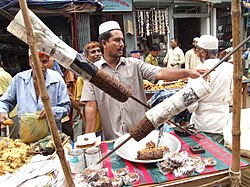
[[File:Sutakabab.JPG|thumb|A [[kebab]] seller from [[Chawkbazar Iftar Market]] in [[Old Dhaka]]. The [[Chowkbazar Thana|Chawkbazar neighborhood]] of Dhaka is famous for its [[Bengal Subah|Mughal-era]] Iftar market.]] | |||
[[File:Sutakabab.JPG|thumb|A [[ | |||
In some Islamic countries, lights are strung up in public squares and across city streets,<ref>{{cite web |url= https://abcnews.go.com/International/slideshow/muslims-begin-fasting-start-ramadan-holy-month-16822614 |title= Muslims begin fasting for Ramadan|work= [[ABC News]] |date= 18 July 2012 |access-date= 6 August 2012 |archive-url=https://web.archive.org/web/20120721093053/https://abcnews.go.com/International/slideshow/muslims-begin-fasting-start-ramadan-holy-month-16822614 |archive-date=2012-07-21 | In some Islamic countries, lights (''[[fanous]]'') are strung up in public squares and across city streets,<ref>{{cite web |url= https://abcnews.go.com/International/slideshow/muslims-begin-fasting-start-ramadan-holy-month-16822614 |title= Muslims begin fasting for Ramadan|work= [[ABC News (United States)|ABC News]] |date= 18 July 2012 |access-date= 6 August 2012 |archive-url=https://web.archive.org/web/20120721093053/https://abcnews.go.com/International/slideshow/muslims-begin-fasting-start-ramadan-holy-month-16822614 |archive-date=2012-07-21 }}</ref><ref>{{cite web |url= http://www.thenational.ae/thenationalconversation/comment/the-spirit-of-ramadan-is-here-but-why-is-it-still-so-dark |title= The spirit of Ramadan is here, but why is it still so dark? |author= Taryam Al Subaihi |date= 29 July 2012 |work= The National |access-date= 30 July 2012 |archive-url= https://web.archive.org/web/20120731232232/http://www.thenational.ae/thenationalconversation/comment/the-spirit-of-ramadan-is-here-but-why-is-it-still-so-dark |archive-date= 31 July 2012 |url-status= dead }}</ref><ref>{{cite web |url= http://shine.yahoo.com/decorate-ramadan-175400368.html |title= How to decorate for Ramadan |first= Sylvia |last= Cochran |work= Yahoo-Shine|date= 8 August 2011 |access-date= 6 August 2012 |archive-url=https://web.archive.org/web/20130115184556/http://shine.yahoo.com/decorate-ramadan-175400368.html |archive-date=2013-01-15 }}</ref> a tradition believed to have originated during the [[Fatimid Caliphate]], where the rule of [[Caliph]] [[al-Mu'izz li-Din Allah]] was acclaimed by people holding lanterns.<ref>{{Cite news |url=http://english.alarabiya.net/en/features/features/2015/06/19/Ramadan-is-here-light-up-your-lanterns.html |title=How did the Ramadan lantern become a symbol of the holy month? |last=Harrison |first=Peter |date=2016-06-09 |work=[[Al Arabiya]] |access-date=2019-05-06 }}{{Dead link|date=August 2019 |bot=InternetArchiveBot |fix-attempted=yes }}</ref> | ||
An old tradition of [[Old Dhaka]], [[Bangladesh]] is during the time of [[Suhur|sehri]], groups of people would sing [[qasida]]s to wake up the [[Bengali Muslim|Muslim]]s in the neighbourhood.<ref name=bpedia>{{cite web|author=Sirajul Islam|author-link=Sirajul Islam|url=http://en.banglapedia.org/index.php?title=Qasida|title=Qasida|publisher=[[Banglapedia]]: The National Encyclopedia of Bangladesh, [[Asiatic Society]] of Bangladesh, [[Dhaka]]|access-date=5 May 2018}}</ref><ref>{{cite news|url=https://www.aljazeera.com/news/2021/5/6/ramadan-south-asias-dying-traditions-on-waking-up-the-faithful|work=[[Al Jazeera English|Al Jazeera]]|title=The fading Qasida tradition in Bangladesh|author1=Maqbool, Majid|author2=Mahmud, Faisal|author3=Pathak, Nilima|date=6 May 2021}}</ref> [[Chowk Bazaar]] is a place with great significance in [[Bengali culture]] during Ramadan. [[Shahi jilapi]] is unique delicacy from the iftar market, popular for its large size. | |||
On the island of [[Java]], many believers bathe in holy springs to prepare for fasting, a ritual known as ''Padusan''.<ref>{{Cite news |url=http:// | On the island of [[Java]], many believers bathe in holy springs to prepare for fasting, a ritual known as ''[[Padusan]]''.<ref>{{Cite news |url=http://jakartaglobe.id/vision/this-is-how-indonesia-welcomes-ramadan |title=This Is How Indonesia Welcomes Ramadan |date=2019-05-04 |work=[[Jakarta Globe]] |access-date=2019-05-06 |archive-date=April 11, 2024 |archive-url=https://web.archive.org/web/20240411011740/http://jakartaglobe.id/vision/this-is-how-indonesia-welcomes-ramadan|url-status=live}}</ref> The city of [[Semarang]] marks the beginning of Ramadan with the Dugderan carnival, which involves parading the [[warak ngendog]], a horse-dragon hybrid creature allegedly inspired by the [[Buraq]].<ref>{{cite web |url=http://www.matasejarah.com/2016/07/tradisi-dugderan-di-kota-semarang.html |title=Tradisi Dugderan di Kota Semarang|work=Mata Sejarah |access-date=18 March 2017 |archive-url=https://web.archive.org/web/20170412143319/http://www.matasejarah.com/2016/07/tradisi-dugderan-di-kota-semarang.html |archive-date=12 April 2017 |language=id |last1=Sejarah |first1=Mata }}</ref> In the Chinese-influenced capital city of [[Jakarta]], firecrackers are widely used to celebrate Ramadan, although they are officially illegal.<ref>{{Cite news |url=https://www.nytimes.com/2000/12/19/world/jakarta-journal-it-s-ramadan-school-is-out-quick-the-earplugs.html |title=Jakarta Journal; It's Ramadan. School Is Out. Quick, the Earplugs! |last=Sims |first=Calvin |date=2000-12-19 |work=[[The New York Times]] |access-date=2019-05-06 |issn=0362-4331 |archive-url=https://web.archive.org/web/20190506171434/https://www.nytimes.com/2000/12/19/world/jakarta-journal-it-s-ramadan-school-is-out-quick-the-earplugs.html |archive-date=6 May 2019 |url-status=live }}</ref> Towards the end of Ramadan, most employees receive a one-month bonus known as ''Tunjangan Hari Raya''.<ref>{{Cite web |url=https://emerhub.com/indonesia/thr/ |title=Understanding the Religious Holiday Allowance THR in Indonesia |date=2018-12-06 |website=Emerhub |access-date=2019-05-06 |archive-url=https://web.archive.org/web/20190506171442/https://emerhub.com/indonesia/thr/ |archive-date=6 May 2019 |url-status=live }}</ref> Certain kinds of food are especially popular during Ramadan, such as large beef or buffalo in [[Aceh]] and snails in [[Central Java]].<ref>{{Cite news |url=https://www.thejakartapost.com/news/2014/07/07/on-hunt-delectable-snacks.html |title=On the hunt for delectable snacks |last1=Maryono |first1=Agus |date=2014-07-07 |work=[[The Jakarta Post]] |access-date=2019-05-06 |last2=Endi |first2=Severianus |archive-url=https://web.archive.org/web/20190506171437/https://www.thejakartapost.com/news/2014/07/07/on-hunt-delectable-snacks.html |archive-date=6 May 2019 |url-status=live }}</ref> The [[iftar]] meal is announced every evening by striking the [[bedug]], a giant drum, in the mosque.<ref>{{Cite news |url=https://www.khaleejtimes.com/ramadan-2016/ramadan-news/diverse-traditions-that-welcome-the-holy-month-in-indonesia |title=Diverse traditions that welcome the holy month in Indonesia |last=Saifudeen |first=Yousuf |date=2016-06-12 |work=[[Khaleej Times]] |access-date=2019-05-06 |archive-url=https://web.archive.org/web/20190506171433/https://www.khaleejtimes.com/ramadan-2016/ramadan-news/diverse-traditions-that-welcome-the-holy-month-in-indonesia |archive-date=6 May 2019 |url-status=live }}</ref> | ||
Common greetings during Ramadan include ''Ramadan mubarak'' and ''Ramadan kareem'', which mean (have a) "blessed Ramadan" and "generous Ramadan" respectively.<ref>[https://www.huffingtonpost.com/2015/06/15/ramadan-2015-facts-dates_n_7554256.html Ramadan 2015: Facts, History, Dates, Greeting And Rules About The Muslim Fast] {{Webarchive|url=https://web.archive.org/web/20150710084438/http://www.huffingtonpost.com/2015/06/15/ramadan-2015-facts-dates_n_7554256.html |date=10 July 2015 }}, [[Huffington Post]], 15 June 2015</ref> | Common greetings during Ramadan include ''Ramadan mubarak'' and ''Ramadan kareem'', which mean (have a) "blessed Ramadan" and "generous Ramadan" respectively.<ref>[https://www.huffingtonpost.com/2015/06/15/ramadan-2015-facts-dates_n_7554256.html Ramadan 2015: Facts, History, Dates, Greeting And Rules About The Muslim Fast] {{Webarchive|url=https://web.archive.org/web/20150710084438/http://www.huffingtonpost.com/2015/06/15/ramadan-2015-facts-dates_n_7554256.html |date=10 July 2015 }}, [[Huffington Post]], 15 June 2015</ref> | ||
During Ramadan in the Middle East, a ''mesaharati'' beats a drum across a neighbourhood to wake people up to eat the suhoor meal. Similarly in Southeast Asia, the ''kentongan'' [[slit drum]] is used for the same purpose. | During Ramadan in the Middle East, a ''mesaharati'' beats a drum across a neighbourhood to wake people up to eat the suhoor meal.<ref>{{Cite web |last=El-Shamma |first=Mohammed |date=2019-05-06 |title=Mesaharati: An ancient career fights extinction in digital age |url=https://www.arabnews.com/node/1493021/middle-east |access-date=2024-03-23 |website=Arab News |language=en}}</ref> Similarly in Southeast Asia, the ''kentongan'' [[slit drum]] is used for the same purpose.<ref>{{Cite web |date=2020-04-23 |title=Ramadan 2020: Unique and bizarre Ramzan practices |url=https://www.hindustantimes.com/art-and-culture/ramadan-2020-unique-and-bizarre-ramzan-practices-around-the-world/story-QHSy9bUPdvE5XBVjOBjgsM.html |access-date=2024-03-23 |website=Hindustan Times |language=en}}</ref> | ||
In Nigeria, Ramadan is widely observed among Muslim communities, particularly in the northern regions. Families gather for suhur before dawn and share iftar meals at sunset, often including local foods such as rice dishes, bean cakes, and traditional drinks. Mosques host nightly prayers and charity events, while communities organize food sharing for those in need. The end of Ramadan is marked with large celebrations during Eid al-Fitr, commonly called “Small Sallah” in Nigeria. | |||
Across West Africa, Ramadan is marked by communal prayer, evening meals shared with neighbors, and acts of charity. Mosques often organize large iftar gatherings and religious lessons during the month. Cultural expressions vary between countries but generally emphasize hospitality, generosity, and family unity.<ref>{{Cite web |last=español |first=MARIAM FAM Leer en |date=2026-02-15 |title=A look at Ramadan and how Muslims observe the holy month |url=https://apnews.com/article/islam-muslims-ramadan-fasting-explainer-3057195e90cc1f46108bdb02da177350 |access-date=2026-02-22 |website=AP News |language=en}}</ref> | |||
Ramadan attracts significant increases in television viewership, as the usual [[prime time]] hours coincide with the ''iftar'', and are commonly extended into the [[Late-night television|late-night]] hours to coincide with the s''uhur''. Broadcasters in the Arab world traditionally premiere [[Serial (radio and television)|serial]] [[Drama (film and television)|dramas]] known as [[Arab television drama|''musalsal'']] during Ramadan; they are similar in style to Latin American [[telenovela]]s, and are typically around 30 episodes in length so that they run over the length of the month.<ref>{{Cite web |title=Why Ramadan is a TV executive's dream in the Middle East |url=https://www.cbc.ca/radio/tapestry/ramadan-tradition-tv-1.6811096 |access-date=2024-01-11 |website=CBC Radio}}</ref><ref>{{Cite web |date=2012-07-17 |title=Ramadan TV: Your ultimate guide to the best of the month's television programmes |url=https://gulfnews.com/entertainment/tv/ramadan-tv-your-ultimate-guide-to-the-best-of-the-months-television-programmes-1.1050028 |access-date=2024-03-11 |website=gulfnews.com |language=en}}</ref><ref name="nyt-iton2">{{cite web |date=November 23, 2003 |title=Ideas & Trends: Ramadan Nights; Traditions Old (Fasting) and New (Soap Operas) |url=https://www.nytimes.com/2003/11/23/weekinreview/ideas-trends-ramadan-nights-traditions-old-fasting-and-new-soap-operas.html |work=New York Times}}</ref> Advertisers in the region have considered Ramadan to be comparable to the [[Super Bowl]] on U.S. television in terms of impact and importance; the cost of a 30-second commercial in peak time during Ramadan is usually more than double than normal.<ref>{{Cite web |last=Carrington |first=Daisy |date=2013-07-29 |title=Ramadan acts as 'Super Bowl for adverts' in the Middle East |url=https://www.cnn.com/2013/07/29/world/meast/ramadan-television-adverts/index.html |access-date=2024-03-11 |website=CNN |language=en}}</ref><ref name="gn-rtv2">{{cite web |date=July 17, 2012 |title=Ramadan TV: Your ultimate guide to the best of the month's television programmes |url=http://gulfnews.com/arts-entertainment/television/ramadan-tv-your-ultimate-guide-to-the-best-of-the-month-s-television-programmes-1.1050028 |publisher=Gulf News}}</ref> | |||
{{Gallery | {{Gallery | ||
|File:COLLECTIE TROPENMUSEUM Oproep tot het gebed op vrijdag via de trom bij de moskee Tulehu TMnr 20018271.jpg|Striking the [[bedug]] in Indonesia | |File:COLLECTIE TROPENMUSEUM Oproep tot het gebed op vrijdag via de trom bij de moskee Tulehu TMnr 20018271.jpg|Striking the [[bedug]] in Indonesia | ||
|File:هلال رمضان.jpg| | |File:هلال رمضان.jpg|A decorated and illuminated crescent statue in [[Jordan]] | ||
|File: | |File:زينة رمضان في أسواق القدس.jpg|Ramadan in the Old City of [[Jerusalem]] | ||
|File:Lanterns from below.JPG|[[Fanous Ramadan]] decorations in [[Cairo]], | |File:Lanterns from below.JPG|[[Fanous Ramadan]] decorations in [[Cairo]], Egypt | ||
| | |Ramadan Home Decorations.jpg|Ramadan home decorations in [[UAE]] | ||
}} | |||
== Observance == | |||
{{Hijri_to_gregorian_calendar.svg}} | |||
According to a 2012 [[Pew Research Centre]] study, there was widespread Ramadan observance, with a median of 93% in the 39 countries and territories studied.<ref name="prc">{{cite web|title=Most Muslims say they fast during Ramadan|url=http://www.pewresearch.org/fact-tank/2013/07/09/global-median-of-93-of-muslims-say-they-fast-during-ramadan/|website=Pew Research Center|access-date=14 November 2017|date=9 July 2013|archive-url=https://web.archive.org/web/20171114145215/http://www.pewresearch.org/fact-tank/2013/07/09/global-median-of-93-of-muslims-say-they-fast-during-ramadan/|archive-date=14 November 2017|url-status=live}}</ref> Regions with high proportions of fasting among Muslims include [[Southeast Asia]], [[South Asia]], [[Middle East and North Africa]], [[Horn of Africa]] and most of [[Sub-Saharan Africa]].<ref name="prc" /> Proportions are lower in [[Central Asia]] and [[Southeast Europe]], with 44% in Albania, 43% in Azerbaijan, and 30% in Kazakhstan.<ref name="prc" /> | |||
According to a 2012 [[Pew Research Centre]] study, there was widespread Ramadan observance, with a median of 93 | |||
According to TGM Global Ramadan Report 2023, 97% of Muslims were expected to fast during Ramadan in 2023, with regional variations showing 98.9% observance in Asia, 96.4% in the Middle East, and 95.4% in Africa. Country-specific included 99.8% in Indonesia, 99.5% in Malaysia, 99.2% in Saudi Arabia, 98.9% in Pakistan, 98.6% in Bangladesh, 97.8% in India, and 93.9% in Turkey. Muslims reported planning a range of activities for Ramadan, with 70% indicating intentions to increase worship and give to charity, rising to 74% among women. In terms of charitable behavior, 97% agreed Ramadan was a period for generosity, 60% volunteered in concrete help (with 67% in Asia), 73% had donated money to charity during Ramadan or Eid the previous year (with 84% in Asia), and 62% planned to donate more in 2023.<ref>{{Cite web |title=TGM Global Ramadan Insights 2023{{!}} Data and Statistics |url=https://tgmresearch.com/https%3A%2F%2Ftgmresearch.com%2Framadan-insights-2023-global-study.html |access-date=2026-02-17 |website=TGM Research |language=en-gb}}</ref> | |||
=== Ramadan in polar regions === | |||
{{Main|Islamic views on fasting in the polar regions}} | |||
The length of time from dawn to sunset varies by location and season. Most Muslims fast for 11 to 16 hours during Ramadan, but in polar regions, the period between dawn and sunset can exceed 22 hours. For example, in 2014, Muslims in Reykjavik, Iceland, and Trondheim, Norway, fasted almost 22 hours, while those in Sydney, Australia, fasted for about 11 hours. In areas characterized by continuous night or day, some Muslims follow the fasting schedule observed in the nearest city that experiences sunrise and sunset, while others follow Mecca time.<ref name="Ramadan2014">See article [https://www.huffpost.com/entry/ramadan-fasting-times_n_5537721 "How Long Muslims Fast For Ramadan Around The World"] -Huffpost.com /31 July 2014 and article "Fasting Hours of Ramadan 2014" -Onislam.net / 29 June 2014 and article "The true spirit of Ramadan" -Gulfnews.com /31 July 2014</ref><ref name="ottawacitizen">See article by Imam Mohamad Jebara [https://ottawacitizen.com/opinion/columnists/jebara-the-fasting-of-ramadan-is-not-meant-to-punish "The fasting of Ramadan is not meant to punish"] {{Webarchive|url=https://web.archive.org/web/20190507015923/https://ottawacitizen.com/opinion/columnists/jebara-the-fasting-of-ramadan-is-not-meant-to-punish|date=7 May 2019}}</ref><ref name="ArcticRamadan">{{Cite web|url=https://www.theguardian.com/world/2016/jul/03/ramadan-canada-arctic-fasting-hours-sunlight|title=Arctic Ramadan: fasting in land of midnight sun comes with a challenge|last=Kassam|first=Ashifa|date=3 July 2016|work=[[The Guardian]]|access-date=6 July 2016|archive-url=https://web.archive.org/web/20160707050659/https://www.theguardian.com/world/2016/jul/03/ramadan-canada-arctic-fasting-hours-sunlight|archive-date=7 July 2016|url-status=live}}</ref> | |||
===Ramadan in Earth orbit=== | |||
Because sunrise and sunset occur 16 times each day in low-Earth orbit, [[List of Muslim astronauts|Muslim astronauts]] in space schedule their religious practices according to the time zone of their most recent physical contact with the Earth. For example, [[Sheikh Muszaphar Shukor]], an astronaut from Malaysia launching from the [[Baikonur Cosmodrome]] calculates their times for fasting and prayers according to the sunrise and sunset times in Cape Canaveral, which is in the [[Eastern Time Zone]].<ref>''A Guideline of Performing ''Ibadah'' at the International Space Station (ISS)''</ref><ref>{{Cite news|url=https://www.nytimes.com/2007/12/09/magazine/09interstellar.html|title=Interstellar Ramadan|last=Donadio|first=Rachel|date=2007-12-09|work=The New York Times|access-date=2019-12-05|language=en-US|issn=0362-4331}}</ref> | |||
== | == Laws == | ||
In some [[List of Muslim majority countries|Muslim countries]], eating in public during daylight hours in Ramadan is a [[crime]].<ref name="Ramadan 2019: 9 questions about the Muslim holy month you were too embarrassed to ask">{{cite web|title=Ramadan 2019: 9 questions about the Muslim holy month you were too embarrassed to ask|url= https://www.vox.com/2017/5/25/11851766/what-is-ramadan-2019-start-date-muslim-islam-about|publisher= Vox|date= 6 June 2016}}</ref><ref name="Breaking Pakistan's Ramadan Fasting Laws Has Serious Consequences">{{cite news|title=Breaking Pakistan's Ramadan Fasting Laws Has Serious Consequences|newspaper= NPR.org|url= https://www.npr.org/2018/05/25/614315937/breaking-pakistan-s-ramadan-fasting-laws-have-serious-consequences|publisher= NPR}}</ref><ref name="Break down by region">{{cite web|title=Not so fast! Ramadan laws in Arab countries make you think twice before digging in|url= https://www.albawaba.com/slideshow/not-so-fast-ramadan-laws-these-arab-countries-will-make-you-think-twice-digging-709066|publisher= Albawaba News}}</ref> Sale of alcohol is prohibited during Ramadan in [[Egypt]].<ref>"[http://english.ahram.org.eg/NewsContent/1/64/48444/Egypt/Politics-/Egypts-tourism-minister-confirms-alcohol-prohibiti.aspx Egypt's tourism minister 'confirms' alcohol prohibition on Islamic holidays beyond Ramadan] {{Webarchive|url=https://web.archive.org/web/20130811064259/http://english.ahram.org.eg/NewsContent/1/64/48444/Egypt/Politics-/Egypts-tourism-minister-confirms-alcohol-prohibiti.aspx |date=11 August 2013 }}," ''[[Al-Ahram]]'', 22 July 2012.</ref> The penalty for publicly eating, drinking or smoking during Ramadan can be fines or incarceration in [[Kuwait]],<ref>{{Cite press release |url=http://www.moi.gov.kw/portal/vEnglish/pressrel.asp?objectid=%7B220CBBC3-8EA9-4835-A491-C368B0689E55%7D&catid=%7B506BD210-2218-41DE-9648-30A1C3AAD0F6%7D&year=&relid=%7B57BF4B27-AAFB-4F61-9065-B013FA96A464%7D |title=Press release by Kuwait Ministry of Interior |access-date=10 May 2019 |archive-url=https://web.archive.org/web/20161009151115/https://www.moi.gov.kw/portal/vEnglish/pressrel.asp?objectid=%7B220CBBC3-8EA9-4835-A491-C368B0689E55%7D&catid=%7B506BD210-2218-41DE-9648-30A1C3AAD0F6%7D&year=&relid=%7B57BF4B27-AAFB-4F61-9065-B013FA96A464%7D |archive-date=9 October 2016 |url-status=live }}</ref><ref>{{Cite news | title = KD 100 fine, one month prison for public eating, drinking | newspaper = Friday Times | publisher = Kuwait Times Newspaper | date = 21 August 2009 | url = http://www.kuwaittimes.net/read_news.php?newsid=MTE3NDM5MzY5NA | archive-url = https://web.archive.org/web/20200107124956/http://www.kuwaittimes.net/read_news.php?newsid=MTE3NDM5MzY5NA | archive-date = 7 January 2020 | access-date = 17 November 2009 }}</ref> [[Saudi Arabia]],<ref>{{cite news|title=Ramadan in Saudi Arabia: Taking it to heart|url=https://www.economist.com/news/middle-east-and-africa/21700396-kingdom-treats-holy-month-more-seriously-anywhere-else-taking-it|access-date=11 June 2016|newspaper=[[The Economist]]|date=11 June 2016|archive-url=https://web.archive.org/web/20160610210452/http://www.economist.com/news/middle-east-and-africa/21700396-kingdom-treats-holy-month-more-seriously-anywhere-else-taking-it|archive-date=10 June 2016|url-status=live}}</ref><ref>{{cite news |title=Ramadan warning for expats in Saudi Arabia |url=https://www.telegraph.co.uk/expat/expatnews/9422969/Ramadan-warning-for-expats-in-Saudi-Arabia.html |website=The Daily Telegraph |access-date=11 March 2019 |date=24 July 2012 |last1=Hyslop |first1=Leah |archive-url=https://web.archive.org/web/20181020011822/https://www.telegraph.co.uk/expat/expatnews/9422969/Ramadan-warning-for-expats-in-Saudi-Arabia.html |archive-date=20 October 2018 |url-status=live }}</ref><ref>[https://www.theguardian.com/news/datablog/2013/jul/10/ramadan-numbers Ramadan in numbers] {{Webarchive|url=https://web.archive.org/web/20170512000111/https://www.theguardian.com/news/datablog/2013/jul/10/ramadan-numbers |date=12 May 2017 }}, 10 July 2013, ''[[The Guardian]]''</ref> [[Morocco]],<ref>{{Cite web |date=2016-06-06 |title=Morocco's Penal Code and Public Eating in Ramadan |url=https://www.moroccoworldnews.com/2016/06/188332/moroccos-penal-code-and-public-eating-in-ramadan |access-date=2022-04-29 |website=moroccoworldnews.com |language=en}}</ref><ref>{{Cite web |last=Latrech |first=Oumaima |date=2022-04-27 |title=Ramadan: 80 Moroccans Arrested for Publicly Eating in Casablanca |url=https://www.moroccoworldnews.com/2022/04/348649/ramadan-80-moroccans-arrested-for-publicly-eating-in-casablanca |access-date=2022-04-29 |website=moroccoworldnews.com |language=en}}</ref> [[Algeria]]<ref>{{cite web |title=Algerians jailed for breaking Ramadan fast |url=http://www.alarabiya.net/articles/2008/10/07/57856.html |work=Al Arabiya News |date=7 October 2008 |archive-url=https://web.archive.org/web/20081211144838/http://www.alarabiya.net/articles/2008/10/07/57856.html |archive-date=11 December 2008 }}</ref> and [[Malaysia]].<ref>{{Cite web |url=https://poskod.my/features/ramadan-fasting-fines-malaysia/ |title=The Hard and Fast Rules of Ramadan |work=Poskod Malaysia |access-date=14 April 2019 |archive-url=https://web.archive.org/web/20190414081040/https://poskod.my/features/ramadan-fasting-fines-malaysia/ |archive-date=14 April 2019 |url-status=live |date=14 July 2015 }}</ref> In the [[United Arab Emirates]], the punishment is community service.<ref>{{Cite news | last = Salama | first = Samir | title = New penalty for minor offences in UAE | newspaper = Gulf News | location = Dubai, UAE | publisher = Al Nisr Publishing LLC | date = 16 July 2009 | url = http://gulfnews.com/news/gulf/uae/crime/new-penalty-for-minor-offences-in-uae-1.492892 | access-date = 17 November 2009 | archive-url = https://web.archive.org/web/20100301171003/http://gulfnews.com/news/gulf/uae/crime/new-penalty-for-minor-offences-in-uae-1.492892 | archive-date = 1 March 2010 }}</ref> | |||
In some countries, on the contrary, the observance of Ramadan has been restricted by governments. In the [[USSR]], the practice of Ramadan was suppressed by officials.<ref>{{cite book|title=When Economies Change Paths: Models of Transition in China, the Central Asian Republics, Myanmar & the Nations of Former Indochine Française|page=162|author= Leo Paul Dana}}</ref><ref>{{cite book|title=The Former Soviet Union's Diverse Peoples: A Reference Sourcebook|page=133|author=James Minahan}}</ref> In Albania, Ramadan festivities were banned during the communist period,<ref>{{cite book|title=Islamic Beliefs, Practices, and Cultures|publisher=Marshall Cavendish|page=165}}</ref> but many Albanians fasted secretly.<ref>{{cite news|title=In Albania, Ramadan under lockdown revives memories of communism|date=2020-04-25 |url=https://www.arabnews.com/node/1664866/world|publisher=[[Arab News]]}}</ref> | |||
China is reported to have banned Ramadan fasting for officials, students, and teachers in [[Xinjiang]] since 2012.<ref>{{Cite web |last=Cagnassola |first=Mary Ellen |date=2021-05-06 |title=170 mosques destroyed in China's Xinjiang crackdown, Australian think tank says |url=https://www.newsweek.com/170-mosques-destroyed-chinas-xinjiang-crackdown-australian-think-tank-says-1589240 |url-status=live |archive-url=https://web.archive.org/web/20220317152006/https://www.newsweek.com/170-mosques-destroyed-chinas-xinjiang-crackdown-australian-think-tank-says-1589240 |archive-date= 2022-03-17|website=[[Newsweek]] |language=en |access-date=17 March 2022 }}</ref><ref>{{cite news |date=2012-08-01 |title=China region bans Muslims from fasting during Ramadan |work=[[The National (Abu Dhabi)|The National]], [[Agence France Presse]] |url=https://www.thenationalnews.com/uae/china-region-bans-muslims-from-fasting-during-ramadan-1.405759}}</ref><ref>{{cite news |title=China bans Muslims from fasting Ramadan in Xinjiang |work=[[Al-Jazeera English]], [[Agence France Presse]] |url=https://www.aljazeera.com/news/2015/06/china-bans-ramadan-fasting-muslim-region-150618070016245.html}}</ref> [[Radio Free Asia]] alleges that residents in [[Kashgar Prefecture]] are compelled to film proof of eating for officials and are encouraged to report those who fast to the authorities.<ref>{{cite web|url=https://www.rfa.org/english/news/uyghur/fasting-05142020144511.html|title=Residents of Uyghur-Majority County in Xinjiang Ordered to Report Others Fasting During Ramadan|date=14 May 2020|access-date=17 May 2020|website=[[Radio Free Asia]]|author=[[Shohret Hoshur]] |author2=Joshua Lipes |translator=Elise Anderson, Alim Seytoff}}</ref><ref>{{Cite news |last=Hoshur |first=Shohret |author-link=Shohret Hoshur |date=2025-03-18 |title=China forces Uyghurs to show video proof they are not fasting during Ramadan |url=https://www.rfa.org/english/uyghur/2025/03/18/uyghur-ramadan-fasting-proof/ |work=[[Radio Free Asia]]}}</ref> The ban has been denied by Chinese diplomats.<ref>{{Cite web |date=2019-05-07 |title=Come see China Muslim culture for yourselves, embassy says |url=https://www.malaysiakini.com/news/475244 |access-date=2022-03-17 |website=[[Malaysiakini]]}}</ref> Muslim associations in Xinjiang.<ref>{{Cite web |last=M. Irfan Ilmie, Atman Ahdiat |date=2021-03-18 |title=Uighur Muslim Community invites global media to witness Ramadan rituals |url=https://www.antaranews.com/berita/2050526/komunitas-muslim-uighur-undang-media-global-saksikan-ritual-ramadhan |website=[[Antara (news agency)|Antara]] |language=id}}</ref> [[Antara (news agency)|Antara]],<ref>{{Cite web |date=2021-04-14 |title=Muslims in Xinjiang begin Ramadan |url=https://www.jawapos.com/hijrah-ramadan/14/04/2021/umat-muslim-di-xinjiang-mulai-menjalankan-puasa-ramadan/ |website=[[Jawa Pos]], [[Antara (news agency)|Antara]] |language=id}}</ref> [[Daily Times (Pakistan)|''Daily Times'']],<ref>{{Cite web |last=S M Hali |date=2019-12-13 |title=Uyghur Human Rights Policy Act of 2019 — a harsh step |url=https://dailytimes.com.pk/519333/uyghur-human-rights-policy-act-of-2019-a-harsh-step/ |website=[[Daily Times (Pakistan)|Daily Times]] |language=en-US}}</ref> and ''[[Pakistan Today]]'' have also brought up accounts of residents in Xinjiang fasting.<ref>{{Cite web |date=July 2, 2016 |title=No restriction over Muslims to observe Ramzan in Xinjiang: JI spokesperson |url=https://archive.pakistantoday.com.pk/2016/07/02/no-restriction-over-muslims-to-observe-ramzan-in-xinjiang-ji-spokesperson/ |website=[[Pakistan Today]] |language=en-GB |access-date=17 March 2022 |archive-date=3 July 2022 |archive-url=https://web.archive.org/web/20220703091525/https://archive.pakistantoday.com.pk/2016/07/02/no-restriction-over-muslims-to-observe-ramzan-in-xinjiang-ji-spokesperson/ }}</ref> According to a 2024 visit to Xinjiang by a reporter from the British magazine The Economist, many Uyghurs do not fast during Ramadan because of pressure from Chinese authorities.<ref>{{Cite news|url=https://www.economist.com/china/2024/04/11/what-ramadan-is-like-in-xinjiang|title=What Ramadan is like in Xinjiang|newspaper=The Economist |access-date=1 March 2025}}</ref> | |||
== Employment during Ramadan == | |||
Muslims continue to work during Ramadan,<ref>{{Cite web|url=https://www.aljazeera.com/indepth/features/ramadan-2019-important-muslims-190505145156499.html|title=Ramadan 2019: Why is it so important for Muslims?|website=Aljazeera.com|access-date=2019-08-06}}</ref><ref>{{Cite web|url=https://www.tuc.org.uk/blogs/supporting-muslim-colleagues-during-ramadan|title=Supporting Muslim colleagues during Ramadan|last=Gilfillan|first=Scott|date=2019-05-03|website=TUC|language=en|access-date=2019-08-06}}</ref> but in some countries, such as Oman and Lebanon, working hours are shortened.<ref>{{cite web |url= http://timesofoman.com/article/36340/Oman/-Ramadan-working-hours-announced-in-Oman |title= Ramadan working hours announced in Oman |work= Times of Oman |date= 22 June 2014 |access-date= 17 June 2016 |archive-url= https://web.archive.org/web/20160624185407/http://timesofoman.com/article/36340/Oman/-Ramadan-working-hours-announced-in-Oman |archive-date= 24 June 2016 |url-status= live }}</ref><ref>{{cite web |url= http://timesofoman.com/article/53294/Ramadan/Ramadan-working-hours-for-muslims-working-during-the-Holy-Month-announced-for-public-and-private-sec |title= Ramadan working hours announced for public and private sectors |work= Times of Oman |date= 10 June 2015 |access-date= 17 June 2016 |archive-url= https://web.archive.org/web/20160624222635/http://timesofoman.com/article/53294/Ramadan/Ramadan-working-hours-for-muslims-working-during-the-Holy-Month-announced-for-public-and-private-sec |archive-date= 24 June 2016 |url-status= live }}</ref> It is often recommended that working Muslims inform their employers if they are fasting, given the potential for the observance to affect their performance.<ref>{{cite web|url=http://www.workingmuslim.com/RamadanEmployeeGuide.pdf|title=The Working Muslim in Ramadan|publisher=Working Muslim|year=2011|access-date=30 June 2016|archive-url=https://web.archive.org/web/20161007181131/http://www.workingmuslim.com/RamadanEmployeeGuide.pdf|archive-date=7 October 2016}}</ref> The extent to which Ramadan observers are protected by [[reasonable accommodation|religious accommodation]] varies by country. Policies putting them at a disadvantage compared to other employees have been met with discrimination claims in the United Kingdom and the United States.<ref>{{cite web|url=http://www.lewissilkinemployment.com/en-gb/insights-knowledge/insights-knowledge/a/knowledge/ramadan-employment-issues/|title=Lewis Silkin – Ramadan – employment issues|author=Lewis Silkin|date=26 April 2016|work=lewissilkinemployment.com|access-date=1 June 2016|archive-url=https://web.archive.org/web/20160803075543/http://www.lewissilkinemployment.com/en-gb/insights-knowledge/insights-knowledge/a/knowledge/ramadan-employment-issues/|archive-date=3 August 2016|url-status=live}}</ref><ref>{{cite web|url=https://blogs.findlaw.com/free_enterprise/2014/06/reasonable-accommodations-for-ramadan-lessons-from-2-eeoc-cases.html|title=Reasonable Accommodations for Ramadan? Lessons From 2 EEOC Cases|work=Free Enterprise|date=27 June 2014|access-date=21 July 2015|archive-url=https://web.archive.org/web/20150707224349/http://blogs.findlaw.com/free_enterprise/2014/06/reasonable-accommodations-for-ramadan-lessons-from-2-eeoc-cases.html|archive-date=7 July 2015|url-status=live}}</ref><ref>{{cite web|url=http://www.eeoc.gov/eeoc/newsroom/release/8-6-10a.cfm|title=EEOC And Electrolux Reach Settlement in Religious Accommodation Charge Brought By Muslim Employees|work=eeoc.gov|access-date=21 July 2015|archive-url=https://web.archive.org/web/20150701194730/http://www.eeoc.gov/eeoc/newsroom/release/8-6-10a.cfm|archive-date=1 July 2015|url-status=live}}</ref> An [[Arab News]] article reported that [[Saudi Arabia]]n businesses were unhappy with shorter working hours during Ramadan, some reporting a decline in productivity of 35–50%.<ref>{{cite news |last1=Hasan |first1=Rumy |title=The costs of Ramadan need to be counted |url=https://www.theguardian.com/business/economics-blog/2015/jul/03/cost-ramadan-counted-muslim-fasting-month |work=The Guardian |date=3 July 2015 }}</ref> The Saudi businesses proposed awarding salary bonuses to incentivize longer hours.<ref>{{Cite web|url=https://www.arabnews.com/news/458892|title=Businesses want more working hours in Ramadan|date=23 July 2013|website=Arab News|access-date=1 March 2025}}</ref> Despite the reduction in productivity, merchants can enjoy higher profit margins in Ramadan due to increase in demand.<ref>{{cite news |last1=Cook |first1=Erin |title=The Ramadan Productivity Drop And How To Overcome It |url=https://indonesiaexpat.biz/business-property/ramadan-productivity-drop-overcome/ |work=Indonesia Expat |date=19 June 2017 }}</ref> | |||
Some countries impose modified work schedules. In [[Bahrain]], [[Kuwait]], [[Oman]], [[Qatar]], and the UAE, employees may work no more than six hours per day and 36 hours per week.<ref>[http://www.dlapiper.com/files/Publication/2cde821c-0999-49a7-a472-7b198caeb169/Presentation/PublicationAttachment/588752a7-2159-4538-8938-7da1610c0faa/DLA_Piper_Middle_East_Be_Alert_Ramadan.pdf Employment Issues During Ramadan – The Gulf Region]; {{Webarchive|url=https://web.archive.org/web/20200404152029/http://www.dlapiper.com/files/Publication/2cde821c-0999-49a7-a472-7b198caeb169/Presentation/PublicationAttachment/588752a7-2159-4538-8938-7da1610c0faa/DLA_Piper_Middle_East_Be_Alert_Ramadan.pdf |date=4 April 2020 }}, DLA Piper Middle East.</ref> | |||
== Health effects == | |||
There are various health effects of fasting. Ramadan fasting is considered safe for healthy people; it may pose risks for those with certain preexisting conditions. Most Islamic scholars hold that fasting is not required for those who are ill. The elderly, pre-pubertal children, and pregnant or lactating women are exempt.<ref name=exemption>{{cite journal|title=Muslim patients in Ramadan: A review for primary care physicians|journal=Avicenna J Med|year=2017|volume=7|issue=3|pmc=5525471|last1=Abolaban|first1=H.|last2=Al-Moujahed|first2=A.|pages=81–87|doi=10.4103/ajm.AJM_76_17|pmid=28791239 |doi-access=free |issn = 2231-0770}}</ref><ref>{{cite book|title=Al Siyam, "Fasting"| author=El-Bahay El-Kholi|publisher=The Supreme Council for Islamic Affairs, [[Arab Republic of Egypt]]|page=36}}</ref> Pregnant women who fast face health risks, including the potential of [[induced labour]] and [[gestational diabetes]].<ref>{{cite journal |last1=Glazier |first1=JD |last2=Hayes |first2=DJL |last3=Hussain |first3=S |last4=D'Souza |first4=SW |last5=Whitcombe |first5=J |last6=Heazell |first6=AEP |last7=Ashton |first7=N |title=The effect of Ramadan fasting during pregnancy on perinatal outcomes: a systematic review and meta-analysis. |journal=BMC Pregnancy and Childbirth |date=25 October 2018 |volume=18 |issue=1 |page=421 |doi=10.1186/s12884-018-2048-y |pmid=30359228|pmc=6202808 |doi-access=free }}</ref><ref name=preg>{{cite book |doi=10.1016/B978-0-12-416045-3.00022-4 |chapter=Obesity, Polycystic Ovaries and Impaired Reproductive Outcome |title=Obesity |year=2013 |last1=Balani |first1=Jyoti |last2=Hyer |first2=Stephen |last3=Wagner |first3=Marion |last4=Shehata |first4=Hassan |pages=289–298 |isbn=978-0-12-416045-3 }}</ref><ref>{{cite journal |last1=Mirghani |first1=HM |last2=Hamud |first2=OA |title=The effect of maternal diet restriction on pregnancy outcome. |journal=American Journal of Perinatology |date=January 2006 |volume=23 |issue=1 |pages=21–24 |doi=10.1055/s-2005-923435 |pmid=16450268|s2cid=260001799 }}</ref> | |||
There are some health benefits of fasting in Ramadan including increasing insulin sensitivity and reducing insulin resistance.<ref>Shariatpanahi, Z. Vahdat, et al. [https://pubmed.ncbi.nlm.nih.gov/18053308/ "Effect of Ramadan fasting on some indices of insulin resistance and components of the metabolic syndrome in healthy male adults"]. ''British Journal of Nutrition'' 100.1 (2008): 147–151.</ref> It has also been shown that there is a significant improvement in 10-year coronary heart disease risk score and other cardiovascular risk factors such as lipid profile, systolic blood pressure, weight, [[Body mass index|BMI]] and waist circumference in subjects with a previous history of cardiovascular disease.<ref>Nematy, Mohsen, et al. "Effects of Ramadan fasting on cardiovascular risk factors: a prospective observational study." Nutrition journal 11.1 (2012): 69.</ref> The fasting period is usually associated with modest weight loss, but weight can return afterwards.<ref>{{cite journal |vauthors=Sadeghirad B, Motaghipisheh S, Kolahdooz F, Zahedi MJ, Haghdoost AA |title=Islamic fasting and weight loss: a systematic review and meta-analysis |journal=Public Health Nutr |volume=17 |issue=2 |pages=396–406 |year=2014 |pmid=23182306 |doi=10.1017/S1368980012005046 |pmc=10282472 |doi-access=free }}</ref> | |||
In many cultures, it is associated with heavy food and water intake during [[Suhur]] and [[Iftar]] times, which may do more harm than good.<ref>{{Cite web|title=Should your water intake change during Ramadan?|url=https://gulfnews.com/uae/should-your-water-intake-change-during-ramadan-1.63675339|access-date=2021-05-09|website=gulfnews.com|date=5 May 2019 |language=en}}</ref> Ramadan fasting is safe for healthy people provided that overall food and water intake is adequate but those with medical conditions should seek medical advice if they encounter health problems before or during fasting.<ref>{{cite journal |vauthors=Azizi F |title=Islamic fasting and health |journal=Ann. Nutr. Metab. |volume=56 |issue=4 |pages=273–282 |year=2010 |pmid=20424438 |doi=10.1159/000295848 |s2cid=13428042 }}</ref> | |||
The education departments of [[Berlin]] and the [[United Kingdom]] have tried to discourage students from fasting during Ramadan, as they state that not eating or drinking can lead to concentration problems and bad grades.<ref>{{cite news |last1=Espinoza |first1=Javier |title=Schools say Muslim students 'should break Ramadan fast' to avoid bad grades |url=https://www.telegraph.co.uk/education/2016/06/03/schools-say-muslim-students-should-break-ramadan-fast-to-avoid-b/ |archive-url=https://ghostarchive.org/archive/20220111/https://www.telegraph.co.uk/education/2016/06/03/schools-say-muslim-students-should-break-ramadan-fast-to-avoid-b/ |archive-date=11 January 2022 |url-access=subscription |url-status=live |work=The Telegraph |date=3 June 2016 }}{{cbignore}}</ref><ref>{{cite book |title=Islam und Schule: Handreichung für Lehrerinnen und Lehrer an Berliner Schulen |series=Bildung für Berlin : Politische Bildung |date=2010 |publisher=Zentral- und Landesbibliothek Berlin ZLB. Senatsbibliothek |oclc=824393822 |language=de |url=https://nbn-resolving.de/urn:nbn:de:kobv:109-opus-95998 }}</ref> | |||
A review of the literature by an Iranian group suggested fasting during Ramadan might produce [[renal injury]] in patients with moderate ([[Glomerular filtration rate|GFR]] under 60{{nbs}}mL/min) or severe [[kidney disease]] but was not injurious to [[renal transplant]] patients with good function or most [[Kidney stone disease|stone-forming]] patients.<ref name="renal diseases mini review">{{cite journal | title=Ramadan fasting and patients with renal diseases: A mini review of the literature |vauthors=Emami-Naini A, Roomizadeh P, Baradaran A, Abedini A, Abtahi M | journal=J Res Med Sci |date=August 2013 | volume=18 | issue=8 | pages=711–716 | pmid=24379850 | issn=1735-1995 | publisher=Official Journal of [[Isfahan University of Medical Sciences]] | pmc=3872613}}</ref> | |||
[[ | |||
A study on 55 professional Algerian soccer players showed that performance during Ramadan declined significantly for speed, agility, dribbling speed and endurance, and most stayed low two weeks after the conclusion of Ramadan.<ref>{{cite journal |last1=Zerguini |first1=Yacine |last2=Kirkendall |first2=Donald |last3=Junge |first3=Astrid |last4=Dvorak |first4=Jiri |title=Impact of Ramadan on physical performance in professional soccer players |journal=British Journal of Sports Medicine |date=1 June 2007 |volume=41 |issue=6 |pages=398–400 |doi=10.1136/bjsm.2006.032037 |pmid=17224435 |pmc=2465333 |url=https://bjsm.bmj.com/content/41/6/398.abstract |language=en |issn=0306-3674}}</ref> | |||
== See also == | == See also == | ||
{{Portal|Islam}} | |||
* [[Fasting and abstinence of the Coptic Orthodox Church]] | * [[Fasting and abstinence of the Coptic Orthodox Church]] | ||
* [[Shraavana]] | * [[Laylatul Qadr]] | ||
* [[Ramadan in the United Arab Emirates]] | |||
* [[Shravana (month)|Shraavana]] | |||
== References == | == References == | ||
=== Notes === | === Notes === | ||
{{ | {{Notelist}} | ||
{{Notelist-num}} | |||
===Citations=== | ===Citations=== | ||
{{ | {{reflist}} | ||
== External links == | == External links == | ||
{{Sister project links|d=Q41662|c=category:Ramadan|voy=Travelling during Ramadan|wikt=Ramadan|m=no|mw=no|species=no|n=Category:Ramadan|q=no|b=no|s=no|v=no}} | |||
{{Prone to spam|date=April 2019}} | |||
<!-- {{No more links}} | <!-- {{No more links}} | ||
| Line 206: | Line 275: | ||
--> | --> | ||
* [http://www.ramadhan.org.uk/ Complete Guide to Ramadhan including Rules, Duas, Itikaaf, Laylatul Qadr, Sadaqatul Fitr etc. ] | * [http://www.ramadhan.org.uk/ Complete Guide to Ramadhan including Rules, Duas, Itikaaf, Laylatul Qadr, Sadaqatul Fitr etc. ] | ||
* [https://web.archive.org/web/20150515011523/http://www.nestle-family.com/my%2Dramadan/ramadan%2Darticles/english/ Articles on Ramadan] | * [https://web.archive.org/web/20150515011523/http://www.nestle-family.com/my%2Dramadan/ramadan%2Darticles/english/ Articles on Ramadan] (archived 15 May 2015) | ||
* [https://www.islamicfinder.org/ramadan/ Ramadan news and articles] | * [https://www.islamicfinder.org/ramadan/ Ramadan news and articles] | ||
{{Ramadan|state=expanded}} | |||
{{IslamicMonths}} | |||
{{Muslim holidays}} | {{Muslim holidays}} | ||
{{Authority control}} | {{Authority control}} | ||
{{DEFAULTSORT:Ramadan}} | |||
[[Category:Ramadan| ]] | [[Category:Ramadan| ]] | ||
[[Category:Islamic | [[Category:Fasting in Islam]] | ||
[[Category:Islamic holidays]] | |||
[[Category:Islamic terminology]] | [[Category:Islamic terminology]] | ||
[[Category: | [[Category:Months of the Islamic calendar|9]] | ||
[[Category:Shia days of remembrance]] | [[Category:Shia days of remembrance]] | ||
Revision as of 01:25, 25 March 2026
| Ramadan | |
|---|---|
| Calendar | Islamic calendar |
| Month number | 9 |
| Number of days | 29–30 (depends on actual observation of the moon's crescent) |
| Significant days | |
_(27351979537).jpg)

.jpg)
.jpg)


| Part of a series on |
| Islam |
|---|
 |
|
|
Ramadan[lower-alpha 1][note 1] is the ninth month of the Islamic calendar. It is observed by Muslims worldwide as a month of fasting (sawm), communal prayer (salah), reflection, study of the Quran, charity, and strengthening community ties.[5] It is also the month in which the Quran is believed to have been revealed to the Islamic prophet Muhammad, known as Laylat al-Qadr. The annual observance of Ramadan is regarded as one of the five pillars of Islam[6] and lasts 29 to 30 days, from one sighting of the crescent moon to the next.[7][8]
Fasting from dawn to sunset is obligatory (fard) for all Muslims who have reached puberty,[9] and who are not acutely or chronically ill, traveling, elderly, breastfeeding, pregnant, or menstruating.[10] The predawn meal is suhur, and the nightly feast that breaks the fast is iftar.[11][12] Although rulings (fatawa) have been issued that Muslims who live in regions with a midnight sun or polar night should follow the timetable of Mecca,[13] it is common practice to follow the timetable of the closest country in which night can be distinguished from day.[14][15][16]
The spiritual rewards (thawab) of fasting are believed to be multiplied during Ramadan.[17] Accordingly, during the hours of fasting, Muslims refrain not only from food and drink, but also from all behavior deemed to be sinful in Islam.[18][19]
Etymology
The word Ramadan derives from the Arabic root R-M-Ḍ (ر-م-ض) Template:Gloss,[20] which is the Classical Arabic verb ramiḍa (رَمِضَ) meaning Template:Gloss.[21][22]
Ramadan is thought of as one of the names of God in Islam by some. Many hadiths say it is prohibited to say only "Ramadan" in reference to the calendar month and that it is necessary to say "month of Ramadan", as reported in Sunni,[23][24][25][26][27][28] Shia[29][30][31][32][33][34] and Zaydi[35] sources. Others consider this Mawḍūʻ (fabricated)[36] and inauthentic.[23]
In the Persian language, the Arabic letter ض (Ḍād) is pronounced /z/. Muslim communities in some countries with historical Persian influence, such as Afghanistan, Azerbaijan, Bosnia and Herzegovina, Iran, India, Pakistan, and Turkey, use the word Ramazan or Ramzan. The word Romzan is used in Bangladesh.[37]
History

Ramadan is the month on which the Quran was revealed as a guide for humanity with clear proofs of guidance and the standard ˹to distinguish between right and wrong˺. So whoever is present this month, let them fast. But whoever is ill or on a journey, then ˹let them fast˺ an equal number of days ˹after Ramaḍân˺. Allah intends ease for you, not hardship, so that you may complete the prescribed period and proclaim the greatness of Allah for guiding you, and perhaps you will be grateful.
Muslims hold that all scriptures were revealed during Ramadan, the scrolls of Abraham, Torah, Psalms, Gospel, and Quran having been handed down during that month.[38] Muhammad is said to have received his first quranic revelation on Laylat al-Qadr, one of five odd-numbered nights during the last ten days of Ramadan.[39]
Although Muslims were first commanded to fast in the second year of Hijra (624 CE),[38] they believe that the practice of fasting is not in fact an innovation of monotheism[40] but rather has always been necessary for believers to attain fear of God (taqwa).[41]Template:Qref They point to the fact that pre-Islamic pagans in Mecca fasted on the tenth day of Muharram to expiate sin and avoid drought.[42] Philip Jenkins argues that the observance of Ramadan fasting grew out of "the strict Lenten discipline of the Syrian Churches", a postulation corroborated by other scholars, including theologian Paul-Gordon Chandler,[43][44] but disputed by some Muslim academics.[45] The Quran itself emphasizes that the fast it prescribes had already been prescribed to earlier biblical communities (2:183), though there is no explicit intertext for this pre-Islamic practice.[46]
Important dates
The Islamic calendar is lunar; each month begins when the first crescent of a new moon is sighted.[5] The Islamic year consists of 12 lunar cycles and is 10 to 11 days shorter than the solar year. As the Islamic calendar does not use intercalation,[lower-alpha 3] Ramadan migrates throughout the seasons. The Islamic day starts after sunset. The estimated start and end dates for Ramadan, based on the Umm al-Qura calendar of Saudi Arabia, are:[47]
| AH | First day (CE/AD) | Last day (CE/AD) |
|---|---|---|
| 1445 | 11 March 2024 | 9 April 2024 |
| 1446 | 1 March 2025 | 29 March 2025 |
| 1447 | 18 February 2026 | 19 March 2026 |
| 1448 | 8 February 2027 | 8 March 2027 |
| 1449 | 28 January 2028 | 25 February 2028 |
.jpg)
Many Muslims insist on the local physical sighting of the moon to mark the beginning of Ramadan, but others use the calculated time of the new moon or the Saudi Arabian declaration to determine the start of the month. Since the new moon is not in the same state at the same time globally, Ramadan's beginning and ending depend on what lunar sightings are received in each location. As a result, Ramadan dates vary in different countries, but usually by only a day. This is due to the cycles of the moon; the moon may not qualify as a waxing crescent, which delineates the change in months, at sundown in one location but later meet it in another location.[48] Astronomical projections that approximate the start of Ramadan are available.[49]
In Shia Islam, one of the special dates of this month is the day of the assassination of Ali, the fourth Rashidun caliph and the first Shia Imam. Ali was struck during morning prayer on the 19th day of Ramadan, 40 AH, and died on the 21st day of the month. Shi'ites engage in mourning and prayer on these nights, especially in Iran.[50]
Beginning

Because the hilāl, or crescent moon, typically appears one day after the new moon, Muslims can usually estimate the beginning of Ramadan,[51] but many prefer to confirm it by direct visual observation.[52]
Laylat al-Qadr
The Laylat al-Qadr (Arabic: لیلة القدر) or "Night of Power" is the night that Muslims believe the Quran was first sent down to the world and Muhammad received his first quranic revelation. It is considered the holiest night of the year.[53][54] It is generally believed to have occurred on an odd-numbered night during the last ten days of Ramadan; the Dawoodi Bohra believe that Laylat al-Qadr was the 23rd night of Ramadan.[55][56]
Eid
The holiday of Eid al-Fitr (Arabic: عيد الفطر), which marks the end of Ramadan and the beginning of Shawwal,[57] the next lunar month, is declared after a crescent new moon has been sighted or after 30 days of fasting if no sighting of the moon is possible. Eid celebrates the return to a more natural disposition (fitra) of eating, drinking, and marital intimacy.[58]
Religious practices

The common practice is to fast from dawn to sunset. The predawn meal before the fast is the suhur, while the meal at sunset that breaks the fast is iftar.[59]
Muslims devote more time to prayer and acts of charity, striving to improve their self-discipline, motivated by hadith: "When Ramadan arrives, the gates of Paradise are opened and the gates of hell are locked up and devils are put in chains."[60][61][62]
Fasting
Ramadan is a time of spiritual reflection, self-improvement, and heightened devotion and worship. Muslims are expected to put more effort into following the teachings of Islam. The fast (sawm) begins at dawn and ends at sunset. In addition to abstaining from eating and drinking, Muslims abstain from sexual relations[63] and sinful speech and behaviour during Ramadan. Fasting is said to redirect the heart away from worldly activities and to cleanse the soul by freeing it from harmful impurities. Muslims believe that Ramadan teaches them to practice self-discipline, self-control,[64] sacrifice, and empathy for those who are less fortunate, thus encouraging actions of generosity and compulsory charity (zakat).[65]
Exemptions from fasting include those traveling, menstruating, severely ill, pregnant, or breastfeeding.[59] Those unable to fast are obligated to make up the missed days later.[66][67]
Suhur
Each day before dawn, Muslims eat a pre-fast meal called suhur. After finishing the meal and stopping a short time before dawn, they begin the first prayer of the day, fajr.[68][69]
Iftar


.jpg)
At sunset, families break the fast with the iftar, traditionally opening the meal by eating dates to commemorate Muhammad's practice of breaking the fast with three dates.[70][71] They then adjourn for Maghrib, the fourth of the five required daily prayers, after which the main meal is served.[72]
Social gatherings, many times in buffet style, are frequent at iftar. Traditional dishes are often highlighted, including traditional desserts, particularly those made only during Ramadan. Examples of dishes are Qatayef, Chorba frik, Knafeh, Haleem, etc.[73] Water is usually the beverage of choice, but juice, milk, soft drinks, and caffeinated beverages are also often available.[74]
In the Middle East, iftar consists of water, juices, dates, salads and appetizers; one or more main dishes; and rich desserts, with dessert considered the most important aspect of the meal.[75] Typical main dishes include lamb stewed with wheat berries, lamb kebabs with grilled vegetables, and roasted chicken served with chickpea-studded rice pilaf. Desserts may include lokma, baklava, or knafeh.[76]
Over time, the practice of iftar has evolved into banquets that may accommodate hundreds or even thousands of diners.[77] The Sheikh Zayed Grand Mosque in Abu Dhabi, the largest mosque in the UAE, feeds up to 30,000 people every night.[78]
Charity

.jpg)
Zakat, often translated as "the poor-rate", is the fixed percentage of income a believer is required to give to the poor; the practice is obligatory as one of the pillars of Islam. Muslims believe that good deeds are rewarded more handsomely during Ramadan than at any other time of the year; consequently, many Muslims donate more, or all, of their yearly zakat during this month.[79]
Nightly prayers
Tarawih (Arabic: تراويح) are extra nightly prayers performed during the month of Ramadan. Contrary to popular belief, they are not compulsory.[80]
Recitation of the Quran
Muslims are encouraged to read the entire Quran, which comprises thirty juz' (sections), over the thirty days of Ramadan.[81]
Cultural practices

In some Islamic countries, lights (fanous) are strung up in public squares and across city streets,[82][83][84] a tradition believed to have originated during the Fatimid Caliphate, where the rule of Caliph al-Mu'izz li-Din Allah was acclaimed by people holding lanterns.[85]
An old tradition of Old Dhaka, Bangladesh is during the time of sehri, groups of people would sing qasidas to wake up the Muslims in the neighbourhood.[86][87] Chowk Bazaar is a place with great significance in Bengali culture during Ramadan. Shahi jilapi is unique delicacy from the iftar market, popular for its large size.
On the island of Java, many believers bathe in holy springs to prepare for fasting, a ritual known as Padusan.[88] The city of Semarang marks the beginning of Ramadan with the Dugderan carnival, which involves parading the warak ngendog, a horse-dragon hybrid creature allegedly inspired by the Buraq.[89] In the Chinese-influenced capital city of Jakarta, firecrackers are widely used to celebrate Ramadan, although they are officially illegal.[90] Towards the end of Ramadan, most employees receive a one-month bonus known as Tunjangan Hari Raya.[91] Certain kinds of food are especially popular during Ramadan, such as large beef or buffalo in Aceh and snails in Central Java.[92] The iftar meal is announced every evening by striking the bedug, a giant drum, in the mosque.[93]
Common greetings during Ramadan include Ramadan mubarak and Ramadan kareem, which mean (have a) "blessed Ramadan" and "generous Ramadan" respectively.[94]
During Ramadan in the Middle East, a mesaharati beats a drum across a neighbourhood to wake people up to eat the suhoor meal.[95] Similarly in Southeast Asia, the kentongan slit drum is used for the same purpose.[96]
In Nigeria, Ramadan is widely observed among Muslim communities, particularly in the northern regions. Families gather for suhur before dawn and share iftar meals at sunset, often including local foods such as rice dishes, bean cakes, and traditional drinks. Mosques host nightly prayers and charity events, while communities organize food sharing for those in need. The end of Ramadan is marked with large celebrations during Eid al-Fitr, commonly called “Small Sallah” in Nigeria.
Across West Africa, Ramadan is marked by communal prayer, evening meals shared with neighbors, and acts of charity. Mosques often organize large iftar gatherings and religious lessons during the month. Cultural expressions vary between countries but generally emphasize hospitality, generosity, and family unity.[97]
Ramadan attracts significant increases in television viewership, as the usual prime time hours coincide with the iftar, and are commonly extended into the late-night hours to coincide with the suhur. Broadcasters in the Arab world traditionally premiere serial dramas known as musalsal during Ramadan; they are similar in style to Latin American telenovelas, and are typically around 30 episodes in length so that they run over the length of the month.[98][99][100] Advertisers in the region have considered Ramadan to be comparable to the Super Bowl on U.S. television in terms of impact and importance; the cost of a 30-second commercial in peak time during Ramadan is usually more than double than normal.[101][102]


Observance
Template:Hijri to gregorian calendar.svg

According to a 2012 Pew Research Centre study, there was widespread Ramadan observance, with a median of 93% in the 39 countries and territories studied.[103] Regions with high proportions of fasting among Muslims include Southeast Asia, South Asia, Middle East and North Africa, Horn of Africa and most of Sub-Saharan Africa.[103] Proportions are lower in Central Asia and Southeast Europe, with 44% in Albania, 43% in Azerbaijan, and 30% in Kazakhstan.[103]
According to TGM Global Ramadan Report 2023, 97% of Muslims were expected to fast during Ramadan in 2023, with regional variations showing 98.9% observance in Asia, 96.4% in the Middle East, and 95.4% in Africa. Country-specific included 99.8% in Indonesia, 99.5% in Malaysia, 99.2% in Saudi Arabia, 98.9% in Pakistan, 98.6% in Bangladesh, 97.8% in India, and 93.9% in Turkey. Muslims reported planning a range of activities for Ramadan, with 70% indicating intentions to increase worship and give to charity, rising to 74% among women. In terms of charitable behavior, 97% agreed Ramadan was a period for generosity, 60% volunteered in concrete help (with 67% in Asia), 73% had donated money to charity during Ramadan or Eid the previous year (with 84% in Asia), and 62% planned to donate more in 2023.[104]
Ramadan in polar regions
The length of time from dawn to sunset varies by location and season. Most Muslims fast for 11 to 16 hours during Ramadan, but in polar regions, the period between dawn and sunset can exceed 22 hours. For example, in 2014, Muslims in Reykjavik, Iceland, and Trondheim, Norway, fasted almost 22 hours, while those in Sydney, Australia, fasted for about 11 hours. In areas characterized by continuous night or day, some Muslims follow the fasting schedule observed in the nearest city that experiences sunrise and sunset, while others follow Mecca time.[14][15][16]
Ramadan in Earth orbit
Because sunrise and sunset occur 16 times each day in low-Earth orbit, Muslim astronauts in space schedule their religious practices according to the time zone of their most recent physical contact with the Earth. For example, Sheikh Muszaphar Shukor, an astronaut from Malaysia launching from the Baikonur Cosmodrome calculates their times for fasting and prayers according to the sunrise and sunset times in Cape Canaveral, which is in the Eastern Time Zone.[105][106]
Laws
In some Muslim countries, eating in public during daylight hours in Ramadan is a crime.[107][108][109] Sale of alcohol is prohibited during Ramadan in Egypt.[110] The penalty for publicly eating, drinking or smoking during Ramadan can be fines or incarceration in Kuwait,[111][112] Saudi Arabia,[113][114][115] Morocco,[116][117] Algeria[118] and Malaysia.[119] In the United Arab Emirates, the punishment is community service.[120]
In some countries, on the contrary, the observance of Ramadan has been restricted by governments. In the USSR, the practice of Ramadan was suppressed by officials.[121][122] In Albania, Ramadan festivities were banned during the communist period,[123] but many Albanians fasted secretly.[124]
China is reported to have banned Ramadan fasting for officials, students, and teachers in Xinjiang since 2012.[125][126][127] Radio Free Asia alleges that residents in Kashgar Prefecture are compelled to film proof of eating for officials and are encouraged to report those who fast to the authorities.[128][129] The ban has been denied by Chinese diplomats.[130] Muslim associations in Xinjiang.[131] Antara,[132] Daily Times,[133] and Pakistan Today have also brought up accounts of residents in Xinjiang fasting.[134] According to a 2024 visit to Xinjiang by a reporter from the British magazine The Economist, many Uyghurs do not fast during Ramadan because of pressure from Chinese authorities.[135]
Employment during Ramadan
Muslims continue to work during Ramadan,[136][137] but in some countries, such as Oman and Lebanon, working hours are shortened.[138][139] It is often recommended that working Muslims inform their employers if they are fasting, given the potential for the observance to affect their performance.[140] The extent to which Ramadan observers are protected by religious accommodation varies by country. Policies putting them at a disadvantage compared to other employees have been met with discrimination claims in the United Kingdom and the United States.[141][142][143] An Arab News article reported that Saudi Arabian businesses were unhappy with shorter working hours during Ramadan, some reporting a decline in productivity of 35–50%.[144] The Saudi businesses proposed awarding salary bonuses to incentivize longer hours.[145] Despite the reduction in productivity, merchants can enjoy higher profit margins in Ramadan due to increase in demand.[146]
Some countries impose modified work schedules. In Bahrain, Kuwait, Oman, Qatar, and the UAE, employees may work no more than six hours per day and 36 hours per week.[147]
Health effects
There are various health effects of fasting. Ramadan fasting is considered safe for healthy people; it may pose risks for those with certain preexisting conditions. Most Islamic scholars hold that fasting is not required for those who are ill. The elderly, pre-pubertal children, and pregnant or lactating women are exempt.[148][149] Pregnant women who fast face health risks, including the potential of induced labour and gestational diabetes.[150][151][152]
There are some health benefits of fasting in Ramadan including increasing insulin sensitivity and reducing insulin resistance.[153] It has also been shown that there is a significant improvement in 10-year coronary heart disease risk score and other cardiovascular risk factors such as lipid profile, systolic blood pressure, weight, BMI and waist circumference in subjects with a previous history of cardiovascular disease.[154] The fasting period is usually associated with modest weight loss, but weight can return afterwards.[155]
In many cultures, it is associated with heavy food and water intake during Suhur and Iftar times, which may do more harm than good.[156] Ramadan fasting is safe for healthy people provided that overall food and water intake is adequate but those with medical conditions should seek medical advice if they encounter health problems before or during fasting.[157]
The education departments of Berlin and the United Kingdom have tried to discourage students from fasting during Ramadan, as they state that not eating or drinking can lead to concentration problems and bad grades.[158][159]
A review of the literature by an Iranian group suggested fasting during Ramadan might produce renal injury in patients with moderate (GFR under 60Template:NbsmL/min) or severe kidney disease but was not injurious to renal transplant patients with good function or most stone-forming patients.[160]
A study on 55 professional Algerian soccer players showed that performance during Ramadan declined significantly for speed, agility, dribbling speed and endurance, and most stayed low two weeks after the conclusion of Ramadan.[161]
See also
- Fasting and abstinence of the Coptic Orthodox Church
- Laylatul Qadr
- Ramadan in the United Arab Emirates
- Shraavana
References
Notes
- ↑ English: /ˌræməˈdɑːn/, also US: /ˌrɑːm-, ˈræmədɑːn, ˈrɑːm-/,[1][2][3] UK: /ˈræmədæn/[4]
- ↑ According to Arabic phonology, it can be realized as [rɑmɑˈdˤɑːn, ramaˈdˤɑːn, ræmæˈdˤɑːn], depending on the region.
- ↑ A tropical year is almost the same length as a year in the Western Gregorian Calendar. The difference is imperceptible in a human lifespan.
Citations
- ↑ Template:Cite American Heritage Dictionary
- ↑ "Ramadan". Collins English Dictionary. HarperCollins. Retrieved 15 May 2019.
- ↑ "Ramadan". Merriam-Webster.com Dictionary. Merriam-Webster. OCLC 1032680871. Retrieved 15 May 2019.
- ↑ "Ramadan". Lexico UK English Dictionary. Oxford University Press. Archived from the original on 3 March 2020.
- ↑ 5.0 5.1 "Ramadan | Islam, Fasting, Timing, Traditions, Rules, Meanings, Iftar, & Eid al-Fitr | Britannica". Encyclopedia Britannica. Archived from the original on 12 February 2026. Retrieved 22 February 2026.
- ↑ "Schools – Religions". BBC. Archived from the original on 27 August 2012. Retrieved 25 July 2012.
- ↑ Bukhari-Ibn-Ismail, AbdAllah-Muhammad (28 January 2009). "Sahih Bukhari – Book 031 (The Book of Fasting), Hadith 124". hadithcollection.com. Archived from the original on 13 June 2012. Retrieved 25 July 2012.
- ↑ Muslim-Ibn-Habaj, Abul-Hussain (28 June 2009). "Sahih Muslim – Book 006 (The Book of Fasting), Hadith 2378". hadithcollection.com. Archived from the original on 15 January 2013. Retrieved 25 July 2012.
- ↑ "Ramadan fast: Should children give up food and water?". Bbc.com. 14 May 2018. Retrieved 6 March 2026.
- ↑ Fasting (Al Siyam) – الصيام – p. 18, el Bahay el Kholi, 1998
- ↑ Islam, Andrew Egan – 2002 – p. 24
- ↑ Dubai – p. 189, Andrea Schulte-Peevers – 2010
- ↑ "Ramadan in the Farthest North". Saudi Aramco World. Archived from the original on 4 February 2015. Retrieved 16 June 2015.
- ↑ 14.0 14.1 See article "How Long Muslims Fast For Ramadan Around The World" -Huffpost.com /31 July 2014 and article "Fasting Hours of Ramadan 2014" -Onislam.net / 29 June 2014 and article "The true spirit of Ramadan" -Gulfnews.com /31 July 2014
- ↑ 15.0 15.1 See article by Imam Mohamad Jebara "The fasting of Ramadan is not meant to punish" Archived 7 May 2019 at the Wayback Machine
- ↑ 16.0 16.1 Kassam, Ashifa (3 July 2016). "Arctic Ramadan: fasting in land of midnight sun comes with a challenge". The Guardian. Archived from the original on 7 July 2016. Retrieved 6 July 2016.
- ↑ Bukhari-Ibn-Ismail, AbdAllah-Muhammad. "Sahih Bukhari – Book 031 (The Book of Fasting), Hadith 125". hadithcollection.com. Archived from the original on 15 January 2013. Retrieved 25 July 2012.
- ↑ Smith, Jane I. (2010). Islam in America. Columbia University Press. p. 15. ISBN 978-0-231-14710-1. Retrieved 30 May 2017.
- ↑ Hotaling, Edward (2003). Islam Without Illusions: Its Past, Its Present, and Its Challenge for the Future. Syracuse University Press. p. 57. ISBN 978-0-8156-0766-3. Retrieved 30 May 2017.
- ↑ Muslim-Ibn-Habaj, Abul-Hussain (28 June 2009). "Sahih Muslim – Book 006 (The Book of Fasting), Hadith 2391". hadithcollection.com. Archived from the original on 12 June 2018. Retrieved 25 July 2012.
- ↑ "رمضان.. لماذا سمي الشهر التاسع في التقويم الهجري بهذا الاسم؟". الجزيرة نت (in العربية). Retrieved 1 March 2025.
- ↑ "لماذا سمي شهر رمضان بهذا الاسم؟ | تعلم العربية". learning.aljazeera.net. Retrieved 1 March 2025.
- ↑ 23.0 23.1 Al-Bayhaqi, Abu Bakr. Sunnan al-Kubra (in العربية). Vol. 4. p. Book 11, Ch. 6, No. 7904.
قال رسولُ اللَّهِ صَلَّىٰ اللَّٰهُ عَلَيْهِ وَسَلَّمَ: 'لا تَقولوا «رَمَضَانُ»، فإِنَّ رَمَضانَ اسمٌ مِن أسماءِ اللَّهِ، ولَكِن قولوا «شَهرُ رَمَضانَ».' وهَكَذا رَواه الحارِثُ بنُ عبدِ اللَّهِ الخازِنُ عن أبي مَعشَرٍ. وأبو مَعشَرٍ هو نَجيحٌ السِّندِىُّ، ضَعَّفَه يَحيَى بنُ مَعين
- ↑ Al-Tabari, Muhammad ibn Jarir. Tafsir al-Tabari (in العربية). Vol. 3. p. 187.
أَنَّهُ كَرِهَ أَنْ يُقَالُ «رَمَضَانَ»، وَيَقُولُ: لَعَلَّهُ اسْمٌ مِنْ أَسْمَاءِ اللَّٰهِ، لَٰكِنَّ نَقُولُ كَمَا قَالَ اللَّٰهُ: «شَهْرُ رَمَضَانَ»
- ↑ Al-Razi, Fakhr al-Din. Tafsir al-Kabir (in العربية). Vol. 5. p. 251.
عَنِ النَّبِيِّ صَلَّىٰ اللَّٰهُ عَلَيْهِ وَسَلَّمَ أَنَّهُ قَالَ: لَا تَقُولُوا۟ «جَاءَ رَمَضَانُ» وَ«ذَهَبَ رَمَضَانُ» وَلَٰكِنْ قُولُوا۟ «جَاءَ شَهْرُ رَمَضَانَ» وَ«ذَهَبَ شَهْرُ رَمَضَانَ» فَإِنَّ رَمَضَانَ اسْمٌ مِنْ أَسْمَاءِ اللَّٰهِ تَعَالَىٰ.
- ↑ Ibn Abu Hatim, Abdul Rahman. Tafsir Ibn Abu Hatim (in العربية). Vol. 1. p. 310, Nu. 1648.
لَا تَقُولُوا۟ «رَمَضَانُ»، فَإِنَّ رَمَضَانَ اسْمٌ مِنْ أَسْمَاءِ اللَّٰهِ، وَلَٰكِنْ قُولُوا۟ «شَهْرُ رَمَضَانَ»
- ↑ Al-Dimashqi, Tamam. Fawa'id al-Tamam (in العربية). Vol. 1. p. 104, Nu. 241.
قَالَ رَسُولُ اللَّٰهِ صَلَّىٰ اللَّٰهُ عَلَيْهِ وَسَلَّمَ: لَا يَقُولَنَّ أَحَدُكُمْ «صُمْتُ رَمَضَانَ»، وَ«قُمْتُ رَمَضَانَ»، وَلَا «صَنَعْتُ فِي رَمَضَانَ كَذَا وَكَذَا»، فَإِنَّ رَمَضَانَ اسْمٌ مِنْ أَسْمَاءِ اللَّٰهِ عَزَّ وَجَلَّ الْعِظَامِ، وَلَٰكِنْ قُولُوا۟ «شَهْرُ رَمَضَانَ» كَمَا قَالَ رَبُّكُمْ عَزَّ وَجَلَّ فِي كِتَابِهِ
- ↑ Ibn al-Saqri, Abu Tahir. Mashyakhah (in العربية). Vol. 1. p. 126, Nu. 52.
عَائِشَةَ رَضِيَ اللَّٰهُ عَنْهَا قَالَتْ قُلْتُ يَا رَسُولَ اللَّٰهِ مَا مَعْنَىٰ رَمَضَانَ فَقَالَ رَسُولُ اللَّٰهِ صَلَّىٰ اللَّٰهُ عَلَيْهِ وَسَلَّمَ: يَا حُمَيْرَاءُ لَا تَقُولِي «رَمَضَانُ» فَإِنَّهُ اسْمٌ مِنْ أَسْمَاءِ اللَّٰهِ وَلَٰكِنْ قُولِي «شَهْرُ رَمَضَانَ» يَعْنِي رَمَضَانَ أَرْمَضَ فِيهِ ذُنُوبَ عِبَادِهِ فَغَفَرَهَا
- ↑ Al-Kulayni, Muhammad ibn Ya'qub. Al-Kafi (in العربية). p. Book 14 (the Book of Fasting), Ch. 4.
قَالَ أَبُو جَعْفَرٍ (عَلَيْهِ السَّلَامُ): لَا تَقُولُوا۟ «هَٰذَا رَمَضَانُ» وَلَا «ذَهَبَ رَمَضَانُ» وَلَا «جَاءَ رَمَضَانُ» فَإِنَّ رَمَضَانَ اسْمٌ مِنْ أَسْمَاءِ اللَّٰهِ عَزَّ وَجَلَّ لَا يَجِيءُ وَلَا يَذْهَبُ وَإِنَّمَا يَجِيءُ وَيَذْهَبُ الزَّائِلُ وَلَٰكِنْ قُولُوا۟ «شَهْرُ رَمَضَانَ» فَإِنَّ الشَّهْرَ مُضَافٌ إِلَىٰ الْاسْمِ وَالاسْمُ اسْمُ اللَّٰهِ عَزَّ وَجَلَّ
- ↑ Ibn Babawayh, al-Saduq. Man La Yahduruhu al-Faqih (in العربية). Vol. 2. p. 182.
قَالَ أَمِيرُ الْمُؤْمِنِينَ (عَلَيْهِ السَّلَامُ): لَا تَقُولُوا۟ «رَمَضَانُ» وَلَٰكِنْ قُولُوا۟ «شَهْرُ رَمَضَانَ» فَإِنَّكُمْ لَا تَدْرُونَ مَا رَمَضَانُ
- ↑ Al-Hurr Al-Amili, Muhammad. Wasa'il al-Shia (in العربية). Vol. 10. p. Ch. 19.
عَلِيٍّ (عَلَيْهِ السَّلَامُ) قَالَ: لَا تَقُولُوا۟ «رَمَضَانُ» فَإِنَّكُمْ لَا تَدْرُونَ مَا رَمَضَانُ فَمَنْ قَالَهُ فَلْيَتَصَدَّقْ وَلْيَصُمْ كَفَّارَهً لِقَوْلِهِ وَلَٰكِنْ قُولُوا۟ كَمَا قَالَ اللَّٰهُ عَزَّ وَجَلَّ «شَهْرُ رَمَضَانَ»
- ↑ Al-Majlisi, Muhammad-Baqir. Bihar al-Anwar (in العربية). Vol. 93. p. Ch. 48.
- ↑ Ibn Tawus, Sayyid. Al-Iqbal Bil-Amal (in العربية). Vol. 2. p. 29.
- ↑ Al-Nouri Al-Tabarsi, Husayn. Mustadrak al-Wasa'il (in العربية). Vol. 7. p. Ch. 12, Hadith 1, Nu. 8609.
- ↑ Al-Shajari, Yahya bin Hussein. Al-Amali Al-Khamisiyah (in العربية). Vol. 1. p. 380, Nu. 1355.
أَنَّ عَلِيًّا عَلَيْهِ السَّلَامُ كَانَ يَقُولُ: لَا تَقُولُوا۟ «رَمَضَانُ» فَإِنَّكُمْ لَا تَدْرُونَ مَا رَمَضَانُ فَمَنْ قَالَهُ فَلْيَتَصَدَّقْ وَلْيَصُمْ كَفَّارَةً لِقَوْلِهِ، وَلَٰكِنْ قُولُوا۟ كَمَا قَالَ اللَّٰهُ عَزَّ وَجَلَّ: «شَهْرُ رَمَضَانَ»
- ↑ Ibn al-Jawzi, Abdul Rahman. Al-Mawdu'at (in العربية). Vol. 2. p. 187.
قَالَ رَسُولُ اللَّٰهِ صَلَّىٰ اللَّٰهُ عَلَيْهِ وَسَلَّمَ: لَا تَقُولُوا۟ «رَمَضَانُ» فَإِنَّ رَمَضَانَ اسْمُ اللَّٰهِ، وَلَٰكِنْ قُولُوا۟ «شَهْرُ رَمَضَانَ»
- ↑ "Was ist Ramadan? - Diegebetszeiten.de". 26 April 2020. Archived from the original on 26 April 2020. Retrieved 1 March 2025.
- ↑ 38.0 38.1 Aliyev, Rafig Y. (2013). Loud Thoughts on Religion: A Version of the System Study of Religion. Useful Lessons for Everybody. Trafford Publishing. p. 129. ISBN 978-1-4907-0521-7.
- ↑ Ad-Dausaree, Mahmood Bin Ahmad Bin Saaleh (2006). The Magnificence of Quran. Darussalam Publishers.
- ↑ Quran Chapter 2, Revelation 183
- ↑ al-Uthaymeen, Shaikh Saalih. Explanation of the Three Fundamental Principles of Islam (Salafi): Sharh Usool ath-Thalatha of Muhammad Ibn Abdul Wahaab. Salafi Books. Archived from the original on 5 January 2020.
- ↑ Aliyev, Rafig Y. (2013). Loud Thoughts on Religion: A Version of the System Study of Religion. Useful Lessons for Everybody. Trafford Publishing. p. 128. ISBN 978-1-4907-0521-7.[self-published source]
- ↑ Jenkins, Philip (2006). The New Faces of Christianity: Believing the Bible in the Global South. p. 182. Oxford University Press. Kindle Edition.
- ↑ Chandler, Paul-Gordon (2008). Pilgrims of Christ on the Muslim Road: Exploring a New Path Between Two Faiths. Cowley Publications. p. 88. ISBN 978-0-7425-6603-3.
- ↑ Muhammad Mustafa al-Azami, "The History of The Quranic Text: From Revelation to Compilation: A Comparative Study with the Old and New Testaments", 2nd Edition (2008), Azami Publishing House
- ↑ Lowry, Joseph (2024). "Quranic Law and Its 'Biblical' Intertexts". Asiatische Studien - Études Asiatiques. 78 (3): 448. doi:10.1515/asia-2023-0017. ISSN 2235-5871.
- ↑ "The Umm al-Qura Calendar of Saudi Arabia". Webspace.science.uu.nl. Retrieved 10 March 2024.
- ↑ "What is the Islamic calendar?". FAQ - For Muslims. Ramadan Awareness Campaign. Archived from the original on 9 September 2012. Retrieved 1 September 2008.
- ↑ "Ramadan and Eidian". Committee For Crescent Observation. Archived from the original on 4 August 2012. Retrieved 7 August 2012.
- ↑ "قم در سالروز شهادت امام علی(ع) به سوگ نشست" [Qom mourns on anniversary of Imam Ali's (AS) martyrdom] (in فارسی). Retrieved 27 February 2025.
- ↑ Hilal Sighting & Islamic Dates: Issues and Solution Insha'Allaah Archived 6 February 2009 at the Wayback Machine. Hilal Sighting Committee of North America (website Archived 31 August 2009 at the Wayback Machine). Retrieved 19 August 2009.
- ↑ Bukhari-Ibn-Ismail, AbdAllah-Muhammad (28 January 2009). "Sahih Bukhari – Book 031 (The Book of Fasting), Hadith 124". hadithcollection.com. Archived from the original on 13 June 2012. Retrieved 25 July 2012.
- ↑ Robinson, Neal (1999). Islam: A Concise Introduction. Washington: Georgetown University Press. ISBN 978-0-87840-224-3.
- ↑ Ibn-Ismail-Bukhari, AbdAllah-Muhammad. "Sahih Bukhari – Book 031 (The Book of Fasting), Hadith 125". hadithcollection.com. Archived from the original on 15 January 2013. Retrieved 28 July 2012.
- ↑ Ibn-Ismail-Bukhari, AbdAllah-Muhammad. "Sahih Bukhari – Book 032 (Praying at Night during Ramadhan), Hadith 238". hadithcollection.com. Archived from the original on 15 January 2013. Retrieved 28 July 2012.
- ↑ Muslim-Ibn-Habaj, Abul-Hussain. "Sahih Muslim – Book 006 (The Book of Fasting), Hadith 2632". hadithcollection.com. Archived from the original on 15 January 2013. Retrieved 28 July 2012.
- ↑ "Eid al-Fitr in the United States". Timeanddate.com. Retrieved 9 May 2021.
- ↑ "Ruling on Voluntary Fasting After The Month of Ramadan: Eid Day(s) And Ash-Shawaal". EsinIslam, Arab News & Information – By Adil Salahi. 11 September 2010. Archived from the original on 27 May 2016. Retrieved 23 May 2016.
- ↑ 59.0 59.1 "Ramadan". Britannica. 7 June 2024.
- ↑ "Sahih Muslim Book 006, Hadith Number 2361". Hadith Collection. Archived from the original on 4 June 2015. Retrieved 16 June 2015.
- ↑ "Book of Fasting – Sahih al-Bukhari – Sunnah.com – Sayings and Teachings of Prophet Muhammad (صلى الله عليه و سلم)". Archived from the original on 10 June 2015. Retrieved 16 June 2015.
- ↑ Garba, Kabir Alabi (4 July 2014). "Muslims observe Ramadan, clerics explain significance". The Guardian. Lagos, Nigeria. Retrieved 16 July 2014.
- ↑ "Ramadan to start May 27 or May 28". aljazeera.com/. Archived from the original on 27 April 2017. Retrieved 27 April 2017.
- ↑ Why Ramadan brings us together Archived 30 August 2009 at the Wayback Machine; BBC, 1 September 2008
- ↑ Help for the Heavy at Ramadan Archived 20 October 2016 at the Wayback Machine, Washington Post, 27 September 2008
- ↑ Template:Qref
- ↑ Ali (28 January 2025). "What Are the Rules of Ramadan?". Embrace Relief Foundation. Retrieved 18 February 2026.
- ↑ Muslim-Ibn-Habaj, Abul-Hussain (2009). "Sahih Muslim – Book 006 (The Book of Fasting), Hadith 2415". hadithcollection.com. Archived from the original on 15 January 2013. Retrieved 25 July 2012.
- ↑ Ibn-Ismail-Bukhari, AbdAllah-Muhammad (2009). "Sahih Bukhari – Book 031 (The Book of Fasting), Hadith 144". hadithcollection.com. Archived from the original on 15 January 2013. Retrieved 25 July 2012.
- ↑ Esposito, John L. (2003). The Oxford dictionary of Islam. New York: Oxford University Press. ISBN 0-19-512558-4. OCLC 50280143.
- ↑ Indrayani, Suharti (2018). "How do Muslims consume dates?" (PDF). Pakistani Journal of Medical and Health Sciences. 12: 1732–1743. Archived (PDF) from the original on 28 July 2020.
- ↑ Fletcher Stoeltje, Melissa (22 August 2009). "Muslims fast and feast as Ramadan begins". San Antonio Express-News. Retrieved 22 July 2012.
- ↑ Aquitaine, Ellanor (1 March 2023). "25 Traditional Dishes Enjoyed For Ramadan Around The Globe". Tasting Table. Retrieved 18 February 2026.
- ↑ El-Zibdeh, Dr. Nour (August 2009). "Understanding Muslim Fasting Practices". todaysdietitian.com. Archived from the original on 31 July 2012. Retrieved 25 July 2012.
- ↑ Goldstein, Darra (April 2015). The Oxford Companion to Sugar and Sweets. Oxford: Oxford University Press. ISBN 978-0-19-931361-7. OCLC 905969818.
- ↑ Levy, Faye; Levy, Yakir (21 July 2012). "Ramadan's high note is often a dip". Los Angeles Times. Archived from the original on 22 July 2012. Retrieved 22 July 2012.
- ↑ Davis, James D. (8 August 2010). "Ramadan: Muslims feast and fast during holy month". South Florida Sun-Sentinel. Archived from the original on 6 July 2011. Retrieved 22 July 2012.
- ↑ "Abu Dhabi's Grand Mosque feeds 30,000 during Ramadan". euronews.com. Euro News. 10 May 2019. Retrieved 11 May 2019.
- ↑ Stack, Liam (29 April 2022). "Why Ramadan Generates Millions in Charitable Giving Every Year". The New York Times. Retrieved 22 November 2023.
- ↑ "Tarawih Prayer a Nafl or Sunnah". Archived from the original on 18 November 2015. Retrieved 16 June 2015.
- ↑ Isra (3 March 2023). "Your Ramadan Quran Reading is Important". Learn Quran online, Arabic & Islamic Studies Online | IQRA Network. Retrieved 1 March 2025.
- ↑ "Muslims begin fasting for Ramadan". ABC News. 18 July 2012. Archived from the original on 21 July 2012. Retrieved 6 August 2012.
- ↑ Taryam Al Subaihi (29 July 2012). "The spirit of Ramadan is here, but why is it still so dark?". The National. Archived from the original on 31 July 2012. Retrieved 30 July 2012.
- ↑ Cochran, Sylvia (8 August 2011). "How to decorate for Ramadan". Yahoo-Shine. Archived from the original on 15 January 2013. Retrieved 6 August 2012.
- ↑ Harrison, Peter (9 June 2016). "How did the Ramadan lantern become a symbol of the holy month?". Al Arabiya. Retrieved 6 May 2019.[permanent dead link]
- ↑ Sirajul Islam. "Qasida". Banglapedia: The National Encyclopedia of Bangladesh, Asiatic Society of Bangladesh, Dhaka. Retrieved 5 May 2018.
- ↑ Maqbool, Majid; Mahmud, Faisal; Pathak, Nilima (6 May 2021). "The fading Qasida tradition in Bangladesh". Al Jazeera.
- ↑ "This Is How Indonesia Welcomes Ramadan". Jakarta Globe. 4 May 2019. Archived from the original on 11 April 2024. Retrieved 6 May 2019.
- ↑ Sejarah, Mata. "Tradisi Dugderan di Kota Semarang". Mata Sejarah (in Bahasa Indonesia). Archived from the original on 12 April 2017. Retrieved 18 March 2017.
- ↑ Sims, Calvin (19 December 2000). "Jakarta Journal; It's Ramadan. School Is Out. Quick, the Earplugs!". The New York Times. ISSN 0362-4331. Archived from the original on 6 May 2019. Retrieved 6 May 2019.
- ↑ "Understanding the Religious Holiday Allowance THR in Indonesia". Emerhub. 6 December 2018. Archived from the original on 6 May 2019. Retrieved 6 May 2019.
- ↑ Maryono, Agus; Endi, Severianus (7 July 2014). "On the hunt for delectable snacks". The Jakarta Post. Archived from the original on 6 May 2019. Retrieved 6 May 2019.
- ↑ Saifudeen, Yousuf (12 June 2016). "Diverse traditions that welcome the holy month in Indonesia". Khaleej Times. Archived from the original on 6 May 2019. Retrieved 6 May 2019.
- ↑ Ramadan 2015: Facts, History, Dates, Greeting And Rules About The Muslim Fast Archived 10 July 2015 at the Wayback Machine, Huffington Post, 15 June 2015
- ↑ El-Shamma, Mohammed (6 May 2019). "Mesaharati: An ancient career fights extinction in digital age". Arab News. Retrieved 23 March 2024.
- ↑ "Ramadan 2020: Unique and bizarre Ramzan practices". Hindustan Times. 23 April 2020. Retrieved 23 March 2024.
- ↑ español, MARIAM FAM Leer en (15 February 2026). "A look at Ramadan and how Muslims observe the holy month". AP News. Retrieved 22 February 2026.
- ↑ "Why Ramadan is a TV executive's dream in the Middle East". CBC Radio. Retrieved 11 January 2024.
- ↑ "Ramadan TV: Your ultimate guide to the best of the month's television programmes". gulfnews.com. 17 July 2012. Retrieved 11 March 2024.
- ↑ "Ideas & Trends: Ramadan Nights; Traditions Old (Fasting) and New (Soap Operas)". New York Times. 23 November 2003.
- ↑ Carrington, Daisy (29 July 2013). "Ramadan acts as 'Super Bowl for adverts' in the Middle East". CNN. Retrieved 11 March 2024.
- ↑ "Ramadan TV: Your ultimate guide to the best of the month's television programmes". Gulf News. 17 July 2012.
- ↑ 103.0 103.1 103.2 "Most Muslims say they fast during Ramadan". Pew Research Center. 9 July 2013. Archived from the original on 14 November 2017. Retrieved 14 November 2017.
- ↑ "TGM Global Ramadan Insights 2023| Data and Statistics". TGM Research. Retrieved 17 February 2026.
- ↑ A Guideline of Performing Ibadah at the International Space Station (ISS)
- ↑ Donadio, Rachel (9 December 2007). "Interstellar Ramadan". The New York Times. ISSN 0362-4331. Retrieved 5 December 2019.
- ↑ "Ramadan 2019: 9 questions about the Muslim holy month you were too embarrassed to ask". Vox. 6 June 2016.
- ↑ "Breaking Pakistan's Ramadan Fasting Laws Has Serious Consequences". NPR.org. NPR.
- ↑ "Not so fast! Ramadan laws in Arab countries make you think twice before digging in". Albawaba News.
- ↑ "Egypt's tourism minister 'confirms' alcohol prohibition on Islamic holidays beyond Ramadan Archived 11 August 2013 at the Wayback Machine," Al-Ahram, 22 July 2012.
- ↑ "Press release by Kuwait Ministry of Interior" (Press release). Archived from the original on 9 October 2016. Retrieved 10 May 2019.
- ↑ "KD 100 fine, one month prison for public eating, drinking". Friday Times. Kuwait Times Newspaper. 21 August 2009. Archived from the original on 7 January 2020. Retrieved 17 November 2009.
- ↑ "Ramadan in Saudi Arabia: Taking it to heart". The Economist. 11 June 2016. Archived from the original on 10 June 2016. Retrieved 11 June 2016.
- ↑ Hyslop, Leah (24 July 2012). "Ramadan warning for expats in Saudi Arabia". The Daily Telegraph. Archived from the original on 20 October 2018. Retrieved 11 March 2019.
- ↑ Ramadan in numbers Archived 12 May 2017 at the Wayback Machine, 10 July 2013, The Guardian
- ↑ "Morocco's Penal Code and Public Eating in Ramadan". moroccoworldnews.com. 6 June 2016. Retrieved 29 April 2022.
- ↑ Latrech, Oumaima (27 April 2022). "Ramadan: 80 Moroccans Arrested for Publicly Eating in Casablanca". moroccoworldnews.com. Retrieved 29 April 2022.
- ↑ "Algerians jailed for breaking Ramadan fast". Al Arabiya News. 7 October 2008. Archived from the original on 11 December 2008.
- ↑ "The Hard and Fast Rules of Ramadan". Poskod Malaysia. 14 July 2015. Archived from the original on 14 April 2019. Retrieved 14 April 2019.
- ↑ Salama, Samir (16 July 2009). "New penalty for minor offences in UAE". Gulf News. Dubai, UAE: Al Nisr Publishing LLC. Archived from the original on 1 March 2010. Retrieved 17 November 2009.
- ↑ Leo Paul Dana. When Economies Change Paths: Models of Transition in China, the Central Asian Republics, Myanmar & the Nations of Former Indochine Française. p. 162.
- ↑ James Minahan. The Former Soviet Union's Diverse Peoples: A Reference Sourcebook. p. 133.
- ↑ Islamic Beliefs, Practices, and Cultures. Marshall Cavendish. p. 165.
- ↑ "In Albania, Ramadan under lockdown revives memories of communism". Arab News. 25 April 2020.
- ↑ Cagnassola, Mary Ellen (6 May 2021). "170 mosques destroyed in China's Xinjiang crackdown, Australian think tank says". Newsweek. Archived from the original on 17 March 2022. Retrieved 17 March 2022.
- ↑ "China region bans Muslims from fasting during Ramadan". The National, Agence France Presse. 1 August 2012.
- ↑ "China bans Muslims from fasting Ramadan in Xinjiang". Al-Jazeera English, Agence France Presse.
- ↑ Shohret Hoshur; Joshua Lipes (14 May 2020). "Residents of Uyghur-Majority County in Xinjiang Ordered to Report Others Fasting During Ramadan". Radio Free Asia. Translated by Elise Anderson, Alim Seytoff. Retrieved 17 May 2020.
- ↑ Hoshur, Shohret (18 March 2025). "China forces Uyghurs to show video proof they are not fasting during Ramadan". Radio Free Asia.
- ↑ "Come see China Muslim culture for yourselves, embassy says". Malaysiakini. 7 May 2019. Retrieved 17 March 2022.
- ↑ M. Irfan Ilmie, Atman Ahdiat (18 March 2021). "Uighur Muslim Community invites global media to witness Ramadan rituals". Antara (in Bahasa Indonesia).
- ↑ "Muslims in Xinjiang begin Ramadan". Jawa Pos, Antara (in Bahasa Indonesia). 14 April 2021.
- ↑ S M Hali (13 December 2019). "Uyghur Human Rights Policy Act of 2019 — a harsh step". Daily Times.
- ↑ "No restriction over Muslims to observe Ramzan in Xinjiang: JI spokesperson". Pakistan Today. 2 July 2016. Archived from the original on 3 July 2022. Retrieved 17 March 2022.
- ↑ "What Ramadan is like in Xinjiang". The Economist. Retrieved 1 March 2025.
- ↑ "Ramadan 2019: Why is it so important for Muslims?". Aljazeera.com. Retrieved 6 August 2019.
- ↑ Gilfillan, Scott (3 May 2019). "Supporting Muslim colleagues during Ramadan". TUC. Retrieved 6 August 2019.
- ↑ "Ramadan working hours announced in Oman". Times of Oman. 22 June 2014. Archived from the original on 24 June 2016. Retrieved 17 June 2016.
- ↑ "Ramadan working hours announced for public and private sectors". Times of Oman. 10 June 2015. Archived from the original on 24 June 2016. Retrieved 17 June 2016.
- ↑ "The Working Muslim in Ramadan" (PDF). Working Muslim. 2011. Archived from the original (PDF) on 7 October 2016. Retrieved 30 June 2016.
- ↑ Lewis Silkin (26 April 2016). "Lewis Silkin – Ramadan – employment issues". lewissilkinemployment.com. Archived from the original on 3 August 2016. Retrieved 1 June 2016.
- ↑ "Reasonable Accommodations for Ramadan? Lessons From 2 EEOC Cases". Free Enterprise. 27 June 2014. Archived from the original on 7 July 2015. Retrieved 21 July 2015.
- ↑ "EEOC And Electrolux Reach Settlement in Religious Accommodation Charge Brought By Muslim Employees". eeoc.gov. Archived from the original on 1 July 2015. Retrieved 21 July 2015.
- ↑ Hasan, Rumy (3 July 2015). "The costs of Ramadan need to be counted". The Guardian.
- ↑ "Businesses want more working hours in Ramadan". Arab News. 23 July 2013. Retrieved 1 March 2025.
- ↑ Cook, Erin (19 June 2017). "The Ramadan Productivity Drop And How To Overcome It". Indonesia Expat.
- ↑ Employment Issues During Ramadan – The Gulf Region; Archived 4 April 2020 at the Wayback Machine, DLA Piper Middle East.
- ↑ Abolaban, H.; Al-Moujahed, A. (2017). "Muslim patients in Ramadan: A review for primary care physicians". Avicenna J Med. 7 (3): 81–87. doi:10.4103/ajm.AJM_76_17. ISSN 2231-0770. PMC 5525471. PMID 28791239.
- ↑ El-Bahay El-Kholi. Al Siyam, "Fasting". The Supreme Council for Islamic Affairs, Arab Republic of Egypt. p. 36.
- ↑ Glazier, JD; Hayes, DJL; Hussain, S; D'Souza, SW; Whitcombe, J; Heazell, AEP; Ashton, N (25 October 2018). "The effect of Ramadan fasting during pregnancy on perinatal outcomes: a systematic review and meta-analysis". BMC Pregnancy and Childbirth. 18 (1): 421. doi:10.1186/s12884-018-2048-y. PMC 6202808. PMID 30359228.
- ↑ Balani, Jyoti; Hyer, Stephen; Wagner, Marion; Shehata, Hassan (2013). "Obesity, Polycystic Ovaries and Impaired Reproductive Outcome". Obesity. pp. 289–298. doi:10.1016/B978-0-12-416045-3.00022-4. ISBN 978-0-12-416045-3.
- ↑ Mirghani, HM; Hamud, OA (January 2006). "The effect of maternal diet restriction on pregnancy outcome". American Journal of Perinatology. 23 (1): 21–24. doi:10.1055/s-2005-923435. PMID 16450268. S2CID 260001799.
- ↑ Shariatpanahi, Z. Vahdat, et al. "Effect of Ramadan fasting on some indices of insulin resistance and components of the metabolic syndrome in healthy male adults". British Journal of Nutrition 100.1 (2008): 147–151.
- ↑ Nematy, Mohsen, et al. "Effects of Ramadan fasting on cardiovascular risk factors: a prospective observational study." Nutrition journal 11.1 (2012): 69.
- ↑ Sadeghirad B, Motaghipisheh S, Kolahdooz F, Zahedi MJ, Haghdoost AA (2014). "Islamic fasting and weight loss: a systematic review and meta-analysis". Public Health Nutr. 17 (2): 396–406. doi:10.1017/S1368980012005046. PMC 10282472. PMID 23182306.
- ↑ "Should your water intake change during Ramadan?". gulfnews.com. 5 May 2019. Retrieved 9 May 2021.
- ↑ Azizi F (2010). "Islamic fasting and health". Ann. Nutr. Metab. 56 (4): 273–282. doi:10.1159/000295848. PMID 20424438. S2CID 13428042.
- ↑ Espinoza, Javier (3 June 2016). "Schools say Muslim students 'should break Ramadan fast' to avoid bad grades". The Telegraph. Archived from the original on 11 January 2022.
- ↑ Islam und Schule: Handreichung für Lehrerinnen und Lehrer an Berliner Schulen. Bildung für Berlin : Politische Bildung (in Deutsch). Zentral- und Landesbibliothek Berlin ZLB. Senatsbibliothek. 2010. OCLC 824393822.
- ↑ Emami-Naini A, Roomizadeh P, Baradaran A, Abedini A, Abtahi M (August 2013). "Ramadan fasting and patients with renal diseases: A mini review of the literature". J Res Med Sci. 18 (8). Official Journal of Isfahan University of Medical Sciences: 711–716. ISSN 1735-1995. PMC 3872613. PMID 24379850.
- ↑ Zerguini, Yacine; Kirkendall, Donald; Junge, Astrid; Dvorak, Jiri (1 June 2007). "Impact of Ramadan on physical performance in professional soccer players". British Journal of Sports Medicine. 41 (6): 398–400. doi:10.1136/bjsm.2006.032037. ISSN 0306-3674. PMC 2465333. PMID 17224435.
External links
- Complete Guide to Ramadhan including Rules, Duas, Itikaaf, Laylatul Qadr, Sadaqatul Fitr etc.
- Articles on Ramadan (archived 15 May 2015)
- Ramadan news and articles
Template:Ramadan
Template:IslamicMonths
Template:Muslim holidays
Cite error: <ref> tags exist for a group named "note", but no corresponding <references group="note"/> tag was found