






No edit summary |
updated details further and added references based on references |
||
| Line 1: | Line 1: | ||
{{short description|Regiment of the Indian Army}} | {{short description|Regiment of the Indian Army}} | ||
{{About|a regiment of the Indian Army|other uses|Grenadier (disambiguation)}} | {{About|a regiment of the Indian Army|other uses|Grenadier (disambiguation)}} | ||
{{Use dmy dates|date=March 2020}} | {{Use dmy dates|date=March 2020}} | ||
{{Infobox military unit | {{Infobox military unit | ||
| unit_name = The Grenadiers | | unit_name = The Grenadiers | ||
| image = [[File:Grenadiers Insignia (India).svg|150px]] | | image = [[File:Grenadiers Insignia (India).svg|150px]] | ||
| caption = Regimental Insignia of The Grenadiers | | caption = Regimental Insignia of The Grenadiers | ||
| dates = 1778–present | | dates = 1778–present | ||
| country = {{flag|India}} | | country = {{flag|British India}}<br />{{flag|India}} | ||
| branch = {{army|India}} | | branch = [[File:Flag of the British East India Company (1801).svg|22px]] [[East India Company]]<br> {{army|British India|23px}}<br>[[File:Flag of Indian Army.svg|24px]] [[Indian Army]] | ||
| type = [[Infantry]] | | type = [[Infantry]] | ||
| role = | | role = | ||
| size = | | size = 25 battalions | ||
| command_structure = | | command_structure = | ||
| garrison = [[Jabalpur]], [[Madhya Pradesh]] | | garrison = [[Jabalpur]], [[Madhya Pradesh]] | ||
| garrison_label = Regimental Centre | | garrison_label = Regimental Centre | ||
| equipment_label = | |||
| equipment_label = | | nickname = The Grinders | ||
| nickname = The Grinders | | patron = | ||
| patron = | | motto = ''Sarvada Shaktishali (Ever Powerful)''<ref>{{cite web|url=https://m.rediff.com/news/1999/jul/19kash1.htm|title=Grenadiers' history is replete with stories of valour|date=1999-07-19|access-date=2023-03-12}}</ref> | ||
| motto = ''Sarvada Shaktishali (Ever Powerful)'' | | colors = | ||
| colors = | | colors_label = War Cry | ||
| colors_label = War Cry | | march = | ||
| march = | | battles = [[Second Anglo-Afghan War]]<br />[[Third Burmese War]]<br />[[Third Anglo-Afghan War]]<br />[[First World War]]<br />[[Second World War]]<br />[[Battle of Namka Chu|Sino-Indian War]]<br/>[[Indo-Pakistani War of 1965]]<br />[[Nathu La and Cho La clashes]]<br/>[[Indo-Pakistani War of 1971]]<br />[[Operation Pawan]]<br/>[[Kargil War|Kargil War, 1999]] | ||
[[Sino-Indian border dispute]] | |||
| battles = [[Second Anglo-Afghan War]]<br /> | * [[2020–2021 China–India skirmishes]] | ||
[[Third Burmese War]]<br /> | | anniversaries = | ||
[[Third Anglo-Afghan War]]<br /> | | decorations = * [[Param Vir Chakra|PVC]] – 3 | ||
[[First World War]]<br /> | |||
[[Second World War]]<br /> | |||
[[Indo-Pakistani War of 1965]]<br /> | |||
[[Nathu La and Cho La clashes]]<br/> | |||
[[Indo-Pakistani War of 1971]]<br /> | |||
[[ | |||
* [[ | |||
* [[Param Vir Chakra|PVC]] – 3 | |||
* [[Ashoka Chakra|AC]] – 2 | * [[Ashoka Chakra|AC]] – 2 | ||
* [[Maha Vir Chakra|MVC]] – 11 | * [[Maha Vir Chakra|MVC]] – 11 | ||
| Line 51: | Line 38: | ||
* [[Vishisht Seva Medal|VSM]] – 43 | * [[Vishisht Seva Medal|VSM]] – 43 | ||
* [[Sena Medal|SM]] – 284 | * [[Sena Medal|SM]] – 284 | ||
* [[ | * [[Victoria Cross|VC]] – 4 | ||
* | * [[Military Cross|MC]] - 35 | ||
| battle_honours = '''Post Independence''' | * [[Indian Order of Merit|IoM]] – 71 | ||
Gurez, | * [[Mentioned in dispatches]] - 398 | ||
<!-- Commanders -->| current_commander = | * COAS commendation card- 917 | ||
| current_commander_label = | | battle_honours = '''Post Independence''' | ||
| ceremonial_chief = | Gurez, Asal Uttar, Jarpal, Chakra, Tololing & Tiger Hill | ||
| ceremonial_chief_label = | <!-- Commanders -->| current_commander = | ||
| colonel_of_the_regiment = Lt | | current_commander_label = | ||
| ceremonial_chief = | |||
| ceremonial_chief_label = | |||
| colonel_of_the_regiment = [[Lt Gen]] Sanjay Mitra<ref>{{cite web|url=https://archive.org/details/in.gazette.central.w.2025-12-27.268912/|title=Gazette of India, No 52|date=2025-12-27|access-date=2026-01-16}}</ref> | |||
| colonel_of_the_regiment_label = | | colonel_of_the_regiment_label = | ||
| notable_commanders = <!-- Insignia --> | | notable_commanders = <!-- Insignia --> | ||
| identification_symbol = A brass grenade bearing the White Horse of Hanover. The insignia is worn on the uniform with a white hackle. | | identification_symbol = A brass grenade bearing the White Horse of Hanover. The insignia is worn on the uniform with a white hackle. | ||
| identification_symbol_label = Regimental Insignia | | identification_symbol_label = Regimental Insignia | ||
| identification_symbol_2 = | | identification_symbol_2 = | ||
| identification_symbol_2_label = | | identification_symbol_2_label = | ||
}} | }} | ||
'''The Grenadiers''' is an [[infantry]] [[Regiment#Infantry|regiment]] of the [[Indian Army]], formerly part of the [[Bombay Army]] and later the pre-independence [[British Indian Army]], when the regiment was known as the '''4th Bombay Grenadiers'''. It has distinguished itself during the two [[world war]]s and also since the [[Independence of India]]. The regiment has won many [[battle honour]]s and [[gallantry award]]s, and is considered to be one of India's most decorated regiments with three [[Param Vir Chakra]] awardees in three different conflicts. | '''The Grenadiers''' is an [[infantry]] [[Regiment#Infantry|regiment]] of the [[Indian Army]], formerly part of the [[Bombay Army]] and later the pre-independence [[British Indian Army]], when the regiment was known as the '''4th Bombay Grenadiers'''. It has distinguished itself during the two [[world war]]s and also since the [[Independence of India]]. The regiment has won many [[battle honour]]s and [[gallantry award]]s, and is considered to be one of India's most decorated regiments with three [[Param Vir Chakra]] awardees in three different conflicts.<ref>{{cite web|url=http://www.indiandefencereview.com/spotlights/infantry-regiments-the-cutting-edge-of-soldiering/0/|title=Infantry Regiments: The cutting edge of Soldiering|date=2018-01-24|access-date=2023-03-12|archive-date=16 December 2023|archive-url=https://web.archive.org/web/20231216031427/http://www.indiandefencereview.com/spotlights/infantry-regiments-the-cutting-edge-of-soldiering/0/|url-status=bot: unknown}}</ref> | ||
==History== | ==History== | ||
===Early history=== | ===Early history=== | ||
The | The Grenadiers are one of the oldest [[grenadier]] regiments in the [[Commonwealth of Nations]], and have the longest unbroken record of existence in the [[Indian Army]].<ref name="Sharma, p. 75">Sharma, p. 75</ref> The history of the Grenadiers dates back to the [[Bombay Army]] of the [[East India Company]] (EIC). In 1684, the Bombay Army consisted of three [[Company (military unit)|companies]] stationed on the [[Seven Islands of Bombay]], one of which was a grenadier company. The company, which consisted of a mixture of Europeans and native Christians, disappears from subsequent historical records. By 1710, the Bombay Army had expanded to five companies of "Europeans, [[Christianity in India|topasses]], and [[Kaffir (racial term)|coffrees]]", one of which was an all-European grenadier company. This company was subsequently merged into the Bombay European Regiment, which was later disbanded. In 1757, [[Robert Clive]] raised the [[1st Regiment of Bengal Native Infantry]], which consisted in part of two grenadier companies. However, no grenadier regiments were raised by the Bengal Army until 1779.<ref>{{cite web|url=https://www.britishempire.co.uk/forces/armyunits/indianinfantry/101stgrenadiers.htm|title=Brief History|date=|access-date=2023-03-12}}</ref> | ||
In 1759, as a response to | In 1759, as a response to the ongoing [[Seven Years' War]], the Bombay Army underwent a major expansion, and the first company of native grenadiers was raised with the best of Bombay sepoys "paying a regard to those having families on the island". It had only native officers and all sepoys wore red coats with blue facings. Later on, an [[adjutant]] was appointed to the corps. Later the Bombay Army comprised a number of sepoy battalions, each having one or two grenadier companies. These were clubbed together as a composite battalion comprising the grenadier companies of the Bombay sepoy battalions, and they won the famous battle of [[Talegaon Dabhade|Talegaon]] in 1778. So impressive was the performance of this composite battalion that the Bombay Presidency ordered the permanent raising of a grenadier battalion which duly took place on 12 March 1779, thirty-six years before the first time that a British battalion was given the honour of calling itself "grenadiers". The Governor General of Bombay made an Order dated 12 November 1779, according to which the grenadier companies of the following regiments combined to form the first Grenadier Regiment in the world, namely "The Grenadier Battalion, First Regiment of Infantry": | ||
Later the Bombay Army comprised a number of sepoy battalions, each having one or two grenadier companies. These were clubbed together as a composite battalion comprising the grenadier companies of the Bombay sepoy battalions, and they won the famous [[ | |||
* 1st Sepoy Battalion | * 1st Sepoy Battalion | ||
* 2nd Sepoy Battalion | * 2nd Sepoy Battalion | ||
| Line 89: | Line 76: | ||
===4th Bombay Grenadiers=== | ===4th Bombay Grenadiers=== | ||
{{Infobox military unit | {{Infobox military unit | ||
|unit_name=4th Bombay Grenadiers | | unit_name = 4th Bombay Grenadiers | ||
|image= | | image = | ||
|caption= | | caption = | ||
|dates= 1922–1947 | | dates = 1922–1947 | ||
|country= | | country = {{flag|British India}} | ||
|allegiance= | | allegiance = | ||
|branch= | | branch = {{army|British India}} | ||
|type= Infantry | | type = Infantry | ||
|garrison_label=Regimental Centre | | garrison_label = Regimental Centre | ||
}} | }} | ||
[[File:A Naigue of Bombay Grenadier Battalion.jpg|thumb|upright|1806 illustration of a Bombay Grenadier Battalion non-commissioned officer]] | |||
The '''4th Bombay Grenadiers''' were an infantry regiment of the pre-independence [[British Indian Army|Indian Army]], formed on 1 March 1922 as part of the reforms of the Indian Army that took place after the end of the [[First World War]].<ref name="Sharma, p. 75"/> Following this, the Regiment spent the next fifteen years serving in the [[British Somaliland]] protectorate in present-day [[Somaliland]], as well as in [[China]] and on the [[North-West Frontier (military history)|North-West Frontier]]. The 3rd, 4th and 5th Battalions were all disbanded and the 10th Battalion amalgamated with the 10th Battalion, [[Jat Regiment]] to form a Combined Training Centre at [[Bareilly]].<ref name="Sharma, p. 75">Sharma, p. 75</ref> Following the [[Second World War]] they were one of the regiments allocated to the new [[Indian Army]] and renamed The Grenadiers | The '''4th Bombay Grenadiers''' were an infantry regiment of the pre-independence [[British Indian Army|Indian Army]], formed on 1 March 1922 as part of the reforms of the Indian Army that took place after the end of the [[First World War]].<ref name="Sharma, p. 75"/> Following this, the Regiment spent the next fifteen years serving in the [[British Somaliland]] protectorate in present-day [[Somaliland]], as well as in [[China]] and on the [[North-West Frontier (military history)|North-West Frontier]]. The 3rd, 4th and 5th Battalions were all disbanded and the 10th Battalion amalgamated with the 10th Battalion, [[Jat Regiment]] to form a Combined Training Centre at [[Bareilly]].<ref name="Sharma, p. 75">Sharma, p. 75</ref> Following the [[Second World War]] they were one of the regiments allocated to the new [[Indian Army]] and renamed The Grenadiers | ||
[[File:UK-bombay-gren.jpg|thumb|200px|right|Bombay Grenadier in British service, 1879.]] | |||
The regiment consisted of six battalions, all former regiments themselves. These were: | The regiment consisted of six battalions, all former regiments themselves. These were: | ||
| Line 110: | Line 99: | ||
*5th Battalion - Formerly the [[112th Infantry]] | *5th Battalion - Formerly the [[112th Infantry]] | ||
*10th (Training) Battalion - Formerly the [[113th Infantry]] | *10th (Training) Battalion - Formerly the [[113th Infantry]] | ||
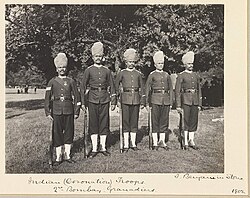
[[File:Soldiers of the 2nd Bombay Grenadiers of the Indian Army in Hampton Court Camp.jpg|thumb|right| 2nd Bombay Grenadiers of the Indian Army in Hampton Court Camp on the occasion of the Coronation of King Edward VII, August 1902]] | |||
====Second World War==== | ====Second World War==== | ||
At the beginning of the Second World War there were only two battalions of the Regiment, the 1st and 2nd. This was soon changed, though, as a number of battalions were raised for wartime service, including: 3rd, 4th, 5th, 6th, 14th, 25th, 26th and 27th Battalions.<ref name="Sharma, p. 75"/> The 10th (Training Battalion) was also de-linked from | At the beginning of the Second World War there were only two battalions of the Regiment, the 1st and 2nd. This was soon changed, though, as a number of battalions were raised for wartime service, including: 3rd, 4th, 5th, 6th, 14th, 25th, 26th and 27th Battalions.<ref name="Sharma, p. 75"/> The 10th (Training Battalion) was also de-linked from [[The Jat Regiment]]. Some of these battalions were to be garrison or rear area troops only, while others went on to serve with distinction in a number of theatres during the war including the Middle East and Burma, notably during the Arakan campaigns and at [[Battle of Kohima|Kohima]]. | ||
The 4th Grenadiers formed the motorised infantry element of the Indian Armoured and Tank brigades, distinguishing themselves as 'tank escort' infantry protecting tanks against sniper attack in jungle conditions: | The 4th Grenadiers formed the motorised infantry element of the Indian Armoured and Tank brigades, distinguishing themselves as 'tank escort' infantry protecting tanks against sniper attack in jungle conditions: | ||
| Line 122: | Line 111: | ||
*3/4th Battalion, [[254th Indian Tank Brigade]] | *3/4th Battalion, [[254th Indian Tank Brigade]] | ||
*4/4th Battalion, [[255th Indian Tank Brigade]] | *4/4th Battalion, [[255th Indian Tank Brigade]] | ||
[[File:Indian Armoured Corps in the Middle East 1944.jpg|thumb|Grenadiers in a [[Lend-Lease Sherman tanks|Sherman III]] tank in the Middle East, March 1944.]] | |||
====Partition==== | |||
In October 1945, the Indian infantry regiments lost their numerical designation and the regiment was re-designated as the '''Indian Grenadiers''', thus severing its last link with the erstwhile Bombay Army (Special Indian Army Order 132/S/45). Following the [[partition of India]], the regiment was allotted to India. The active units at that time were the 1st, 2nd, 3rd, 4th and 25th. The Muslim troops in the regiment were allotted to [[Pakistan]]. [[Dogras]] from [[10th Baluch Regiment|5 Baluch]] joined the 1st battalion, [[13th Frontier Force Rifles|The Frontier Force Rifles]] to 2nd battalion, and from [[16th Punjab Regiment|1/16 Punjab]] to the 4th battalion.<ref>{{cite book|last=Gaylor|first=John|title=Sons of John Company: The Indian and Pakistan Armies 1903–1991.|publisher=Stroud: Spellmount Publishers Ltd.|isbn=978-0-946771-98-1|page=144}}</ref> | |||
==Regimental battalions== | ==Regimental battalions== | ||
The Grenadiers consists of 23 [[battalion]]s, four [[Rashtriya Rifles]] battalions and two [[Territorial Army (India)|Territorial Army]] battalions - | |||
{{Incomplete list|date=April 2023}} | |||
{| class="wikitable" | |||
! scope="col" style="width: 120px;"| Battalion | |||
! scope="col" style="width: 50px;"| Raising Date | |||
! scope="col" style="width: 550px;"| Remarks | |||
! scope="col" style="width: 50px;"| References | |||
|-style="background:#EEE8AA" | |||
|1st Battalion § | |||
|1778 | |||
|Raised as 8th Regiment of Bombay Sepoys. Underwent many name changes, was designated [[101st Grenadiers]], prior to present designation. Battle honours - Mangalore, Mysore, Hyderabad, Kandahar 1880, Afghanistan 1878–80, Burma 1885–87, Somaliland 1901–04, East Africa 1914–16, Egypt, Gaza, Megiddo, Nablus, Palestine 1917–18. Post independence – Gurais. Became 2nd Battalion, [[Brigade of the Guards]] in 1950. | |||
|<ref>{{cite web |url=http://www.grenadiers.info/indian/ |title = Indian Army Grenadiers Regiment}}</ref><ref>{{cite web|url=https://istampgallery.com/2-guards-1-grenadiers-225-years/|title=2 Guards (1 Grenadiers)|access-date=2023-03-13}}</ref> | |||
|- | |||
|2nd Battalion | |||
|1796 | |||
|Raised in [[Kozhikode|Calicut]] by Captain David Cameron as 13th Battalion, Bombay Native Infantry. Underwent many name changes, was designated [[102nd Prince of Wales's Own Grenadiers|102nd King Edward's Own Grenadiers]], before present designation. Battle honours – Egypt (1801), Kirkee (1817), Koregaon (1817), Persia (1857), Abyssinia (1868), Kut-Al-Amara (1917), Naga Village (1944). Nicknamed ''Second to None''. | |||
|<ref>{{cite web|url=https://istampgallery.com/2-grenadiers/|title=2 Grenadiers of India|date=2016-06-07|access-date=2023-03-12}}</ref> | |||
|- | |||
|3rd Battalion | |||
|1768 | |||
|Raised as 1st Battalion, Bombay Sepoys. Underwent many name changes, was designated [[108th Infantry]], before present designation. Nicknamed ''Param Vir Chakra Paltan''. Battle honours (pre-independence) – Mangalore 1783, Mysore 1793, Hyderabad (Sind) 1843, Afghanistan 1879, Aden 1916, Mesopotamia 1917, Kalewa 1944 and Fort Dufferin, Mandalay 1945; post-independence – theatre honour - Rajasthan (Sadhewala) in 1965 and battle honour – Jarpal in 1971. [[Major Hoshiar Singh]] was awarded the PVC. | |||
|<ref>{{cite web|url=https://samsshopping.com/product/third-battalion-the-grenadiers/|title=Third Battalion The Grenadiers|date=2016-02-11|access-date=2023-03-12}}</ref><ref>{{cite web|url=https://www.tribuneindia.com/news/features/16-madras-3-grenadiers-braves-264144|title=16 Madras, 3 Grenadiers' braves|date=2021-06-06|access-date=2023-03-13}}</ref> | |||
|- | |||
|4th Battalion | |||
|1768 | |||
|Raised as 5th Battalion, Bombay Sepoys. Underwent many name changes, was designated [[109th Infantry]], before present designation. Battle honours : pre-independence – Mysore, Central India, Aden, Punjab, Multan, Burma, Afghanistan, Taungtha, Meiktila, Pwabwe, Sharqat, Pegu; post-independence – Asal Uttar (1965). CQMH [[Abdul Hamid (soldier)|Abdul Hamid]] was awarded the PVC. Nicknamed ''Param Vir Chakra Paltan'' and ''The Fighting Fourth''. | |||
|<ref>{{cite web|url=https://samsshopping.com/product/fourth-battalion-the-grenadiers/|title=Fourth Battalion The Grenadiers|date=2016-02-01|access-date=2023-03-12}}</ref><ref>{{cite web|url=https://www.deccanherald.com/content/178027/remembering-hero-named-abdul-hamid.html|title=Remembering a hero named Abdul Hamid|date=2011-07-21|access-date=2023-03-13}}</ref> | |||
|- | |||
|5th Battalion | |||
|1796 | |||
|Raised as 2nd Battalion, 6th Regiment of Bombay Native Infantry. Underwent many name changes, was designated [[112th Infantry]], before present designation. Nicknamed ''Finest Fifth''. | |||
| | |||
|- | |||
|6th Battalion | |||
|1962 | |||
|Raised as 6/4 Grenadiers (Motorised) by Lieutenant Colonel D Greigson at [[Nasirabad, Ajmer|Nasirabad]] in 1942. Disbanded 1943. Re-raised in 1962 by Lieutenant Colonel AB Jhadav at [[Jaipur]]. Nicknamed ''Joshila Sixth''. | |||
|<ref>{{cite web|url=https://samsshopping.com/product/sixth-battalion-the-grenadiers/|title=Sixth Battalion The Grenadiers|date=2016-03-01|access-date=2023-03-12}}</ref> | |||
|-style="background:#EEE8AA" | |||
|7th battalion § | |||
|1949 | |||
|Raised from [[Kutch State|Kutch]] and [[Saurashtra (state)|Saurashtra]] State Forces in camel mounted role, became regular infantry in 1957. Became 9th Battalion, [[Mechanised Infantry Regiment]] in 1979. Battle honour Chhadbet | |||
|<ref>{{cite web |url=http://www.bharat-rakshak.com/ARMY/units/102-Grenadiers.html |title=The Grenadiers Regiment - Bharat Rakshak - Indian Army & Land Forces |access-date=20 January 2019 |archive-date=29 November 2021 |archive-url=https://web.archive.org/web/20211129141233/http://www.bharat-rakshak.com/ARMY/units/102-Grenadiers.html |url-status=dead }}</ref><ref>{{cite web|url=https://indianarmy.nic.in/Site/FormTemplete/frmTempSimple.aspx?MnId=BfOGlbEdBL93UDu2wVUQGw==&ParentID=JHf4479y6uRynEmF3xYK8g==|title=Raising Days and Battle Honours : Mech Battalions|access-date=2023-03-12}}</ref> | |||
|- | |||
|8th Battalion | |||
|1963 | |||
|Raised 1949 in [[Ahmedabad]] from state forces of [[Lunavada State|Lunavada]], [[Rajpipla State|Rajpipla]], [[Baria State|Baria]] and [[Idar State|Idar]], disbanded 1949, re-raised 1963 in [[Jaipur]] under Major BS Brah. Battle honour – Chakra (1971). Nicknamed ''Chakra Battalion'' and ''Gallant Eighth''. | |||
|<ref>{{cite web|url=https://samsshopping.com/product/8-grenadiers/|title=8 Grenadiers|date=2013-01-01|access-date=2023-03-13}}</ref> | |||
|- | |||
|9th Battalion | |||
|1954 | |||
|Mewar, ex-[[Imperial Service Troops|State Forces unit]] | |||
|<ref>{{cite web|url=https://www.devdiscourse.com/article/education/1761355-army-starts-mewar-trail-foot-expedition-from-udaipur|title=Army starts 'Mewar Trail' foot expedition from Udaipur|date=2021-10-08|access-date=2023-03-13}}</ref><ref>{{cite web|url= https://www.rajputcommunity.in/t/princely-states-contribution-to-the-indian-army/192|title= Princely States' contribution to the Indian Army|date=2019-10-01|access-date=2023-03-13}}</ref> | |||
|- | |||
|10th Battalion | |||
|1800 | |||
|Raised 1st Battalion, 7th Regiment of Bombay Native Infantry. Underwent many name changes, was designated [[113th Infantry]], before present designation. Training Battalion. | |||
| | |||
|- | |||
|11th Battalion | |||
|1963 | |||
|Raised at [[Ajmer]] as a Territorial battalion in 1922 (1st battalion, Ajmer Regiment), disbanded in 1948, re-raised in 1963 in Jaipur by Lieutenant Colonel Racchpal Singh. | |||
|<ref>{{cite web|url=https://samsshopping.com/product/11th-battalion-the-grenadiers/|title=11th Battalion The Grenadiers|date=2013-10-01|access-date=2023-03-12}}</ref> | |||
|- | |||
|12th Battalion | |||
|1964 | |||
|Raised at [[Nasirabad, Ajmer|Nasirabad]] by Major NS Sidhu. Lieutenant Colonel Hari Singh was the first commanding officer. Nicknamed ''Thundering Twelfths''. | |||
|<ref>{{cite web|url=https://samsshopping.com/product/12th-battalion-the-grenadiers/|title=12th Battalion The Grenadiers|date=2014-04-01|access-date=2023-03-12}}</ref> | |||
|- | |||
|13th Battalion | |||
|1889 | |||
|Raised as the [[Bikaner Camel Corps|Ganga Risala]] by Maharaja [[Ganga Singh]] of the Indian state of [[Bikaner]]. | |||
|<ref>{{cite web|url=https://www.rajputcommunity.in/t/rajputs-state-forces-to-modern-indian-army-a-milllenium-of-military-service/250|title=Rajputs State forces to modern Indian Army: A milllenium of military service|date=2020-01-01|access-date=2023-03-12}}</ref> | |||
|- | |||
|14th Battalion | |||
|1965 | |||
|From 34th Training Unit (raised 1943), disbanded 1946, re-raised 1965. | |||
|<ref>{{cite web|url=https://samsshopping.com/product/14-grenadiers/|title=14 Grenadiers|date=2015-01-22|access-date=2023-03-12}}</ref> | |||
|- | |||
|15th Battalion | |||
|1966 | |||
|Raised in Nasirabad by Lieutenant Colonel PS Mahurkar. Nicknamed ''The Dare Devils'' | |||
|<ref>{{cite web|url=https://samsshopping.com/product/15th-battalion-the-grenadiers/|title=15th Battalion The Grenadiers|date=2016-01-16|access-date=2023-03-12}}</ref> | |||
|- | |||
|16th Battalion | |||
|1966 | |||
|Raised in [[Babina, Uttar Pradesh|Babina]] under Lieutenant Colonel NB Jayaram . | |||
|<ref>{{cite web|url=https://www.globalsecurity.org/military/world/india/rgt-grenadiers.htm|title=Grenadiers Regiment|access-date=2023-03-13}}</ref> | |||
|-style="background:#EEE8AA" | |||
|17th Battalion § | |||
|1966 | |||
|Raised as a camel battalion in [[Bikaner]] under Lieutenant Colonel KS Harihar Singh. Nicknamed ''The Desert Hawks''. Motorized Infantry Regiment. Became 24th Battalion, [[Brigade of the Guards]] in 2023. | |||
|<ref>{{cite web|url= https://samsshopping.com/product/17th-battalion-the-grenadiers-motorised/|title= 17th Battalion The Grenadiers (Motorised)|date=2016-11-10|access-date=2023-03-12}}</ref> | |||
|- | |||
|18th Battalion | |||
|1976 | |||
|Battle honour – Tiger Hill and Tololing. Nicknamed ''Param Vir Chakra Paltan'' after the PVC won by [[Yogendra Singh Yadav|Grenadier Yogendra Singh Yadav]]. | |||
|<ref>{{cite web|url=https://www.tribuneindia.com/news/archive/j-k/18-grenadiers-relive-tiger-hill-capture-805648|title=18 Grenadiers relive Tiger Hill capture|date=2019-07-22|access-date=2023-03-12}}</ref><ref>{{cite web|url= https://timesofindia.indiatimes.com/india/18-grenadiers-to-celebrate-battle-honour-day/articleshow/37732829.cms|title=18 Grenadiers to celebrate Battle Honour Day|website=[[The Times of India]] |date=2014-07-04|access-date=2023-03-13}}</ref> | |||
|- | |||
|19th Battalion | |||
|1979 | |||
|Nicknamed ''Utkrisht Unnees''. | |||
| | |||
|- | |||
|20th Battalion | |||
| | |||
|Nicknamed ''Double Axe''. | |||
| | |||
|- | |||
|21st Battalion | |||
|1985 | |||
|Nicknamed ''Awwal Ekkis''. | |||
| | |||
|- | |||
|22nd Battalion | |||
|1988 | |||
|Raised in [[Jabalpur]]. Nicknamed as ''Bravest of the Brave'' and ''Ashok Chakra Paltan'' – has won two Ashok Chakras. | |||
|<ref>{{cite web|url=https://samsshopping.com/product/22nd-battalion-the-grenadiers-regiment/|title=22nd Battalion The Grenadiers|date=2013-06-01|access-date=2023-03-12}}</ref> | |||
|- | |||
|23rd Battalion | |||
| | |||
| | |||
| | |||
|- | |||
|24th Battalion | |||
| | |||
| | |||
| | |||
|- | |||
|25th Battalion | |||
|1 July 2014 | |||
|Raised at the Grenadiers Regimental Centre in Jabalpur, the battalion was established under the command of Colonel Vipul Singh Rajput. Nicknamed ''Parakrami Pacchees''. | |||
|<ref>{{cite web|url=https://www.hindustantimes.com/chandigarh/military-diplomacy-with-china-at-what-cost/story-qM3LHGlTg2HfazP6yIvpHP.html|title=Raising of 25th Grenadiers|date=2014-10-19|access-date=2023-03-12}}</ref> | |||
|- | |||
|- style="background:#D0FFD0" | |||
|12 Rashtriya Rifles | |||
| | |||
| | |||
| | |||
|-style="background:#D0FFD0" | |||
|29 Rashtriya Rifles | |||
| | |||
|Nicknamed ''Cobra Paltan''. | |||
| | |||
|-style="background:#D0FFD0" | |||
|39 Rashtriya Rifles | |||
| | |||
| | |||
| | |||
|-style="background:#D0FFD0" | |||
|55 Rashtriya Rifles | |||
| | |||
| | |||
| | |||
|-style="background:#FFD0D0" | |||
|118 (TA) Battalion | |||
|1939 | |||
|Raised at 7 Central Provincial Urban Infantry Battalion (Indian Territorial Force). Present designation since 1949. Located at [[Bhusawal|Bhusaval, Maharashtra]] | |||
|<ref>{{cite web|url= https://samsshopping.com/product/118-inf-bn-ta-grenadiers-platinum-jubilee/|title=118 Inf BN TA Grenadiers Platinum Jubilee|date=2014-08-22|access-date=2023-03-12}}</ref><ref>{{cite web|url=https://thelivenagpur.com/2019/11/14/118-ta-battalion-vacates-sitabuldi-fort/|title=118 TA Battalion vacates Sitabuldi Fort|date=2019-11-14|access-date=2023-03-13}}</ref> | |||
|-style="background:#FFD0D0" | |||
|123 (TA) Battalion | |||
|1956 | |||
|Raised by Lieutenant Colonel Zorawar Singh at raised at Senapati House, [[Jhotwara]]. Located at [[Jaipur, Rajasthan]]. Nicknamed ''Jaipur Terriers''. | |||
|<ref>{{cite web|url=https://www.aninews.in/news/national/general-news/an-entire-army-unit-just-pledges-their-organs201801142105290001/|title=An entire Army unit just pledges their organs|date=2018-01-14|access-date=2023-03-13}}</ref><ref>{{cite web|url=https://musiconcepts.in/mtvindiamusicsummit/jaipurterrierpipeband/|title=Jaipur Terrier Pipe Band|date=|access-date=2023-03-13}}</ref> | |||
|- | |||
|} | |||
§ indicates former units. | |||
==Affiliations== | |||
[[File:Stamp of India - 1996 - Colnect 163317 - 2nd Grenadiers.jpeg|thumb|right|200px|Postal stamp - Bicentenary of 2nd Grenadiers, 1996]] | |||
{{multiple image | {{multiple image | ||
| align = right | | align = right | ||
| Line 136: | Line 299: | ||
| caption2 = | | caption2 = | ||
}} | }} | ||
The Grenadiers has been affiliated with '''The Armoured Corps''' and with the '''Indian Navy'''. | |||
* | *[[51st Armoured Regiment (India)|51 Armoured Regiment]] has been affiliated with The Grenadiers. | ||
*[[INS Beas]] '''(F37)''' has also been affiliated with The Grenadiers. | |||
* | |||
The Grenadiers | |||
* | ==Class composition== | ||
* | *1923 - Rajputana Mussalmans, Rajputana Jats, Mahrattas, Mers and Merats | ||
*1946 - Jats from the Punjab, United Provinces, Rajputana and Central India states, Hindustani Mussalmans from Ambala Civil Division, Rajputana, United Provinces, Central India states and the Deccan.<ref>{{cite book|last=Gaylor|first=John|title=Sons of John Company: The Indian and Pakistan Armies 1903–1991.|publisher=Stroud: Spellmount Publishers Ltd.|isbn=978-0-946771-98-1|page=141}}</ref> | |||
*Present - Rajputs, Kaimkhanis, Hindustani Mussalmans, Dogras, Gujjar, Ahir, Mena, Gujratis, Jats.<ref>{{cite book|last=Gautam|first=PK|title= Indigenous Historical Knowledge: Kautilya and His Vocabulary, Volume III|date=2016|publisher= IDSA/Pentagon Press |isbn= 978-81-8274-909-2|page=154}}</ref><ref name="IA">{{cite web|url=https://indianarmy.nic.in/Site/FormTemplete/frmTempSimple.aspx?MnId=OQcXHdaoK9DKf0kUc6iuHw==&ParentID=K1BY2d//IUQ8WCWWQSILsA==|title=The Grenadiers|date=|access-date=2023-03-11}}</ref> | |||
==Battle honours== | ==Battle honours== | ||
===Battle | ===Battle Honours (Pre-Independence)=== | ||
Prior to Indian independence, the Regiment had won many [[battle honours]] as part of the British Indian Army. These battle honour include: | Prior to Indian independence, the Regiment had won many [[battle honours]] as part of the British Indian Army. These battle honour include:<ref name="IA"/> | ||
====Pre-World War I==== | ====Pre-World War I==== | ||
* [[ | {{div col|colwidth=22em}} | ||
* [[Siege of Mangalore|Mangalore – 1784]] | |||
* [[Mysore]] – 1786 | * [[Mysore]] – 1786 | ||
* [[Srirangapatnam]] – 1799 | * [[Srirangapatnam]] – 1799 | ||
| Line 186: | Line 324: | ||
* [[Kirkee]] – 1827 | * [[Kirkee]] – 1827 | ||
* [[Battle of Hyderabad|Hyderabad – 1831–43]] | * [[Battle of Hyderabad|Hyderabad – 1831–43]] | ||
* [[Siege of Multan (1848–1849)|Multan]] | |||
* Meeane – 1843 | * Meeane – 1843 | ||
* [[Punjab region|Punjab – 1848]] | * [[Punjab region|Punjab – 1848]] | ||
* Central India – 1858 | * [[Central Indian campaign of 1858|Central India – 1858]] | ||
* [[Ethiopian Empire|Abyssinia – 1868]] | * [[Ethiopian Empire|Abyssinia – 1868]] | ||
* [[Siege of Kandahar|Kandahar 1880]] | * [[Siege of Kandahar|Kandahar 1880]] | ||
* [[Second Afghan War|Afghanistan 1878–80]] | * [[Second Afghan War|Afghanistan 1878–80]] | ||
* [[Third Burmese War|Burma 1885–87]] | * [[Third Burmese War|Burma 1885–87]] | ||
* [[Somaliland]] (Dharatol) – 1901–04 | * [[Somaliland]] (Dharatol) – 1901–04 | ||
* [[Third Anglo-Afghan War|Afghanistan 1919]] | |||
{{div col end}} | |||
====World War I==== | ====World War I==== | ||
{{div col|colwidth=22em}} | |||
* [[German East Africa campaign|East Africa 1914–16]] | * [[German East Africa campaign|East Africa 1914–16]] | ||
* [[Egypt]] – 1916–17 | * [[Egypt]] – 1916–17 | ||
* [[Baghdad]] – 1917 | * [[Baghdad]] – 1917 | ||
* Kut-Al-Amara – 1917 | * [[Second Battle of Kut|Kut-Al-Amara]] – 1917 | ||
* [[Battle of Gaza | * [[Battle of Gaza (disambiguation)|Gaza – 1917]] | ||
* [[Battle of Sharqat]] – 1918 | * [[Battle of Sharqat]] – 1918 | ||
* [[Battle of Megiddo (1918)|Megiddo]] | * [[Battle of Megiddo (1918)|Megiddo]] | ||
* [[Nablus]] – 1918 | * [[Nablus]] – 1918 | ||
* [[Sinai and Palestine|Palestine 1917–18]] | * [[Sinai and Palestine campaign|Palestine 1917–18]] | ||
* [[Mesopotamia]] – 1915–18 | * [[Mesopotamia]] – 1915–18 | ||
* [[Aden]] – 1914–19 | * [[Aden]] – 1914–19 | ||
* [[Third Anglo-Afghan War|Afghanistan 1919]] | * [[Third Anglo-Afghan War|Afghanistan 1919]] | ||
* Tigris – 1919 | * Tigris – 1919 | ||
{{div col end}} | |||
====World War II==== | ====World War II==== | ||
* [[Battle of Kohima|Kohima – 1944 | {{div col|colwidth=22em}} | ||
* [[Battle of Kohima|Kohima]] – 1944 | |||
* [[Kalewa]] – 1944 | * [[Kalewa]] – 1944 | ||
* Naga Village – 1944 | * [[Battle of Kohima#Counter-offensive|Naga Village]] – 1944 | ||
* [[Mandalay Palace|Fort Dufferin]], Mandalay – 1945 | * [[Mandalay Palace|Fort Dufferin]], Mandalay – 1945 | ||
* Pwabwe – 1945 | * [[Burma campaign (1944–1945)|Pwabwe]] – 1945 | ||
* [[Capture of Meiktila]] – 1945 | * [[Capture of Meiktila]] – 1945 | ||
* [[Defense of Meiktila]] – 1945 | * [[Defense of Meiktila]] – 1945 | ||
* [[Battle of Pegu|Pegu – 1945 | * [[Battle of Pegu|Pegu]] – 1945 | ||
* [[Battle of Meiktila and Mandalay|Taungtha]] – 1945 | * [[Battle of Meiktila and Mandalay|Taungtha]] – 1945 | ||
{{div col end}} | |||
===Battle | ===Battle Honours (Post-Independence)=== | ||
Since 1947, the Regiment has won the following battle honours as part of the Indian Army: | Since 1947, the Regiment has won the following battle honours as part of the Indian Army: | ||
{{div col|colwidth=22em}} | |||
* Gurais – 1948 | * Gurais – 1948 | ||
* [[Battle of Asal Uttar|Asal Uttar – 1965 | * [[Battle of Asal Uttar|Asal Uttar]] – 1965 | ||
* Jarpal – 1971 | * Jarpal – 1971 | ||
* Chakra – 1971 | * Chakra – 1971 | ||
* [[Battle of Tiger Hill|Tololing & Tiger Hill (Kargil War) – 1999 | * [[Battle of Tiger Hill|Tololing & Tiger Hill (Kargil War)]] – 1999 | ||
{{ | {{div col end}} | ||
{{Incomplete list|date=September 2010}} | |||
==Decorations== | ==Decorations== | ||
The Grenadiers have the unique and distinct honour of having the most number of [[Param Vir Chakra]]s, India's highest medal for gallantry, among all the Indian Army's Infantry Regiments.{{ | The Grenadiers have the unique and distinct honour of having the most number of [[Param Vir Chakra]]s, India's highest medal for gallantry, among all the Indian Army's Infantry Regiments.<ref>{{cite web|url=https://www.indiatvnews.com/news/india/know-the-brave-regiments-of-indian-army-28237.html/page/2|title=Know the brave regiments of Indian Army|date=2014-06-23|access-date=2023-03-12}}</ref> Of note also, is the fact that prior to independence, British officers serving with The Grenadiers won four [[Victoria Cross]]es.<ref>Sharma, p. 69</ref> Members of the Regiment have also received a number of other decorations prior to independence. | ||
[[File:Havildar of The Grenadiers.jpg|thumb|right|200px|An [[Non-commissioned officer|NCO]] of The Grenadiers, 2017]] | |||
=== | ===Pre independence=== | ||
[[ | '''[[Victoria Cross]]''' | ||
* Captain [[George Murray Rolland]], 22 April 1903, Daratoleh, [[Somaliland]] | |||
* [[ | |||
=== | ;1914-1921<ref>{{cite book|last=India|first=Adjutant General of |title=List of Honours Awarded to the Indian Army August 1914 to August 1921|date=1930|publisher= Committee Indian War Memorial Delhi}}</ref> | ||
'''[[Military Cross]]''' | |||
* Jemadar Pola Khan, 101st Grenadiers, Egypt | |||
* | * Subedar Jiwan Khan, 101st Grenadiers, Egypt and Aden (twice) | ||
* Subedar Kasianth Mane, 101st Grenadiers, Egypt | |||
'''[[Order of British India]]''' | |||
* Subedar Major Martand Rao Mohite, 101st Grenadiers, Egypt | |||
* Subedar Agdi Singh, 102nd Grenadiers, Mesopotamia | |||
'''[[Indian Order of Merit]]''' | |||
* Subedar Rahim Khan, | * Sepoy Fazil Khan, 101st Grenadiers, East Africa | ||
* Sepoy Sowaz Khan, 101st Grenadiers, East Africa | |||
* Subedar Rahim Khan, 101st Grenadiers, Egypt<ref>Sharma, p. 73</ref> | |||
* Subedar Ahmed Din, 101st Grenadiers, Egypt | |||
* Colour Havildar Shah Muhammad, 101st Grenadiers, Egypt | |||
* Subedar Jafar Ali, 102nd Grenadiers, Muscat | |||
* Sepoy Nand Ram, 102nd Grenadiers, Muscat | |||
* Subedar Ganga Ram Singh, 102nd Grenadiers, Mesopotamia | |||
* Subedar Muhammad Ali, 102nd Grenadiers, Mesopotamia | |||
* Jemadar Ganga Ram, 102nd Grenadiers, Mesopotamia | |||
* Havildar Jaffar Ali, 102nd Grenadiers, Waziristan | |||
* Naik Shivlal Dalal (1933) | * Naik Shivlal Dalal (1933) | ||
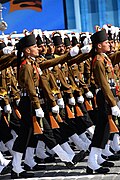
[[File:Парад в честь 70-летия Великой Победы - 39.jpg|250px|thumbnail|right|Grenadiers participating in the [[2015 Moscow Victory Day Parade]], marking the 70th anniversary of the victory in Europe.]] | |||
'''[[Indian Distinguished Service Medal]]''' | |||
* Lance Naik Abdul Sattar Khan, Temporary Lance Naik Muhammad Khan, 101st Grenadiers, Egypt | |||
* Havildar Karan Singh, Havildar Ganga Ram, Private Sultan Ahmad, Havildar Tula Ram, Havildar Tula Ram, Havildar Mansare Ali, Private Sheo Ram, Havildar Sanwal Ram, Private Shedu Ram, Private Sirdara Ram, Private Surja Ram, Jemadar Khan Muhammad, Sepoy Ahmad Khan, Sepoy Girdhari Ram, Sepoy Tulsi Ram, Private Feroz Khan, Havildar Ram Diyal Singh, Naik Niyamat Khan (all in Mesopotamia), Private Karam Dad Khan (Muscat), Lance Naik Hoti Singh (Baluchistan), Subedar Mansar Ali (Pishin Moveable Column) 102nd Grenadiers | |||
'''[[Indian Meritorious Service Medal (for Indian Army)|Indian Meritorious Service Medal]]''' | |||
* 84 medals - 101st Grenadiers, Egypt, Aden, Somaliland, India | |||
* 12 medals - 102nd Grenadiers, Mesopotamia, India, Baluchistan | |||
;World War II<ref>{{cite book|last=|first=|title=The Tiger Kills|date=1944|publisher=Director of Public Relations, India Command, Government of India|page=327}}</ref><ref>{{cite book|last=|first=|title=The Tiger Strikes|date=1942|publisher=Director of Public Relations, India Command, Government of India|page=148}}</ref> | |||
'''[[Order of the British Empire|Member of the Most Excellent Order of the British Empire (MBE)]]''' | |||
* Subedar Major Shamshad Khan, 4th Bombay Grenadiers | |||
'''[[Mentioned in dispatches]]''' | |||
* Major T H Waumsley, 4th Bombay Grenadiers | |||
* Major E R S Dods, 4th Bombay Grenadiers | |||
===Post independence=== | |||
Source:<ref name="IA"/> | |||
'''[[Param Vir Chakra]]''' | |||
[[File:JVF-Mounted-M40-Anti-Tank-Gun.jpg|thumb|Depiction of a 105 mm [[Jonga]]-mounted RCL gun, manned by [[Abdul Hamid (soldier)|Abdul Hamid]], which destroyed eight tanks during the Battle of Asal Uttar]] | |||
* Company Quarter Master [[Abdul Hamid (soldier)|Havildar Abdul Hamid]], 4th Grenadiers, 1965. | |||
* [[Major Hoshiar Singh]], 3rd Grenadiers, 1971. | |||
* [[Yogendra Singh Yadav|Grenadier Yogendra Singh Yadav]], 18th Grenadiers, 1999. | |||
'''[[Ashoka Chakra (military decoration)|Ashok Chakra]]''' | |||
* [[Rakesh Singh (soldier)|Second Lieutenant Rakesh Singh]], 22nd Grenadiers, 1993 | |||
* Major [[Rajiv Kumar Joon]], 22nd Grenadiers, 1995 | |||
[[File:25Grenadiers.jpg|thumb|right|Soldiers of 25 Grenadiers]] | |||
'''[[Maha Vir Chakra]]''' | |||
* 2nd Lieutenant Gopala Krishna Venkatesa Prasanna Rao, (Posthumous), 4th Grenadiers, [[Sino-Indian War]], 1962 | |||
* Brigadier [[Rai Singh Yadav]], 2nd Grenadiers, [[Nathu La and Cho La clashes]] 1967. | |||
* Lieutenant General [[Ved Prakash Airy]], 3rd Grenadiers, [[Indo-Pak War of 1971]] ([[Battle of Basantar]]). | |||
* Major Dharam Vir Singh, 8th Grenadiers, [[Indo-Pak War of 1971]]. | |||
* Major General Antony Harold Edward Michigan, [[Indo-Pak War of 1971]]. | |||
* Major [[Rajesh Singh Adhikari]], (Posthumous), 18th Grenadiers, [[Kargil War]] (Operation Vijay) 1999. | |||
* Colonel [[Balwan Singh]], 18th Grenadiers, [[Kargil War]] (Operation Vijay) 1999. | |||
'''[[Vir Chakra]]''' | |||
* Lieutenant Colonel [[Ramakrishnan Vishwanathan]], (Posthumous), 18th Grenadiers, [[Kargil War]] (Operation Vijay) 1999. | |||
'''[[Kirti Chakra]]''' | |||
* Grenadier Daryao Singh, 1948 | |||
* Grenadier Gopal Singh (Posthumous), 1981 | |||
* Grenadier Bajrang Singh (Posthumous), 1981 | |||
* Naik Prakash Chand, 1990 | |||
* Lieutenant Ravinder Chikara (Posthumous), 2001 | |||
* Grenadier Anil Kumar (Posthumous), 2003 | |||
* Colonel Gurbir Singh Sarna (Posthumous), 2006 | |||
* Major Rajinder Kumar Sharma, 2008 | |||
* Grenadier Pawan Kumar (Posthumous), 2024<ref>{{cite web|url=https://pib.gov.in/PressReleasePage.aspx?PRID=1999669|title=75th Republic Day: President approves Gallantry awards to 80 Armed Forces personnel, including 12 posthumous|date=2024-01-25|access-date=2024-01-27}}</ref> | |||
==Notable General Officers== | |||
*[[Vice Chief of the Army Staff (India)|Vice Chief of the Army Staff]] - Lieutenant General Stanley Leslie Menezes, {{small|PVSM, SC}} | |||
*Army Commanders (GOC-in-C) - Lieutenant General Y. N. Sharma ([[Central Command (India)|Central Command]]) | |||
*Corps Commanders (GOC) - Lieutenant Generals Y.S. Tomar, Sanjay Mitra ([[I Corps (India)|I Corps]]); Rajeev Sirohi ([[III Corps (India)|III Corps]]); Stanley Leslie Menezes, Shakti Gurung, [[Gurpal Singh Sangha]] (all [[IV Corps (India)|IV Corps]]); Y.N. Sharma ([[XII Corps (India)|XII Corps]]); [[Sarabjit Singh Dhillon]] ([[XV Corps (India)|XV Corps]]); Lalit Kumar Pandey ([[XVII Corps (India)|XVII Corps]]). | |||
==References & notes== | ==References & notes== | ||
{{Reflist}} | {{Reflist}} | ||
| Line 271: | Line 477: | ||
* Singh, Rajendra (1969) ''History of the Grenadiers'' | * Singh, Rajendra (1969) ''History of the Grenadiers'' | ||
* Singh, Rajendra (1955) ''Organisation and Administration in the Indian Army'' | * Singh, Rajendra (1955) ''Organisation and Administration in the Indian Army'' | ||
* Palsokar, R.D. (1980) ''The Grenadiers, a Tradition of Valour'', The Grenadiers Regimental Centre, Jabalpur | |||
==See also== | ==See also== | ||
| Line 282: | Line 489: | ||
* [http://www.grenadiers.info/indian/ Indian Grenadiers Regiment] | * [http://www.grenadiers.info/indian/ Indian Grenadiers Regiment] | ||
* [https://web.archive.org/web/20050311031539/http://www.regiments.org/regiments/southasia/inf/1922-04.htm The Bombay Grenadiers] | * [https://web.archive.org/web/20050311031539/http://www.regiments.org/regiments/southasia/inf/1922-04.htm The Bombay Grenadiers] | ||
* [https://books.google.com/books?id=SCZ-AAAAIAAJ&q=grenadiers 2nd Battalion, 4th Bombay Grenadiers (King Edward's Own), Formerly the 102nd King Edward's Own Grenadiers, Historical Record of the Regiment, 1796-1933] | |||
{{Indian Army Infantry Regiments}} | {{Indian Army Infantry Regiments}} | ||
Latest revision as of 01:00, 23 March 2026
| The Grenadiers | |
|---|---|
.svg) Regimental Insignia of The Grenadiers | |
| Active | 1778–present |
| Country |  British India British India India India |
| Branch | .svg) East India Company East India Company British Indian Army British Indian Army Indian Army Indian Army |
| Type | Infantry |
| Size | 25 battalions |
| Regimental Centre | Jabalpur, Madhya Pradesh |
| Nickname(s) | The Grinders |
| Motto(s) | Sarvada Shaktishali (Ever Powerful)[1] |
| Engagements | Second Anglo-Afghan War Third Burmese War Third Anglo-Afghan War First World War Second World War Sino-Indian War Indo-Pakistani War of 1965 Nathu La and Cho La clashes Indo-Pakistani War of 1971 Operation Pawan Kargil War, 1999 |
| Decorations | |
| Battle honours | Post Independence Gurez, Asal Uttar, Jarpal, Chakra, Tololing & Tiger Hill |
| Commanders | |
| Colonel of the Regiment | Lt Gen Sanjay Mitra[2] |
| Insignia | |
| Regimental Insignia | A brass grenade bearing the White Horse of Hanover. The insignia is worn on the uniform with a white hackle. |
The Grenadiers is an infantry regiment of the Indian Army, formerly part of the Bombay Army and later the pre-independence British Indian Army, when the regiment was known as the 4th Bombay Grenadiers. It has distinguished itself during the two world wars and also since the Independence of India. The regiment has won many battle honours and gallantry awards, and is considered to be one of India's most decorated regiments with three Param Vir Chakra awardees in three different conflicts.[3]
History[edit | edit source]
Early history[edit | edit source]
The Grenadiers are one of the oldest grenadier regiments in the Commonwealth of Nations, and have the longest unbroken record of existence in the Indian Army.[4] The history of the Grenadiers dates back to the Bombay Army of the East India Company (EIC). In 1684, the Bombay Army consisted of three companies stationed on the Seven Islands of Bombay, one of which was a grenadier company. The company, which consisted of a mixture of Europeans and native Christians, disappears from subsequent historical records. By 1710, the Bombay Army had expanded to five companies of "Europeans, topasses, and coffrees", one of which was an all-European grenadier company. This company was subsequently merged into the Bombay European Regiment, which was later disbanded. In 1757, Robert Clive raised the 1st Regiment of Bengal Native Infantry, which consisted in part of two grenadier companies. However, no grenadier regiments were raised by the Bengal Army until 1779.[5]
In 1759, as a response to the ongoing Seven Years' War, the Bombay Army underwent a major expansion, and the first company of native grenadiers was raised with the best of Bombay sepoys "paying a regard to those having families on the island". It had only native officers and all sepoys wore red coats with blue facings. Later on, an adjutant was appointed to the corps. Later the Bombay Army comprised a number of sepoy battalions, each having one or two grenadier companies. These were clubbed together as a composite battalion comprising the grenadier companies of the Bombay sepoy battalions, and they won the famous battle of Talegaon in 1778. So impressive was the performance of this composite battalion that the Bombay Presidency ordered the permanent raising of a grenadier battalion which duly took place on 12 March 1779, thirty-six years before the first time that a British battalion was given the honour of calling itself "grenadiers". The Governor General of Bombay made an Order dated 12 November 1779, according to which the grenadier companies of the following regiments combined to form the first Grenadier Regiment in the world, namely "The Grenadier Battalion, First Regiment of Infantry":
- 1st Sepoy Battalion
- 2nd Sepoy Battalion
- 3rd Sepoy Battalion
- 4th Sepoy Battalion
- 5th Sepoy Battalion
- 6th Sepoy Battalion
- Marine Battalion (two companies of grenadiers)
4th Bombay Grenadiers[edit | edit source]
| 4th Bombay Grenadiers | |
|---|---|
| Active | 1922–1947 |
| Country | British India |
| Branch | British Indian Army |
| Type | Infantry |

The 4th Bombay Grenadiers were an infantry regiment of the pre-independence Indian Army, formed on 1 March 1922 as part of the reforms of the Indian Army that took place after the end of the First World War.[4] Following this, the Regiment spent the next fifteen years serving in the British Somaliland protectorate in present-day Somaliland, as well as in China and on the North-West Frontier. The 3rd, 4th and 5th Battalions were all disbanded and the 10th Battalion amalgamated with the 10th Battalion, Jat Regiment to form a Combined Training Centre at Bareilly.[4] Following the Second World War they were one of the regiments allocated to the new Indian Army and renamed The Grenadiers

The regiment consisted of six battalions, all former regiments themselves. These were:
- 1st Battalion - Formerly the 101st Grenadiers.
- 2nd Battalion - Formerly the 102nd King Edward's Own Grenadiers
- 3rd Battalion - Formerly the 108th Infantry
- 4th Battalion - Formerly the 109th Infantry
- 5th Battalion - Formerly the 112th Infantry
- 10th (Training) Battalion - Formerly the 113th Infantry

Second World War[edit | edit source]
At the beginning of the Second World War there were only two battalions of the Regiment, the 1st and 2nd. This was soon changed, though, as a number of battalions were raised for wartime service, including: 3rd, 4th, 5th, 6th, 14th, 25th, 26th and 27th Battalions.[4] The 10th (Training Battalion) was also de-linked from The Jat Regiment. Some of these battalions were to be garrison or rear area troops only, while others went on to serve with distinction in a number of theatres during the war including the Middle East and Burma, notably during the Arakan campaigns and at Kohima.
The 4th Grenadiers formed the motorised infantry element of the Indian Armoured and Tank brigades, distinguishing themselves as 'tank escort' infantry protecting tanks against sniper attack in jungle conditions:
- 1/4th Battalion, 252nd Indian Armoured Brigade, 31st Indian Armoured Division
- 2/4th Battalion, 50th Indian Tank Brigade
- 3/4th Battalion, 254th Indian Tank Brigade
- 4/4th Battalion, 255th Indian Tank Brigade

Partition[edit | edit source]
In October 1945, the Indian infantry regiments lost their numerical designation and the regiment was re-designated as the Indian Grenadiers, thus severing its last link with the erstwhile Bombay Army (Special Indian Army Order 132/S/45). Following the partition of India, the regiment was allotted to India. The active units at that time were the 1st, 2nd, 3rd, 4th and 25th. The Muslim troops in the regiment were allotted to Pakistan. Dogras from 5 Baluch joined the 1st battalion, The Frontier Force Rifles to 2nd battalion, and from 1/16 Punjab to the 4th battalion.[6]
Regimental battalions[edit | edit source]
The Grenadiers consists of 23 battalions, four Rashtriya Rifles battalions and two Territorial Army battalions -
| Battalion | Raising Date | Remarks | References |
|---|---|---|---|
| 1st Battalion § | 1778 | Raised as 8th Regiment of Bombay Sepoys. Underwent many name changes, was designated 101st Grenadiers, prior to present designation. Battle honours - Mangalore, Mysore, Hyderabad, Kandahar 1880, Afghanistan 1878–80, Burma 1885–87, Somaliland 1901–04, East Africa 1914–16, Egypt, Gaza, Megiddo, Nablus, Palestine 1917–18. Post independence – Gurais. Became 2nd Battalion, Brigade of the Guards in 1950. | [7][8] |
| 2nd Battalion | 1796 | Raised in Calicut by Captain David Cameron as 13th Battalion, Bombay Native Infantry. Underwent many name changes, was designated 102nd King Edward's Own Grenadiers, before present designation. Battle honours – Egypt (1801), Kirkee (1817), Koregaon (1817), Persia (1857), Abyssinia (1868), Kut-Al-Amara (1917), Naga Village (1944). Nicknamed Second to None. | [9] |
| 3rd Battalion | 1768 | Raised as 1st Battalion, Bombay Sepoys. Underwent many name changes, was designated 108th Infantry, before present designation. Nicknamed Param Vir Chakra Paltan. Battle honours (pre-independence) – Mangalore 1783, Mysore 1793, Hyderabad (Sind) 1843, Afghanistan 1879, Aden 1916, Mesopotamia 1917, Kalewa 1944 and Fort Dufferin, Mandalay 1945; post-independence – theatre honour - Rajasthan (Sadhewala) in 1965 and battle honour – Jarpal in 1971. Major Hoshiar Singh was awarded the PVC. | [10][11] |
| 4th Battalion | 1768 | Raised as 5th Battalion, Bombay Sepoys. Underwent many name changes, was designated 109th Infantry, before present designation. Battle honours : pre-independence – Mysore, Central India, Aden, Punjab, Multan, Burma, Afghanistan, Taungtha, Meiktila, Pwabwe, Sharqat, Pegu; post-independence – Asal Uttar (1965). CQMH Abdul Hamid was awarded the PVC. Nicknamed Param Vir Chakra Paltan and The Fighting Fourth. | [12][13] |
| 5th Battalion | 1796 | Raised as 2nd Battalion, 6th Regiment of Bombay Native Infantry. Underwent many name changes, was designated 112th Infantry, before present designation. Nicknamed Finest Fifth. | |
| 6th Battalion | 1962 | Raised as 6/4 Grenadiers (Motorised) by Lieutenant Colonel D Greigson at Nasirabad in 1942. Disbanded 1943. Re-raised in 1962 by Lieutenant Colonel AB Jhadav at Jaipur. Nicknamed Joshila Sixth. | [14] |
| 7th battalion § | 1949 | Raised from Kutch and Saurashtra State Forces in camel mounted role, became regular infantry in 1957. Became 9th Battalion, Mechanised Infantry Regiment in 1979. Battle honour Chhadbet | [15][16] |
| 8th Battalion | 1963 | Raised 1949 in Ahmedabad from state forces of Lunavada, Rajpipla, Baria and Idar, disbanded 1949, re-raised 1963 in Jaipur under Major BS Brah. Battle honour – Chakra (1971). Nicknamed Chakra Battalion and Gallant Eighth. | [17] |
| 9th Battalion | 1954 | Mewar, ex-State Forces unit | [18][19] |
| 10th Battalion | 1800 | Raised 1st Battalion, 7th Regiment of Bombay Native Infantry. Underwent many name changes, was designated 113th Infantry, before present designation. Training Battalion. | |
| 11th Battalion | 1963 | Raised at Ajmer as a Territorial battalion in 1922 (1st battalion, Ajmer Regiment), disbanded in 1948, re-raised in 1963 in Jaipur by Lieutenant Colonel Racchpal Singh. | [20] |
| 12th Battalion | 1964 | Raised at Nasirabad by Major NS Sidhu. Lieutenant Colonel Hari Singh was the first commanding officer. Nicknamed Thundering Twelfths. | [21] |
| 13th Battalion | 1889 | Raised as the Ganga Risala by Maharaja Ganga Singh of the Indian state of Bikaner. | [22] |
| 14th Battalion | 1965 | From 34th Training Unit (raised 1943), disbanded 1946, re-raised 1965. | [23] |
| 15th Battalion | 1966 | Raised in Nasirabad by Lieutenant Colonel PS Mahurkar. Nicknamed The Dare Devils | [24] |
| 16th Battalion | 1966 | Raised in Babina under Lieutenant Colonel NB Jayaram . | [25] |
| 17th Battalion § | 1966 | Raised as a camel battalion in Bikaner under Lieutenant Colonel KS Harihar Singh. Nicknamed The Desert Hawks. Motorized Infantry Regiment. Became 24th Battalion, Brigade of the Guards in 2023. | [26] |
| 18th Battalion | 1976 | Battle honour – Tiger Hill and Tololing. Nicknamed Param Vir Chakra Paltan after the PVC won by Grenadier Yogendra Singh Yadav. | [27][28] |
| 19th Battalion | 1979 | Nicknamed Utkrisht Unnees. | |
| 20th Battalion | Nicknamed Double Axe. | ||
| 21st Battalion | 1985 | Nicknamed Awwal Ekkis. | |
| 22nd Battalion | 1988 | Raised in Jabalpur. Nicknamed as Bravest of the Brave and Ashok Chakra Paltan – has won two Ashok Chakras. | [29] |
| 23rd Battalion | |||
| 24th Battalion | |||
| 25th Battalion | 1 July 2014 | Raised at the Grenadiers Regimental Centre in Jabalpur, the battalion was established under the command of Colonel Vipul Singh Rajput. Nicknamed Parakrami Pacchees. | [30] |
| 12 Rashtriya Rifles | |||
| 29 Rashtriya Rifles | Nicknamed Cobra Paltan. | ||
| 39 Rashtriya Rifles | |||
| 55 Rashtriya Rifles | |||
| 118 (TA) Battalion | 1939 | Raised at 7 Central Provincial Urban Infantry Battalion (Indian Territorial Force). Present designation since 1949. Located at Bhusaval, Maharashtra | [31][32] |
| 123 (TA) Battalion | 1956 | Raised by Lieutenant Colonel Zorawar Singh at raised at Senapati House, Jhotwara. Located at Jaipur, Rajasthan. Nicknamed Jaipur Terriers. | [33][34] |
§ indicates former units.
Affiliations[edit | edit source]


The Grenadiers has been affiliated with The Armoured Corps and with the Indian Navy.
- 51 Armoured Regiment has been affiliated with The Grenadiers.
- INS Beas (F37) has also been affiliated with The Grenadiers.
Class composition[edit | edit source]
- 1923 - Rajputana Mussalmans, Rajputana Jats, Mahrattas, Mers and Merats
- 1946 - Jats from the Punjab, United Provinces, Rajputana and Central India states, Hindustani Mussalmans from Ambala Civil Division, Rajputana, United Provinces, Central India states and the Deccan.[35]
- Present - Rajputs, Kaimkhanis, Hindustani Mussalmans, Dogras, Gujjar, Ahir, Mena, Gujratis, Jats.[36][37]
Battle honours[edit | edit source]
Battle Honours (Pre-Independence)[edit | edit source]
Prior to Indian independence, the Regiment had won many battle honours as part of the British Indian Army. These battle honour include:[37]
Pre-World War I[edit | edit source]
- Mangalore – 1784
- Mysore – 1786
- Srirangapatnam – 1799
- Egypt – 1802
- Koregaon – 1818
- Beni Boo Alli – 1821
- Kirkee – 1827
- Hyderabad – 1831–43
- Multan
- Meeane – 1843
- Punjab – 1848
- Central India – 1858
- Abyssinia – 1868
- Kandahar 1880
- Afghanistan 1878–80
- Burma 1885–87
- Somaliland (Dharatol) – 1901–04
- Afghanistan 1919
World War I[edit | edit source]
- East Africa 1914–16
- Egypt – 1916–17
- Baghdad – 1917
- Kut-Al-Amara – 1917
- Gaza – 1917
- Battle of Sharqat – 1918
- Megiddo
- Nablus – 1918
- Palestine 1917–18
- Mesopotamia – 1915–18
- Aden – 1914–19
- Afghanistan 1919
- Tigris – 1919
World War II[edit | edit source]
- Kohima – 1944
- Kalewa – 1944
- Naga Village – 1944
- Fort Dufferin, Mandalay – 1945
- Pwabwe – 1945
- Capture of Meiktila – 1945
- Defense of Meiktila – 1945
- Pegu – 1945
- Taungtha – 1945
Battle Honours (Post-Independence)[edit | edit source]
Since 1947, the Regiment has won the following battle honours as part of the Indian Army:
- Gurais – 1948
- Asal Uttar – 1965
- Jarpal – 1971
- Chakra – 1971
- Tololing & Tiger Hill (Kargil War) – 1999
Decorations[edit | edit source]
The Grenadiers have the unique and distinct honour of having the most number of Param Vir Chakras, India's highest medal for gallantry, among all the Indian Army's Infantry Regiments.[38] Of note also, is the fact that prior to independence, British officers serving with The Grenadiers won four Victoria Crosses.[39] Members of the Regiment have also received a number of other decorations prior to independence.

Pre independence[edit | edit source]
- Captain George Murray Rolland, 22 April 1903, Daratoleh, Somaliland
- 1914-1921[40]
- Jemadar Pola Khan, 101st Grenadiers, Egypt
- Subedar Jiwan Khan, 101st Grenadiers, Egypt and Aden (twice)
- Subedar Kasianth Mane, 101st Grenadiers, Egypt
- Subedar Major Martand Rao Mohite, 101st Grenadiers, Egypt
- Subedar Agdi Singh, 102nd Grenadiers, Mesopotamia
- Sepoy Fazil Khan, 101st Grenadiers, East Africa
- Sepoy Sowaz Khan, 101st Grenadiers, East Africa
- Subedar Rahim Khan, 101st Grenadiers, Egypt[41]
- Subedar Ahmed Din, 101st Grenadiers, Egypt
- Colour Havildar Shah Muhammad, 101st Grenadiers, Egypt
- Subedar Jafar Ali, 102nd Grenadiers, Muscat
- Sepoy Nand Ram, 102nd Grenadiers, Muscat
- Subedar Ganga Ram Singh, 102nd Grenadiers, Mesopotamia
- Subedar Muhammad Ali, 102nd Grenadiers, Mesopotamia
- Jemadar Ganga Ram, 102nd Grenadiers, Mesopotamia
- Havildar Jaffar Ali, 102nd Grenadiers, Waziristan
- Naik Shivlal Dalal (1933)

Indian Distinguished Service Medal
- Lance Naik Abdul Sattar Khan, Temporary Lance Naik Muhammad Khan, 101st Grenadiers, Egypt
- Havildar Karan Singh, Havildar Ganga Ram, Private Sultan Ahmad, Havildar Tula Ram, Havildar Tula Ram, Havildar Mansare Ali, Private Sheo Ram, Havildar Sanwal Ram, Private Shedu Ram, Private Sirdara Ram, Private Surja Ram, Jemadar Khan Muhammad, Sepoy Ahmad Khan, Sepoy Girdhari Ram, Sepoy Tulsi Ram, Private Feroz Khan, Havildar Ram Diyal Singh, Naik Niyamat Khan (all in Mesopotamia), Private Karam Dad Khan (Muscat), Lance Naik Hoti Singh (Baluchistan), Subedar Mansar Ali (Pishin Moveable Column) 102nd Grenadiers
Indian Meritorious Service Medal
- 84 medals - 101st Grenadiers, Egypt, Aden, Somaliland, India
- 12 medals - 102nd Grenadiers, Mesopotamia, India, Baluchistan
Member of the Most Excellent Order of the British Empire (MBE)
- Subedar Major Shamshad Khan, 4th Bombay Grenadiers
- Major T H Waumsley, 4th Bombay Grenadiers
- Major E R S Dods, 4th Bombay Grenadiers
Post independence[edit | edit source]
Source:[37]

- Company Quarter Master Havildar Abdul Hamid, 4th Grenadiers, 1965.
- Major Hoshiar Singh, 3rd Grenadiers, 1971.
- Grenadier Yogendra Singh Yadav, 18th Grenadiers, 1999.
- Second Lieutenant Rakesh Singh, 22nd Grenadiers, 1993
- Major Rajiv Kumar Joon, 22nd Grenadiers, 1995

- 2nd Lieutenant Gopala Krishna Venkatesa Prasanna Rao, (Posthumous), 4th Grenadiers, Sino-Indian War, 1962
- Brigadier Rai Singh Yadav, 2nd Grenadiers, Nathu La and Cho La clashes 1967.
- Lieutenant General Ved Prakash Airy, 3rd Grenadiers, Indo-Pak War of 1971 (Battle of Basantar).
- Major Dharam Vir Singh, 8th Grenadiers, Indo-Pak War of 1971.
- Major General Antony Harold Edward Michigan, Indo-Pak War of 1971.
- Major Rajesh Singh Adhikari, (Posthumous), 18th Grenadiers, Kargil War (Operation Vijay) 1999.
- Colonel Balwan Singh, 18th Grenadiers, Kargil War (Operation Vijay) 1999.
- Lieutenant Colonel Ramakrishnan Vishwanathan, (Posthumous), 18th Grenadiers, Kargil War (Operation Vijay) 1999.
- Grenadier Daryao Singh, 1948
- Grenadier Gopal Singh (Posthumous), 1981
- Grenadier Bajrang Singh (Posthumous), 1981
- Naik Prakash Chand, 1990
- Lieutenant Ravinder Chikara (Posthumous), 2001
- Grenadier Anil Kumar (Posthumous), 2003
- Colonel Gurbir Singh Sarna (Posthumous), 2006
- Major Rajinder Kumar Sharma, 2008
- Grenadier Pawan Kumar (Posthumous), 2024[44]
Notable General Officers[edit | edit source]
- Vice Chief of the Army Staff - Lieutenant General Stanley Leslie Menezes,
PVSM, SC
- Army Commanders (GOC-in-C) - Lieutenant General Y. N. Sharma (Central Command)
- Corps Commanders (GOC) - Lieutenant Generals Y.S. Tomar, Sanjay Mitra (I Corps); Rajeev Sirohi (III Corps); Stanley Leslie Menezes, Shakti Gurung, Gurpal Singh Sangha (all IV Corps); Y.N. Sharma (XII Corps); Sarabjit Singh Dhillon (XV Corps); Lalit Kumar Pandey (XVII Corps).
References & notes[edit | edit source]
- ↑ "Grenadiers' history is replete with stories of valour". 19 July 1999. Retrieved 12 March 2023.
- ↑ "Gazette of India, No 52". 27 December 2025. Retrieved 16 January 2026.
- ↑ "Infantry Regiments: The cutting edge of Soldiering". 24 January 2018. Archived from the original on 16 December 2023. Retrieved 12 March 2023.
{{cite web}}: CS1 maint: bot: original URL status unknown (link) - ↑ 4.0 4.1 4.2 4.3 Sharma, p. 75
- ↑ "Brief History". Retrieved 12 March 2023.
- ↑ Gaylor, John. Sons of John Company: The Indian and Pakistan Armies 1903–1991. Stroud: Spellmount Publishers Ltd. p. 144. ISBN 978-0-946771-98-1.
- ↑ "Indian Army Grenadiers Regiment".
- ↑ "2 Guards (1 Grenadiers)". Retrieved 13 March 2023.
- ↑ "2 Grenadiers of India". 7 June 2016. Retrieved 12 March 2023.
- ↑ "Third Battalion The Grenadiers". 11 February 2016. Retrieved 12 March 2023.
- ↑ "16 Madras, 3 Grenadiers' braves". 6 June 2021. Retrieved 13 March 2023.
- ↑ "Fourth Battalion The Grenadiers". 1 February 2016. Retrieved 12 March 2023.
- ↑ "Remembering a hero named Abdul Hamid". 21 July 2011. Retrieved 13 March 2023.
- ↑ "Sixth Battalion The Grenadiers". 1 March 2016. Retrieved 12 March 2023.
- ↑ "The Grenadiers Regiment - Bharat Rakshak - Indian Army & Land Forces". Archived from the original on 29 November 2021. Retrieved 20 January 2019.
- ↑ "Raising Days and Battle Honours : Mech Battalions". Retrieved 12 March 2023.
- ↑ "8 Grenadiers". 1 January 2013. Retrieved 13 March 2023.
- ↑ "Army starts 'Mewar Trail' foot expedition from Udaipur". 8 October 2021. Retrieved 13 March 2023.
- ↑ "Princely States' contribution to the Indian Army". 1 October 2019. Retrieved 13 March 2023.
- ↑ "11th Battalion The Grenadiers". 1 October 2013. Retrieved 12 March 2023.
- ↑ "12th Battalion The Grenadiers". 1 April 2014. Retrieved 12 March 2023.
- ↑ "Rajputs State forces to modern Indian Army: A milllenium of military service". 1 January 2020. Retrieved 12 March 2023.
- ↑ "14 Grenadiers". 22 January 2015. Retrieved 12 March 2023.
- ↑ "15th Battalion The Grenadiers". 16 January 2016. Retrieved 12 March 2023.
- ↑ "Grenadiers Regiment". Retrieved 13 March 2023.
- ↑ "17th Battalion The Grenadiers (Motorised)". 10 November 2016. Retrieved 12 March 2023.
- ↑ "18 Grenadiers relive Tiger Hill capture". 22 July 2019. Retrieved 12 March 2023.
- ↑ "18 Grenadiers to celebrate Battle Honour Day". The Times of India. 4 July 2014. Retrieved 13 March 2023.
- ↑ "22nd Battalion The Grenadiers". 1 June 2013. Retrieved 12 March 2023.
- ↑ "Raising of 25th Grenadiers". 19 October 2014. Retrieved 12 March 2023.
- ↑ "118 Inf BN TA Grenadiers Platinum Jubilee". 22 August 2014. Retrieved 12 March 2023.
- ↑ "118 TA Battalion vacates Sitabuldi Fort". 14 November 2019. Retrieved 13 March 2023.
- ↑ "An entire Army unit just pledges their organs". 14 January 2018. Retrieved 13 March 2023.
- ↑ "Jaipur Terrier Pipe Band". Retrieved 13 March 2023.
- ↑ Gaylor, John. Sons of John Company: The Indian and Pakistan Armies 1903–1991. Stroud: Spellmount Publishers Ltd. p. 141. ISBN 978-0-946771-98-1.
- ↑ Gautam, PK (2016). Indigenous Historical Knowledge: Kautilya and His Vocabulary, Volume III. IDSA/Pentagon Press. p. 154. ISBN 978-81-8274-909-2.
- ↑ 37.0 37.1 37.2 "The Grenadiers". Retrieved 11 March 2023.
- ↑ "Know the brave regiments of Indian Army". 23 June 2014. Retrieved 12 March 2023.
- ↑ Sharma, p. 69
- ↑ India, Adjutant General of (1930). List of Honours Awarded to the Indian Army August 1914 to August 1921. Committee Indian War Memorial Delhi.
- ↑ Sharma, p. 73
- ↑ The Tiger Kills. Director of Public Relations, India Command, Government of India. 1944. p. 327.
- ↑ The Tiger Strikes. Director of Public Relations, India Command, Government of India. 1942. p. 148.
- ↑ "75th Republic Day: President approves Gallantry awards to 80 Armed Forces personnel, including 12 posthumous". 25 January 2024. Retrieved 27 January 2024.
Bibliography[edit | edit source]
- Barthorp, Michael; Burn, Jeffrey (1979). Indian infantry regiments 1860–1914. Osprey Publishing. ISBN 0-85045-307-0.
- Rinaldi, Richard A (2008). Order of Battle British Army 1914. Ravi Rikhye. ISBN 978-0-9776072-8-0.
- Sharma, Gautam (1990). Valour and sacrifice: famous regiments of the Indian Army. Allied Publishers. ISBN 81-7023-140-X.
- Sumner, Ian (2001). The Indian Army 1914–1947. Osprey Publishing. ISBN 1-84176-196-6.
- Moberly, F.J. (1923). Official History of the War: Mesopotamia Campaign, Imperial War Museum. ISBN 1-870423-30-5
- Singh, Rajendra (1969) History of the Grenadiers
- Singh, Rajendra (1955) Organisation and Administration in the Indian Army
- Palsokar, R.D. (1980) The Grenadiers, a Tradition of Valour, The Grenadiers Regimental Centre, Jabalpur
See also[edit | edit source]
External links[edit | edit source]
- Official Website of Indian Army
- bharat-rakshak.com – The Grenadiers Archived 14 April 2015 at the Wayback Machine
- Indian Grenadiers Regiment
- The Bombay Grenadiers
- 2nd Battalion, 4th Bombay Grenadiers (King Edward's Own), Formerly the 102nd King Edward's Own Grenadiers, Historical Record of the Regiment, 1796-1933
- Pages using the JsonConfig extension
- Incomplete lists from April 2023
- Incomplete lists from September 2010
- Military units and formations established in 1947
- Infantry regiments of the Indian Army from 1947
- Grenadier regiments
- Indian World War I regiments
- Indian World War II regiments
- Military units and formations in Burma in World War II