


imported>Vishwamalva No edit summary |
Pankajglobal (talk | contribs) brief adjust formatting for consistency additionally and updated info |
||
| Line 1: | Line 1: | ||
{{Short description|Style of Indian painting}} | |||
{{Use Indian English|date=June 2017}} | {{Use Indian English|date=June 2017}} | ||
{{Use dmy dates|date=June 2017}} | {{Use dmy dates|date=June 2017}} | ||
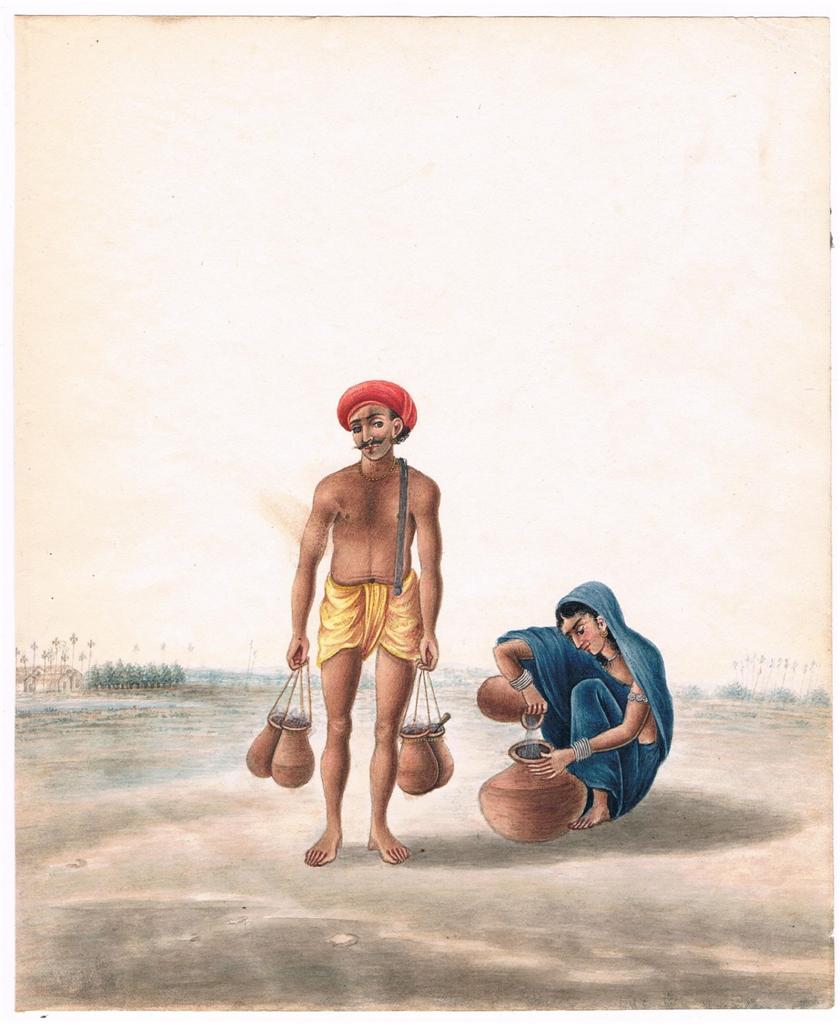
'''Patna School of Painting''' (also '''Patna Qalaam''', '''Patna Kalam | [[File:Hot water seller.jpg|thumb|Bhisti (Water seller)]] | ||
The '''Patna School of Painting''' (also '''Patna Qalaam''', or '''Patna Kalam''') is a style of [[Indian painting]] which existed in [[Bihar]], India in the 18th and 19th centuries.<ref name="Mithila Painting">{{cite web |title=Call to reinvent Patna Kalam paintings |url=https://timesofindia.indiatimes.com/city/patna/call-to-reinvent-patna-kalam-paintings/articleshow/68028044.cms |website=Times Of India |access-date=Feb 17, 2019}}</ref> The Patna School dealt almost exclusively with common people and their lifestyles, which helped the paintings gain in popularity.<ref>{{Cite web|url=https://www.telegraphindia.com/bihar/patna-kalam-comes-alive-in-30-minute-documentary/cid/1341613|title=Patna Kalam comes alive in 30-minute documentary|website=www.telegraphindia.com|language=en|access-date=2018-12-25|archive-url=https://web.archive.org/web/20181225175145/https://www.telegraphindia.com/states/bihar/patna-kalam-comes-alive-in-30-minute-documentary/cid/1341613|archive-date=25 December 2018|url-status=live}}</ref> The principal centres of this style were in [[Patna]], [[Danapur]] and [[Arrah]]. | |||
The [[Art history|art historian]], [[Mildred Archer]] said of the Patna School of painting that: "''It marks the fusion of Eastern and Western taste which occurred in the nineteenth century and mirrors the interests and artistic fashions of the period. The school is, in fact, a summary of the complicated interplay of European and Indian cultures in the nineteenth century.''"<ref name=Archer1948>{{cite book |last1=Archer |first1=Mildred |title=Patna Painting |date=1948 |publisher=Royal India Society |page=vii |url=https://archive.org/details/in.gov.ignca.2044}}</ref> | |||
== History == | |||
The barrister and art collector [[Percival Chater Manuk]] of Patna<ref>{{Cite news |last=Goswamy |first=BN |date=March 27, 2016 |title=An uncommon art collector |work=Tribune India |url=https://www.tribuneindia.com/news/archive/arts/an-uncommon-art-collector-213697}}</ref> wrote the first detailed research article on the history of the Patna School of Painting, its prominent artists, and various notable collections. This was after coming across a collection of work by the painter, [[Shiva]] Lal. This work was entitled the ''Patna School of Painting'' and was published in the Bihar Research Journal in 1943.<ref name=":3">{{Cite journal |last=Rekha |first=Neel |date=2011 |title=The Patna School of Painting: A Brief History (1760–1880) |url=https://www.jstor.org/stable/44146791 |journal=Proceedings of the Indian History Congress |publisher=Indian History Congress |volume=72 |issue=1 |pages=997–1007 |jstor=44146791}}</ref> | |||
Patna Kalam is an off-shoot of both [[Mughal painting]] and of [[Company style]] art.<ref name=Archer1948 /> The Mughal style of painting matured in the regime of [[Jahangir]], and his period was considered the golden era of Mughal paintings,<ref>{{Cite web|url=http://inficentre.blogspot.com/2011/09/patna-kalam-paintings-introduction.html|title=Patna Kalam Paintings an Introduction|archive-url=https://web.archive.org/web/20190515084817/http://inficentre.blogspot.com/2011/09/patna-kalam-paintings-introduction.html|archive-date=15 May 2019|url-status=live}}</ref> but during the rule of [[Aurangzeb]] in the late 17th and early 18th century, artisans faced mass prosecution and aversion in art and painting. The painters migrated from [[Old Delhi|Delhi]] looking for shelter in different places. One such group moved eastward and landed in [[Murshidabad]] under the patronage of the [[Nawabs of Bengal and Murshidabad|Nawab of Bengal]] and other local aristocrats, though British patrons were also important.<ref name="Mithila Painting" /> | |||
[[File:Holi being played in the courtyard, ca 1795 painting.jpg|thumb|Holi being played in the courtyard, ca 1795 painting in Patna style.]] | |||
Patna Kalam is an off-shoot of [[Mughal painting]]. The Mughal style of painting matured in the regime of [[Jahangir]], and his period was considered the golden era of Mughal paintings,<ref>{{Cite web|url=http://inficentre.blogspot.com/2011/09/patna-kalam-paintings-introduction.html|title=Patna Kalam Paintings an Introduction|archive-url=https://web.archive.org/web/20190515084817/http://inficentre.blogspot.com/2011/09/patna-kalam-paintings-introduction.html|archive-date=15 May 2019|url-status=live}}</ref> but during the rule of [[Aurangzeb]] in the late 17th and early 18th century, artisans faced mass prosecution and aversion in art and painting. The painters migrated from [[Old Delhi|Delhi]] looking for shelter in different places. One such group moved eastward and landed in [[Murshidabad]] under the patronage of the [[Nawabs of Bengal and Murshidabad|Nawab of Bengal]] and other local aristocrats. | |||
In the mid 18th century, after the fall of The Nawab of Bengal and subsequent decline of Murshidabad, the artisans started moving to the | In the mid-18th century, after the fall of The Nawab of Bengal and the subsequent decline of Murshidabad, the artisans started moving to the next biggest city in the east, Patna. In Patna they came under the patronage of local aristocracy and often [[Indophile]] scions of the early [[East India Company]].<ref name=":4">{{Cite news |last=Roy |first=Indranil |date=March 6, 2010 |title=Return of the 'Patna Kalam' |work=Deccan Herald |url=https://www.deccanherald.com/content/56522/return-patna-kalam.html}}</ref><ref name=":2">{{Cite news |last=Anwar |first=Shakeel |date=Jan 29, 2019 |title=Patna Kalam Painting – Origin and Characteristics |work=Jagran Josh |url=https://www.jagranjosh.com/general-knowledge/patna-kalam-painting-origin-and-characteristics-1548754612-1 |url-status=live |archive-url=https://web.archive.org/web/20190425113316/https://www.jagranjosh.com/general-knowledge/patna-kalam-painting-origin-and-characteristics-1548754612-1 |archive-date=25 April 2019}}</ref><ref>{{Cite news |last=Nigam |first=Richa |date=January 15, 2021 |title=Patna Kalam: Bihar’s adrift artform: Tradition that failed the test of time |work=Media India Group |url=https://mediaindia.eu/culture/patna-kalam-bihars-adrift-artform/}}</ref> | ||
== Style == | == Style == | ||
Patna Kalam is regarded as an off-shoot of [[Mughal painting]], with influences from Persian and Company | Patna Kalam is regarded as an off-shoot of [[Mughal painting]], with influences from Persian and the [[Company painting]] style developed for British customers.<ref name=":0">{{Cite web|url=http://www.bharatonline.com/bihar/art-craft/patna-kalam.html|title=Patna Kalam – Patna School of Painting Bihar India|website=www.bharatonline.com|access-date=2018-12-25|archive-url=https://web.archive.org/web/20181225175434/http://www.bharatonline.com/bihar/art-craft/patna-kalam.html|archive-date=25 December 2018|url-status=live}}</ref> The portraits can be clearly seen having colours and linings from Mughal style, and the shading can be seen to be adopted from the British style.<ref>{{Citation|last=Rajya Sabha TV|title=RSTV Documentary – Patna Kalam|url=https://www.youtube.com/watch?v=N15kNy4i6co|access-date=2018-12-25}}</ref> Diverging from the Mughal and Persian style of wide and exquisitely decorated borders, Patna Kalam primarily focused on the subject of the painting. | ||
Unlike Mughal paintings, which focused on royalty and court scenes, flag bearers of Patna Kalam were deeply influenced by the daily life of the common man, also a common subject in Company painting. Their main subjects were local festivals, ceremonies, bazaar scenes, local rulers, and domestic activities. The paintings were done on diverse surfaces such as paper, mica, and even ivory diskettes, that were used as brooches.<ref name=":1">{{Cite web |title=Return of the 'Patna Kalam' |url=https://www.deccanherald.com/content/56522/return-patna-kalam.html |url-status=live |archive-url=https://web.archive.org/web/20190515084815/https://www.deccanherald.com/content/56522/return-patna-kalam.html |archive-date=15 May 2019}}</ref> | |||
[[File:Shiv Lal.jpg|thumb|Tamtam (Horse-drawn carriage) – by Shiv Lal]] | |||
A distinguishing characteristic of Patna Kalam is the minimal treatment of landscape foregrounds and backgrounds, which are given little emphasis. Another characteristic was the development of the shading of solid forms. Patna Kalam paintings are painted straightway with the brush without marking with a pencil to delineate [[The Contours|the contours]] of the picture and the procedure of painting is popularly known as 'Kajli Seahi.'<ref name=":2" /> | |||
== Legacy and decline == | |||
The distinctive style of the Patna School of Painting primarily gained prominence during the British colonial period and flourished until the mid-19th century.<ref name=":3" /><ref name=":5">{{Cite book |last=Archer |first=Mildred |url=https://ignca.gov.in/Asi_data/2044.pdf |title=Patna Painting |publisher=David Marlowe Ltd for The Royal India Society |year=1948 |location=Great Britain |via=Indira Gandhi National Centre for the Arts}}</ref> However, over time, the Patna School experienced a gradual decline, leaving behind a rich but fading legacy. The School was renowned for its unique blend of Mughal, Persian, and Indian artistic traditions. It primarily focused on illustrating mythological narratives, religious themes, and scenes from everyday life. The artists employed vibrant colours, intricate detailing, and delicate brushwork to create visually captivating works. One of the major factors contributing to the decline of the Patna School was the diminishing patronage and changing socio-political landscape.<ref name=":3" /> With the advent of the British Raj, the traditional Indian aristocratic patrons who had supported the art form started to lose their influence, leading to a decline in the demand for such paintings. However, the British too commissioned several works, which have not received enough scholarly attention, that can shed light on the nineteenth century socio-economic and cultural conditions of Patna.<ref name=":3" /> | |||
Additionally, the emergence of modern art movements and the growing popularity of European art styles further marginalised the School. As the art world shifted towards new forms of expression and Western influences, the traditional Indian styles faced challenges in maintaining relevance and attracting a new generation of artists. Art historians have noted that the decline of the Patna School of Painting may also be perceived due to the lack of institutional support and documentation. Unlike other renowned art schools in India, the Patna School lacked a systematic approach to preserving its techniques, styles, and historical records. This dearth of institutional backing hindered its continuity and led to a gradual loss of knowledge and skills associated with the art form.<ref name=":5" /> Despite its decline, the legacy of the Patna School of Painting continues to resonate within the art world. Many scholars recognise its contribution to the development of Indian art and its unique synthesis of cultural influences. Efforts are being made to revive and reinvent interest in this fading art form through exhibitions, workshops, and research initiatives.<ref name="Mithila Painting" /><ref name=":4" /> Therefore, it would seem the legacy of Patna School lives on ensuring that future generations can appreciate and learn from its artistic contributions. | |||
== Patna Kalam | == Patna Kalam today == | ||
Some well known painters of Patna Kalam were Sewak Ram, Hulas Lall, Shiv Lal, Shiva Dayal, Mahadeo Lal, and Ishwari Prasad Verma. There is currently no one to carry on the tradition. Only three collections of Patna Kalam paintings exist in Bihar, one at the [[Patna Museum]] and others at Khuda Baksh | Some well-known painters of Patna Kalam were Sewak Ram, Hulas Lall, Shiv Lal, Shiva Dayal, Mahadeo Lal, and Ishwari Prasad Verma.<ref name="Mithila Painting"/> There is currently no one to carry on the tradition. Only three collections of Patna Kalam paintings exist in Bihar, one at the [[Patna Museum]] and others at Khuda Baksh Library, Patna, and [[Patna University]]’s College of Arts and Crafts. The Patna Kalam flourished only as long as its Western patrons existed.<ref>{{cite web |title=A centre of excellence for arts & crafts |url=https://timesofindia.indiatimes.com/city/patna/a-centre-of-excellence-for-arts-crafts/articleshow/90385280.cms |website=Times Of India |access-date=Mar 23, 2022}}</ref> | ||
== Gallery == | == Gallery == | ||
<gallery> | <gallery> | ||
File:Painting of the Golghar Granary (Patna style).JPG|[[Gol Ghar]], 19th Century Painting | File:Painting of the Golghar Granary (Patna style).JPG|[[Gol Ghar]], 19th Century Painting | ||
File:Durga Puja, 1809 watercolour painting in Patna Style.jpg|Durga Puja, 1809 watercolour painting in Patna Style | File:Durga Puja, 1809 watercolour painting in Patna Style.jpg|Durga Puja, 1809 watercolour painting in Patna Style | ||
| Line 30: | Line 40: | ||
== References == | == References == | ||
{{ | {{Commons}} | ||
{{reflist}} | {{reflist}} | ||
==Further reading== | ==Further reading== | ||
*{{cite book |author=Kossak , Steven | title= ''Indian court painting, | *{{cite book |author=Kossak, Steven | title= ''Indian court painting, 16th–19th century.'' | location=New York | publisher=The Metropolitan Museum of Art | year=1997| isbn=0870997831 | url=http://libmma.contentdm.oclc.org/cdm/compoundobject/collection/p15324coll10/id/12335/rec/74}} (see index: p. 148–152) | ||
[[Category:Schools of Indian painting]] | [[Category:Schools of Indian painting]] | ||
[[Category:Culture of | [[Category:Culture of Patna]] | ||
Latest revision as of 04:59, 5 March 2026

The Patna School of Painting (also Patna Qalaam, or Patna Kalam) is a style of Indian painting which existed in Bihar, India in the 18th and 19th centuries.[1] The Patna School dealt almost exclusively with common people and their lifestyles, which helped the paintings gain in popularity.[2] The principal centres of this style were in Patna, Danapur and Arrah.
The art historian, Mildred Archer said of the Patna School of painting that: "It marks the fusion of Eastern and Western taste which occurred in the nineteenth century and mirrors the interests and artistic fashions of the period. The school is, in fact, a summary of the complicated interplay of European and Indian cultures in the nineteenth century."[3]
History[edit | edit source]
The barrister and art collector Percival Chater Manuk of Patna[4] wrote the first detailed research article on the history of the Patna School of Painting, its prominent artists, and various notable collections. This was after coming across a collection of work by the painter, Shiva Lal. This work was entitled the Patna School of Painting and was published in the Bihar Research Journal in 1943.[5]
Patna Kalam is an off-shoot of both Mughal painting and of Company style art.[3] The Mughal style of painting matured in the regime of Jahangir, and his period was considered the golden era of Mughal paintings,[6] but during the rule of Aurangzeb in the late 17th and early 18th century, artisans faced mass prosecution and aversion in art and painting. The painters migrated from Delhi looking for shelter in different places. One such group moved eastward and landed in Murshidabad under the patronage of the Nawab of Bengal and other local aristocrats, though British patrons were also important.[1]

In the mid-18th century, after the fall of The Nawab of Bengal and the subsequent decline of Murshidabad, the artisans started moving to the next biggest city in the east, Patna. In Patna they came under the patronage of local aristocracy and often Indophile scions of the early East India Company.[7][8][9]
Style[edit | edit source]
Patna Kalam is regarded as an off-shoot of Mughal painting, with influences from Persian and the Company painting style developed for British customers.[10] The portraits can be clearly seen having colours and linings from Mughal style, and the shading can be seen to be adopted from the British style.[11] Diverging from the Mughal and Persian style of wide and exquisitely decorated borders, Patna Kalam primarily focused on the subject of the painting.
Unlike Mughal paintings, which focused on royalty and court scenes, flag bearers of Patna Kalam were deeply influenced by the daily life of the common man, also a common subject in Company painting. Their main subjects were local festivals, ceremonies, bazaar scenes, local rulers, and domestic activities. The paintings were done on diverse surfaces such as paper, mica, and even ivory diskettes, that were used as brooches.[12]

A distinguishing characteristic of Patna Kalam is the minimal treatment of landscape foregrounds and backgrounds, which are given little emphasis. Another characteristic was the development of the shading of solid forms. Patna Kalam paintings are painted straightway with the brush without marking with a pencil to delineate the contours of the picture and the procedure of painting is popularly known as 'Kajli Seahi.'[8]
Legacy and decline[edit | edit source]
The distinctive style of the Patna School of Painting primarily gained prominence during the British colonial period and flourished until the mid-19th century.[5][13] However, over time, the Patna School experienced a gradual decline, leaving behind a rich but fading legacy. The School was renowned for its unique blend of Mughal, Persian, and Indian artistic traditions. It primarily focused on illustrating mythological narratives, religious themes, and scenes from everyday life. The artists employed vibrant colours, intricate detailing, and delicate brushwork to create visually captivating works. One of the major factors contributing to the decline of the Patna School was the diminishing patronage and changing socio-political landscape.[5] With the advent of the British Raj, the traditional Indian aristocratic patrons who had supported the art form started to lose their influence, leading to a decline in the demand for such paintings. However, the British too commissioned several works, which have not received enough scholarly attention, that can shed light on the nineteenth century socio-economic and cultural conditions of Patna.[5]
Additionally, the emergence of modern art movements and the growing popularity of European art styles further marginalised the School. As the art world shifted towards new forms of expression and Western influences, the traditional Indian styles faced challenges in maintaining relevance and attracting a new generation of artists. Art historians have noted that the decline of the Patna School of Painting may also be perceived due to the lack of institutional support and documentation. Unlike other renowned art schools in India, the Patna School lacked a systematic approach to preserving its techniques, styles, and historical records. This dearth of institutional backing hindered its continuity and led to a gradual loss of knowledge and skills associated with the art form.[13] Despite its decline, the legacy of the Patna School of Painting continues to resonate within the art world. Many scholars recognise its contribution to the development of Indian art and its unique synthesis of cultural influences. Efforts are being made to revive and reinvent interest in this fading art form through exhibitions, workshops, and research initiatives.[1][7] Therefore, it would seem the legacy of Patna School lives on ensuring that future generations can appreciate and learn from its artistic contributions.
Patna Kalam today[edit | edit source]
Some well-known painters of Patna Kalam were Sewak Ram, Hulas Lall, Shiv Lal, Shiva Dayal, Mahadeo Lal, and Ishwari Prasad Verma.[1] There is currently no one to carry on the tradition. Only three collections of Patna Kalam paintings exist in Bihar, one at the Patna Museum and others at Khuda Baksh Library, Patna, and Patna University’s College of Arts and Crafts. The Patna Kalam flourished only as long as its Western patrons existed.[14]
Gallery[edit | edit source]
-
 Gol Ghar, 19th Century Painting
 -
 Durga Puja, 1809 watercolour painting in Patna Style
 -
 GolGhar, 19th Century Painting
 -
 Patna along The Ganges
 -
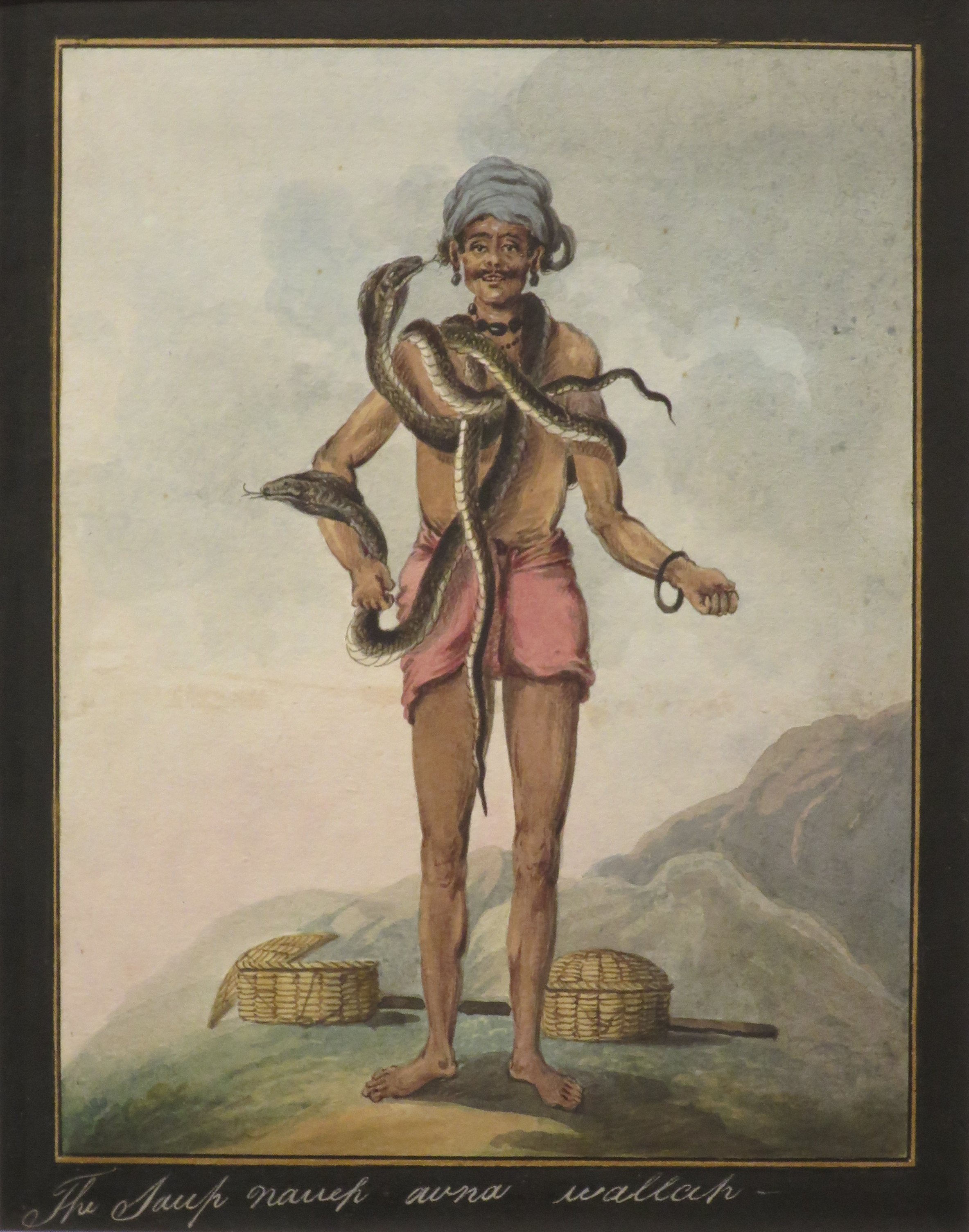 Snake charmer, 19th century
.JPG)


References[edit | edit source]
- ↑ 1.0 1.1 1.2 1.3 "Call to reinvent Patna Kalam paintings". Times Of India. Retrieved 17 February 2019.
- ↑ "Patna Kalam comes alive in 30-minute documentary". www.telegraphindia.com. Archived from the original on 25 December 2018. Retrieved 25 December 2018.
- ↑ 3.0 3.1 Archer, Mildred (1948). Patna Painting. Royal India Society. p. vii.
- ↑ Goswamy, BN (27 March 2016). "An uncommon art collector". Tribune India.
- ↑ 5.0 5.1 5.2 5.3 Rekha, Neel (2011). "The Patna School of Painting: A Brief History (1760–1880)". Proceedings of the Indian History Congress. 72 (1). Indian History Congress: 997–1007. JSTOR 44146791.
- ↑ "Patna Kalam Paintings an Introduction". Archived from the original on 15 May 2019.
- ↑ 7.0 7.1 Roy, Indranil (6 March 2010). "Return of the 'Patna Kalam'". Deccan Herald.
- ↑ 8.0 8.1 Anwar, Shakeel (29 January 2019). "Patna Kalam Painting – Origin and Characteristics". Jagran Josh. Archived from the original on 25 April 2019.
- ↑ Nigam, Richa (15 January 2021). "Patna Kalam: Bihar's adrift artform: Tradition that failed the test of time". Media India Group.
- ↑ "Patna Kalam – Patna School of Painting Bihar India". www.bharatonline.com. Archived from the original on 25 December 2018. Retrieved 25 December 2018.
- ↑ Rajya Sabha TV, RSTV Documentary – Patna Kalam, retrieved 25 December 2018
- ↑ "Return of the 'Patna Kalam'". Archived from the original on 15 May 2019.
- ↑ 13.0 13.1 Archer, Mildred (1948). Patna Painting (PDF). Great Britain: David Marlowe Ltd for The Royal India Society – via Indira Gandhi National Centre for the Arts.
- ↑ "A centre of excellence for arts & crafts". Times Of India. Retrieved 23 March 2022.
Further reading[edit | edit source]
- Kossak, Steven (1997). Indian court painting, 16th–19th century.. New York: The Metropolitan Museum of Art. ISBN 0870997831. (see index: p. 148–152)