



m Removed empty portal template using script |
m basic rework section after review additionally and added references |
||
| Line 1: | Line 1: | ||
{{Short description|Nonsense verse by Sukumar | {{Short description|Nonsense verse by Sukumar Ray}} | ||
| name =Abol Tabol | {{Infobox book | ||
| image =Aboltabol.gif | | name = Abol Tabol | ||
| caption = | | image = Aboltabol.gif | ||
| author =[[Sukumar Ray]] | | caption = | ||
| author = [[Sukumar Ray]] | |||
| country = India | | country = India | ||
| language = [[Bengali language|Bengali]] | | language = [[Bengali language|Bengali]] | ||
| Line 11: | Line 12: | ||
| wikisource = bn:%E0%A6%86%E0%A6%AC%E0%A7%8B%E0%A6%B2_%E0%A6%A4%E0%A6%BE%E0%A6%AC%E0%A7%8B%E0%A6%B2 | | wikisource = bn:%E0%A6%86%E0%A6%AC%E0%A7%8B%E0%A6%B2_%E0%A6%A4%E0%A6%BE%E0%A6%AC%E0%A7%8B%E0%A6%B2 | ||
}} | }} | ||
'''''Abol tabol''''' ({{ | '''''Abol tabol''''' ({{langx|bn|আবোল তাবোল}}; {{audio|Bn-আবোল তাবোল.oga|listen|''Aabol Tabol''}}; {{literally}} 'The Weird and the Absurd') is a collection of Bengali children's poems and rhymes composed by [[Sukumar Ray]], first published on 19 September 1923 by [[U. Ray and Sons]] publishers. It consists of 46 titled and seven untitled short rhymes (quatrains), all considered to be in the genre of nonsense literature. | ||
==Significance== | ==Significance== | ||
| Line 18: | Line 19: | ||
Although it was not understood at the time of its publication, many poems in ''Abol Tabol'' contain skilfully hidden satire on the state of society and administration of early 20th-century colonial India - mostly Bengal. Embedding implied hidden meanings of a subversive nature in nonsense rhymes for children, was Ray's clever way of subverting press censorship by the then British administration in India, which was paranoid about seditious and subversive literature.<ref>{{cite book|last=Goswami |first=Supriya |title=Colonial India in Children's Literature |publisher=Routledge |year=2012 |page=152}}</ref> | Although it was not understood at the time of its publication, many poems in ''Abol Tabol'' contain skilfully hidden satire on the state of society and administration of early 20th-century colonial India - mostly Bengal. Embedding implied hidden meanings of a subversive nature in nonsense rhymes for children, was Ray's clever way of subverting press censorship by the then British administration in India, which was paranoid about seditious and subversive literature.<ref>{{cite book|last=Goswami |first=Supriya |title=Colonial India in Children's Literature |publisher=Routledge |year=2012 |page=152}}</ref> | ||
[[File:ABTBtimeline2ndEd.png|alt=Historical events depicted in the poems of Abol Tabol.|thumb|Timeline and brief explanations of historical events commented upon in the poems of Abol Tabol.]] | [[File:ABTBtimeline2ndEd.png|alt=Historical events depicted in the poems of Abol Tabol.|thumb|Timeline and brief explanations of historical events commented upon in the poems of Abol Tabol.]] | ||
In analytical literature since 2017, the poems in ''Abol Tabol'' have been plotted on a timeline and compared with contemporaneous events, research having yielded plausible connections between historical events and the commentary and satire hidden in many of the poems.<ref name="Whimsy">{{cite book|last=Roy |first=Niladri |title=Rhymes of Whimsy - The Complete Abol Tabol|publisher=Haton Cross Press |pages=116–117}}</ref> | In analytical literature since 2017, the poems in ''Abol Tabol'' have been plotted on a timeline and compared with contemporaneous events, research having yielded plausible connections between historical events and the commentary and satire hidden in many of the poems.<ref name="Whimsy">{{cite book|last=Roy |first=Niladri |title=Rhymes of Whimsy - The Complete Abol Tabol|publisher=Haton Cross Press |pages=116–117}}</ref> A significant perspective on Ray's Abol Tabol has been explored by Hirak Bhattacharya in his article entitled, " Rethinking Sukumar Ray's Abol Tabol as a Multimodal Text". Bhattacharya contends that, Ray's visionary mind accompanied the poems of Abol Tabol with illustrations. Such sketches imbibed unschooled learners to have a comprehensive understanding of the text without delving deep into the dynamics of alphabetical logarithms. The illustrations accompanying Ray's poems appeal to aesthetic sense of the readers and in a way creates a whole edifice of perceptual understanding of the poems, appealing all the sensory perceptions. In this way, Bhattacharya, explores the multimodal aspects of the text, that transcends the [[liminality]] of a text-centred approach. | ||
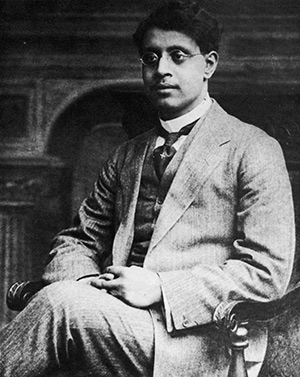
[[File:Sukumar Ray.jpg|thumb|Sukumar Ray]] | |||
== Publication history == | == Publication history == | ||
Sukumar Ray wrote for | Sukumar Ray wrote for [[Sandesh (magazine)|Sandesh]], a children's magazine started by his father [[Upendrakishore Ray Chowdhury]] in [[Calcutta]]. The poems in ''Abol Tabol'', most of which first appeared in ''Sandesh'', were composed between 1915 and 1923<ref name="Sukumar Sahitya Samagra">{{cite book|last=Ray |first=Sukumar |chapter=Abol Tabol |title=Sukumar Sahitya Samagra |year=1973 |volume=1 |editor1-first=Satyajit |editor1-last=Ray |editor2-first=Partha |editor2-last=Basu |location=Kolkata |publisher=Ananda Publishers |page=314}}</ref>. ''Abol Tabol'' was originally the name designating a section within ''Sandesh'' where many of these poems were first published. Thirty-nine poems and seven untitled quatrains can be traced back to having first appeared in ''Sandesh''. Seven other poems making up the balance of the collection were selected by Ray possibly from previously unpublished manuscripts<ref name="Sukumar Sahitya Samagra" />. The first and the last poems, both titled ''Abol Tabol'' were written by Ray specifically for the collection possibly in 1923<ref name=Whimsy />. | ||
==Characters== | ==Characters== | ||
| Line 26: | Line 29: | ||
Some of the most famous characters in "Abol tabol" are: | Some of the most famous characters in "Abol tabol" are: | ||
* | * Kaathburo (Poem: Kaathburo) | ||
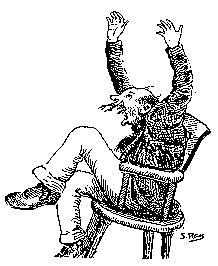
* Head Officer | [[File:Kathburo.gif|thumb|Kathburo]] | ||
* Head Officer Boro Babu (Poem: Gnof Churi) | |||
[[File:Gofchuri.gif|thumb|Gnofchuri]] | |||
* Kumro Potash (Poem: Kumro Potash) | * Kumro Potash (Poem: Kumro Potash) | ||
* Gangaram (Poem: Sat Patro) | * Gangaram (Poem: Sat Patro) | ||
* Chandidaser | * Chandidaser Khuro (Poem: Khuror Kal) | ||
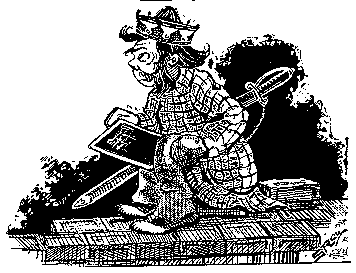
* | * Bombagoder Raja (Poem: Bombagorer Raja) | ||
[[File:Bombagarerraja1.gif|thumb|Bombagoder Raja]] | |||
* Hnukumukho Hyangla (Poem: Hnukumukho Hyangla) | * Hnukumukho Hyangla (Poem: Hnukumukho Hyangla) | ||
* | * Ramgoruder Chhana (Poem: Ramgorurer Chhana) | ||
[[File:Ramgarurer Chhana.svg|thumb|Ramgaruder Chhana]] | |||
* Tnyash Goru (Poem: Tnyash Goru) | * Tnyash Goru (Poem: Tnyash Goru) | ||
* | [[File:Tashgoru.gif|thumb|Tnyashgoru]] | ||
* | * Shashthi Charan (Poem: Palowan) | ||
* Nera (Poem: Nera Beltolay Jay Kobar) | [[File:Paloan.gif|thumb|Shashthi Charan]] | ||
* Jagmohan (Poem: Thikana) | |||
* Panta Bhoot (Poem: Bhooture Khela) | |||
* Nera (Poem: Nera Beltolay Jay Kobar?) | |||
[[File:Nbtjk.gif|thumb|Nera Beltolay Jay Kobar?]] | |||
* Katukutu Buro (Poem: Katukutu Buro) | * Katukutu Buro (Poem: Katukutu Buro) | ||
* Bhisman Lochan Sharma (Poem : Ganer Gunto) | |||
==English Translations== | |||
A complete translation of all 53 poems appears in ''Rhymes of Whimsy - The Complete Abol Tabol,'' trans. Niladri Roy (Haton Cross Press, 2017). A dual-language edition (Haton Cross Press, 2017) includes the Bengali originals; the second edition (Haton Cross Press, 2020) includes the original illustrations by Sukumar Ray. | |||
''The Tenth Rasa: An Anthology of Indian Nonsense'', ed. Michael Heyman, [[Sumanyu Satpathy]] and [[Anushka Ravishankar]] (Penguin, 2007) includes several translations of poems from ''Abol Tabol'' by Sampurna Chattarji. | |||
''' | |||
'' | ''Abol Tabol: The Nonsense World of Sukumar Ray'' trans. Sampurna Chattarji (Puffin, 2004) includes a partial translation and additionally includes translations of ''Khapchhada'', ''Bohurupee'', ''Other Stories'', ''[[HaJaBaRaLa|Haw-Jaw-Baw-Raw-Law]]'', ''Khai-Khai'', and ''[[Pagla Dashu]]''. | ||
''The Select Nonsense of Sukumar Ray'' trans. Sukanta Chaudhuri (Oxford University Press, 1987) is a partial translation and contains an introduction by [[Satyajit Ray]]. | |||
''The | |||
''Rhymes | ''Nonsense Rhymes'' trans. Satyajit Ray (Calcutta Writer's Workshop, 1970) is a partial translation. | ||
== Further reading == | |||
''Fantastic Beasts and How to Sketch Them: The Fabulous Bestiary of Sukumar Ray'' | * Roy, N. (2021) ''Aaloy Dhaka Ondhokar (আলোয় ঢাকা অন্ধকার)''. Kolkata, Dey's Publishing: offers an analysis of all the poems including explanation of hidden satire. | ||
* Bhadury, P. (2013) ''Fantastic Beasts and How to Sketch Them: The Fabulous Bestiary of Sukumar Ray''. South Asian Review, Vol. 34, No. 1: reviews of some of Sukumar Ray's illustrations in ''Abol Tabol'' | |||
''Colonial India in Children’s Literature'' | * Goswami, S (2012) ''Colonial India in Children’s Literature.'' Routledge. | ||
* | * Chaudhuri, S. (1995) ''The World of Sukumar Ray'' (in ''Telling Tales: Children’s Literature in India'', ed. Amit Dasgupta, pp. 88-96). New Delhi, New Age International Publishers Ltd | ||
''The World of Sukumar Ray | |||
== References == | == References == | ||
{{reflist}} | {{reflist}} | ||
4. Bhattacharya, Hirak. "Rethinking Sukumar Ray's ''Abol Tabol'' as a Multimodal Text." ''Bookbird: A Journal of International Children's Literature'', vol. 59 no. 1, 2021, p. 64-69. ''Project MUSE'', [[doi:10.1353/bkb.2021.0000]]. | |||
==External links== | ==External links== | ||
{{Portal |Children's literature}} | |||
*[https://bn.wikisource.org/wiki/সুকুমার_রায়_সমগ্র_রচনাবলী_(দ্বিতীয়_খণ্ড)/কবিতাগুচ্ছ কবিতাগুচ্ছ in Wikisource] | |||
*[http://aboltabol.freehostia.com/index.html Abol Tabol English translations and full list of poems] | |||
{{Authority control}} | |||
[[Category:Bengali-language literature]] | [[Category:Bengali-language literature]] | ||
| Line 85: | Line 90: | ||
[[Category:Indian poetry collections]] | [[Category:Indian poetry collections]] | ||
[[Category:Indian children's literature]] | [[Category:Indian children's literature]] | ||
[[Category:Indian humorous poems]] | |||
[[Category:Nonsense poetry]] | |||
Latest revision as of 07:15, 22 March 2026
 | |
| Author | Sukumar Ray |
|---|---|
| Country | India |
| Language | Bengali |
| Publisher | U. Ray and Sons |
| Text | Abol Tabol at Wikisource |
Abol tabol (Script error: The function "langx" does not exist.;  listen (help·info); lit. 'The Weird and the Absurd') is a collection of Bengali children's poems and rhymes composed by Sukumar Ray, first published on 19 September 1923 by U. Ray and Sons publishers. It consists of 46 titled and seven untitled short rhymes (quatrains), all considered to be in the genre of nonsense literature.
Significance[edit | edit source]
Bengali readers were exposed to a new nonsense fantasy world by the poems in Abol Tabol. This selection offers the best of Sukumar Ray's world of pun-riddled poetry.
Although it was not understood at the time of its publication, many poems in Abol Tabol contain skilfully hidden satire on the state of society and administration of early 20th-century colonial India - mostly Bengal. Embedding implied hidden meanings of a subversive nature in nonsense rhymes for children, was Ray's clever way of subverting press censorship by the then British administration in India, which was paranoid about seditious and subversive literature.[1]

In analytical literature since 2017, the poems in Abol Tabol have been plotted on a timeline and compared with contemporaneous events, research having yielded plausible connections between historical events and the commentary and satire hidden in many of the poems.[2] A significant perspective on Ray's Abol Tabol has been explored by Hirak Bhattacharya in his article entitled, " Rethinking Sukumar Ray's Abol Tabol as a Multimodal Text". Bhattacharya contends that, Ray's visionary mind accompanied the poems of Abol Tabol with illustrations. Such sketches imbibed unschooled learners to have a comprehensive understanding of the text without delving deep into the dynamics of alphabetical logarithms. The illustrations accompanying Ray's poems appeal to aesthetic sense of the readers and in a way creates a whole edifice of perceptual understanding of the poems, appealing all the sensory perceptions. In this way, Bhattacharya, explores the multimodal aspects of the text, that transcends the liminality of a text-centred approach.

Publication history[edit | edit source]
Sukumar Ray wrote for Sandesh, a children's magazine started by his father Upendrakishore Ray Chowdhury in Calcutta. The poems in Abol Tabol, most of which first appeared in Sandesh, were composed between 1915 and 1923[3]. Abol Tabol was originally the name designating a section within Sandesh where many of these poems were first published. Thirty-nine poems and seven untitled quatrains can be traced back to having first appeared in Sandesh. Seven other poems making up the balance of the collection were selected by Ray possibly from previously unpublished manuscripts[3]. The first and the last poems, both titled Abol Tabol were written by Ray specifically for the collection possibly in 1923[2].
Characters[edit | edit source]
His collection had several characters which became legendary in Bengali literature and culture. Some characters even have found idiomatic usage in the language.
Some of the most famous characters in "Abol tabol" are:
- Kaathburo (Poem: Kaathburo)

- Head Officer Boro Babu (Poem: Gnof Churi)

- Kumro Potash (Poem: Kumro Potash)
- Gangaram (Poem: Sat Patro)
- Chandidaser Khuro (Poem: Khuror Kal)
- Bombagoder Raja (Poem: Bombagorer Raja)

- Hnukumukho Hyangla (Poem: Hnukumukho Hyangla)
- Ramgoruder Chhana (Poem: Ramgorurer Chhana)

- Tnyash Goru (Poem: Tnyash Goru)

- Shashthi Charan (Poem: Palowan)

- Jagmohan (Poem: Thikana)
- Panta Bhoot (Poem: Bhooture Khela)
- Nera (Poem: Nera Beltolay Jay Kobar?)

- Katukutu Buro (Poem: Katukutu Buro)
- Bhisman Lochan Sharma (Poem : Ganer Gunto)
English Translations[edit | edit source]
A complete translation of all 53 poems appears in Rhymes of Whimsy - The Complete Abol Tabol, trans. Niladri Roy (Haton Cross Press, 2017). A dual-language edition (Haton Cross Press, 2017) includes the Bengali originals; the second edition (Haton Cross Press, 2020) includes the original illustrations by Sukumar Ray.
The Tenth Rasa: An Anthology of Indian Nonsense, ed. Michael Heyman, Sumanyu Satpathy and Anushka Ravishankar (Penguin, 2007) includes several translations of poems from Abol Tabol by Sampurna Chattarji.
Abol Tabol: The Nonsense World of Sukumar Ray trans. Sampurna Chattarji (Puffin, 2004) includes a partial translation and additionally includes translations of Khapchhada, Bohurupee, Other Stories, Haw-Jaw-Baw-Raw-Law, Khai-Khai, and Pagla Dashu.
The Select Nonsense of Sukumar Ray trans. Sukanta Chaudhuri (Oxford University Press, 1987) is a partial translation and contains an introduction by Satyajit Ray.
Nonsense Rhymes trans. Satyajit Ray (Calcutta Writer's Workshop, 1970) is a partial translation.
Further reading[edit | edit source]
- Roy, N. (2021) Aaloy Dhaka Ondhokar (আলোয় ঢাকা অন্ধকার). Kolkata, Dey's Publishing: offers an analysis of all the poems including explanation of hidden satire.
- Bhadury, P. (2013) Fantastic Beasts and How to Sketch Them: The Fabulous Bestiary of Sukumar Ray. South Asian Review, Vol. 34, No. 1: reviews of some of Sukumar Ray's illustrations in Abol Tabol
- Goswami, S (2012) Colonial India in Children’s Literature. Routledge.
- Chaudhuri, S. (1995) The World of Sukumar Ray (in Telling Tales: Children’s Literature in India, ed. Amit Dasgupta, pp. 88-96). New Delhi, New Age International Publishers Ltd
References[edit | edit source]
- ↑ Goswami, Supriya (2012). Colonial India in Children's Literature. Routledge. p. 152.
- ↑ 2.0 2.1 Roy, Niladri. Rhymes of Whimsy - The Complete Abol Tabol. Haton Cross Press. pp. 116–117.
- ↑ 3.0 3.1 Ray, Sukumar (1973). "Abol Tabol". In Ray, Satyajit; Basu, Partha (eds.). Sukumar Sahitya Samagra. Vol. 1. Kolkata: Ananda Publishers. p. 314.
4. Bhattacharya, Hirak. "Rethinking Sukumar Ray's Abol Tabol as a Multimodal Text." Bookbird: A Journal of International Children's Literature, vol. 59 no. 1, 2021, p. 64-69. Project MUSE, doi:10.1353/bkb.2021.0000.