



Ajay Kumar (talk | contribs) Created a new article |
further adjust references per standard format and improved wording |
||
| Line 10: | Line 10: | ||
}} | }} | ||
'''Betel''' ('''''Piper betle''''') is a species of flowering plant in the pepper family [[Piperaceae]], native to Southeast Asia. It is an evergreen, [[dioecious]]<ref name="RimandoHan1986"/> vine, with glossy heart-shaped leaves and white [[catkin]]s. Betel plants are cultivated for their leaves, which are most commonly used as flavoring for chewing [[areca nut]] in so-called ''betel quid'' (often confusingly referred to as "betel nut"), which is toxic (as it is a psychostimulant drug) and is associated with a wide range of serious health conditions. | |||
==Etymology== | ==Etymology== | ||
The term [[wikt:betel|betel]] was derived from the [[Malayalam language|Malayalam]] word ''vettila'' via Portuguese.<ref>{{Cite OED | betel }}</ref><ref>{{cite book |title=Portuguese Vocables in Asiatic Languages: From the Portuguese Original of M S R Dalgado |year=1988 |publisher=Asian Educational Services |location=New Delhi |isbn=812060413X}}</ref> | The term [[wikt:betel|betel]] was derived from the [[Malayalam language|Malayalam]]/[[Tamil language|Tamil]] word ''vettila'' via Portuguese.<ref>{{Cite OED | betel }}</ref><ref>{{cite book |title=Portuguese Vocables in Asiatic Languages: From the Portuguese Original of M S R Dalgado |year=1988 |publisher=Asian Educational Services |location=New Delhi |isbn=812060413X}}</ref> | ||
==Distribution== | ==Distribution== | ||
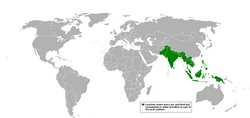
''Piper betle'' is originally native to Southeast Asia, from [[India]] | ''Piper betle'' is originally native to Southeast Asia, from [[India]], [[Philippines]], [[Timor-Leste]] and [[Indonesia]] and [[Peninsular Malaysia]] to [[Indochina]], [[Vietnam]], [[Cambodia]], [[Laos]], [[Thailand]], and [[Myanmar]]. Its cultivation has spread along with the [[Austronesian expansion|Austronesian migrations]] and [[Austronesian maritime trade network|trade]] to other parts of [[Island Southeast Asia]], [[Papua New Guinea]] and [[Melanesia]], [[Micronesia]], [[South Asia]], the [[Maldives]], [[Mauritius]], [[Réunion Island]], and [[Madagascar]]. It was introduced during the [[Colonial Era]] to the [[Caribbean]] by [[Indo-Caribbeans|Indian indentured immigrants]].<ref name="powo">{{cite web |title=''Piper betle'' L. |url=https://powo.science.kew.org/taxon/680605-1 |website=Plants of the World Online |publisher=Royal Botanic Gardens, Kew |access-date=23 April 2022}}</ref><ref name="Zumbroich2007">{{cite journal |last1=Zumbroich |first1=Thomas J. |title=The origin and diffusion of betel chewing: a synthesis of evidence from South Asia, Southeast Asia and beyond |journal=eJournal of Indian Medicine |date=2007–2008 |volume=1 |pages=87–140 |url=https://ugp.rug.nl/eJIM/article/download/24712/22162}}</ref> | ||
==Cultivation== | ==Cultivation== | ||
[[File:Arecanutconsum1.PNG|thumb|left|350px|Betel leaf and Areca nut consumption in the world | [[File:Arecanutconsum1.PNG|thumb|left|350px|Betel leaf and Areca nut consumption in the world]] | ||
The betel leaf is cultivated mostly in | The betel leaf is cultivated mostly in the Indian subcontinent and Southeast Asia, from [[India]]<ref>{{cite news|title=Betel-leaf farming in coastal area|url=http://www.dawn.com/news/33381/betel-leaf-farming-in-coastal-area|access-date=30 October 2014|work=[[Dawn (newspaper)|Dawn]]|date=13 May 2002}}</ref> to [[Papua New Guinea]].<ref>{{cite news|last1=Cassey|first1=Brian|title=Chewing over a betel ban|url=http://www.smh.com.au/world/chewing-over-a-betel-ban-20131108-2x6ra.html|access-date=30 October 2014|work=Sydney Morning Herald|date=9 November 2013}}</ref> It needs a compatible tree or a long pole for support. Betel requires well-drained fertile soil. Waterlogged, [[Soil salinity|saline]] and [[alkali soil]]s are unsuitable for its cultivation.<ref name=LK/> | ||
In Bangladesh, farmers called ''barui''<ref name="barouj">{{cite book |last=Karim |first=ASM Enayet |year=2012 |chapter=Pan1 |chapter-url=http://en.banglapedia.org/index.php?title=Pan1 |editor1-last=Islam |editor1-first=Sirajul |editor1-link=Sirajul Islam |editor2-last=Jamal |editor2-first=Ahmed A |title=Banglapedia: National Encyclopedia of Bangladesh |edition=Second |publisher=[[Asiatic Society of Bangladesh]]}}</ref> prepare a garden called a ''barouj'' in which to grow betel. The ''barouj'' is fenced with [[bamboo]] sticks and [[coconut]] leaves. The soil is plowed into furrows of 10 to 15 m length, 75 cm in width and 75 cm depth. [[Press cake|Oil cakes]], [[manure]], and leaves are thoroughly incorporated with the [[topsoil]] of the furrows and [[wood ash]]. The cuttings are planted at the beginning of the [[monsoon]] season. | In [[Bangladesh]], farmers called ''barui''<ref name="barouj">{{cite book |last=Karim |first=ASM Enayet |year=2012 |chapter=Pan1 |chapter-url=http://en.banglapedia.org/index.php?title=Pan1 |editor1-last=Islam |editor1-first=Sirajul |editor1-link=Sirajul Islam |editor2-last=Jamal |editor2-first=Ahmed A |title=Banglapedia: National Encyclopedia of Bangladesh |edition=Second |publisher=[[Asiatic Society of Bangladesh]]}}</ref> prepare a garden called a ''barouj'' in which to grow betel. The ''barouj'' is fenced with [[bamboo]] sticks and [[coconut]] leaves. The soil is plowed into furrows of 10 to 15 m length, 75 cm in width and 75 cm depth. [[Press cake|Oil cakes]], [[manure]], and leaves are thoroughly incorporated with the [[topsoil]] of the furrows and [[wood ash]]. The cuttings are planted at the beginning of the [[monsoon]] season. | ||
[[File:Betel Plant.JPG|thumb|Betel plant cultivation in Bangladesh]] | [[File:Betel Plant.JPG|thumb|Betel plant cultivation in Bangladesh]] | ||
[[File:Betel in Kolkata market.jpg|thumb|Betel leaves in Kolkata market, West Bengal, India]] | |||
Proper shade and [[irrigation]] are essential for the successful cultivation of this crop. Betel needs constantly moist soil, but there should not be excessive moisture. Irrigation is frequent and light, and standing water should not remain for more than half an hour. | Proper shade and [[irrigation]] are essential for the successful cultivation of this crop. Betel needs constantly moist soil, but there should not be excessive moisture. Irrigation is frequent and light, and standing water should not remain for more than half an hour. | ||
Dried leaves and wood ash are applied to the furrows at fortnightly intervals and cow dung slurry is sprinkled. Application of different kinds of leaves at monthly intervals is believed advantageous for the growth of the betel. In three to six months, the vines reach 150 to 180 | Dried leaves and wood ash are applied to the furrows at fortnightly intervals and cow dung slurry is sprinkled. Application of different kinds of leaves at monthly intervals is believed advantageous for the growth of the betel. In three to six months, the vines reach {{Convert|150 to 180|cm|abbr=on}} in height, and they will branch. Harvest begins with the farmer plucking the leaf and its [[Petiole (botany)|petiole]] with his right thumb. The harvest lasts 15 days to one month. The betel plant has made its way to research labs of many Bangladesh chemical and food nutrition companies. | ||
The harvested leaves are consumed locally and exported to other parts of Asia, the Middle East, Europe, and the Americas. Betel is grown and cultivated as an important crop in rural Bangladesh.{{citation needed|date=December 2013}} | The harvested leaves are consumed locally and exported to other parts of Asia, the Middle East, Europe, and the Americas. Betel is grown and cultivated as an important crop in rural Bangladesh.{{citation needed|date=December 2013}} | ||
==Cultural significance== | ==Cultural significance== | ||
{{Main| | {{Main|Betel nut chewing}} | ||
The primary use of betel leaf is as a wrapper for the [[paan|chewing]] of [[areca nut]] | The primary use of betel leaf is as a wrapper for the [[paan|chewing]] of [[areca nut]], or in modern times, [[tobacco]], where it is mainly used to add flavour. The practice is thought to have originated in the [[Philippines]] around 5,000 years ago, where till date, the oldest remains of areca nuts and [[calcium]] from crushed sea shells have been found in the [[Duyong Cave]] archaeological site. It spread along with the [[Austronesian Expansion|Austronesian migrations]] to the rest of [[Southeast Asia]], [[Taiwan]], [[South China]], and [[South Asia]]. It is unknown when or why betel leaves were first combined with areca nuts, since areca nuts can be chewed alone.<ref name="Zumbroich2007"/> | ||
While the practice of chewing | While the practice of chewing betel leaf existed even before the [[common era]], with attested references from at least the 3rd century CE, the ingredient mix (paan/betel quid) it was chewed with changed over time.<ref name="scripta_mode_history">{{cite journal |doi=10.30674/scripta.67450 |title=Modes of betel leaf consumption in early India. |year=2015 |last1=Gutierrez |first1=Andrea |journal=[[Scripta Instituti Donneriani Aboensis]] |volume=26 |pages=114–34|doi-access=free }}</ref> [[Areca nut]], [[calcium hydroxide]] and [[catechu]] were the historic ingredients, as referenced in texts from 9th century CE. Tobacco started to feature in the 20th century.<ref name="scripta_mode_history"/><ref name="sa_cancer">{{cite journal |doi=10.4103/2278-330X.114120 |title=Betel leaf: Revisiting the benefits of an ancient Indian herb |year=2013 |last1=Toprani |first1=Rajendra |last2=Patel |first2=Daxesh |journal=South Asian Journal of Cancer |volume=2 |issue=3 |pages=140–141|doi-broken-date=11 July 2025 |pmid=24455591 |pmc=3892533 |doi-access=free }}</ref> The practice of chewing betel leaf is on the decline, and now quid consisting of tobacco, areca nut, and [[limewater]], known as [[gutka]], is more popular.<ref name="sa_cancer"/> | ||
In [[India]] and [[Sri Lanka]], a sheaf of betel leaves is traditionally offered as a mark of respect and auspicious beginnings. Occasions include greeting elders at wedding ceremonies, celebrating the New Year, and offering payment to physicians and astrologers | In [[India]] and [[Sri Lanka]], a sheaf of betel leaves is traditionally offered as a mark of respect and auspicious beginnings. Occasions include greeting elders at wedding ceremonies, celebrating the New Year, and offering payment to physicians and astrologers, to whom money and/or areca nut, placed on top of the sheaf of leaves, are offered in thanks for blessings. In Bengali weddings, the bride is brought to the groom, seated on a platform and her face covered in betel leaves. | ||
In [[Papua New Guinea]] and the [[Solomon Islands]], the [[inflorescence]] stalk of the betel tree, known as ''daka'' or "mustard stick", is consumed together with the leaves.<ref>{{Cite web|url=https://bicon.agriculture.gov.au/BiconWeb4.0/ImportConditions/Conditions?EvaluatableElementId=505572&Path=UNDEFINED&UserContext=External&EvaluationStateId=c07f9c08-7e77-4e40-922a-69f1723b0f6f&CaseElementPk=1426181&EvaluationPhase=ImportDefinition&HasAlerts=False&HasChangeNotices=False&IsAEP=False|title=BICON - Import Conditions - Conditions|website=bicon.agriculture.gov.au|accessdate=11 March 2023}}</ref><ref>{{Cite web|url=http://coraltriangle.blogs.panda.org/coral-reefs/making-lime-for-betelnut-chewing-in-mbuke-manus-png|title=Making Lime for Betelnut Chewing in M'Buke, Manus, PNG|date=25 July 2010|website=WWF Coral Triangle Blog|accessdate=11 March 2023}}</ref> | In [[Papua New Guinea]] and the [[Solomon Islands]], the [[inflorescence]] stalk of the betel tree, known as ''daka'' or "mustard stick", is consumed together with the leaves.<ref>{{Cite web|url=https://bicon.agriculture.gov.au/BiconWeb4.0/ImportConditions/Conditions?EvaluatableElementId=505572&Path=UNDEFINED&UserContext=External&EvaluationStateId=c07f9c08-7e77-4e40-922a-69f1723b0f6f&CaseElementPk=1426181&EvaluationPhase=ImportDefinition&HasAlerts=False&HasChangeNotices=False&IsAEP=False|title=BICON - Import Conditions - Conditions|website=bicon.agriculture.gov.au|accessdate=11 March 2023}}</ref><ref>{{Cite web|url=http://coraltriangle.blogs.panda.org/coral-reefs/making-lime-for-betelnut-chewing-in-mbuke-manus-png|title=Making Lime for Betelnut Chewing in M'Buke, Manus, PNG|date=25 July 2010|website=WWF Coral Triangle Blog|accessdate=11 March 2023}}</ref> | ||
It may also be used in cooking, usually raw, for its peppery taste. Use of | It may also be used in cooking, usually raw, for its peppery taste. Use of ''binlang'', or betel, has over a 300-year history in areas of China, where it was once promoted for medicinal use.<ref>{{cite news |last1=Levin |first1=Dan |title=Despite Risks, an Addictive Treat Fuels a Chinese City |url=https://www.nytimes.com/2010/08/20/world/asia/20hunan.html |access-date=16 November 2019 |newspaper=The New York Times |date=19 August 2010}}</ref> | ||
==Health effects== | ==Health effects== | ||
Red betel leaf is sometimes used as an antibacterial mouthwash.<ref>{{cite journal |vauthors=Heliawati L, Lestari S, Hasanah U, Ajiati D, Kurnia D |title=Phytochemical Profile of Antibacterial Agents from Red Betel Leaf (Piper crocatum Ruiz and Pav) against Bacteria in Dental Caries |journal=Molecules (Basel, Switzerland) |volume=27 |issue=9 |date=2022 |page=2861 |pmid=35566225 |pmc=9101570 |doi=10.3390/molecules27092861|doi-access=free }}</ref> While chewing or consuming betel leaf on its own has no known negative effect and have been shown to be chemopreventive in animal models,<ref>{{cite journal |last1=Toprani |first1=Rajendra |last2=Patel |first2=Daxesh |title=Betel leaf: Revisiting the benefits of an ancient Indian herb |journal=South Asian Journal of Cancer |date=2013 |volume=2 |issue=3 |pages=140–141 |pmid=24455591|pmc=3892533 |doi=10.4103/2278-330X.114120 |doi-broken-date=3 December 2025 |doi-access=free }}</ref> it is most often used to wrap ''betel quid'' for chewing, which also contains the carcinogenic and mildly narcotic areca nut.<ref name=Monte2020/> Habitual use of this popular product (sometimes inaccurately referred to as "betel nut") damages the [[oral cavity]] and is associated with a wide range of adverse systemic health effects, including harm to the [[cardiovascular]] and [[central nervous]] systems.<ref name=Monte2020>{{cite journal |vauthors=de la Monte SM, Moriel N, Lin A, Abdullah Tanoukhy N, Homans C, Gallucci G, Tong M, Saito A |title=Betel Quid Health Risks of Insulin Resistance Diseases in Poor Young South Asian Native and Immigrant Populations |journal=International Journal of Environmental Research and Public Health |volume=17 |issue=18 |date=2020 |page=6690 |pmid=32937888 |pmc=7558723 |doi=10.3390/ijerph17186690|doi-access=free }}</ref> Chewing paan (betel quid) is strongly associated with a higher risk of developing [[head and neck cancer]],<ref name="NCIfact">{{cite web |date=29 March 2017 |title=Head and Neck Cancers |url=https://www.cancer.gov/types/head-and-neck/head-neck-fact-sheet |website=[[National Cancer Institute|NCI]] |access-date=7 February 2021}}</ref> as well as [[Oropharyngeal cancer|oropharyngeal squamous cell carcinoma (OPSCC)]], a form of cancer that affects the [[Oropharynx|mouth, tonsils, and throat]].<ref name="StatPearls 2020">{{cite book |last1=A |first1=Fatima |last2=Zohaib |first2=J |title=Definitions |chapter=Oropharyngeal Squamous Cell Carcinoma |date=4 December 2020 |chapter-url=https://www.ncbi.nlm.nih.gov/books/NBK563268/ |work=StatPearls |place=Treasure Island (FL) |publisher=StatPearls Publishing |edition=Updated |id=Bookshelf ID: NBK563268 |doi=10.32388/G6TG1L |pmid=33085415 |s2cid=229252540 |via=[[NCBI]] |access-date=7 February 2021}}</ref> Multiple studies demonstrate that betel quid without added tobacco also causes [[esophageal cancer]], and in some instances, [[liver cancer]].<ref>{{cite journal |doi=10.1016/S1470-2045(09)70326-2 |title=A review of human carcinogens—Part E: tobacco, areca nut, alcohol, coal smoke, and salted fish |year=2009 |first1=Béatrice |last1=Secretan |first2=Kurt |last2=Straif |first3=Robert |last3=Baan |first4=Yann |last4=Grosse |first5=Fatiha |last5=El Ghissassi |first6=Véronique |last6=Bouvard |first7=Lamia |last7=Benbrahim-Tallaa |first8=Neela |last8=Guha |first9=Crystal |last9=Freeman |first10=Laurent |last10=Galichet |first11=Vincent |last11=Cogliano |journal=The Lancet Oncology |url=https://academic.oup.com/carcin/article/8/5/741/2478262?login=true |volume=10 |issue=11 |pages=1033–1034|pmid=19891056 |url-access=subscription }}</ref> Betel quid chewing can also cause [[stillbirth]], [[Preterm birth|premature birth]], and [[low birth weight]].<ref name="VidyasagaranSiddiqi201622">{{cite journal |last1=Vidyasagaran |first1=A. L. |last2=Siddiqi |first2=K. |last3=Kanaan |first3=M. |year=2016 |title=Use of smokeless tobacco and risk of cardiovascular disease: A systematic review and meta-analysis |url=http://eprints.whiterose.ac.uk/101100/1/EJPC_D_16_00085_R1_2016.pdf |journal=European Journal of Preventive Cardiology |volume=23 |issue=18 |pages=1970–1981 |doi=10.1177/2047487316654026 |issn=2047-4873 |pmid=27256827 |s2cid=206820997}}</ref><ref>{{cite journal |last1=Senn |first1=M. |last2=Baiwog |first2=F. |last3=Winmai |first3=J. |last4=Mueller |first4=I. |last5=Rogerson |first5=S. |last6=Senn |first6=N. |year=2009 |title=Betel nut chewing during pregnancy, Madang province, Papua New Guinea |journal=Drug and Alcohol Dependence |volume=105 |issue=1–2 |pages=126–31 |doi=10.1016/j.drugalcdep.2009.06.021 |pmid=19665325}}</ref><ref>{{cite journal |last1=Yang |first1=Mei-Sang |last2=Lee |first2=Chien-Hung |last3=Chang |first3=Shun-Jen |last4=Chung |first4=Tieh-Chi |last5=Tsai |first5=Eing-Mei |last6=Ko |first6=Allen Min-Jen |last7=Ko |first7=Ying-Chin |year=2008 |title=The effect of maternal betel quid exposure during pregnancy on adverse birth outcomes among aborigines in Taiwan |journal=Drug and Alcohol Dependence |volume=95 |issue=1–2 |pages=134–9 |doi=10.1016/j.drugalcdep.2008.01.003 |pmid=18282667}}</ref> | |||
The [[International Agency for Research on Cancer]] (IARC) and the [[World Health Organization]] (WHO) accept the scientific evidence that chewing tobacco and areca nut is [[carcinogenic]] to humans.<ref name=WHOCancer>{{cite book|title=Betel-quid and areca-nut chewing and some areca-nut-derived Nitrosamines|author=IARC Working Group|publisher=The World Health Organization|url=http://monographs.iarc.fr/ENG/Monographs/vol85/mono85.pdf|isbn=9789283215851}}</ref><ref>{{cite book |title=WHO Report on the Global Tobacco Epidemic, 2008: the MPOWER package |year=2008 |publisher=World Health Organization |location=Geneva |isbn=978-92-4-159628-2 |url=https://www.who.int/tobacco/mpower/mpower_report_full_2008.pdf|archive-url=https://web.archive.org/web/20080308173338/http://www.who.int/tobacco/mpower/mpower_report_full_2008.pdf|url-status=dead|archive-date=March 8, 2008}}</ref><ref>{{cite journal |doi=10.1136/bmj.324.7341.799 |title=Areca nut use: An independent risk factor for oral cancer |year=2002 |last1=Warnakulasuriya |first1=S. |journal=BMJ |volume=324 |issue=7341 |pages=799–800 |pmid=11934759 |last2=Trivedy |first2=C |last3=Peters |first3=TJ |pmc=1122751}}</ref><ref>{{cite journal |first1=Bhavana J. |last1=Dave |first2=Amit H. |last2=Trivedi |first3=Siddharth G. |last3=Adhvatyu |year=1992 |title=Role of areca nut consumption in the cause of oral cancers. A cytogenetic assessment |journal=Cancer |volume=70 |issue=5 |pages=1017–23 |pmid=1515978 |doi=10.1002/1097-0142(19920901)70:5<1017::AID-CNCR2820700502>3.0.CO;2-#|s2cid=196365532 }}</ref> As with [[chewing tobacco]], chewing betel quid is discouraged by [[preventive healthcare]] efforts.<ref name="StatPearls 2020"/> While various scales exist to measure betel quid dependency, more comprehensive and validated tools are needed to assess this dependency effectively across different populations.<ref>{{Cite journal |last1=Deshpande |first1=Ashwini |last2=Nagi |first2=Ravleen |last3=Byatnal |first3=Amit |last4=Lingappa |first4=Ashok |last5=Ashok |first5=Sujatha |last6=Sahu |first6=Pitambra |date=2023 |title=Instruments to Measure Betel Quid Dependency among Young and Adult Chewers – A Systematic Review with Meta-analysis |journal=Contemporary Clinical Dentistry |language=en |volume=14 |issue=3 |pages=180–190 |doi=10.4103/ccd.ccd_101_23 |doi-access=free |issn=0976-237X |pmc=10699192 |pmid=38075534}}</ref> | |||
==Chemical composition== | ==Chemical composition== | ||
Chemistry of betel leaf varies geographically and is mostly [[chavibetol]] dominant.<ref name="RimandoHan1986">{{cite journal|last1=Rimando|first1=Agnes M.|last2=Han|first2=Byung Hoon|last3=Park|first3=Jeong Hill|last4=Cantoria|first4=Magdalena C.|title=Studies on the constituents of Philippine ''Piper betle'' leaves|journal=Archives of Pharmacal Research|volume=9|issue=2|year=1986|pages=93–97|issn=0253-6269|doi=10.1007/BF02857217|s2cid=98263258}}</ref><ref name="NepaliBetelConstituent">{{Cite journal|url=https://aromaticplant.org/pdfs/piper-betle.pdf|title=Chemical Composition and Biological Activities of Nepalese Piper betle L.|accessdate=11 March 2023}}</ref> [[Safrole]] is a major component of Sri Lankan | Chemistry of betel leaf varies geographically and is mostly [[chavibetol]] dominant.<ref name="RimandoHan1986">{{cite journal|last1=Rimando|first1=Agnes M.|last2=Han|first2=Byung Hoon|last3=Park|first3=Jeong Hill|last4=Cantoria|first4=Magdalena C.|title=Studies on the constituents of Philippine ''Piper betle'' leaves|journal=Archives of Pharmacal Research|volume=9|issue=2|year=1986|pages=93–97|issn=0253-6269|doi=10.1007/BF02857217|s2cid=98263258}}</ref><ref name="NepaliBetelConstituent">{{Cite journal|url=https://aromaticplant.org/pdfs/piper-betle.pdf|title=Chemical Composition and Biological Activities of Nepalese Piper betle L.|accessdate=11 March 2023}}{{Dead link|date=December 2025 |bot=InternetArchiveBot }}</ref> [[Safrole]] is a major component of Sri Lankan ''Piper betle''.<ref name="pmid22279373">{{cite journal |vauthors=Arambewela LS, Arawwawala LD, Kumaratunga KG, Dissanayake DS, Ratnasooriya WD, Kumarasingha SP |title=Investigations on ''Piper betle'' grown in Sri Lanka |journal=[[Pharmacognosy Reviews]] |volume=5 |issue=10 |pages=159–63 |date=July 2011 |pmid=22279373 |pmc=3263050 |doi=10.4103/0973-7847.91111 |issn= |doi-access=free }}</ref> [[Eugenol]], [[isoeugenol]], and [[germacrene D]] are other dominant compounds in other chemotypes.<ref>{{cite journal |last1=Dwivedi |first1=Vandana |last2=Tripathi |first2=Shalini |title=Review study on potential activity of Piper betle |journal=Journal of Pharmacognosy and Phytochemistry |date=2014 |volume=3 |pages=93–98 |url=https://www.phytojournal.com/archives/2014/vol3issue4/PartB/17.1.pdf |access-date=27 September 2021}}</ref> | ||
Leaves also contain [[eugenol]], [[chavicol]], [[hydroxychavicol]]<ref name="pmid19387769">{{cite journal |vauthors=Murata K, Nakao K, Hirata N, Namba K, Nomi T, Kitamura Y, Moriyama K, Shintani T, Iinuma M, Matsuda H |title=Hydroxychavicol: a potent xanthine oxidase inhibitor obtained from the leaves of betel, Piper betle |journal=[[Journal of Natural Medicines]] |volume=63 |issue=3 |pages=355–9 |date=July 2009 |pmid=19387769 |doi=10.1007/s11418-009-0331-y |s2cid=19647900 |issn=}}</ref><ref name="pmid30169967">{{cite journal |vauthors=Atiya A, Sinha BN, Lal UR |title=The new ether derivative of phenylpropanoid and bioactivity was investigated from the leaves of Piper betle L |journal=[[Natural Product Research]] |volume=34 |issue=5 |pages=638–645 |date=March 2020 |pmid=30169967 |doi=10.1080/14786419.2018.1495634 |s2cid=52139286 |issn=|url=https://figshare.com/articles/journal_contribution/7037525 }}</ref> and [[caryophyllene]]<ref name="NepaliBetelConstituent" /> | Leaves also contain [[eugenol]], [[chavicol]], [[hydroxychavicol]],<ref name="pmid19387769">{{cite journal |vauthors=Murata K, Nakao K, Hirata N, Namba K, Nomi T, Kitamura Y, Moriyama K, Shintani T, Iinuma M, Matsuda H |title=Hydroxychavicol: a potent xanthine oxidase inhibitor obtained from the leaves of betel, Piper betle |journal=[[Journal of Natural Medicines]] |volume=63 |issue=3 |pages=355–9 |date=July 2009 |pmid=19387769 |doi=10.1007/s11418-009-0331-y |s2cid=19647900 |issn=}}</ref><ref name="pmid30169967">{{cite journal |vauthors=Atiya A, Sinha BN, Lal UR |title=The new ether derivative of phenylpropanoid and bioactivity was investigated from the leaves of Piper betle L |journal=[[Natural Product Research]] |volume=34 |issue=5 |pages=638–645 |date=March 2020 |pmid=30169967 |doi=10.1080/14786419.2018.1495634 |s2cid=52139286 |issn=|url=https://figshare.com/articles/journal_contribution/7037525 |url-access=subscription }}</ref> and [[caryophyllene]].<ref name="NepaliBetelConstituent" /> | ||
Stems contain [[phytosterols]] ([[ | Stems contain [[phytosterols]] ([[β-sitosterol]], [[daucosterol|β-daucosterol]], [[stigmasterol]] etc.), [[alkaloids]] ([[piperine]], [[pellitorine]], [[piperdardine]], [[guineensine]] etc.), [[lignan]] ([[pinoresinol]]) and other components. Some of them are [[oleanolic acid]], dehydropipernonaline, piperolein-B, bornyl ''cis''-4-hydroxycinnamate and bornyl ''p''-coumarate.<ref name="pmid19764326">{{cite journal |vauthors=Yin Y, Huang XZ, Wang J, Dai JH, Liang H, Dai Y |title=[Studies on the chemical constituents of the stems of Piper betle] |language=Chinese |journal= Zhong Yao Cai = Zhongyaocai = Journal of Chinese Medicinal Materials |volume=32 |issue=6 |pages=887–90 |date=June 2009 |pmid=19764326 |issn=}}</ref><ref name="pmid21137339">{{cite journal |vauthors=Huang X, Yin Y, Huang W, Sun K, Cheng C, Bai L, Dai Y |title=[Alkaloids and lignans from stems of Piper betle] |language=Chinese |journal= Zhongguo Zhong Yao Za Zhi = Zhongguo Zhongyao Zazhi = China Journal of Chinese Materia Medica |volume=35 |issue=17 |pages=2285–8 |date=September 2010 |pmid=21137339 |issn=}}</ref><ref name="pmid32466337">{{cite journal |vauthors=Wu YJ, Su TR, Chang CI, Chen CR, Hung KF, Liu C |title=(+)-Bornyl p-Coumarate Extracted from Stem of Piper betle Induced Apoptosis and Autophagy in Melanoma Cells |journal=[[International Journal of Molecular Sciences]] |volume=21 |issue=10 |date=May 2020 |page=3737 |pmid=32466337 |pmc=7279146 |doi=10.3390/ijms21103737 |issn=|doi-access=free }}</ref><ref name="pmid29734677">{{cite journal |vauthors=Yang TY, Wu YJ, Chang CI, Chiu CC, Wu ML |title=The Effect of Bornyl cis-4-Hydroxycinnamate on Melanoma Cell Apoptosis Is Associated with Mitochondrial Dysfunction and Endoplasmic Reticulum Stress |journal=[[International Journal of Molecular Sciences]] |volume=19 |issue=5 |date=May 2018 |page=1370 |pmid=29734677 |pmc=5983650 |doi=10.3390/ijms19051370 |issn=|doi-access=free }}</ref> | ||
Roots contain aristololactam A-II, a | Roots contain aristololactam A-II, a [[phenylpropene]], 4-allyl resorcinol and a diketosteroid stigmast-4-en-3,6-dione.<ref name="pmid18007349">{{cite journal |vauthors=Ghosh K, Bhattacharya TK |title=Chemical constituents of ''Piper betle'' Linn. (Piperaceae) roots |journal=[[Molecules (Basel, Switzerland)]] |volume=10 |issue=7 |pages=798–802 |date=August 2005 |pmid=18007349 |pmc=6147577 |doi=10.3390/10070798 |url= |issn= |doi-access=free }}</ref> | ||
Its [[essential oil]] consists of 50 different compounds, of which major components are eugenol, caryophyllene, [[terpinolene]], [[terpinene]], [[cadinene]], and [[3-carene]].<ref name="DasParida2016">{{cite journal|last1=Das|first1=Suryasnata|last2=Parida|first2=Reena|last3=Sandeep|first3=I. Sriram|last4=Kar|first4=Basudev|last5=Nayak|first5=Sanghamitra|last6=Mohanty|first6=Sujata|title=Chemical composition and antioxidant activity of some important betel vine landraces|journal=Biologia|volume=71|issue=2|year=2016|pages=128–132|issn=1336-9563|doi=10.1515/biolog-2016-0030|bibcode=2016Biolg..71..128D |s2cid=88132584}}</ref> | |||
==Genome== | |||
The whole genome of Piper Betle has been available since 2023 on NCBI with the Accession number JAURVB000000000<ref name= JAURVB000000000>{{cite web |title=JAURVB000000000 |url=https://www.ncbi.nlm.nih.gov/Traces/wgs/JAURVB01|publisher=NCBI |access-date=16 March 2026}}</ref> | |||
==Economics== | ==Economics== | ||
| Line 70: | Line 68: | ||
[[File:পান পাতা.jpg|thumb|Betel in [[Bangladesh]]]] | [[File:পান পাতা.jpg|thumb|Betel in [[Bangladesh]]]] | ||
[[File:A Bengali woman selling betel leaves at Howrah station.jpg|thumb|A Bengali woman selling betel leaves in Howrah]] | [[File:A Bengali woman selling betel leaves at Howrah station.jpg|thumb|A Bengali woman selling betel leaves in Howrah]] | ||
Betel vines are cultivated throughout southeast Asia in plots | Betel vines are cultivated throughout southeast Asia, in plots typically 20 to 2,000 square metres (0.005 to 0.5 acre) in size. | ||
Malaysian farmers cultivate four types of betel plants: sirih India, sirih Melayu, sirih Cina and sirih Udang. The harvest is then sold in bundles of leaves, each bundle costing in 2011 between MYR 0.30 | Malaysian farmers cultivate four types of betel plants: sirih India, sirih Melayu, sirih Cina and sirih Udang. The harvest is then sold in bundles of leaves, each bundle costing in 2011 between MYR 0.30 and 0.50 ($0.07 and $0.12). | ||
In Sri Lanka, betel is grown all over the country | In Sri Lanka, betel is grown all over the country. Commercial production of betel, with bigger leaves with dark green colour combined with thickness, known as "kalu bulath", is confined to a few districts, such as [[Kurunegala District|Kurunagala]], [[Gampaha District|Gampaha]], [[Kegalle District|Kegalle]], [[Kalutara District|Kalutara]] and [[Colombo District|Colombo]].<ref name=LK>{{cite web |title= Betel – Piper Betle L |author= Government of Sri Lanka |url= http://www.exportagridept.gov.lk/web/index.php?option=com_content&view=article&id=126&Itemid=159&lang=ta |access-date= 2011-07-31 |archive-url= https://web.archive.org/web/20160514054345/http://www.exportagridept.gov.lk/web/index.php?option=com_content&view=article&id=126&Itemid=159&lang=ta |archive-date= 2016-05-14 |url-status= dead }}</ref> These are sold at a wholesaler in lots of 1,000 leaves. According to a report published by the [[United Nations]] [[Food and Agriculture Organization]] (FAO),<ref>{{cite web|title = Success Case Replication – A Manual for Increasing Farmer Household Income, see case study 12 in the report|author=Jan B. Orsini|url=http://www.fao.org/docrep/004/AC159E/ac159e00.HTM}}</ref> a successful betel farm in Sri Lanka can provide a supplemental income to a farmer by providing six days of work every six months and net income when the leaf prices are attractive.<ref>{{cite web|title=Life in the hill country of Sri Lanka|publisher=The Food and Agriculture Organization of United Nations|url=http://www.fao.org/getinvolved/telefood/telefood-projects/slideshows/life-in-the-hill-country-of-sri-lanka/en/|access-date=2011-07-31|archive-date=2010-12-02|archive-url=https://web.archive.org/web/20101202141728/http://www.fao.org/getinvolved/telefood/telefood-projects/slideshows/life-in-the-hill-country-of-sri-lanka/en/|url-status=dead}}</ref> | ||
The FAO study found the successful farm's yield to be 18,000 leaves per {{convert|150|sqft|m2}}. The additional salary and income to the Sri Lankan betel grower, assuming he or she provides all needed labor and keeps all net profit, is SL Rs. 1635 per {{convert|150|sqft|m2}} of betel farm every 6 months ($90 per "[[decimal]]" per year, or $9000 per acre per year). If the farmer hires outside labor to tend the betel vines and harvest the crop, the net income to the betel farm owner was SL Rs. 735 per {{convert|150|sqft|m2}} of betel farm every six months ($40 per decimal per year, or $4000 per acre per year). The market prices for betel leaves vary with the wet and dry seasons in Sri Lanka, and in 2010 averaged SL Rs. 200–400 per 1,000 leaves ($1.82 to $3.64 per 1000 leaves).<ref>{{cite web|title=Life in the hill country of Sri Lanka|publisher=The Food and Agriculture Organization of United Nations|url=http://www.fao.org/getinvolved/telefood/telefood-projects/slideshows/life-in-the-hill-country-of-sri-lanka/en/|access-date=2011-07-31|archive-date=2010-12-02|archive-url=https://web.archive.org/web/20101202141728/http://www.fao.org/getinvolved/telefood/telefood-projects/slideshows/life-in-the-hill-country-of-sri-lanka/en/|url-status=dead}}</ref> The FAO study assumes no losses from erratic weather and no losses during storage and transportation of perishable betel leaves. These losses are usually between 35% and 70%.<ref name=GUHA/> | |||
In | In Bangladesh, betel leaf farming yields vary by region and vine variety. In one region where betel leaf cultivation is the main source of income for farmers, a total of 2,825 hectares of land is dedicated to betel vine farming.<ref>{{cite news |title= Betel-leaf farming benefiting farmers |url= http://theindependentbd.com/national/48153-betel-leaf-farming-benefiting-farmers.html |newspaper=The Independent |location=Dhaka |date=6 May 2011 |archive-url=https://web.archive.org/web/20120315001729/http://theindependentbd.com/national/48153-betel-leaf-farming-benefiting-farmers.html |archive-date=15 March 2012}}</ref> The average production costs for these betel farms in Bangladesh are about Tk 300,000 per hectare ($4,000 per hectare, $16 per decimal). The farm owners can earn a profit of over Tk 100,000 per hectare ($1,334 per hectare, $5.34 per decimal). | ||
In India, a 2006 research reported<ref name=GUHA>{{cite journal |author= P. Guha| year= 2006| title= Betel Leaf – The neglected green gold of India| volume= 19| issue= 2| pages= 87–93| url = http://www.krepublishers.com/02-Journals/JHE/JHE-19-0-000-000-2006-Web/JHE-19-2-000-000-2006-Abstract-PDF/JHE-19-2-087-093-2006-1405-Guha-P/JHE-19-2-087-093-2006-1405-Guha-P-Text.pdf#search=%22betel%20leaf%20neglected%20gold%22}}</ref> betel vines being cultivated on about 55,000 hectares of farmland, with an annual production worth of about IN Rs. 9000 million ($200 million total, averaging $1,455 per acre). The betel farming industry, the report claims, supports about 400,000 – 500,000 agricultural families. | |||
A March 2011 report claims that betel farming is on a decline in India.<ref name=CSE1>{{cite web|title= Too costly to grow| publisher= CSE|url = http://www.downtoearth.org.in/content/too-costly-grow }}</ref> While in ideal conditions some farms may gross annual incomes after expenses of over IN Rs. 26,000 per 10 decimal farm ($5,780 per acre), a betel farm's income is highly erratic from year to year, due to varying rainfall patterns, temperature, and spoilage rates of 35% to 70% during transport over poor infrastructure.<ref name= GUHA/> Simultaneously, the demand for betel leaves has been dropping in India due to acceptance of gutkha (chewing tobacco) by consumers over betel leaf-based ‘‘paan’’ preparation.<ref>{{cite web|title= Paan loses flavour|publisher= CSE|url= http://www.downtoearth.org.in/content/paan-loses-flavour }}</ref> The report cites betel leaf trading has dropped by 65% from 2000 to 2010 and created an oversupply. As a result, the report claims Indian farmers do not find betel farming lucrative anymore.<ref name=CSE1/> | |||
==Gallery== | |||
{{Gallery | |||
|title=cultivation using 'Paan Baraj' (Bangla: পান বরজ) method | |||
|width=300|height=300 | |||
|align=center | |||
|File:A 'Paan Baraj' Interior, photo taken at Howrah District West Bengal India 1.jpg | |||
|Paan 'Baraj interior, Howrah district, West Bengal India | |||
|File:A 'Paan Baraj' Interior, photo taken at Howrah District West Bengal India 2.jpg | |||
|Paan 'Baraj interior, Howrah district, West Bengal India | |||
|File:A 'Paan Baraj' exterior, photo taken at Howrah District West Bengal India.jpg | |||
|A 'Paan Baraj' exterior, photo taken at Howrah District West Bengal India | |||
}} | |||
{{Gallery | {{Gallery | ||
|title=Objects and Historical Representation | |title=Objects and Historical Representation | ||
| Line 92: | Line 98: | ||
|align=center | |align=center | ||
|File:Tamul Paan2.jpg | |File:Tamul Paan2.jpg | ||
|Assamese 'Paan-Tamul' tradition | |Assamese 'Paan-Tamul' tradition | ||
|File:Trầu cánh phượng.jpg | |File:Trầu cánh phượng.jpg | ||
|A [[Phoenix (mythology)|Phoenix]] wing shaped | |A [[Phoenix (mythology)|Phoenix]] wing-shaped betel leaf plate in [[Vietnam]] | ||
|File:Sac à bétel MHNT ETH AC NG 17 Savès.jpg | |File:Sac à bétel MHNT ETH AC NG 17 Savès.jpg | ||
|Betel bag, New Guinea, nineteenth century [[MHNT]] | |Betel bag, New Guinea, nineteenth century [[MHNT]] | ||
|File:William Alexander, A Chinese Peasant Selling Betel, 1793-1794, NGA 143722.jpg | |File:William Alexander, A Chinese Peasant Selling Betel, 1793-1794, NGA 143722.jpg | ||
|A Chinese Peasant Selling Betel, | |A Chinese Peasant Selling Betel, 1793–1794, by William Alexander, Department of Prints and Drawings, National Gallery of Art, Washington D.C. | ||
}} | }} | ||
==See also== | |||
*[[Kava]] | |||
*[[Khat]] | |||
*[[Domesticated plants and animals of Austronesia]] | |||
==References== | ==References== | ||
| Line 108: | Line 119: | ||
* 'The Art of Chewing Betel', in: Forbes, Andrew, and Henley, David, ''Ancient Chiang Mai'' Volume 3. Chiang Mai, Cognoscenti Books, 2012. ASIN: B006IN1RNW | * 'The Art of Chewing Betel', in: Forbes, Andrew, and Henley, David, ''Ancient Chiang Mai'' Volume 3. Chiang Mai, Cognoscenti Books, 2012. ASIN: B006IN1RNW | ||
*{{cite journal |first=P. |last=Guha |title=Betel leaf: The neglected green gold of India |journal=J. Hum. Ecol. |volume=19 |issue=2 |year=2006 |url=http://www.krepublishers.com/02-Journals/JHE/JHE-19-0-000-000-2006-Web/JHE-19-2-000-000-2006-Abstract-PDF/JHE-19-2-087-093-2006-1405-Guha-P/JHE-19-2-087-093-2006-1405-Guha-P-Text.pdf#search=%22betel%20leaf%20neglected%20gold%22 }} | *{{cite journal |first=P. |last=Guha |title=Betel leaf: The neglected green gold of India |journal=J. Hum. Ecol. |volume=19 |issue=2 |year=2006 |url=http://www.krepublishers.com/02-Journals/JHE/JHE-19-0-000-000-2006-Web/JHE-19-2-000-000-2006-Abstract-PDF/JHE-19-2-087-093-2006-1405-Guha-P/JHE-19-2-087-093-2006-1405-Guha-P-Text.pdf#search=%22betel%20leaf%20neglected%20gold%22 }} | ||
*{{cite journal |first1=Urmila J. |last1=Nair |first2=Günter |last2=Obe |first3=Marlin |last3=Friesen |first4=Mark T. |last4=Goldberg |first5=Helmut |last5=Bartsch |title=Role of Lime in the Generation of Reactive Oxygen Species from Betel-Quid Ingredients |journal=Environmental Health Perspectives |jstor=3431271 |pmid=1486850 |year=1992 |volume=98 |pages=203–5 |pmc=1519632 |doi=10.1289/ehp.9298203 }} | *{{cite journal |first1=Urmila J. |last1=Nair |first2=Günter |last2=Obe |first3=Marlin |last3=Friesen |first4=Mark T. |last4=Goldberg |first5=Helmut |last5=Bartsch |title=Role of Lime in the Generation of Reactive Oxygen Species from Betel-Quid Ingredients |journal=Environmental Health Perspectives |jstor=3431271 |pmid=1486850 |year=1992 |volume=98 |pages=203–5 |pmc=1519632 |doi=10.1289/ehp.9298203 |doi-broken-date=11 January 2026 |bibcode=1992EnvHP..98..203N }} | ||
*The Merck Manual. Tumours of The head and neck. [http://www.merck.com/mmpe/sec08/ch093/ch093a.html Introduction to Inner Ear Disorders - Ear, Nose, and Throat Disorders] | *The Merck Manual. Tumours of The head and neck. [http://www.merck.com/mmpe/sec08/ch093/ch093a.html Introduction to Inner Ear Disorders - Ear, Nose, and Throat Disorders] | ||
*[http://monographs.iarc.fr/ENG/Monographs/vol85/index.php Betel-quid and Areca-nut Chewing and Some Areca-nut-derived Nitrosamines], from ''IARC Monographs on the Evaluation of Carcinogenic Risks to Humans'', Volume 85 (2004) | *[http://monographs.iarc.fr/ENG/Monographs/vol85/index.php Betel-quid and Areca-nut Chewing and Some Areca-nut-derived Nitrosamines], from ''IARC Monographs on the Evaluation of Carcinogenic Risks to Humans'', Volume 85 (2004) | ||
*[http://oehha.ca.gov/prop65/docs_admin/arecanutbetelist.pdf California adds Betel and Areca nut to the list of substances known to cause cancer under TOXIC ENFORCEMENT ACT OF 1986] | *[https://web.archive.org/web/20060217082350/http://www.oehha.ca.gov/prop65/docs_admin/arecanutbetelist.pdf California adds Betel and Areca nut to the list of substances known to cause cancer under TOXIC ENFORCEMENT ACT OF 1986] | ||
== External links == | == External links == | ||
{{wiktionary}} | {{wiktionary}} | ||
* {{Commons-inline | * {{Commons-inline}} | ||
{{Non-timber forest products}} | {{Non-timber forest products}} | ||
| Line 124: | Line 135: | ||
[[Category:Flora of the Indian subcontinent]] | [[Category:Flora of the Indian subcontinent]] | ||
[[Category:Medicinal plants of Asia]] | [[Category:Medicinal plants of Asia]] | ||
[[Category: | [[Category:Botanical taxa named by Carl Linnaeus]] | ||
[[Category:Dioecious plants]] | [[Category:Dioecious plants]] | ||
[[Category:Austronesian agriculture]] | |||
[[Category:Ethnobotany]] | |||
Latest revision as of 00:27, 17 March 2026
| Betel | |
|---|---|

| |

| |
Scientific classification 
| |
| : | [[Template:Taxonomy/Piper]] |
| Species: | Template:Taxonomy/PiperP. betle
|
| Binomial name | |
| Template:Taxonomy/PiperPiper betle | |
Betel (Piper betle) is a species of flowering plant in the pepper family Piperaceae, native to Southeast Asia. It is an evergreen, dioecious[1] vine, with glossy heart-shaped leaves and white catkins. Betel plants are cultivated for their leaves, which are most commonly used as flavoring for chewing areca nut in so-called betel quid (often confusingly referred to as "betel nut"), which is toxic (as it is a psychostimulant drug) and is associated with a wide range of serious health conditions.
Etymology[edit | edit source]
The term betel was derived from the Malayalam/Tamil word vettila via Portuguese.[2][3]
Distribution[edit | edit source]
Piper betle is originally native to Southeast Asia, from India, Philippines, Timor-Leste and Indonesia and Peninsular Malaysia to Indochina, Vietnam, Cambodia, Laos, Thailand, and Myanmar. Its cultivation has spread along with the Austronesian migrations and trade to other parts of Island Southeast Asia, Papua New Guinea and Melanesia, Micronesia, South Asia, the Maldives, Mauritius, Réunion Island, and Madagascar. It was introduced during the Colonial Era to the Caribbean by Indian indentured immigrants.[4][5]
Cultivation[edit | edit source]

The betel leaf is cultivated mostly in the Indian subcontinent and Southeast Asia, from India[6] to Papua New Guinea.[7] It needs a compatible tree or a long pole for support. Betel requires well-drained fertile soil. Waterlogged, saline and alkali soils are unsuitable for its cultivation.[8]
In Bangladesh, farmers called barui[9] prepare a garden called a barouj in which to grow betel. The barouj is fenced with bamboo sticks and coconut leaves. The soil is plowed into furrows of 10 to 15 m length, 75 cm in width and 75 cm depth. Oil cakes, manure, and leaves are thoroughly incorporated with the topsoil of the furrows and wood ash. The cuttings are planted at the beginning of the monsoon season.


Proper shade and irrigation are essential for the successful cultivation of this crop. Betel needs constantly moist soil, but there should not be excessive moisture. Irrigation is frequent and light, and standing water should not remain for more than half an hour.
Dried leaves and wood ash are applied to the furrows at fortnightly intervals and cow dung slurry is sprinkled. Application of different kinds of leaves at monthly intervals is believed advantageous for the growth of the betel. In three to six months, the vines reach 150 to 180 cm (59 to 71 in) in height, and they will branch. Harvest begins with the farmer plucking the leaf and its petiole with his right thumb. The harvest lasts 15 days to one month. The betel plant has made its way to research labs of many Bangladesh chemical and food nutrition companies.
The harvested leaves are consumed locally and exported to other parts of Asia, the Middle East, Europe, and the Americas. Betel is grown and cultivated as an important crop in rural Bangladesh.[citation needed]
Cultural significance[edit | edit source]
The primary use of betel leaf is as a wrapper for the chewing of areca nut, or in modern times, tobacco, where it is mainly used to add flavour. The practice is thought to have originated in the Philippines around 5,000 years ago, where till date, the oldest remains of areca nuts and calcium from crushed sea shells have been found in the Duyong Cave archaeological site. It spread along with the Austronesian migrations to the rest of Southeast Asia, Taiwan, South China, and South Asia. It is unknown when or why betel leaves were first combined with areca nuts, since areca nuts can be chewed alone.[5]
While the practice of chewing betel leaf existed even before the common era, with attested references from at least the 3rd century CE, the ingredient mix (paan/betel quid) it was chewed with changed over time.[10] Areca nut, calcium hydroxide and catechu were the historic ingredients, as referenced in texts from 9th century CE. Tobacco started to feature in the 20th century.[10][11] The practice of chewing betel leaf is on the decline, and now quid consisting of tobacco, areca nut, and limewater, known as gutka, is more popular.[11]
In India and Sri Lanka, a sheaf of betel leaves is traditionally offered as a mark of respect and auspicious beginnings. Occasions include greeting elders at wedding ceremonies, celebrating the New Year, and offering payment to physicians and astrologers, to whom money and/or areca nut, placed on top of the sheaf of leaves, are offered in thanks for blessings. In Bengali weddings, the bride is brought to the groom, seated on a platform and her face covered in betel leaves.
In Papua New Guinea and the Solomon Islands, the inflorescence stalk of the betel tree, known as daka or "mustard stick", is consumed together with the leaves.[12][13]
It may also be used in cooking, usually raw, for its peppery taste. Use of binlang, or betel, has over a 300-year history in areas of China, where it was once promoted for medicinal use.[14]
Health effects[edit | edit source]
Red betel leaf is sometimes used as an antibacterial mouthwash.[15] While chewing or consuming betel leaf on its own has no known negative effect and have been shown to be chemopreventive in animal models,[16] it is most often used to wrap betel quid for chewing, which also contains the carcinogenic and mildly narcotic areca nut.[17] Habitual use of this popular product (sometimes inaccurately referred to as "betel nut") damages the oral cavity and is associated with a wide range of adverse systemic health effects, including harm to the cardiovascular and central nervous systems.[17] Chewing paan (betel quid) is strongly associated with a higher risk of developing head and neck cancer,[18] as well as oropharyngeal squamous cell carcinoma (OPSCC), a form of cancer that affects the mouth, tonsils, and throat.[19] Multiple studies demonstrate that betel quid without added tobacco also causes esophageal cancer, and in some instances, liver cancer.[20] Betel quid chewing can also cause stillbirth, premature birth, and low birth weight.[21][22][23]
The International Agency for Research on Cancer (IARC) and the World Health Organization (WHO) accept the scientific evidence that chewing tobacco and areca nut is carcinogenic to humans.[24][25][26][27] As with chewing tobacco, chewing betel quid is discouraged by preventive healthcare efforts.[19] While various scales exist to measure betel quid dependency, more comprehensive and validated tools are needed to assess this dependency effectively across different populations.[28]
Chemical composition[edit | edit source]
Chemistry of betel leaf varies geographically and is mostly chavibetol dominant.[1][29] Safrole is a major component of Sri Lankan Piper betle.[30] Eugenol, isoeugenol, and germacrene D are other dominant compounds in other chemotypes.[31]
Leaves also contain eugenol, chavicol, hydroxychavicol,[32][33] and caryophyllene.[29]
Stems contain phytosterols (β-sitosterol, β-daucosterol, stigmasterol etc.), alkaloids (piperine, pellitorine, piperdardine, guineensine etc.), lignan (pinoresinol) and other components. Some of them are oleanolic acid, dehydropipernonaline, piperolein-B, bornyl cis-4-hydroxycinnamate and bornyl p-coumarate.[34][35][36][37]
Roots contain aristololactam A-II, a phenylpropene, 4-allyl resorcinol and a diketosteroid stigmast-4-en-3,6-dione.[38]
Its essential oil consists of 50 different compounds, of which major components are eugenol, caryophyllene, terpinolene, terpinene, cadinene, and 3-carene.[39]
Genome[edit | edit source]
The whole genome of Piper Betle has been available since 2023 on NCBI with the Accession number JAURVB000000000[40]
Economics[edit | edit source]


Betel vines are cultivated throughout southeast Asia, in plots typically 20 to 2,000 square metres (0.005 to 0.5 acre) in size.
Malaysian farmers cultivate four types of betel plants: sirih India, sirih Melayu, sirih Cina and sirih Udang. The harvest is then sold in bundles of leaves, each bundle costing in 2011 between MYR 0.30 and 0.50 ($0.07 and $0.12).
In Sri Lanka, betel is grown all over the country. Commercial production of betel, with bigger leaves with dark green colour combined with thickness, known as "kalu bulath", is confined to a few districts, such as Kurunagala, Gampaha, Kegalle, Kalutara and Colombo.[8] These are sold at a wholesaler in lots of 1,000 leaves. According to a report published by the United Nations Food and Agriculture Organization (FAO),[41] a successful betel farm in Sri Lanka can provide a supplemental income to a farmer by providing six days of work every six months and net income when the leaf prices are attractive.[42]
The FAO study found the successful farm's yield to be 18,000 leaves per 150 square feet (14 m2). The additional salary and income to the Sri Lankan betel grower, assuming he or she provides all needed labor and keeps all net profit, is SL Rs. 1635 per 150 square feet (14 m2) of betel farm every 6 months ($90 per "decimal" per year, or $9000 per acre per year). If the farmer hires outside labor to tend the betel vines and harvest the crop, the net income to the betel farm owner was SL Rs. 735 per 150 square feet (14 m2) of betel farm every six months ($40 per decimal per year, or $4000 per acre per year). The market prices for betel leaves vary with the wet and dry seasons in Sri Lanka, and in 2010 averaged SL Rs. 200–400 per 1,000 leaves ($1.82 to $3.64 per 1000 leaves).[43] The FAO study assumes no losses from erratic weather and no losses during storage and transportation of perishable betel leaves. These losses are usually between 35% and 70%.[44]
In Bangladesh, betel leaf farming yields vary by region and vine variety. In one region where betel leaf cultivation is the main source of income for farmers, a total of 2,825 hectares of land is dedicated to betel vine farming.[45] The average production costs for these betel farms in Bangladesh are about Tk 300,000 per hectare ($4,000 per hectare, $16 per decimal). The farm owners can earn a profit of over Tk 100,000 per hectare ($1,334 per hectare, $5.34 per decimal).
In India, a 2006 research reported[44] betel vines being cultivated on about 55,000 hectares of farmland, with an annual production worth of about IN Rs. 9000 million ($200 million total, averaging $1,455 per acre). The betel farming industry, the report claims, supports about 400,000 – 500,000 agricultural families.
A March 2011 report claims that betel farming is on a decline in India.[46] While in ideal conditions some farms may gross annual incomes after expenses of over IN Rs. 26,000 per 10 decimal farm ($5,780 per acre), a betel farm's income is highly erratic from year to year, due to varying rainfall patterns, temperature, and spoilage rates of 35% to 70% during transport over poor infrastructure.[44] Simultaneously, the demand for betel leaves has been dropping in India due to acceptance of gutkha (chewing tobacco) by consumers over betel leaf-based ‘‘paan’’ preparation.[47] The report cites betel leaf trading has dropped by 65% from 2000 to 2010 and created an oversupply. As a result, the report claims Indian farmers do not find betel farming lucrative anymore.[46]
Gallery[edit | edit source]
-
 Paan 'Baraj interior, Howrah district, West Bengal India
 -
 Paan 'Baraj interior, Howrah district, West Bengal India
 -
 A 'Paan Baraj' exterior, photo taken at Howrah District West Bengal India


See also[edit | edit source]
References[edit | edit source]
- ↑ 1.0 1.1 Rimando, Agnes M.; Han, Byung Hoon; Park, Jeong Hill; Cantoria, Magdalena C. (1986). "Studies on the constituents of Philippine Piper betle leaves". Archives of Pharmacal Research. 9 (2): 93–97. doi:10.1007/BF02857217. ISSN 0253-6269. S2CID 98263258.
- ↑ "betel". Oxford English Dictionary (Online ed.). Oxford University Press. Template:OEDsub
- ↑ Portuguese Vocables in Asiatic Languages: From the Portuguese Original of M S R Dalgado. New Delhi: Asian Educational Services. 1988. ISBN 812060413X.
- ↑ "Piper betle L." Plants of the World Online. Royal Botanic Gardens, Kew. Retrieved 23 April 2022.
- ↑ 5.0 5.1 Zumbroich, Thomas J. (2007–2008). "The origin and diffusion of betel chewing: a synthesis of evidence from South Asia, Southeast Asia and beyond". eJournal of Indian Medicine. 1: 87–140.
- ↑ "Betel-leaf farming in coastal area". Dawn. 13 May 2002. Retrieved 30 October 2014.
- ↑ Cassey, Brian (9 November 2013). "Chewing over a betel ban". Sydney Morning Herald. Retrieved 30 October 2014.
- ↑ 8.0 8.1 Government of Sri Lanka. "Betel – Piper Betle L". Archived from the original on 2016-05-14. Retrieved 2011-07-31.
- ↑ Karim, ASM Enayet (2012). "Pan1". In Islam, Sirajul; Jamal, Ahmed A (eds.). Banglapedia: National Encyclopedia of Bangladesh (Second ed.). Asiatic Society of Bangladesh.
- ↑ 10.0 10.1 Gutierrez, Andrea (2015). "Modes of betel leaf consumption in early India". Scripta Instituti Donneriani Aboensis. 26: 114–34. doi:10.30674/scripta.67450.
- ↑ 11.0 11.1 Toprani, Rajendra; Patel, Daxesh (2013). "Betel leaf: Revisiting the benefits of an ancient Indian herb". South Asian Journal of Cancer. 2 (3): 140–141. doi:10.4103/2278-330X.114120 ( (inactive $1) 11 July 2025). PMC 3892533. PMID 24455591.
{{cite journal}}: CS1 maint: DOI inactive as of July 2025 (link) - ↑ "BICON - Import Conditions - Conditions". bicon.agriculture.gov.au. Retrieved 11 March 2023.
- ↑ "Making Lime for Betelnut Chewing in M'Buke, Manus, PNG". WWF Coral Triangle Blog. 25 July 2010. Retrieved 11 March 2023.
- ↑ Levin, Dan (19 August 2010). "Despite Risks, an Addictive Treat Fuels a Chinese City". The New York Times. Retrieved 16 November 2019.
- ↑ Heliawati L, Lestari S, Hasanah U, Ajiati D, Kurnia D (2022). "Phytochemical Profile of Antibacterial Agents from Red Betel Leaf (Piper crocatum Ruiz and Pav) against Bacteria in Dental Caries". Molecules (Basel, Switzerland). 27 (9): 2861. doi:10.3390/molecules27092861. PMC 9101570. PMID 35566225.
- ↑ Toprani, Rajendra; Patel, Daxesh (2013). "Betel leaf: Revisiting the benefits of an ancient Indian herb". South Asian Journal of Cancer. 2 (3): 140–141. doi:10.4103/2278-330X.114120 ( (inactive $1) 3 December 2025). PMC 3892533. PMID 24455591.
{{cite journal}}: CS1 maint: DOI inactive as of December 2025 (link) - ↑ 17.0 17.1 de la Monte SM, Moriel N, Lin A, Abdullah Tanoukhy N, Homans C, Gallucci G, Tong M, Saito A (2020). "Betel Quid Health Risks of Insulin Resistance Diseases in Poor Young South Asian Native and Immigrant Populations". International Journal of Environmental Research and Public Health. 17 (18): 6690. doi:10.3390/ijerph17186690. PMC 7558723. PMID 32937888.
- ↑ "Head and Neck Cancers". NCI. 29 March 2017. Retrieved 7 February 2021.
- ↑ 19.0 19.1 A, Fatima; Zohaib, J (4 December 2020). "Oropharyngeal Squamous Cell Carcinoma". Definitions (Updated ed.). Treasure Island (FL): StatPearls Publishing. doi:10.32388/G6TG1L. PMID 33085415. S2CID 229252540. Bookshelf ID: NBK563268. Retrieved 7 February 2021 – via NCBI.
{{cite book}}:|work=ignored (help) - ↑ Secretan, Béatrice; Straif, Kurt; Baan, Robert; Grosse, Yann; El Ghissassi, Fatiha; Bouvard, Véronique; Benbrahim-Tallaa, Lamia; Guha, Neela; Freeman, Crystal; Galichet, Laurent; Cogliano, Vincent (2009). "A review of human carcinogens—Part E: tobacco, areca nut, alcohol, coal smoke, and salted fish". The Lancet Oncology. 10 (11): 1033–1034. doi:10.1016/S1470-2045(09)70326-2. PMID 19891056.
- ↑ Vidyasagaran, A. L.; Siddiqi, K.; Kanaan, M. (2016). "Use of smokeless tobacco and risk of cardiovascular disease: A systematic review and meta-analysis" (PDF). European Journal of Preventive Cardiology. 23 (18): 1970–1981. doi:10.1177/2047487316654026. ISSN 2047-4873. PMID 27256827. S2CID 206820997.
- ↑ Senn, M.; Baiwog, F.; Winmai, J.; Mueller, I.; Rogerson, S.; Senn, N. (2009). "Betel nut chewing during pregnancy, Madang province, Papua New Guinea". Drug and Alcohol Dependence. 105 (1–2): 126–31. doi:10.1016/j.drugalcdep.2009.06.021. PMID 19665325.
- ↑ Yang, Mei-Sang; Lee, Chien-Hung; Chang, Shun-Jen; Chung, Tieh-Chi; Tsai, Eing-Mei; Ko, Allen Min-Jen; Ko, Ying-Chin (2008). "The effect of maternal betel quid exposure during pregnancy on adverse birth outcomes among aborigines in Taiwan". Drug and Alcohol Dependence. 95 (1–2): 134–9. doi:10.1016/j.drugalcdep.2008.01.003. PMID 18282667.
- ↑ IARC Working Group. Betel-quid and areca-nut chewing and some areca-nut-derived Nitrosamines (PDF). The World Health Organization. ISBN 9789283215851.
- ↑ WHO Report on the Global Tobacco Epidemic, 2008: the MPOWER package (PDF). Geneva: World Health Organization. 2008. ISBN 978-92-4-159628-2. Archived from the original (PDF) on March 8, 2008.
- ↑ Warnakulasuriya, S.; Trivedy, C; Peters, TJ (2002). "Areca nut use: An independent risk factor for oral cancer". BMJ. 324 (7341): 799–800. doi:10.1136/bmj.324.7341.799. PMC 1122751. PMID 11934759.
- ↑ Dave, Bhavana J.; Trivedi, Amit H.; Adhvatyu, Siddharth G. (1992). "Role of areca nut consumption in the cause of oral cancers. A cytogenetic assessment". Cancer. 70 (5): 1017–23. doi:10.1002/1097-0142(19920901)70:5<1017::AID-CNCR2820700502>3.0.CO;2-#. PMID 1515978. S2CID 196365532.
- ↑ Deshpande, Ashwini; Nagi, Ravleen; Byatnal, Amit; Lingappa, Ashok; Ashok, Sujatha; Sahu, Pitambra (2023). "Instruments to Measure Betel Quid Dependency among Young and Adult Chewers – A Systematic Review with Meta-analysis". Contemporary Clinical Dentistry. 14 (3): 180–190. doi:10.4103/ccd.ccd_101_23. ISSN 0976-237X. PMC 10699192. PMID 38075534.
- ↑ 29.0 29.1 "Chemical Composition and Biological Activities of Nepalese Piper betle L." (PDF). Retrieved 11 March 2023.
{{cite journal}}: Cite journal requires|journal=(help)[dead link] - ↑ Arambewela LS, Arawwawala LD, Kumaratunga KG, Dissanayake DS, Ratnasooriya WD, Kumarasingha SP (July 2011). "Investigations on Piper betle grown in Sri Lanka". Pharmacognosy Reviews. 5 (10): 159–63. doi:10.4103/0973-7847.91111. PMC 3263050. PMID 22279373.
- ↑ Dwivedi, Vandana; Tripathi, Shalini (2014). "Review study on potential activity of Piper betle" (PDF). Journal of Pharmacognosy and Phytochemistry. 3: 93–98. Retrieved 27 September 2021.
- ↑ Murata K, Nakao K, Hirata N, Namba K, Nomi T, Kitamura Y, Moriyama K, Shintani T, Iinuma M, Matsuda H (July 2009). "Hydroxychavicol: a potent xanthine oxidase inhibitor obtained from the leaves of betel, Piper betle". Journal of Natural Medicines. 63 (3): 355–9. doi:10.1007/s11418-009-0331-y. PMID 19387769. S2CID 19647900.
- ↑ Atiya A, Sinha BN, Lal UR (March 2020). "The new ether derivative of phenylpropanoid and bioactivity was investigated from the leaves of Piper betle L". Natural Product Research. 34 (5): 638–645. doi:10.1080/14786419.2018.1495634. PMID 30169967. S2CID 52139286.
- ↑ Yin Y, Huang XZ, Wang J, Dai JH, Liang H, Dai Y (June 2009). "[Studies on the chemical constituents of the stems of Piper betle]". Zhong Yao Cai = Zhongyaocai = Journal of Chinese Medicinal Materials (in Chinese). 32 (6): 887–90. PMID 19764326.
{{cite journal}}: CS1 maint: unrecognized language (link) - ↑ Huang X, Yin Y, Huang W, Sun K, Cheng C, Bai L, Dai Y (September 2010). "[Alkaloids and lignans from stems of Piper betle]". Zhongguo Zhong Yao Za Zhi = Zhongguo Zhongyao Zazhi = China Journal of Chinese Materia Medica (in Chinese). 35 (17): 2285–8. PMID 21137339.
{{cite journal}}: CS1 maint: unrecognized language (link) - ↑ Wu YJ, Su TR, Chang CI, Chen CR, Hung KF, Liu C (May 2020). "(+)-Bornyl p-Coumarate Extracted from Stem of Piper betle Induced Apoptosis and Autophagy in Melanoma Cells". International Journal of Molecular Sciences. 21 (10): 3737. doi:10.3390/ijms21103737. PMC 7279146. PMID 32466337.
- ↑ Yang TY, Wu YJ, Chang CI, Chiu CC, Wu ML (May 2018). "The Effect of Bornyl cis-4-Hydroxycinnamate on Melanoma Cell Apoptosis Is Associated with Mitochondrial Dysfunction and Endoplasmic Reticulum Stress". International Journal of Molecular Sciences. 19 (5): 1370. doi:10.3390/ijms19051370. PMC 5983650. PMID 29734677.
- ↑ Ghosh K, Bhattacharya TK (August 2005). "Chemical constituents of Piper betle Linn. (Piperaceae) roots". Molecules (Basel, Switzerland). 10 (7): 798–802. doi:10.3390/10070798. PMC 6147577. PMID 18007349.
- ↑ Das, Suryasnata; Parida, Reena; Sandeep, I. Sriram; Kar, Basudev; Nayak, Sanghamitra; Mohanty, Sujata (2016). "Chemical composition and antioxidant activity of some important betel vine landraces". Biologia. 71 (2): 128–132. Bibcode:2016Biolg..71..128D. doi:10.1515/biolog-2016-0030. ISSN 1336-9563. S2CID 88132584.
- ↑ "JAURVB000000000". NCBI. Retrieved 16 March 2026.
- ↑ Jan B. Orsini. "Success Case Replication – A Manual for Increasing Farmer Household Income, see case study 12 in the report".
- ↑ "Life in the hill country of Sri Lanka". The Food and Agriculture Organization of United Nations. Archived from the original on 2010-12-02. Retrieved 2011-07-31.
- ↑ "Life in the hill country of Sri Lanka". The Food and Agriculture Organization of United Nations. Archived from the original on 2010-12-02. Retrieved 2011-07-31.
- ↑ 44.0 44.1 44.2 P. Guha (2006). "Betel Leaf – The neglected green gold of India" (PDF). 19 (2): 87–93.
{{cite journal}}: Cite journal requires|journal=(help) - ↑ "Betel-leaf farming benefiting farmers". The Independent. Dhaka. 6 May 2011. Archived from the original on 15 March 2012.
- ↑ 46.0 46.1 "Too costly to grow". CSE.
- ↑ "Paan loses flavour". CSE.
Further reading[edit | edit source]
- "Zumbroich, Thomas J. 2008. The origin and diffusion of betel chewing: A synthesis of evidence from South Asia, Southeast Asia and beyond. E-Journal of Indian Medicine 1(3): 87–140".
- 'The Art of Chewing Betel', in: Forbes, Andrew, and Henley, David, Ancient Chiang Mai Volume 3. Chiang Mai, Cognoscenti Books, 2012. ASIN: B006IN1RNW
- Guha, P. (2006). "Betel leaf: The neglected green gold of India" (PDF). J. Hum. Ecol. 19 (2).
- Nair, Urmila J.; Obe, Günter; Friesen, Marlin; Goldberg, Mark T.; Bartsch, Helmut (1992). "Role of Lime in the Generation of Reactive Oxygen Species from Betel-Quid Ingredients". Environmental Health Perspectives. 98: 203–5. Bibcode:1992EnvHP..98..203N. doi:10.1289/ehp.9298203 ( (inactive $1) 11 January 2026). JSTOR 3431271. PMC 1519632. PMID 1486850.
{{cite journal}}: CS1 maint: DOI inactive as of January 2026 (link) - The Merck Manual. Tumours of The head and neck. Introduction to Inner Ear Disorders - Ear, Nose, and Throat Disorders
- Betel-quid and Areca-nut Chewing and Some Areca-nut-derived Nitrosamines, from IARC Monographs on the Evaluation of Carcinogenic Risks to Humans, Volume 85 (2004)
- California adds Betel and Areca nut to the list of substances known to cause cancer under TOXIC ENFORCEMENT ACT OF 1986