


No edit summary |
m quick updated structure for accuracy additionally and cleaned formatting for consistency |
||
| Line 1: | Line 1: | ||
{{Short description|Indian Army | {{Short description|Indian Army unit}} | ||
{{more footnotes|date=March 2013}} | {{more footnotes|date=March 2013}} | ||
{{Use Indian English|date=August 2019}} | {{Use Indian English|date=August 2019}} | ||
| Line 5: | Line 5: | ||
{{Infobox military unit | {{Infobox military unit | ||
| unit_name = Madras Engineer Group | | unit_name = Madras Engineer Group | ||
| image = | | image = | ||
| image_size = 200px | | image_size = 200px | ||
| caption = | | caption = | ||
| Line 32: | Line 32: | ||
| anniversaries = | | anniversaries = | ||
| decorations = | | decorations = | ||
| battle_honours = See [[#Battle honours|Battle honours]] list | | battle_honours = See [[#Battle honours |Battle honours]] list | ||
| disbanded = | | disbanded = | ||
<!-- Commanders --> | <!-- Commanders --> | ||
| commander1 = Lt Gen | | commander1 = Lt Gen AK Ramesh | ||
| commander1_label = Colonel Comdt of Madras Sappers | | commander1_label = Colonel Comdt of Madras Sappers | ||
| commander2 = | | commander2 = | ||
| Line 52: | Line 52: | ||
The Madras Sappers were the only regiment of the [[Madras Army|Madras Presidency Army]] to survive unscathed the extensive reorganisations that took place between 1862 and 1928.<ref name="Mason">{{cite book|first=Philip|last=Mason|pages=345 & 349|title=A Matter of Honour|year=1986|isbn=0-333-41837-9}}</ref> The ''thambis'', as the troops of the Madras Sappers are popularly known, with their hallmark [[Shako]]s have distinguished themselves in many battlefields around the world for more than 200 years. | The Madras Sappers were the only regiment of the [[Madras Army|Madras Presidency Army]] to survive unscathed the extensive reorganisations that took place between 1862 and 1928.<ref name="Mason">{{cite book|first=Philip|last=Mason|pages=345 & 349|title=A Matter of Honour|year=1986|isbn=0-333-41837-9}}</ref> The ''thambis'', as the troops of the Madras Sappers are popularly known, with their hallmark [[Shako]]s have distinguished themselves in many battlefields around the world for more than 200 years. | ||
The [[Bangalore torpedo]], a mine clearing explosive device, was invented in the Centre at Bengaluru in the early years of the Twentieth Century.<ref>{{Citation|last1=Duffy|first1=Michael|title=www.firstworldwar.com|url=http://www.firstworldwar.com/atoz/bangaloretorpedo.htm|work=Bangalore Torpedo|access-date=2021-01-18|last2=Duffy|first2= Michael}}</ref> | The [[Bangalore torpedo]], a mine-clearing explosive device, was invented in the Centre at Bengaluru in the early years of the Twentieth Century.<ref>{{Citation|last1=Duffy|first1=Michael|title=www.firstworldwar.com|url=http://www.firstworldwar.com/atoz/bangaloretorpedo.htm|work=Bangalore Torpedo|access-date=2021-01-18|last2=Duffy|first2= Michael}}</ref> | ||
==Timeline== | ==Timeline== | ||
| Line 59: | Line 59: | ||
* 1834 – Relocated HQ to [[Bengaluru]], where it remains today | * 1834 – Relocated HQ to [[Bengaluru]], where it remains today | ||
* 1876 – Receive prefix ''Queens's Own'' | * 1876 – Receive prefix ''Queens's Own'' | ||
* 1903 – 2nd Queen's Own | * 1903 – 2nd Queen's Own Sappers and Miners, Renamed as part of the [[Horatio Kitchener, 1st Earl Kitchener of Khartoum|Kitchener Reforms]] | ||
==History== | ==History== | ||
The second half of the eighteenth century found the [[East India Company]] involved in the politics of India and in conflict with the French and a number of native states, amongst whom [[Mysore]], the [[Marathas]] and the remnants of the [[Mughal Empire|Mughal]] empire were prominent. The newly raised army of the [[Madras Presidency]] was deficient of [[sappers|combat pioneers]] who were raised as 'ad hoc' companies and disbanded after the conflicts. The [[First Anglo-Mysore War]] highlighted this deficiency and led to the raising of two companies of the [[Madras Pioneers]] on 30 September 1780 at [[Fort St George]]. These men are the forefathers of the Madras Engineer Group of today and the [[Indian Army Corps of Engineers|Corps of Engineers]] of the Indian Army. | The second half of the eighteenth century found the [[East India Company]] involved in the politics of India and in conflict with the French and a number of native states, amongst whom [[Mysore]], the [[Marathas]] and the remnants of the [[Mughal Empire|Mughal]] empire were prominent. The newly raised army of the [[Madras Presidency]] was deficient of [[sappers|combat pioneers]] who were raised as 'ad hoc' companies and disbanded after the conflicts. The [[First Anglo-Mysore War]] highlighted this deficiency and led to the raising of two companies of the [[Madras Pioneers]] on 30 September 1780 at [[Fort St George]]. These men are the forefathers of the Madras Engineer Group of today and the [[Indian Army Corps of Engineers|Corps of Engineers]] of the Indian Army. | ||
The [[Madras Pioneers]] formed an integral part of the armed forces. Their principal job in active warfare was to dig 'saps' or 'trenches' which permitted [[cannon]] to be brought in range of enemy [[fortifications]] and to dig 'mines' which would explode creating a breach in the fort walls. | The [[Madras Pioneers]] formed an integral part of the armed forces. Their principal job in active warfare was to dig 'saps' or 'trenches' which permitted [[cannon]] to be brought in range of enemy [[fortifications]] and to dig 'mines' which would explode creating a breach in the fort walls. As a result, Sappers and Miners was born. In addition, the sappers used to lead the way to the breach for the 'forlorn hope' and infantry to follow. They also built roads, bridges, fortifications, wells, and water supplies, and fought as infantry when needed. | ||
Since this group was constituted by the [[Madras Presidency]], and formed part of the Madras Army, they were called the [[Madras Sappers]]. Likewise in 1803 and again in 1824, the [[Bengal Sappers]] and [[Bombay Sappers]] were formed in the other presidencies. | Since this group was constituted by the [[Madras Presidency]], and formed part of the Madras Army, they were called the [[Madras Sappers]]. Likewise in 1803 and again in 1824, the [[Bengal Sappers]] and [[Bombay Sappers]] were formed in the other presidencies. | ||
| Line 71: | Line 70: | ||
The Madras Sappers recruited and trained ''small tough and wiry men'' from [[South India]]. These engineer troops fought in numerous campaigns in India at [[Sholinghur]], [[Srirangapatna]], [[Assaye]] (along with Major General [[Arthur Wellesley, 1st Duke of Wellington|Arthur Wellesley]], later [[Duke of Wellington (title)|Duke of Wellington]]), and also in [[Egypt]], China, [[Burma]] and other places abroad. | The Madras Sappers recruited and trained ''small tough and wiry men'' from [[South India]]. These engineer troops fought in numerous campaigns in India at [[Sholinghur]], [[Srirangapatna]], [[Assaye]] (along with Major General [[Arthur Wellesley, 1st Duke of Wellington|Arthur Wellesley]], later [[Duke of Wellington (title)|Duke of Wellington]]), and also in [[Egypt]], China, [[Burma]] and other places abroad. | ||
The Madras Sappers moved into [[Bengaluru]] in 1834, when they were involved in a major part of the construction activities of the Civilian and Military buildings in Bengaluru. Their association with Bengaluru, where the | The Madras Sappers moved into [[Bengaluru]] in 1834, when they were involved in a major part of the construction activities of the Civilian and Military buildings in Bengaluru. Their association with Bengaluru, where the center is located, continues to this day. | ||
The motto of the Madras Sappers is that common to all three regiments of the Corps of Engineers, '''Sarvatra''' (''Sanskrit:Everywhere'') the Indian equivalent to 'Ubique', the motto of the [[Royal Engineers]]. | The motto of the Madras Sappers is that common to all three regiments of the Corps of Engineers, '''Sarvatra''' (''Sanskrit:Everywhere'') the Indian equivalent to 'Ubique', the motto of the [[Royal Engineers]]. | ||
| Line 85: | Line 84: | ||
*[[Third Anglo-Mysore War|Mysore (1792)]] | *[[Third Anglo-Mysore War|Mysore (1792)]] | ||
*[[Battle of Seringapatam|Seringapatam (1799)]] | *[[Battle of Seringapatam|Seringapatam (1799)]] | ||
*[[ | *[[French invasion of Egypt and Syria|Egypt (1801)]] | ||
*[[Assaye (Battle honour)|Assaye (1803)]] | *[[Assaye (Battle honour)|Assaye (1803)]] | ||
*[[Invasion of Java (1811)|Java (1811)]] | *[[Invasion of Java (1811)|Java (1811)]] | ||
| Line 166: | Line 165: | ||
[[File:The Queen's Own Madras Sappers and Miners, Review Order.jpg|thumb|right|Madras Sappers review order by [[Richard Simkin]], 1896]] | [[File:The Queen's Own Madras Sappers and Miners, Review Order.jpg|thumb|right|Madras Sappers review order by [[Richard Simkin]], 1896]] | ||
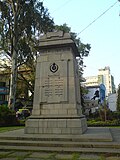
[[File:WarMemorialBangalore.jpg|thumb|400x400px|War memorial on Brigade road, Bangalore]] | [[File:WarMemorialBangalore.jpg|thumb|400x400px|War memorial on Brigade road, Bangalore]] | ||
The battle symbols of MEG are | The battle symbols of MEG are a sphinx to commemorate the victory in Egypt in 1801, an elephant for the victory in Assaye in 1803, a dragon for China (1848), a bighorn sheep for Zoji La (1948), and a tank for Basantar (1971).{{citation needed|date=June 2023}} | ||
== Republic Day Parade == | == Republic Day Parade == | ||
| Line 202: | Line 201: | ||
* https://web.archive.org/web/20071108123617/http://www.regiments.org/regiments/southasia/art-eng-sig/sm-mad.htm | * https://web.archive.org/web/20071108123617/http://www.regiments.org/regiments/southasia/art-eng-sig/sm-mad.htm | ||
* https://web.archive.org/web/20090725060217/http://www.remuseum.org.uk/corpshistory/rem_corps_part10.htm | * https://web.archive.org/web/20090725060217/http://www.remuseum.org.uk/corpshistory/rem_corps_part10.htm | ||
* [http://sify.com/cities/bangalore/fullstory.php?id=13958631 Sify.com]{{dead link|date= | * [http://sify.com/cities/bangalore/fullstory.php?id=13958631 Sify.com]{{dead link|date=January 2025|bot=medic}}{{cbignore|bot=medic}} | ||
* {{cite web |title=INDIAN PIONEER BATTALIONS |url=http://www.reubique.com/indpion.htm |website=www.reubique.com |access-date=16 July 2021}} | * {{cite web |title=INDIAN PIONEER BATTALIONS |url=http://www.reubique.com/indpion.htm |website=www.reubique.com |access-date=16 July 2021}} | ||
| Line 208: | Line 207: | ||
{{DEFAULTSORT:Madras Engineer Group}} | {{DEFAULTSORT:Madras Engineer Group}} | ||
[[Category:History of the Madras | [[Category:History of the Madras Engineer Group|*]] | ||
[[Category:British Indian Army regiments]] | [[Category:British Indian Army regiments]] | ||
[[Category:Indian Army Corps of Engineers]] | [[Category:Indian Army Corps of Engineers]] | ||
Latest revision as of 05:47, 4 November 2025
 | This article includes a list of general references, but it remains largely unverified because it lacks sufficient corresponding inline citations. (March 2013) |
| Madras Engineer Group | |
|---|---|
| Active | 1780–present |
| Country |  British India British India
 India India |
| Branch |  British Indian Army British Indian Army
 Indian Army Indian Army |
| Type | Combat Engineers |
| Role | Combat support |
| Garrison/HQ | Bangalore, Karnataka |
| Motto(s) | Sarvatra! (Everywhere) |
| Engagements | Second Anglo-Afghan War First World War Second World War Burma Campaign Sino-Indian War Indo-Pak War-1947 Indo-Pak War-1965 Indo-Pak War-1971 Kargil War |
| Battle honours | See Battle honours list |
| Commanders | |
| Colonel Comdt of Madras Sappers | Lt Gen AK Ramesh |

Madras Engineer Group (MEG), informally known as the Madras Sappers, is an engineer group of the Corps of Engineers of the Indian Army. The Madras Sappers draw their origin from the erstwhile Madras Presidency army of the British Raj. This regiment has its HQ in Bengaluru. The Madras Sappers are the oldest of the three groups of the Corps of Engineers.
The Madras Sappers were the only regiment of the Madras Presidency Army to survive unscathed the extensive reorganisations that took place between 1862 and 1928.[1] The thambis, as the troops of the Madras Sappers are popularly known, with their hallmark Shakos have distinguished themselves in many battlefields around the world for more than 200 years.
The Bangalore torpedo, a mine-clearing explosive device, was invented in the Centre at Bengaluru in the early years of the Twentieth Century.[2]
Timeline[edit | edit source]
- 1780 – Created Madras Pioneers from two company of Pioneers (On 30 September 1780 at Madras Patnam)
- 1831 – Renamed Corps of Madras Sappers and Miners
- 1834 – Relocated HQ to Bengaluru, where it remains today
- 1876 – Receive prefix Queens's Own
- 1903 – 2nd Queen's Own Sappers and Miners, Renamed as part of the Kitchener Reforms
History[edit | edit source]
The second half of the eighteenth century found the East India Company involved in the politics of India and in conflict with the French and a number of native states, amongst whom Mysore, the Marathas and the remnants of the Mughal empire were prominent. The newly raised army of the Madras Presidency was deficient of combat pioneers who were raised as 'ad hoc' companies and disbanded after the conflicts. The First Anglo-Mysore War highlighted this deficiency and led to the raising of two companies of the Madras Pioneers on 30 September 1780 at Fort St George. These men are the forefathers of the Madras Engineer Group of today and the Corps of Engineers of the Indian Army.
The Madras Pioneers formed an integral part of the armed forces. Their principal job in active warfare was to dig 'saps' or 'trenches' which permitted cannon to be brought in range of enemy fortifications and to dig 'mines' which would explode creating a breach in the fort walls. As a result, Sappers and Miners was born. In addition, the sappers used to lead the way to the breach for the 'forlorn hope' and infantry to follow. They also built roads, bridges, fortifications, wells, and water supplies, and fought as infantry when needed.
Since this group was constituted by the Madras Presidency, and formed part of the Madras Army, they were called the Madras Sappers. Likewise in 1803 and again in 1824, the Bengal Sappers and Bombay Sappers were formed in the other presidencies.
The Madras Sappers recruited and trained small tough and wiry men from South India. These engineer troops fought in numerous campaigns in India at Sholinghur, Srirangapatna, Assaye (along with Major General Arthur Wellesley, later Duke of Wellington), and also in Egypt, China, Burma and other places abroad.
The Madras Sappers moved into Bengaluru in 1834, when they were involved in a major part of the construction activities of the Civilian and Military buildings in Bengaluru. Their association with Bengaluru, where the center is located, continues to this day.
The motto of the Madras Sappers is that common to all three regiments of the Corps of Engineers, Sarvatra (Sanskrit:Everywhere) the Indian equivalent to 'Ubique', the motto of the Royal Engineers.
Battle honours[edit | edit source]
Pre-World War I[edit | edit source]
- Carnatic (1781–82)
- Sholinghur (1781–82)
- Mysore (1792)
- Seringapatam (1799)
- Egypt (1801)
- Assaye (1803)
- Java (1811)
- Nagpur (1819)
- Mehidpur (1819)
- Ava (1825)
- China (1840)
- Meanee (1843)
- Hyderabad (1843)
- Pegu (1852)
- Persia (1856–57)
- Central India (1858)
- Lucknow (1858)
- Taku Forts (1860)
- Pekin (1860)
- Abyssinia (1868)
- Afghanistan (1878–80)
- Egypt (1882)
- Tel-el-Kebir (1882)
- Suakin (1885)
- Tofrek (1885)
- Burma (1885–87)
- Chitral (1895)
- Malakand (1897)
- Tirah (1897–98)
- Punjab Frontier (1897–98)
- Boxer Rebellion (1900)
World War I[edit | edit source]
World War II[edit | edit source]
Post Independence[edit | edit source]
Symbols[edit | edit source]


The battle symbols of MEG are a sphinx to commemorate the victory in Egypt in 1801, an elephant for the victory in Assaye in 1803, a dragon for China (1848), a bighorn sheep for Zoji La (1948), and a tank for Basantar (1971).[citation needed]
Republic Day Parade[edit | edit source]
Madras Engineer Group have been actively participating in the annual Republic Day Parade of India. MEG have been awarded the Best Marching Contingent three times in 1991, 1997 and 2017.[3]
Gallery[edit | edit source]
-
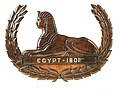 Sphinx symbol depicting the campaign in Egypt, 1801.
 -
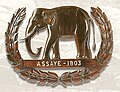 Elephant emblem depicting the Battle of Assaye, 1803.
 -
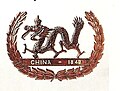 Dragon symbol depicting the campaign in China, during the First Opium War, 1840.
.jpg)
.jpg)
.jpg)
See also[edit | edit source]
- Indian Army
- Indian Army Corps of Engineers
- Bengal Engineer Group
- Bombay Engineer Group
- Madras Sappers Military Band
Notes[edit | edit source]
- ↑ Mason, Philip (1986). A Matter of Honour. pp. 345 & 349. ISBN 0-333-41837-9.
- ↑ Duffy, Michael; Duffy, Michael, "www.firstworldwar.com", Bangalore Torpedo, retrieved 18 January 2021
- ↑ "Republic Day Parade – 2017 Awards announced". Press Information Bureau, Government of India, Ministry of Defence. 28 January 2017. Retrieved 23 August 2019.
Book references[edit | edit source]
- Vibart, Henry Meredith (1881), The military history of the Madras engineers and pioneers, London: W.H. Allen & co.
External links[edit | edit source]
- https://web.archive.org/web/20091027133925/http://www.geocities.com/Athens/Acropolis/9460/remem.htm
- https://web.archive.org/web/20071108123617/http://www.regiments.org/regiments/southasia/art-eng-sig/sm-mad.htm
- https://web.archive.org/web/20090725060217/http://www.remuseum.org.uk/corpshistory/rem_corps_part10.htm
- Sify.com[dead link]
- "INDIAN PIONEER BATTALIONS". www.reubique.com. Retrieved 16 July 2021.
Arms and Services of Indian Army | ||||||
|---|---|---|---|---|---|---|
| Combat arms |
|  | ||||
| Support services |
| |||||
- Pages using the JsonConfig extension
- History of the Madras Engineer Group
- British Indian Army regiments
- Indian Army Corps of Engineers
- Indian World War I regiments
- Indian World War II regiments
- Military units and formations established in 1780
- 1780 establishments in British India
- Military units and formations in Burma in World War II
- Regiments of the Indian Army