




Ajay Kumar (talk | contribs) Created a new article |
m refine page for consistency |
||
| Line 1: | Line 1: | ||
{{Short description| | {{Short description|Academic discipline; implementation or management of policy}} | ||
{{About|the discipline|the journal|Public Administration (journal) | {{About|the discipline|the journal|Public Administration (journal)}} | ||
{{See also|Public policy|Political science|Nonprofit | {{See also|Public policy|Political science|Nonprofit management}} | ||
[[File:FEMA - 43019 - FEMA National Advistory Council meets in Washington, DC.jpg|thumb|Public administration is both an academic discipline and a field of practice; the latter is depicted in this picture of [[Federal government of the United States|U.S. federal public servants]] at a meeting.]] | |||
{{Politics sidebar|expanded=Public administration}} | {{Politics sidebar|expanded=Public administration}} | ||
'''Public administration''', also known as '''public policy and administration''' or '''public management''', and in some cases '''policy management''', is the implementation of [[Public policy|public policies]], which are sets of proposed or decided actions to [[Problem solving|solve problems]] and address relevant [[Social issue|social and economic issues]]. | |||
This implementation generally occurs through the administration of government programs in the [[public sector]], but also through the [[management]] of [[Nonprofit organization|non-profit organizations]] in the [[community sector]], and/or [[business]]es in the [[private sector]] that provide [[goods and services]] to the government through [[Public–private partnership|public-private partnerships]] and [[government procurement]].<ref name="Lassance">{{Cite SSRN |last=Lassance |first=Antonio |date=2020-11-10 |title=What Is a Policy and What Is a Government Program? A Simple Question With No Clear Answer, Until Now |language=en |ssrn=3727996}}</ref><ref>{{cite web |title=Random House Unabridged Dictionary |url=http://dictionary.infoplease.com/public-administration |access-date=2014-08-23 |publisher=Dictionary.infoplease.com}}</ref><ref>{{cite web |date=1 June 2021 |title=What is Public Policy? Why It's Important? {{!}} UoPeople |url=https://www.uopeople.edu/blog/what-is-public-policy/ |url-status=live |archive-url=https://web.archive.org/web/20221012114324/https://www.uopeople.edu/blog/what-is-public-policy/ |archive-date=12 October 2022 |access-date=12 October 2022 |website=University of the People}}</ref><ref>Robert and Janet Denhardt, ''Public Administration: An Action Orientation''. 6th Ed. 2009: Thomson Wadsworth, Belmont CA.</ref> It has also been characterized as the “translation of politics into the reality that citizens experience every day.”<ref name="KettlDonald">Kettl, Donald and James Fessler. 2009. ''The Politics of the Administrative Process''. Washington D.C.: CQ Press</ref> | |||
In an academic context, public administration has been described as the study of government decision-making; the analysis of policies and the inputs that have produced them, as well as those necessary to produce alternative policies.<ref>Jerome B. McKinney and Lawrence C. Howard. Public Administration: Balancing Power and Accountability. 2nd Ed. 1998: Praeger Publishing, Westport, CT. p. 62</ref> It is also a subfield of [[political science]] taught in [[public policy school]]s where studies of policy processes and the structures, functions, and behavior of public institutions and their relationships with broader society take place. The study and application of public administration is founded on the principle that the proper functioning of an organization or institution relies on effective management. In contemporary literature, it is also recognized as applicable to private businesses and nonprofit organizations.<ref>{{Cite book |author1=David H. Rosenbloom |title=Public Administration: Understanding Management, Politics, and Law in the Public Sector |author2=Robert S. Kravchuk |author3=Richard M Clerkin |date=27 January 2022 |publisher=Routledge |isbn=9781003198116 |location=New York}}</ref> | |||
The mid-twentieth century saw the rise of German [[Sociology|sociologist]] [[Max Weber]]'s theory of [[bureaucracy]], bringing about a substantive interest in the theoretical aspects of public administration. The 1968 [[Minnowbrook Conference]], which convened at [[Syracuse University]] under the leadership of [[Dwight Waldo]], gave rise to the concept of [[New Public Administration]], a pivotal movement within the discipline today.<ref>{{Cite journal |url=https://academic.oup.com/jpart/article/21/suppl_1/i1/913462 |access-date=2024-02-17 |title=Minnowbrook: Tradition, Idea, Spirit, Event, Challenge |first=Rosemary |last=O'Leary |journal=Journal of Public Administration Research and Theory |volume=21 |issue=1 |year=2011 |pages=i1–i6|doi=10.1093/jopart/muq066 }}</ref> | |||
==Definitions== | ==Definitions== | ||
[[File:US Navy 020614-N-0552D-001 SPAWAR award winning employee.jpg|thumb|right|200px|Administrators tend to work with both paper documents and computer files: "There has been a significant shift from paper to electronic records during the past two decades | [[File:US Navy 020614-N-0552D-001 SPAWAR award winning employee.jpg|thumb|right|200px|Administrators tend to work with both paper documents and computer files: "There has been a significant shift from paper to electronic records during the past two decades."<ref>{{cite web|url=https://www.ipc.on.ca/wp-content/uploads/Resources/up-erdms_e.pdf |title=Electronic Records and Document Management Systems: A New Tool for Enhancing the Public's Right to Access Government-Held Information? |access-date=2017-04-29}}</ref><!-- The picture illustrates a public servant with a computer and paper documents on his desk :) --> Pictured here is Stephen C. Dunn, Deputy Comptroller for the US Navy.]] | ||
Public administration | Public administration encompasses the execution, oversight, and management of government policies and the management of public affairs. The field involves the organization, operation, and strategic coordination of [[Bureaucracy|bureaucratic structures]] in the public sector. Public administrators play a significant role in devising and executing policies, managing shared resources, and ensuring the efficient functioning of government agencies and programs.<ref>{{Cite web |title=What Is Public Administration? |url=https://onlinempa.unc.edu/academics/what-is-public-administration/ |access-date=2023-01-15 |website=UNC-MPA |language=en-US}}</ref> | ||
In 1947, [[Paul H. Appleby]] defined public administration as the "public leadership of public affairs directly responsible for executive action" | In 1947, [[Paul H. Appleby]] defined public administration as the "public leadership of public affairs directly responsible for executive action." In democracies, it usually has to do with such leadership and executive action in terms that respect and contribute to the dignity, worth, and potential of the citizen.<ref>Appleby, Paul 1947. "Toward Better Public Administration", ''[[Public Administration Review]]'' Vol. 7, No. 2 pp. 93–99.</ref> One year later, Gordon Clapp, then Chairman of the [[Tennessee Valley Authority]], defined public administration "as a public instrument whereby democratic society may be more completely realized." This implies that it must relate itself to concepts of justice, liberty, and fuller economic opportunity for human beings and is thus concerned with "people, with ideas, and with things".<ref>Clapp, Gordon. 1948. "Public Administration in an Advancing South", ''[[Public Administration Review]]'' Vol. 8. no. 2 pp. 169–75. Clapp attributed part of this definition to Charles Beard.</ref> James D. Carroll and Alfred M. Zuck called [[Woodrow Wilson]]'s publication of his essay, "[[The Study of Administration]]", "the beginning of public administration as a specific and influential field of study."<ref>Carroll, J.D. & Zuck, A.M. (1983). "The Study of Public Administration Revisited". ''A Report of the Centennial Agendas project of the American Society for Public Administration''. Washington, DC; American Society for Public Administration.</ref> | ||
More recently, scholars claim that "public administration has no generally accepted definition" because the "scope of the subject is so great and so debatable that it is easier to explain than define."<ref name="thecanadianencyclopedia">{{cite web|url=https://thecanadianencyclopedia.ca/en/article/public-administration|archive-url=https://web.archive.org/web/20170328003943/http://www.thecanadianencyclopedia.com/en/article/public-administration/|url-status=live|archive-date=March 28, 2017|title=Public Administration | the Canadian Encyclopedia|access-date=March 13, 2018}}</ref> Public administration is a field of study (i.e., a discipline) and an occupation. There is much disagreement about whether the study of public administration can properly be called a discipline, largely because of the debate over whether public administration is a sub-field of political science or a sub-field of administrative science, the latter an outgrowth of its roots in policy analysis and evaluation research.<ref name="thecanadianencyclopedia" /><ref>{{cite journal |last=Haveman |first=R. H. |year=1987 |title=Policy analysis and evaluation research after twenty years |journal=Policy Studies Journal |volume=16 |issue=1 |pages=191–218|doi=10.1111/j.1541-0072.1987.tb00775.x }}</ref> Scholar Donald F. Kettl is among those who view public administration "as a sub-field within political science."<ref name="h-net">{{cite web |title=The Future of Public Administration |first=Donald F. |last=Kettl |url=http://www.h-net.org/~pubadmin/tfreport/kettl.pdf |publisher=H-net.org |access-date=October 25, 2010}}</ref> According to Lalor, a society with a public authority that provides at least one public good can be said to have a public administration, whereas the absence of either (or ''a fortiori'' both) a public authority or the provision of at least one public good implies the absence of a public administration. He argues that public administration is the public provision of public goods in which the demand function is satisfied more or less effectively by politics, whose primary tool is rhetoric, providing for public goods, and the supply function is satisfied more or less efficiently by public management, whose primary tools are speech acts, producing public goods. The moral purpose of public administration, implicit in its acceptance of its role, is the maximization of the opportunities of the public to satisfy its wants.<ref>{{cite book |last=Lalor |first=Stephen |title=A General Theory of Public Administration |year=2014}}</ref> | |||
The [[North American Industry Classification System]] definition of the Public Administration sector (NAICS 91) states that public administration "... comprises establishments primarily engaged in activities of a governmental nature, that is, the enactment and judicial interpretation of laws and their pursuant regulations, and the administration of programs based on them." This includes "legislative activities, taxation, national defense, public order and safety, immigration services, foreign affairs and international assistance, and the administration of government programs are activities that are purely governmental in nature."<ref>{{cite web |url=http://www.ic.gc.ca/cis-sic/cis-sic.nsf/IDE/cis-sic91defe.html |title=Definition Public Administration (NAICS 91) |publisher=Ic.gc.ca |access-date=October 25, 2010 |archive-url=https://web.archive.org/web/20130506223436/http://www.ic.gc.ca/cis-sic/cis-sic.nsf/IDE/cis-sic91defe.html |archive-date=May 6, 2013 |url-status=dead }}</ref> | |||
The [[North American Industry Classification System]] definition of the Public Administration ( | |||
==History== | ==History== | ||
===India in the 6th century BCE=== | |||
{{Main|Charvaka#Public_administration}} | |||
The | The [[Harappa]] and [[Mohenjo-daro]] civilizations had organized bodies of public servants, suggesting the presence of some form of public administration. Numerous references exist to [[Brihaspati]]'s contributions to laws and governance. An excerpt from [[Ain-i-Akbari]] [vol.III, tr. by H. S. Barrett, p. 217–218], written by [[Abu'l-Fazl ibn Mubarak|Abul Fazl]], mentions a symposium of philosophers from various faiths held in 1578 at Akbar's instance.<ref>{{Cite book |last=Smith |first=Vincent |title=The Jain Teachers of Akbar |publisher=Bhandarkar Oriental Research Institute |year=1917}}</ref> It is believed that some [[Charvaka]] thinkers may have participated in the symposium. In "[[Āstika and nāstika|Naastika]]," Fazl refers to the Charvaka law-makers emphasizing "good work, judicious administration, and welfare schemes." [[Somadeva]] also describes the Charvaka method of defeating the nation's enemies, referring to thirteen disguised enemies in the kingdom with selfish interests who should not be spared. [[Chanakya|Kautilya]] presents a detailed scheme to remove the enemies in the guise of friends. The Charvaka stalwart, Brihaspati, is more ancient than Kautilya and Somadeva. He appears to have been contemporaneous with the Harappa and Mohenjo-daro cultures. | ||
Archaeological evidence regarding kings, priests, and palaces in the Harappa and [[Mohenjo-daro|Mohenjo-Daro]] excavations is limited.<ref>{{Cite web |date=2009-10-09 |title=The lost city of Mohenjo Daro |url=https://www.nationalgeographic.com/history/article/mohenjo-daro |access-date=2024-08-16 |website=History |language=en}}</ref> However, the presence of complex civilization and public facilities such as granaries and bathhouses, along with the existence of large cities, indicates the likelihood of centralized governance. The uniformity in the artifacts and brick sizes suggests that there was some form of centralized governance. Although speculation regarding social hierarchies and class structures is plausible, the absence of discernible elite burial sites also suggests that most citizens were almost equal in status. | |||
===Antiquity to the 19th century=== | ===Antiquity to the 19th century=== | ||
Dating back to | Dating back to antiquity, states have required officials like pages, treasurers, and tax collectors to administer the practical business of government. Before the 19th century, the staffing of most public administrations was rife with nepotism, favoritism, and political patronage, which was often referred to as a "[[spoils system]]".<ref>{{Cite web |title=Spoils system {{!}} Definition, Examples, Significance, & Facts {{!}} Britannica |url=https://www.britannica.com/topic/spoils-system |access-date=2024-08-16 |website=www.britannica.com |language=en}}</ref> Public administrators have long been the "eyes and ears" of rulers. In medieval times, the abilities to read and write, as well as add and subtract were as dominated by the educated elite as public employment. Consequently, the need for expert civil servants whose ability to read and write formed the basis for developing expertise in such necessary activities as legal record-keeping, paying and feeding armies, and levying taxes. As the [[European imperialism|European imperialist age]] progressed and the military powers extended their hold over other continents and people, the need for a sophisticated public administration grew.<ref>{{Cite journal |last=Basheka |first=B.C. |date=March 2012 |title=THE PARADIGMS OF PUBLIC ADMINISTRATION RE-EXAMINED: A REFLECTION |url=https://hdl.handle.net/10520/EJC121371 |journal=Journal of Public Administration |volume=47 |issue=1 |pages=25–67 |hdl=10520/EJC121371 |via=Sabinet African Journals}}</ref> | ||
The field of [[management]] may | ==== Roots in ancient China ==== | ||
*{{cite book|last1=Tan|first1=Chung|first2=Yinzheng|last2=Geng|title=India and China: twenty centuries of civilization interaction and vibrations|year=2005|publisher=University of Michigan Press|page=128|quote=China not only produced the world's first "bureaucracy", but also the world's first "meritocracy"}} | The field of [[management]] may have originated in ancient [[China]],<ref name="Ewan Ferlie p.30">Ewan Ferlie, Laurence E. Lynn, Christopher Pollitt (2005) ''The Oxford Handbook of Public Management'', p.30.</ref> including, possibly, the first highly centralized bureaucratic state and the earliest (by the second century BC) example of a [[meritocracy]] based on [[Imperial examination|civil service tests]].<ref name="APHq">Kazin, Edwards, and Rothman (2010), 142. ''One of the oldest examples of a merit-based civil service system existed' in the imperial bureaucracy of China.'' | ||
*{{cite book|last=Konner|first=Melvin|title=Unsettled: an anthropology of the Jews|url=https://archive.org/details/unsettledanthrop00konn|url-access=registration|year=2003|publisher=Viking Compass|page=[https://archive.org/details/unsettledanthrop00konn/page/217 217]|isbn=9780670032440|quote=China is the world's oldest meritocracy}} | * {{cite book|last1=Tan|first1=Chung|first2=Yinzheng|last2=Geng|title=India and China: twenty centuries of civilization interaction and vibrations|year=2005|publisher=University of Michigan Press|page=128|quote=China not only produced the world's first "bureaucracy", but also the world's first "meritocracy"}} | ||
*{{cite journal |last1=Tucker|first1=Mary Evelyn|year=2009|title=Touching the Depths of Things: Cultivating Nature in East Asia|journal=Ecology and the Environment: Perspectives from the Humanities|page=51|quote=To staff these institutions, they created the oldest meritocracy in the world, in which government appointments were based on civil service examinations that drew on the values of the Confucian Classics}}</ref> | * {{cite book|last=Konner|first=Melvin|title=Unsettled: an anthropology of the Jews|url=https://archive.org/details/unsettledanthrop00konn|url-access=registration|year=2003|publisher=Viking Compass|page=[https://archive.org/details/unsettledanthrop00konn/page/217 217]|isbn=9780670032440|quote=China is the world's oldest meritocracy}} | ||
* {{cite journal |last1=Tucker|first1=Mary Evelyn|year=2009|title=Touching the Depths of Things: Cultivating Nature in East Asia|journal=Ecology and the Environment: Perspectives from the Humanities|page=51|quote=To staff these institutions, they created the oldest meritocracy in the world, in which government appointments were based on civil service examinations that drew on the values of the Confucian Classics}}</ref> In regards to public administration, China was considered to be "advanced" compared to the rest of the world up until the end of the 18th century. | |||
Though Chinese administration cannot be traced to any one individual, | [[Thomas Taylor Meadows]], the British consul in [[Guangzhou]], argued in his ''Desultory Notes on the Government and People of China'' (1847) that "the long duration of the Chinese empire is solely and altogether owing to the good government which consists in the advancement of men of talent and merit only."<ref name="Bodde" /> Influenced by the ancient Chinese imperial examination, the [[Northcote–Trevelyan Report]] of 1854 recommended that recruitment should be on the basis of merit determined through competitive examination, candidates should have a solid general education to enable inter-departmental transfers, and promotion should be through achievement rather than "preferment, patronage, or purchase".<ref>[http://www.civilservant.org.uk/northcotetrevelyan.pdf Full text of the Northcote-Trevelyan Report] {{webarchive |url=https://web.archive.org/web/20141222072511/http://www.civilservant.org.uk/northcotetrevelyan.pdf |date=22 December 2014 }}</ref><ref name="Bodde">{{cite web|last=Bodde|first=Derke|title=China: A Teaching Workbook|url=http://afe.easia.columbia.edu/song/readings/inventions_ideas.htm|publisher=Columbia University}}</ref> This led to implementation of [[Her Majesty's Civil Service]] as a systematic, meritocratic civil service bureaucracy.<ref>{{cite news|last=Walker|first=David|title=Fair game|work=The Guardian|date=2003-07-09|url=https://www.theguardian.com/society/2003/jul/09/publicsector.guardiansocietysupplement|access-date =2003-07-09|location=London, UK}}</ref> Like the British, the development of French bureaucracy was influenced by the Chinese system. [[Voltaire]] claimed that the Chinese had "perfected moral science" and [[François Quesnay]] advocated an economic and political system modeled after that of the Chinese.<ref>{{cite book |author1=Mark W. Huddleston |author2=William W. Boyer |title=The Higher Civil Service in the United States: Quest for Reform |date=1996 |publisher=University of Pittsburgh Pre |isbn=0822974738 |page=15}}</ref> French civil service examinations adopted in the late 19th century were also heavily based on general cultural studies. These features have been likened to the earlier Chinese model.<ref name="rung">{{cite book |last1=Rung |first1=Margaret C. |title=Servants of the State: Managing Diversity & Democracy in the Federal Workforce, 1933–1953 |date=2002 |publisher=University of Georgia Press |isbn=0820323624 |pages=8,200–201 |url=https://books.google.com/books?id=ucVgkbmqynUC}}</ref> | ||
Though Chinese administration cannot be traced to any one individual, figures of the [[Legalism (Chinese philosophy)|Fa-Jia]] emphasizing a [[merit system]], like [[Shen Buhai]] (400–337 BC), may have had the most influence, and could be considered its founders, if they are not valuable as rare pre-modern examples of the abstract theory of administration. Creel writes that, in Shen Buhai, there are the "seeds of the [[civil service examination]]", and that, if one wishes to exaggerate, it would "no doubt be possible to translate Shen Buhai's term Shu, or technique, as 'science'", and argue that he was the first political scientist, though Creel does "not care to go this far".<ref>Creel, What Is Taoism?, 94 | |||
* Creel, 1974 p.4, 119 Shen Pu-hai: A Chinese Political Philosopher of the Fourth Century B.C. | * Creel, 1974 p.4, 119 Shen Pu-hai: A Chinese Political Philosopher of the Fourth Century B.C. | ||
* Creel 1964: 155–6 | * Creel 1964: 155–6 | ||
| Line 56: | Line 49: | ||
* Paul R. Goldin, p.16 Persistent Misconceptions about Chinese Legalism. https://www.academia.edu/24999390/Persistent_Misconceptions_about_Chinese_Legalism_</ref> | * Paul R. Goldin, p.16 Persistent Misconceptions about Chinese Legalism. https://www.academia.edu/24999390/Persistent_Misconceptions_about_Chinese_Legalism_</ref> | ||
==== Europe in the 18th century ==== | |||
In the 18th century, [[Frederick William I of Prussia|King Frederick William I of Prussia]] created professoriates in [[Kameralism|Cameralism]] in order to train a new class of public administrators. The universities of [[Frankfurt an der Oder]] and the [[University of Halle]] were [[Prussia]]n institutions emphasizing economic and social disciplines, with the goal of societal reform. [[Johann Heinrich Gottlob Justi]] was a well-known professor of [[Cameralism]]. | |||
[[Lorenz von Stein]], an 1855 German professor from | [[Lorenz von Stein]], an 1855 German professor from Vienna, is considered the founder of the science of public administration in many parts of the world. {{citation needed|date=August 2024}} In the time of Von Stein, public administration was considered a form of administrative law, but Von Stein believed this concept was too restrictive. Von Stein taught that public administration relies on many pre-established disciplines such as [[sociology]], political science, [[administrative law]], and [[public finance]]. He called public administration an integrating science and stated that public administrators should be concerned with both theory and practice. He argued that public administration is a science because knowledge is generated and evaluated according to the scientific method.{{citation needed|date=August 2024}} | ||
===In the United States=== | |||
=== | |||
[[File:Woodrow Wilson (Nobel 1919).jpg|thumb|[[Woodrow Wilson]]]] | [[File:Woodrow Wilson (Nobel 1919).jpg|thumb|[[Woodrow Wilson]]]] | ||
The father of public administration in the US is considered to be [[Woodrow Wilson]].<ref>{{cite journal |last1=Stivers |first1=C |last2=McDonald |first2=B. D. |year=2023 |title=Teaching Public Administration Historically |journal=Journal of Public Affairs Education |volume=29 |issue=3 |pages=275–279 |doi=10.1080/15236803.2023.2205805}}</ref> He first formally recognized public administration in an 1887 article entitled "[[The Study of Administration]]". The future president wrote that "it is the object of administrative study to discover, first, what government can properly and successfully do, and, secondly, how it can do these proper things with the utmost possible efficiency and at the least possible cost either of money or energy."<ref name="Wilson">Wilson, Woodrow. June 1887. "[[The Study of Administration]]", ''Political Science Quarterly'' 2.</ref> | |||
By the 1920s, scholars of public administration had responded to Wilson's solicitation and | By the 1920s, scholars of public administration had responded to Wilson's solicitation and textbooks in this field were introduced. Distinguished scholars of that period include [[Luther Gulick (social scientist)|Luther Gulick]], [[Lyndall Urwick]], [[Henri Fayol]], and [[Frederick Winslow Taylor|Frederick Taylor]]. Taylor argued in ''[[The Principles of Scientific Management]],'' that scientific analysis would lead to the discovery of the "[a] best way" to do things or carry out an operation. Taylor's technique was introduced to private industrialists, and later to various government organizations.<ref name="JeongChun">{{cite book |first1=Chun Hai |last1=Jeong |first2=Nor Fadzlina |last2=Nawi |year=2007 |title=Principles of Public Administration: An Introduction |location=Kuala Lumpur |publisher=Karisma Publications |isbn=978-983-195-253-5}}</ref> | ||
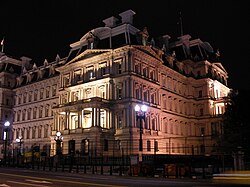
[[Image:Exec bldg.JPG|right|thumb|The [[Eisenhower Executive Office Building]] at night]] | |||
In 1937, the [[Brownlow Committee]], which was a presidentially commissioned panel of [[political science]] and public administration experts, recommended sweeping changes to the executive branch of the [[Federal government of the United States|U.S. federal government]], including the creation of the Executive Office of the President. Based on these recommendations, President [[Franklin D. Roosevelt]] in 1939 lobbied Congress to approve the [[Reorganization Act of 1939]]. The Act led to Reorganization Plan No. 1,<ref name="Plan1">{{cite news |last= Roosevelt |first= Franklin D. |url= http://www.presidency.ucsb.edu/ws/index.php?pid=15748 |title= Message to Congress on the Reorganization Act |date= April 25, 1939 |department= John T. Woolley and Gerhard Peters |work= The American Presidency Project |location= Santa Barbara |publisher= University of California |access-date=May 6, 2011}}</ref> which created the office,<ref name="Mosher">{{cite book |last= Mosher |first= Frederick C. |title= American Public Administration: Past, Present, Future |edition= 2nd |location= Birmingham |publisher= University of Alabama Press |year= 1975 |isbn= 0817348298}}</ref> which reported directly to the president. | |||
The [[American Society for Public Administration]] (ASPA), the leading professional group for public administration was founded in 1939. ASPA sponsors the journal [[Public Administration Review]], which was founded in 1940.<ref>{{cite web |url=http://www.aspanet.org/scriptcontent/ASPAgeneral.cfm |title=Our Web Site Has Moved! |publisher=Aspanet.org |access-date=2014-08-23 |archive-url=https://web.archive.org/web/20111203193218/http://www.aspanet.org/scriptcontent/ASPAgeneral.cfm |archive-date=2011-12-03 |url-status=dead }}</ref> The [[National Academy of Public Administration (United States)|National Academy of Public Administration]] (NAPA) is a United States nonprofit, non-governmental, non-partisan organization. As a [[Congressional charter|congressionally chartered]] [[national academy]], its mission is to produce independent research and studies that advance the field of public administration and facilitate the development, adoption, and implementation of solutions to government's most significant challenges.<ref>''[https://napawash.org/who-we-are Who We Are]'' ''National Academy of Public Administration'' Retrieved March 12, 2025.</ref> | |||
==== 1940s ==== | |||
=== | |||
[[File:Luther Gulick (social scientist).jpg|thumb|left|[[Luther Gulick (social scientist)|Luther Gulick]] (1892–1993) was an expert on public administration.]] | [[File:Luther Gulick (social scientist).jpg|thumb|left|[[Luther Gulick (social scientist)|Luther Gulick]] (1892–1993) was an expert on public administration.]] | ||
The separation of politics and administration advocated by Wilson continues to play a significant role in public administration today. However, the dominance of this dichotomy was challenged by second generation scholars, beginning in the 1940s. [[Luther Gulick (social scientist)|Luther Gulick]]'s fact-value dichotomy was a key contender for Wilson's proposed [[politics-administration dichotomy]]. In place of Wilson's first generation split, Gulick advocated a "seamless web of discretion and interaction".<ref>Fry, Brian R. 1989. Mastering Public Administration; from Max Weber to Dwight Waldo. Chatham, New Jersey: Chatham House Publishers, Inc. p. 80</ref> | The separation of politics and administration advocated by Wilson continues to play a significant role in public administration today. However, the dominance of this dichotomy was challenged by second-generation scholars, beginning in the 1940s. [[Luther Gulick (social scientist)|Luther Gulick]]'s fact-value dichotomy was a key contender for Wilson's proposed [[politics-administration dichotomy]]. In place of Wilson's first generation split, Gulick advocated a "seamless web of discretion and interaction".<ref>Fry, Brian R. 1989. Mastering Public Administration; from Max Weber to Dwight Waldo. Chatham, New Jersey: Chatham House Publishers, Inc. p. 80</ref> | ||
Luther Gulick and [[Lyndall Urwick]] are two second-generation scholars. Gulick, Urwick, and the new generation of administrators built on the work of contemporary | Luther Gulick and [[Lyndall Urwick]] are two second-generation scholars. Gulick, Urwick, and the new generation of administrators built on the work of contemporary behavioral, administrative, and organizational scholars including [[Henri Fayol]], [[Fredrick Winslow Taylor]], Paul Appleby, Frank Goodnow, and Willam Willoughby. The new generation of organizational theories no longer relied upon logical assumptions and generalizations about human nature like classical and enlightened theorists. | ||
Gulick developed a comprehensive, generic theory of organization that emphasized the scientific method, efficiency, professionalism, structural reform, and executive control. Gulick summarized the duties of administrators with an acronym; [[POSDCORB]], which stands for planning, organizing, staffing, directing, coordinating, reporting, and budgeting. Fayol developed a systematic, 14-point treatment of private management. Second-generation theorists drew upon private management practices for administrative sciences. A single, generic management theory bleeding the borders between the private and the public sector was thought to be possible. With the general theory, the administrative theory could be focused on governmental organizations. The mid-1940s theorists challenged Wilson and Gulick. The politics-administration dichotomy remained the | Gulick developed a comprehensive, generic theory of organization that emphasized the scientific method, efficiency, professionalism, structural reform, and executive control. Gulick summarized the duties of administrators with an acronym; [[POSDCORB]], which stands for planning, organizing, staffing, directing, coordinating, reporting, and budgeting. Fayol developed a systematic, 14-point treatment of private management. Second-generation theorists drew upon private management practices for administrative sciences. A single, generic management theory bleeding the borders between the private and the public sector was thought to be possible. With the general theory, the administrative theory could be focused on governmental organizations. The mid-1940s theorists challenged Wilson and Gulick. The politics-administration dichotomy remained the center of criticism. | ||
====1950s | ==== 1950s - 1970s ==== | ||
During the 1950s, the United States experienced prolonged prosperity and solidified its place as a world leader. Public Administration experienced a kind of heyday due to the successful war effort and successful post war reconstruction in Western Europe and Japan. Government was popular as was President Eisenhower. In the 1960s and 1970s, government itself came under fire as ineffective, inefficient, and largely a wasted effort. | During the 1950s, the United States experienced prolonged prosperity and solidified its place as a world leader. Public Administration experienced a kind of heyday due to the successful war effort and successful post-war reconstruction in Western Europe and Japan. Government was popular as was President Eisenhower. In the 1960s and 1970s, the government itself came under fire as ineffective, inefficient, and largely a wasted effort. The costly [[Vietnam War|American intervention in Vietnam]] along with domestic scandals including the bugging of Democratic Party headquarters (the 1974 [[Watergate]] scandal) are two examples of self-destructive government behavior that alienated citizens. | ||
[[File:B-52D(061127-F-1234S-017).jpg|thumb|right|The costly [[Vietnam War]] alienated U.S. citizens from their government. Pictured is [[Operation Arc Light]], a U.S. bombing operation.]] | [[File:B-52D(061127-F-1234S-017).jpg|thumb|right|The costly [[Vietnam War]] alienated U.S. citizens from their government. Pictured is [[Operation Arc Light]], a U.S. bombing operation.]] | ||
Concurrently, after [[World War II]], the | There was a call by citizens for efficient administration to replace ineffective, wasteful bureaucracy. Public administration would have to distance itself from politics to answer this call and remain effective. Elected officials supported these reforms. The [[Hoover Commission]], chaired by University of Chicago professor [[Louis Brownlow]], examines the reorganization of government. Brownlow subsequently founded the Public Administration Service (PAS) at the university, an organization that provided consulting services to all levels of government until the 1970s. | ||
Concurrently, after [[World War II]], the entire concept of public administration expanded to include policy making and analysis, thus the study of "administrative policy making and analysis" was introduced and enhanced into the government decision-making bodies. Later on, the human factor became a predominant concern and emphasis in the study of public administration. This period witnessed the development and inclusion of other social sciences knowledge, predominantly, psychology, anthropology, and sociology, into the study of public administration (Jeong, 2007).<ref name="JeongChun" /> Henceforth, the emergence of scholars such as [[Fritz Morstein Marx]], with his book ''The Elements of Public Administration'' (1946), Paul H. Appleby ''Policy and Administration'' (1952), Frank Marini 'Towards a New Public Administration' (1971), and others that have contributed positively in these endeavors. | |||
Stimulated by events during the 1960s such as an active civil rights movement, the Vietnam | Stimulated by events during the 1960s such as an active civil rights movement, the Vietnam War and war protests, assassinations of a president and civil rights leaders, and an active women's movement, public administration changed course somewhat. Landmark legislation such as the [[Equal Pay Act of 1963]] and the [[Civil Rights Act of 1964]] also gave public administrators new responsibilities. These events were manifest in the public administration profession through the new public administration movement. "Under the stimulating patronage of Dwight Waldo, some of the best of the younger generation of scholars challenged the doctrine they had received".<ref>Schick, A. (1975). The trauma of politics: public administration in the sixties. In Mosher, F. (Ed.), | ||
American Public Administration: Past, Present, Future, pp. 142–80. University of Alabama Press (p. 161).</ref> These new scholars demanded | American Public Administration: Past, Present, Future, pp. 142–80. University of Alabama Press (p. 161).</ref> These new scholars demanded more policy-oriented public administrators that incorporated "four themes: relevance, values, equity, and change".<ref>Schick, A. (1975). The trauma of politics: public administration in the sixties. In Mosher, F. (Ed.), | ||
American Public Administration: Past, Present, Future, pp. 142–80. University of Alabama Press. (p. 162).</ref> All of these themes would encourage more participation among women and minorities.<ref name="Shields, P. M. 2022 pp.1 - 19"/> | American Public Administration: Past, Present, Future, pp. 142–80. University of Alabama Press. (p. 162).</ref> All of these themes would encourage more participation among women and minorities.<ref name="Shields, P. M. 2022 pp.1 - 19">Shields, P. M., & Elias, N. M. (2022). Introduction to the Handbook on Gender and Public Administration. In Shields, P. and Elias, N. (Eds.)Handbook on Gender and Public Administration. pp.1 – 19. Edward Elgar Publishing. https://www.elgaronline.com/view/edcoll/9781789904727/9781789904727.00008.xml</ref> | ||
Stimulated by the events of the 60s, the 1970s brought significant change | Stimulated by the events of the '60s, the 1970s brought significant change to the American Society for Public Administration. Racial and ethnic minorities and women members organized to seek greater participation.<ref>Foye-Cox, N. (2006). Women in public administration: breaking new ground. In Felbinger, C. and | ||
Haynes, W. (Eds.), Profiles of Outstanding Women in Public Administration, pp. 7–42. American | Haynes, W. (Eds.), Profiles of Outstanding Women in Public Administration, pp. 7–42. American | ||
Society for Public Administration.</ref> Eventually, the Conference on Minority Public Administrators and the Section for Women in Public Administration were established.<ref>Rubin, M. (1990). Women in ASPA: the fifty-year climb toward equality. Public Administration Review, | Society for Public Administration.</ref> Eventually, the Conference on Minority Public Administrators and the Section for Women in Public Administration were established.<ref>Rubin, M. (1990). Women in ASPA: the fifty-year climb toward equality. Public Administration Review, | ||
50(2), 277–87.</ref> | 50(2), 277–87.</ref> | ||
==== | ==== 1980s - 1990s ==== | ||
In the late 1980s, yet another generation of public administration theorists began to displace the last. | In the late 1980s, yet another generation of public administration theorists began to displace the last. The new theory, which came to be called [[New Public Management]], was proposed by David Osborne and Ted Gaebler in their book ''Reinventing Government''.<ref>{{Cite journal | last = Kamensky | first = John M. | title = Role of the "Reinventing Government" movement in Federal management reform | journal = [[Public Administration Review]] | volume = 56 | issue = 3 | pages = 247–55 | doi = 10.2307/976448 | jstor = 976448 | date = May–June 1996 }}</ref> The new model advocated the use of [[private sector]]-style models, organizational ideas and values to improve the efficiency and service-orientation of the public sector. During the [[Clinton Administration]] (1993–2001), Vice President [[Al Gore]] adopted and reformed federal agencies using NPM approaches. In the 1990s, new public management became prevalent throughout the bureaucracies of the US, the UK, and to a lesser extent, in Canada. The original public management theories have roots attributed to policy analysis, according to [[Richard Elmore]] in his 1986 article published in the "[[Journal of Policy Analysis and Management]]".<ref>{{Cite journal | last = Elmore | first = Richard F. | author-link = Richard Elmore | title = Graduate education in public management: working the seams of government | journal = [[Journal of Policy Analysis and Management]] | volume = 6 | issue = 1 | pages = 69–83 | doi = 10.1002/pam.4050060107 | date = 1986 }}</ref> | ||
Some modern authors define NPM as a combination of splitting large bureaucracies into smaller, more fragmented agencies, encouraging competition between different public agencies, and encouraging competition between public agencies and private firms and using economic incentives lines (e.g., performance pay for senior executives or user-pay models).<ref>{{Cite journal | last1 = Margetts | first1 = Helen | last2 = Dunleavy | first2 = Patrick | last3 = Bastow | first3 = Simon | last4 = Tinkler | first4 = Jane | author-link1 = Helen Margetts | author-link2 = Patrick Dunleavy | title = New public management is dead – long live digital-era governance | journal = [[Journal of Public Administration Research and Theory]] | volume = 16 | issue = 3 | pages = 467–94 | doi = 10.1093/jopart/mui057 | date = July 2006 | doi-access = free }}</ref> NPM treats individuals as "customers" or "clients" (in the private sector sense), rather than as citizens.<ref>[[Diane Stone]], (2008) "Global Public Policy, Transnational Policy Communities and their Networks", ''Journal of Policy Sciences''.</ref> | Some modern authors define NPM as a combination of splitting large bureaucracies into smaller, more fragmented agencies, encouraging competition between different public agencies, and encouraging competition between public agencies and private firms and using economic incentives lines (e.g., performance pay for senior executives or user-pay models).<ref>{{Cite journal | last1 = Margetts | first1 = Helen | last2 = Dunleavy | first2 = Patrick | last3 = Bastow | first3 = Simon | last4 = Tinkler | first4 = Jane | author-link1 = Helen Margetts | author-link2 = Patrick Dunleavy | title = New public management is dead – long live digital-era governance | journal = [[Journal of Public Administration Research and Theory]] | volume = 16 | issue = 3 | pages = 467–94 | doi = 10.1093/jopart/mui057 | date = July 2006 | doi-access = free }}</ref> NPM treats individuals as "customers" or "clients" (in the private sector sense), rather than as citizens.<ref>[[Diane Stone]], (2008) "Global Public Policy, Transnational Policy Communities and their Networks", ''Journal of Policy Sciences''.</ref> | ||
Some critics argue that the New Public Management concept of treating people as "customers" rather than "citizens" is an inappropriate borrowing from the private sector model, because businesses see customers as a means to an end (profit), rather than as the proprietors of government (the owners), opposed to merely the customers of a business (the patrons). In New Public Management, people are viewed as economic units not democratic participants which is the hazard of linking an MBA (business administration, economic and employer-based model) too closely with the public administration (governmental, [[Public good (economics)|public good]]) sector. Nevertheless, the NPM model (one of four described by Elmore in 1986, including the "generic model") is still widely accepted at multiple levels of government (e.g., municipal, state/province, and federal) and in many OECD nations. | Some critics<ref>{{Cite journal |last=Thomas |first=John Clayton |date=November–December 2013 |title=Citizen, Customer, Partner: Rethinking the Place of the Public in Public Management |url=https://www.jstor.org/stable/42003125 |journal=Public Administration Review |volume=73 |issue=6 |pages=786–796 |doi=10.1111/puar.12109 |jstor=42003125 |url-access=subscription }}</ref><ref>{{Cite journal |last=Mathiasen |first=David |date=31 July 2000 |title=The new public management and its critics |url=https://www.sciencedirect.com/science/article/abs/pii/S1096749400874334 |journal=Elsevier |volume=2 |issue=1 |pages=90–111 |doi=10.1016/S1096-7494(00)87433-4 |via=Science Direct|url-access=subscription }}</ref> argue that the New Public Management concept of treating people as "customers" rather than "citizens" is an inappropriate borrowing from the private sector model, because businesses see customers as a means to an end (profit), rather than as the proprietors of government (the owners), opposed to merely the customers of a business (the patrons). In New Public Management, people are viewed as economic units not as democratic participants which is the hazard of linking an MBA (business administration, economic and employer-based model) too closely with the public administration (governmental, [[Public good (economics)|public good]]) sector. Nevertheless, the NPM model (one of four described by Elmore in 1986, including the "generic model") is still widely accepted at multiple levels of government (e.g., municipal, state/province, and federal) and in many OECD nations.{{citation needed|date=August 2024}} | ||
In the late 1990s, Janet and Robert Denhardt proposed a new public services model in response to the dominance of NPM.<ref>{{Cite journal | last1 = Denhardt | first1 = Robert B. | last2 = Vinzant Denhardt | first2 = Janet | title = The new public service: serving rather than steering | journal = [[Public Administration Review]] | volume = 60 | issue = 6 | pages = 549–59 | doi = 10.1111/0033-3352.00117 | jstor = 977437 | date = November–December 2000 }}</ref> A successor to NPM is [[digital era governance]], focusing on themes of reintegrating government responsibilities, needs-based holism (executing duties in cursive ways), and digitalization (exploiting the transformational capabilities of modern IT and digital storage). | In the late 1990s, Janet and Robert Denhardt proposed a new public services model in response to the dominance of NPM.<ref>{{Cite journal | last1 = Denhardt | first1 = Robert B. | last2 = Vinzant Denhardt | first2 = Janet | title = The new public service: serving rather than steering | journal = [[Public Administration Review]] | volume = 60 | issue = 6 | pages = 549–59 | doi = 10.1111/0033-3352.00117 | jstor = 977437 | date = November–December 2000 }}</ref> A successor to NPM is [[digital era governance]], focusing on themes of reintegrating government responsibilities, needs-based holism (executing duties in cursive ways), and digitalization (exploiting the transformational capabilities of modern IT and digital storage). | ||
One example | One example of the deployment of DEG is [[Open Forum (Australia)|openforum.com.au]], an Australian not-for-profit e-Democracy project that invites politicians, senior public servants, academics, business people, and other key stakeholders to engage in high-level policy debate. Another example is Brunei's Information Department in deploying Social Media technology to improve its Digital Governance process.<ref name=":3">Omar, A. M. (2020). Digital Era Governance and Social Media: The Case of Information Department Brunei. In Employing Recent Technologies for Improved Digital Governance (pp. 19–35). IGI Global.</ref> The book chapter work concludes that digital dividends can be secured through the effective application of Social Media within the framework of Digital Era Governance.<ref name=":3" /> | ||
Another new public service model is what has been called New Public Governance, an approach | Another new public service model is what has been called New Public Governance, an approach that includes a centralization of power; an increased number, role, and influence of partisan-political staff; personal-politicization of appointments to the senior public service; and, the assumption that the public service is promiscuously partisan for the government of the day.<ref>Aucoin, Peter (2008). "New Public Management and the Quality of Government: Coping with the New Political Governance in Canada", Conference on ''New Public Management and the Quality of Government'', SOG and the Quality of Government Institute, University of Gothenburg, Sweden, 13–15 November 2008, p. 14.</ref> | ||
In the mid-1980s, the goal of community programs in the United States was often represented by terms such as independent living, [[community integration]], inclusion, community participation, [[deinstitutionalization]], and civil rights. Thus, the same public policy (and public administration) was to apply to all citizens, inclusive of disability. However, by the 1990s, categorical state systems were strengthened in the United States (Racino, in press, 2014), and efforts were made to introduce more disability content into the public policy curricula<ref>{{Cite journal | last1 = Elmore | first1 = Richard F. | last2 = Watson | first2 = Sara | last3 = Pfeiffer | first3 = David | author-link1 = Richard Elmore | title = A case for including disability policy issues in public policy curricula | journal = Journal of Policy Analysis and Management (Curriculum and Case Notes) | volume = 11 | issue = 1 | pages = 167–73 | doi = 10.2307/3325146 | date = 1992 | jstor = 3325146 }}</ref> with disability public policy (and administration) distinct fields in their own right.<ref>{{Citation | last = Zola | first = Irving K. | author-link = Irving Zola | contribution = Introduction | editor-last1 = Brown | editor-first1 = Susan T. | title = An Independent Living Approach to Disability Policy Studies | publisher = Research and Training Center on Public Policy And Independent Living, World Institute on Disability | location = Berkeley, CA | year = 1993 | oclc = 36404707 | postscript = .}}</ref><ref>{{cite book | last = Racino | first = Julie A. | title = Public administration and disability community services administration in the US | publisher = CRC Press | location = Boca Raton | year = 2015 | isbn = 9781466579828 }}</ref> Behaviorists have also dominated "intervention practice" (generally not the province of public administration) in recent years, believing that they are in opposition to generic public policy (termed [[ecological systems theory]], of the late [[Urie Bronfenbrenner]]). | In the mid-1980s, the goal of community programs in the United States was often represented by terms such as independent living, [[community integration]], inclusion, community participation, [[deinstitutionalization]], and civil rights. Thus, the same public policy (and public administration) was to apply to all citizens, inclusive of disability. However, by the 1990s, categorical state systems were strengthened in the United States (Racino, in press, 2014), and efforts were made to introduce more disability content into the public policy curricula<ref>{{Cite journal | last1 = Elmore | first1 = Richard F. | last2 = Watson | first2 = Sara | last3 = Pfeiffer | first3 = David | author-link1 = Richard Elmore | title = A case for including disability policy issues in public policy curricula | journal = Journal of Policy Analysis and Management (Curriculum and Case Notes) | volume = 11 | issue = 1 | pages = 167–73 | doi = 10.2307/3325146 | date = 1992 | jstor = 3325146 }}</ref> with disability public policy (and administration) distinct fields in their own right.<ref>{{Citation | last = Zola | first = Irving K. | author-link = Irving Zola | contribution = Introduction | editor-last1 = Brown | editor-first1 = Susan T. | title = An Independent Living Approach to Disability Policy Studies | publisher = Research and Training Center on Public Policy And Independent Living, World Institute on Disability | location = Berkeley, CA | year = 1993 | oclc = 36404707 | postscript = .}}</ref><ref>{{cite book | last = Racino | first = Julie A. | title = Public administration and disability community services administration in the US | publisher = CRC Press | location = Boca Raton | year = 2015 | isbn = 9781466579828 }}</ref> Behaviorists have also dominated "intervention practice" (generally not the province of public administration) in recent years, believing that they are in opposition to generic public policy (termed [[ecological systems theory]], of the late [[Urie Bronfenbrenner]]). | ||
Increasingly, | Increasingly, public policy academics and practitioners have utilized the theoretical concepts of [[political economy]] to explain policy outcomes such as the success or failure of reform efforts or the persistence of suboptimal outcomes.<ref>{{cite book |last1=Corduneanu-Huci |first1=Cristina |first2=Alexander |last2=Hamilton |first3=Issel |last3=Masses Ferrer |year=2012 |title=Understanding Policy Change: How to Apply Political Economy Concepts in Practice |publisher=The World Bank |location=Washington DC. |url=https://books.google.com/books?id=oKShuAAACAAJ }}{{Dead link|date=September 2023 |bot=InternetArchiveBot |fix-attempted=yes }}</ref> | ||
=== | ==== Women's civic clubs and the Settlement movement ==== | ||
Contemporary scholars <ref name="elgaronline.com">Shields, P. M., & Elias, N. M. (2022). Introduction to the ''Handbook on Gender and Public Administration''. In Shields, P. and Elias, N. (Eds.)''Handbook on Gender and Public Administration''. pp.1 – 19. Edward Elgar Publishing. https://www.elgaronline.com/view/edcoll/9781789904727/9781789904727.00008.xml</ref><ref name="Stivers, C. 2000">Stivers, C. (2000). ''Bureau Men, Settlement Women: Constructing Public Administration in the Progressive Era''. University Press of Kansas.</ref><ref>Burnier, D. (2008). Erased history: Frances Perkins and the emergence of care-centered public administration. ''Administration & Society'', 40(4), 403–22.</ref><ref>Burnier, D. (2022). The long road of administrative memory: Jane Addams, Frances Perkins and care-centered administration. In Shields, P. and Elias, N. (Eds.),''Handbook on Gender and Public Administration''. Cheltenham, UK and Northampton, MA, USA, Edward Elgar Publishing.</ref> are reclaiming a companion public administration origin story that includes the contributions of women. This has become known as the "alternative" or "settlement" model of public administration.<ref name="elgaronline.com" /> During the 19th century upper-class women in the United States and Europe organized voluntary associations that worked to mitigate the excesses of urbanization and industrialization in their towns. Eventually, these voluntary associations became networks that were able to spearhead changes to policy and administration.<ref>Skocpol, T. (1992). ''Protecting Soldiers and Mothers: The Political Origins of Social Policy in the United States''. Harvard University Press.</ref><ref>Hunt, K. (2006). Women as citizens: changing the polity. In Simonton, D. (Ed.), ''The Routledge History of Women in Europe Since 1700'', pp. 216–58. Routledge.</ref> These women's civic clubs worked to make cities and workplaces safer (cleaner streets, water, sewage, and workplace. As well as workplace regulation) and more suited to the needs of their children (playgrounds, libraries, juvenile courts, child labor laws). These were administrative and policy spaces ignored by their fathers and husbands. The work of these clubs was amplified by newly organized non-profit organizations ([[Settlement houses|Settlement Houses]]), usually situated in industrialized city slums filled with immigrants.<ref name="Stivers, C. 2000" /><ref name="Shields, P. 2022">Shields, P. (2022). The origins of the settlement model of public administration. In Shields, P. and Elias, N. (Eds.), ''Handbook on Gender and Public Administration''. Cheltenham, UK and Northampton, MA, USA, Edward Elgar Publishing.</ref><ref>Shields, P. (2017). Jane Addams: pioneer in American sociology, social work and public administration. In Shields, P. (Ed.), ''Jane Addams: Progressive Pioneer of Peace, Philosophy, Sociology, Social Work and Public Administration'', pp. 43–67. Springer.</ref><ref name="doi.org">Burnier, D. (2021). Hiding in plain sight: recovering public administration's lost Legacy of social justice, ''Administrative Theory & Praxis'', https://doi.org/10.1080/10841806.2021.1891796.</ref> | |||
= | Reforms that emerged from the [[New Deal]] (e.g., income for the old, unemployment insurance, aid for dependent children and the disabled, child labor prohibitions and limits on hours worked, etc.) were supported by leaders of the Settlement movement. Richard Stillman <ref>Stillman II, R. (1998). Creating the American State: The Moral Reformers and the Modern Administrative World They Made. University of Alabama Press p. 82.</ref> credits [[Jane Addams]], a key leader of the Settlement movement and a pioneer of public administration with "conceiving and spawning" the modern welfare state. The accomplishments of the Settlement movement and their conception of public administration were ignored in the early literature of public administration. The alternative model of Public Administration was invisible or buried for about 100 years until Camilla Stivers published ''Bureau Men and Settlement Women'' in 2000.<ref name="ReferenceB">Stivers, C. (2000). Bureau Men, Settlement Women: Constructing Public Administration in the Progressive Era. University Press of Kansas.</ref> | ||
= | Settlement workers explicitly fought for social justice as they campaigned for reform.<ref name="doi.org" /> They sought policy changes that would improve the lives of immigrants, women, children, sick, old, and impoverished people. Both municipal housekeeping and industrial citizenship applied an ethic of care informed by the feminine experience of policy and administration.<ref>Burnier, D. (2022). The long road of administrative memory: Jane Addams, Frances Perkins and care-centered administration. In Shields, P. and Elias, N. (Eds.), Handbook on Gender and Public Administration. Cheltenham, UK and Northampton, MA, USA, Edward Elgar Publishing.</ref> While they saw the relevance of the traditional public administration values (efficiency, effectiveness, etc.) and practices<ref>Schachter, H.L. (2002). Women, progressive-era reform, and scientific management. ''Administration & Society'', 34(5), 563–78.</ref><ref>Schachter, H.L. (2011). The New York School of Philanthropy, the Bureau of Municipal Research, and the trail of the missing women: a public administration history detective story. ''Administration & Society'', 43(1), 3–21.</ref> of their male reformist counterparts, they also emphasized social justice and social equity. Jane Addams, for example, was a founder of the [[NAACP|National Association for the Advancement of Colored People]] (NAACP).<ref>Shields, P. (ed.)(2017) ''Jane Addams: Progressive Pioneer of Peace, Philosophy, Sociology, Social Work and Public Administration'', Springer.</ref> | ||
In | |||
===== The Settlement Model of Public Administration ===== | |||
The Settlement movement and its leaders such as Jane Addams, [[Julia Lathrop]], and [[Florence Kelley]] were instrumental in crafting the alternative, feminine inspired, model of public administration.<ref name="ReferenceB" /><ref>McGuire, J.T. (2011). Continuing an alternative view of public administration: Mary van Kleeck and industrial citizenship, 1918–1927. Administration & Society, 43(1), 66–86.</ref> This settlement model of public administration, had two interrelated components – municipal housekeeping and industrial citizenship.<ref name="Shields, P. 2022" /><ref name="Shields, P. M. 2022 pp.1 - 19" /> Municipal housekeeping<ref>Shields, P. (2017). Jane Addams: pioneer in American sociology, social work and public administration. In Shields, P. (Ed.), Jane Addams: Progressive Pioneer of Peace, Philosophy, Sociology, Social Work and Public Administration, pp. 43–67. Springer.</ref> called for cities to be run like a caring home, the city should be conceived as an extension of the home where families could be safe and children cared for. Clean streets, clean water, playgrounds, educational curricular reform, and juvenile courts, are examples of reforms associated with this movement. Industrial citizenship <ref>Shields, Patricia (2023). 'Jane Addams and Public Administration: Clarifying Industrial Citizenship', in Patricia M. Shields, Maurice Hamington, and Joseph Soeters (eds), The Oxford Handbook of Jane Addams pp. 305–326. Oxford Academic https://doi.org/10.1093/oxfordhb/9780197544518.013.3</ref> focused on the problems and risks of labor force participation in a laissez-faire, newly industrialized economy. Reforms that mitigated workplace problems such as child labor, unsanitary workplaces, excessive work schedules, risks of industrial accidents, and old age poverty were the focus of these efforts. Organized settlement women's reform efforts led to workplace safety laws and inspections. Settlement reformers went on to serve as local, state, and federal administrators. Jane Addams was a garbage inspector, Florence Kelley served as the chief factory inspector for the State of Illinois, Julia Lathrop was the first director of the [[United States Women's Bureau|Women's Bureau]] and [[Francis Perkins]] was Secretary of Labor during the F. Roosevelt Administration<ref>Shields, P. (2022). The origins of the settlement model of public administration. In Shields, P. and Elias, N. (Eds.), Handbook on Gender and Public Administration. pp. 35–52. Edward Elgar Publishing</ref><ref>Burnier, D. (2008). Erased history: Frances Perkins and the emergence of care-centered public administration. Administration & Society, 40(4), 403–22.</ref><ref>Newman, M.A. (2004). Madam Secretary: Frances Perkins. In Felbinger, C. and Hanes, W. (Eds.), Outstanding Women in Public Administration: Leaders, Mentors, and Pioneers, pp. 83–102. Routledge.</ref> | |||
== | ==Branches== | ||
=== Alternative names for the field === | |||
== | * Public administration | ||
{{ | * Public policy and administration | ||
* Public policy and public administration | |||
* Public management<ref>{{Cite web |title=Master of Arts in Public Management |url=https://landing.advanced.jhu.edu/mapubmgmt/ |access-date=2026-01-29 |website=JHU AAP LP |language=en-US}}</ref> | |||
* Policy management<ref>{{Cite web |title=Master of Policy Management - Georgetown McCourt School |url=https://mccourt.georgetown.edu/master-of-policy-management/ |access-date=2026-01-29 |website=McCourt School of Public Policy |language=en}}</ref> | |||
=== | === Core branches === | ||
In | In academia, the field of public administration consists of several sub-fields. Scholars have proposed several different sets of sub-fields. One of the proposed models uses five "pillars":<ref name="Shafritz">Shafritz, J.M., A.C. Hyde. 2007. ''Classics of Public Administration''. Wadsworth: Boston.</ref> | ||
* [[Organization theory|Organizational theory in public administration]] is the study of the structure of governmental entities and the many particulars inculcated in them. | |||
* [[Public sector ethics|Ethics in public administration]] serves as a normative approach to decision making. | |||
* [[Policy analysis]] and [[program evaluation]] serves as an empirical approach to decision making. | |||
* Public budgeting and public finance | |||
** [[Public budgeting]] is the activity within a government that seeks to allocate scarce resources among unlimited demands. | |||
** [[Public finance]] is the study of the role of the government in the economy.<ref name="Public Finance and Public Policy2">{{cite book |last=Gruber |first=Jonathan |title=Public Finance and Public Policy |publisher=Worth Publications |year=2005 |isbn=0-7167-8655-9 |location=New York |pages=2}}</ref> It is the branch of economics that assesses the [[government revenue]] and [[government expenditure]] of the public authorities and the adjustment of one or the other to achieve desirable effects and avoid undesirable ones.<ref name="The Economics of Public Finance">{{cite book |author=Jain, P C |url=https://books.google.com/books?id=L2AhEMv7qeoC&q=Public+finance+definition&pg=PA2 |title=The Economics of Public Finance |year=1974}}</ref> | |||
* [[Human Resource Management in Public Administration|Human resource management]] is an in-house structure that ensures that public service staffing is done in an unbiased, ethical and values-based manner. The basic functions of the HR system are employee benefits, employee health care, compensation, and many more (e.g., human rights, [[Americans with Disabilities Act]]). The executives managing the HR director and other key departmental personnel are also part of the public administration system. | |||
=== | === Other branches === | ||
* [[Nonprofit studies|Nonprofit management]] is research into and the practice of operating nonprofit organizations and their effects. | |||
* [[Emergency management]] is the managerial function charged with creating the framework within which communities reduce [[vulnerability]] to hazards and cope with disasters.<ref>{{cite web |title=Emergency Management Definition, Vision, Missions, Principles |url=https://training.fema.gov/hiedu/docs/emprinciples/0907_176%20em%20principles12x18v2f%20johnson%20(w-o%20draft).pdf |archive-url=https://web.archive.org/web/20151005115917/http://www.training.fema.gov/hiedu/docs/emprinciples/0907_176%20em%20principles12x18v2f%20johnson%20(w-o%20draft).pdf |url-status=dead |archive-date=October 5, 2015 |access-date=2022-12-08 |website=training.fema.gov |language=EN-US}}</ref> | |||
* [[ Information Technology in Public Administration]] | |||
Examines the role of IT in enhancing public sector operations, including e-governance and digital service delivery. | |||
https://dergipark.org.tr/tr/download/article-file/257008 | |||
==Academic field== | ==Academic field== | ||
{{Further|Public policy school|Public policy degrees|Political science#Education}} | {{Further|Public policy school|Public policy degrees|Political science#Education}} | ||
Universities offer | Universities can offer undergraduate and graduate degrees in Public Administration or Government, Political Science, and International Affairs with a concentration or specialization in Public Policy and Administration. Graduate degrees include the [[Master of Public Administration|Master of Public Administration (MPA)]] degree, a [[Master of Arts|Master of Arts (MA)]] or [[Master of Science|Master of Science (MS)]] in Public Administration (for the management tract), and the [[Master of Public Policy|Master of Public Policy (MPP)]], a Master of Arts (MA), or a Master of Science (MS) in Public Policy (for the research tract) | ||
In the United States, the academic field of public administration draws heavily on | In the United States, the academic field of public administration draws heavily on political science and administrative law. Some MPA programs include economics courses to give students a background in micro-economic issues (markets, rationing mechanisms, etc.) and macroeconomic issues (e.g., national debt). Scholars such as [[John A. Rohr]] write of a long history behind the constitutional legitimacy of government bureaucracy. | ||
One public administration scholar, Donald Kettl, argues that "public administration sits in a disciplinary backwater", because "for the last generation, scholars have sought to save or replace it with fields of study like implementation, public management, and formal bureaucratic theory".<ref name="h-net" /> Kettl states that "public administration, as a subfield within political science ... is struggling to define its role within the discipline".<ref name="h-net" /> He notes two problems with public administration: it "has seemed methodologically to lag behind" and "the field's theoretical work too often seems not to define it"-indeed, "some of the most interesting recent ideas in public administration have come from outside the field".<ref name="h-net" /> | |||
===Public administration theory and bureaucracy=== | |||
[[Public administration theory]] is the domain in which discussions of the meaning and purpose of government, the role of bureaucracy in supporting democratic governments, budgets, governance, and public affairs take place. In the 1920s the German sociologist [[Max Weber]] expanded the definition of bureaucracy to include any system of administration conducted by trained professionals according to fixed rules.<ref name= "google1">{{cite book |url= https://books.google.com/books?id=KtFI15WCr_8C&pg=PA3 |title= Bureaucracy |first= David |last= Beetham |access-date= 26 May 2013 |isbn= 978-0816629398 |year= 1996|publisher= U of Minnesota Press }}</ref> Weber saw bureaucracy as a relatively positive development; however, by 1944 the [[Austria]]n economist [[Ludwig von Mises]] opined in the context of his experience in the [[Nazi]] regime that the term ''bureaucracy'' was "always applied with an opprobrious connotation",<ref name = "Mises">{{cite book|author=Ludwig von Mises|author-link=Ludwig von Mises|url=https://mises.org/etexts/mises/bureaucracy.asp|access-date=12 October 2012|title=Bureaucracy|year=1944}}</ref> and by 1957 the American sociologist [[Robert K. Merton|Robert Merton]] suggested that the term ''[[bureaucrat]]'' had become an "[[epithet]], a {{Lang|de|Schimpfwort}}" in some circumstances.<ref name="Merton">{{cite book|author=Robert K. Merton|author-link=Robert K. Merton|title=Social Theory and Social Structure|url=http://www.sociosite.net/topics/texts/merton_bureaucratic_structure.php|access-date=12 October 2012|year=1957|publisher=Glencoe, IL;Free Press|pages=195–206|archive-url=https://web.archive.org/web/20121227113532/http://www.sociosite.net/topics/texts/merton_bureaucratic_structure.php|archive-date=27 December 2012|url-status=dead}}</ref> | |||
The word ''bureaucracy'' is also used in politics and government with a disapproving tone to disparage official rules that appear to make it difficult—by insistence on procedure and compliance to rule, regulation, and law—to get things done. In workplaces, the word is used very often to blame complicated rules, processes, and written work that are interpreted as obstacles rather than safeguards and accountability assurances.<ref name="Cambridge1">{{cite web|url=https://dictionary.cambridge.org/dictionary/english/bureaucracy|title=Meaning of bureaucracy in English |publisher=Cambridge.org}}</ref> Socio-bureaucracy would then refer to certain social influences that may affect the function of a society.<ref>{{cite journal |first = Franz |last = Wirl |date = July 1998 |title = Socio-economic typologies of bureaucratic corruption and implications |journal = Journal of Evolutionary Economics |volume = 8 |issue = 2 |pages = 199–220 |publisher = Springer-Verlag |doi = 10.1007/s001910050062 |s2cid = 154833892 }}</ref> | |||
In modern usage, modern bureaucracy has been defined as comprising four features:<ref> | |||
{{Cite book |last1= BARNETT |first1= Michael |title= Rules for the World: International Organizations in Global Politics |last2= FINNEMORE |first2= Marftha |date= 2004 |publisher= Cornell University Press |isbn= 978-0-8014-4090-8 |pages= 17–18 |jstor= 10.7591/j.ctt7z7mx}} | |||
</ref> | |||
# hierarchy (clearly defined spheres of competence and divisions of labor) | |||
# continuity (a structure where administrators have a full-time salary and advance within the structure) | |||
# impersonality (prescribed rules and operating rules rather than arbitrary actions) | |||
# expertise (officials are chosen according to merit, have been trained, and hold access to knowledge) | |||
===Comparative public administration=== | ===Comparative public administration=== | ||
Comparative public administration or CPA is defined as the study of administrative systems in a comparative fashion or the study of public administration in other countries. | Comparative public administration or CPA is defined as the study of administrative systems in a comparative fashion or the study of public administration in other countries. Today, there is a section of the American Society for Public Administration that specializes in comparative administration. It is responsible for the annual Riggs Award for Lifetime Achievement in International and Comparative Public Administration. | ||
There have been several issues that have hampered the development of comparative public administration, including the major differences between Western countries and developing countries; the lack of curriculum on this sub-field in public administration programs; and the lack of success in developing theoretical models that can be scientifically tested. Even though CPA is a weakly formed field as a whole, this sub-field of public administration is an attempt at cross-cultural analysis, a "quest for patterns and regularities of administrative action and behavior."<ref>{{Cite journal|last=Jreisat|first=Jamil E.|date=2005-03-01|title=Comparative Public Administration Is Back In, Prudently|journal=Public Administration Review|language=en|volume=65|issue=2|pages=231–42|doi=10.1111/j.1540-6210.2005.00447.x|s2cid=154592957 |issn=1540-6210}}</ref> CPA is an integral part to the analysis of public administration techniques. The process of comparison allows for more widely applicable policies to be tested in a variety of situations. | |||
Comparative public administration lacks curriculum, which has prevented it from becoming a major field of study. This lack of understanding of the basic concepts that build this field's foundation has ultimately led to its lack of use. For example, William Waugh, a professor at Georgia State University has stated "Comparative studies are difficult because of the necessity to provide enough information on the sociopolitical context of national administrative structures and processes for readers to understand why there are differences and similarities."<ref name=":0">{{cite journal |title=Comparative Politics: Review of ''Comparative Bureaucratic Systems,'' Tummala, Krishna K., ed.| last = Waugh| first=William L | Comparative public administration lacks a curriculum, which has prevented it from becoming a major field of study. This lack of understanding of the basic concepts that build this field's foundation has ultimately led to its lack of use. For example, William Waugh, a professor at Georgia State University has stated "Comparative studies are difficult because of the necessity to provide enough information on the sociopolitical context of national administrative structures and processes for readers to understand why there are differences and similarities."<ref name=":0">{{cite journal |title=Comparative Politics: Review of ''Comparative Bureaucratic Systems,'' Tummala, Krishna K., ed.| last = Waugh Jr.| first=William L. |journal = Perspectives on Political Science|location = Philadelphia|volume= 33|issue= 2|date = Spring 2004|page = 119|doi =10.1080/10457090409600740|s2cid=220344433}}</ref> He also asserts, "Although there is sizable literature on comparative public administration it is scattered and dated."<ref name=":0" /> | ||
=== Bachelor's degrees, academic concentrations, and academic minors === | === Bachelor's degrees, academic concentrations, and academic minors === | ||
{{See also|Bachelor's degree|Bachelor of Arts|Bachelor of Science | {{See also|Bachelor's degree|Bachelor of Arts|Bachelor of Science|Academic concentration|Academic minor|Student organization}} | ||
Universities offer | {{Missing information||Bachelor's degrees and undergraduate concentrations, but information on this within the article is missing|date=July 2022}} | ||
Universities offer undergraduate level bachelor's degrees in Public Administration or Government, Political Science, and International Affairs with an academic concentration or specialization in Public Policy and Administration. At several universities undergraduate-level public administration and non-profit management education is packaged together (along with international relations and security studies) in a degree in political science. | |||
===Master's degrees=== | ===Master's degrees=== | ||
{{See also|Master of Public Administration|Master of Public Policy|Master of Public Policy and Administration|Master of Nonprofit Organizations|Master of Arts|Master of Science}} | {{See also|Master of Public Administration|Master of Public Policy|Master of Public Policy and Administration|Master of Nonprofit Organizations|Master of Arts|Master of Science}} | ||
Some public administration programs have similarities to [[business administration]] programs, in cases where the students from both the Master's in Public Administration (MPA) and Master's in Business Administration (MBA) programs take many of the same courses.<ref>{{Cite web |title=What is the difference between public and private administration? |url=https://www.cmich.edu/blog/all-things-higher-ed/difference-between-public-and-private-administration |access-date=2024-08-16 |website=www.cmich.edu |language=en}}</ref> | |||
Some public administration programs have similarities to [[business administration]] programs, in cases where the students from both the Master's in Public Administration (MPA) and Master's in Business Administration (MBA) programs take many of the same courses.{{ | [[Master of Business Administration]] (MBA) is a postgraduate degree focused on business principles, management, and leadership skills, typically aimed at preparing students for managerial roles in the private sector. Master of Public Administration (MPA) is a postgraduate degree focused on the theory and practice of public administration, management, and policy. | ||
===Doctoral degrees=== | ===Doctoral degrees=== | ||
{{See also|Doctor of Public Administration|}} | {{See also|Doctor of Public Administration|}} | ||
There are two types of doctoral degrees in public administration: the Doctor of Public Administration (DPA) and the [[Ph.D.]] in public administration. The DPA is an applied-research doctoral degree in the field of public administration, focusing on the practice of public administration more than on its theoretical aspects | There are two types of doctoral degrees in public administration: the Doctor of Public Administration (DPA) and the [[Ph.D.]] in public administration. The DPA is an applied-research doctoral degree in the field of public administration, focusing on the practice of public administration more than on its theoretical aspects. The Ph.D. is typically sought by individuals aiming to become professors of public administration or researchers. Individuals pursuing a Ph.D. in public administration often pursue more theoretical dissertation topics than their DPA counterparts. | ||
===Notable scholars=== | ===Notable scholars=== | ||
{{main | {{main|List of notable public administration scholars}} | ||
Notable scholars of public administration have come from a range of fields. In the period before public administration existed as its own independent sub-discipline of political science, scholars contributing to the field came from economics, sociology, management, | |||
Notable scholars of public administration have come from a wide range of fields. In the period before public administration existed as its own independent sub-discipline of political science, scholars contributing to the field came from economics, sociology, management, political science, legal—specifically administrative law—and other related fields. More recently, scholars from public administration and public policy have contributed important studies and theories. | |||
=== Notable Institutions === | === Notable Institutions === | ||
{{Further|Public policy school}}For notable institutions, see the | {{Further|Public policy school}}For notable institutions, see the Bharatpedia article on [[public policy school]]s. | ||
==International organizations== | ==International organizations== | ||
There are a number of international public administration organizations. The Commonwealth Association of Public Administration and Management (CAPAM) | There are a number of international public administration organizations. The Commonwealth Association of Public Administration and Management (CAPAM) includes the 56 member states of the Commonwealth from India and the UK to Nauru.<ref>{{Cite web |date=2024-08-15 |title=Commonwealth {{!}} History, Members, Purpose, Countries, & Facts {{!}} Britannica |url=https://www.britannica.com/topic/Commonwealth-association-of-states |access-date=2024-08-16 |website=www.britannica.com |language=en}}</ref> The oldest organization is the [[International Institute of Administrative Sciences]] (IIAS), founded in 1930, in Brussels, Belgium. Another body, the International Committee of the US-based [[Network of Schools of Public Policy, Affairs, and Administration]] (NASPAA), has developed several relationships around the world. They include sub regional and National forums like CLAD, INPAE and NISPAcee, APSA, ASPA.<ref>{{cite web |url=http://www.GlobalMPA.net |title=NASPAA International Web Portal |publisher=Globalmpa.net |access-date=2014-08-23 |url-status=dead |archive-url=https://web.archive.org/web/20140517102057/http://globalmpa.net/ |archive-date=2014-05-17 }}</ref> | ||
The Center for Latin American Administration for Development (CLAD), based in | The Center for Latin American Administration for Development (CLAD), based in Caracas, Venezuela, is a regional network of schools of public administration set up by the governments in Latin America.<ref>{{cite web |url=http://www.clad.org.ve/ |title=CLAD |publisher=CLAD |date=2007-08-29 |access-date=2017-04-29 |archive-date=2017-07-18 |archive-url=https://web.archive.org/web/20170718145315/http://www.clad.org.ve/ |url-status=dead }}</ref> | ||
NISPAcee is a network of experts, scholars and practitioners who work in the field of public administration in central Europe and Eastern Europe, including the Russian Federation and the Caucasus and Central Asia.<ref>{{cite web |first1=Floyd |last1=Studio |first2= Ján |last2=Andruch |url=http://www.nispa.sk/_portal/homepage.php|title=Homepage – NISPAcee Information Portal|work=nispa.sk}}</ref> | NISPAcee is a network of experts, scholars and practitioners who work in the field of public administration in central Europe and Eastern Europe, including the Russian Federation and the Caucasus and Central Asia.<ref>{{cite web |first1=Floyd |last1=Studio |first2= Ján |last2=Andruch |url=http://www.nispa.sk/_portal/homepage.php|title=Homepage – NISPAcee Information Portal|work=nispa.sk}}</ref> | ||
[[Eastern Regional Organization for Public Administration]] (EROPA) is a state-membership based organization, open to other organizations and individuals, headquartered in the | [[Eastern Regional Organization for Public Administration]] (EROPA) is a state-membership based organization, open to other organizations and individuals, headquartered in the Philippines with centers and membership organized around the Asia Pacific region. EROPA organizes annual conferences and publishes a journal ''Asian Review of Public Administration'' (ARPA). It has several centers in the region, and assists in networking experts with its members.<ref>{{cite web|title=Eastern Regional Organization for Public Administration|url=http://www.eropa.org.ph|website=Eastern Regional Organization for Public Administration|access-date=17 April 2017}}</ref> | ||
==Public management== | ==Public management== | ||
"Public management" is an approach to government administration and | "Public management" is an approach to government administration and nonprofit administration that resembles or draws on private-sector management and business techniques and approaches. These business approaches often aim to maximize efficiency and effectiveness and provide improved customer service. A contrast is drawn with the study of public administration, which emphasizes the social and cultural drivers of government that many contend (e.g., [[Graham T. Allison]] and [[Charles Goodsell]]) makes it different from the private sector.<ref name="Raczkowski 2016 15">{{Cite book|last=Raczkowski|first=Konrad|title=Public management : theory and practice|publisher=Springer|year=2016|isbn=978-3-319-20312-6|location=Cham, Heidelberg, New York, Dordrecht, London|pages=15|oclc=914254547}}</ref> A positive and negative definition of public management have been proposed. The positive approach as: "praxeological and rightful process of public service for citizens for the sake of their and following generations good through strengthening mutual relationships, competitiveness of national economy and practical increase of social utility through effective allocation of public resources".<ref name="Raczkowski 2016 15"/> Negative approach as: "Fiction, whose aim is the possibility of temporal or permanent appropriation of public goods for the implementation of the particular interests of a narrow social group".<ref>{{Cite book |last=Sánchez-Bayón |first=Antonio |url=https://doi.org/10.2478/sbe-2023-0015 |title=Digital transition and readjustmen on EU tourism industry. Studies in Business and Economics, 18(1): 275-297. |date=14 July 2023 |edition=18º |location=reference global |doi=10.2478/sbe-2023-0015 }}</ref> Studying and teaching about public management are widely practiced in [[developed nation]]s<ref>{{Cite journal |last1=Sánchez-Bayón |first1=Antonio |last2=Sastre |first2=F. Javier |last3=Sánchez |first3=Luis Isasi |date=2025-07-01 |title=Public management of digitalization into the Spanish tourism services: a heterodox analysis |url=https://doi.org/10.1007/s11846-024-00753-1 |journal=Review of Managerial Science |language=en |volume=19 |issue=7 |pages=2235–2253 |doi=10.1007/s11846-024-00753-1 |issn=1863-6691|hdl=10115/35130 |hdl-access=free }}</ref> | ||
===Organizations=== | ===Organizations=== | ||
Many entities study public management in particular, in various countries, including: | Many entities study public management in particular, in various countries, including: | ||
*In the US, the | * In the US, the American Society for Public Administration. Indiana University Bloomington | ||
*In Canada, the [http://www.ipac.ca Institute of Public Administration of Canada], the [http://www.observatoire.enap.ca Observatoire de l' | * In Canada, the [http://www.ipac.ca Institute of Public Administration of Canada], the ''[http://www.observatoire.enap.ca Observatoire de l'Administration publique]'', and various projects of the [[Federation of Canadian Municipalities]] and [[Housing, Infrastructure and Communities Canada]] | ||
*In the UK, [https://www.birmingham.ac.uk/schools/government/departments/local-government-studies/index.aspx Institute of Local Government Studies], INLOGOV, [[Newcastle Business School]], [[Warwick Business School]], the [[London School of Economics]], [[University College London]], the [[UK local democracy project]] and [[Public health observatory|London Health Observatory]]. | * In the UK, [https://www.birmingham.ac.uk/schools/government/departments/local-government-studies/index.aspx Institute of Local Government Studies], INLOGOV, [[Newcastle Business School]], [[Warwick Business School]], the [[London School of Economics]], [[University College London]], the [[UK local democracy project]] and [[Public health observatory|London Health Observatory]]. | ||
*In the Netherlands, [[Erasmus University Rotterdam]] | * In the Netherlands, [[Erasmus University Rotterdam]] | ||
*In Australia, the [http://www.ipaa.org.au Institute of Public Administration Australia]. | * In Australia, the [http://www.ipaa.org.au Institute of Public Administration Australia]. | ||
*In France, the [[École nationale d'administration]], the [[Sciences Po]] School of Public Affairs, the [[:en:Institut national des études territoriales|INET]], National Institute of Territorial Studies, and the {{ill|IMPGT|fr|Institut de management public et de gouvernance territoriale|vertical-align=sup}}, Institute of Public Management and Territorial Governance in Aix-en-Provence, Aix-Marseille University. | * In France, the {{lang|fr|[[École nationale d'administration]]|italic=no}}, the [[Sciences Po]] School of Public Affairs, the [[:en:Institut national des études territoriales|INET]], National Institute of Territorial Studies, and the {{ill|IMPGT|fr|Institut de management public et de gouvernance territoriale|vertical-align=sup}}, Institute of Public Management and Territorial Governance in Aix-en-Provence, Aix-Marseille University. | ||
* In Belgium, the [http://soc.kuleuven.be/io/english/ Public Governance Institute], [[KU Leuven]]. | * In Belgium, the [http://soc.kuleuven.be/io/english/ Public Governance Institute], [[KU Leuven]]. | ||
*In Germany, the [[German University of Administrative Sciences Speyer]], the [[Hertie School of Governance]], the Bachelor and Master of [https://www.zu.de/pair Politics, Administration & International Relations (PAIR)] at the [[Zeppelin University|Zeppelin University Friedrichshafen]], and the Bachelor and Master of Public Policy & Management and the Executive Public Management Master of [[University of Potsdam]]. | * In Germany, the [[German University of Administrative Sciences Speyer]], the [[Hertie School of Governance]], the Bachelor and Master of [https://www.zu.de/pair Politics, Administration & International Relations (PAIR)] at the [[Zeppelin University|Zeppelin University Friedrichshafen]], and the Bachelor and Master of Public Policy & Management and the Executive Public Management Master of [[University of Potsdam]]. | ||
*In Switzerland, the [[University of Geneva]] and the [[Swiss Graduate School of Public Administration|Swiss Graduate School of Public Administration (IDHEAP)]]. | * In Switzerland, the [[University of Geneva]] and the [[Swiss Graduate School of Public Administration|Swiss Graduate School of Public Administration (IDHEAP)]]. | ||
*In Italy, the [[SDA Bocconi School of Management]], the graduate business school of [[Bocconi University]] in | * In Italy, the [[SDA Bocconi School of Management]], the graduate business school of [[Bocconi University]] in Milan. | ||
*In Cyprus, the [[Cyprus International Institute of Management]] | * In Cyprus, the [[Cyprus International Institute of Management]]. | ||
*In Ireland, the Institute of Public Administration, Dublin. | * In Ireland, the Institute of Public Administration, Dublin. | ||
*In South Africa, [[Regenesys Business School]] through the Regenesys School of Public Management and MANCOSA. | * In South Africa, [[Regenesys Business School]] through the Regenesys School of Public Management and MANCOSA. | ||
Comparative public management, through [[government performance auditing]], examines the efficiency and effectiveness of two or more governments. | Comparative public management, through [[government performance auditing]], examines the efficiency and effectiveness of two or more governments. | ||
| Line 263: | Line 229: | ||
==See also== | ==See also== | ||
{{Div col}} | {{Div col}} | ||
*[[Administration (government)]] | * [[Administration (government)]] | ||
*[[Administrative discretion | * [[Administrative discretion]] | ||
* [[Budgeting]] | |||
*[[Budgeting]] | * [[Bureaucracy]] | ||
*[[Bureaucracy]] | * [[Civil society]] | ||
*[[Civil society]] | |||
* [[Community services]] | * [[Community services]] | ||
**[[Max Weber]] | ** [[Max Weber]] | ||
*[[Doctor of Public Administration]] | * [[Doctor of Public Administration]] | ||
*[[List of Public Administration Journals]] | * [[List of Public Administration Journals]] | ||
*[[List of public administration schools]] | * [[List of public administration schools]] | ||
*[[Master of Public Administration]] | * [[Master of Public Administration]] | ||
*[[Municipal government]] | * [[Municipal government]] | ||
*[[Official]] | * [[Official]] | ||
*[[ | * [[Political science]] | ||
*[[ | * [[Politics]] | ||
*[[ | * [[Professional administration]] | ||
* | * Public policy | ||
*[[Policy Studies]] | * [[Policy Studies]] | ||
*[[Public policy schools]] | * [[Public policy schools]] | ||
*[[Teleadministration]] | * [[Social policy]] | ||
*[[Theories of administration]] | * [[Teleadministration]] | ||
*[[The Study of Administration]] | * [[Theories of administration]] | ||
* [[The Study of Administration]] | |||
{{div col end}} | {{div col end}} | ||
===Societies=== | ===Societies=== | ||
{{Div col}} | {{Div col}} | ||
* | * International Institute of Administrative Sciences | ||
* | * American Society for Public Administration | ||
*[[Chinese Public Administration Society]] | * [[Chinese Public Administration Society]] | ||
*[[Dutch Association for Public Administration]] | * [[Dutch Association for Public Administration]] | ||
*[[Indian Institute of Public Administration]] | * [[Indian Institute of Public Administration]] | ||
*[[Joint University Council of the Applied Social Sciences]] | * [[Joint University Council of the Applied Social Sciences]] | ||
*[[Korea Institute of Public Administration]] | * [[Korea Institute of Public Administration]] | ||
*[[Royal Institute of Public Administration]] | * [[Royal Institute of Public Administration]] | ||
{{div col end}} | {{div col end}} | ||
===Public management academic resources=== | ===Public management academic resources=== | ||
* [[Public Policy and Administration]], {{ISSN|1749-4192}}, (electronic) {{ISSN|0952-0767}} (print), [[SAGE Publications]] and | * [[Public Policy and Administration]], {{ISSN|1749-4192}}, (electronic) {{ISSN|0952-0767}} (print), [[SAGE Publications]] and Joint University Council of the Applied Social Sciences | ||
* | * International Journal of Public Sector Management, {{ISSN|0951-3558}}, Emerald Group Publishing | ||
* Public Management Review, {{ISSN|1471-9045}} (electronic) {{ISSN|1471-9037}} (paper) [[Routledge]] | * Public Management Review, {{ISSN|1471-9045}} (electronic) {{ISSN|1471-9037}} (paper) [[Routledge]] | ||
* Public Works Management & Policy, {{ISSN|1552-7549}} (electronic) {{ISSN|1087-724X}} (paper), [[SAGE Publications]] | * Public Works Management & Policy, {{ISSN|1552-7549}} (electronic) {{ISSN|1087-724X}} (paper), [[SAGE Publications]] | ||
| Line 322: | Line 288: | ||
===Public management=== | ===Public management=== | ||
*Janicke, M. (1990). ''State Failure''. Cambridge: Polity Press. | * Janicke, M. (1990). ''State Failure''. Cambridge: Polity Press. | ||
*Kanter, R. M. (1985). ''The Change Masters: Corporate Entrepreneurs at Work''. Hemel Hempstead: Unwin Paperbacks. | * Kanter, R. M. (1985). ''The Change Masters: Corporate Entrepreneurs at Work''. Hemel Hempstead: Unwin Paperbacks. | ||
*Lane, R. E. (1991). ''The Market Experience''. New York: Cambridge University Press. | * Lane, R. E. (1991). ''The Market Experience''. New York: Cambridge University Press. | ||
*Lynn, L. E. | * Lynn, L. E. Jr. (1996). "Public Management as Art, Science, and Profession." Chatham House, CQ Press. | ||
*Lynn, L. E. | * Lynn, L. E. Jr. (2006). "Public Management: Old and New." Routledge. | ||
*Raczkowski, K. (2016). "Public Management: Theory and Practice." Springer | * Raczkowski, K. (2016). "Public Management: Theory and Practice." Springer | ||
==External links== | ==External links== | ||
{{wikiquote}} | {{wikiquote}} | ||
{{Social sciences|state=collapsed}} | {{Social sciences|state=collapsed}} | ||
{{Public services |state=collapsed}} | {{Public services |state=collapsed}} | ||
{{Civil service |state=collapsed}} | {{Civil service |state=collapsed}} | ||
{{Authority control}} | {{Authority control}} | ||
{{Use Oxford spelling|date=November 2017}} | {{Use Oxford spelling|date=November 2017}} | ||
Latest revision as of 17:44, 22 March 2026

| Part of the Politics series |
| Politics |
|---|
.svg) |
Public administration, also known as public policy and administration or public management, and in some cases policy management, is the implementation of public policies, which are sets of proposed or decided actions to solve problems and address relevant social and economic issues.
This implementation generally occurs through the administration of government programs in the public sector, but also through the management of non-profit organizations in the community sector, and/or businesses in the private sector that provide goods and services to the government through public-private partnerships and government procurement.[1][2][3][4] It has also been characterized as the “translation of politics into the reality that citizens experience every day.”[5]
In an academic context, public administration has been described as the study of government decision-making; the analysis of policies and the inputs that have produced them, as well as those necessary to produce alternative policies.[6] It is also a subfield of political science taught in public policy schools where studies of policy processes and the structures, functions, and behavior of public institutions and their relationships with broader society take place. The study and application of public administration is founded on the principle that the proper functioning of an organization or institution relies on effective management. In contemporary literature, it is also recognized as applicable to private businesses and nonprofit organizations.[7]
The mid-twentieth century saw the rise of German sociologist Max Weber's theory of bureaucracy, bringing about a substantive interest in the theoretical aspects of public administration. The 1968 Minnowbrook Conference, which convened at Syracuse University under the leadership of Dwight Waldo, gave rise to the concept of New Public Administration, a pivotal movement within the discipline today.[8]
Definitions[edit | edit source]

Public administration encompasses the execution, oversight, and management of government policies and the management of public affairs. The field involves the organization, operation, and strategic coordination of bureaucratic structures in the public sector. Public administrators play a significant role in devising and executing policies, managing shared resources, and ensuring the efficient functioning of government agencies and programs.[10]
In 1947, Paul H. Appleby defined public administration as the "public leadership of public affairs directly responsible for executive action." In democracies, it usually has to do with such leadership and executive action in terms that respect and contribute to the dignity, worth, and potential of the citizen.[11] One year later, Gordon Clapp, then Chairman of the Tennessee Valley Authority, defined public administration "as a public instrument whereby democratic society may be more completely realized." This implies that it must relate itself to concepts of justice, liberty, and fuller economic opportunity for human beings and is thus concerned with "people, with ideas, and with things".[12] James D. Carroll and Alfred M. Zuck called Woodrow Wilson's publication of his essay, "The Study of Administration", "the beginning of public administration as a specific and influential field of study."[13]
More recently, scholars claim that "public administration has no generally accepted definition" because the "scope of the subject is so great and so debatable that it is easier to explain than define."[14] Public administration is a field of study (i.e., a discipline) and an occupation. There is much disagreement about whether the study of public administration can properly be called a discipline, largely because of the debate over whether public administration is a sub-field of political science or a sub-field of administrative science, the latter an outgrowth of its roots in policy analysis and evaluation research.[14][15] Scholar Donald F. Kettl is among those who view public administration "as a sub-field within political science."[16] According to Lalor, a society with a public authority that provides at least one public good can be said to have a public administration, whereas the absence of either (or a fortiori both) a public authority or the provision of at least one public good implies the absence of a public administration. He argues that public administration is the public provision of public goods in which the demand function is satisfied more or less effectively by politics, whose primary tool is rhetoric, providing for public goods, and the supply function is satisfied more or less efficiently by public management, whose primary tools are speech acts, producing public goods. The moral purpose of public administration, implicit in its acceptance of its role, is the maximization of the opportunities of the public to satisfy its wants.[17]
The North American Industry Classification System definition of the Public Administration sector (NAICS 91) states that public administration "... comprises establishments primarily engaged in activities of a governmental nature, that is, the enactment and judicial interpretation of laws and their pursuant regulations, and the administration of programs based on them." This includes "legislative activities, taxation, national defense, public order and safety, immigration services, foreign affairs and international assistance, and the administration of government programs are activities that are purely governmental in nature."[18]
History[edit | edit source]
India in the 6th century BCE[edit | edit source]
The Harappa and Mohenjo-daro civilizations had organized bodies of public servants, suggesting the presence of some form of public administration. Numerous references exist to Brihaspati's contributions to laws and governance. An excerpt from Ain-i-Akbari [vol.III, tr. by H. S. Barrett, p. 217–218], written by Abul Fazl, mentions a symposium of philosophers from various faiths held in 1578 at Akbar's instance.[19] It is believed that some Charvaka thinkers may have participated in the symposium. In "Naastika," Fazl refers to the Charvaka law-makers emphasizing "good work, judicious administration, and welfare schemes." Somadeva also describes the Charvaka method of defeating the nation's enemies, referring to thirteen disguised enemies in the kingdom with selfish interests who should not be spared. Kautilya presents a detailed scheme to remove the enemies in the guise of friends. The Charvaka stalwart, Brihaspati, is more ancient than Kautilya and Somadeva. He appears to have been contemporaneous with the Harappa and Mohenjo-daro cultures.
Archaeological evidence regarding kings, priests, and palaces in the Harappa and Mohenjo-Daro excavations is limited.[20] However, the presence of complex civilization and public facilities such as granaries and bathhouses, along with the existence of large cities, indicates the likelihood of centralized governance. The uniformity in the artifacts and brick sizes suggests that there was some form of centralized governance. Although speculation regarding social hierarchies and class structures is plausible, the absence of discernible elite burial sites also suggests that most citizens were almost equal in status.
Antiquity to the 19th century[edit | edit source]
Dating back to antiquity, states have required officials like pages, treasurers, and tax collectors to administer the practical business of government. Before the 19th century, the staffing of most public administrations was rife with nepotism, favoritism, and political patronage, which was often referred to as a "spoils system".[21] Public administrators have long been the "eyes and ears" of rulers. In medieval times, the abilities to read and write, as well as add and subtract were as dominated by the educated elite as public employment. Consequently, the need for expert civil servants whose ability to read and write formed the basis for developing expertise in such necessary activities as legal record-keeping, paying and feeding armies, and levying taxes. As the European imperialist age progressed and the military powers extended their hold over other continents and people, the need for a sophisticated public administration grew.[22]
Roots in ancient China[edit | edit source]
The field of management may have originated in ancient China,[23] including, possibly, the first highly centralized bureaucratic state and the earliest (by the second century BC) example of a meritocracy based on civil service tests.[24] In regards to public administration, China was considered to be "advanced" compared to the rest of the world up until the end of the 18th century.
Thomas Taylor Meadows, the British consul in Guangzhou, argued in his Desultory Notes on the Government and People of China (1847) that "the long duration of the Chinese empire is solely and altogether owing to the good government which consists in the advancement of men of talent and merit only."[25] Influenced by the ancient Chinese imperial examination, the Northcote–Trevelyan Report of 1854 recommended that recruitment should be on the basis of merit determined through competitive examination, candidates should have a solid general education to enable inter-departmental transfers, and promotion should be through achievement rather than "preferment, patronage, or purchase".[26][25] This led to implementation of Her Majesty's Civil Service as a systematic, meritocratic civil service bureaucracy.[27] Like the British, the development of French bureaucracy was influenced by the Chinese system. Voltaire claimed that the Chinese had "perfected moral science" and François Quesnay advocated an economic and political system modeled after that of the Chinese.[28] French civil service examinations adopted in the late 19th century were also heavily based on general cultural studies. These features have been likened to the earlier Chinese model.[29]
Though Chinese administration cannot be traced to any one individual, figures of the Fa-Jia emphasizing a merit system, like Shen Buhai (400–337 BC), may have had the most influence, and could be considered its founders, if they are not valuable as rare pre-modern examples of the abstract theory of administration. Creel writes that, in Shen Buhai, there are the "seeds of the civil service examination", and that, if one wishes to exaggerate, it would "no doubt be possible to translate Shen Buhai's term Shu, or technique, as 'science'", and argue that he was the first political scientist, though Creel does "not care to go this far".[30]
Europe in the 18th century[edit | edit source]
In the 18th century, King Frederick William I of Prussia created professoriates in Cameralism in order to train a new class of public administrators. The universities of Frankfurt an der Oder and the University of Halle were Prussian institutions emphasizing economic and social disciplines, with the goal of societal reform. Johann Heinrich Gottlob Justi was a well-known professor of Cameralism.
Lorenz von Stein, an 1855 German professor from Vienna, is considered the founder of the science of public administration in many parts of the world. [citation needed] In the time of Von Stein, public administration was considered a form of administrative law, but Von Stein believed this concept was too restrictive. Von Stein taught that public administration relies on many pre-established disciplines such as sociology, political science, administrative law, and public finance. He called public administration an integrating science and stated that public administrators should be concerned with both theory and practice. He argued that public administration is a science because knowledge is generated and evaluated according to the scientific method.[citation needed]
In the United States[edit | edit source]
.jpg)
The father of public administration in the US is considered to be Woodrow Wilson.[31] He first formally recognized public administration in an 1887 article entitled "The Study of Administration". The future president wrote that "it is the object of administrative study to discover, first, what government can properly and successfully do, and, secondly, how it can do these proper things with the utmost possible efficiency and at the least possible cost either of money or energy."[32]
By the 1920s, scholars of public administration had responded to Wilson's solicitation and textbooks in this field were introduced. Distinguished scholars of that period include Luther Gulick, Lyndall Urwick, Henri Fayol, and Frederick Taylor. Taylor argued in The Principles of Scientific Management, that scientific analysis would lead to the discovery of the "[a] best way" to do things or carry out an operation. Taylor's technique was introduced to private industrialists, and later to various government organizations.[33]

In 1937, the Brownlow Committee, which was a presidentially commissioned panel of political science and public administration experts, recommended sweeping changes to the executive branch of the U.S. federal government, including the creation of the Executive Office of the President. Based on these recommendations, President Franklin D. Roosevelt in 1939 lobbied Congress to approve the Reorganization Act of 1939. The Act led to Reorganization Plan No. 1,[34] which created the office,[35] which reported directly to the president.
The American Society for Public Administration (ASPA), the leading professional group for public administration was founded in 1939. ASPA sponsors the journal Public Administration Review, which was founded in 1940.[36] The National Academy of Public Administration (NAPA) is a United States nonprofit, non-governmental, non-partisan organization. As a congressionally chartered national academy, its mission is to produce independent research and studies that advance the field of public administration and facilitate the development, adoption, and implementation of solutions to government's most significant challenges.[37]
1940s[edit | edit source]
.jpg)
The separation of politics and administration advocated by Wilson continues to play a significant role in public administration today. However, the dominance of this dichotomy was challenged by second-generation scholars, beginning in the 1940s. Luther Gulick's fact-value dichotomy was a key contender for Wilson's proposed politics-administration dichotomy. In place of Wilson's first generation split, Gulick advocated a "seamless web of discretion and interaction".[38]
Luther Gulick and Lyndall Urwick are two second-generation scholars. Gulick, Urwick, and the new generation of administrators built on the work of contemporary behavioral, administrative, and organizational scholars including Henri Fayol, Fredrick Winslow Taylor, Paul Appleby, Frank Goodnow, and Willam Willoughby. The new generation of organizational theories no longer relied upon logical assumptions and generalizations about human nature like classical and enlightened theorists.
Gulick developed a comprehensive, generic theory of organization that emphasized the scientific method, efficiency, professionalism, structural reform, and executive control. Gulick summarized the duties of administrators with an acronym; POSDCORB, which stands for planning, organizing, staffing, directing, coordinating, reporting, and budgeting. Fayol developed a systematic, 14-point treatment of private management. Second-generation theorists drew upon private management practices for administrative sciences. A single, generic management theory bleeding the borders between the private and the public sector was thought to be possible. With the general theory, the administrative theory could be focused on governmental organizations. The mid-1940s theorists challenged Wilson and Gulick. The politics-administration dichotomy remained the center of criticism.
1950s - 1970s[edit | edit source]
During the 1950s, the United States experienced prolonged prosperity and solidified its place as a world leader. Public Administration experienced a kind of heyday due to the successful war effort and successful post-war reconstruction in Western Europe and Japan. Government was popular as was President Eisenhower. In the 1960s and 1970s, the government itself came under fire as ineffective, inefficient, and largely a wasted effort. The costly American intervention in Vietnam along with domestic scandals including the bugging of Democratic Party headquarters (the 1974 Watergate scandal) are two examples of self-destructive government behavior that alienated citizens.
.jpg)
There was a call by citizens for efficient administration to replace ineffective, wasteful bureaucracy. Public administration would have to distance itself from politics to answer this call and remain effective. Elected officials supported these reforms. The Hoover Commission, chaired by University of Chicago professor Louis Brownlow, examines the reorganization of government. Brownlow subsequently founded the Public Administration Service (PAS) at the university, an organization that provided consulting services to all levels of government until the 1970s.
Concurrently, after World War II, the entire concept of public administration expanded to include policy making and analysis, thus the study of "administrative policy making and analysis" was introduced and enhanced into the government decision-making bodies. Later on, the human factor became a predominant concern and emphasis in the study of public administration. This period witnessed the development and inclusion of other social sciences knowledge, predominantly, psychology, anthropology, and sociology, into the study of public administration (Jeong, 2007).[33] Henceforth, the emergence of scholars such as Fritz Morstein Marx, with his book The Elements of Public Administration (1946), Paul H. Appleby Policy and Administration (1952), Frank Marini 'Towards a New Public Administration' (1971), and others that have contributed positively in these endeavors.
Stimulated by events during the 1960s such as an active civil rights movement, the Vietnam War and war protests, assassinations of a president and civil rights leaders, and an active women's movement, public administration changed course somewhat. Landmark legislation such as the Equal Pay Act of 1963 and the Civil Rights Act of 1964 also gave public administrators new responsibilities. These events were manifest in the public administration profession through the new public administration movement. "Under the stimulating patronage of Dwight Waldo, some of the best of the younger generation of scholars challenged the doctrine they had received".[39] These new scholars demanded more policy-oriented public administrators that incorporated "four themes: relevance, values, equity, and change".[40] All of these themes would encourage more participation among women and minorities.[41] Stimulated by the events of the '60s, the 1970s brought significant change to the American Society for Public Administration. Racial and ethnic minorities and women members organized to seek greater participation.[42] Eventually, the Conference on Minority Public Administrators and the Section for Women in Public Administration were established.[43]
1980s - 1990s[edit | edit source]
In the late 1980s, yet another generation of public administration theorists began to displace the last. The new theory, which came to be called New Public Management, was proposed by David Osborne and Ted Gaebler in their book Reinventing Government.[44] The new model advocated the use of private sector-style models, organizational ideas and values to improve the efficiency and service-orientation of the public sector. During the Clinton Administration (1993–2001), Vice President Al Gore adopted and reformed federal agencies using NPM approaches. In the 1990s, new public management became prevalent throughout the bureaucracies of the US, the UK, and to a lesser extent, in Canada. The original public management theories have roots attributed to policy analysis, according to Richard Elmore in his 1986 article published in the "Journal of Policy Analysis and Management".[45]
Some modern authors define NPM as a combination of splitting large bureaucracies into smaller, more fragmented agencies, encouraging competition between different public agencies, and encouraging competition between public agencies and private firms and using economic incentives lines (e.g., performance pay for senior executives or user-pay models).[46] NPM treats individuals as "customers" or "clients" (in the private sector sense), rather than as citizens.[47]
Some critics[48][49] argue that the New Public Management concept of treating people as "customers" rather than "citizens" is an inappropriate borrowing from the private sector model, because businesses see customers as a means to an end (profit), rather than as the proprietors of government (the owners), opposed to merely the customers of a business (the patrons). In New Public Management, people are viewed as economic units not as democratic participants which is the hazard of linking an MBA (business administration, economic and employer-based model) too closely with the public administration (governmental, public good) sector. Nevertheless, the NPM model (one of four described by Elmore in 1986, including the "generic model") is still widely accepted at multiple levels of government (e.g., municipal, state/province, and federal) and in many OECD nations.[citation needed]
In the late 1990s, Janet and Robert Denhardt proposed a new public services model in response to the dominance of NPM.[50] A successor to NPM is digital era governance, focusing on themes of reintegrating government responsibilities, needs-based holism (executing duties in cursive ways), and digitalization (exploiting the transformational capabilities of modern IT and digital storage).
One example of the deployment of DEG is openforum.com.au, an Australian not-for-profit e-Democracy project that invites politicians, senior public servants, academics, business people, and other key stakeholders to engage in high-level policy debate. Another example is Brunei's Information Department in deploying Social Media technology to improve its Digital Governance process.[51] The book chapter work concludes that digital dividends can be secured through the effective application of Social Media within the framework of Digital Era Governance.[51]
Another new public service model is what has been called New Public Governance, an approach that includes a centralization of power; an increased number, role, and influence of partisan-political staff; personal-politicization of appointments to the senior public service; and, the assumption that the public service is promiscuously partisan for the government of the day.[52]
In the mid-1980s, the goal of community programs in the United States was often represented by terms such as independent living, community integration, inclusion, community participation, deinstitutionalization, and civil rights. Thus, the same public policy (and public administration) was to apply to all citizens, inclusive of disability. However, by the 1990s, categorical state systems were strengthened in the United States (Racino, in press, 2014), and efforts were made to introduce more disability content into the public policy curricula[53] with disability public policy (and administration) distinct fields in their own right.[54][55] Behaviorists have also dominated "intervention practice" (generally not the province of public administration) in recent years, believing that they are in opposition to generic public policy (termed ecological systems theory, of the late Urie Bronfenbrenner).
Increasingly, public policy academics and practitioners have utilized the theoretical concepts of political economy to explain policy outcomes such as the success or failure of reform efforts or the persistence of suboptimal outcomes.[56]
Women's civic clubs and the Settlement movement[edit | edit source]
Contemporary scholars [57][58][59][60] are reclaiming a companion public administration origin story that includes the contributions of women. This has become known as the "alternative" or "settlement" model of public administration.[57] During the 19th century upper-class women in the United States and Europe organized voluntary associations that worked to mitigate the excesses of urbanization and industrialization in their towns. Eventually, these voluntary associations became networks that were able to spearhead changes to policy and administration.[61][62] These women's civic clubs worked to make cities and workplaces safer (cleaner streets, water, sewage, and workplace. As well as workplace regulation) and more suited to the needs of their children (playgrounds, libraries, juvenile courts, child labor laws). These were administrative and policy spaces ignored by their fathers and husbands. The work of these clubs was amplified by newly organized non-profit organizations (Settlement Houses), usually situated in industrialized city slums filled with immigrants.[58][63][64][65]
Reforms that emerged from the New Deal (e.g., income for the old, unemployment insurance, aid for dependent children and the disabled, child labor prohibitions and limits on hours worked, etc.) were supported by leaders of the Settlement movement. Richard Stillman [66] credits Jane Addams, a key leader of the Settlement movement and a pioneer of public administration with "conceiving and spawning" the modern welfare state. The accomplishments of the Settlement movement and their conception of public administration were ignored in the early literature of public administration. The alternative model of Public Administration was invisible or buried for about 100 years until Camilla Stivers published Bureau Men and Settlement Women in 2000.[67]
Settlement workers explicitly fought for social justice as they campaigned for reform.[65] They sought policy changes that would improve the lives of immigrants, women, children, sick, old, and impoverished people. Both municipal housekeeping and industrial citizenship applied an ethic of care informed by the feminine experience of policy and administration.[68] While they saw the relevance of the traditional public administration values (efficiency, effectiveness, etc.) and practices[69][70] of their male reformist counterparts, they also emphasized social justice and social equity. Jane Addams, for example, was a founder of the National Association for the Advancement of Colored People (NAACP).[71]
The Settlement Model of Public Administration[edit | edit source]
The Settlement movement and its leaders such as Jane Addams, Julia Lathrop, and Florence Kelley were instrumental in crafting the alternative, feminine inspired, model of public administration.[67][72] This settlement model of public administration, had two interrelated components – municipal housekeeping and industrial citizenship.[63][41] Municipal housekeeping[73] called for cities to be run like a caring home, the city should be conceived as an extension of the home where families could be safe and children cared for. Clean streets, clean water, playgrounds, educational curricular reform, and juvenile courts, are examples of reforms associated with this movement. Industrial citizenship [74] focused on the problems and risks of labor force participation in a laissez-faire, newly industrialized economy. Reforms that mitigated workplace problems such as child labor, unsanitary workplaces, excessive work schedules, risks of industrial accidents, and old age poverty were the focus of these efforts. Organized settlement women's reform efforts led to workplace safety laws and inspections. Settlement reformers went on to serve as local, state, and federal administrators. Jane Addams was a garbage inspector, Florence Kelley served as the chief factory inspector for the State of Illinois, Julia Lathrop was the first director of the Women's Bureau and Francis Perkins was Secretary of Labor during the F. Roosevelt Administration[75][76][77]
Branches[edit | edit source]
Alternative names for the field[edit | edit source]
- Public administration
- Public policy and administration
- Public policy and public administration
- Public management[78]
- Policy management[79]
Core branches[edit | edit source]
In academia, the field of public administration consists of several sub-fields. Scholars have proposed several different sets of sub-fields. One of the proposed models uses five "pillars":[80]
- Organizational theory in public administration is the study of the structure of governmental entities and the many particulars inculcated in them.
- Ethics in public administration serves as a normative approach to decision making.
- Policy analysis and program evaluation serves as an empirical approach to decision making.
- Public budgeting and public finance
- Public budgeting is the activity within a government that seeks to allocate scarce resources among unlimited demands.
- Public finance is the study of the role of the government in the economy.[81] It is the branch of economics that assesses the government revenue and government expenditure of the public authorities and the adjustment of one or the other to achieve desirable effects and avoid undesirable ones.[82]
- Human resource management is an in-house structure that ensures that public service staffing is done in an unbiased, ethical and values-based manner. The basic functions of the HR system are employee benefits, employee health care, compensation, and many more (e.g., human rights, Americans with Disabilities Act). The executives managing the HR director and other key departmental personnel are also part of the public administration system.
Other branches[edit | edit source]
- Nonprofit management is research into and the practice of operating nonprofit organizations and their effects.
- Emergency management is the managerial function charged with creating the framework within which communities reduce vulnerability to hazards and cope with disasters.[83]
- Information Technology in Public Administration
Examines the role of IT in enhancing public sector operations, including e-governance and digital service delivery. https://dergipark.org.tr/tr/download/article-file/257008
Academic field[edit | edit source]
Universities can offer undergraduate and graduate degrees in Public Administration or Government, Political Science, and International Affairs with a concentration or specialization in Public Policy and Administration. Graduate degrees include the Master of Public Administration (MPA) degree, a Master of Arts (MA) or Master of Science (MS) in Public Administration (for the management tract), and the Master of Public Policy (MPP), a Master of Arts (MA), or a Master of Science (MS) in Public Policy (for the research tract)
In the United States, the academic field of public administration draws heavily on political science and administrative law. Some MPA programs include economics courses to give students a background in micro-economic issues (markets, rationing mechanisms, etc.) and macroeconomic issues (e.g., national debt). Scholars such as John A. Rohr write of a long history behind the constitutional legitimacy of government bureaucracy.
One public administration scholar, Donald Kettl, argues that "public administration sits in a disciplinary backwater", because "for the last generation, scholars have sought to save or replace it with fields of study like implementation, public management, and formal bureaucratic theory".[16] Kettl states that "public administration, as a subfield within political science ... is struggling to define its role within the discipline".[16] He notes two problems with public administration: it "has seemed methodologically to lag behind" and "the field's theoretical work too often seems not to define it"-indeed, "some of the most interesting recent ideas in public administration have come from outside the field".[16]
Public administration theory and bureaucracy[edit | edit source]
Public administration theory is the domain in which discussions of the meaning and purpose of government, the role of bureaucracy in supporting democratic governments, budgets, governance, and public affairs take place. In the 1920s the German sociologist Max Weber expanded the definition of bureaucracy to include any system of administration conducted by trained professionals according to fixed rules.[84] Weber saw bureaucracy as a relatively positive development; however, by 1944 the Austrian economist Ludwig von Mises opined in the context of his experience in the Nazi regime that the term bureaucracy was "always applied with an opprobrious connotation",[85] and by 1957 the American sociologist Robert Merton suggested that the term bureaucrat had become an "epithet, a Schimpfwort" in some circumstances.[86]
The word bureaucracy is also used in politics and government with a disapproving tone to disparage official rules that appear to make it difficult—by insistence on procedure and compliance to rule, regulation, and law—to get things done. In workplaces, the word is used very often to blame complicated rules, processes, and written work that are interpreted as obstacles rather than safeguards and accountability assurances.[87] Socio-bureaucracy would then refer to certain social influences that may affect the function of a society.[88]
In modern usage, modern bureaucracy has been defined as comprising four features:[89]
- hierarchy (clearly defined spheres of competence and divisions of labor)
- continuity (a structure where administrators have a full-time salary and advance within the structure)
- impersonality (prescribed rules and operating rules rather than arbitrary actions)
- expertise (officials are chosen according to merit, have been trained, and hold access to knowledge)
Comparative public administration[edit | edit source]
Comparative public administration or CPA is defined as the study of administrative systems in a comparative fashion or the study of public administration in other countries. Today, there is a section of the American Society for Public Administration that specializes in comparative administration. It is responsible for the annual Riggs Award for Lifetime Achievement in International and Comparative Public Administration.
There have been several issues that have hampered the development of comparative public administration, including the major differences between Western countries and developing countries; the lack of curriculum on this sub-field in public administration programs; and the lack of success in developing theoretical models that can be scientifically tested. Even though CPA is a weakly formed field as a whole, this sub-field of public administration is an attempt at cross-cultural analysis, a "quest for patterns and regularities of administrative action and behavior."[90] CPA is an integral part to the analysis of public administration techniques. The process of comparison allows for more widely applicable policies to be tested in a variety of situations.
Comparative public administration lacks a curriculum, which has prevented it from becoming a major field of study. This lack of understanding of the basic concepts that build this field's foundation has ultimately led to its lack of use. For example, William Waugh, a professor at Georgia State University has stated "Comparative studies are difficult because of the necessity to provide enough information on the sociopolitical context of national administrative structures and processes for readers to understand why there are differences and similarities."[91] He also asserts, "Although there is sizable literature on comparative public administration it is scattered and dated."[91]
Bachelor's degrees, academic concentrations, and academic minors[edit | edit source]
 | This is missing information about Bachelor's degrees and undergraduate concentrations, but information on this within the article is missing. (July 2022) |
Universities offer undergraduate level bachelor's degrees in Public Administration or Government, Political Science, and International Affairs with an academic concentration or specialization in Public Policy and Administration. At several universities undergraduate-level public administration and non-profit management education is packaged together (along with international relations and security studies) in a degree in political science.
Master's degrees[edit | edit source]
Some public administration programs have similarities to business administration programs, in cases where the students from both the Master's in Public Administration (MPA) and Master's in Business Administration (MBA) programs take many of the same courses.[92] Master of Business Administration (MBA) is a postgraduate degree focused on business principles, management, and leadership skills, typically aimed at preparing students for managerial roles in the private sector. Master of Public Administration (MPA) is a postgraduate degree focused on the theory and practice of public administration, management, and policy.
Doctoral degrees[edit | edit source]
There are two types of doctoral degrees in public administration: the Doctor of Public Administration (DPA) and the Ph.D. in public administration. The DPA is an applied-research doctoral degree in the field of public administration, focusing on the practice of public administration more than on its theoretical aspects. The Ph.D. is typically sought by individuals aiming to become professors of public administration or researchers. Individuals pursuing a Ph.D. in public administration often pursue more theoretical dissertation topics than their DPA counterparts.
Notable scholars[edit | edit source]
Notable scholars of public administration have come from a wide range of fields. In the period before public administration existed as its own independent sub-discipline of political science, scholars contributing to the field came from economics, sociology, management, political science, legal—specifically administrative law—and other related fields. More recently, scholars from public administration and public policy have contributed important studies and theories.
Notable Institutions[edit | edit source]
For notable institutions, see the Bharatpedia article on public policy schools.
International organizations[edit | edit source]
There are a number of international public administration organizations. The Commonwealth Association of Public Administration and Management (CAPAM) includes the 56 member states of the Commonwealth from India and the UK to Nauru.[93] The oldest organization is the International Institute of Administrative Sciences (IIAS), founded in 1930, in Brussels, Belgium. Another body, the International Committee of the US-based Network of Schools of Public Policy, Affairs, and Administration (NASPAA), has developed several relationships around the world. They include sub regional and National forums like CLAD, INPAE and NISPAcee, APSA, ASPA.[94]
The Center for Latin American Administration for Development (CLAD), based in Caracas, Venezuela, is a regional network of schools of public administration set up by the governments in Latin America.[95]
NISPAcee is a network of experts, scholars and practitioners who work in the field of public administration in central Europe and Eastern Europe, including the Russian Federation and the Caucasus and Central Asia.[96]
Eastern Regional Organization for Public Administration (EROPA) is a state-membership based organization, open to other organizations and individuals, headquartered in the Philippines with centers and membership organized around the Asia Pacific region. EROPA organizes annual conferences and publishes a journal Asian Review of Public Administration (ARPA). It has several centers in the region, and assists in networking experts with its members.[97]
Public management[edit | edit source]
"Public management" is an approach to government administration and nonprofit administration that resembles or draws on private-sector management and business techniques and approaches. These business approaches often aim to maximize efficiency and effectiveness and provide improved customer service. A contrast is drawn with the study of public administration, which emphasizes the social and cultural drivers of government that many contend (e.g., Graham T. Allison and Charles Goodsell) makes it different from the private sector.[98] A positive and negative definition of public management have been proposed. The positive approach as: "praxeological and rightful process of public service for citizens for the sake of their and following generations good through strengthening mutual relationships, competitiveness of national economy and practical increase of social utility through effective allocation of public resources".[98] Negative approach as: "Fiction, whose aim is the possibility of temporal or permanent appropriation of public goods for the implementation of the particular interests of a narrow social group".[99] Studying and teaching about public management are widely practiced in developed nations[100]
Organizations[edit | edit source]
Many entities study public management in particular, in various countries, including:
- In the US, the American Society for Public Administration. Indiana University Bloomington
- In Canada, the Institute of Public Administration of Canada, the Observatoire de l'Administration publique, and various projects of the Federation of Canadian Municipalities and Housing, Infrastructure and Communities Canada
- In the UK, Institute of Local Government Studies, INLOGOV, Newcastle Business School, Warwick Business School, the London School of Economics, University College London, the UK local democracy project and London Health Observatory.
- In the Netherlands, Erasmus University Rotterdam
- In Australia, the Institute of Public Administration Australia.
- In France, the École nationale d'administration, the Sciences Po School of Public Affairs, the INET, National Institute of Territorial Studies, and the IMPGT [fr], Institute of Public Management and Territorial Governance in Aix-en-Provence, Aix-Marseille University.
- In Belgium, the Public Governance Institute, KU Leuven.
- In Germany, the German University of Administrative Sciences Speyer, the Hertie School of Governance, the Bachelor and Master of Politics, Administration & International Relations (PAIR) at the Zeppelin University Friedrichshafen, and the Bachelor and Master of Public Policy & Management and the Executive Public Management Master of University of Potsdam.
- In Switzerland, the University of Geneva and the Swiss Graduate School of Public Administration (IDHEAP).
- In Italy, the SDA Bocconi School of Management, the graduate business school of Bocconi University in Milan.
- In Cyprus, the Cyprus International Institute of Management.
- In Ireland, the Institute of Public Administration, Dublin.
- In South Africa, Regenesys Business School through the Regenesys School of Public Management and MANCOSA.
Comparative public management, through government performance auditing, examines the efficiency and effectiveness of two or more governments.
See also[edit | edit source]
- Administration (government)
- Administrative discretion
- Budgeting
- Bureaucracy
- Civil society
- Community services
- Doctor of Public Administration
- List of Public Administration Journals
- List of public administration schools
- Master of Public Administration
- Municipal government
- Official
- Political science
- Politics
- Professional administration
- Public policy
- Policy Studies
- Public policy schools
- Social policy
- Teleadministration
- Theories of administration
- The Study of Administration
Societies[edit | edit source]
- International Institute of Administrative Sciences
- American Society for Public Administration
- Chinese Public Administration Society
- Dutch Association for Public Administration
- Indian Institute of Public Administration
- Joint University Council of the Applied Social Sciences
- Korea Institute of Public Administration
- Royal Institute of Public Administration
Public management academic resources[edit | edit source]
- Public Policy and Administration, ISSN 1749-4192, (electronic) ISSN 0952-0767 (print), SAGE Publications and Joint University Council of the Applied Social Sciences
- International Journal of Public Sector Management, ISSN 0951-3558, Emerald Group Publishing
- Public Management Review, ISSN 1471-9045 (electronic) ISSN 1471-9037 (paper) Routledge
- Public Works Management & Policy, ISSN 1552-7549 (electronic) ISSN 1087-724X (paper), SAGE Publications
- Public Administration and Development, ISSN 1099-162X, Wiley (publisher)
Notes[edit | edit source]
- ↑ Lassance, Antonio (2020-11-10). "What Is a Policy and What Is a Government Program? A Simple Question With No Clear Answer, Until Now". SSRN 3727996.
- ↑ "Random House Unabridged Dictionary". Dictionary.infoplease.com. Retrieved 2014-08-23.
- ↑ "What is Public Policy? Why It's Important? | UoPeople". University of the People. 1 June 2021. Archived from the original on 12 October 2022. Retrieved 12 October 2022.
- ↑ Robert and Janet Denhardt, Public Administration: An Action Orientation. 6th Ed. 2009: Thomson Wadsworth, Belmont CA.
- ↑ Kettl, Donald and James Fessler. 2009. The Politics of the Administrative Process. Washington D.C.: CQ Press
- ↑ Jerome B. McKinney and Lawrence C. Howard. Public Administration: Balancing Power and Accountability. 2nd Ed. 1998: Praeger Publishing, Westport, CT. p. 62
- ↑ David H. Rosenbloom; Robert S. Kravchuk; Richard M Clerkin (27 January 2022). Public Administration: Understanding Management, Politics, and Law in the Public Sector. New York: Routledge. ISBN 9781003198116.
- ↑ O'Leary, Rosemary (2011). "Minnowbrook: Tradition, Idea, Spirit, Event, Challenge". Journal of Public Administration Research and Theory. 21 (1): i1–i6. doi:10.1093/jopart/muq066. Retrieved 2024-02-17.
- ↑ "Electronic Records and Document Management Systems: A New Tool for Enhancing the Public's Right to Access Government-Held Information?" (PDF). Retrieved 2017-04-29.
- ↑ "What Is Public Administration?". UNC-MPA. Retrieved 2023-01-15.
- ↑ Appleby, Paul 1947. "Toward Better Public Administration", Public Administration Review Vol. 7, No. 2 pp. 93–99.
- ↑ Clapp, Gordon. 1948. "Public Administration in an Advancing South", Public Administration Review Vol. 8. no. 2 pp. 169–75. Clapp attributed part of this definition to Charles Beard.
- ↑ Carroll, J.D. & Zuck, A.M. (1983). "The Study of Public Administration Revisited". A Report of the Centennial Agendas project of the American Society for Public Administration. Washington, DC; American Society for Public Administration.
- ↑ 14.0 14.1 "Public Administration | the Canadian Encyclopedia". Archived from the original on March 28, 2017. Retrieved March 13, 2018.
- ↑ Haveman, R. H. (1987). "Policy analysis and evaluation research after twenty years". Policy Studies Journal. 16 (1): 191–218. doi:10.1111/j.1541-0072.1987.tb00775.x.
- ↑ 16.0 16.1 16.2 16.3 Kettl, Donald F. "The Future of Public Administration" (PDF). H-net.org. Retrieved October 25, 2010.
- ↑ Lalor, Stephen (2014). A General Theory of Public Administration.
- ↑ "Definition Public Administration (NAICS 91)". Ic.gc.ca. Archived from the original on May 6, 2013. Retrieved October 25, 2010.
- ↑ Smith, Vincent (1917). The Jain Teachers of Akbar. Bhandarkar Oriental Research Institute.
- ↑ "The lost city of Mohenjo Daro". History. 2009-10-09. Retrieved 2024-08-16.
- ↑ "Spoils system | Definition, Examples, Significance, & Facts | Britannica". www.britannica.com. Retrieved 2024-08-16.
- ↑ Basheka, B.C. (March 2012). "THE PARADIGMS OF PUBLIC ADMINISTRATION RE-EXAMINED: A REFLECTION". Journal of Public Administration. 47 (1): 25–67. hdl:10520/EJC121371 – via Sabinet African Journals.
- ↑ Ewan Ferlie, Laurence E. Lynn, Christopher Pollitt (2005) The Oxford Handbook of Public Management, p.30.
- ↑ Kazin, Edwards, and Rothman (2010), 142. One of the oldest examples of a merit-based civil service system existed' in the imperial bureaucracy of China.
- Tan, Chung; Geng, Yinzheng (2005). India and China: twenty centuries of civilization interaction and vibrations. University of Michigan Press. p. 128.
China not only produced the world's first "bureaucracy", but also the world's first "meritocracy"
- Konner, Melvin (2003). Unsettled: an anthropology of the Jews. Viking Compass. p. 217. ISBN 9780670032440.
China is the world's oldest meritocracy
- Tucker, Mary Evelyn (2009). "Touching the Depths of Things: Cultivating Nature in East Asia". Ecology and the Environment: Perspectives from the Humanities: 51.
To staff these institutions, they created the oldest meritocracy in the world, in which government appointments were based on civil service examinations that drew on the values of the Confucian Classics
- Tan, Chung; Geng, Yinzheng (2005). India and China: twenty centuries of civilization interaction and vibrations. University of Michigan Press. p. 128.
- ↑ 25.0 25.1 Bodde, Derke. "China: A Teaching Workbook". Columbia University.
- ↑ Full text of the Northcote-Trevelyan Report Archived 22 December 2014 at the Wayback Machine
- ↑ Walker, David (2003-07-09). "Fair game". The Guardian. London, UK. Retrieved 2003-07-09.
- ↑ Mark W. Huddleston; William W. Boyer (1996). The Higher Civil Service in the United States: Quest for Reform. University of Pittsburgh Pre. p. 15. ISBN 0822974738.
- ↑ Rung, Margaret C. (2002). Servants of the State: Managing Diversity & Democracy in the Federal Workforce, 1933–1953. University of Georgia Press. pp. 8, 200–201. ISBN 0820323624.
- ↑ Creel, What Is Taoism?, 94
- Creel, 1974 p.4, 119 Shen Pu-hai: A Chinese Political Philosopher of the Fourth Century B.C.
- Creel 1964: 155–6
- Herrlee G. Creel, 1974 p.119. Shen Pu-Hai: A Secular Philosopher of Administration, Journal of Chinese Philosophy Volume 1.
- Paul R. Goldin, p.16 Persistent Misconceptions about Chinese Legalism. https://www.academia.edu/24999390/Persistent_Misconceptions_about_Chinese_Legalism_
- ↑ Stivers, C; McDonald, B. D. (2023). "Teaching Public Administration Historically". Journal of Public Affairs Education. 29 (3): 275–279. doi:10.1080/15236803.2023.2205805.
- ↑ Wilson, Woodrow. June 1887. "The Study of Administration", Political Science Quarterly 2.
- ↑ 33.0 33.1 Jeong, Chun Hai; Nawi, Nor Fadzlina (2007). Principles of Public Administration: An Introduction. Kuala Lumpur: Karisma Publications. ISBN 978-983-195-253-5.
- ↑ Roosevelt, Franklin D. (April 25, 1939). "Message to Congress on the Reorganization Act". John T. Woolley and Gerhard Peters. The American Presidency Project. Santa Barbara: University of California. Retrieved May 6, 2011.
- ↑ Mosher, Frederick C. (1975). American Public Administration: Past, Present, Future (2nd ed.). Birmingham: University of Alabama Press. ISBN 0817348298.
- ↑ "Our Web Site Has Moved!". Aspanet.org. Archived from the original on 2011-12-03. Retrieved 2014-08-23.
- ↑ Who We Are National Academy of Public Administration Retrieved March 12, 2025.
- ↑ Fry, Brian R. 1989. Mastering Public Administration; from Max Weber to Dwight Waldo. Chatham, New Jersey: Chatham House Publishers, Inc. p. 80
- ↑ Schick, A. (1975). The trauma of politics: public administration in the sixties. In Mosher, F. (Ed.), American Public Administration: Past, Present, Future, pp. 142–80. University of Alabama Press (p. 161).
- ↑ Schick, A. (1975). The trauma of politics: public administration in the sixties. In Mosher, F. (Ed.), American Public Administration: Past, Present, Future, pp. 142–80. University of Alabama Press. (p. 162).
- ↑ 41.0 41.1 Shields, P. M., & Elias, N. M. (2022). Introduction to the Handbook on Gender and Public Administration. In Shields, P. and Elias, N. (Eds.)Handbook on Gender and Public Administration. pp.1 – 19. Edward Elgar Publishing. https://www.elgaronline.com/view/edcoll/9781789904727/9781789904727.00008.xml
- ↑ Foye-Cox, N. (2006). Women in public administration: breaking new ground. In Felbinger, C. and Haynes, W. (Eds.), Profiles of Outstanding Women in Public Administration, pp. 7–42. American Society for Public Administration.
- ↑ Rubin, M. (1990). Women in ASPA: the fifty-year climb toward equality. Public Administration Review, 50(2), 277–87.
- ↑ Kamensky, John M. (May–June 1996). "Role of the "Reinventing Government" movement in Federal management reform". Public Administration Review. 56 (3): 247–55. doi:10.2307/976448. JSTOR 976448.
- ↑ Elmore, Richard F. (1986). "Graduate education in public management: working the seams of government". Journal of Policy Analysis and Management. 6 (1): 69–83. doi:10.1002/pam.4050060107.
- ↑ Margetts, Helen; Dunleavy, Patrick; Bastow, Simon; Tinkler, Jane (July 2006). "New public management is dead – long live digital-era governance". Journal of Public Administration Research and Theory. 16 (3): 467–94. doi:10.1093/jopart/mui057.
- ↑ Diane Stone, (2008) "Global Public Policy, Transnational Policy Communities and their Networks", Journal of Policy Sciences.
- ↑ Thomas, John Clayton (November–December 2013). "Citizen, Customer, Partner: Rethinking the Place of the Public in Public Management". Public Administration Review. 73 (6): 786–796. doi:10.1111/puar.12109. JSTOR 42003125.
- ↑ Mathiasen, David (31 July 2000). "The new public management and its critics". Elsevier. 2 (1): 90–111. doi:10.1016/S1096-7494(00)87433-4 – via Science Direct.
- ↑ Denhardt, Robert B.; Vinzant Denhardt, Janet (November–December 2000). "The new public service: serving rather than steering". Public Administration Review. 60 (6): 549–59. doi:10.1111/0033-3352.00117. JSTOR 977437.
- ↑ 51.0 51.1 Omar, A. M. (2020). Digital Era Governance and Social Media: The Case of Information Department Brunei. In Employing Recent Technologies for Improved Digital Governance (pp. 19–35). IGI Global.
- ↑ Aucoin, Peter (2008). "New Public Management and the Quality of Government: Coping with the New Political Governance in Canada", Conference on New Public Management and the Quality of Government, SOG and the Quality of Government Institute, University of Gothenburg, Sweden, 13–15 November 2008, p. 14.
- ↑ Elmore, Richard F.; Watson, Sara; Pfeiffer, David (1992). "A case for including disability policy issues in public policy curricula". Journal of Policy Analysis and Management (Curriculum and Case Notes). 11 (1): 167–73. doi:10.2307/3325146. JSTOR 3325146.
- ↑ Zola, Irving K. (1993), "Introduction", in Brown, Susan T. (ed.), An Independent Living Approach to Disability Policy Studies, Berkeley, CA: Research and Training Center on Public Policy And Independent Living, World Institute on Disability, OCLC 36404707.
- ↑ Racino, Julie A. (2015). Public administration and disability community services administration in the US. Boca Raton: CRC Press. ISBN 9781466579828.
- ↑ Corduneanu-Huci, Cristina; Hamilton, Alexander; Masses Ferrer, Issel (2012). Understanding Policy Change: How to Apply Political Economy Concepts in Practice. Washington DC.: The World Bank.[permanent dead link]
- ↑ 57.0 57.1 Shields, P. M., & Elias, N. M. (2022). Introduction to the Handbook on Gender and Public Administration. In Shields, P. and Elias, N. (Eds.)Handbook on Gender and Public Administration. pp.1 – 19. Edward Elgar Publishing. https://www.elgaronline.com/view/edcoll/9781789904727/9781789904727.00008.xml
- ↑ 58.0 58.1 Stivers, C. (2000). Bureau Men, Settlement Women: Constructing Public Administration in the Progressive Era. University Press of Kansas.
- ↑ Burnier, D. (2008). Erased history: Frances Perkins and the emergence of care-centered public administration. Administration & Society, 40(4), 403–22.
- ↑ Burnier, D. (2022). The long road of administrative memory: Jane Addams, Frances Perkins and care-centered administration. In Shields, P. and Elias, N. (Eds.),Handbook on Gender and Public Administration. Cheltenham, UK and Northampton, MA, USA, Edward Elgar Publishing.
- ↑ Skocpol, T. (1992). Protecting Soldiers and Mothers: The Political Origins of Social Policy in the United States. Harvard University Press.
- ↑ Hunt, K. (2006). Women as citizens: changing the polity. In Simonton, D. (Ed.), The Routledge History of Women in Europe Since 1700, pp. 216–58. Routledge.
- ↑ 63.0 63.1 Shields, P. (2022). The origins of the settlement model of public administration. In Shields, P. and Elias, N. (Eds.), Handbook on Gender and Public Administration. Cheltenham, UK and Northampton, MA, USA, Edward Elgar Publishing.
- ↑ Shields, P. (2017). Jane Addams: pioneer in American sociology, social work and public administration. In Shields, P. (Ed.), Jane Addams: Progressive Pioneer of Peace, Philosophy, Sociology, Social Work and Public Administration, pp. 43–67. Springer.
- ↑ 65.0 65.1 Burnier, D. (2021). Hiding in plain sight: recovering public administration's lost Legacy of social justice, Administrative Theory & Praxis, https://doi.org/10.1080/10841806.2021.1891796.
- ↑ Stillman II, R. (1998). Creating the American State: The Moral Reformers and the Modern Administrative World They Made. University of Alabama Press p. 82.
- ↑ 67.0 67.1 Stivers, C. (2000). Bureau Men, Settlement Women: Constructing Public Administration in the Progressive Era. University Press of Kansas.
- ↑ Burnier, D. (2022). The long road of administrative memory: Jane Addams, Frances Perkins and care-centered administration. In Shields, P. and Elias, N. (Eds.), Handbook on Gender and Public Administration. Cheltenham, UK and Northampton, MA, USA, Edward Elgar Publishing.
- ↑ Schachter, H.L. (2002). Women, progressive-era reform, and scientific management. Administration & Society, 34(5), 563–78.
- ↑ Schachter, H.L. (2011). The New York School of Philanthropy, the Bureau of Municipal Research, and the trail of the missing women: a public administration history detective story. Administration & Society, 43(1), 3–21.
- ↑ Shields, P. (ed.)(2017) Jane Addams: Progressive Pioneer of Peace, Philosophy, Sociology, Social Work and Public Administration, Springer.
- ↑ McGuire, J.T. (2011). Continuing an alternative view of public administration: Mary van Kleeck and industrial citizenship, 1918–1927. Administration & Society, 43(1), 66–86.
- ↑ Shields, P. (2017). Jane Addams: pioneer in American sociology, social work and public administration. In Shields, P. (Ed.), Jane Addams: Progressive Pioneer of Peace, Philosophy, Sociology, Social Work and Public Administration, pp. 43–67. Springer.
- ↑ Shields, Patricia (2023). 'Jane Addams and Public Administration: Clarifying Industrial Citizenship', in Patricia M. Shields, Maurice Hamington, and Joseph Soeters (eds), The Oxford Handbook of Jane Addams pp. 305–326. Oxford Academic https://doi.org/10.1093/oxfordhb/9780197544518.013.3
- ↑ Shields, P. (2022). The origins of the settlement model of public administration. In Shields, P. and Elias, N. (Eds.), Handbook on Gender and Public Administration. pp. 35–52. Edward Elgar Publishing
- ↑ Burnier, D. (2008). Erased history: Frances Perkins and the emergence of care-centered public administration. Administration & Society, 40(4), 403–22.
- ↑ Newman, M.A. (2004). Madam Secretary: Frances Perkins. In Felbinger, C. and Hanes, W. (Eds.), Outstanding Women in Public Administration: Leaders, Mentors, and Pioneers, pp. 83–102. Routledge.
- ↑ "Master of Arts in Public Management". JHU AAP LP. Retrieved 2026-01-29.
- ↑ "Master of Policy Management - Georgetown McCourt School". McCourt School of Public Policy. Retrieved 2026-01-29.
- ↑ Shafritz, J.M., A.C. Hyde. 2007. Classics of Public Administration. Wadsworth: Boston.
- ↑ Gruber, Jonathan (2005). Public Finance and Public Policy. New York: Worth Publications. p. 2. ISBN 0-7167-8655-9.
- ↑ Jain, P C (1974). The Economics of Public Finance.
- ↑ "Emergency Management Definition, Vision, Missions, Principles" (PDF). training.fema.gov. Archived from the original (PDF) on October 5, 2015. Retrieved 2022-12-08.
- ↑ Beetham, David (1996). Bureaucracy. U of Minnesota Press. ISBN 978-0816629398. Retrieved 26 May 2013.
- ↑ Ludwig von Mises (1944). Bureaucracy. Retrieved 12 October 2012.
- ↑ Robert K. Merton (1957). Social Theory and Social Structure. Glencoe, IL;Free Press. pp. 195–206. Archived from the original on 27 December 2012. Retrieved 12 October 2012.
- ↑ "Meaning of bureaucracy in English". Cambridge.org.
- ↑ Wirl, Franz (July 1998). "Socio-economic typologies of bureaucratic corruption and implications". Journal of Evolutionary Economics. 8 (2). Springer-Verlag: 199–220. doi:10.1007/s001910050062. S2CID 154833892.
- ↑ BARNETT, Michael; FINNEMORE, Marftha (2004). Rules for the World: International Organizations in Global Politics. Cornell University Press. pp. 17–18. ISBN 978-0-8014-4090-8. JSTOR 10.7591/j.ctt7z7mx.
- ↑ Jreisat, Jamil E. (2005-03-01). "Comparative Public Administration Is Back In, Prudently". Public Administration Review. 65 (2): 231–42. doi:10.1111/j.1540-6210.2005.00447.x. ISSN 1540-6210. S2CID 154592957.
- ↑ 91.0 91.1 Waugh Jr., William L. (Spring 2004). "Comparative Politics: Review of Comparative Bureaucratic Systems, Tummala, Krishna K., ed". Perspectives on Political Science. 33 (2). Philadelphia: 119. doi:10.1080/10457090409600740. S2CID 220344433.
- ↑ "What is the difference between public and private administration?". www.cmich.edu. Retrieved 2024-08-16.
- ↑ "Commonwealth | History, Members, Purpose, Countries, & Facts | Britannica". www.britannica.com. 2024-08-15. Retrieved 2024-08-16.
- ↑ "NASPAA International Web Portal". Globalmpa.net. Archived from the original on 2014-05-17. Retrieved 2014-08-23.
- ↑ "CLAD". CLAD. 2007-08-29. Archived from the original on 2017-07-18. Retrieved 2017-04-29.
- ↑ Studio, Floyd; Andruch, Ján. "Homepage – NISPAcee Information Portal". nispa.sk.
- ↑ "Eastern Regional Organization for Public Administration". Eastern Regional Organization for Public Administration. Retrieved 17 April 2017.
- ↑ 98.0 98.1 Raczkowski, Konrad (2016). Public management : theory and practice. Cham, Heidelberg, New York, Dordrecht, London: Springer. p. 15. ISBN 978-3-319-20312-6. OCLC 914254547.
- ↑ Sánchez-Bayón, Antonio (14 July 2023). Digital transition and readjustmen on EU tourism industry. Studies in Business and Economics, 18(1): 275-297 (18º ed.). reference global. doi:10.2478/sbe-2023-0015.
{{cite book}}: CS1 maint: location missing publisher (link) - ↑ Sánchez-Bayón, Antonio; Sastre, F. Javier; Sánchez, Luis Isasi (2025-07-01). "Public management of digitalization into the Spanish tourism services: a heterodox analysis". Review of Managerial Science. 19 (7): 2235–2253. doi:10.1007/s11846-024-00753-1. hdl:10115/35130. ISSN 1863-6691.
References[edit | edit source]
- Kirchwey, George W. (1905). . In Gilman, D. C.; Peck, H. T.; Colby, F. M. (eds.). New International Encyclopedia (1st ed.). New York: Dodd, Mead.
Further reading[edit | edit source]
- Dubois, H.F.W. & Fattore, G. (2009), 'Definitions and typologies in public administration research: the case of decentralization', International Journal of Public Administration, 32(8): 704–27.
- Jeong Chun Hai @Ibrahim, & Nor Fadzlina Nawi. (2007). Principles of Public Administration: An Introduction. Kuala Lumpur: Karisma Publications. ISBN 978-983-195-253-5
- Smith, Kevin B. and Licari, Michael J. (2006) Public Administration – Power and Politics in the Fourth Branch of Government, LA: Roxbury Pub. Co. ISBN 1-933220-04-X
- White, Jay D. and Guy B. Adams. Research in public administration: reflections on theory and practice. 1994.
- Donald Menzel and Harvey White (eds) 2011. The State of Public Administration: Issues, Challenges and Opportunity. New York: M. E. Sharpe.
Public management[edit | edit source]
- Janicke, M. (1990). State Failure. Cambridge: Polity Press.
- Kanter, R. M. (1985). The Change Masters: Corporate Entrepreneurs at Work. Hemel Hempstead: Unwin Paperbacks.
- Lane, R. E. (1991). The Market Experience. New York: Cambridge University Press.
- Lynn, L. E. Jr. (1996). "Public Management as Art, Science, and Profession." Chatham House, CQ Press.
- Lynn, L. E. Jr. (2006). "Public Management: Old and New." Routledge.
- Raczkowski, K. (2016). "Public Management: Theory and Practice." Springer
External links[edit | edit source]
Template:Social sciences Template:Public services