

m Removing protection template from an unprotected page |
RobertSwale (talk | contribs) minor edit |
||
| Line 1: | Line 1: | ||
{{Short description|Building at the center of Masjid al-Haram}} | |||
{{Use dmy dates|date=October 2020}} | |||
{{ | {{About|the Islamic holy site in Mecca|other cube-shaped places of worship in ancient Arabia|Kaabas|other uses|Kaba (disambiguation)}} | ||
{{About|the Islamic holy site in Mecca|other uses|Kaba (disambiguation)}} | |||
{{redirect|Kaab|other uses|Kaab (disambiguation)}} | {{redirect|Kaab|other uses|Kaab (disambiguation)}} | ||
{{ | {{pp-move}} | ||
{{protection padlock|small=yes}} | |||
{{Infobox religious building | {{Infobox religious building | ||
| building_name = The Kaaba | | building_name = The Kaaba | ||
| native_name = {{lang|ar| | | native_name = {{lang|ar|الكعبة}} | ||
| native_name_lang = ar | | native_name_lang = ar | ||
| image = The Ka'ba, Great Mosque of Mecca, Saudi Arabia (4).jpg | | image = The Ka'ba, Great Mosque of Mecca, Saudi Arabia (4).jpg | ||
| caption = The Kaaba | | caption = The Kaaba | ||
| map_type = Saudi Arabia | | map_type = Saudi Arabia | ||
| map_size = | | map_size = 250 | ||
| map_caption = Location of the Kaaba in Saudi Arabia | | map_relief = 1 | ||
| | | map_caption = Location of the Kaaba in [[Saudi Arabia]] | ||
| location = | | mapframe = yes | ||
| coordinates = {{ | | location = [[Great Mosque of Mecca]], [[Mecca]], [[Mecca Province]], [[Hejaz]] | ||
| country = [[Saudi Arabia]] | |||
| coordinates = {{Coord|region:SA_type:landmark|format=dms|display=inline,title}} | |||
| religious_affiliation = [[Islam]] | | religious_affiliation = [[Islam]] | ||
| rite = [[Tawaf]] | | rite = [[Tawaf]] | ||
| | | status = [[Mosque]] | ||
| | | functional_status = Active | ||
| leadership = | | leadership = [[Abdul-Rahman Al-Sudais]]: ([[General Presidency of Haramain|President of the Affairs of the Two Holy Mosques]]) | ||
| website = | | website = | ||
| architect = | | architect = | ||
| architecture_type = | | architecture_type = Temple{{sfn|Wensinck|Jomier|1978|p=319}} | ||
| established = [[Pre-Islamic Arabia#Religion|Pre-Islamic era]] | | established = [[Pre-Islamic Arabia#Religion|Pre-Islamic era]] | ||
| administration = The Agency of the General Presidency for the Affairs of the Two Holy Mosques | | administration = The Agency of the General Presidency for the Affairs of the Two Holy Mosques | ||
| Line 35: | Line 36: | ||
| width = {{cvt|11.03|m|ftin}} | | width = {{cvt|11.03|m|ftin}} | ||
| height_max = {{cvt|13.1|m|ftin}} | | height_max = {{cvt|13.1|m|ftin}} | ||
| materials = [[Stone]] | | materials = [[Stone]]; [[marble]]; [[limestone]] | ||
}} | }} | ||
The '''Kaaba''' ({{langx|ar|الكعبة|al-Kaʿba|the Cube}}),{{efn|ALA-LC: {{Transliteration|ar|al-Ka{{ayin}}bah}}; DMG: {{Transliteration|ar|al-Ka{{ayin}}ba}}; Wehr: {{Transliteration|ar|al-ka{{ayin}}ba}} {{IPA|ar|alˈkaʕba}}}} also spelled '''Ka{{ayin}}ba''', '''Ka{{ayin}}bah''' or '''Kabah''', sometimes referred to as '''al-Ka{{ayin}}ba al-Musharrafa''' ({{langx|ar|الكعبة المشرفة|lit=the Honored Ka'ba}}),{{efn|ALA-LC: {{Transliteration|ar|al-Ka{{ayn}}bah al-Musharrafah}}; DMG: {{Transliteration|ar|al-Kaʿba al-Mušarrafa}}; Wehr: {{Transliteration|ar|al-kaʿba al-mušarrafa}} {{IPA|ar|alˈkaʕba‿lmuˈʃarrafa}} }} is a stone building at the center of [[Islam]]'s most important [[mosque]] and [[Holiest sites in Islam|holiest site]], the [[Masjid al-Haram]] in [[Mecca]], Saudi Arabia.<ref>{{Cite web |url=https://www.theguardian.com/world/2011/aug/15/explosives-detectors-mecca-holy-mosque |title=Explosives detectors to be installed at gates of Mecca's Holy Mosque |access-date=23 May 2021 |date=15 August 2011 |website=[[The Guardian]] |first=Riazat |last=Butt}}</ref><ref name="Al-Azraqi-2003">{{cite book |url=https://books.google.com/books?id=GydWAAAAYAAJ&q=%D8%A8%D9%83%D9%87 |title=Akhbar Mecca: History of Mecca |author=Al-Azraqi |year=2003 |isbn=9773411273 |page=262}}</ref>{{sfn|Wensinck|Jomier|1978|p=317}} It is considered by [[Muslim]]s to be the ''Baytullah'' ({{langx|ar|بيت اللَّٰه||House of God|links=no}}) and determines the [[qibla]] ({{langx|ar|قبلة||direction of [[Salah|prayer]]|links=no}}) for Muslims around the world. | |||
According to Islamic tradition, the Kaaba was rebuilt several times throughout history, most famously by [[Abraham in Islam|Ibrahim]] and his son [[Ishmael in Islam|Ismail]],<ref>{{cite book |author=Ayoub, M. |year=2013 |title=Islam |edition=<!-- [unavailable] --> |publisher=Oneworld Publications |url=https://www.perlego.com/book/949928 |access-date=7 February 2025 |page= }}</ref> when he returned to the valley of Mecca several years after leaving his wife [[Hagar in Islam|Hajar]] and Ismail there upon [[God in Islam|Allah]]'s command. The current structure was built after the original building was damaged by a fire during the [[Siege of Mecca (683)|siege of Mecca]] by the [[Umayyad Caliphate|Umayyads]] in 683 [[Common Era|CE]].{{sfn|Wensinck|Jomier|1978|p=319}} Circling the ''Kaaba'' seven times counterclockwise, known as ''[[Tawaf]]'' ({{Langx|ar|طواف |translit=tawaaf|links=no}}), is a ''[[Fard]]'' rite for the completion of the ''[[Hajj]]'' and ''[[Umrah]]'' pilgrimages.{{sfn|Wensinck|Jomier|1978|p=317}} The area around the Kaaba where pilgrims walk is called the ''Mataaf''. | |||
In [[Historiography of early Islam|early Islam]], Muslims faced in the general direction of [[Al-Aqsa Mosque]] in [[Jerusalem]] as the [[qibla]] in [[salah|their prayers]] before changing the direction to face the Kaaba, believed by Muslims to be a result of a [[Quran]]ic verse revelation to [[Muhammad]].{{sfn|Mubarakpuri|1976}} The Kaaba and the Mataaf are surrounded by pilgrims every day of the [[Islamic calendar|Islamic year]], except the 9th of [[Dhu al-Hijjah]], known as the [[Day of Arafah]], on which the cloth covering the structure, known as the ''[[Kiswah]]'' ({{Langx|ar|كسوة |translit=kiswa|lit=Cloth|links=no}}), is changed. However, the most significant increase in their numbers is during [[Ramadan]] and the ''Hajj'', when millions of pilgrims gather for ''Tawaf''.<ref>{{cite news |url=https://news.bbc.co.uk/1/hi/in_pictures/7769689.stm |title=In pictures: Hajj pilgrimage |date=7 December 2008 |work=[[BBC News]] |access-date=8 December 2008}}</ref> According to the Saudi [[Ministry of Hajj and Umrah (Saudi Arabia)|Ministry of Hajj and Umrah]], 6,791,100 external pilgrims arrived for the Umrah [[pilgrimage]] in {{AH|1439|link=yes}}.<ref>{{cite web |title=Umrah Statistics Bulletin 2018 |url=https://www.stats.gov.sa/sites/default/files/umrah_statistics_bulletin_2018_en.pdf |website=General Authority for Statistics |publisher=Kingdom of Saudi Arabia |access-date=28 May 2022 |archive-date=6 June 2023 |archive-url=https://web.archive.org/web/20230606070450/https://www.stats.gov.sa/sites/default/files/umrah_statistics_bulletin_2018_en.pdf |url-status=dead }}</ref> | |||
== <span class="anchor" id="Etymology"></span>Etymology and pre-Islamic usage == | |||
In Arabic, the literal meaning of the word ''Ka'ba'' ({{Langx|ar|كعبة}}) is ''cube''. Therefore, the most popular etymology has been that the Kaaba was named after its ''kaʿb'' form.<ref>{{cite book |author=Wher, Hans |title=Dictionary of Modern Written Arabic |year=1994 |isbn= |page=}}</ref> Some have questioned that the cubic sense of ''kaʿb'' is pre-Islamic, seeking etymologies elsewhere.{{Sfn|Atbuosh|2025|p=78–79}} One disputed hypothesis suggests that the name "Kaaba" is related to the southern [[Arabian]] or [[Ethiopia]]n word "''mikrab''", signifying a temple.{{sfn|Wensinck|Jomier|1978|p=318}}{{sfn|Crone|2004}} Another relates it to ''Kʿbt'', which is related to the [[Kaaba of Najran]].{{Sfn|Atbuosh|2025|p=}} | |||
(See for a word with similar pronunciation: [[Qubba]]) | |||
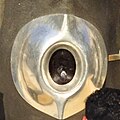
[[File:The_Blackstone.jpg|thumb|The [[Black Stone]] is seen through a portal in the Kaaba.<ref name="uscmsa">{{cite web |author=University of Southern California |title=The Prophet of Islam – His Biography |url=http://www.usc.edu/dept/MSA/fundamentals/prophet/profbio.html |url-status=dead |archive-url=https://web.archive.org/web/20060721113854/http://www.usc.edu/dept/MSA/fundamentals/prophet/profbio.html |archive-date=21 July 2006 |access-date=12 August 2006}}</ref>]] | |||
<!----Please note: Bharatpedia DOES NOT CENSOR CONTENT. PLEASE DO NOT REMOVE THE IMAGE ABOVE. IT WILL BE RESTORED. REPEATED REMOVAL OF AN IMAGE THAT CONFORMS TO OUR GUIDELINES MAY RESULT IN YOUR USERNAME BEING BLOCKED. For more information, please visit http://en.Bharatpedia.org/wiki/Bharatpedia:NOTCENSORED-----> | |||
The architectural style of the Meccan Kaaba is shared by a number of pre-Islamic religious buildings, which have broadly been labelled as [[Kaabas]]. They are primarily known from the [[Arabian Peninsula]], but some have also been found in other regions, including the [[Kaaba of Zoroaster]].{{Sfn|Finster|2010|p=83–86}} Imoti contends that there were numerous such Kaaba sanctuaries in Arabia at one time, although only the Meccan Kaaba was built of stone.<ref>{{cite journal |author=Imoti, Eiichi |year=1979 |title=The Ka'ba-i Zardušt" |journal=Orient |publisher=The Society for Near Eastern Studies in Japan |volume=XV |pages=65–69 }}</ref> The [[Black Stone]] of the Kaaba has been compared to pre-Islamic religious stones called [[baetyl|baetyls]], which were often black, thought to be of meteorite origins, and venerated in houses or temples of worship for a particular deity.{{Sfn|Durand|2019|p=27, 27n41}} Imoti argues that the other Kaabas also allegedly had their own counterparts of the Black Stone. There was a "Red Stone", in the Kaaba of the South Arabian city of Ghaiman; and the "White Stone" in the Kaaba of al-Abalat (near modern-day [[Tabalah, Saudi Arabia|Tabalah]]). Grunebaum, in ''Classical Islam'', points out that the experience of divinity of that period was often associated with the [[fetishism]] of stones, mountains, special rock formations, or "trees of strange growth."{{sfn|von Grunebaum|1970|p=24}} | |||
== History == | |||
{{See also|Hejaz|History of Islam|History of Saudi Arabia}} | |||
== | [[Patricia Crone]] and a group of historians later called the [[revisionist school of Islamic studies]] has cast doubt on the claim that Mecca was a major historical trading outpost,{{sfn|Crone|2004|p=7}}<ref>{{cite book |author=Holland, Tom |year=2012 |title=In the Shadow of the Sword |publisher=Little, Brown |page=303 |location= |isbn= }}</ref> and proposed a more northern region as the origin of Islam. Other scholars such as [[Glen Bowersock]] disagree and assert that it was.<ref>{{Cite book |author=Haji Hassan, Abdullah Alwi |title=Sales and Contracts in Early Islamic Commercial Law |year=1994 |isbn=978-9694081366 |pages=3 ff |publisher=Islamic Research Institute, International Islamic University }}</ref><ref>{{Cite book |last=Bowersock |first=Glen. W. |author-link=Glen Bowersock |title=The crucible of Islam |location=Cambridge (Mass.) |publisher=Harvard University Press. |pages=50 ff |year=2017 |isbn= }}</ref> | ||
{{ | |||
=== | === Before Muhammad === | ||
{{ | {{see also|Pre-Islamic Arabia|Religion in pre-Islamic Arabia}} | ||
In [[pre-Islamic Arabic poetry]] attributed to [[Zuhayr ibn Abi Sulma]], the builders of the Kaaba are said to be the [[Quraysh]] and [[Jurhum]] tribes.{{Sfn|Webb|2023|p=40}} [[Christian J. Robin]] argues that the Kaaba may have become prominent in the last decades of the 6th century in the aftermath of the military defeat of [[Abraha]] by the [[Quraysh]].{{Sfn|Robin|2015|p=152}} However, Peter Webb, based on pre-Islamic poetry, argues that the Kaaba was never a prominent site of pilgrimage and that it largely played a local role in Western Arabia as opposed to a pan-Arabian one.{{Sfn|Webb|2023}} | |||
==== | In [[Islamic cosmology]], the [[Zurah]] pilgrimage site was the precursor to the Kaaba.<ref name="Efendi1987">{{cite book |author=Efendi, Caʻfer |title=Risāle-i Miʻmāriyye |publisher=Brill Archive |year=1987 |isbn=90-04-07846-0 |page=[https://books.google.com/books?id=dJk3AAAAIAAJ&pg=PA49 49]}}</ref> According to Islamic tradition, the pre-Islamic Kaaba was a site of worship for various [[Arabian Peninsula|Arabian]] [[Bedouin]] tribes, who would make pilgrimage once every lunar year, setting aside their tribal feuds.<ref>{{cite book |author=Kuran, Timur |chapter=Commercial Life under Islamic Rule |title=The Long Divergence: How Islamic Law Held Back the Middle East |publisher=Princeton University Press |year=2011 |pages=45–62}}</ref> The Kaaba hosted 360 pagan idols (potentially one representing each day of the year) including sculptures and paintings before Islam, notably including a statue of [[Hubal]], the principal idol of Mecca.<ref name="King-2004">{{Cite journal |last=King |first=G. R. D. |date=2004 |title=The Paintings of the Pre-Islamic Kaʿba |journal=Muqarnas |volume=21 |pages=219–229 |jstor=1523357}}</ref>{{sfn|Armstrong|2000|p=11}} Paintings of [[Angels in Islam|angels]], of [[Abraham in Islam|Ibrahim]] holding [[Belomancy|divination arrows]], and of [[Jesus in Islam|Isa]] ([[Jesus]]) and his mother [[Mary in Islam|Maryam]] ([[Mary, mother of Jesus|Mary]]), which Muhammad spared.<ref name="EllenbogenTugendhaft2011">{{cite book |last1=Ellenbogen |first1=Josh |title=Idol Anxiety |last2=Tugendhaft |first2=Aaron |date=18 July 2011 |publisher=Stanford University Press |isbn=9780804781817 |page=47 |quote=When Muhammad ordered his men to cleanse the ''Kaaba'' of the statues and pictures displayed there, he spared the paintings of the Virgin and Child and of Abraham.}}</ref> Undefined decorations, money and a pair of ram's horns were recorded to be inside the Kaaba.<ref name="King-2004" /> The pair of ram's horns were said to have belonged to the ram sacrificed by Ibrahim in place of his son Ismail as held by Islamic tradition.<ref name="King-2004" /> Islamic tradition traces the polytheism of the Kaaba to the descendants of [[Ishmael in Islam|Ishmael]] who settled around the [[Zamzam Well]] and gradually turned it away from its original monotheist practice during the time of Abraham.{{sfn|Ibn Ishaq|1955|pages=88–9}} The [[Book of Idols]] by [[Hisham ibn al-Kalbi]] describes the origins of idolatry at the Kaaba: about 400 years before the birth of Muhammad, a man named '[[Amr ibn Luhay]], who descended from [[Qahtan]] and was the king of [[Hijaz]], placed an idol of Hubal on the roof of the Kaaba. This idol was one of the chief deities of the ruling [[Quraysh]] tribe. The idol was made of red [[agate]] and shaped like a human, but with the right hand broken off and replaced with a golden hand. When the idol was moved inside the Kaaba, it had seven arrows in front of it, which were used for [[divination]].<ref>{{cite book |author=Peters, Francis E. |title=Muhammad and the origins of Islam |publisher=SUNY Press |year=1994 |isbn= |page=109}}</ref> To maintain peace among the perpetually warring tribes, Mecca was declared a sanctuary where no violence was allowed within {{cvt|20|mi|km|sigfig=1|order=flip}} of the Kaaba. This combat-free zone allowed Mecca to thrive not only as a place of pilgrimage, but also as a trading center.{{sfn|Armstrong|1997|pp=221–22}} A king named Tubba' is considered the first one to have a door be built for the Kaaba according to sayings recorded in [[Al-Azraqi]]'s {{transliteration|ar|Akhbar Makka}}.<ref name="Al Arabiya">{{cite news |date=26 December 2018 |title=IN PICTURES: Six doors of Ka{{ayin}}aba over 5,000 years |url=http://english.alarabiya.net/en/variety/2018/12/26/Oldest-out-of-six-Kaaba-doors-tours-the-world.html |access-date=22 October 2019 |publisher=Al Arabiya}}</ref> | ||
[[Alfred Guillaume]], in his translation of the [[Ibn Ishaq]]'s [[Prophetic biography|seerah]], says that the Kaaba itself might be referred to in the feminine form.<ref>{{harvnb|Ibn Ishaq|1955|page=85 footnote 2}}: The text reads 'O God, do not be afraid', the second footnote reads 'The feminine form indicates the Ka'ba itself is addressed'</ref> [[Circumambulation]] was often performed naked by men and almost naked by women.{{sfn|Ibn Ishaq|1955|pages=88–9}} It is disputed whether Allah and Hubal were the same deity or different. According to a hypothesis by [[Uri Rubin]] and Christian Robin, Hubal was only venerated by [[Quraysh]] and the Kaaba was first dedicated to Allah, a supreme god of individuals belonging to different tribes, while the pantheon of the gods of Quraysh was installed in the Kaaba after they conquered Mecca a century before Muhammad's time.<ref>{{cite book |author=Robin, Christian Julien |title=Arabia and Ethiopia. In The Oxford Handbook of Late Antiquity |publisher=Oxford University Press USA |year=2012 |isbn=9780195336931 |page=[https://books.google.com/books?id=GKRybwb17WMC&pg=PA304 304–305]}}</ref> | |||
==== | ====Ptolemy and Diodorus Siculus==== | ||
[[ | Writing in the ''[[Encyclopedia of Islam]]'', Wensinck identifies Mecca with a place called ''Macoraba'' mentioned by [[Ptolemy]].<ref>{{cite book |last1=Neuwirth |first1=Angelika |url=http://www.aai.uni-hamburg.de/voror/Personal/heidemann/Heidemann_Texte/Heidemann_Quran_in_Context_2010_Representation.pdf |title=The Qur'an in context historical and literary investigations into the Qur'anic milieu |last2=Nicolai Sinai |first2=Michael |publisher=Brill |year=2010 |isbn=9789047430322 |location=Leiden |pages=63,123,83, 295 |archive-url=https://web.archive.org/web/20151002140559/http://www.aai.uni-hamburg.de/voror/Personal/heidemann/Heidemann_Texte/Heidemann_Quran_in_Context_2010_Representation.pdf |archive-date=2 October 2015 |url-status=dead}}</ref>{{sfn|Wensinck|Jomier|1978|p=318}} [[Gustave E. von Grunebaum|G. E. von Grunebaum]] states: "Mecca is mentioned by Ptolemy. The name he gives it allows us to identify it as a South Arabian foundation created around a sanctuary."{{sfn|von Grunebaum|1970|p=19}} In ''[[Meccan Trade and the Rise of Islam]]'', [[Patricia Crone]] argues that the identification of Macoraba with Mecca is false and that Macoraba was a town in southern Arabia in what was then known as [[Arabia Felix]].{{sfn|Crone|2004|pp=134–137}} A recent study has revisited the arguments for Macoraba and found them unsatisfactory.<ref name="IslamicHistory2018">{{Cite journal |author=Morris, Ian D. |year=2018 |title=Mecca and Macoraba |url=https://islamichistorycommons.org/mem/wp-content/uploads/sites/55/2018/11/UW-26-Morris.pdf |url-status=dead |journal=Al-ʿUṣūr Al-Wusṭā |volume=26 |pages=1–60 |archive-url=https://web.archive.org/web/20181117022342/https://islamichistorycommons.org/mem/wp-content/uploads/sites/55/2018/11/UW-26-Morris.pdf |archive-date=17 November 2018 |access-date=16 November 2018}}</ref> | ||
Based on an earlier report by [[Agatharchides of Cnidus]], [[Diodorus Siculus]] mentions a temple along the Red Sea coast, "which is very holy and exceedingly revered by all Arabians".<ref>{{cite book |last1=Siculus |first1=Diodorus |url=https://penelope.uchicago.edu/Thayer/E/Roman/Texts/Diodorus_Siculus/3C*.html |title=Bibliotheca Historica |series=Book 3 |chapter=44}}</ref> [[Edward Gibbon]] believed that this was the Kaaba.<ref>{{cite book |last1=Gibbon |first1=Edward |url=https://archive.org/details/in.ernet.dli.2015.533456 |title=The History of the Decline and Fall of the Roman Empire |year=1862 |series=Book 5 |pages=223–224}}</ref> However, Ian D. Morris argues that Gibbon had misread the source: Diodorus puts the temple too far north for it to have been Mecca.<ref name="IslamicHistory2018"/> | |||
==== In the Quran ==== | |||
In the Qur'an, from the era of the life of [[Muhammad]], the Kaaba is mentioned by the following names: | |||
*''al-Bayt'' ({{langx|ar|ٱلْبَيْت|lit=the house|link=yes}}) in 2:125 by Allah{{Cite Quran|2|125}} | |||
*''Baytī'' ({{langx|ar|بَيْتِي|lit=My House|link=no}}) in 22:26 by Allah{{Cite Quran|22|26}} | |||
*''Baytik al-Muḥarram'' ({{langx|ar|بَيْتِكَ ٱلْمُحَرَّم|lit=Your Inviolable House|link=no}}) in 14:37 by Ibrahim{{Cite Quran|14|37}} | |||
*''al-Bayt al-Ḥarām'' ({{langx|ar|ٱلْبَيْت ٱلْحَرَام|lit=The Sacred House|link=no}}) in 5:97 by Allah{{Cite Quran|5|97}} | |||
*''al-Bayt al-ʿAtīq'' ({{langx|ar|ٱلْبَيْت ٱلْعَتِيق|lit=The Ancient House|link=no}}) in 22:29 by Allah{{Cite Quran|22|29}} | |||
The Qur'an contains several verses regarding the origin of the Kaaba. It states that the Kaaba was the first [[Islamic architecture#Beginning|House of Worship]] for mankind, and that it was built by Ibrahim and Ismail on Allah's instructions:<ref name="Michigan C 1986">{{cite book |author=Michigan Consortium for Medieval and Early Modern Studies |title=The Meeting of Two Worlds: Cultural Exchange Between East and West During the Period of the Crusades |publisher=Medieval Institute Publications, Western Michigan University |year=1986 |isbn=0918720583 |editor1=Goss, V. P. |volume=21 |page=208 |oclc=13159056 |editor2=Bornstein, C. V.}}</ref><ref name="Abu Sway 2011">{{cite news |author=Sway, Mustafa Abu |title=The Holy Land, Jerusalem and Al-Aqsa Mosque in the Qur'an, Sunnah and other Islamic Literary Source |url=http://www.wcfia.harvard.edu/sites/default/files/Abusway_0.pdf |url-status=dead |archive-url=https://web.archive.org/web/20110728001911/http://www.wcfia.harvard.edu/sites/default/files/Abusway_0.pdf |archive-date=28 July 2011 |publisher=[[Central Conference of American Rabbis]]}}</ref><ref name="Dyrness2013">{{cite book |author=Dyrness, W. A. |title=Senses of Devotion: Interfaith Aesthetics in Buddhist and Muslim Communities |date=29 May 2013 |publisher=[[Wipf and Stock]] Publishers |isbn=978-1620321362 |volume=7 |page=25 |oclc=855764827}}</ref> | |||
{{blockquote|Verily, the first House (of worship) appointed for mankind was that at Bakkah (Makkah), full of blessing, and a guidance for mankind.|Quran|[[Surah]] [[Al Imran]] (3), [[Ayah]] 96<ref name="Cite quran|3|96|t=y|s=ns">{{Cite quran|3|96 |t=y |s=ns}}</ref>}} | |||
{{blockquote|Behold! We gave the site, to Ibrahim, of the (Sacred) House, (saying): "Associate not anything (in worship) with Me; and sanctify My House for those who compass it round, or stand up, or bow, or prostrate themselves (therein in prayer)."|Quran|Surah [[Al-Hajj]] (22), Ayah 26<ref name="Cite quran|22|26|t=y|s=ns">{{Cite quran|22|26 |t=y |s=ns}}</ref>}} | |||
{{ | |||
{{blockquote|And remember Ibrahim and Ismail raised the foundations of the House (With this prayer): "Our Lord! Accept (this service) from us: For Thou art the All-Hearing, the All-knowing."|Quran|[[Al-Baqarah]] (2), Ayah 127<ref name="Cite quran|2|127|t=y|s=ns">{{Cite quran|2|127 |t=y |s=ns}}</ref>}} | |||
[[Ibn Kathir]], in his famous [[exegesis]] ({{transliteration|ar|[[tafsir]]}}) of the Quran, mentions two interpretations among the Muslims on the origin of the Kaaba. One is that the temple was a place of worship for {{transliteration|ar|[[mala'ikah]]}} ([[angel]]s) before the creation of man. Later, a house of worship was built on the location and was lost during the flood in [[Noah in Islam|Nuh]] ([[Noah]])'s time and was finally rebuilt by Ibrahim and Ismail as mentioned later in the Quran. Ibn Kathir regarded this tradition as weak and preferred instead the narration by [[Ali ibn Abi Talib]] that although several other temples might have preceded the Kaaba, it was the first {{transliteration|ar|Bayt Allah}} ('House of God'), dedicated solely to him, built by his instruction, and sanctified and blessed by him, as stated in {{qref|22|26-29|b=y|pl=y}}.<ref>{{Cite Tafsir|en:ibn kathir|3|96}}</ref> A [[hadith]] in [[Sahih al-Bukhari]] states that the Kaaba was the first {{transliteration|ar|masjid}} on Earth, and the second was [[Al-Aqsa]] in Jerusalem.<ref>{{href|bukhari|3366|b=y}}</ref> | |||
{{quote box | |||
| quote = Narrated [[Abu Dhar al-Ghifari|Abu Dhar]]: I said, "O Allah's Messenger (ﷺ)! Which mosque was first built on the surface of the earth?" He said, "Al- Masjid-ul-,Haram (in Mecca)." I said, "Which was built next?" He replied "The mosque of Al-Aqsa ( in Jerusalem) ." I said, "What was the period of construction between the two?" He said, "Forty years." He added, "Wherever (you may be, and) the prayer time becomes due, perform the prayer there, for the best thing is to do so (i.e. to offer the prayers in time). | |||
| quoted = 2 | |||
| width = 40% | |||
| align = right | |||
| source = {{href|bukhari|3366|b=y}}<ref>{{cite web |url=http://www.arabworldbooks.com/Readers2010/articles/aqsa_mosque_history.htm |title=A history of the Al Asqa Mosque |work=Arab World Books}}</ref> | |||
}} | |||
== | {{citation needed span|date=November 2023|reason=The specific details are not directly supported by the reference of Quran 22:26–33.|While Abraham was building the Kaaba, an angel brought to him the Black Stone which he placed in the eastern corner of the structure. Another stone was the {{transliteration|ar|[[Maqam Ibrahim]]}}, the Station of Abraham, where Abraham stood for elevation while building the structure. The Black Stone and the {{transliteration|ar|Maqam Ibrahim}} are believed by Muslims to be the only remnants of the original structure made by Abraham, as the remaining structure had to be demolished and rebuilt several times over history for its maintenance.}} After the construction was complete, God enjoined the descendants of Ismail to perform an annual pilgrimage: the Hajj and the [[Qurban (Islamic ritual sacrifice)|Qurban]], sacrifice of cattle. The vicinity of the temple was also made a sanctuary where bloodshed and war were forbidden.{{qref|22|26-33|s=y|b=y}} | ||
[[ | |||
===During Muhammad's lifetime=== | |||
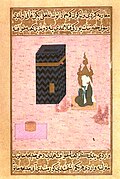
[[File:Siyer-i Nebi 151b.jpg|thumb|"Muhammad at the Ka'ba" from the ''[[Siyer-i Nebi]]''.<ref>{{cite web |url=http://www.ee.bilkent.edu.tr/~history/ottoman33.html |title=Ottomans : religious painting |access-date=1 May 2016}}</ref> Muhammad is shown with veiled face, {{circa|1595}} CE.]] | |||
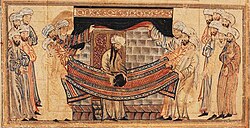
[[File:One of the oldest depictions of the Kaaba, from 1307.jpg|thumb|Miniature from ''[[Jami' al-tawarikh]]'', {{AH|706}}, depicting Muhammad and others moving the black stone into the Kaaba]] <!-- Kindly read Talk:Muhammad/FAQ if you have concerns about this image. Do not try to delete it, as it will be added again shortly afterwards. --> | |||
During Muhammad's lifetime (570–632 CE), the Kaaba was considered a holy site by the local Arabs. Muhammad took part in the reconstruction of the Kaaba around 600 CE, after its structure was weakened by a fire, and then damaged by a subsequent flood. Sources including [[Ibn Ishaq]]'s ''[[Sirat Rasūl Allāh]]'', one of the biographies of Muhammad (as reconstructed and translated by Guillaume), as well as [[Al-Azraqi]]'s chronicle of Mecca, describe Muhammad settling a quarrel between the Meccan clans as to which clan should set the Black Stone in its place. According to Ishaq's biography, Muhammad's solution was to have all the clan elders raise the cornerstone on a cloak, after which Muhammad set the stone into its final place with his own hands.<ref>{{cite book |last=Guillaume |first=A. |title=The Life of Muhammad |publisher=Oxford University Press |year=1955 |location=Oxford}} pp. 84–87</ref>{{sfn|Mubarakpuri|1976|loc="Muhammad's Birth and Forty Years prior to Prophethood"}} The [[Lumber|timber]] for the reconstruction of the Kaaba was purchased by Quraysh from a Byzantine ship that had been wrecked on the [[Red Sea]] coast at Shu'aybah. The work was undertaken by a Coptic Egyptian carpenter from the same ship, called Baqum (باخوم Pachomius), the name indicates an Egyptian Origin, The name Pachomius means "eagle" or "falcon", It comes from the [[Coptic language|Coptic]] word "akhōm" (eagle/falcon), which originally meant "divine image" in Middle Egyptian.<ref name="King-2004"/><ref>{{cite book |author=Glasse, Cyril |title=New Encyclopedia of Islam |publisher=Rowman Altamira |year=2001 |isbn=0-7591-0190-6 |page=245}}</ref> Financial constraints during this rebuilding caused Quraysh to exclude six cubits from the northern part of the Kaaba. This portion is what is currently known as Al-Hateem الحطيم or [[Hijr Ismail]] حجر اسماعيل. | |||
| | |||
Muhammad's [[Isra and Mi'raj|Isra']] is said to have taken him from the Kaaba to the [[Temple Mount|Masjid al-Aqsa]] and heavenwards from there.<ref>{{Cite web |title=Surah Al-Isra - 1-111 |url=https://quran.com/al-isra |access-date=2024-02-28 |website=Quran.com |language=en}}</ref> | |||
Muslims initially considered Jerusalem as their qibla, or prayer direction, and faced toward it while offering prayers; however, pilgrimage to the Kaaba was considered a religious duty though its rites were not yet finalized. During the first half of Muhammad's time as a prophet while he was at Mecca, he and his followers were severely persecuted which eventually led to their migration to [[Medina]] in 622 CE. In 624 CE, Muslims believe the direction of the qibla was changed from the Masjid al-Aqsa to the Masjid al-Haram in Mecca, with the revelation of {{qref|2|144|c=y|pl=y}}.{{sfn|Mubarakpuri|1976|page=[https://archive.org/details/TheSealedNectar_201312/page/n129 130]}} In 628 CE, Muhammad led a group of Muslims towards Mecca with the intention of performing the ''Umrah'', but was prevented from doing so by the Quraysh. He secured a peace treaty with them, the [[Treaty of Hudaybiyyah]], which allowed the Muslims to freely perform pilgrimage at the Kaaba from the following year.{{sfn|Mubarakpuri|1976|page=[https://archive.org/details/TheSealedNectar_201312/page/n212 213]}} | |||
At the culmination of his mission,<ref>{{Cite book |last=Lapidus |first=Ira M. |title=A history of Islamic societies |date=13 October 2014 |publisher=Cambridge University Press |isbn=9780521514309 |oclc=853114008}}</ref> in 630 CE, after the allies of the Quraysh, the Banu Bakr, violated the Treaty of Hudaybiyyah, Muhammad [[Conquest of Mecca|conquered Mecca]]. His first action was to remove statues and images from the ''Kaaba''.<ref name="EllenbogenTugendhaft2011" /> According to reports collected by [[Ibn Ishaq]] and [[al-Azraqi]], Muhammad spared a painting of [[Mary (mother of Jesus)|Mary]] and [[Jesus]], and a fresco of Ibrahim.<ref>{{harvnb|Ibn Ishaq|1955|page=552}}: Quraysh had put pictures in the Ka'ba including two of Jesus son of Mary and Mary (on both of whom be peace!). ... The apostle ordered that the pictures should be erased except those of Jesus and Mary.</ref><ref name="EllenbogenTugendhaft2011" /><ref name="Rogerson2003">{{cite book |last=Rogerson |first=Barnaby |author-link=Barnaby Rogerson |title=The Prophet Muhammad: A Biography |publisher=Paulist Press |year=2003 |isbn=9781587680298 |page=190 |quote=Muhammad raised his hand to protect an icon of the Virgin and Child and a painting of Abraham, but otherwise his companions cleared the interior of its clutter of votive treasures, cult implements, statuettes and hanging charms.}}</ref> | |||
{{blockquote|Narrated Abdullah: When the Prophet entered Mecca on the day of the conquest, there were 360 idols around the Kaaba. The Prophet started striking them with a stick he had in his hand and was saying, "Truth has come and Falsehood has vanished..." (Qur'an 17:81) |[[Muhammad al-Bukhari]]|[[Sahih al-Bukhari]] |source=Book 59, Hadith 583}} | |||
Al-Azraqi further conveys how Muhammad, after he entered the Kaaba on the day of the conquest, ordered all the pictures erased except that of Maryam: | |||
{{ | {{Blockquote|text=Shihab (said) that the Prophet (peace be upon him) entered the Kaaba on the day of the conquest, and in it was a picture of the angels (mala'ika), among others, and he saw a picture of Ibrahim and he said: "May Allah kill those representing him as a venerable old man casting arrows in divination (shaykhan yastaqsim bil-azlam)." Then he saw the picture of Maryam, so he put his hands on it and he said: "Erase what is in it [the Kaaba] in the way of pictures except the picture of Maryam." |author=[[al-Azraqi]]|title=|source=Akhbar Mecca: History of Mecca}} | ||
After the conquest, Muhammad restated the sanctity and holiness of Mecca, including its Great Mosque (Masjid al-Haram), in Islam.<ref name="Grolier_Society_Book_of_History">{{cite book |last1=Petrie |first1=W. M. Flinders |author-link=Flinders Petrie |url=https://archive.org/details/bookofhistoryhis04bryciala |title=The Book of History: A History of All Nations From the Earliest Times to the Present |last2=Helmolt |first2=Hans F. |last3=Lee-Warner |first3=William |author3-link=William Lee-Warner |last4=Lane-Poole |first4=Stanley |last5=Bain |first5=Robert Nisbet |last6=Winckler |first6=Hugo |last7=Sayce |first7=Archibald H. |last8=Wallace |first8=Alfred Russel |last9=Thompson |first9=Holland |publisher=The Grolier Society |year=1915 |display-authors=3 |first10=W. Stewart |last10=Wallace}}</ref> He performed the Hajj in 632 CE called the [[Farewell Pilgrimage|Hujjat ul-Wada']] ("Farewell Pilgrimage") since Muhammad prophesied his impending death on this event.{{sfn|Mubarakpuri|1976|page=[https://archive.org/details/TheSealedNectar_201312/page/n297 298]}} | |||
After Muhammad's [[conquest of Mecca]], it is said that the 360 idols of the Kaaba were destroyed. The Kaaba became a site for the veneration of [[Allah]] only, identified as the same God as that of other monotheists. The Kaaba continued to be a site of annual pilgrimage,<ref name="King-2004" /> and Muslims would perform the Salat prayer facing [[Al-Aqsa Mosque]] in Jerusalem, as instructed by Muhammad, and turning their backs on the pagan associations of the Kabah.{{sfn|Armstrong|2000|p=11}} | |||
===After Muhammad=== | |||
[[File:Adriaan-Reland-Verhandeling-van-de-godsdienst-der-Mahometaanen MG 0723.tif|thumb|View of the Kaaba, 1718. [[Adriaan Reland]]: ''Verhandeling van de godsdienst der Mahometaanen'']] | |||
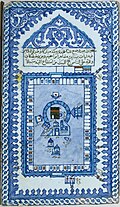
[[File:Turkish - Tile with the Great Mosque of Mecca - Walters 481307 - View A.jpg|thumb|[[Ottoman Empire|Ottoman]] [[tile]]s representing the Kaaba in the [[17th century]]]] | |||
[[ | The Kaaba has been repaired and reconstructed many times. The structure was severely damaged by a fire on 3 [[Rabi' al-awwal|Rabi' I]] 64 AH (Sunday 31 October 683 CE), during the [[Siege of Mecca (683)|first siege of Mecca in 683]] in the [[Second Fitna|war]] between the [[Umayyad Caliphate|Umayyads]] and [[Abd-Allah ibn al-Zubayr|'Abdullah ibn al-Zubayr]],<ref>{{cite news |last1=Selwood |first1=Dominic |date=31 October 2017 |title=On this day in 683 AD: The Kaaba, the holiest site in Islam, is burned to the ground |url=https://www.telegraph.co.uk/news/2017/10/31/day-683-ad-kaaba-holiest-site-islam-burned-ground/ |url-access=subscription |url-status=live |archive-url=https://ghostarchive.org/archive/20220111/https://www.telegraph.co.uk/news/2017/10/31/day-683-ad-kaaba-holiest-site-islam-burned-ground/ |archive-date=11 January 2022 |newspaper=The Telegraph}}{{cbignore}}</ref> an early Muslim who ruled Mecca for many years between the death of ʿAli and the consolidation of power by the [[Umayyad Caliphate|Umayyads]]. 'Abdullah rebuilt it to include the ''hatīm''. He did so on the basis of a tradition (found in several [[hadith collection]]s) that the ''hatīm'' was a remnant of the foundations of the Abrahamic Kaaba, and that Muhammad himself had wished to rebuild it so as to include it.<ref name="Ibn Khaldun">{{cite book |last=Ibn Khaldun |first=Abd al-Rahman |author-link=Ibn Khaldun |title=Al-Muqaddimah |title-link=Muqaddimah |publisher=Princeton University Press |year=1967 |isbn=0-691-09797-6 |edition=2 |series=Bollingen series |volume=2 |publication-place=Princeton, N. J. |publication-date=1980 |pages=253–255 |translator-last1=Rosenthal |translator-first1=Franz |trans-title=An Introduction to History |chapter=IV. Countries and cities, and all other forms of sedentary civilization. The conditions occurring there. Primary and secondary considerations in this connection. |orig-date=1377}}</ref> | ||
The Kaaba was bombarded with stones in the [[Siege of Mecca (692)|second siege of Mecca in 692]], in which the Umayyad army was led by [[al-Hajjaj ibn Yusuf]]. The fall of the city and the death of 'Abdullah ibn al-Zubayr allowed the Umayyads under [[ʿAbdu l-Malik ibn Marwan|'Abd al-Malik ibn Marwan]] to finally reunite all the Islamic possessions and end the long civil war. In 693 CE, 'Abd al-Malik had the remnants of al-Zubayr's Kaaba razed, and rebuilt it on the foundations set by the Quraysh. The Kaaba returned to the cube shape it had taken during Muhammad's time. Its basic shape and structure have not changed since then.<ref name="Ibn Khaldun" /> | |||
During its history, the [[Black Stone]] at the Kaaba has been struck and smashed by a stone fired from a [[catapult]],<ref>{{Cite book |author1=Office of the Blessed Mantle, Topkapı Palace Museum |title=The sacred trusts: Pavilion of the Sacred Relics, Topkapı Palace Museum, Istanbul |last2=Aydın |first2=Hilmi |last3=Uğurluel |first3=Talha |last4=Doğru |first4=Ahmet |date=2004 |publisher=Light |isbn=1-932099-72-7 |location=Somerset, New Jersey |oclc=56942620}}</ref> it has been smeared with excrement,<ref>{{Cite book |last=Burton |first=Richard Francis |url=http://dx.doi.org/10.1017/cbo9781139162302 |title=Personal Narrative of a Pilgrimage to El-Medinah and Meccah |date=2009 |publisher=Cambridge University Press |isbn=978-1-139-16230-2 |location=Cambridge |doi=10.1017/cbo9781139162302 |hdl=2027/coo.31924062544543}}</ref> stolen and ransomed by the [[Qarmatians]]<ref name="Peters 1994">{{Cite book |last=Peters |first=F. E. |title=Mecca: a literary history of the Muslim Holy Land |date=1994 |publisher=Princeton University Press |others=Mazal Holocaust Collection |isbn=0-691-03267-X |location=Princeton, New Jersey |oclc=30671443}}</ref> and smashed into several fragments.<ref name="Peters 1994" /><ref name="King-2004" /> | |||
During the Hajj of 930 CE, the [[Shia Islam|Shi'ite]] [[Qarmatians]] [[Sack of Mecca|attacked Mecca]] under [[Abu Tahir al-Jannabi]], defiled the Zamzam Well with the bodies of pilgrims and stole the Black Stone, taking it to the oasis in Eastern Arabia known as [[Al-Ahsa Oasis|al-Aḥsāʾ]], where it remained until the [[Abbasid Caliphate|Abbasids]] ransomed it in 952 CE.<ref>{{cite web |author=Ghamidi, Javed Ahmad |author-link=Javed Ahmad Ghamidi |title=The Rituals of Hajj and 'Umrah |url=http://www.renaissance.com.pk/JanIslamiShari2y5.htm |archive-url=https://web.archive.org/web/20100307022435/http://www.renaissance.com.pk/JanIslamiShari2y5.htm |archive-date=7 March 2010 |access-date= |work=renaissance.com.pk |translator=Saleem, Shehzad |location=[[Mizan]], [[Al-Mawrid]]}}</ref> | |||
After heavy rains and flooding in 1626, the walls of the Kaaba collapsed and the Mosque was damaged. The same year, during the reign of Ottoman Emperor [[Murad IV]], the Kaaba was rebuilt with granite stones from Mecca, and the Mosque was renovated. | |||
In 1916, after [[Hussein bin Ali, King of Hejaz|Hussein bin Ali]] had launched the [[Arab Revolt|Great Arab Revolt]], during the [[Battle of Mecca (1916)|Battle of Mecca]] between [[Arabs|Arab]] and Ottoman forces, the Ottoman troops bombarded the city and hit the Kaaba, setting fire to the protective veil.<ref name="Le Naour-2017">{{Cite book |last=Le Naour |first=Jean-Yves |url=http://www.cairn.info/djihad--9782262070830.htm |title=Djihad 1914-1918 |date=2017 |publisher=Éditions Perrin |isbn=978-2-262-07083-0 |language=fr |doi=10.3917/perri.lenao.2017.01}}</ref><ref name="Murphy-2008">{{Cite book |last=Murphy |first=David |title=The Arab Revolt 1916–18: Lawrence sets Arabia ablaze |date=2008-11-18 |publisher=Bloomsbury USA |isbn=978-1-84603-339-1 |language=en |oclc=212855786}}</ref> This incident was later exploited by the propaganda of the Great Arab Revolt to attempt to demonstrate the impiety of the Ottomans and the legitimacy of the revolt as a holy war.<ref name="Le Naour-2017" /><ref name="Murphy-2008" /> | |||
{{ | |||
On 15 March 1935, three armed men from Oman attacked and tried to assassinate King [[Ibn Saud]] during his performance of Hajj.<ref>{{cite thesis |author=Jerald L. Thompson |title=H. St. John Philby, Ibn Saud and Palestine |url=https://apps.dtic.mil/sti/citations/ADA111290 |degree=MA |location=University of Kansas |date=December 1981}}</ref><ref name=amin>{{cite web|author=Amin K. Tokumasu|title=Cultural Relations between Saudi Arabia and Japan from the Time of King Abdulaziz to the Time of King Fahd |url=http://www.darah.info/bohos/Data/15/13.htm |work=Darah |archive-url=https://web.archive.org/web/20130708081440/http://darah.info/bohos/Data/15/13.htm |archive-date=8 July 2013 |access-date=2 January 2013 |url-status=dead}}</ref><ref name=richard/> He survived the attack unhurt, through the intervention of the [[Saud of Saudi Arabia|crown prince]], and the three attackers were killed by bodyguards.<ref name=amin/><ref name=richard>{{cite news|first=Richard |last=Halliburton |authorlink=Richard Halliburton |title=Ibn Saud, King of Arabia, Goes out from Mecca to Grant an Interview |url=https://www.newspapers.com/article/the-kansas-city-star-ibn-saud-king-of-a/177981176/ |access-date=1 August 2025 |newspaper=[[The Kansas City Star]] |page=16 |date=24 June 1935 |via=newspapers.com |quote=Two of the assassins, in the shadow of the Kaaba, were hacked to pieces; and the third, breaking free...was overtaken and struck down.}}</ref><ref>{{cite journal |url=https://www.jstor.org/stable/45334930 |journal=Current History |title=Arab King Escapes Assassins |volume=42 |number=2 |date=May 1935 |pages=218-220 |first=Robert L. |last=Baker |accessdate=August 1, 2025 |via=[[JSTOR]] |quote=While the Emir Suad grappled with the leader the King's alert bodyguard killed the would-be regicides.}}</ref> | |||
The Kaaba is depicted on the [[Obverse and reverse|reverse]] of 500 [[Saudi Riyal|Saudi riyal]] and 2000 [[Iranian rial]] banknotes.<ref>{{cite web |title=Banknotes & Coins: 500 Rials |url=http://www.cbi.ir/default_en.aspx |archive-url=https://web.archive.org/web/20210203093839/https://www.cbi.ir/default_en.aspx |archive-date=3 February 2021 |access-date=24 March 2009 |work=Central Bank of Iran}}</ref><ref>{{cite web |title=Banknotes & Coins: 2000 Rials |url=http://www.cbi.ir/page/1980.aspx |archive-url=https://web.archive.org/web/20220309064805/https://www.cbi.ir/page/1980.aspx |archive-date=9 March 2022 |access-date=24 March 2009 |work=Central Bank of Iran}}</ref> | |||
[[Al-Azraqi]] provided the following narrative on the authority of his grandfather:<ref name="King-2004" /> | |||
{{blockquote|I have heard that there was set up in ''al-Bayt'' (referring to the Kaaba) a picture ({{Langx|ar|تمثال|lit=Depiction |translit=Timthal}}) of Maryam and 'Isa. ['Ata'] said: "Yes, there was set in it a picture of Maryam adorned (''muzawwaqan''); in her lap, her son Isa sat adorned."|[[al-Azraqi]], ''Akhbar Mecca: History of Mecca''<ref name="Al-Azraqi-2003" />}} | |||
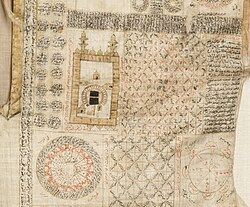
= | The Kaaba came to be considered the [[axis mundi]] (world center), with the Gate of Heaven directly above it. The Kaaba marked the location where the sacred world intersected with the profane; the embedded Black Stone was a further symbol of this as a [[meteorite]] that had fallen from the sky and linked heaven and earth.{{sfn|Armstrong|1997|p=221}}[[File:Khalili Collection Hajj and Arts of Pilgrimage txt-0471-front CROP.jpg|thumb|The Kaaba and Masjid al-Haram depicted on a [[talismanic shirt]], 16th or early 17th century]]{{multiple image |width=220 |direction=vertical | ||
{{multiple image |width=220 |direction=vertical | |||
|image1=Khalili Collection Hajj and Arts of Pilgrimage arc.pp 0211.04 CROP.jpg |caption1=Photographed in 1880 by [[Muhammad Sadiq (photographer)|Muhammad Sadiq]] | |image1=Khalili Collection Hajj and Arts of Pilgrimage arc.pp 0211.04 CROP.jpg |caption1=Photographed in 1880 by [[Muhammad Sadiq (photographer)|Muhammad Sadiq]] | ||
|image2=Masjid al-Haram 1.jpg |caption2=In 1907 | |image2=Masjid al-Haram 1.jpg |caption2=In 1907 | ||
}} | }} | ||
The | === In non-Islamic literature === | ||
The [[Khuzistan Chronicle]] is a short [[Church of the East|Nestorian]] (Christian origin) chronicle written no later than the 660s CE covers the history up to the Arab conquest and gives an interesting note on Arabian geography. The section covering the geography starts with a speculation about the origin of the Muslim sanctuary in Arabia: | |||
{{blockquote|Regarding the K'bta (Kaaba) of Ibrahim, we have been unable to discover what it is except that, because the blessed Abraham grew rich in property and wanted to get away from the envy of the Canaanites, he chose to live in the distant and spacious parts of the desert. Since he lived in tents, he built that place for the worship of God and for the offering of sacrifices. It took its present name from what it had been, since the memory of the place was preserved with the generations of their race. Indeed, it was no new thing for the Arabs to worship there, but goes back to antiquity, to their early days, in that they show honor to the father of the head of their people.<ref>{{Cite book |author=Hoyland, Robert G. |title=Seeing Islam as others saw it |publisher=The Darwin Press |year=1997 |pages=187}}</ref>}} | |||
According to the [[The Asatir|''Asatir'']], a 10th-century work of [[Samaritan]] literature,<ref>{{cite book |last=Crown |first=Alan David |title=Samaritan Scribes and Manuscripts' |date=2001 |publisher=Mohr Siebeck |location=Tübingen |page=[https://books.google.com/books?id=e5iW24esf-sC&dq=samaritan+Book+of+the+%E2%80%9CSecrets+of+Moses%E2%80%9D&pg=PA27 27]}}</ref> Ismail and his eldest son [[Nebaioth]] built the Kaaba as well as the city of Mecca."<ref>{{cite book |last=Gaster |first=Moses |url=https://archive.org/stream/MN40245ucmf_0#page/n271/mode/2up |title=The Asatir: the Samaritan book of Moses |publisher=The Royal Asiatic Society |year=1927 |location=London |pages=71, 262 |quote=Ishmaelites built Mecca (Baka, Bakh)}}</ref> | |||
== Architecture and interior == | |||
The Kaaba is a [[Cube|cuboid]]-shaped structure made of [[stones]]. It is approximately {{cvt|15|m|ftin}} high with sides measuring {{cvt|12|m|ftin}} × {{cvt|10.5|m|ftin}} wide.<ref name=Peterson>{{cite book |last1=Peterson |first1=Andrew |title=Dictionary of Islamic Architecture |date=1996 |publisher=Taylor & Francis |location=London |page=[https://archive.org/details/dictionaryofisla00andr/page/142/mode/2up?q=box- 142] }}</ref>{{efn|Hawting states {{cvt|10|m|ftin}}.{{sfn|Hawting|2003|page=75}}}} Inside the Kaaba, the floor is made of [[marble]] and [[limestone]]. The interior walls are clad with tiled, white marble halfway to the roof, with darker trimmings along the floor. The floor of the interior stands about {{cvt|2|m|ftin}} above the ground area where [[tawaf]] is performed.<ref name=Peterson />{{sfn|Hawting|2003|page=75}} | |||
The wall directly adjacent to the entrance of the Kaaba has six tablets inlaid with inscriptions, and there are several more tablets along the other walls. Along the top corners of the walls runs a black cloth embroidered with gold Qur'anic verses. Caretakers anoint the marble cladding with the same scented oil used to anoint the Black Stone outside. Three pillars (some erroneously report two) stand inside the Kaaba, with a small altar or table set between one and the other two. [[Oil lamp|Lamp]]-like objects (possible lanterns or [[crucible]] [[censer]]s) hang from the ceiling. The ceiling itself is of a darker colour, similar in hue to the lower trimming. The ''Bāb ut-Tawbah''—on the right wall (right of the entrance) opens to an enclosed staircase that leads to a hatch, which itself opens to the roof. Both the roof and ceiling (collectively dual-layered) are made of [[stainless steel]]-capped [[teak|teak wood]].{{fact|date=May 2025}} | |||
The wall directly adjacent to the entrance of the Kaaba has six tablets inlaid with inscriptions, and there are several more tablets along the other walls. Along the top corners of the walls runs a black cloth embroidered with gold Qur'anic verses. Caretakers anoint the marble cladding with the same scented oil used to anoint the Black Stone outside. Three pillars (some erroneously report two) stand inside the Kaaba, with a small altar or table set between one and the other two. [[Oil lamp|Lamp]]-like objects (possible lanterns or [[crucible]] [[censer]]s) hang from the ceiling. The ceiling itself is of a darker colour, similar in hue to the lower trimming. The ''Bāb ut-Tawbah''—on the right wall (right of the entrance) opens to an enclosed staircase that leads to a hatch, which itself opens to the roof. Both the roof and ceiling (collectively dual-layered) are made of [[stainless steel]]-capped [[teak|teak wood]]. | |||
[[File:Kaaba.png|alt=|center]] | [[File:Kaaba.png|alt=|center]] | ||
| Line 167: | Line 164: | ||
[[File:Rukn al-Yamani 01.jpg|thumb|Rukn al-Yamani (The Yemeni Corner)]] | [[File:Rukn al-Yamani 01.jpg|thumb|Rukn al-Yamani (The Yemeni Corner)]] | ||
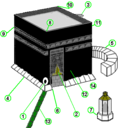
Each numbered item in the following list corresponds to features noted in the diagram image. | Each numbered item in the following list corresponds to features noted in the diagram image. | ||
# The ''Ḥajar al-Aswad'' ({{ | # The ''Ḥajar al-Aswad'' ({{Langx|ar|الحجر الأسود|lit=The Black Stone |translit=al-Hajar al-Aswad}}), is located on the Kaaba's eastern corner. It is the location where Muslims start their circumambulation of the Kaaba, known as the ''tawaf''. | ||
# The entrance is a door set {{cvt|2.13|m|ftin|frac=2}} above the ground on the north-eastern wall of the Kaaba, called the ''Bāb ar-Raḥmah'' ({{ | # The entrance is a door set {{cvt|2.13|m|ftin|frac=2}} above the ground on the north-eastern wall of the Kaaba, called the ''Bāb ar-Raḥmah'' ({{Langx|ar|باب الرحمة|lit=Door of Mercy |translit=Bāb ar-Raḥmah}}), that also acts as the façade.{{sfn|Wensinck|Jomier|1978|p=317}} In 1979, the {{cvt|300|kg|lb}} gold doors made by artist [[Ahmad bin Ibrahim Badr]], replaced the old silver doors made by his father, Ibrahim Badr, in 1942.<ref>{{cite news |date=9 November 2009 |title=Saudi Arabia's Top Artist Ahmad bin Ibrahim Passes Away |work=Khaleej Times |url=http://www.khaleejtimes.com/DisplayArticleNew.asp?col=§ion=middleeast&xfile=data/middleeast/2009/November/middleeast_November268.xml |url-status=dead |access-date=15 October 2010 |archive-url=https://web.archive.org/web/20120930091632/http://www.khaleejtimes.com/DisplayArticleNew.asp?col=§ion=middleeast&xfile=data%2Fmiddleeast%2F2009%2FNovember%2Fmiddleeast_November268.xml |archive-date=30 September 2012}}</ref> There is a wooden staircase on wheels, usually stored in the mosque between the arch-shaped gate of ''Banū Shaybah'' and the [[Zamzam Well]]. The oldest surviving door dates back to 1045 AH (1635–6 CE).<ref name="Al Arabiya"/> | ||
# The ''[[Mīzāb al-Raḥmah|Mīzāb ar-Raḥmah]]'', commonly shortened to ''Mīzāb'' or ''Meezab'' is a rain spout made of gold. Added when the Kaaba was rebuilt in 1627, after a flood in 1626 caused three of the four walls to collapse. | # The ''[[Mīzāb al-Raḥmah|Mīzāb ar-Raḥmah]]'', commonly shortened to ''Mīzāb'' or ''Meezab'' is a rain spout made of gold. Added when the Kaaba was rebuilt in 1627, after a flood in 1626 caused three of the four walls to collapse. | ||
# This slant structure, covering three sides of the Kaaba, is known as the ''Shadherwaan'' ({{ | # This slant structure, covering three sides of the Kaaba, is known as the ''Shadherwaan'' ({{Langx|ar|شاذروان}}) and was added in 1627 along with the ''Mīzāb ar-Raḥmah'' to protect the foundation from rainwater. | ||
# The ''Hatīm'' (also romanized as ''hateem'') and | # The ''Hatīm'' (also romanized as ''hateem'') and known as the ''[[Hijr Ismail]]'', is a low wall that was part of the original Kaaba. It is a semi-circular wall opposite, but not connected to, the north-west wall of the Kaaba. It is {{cvt|1.31|m|ftin|frac=2}} in height and {{cvt|1.5|m|ftin|0}} in width, and is composed of white marble. The space between the ''hatīm'' and the Kaaba was originally part of the ''Kaaba'', and is thus not entered during the ''tawaf''. | ||
# ''al-Multazam'', the roughly {{cvt|2|m|ft|adj=on|frac=2}} space along the wall between the Black Stone and the entry door. It is sometimes considered pious or desirable for a pilgrim to touch this area of the Kaaba, or perform [[dua]] here. | # ''al-Multazam'', the roughly {{cvt|2|m|ft|adj=on|frac=2}} space along the wall between the Black Stone and the entry door. It is sometimes considered pious or desirable for a pilgrim to touch this area of the Kaaba, or perform [[dua]] here. | ||
# The Station of Ibrahim ''([[Maqam Ibrahim]])'' is a glass and metal enclosure with what is said to be an imprint of Ibrahim's feet. Ibrahim is said to have stood on this stone during the construction of the upper parts of the Kaaba, raising Ismail on his shoulders for the uppermost parts.<ref>According to [[Muslim]] tradition: ''"God made the stone under Ibrahim's feet into something like clay so that his feet sunk into it. That was a miracle. It was transmitted on the authority of Abu Ja'far al-Baqir (may [[Peace be upon him (Islam)|peace be upon him]]) that he said: Three stones were sent down from [[Jannah|the Garden]]: the Station of Ibrahim, [[Foundation Stone|the rock of the children of Israel]], and the Black Stone, which God entrusted Ibrahim with as a white stone. It was whiter than paper, but became black from the sins of [[Son of man|the children of Adam]]."'' (The Hajj, [[F.E. Peters]] 1996)</ref> | # The Station of Ibrahim ''([[Maqam Ibrahim]])'' is a glass and metal enclosure with what is said to be an imprint of Ibrahim's feet. Ibrahim is said to have stood on this stone during the construction of the upper parts of the Kaaba, raising Ismail on his shoulders for the uppermost parts.<ref>According to [[Muslim]] tradition: ''"God made the stone under Ibrahim's feet into something like clay so that his feet sunk into it. That was a miracle. It was transmitted on the authority of Abu Ja'far al-Baqir (may [[Peace be upon him (Islam)|peace be upon him]]) that he said: Three stones were sent down from [[Jannah|the Garden]]: the Station of Ibrahim, [[Foundation Stone|the rock of the children of Israel]], and the Black Stone, which God entrusted Ibrahim with as a white stone. It was whiter than paper, but became black from the sins of [[Son of man|the children of Adam]]."'' (The Hajj, [[F.E. Peters]] 1996)</ref> | ||
# The corner of the Black Stone. It faces very slightly southeast from the center of the ''Kaaba.'' The four corners of the Kaaba roughly point toward the four [[cardinal direction]]s of the [[compass]]. | # The corner of the Black Stone. It faces very slightly southeast from the center of the ''Kaaba.'' The four corners of the Kaaba roughly point toward the four [[cardinal direction]]s of the [[compass]].{{sfn|Wensinck|Jomier|1978|p=317}} | ||
# The ''Rukn al-Yamani'' ({{ | # The ''Rukn al-Yamani'' ({{Langx|ar|الركن اليمني |translit=ar-Rukn al-Yamani|lit=The Yemeni Corner}}), also known as ''Rukn-e-Yamani'' or ''Rukn-e-Yemeni'', is the corner of the ''Kaaba'' facing slightly southwest from the center of the Kaaba.{{sfn|Wensinck|Jomier|1978|p=317}}{{sfn|Hawting|2003|page=76}} | ||
# The ''Rukn ush-Shami'' ({{ | # The ''Rukn ush-Shami'' ({{Langx|ar|الركن الشامي |translit=ar-Rukn ash-Shami|lit=The Levantine Corner}})'','' also known as ''Rukn-e-Shami'', is the corner of the ''Kaaba'' facing very slightly northwest from the center of the Kaaba.{{sfn|Wensinck|Jomier|1978|p=317}}{{sfn|Hawting|2003|page=76}} | ||
# The ''Rukn al-'Iraqi'' ({{ | # The ''Rukn al-'Iraqi'' ({{Langx|ar|الركن العراقي |translit=ar-Rukn al-'Iraqi|lit=The Iraqi Corner}}), is the corner that faces slightly northeast from the center of the Kaaba. | ||
# [[Kiswah]], the embroidered covering. Kiswa is a black silk and gold curtain which is replaced annually during the Hajj pilgrimage.<ref>{{cite web | | # [[Kiswah]], the embroidered covering. Kiswa is a black silk and gold curtain which is replaced annually during the Hajj pilgrimage.<ref>{{cite web |date=2003-02-11 |title='House of God' Kaaba gets new cloth |url=http://www.theage.com.au/articles/2003/02/11/1044725746252.html |access-date=17 August 2006 |work=[[The Age]] |location=Melbourne, Australia }}</ref><ref>{{cite web |title=The Kiswa – (Kaaba Covering) |url=http://members.tripod.com/worldupdates/newupdates10/id43.htm |url-status=dead |archive-url=https://archive.today/20030722203309/http://members.tripod.com/worldupdates/newupdates10/id43.htm |archive-date=22 July 2003 |access-date=17 August 2006 |publisher=Al-Islaah Publications}}</ref> Two-thirds of the way up is the ''hizam'', a band of gold-embroidered Quranic text, including the [[Shahada]], the Islamic declaration of faith. The curtain over the door of the Kaaba is especially ornate and is known as the ''[[Sitara (textile)|sitara]]'' or ''burqu'''.<ref name="textiles2">{{Cite book |last=Porter |first=Venetia |url= |title=Hajj: journey to the heart of Islam |publisher=The British Museum |year=2012 |isbn=978-0-674-06218-4 |editor=Porter, Venetia |location=Cambridge, Mass. |pages=257–258 |chapter=Textiles of Mecca and Medina |oclc=709670348}}</ref> The ''hizam'' and ''sitara'' have inscriptions embroidered in gold and silver wire,<ref name="textiles2"/> including verses from the [[Quran]] and supplications to [[Allah]].<ref name=":02">{{Cite web |last=Ghazal |first=Rym |date=28 August 2014 |title=Woven with devotion: the sacred Islamic textiles of the Kaaba |url=https://www.thenationalnews.com/arts-culture/woven-with-devotion-the-sacred-islamic-textiles-of-the-kaaba-1.258782 |access-date=2021-01-07 |website=The National |language=en}}</ref><ref name="daralkiswa">{{Cite book |last=Nassar |first=Nahla |url= |title=The Hajj: collected essays |publisher=The British Museum |year=2013 |isbn=978-0-86159-193-0 |editor1=Porter, Venetia |location=London |pages=176–178 |chapter=Dar al-Kiswa al-Sharifa: Administration and Production |oclc=857109543 |editor2=Saif, Liana}}</ref> | ||
# Marble stripe marking the beginning and end of each circumambulation.<ref>Key to numbered parts translated from, accessed 2 December</ref> | # Marble stripe marking the beginning and end of each circumambulation.<ref>Key to numbered parts translated from, accessed 2 December</ref> | ||
Note: The major (long) axis of the Kaaba has been observed to align with the rising of the star [[Canopus]] toward which its southern wall is directed, while its minor axis (its east–west facades) roughly align with the sunrise of [[summer solstice]] and the sunset of [[winter solstice]].<ref>{{cite book | | Note: The major (long) axis of the Kaaba has been observed to align with the rising of the star [[Canopus]] toward which its southern wall is directed, while its minor axis (its east–west facades) roughly align with the sunrise of [[summer solstice]] and the sunset of [[winter solstice]].<ref>{{cite book |page=[https://books.google.com/books?id=Q9YYqiXm-lkC&q=kaaba+canopus&pg=PA202 202] |title=Ancient astronomy: an encyclopedia of cosmologies and myth |author=Ruggles, Clive L. N. |edition=Illustrated |publisher=ABC-CLIO |year=2005 |isbn=978-1-85109-477-6 }}</ref><ref>{{cite book |page=[https://books.google.com/books?id=pheL_ubbXD0C&q=kaaba+canopus&pg=PA137 137] |title=Lost Discoveries: The Ancient Roots of Modern Science—from the Babylonians to the Maya |author=Teresi, Dick |edition=Reprint, illustrated |publisher=Simon and Schuster |year=2003 |isbn=978-0-7432-4379-7}}</ref> | ||
{{gallery| | |||
|File:Gate of Ka-bah.JPG|The ''Bāb at-Tawbah'', "Door of Repentance" | {{gallery|width=200 |height=200 | ||
|File:Kaaba mirror edit jj.jpg|The Kaaba with the signature minarets. A similar view is printed on the obverse side of 500-[[Saudi riyal|riyal]] (approximately 133 [[United States dollar|USD]]) notes in Saudi Arabia. | |File:Calligraphy on Cover of Kaba.jpg|Textile cover of the Kaaba (called [[Kiswah]]) with Islamic inscriptions calligraphed in Arabic with golden threads | ||
|File:Gate of Ka-bah.JPG|The ''Bāb at-Tawbah'', "Door of Repentance"|File:Kaaba mirror edit jj.jpg|The Kaaba with the signature minarets. A similar view is printed on the obverse side of 500-[[Saudi riyal|riyal]] (approximately 133 [[United States dollar|USD]]) notes in Saudi Arabia. | |||
|File:Maqam Ibrahim, Makkah.jpg|The Station of Ibrahim (''Maqam Ibrahim'') | |File:Maqam Ibrahim, Makkah.jpg|The Station of Ibrahim (''Maqam Ibrahim'') | ||
|File:Meezab -e- rehmat.jpg|The ''Mīzāb al-Raḥmah'' | |File:Meezab -e- rehmat.jpg|The ''Mīzāb al-Raḥmah'' | ||
|File:Kaaba during expansion in 2013.jpg|The Kaaba during an expansion phase in 2013 | |||
}} | }} | ||
== Written marble documents inside the Kaaba == | == Written marble documents inside the Kaaba == | ||
Inside the Kaaba, there were nine engraved marble stones, all written in the Thuluth script, except for one which is written in prominent Kufic script. In the eastern wall between the door and the Gate of Repentance another document was added by the custodian of the Two Holy Mosques at the time [[Fahd of Saudi Arabia]], regarding his expansion of the mosque, thus bringing the number of documents to ten, all of which are inscribed on white marble.<ref>{{Cite web |title=The Holy Kaaba |url=https://gph.gov.sa/index.php/ar/about-the-two-holy-mosques-ar/grand-mosque-ar/2020-05-28-09-37-55/95-2020-05-28-09-32-8}}</ref> | Inside the Kaaba, there were nine engraved marble stones, all written in the [[Thuluth script]], except for one which is written in prominent [[Kufic]] script. In the eastern wall between the door and the Gate of Repentance another document was added by the custodian of the Two Holy Mosques at the time [[Fahd of Saudi Arabia]], regarding his expansion of the mosque, thus bringing the number of documents to ten, all of which are inscribed on white marble.<ref>{{Cite web |title=The Holy Kaaba |url=https://gph.gov.sa/index.php/ar/about-the-two-holy-mosques-ar/grand-mosque-ar/2020-05-28-09-37-55/95-2020-05-28-09-32-8 |work=gph.gov.sa |date=2020-05-28 |access-date= }}</ref> | ||
Islamic sanctities received great attention from the [[Burji dynasty|Circassian sultans]] during the period in which they ruled the Islamic world ( | Islamic sanctities received great attention from the [[Burji dynasty|Circassian sultans]] during the period in which they ruled the Islamic world (784{{ndash}}924{{nbsp}}AH, 1382–1517{{nbsp}}CE), with the Kaaba receiving significant attention. Of the ten marble slabs chronicling the architectural contributions of various rulers to [[Masjid al-Haram|Al-Masjid al-Haram]], two of the slabs pertain to [[Burji dynasty|Circassian sultans]]. | ||
[[File:نقش السلطان الجركسي برسباي داخل الكعبة المشرفة.jpg|thumb|Sultan Barsbay inscription on the slab in Kaaba]] | [[File:نقش السلطان الجركسي برسباي داخل الكعبة المشرفة.jpg|thumb|Sultan Barsbay inscription on the slab in Kaaba]] | ||
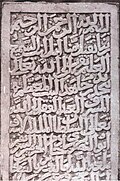
One of these two records the achievements of one of the most notable circassians, [[Barsbay|Sultan Barsbay]]. The document, dated to 1423 | One of these two records the achievements of one of the most notable circassians, [[Barsbay|Sultan Barsbay]]. The document, dated to 1423 (CE), attests to a wide reconstruction and restoration process in the mosque by the Sultan.<ref>{{Cite journal |last=Alsheerf |first=Prof Adnan |date=2011-01-01 |script-title=ar:أعمال الأشرف برسباي بالمسجد الحرام في ضوء نقش مؤرخ بسنة 826هـ/1423م محفوظ بالكعبة المشرفة دراسة أثرية حضارية |url=https://www.academia.edu/38302836 |script-journal=ar:كتاب المؤتمر الرابع عشر للاتحاد العام للاثاريين العرب |lang=ar |access-date= }}</ref> The inscription on the slab reads: <blockquote><span lang="AR" dir="ltr">بسم الله الرحمن الرحيم ربنا تقبل منا انك انت السميع العليم تقرب الى الله تعالى بتجديد رخام هذا البيت المعظم المشرف العبد الفقير الى الله تعالى السلطان الملك الاشرف ابو النصر برسباي خادم الحرمين الشريفين بلغه الله اماله و زين بالصالحات اعماله بتاريخ سنة ست و عشرين و ثمان مئه</span></blockquote> | ||
The inscription on the slab reads: <blockquote><span lang="AR" dir="ltr">بسم الله الرحمن الرحيم ربنا تقبل منا انك انت السميع العليم تقرب الى الله تعالى بتجديد رخام هذا البيت المعظم المشرف العبد الفقير الى الله تعالى السلطان الملك الاشرف ابو النصر برسباي خادم الحرمين الشريفين بلغه الله اماله و زين بالصالحات اعماله بتاريخ سنة ست و عشرين و ثمان مئه</span></blockquote> | |||
This translates to:<blockquote> | This translates to:<blockquote> "In the name of God, the Most Compassionate, the Most Merciful. Our Lord, accept from us that you are the All-Hearing, the All-Knowing. Draw nearer to God Almighty by renewing the marble of this noble and honorable house. The poor servant of God Almighty, the honorable Sultan King Abu al-Nasr Barsbay, Custodian of the Two Holy Mosques. May God reach his hopes and adorn his deeds with good deeds. The year eight hundred and twenty-six AH" </blockquote> | ||
[[File: | [[File:Qait Bay (81651352).jpg|alt=Sultan Barsbay portrait|thumb|The Circassian Sultan Barsbay]] | ||
The other of the two circassian slabs is dedicated to Barsbays son, [[Qaitbay|Sultan Qaitbay]], known for his great architectural achievements throughout the [[Muslim world|Islamic world]]. Dated to 1479 | The other of the two circassian slabs is dedicated to Barsbays son, [[Qaitbay|Sultan Qaitbay]], known for his great architectural achievements throughout the [[Muslim world|Islamic world]]. Dated to 1479 (CE), the document attests to a wide reconstruction and restoration process undertaken by Sultan [[Qaitbay|Sultan Qaitbay]] for [[Masjid al-Haram|Al-Masjid Al-Haram]].<ref>{{Cite book |last=Bāsalāmah |first=Ḥusayn ʻAbd Allāh |url=https://books.google.com/books?id=P9ptAAAAMAAJ |script-title=ar:تاريخ الكعبة المعظمة: عمارتها وكسوتها وسدانتها |date=2000 |publisher=مكتبة الثقافة الدينية، |isbn=978-977-5250-63-6 |lang=ar }}</ref> | ||
The inscription reads:<blockquote><span lang="AR" dir="ltr">بسم الله الرحمن الرحيم ربنا تقبل منا انك انت السميع العليم أمر بتجيد ترخيم داخل البيت مولانا السلطان الأشرف أبو النصر قايتباي خلد الله ملكه يارب العالمين بتاريخ مستهل رجب الفرد عام أربع و ثمانين و ثمانمائة من الهجرة</span></blockquote> | The inscription reads:<blockquote><span lang="AR" dir="ltr">بسم الله الرحمن الرحيم ربنا تقبل منا انك انت السميع العليم أمر بتجيد ترخيم داخل البيت مولانا السلطان الأشرف أبو النصر قايتباي خلد الله ملكه يارب العالمين بتاريخ مستهل رجب الفرد عام أربع و ثمانين و ثمانمائة من الهجرة</span></blockquote> | ||
Which translates to: <blockquote> | Which translates to: <blockquote>"In the name of God, the Most Compassionate, the Most Merciful. Our Lord, accept from us that You are the All-Hearing, the All-Knowing. He commanded the perfection of melodious chanting inside the house. Our Lord, the honorable and victorious Sultan Qaytbay, may God immortalize his kingdom, Lord of the worlds, on the first of the month of Rajab in the year eight hundred and eighty-four AH." </blockquote> | ||
==Significance in Islam== | ==Significance in Islam== | ||
The ''Kaaba'' is the [[Holiest sites in Islam|holiest site in Islam]],<ref>{{Citation | | The ''Kaaba'' is the [[Holiest sites in Islam|holiest site in Islam]],<ref>{{Citation |last1=Wright |first1=Lyn |last2=Kramer |first2=John |last3=Fusco |first3=Angela. |title=Dad's house, mom's house |date=2012 |publisher=National Film Board of Canada |oclc=812009749}}</ref> and is often called by names such as the ''Bayt Allah'' ({{Langx|ar|بيت الله|lit=House of Allah |translit=Bayt Allah}}).<ref>''The Basis for the Building Work of God'' p. 37, Witness Lee, 2003</ref><ref>Al-Muwatta Of Iman Malik Ibn Ana, p. 186, Anas, 2013</ref> and ''Bayt Allah al-Haram'' ({{Langx|ar|بيت الله الحرام |translit=Bayt Allah il-Haram|lit=The Sacred House of Allah}}). | ||
=== Tawaf === | === Tawaf === | ||
{{Further|Hajj|Umrah}} | {{Further|Hajj|Umrah}} | ||
[[File:Hajj.ogg|thumb|Pilgrims perform Tawaf around the Kaaba during [[ | [[File:Hajj.ogg|thumb|Pilgrims perform Tawaf around the Kaaba during [[Umrah]] (video)]] | ||
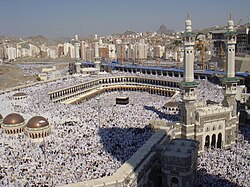
[[File:Al-Haram mosque - Flickr - Al Jazeera English.jpg|thumb|The Kaaba and the [[Masjid Al-Haram]] during Hajj, 2008]] | [[File:Al-Haram mosque - Flickr - Al Jazeera English.jpg|thumb|The Kaaba and the [[Masjid Al-Haram]] during Hajj, 2008]] | ||
''Ṭawāf'' ({{ | ''Ṭawāf'' ({{langx|ar|طَوَاف|lit=going about}}) is one of the Islamic rituals of pilgrimage and is compulsory during both the [[Hajj]] and Umrah. Pilgrims [[Circumambulation#Islam|go around]] the Kaaba (the [[Most holy place#Islam|most sacred site]] in Islam) seven times in a [[counterclockwise]] direction; the first three at a hurried pace on the outer part of the ''Mataaf'' and the latter four times closer to the Kaaba at a leisurely pace.<ref>{{citation |author=Ruqaiyyah Maqsood |title=World Faiths, teach yourself – Islam |year=1994 |url=https://archive.org/details/islam0000maqs/page/76 |page=[https://archive.org/details/islam0000maqs/page/76 76] |publisher=Hodder & Stoughton |isbn=0-340-60901-X}}</ref> The circling is believed to demonstrate the unity of the believers in the worship of the [[Tawhid|One God]], as they move in harmony together around the Kaaba, while supplicating to [[God in Islam|God]].<ref>{{Cite book |last=Shariati |first=Ali |title=HAJJ: Reflection on Its Rituals |publisher=Islamic Publications International |year=2005 |isbn=1-889999-38-5}}</ref><ref>{{Cite book |last=Denny |first=Frederick Mathewson |title=An Introduction to Islam |publisher=[[Prentice Hall]] |year=2010 |isbn=978-0-13814477-7}}</ref> To be in a state of [[Wudu]] (ablution) is mandatory while performing tawaf as it is considered to be a form of worship (''[[Ibadah|<nowiki/>'ibadah]]''). | ||
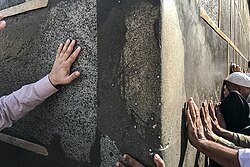
Tawaf begins from the corner of the Kaaba with the [[Black Stone]]. If possible, Muslims are to kiss or touch it, but this is often not possible because of the large crowds. They are also to chant the [[Basmala]] and [[Takbir]] each time they complete one revolution. Hajj pilgrims are generally advised to "make ṭawāf" at least twice – once as part of the Hajj, and again before leaving Mecca.<ref name="AtoZ2">{{Cite book |last=Mohamed |first=Mamdouh N. |url=https://archive.org/details/hajjumrahfromtoz00moha |title=Hajj to Umrah: From A to Z |publisher=Mamdouh Mohamed |year=1996 |isbn=0-915957-54-X |url-access=registration}}</ref> | Tawaf begins from the corner of the Kaaba with the [[Black Stone]]. If possible, Muslims are to kiss or touch it, but this is often not possible because of the large crowds. They are also to chant the [[Basmala]] and [[Takbir]] each time they complete one revolution. Hajj pilgrims are generally advised to "make ṭawāf" at least twice – once as part of the Hajj, and again before leaving Mecca.<ref name="AtoZ2">{{Cite book |last=Mohamed |first=Mamdouh N. |url=https://archive.org/details/hajjumrahfromtoz00moha |title=Hajj to Umrah: From A to Z |publisher=Mamdouh Mohamed |year=1996 |isbn=0-915957-54-X |url-access=registration}}</ref> | ||
| Line 218: | Line 216: | ||
The five types of ṭawāf are: | The five types of ṭawāf are: | ||
*''Ṭawāf al-Qudūm'' (arrival ṭawāf) is performed by those not residing in Mecca once reaching the Holy City. | *''Ṭawāf al-Qudūm'' (arrival ṭawāf) is performed by those not residing in Mecca once reaching the Holy City. | ||
*''Ṭawāf aṭ-Ṭaḥīyah'' (greeting ṭawāf) is performed after entering ''al-Masjid al-Haram'' at any other times and is [[ | *''Ṭawāf aṭ-Ṭaḥīyah'' (greeting ṭawāf) is performed after entering ''al-Masjid al-Haram'' at any other times and is ''[[Mustahabb]]''. | ||
*''Ṭawāf al-'Umrah'' (Umrah ṭawāf) refers to the ṭawāf performed specifically for Umrah. | *''Ṭawāf al-'Umrah'' (Umrah ṭawāf) refers to the ṭawāf performed specifically for Umrah. | ||
*''Ṭawāf al-Wadā''' ("farewell ṭawāf") is performed before leaving Mecca. | *''Ṭawāf al-Wadā''' ("farewell ṭawāf") is performed before leaving Mecca. | ||
| Line 227: | Line 225: | ||
===As the Qibla=== | ===As the Qibla=== | ||
{{main|Qibla}} | {{main|Qibla}} | ||
The ''Qibla'' is the direction faced during prayer.{{ | The ''Qibla'' is the direction faced during prayer.<ref>{{qref|2|144|b=y}}</ref> The direction faced during prayer is the direction of the Kaaba, relative to the person praying. Apart from praying, Muslims generally consider facing the Qibla while reciting the [[Quran]] to be a part of good etiquette. | ||
==Cleaning== | ==Cleaning== | ||
The building is opened biannually for the ceremony of "The Cleaning of the Sacred Kaaba" ({{ | The building is opened biannually for the ceremony of "The Cleaning of the Sacred Kaaba" ({{Langx|ar|تنظيف الكعبة المشرفة |translit=Tanzif al-Ka'bat al-Musharrafah|lit=Cleaning of the Sacred Cube}}). The ceremony takes place on the 1st of [[Sha'ban|Sha'baan]], the eighth month of the [[Islamic calendar]], around thirty days before the start of the month of [[Ramadan]] and on the 15th of [[Muharram]], the first month. The keys to the ''Kaaba'' are held by the [[Bani Shaiba|Banī Shayba]]h ({{Langx|ar|بني شيبة}}) tribe, an honor bestowed upon them by Muhammad.<ref>{{cite news |title=الرسول شرّف بني شيبة بحمل مفتاح الكعبة حتى قيام الساعة |url=http://www.alkhaleej.ae/supplements/page/6c992375-dbb6-4376-bc85-89a282d01554 |publisher=[[Al Khaleej (newspaper)|Al Khaleej]]}}</ref> Members of the tribe greet visitors to the inside of the Kaaba on the occasion of the cleaning ceremony.<ref>{{cite web |title=Kaaba |url=http://enc.slider.com/Enc/Kaaba |url-status=dead |archive-url=https://archive.today/20120707172635/http://enc.slider.com/Enc/Kaaba |archive-date=7 July 2012 |access-date=15 October 2010}}</ref> | ||
The Governor of the [[Makkah Province]] and accompanying dignitaries clean the interior of the Kaaba using cloths dipped in [[Zamzam water]] scented with [[Agarwood| | The Governor of the [[Makkah Province]] and accompanying dignitaries clean the interior of the Kaaba using cloths dipped in [[Zamzam water]] scented with [[Agarwood|oud perfume]]. Preparations for the washing start a day before the agreed date, with the mixing of Zamzam water with several luxurious perfumes including Tayef rose, 'oud and [[musk]]. Zamzam water mixed with rose perfume is splashed on the floor and is wiped with [[palm leaves]]. Usually, the entire process is completed in two hours.<ref>{{Cite web |date=17 October 2016 |title=This is how the Kaaba is washed |url=https://english.alarabiya.net/en/variety/2016/10/17/Prince-Khaled-cleans-the-Holy-Kaaba.html |access-date=8 July 2020 |website=Al Arabiya English |language=en}}</ref> | ||
== Events related to the Kaaba == | |||
Many Islamic sources include [[Shia]] and [[Sunni]] sources ([[Al-Hakim al-Nishapuri]],<ref>[[Al-Mustadrak ala al-Sahihayn]], Volume 3, Page 550.</ref> [[Sibt ibn al-Jawzi]],<ref>Tazkerat al-Khawas, Page 10.</ref> Halabi Shafi'i,<ref>Al-Sirat al-Halabia, Volume 3, Page 485.</ref> [[Al-Fakihi]],<ref>Ikhbar al-Mecca, Volume 3, Page 226.</ref> Sheikh Abu Zakariyya al-Azdi,<ref>Tarikh Mosul, Kitab al-Salis al-Ashar, Page 58.</ref> [[Mahmud al-Alusi]],<ref>Sarah al-Kharidah, Pages 3 and 15.</ref> Ibn Sabbagh Maliki,<ref>Al-Fosul al-Mohemmah, Page 29.</ref> Ganji Shafi'i,<ref>Kefayat al-Talib fi Manaqibi Ali ibn Abi Talib, Pages 405-406.</ref> Saffuri Shafi'i,<ref>Nazhat al-Majalis, Page 159.</ref><ref>Mokhtasar al-Mahaasein al-Mojtama'ah, Page 156.</ref> [[Al-Masudi]],<ref>Isbat al-Vasia'ah, Page 142.</ref><ref>[[The Meadows of Gold]], Volume 2, Page 273.</ref> Zarandi Hanafi,<ref>Ma'arej al-Vosul, Page 49.</ref><ref>Nazm Dorrar al-Samtein, Page 76.</ref> Amir San'ani<ref>Al-Rozat al-Nadiyyah, Page 36.</ref>) have written that [[Ali|Ali ibn Abi Talib]], the first [[Imamate in Shia doctrine|Imam]] of the [[Shia Islam|Shiites]], was the only person to have been born in the Kaaba.<ref> | |||
{{cite web | |||
|url = https://www.yjc.ir/fa/news/7677488/%D8%AA%D9%86%D9%87%D8%A7-%DA%A9%D8%B3%DB%8C-%DA%A9%D9%87-%D8%AF%D8%B1-%D8%AE%D8%A7%D9%86%D9%87-%D8%AE%D8%AF%D8%A7-%D8%A8%D8%AF%D9%86%DB%8C%D8%A7-%D8%A2%D9%85%D8%AF | |||
|title = تنها کسی که در خانه خدا بدنیا آمد | |||
|trans-title = The only one born in the house of God | |||
|language = fa | |||
|access-date = 27 February 2025 | |||
}} | |||
</ref><ref> | |||
{{cite web | |||
|url = https://www.khabaronline.ir/news/1726444/%D8%A7%D8%B3%D9%86%D8%A7%D8%AF-%D8%AA%D8%A7%D8%B1%DB%8C%D8%AE%DB%8C-%D8%AF%D8%B1%D8%A8%D8%A7%D8%B1%D9%87-%D9%88%D9%84%D8%A7%D8%AF%D8%AA-%D8%A7%D9%85%D8%A7%D9%85-%D8%B9%D9%84%DB%8C-%D8%B9-%D8%AF%D8%B1-%DA%A9%D8%B9%D8%A8%D9%87-%D9%86%D8%A7%D9%85-%D8%A7%D9%85%D8%A7%D9%85-%D8%B9%D9%84%DB%8C-%D8%B9 | |||
|title = اسناد تاریخی درباره ولادت امام علی(ع) در کعبه | |||
|trans-title = Historical documents about the birth of Imam Ali (AS) in the Kaaba | |||
|language = fa | |||
|access-date = 27 February 2025 | |||
}} | |||
</ref><ref> | |||
{{cite web | |||
|url = https://www.yjc.ir/fa/news/8898017/%D8%B2%D9%86%D8%AF%DA%AF%DB%8C%E2%80%8E%D9%86%D8%A7%D9%85%D9%87-%D8%A7%D9%85%D8%A7%D9%85-%D8%B9%D9%84%DB%8C-%D8%B9-%D8%AA%D9%86%D9%87%D8%A7-%DA%A9%D8%B3%DB%8C-%DA%A9%D9%87-%D8%AF%D8%B1-%D8%AE%D8%A7%D9%86%D9%87-%D8%AE%D8%AF%D8%A7-%D8%A8%D9%87-%D8%AF%D9%86%DB%8C%D8%A7-%D8%A2%D9%85%D8%AF | |||
|title = زندگینامه امام علی (ع)/ تنها کسی که در خانه خدا به دنیا آمد | |||
|trans-title = Biography of Imam Ali (AS)/ The only one who was born in the house of God | |||
|language = fa | |||
|access-date = 27 February 2025 | |||
}} | |||
</ref> | |||
==See also== | ==See also== | ||
{{portal|Islam|Saudi Arabia}} | {{portal|Islam|Saudi Arabia}} | ||
*[[Glossary of Islam]] | |||
*[[Outline of Islam]] | |||
*[[Al-Masjid an-Nabawi]] | *[[Al-Masjid an-Nabawi]] | ||
*''[[Bayt al-Mawlid]]'', the [[Makkah Al Mukarramah Library|house]] where Muhammad is believed to have been born | *''[[Bayt al-Mawlid]]'', the [[Makkah Al Mukarramah Library|house]] where Muhammad is believed to have been born | ||
*[[List of largest mosques]] | *[[List of largest mosques]] | ||
*[[List of mosques in Saudi Arabia]] | *[[List of mosques in Saudi Arabia]] | ||
* [[Miscellaneous Symbols and Pictographs]] (Unicode block), which contains a pictogram for the Kaaba, {{unichar|1F54B}} | |||
{{ | |||
==Notes== | ==Notes== | ||
| Line 250: | Line 276: | ||
==Bibliography== | ==Bibliography== | ||
*Armstrong, Karen | * {{cite book |author=Al-Kalbi, Hisham Ibn |author-link=Hisham Ibn Al-Kalbi |title=The book of Idols |translator=Faris, Nabih Amin |postscript=, (with introduction and notes). |year=1952 |isbn=}} | ||
*Crone | * {{cite book |last=Armstrong |first=Karen |author-link=Karen Armstrong |date=1997 |title=Jerusalem: One City, Three Faiths |publisher=HarperCollins |isbn=9780345391681 |url={{google books URL|TZltAAAAMAAJ}} }} | ||
* {{cite book |last=Armstrong |first=Karen |author-link=Karen Armstrong |date=2000 |title=[[Islam: A Short History]] |isbn=0-8129-6618-X |publisher=Random House Publishing }} | |||
* {{Cite journal |last=Atbuosh |first=Mohammed |date=2025 |title=South Arabian etymology for the Meccan Kaʿbah |url=https://www.cambridge.org/core/journals/bulletin-of-the-school-of-oriental-and-african-studies/article/abs/south-arabian-etymology-for-the-meccan-kabah/B71EC35E6CE8795769947C1DBE4A899C |journal=Bulletin of the School of Oriental and African Studies |volume=88 |pages=71–81}} | |||
*{{ | * {{cite book |last=Crone |first=Patricia |author-link=Patricia Crone |date=2004 |orig-date=1987 |title=Meccan Trade and the Rise of Islam |location=Piscataway, New Jersey |publisher=Gorgias |isbn=1-59333-102-9 |url=https://api.pageplace.de/preview/DT0400.9781463209933_A38591042/preview-9781463209933_A38591042.pdf }} | ||
*Hawting | * {{Cite book |last=Durand |first=Jean-Marie |title=Représenter dieux et hommes dans le Proche-Orient ancien et dans la Bible |date=2019 |editor-last=Römer |editor-first=Thomas |pages=15–37 |chapter=Le Culte Des Bétyles Dans La Documentation Cunéiforme DʾÉpoque Amorrite |editor-last2=Gonzalez |editor-first2=Hervé |editor-last3=Marti |editor-first3=Lionel |chapter-url=https://library.oapen.org/bitstream/handle/20.500.12657/42999/1/9789042939745.pdf#page=28}} | ||
* | * {{Cite book |last=Finster |first=Barbara |title=The Qur'an in Context. Historical and Literary Investigations into the Qur'anic Milieu |date=2010 |publisher=Brill |editor-last=Neuwirth |editor-first=Angelika |pages=61–114 |chapter=Arabia in Late Antiquity: An Outline of the Cultural Situation in the Peninsula at the Time of Muhammad |editor-last2=Sinai |editor-first2=Nicolai |editor-last3=Marx |editor-first3=Michael |chapter-url=https://www.su.se/polopoly_fs/1.323006.1488789592!/menu/standard/file/FinsterPages%20from%20Angelika%20Neuwirth%2C%20Nicolai%20Sinai%2C%20Michael%20Marx-The%20Quran%20in%20Context%20%28Texts%20and%20Studies%20on%20the%20Qur%27an%29%20%282009%29.pdf}} | ||
* {{cite encyclopedia |last=Hawting |first=G. R. |author-link=G. R. Hawting |title=Kaʿba |encyclopedia=[[Encyclopaedia of the Qurʾān]] |volume=3: J-O |date=2003 |pages=75–80 |url=https://archive.org/details/encyclopaedia-of-the-quran-6-volumes-jane-dammen-mc-auliffe/page/n1291}} | |||
* {{Cite book |last=Ibn Ishaq |first=Muhammad |author-link=Ibn Ishaq |translator-last=Guillaume |translator-first=Alfred |translator-link=Alfred Guillaume |title=Sirat Rasul Allah |trans-title=The Life of Muhammad |date=1955 |publisher=Oxford University Press |isbn=9780196360331 |location=Oxford |url=https://archive.org/stream/TheLifeOfMohammedGuillaume/The_Life_Of_Mohammed_Guillaume}} | |||
*Mohamed, Mamdouh N. (1996). ''Hajj to Umrah: From A to Z''. Amana Publications. {{ISBN|0-915957-54-X}}. | *Mohamed, Mamdouh N. (1996). ''Hajj to Umrah: From A to Z''. Amana Publications. {{ISBN|0-915957-54-X}}. | ||
*Peterson, Andrew | * {{Cite book |last=Mubarakpuri |first=Safiur Rahman |author-link=Safiur Rahman Mubarakpuri |lang=ar |translator-first=Issam |translator-last=Diab |date=1976 |title=Ar-Raheeq Al-Makhtum <!-- |title-link=Ar-Raheeq Al-Makhtum --> |trans-title=The Sealed Nectar |url=https://www.muslim-library.com/dl/books/English_ArRaheeq_AlMakhtum_THE_SEALED_NECTAR.pdf |archive-url=https://web.archive.org/web/20180324152212/https://www.muslim-library.com/dl/books/English_ArRaheeq_AlMakhtum_THE_SEALED_NECTAR.pdf |archive-date=24 March 2018 }} | ||
* | * {{cite book |author=Peterson, Andrew |year=1997 |title=Dictionary of Islamic Architecture |location=London |publisher=Routledge |isbn= }} | ||
* {{Cite book |last=Robin |first=Christian J. |author-link=Christian J. Robin |title=Arabs and Empires before Islam |date=2015 |publisher=Oxford University Press |editor-last=Fisher |editor-first=Greg |pages=127–171 |chapter=Ḥimyar, Aksūm, and Arabia Deserta in Late Antiquity. The Epigraphic Evidence |chapter-url=https://www.academia.edu/37672841}} | |||
* {{cite book |last=von Grunebaum | first=G. E. |author-link=Gustave E. von Grunebaum |year=1970 |title=Classical Islam: A History 600 A.D. to 1258 A.D. |url=https://archive.org/details/classicalislamhi0089grun |url-access=registration |publisher=Aldine Publishing Company |isbn=978-0-202-30767-1 }} | |||
* {{Cite journal |last=Webb |first=Peter |date=2023 |title=The Hajj Before Muhammad: The Early Evidence in Poetry and Hadith |url=https://www.degruyter.com/document/doi/10.1515/mill-2023-0004/html |journal=Millennium |volume=20 |issue=1 |pages=33–63 |doi=10.1515/mill-2023-0004 |hdl-access=free |hdl=1887/3674390}} | |||
* {{Encyclopaedia of Islam, Second Edition |volume=4 |first1 = A. J. |last1=Wensinck |first2=J. |last2=Jomier |title=Ka‘ba |pages=317–322 }}{{sfn whitelist|CITEREFWensinckJomier1978}} | |||
*[1915] ''The Book of History, a History of All Nations From the Earliest Times to the Present'', Viscount Bryce (Introduction), The Grolier Society. | *[1915] ''The Book of History, a History of All Nations From the Earliest Times to the Present'', Viscount Bryce (Introduction), The Grolier Society. | ||
==External links== | ==External links== | ||
{{ | {{sister project links|d=Q29466|c=Category:Kaaba|n=no|b=no|v=no|voy=no|m=no|mw=no|s=no|wikt=no|species=no}} | ||
{{NIE Poster|year=1905}} | {{NIE Poster|year=1905}} | ||
*[http://kabahinfo.net Ka'bah info: Everything you want to know about the Holy Ka'bah] | *[http://kabahinfo.net Ka'bah info: Everything you want to know about the Holy Ka'bah] {{Webarchive|url=https://web.archive.org/web/20090501200859/http://www.kabahinfo.net/ |date=1 May 2009 }} | ||
*[https://web.archive.org/web/20080423174338/http://live.gph.gov.sa/ SA's Official Live Webcam of the Kaaba] | *[https://web.archive.org/web/20080423174338/http://live.gph.gov.sa/ SA's Official Live Webcam of the Kaaba] | ||
*[https://web.archive.org/web/20140809215043/http://www.roadsofarabia.com/exhibition/artifact_11.html Former door of the Kaaba (ca. 1635)] | *[https://web.archive.org/web/20140809215043/http://www.roadsofarabia.com/exhibition/artifact_11.html Former door of the Kaaba (ca. 1635)] | ||
*[https://www.britannica.com/topic/Kaaba-shrine-Mecca-Saudi-Arabia Kaaba | Definition, Interior, Black Stone, & Fact] | |||
*[https://www.khanacademy.org/humanities/ap-art-history/introduction-cultures-religions-apah/islam-apah/a/the-kaaba The Kaaba (article) | Islam] | |||
*[https://smarthistory.org/the-kaaba/ The Kaaba] | |||
*[https://www.lemonde.fr/en/religions/article/2022/07/07/mecca-pilgrimage-10-things-to-know-about-the-kaaba_5989372_63.html Mecca pilgrimage: 10 things to know about the Kaaba] | |||
*[https://www.islamic-relief.org.uk/resources/knowledge-base/five-pillars-of-islam/hajj/the-kaaba/ About The Ka'aba] | |||
*[https://www.umrahservices.in/blog/history-and-evolution-of-the-kaaba/ The History Of Kaaba] | |||
*[https://www.hajinformation.com/main/j1091.htm Kaaba - Hajj] | |||
{{Characters and names in the Quran}} | {{Characters and names in the Quran}} | ||
{{Hajj topics}} | {{Hajj topics}} | ||
| Line 278: | Line 316: | ||
[[Category:Articles containing video clips]] | [[Category:Articles containing video clips]] | ||
[[Category:Religious buildings and structures converted into mosques]] | [[Category:Religious buildings and structures converted into mosques]] | ||
[[Category:Geography in the medieval Islamic world]] | |||
[[Category:Hajj]] | |||
[[Category:Masjid al-Haram]] | |||
[[Category:Islamic architecture]] | |||
[[Category:Arabic architecture]] | |||
[[Category:Buildings and structures in Mecca]] | |||
Latest revision as of 06:44, 28 February 2026
| The Kaaba | |
|---|---|
الكعبة | |
| Religion | |
| Affiliation | Islam |
| Rite | Tawaf |
| Mosque | |
| Leadership | Abdul-Rahman Al-Sudais: (President of the Affairs of the Two Holy Mosques) |
| Status | Active |
| Location | |
| Location | Great Mosque of Mecca, Mecca, Mecca Province, Hejaz |
| Country | Saudi Arabia |
| Lua error in Module:Location_map at line 851: Unable to find the specified location map definition: "Module:Location map/data/Saudi Arabia" does not exist. | |
| Administration | The Agency of the General Presidency for the Affairs of the Two Holy Mosques |
| Coordinates | Coordinates: Missing latitude Invalid arguments have been passed to the {{#coordinates:}} function |
| Architecture | |
| Type | Temple[1] |
| Established | Pre-Islamic era |
| Specifications | |
| Length | 12.86 m (42 ft 2 in) |
| Width | 11.03 m (36 ft 2 in) |
| Height (max) | 13.1 m (43 ft 0 in) |
| Materials | Stone; marble; limestone |
The Kaaba (Arabic: الكعبة, romanized: al-Kaʿba, lit. 'the Cube'),[lower-alpha 1] also spelled KaTemplate:Ayinba, KaTemplate:Ayinbah or Kabah, sometimes referred to as al-KaTemplate:Ayinba al-Musharrafa (Arabic: الكعبة المشرفة, lit. 'the Honored Ka'ba'),[lower-alpha 2] is a stone building at the center of Islam's most important mosque and holiest site, the Masjid al-Haram in Mecca, Saudi Arabia.[2][3][4] It is considered by Muslims to be the Baytullah (Arabic: بيت اللَّٰه, lit. 'House of God') and determines the qibla (Arabic: قبلة, lit. 'direction of prayer') for Muslims around the world.
According to Islamic tradition, the Kaaba was rebuilt several times throughout history, most famously by Ibrahim and his son Ismail,[5] when he returned to the valley of Mecca several years after leaving his wife Hajar and Ismail there upon Allah's command. The current structure was built after the original building was damaged by a fire during the siege of Mecca by the Umayyads in 683 CE.[1] Circling the Kaaba seven times counterclockwise, known as Tawaf (Arabic: طواف, romanized: tawaaf), is a Fard rite for the completion of the Hajj and Umrah pilgrimages.[4] The area around the Kaaba where pilgrims walk is called the Mataaf.
In early Islam, Muslims faced in the general direction of Al-Aqsa Mosque in Jerusalem as the qibla in their prayers before changing the direction to face the Kaaba, believed by Muslims to be a result of a Quranic verse revelation to Muhammad.[6] The Kaaba and the Mataaf are surrounded by pilgrims every day of the Islamic year, except the 9th of Dhu al-Hijjah, known as the Day of Arafah, on which the cloth covering the structure, known as the Kiswah (Arabic: كسوة, romanized: kiswa, lit. 'Cloth'), is changed. However, the most significant increase in their numbers is during Ramadan and the Hajj, when millions of pilgrims gather for Tawaf.[7] According to the Saudi Ministry of Hajj and Umrah, 6,791,100 external pilgrims arrived for the Umrah pilgrimage in Template:AH.[8]
Etymology and pre-Islamic usage[edit | edit source]
In Arabic, the literal meaning of the word Ka'ba (Arabic: كعبة) is cube. Therefore, the most popular etymology has been that the Kaaba was named after its kaʿb form.[9] Some have questioned that the cubic sense of kaʿb is pre-Islamic, seeking etymologies elsewhere.[10] One disputed hypothesis suggests that the name "Kaaba" is related to the southern Arabian or Ethiopian word "mikrab", signifying a temple.[11][12] Another relates it to Kʿbt, which is related to the Kaaba of Najran.[13] (See for a word with similar pronunciation: Qubba)

The architectural style of the Meccan Kaaba is shared by a number of pre-Islamic religious buildings, which have broadly been labelled as Kaabas. They are primarily known from the Arabian Peninsula, but some have also been found in other regions, including the Kaaba of Zoroaster.[15] Imoti contends that there were numerous such Kaaba sanctuaries in Arabia at one time, although only the Meccan Kaaba was built of stone.[16] The Black Stone of the Kaaba has been compared to pre-Islamic religious stones called baetyls, which were often black, thought to be of meteorite origins, and venerated in houses or temples of worship for a particular deity.[17] Imoti argues that the other Kaabas also allegedly had their own counterparts of the Black Stone. There was a "Red Stone", in the Kaaba of the South Arabian city of Ghaiman; and the "White Stone" in the Kaaba of al-Abalat (near modern-day Tabalah). Grunebaum, in Classical Islam, points out that the experience of divinity of that period was often associated with the fetishism of stones, mountains, special rock formations, or "trees of strange growth."[18]
History[edit | edit source]
Patricia Crone and a group of historians later called the revisionist school of Islamic studies has cast doubt on the claim that Mecca was a major historical trading outpost,[19][20] and proposed a more northern region as the origin of Islam. Other scholars such as Glen Bowersock disagree and assert that it was.[21][22]
Before Muhammad[edit | edit source]
In pre-Islamic Arabic poetry attributed to Zuhayr ibn Abi Sulma, the builders of the Kaaba are said to be the Quraysh and Jurhum tribes.[23] Christian J. Robin argues that the Kaaba may have become prominent in the last decades of the 6th century in the aftermath of the military defeat of Abraha by the Quraysh.[24] However, Peter Webb, based on pre-Islamic poetry, argues that the Kaaba was never a prominent site of pilgrimage and that it largely played a local role in Western Arabia as opposed to a pan-Arabian one.[25]
In Islamic cosmology, the Zurah pilgrimage site was the precursor to the Kaaba.[26] According to Islamic tradition, the pre-Islamic Kaaba was a site of worship for various Arabian Bedouin tribes, who would make pilgrimage once every lunar year, setting aside their tribal feuds.[27] The Kaaba hosted 360 pagan idols (potentially one representing each day of the year) including sculptures and paintings before Islam, notably including a statue of Hubal, the principal idol of Mecca.[28][29] Paintings of angels, of Ibrahim holding divination arrows, and of Isa (Jesus) and his mother Maryam (Mary), which Muhammad spared.[30] Undefined decorations, money and a pair of ram's horns were recorded to be inside the Kaaba.[28] The pair of ram's horns were said to have belonged to the ram sacrificed by Ibrahim in place of his son Ismail as held by Islamic tradition.[28] Islamic tradition traces the polytheism of the Kaaba to the descendants of Ishmael who settled around the Zamzam Well and gradually turned it away from its original monotheist practice during the time of Abraham.[31] The Book of Idols by Hisham ibn al-Kalbi describes the origins of idolatry at the Kaaba: about 400 years before the birth of Muhammad, a man named 'Amr ibn Luhay, who descended from Qahtan and was the king of Hijaz, placed an idol of Hubal on the roof of the Kaaba. This idol was one of the chief deities of the ruling Quraysh tribe. The idol was made of red agate and shaped like a human, but with the right hand broken off and replaced with a golden hand. When the idol was moved inside the Kaaba, it had seven arrows in front of it, which were used for divination.[32] To maintain peace among the perpetually warring tribes, Mecca was declared a sanctuary where no violence was allowed within 30 km (20 mi) of the Kaaba. This combat-free zone allowed Mecca to thrive not only as a place of pilgrimage, but also as a trading center.[33] A king named Tubba' is considered the first one to have a door be built for the Kaaba according to sayings recorded in Al-Azraqi's Akhbar Makka.[34]
Alfred Guillaume, in his translation of the Ibn Ishaq's seerah, says that the Kaaba itself might be referred to in the feminine form.[35] Circumambulation was often performed naked by men and almost naked by women.[31] It is disputed whether Allah and Hubal were the same deity or different. According to a hypothesis by Uri Rubin and Christian Robin, Hubal was only venerated by Quraysh and the Kaaba was first dedicated to Allah, a supreme god of individuals belonging to different tribes, while the pantheon of the gods of Quraysh was installed in the Kaaba after they conquered Mecca a century before Muhammad's time.[36]
Ptolemy and Diodorus Siculus[edit | edit source]
Writing in the Encyclopedia of Islam, Wensinck identifies Mecca with a place called Macoraba mentioned by Ptolemy.[37][11] G. E. von Grunebaum states: "Mecca is mentioned by Ptolemy. The name he gives it allows us to identify it as a South Arabian foundation created around a sanctuary."[38] In Meccan Trade and the Rise of Islam, Patricia Crone argues that the identification of Macoraba with Mecca is false and that Macoraba was a town in southern Arabia in what was then known as Arabia Felix.[39] A recent study has revisited the arguments for Macoraba and found them unsatisfactory.[40]
Based on an earlier report by Agatharchides of Cnidus, Diodorus Siculus mentions a temple along the Red Sea coast, "which is very holy and exceedingly revered by all Arabians".[41] Edward Gibbon believed that this was the Kaaba.[42] However, Ian D. Morris argues that Gibbon had misread the source: Diodorus puts the temple too far north for it to have been Mecca.[40]
In the Quran[edit | edit source]
In the Qur'an, from the era of the life of Muhammad, the Kaaba is mentioned by the following names:
- al-Bayt (Arabic: ٱلْبَيْت, lit. 'the house') in 2:125 by Allah[Quran 2:125]
- Baytī (Arabic: بَيْتِي, lit. 'My House') in 22:26 by Allah[Quran 22:26]
- Baytik al-Muḥarram (Arabic: بَيْتِكَ ٱلْمُحَرَّم, lit. 'Your Inviolable House') in 14:37 by Ibrahim[Quran 14:37]
- al-Bayt al-Ḥarām (Arabic: ٱلْبَيْت ٱلْحَرَام, lit. 'The Sacred House') in 5:97 by Allah[Quran 5:97]
- al-Bayt al-ʿAtīq (Arabic: ٱلْبَيْت ٱلْعَتِيق, lit. 'The Ancient House') in 22:29 by Allah[Quran 22:29]
The Qur'an contains several verses regarding the origin of the Kaaba. It states that the Kaaba was the first House of Worship for mankind, and that it was built by Ibrahim and Ismail on Allah's instructions:[43][44][45]
Verily, the first House (of worship) appointed for mankind was that at Bakkah (Makkah), full of blessing, and a guidance for mankind.
Behold! We gave the site, to Ibrahim, of the (Sacred) House, (saying): "Associate not anything (in worship) with Me; and sanctify My House for those who compass it round, or stand up, or bow, or prostrate themselves (therein in prayer)."
And remember Ibrahim and Ismail raised the foundations of the House (With this prayer): "Our Lord! Accept (this service) from us: For Thou art the All-Hearing, the All-knowing."
— Quran, Al-Baqarah (2), Ayah 127[48]
Ibn Kathir, in his famous exegesis (tafsir) of the Quran, mentions two interpretations among the Muslims on the origin of the Kaaba. One is that the temple was a place of worship for mala'ikah (angels) before the creation of man. Later, a house of worship was built on the location and was lost during the flood in Nuh (Noah)'s time and was finally rebuilt by Ibrahim and Ismail as mentioned later in the Quran. Ibn Kathir regarded this tradition as weak and preferred instead the narration by Ali ibn Abi Talib that although several other temples might have preceded the Kaaba, it was the first Bayt Allah ('House of God'), dedicated solely to him, built by his instruction, and sanctified and blessed by him, as stated in Template:Qref.[49] A hadith in Sahih al-Bukhari states that the Kaaba was the first masjid on Earth, and the second was Al-Aqsa in Jerusalem.[50]
While Abraham was building the Kaaba, an angel brought to him the Black Stone which he placed in the eastern corner of the structure. Another stone was the Maqam Ibrahim, the Station of Abraham, where Abraham stood for elevation while building the structure. The Black Stone and the Maqam Ibrahim are believed by Muslims to be the only remnants of the original structure made by Abraham, as the remaining structure had to be demolished and rebuilt several times over history for its maintenance.[citation needed] After the construction was complete, God enjoined the descendants of Ismail to perform an annual pilgrimage: the Hajj and the Qurban, sacrifice of cattle. The vicinity of the temple was also made a sanctuary where bloodshed and war were forbidden.Template:Qref
During Muhammad's lifetime[edit | edit source]


During Muhammad's lifetime (570–632 CE), the Kaaba was considered a holy site by the local Arabs. Muhammad took part in the reconstruction of the Kaaba around 600 CE, after its structure was weakened by a fire, and then damaged by a subsequent flood. Sources including Ibn Ishaq's Sirat Rasūl Allāh, one of the biographies of Muhammad (as reconstructed and translated by Guillaume), as well as Al-Azraqi's chronicle of Mecca, describe Muhammad settling a quarrel between the Meccan clans as to which clan should set the Black Stone in its place. According to Ishaq's biography, Muhammad's solution was to have all the clan elders raise the cornerstone on a cloak, after which Muhammad set the stone into its final place with his own hands.[53][54] The timber for the reconstruction of the Kaaba was purchased by Quraysh from a Byzantine ship that had been wrecked on the Red Sea coast at Shu'aybah. The work was undertaken by a Coptic Egyptian carpenter from the same ship, called Baqum (باخوم Pachomius), the name indicates an Egyptian Origin, The name Pachomius means "eagle" or "falcon", It comes from the Coptic word "akhōm" (eagle/falcon), which originally meant "divine image" in Middle Egyptian.[28][55] Financial constraints during this rebuilding caused Quraysh to exclude six cubits from the northern part of the Kaaba. This portion is what is currently known as Al-Hateem الحطيم or Hijr Ismail حجر اسماعيل.
Muhammad's Isra' is said to have taken him from the Kaaba to the Masjid al-Aqsa and heavenwards from there.[56]
Muslims initially considered Jerusalem as their qibla, or prayer direction, and faced toward it while offering prayers; however, pilgrimage to the Kaaba was considered a religious duty though its rites were not yet finalized. During the first half of Muhammad's time as a prophet while he was at Mecca, he and his followers were severely persecuted which eventually led to their migration to Medina in 622 CE. In 624 CE, Muslims believe the direction of the qibla was changed from the Masjid al-Aqsa to the Masjid al-Haram in Mecca, with the revelation of Template:Qref.[57] In 628 CE, Muhammad led a group of Muslims towards Mecca with the intention of performing the Umrah, but was prevented from doing so by the Quraysh. He secured a peace treaty with them, the Treaty of Hudaybiyyah, which allowed the Muslims to freely perform pilgrimage at the Kaaba from the following year.[58]
At the culmination of his mission,[59] in 630 CE, after the allies of the Quraysh, the Banu Bakr, violated the Treaty of Hudaybiyyah, Muhammad conquered Mecca. His first action was to remove statues and images from the Kaaba.[30] According to reports collected by Ibn Ishaq and al-Azraqi, Muhammad spared a painting of Mary and Jesus, and a fresco of Ibrahim.[60][30][61]
Narrated Abdullah: When the Prophet entered Mecca on the day of the conquest, there were 360 idols around the Kaaba. The Prophet started striking them with a stick he had in his hand and was saying, "Truth has come and Falsehood has vanished..." (Qur'an 17:81)
— Muhammad al-Bukhari, Sahih al-Bukhari, Book 59, Hadith 583
Al-Azraqi further conveys how Muhammad, after he entered the Kaaba on the day of the conquest, ordered all the pictures erased except that of Maryam:
Shihab (said) that the Prophet (peace be upon him) entered the Kaaba on the day of the conquest, and in it was a picture of the angels (mala'ika), among others, and he saw a picture of Ibrahim and he said: "May Allah kill those representing him as a venerable old man casting arrows in divination (shaykhan yastaqsim bil-azlam)." Then he saw the picture of Maryam, so he put his hands on it and he said: "Erase what is in it [the Kaaba] in the way of pictures except the picture of Maryam."
— al-Azraqi, Akhbar Mecca: History of Mecca
After the conquest, Muhammad restated the sanctity and holiness of Mecca, including its Great Mosque (Masjid al-Haram), in Islam.[62] He performed the Hajj in 632 CE called the Hujjat ul-Wada' ("Farewell Pilgrimage") since Muhammad prophesied his impending death on this event.[63]
After Muhammad's conquest of Mecca, it is said that the 360 idols of the Kaaba were destroyed. The Kaaba became a site for the veneration of Allah only, identified as the same God as that of other monotheists. The Kaaba continued to be a site of annual pilgrimage,[28] and Muslims would perform the Salat prayer facing Al-Aqsa Mosque in Jerusalem, as instructed by Muhammad, and turning their backs on the pagan associations of the Kabah.[29]
After Muhammad[edit | edit source]

The Kaaba has been repaired and reconstructed many times. The structure was severely damaged by a fire on 3 Rabi' I 64 AH (Sunday 31 October 683 CE), during the first siege of Mecca in 683 in the war between the Umayyads and 'Abdullah ibn al-Zubayr,[64] an early Muslim who ruled Mecca for many years between the death of ʿAli and the consolidation of power by the Umayyads. 'Abdullah rebuilt it to include the hatīm. He did so on the basis of a tradition (found in several hadith collections) that the hatīm was a remnant of the foundations of the Abrahamic Kaaba, and that Muhammad himself had wished to rebuild it so as to include it.[65]
The Kaaba was bombarded with stones in the second siege of Mecca in 692, in which the Umayyad army was led by al-Hajjaj ibn Yusuf. The fall of the city and the death of 'Abdullah ibn al-Zubayr allowed the Umayyads under 'Abd al-Malik ibn Marwan to finally reunite all the Islamic possessions and end the long civil war. In 693 CE, 'Abd al-Malik had the remnants of al-Zubayr's Kaaba razed, and rebuilt it on the foundations set by the Quraysh. The Kaaba returned to the cube shape it had taken during Muhammad's time. Its basic shape and structure have not changed since then.[65]
During its history, the Black Stone at the Kaaba has been struck and smashed by a stone fired from a catapult,[66] it has been smeared with excrement,[67] stolen and ransomed by the Qarmatians[68] and smashed into several fragments.[68][28]
During the Hajj of 930 CE, the Shi'ite Qarmatians attacked Mecca under Abu Tahir al-Jannabi, defiled the Zamzam Well with the bodies of pilgrims and stole the Black Stone, taking it to the oasis in Eastern Arabia known as al-Aḥsāʾ, where it remained until the Abbasids ransomed it in 952 CE.[69]
After heavy rains and flooding in 1626, the walls of the Kaaba collapsed and the Mosque was damaged. The same year, during the reign of Ottoman Emperor Murad IV, the Kaaba was rebuilt with granite stones from Mecca, and the Mosque was renovated.
In 1916, after Hussein bin Ali had launched the Great Arab Revolt, during the Battle of Mecca between Arab and Ottoman forces, the Ottoman troops bombarded the city and hit the Kaaba, setting fire to the protective veil.[70][71] This incident was later exploited by the propaganda of the Great Arab Revolt to attempt to demonstrate the impiety of the Ottomans and the legitimacy of the revolt as a holy war.[70][71]
On 15 March 1935, three armed men from Oman attacked and tried to assassinate King Ibn Saud during his performance of Hajj.[72][73][74] He survived the attack unhurt, through the intervention of the crown prince, and the three attackers were killed by bodyguards.[73][74][75]
The Kaaba is depicted on the reverse of 500 Saudi riyal and 2000 Iranian rial banknotes.[76][77]
Al-Azraqi provided the following narrative on the authority of his grandfather:[28]
I have heard that there was set up in al-Bayt (referring to the Kaaba) a picture (Arabic: تمثال, romanized: Timthal, lit. 'Depiction') of Maryam and 'Isa. ['Ata'] said: "Yes, there was set in it a picture of Maryam adorned (muzawwaqan); in her lap, her son Isa sat adorned."
The Kaaba came to be considered the axis mundi (world center), with the Gate of Heaven directly above it. The Kaaba marked the location where the sacred world intersected with the profane; the embedded Black Stone was a further symbol of this as a meteorite that had fallen from the sky and linked heaven and earth.[78]


In non-Islamic literature[edit | edit source]
The Khuzistan Chronicle is a short Nestorian (Christian origin) chronicle written no later than the 660s CE covers the history up to the Arab conquest and gives an interesting note on Arabian geography. The section covering the geography starts with a speculation about the origin of the Muslim sanctuary in Arabia:
Regarding the K'bta (Kaaba) of Ibrahim, we have been unable to discover what it is except that, because the blessed Abraham grew rich in property and wanted to get away from the envy of the Canaanites, he chose to live in the distant and spacious parts of the desert. Since he lived in tents, he built that place for the worship of God and for the offering of sacrifices. It took its present name from what it had been, since the memory of the place was preserved with the generations of their race. Indeed, it was no new thing for the Arabs to worship there, but goes back to antiquity, to their early days, in that they show honor to the father of the head of their people.[79]
According to the Asatir, a 10th-century work of Samaritan literature,[80] Ismail and his eldest son Nebaioth built the Kaaba as well as the city of Mecca."[81]
Architecture and interior[edit | edit source]
The Kaaba is a cuboid-shaped structure made of stones. It is approximately 15 m (49 ft 3 in) high with sides measuring 12 m (39 ft 4 in) × 10.5 m (34 ft 5 in) wide.[82][lower-alpha 3] Inside the Kaaba, the floor is made of marble and limestone. The interior walls are clad with tiled, white marble halfway to the roof, with darker trimmings along the floor. The floor of the interior stands about 2 m (6 ft 7 in) above the ground area where tawaf is performed.[82][83]
The wall directly adjacent to the entrance of the Kaaba has six tablets inlaid with inscriptions, and there are several more tablets along the other walls. Along the top corners of the walls runs a black cloth embroidered with gold Qur'anic verses. Caretakers anoint the marble cladding with the same scented oil used to anoint the Black Stone outside. Three pillars (some erroneously report two) stand inside the Kaaba, with a small altar or table set between one and the other two. Lamp-like objects (possible lanterns or crucible censers) hang from the ceiling. The ceiling itself is of a darker colour, similar in hue to the lower trimming. The Bāb ut-Tawbah—on the right wall (right of the entrance) opens to an enclosed staircase that leads to a hatch, which itself opens to the roof. Both the roof and ceiling (collectively dual-layered) are made of stainless steel-capped teak wood.[citation needed]


Each numbered item in the following list corresponds to features noted in the diagram image.
- The Ḥajar al-Aswad (Arabic: الحجر الأسود, romanized: al-Hajar al-Aswad, lit. 'The Black Stone'), is located on the Kaaba's eastern corner. It is the location where Muslims start their circumambulation of the Kaaba, known as the tawaf.
- The entrance is a door set 2.13 m (7 ft 0 in) above the ground on the north-eastern wall of the Kaaba, called the Bāb ar-Raḥmah (Arabic: باب الرحمة, romanized: Bāb ar-Raḥmah, lit. 'Door of Mercy'), that also acts as the façade.[4] In 1979, the 300 kg (660 lb) gold doors made by artist Ahmad bin Ibrahim Badr, replaced the old silver doors made by his father, Ibrahim Badr, in 1942.[84] There is a wooden staircase on wheels, usually stored in the mosque between the arch-shaped gate of Banū Shaybah and the Zamzam Well. The oldest surviving door dates back to 1045 AH (1635–6 CE).[34]
- The Mīzāb ar-Raḥmah, commonly shortened to Mīzāb or Meezab is a rain spout made of gold. Added when the Kaaba was rebuilt in 1627, after a flood in 1626 caused three of the four walls to collapse.
- This slant structure, covering three sides of the Kaaba, is known as the Shadherwaan (Arabic: شاذروان) and was added in 1627 along with the Mīzāb ar-Raḥmah to protect the foundation from rainwater.
- The Hatīm (also romanized as hateem) and known as the Hijr Ismail, is a low wall that was part of the original Kaaba. It is a semi-circular wall opposite, but not connected to, the north-west wall of the Kaaba. It is 1.31 m (4 ft 3+1⁄2 in) in height and 1.5 m (4 ft 11 in) in width, and is composed of white marble. The space between the hatīm and the Kaaba was originally part of the Kaaba, and is thus not entered during the tawaf.
- al-Multazam, the roughly 2 m (6+1⁄2 ft) space along the wall between the Black Stone and the entry door. It is sometimes considered pious or desirable for a pilgrim to touch this area of the Kaaba, or perform dua here.
- The Station of Ibrahim (Maqam Ibrahim) is a glass and metal enclosure with what is said to be an imprint of Ibrahim's feet. Ibrahim is said to have stood on this stone during the construction of the upper parts of the Kaaba, raising Ismail on his shoulders for the uppermost parts.[85]
- The corner of the Black Stone. It faces very slightly southeast from the center of the Kaaba. The four corners of the Kaaba roughly point toward the four cardinal directions of the compass.[4]
- The Rukn al-Yamani (Arabic: الركن اليمني, romanized: ar-Rukn al-Yamani, lit. 'The Yemeni Corner'), also known as Rukn-e-Yamani or Rukn-e-Yemeni, is the corner of the Kaaba facing slightly southwest from the center of the Kaaba.[4][86]
- The Rukn ush-Shami (Arabic: الركن الشامي, romanized: ar-Rukn ash-Shami, lit. 'The Levantine Corner'), also known as Rukn-e-Shami, is the corner of the Kaaba facing very slightly northwest from the center of the Kaaba.[4][86]
- The Rukn al-'Iraqi (Arabic: الركن العراقي, romanized: ar-Rukn al-'Iraqi, lit. 'The Iraqi Corner'), is the corner that faces slightly northeast from the center of the Kaaba.
- Kiswah, the embroidered covering. Kiswa is a black silk and gold curtain which is replaced annually during the Hajj pilgrimage.[87][88] Two-thirds of the way up is the hizam, a band of gold-embroidered Quranic text, including the Shahada, the Islamic declaration of faith. The curtain over the door of the Kaaba is especially ornate and is known as the sitara or burqu'.[89] The hizam and sitara have inscriptions embroidered in gold and silver wire,[89] including verses from the Quran and supplications to Allah.[90][91]
- Marble stripe marking the beginning and end of each circumambulation.[92]
Note: The major (long) axis of the Kaaba has been observed to align with the rising of the star Canopus toward which its southern wall is directed, while its minor axis (its east–west facades) roughly align with the sunrise of summer solstice and the sunset of winter solstice.[93][94]
-
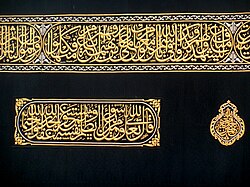 Textile cover of the Kaaba (called Kiswah) with Islamic inscriptions calligraphed in Arabic with golden threads
 -
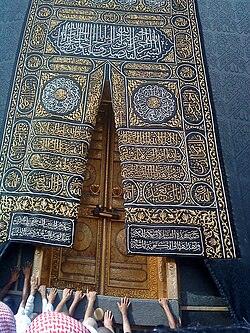 The Bāb at-Tawbah, "Door of Repentance"
 -
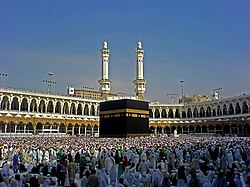
-
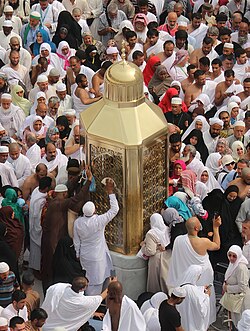 The Station of Ibrahim (Maqam Ibrahim)
 -
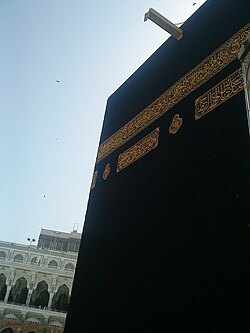 The Mīzāb al-Raḥmah
 -
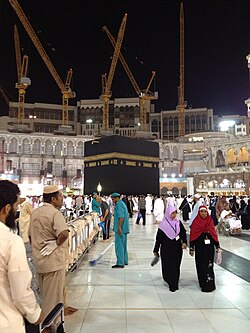 The Kaaba during an expansion phase in 2013


Written marble documents inside the Kaaba[edit | edit source]
Inside the Kaaba, there were nine engraved marble stones, all written in the Thuluth script, except for one which is written in prominent Kufic script. In the eastern wall between the door and the Gate of Repentance another document was added by the custodian of the Two Holy Mosques at the time Fahd of Saudi Arabia, regarding his expansion of the mosque, thus bringing the number of documents to ten, all of which are inscribed on white marble.[95]
Islamic sanctities received great attention from the Circassian sultans during the period in which they ruled the Islamic world (784–924 AH, 1382–1517 CE), with the Kaaba receiving significant attention. Of the ten marble slabs chronicling the architectural contributions of various rulers to Al-Masjid al-Haram, two of the slabs pertain to Circassian sultans.

One of these two records the achievements of one of the most notable circassians, Sultan Barsbay. The document, dated to 1423 (CE), attests to a wide reconstruction and restoration process in the mosque by the Sultan.[96] The inscription on the slab reads:
بسم الله الرحمن الرحيم ربنا تقبل منا انك انت السميع العليم تقرب الى الله تعالى بتجديد رخام هذا البيت المعظم المشرف العبد الفقير الى الله تعالى السلطان الملك الاشرف ابو النصر برسباي خادم الحرمين الشريفين بلغه الله اماله و زين بالصالحات اعماله بتاريخ سنة ست و عشرين و ثمان مئه
This translates to:
"In the name of God, the Most Compassionate, the Most Merciful. Our Lord, accept from us that you are the All-Hearing, the All-Knowing. Draw nearer to God Almighty by renewing the marble of this noble and honorable house. The poor servant of God Almighty, the honorable Sultan King Abu al-Nasr Barsbay, Custodian of the Two Holy Mosques. May God reach his hopes and adorn his deeds with good deeds. The year eight hundred and twenty-six AH"
.jpg)
The other of the two circassian slabs is dedicated to Barsbays son, Sultan Qaitbay, known for his great architectural achievements throughout the Islamic world. Dated to 1479 (CE), the document attests to a wide reconstruction and restoration process undertaken by Sultan Sultan Qaitbay for Al-Masjid Al-Haram.[97]
The inscription reads:
بسم الله الرحمن الرحيم ربنا تقبل منا انك انت السميع العليم أمر بتجيد ترخيم داخل البيت مولانا السلطان الأشرف أبو النصر قايتباي خلد الله ملكه يارب العالمين بتاريخ مستهل رجب الفرد عام أربع و ثمانين و ثمانمائة من الهجرة
Which translates to:
"In the name of God, the Most Compassionate, the Most Merciful. Our Lord, accept from us that You are the All-Hearing, the All-Knowing. He commanded the perfection of melodious chanting inside the house. Our Lord, the honorable and victorious Sultan Qaytbay, may God immortalize his kingdom, Lord of the worlds, on the first of the month of Rajab in the year eight hundred and eighty-four AH."
Significance in Islam[edit | edit source]
The Kaaba is the holiest site in Islam,[98] and is often called by names such as the Bayt Allah (Arabic: بيت الله, romanized: Bayt Allah, lit. 'House of Allah').[99][100] and Bayt Allah al-Haram (Arabic: بيت الله الحرام, romanized: Bayt Allah il-Haram, lit. 'The Sacred House of Allah').
Tawaf[edit | edit source]

Ṭawāf (Arabic: طَوَاف, lit. 'going about') is one of the Islamic rituals of pilgrimage and is compulsory during both the Hajj and Umrah. Pilgrims go around the Kaaba (the most sacred site in Islam) seven times in a counterclockwise direction; the first three at a hurried pace on the outer part of the Mataaf and the latter four times closer to the Kaaba at a leisurely pace.[101] The circling is believed to demonstrate the unity of the believers in the worship of the One God, as they move in harmony together around the Kaaba, while supplicating to God.[102][103] To be in a state of Wudu (ablution) is mandatory while performing tawaf as it is considered to be a form of worship ('ibadah).
Tawaf begins from the corner of the Kaaba with the Black Stone. If possible, Muslims are to kiss or touch it, but this is often not possible because of the large crowds. They are also to chant the Basmala and Takbir each time they complete one revolution. Hajj pilgrims are generally advised to "make ṭawāf" at least twice – once as part of the Hajj, and again before leaving Mecca.[104]
The five types of ṭawāf are:
- Ṭawāf al-Qudūm (arrival ṭawāf) is performed by those not residing in Mecca once reaching the Holy City.
- Ṭawāf aṭ-Ṭaḥīyah (greeting ṭawāf) is performed after entering al-Masjid al-Haram at any other times and is Mustahabb.
- Ṭawāf al-'Umrah (Umrah ṭawāf) refers to the ṭawāf performed specifically for Umrah.
- Ṭawāf al-Wadā' ("farewell ṭawāf") is performed before leaving Mecca.
- Ṭawāf az-Zīyārah (ṭawāf of visiting), Ṭawāf al-'Ifāḍah (ṭawāf of compensation) or Ṭawāf al-Ḥajj (Hajj ṭawāf) is performed after completing the Hajj.
The Tawaf has its origins in the religion of the Najranite pagans, who walked around the Kaaba in an act of devotion to their creator god, Allah (not to be confused with the monotheistic god of Islam by the same name). This practice was adopted by Mohammad after some reform.[105][106][107]
As the Qibla[edit | edit source]
The Qibla is the direction faced during prayer.[108] The direction faced during prayer is the direction of the Kaaba, relative to the person praying. Apart from praying, Muslims generally consider facing the Qibla while reciting the Quran to be a part of good etiquette.
Cleaning[edit | edit source]
The building is opened biannually for the ceremony of "The Cleaning of the Sacred Kaaba" (Arabic: تنظيف الكعبة المشرفة, romanized: Tanzif al-Ka'bat al-Musharrafah, lit. 'Cleaning of the Sacred Cube'). The ceremony takes place on the 1st of Sha'baan, the eighth month of the Islamic calendar, around thirty days before the start of the month of Ramadan and on the 15th of Muharram, the first month. The keys to the Kaaba are held by the Banī Shaybah (Arabic: بني شيبة) tribe, an honor bestowed upon them by Muhammad.[109] Members of the tribe greet visitors to the inside of the Kaaba on the occasion of the cleaning ceremony.[110]
The Governor of the Makkah Province and accompanying dignitaries clean the interior of the Kaaba using cloths dipped in Zamzam water scented with oud perfume. Preparations for the washing start a day before the agreed date, with the mixing of Zamzam water with several luxurious perfumes including Tayef rose, 'oud and musk. Zamzam water mixed with rose perfume is splashed on the floor and is wiped with palm leaves. Usually, the entire process is completed in two hours.[111]
[edit | edit source]
Many Islamic sources include Shia and Sunni sources (Al-Hakim al-Nishapuri,[112] Sibt ibn al-Jawzi,[113] Halabi Shafi'i,[114] Al-Fakihi,[115] Sheikh Abu Zakariyya al-Azdi,[116] Mahmud al-Alusi,[117] Ibn Sabbagh Maliki,[118] Ganji Shafi'i,[119] Saffuri Shafi'i,[120][121] Al-Masudi,[122][123] Zarandi Hanafi,[124][125] Amir San'ani[126]) have written that Ali ibn Abi Talib, the first Imam of the Shiites, was the only person to have been born in the Kaaba.[127][128][129]
See also[edit | edit source]
- Glossary of Islam
- Outline of Islam
- Al-Masjid an-Nabawi
- Bayt al-Mawlid, the house where Muhammad is believed to have been born
- List of largest mosques
- List of mosques in Saudi Arabia
- Miscellaneous Symbols and Pictographs (Unicode block), which contains a pictogram for the Kaaba, U+1F54B 🕋
Notes[edit | edit source]
- ↑ ALA-LC: al-KaTemplate:Ayinbah; DMG: al-KaTemplate:Ayinba; Wehr: al-kaTemplate:Ayinba Arabic pronunciation: [alˈkaʕba]
- ↑ ALA-LC: al-KaTemplate:Aynbah al-Musharrafah; DMG: al-Kaʿba al-Mušarrafa; Wehr: al-kaʿba al-mušarrafa Arabic pronunciation: [alˈkaʕba‿lmuˈʃarrafa]
- ↑ Hawting states 10 m (32 ft 10 in).[83]
References[edit | edit source]
- ↑ 1.0 1.1 Wensinck & Jomier 1978, p. 319.
- ↑ Butt, Riazat (15 August 2011). "Explosives detectors to be installed at gates of Mecca's Holy Mosque". The Guardian. Retrieved 23 May 2021.
- ↑ 3.0 3.1 Al-Azraqi (2003). Akhbar Mecca: History of Mecca. p. 262. ISBN 9773411273.
- ↑ 4.0 4.1 4.2 4.3 4.4 4.5 Wensinck & Jomier 1978, p. 317.
- ↑ Ayoub, M. (2013). Islam. Oneworld Publications. Retrieved 7 February 2025.
- ↑ Mubarakpuri 1976.
- ↑ "In pictures: Hajj pilgrimage". BBC News. 7 December 2008. Retrieved 8 December 2008.
- ↑ "Umrah Statistics Bulletin 2018" (PDF). General Authority for Statistics. Kingdom of Saudi Arabia. Archived from the original (PDF) on 6 June 2023. Retrieved 28 May 2022.
- ↑ Wher, Hans (1994). Dictionary of Modern Written Arabic.
- ↑ Atbuosh 2025, p. 78–79.
- ↑ 11.0 11.1 Wensinck & Jomier 1978, p. 318.
- ↑ Crone 2004.
- ↑ Atbuosh 2025.
- ↑ University of Southern California. "The Prophet of Islam – His Biography". Archived from the original on 21 July 2006. Retrieved 12 August 2006.
- ↑ Finster 2010, p. 83–86.
- ↑ Imoti, Eiichi (1979). "The Ka'ba-i Zardušt"". Orient. XV. The Society for Near Eastern Studies in Japan: 65–69.
- ↑ Durand 2019, p. 27, 27n41.
- ↑ von Grunebaum 1970, p. 24.
- ↑ Crone 2004, p. 7.
- ↑ Holland, Tom (2012). In the Shadow of the Sword. Little, Brown. p. 303.
- ↑ Haji Hassan, Abdullah Alwi (1994). Sales and Contracts in Early Islamic Commercial Law. Islamic Research Institute, International Islamic University. pp. 3 ff. ISBN 978-9694081366.
- ↑ Bowersock, Glen. W. (2017). The crucible of Islam. Cambridge (Mass.): Harvard University Press. pp. 50 ff.
- ↑ Webb 2023, p. 40.
- ↑ Robin 2015, p. 152.
- ↑ Webb 2023.
- ↑ Efendi, Caʻfer (1987). Risāle-i Miʻmāriyye. Brill Archive. p. 49. ISBN 90-04-07846-0.
- ↑ Kuran, Timur (2011). "Commercial Life under Islamic Rule". The Long Divergence: How Islamic Law Held Back the Middle East. Princeton University Press. pp. 45–62.
- ↑ 28.0 28.1 28.2 28.3 28.4 28.5 28.6 King, G. R. D. (2004). "The Paintings of the Pre-Islamic Kaʿba". Muqarnas. 21: 219–229. JSTOR 1523357.
- ↑ 29.0 29.1 Armstrong 2000, p. 11.
- ↑ 30.0 30.1 30.2 Ellenbogen, Josh; Tugendhaft, Aaron (18 July 2011). Idol Anxiety. Stanford University Press. p. 47. ISBN 9780804781817.
When Muhammad ordered his men to cleanse the Kaaba of the statues and pictures displayed there, he spared the paintings of the Virgin and Child and of Abraham.
- ↑ 31.0 31.1 Ibn Ishaq 1955, pp. 88–9.
- ↑ Peters, Francis E. (1994). Muhammad and the origins of Islam. SUNY Press. p. 109.
- ↑ Armstrong 1997, pp. 221–22.
- ↑ 34.0 34.1 "IN PICTURES: Six doors of Ka[[:Template:Ayin]]aba over 5,000 years". Al Arabiya. 26 December 2018. Retrieved 22 October 2019.
{{cite news}}: URL–wikilink conflict (help) - ↑ Ibn Ishaq 1955, p. 85 footnote 2: The text reads 'O God, do not be afraid', the second footnote reads 'The feminine form indicates the Ka'ba itself is addressed'
- ↑ Robin, Christian Julien (2012). Arabia and Ethiopia. In The Oxford Handbook of Late Antiquity. Oxford University Press USA. p. 304–305. ISBN 9780195336931.
- ↑ Neuwirth, Angelika; Nicolai Sinai, Michael (2010). The Qur'an in context historical and literary investigations into the Qur'anic milieu (PDF). Leiden: Brill. pp. 63, 123, 83, 295. ISBN 9789047430322. Archived from the original (PDF) on 2 October 2015.
- ↑ von Grunebaum 1970, p. 19.
- ↑ Crone 2004, pp. 134–137.
- ↑ 40.0 40.1 Morris, Ian D. (2018). "Mecca and Macoraba" (PDF). Al-ʿUṣūr Al-Wusṭā. 26: 1–60. Archived from the original (PDF) on 17 November 2018. Retrieved 16 November 2018.
- ↑ Siculus, Diodorus. "44". Bibliotheca Historica. Book 3.
- ↑ Gibbon, Edward (1862). The History of the Decline and Fall of the Roman Empire. Book 5. pp. 223–224.
- ↑ Michigan Consortium for Medieval and Early Modern Studies (1986). Goss, V. P.; Bornstein, C. V. (eds.). The Meeting of Two Worlds: Cultural Exchange Between East and West During the Period of the Crusades. Vol. 21. Medieval Institute Publications, Western Michigan University. p. 208. ISBN 0918720583. OCLC 13159056.
- ↑ Sway, Mustafa Abu. "The Holy Land, Jerusalem and Al-Aqsa Mosque in the Qur'an, Sunnah and other Islamic Literary Source" (PDF). Central Conference of American Rabbis. Archived from the original (PDF) on 28 July 2011.
- ↑ Dyrness, W. A. (29 May 2013). Senses of Devotion: Interfaith Aesthetics in Buddhist and Muslim Communities. Vol. 7. Wipf and Stock Publishers. p. 25. ISBN 978-1620321362. OCLC 855764827.
- ↑ Quran 3:96 (Translated by Yusuf Ali)
- ↑ Quran 22:26 (Translated by Yusuf Ali)
- ↑ Quran 2:127 (Translated by Yusuf Ali)
- ↑ Tafsir Ibn Kathir 3:96
- ↑ Template:Href
- ↑ "A history of the Al Asqa Mosque". Arab World Books.
- ↑ "Ottomans : religious painting". Retrieved 1 May 2016.
- ↑ Guillaume, A. (1955). The Life of Muhammad. Oxford: Oxford University Press. pp. 84–87
- ↑ Mubarakpuri 1976, "Muhammad's Birth and Forty Years prior to Prophethood".
- ↑ Glasse, Cyril (2001). New Encyclopedia of Islam. Rowman Altamira. p. 245. ISBN 0-7591-0190-6.
- ↑ "Surah Al-Isra - 1-111". Quran.com. Retrieved 28 February 2024.
- ↑ Mubarakpuri 1976, p. 130.
- ↑ Mubarakpuri 1976, p. 213.
- ↑ Lapidus, Ira M. (13 October 2014). A history of Islamic societies. Cambridge University Press. ISBN 9780521514309. OCLC 853114008.
- ↑ Ibn Ishaq 1955, p. 552: Quraysh had put pictures in the Ka'ba including two of Jesus son of Mary and Mary (on both of whom be peace!). ... The apostle ordered that the pictures should be erased except those of Jesus and Mary.
- ↑ Rogerson, Barnaby (2003). The Prophet Muhammad: A Biography. Paulist Press. p. 190. ISBN 9781587680298.
Muhammad raised his hand to protect an icon of the Virgin and Child and a painting of Abraham, but otherwise his companions cleared the interior of its clutter of votive treasures, cult implements, statuettes and hanging charms.
- ↑ Petrie, W. M. Flinders; Helmolt, Hans F.; Lee-Warner, William; et al. (1915). The Book of History: A History of All Nations From the Earliest Times to the Present. The Grolier Society.
- ↑ Mubarakpuri 1976, p. 298.
- ↑ Selwood, Dominic (31 October 2017). "On this day in 683 AD: The Kaaba, the holiest site in Islam, is burned to the ground". The Telegraph. Archived from the original on 11 January 2022.
- ↑ 65.0 65.1 Ibn Khaldun, Abd al-Rahman (1967) [1377]. "IV. Countries and cities, and all other forms of sedentary civilization. The conditions occurring there. Primary and secondary considerations in this connection.". Al-Muqaddimah [An Introduction to History]. Bollingen series. Vol. 2. Translated by Rosenthal, Franz (2 ed.). Princeton, N. J.: Princeton University Press (published 1980). pp. 253–255. ISBN 0-691-09797-6.
- ↑ Office of the Blessed Mantle, Topkapı Palace Museum; Aydın, Hilmi; Uğurluel, Talha; Doğru, Ahmet (2004). The sacred trusts: Pavilion of the Sacred Relics, Topkapı Palace Museum, Istanbul. Somerset, New Jersey: Light. ISBN 1-932099-72-7. OCLC 56942620.
- ↑ Burton, Richard Francis (2009). Personal Narrative of a Pilgrimage to El-Medinah and Meccah. Cambridge: Cambridge University Press. doi:10.1017/cbo9781139162302. hdl:2027/coo.31924062544543. ISBN 978-1-139-16230-2.
- ↑ 68.0 68.1 Peters, F. E. (1994). Mecca: a literary history of the Muslim Holy Land. Mazal Holocaust Collection. Princeton, New Jersey: Princeton University Press. ISBN 0-691-03267-X. OCLC 30671443.
- ↑ Ghamidi, Javed Ahmad. "The Rituals of Hajj and 'Umrah". renaissance.com.pk. Translated by Saleem, Shehzad. Mizan, Al-Mawrid. Archived from the original on 7 March 2010.
- ↑ 70.0 70.1 Le Naour, Jean-Yves (2017). Djihad 1914-1918 (in français). Éditions Perrin. doi:10.3917/perri.lenao.2017.01. ISBN 978-2-262-07083-0.
- ↑ 71.0 71.1 Murphy, David (18 November 2008). The Arab Revolt 1916–18: Lawrence sets Arabia ablaze. Bloomsbury USA. ISBN 978-1-84603-339-1. OCLC 212855786.
- ↑ Jerald L. Thompson (December 1981). H. St. John Philby, Ibn Saud and Palestine (MA thesis). University of Kansas.
- ↑ 73.0 73.1 Amin K. Tokumasu. "Cultural Relations between Saudi Arabia and Japan from the Time of King Abdulaziz to the Time of King Fahd". Darah. Archived from the original on 8 July 2013. Retrieved 2 January 2013.
- ↑ 74.0 74.1 Halliburton, Richard (24 June 1935). "Ibn Saud, King of Arabia, Goes out from Mecca to Grant an Interview". The Kansas City Star. p. 16. Retrieved 1 August 2025 – via newspapers.com.
Two of the assassins, in the shadow of the Kaaba, were hacked to pieces; and the third, breaking free...was overtaken and struck down.
- ↑ Baker, Robert L. (May 1935). "Arab King Escapes Assassins". Current History. 42 (2): 218–220. Retrieved 1 August 2025 – via JSTOR.
While the Emir Suad grappled with the leader the King's alert bodyguard killed the would-be regicides.
- ↑ "Banknotes & Coins: 500 Rials". Central Bank of Iran. Archived from the original on 3 February 2021. Retrieved 24 March 2009.
- ↑ "Banknotes & Coins: 2000 Rials". Central Bank of Iran. Archived from the original on 9 March 2022. Retrieved 24 March 2009.
- ↑ Armstrong 1997, p. 221.
- ↑ Hoyland, Robert G. (1997). Seeing Islam as others saw it. The Darwin Press. p. 187.
- ↑ Crown, Alan David (2001). Samaritan Scribes and Manuscripts'. Tübingen: Mohr Siebeck. p. 27.
- ↑ Gaster, Moses (1927). The Asatir: the Samaritan book of Moses. London: The Royal Asiatic Society. pp. 71, 262.
Ishmaelites built Mecca (Baka, Bakh)
- ↑ 82.0 82.1 Peterson, Andrew (1996). Dictionary of Islamic Architecture. London: Taylor & Francis. p. 142.
- ↑ 83.0 83.1 Hawting 2003, p. 75.
- ↑ "Saudi Arabia's Top Artist Ahmad bin Ibrahim Passes Away". Khaleej Times. 9 November 2009. Archived from the original on 30 September 2012. Retrieved 15 October 2010.
- ↑ According to Muslim tradition: "God made the stone under Ibrahim's feet into something like clay so that his feet sunk into it. That was a miracle. It was transmitted on the authority of Abu Ja'far al-Baqir (may peace be upon him) that he said: Three stones were sent down from the Garden: the Station of Ibrahim, the rock of the children of Israel, and the Black Stone, which God entrusted Ibrahim with as a white stone. It was whiter than paper, but became black from the sins of the children of Adam." (The Hajj, F.E. Peters 1996)
- ↑ 86.0 86.1 Hawting 2003, p. 76.
- ↑ "'House of God' Kaaba gets new cloth". The Age. Melbourne, Australia. 11 February 2003. Retrieved 17 August 2006.
- ↑ "The Kiswa – (Kaaba Covering)". Al-Islaah Publications. Retrieved 17 August 2006.
{{cite web}}: CS1 maint: deprecated archival service (link) - ↑ 89.0 89.1 Porter, Venetia (2012). "Textiles of Mecca and Medina". In Porter, Venetia (ed.). Hajj: journey to the heart of Islam. Cambridge, Mass.: The British Museum. pp. 257–258. ISBN 978-0-674-06218-4. OCLC 709670348.
- ↑ Ghazal, Rym (28 August 2014). "Woven with devotion: the sacred Islamic textiles of the Kaaba". The National. Retrieved 7 January 2021.
- ↑ Nassar, Nahla (2013). "Dar al-Kiswa al-Sharifa: Administration and Production". In Porter, Venetia; Saif, Liana (eds.). The Hajj: collected essays. London: The British Museum. pp. 176–178. ISBN 978-0-86159-193-0. OCLC 857109543.
- ↑ Key to numbered parts translated from, accessed 2 December
- ↑ Ruggles, Clive L. N. (2005). Ancient astronomy: an encyclopedia of cosmologies and myth (Illustrated ed.). ABC-CLIO. p. 202. ISBN 978-1-85109-477-6.
- ↑ Teresi, Dick (2003). Lost Discoveries: The Ancient Roots of Modern Science—from the Babylonians to the Maya (Reprint, illustrated ed.). Simon and Schuster. p. 137. ISBN 978-0-7432-4379-7.
- ↑ "The Holy Kaaba". gph.gov.sa. 28 May 2020.
- ↑ Alsheerf, Prof Adnan (1 January 2011). أعمال الأشرف برسباي بالمسجد الحرام في ضوء نقش مؤرخ بسنة 826هـ/1423م محفوظ بالكعبة المشرفة دراسة أثرية حضارية. كتاب المؤتمر الرابع عشر للاتحاد العام للاثاريين العرب (in العربية).
- ↑ Bāsalāmah, Ḥusayn ʻAbd Allāh (2000). تاريخ الكعبة المعظمة: عمارتها وكسوتها وسدانتها (in العربية). مكتبة الثقافة الدينية،. ISBN 978-977-5250-63-6.
- ↑ Wright, Lyn; Kramer, John; Fusco, Angela. (2012), Dad's house, mom's house, National Film Board of Canada, OCLC 812009749
- ↑ The Basis for the Building Work of God p. 37, Witness Lee, 2003
- ↑ Al-Muwatta Of Iman Malik Ibn Ana, p. 186, Anas, 2013
- ↑ Ruqaiyyah Maqsood (1994), World Faiths, teach yourself – Islam, Hodder & Stoughton, p. 76, ISBN 0-340-60901-X
- ↑ Shariati, Ali (2005). HAJJ: Reflection on Its Rituals. Islamic Publications International. ISBN 1-889999-38-5.
- ↑ Denny, Frederick Mathewson (2010). An Introduction to Islam. Prentice Hall. ISBN 978-0-13814477-7.
- ↑ Mohamed, Mamdouh N. (1996). Hajj to Umrah: From A to Z. Mamdouh Mohamed. ISBN 0-915957-54-X.
- ↑ Al-Nahee, Owed Abdullah (2016). "The Historical Development of Paganism in Najran during the Pre- and Early Islamic Era (524–641 CE)". Proceedings of the Eighth Saudi Students Conference in the UK. pp. 13–24. doi:10.1142/9781783269150_0002. ISBN 978-1-78326-914-3.
- ↑ Assasi, Reza. "Kaaba a house built under the Sun".
- ↑ Peters, Francis E. Muhammad and the Origins of Islam.
- ↑ Template:Qref
- ↑ "الرسول شرّف بني شيبة بحمل مفتاح الكعبة حتى قيام الساعة". Al Khaleej.
- ↑ "Kaaba". Retrieved 15 October 2010.
{{cite web}}: CS1 maint: deprecated archival service (link) - ↑ "This is how the Kaaba is washed". Al Arabiya English. 17 October 2016. Retrieved 8 July 2020.
- ↑ Al-Mustadrak ala al-Sahihayn, Volume 3, Page 550.
- ↑ Tazkerat al-Khawas, Page 10.
- ↑ Al-Sirat al-Halabia, Volume 3, Page 485.
- ↑ Ikhbar al-Mecca, Volume 3, Page 226.
- ↑ Tarikh Mosul, Kitab al-Salis al-Ashar, Page 58.
- ↑ Sarah al-Kharidah, Pages 3 and 15.
- ↑ Al-Fosul al-Mohemmah, Page 29.
- ↑ Kefayat al-Talib fi Manaqibi Ali ibn Abi Talib, Pages 405-406.
- ↑ Nazhat al-Majalis, Page 159.
- ↑ Mokhtasar al-Mahaasein al-Mojtama'ah, Page 156.
- ↑ Isbat al-Vasia'ah, Page 142.
- ↑ The Meadows of Gold, Volume 2, Page 273.
- ↑ Ma'arej al-Vosul, Page 49.
- ↑ Nazm Dorrar al-Samtein, Page 76.
- ↑ Al-Rozat al-Nadiyyah, Page 36.
- ↑ "تنها کسی که در خانه خدا بدنیا آمد" [The only one born in the house of God] (in فارسی). Retrieved 27 February 2025.
- ↑ "اسناد تاریخی درباره ولادت امام علی(ع) در کعبه" [Historical documents about the birth of Imam Ali (AS) in the Kaaba] (in فارسی). Retrieved 27 February 2025.
- ↑ "زندگینامه امام علی (ع)/ تنها کسی که در خانه خدا به دنیا آمد" [Biography of Imam Ali (AS)/ The only one who was born in the house of God] (in فارسی). Retrieved 27 February 2025.
Bibliography[edit | edit source]
- Al-Kalbi, Hisham Ibn (1952). The book of Idols. Translated by Faris, Nabih Amin, (with introduction and notes).
{{cite book}}: CS1 maint: postscript (link) - Armstrong, Karen (1997). [[[:Template:Google books URL]] Jerusalem: One City, Three Faiths]. HarperCollins. ISBN 9780345391681.
{{cite book}}: Check|url=value (help) - Armstrong, Karen (2000). Islam: A Short History. Random House Publishing. ISBN 0-8129-6618-X.
- Atbuosh, Mohammed (2025). "South Arabian etymology for the Meccan Kaʿbah". Bulletin of the School of Oriental and African Studies. 88: 71–81.
- Crone, Patricia (2004) [1987]. Meccan Trade and the Rise of Islam (PDF). Piscataway, New Jersey: Gorgias. ISBN 1-59333-102-9.
- Durand, Jean-Marie (2019). "Le Culte Des Bétyles Dans La Documentation Cunéiforme DʾÉpoque Amorrite" (PDF). In Römer, Thomas; Gonzalez, Hervé; Marti, Lionel (eds.). Représenter dieux et hommes dans le Proche-Orient ancien et dans la Bible. pp. 15–37.
- Finster, Barbara (2010). "Arabia in Late Antiquity: An Outline of the Cultural Situation in the Peninsula at the Time of Muhammad" (PDF). In Neuwirth, Angelika; Sinai, Nicolai; Marx, Michael (eds.). The Qur'an in Context. Historical and Literary Investigations into the Qur'anic Milieu. Brill. pp. 61–114.
- Hawting, G. R. (2003). "Kaʿba". Encyclopaedia of the Qurʾān. Vol. 3: J-O. pp. 75–80.
- Ibn Ishaq, Muhammad (1955). Sirat Rasul Allah [The Life of Muhammad]. Translated by Guillaume, Alfred. Oxford: Oxford University Press. ISBN 9780196360331.
- Mohamed, Mamdouh N. (1996). Hajj to Umrah: From A to Z. Amana Publications. ISBN 0-915957-54-X.
- Mubarakpuri, Safiur Rahman (1976). Ar-Raheeq Al-Makhtum [The Sealed Nectar] (PDF) (in العربية). Translated by Diab, Issam. Archived from the original (PDF) on 24 March 2018.
- Peterson, Andrew (1997). Dictionary of Islamic Architecture. London: Routledge.
- Robin, Christian J. (2015). "Ḥimyar, Aksūm, and Arabia Deserta in Late Antiquity. The Epigraphic Evidence". In Fisher, Greg (ed.). Arabs and Empires before Islam. Oxford University Press. pp. 127–171.
- von Grunebaum, G. E. (1970). Classical Islam: A History 600 A.D. to 1258 A.D.. Aldine Publishing Company. ISBN 978-0-202-30767-1.
- Webb, Peter (2023). "The Hajj Before Muhammad: The Early Evidence in Poetry and Hadith". Millennium. 20 (1): 33–63. doi:10.1515/mill-2023-0004. hdl:1887/3674390.
- Wensinck, A. J. & Jomier, J. (1978). "Ka'ba". In van Donzel, E.; Lewis, B.; Pellat, Ch. & Bosworth, C. E. (eds.). Encyclopaedia of Islam. Volume IV: Iran–Kha (2nd ed.). Leiden: E. J. Brill. pp. 317–322. OCLC 758278456.
- [1915] The Book of History, a History of All Nations From the Earliest Times to the Present, Viscount Bryce (Introduction), The Grolier Society.
External links[edit | edit source]
- Ka'bah info: Everything you want to know about the Holy Ka'bah Archived 1 May 2009 at the Wayback Machine
- SA's Official Live Webcam of the Kaaba
- Former door of the Kaaba (ca. 1635)
- Kaaba | Definition, Interior, Black Stone, & Fact
- The Kaaba (article) | Islam
- The Kaaba
- Mecca pilgrimage: 10 things to know about the Kaaba
- About The Ka'aba
- The History Of Kaaba
- Kaaba - Hajj
Template:Characters and names in the Quran Template:Hajj topics Template:Holiest sites in Shia Islam
- Pages with Arabic IPA
- Pages using the JsonConfig extension
- Pages using infobox mapframe with missing coordinates
- Kaaba
- Religious buildings and structures converted into mosques
- Geography in the medieval Islamic world
- Hajj
- Masjid al-Haram
- Islamic architecture
- Arabic architecture
- Buildings and structures in Mecca